Cambridge A Level English General Paper 8021 — 2020 Oct/Nov Paper 1 · Variant 3
8021/13/O/N/20 · 30 marks · ≈34 min
The question paper and its mark scheme, free to read here and free to download. This is Cambridge’s own paper, exactly as it was sat.
Question paper4 pages


Mark scheme16 pages
Answers below. Sit the paper first if you are practising.
Paper as text
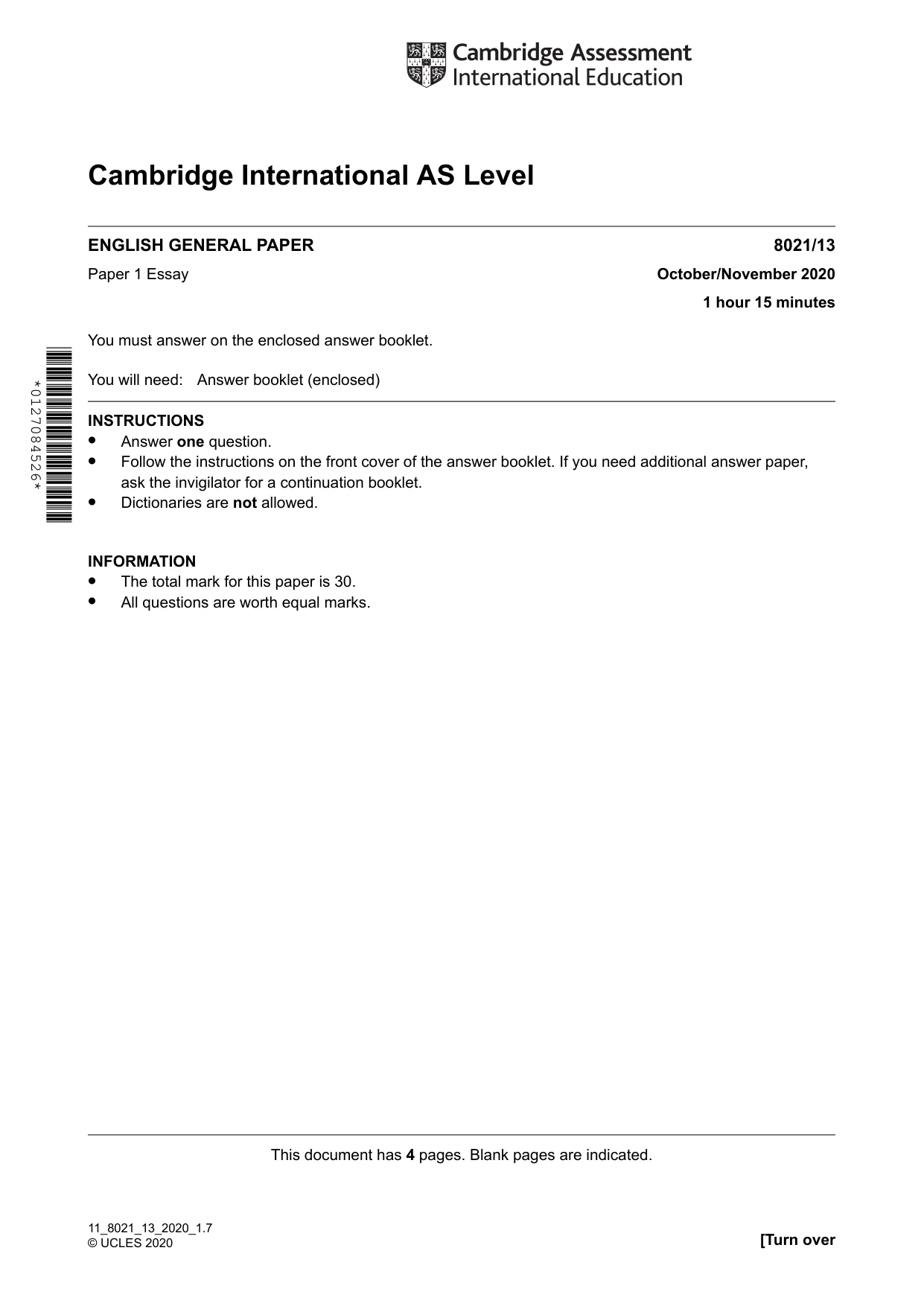
Question paper, page 1
Cambridge International AS Level 8021/13 October/November 2020 1 hour 15 minutes ENGLISH GENERAL PAPER Paper 1 Essay You must answer on the enclosed answer booklet. You will need: Answer booklet (enclosed) INSTRUCTIONS • Answer one question. • Follow the instructions on the front cover of the answer booklet. If you need additional answer paper, ask the invigilator for a continuation booklet. • Dictionaries are not allowed. INFORMATION • The total mark for this paper is 30. • All questions are worth equal marks. This document has 4 pages. Blank pages are indicated. [Turn over 11_8021_13_2020_1.7 © UCLES 2020 *0127084526*
Question paper, page 2
BLANK PAGE 11_8021_13_2020_1.7 © UCLES 2020 2
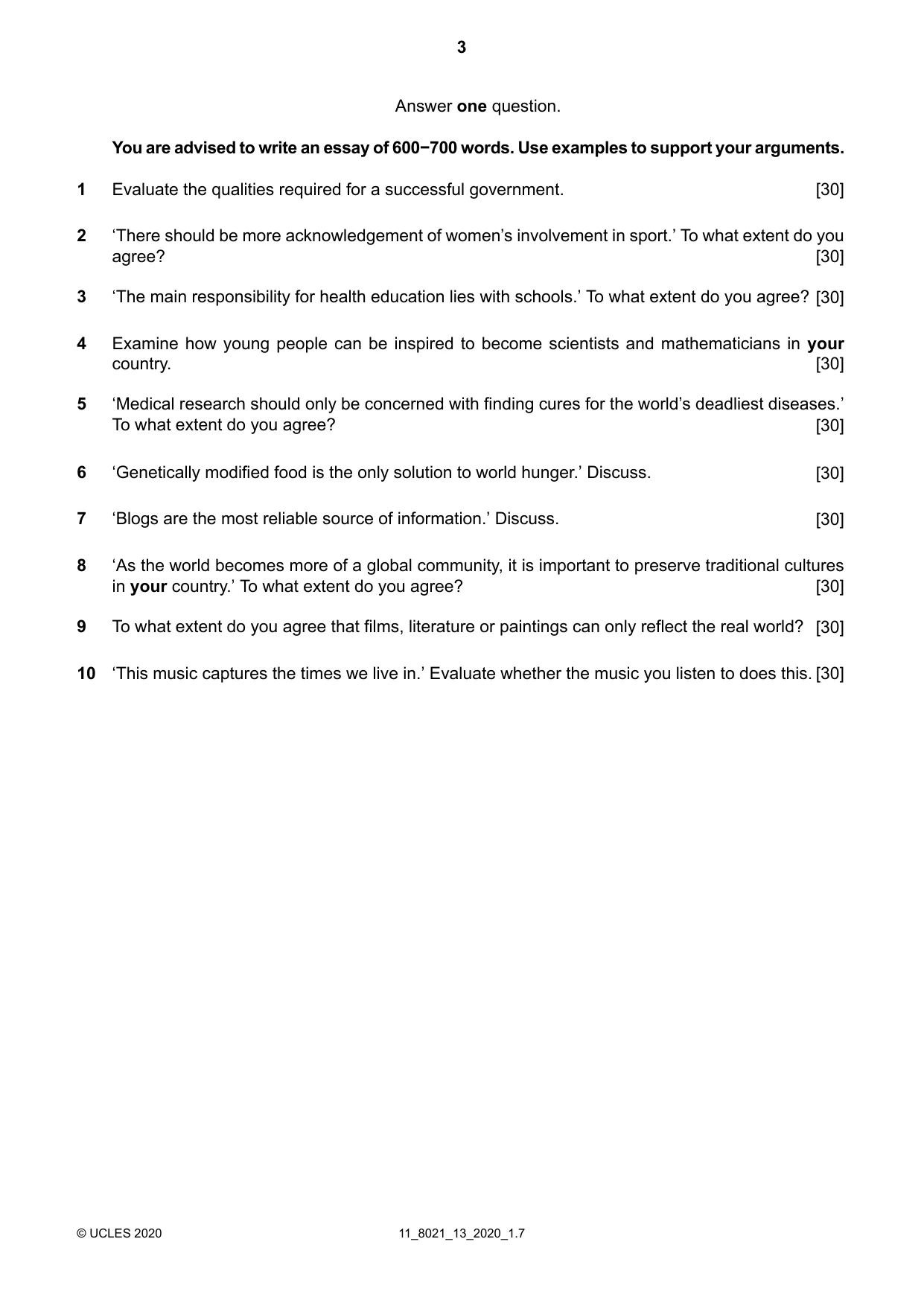
Question paper, page 3
Answer one question. You are advised to write an essay of 600−700 words. Use examples to support your arguments. Evaluate the qualities required for a successful government. [30] 1 ‘There should be more acknowledgement of women’s involvement in sport.’ To what extent do you agree? [30] 2 ‘The main responsibility for health education lies with schools.’ To what extent do you agree? [30] 3 Examine how young people can be inspired to become scientists and mathematicians in your country. [30] 4 ‘Medical research should only be concerned with finding cures for the world’s deadliest diseases.’ To what extent do you agree? [30] 5 ‘Genetically modified food is the only solution to world hunger.’ Discuss. [30] 6 ‘Blogs are the most reliable source of information.’ Discuss. [30] 7 ‘As the world becomes more of a global community, it is important to preserve traditional cultures in your country.’ To what extent do you agree? [30] 8 To what extent do you agree that films, literature or paintings can only reflect the real world? [30] 9 ‘This music captures the times we live in.’ Evaluate whether the music you listen to does this. [30] 10 11_8021_13_2020_1.7 © UCLES 2020 3
Question paper, page 4
BLANK PAGE Permission to reproduce items where third-party owned material protected by copyright is included has been sought and cleared where possible. Every reasonable effort has been made by the publisher (UCLES) to trace copyright holders, but if any items requiring clearance have unwittingly been included, the publisher will be pleased to make amends at the earliest possible opportunity. To avoid the issue of disclosure of answer-related information to candidates, all copyright acknowledgements are reproduced online in the Cambridge Assessment International Education Copyright Acknowledgements Booklet. This is produced for each series of examinations and is freely available to download at www.cambridgeinternational.org after the live examination series. Cambridge Assessment International Education is part of the Cambridge Assessment Group. Cambridge Assessment is the brand name of the University of Cambridge Local Examinations Syndicate (UCLES), which itself is a department of the University of Cambridge. 11_8021_13_2020_1.7 © UCLES 2020 4
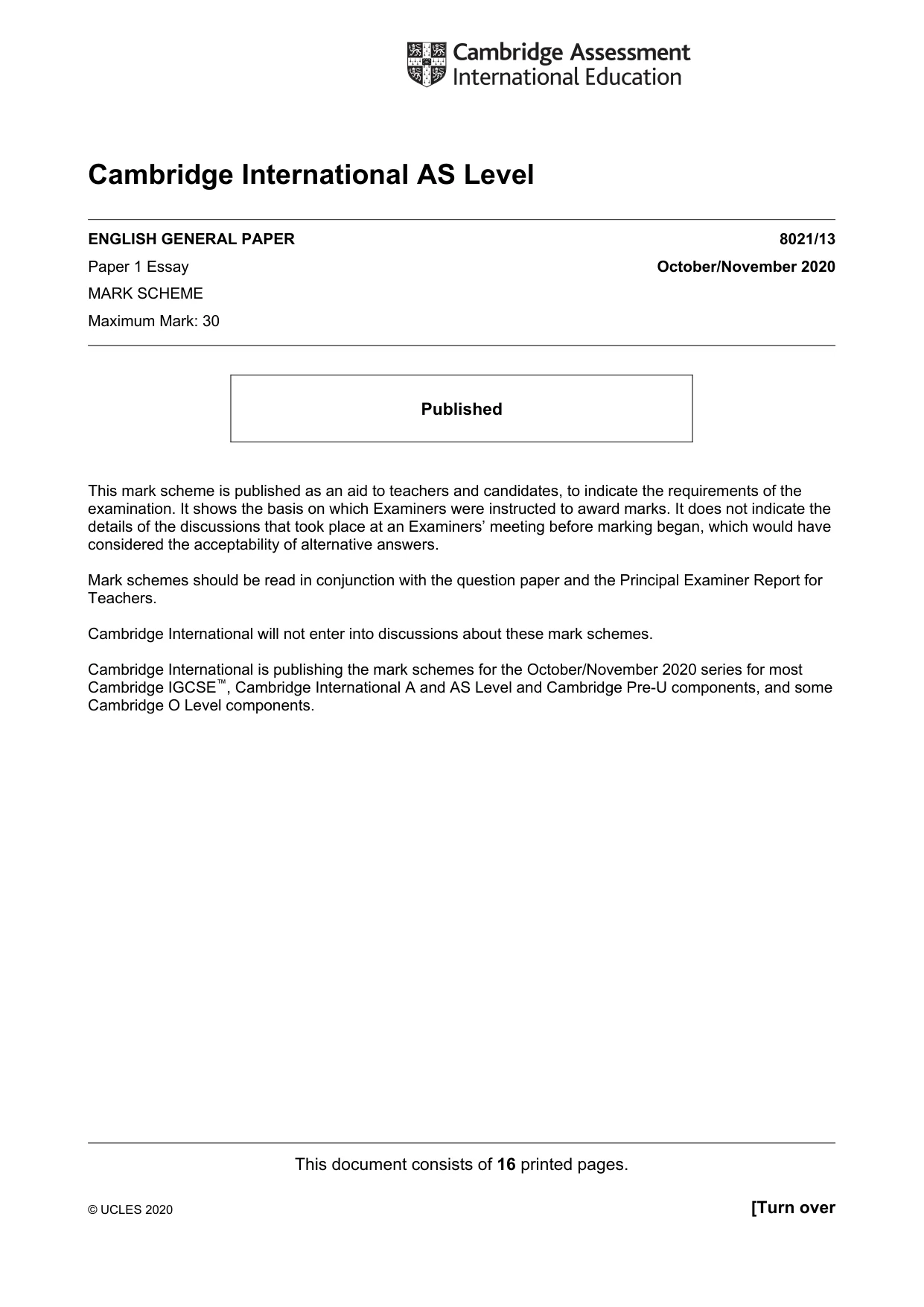
Mark scheme, page 1
This document consists of 16 printed pages. © UCLES 2020 [Turn over Cambridge International AS Level ENGLISH GENERAL PAPER 8021/13 Paper 1 Essay October/November 2020 MARK SCHEME Maximum Mark: 30 Published This mark scheme is published as an aid to teachers and candidates, to indicate the requirements of the examination. It shows the basis on which Examiners were instructed to award marks. It does not indicate the details of the discussions that took place at an Examiners’ meeting before marking began, which would have considered the acceptability of alternative answers. Mark schemes should be read in conjunction with the question paper and the Principal Examiner Report for Teachers. Cambridge International will not enter into discussions about these mark schemes. Cambridge International is publishing the mark schemes for the October/November 2020 series for most Cambridge IGCSE™, Cambridge International A and AS Level and Cambridge Pre-U components, and some Cambridge O Level components.
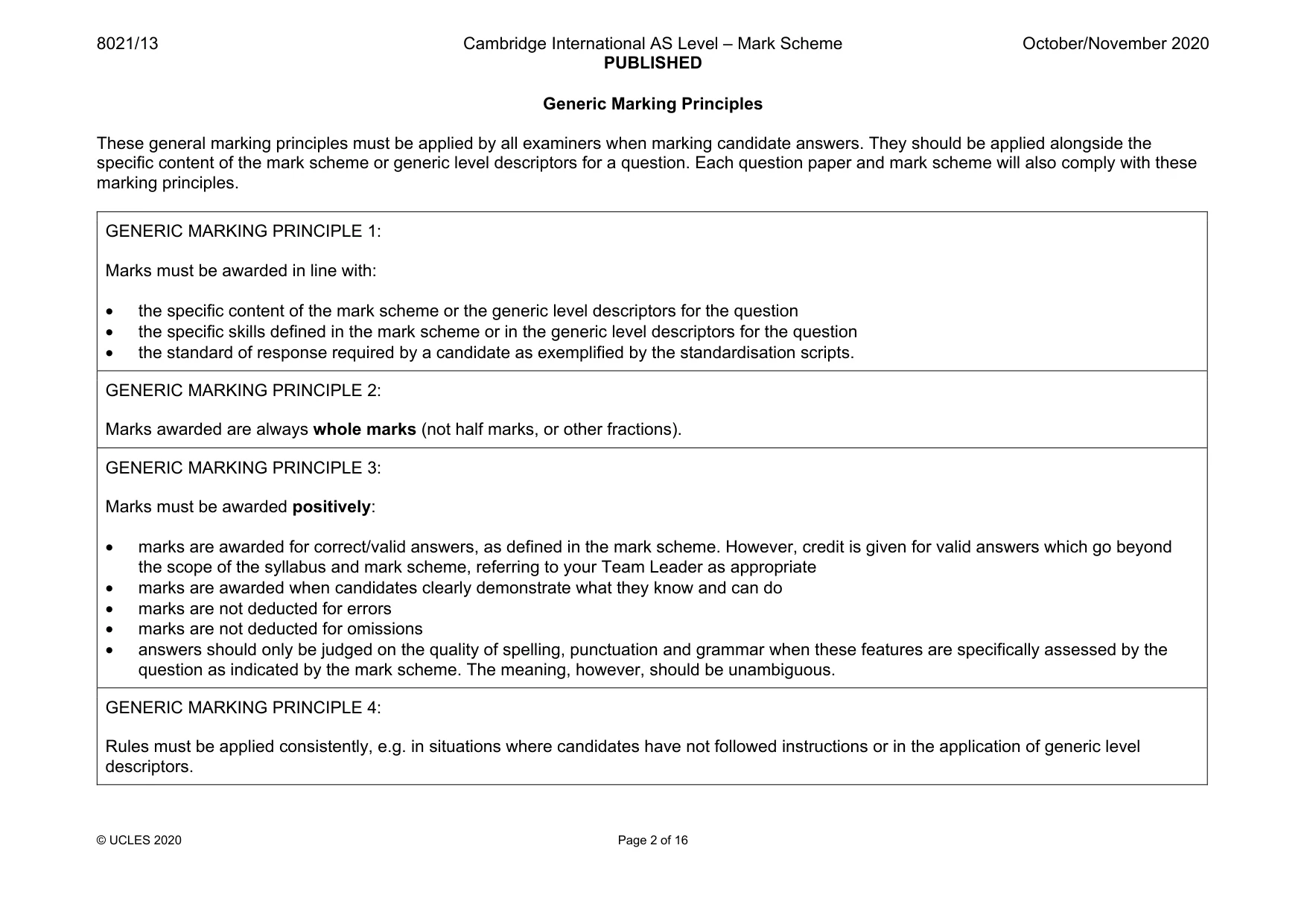
Mark scheme, page 2
8021/13 Cambridge International AS Level – Mark Scheme PUBLISHED October/November 2020 © UCLES 2020 Page 2 of 16 Generic Marking Principles These general marking principles must be applied by all examiners when marking candidate answers. They should be applied alongside the specific content of the mark scheme or generic level descriptors for a question. Each question paper and mark scheme will also comply with these marking principles. GENERIC MARKING PRINCIPLE 1: Marks must be awarded in line with: • the specific content of the mark scheme or the generic level descriptors for the question • the specific skills defined in the mark scheme or in the generic level descriptors for the question • the standard of response required by a candidate as exemplified by the standardisation scripts. GENERIC MARKING PRINCIPLE 2: Marks awarded are always whole marks (not half marks, or other fractions). GENERIC MARKING PRINCIPLE 3: Marks must be awarded positively: • marks are awarded for correct/valid answers, as defined in the mark scheme. However, credit is given for valid answers which go beyond the scope of the syllabus and mark scheme, referring to your Team Leader as appropriate • marks are awarded when candidates clearly demonstrate what they know and can do • marks are not deducted for errors • marks are not deducted for omissions • answers should only be judged on the quality of spelling, punctuation and grammar when these features are specifically assessed by the question as indicated by the mark scheme. The meaning, however, should be unambiguous. GENERIC MARKING PRINCIPLE 4: Rules must be applied consistently, e.g. in situations where candidates have not followed instructions or in the application of generic level descriptors.
Mark scheme, page 3
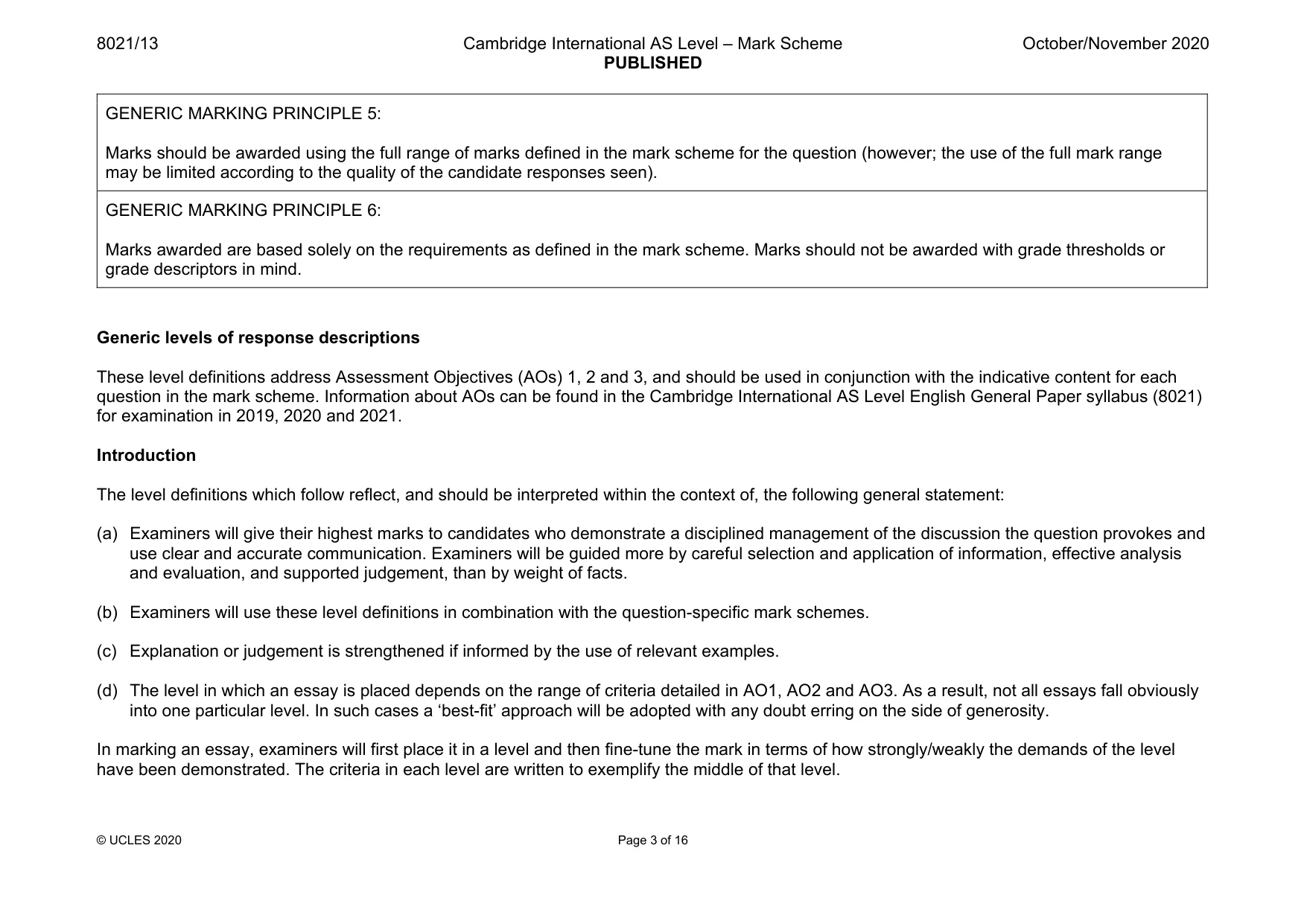
8021/13 Cambridge International AS Level – Mark Scheme PUBLISHED October/November 2020 © UCLES 2020 Page 3 of 16 GENERIC MARKING PRINCIPLE 5: Marks should be awarded using the full range of marks defined in the mark scheme for the question (however; the use of the full mark range may be limited according to the quality of the candidate responses seen). GENERIC MARKING PRINCIPLE 6: Marks awarded are based solely on the requirements as defined in the mark scheme. Marks should not be awarded with grade thresholds or grade descriptors in mind. Generic levels of response descriptions These level definitions address Assessment Objectives (AOs) 1, 2 and 3, and should be used in conjunction with the indicative content for each question in the mark scheme. Information about AOs can be found in the Cambridge International AS Level English General Paper syllabus (8021) for examination in 2019, 2020 and 2021. Introduction The level definitions which follow reflect, and should be interpreted within the context of, the following general statement: (a) Examiners will give their highest marks to candidates who demonstrate a disciplined management of the discussion the question provokes and use clear and accurate communication. Examiners will be guided more by careful selection and application of information, effective analysis and evaluation, and supported judgement, than by weight of facts. (b) Examiners will use these level definitions in combination with the question-specific mark schemes. (c) Explanation or judgement is strengthened if informed by the use of relevant examples. (d) The level in which an essay is placed depends on the range of criteria detailed in AO1, AO2 and AO3. As a result, not all essays fall obviously into one particular level. In such cases a ‘best-fit’ approach will be adopted with any doubt erring on the side of generosity. In marking an essay, examiners will first place it in a level and then fine-tune the mark in terms of how strongly/weakly the demands of the level have been demonstrated. The criteria in each level are written to exemplify the middle of that level.
Mark scheme, page 4
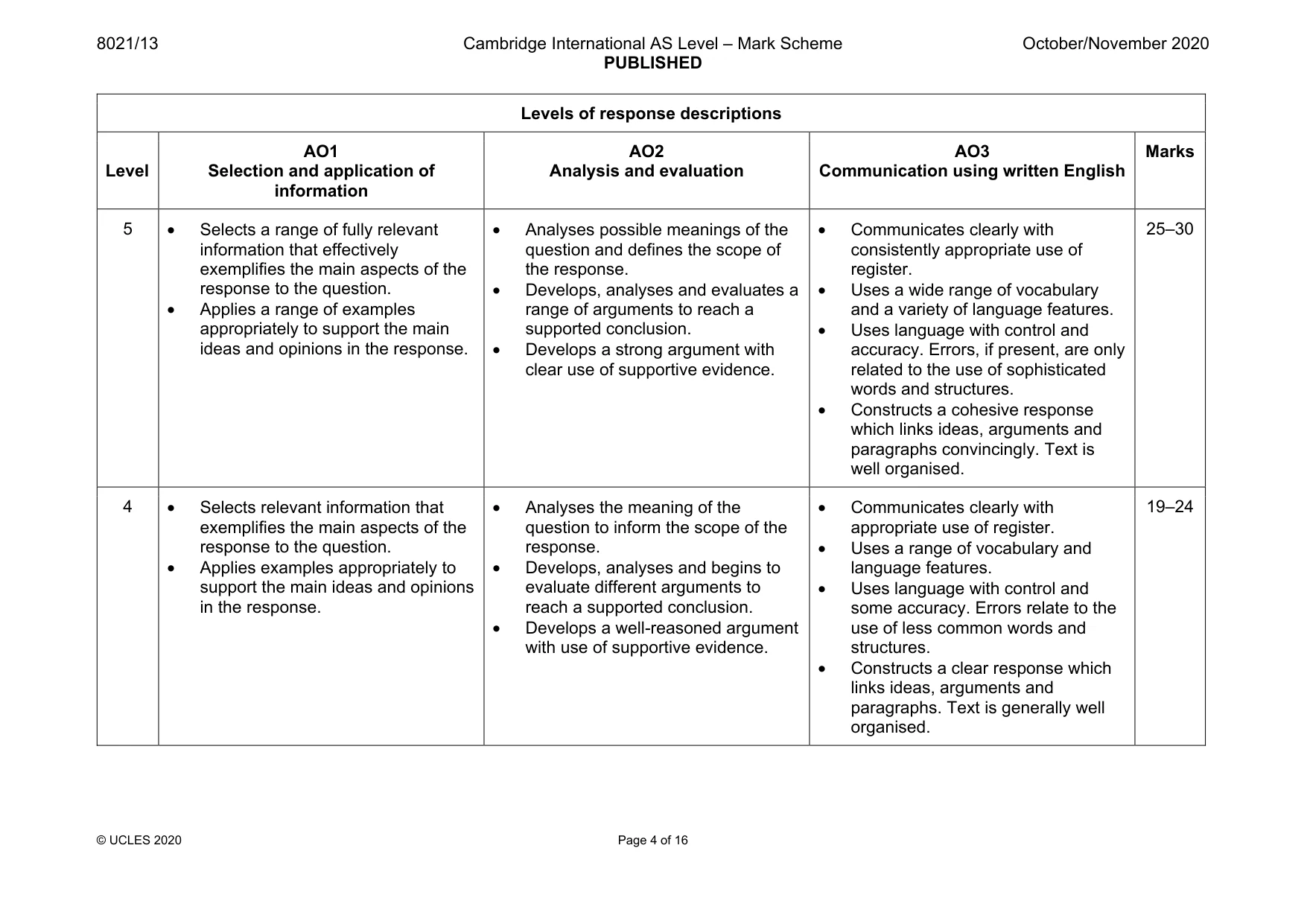
8021/13 Cambridge International AS Level – Mark Scheme PUBLISHED October/November 2020 © UCLES 2020 Page 4 of 16 Levels of response descriptions Level AO1 Selection and application of information AO2 Analysis and evaluation AO3 Communication using written English Marks 5 • Selects a range of fully relevant information that effectively exemplifies the main aspects of the response to the question. • Applies a range of examples appropriately to support the main ideas and opinions in the response. • Analyses possible meanings of the question and defines the scope of the response. • Develops, analyses and evaluates a range of arguments to reach a supported conclusion. • Develops a strong argument with clear use of supportive evidence. • Communicates clearly with consistently appropriate use of register. • Uses a wide range of vocabulary and a variety of language features. • Uses language with control and accuracy. Errors, if present, are only related to the use of sophisticated words and structures. • Constructs a cohesive response which links ideas, arguments and paragraphs convincingly. Text is well organised. 25–30 4 • Selects relevant information that exemplifies the main aspects of the response to the question. • Applies examples appropriately to support the main ideas and opinions in the response. • Analyses the meaning of the question to inform the scope of the response. • Develops, analyses and begins to evaluate different arguments to reach a supported conclusion. • Develops a well-reasoned argument with use of supportive evidence. • Communicates clearly with appropriate use of register. • Uses a range of vocabulary and language features. • Uses language with control and some accuracy. Errors relate to the use of less common words and structures. • Constructs a clear response which links ideas, arguments and paragraphs. Text is generally well organised. 19–24
Mark scheme, page 5
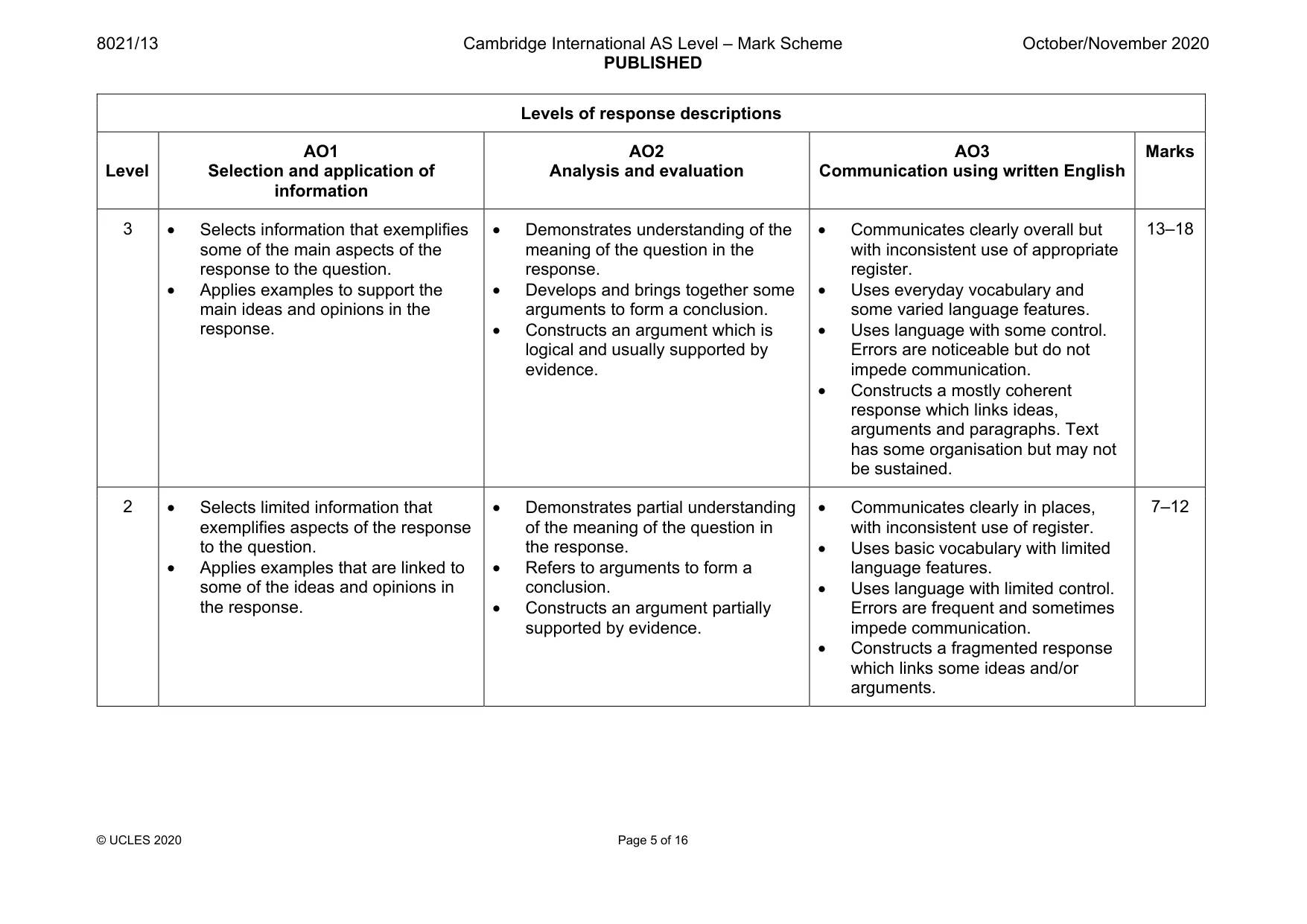
8021/13 Cambridge International AS Level – Mark Scheme PUBLISHED October/November 2020 © UCLES 2020 Page 5 of 16 Levels of response descriptions Level AO1 Selection and application of information AO2 Analysis and evaluation AO3 Communication using written English Marks 3 • Selects information that exemplifies some of the main aspects of the response to the question. • Applies examples to support the main ideas and opinions in the response. • Demonstrates understanding of the meaning of the question in the response. • Develops and brings together some arguments to form a conclusion. • Constructs an argument which is logical and usually supported by evidence. • Communicates clearly overall but with inconsistent use of appropriate register. • Uses everyday vocabulary and some varied language features. • Uses language with some control. Errors are noticeable but do not impede communication. • Constructs a mostly coherent response which links ideas, arguments and paragraphs. Text has some organisation but may not be sustained. 13–18 2 • Selects limited information that exemplifies aspects of the response to the question. • Applies examples that are linked to some of the ideas and opinions in the response. • Demonstrates partial understanding of the meaning of the question in the response. • Refers to arguments to form a conclusion. • Constructs an argument partially supported by evidence. • Communicates clearly in places, with inconsistent use of register. • Uses basic vocabulary with limited language features. • Uses language with limited control. Errors are frequent and sometimes impede communication. • Constructs a fragmented response which links some ideas and/or arguments. 7–12
Mark scheme, page 6
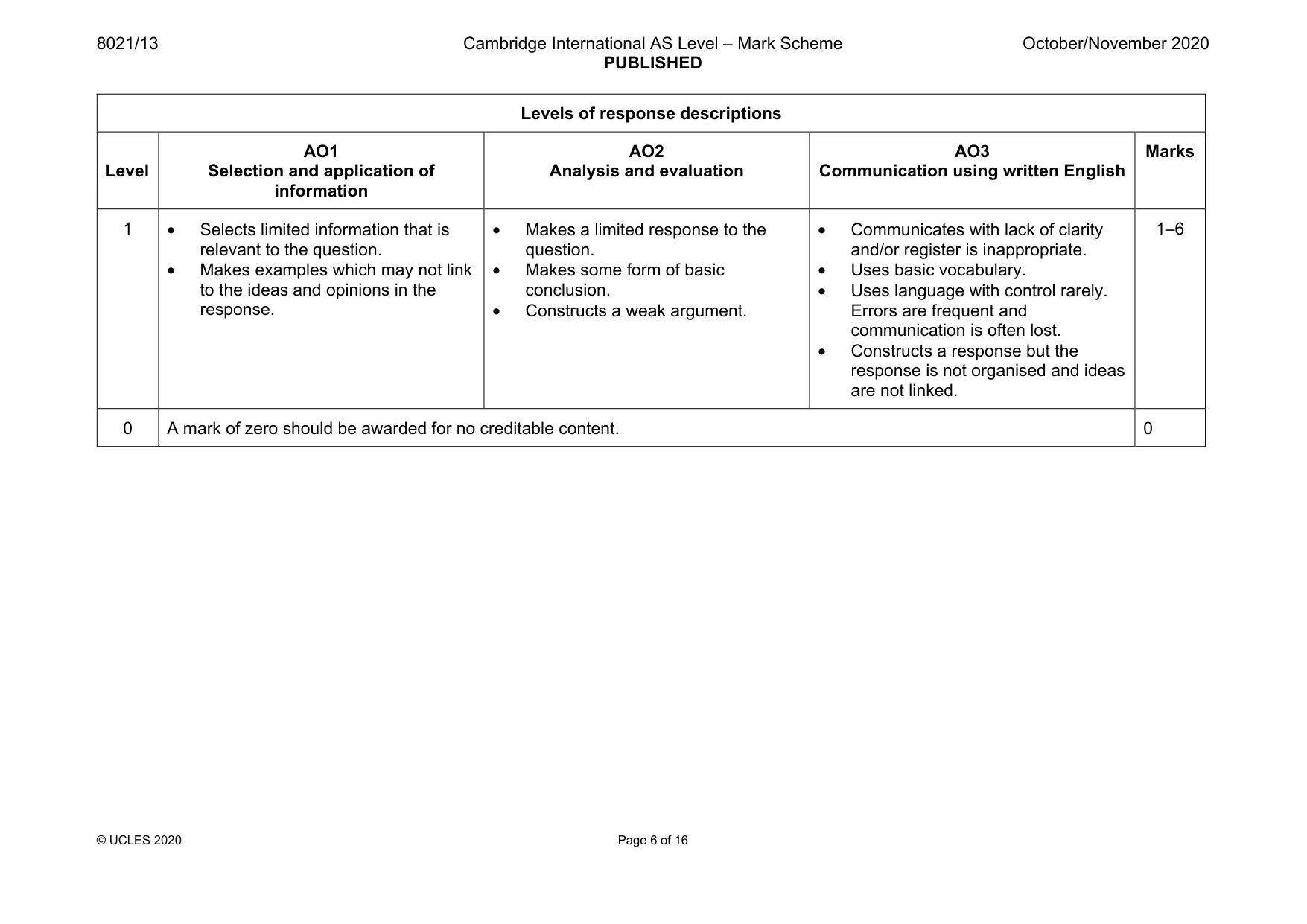
8021/13 Cambridge International AS Level – Mark Scheme PUBLISHED October/November 2020 © UCLES 2020 Page 6 of 16 Levels of response descriptions Level AO1 Selection and application of information AO2 Analysis and evaluation AO3 Communication using written English Marks 1 • Selects limited information that is relevant to the question. • Makes examples which may not link to the ideas and opinions in the response. • Makes a limited response to the question. • Makes some form of basic conclusion. • Constructs a weak argument. • Communicates with lack of clarity and/or register is inappropriate. • Uses basic vocabulary. • Uses language with control rarely. Errors are frequent and communication is often lost. • Constructs a response but the response is not organised and ideas are not linked. 1–6 0 A mark of zero should be awarded for no creditable content. 0
Mark scheme, page 7
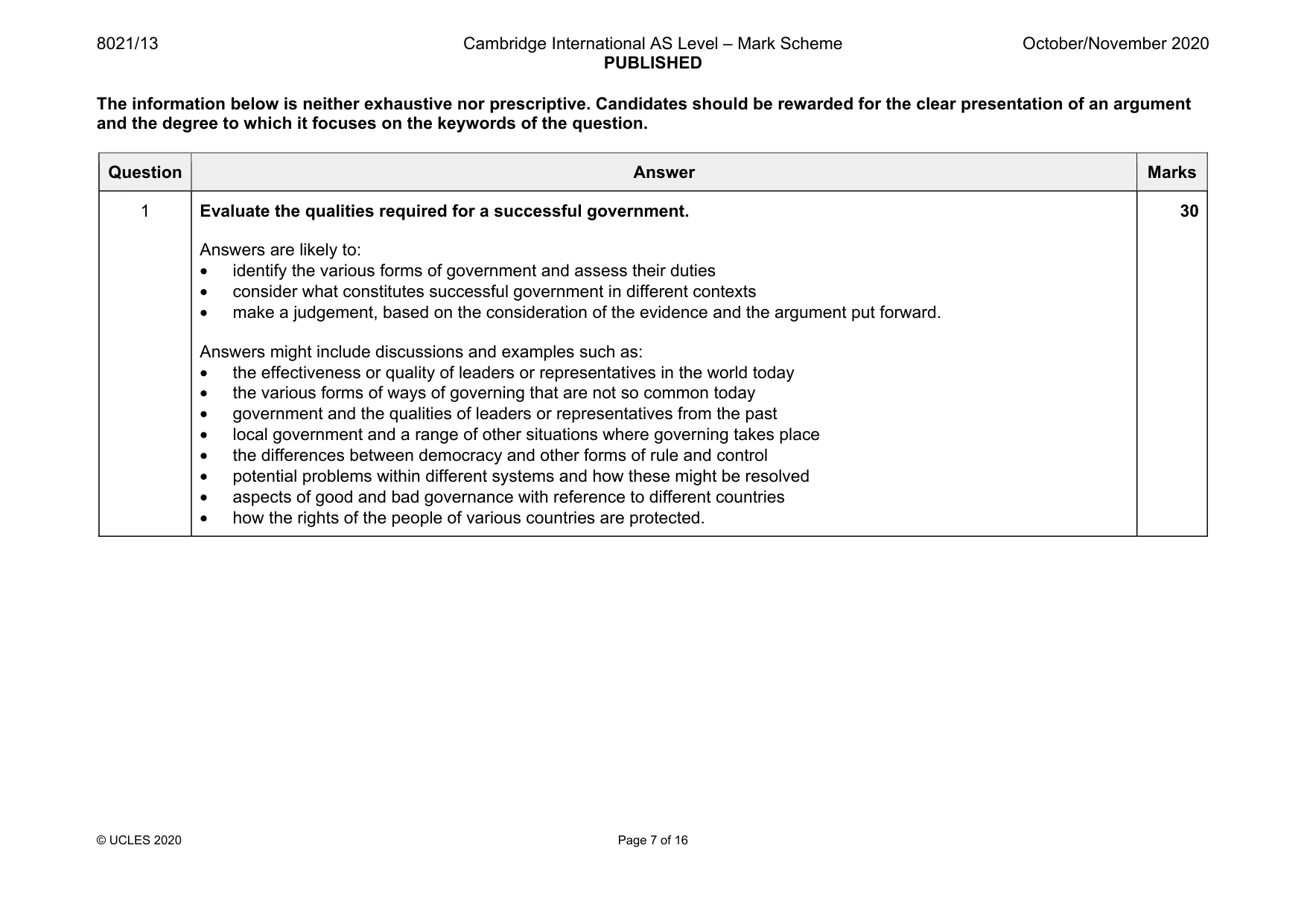
8021/13 Cambridge International AS Level – Mark Scheme PUBLISHED October/November 2020 © UCLES 2020 Page 7 of 16 The information below is neither exhaustive nor prescriptive. Candidates should be rewarded for the clear presentation of an argument and the degree to which it focuses on the keywords of the question. Question Answer Marks 1 Evaluate the qualities required for a successful government. Answers are likely to: • identify the various forms of government and assess their duties • consider what constitutes successful government in different contexts • make a judgement, based on the consideration of the evidence and the argument put forward. Answers might include discussions and examples such as: • the effectiveness or quality of leaders or representatives in the world today • the various forms of ways of governing that are not so common today • government and the qualities of leaders or representatives from the past • local government and a range of other situations where governing takes place • the differences between democracy and other forms of rule and control • potential problems within different systems and how these might be resolved • aspects of good and bad governance with reference to different countries • how the rights of the people of various countries are protected. 30
Mark scheme, page 8
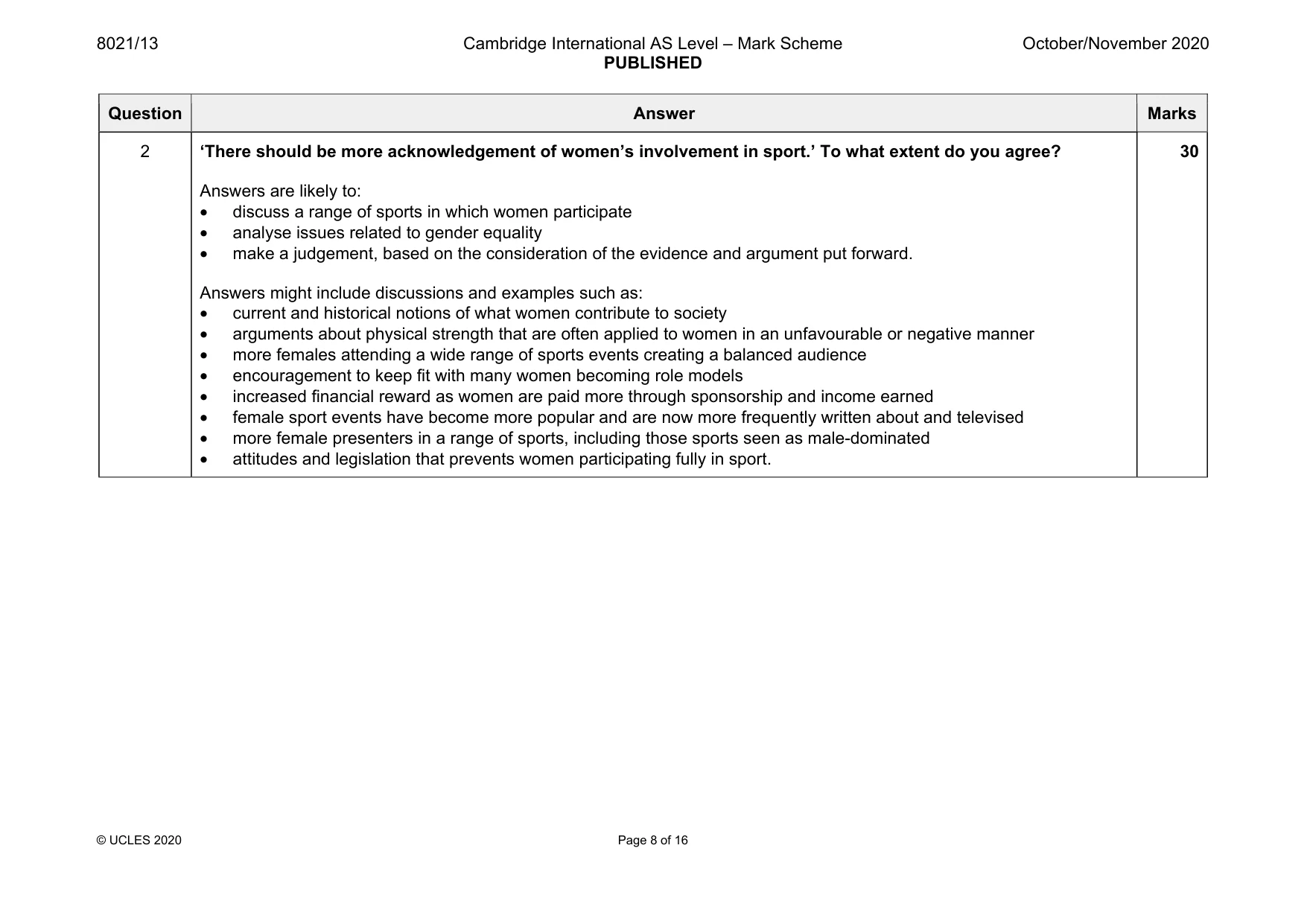
8021/13 Cambridge International AS Level – Mark Scheme PUBLISHED October/November 2020 © UCLES 2020 Page 8 of 16 Question Answer Marks 2 ‘There should be more acknowledgement of women’s involvement in sport.’ To what extent do you agree? Answers are likely to: • discuss a range of sports in which women participate • analyse issues related to gender equality • make a judgement, based on the consideration of the evidence and argument put forward. Answers might include discussions and examples such as: • current and historical notions of what women contribute to society • arguments about physical strength that are often applied to women in an unfavourable or negative manner • more females attending a wide range of sports events creating a balanced audience • encouragement to keep fit with many women becoming role models • increased financial reward as women are paid more through sponsorship and income earned • female sport events have become more popular and are now more frequently written about and televised • more female presenters in a range of sports, including those sports seen as male-dominated • attitudes and legislation that prevents women participating fully in sport. 30
Mark scheme, page 9
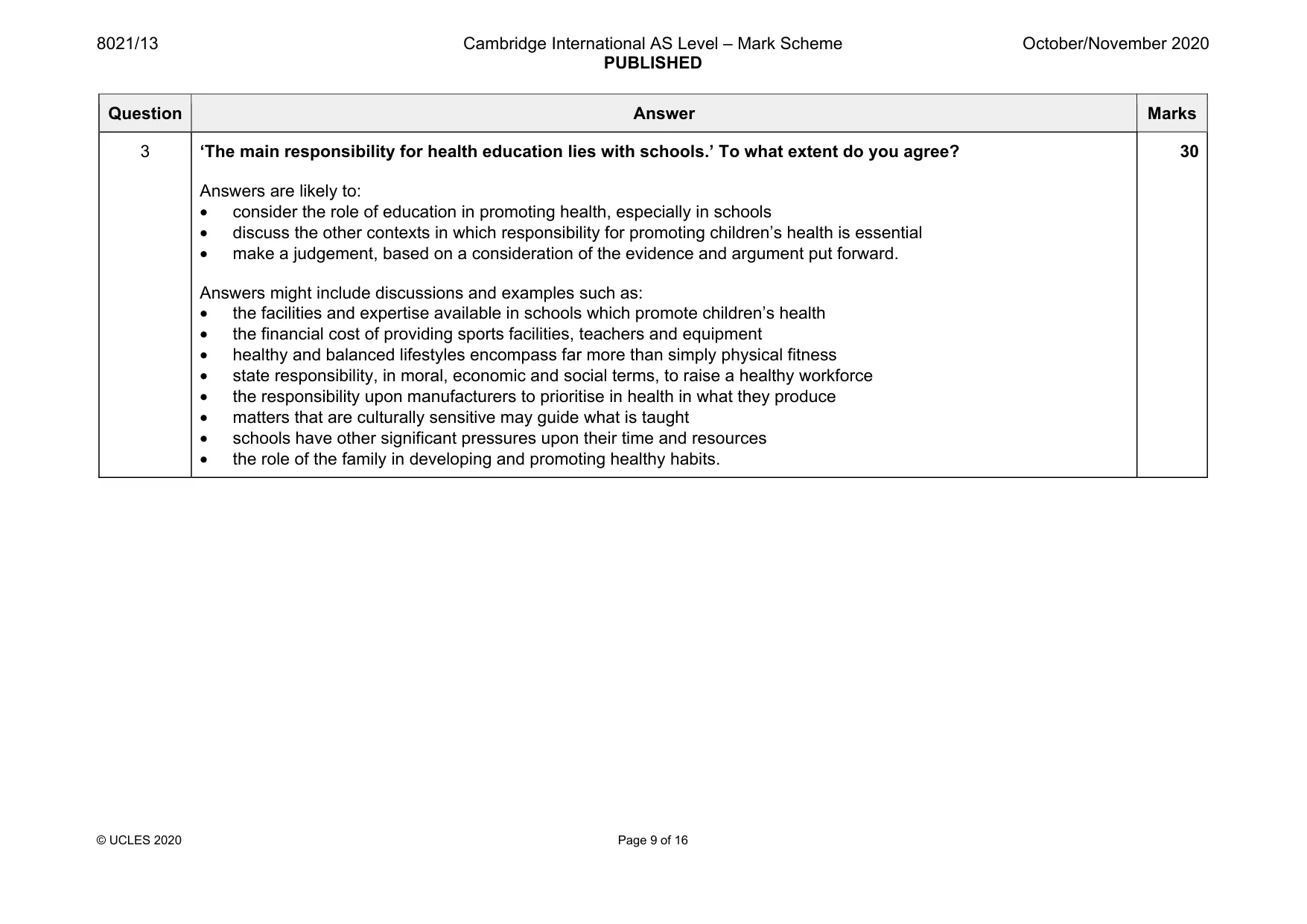
8021/13 Cambridge International AS Level – Mark Scheme PUBLISHED October/November 2020 © UCLES 2020 Page 9 of 16 Question Answer Marks 3 ‘The main responsibility for health education lies with schools.’ To what extent do you agree? Answers are likely to: • consider the role of education in promoting health, especially in schools • discuss the other contexts in which responsibility for promoting children’s health is essential • make a judgement, based on a consideration of the evidence and argument put forward. Answers might include discussions and examples such as: • the facilities and expertise available in schools which promote children’s health • the financial cost of providing sports facilities, teachers and equipment • healthy and balanced lifestyles encompass far more than simply physical fitness • state responsibility, in moral, economic and social terms, to raise a healthy workforce • the responsibility upon manufacturers to prioritise in health in what they produce • matters that are culturally sensitive may guide what is taught • schools have other significant pressures upon their time and resources • the role of the family in developing and promoting healthy habits. 30
Mark scheme, page 10
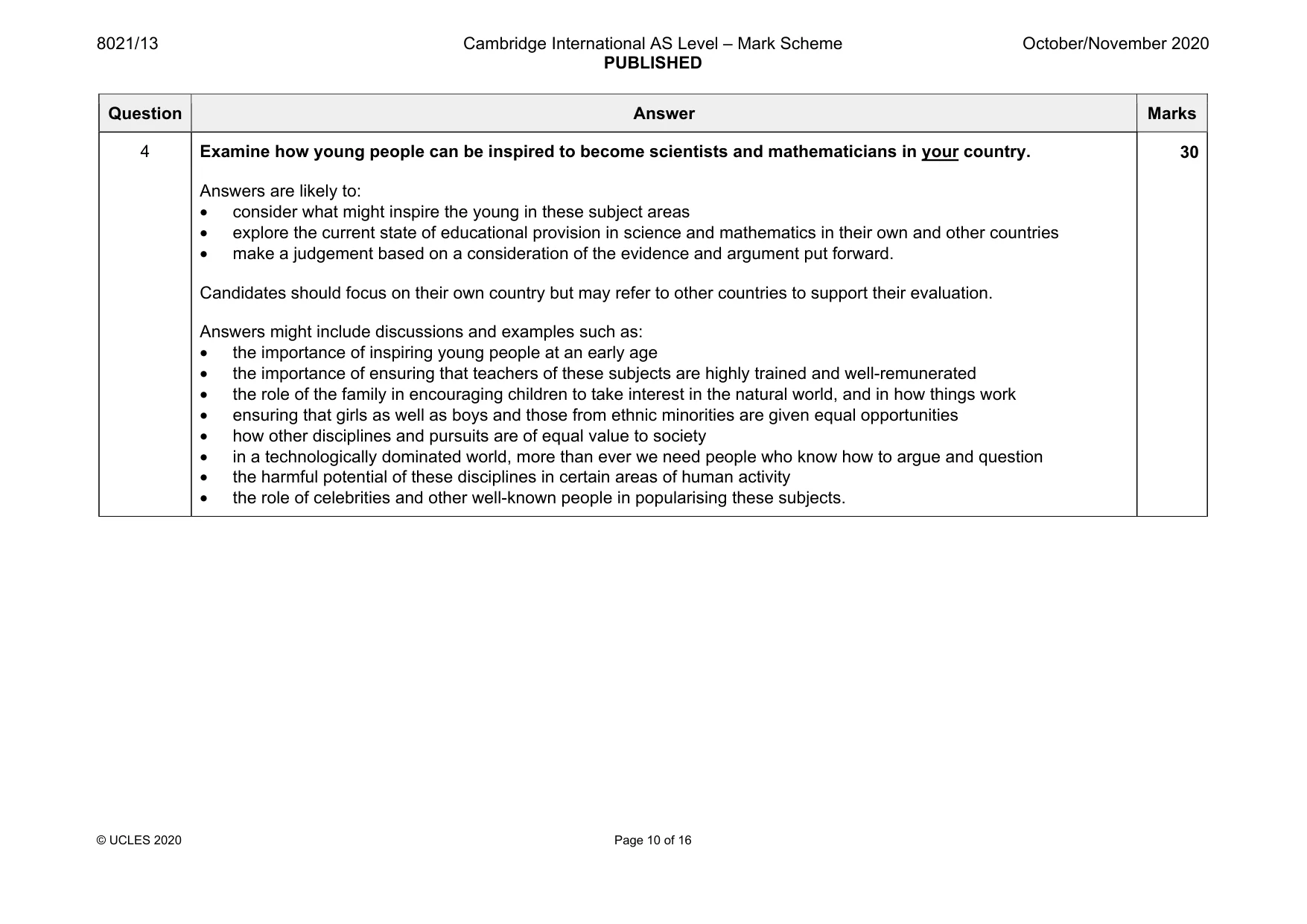
8021/13 Cambridge International AS Level – Mark Scheme PUBLISHED October/November 2020 © UCLES 2020 Page 10 of 16 Question Answer Marks 4 Examine how young people can be inspired to become scientists and mathematicians in your country. Answers are likely to: • consider what might inspire the young in these subject areas • explore the current state of educational provision in science and mathematics in their own and other countries • make a judgement based on a consideration of the evidence and argument put forward. Candidates should focus on their own country but may refer to other countries to support their evaluation. Answers might include discussions and examples such as: • the importance of inspiring young people at an early age • the importance of ensuring that teachers of these subjects are highly trained and well-remunerated • the role of the family in encouraging children to take interest in the natural world, and in how things work • ensuring that girls as well as boys and those from ethnic minorities are given equal opportunities • how other disciplines and pursuits are of equal value to society • in a technologically dominated world, more than ever we need people who know how to argue and question • the harmful potential of these disciplines in certain areas of human activity • the role of celebrities and other well-known people in popularising these subjects. 30
Mark scheme, page 11
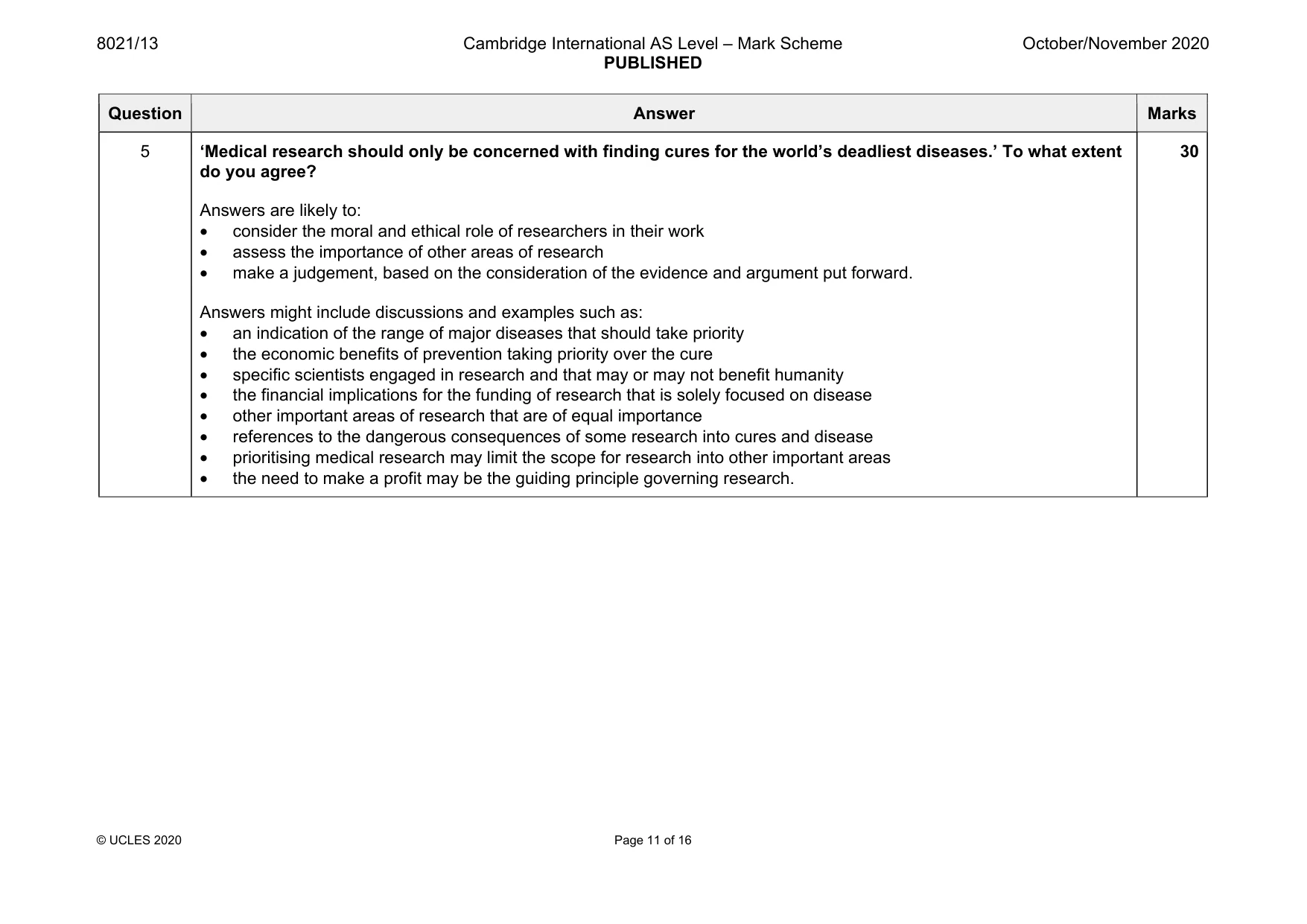
8021/13 Cambridge International AS Level – Mark Scheme PUBLISHED October/November 2020 © UCLES 2020 Page 11 of 16 Question Answer Marks 5 ‘Medical research should only be concerned with finding cures for the world’s deadliest diseases.’ To what extent do you agree? Answers are likely to: • consider the moral and ethical role of researchers in their work • assess the importance of other areas of research • make a judgement, based on the consideration of the evidence and argument put forward. Answers might include discussions and examples such as: • an indication of the range of major diseases that should take priority • the economic benefits of prevention taking priority over the cure • specific scientists engaged in research and that may or may not benefit humanity • the financial implications for the funding of research that is solely focused on disease • other important areas of research that are of equal importance • references to the dangerous consequences of some research into cures and disease • prioritising medical research may limit the scope for research into other important areas • the need to make a profit may be the guiding principle governing research. 30
Mark scheme, page 12
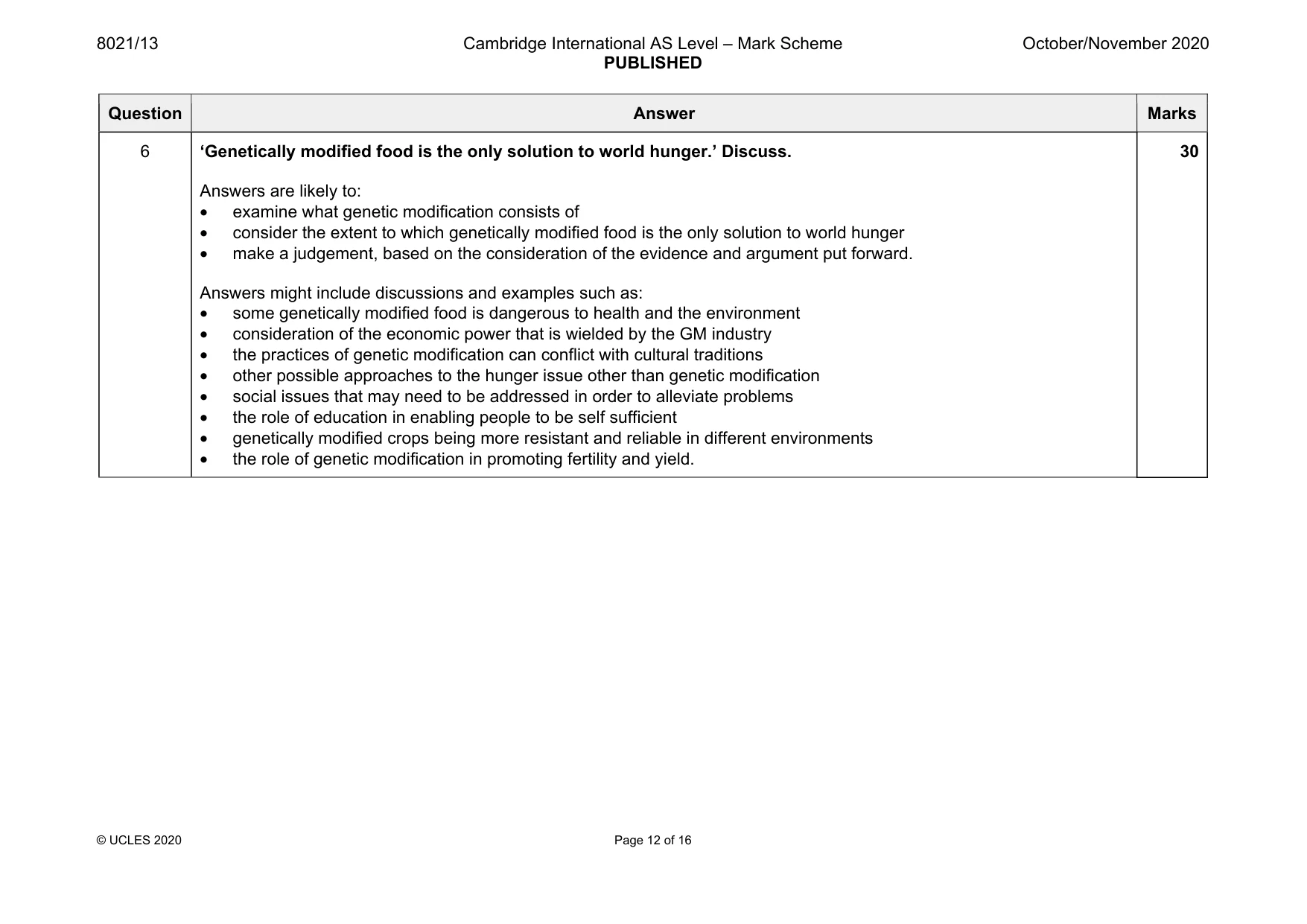
8021/13 Cambridge International AS Level – Mark Scheme PUBLISHED October/November 2020 © UCLES 2020 Page 12 of 16 Question Answer Marks 6 ‘Genetically modified food is the only solution to world hunger.’ Discuss. Answers are likely to: • examine what genetic modification consists of • consider the extent to which genetically modified food is the only solution to world hunger • make a judgement, based on the consideration of the evidence and argument put forward. Answers might include discussions and examples such as: • some genetically modified food is dangerous to health and the environment • consideration of the economic power that is wielded by the GM industry • the practices of genetic modification can conflict with cultural traditions • other possible approaches to the hunger issue other than genetic modification • social issues that may need to be addressed in order to alleviate problems • the role of education in enabling people to be self sufficient • genetically modified crops being more resistant and reliable in different environments • the role of genetic modification in promoting fertility and yield. 30
Mark scheme, page 13
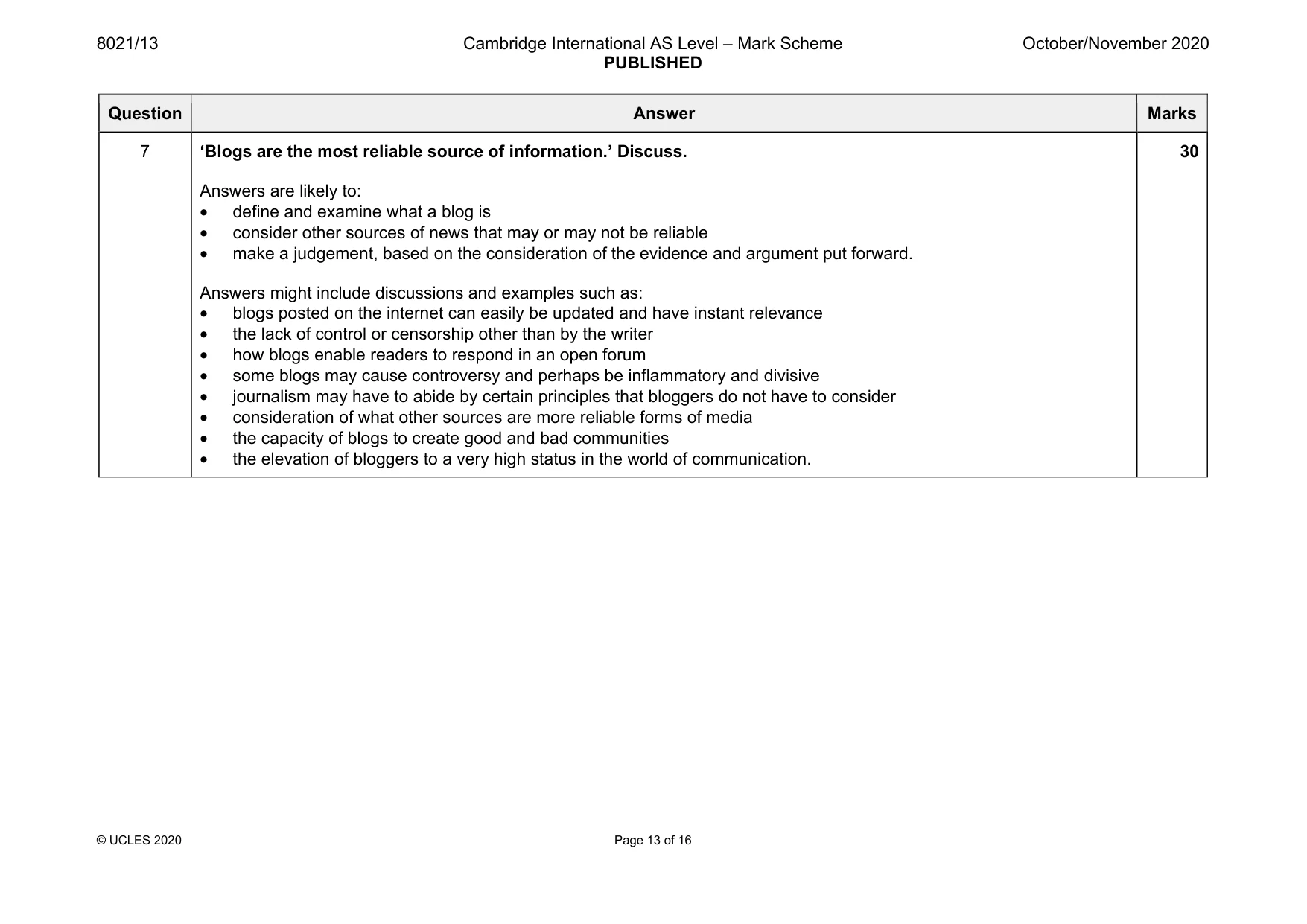
8021/13 Cambridge International AS Level – Mark Scheme PUBLISHED October/November 2020 © UCLES 2020 Page 13 of 16 Question Answer Marks 7 ‘Blogs are the most reliable source of information.’ Discuss. Answers are likely to: • define and examine what a blog is • consider other sources of news that may or may not be reliable • make a judgement, based on the consideration of the evidence and argument put forward. Answers might include discussions and examples such as: • blogs posted on the internet can easily be updated and have instant relevance • the lack of control or censorship other than by the writer • how blogs enable readers to respond in an open forum • some blogs may cause controversy and perhaps be inflammatory and divisive • journalism may have to abide by certain principles that bloggers do not have to consider • consideration of what other sources are more reliable forms of media • the capacity of blogs to create good and bad communities • the elevation of bloggers to a very high status in the world of communication. 30
Mark scheme, page 14
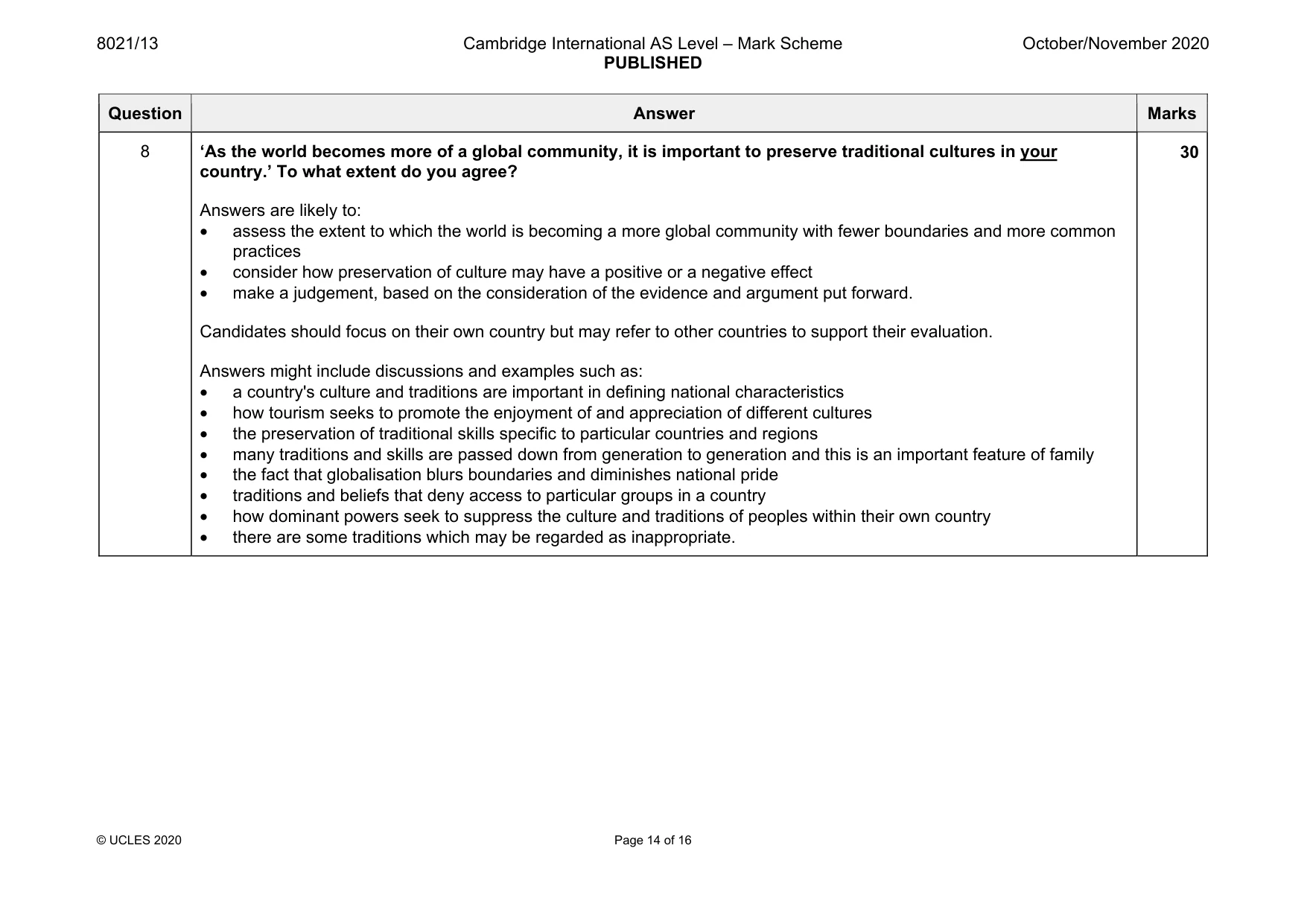
8021/13 Cambridge International AS Level – Mark Scheme PUBLISHED October/November 2020 © UCLES 2020 Page 14 of 16 Question Answer Marks 8 ‘As the world becomes more of a global community, it is important to preserve traditional cultures in your country.’ To what extent do you agree? Answers are likely to: • assess the extent to which the world is becoming a more global community with fewer boundaries and more common practices • consider how preservation of culture may have a positive or a negative effect • make a judgement, based on the consideration of the evidence and argument put forward. Candidates should focus on their own country but may refer to other countries to support their evaluation. Answers might include discussions and examples such as: • a country's culture and traditions are important in defining national characteristics • how tourism seeks to promote the enjoyment of and appreciation of different cultures • the preservation of traditional skills specific to particular countries and regions • many traditions and skills are passed down from generation to generation and this is an important feature of family • the fact that globalisation blurs boundaries and diminishes national pride • traditions and beliefs that deny access to particular groups in a country • how dominant powers seek to suppress the culture and traditions of peoples within their own country • there are some traditions which may be regarded as inappropriate. 30
Mark scheme, page 15
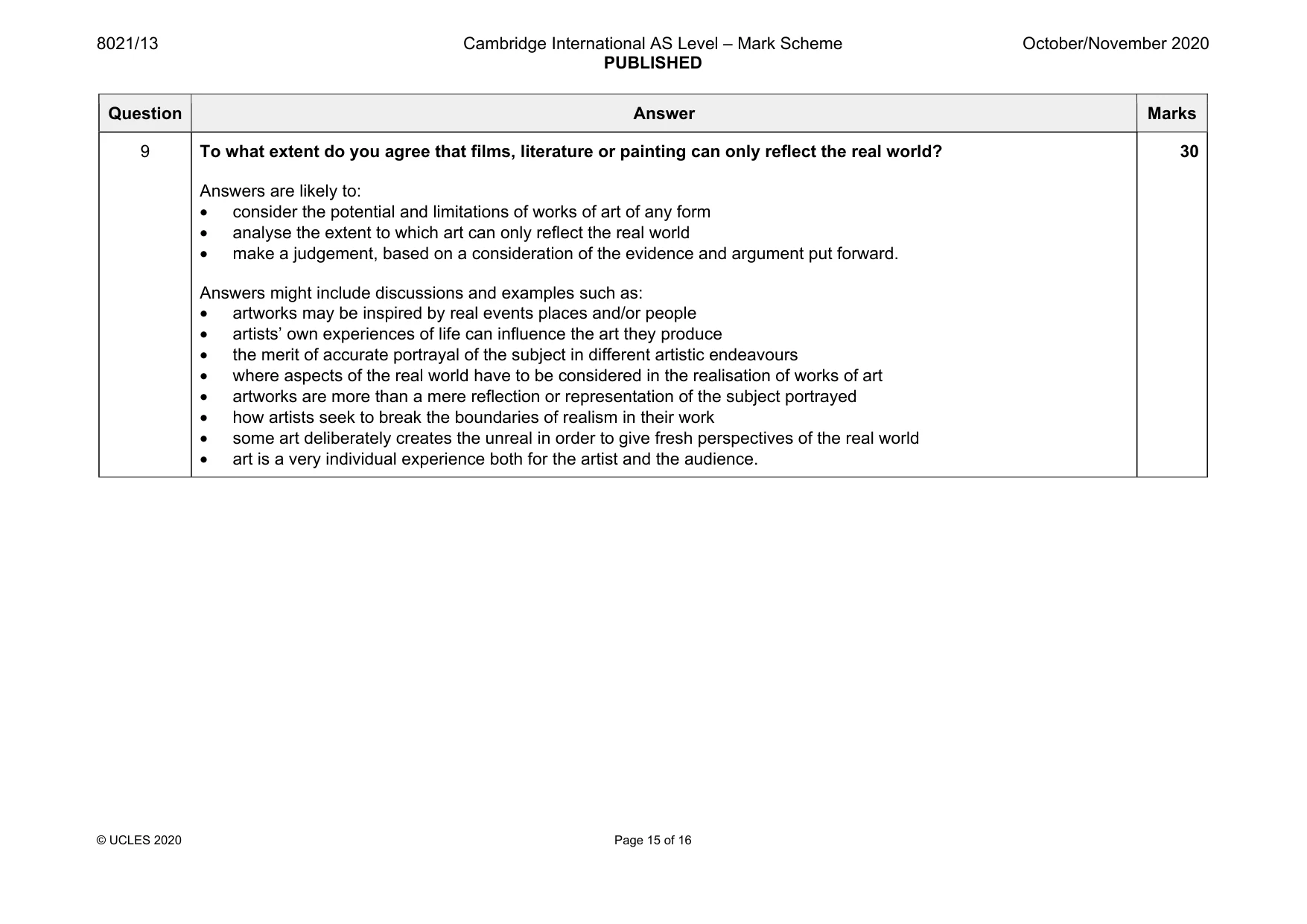
8021/13 Cambridge International AS Level – Mark Scheme PUBLISHED October/November 2020 © UCLES 2020 Page 15 of 16 Question Answer Marks 9 To what extent do you agree that films, literature or painting can only reflect the real world? Answers are likely to: • consider the potential and limitations of works of art of any form • analyse the extent to which art can only reflect the real world • make a judgement, based on a consideration of the evidence and argument put forward. Answers might include discussions and examples such as: • artworks may be inspired by real events places and/or people • artists’ own experiences of life can influence the art they produce • the merit of accurate portrayal of the subject in different artistic endeavours • where aspects of the real world have to be considered in the realisation of works of art • artworks are more than a mere reflection or representation of the subject portrayed • how artists seek to break the boundaries of realism in their work • some art deliberately creates the unreal in order to give fresh perspectives of the real world • art is a very individual experience both for the artist and the audience. 30
Mark scheme, page 16
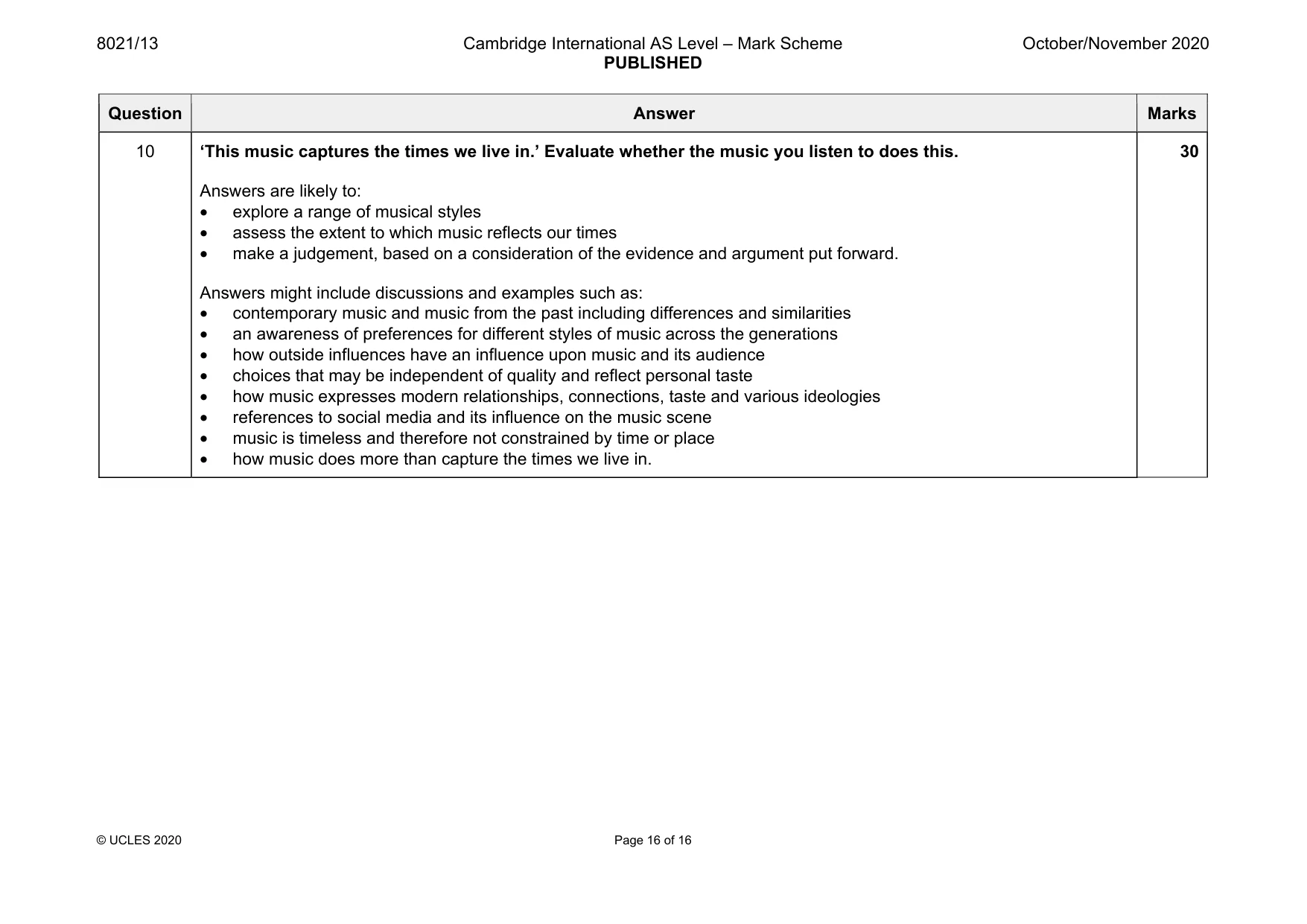
8021/13 Cambridge International AS Level – Mark Scheme PUBLISHED October/November 2020 © UCLES 2020 Page 16 of 16 Question Answer Marks 10 ‘This music captures the times we live in.’ Evaluate whether the music you listen to does this. Answers are likely to: • explore a range of musical styles • assess the extent to which music reflects our times • make a judgement, based on a consideration of the evidence and argument put forward. Answers might include discussions and examples such as: • contemporary music and music from the past including differences and similarities • an awareness of preferences for different styles of music across the generations • how outside influences have an influence upon music and its audience • choices that may be independent of quality and reflect personal taste • how music expresses modern relationships, connections, taste and various ideologies • references to social media and its influence on the music scene • music is timeless and therefore not constrained by time or place • how music does more than capture the times we live in. 30
What you needed in this session
Cambridge’s own grade thresholds for 2020 Oct/Nov, Paper 1 · Variant 3. A higher threshold means an easier paper — the bar moves with how the cohort did.