Questions as text
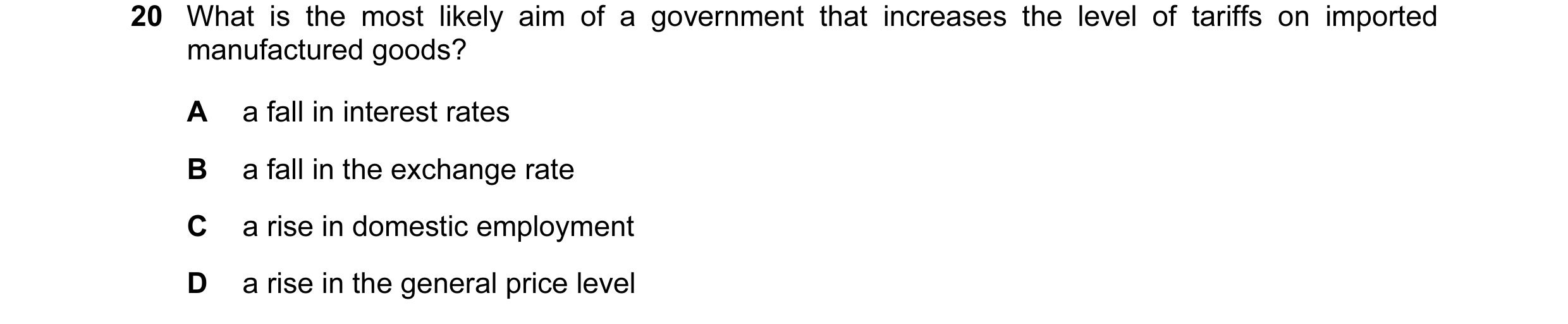
Q1 · What is the most likely aim of a government that increases the level of tariffs on… 9708/12 May/June 2013
20 What is the most likely aim of a government that increases the level of tariffs on imported manufactured goods? A a fall in interest rates B a fall in the exchange rate C a rise in domestic employment D a rise in the general price level
1 marks
Answer: C
This question in 9708/12 May/June 2013
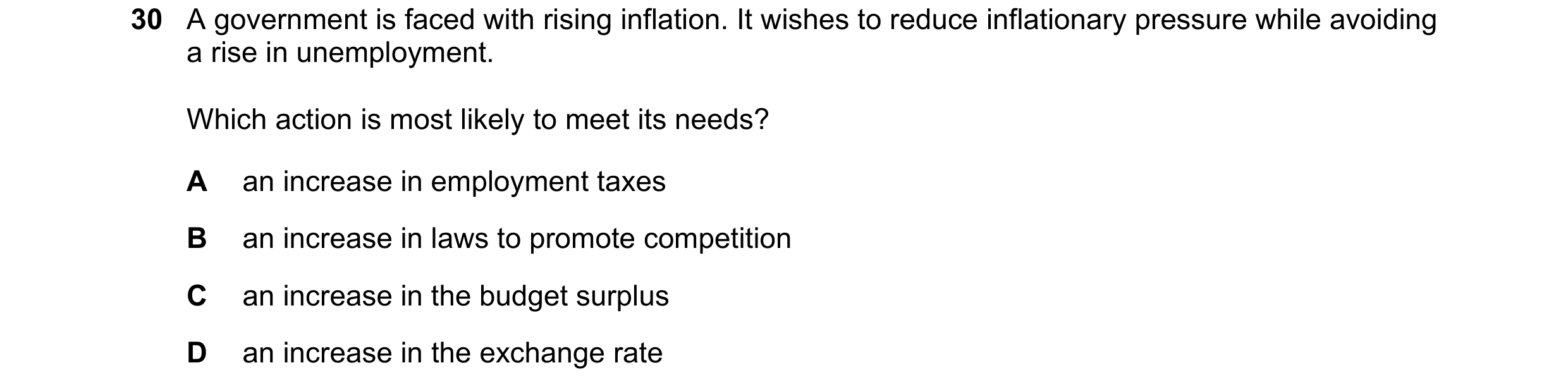
Q2 · A government is faced with rising inflation 9708/12 Oct/Nov 2016
30 A government is faced with rising inflation. It wishes to reduce inflationary pressure while avoiding a rise in unemployment. Which action is most likely to meet its needs? A an increase in employment taxes B an increase in laws to promote competition C an increase in the budget surplus D an increase in the exchange rate
1 marks
Answer: B
This question in 9708/12 Oct/Nov 2016
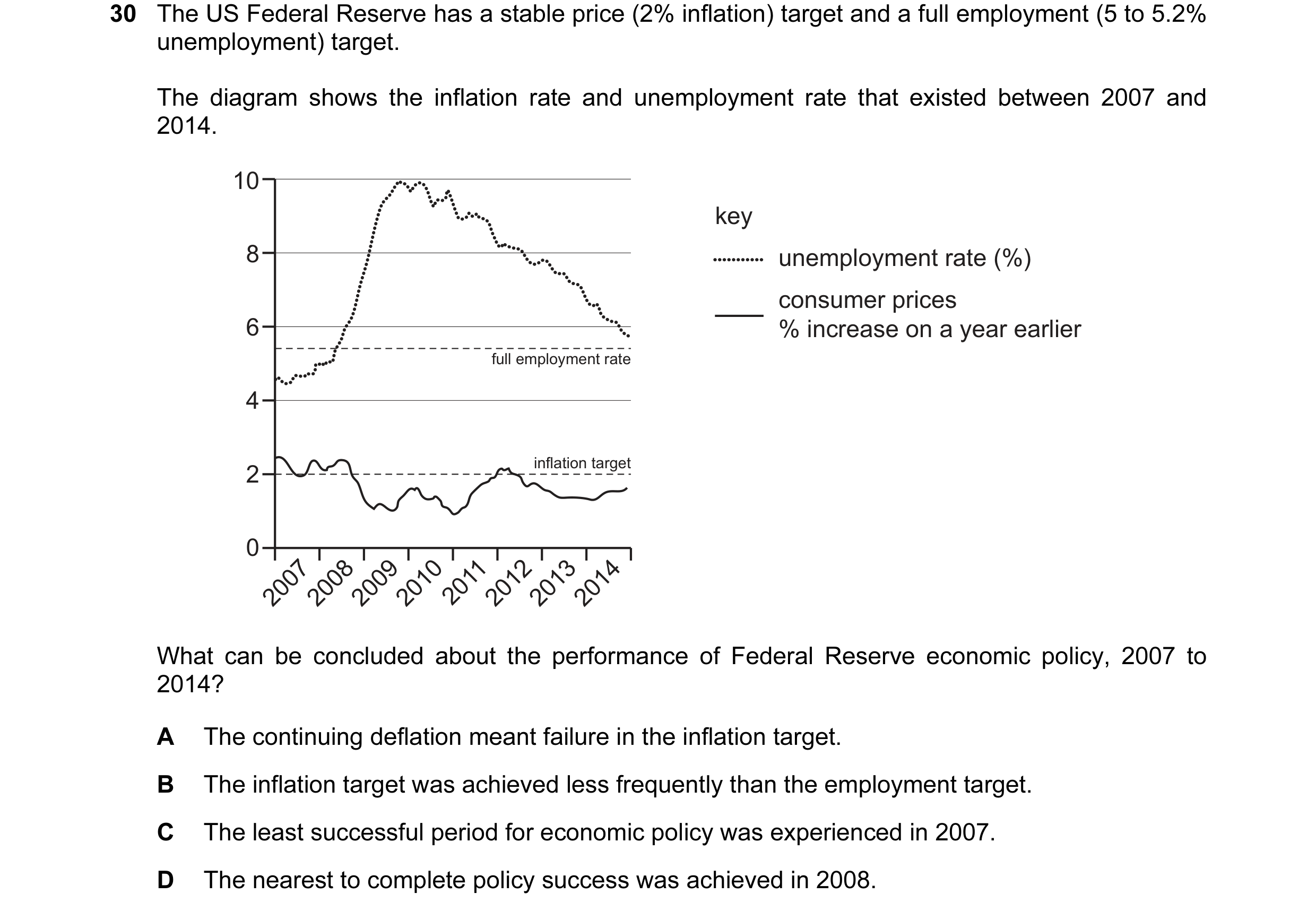
Q3 · The US Federal Reserve has a stable price (2% inflation) target and a full employment (5… 9708/13 May/June 2017
30 The US Federal Reserve has a stable price (2% inflation) target and a full employment (5 to 5.2% unemployment) target. The diagram shows the inflation rate and unemployment rate that existed between 2007 and 2014. 10 key 8 unemployment rate (%) consumer prices 6 % increase on a year earlier full employment rate 4 2 inflation target 0 2007 2008 2009 2010 2011 2012 2013 2014 What can be concluded about the performance of Federal Reserve economic policy, 2007 to 2014? A The continuing deflation meant failure in the inflation target. B The inflation target was achieved less frequently than the employment target. C The least successful period for economic policy was experienced in 2007. D The nearest to complete policy success was achieved in 2008.
1 marks
Answer: D
This question in 9708/13 May/June 2017
Q4 · What is most likely to be increased by a policy of increased direct taxes and lower… 9708/11 May/June 2019
28 What is most likely to be increased by a policy of increased direct taxes and lower government spending? A the balance of payments deficit B the budget deficit C the rate of inflation D the level of unemployment
1 marks
Answer: D
This question in 9708/11 May/June 2019
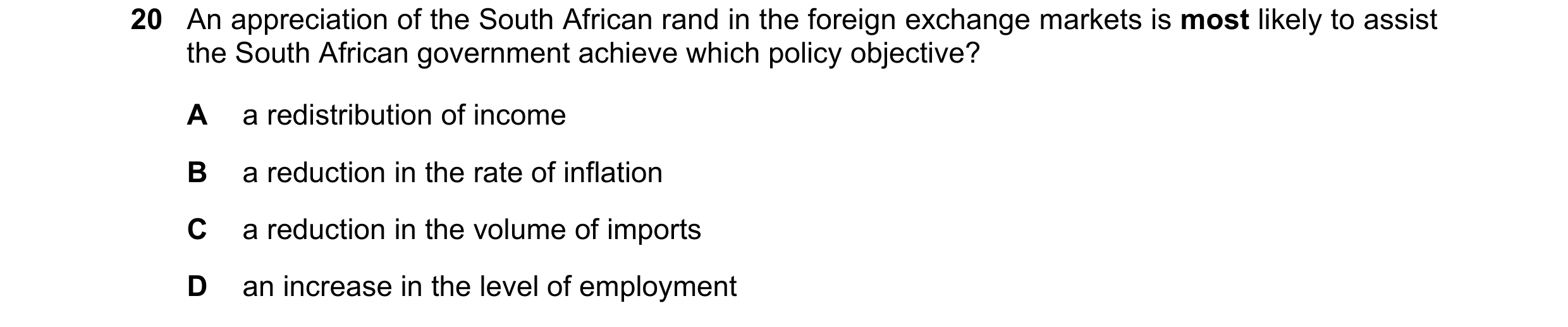
Q5 · An appreciation of the South African rand in the foreign exchange markets is most likely… 9708/12 Feb/March 2020
20 An appreciation of the South African rand in the foreign exchange markets is most likely to assist the South African government achieve which policy objective? A a redistribution of income B a reduction in the rate of inflation C a reduction in the volume of imports D an increase in the level of employment
1 marks
Answer: B
This question in 9708/12 Feb/March 2020
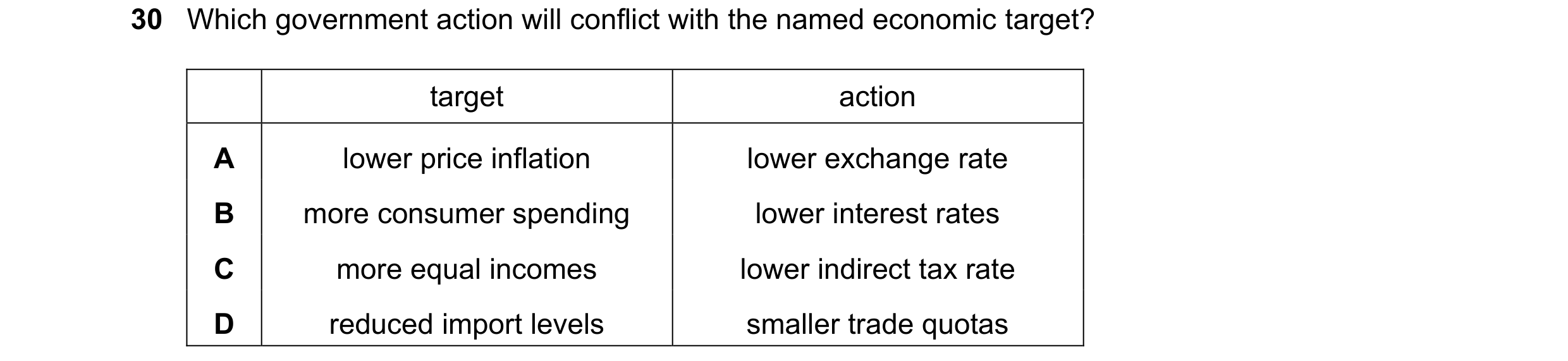
Q6 · Which government action will conflict with the named economic target? 9708/13 Oct/Nov 2022
30 Which government action will conflict with the named economic target? target action A lower price inflation lower exchange rate B more consumer spending lower interest rates C more equal incomes lower indirect tax rate D reduced import levels smaller trade quotas
1 marks
Answer: A
This question in 9708/13 Oct/Nov 2022
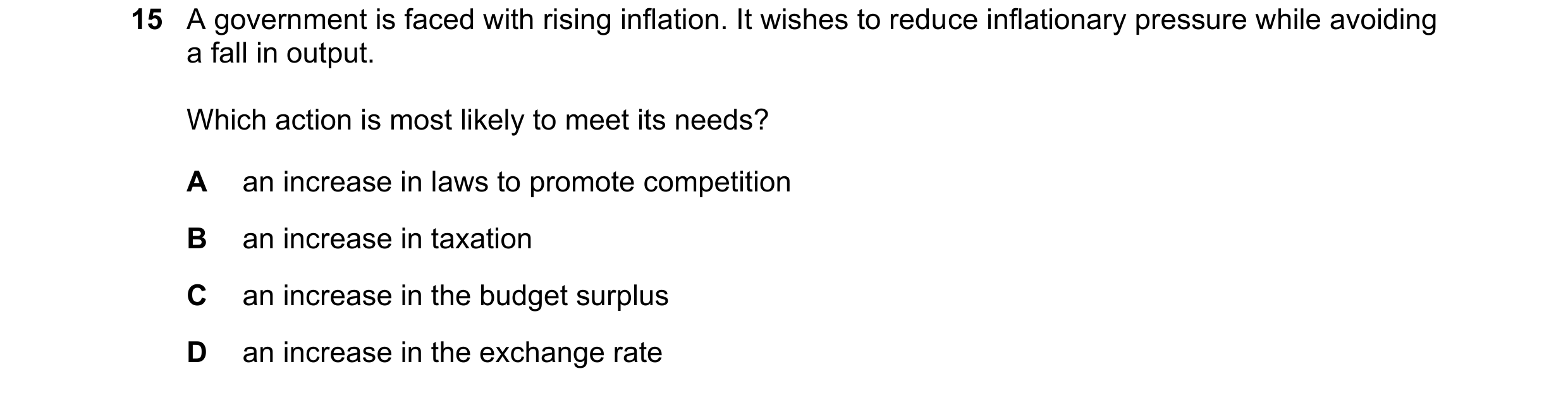
Q7 · A government is faced with rising inflation 9708/12 Feb/March 2023
15 A government is faced with rising inflation. It wishes to reduce inflationary pressure while avoiding a fall in output. Which action is most likely to meet its needs? A an increase in laws to promote competition B an increase in taxation C an increase in the budget surplus D an increase in the exchange rate
1 marks
Answer: A
This question in 9708/12 Feb/March 2023
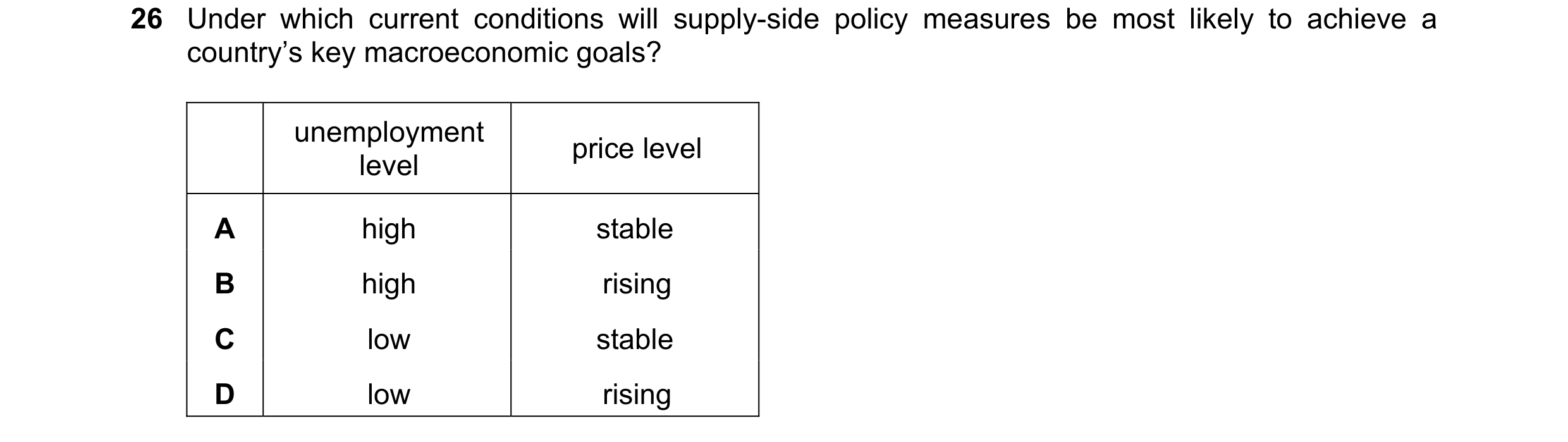
Q8 · Under which current conditions will supply-side policy measures be most likely to achieve… 9708/12 Feb/March 2023
26 Under which current conditions will supply-side policy measures be most likely to achieve a country’s key macroeconomic goals? unemployment price level level A high stable B high rising C low stable D low rising
1 marks
Answer: B
This question in 9708/12 Feb/March 2023
Q9 · What is true about a government’s macroeconomic objectives? 9708/12 May/June 2024
20 What is true about a government’s macroeconomic objectives? A Economic growth ensures a more even distribution of income. B Increasing output ensures that more workers are employed. C Choosing between macroeconomic objectives requires a normative decision. D A stable rate of inflation means zero inflation is required.
1 marks
Answer: C
This question in 9708/12 May/June 2024
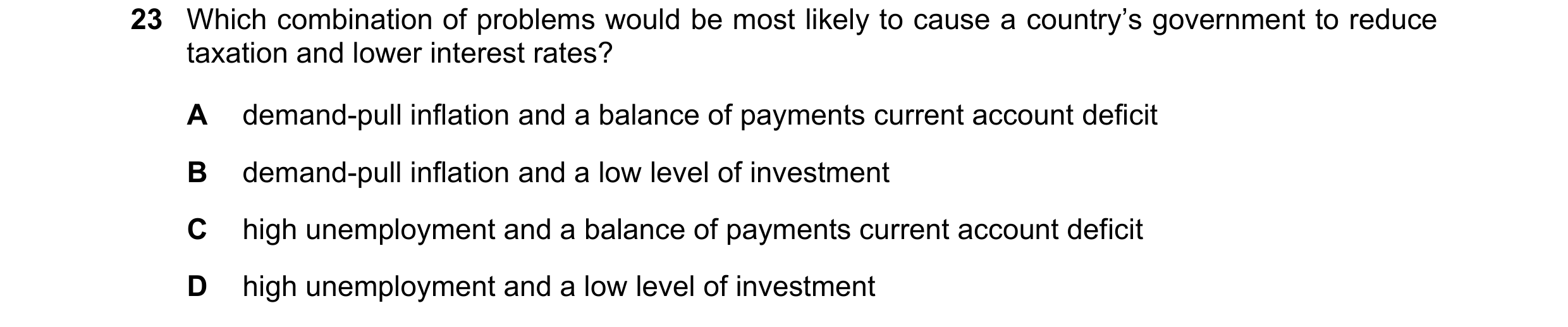
Q10 · Which combination of problems would be most likely to cause a country’s government to… 9708/12 May/June 2024
23 Which combination of problems would be most likely to cause a country’s government to reduce taxation and lower interest rates? A demand-pull inflation and a balance of payments current account deficit B demand-pull inflation and a low level of investment C high unemployment and a balance of payments current account deficit D high unemployment and a low level of investment
1 marks
Answer: D
This question in 9708/12 May/June 2024
Q11 · Which macroeconomic objective is most likely to be achieved by increasing income tax? 9708/13 May/June 2024
21 Which macroeconomic objective is most likely to be achieved by increasing income tax? A depreciation of the exchange rate B economic growth C low unemployment D price stability
1 marks
Answer: D
This question in 9708/13 May/June 2024
Q12 · When can a policy be classified as macroeconomic? 9708/13 May/June 2024
23 When can a policy be classified as macroeconomic? A when it focuses on the level of individual welfare B when it involves economy-wide institutions and behaviour C when it is based on the control of monopoly markets D when it relies on the use of buffer stock schemes
1 marks
Answer: B
This question in 9708/13 May/June 2024
Q13 · What is an example of a macroeconomic policy? 9708/12 Oct/Nov 2024
20 What is an example of a macroeconomic policy? A encourage the consumption of merit goods B reduce pollution in the steel industry C maintain general price stability D reduce unemployment in the service sector
1 marks
Answer: C
This question in 9708/12 Oct/Nov 2024
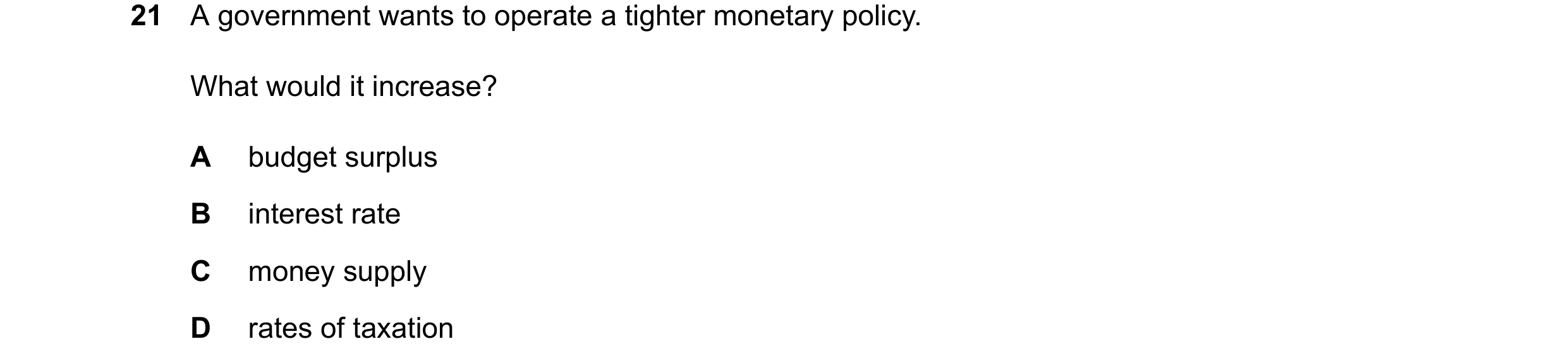
Q14 · A government wants to operate a tighter monetary policy 9708/13 May/June 2025
21 A government wants to operate a tighter monetary policy. What would it increase? A budget surplus B interest rate C money supply D rates of taxation
1 marks
Answer: B
This question in 9708/13 May/June 2025
Q15 · What is not a government macroeconomic policy objective? 9708/11 Oct/Nov 2025
22 What is not a government macroeconomic policy objective? A economic growth B income equality C low unemployment D price stability
1 marks
Answer: B
This question in 9708/11 Oct/Nov 2025
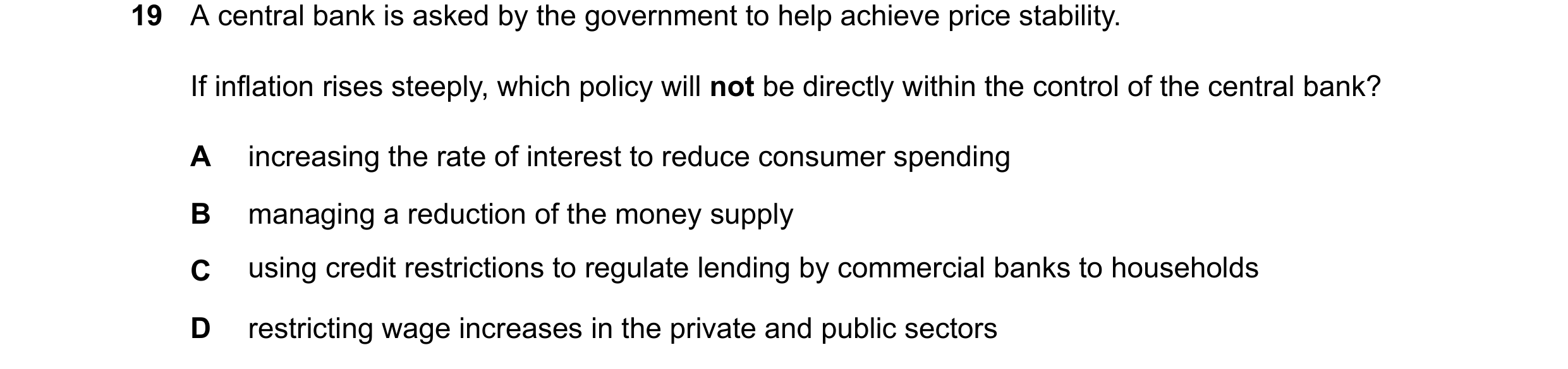
Q16 · A central bank is asked by the government to help achieve price stability 9708/12 Oct/Nov 2025
19 A central bank is asked by the government to help achieve price stability. If inflation rises steeply, which policy will not be directly within the control of the central bank? A increasing the rate of interest to reduce consumer spending B managing a reduction of the money supply C using credit restrictions to regulate lending by commercial banks to households D restricting wage increases in the private and public sectors
1 marks
Answer: D
This question in 9708/12 Oct/Nov 2025
Q17 · What is not a likely reason for a government having the objective of economic growth? 9708/12 Oct/Nov 2025
20 What is not a likely reason for a government having the objective of economic growth? A to improve living standards B to improve business confidence C to increase inflationary pressures D to increase consumer choice
1 marks
Answer: C
This question in 9708/12 Oct/Nov 2025
 1 / 4
1 / 4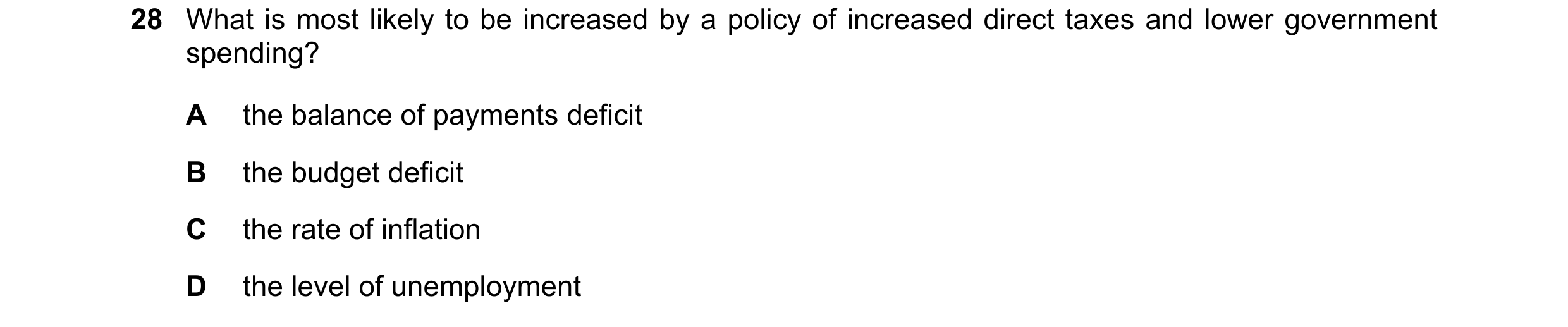
 2 / 4
2 / 4



 3 / 4
3 / 4
 4 / 4
4 / 4