Questions as text
Q1 · The price elasticity of demand for a firm’s product is zero 9708/31 Oct/Nov 2009
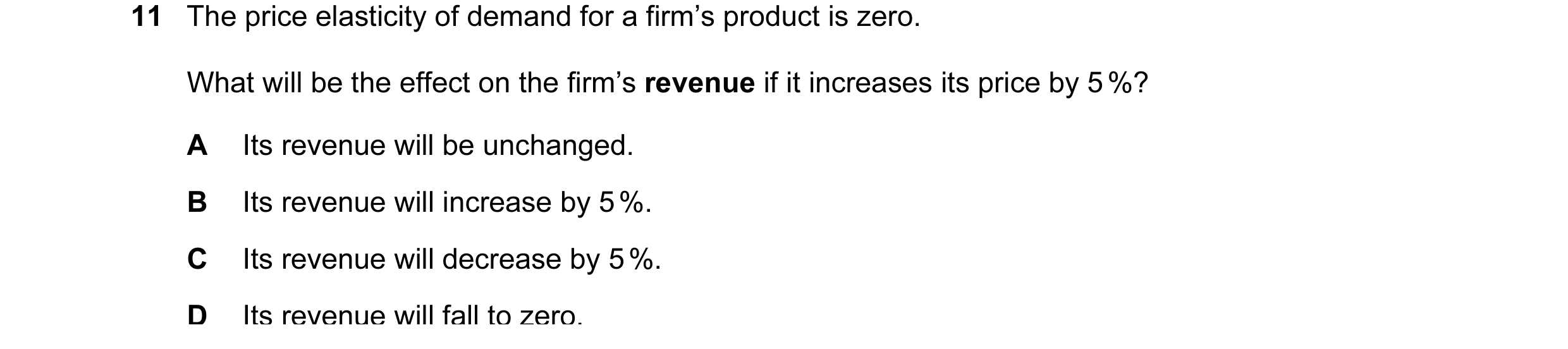
11 The price elasticity of demand for a firm’s product is zero. What will be the effect on the firm’s revenue if it increases its price by 5 %? A Its revenue will be unchanged. B Its revenue will increase by 5 %. C Its revenue will decrease by 5 %. D Its revenue will fall to zero.
1 marks
Answer: B
This question in 9708/31 Oct/Nov 2009
Q2 · The price elasticity of demand for a firm’s product is zero 9708/32 Oct/Nov 2009
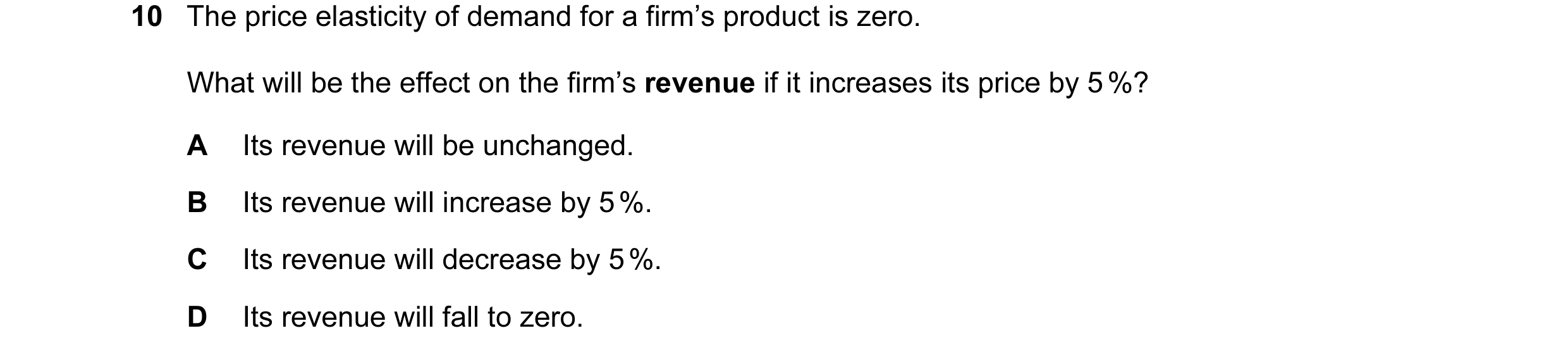
10 The price elasticity of demand for a firm’s product is zero. What will be the effect on the firm’s revenue if it increases its price by 5 %? A Its revenue will be unchanged. B Its revenue will increase by 5 %. C Its revenue will decrease by 5 %. D Its revenue will fall to zero.
1 marks
Answer: B
This question in 9708/32 Oct/Nov 2009
Q3 · The diagram shows a firm’s demand curve and its marginal revenue curve 9708/31 May/June 2010
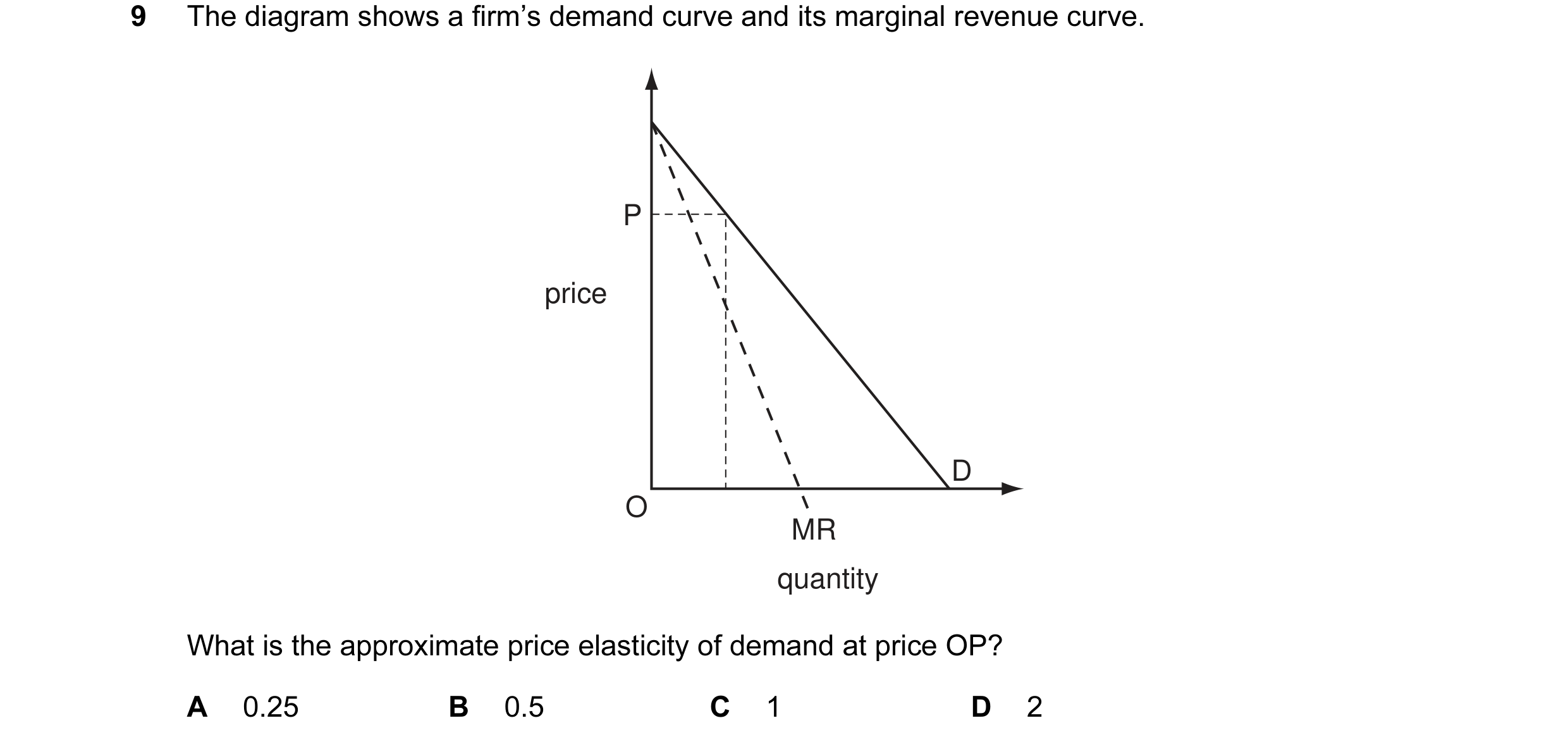
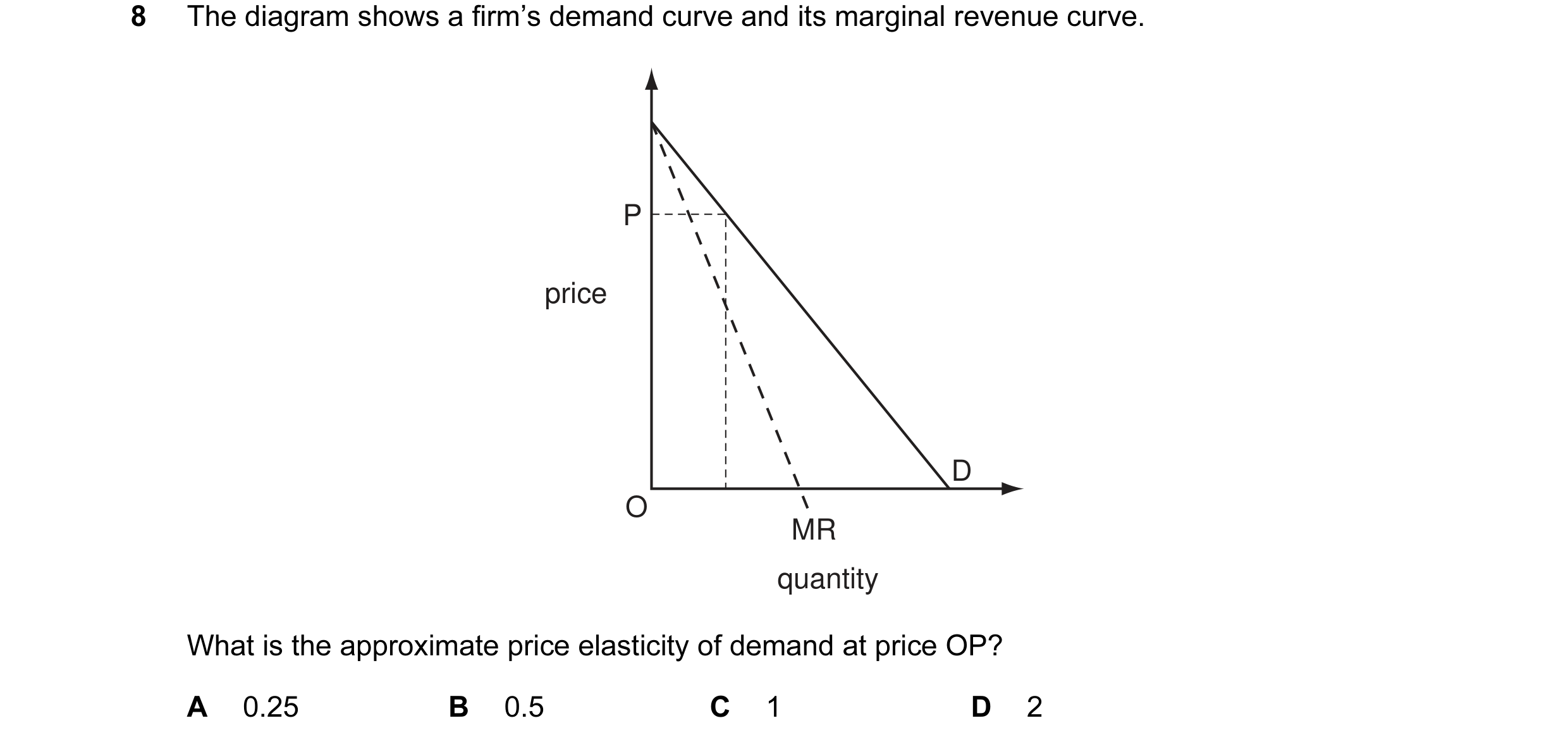
9 The diagram shows a firm’s demand curve and its marginal revenue curve. P price D O MR quantity What is the approximate price elasticity of demand at price OP? A 0.25 B 0.5 C 1 D 2
1 marks
Answer: D
This question in 9708/31 May/June 2010
Q4 · The diagram shows a firm’s demand curve and its marginal revenue curve 9708/32 May/June 2010
8 The diagram shows a firm’s demand curve and its marginal revenue curve. P price D O MR quantity What is the approximate price elasticity of demand at price OP? A 0.25 B 0.5 C 1 D 2
1 marks
Answer: D
This question in 9708/32 May/June 2010
Q5 · The diagram shows a firm’s demand curve and its marginal revenue curve 9708/33 May/June 2010
8 The diagram shows a firm’s demand curve and its marginal revenue curve. P price D O MR quantity What is the approximate price elasticity of demand at price OP? A 0.25 B 0.5 C 1 D 2
1 marks
Answer: D
This question in 9708/33 May/June 2010
Q6 · A product with infinite elasticity of supply has sales of 1000 units a week at a price of… 9708/32 May/June 2011
7 A product with infinite elasticity of supply has sales of 1000 units a week at a price of $1 per unit. Price elasticity of demand is 1.5 over the relevant range. The government imposes a tax of 10 %. What will be the government’s weekly tax revenue? A $15 B $85 C $100 D $150
1 marks
Answer: B
This question in 9708/32 May/June 2011
Q7 · Which commodities should a government tax if it wishes to make the tax system more… 9708/31 Oct/Nov 2011
11 Which commodities should a government tax if it wishes to make the tax system more progressive? A those for which demand is price elastic B those for which demand is price inelastic C those with an income elasticity of demand greater than one D those with an income elasticity of demand less than one
1 marks
Answer: C
This question in 9708/31 Oct/Nov 2011
Q8 · Which commodities should a government tax if it wishes to make the tax system more… 9708/33 Oct/Nov 2011
10 Which commodities should a government tax if it wishes to make the tax system more progressive? A those for which demand is price elastic B those for which demand is price inelastic C those with an income elasticity of demand greater than one D those with an income elasticity of demand less than one
1 marks
Answer: C
This question in 9708/33 Oct/Nov 2011
Q9 · The price elasticity of demand for a firm’s product is zero 9708/31 May/June 2012
9 The price elasticity of demand for a firm’s product is zero. What will be the effect on the firm’s revenue if it reduces its price by 5 %? A Its revenue will fall to zero. B Its revenue will be unchanged. C Its revenue will decrease by 5 %. D Its revenue will increase by 5 %.
1 marks
Answer: C
This question in 9708/31 May/June 2012
Q10 · The price elasticity of demand for a firm’s product is zero 9708/33 May/June 2012
9 The price elasticity of demand for a firm’s product is zero. What will be the effect on the firm’s revenue if it reduces its price by 5 %? A Its revenue will fall to zero. B Its revenue will be unchanged. C Its revenue will decrease by 5 %. D Its revenue will increase by 5 %.
1 marks
Answer: C
This question in 9708/33 May/June 2012
Q11 · The demand for a firm’s product is perfectly elastic 9708/31 May/June 2013
9 The demand for a firm’s product is perfectly elastic. What will be the effect on the firm’s revenue if it increases its price by 5%? A Its revenue will be unchanged. B Its revenue will decrease by 5%. C Its revenue will fall to zero. D Its revenue will increase by 5%.
1 marks
Answer: C
This question in 9708/31 May/June 2013
Q12 · The demand for a firm’s product is perfectly inelastic 9708/32 May/June 2013
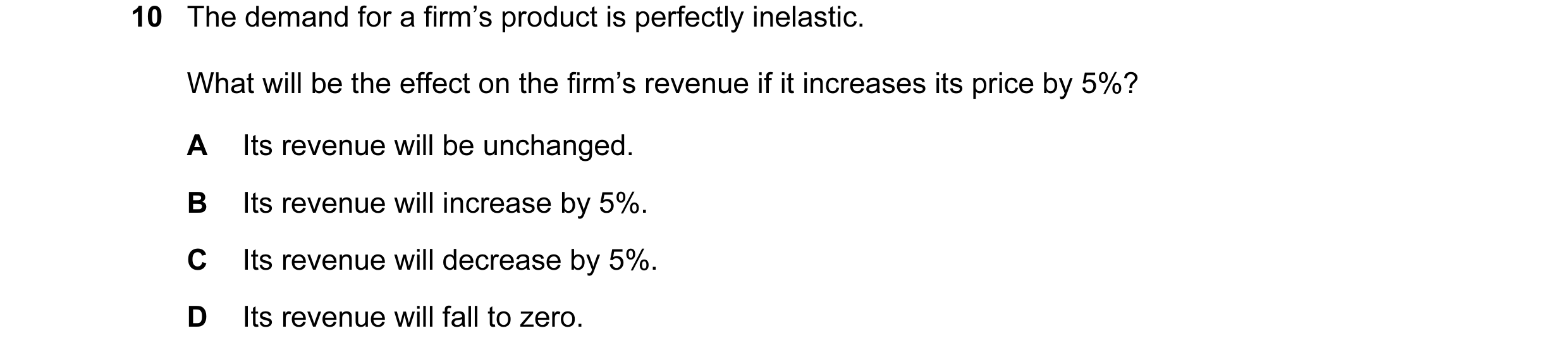
10 The demand for a firm’s product is perfectly inelastic. What will be the effect on the firm’s revenue if it increases its price by 5%? A Its revenue will be unchanged. B Its revenue will increase by 5%. C Its revenue will decrease by 5%. D Its revenue will fall to zero.
1 marks
Answer: B
This question in 9708/32 May/June 2013
Q13 · The demand for a firm’s product is perfectly elastic 9708/33 May/June 2013
9 The demand for a firm’s product is perfectly elastic. What will be the effect on the firm’s revenue if it increases its price by 5%? A Its revenue will be unchanged. B Its revenue will decrease by 5%. C Its revenue will fall to zero. D Its revenue will increase by 5%.
1 marks
Answer: C
This question in 9708/33 May/June 2013
Q14 · The demand for a firm’s product is perfectly elastic 9708/33 Oct/Nov 2013
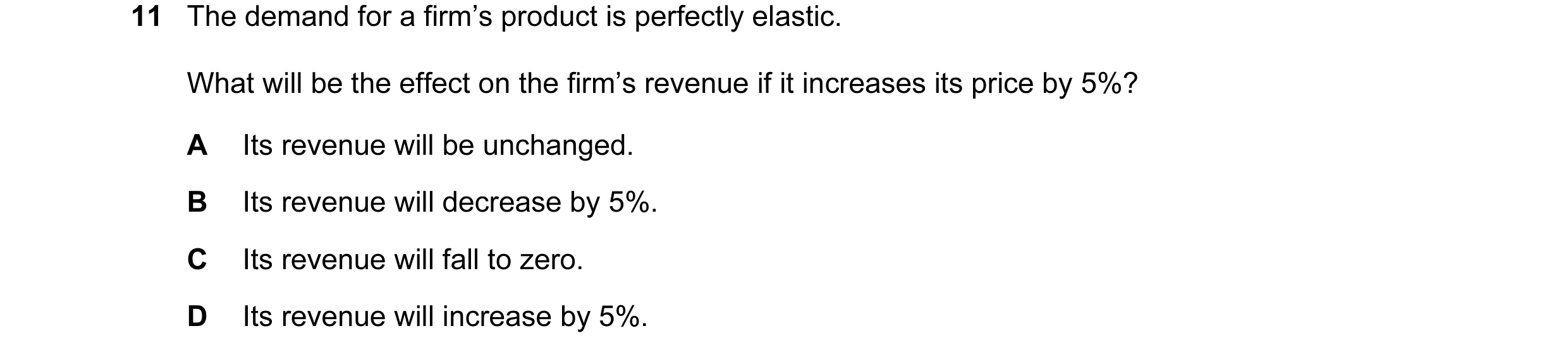
11 The demand for a firm’s product is perfectly elastic. What will be the effect on the firm’s revenue if it increases its price by 5%? A Its revenue will be unchanged. B Its revenue will decrease by 5%. C Its revenue will fall to zero. D Its revenue will increase by 5%.
1 marks
Answer: C
This question in 9708/33 Oct/Nov 2013
Q15 · The diagram shows the demand curve for a particular good 9708/33 Oct/Nov 2015
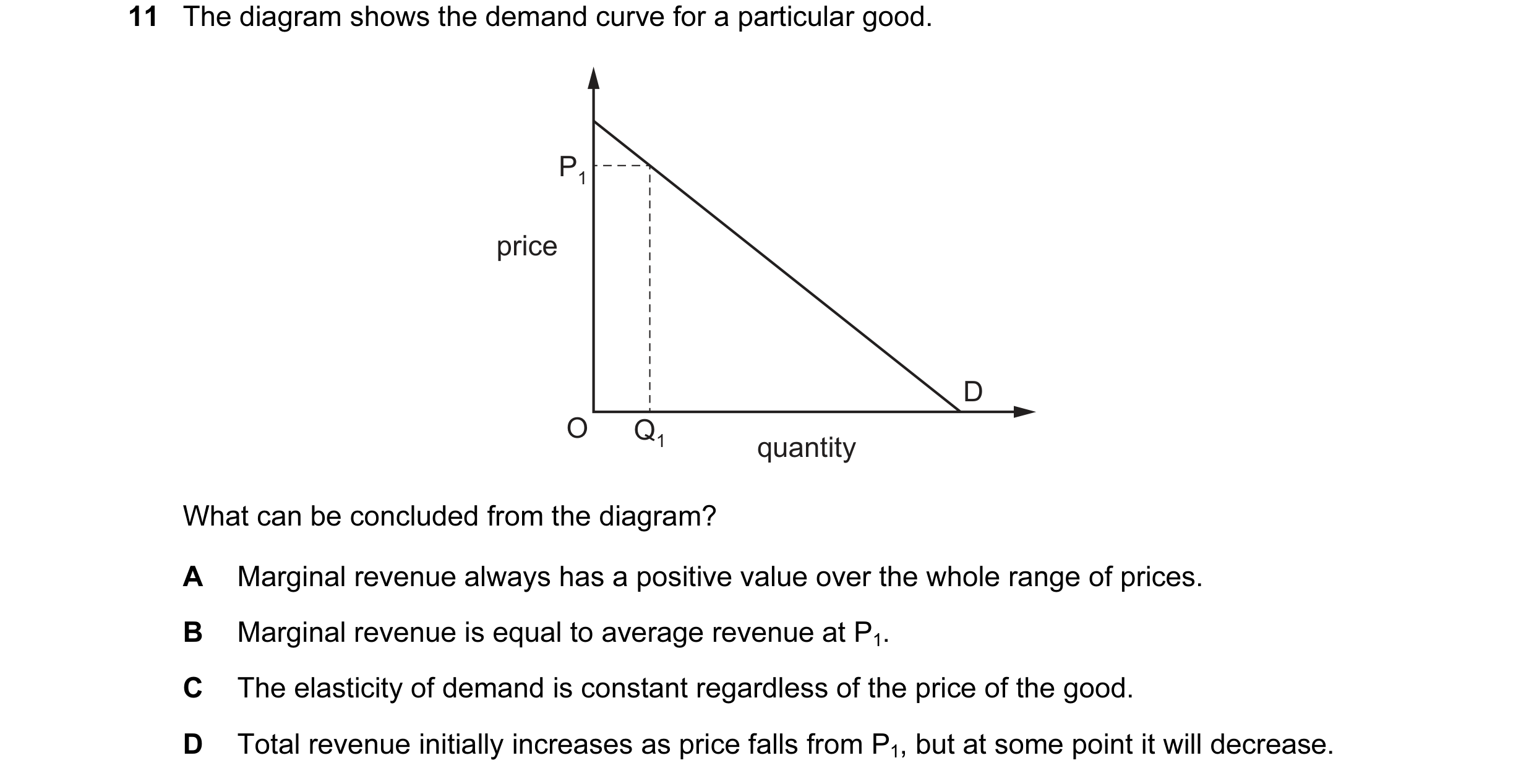
11 The diagram shows the demand curve for a particular good. P1 price D O Q1 quantity What can be concluded from the diagram? A Marginal revenue always has a positive value over the whole range of prices. B Marginal revenue is equal to average revenue at P1. C The elasticity of demand is constant regardless of the price of the good. D Total revenue initially increases as price falls from P1, but at some point it will decrease.
1 marks
Answer: D
This question in 9708/33 Oct/Nov 2015
Q16 · A firm estimates that, all else remaining unchanged, an increase in its output will… 9708/32 May/June 2016
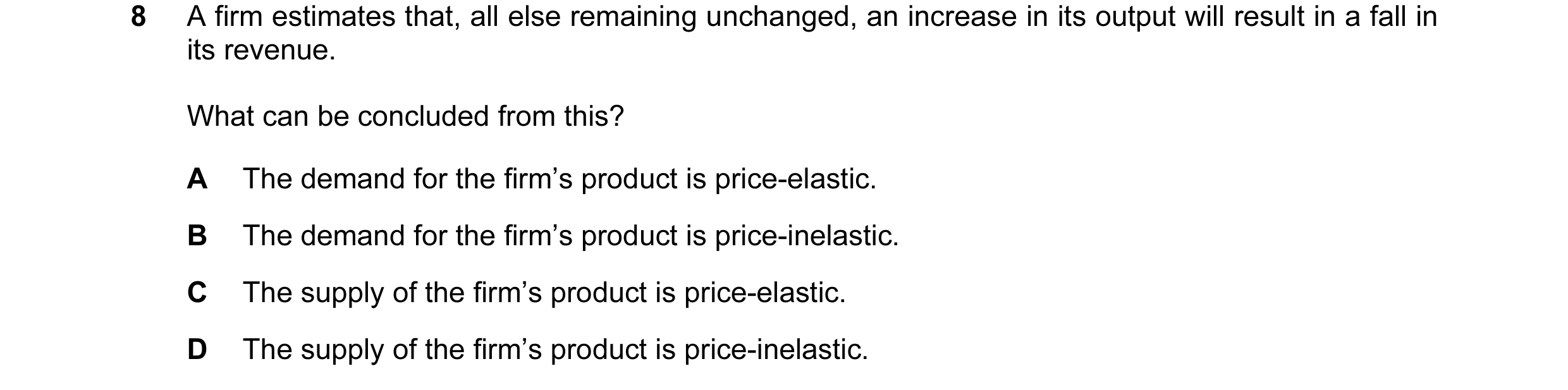
8 A firm estimates that, all else remaining unchanged, an increase in its output will result in a fall in its revenue. What can be concluded from this? A The demand for the firm’s product is price-elastic. B The demand for the firm’s product is price-inelastic. C The supply of the firm’s product is price-elastic. D The supply of the firm’s product is price-inelastic.
1 marks
Answer: B
This question in 9708/32 May/June 2016
Q17 · The diagram shows the total revenue curve for a firm operating in an imperfectly… 9708/33 May/June 2016
7 The diagram shows the total revenue curve for a firm operating in an imperfectly competitive market. revenue TR O Q1 Q2 Q3 output What is the value of the price elasticity of demand for the product at outputs Q1, Q2 and Q3? output Q1 output Q2 output Q3 A equal to 1 less than 1 greater than 1 B greater than 1 equal to 1 less than 1 C greater than 1 less than 1 equal to 1 D less than 1 equal to 1 greater than 1
1 marks
Answer: B
This question in 9708/33 May/June 2016
Q18 · When the price of a good falls the effect on the quantity demanded is the result of an… 9708/32 May/June 2017
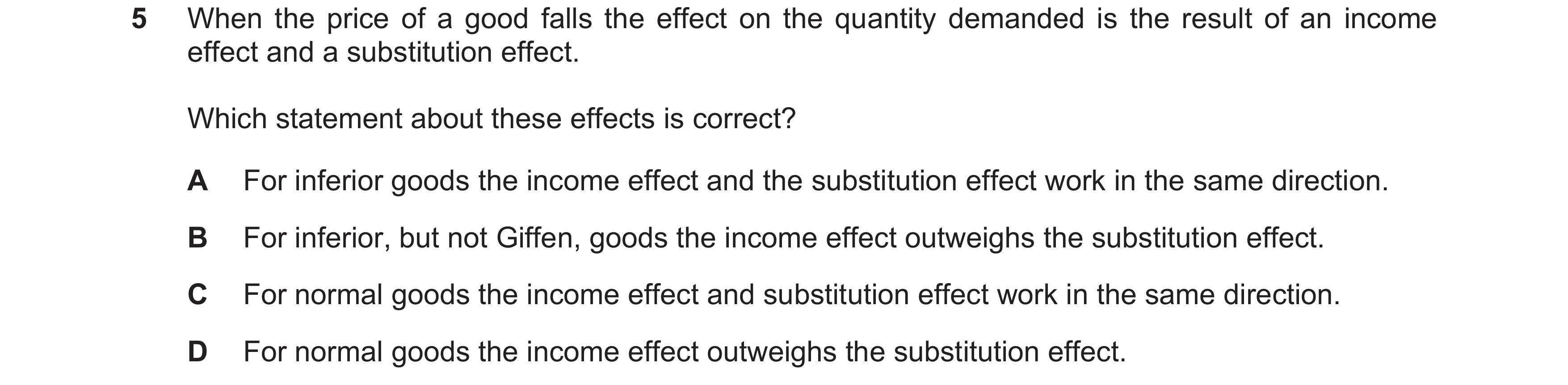
5 When the price of a good falls the effect on the quantity demanded is the result of an income effect and a substitution effect. Which statement about these effects is correct? A For inferior goods the income effect and the substitution effect work in the same direction. B For inferior, but not Giffen, goods the income effect outweighs the substitution effect. C For normal goods the income effect and substitution effect work in the same direction. D For normal goods the income effect outweighs the substitution effect.
1 marks
Answer: C
This question in 9708/32 May/June 2017
Q19 · A firm estimates that, all else remaining unchanged, an increase in its output will… 9708/32 May/June 2017
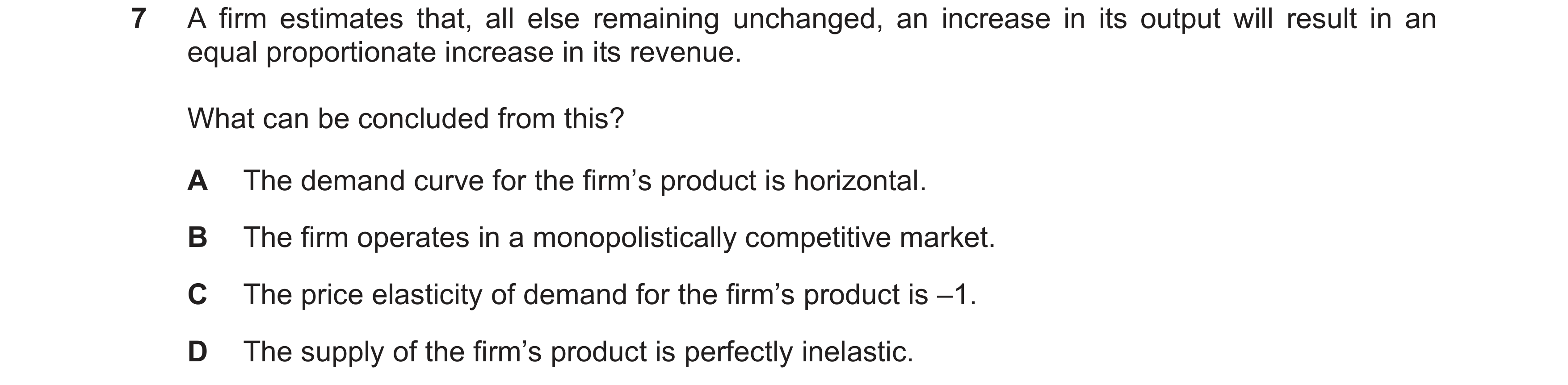
7 A firm estimates that, all else remaining unchanged, an increase in its output will result in an equal proportionate increase in its revenue. What can be concluded from this? A The demand curve for the firm’s product is horizontal. B The firm operates in a monopolistically competitive market. C The price elasticity of demand for the firm’s product is –1. D The supply of the firm’s product is perfectly inelastic.
1 marks
Answer: A
This question in 9708/32 May/June 2017
Q20 · The diagram shows the demand curve for a firm’s product 9708/32 May/June 2017
11 The diagram shows the demand curve for a firm’s product. price O output Which diagram shows the shape of the firm’s total revenue (TR) curve? A B C D revenue revenue revenue revenue O output O output O output O output
1 marks
Answer: C
This question in 9708/32 May/June 2017
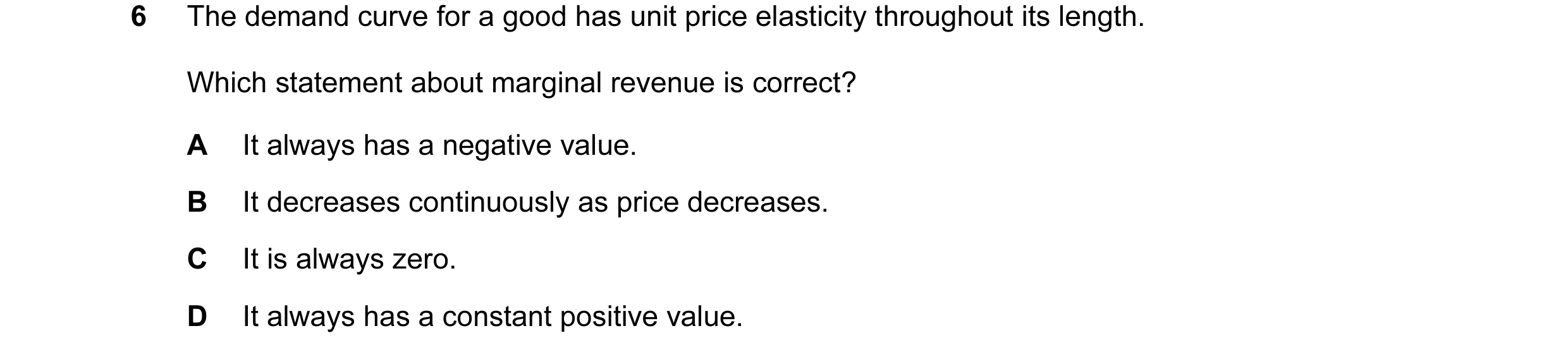
Q21 · The demand curve for a good has unit price elasticity throughout its length 9708/33 May/June 2017
6 The demand curve for a good has unit price elasticity throughout its length. Which statement about marginal revenue is correct? A It always has a negative value. B It decreases continuously as price decreases. C It is always zero. D It always has a constant positive value.
1 marks
Answer: C
This question in 9708/33 May/June 2017
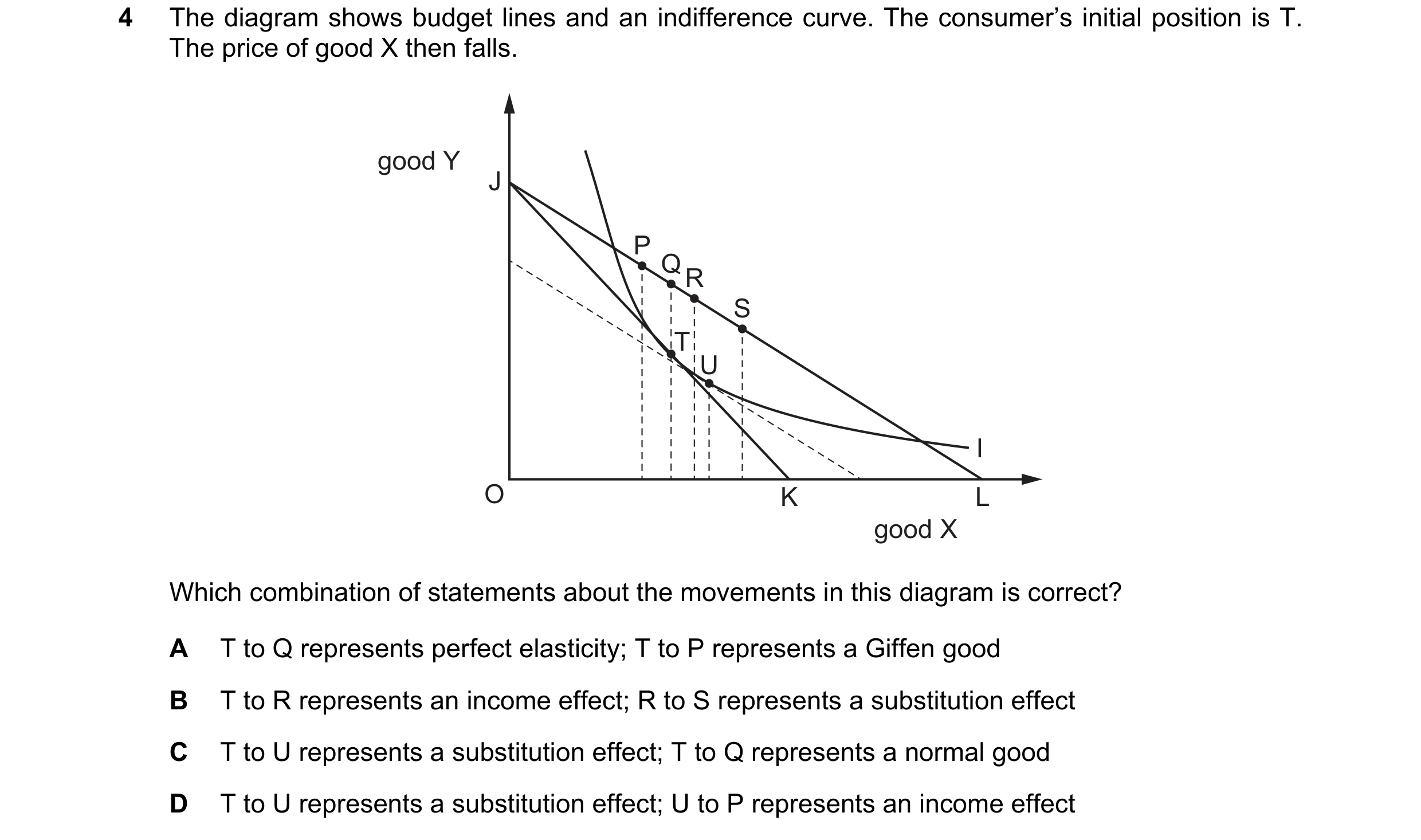
Q22 · The diagram shows budget lines and an indifference curve 9708/32 Oct/Nov 2018
4 The diagram shows budget lines and an indifference curve. The consumer’s initial position is T. The price of good X then falls. good Y J P Q R S T U I O K L good X Which combination of statements about the movements in this diagram is correct? A T to Q represents perfect elasticity; T to P represents a Giffen good B T to R represents an income effect; R to S represents a substitution effect C T to U represents a substitution effect; T to Q represents a normal good D T to U represents a substitution effect; U to P represents an income effect
1 marks
Answer: D
This question in 9708/32 Oct/Nov 2018
Q23 · What must be found in two markets for price discrimination to be profitable? 9708/32 Oct/Nov 2018
7 What must be found in two markets for price discrimination to be profitable? A different price elasticities of demand B different price elasticities of supply C different producers D different products
1 marks
Answer: A
This question in 9708/32 Oct/Nov 2018
Q24 · Transport economists estimate the price elasticity of demand for private car use is very… 9708/32 Oct/Nov 2018
13 Transport economists estimate the price elasticity of demand for private car use is very low. What would be the most effective way of reducing road traffic congestion? A banning private cars and lorries from town centres B introducing a subsidy to lower the price of using bicycles C introducing road pricing on all main roads D subsidising public transport such as trains and buses
1 marks
Answer: A
This question in 9708/32 Oct/Nov 2018
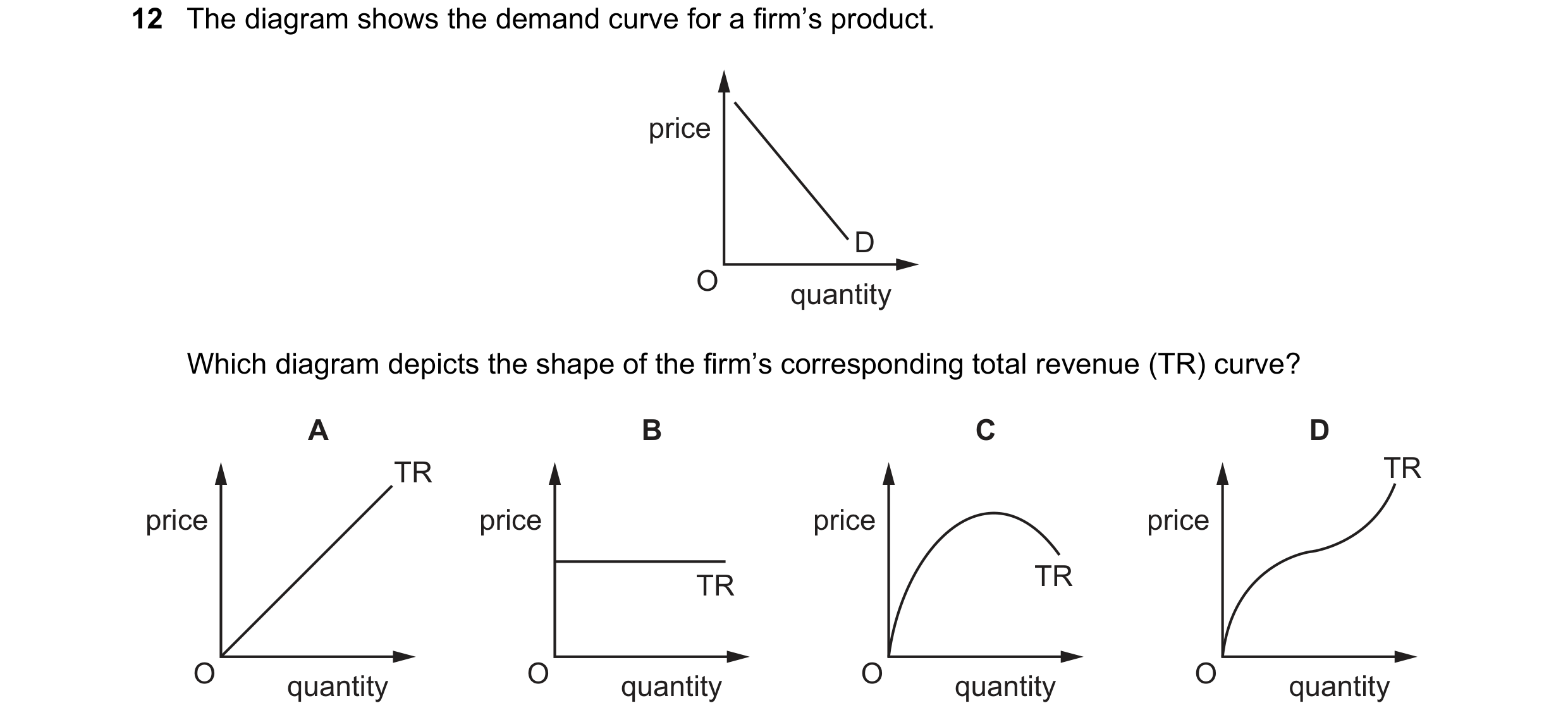
Q25 · The diagram shows the demand curve for a firm’s product 9708/32 Feb/March 2021
12 The diagram shows the demand curve for a firm’s product. price D O quantity Which diagram depicts the shape of the firm’s corresponding total revenue (TR) curve? A B C D TR TR price price price price TR TR O quantity O quantity O quantity O quantity
1 marks
Answer: C
This question in 9708/32 Feb/March 2021
Q26 · What would be most likely to cause the demand for labour in an industry to be inelastic? 9708/32 Feb/March 2021
17 What would be most likely to cause the demand for labour in an industry to be inelastic? A Labour costs are a small percentage of total cost. B The demand for the final product has a price elasticity of demand that is greater than one. C The workforce belongs to a strong trade union. D There is a large pool of readily available labour.
1 marks
Answer: A
This question in 9708/32 Feb/March 2021
Q27 · What is the most likely combination of income elasticity of demand and price elasticity… 9708/31 Oct/Nov 2021
10 What is the most likely combination of income elasticity of demand and price elasticity of demand that explains why a firm can make higher profits in specialised luxury product markets? income elasticity price elasticity of demand of demand A high high B high low C low high D low low
1 marks
Answer: B
This question in 9708/31 Oct/Nov 2021
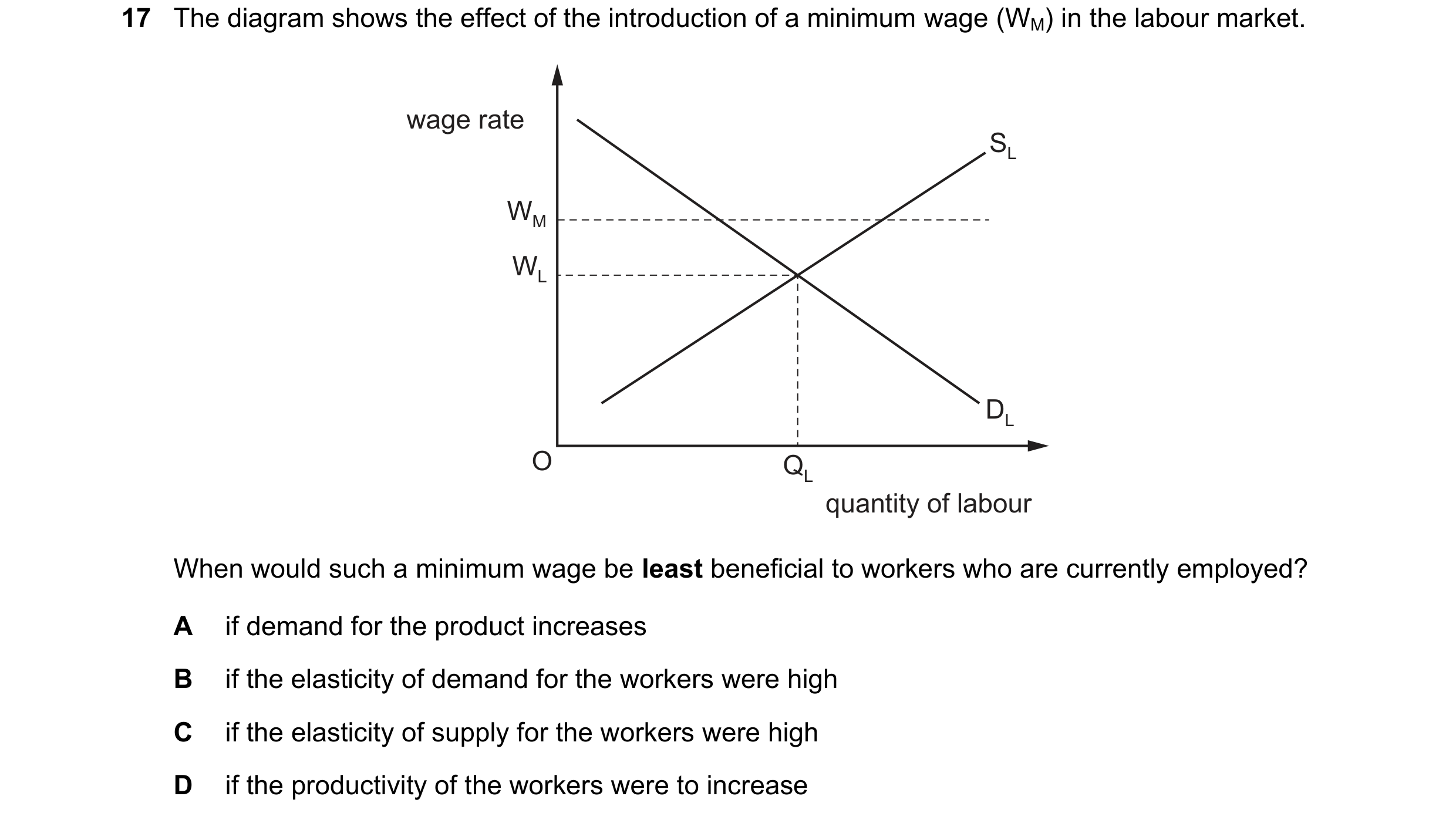
Q28 · The diagram shows the effect of the introduction of a minimum wage (WM) in the labour… 9708/32 Oct/Nov 2021
17 The diagram shows the effect of the introduction of a minimum wage (WM) in the labour market. wage rate SL WM WL DL O QL quantity of labour When would such a minimum wage be least beneficial to workers who are currently employed? A if demand for the product increases B if the elasticity of demand for the workers were high C if the elasticity of supply for the workers were high D if the productivity of the workers were to increase
1 marks
Answer: B
This question in 9708/32 Oct/Nov 2021
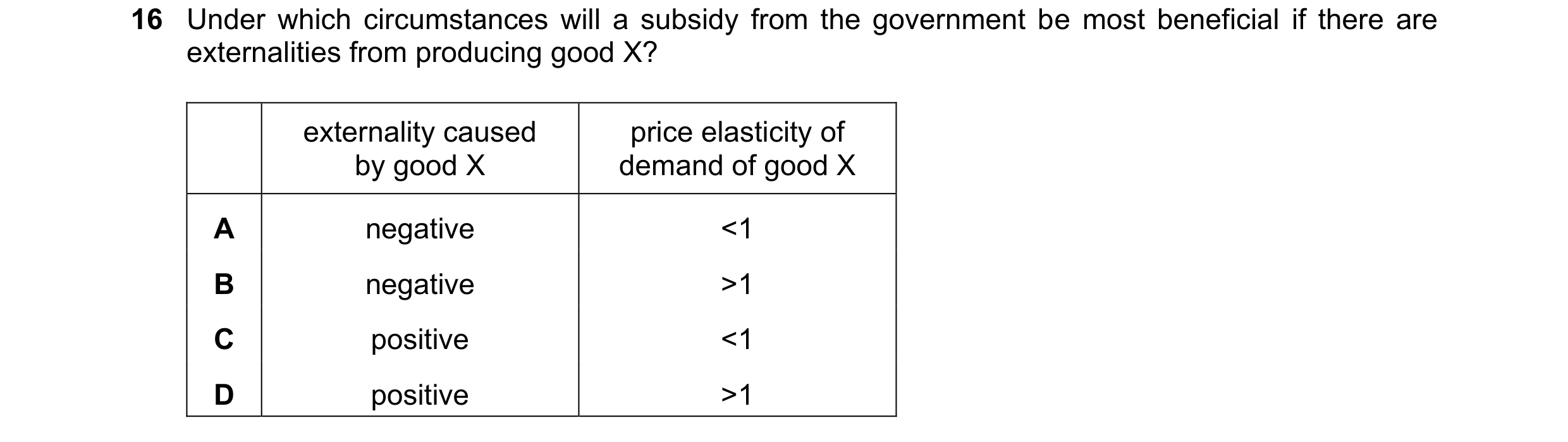
Q29 · Under which circumstances will a subsidy from the government be most beneficial if there… 9708/31 Oct/Nov 2023
16 Under which circumstances will a subsidy from the government be most beneficial if there are externalities from producing good X? externality caused price elasticity of by good X demand of good X A negative <1 B negative >1 C positive <1 D positive >1
1 marks
Answer: D
This question in 9708/31 Oct/Nov 2023
Q30 · Which statement about the downward sloping demand curve of an inferior good is correct? 9708/32 Feb/March 2025
5 Which statement about the downward sloping demand curve of an inferior good is correct? A Negative income effect and substitution effect move in opposite directions, leading to a steeper demand curve. B Negative income effect and substitution effect move in the same direction, leading to a flatter demand curve. C Positive income effect and substitution effect move in opposite directions, leading to a steeper demand curve. D Positive income effect and substitution effect move in the same direction, leading to a flatter demand curve.
1 marks
Answer: A
This question in 9708/32 Feb/March 2025
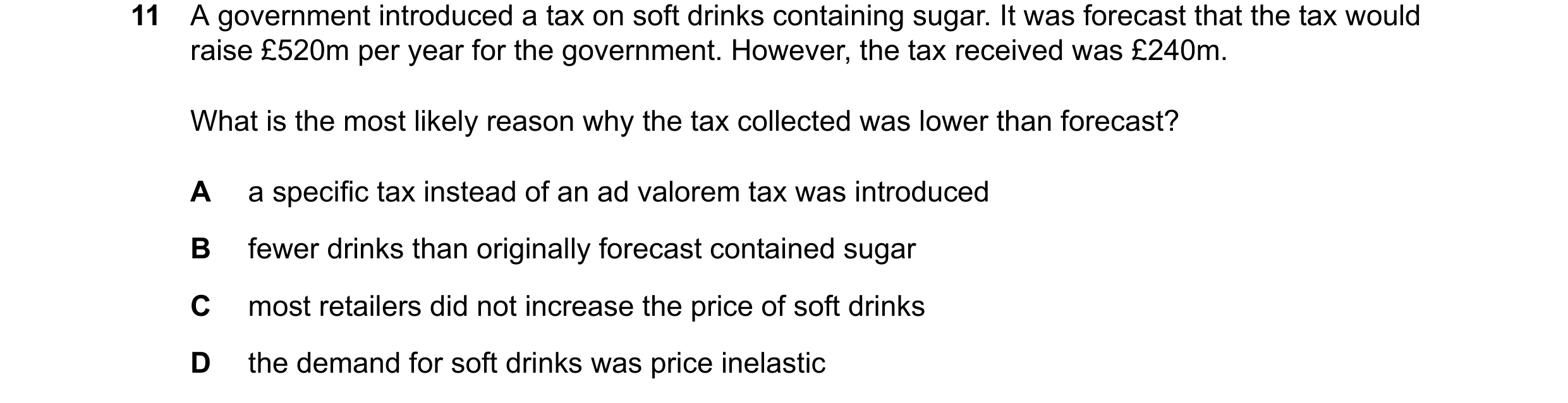
Q31 · A government introduced a tax on soft drinks containing sugar 9708/32 Feb/March 2025
11 A government introduced a tax on soft drinks containing sugar. It was forecast that the tax would raise £520m per year for the government. However, the tax received was £240m. What is the most likely reason why the tax collected was lower than forecast? A a specific tax instead of an ad valorem tax was introduced B fewer drinks than originally forecast contained sugar C most retailers did not increase the price of soft drinks D the demand for soft drinks was price inelastic
1 marks
Answer: B
This question in 9708/32 Feb/March 2025
 1 / 9
1 / 9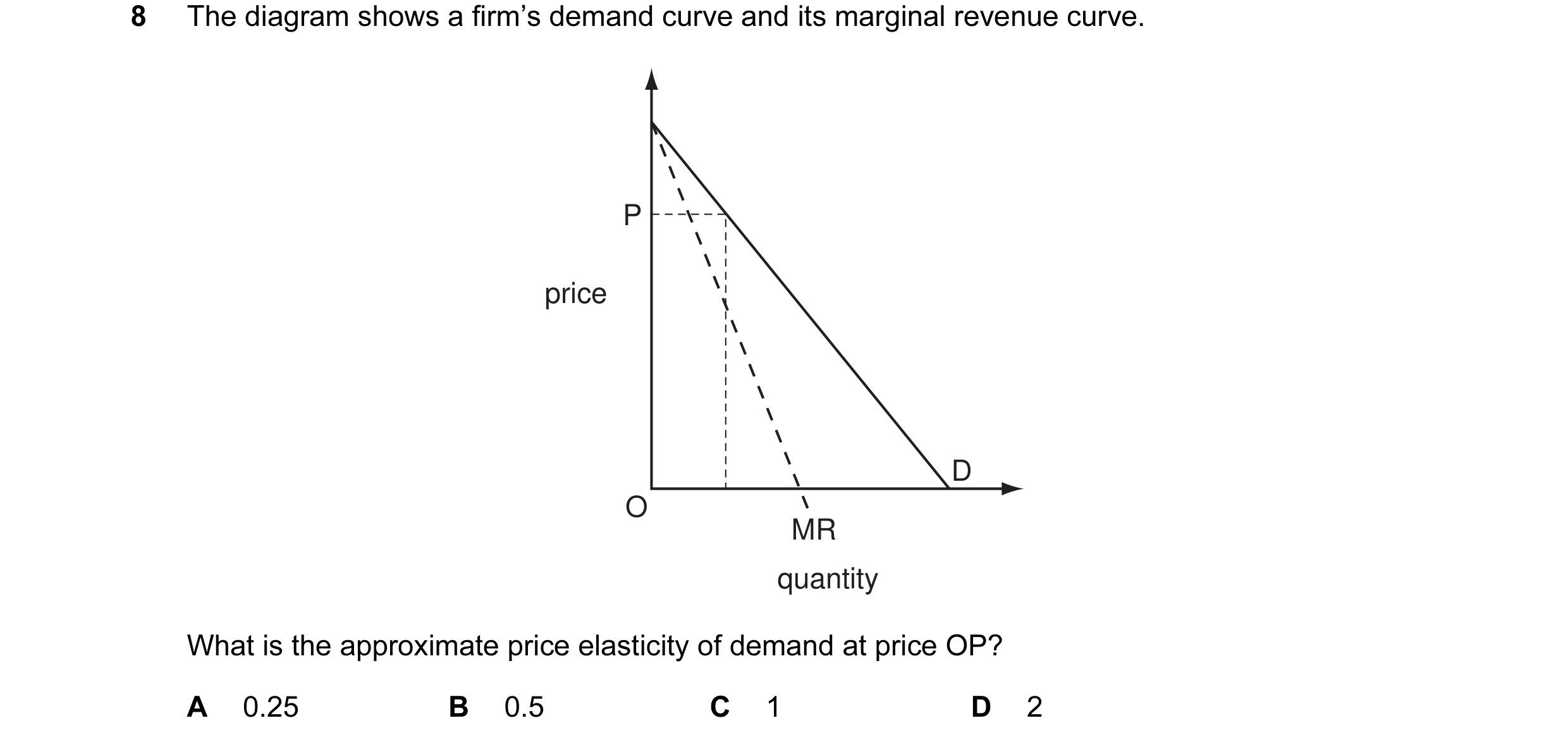

 2 / 9
2 / 9
 3 / 9
3 / 9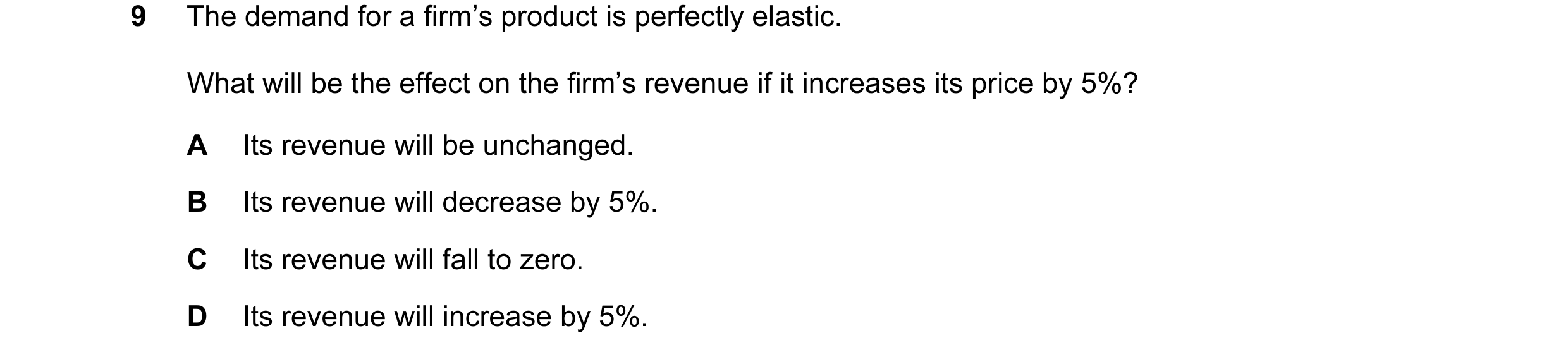
 4 / 9
4 / 9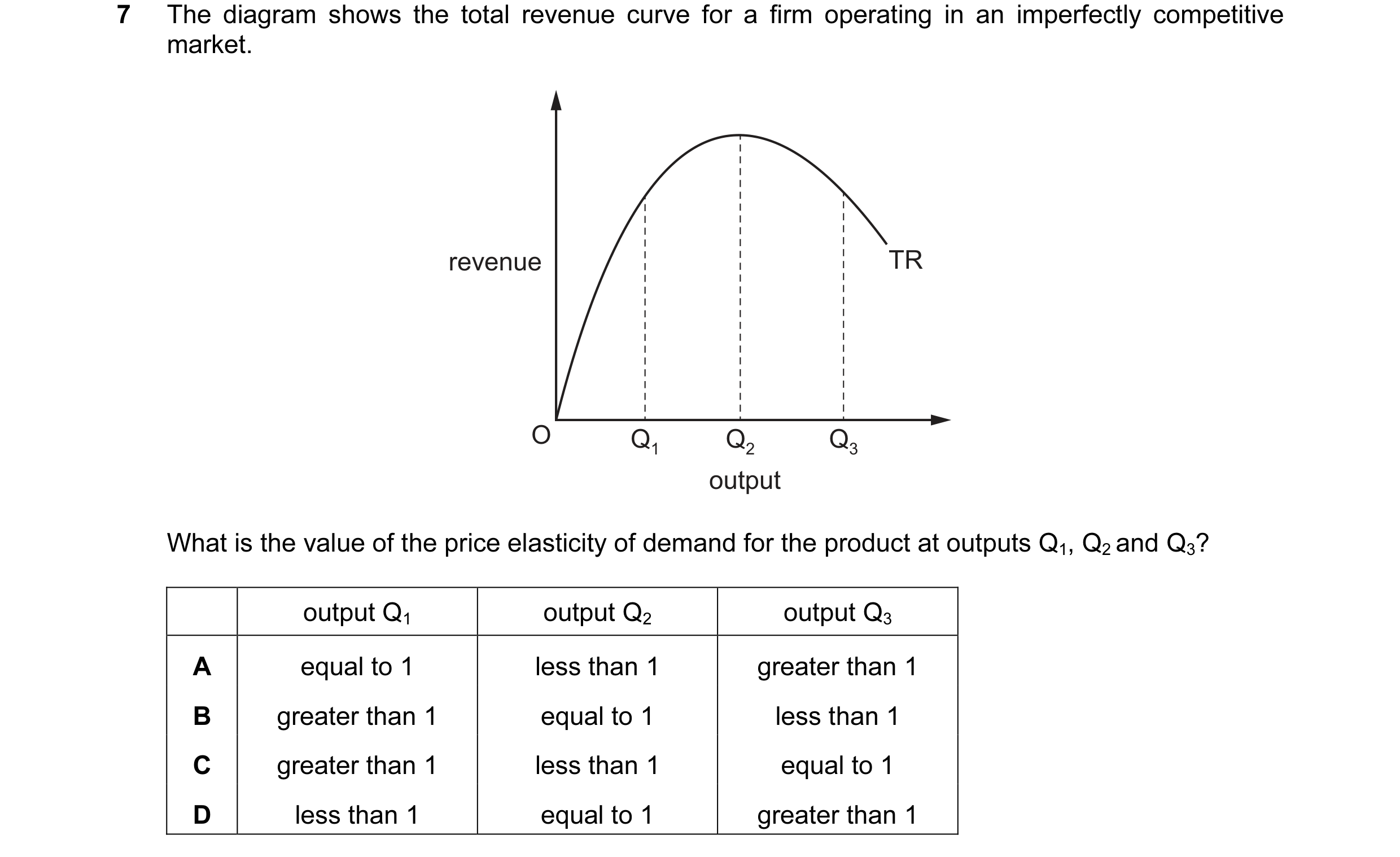
 5 / 9
5 / 9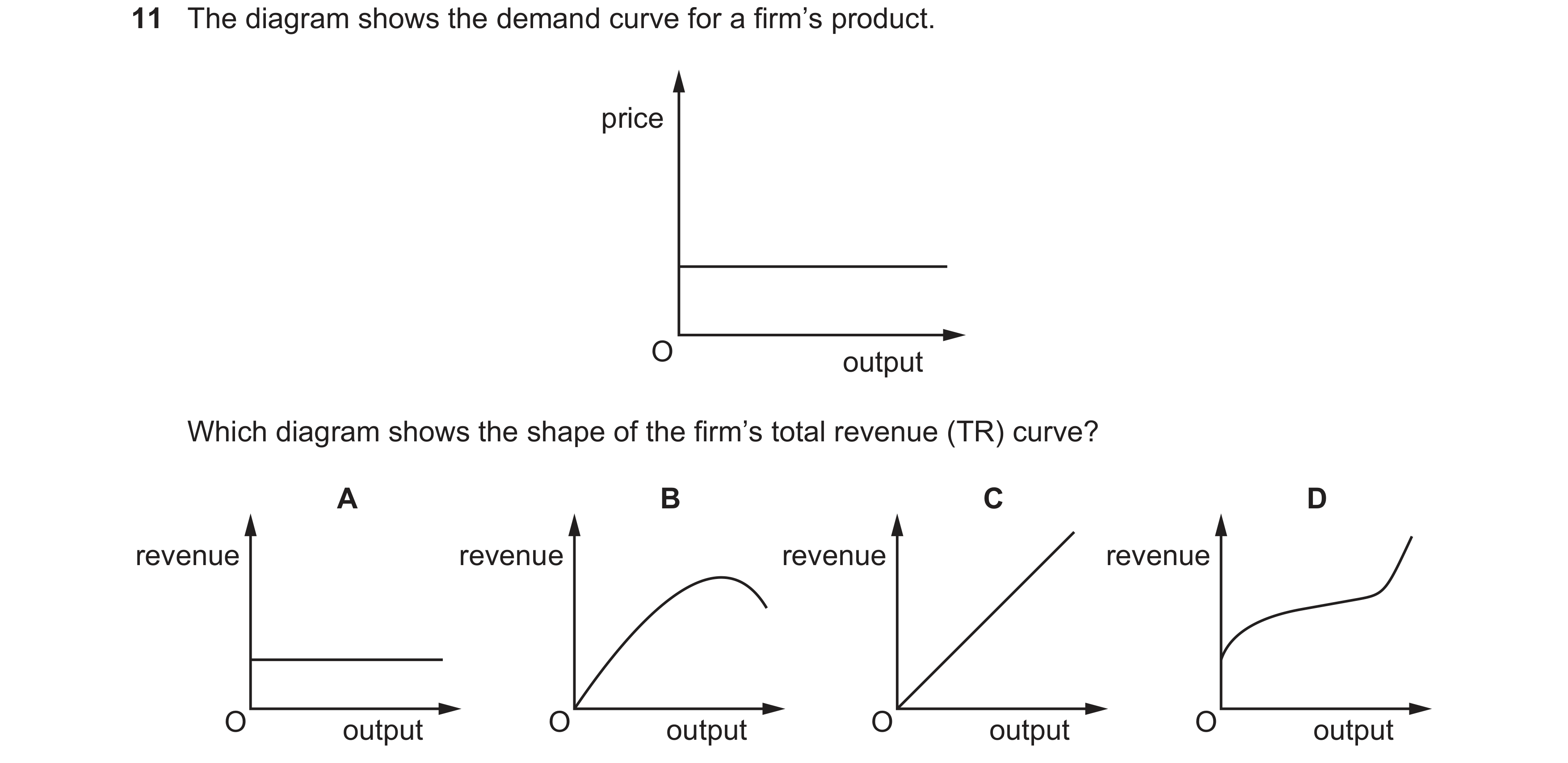
 6 / 9
6 / 9
 7 / 9
7 / 9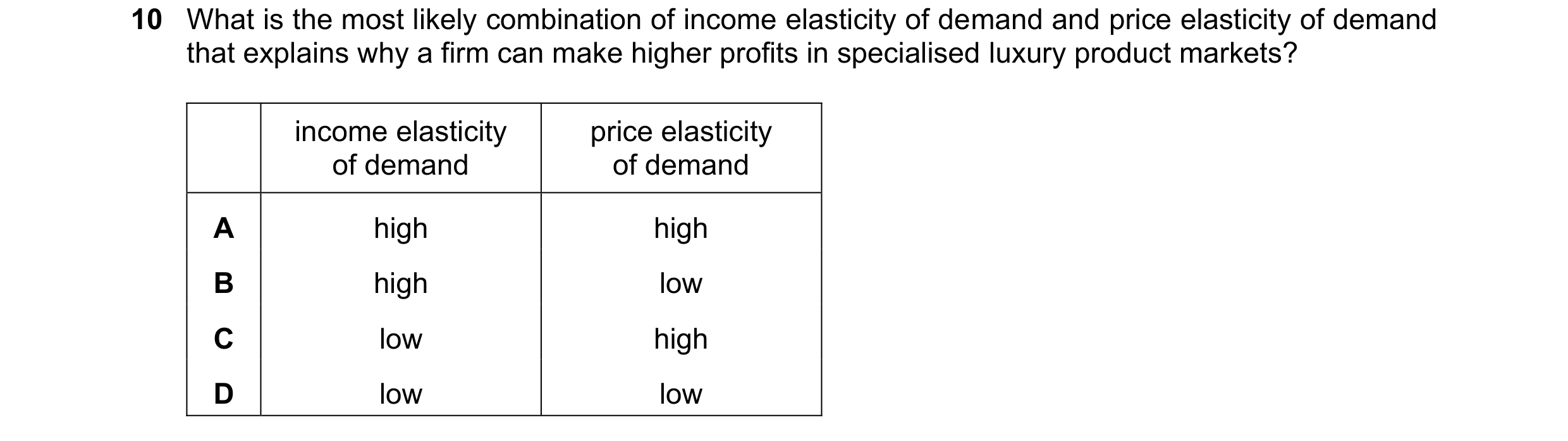
 8 / 9
8 / 9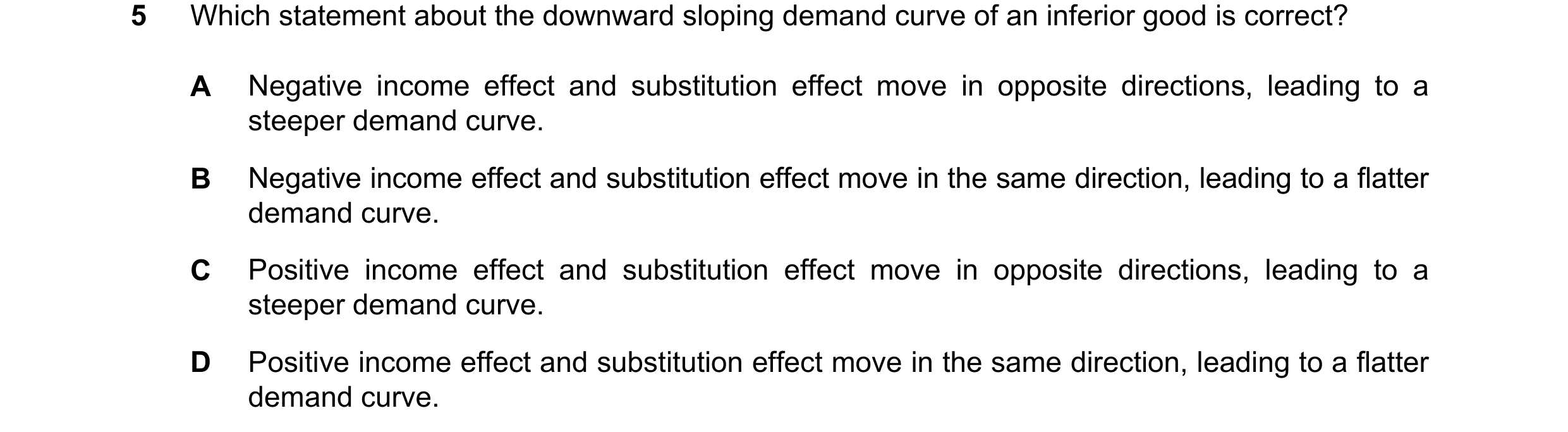
 9 / 9
9 / 9