Cambridge A Level Economics 9708 — 2024 Oct/Nov Paper 2 · Variant 3
9708/23/O/N/24 · 5 questions · 60 marks · ≈68 min
The question paper and its mark scheme, free to read here and free to download. This is Cambridge’s own paper, exactly as it was sat.
Question paper4 pages
Mark scheme20 pages
Answers below. Sit the paper first if you are practising.
Questions as text
Q1 · Global coffee bean prices reach a new high Coffee is big business, especially in the…
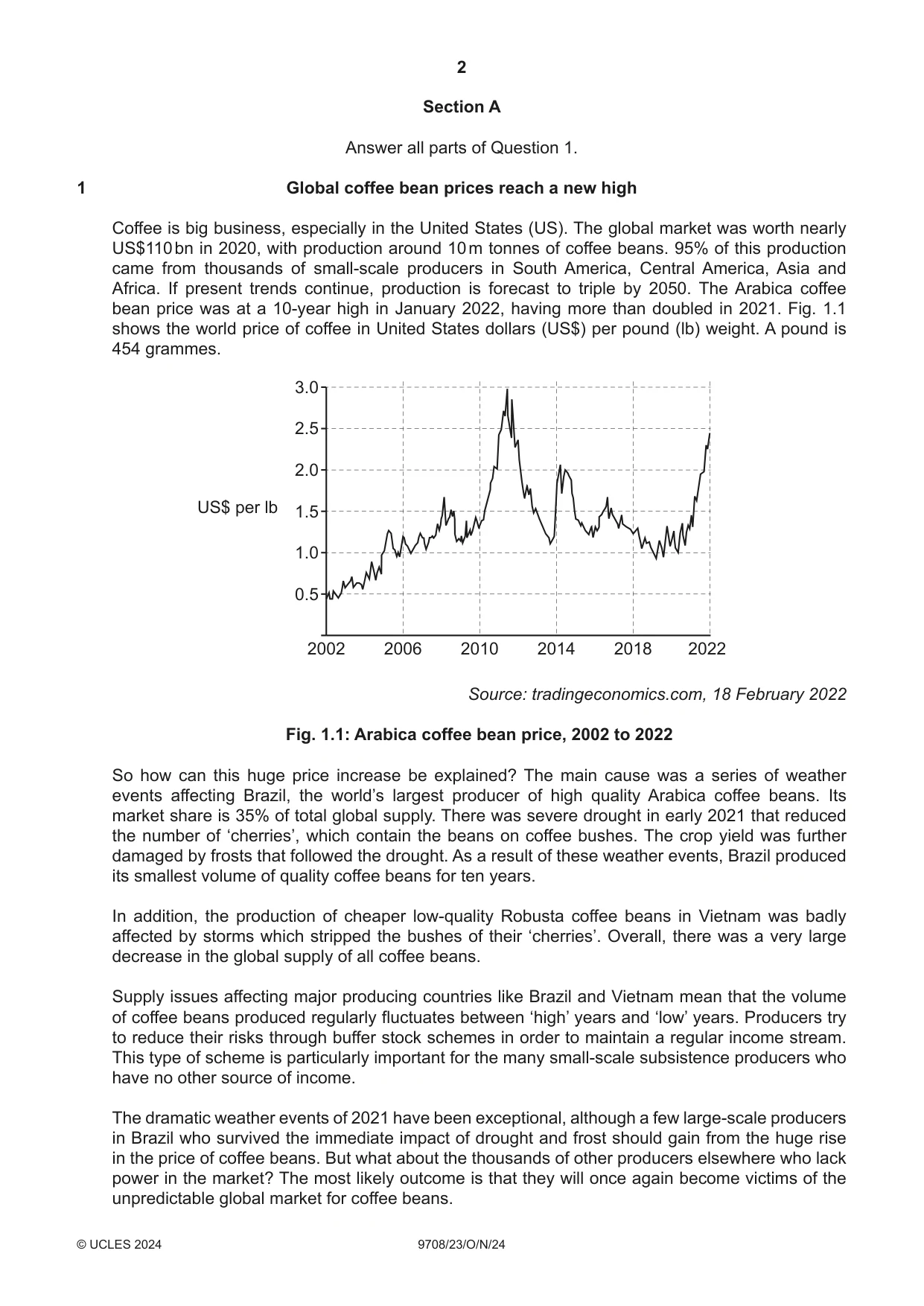
1 Global coffee bean prices reach a new high Coffee is big business, especially in the United States (US). The global market was worth nearly US$110 bn in 2020, with production around 10 m tonnes of coffee beans. 95% of this production came from thousands of small-scale producers in South America, Central America, Asia and Africa. If present trends continue, production is forecast to triple by 2050. The Arabica coffee bean price was at a 10-year high in January 2022, having more than doubled in 2021. Fig. 1.1 shows the world price of coffee in United States dollars (US$) per pound (lb) weight. A pound is 454 grammes. 3.0 2.5 2.0 US$ per lb 1.5 1.0 0.5 2002 2006 2010 2014 2018 2022 Source: tradingeconomics.com, 18 February 2022 Fig. 1.1: Arabica coffee bean price, 2002 to 2022 So how can this huge price increase be explained? The main cause was a series of weather events affecting Brazil, the world’s largest producer of high quality Arabica coffee beans. Its market share is 35% of total global supply. There was severe drought in early 2021 that reduced the number of ‘cherries’, which contain the beans on coffee bushes. The crop yield was further damaged by frosts that followed the drought. As a result of these weather events, Brazil produced its smallest volume of quality coffee beans for ten years. In addition, the production of cheaper low-quality Robusta coffee beans in Vietnam was badly affected by storms which stripped the bushes of their ‘cherries’. Overall, there was a very large decrease in the global supply of all coffee beans. Supply issues affecting major producing countries like Brazil and Vietnam mean that the volume of coffee beans produced regularly fluctuates between ‘high’ years and ‘low’ years. Producers try to reduce their risks through buffer stock schemes in order to maintain a regular income stream. This type of scheme is particularly important for the many small-scale subsistence producers who have no other source of income. The dramatic weather events of 2021 have been exceptional, although a few large-scale producers in Brazil who survived the immediate impact of drought and frost should gain from the huge rise in the price of coffee beans. But what about the thousands of other producers elsewhere who lack power in the market? The most likely outcome is that they will once again become victims of the unpredictable global market for coffee beans. (a) Use a demand and supply diagram to show why there was a ‘huge’ increase in the price of Arabica coffee beans in 2021. [2] (b) Is the price elasticity of supply of coffee beans likely to be elastic or inelastic in any one year? Justify your answer from the information provided. [2] (c) Consider whether a buffer stock scheme is likely to be successful in reducing the price fluctuations shown in Fig. 1.1. [4] (d) Assess the extent to which coffee bean producers will gain from the huge increase in coffee bean prices in 2021. [6] (e) Assess the likely impact of the fluctuations in coffee bean prices on the economies of major producers such as Brazil and Vietnam. [6]
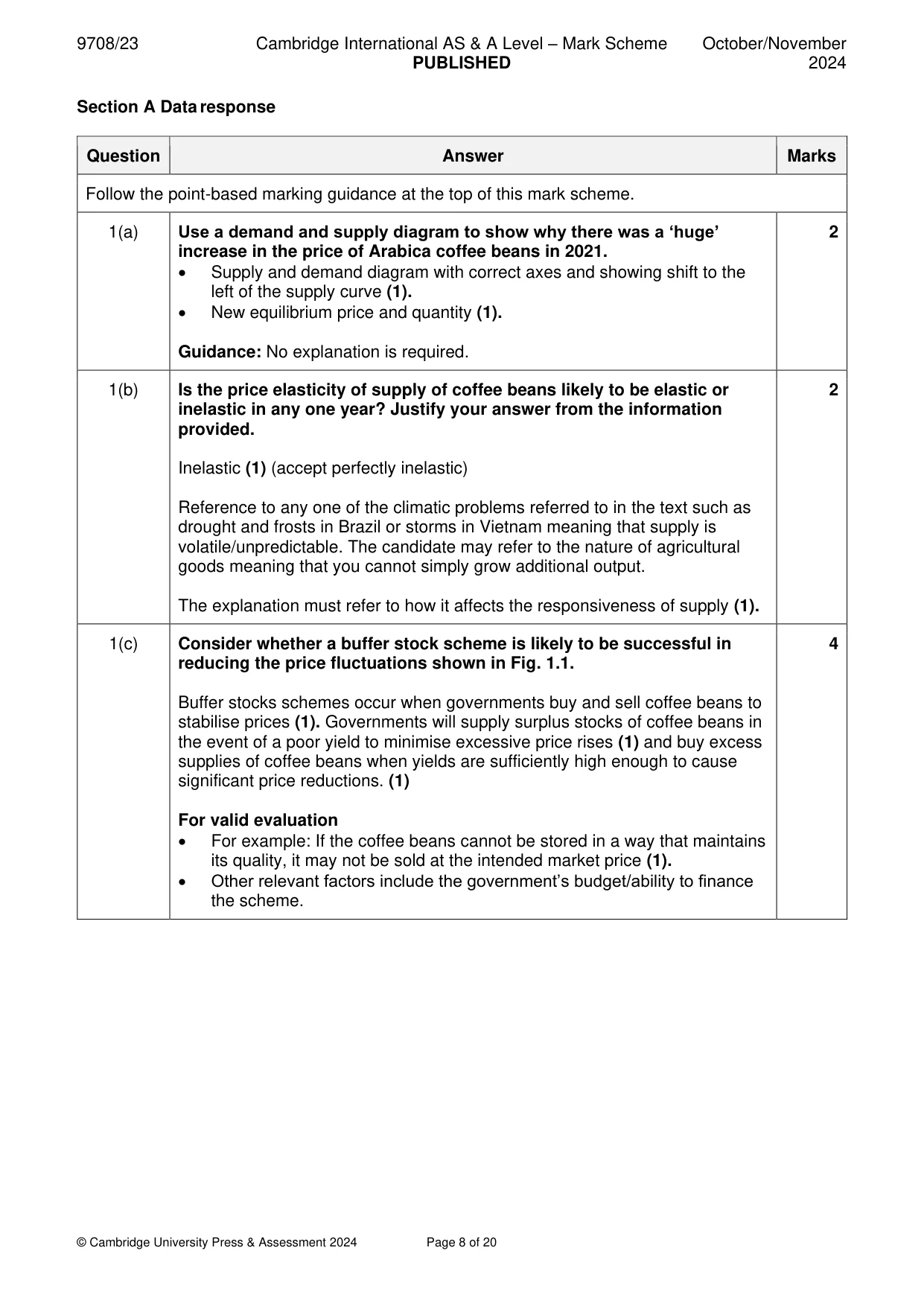
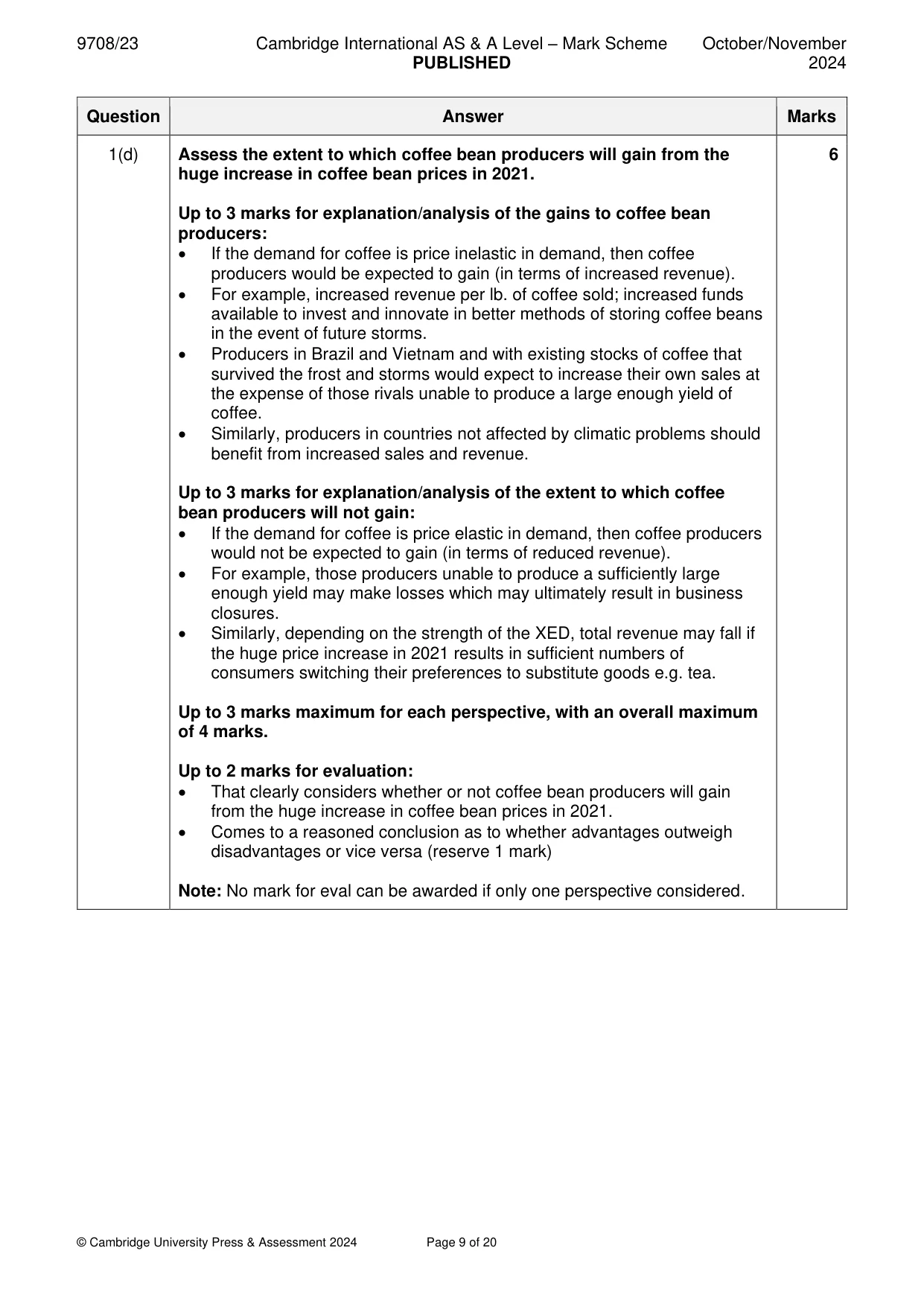
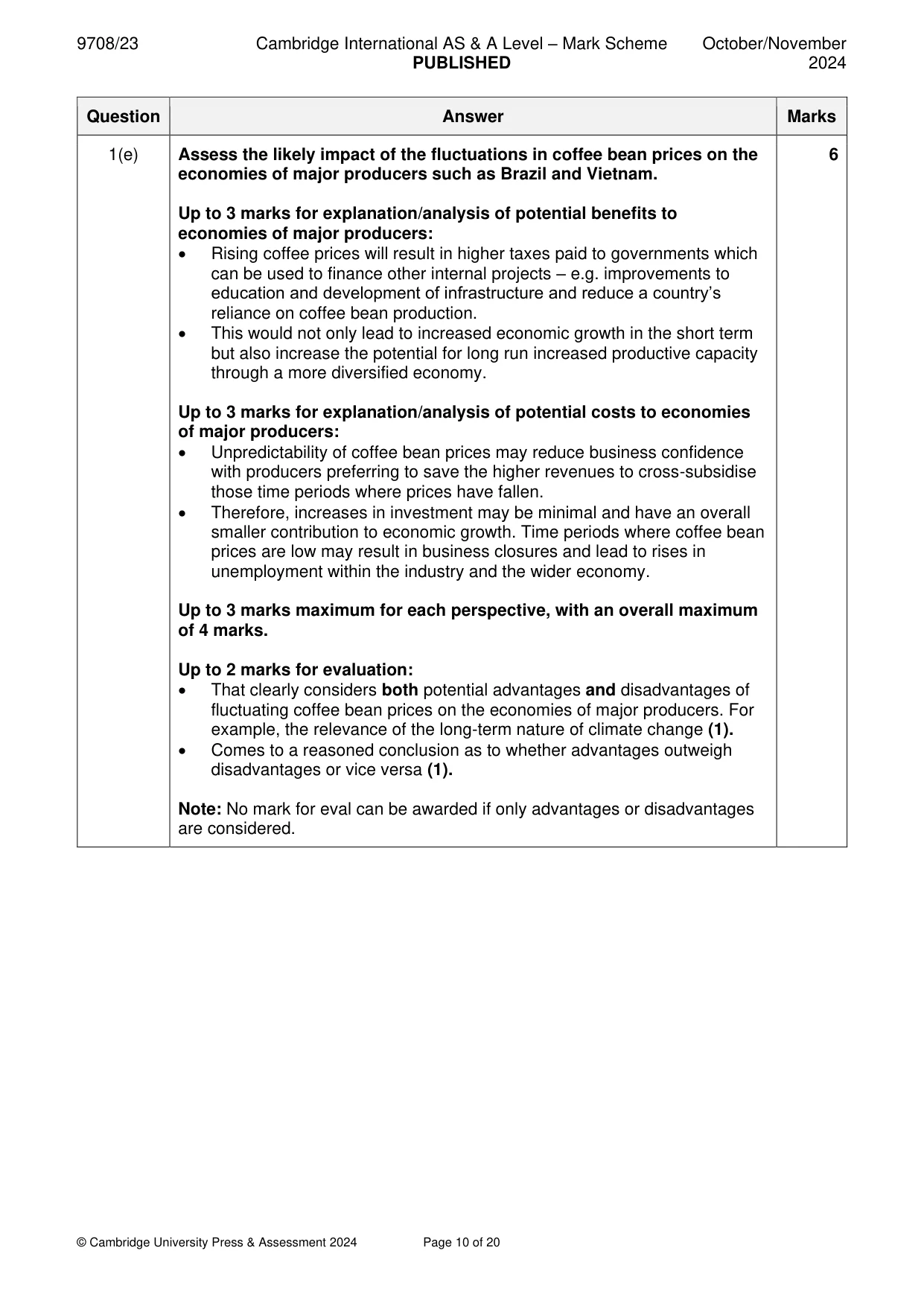
Mark scheme: Question Answer Marks Follow the point-based marking guidance at the top of this mark scheme. 1(a) Use a demand and supply diagram to show why there was a ‘huge’ 2 increase in the price of Arabica coffee beans in 2021. • Supply and demand diagram with correct axes and showing shift to the left of the supply curve (1). • New equilibrium price and quantity (1). Guidance: No explanation is required. 1(b) Is the price elasticity of supply of coffee beans likely to be elastic or 2 inelastic in any one year? Justify your answer from the information provided. Inelastic (1) (accept perfectly inelastic) Reference to any one of the climatic problems referred to in the text such as drought and frosts in Brazil or storms in Vietnam meaning that supply is volatile/unpredictable. The candidate may refer to the nature of agricultural goods meaning that you cannot simply grow additional output. The explanation must refer to how it affects the responsiveness of supply (1). 1(c) Consider whether a buffer stock scheme is likely to be successful in 4 reducing the price fluctuations shown in Fig. 1.1. Buffer stocks schemes occur when governments buy and sell coffee beans to stabilise prices (1). Governments will supply surplus stocks of coffee beans in the event of a poor yield to minimise excessive price rises (1) and buy excess supplies of coffee beans when yields are sufficiently high enough to cause significant price reductions. (1) For valid evaluation • For example: If the coffee beans cannot be stored in a way that maintains its quality, it may not be sold at the intended market price (1). • Other relevant factors include the government’s budget/ability to finance the scheme. 1(d) Assess the extent to which coffee bean producers will gain from the 6 huge increase in coffee bean prices in 2021. Up to 3 marks for explanation/analysis of the gains to coffee bean producers: • If the demand for coffee is price inelastic in demand, then coffee producers would be expected to gain (in terms of increased revenue). • For example, increased revenue per lb. of coffee sold; increased funds available to invest and innovate in better methods of storing coffee beans in the event of future storms. • Producers in Brazil and Vietnam and with existing stocks of coffee that survived the frost and storms would expect to increase their own sales at the expense of those rivals unable to produce a large enough yield of coffee. • Similarly, producers in countries not affected by climatic problems should benefit from increased sales and revenue. Up to 3 marks for explanation/analysis of the extent to which coffee bean producers will not gain: • If the demand for coffee is price elastic in demand, then coffee producers would not be expected to gain (in terms of reduced revenue). • For example, those producers unable to produce a sufficiently large enough yield may make losses which may ultimately result in business closures. • Similarly, depending on the strength of the XED, total revenue may fall if the huge price increase in 2021 results in sufficient numbers of consumers switching their preferences to substitute goods e.g. tea. Up to 3 marks maximum for each perspective, with an overall maximum of 4 marks. Up to 2 marks for evaluation: • That clearly considers whether or not coffee bean producers will gain from the huge increase in coffee bean prices in 2021. • Comes to a reasoned conclusion as to whether advantages outweigh disadvantages or vice versa (reserve 1 mark) Note: No mark for eval can be awarded if only one perspective considered. 1(e) Assess the likely impact of the fluctuations in coffee bean prices on the 6 economies of major producers such as Brazil and Vietnam. Up to 3 marks for explanation/analysis of potential benefits to economies of major producers: • Rising coffee prices will result in higher taxes paid to governments which can be used to finance other internal projects – e.g. improvements to education and development of infrastructure and reduce a country’s reliance on coffee bean production. • This would not only lead to increased economic growth in the short term but also increase the potential for long run increased productive capacity through a more diversified economy. Up to 3 marks for explanation/analysis of potential costs to economies of major producers: • Unpredictability of coffee bean prices may reduce business confidence with producers preferring to save the higher revenues to cross-subsidise those time periods where prices have fallen. • Therefore, increases in investment may be minimal and have an overall smaller contribution to economic growth. Time periods where coffee bean prices are low may result in business closures and lead to rises in unemployment within the industry and the wider economy. Up to 3 marks maximum for each perspective, with an overall maximum of 4 marks. Up to 2 marks for evaluation: • That clearly considers both potential advantages and disadvantages of fluctuating coffee bean prices on the economies of major producers. For example, the relevance of the long-term nature of climate change (1). • Comes to a reasoned conclusion as to whether advantages outweigh disadvantages or vice versa (1). Note: No mark for eval can be awarded if only advantages or disadvantages are considered.
More questions on Types of cost, revenue and profit, short-run and long-run production
Q2 · With the aid of examples, explain the characteristics of public goods and free goods and…
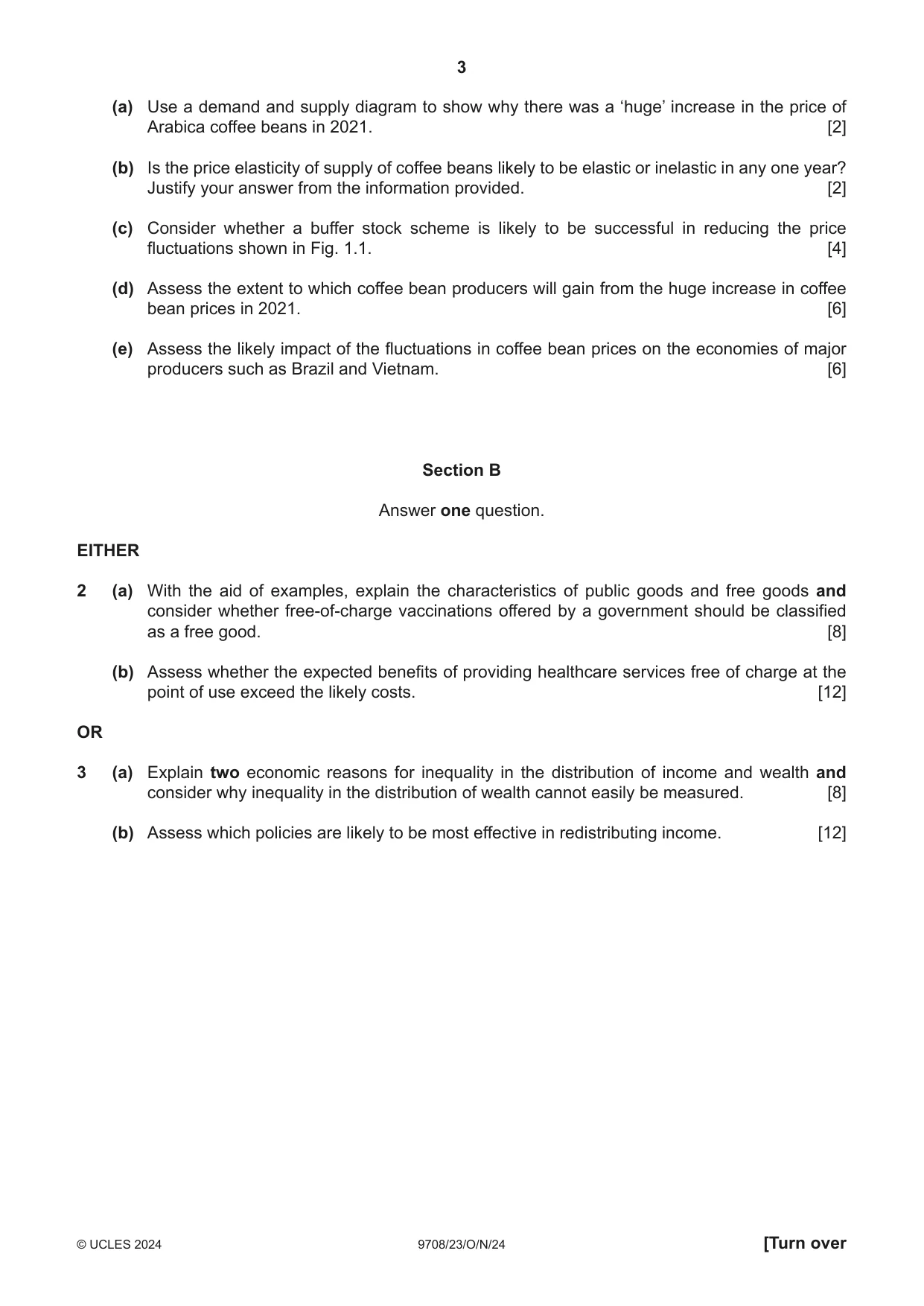
2 (a) With the aid of examples, explain the characteristics of public goods and free goods and consider whether free-of-charge vaccinations offered by a government should be classified as a free good. [8] (b) Assess whether the expected benefits of providing healthcare services free of charge at the point of use exceed the likely costs. [12] OR
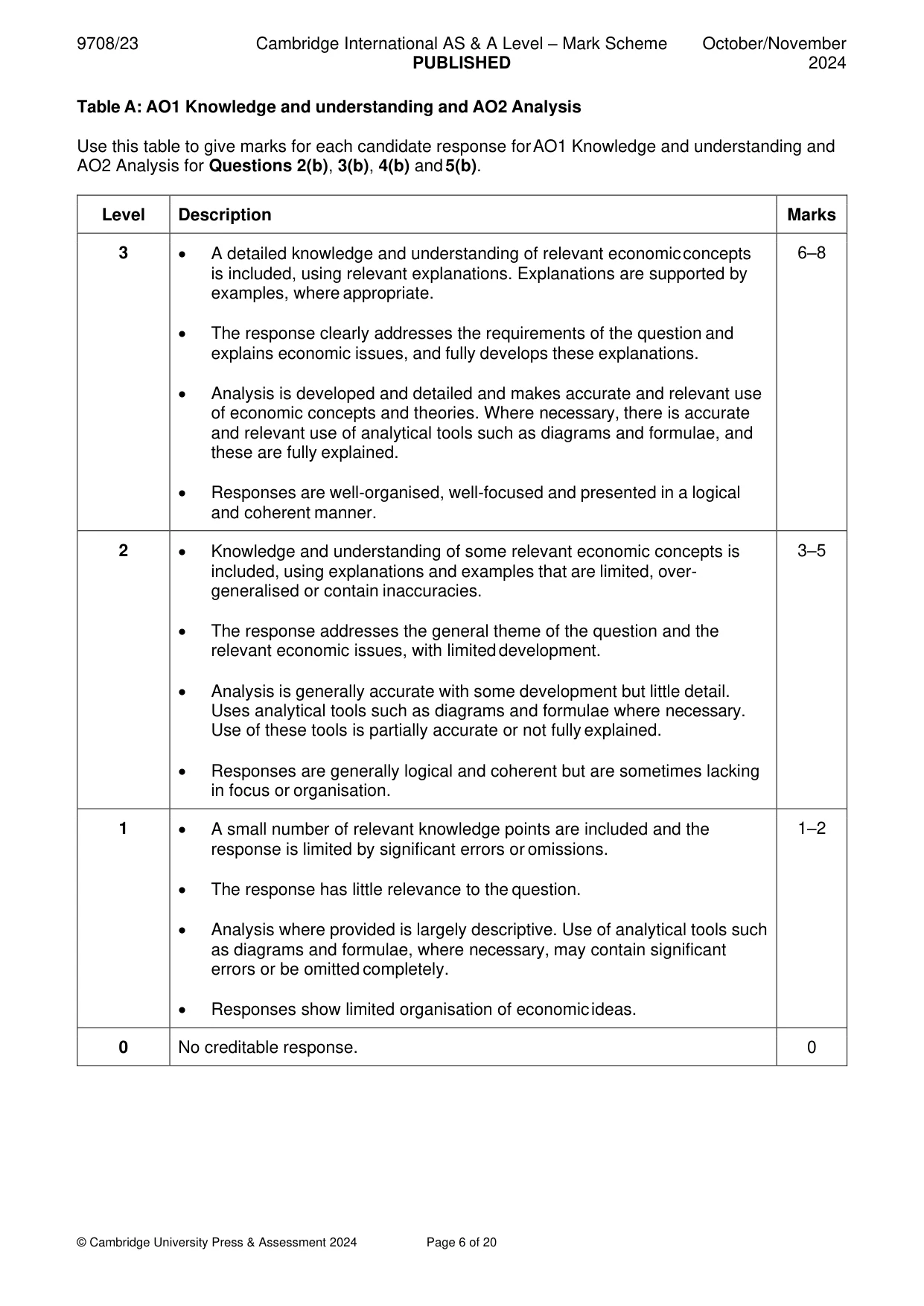
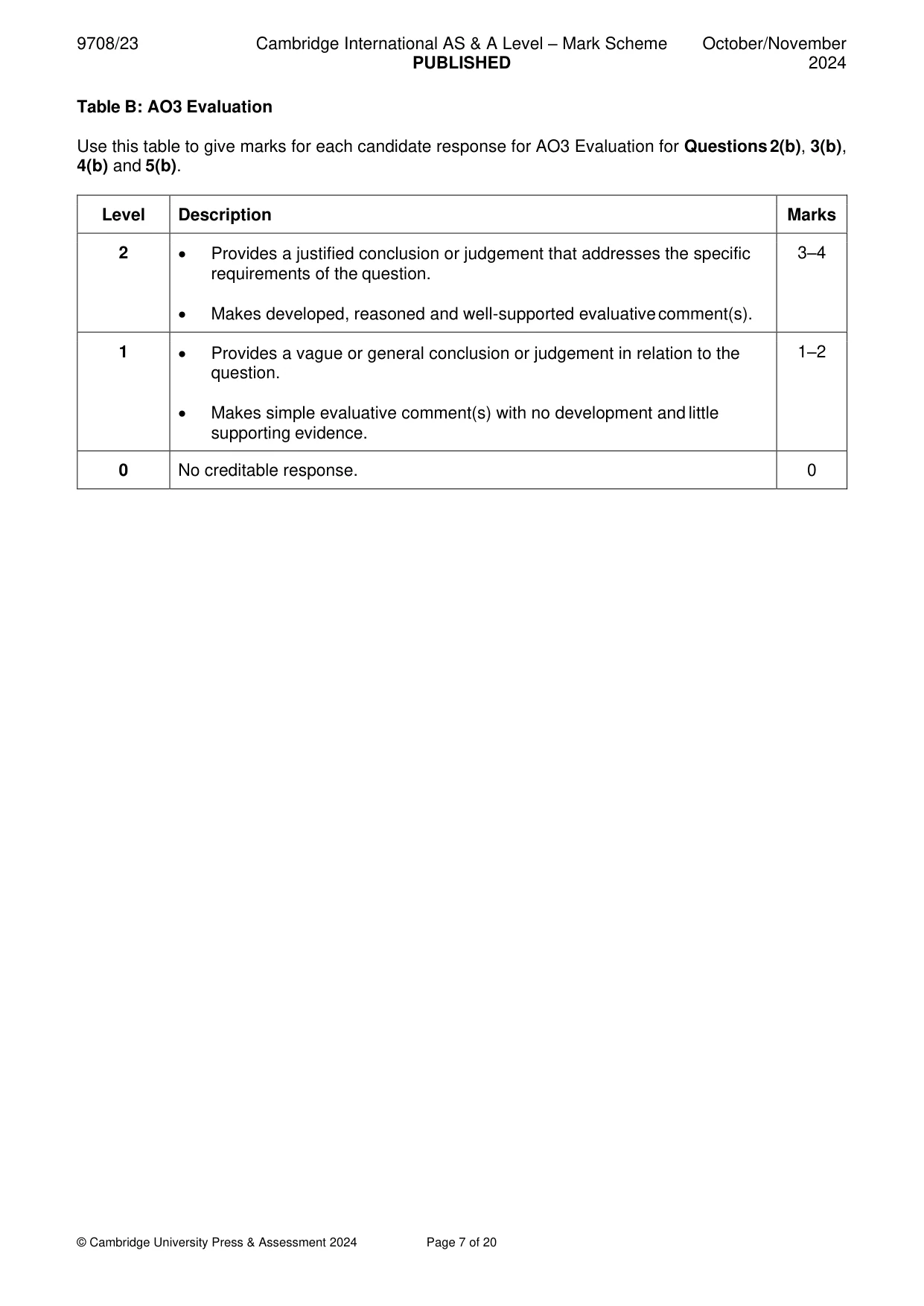
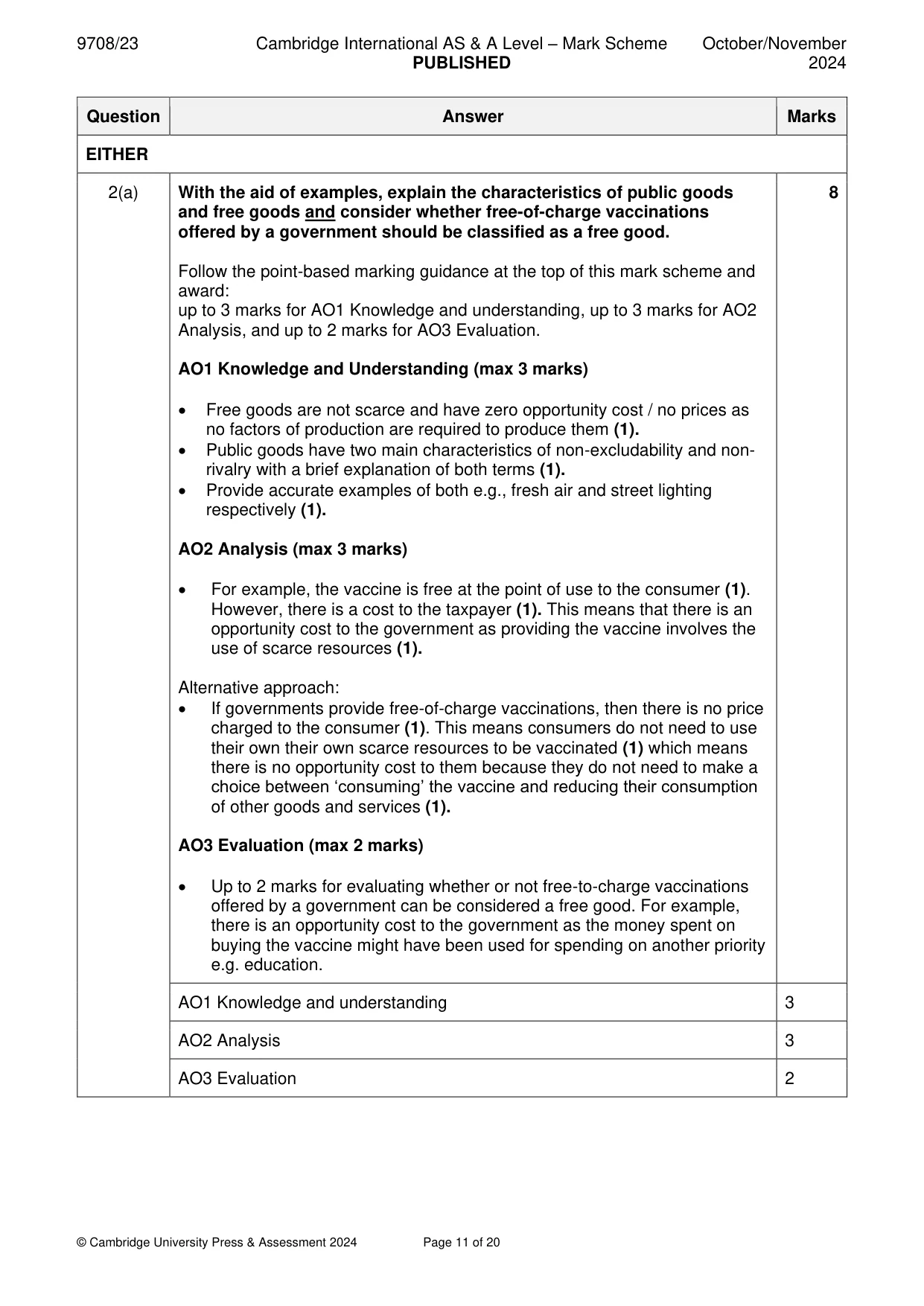
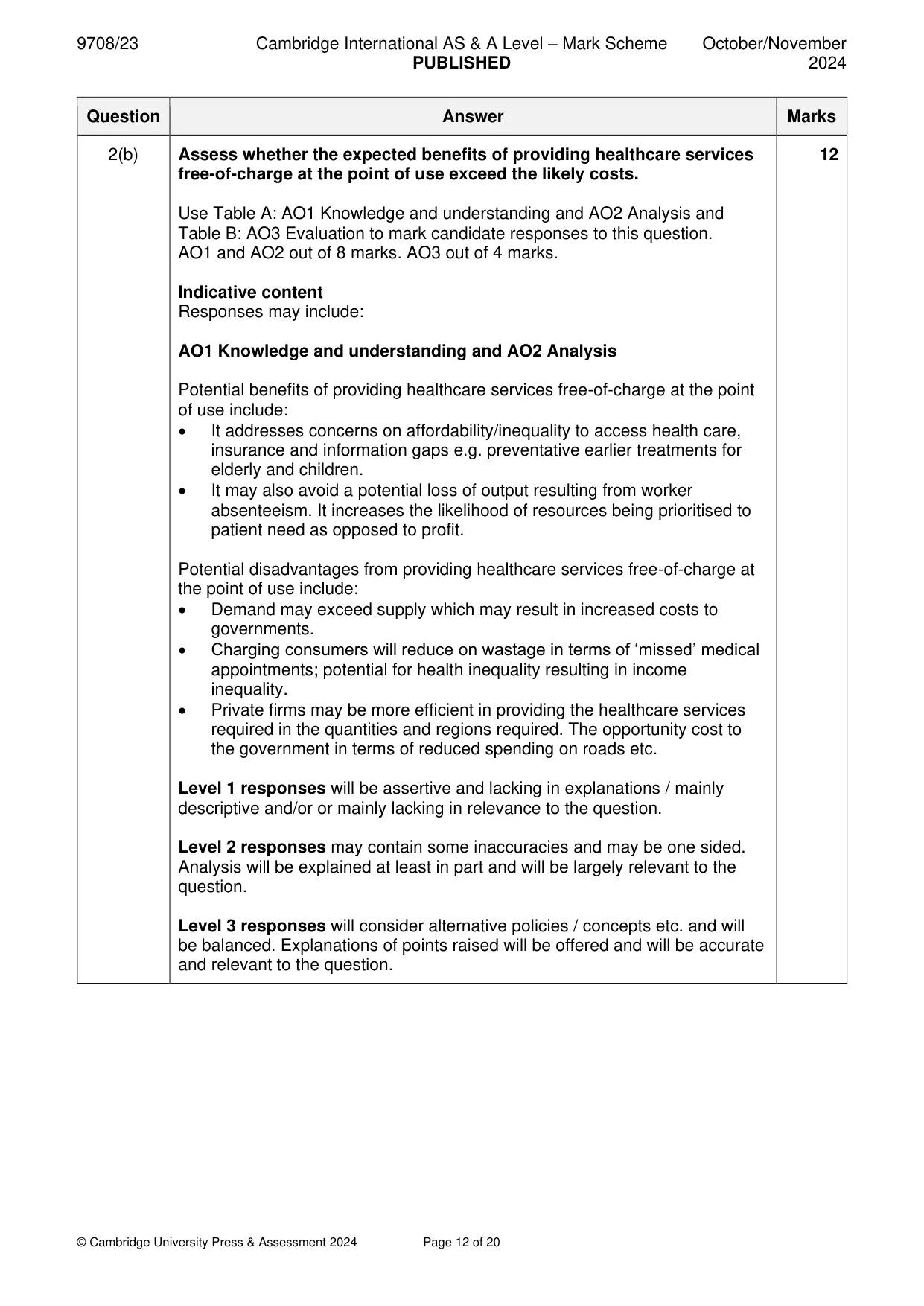
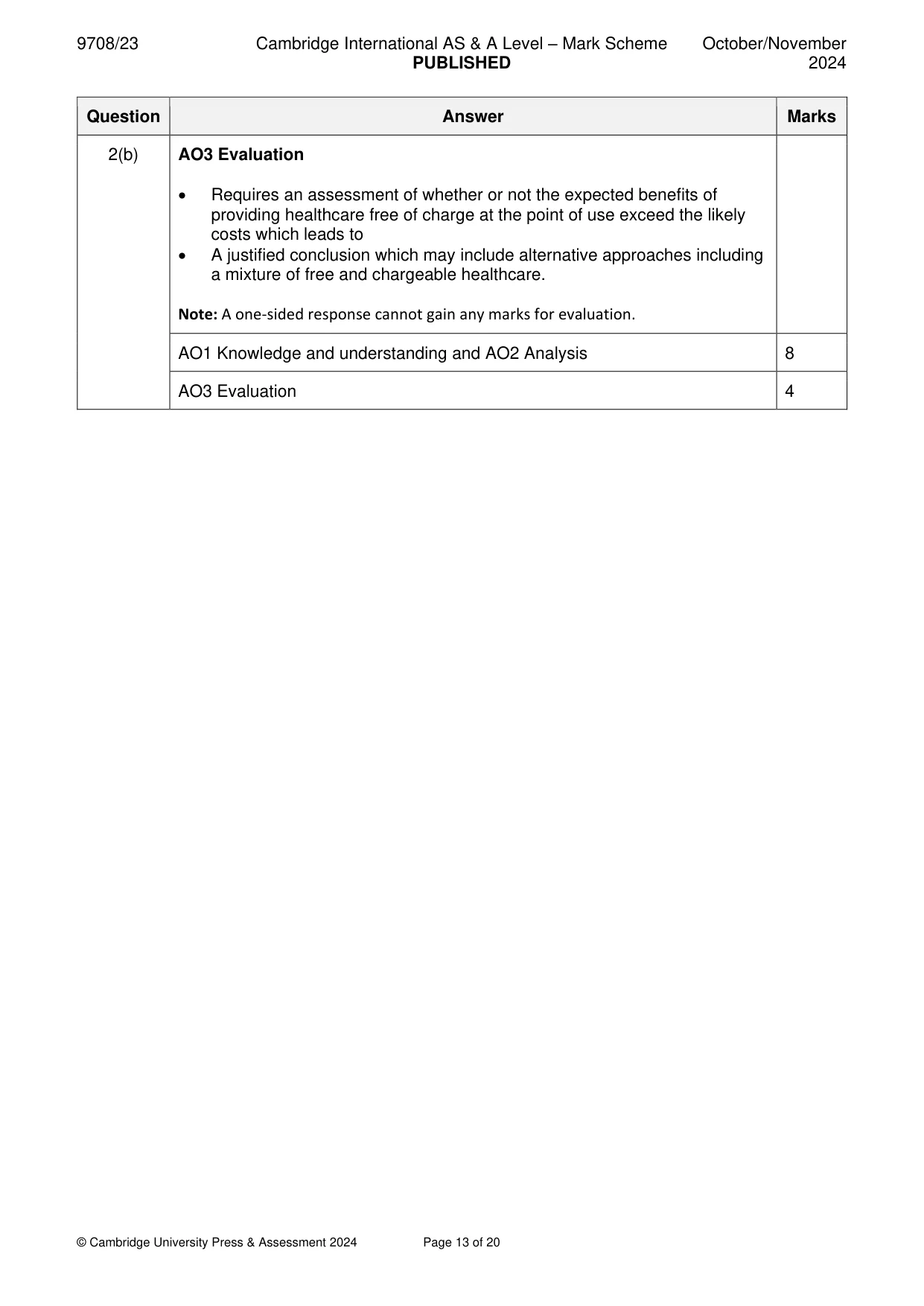
Mark scheme: 2(a) With the aid of examples, explain the characteristics of public goods 8 and free goods and consider whether free-of-charge vaccinations offered by a government should be classified as a free good. Follow the point-based marking guidance at the top of this mark scheme and award: up to 3 marks for AO1 Knowledge and understanding, up to 3 marks for AO2 Analysis, and up to 2 marks for AO3 Evaluation. AO1 Knowledge and Understanding (max 3 marks) • Free goods are not scarce and have zero opportunity cost / no prices as no factors of production are required to produce them (1). • Public goods have two main characteristics of non-excludability and non- rivalry with a brief explanation of both terms (1). • Provide accurate examples of both e.g., fresh air and street lighting respectively (1). AO2 Analysis (max 3 marks) • For example, the vaccine is free at the point of use to the consumer (1). However, there is a cost to the taxpayer (1). This means that there is an opportunity cost to the government as providing the vaccine involves the use of scarce resources (1). Alternative approach: • If governments provide free-of-charge vaccinations, then there is no price charged to the consumer (1). This means consumers do not need to use their own their own scarce resources to be vaccinated (1) which means there is no opportunity cost to them because they do not need to make a choice between ‘consuming’ the vaccine and reducing their consumption of other goods and services (1). AO3 Evaluation (max 2 marks) • Up to 2 marks for evaluating whether or not free-to-charge vaccinations offered by a government can be considered a free good. For example, there is an opportunity cost to the government as the money spent on buying the vaccine might have been used for spending on another priority e.g. education. AO1 Knowledge and understanding 3 AO2 Analysis 3 AO3 Evaluation 2 2(b) Assess whether the expected benefits of providing healthcare services 12 free-of-charge at the point of use exceed the likely costs. Use Table A: AO1 Knowledge and understanding and AO2 Analysis and Table B: AO3 Evaluation to mark candidate responses to this question. AO1 and AO2 out of 8 marks. AO3 out of 4 marks. Indicative content Responses may include: AO1 Knowledge and understanding and AO2 Analysis Potential benefits of providing healthcare services free-of-charge at the point of use include: • It addresses concerns on affordability/inequality to access health care, insurance and information gaps e.g. preventative earlier treatments for elderly and children. • It may also avoid a potential loss of output resulting from worker absenteeism. It increases the likelihood of resources being prioritised to patient need as opposed to profit. Potential disadvantages from providing healthcare services free-of-charge at the point of use include: • Demand may exceed supply which may result in increased costs to governments. • Charging consumers will reduce on wastage in terms of ‘missed’ medical appointments; potential for health inequality resulting in income inequality. • Private firms may be more efficient in providing the healthcare services required in the quantities and regions required. The opportunity cost to the government in terms of reduced spending on roads etc. Level 1 responses will be assertive and lacking in explanations / mainly descriptive and/or or mainly lacking in relevance to the question. Level 2 responses may contain some inaccuracies and may be one sided. Analysis will be explained at least in part and will be largely relevant to the question. Level 3 responses will consider alternative policies / concepts etc. and will be balanced. Explanations of points raised will be offered and will be accurate and relevant to the question. 2(b) AO3 Evaluation • Requires an assessment of whether or not the expected benefits of providing healthcare free of charge at the point of use exceed the likely costs which leads to • A justified conclusion which may include alternative approaches including a mixture of free and chargeable healthcare. Note: A one-sided response cannot gain any marks for evaluation. AO1 Knowledge and understanding and AO2 Analysis 8 AO3 Evaluation 4
More questions on Private costs and benefits, externalities and social costs and benefits
Q3 · Explain two economic reasons for inequality in the distribution of income and wealth and…
3 (a) Explain two economic reasons for inequality in the distribution of income and wealth and consider why inequality in the distribution of wealth cannot easily be measured. [8] (b) Assess which policies are likely to be most effective in redistributing income. [12] Section C Answer one question. EITHER
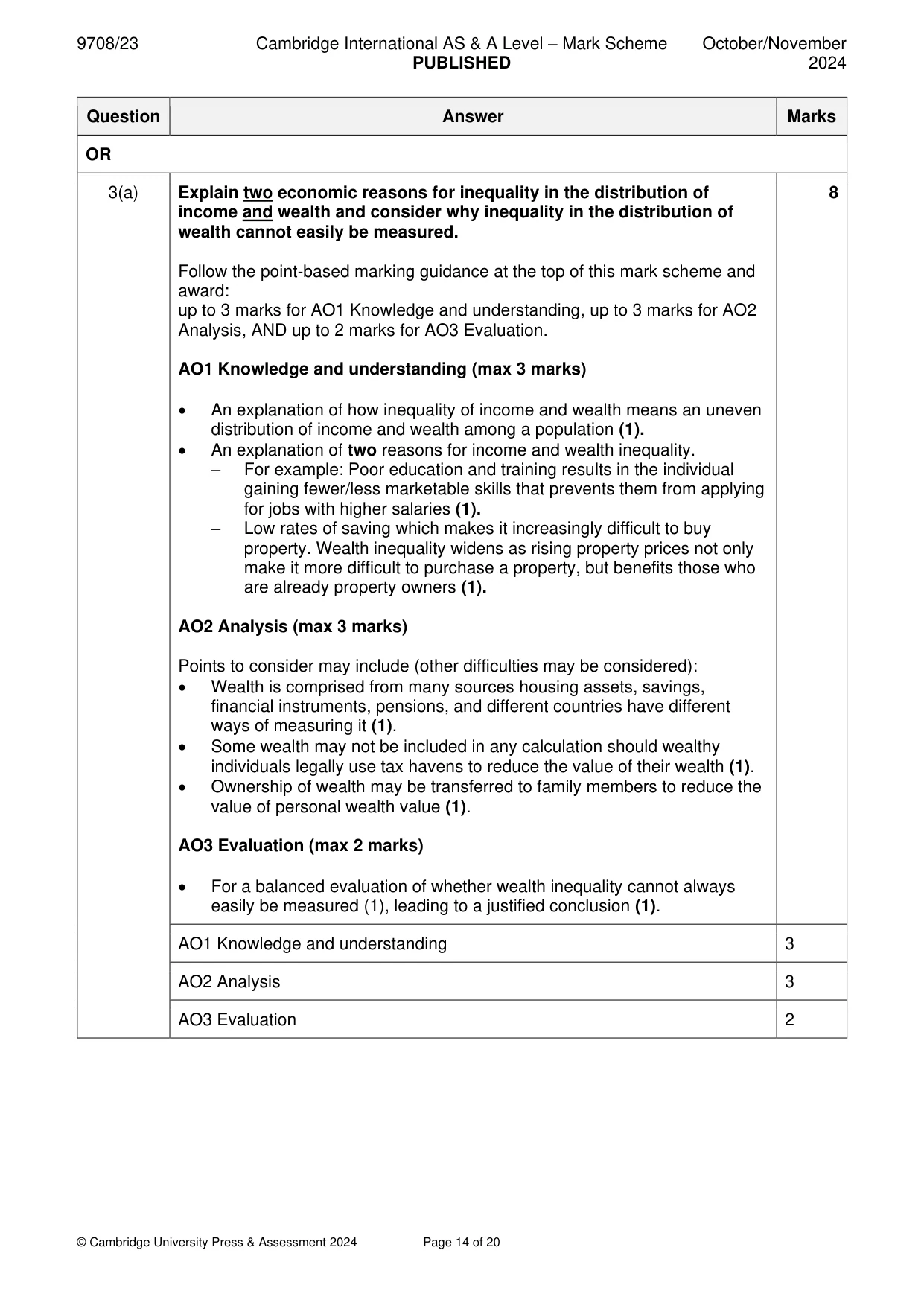
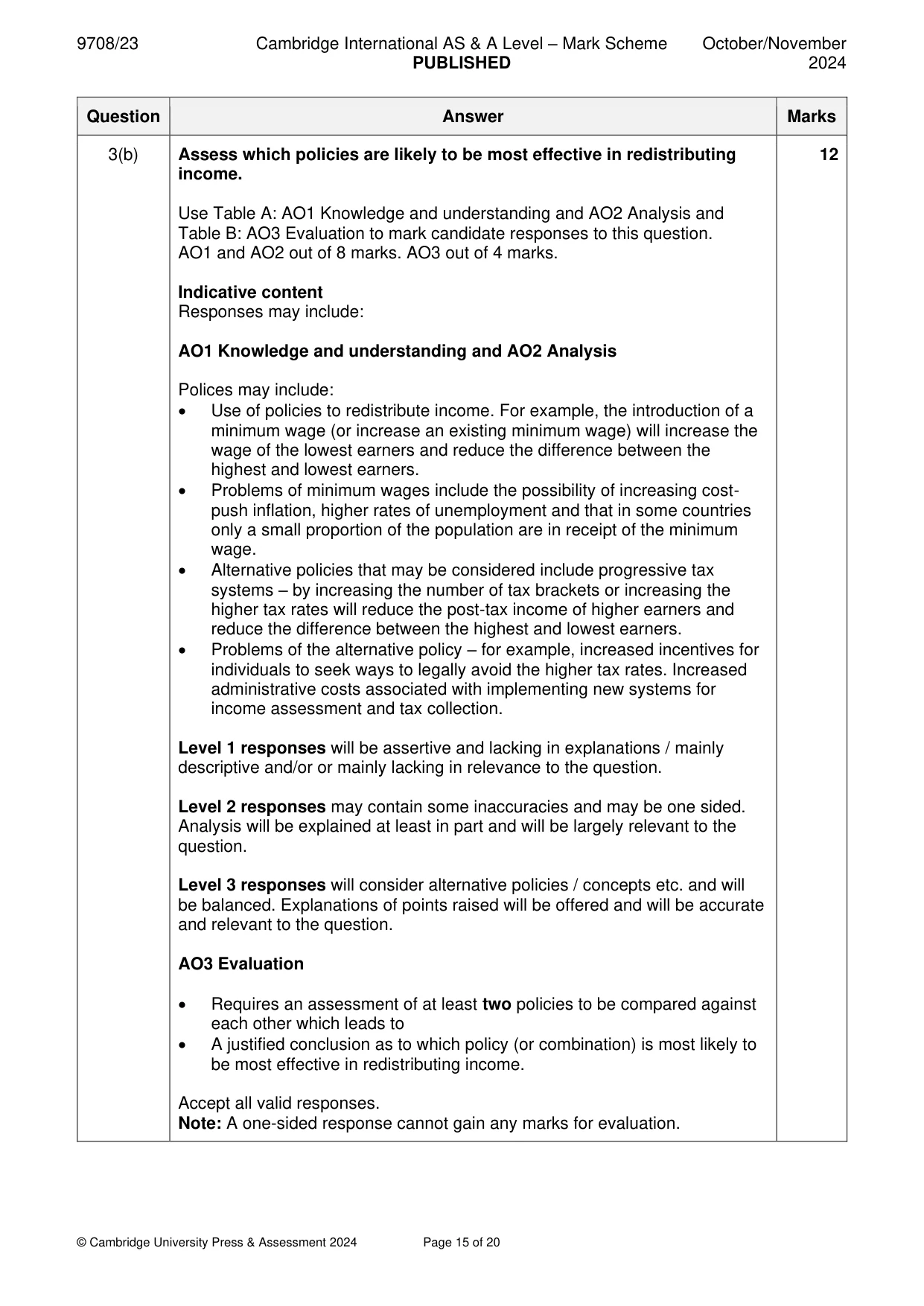
Mark scheme: 3(a) Explain two economic reasons for inequality in the distribution of 8 income and wealth and consider why inequality in the distribution of wealth cannot easily be measured. Follow the point-based marking guidance at the top of this mark scheme and award: up to 3 marks for AO1 Knowledge and understanding, up to 3 marks for AO2 Analysis, AND up to 2 marks for AO3 Evaluation. AO1 Knowledge and understanding (max 3 marks) • An explanation of how inequality of income and wealth means an uneven distribution of income and wealth among a population (1). • An explanation of two reasons for income and wealth inequality. – For example: Poor education and training results in the individual gaining fewer/less marketable skills that prevents them from applying for jobs with higher salaries (1). – Low rates of saving which makes it increasingly difficult to buy property. Wealth inequality widens as rising property prices not only make it more difficult to purchase a property, but benefits those who are already property owners (1). AO2 Analysis (max 3 marks) Points to consider may include (other difficulties may be considered): • Wealth is comprised from many sources housing assets, savings, financial instruments, pensions, and different countries have different ways of measuring it (1). • Some wealth may not be included in any calculation should wealthy individuals legally use tax havens to reduce the value of their wealth (1). • Ownership of wealth may be transferred to family members to reduce the value of personal wealth value (1). AO3 Evaluation (max 2 marks) • For a balanced evaluation of whether wealth inequality cannot always easily be measured (1), leading to a justified conclusion (1). AO1 Knowledge and understanding 3 AO2 Analysis 3 AO3 Evaluation 2 3(b) Assess which policies are likely to be most effective in redistributing 12 income. Use Table A: AO1 Knowledge and understanding and AO2 Analysis and Table B: AO3 Evaluation to mark candidate responses to this question. AO1 and AO2 out of 8 marks. AO3 out of 4 marks. Indicative content Responses may include: AO1 Knowledge and understanding and AO2 Analysis Polices may include: • Use of policies to redistribute income. For example, the introduction of a minimum wage (or increase an existing minimum wage) will increase the wage of the lowest earners and reduce the difference between the highest and lowest earners. • Problems of minimum wages include the possibility of increasing cost- push inflation, higher rates of unemployment and that in some countries only a small proportion of the population are in receipt of the minimum wage. • Alternative policies that may be considered include progressive tax systems – by increasing the number of tax brackets or increasing the higher tax rates will reduce the post-tax income of higher earners and reduce the difference between the highest and lowest earners. • Problems of the alternative policy – for example, increased incentives for individuals to seek ways to legally avoid the higher tax rates. Increased administrative costs associated with implementing new systems for income assessment and tax collection. Level 1 responses will be assertive and lacking in explanations / mainly descriptive and/or or mainly lacking in relevance to the question. Level 2 responses may contain some inaccuracies and may be one sided. Analysis will be explained at least in part and will be largely relevant to the question. Level 3 responses will consider alternative policies / concepts etc. and will be balanced. Explanations of points raised will be offered and will be accurate and relevant to the question. AO3 Evaluation • Requires an assessment of at least two policies to be compared against each other which leads to • A justified conclusion as to which policy (or combination) is most likely to be most effective in redistributing income. Accept all valid responses. Note: A one-sided response cannot gain any marks for evaluation. 3(b) AO1 Knowledge and understanding and AO2 Analysis 8 AO3 Evaluation 4
More questions on Equity and redistribution of income and wealth
Q4 · In 2021, year-on-year inflation in many economies increased to a level not experienced…
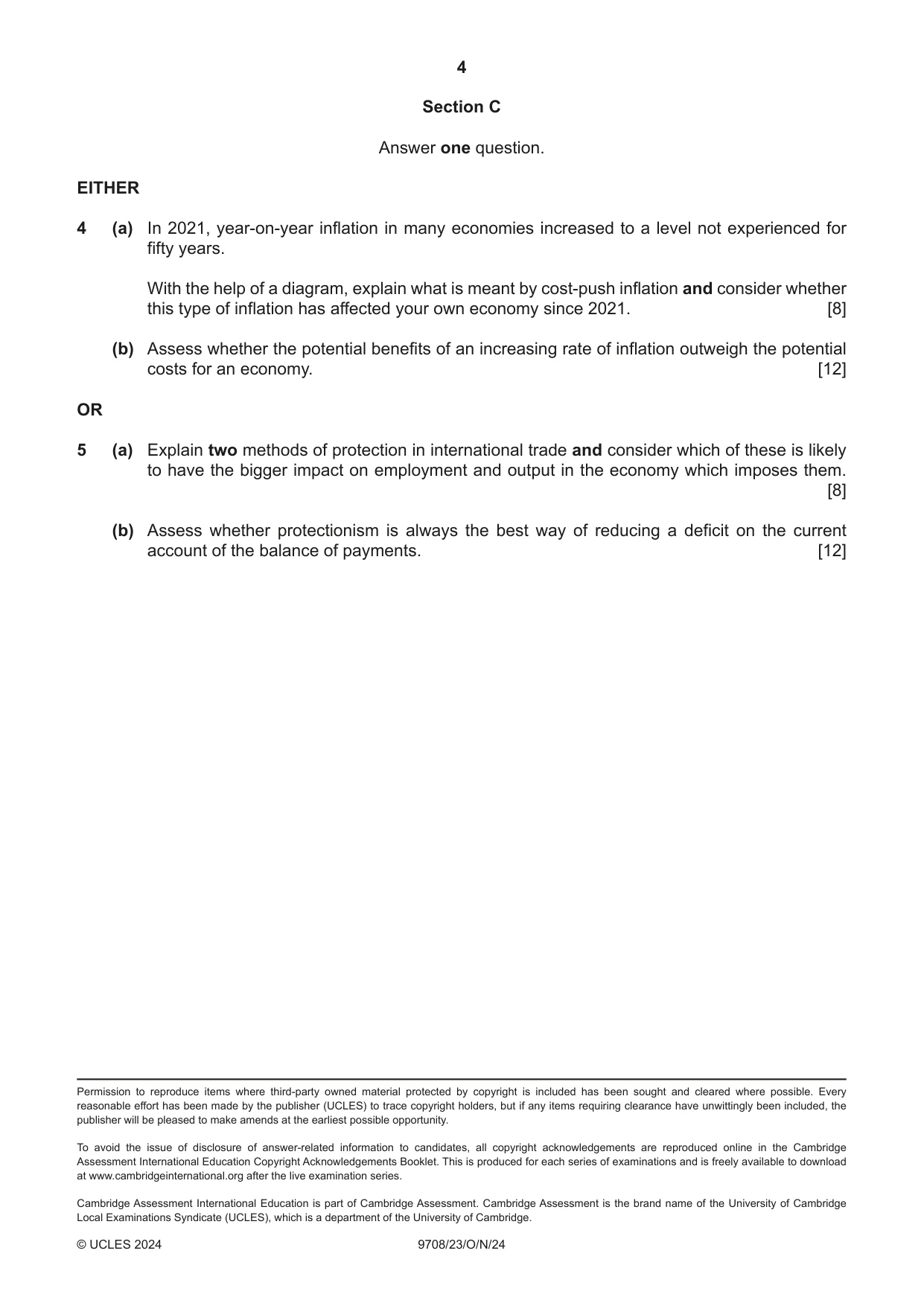
4 (a) In 2021, year-on-year inflation in many economies increased to a level not experienced for fifty years. With the help of a diagram, explain what is meant by cost-push inflation and consider whether this type of inflation has affected your own economy since 2021. [8] (b) Assess whether the potential benefits of an increasing rate of inflation outweigh the potential costs for an economy. [12] OR
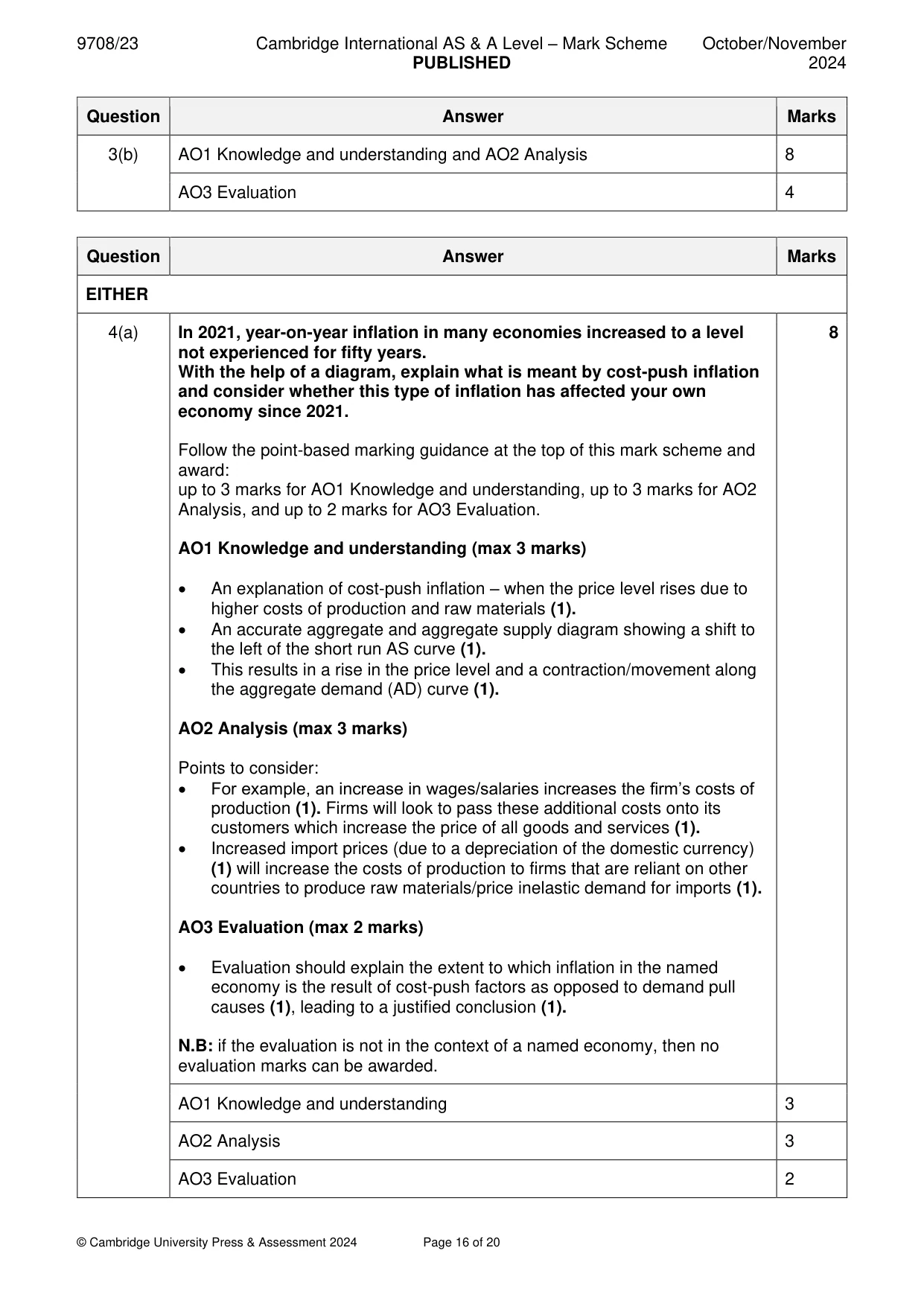
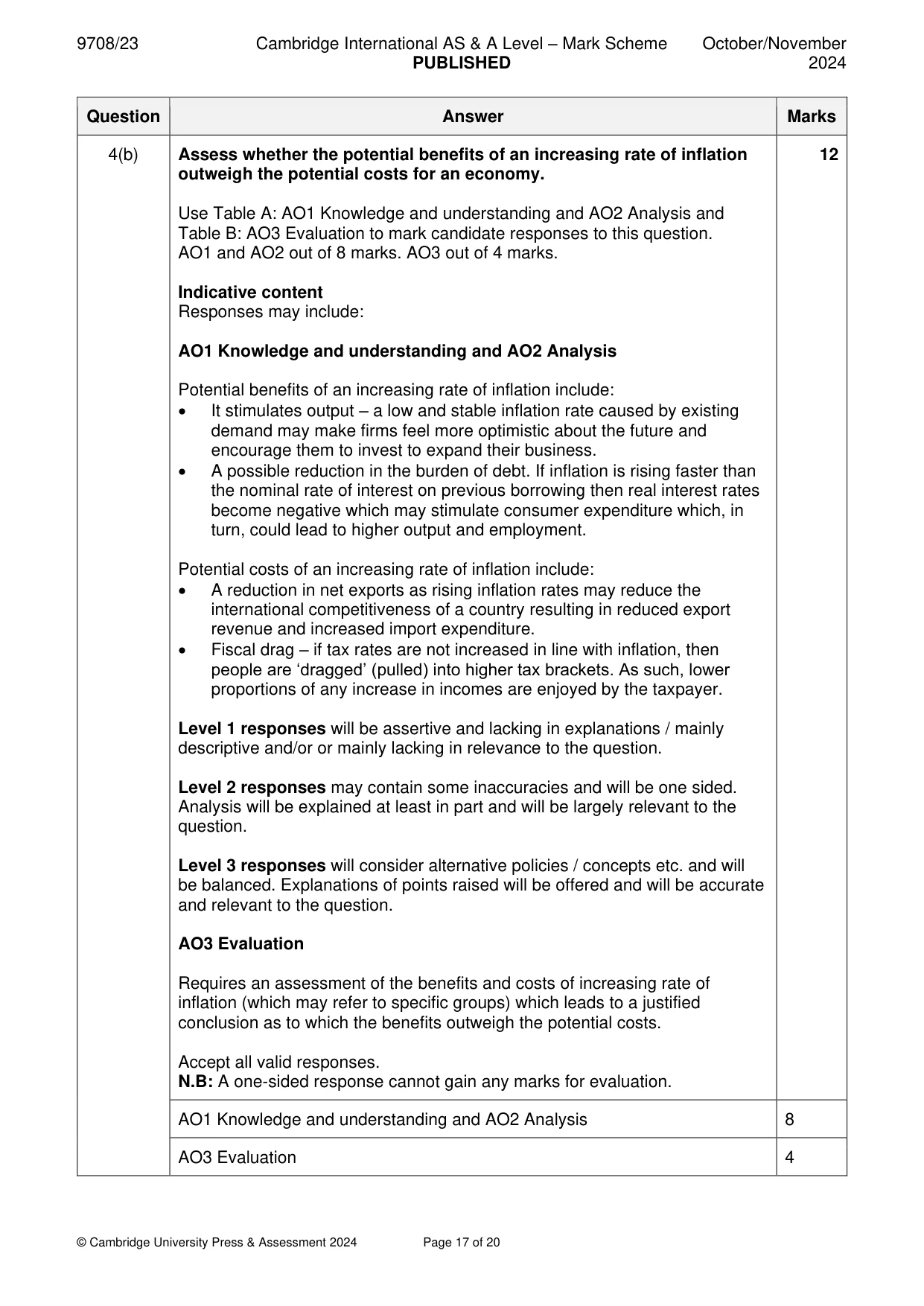
Mark scheme: 4(a) In 2021, year-on-year inflation in many economies increased to a level 8 not experienced for fifty years. With the help of a diagram, explain what is meant by cost-push inflation and consider whether this type of inflation has affected your own economy since 2021. Follow the point-based marking guidance at the top of this mark scheme and award: up to 3 marks for AO1 Knowledge and understanding, up to 3 marks for AO2 Analysis, and up to 2 marks for AO3 Evaluation. AO1 Knowledge and understanding (max 3 marks) • An explanation of cost-push inflation – when the price level rises due to higher costs of production and raw materials (1). • An accurate aggregate and aggregate supply diagram showing a shift to the left of the short run AS curve (1). • This results in a rise in the price level and a contraction/movement along the aggregate demand (AD) curve (1). AO2 Analysis (max 3 marks) Points to consider: • For example, an increase in wages/salaries increases the firm’s costs of production (1). Firms will look to pass these additional costs onto its customers which increase the price of all goods and services (1). • Increased import prices (due to a depreciation of the domestic currency) (1) will increase the costs of production to firms that are reliant on other countries to produce raw materials/price inelastic demand for imports (1). AO3 Evaluation (max 2 marks) • Evaluation should explain the extent to which inflation in the named economy is the result of cost-push factors as opposed to demand pull causes (1), leading to a justified conclusion (1). N.B: if the evaluation is not in the context of a named economy, then no evaluation marks can be awarded. AO1 Knowledge and understanding 3 AO2 Analysis 3 AO3 Evaluation 2 4(b) Assess whether the potential benefits of an increasing rate of inflation 12 outweigh the potential costs for an economy. Use Table A: AO1 Knowledge and understanding and AO2 Analysis and Table B: AO3 Evaluation to mark candidate responses to this question. AO1 and AO2 out of 8 marks. AO3 out of 4 marks. Indicative content Responses may include: AO1 Knowledge and understanding and AO2 Analysis Potential benefits of an increasing rate of inflation include: • It stimulates output – a low and stable inflation rate caused by existing demand may make firms feel more optimistic about the future and encourage them to invest to expand their business. • A possible reduction in the burden of debt. If inflation is rising faster than the nominal rate of interest on previous borrowing then real interest rates become negative which may stimulate consumer expenditure which, in turn, could lead to higher output and employment. Potential costs of an increasing rate of inflation include: • A reduction in net exports as rising inflation rates may reduce the international competitiveness of a country resulting in reduced export revenue and increased import expenditure. • Fiscal drag – if tax rates are not increased in line with inflation, then people are ‘dragged’ (pulled) into higher tax brackets. As such, lower proportions of any increase in incomes are enjoyed by the taxpayer. Level 1 responses will be assertive and lacking in explanations / mainly descriptive and/or or mainly lacking in relevance to the question. Level 2 responses may contain some inaccuracies and will be one sided. Analysis will be explained at least in part and will be largely relevant to the question. Level 3 responses will consider alternative policies / concepts etc. and will be balanced. Explanations of points raised will be offered and will be accurate and relevant to the question. AO3 Evaluation Requires an assessment of the benefits and costs of increasing rate of inflation (which may refer to specific groups) which leads to a justified conclusion as to which the benefits outweigh the potential costs. Accept all valid responses. N.B: A one-sided response cannot gain any marks for evaluation. AO1 Knowledge and understanding and AO2 Analysis 8 AO3 Evaluation 4
Q5 · Explain two methods of protection in international trade and consider which of these is…
5 (a) Explain two methods of protection in international trade and consider which of these is likely to have the bigger impact on employment and output in the economy which imposes them. [8] (b) Assess whether protectionism is always the best way of reducing a deficit on the current account of the balance of payments. [12]
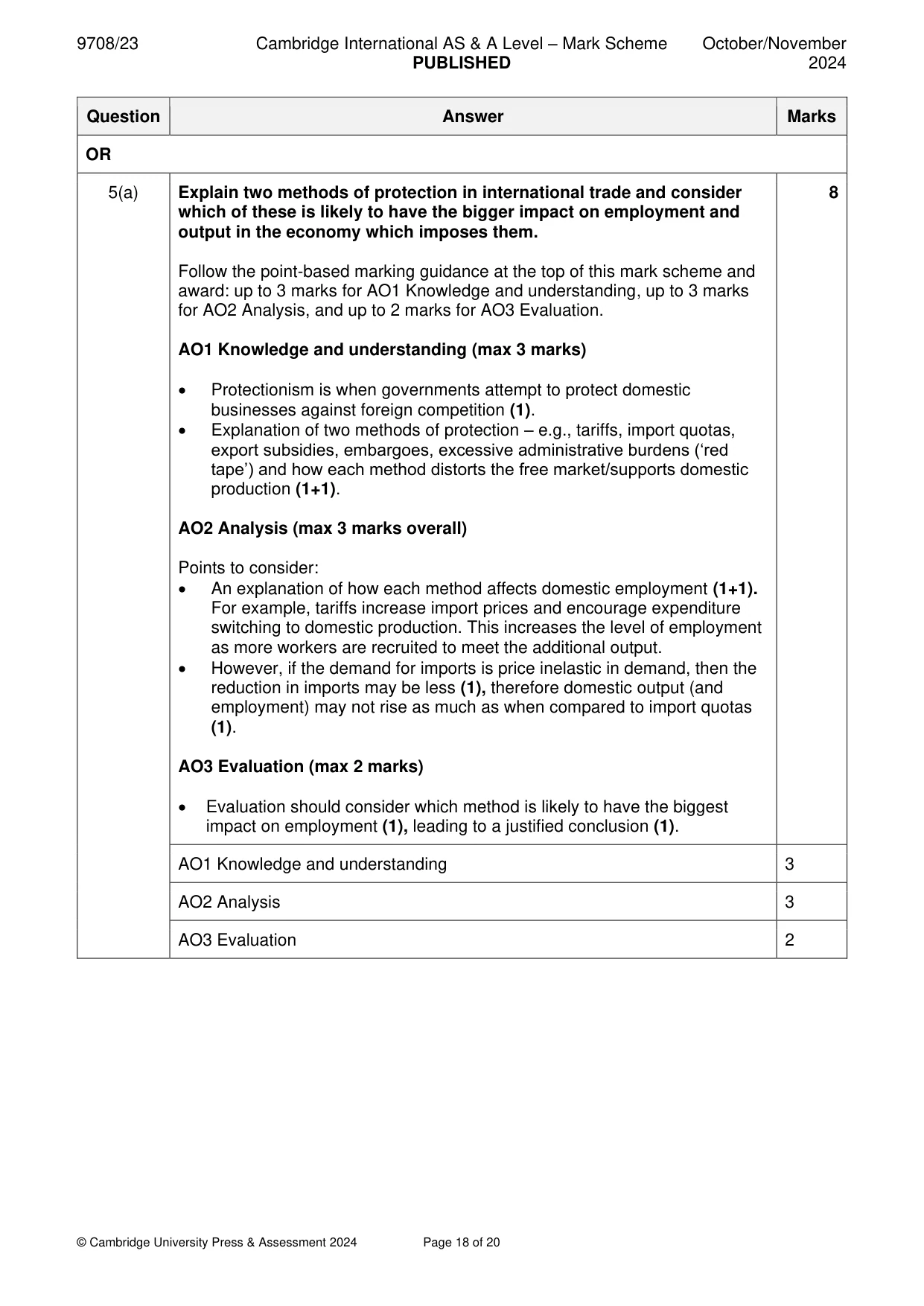
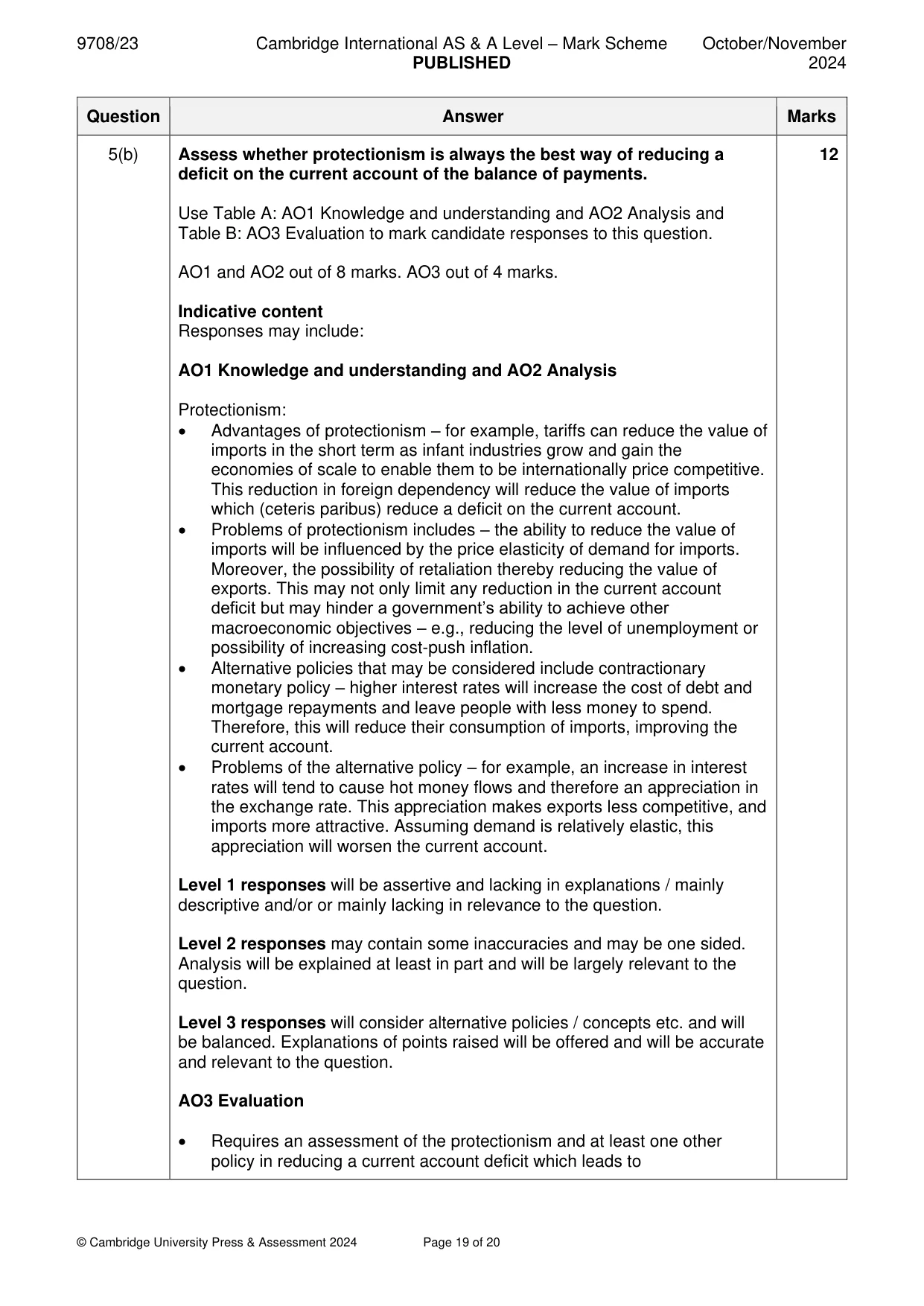
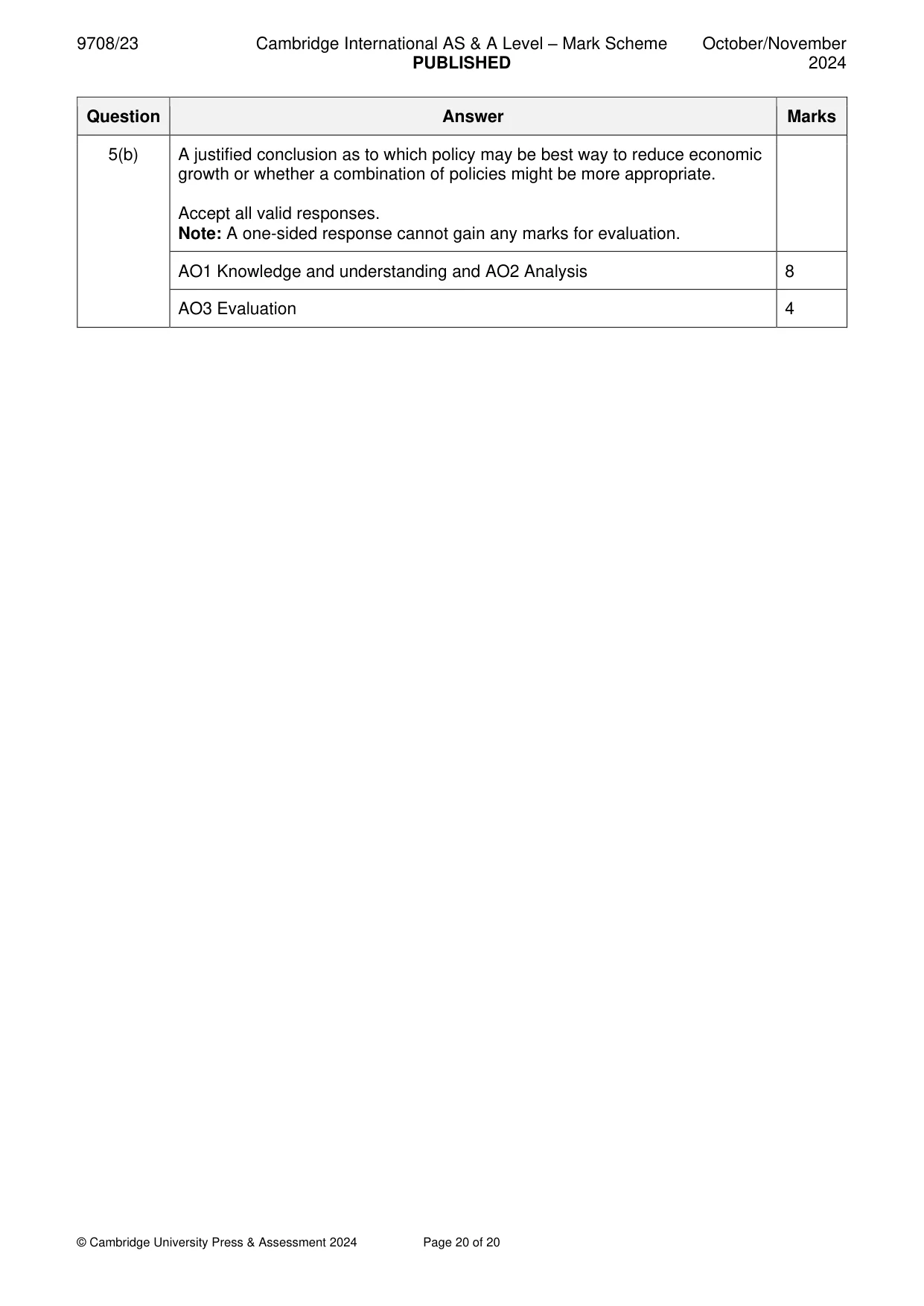
Mark scheme: 5(a) Explain two methods of protection in international trade and consider 8 which of these is likely to have the bigger impact on employment and output in the economy which imposes them. Follow the point-based marking guidance at the top of this mark scheme and award: up to 3 marks for AO1 Knowledge and understanding, up to 3 marks for AO2 Analysis, and up to 2 marks for AO3 Evaluation. AO1 Knowledge and understanding (max 3 marks) • Protectionism is when governments attempt to protect domestic businesses against foreign competition (1). • Explanation of two methods of protection – e.g., tariffs, import quotas, export subsidies, embargoes, excessive administrative burdens (‘red tape’) and how each method distorts the free market/supports domestic production (1+1). AO2 Analysis (max 3 marks overall) Points to consider: • An explanation of how each method affects domestic employment (1+1). For example, tariffs increase import prices and encourage expenditure switching to domestic production. This increases the level of employment as more workers are recruited to meet the additional output. • However, if the demand for imports is price inelastic in demand, then the reduction in imports may be less (1), therefore domestic output (and employment) may not rise as much as when compared to import quotas (1). AO3 Evaluation (max 2 marks) • Evaluation should consider which method is likely to have the biggest impact on employment (1), leading to a justified conclusion (1). AO1 Knowledge and understanding 3 AO2 Analysis 3 AO3 Evaluation 2 5(b) Assess whether protectionism is always the best way of reducing a 12 deficit on the current account of the balance of payments. Use Table A: AO1 Knowledge and understanding and AO2 Analysis and Table B: AO3 Evaluation to mark candidate responses to this question. AO1 and AO2 out of 8 marks. AO3 out of 4 marks. Indicative content Responses may include: AO1 Knowledge and understanding and AO2 Analysis Protectionism: • Advantages of protectionism – for example, tariffs can reduce the value of imports in the short term as infant industries grow and gain the economies of scale to enable them to be internationally price competitive. This reduction in foreign dependency will reduce the value of imports which (ceteris paribus) reduce a deficit on the current account. • Problems of protectionism includes – the ability to reduce the value of imports will be influenced by the price elasticity of demand for imports. Moreover, the possibility of retaliation thereby reducing the value of exports. This may not only limit any reduction in the current account deficit but may hinder a government’s ability to achieve other macroeconomic objectives – e.g., reducing the level of unemployment or possibility of increasing cost-push inflation. • Alternative policies that may be considered include contractionary monetary policy – higher interest rates will increase the cost of debt and mortgage repayments and leave people with less money to spend. Therefore, this will reduce their consumption of imports, improving the current account. • Problems of the alternative policy – for example, an increase in interest rates will tend to cause hot money flows and therefore an appreciation in the exchange rate. This appreciation makes exports less competitive, and imports more attractive. Assuming demand is relatively elastic, this appreciation will worsen the current account. Level 1 responses will be assertive and lacking in explanations / mainly descriptive and/or or mainly lacking in relevance to the question. Level 2 responses may contain some inaccuracies and may be one sided. Analysis will be explained at least in part and will be largely relevant to the question. Level 3 responses will consider alternative policies / concepts etc. and will be balanced. Explanations of points raised will be offered and will be accurate and relevant to the question. AO3 Evaluation • Requires an assessment of the protectionism and at least one other policy in reducing a current account deficit which leads to 5(b) A justified conclusion as to which policy may be best way to reduce economic growth or whether a combination of policies might be more appropriate. Accept all valid responses. Note: A one-sided response cannot gain any marks for evaluation. AO1 Knowledge and understanding and AO2 Analysis 8 AO3 Evaluation 4
More questions on Policies to correct imbalances in the current account of the balance of payments
What was in this paper
The subtopics covered by these 5 questions, and how many questions each got. Open one in a new tab to see every Cambridge question on it.
What you needed in this session
Cambridge’s own grade thresholds for 2024 Oct/Nov, Paper 2 · Variant 3. A higher threshold means an easier paper — the bar moves with how the cohort did.