Cambridge A Level Economics 9708 — 2023 May/June Paper 2 · Variant 3
9708/23/M/J/23 · 5 questions · 60 marks · ≈68 min
The question paper and its mark scheme, free to read here and free to download. This is Cambridge’s own paper, exactly as it was sat.
Question paper4 pages
Mark scheme17 pages
Answers below. Sit the paper first if you are practising.


Questions as text
Q1 · Are doughnuts demerit goods?
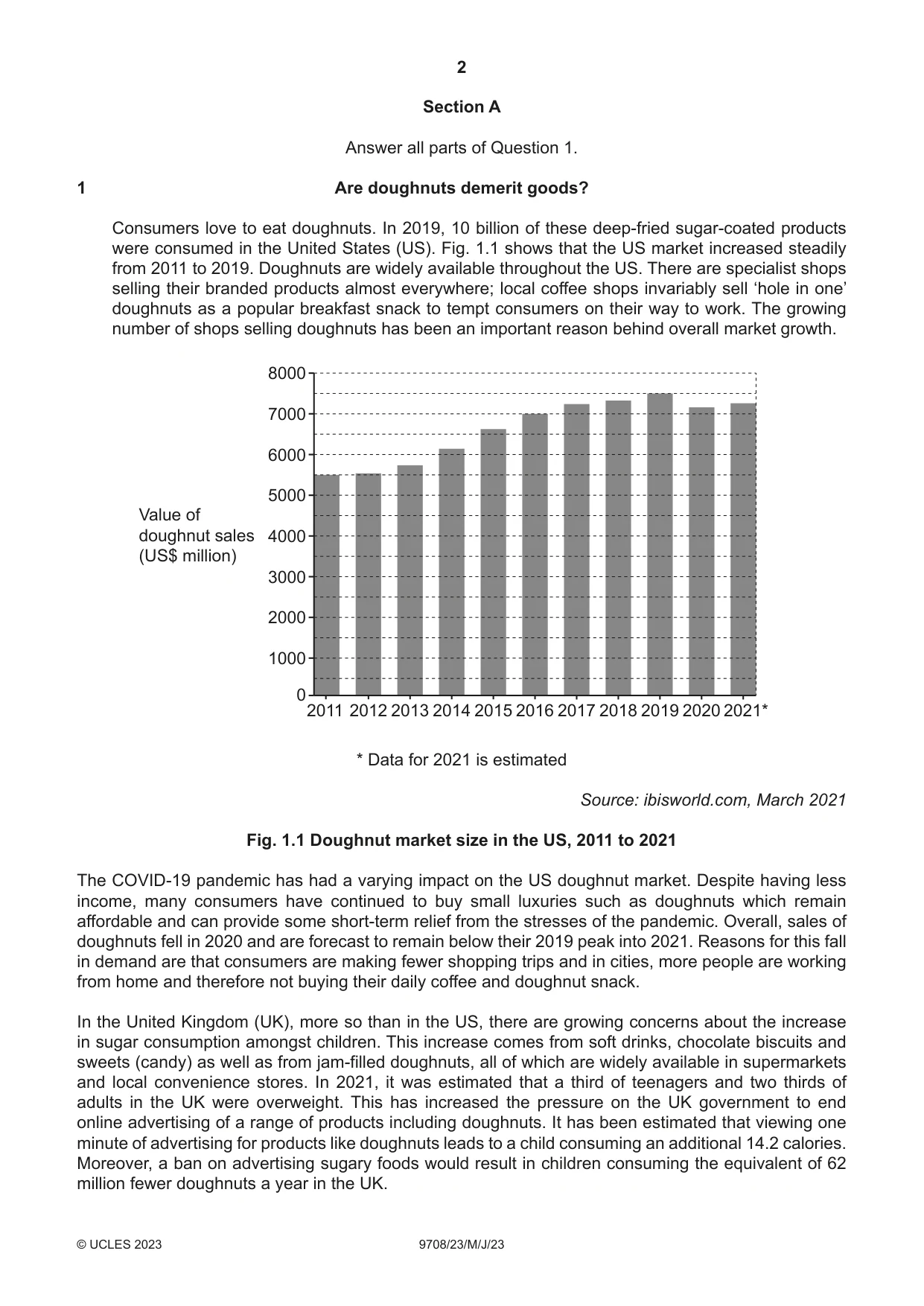
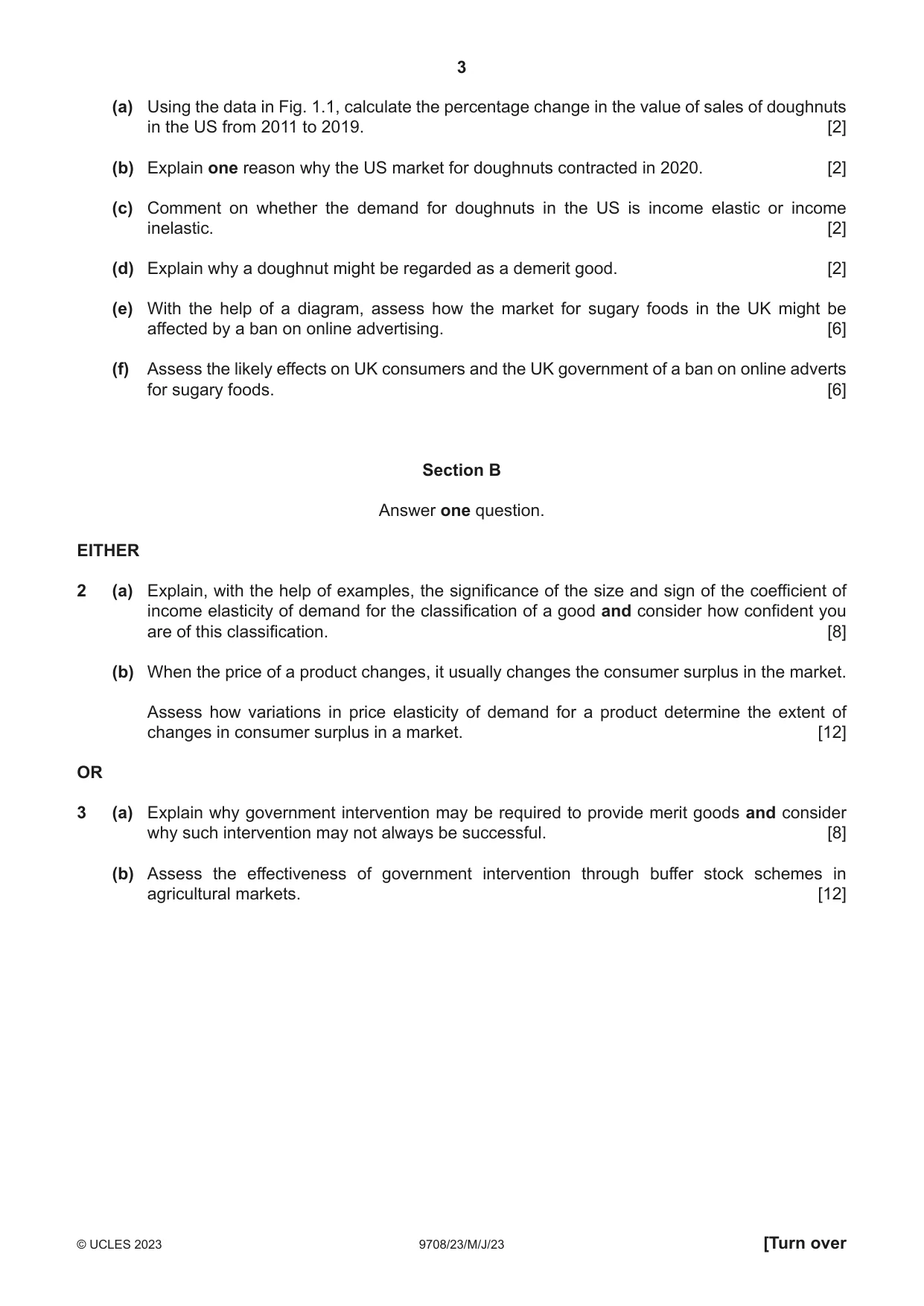
1 Are doughnuts demerit goods? Consumers love to eat doughnuts. In 2019, 10 billion of these deep-fried sugar-coated products were consumed in the United States (US). Fig. 1.1 shows that the US market increased steadily from 2011 to 2019. Doughnuts are widely available throughout the US. There are specialist shops selling their branded products almost everywhere; local coffee shops invariably sell ‘hole in one’ doughnuts as a popular breakfast snack to tempt consumers on their way to work. The growing number of shops selling doughnuts has been an important reason behind overall market growth. 8000 7000 6000 5000 Value of doughnut sales 4000 (US$ million) 3000 2000 1000 0 2011 2012 2013 2014 2015 2016 2017 2018 2019 2020 2021* * Data for 2021 is estimated Source: ibisworld.com, March 2021 Fig. 1.1 Doughnut market size in the US, 2011 to 2021 The COVID-19 pandemic has had a varying impact on the US doughnut market. Despite having less income, many consumers have continued to buy small luxuries such as doughnuts which remain affordable and can provide some short-term relief from the stresses of the pandemic. Overall, sales of doughnuts fell in 2020 and are forecast to remain below their 2019 peak into 2021. Reasons for this fall in demand are that consumers are making fewer shopping trips and in cities, more people are working from home and therefore not buying their daily coffee and doughnut snack. In the United Kingdom (UK), more so than in the US, there are growing concerns about the increase in sugar consumption amongst children. This increase comes from soft drinks, chocolate biscuits and sweets (candy) as well as from jam-filled doughnuts, all of which are widely available in supermarkets and local convenience stores. In 2021, it was estimated that a third of teenagers and two thirds of adults in the UK were overweight. This has increased the pressure on the UK government to end online advertising of a range of products including doughnuts. It has been estimated that viewing one minute of advertising for products like doughnuts leads to a child consuming an additional 14.2 calories. Moreover, a ban on advertising sugary foods would result in children consuming the equivalent of 62 million fewer doughnuts a year in the UK. (a) Using the data in Fig. 1.1, calculate the percentage change in the value of sales of doughnuts in the US from 2011 to 2019. [2] (b) Explain one reason why the US market for doughnuts contracted in 2020. [2] (c) Comment on whether the demand for doughnuts in the US is income elastic or income inelastic. [2] (d) Explain why a doughnut might be regarded as a demerit good. [2] (e) With the help of a diagram, assess how the market for sugary foods in the UK might be affected by a ban on online advertising. [6] (f) Assess the likely effects on UK consumers and the UK government of a ban on online adverts for sugary foods. [6]
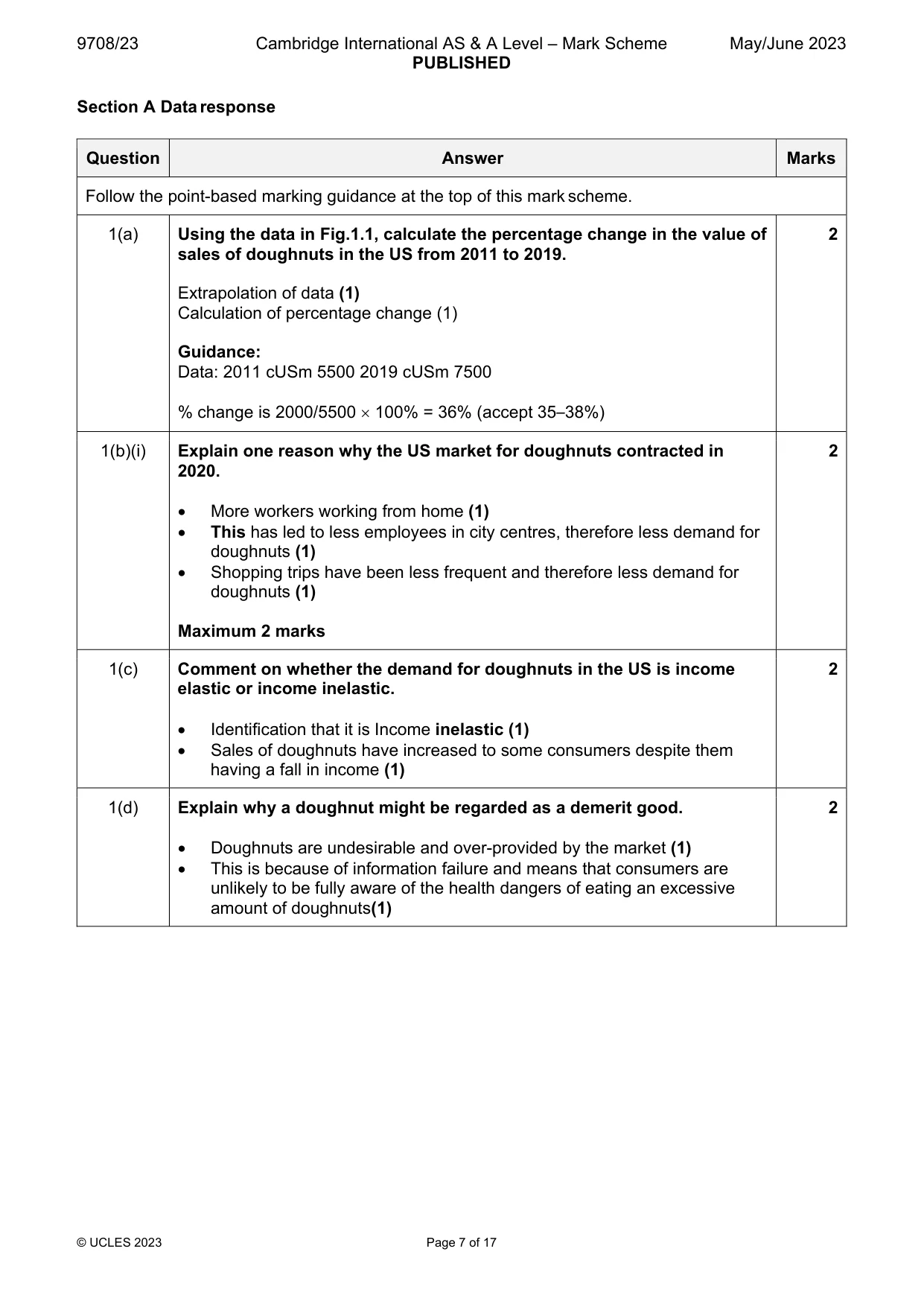
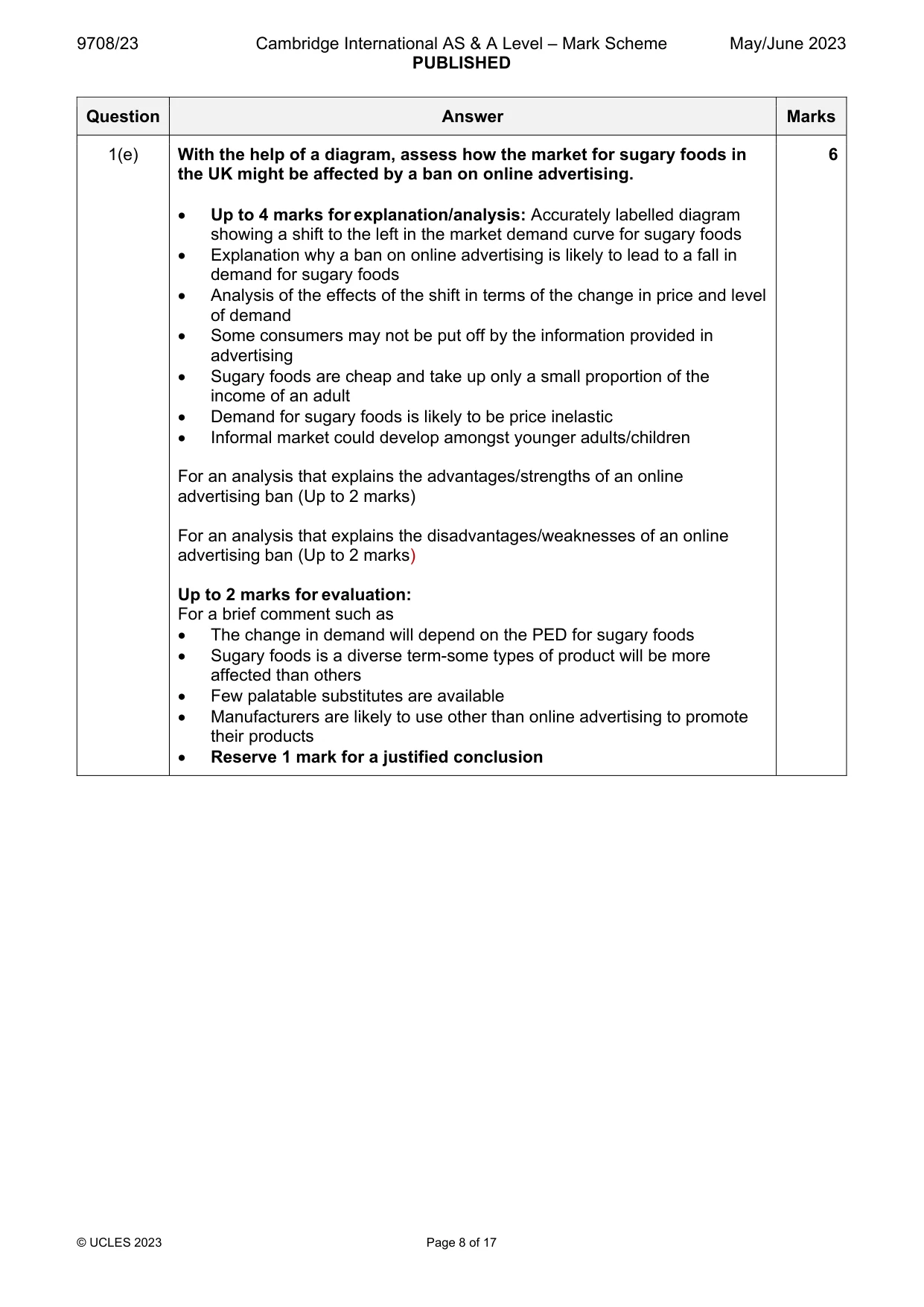
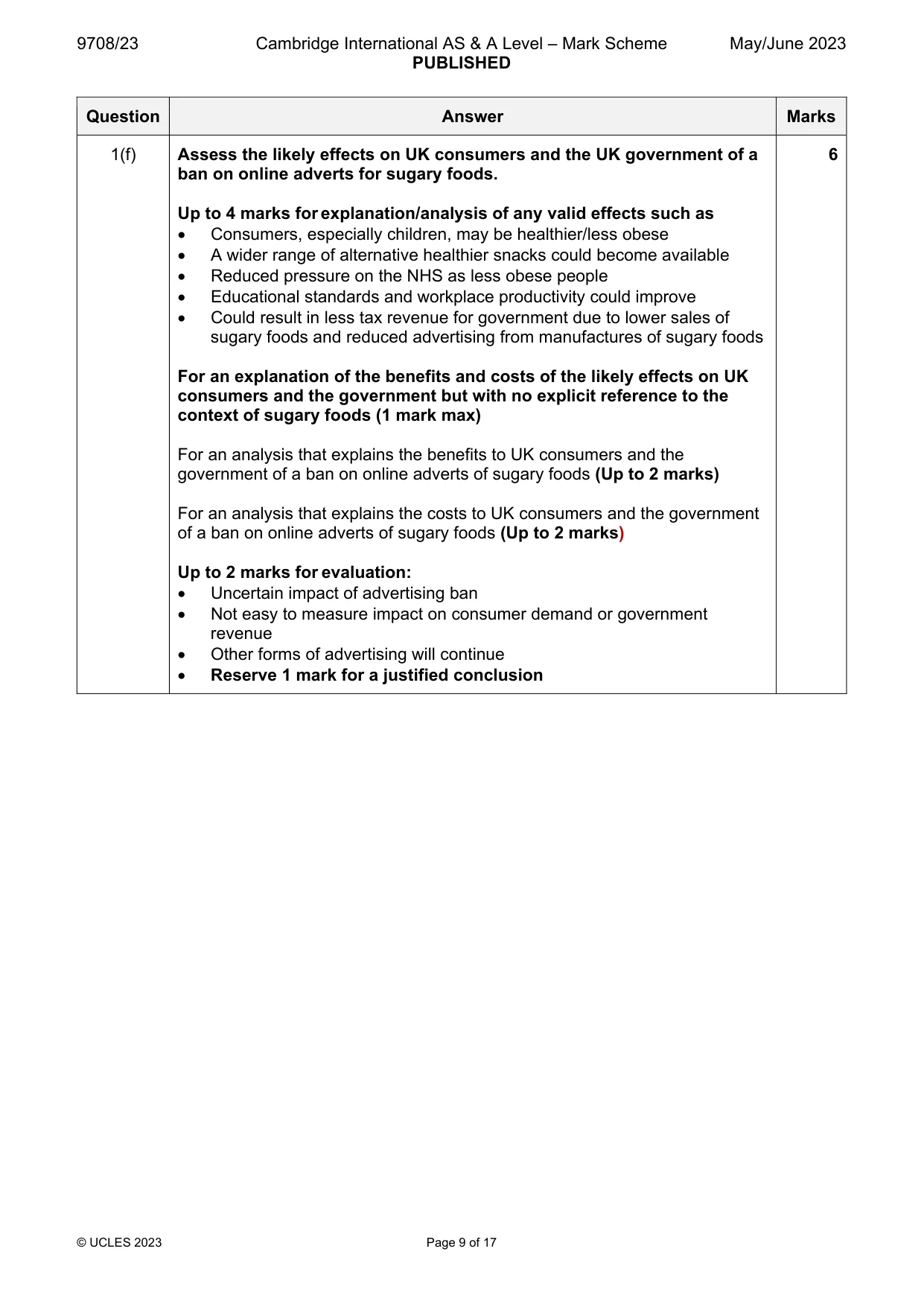
Mark scheme: Question Answer Marks Follow the point-based marking guidance at the top of this mark scheme. 1(a) Using the data in Fig.1.1, calculate the percentage change in the value of 2 sales of doughnuts in the US from 2011 to 2019. Extrapolation of data (1) Calculation of percentage change (1) Guidance: Data: 2011 cUSm 5500 2019 cUSm 7500 % change is 2000/5500 100% = 36% (accept 35–38%) 1(b)(i) Explain one reason why the US market for doughnuts contracted in 2 2020. More workers working from home (1) This has led to less employees in city centres, therefore less demand for doughnuts (1) Shopping trips have been less frequent and therefore less demand for doughnuts (1) Maximum 2 marks 1(c) Comment on whether the demand for doughnuts in the US is income 2 elastic or income inelastic. Identification that it is Income inelastic (1) Sales of doughnuts have increased to some consumers despite them having a fall in income (1) 1(d) Explain why a doughnut might be regarded as a demerit good. 2 Doughnuts are undesirable and over-provided by the market (1) This is because of information failure and means that consumers are unlikely to be fully aware of the health dangers of eating an excessive amount of doughnuts(1) 1(e) With the help of a diagram, assess how the market for sugary foods in 6 the UK might be affected by a ban on online advertising. Up to 4 marks for explanation/analysis: Accurately labelled diagram showing a shift to the left in the market demand curve for sugary foods Explanation why a ban on online advertising is likely to lead to a fall in demand for sugary foods Analysis of the effects of the shift in terms of the change in price and level of demand Some consumers may not be put off by the information provided in advertising Sugary foods are cheap and take up only a small proportion of the income of an adult Demand for sugary foods is likely to be price inelastic Informal market could develop amongst younger adults/children For an analysis that explains the advantages/strengths of an online advertising ban (Up to 2 marks) For an analysis that explains the disadvantages/weaknesses of an online advertising ban (Up to 2 marks) Up to 2 marks for evaluation: For a brief comment such as The change in demand will depend on the PED for sugary foods Sugary foods is a diverse term-some types of product will be more affected than others Few palatable substitutes are available Manufacturers are likely to use other than online advertising to promote their products Reserve 1 mark for a justified conclusion 1(f) Assess the likely effects on UK consumers and the UK government of a 6 ban on online adverts for sugary foods. Up to 4 marks for explanation/analysis of any valid effects such as Consumers, especially children, may be healthier/less obese A wider range of alternative healthier snacks could become available Reduced pressure on the NHS as less obese people Educational standards and workplace productivity could improve Could result in less tax revenue for government due to lower sales of sugary foods and reduced advertising from manufactures of sugary foods For an explanation of the benefits and costs of the likely effects on UK consumers and the government but with no explicit reference to the context of sugary foods (1 mark max) For an analysis that explains the benefits to UK consumers and the government of a ban on online adverts of sugary foods (Up to 2 marks) For an analysis that explains the costs to UK consumers and the government of a ban on online adverts of sugary foods (Up to 2 marks) Up to 2 marks for evaluation: Uncertain impact of advertising ban Not easy to measure impact on consumer demand or government revenue Other forms of advertising will continue Reserve 1 mark for a justified conclusion
More questions on Methods and effects of government intervention in markets
Q2 · Explain, with the help of examples, the significance of the size and sign of the…
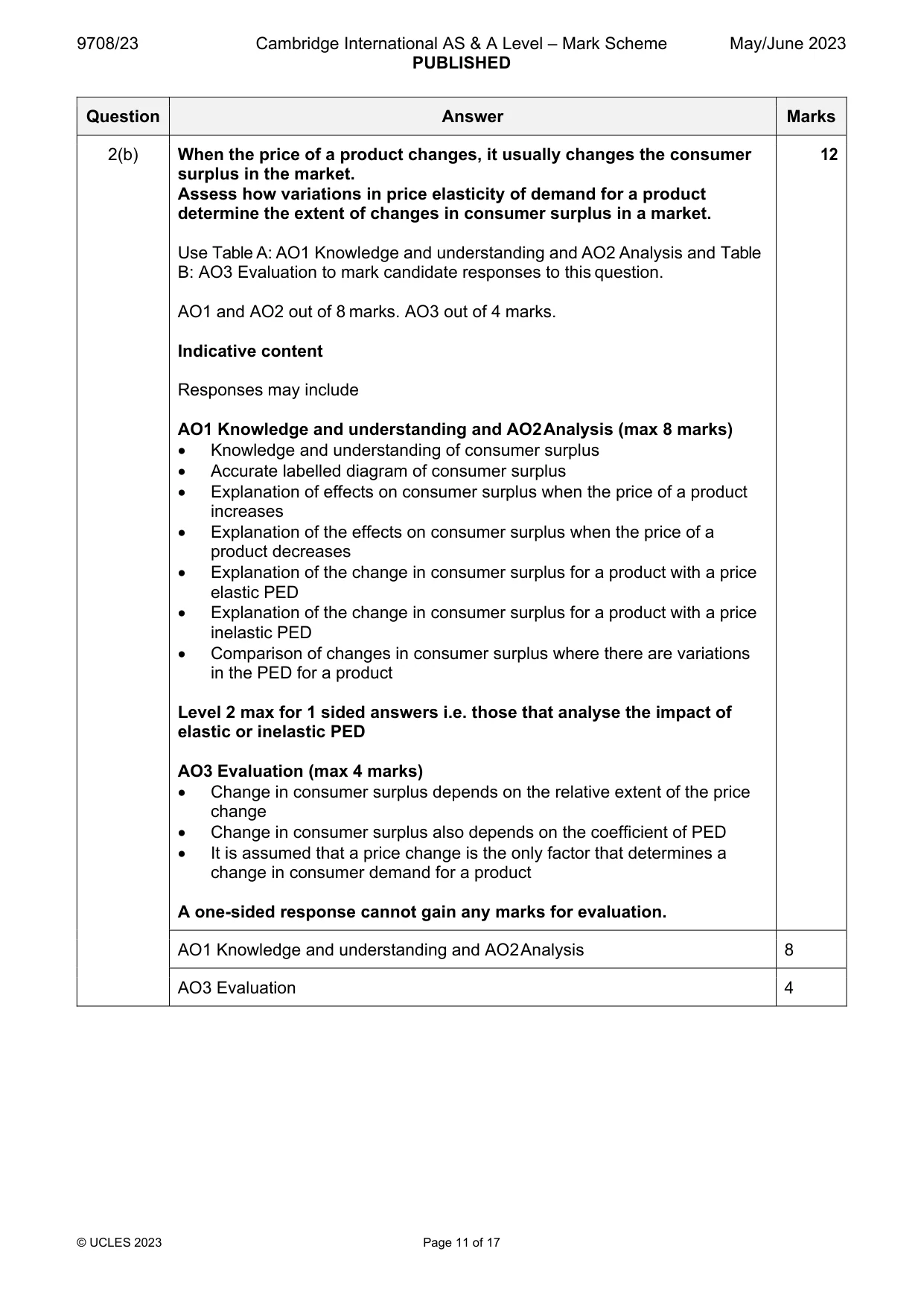
2 (a) Explain, with the help of examples, the significance of the size and sign of the coefficient of income elasticity of demand for the classification of a good and consider how confident you are of this classification. [8] (b) When the price of a product changes, it usually changes the consumer surplus in the market. Assess how variations in price elasticity of demand for a product determine the extent of changes in consumer surplus in a market. [12] OR
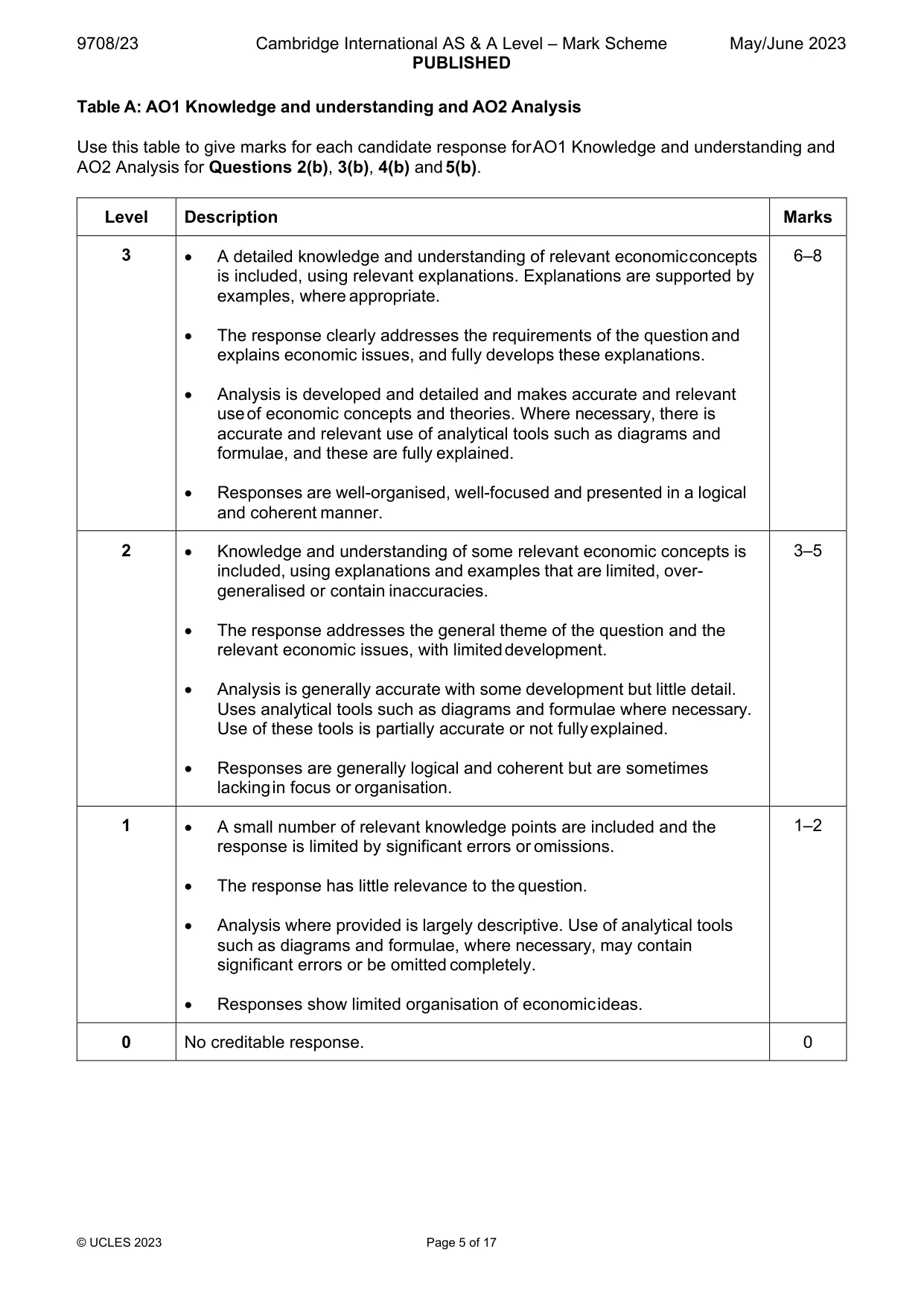
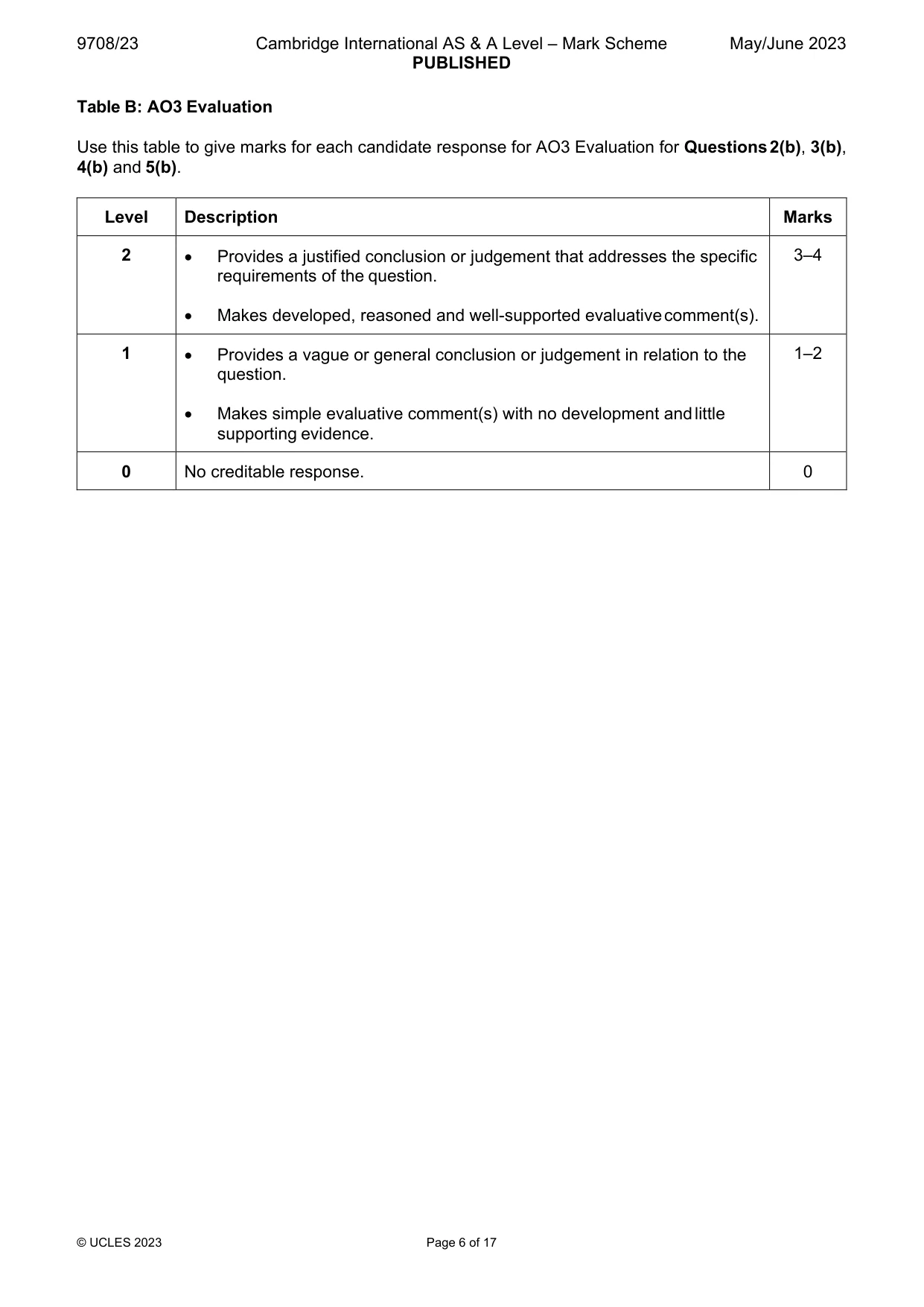
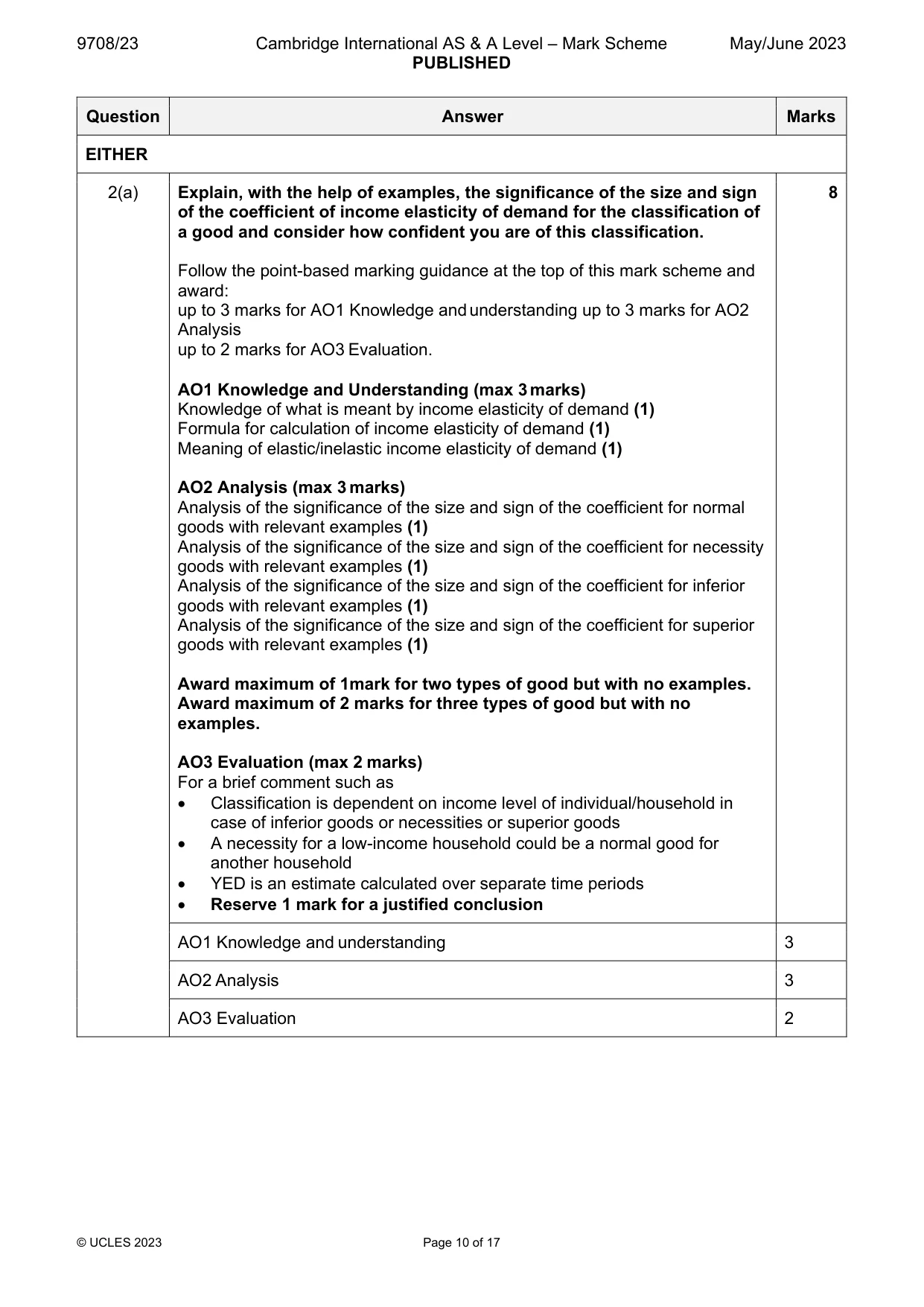
Mark scheme: 2(a) Explain, with the help of examples, the significance of the size and sign 8 of the coefficient of income elasticity of demand for the classification of a good and consider how confident you are of this classification. Follow the point-based marking guidance at the top of this mark scheme and award: up to 3 marks for AO1 Knowledge and understanding up to 3 marks for AO2 Analysis up to 2 marks for AO3 Evaluation. AO1 Knowledge and Understanding (max 3 marks) Knowledge of what is meant by income elasticity of demand (1) Formula for calculation of income elasticity of demand (1) Meaning of elastic/inelastic income elasticity of demand (1) AO2 Analysis (max 3 marks) Analysis of the significance of the size and sign of the coefficient for normal goods with relevant examples (1) Analysis of the significance of the size and sign of the coefficient for necessity goods with relevant examples (1) Analysis of the significance of the size and sign of the coefficient for inferior goods with relevant examples (1) Analysis of the significance of the size and sign of the coefficient for superior goods with relevant examples (1) Award maximum of 1mark for two types of good but with no examples. Award maximum of 2 marks for three types of good but with no examples. AO3 Evaluation (max 2 marks) For a brief comment such as Classification is dependent on income level of individual/household in case of inferior goods or necessities or superior goods A necessity for a low-income household could be a normal good for another household YED is an estimate calculated over separate time periods Reserve 1 mark for a justified conclusion AO1 Knowledge and understanding 3 AO2 Analysis 3 AO3 Evaluation 2 2(b) When the price of a product changes, it usually changes the consumer 12 surplus in the market. Assess how variations in price elasticity of demand for a product determine the extent of changes in consumer surplus in a market. Use Table A: AO1 Knowledge and understanding and AO2 Analysis and Table B: AO3 Evaluation to mark candidate responses to this question. AO1 and AO2 out of 8 marks. AO3 out of 4 marks. Indicative content Responses may include AO1 Knowledge and understanding and AO2 Analysis (max 8 marks) Knowledge and understanding of consumer surplus Accurate labelled diagram of consumer surplus Explanation of effects on consumer surplus when the price of a product increases Explanation of the effects on consumer surplus when the price of a product decreases Explanation of the change in consumer surplus for a product with a price elastic PED Explanation of the change in consumer surplus for a product with a price inelastic PED Comparison of changes in consumer surplus where there are variations in the PED for a product Level 2 max for 1 sided answers i.e. those that analyse the impact of elastic or inelastic PED AO3 Evaluation (max 4 marks) Change in consumer surplus depends on the relative extent of the price change Change in consumer surplus also depends on the coefficient of PED It is assumed that a price change is the only factor that determines a change in consumer demand for a product A one-sided response cannot gain any marks for evaluation. AO1 Knowledge and understanding and AO2 Analysis 8 AO3 Evaluation 4
Q3 · Explain why government intervention may be required to provide merit goods and consider…
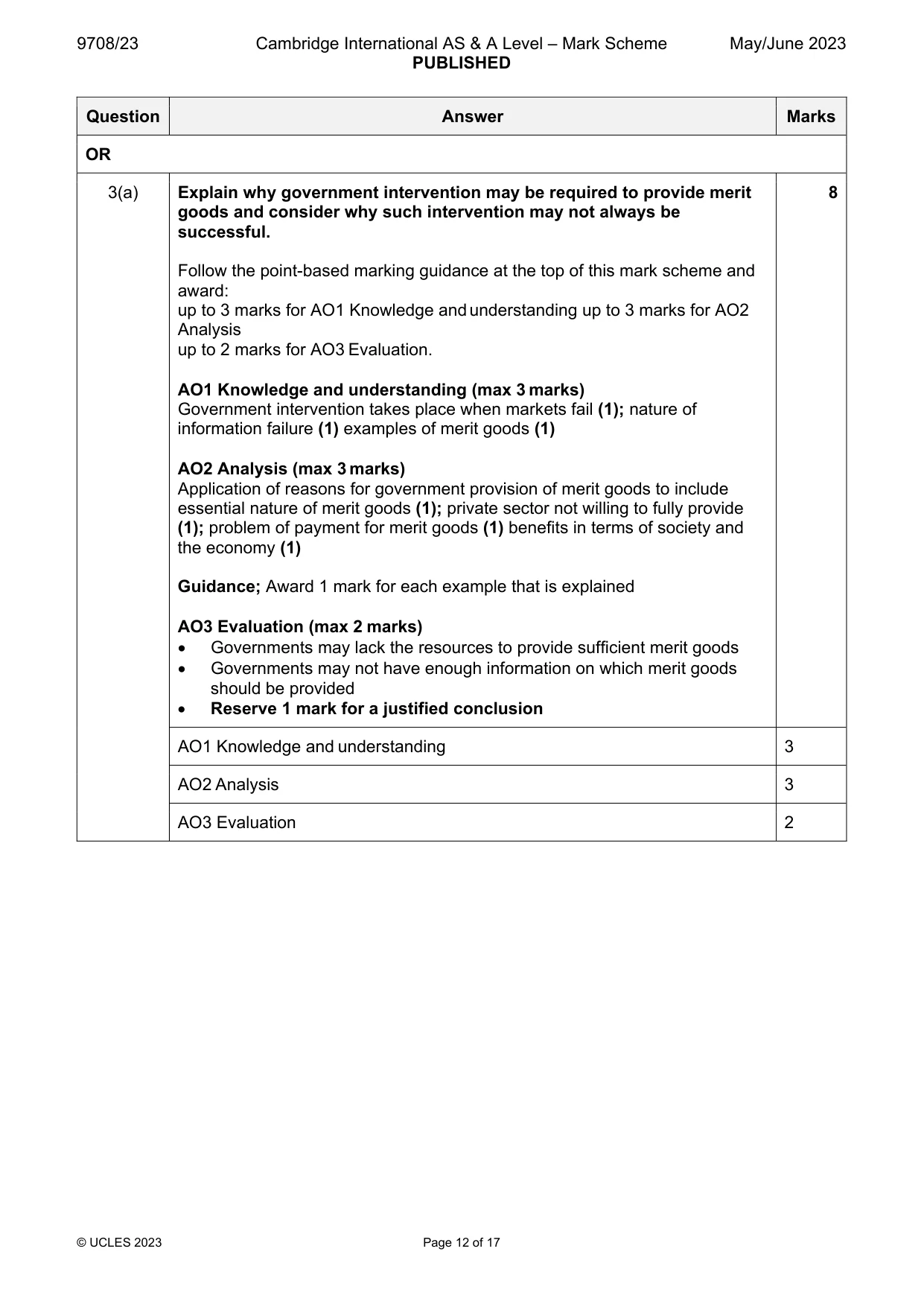
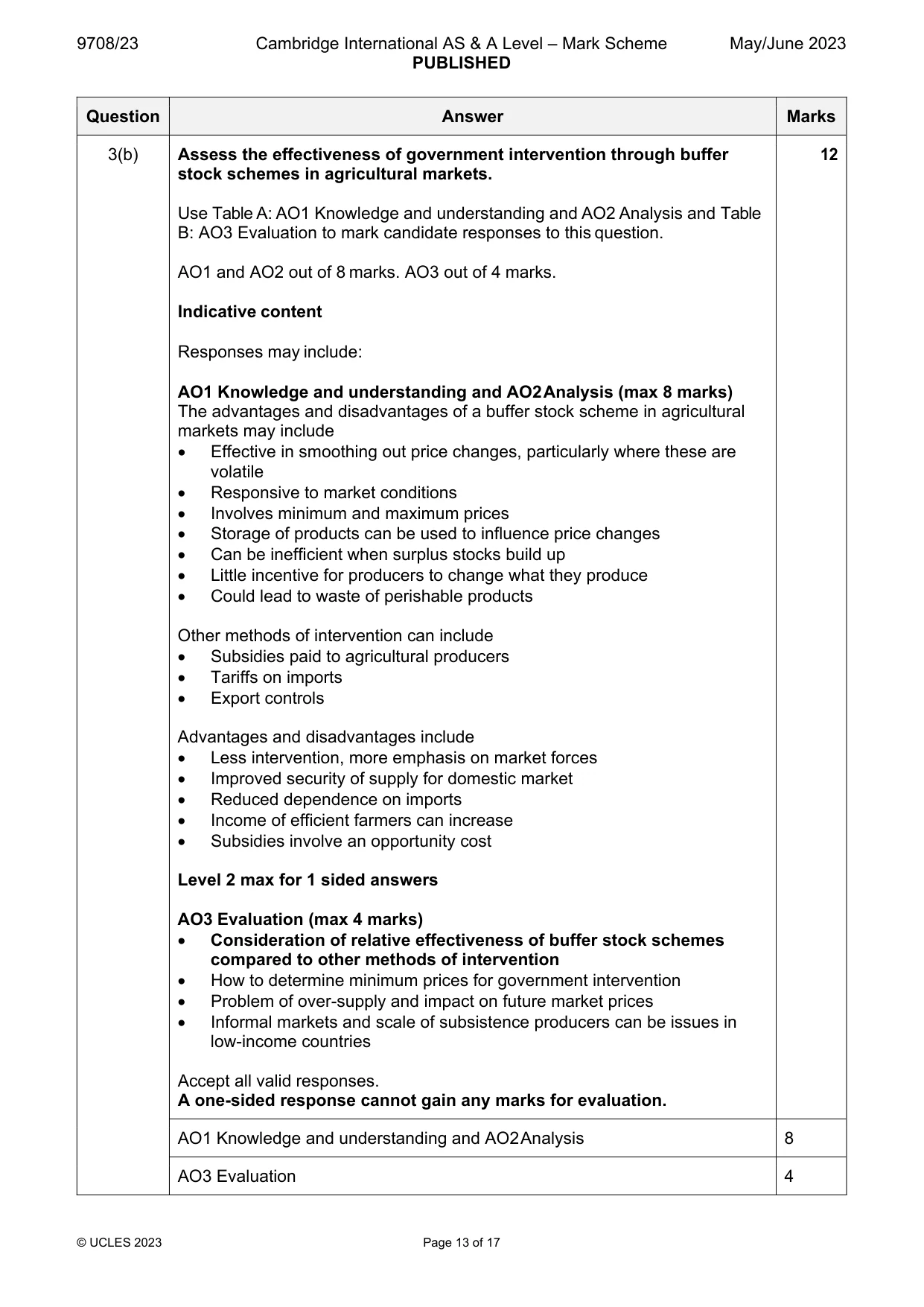
3 (a) Explain why government intervention may be required to provide merit goods and consider why such intervention may not always be successful. [8] (b) Assess the effectiveness of government intervention through buffer stock schemes in agricultural markets. [12] Section C Answer one question. EITHER
Mark scheme: 3(a) Explain why government intervention may be required to provide merit 8 goods and consider why such intervention may not always be successful. Follow the point-based marking guidance at the top of this mark scheme and award: up to 3 marks for AO1 Knowledge and understanding up to 3 marks for AO2 Analysis up to 2 marks for AO3 Evaluation. AO1 Knowledge and understanding (max 3 marks) Government intervention takes place when markets fail (1); nature of information failure (1) examples of merit goods (1) AO2 Analysis (max 3 marks) Application of reasons for government provision of merit goods to include essential nature of merit goods (1); private sector not willing to fully provide (1); problem of payment for merit goods (1) benefits in terms of society and the economy (1) Guidance; Award 1 mark for each example that is explained AO3 Evaluation (max 2 marks) Governments may lack the resources to provide sufficient merit goods Governments may not have enough information on which merit goods should be provided Reserve 1 mark for a justified conclusion AO1 Knowledge and understanding 3 AO2 Analysis 3 AO3 Evaluation 2 3(b) Assess the effectiveness of government intervention through buffer 12 stock schemes in agricultural markets. Use Table A: AO1 Knowledge and understanding and AO2 Analysis and Table B: AO3 Evaluation to mark candidate responses to this question. AO1 and AO2 out of 8 marks. AO3 out of 4 marks. Indicative content Responses may include: AO1 Knowledge and understanding and AO2 Analysis (max 8 marks) The advantages and disadvantages of a buffer stock scheme in agricultural markets may include Effective in smoothing out price changes, particularly where these are volatile Responsive to market conditions Involves minimum and maximum prices Storage of products can be used to influence price changes Can be inefficient when surplus stocks build up Little incentive for producers to change what they produce Could lead to waste of perishable products Other methods of intervention can include Subsidies paid to agricultural producers Tariffs on imports Export controls Advantages and disadvantages include Less intervention, more emphasis on market forces Improved security of supply for domestic market Reduced dependence on imports Income of efficient farmers can increase Subsidies involve an opportunity cost Level 2 max for 1 sided answers AO3 Evaluation (max 4 marks) Consideration of relative effectiveness of buffer stock schemes compared to other methods of intervention How to determine minimum prices for government intervention Problem of over-supply and impact on future market prices Informal markets and scale of subsistence producers can be issues in low-income countries Accept all valid responses. A one-sided response cannot gain any marks for evaluation. AO1 Knowledge and understanding and AO2 Analysis 8 AO3 Evaluation 4
More questions on Methods and effects of government intervention in markets
Q4 · With the help of a circular flow of income diagram, explain how equilibrium is determined…
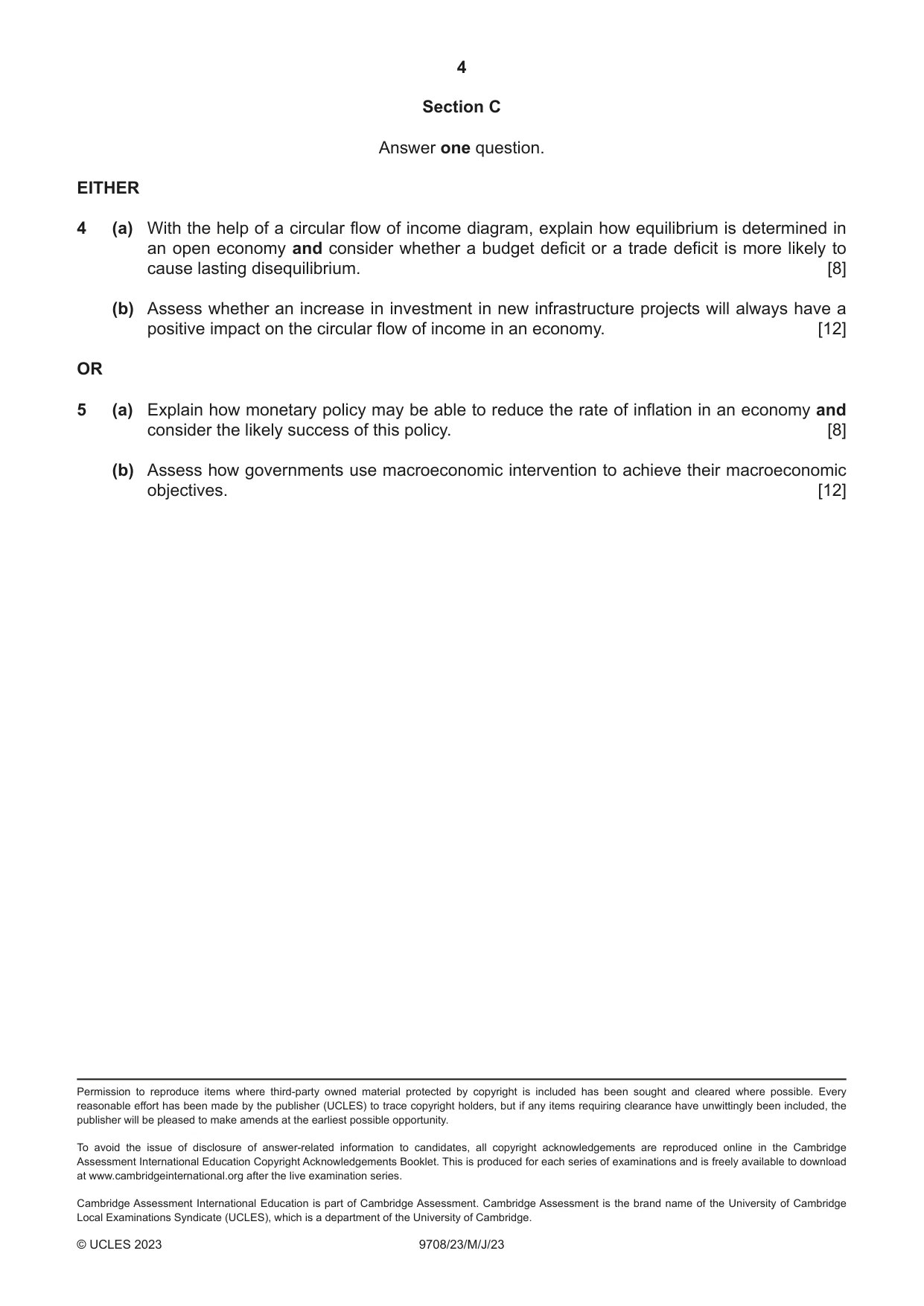
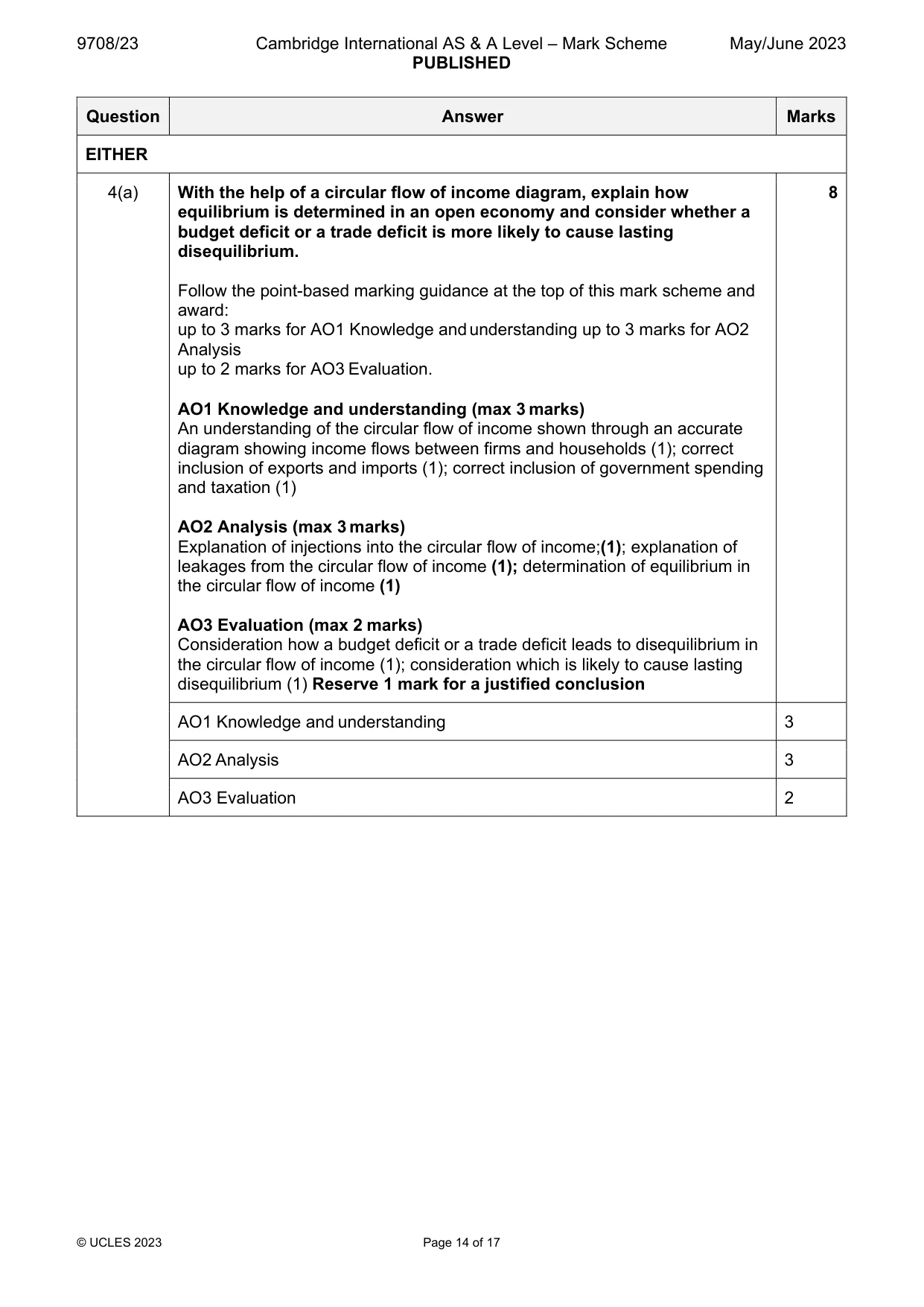
4 (a) With the help of a circular flow of income diagram, explain how equilibrium is determined in an open economy and consider whether a budget deficit or a trade deficit is more likely to cause lasting disequilibrium. [8] (b) Assess whether an increase in investment in new infrastructure projects will always have a positive impact on the circular flow of income in an economy. [12] OR
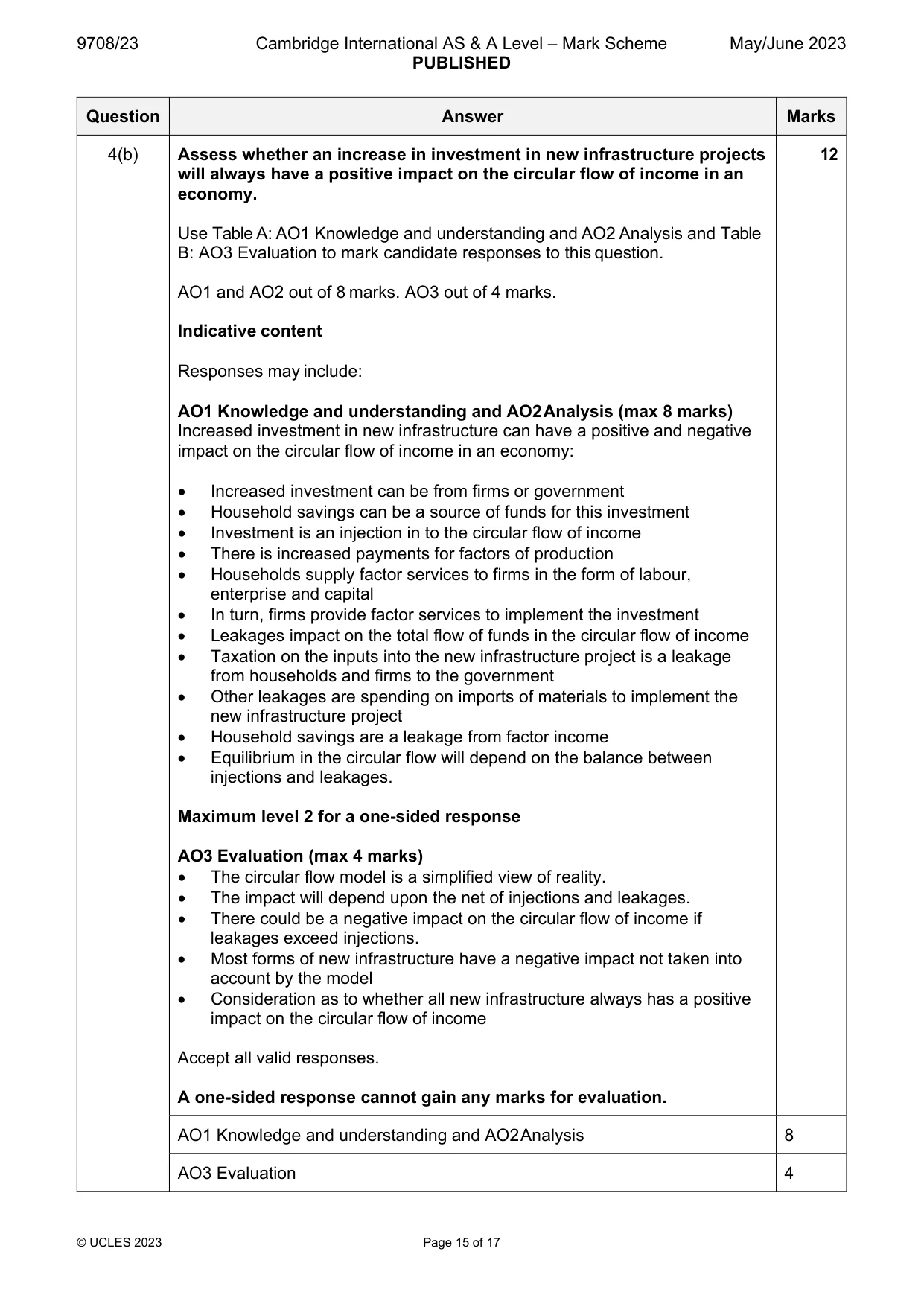
Mark scheme: 4(a) With the help of a circular flow of income diagram, explain how 8 equilibrium is determined in an open economy and consider whether a budget deficit or a trade deficit is more likely to cause lasting disequilibrium. Follow the point-based marking guidance at the top of this mark scheme and award: up to 3 marks for AO1 Knowledge and understanding up to 3 marks for AO2 Analysis up to 2 marks for AO3 Evaluation. AO1 Knowledge and understanding (max 3 marks) An understanding of the circular flow of income shown through an accurate diagram showing income flows between firms and households (1); correct inclusion of exports and imports (1); correct inclusion of government spending and taxation (1) AO2 Analysis (max 3 marks) Explanation of injections into the circular flow of income;(1); explanation of leakages from the circular flow of income (1); determination of equilibrium in the circular flow of income (1) AO3 Evaluation (max 2 marks) Consideration how a budget deficit or a trade deficit leads to disequilibrium in the circular flow of income (1); consideration which is likely to cause lasting disequilibrium (1) Reserve 1 mark for a justified conclusion AO1 Knowledge and understanding 3 AO2 Analysis 3 AO3 Evaluation 2 4(b) Assess whether an increase in investment in new infrastructure projects 12 will always have a positive impact on the circular flow of income in an economy. Use Table A: AO1 Knowledge and understanding and AO2 Analysis and Table B: AO3 Evaluation to mark candidate responses to this question. AO1 and AO2 out of 8 marks. AO3 out of 4 marks. Indicative content Responses may include: AO1 Knowledge and understanding and AO2 Analysis (max 8 marks) Increased investment in new infrastructure can have a positive and negative impact on the circular flow of income in an economy: Increased investment can be from firms or government Household savings can be a source of funds for this investment Investment is an injection in to the circular flow of income There is increased payments for factors of production Households supply factor services to firms in the form of labour, enterprise and capital In turn, firms provide factor services to implement the investment Leakages impact on the total flow of funds in the circular flow of income Taxation on the inputs into the new infrastructure project is a leakage from households and firms to the government Other leakages are spending on imports of materials to implement the new infrastructure project Household savings are a leakage from factor income Equilibrium in the circular flow will depend on the balance between injections and leakages. Maximum level 2 for a one-sided response AO3 Evaluation (max 4 marks) The circular flow model is a simplified view of reality. The impact will depend upon the net of injections and leakages. There could be a negative impact on the circular flow of income if leakages exceed injections. Most forms of new infrastructure have a negative impact not taken into account by the model Consideration as to whether all new infrastructure always has a positive impact on the circular flow of income Accept all valid responses. A one-sided response cannot gain any marks for evaluation. AO1 Knowledge and understanding and AO2 Analysis 8 AO3 Evaluation 4
Q5 · Explain how monetary policy may be able to reduce the rate of inflation in an economy and…
5 (a) Explain how monetary policy may be able to reduce the rate of inflation in an economy and consider the likely success of this policy. [8] (b) Assess how governments use macroeconomic intervention to achieve their macroeconomic objectives. [12]
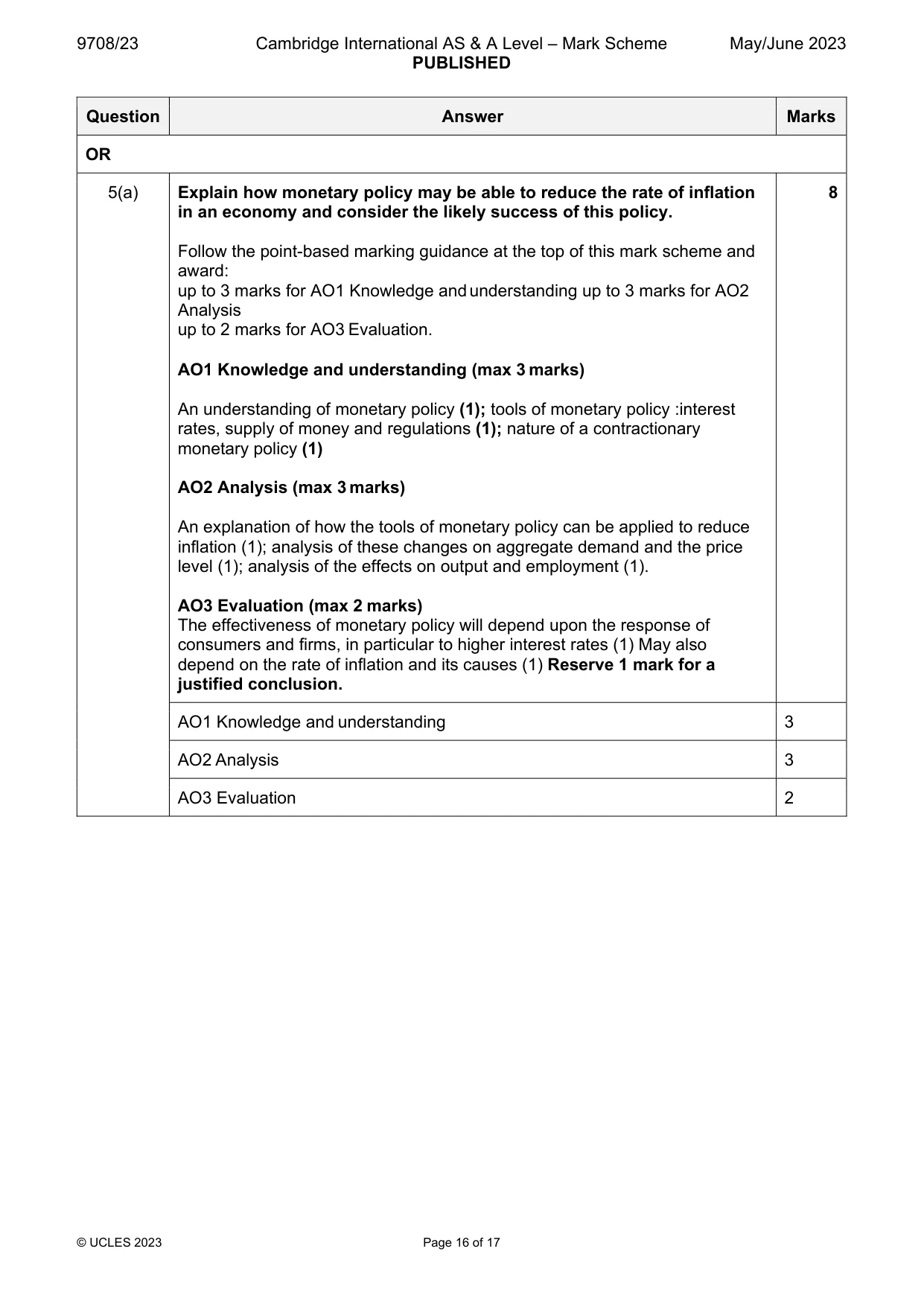
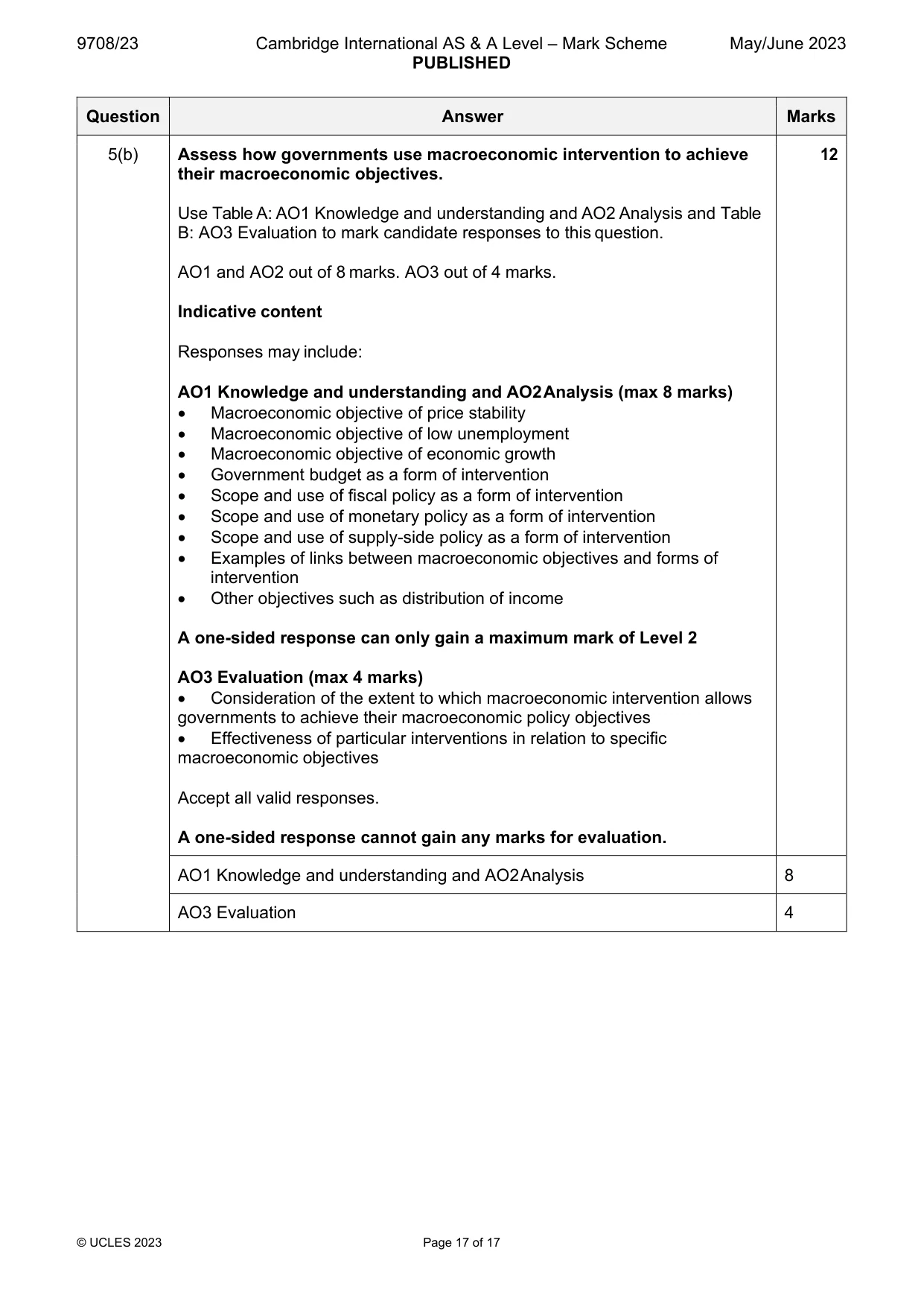
Mark scheme: 5(a) Explain how monetary policy may be able to reduce the rate of inflation 8 in an economy and consider the likely success of this policy. Follow the point-based marking guidance at the top of this mark scheme and award: up to 3 marks for AO1 Knowledge and understanding up to 3 marks for AO2 Analysis up to 2 marks for AO3 Evaluation. AO1 Knowledge and understanding (max 3 marks) An understanding of monetary policy (1); tools of monetary policy :interest rates, supply of money and regulations (1); nature of a contractionary monetary policy (1) AO2 Analysis (max 3 marks) An explanation of how the tools of monetary policy can be applied to reduce inflation (1); analysis of these changes on aggregate demand and the price level (1); analysis of the effects on output and employment (1). AO3 Evaluation (max 2 marks) The effectiveness of monetary policy will depend upon the response of consumers and firms, in particular to higher interest rates (1) May also depend on the rate of inflation and its causes (1) Reserve 1 mark for a justified conclusion. AO1 Knowledge and understanding 3 AO2 Analysis 3 AO3 Evaluation 2 5(b) Assess how governments use macroeconomic intervention to achieve 12 their macroeconomic objectives. Use Table A: AO1 Knowledge and understanding and AO2 Analysis and Table B: AO3 Evaluation to mark candidate responses to this question. AO1 and AO2 out of 8 marks. AO3 out of 4 marks. Indicative content Responses may include: AO1 Knowledge and understanding and AO2 Analysis (max 8 marks) Macroeconomic objective of price stability Macroeconomic objective of low unemployment Macroeconomic objective of economic growth Government budget as a form of intervention Scope and use of fiscal policy as a form of intervention Scope and use of monetary policy as a form of intervention Scope and use of supply-side policy as a form of intervention Examples of links between macroeconomic objectives and forms of intervention Other objectives such as distribution of income A one-sided response can only gain a maximum mark of Level 2 AO3 Evaluation (max 4 marks) Consideration of the extent to which macroeconomic intervention allows governments to achieve their macroeconomic policy objectives Effectiveness of particular interventions in relation to specific macroeconomic objectives Accept all valid responses. A one-sided response cannot gain any marks for evaluation. AO1 Knowledge and understanding and AO2 Analysis 8 AO3 Evaluation 4
More questions on Effectiveness of policy options to meet all macroeconomic objectives
What was in this paper
The subtopics covered by these 5 questions, and how many questions each got. Open one in a new tab to see every Cambridge question on it.
What you needed in this session
Cambridge’s own grade thresholds for 2023 May/June, Paper 2 · Variant 3. A higher threshold means an easier paper — the bar moves with how the cohort did.