Cambridge A Level Economics 9708 — 2022 May/June Paper 2 · Variant 3
9708/23/M/J/22 · 4 questions · 40 marks · ≈45 min
The question paper and its mark scheme, free to read here and free to download. This is Cambridge’s own paper, exactly as it was sat.
Question paper4 pages
Mark scheme13 pages
Answers below. Sit the paper first if you are practising.
Questions as text
Q1 · The changing market for avocados The global consumption of avocados has increased in the…
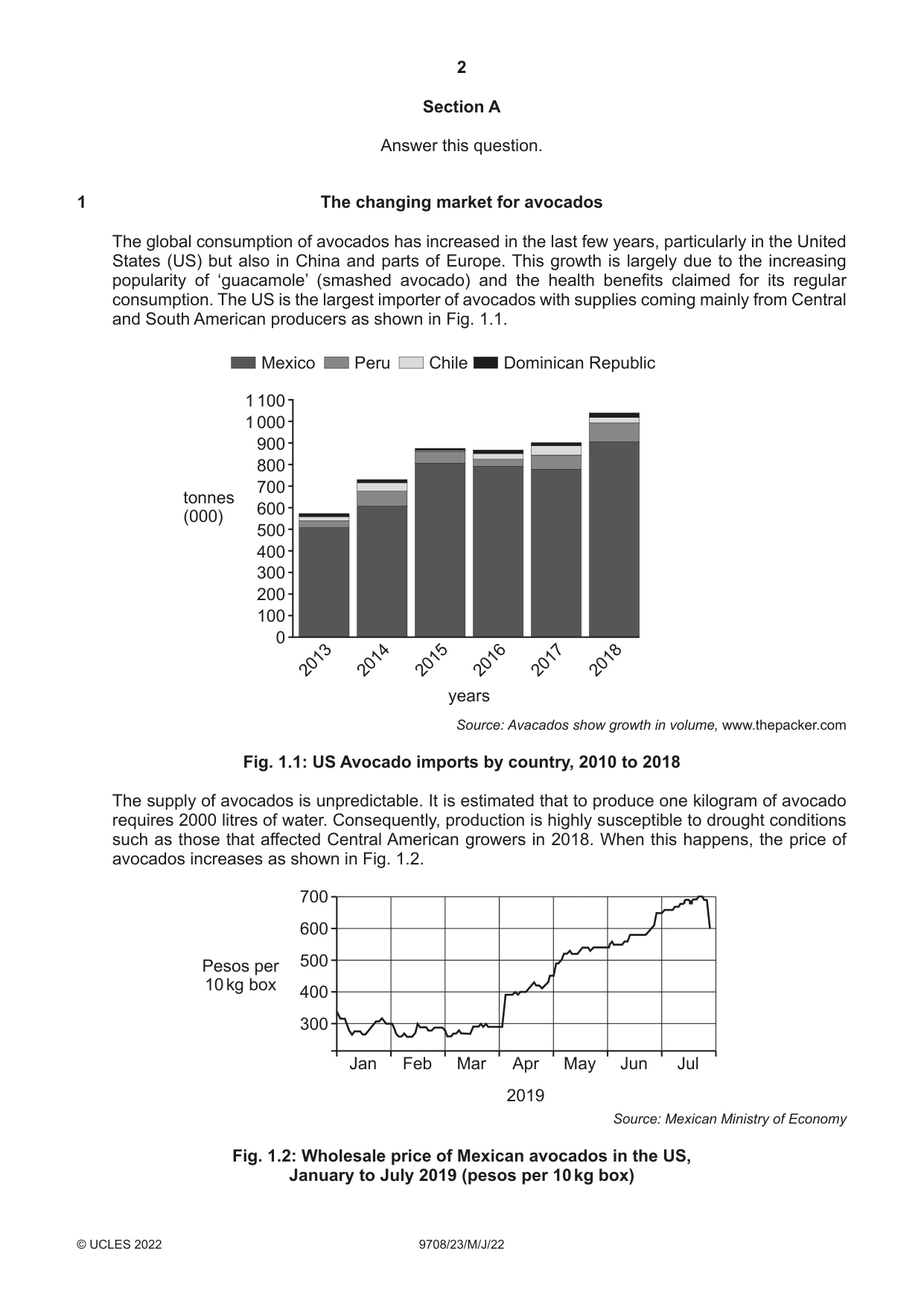
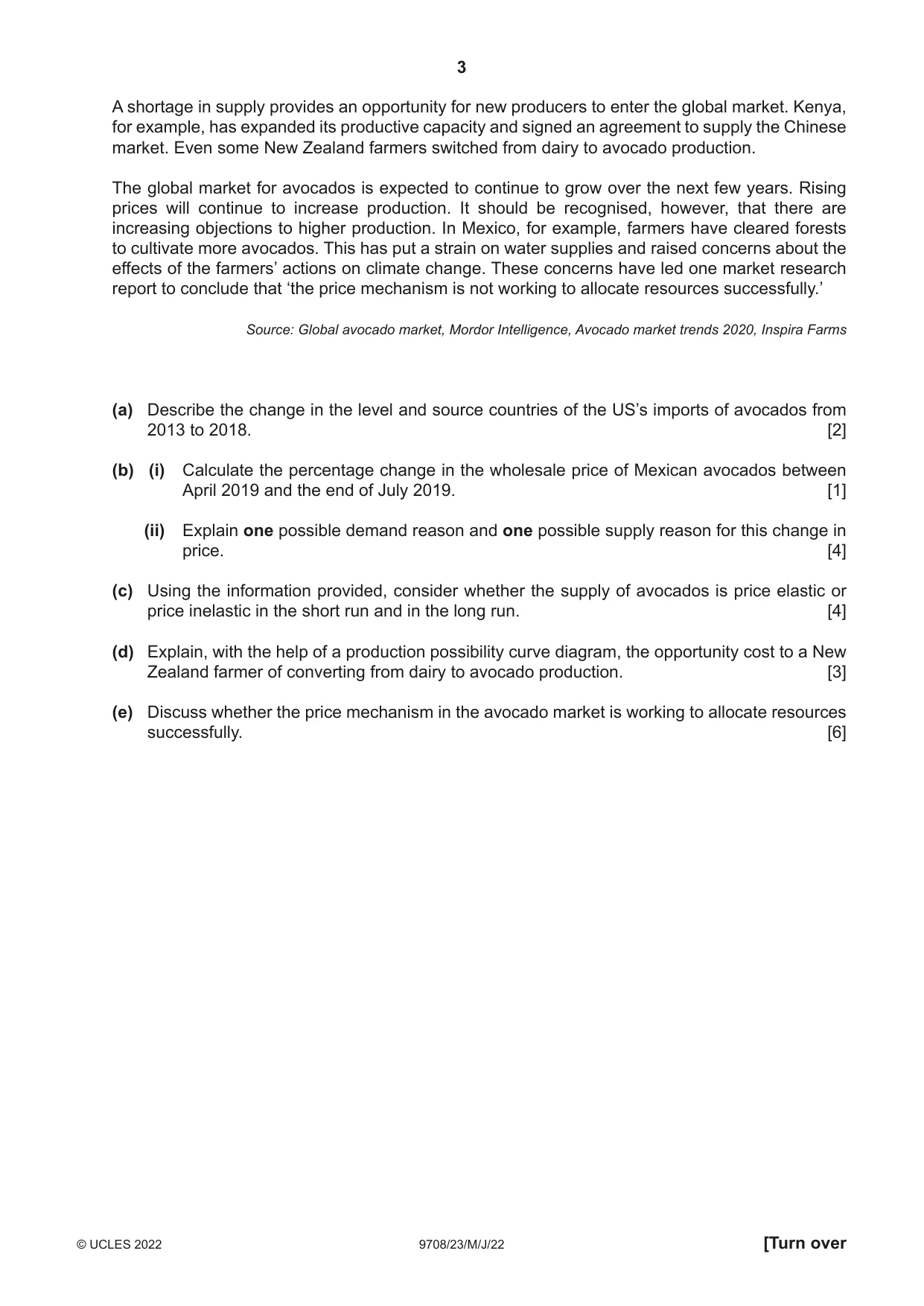
1 The changing market for avocados The global consumption of avocados has increased in the last few years, particularly in the United States (US) but also in China and parts of Europe. This growth is largely due to the increasing popularity of ‘guacamole’ (smashed avocado) and the health benefits claimed for its regular consumption. The US is the largest importer of avocados with supplies coming mainly from Central and South American producers as shown in Fig. 1.1. Mexico Peru Chile Dominican Republic 1 100 1 000 900 800 700 tonnes 600 (000) 500 400 300 200 100 0 2013 2014 2015 2016 2017 2018 years Source: Avacados show growth in volume, www.thepacker.com Fig. 1.1: US Avocado imports by country, 2010 to 2018 The supply of avocados is unpredictable. It is estimated that to produce one kilogram of avocado requires 2000 litres of water. Consequently, production is highly susceptible to drought conditions such as those that affected Central American growers in 2018. When this happens, the price of avocados increases as shown in Fig. 1.2. 700 600 500 Pesos per 10 kg box 400 300 Jan Feb Mar Apr May Jun Jul 2019 Source: Mexican Ministry of Economy Fig. 1.2: Wholesale price of Mexican avocados in the US, January to July 2019 (pesos per 10 kg box) A shortage in supply provides an opportunity for new producers to enter the global market. Kenya, for example, has expanded its productive capacity and signed an agreement to supply the Chinese market. Even some New Zealand farmers switched from dairy to avocado production. The global market for avocados is expected to continue to grow over the next few years. Rising prices will continue to increase production. It should be recognised, however, that there are increasing objections to higher production. In Mexico, for example, farmers have cleared forests to cultivate more avocados. This has put a strain on water supplies and raised concerns about the effects of the farmers’ actions on climate change. These concerns have led one market research report to conclude that ‘the price mechanism is not working to allocate resources successfully.’ Source: Global avocado market, Mordor Intelligence, Avocado market trends 2020, Inspira Farms (a) Describe the change in the level and source countries of the US’s imports of avocados from 2013 to 2018. [2] (b) (i) Calculate the percentage change in the wholesale price of Mexican avocados between April 2019 and the end of July 2019. [1] (ii) Explain one possible demand reason and one possible supply reason for this change in price. [4] (c) Using the information provided, consider whether the supply of avocados is price elastic or price inelastic in the short run and in the long run. [4] (d) Explain, with the help of a production possibility curve diagram, the opportunity cost to a New Zealand farmer of converting from dairy to avocado production. [3] (e) Discuss whether the price mechanism in the avocado market is working to allocate resources successfully. [6]
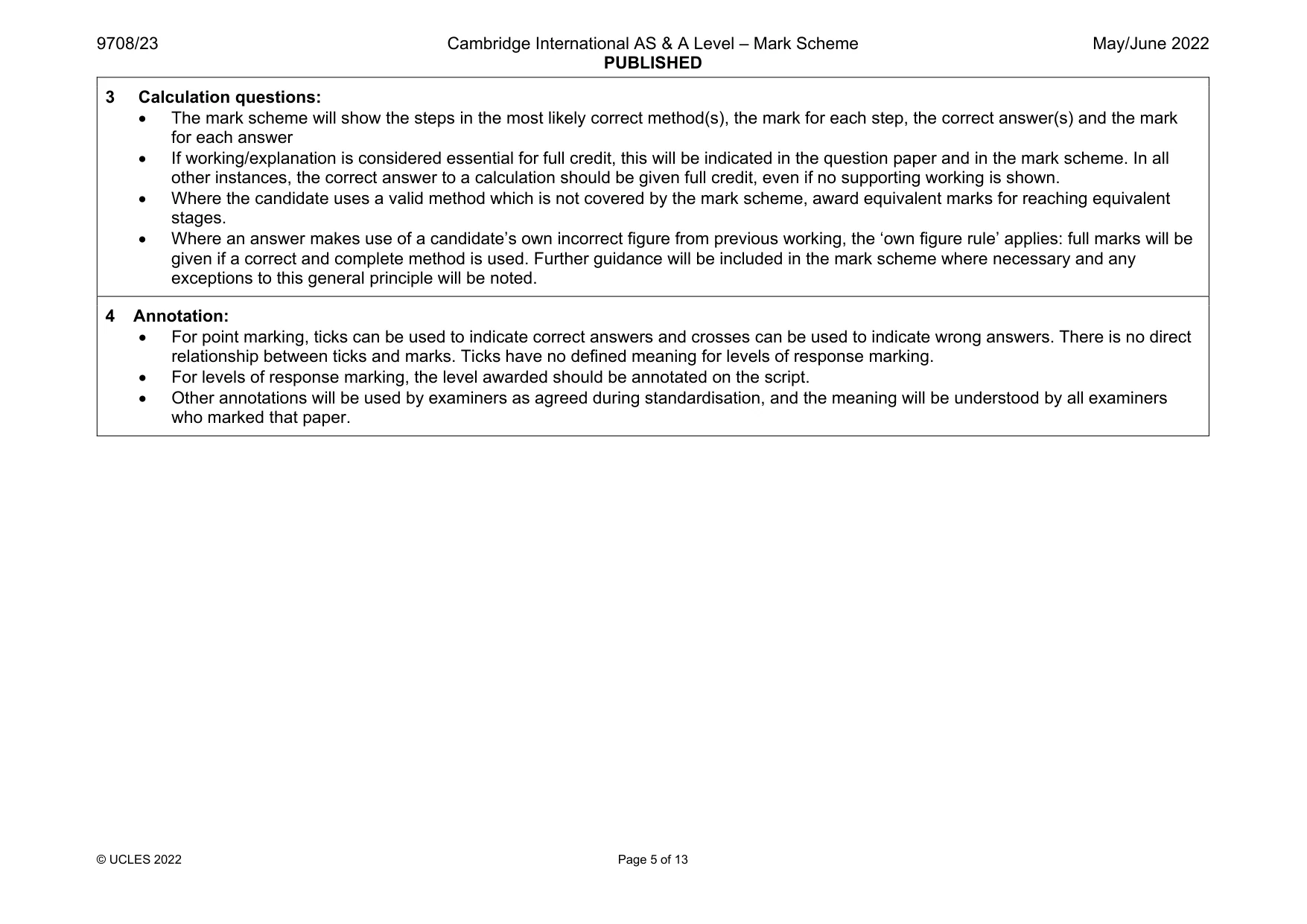
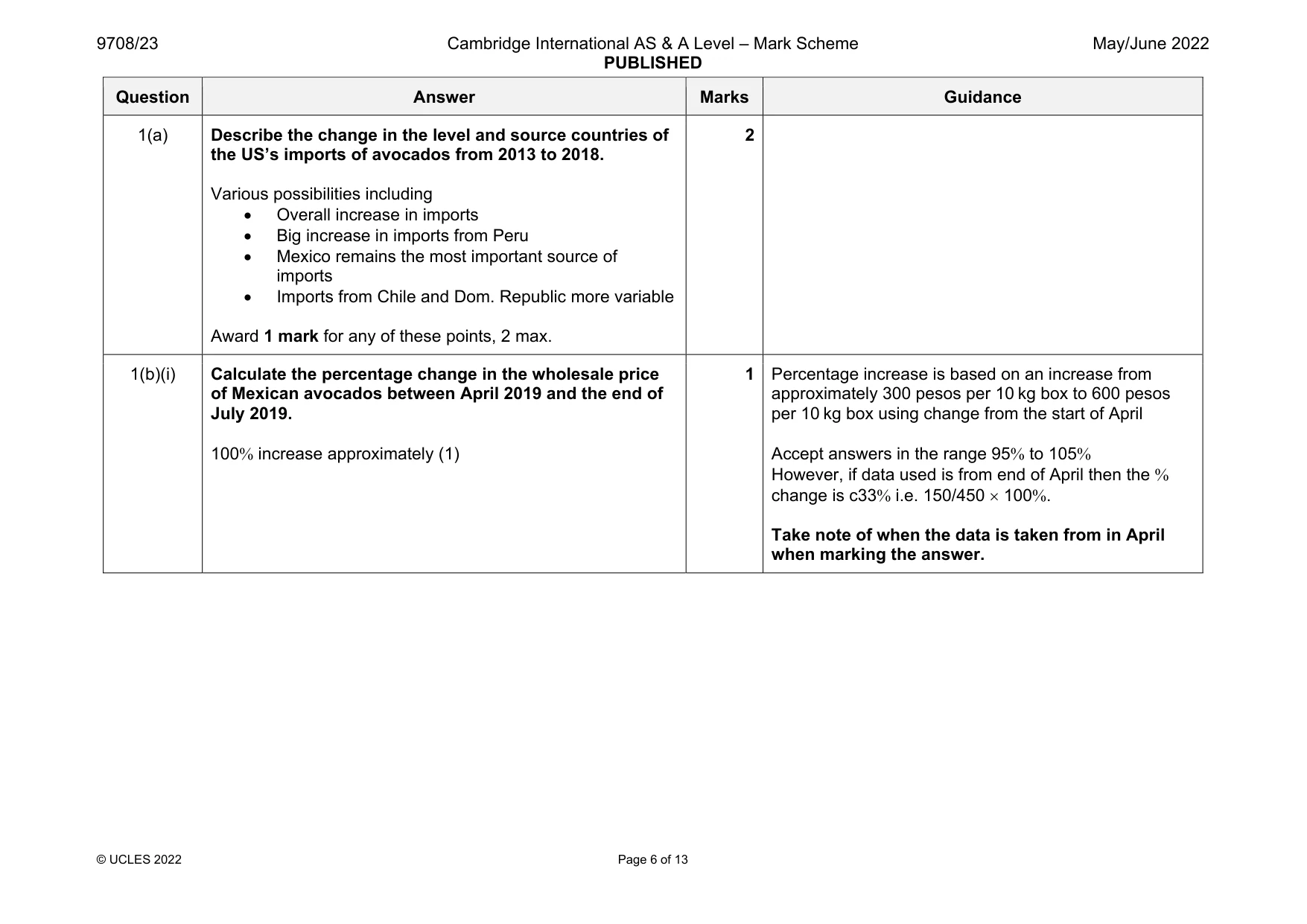
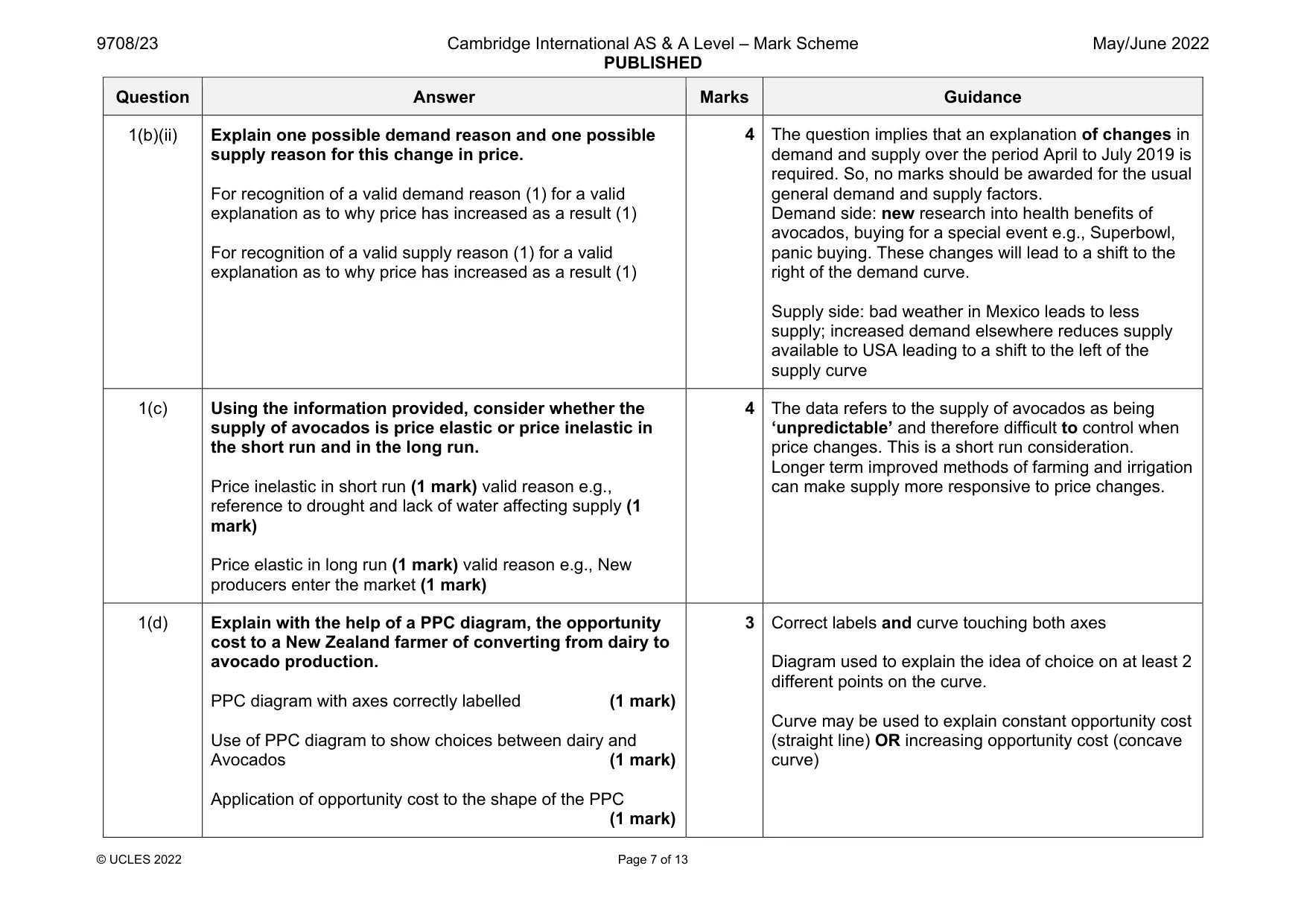
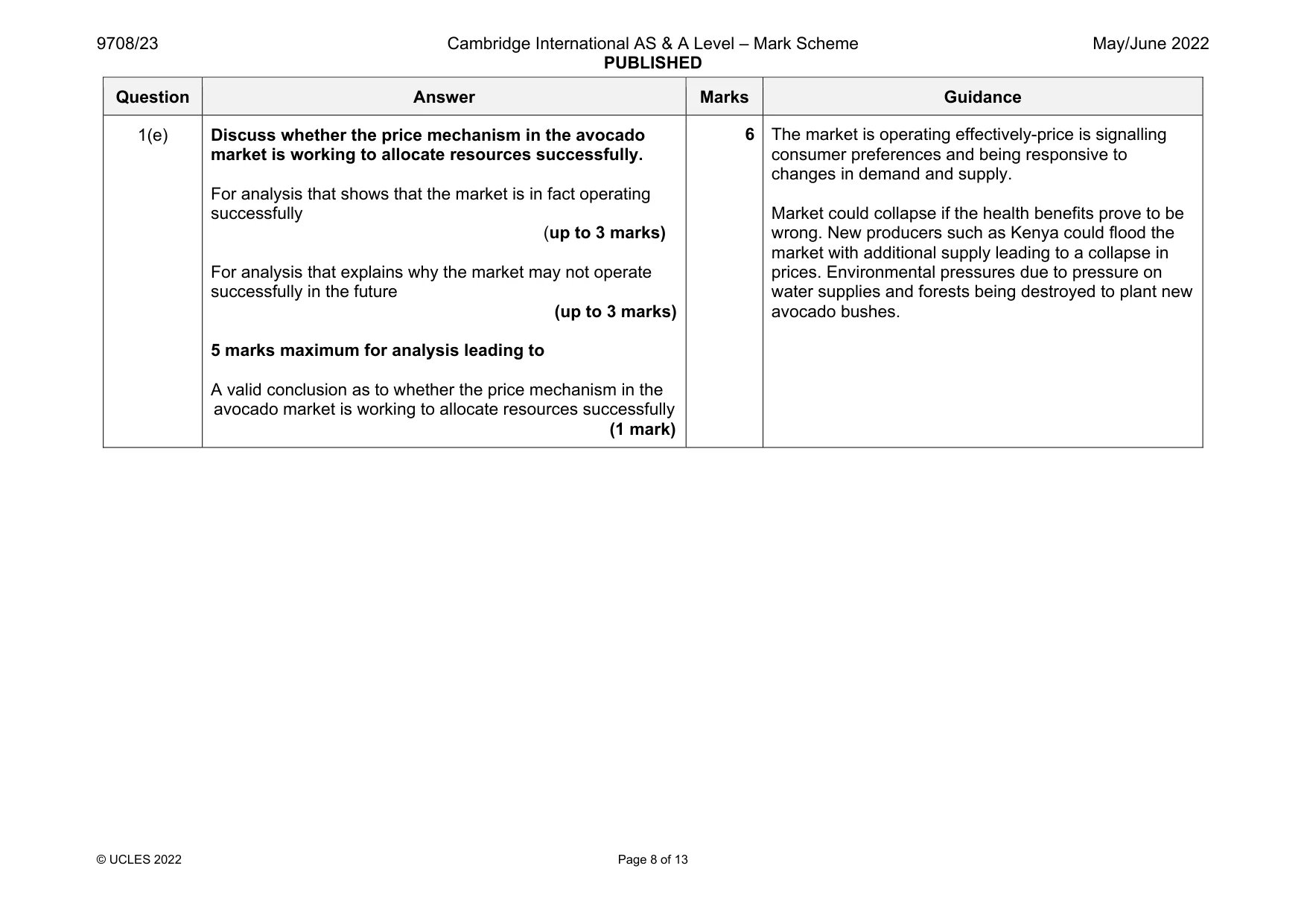
Mark scheme: 1(a) Describe the change in the level and source countries of the US’s imports of avocados from 2013 to 2018. Various possibilities including Overall increase in imports Big increase in imports from Peru Mexico remains the most important source of imports Imports from Chile and Dom. Republic more variable Award 1 mark for any of these points, 2 max. 2 1(b)(i) Calculate the percentage change in the wholesale price of Mexican avocados between April 2019 and the end of July 2019. 100 increase approximately (1) 1 Percentage increase is based on an increase from approximately 300 pesos per 10 kg box to 600 pesos per 10 kg box using change from the start of April Accept answers in the range 95 to 105 However, if data used is from end of April then the change is c33 i.e. 150/450 100. Take note of when the data is taken from in April when marking the answer. Question Answer Marks Guidance 1(b)(ii) Explain one possible demand reason and one possible supply reason for this change in price. For recognition of a valid demand reason (1) for a valid explanation as to why price has increased as a result (1) For recognition of a valid supply reason (1) for a valid explanation as to why price has increased as a result (1) 4 The question implies that an explanation of changes in demand and supply over the period April to July 2019 is required. So, no marks should be awarded for the usual general demand and supply factors. Demand side: new research into health benefits of avocados, buying for a special event e.g., Superbowl, panic buying. These changes will lead to a shift to the right of the demand curve. Supply side: bad weather in Mexico leads to less supply; increased demand elsewhere reduces supply available to USA leading to a shift to the left of the supply curve 1(c) Using the information provided, consider whether the supply of avocados is price elastic or price inelastic in the short run and in the long run. Price inelastic in short run (1 mark) valid reason e.g., reference to drought and lack of water affecting supply (1 mark) Price elastic in long run (1 mark) valid reason e.g., New producers enter the market (1 mark) 4 The data refers to the supply of avocados as being ‘unpredictable’ and therefore difficult to control when price changes. This is a short run consideration. Longer term improved methods of farming and irrigation can make supply more responsive to price changes. 1(d) Explain with the help of a PPC diagram, the opportunity cost to a New Zealand farmer of converting from dairy to avocado production. PPC diagram with axes correctly labelled (1 mark) Use of PPC diagram to show choices between dairy and Avocados (1 mark) Application of opportunity cost to the shape of the PPC (1 mark) 3 Correct labels and curve touching both axes Diagram used to explain the idea of choice on at least 2 different points on the curve. Curve may be used to explain constant opportunity cost (straight line) OR increasing opportunity cost (concave curve) Question Answer Marks Guidance 1(e) Discuss whether the price mechanism in the avocado market is working to allocate resources successfully. For analysis that shows that the market is in fact operating successfully (up to 3 marks) For analysis that explains why the market may not operate successfully in the future (up to 3 marks) 5 marks maximum for analysis leading to A valid conclusion as to whether the price mechanism in the avocado market is working to allocate resources successfully (1 mark) 6 The market is operating effectively-price is signalling consumer preferences and being responsive to changes in demand and supply. Market could collapse if the health benefits prove to be wrong. New producers such as Kenya could flood the market with additional supply leading to a collapse in prices. Environmental pressures due to pressure on water supplies and forests being destroyed to plant new avocado bushes.
Q2 · A government has decided to spend money building a new barrier to prevent flooding across…
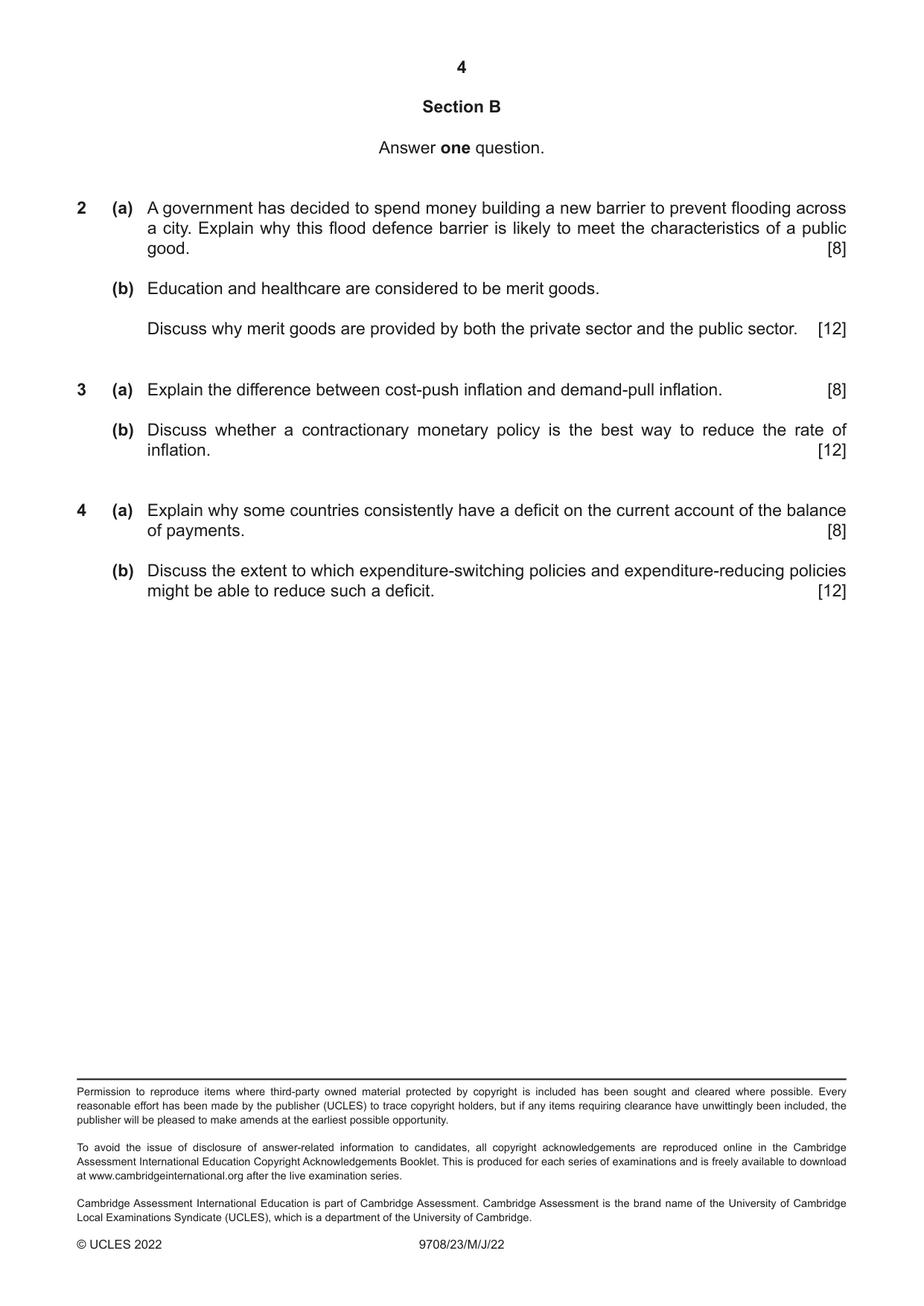
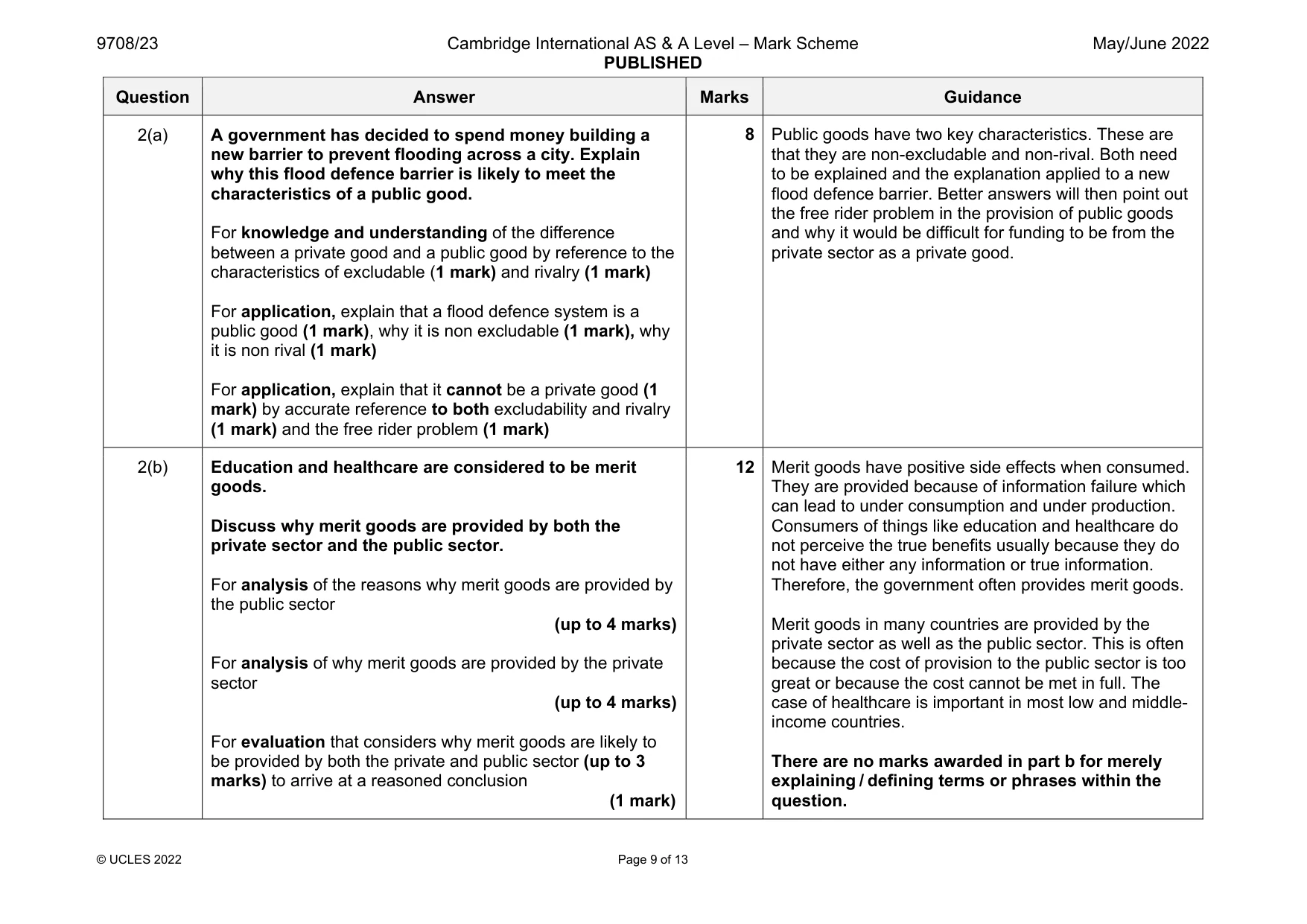
2 (a) A government has decided to spend money building a new barrier to prevent flooding across a city. Explain why this flood defence barrier is likely to meet the characteristics of a public good. [8] (b) Education and healthcare are considered to be merit goods. Discuss why merit goods are provided by both the private sector and the public sector. [12]
Mark scheme: 2(a) A government has decided to spend money building a new barrier to prevent flooding across a city. Explain why this flood defence barrier is likely to meet the characteristics of a public good. For knowledge and understanding of the difference between a private good and a public good by reference to the characteristics of excludable (1 mark) and rivalry (1 mark) For application, explain that a flood defence system is a public good (1 mark), why it is non excludable (1 mark), why it is non rival (1 mark) For application, explain that it cannot be a private good (1 mark) by accurate reference to both excludability and rivalry (1 mark) and the free rider problem (1 mark) that they are non-excludable and non-rival. Both need to be explained and the explanation applied to a new flood defence barrier. Better answers will then point out the free rider problem in the provision of public goods and why it would be difficult for funding to be from the private sector as a private good. 2(b) Education and healthcare are considered to be merit goods. Discuss why merit goods are provided by both the private sector and the public sector. For analysis of the reasons why merit goods are provided by the public sector (up to 4 marks) For analysis of why merit goods are provided by the private sector (up to 4 marks) For evaluation that considers why merit goods are likely to be provided by both the private and public sector (up to 3 marks) to arrive at a reasoned conclusion (1 mark) 12 Merit goods have positive side effects when consumed. They are provided because of information failure which can lead to under consumption and under production. Consumers of things like education and healthcare do not perceive the true benefits usually because they do not have either any information or true information. Therefore, the government often provides merit goods. Merit goods in many countries are provided by the private sector as well as the public sector. This is often because the cost of provision to the public sector is too great or because the cost cannot be met in full. The case of healthcare is important in most low and middle- income countries. There are no marks awarded in part b for merely explaining / defining terms or phrases within the question.
Q3 · Explain the difference between cost-push inflation and demand-pull inflation
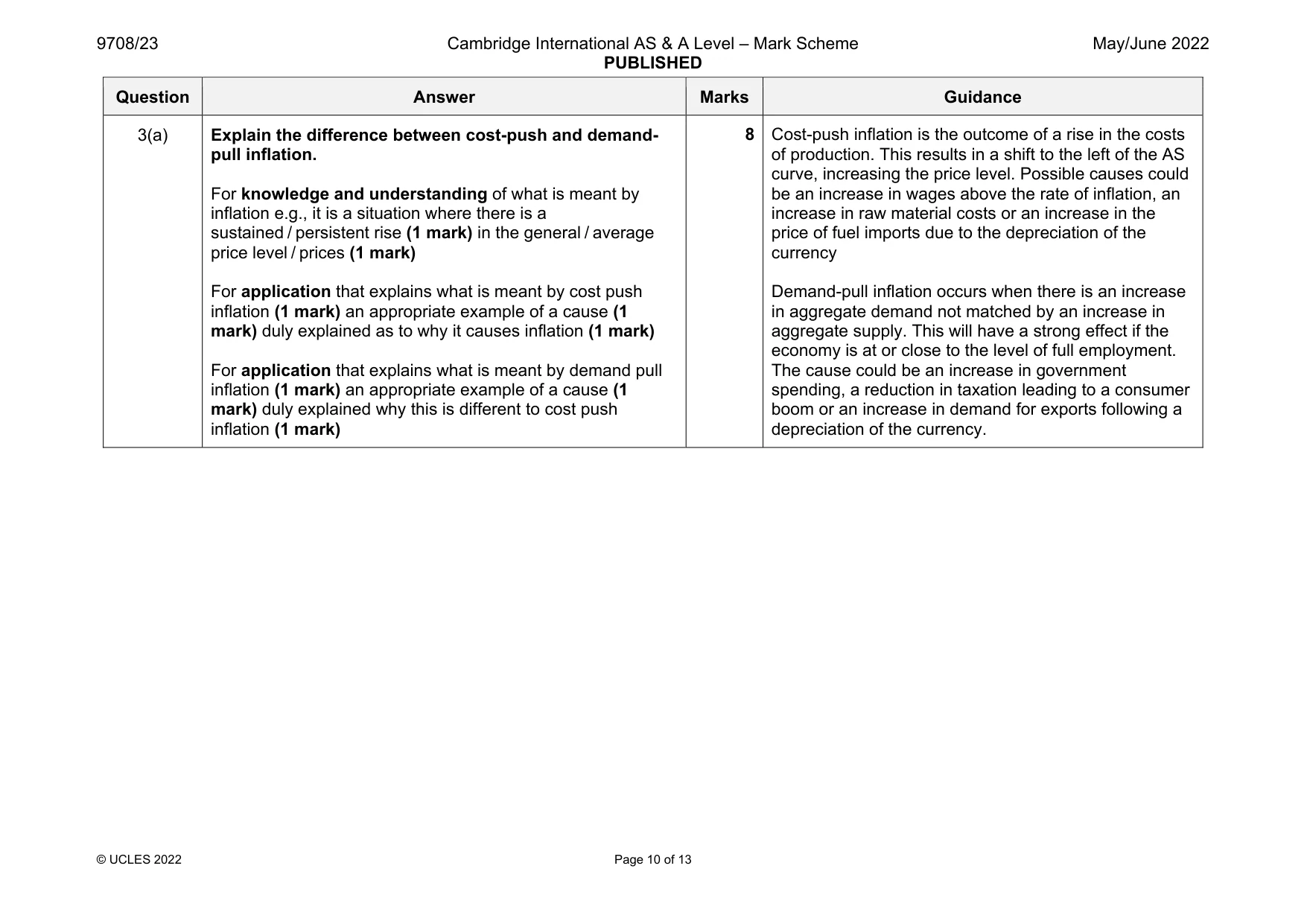
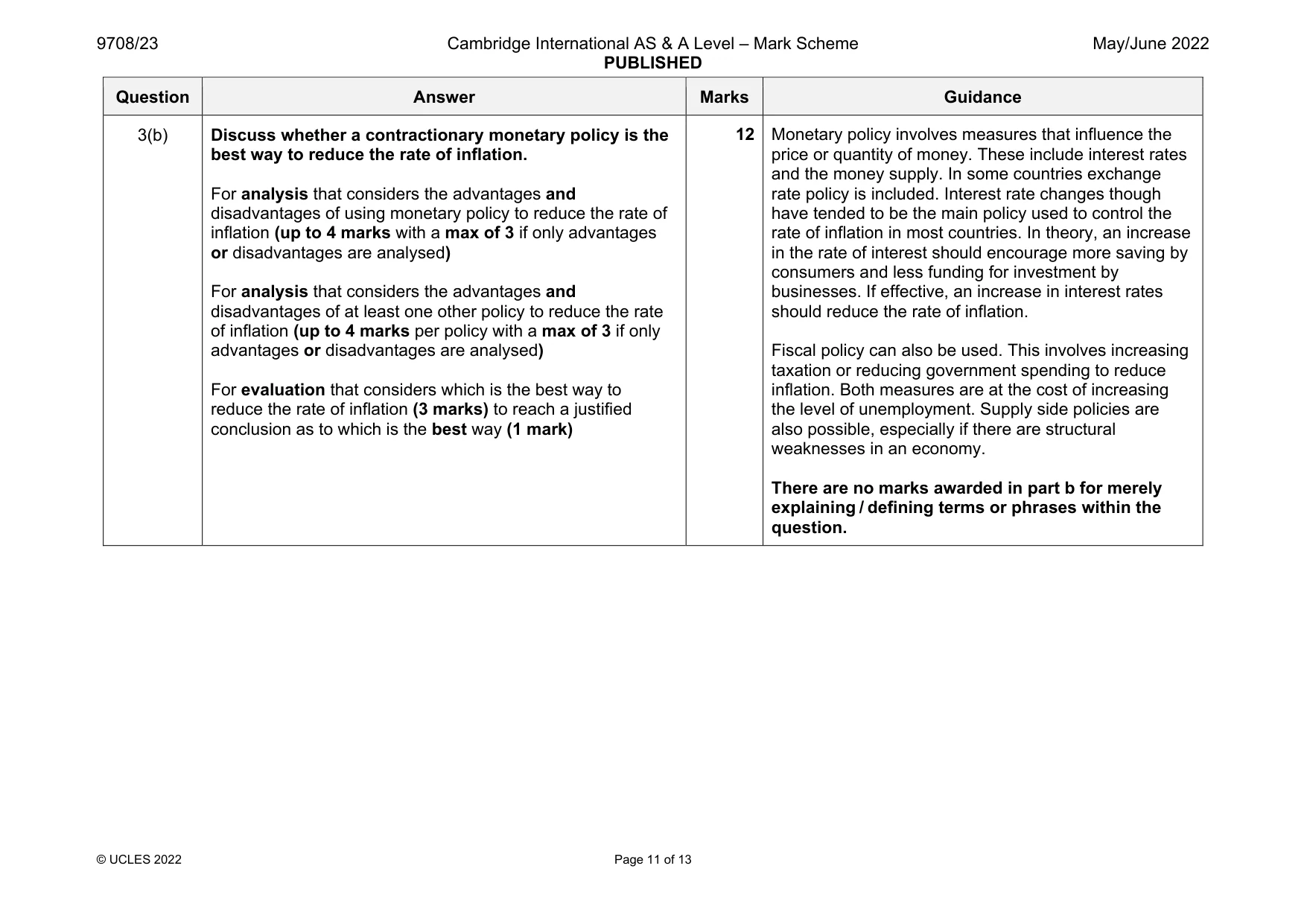
3 (a) Explain the difference between cost-push inflation and demand-pull inflation. [8] (b) Discuss whether a contractionary monetary policy is the best way to reduce the rate of inflation. [12]
Mark scheme: 3(a) Explain the difference between cost-push and demand- pull inflation. For knowledge and understanding of what is meant by inflation e.g., it is a situation where there is a sustained / persistent rise (1 mark) in the general / average price level / prices (1 mark) For application that explains what is meant by cost push inflation (1 mark) an appropriate example of a cause (1 mark) duly explained as to why it causes inflation (1 mark) For application that explains what is meant by demand pull inflation (1 mark) an appropriate example of a cause (1 mark) duly explained why this is different to cost push inflation (1 mark) of production. This results in a shift to the left of the AS curve, increasing the price level. Possible causes could be an increase in wages above the rate of inflation, an increase in raw material costs or an increase in the price of fuel imports due to the depreciation of the currency Demand-pull inflation occurs when there is an increase in aggregate demand not matched by an increase in aggregate supply. This will have a strong effect if the economy is at or close to the level of full employment. The cause could be an increase in government spending, a reduction in taxation leading to a consumer boom or an increase in demand for exports following a depreciation of the currency. Question Answer Marks Guidance 3(b) Discuss whether a contractionary monetary policy is the best way to reduce the rate of inflation. For analysis that considers the advantages and disadvantages of using monetary policy to reduce the rate of inflation (up to 4 marks with a max of 3 if only advantages or disadvantages are analysed) For analysis that considers the advantages and disadvantages of at least one other policy to reduce the rate of inflation (up to 4 marks per policy with a max of 3 if only advantages or disadvantages are analysed) For evaluation that considers which is the best way to reduce the rate of inflation (3 marks) to reach a justified conclusion as to which is the best way (1 mark) 12 Monetary policy involves measures that influence the price or quantity of money. These include interest rates and the money supply. In some countries exchange rate policy is included. Interest rate changes though have tended to be the main policy used to control the rate of inflation in most countries. In theory, an increase in the rate of interest should encourage more saving by consumers and less funding for investment by businesses. If effective, an increase in interest rates should reduce the rate of inflation. Fiscal policy can also be used. This involves increasing taxation or reducing government spending to reduce inflation. Both measures are at the cost of increasing the level of unemployment. Supply side policies are also possible, especially if there are structural weaknesses in an economy. There are no marks awarded in part b for merely explaining / defining terms or phrases within the question.
More questions on Effectiveness of policy options to meet all macroeconomic objectives
Q4 · Explain why some countries consistently have a deficit on the current account of the…
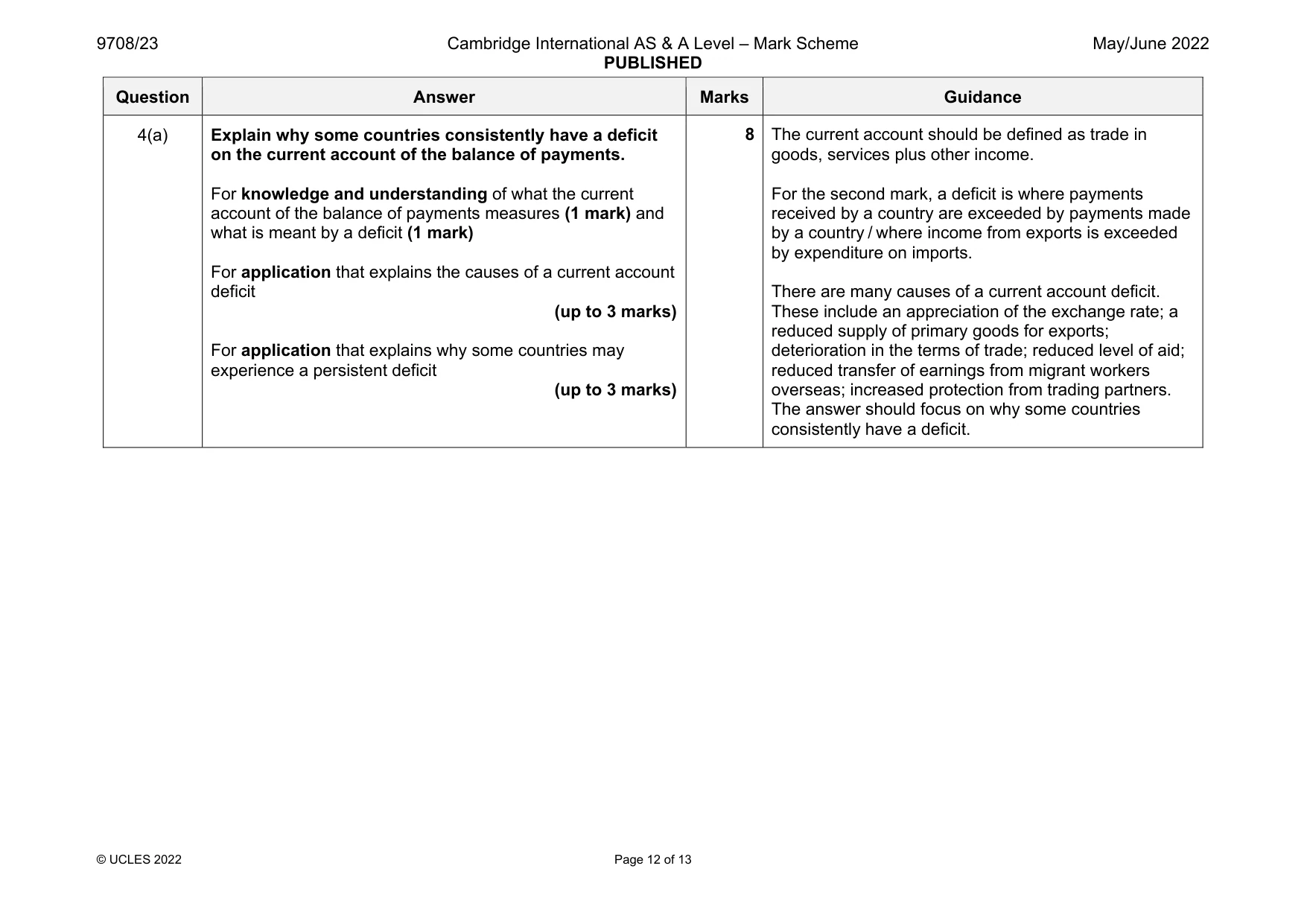
4 (a) Explain why some countries consistently have a deficit on the current account of the balance of payments. [8] (b) Discuss the extent to which expenditure-switching policies and expenditure-reducing policies might be able to reduce such a deficit. [12]
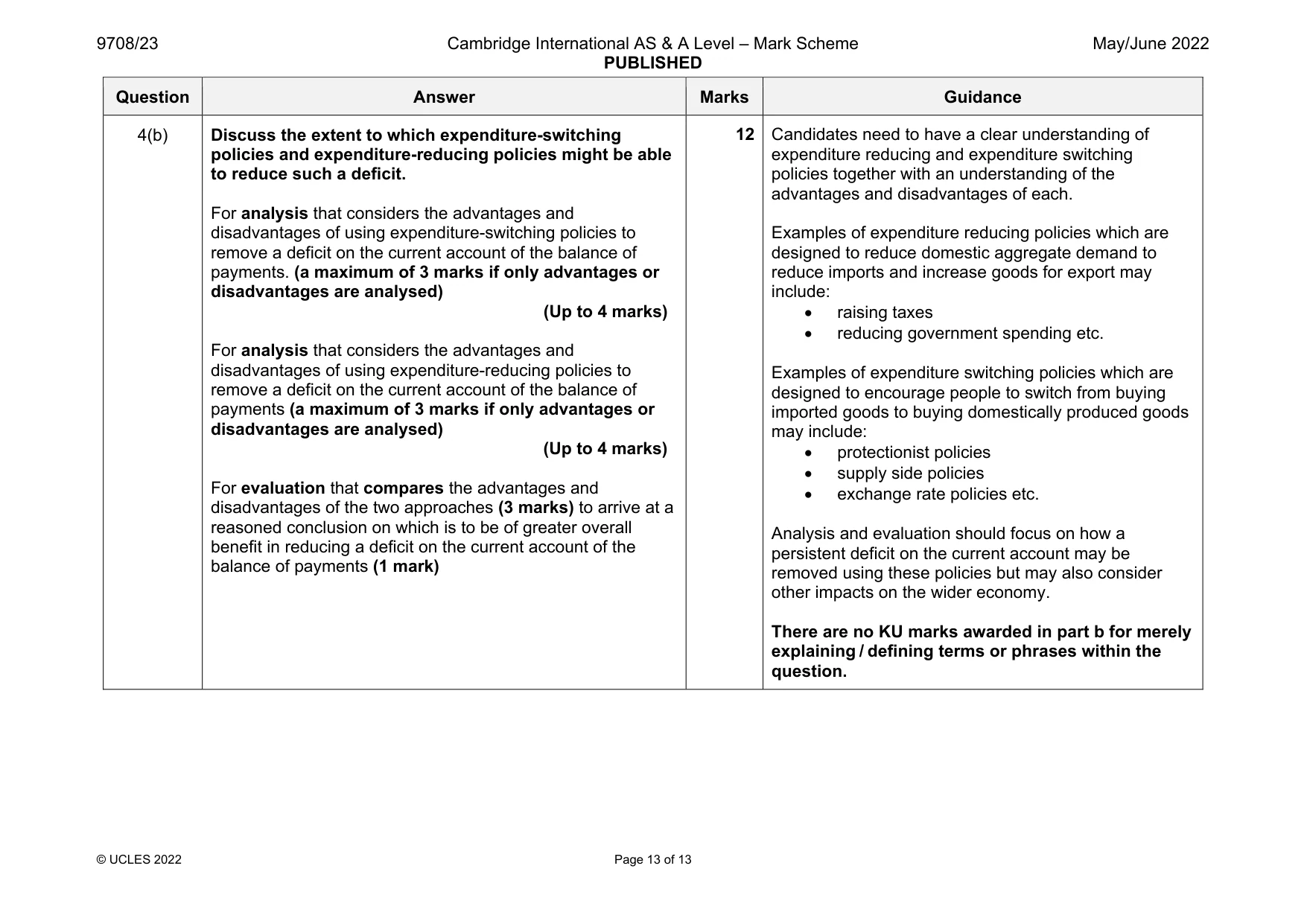
Mark scheme: 4(a) Explain why some countries consistently have a deficit on the current account of the balance of payments. For knowledge and understanding of what the current account of the balance of payments measures (1 mark) and what is meant by a deficit (1 mark) For application that explains the causes of a current account deficit (up to 3 marks) For application that explains why some countries may experience a persistent deficit (up to 3 marks) goods, services plus other income. For the second mark, a deficit is where payments received by a country are exceeded by payments made by a country / where income from exports is exceeded by expenditure on imports. There are many causes of a current account deficit. These include an appreciation of the exchange rate; a reduced supply of primary goods for exports; deterioration in the terms of trade; reduced level of aid; reduced transfer of earnings from migrant workers overseas; increased protection from trading partners. The answer should focus on why some countries consistently have a deficit. Question Answer Marks Guidance 4(b) Discuss the extent to which expenditure-switching policies and expenditure-reducing policies might be able to reduce such a deficit. For analysis that considers the advantages and disadvantages of using expenditure-switching policies to remove a deficit on the current account of the balance of payments. (a maximum of 3 marks if only advantages or disadvantages are analysed) (Up to 4 marks) For analysis that considers the advantages and disadvantages of using expenditure-reducing policies to remove a deficit on the current account of the balance of payments (a maximum of 3 marks if only advantages or disadvantages are analysed) (Up to 4 marks) For evaluation that compares the advantages and disadvantages of the two approaches (3 marks) to arrive at a reasoned conclusion on which is to be of greater overall benefit in reducing a deficit on the current account of the balance of payments (1 mark) 12 Candidates need to have a clear understanding of expenditure reducing and expenditure switching policies together with an understanding of the advantages and disadvantages of each. Examples of expenditure reducing policies which are designed to reduce domestic aggregate demand to reduce imports and increase goods for export may include: raising taxes reducing government spending etc. Examples of expenditure switching policies which are designed to encourage people to switch from buying imported goods to buying domestically produced goods may include: protectionist policies supply side policies exchange rate policies etc. Analysis and evaluation should focus on how a persistent deficit on the current account may be removed using these policies but may also consider other impacts on the wider economy. There are no KU marks awarded in part b for merely explaining / defining terms or phrases within the question.
More questions on Policies to correct imbalances in the current account of the balance of payments
What was in this paper
The subtopics covered by these 4 questions, and how many questions each got. Open one in a new tab to see every Cambridge question on it.
What you needed in this session
Cambridge’s own grade thresholds for 2022 May/June, Paper 2 · Variant 3. A higher threshold means an easier paper — the bar moves with how the cohort did.