Cambridge A Level Economics 9708 — 2023 Oct/Nov Paper 2 · Variant 3
9708/23/O/N/23 · 5 questions · 60 marks · ≈68 min
The question paper and its mark scheme, free to read here and free to download. This is Cambridge’s own paper, exactly as it was sat.
Question paper4 pages
Mark scheme16 pages
Answers below. Sit the paper first if you are practising.
Questions as text
Q1 · Varied responses to the COVID-19 pandemic The COVID-19 pandemic had a very significant…
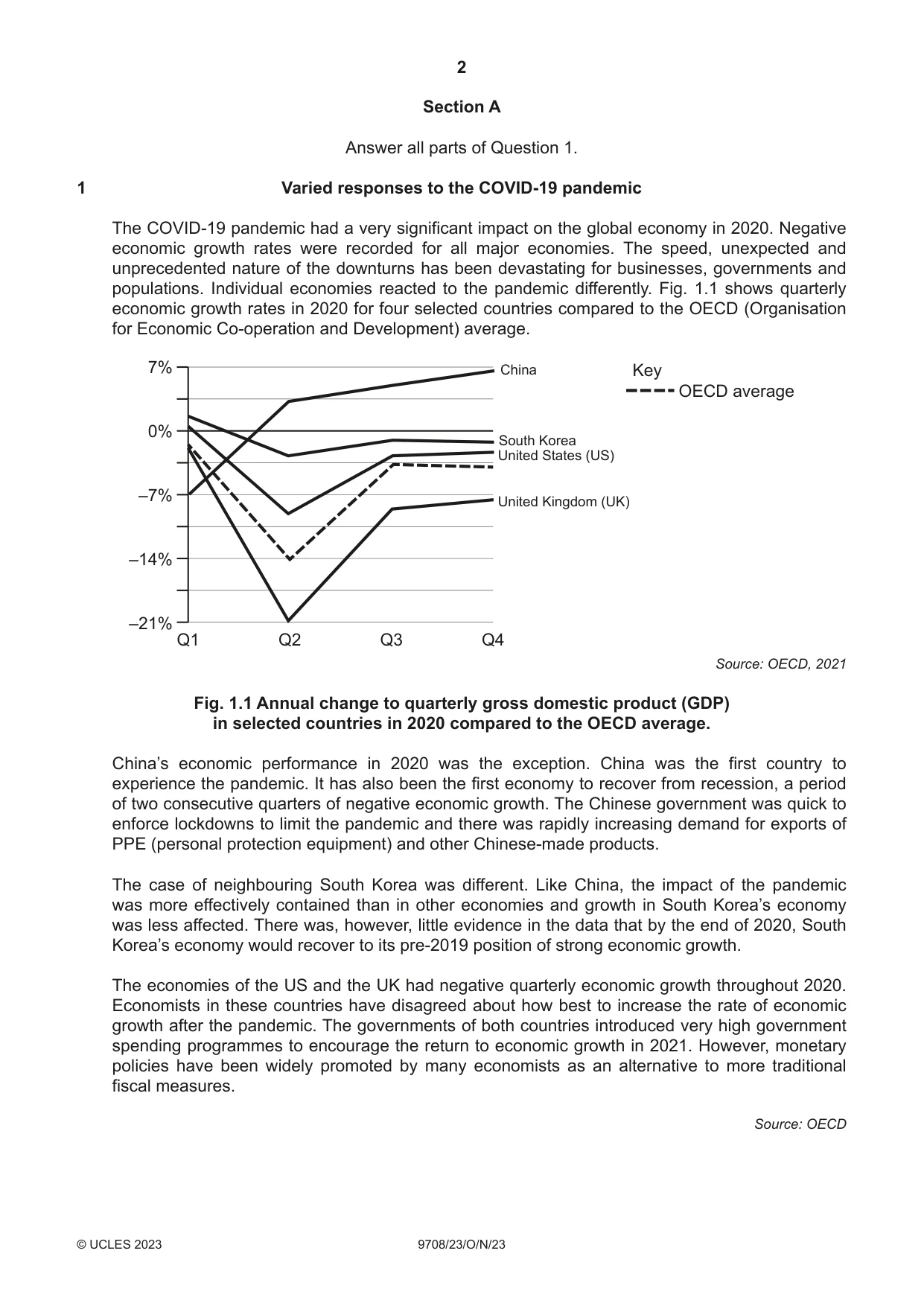
1 Varied responses to the COVID-19 pandemic The COVID-19 pandemic had a very significant impact on the global economy in 2020. Negative economic growth rates were recorded for all major economies. The speed, unexpected and unprecedented nature of the downturns has been devastating for businesses, governments and populations. Individual economies reacted to the pandemic differently. Fig. 1.1 shows quarterly economic growth rates in 2020 for four selected countries compared to the OECD (Organisation for Economic Co-operation and Development) average. 7% ChinaChina Key OECD average 0% SouthSouth KoreaKorea UnitedUnited StatesStates,(US)US –7% UnitedUnited KingdomKingdom,(UK)UK –14% –21% Q1 Q2 Q3 Q4 Source: OECD, 2021 Fig. 1.1 Annual change to quarterly gross domestic product (GDP) in selected countries in 2020 compared to the OECD average. China’s economic performance in 2020 was the exception. China was the first country to experience the pandemic. It has also been the first economy to recover from recession, a period of two consecutive quarters of negative economic growth. The Chinese government was quick to enforce lockdowns to limit the pandemic and there was rapidly increasing demand for exports of PPE (personal protection equipment) and other Chinese-made products. The case of neighbouring South Korea was different. Like China, the impact of the pandemic was more effectively contained than in other economies and growth in South Korea’s economy was less affected. There was, however, little evidence in the data that by the end of 2020, South Korea’s economy would recover to its pre-2019 position of strong economic growth. The economies of the US and the UK had negative quarterly economic growth throughout 2020. Economists in these countries have disagreed about how best to increase the rate of economic growth after the pandemic. The governments of both countries introduced very high government spending programmes to encourage the return to economic growth in 2021. However, monetary policies have been widely promoted by many economists as an alternative to more traditional fiscal measures. Source: OECD (a) Explain the meaning of ‘negative economic growth’. [2] (b) Which country shown in Fig. 1.1 experienced the most severe recession in 2020? Justify your answer. [2] (c) State two likely economic reasons why China experienced strong economic growth starting in the second quarter of 2020 and consider which of these is likely to have generated the greater rate of growth. [4] (d) Assess how economic recovery is likely to have affected employment and price stability in China. [6] (e) Assess whether monetary policies are the best way for high-income countries such as the US and the UK to produce an economic recovery. [6]
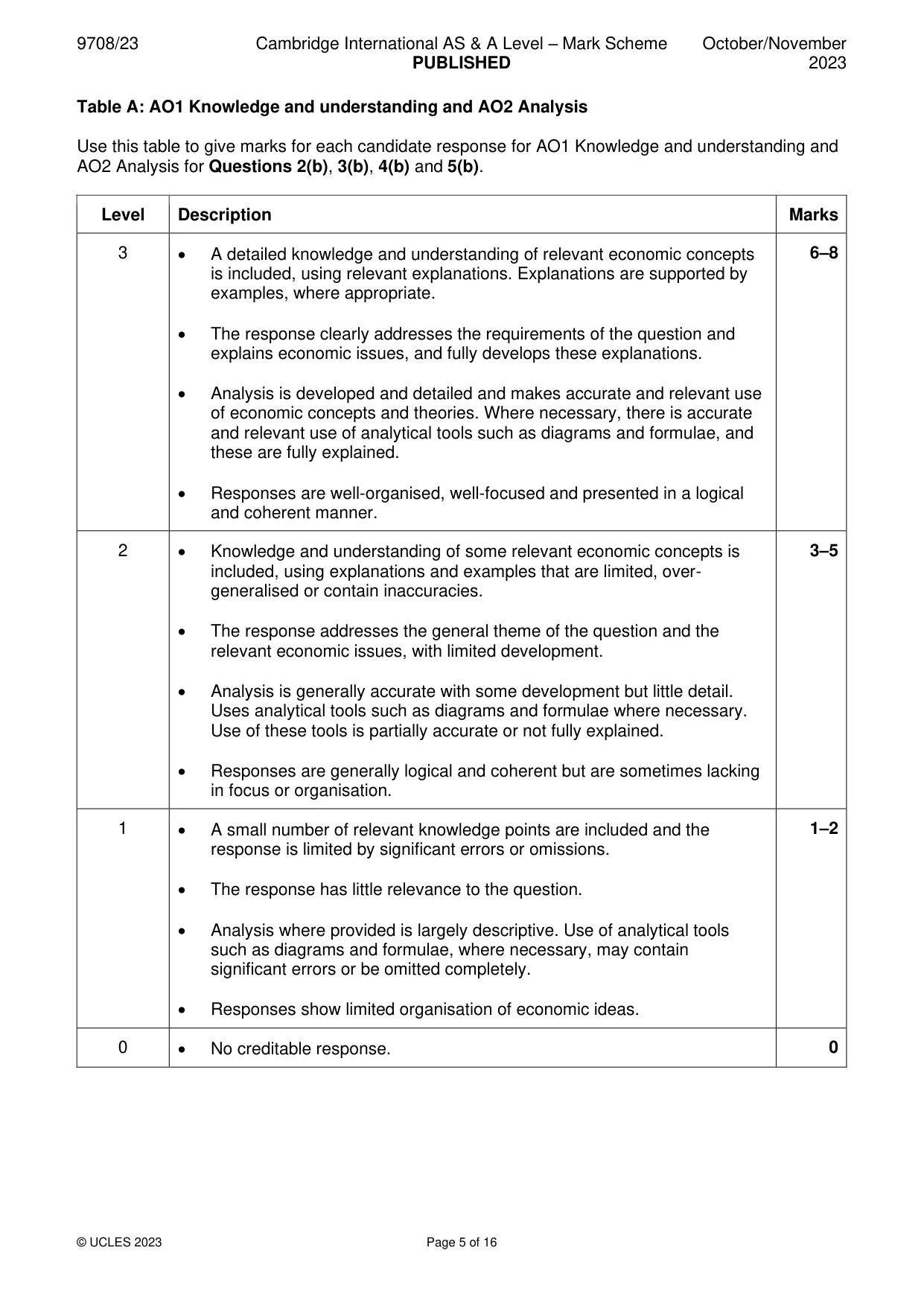
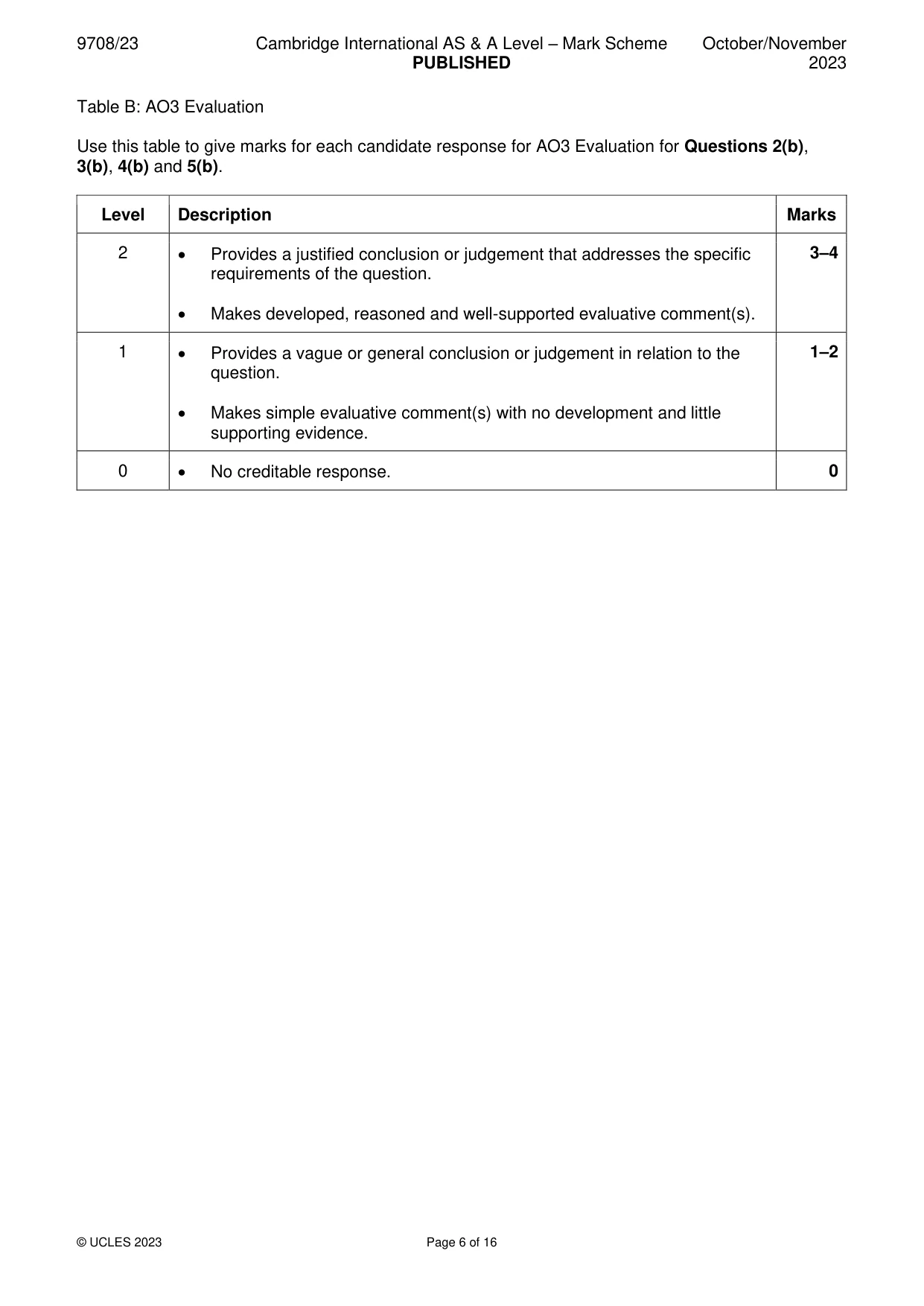
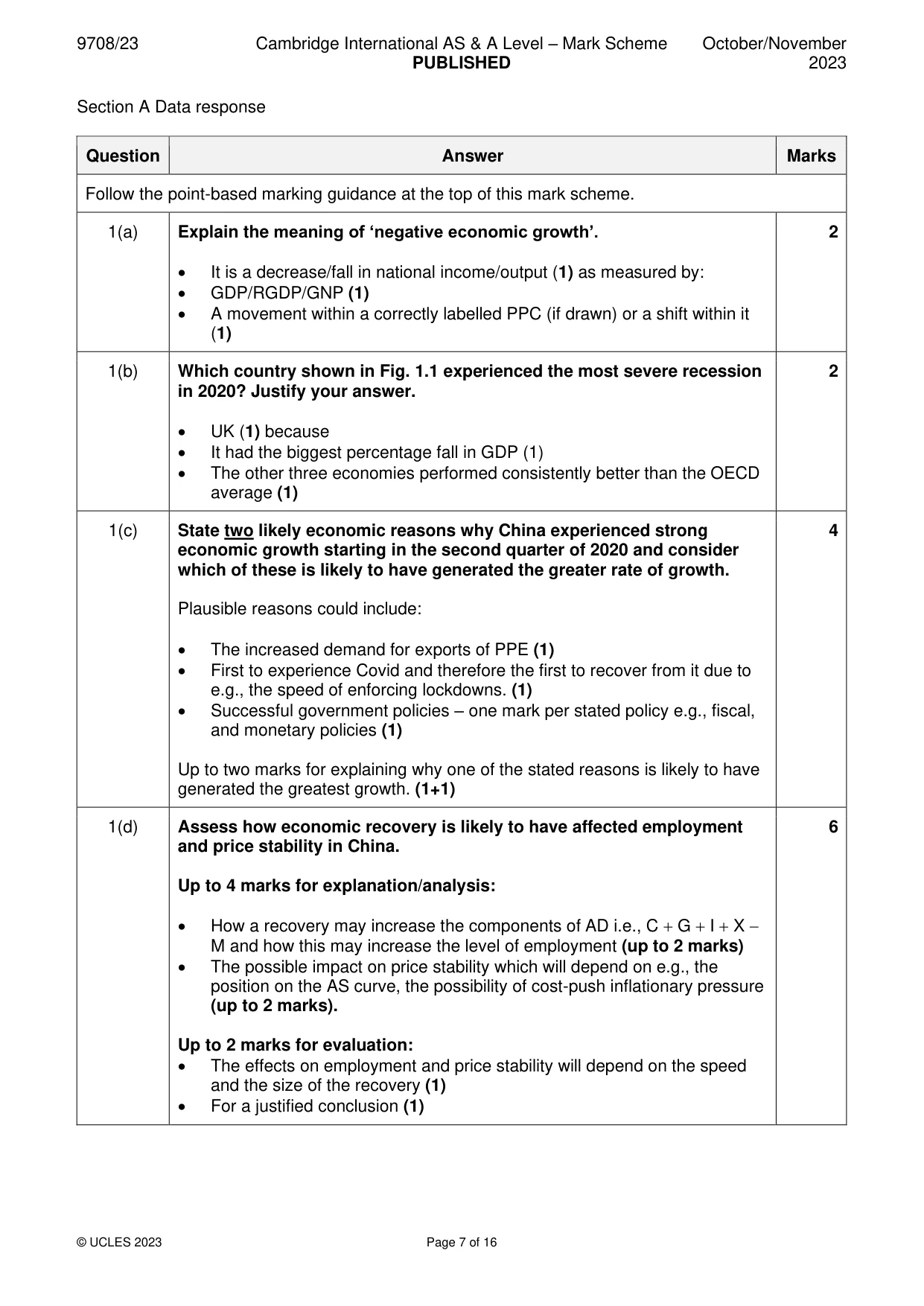
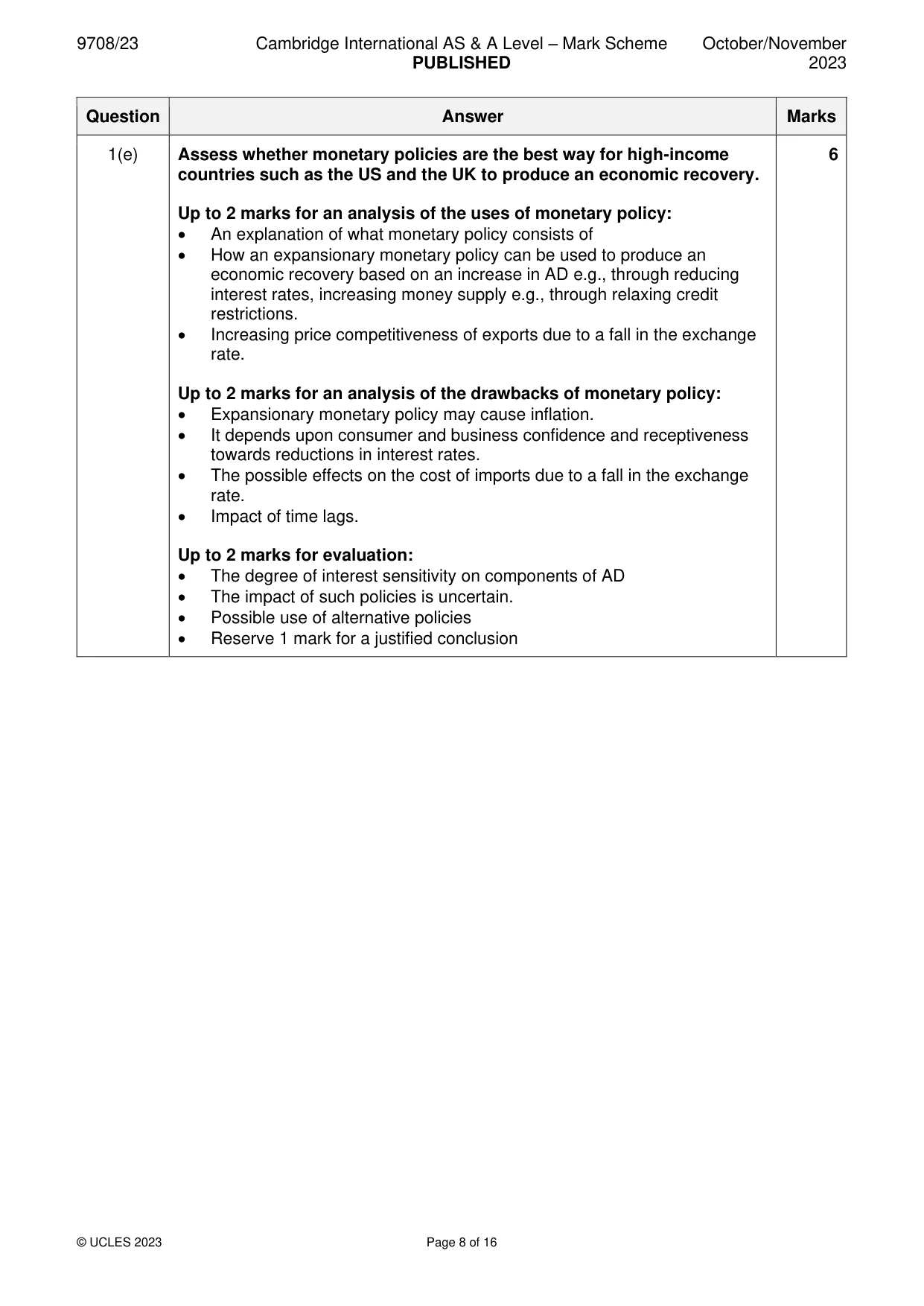
Mark scheme: Question Answer Marks Follow the point-based marking guidance at the top of this mark scheme. 1(a) Explain the meaning of ‘negative economic growth’. 2 • It is a decrease/fall in national income/output (1) as measured by: • GDP/RGDP/GNP (1) • A movement within a correctly labelled PPC (if drawn) or a shift within it (1) 1(b) Which country shown in Fig. 1.1 experienced the most severe recession 2 in 2020? Justify your answer. • UK (1) because • It had the biggest percentage fall in GDP (1) • The other three economies performed consistently better than the OECD average (1) 1(c) State two likely economic reasons why China experienced strong 4 economic growth starting in the second quarter of 2020 and consider which of these is likely to have generated the greater rate of growth. Plausible reasons could include: • The increased demand for exports of PPE (1) • First to experience Covid and therefore the first to recover from it due to e.g., the speed of enforcing lockdowns. (1) • Successful government policies – one mark per stated policy e.g., fiscal, and monetary policies (1) Up to two marks for explaining why one of the stated reasons is likely to have generated the greatest growth. (1+1) 1(d) Assess how economic recovery is likely to have affected employment 6 and price stability in China. Up to 4 marks for explanation/analysis: • How a recovery may increase the components of AD i.e., C + G + I + X − M and how this may increase the level of employment (up to 2 marks) • The possible impact on price stability which will depend on e.g., the position on the AS curve, the possibility of cost-push inflationary pressure (up to 2 marks). Up to 2 marks for evaluation: • The effects on employment and price stability will depend on the speed and the size of the recovery (1) • For a justified conclusion (1) 1(e) Assess whether monetary policies are the best way for high-income 6 countries such as the US and the UK to produce an economic recovery. Up to 2 marks for an analysis of the uses of monetary policy: • An explanation of what monetary policy consists of • How an expansionary monetary policy can be used to produce an economic recovery based on an increase in AD e.g., through reducing interest rates, increasing money supply e.g., through relaxing credit restrictions. • Increasing price competitiveness of exports due to a fall in the exchange rate. Up to 2 marks for an analysis of the drawbacks of monetary policy: • Expansionary monetary policy may cause inflation. • It depends upon consumer and business confidence and receptiveness towards reductions in interest rates. • The possible effects on the cost of imports due to a fall in the exchange rate. • Impact of time lags. Up to 2 marks for evaluation: • The degree of interest sensitivity on components of AD • The impact of such policies is uncertain. • Possible use of alternative policies • Reserve 1 mark for a justified conclusion
Q2 · The price elasticity of supply (PES) for a new smartphone is estimated to be 0.8 in the…
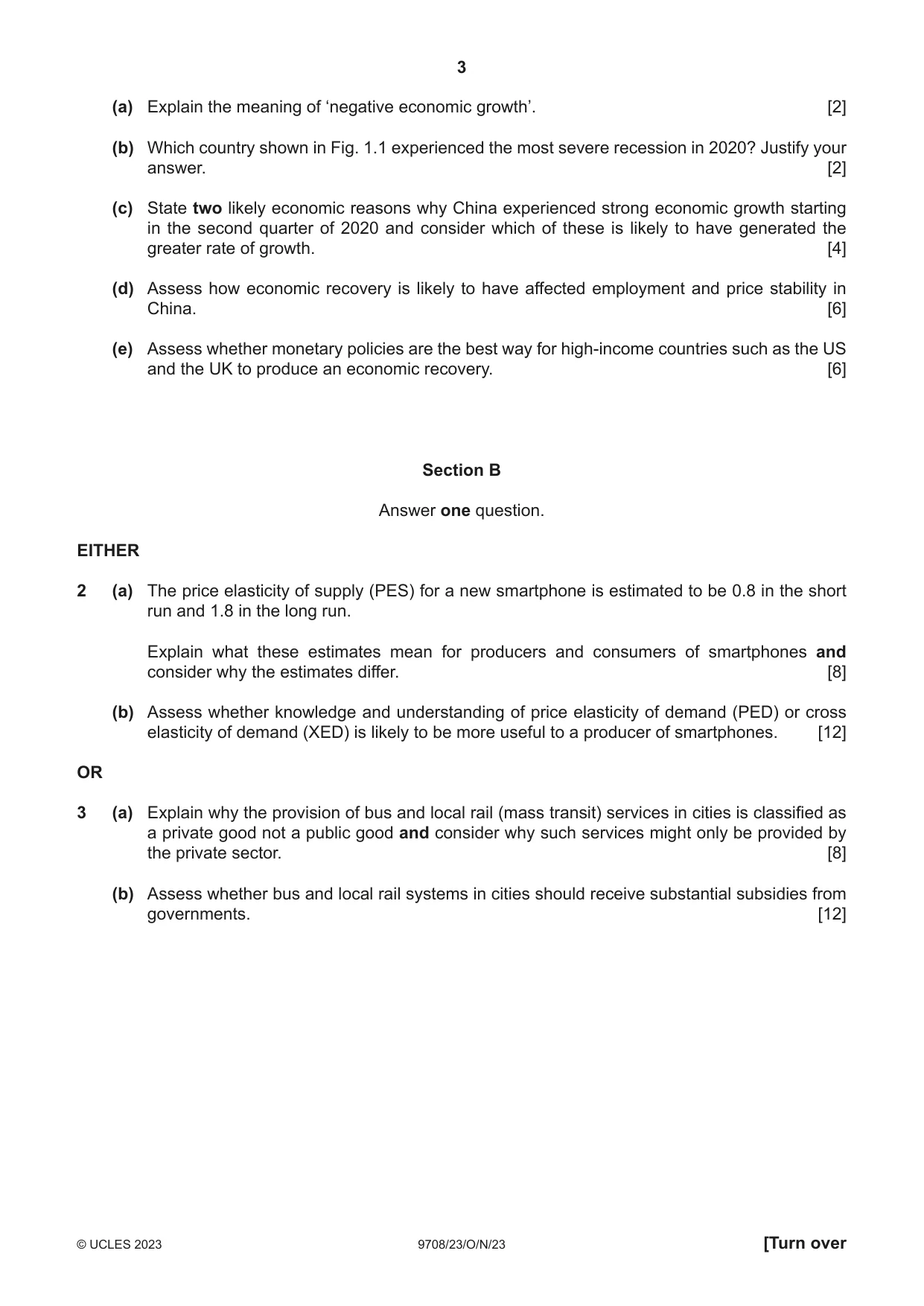
2 (a) The price elasticity of supply (PES) for a new smartphone is estimated to be 0.8 in the short run and 1.8 in the long run. Explain what these estimates mean for producers and consumers of smartphones and consider why the estimates differ. [8] (b) Assess whether knowledge and understanding of price elasticity of demand (PED) or cross elasticity of demand (XED) is likely to be more useful to a producer of smartphones. [12] OR
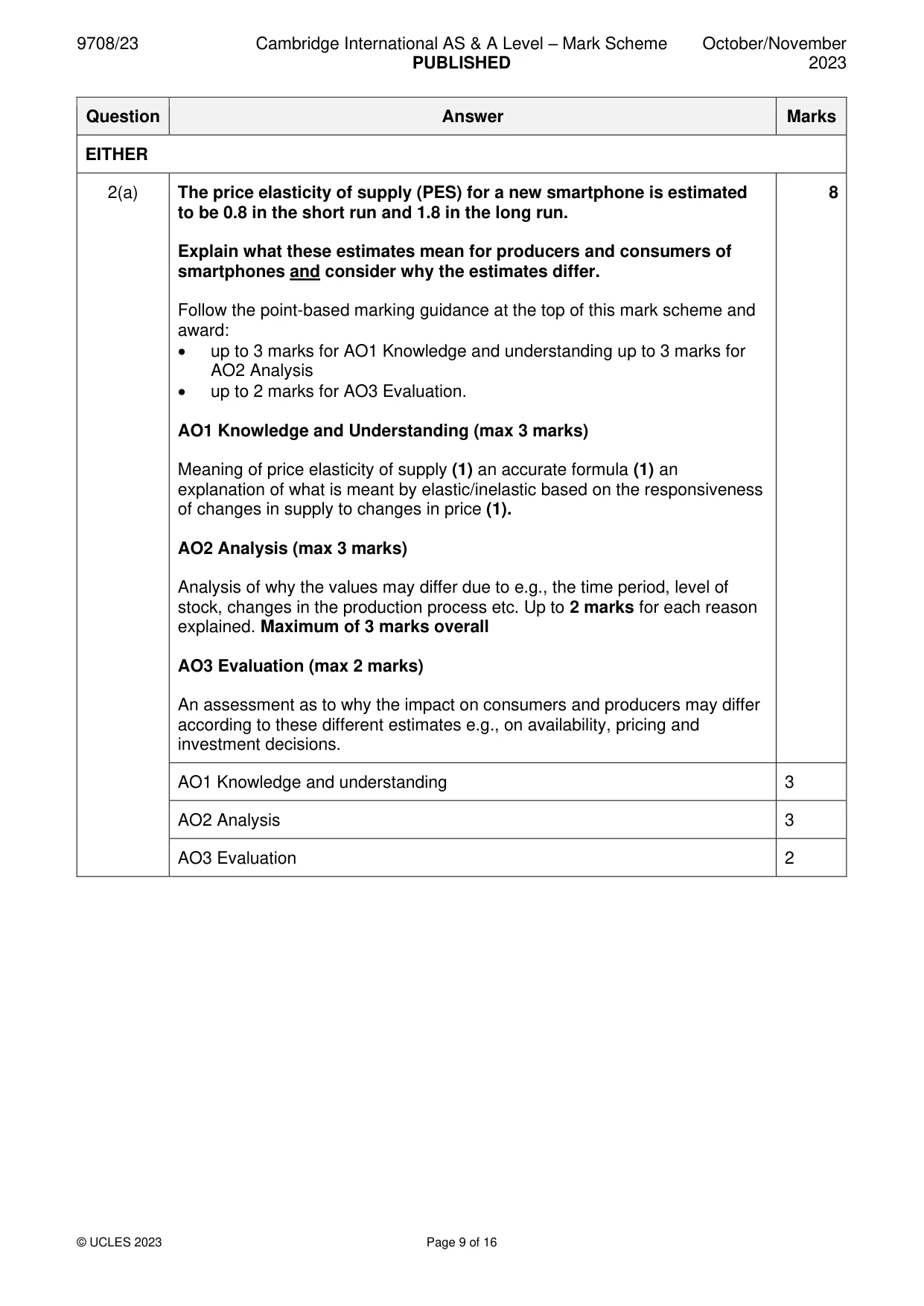
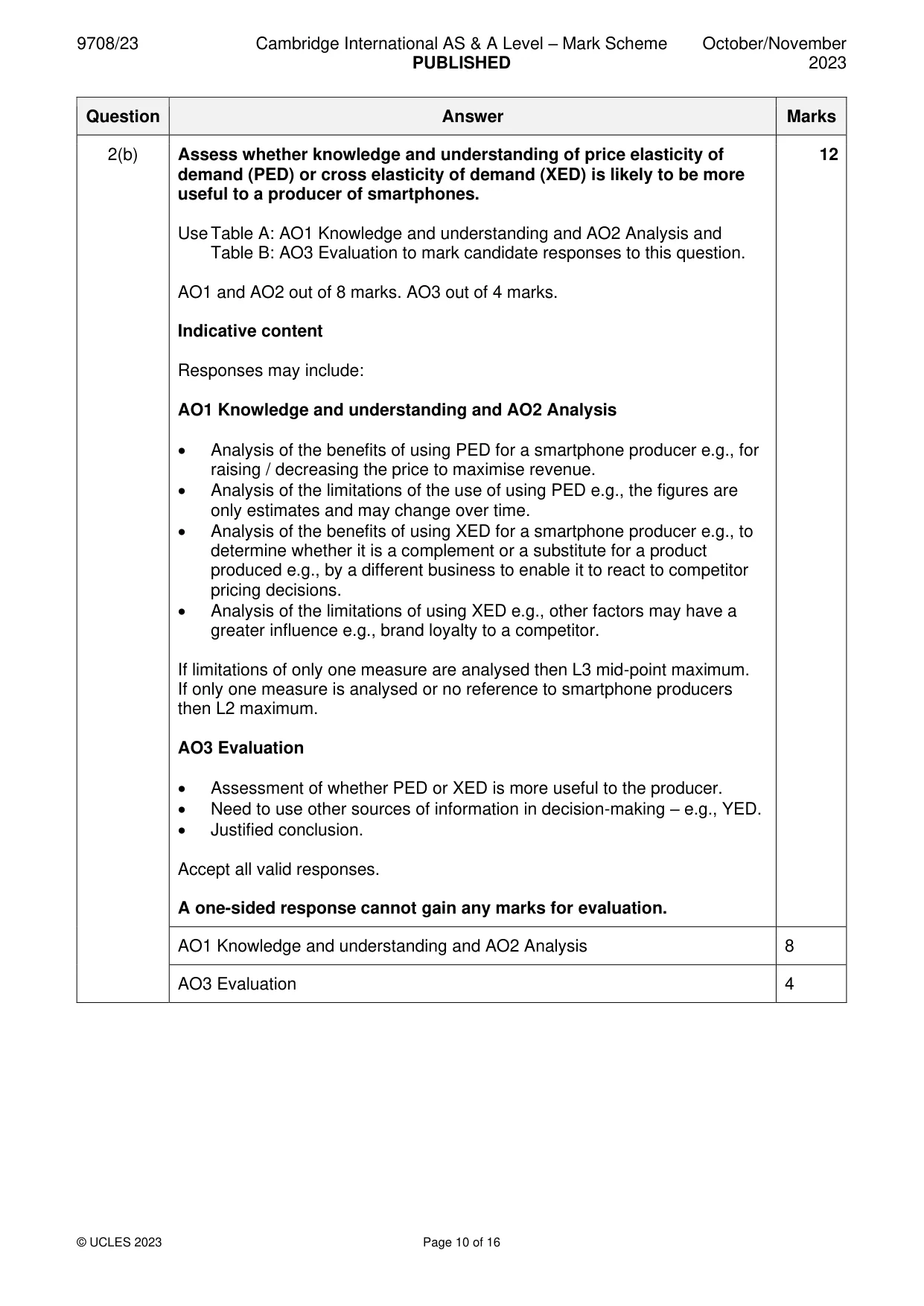
Mark scheme: 2(a) The price elasticity of supply (PES) for a new smartphone is estimated 8 to be 0.8 in the short run and 1.8 in the long run. Explain what these estimates mean for producers and consumers of smartphones and consider why the estimates differ. Follow the point-based marking guidance at the top of this mark scheme and award: • up to 3 marks for AO1 Knowledge and understanding up to 3 marks for AO2 Analysis • up to 2 marks for AO3 Evaluation. AO1 Knowledge and Understanding (max 3 marks) Meaning of price elasticity of supply (1) an accurate formula (1) an explanation of what is meant by elastic/inelastic based on the responsiveness of changes in supply to changes in price (1). AO2 Analysis (max 3 marks) Analysis of why the values may differ due to e.g., the time period, level of stock, changes in the production process etc. Up to 2 marks for each reason explained. Maximum of 3 marks overall AO3 Evaluation (max 2 marks) An assessment as to why the impact on consumers and producers may differ according to these different estimates e.g., on availability, pricing and investment decisions. AO1 Knowledge and understanding 3 AO2 Analysis 3 AO3 Evaluation 2 2(b) Assess whether knowledge and understanding of price elasticity of 12 demand (PED) or cross elasticity of demand (XED) is likely to be more useful to a producer of smartphones. Use Table A: AO1 Knowledge and understanding and AO2 Analysis and Table B: AO3 Evaluation to mark candidate responses to this question. AO1 and AO2 out of 8 marks. AO3 out of 4 marks. Indicative content Responses may include: AO1 Knowledge and understanding and AO2 Analysis • Analysis of the benefits of using PED for a smartphone producer e.g., for raising / decreasing the price to maximise revenue. • Analysis of the limitations of the use of using PED e.g., the figures are only estimates and may change over time. • Analysis of the benefits of using XED for a smartphone producer e.g., to determine whether it is a complement or a substitute for a product produced e.g., by a different business to enable it to react to competitor pricing decisions. • Analysis of the limitations of using XED e.g., other factors may have a greater influence e.g., brand loyalty to a competitor. If limitations of only one measure are analysed then L3 mid-point maximum. If only one measure is analysed or no reference to smartphone producers then L2 maximum. AO3 Evaluation • Assessment of whether PED or XED is more useful to the producer. • Need to use other sources of information in decision-making – e.g., YED. • Justified conclusion. Accept all valid responses. A one-sided response cannot gain any marks for evaluation. AO1 Knowledge and understanding and AO2 Analysis 8 AO3 Evaluation 4
More questions on Price elasticity, income elasticity and cross elasticity of demand
Q3 · Explain why the provision of bus and local rail (mass transit) services in cities is…
3 (a) Explain why the provision of bus and local rail (mass transit) services in cities is classified as a private good not a public good and consider why such services might only be provided by the private sector. [8] (b) Assess whether bus and local rail systems in cities should receive substantial subsidies from governments. [12] Section C Answer one question. EITHER
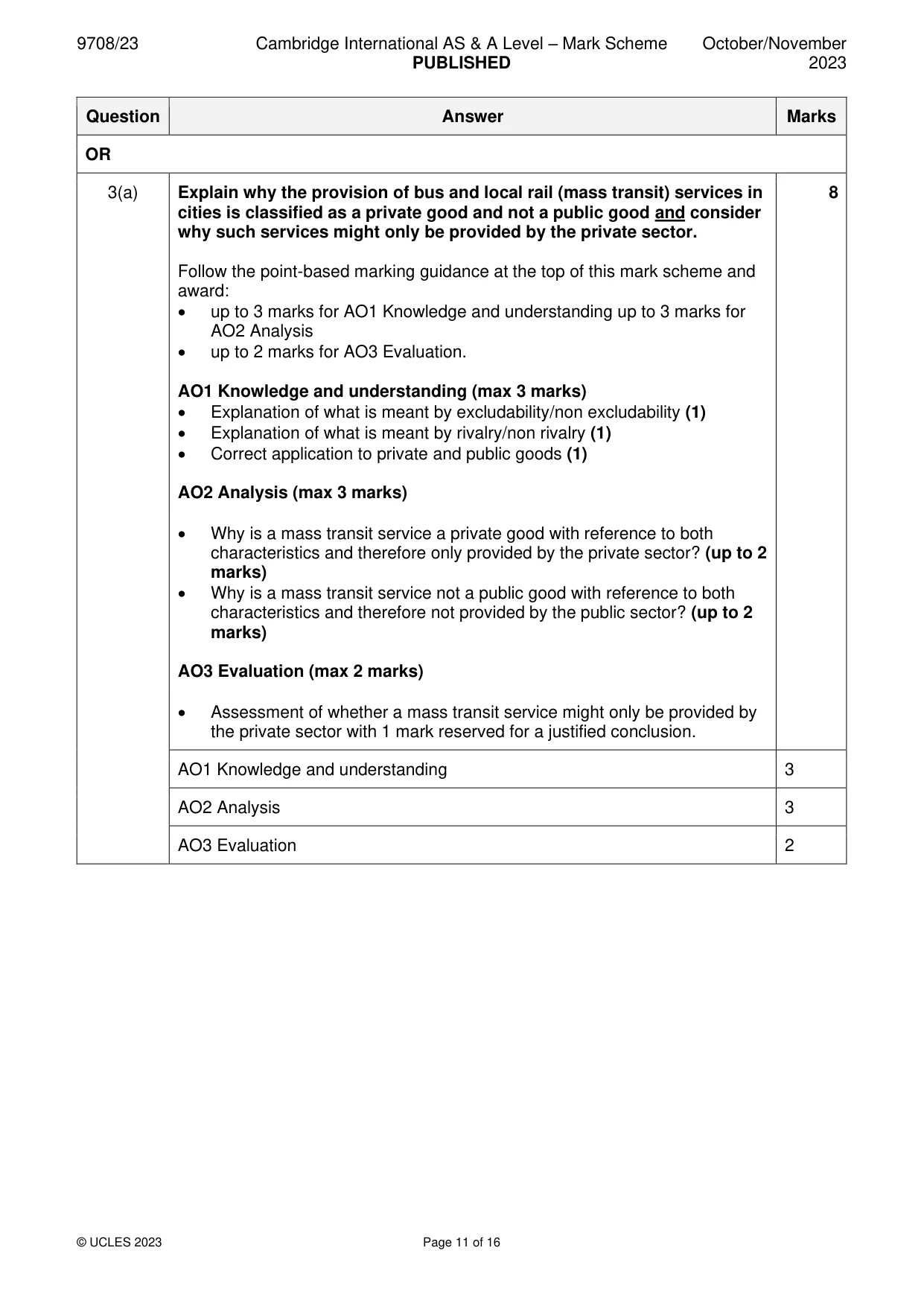
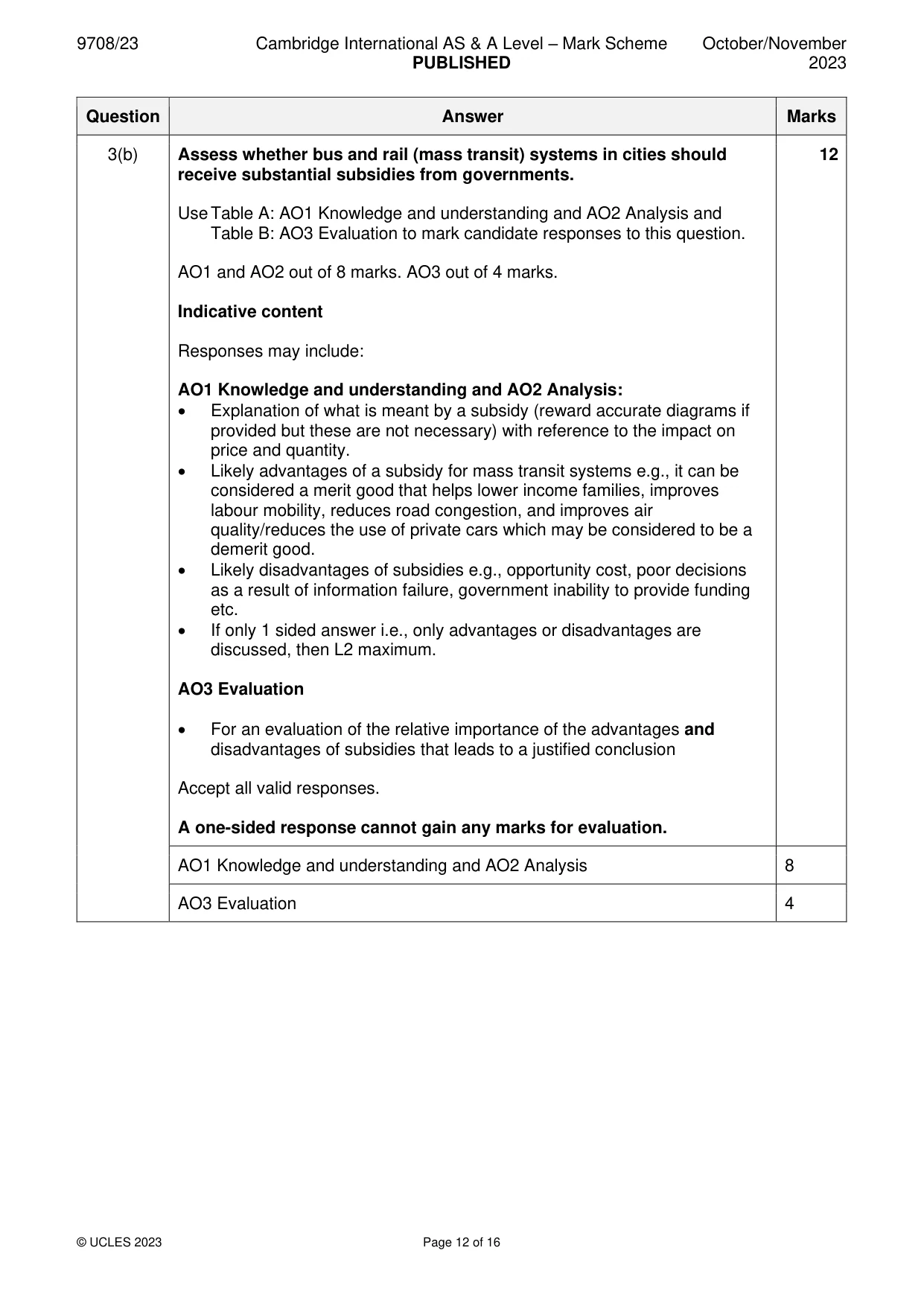
Mark scheme: 3(a) Explain why the provision of bus and local rail (mass transit) services in 8 cities is classified as a private good and not a public good and consider why such services might only be provided by the private sector. Follow the point-based marking guidance at the top of this mark scheme and award: • up to 3 marks for AO1 Knowledge and understanding up to 3 marks for AO2 Analysis • up to 2 marks for AO3 Evaluation. AO1 Knowledge and understanding (max 3 marks) • Explanation of what is meant by excludability/non excludability (1) • Explanation of what is meant by rivalry/non rivalry (1) • Correct application to private and public goods (1) AO2 Analysis (max 3 marks) • Why is a mass transit service a private good with reference to both characteristics and therefore only provided by the private sector? (up to 2 marks) • Why is a mass transit service not a public good with reference to both characteristics and therefore not provided by the public sector? (up to 2 marks) AO3 Evaluation (max 2 marks) • Assessment of whether a mass transit service might only be provided by the private sector with 1 mark reserved for a justified conclusion. AO1 Knowledge and understanding 3 AO2 Analysis 3 AO3 Evaluation 2 3(b) Assess whether bus and rail (mass transit) systems in cities should 12 receive substantial subsidies from governments. Use Table A: AO1 Knowledge and understanding and AO2 Analysis and Table B: AO3 Evaluation to mark candidate responses to this question. AO1 and AO2 out of 8 marks. AO3 out of 4 marks. Indicative content Responses may include: AO1 Knowledge and understanding and AO2 Analysis: • Explanation of what is meant by a subsidy (reward accurate diagrams if provided but these are not necessary) with reference to the impact on price and quantity. • Likely advantages of a subsidy for mass transit systems e.g., it can be considered a merit good that helps lower income families, improves labour mobility, reduces road congestion, and improves air quality/reduces the use of private cars which may be considered to be a demerit good. • Likely disadvantages of subsidies e.g., opportunity cost, poor decisions as a result of information failure, government inability to provide funding etc. • If only 1 sided answer i.e., only advantages or disadvantages are discussed, then L2 maximum. AO3 Evaluation • For an evaluation of the relative importance of the advantages and disadvantages of subsidies that leads to a justified conclusion Accept all valid responses. A one-sided response cannot gain any marks for evaluation. AO1 Knowledge and understanding and AO2 Analysis 8 AO3 Evaluation 4
Q4 · With reference to a country that is known to you, explain the main causes of unemployment…
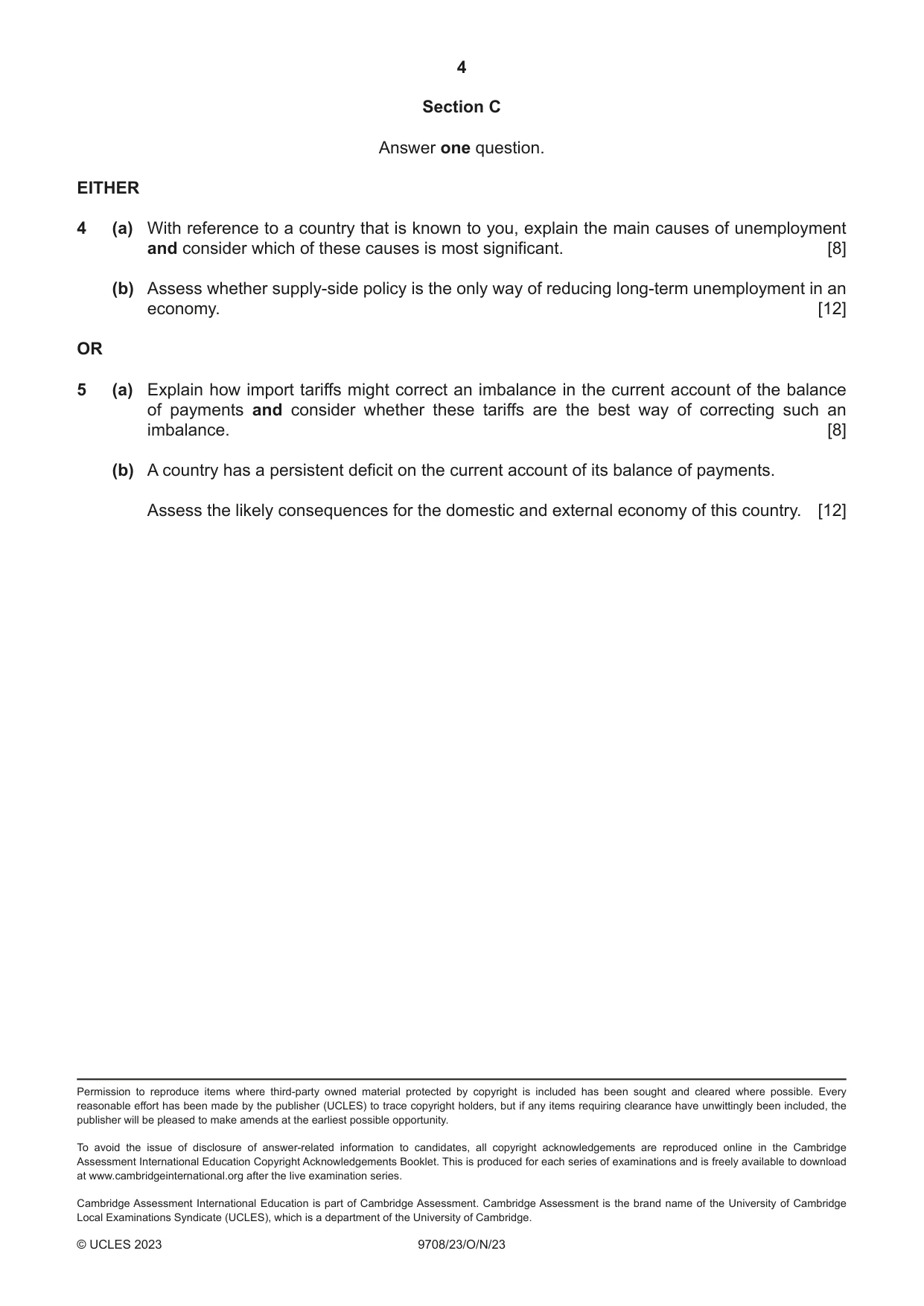
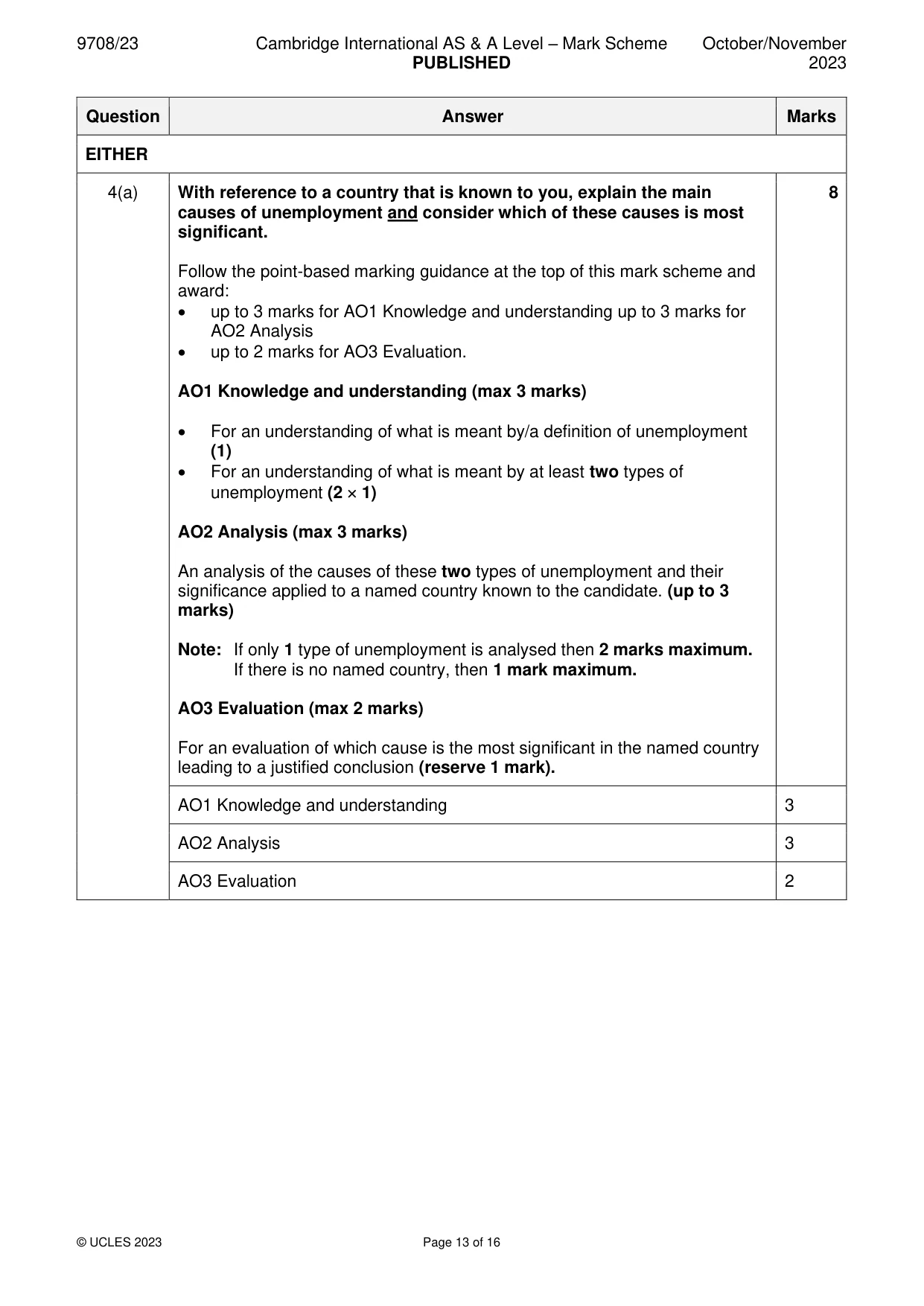
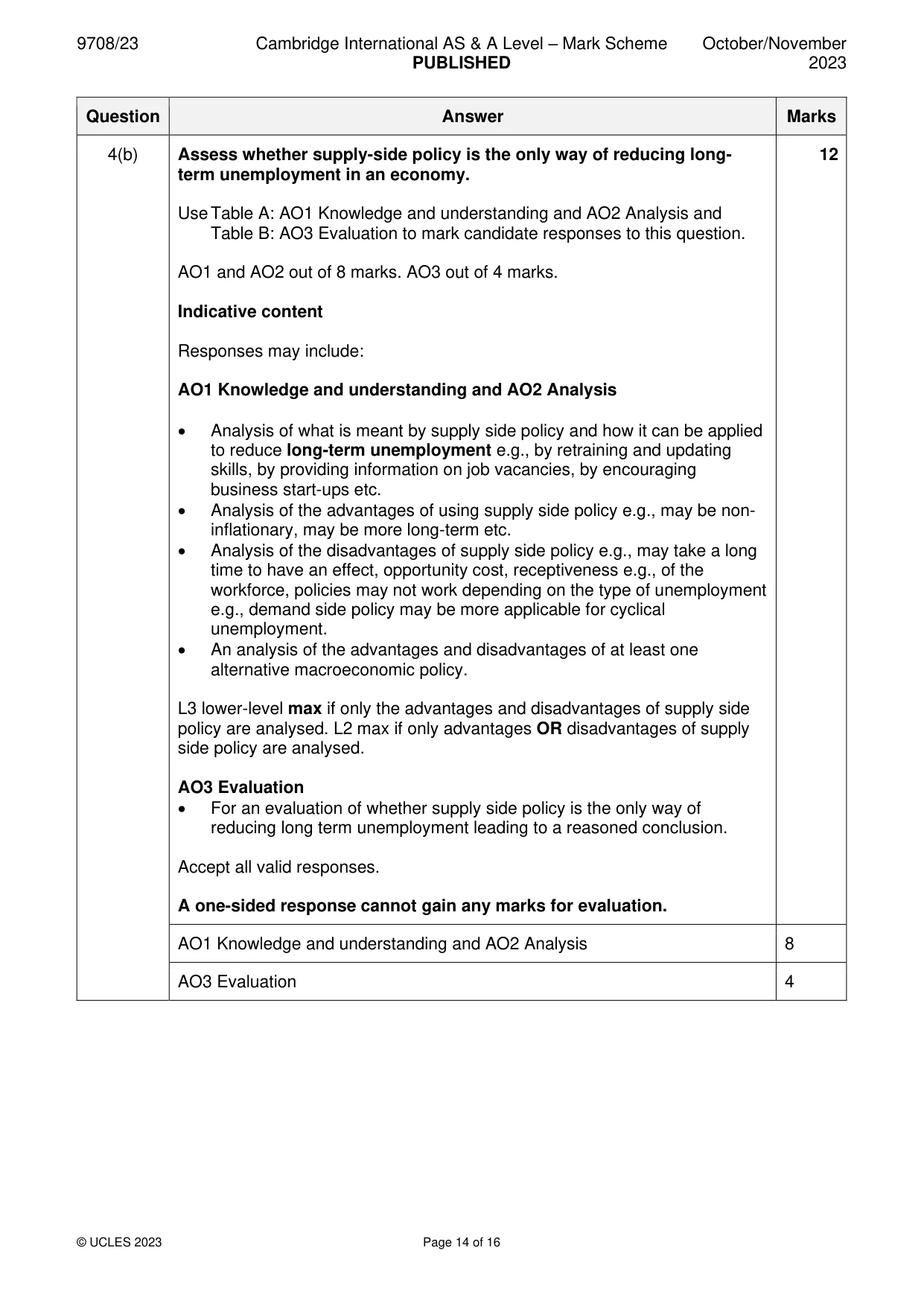
4 (a) With reference to a country that is known to you, explain the main causes of unemployment and consider which of these causes is most significant. [8] (b) Assess whether supply-side policy is the only way of reducing long-term unemployment in an economy. [12] OR
Mark scheme: 4(a) With reference to a country that is known to you, explain the main 8 causes of unemployment and consider which of these causes is most significant. Follow the point-based marking guidance at the top of this mark scheme and award: • up to 3 marks for AO1 Knowledge and understanding up to 3 marks for AO2 Analysis • up to 2 marks for AO3 Evaluation. AO1 Knowledge and understanding (max 3 marks) • For an understanding of what is meant by/a definition of unemployment (1) • For an understanding of what is meant by at least two types of unemployment (2 1) AO2 Analysis (max 3 marks) An analysis of the causes of these two types of unemployment and their significance applied to a named country known to the candidate. (up to 3 marks) Note: If only 1 type of unemployment is analysed then 2 marks maximum. If there is no named country, then 1 mark maximum. AO3 Evaluation (max 2 marks) For an evaluation of which cause is the most significant in the named country leading to a justified conclusion (reserve 1 mark). AO1 Knowledge and understanding 3 AO2 Analysis 3 AO3 Evaluation 2 4(b) Assess whether supply-side policy is the only way of reducing long- 12 term unemployment in an economy. Use Table A: AO1 Knowledge and understanding and AO2 Analysis and Table B: AO3 Evaluation to mark candidate responses to this question. AO1 and AO2 out of 8 marks. AO3 out of 4 marks. Indicative content Responses may include: AO1 Knowledge and understanding and AO2 Analysis • Analysis of what is meant by supply side policy and how it can be applied to reduce long-term unemployment e.g., by retraining and updating skills, by providing information on job vacancies, by encouraging business start-ups etc. • Analysis of the advantages of using supply side policy e.g., may be non- inflationary, may be more long-term etc. • Analysis of the disadvantages of supply side policy e.g., may take a long time to have an effect, opportunity cost, receptiveness e.g., of the workforce, policies may not work depending on the type of unemployment e.g., demand side policy may be more applicable for cyclical unemployment. • An analysis of the advantages and disadvantages of at least one alternative macroeconomic policy. L3 lower-level max if only the advantages and disadvantages of supply side policy are analysed. L2 max if only advantages OR disadvantages of supply side policy are analysed. AO3 Evaluation • For an evaluation of whether supply side policy is the only way of reducing long term unemployment leading to a reasoned conclusion. Accept all valid responses. A one-sided response cannot gain any marks for evaluation. AO1 Knowledge and understanding and AO2 Analysis 8 AO3 Evaluation 4
Q5 · Explain how import tariffs might correct an imbalance in the current account of the…
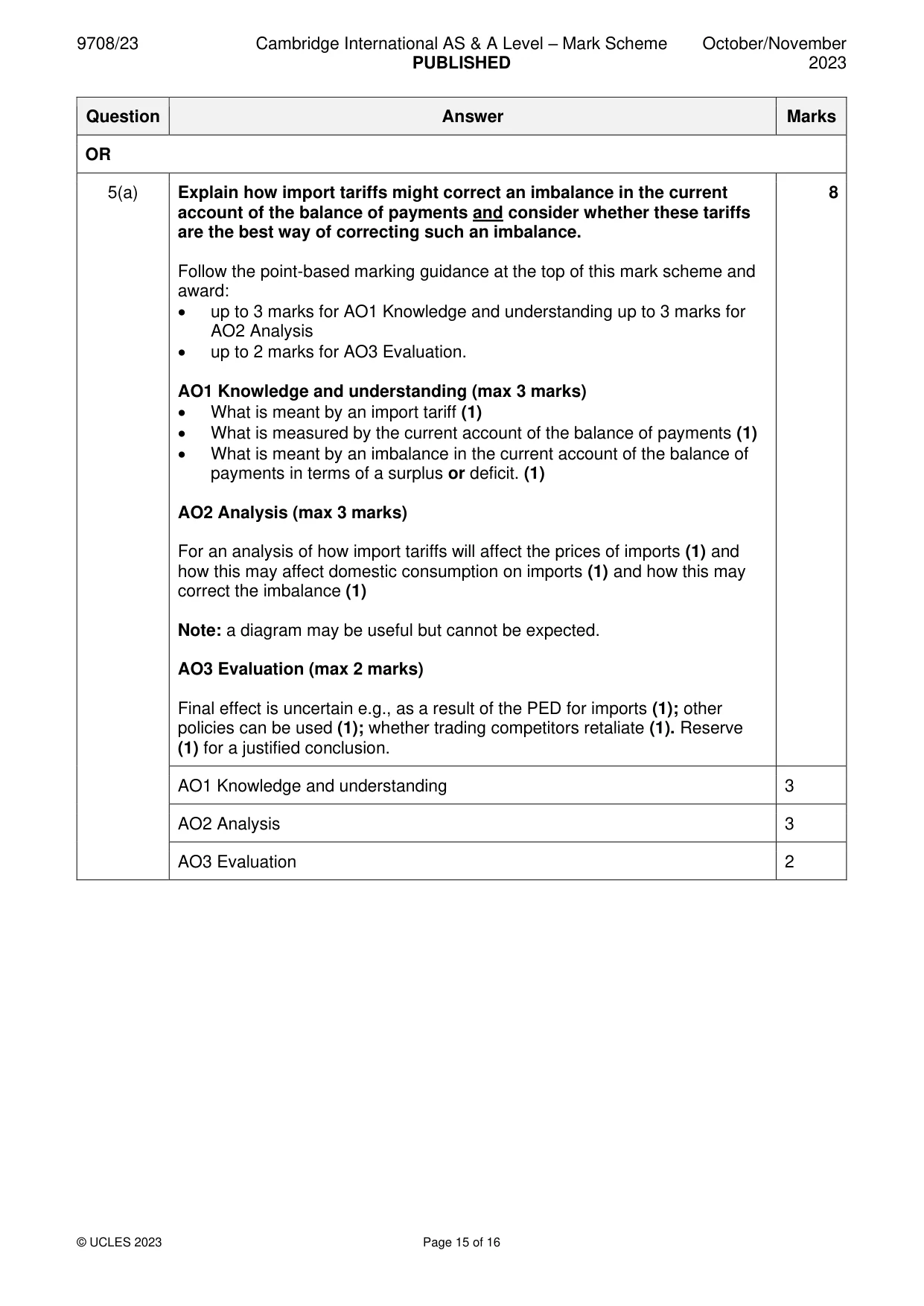
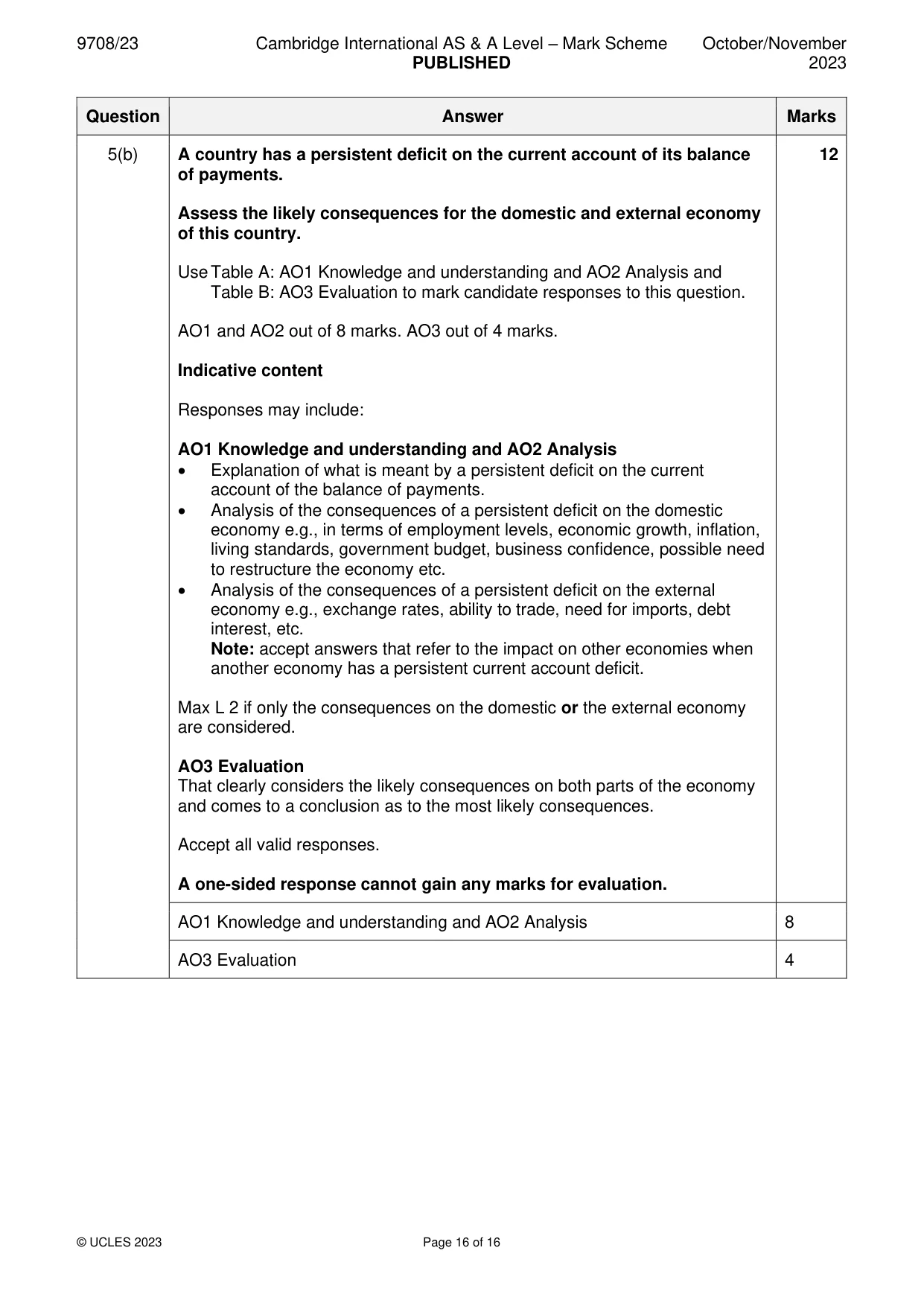
5 (a) Explain how import tariffs might correct an imbalance in the current account of the balance of payments and consider whether these tariffs are the best way of correcting such an imbalance. [8] (b) A country has a persistent deficit on the current account of its balance of payments. Assess the likely consequences for the domestic and external economy of this country. [12]
Mark scheme: 5(a) Explain how import tariffs might correct an imbalance in the current 8 account of the balance of payments and consider whether these tariffs are the best way of correcting such an imbalance. Follow the point-based marking guidance at the top of this mark scheme and award: • up to 3 marks for AO1 Knowledge and understanding up to 3 marks for AO2 Analysis • up to 2 marks for AO3 Evaluation. AO1 Knowledge and understanding (max 3 marks) • What is meant by an import tariff (1) • What is measured by the current account of the balance of payments (1) • What is meant by an imbalance in the current account of the balance of payments in terms of a surplus or deficit. (1) AO2 Analysis (max 3 marks) For an analysis of how import tariffs will affect the prices of imports (1) and how this may affect domestic consumption on imports (1) and how this may correct the imbalance (1) Note: a diagram may be useful but cannot be expected. AO3 Evaluation (max 2 marks) Final effect is uncertain e.g., as a result of the PED for imports (1); other policies can be used (1); whether trading competitors retaliate (1). Reserve (1) for a justified conclusion. AO1 Knowledge and understanding 3 AO2 Analysis 3 AO3 Evaluation 2 5(b) A country has a persistent deficit on the current account of its balance 12 of payments. Assess the likely consequences for the domestic and external economy of this country. Use Table A: AO1 Knowledge and understanding and AO2 Analysis and Table B: AO3 Evaluation to mark candidate responses to this question. AO1 and AO2 out of 8 marks. AO3 out of 4 marks. Indicative content Responses may include: AO1 Knowledge and understanding and AO2 Analysis • Explanation of what is meant by a persistent deficit on the current account of the balance of payments. • Analysis of the consequences of a persistent deficit on the domestic economy e.g., in terms of employment levels, economic growth, inflation, living standards, government budget, business confidence, possible need to restructure the economy etc. • Analysis of the consequences of a persistent deficit on the external economy e.g., exchange rates, ability to trade, need for imports, debt interest, etc. Note: accept answers that refer to the impact on other economies when another economy has a persistent current account deficit. Max L 2 if only the consequences on the domestic or the external economy are considered. AO3 Evaluation That clearly considers the likely consequences on both parts of the economy and comes to a conclusion as to the most likely consequences. Accept all valid responses. A one-sided response cannot gain any marks for evaluation. AO1 Knowledge and understanding and AO2 Analysis 8 AO3 Evaluation 4
More questions on Current account of the balance of payments
What was in this paper
The subtopics covered by these 5 questions, and how many questions each got. Open one in a new tab to see every Cambridge question on it.
What you needed in this session
Cambridge’s own grade thresholds for 2023 Oct/Nov, Paper 2 · Variant 3. A higher threshold means an easier paper — the bar moves with how the cohort did.