Cambridge A Level Economics 9708 — 2021 Oct/Nov Paper 2 · Variant 3
9708/23/O/N/21 · 4 questions · 40 marks · ≈45 min
The question paper and its mark scheme, free to read here and free to download. This is Cambridge’s own paper, exactly as it was sat.
Question paper4 pages
Mark scheme12 pages
Answers below. Sit the paper first if you are practising.
Questions as text
Q1 · China’s uncertain economic prospects Fig
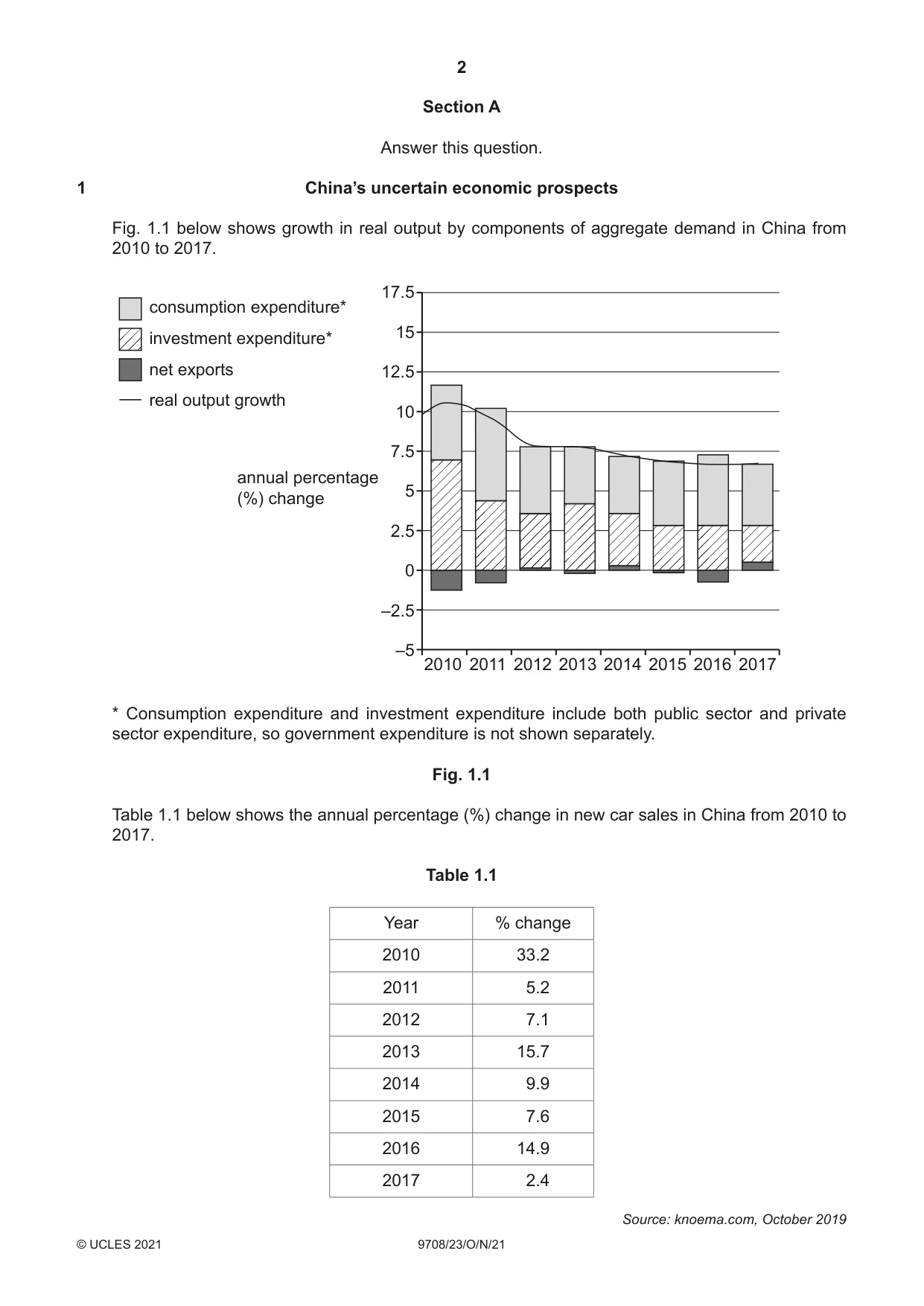
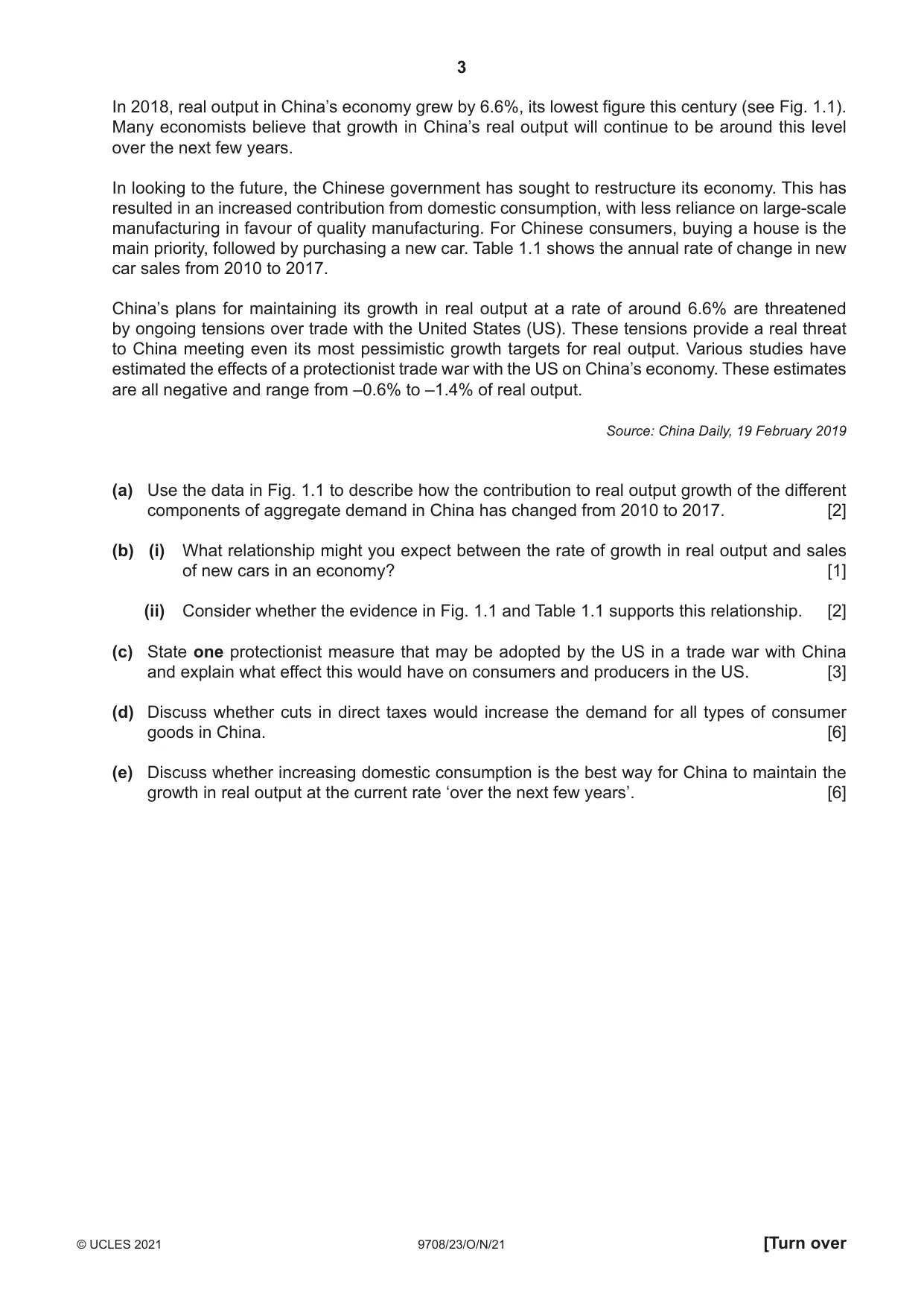
1 China’s uncertain economic prospects Fig. 1.1 below shows growth in real output by components of aggregate demand in China from 2010 to 2017. 17.5 consumption expenditure* 15 investment expenditure* net exports 12.5 real output growth 10 7.5 annual percentage 5 (%) change 2.5 0 –2.5 –5 2010 2011 2012 2013 2014 2015 2016 2017 * Consumption expenditure and investment expenditure include both public sector and private sector expenditure, so government expenditure is not shown separately. Fig. 1.1 Table 1.1 below shows the annual percentage (%) change in new car sales in China from 2010 to 2017. Table 1.1 Year % change 2010 33.2 2011 5.2 2012 7.1 2013 15.7 2014 9.9 2015 7.6 2016 14.9 2017 2.4 Source: knoema.com, October 2019 In 2018, real output in China’s economy grew by 6.6%, its lowest figure this century (see Fig. 1.1). Many economists believe that growth in China’s real output will continue to be around this level over the next few years. In looking to the future, the Chinese government has sought to restructure its economy. This has resulted in an increased contribution from domestic consumption, with less reliance on large-scale manufacturing in favour of quality manufacturing. For Chinese consumers, buying a house is the main priority, followed by purchasing a new car. Table 1.1 shows the annual rate of change in new car sales from 2010 to 2017. China’s plans for maintaining its growth in real output at a rate of around 6.6% are threatened by ongoing tensions over trade with the United States (US). These tensions provide a real threat to China meeting even its most pessimistic growth targets for real output. Various studies have estimated the effects of a protectionist trade war with the US on China’s economy. These estimates are all negative and range from –0.6% to –1.4% of real output. Source: China Daily, 19 February 2019 (a) Use the data in Fig. 1.1 to describe how the contribution to real output growth of the different components of aggregate demand in China has changed from 2010 to 2017. [2] (b) (i) What relationship might you expect between the rate of growth in real output and sales of new cars in an economy? [1] (ii) Consider whether the evidence in Fig. 1.1 and Table 1.1 supports this relationship. [2] (c) State one protectionist measure that may be adopted by the US in a trade war with China and explain what effect this would have on consumers and producers in the US. [3] (d) Discuss whether cuts in direct taxes would increase the demand for all types of consumer goods in China. [6] (e) Discuss whether increasing domestic consumption is the best way for China to maintain the growth in real output at the current rate ‘over the next few years’. [6]
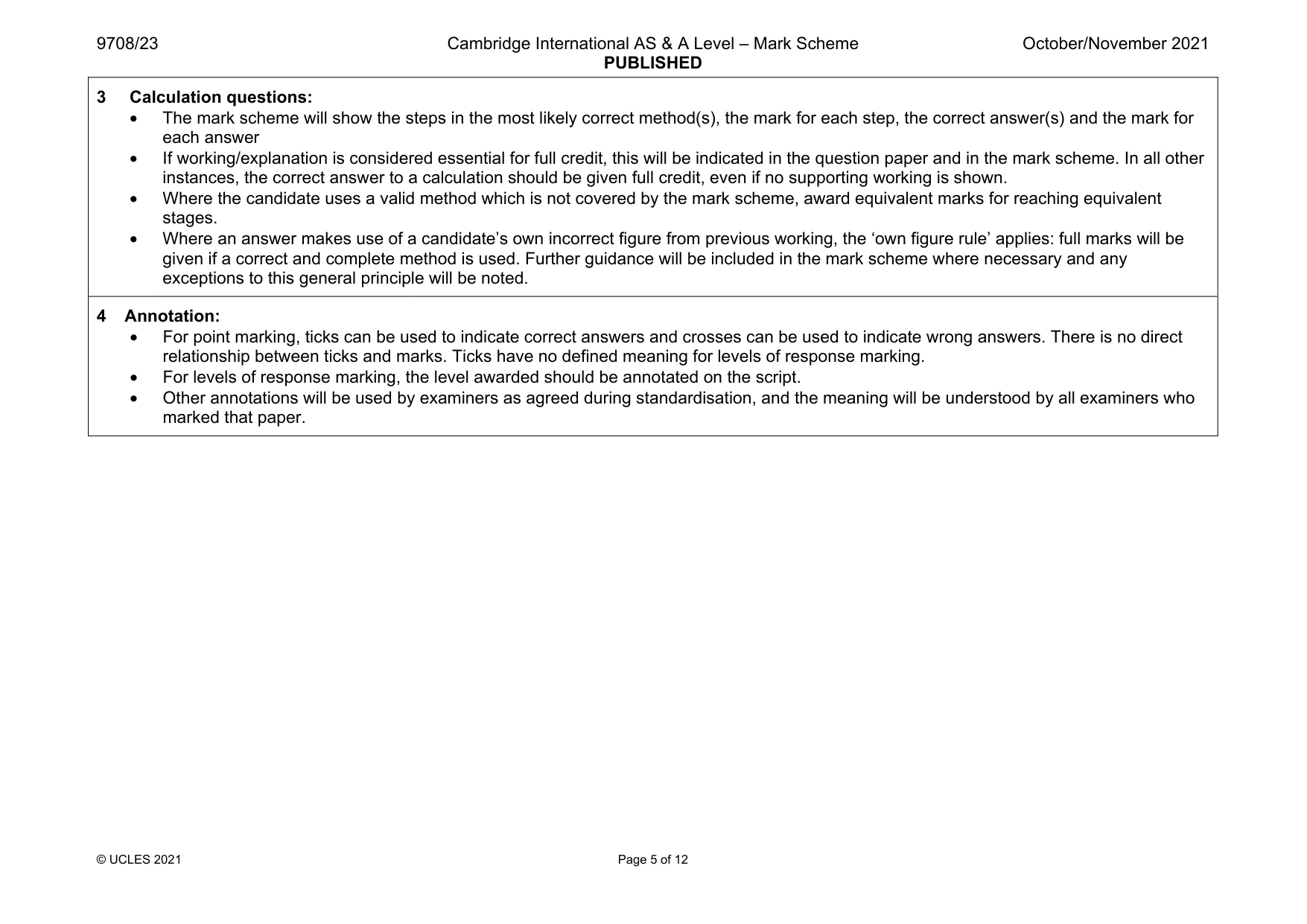
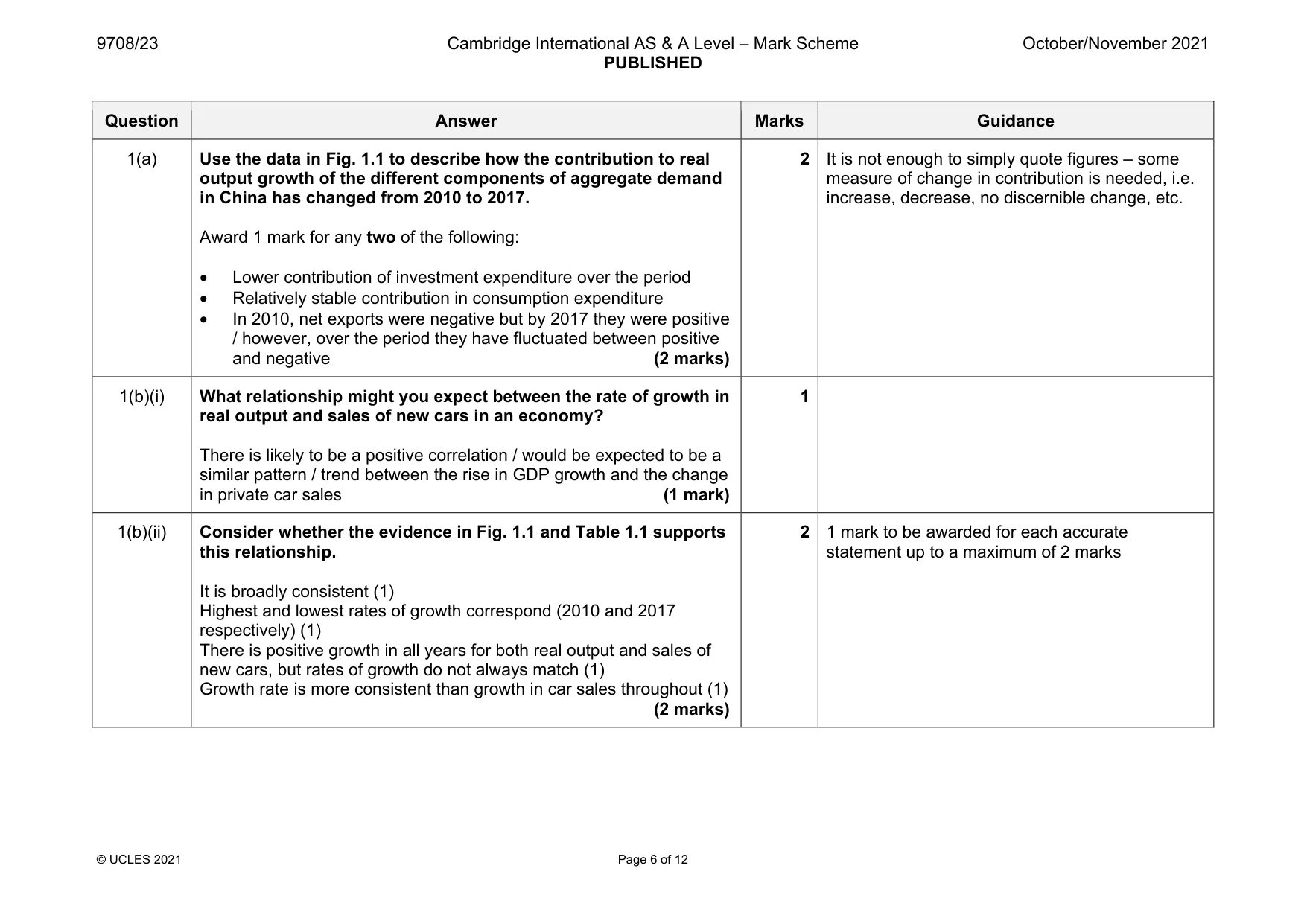
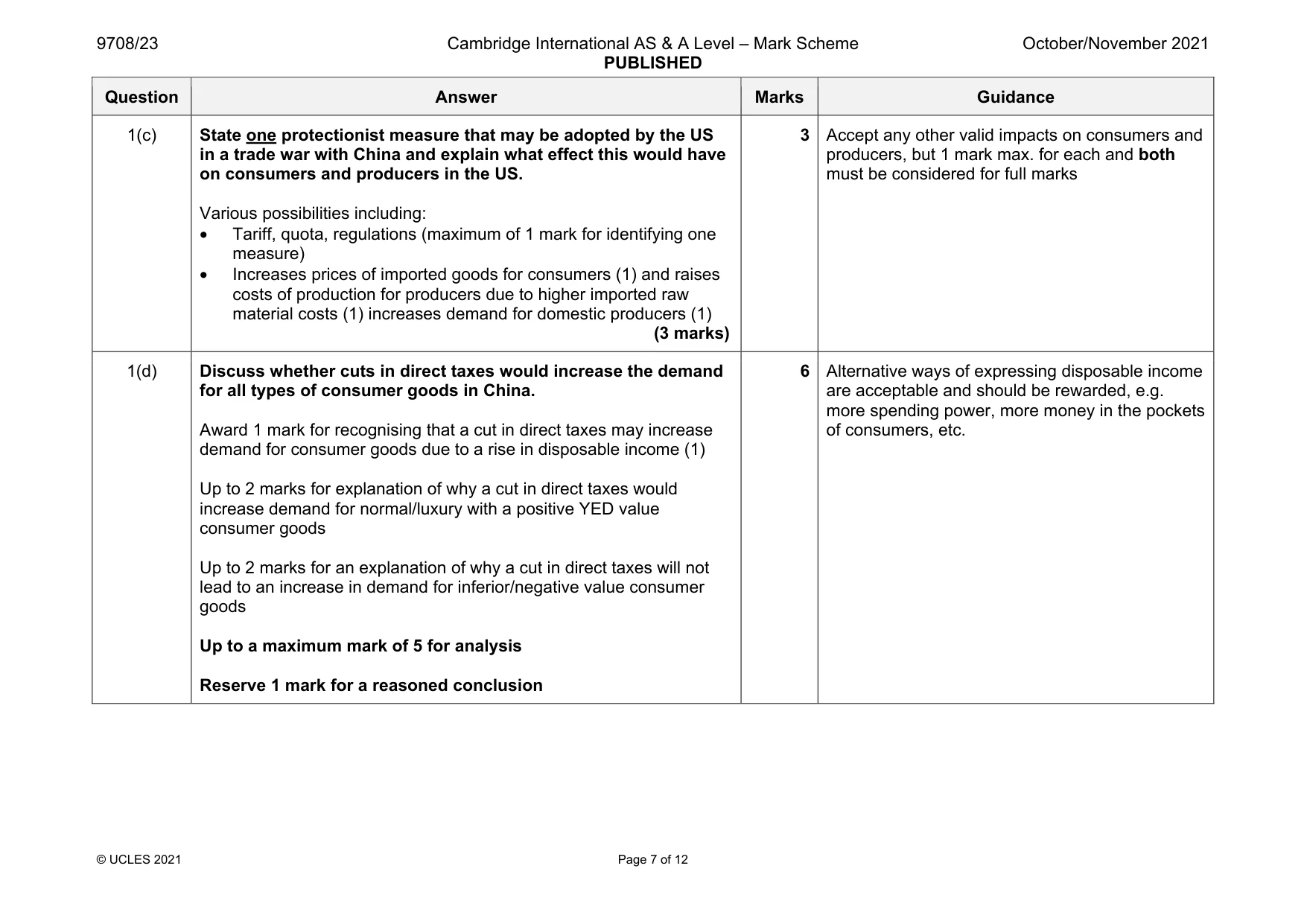
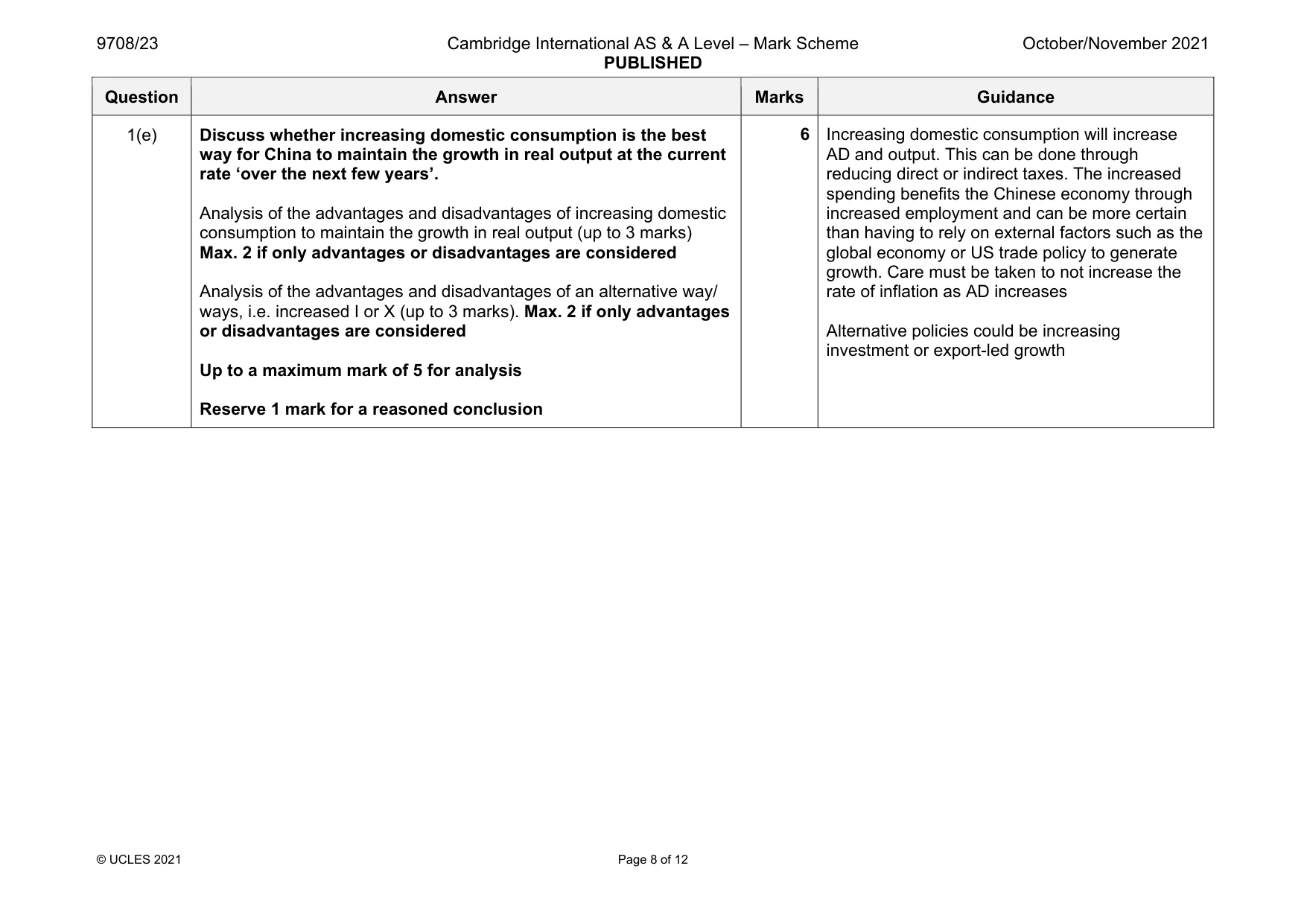
Mark scheme: 1(a) Use the data in Fig. 1.1 to describe how the contribution to real output growth of the different components of aggregate demand in China has changed from 2010 to 2017. Award 1 mark for any two of the following: • Lower contribution of investment expenditure over the period • Relatively stable contribution in consumption expenditure • In 2010, net exports were negative but by 2017 they were positive / however, over the period they have fluctuated between positive and negative (2 marks) 2 It is not enough to simply quote figures – some measure of change in contribution is needed, i.e. increase, decrease, no discernible change, etc. 1(b)(i) What relationship might you expect between the rate of growth in real output and sales of new cars in an economy? There is likely to be a positive correlation / would be expected to be a similar pattern / trend between the rise in GDP growth and the change in private car sales (1 mark) 1 1(b)(ii) Consider whether the evidence in Fig. 1.1 and Table 1.1 supports this relationship. It is broadly consistent (1) Highest and lowest rates of growth correspond (2010 and 2017 respectively) (1) There is positive growth in all years for both real output and sales of new cars, but rates of growth do not always match (1) Growth rate is more consistent than growth in car sales throughout (1) (2 marks) 2 1 mark to be awarded for each accurate statement up to a maximum of 2 marks Question Answer Marks Guidance 1(c) State one protectionist measure that may be adopted by the US in a trade war with China and explain what effect this would have on consumers and producers in the US. Various possibilities including: • Tariff, quota, regulations (maximum of 1 mark for identifying one measure) • Increases prices of imported goods for consumers (1) and raises costs of production for producers due to higher imported raw material costs (1) increases demand for domestic producers (1) (3 marks) 3 Accept any other valid impacts on consumers and producers, but 1 mark max. for each and both must be considered for full marks 1(d) Discuss whether cuts in direct taxes would increase the demand for all types of consumer goods in China. Award 1 mark for recognising that a cut in direct taxes may increase demand for consumer goods due to a rise in disposable income (1) Up to 2 marks for explanation of why a cut in direct taxes would increase demand for normal/luxury with a positive YED value consumer goods Up to 2 marks for an explanation of why a cut in direct taxes will not lead to an increase in demand for inferior/negative value consumer goods Up to a maximum mark of 5 for analysis Reserve 1 mark for a reasoned conclusion 6 Alternative ways of expressing disposable income are acceptable and should be rewarded, e.g. more spending power, more money in the pockets of consumers, etc. Question Answer Marks Guidance 1(e) Discuss whether increasing domestic consumption is the best way for China to maintain the growth in real output at the current rate ‘over the next few years’. Analysis of the advantages and disadvantages of increasing domestic consumption to maintain the growth in real output (up to 3 marks) Max. 2 if only advantages or disadvantages are considered Analysis of the advantages and disadvantages of an alternative way/ ways, i.e. increased I or X (up to 3 marks). Max. 2 if only advantages or disadvantages are considered Up to a maximum mark of 5 for analysis Reserve 1 mark for a reasoned conclusion 6 Increasing domestic consumption will increase AD and output. This can be done through reducing direct or indirect taxes. The increased spending benefits the Chinese economy through increased employment and can be more certain than having to rely on external factors such as the global economy or US trade policy to generate growth. Care must be taken to not increase the rate of inflation as AD increases Alternative policies could be increasing investment or export-led growth
More questions on Aggregate Demand and Aggregate Supply analysis
Q2 · Explain how the fundamental economic problem is addressed in a planned economy and in a…
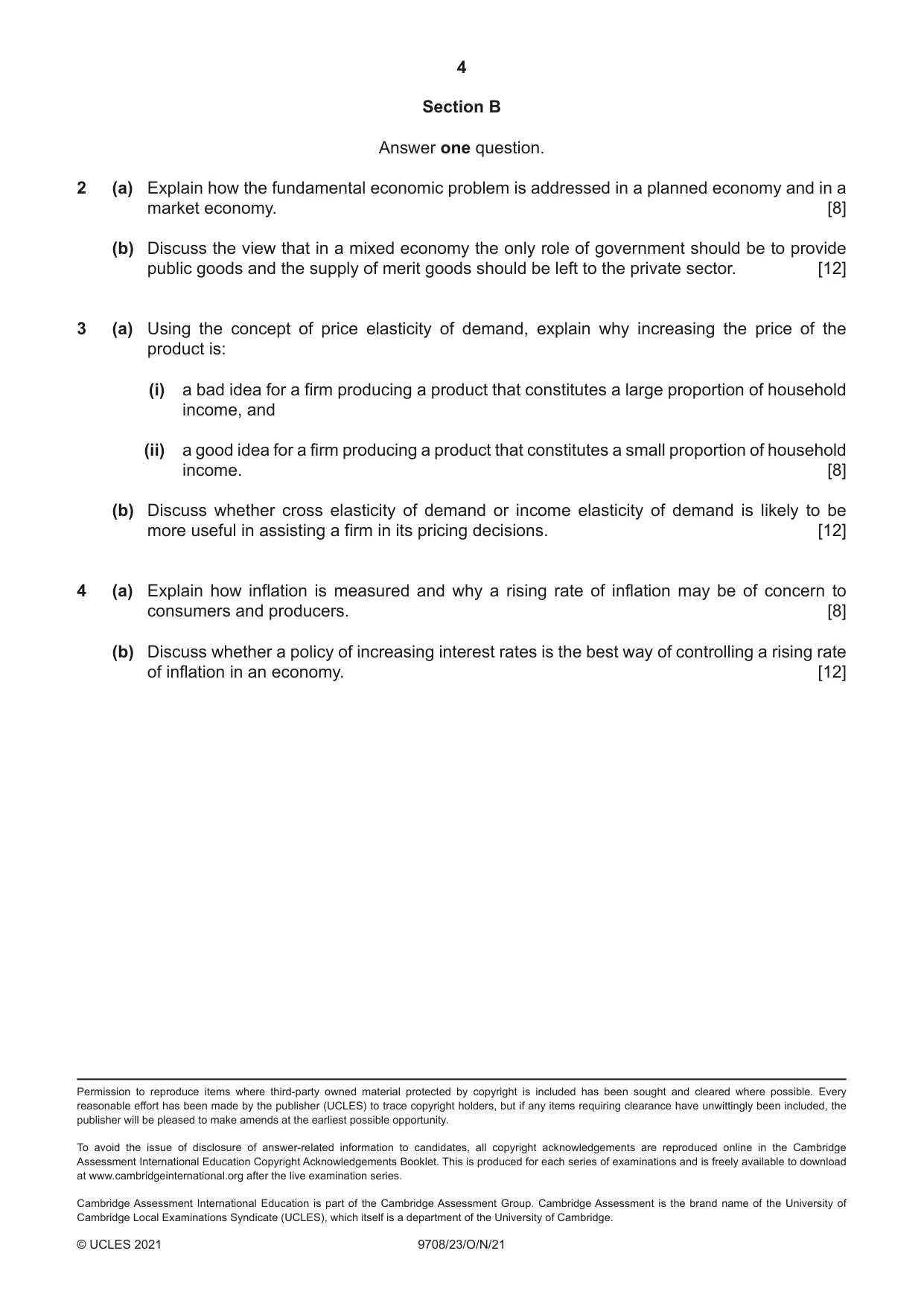
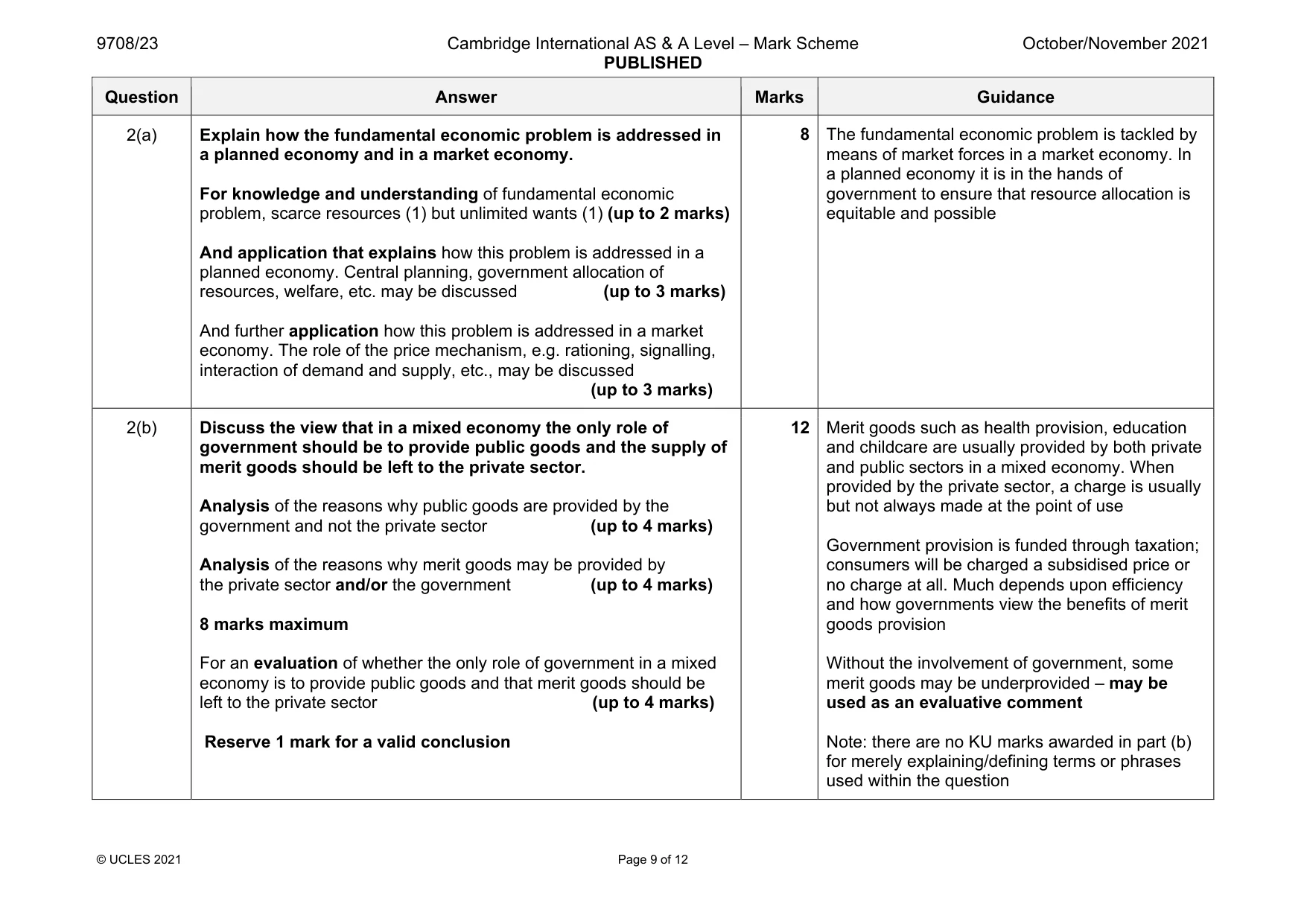
2 (a) Explain how the fundamental economic problem is addressed in a planned economy and in a market economy. [8] (b) Discuss the view that in a mixed economy the only role of government should be to provide public goods and the supply of merit goods should be left to the private sector. [12]
Mark scheme: 2(a) Explain how the fundamental economic problem is addressed in a planned economy and in a market economy. For knowledge and understanding of fundamental economic problem, scarce resources (1) but unlimited wants (1) (up to 2 marks) And application that explains how this problem is addressed in a planned economy. Central planning, government allocation of resources, welfare, etc. may be discussed (up to 3 marks) And further application how this problem is addressed in a market economy. The role of the price mechanism, e.g. rationing, signalling, interaction of demand and supply, etc., may be discussed (up to 3 marks) means of market forces in a market economy. In a planned economy it is in the hands of government to ensure that resource allocation is equitable and possible 2(b) Discuss the view that in a mixed economy the only role of government should be to provide public goods and the supply of merit goods should be left to the private sector. Analysis of the reasons why public goods are provided by the government and not the private sector (up to 4 marks) Analysis of the reasons why merit goods may be provided by the private sector and/or the government (up to 4 marks) 8 marks maximum For an evaluation of whether the only role of government in a mixed economy is to provide public goods and that merit goods should be left to the private sector (up to 4 marks) Reserve 1 mark for a valid conclusion 12 Merit goods such as health provision, education and childcare are usually provided by both private and public sectors in a mixed economy. When provided by the private sector, a charge is usually but not always made at the point of use Government provision is funded through taxation; consumers will be charged a subsidised price or no charge at all. Much depends upon efficiency and how governments view the benefits of merit goods provision Without the involvement of government, some merit goods may be underprovided – may be used as an evaluative comment Note: there are no KU marks awarded in part (b) for merely explaining/defining terms or phrases used within the question
Q3 · Using the concept of price elasticity of demand, explain why increasing the price of the…
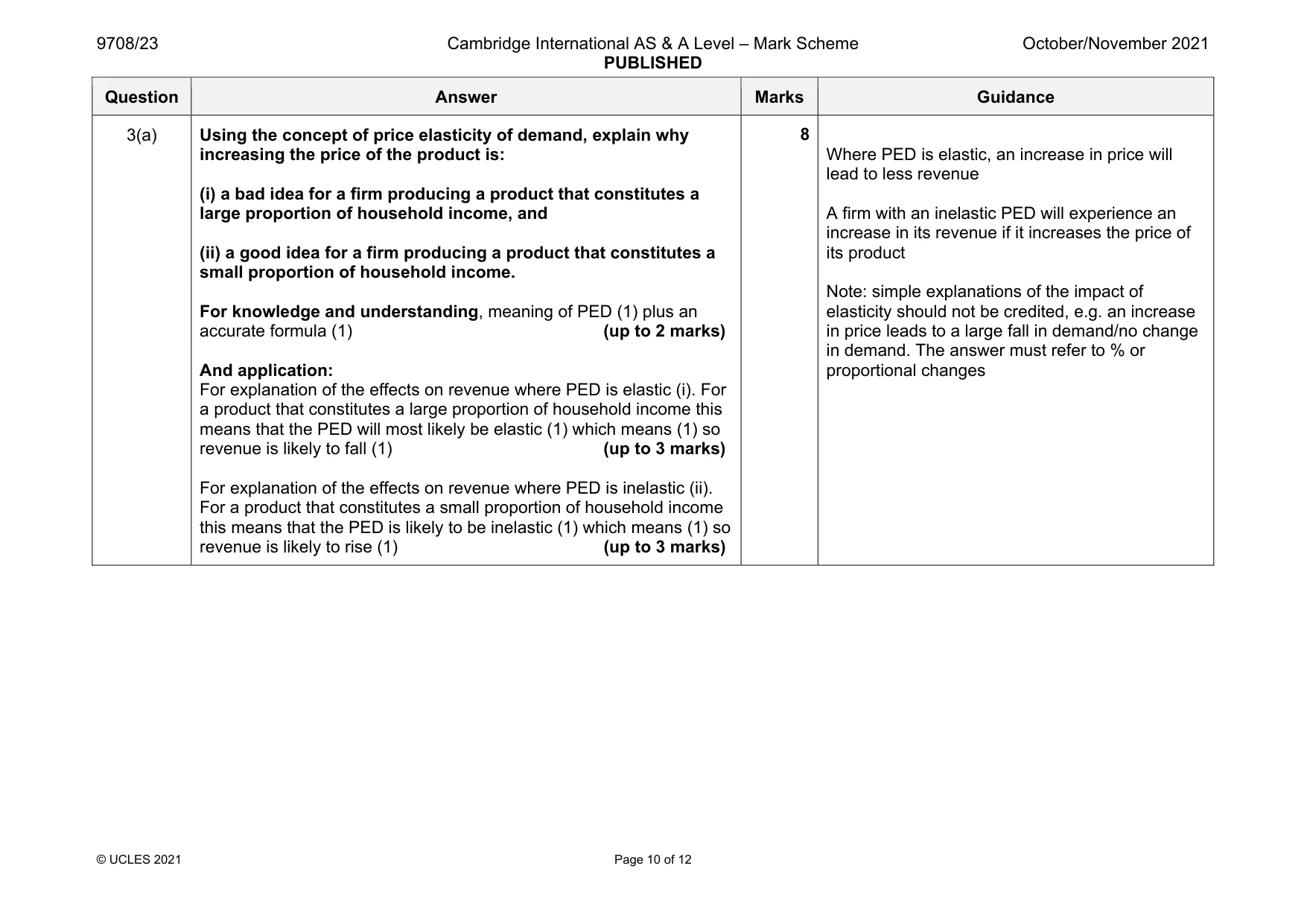
3 (a) Using the concept of price elasticity of demand, explain why increasing the price of the product is: (i) a bad idea for a firm producing a product that constitutes a large proportion of household income, and (ii) a good idea for a firm producing a product that constitutes a small proportion of household income. [8] (b) Discuss whether cross elasticity of demand or income elasticity of demand is likely to be more useful in assisting a firm in its pricing decisions. [12]
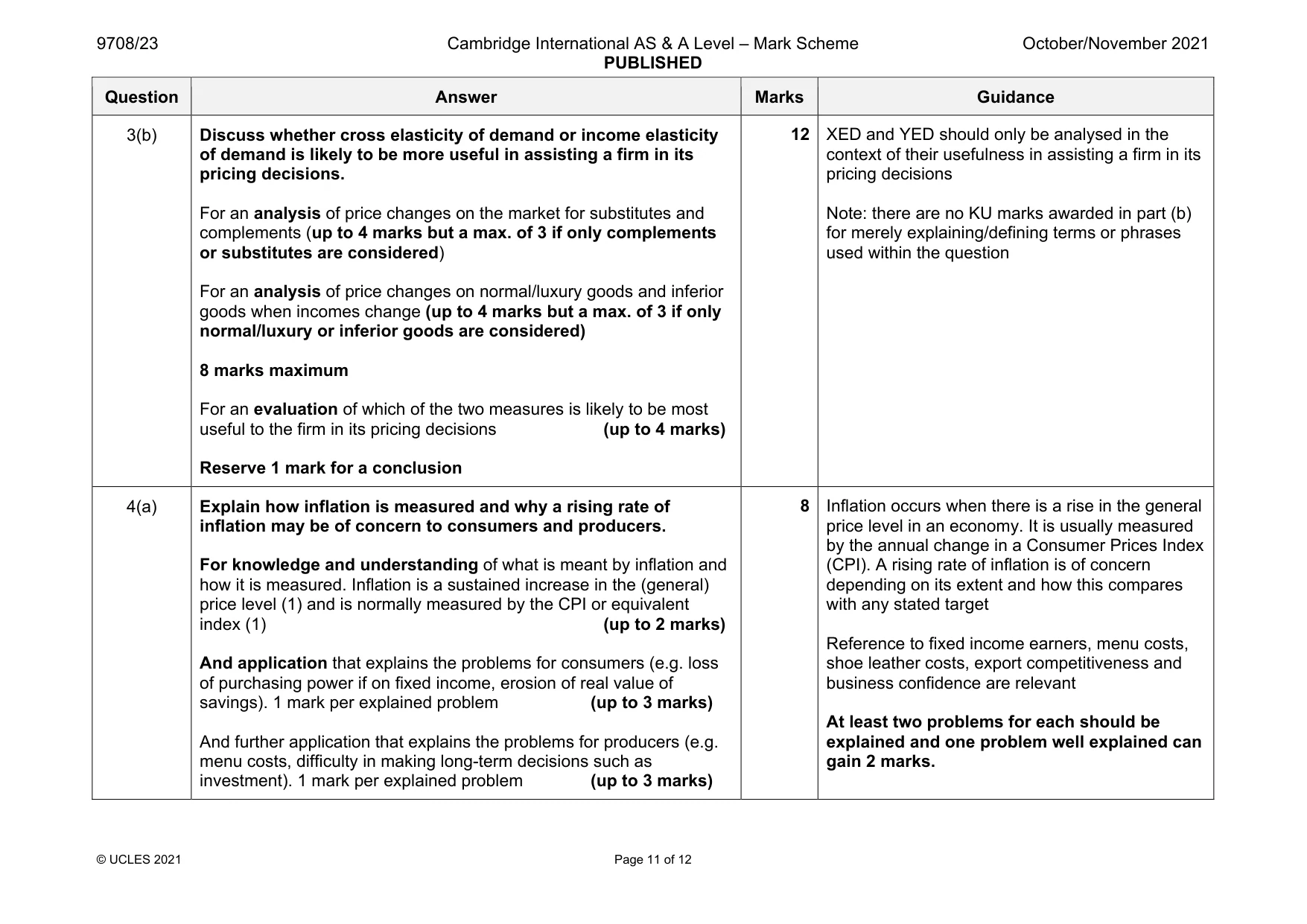
Mark scheme: 3(a) Using the concept of price elasticity of demand, explain why increasing the price of the product is: (i) a bad idea for a firm producing a product that constitutes a large proportion of household income, and (ii) a good idea for a firm producing a product that constitutes a small proportion of household income. For knowledge and understanding, meaning of PED (1) plus an accurate formula (1) (up to 2 marks) And application: For explanation of the effects on revenue where PED is elastic (i). For a product that constitutes a large proportion of household income this means that the PED will most likely be elastic (1) which means (1) so revenue is likely to fall (1) (up to 3 marks) For explanation of the effects on revenue where PED is inelastic (ii). For a product that constitutes a small proportion of household income this means that the PED is likely to be inelastic (1) which means (1) so revenue is likely to rise (1) (up to 3 marks) Where PED is elastic, an increase in price will lead to less revenue A firm with an inelastic PED will experience an increase in its revenue if it increases the price of its product Note: simple explanations of the impact of elasticity should not be credited, e.g. an increase in price leads to a large fall in demand/no change in demand. The answer must refer to % or proportional changes Question Answer Marks Guidance 3(b) Discuss whether cross elasticity of demand or income elasticity of demand is likely to be more useful in assisting a firm in its pricing decisions. For an analysis of price changes on the market for substitutes and complements (up to 4 marks but a max. of 3 if only complements or substitutes are considered) For an analysis of price changes on normal/luxury goods and inferior goods when incomes change (up to 4 marks but a max. of 3 if only normal/luxury or inferior goods are considered) 8 marks maximum For an evaluation of which of the two measures is likely to be most useful to the firm in its pricing decisions (up to 4 marks) Reserve 1 mark for a conclusion 12 XED and YED should only be analysed in the context of their usefulness in assisting a firm in its pricing decisions Note: there are no KU marks awarded in part (b) for merely explaining/defining terms or phrases used within the question 8 Inflation occurs when there is a rise in the general
More questions on Price elasticity, income elasticity and cross elasticity of demand
Q4 · Explain how inflation is measured and why a rising rate of inflation may be of concern to…
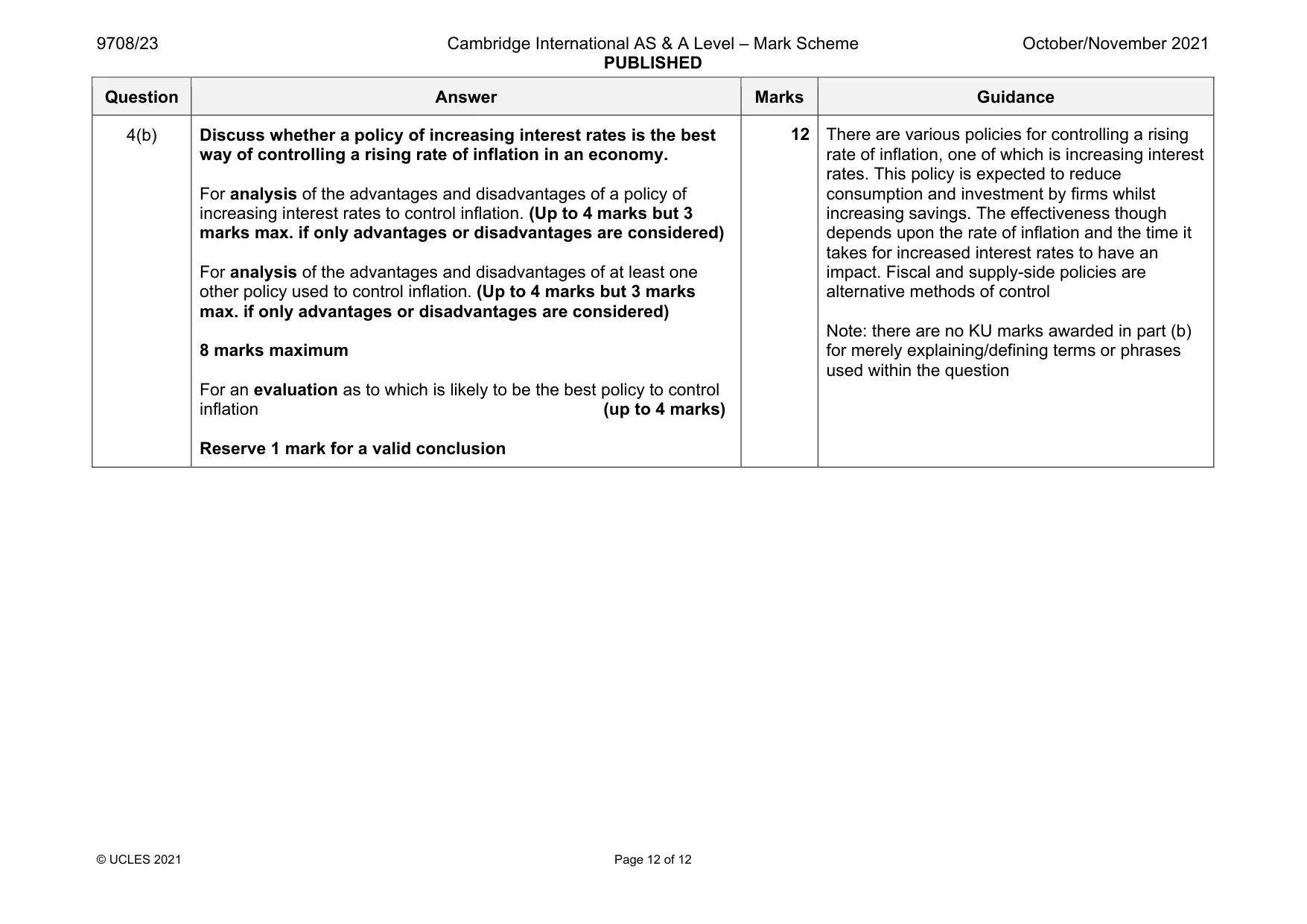
4 (a) Explain how inflation is measured and why a rising rate of inflation may be of concern to consumers and producers. [8] (b) Discuss whether a policy of increasing interest rates is the best way of controlling a rising rate of inflation in an economy. [12]
Mark scheme: 4(a) Explain how inflation is measured and why a rising rate of inflation may be of concern to consumers and producers. For knowledge and understanding of what is meant by inflation and how it is measured. Inflation is a sustained increase in the (general) price level (1) and is normally measured by the CPI or equivalent index (1) (up to 2 marks) And application that explains the problems for consumers (e.g. loss of purchasing power if on fixed income, erosion of real value of savings). 1 mark per explained problem (up to 3 marks) And further application that explains the problems for producers (e.g. menu costs, difficulty in making long-term decisions such as investment). 1 mark per explained problem (up to 3 marks) price level in an economy. It is usually measured by the annual change in a Consumer Prices Index (CPI). A rising rate of inflation is of concern depending on its extent and how this compares with any stated target Reference to fixed income earners, menu costs, shoe leather costs, export competitiveness and business confidence are relevant At least two problems for each should be explained and one problem well explained can gain 2 marks. Question Answer Marks Guidance 4(b) Discuss whether a policy of increasing interest rates is the best way of controlling a rising rate of inflation in an economy. For analysis of the advantages and disadvantages of a policy of increasing interest rates to control inflation. (Up to 4 marks but 3 marks max. if only advantages or disadvantages are considered) For analysis of the advantages and disadvantages of at least one other policy used to control inflation. (Up to 4 marks but 3 marks max. if only advantages or disadvantages are considered) 8 marks maximum For an evaluation as to which is likely to be the best policy to control inflation (up to 4 marks) Reserve 1 mark for a valid conclusion 12 There are various policies for controlling a rising rate of inflation, one of which is increasing interest rates. This policy is expected to reduce consumption and investment by firms whilst increasing savings. The effectiveness though depends upon the rate of inflation and the time it takes for increased interest rates to have an impact. Fiscal and supply-side policies are alternative methods of control Note: there are no KU marks awarded in part (b) for merely explaining/defining terms or phrases used within the question
More questions on Effectiveness of policy options to meet all macroeconomic objectives
What was in this paper
The subtopics covered by these 4 questions, and how many questions each got. Open one in a new tab to see every Cambridge question on it.
What you needed in this session
Cambridge’s own grade thresholds for 2021 Oct/Nov, Paper 2 · Variant 3. A higher threshold means an easier paper — the bar moves with how the cohort did.