Cambridge A Level Economics 9708 — 2021 Oct/Nov Paper 2 · Variant 1
9708/21/O/N/21 · 4 questions · 40 marks · ≈45 min
The question paper and its mark scheme, free to read here and free to download. This is Cambridge’s own paper, exactly as it was sat.
Question paper4 pages
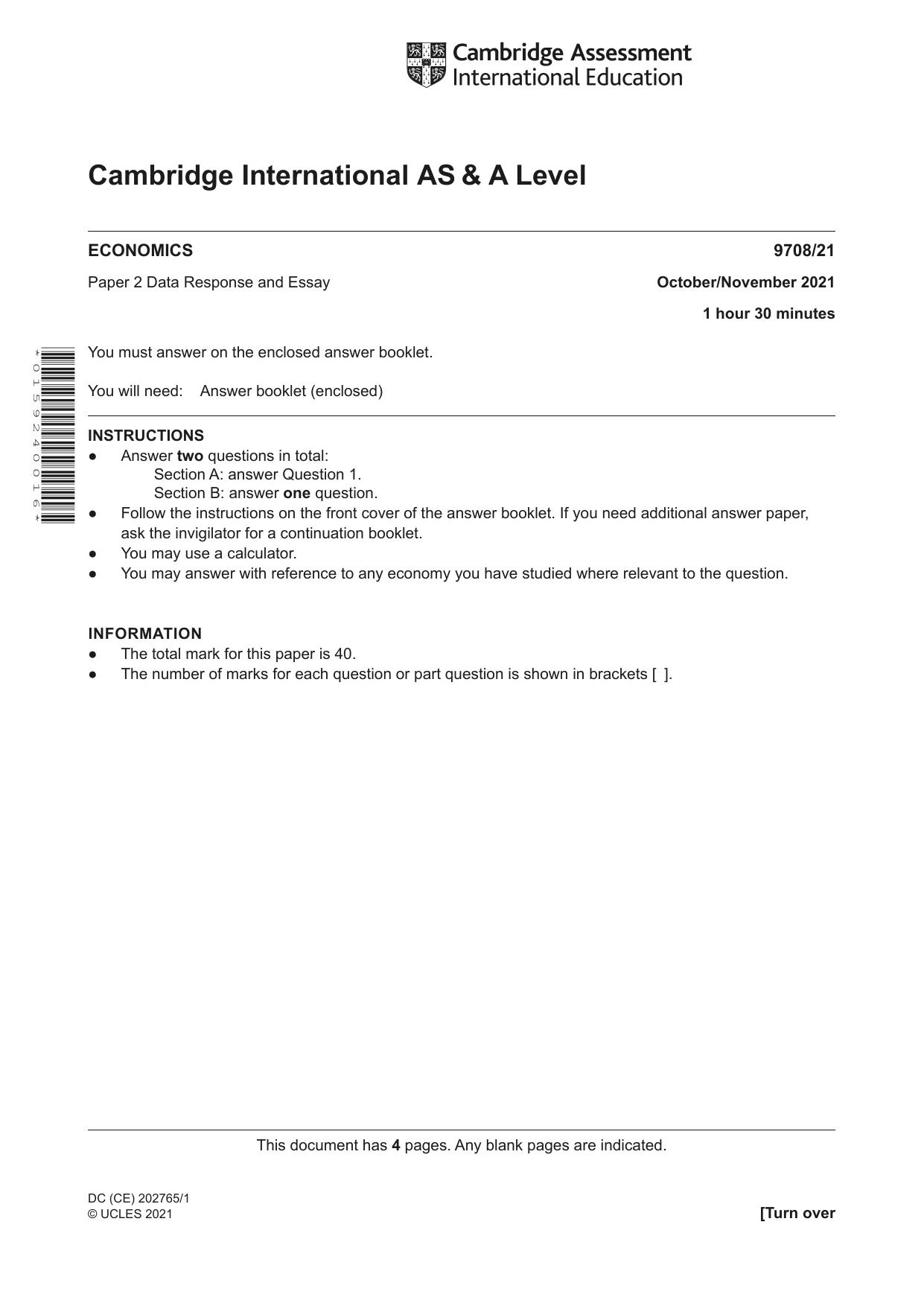
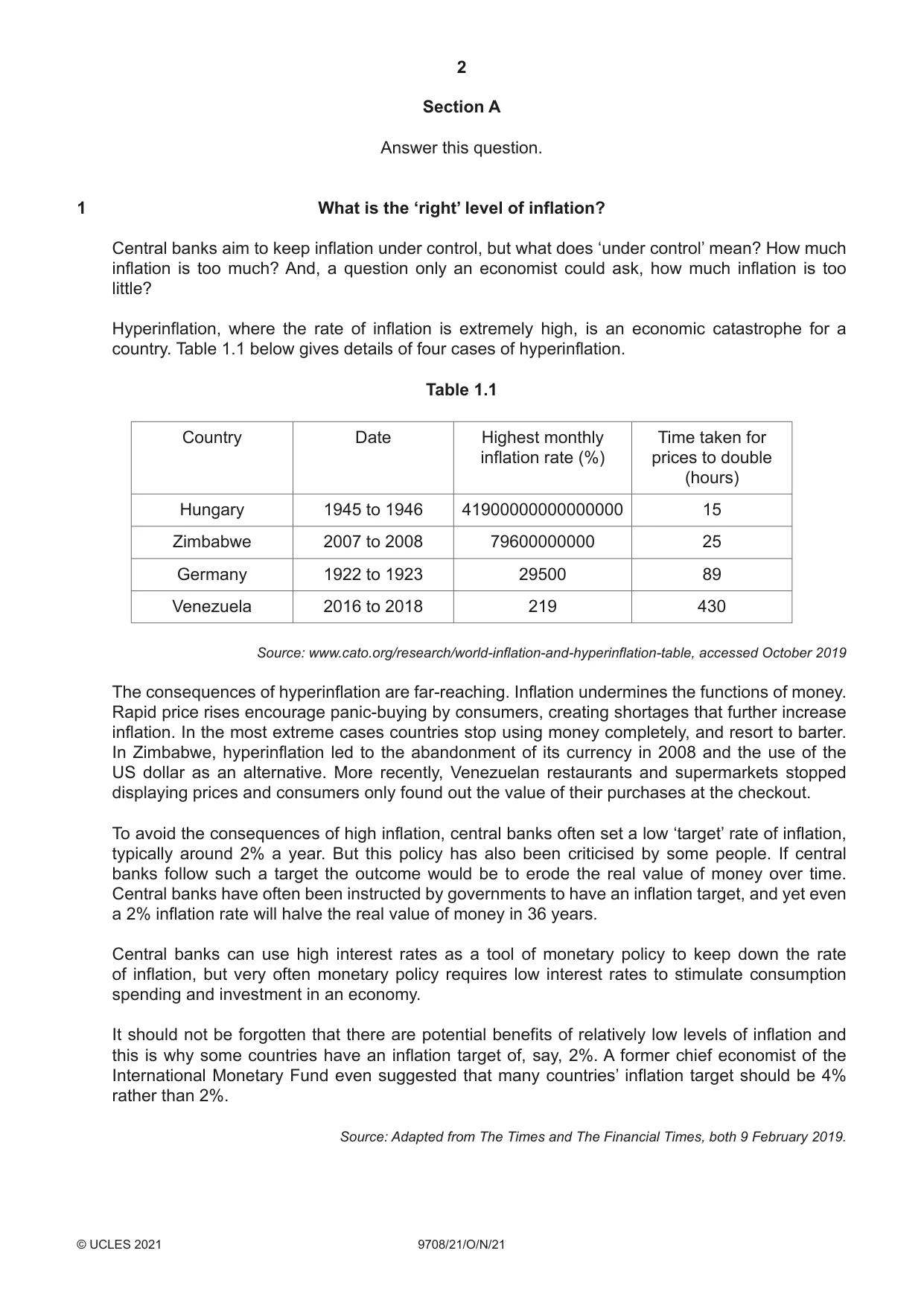
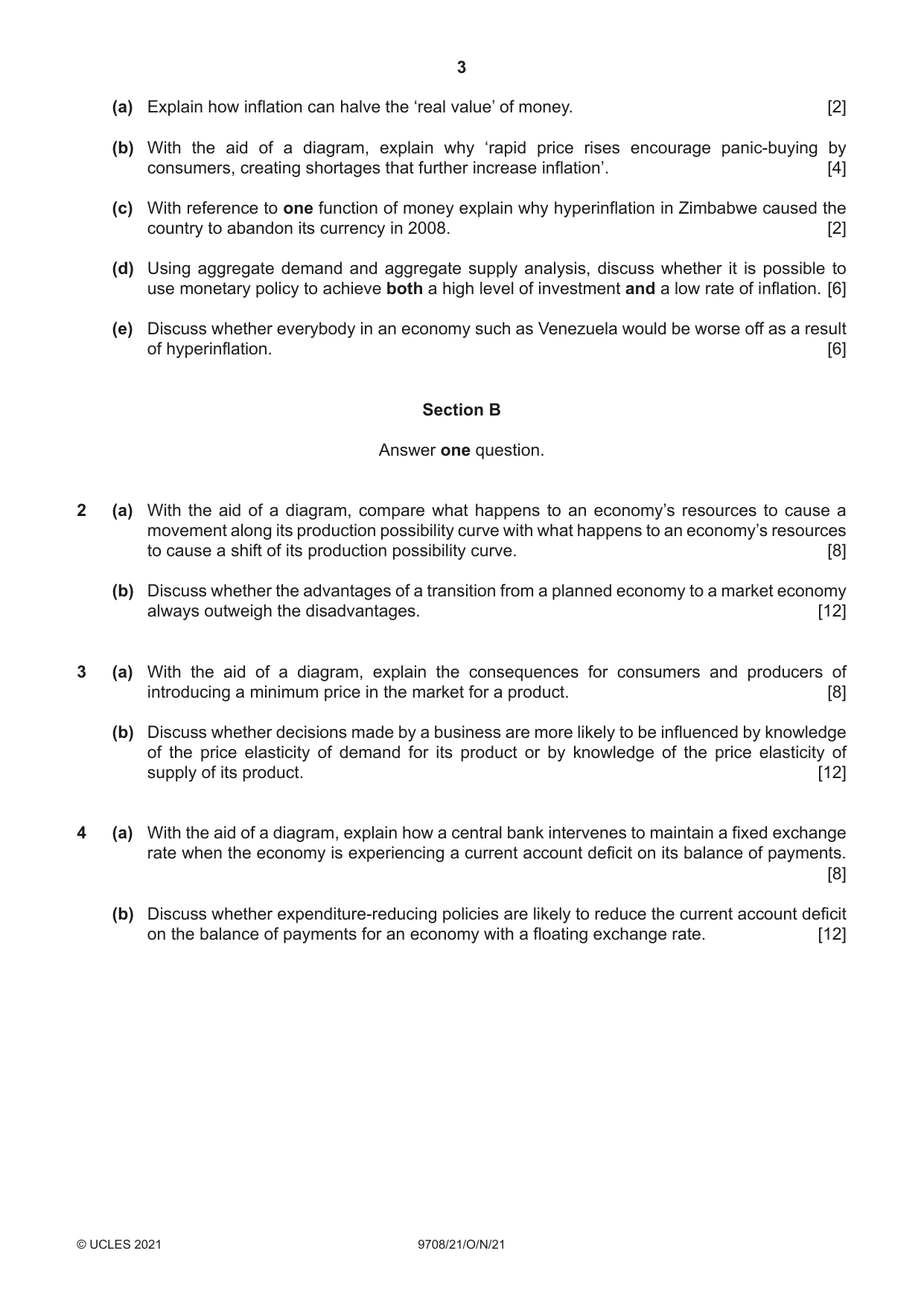
Mark scheme13 pages
Answers below. Sit the paper first if you are practising.
Questions as text
Q1 · What is the ‘right’ level of inflation?
1 What is the ‘right’ level of inflation? Central banks aim to keep inflation under control, but what does ‘under control’ mean? How much inflation is too much? And, a question only an economist could ask, how much inflation is too little? Hyperinflation, where the rate of inflation is extremely high, is an economic catastrophe for a country. Table 1.1 below gives details of four cases of hyperinflation. Table 1.1 Country Date Highest monthly Time taken for inflation rate (%) prices to double (hours) Hungary 1945 to 1946 41900000000000000 15 Zimbabwe 2007 to 2008 79600000000 25 Germany 1922 to 1923 29500 89 Venezuela 2016 to 2018 219 430 Source: www.cato.org/research/world-inflation-and-hyperinflation-table, accessed October 2019 The consequences of hyperinflation are far-reaching. Inflation undermines the functions of money. Rapid price rises encourage panic-buying by consumers, creating shortages that further increase inflation. In the most extreme cases countries stop using money completely, and resort to barter. In Zimbabwe, hyperinflation led to the abandonment of its currency in 2008 and the use of the US dollar as an alternative. More recently, Venezuelan restaurants and supermarkets stopped displaying prices and consumers only found out the value of their purchases at the checkout. To avoid the consequences of high inflation, central banks often set a low ‘target’ rate of inflation, typically around 2% a year. But this policy has also been criticised by some people. If central banks follow such a target the outcome would be to erode the real value of money over time. Central banks have often been instructed by governments to have an inflation target, and yet even a 2% inflation rate will halve the real value of money in 36 years. Central banks can use high interest rates as a tool of monetary policy to keep down the rate of inflation, but very often monetary policy requires low interest rates to stimulate consumption spending and investment in an economy. It should not be forgotten that there are potential benefits of relatively low levels of inflation and this is why some countries have an inflation target of, say, 2%. A former chief economist of the International Monetary Fund even suggested that many countries’ inflation target should be 4% rather than 2%. Source: Adapted from The Times and The Financial Times, both 9 February 2019. (a) Explain how inflation can halve the ‘real value’ of money. [2] (b) With the aid of a diagram, explain why ‘rapid price rises encourage panic-buying by consumers, creating shortages that further increase inflation’. [4] (c) With reference to one function of money explain why hyperinflation in Zimbabwe caused the country to abandon its currency in 2008. [2] (d) Using aggregate demand and aggregate supply analysis, discuss whether it is possible to use monetary policy to achieve both a high level of investment and a low rate of inflation. [6] (e) Discuss whether everybody in an economy such as Venezuela would be worse off as a result of hyperinflation. [6]
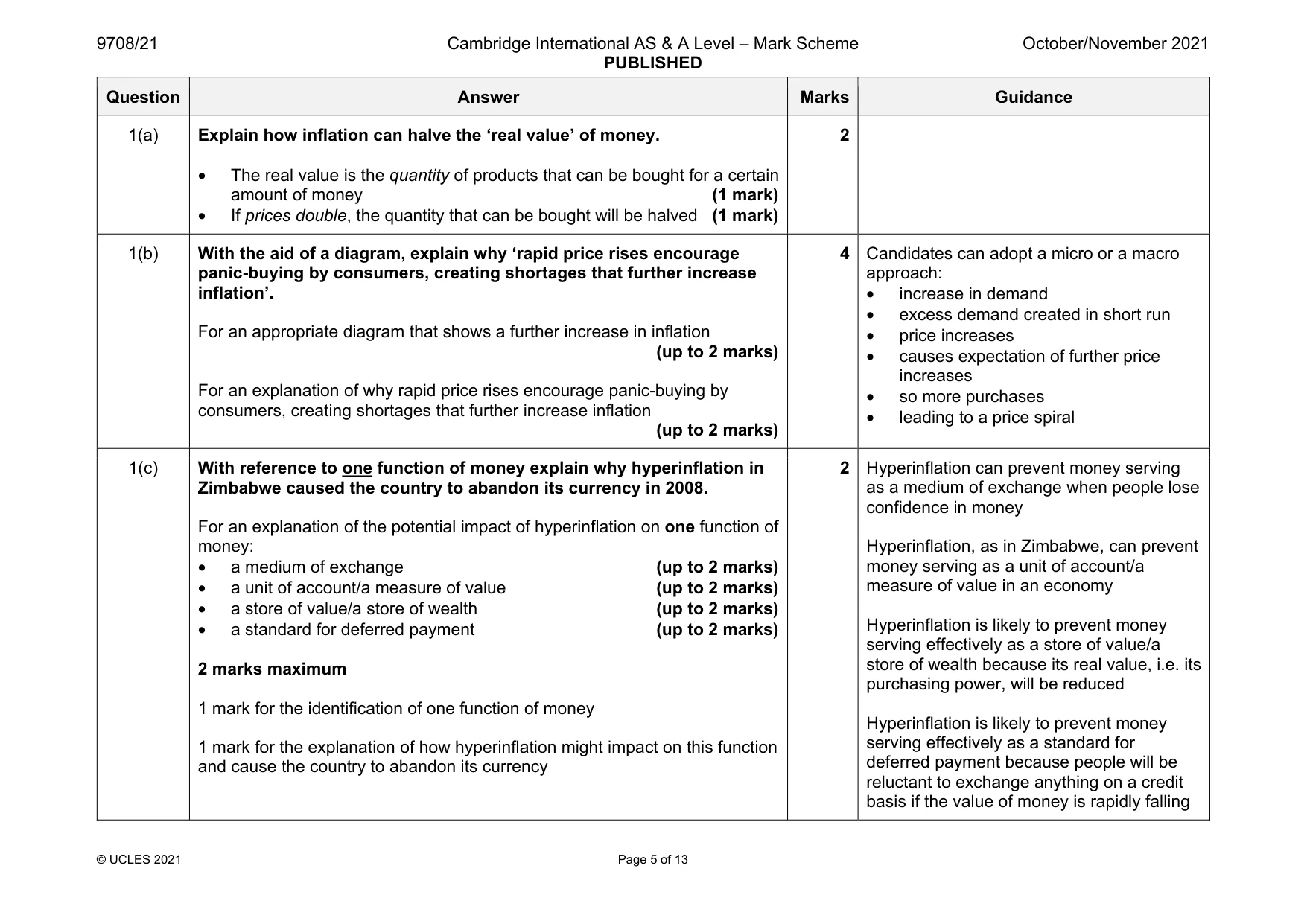
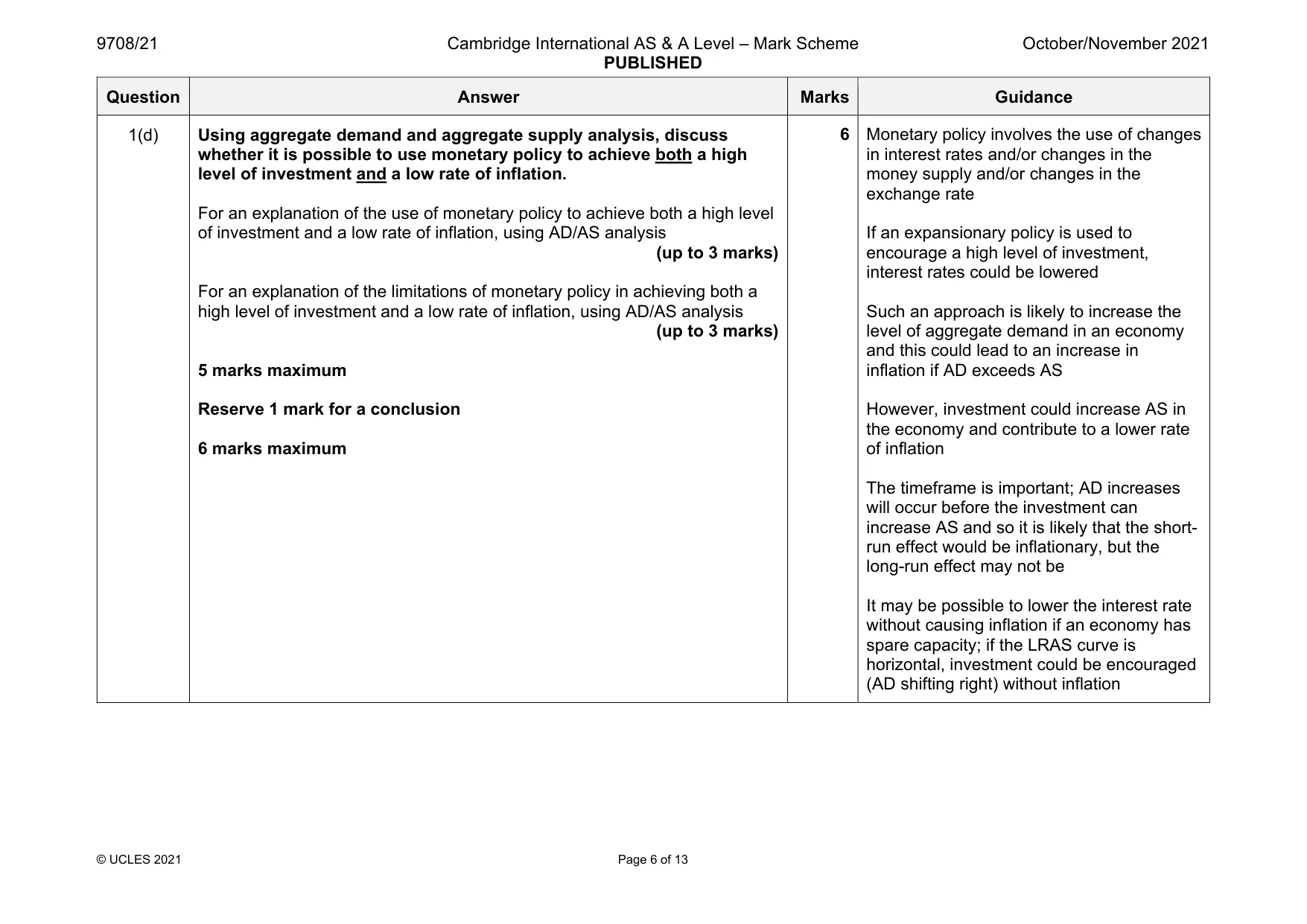
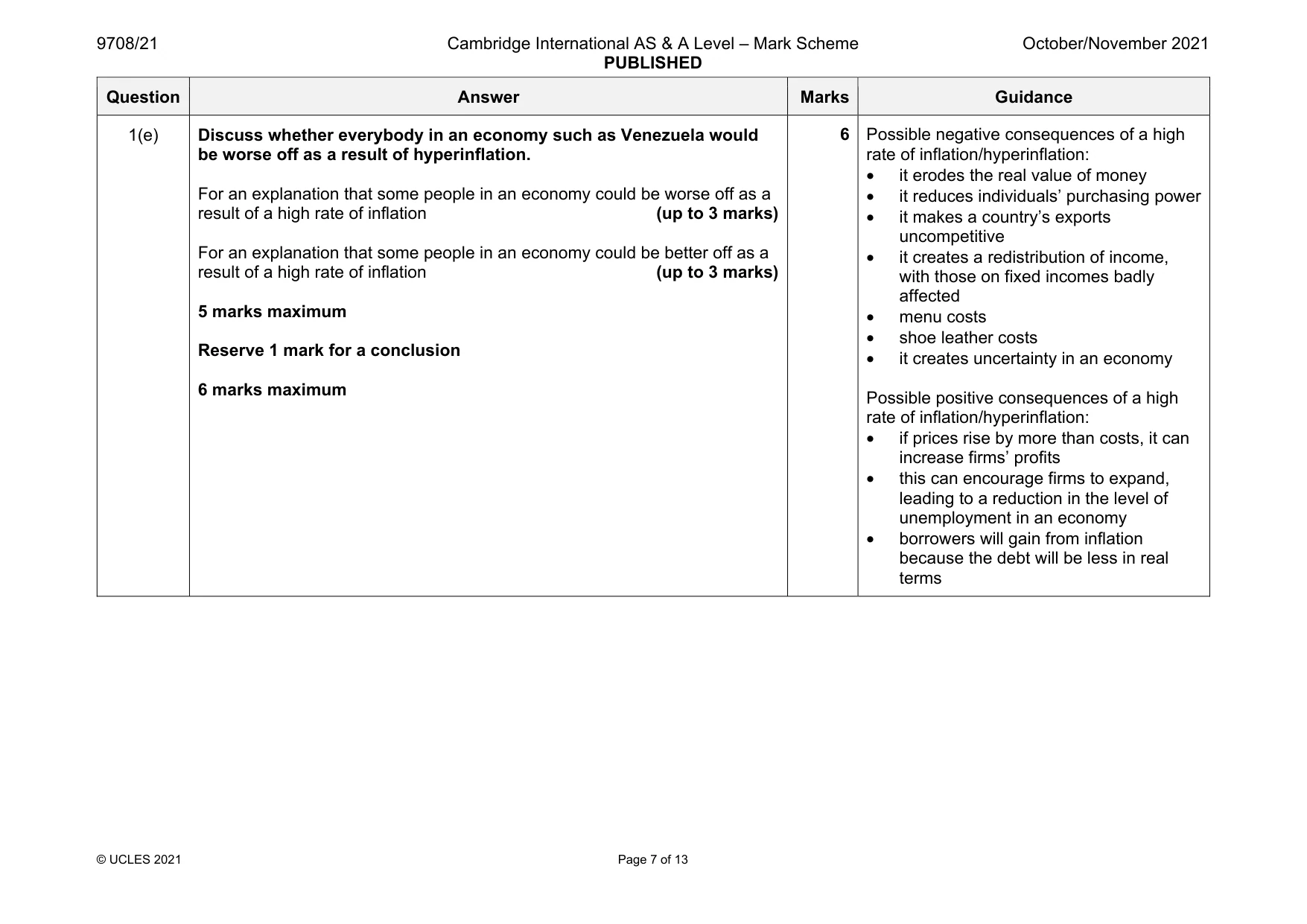
Mark scheme: 1(a) Explain how inflation can halve the ‘real value’ of money. • The real value is the quantity of products that can be bought for a certain amount of money (1 mark) • If prices double, the quantity that can be bought will be halved (1 mark) 2 1(b) With the aid of a diagram, explain why ‘rapid price rises encourage panic-buying by consumers, creating shortages that further increase inflation’. For an appropriate diagram that shows a further increase in inflation (up to 2 marks) For an explanation of why rapid price rises encourage panic-buying by consumers, creating shortages that further increase inflation (up to 2 marks) 4 Candidates can adopt a micro or a macro approach: • increase in demand • excess demand created in short run • price increases • causes expectation of further price increases • so more purchases • leading to a price spiral 1(c) With reference to one function of money explain why hyperinflation in Zimbabwe caused the country to abandon its currency in 2008. For an explanation of the potential impact of hyperinflation on one function of money: • a medium of exchange (up to 2 marks) • a unit of account/a measure of value (up to 2 marks) • a store of value/a store of wealth (up to 2 marks) • a standard for deferred payment (up to 2 marks) 2 marks maximum 1 mark for the identification of one function of money 1 mark for the explanation of how hyperinflation might impact on this function and cause the country to abandon its currency 2 Hyperinflation can prevent money serving as a medium of exchange when people lose confidence in money Hyperinflation, as in Zimbabwe, can prevent money serving as a unit of account/a measure of value in an economy Hyperinflation is likely to prevent money serving effectively as a store of value/a store of wealth because its real value, i.e. its purchasing power, will be reduced Hyperinflation is likely to prevent money serving effectively as a standard for deferred payment because people will be reluctant to exchange anything on a credit basis if the value of money is rapidly falling Question Answer Marks Guidance 1(d) Using aggregate demand and aggregate supply analysis, discuss whether it is possible to use monetary policy to achieve both a high level of investment and a low rate of inflation. For an explanation of the use of monetary policy to achieve both a high level of investment and a low rate of inflation, using AD/AS analysis (up to 3 marks) For an explanation of the limitations of monetary policy in achieving both a high level of investment and a low rate of inflation, using AD/AS analysis (up to 3 marks) 5 marks maximum Reserve 1 mark for a conclusion 6 marks maximum 6 Monetary policy involves the use of changes in interest rates and/or changes in the money supply and/or changes in the exchange rate If an expansionary policy is used to encourage a high level of investment, interest rates could be lowered Such an approach is likely to increase the level of aggregate demand in an economy and this could lead to an increase in inflation if AD exceeds AS However, investment could increase AS in the economy and contribute to a lower rate of inflation The timeframe is important; AD increases will occur before the investment can increase AS and so it is likely that the short- run effect would be inflationary, but the long-run effect may not be It may be possible to lower the interest rate without causing inflation if an economy has spare capacity; if the LRAS curve is horizontal, investment could be encouraged (AD shifting right) without inflation Question Answer Marks Guidance 1(e) Discuss whether everybody in an economy such as Venezuela would be worse off as a result of hyperinflation. For an explanation that some people in an economy could be worse off as a result of a high rate of inflation (up to 3 marks) For an explanation that some people in an economy could be better off as a result of a high rate of inflation (up to 3 marks) 5 marks maximum Reserve 1 mark for a conclusion 6 marks maximum 6 Possible negative consequences of a high rate of inflation/hyperinflation: • it erodes the real value of money • it reduces individuals’ purchasing power • it makes a country’s exports uncompetitive • it creates a redistribution of income, with those on fixed incomes badly affected • menu costs • shoe leather costs • it creates uncertainty in an economy Possible positive consequences of a high rate of inflation/hyperinflation: • if prices rise by more than costs, it can increase firms’ profits • this can encourage firms to expand, leading to a reduction in the level of unemployment in an economy • borrowers will gain from inflation because the debt will be less in real terms
Q2 · With the aid of a diagram, compare what happens to an economy’s resources to cause a…
2 (a) With the aid of a diagram, compare what happens to an economy’s resources to cause a movement along its production possibility curve with what happens to an economy’s resources to cause a shift of its production possibility curve. [8] (b) Discuss whether the advantages of a transition from a planned economy to a market economy always outweigh the disadvantages. [12]
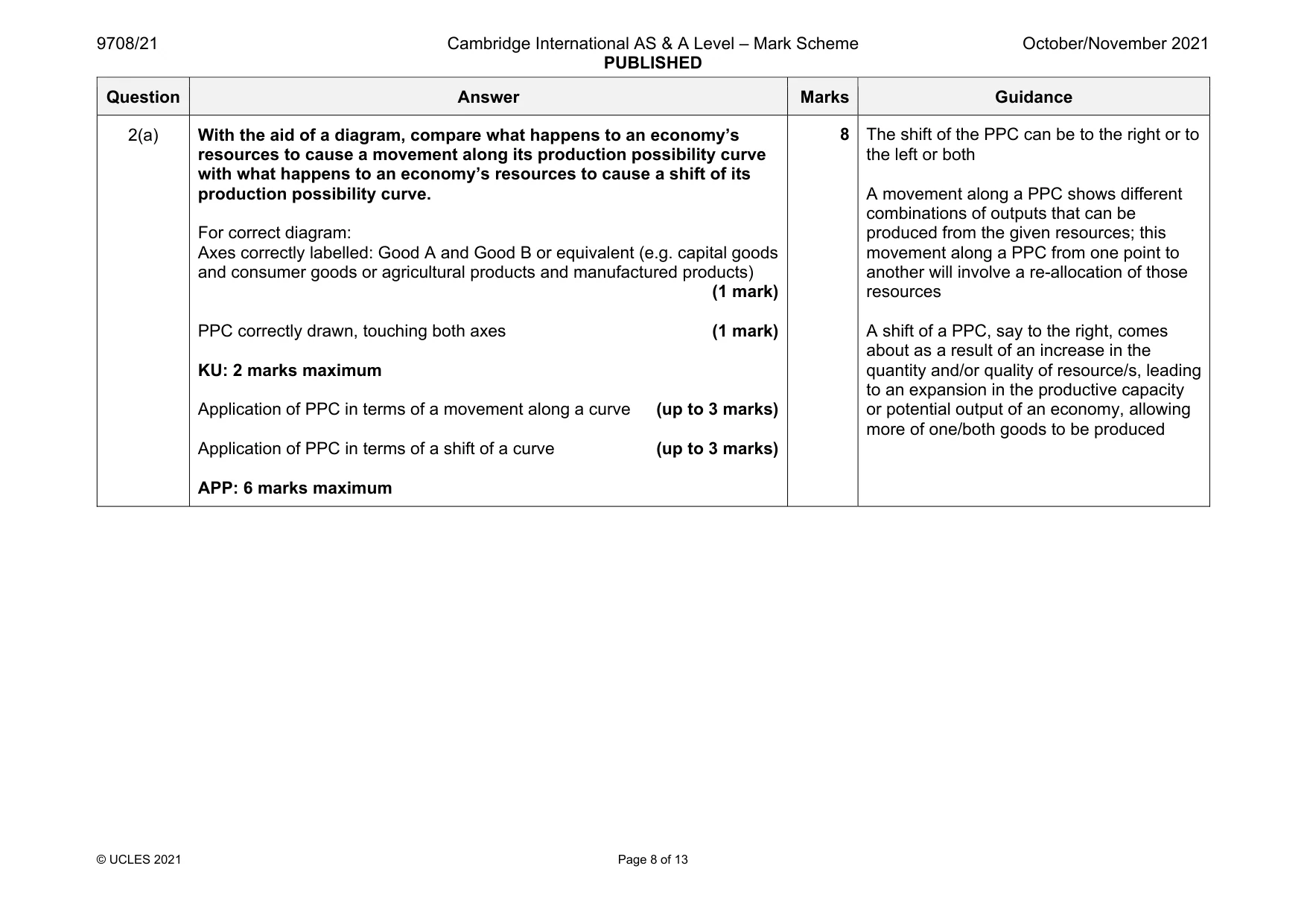
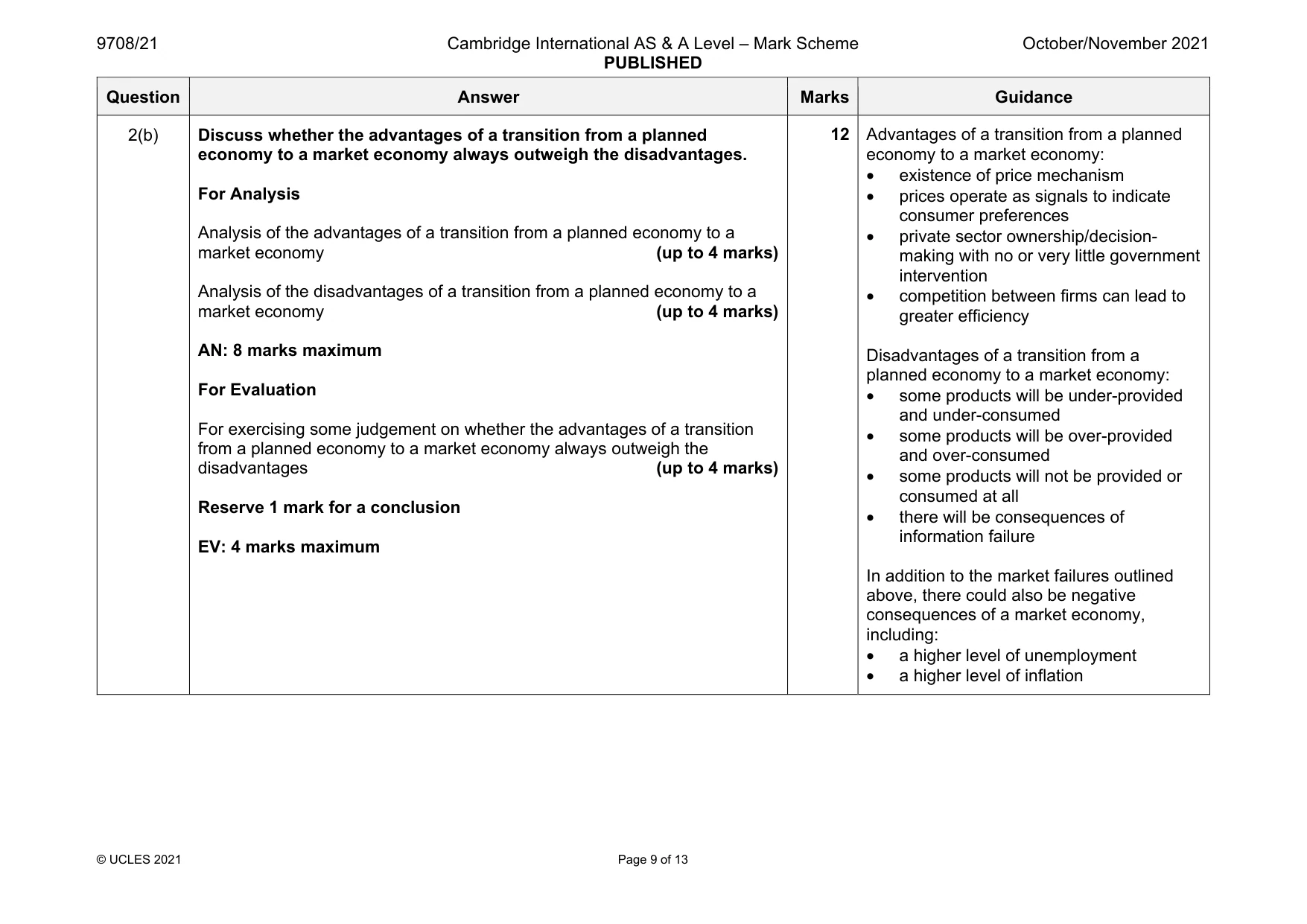
Mark scheme: 2(a) With the aid of a diagram, compare what happens to an economy’s resources to cause a movement along its production possibility curve with what happens to an economy’s resources to cause a shift of its production possibility curve. For correct diagram: Axes correctly labelled: Good A and Good B or equivalent (e.g. capital goods and consumer goods or agricultural products and manufactured products) (1 mark) PPC correctly drawn, touching both axes (1 mark) KU: 2 marks maximum Application of PPC in terms of a movement along a curve (up to 3 marks) Application of PPC in terms of a shift of a curve (up to 3 marks) APP: 6 marks maximum the left or both A movement along a PPC shows different combinations of outputs that can be produced from the given resources; this movement along a PPC from one point to another will involve a re-allocation of those resources A shift of a PPC, say to the right, comes about as a result of an increase in the quantity and/or quality of resource/s, leading to an expansion in the productive capacity or potential output of an economy, allowing more of one/both goods to be produced Question Answer Marks Guidance 2(b) Discuss whether the advantages of a transition from a planned economy to a market economy always outweigh the disadvantages. For Analysis Analysis of the advantages of a transition from a planned economy to a market economy (up to 4 marks) Analysis of the disadvantages of a transition from a planned economy to a market economy (up to 4 marks) AN: 8 marks maximum For Evaluation For exercising some judgement on whether the advantages of a transition from a planned economy to a market economy always outweigh the disadvantages (up to 4 marks) Reserve 1 mark for a conclusion EV: 4 marks maximum 12 Advantages of a transition from a planned economy to a market economy: • existence of price mechanism • prices operate as signals to indicate consumer preferences • private sector ownership/decision- making with no or very little government intervention • competition between firms can lead to greater efficiency Disadvantages of a transition from a planned economy to a market economy: • some products will be under-provided and under-consumed • some products will be over-provided and over-consumed • some products will not be provided or consumed at all • there will be consequences of information failure In addition to the market failures outlined above, there could also be negative consequences of a market economy, including: • a higher level of unemployment • a higher level of inflation
More questions on Resource allocation in different economic systems
Q3 · With the aid of a diagram, explain the consequences for consumers and producers of…
3 (a) With the aid of a diagram, explain the consequences for consumers and producers of introducing a minimum price in the market for a product. [8] (b) Discuss whether decisions made by a business are more likely to be influenced by knowledge of the price elasticity of demand for its product or by knowledge of the price elasticity of supply of its product. [12]
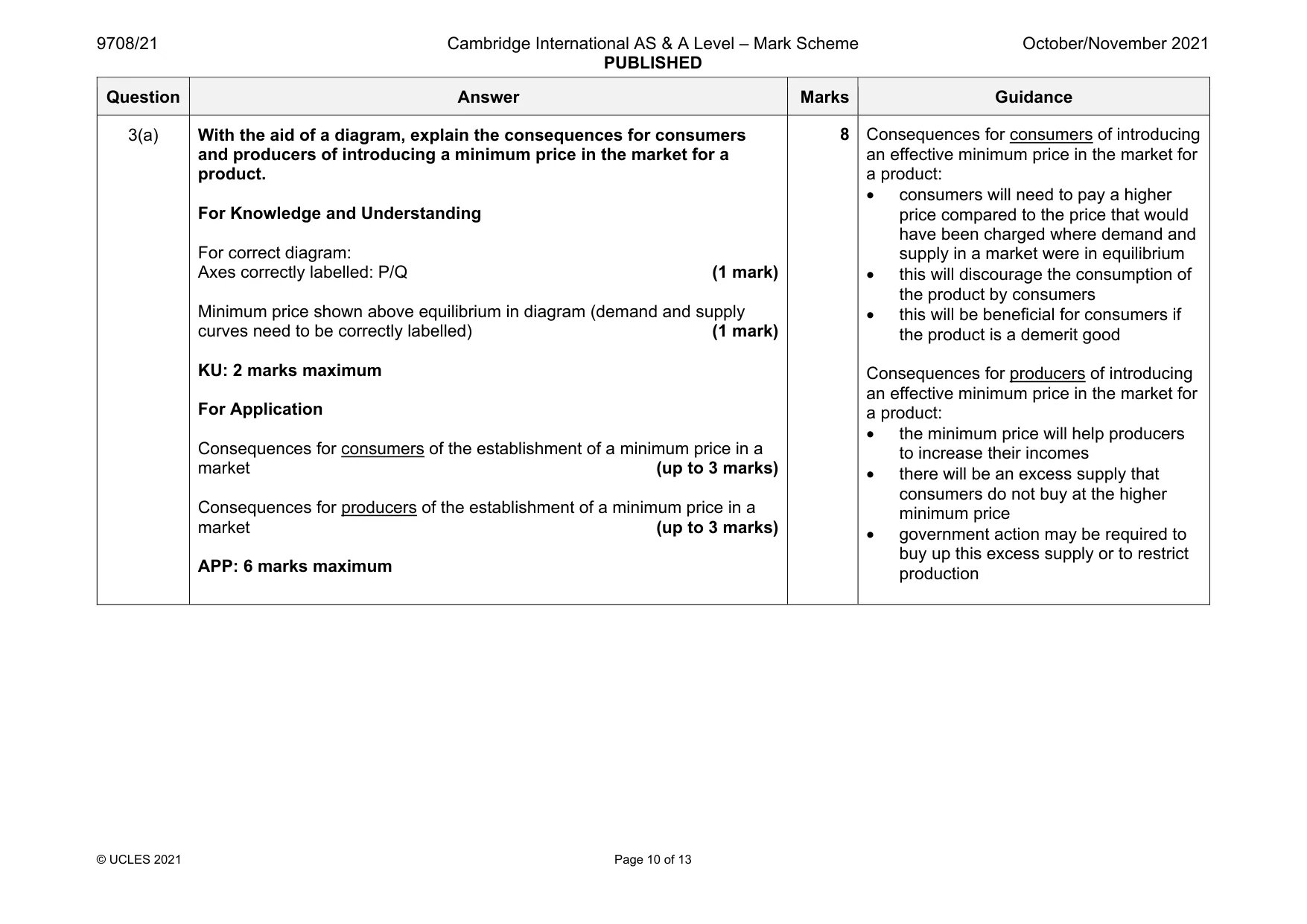
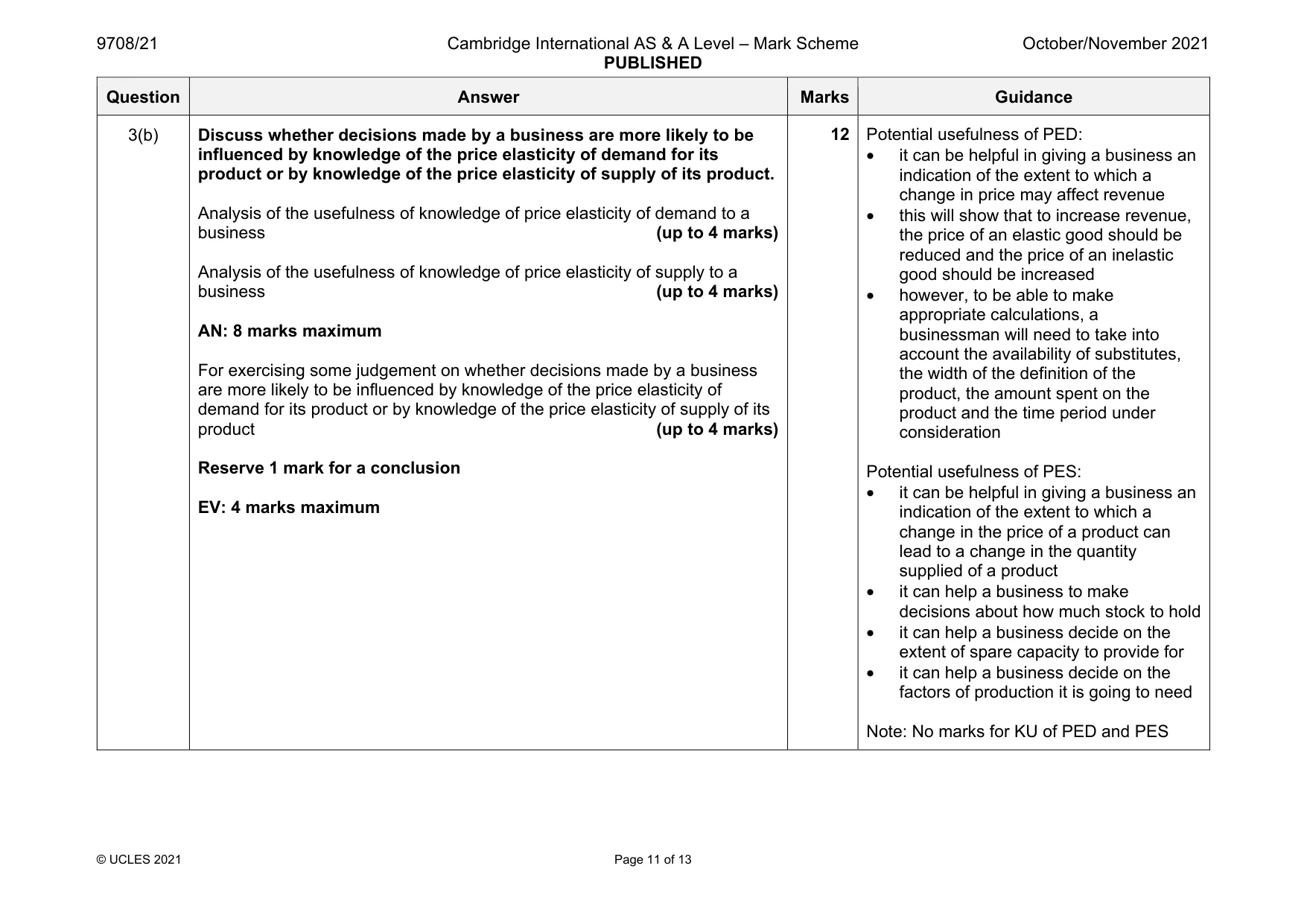
Mark scheme: 3(a) With the aid of a diagram, explain the consequences for consumers and producers of introducing a minimum price in the market for a product. For Knowledge and Understanding For correct diagram: Axes correctly labelled: P/Q (1 mark) Minimum price shown above equilibrium in diagram (demand and supply curves need to be correctly labelled) (1 mark) KU: 2 marks maximum For Application Consequences for consumers of the establishment of a minimum price in a market (up to 3 marks) Consequences for producers of the establishment of a minimum price in a market (up to 3 marks) APP: 6 marks maximum an effective minimum price in the market for a product: • consumers will need to pay a higher price compared to the price that would have been charged where demand and supply in a market were in equilibrium • this will discourage the consumption of the product by consumers • this will be beneficial for consumers if the product is a demerit good Consequences for producers of introducing an effective minimum price in the market for a product: • the minimum price will help producers to increase their incomes • there will be an excess supply that consumers do not buy at the higher minimum price • government action may be required to buy up this excess supply or to restrict production Question Answer Marks Guidance 3(b) Discuss whether decisions made by a business are more likely to be influenced by knowledge of the price elasticity of demand for its product or by knowledge of the price elasticity of supply of its product. Analysis of the usefulness of knowledge of price elasticity of demand to a business (up to 4 marks) Analysis of the usefulness of knowledge of price elasticity of supply to a business (up to 4 marks) AN: 8 marks maximum For exercising some judgement on whether decisions made by a business are more likely to be influenced by knowledge of the price elasticity of demand for its product or by knowledge of the price elasticity of supply of its product (up to 4 marks) Reserve 1 mark for a conclusion EV: 4 marks maximum 12 Potential usefulness of PED: • it can be helpful in giving a business an indication of the extent to which a change in price may affect revenue • this will show that to increase revenue, the price of an elastic good should be reduced and the price of an inelastic good should be increased • however, to be able to make appropriate calculations, a businessman will need to take into account the availability of substitutes, the width of the definition of the product, the amount spent on the product and the time period under consideration Potential usefulness of PES: • it can be helpful in giving a business an indication of the extent to which a change in the price of a product can lead to a change in the quantity supplied of a product • it can help a business to make decisions about how much stock to hold • it can help a business decide on the extent of spare capacity to provide for • it can help a business decide on the factors of production it is going to need Note: No marks for KU of PED and PES
More questions on Price elasticity, income elasticity and cross elasticity of demand
Q4 · With the aid of a diagram, explain how a central bank intervenes to maintain a fixed…
4 (a) With the aid of a diagram, explain how a central bank intervenes to maintain a fixed exchange rate when the economy is experiencing a current account deficit on its balance of payments. [8] (b) Discuss whether expenditure-reducing policies are likely to reduce the current account deficit on the balance of payments for an economy with a floating exchange rate. [12]
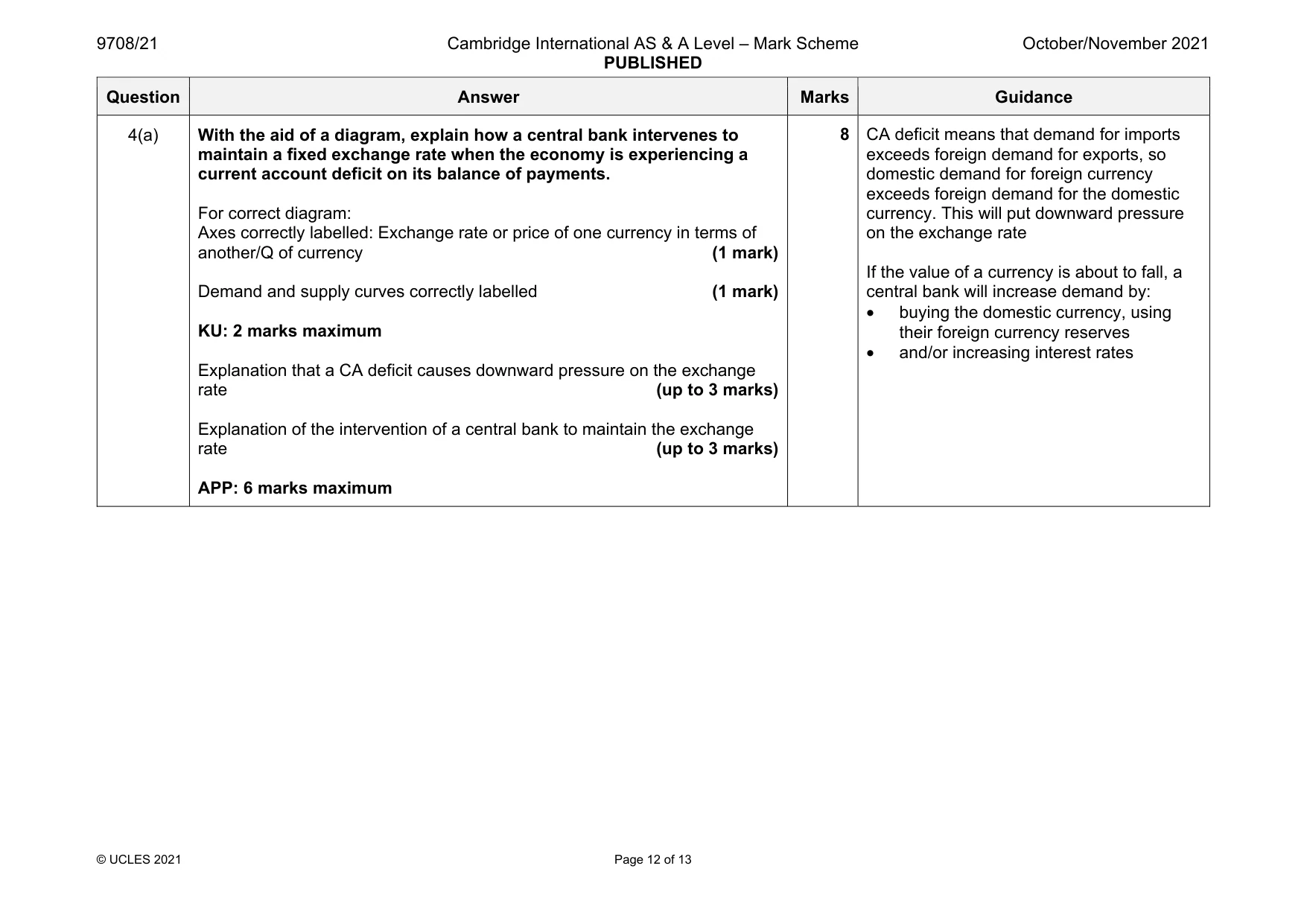
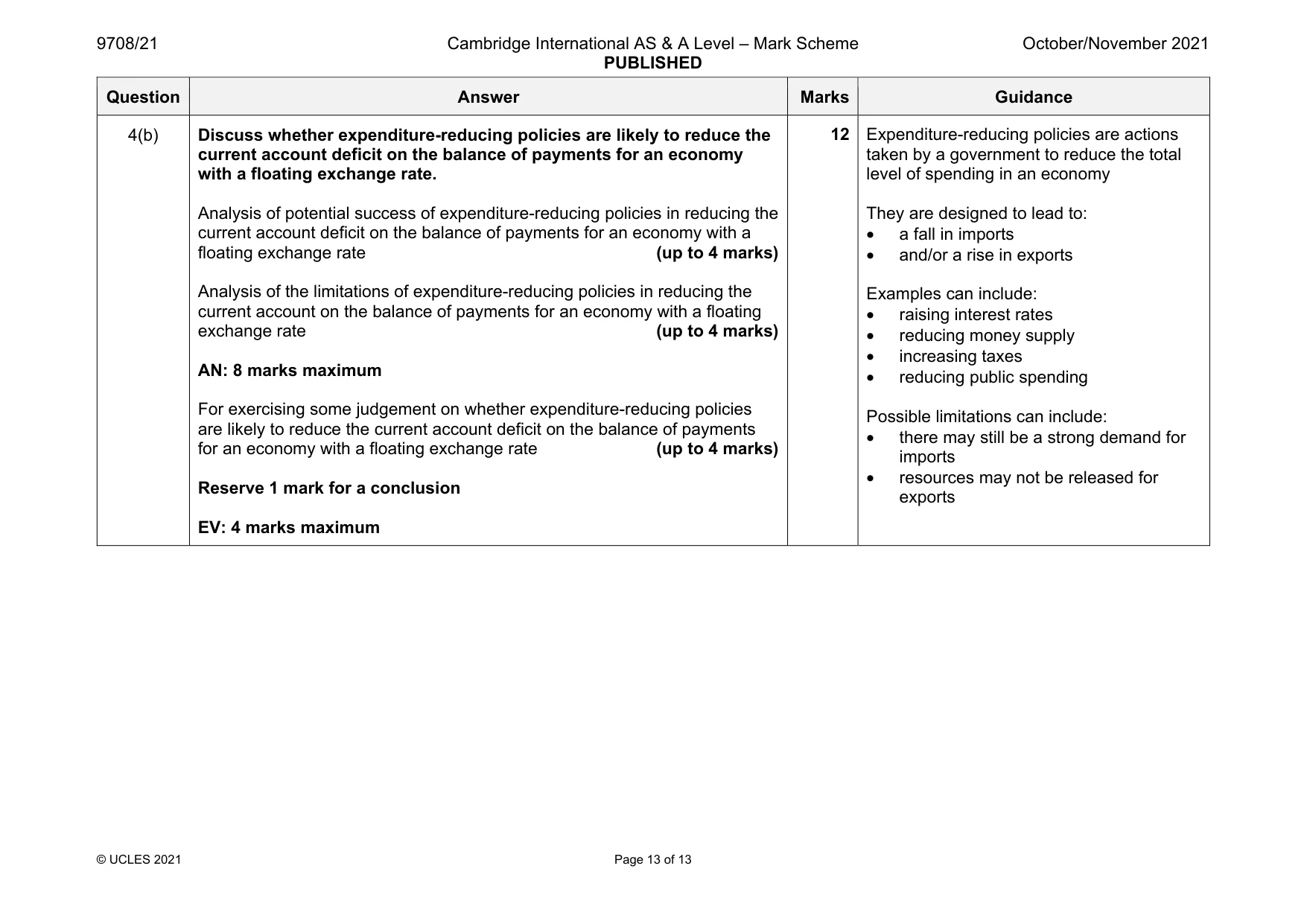
Mark scheme: 4(a) With the aid of a diagram, explain how a central bank intervenes to maintain a fixed exchange rate when the economy is experiencing a current account deficit on its balance of payments. For correct diagram: Axes correctly labelled: Exchange rate or price of one currency in terms of another/Q of currency (1 mark) Demand and supply curves correctly labelled (1 mark) KU: 2 marks maximum Explanation that a CA deficit causes downward pressure on the exchange rate (up to 3 marks) Explanation of the intervention of a central bank to maintain the exchange rate (up to 3 marks) APP: 6 marks maximum exceeds foreign demand for exports, so domestic demand for foreign currency exceeds foreign demand for the domestic currency. This will put downward pressure on the exchange rate If the value of a currency is about to fall, a central bank will increase demand by: • buying the domestic currency, using their foreign currency reserves • and/or increasing interest rates Question Answer Marks Guidance 4(b) Discuss whether expenditure-reducing policies are likely to reduce the current account deficit on the balance of payments for an economy with a floating exchange rate. Analysis of potential success of expenditure-reducing policies in reducing the current account deficit on the balance of payments for an economy with a floating exchange rate (up to 4 marks) Analysis of the limitations of expenditure-reducing policies in reducing the current account on the balance of payments for an economy with a floating exchange rate (up to 4 marks) AN: 8 marks maximum For exercising some judgement on whether expenditure-reducing policies are likely to reduce the current account deficit on the balance of payments for an economy with a floating exchange rate (up to 4 marks) Reserve 1 mark for a conclusion EV: 4 marks maximum 12 Expenditure-reducing policies are actions taken by a government to reduce the total level of spending in an economy They are designed to lead to: • a fall in imports • and/or a rise in exports Examples can include: • raising interest rates • reducing money supply • increasing taxes • reducing public spending Possible limitations can include: • there may still be a strong demand for imports • resources may not be released for exports
More questions on Policies to correct imbalances in the current account of the balance of payments
What was in this paper
The subtopics covered by these 4 questions, and how many questions each got. Open one in a new tab to see every Cambridge question on it.
What you needed in this session
Cambridge’s own grade thresholds for 2021 Oct/Nov, Paper 2 · Variant 1. A higher threshold means an easier paper — the bar moves with how the cohort did.