Cambridge A Level Economics 9708 — 2020 Oct/Nov Paper 2 · Variant 2
9708/22/O/N/20 · 4 questions · 40 marks · ≈45 min
The question paper and its mark scheme, free to read here and free to download. This is Cambridge’s own paper, exactly as it was sat.
Question paper4 pages
Mark scheme14 pages
Answers below. Sit the paper first if you are practising.
Questions as text
Q1 · Ice cream producers struggle with record vanilla prices 600 500 400 US$ per kg 300 200…
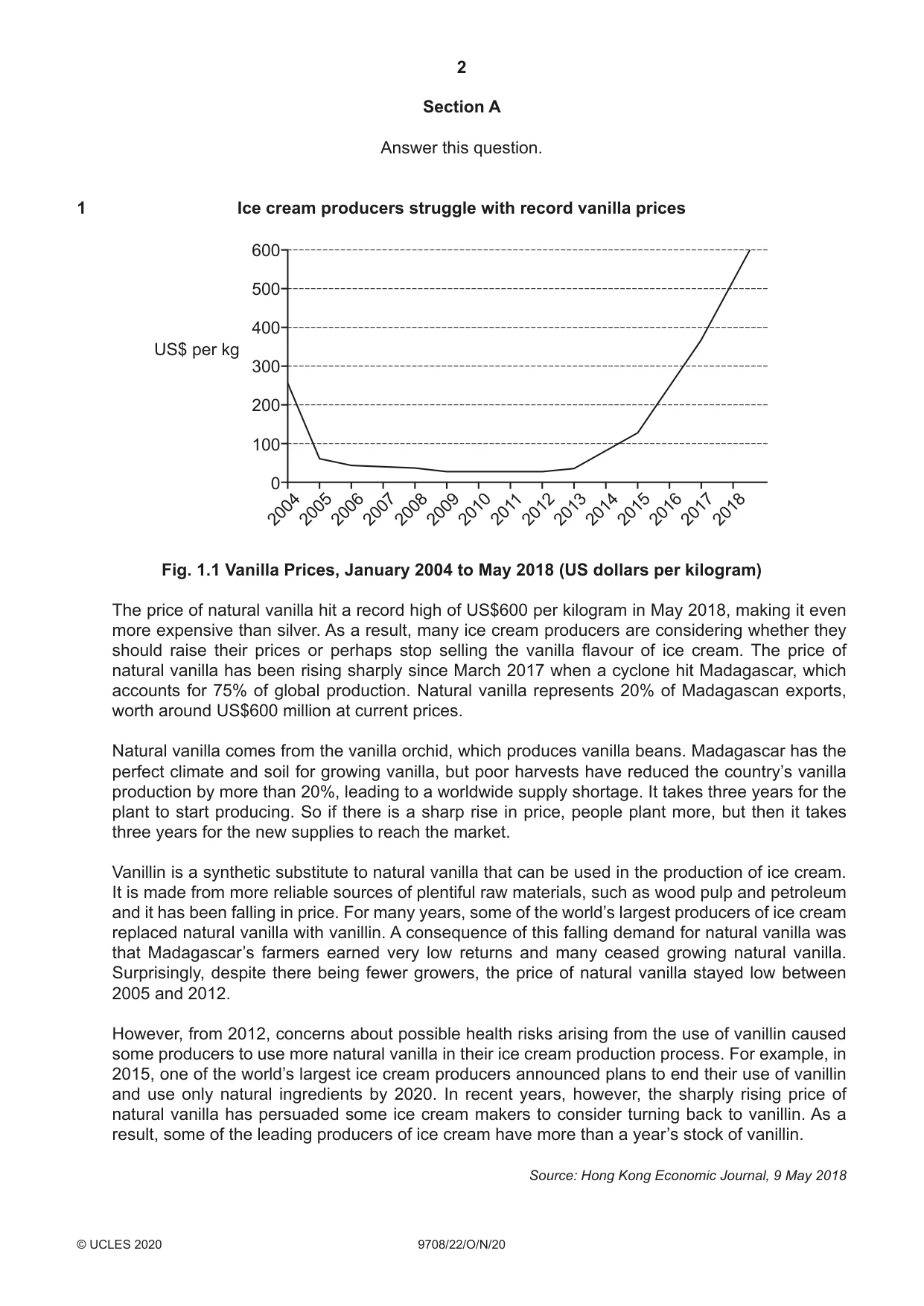
1 Ice cream producers struggle with record vanilla prices 600 500 400 US$ per kg 300 200 100 0 200420052006200720082009201020112012201320142015201620172018 Fig. 1.1 Vanilla Prices, January 2004 to May 2018 (US dollars per kilogram) The price of natural vanilla hit a record high of US$600 per kilogram in May 2018, making it even more expensive than silver. As a result, many ice cream producers are considering whether they should raise their prices or perhaps stop selling the vanilla flavour of ice cream. The price of natural vanilla has been rising sharply since March 2017 when a cyclone hit Madagascar, which accounts for 75% of global production. Natural vanilla represents 20% of Madagascan exports, worth around US$600 million at current prices. Natural vanilla comes from the vanilla orchid, which produces vanilla beans. Madagascar has the perfect climate and soil for growing vanilla, but poor harvests have reduced the country’s vanilla production by more than 20%, leading to a worldwide supply shortage. It takes three years for the plant to start producing. So if there is a sharp rise in price, people plant more, but then it takes three years for the new supplies to reach the market. Vanillin is a synthetic substitute to natural vanilla that can be used in the production of ice cream. It is made from more reliable sources of plentiful raw materials, such as wood pulp and petroleum and it has been falling in price. For many years, some of the world’s largest producers of ice cream replaced natural vanilla with vanillin. A consequence of this falling demand for natural vanilla was that Madagascar’s farmers earned very low returns and many ceased growing natural vanilla. Surprisingly, despite there being fewer growers, the price of natural vanilla stayed low between 2005 and 2012. However, from 2012, concerns about possible health risks arising from the use of vanillin caused some producers to use more natural vanilla in their ice cream production process. For example, in 2015, one of the world’s largest ice cream producers announced plans to end their use of vanillin and use only natural ingredients by 2020. In recent years, however, the sharply rising price of natural vanilla has persuaded some ice cream makers to consider turning back to vanillin. As a result, some of the leading producers of ice cream have more than a year’s stock of vanillin. Source: Hong Kong Economic Journal, 9 May 2018 (a) With reference to the extract and Fig. 1.1, use supply and demand diagrams to explain the change in the price of natural vanilla (i) from 2004 to 2009 [3] (ii) from 2015 to 2018. [3] (b) Ice cream producers can use natural vanilla or vanillin to produce ice cream. (i) State the concept that an economist would use to measure the responsiveness of the demand for natural vanilla to a change in the price of vanillin. [1] (ii) Explain the value that you would expect for this measurement. [3] (c) Explain why the price elasticity of supply of ice cream made with vanillin is likely to be relatively more elastic than the price elasticity of supply of ice cream made with natural vanilla. [4] (d) Discuss whether the recent rise in the price of vanilla is on balance likely to have a positive or negative impact upon Madagascar’s economy. [6]
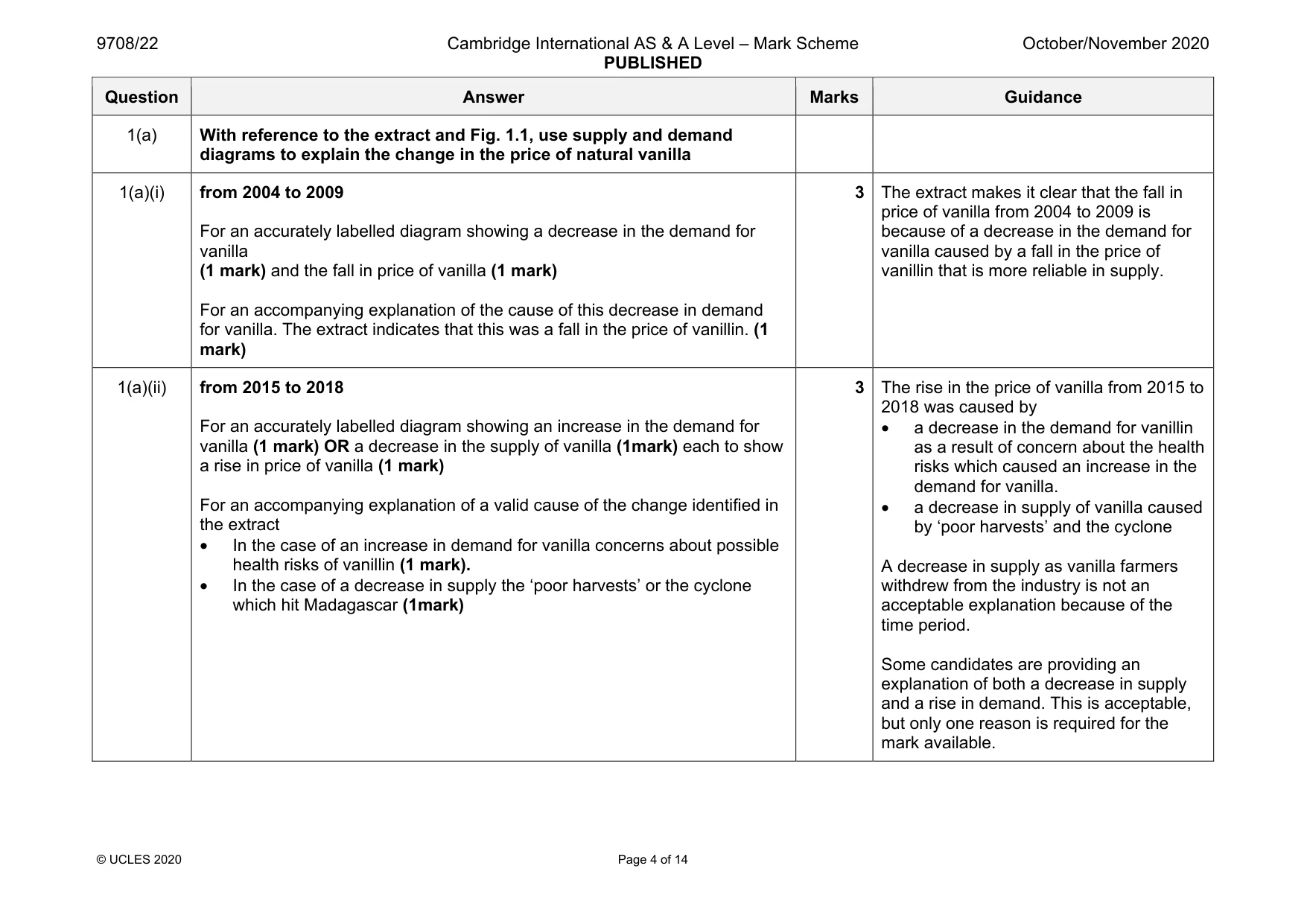
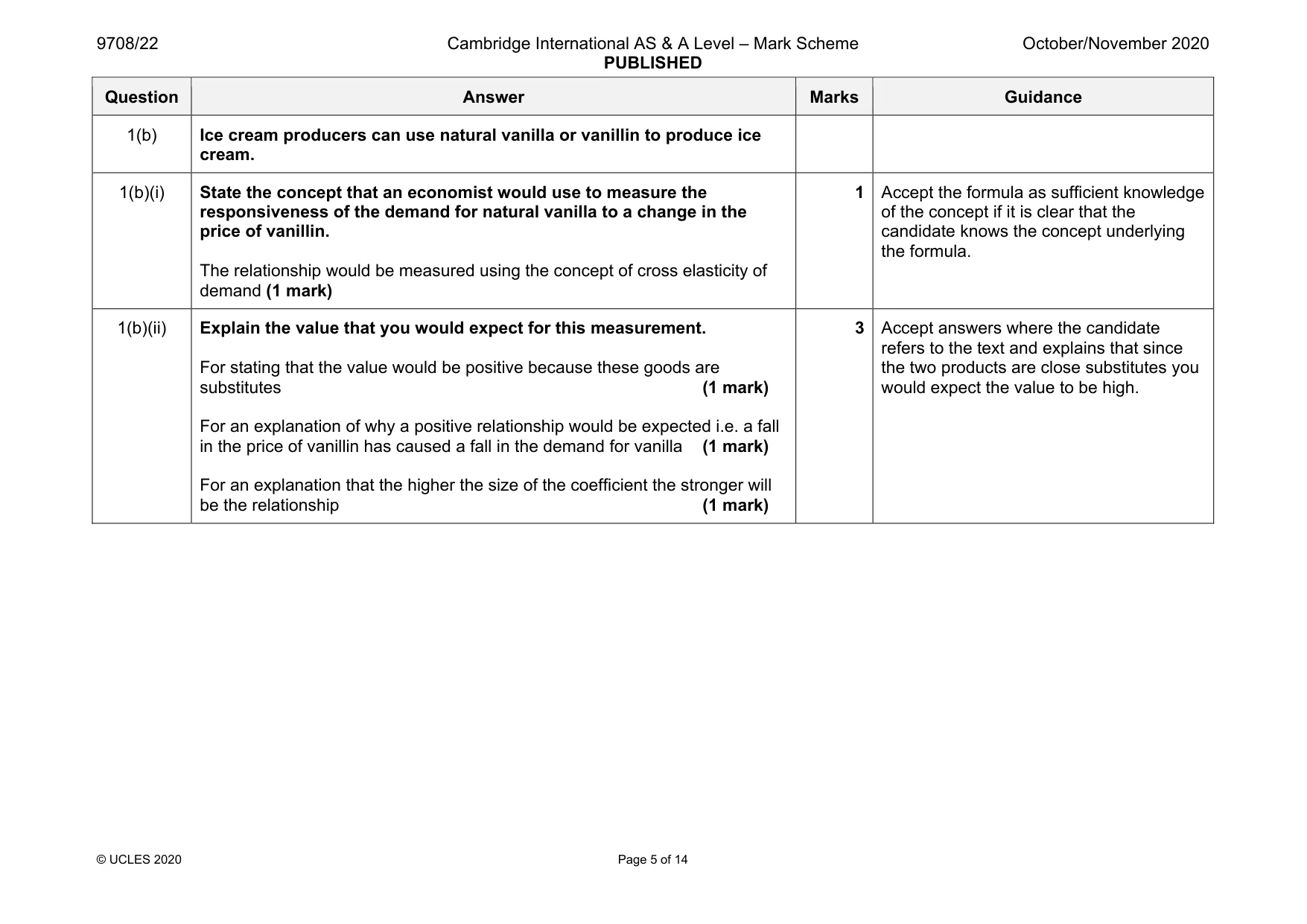
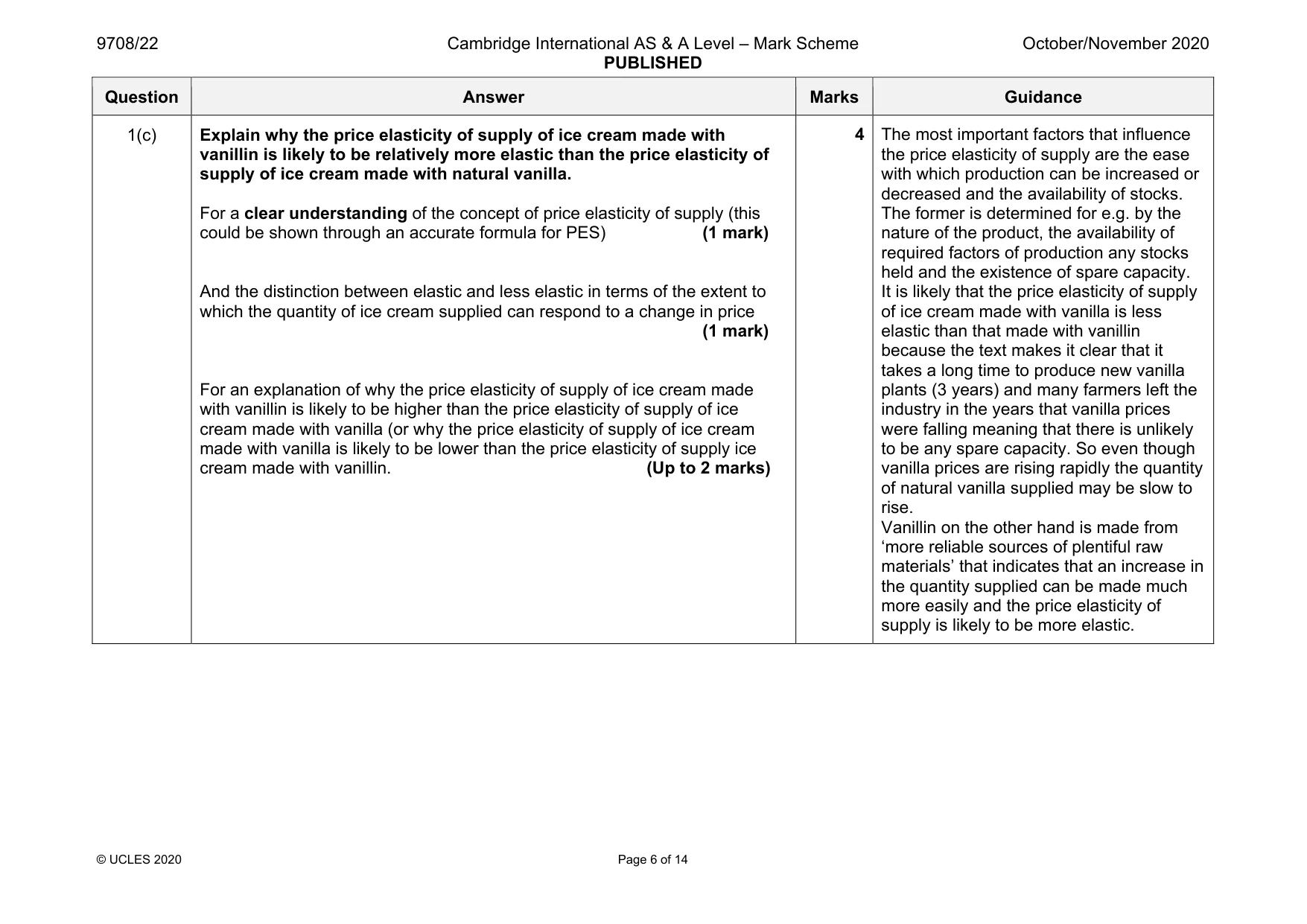
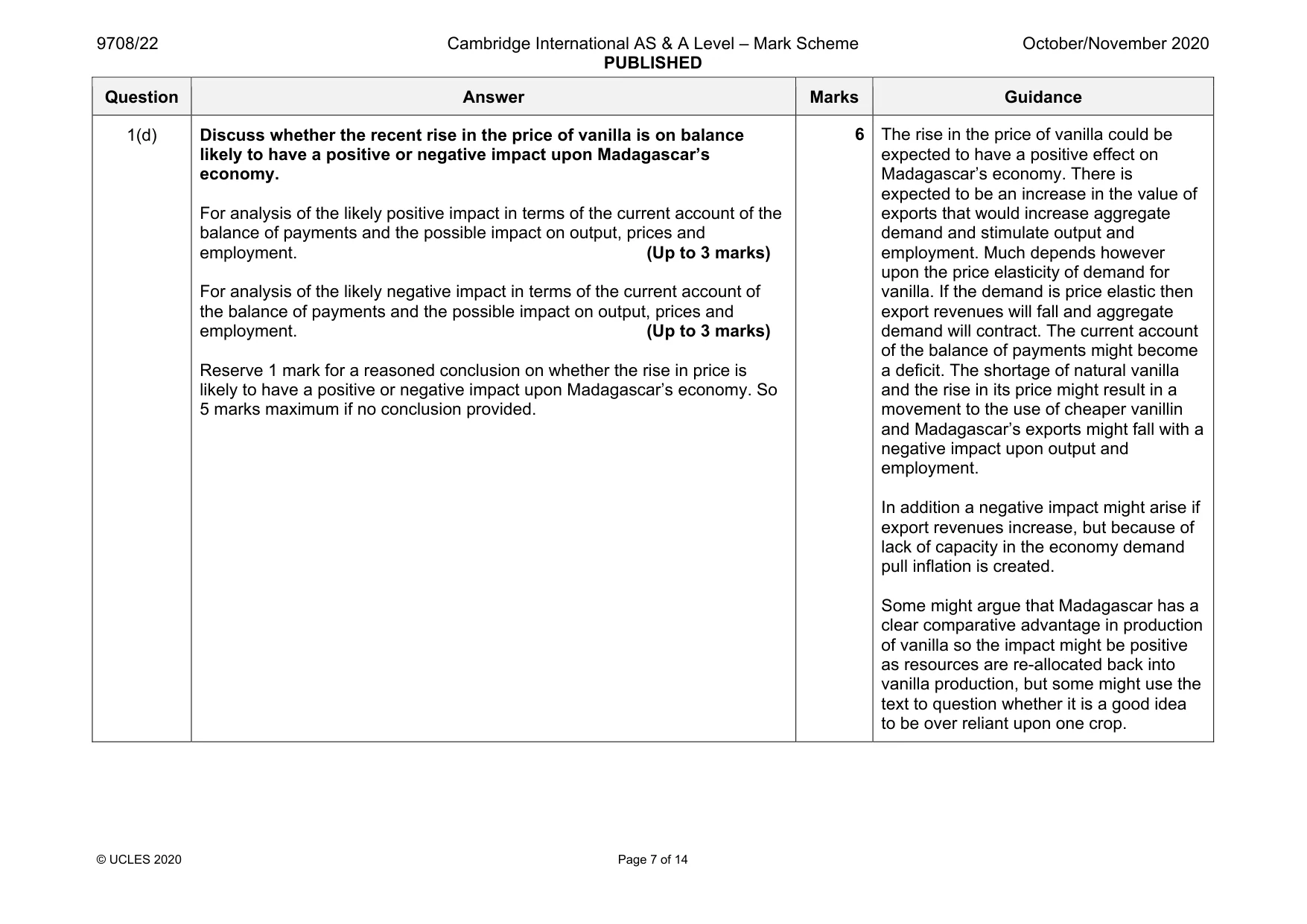
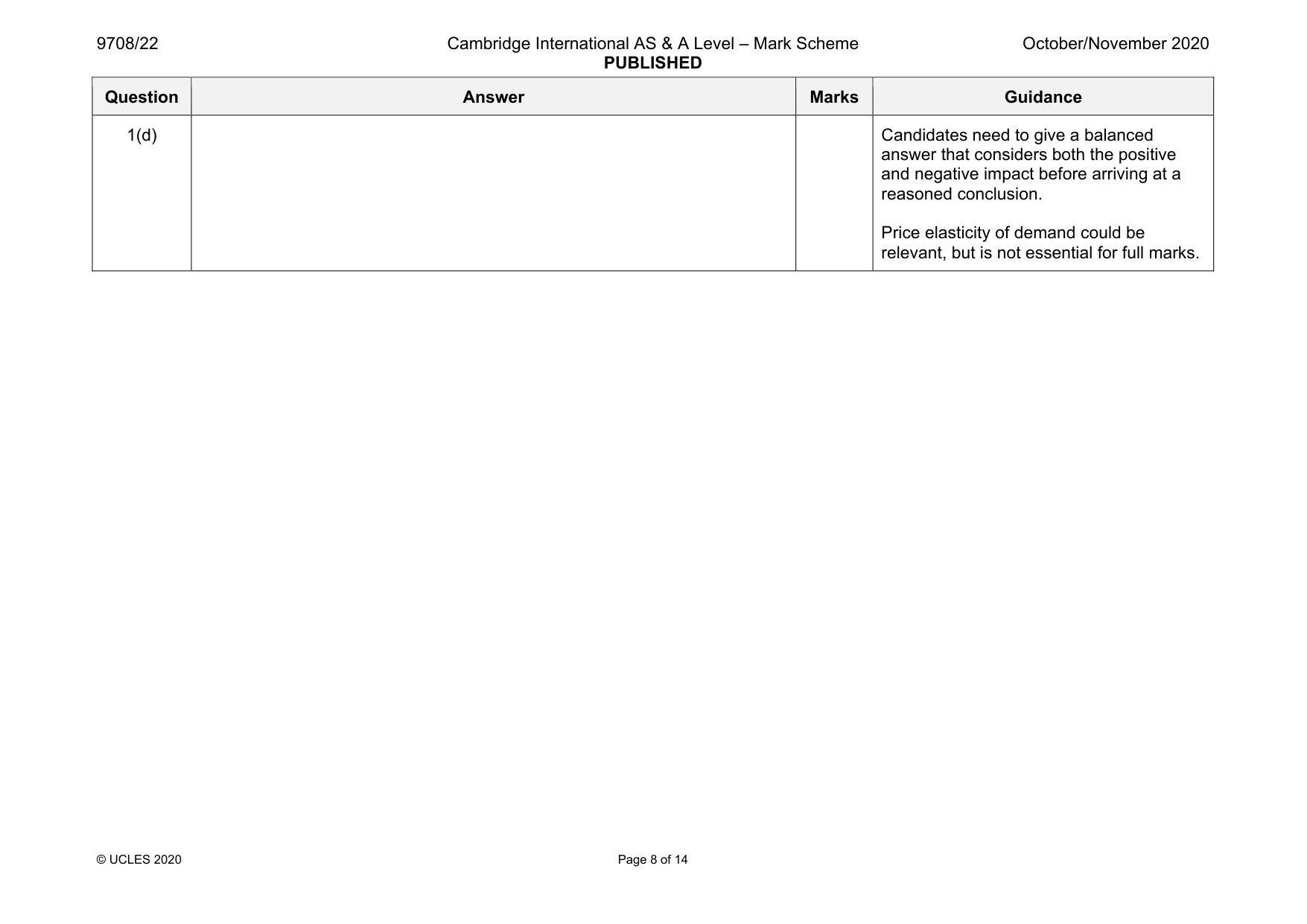
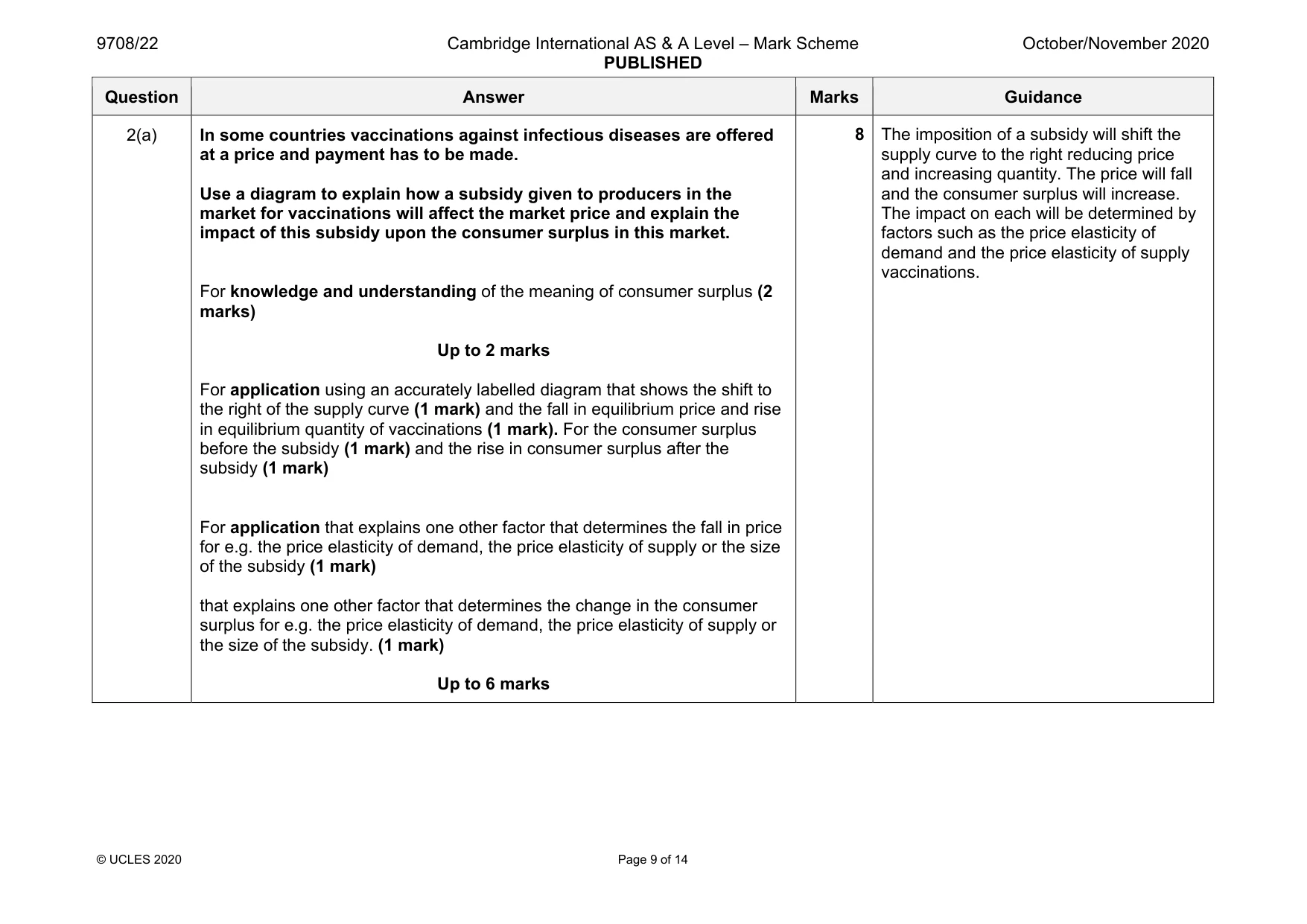
Mark scheme: 1(a) With reference to the extract and Fig. 1.1, use supply and demand diagrams to explain the change in the price of natural vanilla 1(a)(i) from 2004 to 2009 For an accurately labelled diagram showing a decrease in the demand for vanilla (1 mark) and the fall in price of vanilla (1 mark) For an accompanying explanation of the cause of this decrease in demand for vanilla. The extract indicates that this was a fall in the price of vanillin. (1 mark) 3 The extract makes it clear that the fall in price of vanilla from 2004 to 2009 is because of a decrease in the demand for vanilla caused by a fall in the price of vanillin that is more reliable in supply. 1(a)(ii) from 2015 to 2018 For an accurately labelled diagram showing an increase in the demand for vanilla (1 mark) OR a decrease in the supply of vanilla (1mark) each to show a rise in price of vanilla (1 mark) For an accompanying explanation of a valid cause of the change identified in the extract • In the case of an increase in demand for vanilla concerns about possible health risks of vanillin (1 mark). • In the case of a decrease in supply the ‘poor harvests’ or the cyclone which hit Madagascar (1mark) 3 The rise in the price of vanilla from 2015 to 2018 was caused by • a decrease in the demand for vanillin as a result of concern about the health risks which caused an increase in the demand for vanilla. • a decrease in supply of vanilla caused by ‘poor harvests’ and the cyclone A decrease in supply as vanilla farmers withdrew from the industry is not an acceptable explanation because of the time period. Some candidates are providing an explanation of both a decrease in supply and a rise in demand. This is acceptable, but only one reason is required for the mark available. Question Answer Marks Guidance 1(b) Ice cream producers can use natural vanilla or vanillin to produce ice cream. 1(b)(i) State the concept that an economist would use to measure the responsiveness of the demand for natural vanilla to a change in the price of vanillin. The relationship would be measured using the concept of cross elasticity of demand (1 mark) 1 Accept the formula as sufficient knowledge of the concept if it is clear that the candidate knows the concept underlying the formula. 1(b)(ii) Explain the value that you would expect for this measurement. For stating that the value would be positive because these goods are substitutes (1 mark) For an explanation of why a positive relationship would be expected i.e. a fall in the price of vanillin has caused a fall in the demand for vanilla (1 mark) For an explanation that the higher the size of the coefficient the stronger will be the relationship (1 mark) 3 Accept answers where the candidate refers to the text and explains that since the two products are close substitutes you would expect the value to be high. Question Answer Marks Guidance 1(c) Explain why the price elasticity of supply of ice cream made with vanillin is likely to be relatively more elastic than the price elasticity of supply of ice cream made with natural vanilla. For a clear understanding of the concept of price elasticity of supply (this could be shown through an accurate formula for PES) (1 mark) And the distinction between elastic and less elastic in terms of the extent to which the quantity of ice cream supplied can respond to a change in price (1 mark) For an explanation of why the price elasticity of supply of ice cream made with vanillin is likely to be higher than the price elasticity of supply of ice cream made with vanilla (or why the price elasticity of supply of ice cream made with vanilla is likely to be lower than the price elasticity of supply ice cream made with vanillin. (Up to 2 marks) 4 The most important factors that influence the price elasticity of supply are the ease with which production can be increased or decreased and the availability of stocks. The former is determined for e.g. by the nature of the product, the availability of required factors of production any stocks held and the existence of spare capacity. It is likely that the price elasticity of supply of ice cream made with vanilla is less elastic than that made with vanillin because the text makes it clear that it takes a long time to produce new vanilla plants (3 years) and many farmers left the industry in the years that vanilla prices were falling meaning that there is unlikely to be any spare capacity. So even though vanilla prices are rising rapidly the quantity of natural vanilla supplied may be slow to rise. Vanillin on the other hand is made from ‘more reliable sources of plentiful raw materials’ that indicates that an increase in the quantity supplied can be made much more easily and the price elasticity of supply is likely to be more elastic. Question Answer Marks Guidance 1(d) Discuss whether the recent rise in the price of vanilla is on balance likely to have a positive or negative impact upon Madagascar’s economy. For analysis of the likely positive impact in terms of the current account of the balance of payments and the possible impact on output, prices and employment. (Up to 3 marks) For analysis of the likely negative impact in terms of the current account of the balance of payments and the possible impact on output, prices and employment. (Up to 3 marks) Reserve 1 mark for a reasoned conclusion on whether the rise in price is likely to have a positive or negative impact upon Madagascar’s economy. So 5 marks maximum if no conclusion provided. 6 The rise in the price of vanilla could be expected to have a positive effect on Madagascar’s economy. There is expected to be an increase in the value of exports that would increase aggregate demand and stimulate output and employment. Much depends however upon the price elasticity of demand for vanilla. If the demand is price elastic then export revenues will fall and aggregate demand will contract. The current account of the balance of payments might become a deficit. The shortage of natural vanilla and the rise in its price might result in a movement to the use of cheaper vanillin and Madagascar’s exports might fall with a negative impact upon output and employment. In addition a negative impact might arise if export revenues increase, but because of lack of capacity in the economy demand pull inflation is created. Some might argue that Madagascar has a clear comparative advantage in production of vanilla so the impact might be positive as resources are re-allocated back into vanilla production, but some might use the text to question whether it is a good idea to be over reliant upon one crop. Question Answer Marks Guidance 1(d) Candidates need to give a balanced answer that considers both the positive and negative impact before arriving at a reasoned conclusion. Price elasticity of demand could be relevant, but is not essential for full marks.
Q2 · In some countries vaccinations against infectious diseases are offered at a price and…
2 In some countries vaccinations against infectious diseases are offered at a price and payment has to be made. (a) Use a diagram to explain how a subsidy given to producers in the market for vaccinations will affect the market price and explain the impact of this subsidy upon the consumer surplus in this market. [8] (b) If the cost of the subsidy is to be paid from tax revenues, discuss whether the revenue should be raised through direct taxes or indirect taxes. [12]
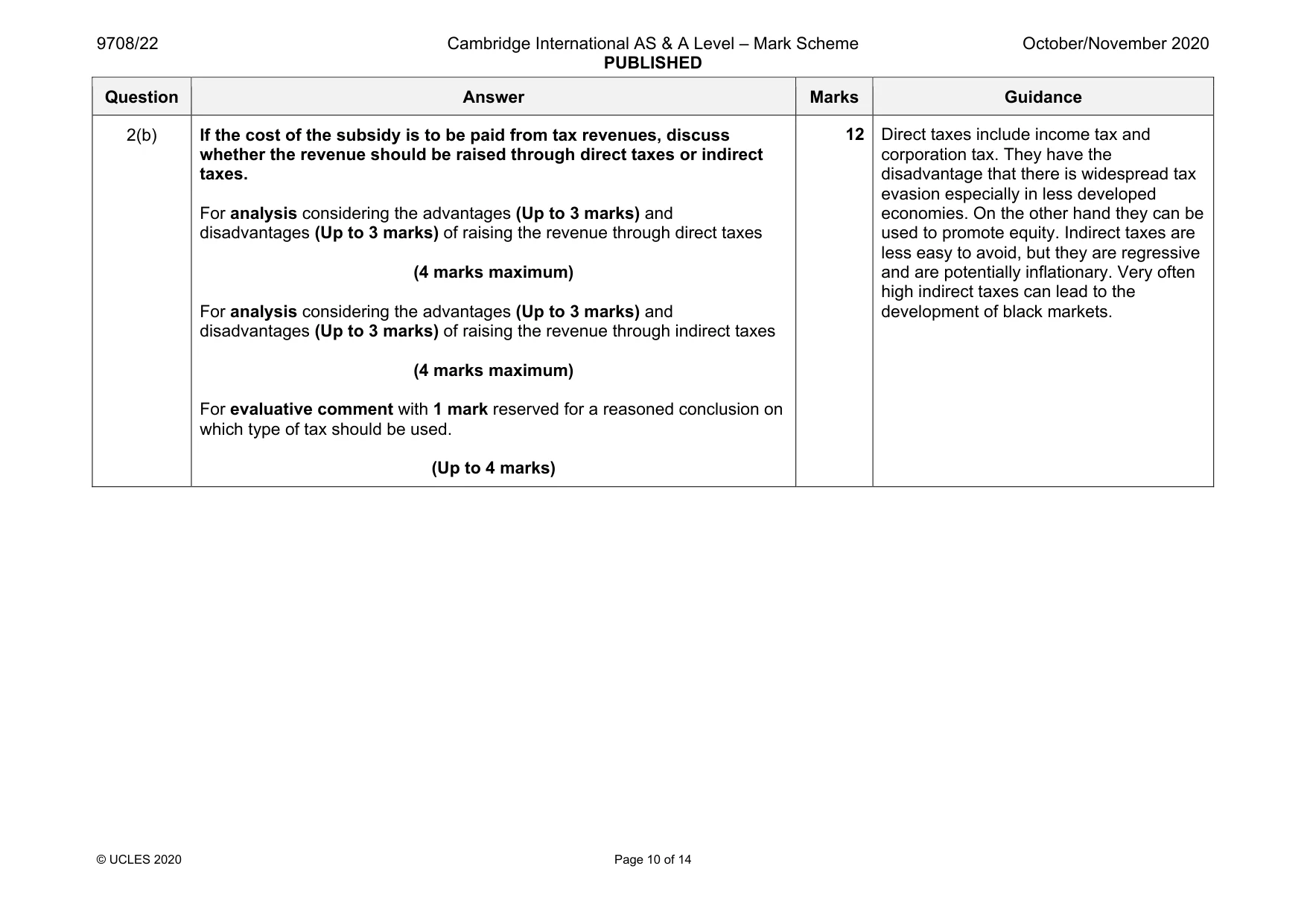
Mark scheme: 2(a) In some countries vaccinations against infectious diseases are offered at a price and payment has to be made. Use a diagram to explain how a subsidy given to producers in the market for vaccinations will affect the market price and explain the impact of this subsidy upon the consumer surplus in this market. For knowledge and understanding of the meaning of consumer surplus (2 marks) Up to 2 marks For application using an accurately labelled diagram that shows the shift to the right of the supply curve (1 mark) and the fall in equilibrium price and rise in equilibrium quantity of vaccinations (1 mark). For the consumer surplus before the subsidy (1 mark) and the rise in consumer surplus after the subsidy (1 mark) For application that explains one other factor that determines the fall in price for e.g. the price elasticity of demand, the price elasticity of supply or the size of the subsidy (1 mark) that explains one other factor that determines the change in the consumer surplus for e.g. the price elasticity of demand, the price elasticity of supply or the size of the subsidy. (1 mark) Up to 6 marks supply curve to the right reducing price and increasing quantity. The price will fall and the consumer surplus will increase. The impact on each will be determined by factors such as the price elasticity of demand and the price elasticity of supply vaccinations. Question Answer Marks Guidance 2(b) If the cost of the subsidy is to be paid from tax revenues, discuss whether the revenue should be raised through direct taxes or indirect taxes. For analysis considering the advantages (Up to 3 marks) and disadvantages (Up to 3 marks) of raising the revenue through direct taxes (4 marks maximum) For analysis considering the advantages (Up to 3 marks) and disadvantages (Up to 3 marks) of raising the revenue through indirect taxes (4 marks maximum) For evaluative comment with 1 mark reserved for a reasoned conclusion on which type of tax should be used. (Up to 4 marks) 12 Direct taxes include income tax and corporation tax. They have the disadvantage that there is widespread tax evasion especially in less developed economies. On the other hand they can be used to promote equity. Indirect taxes are less easy to avoid, but they are regressive and are potentially inflationary. Very often high indirect taxes can lead to the development of black markets.
More questions on Equity and redistribution of income and wealth
Q3 · Explain how the factor of production enterprise contributes to aggregate supply in a…
3 (a) Explain how the factor of production enterprise contributes to aggregate supply in a modern economy and how it differs from the other factors of production in terms of the reward for its services. [8] (b) Explain how aggregate demand is likely to be affected by an increase in the money supply and consider whether the impact of such an increase will be on employment or on the general price level. [12]
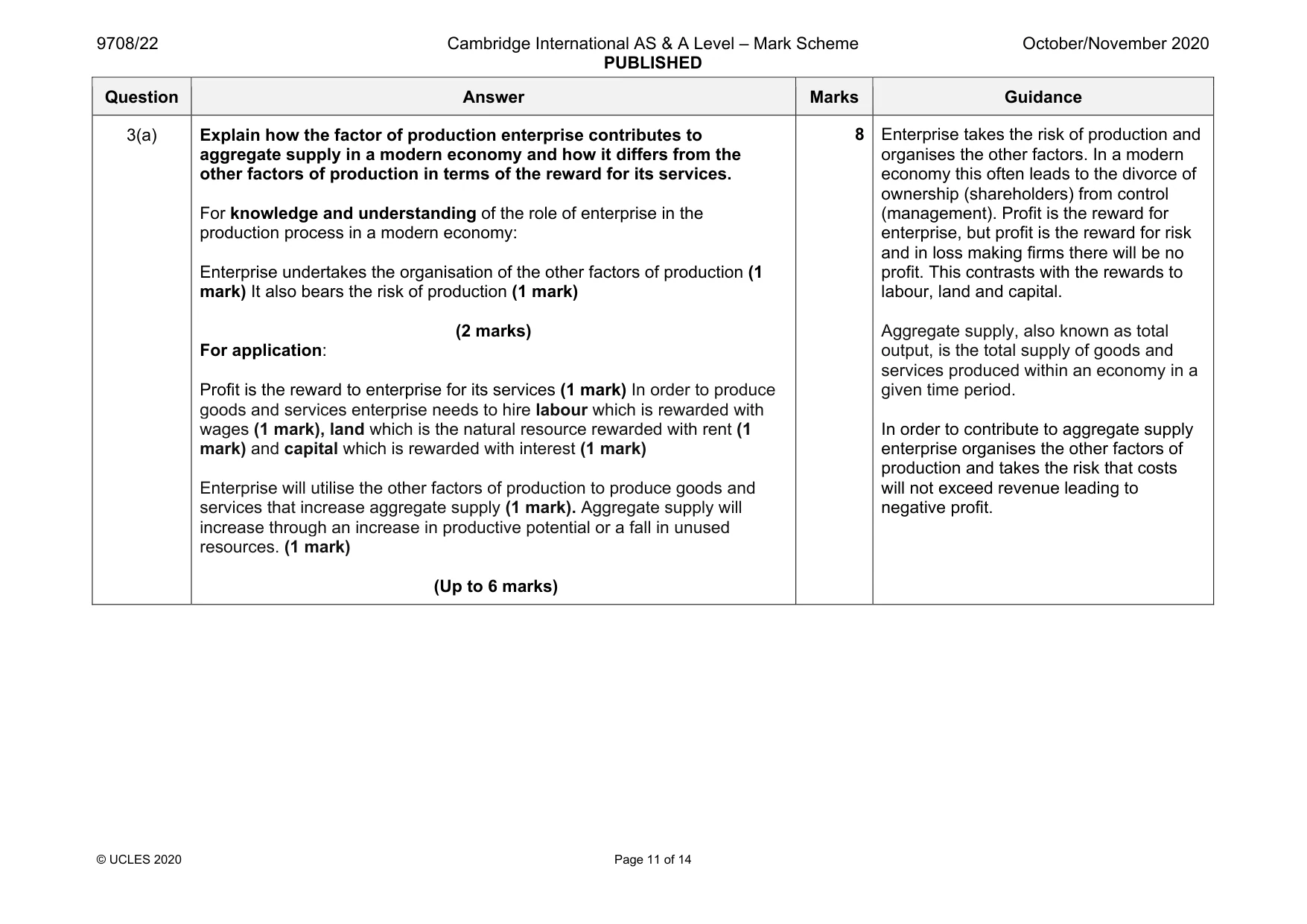
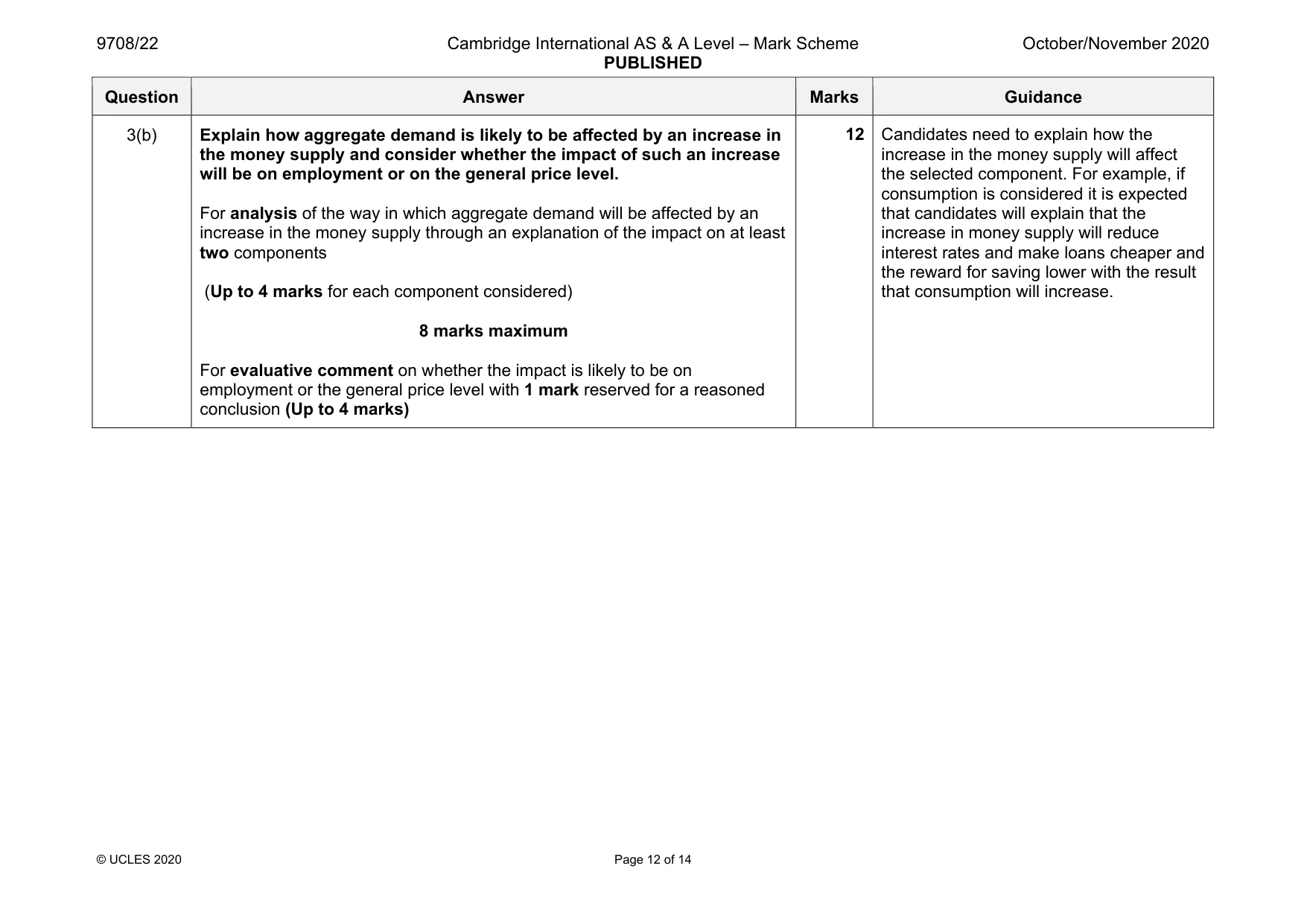
Mark scheme: 3(a) Explain how the factor of production enterprise contributes to aggregate supply in a modern economy and how it differs from the other factors of production in terms of the reward for its services. For knowledge and understanding of the role of enterprise in the production process in a modern economy: Enterprise undertakes the organisation of the other factors of production (1 mark) It also bears the risk of production (1 mark) (2 marks) For application: Profit is the reward to enterprise for its services (1 mark) In order to produce goods and services enterprise needs to hire labour which is rewarded with wages (1 mark), land which is the natural resource rewarded with rent (1 mark) and capital which is rewarded with interest (1 mark) Enterprise will utilise the other factors of production to produce goods and services that increase aggregate supply (1 mark). Aggregate supply will increase through an increase in productive potential or a fall in unused resources. (1 mark) (Up to 6 marks) organises the other factors. In a modern economy this often leads to the divorce of ownership (shareholders) from control (management). Profit is the reward for enterprise, but profit is the reward for risk and in loss making firms there will be no profit. This contrasts with the rewards to labour, land and capital. Aggregate supply, also known as total output, is the total supply of goods and services produced within an economy in a given time period. In order to contribute to aggregate supply enterprise organises the other factors of production and takes the risk that costs will not exceed revenue leading to negative profit. Question Answer Marks Guidance 3(b) Explain how aggregate demand is likely to be affected by an increase in the money supply and consider whether the impact of such an increase will be on employment or on the general price level. For analysis of the way in which aggregate demand will be affected by an increase in the money supply through an explanation of the impact on at least two components (Up to 4 marks for each component considered) 8 marks maximum For evaluative comment on whether the impact is likely to be on employment or the general price level with 1 mark reserved for a reasoned conclusion (Up to 4 marks) 12 Candidates need to explain how the increase in the money supply will affect the selected component. For example, if consumption is considered it is expected that candidates will explain that the increase in money supply will reduce interest rates and make loans cheaper and the reward for saving lower with the result that consumption will increase.
Q4 · China’s terms of trade index fell from 102.1 in March 2018 to 99.7 in April 2018
4 China’s terms of trade index fell from 102.1 in March 2018 to 99.7 in April 2018. (a) State how the terms of trade are measured, and explain three possible causes of the fall in China’s terms of trade shown above. [8] (b) Discuss whether a rise in the terms of trade or a fall in the terms of trade is more likely to be of benefit for an economy. [12]
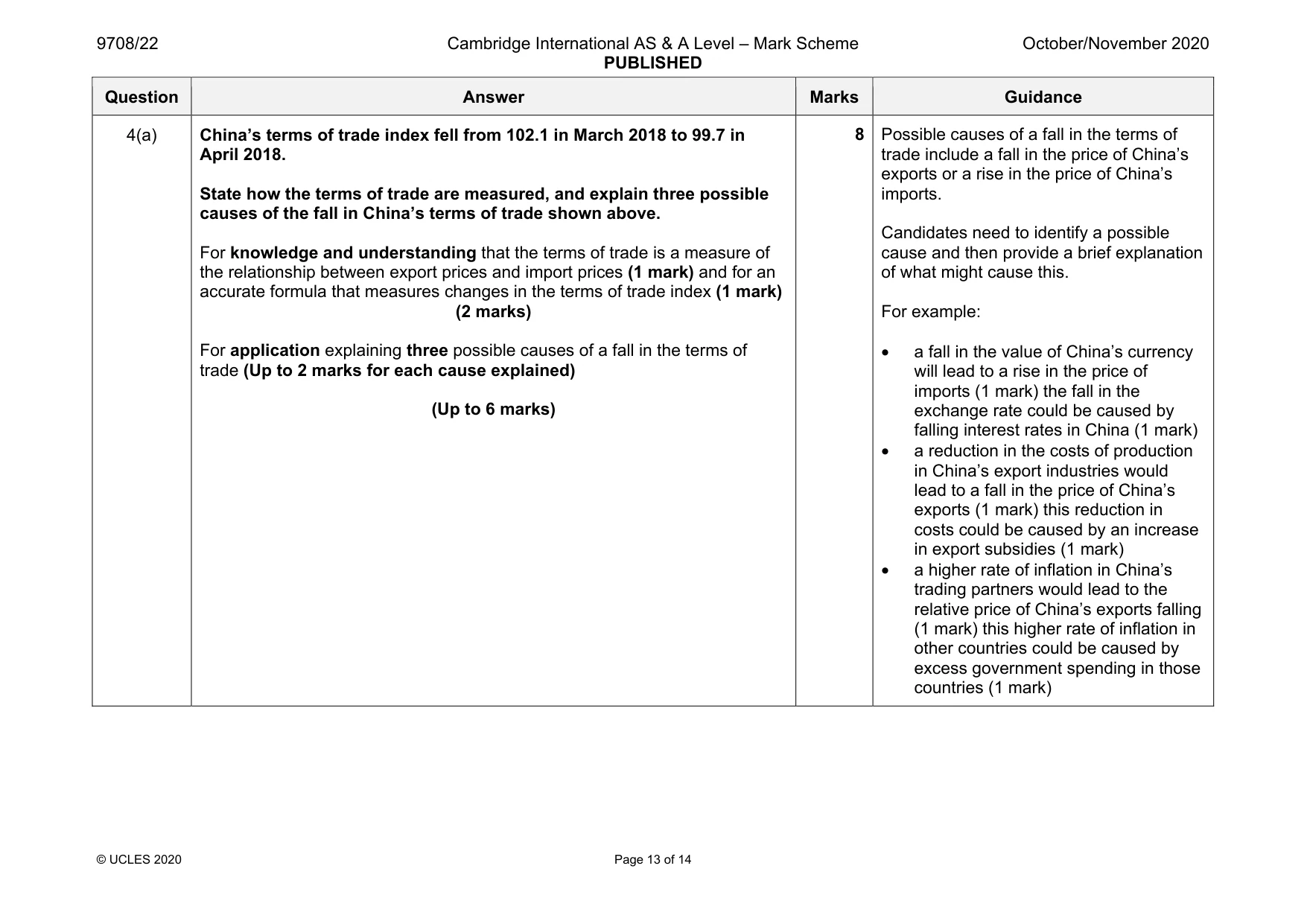
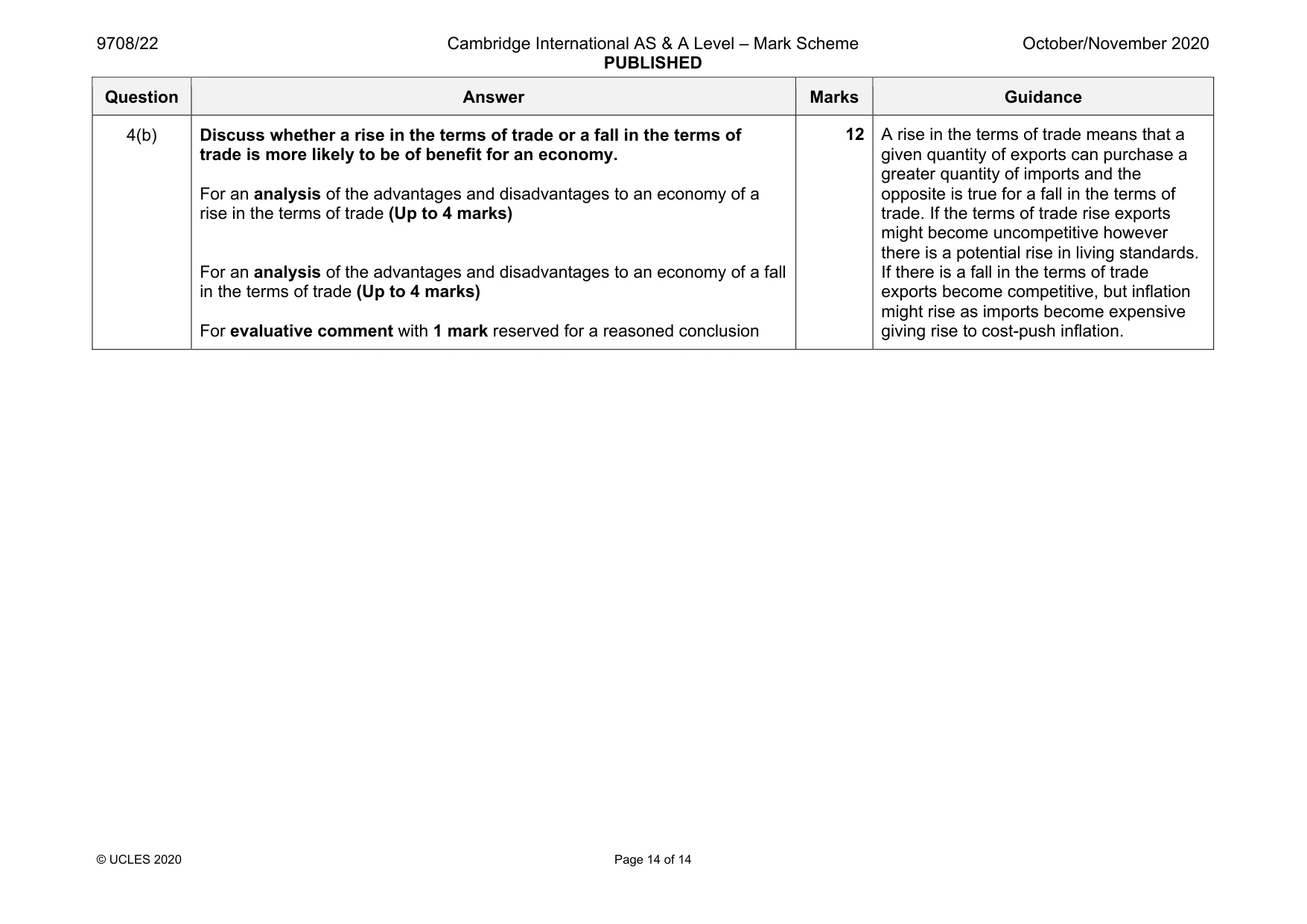
Mark scheme: 4(a) China’s terms of trade index fell from 102.1 in March 2018 to 99.7 in April 2018. State how the terms of trade are measured, and explain three possible causes of the fall in China’s terms of trade shown above. For knowledge and understanding that the terms of trade is a measure of the relationship between export prices and import prices (1 mark) and for an accurate formula that measures changes in the terms of trade index (1 mark) (2 marks) For application explaining three possible causes of a fall in the terms of trade (Up to 2 marks for each cause explained) (Up to 6 marks) trade include a fall in the price of China’s exports or a rise in the price of China’s imports. Candidates need to identify a possible cause and then provide a brief explanation of what might cause this. For example: • a fall in the value of China’s currency will lead to a rise in the price of imports (1 mark) the fall in the exchange rate could be caused by falling interest rates in China (1 mark) • a reduction in the costs of production in China’s export industries would lead to a fall in the price of China’s exports (1 mark) this reduction in costs could be caused by an increase in export subsidies (1 mark) • a higher rate of inflation in China’s trading partners would lead to the relative price of China’s exports falling (1 mark) this higher rate of inflation in other countries could be caused by excess government spending in those countries (1 mark) Question Answer Marks Guidance 4(b) Discuss whether a rise in the terms of trade or a fall in the terms of trade is more likely to be of benefit for an economy. For an analysis of the advantages and disadvantages to an economy of a rise in the terms of trade (Up to 4 marks) For an analysis of the advantages and disadvantages to an economy of a fall in the terms of trade (Up to 4 marks) For evaluative comment with 1 mark reserved for a reasoned conclusion 12 A rise in the terms of trade means that a given quantity of exports can purchase a greater quantity of imports and the opposite is true for a fall in the terms of trade. If the terms of trade rise exports might become uncompetitive however there is a potential rise in living standards. If there is a fall in the terms of trade exports become competitive, but inflation might rise as imports become expensive giving rise to cost-push inflation.
What was in this paper
The subtopics covered by these 4 questions, and how many questions each got. Open one in a new tab to see every Cambridge question on it.
What you needed in this session
Cambridge’s own grade thresholds for 2020 Oct/Nov, Paper 2 · Variant 2. A higher threshold means an easier paper — the bar moves with how the cohort did.