Cambridge A Level Economics 9708 — 2020 May/June Paper 2 · Variant 3
9708/23/M/J/20 · 4 questions · 80 marks · ≈90 min
The question paper and its mark scheme, free to read here and free to download. This is Cambridge’s own paper, exactly as it was sat.
Question paper4 pages
Mark scheme6 pages
Answers below. Sit the paper first if you are practising.
Questions as text
Q1 · The growing problem of plastic waste It has been estimated that, globally, consumers buy…
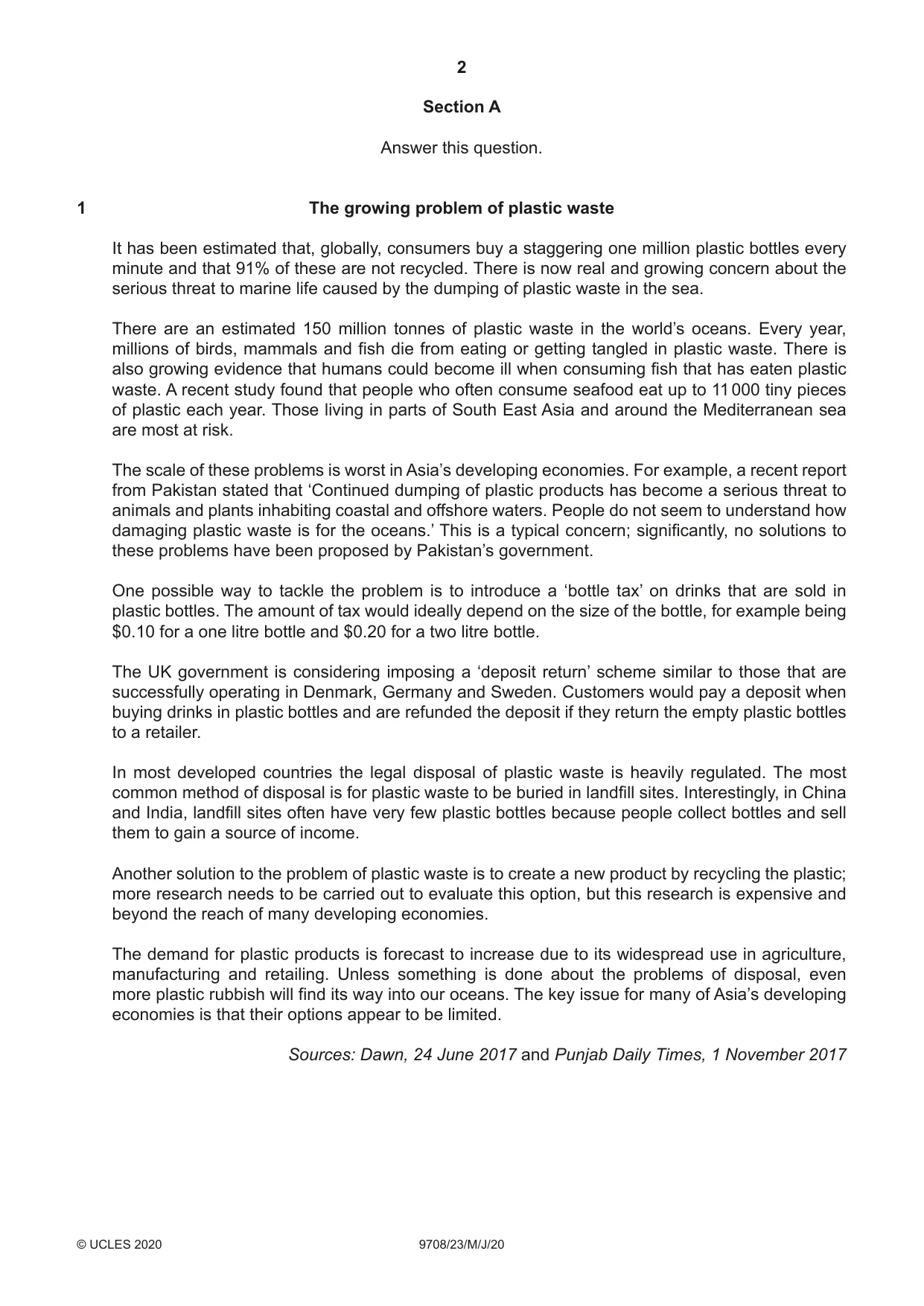
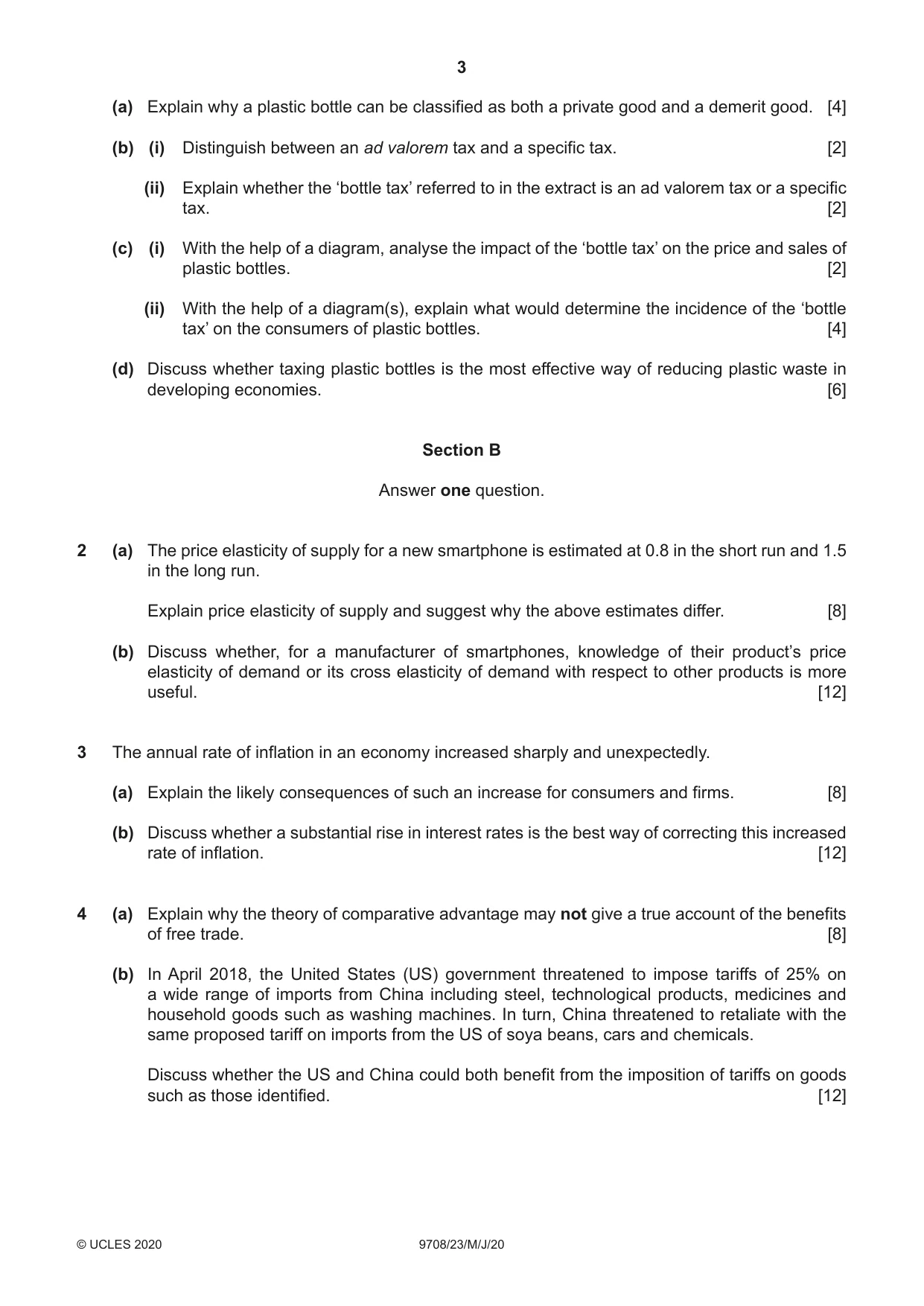
1 The growing problem of plastic waste It has been estimated that, globally, consumers buy a staggering one million plastic bottles every minute and that 91% of these are not recycled. There is now real and growing concern about the serious threat to marine life caused by the dumping of plastic waste in the sea. There are an estimated 150 million tonnes of plastic waste in the world’s oceans. Every year, millions of birds, mammals and fish die from eating or getting tangled in plastic waste. There is also growing evidence that humans could become ill when consuming fish that has eaten plastic waste. A recent study found that people who often consume seafood eat up to 11 000 tiny pieces of plastic each year. Those living in parts of South East Asia and around the Mediterranean sea are most at risk. The scale of these problems is worst in Asia’s developing economies. For example, a recent report from Pakistan stated that ‘Continued dumping of plastic products has become a serious threat to animals and plants inhabiting coastal and offshore waters. People do not seem to understand how damaging plastic waste is for the oceans.’ This is a typical concern; significantly, no solutions to these problems have been proposed by Pakistan’s government. One possible way to tackle the problem is to introduce a ‘bottle tax’ on drinks that are sold in plastic bottles. The amount of tax would ideally depend on the size of the bottle, for example being $0.10 for a one litre bottle and $0.20 for a two litre bottle. The UK government is considering imposing a ‘deposit return’ scheme similar to those that are successfully operating in Denmark, Germany and Sweden. Customers would pay a deposit when buying drinks in plastic bottles and are refunded the deposit if they return the empty plastic bottles to a retailer. In most developed countries the legal disposal of plastic waste is heavily regulated. The most common method of disposal is for plastic waste to be buried in landfill sites. Interestingly, in China and India, landfill sites often have very few plastic bottles because people collect bottles and sell them to gain a source of income. Another solution to the problem of plastic waste is to create a new product by recycling the plastic; more research needs to be carried out to evaluate this option, but this research is expensive and beyond the reach of many developing economies. The demand for plastic products is forecast to increase due to its widespread use in agriculture, manufacturing and retailing. Unless something is done about the problems of disposal, even more plastic rubbish will find its way into our oceans. The key issue for many of Asia’s developing economies is that their options appear to be limited. Sources: Dawn, 24 June 2017 and Punjab Daily Times, 1 November 2017 (a) Explain why a plastic bottle can be classified as both a private good and a demerit good. [4] (b) (i) Distinguish between an ad valorem tax and a specific tax. [2] (ii) Explain whether the ‘bottle tax’ referred to in the extract is an ad valorem tax or a specific tax. [2] (c) (i) With the help of a diagram, analyse the impact of the ‘bottle tax’ on the price and sales of plastic bottles. [2] (ii) With the help of a diagram(s), explain what would determine the incidence of the ‘bottle tax’ on the consumers of plastic bottles. [4] (d) Discuss whether taxing plastic bottles is the most effective way of reducing plastic waste in developing economies. [6]
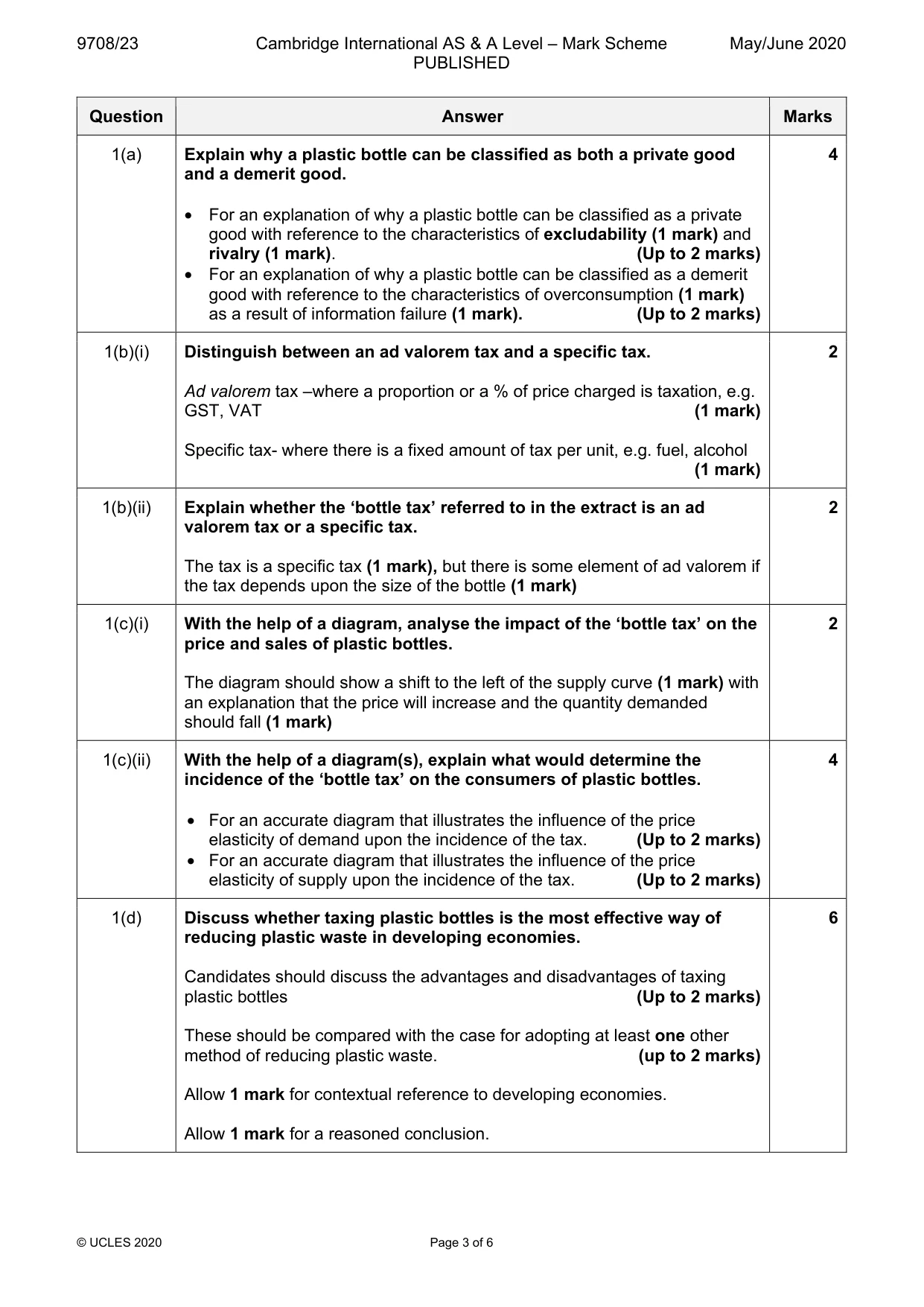
Mark scheme: Question Answer Marks 1(a) Explain why a plastic bottle can be classified as both a private good 4 and a demerit good. • For an explanation of why a plastic bottle can be classified as a private good with reference to the characteristics of excludability (1 mark) and rivalry (1 mark). (Up to 2 marks) • For an explanation of why a plastic bottle can be classified as a demerit good with reference to the characteristics of overconsumption (1 mark) as a result of information failure (1 mark). (Up to 2 marks) 1(b)(i) Distinguish between an ad valorem tax and a specific tax. 2 Ad valorem tax –where a proportion or a % of price charged is taxation, e.g. GST, VAT (1 mark) Specific tax- where there is a fixed amount of tax per unit, e.g. fuel, alcohol (1 mark) 1(b)(ii) Explain whether the ‘bottle tax’ referred to in the extract is an ad 2 valorem tax or a specific tax. The tax is a specific tax (1 mark), but there is some element of ad valorem if the tax depends upon the size of the bottle (1 mark) 1(c)(i) With the help of a diagram, analyse the impact of the ‘bottle tax’ on the 2 price and sales of plastic bottles. The diagram should show a shift to the left of the supply curve (1 mark) with an explanation that the price will increase and the quantity demanded should fall (1 mark) 1(c)(ii) With the help of a diagram(s), explain what would determine the 4 incidence of the ‘bottle tax’ on the consumers of plastic bottles. • For an accurate diagram that illustrates the influence of the price elasticity of demand upon the incidence of the tax. (Up to 2 marks) • For an accurate diagram that illustrates the influence of the price elasticity of supply upon the incidence of the tax. (Up to 2 marks) 1(d) Discuss whether taxing plastic bottles is the most effective way of 6 reducing plastic waste in developing economies. Candidates should discuss the advantages and disadvantages of taxing plastic bottles (Up to 2 marks) These should be compared with the case for adopting at least one other method of reducing plastic waste. (up to 2 marks) Allow 1 mark for contextual reference to developing economies. Allow 1 mark for a reasoned conclusion.
Q2 · The price elasticity of supply for a new smartphone is estimated at 0.8 in the short run…
2 (a) The price elasticity of supply for a new smartphone is estimated at 0.8 in the short run and 1.5 in the long run. Explain price elasticity of supply and suggest why the above estimates differ. [8] (b) Discuss whether, for a manufacturer of smartphones, knowledge of their product’s price elasticity of demand or its cross elasticity of demand with respect to other products is more useful. [12]
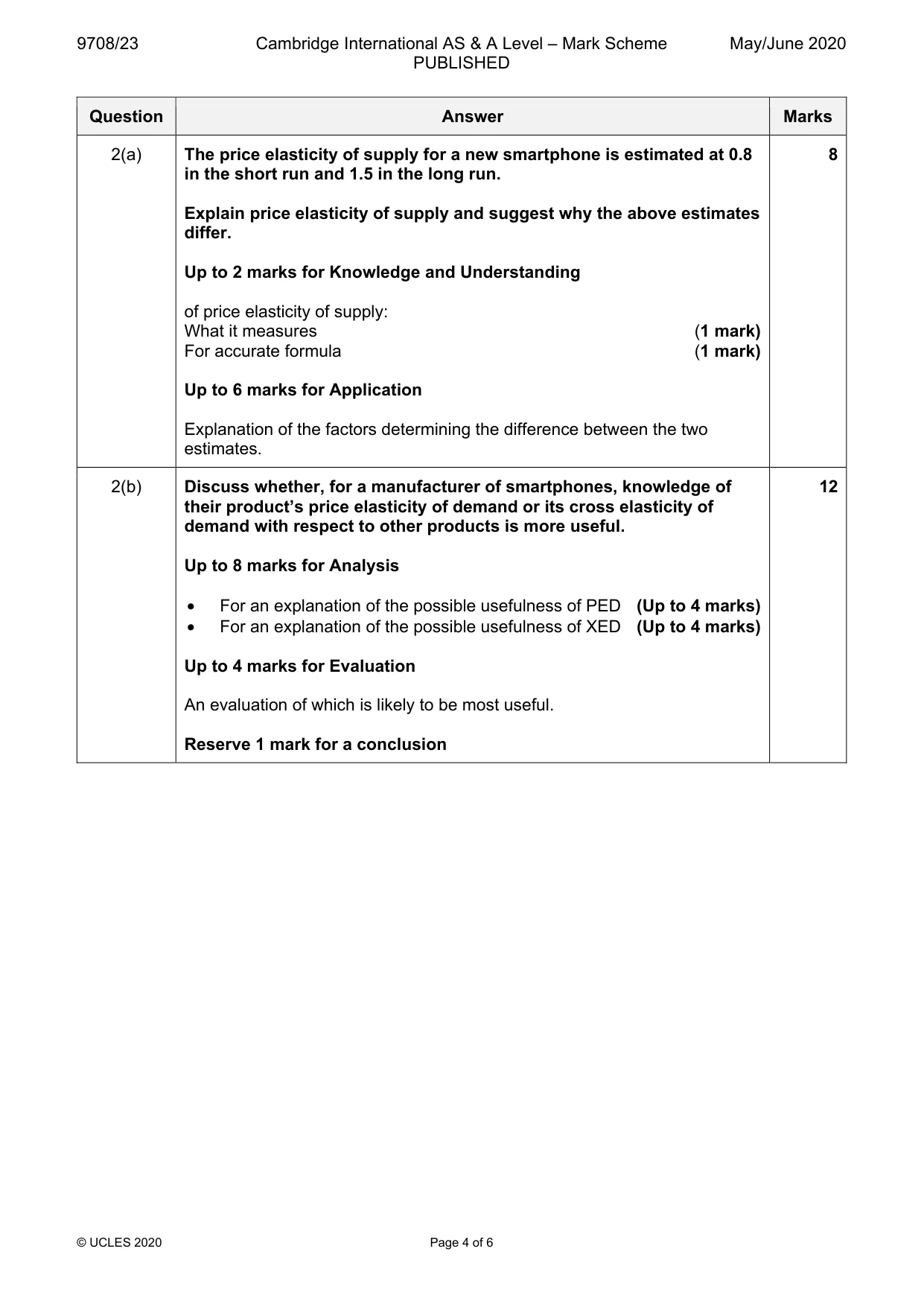
Mark scheme: 2(a) The price elasticity of supply for a new smartphone is estimated at 0.8 8 in the short run and 1.5 in the long run. Explain price elasticity of supply and suggest why the above estimates differ. Up to 2 marks for Knowledge and Understanding of price elasticity of supply: What it measures (1 mark) For accurate formula (1 mark) Up to 6 marks for Application Explanation of the factors determining the difference between the two estimates. 2(b) Discuss whether, for a manufacturer of smartphones, knowledge of 12 their product’s price elasticity of demand or its cross elasticity of demand with respect to other products is more useful. Up to 8 marks for Analysis • For an explanation of the possible usefulness of PED (Up to 4 marks) • For an explanation of the possible usefulness of XED (Up to 4 marks) Up to 4 marks for Evaluation An evaluation of which is likely to be most useful. Reserve 1 mark for a conclusion
More questions on Price elasticity, income elasticity and cross elasticity of demand
Q3 · The annual rate of inflation in an economy increased sharply and unexpectedly
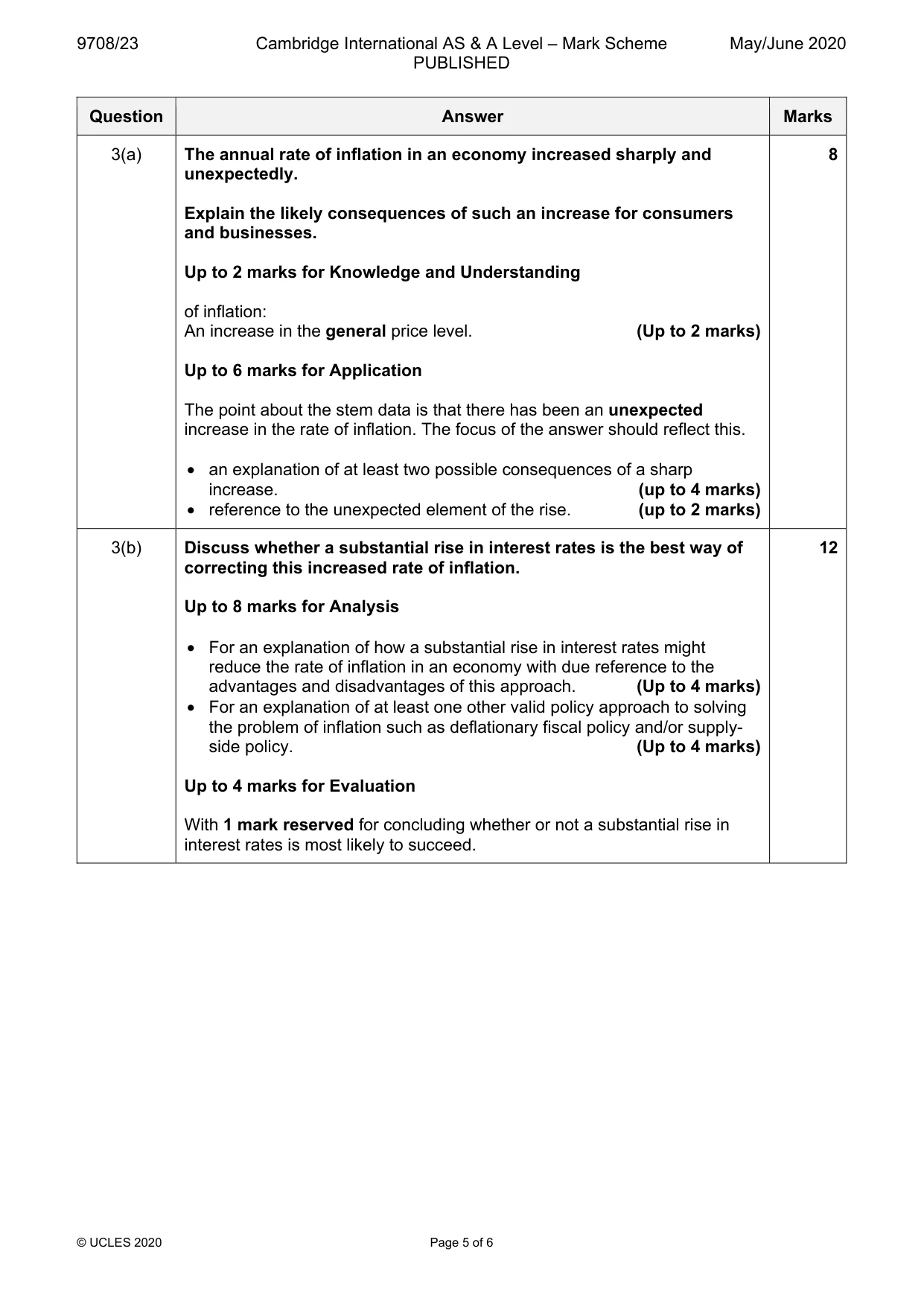
3 The annual rate of inflation in an economy increased sharply and unexpectedly. (a) Explain the likely consequences of such an increase for consumers and firms. [8] (b) Discuss whether a substantial rise in interest rates is the best way of correcting this increased rate of inflation. [12]
Mark scheme: 3(a) The annual rate of inflation in an economy increased sharply and 8 unexpectedly. Explain the likely consequences of such an increase for consumers and businesses. Up to 2 marks for Knowledge and Understanding of inflation: An increase in the general price level. (Up to 2 marks) Up to 6 marks for Application The point about the stem data is that there has been an unexpected increase in the rate of inflation. The focus of the answer should reflect this. • an explanation of at least two possible consequences of a sharp increase. (up to 4 marks) • reference to the unexpected element of the rise. (up to 2 marks) 3(b) Discuss whether a substantial rise in interest rates is the best way of 12 correcting this increased rate of inflation. Up to 8 marks for Analysis • For an explanation of how a substantial rise in interest rates might reduce the rate of inflation in an economy with due reference to the advantages and disadvantages of this approach. (Up to 4 marks) • For an explanation of at least one other valid policy approach to solving the problem of inflation such as deflationary fiscal policy and/or supply- side policy. (Up to 4 marks) Up to 4 marks for Evaluation With 1 mark reserved for concluding whether or not a substantial rise in interest rates is most likely to succeed.
Q4 · Explain why the theory of comparative advantage may not give a true account of the…
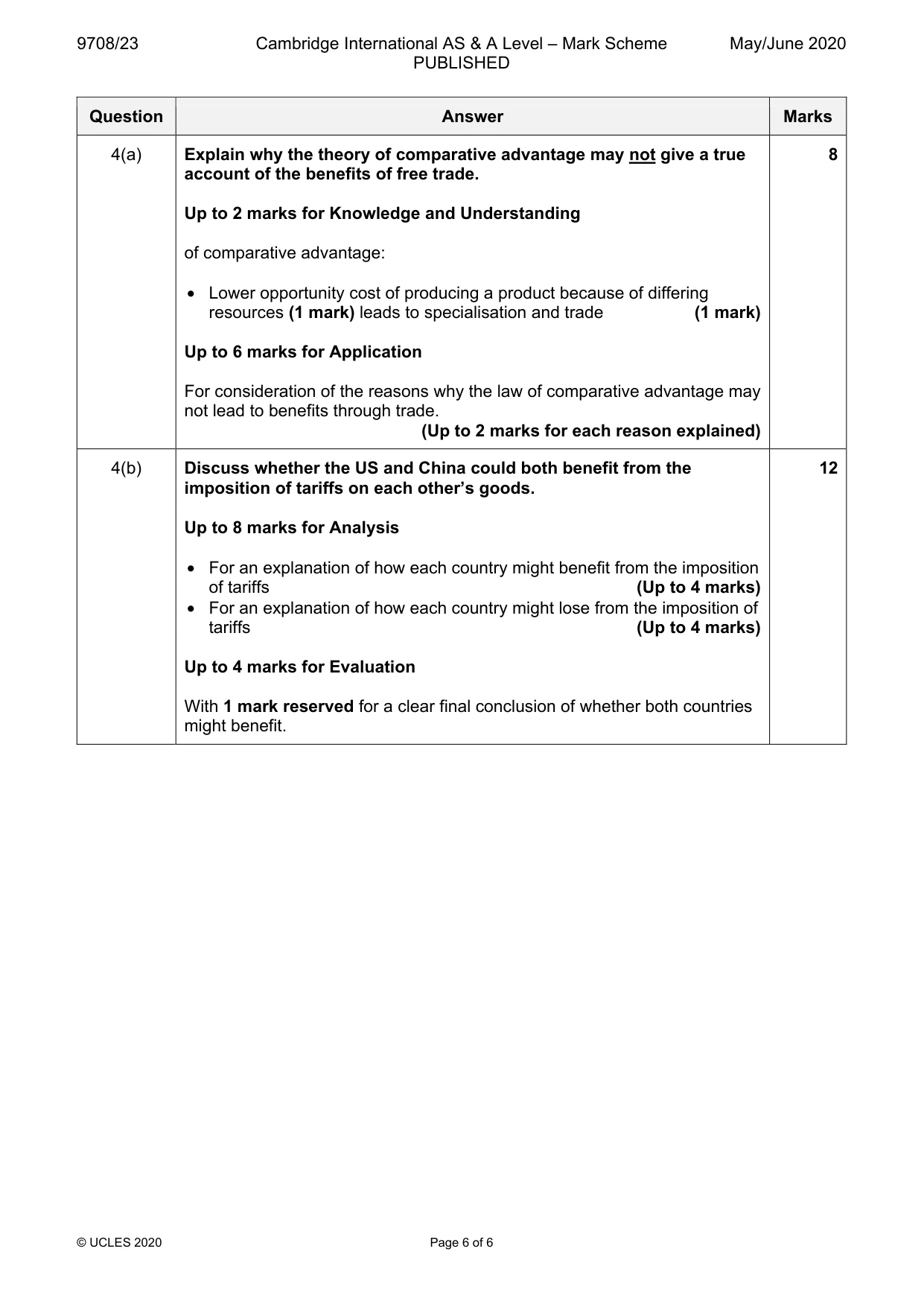
4 (a) Explain why the theory of comparative advantage may not give a true account of the benefits of free trade. [8] (b) In April 2018, the United States (US) government threatened to impose tariffs of 25% on a wide range of imports from China including steel, technological products, medicines and household goods such as washing machines. In turn, China threatened to retaliate with the same proposed tariff on imports from the US of soya beans, cars and chemicals. Discuss whether the US and China could both benefit from the imposition of tariffs on goods such as those identified. [12]
Mark scheme: 4(a) Explain why the theory of comparative advantage may not give a true 8 account of the benefits of free trade. Up to 2 marks for Knowledge and Understanding of comparative advantage: • Lower opportunity cost of producing a product because of differing resources (1 mark) leads to specialisation and trade (1 mark) Up to 6 marks for Application For consideration of the reasons why the law of comparative advantage may not lead to benefits through trade. (Up to 2 marks for each reason explained) 4(b) Discuss whether the US and China could both benefit from the 12 imposition of tariffs on each other’s goods. Up to 8 marks for Analysis • For an explanation of how each country might benefit from the imposition of tariffs (Up to 4 marks) • For an explanation of how each country might lose from the imposition of tariffs (Up to 4 marks) Up to 4 marks for Evaluation With 1 mark reserved for a clear final conclusion of whether both countries might benefit.
What was in this paper
The subtopics covered by these 4 questions, and how many questions each got. Open one in a new tab to see every Cambridge question on it.