Cambridge A Level Economics 9708 — 2020 May/June Paper 2 · Variant 1
9708/21/M/J/20 · 4 questions · 80 marks · ≈90 min
The question paper and its mark scheme, free to read here and free to download. This is Cambridge’s own paper, exactly as it was sat.
Question paper4 pages
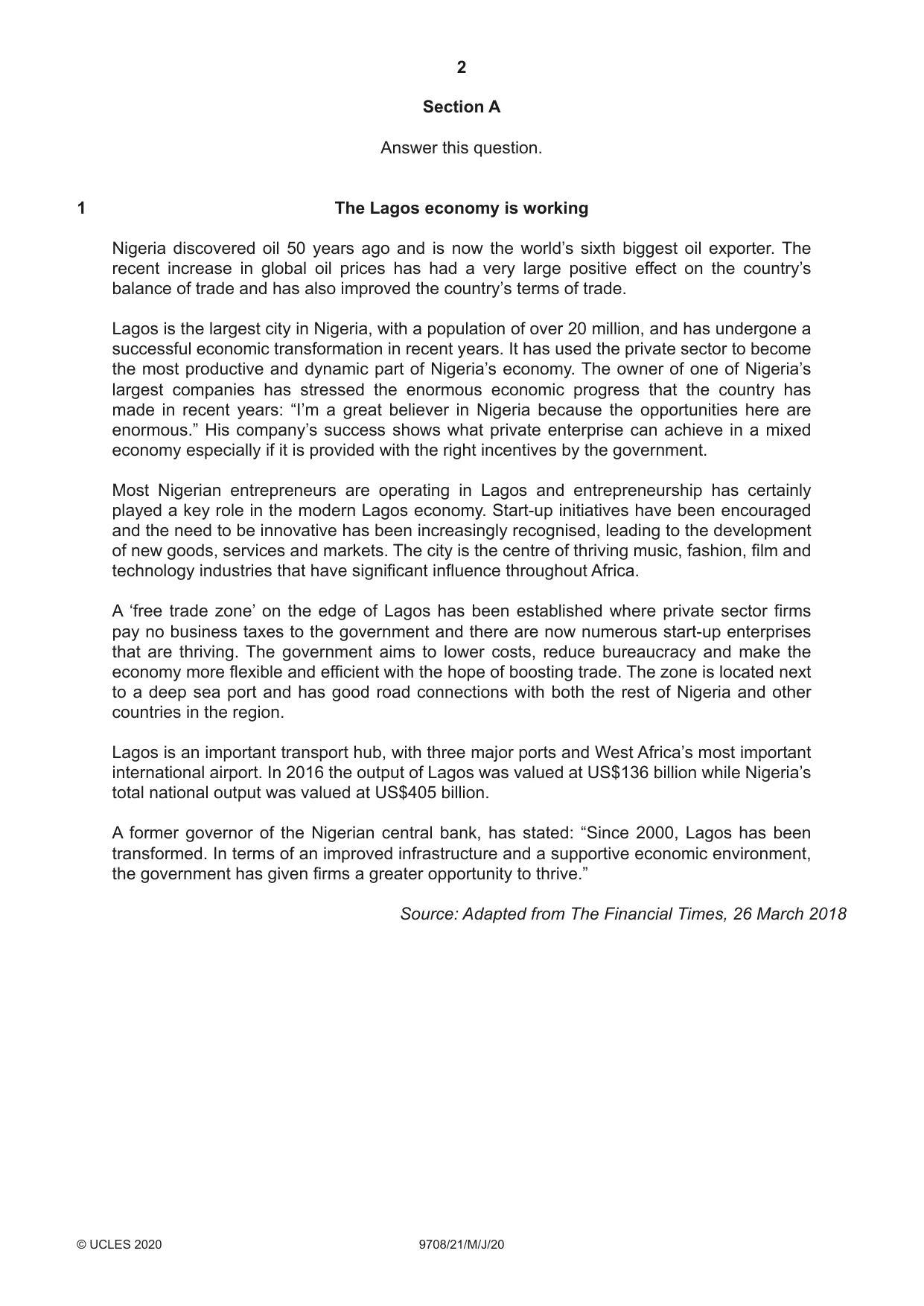
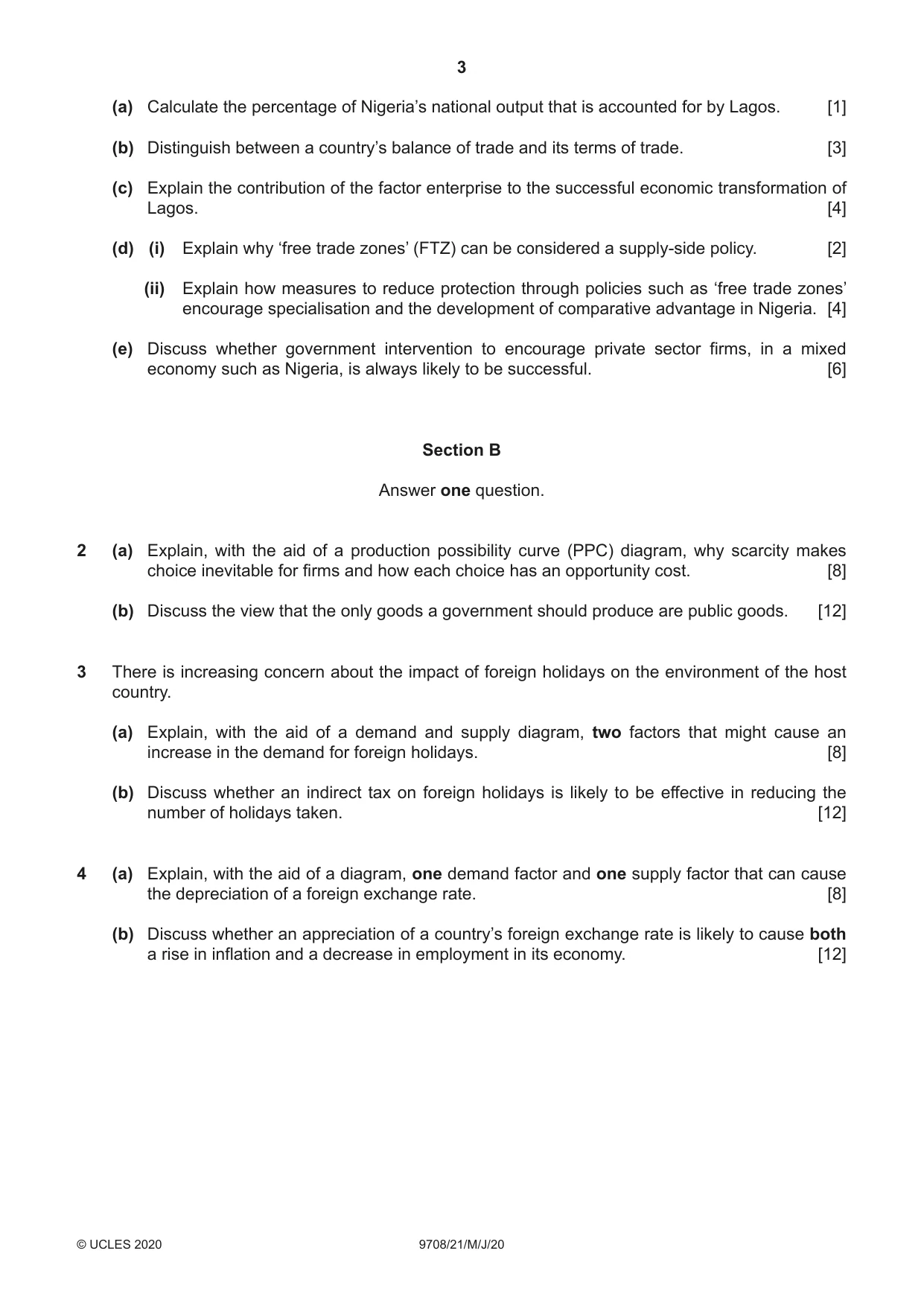

Mark scheme7 pages
Answers below. Sit the paper first if you are practising.

Questions as text
Q1 · The Lagos economy is working Nigeria discovered oil 50 years ago and is now the world’s…
1 The Lagos economy is working Nigeria discovered oil 50 years ago and is now the world’s sixth biggest oil exporter. The recent increase in global oil prices has had a very large positive effect on the country’s balance of trade and has also improved the country’s terms of trade. Lagos is the largest city in Nigeria, with a population of over 20 million, and has undergone a successful economic transformation in recent years. It has used the private sector to become the most productive and dynamic part of Nigeria’s economy. The owner of one of Nigeria’s largest companies has stressed the enormous economic progress that the country has made in recent years: “I’m a great believer in Nigeria because the opportunities here are enormous.” His company’s success shows what private enterprise can achieve in a mixed economy especially if it is provided with the right incentives by the government. Most Nigerian entrepreneurs are operating in Lagos and entrepreneurship has certainly played a key role in the modern Lagos economy. Start-up initiatives have been encouraged and the need to be innovative has been increasingly recognised, leading to the development of new goods, services and markets. The city is the centre of thriving music, fashion, film and technology industries that have significant influence throughout Africa. A ‘free trade zone’ on the edge of Lagos has been established where private sector firms pay no business taxes to the government and there are now numerous start-up enterprises that are thriving. The government aims to lower costs, reduce bureaucracy and make the economy more flexible and efficient with the hope of boosting trade. The zone is located next to a deep sea port and has good road connections with both the rest of Nigeria and other countries in the region. Lagos is an important transport hub, with three major ports and West Africa’s most important international airport. In 2016 the output of Lagos was valued at US$136 billion while Nigeria’s total national output was valued at US$405 billion. A former governor of the Nigerian central bank, has stated: “Since 2000, Lagos has been transformed. In terms of an improved infrastructure and a supportive economic environment, the government has given firms a greater opportunity to thrive.” Source: Adapted from The Financial Times, 26 March 2018 (a) Calculate the percentage of Nigeria’s national output that is accounted for by Lagos. [1] (b) Distinguish between a country’s balance of trade and its terms of trade. [3] (c) Explain the contribution of the factor enterprise to the successful economic transformation of Lagos. [4] (d) (i) Explain why ‘free trade zones’ (FTZ) can be considered a supply-side policy. [2] (ii) Explain how measures to reduce protection through policies such as ‘free trade zones’ encourage specialisation and the development of comparative advantage in Nigeria. [4] (e) Discuss whether government intervention to encourage private sector firms, in a mixed economy such as Nigeria, is always likely to be successful. [6]
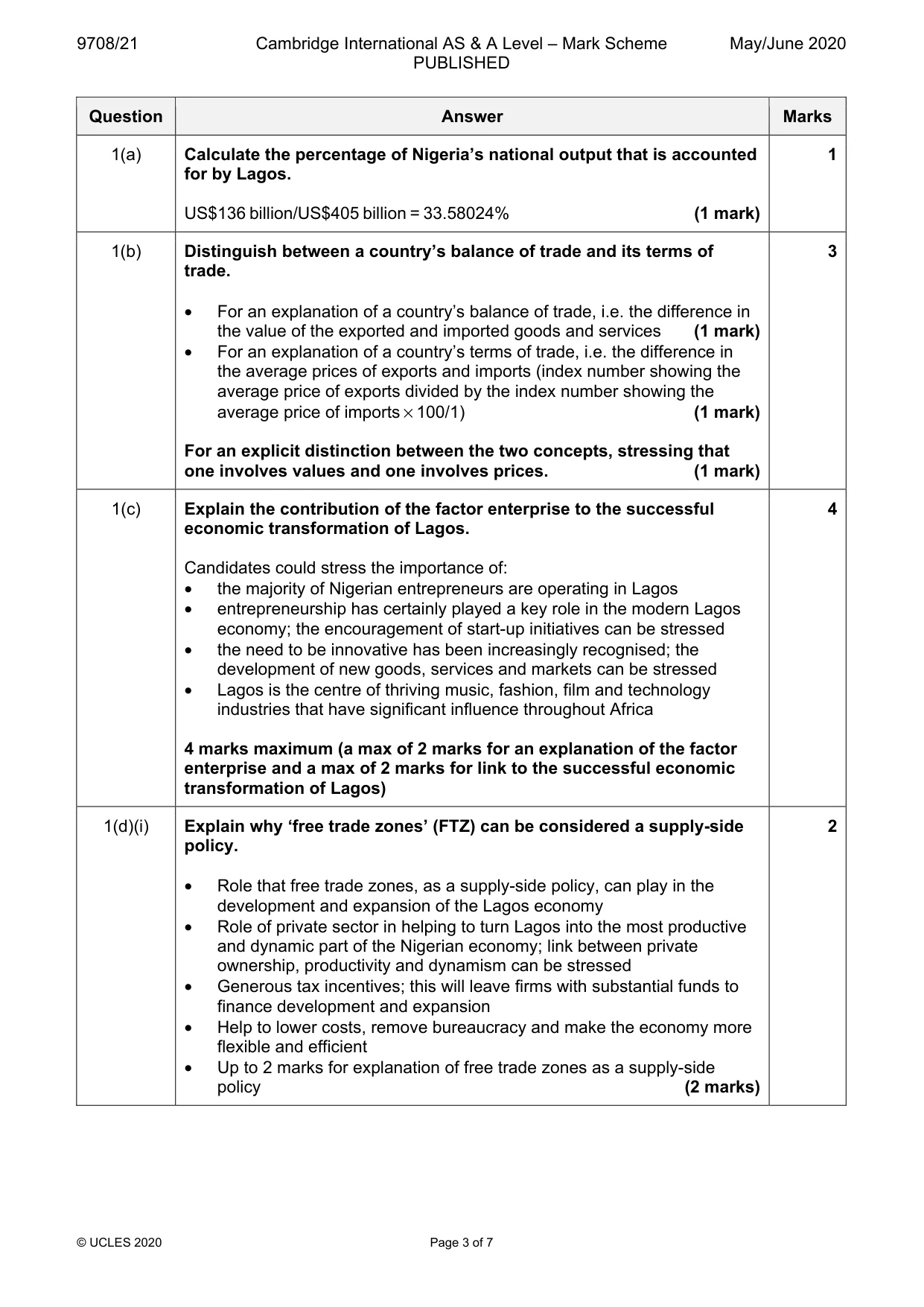
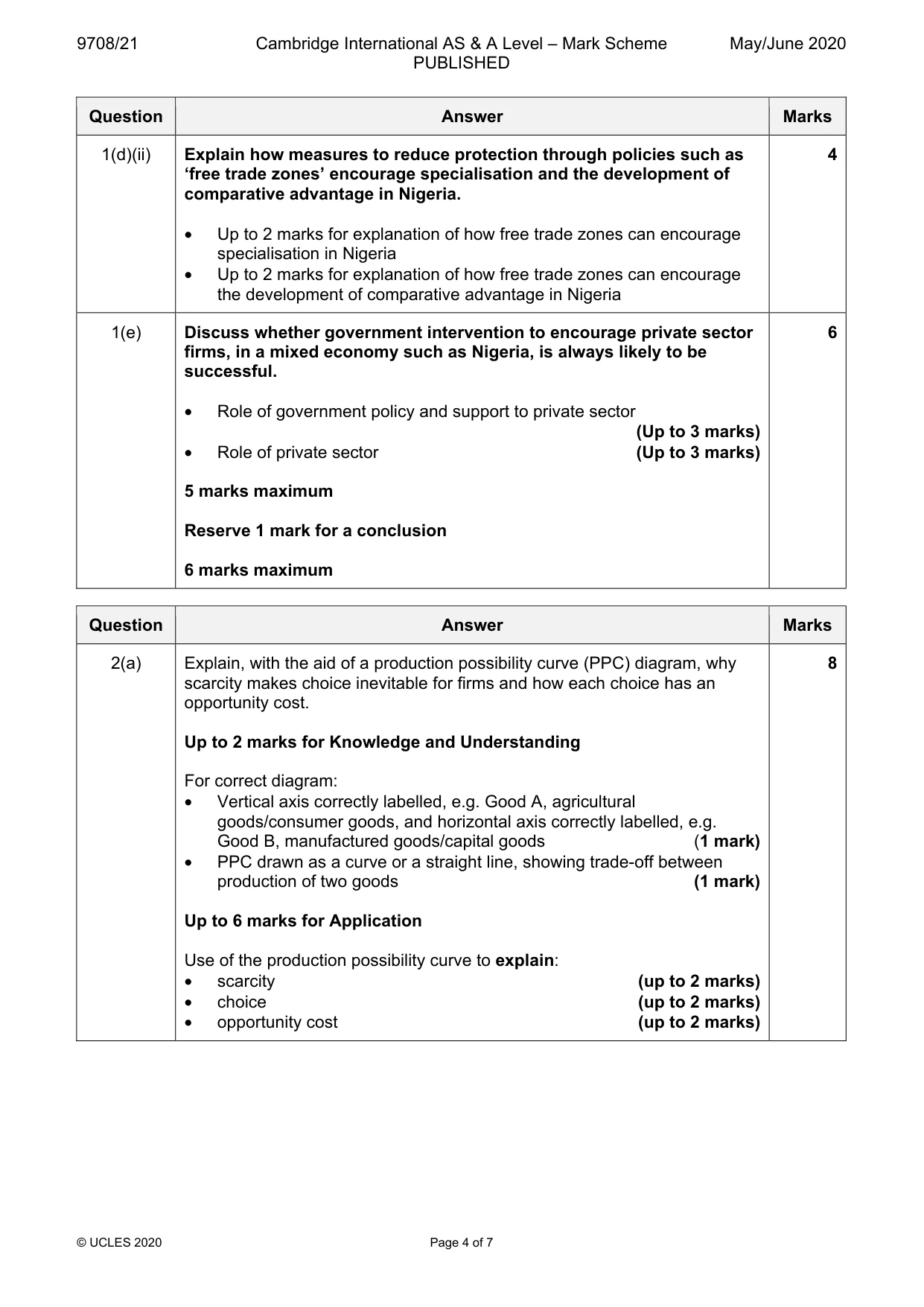
Mark scheme: Question Answer Marks 1(a) Calculate the percentage of Nigeria’s national output that is accounted 1 for by Lagos. US$136 billion/US$405 billion = 33.58024% (1 mark) 1(b) Distinguish between a country’s balance of trade and its terms of 3 trade. • For an explanation of a country’s balance of trade, i.e. the difference in the value of the exported and imported goods and services (1 mark) • For an explanation of a country’s terms of trade, i.e. the difference in the average prices of exports and imports (index number showing the average price of exports divided by the index number showing the average price of imports × 100/1) (1 mark) For an explicit distinction between the two concepts, stressing that one involves values and one involves prices. (1 mark) 1(c) Explain the contribution of the factor enterprise to the successful 4 economic transformation of Lagos. Candidates could stress the importance of: • the majority of Nigerian entrepreneurs are operating in Lagos • entrepreneurship has certainly played a key role in the modern Lagos economy; the encouragement of start-up initiatives can be stressed • the need to be innovative has been increasingly recognised; the development of new goods, services and markets can be stressed • Lagos is the centre of thriving music, fashion, film and technology industries that have significant influence throughout Africa 4 marks maximum (a max of 2 marks for an explanation of the factor enterprise and a max of 2 marks for link to the successful economic transformation of Lagos) 1(d)(i) Explain why ‘free trade zones’ (FTZ) can be considered a supply-side 2 policy. • Role that free trade zones, as a supply-side policy, can play in the development and expansion of the Lagos economy • Role of private sector in helping to turn Lagos into the most productive and dynamic part of the Nigerian economy; link between private ownership, productivity and dynamism can be stressed • Generous tax incentives; this will leave firms with substantial funds to finance development and expansion • Help to lower costs, remove bureaucracy and make the economy more flexible and efficient • Up to 2 marks for explanation of free trade zones as a supply-side policy (2 marks) 1(d)(ii) Explain how measures to reduce protection through policies such as 4 ‘free trade zones’ encourage specialisation and the development of comparative advantage in Nigeria. • Up to 2 marks for explanation of how free trade zones can encourage specialisation in Nigeria • Up to 2 marks for explanation of how free trade zones can encourage the development of comparative advantage in Nigeria 1(e) Discuss whether government intervention to encourage private sector 6 firms, in a mixed economy such as Nigeria, is always likely to be successful. • Role of government policy and support to private sector (Up to 3 marks) • Role of private sector (Up to 3 marks) 5 marks maximum Reserve 1 mark for a conclusion 6 marks maximum
Q2 · Explain, with the aid of a production possibility curve (PPC) diagram, why scarcity makes…
2 (a) Explain, with the aid of a production possibility curve (PPC) diagram, why scarcity makes choice inevitable for firms and how each choice has an opportunity cost. [8] (b) Discuss the view that the only goods a government should produce are public goods. [12]
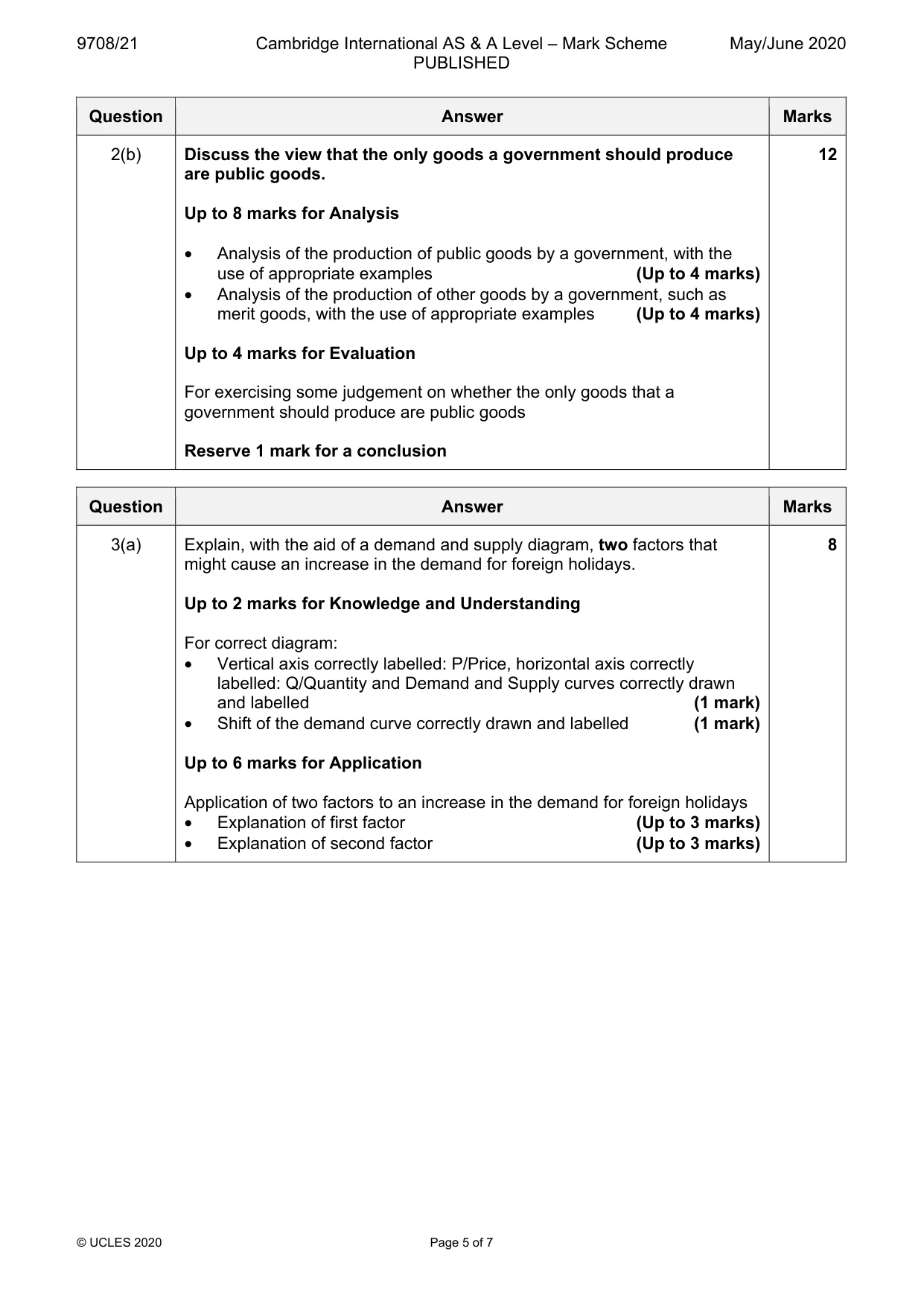
Mark scheme: 2(a) Explain, with the aid of a production possibility curve (PPC) diagram, why 8 scarcity makes choice inevitable for firms and how each choice has an opportunity cost. Up to 2 marks for Knowledge and Understanding For correct diagram: • Vertical axis correctly labelled, e.g. Good A, agricultural goods/consumer goods, and horizontal axis correctly labelled, e.g. Good B, manufactured goods/capital goods (1 mark) • PPC drawn as a curve or a straight line, showing trade-off between production of two goods (1 mark) Up to 6 marks for Application Use of the production possibility curve to explain: • scarcity (up to 2 marks) • choice (up to 2 marks) • opportunity cost (up to 2 marks) 2(b) Discuss the view that the only goods a government should produce 12 are public goods. Up to 8 marks for Analysis • Analysis of the production of public goods by a government, with the use of appropriate examples (Up to 4 marks) • Analysis of the production of other goods by a government, such as merit goods, with the use of appropriate examples (Up to 4 marks) Up to 4 marks for Evaluation For exercising some judgement on whether the only goods that a government should produce are public goods Reserve 1 mark for a conclusion
More questions on Reasons for government intervention in markets
Q3 · There is increasing concern about the impact of foreign holidays on the environment of…
3 There is increasing concern about the impact of foreign holidays on the environment of the host country. (a) Explain, with the aid of a demand and supply diagram, two factors that might cause an increase in the demand for foreign holidays. [8] (b) Discuss whether an indirect tax on foreign holidays is likely to be effective in reducing the number of holidays taken. [12]
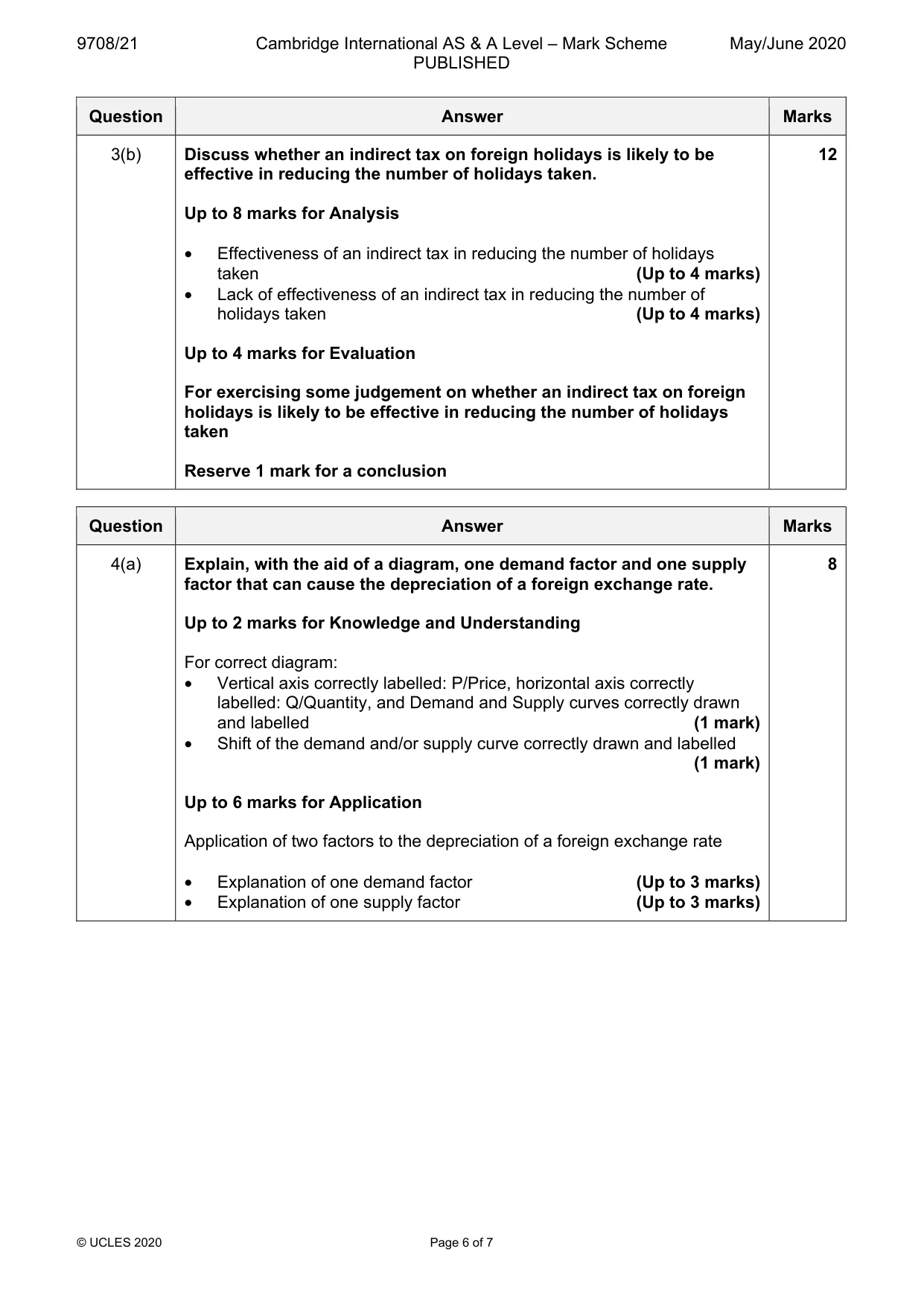
Mark scheme: 3(a) Explain, with the aid of a demand and supply diagram, two factors that 8 might cause an increase in the demand for foreign holidays. Up to 2 marks for Knowledge and Understanding For correct diagram: • Vertical axis correctly labelled: P/Price, horizontal axis correctly labelled: Q/Quantity and Demand and Supply curves correctly drawn and labelled (1 mark) • Shift of the demand curve correctly drawn and labelled (1 mark) Up to 6 marks for Application Application of two factors to an increase in the demand for foreign holidays • Explanation of first factor (Up to 3 marks) • Explanation of second factor (Up to 3 marks) 3(b) Discuss whether an indirect tax on foreign holidays is likely to be 12 effective in reducing the number of holidays taken. Up to 8 marks for Analysis • Effectiveness of an indirect tax in reducing the number of holidays taken (Up to 4 marks) • Lack of effectiveness of an indirect tax in reducing the number of holidays taken (Up to 4 marks) Up to 4 marks for Evaluation For exercising some judgement on whether an indirect tax on foreign holidays is likely to be effective in reducing the number of holidays taken Reserve 1 mark for a conclusion
More questions on Methods and effects of government intervention in markets
Q4 · Explain, with the aid of a diagram, one demand factor and one supply factor that can…
4 (a) Explain, with the aid of a diagram, one demand factor and one supply factor that can cause the depreciation of a foreign exchange rate. [8] (b) Discuss whether an appreciation of a country’s foreign exchange rate is likely to cause both a rise in inflation and a decrease in employment in its economy. [12]
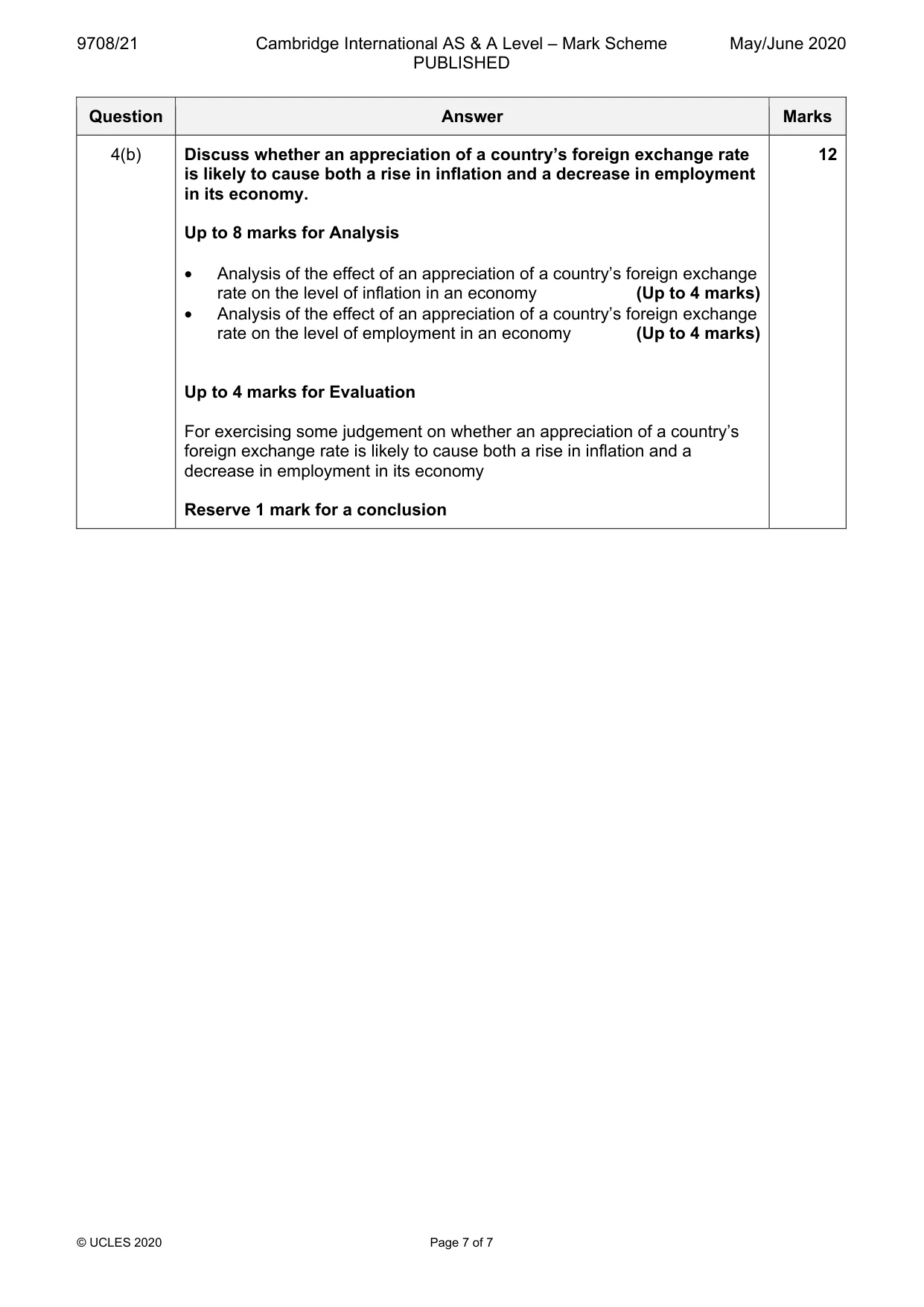
Mark scheme: 4(a) Explain, with the aid of a diagram, one demand factor and one supply 8 factor that can cause the depreciation of a foreign exchange rate. Up to 2 marks for Knowledge and Understanding For correct diagram: • Vertical axis correctly labelled: P/Price, horizontal axis correctly labelled: Q/Quantity, and Demand and Supply curves correctly drawn and labelled (1 mark) • Shift of the demand and/or supply curve correctly drawn and labelled (1 mark) Up to 6 marks for Application Application of two factors to the depreciation of a foreign exchange rate • Explanation of one demand factor (Up to 3 marks) • Explanation of one supply factor (Up to 3 marks) 4(b) Discuss whether an appreciation of a country’s foreign exchange rate 12 is likely to cause both a rise in inflation and a decrease in employment in its economy. Up to 8 marks for Analysis • Analysis of the effect of an appreciation of a country’s foreign exchange rate on the level of inflation in an economy (Up to 4 marks) • Analysis of the effect of an appreciation of a country’s foreign exchange rate on the level of employment in an economy (Up to 4 marks) Up to 4 marks for Evaluation For exercising some judgement on whether an appreciation of a country’s foreign exchange rate is likely to cause both a rise in inflation and a decrease in employment in its economy Reserve 1 mark for a conclusion
More questions on Links between macroeconomic problems and their interrelatedness
What was in this paper
The subtopics covered by these 4 questions, and how many questions each got. Open one in a new tab to see every Cambridge question on it.