Cambridge A Level Economics 9708 — 2019 May/June Paper 2 · Variant 3
9708/23/M/J/19 · 40 marks · ≈45 min
The question paper and its mark scheme, free to read here and free to download. This is Cambridge’s own paper, exactly as it was sat.
Question paper4 pages
Mark scheme9 pages
Answers below. Sit the paper first if you are practising.
Paper as text
Question paper, page 1
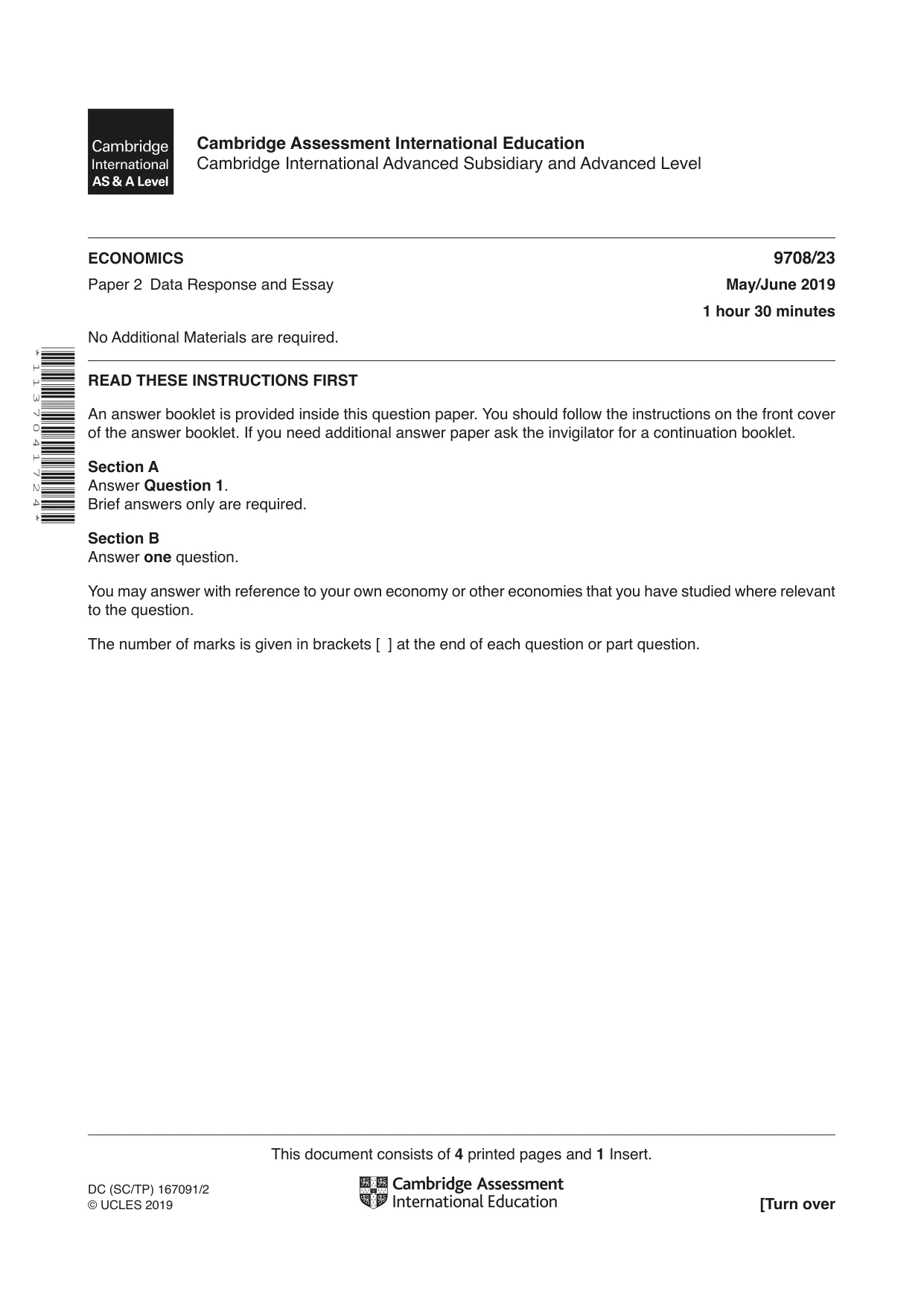
This document consists of 4 printed pages and 1 Insert. DC (SC/TP) 167091/2 © UCLES 2019 [Turn over Cambridge Assessment International Education Cambridge International Advanced Subsidiary and Advanced Level * 1 1 3 7 0 4 1 7 2 4 * ECONOMICS 9708/23 Paper 2 Data Response and Essay May/June 2019 1 hour 30 minutes No Additional Materials are required. READ THESE INSTRUCTIONS FIRST An answer booklet is provided inside this question paper. You should follow the instructions on the front cover of the answer booklet. If you need additional answer paper ask the invigilator for a continuation booklet. Section A Answer Question 1. Brief answers only are required. Section B Answer one question. You may answer with reference to your own economy or other economies that you have studied where relevant to the question. The number of marks is given in brackets [ ] at the end of each question or part question.
Question paper, page 2
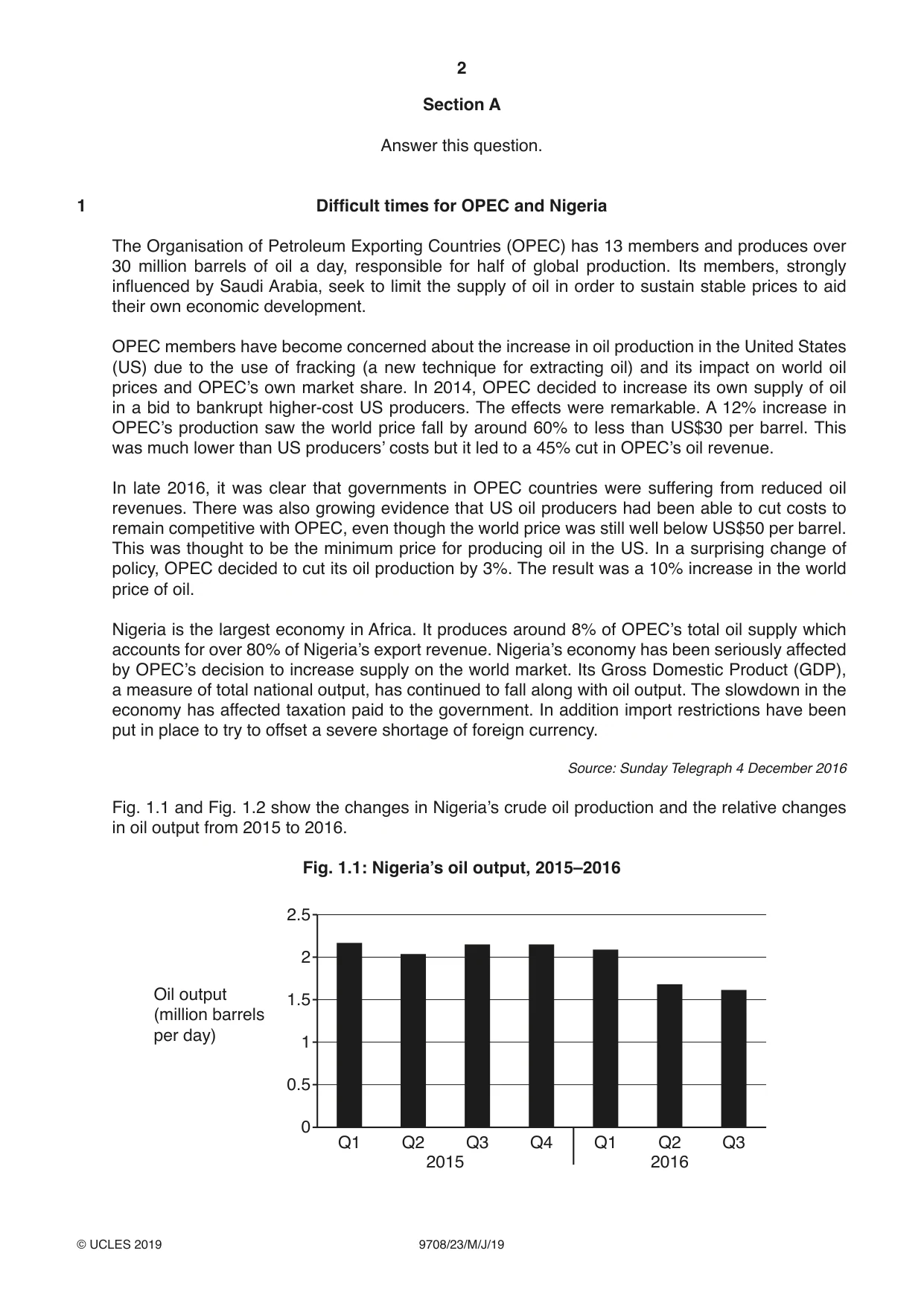
2 9708/23/M/J/19 © UCLES 2019 Section A Answer this question. 1 Difficult times for OPEC and Nigeria The Organisation of Petroleum Exporting Countries (OPEC) has 13 members and produces over 30 million barrels of oil a day, responsible for half of global production. Its members, strongly influenced by Saudi Arabia, seek to limit the supply of oil in order to sustain stable prices to aid their own economic development. OPEC members have become concerned about the increase in oil production in the United States (US) due to the use of fracking (a new technique for extracting oil) and its impact on world oil prices and OPEC’s own market share. In 2014, OPEC decided to increase its own supply of oil in a bid to bankrupt higher-cost US producers. The effects were remarkable. A 12% increase in OPEC’s production saw the world price fall by around 60% to less than US$30 per barrel. This was much lower than US producers’ costs but it led to a 45% cut in OPEC’s oil revenue. In late 2016, it was clear that governments in OPEC countries were suffering from reduced oil revenues. There was also growing evidence that US oil producers had been able to cut costs to remain competitive with OPEC, even though the world price was still well below US$50 per barrel. This was thought to be the minimum price for producing oil in the US. In a surprising change of policy, OPEC decided to cut its oil production by 3%. The result was a 10% increase in the world price of oil. Nigeria is the largest economy in Africa. It produces around 8% of OPEC’s total oil supply which accounts for over 80% of Nigeria’s export revenue. Nigeria’s economy has been seriously affected by OPEC’s decision to increase supply on the world market. Its Gross Domestic Product (GDP), a measure of total national output, has continued to fall along with oil output. The slowdown in the economy has affected taxation paid to the government. In addition import restrictions have been put in place to try to offset a severe shortage of foreign currency. Source: Sunday Telegraph 4 December 2016 Fig. 1.1 and Fig. 1.2 show the changes in Nigeria’s crude oil production and the relative changes in oil output from 2015 to 2016. Fig. 1.1: Nigeria’s oil output, 2015–2016 0 Q1 Q1 Q3 Q3 Q4 Q2 Q2 2015 2016 2.5 2 1.5 1 0.5 Oil output (million barrels per day)
Question paper, page 3
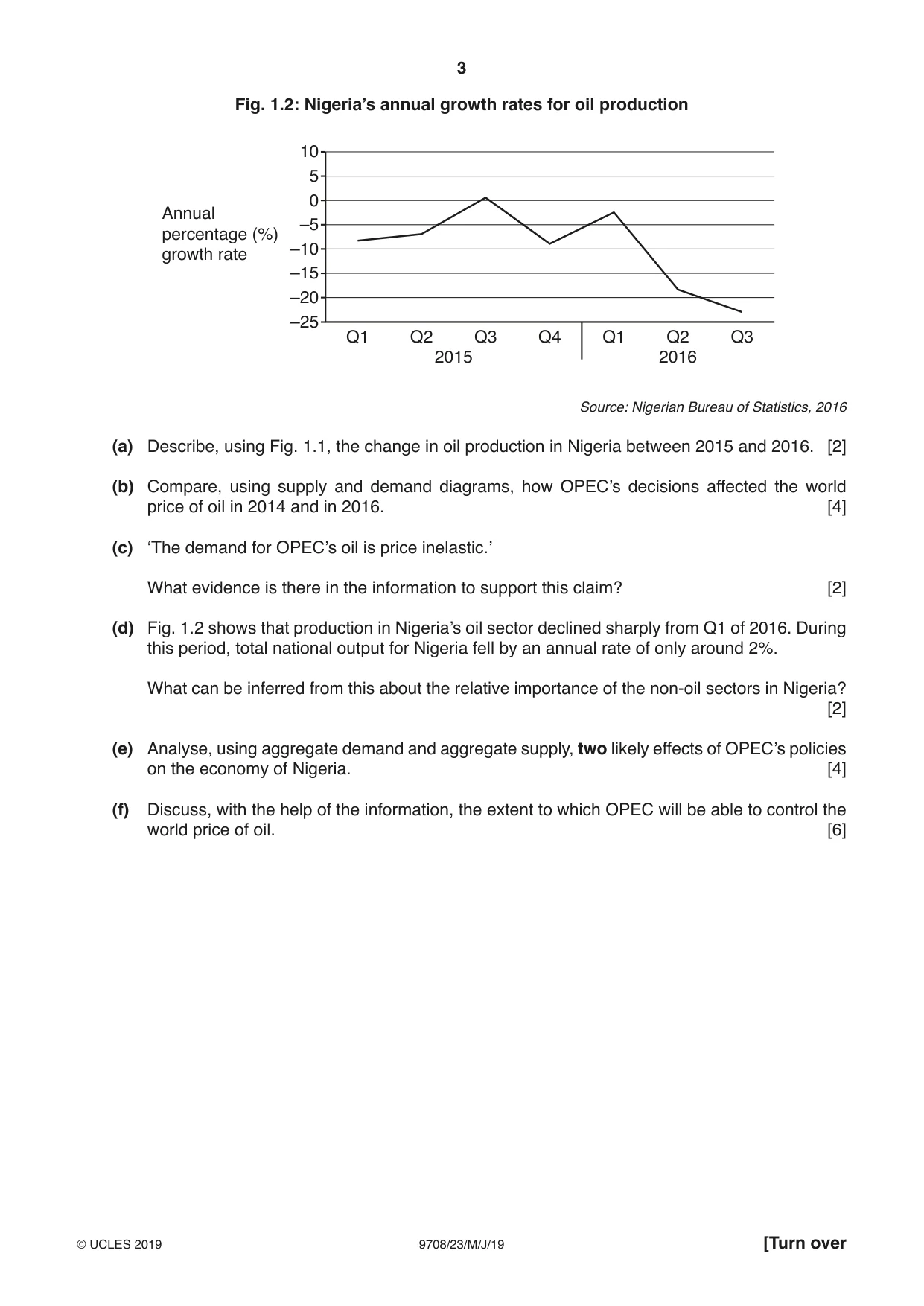
3 9708/23/M/J/19 © UCLES 2019 [Turn over Fig. 1.2: Nigeria’s annual growth rates for oil production –25 Q1 Q1 Q3 Q3 Q4 Q2 Q2 2015 2016 10 5 0 –5 –10 –20 –15 Annual percentage (%) growth rate Source: Nigerian Bureau of Statistics, 2016 (a) Describe, using Fig. 1.1, the change in oil production in Nigeria between 2015 and 2016. [2] (b) Compare, using supply and demand diagrams, how OPEC’s decisions affected the world price of oil in 2014 and in 2016. [4] (c) ‘The demand for OPEC’s oil is price inelastic.’ What evidence is there in the information to support this claim? [2] (d) Fig. 1.2 shows that production in Nigeria’s oil sector declined sharply from Q1 of 2016. During this period, total national output for Nigeria fell by an annual rate of only around 2%. What can be inferred from this about the relative importance of the non-oil sectors in Nigeria? [2] (e) Analyse, using aggregate demand and aggregate supply, two likely effects of OPEC’s policies on the economy of Nigeria. [4] (f) Discuss, with the help of the information, the extent to which OPEC will be able to control the world price of oil. [6]
Question paper, page 4
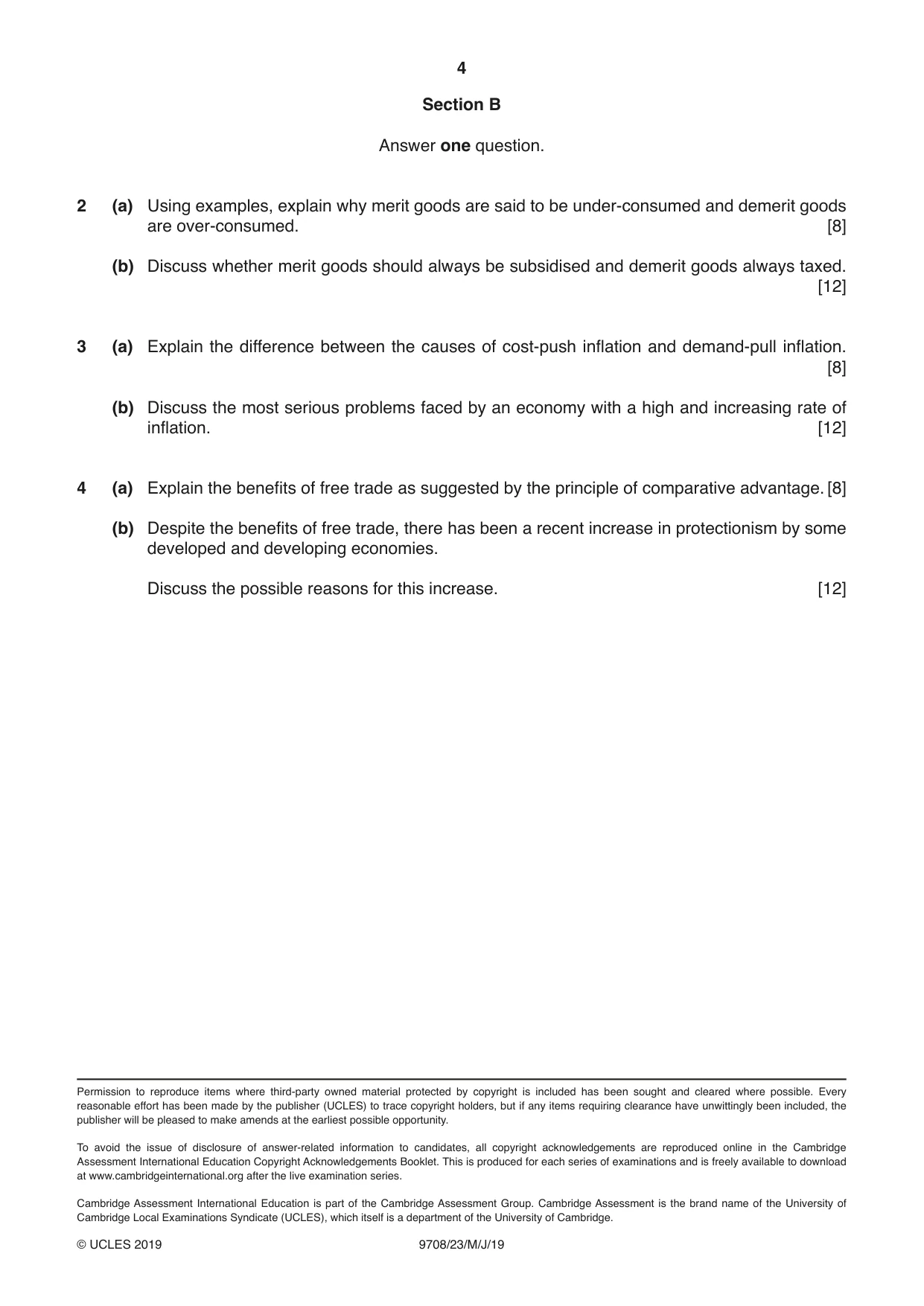
4 9708/23/M/J/19 © UCLES 2019 Section B Answer one question. 2 (a) Using examples, explain why merit goods are said to be under-consumed and demerit goods are over-consumed. [8] (b) Discuss whether merit goods should always be subsidised and demerit goods always taxed. [12] 3 (a) Explain the difference between the causes of cost-push inflation and demand-pull inflation. [8] (b) Discuss the most serious problems faced by an economy with a high and increasing rate of inflation. [12] 4 (a) Explain the benefits of free trade as suggested by the principle of comparative advantage. [8] (b) Despite the benefits of free trade, there has been a recent increase in protectionism by some developed and developing economies. Discuss the possible reasons for this increase. [12] Permission to reproduce items where third-party owned material protected by copyright is included has been sought and cleared where possible. Every reasonable effort has been made by the publisher (UCLES) to trace copyright holders, but if any items requiring clearance have unwittingly been included, the publisher will be pleased to make amends at the earliest possible opportunity. To avoid the issue of disclosure of answer-related information to candidates, all copyright acknowledgements are reproduced online in the Cambridge Assessment International Education Copyright Acknowledgements Booklet. This is produced for each series of examinations and is freely available to download at www.cambridgeinternational.org after the live examination series. Cambridge Assessment International Education is part of the Cambridge Assessment Group. Cambridge Assessment is the brand name of the University of Cambridge Local Examinations Syndicate (UCLES), which itself is a department of the University of Cambridge.
Mark scheme, page 1
This document consists of 9 printed pages. © UCLES 2019 [Turn over Cambridge Assessment International Education Cambridge International Advanced Subsidiary and Advanced Level ECONOMICS 9708/23 Paper 2 Data Response and Essay May/June 2019 MARK SCHEME Maximum Mark: 40 Published This mark scheme is published as an aid to teachers and candidates, to indicate the requirements of the examination. It shows the basis on which Examiners were instructed to award marks. It does not indicate the details of the discussions that took place at an Examiners’ meeting before marking began, which would have considered the acceptability of alternative answers. Mark schemes should be read in conjunction with the question paper and the Principal Examiner Report for Teachers. Cambridge International will not enter into discussions about these mark schemes. Cambridge International is publishing the mark schemes for the May/June 2019 series for most Cambridge IGCSE™, Cambridge International A and AS Level and Cambridge Pre-U components, and some Cambridge O Level components.
Mark scheme, page 2
9708/23 Cambridge International AS/A Level – Mark Scheme PUBLISHED May/June 2019 © UCLES 2019 Page 2 of 9 Generic Marking Principles These general marking principles must be applied by all examiners when marking candidate answers. They should be applied alongside the specific content of the mark scheme or generic level descriptors for a question. Each question paper and mark scheme will also comply with these marking principles. GENERIC MARKING PRINCIPLE 1: Marks must be awarded in line with: • the specific content of the mark scheme or the generic level descriptors for the question • the specific skills defined in the mark scheme or in the generic level descriptors for the question • the standard of response required by a candidate as exemplified by the standardisation scripts. GENERIC MARKING PRINCIPLE 2: Marks awarded are always whole marks (not half marks, or other fractions). GENERIC MARKING PRINCIPLE 3: Marks must be awarded positively: • marks are awarded for correct/valid answers, as defined in the mark scheme. However, credit is given for valid answers which go beyond the scope of the syllabus and mark scheme, referring to your Team Leader as appropriate • marks are awarded when candidates clearly demonstrate what they know and can do • marks are not deducted for errors • marks are not deducted for omissions • answers should only be judged on the quality of spelling, punctuation and grammar when these features are specifically assessed by the question as indicated by the mark scheme. The meaning, however, should be unambiguous. GENERIC MARKING PRINCIPLE 4: Rules must be applied consistently e.g. in situations where candidates have not followed instructions or in the application of generic level descriptors.
Mark scheme, page 3
9708/23 Cambridge International AS/A Level – Mark Scheme PUBLISHED May/June 2019 © UCLES 2019 Page 3 of 9 GENERIC MARKING PRINCIPLE 5: Marks should be awarded using the full range of marks defined in the mark scheme for the question (however; the use of the full mark range may be limited according to the quality of the candidate responses seen). GENERIC MARKING PRINCIPLE 6: Marks awarded are based solely on the requirements as defined in the mark scheme. Marks should not be awarded with grade thresholds or grade descriptors in mind.
Mark scheme, page 4
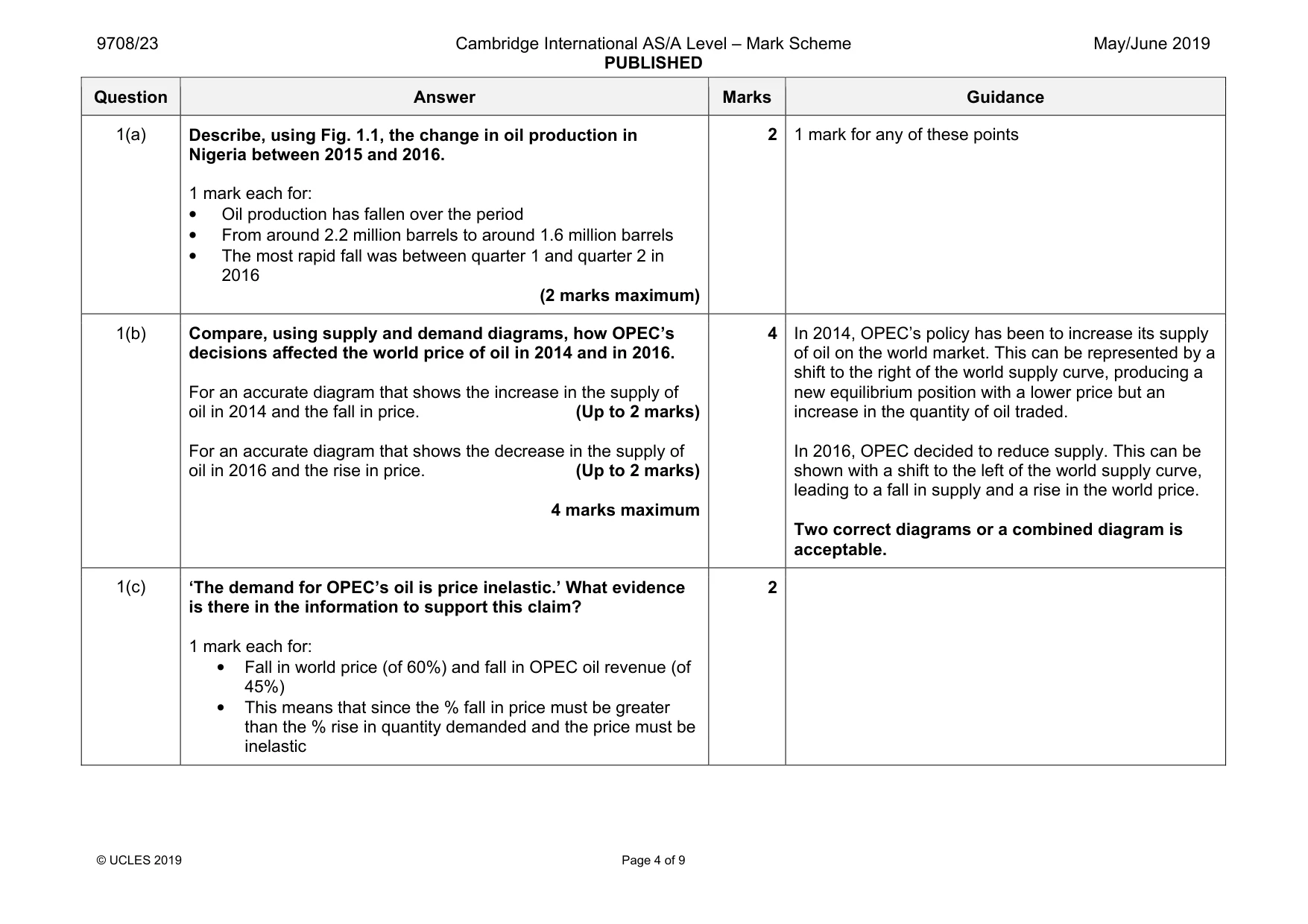
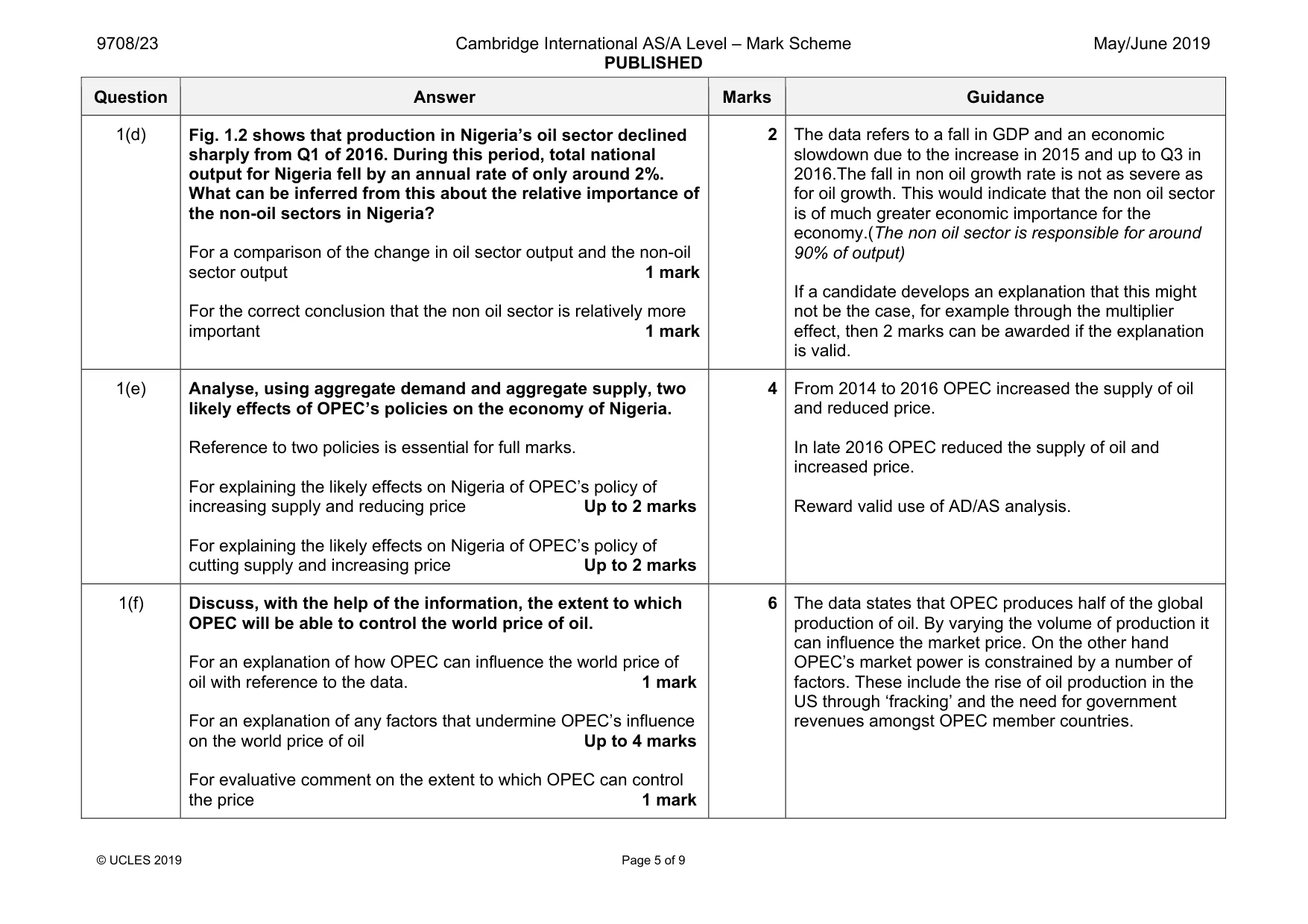
9708/23 Cambridge International AS/A Level – Mark Scheme PUBLISHED May/June 2019 © UCLES 2019 Page 4 of 9 Question Answer Marks Guidance 1(a) Describe, using Fig. 1.1, the change in oil production in Nigeria between 2015 and 2016. 1 mark each for: • Oil production has fallen over the period • From around 2.2 million barrels to around 1.6 million barrels • The most rapid fall was between quarter 1 and quarter 2 in 2016 (2 marks maximum) 2 1 mark for any of these points 1(b) Compare, using supply and demand diagrams, how OPEC’s decisions affected the world price of oil in 2014 and in 2016. For an accurate diagram that shows the increase in the supply of oil in 2014 and the fall in price. (Up to 2 marks) For an accurate diagram that shows the decrease in the supply of oil in 2016 and the rise in price. (Up to 2 marks) 4 marks maximum 4 In 2014, OPEC’s policy has been to increase its supply of oil on the world market. This can be represented by a shift to the right of the world supply curve, producing a new equilibrium position with a lower price but an increase in the quantity of oil traded. In 2016, OPEC decided to reduce supply. This can be shown with a shift to the left of the world supply curve, leading to a fall in supply and a rise in the world price. Two correct diagrams or a combined diagram is acceptable. 1(c) ‘The demand for OPEC’s oil is price inelastic.’ What evidence is there in the information to support this claim? 1 mark each for: • Fall in world price (of 60%) and fall in OPEC oil revenue (of 45%) • This means that since the % fall in price must be greater than the % rise in quantity demanded and the price must be inelastic 2
Mark scheme, page 5
9708/23 Cambridge International AS/A Level – Mark Scheme PUBLISHED May/June 2019 © UCLES 2019 Page 5 of 9 Question Answer Marks Guidance 1(d) Fig. 1.2 shows that production in Nigeria’s oil sector declined sharply from Q1 of 2016. During this period, total national output for Nigeria fell by an annual rate of only around 2%. What can be inferred from this about the relative importance of the non-oil sectors in Nigeria? For a comparison of the change in oil sector output and the non-oil sector output 1 mark For the correct conclusion that the non oil sector is relatively more important 1 mark 2 The data refers to a fall in GDP and an economic slowdown due to the increase in 2015 and up to Q3 in 2016.The fall in non oil growth rate is not as severe as for oil growth. This would indicate that the non oil sector is of much greater economic importance for the economy.(The non oil sector is responsible for around 90% of output) If a candidate develops an explanation that this might not be the case, for example through the multiplier effect, then 2 marks can be awarded if the explanation is valid. 1(e) Analyse, using aggregate demand and aggregate supply, two likely effects of OPEC’s policies on the economy of Nigeria. Reference to two policies is essential for full marks. For explaining the likely effects on Nigeria of OPEC’s policy of increasing supply and reducing price Up to 2 marks For explaining the likely effects on Nigeria of OPEC’s policy of cutting supply and increasing price Up to 2 marks 4 From 2014 to 2016 OPEC increased the supply of oil and reduced price. In late 2016 OPEC reduced the supply of oil and increased price. Reward valid use of AD/AS analysis. 1(f) Discuss, with the help of the information, the extent to which OPEC will be able to control the world price of oil. For an explanation of how OPEC can influence the world price of oil with reference to the data. 1 mark For an explanation of any factors that undermine OPEC’s influence on the world price of oil Up to 4 marks For evaluative comment on the extent to which OPEC can control the price 1 mark 6 The data states that OPEC produces half of the global production of oil. By varying the volume of production it can influence the market price. On the other hand OPEC’s market power is constrained by a number of factors. These include the rise of oil production in the US through ‘fracking’ and the need for government revenues amongst OPEC member countries.
Mark scheme, page 6
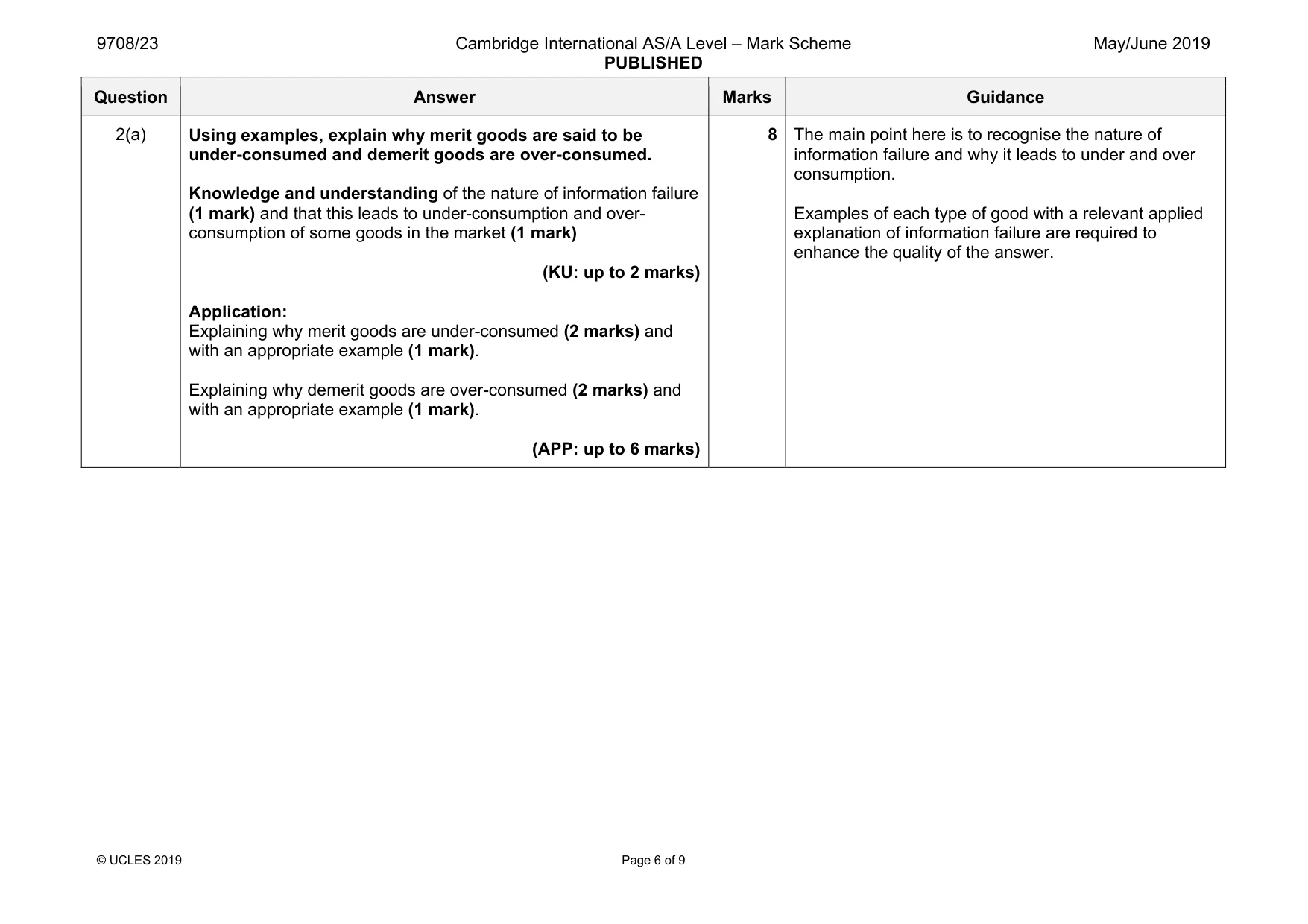
9708/23 Cambridge International AS/A Level – Mark Scheme PUBLISHED May/June 2019 © UCLES 2019 Page 6 of 9 Question Answer Marks Guidance 2(a) Using examples, explain why merit goods are said to be under-consumed and demerit goods are over-consumed. Knowledge and understanding of the nature of information failure (1 mark) and that this leads to under-consumption and over- consumption of some goods in the market (1 mark) (KU: up to 2 marks) Application: Explaining why merit goods are under-consumed (2 marks) and with an appropriate example (1 mark). Explaining why demerit goods are over-consumed (2 marks) and with an appropriate example (1 mark). (APP: up to 6 marks) 8 The main point here is to recognise the nature of information failure and why it leads to under and over consumption. Examples of each type of good with a relevant applied explanation of information failure are required to enhance the quality of the answer.
Mark scheme, page 7
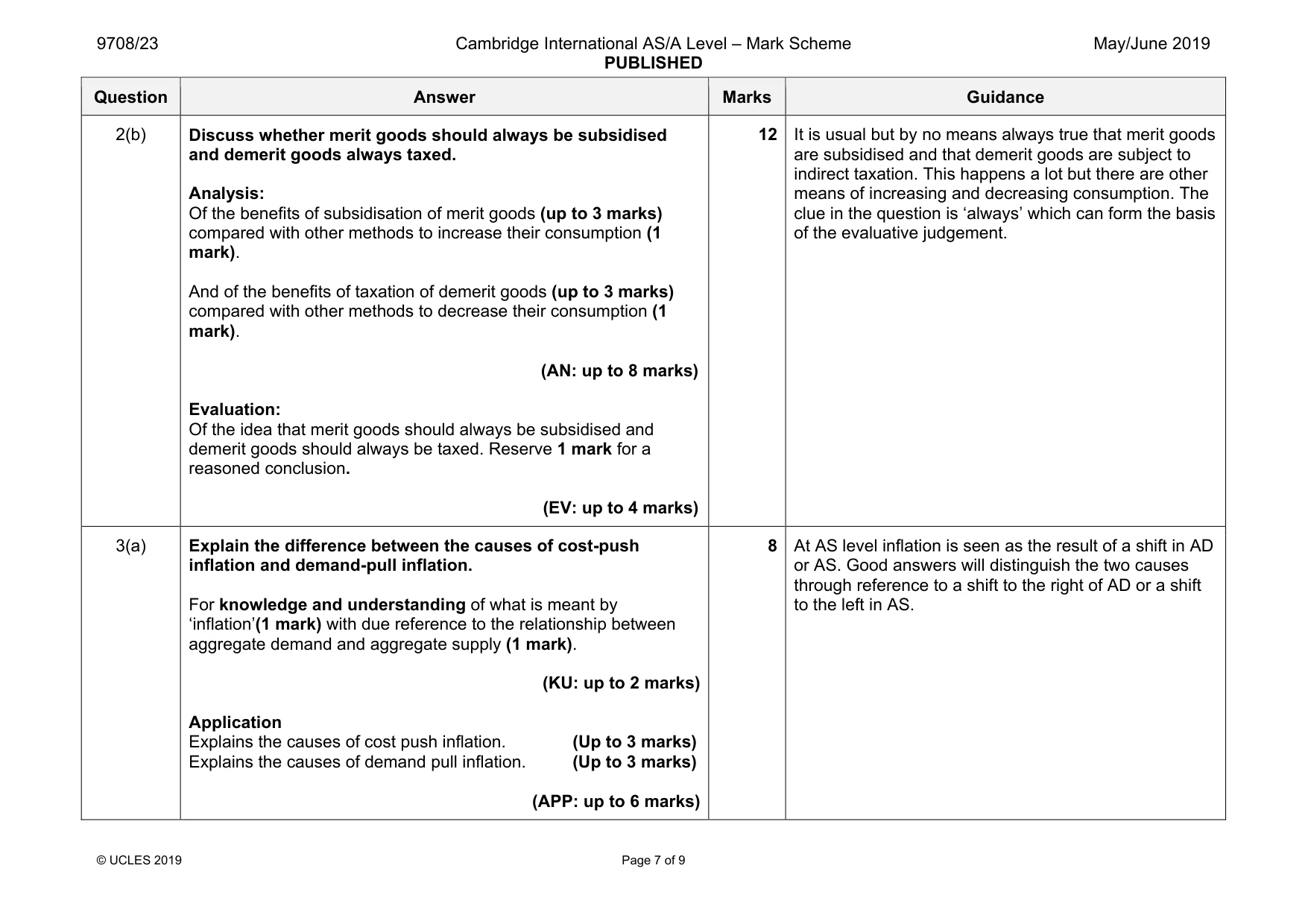
9708/23 Cambridge International AS/A Level – Mark Scheme PUBLISHED May/June 2019 © UCLES 2019 Page 7 of 9 Question Answer Marks Guidance 2(b) Discuss whether merit goods should always be subsidised and demerit goods always taxed. Analysis: Of the benefits of subsidisation of merit goods (up to 3 marks) compared with other methods to increase their consumption (1 mark). And of the benefits of taxation of demerit goods (up to 3 marks) compared with other methods to decrease their consumption (1 mark). (AN: up to 8 marks) Evaluation: Of the idea that merit goods should always be subsidised and demerit goods should always be taxed. Reserve 1 mark for a reasoned conclusion. (EV: up to 4 marks) 12 It is usual but by no means always true that merit goods are subsidised and that demerit goods are subject to indirect taxation. This happens a lot but there are other means of increasing and decreasing consumption. The clue in the question is ‘always’ which can form the basis of the evaluative judgement. 3(a) Explain the difference between the causes of cost-push inflation and demand-pull inflation. For knowledge and understanding of what is meant by ‘inflation’(1 mark) with due reference to the relationship between aggregate demand and aggregate supply (1 mark). (KU: up to 2 marks) Application Explains the causes of cost push inflation. (Up to 3 marks) Explains the causes of demand pull inflation. (Up to 3 marks) (APP: up to 6 marks) 8 At AS level inflation is seen as the result of a shift in AD or AS. Good answers will distinguish the two causes through reference to a shift to the right of AD or a shift to the left in AS.
Mark scheme, page 8
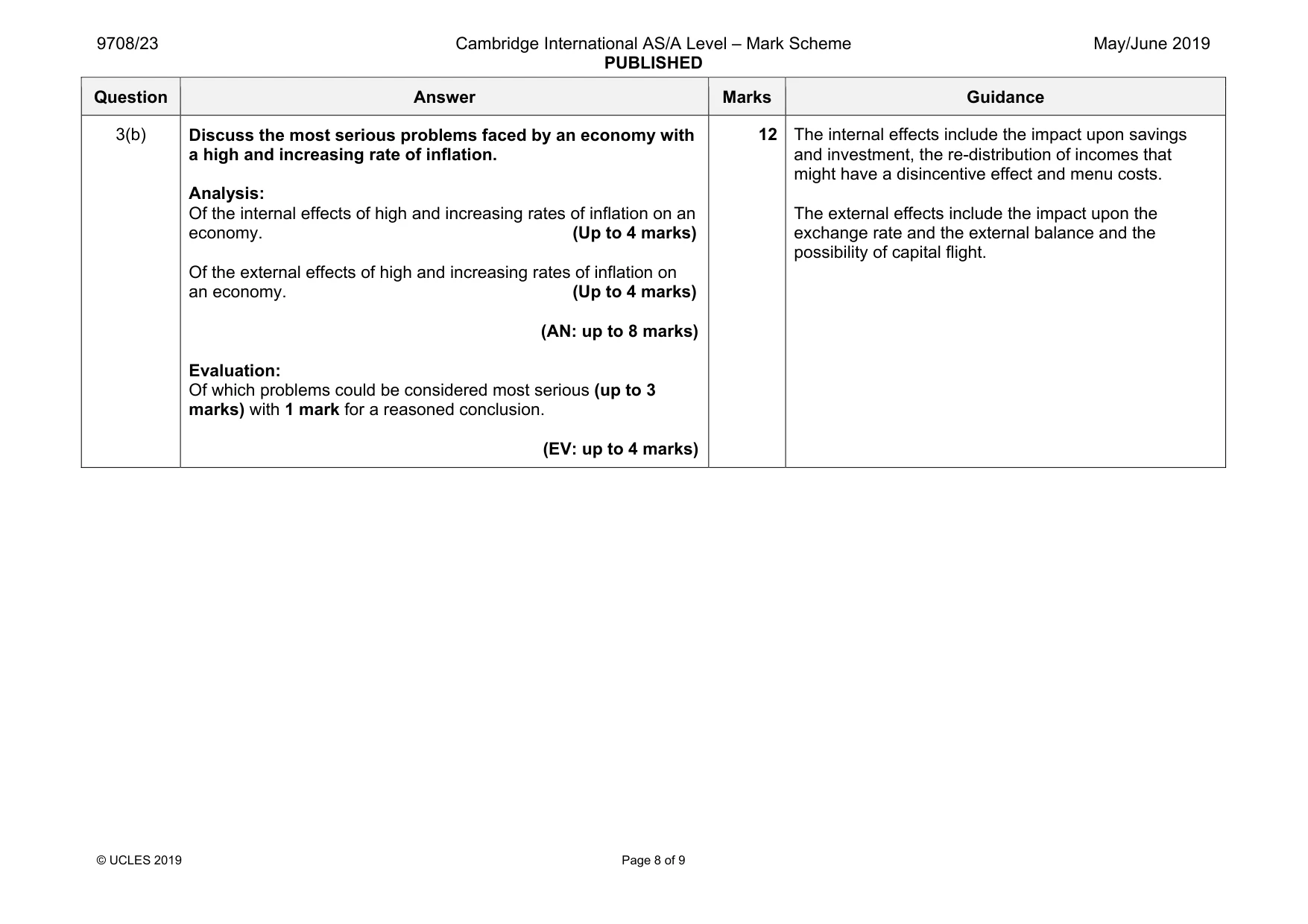
9708/23 Cambridge International AS/A Level – Mark Scheme PUBLISHED May/June 2019 © UCLES 2019 Page 8 of 9 Question Answer Marks Guidance 3(b) Discuss the most serious problems faced by an economy with a high and increasing rate of inflation. Analysis: Of the internal effects of high and increasing rates of inflation on an economy. (Up to 4 marks) Of the external effects of high and increasing rates of inflation on an economy. (Up to 4 marks) (AN: up to 8 marks) Evaluation: Of which problems could be considered most serious (up to 3 marks) with 1 mark for a reasoned conclusion. (EV: up to 4 marks) 12 The internal effects include the impact upon savings and investment, the re-distribution of incomes that might have a disincentive effect and menu costs. The external effects include the impact upon the exchange rate and the external balance and the possibility of capital flight.
Mark scheme, page 9
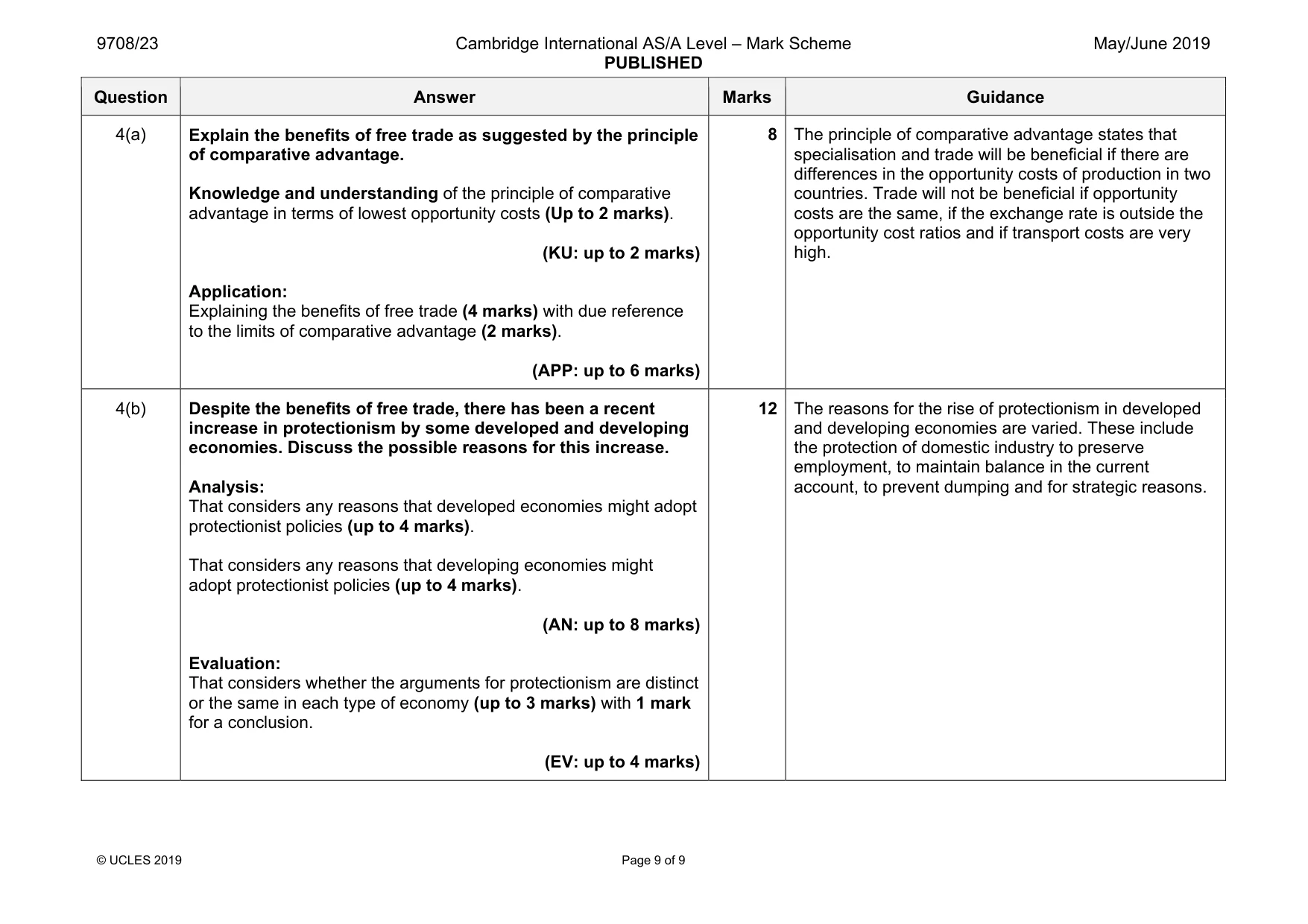
9708/23 Cambridge International AS/A Level – Mark Scheme PUBLISHED May/June 2019 © UCLES 2019 Page 9 of 9 Question Answer Marks Guidance 4(a) Explain the benefits of free trade as suggested by the principle of comparative advantage. Knowledge and understanding of the principle of comparative advantage in terms of lowest opportunity costs (Up to 2 marks). (KU: up to 2 marks) Application: Explaining the benefits of free trade (4 marks) with due reference to the limits of comparative advantage (2 marks). (APP: up to 6 marks) 8 The principle of comparative advantage states that specialisation and trade will be beneficial if there are differences in the opportunity costs of production in two countries. Trade will not be beneficial if opportunity costs are the same, if the exchange rate is outside the opportunity cost ratios and if transport costs are very high. 4(b) Despite the benefits of free trade, there has been a recent increase in protectionism by some developed and developing economies. Discuss the possible reasons for this increase. Analysis: That considers any reasons that developed economies might adopt protectionist policies (up to 4 marks). That considers any reasons that developing economies might adopt protectionist policies (up to 4 marks). (AN: up to 8 marks) Evaluation: That considers whether the arguments for protectionism are distinct or the same in each type of economy (up to 3 marks) with 1 mark for a conclusion. (EV: up to 4 marks) 12 The reasons for the rise of protectionism in developed and developing economies are varied. These include the protection of domestic industry to preserve employment, to maintain balance in the current account, to prevent dumping and for strategic reasons.
What you needed in this session
Cambridge’s own grade thresholds for 2019 May/June, Paper 2 · Variant 3. A higher threshold means an easier paper — the bar moves with how the cohort did.