Cambridge A Level Economics 9708 — 2019 May/June Paper 2 · Variant 1
9708/21/M/J/19 · 4 questions · 40 marks · ≈45 min
The question paper and its mark scheme, free to read here and free to download. This is Cambridge’s own paper, exactly as it was sat.
Question paper4 pages
Mark scheme10 pages
Answers below. Sit the paper first if you are practising.
Questions as text
Q1 · Trade tensions between China and the United States At a World Economic Forum meeting in…
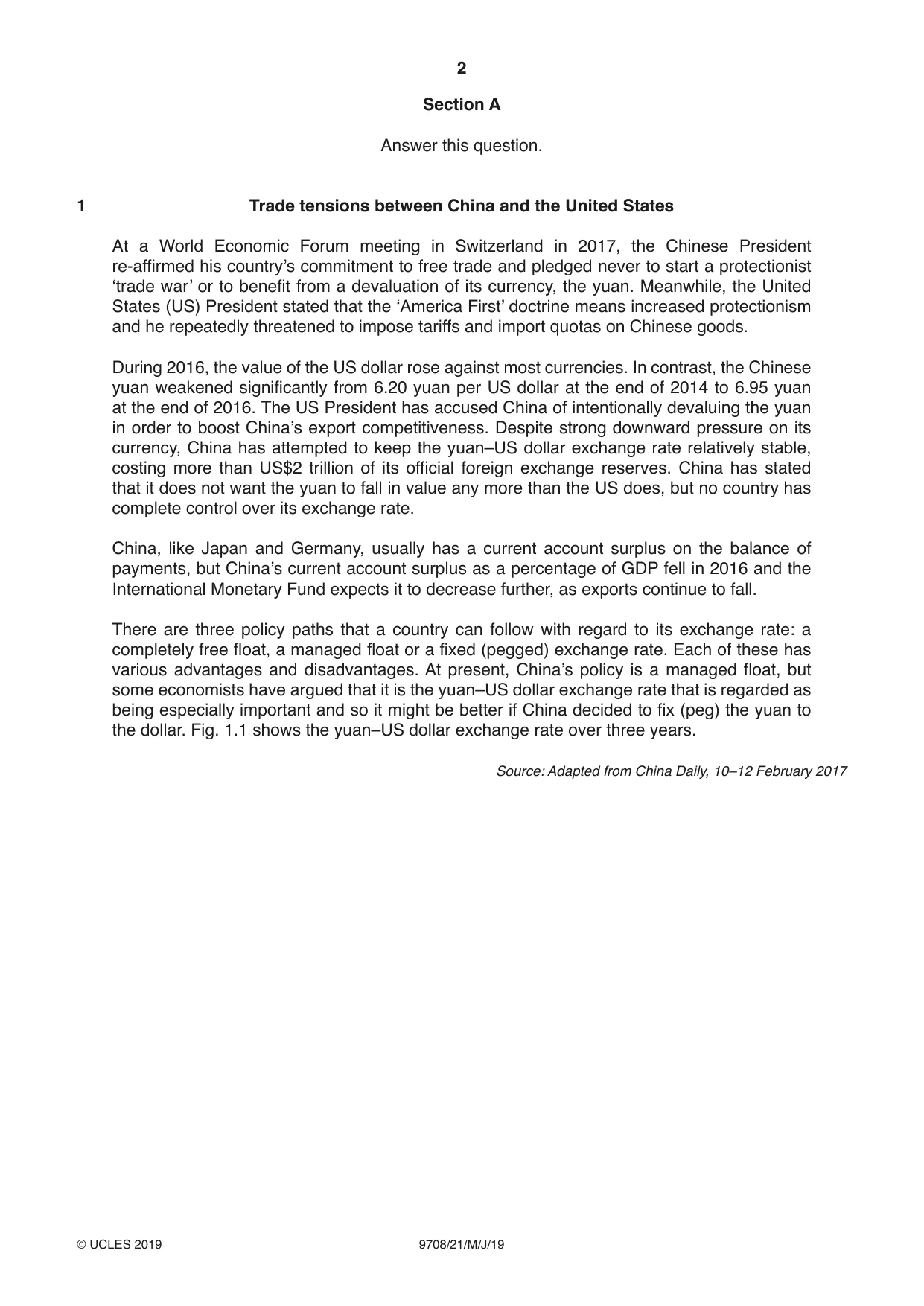
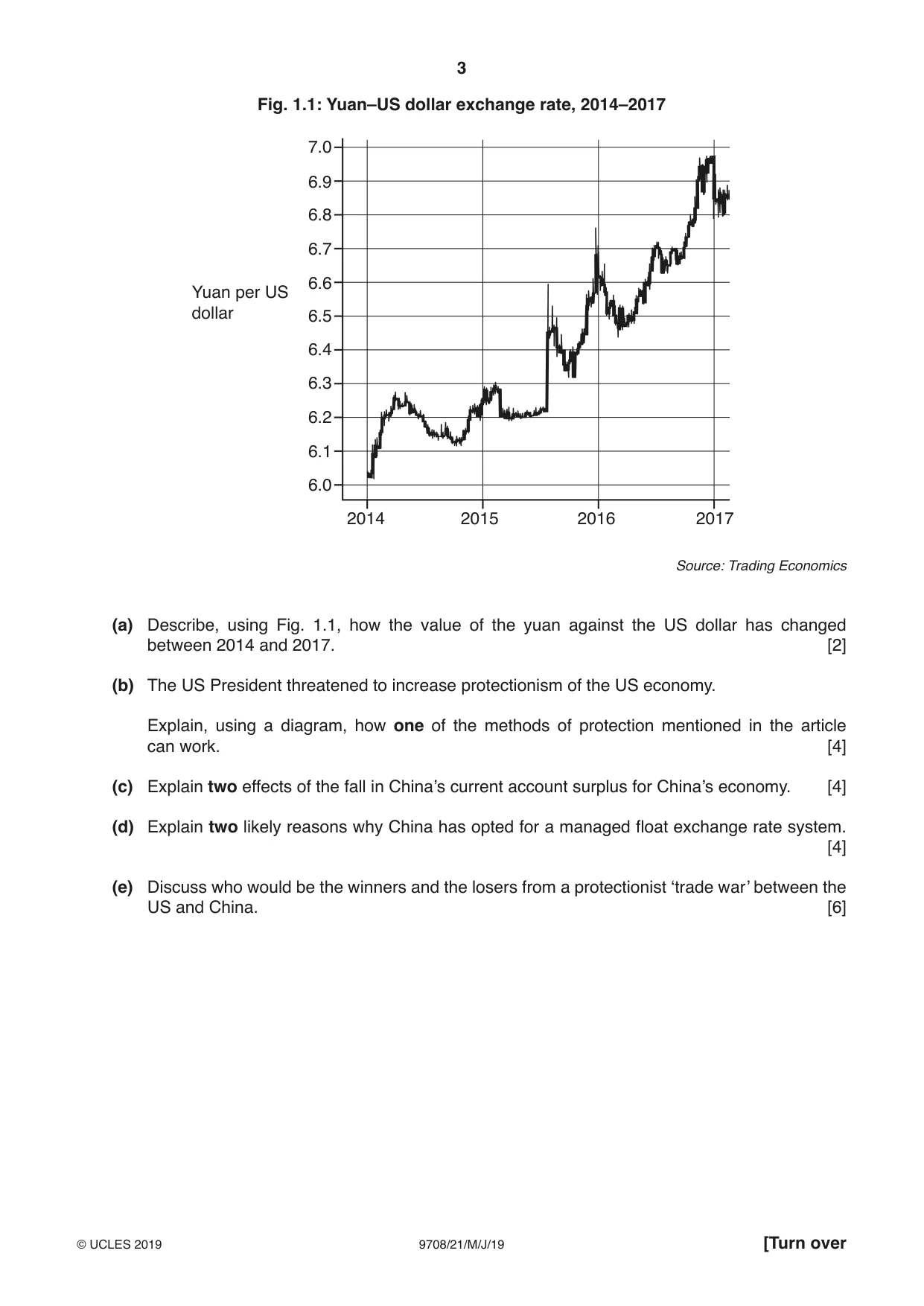
1 Trade tensions between China and the United States At a World Economic Forum meeting in Switzerland in 2017, the Chinese President re-affirmed his country’s commitment to free trade and pledged never to start a protectionist ‘trade war’ or to benefit from a devaluation of its currency, the yuan. Meanwhile, the United States (US) President stated that the ‘America First’ doctrine means increased protectionism and he repeatedly threatened to impose tariffs and import quotas on Chinese goods. During 2016, the value of the US dollar rose against most currencies. In contrast, the Chinese yuan weakened significantly from 6.20 yuan per US dollar at the end of 2014 to 6.95 yuan at the end of 2016. The US President has accused China of intentionally devaluing the yuan in order to boost China’s export competitiveness. Despite strong downward pressure on its currency, China has attempted to keep the yuan–US dollar exchange rate relatively stable, costing more than US$2 trillion of its official foreign exchange reserves. China has stated that it does not want the yuan to fall in value any more than the US does, but no country has complete control over its exchange rate. China, like Japan and Germany, usually has a current account surplus on the balance of payments, but China’s current account surplus as a percentage of GDP fell in 2016 and the International Monetary Fund expects it to decrease further, as exports continue to fall. There are three policy paths that a country can follow with regard to its exchange rate: a completely free float, a managed float or a fixed (pegged) exchange rate. Each of these has various advantages and disadvantages. At present, China’s policy is a managed float, but some economists have argued that it is the yuan–US dollar exchange rate that is regarded as being especially important and so it might be better if China decided to fix (peg) the yuan to the dollar. Fig. 1.1 shows the yuan–US dollar exchange rate over three years. Source: Adapted from China Daily, 10–12 February 2017 Fig. 1.1: Yuan–US dollar exchange rate, 2014–2017 7.0 6.9 6.8 6.7 6.6 Yuan per US dollar 6.5 6.4 6.3 6.2 6.1 6.0 2014 2015 2016 2017 Source: Trading Economics (a) Describe, using Fig. 1.1, how the value of the yuan against the US dollar has changed between 2014 and 2017. [2] (b) The US President threatened to increase protectionism of the US economy. Explain, using a diagram, how one of the methods of protection mentioned in the article can work. [4] (c) Explain two effects of the fall in China’s current account surplus for China’s economy. [4] (d) Explain two likely reasons why China has opted for a managed float exchange rate system. [4] (e) Discuss who would be the winners and the losers from a protectionist ‘trade war’ between the US and China. [6]
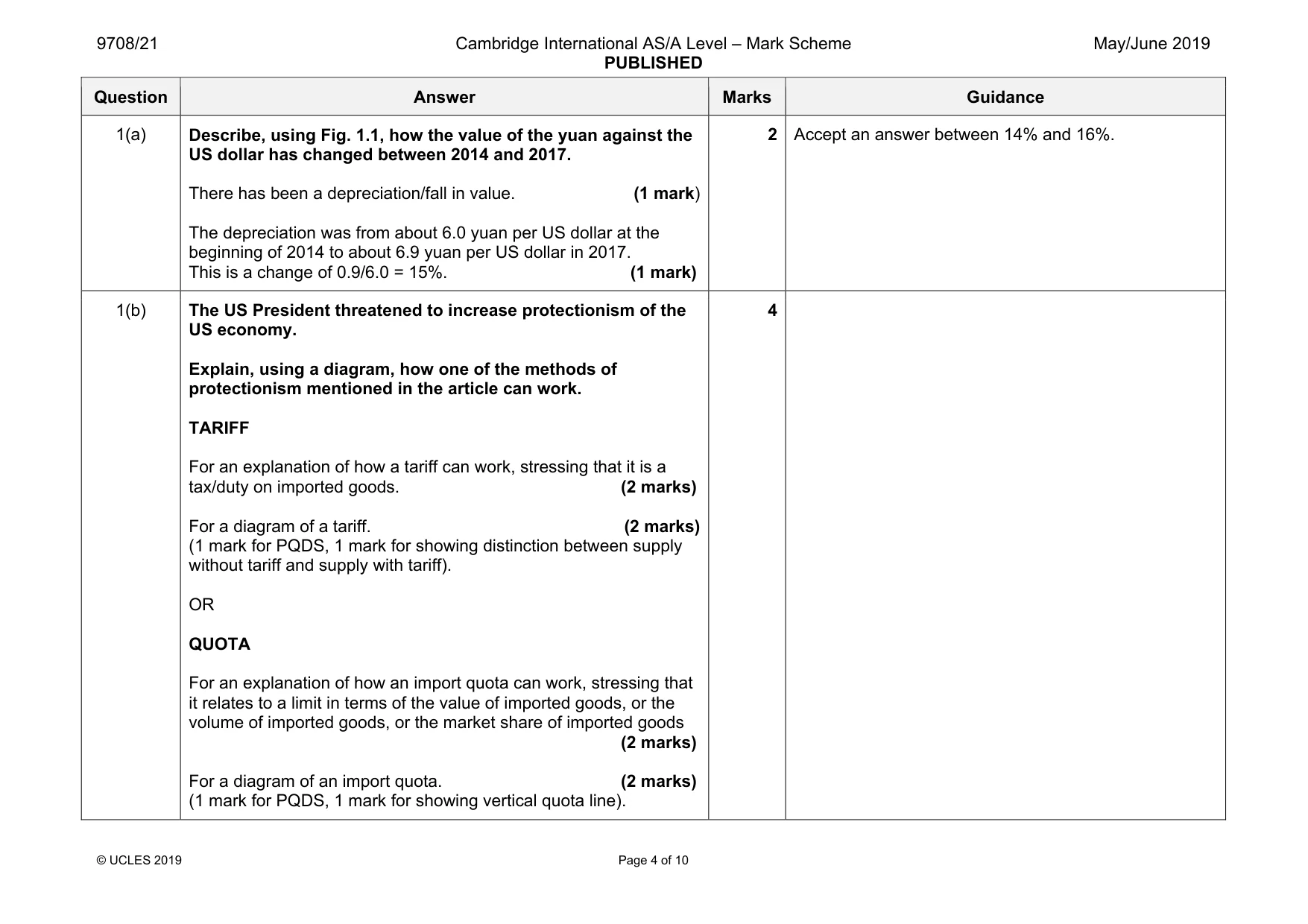
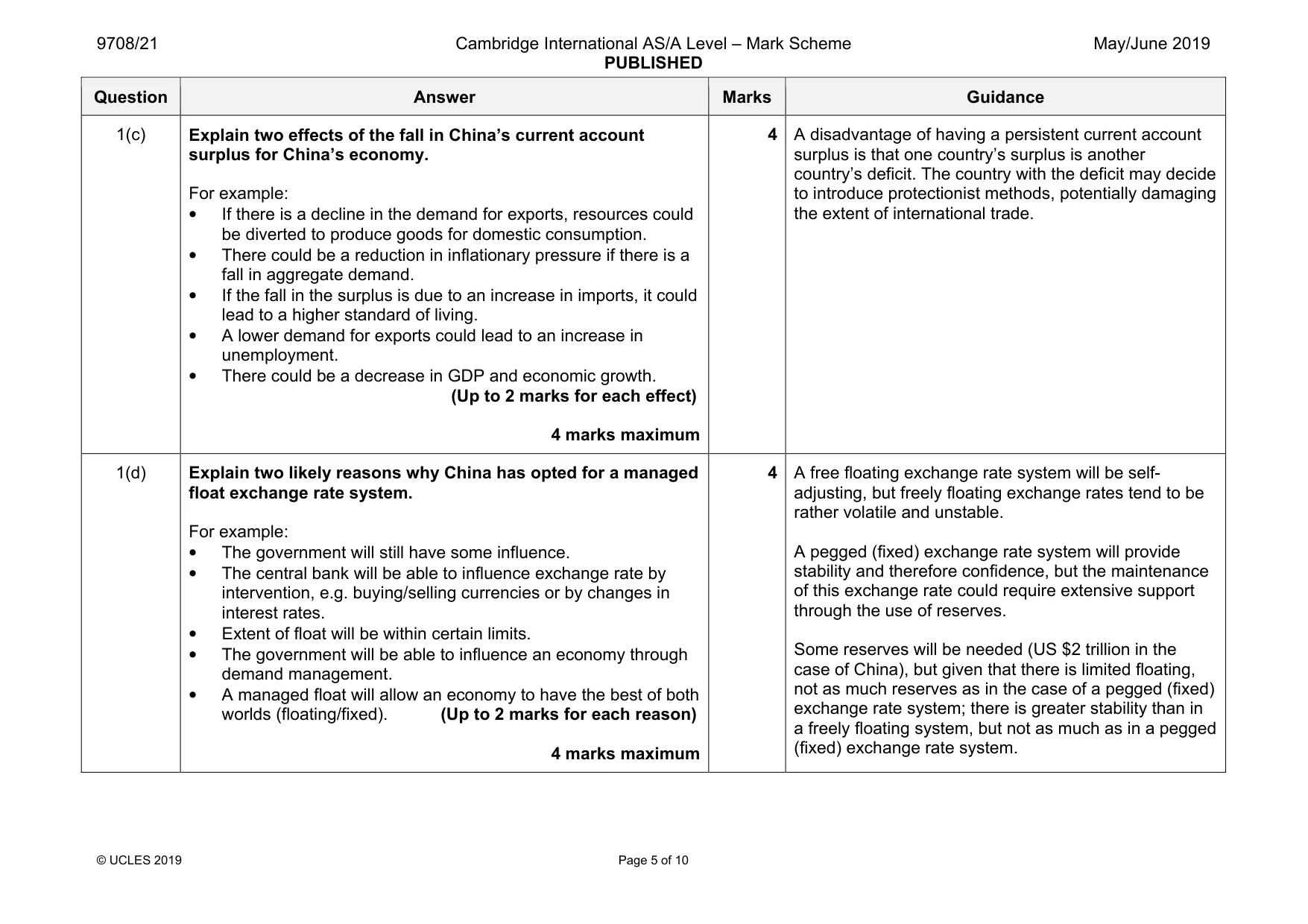
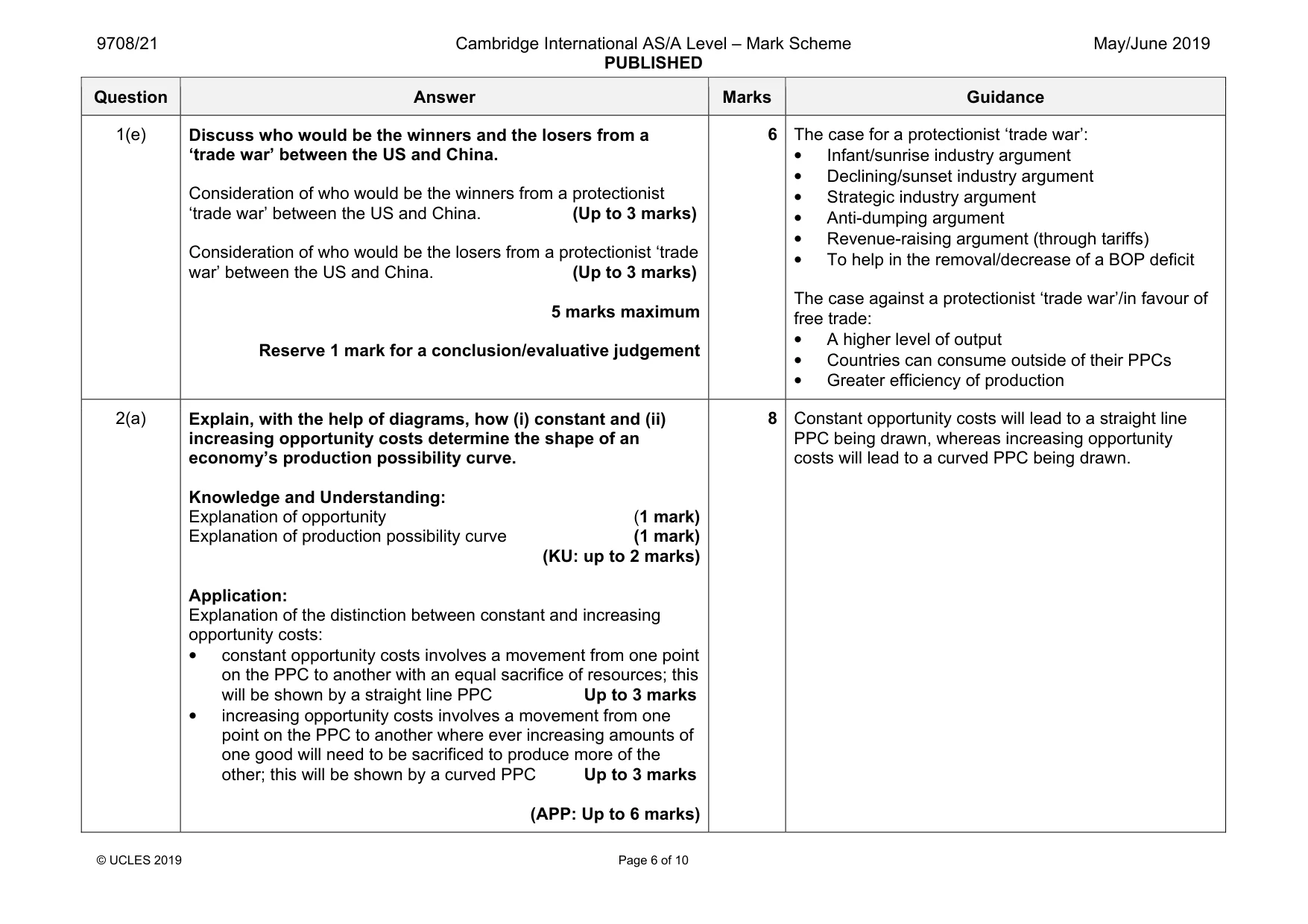
Mark scheme: 1(a) Describe, using Fig. 1.1, how the value of the yuan against the US dollar has changed between 2014 and 2017. There has been a depreciation/fall in value. (1 mark) The depreciation was from about 6.0 yuan per US dollar at the beginning of 2014 to about 6.9 yuan per US dollar in 2017. This is a change of 0.9/6.0 = 15%. (1 mark) 2 1(b) The US President threatened to increase protectionism of the US economy. Explain, using a diagram, how one of the methods of protectionism mentioned in the article can work. TARIFF For an explanation of how a tariff can work, stressing that it is a tax/duty on imported goods. (2 marks) For a diagram of a tariff. (2 marks) (1 mark for PQDS, 1 mark for showing distinction between supply without tariff and supply with tariff). OR QUOTA For an explanation of how an import quota can work, stressing that it relates to a limit in terms of the value of imported goods, or the volume of imported goods, or the market share of imported goods (2 marks) For a diagram of an import quota. (2 marks) (1 mark for PQDS, 1 mark for showing vertical quota line). 4 Question Answer Marks Guidance 1(c) Explain two effects of the fall in China’s current account surplus for China’s economy. For example: • If there is a decline in the demand for exports, resources could be diverted to produce goods for domestic consumption. • There could be a reduction in inflationary pressure if there is a fall in aggregate demand. • If the fall in the surplus is due to an increase in imports, it could lead to a higher standard of living. • A lower demand for exports could lead to an increase in unemployment. • There could be a decrease in GDP and economic growth. (Up to 2 marks for each effect) 4 marks maximum 4 A disadvantage of having a persistent current account surplus is that one country’s surplus is another country’s deficit. The country with the deficit may decide to introduce protectionist methods, potentially damaging the extent of international trade. 1(d) Explain two likely reasons why China has opted for a managed float exchange rate system. For example: • The government will still have some influence. • The central bank will be able to influence exchange rate by intervention, e.g. buying/selling currencies or by changes in interest rates. • Extent of float will be within certain limits. • The government will be able to influence an economy through demand management. • A managed float will allow an economy to have the best of both worlds (floating/fixed). (Up to 2 marks for each reason) 4 marks maximum 4 A free floating exchange rate system will be self- adjusting, but freely floating exchange rates tend to be rather volatile and unstable. A pegged (fixed) exchange rate system will provide stability and therefore confidence, but the maintenance of this exchange rate could require extensive support through the use of reserves. Some reserves will be needed (US $2 trillion in the case of China), but given that there is limited floating, not as much reserves as in the case of a pegged (fixed) exchange rate system; there is greater stability than in a freely floating system, but not as much as in a pegged (fixed) exchange rate system. Question Answer Marks Guidance 1(e) Discuss who would be the winners and the losers from a ‘trade war’ between the US and China. Consideration of who would be the winners from a protectionist ‘trade war’ between the US and China. (Up to 3 marks) Consideration of who would be the losers from a protectionist ‘trade war’ between the US and China. (Up to 3 marks) 5 marks maximum Reserve 1 mark for a conclusion/evaluative judgement 6 The case for a protectionist ‘trade war’: • Infant/sunrise industry argument • Declining/sunset industry argument • Strategic industry argument • Anti-dumping argument • Revenue-raising argument (through tariffs) • To help in the removal/decrease of a BOP deficit The case against a protectionist ‘trade war’/in favour of free trade: • A higher level of output • Countries can consume outside of their PPCs • Greater efficiency of production Constant opportunity costs will lead to a straight line
Q2 · Explain, with the help of diagrams, how (i) constant and (ii) increasing opportunity…
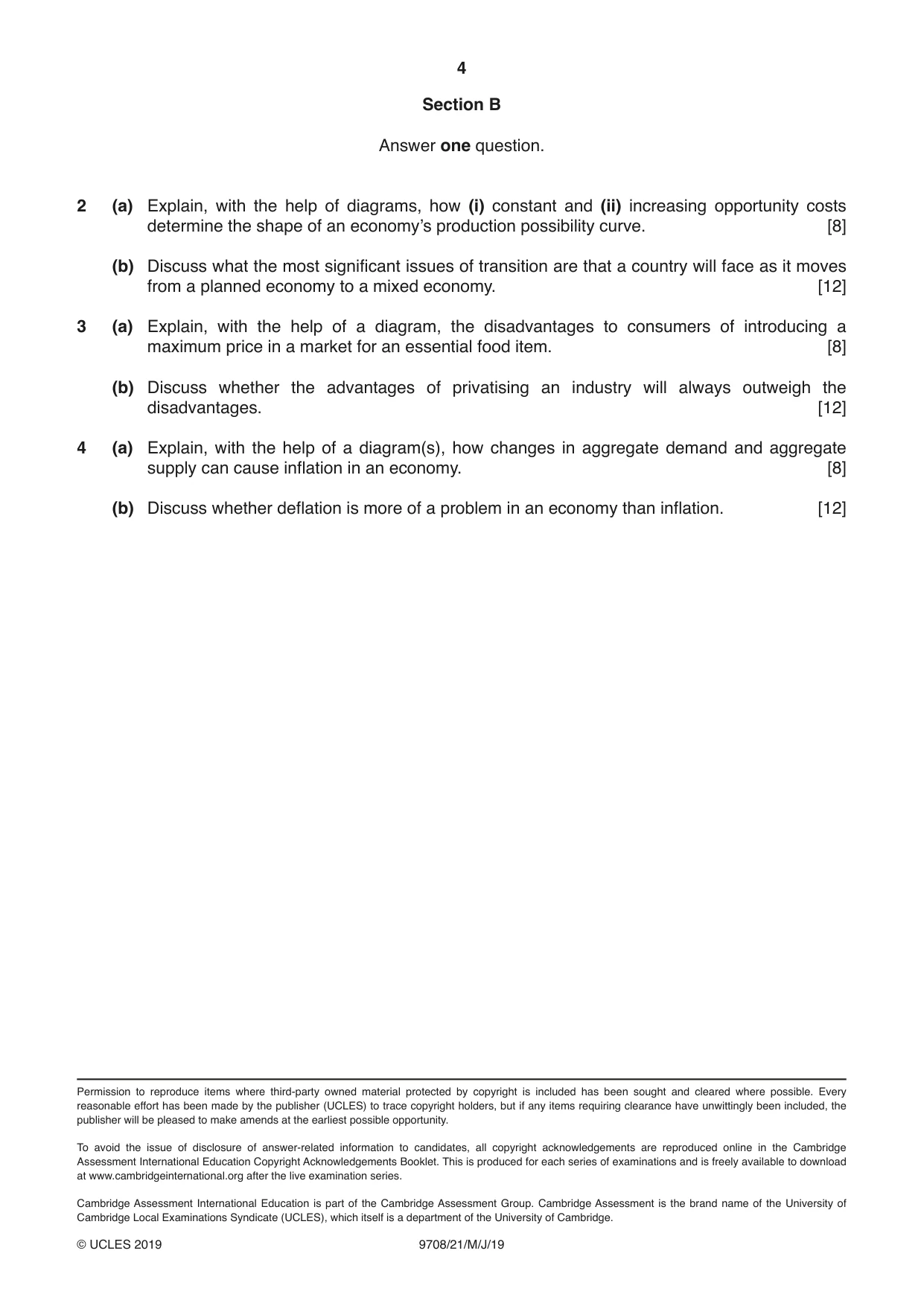
2 (a) Explain, with the help of diagrams, how (i) constant and (ii) increasing opportunity costs determine the shape of an economy’s production possibility curve. [8] (b) Discuss what the most significant issues of transition are that a country will face as it moves from a planned economy to a mixed economy. [12]
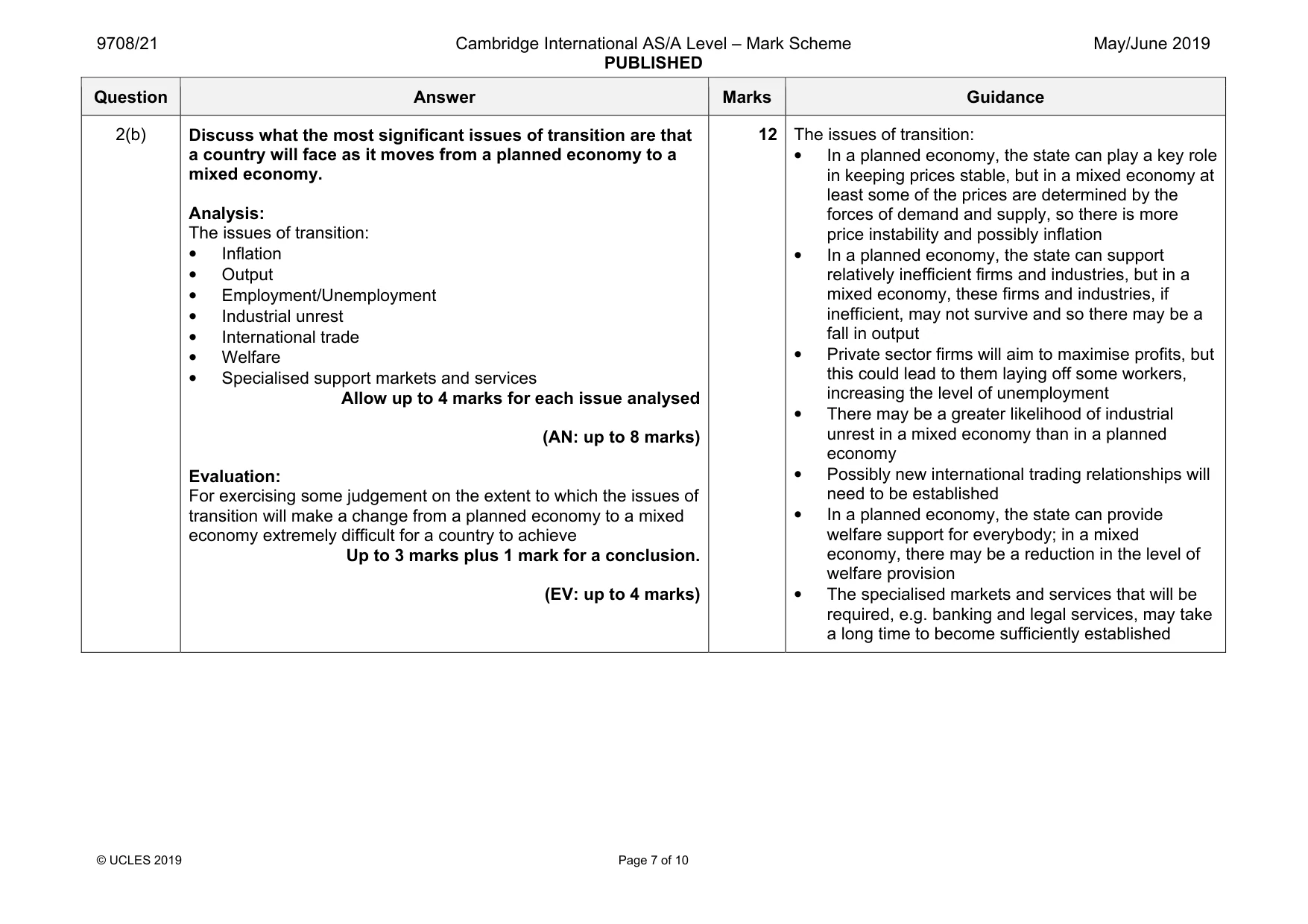
Mark scheme: 2(a) Explain, with the help of diagrams, how (i) constant and (ii) increasing opportunity costs determine the shape of an economy’s production possibility curve. Knowledge and Understanding: Explanation of opportunity (1 mark) Explanation of production possibility curve (1 mark) (KU: up to 2 marks) Application: Explanation of the distinction between constant and increasing opportunity costs: • constant opportunity costs involves a movement from one point on the PPC to another with an equal sacrifice of resources; this will be shown by a straight line PPC Up to 3 marks • increasing opportunity costs involves a movement from one point on the PPC to another where ever increasing amounts of one good will need to be sacrificed to produce more of the other; this will be shown by a curved PPC Up to 3 marks (APP: Up to 6 marks) 8 PPC being drawn, whereas increasing opportunity costs will lead to a curved PPC being drawn. Question Answer Marks Guidance 2(b) Discuss what the most significant issues of transition are that a country will face as it moves from a planned economy to a mixed economy. Analysis: The issues of transition: • Inflation • Output • Employment/Unemployment • Industrial unrest • International trade • Welfare • Specialised support markets and services Allow up to 4 marks for each issue analysed (AN: up to 8 marks) Evaluation: For exercising some judgement on the extent to which the issues of transition will make a change from a planned economy to a mixed economy extremely difficult for a country to achieve Up to 3 marks plus 1 mark for a conclusion. (EV: up to 4 marks) 12 The issues of transition: • In a planned economy, the state can play a key role in keeping prices stable, but in a mixed economy at least some of the prices are determined by the forces of demand and supply, so there is more price instability and possibly inflation • In a planned economy, the state can support relatively inefficient firms and industries, but in a mixed economy, these firms and industries, if inefficient, may not survive and so there may be a fall in output • Private sector firms will aim to maximise profits, but this could lead to them laying off some workers, increasing the level of unemployment • There may be a greater likelihood of industrial unrest in a mixed economy than in a planned economy • Possibly new international trading relationships will need to be established • In a planned economy, the state can provide welfare support for everybody; in a mixed economy, there may be a reduction in the level of welfare provision • The specialised markets and services that will be required, e.g. banking and legal services, may take a long time to become sufficiently established
More questions on Resource allocation in different economic systems
Q3 · Explain, with the help of a diagram, the disadvantages to consumers of introducing a…
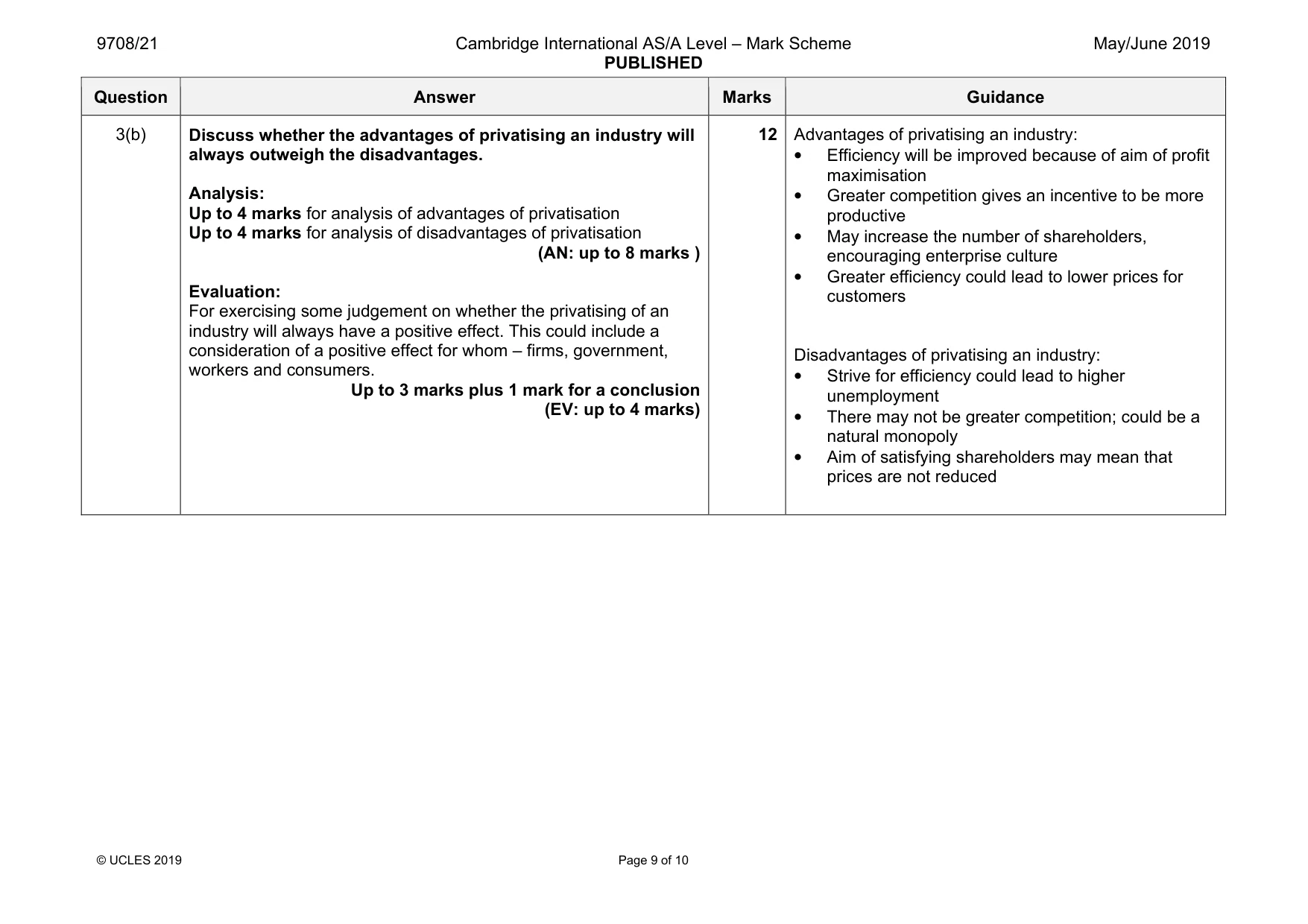
3 (a) Explain, with the help of a diagram, the disadvantages to consumers of introducing a maximum price in a market for an essential food item. [8] (b) Discuss whether the advantages of privatising an industry will always outweigh the disadvantages. [12]
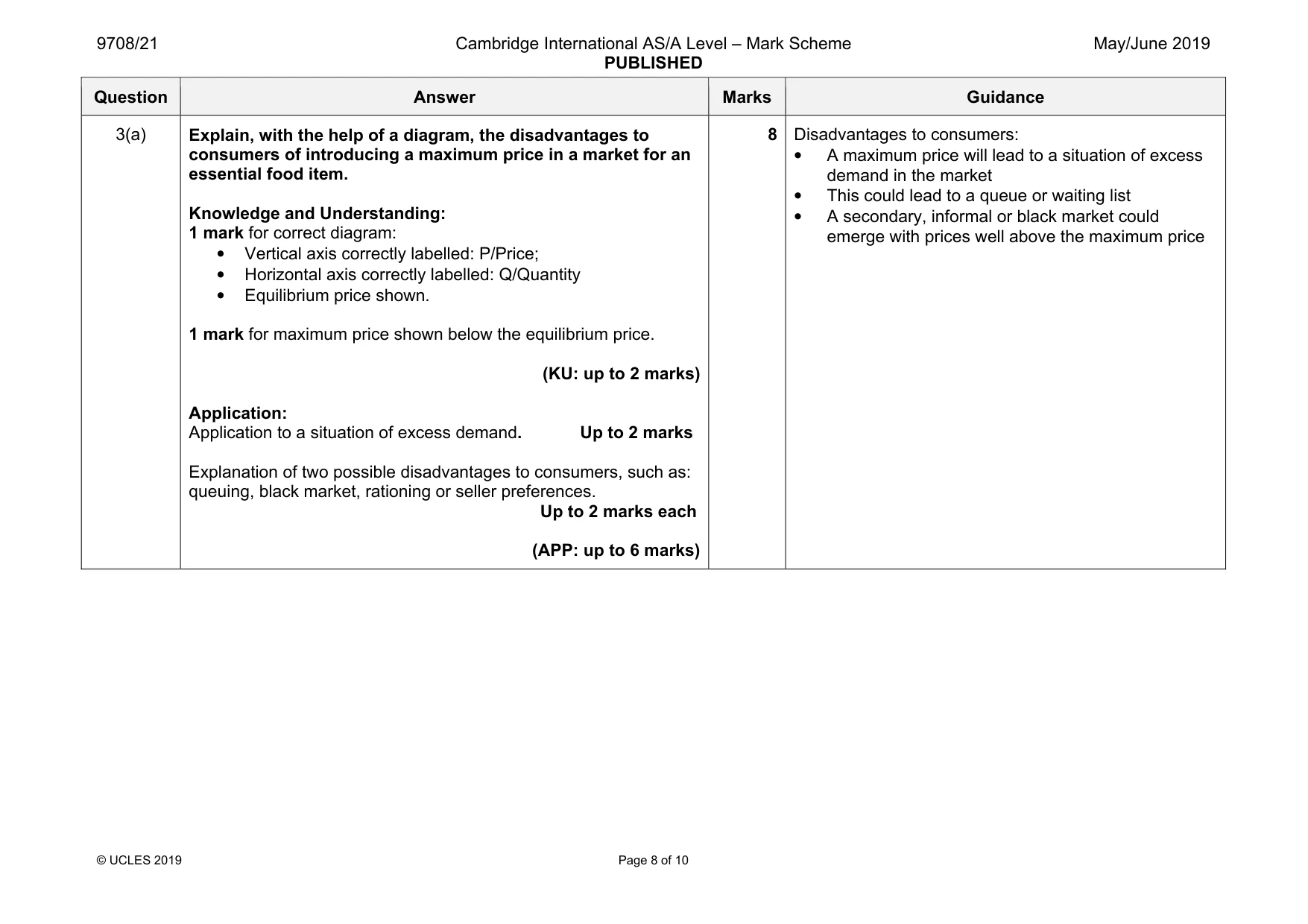
Mark scheme: 3(a) Explain, with the help of a diagram, the disadvantages to consumers of introducing a maximum price in a market for an essential food item. Knowledge and Understanding: 1 mark for correct diagram: • Vertical axis correctly labelled: P/Price; • Horizontal axis correctly labelled: Q/Quantity • Equilibrium price shown. 1 mark for maximum price shown below the equilibrium price. (KU: up to 2 marks) Application: Application to a situation of excess demand. Up to 2 marks Explanation of two possible disadvantages to consumers, such as: queuing, black market, rationing or seller preferences. Up to 2 marks each (APP: up to 6 marks) 8 • A maximum price will lead to a situation of excess demand in the market • This could lead to a queue or waiting list • A secondary, informal or black market could emerge with prices well above the maximum price Question Answer Marks Guidance 3(b) Discuss whether the advantages of privatising an industry will always outweigh the disadvantages. Analysis: Up to 4 marks for analysis of advantages of privatisation Up to 4 marks for analysis of disadvantages of privatisation (AN: up to 8 marks ) Evaluation: For exercising some judgement on whether the privatising of an industry will always have a positive effect. This could include a consideration of a positive effect for whom – firms, government, workers and consumers. Up to 3 marks plus 1 mark for a conclusion (EV: up to 4 marks) 12 Advantages of privatising an industry: • Efficiency will be improved because of aim of profit maximisation • Greater competition gives an incentive to be more productive • May increase the number of shareholders, encouraging enterprise culture • Greater efficiency could lead to lower prices for customers Disadvantages of privatising an industry: • Strive for efficiency could lead to higher unemployment • There may not be greater competition; could be a natural monopoly • Aim of satisfying shareholders may mean that prices are not reduced
Q4 · Explain, with the help of a diagram(s), how changes in aggregate demand and aggregate…
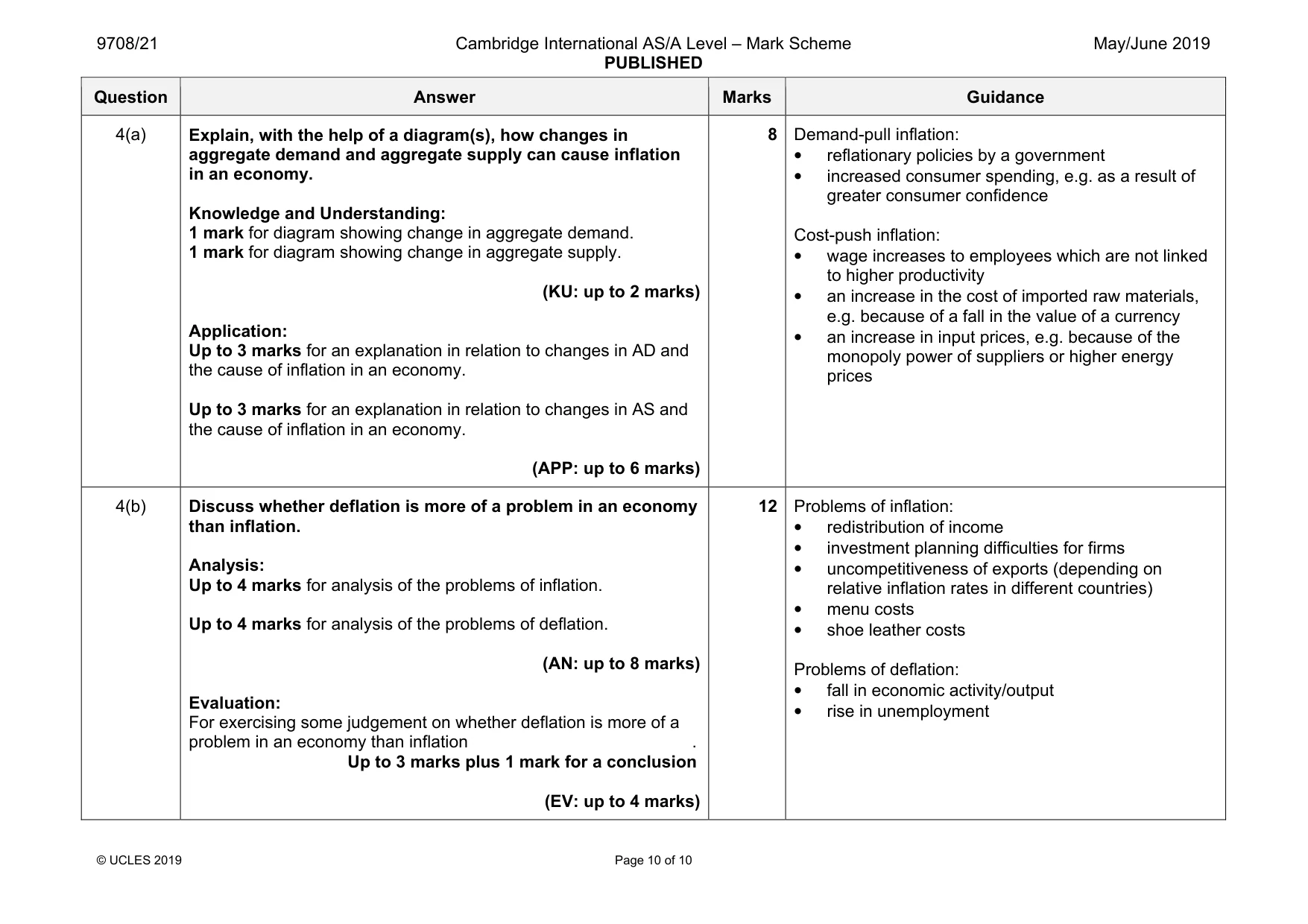
4 (a) Explain, with the help of a diagram(s), how changes in aggregate demand and aggregate supply can cause inflation in an economy. [8] (b) Discuss whether deflation is more of a problem in an economy than inflation. [12]
Mark scheme: 4(a) Explain, with the help of a diagram(s), how changes in aggregate demand and aggregate supply can cause inflation in an economy. Knowledge and Understanding: 1 mark for diagram showing change in aggregate demand. 1 mark for diagram showing change in aggregate supply. (KU: up to 2 marks) Application: Up to 3 marks for an explanation in relation to changes in AD and the cause of inflation in an economy. Up to 3 marks for an explanation in relation to changes in AS and the cause of inflation in an economy. (APP: up to 6 marks) 8 • reflationary policies by a government • increased consumer spending, e.g. as a result of greater consumer confidence Cost-push inflation: • wage increases to employees which are not linked to higher productivity • an increase in the cost of imported raw materials, e.g. because of a fall in the value of a currency • an increase in input prices, e.g. because of the monopoly power of suppliers or higher energy prices 4(b) Discuss whether deflation is more of a problem in an economy than inflation. Analysis: Up to 4 marks for analysis of the problems of inflation. Up to 4 marks for analysis of the problems of deflation. (AN: up to 8 marks) Evaluation: For exercising some judgement on whether deflation is more of a problem in an economy than inflation . Up to 3 marks plus 1 mark for a conclusion (EV: up to 4 marks) 12 Problems of inflation: • redistribution of income • investment planning difficulties for firms • uncompetitiveness of exports (depending on relative inflation rates in different countries) • menu costs • shoe leather costs Problems of deflation: • fall in economic activity/output • rise in unemployment
What was in this paper
The subtopics covered by these 4 questions, and how many questions each got. Open one in a new tab to see every Cambridge question on it.
What you needed in this session
Cambridge’s own grade thresholds for 2019 May/June, Paper 2 · Variant 1. A higher threshold means an easier paper — the bar moves with how the cohort did.