Cambridge A Level Economics 9708 — 2019 May/June Paper 2 · Variant 2
9708/22/M/J/19 · 4 questions · 40 marks · ≈45 min
The question paper and its mark scheme, free to read here and free to download. This is Cambridge’s own paper, exactly as it was sat.
Question paper4 pages
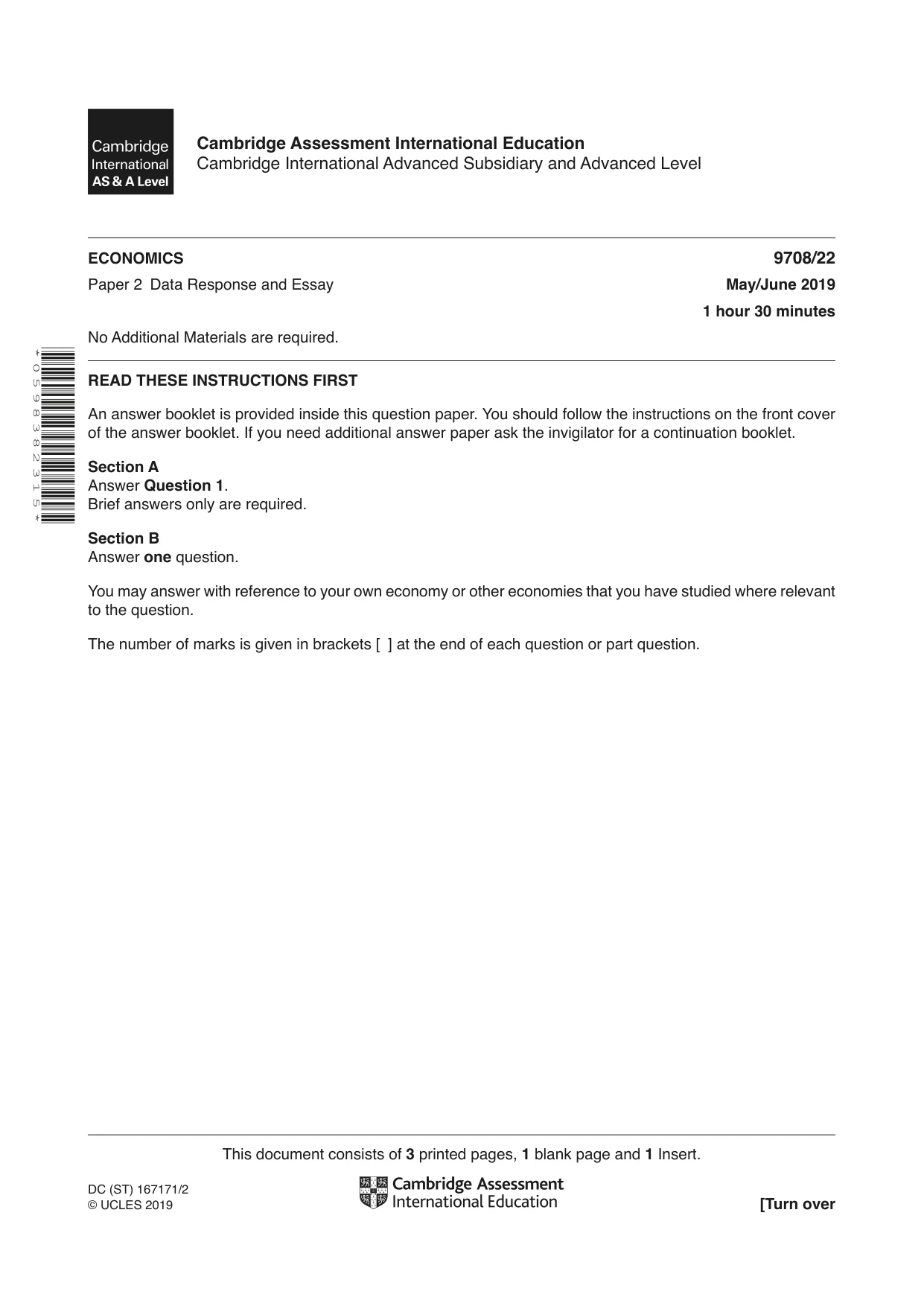
Mark scheme13 pages
Answers below. Sit the paper first if you are practising.
Questions as text
Q1 · Egypt’s economic difficulties Table 1.1: Egypt, selected economic indicators, 2014–2019…
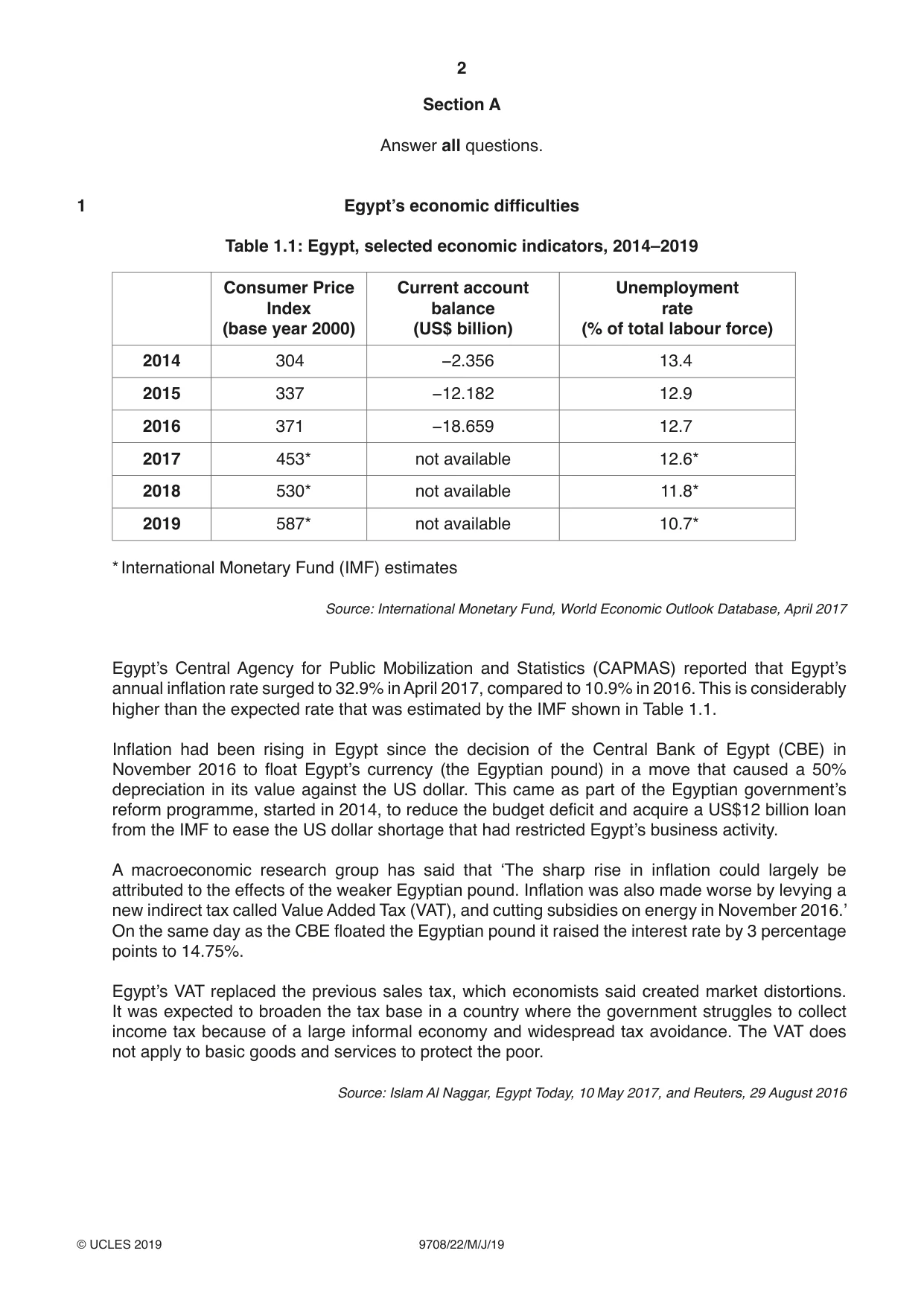
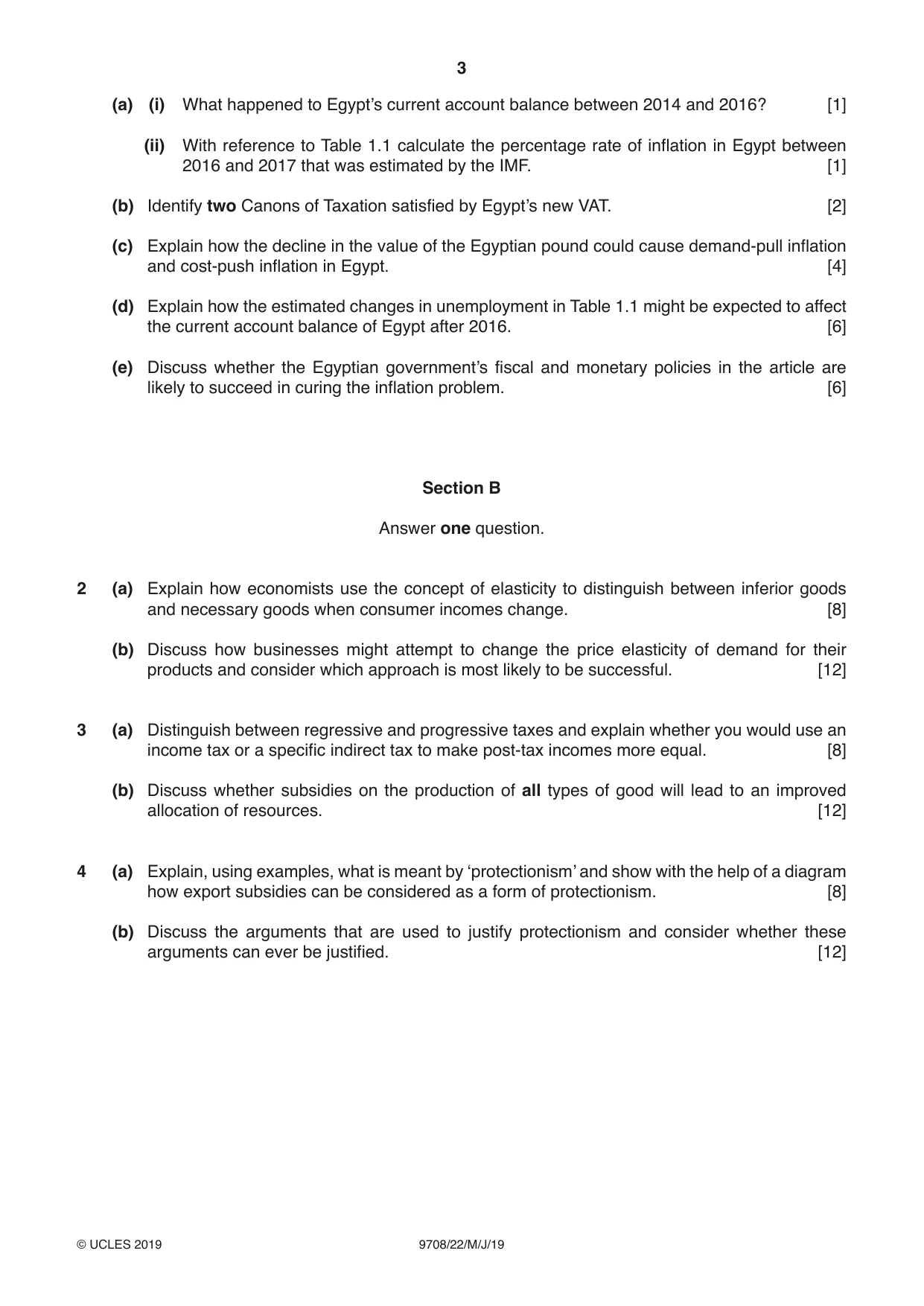
1 Egypt’s economic difficulties Table 1.1: Egypt, selected economic indicators, 2014–2019 Consumer Price Current account Unemployment Index balance rate (base year 2000) (US$ billion) (% of total labour force) 2014 304 −2.356 13.4 2015 337 −12.182 12.9 2016 371 −18.659 12.7 2017 453* not available 12.6* 2018 530* not available 11.8* 2019 587* not available 10.7* * International Monetary Fund (IMF) estimates Source: International Monetary Fund, World Economic Outlook Database, April 2017 Egypt’s Central Agency for Public Mobilization and Statistics (CAPMAS) reported that Egypt’s annual inflation rate surged to 32.9% in April 2017, compared to 10.9% in 2016. This is considerably higher than the expected rate that was estimated by the IMF shown in Table 1.1. Inflation had been rising in Egypt since the decision of the Central Bank of Egypt (CBE) in November 2016 to float Egypt’s currency (the Egyptian pound) in a move that caused a 50% depreciation in its value against the US dollar. This came as part of the Egyptian government’s reform programme, started in 2014, to reduce the budget deficit and acquire a US$12 billion loan from the IMF to ease the US dollar shortage that had restricted Egypt’s business activity. A macroeconomic research group has said that ‘The sharp rise in inflation could largely be attributed to the effects of the weaker Egyptian pound. Inflation was also made worse by levying a new indirect tax called Value Added Tax (VAT), and cutting subsidies on energy in November 2016.’ On the same day as the CBE floated the Egyptian pound it raised the interest rate by 3 percentage points to 14.75%. Egypt’s VAT replaced the previous sales tax, which economists said created market distortions. It was expected to broaden the tax base in a country where the government struggles to collect income tax because of a large informal economy and widespread tax avoidance. The VAT does not apply to basic goods and services to protect the poor. Source: Islam Al Naggar, Egypt Today, 10 May 2017, and Reuters, 29 August 2016 (a) (i) What happened to Egypt’s current account balance between 2014 and 2016? [1] (ii) With reference to Table 1.1 calculate the percentage rate of inflation in Egypt between 2016 and 2017 that was estimated by the IMF. [1] (b) Identify two Canons of Taxation satisfied by Egypt’s new VAT. [2] (c) Explain how the decline in the value of the Egyptian pound could cause demand-pull inflation and cost-push inflation in Egypt. [4] (d) Explain how the estimated changes in unemployment in Table 1.1 might be expected to affect the current account balance of Egypt after 2016. [6] (e) Discuss whether the Egyptian government’s fiscal and monetary policies in the article are likely to succeed in curing the inflation problem. [6]
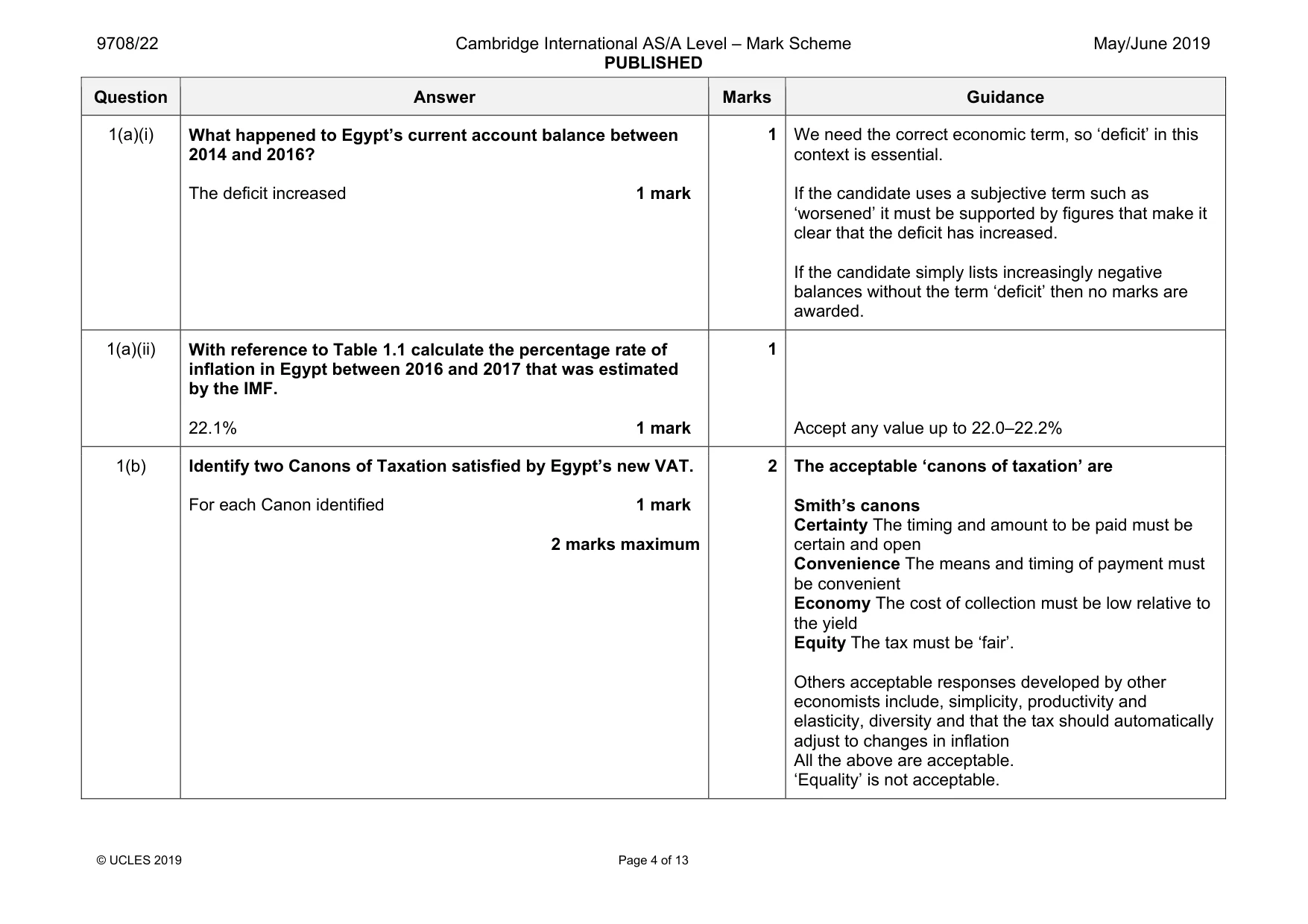
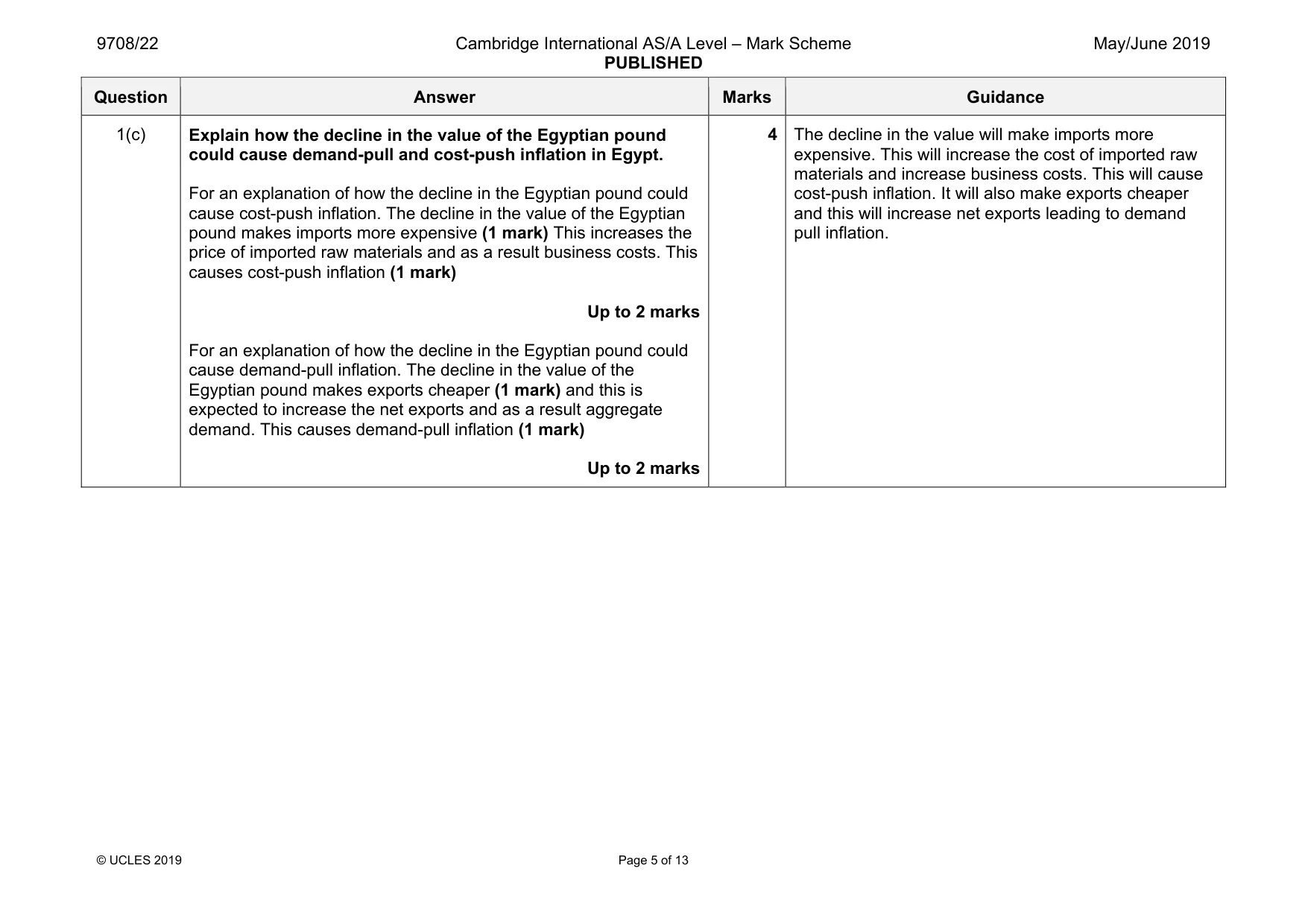
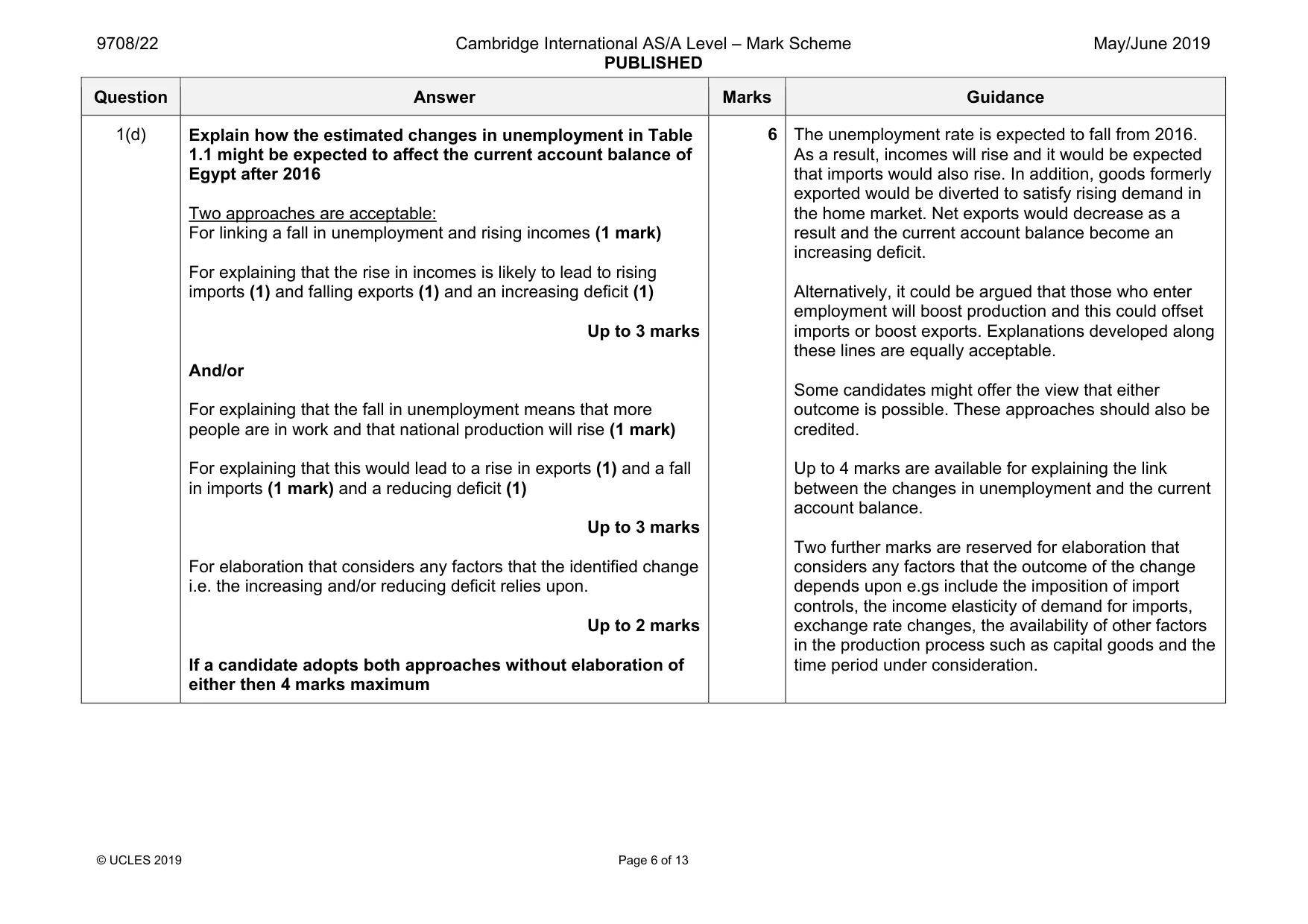
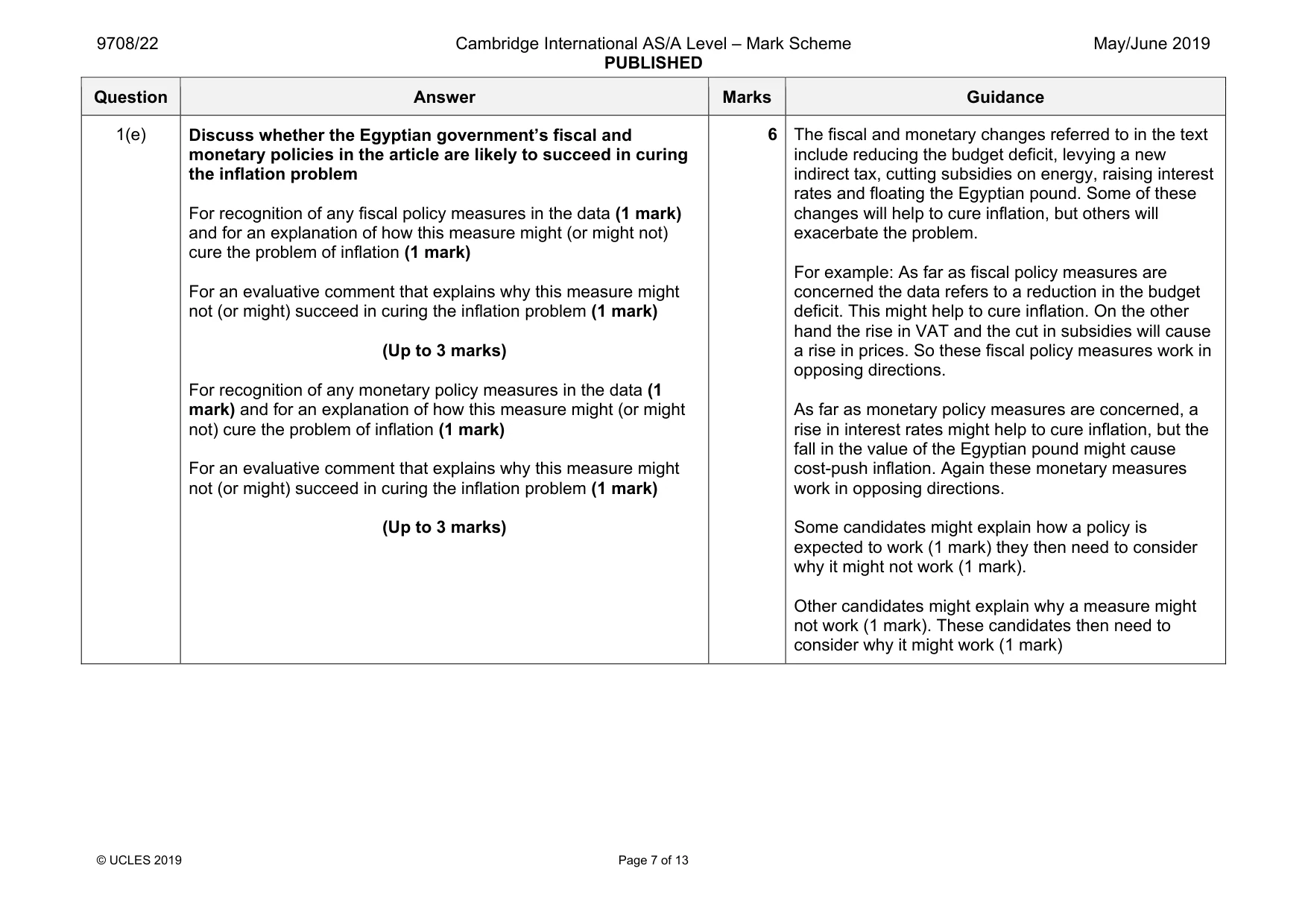
Mark scheme: 1(a)(i) What happened to Egypt’s current account balance between 2014 and 2016? The deficit increased 1 mark 1 context is essential. If the candidate uses a subjective term such as ‘worsened’ it must be supported by figures that make it clear that the deficit has increased. If the candidate simply lists increasingly negative balances without the term ‘deficit’ then no marks are awarded. 1(a)(ii) With reference to Table 1.1 calculate the percentage rate of inflation in Egypt between 2016 and 2017 that was estimated by the IMF. 22.1% 1 mark 1 Accept any value up to 22.0–22.2% 1(b) Identify two Canons of Taxation satisfied by Egypt’s new VAT. For each Canon identified 1 mark 2 marks maximum 2 The acceptable ‘canons of taxation’ are Smith’s canons Certainty The timing and amount to be paid must be certain and open Convenience The means and timing of payment must be convenient Economy The cost of collection must be low relative to the yield Equity The tax must be ‘fair’. Others acceptable responses developed by other economists include, simplicity, productivity and elasticity, diversity and that the tax should automatically adjust to changes in inflation All the above are acceptable. ‘Equality’ is not acceptable. Question Answer Marks Guidance 1(c) Explain how the decline in the value of the Egyptian pound could cause demand-pull and cost-push inflation in Egypt. For an explanation of how the decline in the Egyptian pound could cause cost-push inflation. The decline in the value of the Egyptian pound makes imports more expensive (1 mark) This increases the price of imported raw materials and as a result business costs. This causes cost-push inflation (1 mark) Up to 2 marks For an explanation of how the decline in the Egyptian pound could cause demand-pull inflation. The decline in the value of the Egyptian pound makes exports cheaper (1 mark) and this is expected to increase the net exports and as a result aggregate demand. This causes demand-pull inflation (1 mark) Up to 2 marks 4 The decline in the value will make imports more expensive. This will increase the cost of imported raw materials and increase business costs. This will cause cost-push inflation. It will also make exports cheaper and this will increase net exports leading to demand pull inflation. Question Answer Marks Guidance 1(d) Explain how the estimated changes in unemployment in Table 1.1 might be expected to affect the current account balance of Egypt after 2016 Two approaches are acceptable: For linking a fall in unemployment and rising incomes (1 mark) For explaining that the rise in incomes is likely to lead to rising imports (1) and falling exports (1) and an increasing deficit (1) Up to 3 marks And/or For explaining that the fall in unemployment means that more people are in work and that national production will rise (1 mark) For explaining that this would lead to a rise in exports (1) and a fall in imports (1 mark) and a reducing deficit (1) Up to 3 marks For elaboration that considers any factors that the identified change i.e. the increasing and/or reducing deficit relies upon. Up to 2 marks If a candidate adopts both approaches without elaboration of either then 4 marks maximum 6 The unemployment rate is expected to fall from 2016. As a result, incomes will rise and it would be expected that imports would also rise. In addition, goods formerly exported would be diverted to satisfy rising demand in the home market. Net exports would decrease as a result and the current account balance become an increasing deficit. Alternatively, it could be argued that those who enter employment will boost production and this could offset imports or boost exports. Explanations developed along these lines are equally acceptable. Some candidates might offer the view that either outcome is possible. These approaches should also be credited. Up to 4 marks are available for explaining the link between the changes in unemployment and the current account balance. Two further marks are reserved for elaboration that considers any factors that the outcome of the change depends upon e.gs include the imposition of import controls, the income elasticity of demand for imports, exchange rate changes, the availability of other factors in the production process such as capital goods and the time period under consideration. Question Answer Marks Guidance 1(e) Discuss whether the Egyptian government’s fiscal and monetary policies in the article are likely to succeed in curing the inflation problem For recognition of any fiscal policy measures in the data (1 mark) and for an explanation of how this measure might (or might not) cure the problem of inflation (1 mark) For an evaluative comment that explains why this measure might not (or might) succeed in curing the inflation problem (1 mark) (Up to 3 marks) For recognition of any monetary policy measures in the data (1 mark) and for an explanation of how this measure might (or might not) cure the problem of inflation (1 mark) For an evaluative comment that explains why this measure might not (or might) succeed in curing the inflation problem (1 mark) (Up to 3 marks) 6 The fiscal and monetary changes referred to in the text include reducing the budget deficit, levying a new indirect tax, cutting subsidies on energy, raising interest rates and floating the Egyptian pound. Some of these changes will help to cure inflation, but others will exacerbate the problem. For example: As far as fiscal policy measures are concerned the data refers to a reduction in the budget deficit. This might help to cure inflation. On the other hand the rise in VAT and the cut in subsidies will cause a rise in prices. So these fiscal policy measures work in opposing directions. As far as monetary policy measures are concerned, a rise in interest rates might help to cure inflation, but the fall in the value of the Egyptian pound might cause cost-push inflation. Again these monetary measures work in opposing directions. Some candidates might explain how a policy is expected to work (1 mark) they then need to consider why it might not work (1 mark). Other candidates might explain why a measure might not work (1 mark). These candidates then need to consider why it might work (1 mark)
More questions on Current account of the balance of payments
Q2 · Explain how economists use the concept of elasticity to distinguish between inferior…
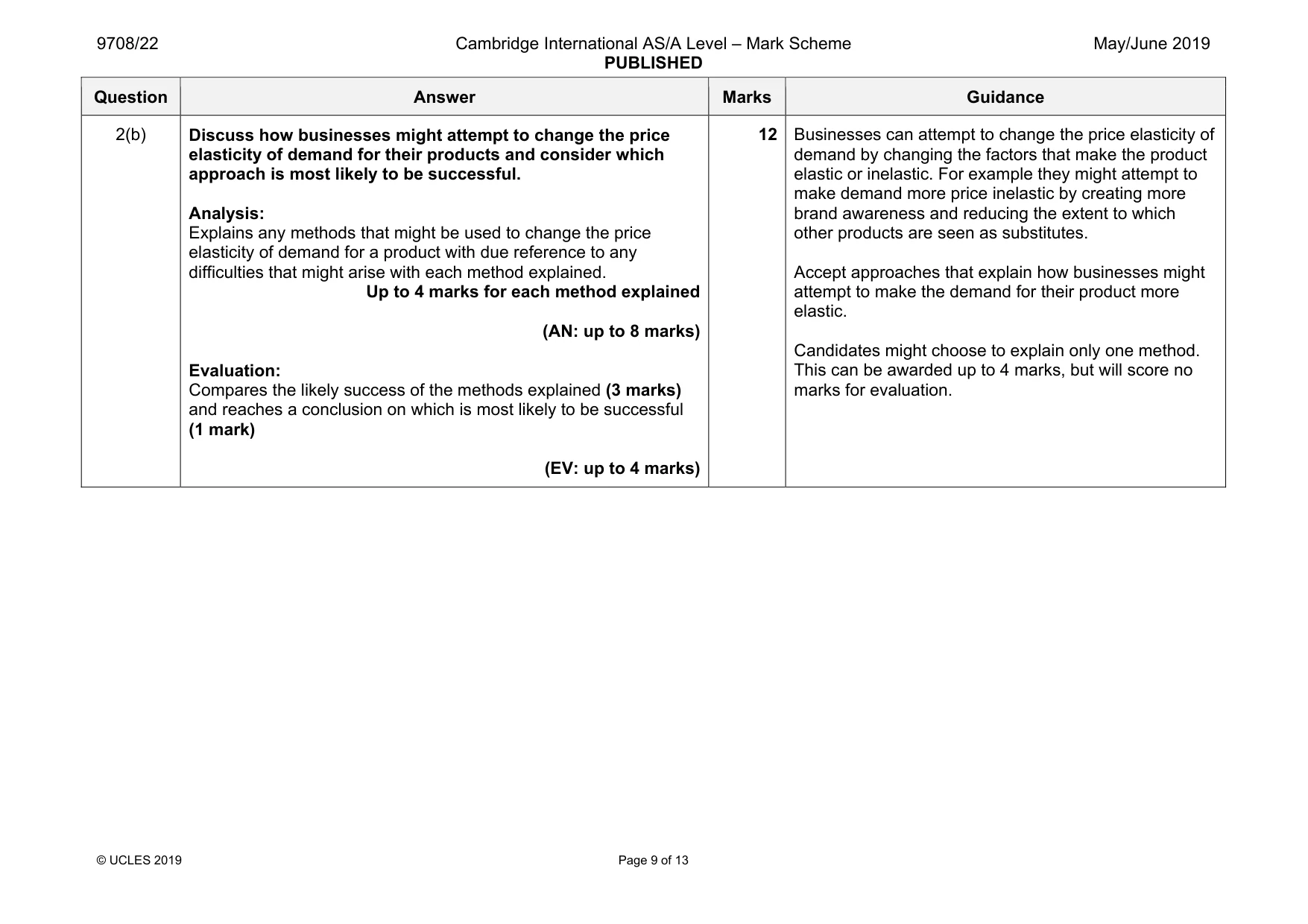
2 (a) Explain how economists use the concept of elasticity to distinguish between inferior goods and necessary goods when consumer incomes change. [8] (b) Discuss how businesses might attempt to change the price elasticity of demand for their products and consider which approach is most likely to be successful. [12]
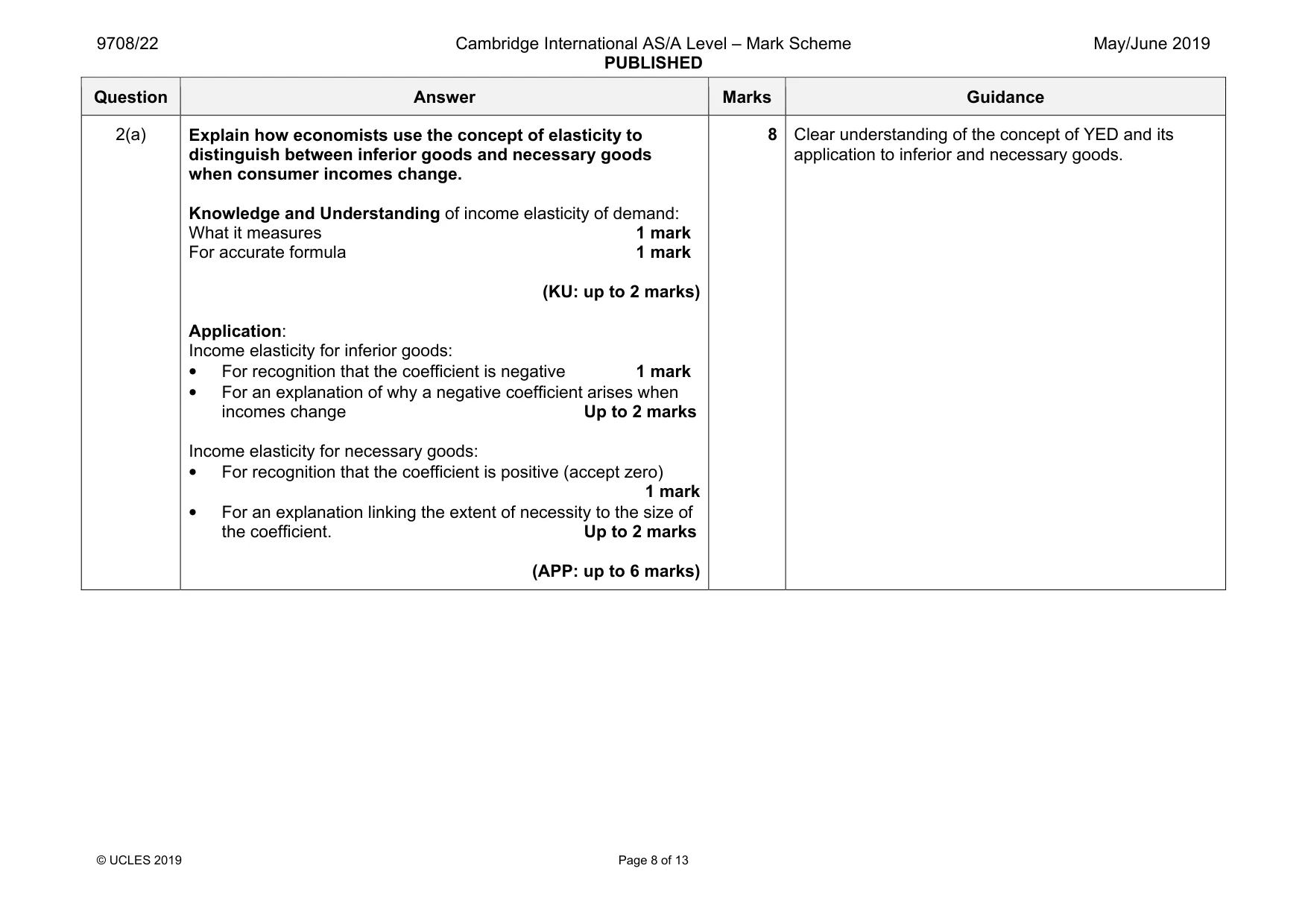
Mark scheme: 2(a) Explain how economists use the concept of elasticity to distinguish between inferior goods and necessary goods when consumer incomes change. Knowledge and Understanding of income elasticity of demand: What it measures 1 mark For accurate formula 1 mark (KU: up to 2 marks) Application: Income elasticity for inferior goods: • For recognition that the coefficient is negative 1 mark • For an explanation of why a negative coefficient arises when incomes change Up to 2 marks Income elasticity for necessary goods: • For recognition that the coefficient is positive (accept zero) 1 mark • For an explanation linking the extent of necessity to the size of the coefficient. Up to 2 marks (APP: up to 6 marks) 8 application to inferior and necessary goods. Question Answer Marks Guidance 2(b) Discuss how businesses might attempt to change the price elasticity of demand for their products and consider which approach is most likely to be successful. Analysis: Explains any methods that might be used to change the price elasticity of demand for a product with due reference to any difficulties that might arise with each method explained. Up to 4 marks for each method explained (AN: up to 8 marks) Evaluation: Compares the likely success of the methods explained (3 marks) and reaches a conclusion on which is most likely to be successful (1 mark) (EV: up to 4 marks) 12 Businesses can attempt to change the price elasticity of demand by changing the factors that make the product elastic or inelastic. For example they might attempt to make demand more price inelastic by creating more brand awareness and reducing the extent to which other products are seen as substitutes. Accept approaches that explain how businesses might attempt to make the demand for their product more elastic. Candidates might choose to explain only one method. This can be awarded up to 4 marks, but will score no marks for evaluation.
More questions on Price elasticity, income elasticity and cross elasticity of demand
Q3 · Distinguish between regressive and progressive taxes and explain whether you would use an…
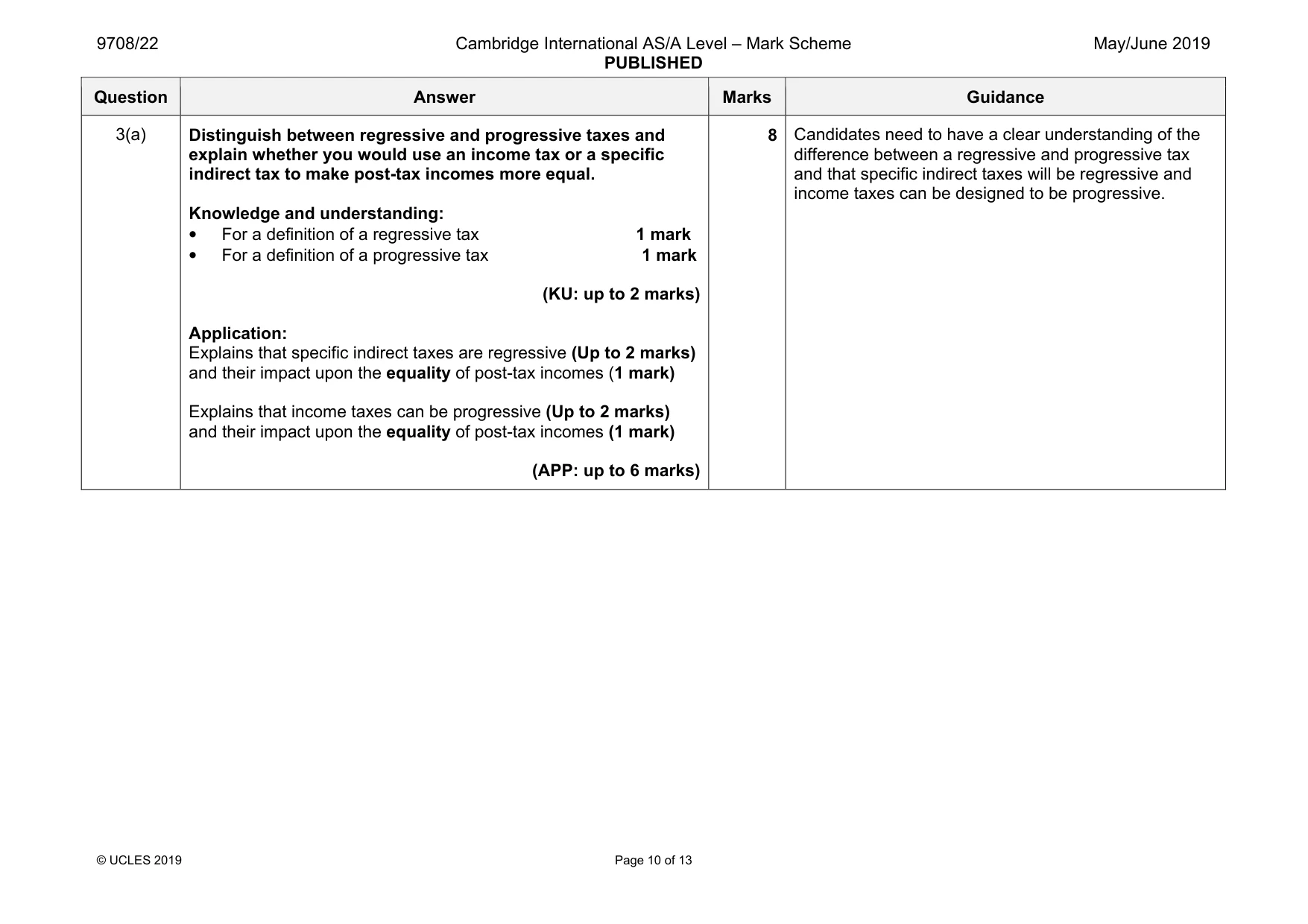
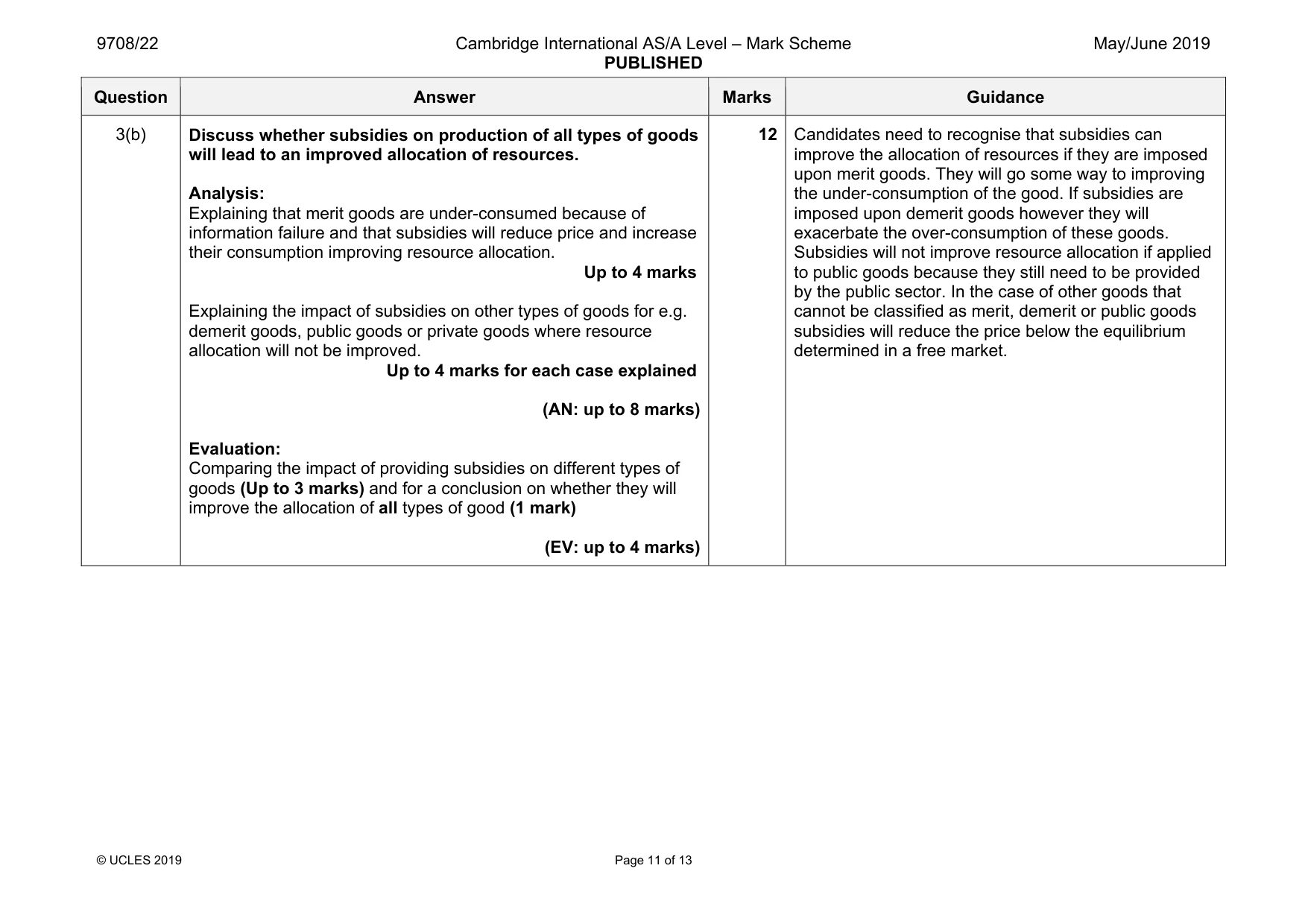
3 (a) Distinguish between regressive and progressive taxes and explain whether you would use an income tax or a specific indirect tax to make post-tax incomes more equal. [8] (b) Discuss whether subsidies on the production of all types of good will lead to an improved allocation of resources. [12]
Mark scheme: 3(a) Distinguish between regressive and progressive taxes and explain whether you would use an income tax or a specific indirect tax to make post-tax incomes more equal. Knowledge and understanding: • For a definition of a regressive tax 1 mark • For a definition of a progressive tax 1 mark (KU: up to 2 marks) Application: Explains that specific indirect taxes are regressive (Up to 2 marks) and their impact upon the equality of post-tax incomes (1 mark) Explains that income taxes can be progressive (Up to 2 marks) and their impact upon the equality of post-tax incomes (1 mark) (APP: up to 6 marks) 8 Candidates need to have a clear understanding of the difference between a regressive and progressive tax and that specific indirect taxes will be regressive and income taxes can be designed to be progressive. Question Answer Marks Guidance 3(b) Discuss whether subsidies on production of all types of goods will lead to an improved allocation of resources. Analysis: Explaining that merit goods are under-consumed because of information failure and that subsidies will reduce price and increase their consumption improving resource allocation. Up to 4 marks Explaining the impact of subsidies on other types of goods for e.g. demerit goods, public goods or private goods where resource allocation will not be improved. Up to 4 marks for each case explained (AN: up to 8 marks) Evaluation: Comparing the impact of providing subsidies on different types of goods (Up to 3 marks) and for a conclusion on whether they will improve the allocation of all types of good (1 mark) (EV: up to 4 marks) 12 Candidates need to recognise that subsidies can improve the allocation of resources if they are imposed upon merit goods. They will go some way to improving the under-consumption of the good. If subsidies are imposed upon demerit goods however they will exacerbate the over-consumption of these goods. Subsidies will not improve resource allocation if applied to public goods because they still need to be provided by the public sector. In the case of other goods that cannot be classified as merit, demerit or public goods subsidies will reduce the price below the equilibrium determined in a free market.
Q4 · Explain, using examples, what is meant by ‘protectionism’ and show with the help of a…
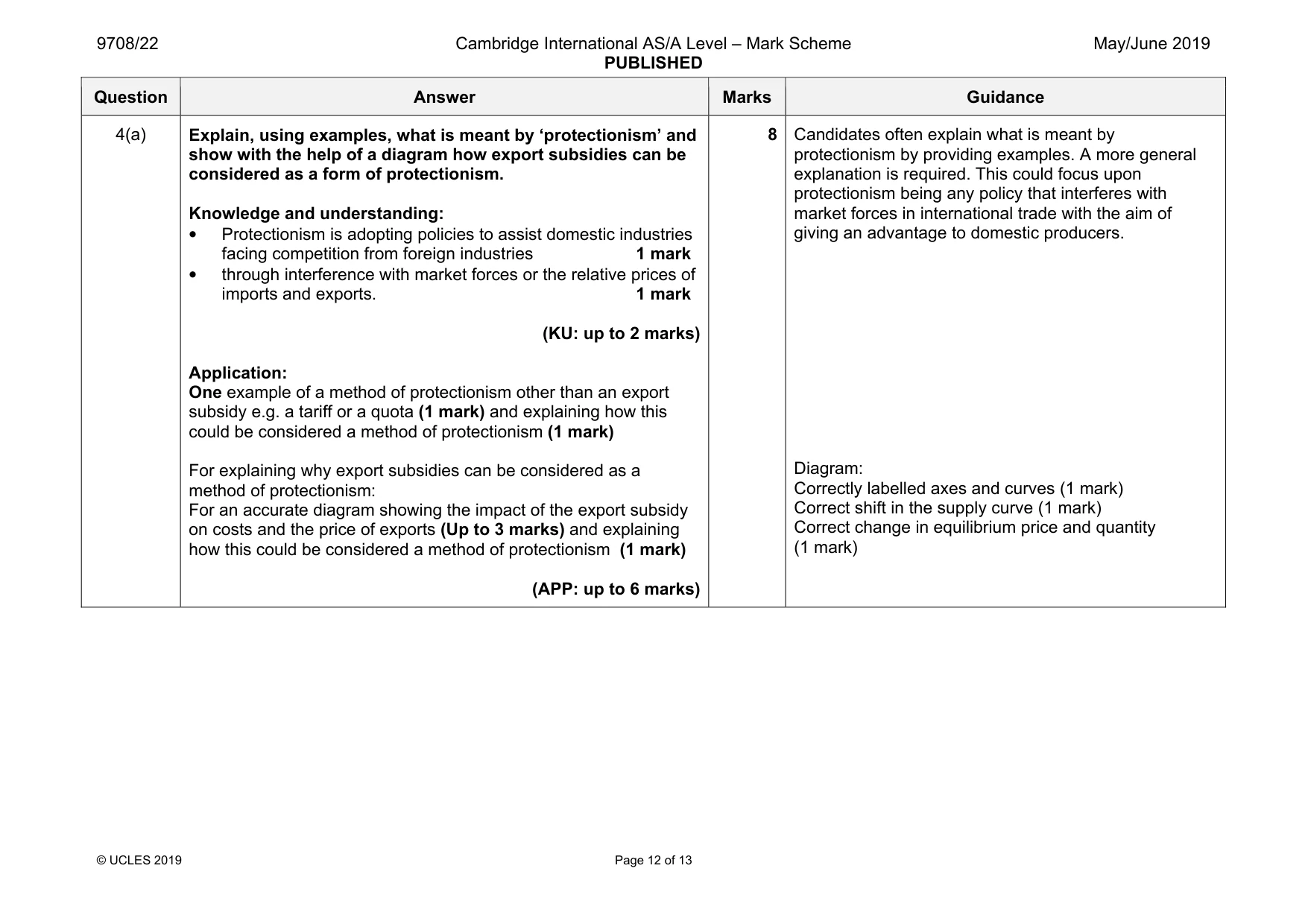
4 (a) Explain, using examples, what is meant by ‘protectionism’ and show with the help of a diagram how export subsidies can be considered as a form of protectionism. [8] (b) Discuss the arguments that are used to justify protectionism and consider whether these arguments can ever be justified. [12]
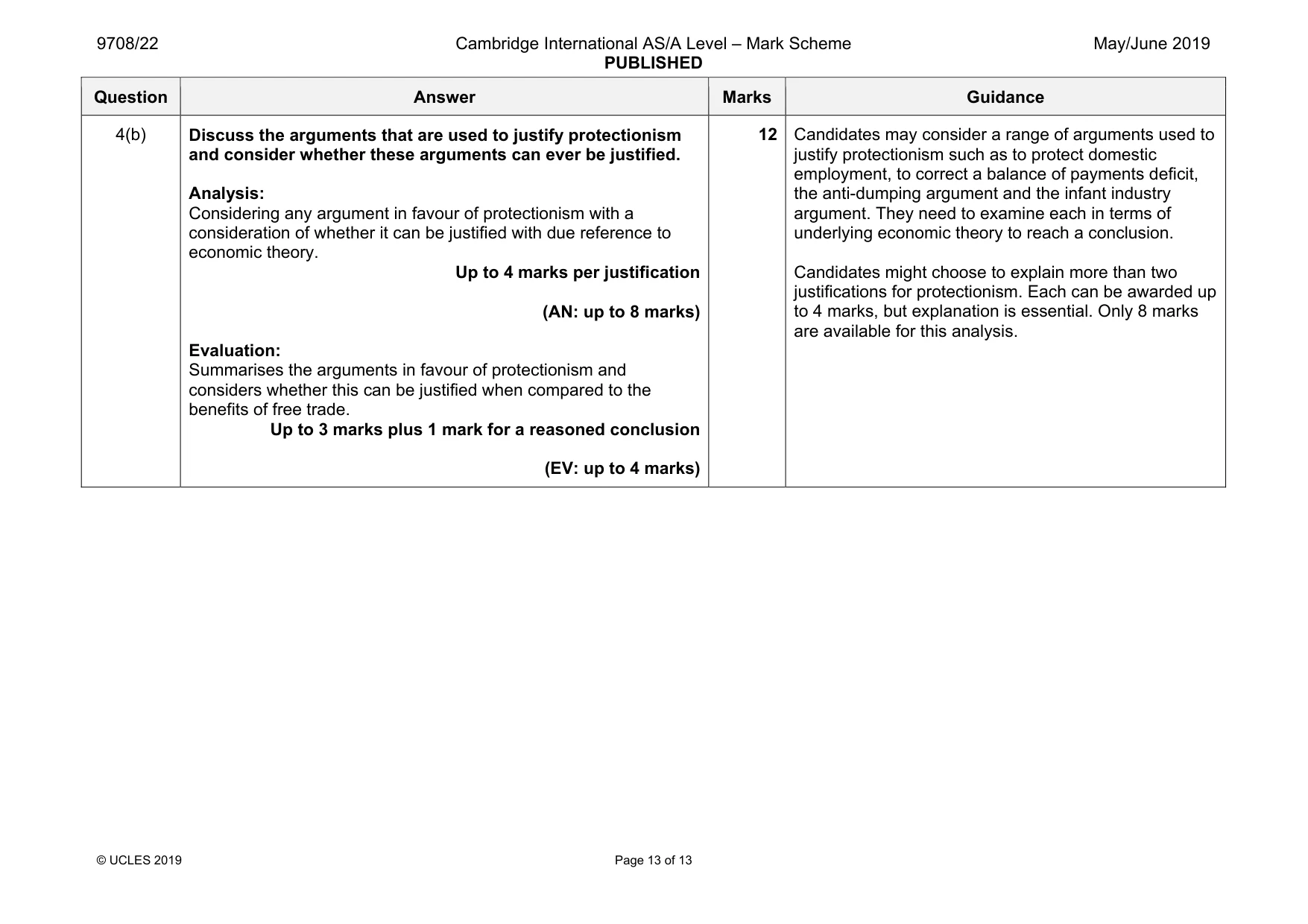
Mark scheme: 4(a) Explain, using examples, what is meant by ‘protectionism’ and show with the help of a diagram how export subsidies can be considered as a form of protectionism. Knowledge and understanding: • Protectionism is adopting policies to assist domestic industries facing competition from foreign industries 1 mark • through interference with market forces or the relative prices of imports and exports. 1 mark (KU: up to 2 marks) Application: One example of a method of protectionism other than an export subsidy e.g. a tariff or a quota (1 mark) and explaining how this could be considered a method of protectionism (1 mark) For explaining why export subsidies can be considered as a method of protectionism: For an accurate diagram showing the impact of the export subsidy on costs and the price of exports (Up to 3 marks) and explaining how this could be considered a method of protectionism (1 mark) (APP: up to 6 marks) 8 protectionism by providing examples. A more general explanation is required. This could focus upon protectionism being any policy that interferes with market forces in international trade with the aim of giving an advantage to domestic producers. Diagram: Correctly labelled axes and curves (1 mark) Correct shift in the supply curve (1 mark) Correct change in equilibrium price and quantity (1 mark) Question Answer Marks Guidance 4(b) Discuss the arguments that are used to justify protectionism and consider whether these arguments can ever be justified. Analysis: Considering any argument in favour of protectionism with a consideration of whether it can be justified with due reference to economic theory. Up to 4 marks per justification (AN: up to 8 marks) Evaluation: Summarises the arguments in favour of protectionism and considers whether this can be justified when compared to the benefits of free trade. Up to 3 marks plus 1 mark for a reasoned conclusion (EV: up to 4 marks) 12 Candidates may consider a range of arguments used to justify protectionism such as to protect domestic employment, to correct a balance of payments deficit, the anti-dumping argument and the infant industry argument. They need to examine each in terms of underlying economic theory to reach a conclusion. Candidates might choose to explain more than two justifications for protectionism. Each can be awarded up to 4 marks, but explanation is essential. Only 8 marks are available for this analysis.
What was in this paper
The subtopics covered by these 4 questions, and how many questions each got. Open one in a new tab to see every Cambridge question on it.
What you needed in this session
Cambridge’s own grade thresholds for 2019 May/June, Paper 2 · Variant 2. A higher threshold means an easier paper — the bar moves with how the cohort did.