Cambridge A Level Chemistry 9701 — 2025 May/June Paper 2 · Variant 2
9701/22/M/J/25 · 5 questions · 60 marks · 75 min
The question paper and its mark scheme, free to read here and free to download. This is Cambridge’s own paper, exactly as it was sat.
Question paper16 pages
Mark scheme14 pages
Answers below. Sit the paper first if you are practising.
Questions as text
Q1 · Diamond and graphite are both crystalline solids made from carbon atoms
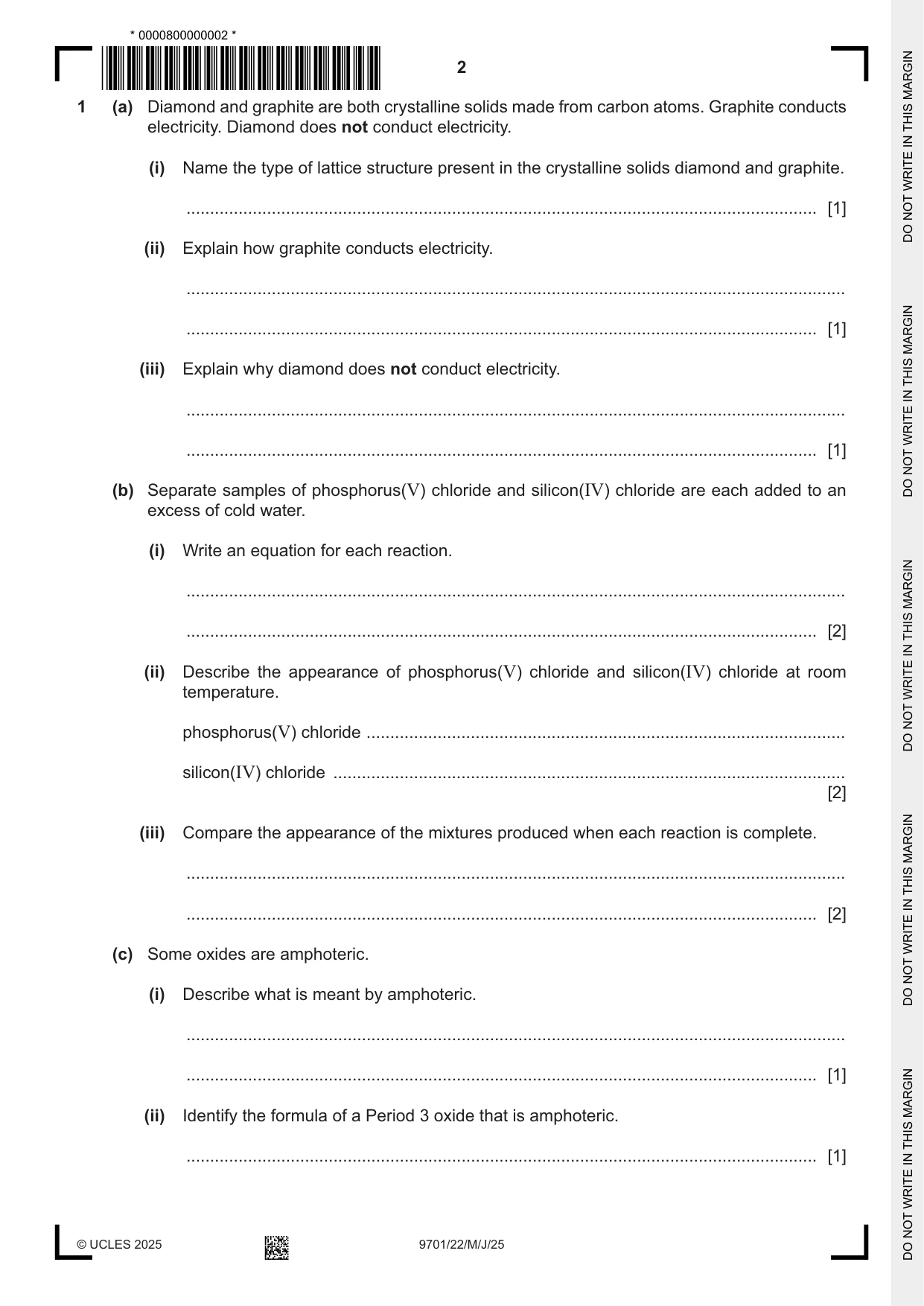
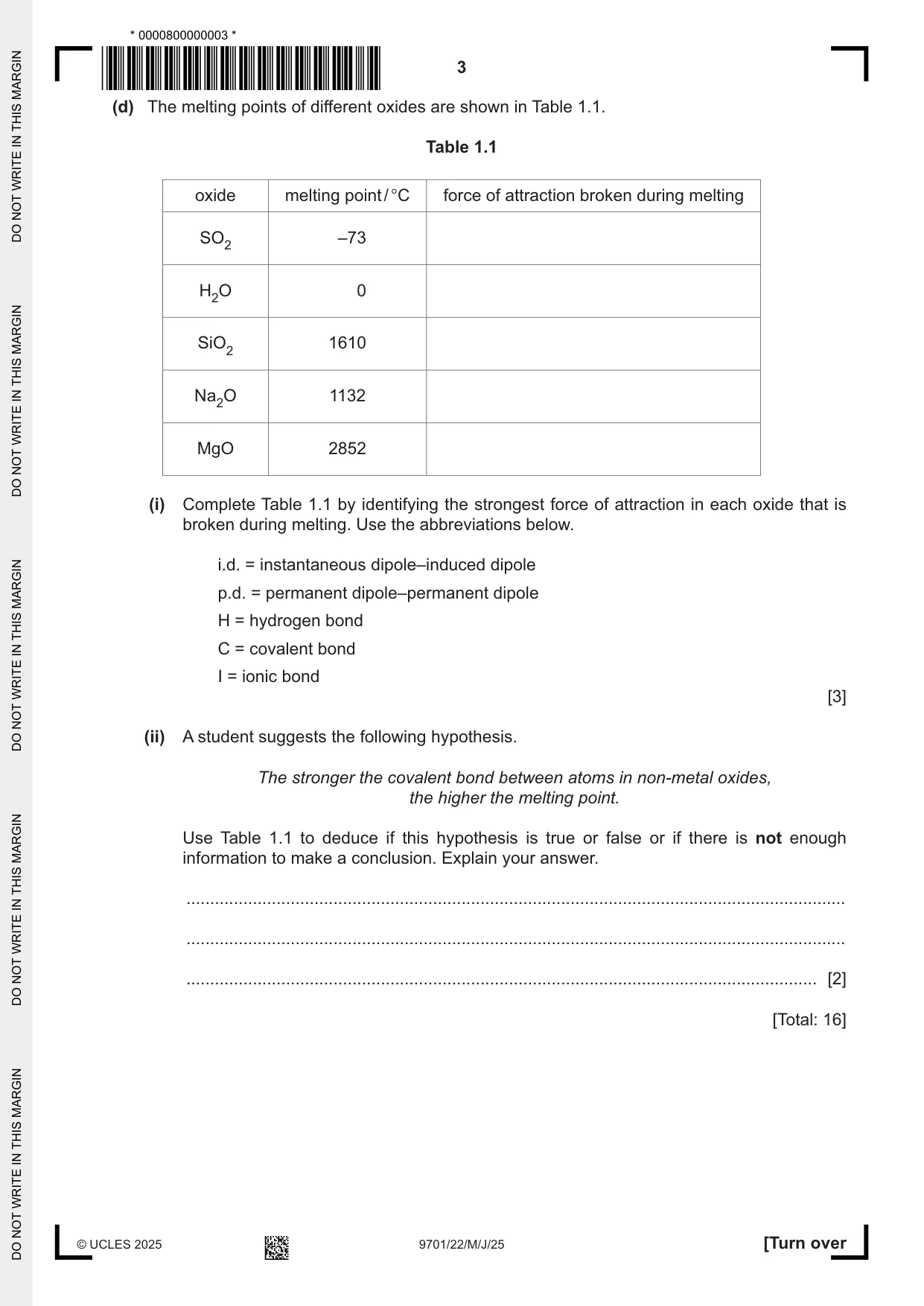
1 (a) Diamond and graphite are both crystalline solids made from carbon atoms. Graphite conducts electricity. Diamond does not conduct electricity. (i) Name the type of lattice structure present in the crystalline solids diamond and graphite. ..................................................................................................................................... [1] (ii) Explain how graphite conducts electricity. ........................................................................................................................................... ..................................................................................................................................... [1] (iii) Explain why diamond does not conduct electricity. ........................................................................................................................................... ..................................................................................................................................... [1] (b) Separate samples of phosphorus(V) chloride and silicon(IV) chloride are each added to an excess of cold water. (i) Write an equation for each reaction. ........................................................................................................................................... ..................................................................................................................................... [2] (ii) Describe the appearance of phosphorus(V) chloride and silicon(IV) chloride at room temperature. phosphorus(V) chloride ..................................................................................................... silicon(IV) chloride ............................................................................................................ [2] (iii) Compare the appearance of the mixtures produced when each reaction is complete. ........................................................................................................................................... ..................................................................................................................................... [2] (c) Some oxides are amphoteric. (i) Describe what is meant by amphoteric. ........................................................................................................................................... ..................................................................................................................................... [1] (ii) Identify the formula of a Period 3 oxide that is amphoteric. ..................................................................................................................................... [1] (d) The melting points of different oxides are shown in Table 1.1. Table 1.1 oxide melting point / °C force of attraction broken during melting SO2 –73 H2O 0 SiO2 1610 Na2O 1132 MgO 2852 (i) Complete Table 1.1 by identifying the strongest force of attraction in each oxide that is broken during melting. Use the abbreviations below. i.d. = instantaneous dipole–induced dipole p.d. = permanent dipole–permanent dipole H = hydrogen bond C = covalent bond I = ionic bond [3] (ii) A student suggests the following hypothesis. The stronger the covalent bond between atoms in non‑metal oxides, the higher the melting point. Use Table 1.1 to deduce if this hypothesis is true or false or if there is not enough information to make a conclusion. Explain your answer. ........................................................................................................................................... ........................................................................................................................................... ..................................................................................................................................... [2] [Total: 16]
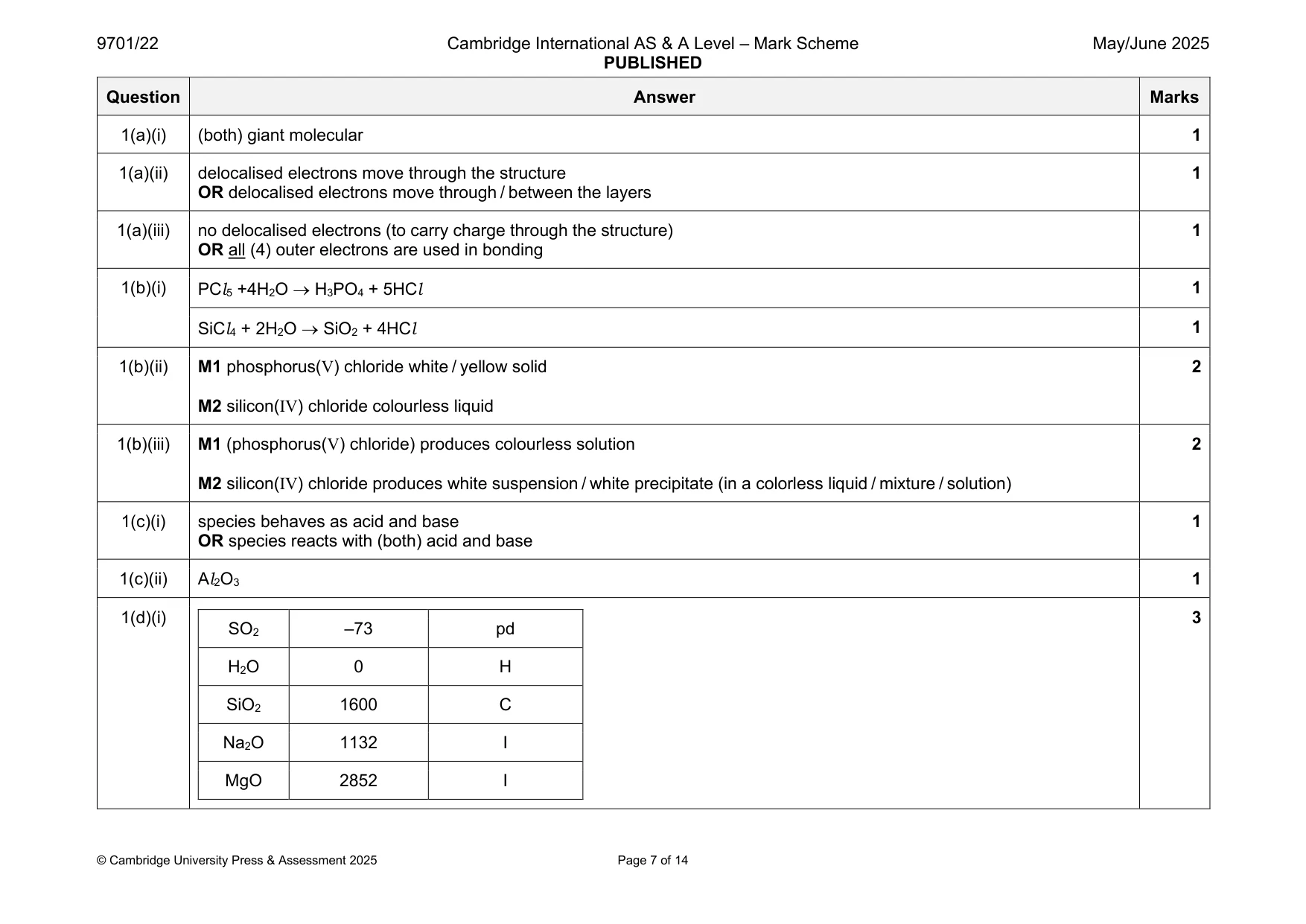
Mark scheme: Question Answer Marks 1(a)(i) (both) giant molecular 1 1(a)(ii) delocalised electrons move through the structure 1 OR delocalised electrons move through / between the layers 1(a)(iii) no delocalised electrons (to carry charge through the structure) 1 OR all (4) outer electrons are used in bonding 1(b)(i) PCl5 +4H2O → H3PO4 + 5HCl 1 SiCl4 + 2H2O → SiO2 + 4HCl 1 1(b)(ii) M1 phosphorus(V) chloride white / yellow solid 2 M2 silicon(IV) chloride colourless liquid 1(b)(iii) M1 (phosphorus(V) chloride) produces colourless solution 2 M2 silicon(IV) chloride produces white suspension / white precipitate (in a colorless liquid / mixture / solution) 1(c)(i) species behaves as acid and base 1 OR species reacts with (both) acid and base 1(c)(ii) Al2O3 1 1(d)(i) 3 SO2 –73 pd H2O 0 H SiO2 1600 C Na2O 1132 I MgO 2852 I 1(d)(ii) Evaluate hypotheses based on the information candidates have given in the table 2 M1 not enough information M2 SO2 and / or H2O break intermolecular forces OR SO2 and / or H2O does not break covalent bonds OR only SiO2 breaks covalent bonds
Q2 · A sample of iron contains three different isotopes and has a relative atomic mass, Ar, of…
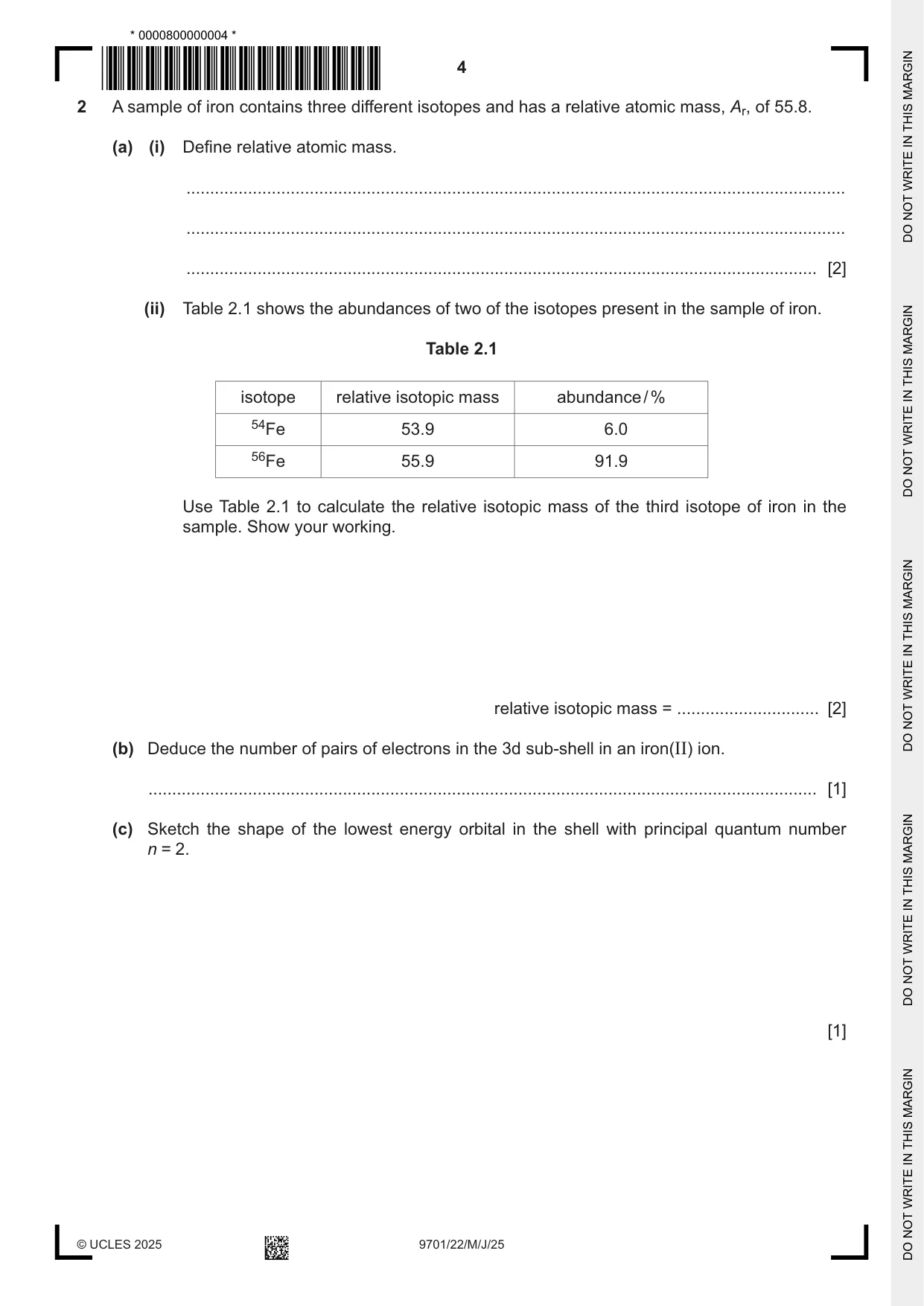
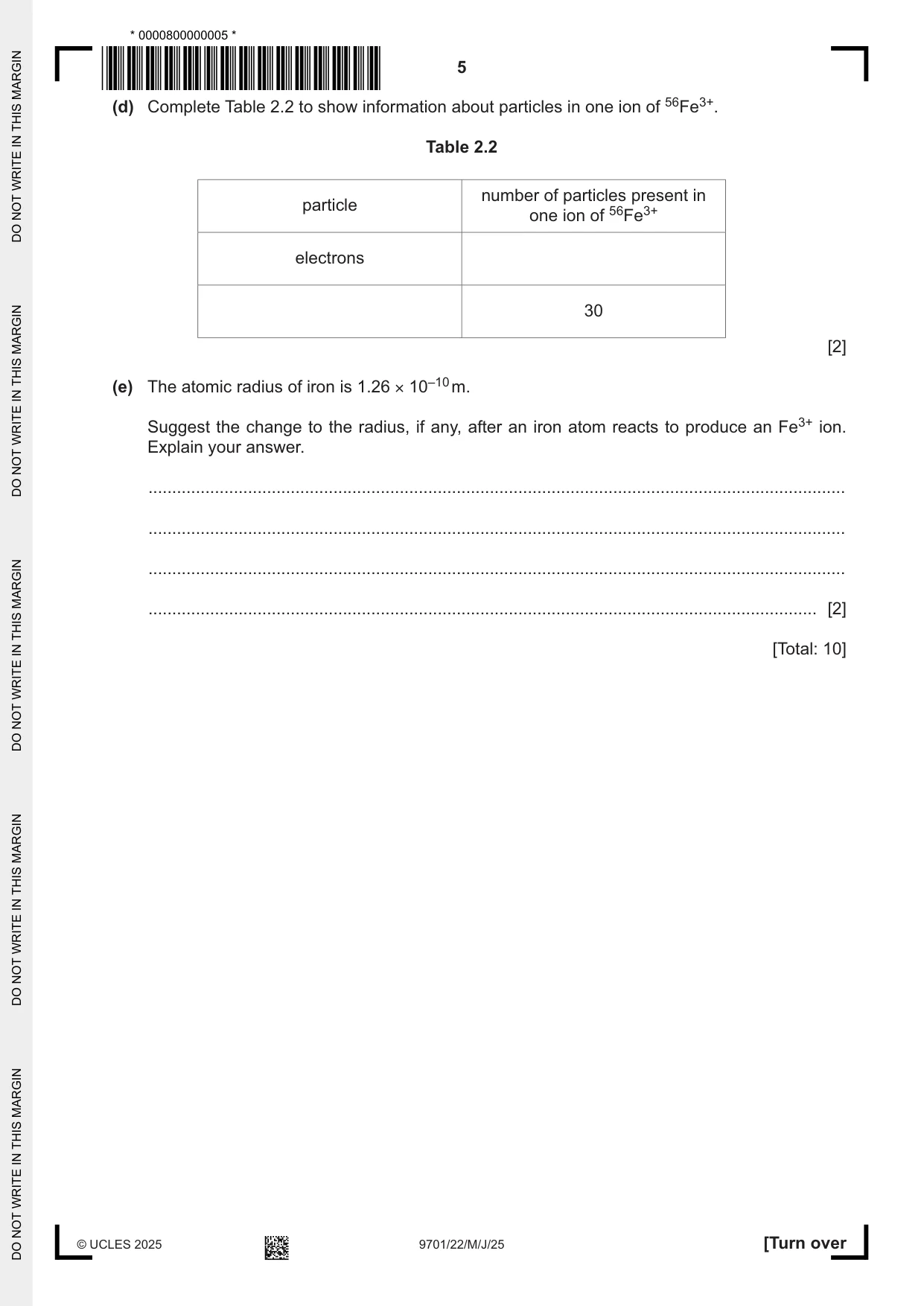
2 A sample of iron contains three different isotopes and has a relative atomic mass, Ar, of 55.8. (a) (i) Define relative atomic mass. ........................................................................................................................................... ........................................................................................................................................... ..................................................................................................................................... [2] (ii) Table 2.1 shows the abundances of two of the isotopes present in the sample of iron. Table 2.1 isotope relative isotopic mass abundance / % 54Fe 53.9 6.0 56Fe 55.9 91.9 Use Table 2.1 to calculate the relative isotopic mass of the third isotope of iron in the sample. Show your working. relative isotopic mass = .............................. [2] (b) Deduce the number of pairs of electrons in the 3d sub‑shell in an iron(II) ion. ............................................................................................................................................. [1] (c) Sketch the shape of the lowest energy orbital in the shell with principal quantum number n = 2. [1] (d) Complete Table 2.2 to show information about particles in one ion of 56Fe3+. Table 2.2 number of particles present in particle one ion of 56Fe3+ electrons 30 [2] (e) The atomic radius of iron is 1.26 × 10⁻¹⁰ m. Suggest the change to the radius, if any, after an iron atom reacts to produce an Fe3+ ion. Explain your answer. ................................................................................................................................................... ................................................................................................................................................... ................................................................................................................................................... ............................................................................................................................................. [2] [Total: 10]
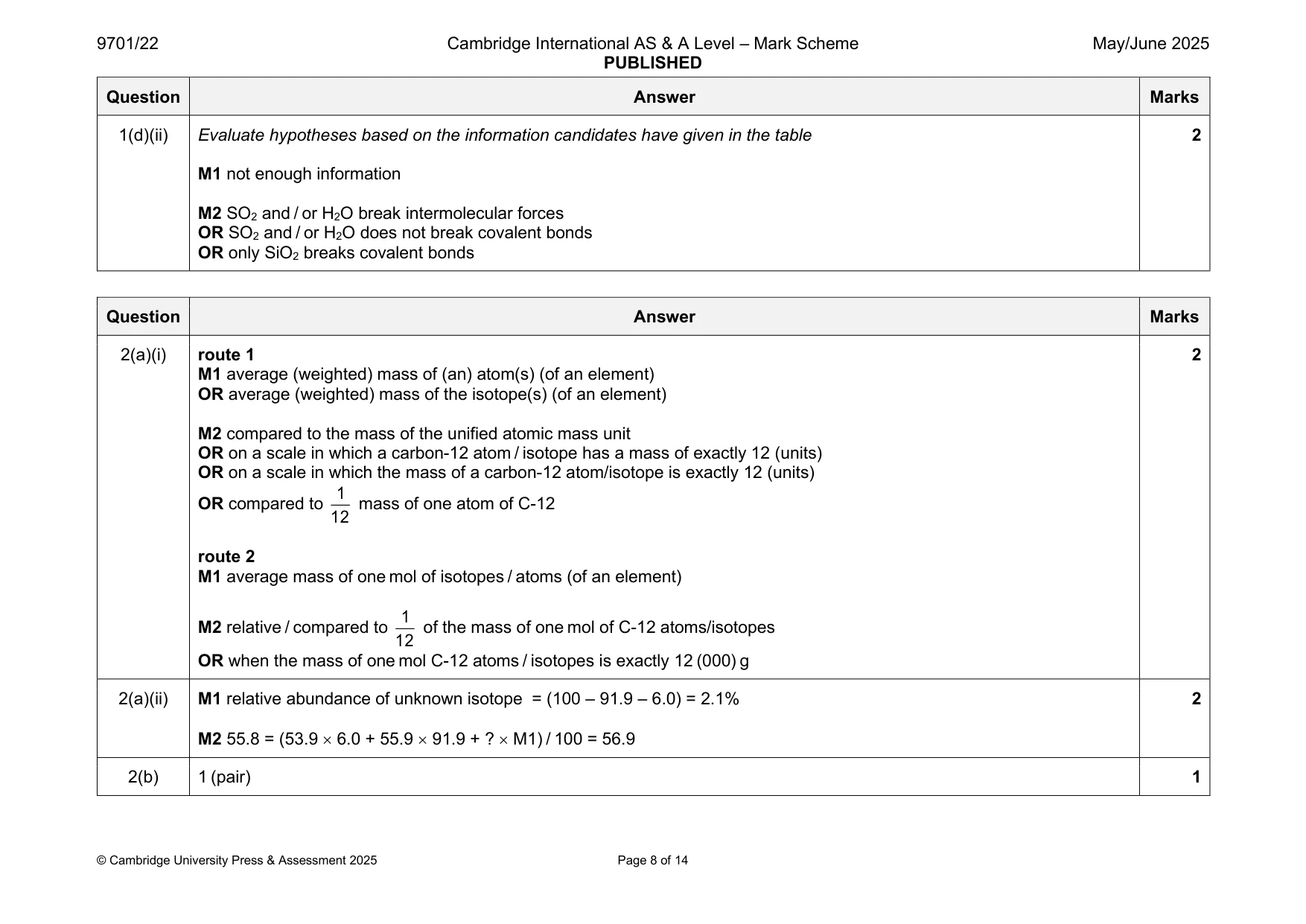
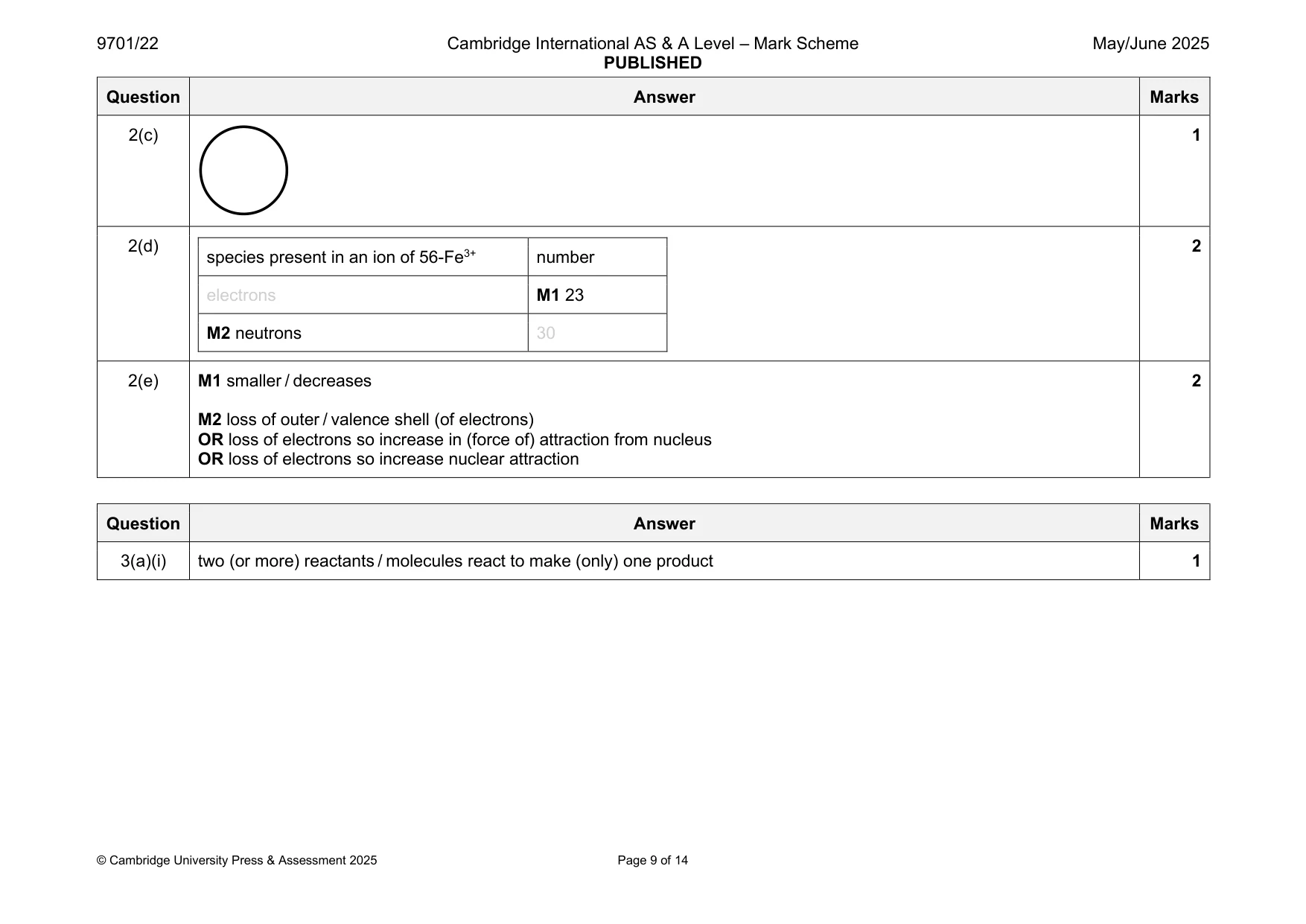
Mark scheme: 2(a)(i) route 1 2 M1 average (weighted) mass of (an) atom(s) (of an element) OR average (weighted) mass of the isotope(s) (of an element) M2 compared to the mass of the unified atomic mass unit OR on a scale in which a carbon-12 atom / isotope has a mass of exactly 12 (units) OR on a scale in which the mass of a carbon-12 atom/isotope is exactly 12 (units) 1 OR compared to mass of one atom of C-12 12 route 2 M1 average mass of one mol of isotopes / atoms (of an element) 1 M2 relative / compared to of the mass of one mol of C-12 atoms/isotopes 12 OR when the mass of one mol C-12 atoms / isotopes is exactly 12 (000) g 2(a)(ii) M1 relative abundance of unknown isotope = (100 – 91.9 – 6.0) = 2.1% 2 M2 55.8 = (53.9 6.0 + 55.9 91.9 + ? M1) / 100 = 56.9 2(b) 1 (pair) 1 2(c) 1 2(d) 2 species present in an ion of 56-Fe3+ number electrons M1 23 M2 neutrons 30 2(e) M1 smaller / decreases 2 M2 loss of outer / valence shell (of electrons) OR loss of electrons so increase in (force of) attraction from nucleus OR loss of electrons so increase nuclear attraction
Q3 · C3H6 reacts with HBr(g) in an addition reaction
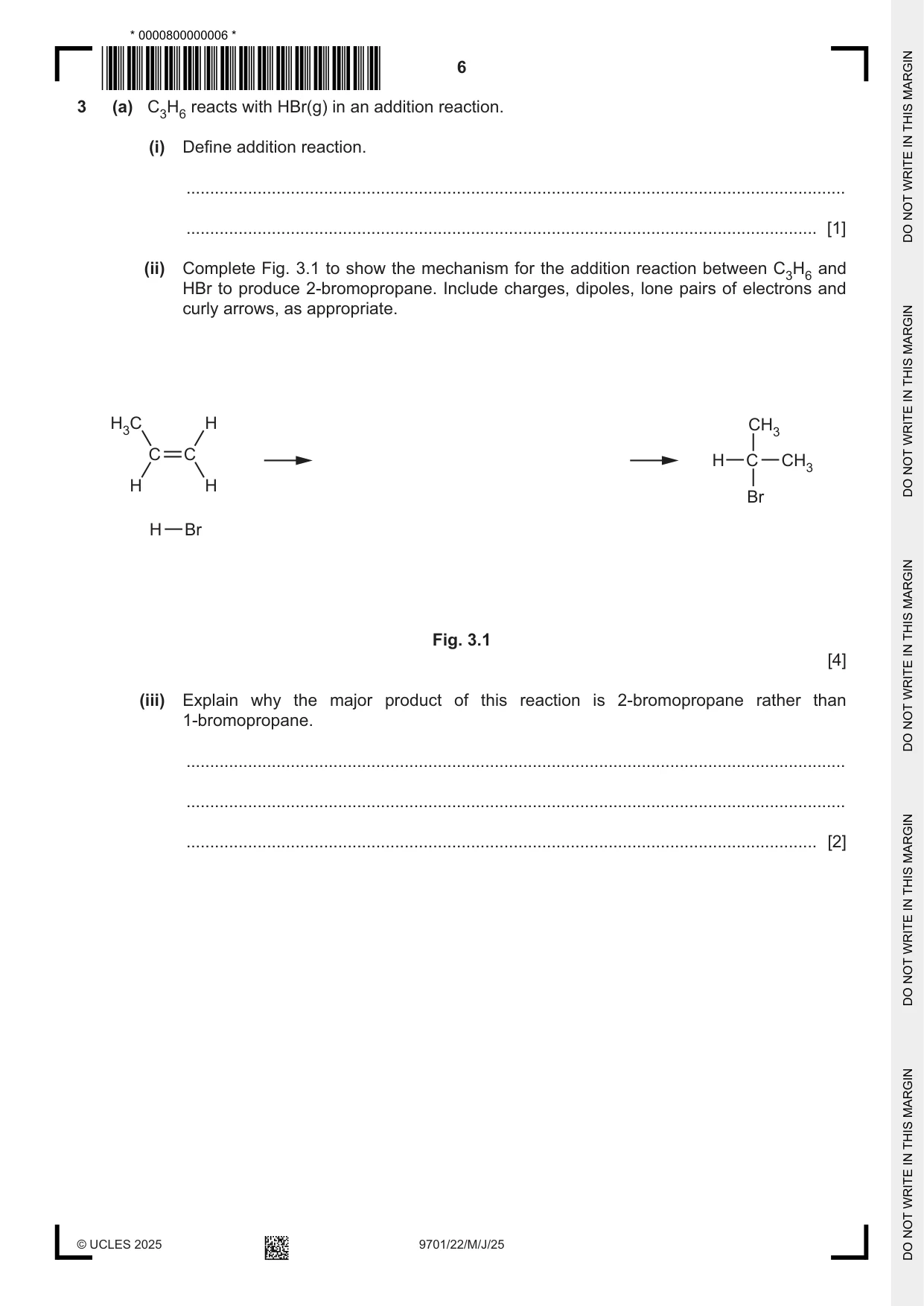
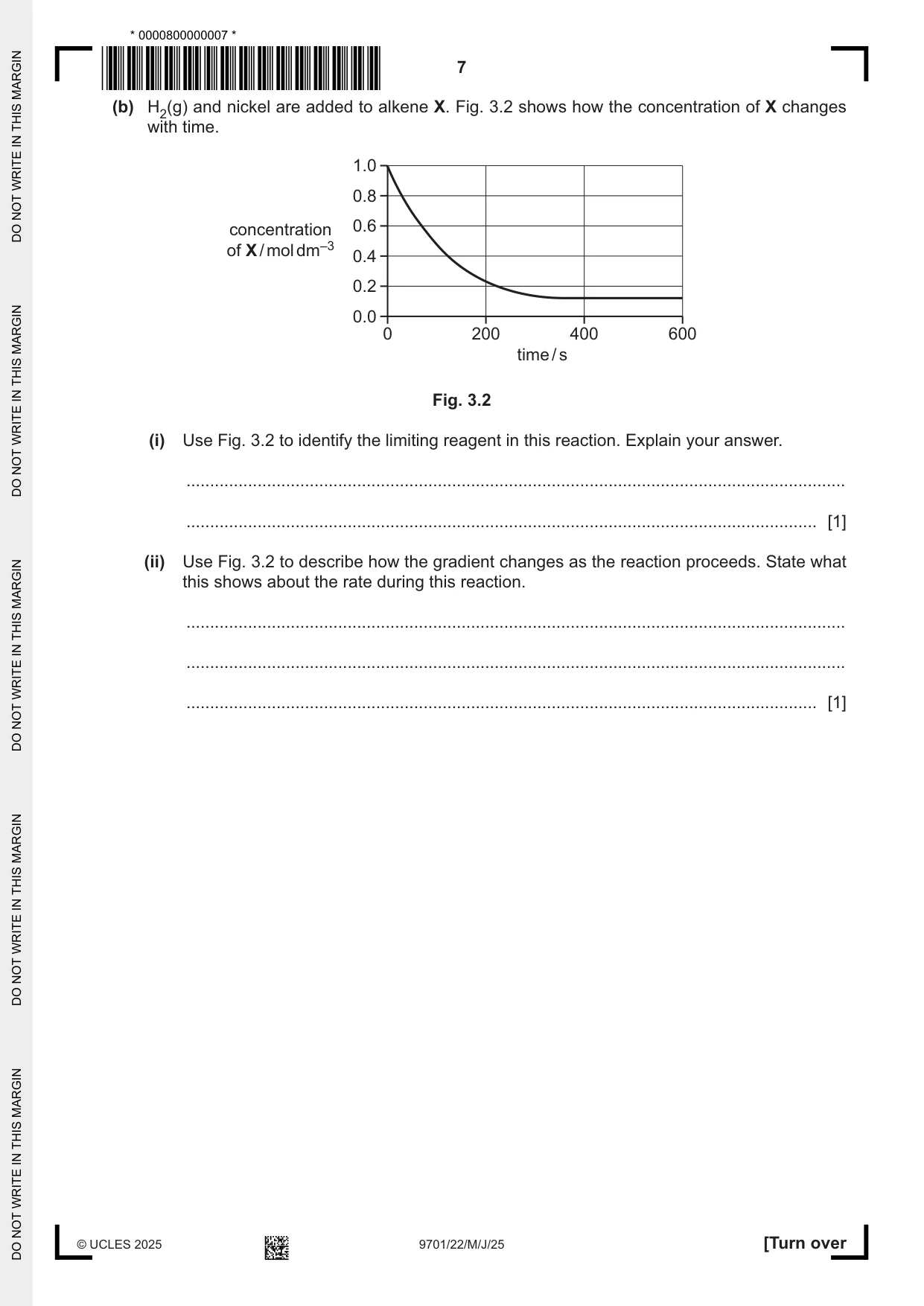
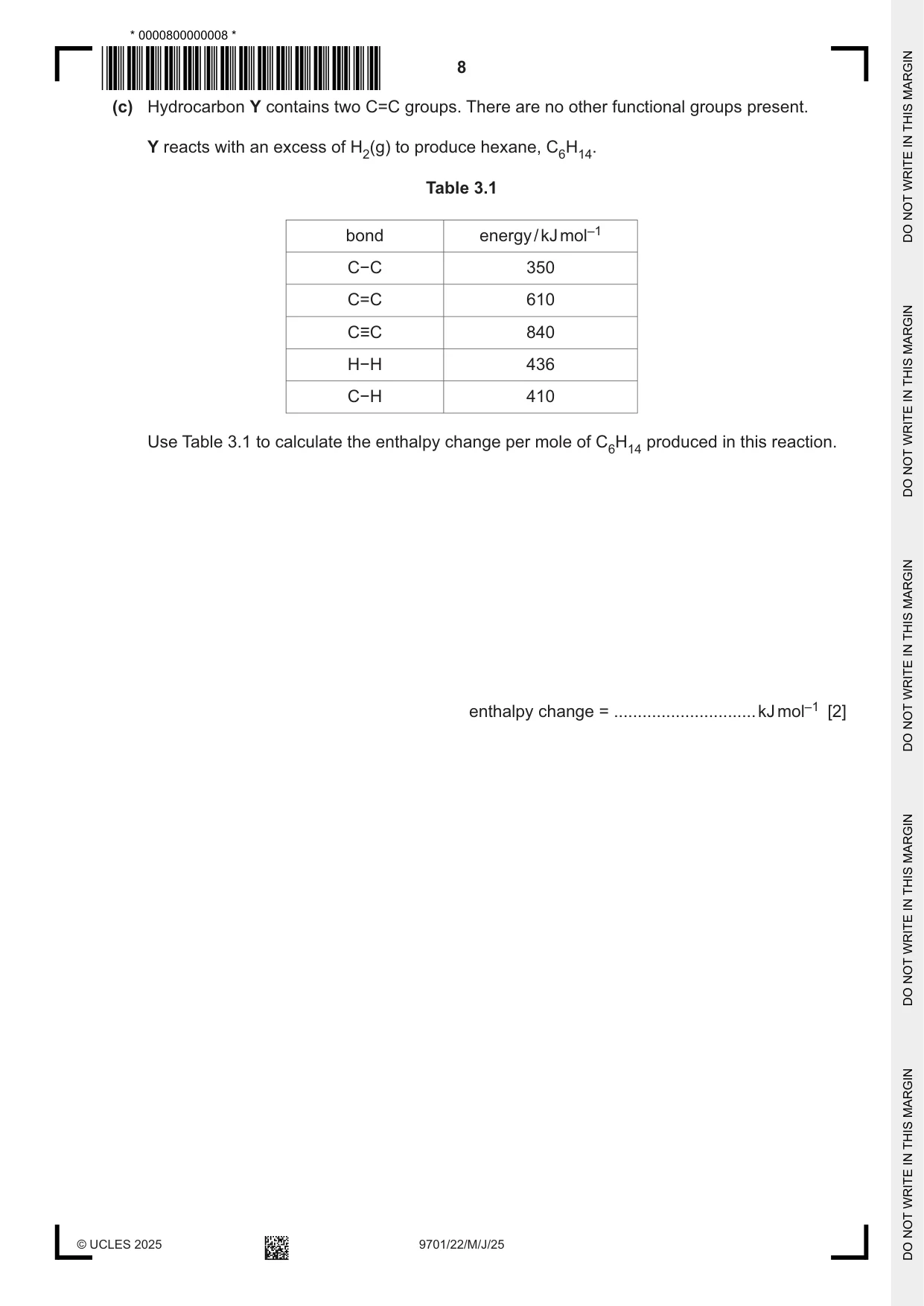
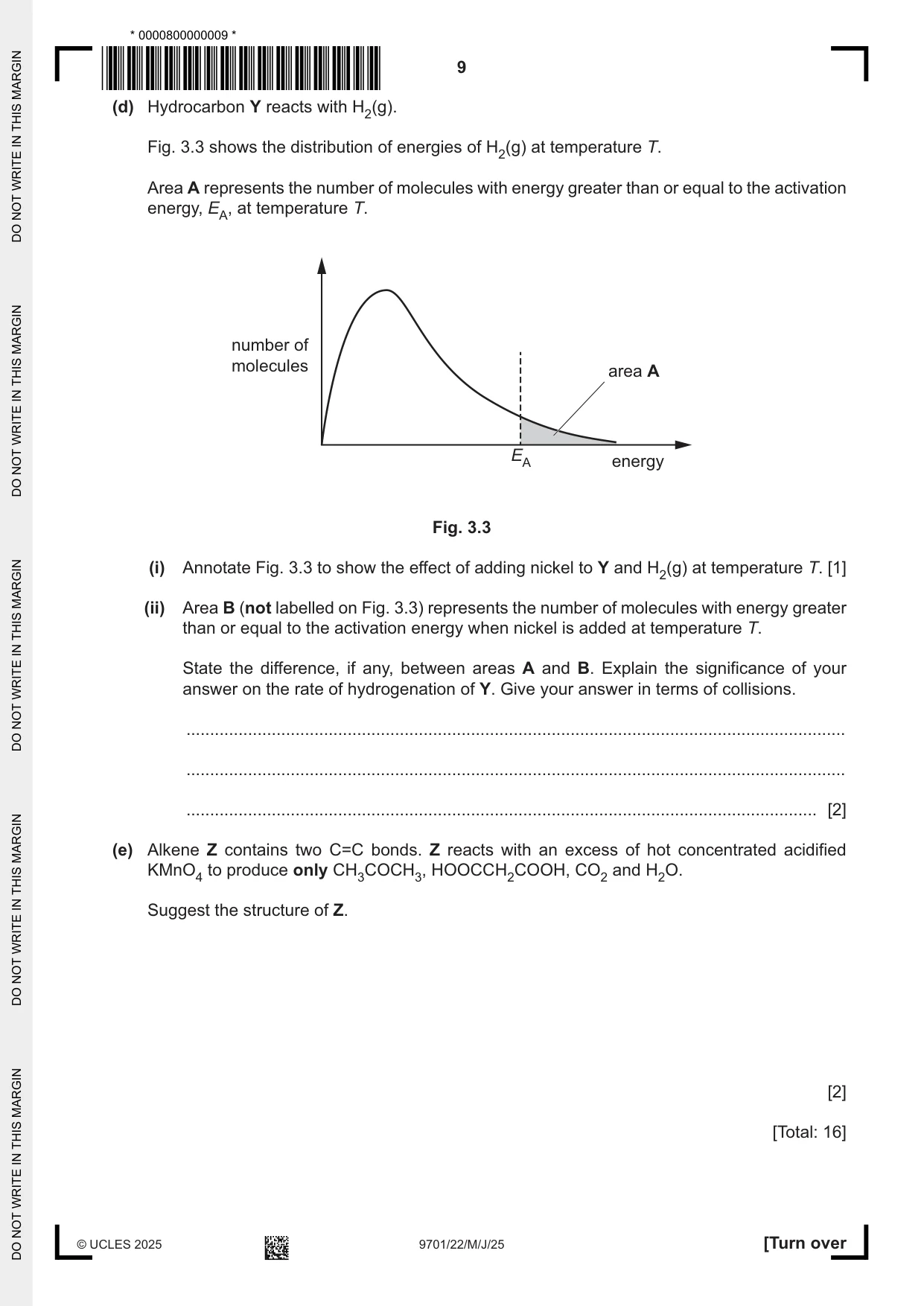
3 (a) C3H6 reacts with HBr(g) in an addition reaction. (i) Define addition reaction. ........................................................................................................................................... ..................................................................................................................................... [1] (ii) Complete Fig. 3.1 to show the mechanism for the addition reaction between C3H6 and HBr to produce 2‑bromopropane. Include charges, dipoles, lone pairs of electrons and curly arrows, as appropriate. H3C H CH3 C C H C CH3 H H Br H Br Fig. 3.1 [4] (iii) Explain why the major product of this reaction is 2‑bromopropane rather than 1‑bromopropane. ........................................................................................................................................... ........................................................................................................................................... ..................................................................................................................................... [2] (b) H2(g) and nickel are added to alkene X. Fig. 3.2 shows how the concentration of X changes with time. 1.0 0.8 concentration 0.6 of X / mol dm–3 0.4 0.2 0.0 0 200 400 600 time / s Fig. 3.2 (i) Use Fig. 3.2 to identify the limiting reagent in this reaction. Explain your answer. ........................................................................................................................................... ..................................................................................................................................... [1] (ii) Use Fig. 3.2 to describe how the gradient changes as the reaction proceeds. State what this shows about the rate during this reaction. ........................................................................................................................................... ........................................................................................................................................... ..................................................................................................................................... [1] (c) Hydrocarbon Y contains two C=C groups. There are no other functional groups present. Y reacts with an excess of H2(g) to produce hexane, C6H14. Table 3.1 bond energy / kJ mol–1 C−C 350 C=C 610 C≡C 840 H−H 436 C−H 410 Use Table 3.1 to calculate the enthalpy change per mole of C6H14 produced in this reaction. enthalpy change = .............................. kJ mol–1 [2] (d) Hydrocarbon Y reacts with H2(g). Fig. 3.3 shows the distribution of energies of H2(g) at temperature T. Area A represents the number of molecules with energy greater than or equal to the activation energy, EA, at temperature T. number of molecules area A EA energy Fig. 3.3 (i) Annotate Fig. 3.3 to show the effect of adding nickel to Y and H2(g) at temperature T. [1] (ii) Area B (not labelled on Fig. 3.3) represents the number of molecules with energy greater than or equal to the activation energy when nickel is added at temperature T. State the difference, if any, between areas A and B. Explain the significance of your answer on the rate of hydrogenation of Y. Give your answer in terms of collisions. ........................................................................................................................................... ........................................................................................................................................... ..................................................................................................................................... [2] (e) Alkene Z contains two C=C bonds. Z reacts with an excess of hot concentrated acidified KMnO4 to produce only CH3COCH3, HOOCCH2COOH, CO2 and H2O. Suggest the structure of Z. [2] [Total: 16]
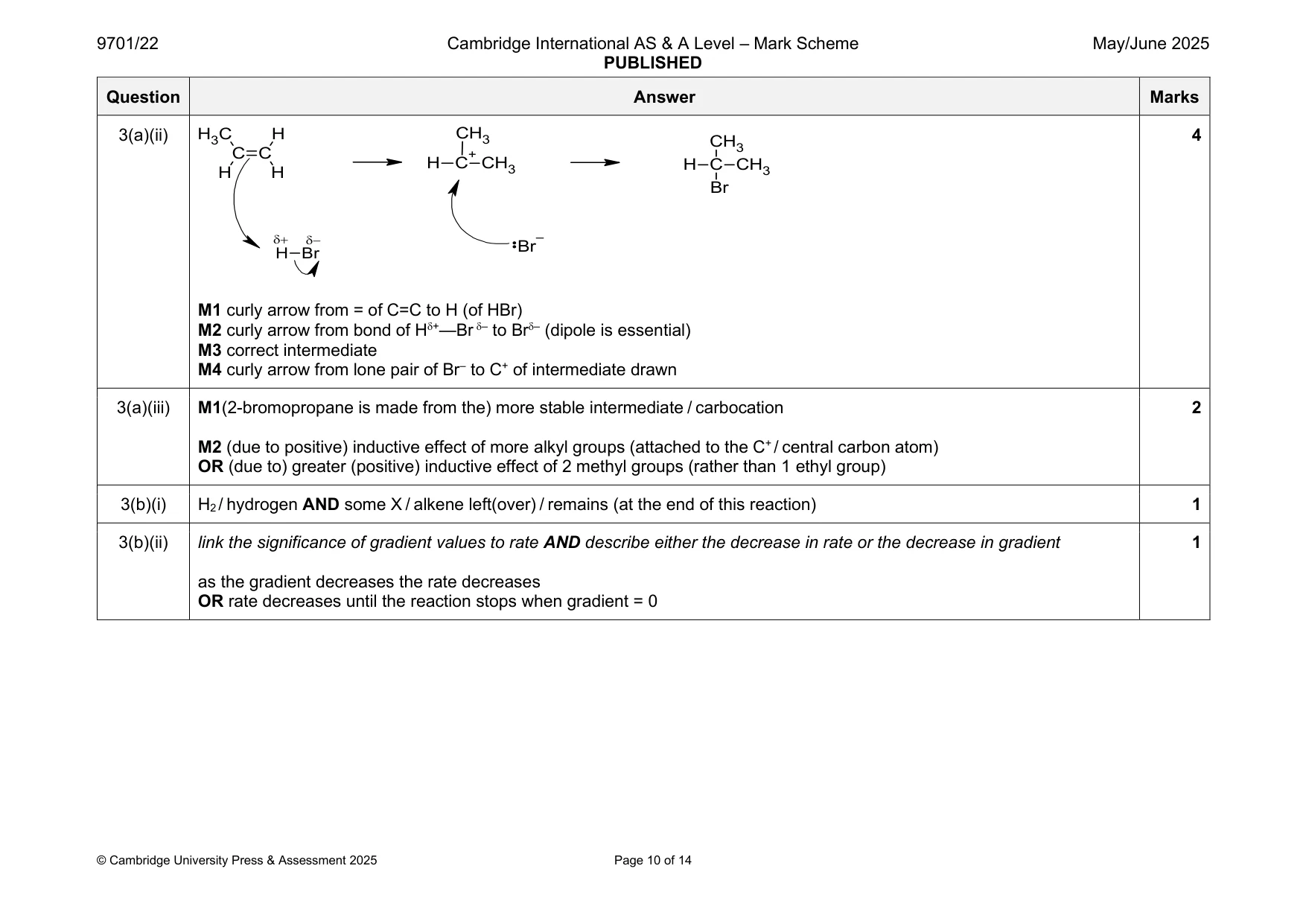
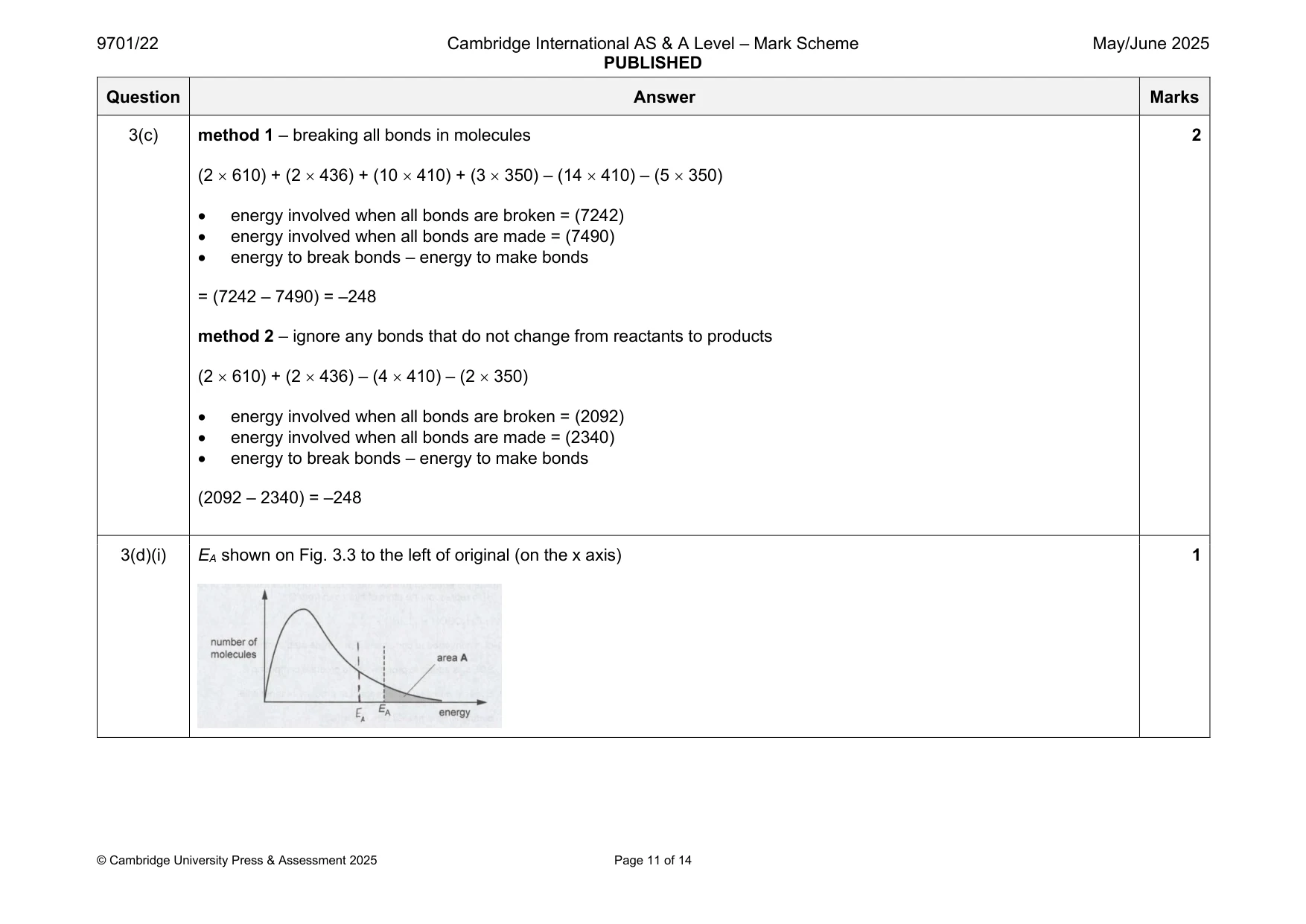
Mark scheme: 3(a)(i) two (or more) reactants / molecules react to make (only) one product 1 3(a)(ii) H3 C H CH3 4 CH3 C C H C+ CH3 H C CH3 H H Br d+ d- Br– H Br M1 curly arrow from = of C=C to H (of HBr) M2 curly arrow from bond of Hd+—Br d– to Brd– (dipole is essential) M3 correct intermediate M4 curly arrow from lone pair of Br– to C+ of intermediate drawn 3(a)(iii) M1(2-bromopropane is made from the) more stable intermediate / carbocation 2 M2 (due to positive) inductive effect of more alkyl groups (attached to the C+ / central carbon atom) OR (due to) greater (positive) inductive effect of 2 methyl groups (rather than 1 ethyl group) 3(b)(i) H2 / hydrogen AND some X / alkene left(over) / remains (at the end of this reaction) 1 3(b)(ii) link the significance of gradient values to rate AND describe either the decrease in rate or the decrease in gradient 1 as the gradient decreases the rate decreases OR rate decreases until the reaction stops when gradient = 0 3(c) method 1 – breaking all bonds in molecules 2 (2 610) + (2 436) + (10 410) + (3 350) – (14 410) – (5 350) • energy involved when all bonds are broken = (7242) • energy involved when all bonds are made = (7490) • energy to break bonds – energy to make bonds = (7242 – 7490) = –248 method 2 – ignore any bonds that do not change from reactants to products (2 610) + (2 436) – (4 410) – (2 350) • energy involved when all bonds are broken = (2092) • energy involved when all bonds are made = (2340) • energy to break bonds – energy to make bonds (2092 – 2340) = –248 3(d)(i) EA shown on Fig. 3.3 to the left of original (on the x axis) 1 3(d)(ii) M1 it / (area) B larger AND rate (reaction / hydrogenation) increases 2 OR (area) B identified by shading or labelling on Fig 3.3 AND rate (reaction / hydrogenation) increases in prose M2 increase in the frequency of effective / successful collisions OR increase in rate of effective / successful collisions 3(e) 2 H2C=CHCH2CH=C(CH3)2 ✓✓ ✓✓ H2CCHCH2CHC(CH3)2 ✓✓ M1 H2C=C…. on one end of their molecule OR …C=C(CH3)2 on one end of their molecule OR …C=CHCH2CH=C… in the middle of their molecule M2 correct structure
Q4 · Propanoic acid, CH3CH2COOH, reacts with reducing agent Q to produce propan‑1‑ol…
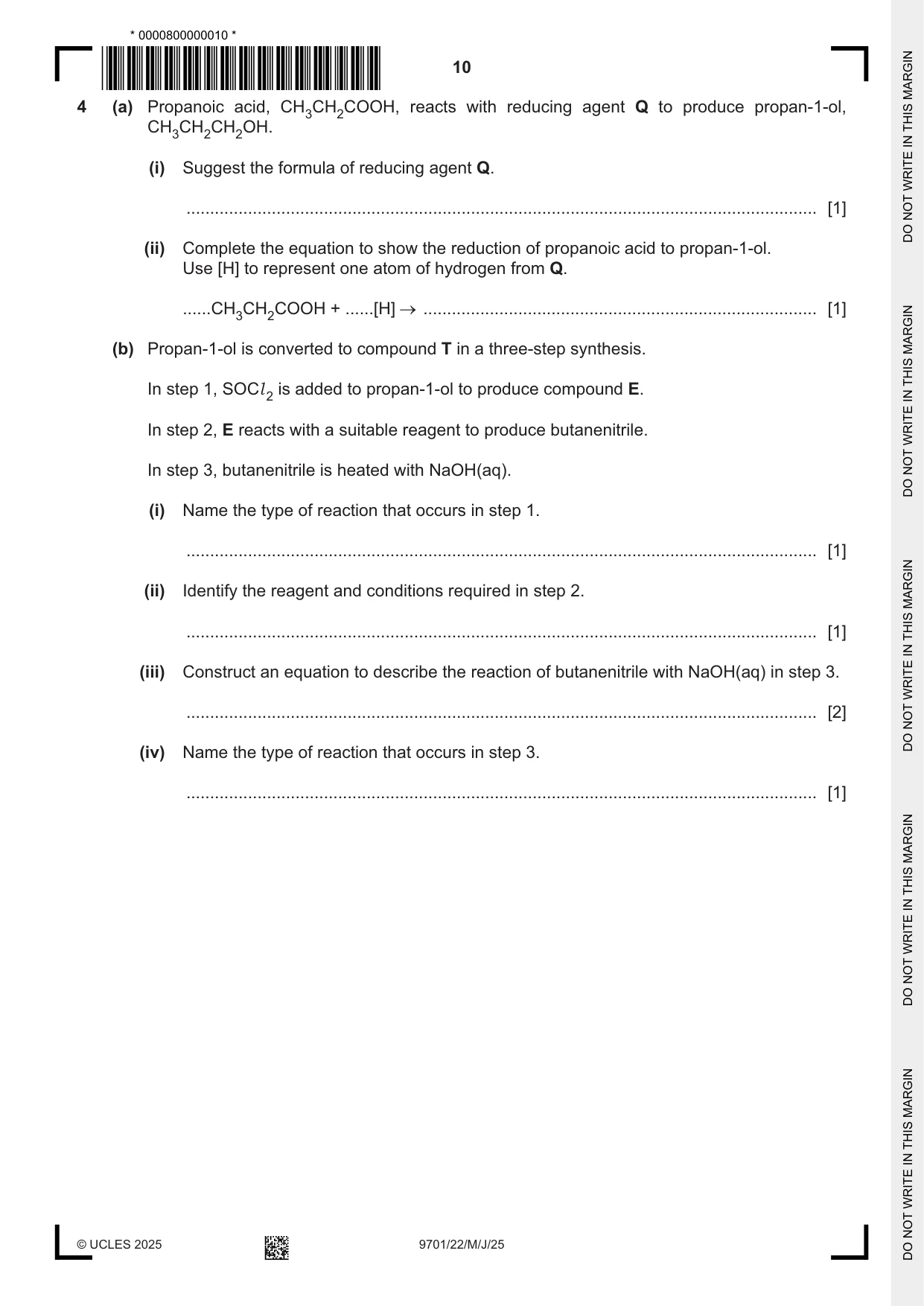
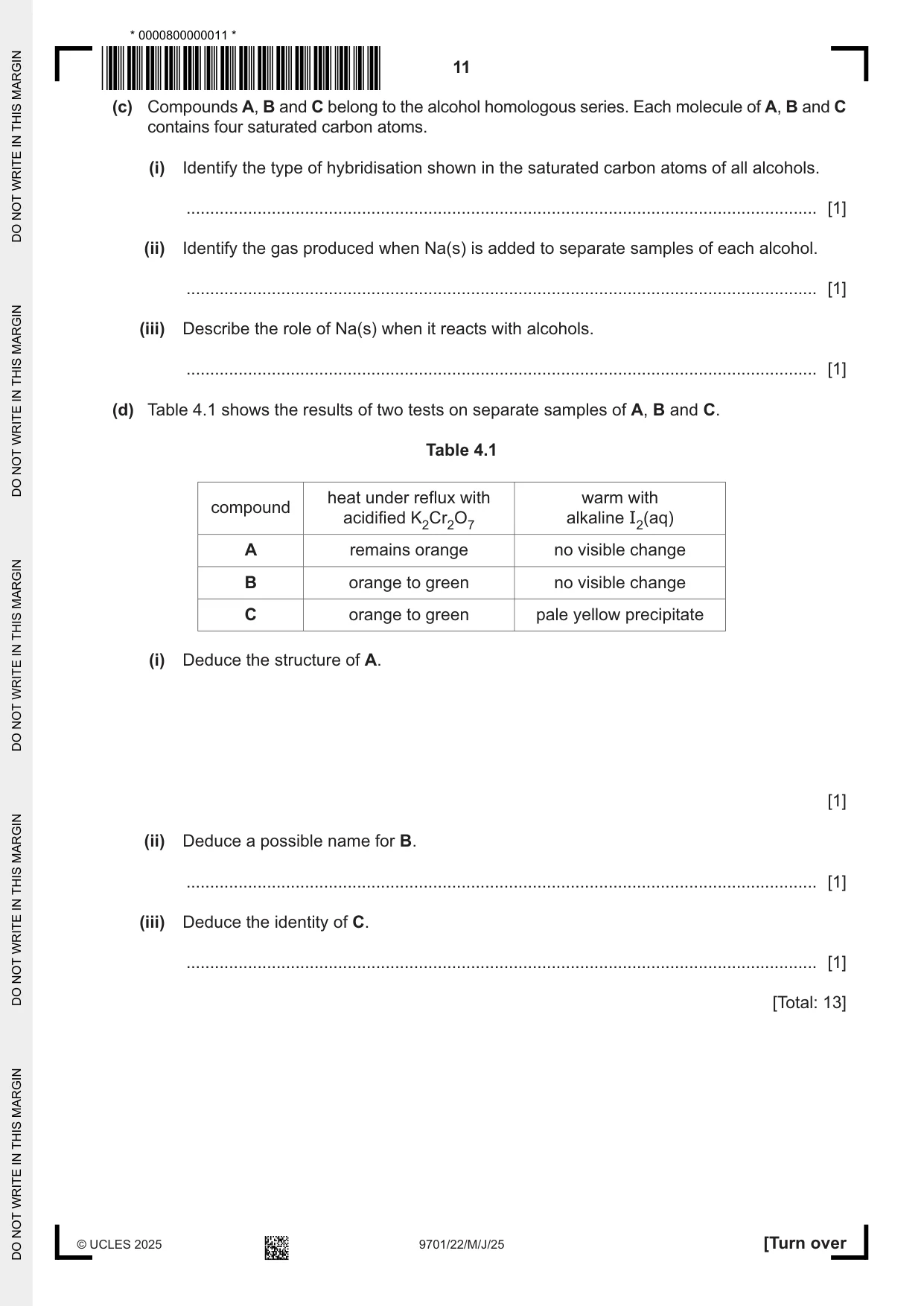
4 (a) Propanoic acid, CH3CH2COOH, reacts with reducing agent Q to produce propan‑1‑ol, CH3CH2CH2OH. (i) Suggest the formula of reducing agent Q. ..................................................................................................................................... [1] (ii) Complete the equation to show the reduction of propanoic acid to propan‑1‑ol. Use [H] to represent one atom of hydrogen from Q. ......CH3CH2COOH + ......[H] ................................................................................... [1] (b) Propan‑1‑ol is converted to compound T in a three‑step synthesis. In step 1, SOCl is added to propan‑1‑ol to produce compound E. 2 In step 2, E reacts with a suitable reagent to produce butanenitrile. In step 3, butanenitrile is heated with NaOH(aq). (i) Name the type of reaction that occurs in step 1. ..................................................................................................................................... [1] (ii) Identify the reagent and conditions required in step 2. ..................................................................................................................................... [1] (iii) Construct an equation to describe the reaction of butanenitrile with NaOH(aq) in step 3. ..................................................................................................................................... [2] (iv) Name the type of reaction that occurs in step 3. ..................................................................................................................................... [1] (c) Compounds A, B and C belong to the alcohol homologous series. Each molecule of A, B and C contains four saturated carbon atoms. (i) Identify the type of hybridisation shown in the saturated carbon atoms of all alcohols. ..................................................................................................................................... [1] (ii) Identify the gas produced when Na(s) is added to separate samples of each alcohol. ..................................................................................................................................... [1] (iii) Describe the role of Na(s) when it reacts with alcohols. ..................................................................................................................................... [1] (d) Table 4.1 shows the results of two tests on separate samples of A, B and C. Table 4.1 heat under reflux with warm with compound acidified K2Cr2O7 alkaline I2(aq) A remains orange no visible change B orange to green no visible change C orange to green pale yellow precipitate (i) Deduce the structure of A. [1] (ii) Deduce a possible name for B. ..................................................................................................................................... [1] (iii) Deduce the identity of C. ..................................................................................................................................... [1] [Total: 13]
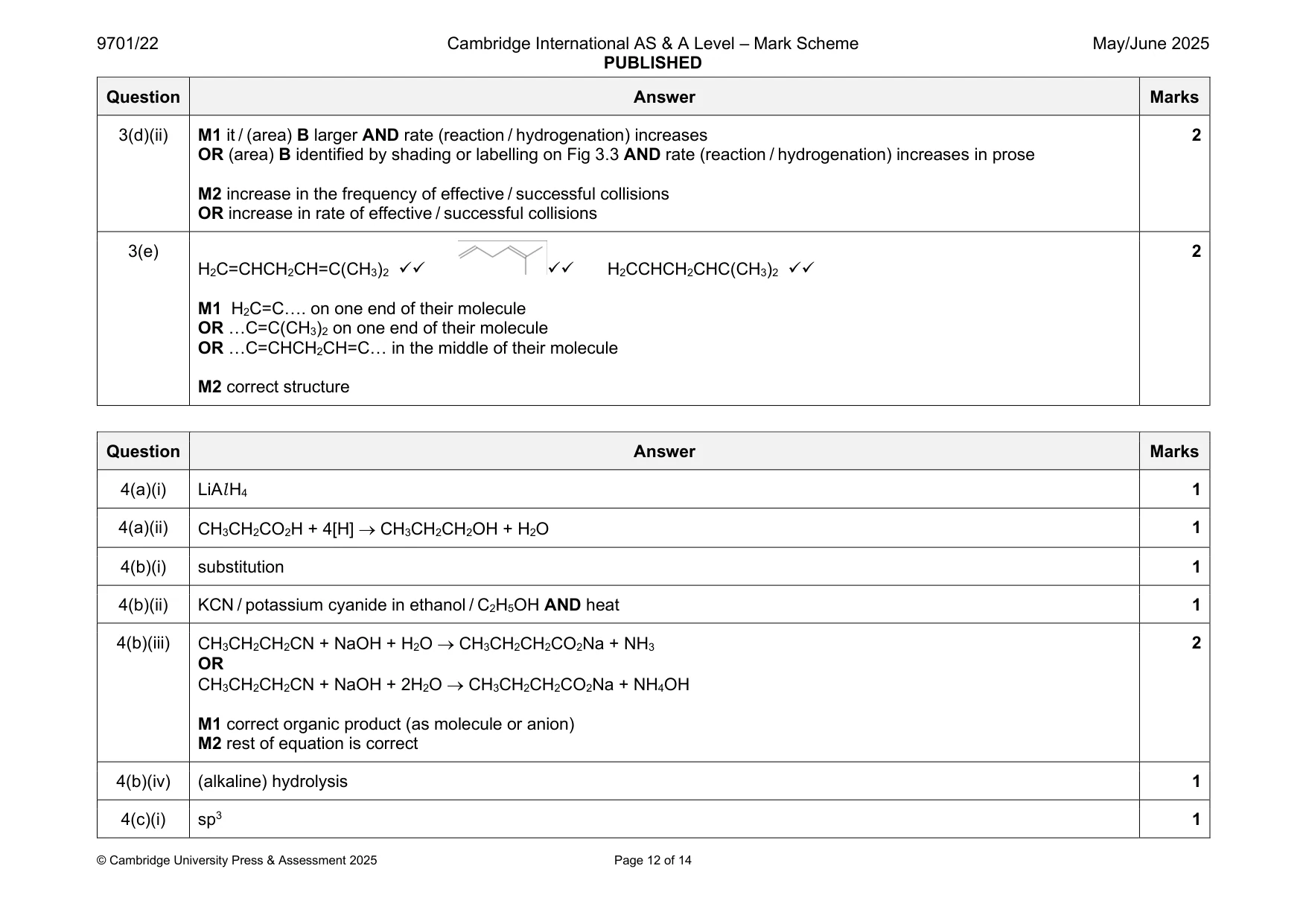
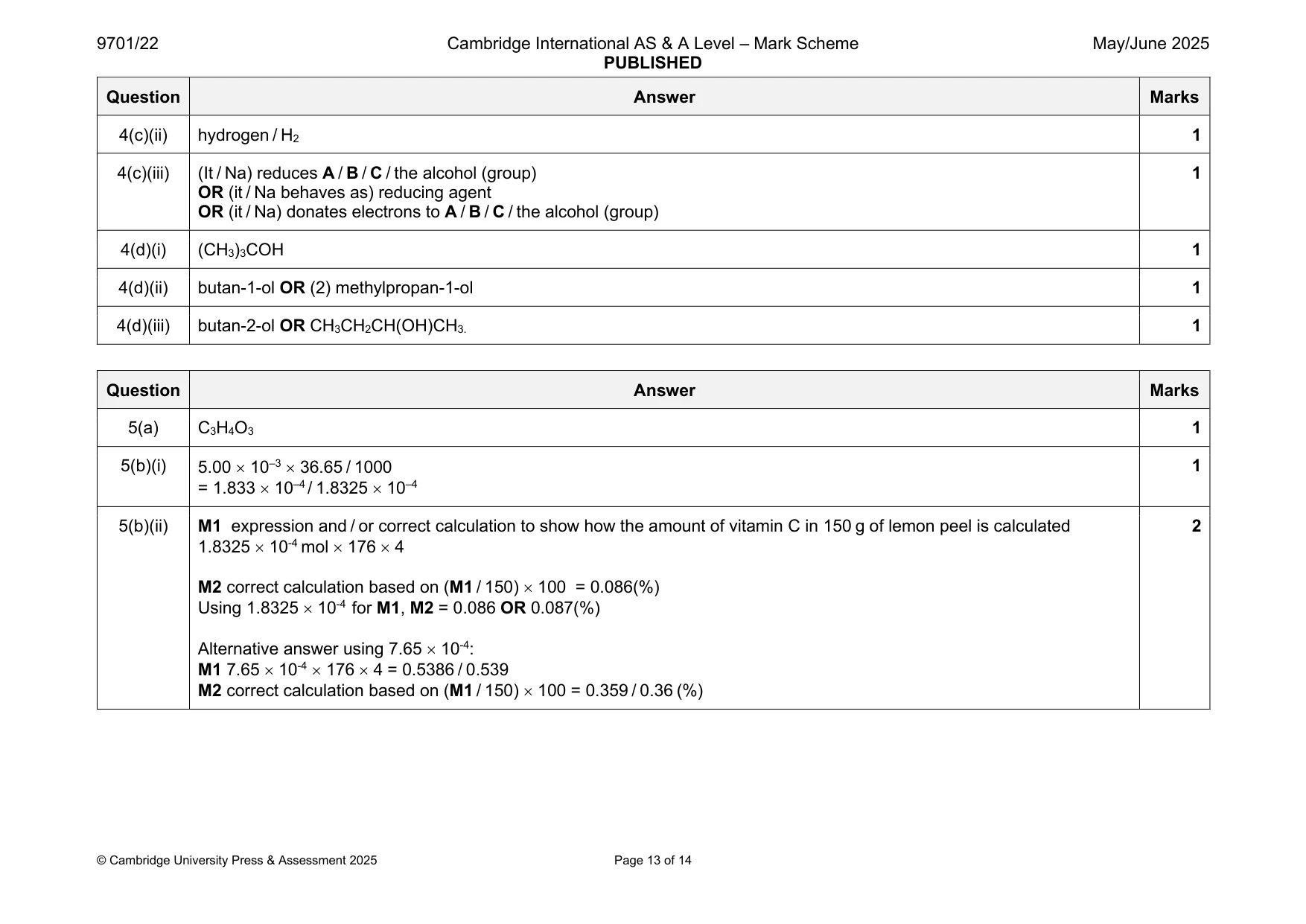
Mark scheme: 4(a)(i) LiAl H4 1 4(a)(ii) CH3CH2CO2H + 4[H] → CH3CH2CH2OH + H2O 1 4(b)(i) substitution 1 4(b)(ii) KCN / potassium cyanide in ethanol / C2H5OH AND heat 1 4(b)(iii) CH3CH2CH2CN + NaOH + H2O → CH3CH2CH2CO2Na + NH3 2 OR CH3CH2CH2CN + NaOH + 2H2O → CH3CH2CH2CO2Na + NH4OH M1 correct organic product (as molecule or anion) M2 rest of equation is correct 4(b)(iv) (alkaline) hydrolysis 1 4(c)(i) sp3 1 4(c)(ii) hydrogen / H2 1 4(c)(iii) (It / Na) reduces A / B / C / the alcohol (group) 1 OR (it / Na behaves as) reducing agent OR (it / Na) donates electrons to A / B / C / the alcohol (group) 4(d)(i) (CH3)3COH 1 4(d)(ii) butan-1-ol OR (2) methylpropan-1-ol 1 4(d)(iii) butan-2-ol OR CH3CH2CH(OH)CH3. 1
Q5 · The structure of vitamin C is shown in Fig
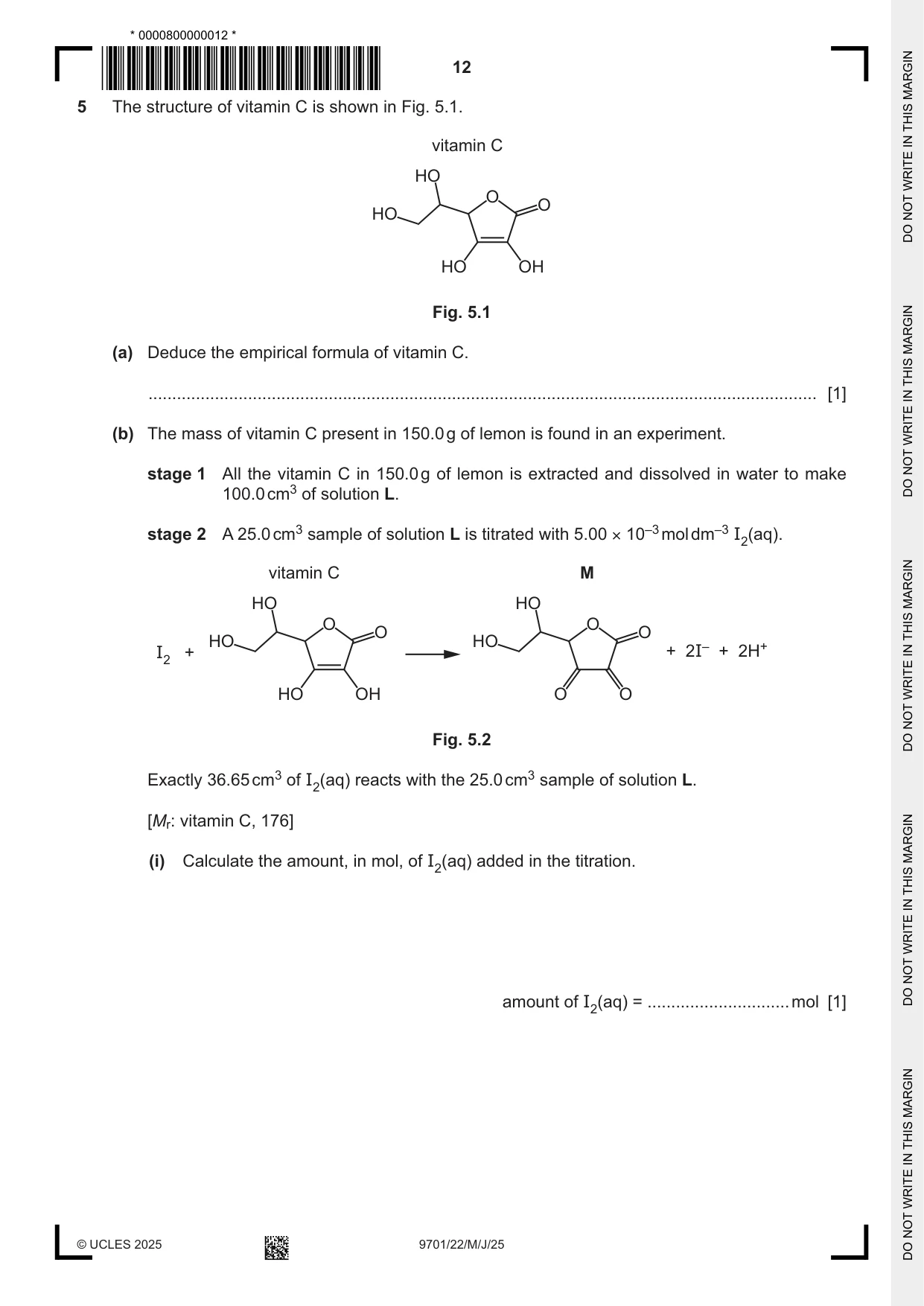
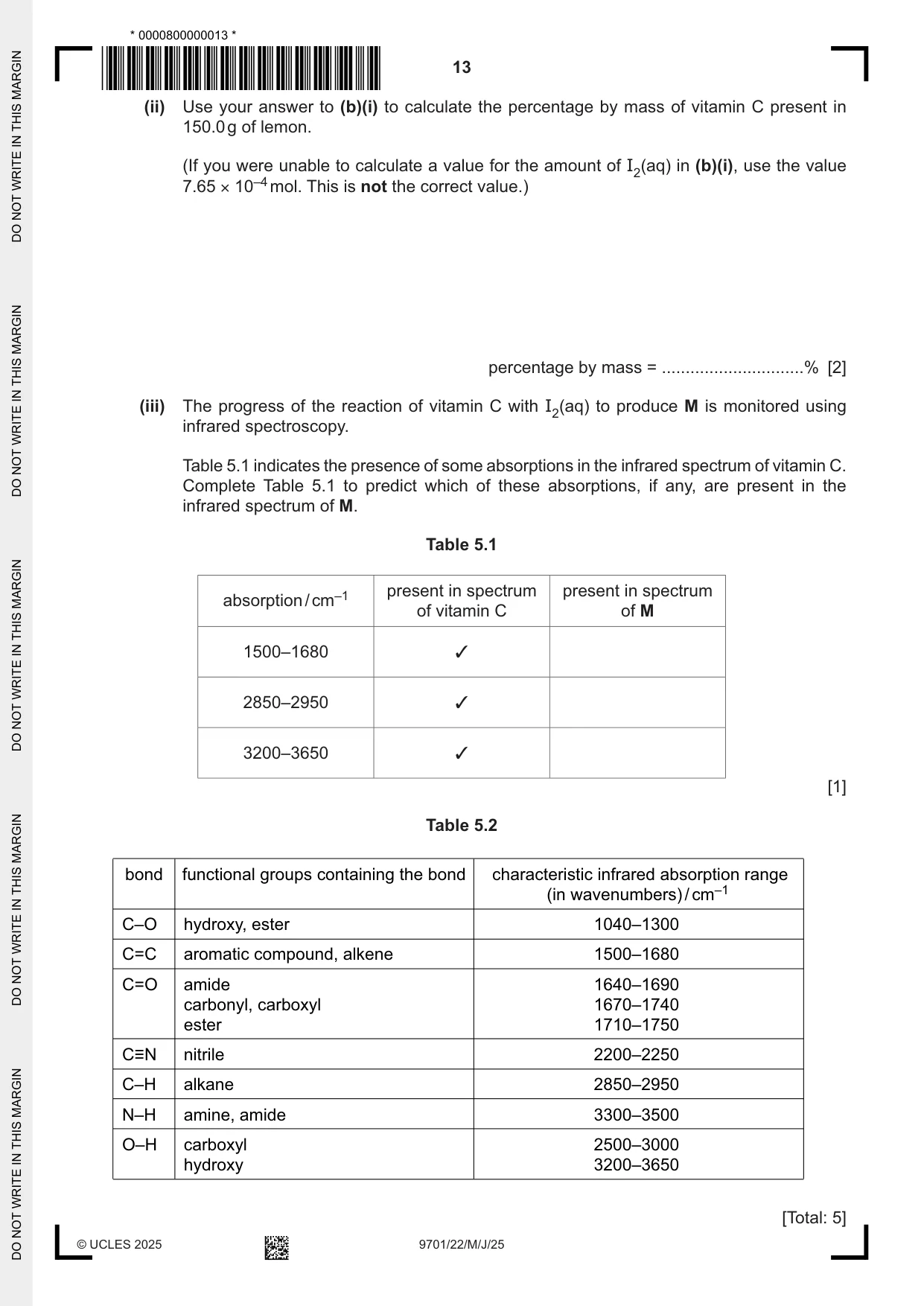
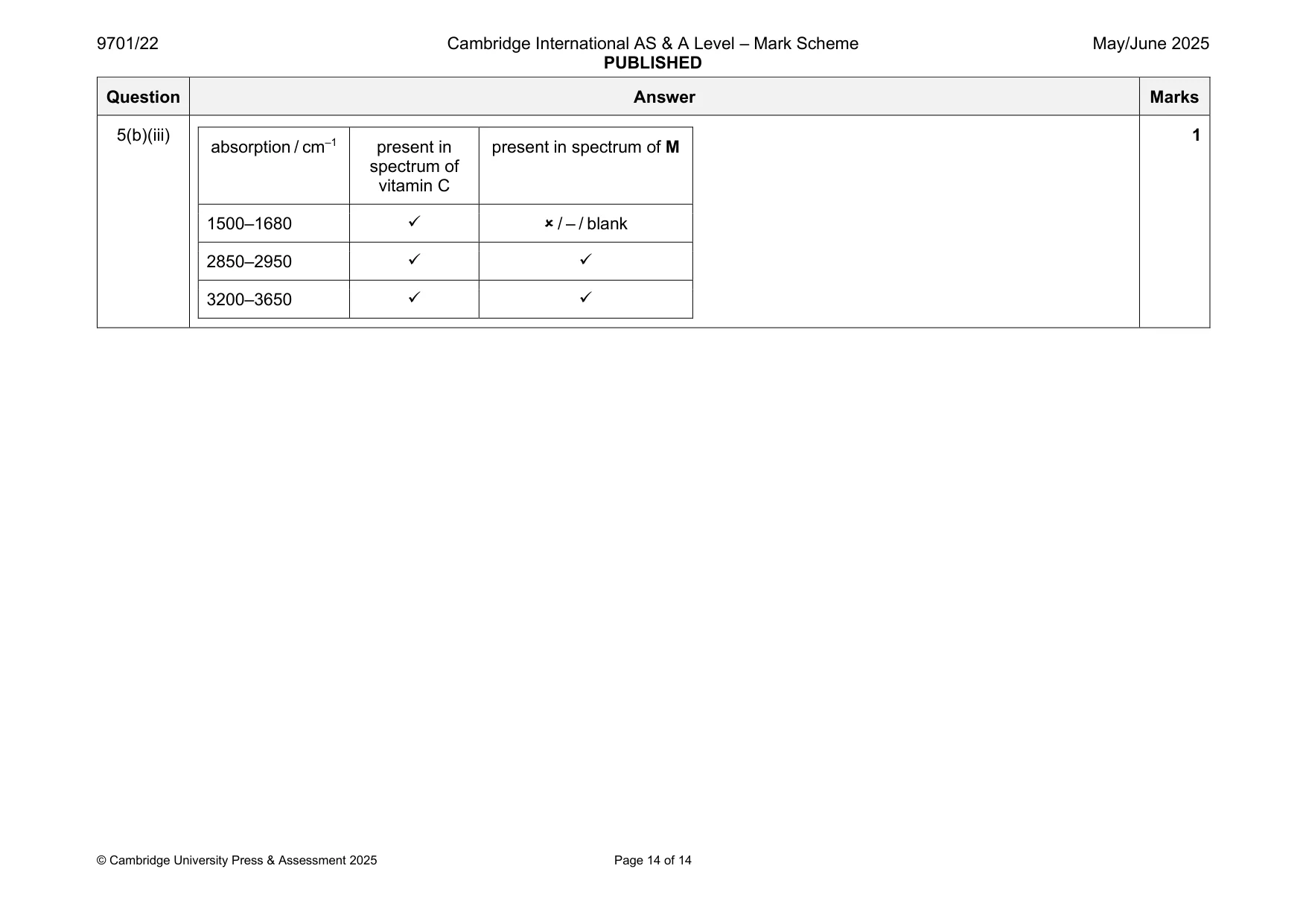
5 The structure of vitamin C is shown in Fig. 5.1. vitamin C HO O O HO HO OH Fig. 5.1 (a) Deduce the empirical formula of vitamin C. ............................................................................................................................................. [1] (b) The mass of vitamin C present in 150.0 g of lemon is found in an experiment. stage 1 All the vitamin C in 150.0 g of lemon is extracted and dissolved in water to make 100.0 cm3 of solution L. stage 2 A 25.0 cm3 sample of solution L is titrated with 5.00 × 10⁻³ mol dm–3 I2(aq). vitamin C M HO HO O O O O HO HO I2 + + 2I– + 2H+ HO OH O O Fig. 5.2 Exactly 36.65 cm3 of I2(aq) reacts with the 25.0 cm3 sample of solution L. [Mr: vitamin C, 176] (i) Calculate the amount, in mol, of I2(aq) added in the titration. amount of I2(aq) = .............................. mol [1] (ii) Use your answer to (b)(i) to calculate the percentage by mass of vitamin C present in 150.0 g of lemon. (If you were unable to calculate a value for the amount of I2(aq) in (b)(i), use the value 7.65 × 10⁻⁴ mol. This is not the correct value.) percentage by mass = ..............................% [2] (iii) The progress of the reaction of vitamin C with I2(aq) to produce M is monitored using infrared spectroscopy. Table 5.1 indicates the presence of some absorptions in the infrared spectrum of vitamin C. Complete Table 5.1 to predict which of these absorptions, if any, are present in the infrared spectrum of M. Table 5.1 present in spectrum present in spectrum absorption / cm–1 of vitamin C of M 1500–1680 ✓ 2850–2950 ✓ 3200–3650 ✓ [1] Table 5.2 bond functional groups containing the bond characteristic infrared absorption range (in wavenumbers) / cm–1 C–O hydroxy, ester 1040–1300 C=C aromatic compound, alkene 1500–1680 C=O amide 1640–1690 carbonyl, carboxyl 1670–1740 ester 1710–1750 C≡N nitrile 2200–2250 C–H alkane 2850–2950 N–H amine, amide 3300–3500 O–H carboxyl 2500–3000 hydroxy 3200–3650 [Total: 5]
Mark scheme: 5(a) C3H4O3 1 5(b)(i) 5.00 10–3 36.65 / 1000 1 = 1.833 10–4 / 1.8325 10–4 5(b)(ii) M1 expression and / or correct calculation to show how the amount of vitamin C in 150 g of lemon peel is calculated 2 1.8325 10-4 mol 176 4 M2 correct calculation based on (M1 / 150) 100 = 0.086(%) Using 1.8325 10-4 for M1, M2 = 0.086 OR 0.087(%) Alternative answer using 7.65 10-4: M1 7.65 10-4 176 4 = 0.5386 / 0.539 M2 correct calculation based on (M1 / 150) 100 = 0.359 / 0.36 (%) 5(b)(iii) 1 absorption / cm–1 present in present in spectrum of M spectrum of vitamin C 1500–1680 ✓ / – / blank 2850–2950 ✓ ✓ 3200–3650 ✓ ✓
More questions on Reacting masses and volumes (of solutions and gases)
What was in this paper
The subtopics covered by these 5 questions, and how many questions each got. Open one in a new tab to see every Cambridge question on it.
What you needed in this session
Cambridge’s own grade thresholds for 2025 May/June, Paper 2 · Variant 2. A higher threshold means an easier paper — the bar moves with how the cohort did.