Cambridge A Level Chemistry 9701 — 2025 May/June Paper 2 · Variant 1
9701/21/M/J/25 · 6 questions · 60 marks · 75 min
The question paper and its mark scheme, free to read here and free to download. This is Cambridge’s own paper, exactly as it was sat.
Question paper16 pages
Mark scheme12 pages
Answers below. Sit the paper first if you are practising.
Questions as text
Q1 · Solid sodium conducts electricity
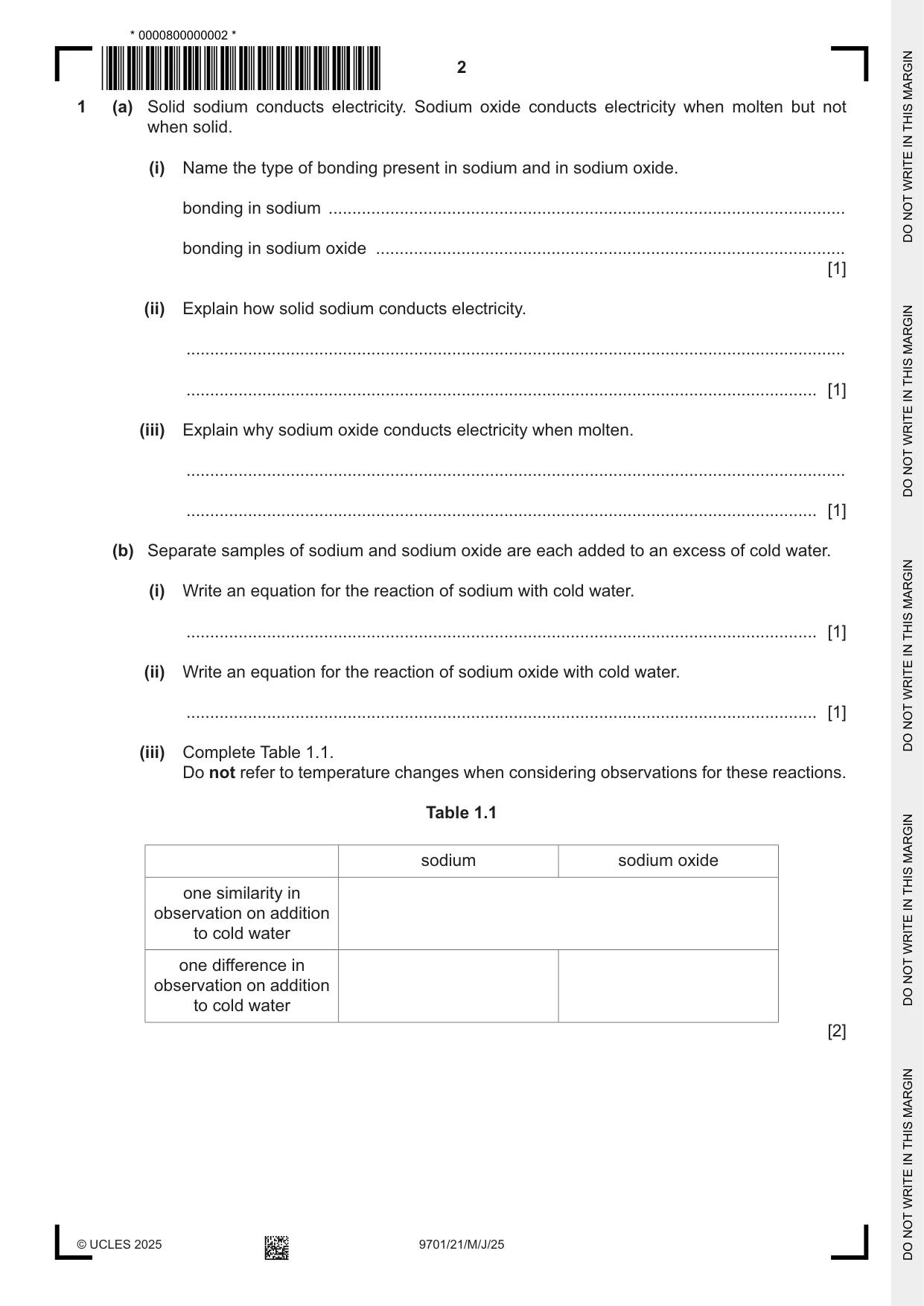
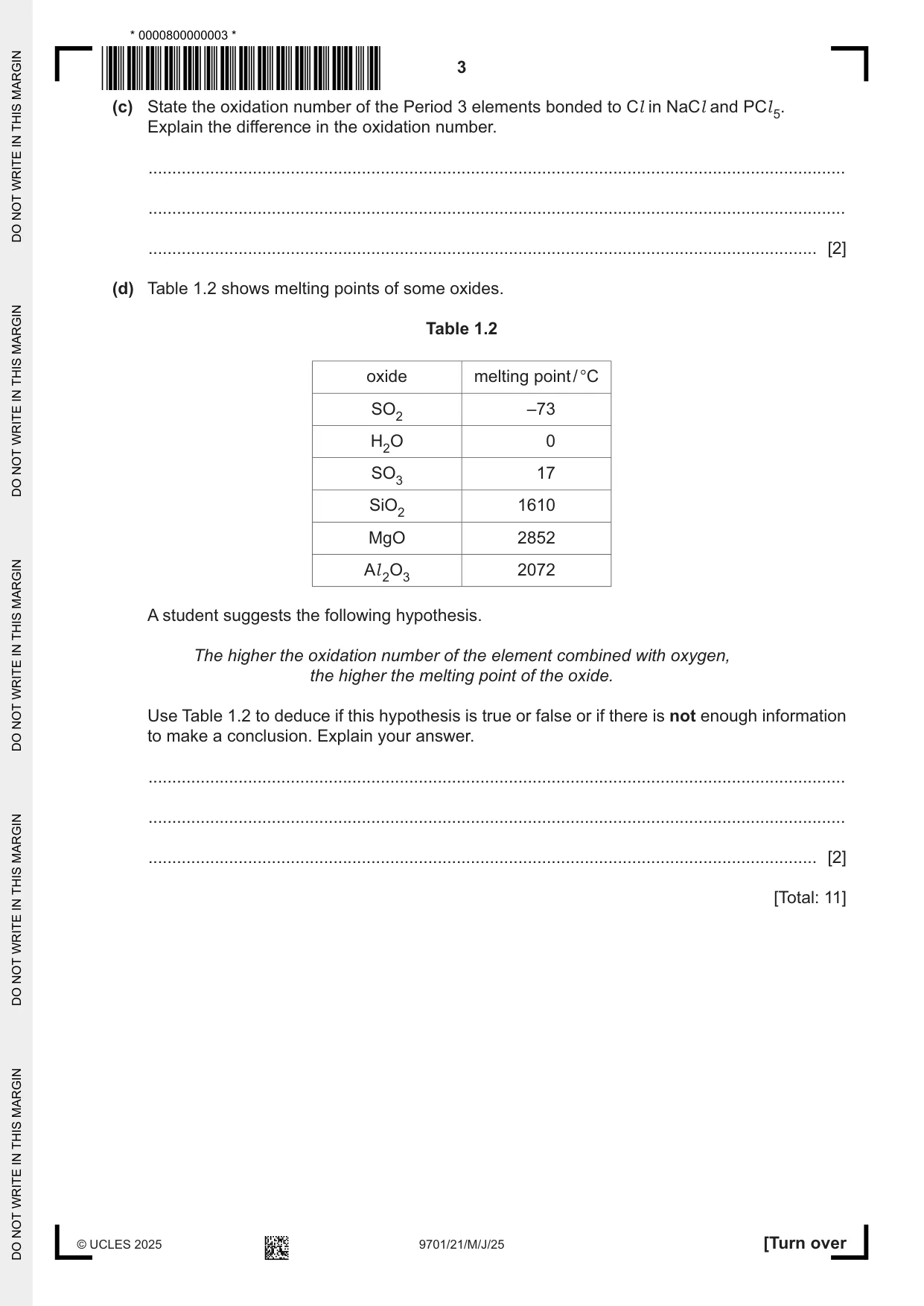
1 (a) Solid sodium conducts electricity. Sodium oxide conducts electricity when molten but not when solid. (i) Name the type of bonding present in sodium and in sodium oxide. bonding in sodium ............................................................................................................. bonding in sodium oxide ................................................................................................... [1] (ii) Explain how solid sodium conducts electricity. ........................................................................................................................................... ..................................................................................................................................... [1] (iii) Explain why sodium oxide conducts electricity when molten. ........................................................................................................................................... ..................................................................................................................................... [1] (b) Separate samples of sodium and sodium oxide are each added to an excess of cold water. (i) Write an equation for the reaction of sodium with cold water. ..................................................................................................................................... [1] (ii) Write an equation for the reaction of sodium oxide with cold water. ..................................................................................................................................... [1] (iii) Complete Table 1.1. Do not refer to temperature changes when considering observations for these reactions. Table 1.1 sodium sodium oxide one similarity in observation on addition to cold water one difference in observation on addition to cold water [2] (c) State the oxidation number of the Period 3 elements bonded to Cl in NaCl and PCl 5. Explain the difference in the oxidation number. ................................................................................................................................................... ................................................................................................................................................... ............................................................................................................................................. [2] (d) Table 1.2 shows melting points of some oxides. Table 1.2 oxide melting point / °C SO2 –73 H2O 0 SO3 17 SiO2 1610 MgO 2852 Al 2O3 2072 A student suggests the following hypothesis. The higher the oxidation number of the element combined with oxygen, the higher the melting point of the oxide. Use Table 1.2 to deduce if this hypothesis is true or false or if there is not enough information to make a conclusion. Explain your answer. ................................................................................................................................................... ................................................................................................................................................... ............................................................................................................................................. [2] [Total: 11]
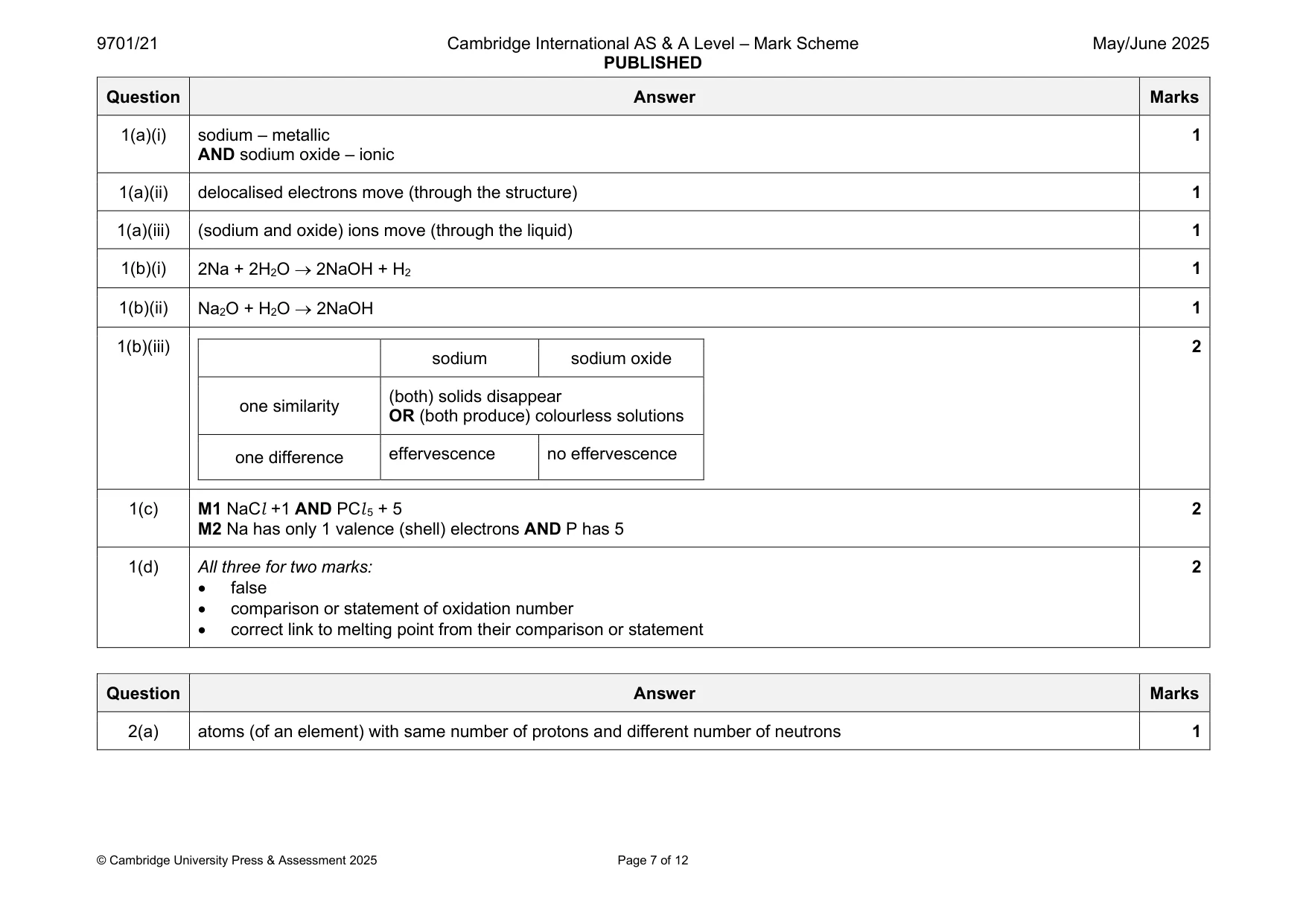
Mark scheme: Question Answer Marks 1(a)(i) sodium – metallic 1 AND sodium oxide – ionic 1(a)(ii) delocalised electrons move (through the structure) 1 1(a)(iii) (sodium and oxide) ions move (through the liquid) 1 1(b)(i) 2Na + 2H2O → 2NaOH + H2 1 1(b)(ii) Na2O + H2O → 2NaOH 1 1(b)(iii) 2 sodium sodium oxide (both) solids disappear one similarity OR (both produce) colourless solutions one difference effervescence no effervescence 1(c) M1 NaCl +1 AND PCl 5 + 5 2 M2 Na has only 1 valence (shell) electrons AND P has 5 1(d) All three for two marks: 2 • false • comparison or statement of oxidation number • correct link to melting point from their comparison or statement
More questions on Periodicity of chemical properties of the elements in Period 3
Q2 · A sample of iron is analysed using a mass spectrometer
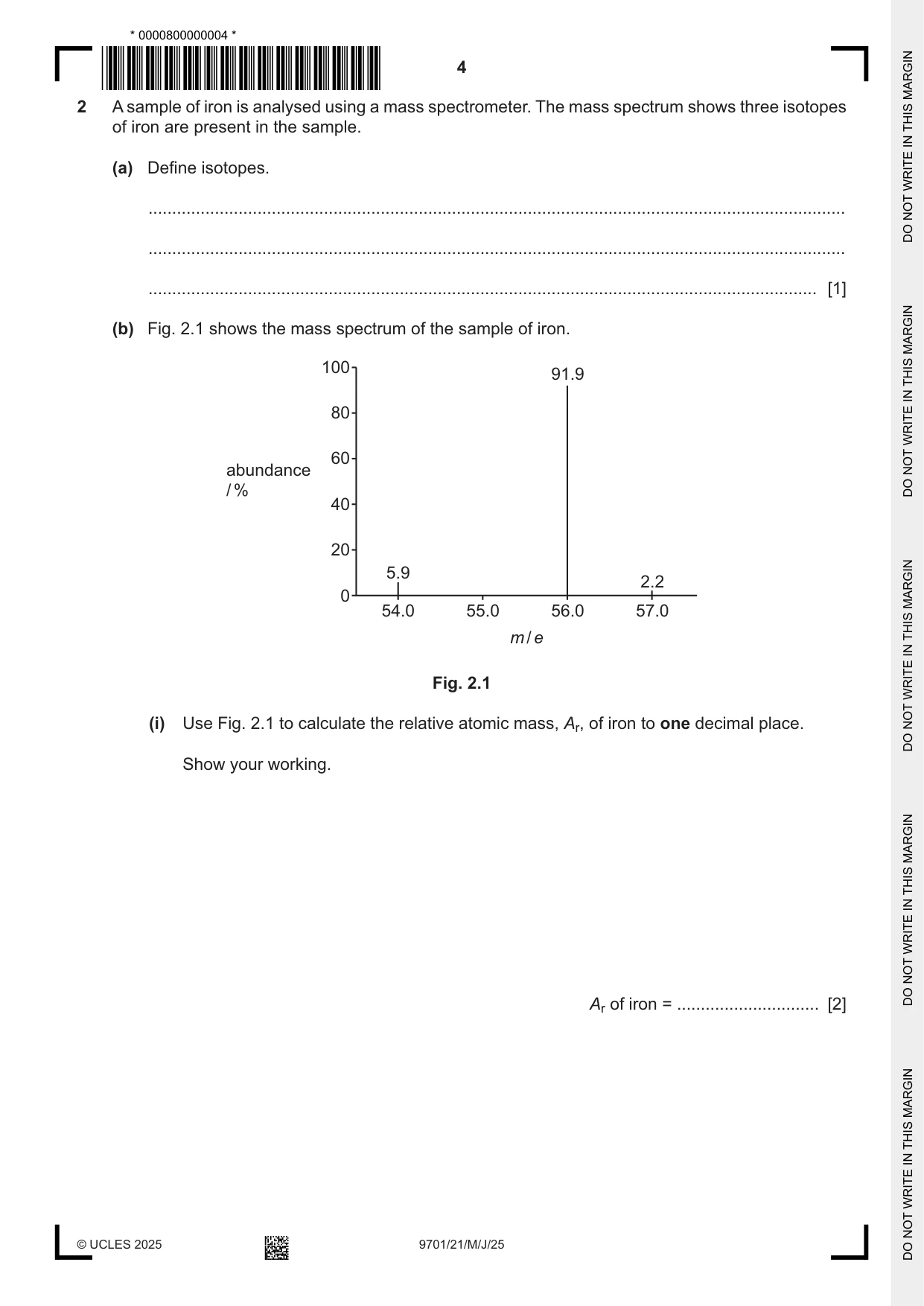
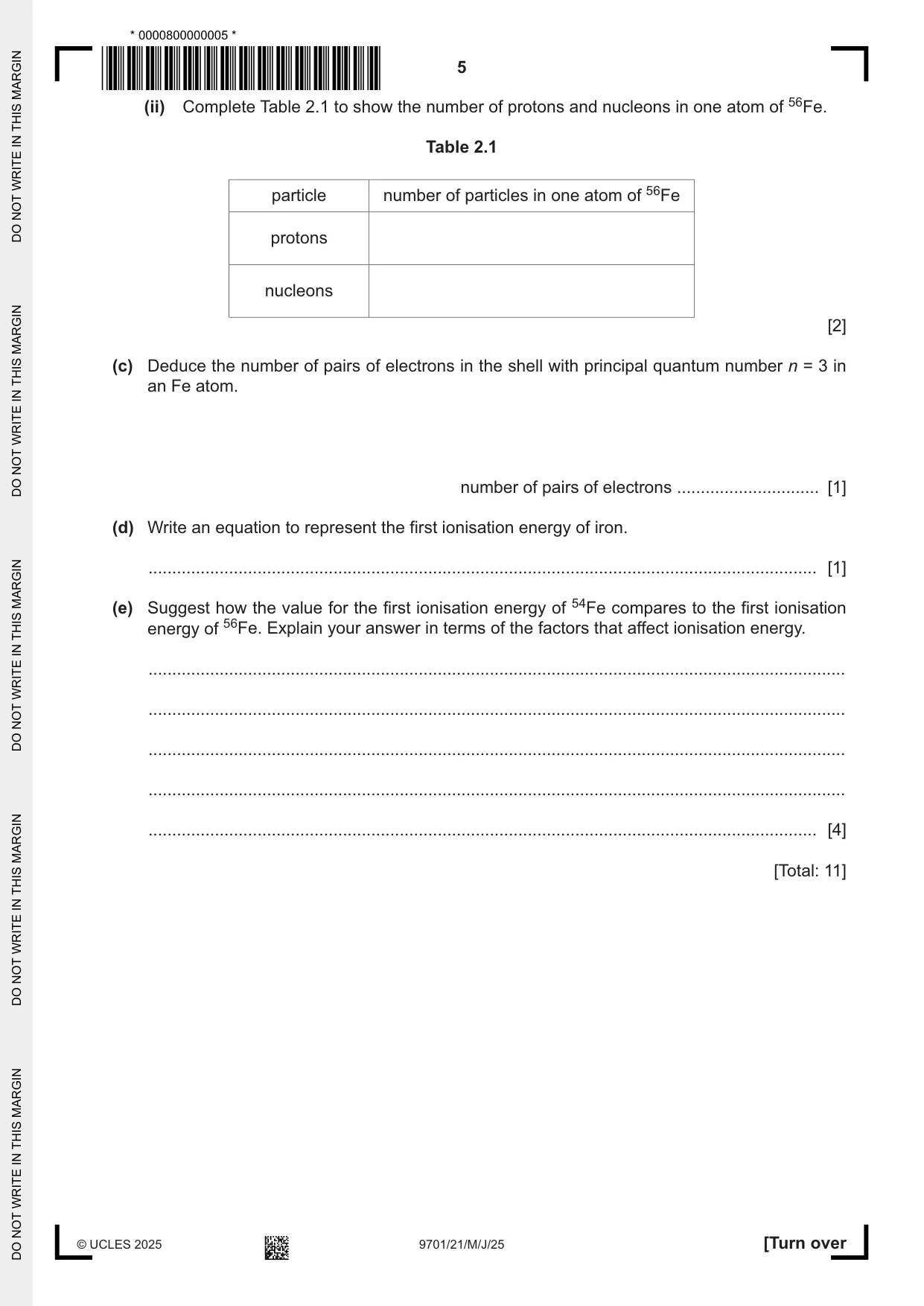
2 A sample of iron is analysed using a mass spectrometer. The mass spectrum shows three isotopes of iron are present in the sample. (a) Define isotopes. ................................................................................................................................................... ................................................................................................................................................... ............................................................................................................................................. [1] (b) Fig. 2.1 shows the mass spectrum of the sample of iron. 100 91.9 80 60 abundance / % 40 20 5.9 2.2 0 54.0 55.0 56.0 57.0 m / e Fig. 2.1 (i) Use Fig. 2.1 to calculate the relative atomic mass, Ar, of iron to one decimal place. Show your working. Ar of iron = .............................. [2] (ii) Complete Table 2.1 to show the number of protons and nucleons in one atom of 56Fe. Table 2.1 particle number of particles in one atom of 56Fe protons nucleons [2] (c) Deduce the number of pairs of electrons in the shell with principal quantum number n = 3 in an Fe atom. number of pairs of electrons .............................. [1] (d) Write an equation to represent the first ionisation energy of iron. ............................................................................................................................................. [1] (e) Suggest how the value for the first ionisation energy of 54Fe compares to the first ionisation energy of 56Fe. Explain your answer in terms of the factors that affect ionisation energy. ................................................................................................................................................... ................................................................................................................................................... ................................................................................................................................................... ................................................................................................................................................... ............................................................................................................................................. [4] [Total: 11]
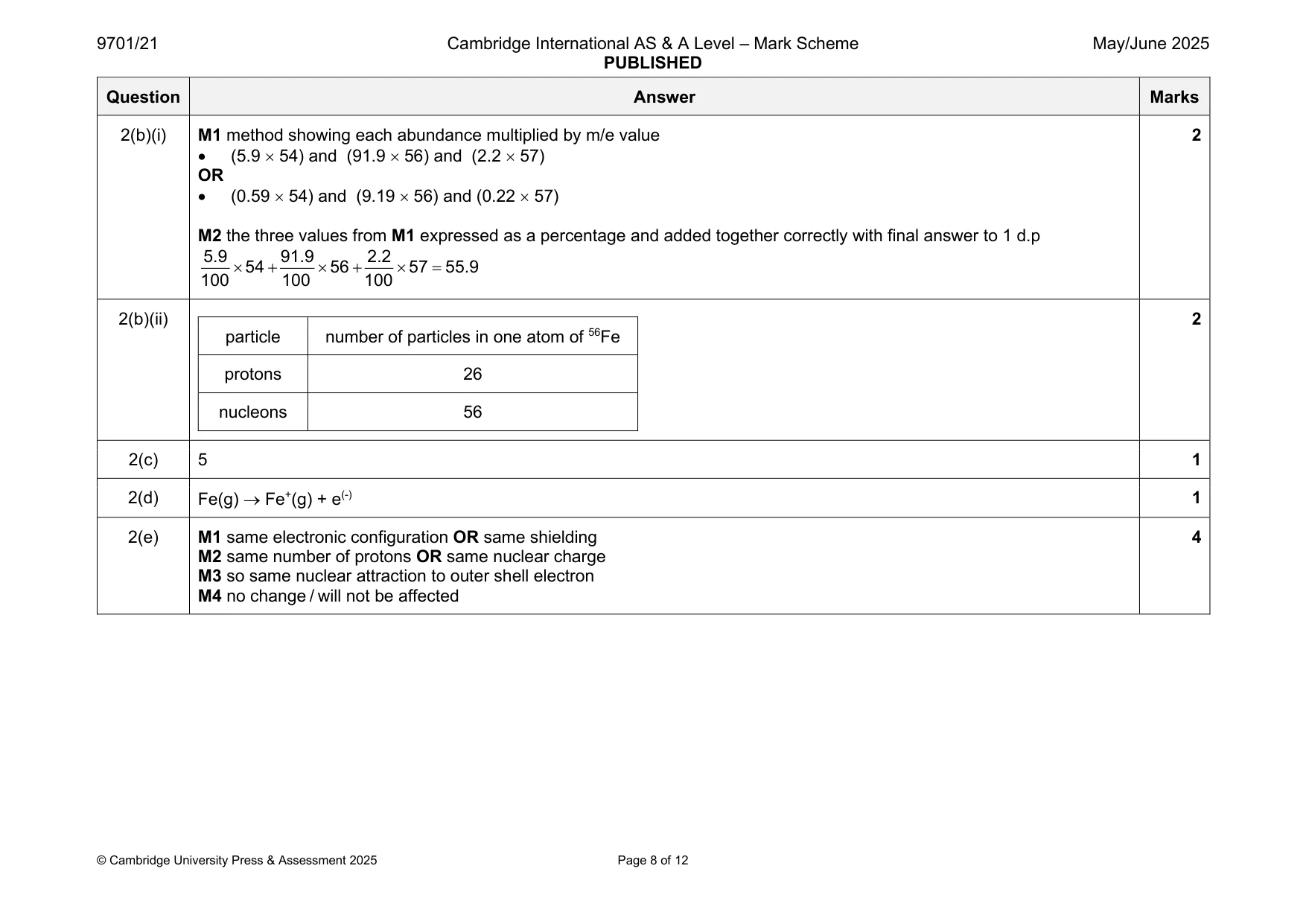
Mark scheme: 2(a) atoms (of an element) with same number of protons and different number of neutrons 1 2(b)(i) M1 method showing each abundance multiplied by m/e value 2 • (5.9 54) and (91.9 56) and (2.2 57) OR • (0.59 54) and (9.19 56) and (0.22 57) M2 the three values from M1 expressed as a percentage and added together correctly with final answer to 1 d.p 5.9 91.9 2.2 54 + 56 + 57 = 55.9 100 100 100 2(b)(ii) 2 particle number of particles in one atom of 56Fe protons 26 nucleons 56 2(c) 5 1 2(d) Fe(g) → Fe+(g) + e(-) 1 2(e) M1 same electronic configuration OR same shielding 4 M2 same number of protons OR same nuclear charge M3 so same nuclear attraction to outer shell electron M4 no change / will not be affected
Q3 · Hexene reacts with hydrogen gas to produce hexane
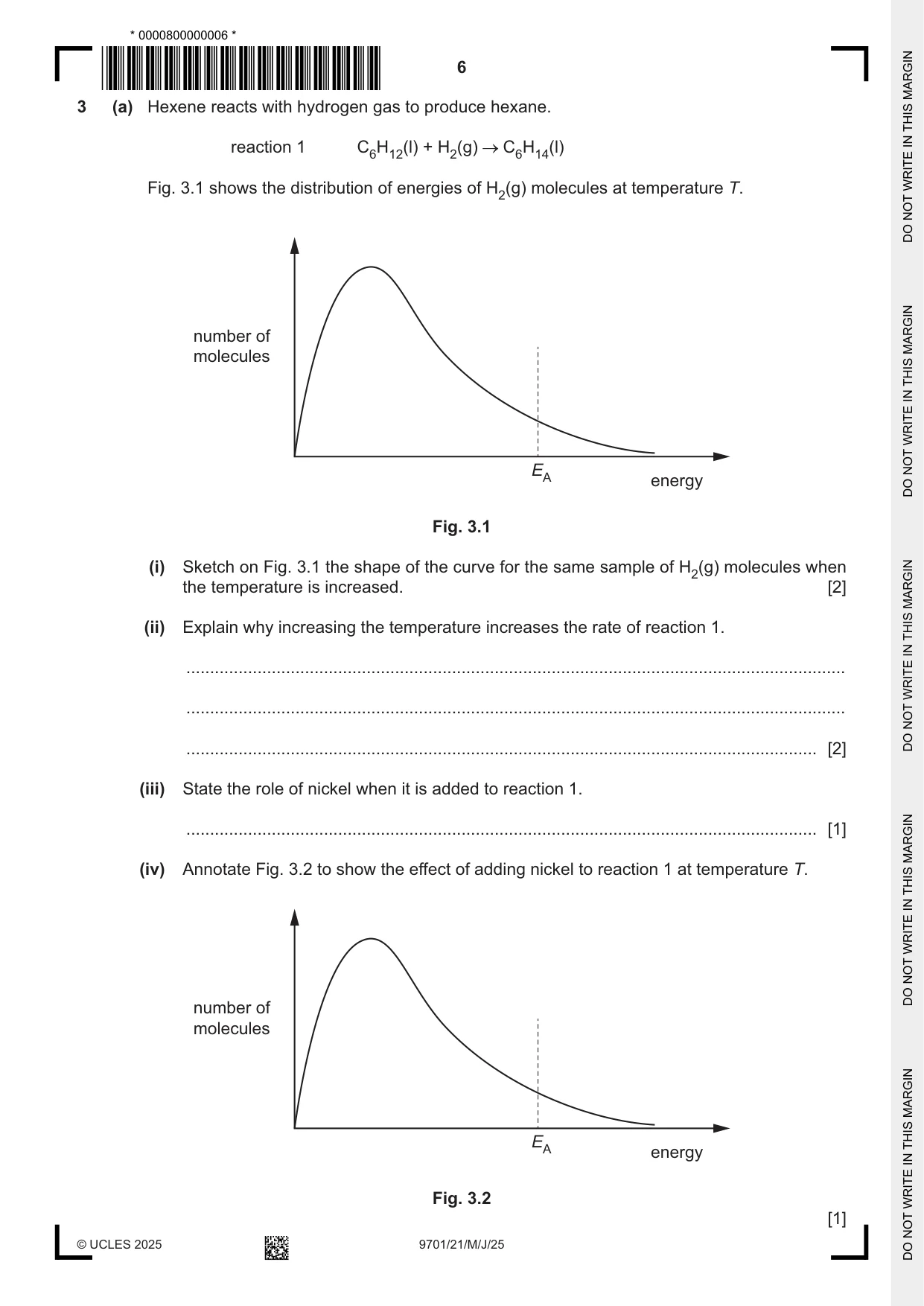
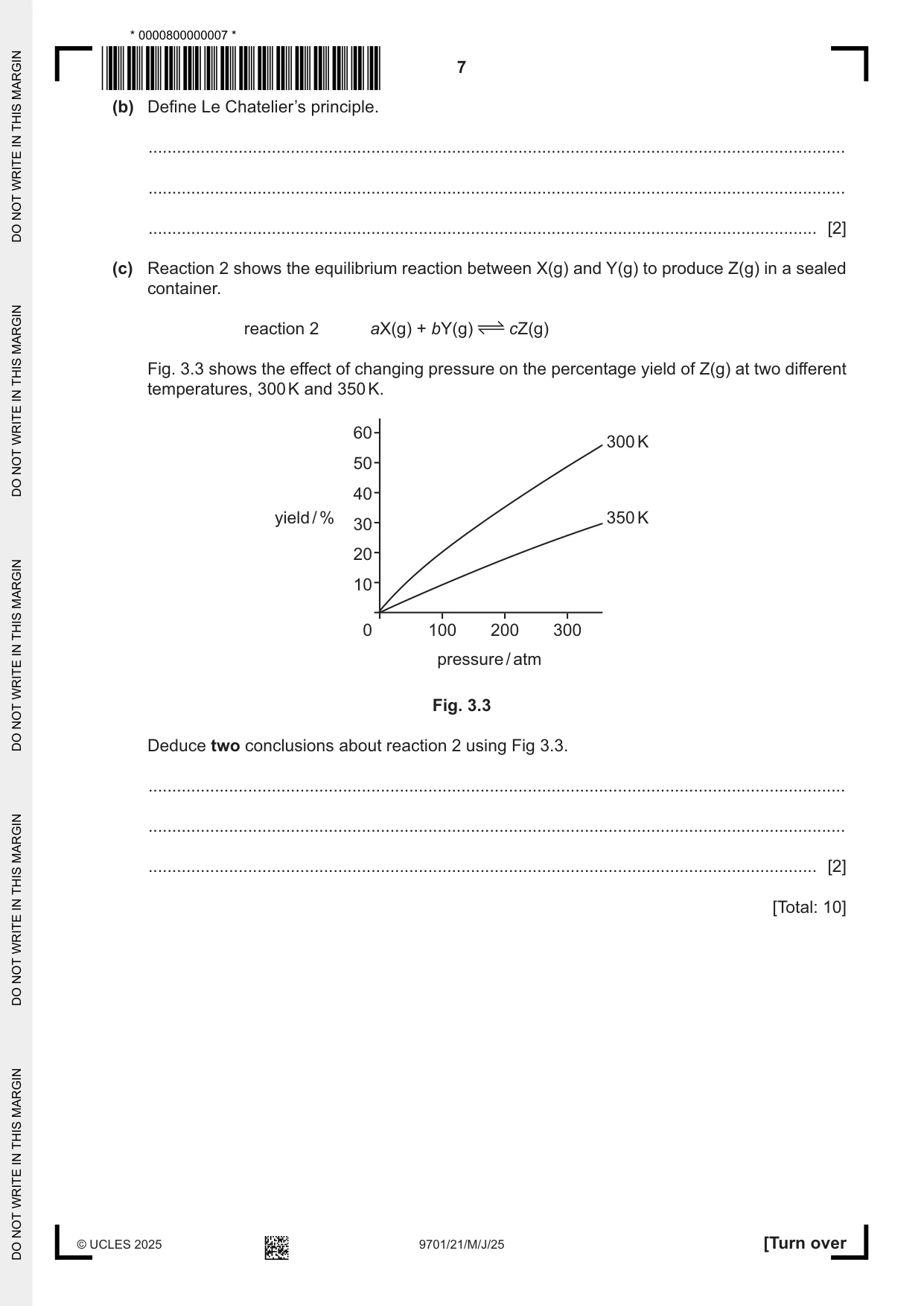
3 (a) Hexene reacts with hydrogen gas to produce hexane. reaction 1 C6H12(l) + H2(g) C6H14(l) Fig. 3.1 shows the distribution of energies of H2(g) molecules at temperature T. number of molecules EA energy Fig. 3.1 (i) Sketch on Fig. 3.1 the shape of the curve for the same sample of H2(g) molecules when the temperature is increased. [2] (ii) Explain why increasing the temperature increases the rate of reaction 1. ........................................................................................................................................... ........................................................................................................................................... ..................................................................................................................................... [2] (iii) State the role of nickel when it is added to reaction 1. ..................................................................................................................................... [1] (iv) Annotate Fig. 3.2 to show the effect of adding nickel to reaction 1 at temperature T. number of molecules EA energy Fig. 3.2 [1] (b) Define Le Chatelier’s principle. ................................................................................................................................................... ................................................................................................................................................... ............................................................................................................................................. [2] (c) Reaction 2 shows the equilibrium reaction between X(g) and Y(g) to produce Z(g) in a sealed container. reaction 2 aX(g) + bY(g) cZ(g) Fig. 3.3 shows the effect of changing pressure on the percentage yield of Z(g) at two different temperatures, 300 K and 350 K. 60 300 K 50 40 yield / % 350 K 30 20 10 0 100 200 300 pressure / atm Fig. 3.3 Deduce two conclusions about reaction 2 using Fig 3.3. ................................................................................................................................................... ................................................................................................................................................... ............................................................................................................................................. [2] [Total: 10]
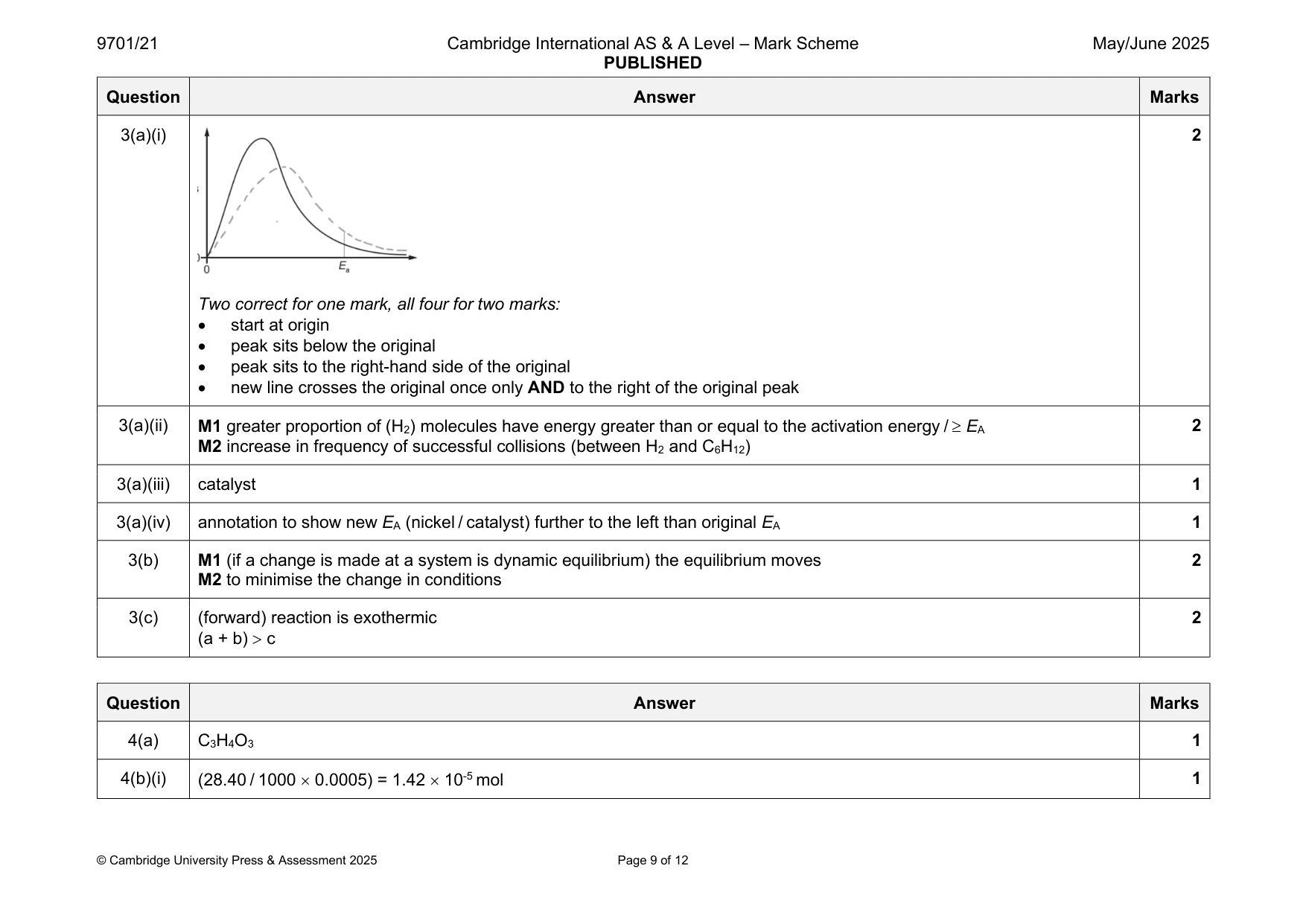
Mark scheme: 3(a)(i) 2 Two correct for one mark, all four for two marks: • start at origin • peak sits below the original • peak sits to the right-hand side of the original • new line crosses the original once only AND to the right of the original peak 3(a)(ii) M1 greater proportion of (H2) molecules have energy greater than or equal to the activation energy / EA 2 M2 increase in frequency of successful collisions (between H2 and C6H12) 3(a)(iii) catalyst 1 3(a)(iv) annotation to show new EA (nickel / catalyst) further to the left than original EA 1 3(b) M1 (if a change is made at a system is dynamic equilibrium) the equilibrium moves 2 M2 to minimise the change in conditions 3(c) (forward) reaction is exothermic 2 (a + b) c
More questions on Effect of temperature on reaction rates and the concept of activation energy
Q4 · The structure of vitamin C is shown in Fig
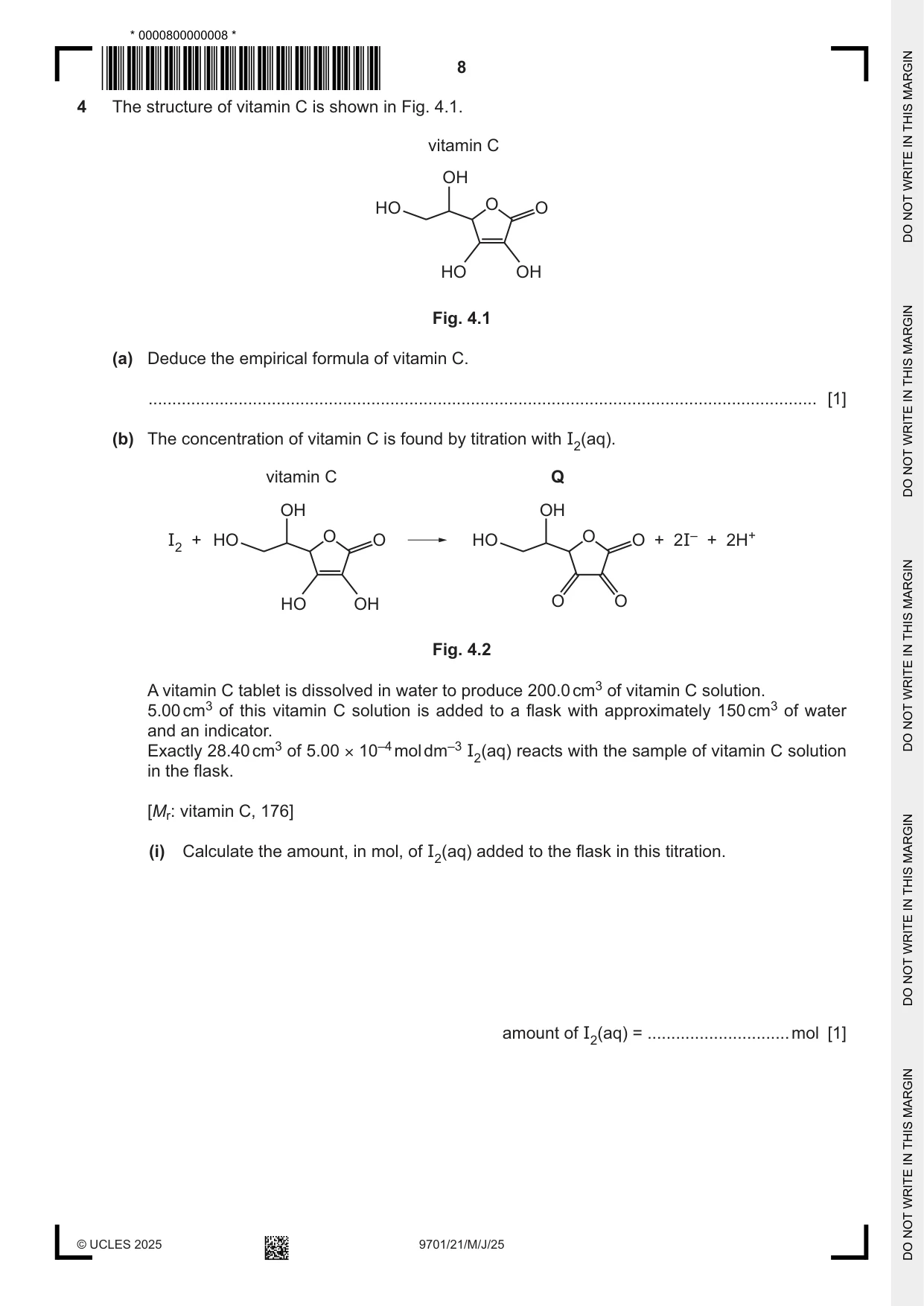
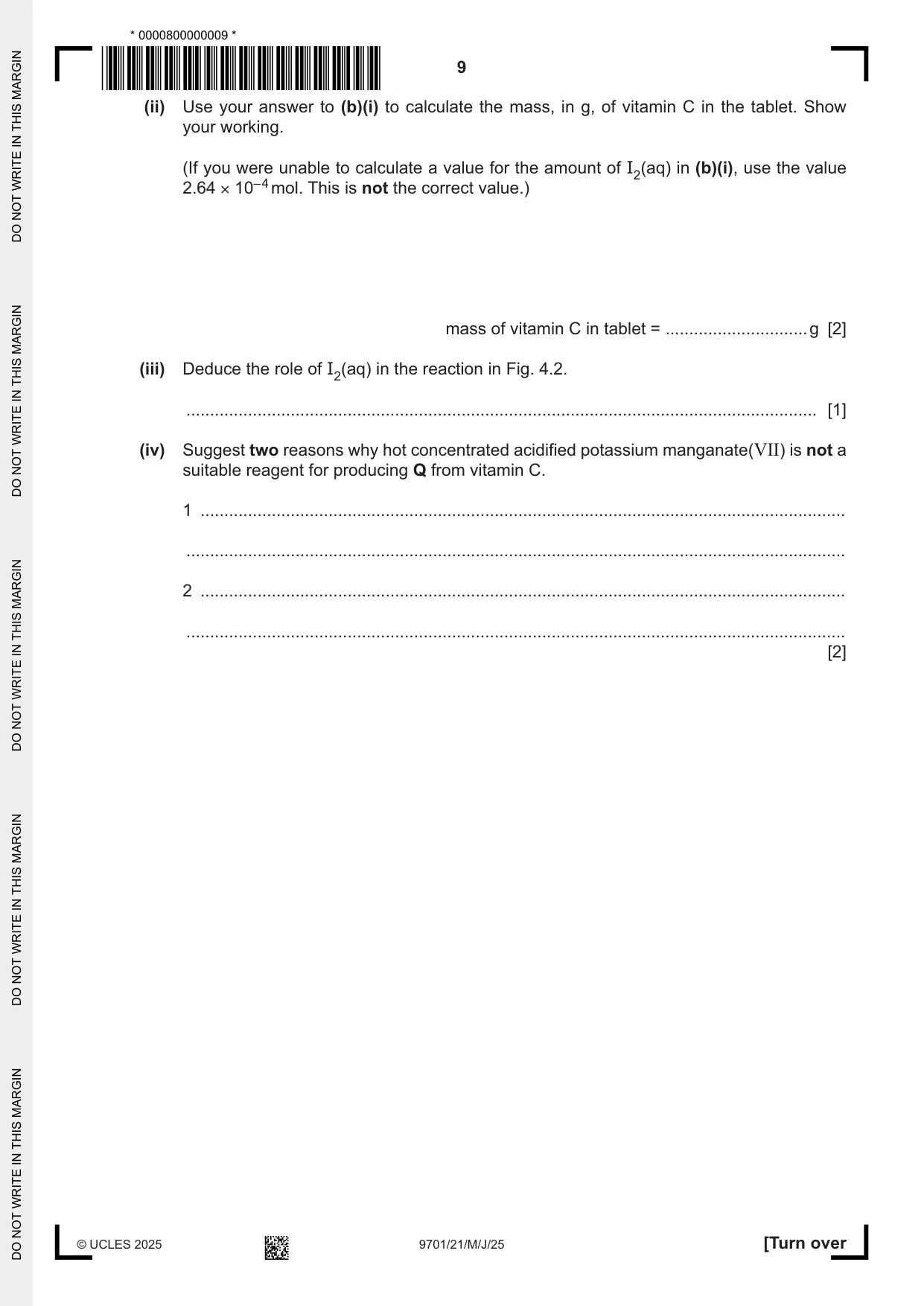
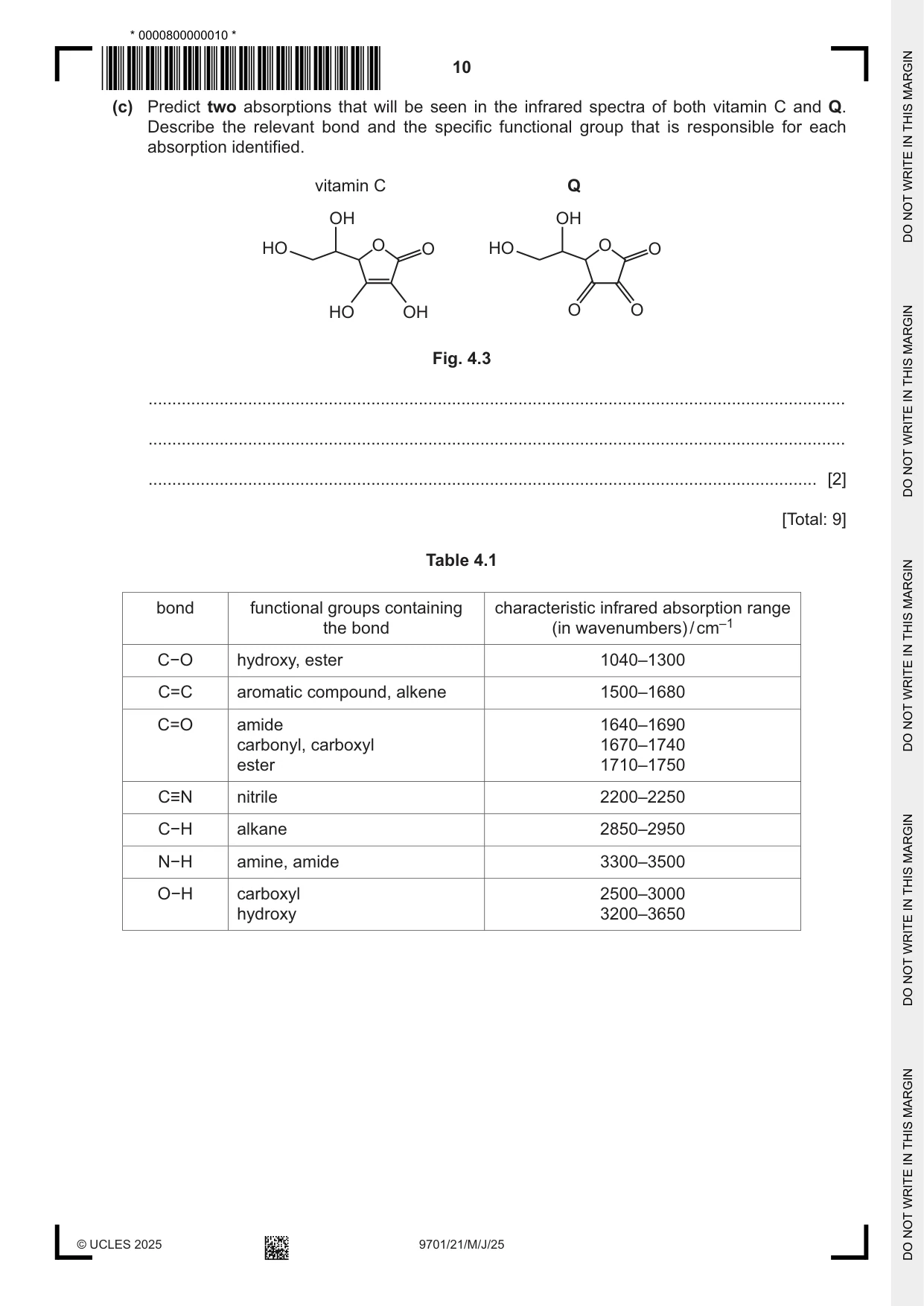
4 The structure of vitamin C is shown in Fig. 4.1. vitamin C OH HO O O HO OH Fig. 4.1 (a) Deduce the empirical formula of vitamin C. ............................................................................................................................................. [1] (b) The concentration of vitamin C is found by titration with I2(aq). vitamin C Q OH OH I2 + HO O O HO O O + 2I– + 2H+ HO OH O O Fig. 4.2 A vitamin C tablet is dissolved in water to produce 200.0 cm3 of vitamin C solution. 5.00 cm3 of this vitamin C solution is added to a flask with approximately 150 cm3 of water and an indicator. Exactly 28.40 cm3 of 5.00 × 10⁻⁴ mol dm–3 I2(aq) reacts with the sample of vitamin C solution in the flask. [Mr: vitamin C, 176] (i) Calculate the amount, in mol, of I2(aq) added to the flask in this titration. amount of I2(aq) = .............................. mol [1] (ii) Use your answer to (b)(i) to calculate the mass, in g, of vitamin C in the tablet. Show your working. (If you were unable to calculate a value for the amount of I2(aq) in (b)(i), use the value 2.64 × 10– 4 mol. This is not the correct value.) mass of vitamin C in tablet = .............................. g [2] (iii) Deduce the role of I2(aq) in the reaction in Fig. 4.2. ..................................................................................................................................... [1] (iv) Suggest two reasons why hot concentrated acidified potassium manganate(VII) is not a suitable reagent for producing Q from vitamin C. 1 ........................................................................................................................................ ........................................................................................................................................... 2 ........................................................................................................................................ ........................................................................................................................................... [2] (c) Predict two absorptions that will be seen in the infrared spectra of both vitamin C and Q. Describe the relevant bond and the specific functional group that is responsible for each absorption identified. vitamin C Q OH OH HO O O HO O O HO OH O O Fig. 4.3 ................................................................................................................................................... ................................................................................................................................................... ............................................................................................................................................. [2] [Total: 9] Table 4.1 bond functional groups containing characteristic infrared absorption range the bond (in wavenumbers) / cm–1 C−O hydroxy, ester 1040–1300 C=C aromatic compound, alkene 1500–1680 C=O amide 1640–1690 carbonyl, carboxyl 1670–1740 ester 1710–1750 C≡N nitrile 2200–2250 C−H alkane 2850–2950 N−H amine, amide 3300–3500 O−H carboxyl 2500–3000 hydroxy 3200–3650
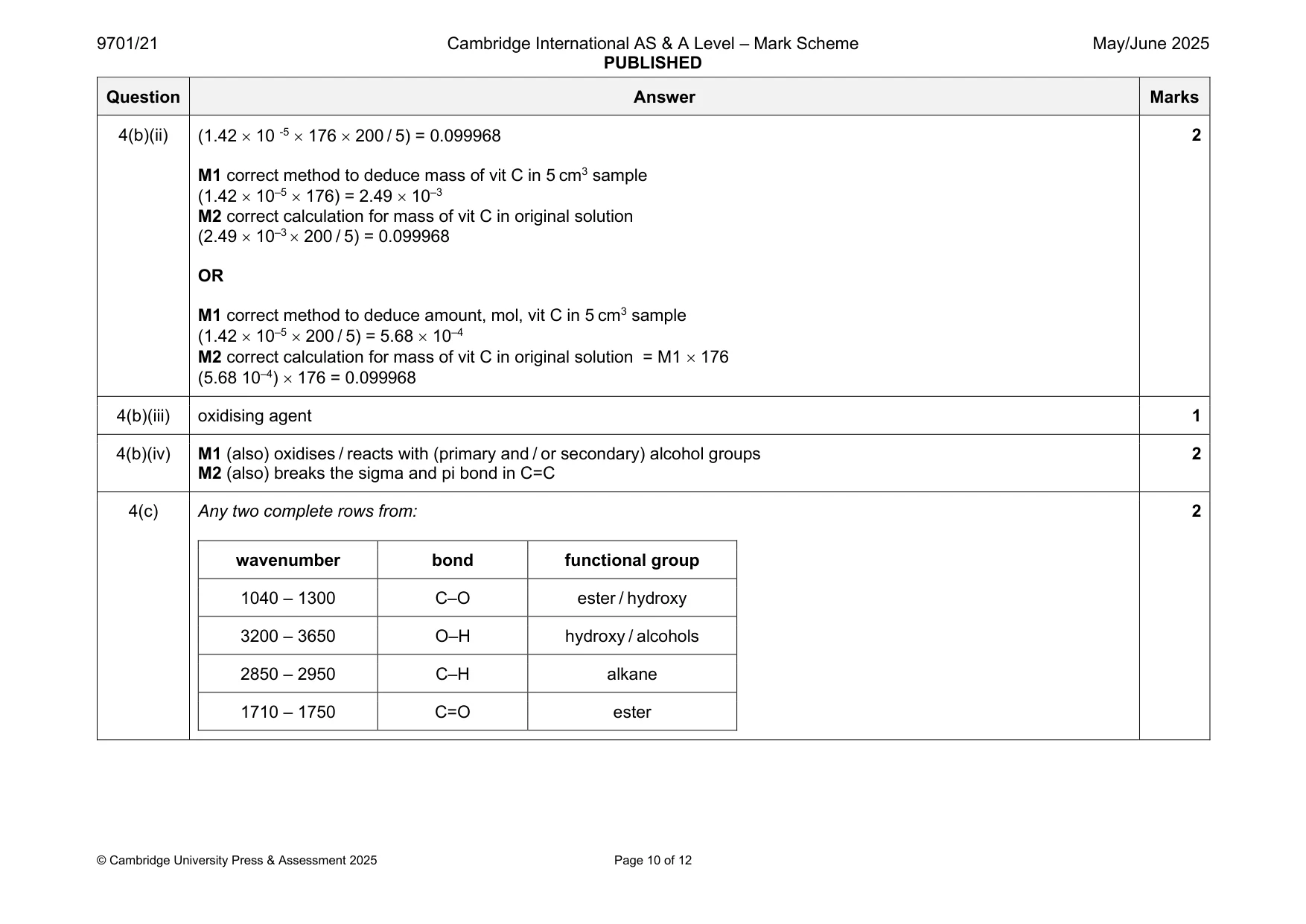
Mark scheme: 4(a) C3H4O3 1 4(b)(i) (28.40 / 1000 0.0005) = 1.42 10-5 mol 1 4(b)(ii) (1.42 10 -5 176 200 / 5) = 0.099968 2 M1 correct method to deduce mass of vit C in 5 cm3 sample (1.42 10–5 176) = 2.49 10–3 M2 correct calculation for mass of vit C in original solution (2.49 10–3 200 / 5) = 0.099968 OR M1 correct method to deduce amount, mol, vit C in 5 cm3 sample (1.42 10–5 200 / 5) = 5.68 10–4 M2 correct calculation for mass of vit C in original solution = M1 176 (5.68 10–4) 176 = 0.099968 4(b)(iii) oxidising agent 1 4(b)(iv) M1 (also) oxidises / reacts with (primary and / or secondary) alcohol groups 2 M2 (also) breaks the sigma and pi bond in C=C 4(c) Any two complete rows from: 2 wavenumber bond functional group 1040 – 1300 C–O ester / hydroxy 3200 – 3650 O–H hydroxy / alcohols 2850 – 2950 C–H alkane 1710 – 1750 C=O ester
More questions on Reacting masses and volumes (of solutions and gases)
Q5 · Compound A contains the elements carbon, hydrogen and oxygen only
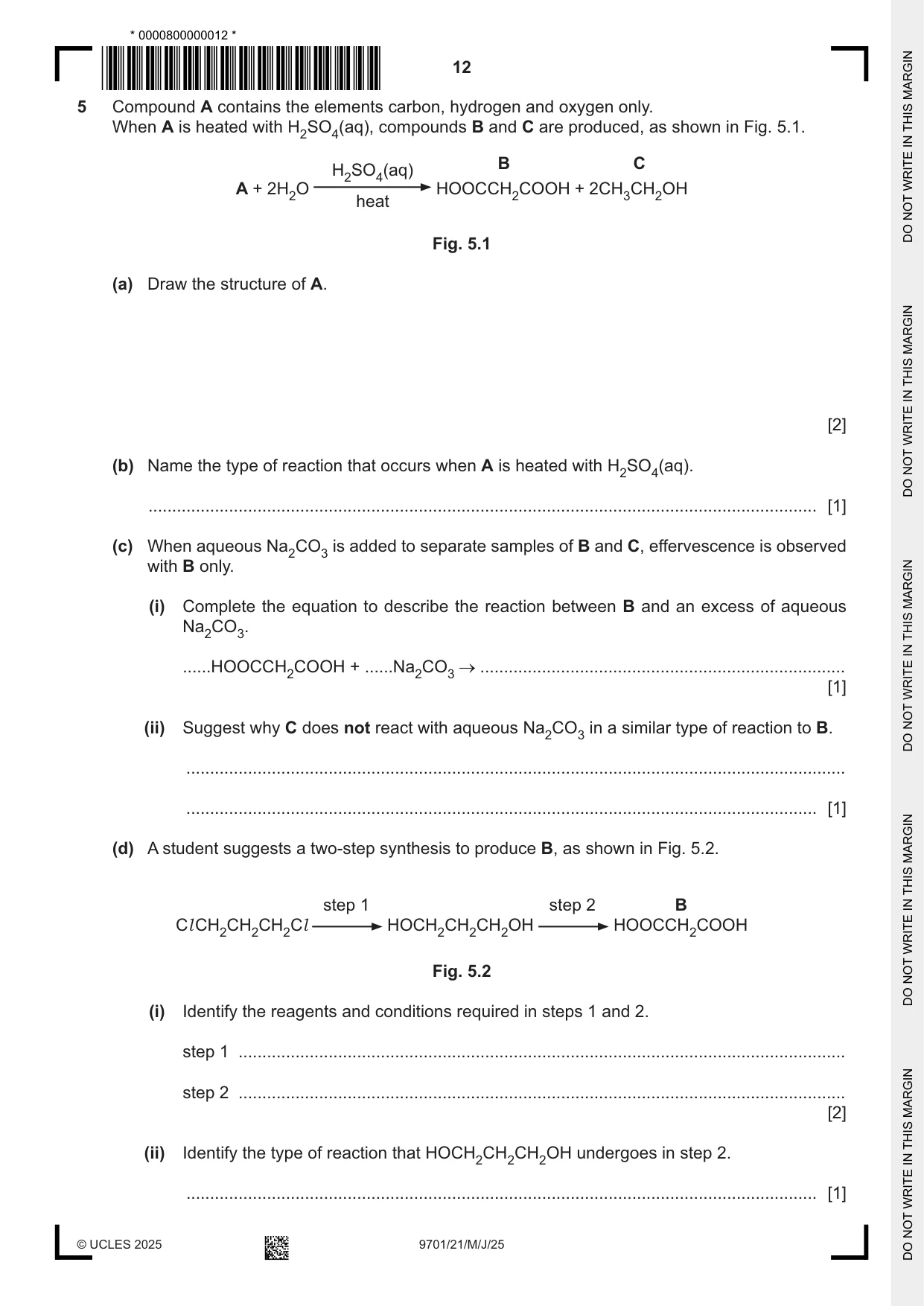
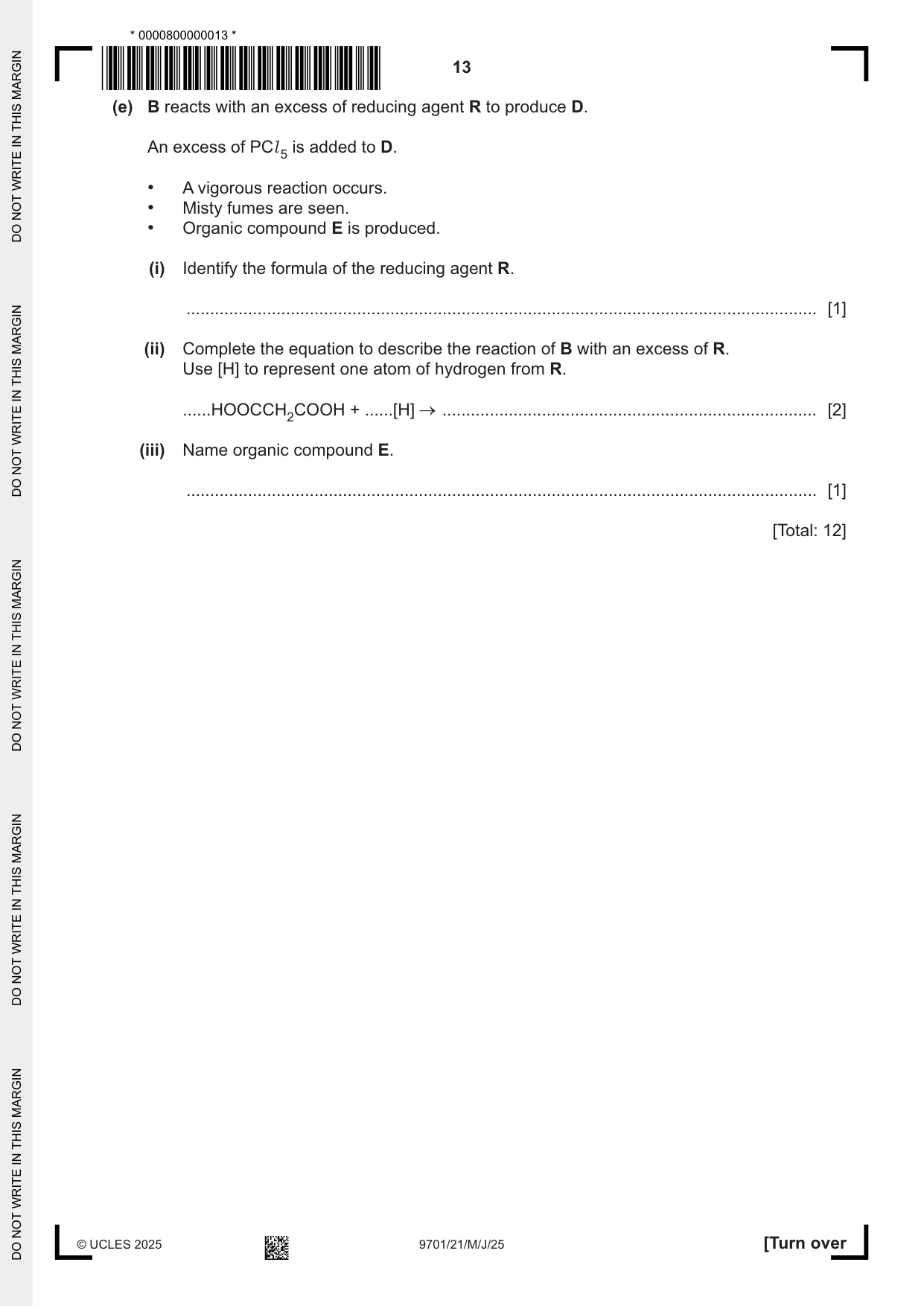
5 Compound A contains the elements carbon, hydrogen and oxygen only. When A is heated with H2SO4(aq), compounds B and C are produced, as shown in Fig. 5.1. B C H2SO4(aq) A + 2H2O HOOCCH2COOH + 2CH3CH2OH heat Fig. 5.1 (a) Draw the structure of A. [2] (b) Name the type of reaction that occurs when A is heated with H2SO4(aq). ............................................................................................................................................. [1] (c) When aqueous Na2CO3 is added to separate samples of B and C, effervescence is observed with B only. (i) Complete the equation to describe the reaction between B and an excess of aqueous Na2CO3. ......HOOCCH2COOH + ......Na2CO3 ............................................................................. [1] (ii) Suggest why C does not react with aqueous Na2CO3 in a similar type of reaction to B. ........................................................................................................................................... ..................................................................................................................................... [1] (d) A student suggests a two-step synthesis to produce B, as shown in Fig. 5.2. step 1 step 2 B Cl CH2CH2CH2Cl HOCH2CH2CH2OH HOOCCH2COOH Fig. 5.2 (i) Identify the reagents and conditions required in steps 1 and 2. step 1 ................................................................................................................................ step 2 ................................................................................................................................ [2] (ii) Identify the type of reaction that HOCH2CH2CH2OH undergoes in step 2. ..................................................................................................................................... [1] (e) B reacts with an excess of reducing agent R to produce D. An excess of PCl is added to D. 5 • A vigorous reaction occurs. • Misty fumes are seen. • Organic compound E is produced. (i) Identify the formula of the reducing agent R. ..................................................................................................................................... [1] (ii) Complete the equation to describe the reaction of B with an excess of R. Use [H] to represent one atom of hydrogen from R. ......HOOCCH2COOH + ......[H] ............................................................................... [2] (iii) Name organic compound E. ..................................................................................................................................... [1] [Total: 12]
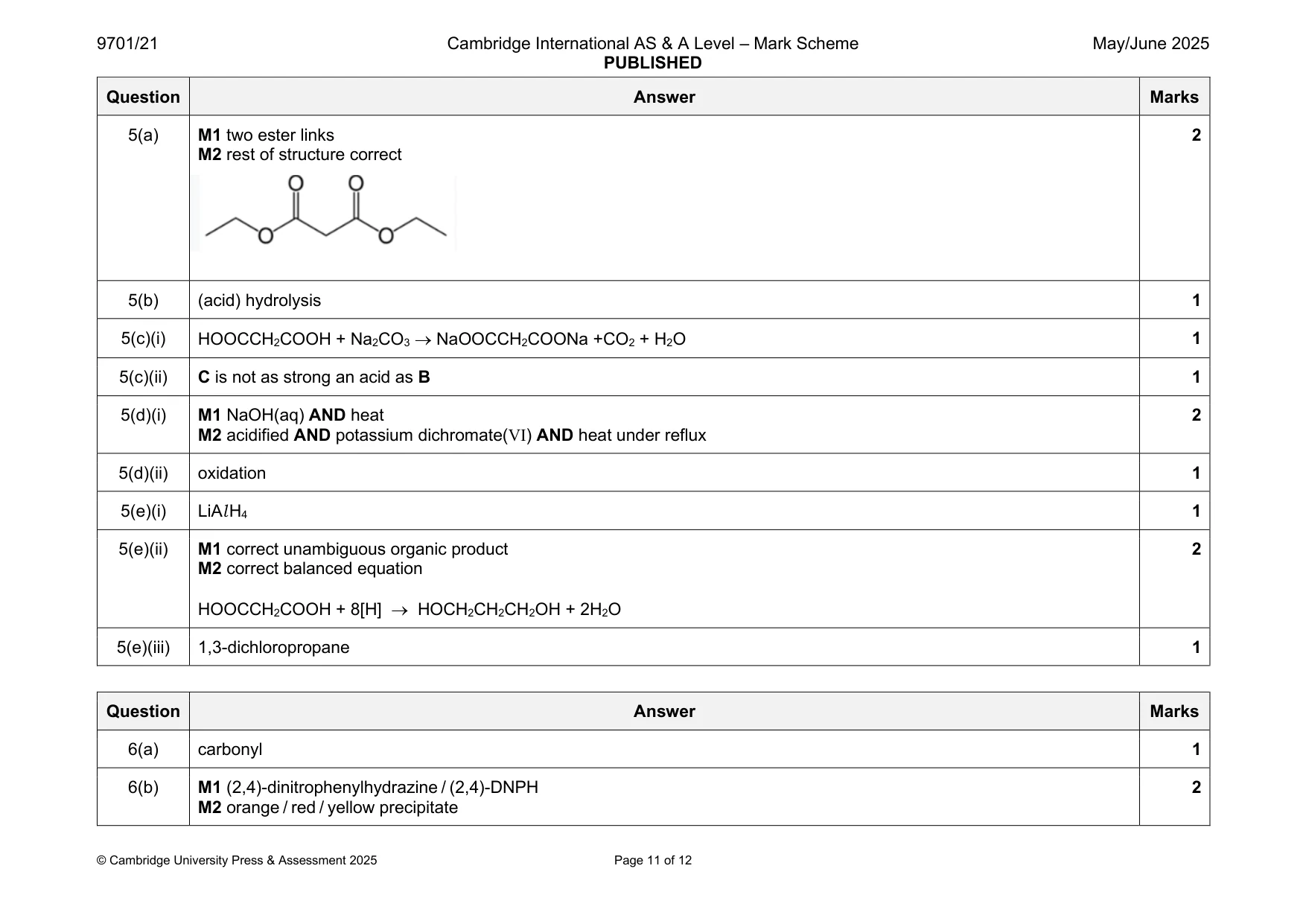
Mark scheme: 5(a) M1 two ester links 2 M2 rest of structure correct 5(b) (acid) hydrolysis 1 5(c)(i) HOOCCH2COOH + Na2CO3 → NaOOCCH2COONa +CO2 + H2O 1 5(c)(ii) C is not as strong an acid as B 1 5(d)(i) M1 NaOH(aq) AND heat 2 M2 acidified AND potassium dichromate(VI) AND heat under reflux 5(d)(ii) oxidation 1 5(e)(i) LiAl H4 1 5(e)(ii) M1 correct unambiguous organic product 2 M2 correct balanced equation HOOCCH2COOH + 8[H] → HOCH2CH2CH2OH + 2H2O 5(e)(iii) 1,3-dichloropropane 1
Q6 · Three bottles of colourless liquids labelled F, G and H contain separate pure samples of…
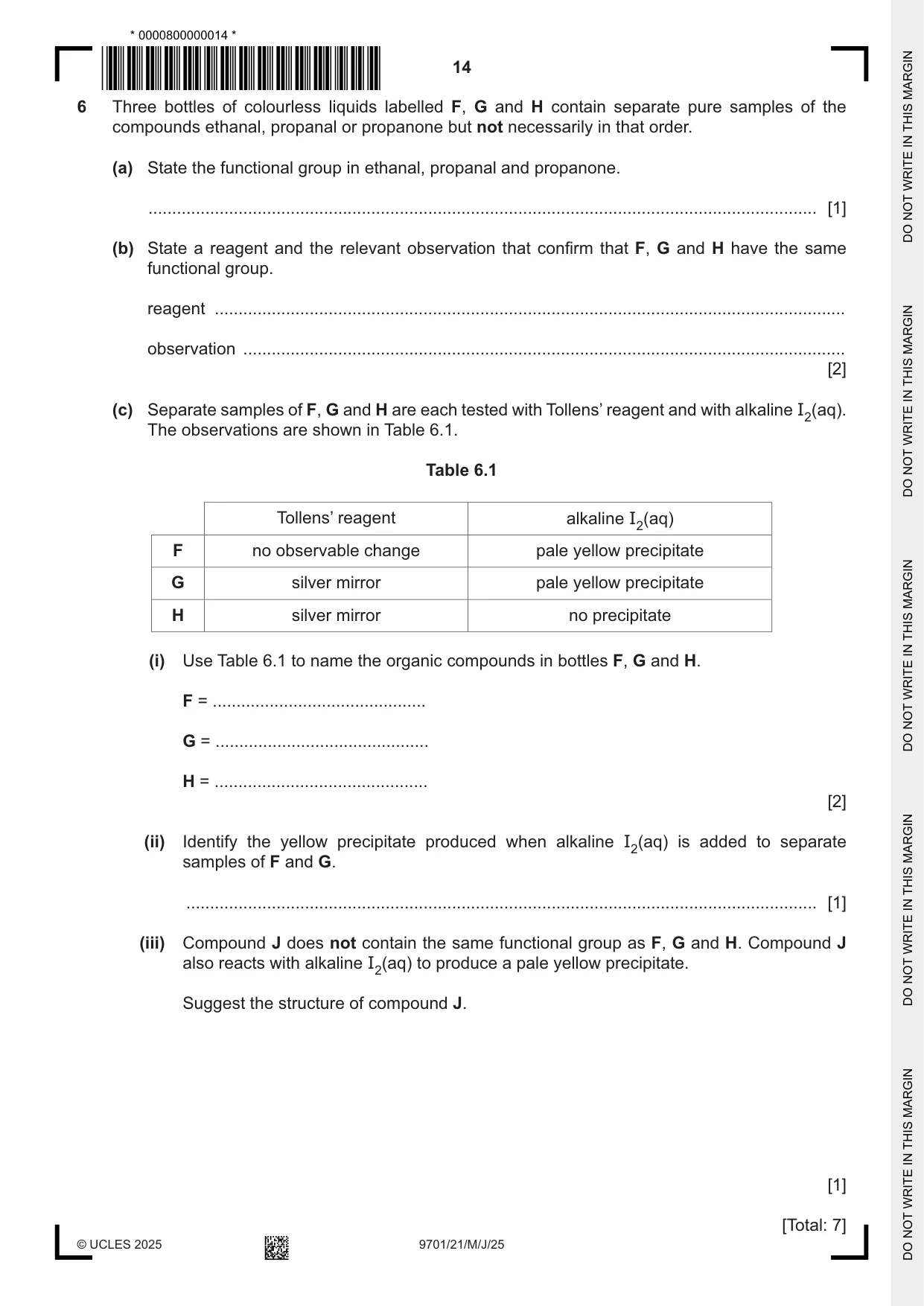
6 Three bottles of colourless liquids labelled F, G and H contain separate pure samples of the compounds ethanal, propanal or propanone but not necessarily in that order. (a) State the functional group in ethanal, propanal and propanone. ............................................................................................................................................. [1] (b) State a reagent and the relevant observation that confirm that F, G and H have the same functional group. reagent ..................................................................................................................................... observation ............................................................................................................................... [2] (c) Separate samples of F, G and H are each tested with Tollens’ reagent and with alkaline I2(aq). The observations are shown in Table 6.1. Table 6.1 Tollens’ reagent alkaline I2(aq) F no observable change pale yellow precipitate G silver mirror pale yellow precipitate H silver mirror no precipitate (i) Use Table 6.1 to name the organic compounds in bottles F, G and H. F = ............................................. G = ............................................. H = ............................................. [2] (ii) Identify the yellow precipitate produced when alkaline I2(aq) is added to separate samples of F and G. ..................................................................................................................................... [1] (iii) Compound J does not contain the same functional group as F, G and H. Compound J also reacts with alkaline I2(aq) to produce a pale yellow precipitate. Suggest the structure of compound J. [1] [Total: 7]
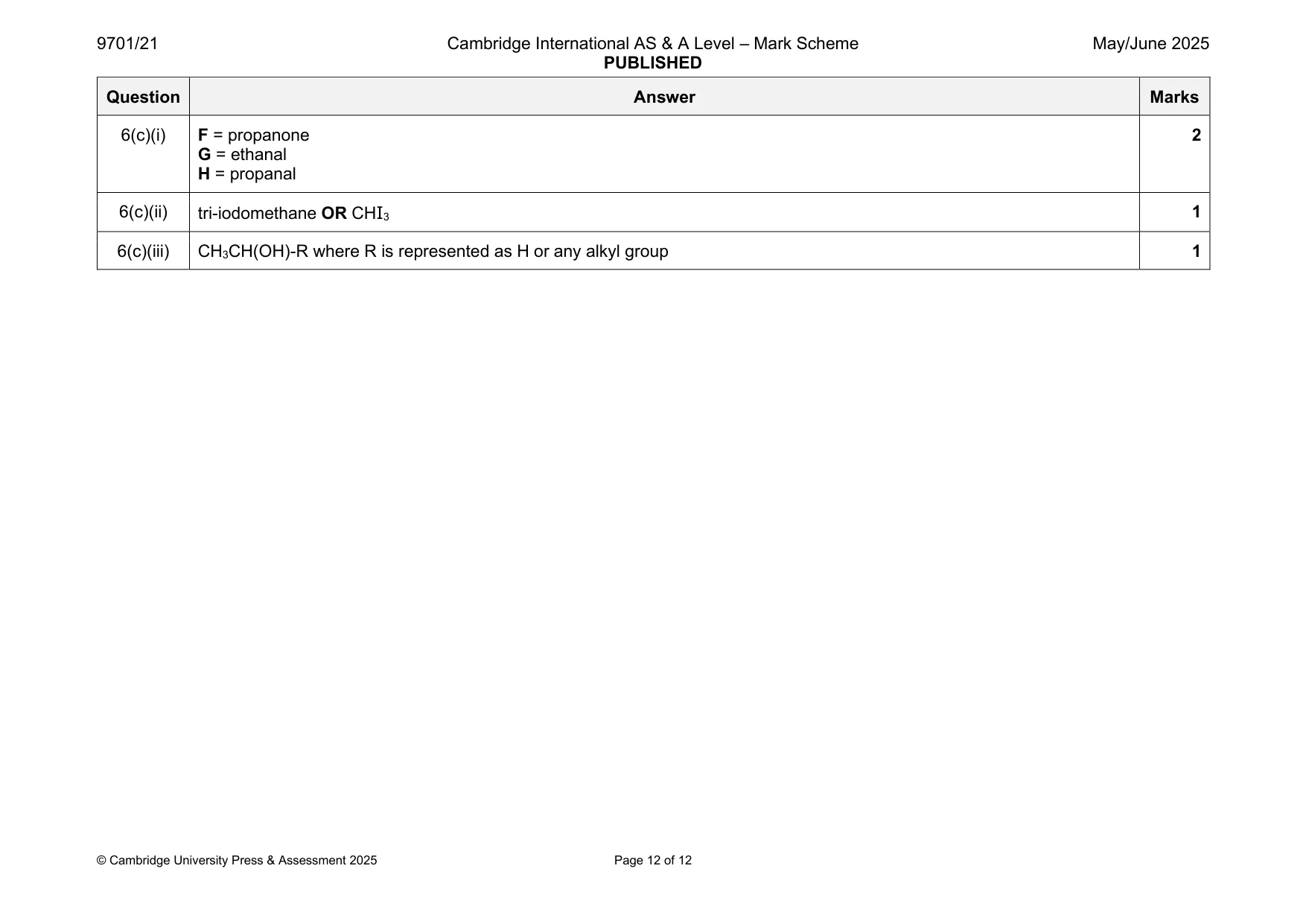
Mark scheme: 6(a) carbonyl 1 6(b) M1 (2,4)-dinitrophenylhydrazine / (2,4)-DNPH 2 M2 orange / red / yellow precipitate 6(c)(i) F = propanone 2 G = ethanal H = propanal 6(c)(ii) tri-iodomethane OR CHI3 1 6(c)(iii) CH3CH(OH)-R where R is represented as H or any alkyl group 1
What was in this paper
The subtopics covered by these 6 questions, and how many questions each got. Open one in a new tab to see every Cambridge question on it.
What you needed in this session
Cambridge’s own grade thresholds for 2025 May/June, Paper 2 · Variant 1. A higher threshold means an easier paper — the bar moves with how the cohort did.