Cambridge A Level Chemistry 9701 — 2025 Oct/Nov Paper 2 · Variant 2
9701/22/O/N/25 · 4 questions · 60 marks · 75 min
The question paper and its mark scheme, free to read here and free to download. This is Cambridge’s own paper, exactly as it was sat.
Question paper16 pages
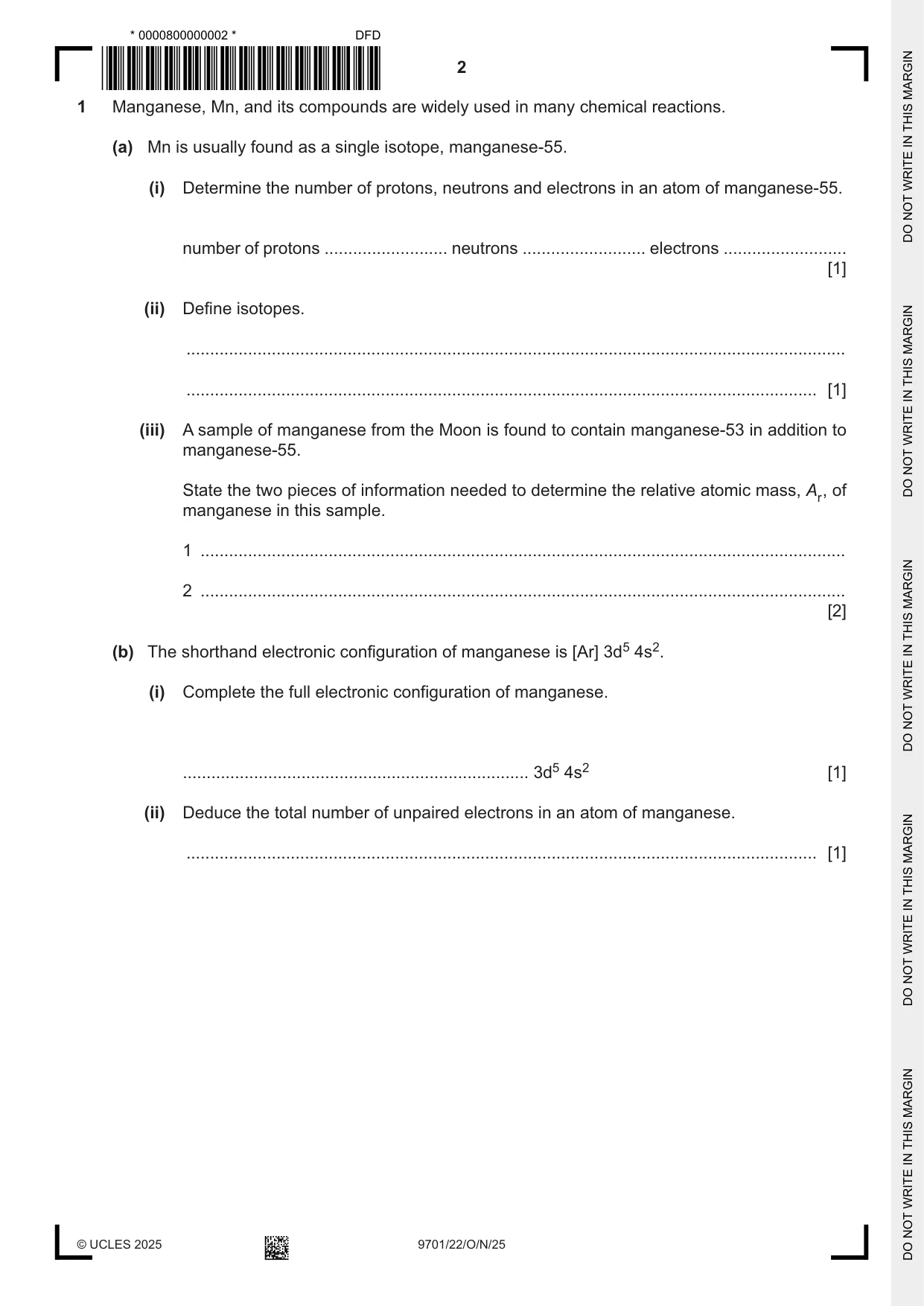
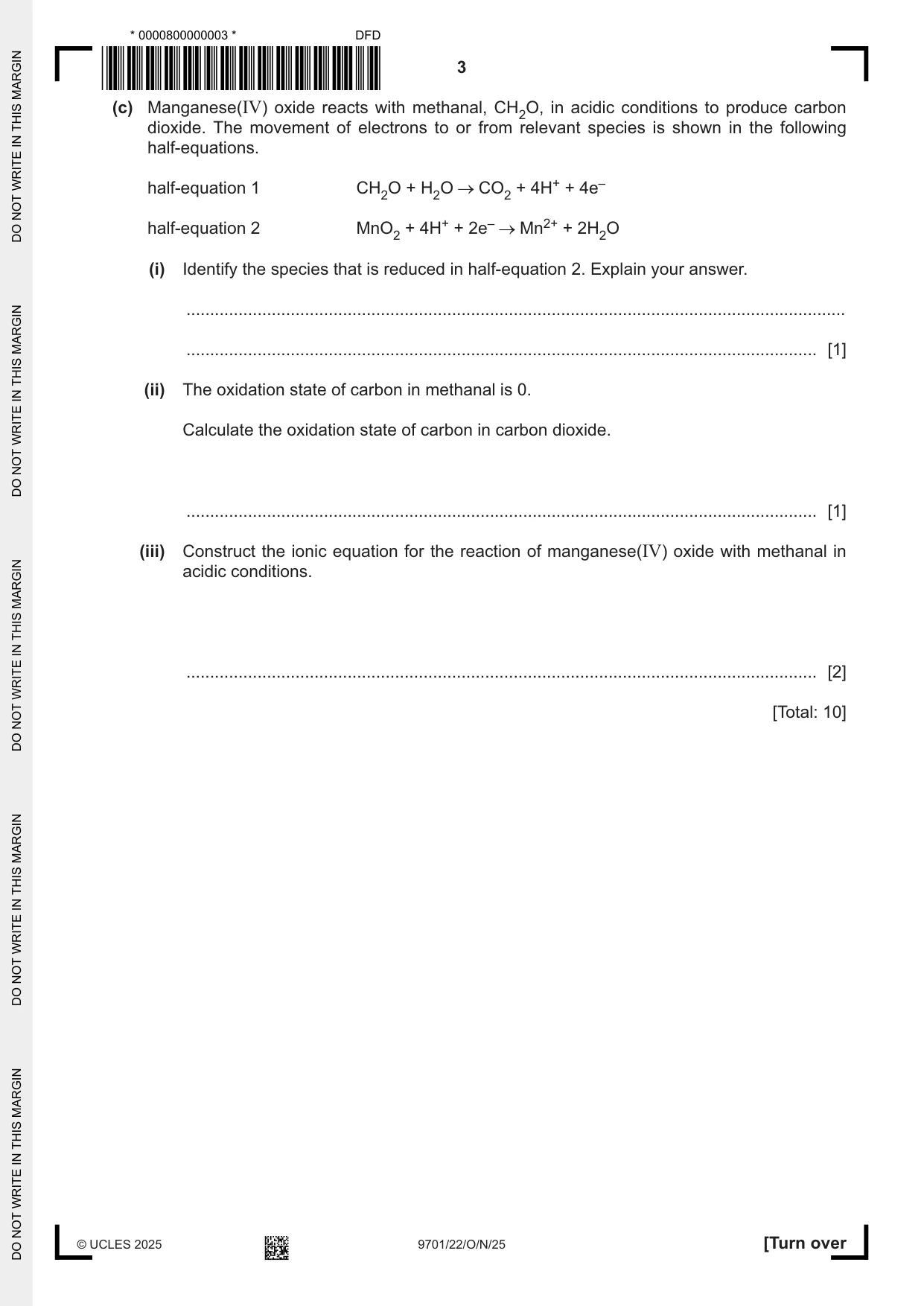


Mark scheme10 pages
Answers below. Sit the paper first if you are practising.
Questions as text
Q1 · Manganese, Mn, and its compounds are widely used in many chemical reactions
1 Manganese, Mn, and its compounds are widely used in many chemical reactions. (a) Mn is usually found as a single isotope, manganese-55. (i) Determine the number of protons, neutrons and electrons in an atom of manganese-55. number of protons .......................... neutrons .......................... electrons .......................... [1] (ii) Define isotopes. ........................................................................................................................................... ..................................................................................................................................... [1] (iii) A sample of manganese from the Moon is found to contain manganese-53 in addition to manganese-55. State the two pieces of information needed to determine the relative atomic mass, Ar , of manganese in this sample. 1 ........................................................................................................................................ 2 ........................................................................................................................................ [2] (b) The shorthand electronic configuration of manganese is [Ar] 3d5 4s2. (i) Complete the full electronic configuration of manganese. ......................................................................... 3d5 4s2 [1] (ii) Deduce the total number of unpaired electrons in an atom of manganese. ..................................................................................................................................... [1] (c) Manganese(IV) oxide reacts with methanal, CH2O, in acidic conditions to produce carbon dioxide. The movement of electrons to or from relevant species is shown in the following half-equations. half-equation 1 CH2O + H2O CO2 + 4H+ + 4e– half-equation 2 MnO2 + 4H+ + 2e– Mn2+ + 2H2O (i) Identify the species that is reduced in half-equation 2. Explain your answer. ........................................................................................................................................... ..................................................................................................................................... [1] (ii) The oxidation state of carbon in methanal is 0. Calculate the oxidation state of carbon in carbon dioxide. ..................................................................................................................................... [1] (iii) Construct the ionic equation for the reaction of manganese(IV) oxide with methanal in acidic conditions. ..................................................................................................................................... [2] [Total: 10]
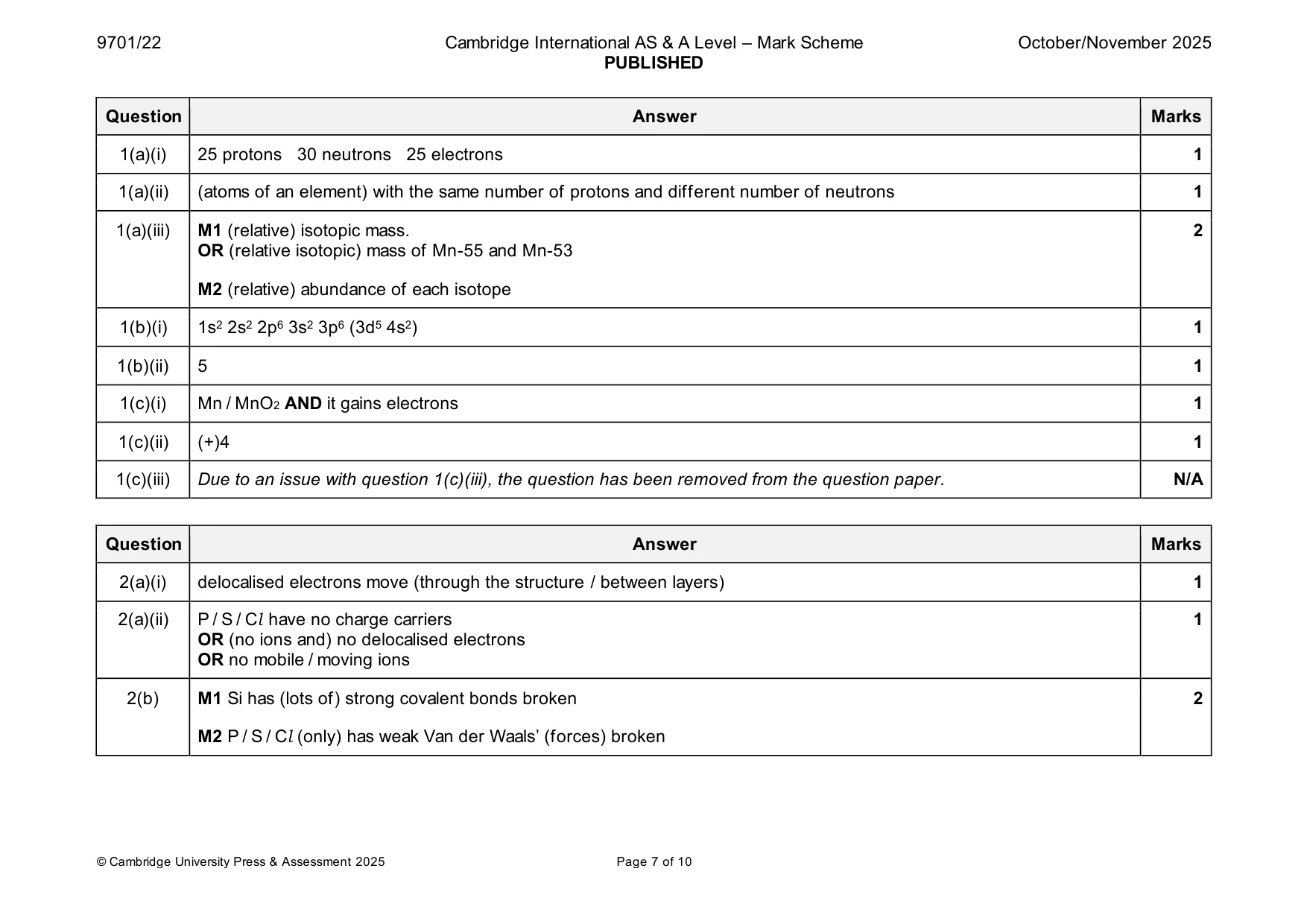
Mark scheme: Question Answer Marks 1(a)(i) 25 protons 30 neutrons 25 electrons 1 1(a)(ii) (atoms of an element) with the same number of protons and different number of neutrons 1 1(a)(iii) M1 (relative) isotopic mass. 2 OR (relative isotopic) mass of Mn-55 and Mn-53 M2 (relative) abundance of each isotope 1(b)(i) 1s2 2s2 2p6 3s2 3p6 (3d5 4s2) 1 1(b)(ii) 5 1 1(c)(i) Mn / MnO2 AND it gains electrons 1 1(c)(ii) (+)4 1 1(c)(iii) Due to an issue with question 1(c)(iii), the question has been removed from the question paper. N/A
Q2 · The Period 3 elements show trends in physical and chemical properties across the period
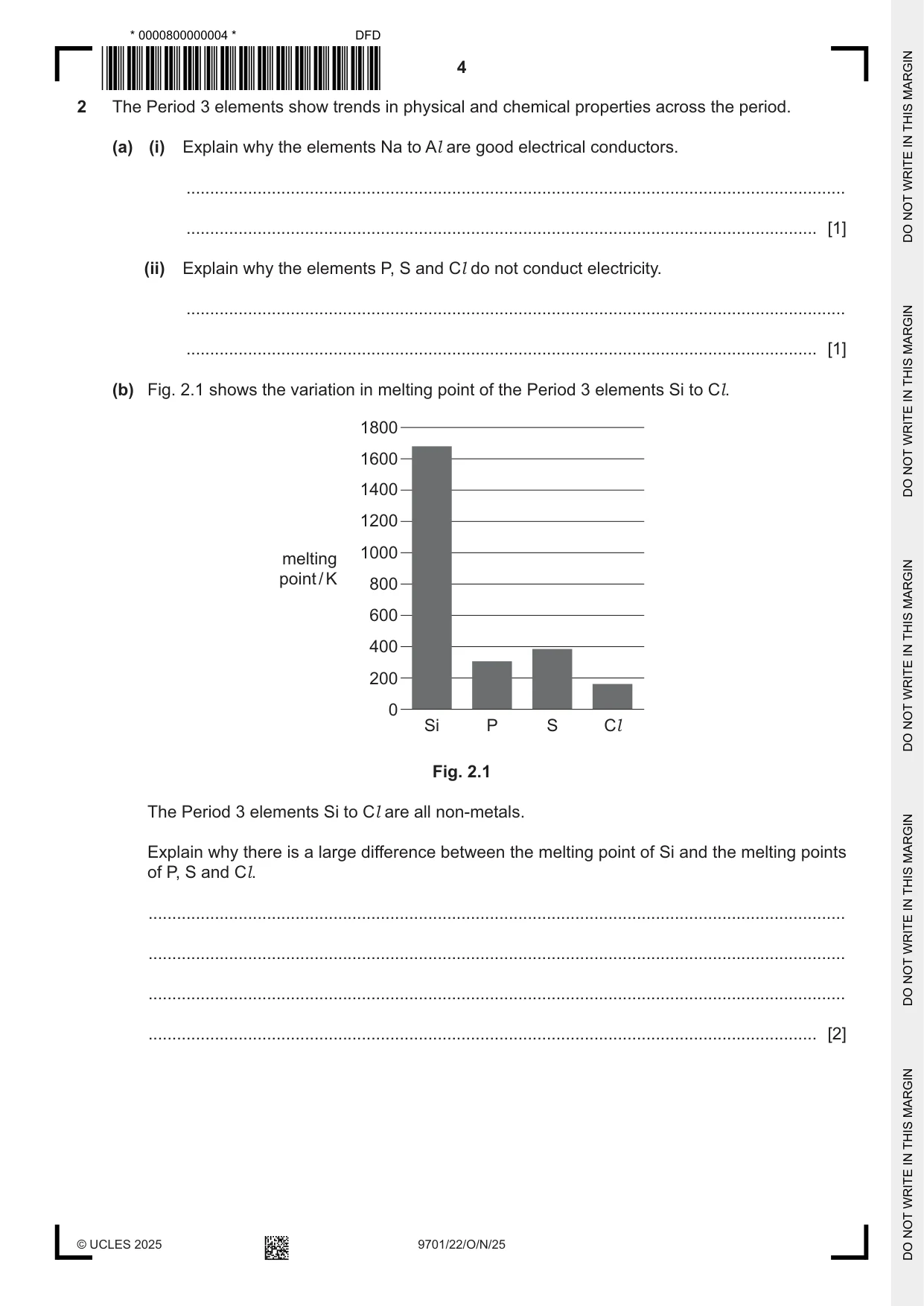
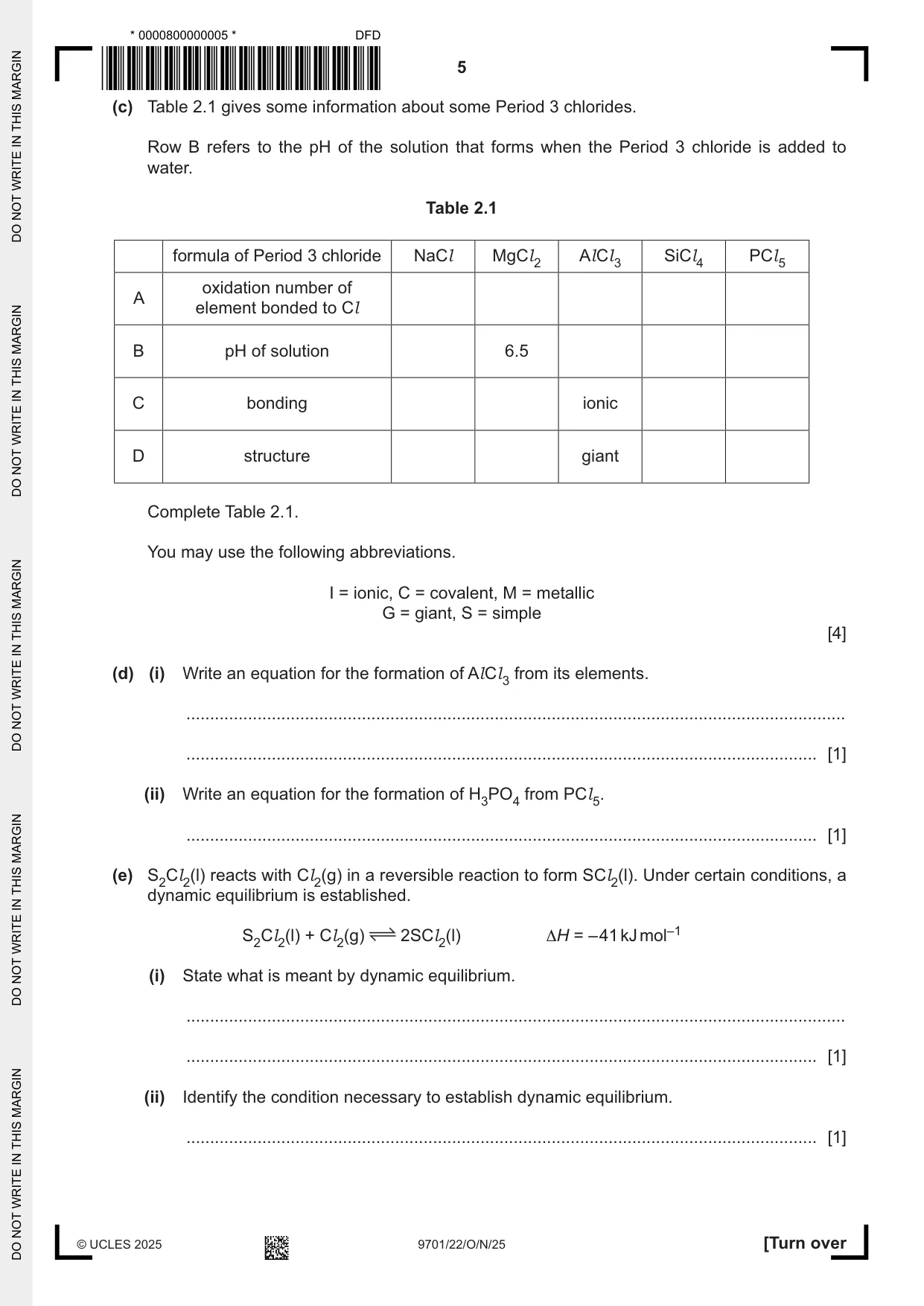
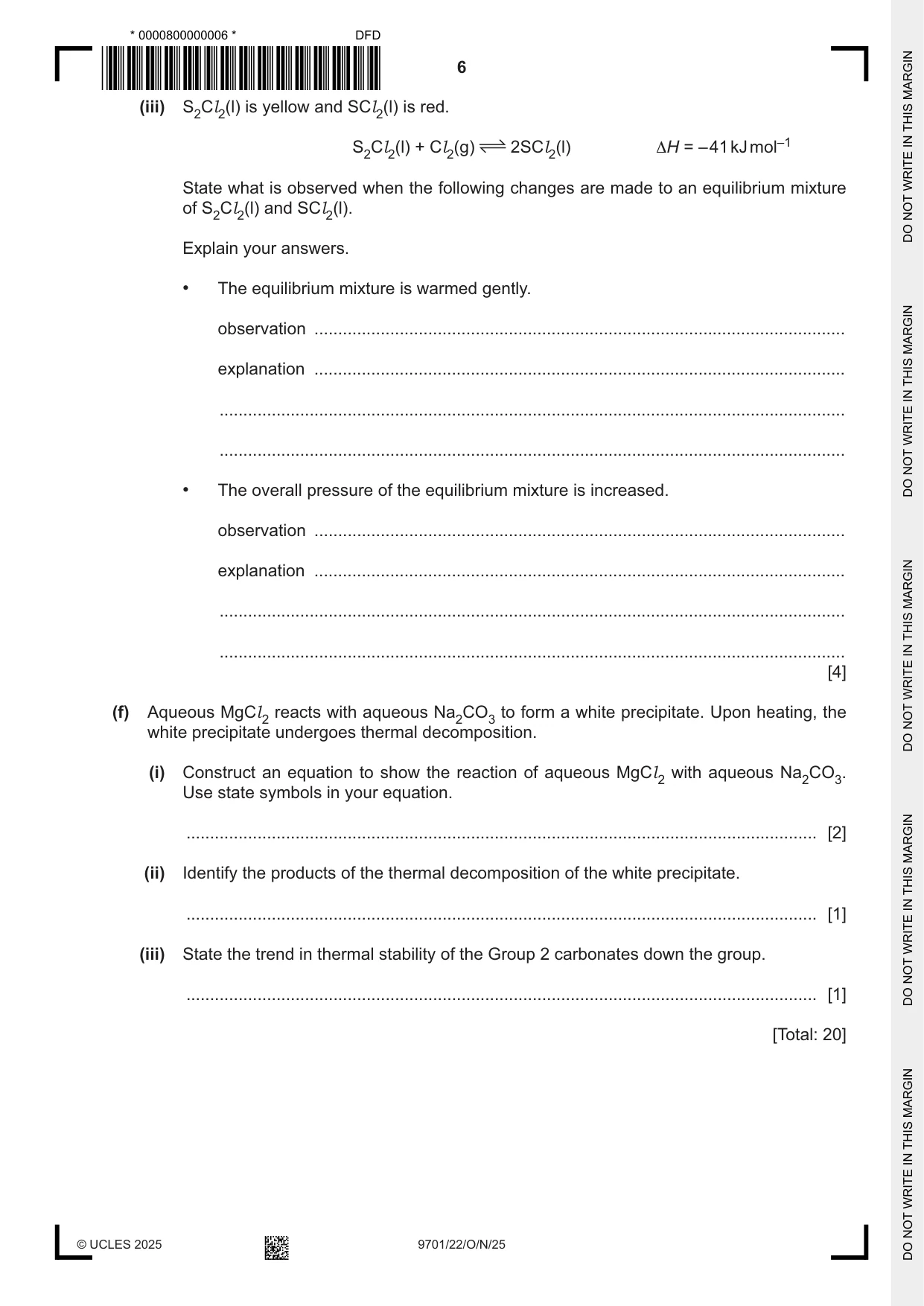
2 The Period 3 elements show trends in physical and chemical properties across the period. (a) (i) Explain why the elements Na to Al are good electrical conductors. ........................................................................................................................................... ..................................................................................................................................... [1] (ii) Explain why the elements P, S and Cl do not conduct electricity. ........................................................................................................................................... ..................................................................................................................................... [1] (b) Fig. 2.1 shows the variation in melting point of the Period 3 elements Si to Cl. 1800 1600 1400 1200 1000 melting point / K 800 600 400 200 0 Si P S Cl Fig. 2.1 The Period 3 elements Si to Cl are all non-metals. Explain why there is a large difference between the melting point of Si and the melting points of P, S and Cl. ................................................................................................................................................... ................................................................................................................................................... ................................................................................................................................................... ............................................................................................................................................. [2] (c) Table 2.1 gives some information about some Period 3 chlorides. Row B refers to the pH of the solution that forms when the Period 3 chloride is added to water. Table 2.1 formula of Period 3 chloride NaCl MgCl Al Cl PCl 2 3 SiCl4 5 oxidation number of A element bonded to Cl B pH of solution 6.5 C bonding ionic D structure giant Complete Table 2.1. You may use the following abbreviations. I = ionic, C = covalent, M = metallic G = giant, S = simple [4] (d) (i) Write an equation for the formation of Al Cl from its elements. 3 ........................................................................................................................................... ..................................................................................................................................... [1] (ii) Write an equation for the formation of H3PO4 from PCl 5. ..................................................................................................................................... [1] (e) S2Cl2(l) reacts with Cl2(g) in a reversible reaction to form SCl2(l). Under certain conditions, a dynamic equilibrium is established. S2Cl2(l) + Cl2(g) 2SCl2(l) ΔH = – 41 kJ mol–1 (i) State what is meant by dynamic equilibrium. ........................................................................................................................................... ..................................................................................................................................... [1] (ii) Identify the condition necessary to establish dynamic equilibrium. ..................................................................................................................................... [1] (iii) S2Cl2(l) is yellow and SCl2(l) is red. S2Cl2(l) + Cl2(g) 2SCl2(l) ΔH = – 41 kJ mol–1 State what is observed when the following changes are made to an equilibrium mixture of S2Cl2(l) and SCl2(l). Explain your answers. • The equilibrium mixture is warmed gently. observation ................................................................................................................ explanation ................................................................................................................ .................................................................................................................................... .................................................................................................................................... • The overall pressure of the equilibrium mixture is increased. observation ................................................................................................................ explanation ................................................................................................................ .................................................................................................................................... .................................................................................................................................... [4] (f) Aqueous MgCl reacts with aqueous to form a white precipitate. Upon heating, the 2 Na2CO3 white precipitate undergoes thermal decomposition. (i) Construct an equation to show the reaction of aqueous MgCl with aqueous 2 Na2CO3. Use state symbols in your equation. ..................................................................................................................................... [2] (ii) Identify the products of the thermal decomposition of the white precipitate. ..................................................................................................................................... [1] (iii) State the trend in thermal stability of the Group 2 carbonates down the group. ..................................................................................................................................... [1] [Total: 20]
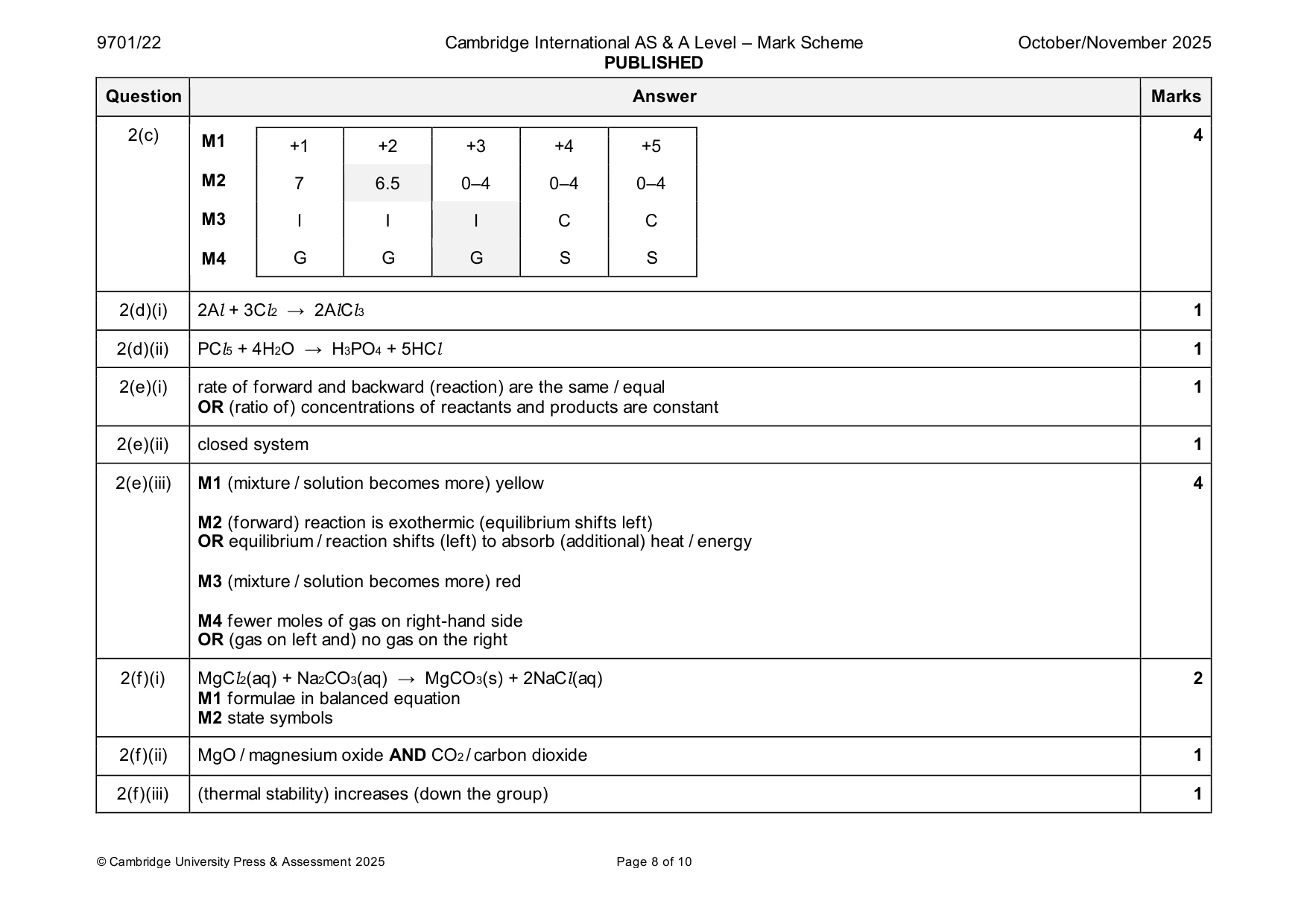
Mark scheme: 2(a)(i) delocalised electrons move (through the structure / between layers) 1 2(a)(ii) P / S / Cl have no charge carriers 1 OR (no ions and) no delocalised electrons OR no mobile / moving ions 2(b) M1 Si has (lots of) strong covalent bonds broken 2 M2 P / S / Cl (only) has weak Van der Waals’ (forces) broken 2(c) 4 M1 +1 +2 +3 +4 +5 M2 7 6.5 0–4 0–4 0–4 M3 I I I C C M4 G G G S S 2(d)(i) 2Al + 3Cl2 → 2AlCl3 1 2(d)(ii) PCl5 + 4H2O → H3PO4 + 5HCl 1 2(e)(i) rate of forward and backward (reaction) are the same / equal 1 OR (ratio of) concentrations of reactants and products are constant 2(e)(ii) closed system 1 2(e)(iii) M1 (mixture / solution becomes more) yellow 4 M2 (forward) reaction is exothermic (equilibrium shifts left) OR equilibrium / reaction shifts (left) to absorb (additional) heat / energy M3 (mixture / solution becomes more) red M4 fewer moles of gas on right-hand side OR (gas on left and) no gas on the right 2(f)(i) MgCl2(aq) + Na2CO3(aq) → MgCO3(s) + 2NaCl(aq) 2 M1 formulae in balanced equation M2 state symbols 2(f)(ii) MgO / magnesium oxide AND CO2 / carbon dioxide 1 2(f)(iii) (thermal stability) increases (down the group) 1
More questions on Periodicity of physical properties of the elements in Period 3
Q3 · The alkanes are a homologous series of organic molecules
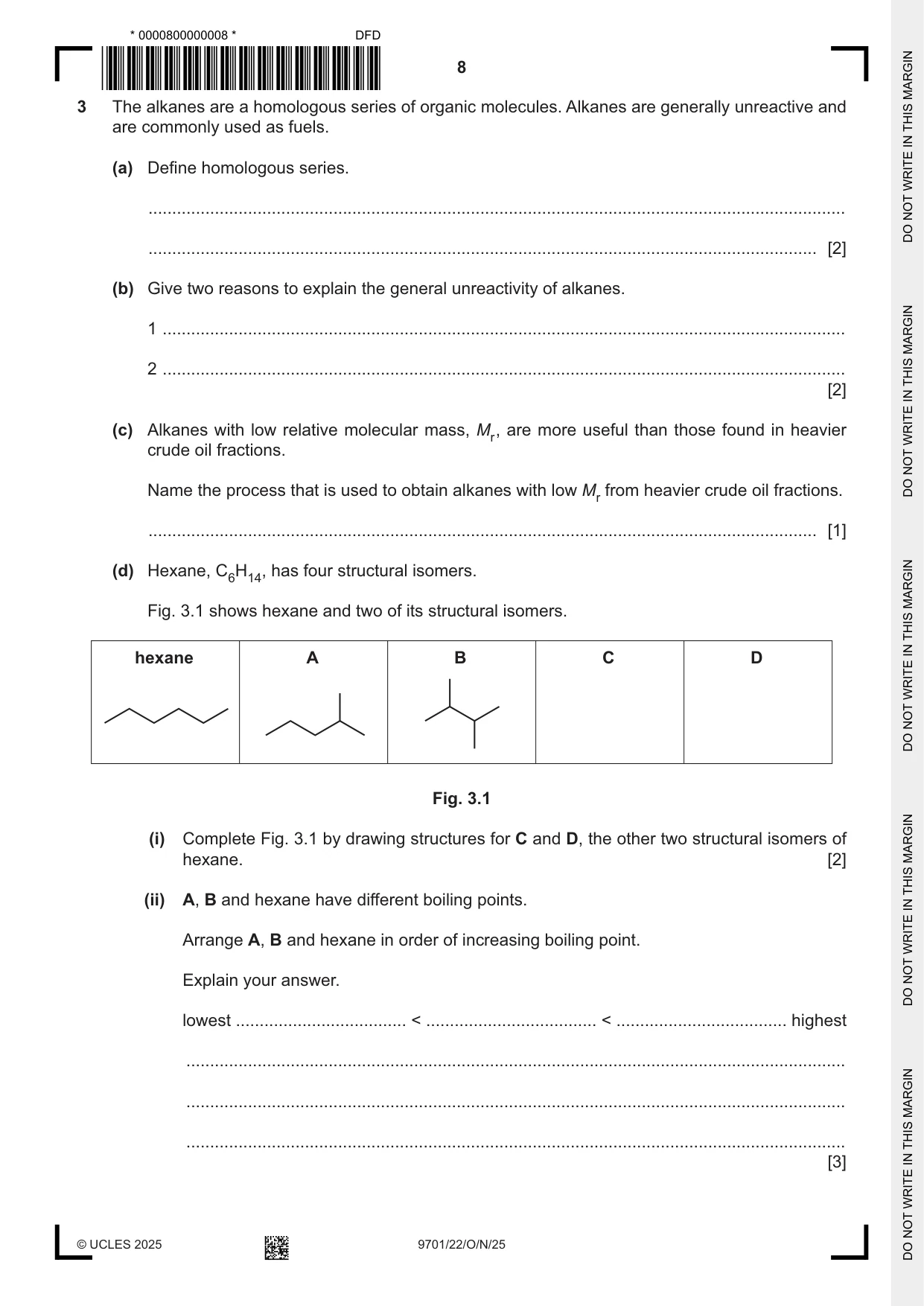
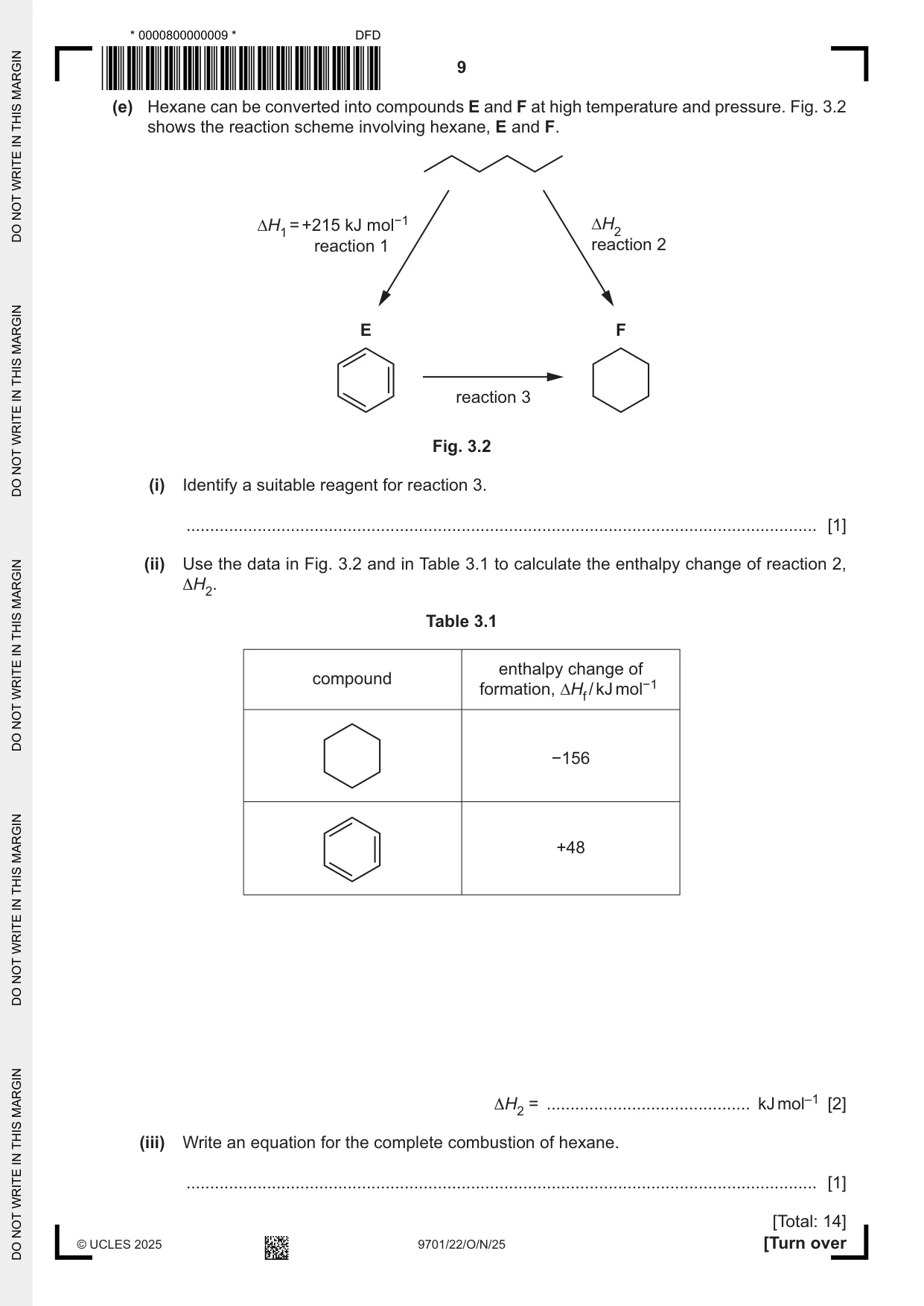
3 The alkanes are a homologous series of organic molecules. Alkanes are generally unreactive and are commonly used as fuels. (a) Define homologous series. ................................................................................................................................................... ............................................................................................................................................. [2] (b) Give two reasons to explain the general unreactivity of alkanes. 1 ................................................................................................................................................ 2 ................................................................................................................................................ [2] (c) Alkanes with low relative molecular mass, Mr , are more useful than those found in heavier crude oil fractions. Name the process that is used to obtain alkanes with low Mr from heavier crude oil fractions. ............................................................................................................................................. [1] (d) Hexane, C6H14, has four structural isomers. Fig. 3.1 shows hexane and two of its structural isomers. hexane A B C D Fig. 3.1 (i) Complete Fig. 3.1 by drawing structures for C and D, the other two structural isomers of hexane. [2] (ii) A, B and hexane have different boiling points. Arrange A, B and hexane in order of increasing boiling point. Explain your answer. lowest .................................... < .................................... < .................................... highest ........................................................................................................................................... ........................................................................................................................................... ........................................................................................................................................... [3] (e) Hexane can be converted into compounds E and F at high temperature and pressure. Fig. 3.2 shows the reaction scheme involving hexane, E and F. ∆H1 = +215 kJ mol−1 ∆H2 reaction 1 reaction 2 E F reaction 3 Fig. 3.2 (i) Identify a suitable reagent for reaction 3. ..................................................................................................................................... [1] (ii) Use the data in Fig. 3.2 and in Table 3.1 to calculate the enthalpy change of reaction 2, ΔH2. Table 3.1 enthalpy change of compound formation, ∆Hf / kJ mol−1 −156 +48 ΔH2 = ........................................... kJ mol–1 [2] (iii) Write an equation for the complete combustion of hexane. ..................................................................................................................................... [1] [Total: 14]
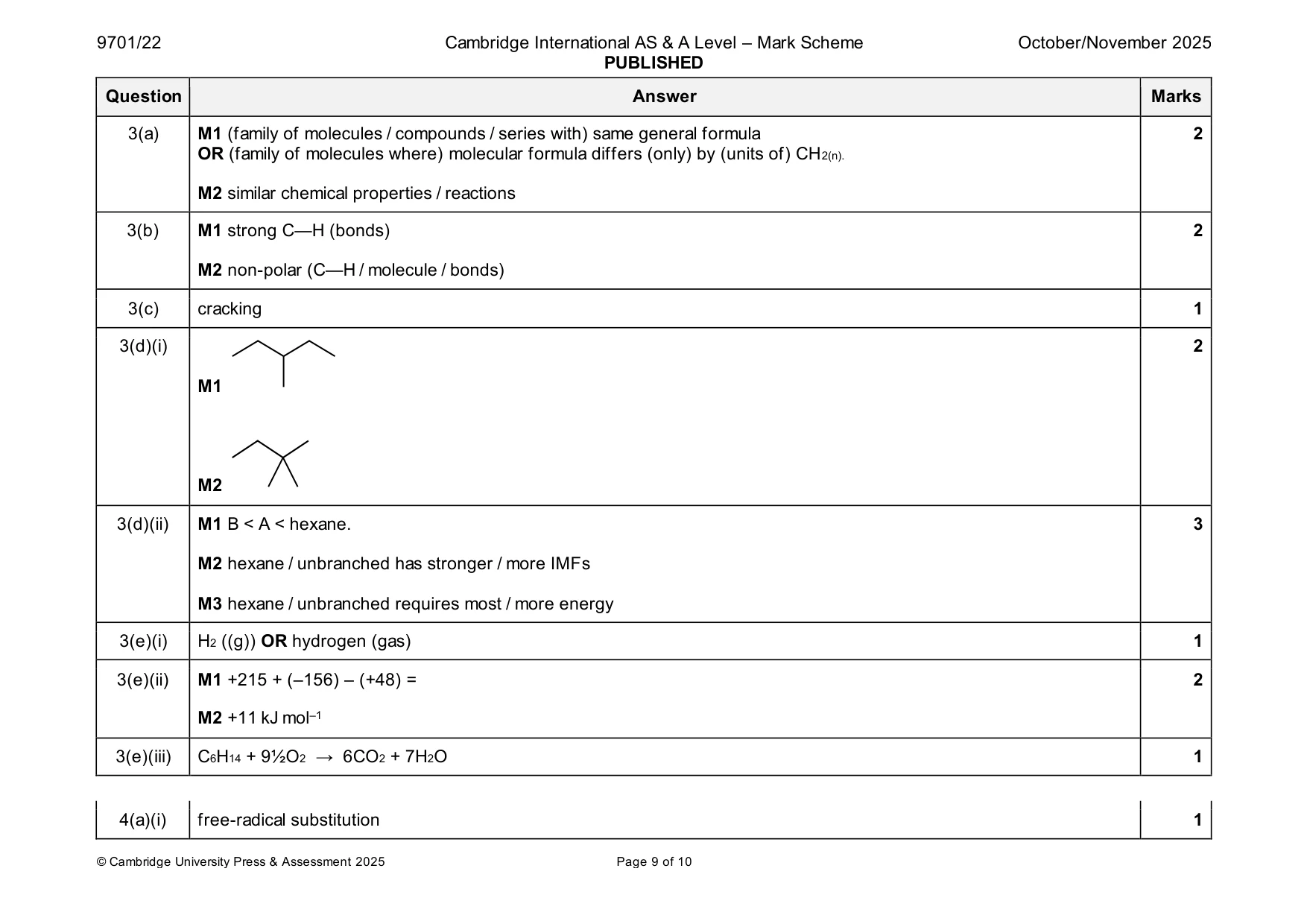
Mark scheme: 3(a) M1 (family of molecules / compounds / series with) same general formula 2 OR (family of molecules where) molecular formula differs (only) by (units of) CH2(n). M2 similar chemical properties / reactions 3(b) M1 strong C—H (bonds) 2 M2 non-polar (C—H / molecule / bonds) 3(c) cracking 1 3(d)(i) 2 M1 M2 3(d)(ii) M1 B < A < hexane. 3 M2 hexane / unbranched has stronger / more IMFs M3 hexane / unbranched requires most / more energy 3(e)(i) H2 ((g)) OR hydrogen (gas) 1 3(e)(ii) M1 +215 + (–156) – (+48) = 2 M2 +11 kJ mol–1 3(e)(iii) C6H14 + 9½O2 → 6CO2 + 7H2O 1
More questions on Isomerism: structural isomerism and stereoisomerism
Q4 · How propane, C3H8, can be converted to propanoic acid, CH3CH2COOH
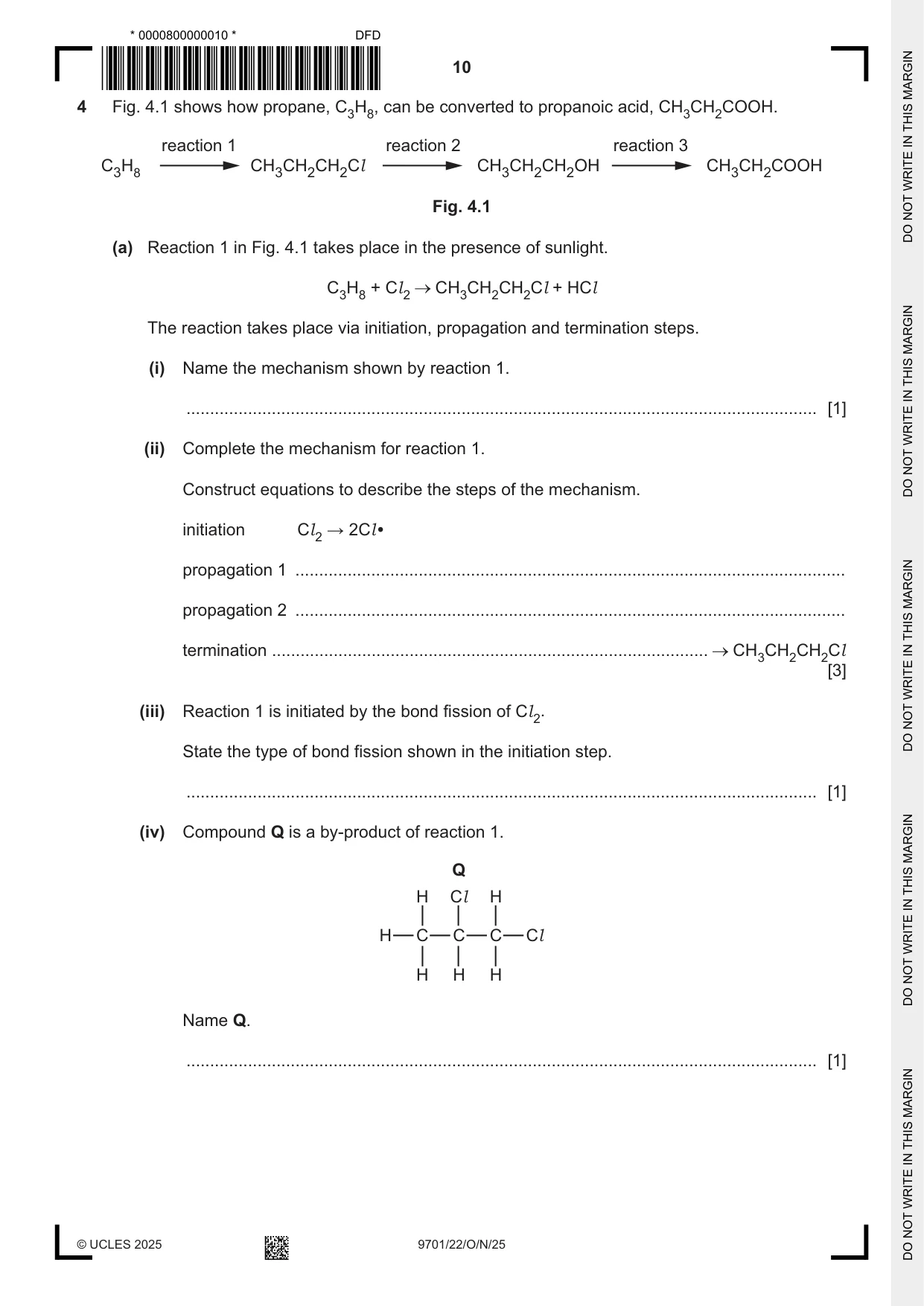
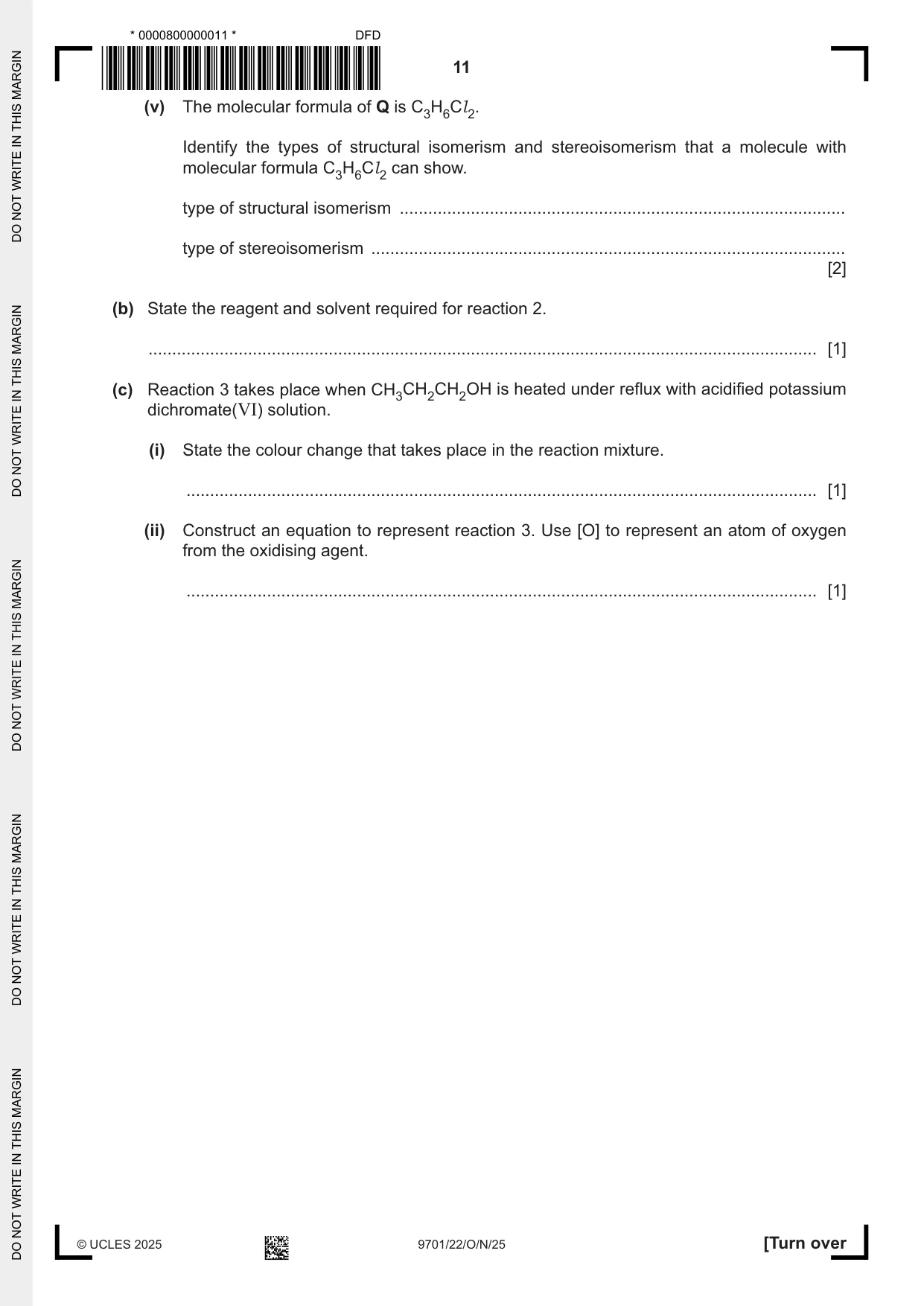
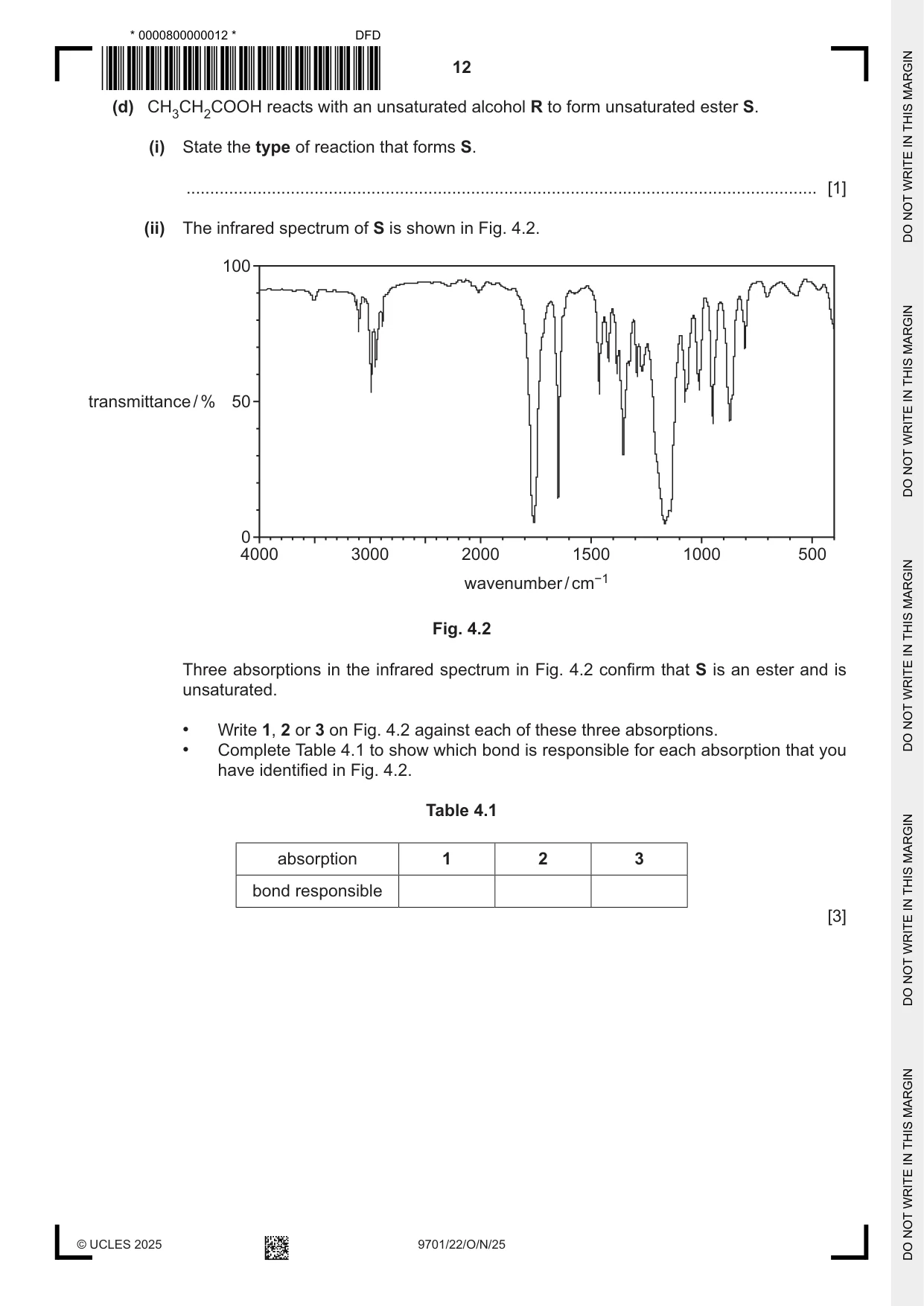
4 Fig. 4.1 shows how propane, C3H8, can be converted to propanoic acid, CH3CH2COOH. reaction 1 reaction 2 reaction 3 C3H8 CH3CH2CH2Cl CH3CH2CH2OH CH3CH2COOH Fig. 4.1 (a) Reaction 1 in Fig. 4.1 takes place in the presence of sunlight. C3H8 + Cl 2 CH3CH2CH2Cl + HCl The reaction takes place via initiation, propagation and termination steps. (i) Name the mechanism shown by reaction 1. ..................................................................................................................................... [1] (ii) Complete the mechanism for reaction 1. Construct equations to describe the steps of the mechanism. initiation Cl → 2Cl• 2 propagation 1 .................................................................................................................... propagation 2 .................................................................................................................... termination ............................................................................................ CH3CH2CH2Cl [3] (iii) Reaction 1 is initiated by the bond fission of Cl 2. State the type of bond fission shown in the initiation step. ..................................................................................................................................... [1] (iv) Compound Q is a by-product of reaction 1. Q H Cl H H C C C Cl H H H Name Q. ..................................................................................................................................... [1] (v) The molecular formula of Q is C3H6Cl 2. Identify the types of structural isomerism and stereoisomerism that a molecule with molecular formula C3H6Cl 2 can show. type of structural isomerism .............................................................................................. type of stereoisomerism .................................................................................................... [2] (b) State the reagent and solvent required for reaction 2. ............................................................................................................................................. [1] (c) Reaction 3 takes place when CH3CH2CH2OH is heated under reflux with acidified potassium dichromate(VI) solution. (i) State the colour change that takes place in the reaction mixture. ..................................................................................................................................... [1] (ii) Construct an equation to represent reaction 3. Use [O] to represent an atom of oxygen from the oxidising agent. ..................................................................................................................................... [1] (d) CH3CH2COOH reacts with an unsaturated alcohol R to form unsaturated ester S. (i) State the type of reaction that forms S. ..................................................................................................................................... [1] (ii) The infrared spectrum of S is shown in Fig. 4.2. 100 transmittance / % 50 0 4000 3000 2000 1500 1000 500 wavenumber / cm−1 Fig. 4.2 Three absorptions in the infrared spectrum in Fig. 4.2 confirm that S is an ester and is unsaturated. • Write 1, 2 or 3 on Fig. 4.2 against each of these three absorptions. • Complete Table 4.1 to show which bond is responsible for each absorption that you have identified in Fig. 4.2. Table 4.1 absorption 1 2 3 bond responsible [3]
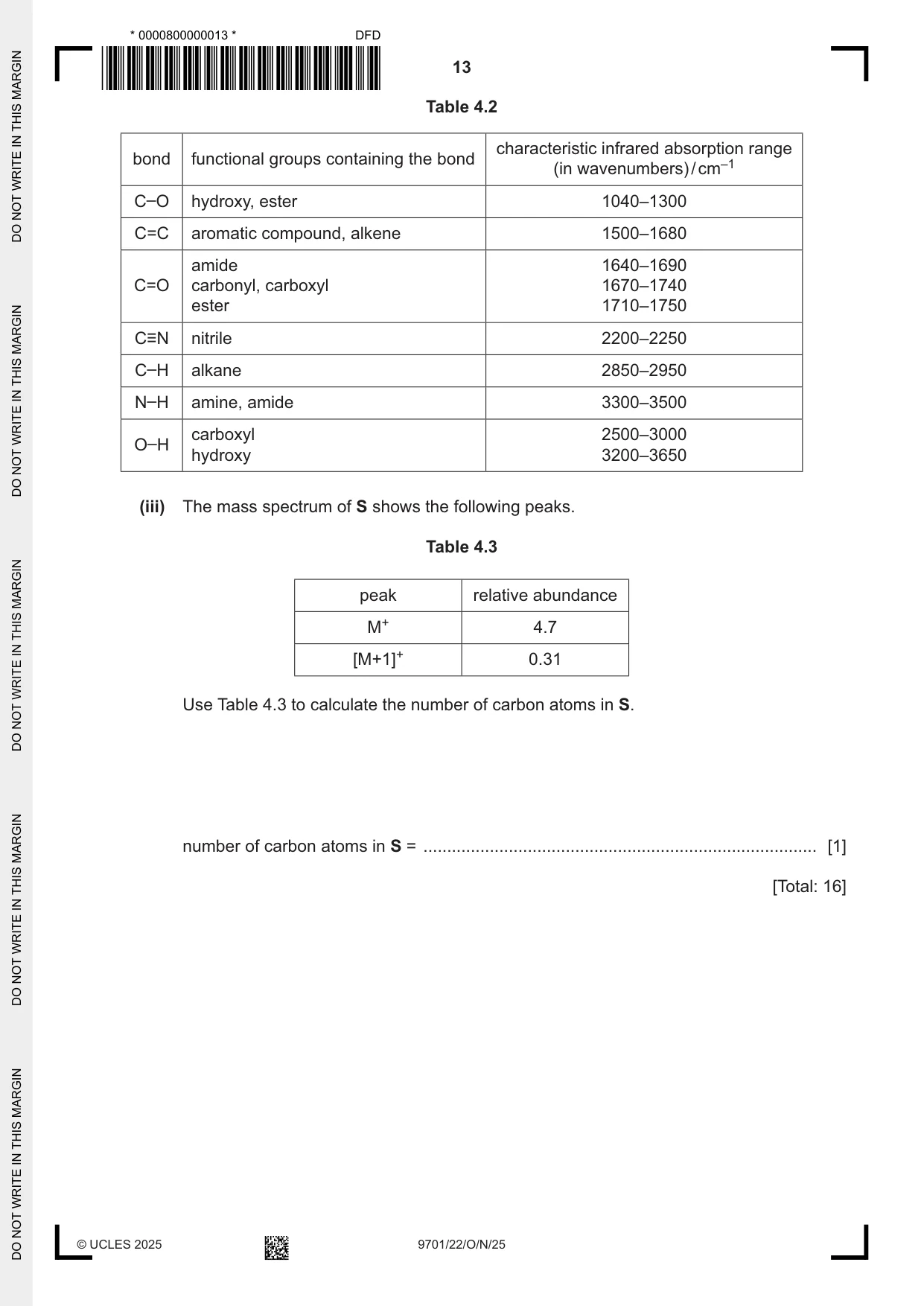
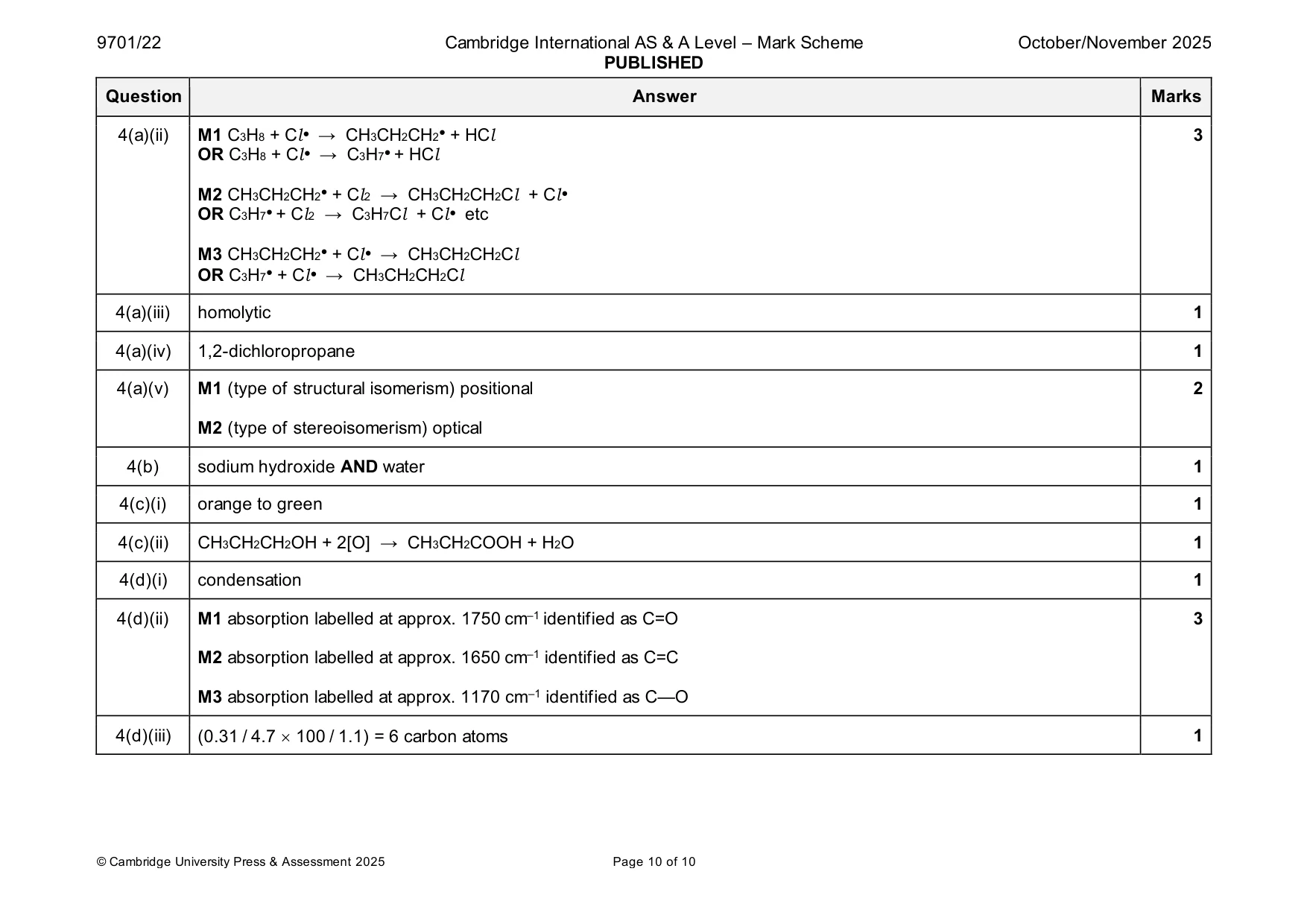
Mark scheme: 4(a)(i) free-radical substitution 1 4(a)(ii) M1 C3H8 + Cl● → CH3CH2CH2● + HCl 3 OR C3H8 + Cl● → C3H7● + HCl M2 CH3CH2CH2● + Cl2 → CH3CH2CH2Cl + Cl● OR C3H7● + Cl2 → C3H7Cl + Cl● etc M3 CH3CH2CH2● + Cl● → CH3CH2CH2Cl OR C3H7● + Cl● → CH3CH2CH2Cl 4(a)(iii) homolytic 1 4(a)(iv) 1,2-dichloropropane 1 4(a)(v) M1 (type of structural isomerism) positional 2 M2 (type of stereoisomerism) optical 4(b) sodium hydroxide AND water 1 4(c)(i) orange to green 1 4(c)(ii) CH3CH2CH2OH + 2[O] → CH3CH2COOH + H2O 1 4(d)(i) condensation 1 4(d)(ii) M1 absorption labelled at approx. 1750 cm–1 identified as C=O 3 M2 absorption labelled at approx. 1650 cm–1 identified as C=C M3 absorption labelled at approx. 1170 cm–1 identified as C—O 4(d)(iii) (0.31 / 4.7 100 / 1.1) = 6 carbon atoms 1
What was in this paper
The subtopics covered by these 4 questions, and how many questions each got. Open one in a new tab to see every Cambridge question on it.
What you needed in this session
Cambridge’s own grade thresholds for 2025 Oct/Nov, Paper 2 · Variant 2. A higher threshold means an easier paper — the bar moves with how the cohort did.