Cambridge A Level Chemistry 9701 — 2025 Feb/March Paper 2 · Variant 2
9701/22/F/M/25 · 4 questions · 60 marks · 75 min
The question paper and its mark scheme, free to read here and free to download. This is Cambridge’s own paper, exactly as it was sat.
Question paper12 pages
Mark scheme9 pages
Answers below. Sit the paper first if you are practising.
Questions as text
Q1 · Phosphorus and chlorine are elements in Period 3 of the Periodic Table
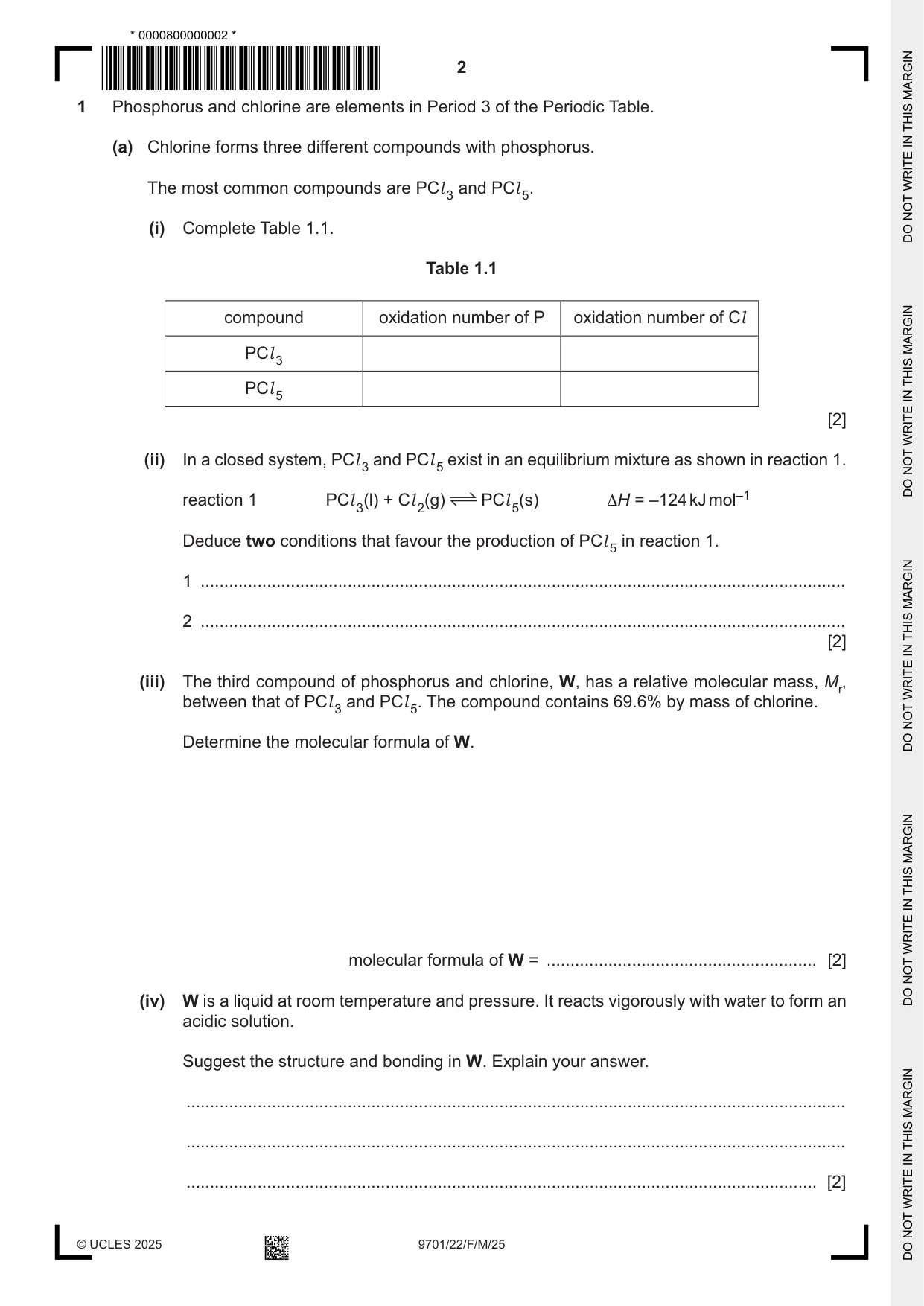
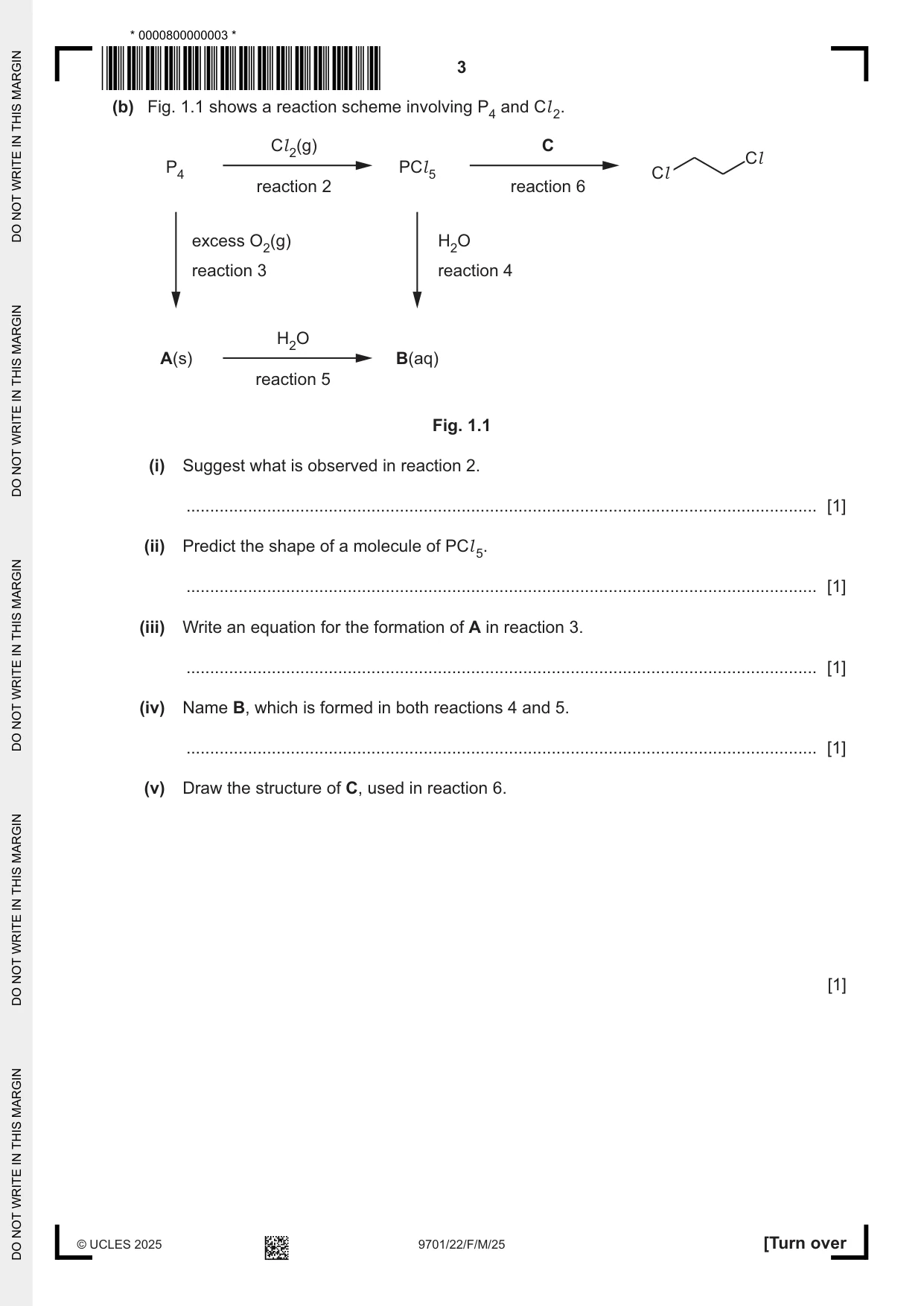
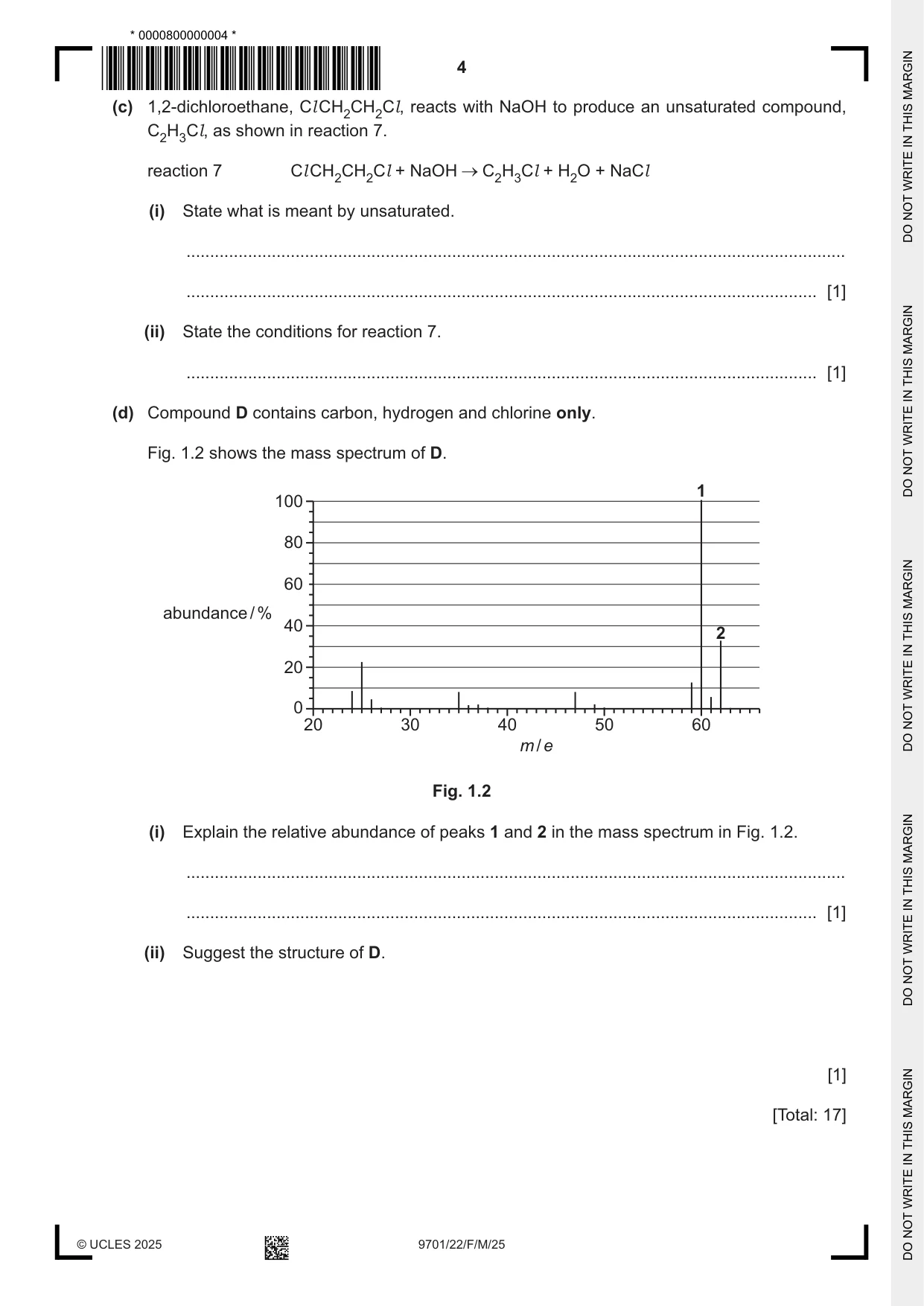
1 Phosphorus and chlorine are elements in Period 3 of the Periodic Table. (a) Chlorine forms three different compounds with phosphorus. The most common compounds are PCl and PCl 3 5. (i) Complete Table 1.1. Table 1.1 compound oxidation number of P oxidation number of Cl PCl 3 PCl 5 [2] (ii) In a closed system, PCl and PCl exist in an equilibrium mixture as shown in reaction 1. 3 5 reaction 1 PCl 3(l) + Cl 2(g) PCl 5(s) ΔH = –124 kJ mol–1 Deduce two conditions that favour the production of PCl in reaction 1. 5 1 ........................................................................................................................................ 2 ........................................................................................................................................ [2] (iii) The third compound of phosphorus and chlorine, W, has a relative molecular mass, Mr, between that of PCl and PCl The compound contains 69.6% by mass of chlorine. 3 5. Determine the molecular formula of W. molecular formula of W = ......................................................... [2] (iv) W is a liquid at room temperature and pressure. It reacts vigorously with water to form an acidic solution. Suggest the structure and bonding in W. Explain your answer. ........................................................................................................................................... ........................................................................................................................................... ..................................................................................................................................... [2] (b) Fig. 1.1 shows a reaction scheme involving P4 and Cl 2. Cl2(g) C Cl P4 PCl5 Cl reaction 2 reaction 6 excess O2(g) H2O reaction 3 reaction 4 H2O A(s) B(aq) reaction 5 Fig. 1.1 (i) Suggest what is observed in reaction 2. ..................................................................................................................................... [1] (ii) Predict the shape of a molecule of PCl 5. ..................................................................................................................................... [1] (iii) Write an equation for the formation of A in reaction 3. ..................................................................................................................................... [1] (iv) Name B, which is formed in both reactions 4 and 5. ..................................................................................................................................... [1] (v) Draw the structure of C, used in reaction 6. [1] (c) 1,2-dichloroethane, Cl CH2CH2Cl, reacts with NaOH to produce an unsaturated compound, C2H3Cl, as shown in reaction 7. reaction 7 Cl CH2CH2Cl + NaOH C2H3Cl + H2O + NaCl (i) State what is meant by unsaturated. ........................................................................................................................................... ..................................................................................................................................... [1] (ii) State the conditions for reaction 7. ..................................................................................................................................... [1] (d) Compound D contains carbon, hydrogen and chlorine only. Fig. 1.2 shows the mass spectrum of D. 1 100 80 60 abundance / % 40 2 20 0 20 30 40 50 60 m / e Fig. 1.2 (i) Explain the relative abundance of peaks 1 and 2 in the mass spectrum in Fig. 1.2. ........................................................................................................................................... ..................................................................................................................................... [1] (ii) Suggest the structure of D. [1] [Total: 17]
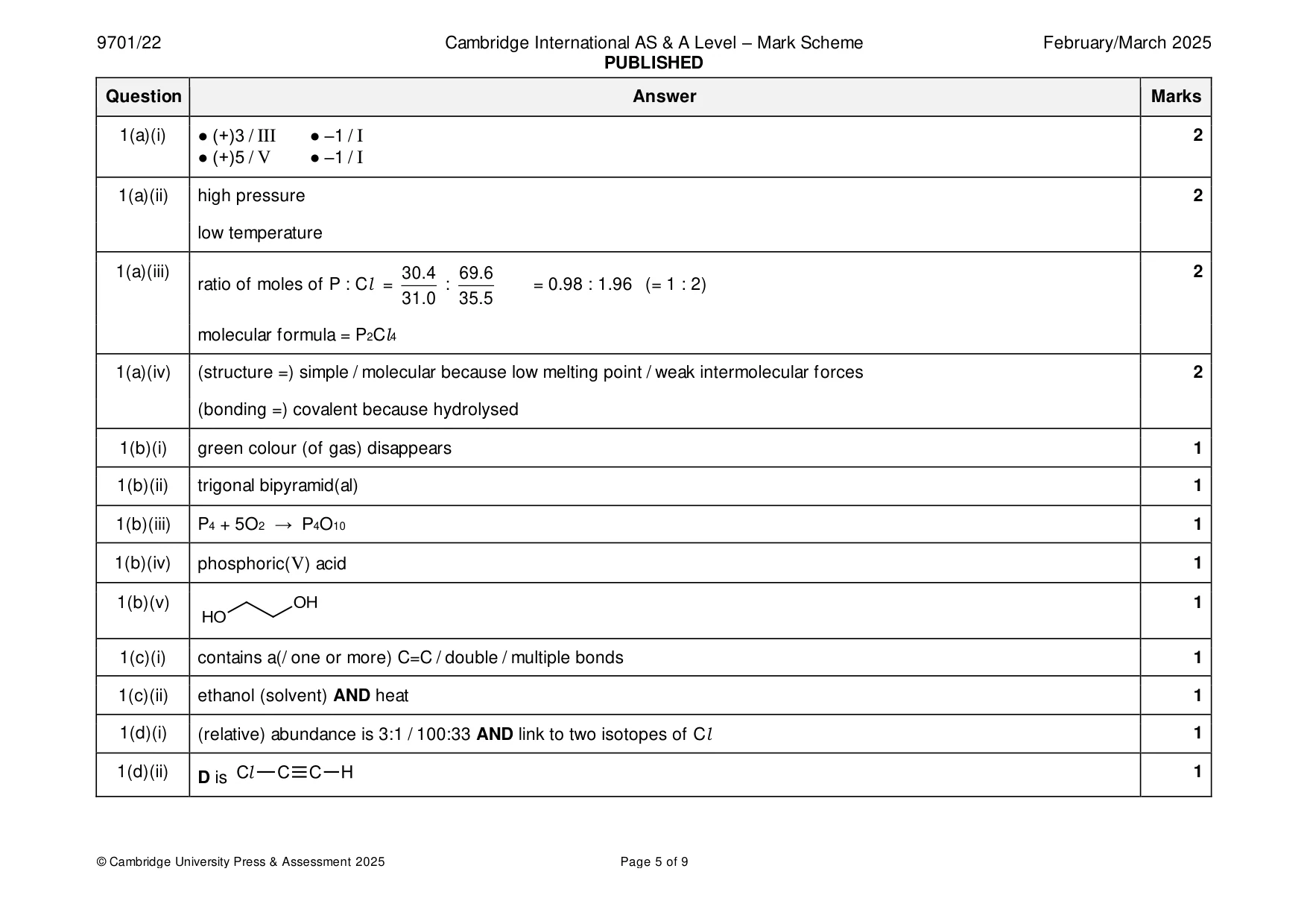
Mark scheme: Question Answer Marks 1(a)(i) ● (+)3 / III ● –1 / I 2 ● (+)5 / V ● –1 / I 1(a)(ii) high pressure 2 low temperature 1(a)(iii) 30.4 69.6 2 ratio of moles of P : Cl = : = 0.98 : 1.96 (= 1 : 2) 31.0 35.5 molecular formula = P2Cl4 1(a)(iv) (structure =) simple / molecular because low melting point / weak intermolecular forces 2 (bonding =) covalent because hydrolysed 1(b)(i) green colour (of gas) disappears 1 1(b)(ii) trigonal bipyramid(al) 1 1(b)(iii) P4 + 5O2 → P4O10 1 1(b)(iv) phosphoric(V) acid 1 1(b)(v) 1 1(c)(i) contains a(/ one or more) C=C / double / multiple bonds 1 1(c)(ii) ethanol (solvent) AND heat 1 1(d)(i) (relative) abundance is 3:1 / 100:33 AND link to two isotopes of Cl 1 1(d)(ii) 1 D is
Q2 · The Group 2 elements show metallic bonding
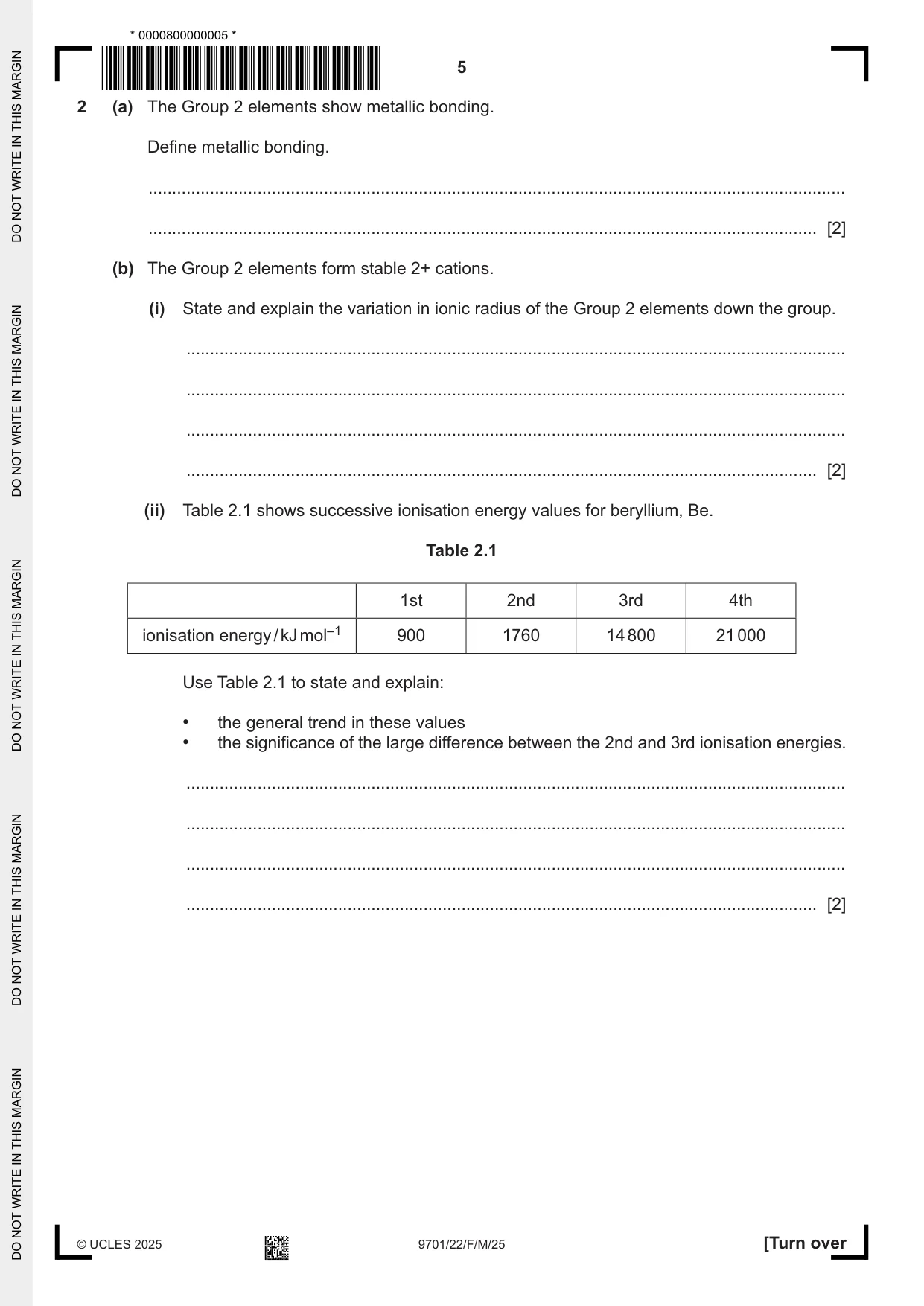
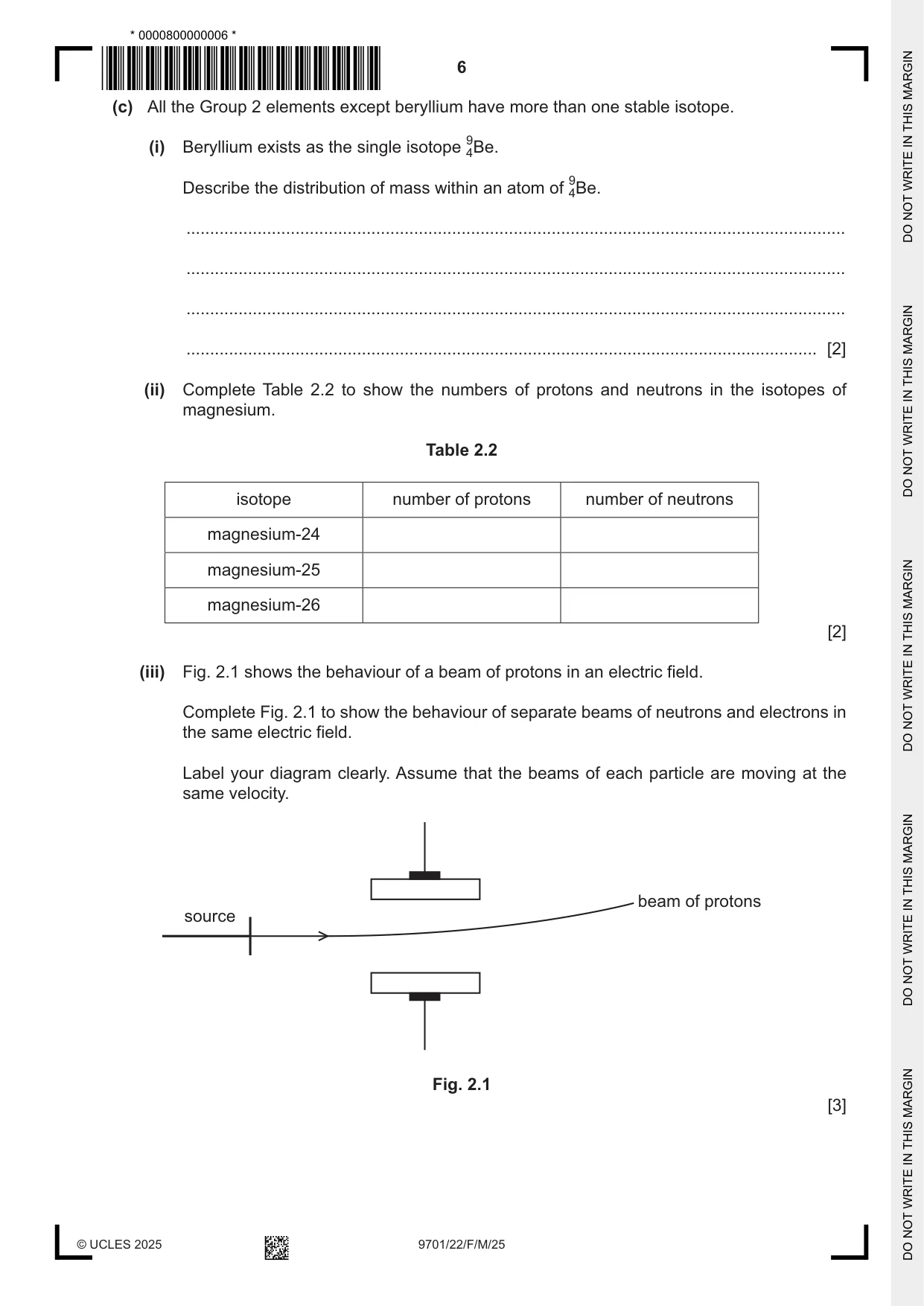
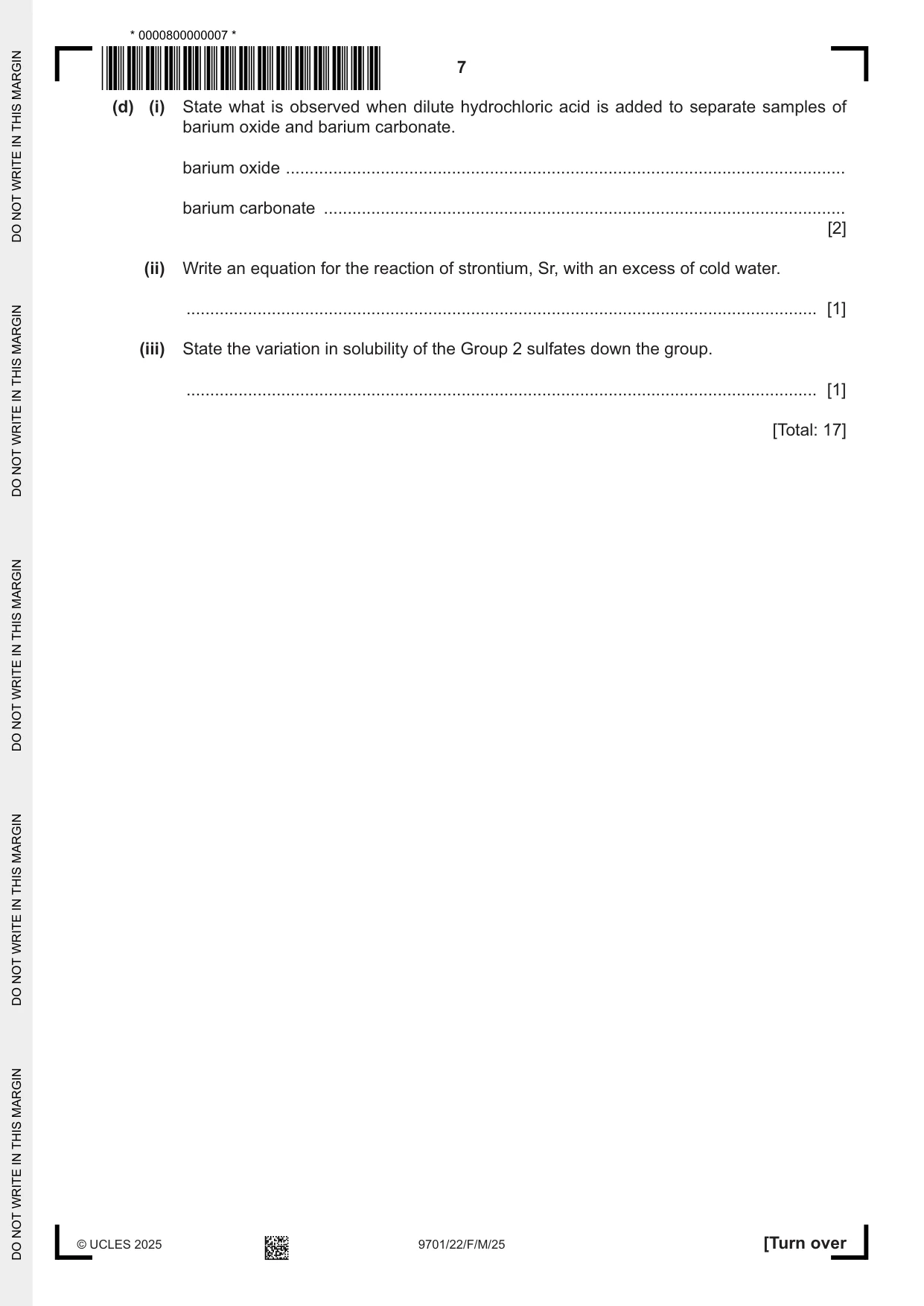
2 (a) The Group 2 elements show metallic bonding. Define metallic bonding. ................................................................................................................................................... ............................................................................................................................................. [2] (b) The Group 2 elements form stable 2+ cations. (i) State and explain the variation in ionic radius of the Group 2 elements down the group. ........................................................................................................................................... ........................................................................................................................................... ........................................................................................................................................... ..................................................................................................................................... [2] (ii) Table 2.1 shows successive ionisation energy values for beryllium, Be. Table 2.1 1st 2nd 3rd 4th ionisation energy / kJ mol–1 900 1760 14 800 21 000 Use Table 2.1 to state and explain: • the general trend in these values • the significance of the large difference between the 2nd and 3rd ionisation energies. ........................................................................................................................................... ........................................................................................................................................... ........................................................................................................................................... ..................................................................................................................................... [2] (c) All the Group 2 elements except beryllium have more than one stable isotope. (i) Beryllium exists as the single isotope 94Be. Describe the distribution of mass within an atom of 94Be. ........................................................................................................................................... ........................................................................................................................................... ........................................................................................................................................... ..................................................................................................................................... [2] (ii) Complete Table 2.2 to show the numbers of protons and neutrons in the isotopes of magnesium. Table 2.2 isotope number of protons number of neutrons magnesium-24 magnesium-25 magnesium-26 [2] (iii) Fig. 2.1 shows the behaviour of a beam of protons in an electric field. Complete Fig. 2.1 to show the behaviour of separate beams of neutrons and electrons in the same electric field. Label your diagram clearly. Assume that the beams of each particle are moving at the same velocity. beam of protons source Fig. 2.1 [3] (d) (i) State what is observed when dilute hydrochloric acid is added to separate samples of barium oxide and barium carbonate. barium oxide ...................................................................................................................... barium carbonate .............................................................................................................. [2] (ii) Write an equation for the reaction of strontium, Sr, with an excess of cold water. ..................................................................................................................................... [1] (iii) State the variation in solubility of the Group 2 sulfates down the group. ..................................................................................................................................... [1] [Total: 17]
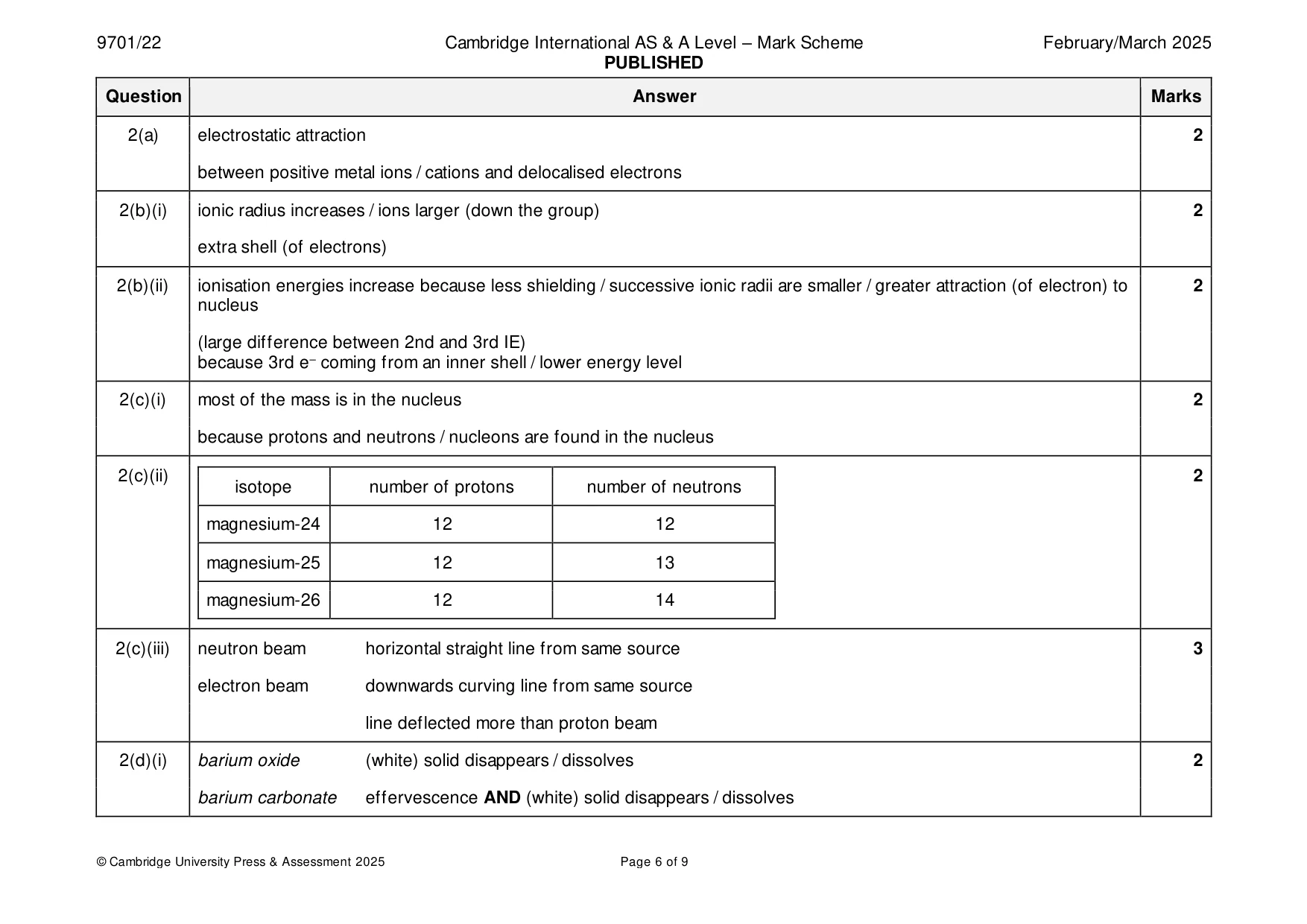
Mark scheme: 2(a) electrostatic attraction 2 between positive metal ions / cations and delocalised electrons 2(b)(i) ionic radius increases / ions larger (down the group) 2 extra shell (of electrons) 2(b)(ii) ionisation energies increase because less shielding / successive ionic radii are smaller / greater attraction (of electron) to 2 nucleus (large difference between 2nd and 3rd IE) because 3rd e– coming from an inner shell / lower energy level 2(c)(i) most of the mass is in the nucleus 2 because protons and neutrons / nucleons are found in the nucleus 2(c)(ii) 2 isotope number of protons number of neutrons magnesium-24 12 12 magnesium-25 12 13 magnesium-26 12 14 2(c)(iii) neutron beam horizontal straight line from same source 3 electron beam downwards curving line from same source line deflected more than proton beam 2(d)(i) barium oxide (white) solid disappears / dissolves 2 barium carbonate effervescence AND (white) solid disappears / dissolves 2(d)(ii) Sr + 2H2O → Sr(OH)2 + H2 1 2(d)(iii) decreases (down the group) 1
Q3 · The halogens chlorine, bromine and iodine show trends in chemical and physical properties…
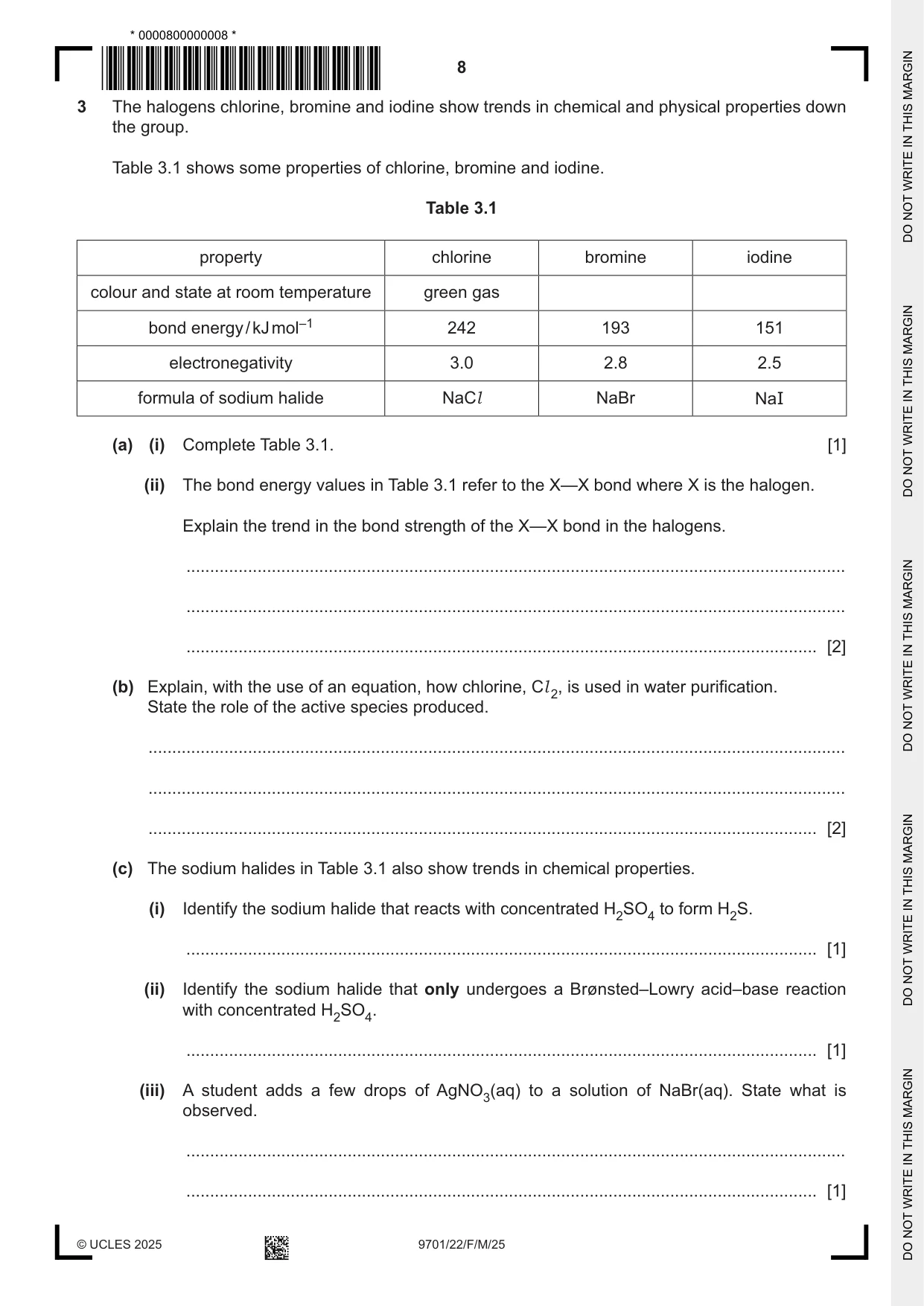
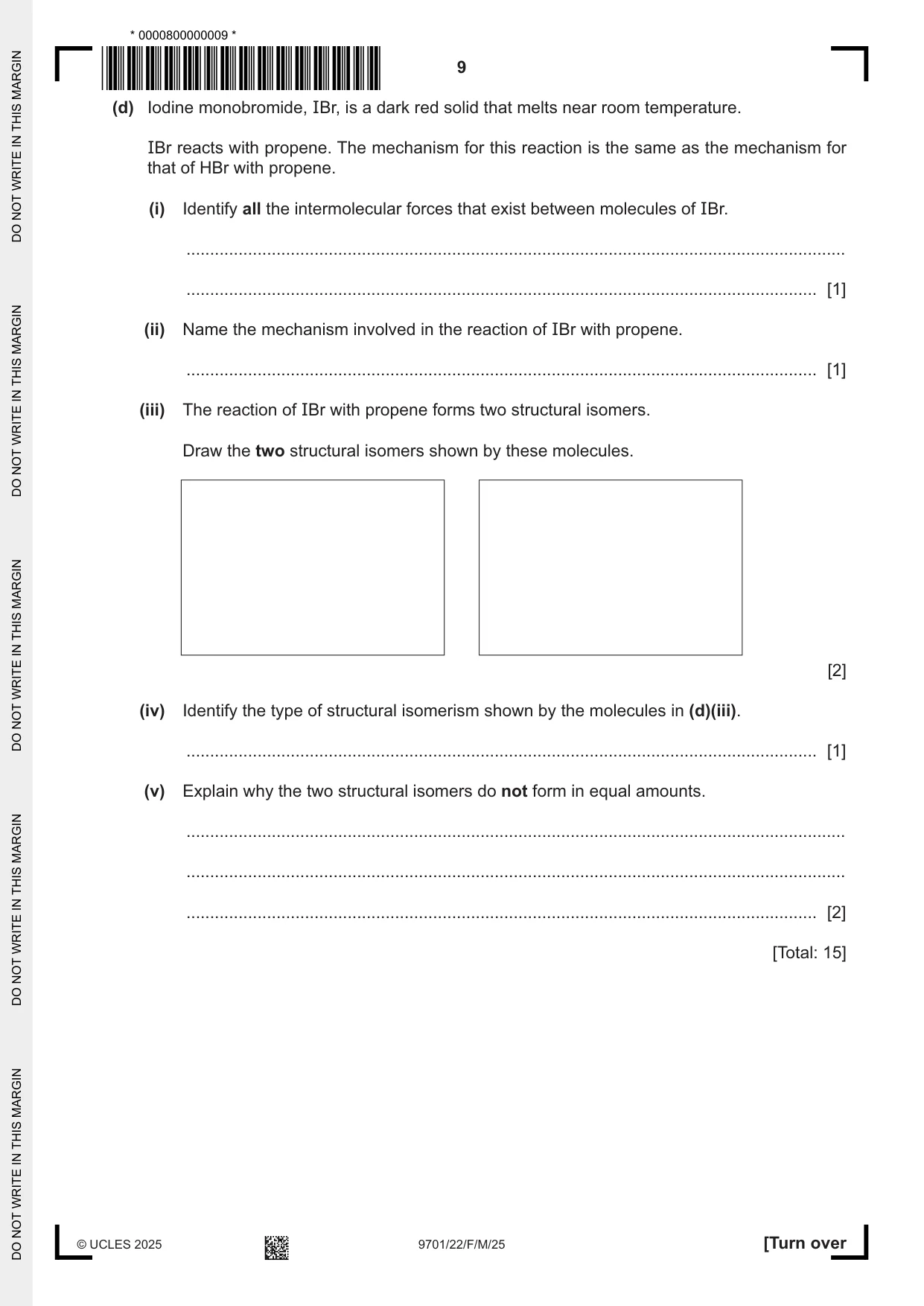
3 The halogens chlorine, bromine and iodine show trends in chemical and physical properties down the group. Table 3.1 shows some properties of chlorine, bromine and iodine. Table 3.1 property chlorine bromine iodine colour and state at room temperature green gas bond energy / kJ mol–1 242 193 151 electronegativity 3.0 2.8 2.5 formula of sodium halide NaCl NaBr NaI (a) (i) Complete Table 3.1. [1] (ii) The bond energy values in Table 3.1 refer to the X—X bond where X is the halogen. Explain the trend in the bond strength of the X—X bond in the halogens. ........................................................................................................................................... ........................................................................................................................................... ..................................................................................................................................... [2] (b) Explain, with the use of an equation, how chlorine, Cl 2, is used in water purification. State the role of the active species produced. ................................................................................................................................................... ................................................................................................................................................... ............................................................................................................................................. [2] (c) The sodium halides in Table 3.1 also show trends in chemical properties. (i) Identify the sodium halide that reacts with concentrated H2SO4 to form H2S. ..................................................................................................................................... [1] (ii) Identify the sodium halide that only undergoes a Brønsted–Lowry acid–base reaction with concentrated H2SO4. ..................................................................................................................................... [1] (iii) A student adds a few drops of AgNO3(aq) to a solution of NaBr(aq). State what is observed. ........................................................................................................................................... ..................................................................................................................................... [1] (d) Iodine monobromide, IBr, is a dark red solid that melts near room temperature. IBr reacts with propene. The mechanism for this reaction is the same as the mechanism for that of HBr with propene. (i) Identify all the intermolecular forces that exist between molecules of IBr. ........................................................................................................................................... ..................................................................................................................................... [1] (ii) Name the mechanism involved in the reaction of IBr with propene. ..................................................................................................................................... [1] (iii) The reaction of IBr with propene forms two structural isomers. Draw the two structural isomers shown by these molecules. [2] (iv) Identify the type of structural isomerism shown by the molecules in (d)(iii). ..................................................................................................................................... [1] (v) Explain why the two structural isomers do not form in equal amounts. ........................................................................................................................................... ........................................................................................................................................... ..................................................................................................................................... [2] [Total: 15]
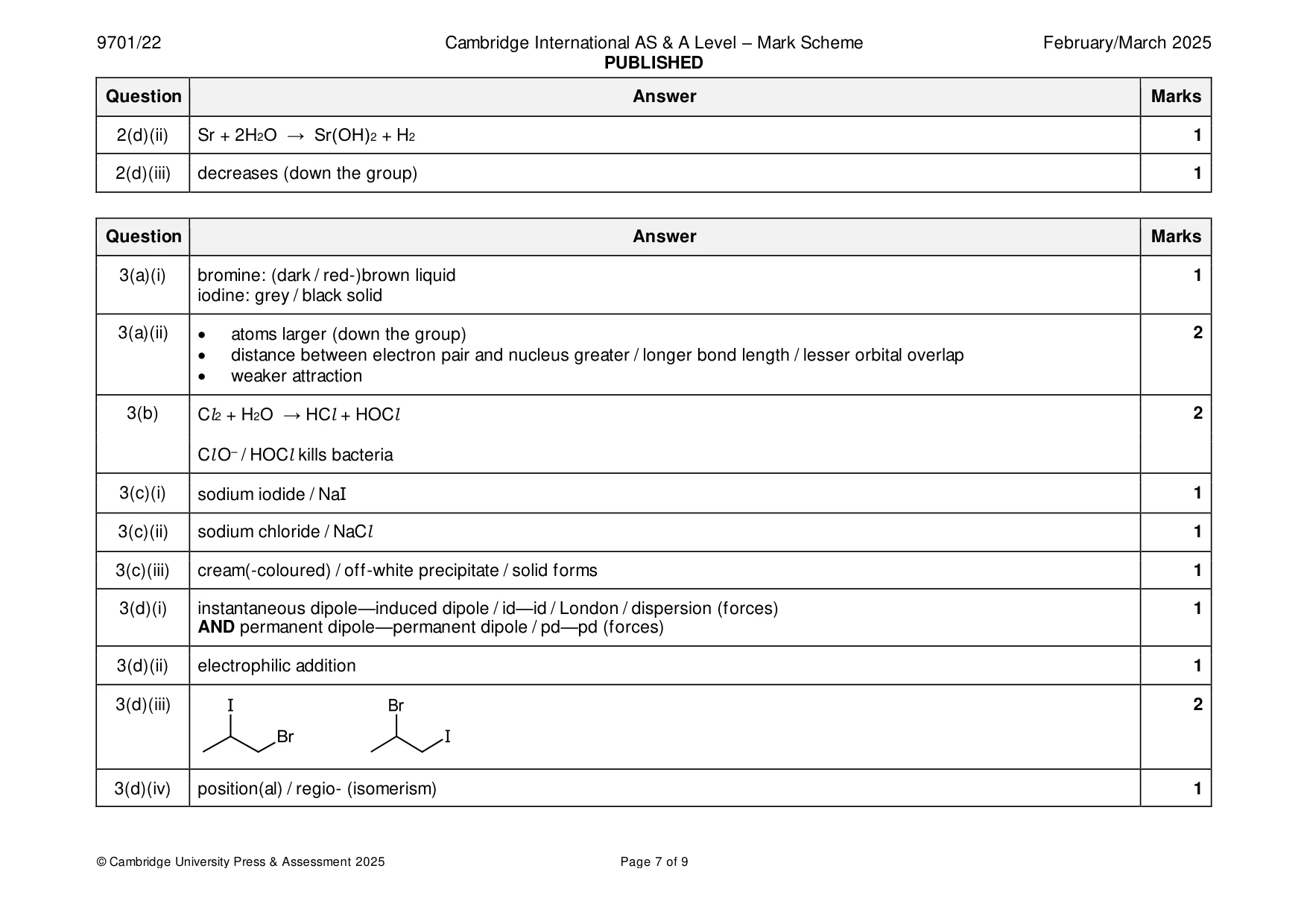
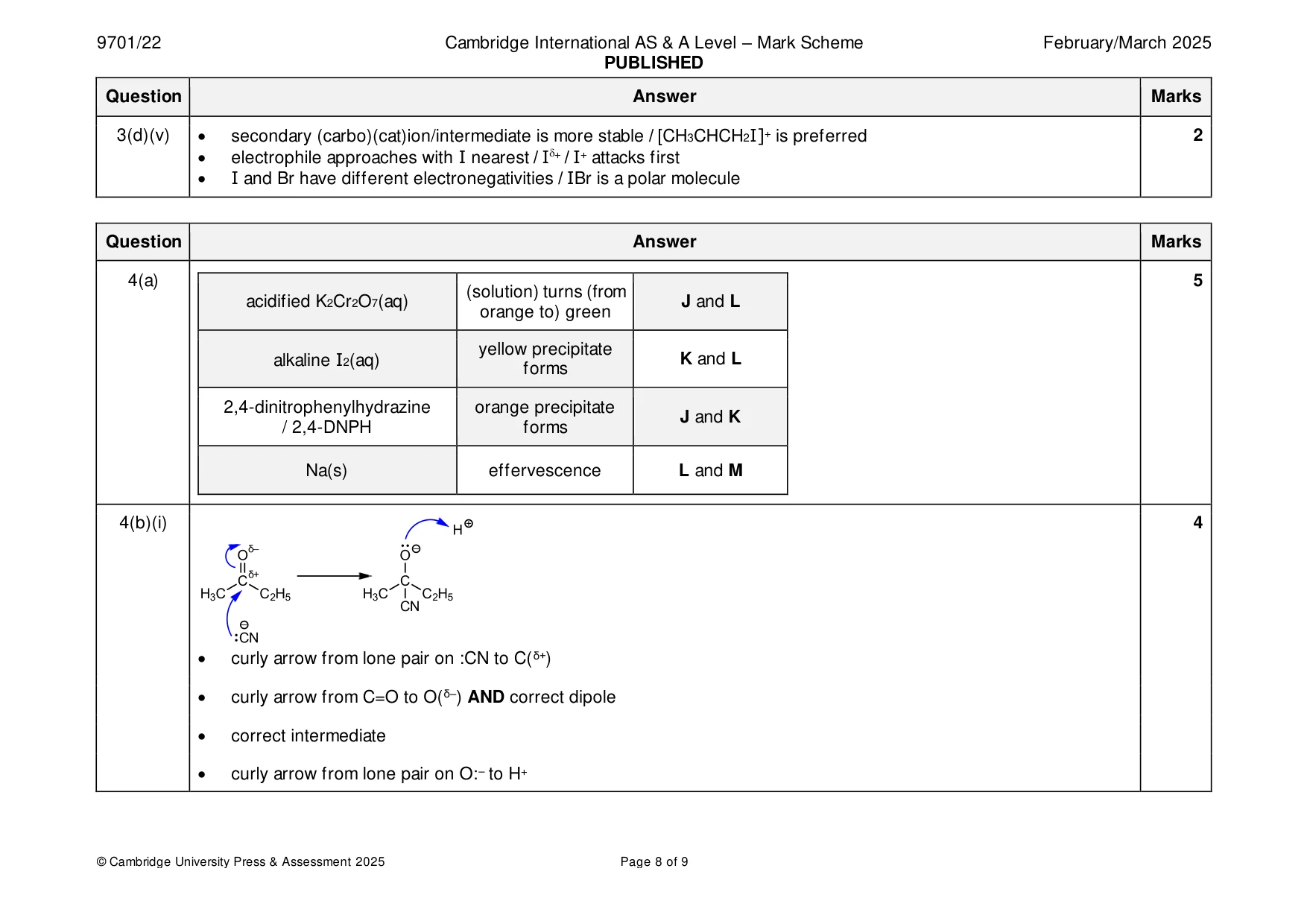
Mark scheme: 3(a)(i) bromine: (dark / red-)brown liquid 1 iodine: grey / black solid 3(a)(ii) • atoms larger (down the group) 2 • distance between electron pair and nucleus greater / longer bond length / lesser orbital overlap • weaker attraction 3(b) Cl2 + H2O → HCl + HOCl 2 Cl O– / HOCl kills bacteria 3(c)(i) sodium iodide / NaI 1 3(c)(ii) sodium chloride / NaCl 1 3(c)(iii) cream(-coloured) / off-white precipitate / solid forms 1 3(d)(i) instantaneous dipole—induced dipole / id—id / London / dispersion (forces) 1 AND permanent dipole—permanent dipole / pd—pd (forces) 3(d)(ii) electrophilic addition 1 3(d)(iii) 2 3(d)(iv) position(al) / regio- (isomerism) 1 3(d)(v) • secondary (carbo)(cat)ion/intermediate is more stable / [CH3CHCH2I]+ is preferred 2 • electrophile approaches with I nearest / I+ / I+ attacks first • I and Br have different electronegativities / IBr is a polar molecule
Q4 · Compounds J to M, each of which contains four carbon atoms
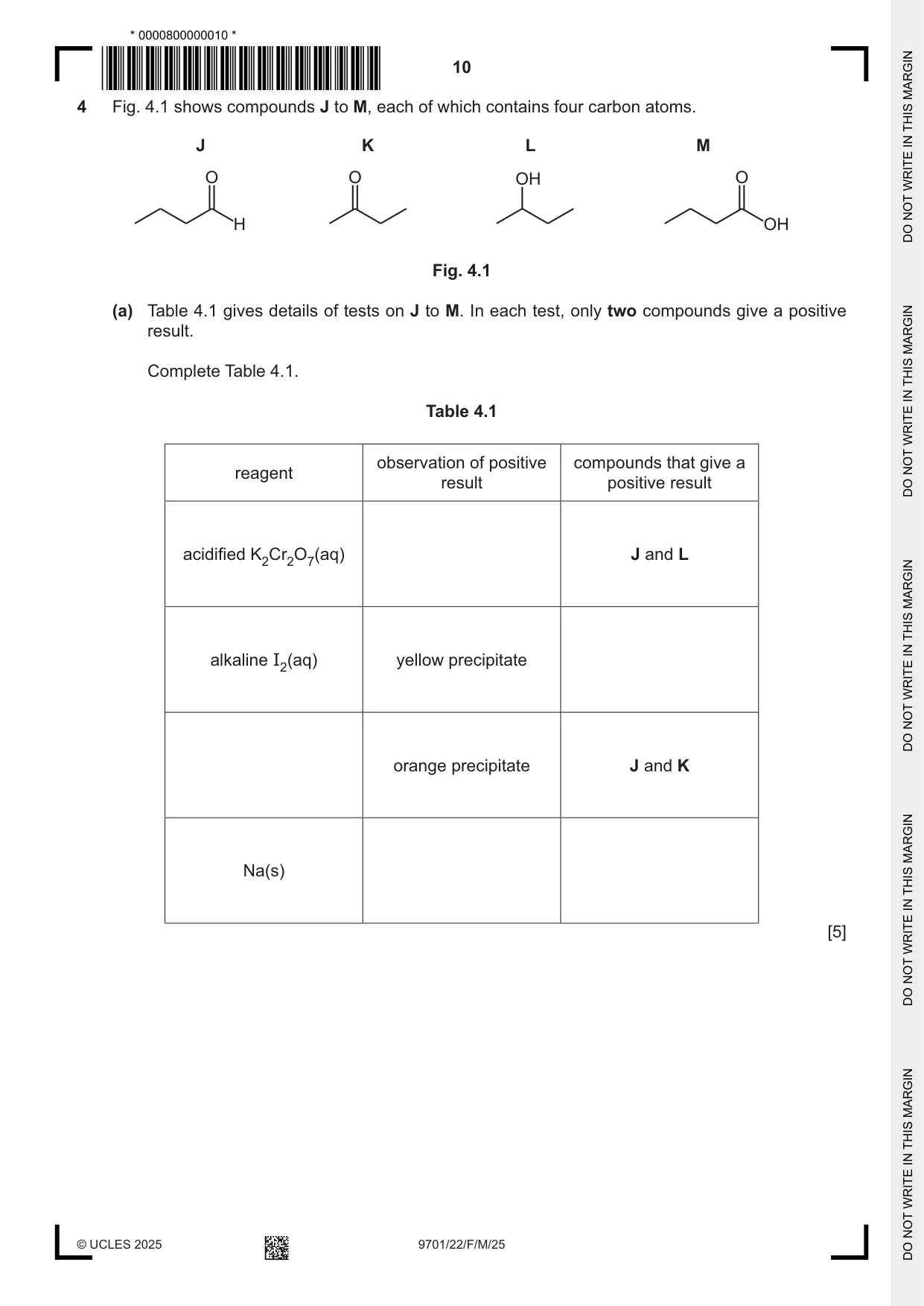
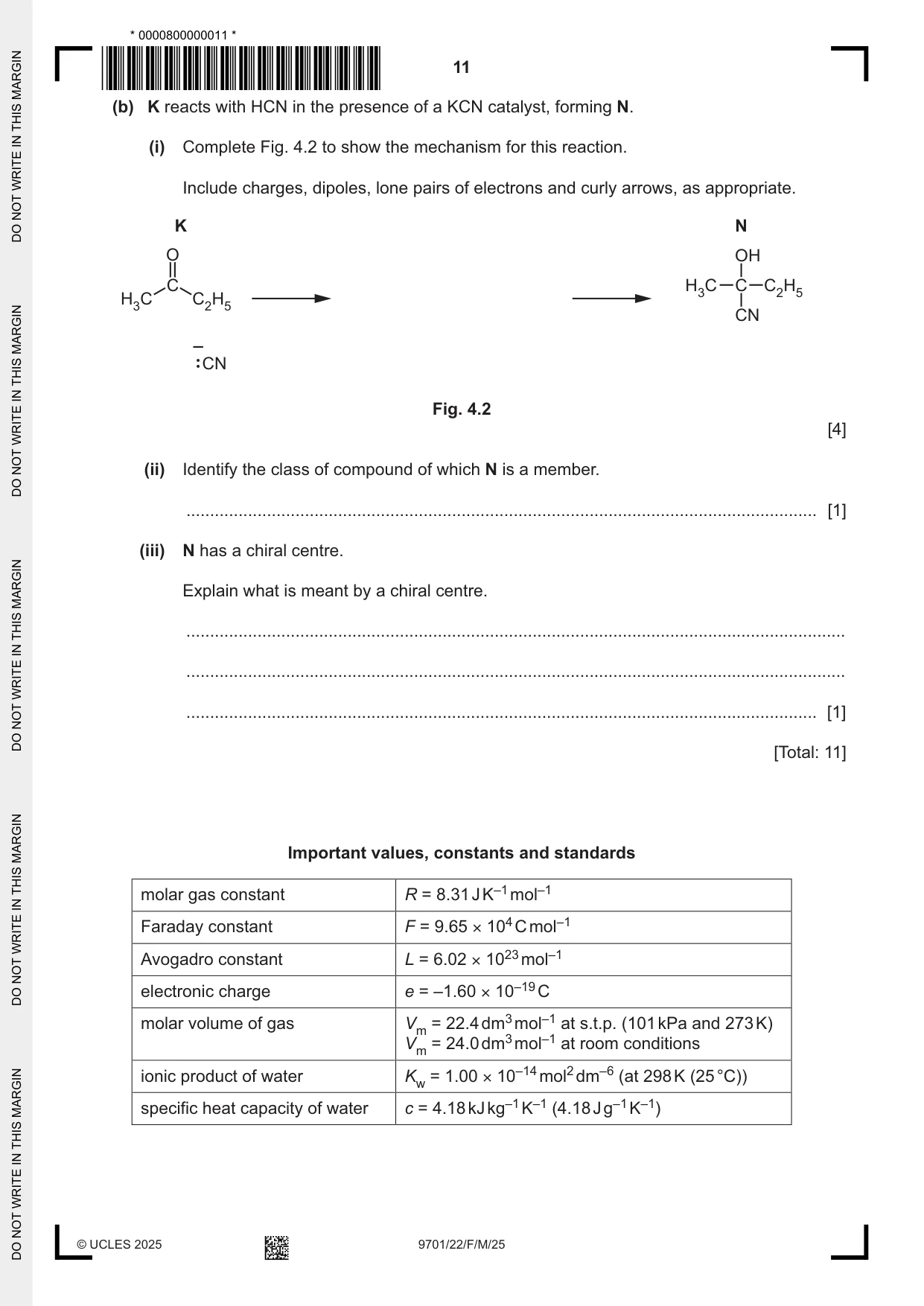
4 Fig. 4.1 shows compounds J to M, each of which contains four carbon atoms. J K L M O O OH O H OH Fig. 4.1 (a) Table 4.1 gives details of tests on J to M. In each test, only two compounds give a positive result. Complete Table 4.1. Table 4.1 observation of positive compounds that give a reagent result positive result acidified K2Cr2O7(aq) J and L alkaline I2(aq) yellow precipitate orange precipitate J and K Na(s) [5] (b) K reacts with HCN in the presence of a KCN catalyst, forming N. (i) Complete Fig. 4.2 to show the mechanism for this reaction. Include charges, dipoles, lone pairs of electrons and curly arrows, as appropriate. K N O OH C H3C C C2H5 H3C C2H5 CN CN Fig. 4.2 [4] (ii) Identify the class of compound of which N is a member. ..................................................................................................................................... [1] (iii) N has a chiral centre. Explain what is meant by a chiral centre. ........................................................................................................................................... ........................................................................................................................................... ..................................................................................................................................... [1] [Total: 11]
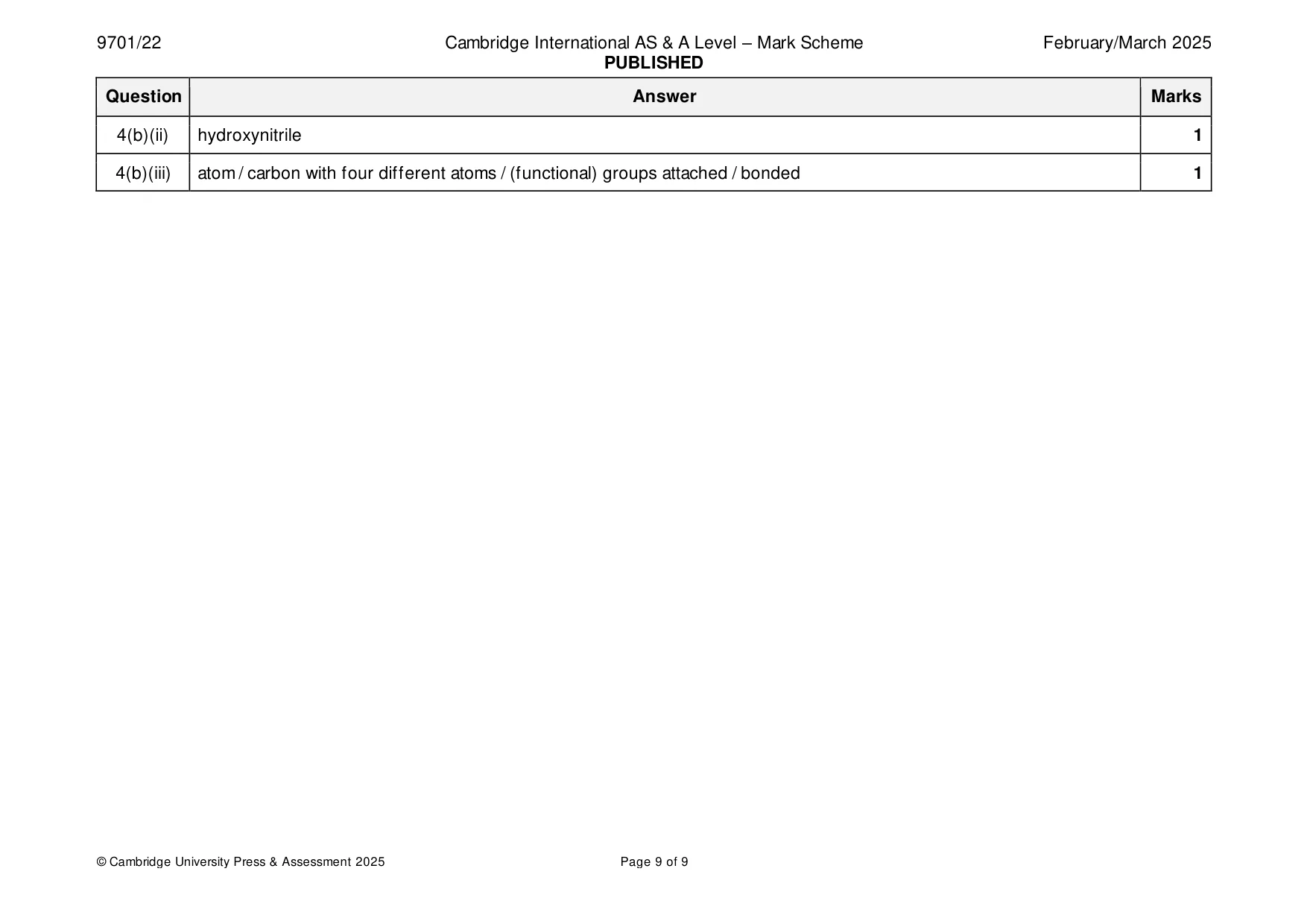
Mark scheme: 4(a) 5 (solution) turns (from acidified K2Cr2O7(aq) J and L orange to) green yellow precipitate alkaline I2(aq) K and L forms 2,4-dinitrophenylhydrazine orange precipitate J and K / 2,4-DNPH forms Na(s) effervescence L and M 4(b)(i) 4 • curly arrow from lone pair on :CN to C(δ+) • curly arrow from C=O to O(δ–) AND correct dipole • correct intermediate • curly arrow from lone pair on O:– to H+ 4(b)(ii) hydroxynitrile 1 4(b)(iii) atom / carbon with four different atoms / (functional) groups attached / bonded 1
What was in this paper
The subtopics covered by these 4 questions, and how many questions each got. Open one in a new tab to see every Cambridge question on it.
What you needed in this session
Cambridge’s own grade thresholds for 2025 Feb/March, Paper 2 · Variant 2. A higher threshold means an easier paper — the bar moves with how the cohort did.