Cambridge A Level Chemistry 9701 — 2024 Oct/Nov Paper 2 · Variant 2
9701/22/O/N/24 · 4 questions · 60 marks · ≈68 min
The question paper and its mark scheme, free to read here and free to download. This is Cambridge’s own paper, exactly as it was sat.
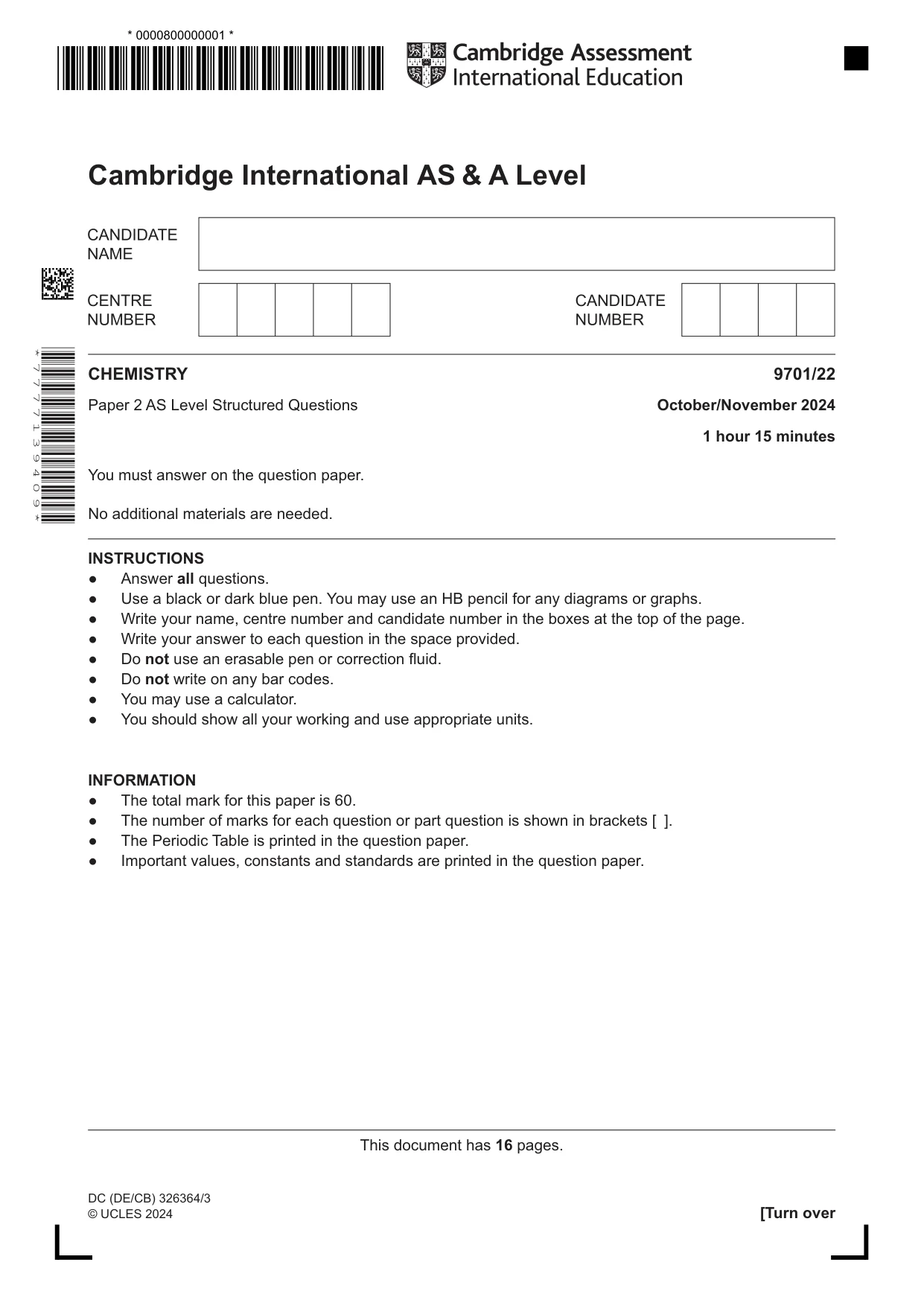
Question paper16 pages

Mark scheme11 pages
Answers below. Sit the paper first if you are practising.
Questions as text
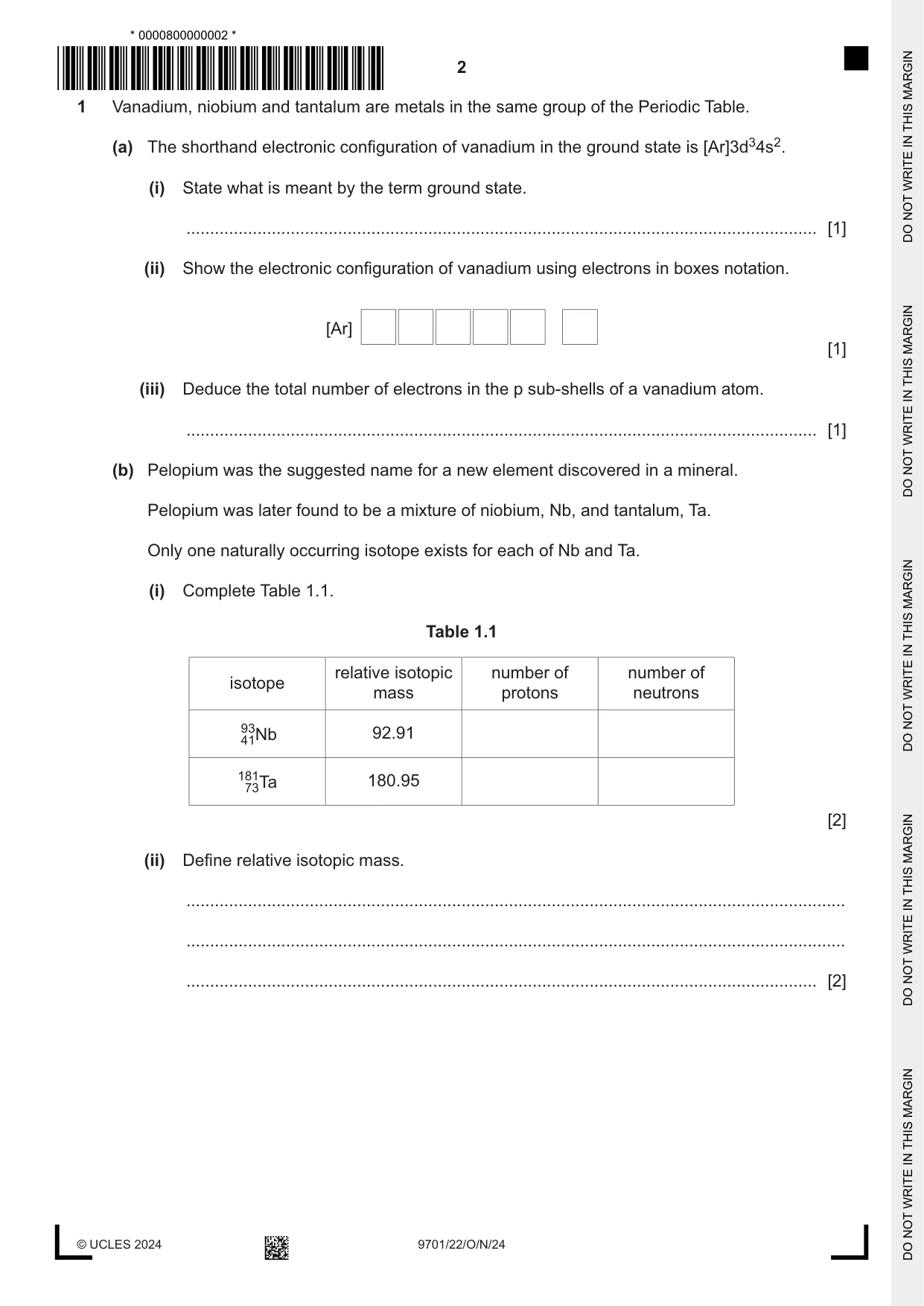
Q1 · Vanadium, niobium and tantalum are metals in the same group of the Periodic Table
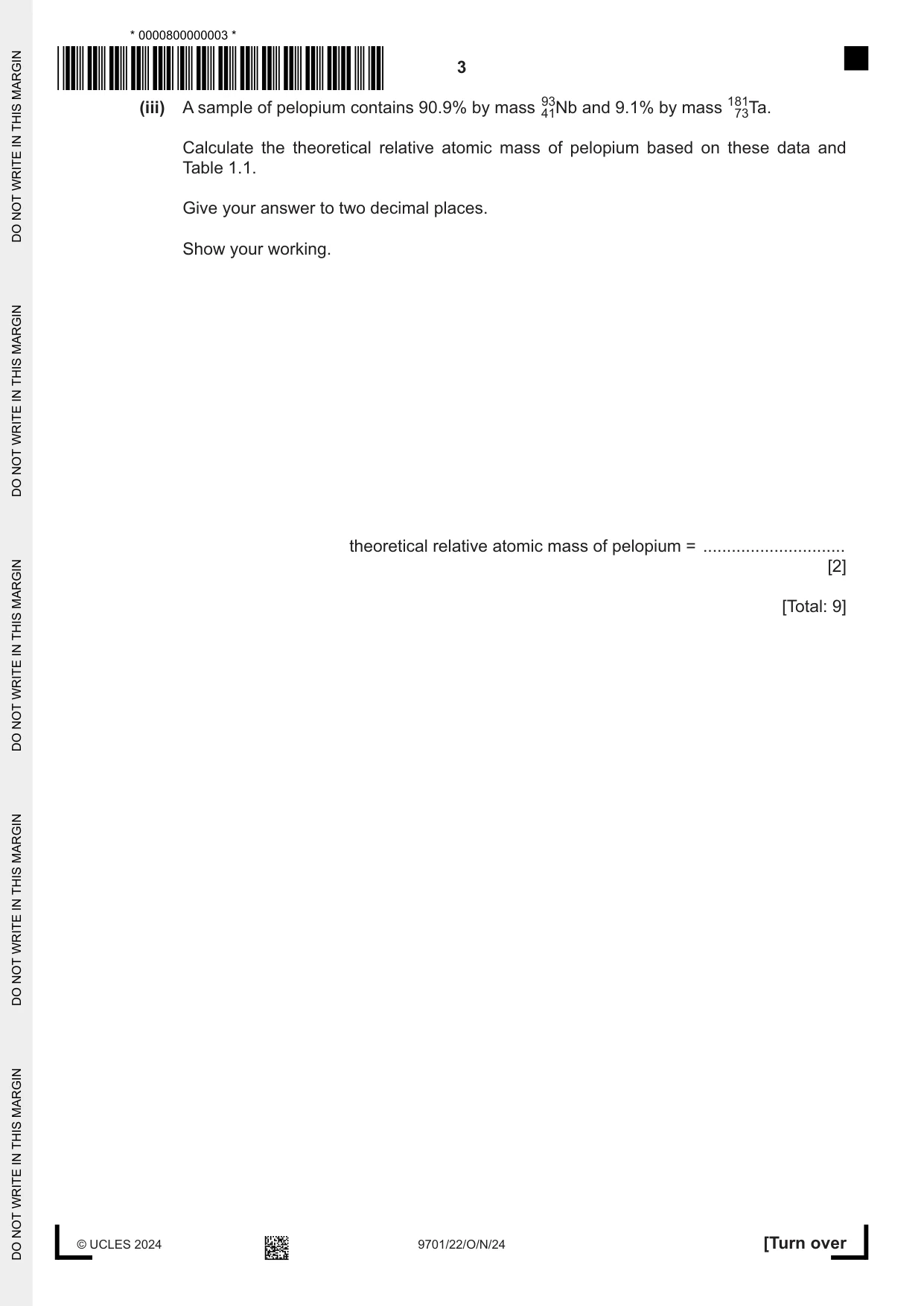
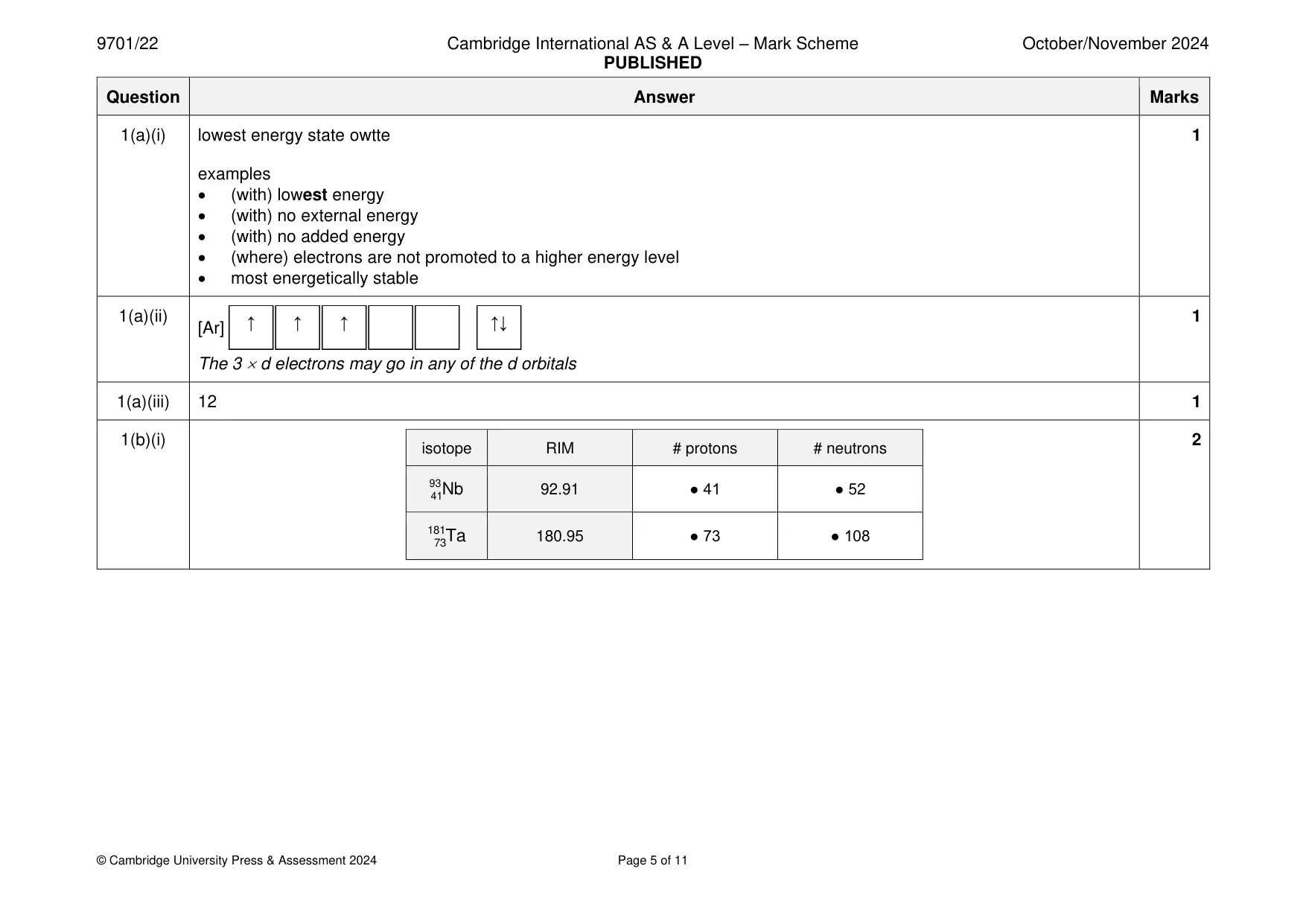
1 Vanadium, niobium and tantalum are metals in the same group of the Periodic Table. (a) The shorthand electronic configuration of vanadium in the ground state is [Ar]3d34s2. (i) State what is meant by the term ground state. ..................................................................................................................................... [1] (ii) Show the electronic configuration of vanadium using electrons in boxes notation. [Ar] [1] (iii) Deduce the total number of electrons in the p sub-shells of a vanadium atom. ..................................................................................................................................... [1] (b) Pelopium was the suggested name for a new element discovered in a mineral. Pelopium was later found to be a mixture of niobium, Nb, and tantalum, Ta. Only one naturally occurring isotope exists for each of Nb and Ta. (i) Complete Table 1.1. Table 1.1 relative isotopic number of number of isotope mass protons neutrons 9341Nb 92.91 18173Ta 180.95 [2] (ii) Define relative isotopic mass. ........................................................................................................................................... ........................................................................................................................................... ..................................................................................................................................... [2] (iii) A sample of pelopium contains 90.9% by mass 9341Nb and 9.1% by mass 18173Ta. Calculate the theoretical relative atomic mass of pelopium based on these data and Table 1.1. Give your answer to two decimal places. Show your working. theoretical relative atomic mass of pelopium = .............................. [2] [Total: 9]
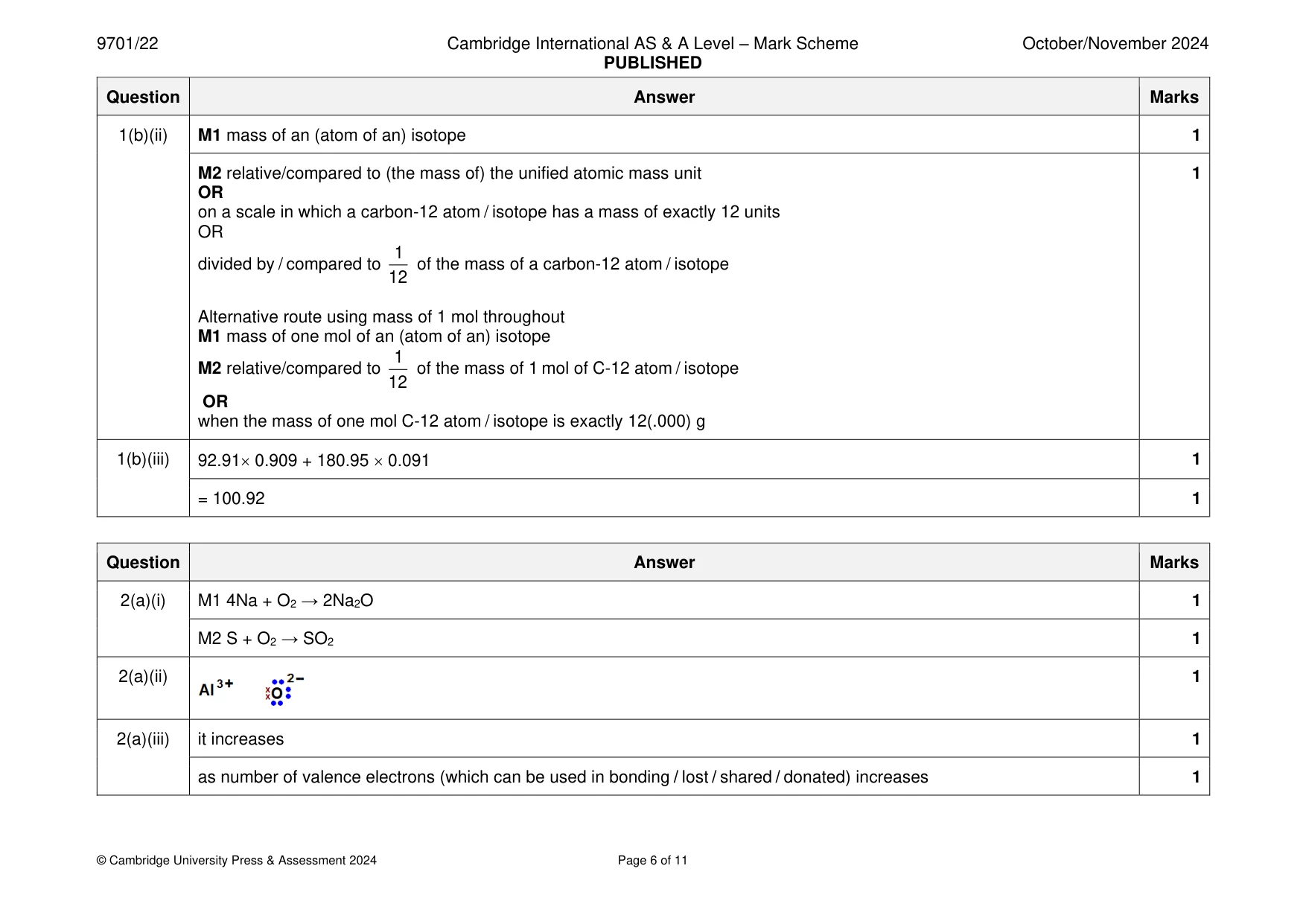
Mark scheme: Question Answer Marks 1(a)(i) lowest energy state owtte 1 examples • (with) lowest energy • (with) no external energy • (with) no added energy • (where) electrons are not promoted to a higher energy level • most energetically stable 1(a)(ii) 1 ↑ ↑ ↑ ↑↓ [Ar] The 3 d electrons may go in any of the d orbitals 1(a)(iii) 12 1 1(b)(i) 2 isotope RIM # protons # neutrons 9341Nb 92.91 ● 41 ● 52 18173Ta 180.95 ● 73 ● 108 1(b)(ii) M1 mass of an (atom of an) isotope 1 M2 relative/compared to (the mass of) the unified atomic mass unit 1 OR on a scale in which a carbon-12 atom / isotope has a mass of exactly 12 units OR 1 divided by / compared to of the mass of a carbon-12 atom / isotope 12 Alternative route using mass of 1 mol throughout M1 mass of one mol of an (atom of an) isotope 1 M2 relative/compared to of the mass of 1 mol of C-12 atom / isotope 12 OR when the mass of one mol C-12 atom / isotope is exactly 12(.000) g 1(b)(iii) 92.91 0.909 + 180.95 0.091 1 = 100.92 1
More questions on Electrons, energy levels and atomic orbitals
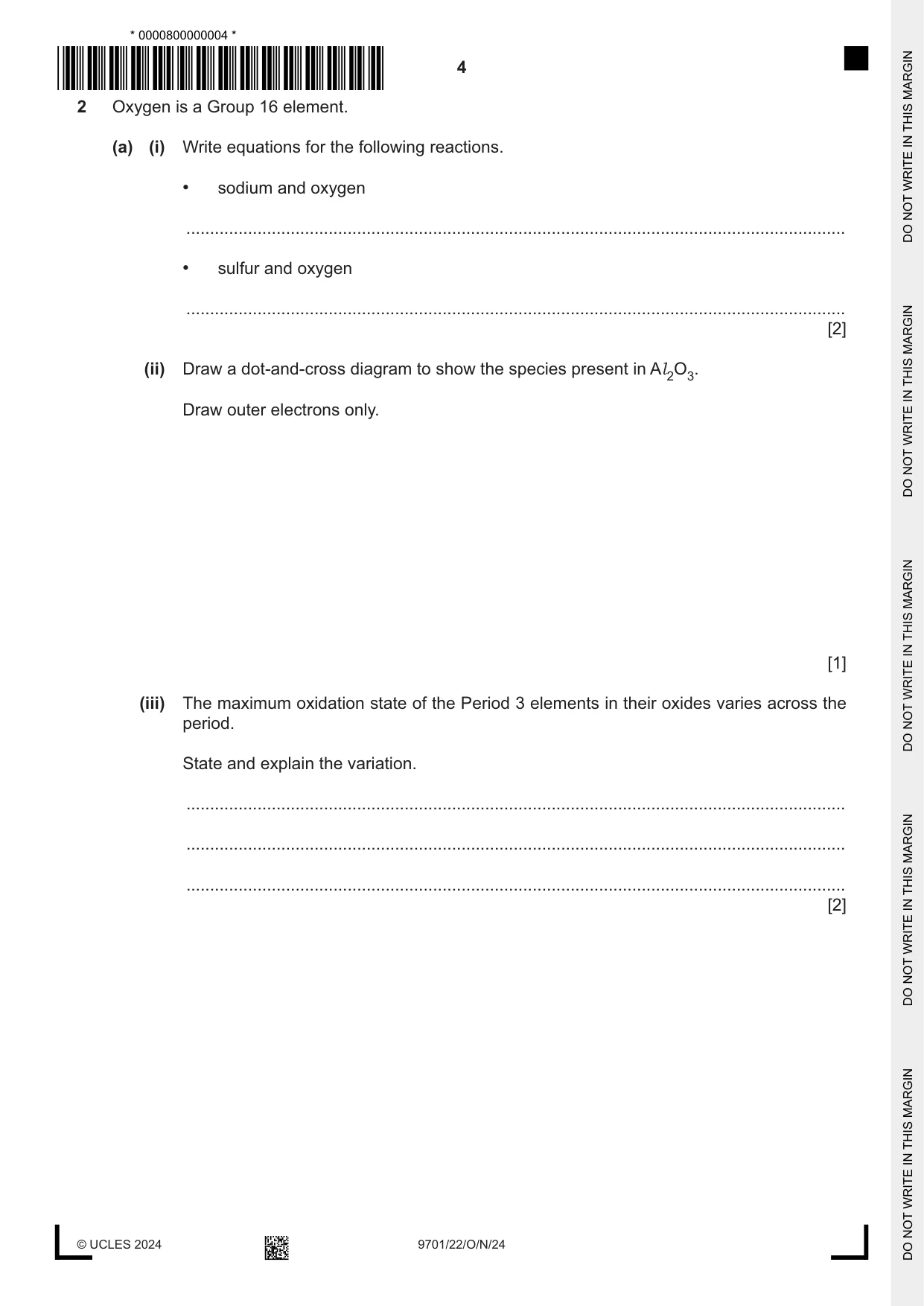
Q2 · Oxygen is a Group 16 element
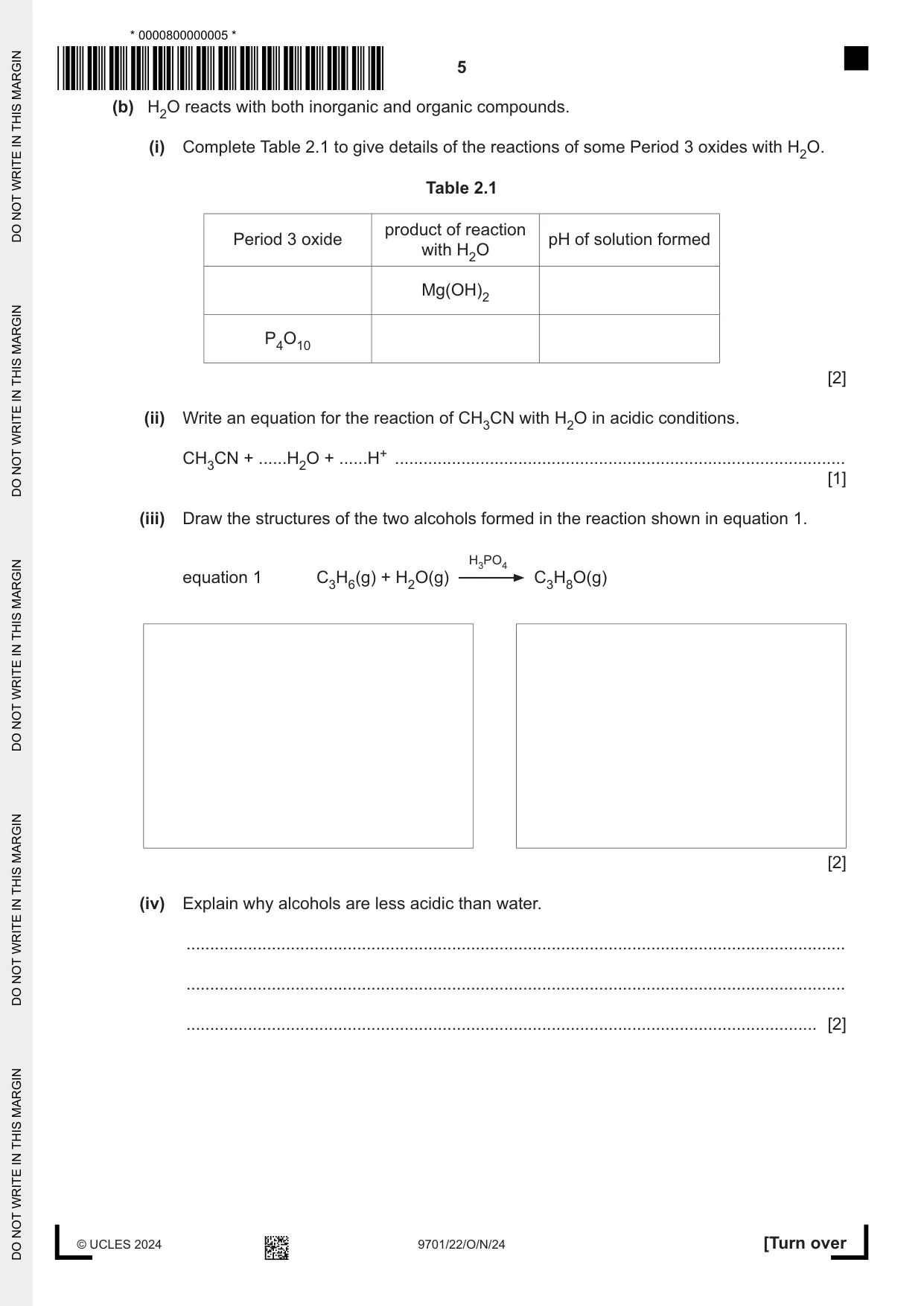
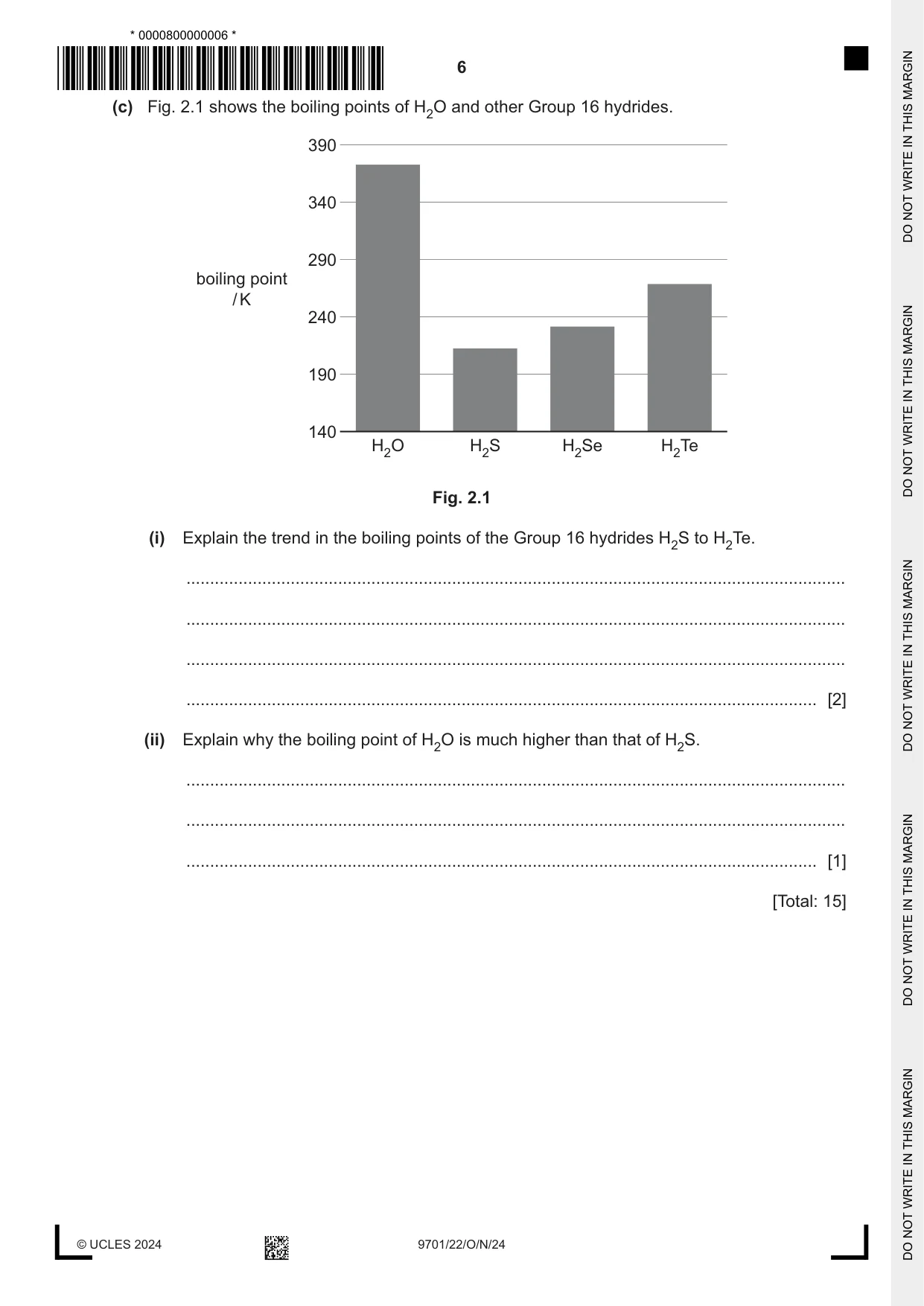
2 Oxygen is a Group 16 element. (a) (i) Write equations for the following reactions. • sodium and oxygen ........................................................................................................................................... • sulfur and oxygen ........................................................................................................................................... [2] (ii) Draw a dot-and-cross diagram to show the species present in Al2O3. Draw outer electrons only. [1] (iii) The maximum oxidation state of the Period 3 elements in their oxides varies across the period. State and explain the variation. ........................................................................................................................................... ........................................................................................................................................... ........................................................................................................................................... [2] (b) H2O reacts with both inorganic and organic compounds. (i) Complete Table 2.1 to give details of the reactions of some Period 3 oxides with H2O. Table 2.1 product of reaction Period 3 oxide pH of solution formed with H2O Mg(OH)2 P4O10 [2] (ii) Write an equation for the reaction of CH3CN with H2O in acidic conditions. CH3CN + ......H2O + ......H+ ............................................................................................... [1] (iii) Draw the structures of the two alcohols formed in the reaction shown in equation 1. H3PO4 equation 1 C3H6(g) + H2O(g) C3H8O(g) [2] (iv) Explain why alcohols are less acidic than water. ........................................................................................................................................... ........................................................................................................................................... ..................................................................................................................................... [2] (c) Fig. 2.1 shows the boiling points of H2O and other Group 16 hydrides. 390 340 290 boiling point / K 240 190 140 H2O H2S H2Se H2Te Fig. 2.1 (i) Explain the trend in the boiling points of the Group 16 hydrides H2S to H2Te. ........................................................................................................................................... ........................................................................................................................................... ........................................................................................................................................... ..................................................................................................................................... [2] (ii) Explain why the boiling point of H2O is much higher than that of H2S. ........................................................................................................................................... ........................................................................................................................................... ..................................................................................................................................... [1] [Total: 15]
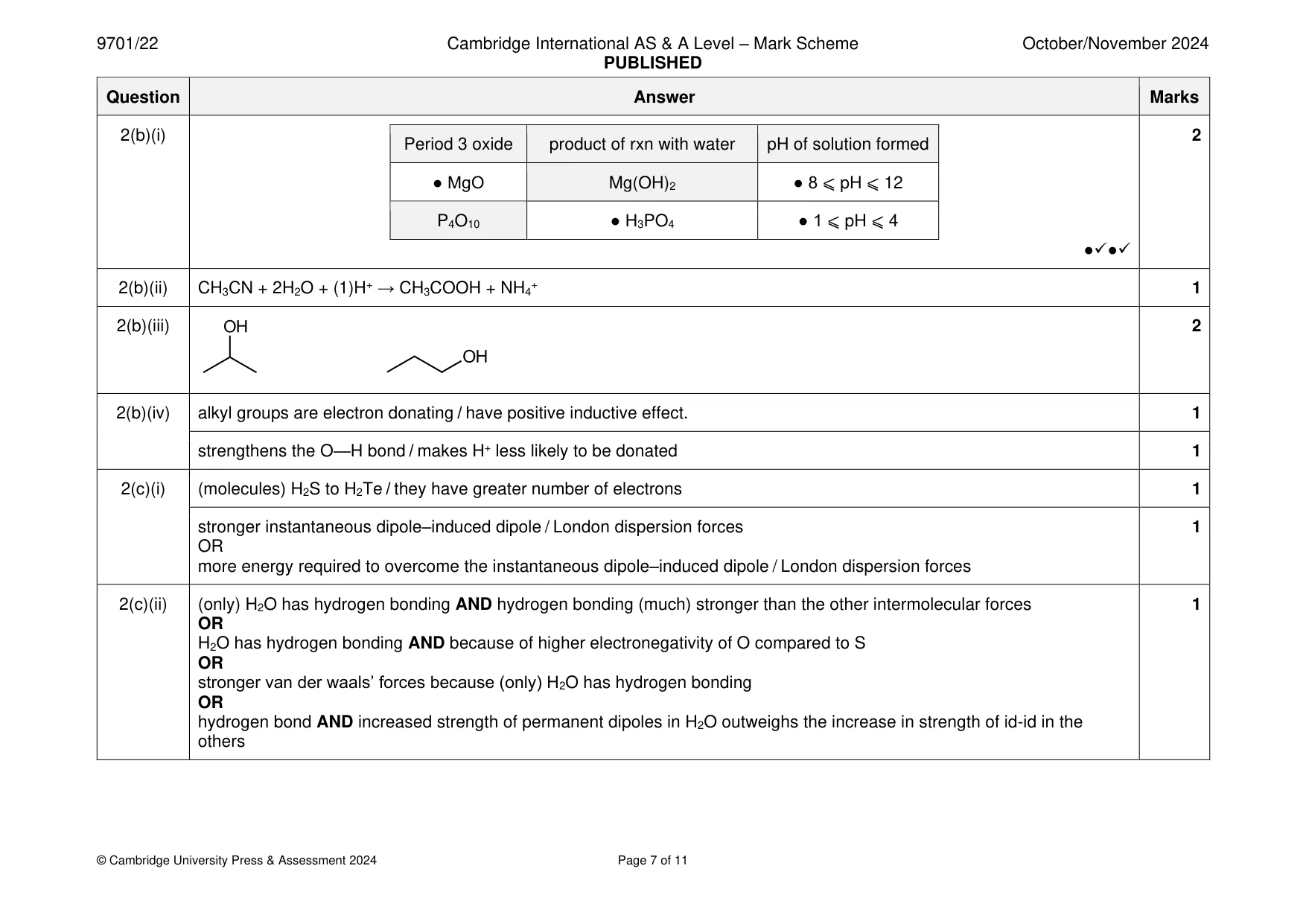
Mark scheme: 2(a)(i) M1 4Na + O2 → 2Na2O 1 M2 S + O2 → SO2 1 2(a)(ii) 1 2(a)(iii) it increases 1 as number of valence electrons (which can be used in bonding / lost / shared / donated) increases 1 2(b)(i) 2 Period 3 oxide product of rxn with water pH of solution formed ● MgO Mg(OH)2 ● 8 ⩽ pH ⩽ 12 P4O10 ● H3PO4 ● 1 ⩽ pH ⩽ 4 ●✓●✓ 2(b)(ii) CH3CN + 2H2O + (1)H+ → CH3COOH + NH4+ 1 2(b)(iii) 2 2(b)(iv) alkyl groups are electron donating / have positive inductive effect. 1 strengthens the O—H bond / makes H+ less likely to be donated 1 2(c)(i) (molecules) H2S to H2Te / they have greater number of electrons 1 stronger instantaneous dipole–induced dipole / London dispersion forces 1 OR more energy required to overcome the instantaneous dipole–induced dipole / London dispersion forces 2(c)(ii) (only) H2O has hydrogen bonding AND hydrogen bonding (much) stronger than the other intermolecular forces 1 OR H2O has hydrogen bonding AND because of higher electronegativity of O compared to S OR stronger van der waals’ forces because (only) H2O has hydrogen bonding OR hydrogen bond AND increased strength of permanent dipoles in H2O outweighs the increase in strength of id-id in the others
Q3 · Nitrogen and phosphorus are elements in Group 15 of the Periodic Table
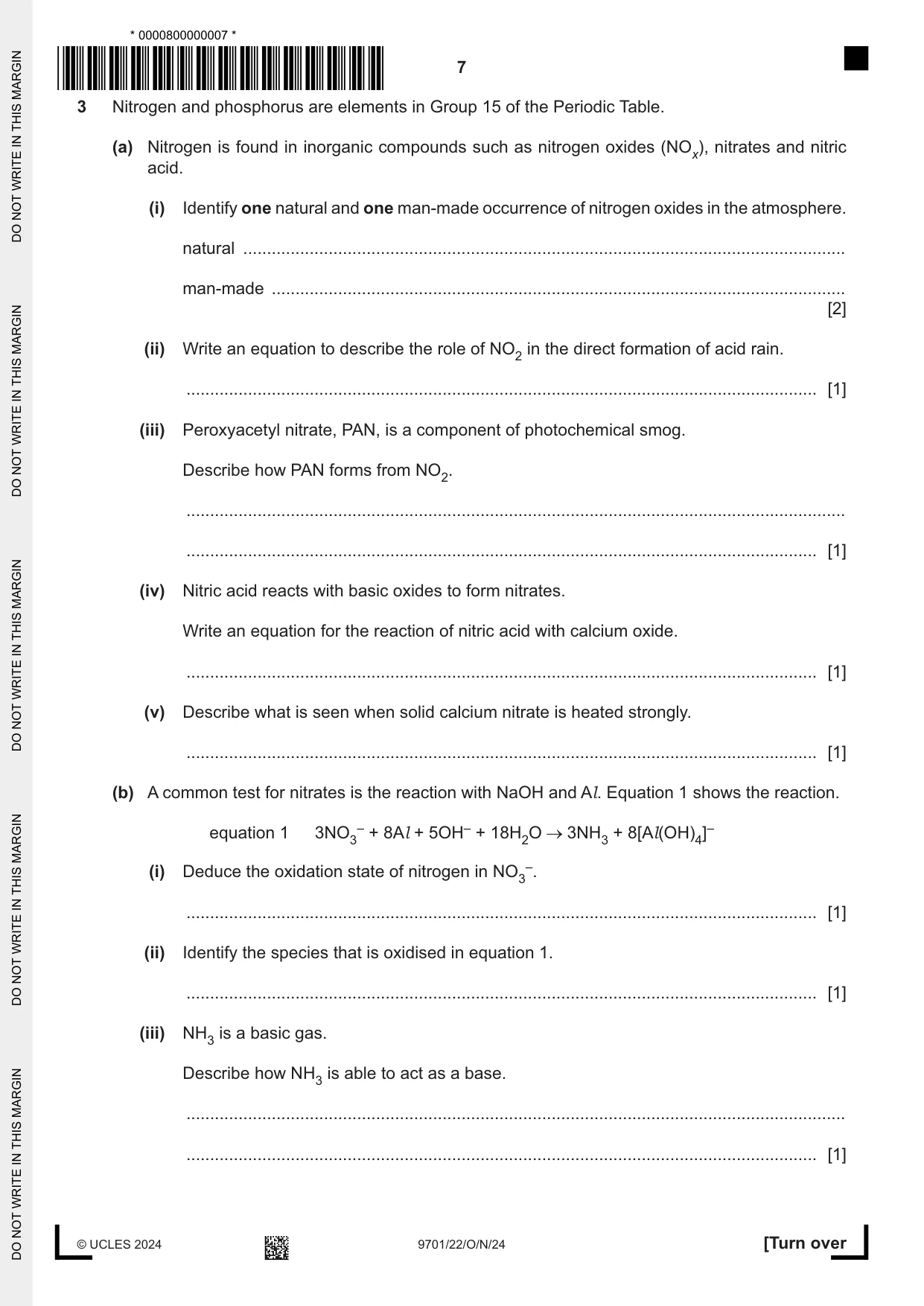
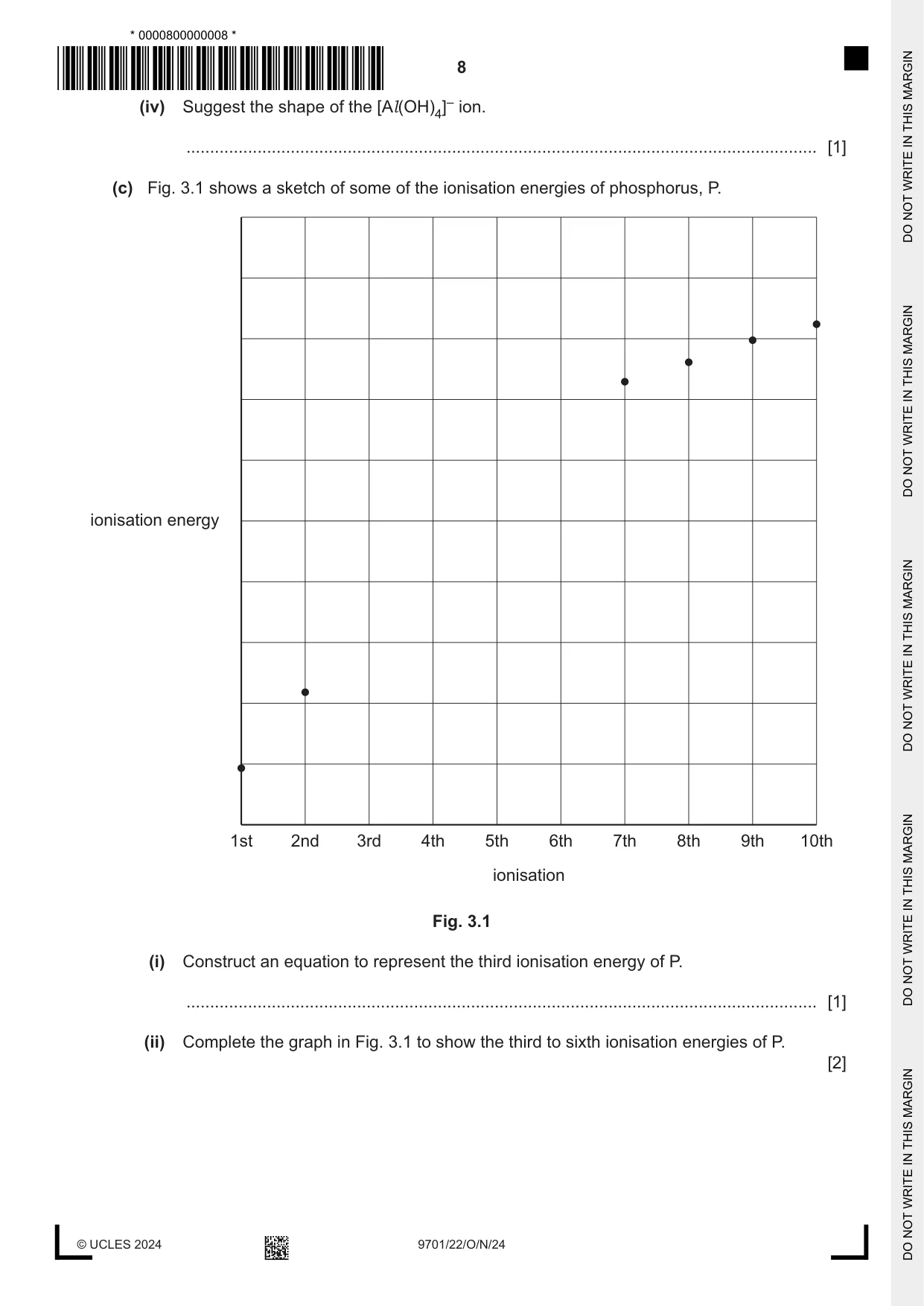
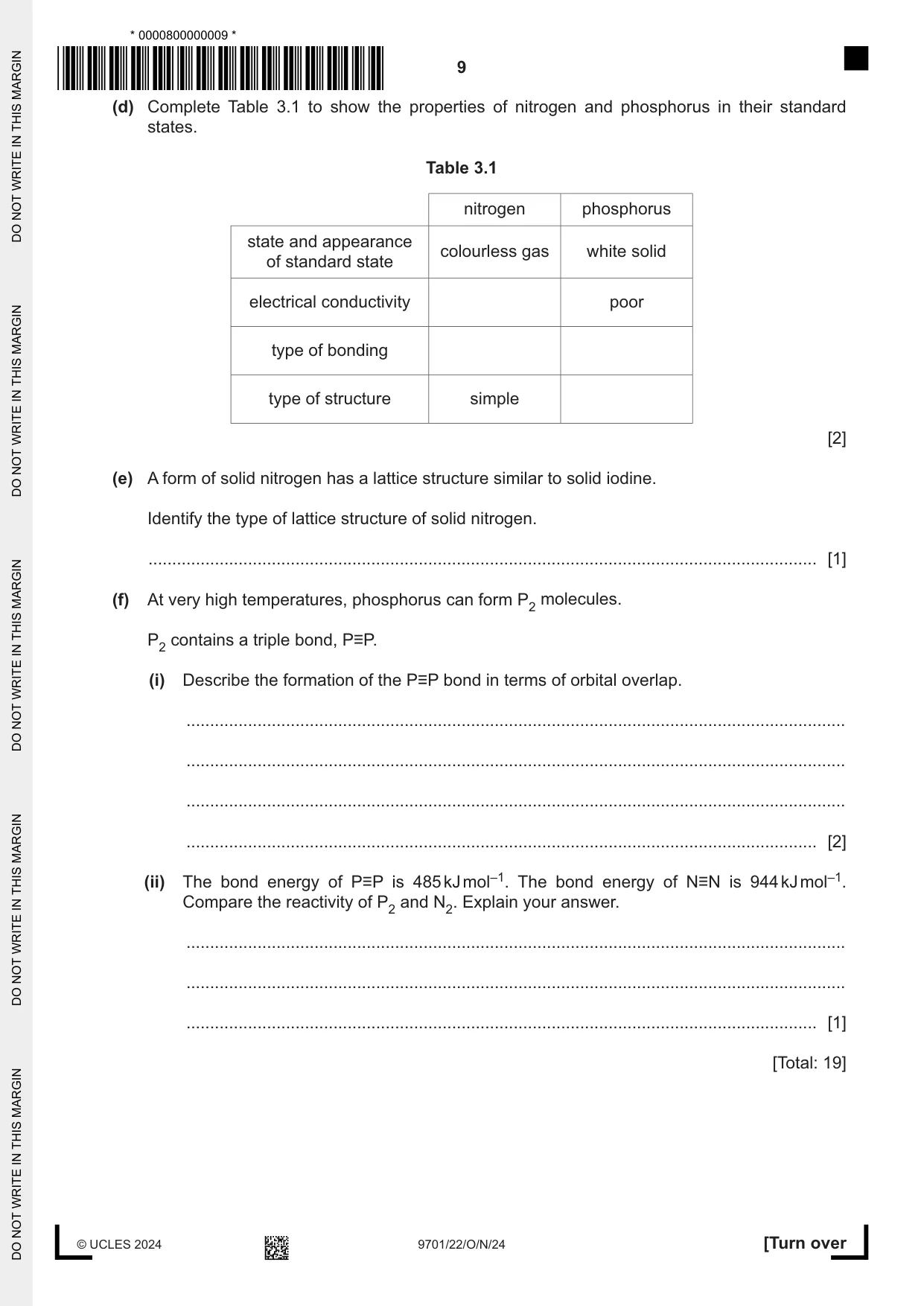
3 Nitrogen and phosphorus are elements in Group 15 of the Periodic Table. (a) Nitrogen is found in inorganic compounds such as nitrogen oxides (NOx), nitrates and nitric acid. (i) Identify one natural and one man-made occurrence of nitrogen oxides in the atmosphere. natural ............................................................................................................................... man-made ......................................................................................................................... [2] (ii) Write an equation to describe the role of NO2 in the direct formation of acid rain. ..................................................................................................................................... [1] (iii) Peroxyacetyl nitrate, PAN, is a component of photochemical smog. Describe how PAN forms from NO2. ........................................................................................................................................... ..................................................................................................................................... [1] (iv) Nitric acid reacts with basic oxides to form nitrates. Write an equation for the reaction of nitric acid with calcium oxide. ..................................................................................................................................... [1] (v) Describe what is seen when solid calcium nitrate is heated strongly. ..................................................................................................................................... [1] (b) A common test for nitrates is the reaction with NaOH and Al. Equation 1 shows the reaction. equation 1 3NO3– + 8Al + 5OH– + 18H2O 3NH3 + 8[Al(OH)4]– (i) Deduce the oxidation state of nitrogen in NO3–. ..................................................................................................................................... [1] (ii) Identify the species that is oxidised in equation 1. ..................................................................................................................................... [1] (iii) NH3 is a basic gas. Describe how NH3 is able to act as a base. ........................................................................................................................................... ..................................................................................................................................... [1] (iv) Suggest the shape of the [Al(OH)4]– ion. ..................................................................................................................................... [1] (c) Fig. 3.1 shows a sketch of some of the ionisation energies of phosphorus, P. ionisation energy 1st 2nd 3rd 4th 5th 6th 7th 8th 9th 10th ionisation Fig. 3.1 (i) Construct an equation to represent the third ionisation energy of P. ..................................................................................................................................... [1] (ii) Complete the graph in Fig. 3.1 to show the third to sixth ionisation energies of P. [2] (d) Complete Table 3.1 to show the properties of nitrogen and phosphorus in their standard states. Table 3.1 nitrogen phosphorus state and appearance colourless gas white solid of standard state electrical conductivity poor type of bonding type of structure simple [2] (e) A form of solid nitrogen has a lattice structure similar to solid iodine. Identify the type of lattice structure of solid nitrogen. ............................................................................................................................................. [1] (f) At very high temperatures, phosphorus can form P2 molecules. P2 contains a triple bond, P P. (i) Describe the formation of the P P bond in terms of orbital overlap. ........................................................................................................................................... ........................................................................................................................................... ........................................................................................................................................... ..................................................................................................................................... [2] (ii) The bond energy of P P is 485 kJ mol–1. The bond energy of N N is 944 kJ mol–1. Compare the reactivity of P2 and N2. Explain your answer. ........................................................................................................................................... ........................................................................................................................................... ..................................................................................................................................... [1] [Total: 19]
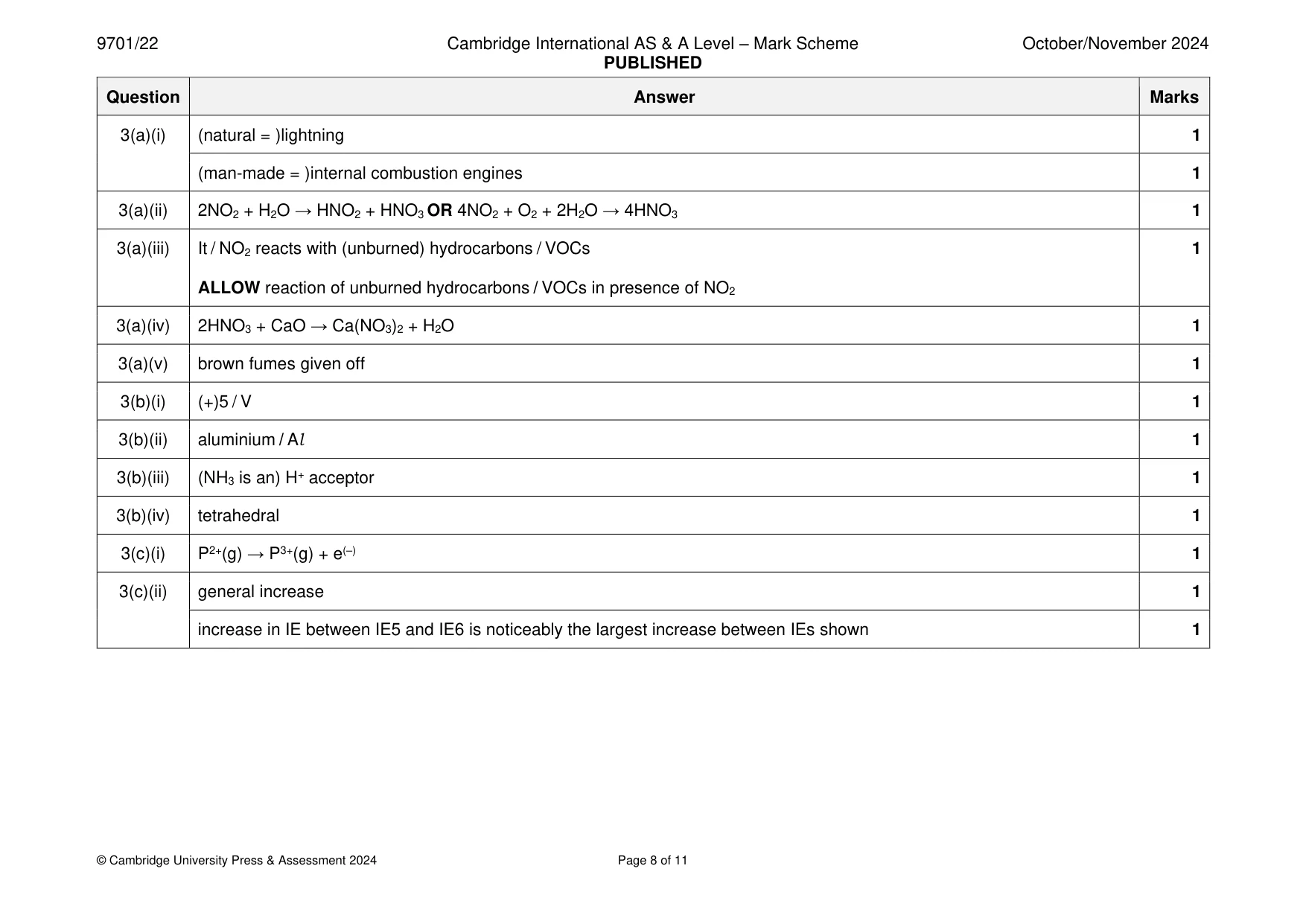
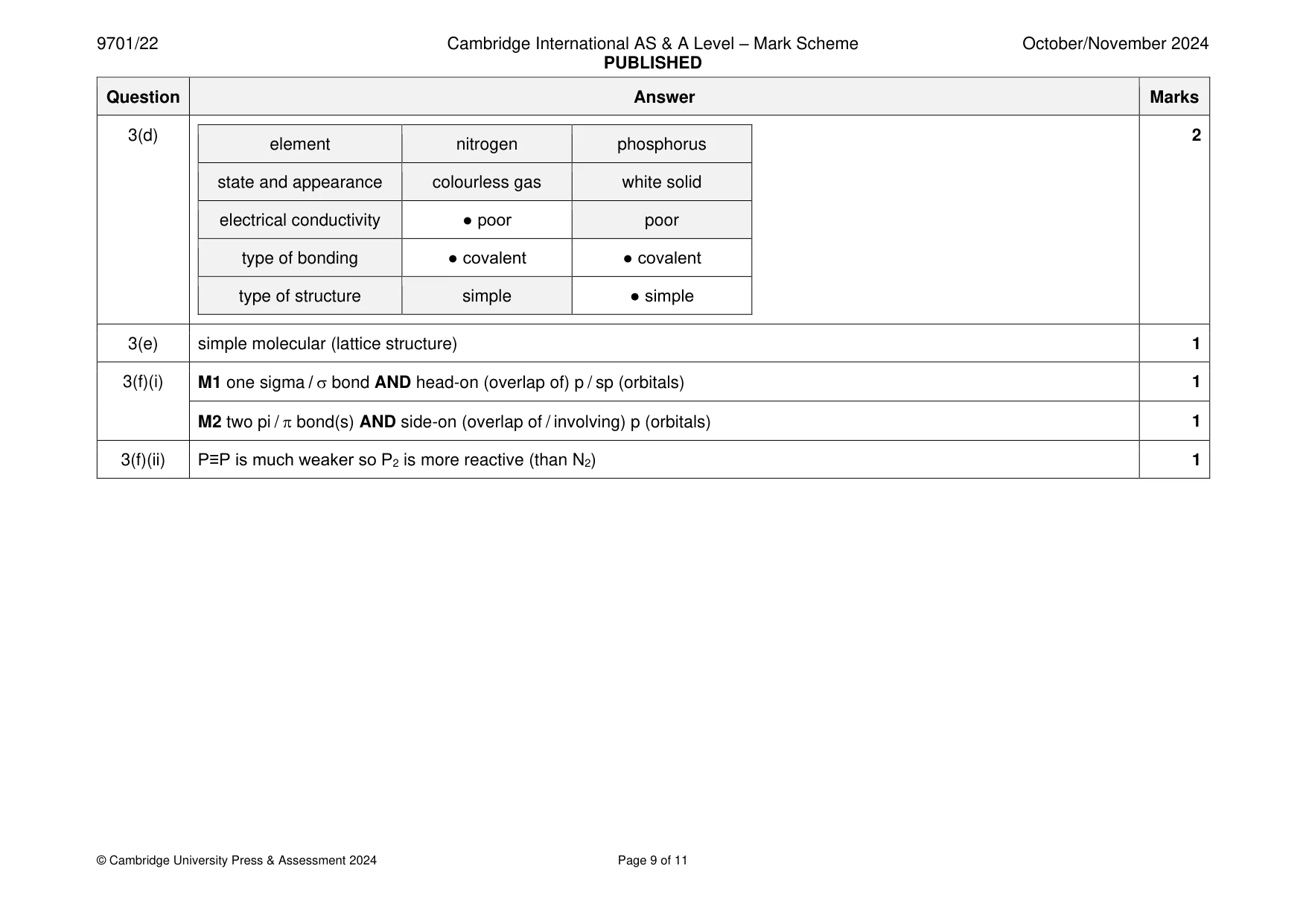
Mark scheme: 3(a)(i) (natural = )lightning 1 (man-made = )internal combustion engines 1 3(a)(ii) 2NO2 + H2O → HNO2 + HNO3 OR 4NO2 + O2 + 2H2O → 4HNO3 1 3(a)(iii) It / NO2 reacts with (unburned) hydrocarbons / VOCs 1 ALLOW reaction of unburned hydrocarbons / VOCs in presence of NO2 3(a)(iv) 2HNO3 + CaO → Ca(NO3)2 + H2O 1 3(a)(v) brown fumes given off 1 3(b)(i) (+)5 / V 1 3(b)(ii) aluminium / Al 1 3(b)(iii) (NH3 is an) H+ acceptor 1 3(b)(iv) tetrahedral 1 3(c)(i) P2+(g) → P3+(g) + e(–) 1 3(c)(ii) general increase 1 increase in IE between IE5 and IE6 is noticeably the largest increase between IEs shown 1 3(d) 2 element nitrogen phosphorus state and appearance colourless gas white solid electrical conductivity ● poor poor type of bonding ● covalent ● covalent type of structure simple ● simple 3(e) simple molecular (lattice structure) 1 3(f)(i) M1 one sigma / bond AND head-on (overlap of) p / sp (orbitals) 1 M2 two pi / bond(s) AND side-on (overlap of / involving) p (orbitals) 1 3(f)(ii) P≡P is much weaker so P2 is more reactive (than N2) 1
Q4 · Bromoalkanes are used widely in industry, although there is increasing concern about…
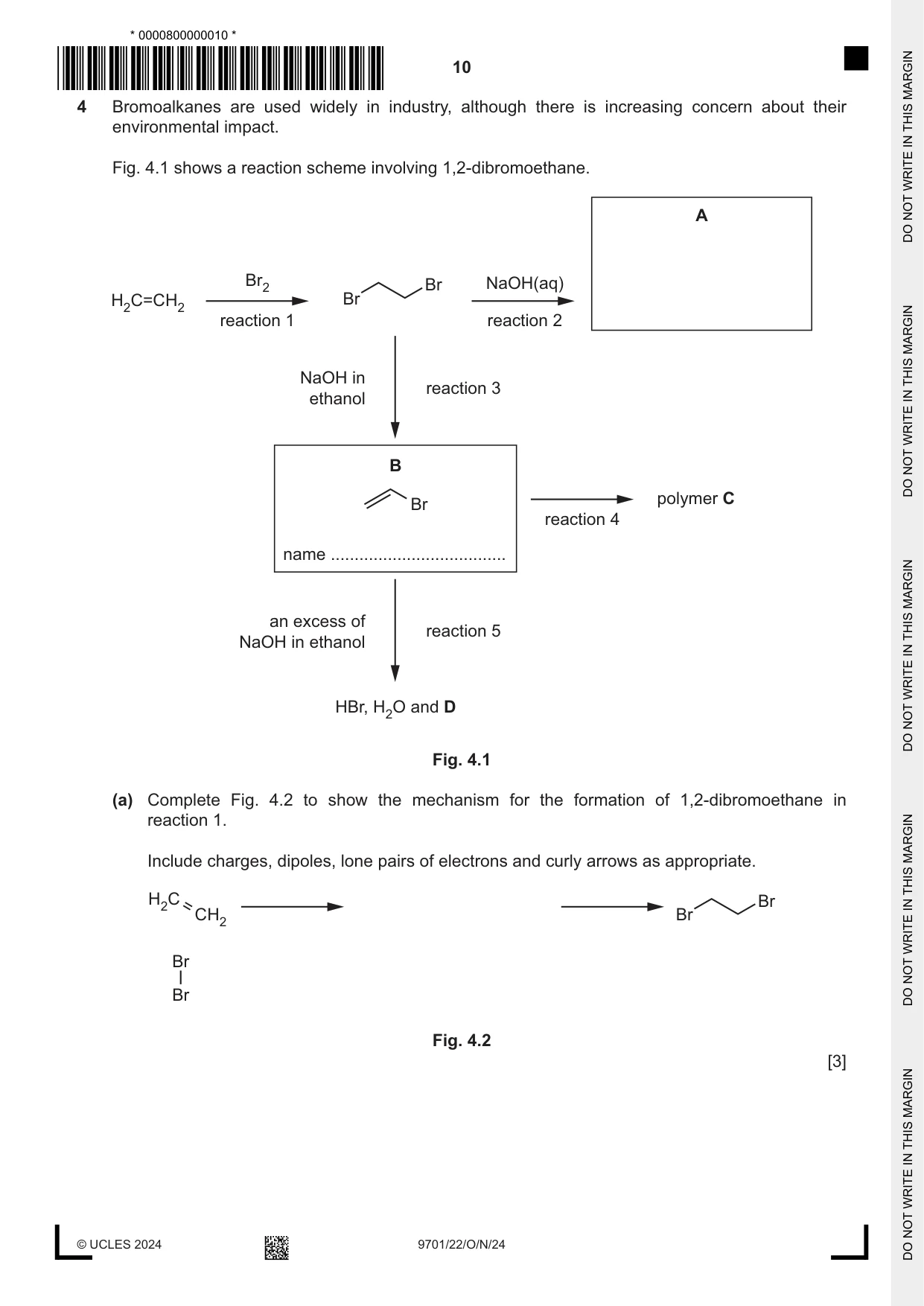
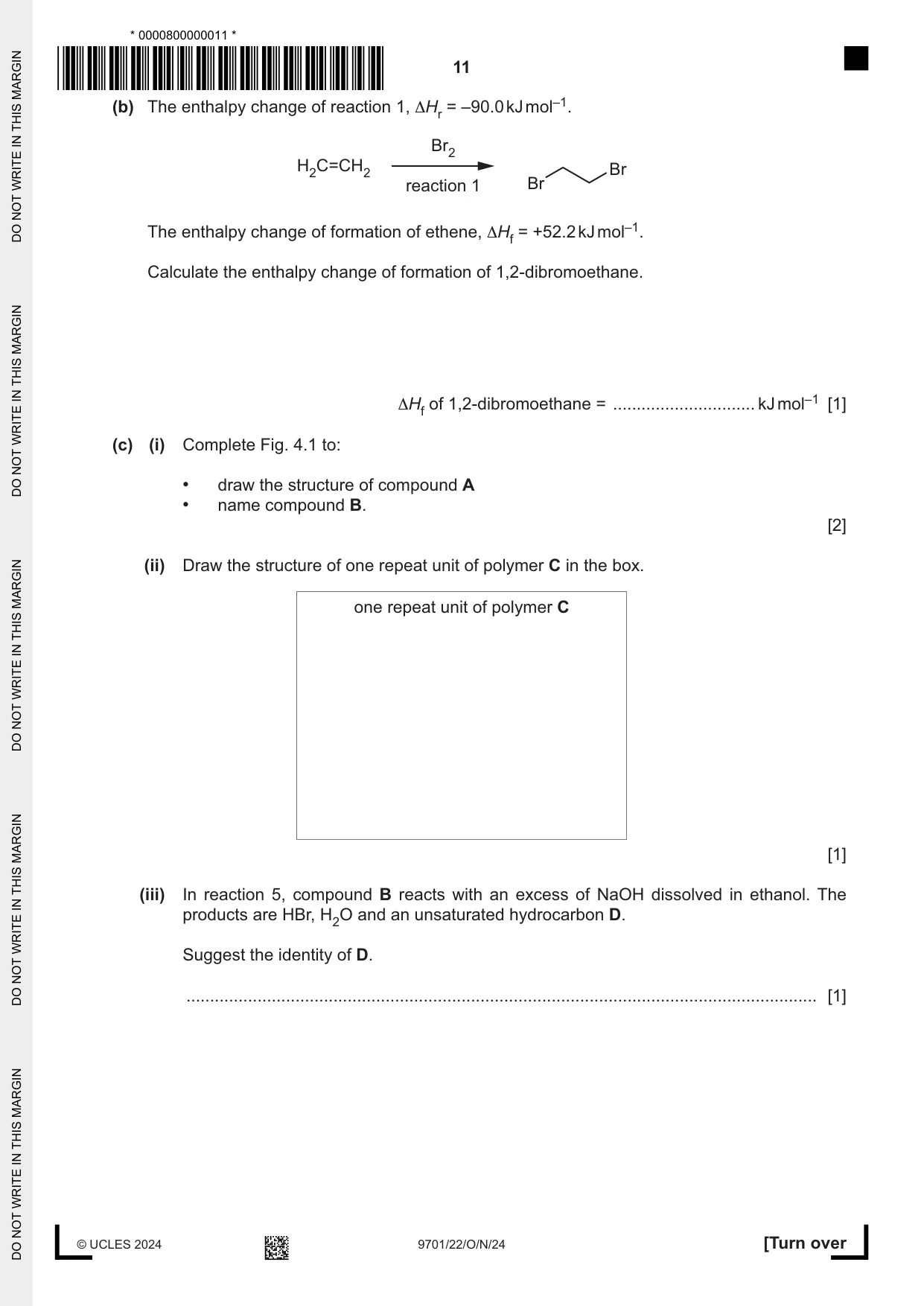
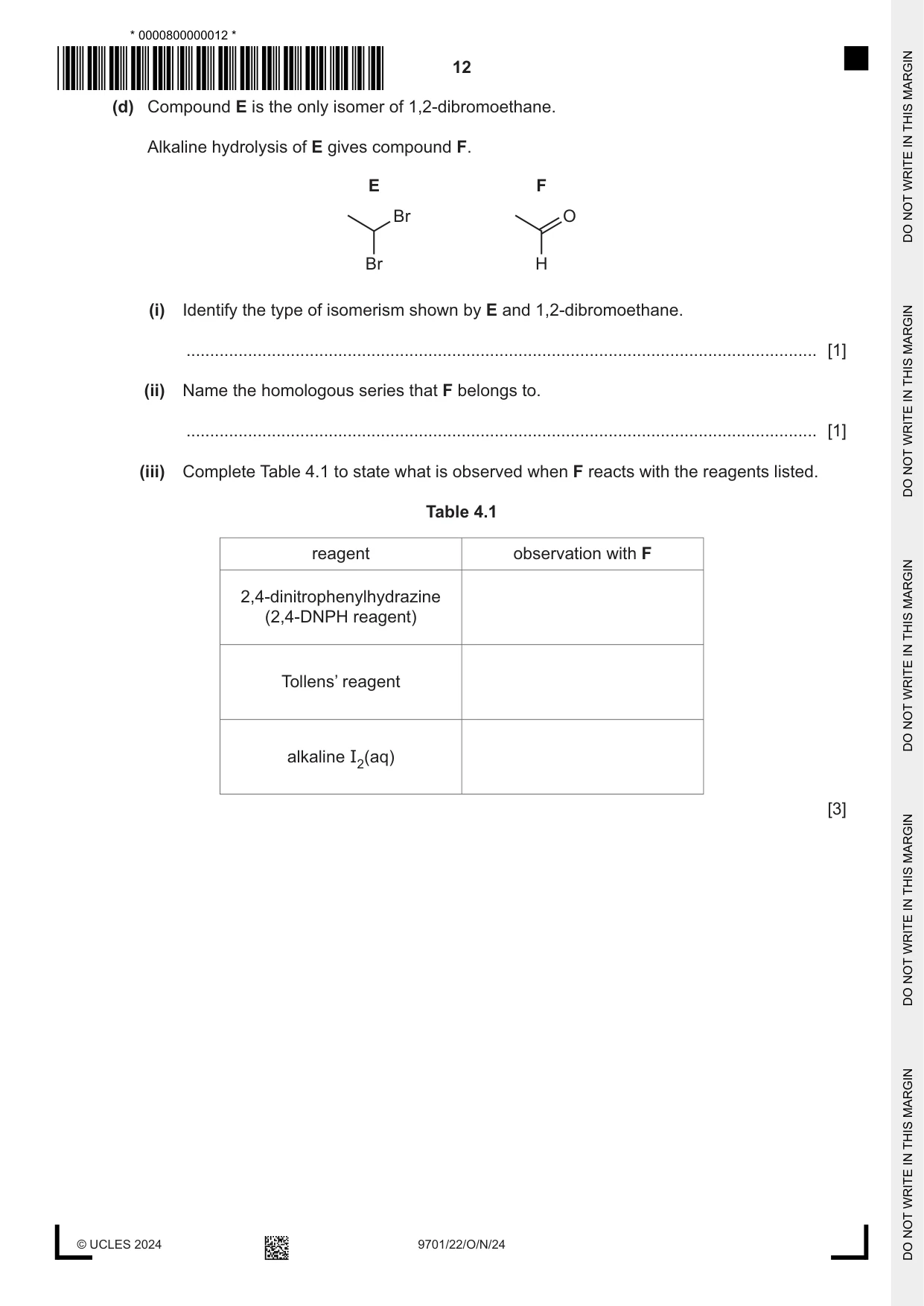
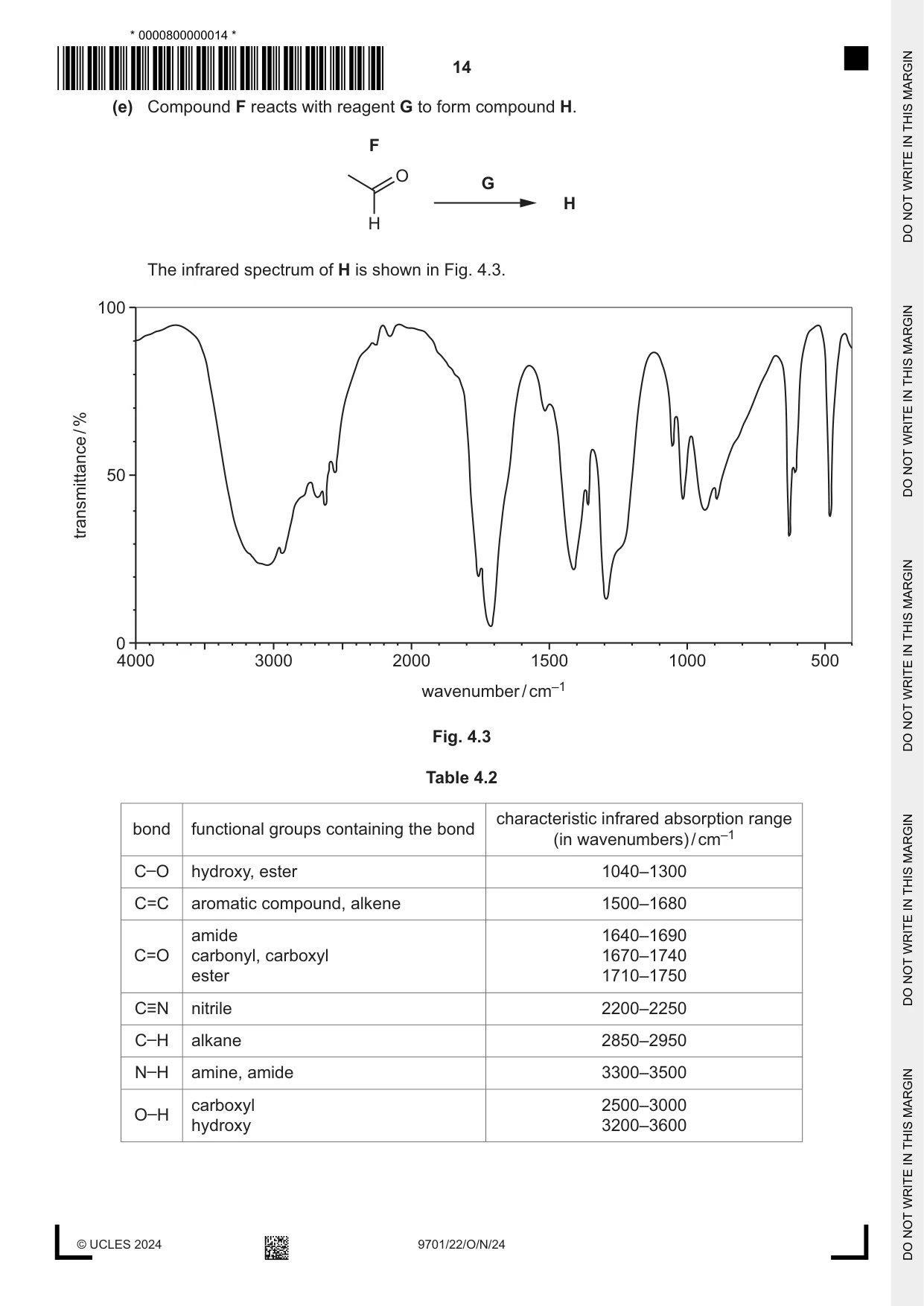
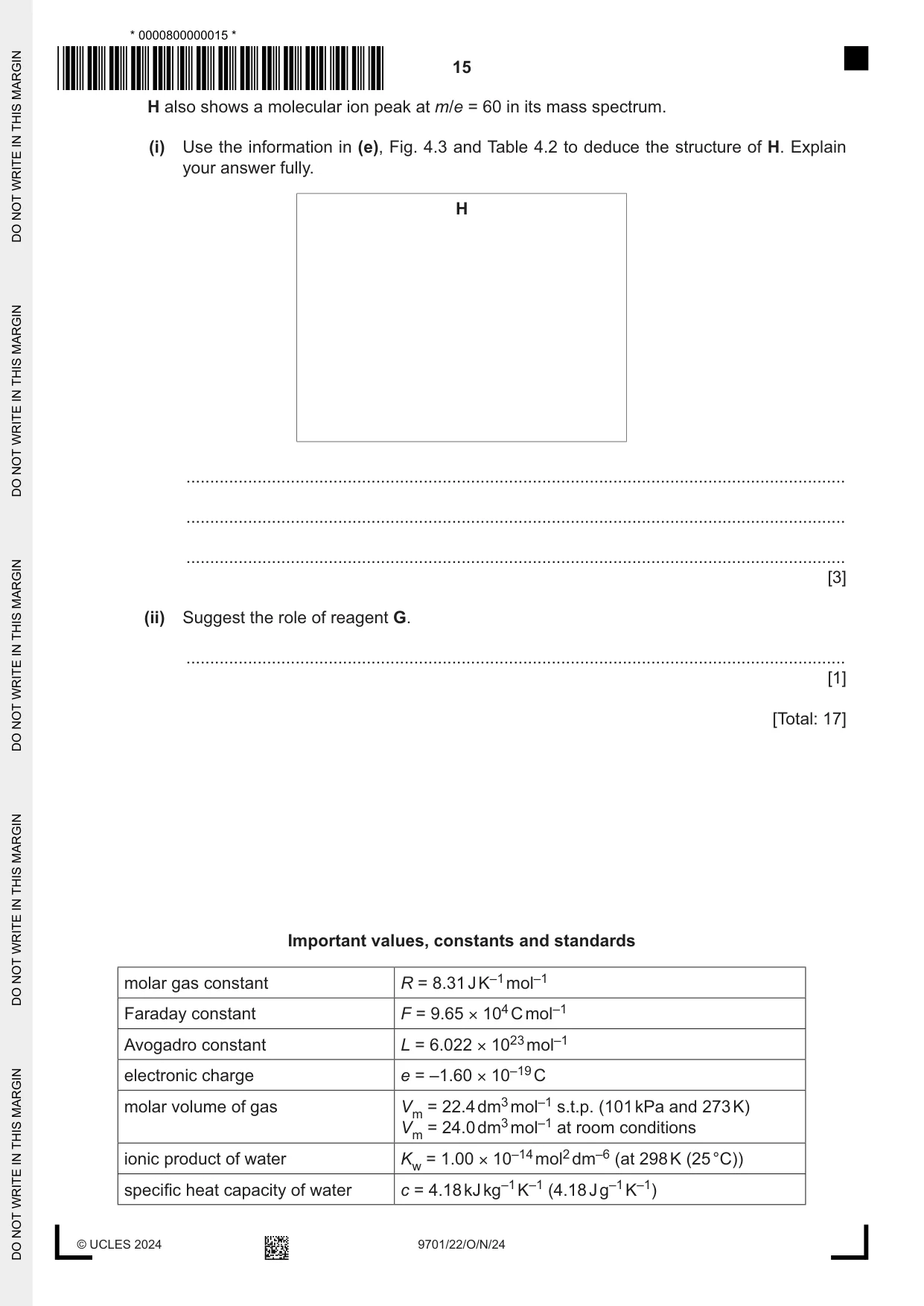
4 Bromoalkanes are used widely in industry, although there is increasing concern about their environmental impact. Fig. 4.1 shows a reaction scheme involving 1,2-dibromoethane. A Br2 Br NaOH(aq) H2C=CH2 Br reaction 1 reaction 2 NaOH in reaction 3 ethanol B polymer C Br reaction 4 name ..................................... an excess of reaction 5 NaOH in ethanol HBr, H2O and D Fig. 4.1 (a) Complete Fig. 4.2 to show the mechanism for the formation of 1,2-dibromoethane in reaction 1. Include charges, dipoles, lone pairs of electrons and curly arrows as appropriate. H2C= Br CH2 Br Br Br Fig. 4.2 [3] (b) The enthalpy change of reaction 1, ΔHr = –90.0 kJ mol–1. Br2 H2C=CH2 Br reaction 1 Br The enthalpy change of formation of ethene, ΔHf = +52.2 kJ mol–1. Calculate the enthalpy change of formation of 1,2-dibromoethane. ΔHf of 1,2-dibromoethane = .............................. kJ mol–1 [1] (c) (i) Complete Fig. 4.1 to: • draw the structure of compound A • name compound B. [2] (ii) Draw the structure of one repeat unit of polymer C in the box. one repeat unit of polymer C [1] (iii) In reaction 5, compound B reacts with an excess of NaOH dissolved in ethanol. The products are HBr, H2O and an unsaturated hydrocarbon D. Suggest the identity of D. ..................................................................................................................................... [1] (d) Compound E is the only isomer of 1,2-dibromoethane. Alkaline hydrolysis of E gives compound F. E F Br O Br H (i) Identify the type of isomerism shown by E and 1,2-dibromoethane. ..................................................................................................................................... [1] (ii) Name the homologous series that F belongs to. ..................................................................................................................................... [1] (iii) Complete Table 4.1 to state what is observed when F reacts with the reagents listed. Table 4.1 reagent observation with F 2,4-dinitrophenylhydrazine (2,4-DNPH reagent) Tollens’ reagent alkaline I2(aq) [3]
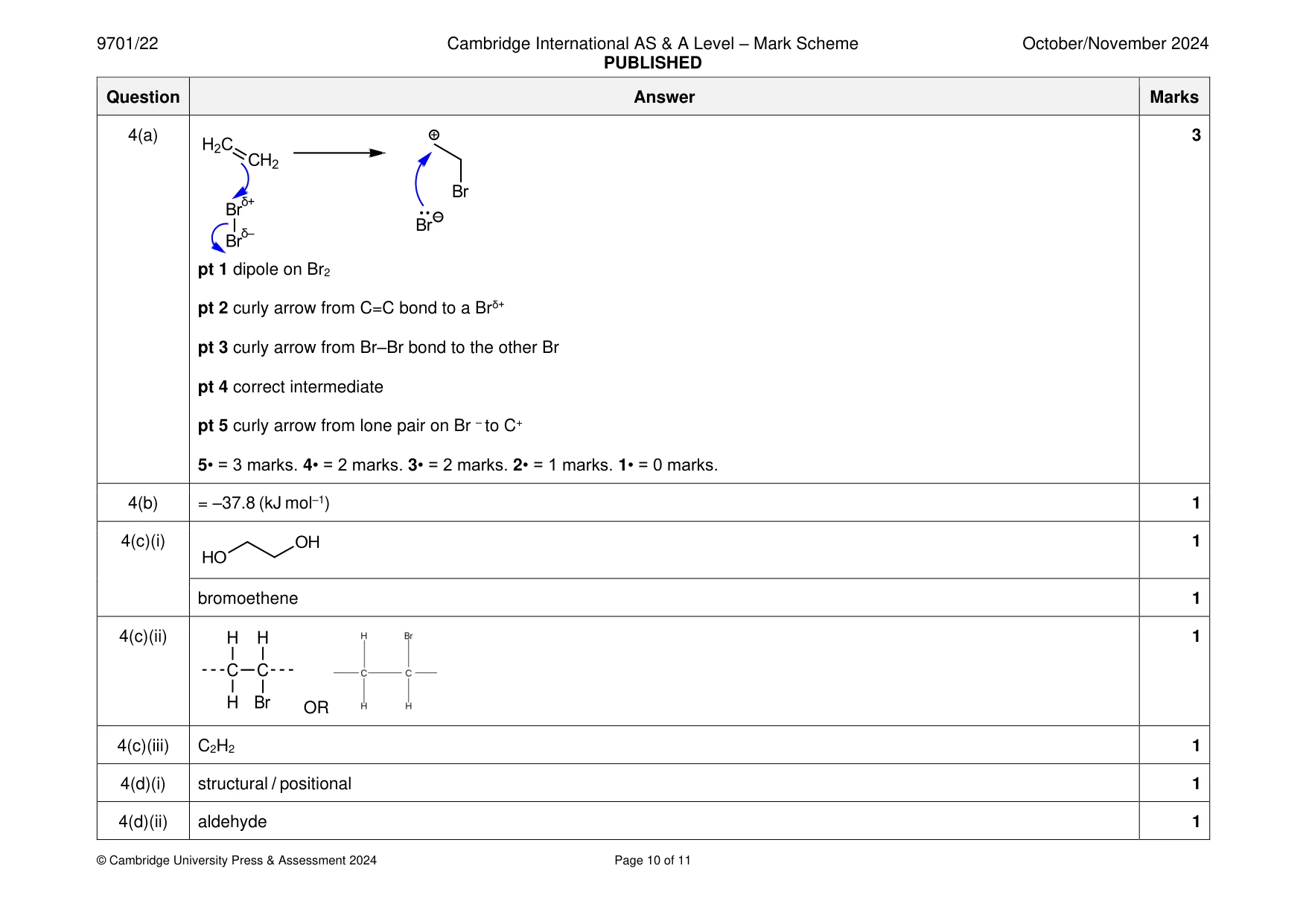
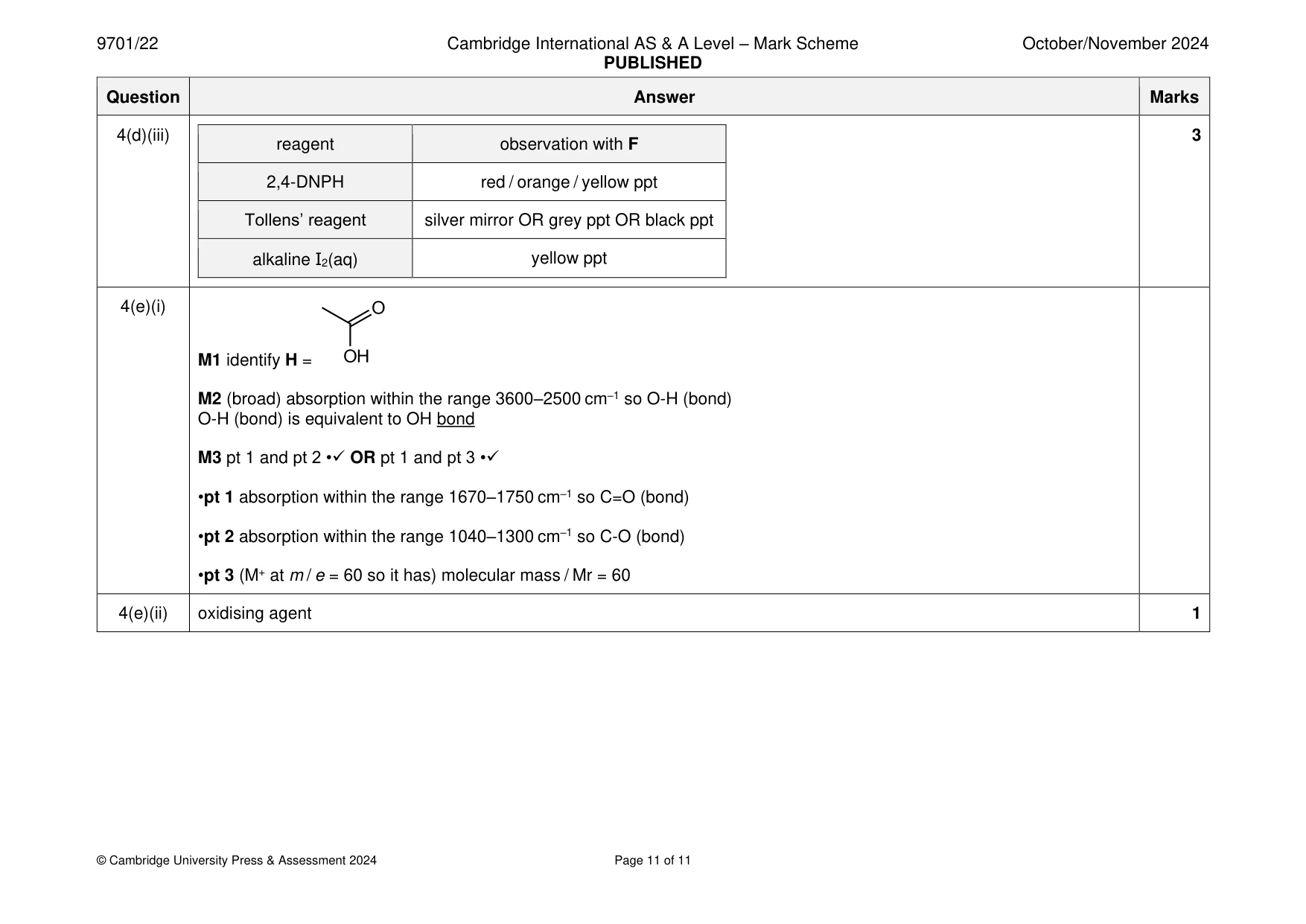
Mark scheme: 4(a) 3 pt 1 dipole on Br2 pt 2 curly arrow from C=C bond to a Brδ+ pt 3 curly arrow from Br–Br bond to the other Br pt 4 correct intermediate pt 5 curly arrow from lone pair on Br – to C+ 5• = 3 marks. 4• = 2 marks. 3• = 2 marks. 2• = 1 marks. 1• = 0 marks. 4(b) = –37.8 (kJ mol–1) 1 4(c)(i) 1 bromoethene 1 4(c)(ii) 1 OR 4(c)(iii) C2H2 1 4(d)(i) structural / positional 1 4(d)(ii) aldehyde 1 4(d)(iii) 3 reagent observation with F 2,4-DNPH red / orange / yellow ppt Tollens’ reagent silver mirror OR grey ppt OR black ppt alkaline I2(aq) yellow ppt 4(e)(i) M1 identify H = M2 (broad) absorption within the range 3600–2500 cm–1 so O-H (bond) O-H (bond) is equivalent to OH bond M3 pt 1 and pt 2 •✓ OR pt 1 and pt 3 •✓ •pt 1 absorption within the range 1670–1750 cm–1 so C=O (bond) •pt 2 absorption within the range 1040–1300 cm–1 so C-O (bond) •pt 3 (M+ at m / e = 60 so it has) molecular mass / Mr = 60 4(e)(ii) oxidising agent 1
What was in this paper
The subtopics covered by these 4 questions, and how many questions each got. Open one in a new tab to see every Cambridge question on it.
What you needed in this session
Cambridge’s own grade thresholds for 2024 Oct/Nov, Paper 2 · Variant 2. A higher threshold means an easier paper — the bar moves with how the cohort did.