Cambridge A Level Chemistry 9701 — 2024 May/June Paper 2 · Variant 2
9701/22/M/J/24 · 5 questions · 60 marks · ≈68 min
The question paper and its mark scheme, free to read here and free to download. This is Cambridge’s own paper, exactly as it was sat.
Question paper16 pages

Mark scheme13 pages
Answers below. Sit the paper first if you are practising.
Questions as text
Q1 · Complete Table 1.1 using relevant information from the Periodic Table
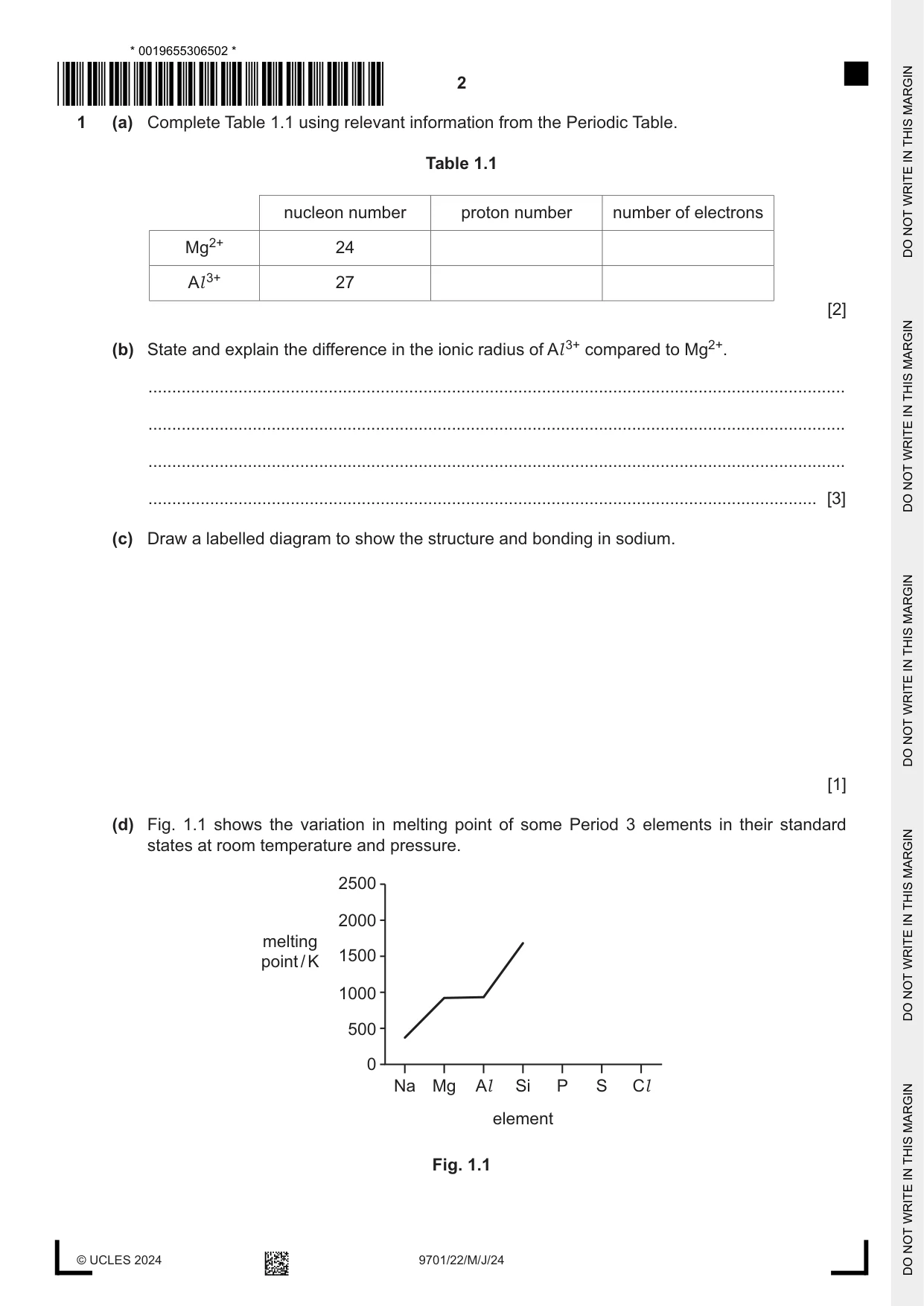
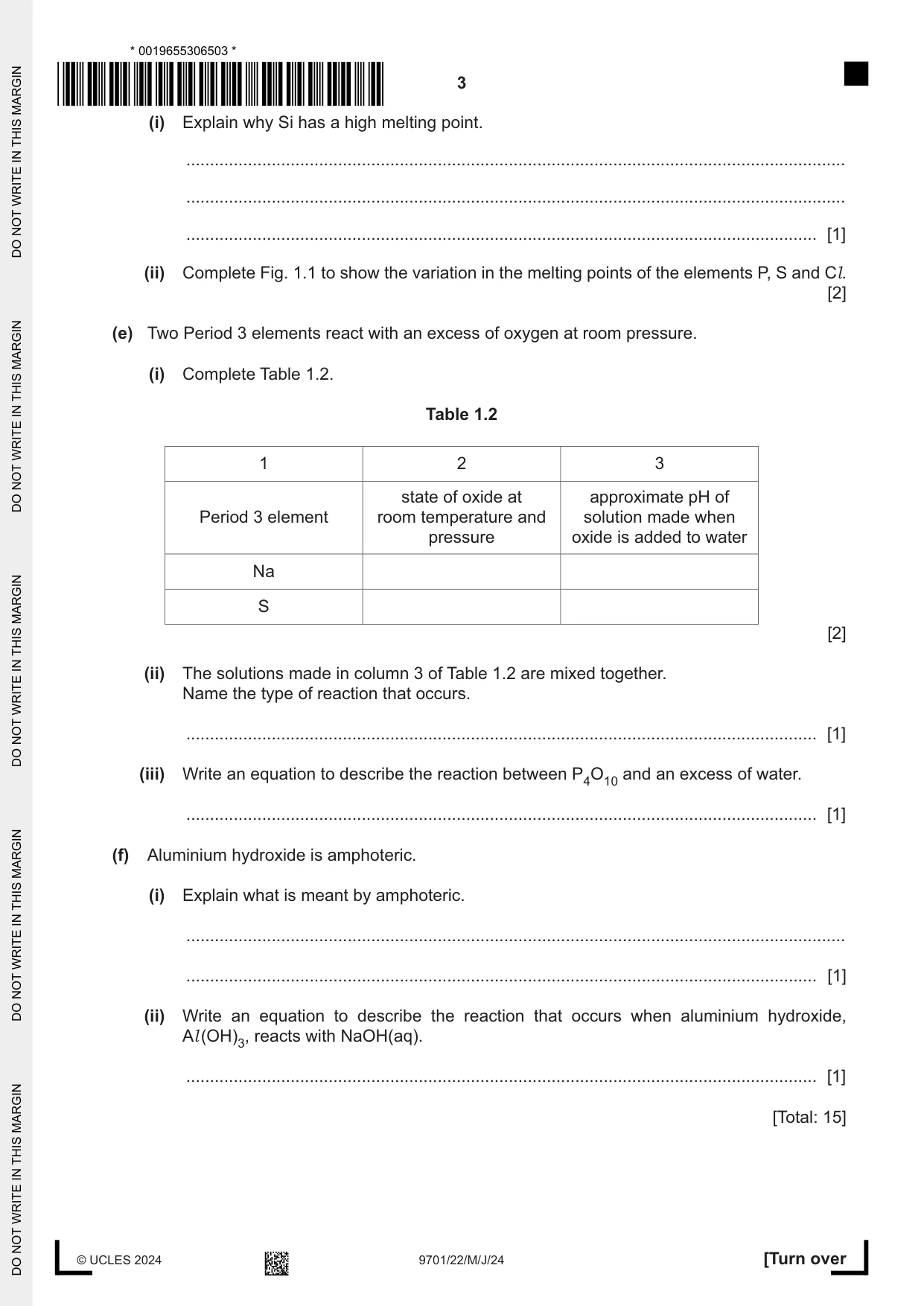
1 (a) Complete Table 1.1 using relevant information from the Periodic Table. Table 1.1 nucleon number proton number number of electrons Mg2+ 24 Al 3+ 27 [2] (b) State and explain the difference in the ionic radius of Al 3+ compared to Mg2+. ................................................................................................................................................... ................................................................................................................................................... ................................................................................................................................................... ............................................................................................................................................. [3] (c) Draw a labelled diagram to show the structure and bonding in sodium. [1] (d) Fig. 1.1 shows the variation in melting point of some Period 3 elements in their standard states at room temperature and pressure. 2500 2000 melting 1500 point / K 1000 500 0 Na Mg Al Si P S Cl element Fig. 1.1 (i) Explain why Si has a high melting point. ........................................................................................................................................... ........................................................................................................................................... ..................................................................................................................................... [1] (ii) Complete Fig. 1.1 to show the variation in the melting points of the elements P, S and Cl. [2] (e) Two Period 3 elements react with an excess of oxygen at room pressure. (i) Complete Table 1.2. Table 1.2 1 2 3 state of oxide at approximate pH of Period 3 element room temperature and solution made when pressure oxide is added to water Na S [2] (ii) The solutions made in column 3 of Table 1.2 are mixed together. Name the type of reaction that occurs. ..................................................................................................................................... [1] (iii) Write an equation to describe the reaction between P4O10 and an excess of water. ..................................................................................................................................... [1] (f) Aluminium hydroxide is amphoteric. (i) Explain what is meant by amphoteric. ........................................................................................................................................... ..................................................................................................................................... [1] (ii) Write an equation to describe the reaction that occurs when aluminium hydroxide, Al (OH)3, reacts with NaOH(aq). ..................................................................................................................................... [1] [Total: 15]
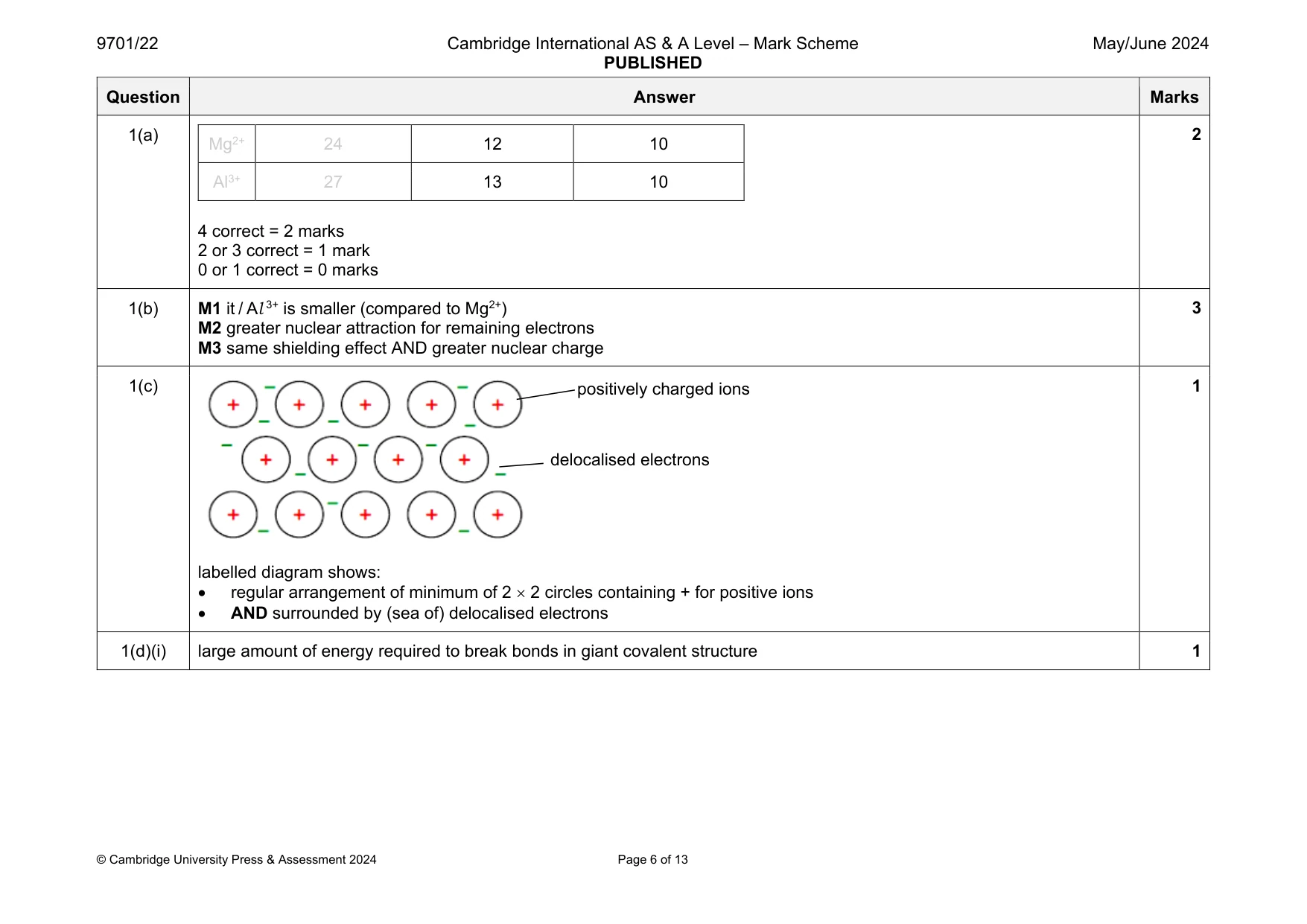
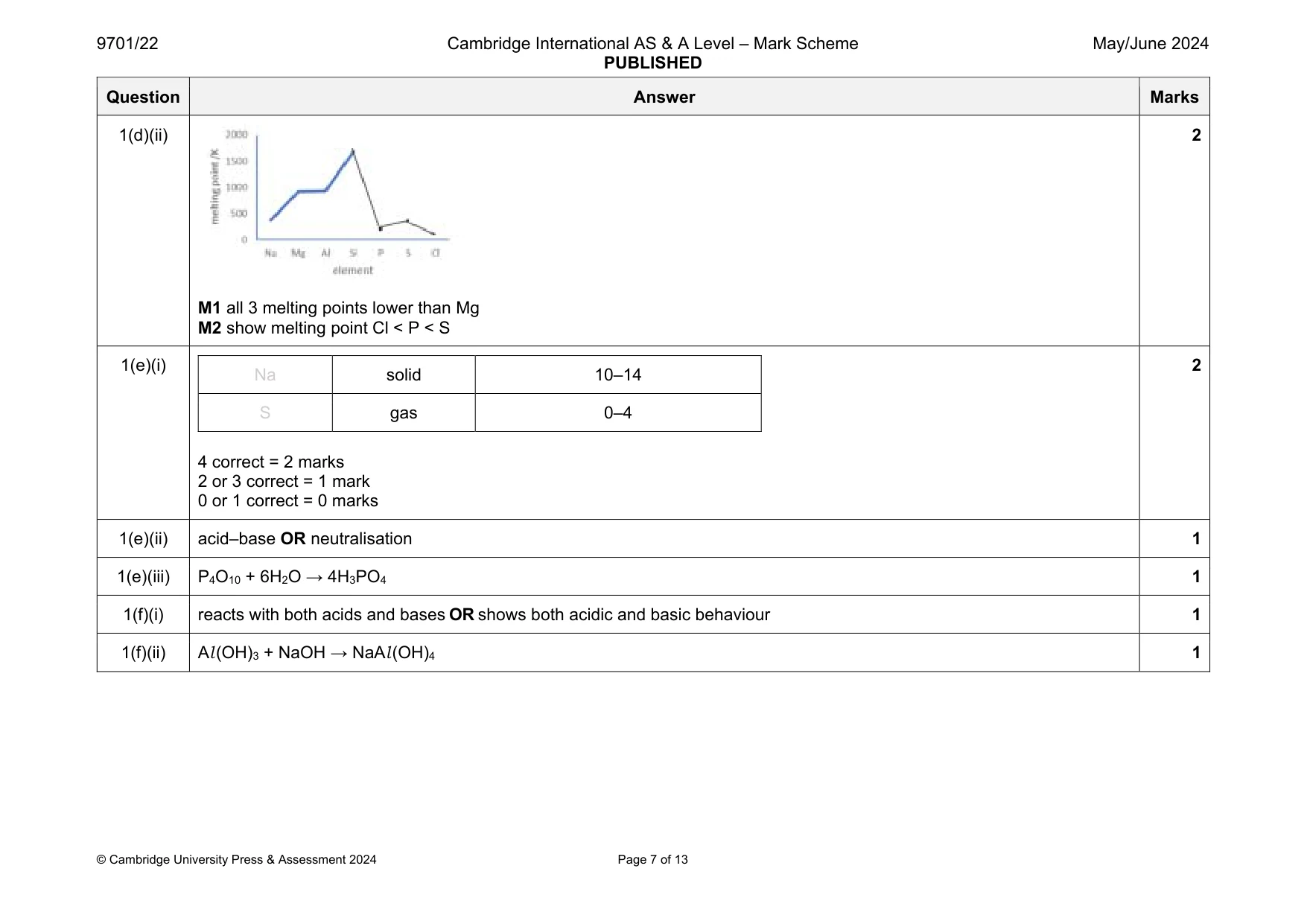
Mark scheme: 1(a) Mg2+ 24 12 10 Al3+ 27 13 10 4 correct = 2 marks 2 or 3 correct = 1 mark 0 or 1 correct = 0 marks 1(b) M1 it / Al 3+ is smaller (compared to Mg2+) M2 greater nuclear attraction for remaining electrons M3 same shielding effect AND greater nuclear charge 3 1(c) labelled diagram shows: regular arrangement of minimum of 2 2 circles containing + for positive ions AND surrounded by (sea of) delocalised electrons 1 1(d)(i) large amount of energy required to break bonds in giant covalent structure 1 delocalised electrons positively charged ions Question Answer Marks 1(d)(ii) M1 all 3 melting points lower than Mg M2 show melting point Cl < P < S 2 1(e)(i) Na solid 10–14 S gas 0–4 4 correct = 2 marks 2 or 3 correct = 1 mark 0 or 1 correct = 0 marks 2 1(e)(ii) acid–base OR neutralisation 1 1(e)(iii) P4O10 + 6H2O → 4H3PO4 1 1(f)(i) reacts with both acids and bases OR shows both acidic and basic behaviour 1 1(f)(ii) Al (OH)3 + NaOH → NaAl (OH)4 1
More questions on Periodicity of chemical properties of the elements in Period 3
Q2 · Separate samples of Na2CO3 and NaHCO3 react with HCl (aq) to produce the same products…
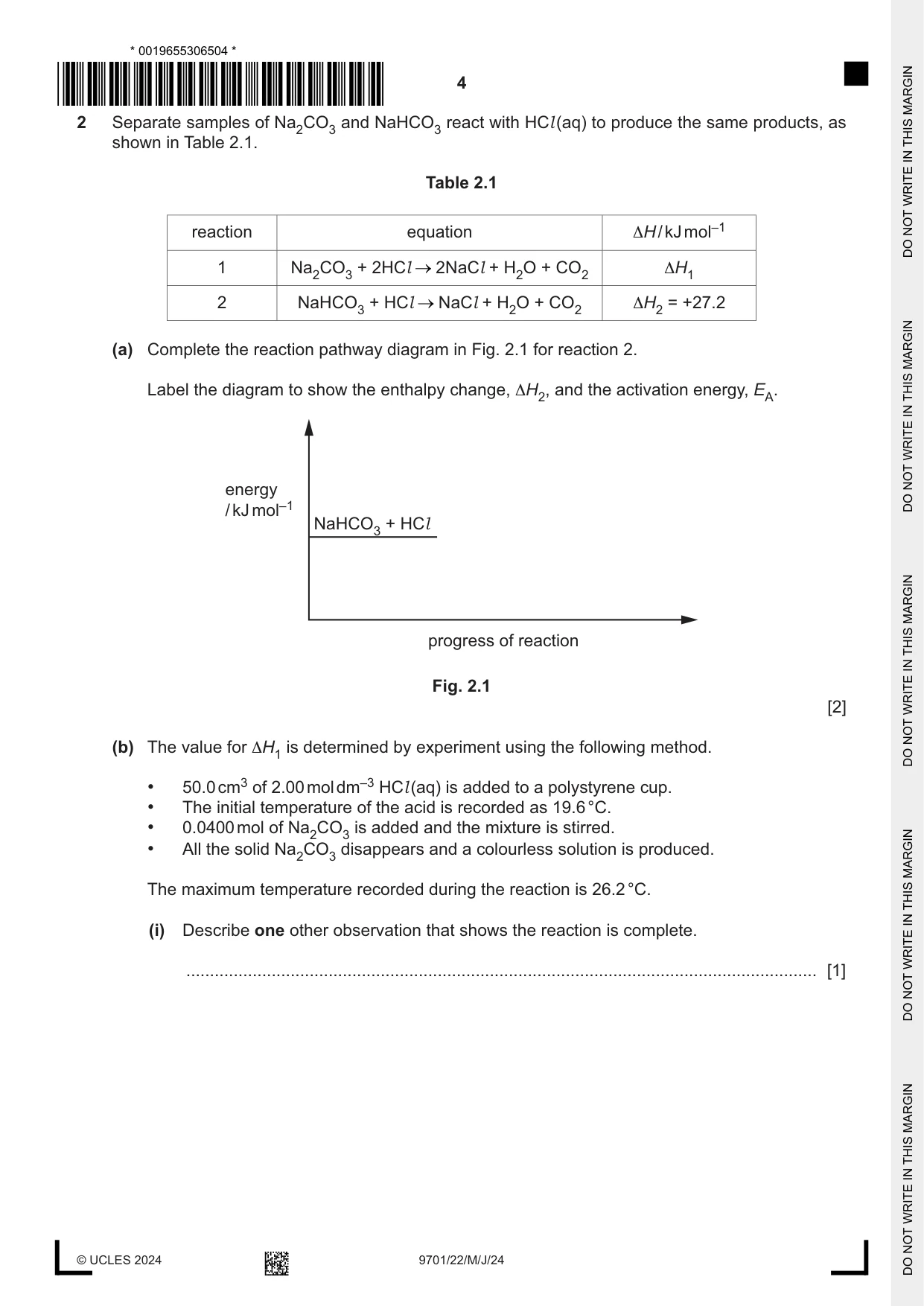
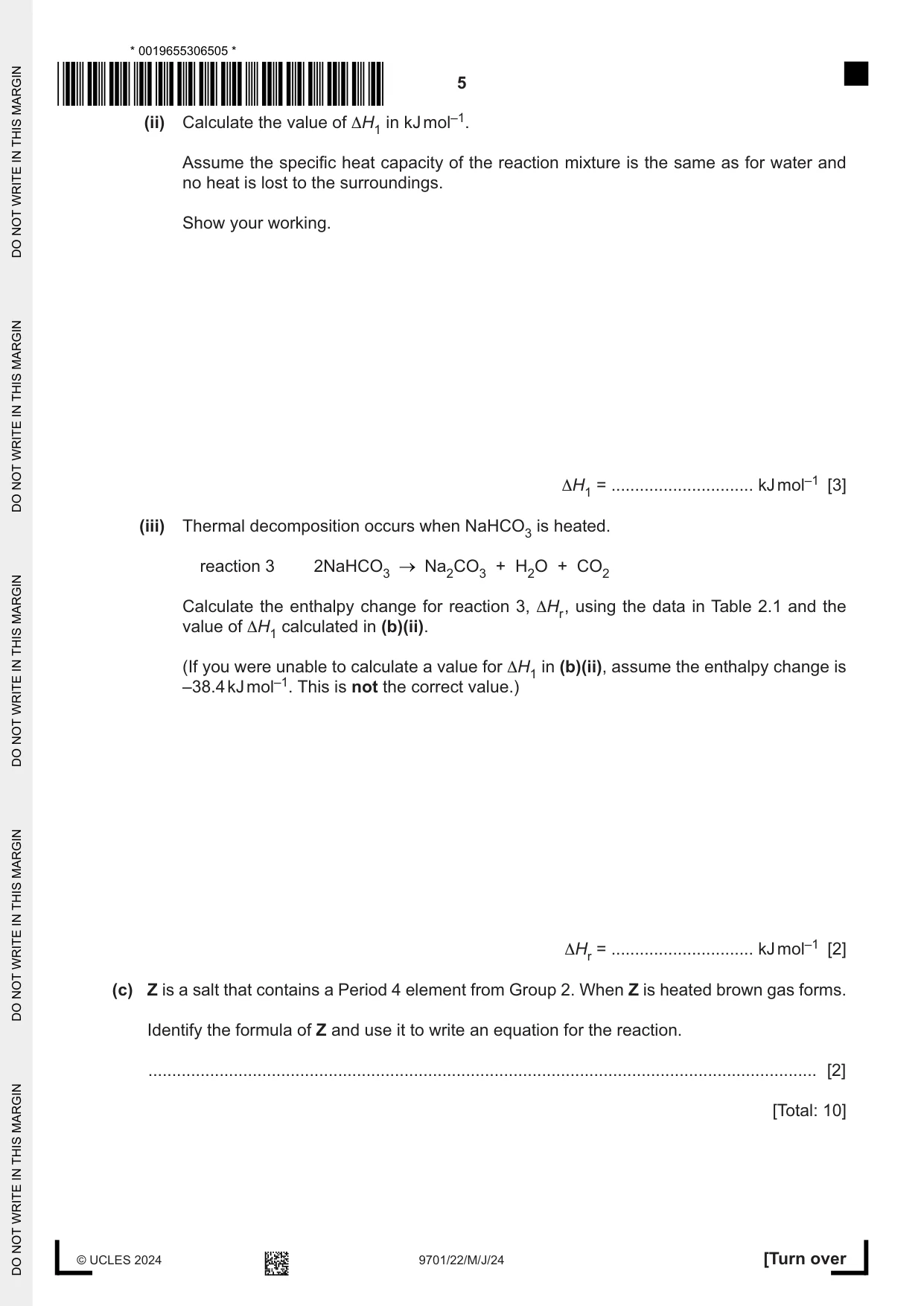
2 Separate samples of Na2CO3 and NaHCO3 react with HCl (aq) to produce the same products, as shown in Table 2.1. Table 2.1 reaction equation ∆H / kJ mol–1 1 Na2CO3 + 2HCl 2NaCl + H2O + CO2 ∆H1 2 NaHCO3 + HCl NaCl + H2O + CO2 ∆H2 = +27.2 (a) Complete the reaction pathway diagram in Fig. 2.1 for reaction 2. Label the diagram to show the enthalpy change, ∆H2, and the activation energy, EA. energy / kJ mol–1 NaHCO3 + HCl progress of reaction Fig. 2.1 [2] (b) The value for ∆H1 is determined by experiment using the following method. • 50.0 cm3 of 2.00 mol dm–3 HCl (aq) is added to a polystyrene cup. • The initial temperature of the acid is recorded as 19.6 °C. • 0.0400 mol of Na2CO3 is added and the mixture is stirred. • All the solid Na2CO3 disappears and a colourless solution is produced. The maximum temperature recorded during the reaction is 26.2 °C. (i) Describe one other observation that shows the reaction is complete. ..................................................................................................................................... [1] (ii) Calculate the value of ∆H1 in kJ mol–1. Assume the specific heat capacity of the reaction mixture is the same as for water and no heat is lost to the surroundings. Show your working. ∆H1 = .............................. kJ mol–1 [3] (iii) Thermal decomposition occurs when NaHCO3 is heated. reaction 3 2NaHCO3 Na2CO3 + H2O + CO2 Calculate the enthalpy change for reaction 3, ∆Hr , using the data in Table 2.1 and the value of ∆H1 calculated in (b)(ii). (If you were unable to calculate a value for ∆H1 in (b)(ii), assume the enthalpy change is –38.4 kJ mol–1. This is not the correct value.) ∆Hr = .............................. kJ mol–1 [2] (c) Z is a salt that contains a Period 4 element from Group 2. When Z is heated brown gas forms. Identify the formula of Z and use it to write an equation for the reaction. ............................................................................................................................................. [2] [Total: 10]
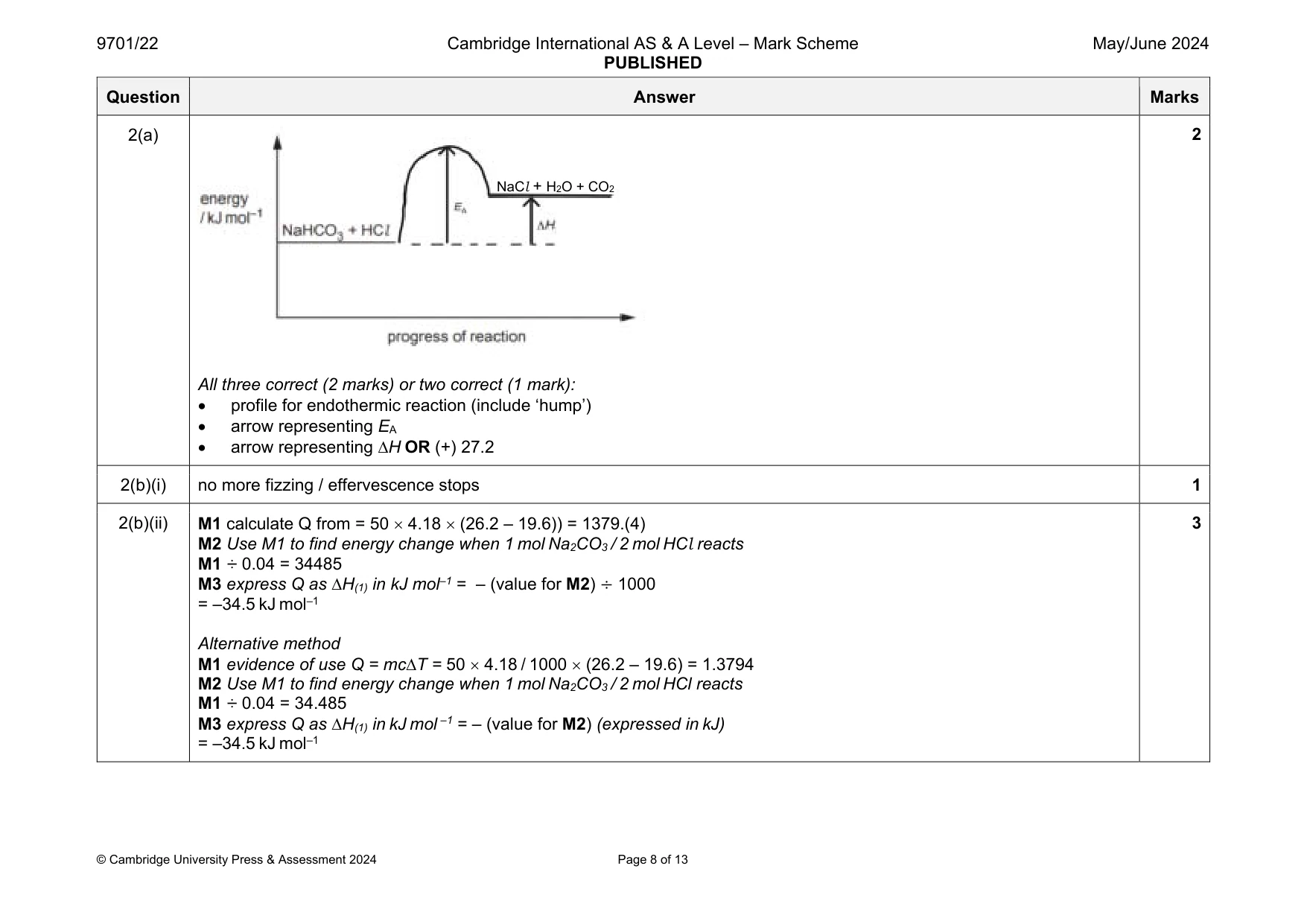
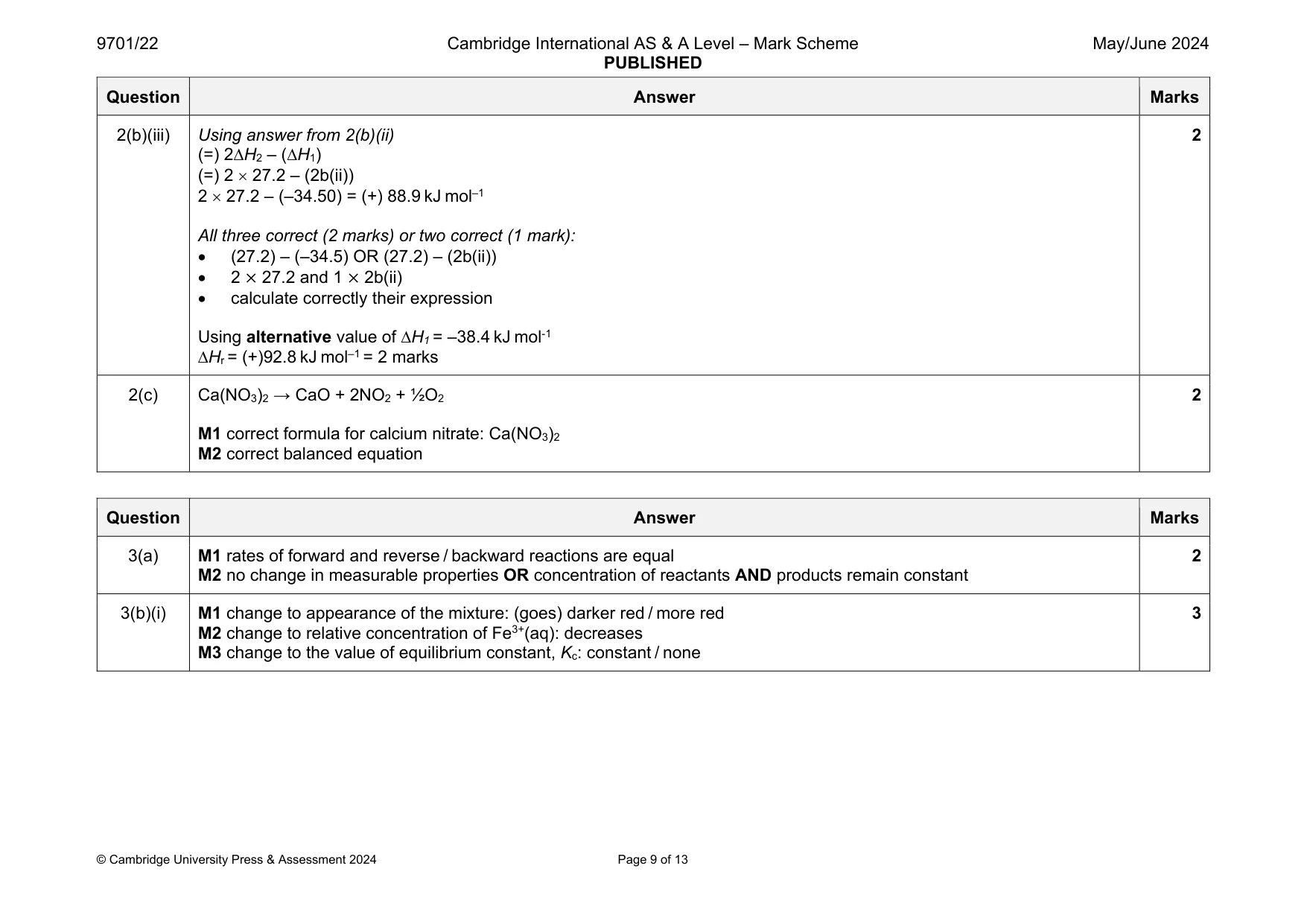
Mark scheme: 2(a) All three correct (2 marks) or two correct (1 mark): profile for endothermic reaction (include ‘hump’) arrow representing EA arrow representing ∆H OR (+) 27.2 2(b)(i) no more fizzing / effervescence stops 1 2(b)(ii) M1 calculate Q from = 50 4.18 (26.2 – 19.6)) = 1379.(4) M2 Use M1 to find energy change when 1 mol Na2CO3 / 2 mol HCl reacts M1 ÷ 0.04 = 34485 M3 express Q as ∆H(1) in kJ mol–1 = – (value for M2) ൊ 1000 = –34.5 kJ mol–1 Alternative method M1 evidence of use Q = mc∆T = 50 4.18 / 1000 (26.2 – 19.6) = 1.3794 M2 Use M1 to find energy change when 1 mol Na2CO3 / 2 mol HCl reacts M1 ÷ 0.04 = 34.485 M3 express Q as ∆H(1) in kJ mol –1 = – (value for M2) (expressed in kJ) = –34.5 kJ mol–1 3 Question Answer Marks 2(b)(iii) Using answer from 2(b)(ii) (=) 2∆H2 – (∆H1) (=) 2 27.2 – (2b(ii)) 2 27.2 – (–34.50) = (+) 88.9 kJ mol–1 All three correct (2 marks) or two correct (1 mark): (27.2) – (–34.5) OR (27.2) – (2b(ii)) 2 × 27.2 and 1 × 2b(ii) calculate correctly their expression Using alternative value of ∆H1 = –38.4 kJ mol-1 ∆Hr = (+)92.8 kJ mol–1 = 2 marks 2 2(c) Ca(NO3)2 → CaO + 2NO2 + ½O2 M1 correct formula for calcium nitrate: Ca(NO3)2 M2 correct balanced equation 2
Q3 · Describe what is meant by dynamic equilibrium
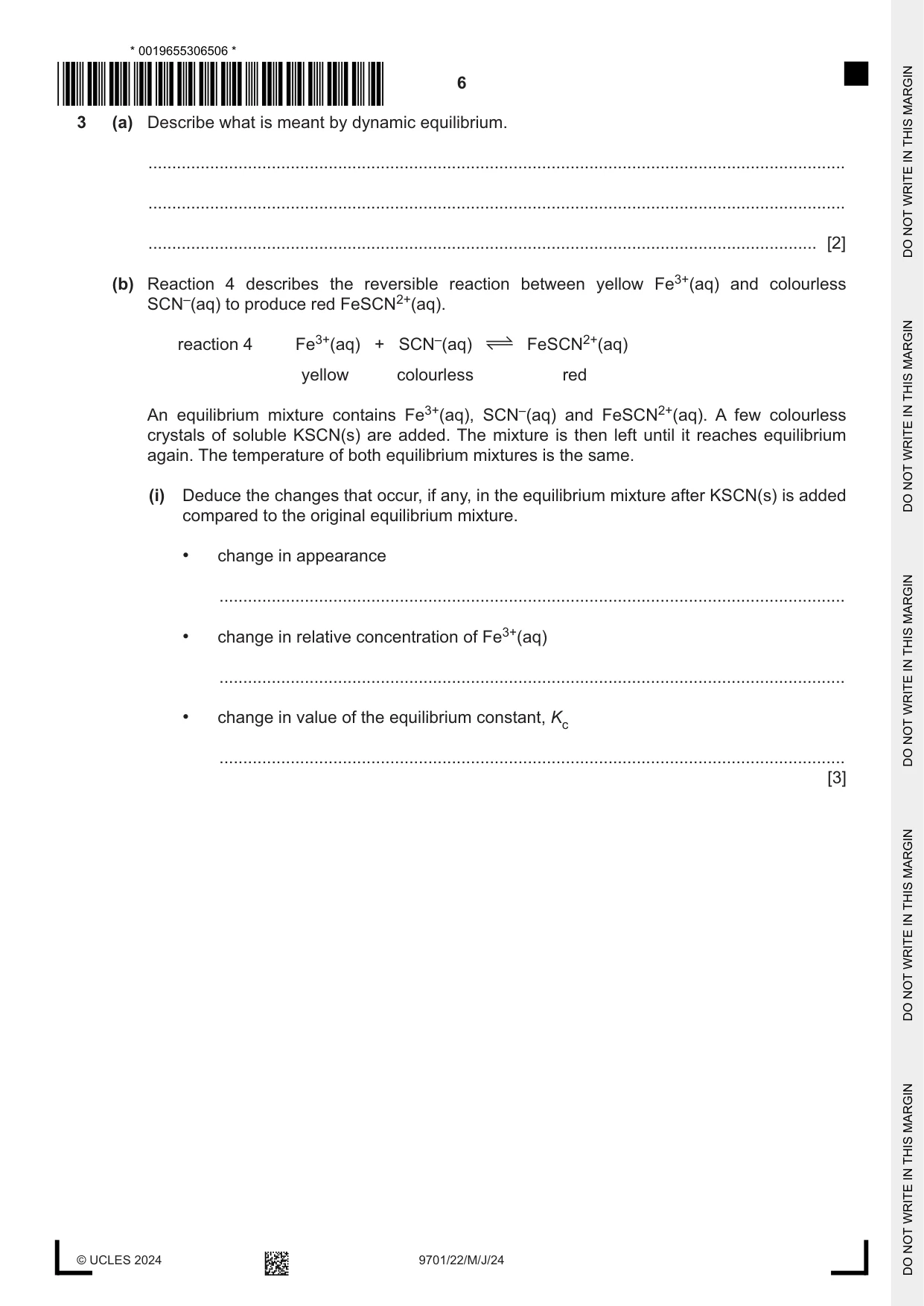
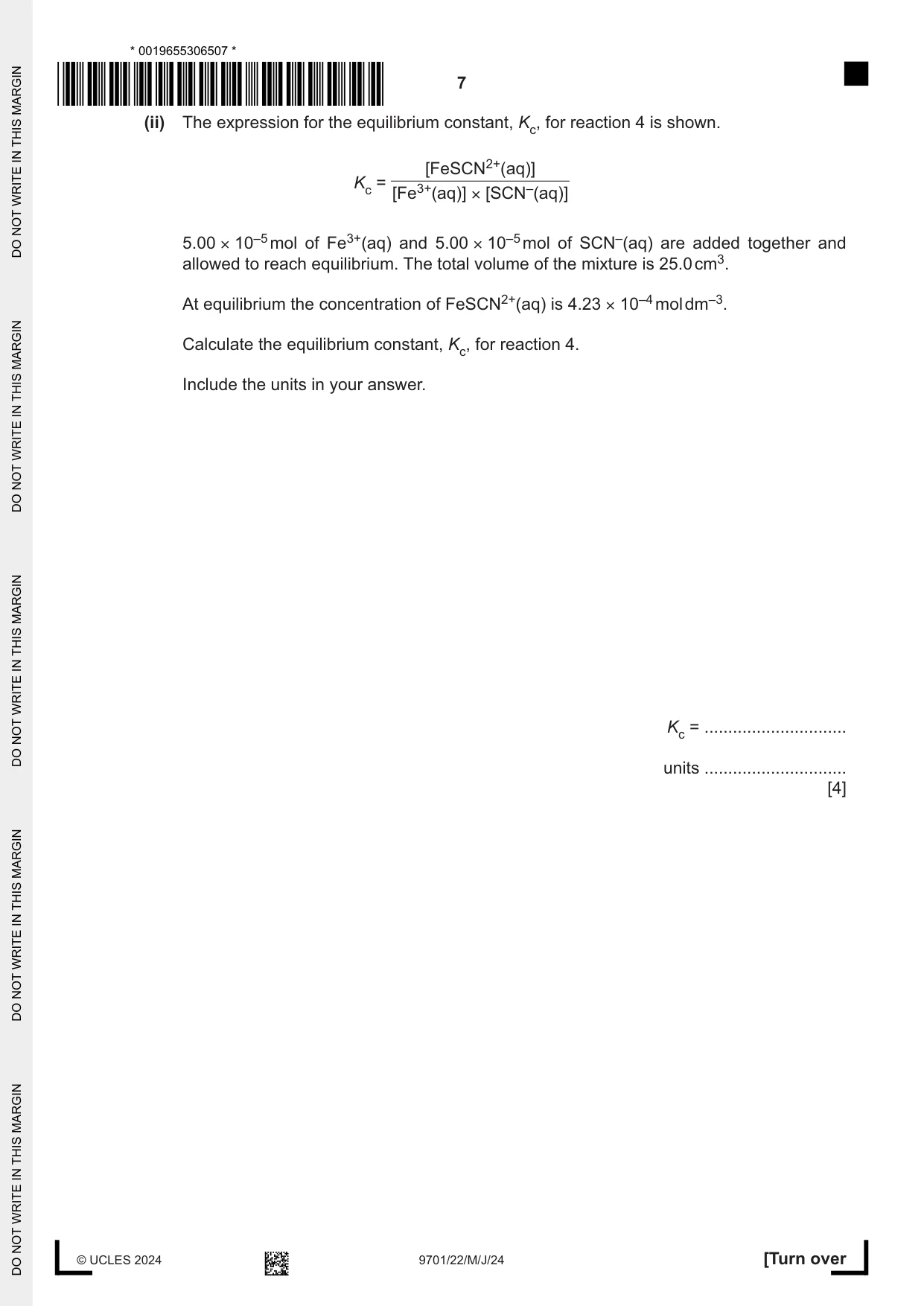
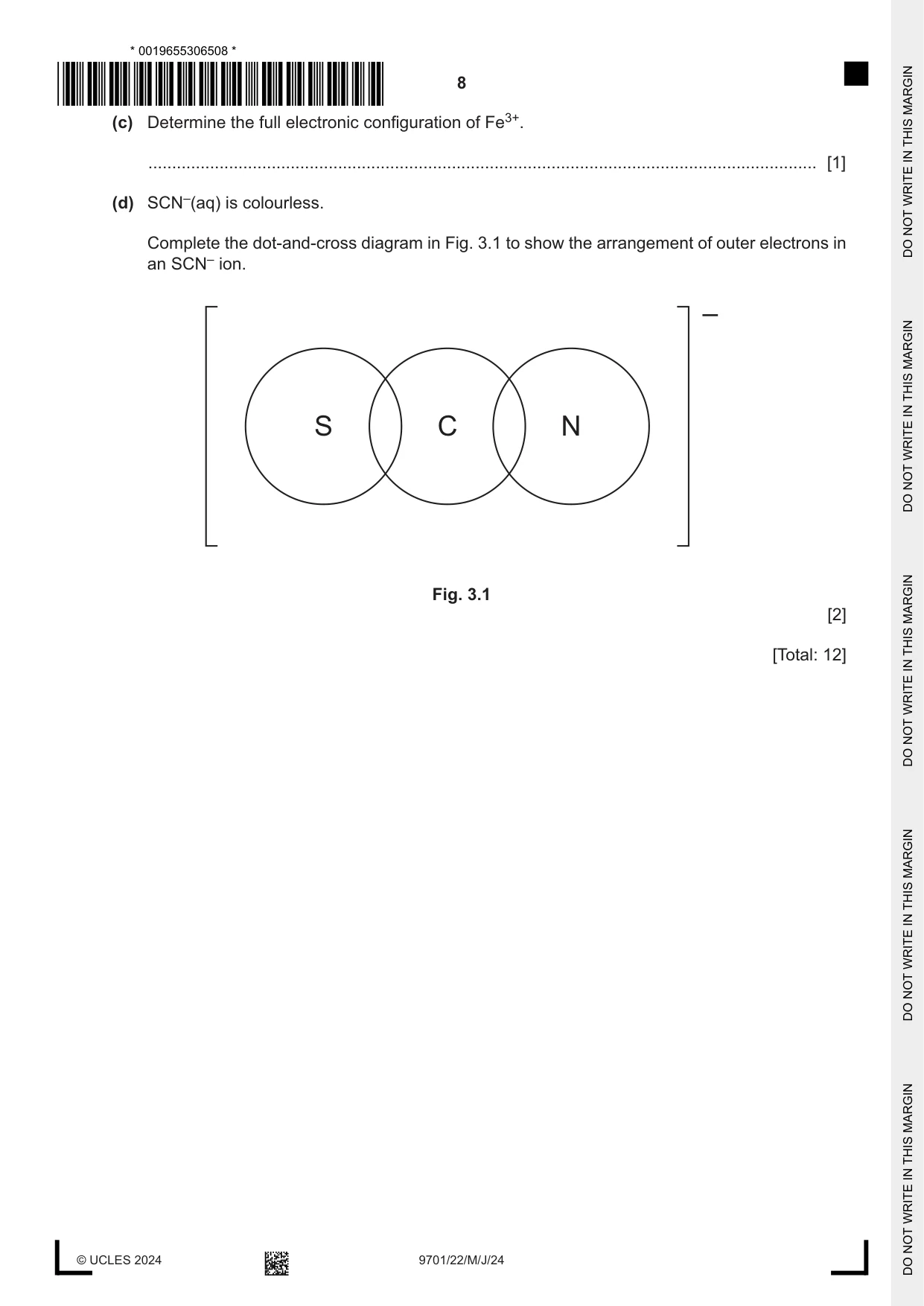
3 (a) Describe what is meant by dynamic equilibrium. ................................................................................................................................................... ................................................................................................................................................... ............................................................................................................................................. [2] (b) Reaction 4 describes the reversible reaction between yellow Fe3+(aq) and colourless SCN–(aq) to produce red FeSCN2+(aq). reaction 4 Fe3+(aq) + SCN–(aq) FeSCN2+(aq) yellow colourless red An equilibrium mixture contains Fe3+(aq), SCN–(aq) and FeSCN2+(aq). A few colourless crystals of soluble KSCN(s) are added. The mixture is then left until it reaches equilibrium again. The temperature of both equilibrium mixtures is the same. (i) Deduce the changes that occur, if any, in the equilibrium mixture after KSCN(s) is added compared to the original equilibrium mixture. • change in appearance .................................................................................................................................... • change in relative concentration of Fe3+(aq) .................................................................................................................................... • change in value of the equilibrium constant, Kc .................................................................................................................................... [3] (ii) The expression for the equilibrium constant, Kc, for reaction 4 is shown. [FeSCN2+(aq)] Kc = [Fe3+(aq)] × [SCN–(aq)] 5.00 × 10⁻⁵ mol of Fe3+(aq) and 5.00 × 10⁻⁵ mol of SCN–(aq) are added together and allowed to reach equilibrium. The total volume of the mixture is 25.0 cm3. At equilibrium the concentration of FeSCN2+(aq) is 4.23 × 10⁻⁴ mol dm–3. Calculate the equilibrium constant, Kc, for reaction 4. Include the units in your answer. Kc = .............................. units .............................. [4] (c) Determine the full electronic configuration of Fe3+. ............................................................................................................................................. [1] (d) SCN–(aq) is colourless. Complete the dot-and-cross diagram in Fig. 3.1 to show the arrangement of outer electrons in an SCN– ion. – S C N Fig. 3.1 [2] [Total: 12]
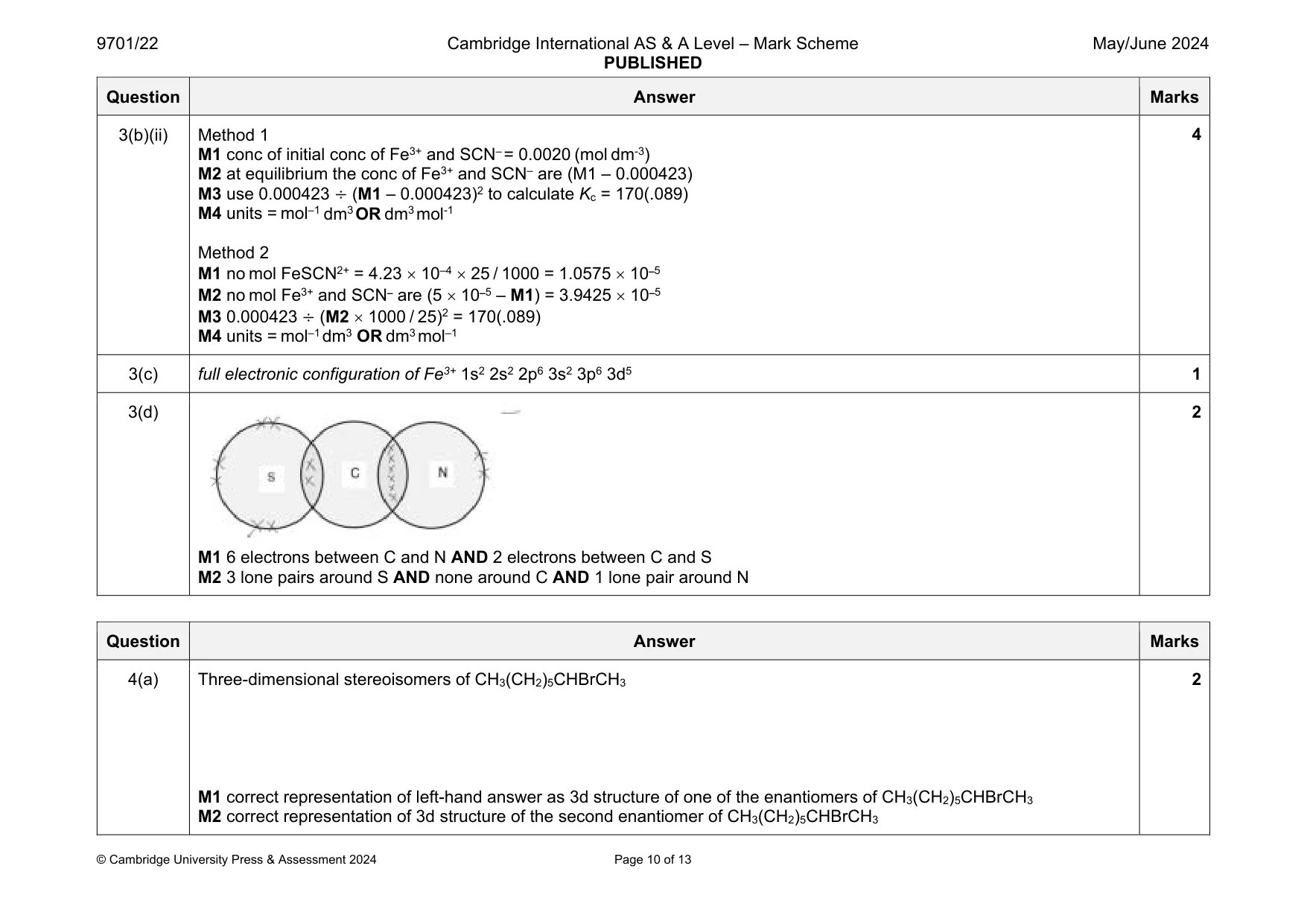
Mark scheme: 3(a) M1 rates of forward and reverse / backward reactions are equal M2 no change in measurable properties OR concentration of reactants AND products remain constant 2 3(b)(i) M1 change to appearance of the mixture: (goes) darker red / more red M2 change to relative concentration of Fe3+(aq): decreases M3 change to the value of equilibrium constant, Kc: constant / none 3 Question Answer Marks 3(b)(ii) Method 1 M1 conc of initial conc of Fe3+ and SCN– = 0.0020 (mol dm-3) M2 at equilibrium the conc of Fe3+ and SCN– are (M1 – 0.000423) M3 use 0.000423 ൊ (M1 – 0.000423)2 to calculate Kc = 170(.089) M4 units = mol–1 dm3 OR dm3 mol-1 Method 2 M1 no mol FeSCN2+ = 4.23 10–4 25 / 1000 = 1.0575 10–5 M2 no mol Fe3+ and SCN– are (5 10–5 – M1) = 3.9425 10–5 M3 0.000423 ൊ (M2 1000 / 25)2 = 170(.089) M4 units = mol–1 dm3 OR dm3 mol–1 4 3(c) full electronic configuration of Fe3+ 1s2 2s2 2p6 3s2 3p6 3d5 1 3(d) M1 6 electrons between C and N AND 2 electrons between C and S M2 3 lone pairs around S AND none around C AND 1 lone pair around N 2
More questions on Chemical equilibria: reversible reactions, dynamic equilibrium
Q4 · CH3(CH2)5CHBrCH3 exists as a pair of stereoisomers
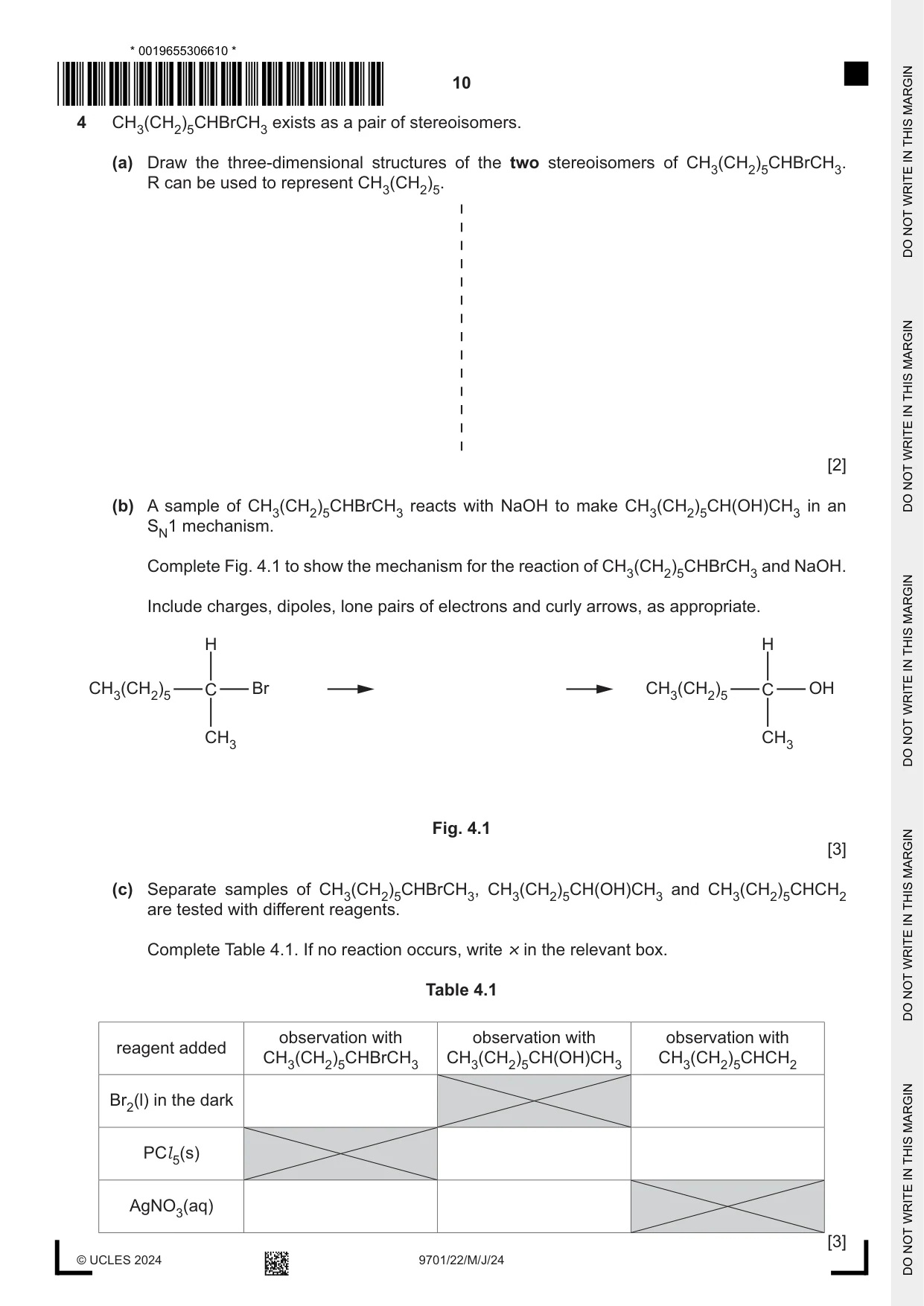
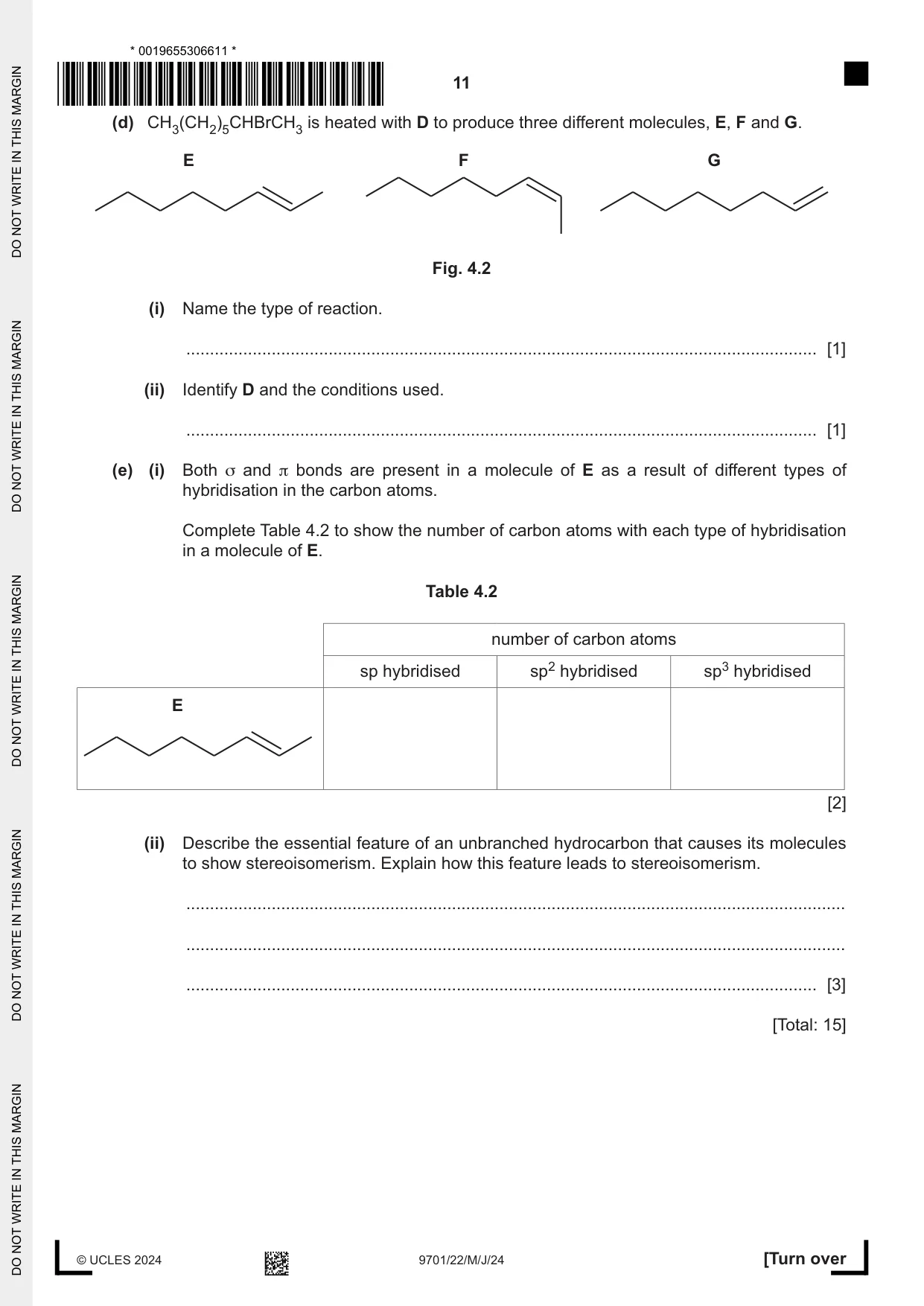
4 CH3(CH2)5CHBrCH3 exists as a pair of stereoisomers. (a) Draw the three-dimensional structures of the two stereoisomers of CH3(CH2)5CHBrCH3. R can be used to represent CH3(CH2)5. [2] (b) A sample of CH3(CH2)5CHBrCH3 reacts with NaOH to make CH3(CH2)5CH(OH)CH3 in an SN1 mechanism. Complete Fig. 4.1 to show the mechanism for the reaction of CH3(CH2)5CHBrCH3 and NaOH. Include charges, dipoles, lone pairs of electrons and curly arrows, as appropriate. H H CH3(CH2)5 C Br CH3(CH2)5 C OH CH3 CH3 Fig. 4.1 [3] (c) Separate samples of CH3(CH2)5CHBrCH3, CH3(CH2)5CH(OH)CH3 and CH3(CH2)5CHCH2 are tested with different reagents. Complete Table 4.1. If no reaction occurs, write × in the relevant box. Table 4.1 observation with observation with observation with reagent added CH3(CH2)5CHBrCH3 CH3(CH2)5CH(OH)CH3 CH3(CH2)5CHCH2 Br2(l) in the dark PCl 5(s) AgNO3(aq) [3] (d) CH3(CH2)5CHBrCH3 is heated with D to produce three different molecules, E, F and G. E F G Fig. 4.2 (i) Name the type of reaction. ..................................................................................................................................... [1] (ii) Identify D and the conditions used. ..................................................................................................................................... [1] (e) (i) Both σ and π bonds are present in a molecule of E as a result of different types of hybridisation in the carbon atoms. Complete Table 4.2 to show the number of carbon atoms with each type of hybridisation in a molecule of E. Table 4.2 number of carbon atoms sp hybridised sp2 hybridised sp3 hybridised E [2] (ii) Describe the essential feature of an unbranched hydrocarbon that causes its molecules to show stereoisomerism. Explain how this feature leads to stereoisomerism. ........................................................................................................................................... ........................................................................................................................................... ..................................................................................................................................... [3] [Total: 15]
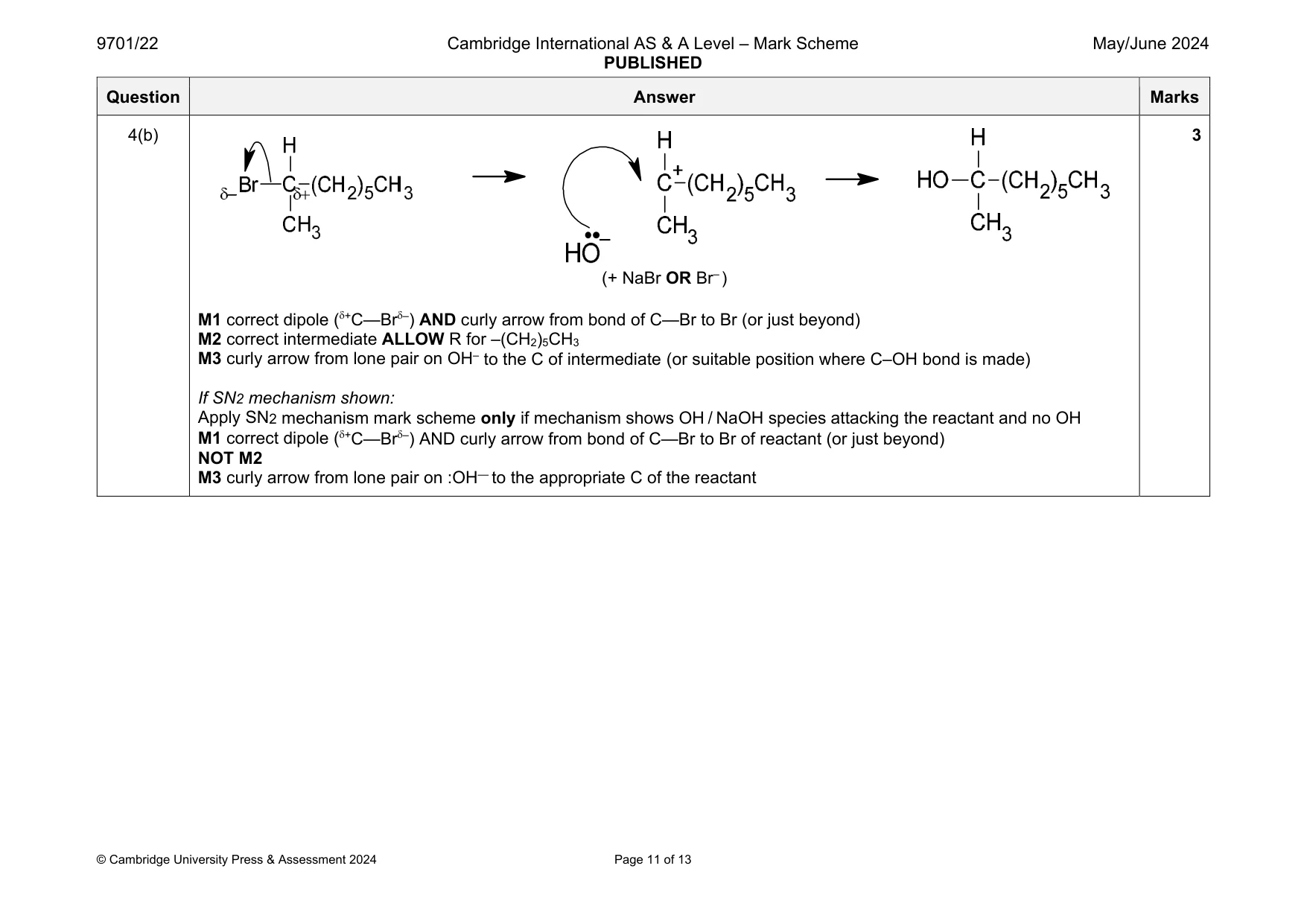
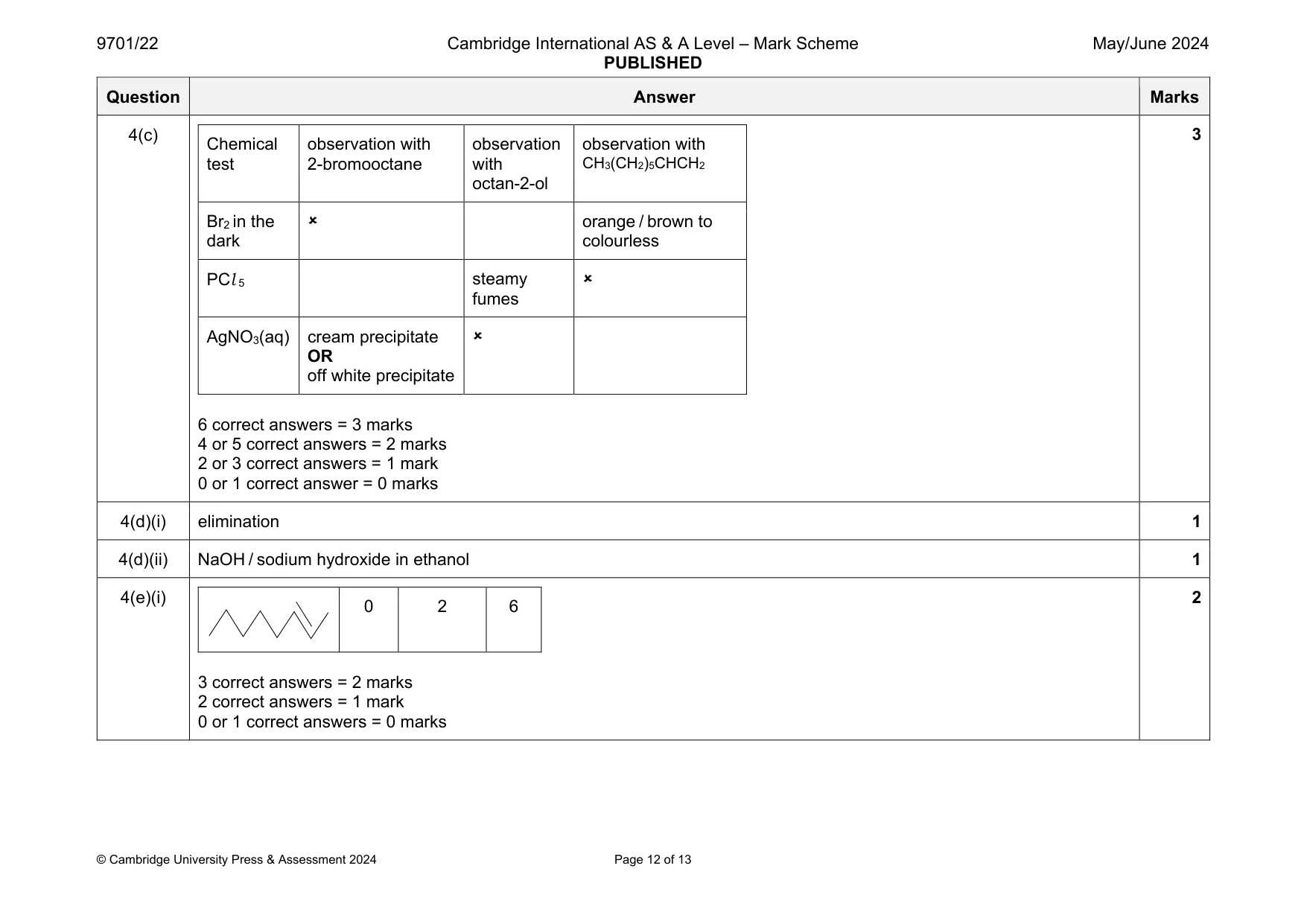
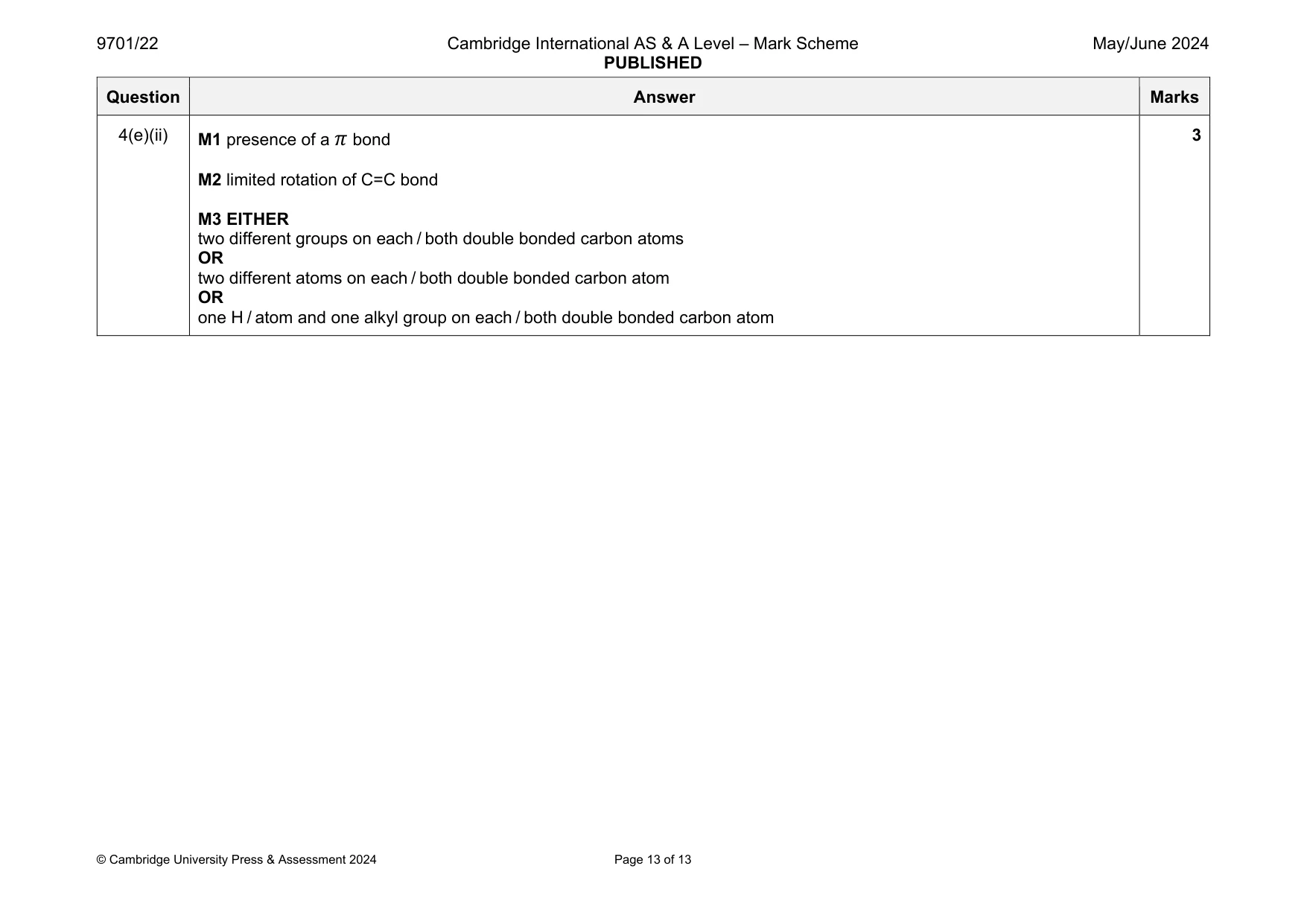
Mark scheme: 4(a) Three-dimensional stereoisomers of CH3(CH2)5CHBrCH3 M1 correct representation of left-hand answer as 3d structure of one of the enantiomers of CH3(CH2)5CHBrCH3 M2 correct representation of 3d structure of the second enantiomer of CH3(CH2)5CHBrCH3 2 Question Answer Marks 4(b) (+ NaBr OR Br– ) M1 correct dipole (+C—Br–) AND curly arrow from bond of C—Br to Br (or just beyond) M2 correct intermediate ALLOW R for –(CH2)5CH3 M3 curly arrow from lone pair on OH– to the C of intermediate (or suitable position where C–OH bond is made) If SN2 mechanism shown: Apply SN2 mechanism mark scheme only if mechanism shows OH / NaOH species attacking the reactant and no OH M1 correct dipole (+C—Br–) AND curly arrow from bond of C—Br to Br of reactant (or just beyond) NOT M2 M3 curly arrow from lone pair on :OH— to the appropriate C of the reactant 3 Question Answer Marks 4(c) Chemical test observation with 2-bromooctane observation with octan-2-ol observation with CH3(CH2)5CHCH2 Br2 in the dark orange / brown to colourless PCl 5 steamy fumes AgNO3(aq) cream precipitate OR off white precipitate 6 correct answers = 3 marks 4 or 5 correct answers = 2 marks 2 or 3 correct answers = 1 mark 0 or 1 correct answer = 0 marks 3 4(d)(i) elimination 1 4(d)(ii) NaOH / sodium hydroxide in ethanol 1 4(e)(i) 0 2 6 3 correct answers = 2 marks 2 correct answers = 1 mark 0 or 1 correct answers = 0 marks 2 Question Answer Marks 4(e)(ii) M1 presence of a 𝜋 bond M2 limited rotation of C=C bond M3 EITHER two different groups on each / both double bonded carbon atoms OR two different atoms on each / both double bonded carbon atom OR one H / atom and one alkyl group on each / both double bonded carbon atom 3
Q5 · Compound W has molecular formula C4H10O
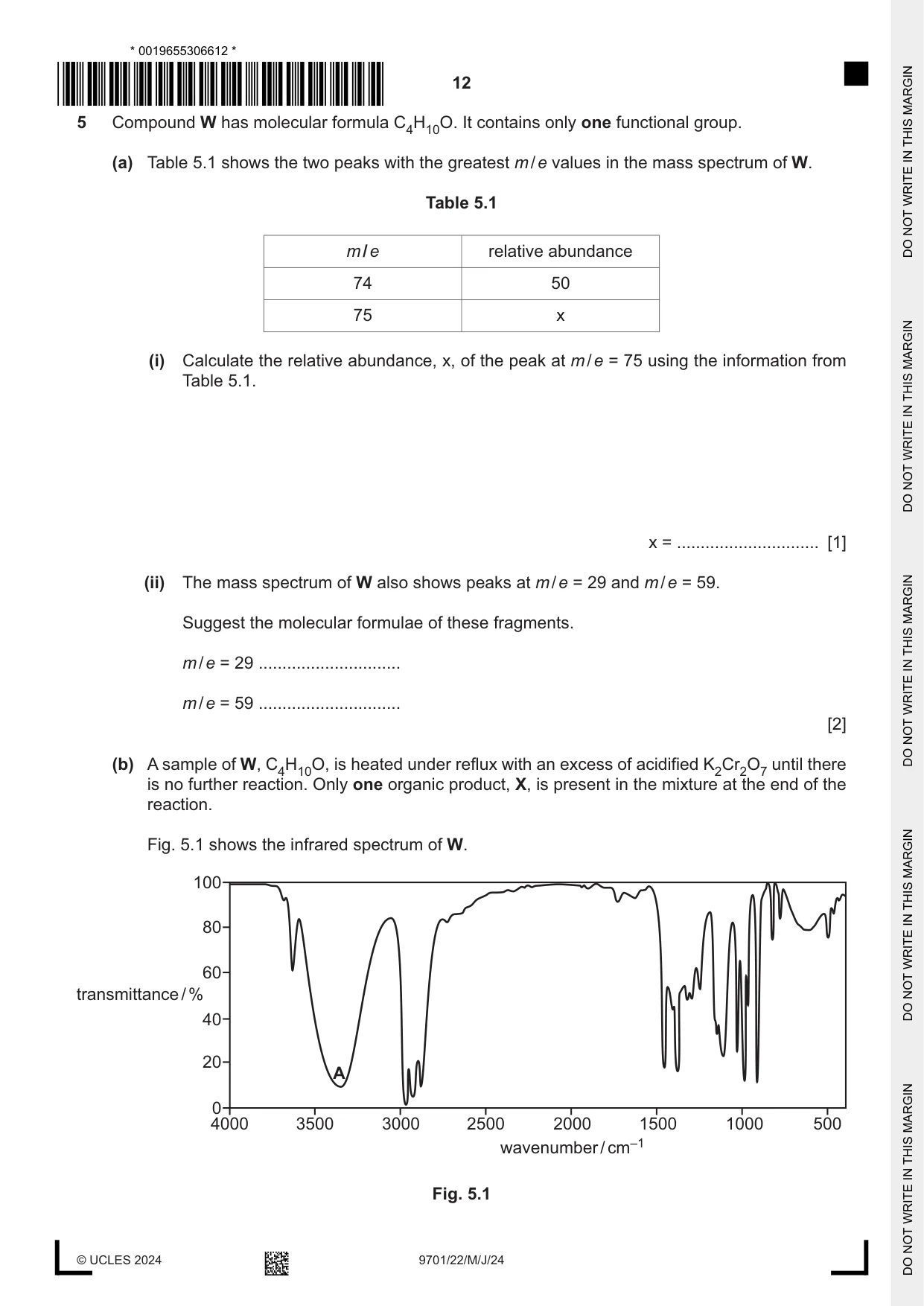
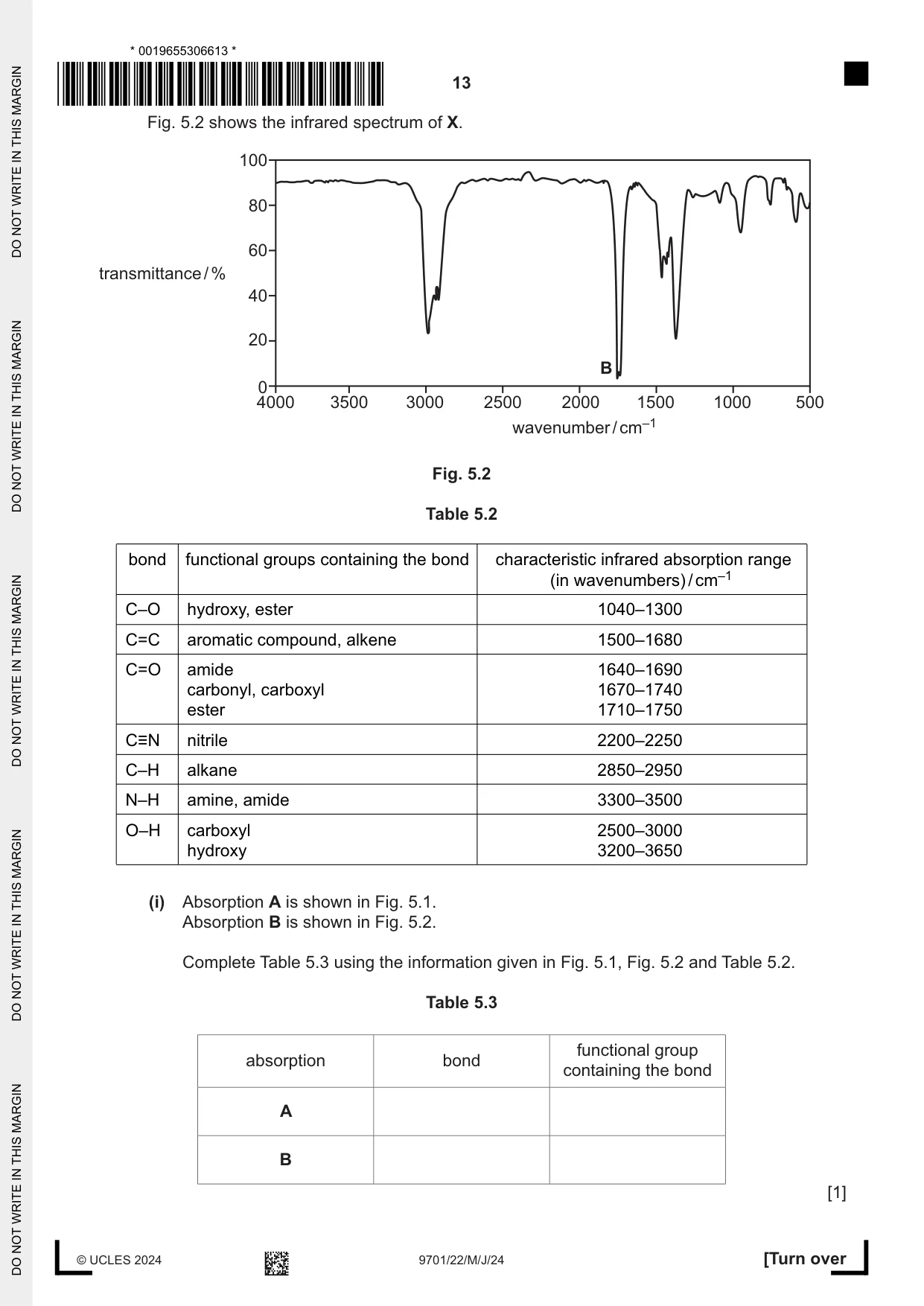
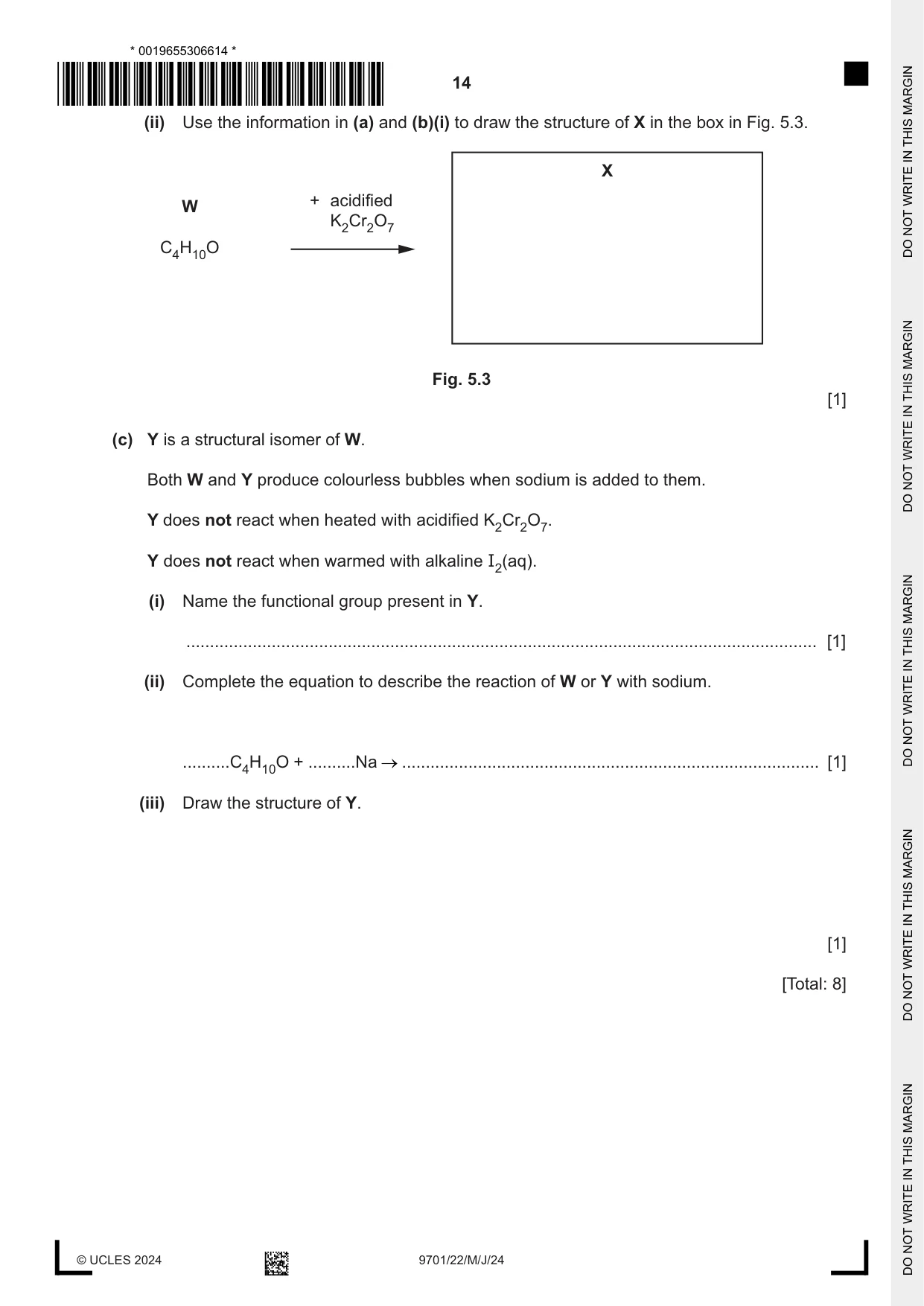
5 Compound W has molecular formula C4H10O. It contains only one functional group. (a) Table 5.1 shows the two peaks with the greatest m / e values in the mass spectrum of W. Table 5.1 m / e relative abundance 74 50 75 x (i) Calculate the relative abundance, x, of the peak at m / e = 75 using the information from Table 5.1. x = .............................. [1] (ii) The mass spectrum of W also shows peaks at m / e = 29 and m / e = 59. Suggest the molecular formulae of these fragments. m / e = 29 .............................. m / e = 59 .............................. [2] (b) A sample of W, C4H10O, is heated under reflux with an excess of acidified K2Cr2O7 until there is no further reaction. Only one organic product, X, is present in the mixture at the end of the reaction. Fig. 5.1 shows the infrared spectrum of W. 100 80 60 transmittance / % 40 20 A 0 4000 3500 3000 2500 2000 1500 1000 500 wavenumber / cm–1 Fig. 5.1 Fig. 5.2 shows the infrared spectrum of X. 100 80 60 transmittance / % 40 20 B 0 4000 3500 3000 2500 2000 1500 1000 500 wavenumber / cm–1 Fig. 5.2 Table 5.2 bond functional groups containing the bond characteristic infrared absorption range (in wavenumbers) / cm–1 C–O hydroxy, ester 1040–1300 C=C aromatic compound, alkene 1500–1680 C=O amide 1640–1690 carbonyl, carboxyl 1670–1740 ester 1710–1750 C≡N nitrile 2200–2250 C–H alkane 2850–2950 N–H amine, amide 3300–3500 O–H carboxyl 2500–3000 hydroxy 3200–3650 (i) Absorption A is shown in Fig. 5.1. Absorption B is shown in Fig. 5.2. Complete Table 5.3 using the information given in Fig. 5.1, Fig. 5.2 and Table 5.2. Table 5.3 functional group absorption bond containing the bond A B [1] (ii) Use the information in (a) and (b)(i) to draw the structure of X in the box in Fig. 5.3. X + acidified W K2Cr2O7 C4H10O Fig. 5.3 [1] (c) Y is a structural isomer of W. Both W and Y produce colourless bubbles when sodium is added to them. Y does not react when heated with acidified K2Cr2O7. Y does not react when warmed with alkaline I2(aq). (i) Name the functional group present in Y. ..................................................................................................................................... [1] (ii) Complete the equation to describe the reaction of W or Y with sodium. ..........C4H10O + ..........Na ........................................................................................ [1] (iii) Draw the structure of Y. [1] [Total: 8]
What was in this paper
The subtopics covered by these 5 questions, and how many questions each got. Open one in a new tab to see every Cambridge question on it.
What you needed in this session
Cambridge’s own grade thresholds for 2024 May/June, Paper 2 · Variant 2. A higher threshold means an easier paper — the bar moves with how the cohort did.