Cambridge A Level Chemistry 9701 — 2023 Feb/March Paper 2 · Variant 2
9701/22/F/M/23 · 4 questions · 60 marks · ≈68 min
The question paper and its mark scheme, free to read here and free to download. This is Cambridge’s own paper, exactly as it was sat.
Question paper16 pages
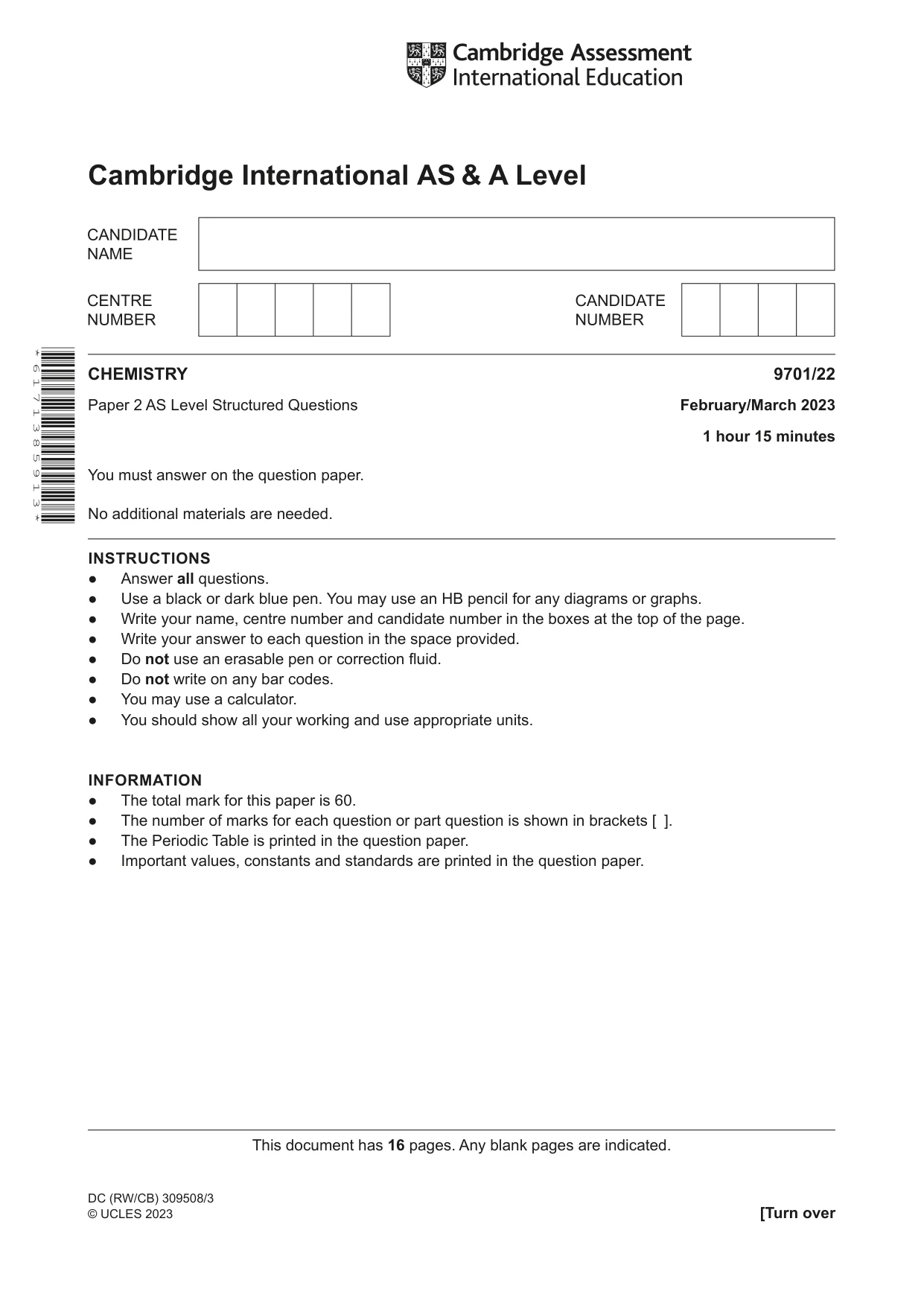

Mark scheme10 pages
Answers below. Sit the paper first if you are practising.
Questions as text
Q1 · The Pauling electronegativity values of elements can be used to predict the chemical…
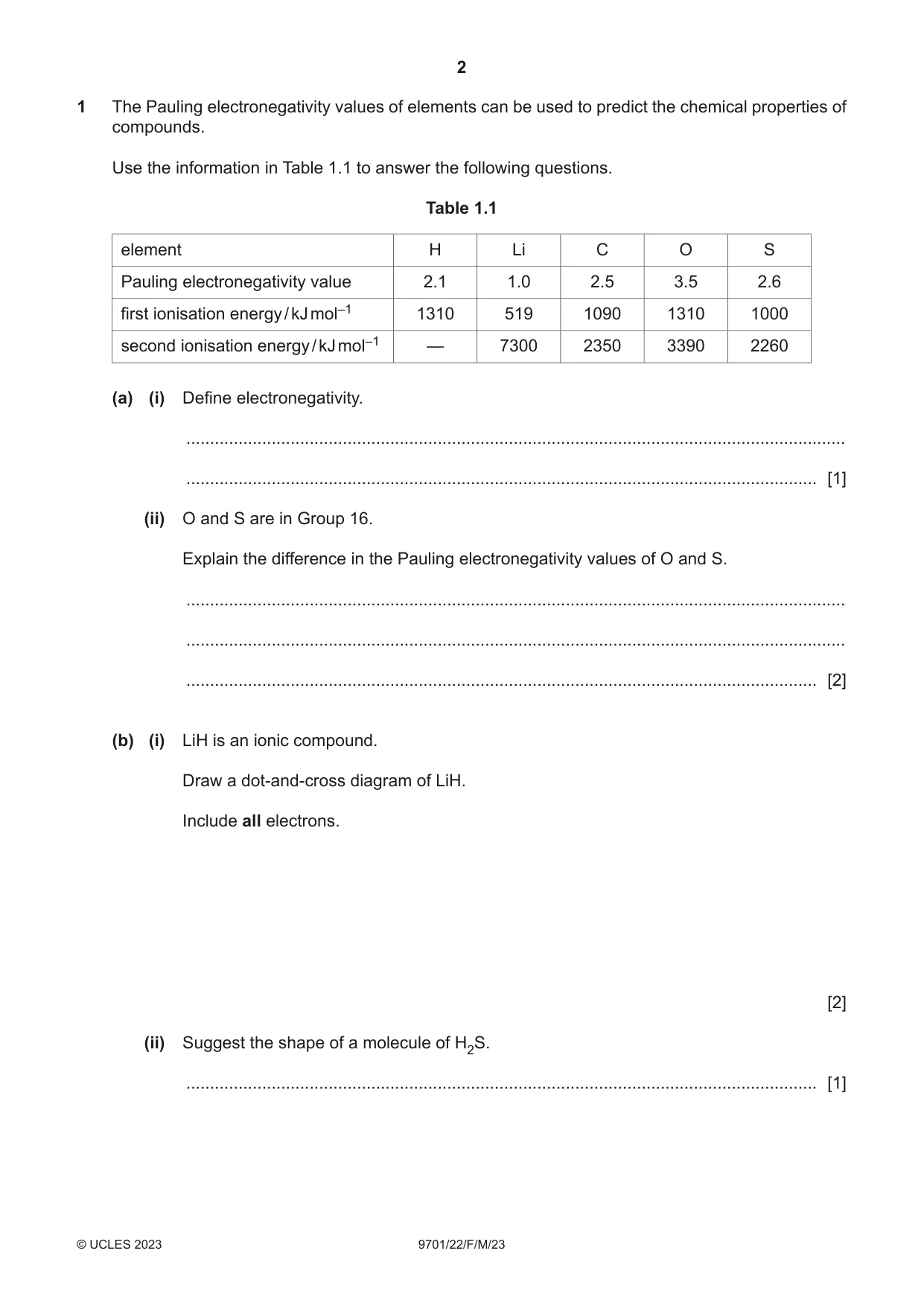
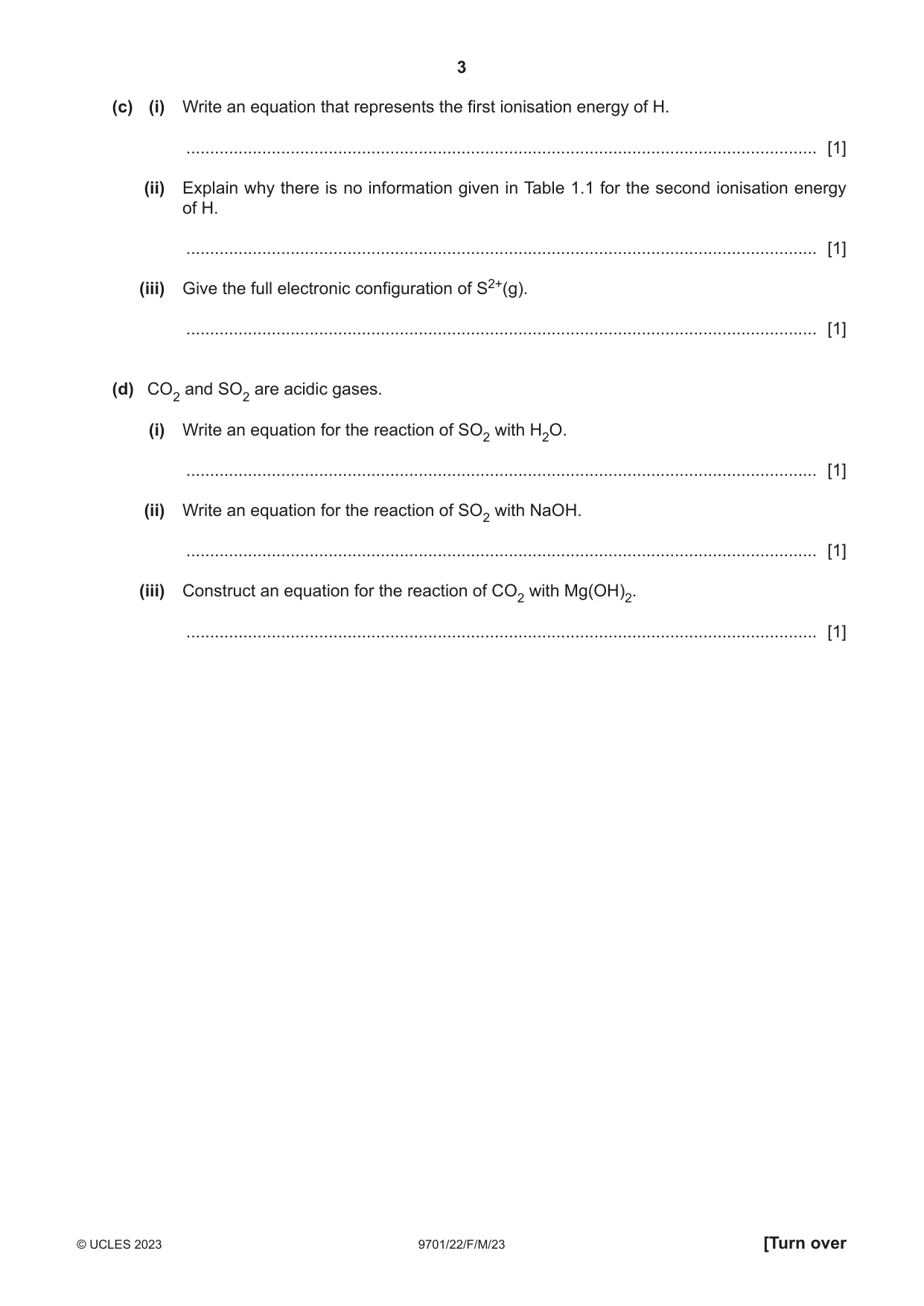
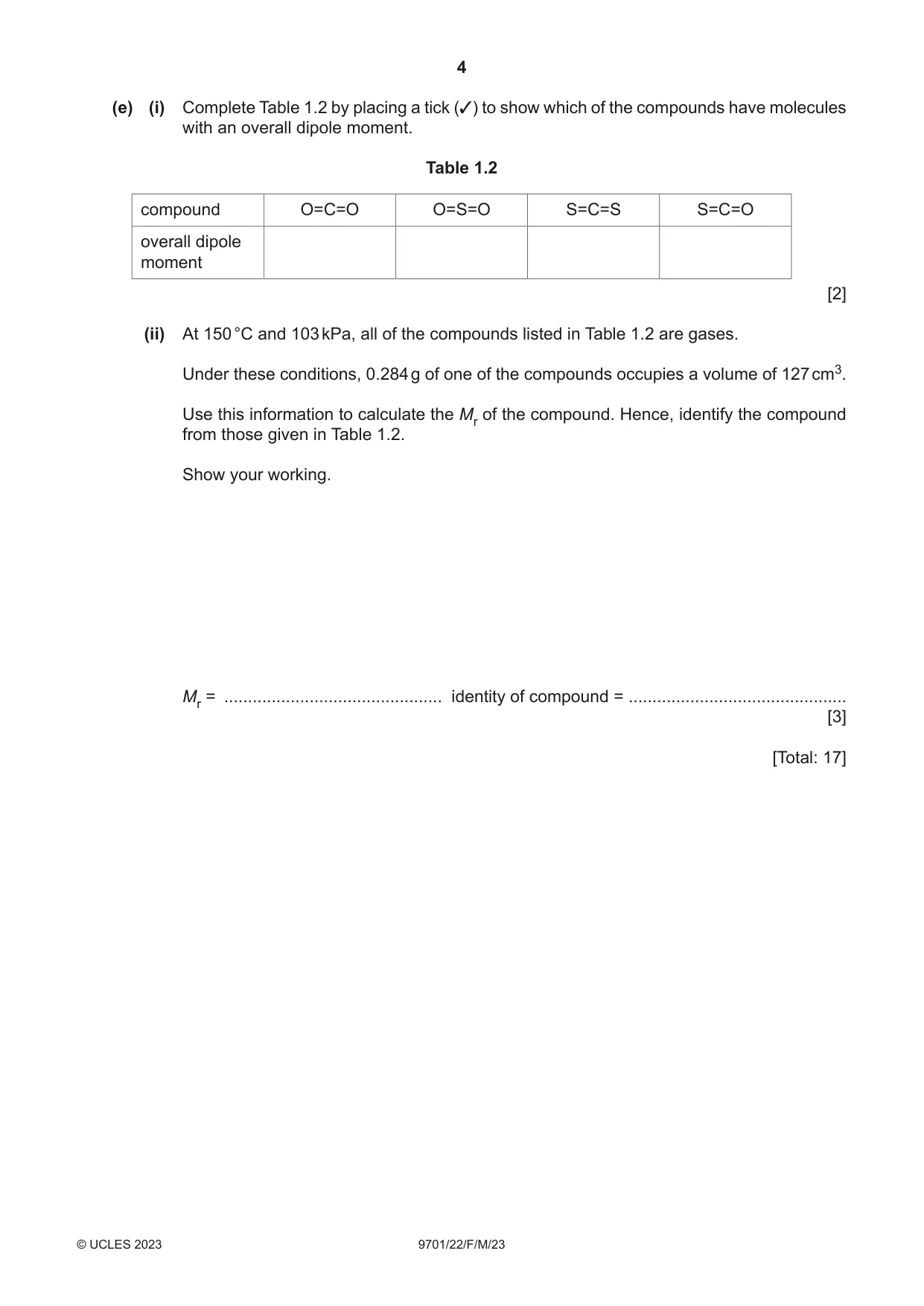
1 The Pauling electronegativity values of elements can be used to predict the chemical properties of compounds. Use the information in Table 1.1 to answer the following questions. Table 1.1 element H Li C O S Pauling electronegativity value 2.1 1.0 2.5 3.5 2.6 first ionisation energy / kJ mol–1 1310 519 1090 1310 1000 second ionisation energy / kJ mol–1 — 7300 2350 3390 2260 (a) (i) Define electronegativity. ........................................................................................................................................... ..................................................................................................................................... [1] (ii) O and S are in Group 16. Explain the difference in the Pauling electronegativity values of O and S. ........................................................................................................................................... ........................................................................................................................................... ..................................................................................................................................... [2] (b) (i) LiH is an ionic compound. Draw a dot‑and‑cross diagram of LiH. Include all electrons. [2] (ii) Suggest the shape of a molecule of H2S. ..................................................................................................................................... [1] (c) (i) Write an equation that represents the first ionisation energy of H. ..................................................................................................................................... [1] (ii) Explain why there is no information given in Table 1.1 for the second ionisation energy of H. ..................................................................................................................................... [1] (iii) Give the full electronic configuration of S2+(g). ..................................................................................................................................... [1] (d) CO2 and SO2 are acidic gases. (i) Write an equation for the reaction of SO2 with H2O. ..................................................................................................................................... [1] (ii) Write an equation for the reaction of SO2 with NaOH. ..................................................................................................................................... [1] (iii) Construct an equation for the reaction of CO2 with Mg(OH)2. ..................................................................................................................................... [1] (e) (i) Complete Table 1.2 by placing a tick (✓) to show which of the compounds have molecules with an overall dipole moment. Table 1.2 compound O=C=O O=S=O S=C=S S=C=O overall dipole moment [2] (ii) At 150 °C and 103 kPa, all of the compounds listed in Table 1.2 are gases. Under these conditions, 0.284 g of one of the compounds occupies a volume of 127 cm3. Use this information to calculate the Mr of the compound. Hence, identify the compound from those given in Table 1.2. Show your working. Mr = .............................................. identity of compound = .............................................. [3] [Total: 17]
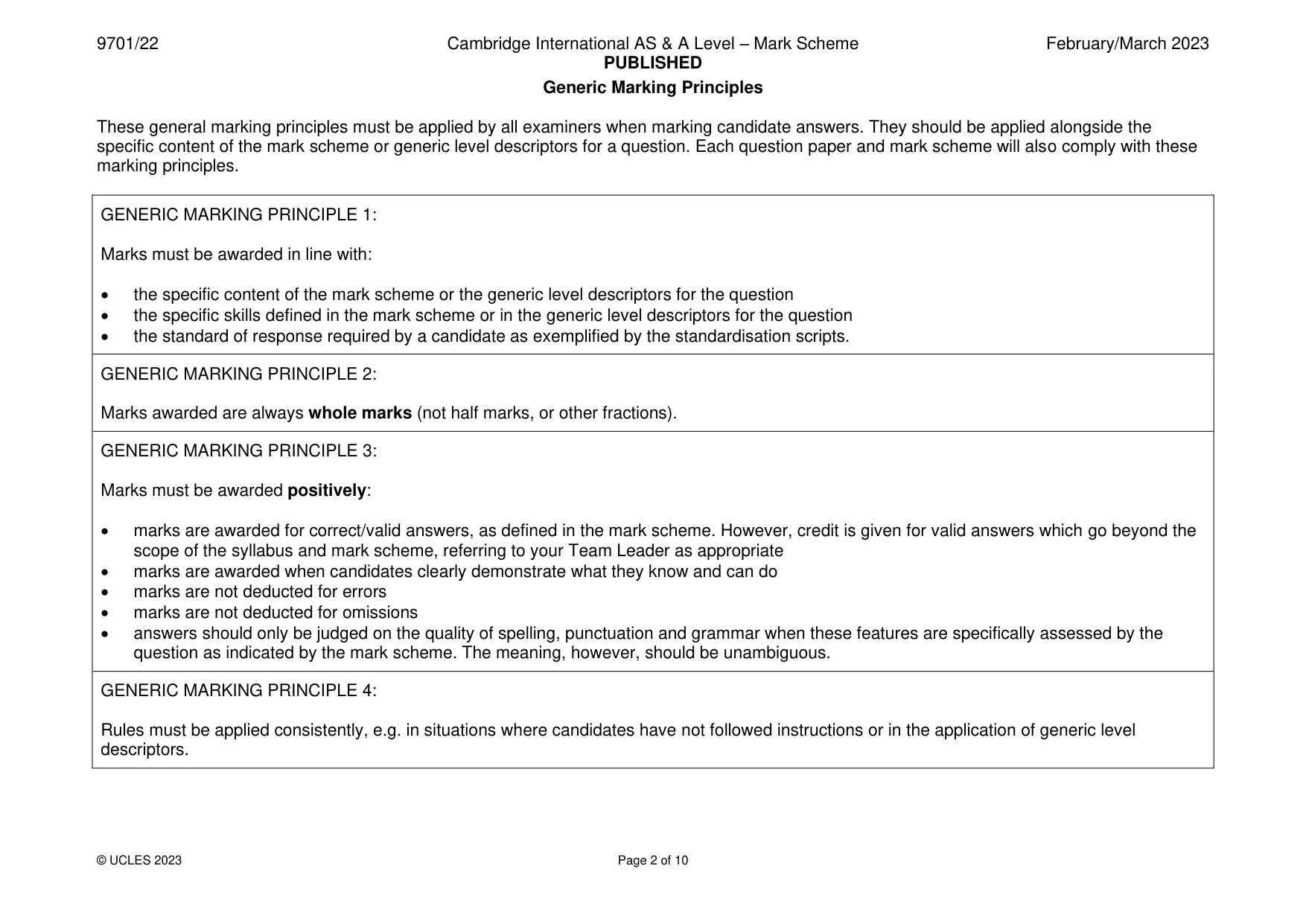
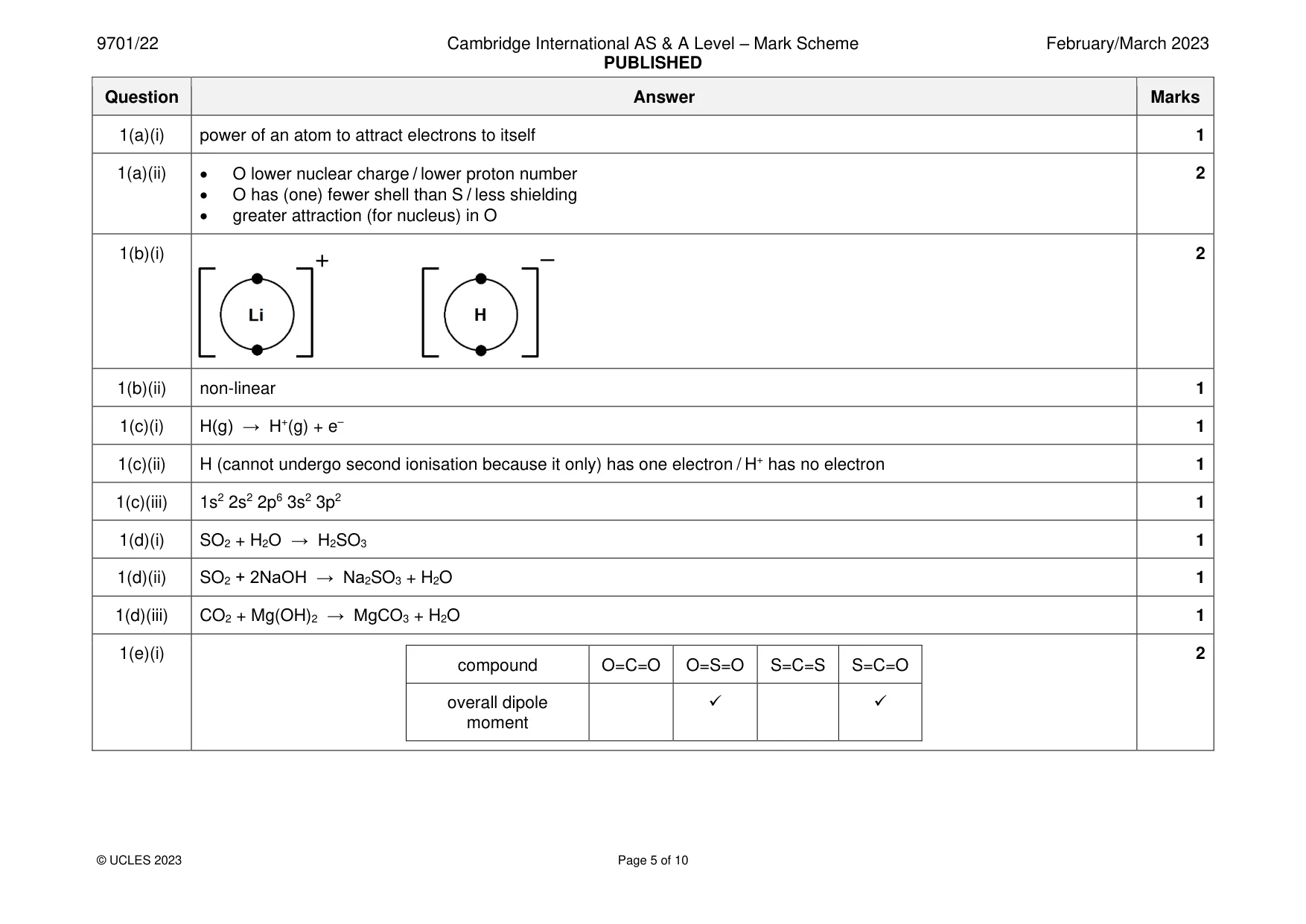
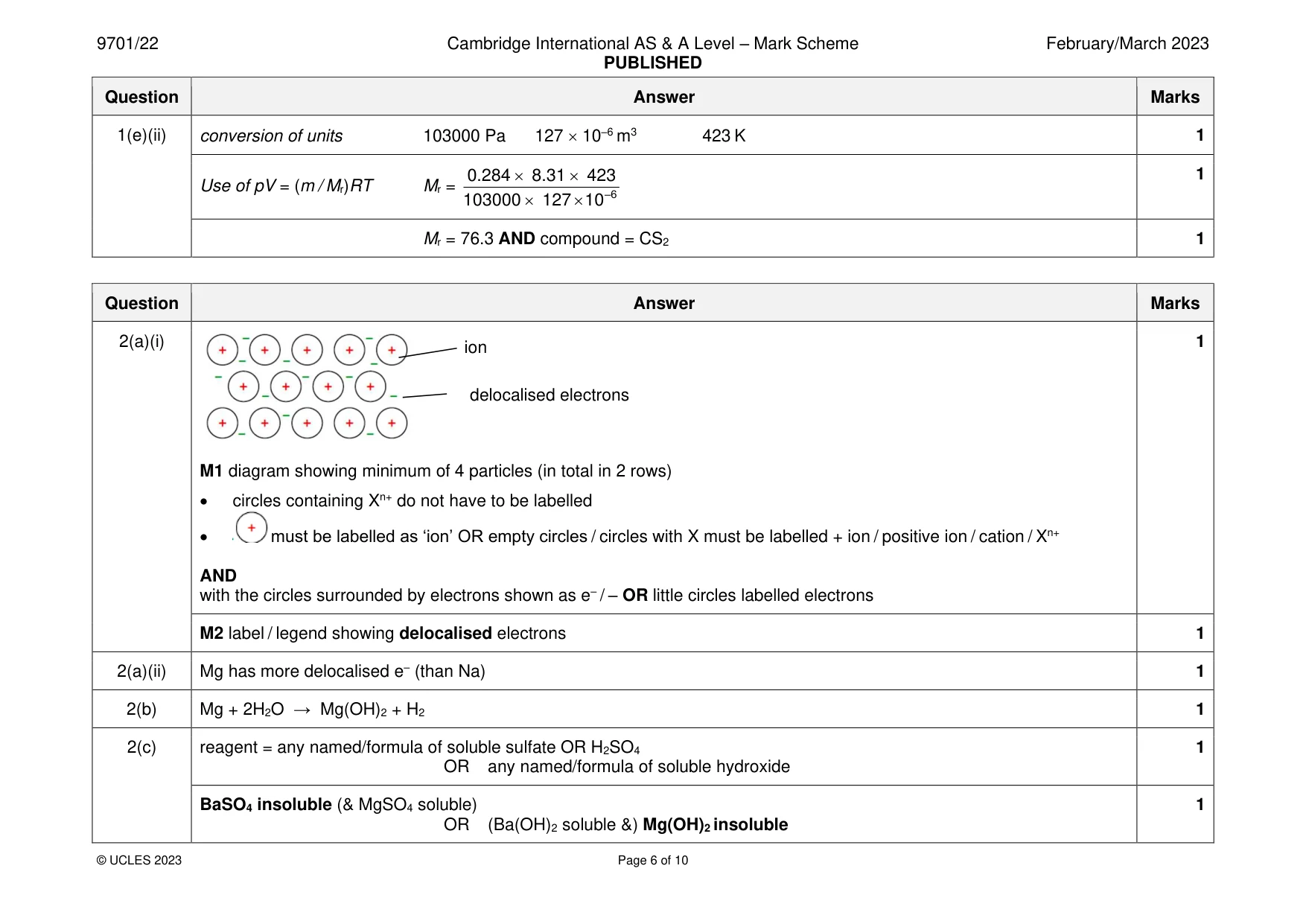
Mark scheme: Question Answer Marks 1(a)(i) power of an atom to attract electrons to itself 1 1(a)(ii) • O lower nuclear charge / lower proton number 2 • O has (one) fewer shell than S / less shielding • greater attraction (for nucleus) in O 1(b)(i) + – 2 1(b)(ii) non-linear 1 1(c)(i) H(g) → H+(g) + e– 1 1(c)(ii) H (cannot undergo second ionisation because it only) has one electron / H+ has no electron 1 1(c)(iii) 1s2 2s2 2p6 3s2 3p2 1 1(d)(i) SO2 + H2O → H2SO3 1 1(d)(ii) SO2 + 2NaOH → Na2SO3 + H2O 1 1(d)(iii) CO2 + Mg(OH)2 → MgCO3 + H2O 1 1(e)(i) 2 compound O=C=O O=S=O S=C=S S=C=O overall dipole ✓ ✓ moment 1(e)(ii) conversion of units 103000 Pa 127 10–6 m3 423 K 1 0.284 8.31 423 1 Use of pV = (m / Mr)RT Mr = 103000 127 10 –6 Mr = 76.3 AND compound = CS2 1
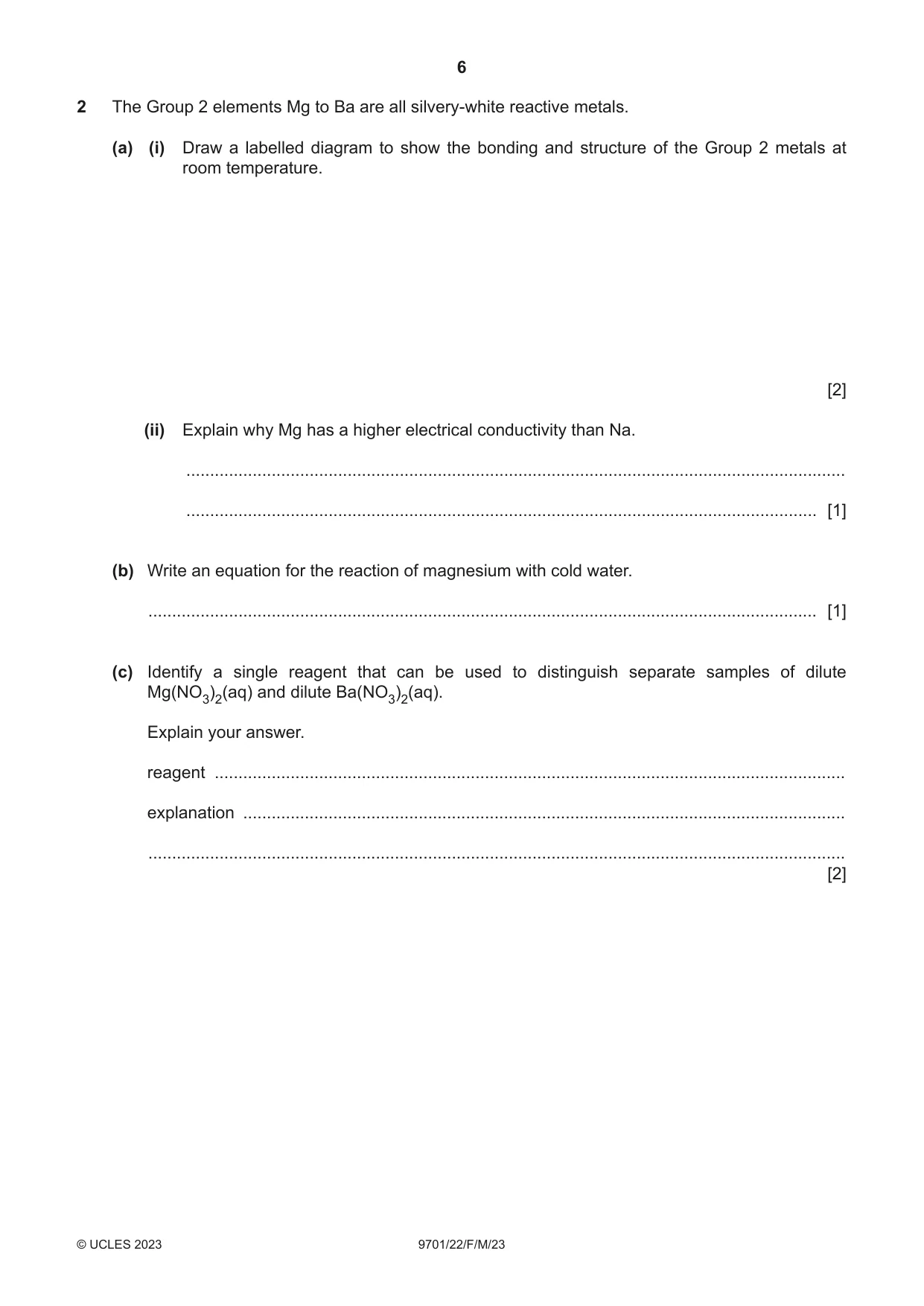
Q2 · The Group 2 elements Mg to Ba are all silvery‑white reactive metals
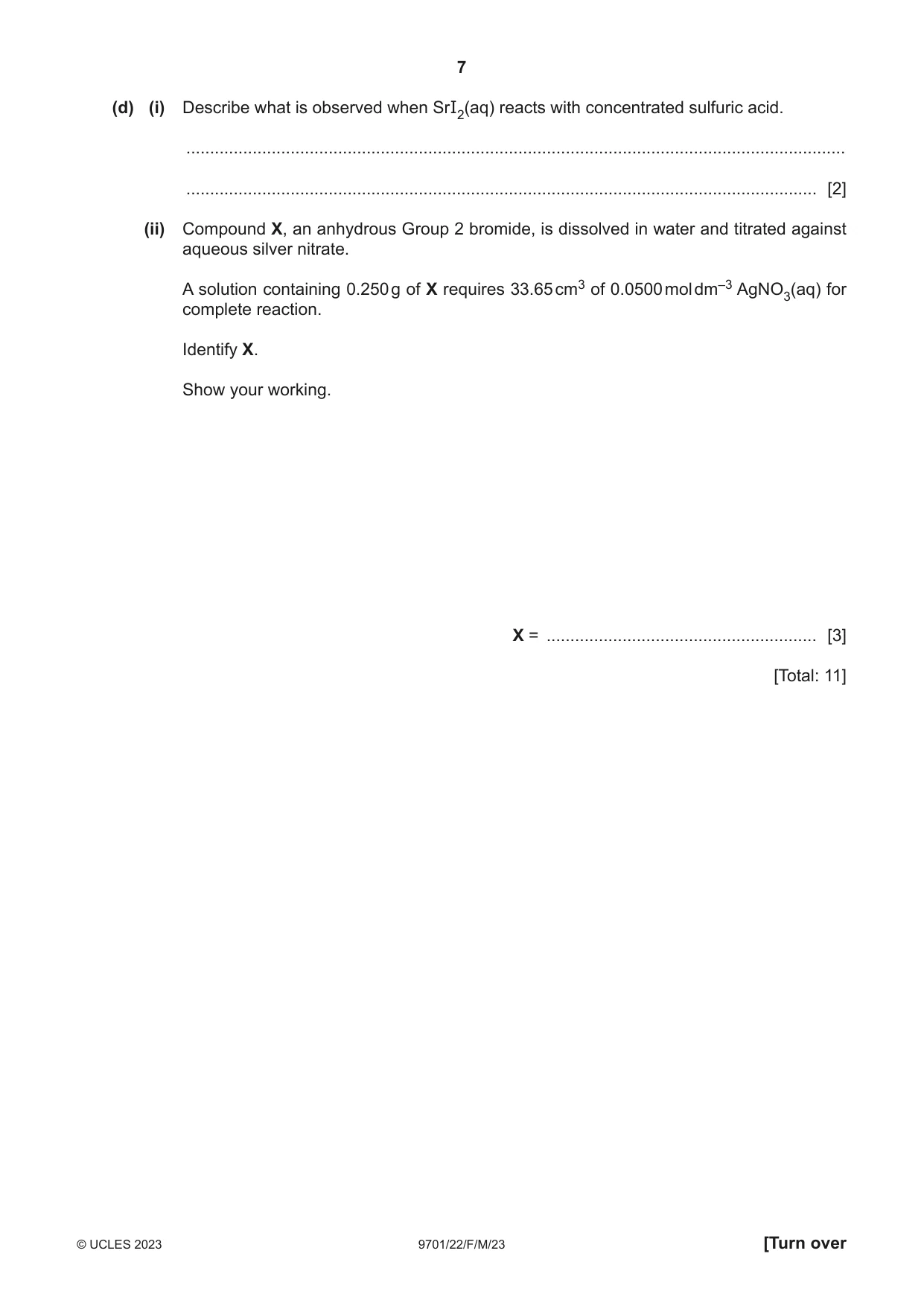
2 The Group 2 elements Mg to Ba are all silvery‑white reactive metals. (a) (i) Draw a labelled diagram to show the bonding and structure of the Group 2 metals at room temperature. [2] (ii) Explain why Mg has a higher electrical conductivity than Na. ........................................................................................................................................... ..................................................................................................................................... [1] (b) Write an equation for the reaction of magnesium with cold water. ............................................................................................................................................. [1] (c) Identify a single reagent that can be used to distinguish separate samples of dilute Mg(NO3)2(aq) and dilute Ba(NO3)2(aq). Explain your answer. reagent ..................................................................................................................................... explanation ............................................................................................................................... ................................................................................................................................................... [2] (d) (i) Describe what is observed when SrI2(aq) reacts with concentrated sulfuric acid. ........................................................................................................................................... ..................................................................................................................................... [2] (ii) Compound X, an anhydrous Group 2 bromide, is dissolved in water and titrated against aqueous silver nitrate. A solution containing 0.250 g of X requires 33.65 cm3 of 0.0500 mol dm–3 AgNO3(aq) for complete reaction. Identify X. Show your working. X = ......................................................... [3] [Total: 11]
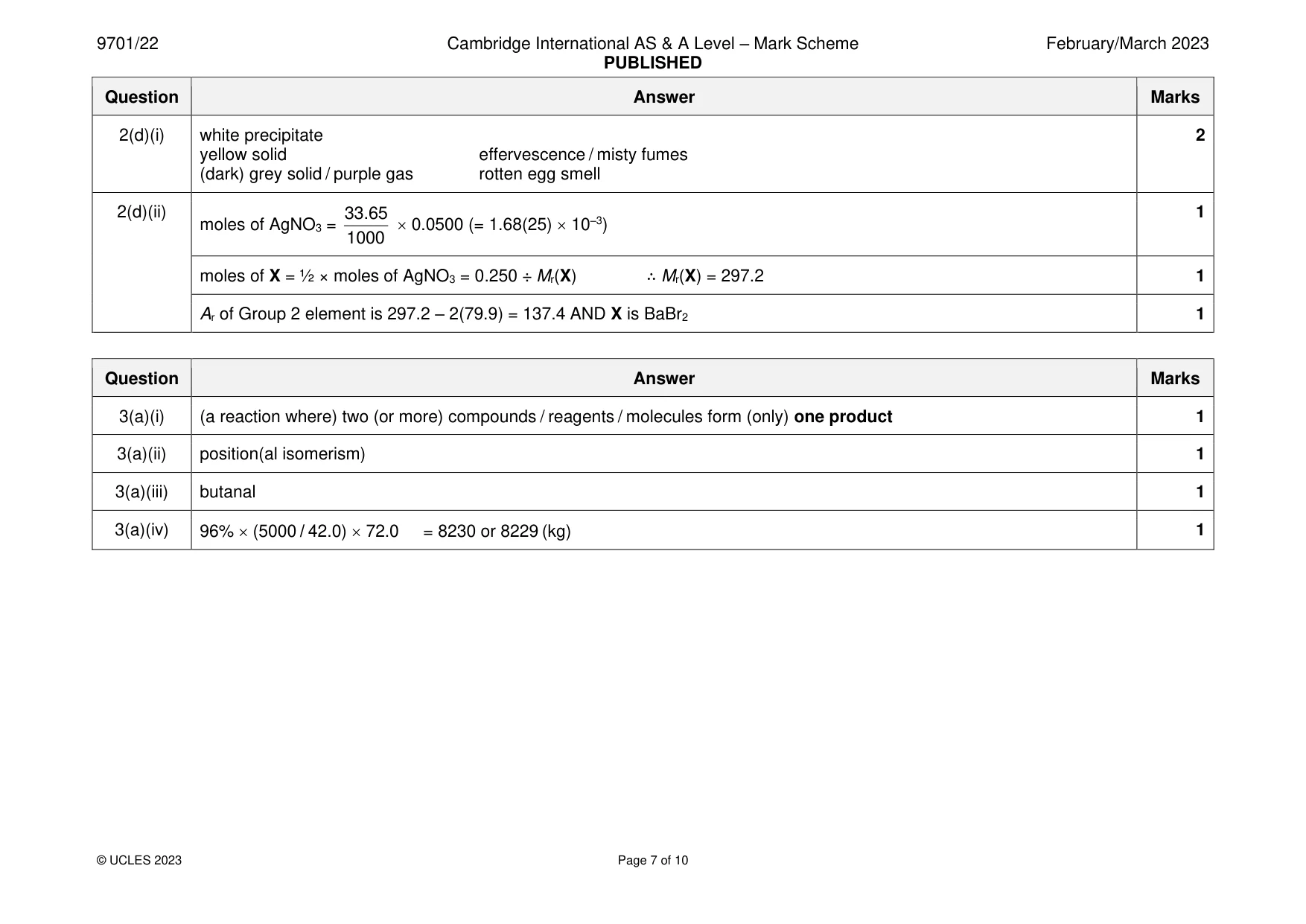
Mark scheme: 2(a)(i) 1 ion delocalised electrons M1 diagram showing minimum of 4 particles (in total in 2 rows) • circles containing Xn+ do not have to be labelled • must be labelled as ‘ion’ OR empty circles / circles with X must be labelled + ion / positive ion / cation / Xn+ AND with the circles surrounded by electrons shown as e– / – OR little circles labelled electrons M2 label / legend showing delocalised electrons 1 2(a)(ii) Mg has more delocalised e– (than Na) 1 2(b) Mg + 2H2O → Mg(OH)2 + H2 1 2(c) reagent = any named/formula of soluble sulfate OR H2SO4 1 OR any named/formula of soluble hydroxide BaSO4 insoluble (& MgSO4 soluble) 1 OR (Ba(OH)2 soluble &) Mg(OH)2 insoluble 2(d)(i) white precipitate 2 yellow solid effervescence / misty fumes (dark) grey solid / purple gas rotten egg smell 2(d)(ii) 33.65 1 moles of AgNO3 = 0.0500 (= 1.68(25) 10–3) 1000 moles of X = ½ × moles of AgNO3 = 0.250 ÷ Mr(X) ∴ Mr(X) = 297.2 1 Ar of Group 2 element is 297.2 – 2(79.9) = 137.4 AND X is BaBr2 1
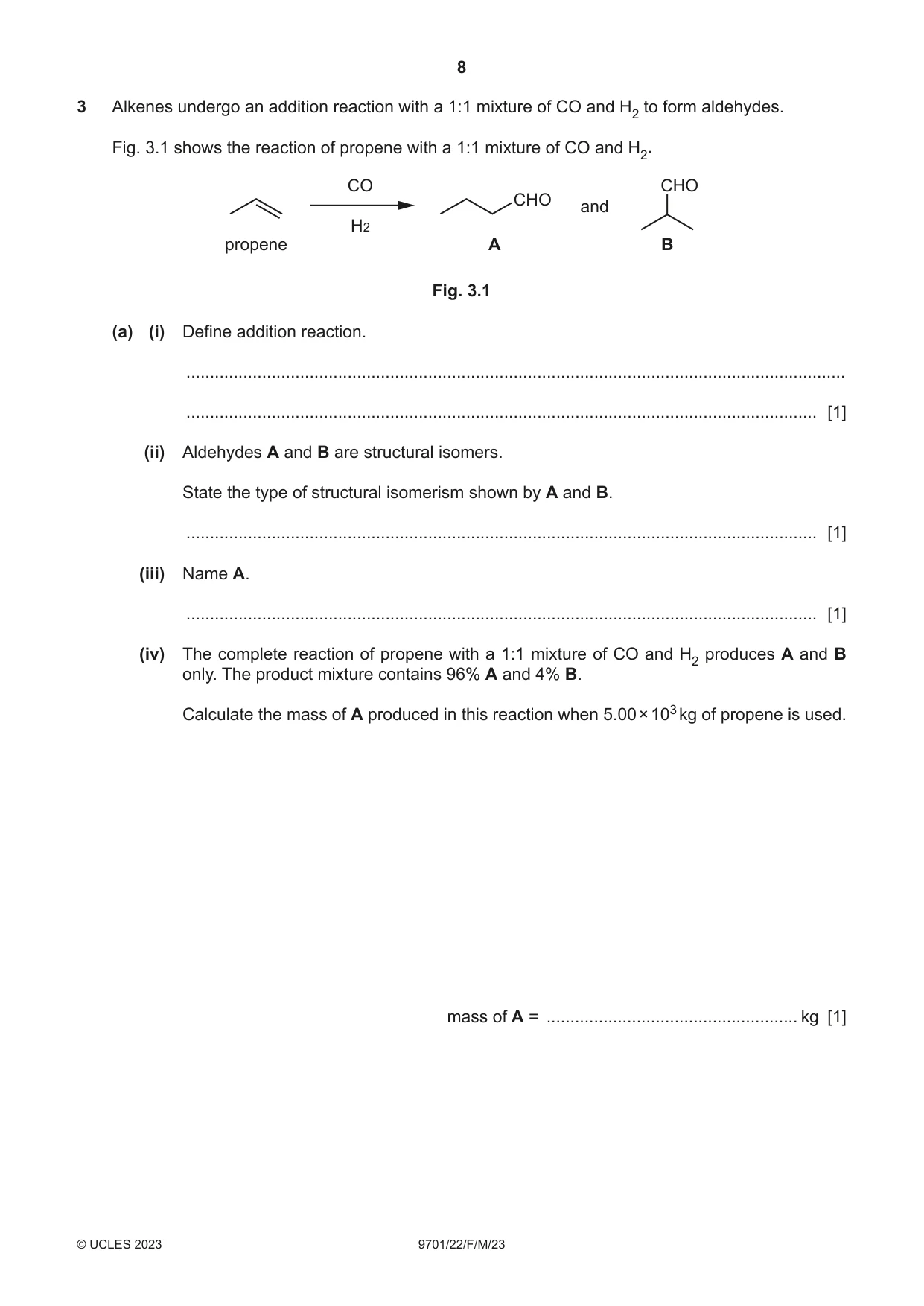
Q3 · Alkenes undergo an addition reaction with a 1:1 mixture of CO and H2 to form aldehydes
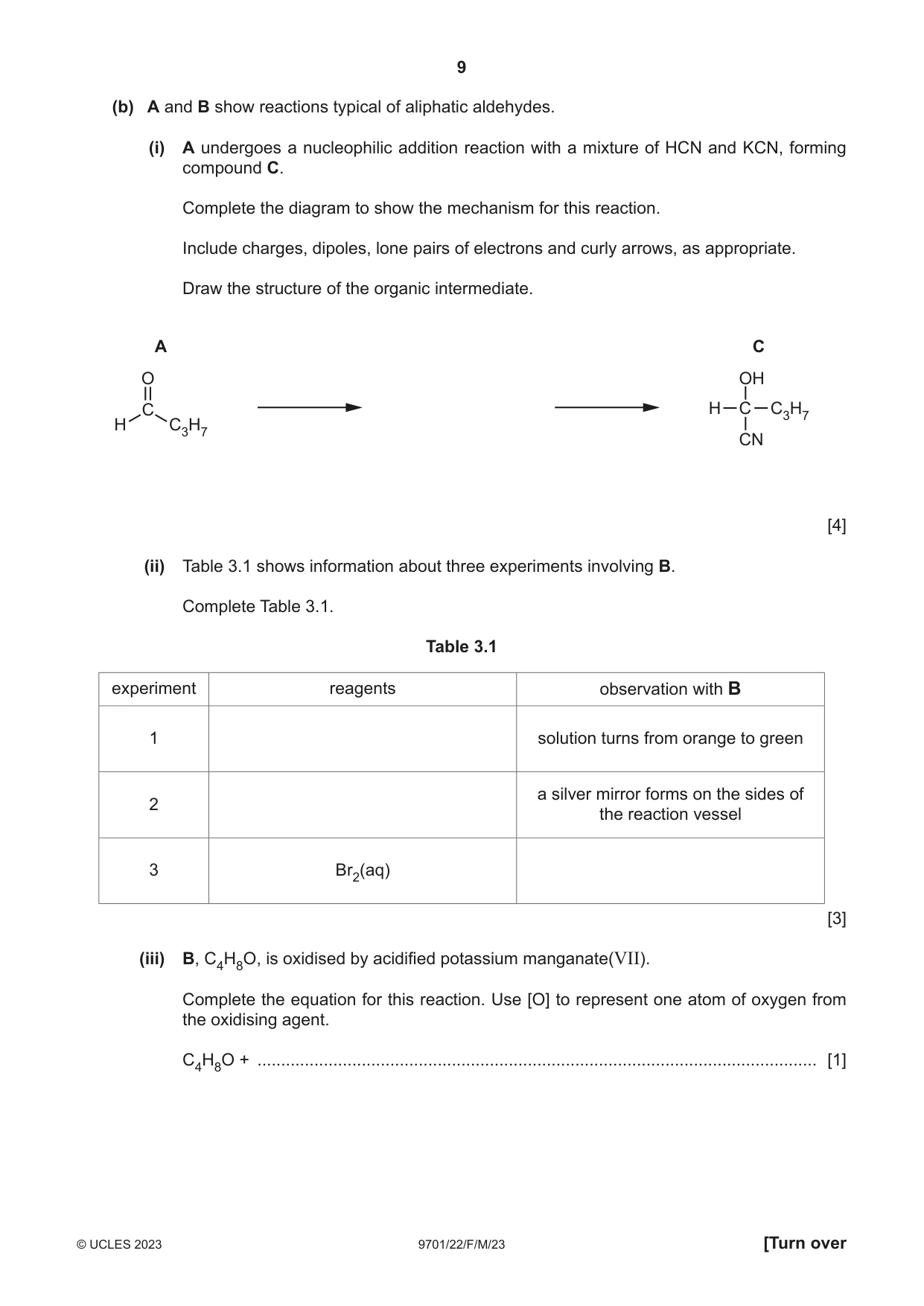
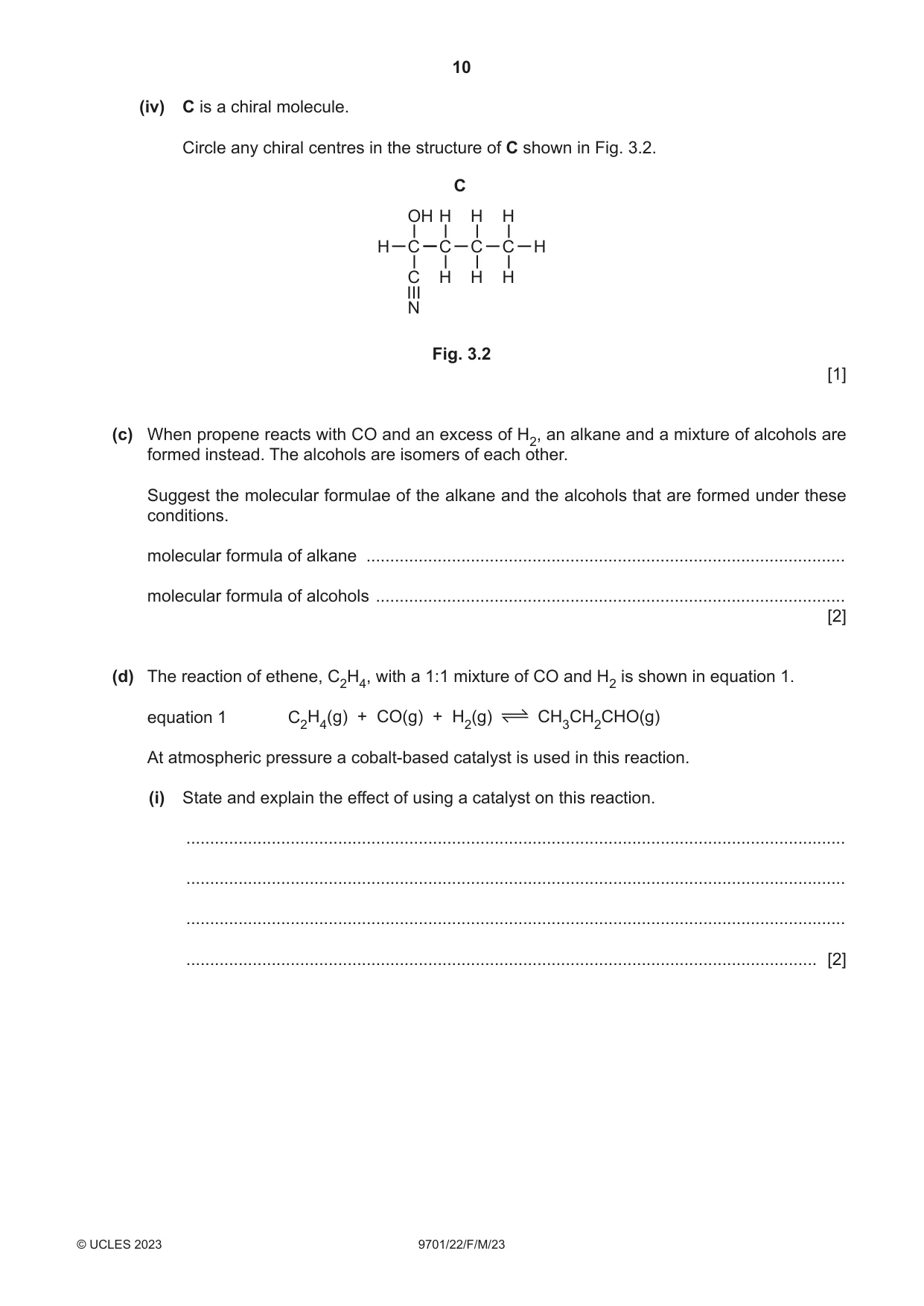
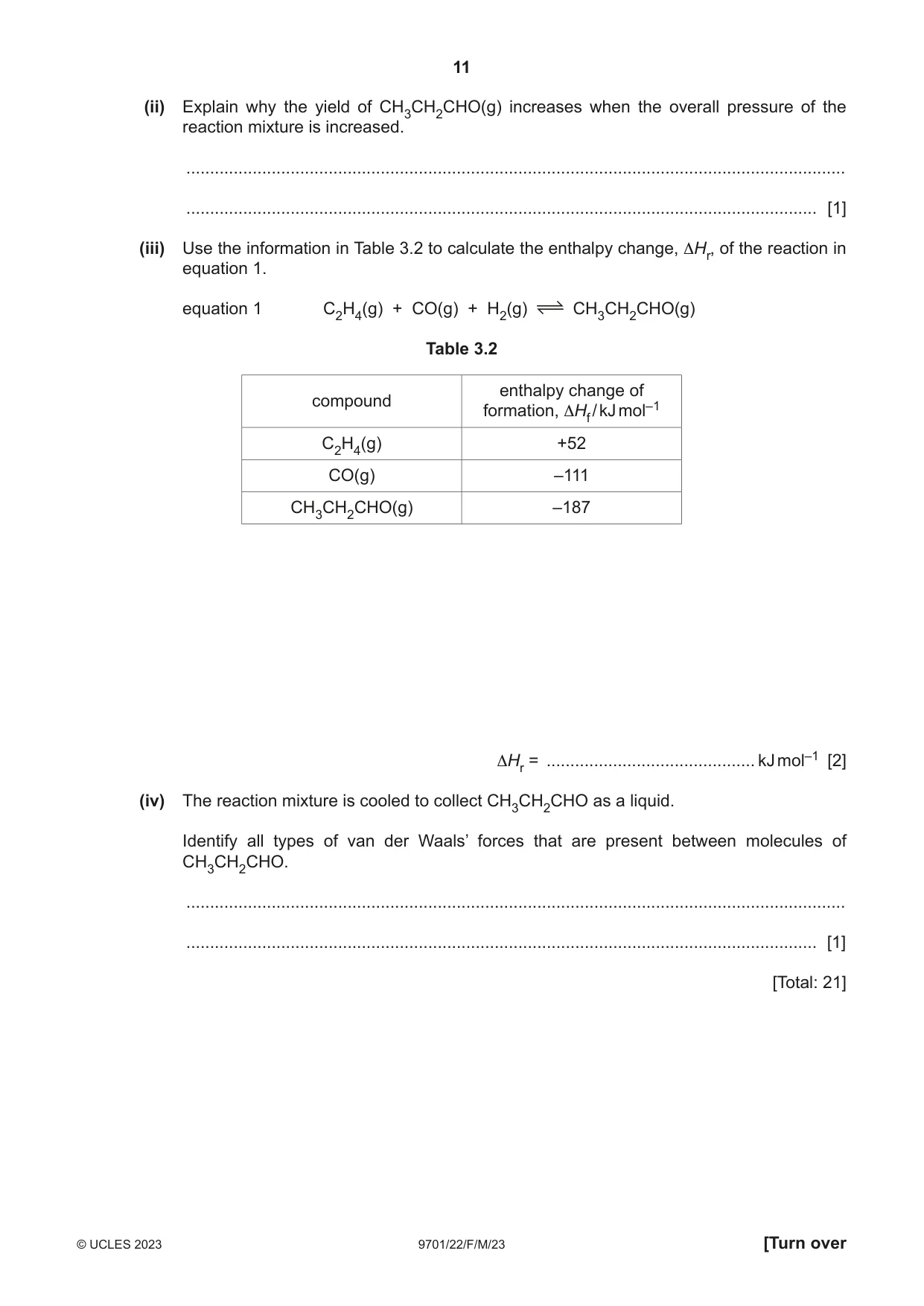
3 Alkenes undergo an addition reaction with a 1:1 mixture of CO and H2 to form aldehydes. Fig. 3.1 shows the reaction of propene with a 1:1 mixture of CO and H2. CO CHO CHO and H2 propene A B Fig. 3.1 (a) (i) Define addition reaction. ........................................................................................................................................... ..................................................................................................................................... [1] (ii) Aldehydes A and B are structural isomers. State the type of structural isomerism shown by A and B. ..................................................................................................................................... [1] (iii) Name A. ..................................................................................................................................... [1] (iv) The complete reaction of propene with a 1:1 mixture of CO and H2 produces A and B only. The product mixture contains 96% A and 4% B. Calculate the mass of A produced in this reaction when 5.00 × 10³ kg of propene is used. mass of A = ..................................................... kg [1] (b) A and B show reactions typical of aliphatic aldehydes. (i) A undergoes a nucleophilic addition reaction with a mixture of HCN and KCN, forming compound C. Complete the diagram to show the mechanism for this reaction. Include charges, dipoles, lone pairs of electrons and curly arrows, as appropriate. Draw the structure of the organic intermediate. A C O OH C H C C3H7 H C3H7 CN [4] (ii) Table 3.1 shows information about three experiments involving B. Complete Table 3.1. Table 3.1 experiment reagents observation with B 1 solution turns from orange to green a silver mirror forms on the sides of 2 the reaction vessel 3 Br2(aq) [3] (iii) B, C4H8O, is oxidised by acidified potassium manganate(VII). Complete the equation for this reaction. Use [O] to represent one atom of oxygen from the oxidising agent. C4H8O + ...................................................................................................................... [1] (iv) C is a chiral molecule. Circle any chiral centres in the structure of C shown in Fig. 3.2. C OH H H H H C C C C H C H H H III N Fig. 3.2 [1] (c) When propene reacts with CO and an excess of H2, an alkane and a mixture of alcohols are formed instead. The alcohols are isomers of each other. Suggest the molecular formulae of the alkane and the alcohols that are formed under these conditions. molecular formula of alkane ..................................................................................................... molecular formula of alcohols ................................................................................................... [2] (d) The reaction of ethene, C2H4, with a 1:1 mixture of CO and H2 is shown in equation 1. equation 1 C2H4(g) + CO(g) + H2(g) CH3CH2CHO(g) At atmospheric pressure a cobalt‑based catalyst is used in this reaction. (i) State and explain the effect of using a catalyst on this reaction. ........................................................................................................................................... ........................................................................................................................................... ........................................................................................................................................... ..................................................................................................................................... [2] (ii) Explain why the yield of CH3CH2CHO(g) increases when the overall pressure of the reaction mixture is increased. ........................................................................................................................................... ..................................................................................................................................... [1] (iii) Use the information in Table 3.2 to calculate the enthalpy change, ΔHr, of the reaction in equation 1. equation 1 C2H4(g) + CO(g) + H2(g) CH3CH2CHO(g) Table 3.2 enthalpy change of compound formation, ΔHf / kJ mol–1 C2H4(g) +52 CO(g) –111 CH3CH2CHO(g) –187 ΔHr = ............................................ kJ mol–1 [2] (iv) The reaction mixture is cooled to collect CH3CH2CHO as a liquid. Identify all types of van der Waals’ forces that are present between molecules of CH3CH2CHO. ........................................................................................................................................... ..................................................................................................................................... [1] [Total: 21]
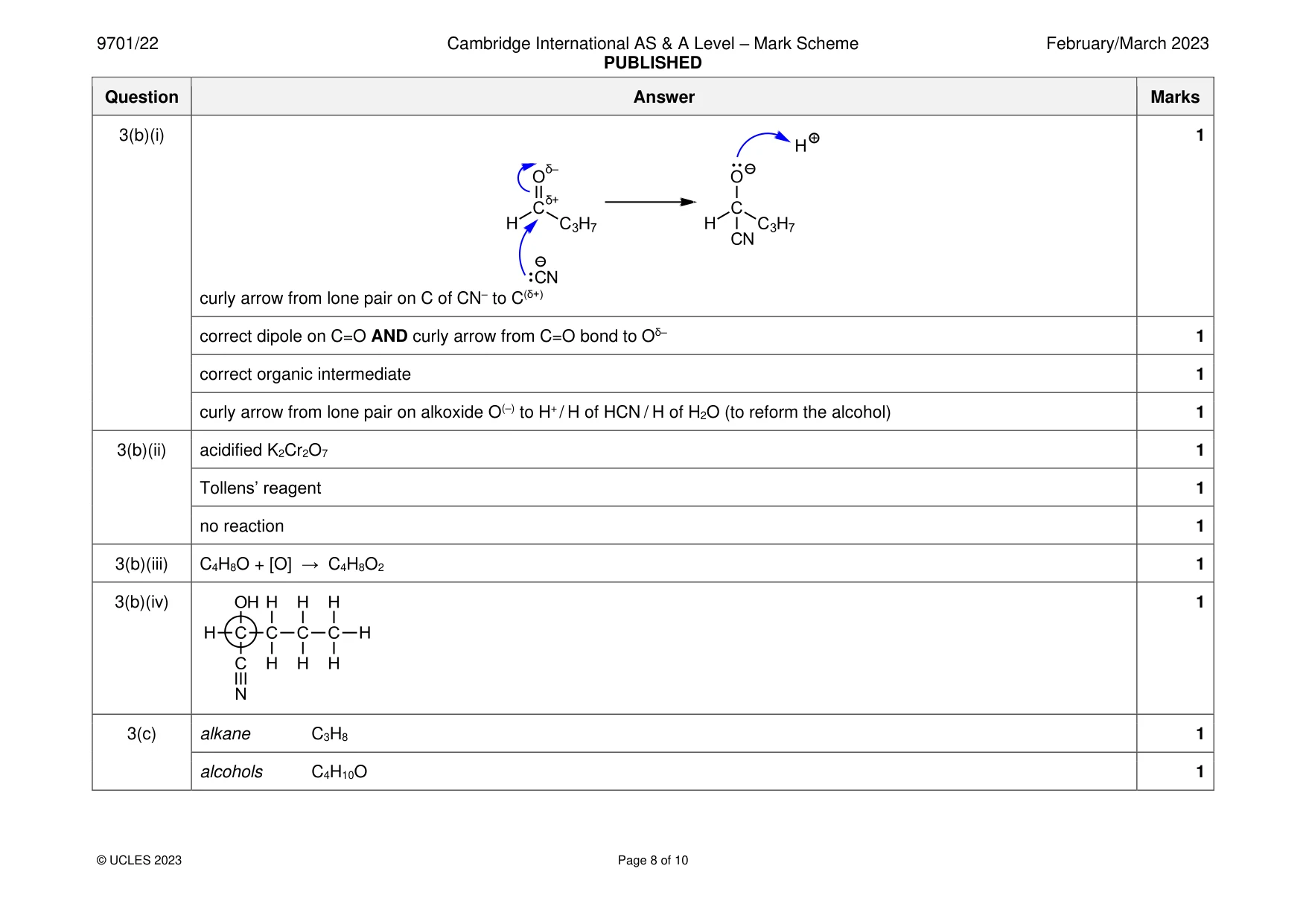
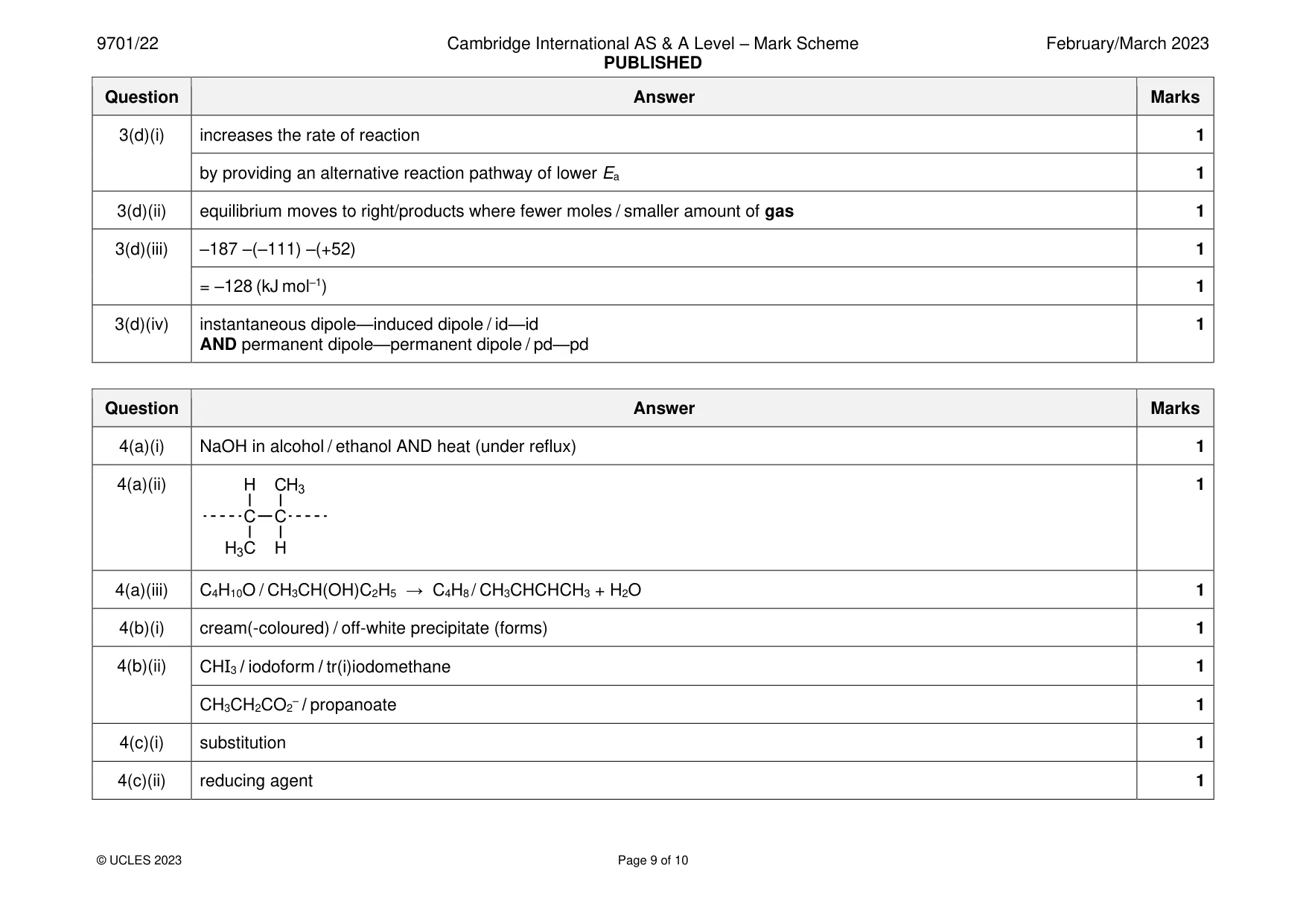
Mark scheme: 3(a)(i) (a reaction where) two (or more) compounds / reagents / molecules form (only) one product 1 3(a)(ii) position(al isomerism) 1 3(a)(iii) butanal 1 3(a)(iv) 96% (5000 / 42.0) 72.0 = 8230 or 8229 (kg) 1 3(b)(i) 1 curly arrow from lone pair on C of CN– to C(δ+) correct dipole on C=O AND curly arrow from C=O bond to Oδ– 1 correct organic intermediate 1 curly arrow from lone pair on alkoxide O(–) to H+ / H of HCN / H of H2O (to reform the alcohol) 1 3(b)(ii) acidified K2Cr2O7 1 Tollens’ reagent 1 no reaction 1 3(b)(iii) C4H8O + [O] → C4H8O2 1 3(b)(iv) 1 3(c) alkane C3H8 1 alcohols C4H10O 1 3(d)(i) increases the rate of reaction 1 by providing an alternative reaction pathway of lower Ea 1 3(d)(ii) equilibrium moves to right/products where fewer moles / smaller amount of gas 1 3(d)(iii) –187 –(–111) –(+52) 1 = –128 (kJ mol–1) 1 3(d)(iv) instantaneous dipole—induced dipole / id—id 1 AND permanent dipole—permanent dipole / pd—pd
More questions on Isomerism: structural isomerism and stereoisomerism
Q4 · Some reactions of compound D, 2‑bromobutane
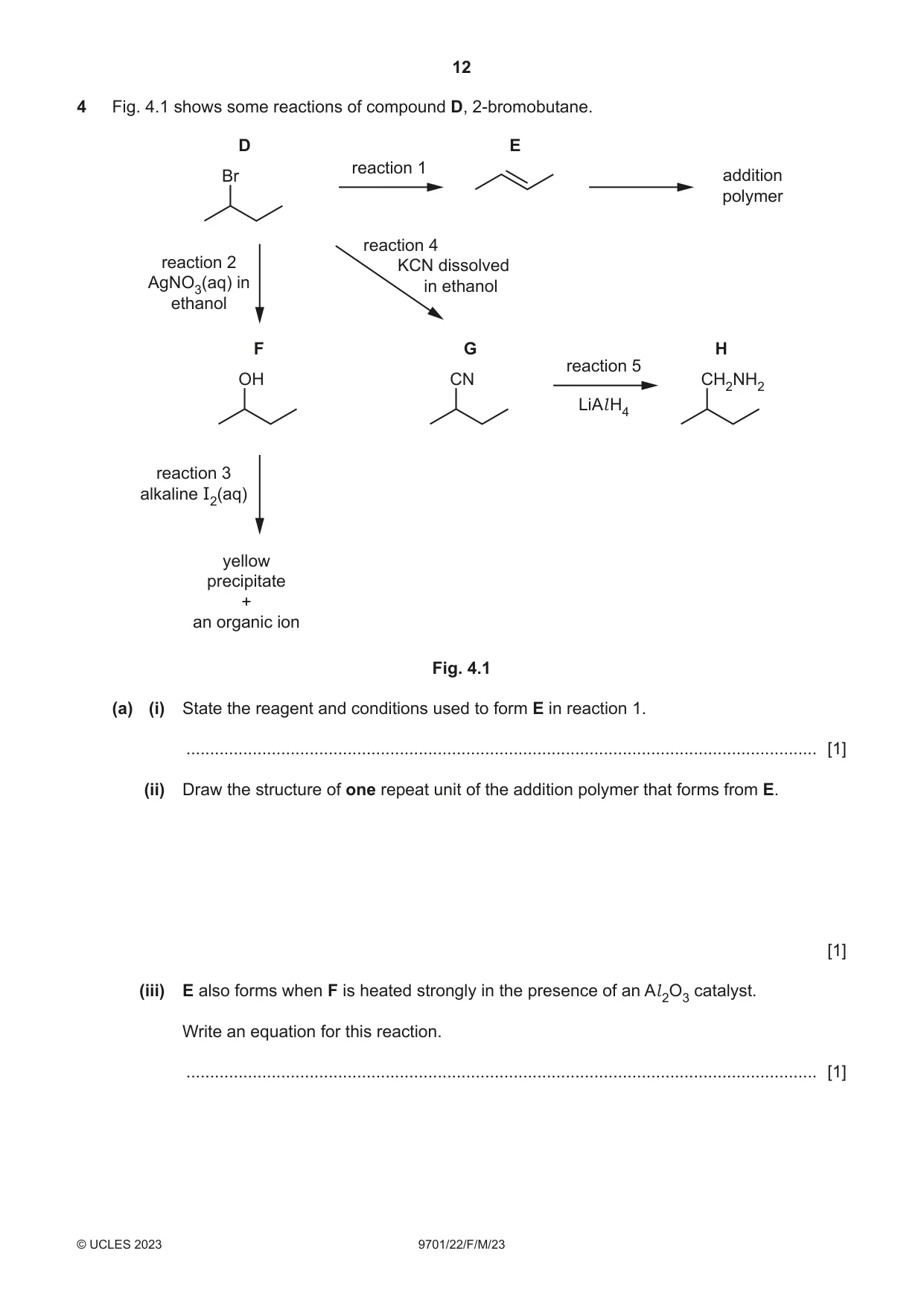
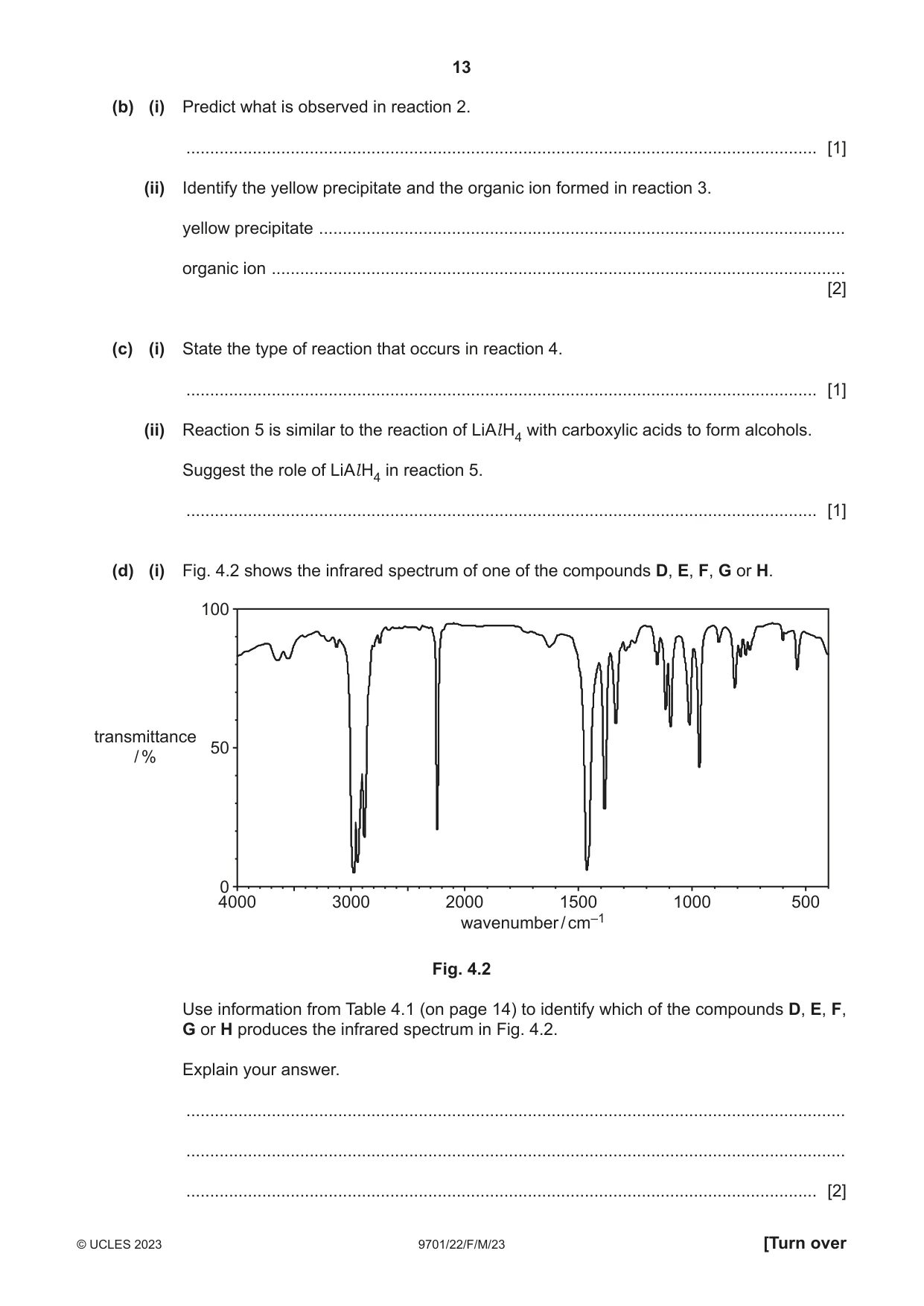
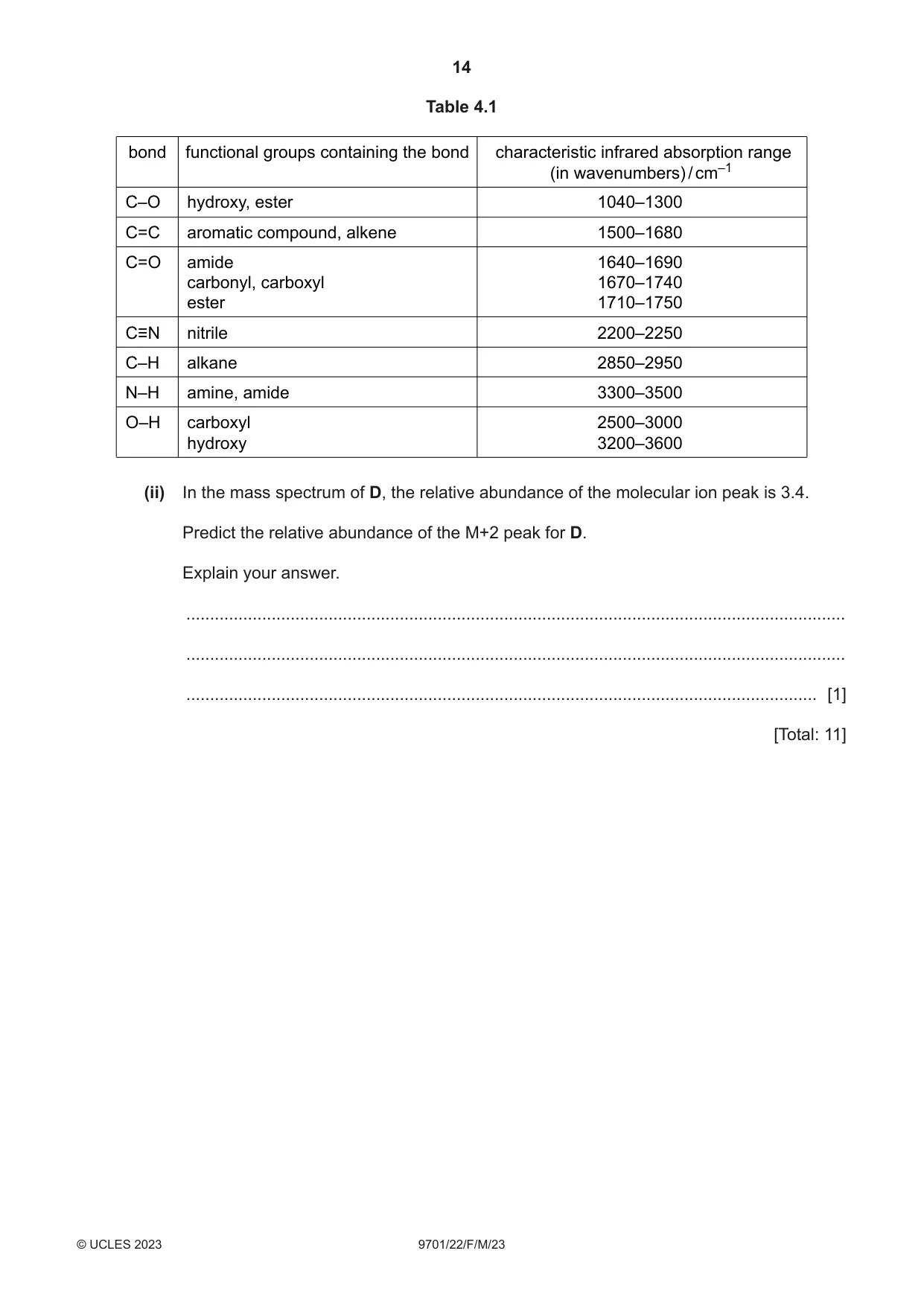
4 Fig. 4.1 shows some reactions of compound D, 2‑bromobutane. D E reaction 1 Br addition polymer reaction 4 reaction 2 KCN dissolved AgNO3(aq) in in ethanol ethanol F G H reaction 5 OH CN CH2NH2 LiAlH4 reaction 3 alkaline I2(aq) yellow precipitate + an organic ion Fig. 4.1 (a) (i) State the reagent and conditions used to form E in reaction 1. ..................................................................................................................................... [1] (ii) Draw the structure of one repeat unit of the addition polymer that forms from E. [1] (iii) E also forms when F is heated strongly in the presence of an Al 2O3 catalyst. Write an equation for this reaction. ..................................................................................................................................... [1] (b) (i) Predict what is observed in reaction 2. ..................................................................................................................................... [1] (ii) Identify the yellow precipitate and the organic ion formed in reaction 3. yellow precipitate ............................................................................................................... organic ion ......................................................................................................................... [2] (c) (i) State the type of reaction that occurs in reaction 4. ..................................................................................................................................... [1] (ii) Reaction 5 is similar to the reaction of LiAl H4 with carboxylic acids to form alcohols. Suggest the role of LiAl H4 in reaction 5. ..................................................................................................................................... [1] (d) (i) Fig. 4.2 shows the infrared spectrum of one of the compounds D, E, F, G or H. 100 transmittance 50 / % 0 4000 3000 2000 1500 1000 500 wavenumber / cm–1 Fig. 4.2 Use information from Table 4.1 (on page 14) to identify which of the compounds D, E, F, G or H produces the infrared spectrum in Fig. 4.2. Explain your answer. ........................................................................................................................................... ........................................................................................................................................... ..................................................................................................................................... [2] Table 4.1 bond functional groups containing the bond characteristic infrared absorption range (in wavenumbers) / cm–1 C–O hydroxy, ester 1040–1300 C=C aromatic compound, alkene 1500–1680 C=O amide 1640–1690 carbonyl, carboxyl 1670–1740 ester 1710–1750 C≡N nitrile 2200–2250 C–H alkane 2850–2950 N–H amine, amide 3300–3500 O–H carboxyl 2500–3000 hydroxy 3200–3600 (ii) In the mass spectrum of D, the relative abundance of the molecular ion peak is 3.4. Predict the relative abundance of the M+2 peak for D. Explain your answer. ........................................................................................................................................... ........................................................................................................................................... ..................................................................................................................................... [1] [Total: 11]
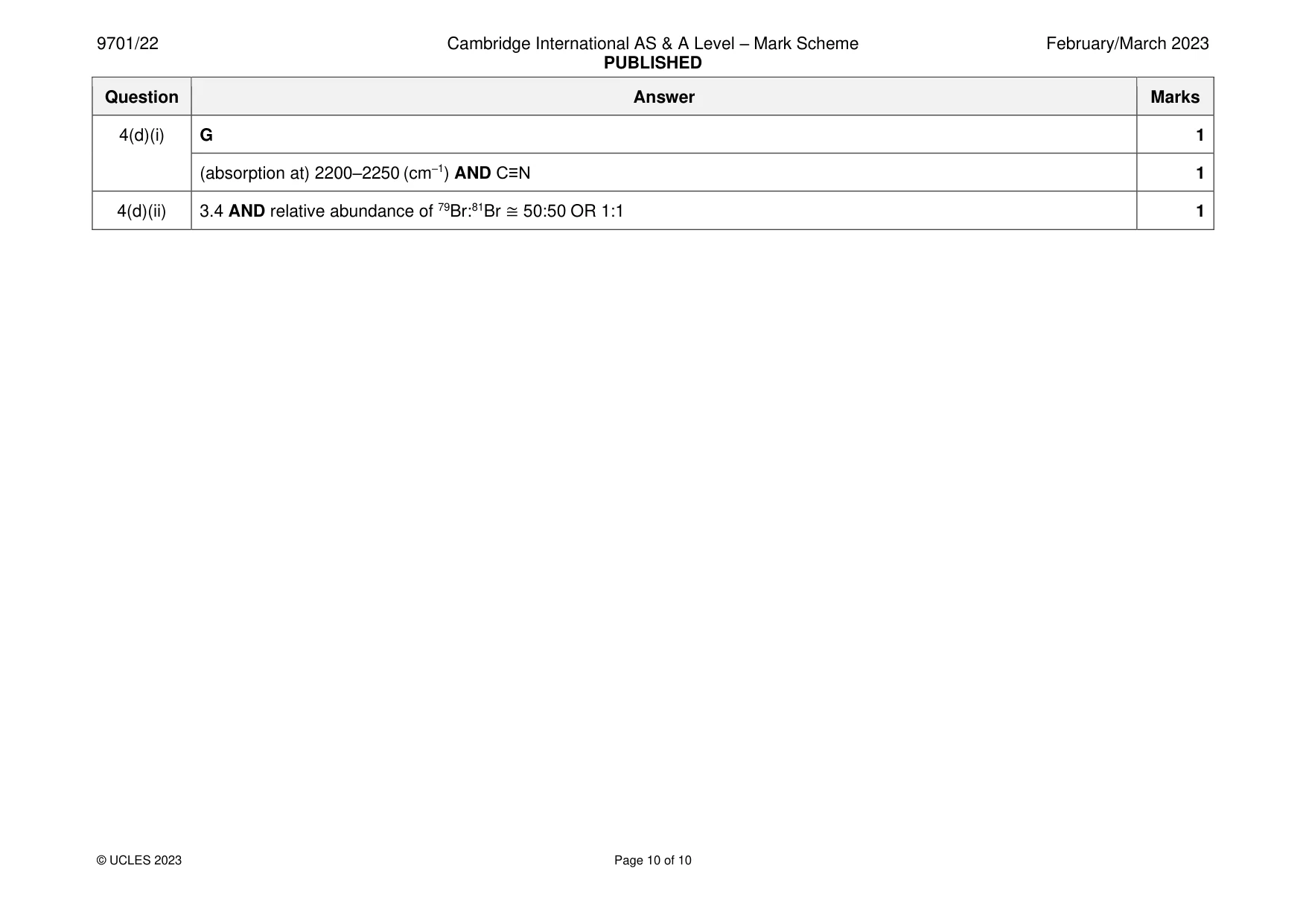
Mark scheme: 4(a)(i) NaOH in alcohol / ethanol AND heat (under reflux) 1 4(a)(ii) 1 4(a)(iii) C4H10O / CH3CH(OH)C2H5 → C4H8 / CH3CHCHCH3 + H2O 1 4(b)(i) cream(-coloured) / off-white precipitate (forms) 1 4(b)(ii) CHI3 / iodoform / tr(i)iodomethane 1 CH3CH2CO2– / propanoate 1 4(c)(i) substitution 1 4(c)(ii) reducing agent 1 4(d)(i) G 1 (absorption at) 2200–2250 (cm–1) AND C≡N 1 4(d)(ii) 3.4 AND relative abundance of 79Br:81Br ≅ 50:50 OR 1:1 1
What was in this paper
The subtopics covered by these 4 questions, and how many questions each got. Open one in a new tab to see every Cambridge question on it.
What you needed in this session
Cambridge’s own grade thresholds for 2023 Feb/March, Paper 2 · Variant 2. A higher threshold means an easier paper — the bar moves with how the cohort did.