Cambridge A Level Chemistry 9701 — 2025 May/June Paper 2 · Variant 3
9701/23/M/J/25 · 6 questions · 60 marks · 75 min
The question paper and its mark scheme, free to read here and free to download. This is Cambridge’s own paper, exactly as it was sat.
Question paper16 pages
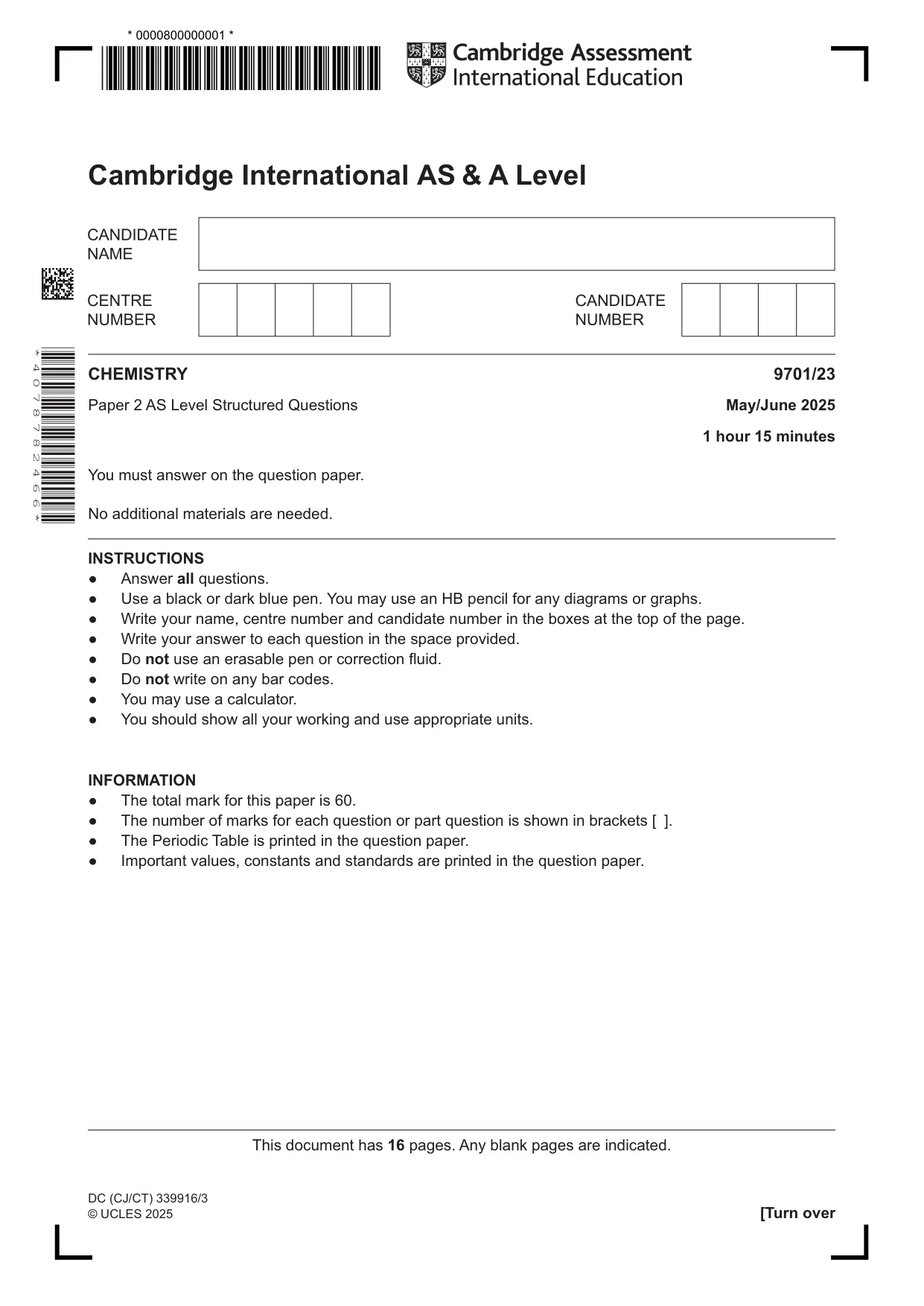
Mark scheme11 pages
Answers below. Sit the paper first if you are practising.
Questions as text
Q1 · The chemical properties of an element are related to the electronic configuration of its…
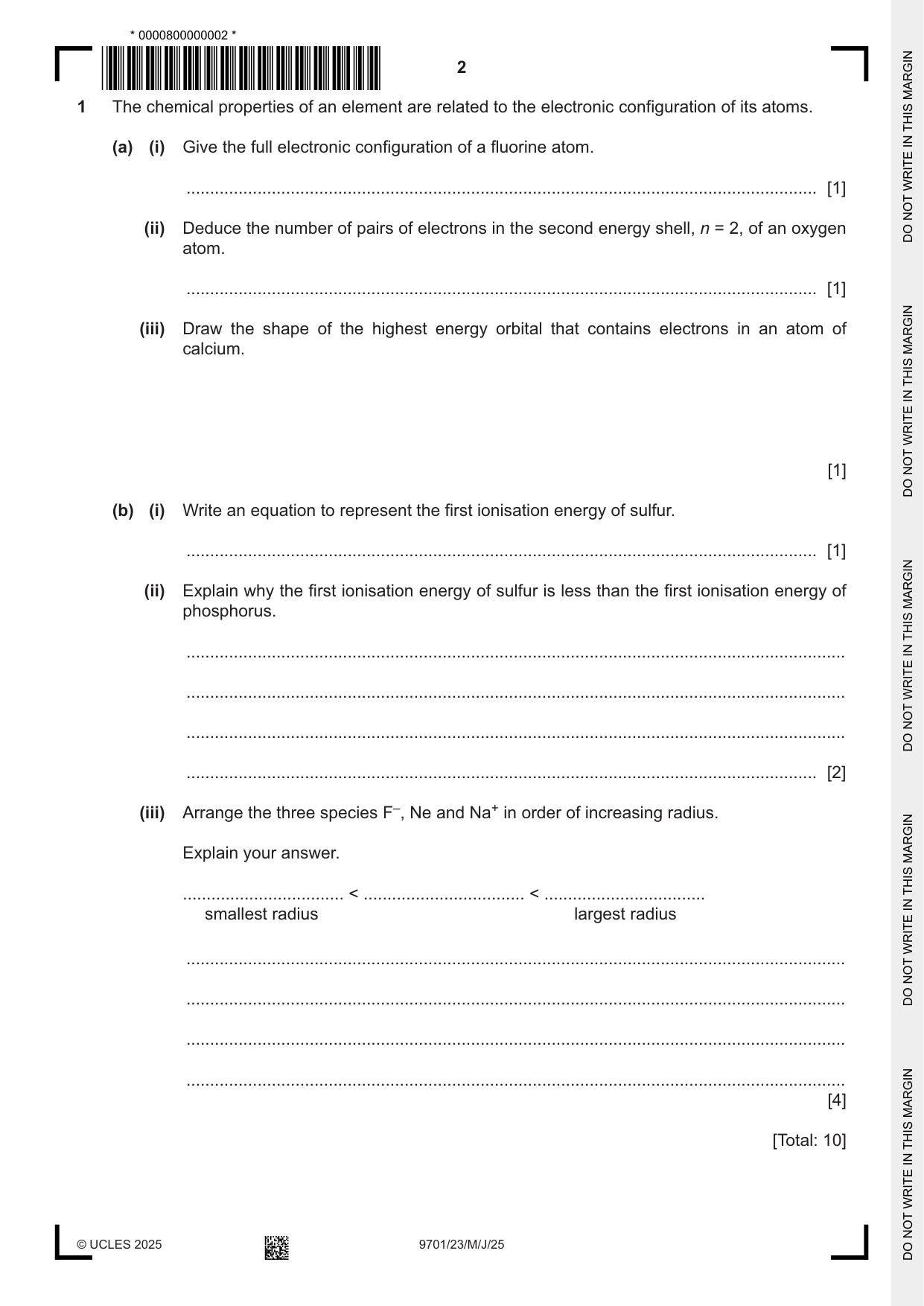
1 The chemical properties of an element are related to the electronic configuration of its atoms. (a) (i) Give the full electronic configuration of a fluorine atom. ..................................................................................................................................... [1] (ii) Deduce the number of pairs of electrons in the second energy shell, n = 2, of an oxygen atom. ..................................................................................................................................... [1] (iii) Draw the shape of the highest energy orbital that contains electrons in an atom of calcium. [1] (b) (i) Write an equation to represent the first ionisation energy of sulfur. ..................................................................................................................................... [1] (ii) Explain why the first ionisation energy of sulfur is less than the first ionisation energy of phosphorus. ........................................................................................................................................... ........................................................................................................................................... ........................................................................................................................................... ..................................................................................................................................... [2] (iii) Arrange the three species F–, Ne and Na+ in order of increasing radius. Explain your answer. .................................. < .................................. < .................................. smallest radius largest radius ........................................................................................................................................... ........................................................................................................................................... ........................................................................................................................................... ........................................................................................................................................... [4] [Total: 10]
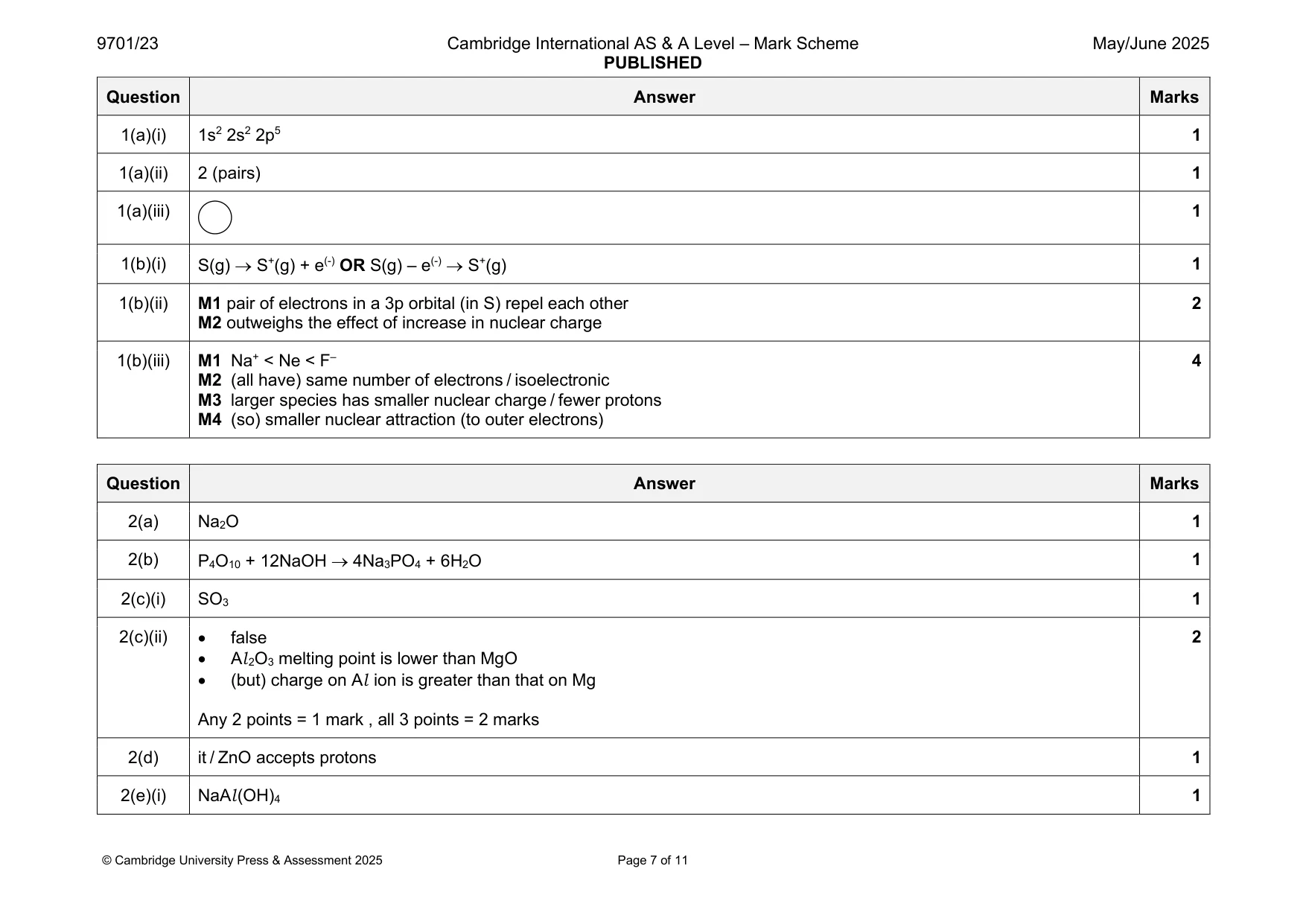
Mark scheme: Question Answer Marks 1(a)(i) 1s2 2s2 2p5 1 1(a)(ii) 2 (pairs) 1 1(a)(iii) 1 1(b)(i) S(g) → S+(g) + e(-) OR S(g) – e(-) → S+(g) 1 1(b)(ii) M1 pair of electrons in a 3p orbital (in S) repel each other 2 M2 outweighs the effect of increase in nuclear charge 1(b)(iii) M1 Na+ < Ne < F– 4 M2 (all have) same number of electrons / isoelectronic M3 larger species has smaller nuclear charge / fewer protons M4 (so) smaller nuclear attraction (to outer electrons)
Q2 · The chemical properties of oxides are related to the chemical bonding present in these…
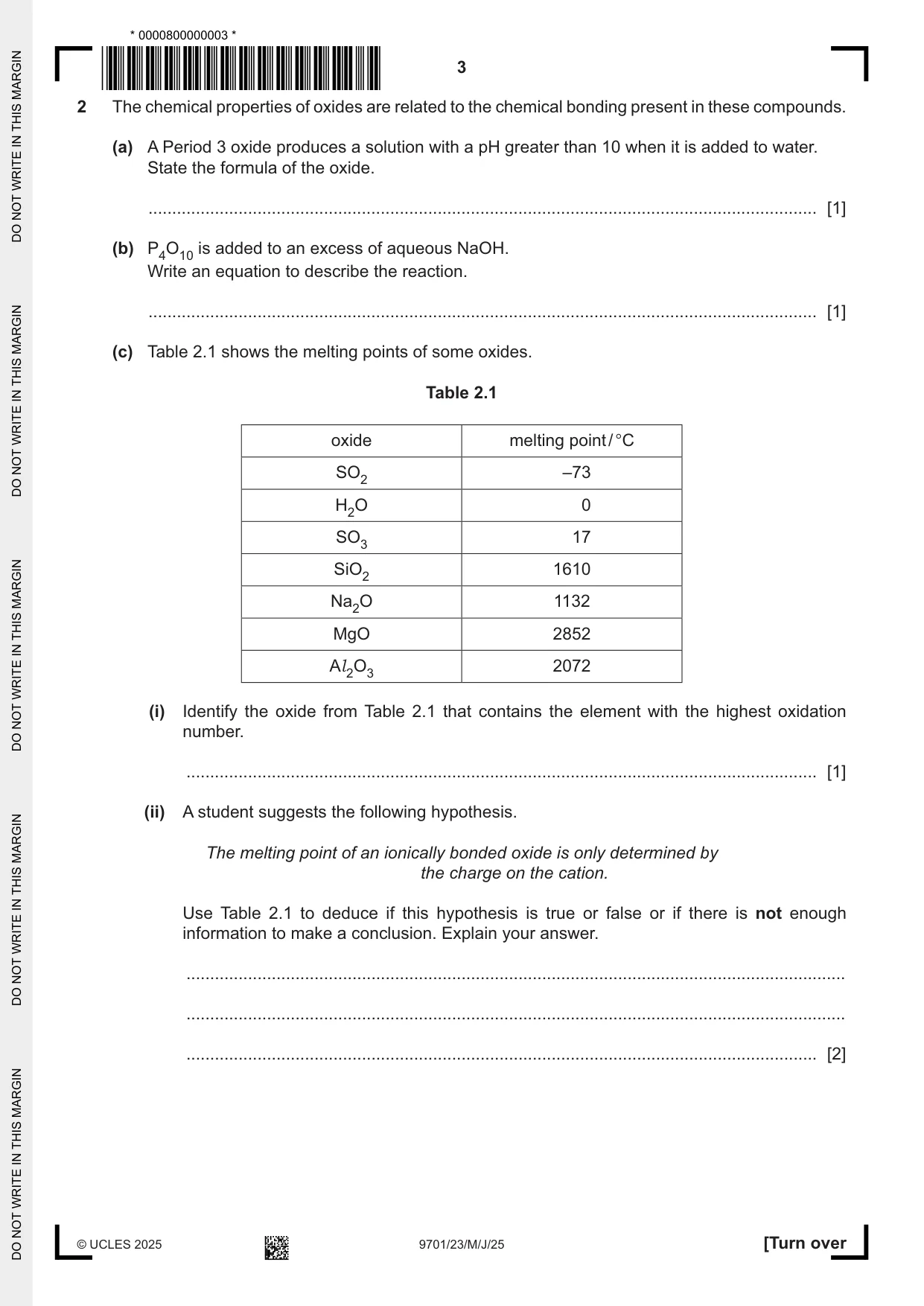
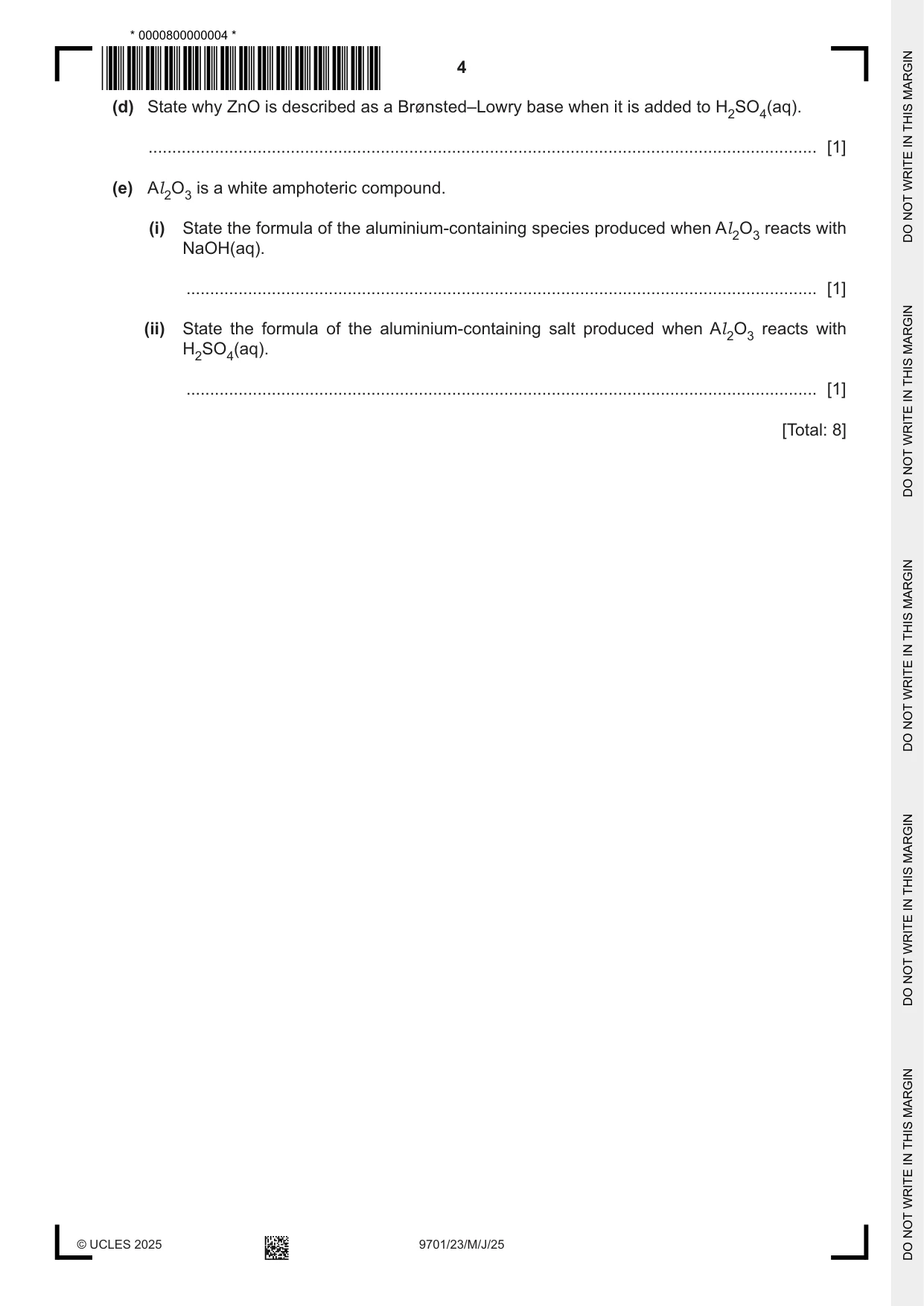
2 The chemical properties of oxides are related to the chemical bonding present in these compounds. (a) A Period 3 oxide produces a solution with a pH greater than 10 when it is added to water. State the formula of the oxide. ............................................................................................................................................. [1] (b) P4O10 is added to an excess of aqueous NaOH. Write an equation to describe the reaction. ............................................................................................................................................. [1] (c) Table 2.1 shows the melting points of some oxides. Table 2.1 oxide melting point / °C SO2 –73 H2O 0 SO3 17 SiO2 1610 Na2O 1132 MgO 2852 Al 2O3 2072 (i) Identify the oxide from Table 2.1 that contains the element with the highest oxidation number. ..................................................................................................................................... [1] (ii) A student suggests the following hypothesis. The melting point of an ionically bonded oxide is only determined by the charge on the cation. Use Table 2.1 to deduce if this hypothesis is true or false or if there is not enough information to make a conclusion. Explain your answer. ........................................................................................................................................... ........................................................................................................................................... ..................................................................................................................................... [2] (d) State why ZnO is described as a Brønsted–Lowry base when it is added to H2SO4(aq). ............................................................................................................................................. [1] (e) Al 2O3 is a white amphoteric compound. (i) State the formula of the aluminium‑containing species produced when Al 2O3 reacts with NaOH(aq). ..................................................................................................................................... [1] (ii) State the formula of the aluminium‑containing salt produced when Al 2O3 reacts with H2SO4(aq). ..................................................................................................................................... [1] [Total: 8]
Mark scheme: 2(a) Na2O 1 2(b) P4O10 + 12NaOH → 4Na3PO4 + 6H2O 1 2(c)(i) SO3 1 2(c)(ii) • false 2 • Al 2O3 melting point is lower than MgO • (but) charge on Al ion is greater than that on Mg Any 2 points = 1 mark , all 3 points = 2 marks 2(d) it / ZnO accepts protons 1 2(e)(i) NaAl (OH)4 1 2(e)(ii) Al 2(SO4)3 1
More questions on Periodicity of chemical properties of the elements in Period 3
Q3 · Different hydrocarbon mixtures produced from fractional distillation of crude oil have…
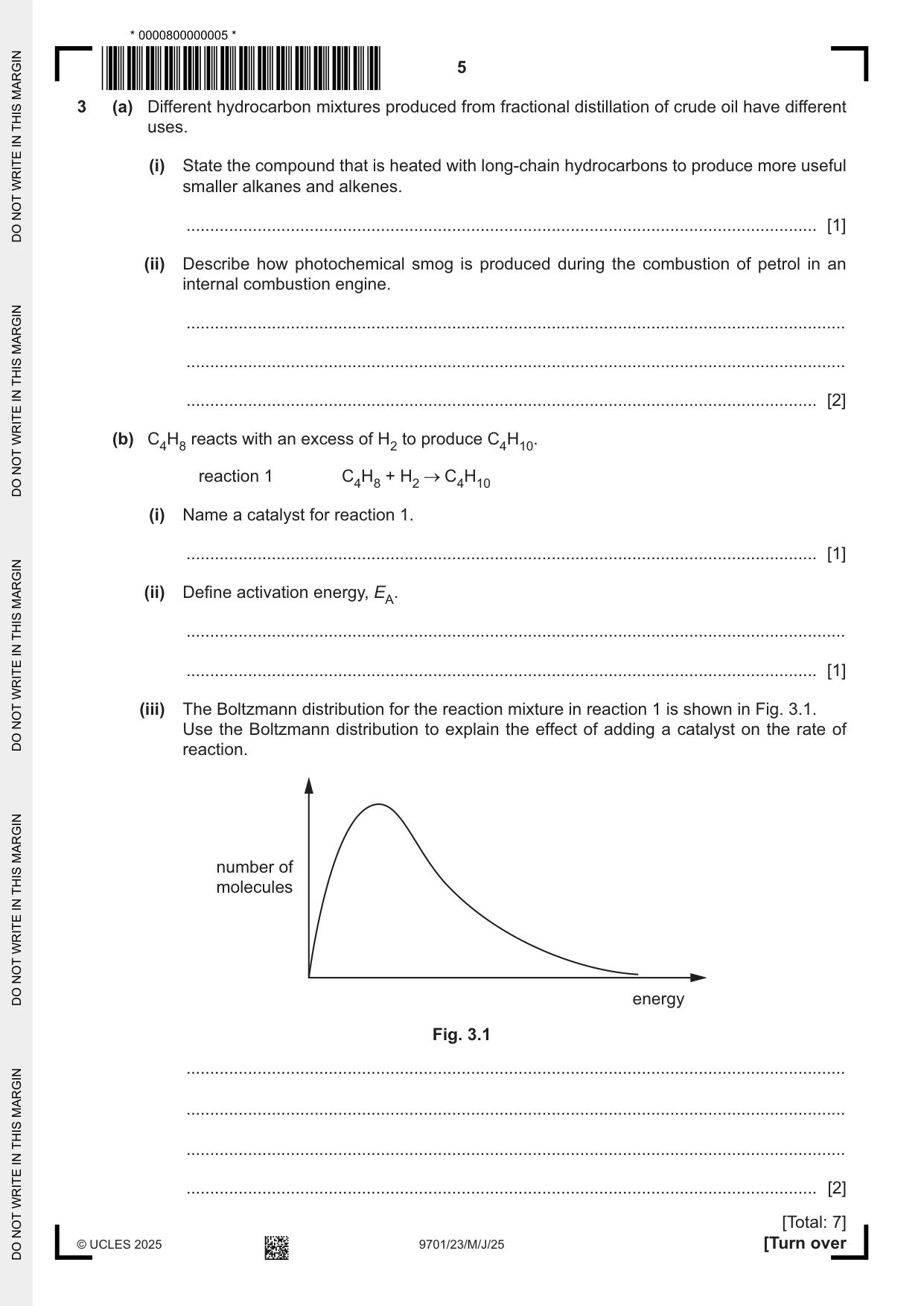
3 (a) Different hydrocarbon mixtures produced from fractional distillation of crude oil have different uses. (i) State the compound that is heated with long‑chain hydrocarbons to produce more useful smaller alkanes and alkenes. ..................................................................................................................................... [1] (ii) Describe how photochemical smog is produced during the combustion of petrol in an internal combustion engine. ........................................................................................................................................... ........................................................................................................................................... ..................................................................................................................................... [2] (b) C4H8 reacts with an excess of H2 to produce C4H10. reaction 1 C4H8 + H2 C4H10 (i) Name a catalyst for reaction 1. ..................................................................................................................................... [1] (ii) Define activation energy, EA. ........................................................................................................................................... ..................................................................................................................................... [1] (iii) The Boltzmann distribution for the reaction mixture in reaction 1 is shown in Fig. 3.1. Use the Boltzmann distribution to explain the effect of adding a catalyst on the rate of reaction. number of molecules energy Fig. 3.1 ........................................................................................................................................... ........................................................................................................................................... ........................................................................................................................................... ..................................................................................................................................... [2] [Total: 7]
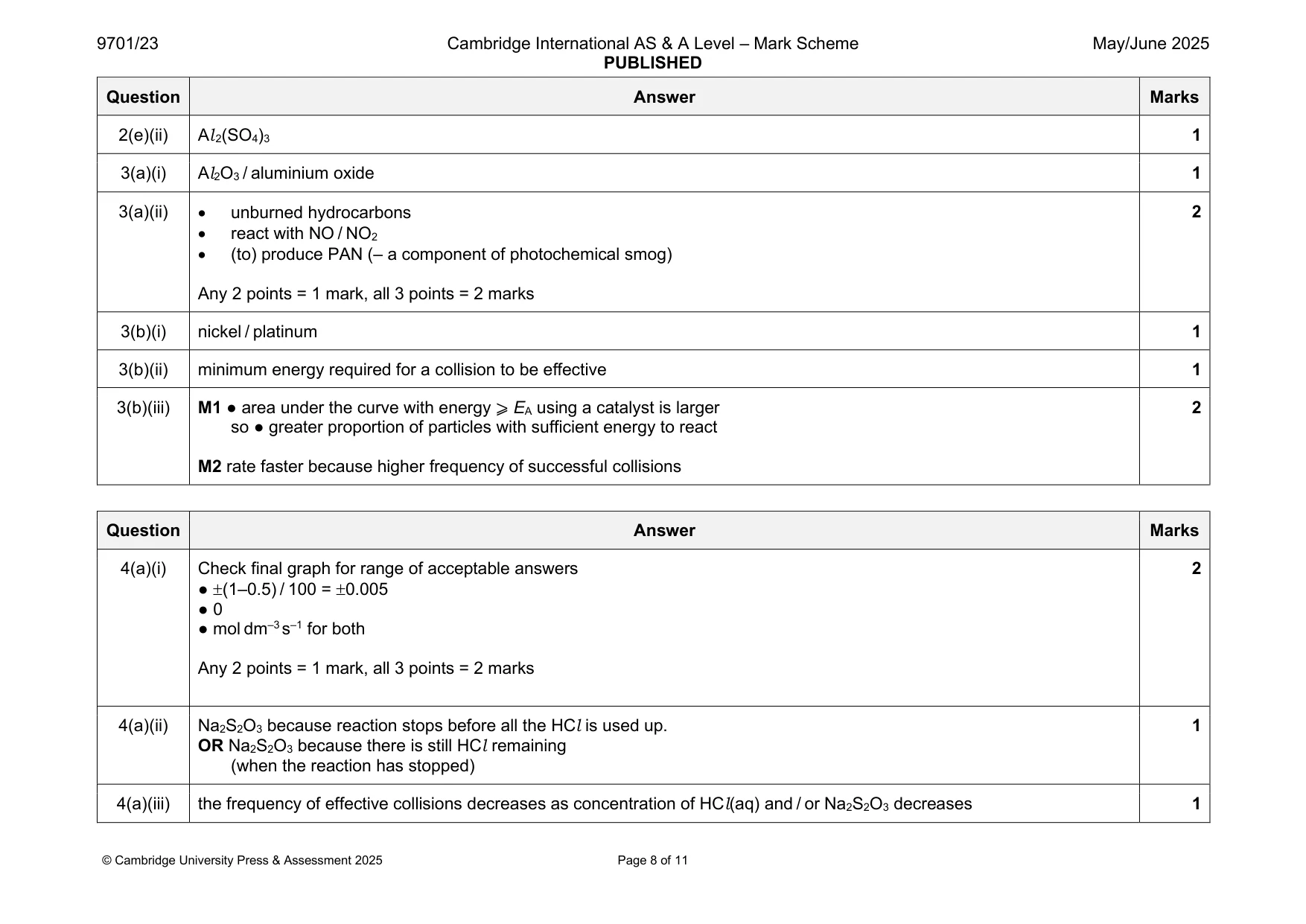
Mark scheme: 3(a)(i) Al2O3 / aluminium oxide 1 3(a)(ii) • unburned hydrocarbons 2 • react with NO / NO2 • (to) produce PAN (– a component of photochemical smog) Any 2 points = 1 mark, all 3 points = 2 marks 3(b)(i) nickel / platinum 1 3(b)(ii) minimum energy required for a collision to be effective 1 3(b)(iii) M1 ● area under the curve with energy ⩾ EA using a catalyst is larger 2 so ● greater proportion of particles with sufficient energy to react M2 rate faster because higher frequency of successful collisions
Q4 · The reaction between Na2S2O3(aq) and HCl (aq) is monitored at constant temperature
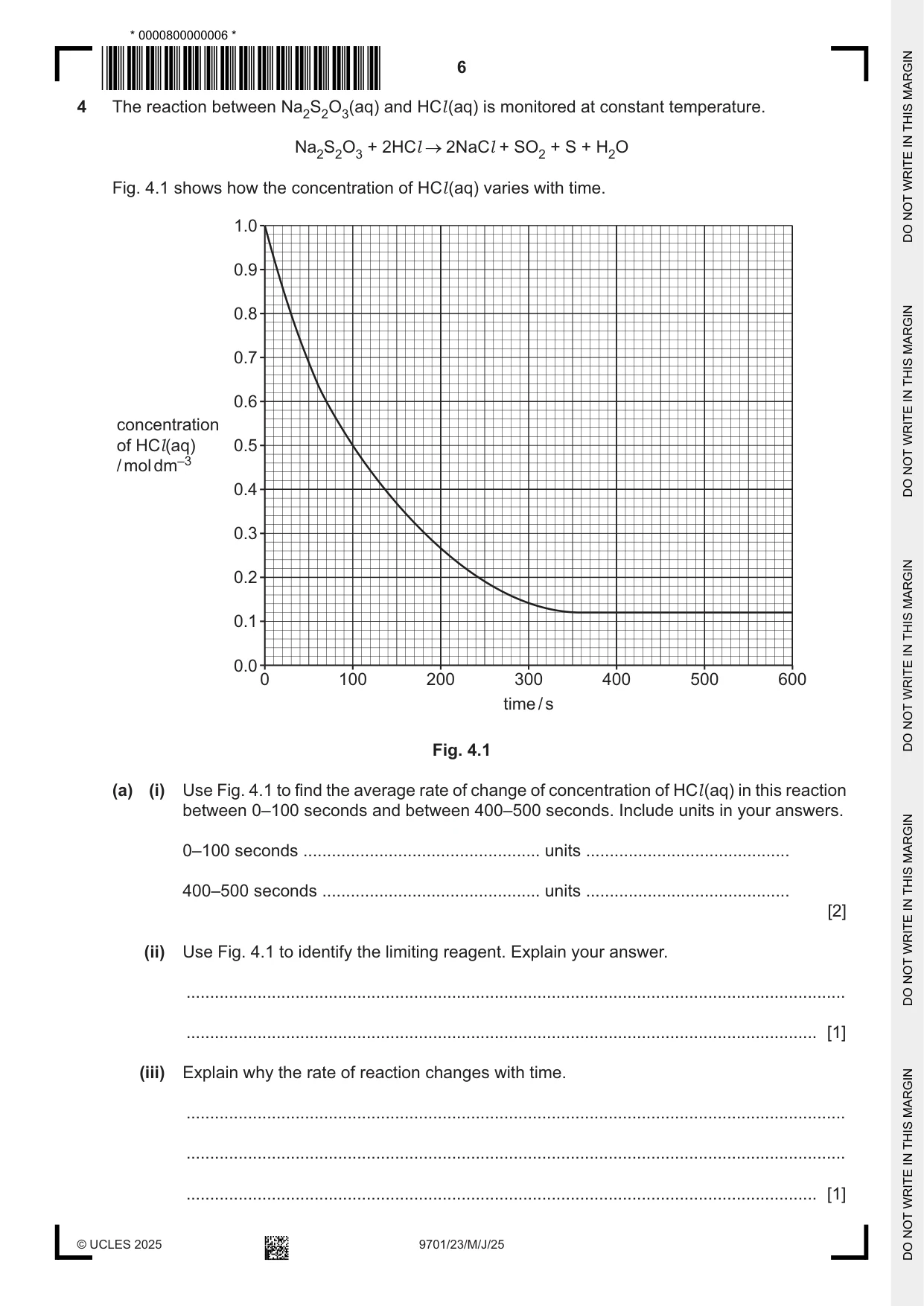
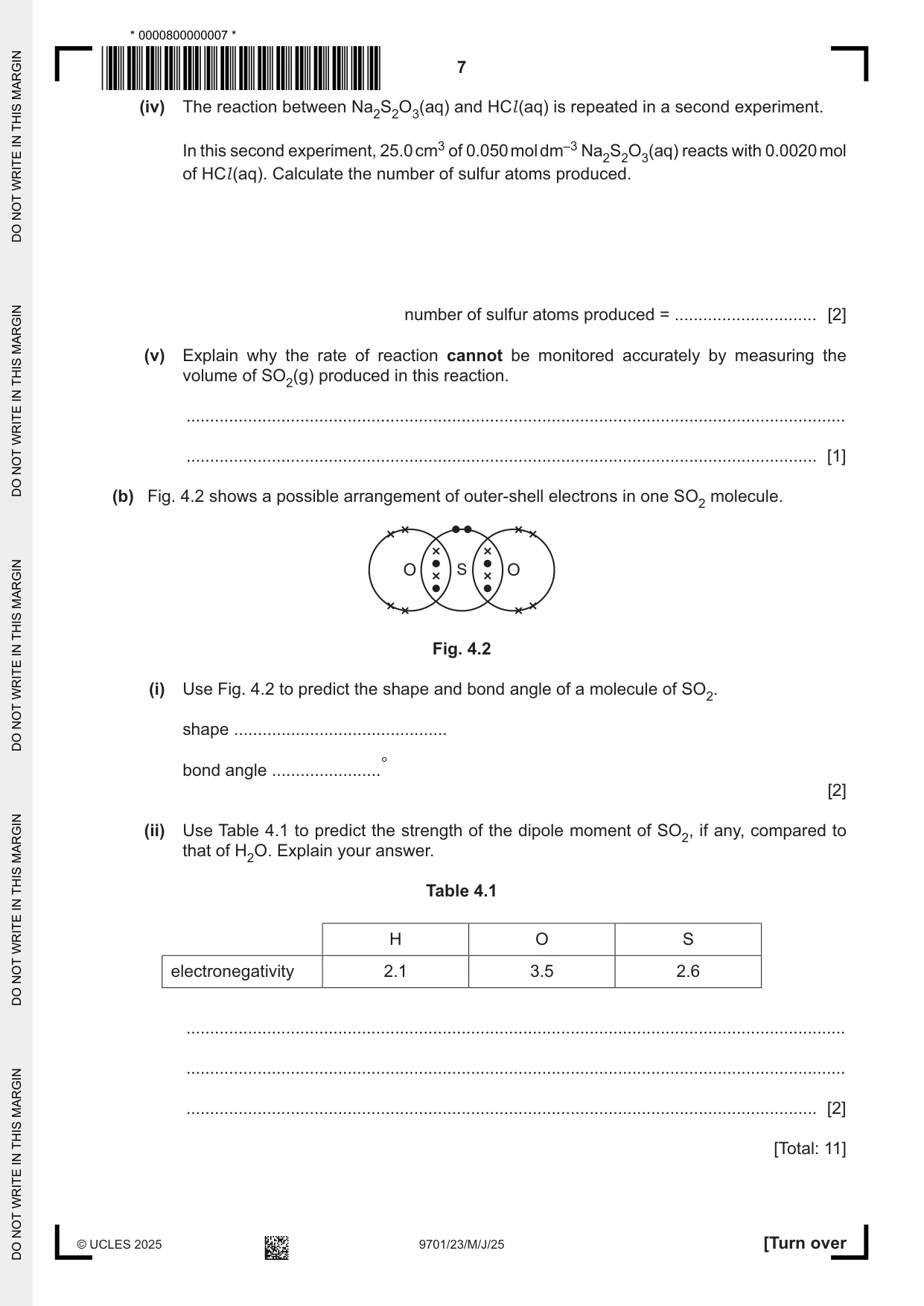
4 The reaction between Na2S2O3(aq) and HCl (aq) is monitored at constant temperature. Na2S2O3 + 2HCl 2NaCl + SO2 + S + H2O Fig. 4.1 shows how the concentration of HCl (aq) varies with time. 1.0 0.9 0.8 0.7 0.6 concentration of HCl(aq) 0.5 / mol dm–3 0.4 0.3 0.2 0.1 0.0 0 100 200 300 400 500 600 time / s Fig. 4.1 (a) (i) Use Fig. 4.1 to find the average rate of change of concentration of HCl (aq) in this reaction between 0–100 seconds and between 400–500 seconds. Include units in your answers. 0–100 seconds .................................................. units ........................................... 400–500 seconds .............................................. units ........................................... [2] (ii) Use Fig. 4.1 to identify the limiting reagent. Explain your answer. ........................................................................................................................................... ..................................................................................................................................... [1] (iii) Explain why the rate of reaction changes with time. ........................................................................................................................................... ........................................................................................................................................... ..................................................................................................................................... [1] (iv) The reaction between Na2S2O3(aq) and HCl (aq) is repeated in a second experiment. In this second experiment, 25.0 cm3 of 0.050 mol dm–3 Na2S2O3(aq) reacts with 0.0020 mol of HCl (aq). Calculate the number of sulfur atoms produced. number of sulfur atoms produced = .............................. [2] (v) Explain why the rate of reaction cannot be monitored accurately by measuring the volume of SO2(g) produced in this reaction. ........................................................................................................................................... ..................................................................................................................................... [1] (b) Fig. 4.2 shows a possible arrangement of outer‑shell electrons in one SO2 molecule. O S O Fig. 4.2 (i) Use Fig. 4.2 to predict the shape and bond angle of a molecule of SO2. shape ............................................. bond angle .......................° [2] (ii) Use Table 4.1 to predict the strength of the dipole moment of SO2, if any, compared to that of H2O. Explain your answer. Table 4.1 H O S electronegativity 2.1 3.5 2.6 ........................................................................................................................................... ........................................................................................................................................... ..................................................................................................................................... [2] [Total: 11]
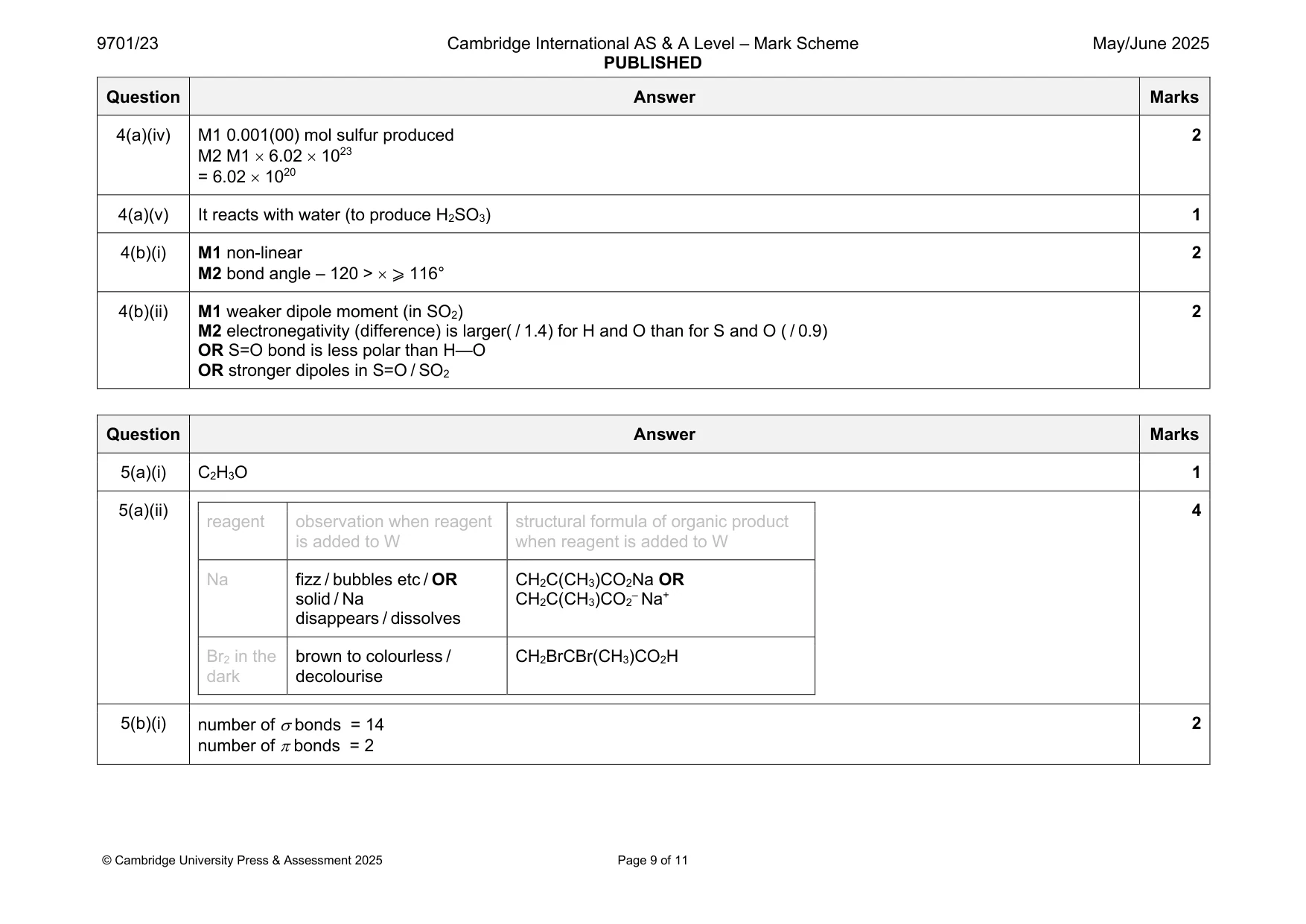
Mark scheme: 4(a)(i) Check final graph for range of acceptable answers 2 ● (1–0.5) / 100 = 0.005 ● 0 ● mol dm–3 s–1 for both Any 2 points = 1 mark, all 3 points = 2 marks 4(a)(ii) Na2S2O3 because reaction stops before all the HCl is used up. 1 OR Na2S2O3 because there is still HCl remaining (when the reaction has stopped) 4(a)(iii) the frequency of effective collisions decreases as concentration of HCl(aq) and / or Na2S2O3 decreases 1 4(a)(iv) M1 0.001(00) mol sulfur produced 2 M2 M1 6.02 1023 = 6.02 1020 4(a)(v) It reacts with water (to produce H2SO3) 1 4(b)(i) M1 non-linear 2 M2 bond angle – 120 > ⩾ 116° 4(b)(ii) M1 weaker dipole moment (in SO2) 2 M2 electronegativity (difference) is larger( / 1.4) for H and O than for S and O ( / 0.9) OR S=O bond is less polar than H—O OR stronger dipoles in S=O / SO2
Q5 · W is a colourless liquid
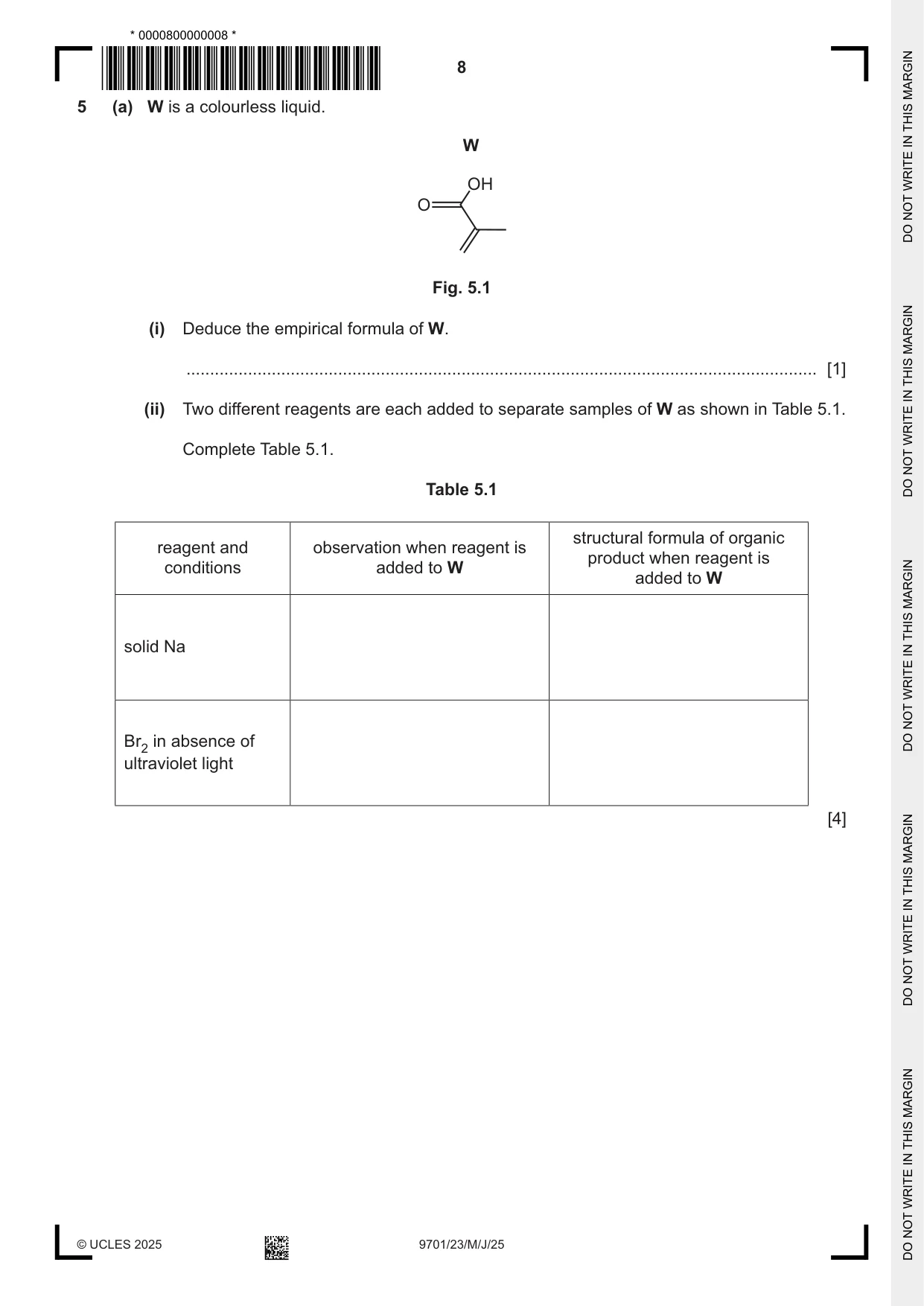
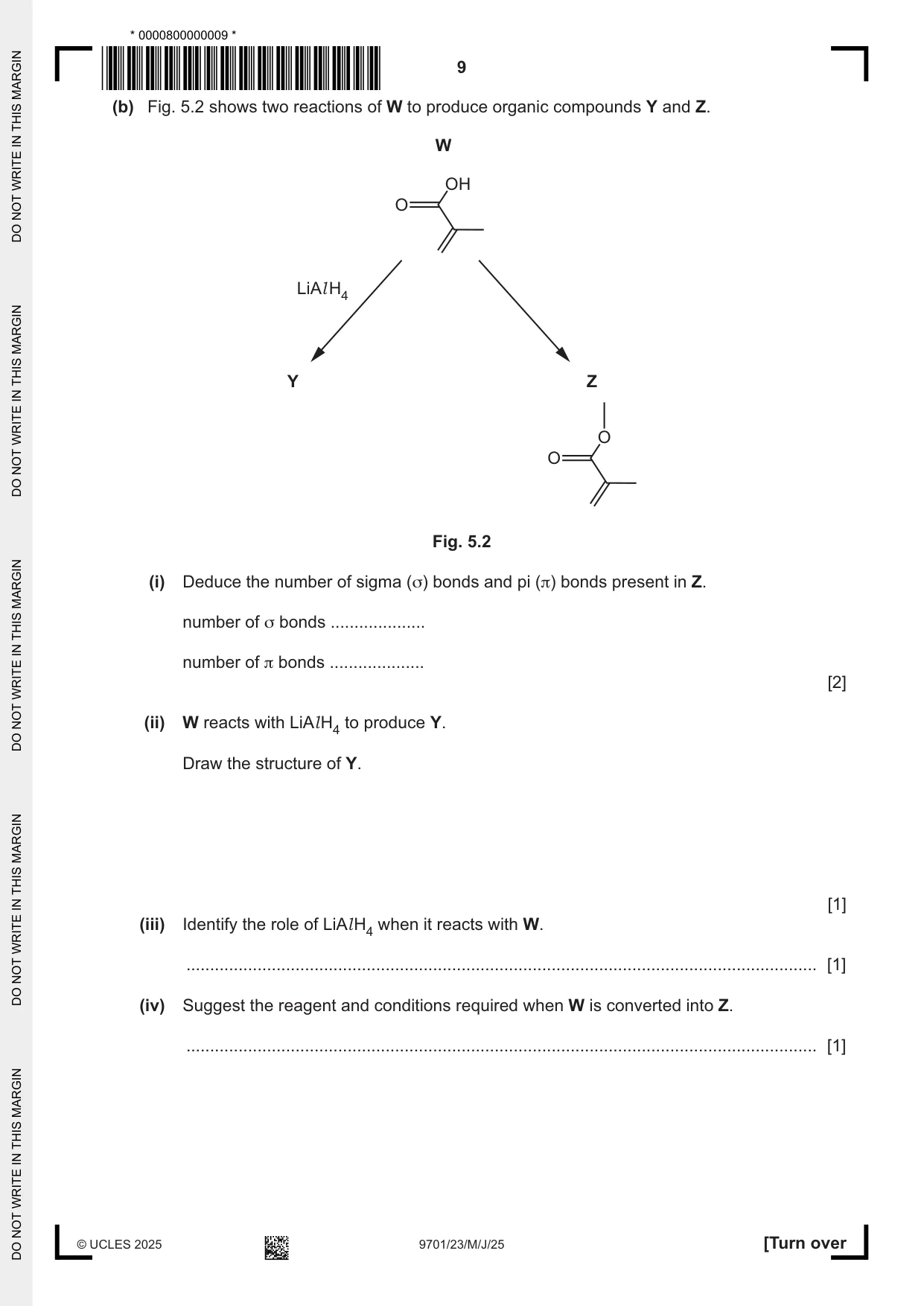
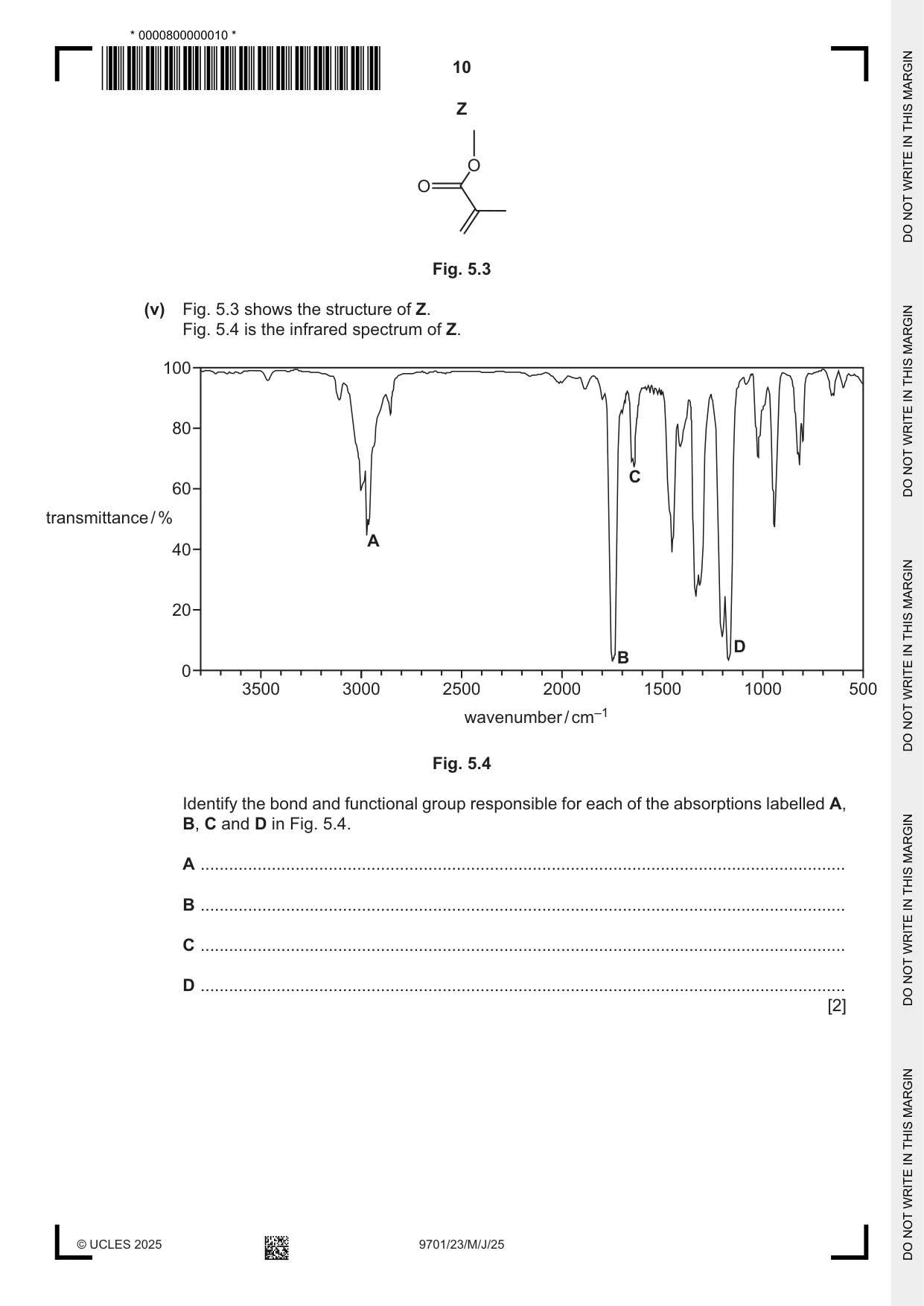
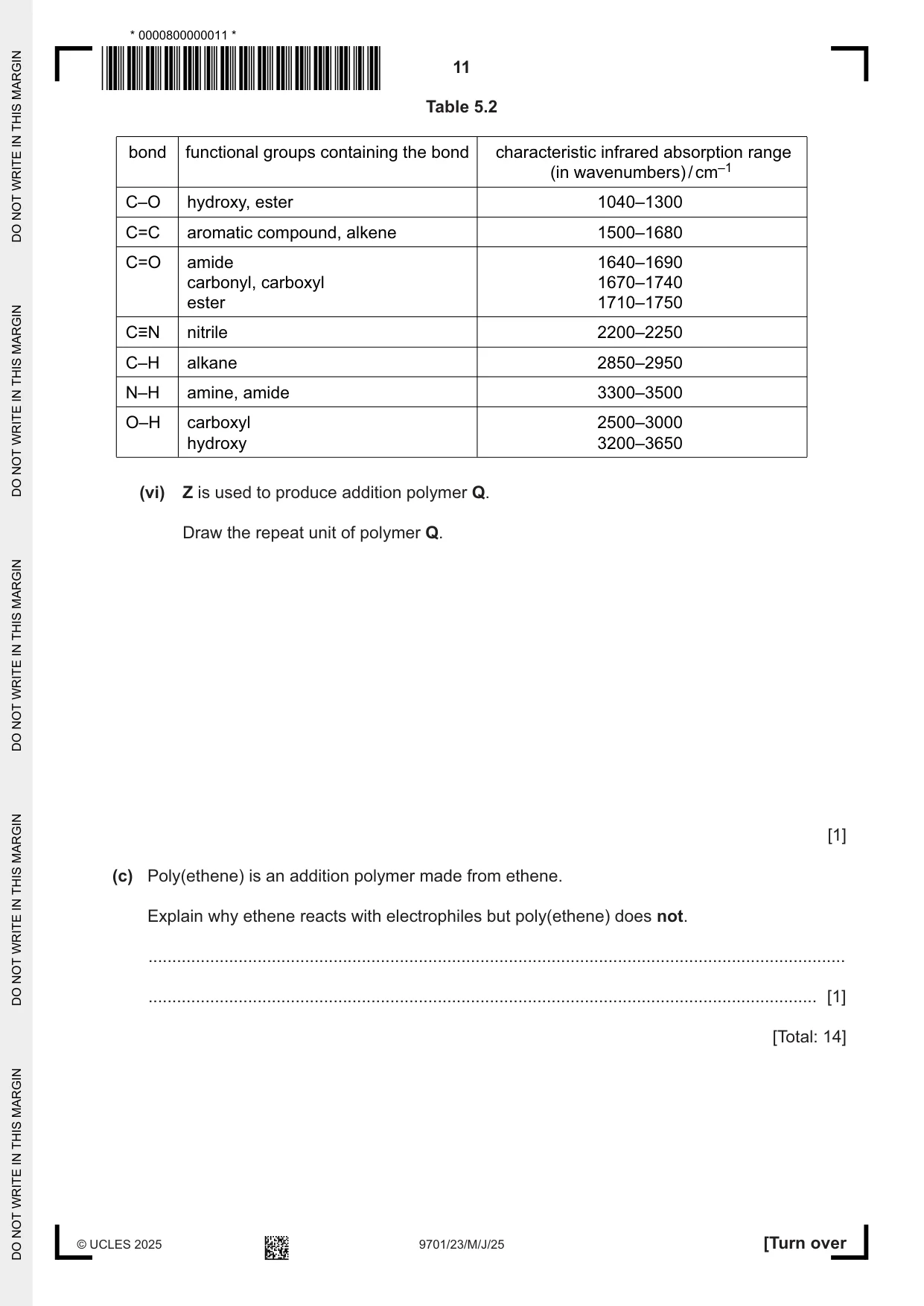
5 (a) W is a colourless liquid. W OH O Fig. 5.1 (i) Deduce the empirical formula of W. ..................................................................................................................................... [1] (ii) Two different reagents are each added to separate samples of W as shown in Table 5.1. Complete Table 5.1. Table 5.1 structural formula of organic reagent and observation when reagent is product when reagent is conditions added to W added to W solid Na Br2 in absence of ultraviolet light [4] (b) Fig. 5.2 shows two reactions of W to produce organic compounds Y and Z. W OH O LiAl H4 Y Z O O Fig. 5.2 (i) Deduce the number of sigma (σ) bonds and pi (π) bonds present in Z. number of σ bonds .................... number of π bonds .................... [2] (ii) W reacts with LiAl H4 to produce Y. Draw the structure of Y. [1] (iii) Identify the role of LiAl H4 when it reacts with W. ..................................................................................................................................... [1] (iv) Suggest the reagent and conditions required when W is converted into Z. ..................................................................................................................................... [1] Z O O Fig. 5.3 (v) Fig. 5.3 shows the structure of Z. Fig. 5.4 is the infrared spectrum of Z. 100 80 C 60 transmittance / % A 40 20 D B 0 3500 3000 2500 2000 1500 1000 500 wavenumber / cm–1 Fig. 5.4 Identify the bond and functional group responsible for each of the absorptions labelled A, B, C and D in Fig. 5.4. A ........................................................................................................................................ B ........................................................................................................................................ C ........................................................................................................................................ D ........................................................................................................................................ [2] Table 5.2 bond functional groups containing the bond characteristic infrared absorption range (in wavenumbers) / cm–1 C–O hydroxy, ester 1040–1300 C=C aromatic compound, alkene 1500–1680 C=O amide 1640–1690 carbonyl, carboxyl 1670–1740 ester 1710–1750 C≡N nitrile 2200–2250 C–H alkane 2850–2950 N–H amine, amide 3300–3500 O–H carboxyl 2500–3000 hydroxy 3200–3650 (vi) Z is used to produce addition polymer Q. Draw the repeat unit of polymer Q. [1] (c) Poly(ethene) is an addition polymer made from ethene. Explain why ethene reacts with electrophiles but poly(ethene) does not. ................................................................................................................................................... ............................................................................................................................................. [1] [Total: 14]
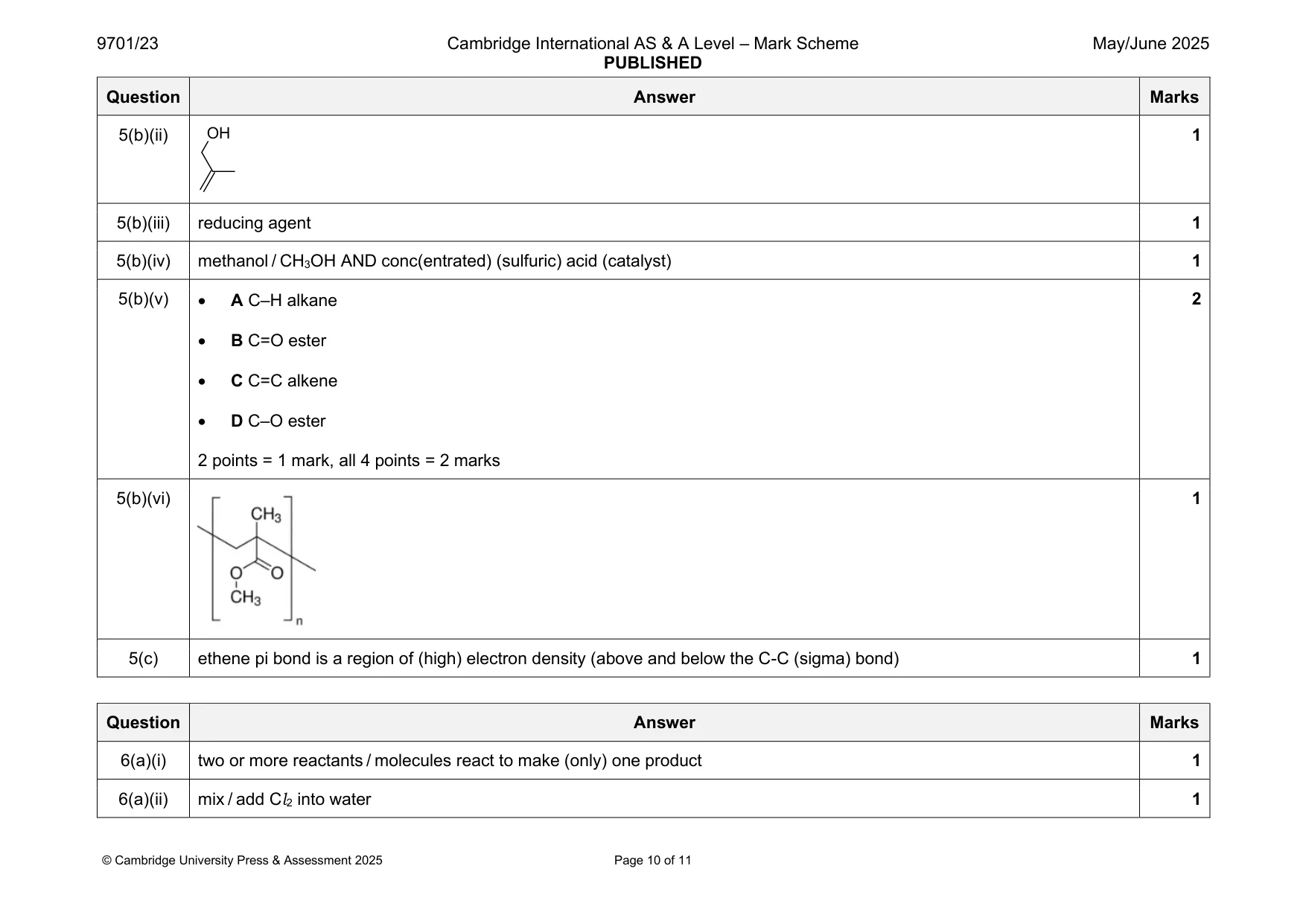
Mark scheme: 5(a)(i) C2H3O 1 5(a)(ii) 4 reagent observation when reagent structural formula of organic product is added to W when reagent is added to W Na fizz / bubbles etc / OR CH2C(CH3)CO2Na OR solid / Na CH2C(CH3)CO2– Na+ disappears / dissolves Br2 in the brown to colourless / CH2BrCBr(CH3)CO2H dark decolourise 5(b)(i) number of bonds = 14 2 number of bonds = 2 5(b)(ii) OH 1 5(b)(iii) reducing agent 1 5(b)(iv) methanol / CH3OH AND conc(entrated) (sulfuric) acid (catalyst) 1 5(b)(v) • A C–H alkane 2 • B C=O ester • C C=C alkene • D C–O ester 2 points = 1 mark, all 4 points = 2 marks 5(b)(vi) 1 5(c) ethene pi bond is a region of (high) electron density (above and below the C-C (sigma) bond) 1
Q6 · HOCl reacts with CH2=CH2 to produce HOCH2CH2Cl in an electrophilic addition reaction
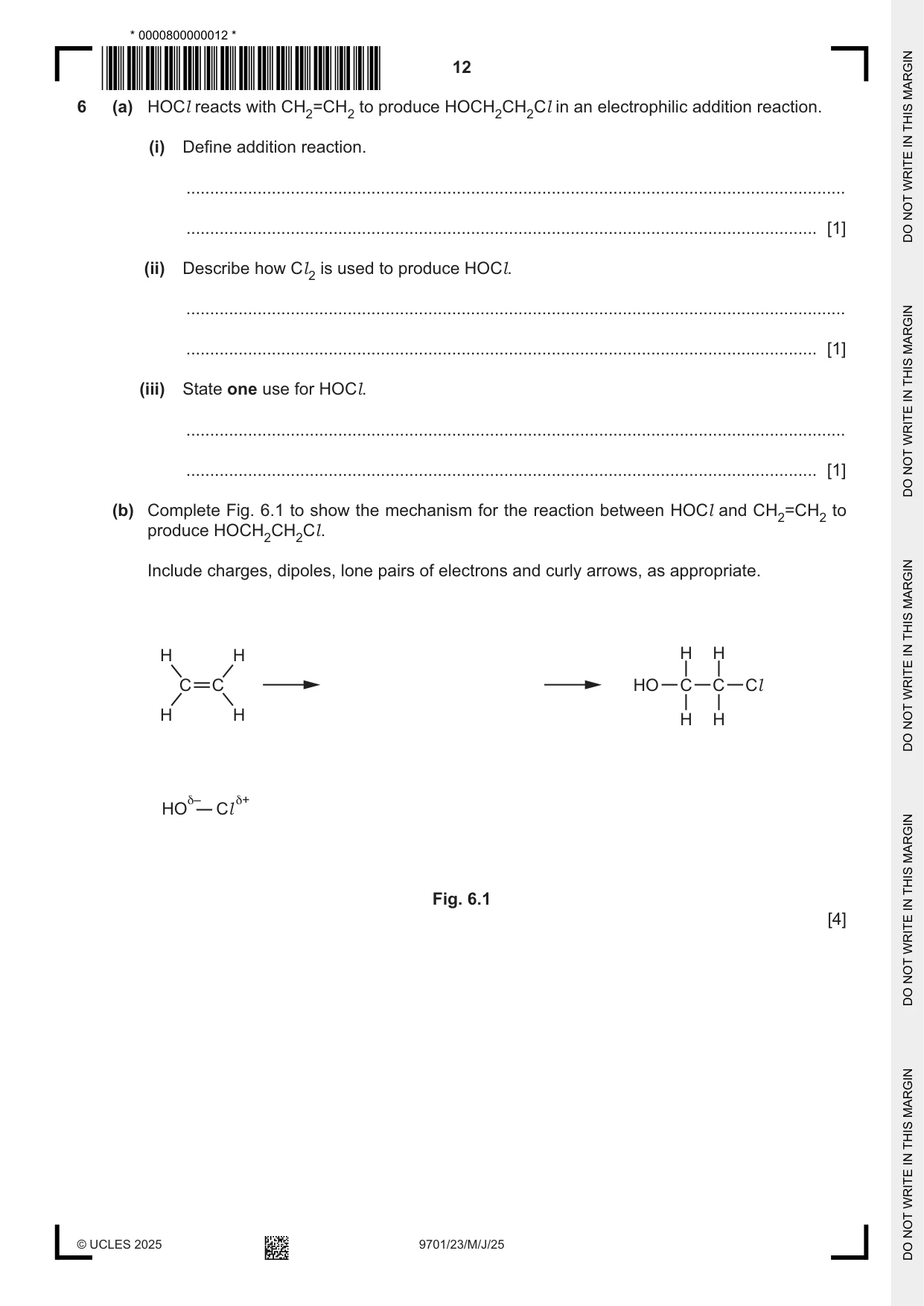
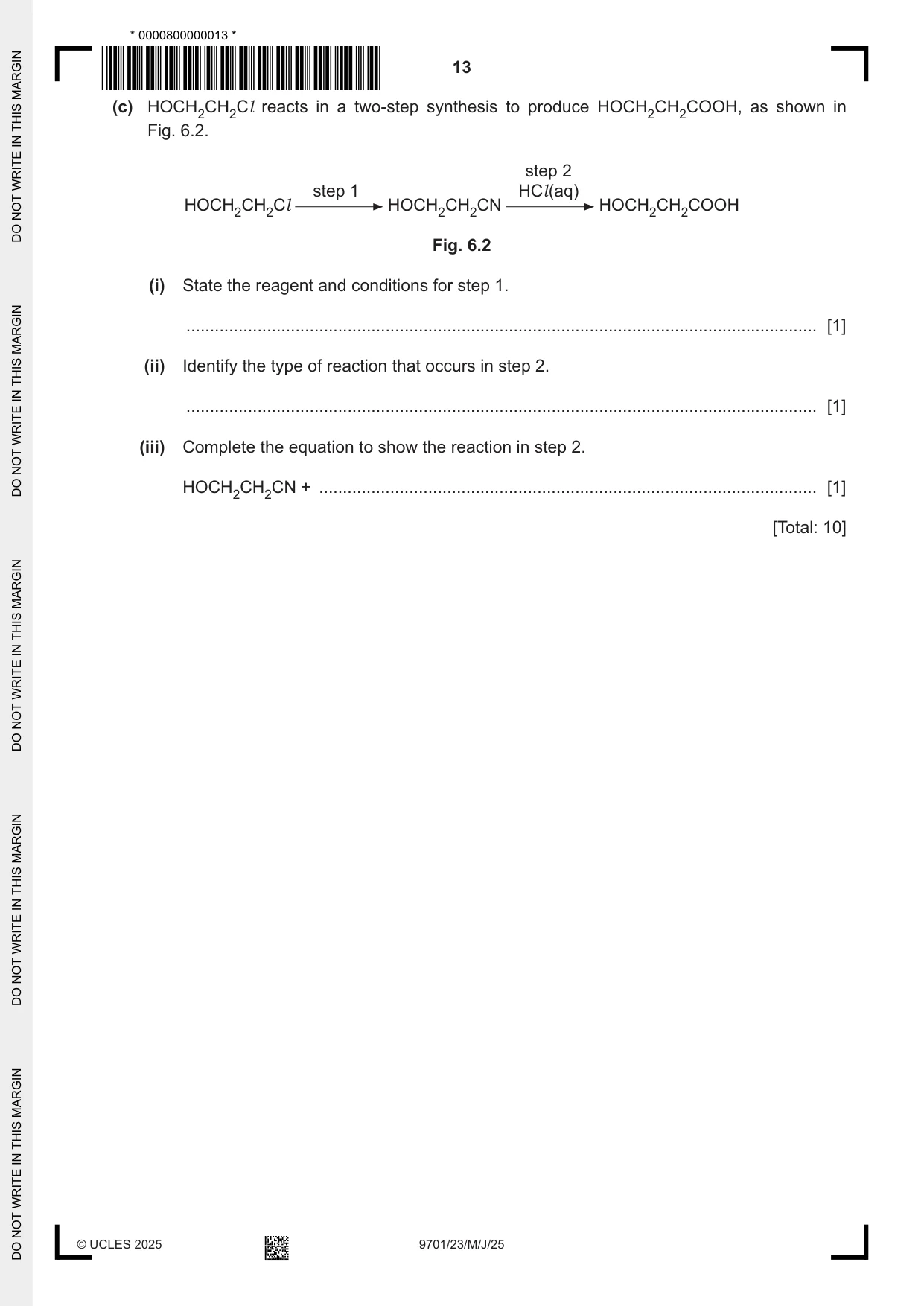
6 (a) HOCl reacts with CH2=CH2 to produce HOCH2CH2Cl in an electrophilic addition reaction. (i) Define addition reaction. ........................................................................................................................................... ..................................................................................................................................... [1] (ii) Describe how Cl is used to produce HOCl. 2 ........................................................................................................................................... ..................................................................................................................................... [1] (iii) State one use for HOCl. ........................................................................................................................................... ..................................................................................................................................... [1] (b) Complete Fig. 6.1 to show the mechanism for the reaction between HOCl and CH2=CH2 to produce HOCH2CH2Cl . Include charges, dipoles, lone pairs of electrons and curly arrows, as appropriate. H H H H C C HO C C Cl H H H H δ– δ+ HO Cl Fig. 6.1 [4] (c) HOCH2CH2Cl reacts in a two‑step synthesis to produce HOCH2CH2COOH, as shown in Fig. 6.2. step 2 step 1 HCl (aq) HOCH2CH2Cl HOCH2CH2CN HOCH2CH2COOH Fig. 6.2 (i) State the reagent and conditions for step 1. ..................................................................................................................................... [1] (ii) Identify the type of reaction that occurs in step 2. ..................................................................................................................................... [1] (iii) Complete the equation to show the reaction in step 2. HOCH2CH2CN + ......................................................................................................... [1] [Total: 10]
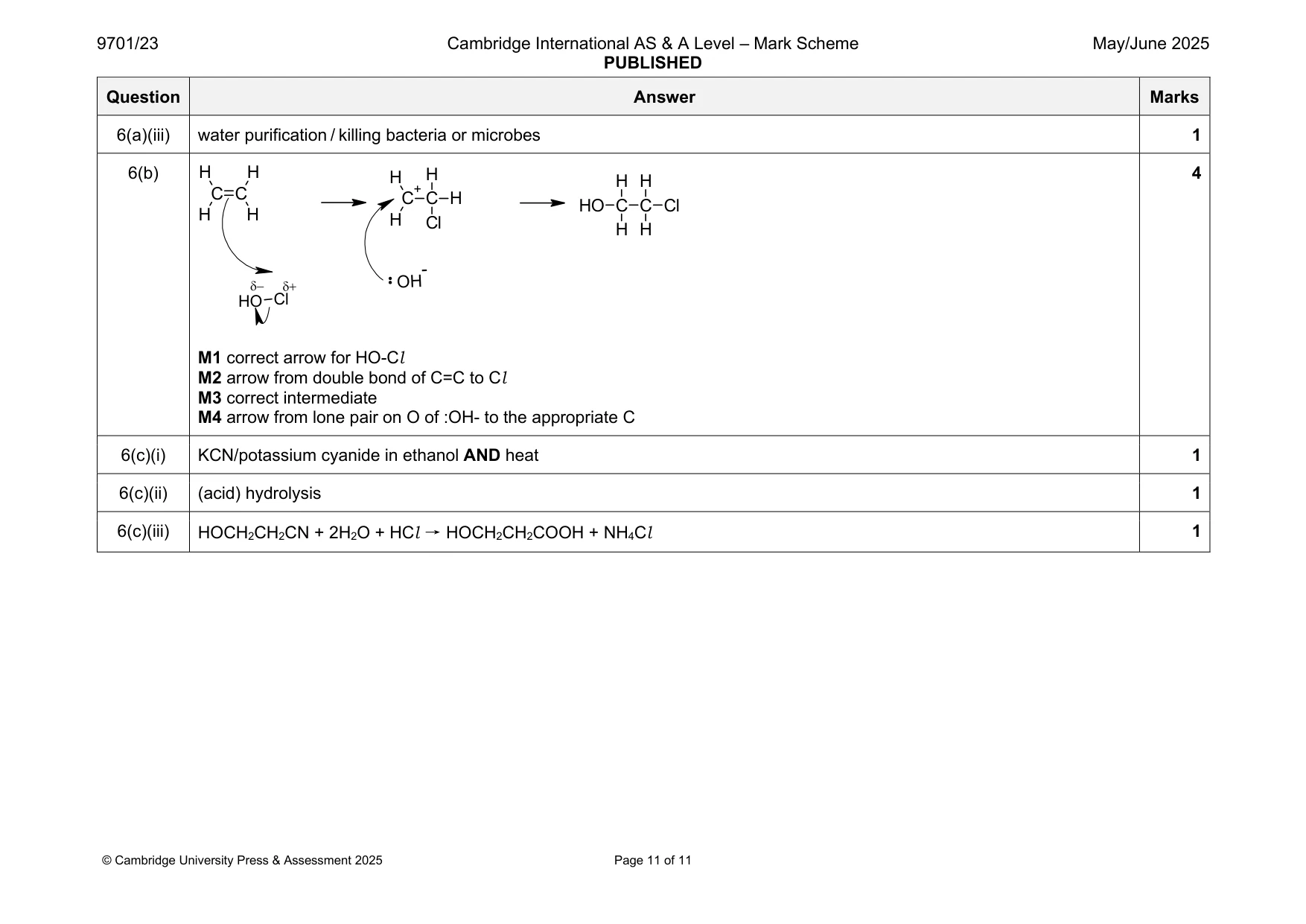
Mark scheme: 6(a)(i) two or more reactants / molecules react to make (only) one product 1 6(a)(ii) mix / add Cl2 into water 1 6(a)(iii) water purification / killing bacteria or microbes 1 6(b) H H H H H H 4 C C C+ C H HO C C Cl H H H Cl H H d- d+ OH- H O Cl M1 correct arrow for HO-Cl M2 arrow from double bond of C=C to Cl M3 correct intermediate M4 arrow from lone pair on O of :OH- to the appropriate C 6(c)(i) KCN/potassium cyanide in ethanol AND heat 1 6(c)(ii) (acid) hydrolysis 1 6(c)(iii) HOCH2CH2CN + 2H2O + HCl → HOCH2CH2COOH + NH4Cl 1
What was in this paper
The subtopics covered by these 6 questions, and how many questions each got. Open one in a new tab to see every Cambridge question on it.
What you needed in this session
Cambridge’s own grade thresholds for 2025 May/June, Paper 2 · Variant 3. A higher threshold means an easier paper — the bar moves with how the cohort did.