Cambridge A Level Chemistry 9701 — 2024 Feb/March Paper 2 · Variant 2
9701/22/F/M/24 · 4 questions · 60 marks · ≈68 min
The question paper and its mark scheme, free to read here and free to download. This is Cambridge’s own paper, exactly as it was sat.
Question paper16 pages

Mark scheme10 pages
Answers below. Sit the paper first if you are practising.
Questions as text
Q1 · Bismuth is an element in Group 15 of the Periodic Table
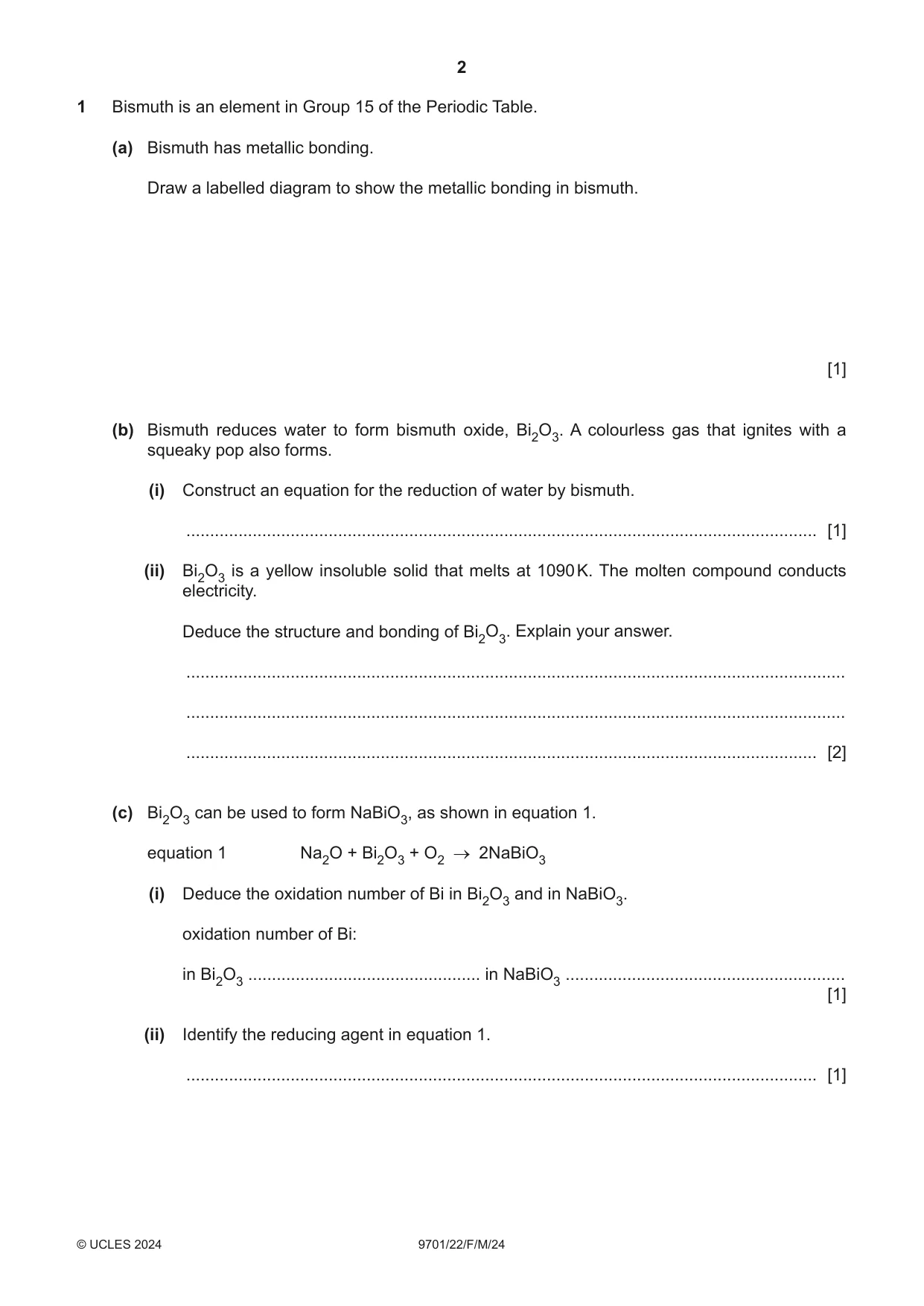
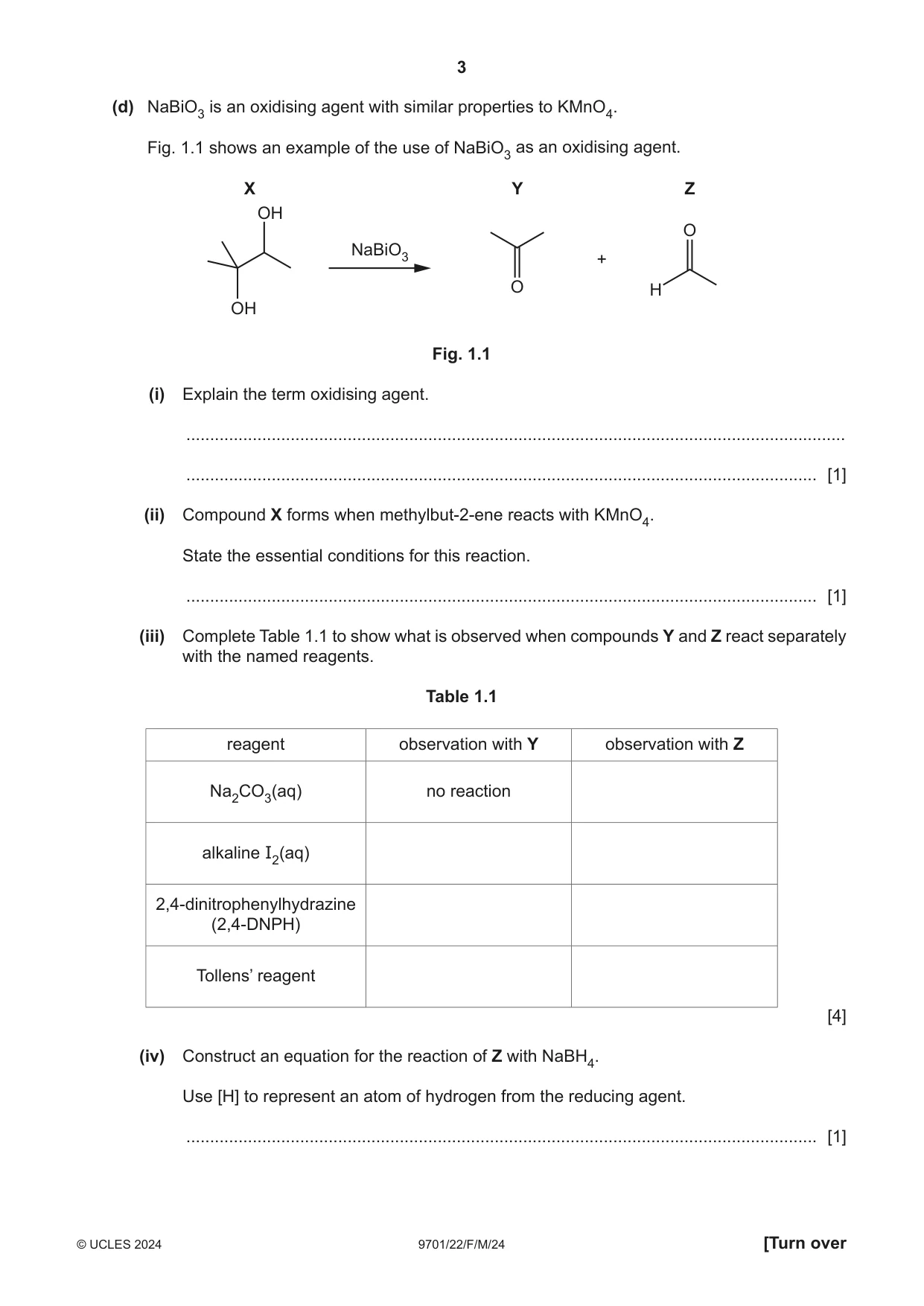
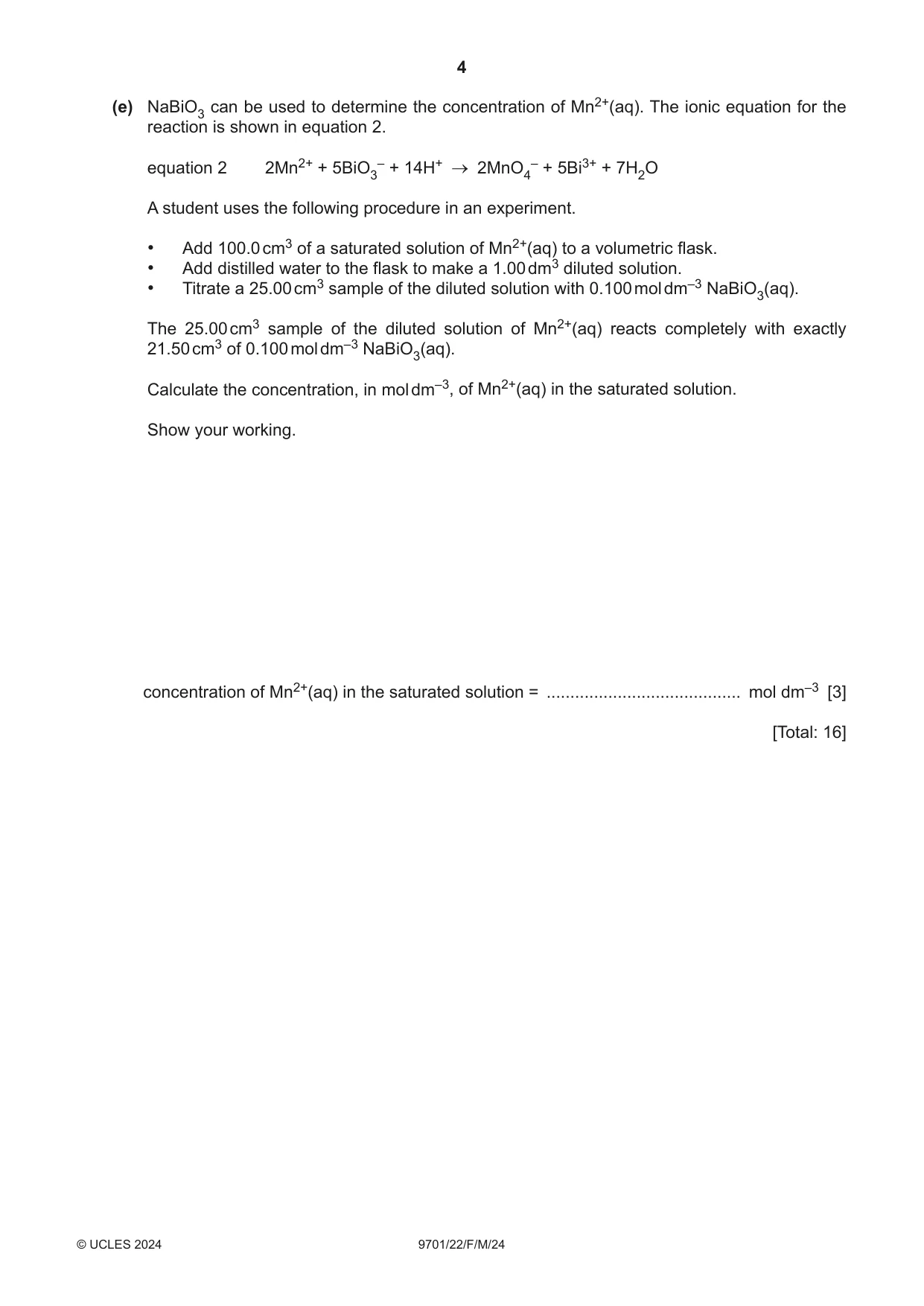
1 Bismuth is an element in Group 15 of the Periodic Table. (a) Bismuth has metallic bonding. Draw a labelled diagram to show the metallic bonding in bismuth. [1] (b) Bismuth reduces water to form bismuth oxide, Bi2O3. A colourless gas that ignites with a squeaky pop also forms. (i) Construct an equation for the reduction of water by bismuth. ..................................................................................................................................... [1] (ii) Bi2O3 is a yellow insoluble solid that melts at 1090 K. The molten compound conducts electricity. Deduce the structure and bonding of Bi2O3. Explain your answer. ........................................................................................................................................... ........................................................................................................................................... ..................................................................................................................................... [2] (c) Bi2O3 can be used to form NaBiO3, as shown in equation 1. equation 1 Na2O + Bi2O3 + O2 2NaBiO3 (i) Deduce the oxidation number of Bi in Bi2O3 and in NaBiO3. oxidation number of Bi: in Bi2O3 ................................................. in NaBiO3 ........................................................... [1] (ii) Identify the reducing agent in equation 1. ..................................................................................................................................... [1] (d) NaBiO3 is an oxidising agent with similar properties to KMnO4. Fig. 1.1 shows an example of the use of NaBiO3 as an oxidising agent. X Y Z OH O NaBiO3 + O H OH Fig. 1.1 (i) Explain the term oxidising agent. ........................................................................................................................................... ..................................................................................................................................... [1] (ii) Compound X forms when methylbut-2-ene reacts with KMnO4. State the essential conditions for this reaction. ..................................................................................................................................... [1] (iii) Complete Table 1.1 to show what is observed when compounds Y and Z react separately with the named reagents. Table 1.1 reagent observation with Y observation with Z Na2CO3(aq) no reaction alkaline I2(aq) 2,4-dinitrophenylhydrazine (2,4-DNPH) Tollens’ reagent [4] (iv) Construct an equation for the reaction of Z with NaBH4. Use [H] to represent an atom of hydrogen from the reducing agent. ..................................................................................................................................... [1] (e) NaBiO3 can be used to determine the concentration of Mn2+(aq). The ionic equation for the reaction is shown in equation 2. equation 2 2Mn2+ + 5BiO3– + 14H+ 2MnO4– + 5Bi3+ + 7H2O A student uses the following procedure in an experiment. • Add 100.0 cm3 of a saturated solution of Mn2+(aq) to a volumetric flask. • Add distilled water to the flask to make a 1.00 dm3 diluted solution. • Titrate a 25.00 cm3 sample of the diluted solution with 0.100 mol dm–3 NaBiO3(aq). The 25.00 cm3 sample of the diluted solution of Mn2+(aq) reacts completely with exactly 21.50 cm3 of 0.100 mol dm–3 NaBiO3(aq). Calculate the concentration, in mol dm–3, of Mn2+(aq) in the saturated solution. Show your working. concentration of Mn2+(aq) in the saturated solution = ......................................... mol dm–3 [3] [Total: 16]
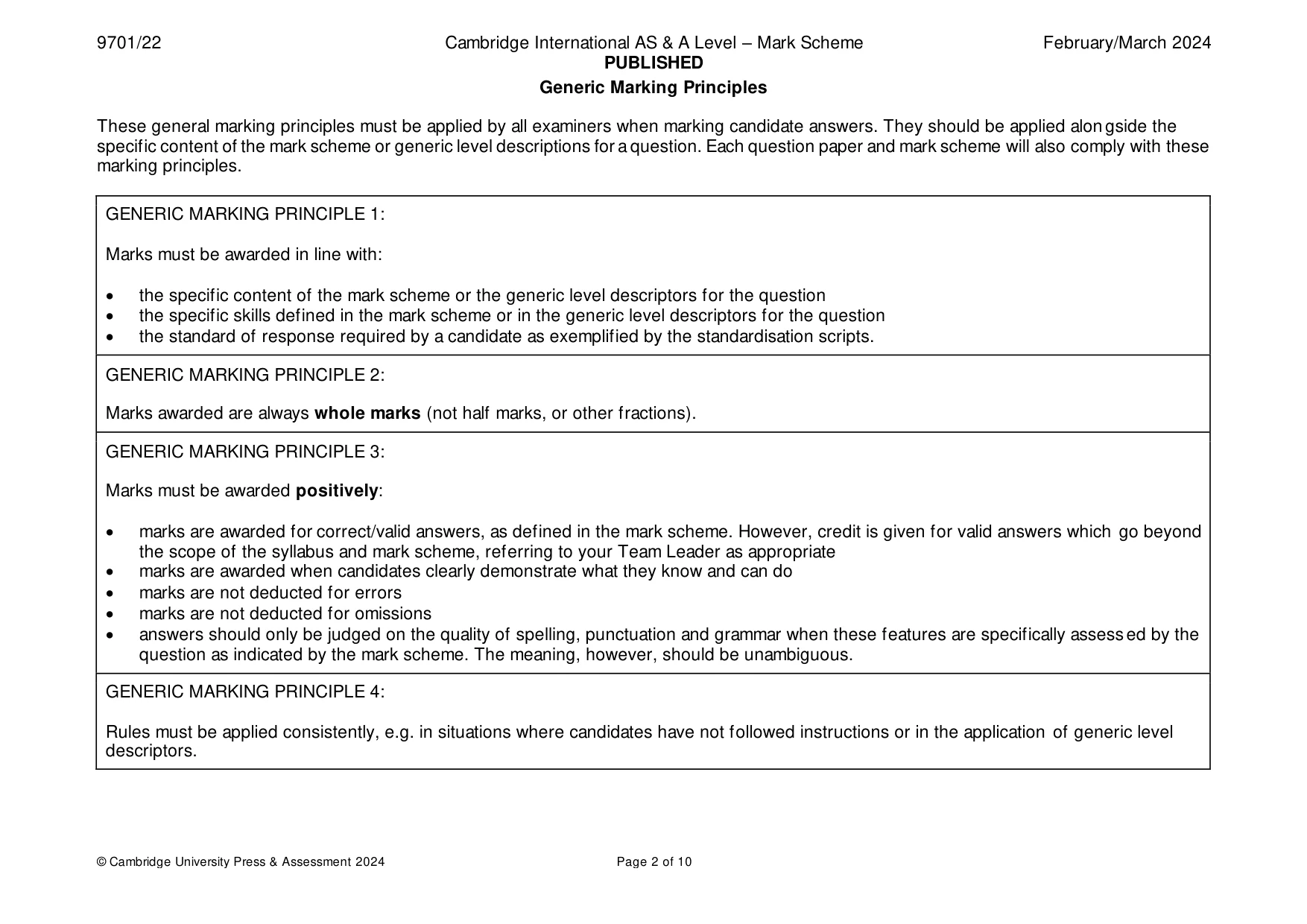
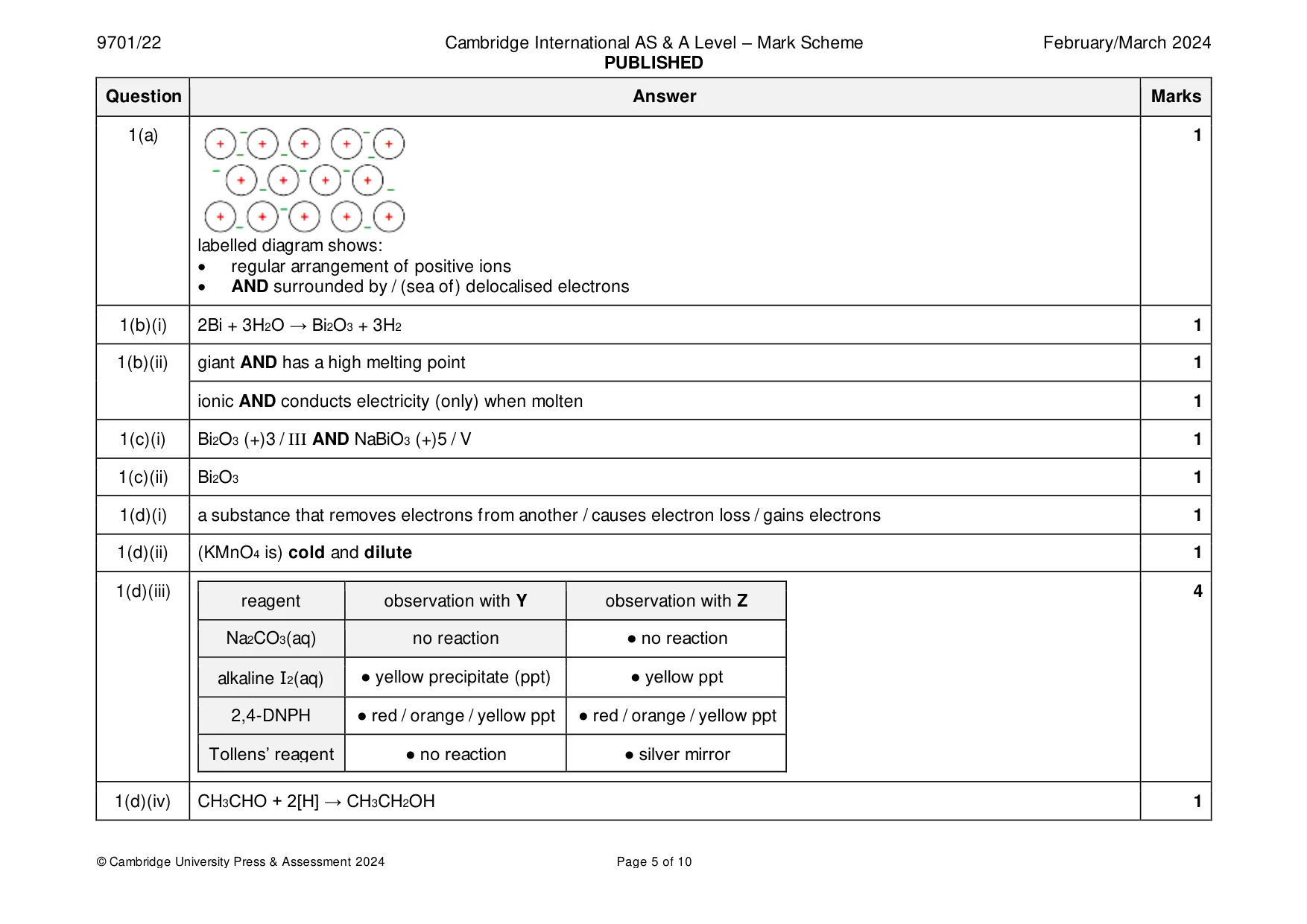
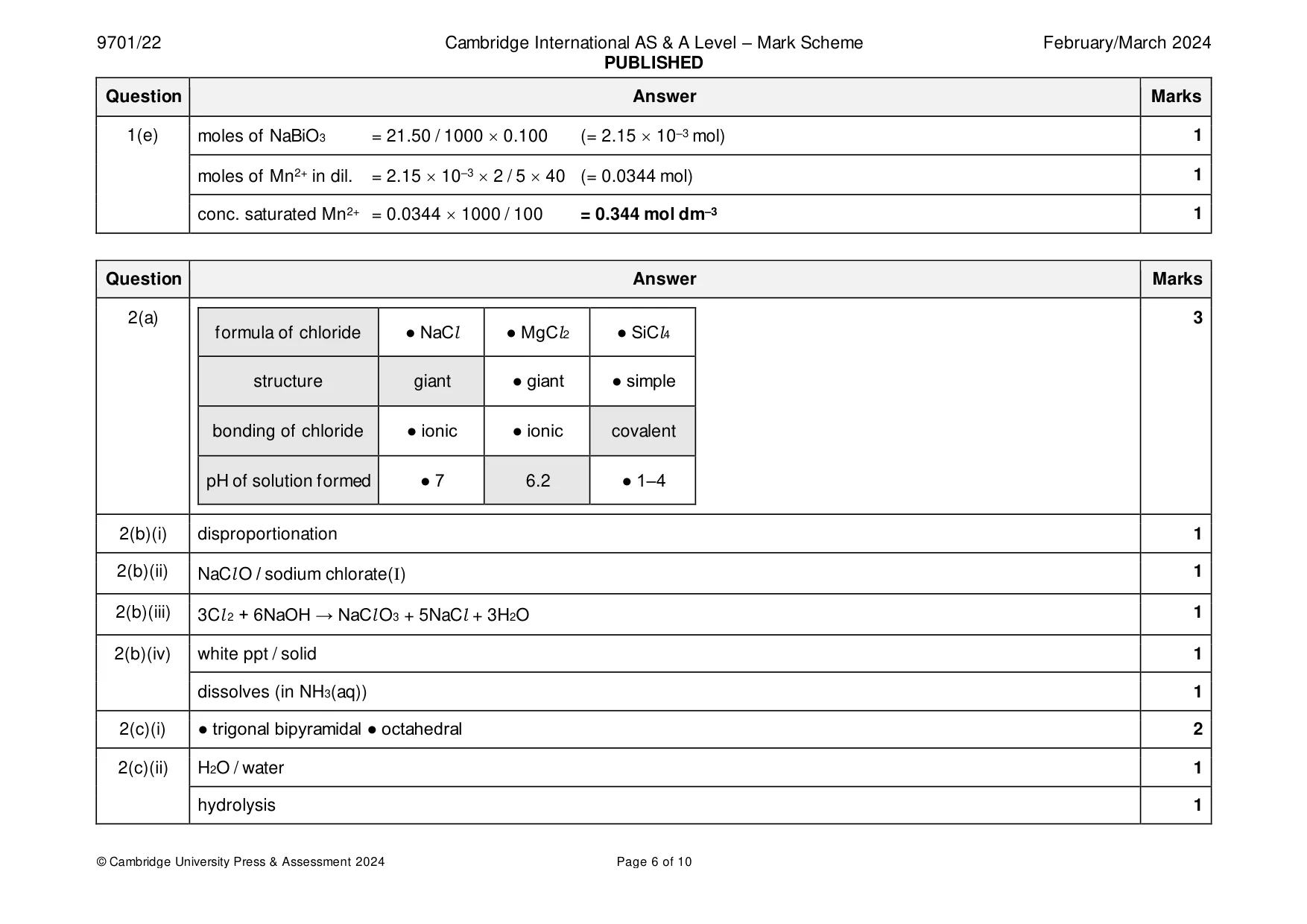
Mark scheme: Question Answer Marks 1(a) 1 labelled diagram shows: • regular arrangement of positive ions • AND surrounded by / (sea of) delocalised electrons 1(b)(i) 2Bi + 3H2O → Bi2O3 + 3H2 1 1(b)(ii) giant AND has a high melting point 1 ionic AND conducts electricity (only) when molten 1 1(c)(i) Bi2O3 (+)3 / III AND NaBiO3 (+)5 / V 1 1(c)(ii) Bi2O3 1 1(d)(i) a substance that removes electrons from another / causes electron loss / gains electrons 1 1(d)(ii) (KMnO4 is) cold and dilute 1 1(d)(iii) 4 reagent observation with Y observation with Z Na2CO3(aq) no reaction ● no reaction alkaline I2(aq) ● yellow precipitate (ppt) ● yellow ppt 2,4-DNPH ● red / orange / yellow ppt ● red / orange / yellow ppt Tollens’ reagent ● no reaction ● silver mirror 1(d)(iv) CH3CHO + 2[H] → CH3CH2OH 1 1(e) moles of NaBiO3 = 21.50 / 1000 0.100 (= 2.15 10–3 mol) 1 moles of Mn2+ in dil. = 2.15 10–3 2 / 5 40 (= 0.0344 mol) 1 conc. saturated Mn2+ = 0.0344 1000 / 100 = 0.344 mol dm–3 1
Q2 · Chlorine, Cl 2, reacts with many elements and compounds to form chlorides
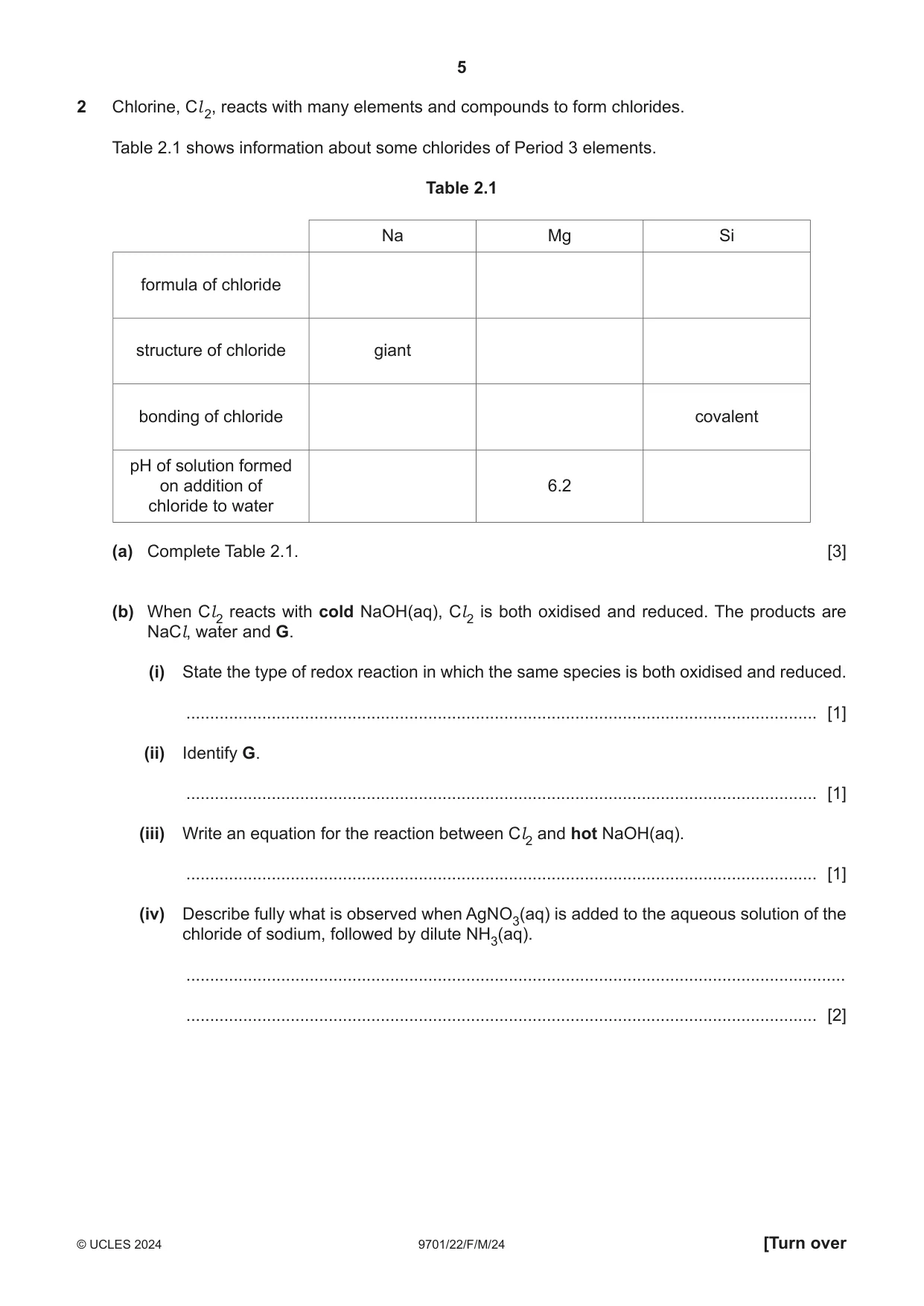
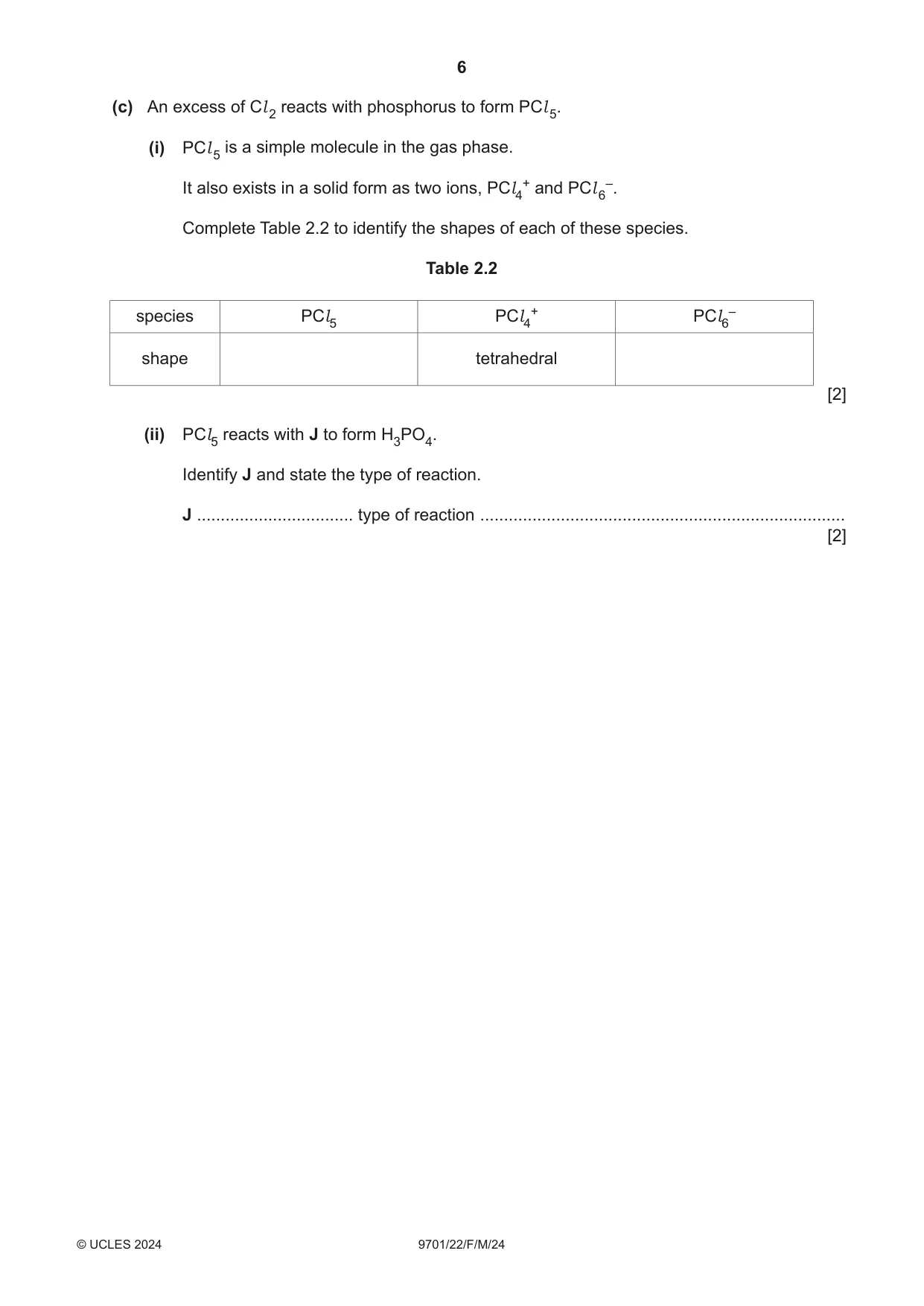
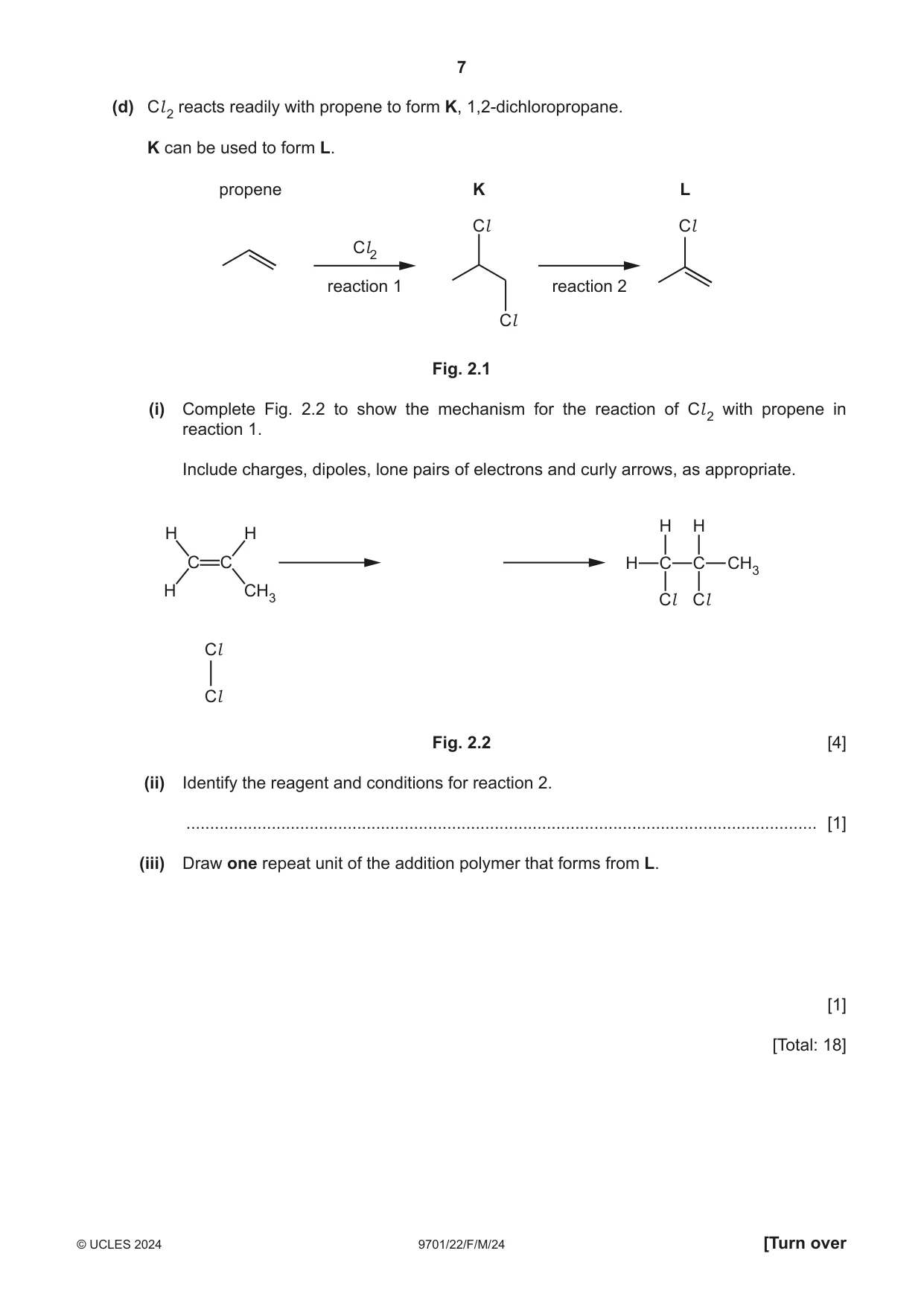
2 Chlorine, Cl 2, reacts with many elements and compounds to form chlorides. Table 2.1 shows information about some chlorides of Period 3 elements. Table 2.1 Na Mg Si formula of chloride structure of chloride giant bonding of chloride covalent pH of solution formed on addition of 6.2 chloride to water (a) Complete Table 2.1. [3] (b) When Cl 2 reacts with cold NaOH(aq), Cl 2 is both oxidised and reduced. The products are NaCl, water and G. (i) State the type of redox reaction in which the same species is both oxidised and reduced. ..................................................................................................................................... [1] (ii) Identify G. ..................................................................................................................................... [1] (iii) Write an equation for the reaction between Cl2 and hot NaOH(aq). ..................................................................................................................................... [1] (iv) Describe fully what is observed when AgNO3(aq) is added to the aqueous solution of the chloride of sodium, followed by dilute NH3(aq). ........................................................................................................................................... ..................................................................................................................................... [2] (c) An excess of Cl 2 reacts with phosphorus to form PCl 5. (i) PCl 5 is a simple molecule in the gas phase. It also exists in a solid form as two ions, PCl4+ and PCl 6–. Complete Table 2.2 to identify the shapes of each of these species. Table 2.2 species PCl5 PCl4+ PCl6– shape tetrahedral [2] (ii) PCl5 reacts with J to form H3PO4. Identify J and state the type of reaction. J ................................. type of reaction ............................................................................. [2] (d) Cl 2 reacts readily with propene to form K, 1,2-dichloropropane. K can be used to form L. propene K L Cl Cl Cl2 reaction 1 reaction 2 Cl Fig. 2.1 (i) Complete Fig. 2.2 to show the mechanism for the reaction of Cl 2 with propene in reaction 1. Include charges, dipoles, lone pairs of electrons and curly arrows, as appropriate. H H H H C C H C C CH3 H CH3 Cl Cl Cl Cl Fig. 2.2 [4] (ii) Identify the reagent and conditions for reaction 2. ..................................................................................................................................... [1] (iii) Draw one repeat unit of the addition polymer that forms from L. [1] [Total: 18]
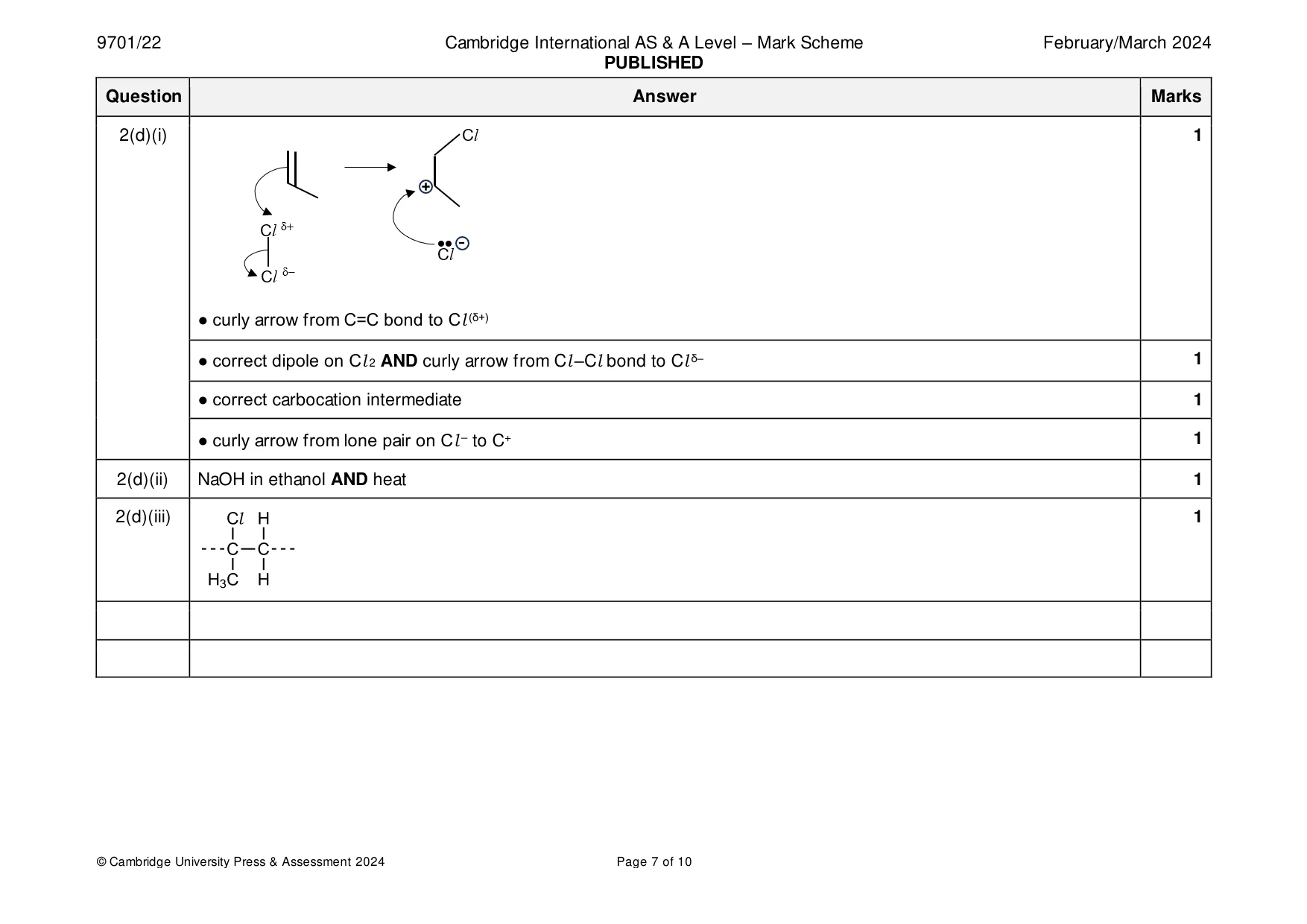
Mark scheme: 2(a) 3 formula of chloride ● NaCl ● MgCl2 ● SiCl4 structure giant ● giant ● simple bonding of chloride ● ionic ● ionic covalent pH of solution formed ● 7 6.2 ● 1–4 2(b)(i) disproportionation 1 2(b)(ii) NaCl O / sodium chlorate(I) 1 2(b)(iii) 3Cl 2 + 6NaOH → NaCl O3 + 5NaCl + 3H2O 1 2(b)(iv) white ppt / solid 1 dissolves (in NH3(aq)) 1 2(c)(i) ● trigonal bipyramidal ● octahedral 2 2(c)(ii) H2O / water 1 hydrolysis 1 2(d)(i) 1 ● curly arrow from C=C bond to Cl (δ+) ● correct dipole on Cl 2 AND curly arrow from Cl –Cl bond to Cl δ– 1 ● correct carbocation intermediate 1 ● curly arrow from lone pair on Cl – to C+ 1 2(d)(ii) NaOH in ethanol AND heat 1 2(d)(iii) 1
Q3 · Nitrogen, N2, is generally an unreactive molecule but it does react under certain…
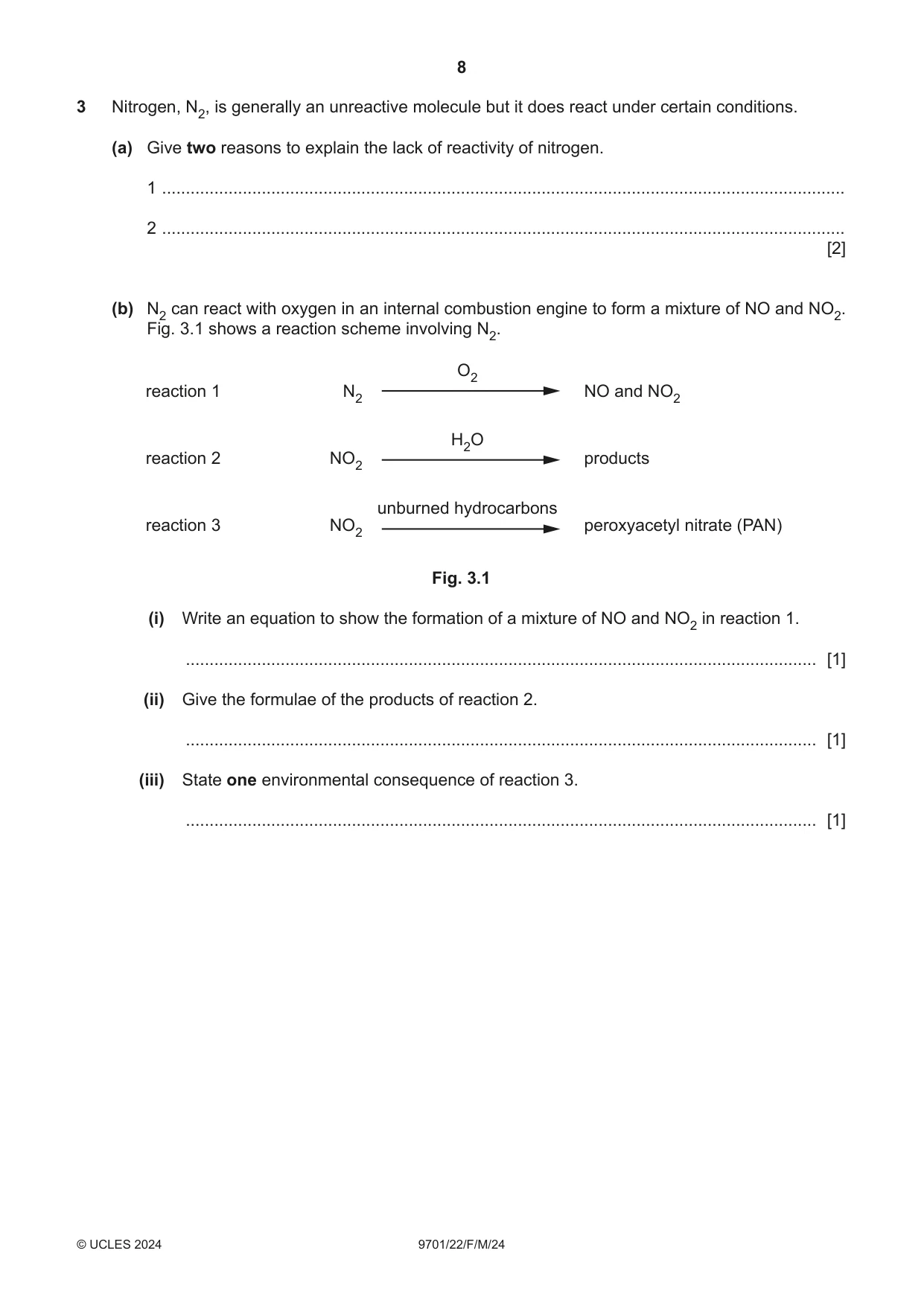
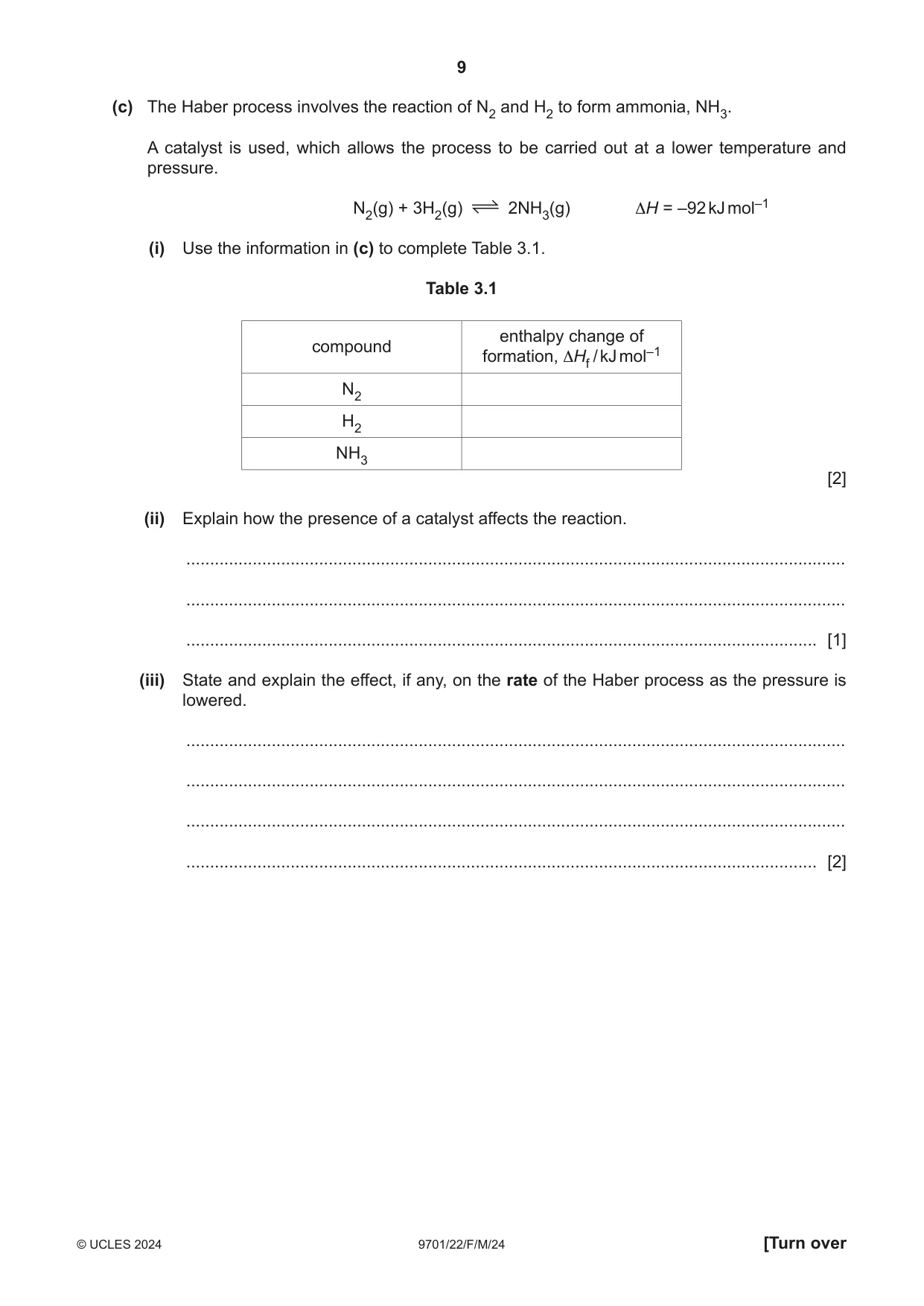
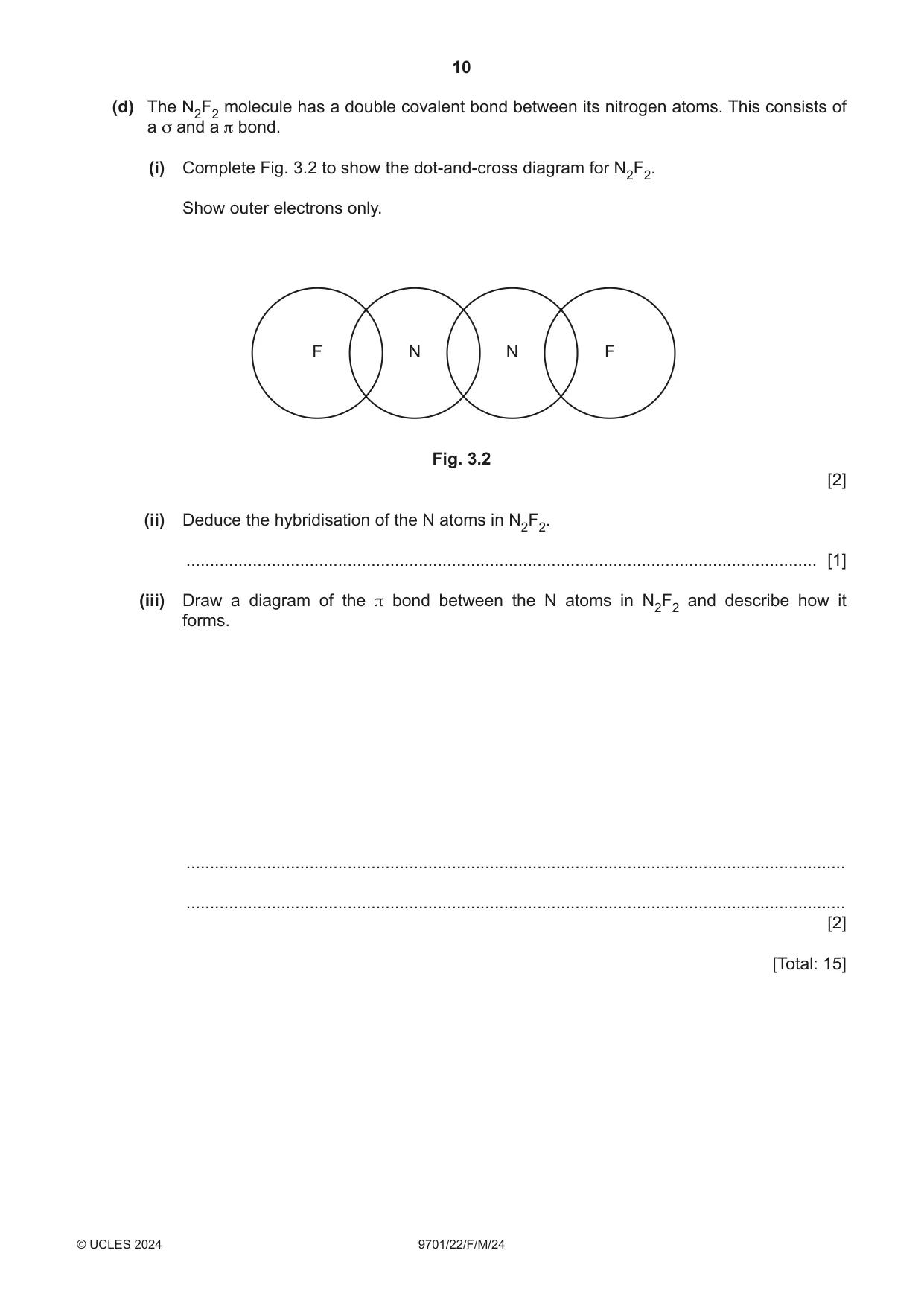
3 Nitrogen, N2, is generally an unreactive molecule but it does react under certain conditions. (a) Give two reasons to explain the lack of reactivity of nitrogen. 1 ................................................................................................................................................ 2 ................................................................................................................................................ [2] (b) N2 can react with oxygen in an internal combustion engine to form a mixture of NO and NO2. Fig. 3.1 shows a reaction scheme involving N2. O2 reaction 1 N2 NO and NO2 H2O reaction 2 NO2 products unburned hydrocarbons reaction 3 NO2 peroxyacetyl nitrate (PAN) Fig. 3.1 (i) Write an equation to show the formation of a mixture of NO and NO2 in reaction 1. ..................................................................................................................................... [1] (ii) Give the formulae of the products of reaction 2. ..................................................................................................................................... [1] (iii) State one environmental consequence of reaction 3. ..................................................................................................................................... [1] (c) The Haber process involves the reaction of N2 and H2 to form ammonia, NH3. A catalyst is used, which allows the process to be carried out at a lower temperature and pressure. N2(g) + 3H2(g) 2NH3(g) ΔH = –92 kJ mol–1 (i) Use the information in (c) to complete Table 3.1. Table 3.1 enthalpy change of compound formation, ΔHf / kJ mol–1 N2 H2 NH3 [2] (ii) Explain how the presence of a catalyst affects the reaction. ........................................................................................................................................... ........................................................................................................................................... ..................................................................................................................................... [1] (iii) State and explain the effect, if any, on the rate of the Haber process as the pressure is lowered. ........................................................................................................................................... ........................................................................................................................................... ........................................................................................................................................... ..................................................................................................................................... [2] (d) The N2F2 molecule has a double covalent bond between its nitrogen atoms. This consists of a σ and a π bond. (i) Complete Fig. 3.2 to show the dot-and-cross diagram for N2F2. Show outer electrons only. F N N F Fig. 3.2 [2] (ii) Deduce the hybridisation of the N atoms in N2F2. ..................................................................................................................................... [1] (iii) Draw a diagram of the π bond between the N atoms in N2F2 and describe how it forms. ........................................................................................................................................... ........................................................................................................................................... [2] [Total: 15]
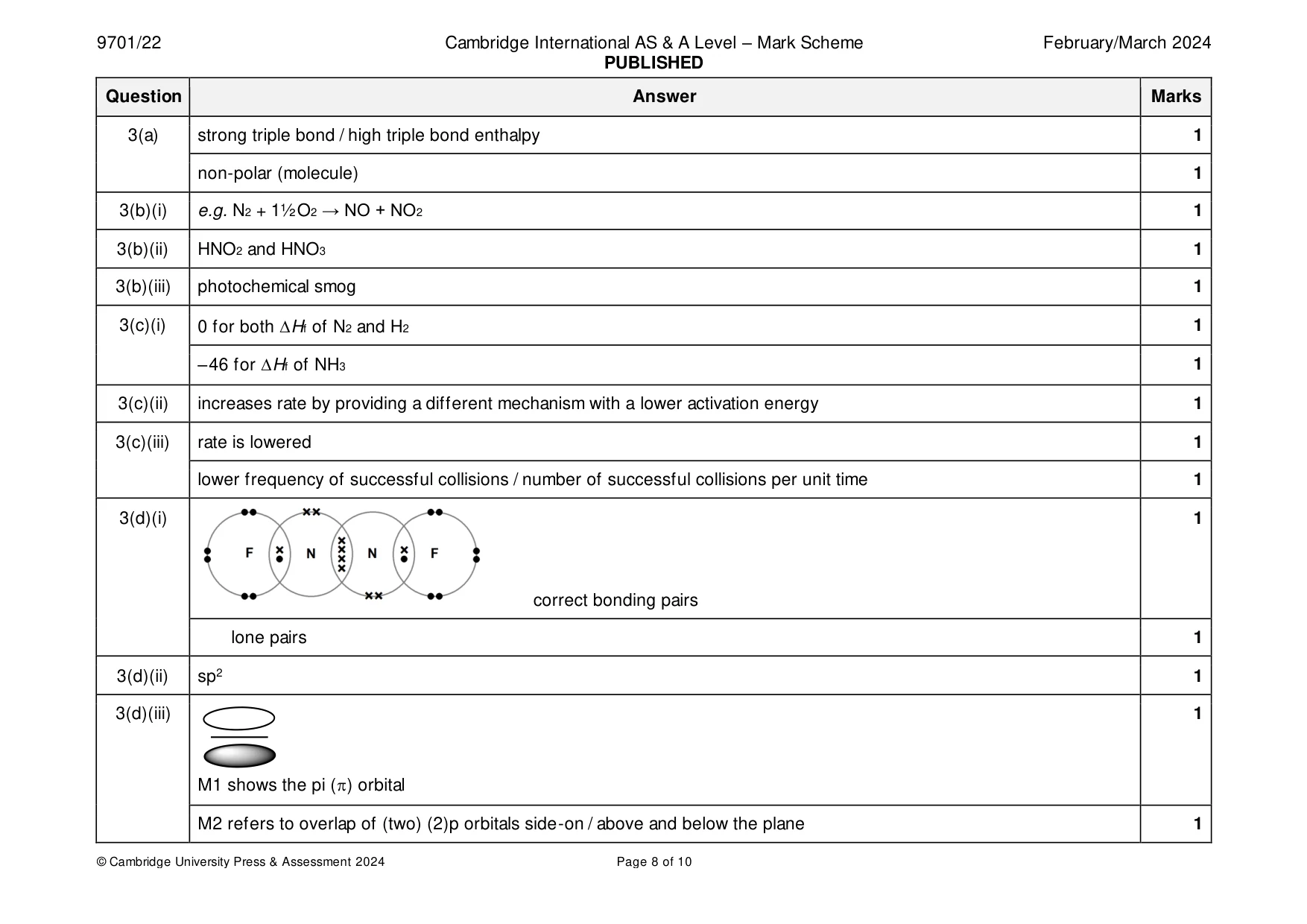
Mark scheme: 3(a) strong triple bond / high triple bond enthalpy 1 non-polar (molecule) 1 3(b)(i) e.g. N2 + 1½ O2 → NO + NO2 1 3(b)(ii) HNO2 and HNO3 1 3(b)(iii) photochemical smog 1 3(c)(i) 0 for both Hf of N2 and H2 1 – 46 for Hf of NH3 1 3(c)(ii) increases rate by providing a different mechanism with a lower activation energy 1 3(c)(iii) rate is lowered 1 lower frequency of successful collisions / number of successful collisions per unit time 1 3(d)(i) 1 correct bonding pairs lone pairs 1 3(d)(ii) sp2 1 3(d)(iii) 1 M1 shows the pi () orbital M2 refers to overlap of (two) (2)p orbitals side-on / above and below the plane 1
Q4 · Compound S is used in food flavourings
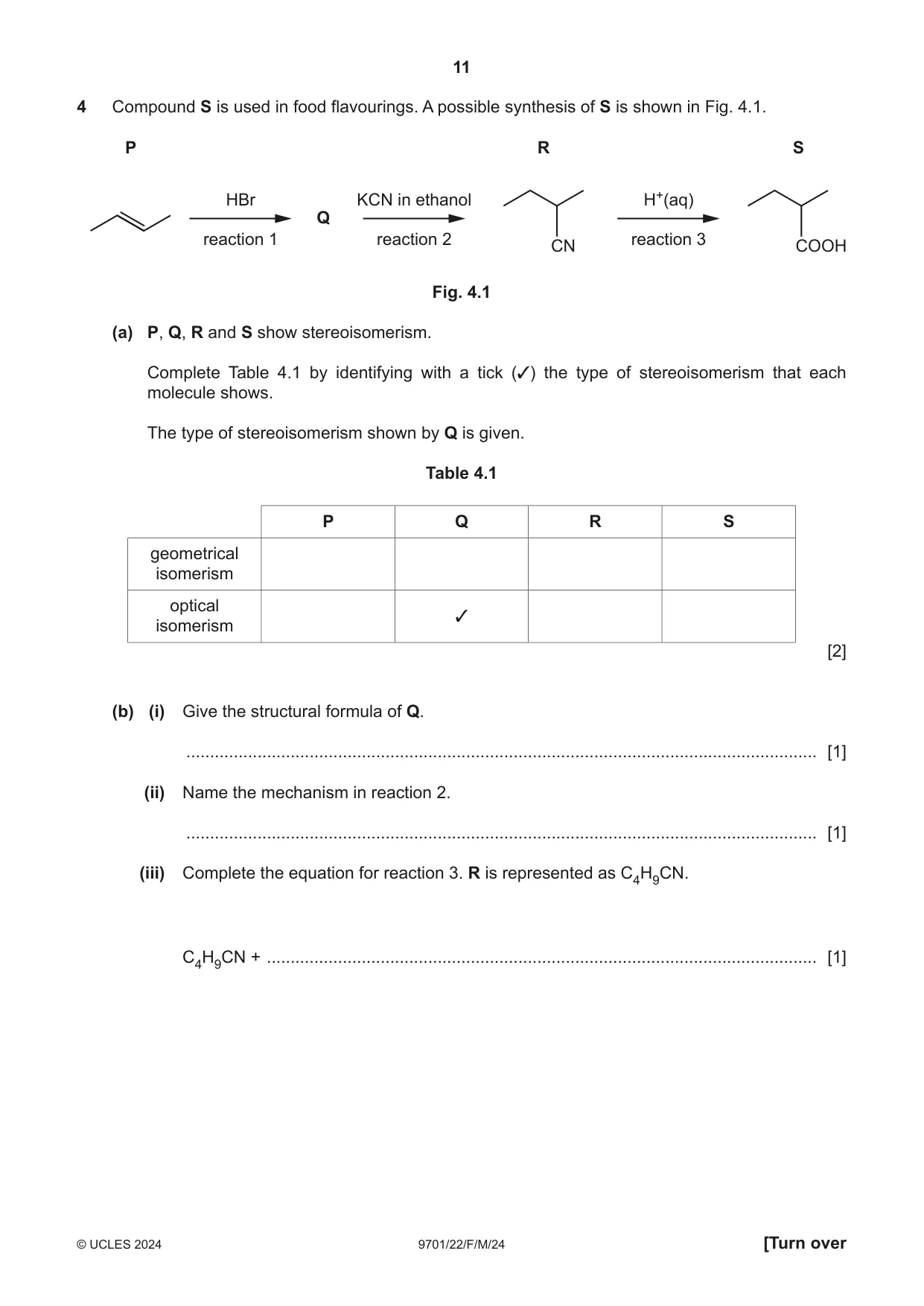
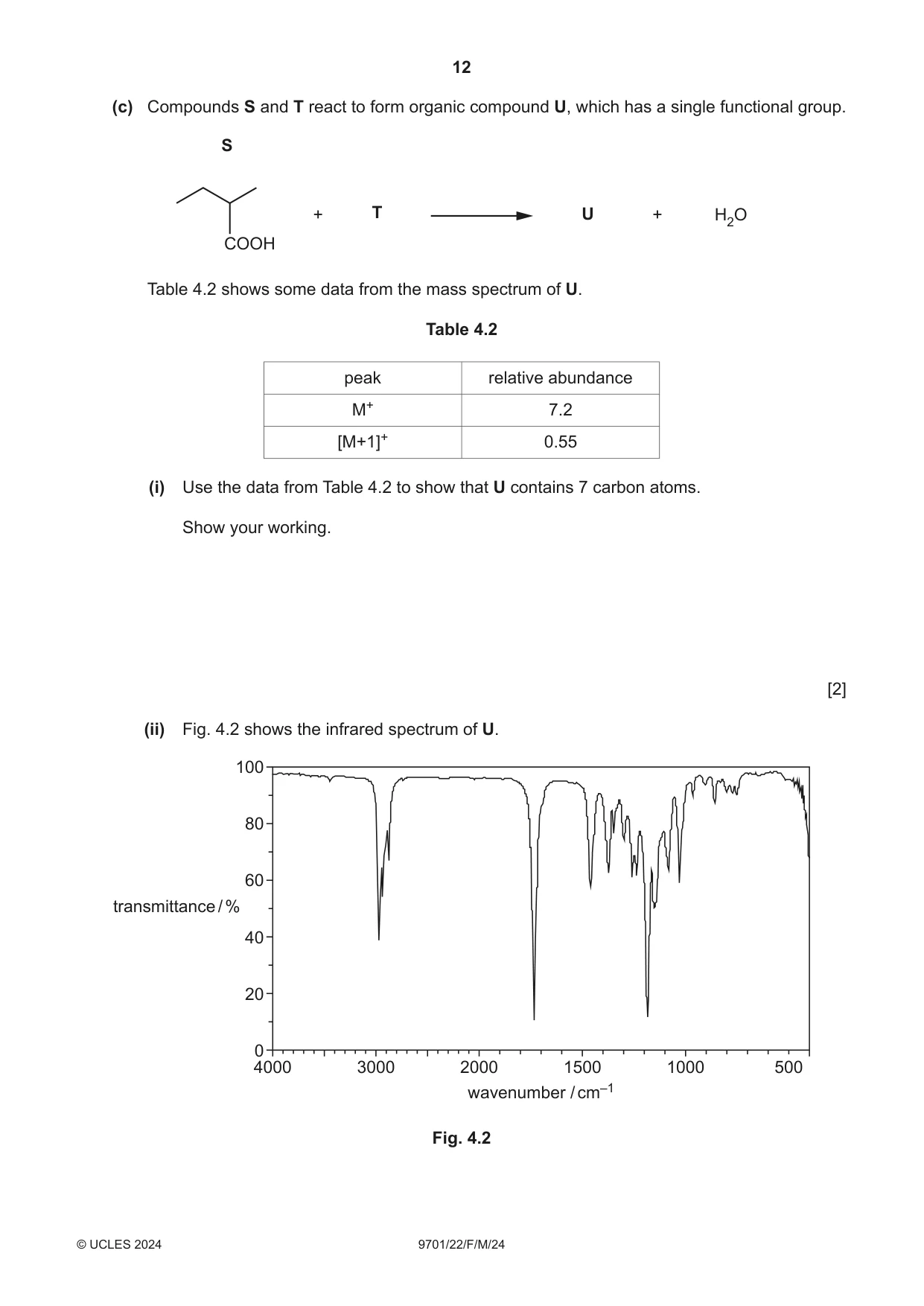
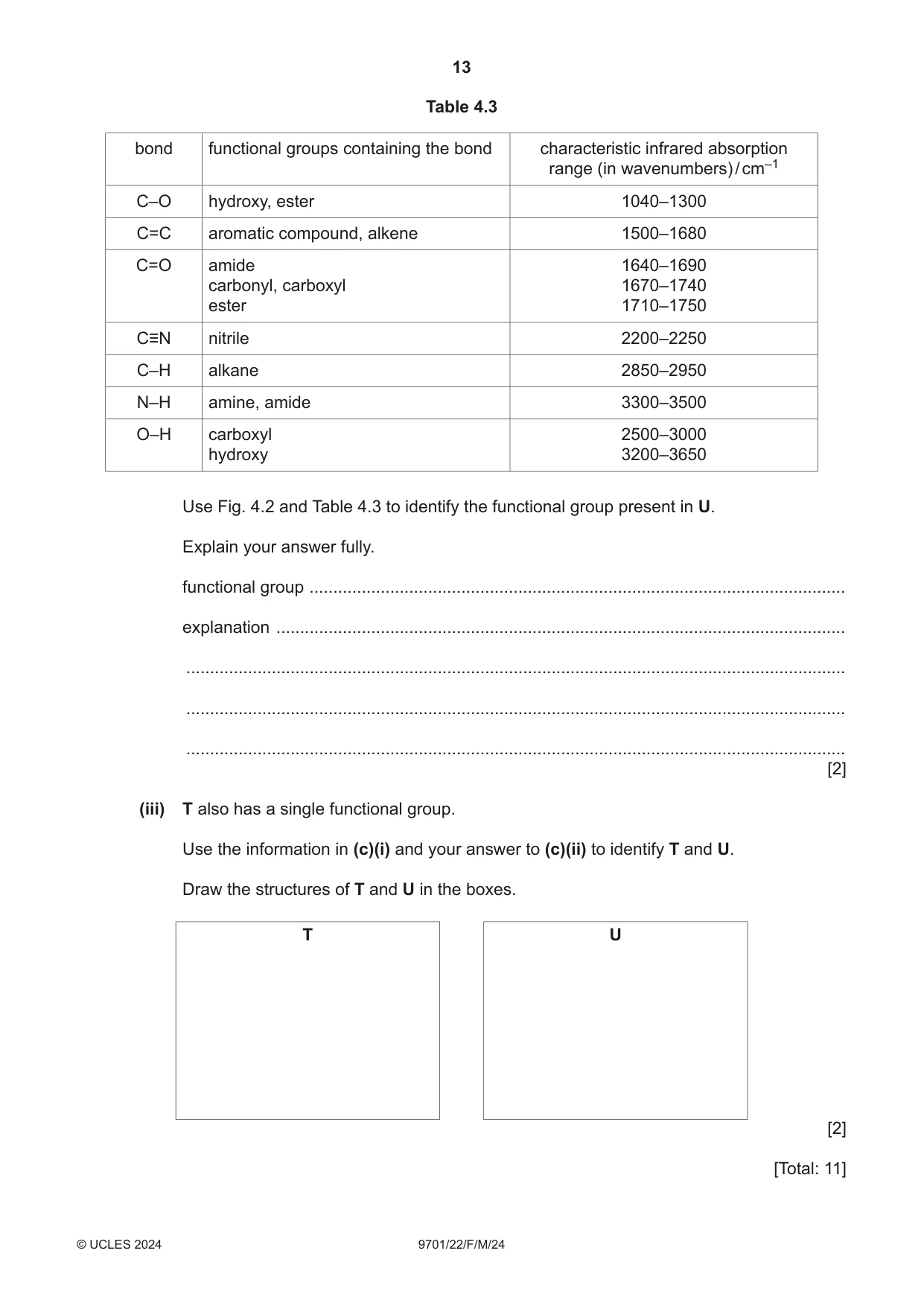
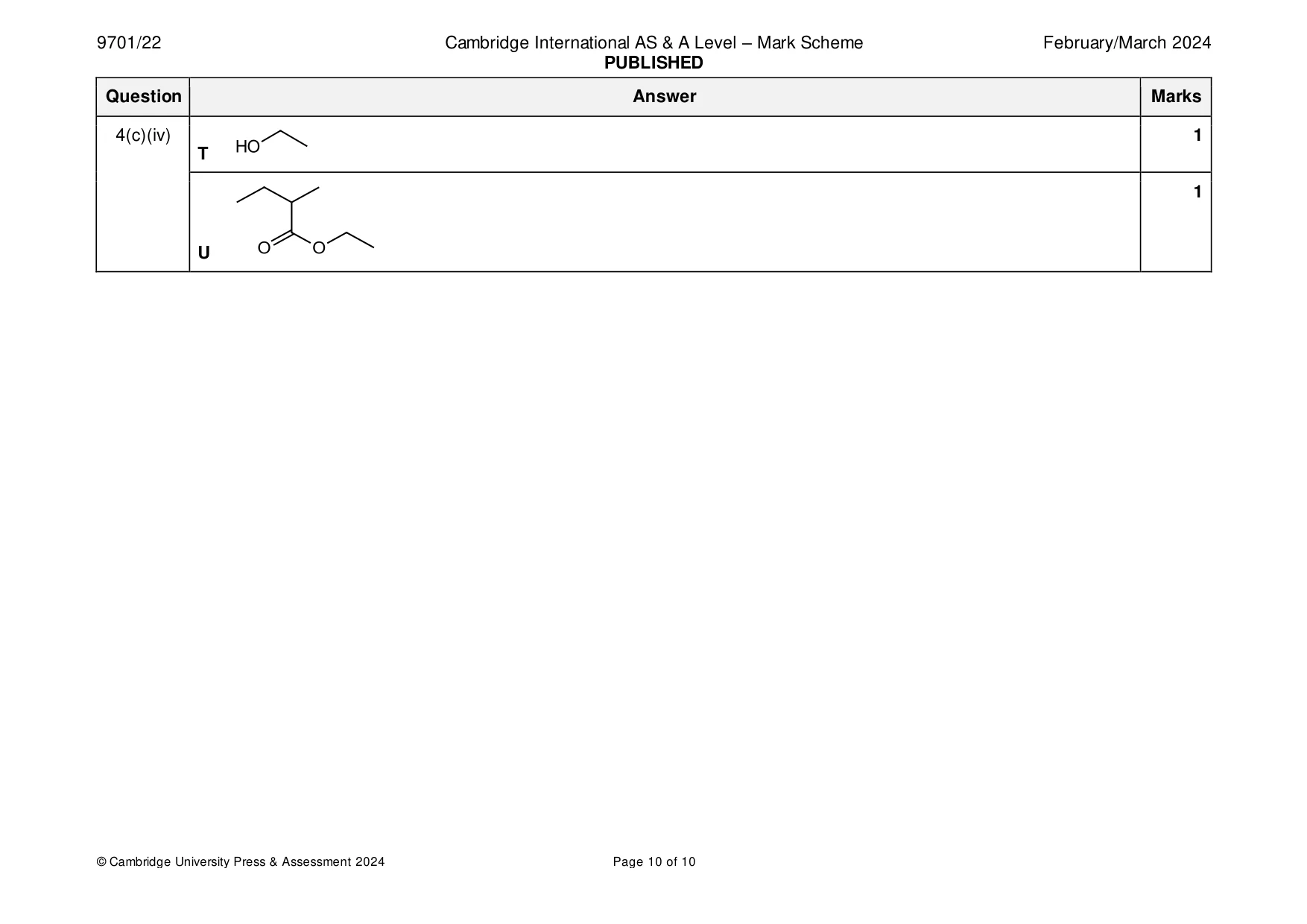
4 Compound S is used in food flavourings. A possible synthesis of S is shown in Fig. 4.1. P R S HBr KCN in ethanol H+(aq) Q reaction 1 reaction 2 reaction 3 CN COOH Fig. 4.1 (a) P, Q, R and S show stereoisomerism. Complete Table 4.1 by identifying with a tick (3) the type of stereoisomerism that each molecule shows. The type of stereoisomerism shown by Q is given. Table 4.1 P Q R S geometrical isomerism optical 3 isomerism [2] (b) (i) Give the structural formula of Q. ..................................................................................................................................... [1] (ii) Name the mechanism in reaction 2. ..................................................................................................................................... [1] (iii) Complete the equation for reaction 3. R is represented as C4H9CN. C4H9CN + .................................................................................................................... [1] (c) Compounds S and T react to form organic compound U, which has a single functional group. S + T U + H2O COOH Table 4.2 shows some data from the mass spectrum of U. Table 4.2 peak relative abundance M+ 7.2 [M+1]+ 0.55 (i) Use the data from Table 4.2 to show that U contains 7 carbon atoms. Show your working. [2] (ii) Fig. 4.2 shows the infrared spectrum of U. 100 80 60 transmittance / % 40 20 0 4000 3000 2000 1500 1000 500 wavenumber / cm–1 Fig. 4.2 Table 4.3 bond functional groups containing the bond characteristic infrared absorption range (in wavenumbers) / cm–1 C–O hydroxy, ester 1040–1300 C=C aromatic compound, alkene 1500–1680 C=O amide 1640–1690 carbonyl, carboxyl 1670–1740 ester 1710–1750 C≡N nitrile 2200–2250 C–H alkane 2850–2950 N–H amine, amide 3300–3500 O–H carboxyl 2500–3000 hydroxy 3200–3650 Use Fig. 4.2 and Table 4.3 to identify the functional group present in U. Explain your answer fully. functional group ................................................................................................................. explanation ........................................................................................................................ ........................................................................................................................................... ........................................................................................................................................... ........................................................................................................................................... [2] (iii) T also has a single functional group. Use the information in (c)(i) and your answer to (c)(ii) to identify T and U. Draw the structures of T and U in the boxes. T U [2] [Total: 11]
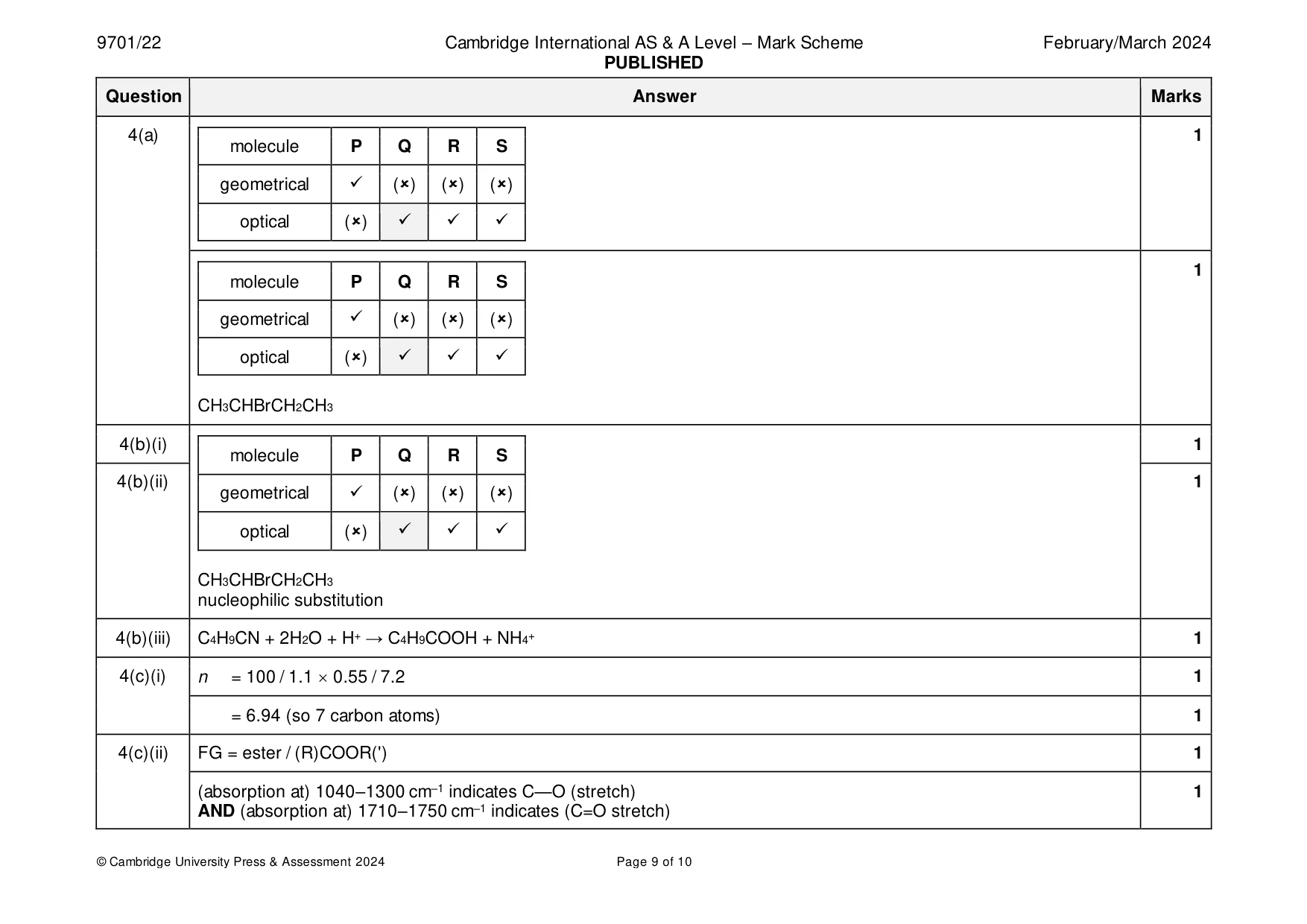
Mark scheme: 4(a) 1 molecule P Q R S geometrical ✓ () () () optical () ✓ ✓ ✓ 1 molecule P Q R S geometrical ✓ () () () optical () ✓ ✓ ✓ CH3CHBrCH2CH3 4(b)(i) 1 molecule P Q R S 4(b)(ii) 1 geometrical ✓ () () () optical () ✓ ✓ ✓ CH3CHBrCH2CH3 nucleophilic substitution 4(b)(iii) C4H9CN + 2H2O + H+ → C4H9COOH + NH4+ 1 4(c)(i) n = 100 / 1.1 0.55 / 7.2 1 = 6.94 (so 7 carbon atoms) 1 4(c)(ii) FG = ester / (R)COOR(') 1 (absorption at) 1040–1300 cm–1 indicates C—O (stretch) 1 AND (absorption at) 1710–1750 cm–1 indicates (C=O stretch) 4(c)(iv) 1 T 1 U
What was in this paper
The subtopics covered by these 4 questions, and how many questions each got. Open one in a new tab to see every Cambridge question on it.
What you needed in this session
Cambridge’s own grade thresholds for 2024 Feb/March, Paper 2 · Variant 2. A higher threshold means an easier paper — the bar moves with how the cohort did.