Cambridge A Level Chemistry 9701 — 2022 May/June Paper 2 · Variant 2
9701/22/M/J/22 · 6 questions · 60 marks · ≈68 min
The question paper and its mark scheme, free to read here and free to download. This is Cambridge’s own paper, exactly as it was sat.
Question paper16 pages


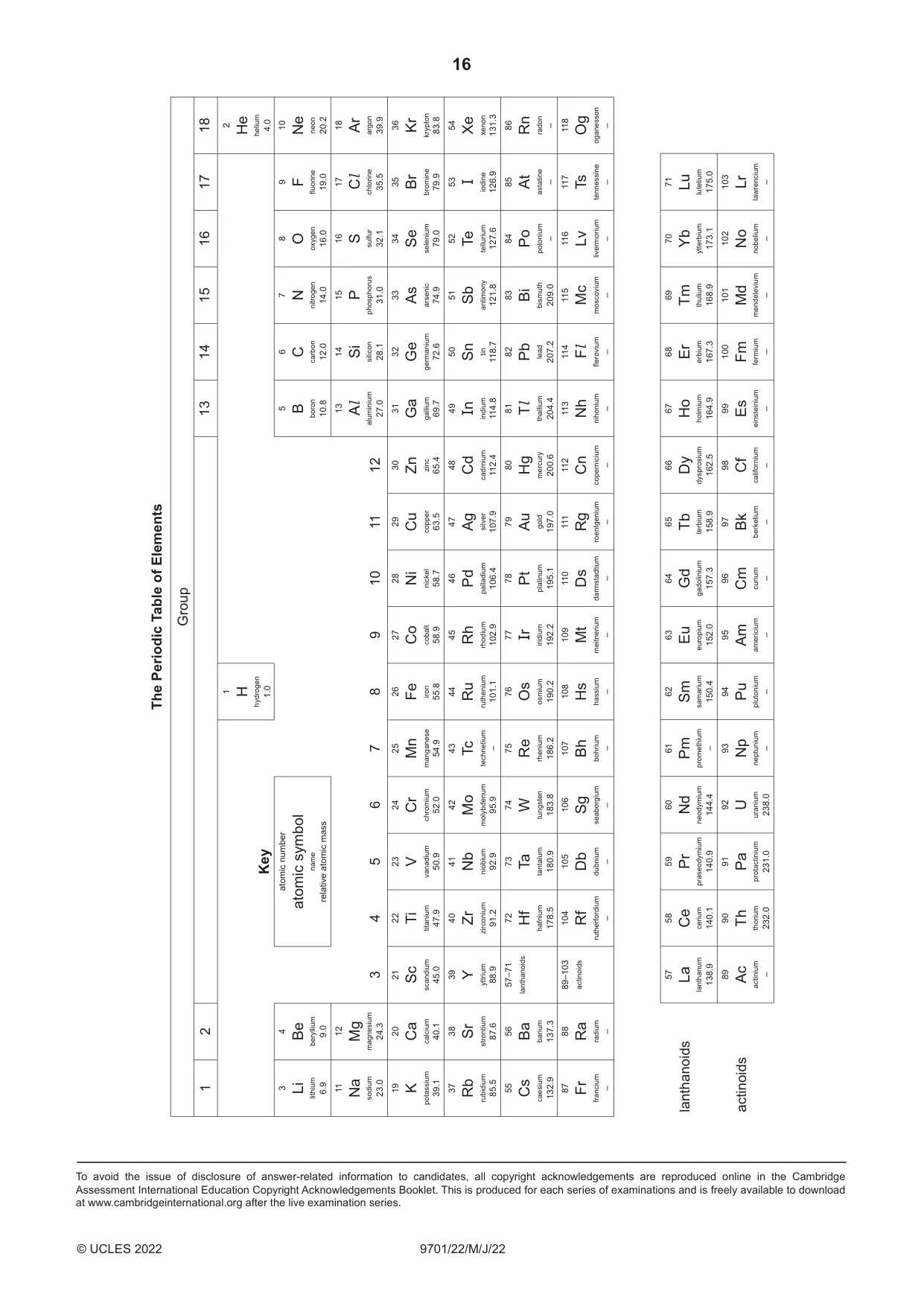
Mark scheme14 pages
Answers below. Sit the paper first if you are practising.
Questions as text
Q1 · Magnesium has a melting point of 650 °C and high electrical conductivity
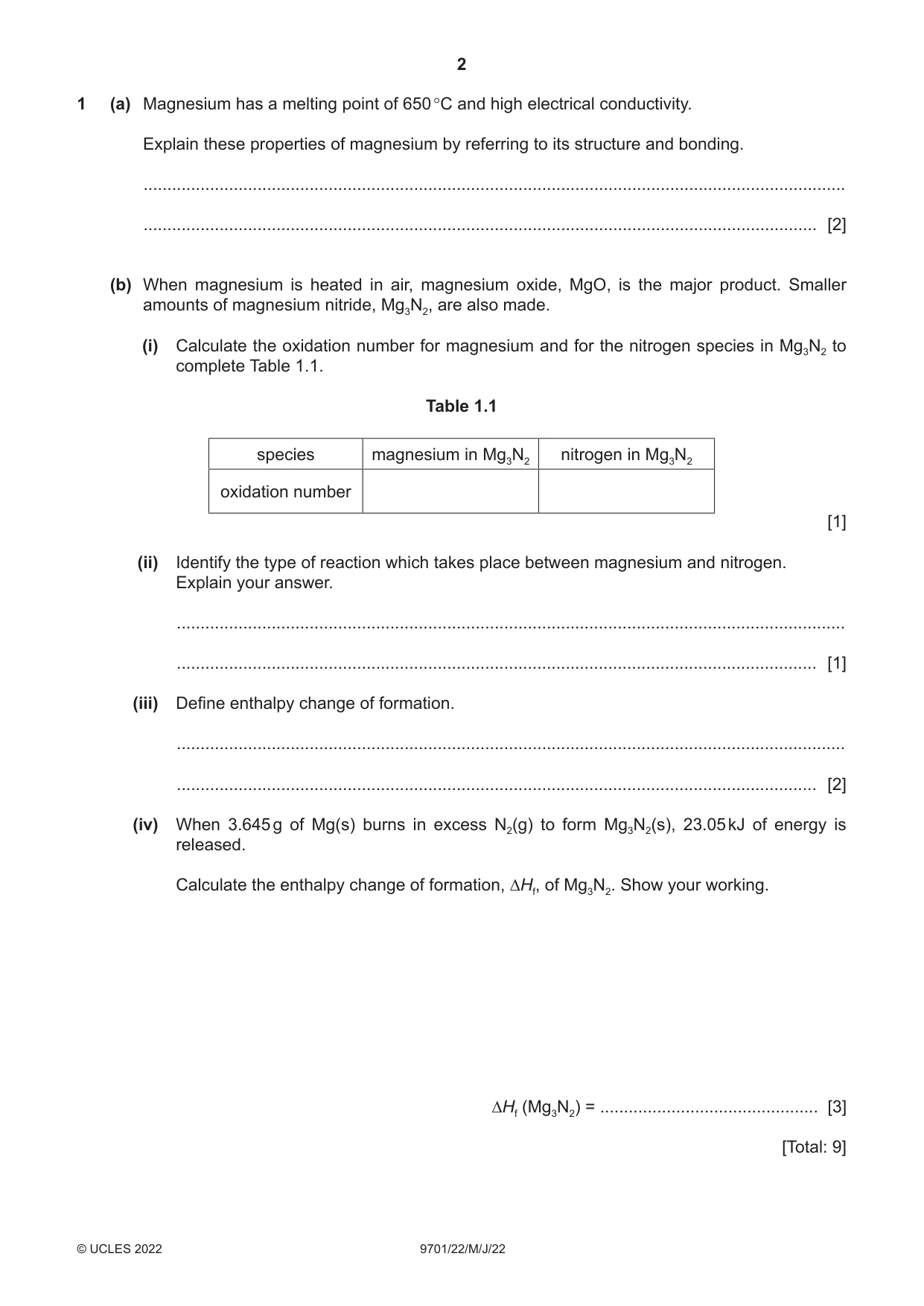
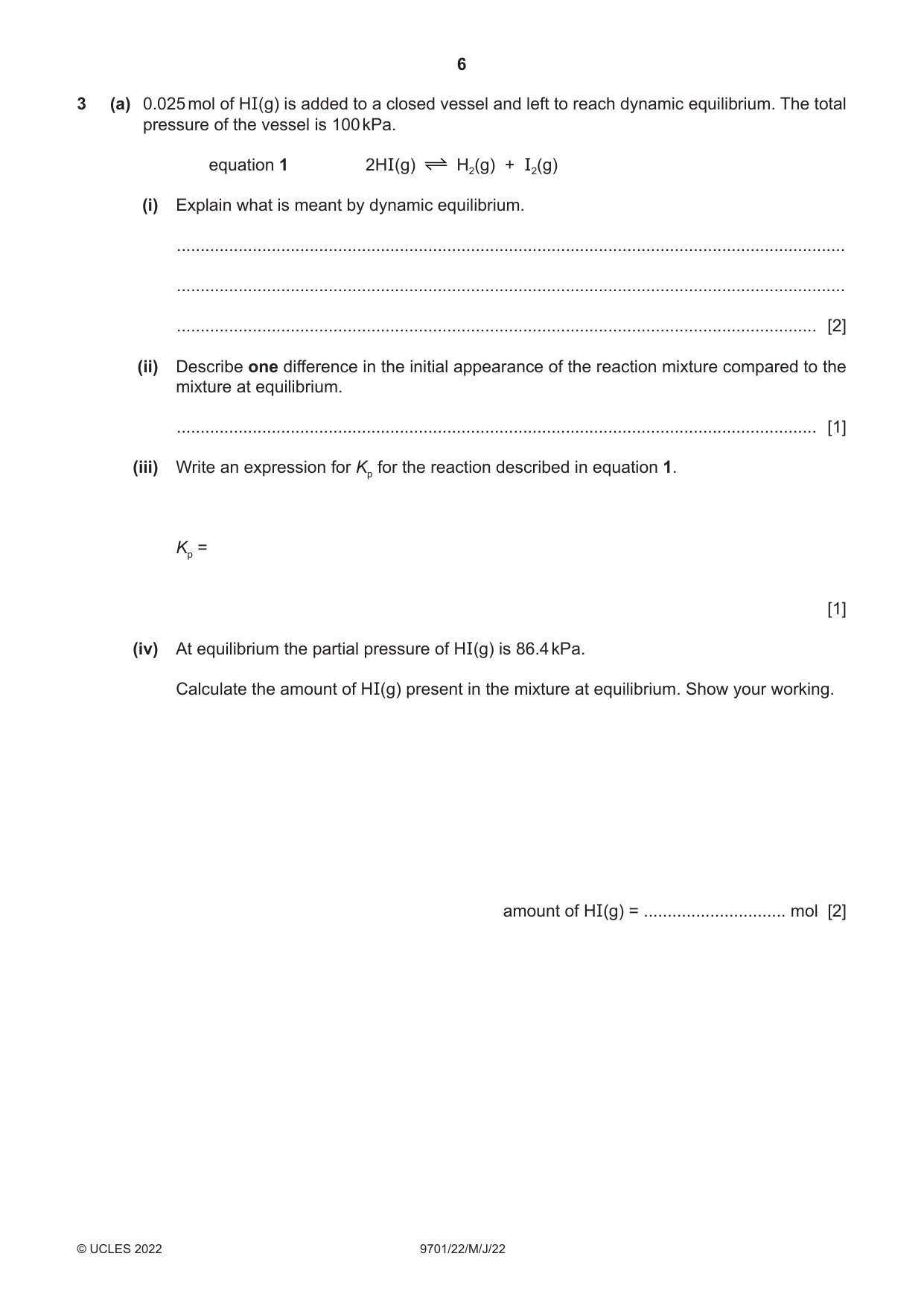
1 (a) Magnesium has a melting point of 650 °C and high electrical conductivity. Explain these properties of magnesium by referring to its structure and bonding. .................................................................................................................................................... .............................................................................................................................................. [2] (b) When magnesium is heated in air, magnesium oxide, MgO, is the major product. Smaller amounts of magnesium nitride, Mg3N2, are also made. (i) Calculate the oxidation number for magnesium and for the nitrogen species in Mg3N2 to complete Table 1.1. Table 1.1 species magnesium in Mg3N2 nitrogen in Mg3N2 oxidation number [1] (ii) Identify the type of reaction which takes place between magnesium and nitrogen. Explain your answer. ............................................................................................................................................. ....................................................................................................................................... [1] (iii) Define enthalpy change of formation. ............................................................................................................................................. ....................................................................................................................................... [2] (iv) When 3.645 g of Mg(s) burns in excess N2(g) to form Mg3N2(s), 23.05 kJ of energy is released. Calculate the enthalpy change of formation, ∆Hf, of Mg3N2. Show your working. ∆Hf (Mg3N2) = .............................................. [3] [Total: 9] Question 2 starts on the next page.
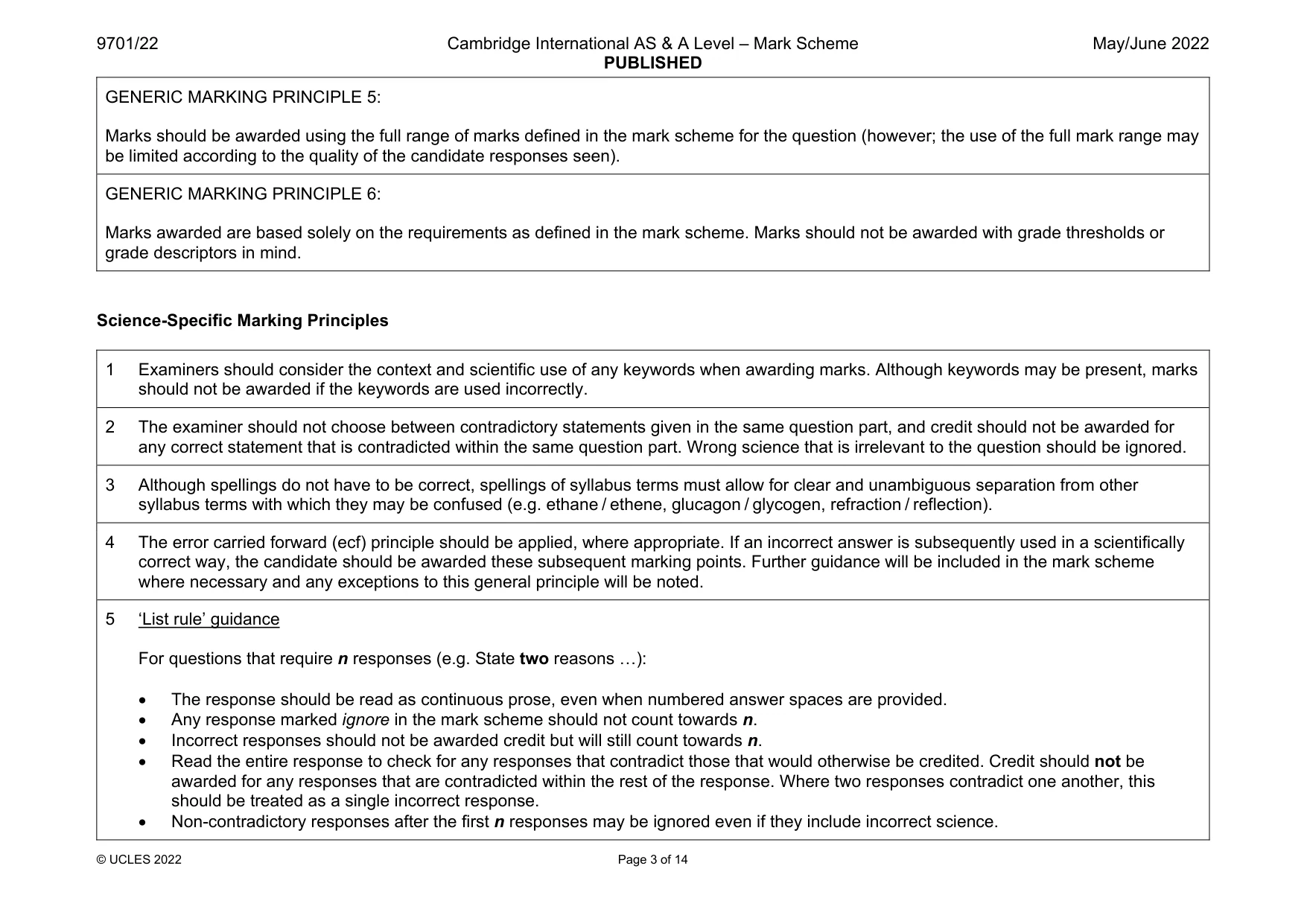
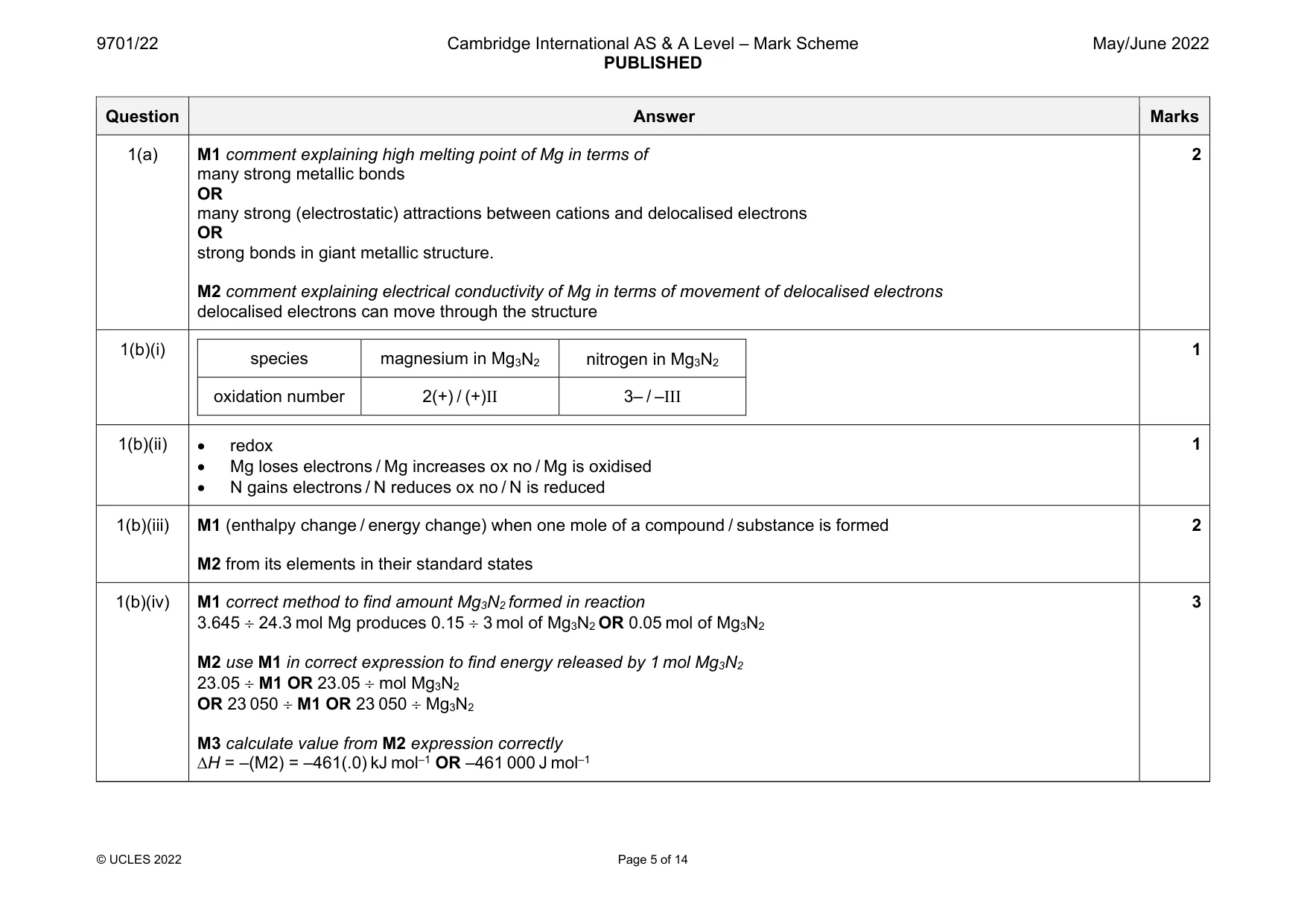
Mark scheme: 1(a) M1 comment explaining high melting point of Mg in terms of many strong metallic bonds OR many strong (electrostatic) attractions between cations and delocalised electrons OR strong bonds in giant metallic structure. M2 comment explaining electrical conductivity of Mg in terms of movement of delocalised electrons delocalised electrons can move through the structure 1(b)(i) species magnesium in Mg3N2 nitrogen in Mg3N2 oxidation number 2(+) / (+)II 3– / –III 1 1(b)(ii) redox Mg loses electrons / Mg increases ox no / Mg is oxidised N gains electrons / N reduces ox no / N is reduced 1 1(b)(iii) M1 (enthalpy change / energy change) when one mole of a compound / substance is formed M2 from its elements in their standard states 2 1(b)(iv) M1 correct method to find amount Mg3N2 formed in reaction 3.645 24.3 mol Mg produces 0.15 3 mol of Mg3N2 OR 0.05 mol of Mg3N2 M2 use M1 in correct expression to find energy released by 1 mol Mg3N2 23.05 M1 OR 23.05 mol Mg3N2 OR 23 050 M1 OR 23 050 Mg3N2 M3 calculate value from M2 expression correctly ∆H = –(M2) = –461(.0) kJ mol–1 OR –461 000 J mol–1 3
Q2 · Radium, Ra, is an element found in Group 2 of the Periodic Table
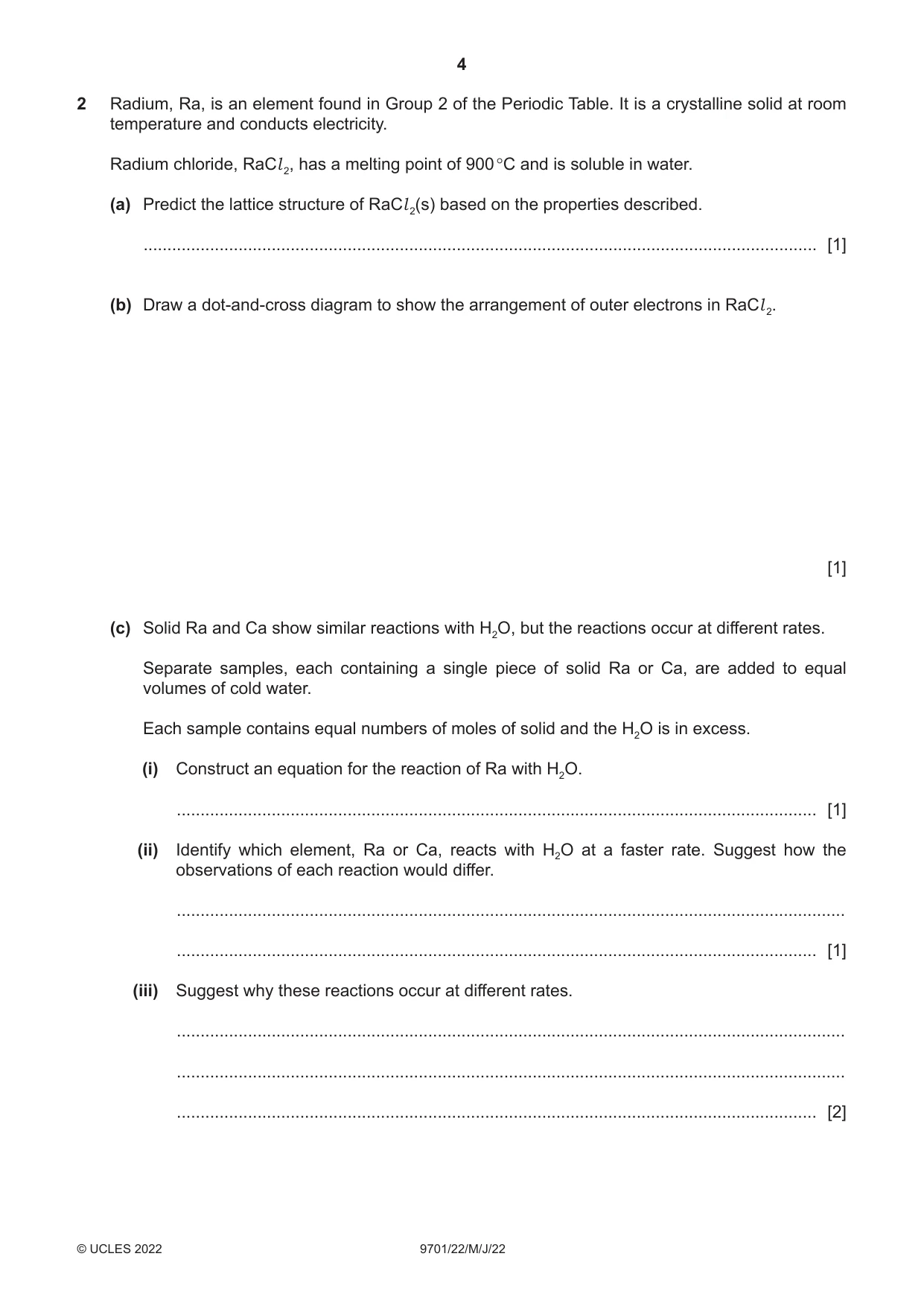
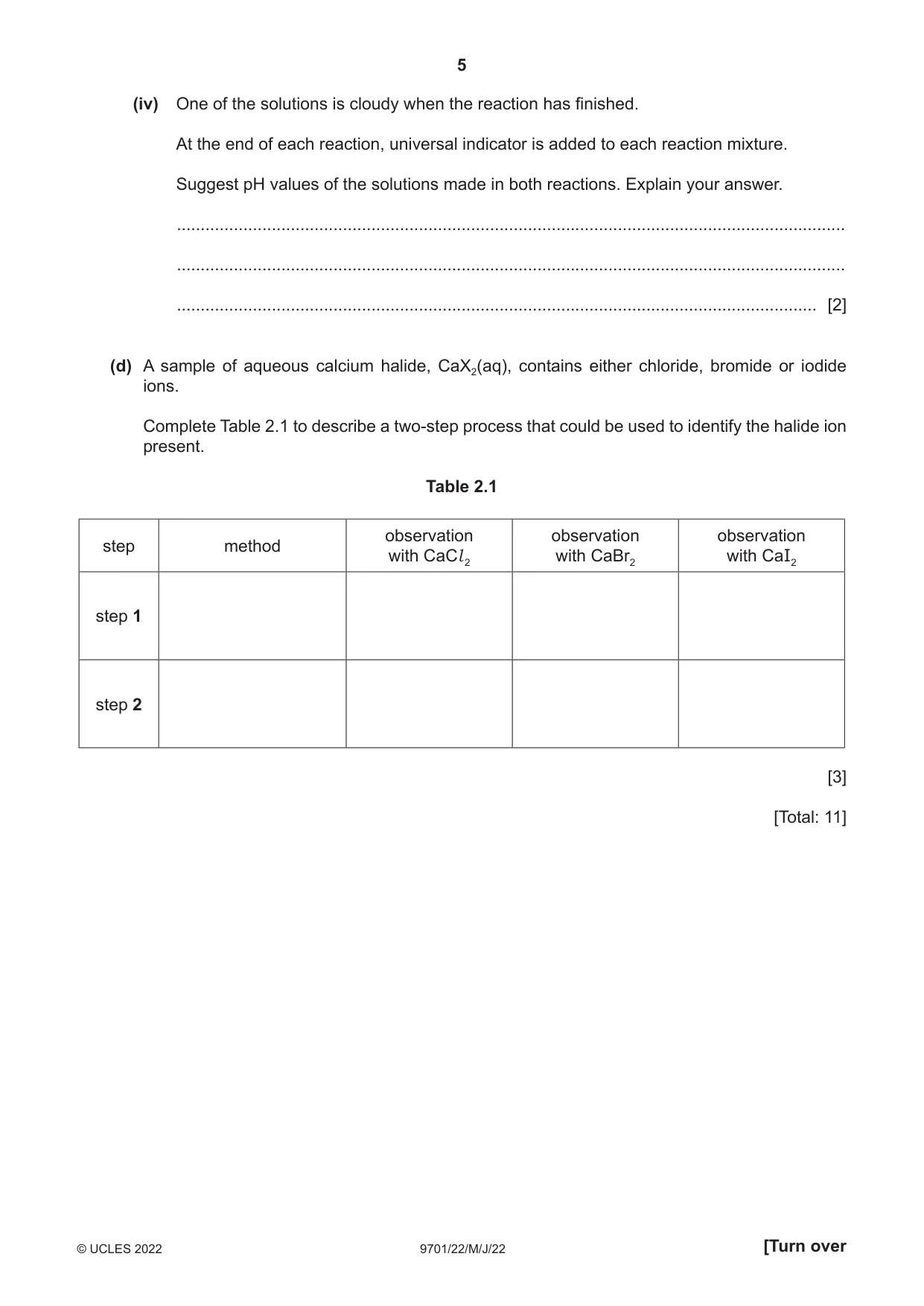
2 Radium, Ra, is an element found in Group 2 of the Periodic Table. It is a crystalline solid at room temperature and conducts electricity. Radium chloride, RaCl 2, has a melting point of 900 °C and is soluble in water. (a) Predict the lattice structure of RaCl 2(s) based on the properties described. .............................................................................................................................................. [1] (b) Draw a dot-and-cross diagram to show the arrangement of outer electrons in RaCl 2. [1] (c) Solid Ra and Ca show similar reactions with H2O, but the reactions occur at different rates. Separate samples, each containing a single piece of solid Ra or Ca, are added to equal volumes of cold water. Each sample contains equal numbers of moles of solid and the H2O is in excess. (i) Construct an equation for the reaction of Ra with H2O. ....................................................................................................................................... [1] (ii) Identify which element, Ra or Ca, reacts with H2O at a faster rate. Suggest how the observations of each reaction would differ. ............................................................................................................................................. ....................................................................................................................................... [1] (iii) Suggest why these reactions occur at different rates. ............................................................................................................................................. ............................................................................................................................................. ....................................................................................................................................... [2] (iv) One of the solutions is cloudy when the reaction has finished. At the end of each reaction, universal indicator is added to each reaction mixture. Suggest pH values of the solutions made in both reactions. Explain your answer. ............................................................................................................................................. ............................................................................................................................................. ....................................................................................................................................... [2] (d) A sample of aqueous calcium halide, CaX2(aq), contains either chloride, bromide or iodide ions. Complete Table 2.1 to describe a two-step process that could be used to identify the halide ion present. Table 2.1 observation observation observation step method with CaCl 2 with CaBr2 with CaI2 step 1 step 2 [3] [Total: 11]
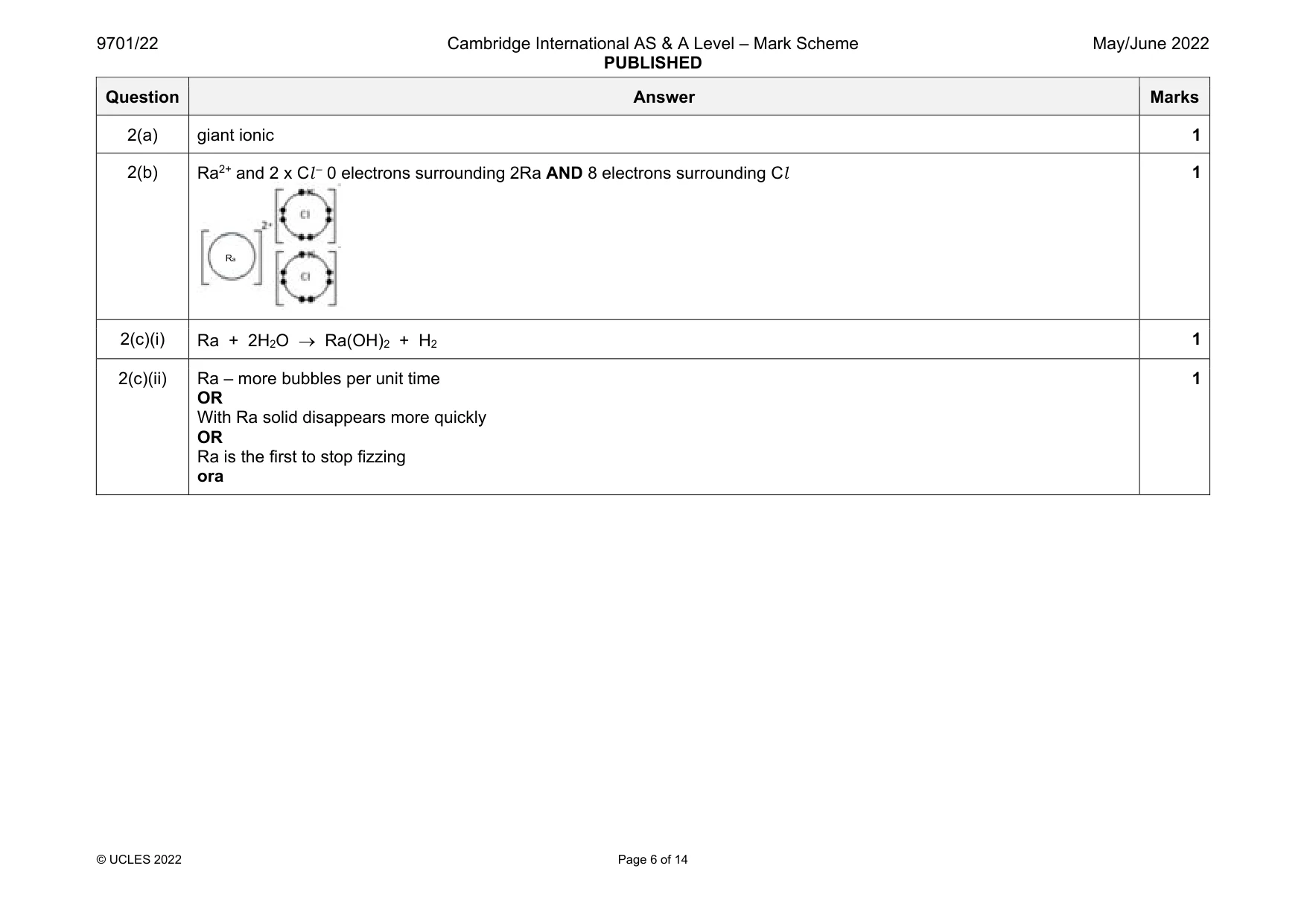
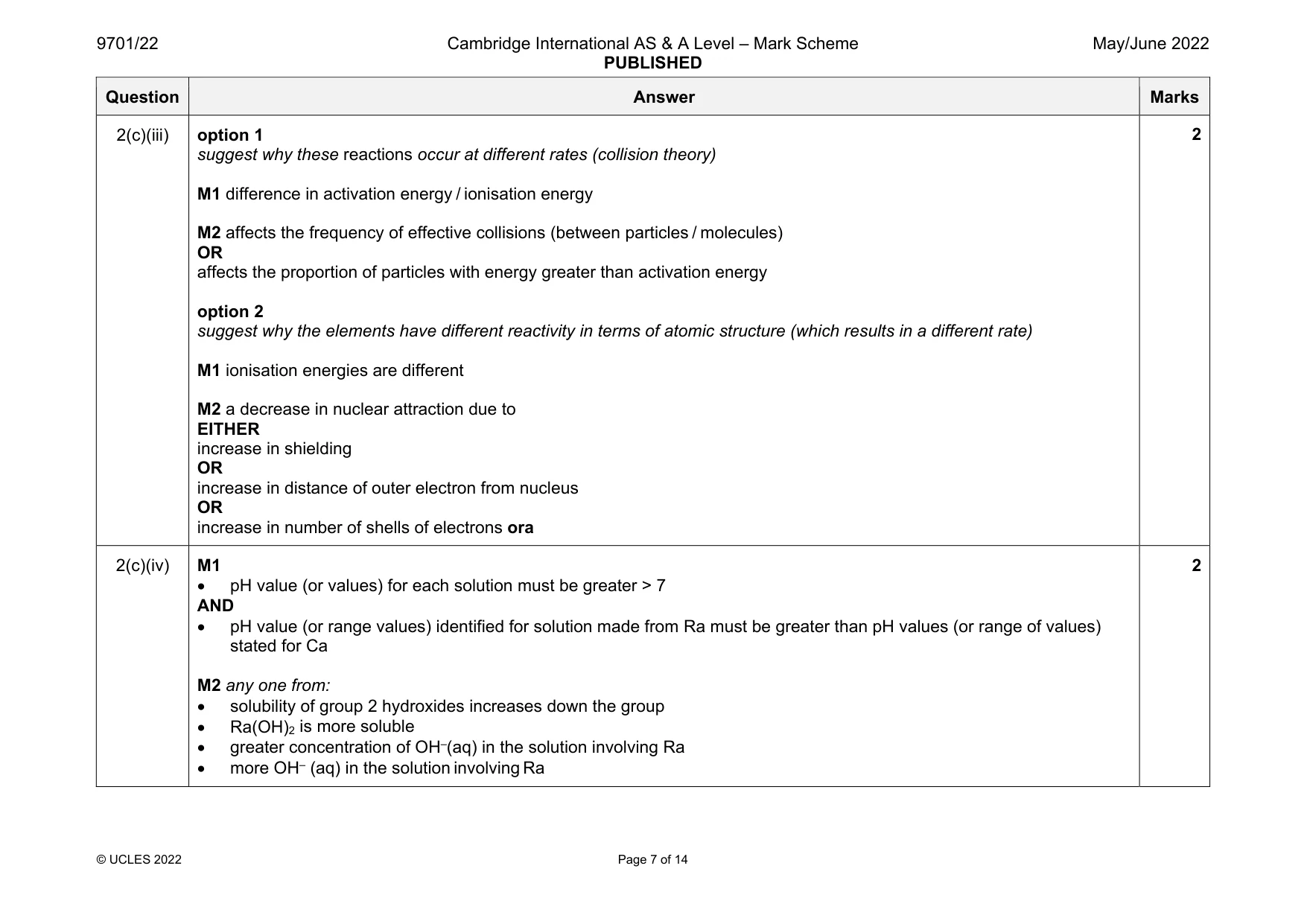
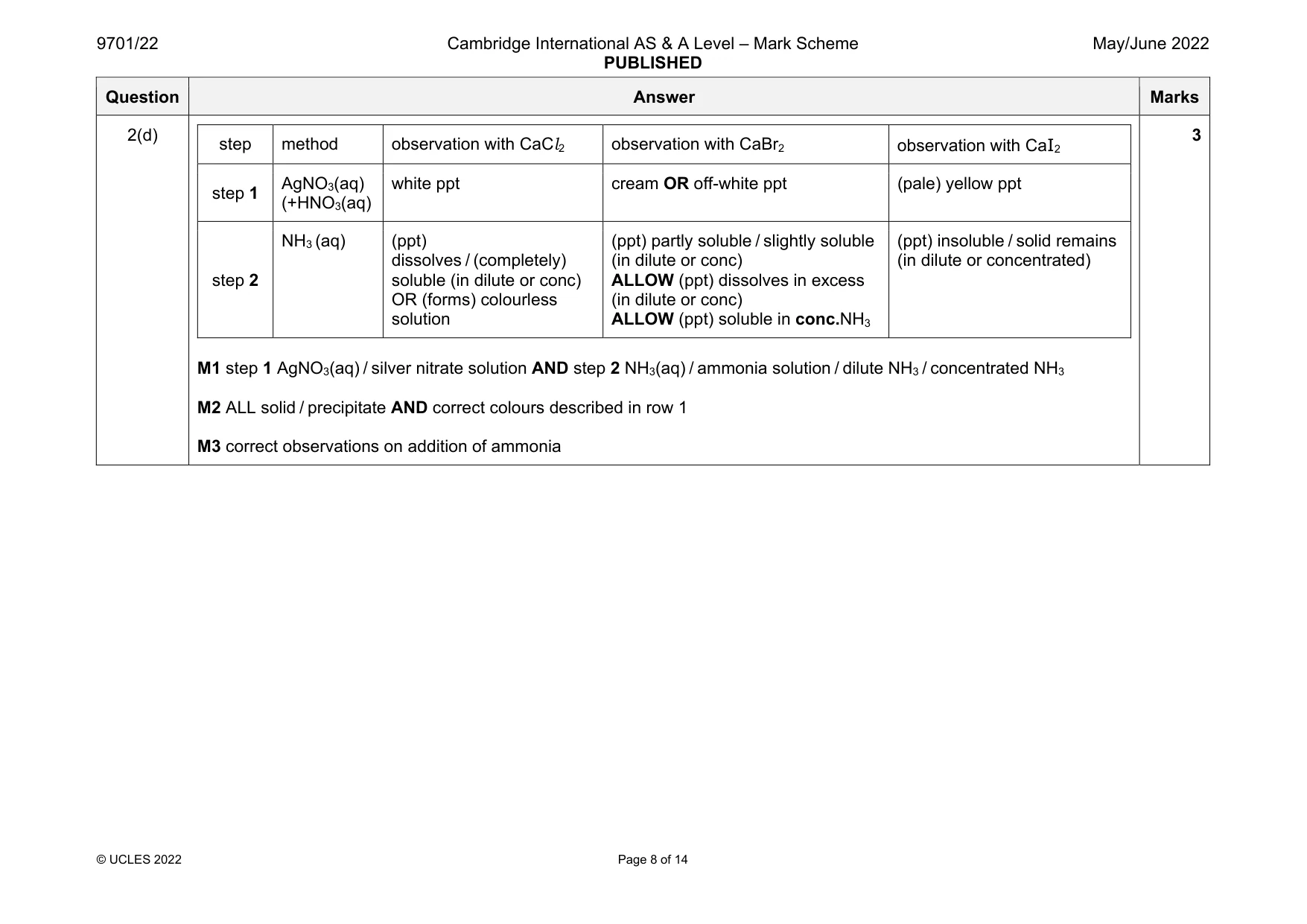
Mark scheme: 2(a) giant ionic 1 2(b) Ra2+ and 2 x Cl – 0 electrons surrounding 2Ra AND 8 electrons surrounding Cl 1 2(c)(i) Ra + 2H2O Ra(OH)2 + H2 1 2(c)(ii) Ra – more bubbles per unit time OR With Ra solid disappears more quickly OR Ra is the first to stop fizzing ora 1 Ra Question Answer Marks 2(c)(iii) option 1 suggest why these reactions occur at different rates (collision theory) M1 difference in activation energy / ionisation energy M2 affects the frequency of effective collisions (between particles / molecules) OR affects the proportion of particles with energy greater than activation energy option 2 suggest why the elements have different reactivity in terms of atomic structure (which results in a different rate) M1 ionisation energies are different M2 a decrease in nuclear attraction due to EITHER increase in shielding OR increase in distance of outer electron from nucleus OR increase in number of shells of electrons ora 2 2(c)(iv) M1 pH value (or values) for each solution must be greater > 7 AND pH value (or range values) identified for solution made from Ra must be greater than pH values (or range of values) stated for Ca M2 any one from: solubility of group 2 hydroxides increases down the group Ra(OH)2 is more soluble greater concentration of OH–(aq) in the solution involving Ra more OH– (aq) in the solution involving Ra 2 Question Answer Marks 2(d) step method observation with CaCl2 observation with CaBr2 observation with CaI2 step 1 AgNO3(aq) (+HNO3(aq) white ppt cream OR off-white ppt (pale) yellow ppt step 2 NH3 (aq) (ppt) dissolves / (completely) soluble (in dilute or conc) OR (forms) colourless solution (ppt) partly soluble / slightly soluble (in dilute or conc) ALLOW (ppt) dissolves in excess (in dilute or conc) ALLOW (ppt) soluble in conc.NH3 (ppt) insoluble / solid remains (in dilute or concentrated) M1 step 1 AgNO3(aq) / silver nitrate solution AND step 2 NH3(aq) / ammonia solution / dilute NH3 / concentrated NH3 M2 ALL solid / precipitate AND correct colours described in row 1 M3 correct observations on addition of ammonia 3
Q3 · 0.025 mol of HI(g) is added to a closed vessel and left to reach dynamic equilibrium
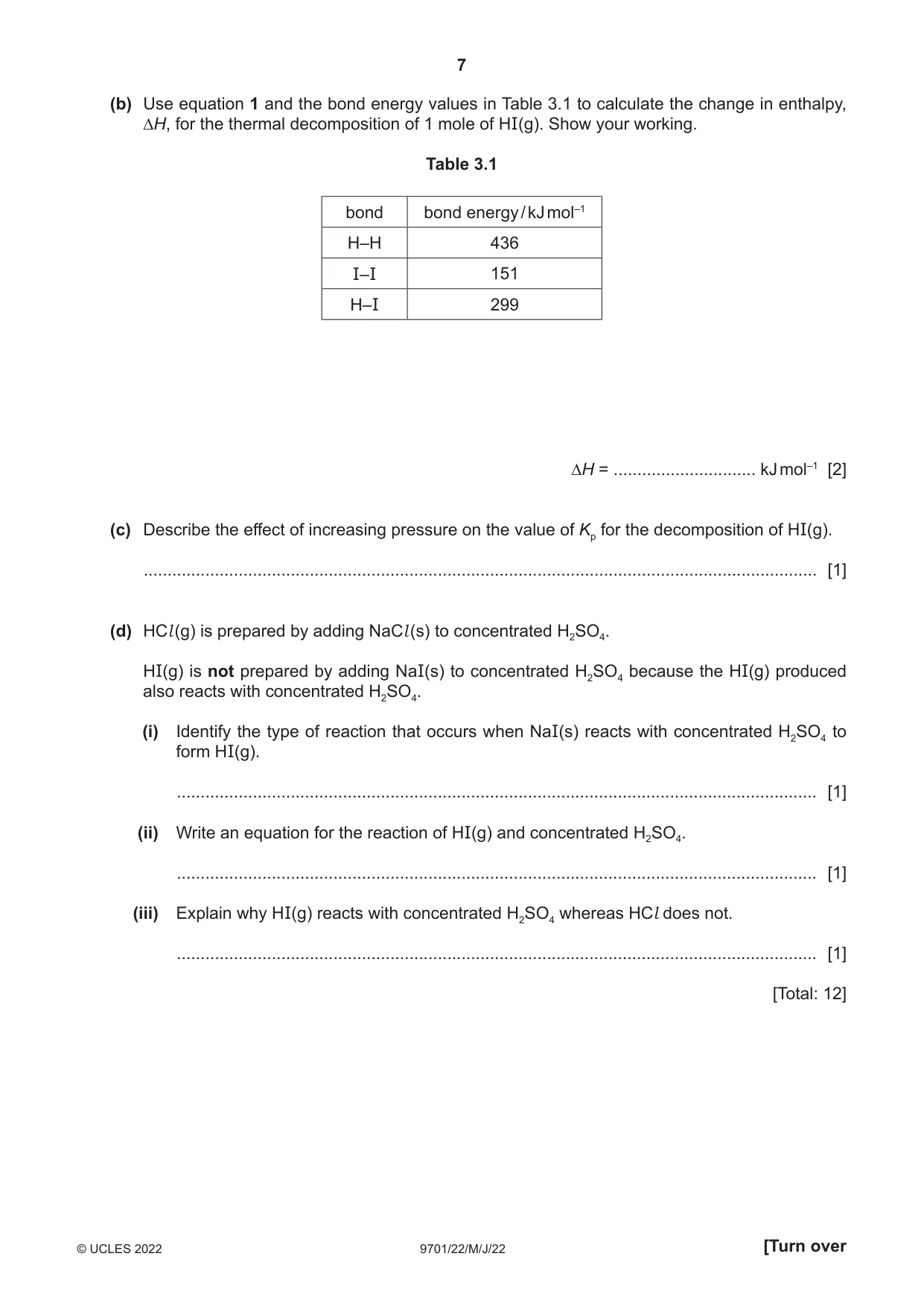
3 (a) 0.025 mol of HI(g) is added to a closed vessel and left to reach dynamic equilibrium. The total pressure of the vessel is 100 kPa. equation 1 2HI(g) H2(g) + I2(g) (i) Explain what is meant by dynamic equilibrium. ............................................................................................................................................. ............................................................................................................................................. ....................................................................................................................................... [2] (ii) Describe one difference in the initial appearance of the reaction mixture compared to the mixture at equilibrium. ....................................................................................................................................... [1] (iii) Write an expression for Kp for the reaction described in equation 1. Kp = [1] (iv) At equilibrium the partial pressure of HI(g) is 86.4 kPa. Calculate the amount of HI(g) present in the mixture at equilibrium. Show your working. amount of HI(g) = .............................. mol [2] (b) Use equation 1 and the bond energy values in Table 3.1 to calculate the change in enthalpy, ∆H, for the thermal decomposition of 1 mole of HI(g). Show your working. Table 3.1 bond bond energy / kJ mol–1 H–H 436 I–I 151 H–I 299 ∆H = .............................. kJ mol–1 [2] (c) Describe the effect of increasing pressure on the value of Kp for the decomposition of HI(g). .............................................................................................................................................. [1] (d) HCl (g) is prepared by adding NaCl (s) to concentrated H2SO4. HI(g) is not prepared by adding NaI(s) to concentrated H2SO4 because the HI(g) produced also reacts with concentrated H2SO4. (i) Identify the type of reaction that occurs when NaI(s) reacts with concentrated H2SO4 to form HI(g). ....................................................................................................................................... [1] (ii) Write an equation for the reaction of HI(g) and concentrated H2SO4. ....................................................................................................................................... [1] (iii) Explain why HI(g) reacts with concentrated H2SO4 whereas HCl does not. ....................................................................................................................................... [1] [Total: 12]
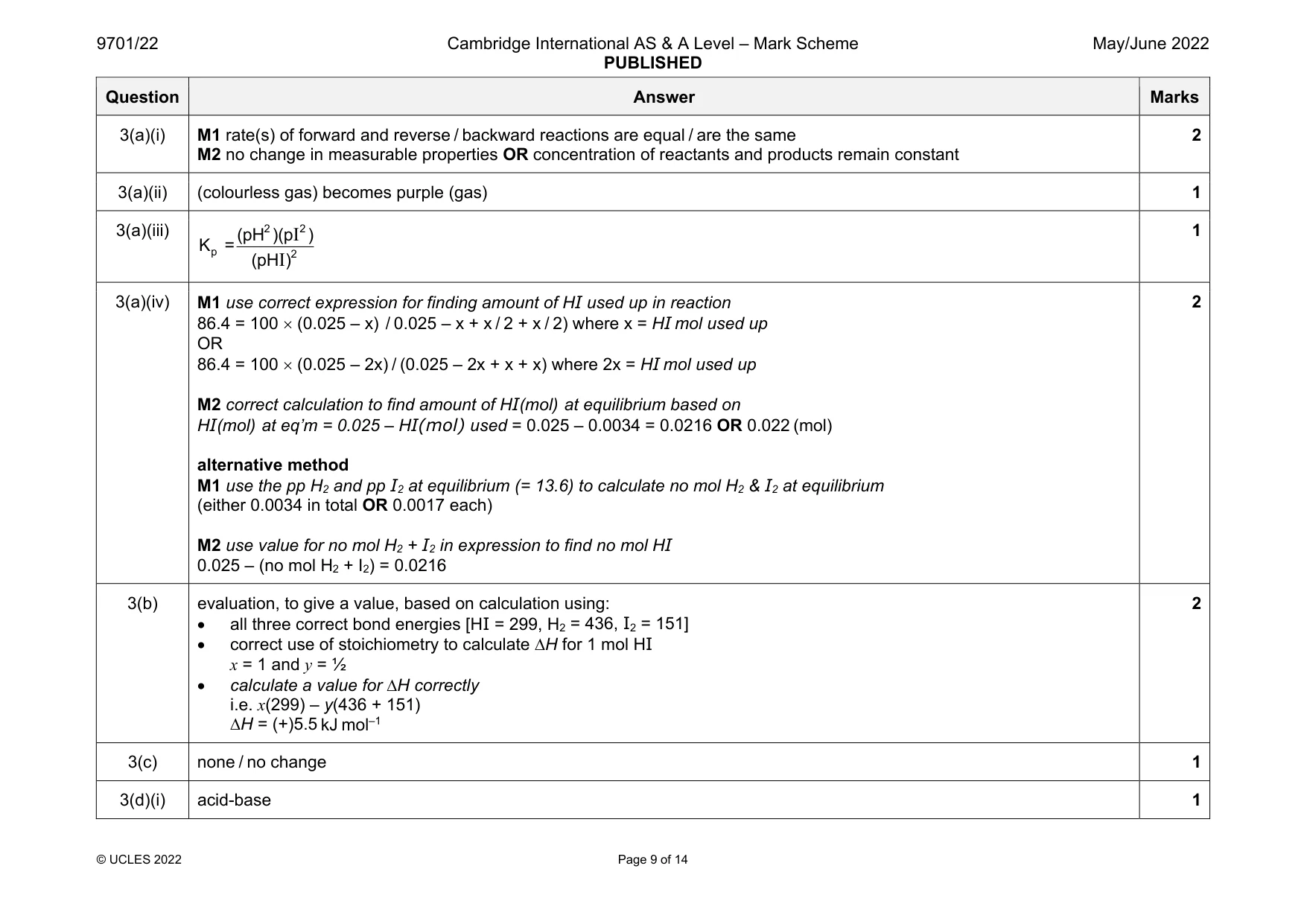
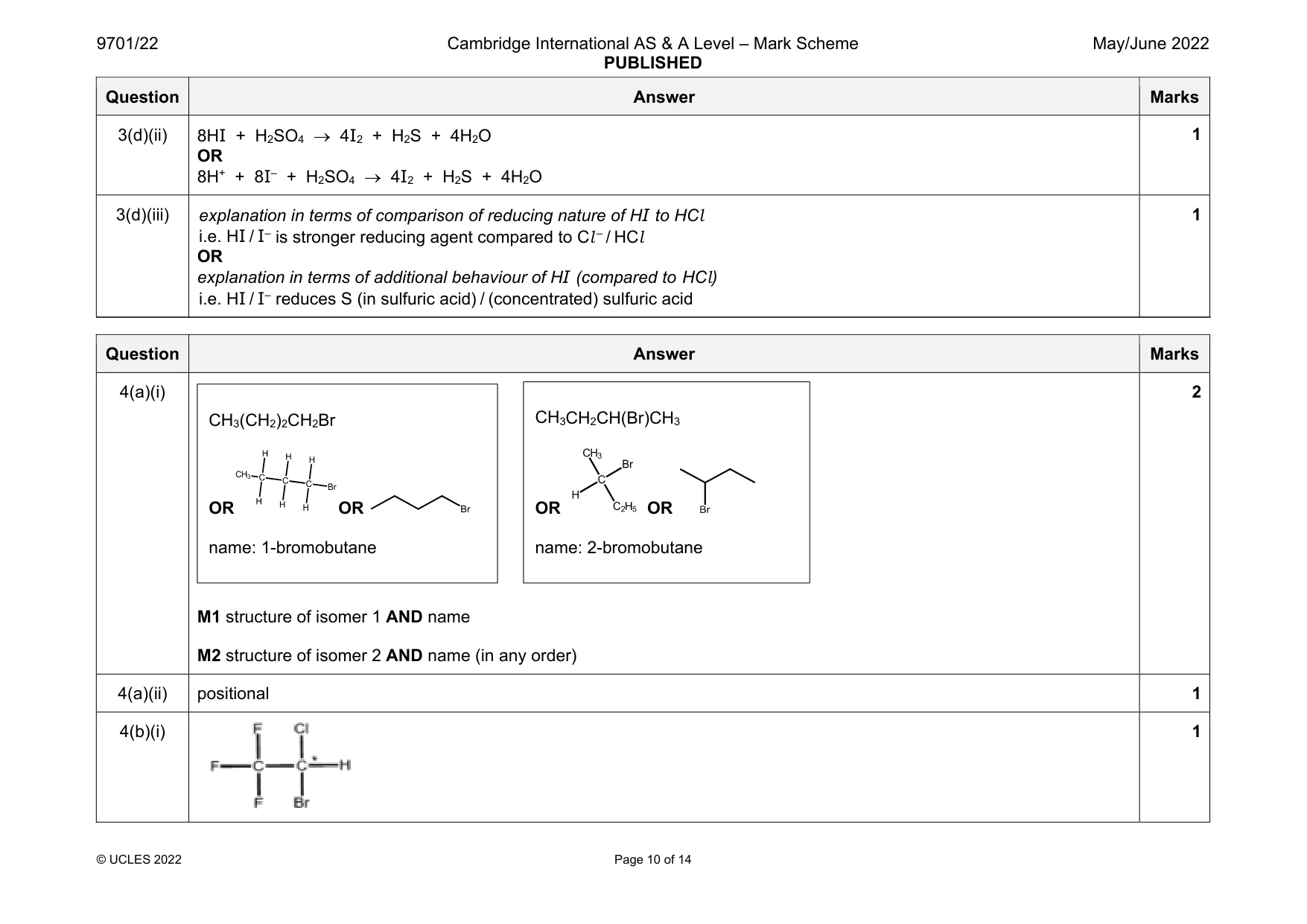
Mark scheme: 3(a)(i) M1 rate(s) of forward and reverse / backward reactions are equal / are the same M2 no change in measurable properties OR concentration of reactants and products remain constant 2 3(a)(ii) (colourless gas) becomes purple (gas) 1 3(a)(iii) I I 2 2 p 2 (pH )(p ) K = (pH ) 1 3(a)(iv) M1 use correct expression for finding amount of HI used up in reaction 86.4 = 100 (0.025 – x) / 0.025 – x + x / 2 + x / 2) where x = HI mol used up OR 86.4 = 100 (0.025 – 2x) / (0.025 – 2x + x + x) where 2x = HI mol used up M2 correct calculation to find amount of HI(mol) at equilibrium based on HI(mol) at eq’m = 0.025 – HI(mol) used = 0.025 – 0.0034 = 0.0216 OR 0.022 (mol) alternative method M1 use the pp H2 and pp I2 at equilibrium (= 13.6) to calculate no mol H2 & I2 at equilibrium (either 0.0034 in total OR 0.0017 each) M2 use value for no mol H2 + I2 in expression to find no mol HI 0.025 – (no mol H2 + I2) = 0.0216 2 3(b) evaluation, to give a value, based on calculation using: all three correct bond energies [HI = 299, H2 = 436, I2 = 151] correct use of stoichiometry to calculate ∆H for 1 mol HI x = 1 and y = ½ calculate a value for ∆H correctly i.e. x(299) – y(436 + 151) ∆H = (+)5.5 kJ mol–1 2 3(c) none / no change 1 3(d)(i) acid-base 1 Question Answer Marks 3(d)(ii) 8HI + H2SO4 4I2 + H2S + 4H2O OR 8H+ + 8I– + H2SO4 4I2 + H2S + 4H2O 1 3(d)(iii) explanation in terms of comparison of reducing nature of HI to HCl i.e. HI / I– is stronger reducing agent compared to Cl – / HCl OR explanation in terms of additional behaviour of HI (compared to HCl) i.e. HI / I– reduces S (in sulfuric acid) / (concentrated) sulfuric acid 1
More questions on Chemical equilibria: reversible reactions, dynamic equilibrium
Q4 · Bromine reacts with butane in the presence of ultraviolet light to form bromobutane
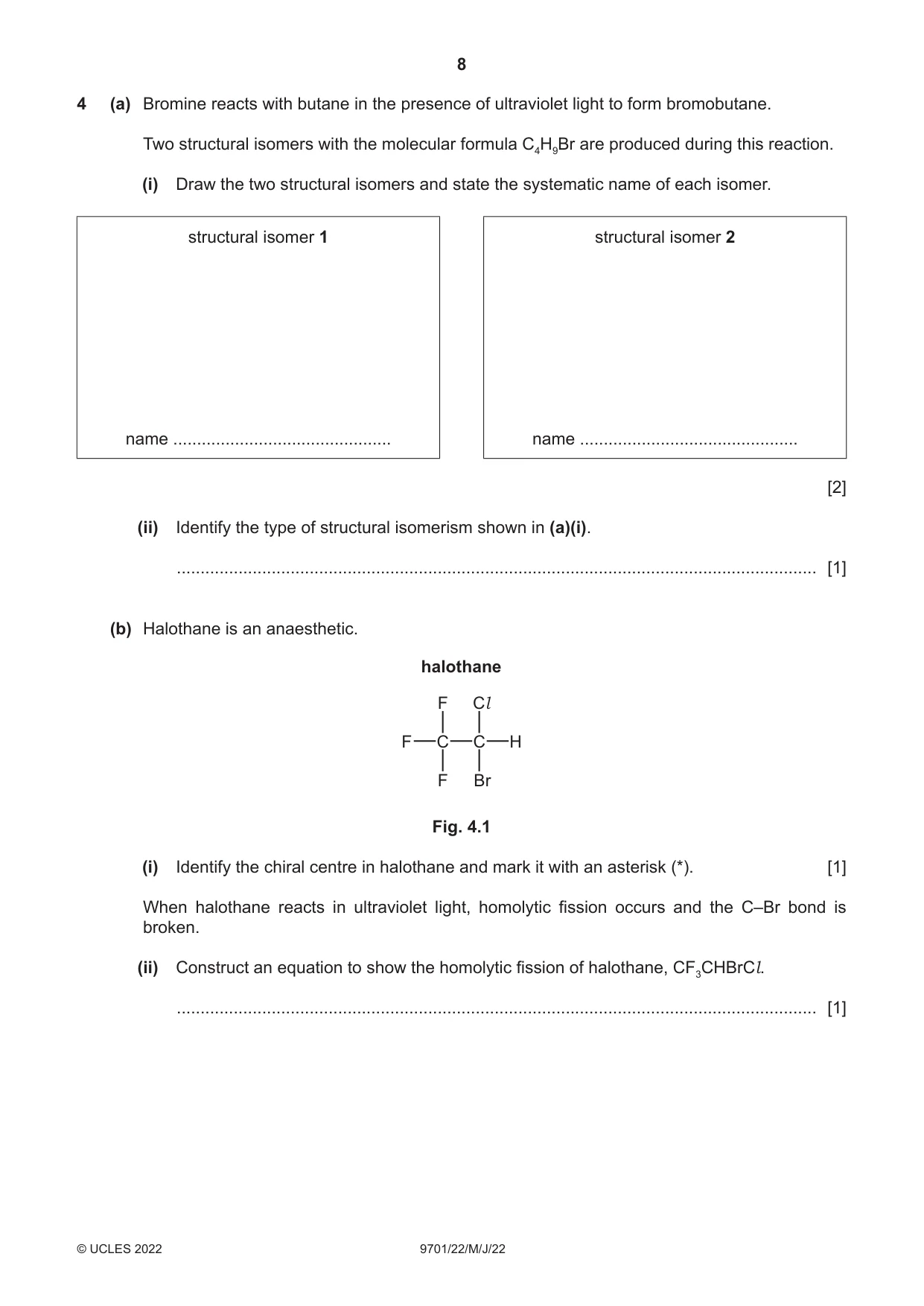
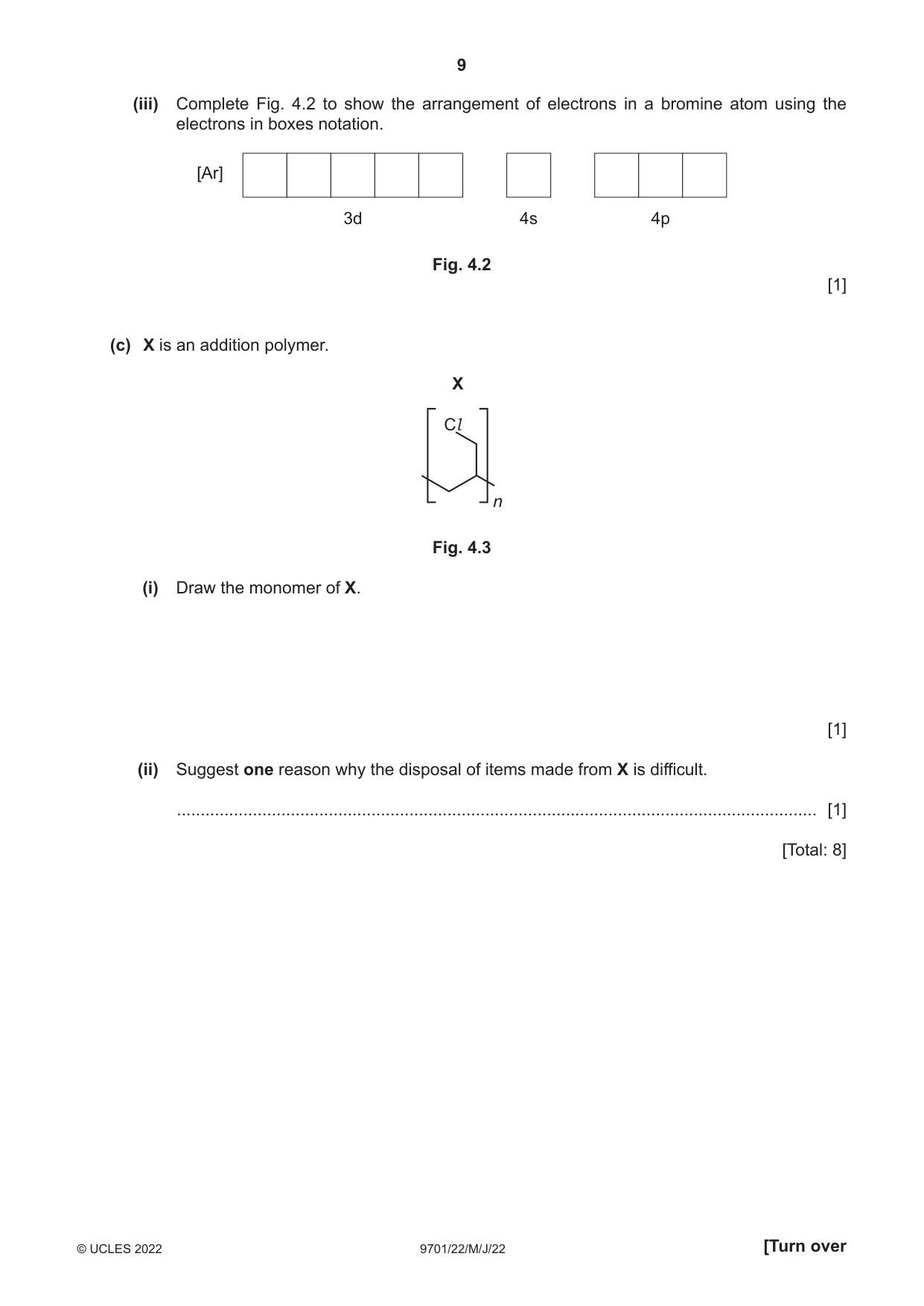
4 (a) Bromine reacts with butane in the presence of ultraviolet light to form bromobutane. Two structural isomers with the molecular formula C4H9Br are produced during this reaction. (i) Draw the two structural isomers and state the systematic name of each isomer. structural isomer 1 structural isomer 2 name .............................................. name .............................................. [2] (ii) Identify the type of structural isomerism shown in (a)(i). ....................................................................................................................................... [1] (b) Halothane is an anaesthetic. halothane F Cl F C C H F Br Fig. 4.1 (i) Identify the chiral centre in halothane and mark it with an asterisk (*). [1] When halothane reacts in ultraviolet light, homolytic fission occurs and the C–Br bond is broken. (ii) Construct an equation to show the homolytic fission of halothane, CF3CHBrCl. ....................................................................................................................................... [1] (iii) Complete Fig. 4.2 to show the arrangement of electrons in a bromine atom using the electrons in boxes notation. [Ar] 3d 4s 4p Fig. 4.2 [1] (c) X is an addition polymer. X Cl n Fig. 4.3 (i) Draw the monomer of X. [1] (ii) Suggest one reason why the disposal of items made from X is difficult. ....................................................................................................................................... [1] [Total: 8]
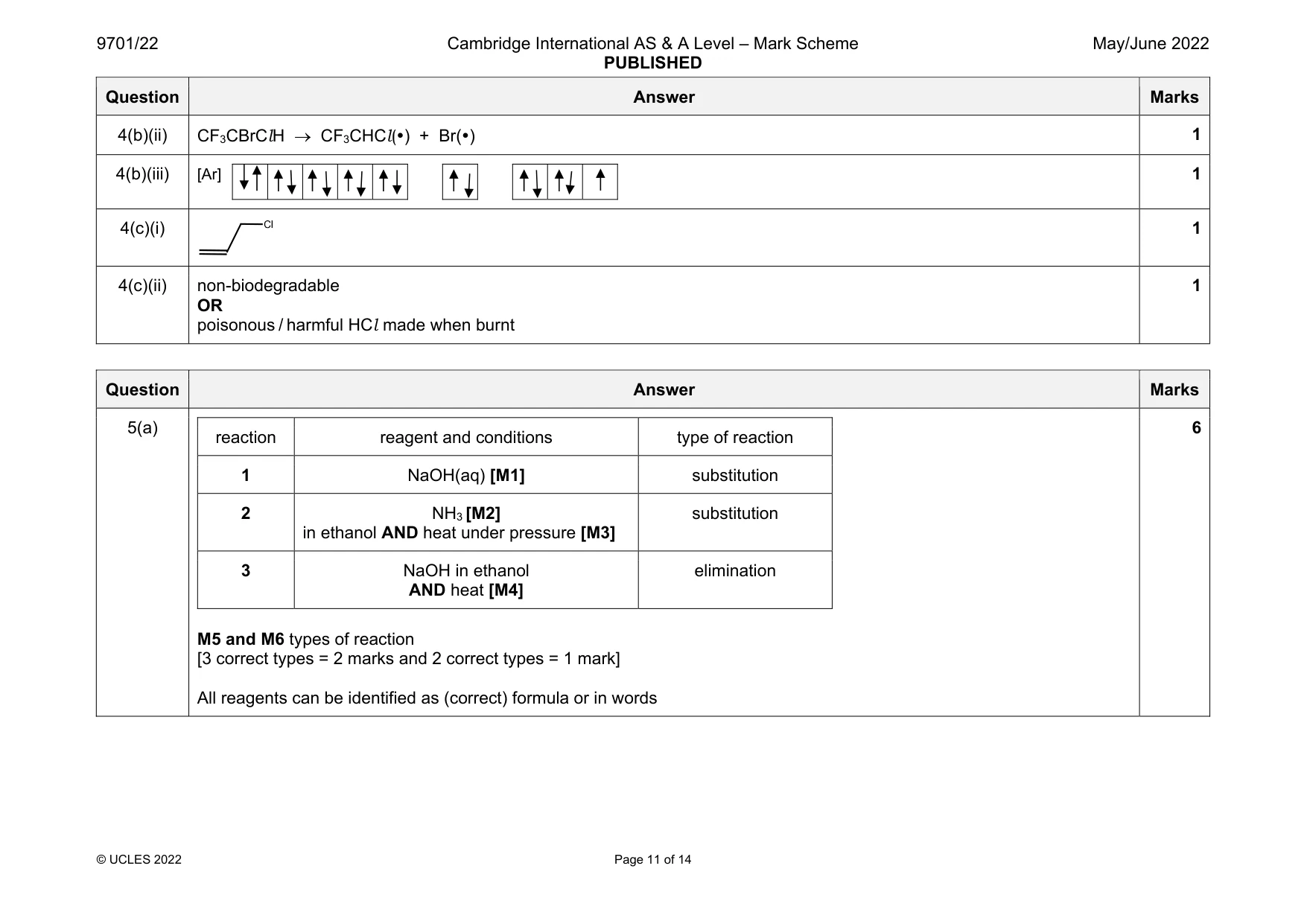
Mark scheme: 4(a)(i) M1 structure of isomer 1 AND name M2 structure of isomer 2 AND name (in any order) 2 4(a)(ii) positional 1 4(b)(i) 1 CH3CH2CH(Br)CH3 OR OR name: 2-bromobutane CH3(CH2)2CH2Br OR OR name: 1-bromobutane Question Answer Marks 4(b)(ii) CF3CBrClH CF3CHCl() + Br() 1 4(b)(iii) [Ar] 1 4(c)(i) 1 4(c)(ii) non-biodegradable OR poisonous / harmful HCl made when burnt 1
Q5 · Three reactions of 2-bromopropane, CH3CH(Br)CH3
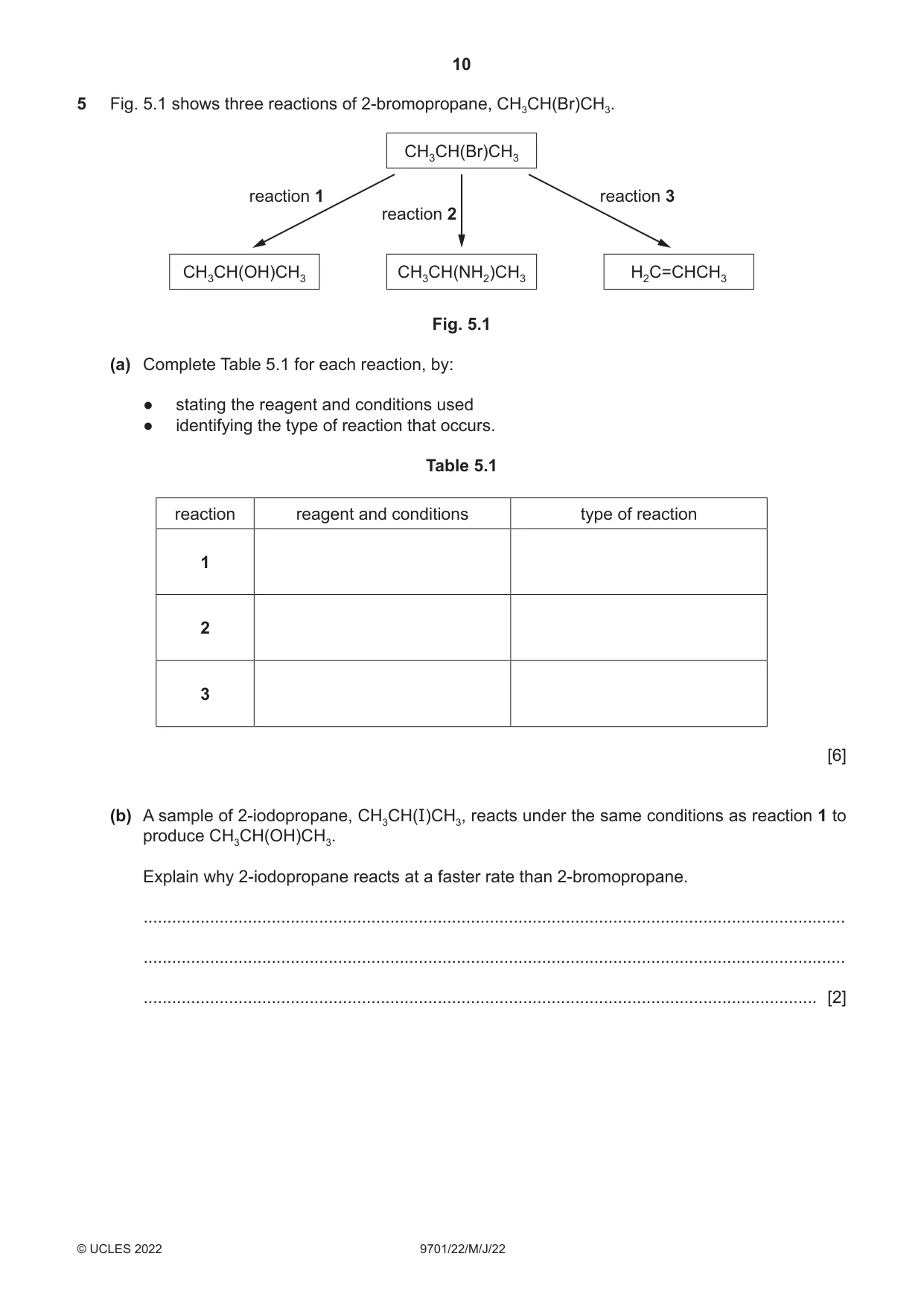
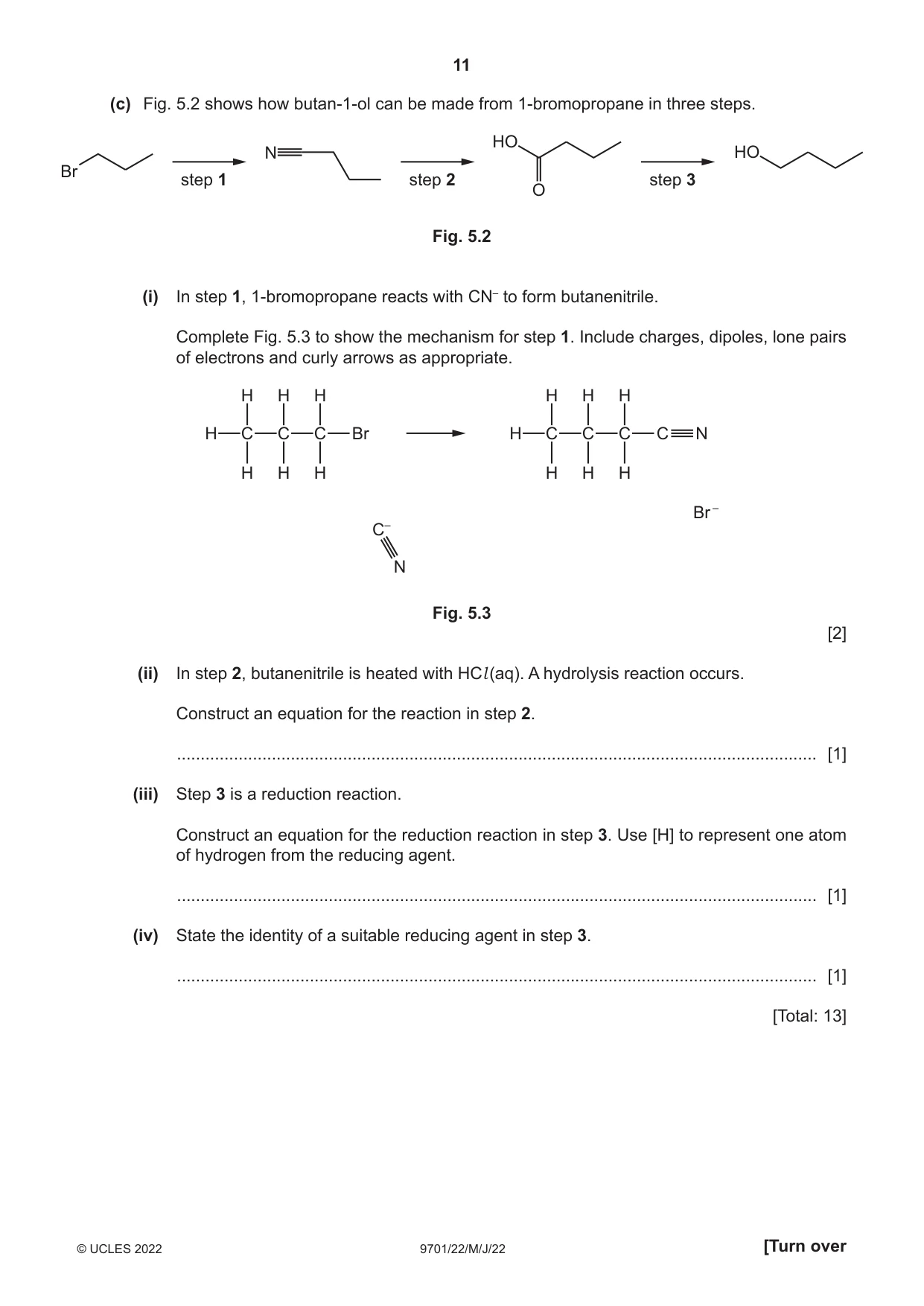
5 Fig. 5.1 shows three reactions of 2-bromopropane, CH3CH(Br)CH3. CH3CH(Br)CH3 reaction 1 reaction 3 reaction 2 CH3CH(OH)CH3 CH3CH(NH2)CH3 H2C=CHCH3 Fig. 5.1 (a) Complete Table 5.1 for each reaction, by: ● stating the reagent and conditions used ● identifying the type of reaction that occurs. Table 5.1 reaction reagent and conditions type of reaction 1 2 3 [6] (b) A sample of 2-iodopropane, CH3CH(I)CH3, reacts under the same conditions as reaction 1 to produce CH3CH(OH)CH3. Explain why 2-iodopropane reacts at a faster rate than 2-bromopropane. .................................................................................................................................................... .................................................................................................................................................... .............................................................................................................................................. [2] (c) Fig. 5.2 shows how butan-1-ol can be made from 1-bromopropane in three steps. HO N HO Br step 1 step 2 step 3 O Fig. 5.2 (i) In step 1, 1-bromopropane reacts with CN– to form butanenitrile. Complete Fig. 5.3 to show the mechanism for step 1. Include charges, dipoles, lone pairs of electrons and curly arrows as appropriate. H H H H H H H C C C Br H C C C C N H H H H H H Br – C– N Fig. 5.3 [2] (ii) In step 2, butanenitrile is heated with HCl (aq). A hydrolysis reaction occurs. Construct an equation for the reaction in step 2. ....................................................................................................................................... [1] (iii) Step 3 is a reduction reaction. Construct an equation for the reduction reaction in step 3. Use [H] to represent one atom of hydrogen from the reducing agent. ....................................................................................................................................... [1] (iv) State the identity of a suitable reducing agent in step 3. ....................................................................................................................................... [1] [Total: 13]
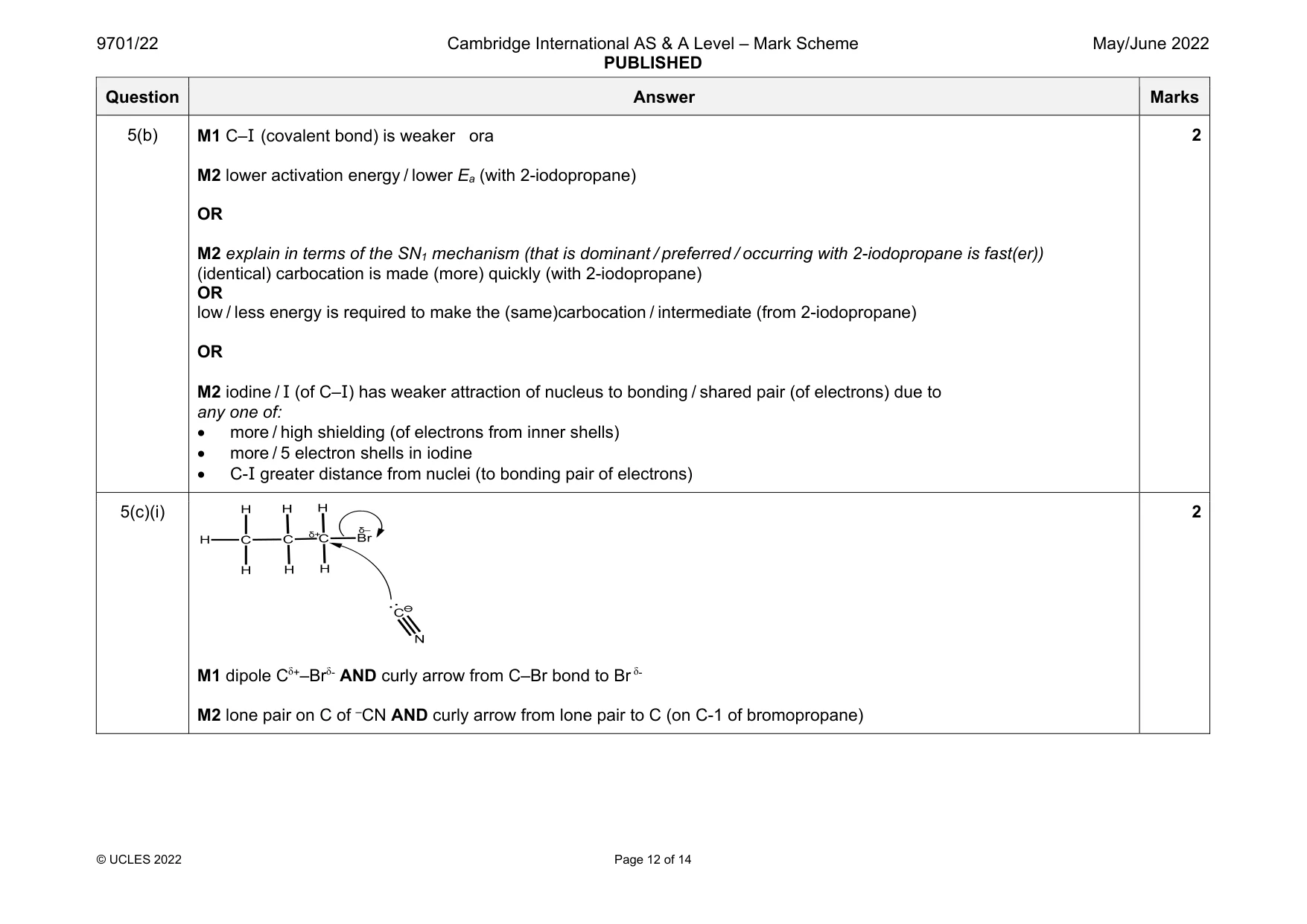
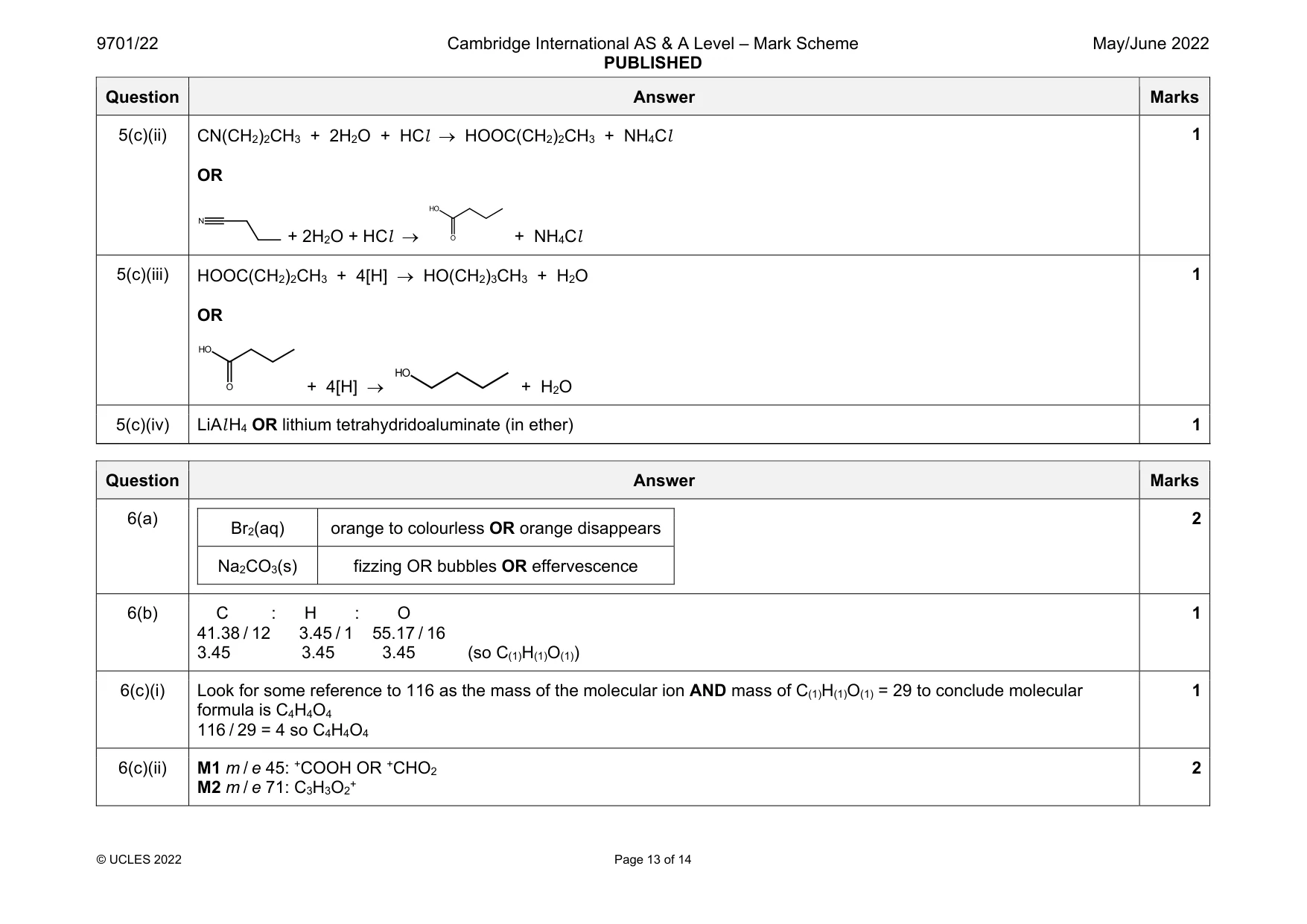
Mark scheme: 5(a) reaction reagent and conditions type of reaction 1 NaOH(aq) [M1] substitution 2 NH3 [M2] in ethanol AND heat under pressure [M3] substitution 3 NaOH in ethanol AND heat [M4] elimination M5 and M6 types of reaction [3 correct types = 2 marks and 2 correct types = 1 mark] All reagents can be identified as (correct) formula or in words Question Answer Marks 5(b) M1 C–I (covalent bond) is weaker ora M2 lower activation energy / lower Ea (with 2-iodopropane) OR M2 explain in terms of the SN1 mechanism (that is dominant / preferred / occurring with 2-iodopropane is fast(er)) (identical) carbocation is made (more) quickly (with 2-iodopropane) OR low / less energy is required to make the (same)carbocation / intermediate (from 2-iodopropane) OR M2 iodine / I (of C–I) has weaker attraction of nucleus to bonding / shared pair (of electrons) due to any one of: more / high shielding (of electrons from inner shells) more / 5 electron shells in iodine C-I greater distance from nuclei (to bonding pair of electrons) 2 5(c)(i) M1 dipole Cδ+–Brδ- AND curly arrow from C–Br bond to Br δ- M2 lone pair on C of –CN AND curly arrow from lone pair to C (on C-1 of bromopropane) 2 Question Answer Marks 5(c)(ii) CN(CH2)2CH3 + 2H2O + HCl HOOC(CH2)2CH3 + NH4Cl OR + 2H2O + HCl + NH4Cl 1 5(c)(iii) HOOC(CH2)2CH3 + 4[H] HO(CH2)3CH3 + H2O OR + 4[H] + H2O 1 5(c)(iv) LiAl H4 OR lithium tetrahydridoaluminate (in ether) 1
Q6 · Z is a molecule which contains the elements carbon, hydrogen and oxygen only
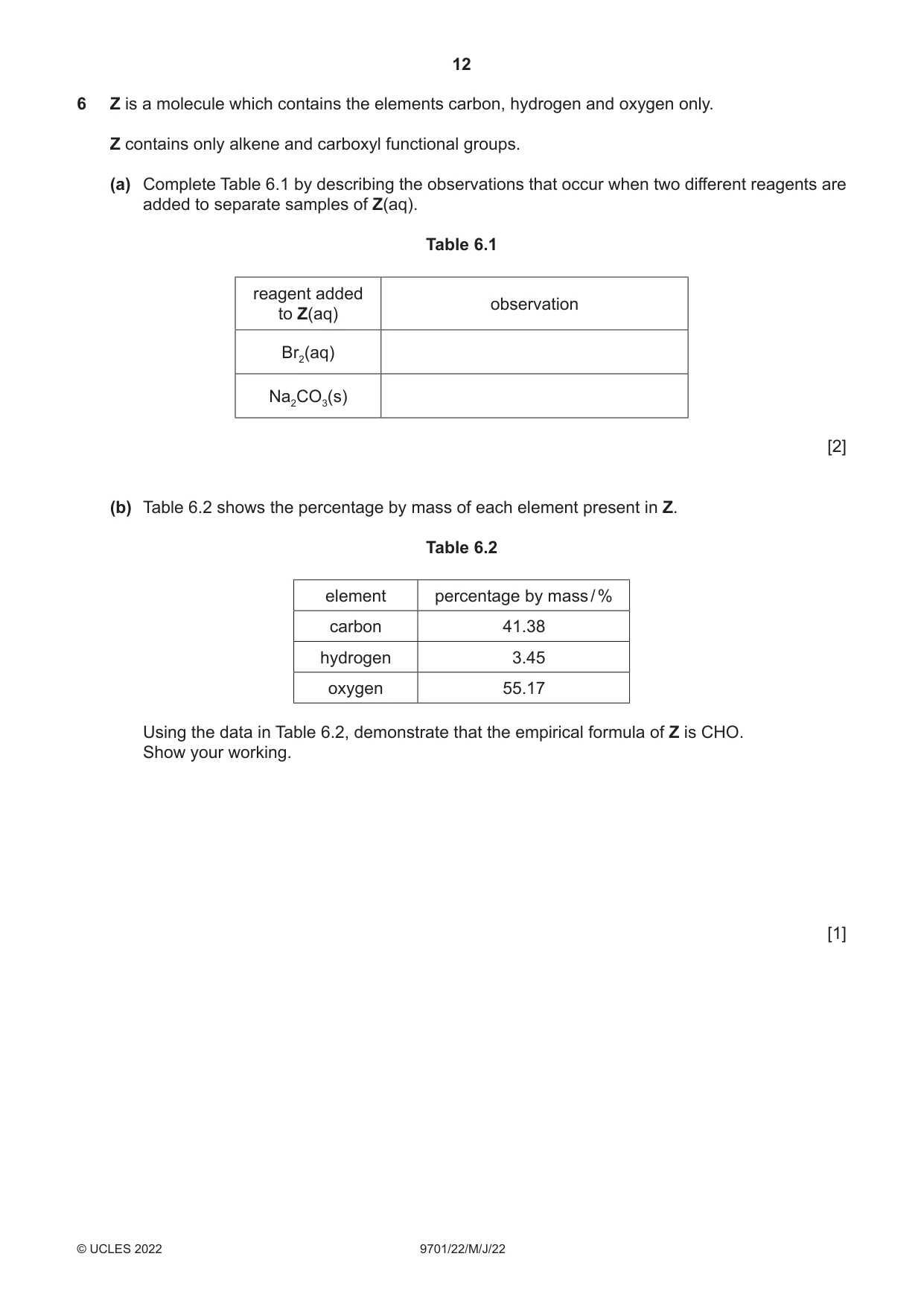
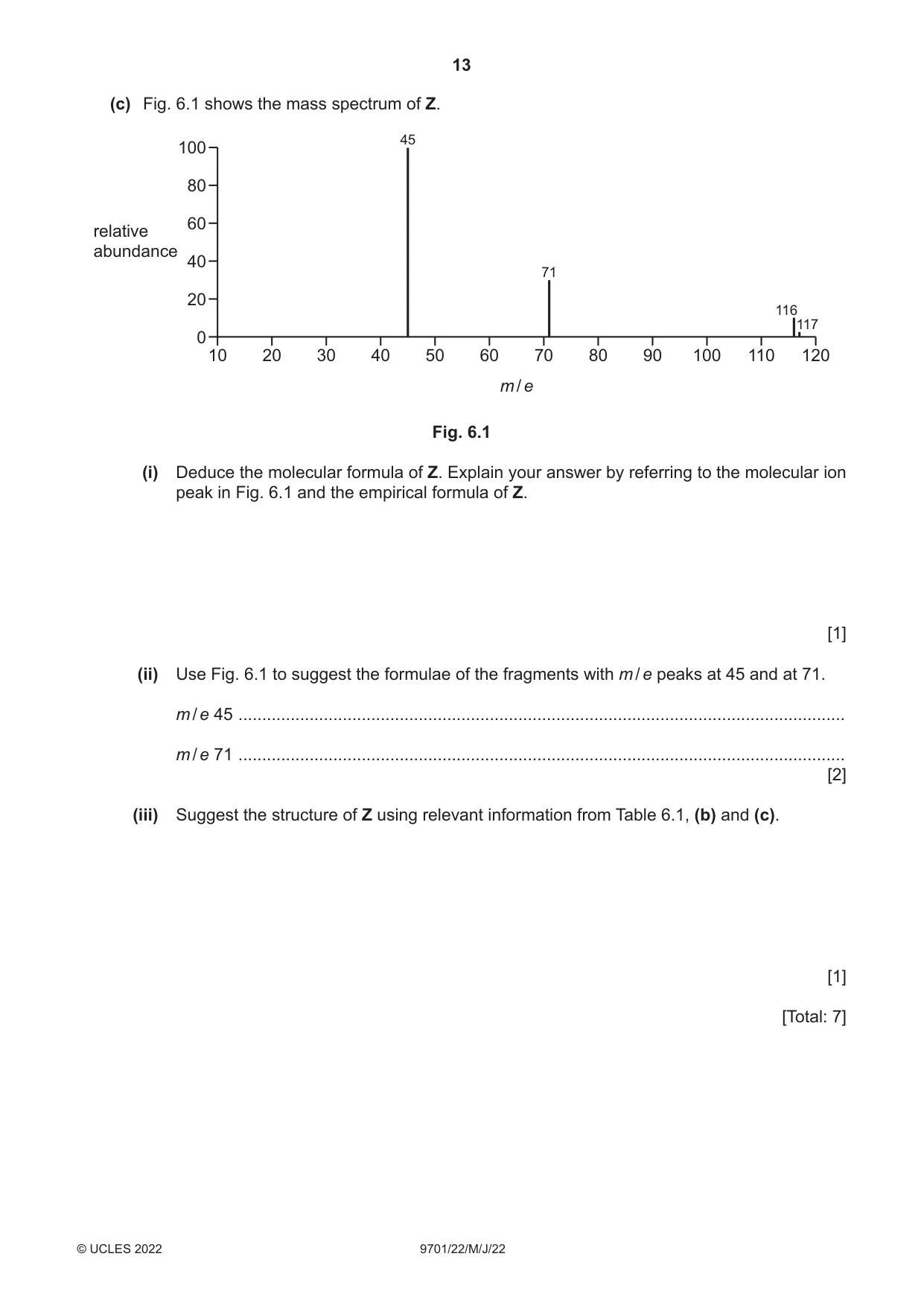
6 Z is a molecule which contains the elements carbon, hydrogen and oxygen only. Z contains only alkene and carboxyl functional groups. (a) Complete Table 6.1 by describing the observations that occur when two different reagents are added to separate samples of Z(aq). Table 6.1 reagent added observation to Z(aq) Br2(aq) Na2CO3(s) [2] (b) Table 6.2 shows the percentage by mass of each element present in Z. Table 6.2 element percentage by mass / % carbon 41.38 hydrogen 3.45 oxygen 55.17 Using the data in Table 6.2, demonstrate that the empirical formula of Z is CHO. Show your working. [1] (c) Fig. 6.1 shows the mass spectrum of Z. 45 100 80 60relative abundance 40 71 20 116 117 0 10 20 30 40 50 60 70 80 90 100 110 120 m / e Fig. 6.1 (i) Deduce the molecular formula of Z. Explain your answer by referring to the molecular ion peak in Fig. 6.1 and the empirical formula of Z. [1] (ii) Use Fig. 6.1 to suggest the formulae of the fragments with m / e peaks at 45 and at 71. m / e 45 ................................................................................................................................ m / e 71 ................................................................................................................................ [2] (iii) Suggest the structure of Z using relevant information from Table 6.1, (b) and (c). [1] [Total: 7]
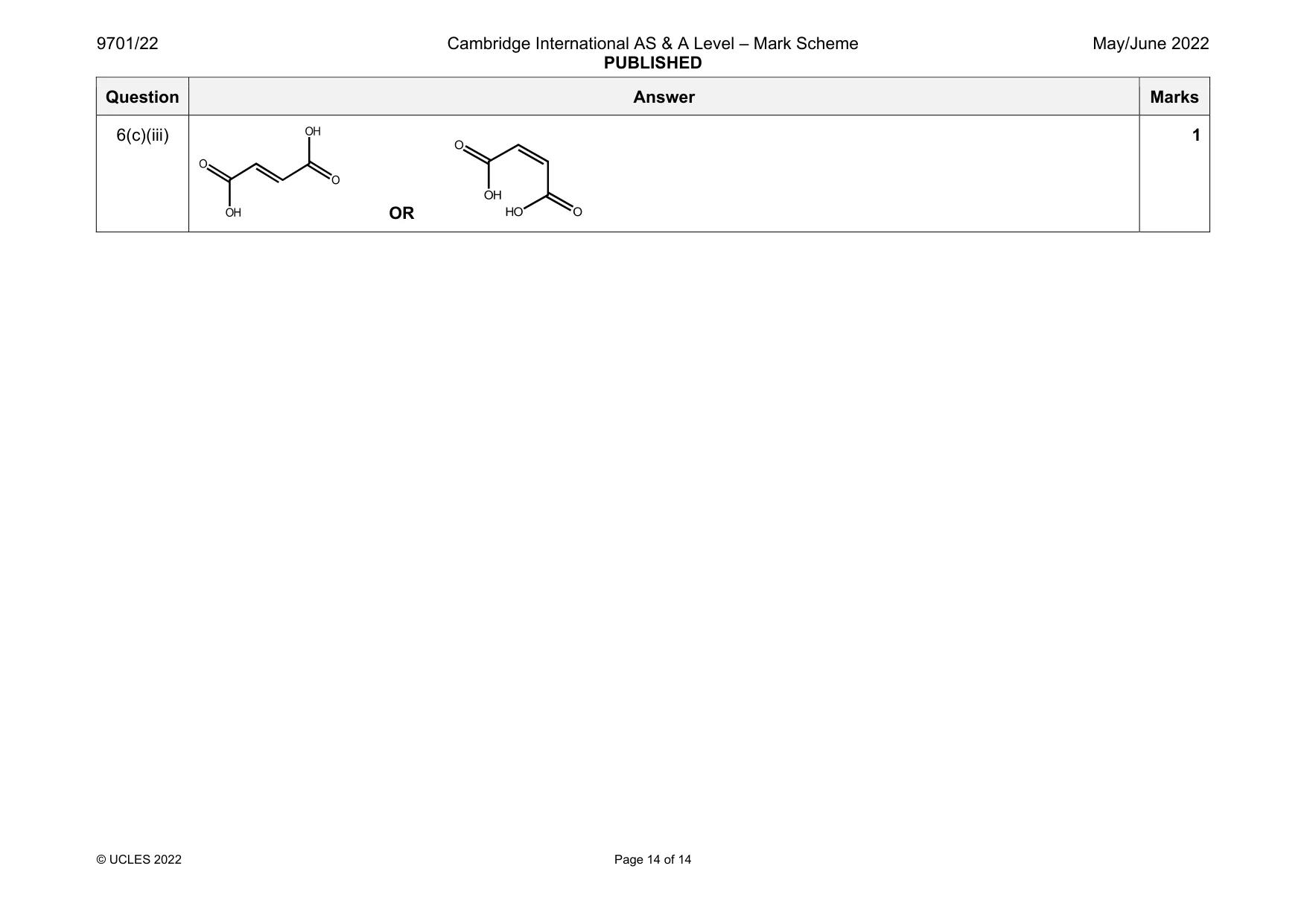
Mark scheme: 6(a) Br2(aq) orange to colourless OR orange disappears Na2CO3(s) fizzing OR bubbles OR effervescence 2 6(b) C : H : O 41.38 / 12 3.45 / 1 55.17 / 16 3.45 3.45 3.45 (so C(1)H(1)O(1)) 1 6(c)(i) Look for some reference to 116 as the mass of the molecular ion AND mass of C(1)H(1)O(1) = 29 to conclude molecular formula is C4H4O4 116 / 29 = 4 so C4H4O4 1 6(c)(ii) M1 m / e 45: +COOH OR +CHO2 M2 m / e 71: C3H3O2+ 2 Question Answer Marks 6(c)(iii) OR 1
What was in this paper
The subtopics covered by these 6 questions, and how many questions each got. Open one in a new tab to see every Cambridge question on it.
What you needed in this session
Cambridge’s own grade thresholds for 2022 May/June, Paper 2 · Variant 2. A higher threshold means an easier paper — the bar moves with how the cohort did.