Cambridge A Level Chemistry 9701 — 2022 May/June Paper 2 · Variant 3
9701/23/M/J/22 · 5 questions · 60 marks · ≈68 min
The question paper and its mark scheme, free to read here and free to download. This is Cambridge’s own paper, exactly as it was sat.
Question paper16 pages

Mark scheme12 pages
Answers below. Sit the paper first if you are practising.
Questions as text
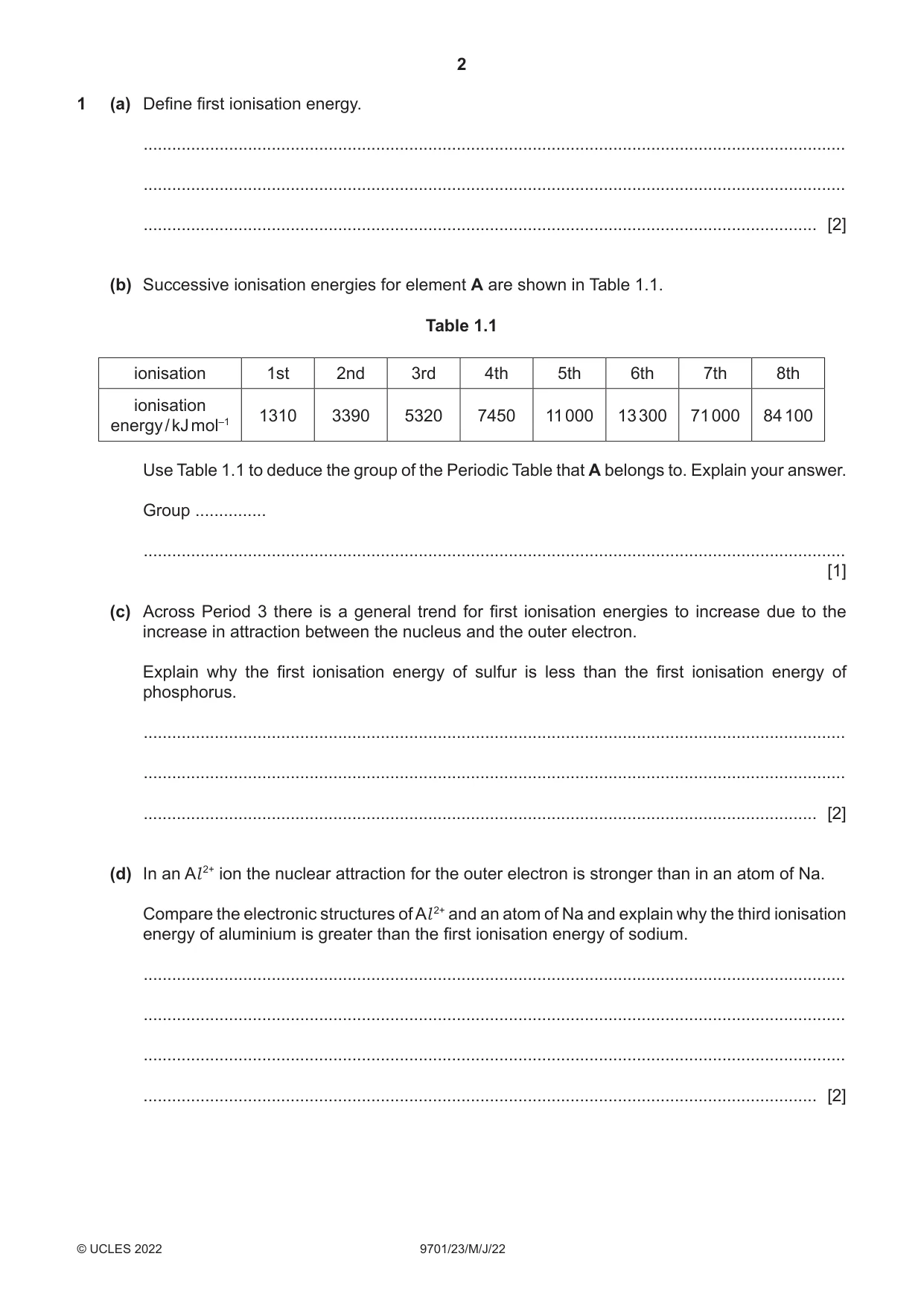
Q1 · Define first ionisation energy
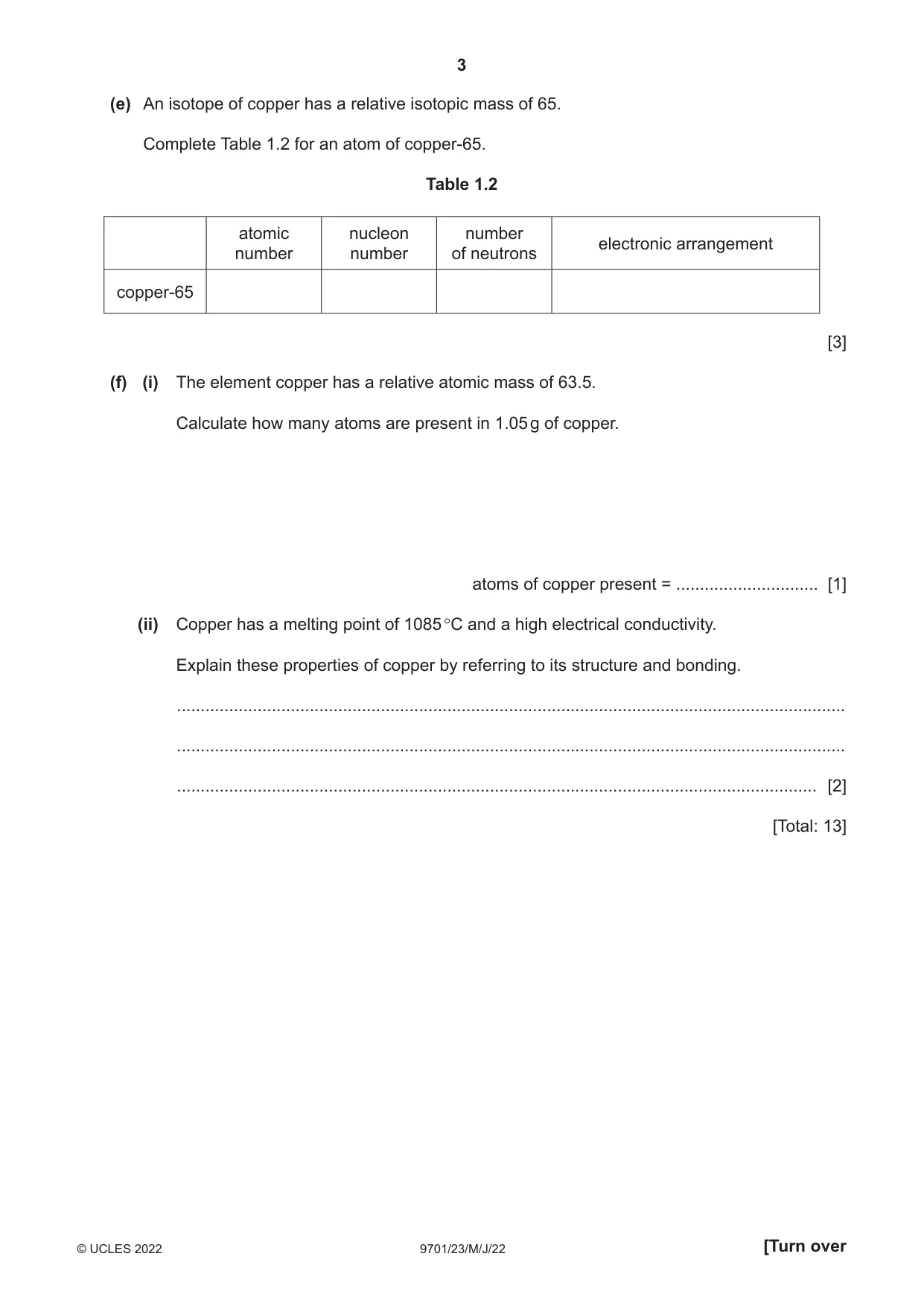
1 (a) Define first ionisation energy. .................................................................................................................................................... .................................................................................................................................................... .............................................................................................................................................. [2] (b) Successive ionisation energies for element A are shown in Table 1.1. Table 1.1 ionisation 1st 2nd 3rd 4th 5th 6th 7th 8th ionisation 1310 3390 5320 7450 11 000 13 300 71 000 84 100 energy / kJ mol–1 Use Table 1.1 to deduce the group of the Periodic Table that A belongs to. Explain your answer. Group ............... .................................................................................................................................................... [1] (c) Across Period 3 there is a general trend for first ionisation energies to increase due to the increase in attraction between the nucleus and the outer electron. Explain why the first ionisation energy of sulfur is less than the first ionisation energy of phosphorus. .................................................................................................................................................... .................................................................................................................................................... .............................................................................................................................................. [2] (d) In an Al 2+ ion the nuclear attraction for the outer electron is stronger than in an atom of Na. Compare the electronic structures of Al 2+ and an atom of Na and explain why the third ionisation energy of aluminium is greater than the first ionisation energy of sodium. .................................................................................................................................................... .................................................................................................................................................... .................................................................................................................................................... .............................................................................................................................................. [2] (e) An isotope of copper has a relative isotopic mass of 65. Complete Table 1.2 for an atom of copper-65. Table 1.2 atomic nucleon number electronic arrangement number number of neutrons copper-65 [3] (f) (i) The element copper has a relative atomic mass of 63.5. Calculate how many atoms are present in 1.05 g of copper. atoms of copper present = .............................. [1] (ii) Copper has a melting point of 1085 °C and a high electrical conductivity. Explain these properties of copper by referring to its structure and bonding. ............................................................................................................................................. ............................................................................................................................................. ....................................................................................................................................... [2] [Total: 13]
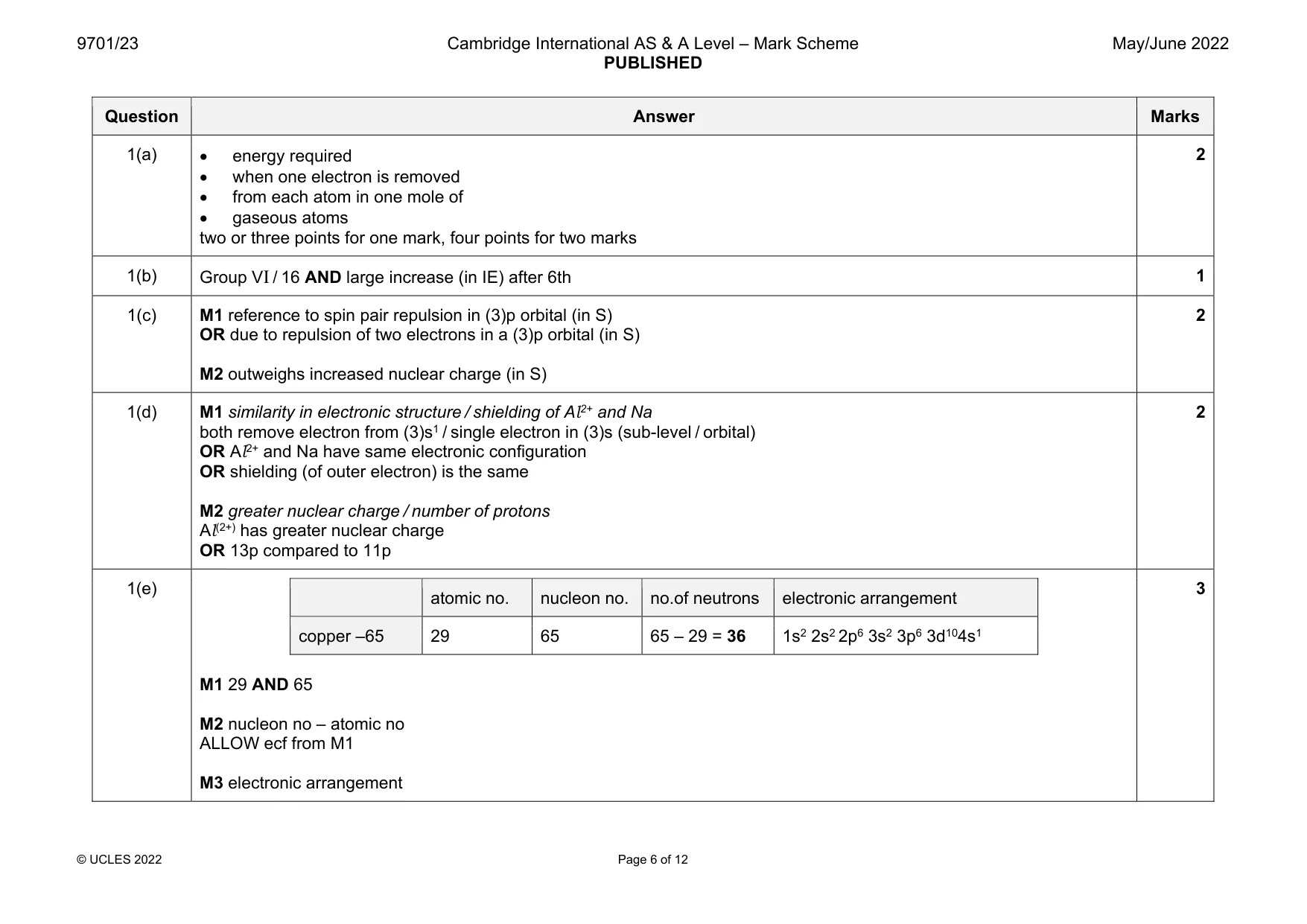
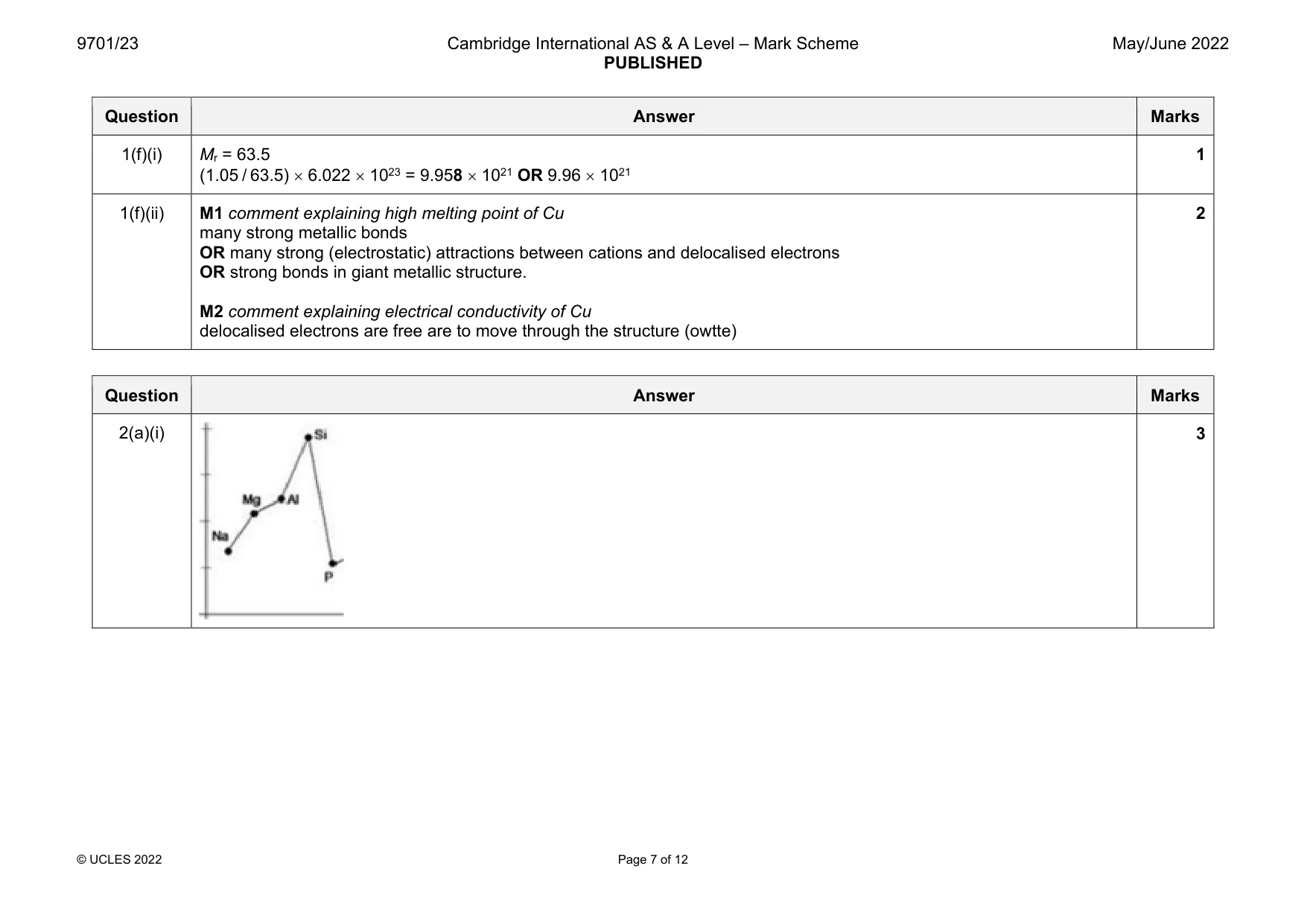
Mark scheme: 1(a) energy required when one electron is removed from each atom in one mole of gaseous atoms two or three points for one mark, four points for two marks 2 1(b) Group VI / 16 AND large increase (in IE) after 6th 1 1(c) M1 reference to spin pair repulsion in (3)p orbital (in S) OR due to repulsion of two electrons in a (3)p orbital (in S) M2 outweighs increased nuclear charge (in S) 2 1(d) M1 similarity in electronic structure / shielding of Al2+ and Na both remove electron from (3)s1 / single electron in (3)s (sub-level / orbital) OR Al2+ and Na have same electronic configuration OR shielding (of outer electron) is the same M2 greater nuclear charge / number of protons Al(2+) has greater nuclear charge OR 13p compared to 11p 2 1(e) atomic no. nucleon no. no.of neutrons electronic arrangement copper –65 29 65 65 – 29 = 36 1s2 2s2 2p6 3s2 3p6 3d104s1 M1 29 AND 65 M2 nucleon no – atomic no ALLOW ecf from M1 M3 electronic arrangement 3 Question Answer Marks 1(f)(i) Mr = 63.5 (1.05 / 63.5) 6.022 1023 = 9.958 1021 OR 9.96 1021 1 1(f)(ii) M1 comment explaining high melting point of Cu many strong metallic bonds OR many strong (electrostatic) attractions between cations and delocalised electrons OR strong bonds in giant metallic structure. M2 comment explaining electrical conductivity of Cu delocalised electrons are free are to move through the structure (owtte) 2
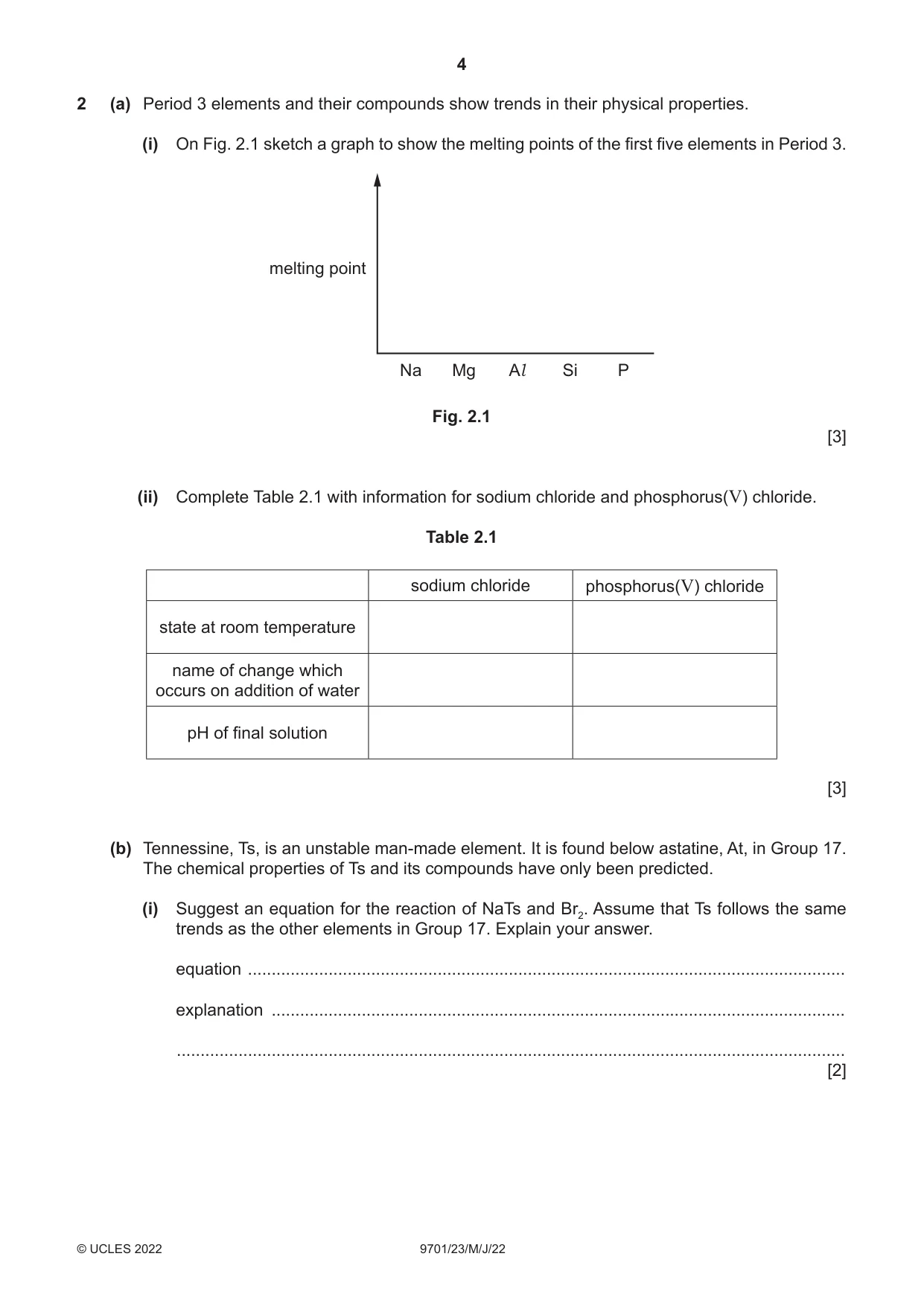
Q2 · Period 3 elements and their compounds show trends in their physical properties
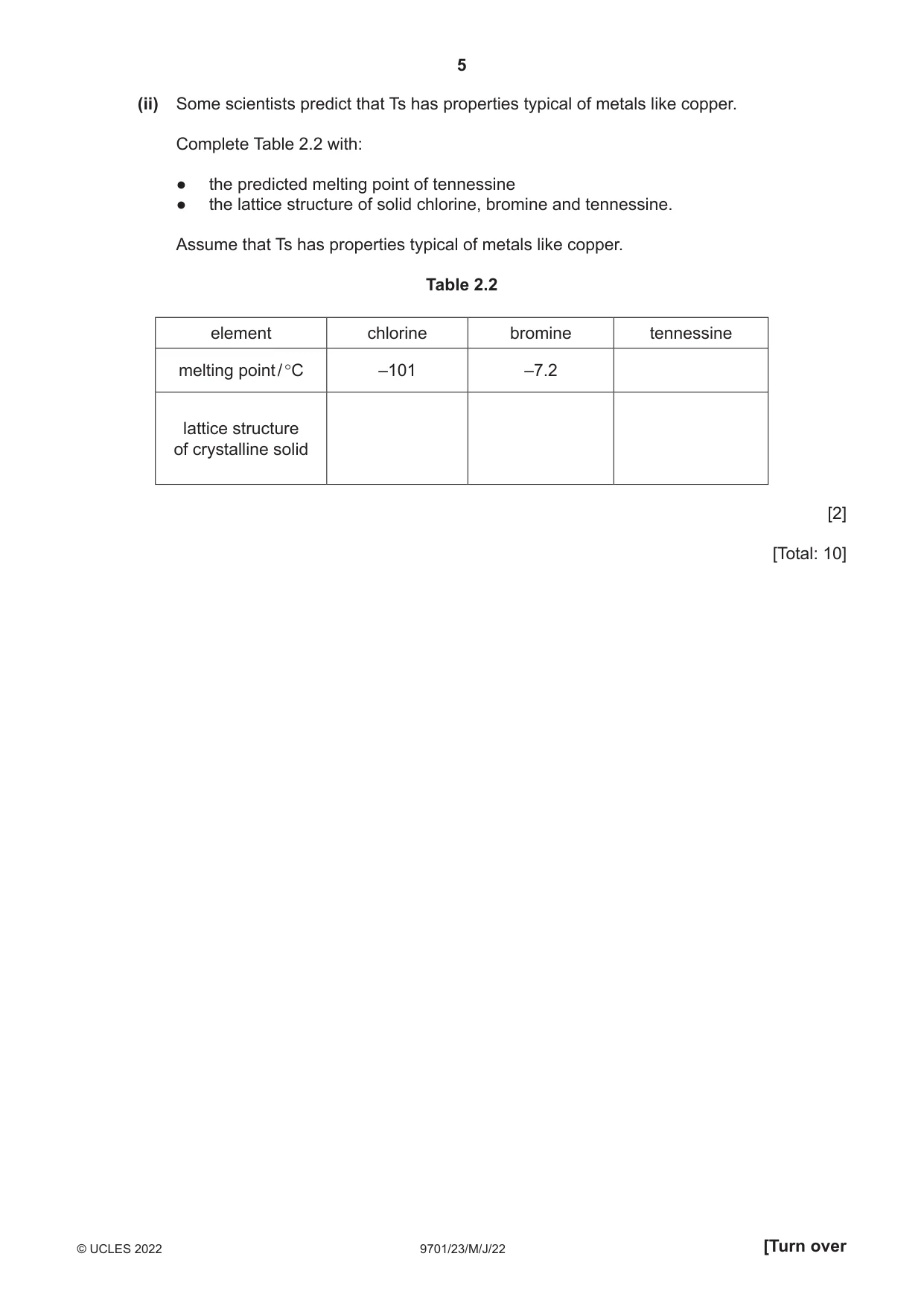
2 (a) Period 3 elements and their compounds show trends in their physical properties. (i) On Fig. 2.1 sketch a graph to show the melting points of the first five elements in Period 3. melting point Na Mg Al Si P Fig. 2.1 [3] (ii) Complete Table 2.1 with information for sodium chloride and phosphorus(V) chloride. Table 2.1 sodium chloride phosphorus(V) chloride state at room temperature name of change which occurs on addition of water pH of final solution [3] (b) Tennessine, Ts, is an unstable man-made element. It is found below astatine, At, in Group 17. The chemical properties of Ts and its compounds have only been predicted. (i) Suggest an equation for the reaction of NaTs and Br2. Assume that Ts follows the same trends as the other elements in Group 17. Explain your answer. equation .............................................................................................................................. explanation .......................................................................................................................... ............................................................................................................................................. [2] (ii) Some scientists predict that Ts has properties typical of metals like copper. Complete Table 2.2 with: ● the predicted melting point of tennessine ● the lattice structure of solid chlorine, bromine and tennessine. Assume that Ts has properties typical of metals like copper. Table 2.2 element chlorine bromine tennessine melting point / °C –101 –7.2 lattice structure of crystalline solid [2] [Total: 10]
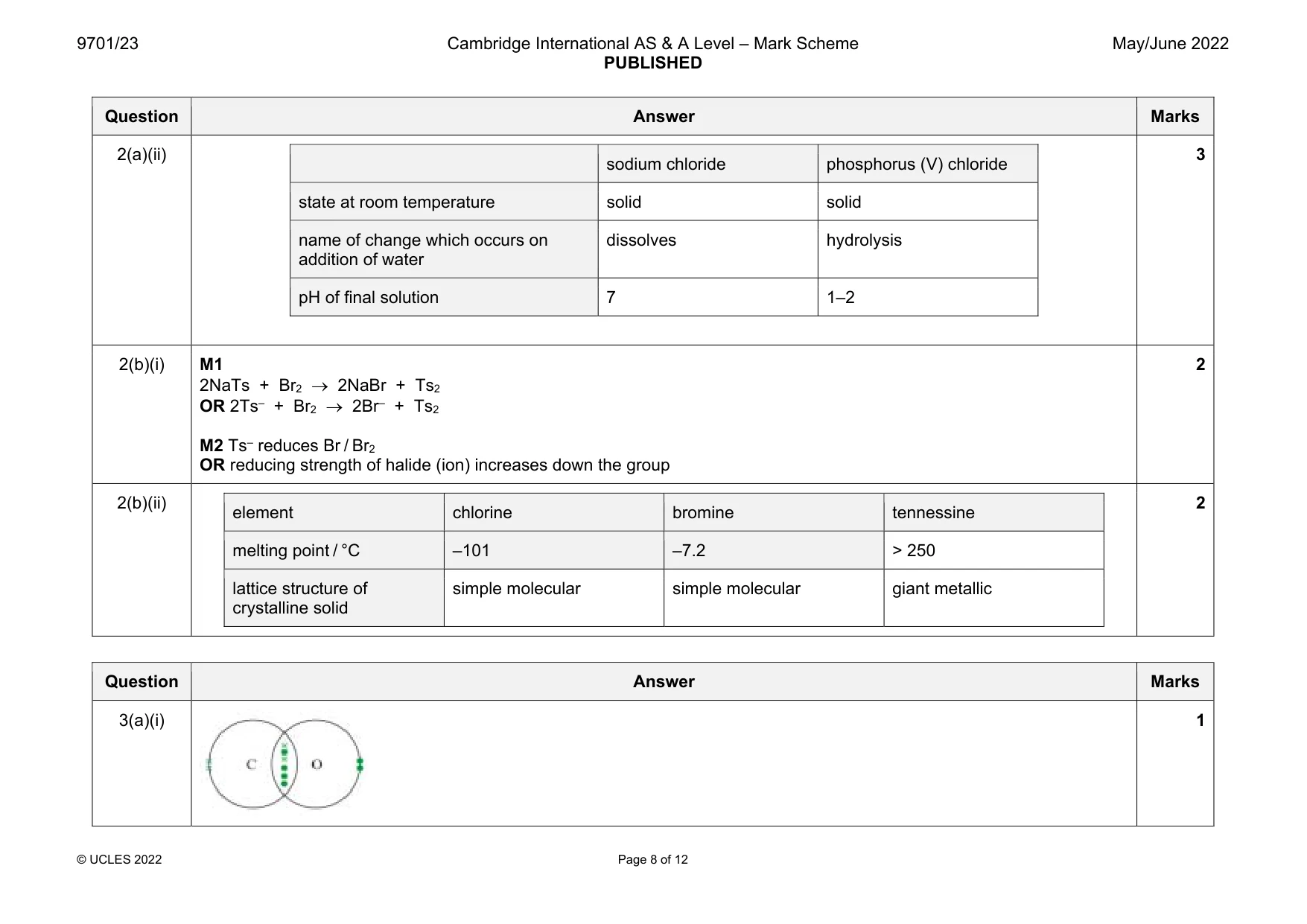
Mark scheme: 2(a)(i) 3 Question Answer Marks 2(a)(ii) sodium chloride phosphorus (V) chloride state at room temperature solid solid name of change which occurs on addition of water dissolves hydrolysis pH of final solution 7 1–2 3 2(b)(i) M1 2NaTs + Br2 2NaBr + Ts2 OR 2Ts– + Br2 2Br– + Ts2 M2 Ts– reduces Br / Br2 OR reducing strength of halide (ion) increases down the group 2 2(b)(ii) element chlorine bromine tennessine melting point / °C –101 –7.2 > 250 lattice structure of crystalline solid simple molecular simple molecular giant metallic 2
More questions on Periodicity of physical properties of the elements in Period 3
Q3 · G belongs to a group of compounds called ethers
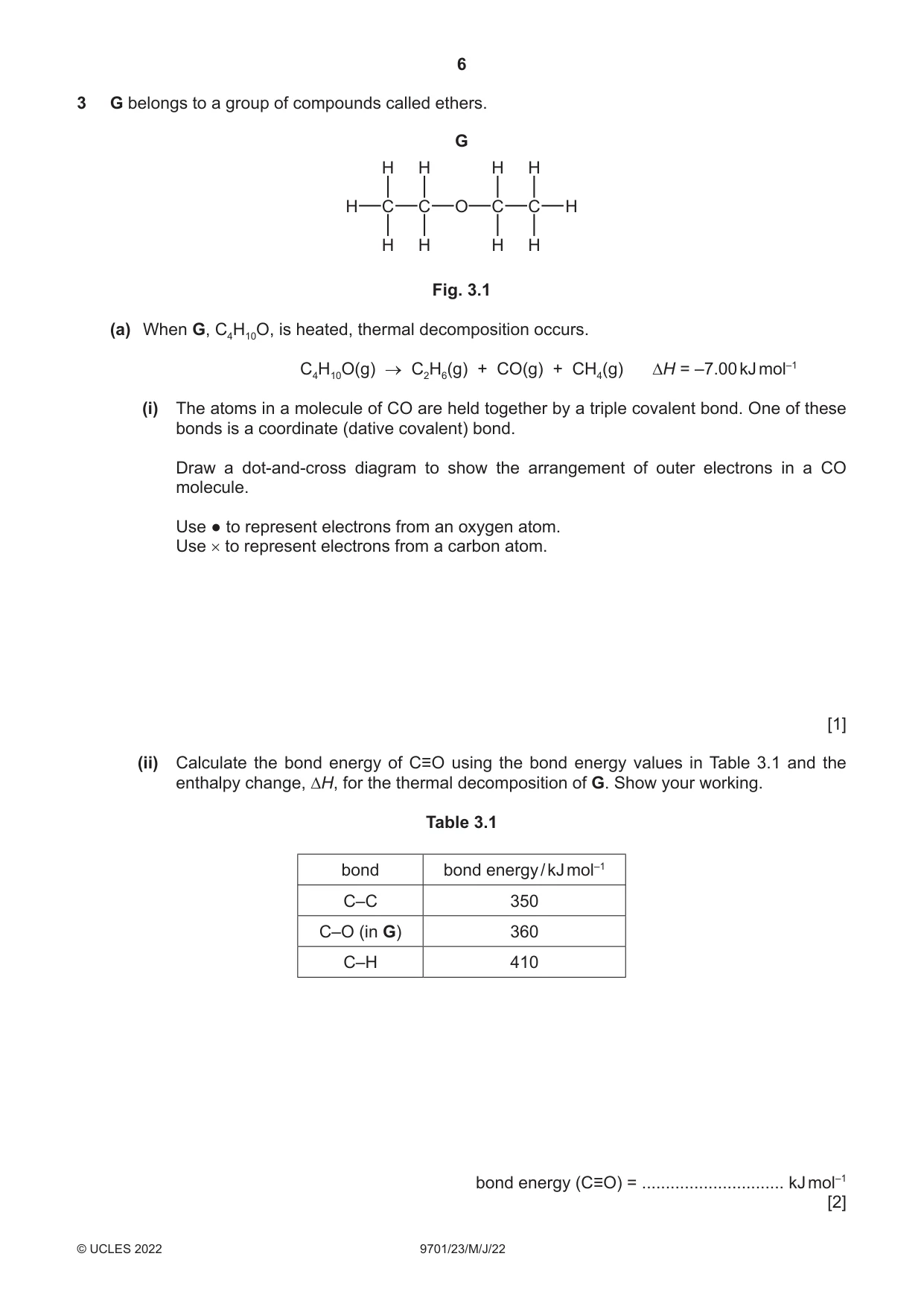
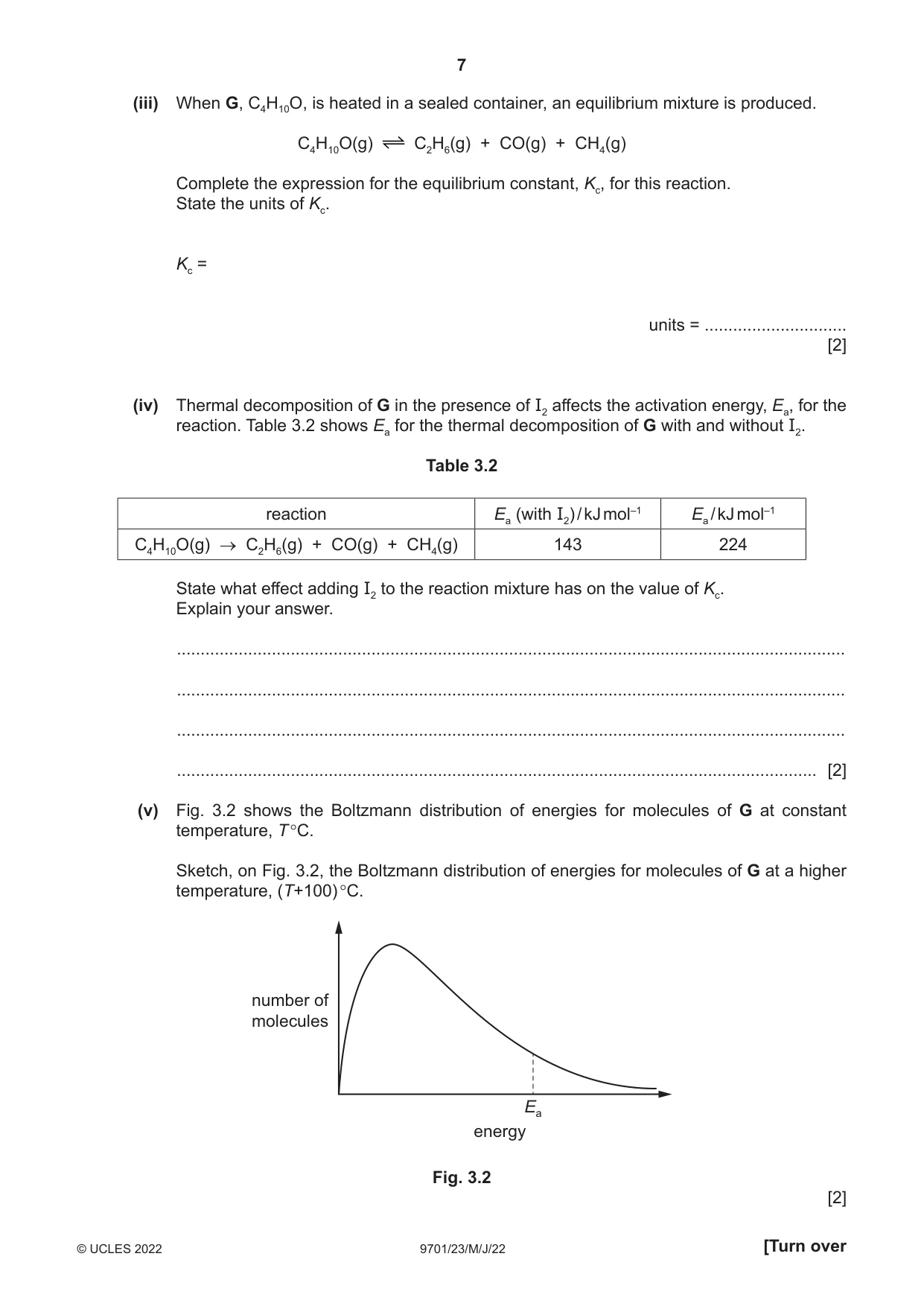
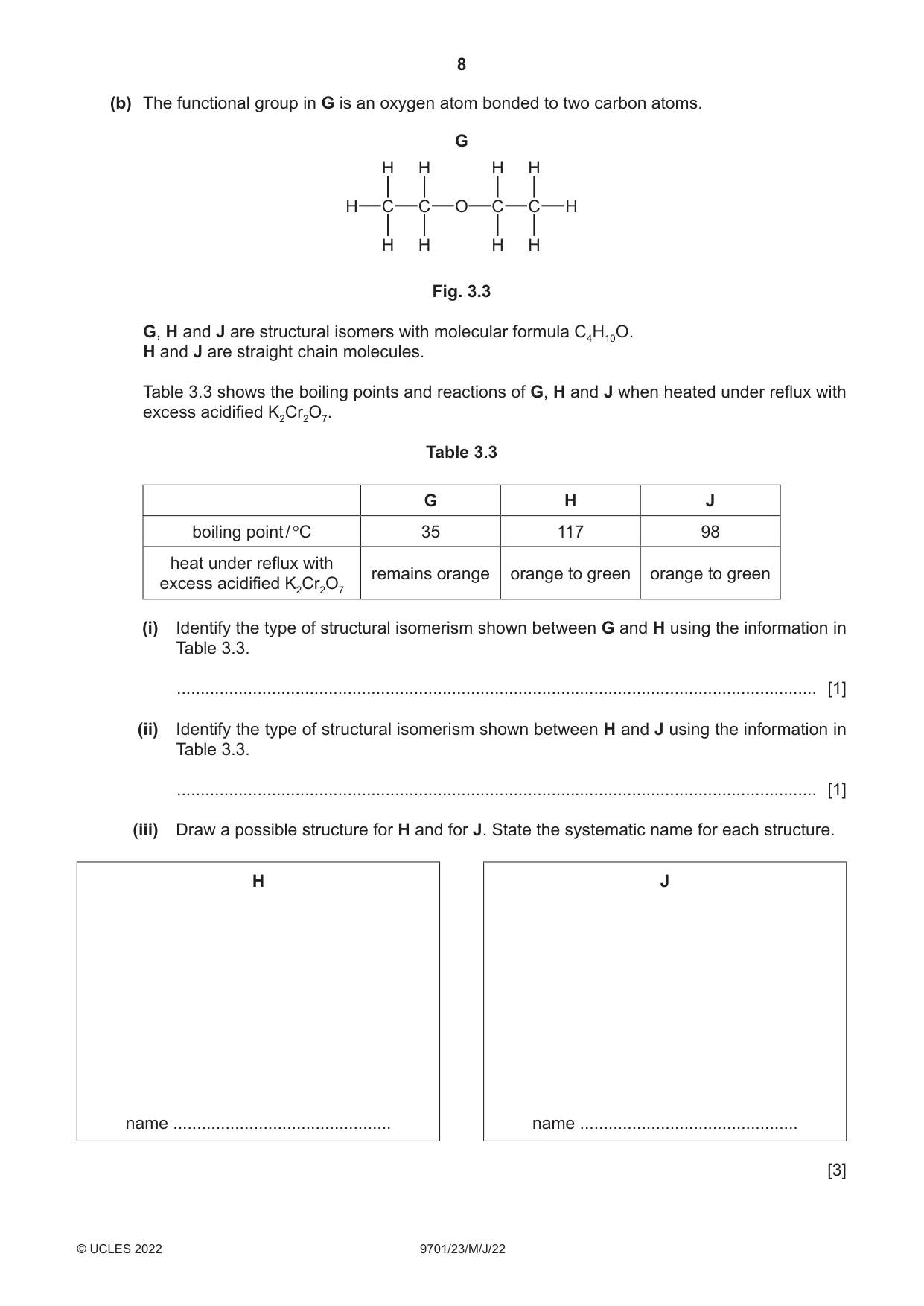
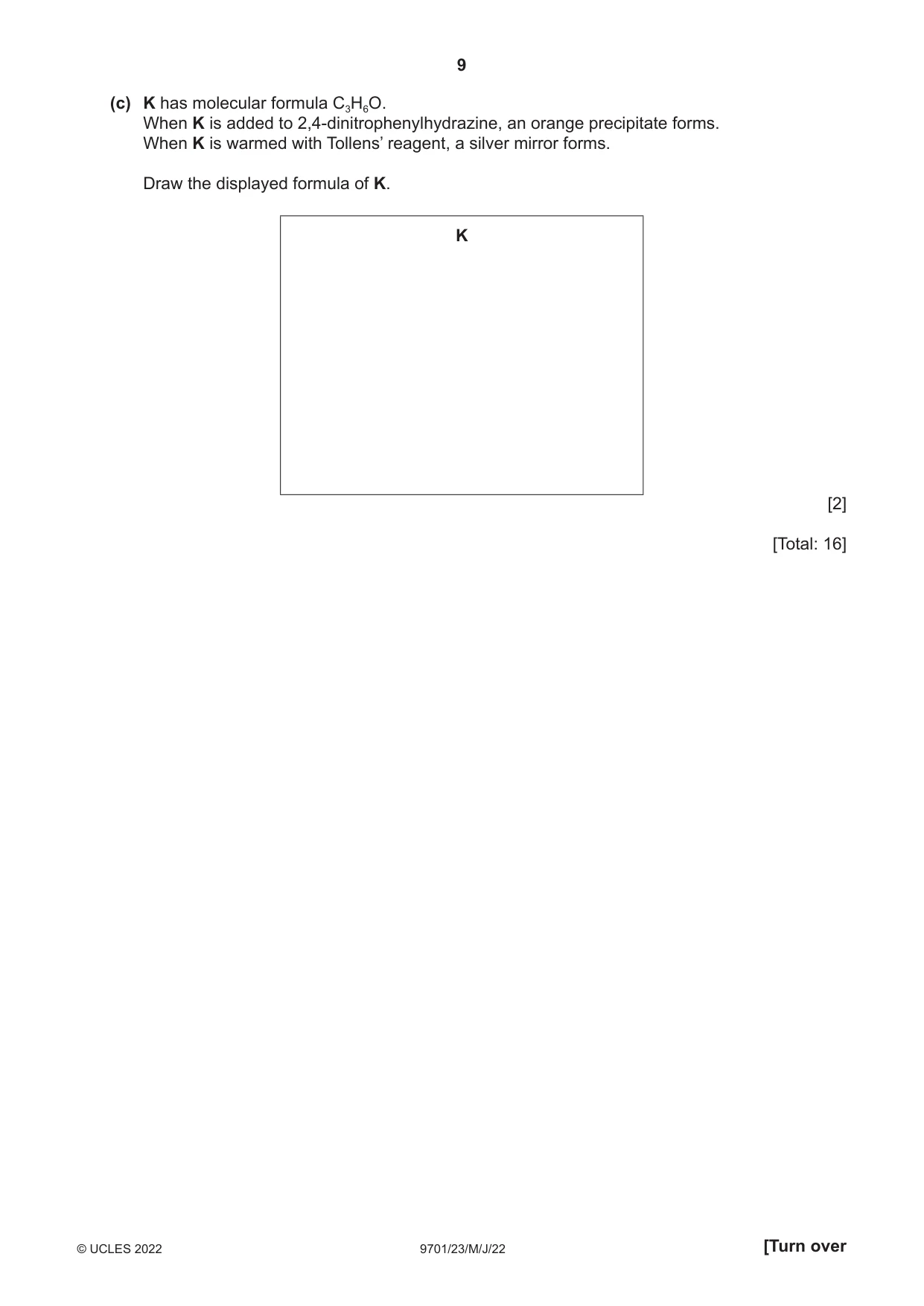
3 G belongs to a group of compounds called ethers. G H H H H H C C O C C H H H H H Fig. 3.1 (a) When G, C4H10O, is heated, thermal decomposition occurs. C4H10O(g) → C2H6(g) + CO(g) + CH4(g) ∆H = –7.00 kJ mol–1 (i) The atoms in a molecule of CO are held together by a triple covalent bond. One of these bonds is a coordinate (dative covalent) bond. Draw a dot-and-cross diagram to show the arrangement of outer electrons in a CO molecule. Use ● to represent electrons from an oxygen atom. Use × to represent electrons from a carbon atom. [1] (ii) Calculate the bond energy of C≡O using the bond energy values in Table 3.1 and the enthalpy change, ∆H, for the thermal decomposition of G. Show your working. Table 3.1 bond bond energy / kJ mol–1 C–C 350 C–O (in G) 360 C–H 410 bond energy (C≡O) = .............................. kJ mol–1 [2] (iii) When G, C4H10O, is heated in a sealed container, an equilibrium mixture is produced. C4H10O(g) C2H6(g) + CO(g) + CH4(g) Complete the expression for the equilibrium constant, Kc, for this reaction. State the units of Kc. Kc = units = .............................. [2] (iv) Thermal decomposition of G in the presence of I2 affects the activation energy, Ea, for the reaction. Table 3.2 shows Ea for the thermal decomposition of G with and without I2. Table 3.2 reaction Ea (with I2) / kJ mol–1 Ea / kJ mol–1 C4H10O(g) → C2H6(g) + CO(g) + CH4(g) 143 224 State what effect adding I2 to the reaction mixture has on the value of Kc. Explain your answer. ............................................................................................................................................. ............................................................................................................................................. ............................................................................................................................................. ....................................................................................................................................... [2] (v) Fig. 3.2 shows the Boltzmann distribution of energies for molecules of G at constant temperature, T °C. Sketch, on Fig. 3.2, the Boltzmann distribution of energies for molecules of G at a higher temperature, (T+100) °C. number of molecules Ea energy Fig. 3.2 [2] (b) The functional group in G is an oxygen atom bonded to two carbon atoms. G H H H H H C C O C C H H H H H Fig. 3.3 G, H and J are structural isomers with molecular formula C4H10O. H and J are straight chain molecules. Table 3.3 shows the boiling points and reactions of G, H and J when heated under reflux with excess acidified K2Cr2O7. Table 3.3 G H J boiling point / °C 35 117 98 heat under reflux with remains orange orange to green orange to green excess acidified K2Cr2O7 (i) Identify the type of structural isomerism shown between G and H using the information in Table 3.3. ....................................................................................................................................... [1] (ii) Identify the type of structural isomerism shown between H and J using the information in Table 3.3. ....................................................................................................................................... [1] (iii) Draw a possible structure for H and for J. State the systematic name for each structure. H J name .............................................. name .............................................. [3] (c) K has molecular formula C3H6O. When K is added to 2,4-dinitrophenylhydrazine, an orange precipitate forms. When K is warmed with Tollens’ reagent, a silver mirror forms. Draw the displayed formula of K. K [2] [Total: 16]
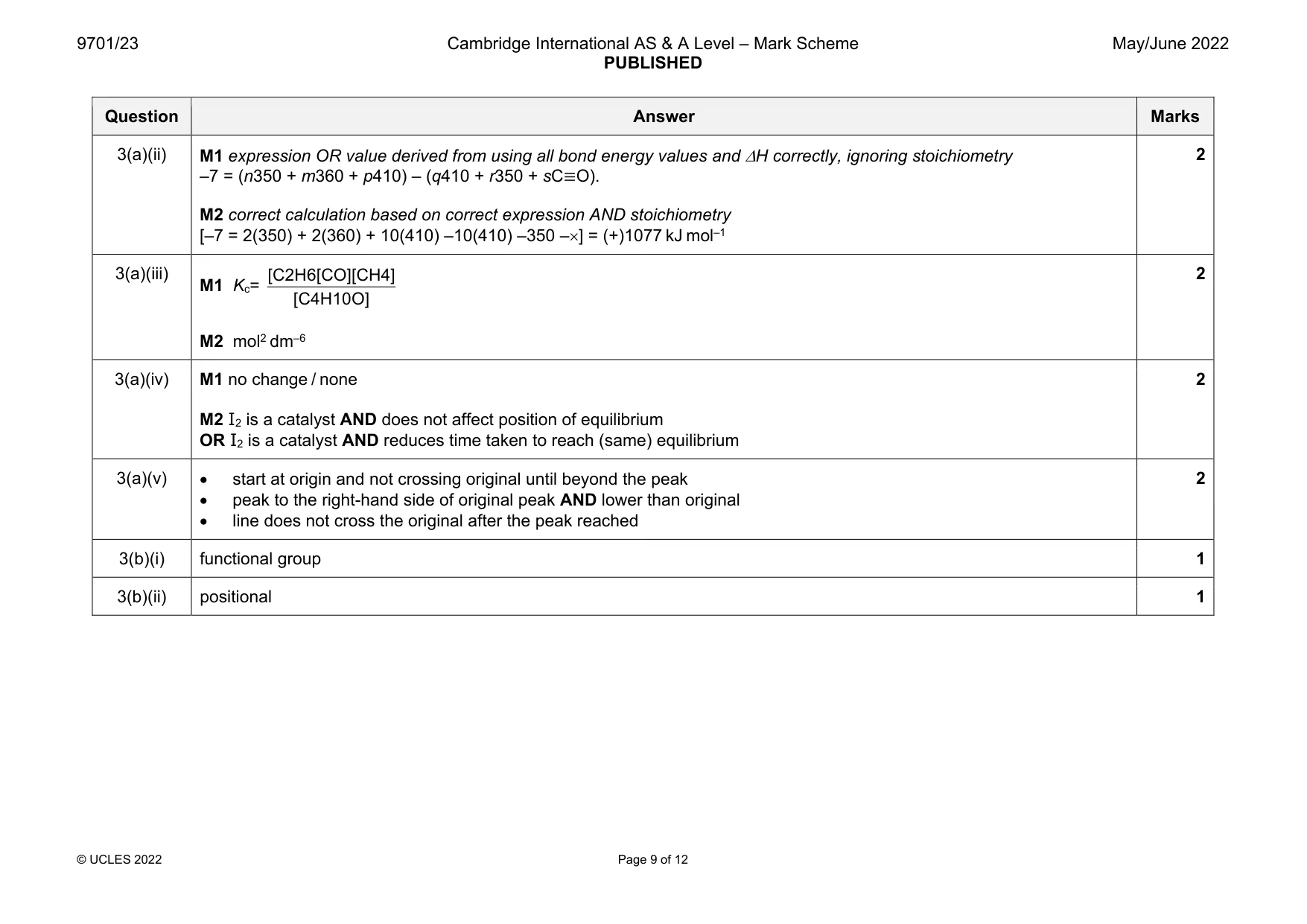
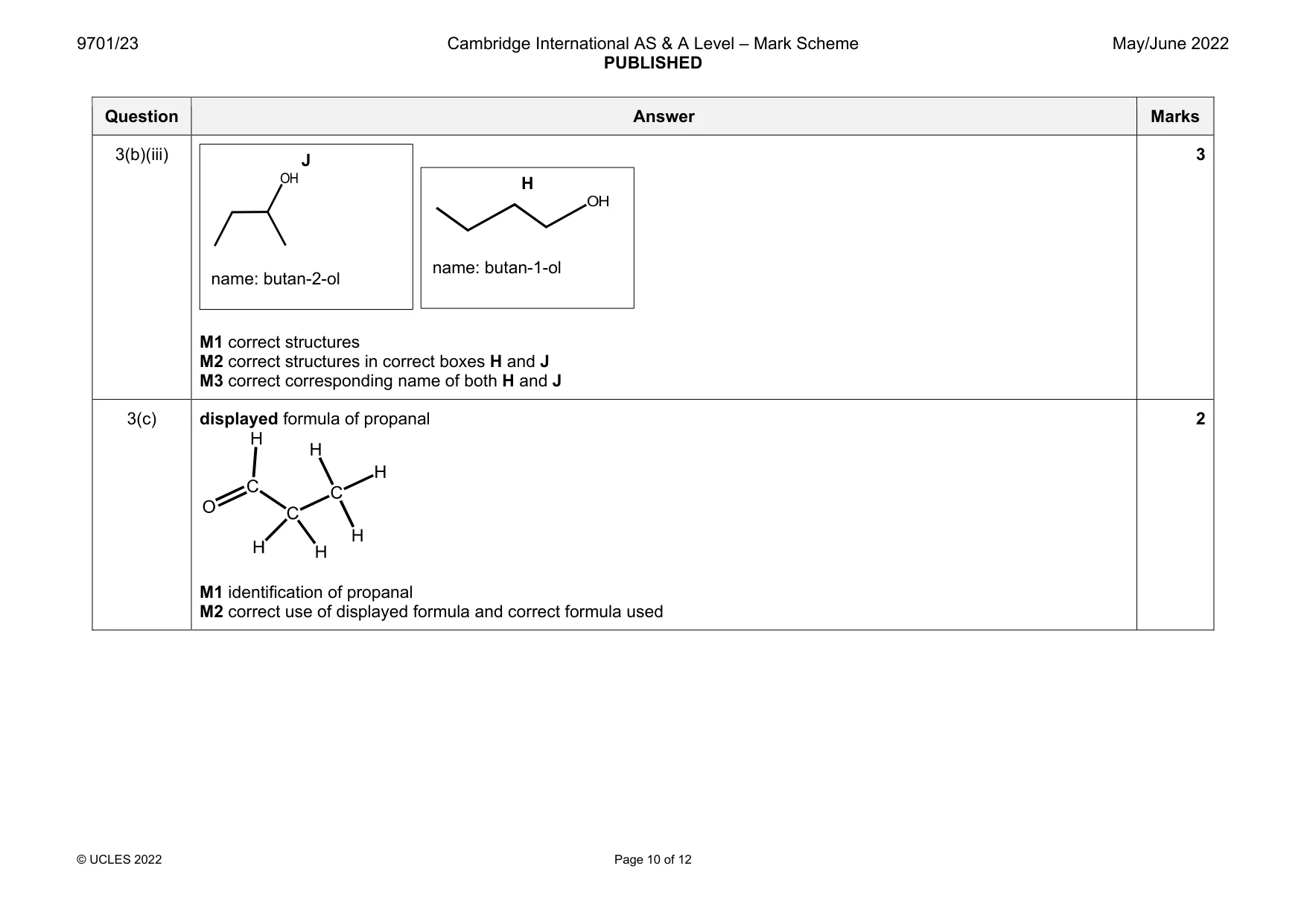
Mark scheme: 3(a)(i) 1 Question Answer Marks 3(a)(ii) M1 expression OR value derived from using all bond energy values and H correctly, ignoring stoichiometry –7 = (n350 + m360 + p410) – (q410 + r350 + sC≡O). M2 correct calculation based on correct expression AND stoichiometry [–7 = 2(350) + 2(360) + 10(410) –10(410) –350 –] = (+)1077 kJ mol–1 2 3(a)(iii) M1 Kc= [C2H6[CO][CH4] [C4H10O] M2 mol2 dm–6 2 3(a)(iv) M1 no change / none M2 I2 is a catalyst AND does not affect position of equilibrium OR I2 is a catalyst AND reduces time taken to reach (same) equilibrium 2 3(a)(v) start at origin and not crossing original until beyond the peak peak to the right-hand side of original peak AND lower than original line does not cross the original after the peak reached 2 3(b)(i) functional group 1 3(b)(ii) positional 1 Question Answer Marks 3(b)(iii) M1 correct structures M2 correct structures in correct boxes H and J M3 correct corresponding name of both H and J 3 3(c) displayed formula of propanal M1 identification of propanal M2 correct use of displayed formula and correct formula used 2 H name: butan-1-ol J name: butan-2-ol
More questions on Isomerism: structural isomerism and stereoisomerism
Q4 · 2-methylpropene reacts with HCl (g) at room temperature
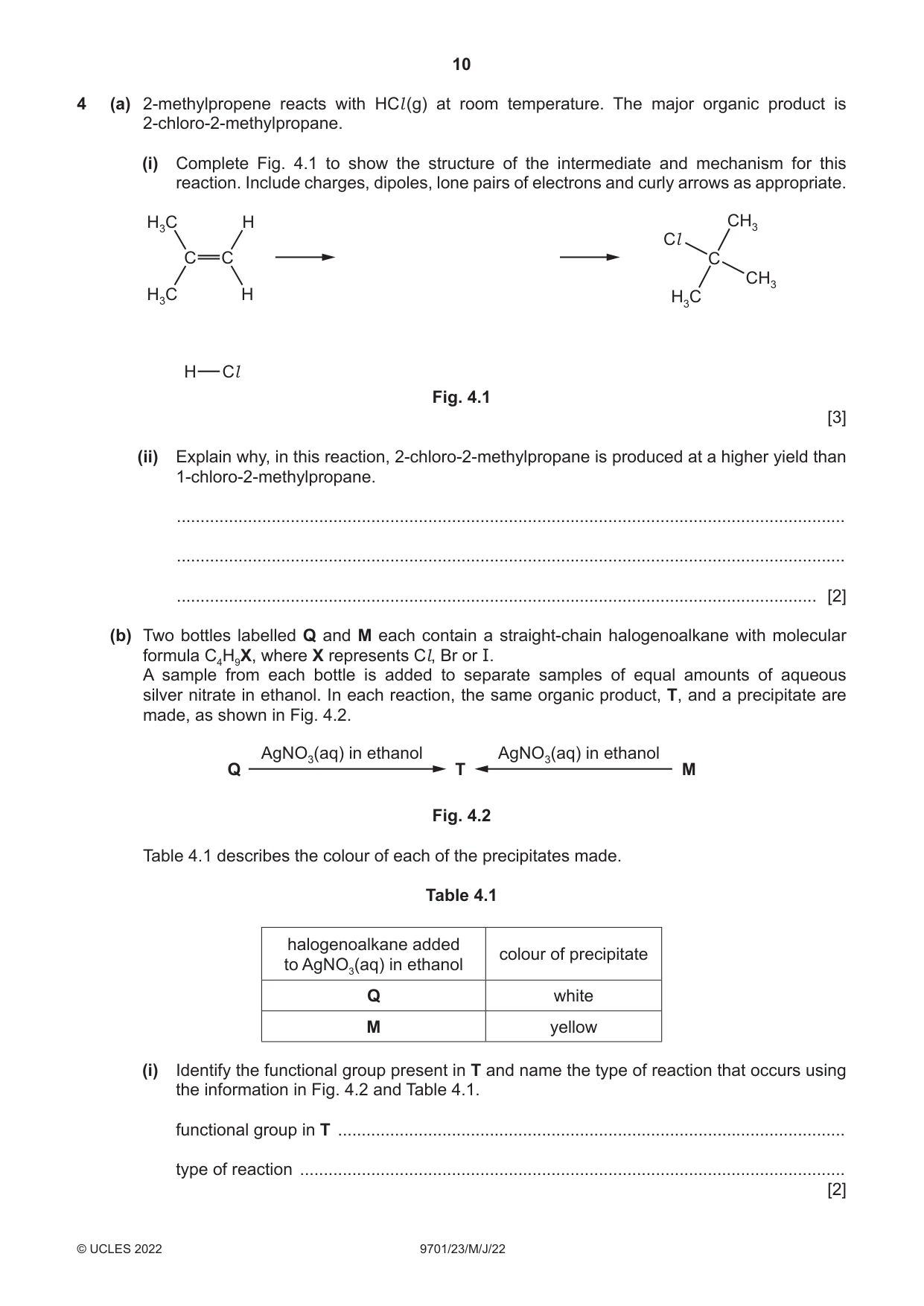
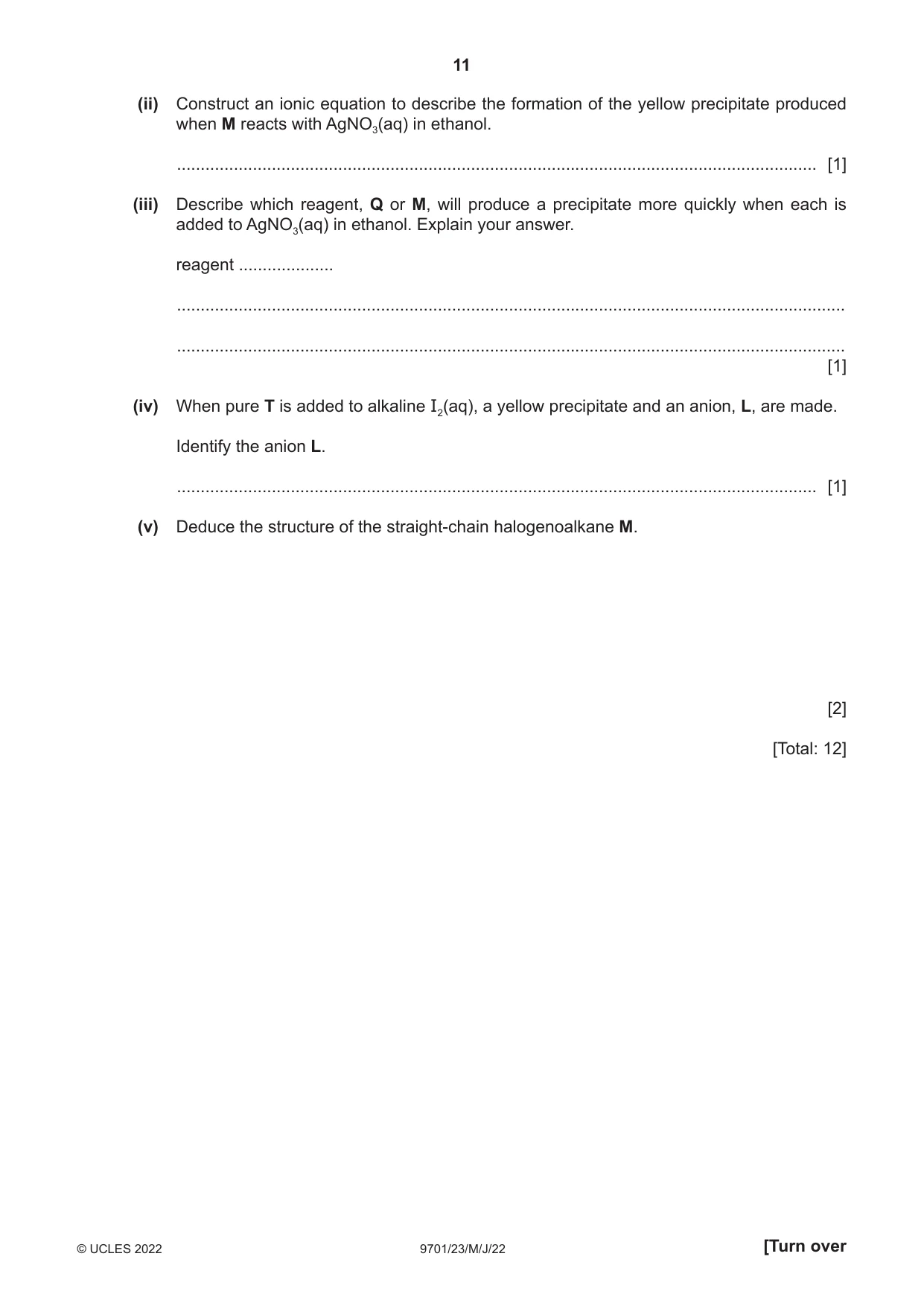
4 (a) 2-methylpropene reacts with HCl (g) at room temperature. The major organic product is 2-chloro-2-methylpropane. (i) Complete Fig. 4.1 to show the structure of the intermediate and mechanism for this reaction. Include charges, dipoles, lone pairs of electrons and curly arrows as appropriate. H3C H CH3 Cl C C C CH3 H3C H H3C H Cl Fig. 4.1 [3] (ii) Explain why, in this reaction, 2-chloro-2-methylpropane is produced at a higher yield than 1-chloro-2-methylpropane. ............................................................................................................................................. ............................................................................................................................................. ....................................................................................................................................... [2] (b) Two bottles labelled Q and M each contain a straight-chain halogenoalkane with molecular formula C4H9X, where X represents Cl, Br or I. A sample from each bottle is added to separate samples of equal amounts of aqueous silver nitrate in ethanol. In each reaction, the same organic product, T, and a precipitate are made, as shown in Fig. 4.2. AgNO3(aq) in ethanol AgNO3(aq) in ethanol Q T M Fig. 4.2 Table 4.1 describes the colour of each of the precipitates made. Table 4.1 halogenoalkane added colour of precipitate to AgNO3(aq) in ethanol Q white M yellow (i) Identify the functional group present in T and name the type of reaction that occurs using the information in Fig. 4.2 and Table 4.1. functional group in T ............................................................................................................ type of reaction .................................................................................................................... [2] (ii) Construct an ionic equation to describe the formation of the yellow precipitate produced when M reacts with AgNO3(aq) in ethanol. ....................................................................................................................................... [1] (iii) Describe which reagent, Q or M, will produce a precipitate more quickly when each is added to AgNO3(aq) in ethanol. Explain your answer. reagent .................... ............................................................................................................................................. ............................................................................................................................................. [1] (iv) When pure T is added to alkaline I2(aq), a yellow precipitate and an anion, L, are made. Identify the anion L. ....................................................................................................................................... [1] (v) Deduce the structure of the straight-chain halogenoalkane M. [2] [Total: 12]
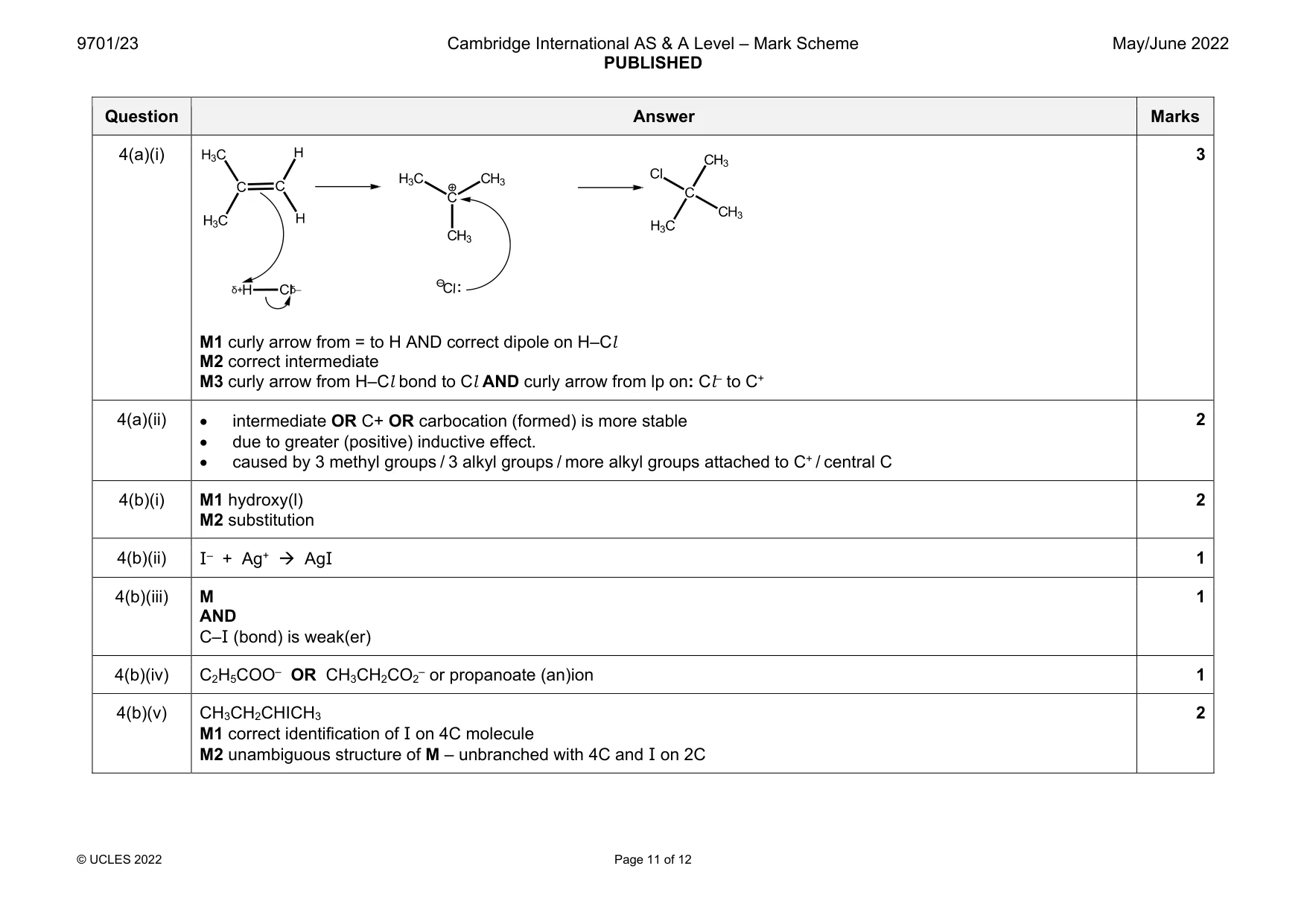
Mark scheme: 4(a)(i) M1 curly arrow from = to H AND correct dipole on H–Cl M2 correct intermediate M3 curly arrow from H–Cl bond to Cl AND curly arrow from lp on: Cl– to C+ 3 4(a)(ii) intermediate OR C+ OR carbocation (formed) is more stable due to greater (positive) inductive effect. caused by 3 methyl groups / 3 alkyl groups / more alkyl groups attached to C+ / central C 2 4(b)(i) M1 hydroxy(l) M2 substitution 2 4(b)(ii) I– + Ag+ AgI 1 4(b)(iii) M AND C–I (bond) is weak(er) 1 4(b)(iv) C2H5COO– OR CH3CH2CO2– or propanoate (an)ion 1 4(b)(v) CH3CH2CHICH3 M1 correct identification of I on 4C molecule M2 unambiguous structure of M – unbranched with 4C and I on 2C 2
Q5 · But-2-ene reacts with KMnO4 to form organic product, Y
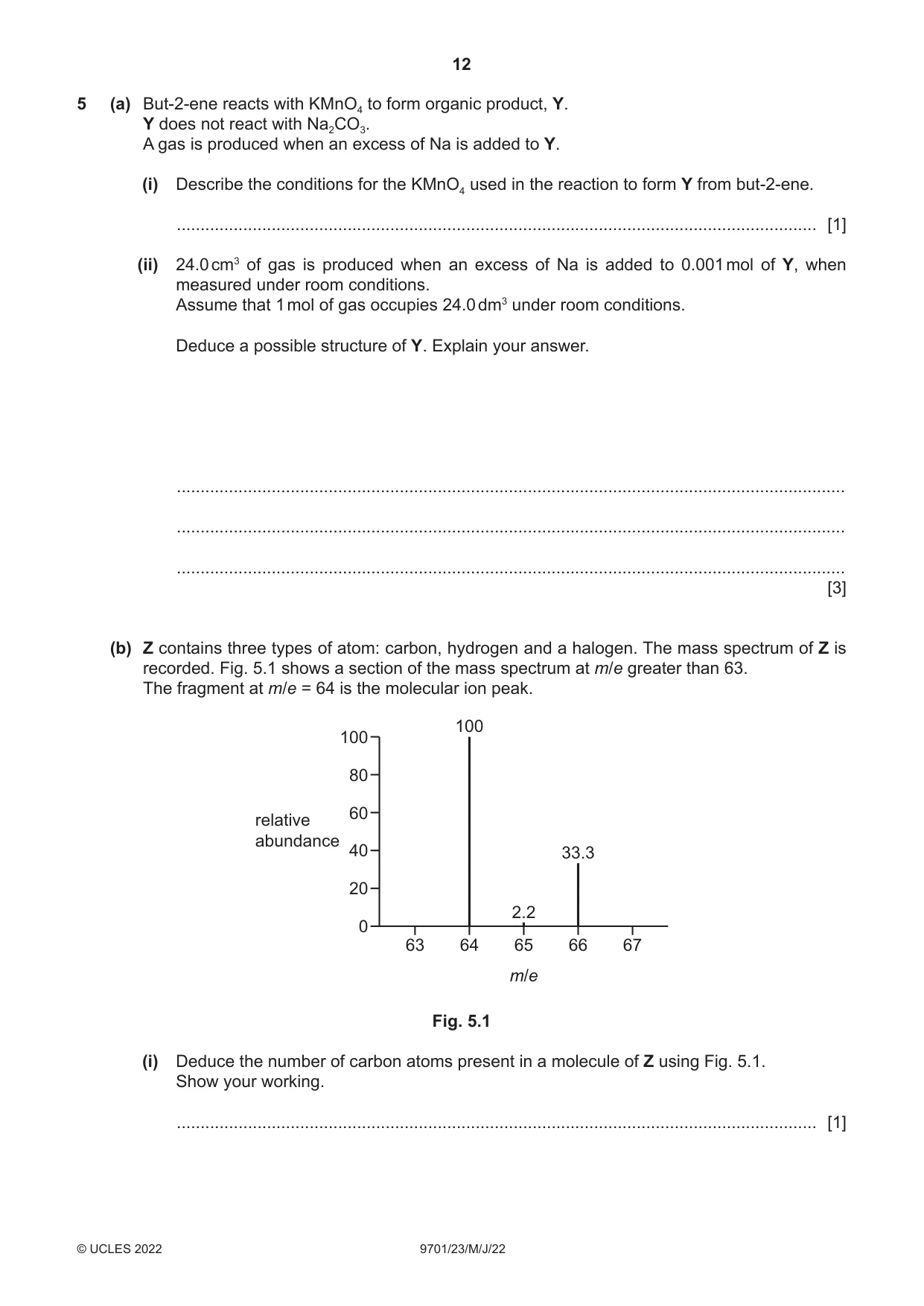
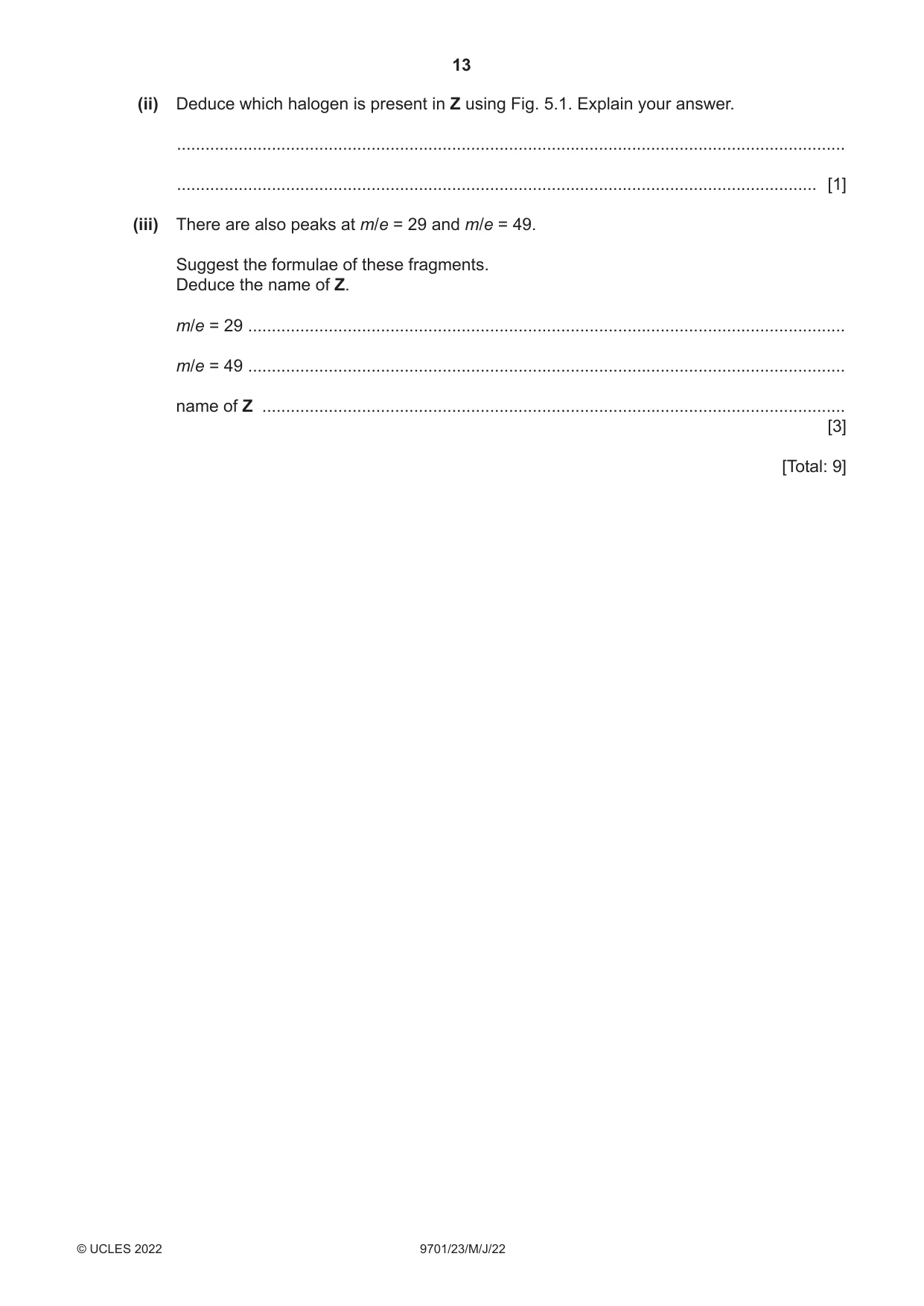
5 (a) But-2-ene reacts with KMnO4 to form organic product, Y. Y does not react with Na2CO3. A gas is produced when an excess of Na is added to Y. (i) Describe the conditions for the KMnO4 used in the reaction to form Y from but-2-ene. ....................................................................................................................................... [1] (ii) 24.0 cm3 of gas is produced when an excess of Na is added to 0.001 mol of Y, when measured under room conditions. Assume that 1 mol of gas occupies 24.0 dm3 under room conditions. Deduce a possible structure of Y. Explain your answer. ............................................................................................................................................. ............................................................................................................................................. ............................................................................................................................................. [3] (b) Z contains three types of atom: carbon, hydrogen and a halogen. The mass spectrum of Z is recorded. Fig. 5.1 shows a section of the mass spectrum at m/e greater than 63. The fragment at m/e = 64 is the molecular ion peak. 100 100 80 60 relative abundance 40 33.3 20 2.2 0 63 64 65 66 67 m/e Fig. 5.1 (i) Deduce the number of carbon atoms present in a molecule of Z using Fig. 5.1. Show your working. ....................................................................................................................................... [1] (ii) Deduce which halogen is present in Z using Fig. 5.1. Explain your answer. ............................................................................................................................................. ....................................................................................................................................... [1] (iii) There are also peaks at m/e = 29 and m/e = 49. Suggest the formulae of these fragments. Deduce the name of Z. m/e = 29 .............................................................................................................................. m/e = 49 .............................................................................................................................. name of Z ............................................................................................................................ [3] [Total: 9]
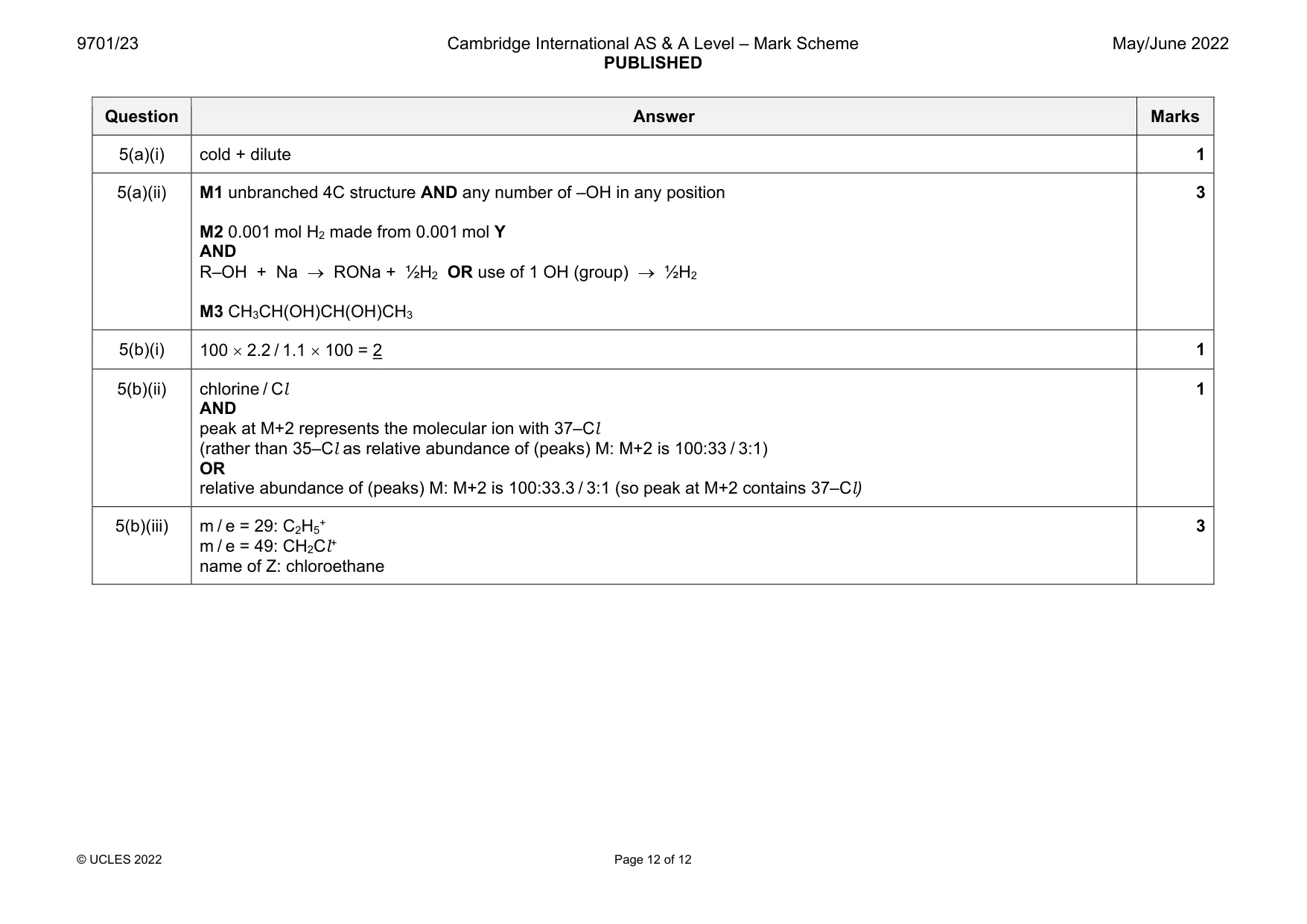
Mark scheme: 5(a)(i) cold + dilute 1 5(a)(ii) M1 unbranched 4C structure AND any number of –OH in any position M2 0.001 mol H2 made from 0.001 mol Y AND R–OH + Na RONa + ½H2 OR use of 1 OH (group) ½H2 M3 CH3CH(OH)CH(OH)CH3 3 5(b)(i) 100 2.2 / 1.1 100 = 2 1 5(b)(ii) chlorine / Cl AND peak at M+2 represents the molecular ion with 37–Cl (rather than 35–Cl as relative abundance of (peaks) M: M+2 is 100:33 / 3:1) OR relative abundance of (peaks) M: M+2 is 100:33.3 / 3:1 (so peak at M+2 contains 37–Cl) 1 5(b)(iii) m / e = 29: C2H5+ m / e = 49: CH2Cl+ name of Z: chloroethane 3
What was in this paper
The subtopics covered by these 5 questions, and how many questions each got. Open one in a new tab to see every Cambridge question on it.
What you needed in this session
Cambridge’s own grade thresholds for 2022 May/June, Paper 2 · Variant 3. A higher threshold means an easier paper — the bar moves with how the cohort did.