Cambridge A Level Chemistry 9701 — 2022 May/June Paper 2 · Variant 1
9701/21/M/J/22 · 4 questions · 60 marks · ≈68 min
The question paper and its mark scheme, free to read here and free to download. This is Cambridge’s own paper, exactly as it was sat.
Question paper16 pages


Mark scheme10 pages
Answers below. Sit the paper first if you are practising.
Questions as text
Q1 · Calcium, magnesium and radium are Group 2 elements
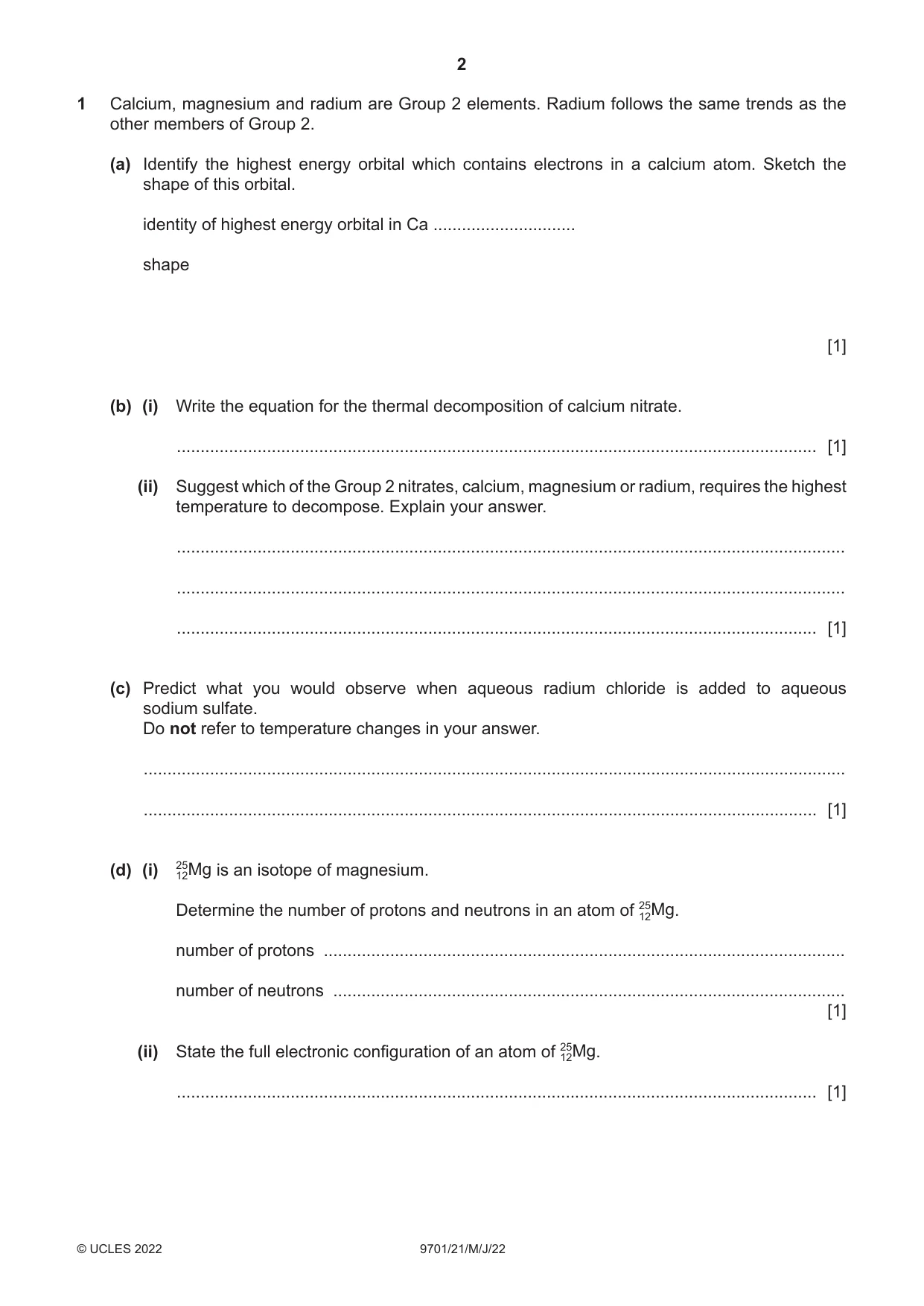
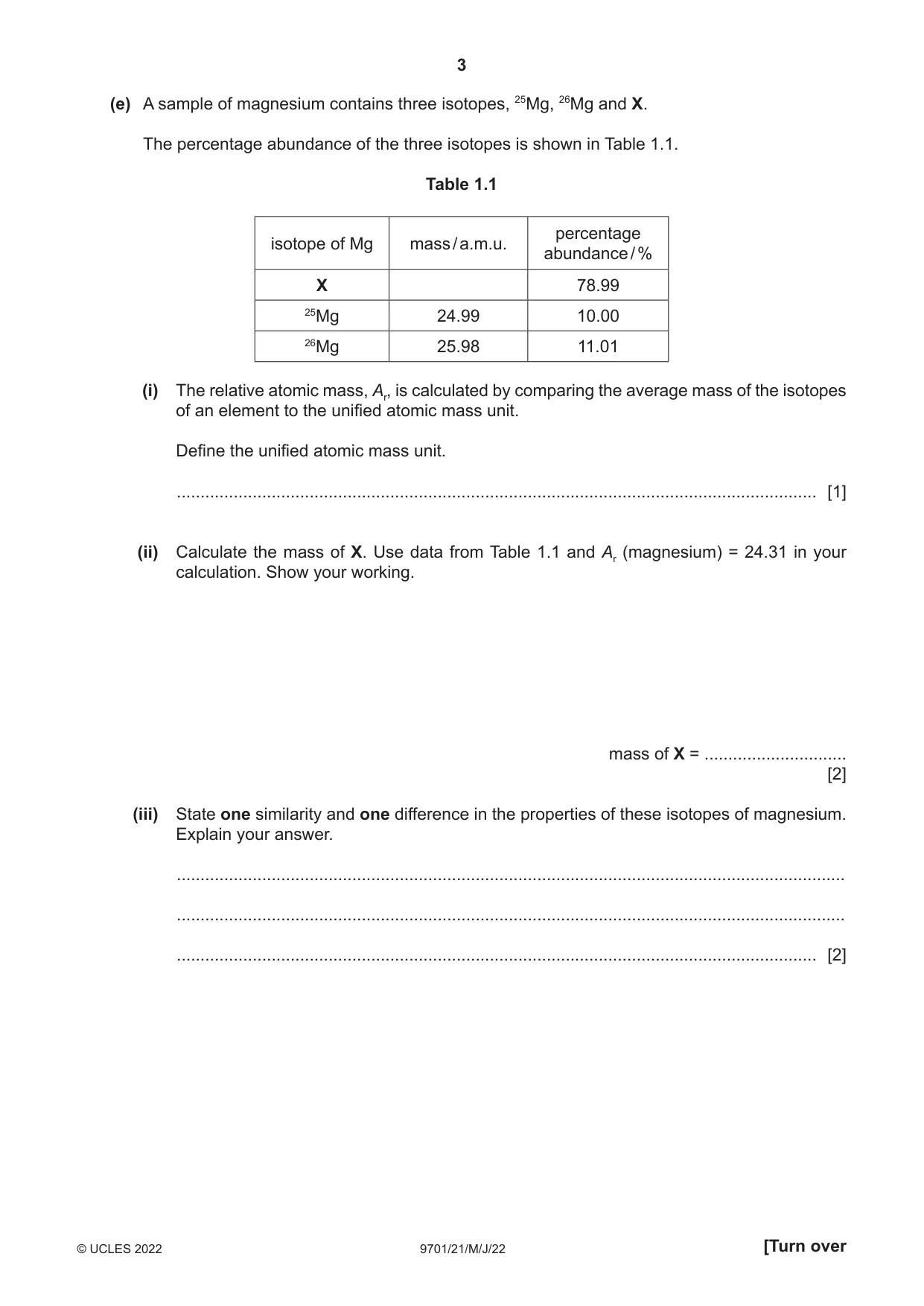
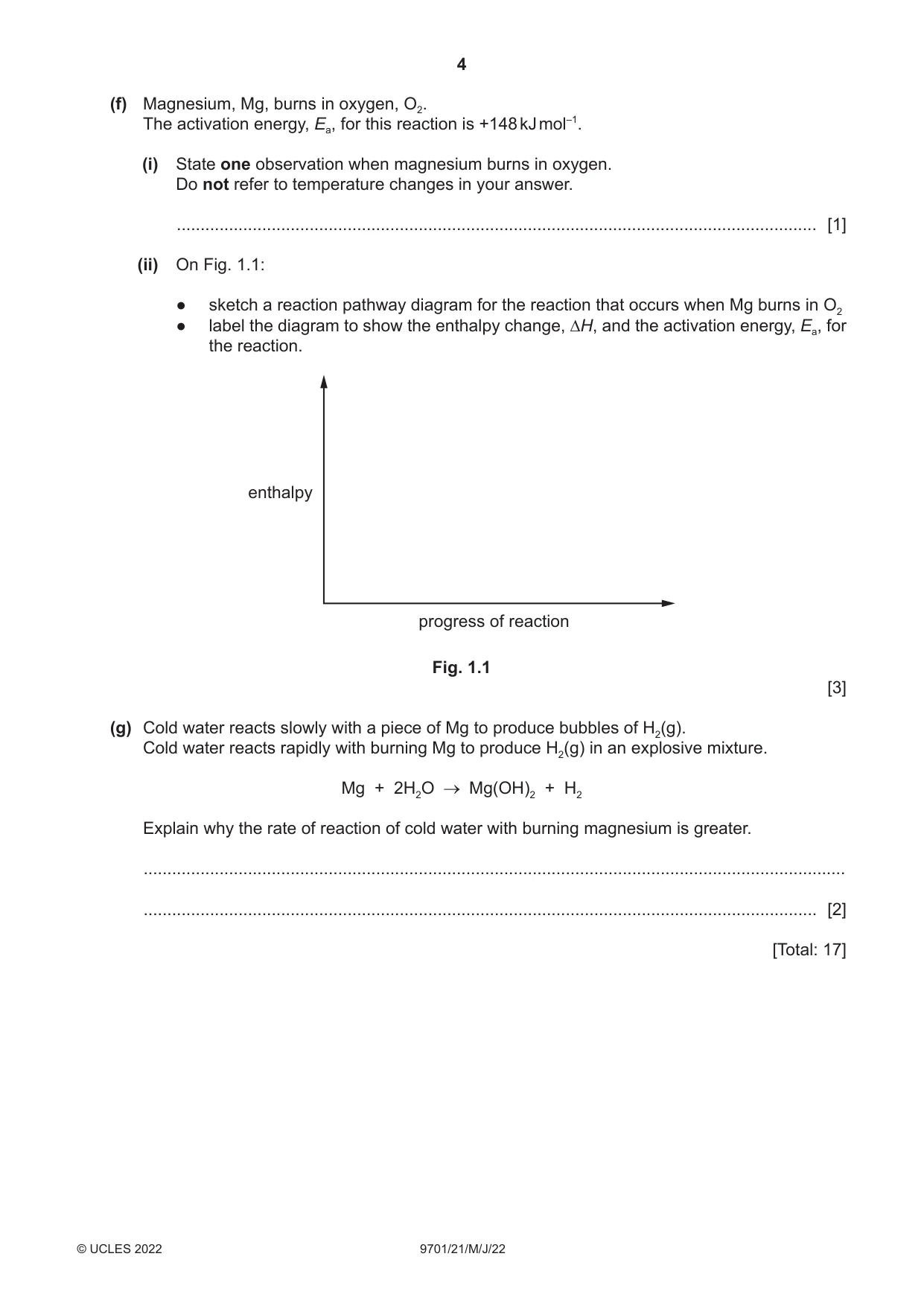
1 Calcium, magnesium and radium are Group 2 elements. Radium follows the same trends as the other members of Group 2. (a) Identify the highest energy orbital which contains electrons in a calcium atom. Sketch the shape of this orbital. identity of highest energy orbital in Ca .............................. shape [1] (b) (i) Write the equation for the thermal decomposition of calcium nitrate. ....................................................................................................................................... [1] (ii) Suggest which of the Group 2 nitrates, calcium, magnesium or radium, requires the highest temperature to decompose. Explain your answer. ............................................................................................................................................. ............................................................................................................................................. ....................................................................................................................................... [1] (c) Predict what you would observe when aqueous radium chloride is added to aqueous sodium sulfate. Do not refer to temperature changes in your answer. .................................................................................................................................................... .............................................................................................................................................. [1] (d) (i) 1225Mg is an isotope of magnesium. Determine the number of protons and neutrons in an atom of 1225Mg . number of protons ............................................................................................................... number of neutrons ............................................................................................................. [1] (ii) State the full electronic configuration of an atom of 1225Mg . ....................................................................................................................................... [1] (e) A sample of magnesium contains three isotopes, 25Mg, 26Mg and X. The percentage abundance of the three isotopes is shown in Table 1.1. Table 1.1 percentage isotope of Mg mass / a.m.u. abundance / % X 78.99 25Mg 24.99 10.00 26Mg 25.98 11.01 (i) The relative atomic mass, Ar, is calculated by comparing the average mass of the isotopes of an element to the unified atomic mass unit. Define the unified atomic mass unit. ....................................................................................................................................... [1] (ii) Calculate the mass of X. Use data from Table 1.1 and Ar (magnesium) = 24.31 in your calculation. Show your working. mass of X = .............................. [2] (iii) State one similarity and one difference in the properties of these isotopes of magnesium. Explain your answer. ............................................................................................................................................. ............................................................................................................................................. ....................................................................................................................................... [2] (f) Magnesium, Mg, burns in oxygen, O2. The activation energy, Ea, for this reaction is +148 kJ mol–1. (i) State one observation when magnesium burns in oxygen. Do not refer to temperature changes in your answer. ....................................................................................................................................... [1] (ii) On Fig. 1.1: ● sketch a reaction pathway diagram for the reaction that occurs when Mg burns in O2 ● label the diagram to show the enthalpy change, ∆H, and the activation energy, Ea, for the reaction. enthalpy progress of reaction Fig. 1.1 [3] (g) Cold water reacts slowly with a piece of Mg to produce bubbles of H2(g). Cold water reacts rapidly with burning Mg to produce H2(g) in an explosive mixture. Mg + 2H2O Mg(OH)2 + H2 Explain why the rate of reaction of cold water with burning magnesium is greater. .................................................................................................................................................... .............................................................................................................................................. [2] [Total: 17]
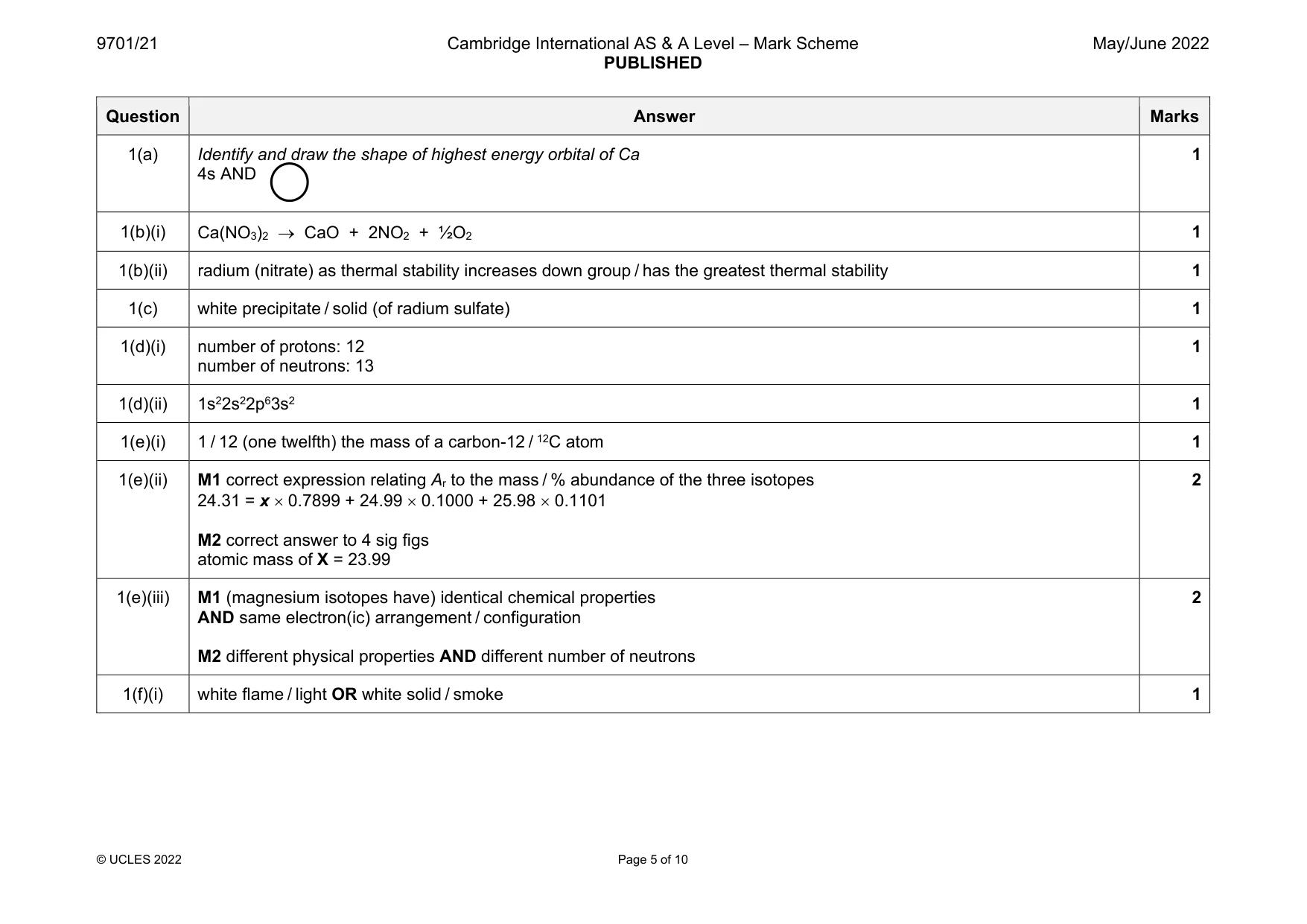
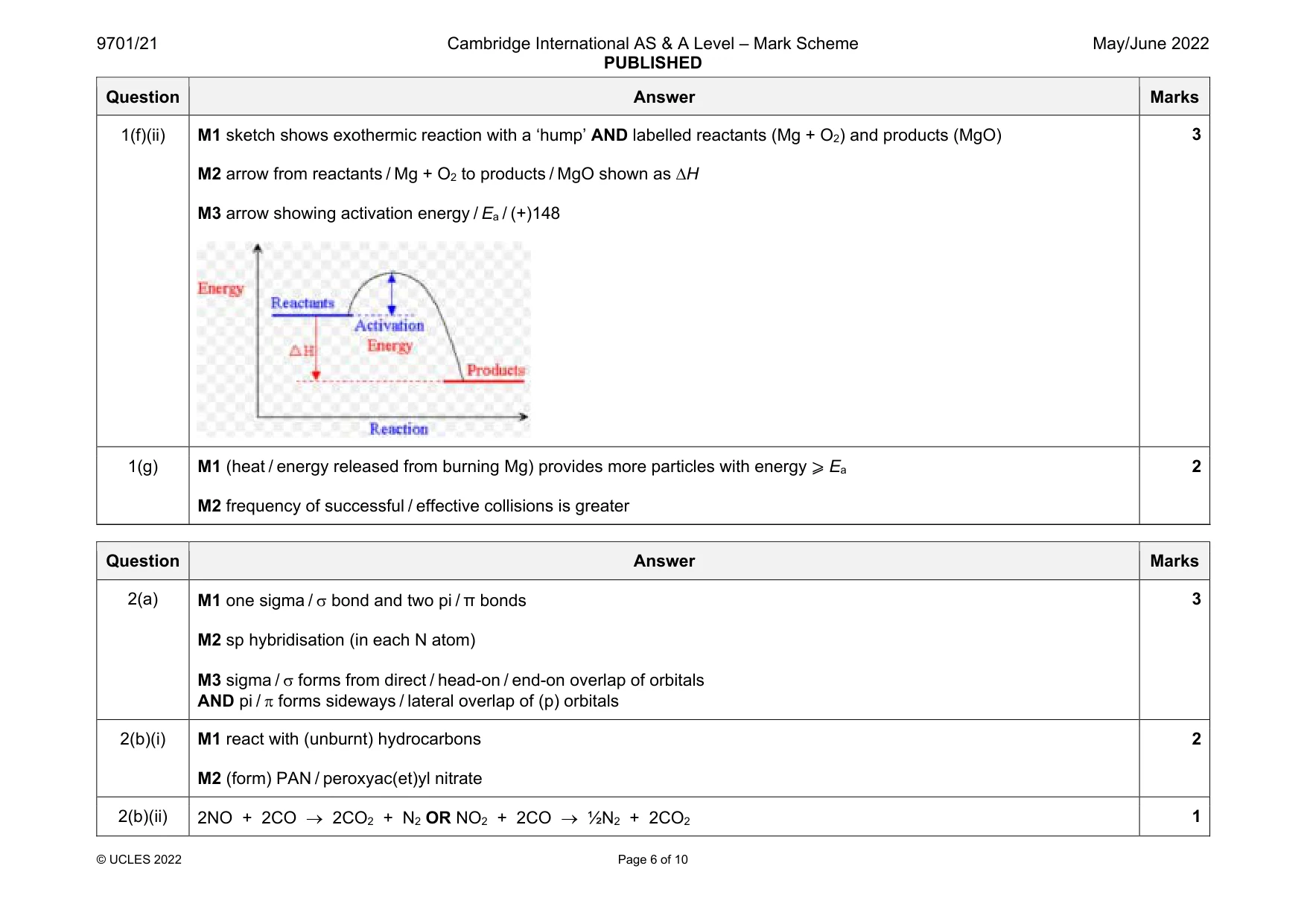
Mark scheme: 1(a) Identify and draw the shape of highest energy orbital of Ca 4s AND 1 1(b)(i) Ca(NO3)2 CaO + 2NO2 + ½O2 1 1(b)(ii) radium (nitrate) as thermal stability increases down group / has the greatest thermal stability 1 1(c) white precipitate / solid (of radium sulfate) 1 1(d)(i) number of protons: 12 number of neutrons: 13 1 1(d)(ii) 1s22s22p63s2 1 1(e)(i) 1 / 12 (one twelfth) the mass of a carbon-12 / 12C atom 1 1(e)(ii) M1 correct expression relating Ar to the mass / % abundance of the three isotopes 24.31 = x 0.7899 + 24.99 0.1000 + 25.98 0.1101 M2 correct answer to 4 sig figs atomic mass of X = 23.99 2 1(e)(iii) M1 (magnesium isotopes have) identical chemical properties AND same electron(ic) arrangement / configuration M2 different physical properties AND different number of neutrons 2 1(f)(i) white flame / light OR white solid / smoke 1 Question Answer Marks 1(f)(ii) M1 sketch shows exothermic reaction with a ‘hump’ AND labelled reactants (Mg + O2) and products (MgO) M2 arrow from reactants / Mg + O2 to products / MgO shown as ∆H M3 arrow showing activation energy / Ea / (+)148 3 1(g) M1 (heat / energy released from burning Mg) provides more particles with energy ⩾ Ea M2 frequency of successful / effective collisions is greater 2
Q2 · Nitrogen molecules, N2(g), contain two atoms attracted to each other by a triple covalent…
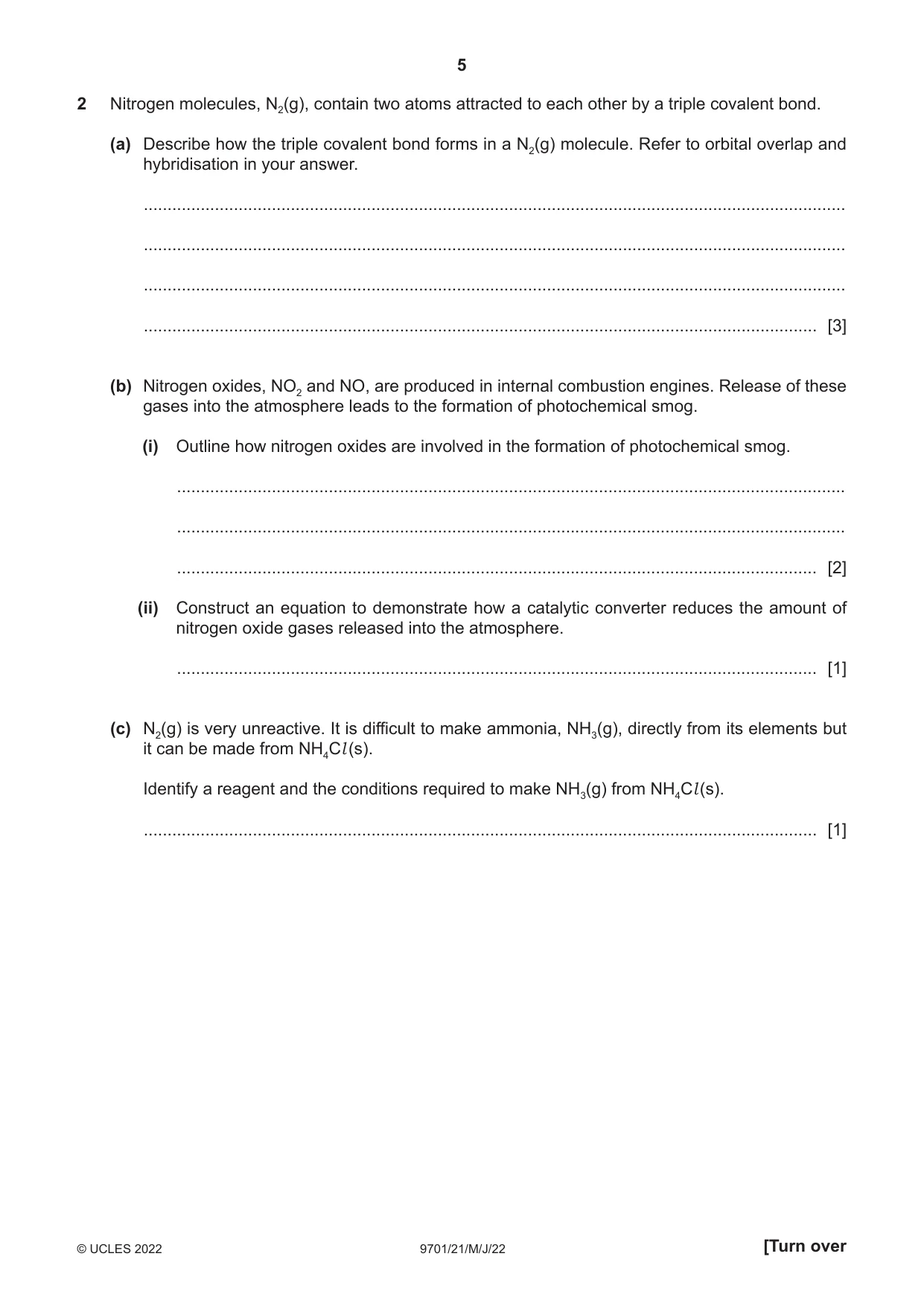
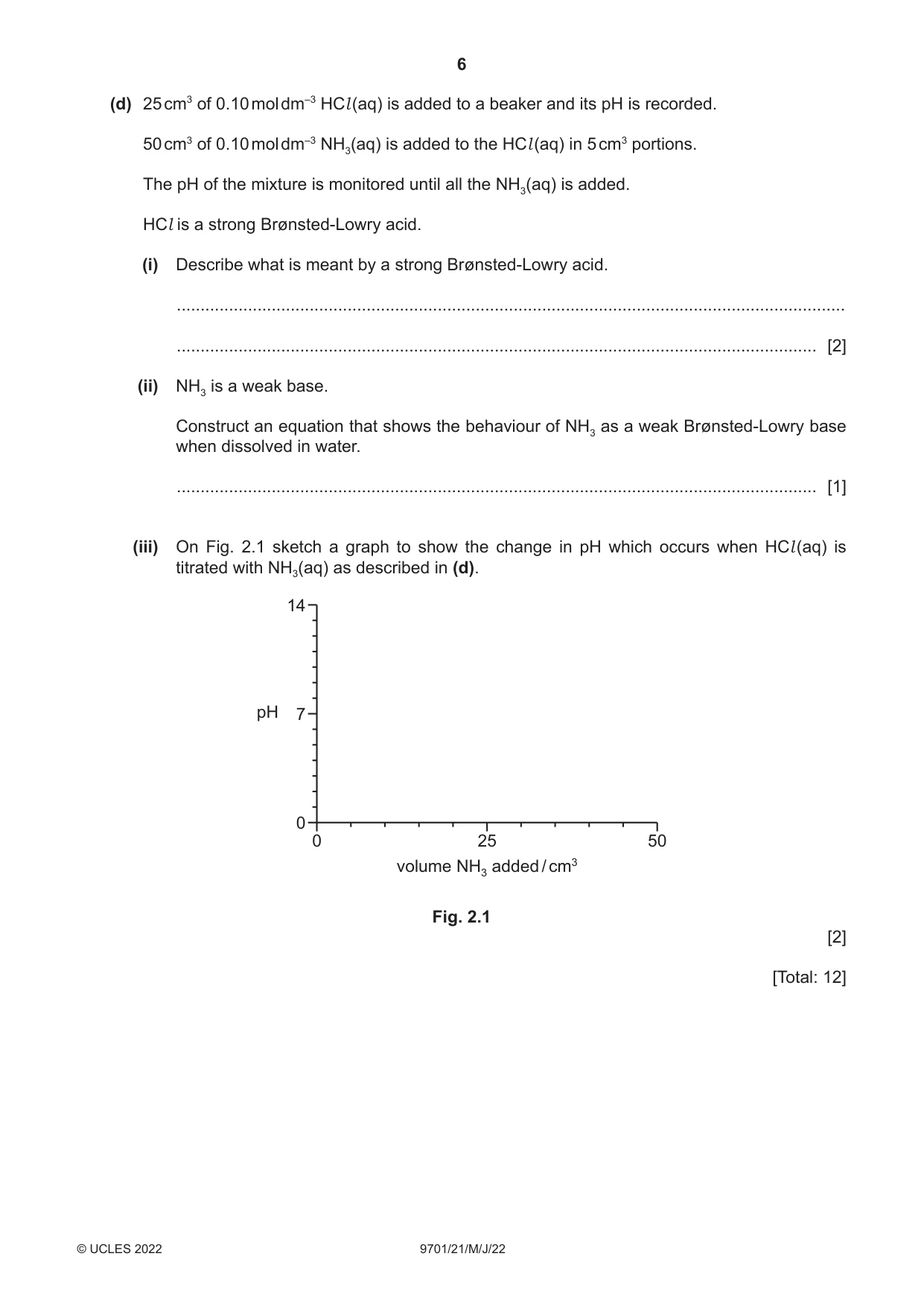
2 Nitrogen molecules, N2(g), contain two atoms attracted to each other by a triple covalent bond. (a) Describe how the triple covalent bond forms in a N2(g) molecule. Refer to orbital overlap and hybridisation in your answer. .................................................................................................................................................... .................................................................................................................................................... .................................................................................................................................................... .............................................................................................................................................. [3] (b) Nitrogen oxides, NO2 and NO, are produced in internal combustion engines. Release of these gases into the atmosphere leads to the formation of photochemical smog. (i) Outline how nitrogen oxides are involved in the formation of photochemical smog. ............................................................................................................................................. ............................................................................................................................................. ....................................................................................................................................... [2] (ii) Construct an equation to demonstrate how a catalytic converter reduces the amount of nitrogen oxide gases released into the atmosphere. ....................................................................................................................................... [1] (c) N2(g) is very unreactive. It is difficult to make ammonia, NH3(g), directly from its elements but it can be made from NH4Cl (s). Identify a reagent and the conditions required to make NH3(g) from NH4Cl (s). .............................................................................................................................................. [1] (d) 25 cm3 of 0.10 mol dm–3 HCl (aq) is added to a beaker and its pH is recorded. 50 cm3 of 0.10 mol dm–3 NH3(aq) is added to the HCl (aq) in 5 cm3 portions. The pH of the mixture is monitored until all the NH3(aq) is added. HCl is a strong Brønsted-Lowry acid. (i) Describe what is meant by a strong Brønsted-Lowry acid. ............................................................................................................................................. ....................................................................................................................................... [2] (ii) NH3 is a weak base. Construct an equation that shows the behaviour of NH3 as a weak Brønsted-Lowry base when dissolved in water. ....................................................................................................................................... [1] (iii) On Fig. 2.1 sketch a graph to show the change in pH which occurs when HCl (aq) is titrated with NH3(aq) as described in (d). 14 pH 7 0 0 25 50 volume NH3 added / cm3 Fig. 2.1 [2] [Total: 12]
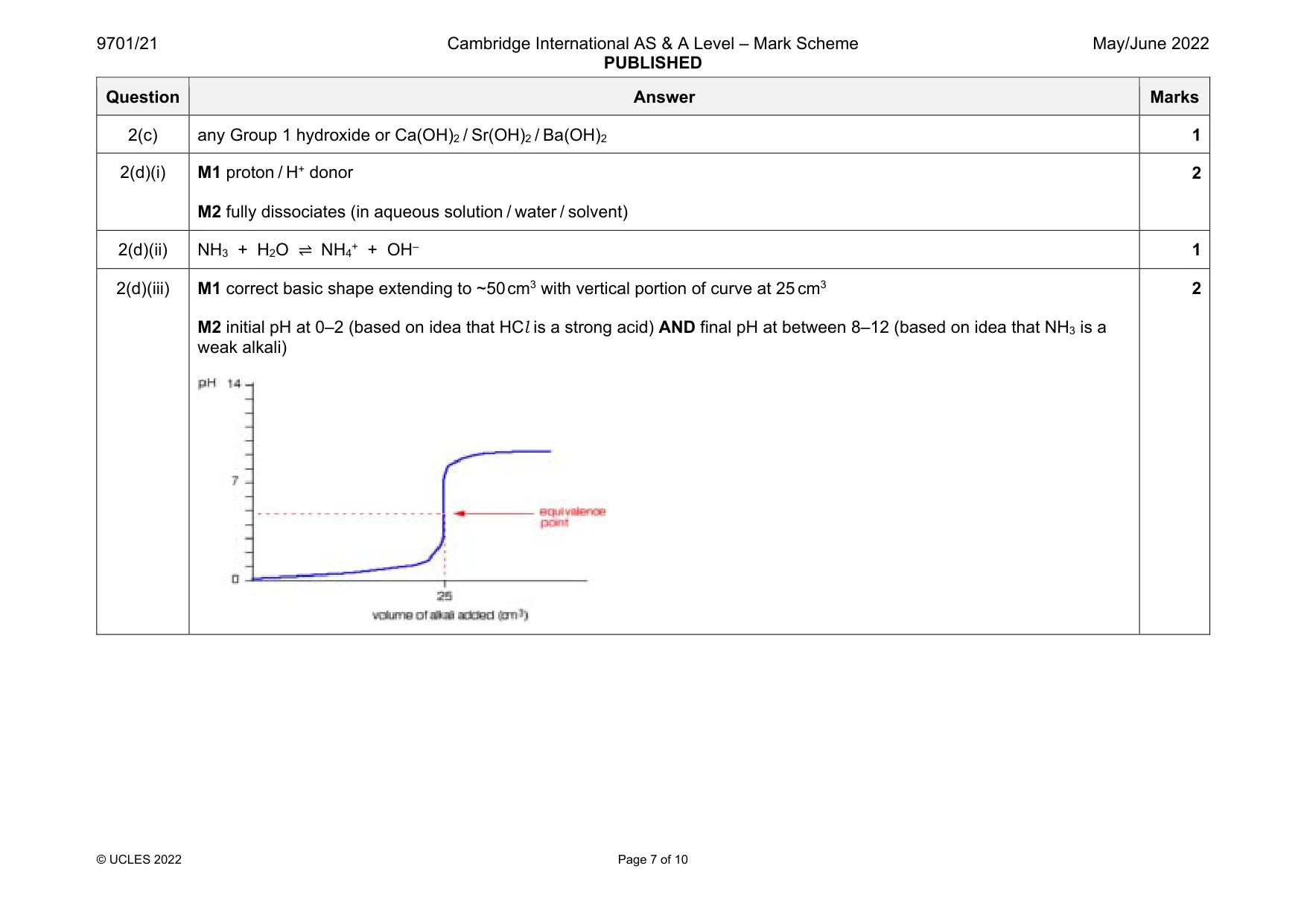
Mark scheme: 2(a) M2 sp hybridisation (in each N atom) M3 sigma / forms from direct / head-on / end-on overlap of orbitals AND pi / forms sideways / lateral overlap of (p) orbitals 2(b)(i) M1 react with (unburnt) hydrocarbons M2 (form) PAN / peroxyac(et)yl nitrate 2 2(b)(ii) 2NO + 2CO 2CO2 + N2 OR NO2 + 2CO ½N2 + 2CO2 1 Question Answer Marks 2(c) any Group 1 hydroxide or Ca(OH)2 / Sr(OH)2 / Ba(OH)2 1 2(d)(i) M1 proton / H+ donor M2 fully dissociates (in aqueous solution / water / solvent) 2 2(d)(ii) NH3 + H2O ⇌ NH4+ + OH– 1 2(d)(iii) M1 correct basic shape extending to ~50 cm3 with vertical portion of curve at 25 cm3 M2 initial pH at 0–2 (based on idea that HCl is a strong acid) AND final pH at between 8–12 (based on idea that NH3 is a weak alkali) 2
Q3 · Liquids that contain molecules of T smell like lemons
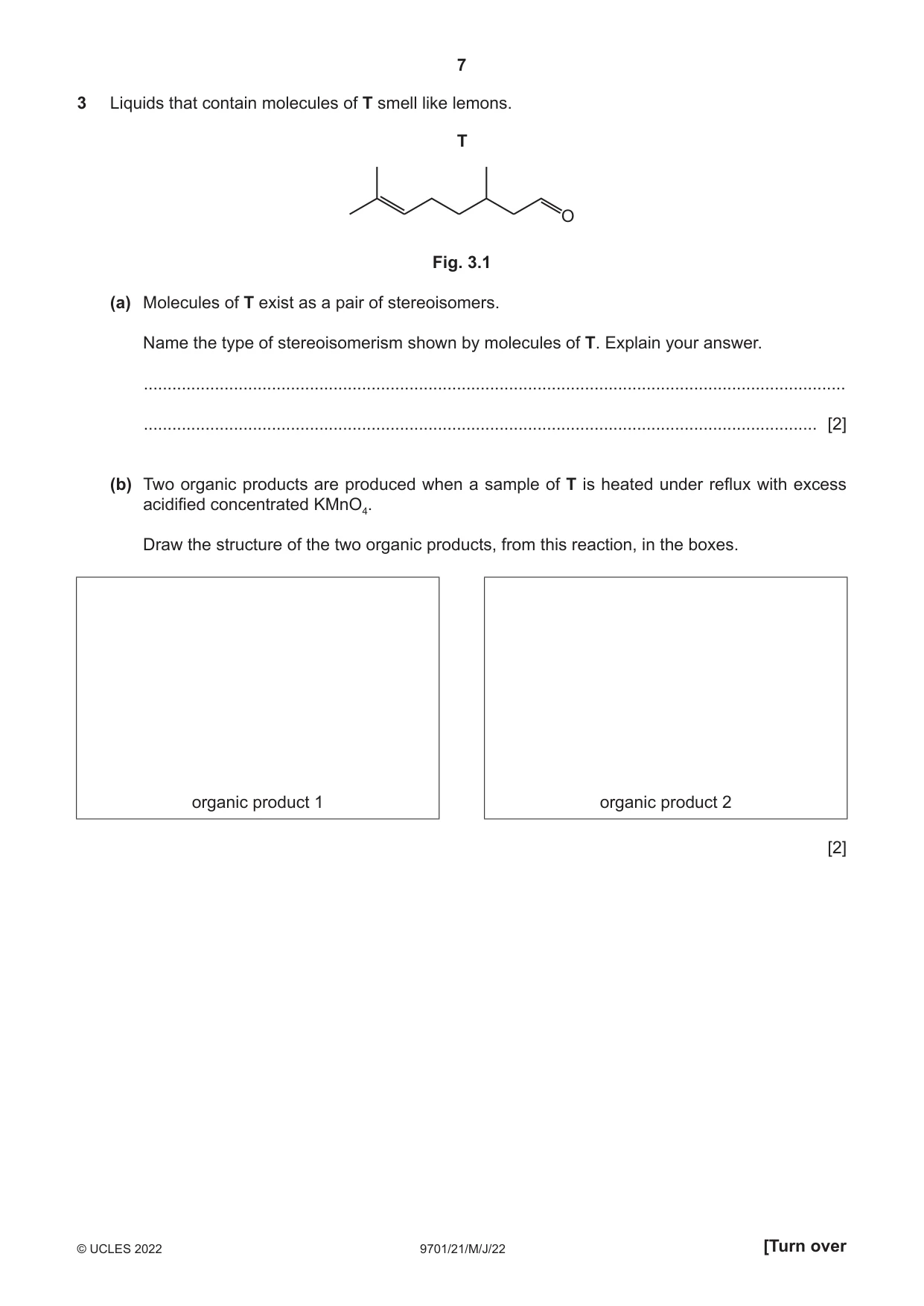
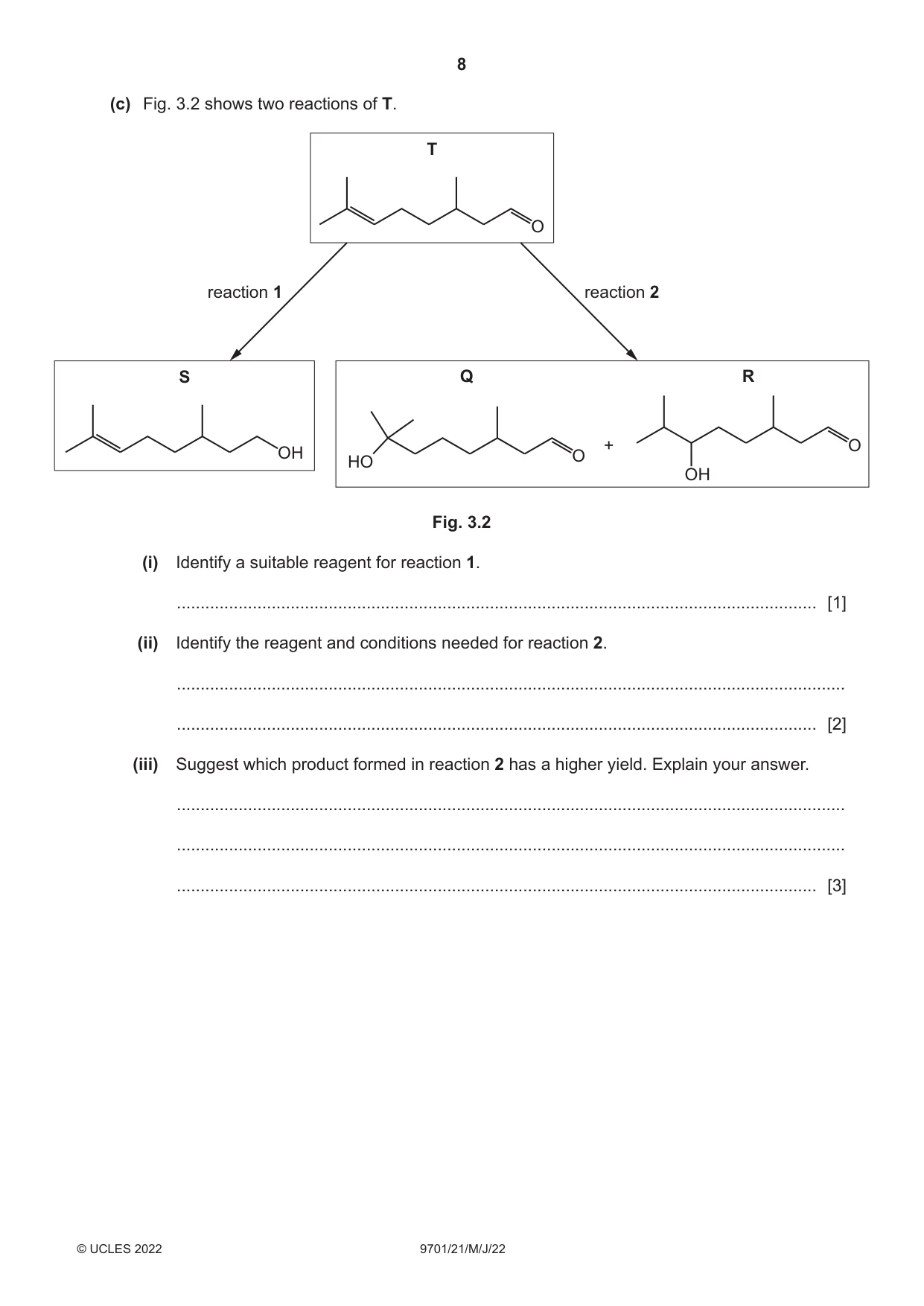
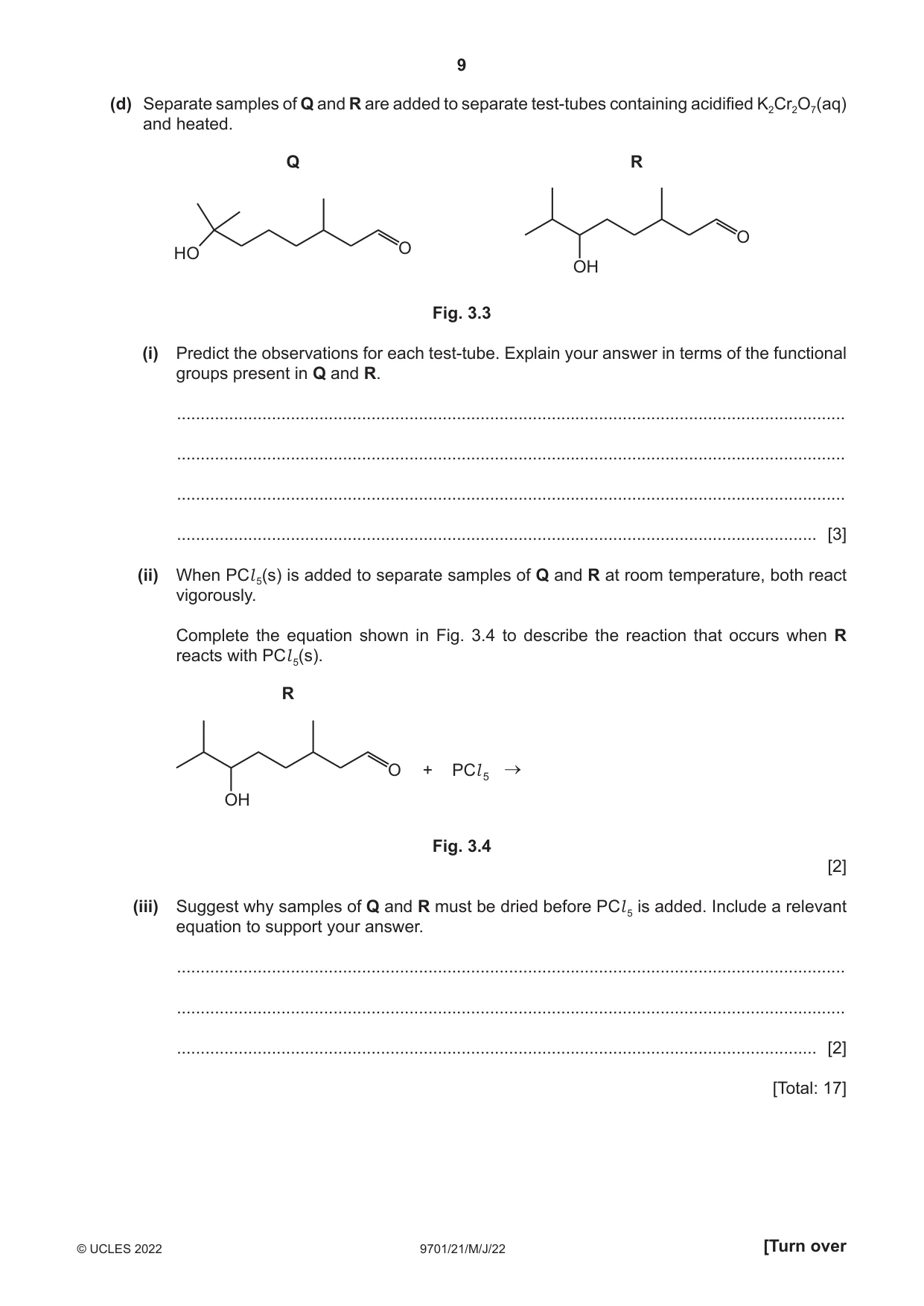
3 Liquids that contain molecules of T smell like lemons. T O Fig. 3.1 (a) Molecules of T exist as a pair of stereoisomers. Name the type of stereoisomerism shown by molecules of T. Explain your answer. .................................................................................................................................................... .............................................................................................................................................. [2] (b) Two organic products are produced when a sample of T is heated under reflux with excess acidified concentrated KMnO4. Draw the structure of the two organic products, from this reaction, in the boxes. organic product 1 organic product 2 [2] (c) Fig. 3.2 shows two reactions of T. T O reaction 1 reaction 2 S Q R + O OH O HO OH Fig. 3.2 (i) Identify a suitable reagent for reaction 1. ....................................................................................................................................... [1] (ii) Identify the reagent and conditions needed for reaction 2. ............................................................................................................................................. ....................................................................................................................................... [2] (iii) Suggest which product formed in reaction 2 has a higher yield. Explain your answer. ............................................................................................................................................. ............................................................................................................................................. ....................................................................................................................................... [3] (d) Separate samples of Q and R are added to separate test-tubes containing acidified K2Cr2O7(aq) and heated. Q R O O HO OH Fig. 3.3 (i) Predict the observations for each test-tube. Explain your answer in terms of the functional groups present in Q and R. ............................................................................................................................................. ............................................................................................................................................. ............................................................................................................................................. ....................................................................................................................................... [3] (ii) When PCl 5(s) is added to separate samples of Q and R at room temperature, both react vigorously. Complete the equation shown in Fig. 3.4 to describe the reaction that occurs when R reacts with PCl 5(s). R O + PCl 5 OH Fig. 3.4 [2] (iii) Suggest why samples of Q and R must be dried before PCl 5 is added. Include a relevant equation to support your answer. ............................................................................................................................................. ............................................................................................................................................. ....................................................................................................................................... [2] [Total: 17]
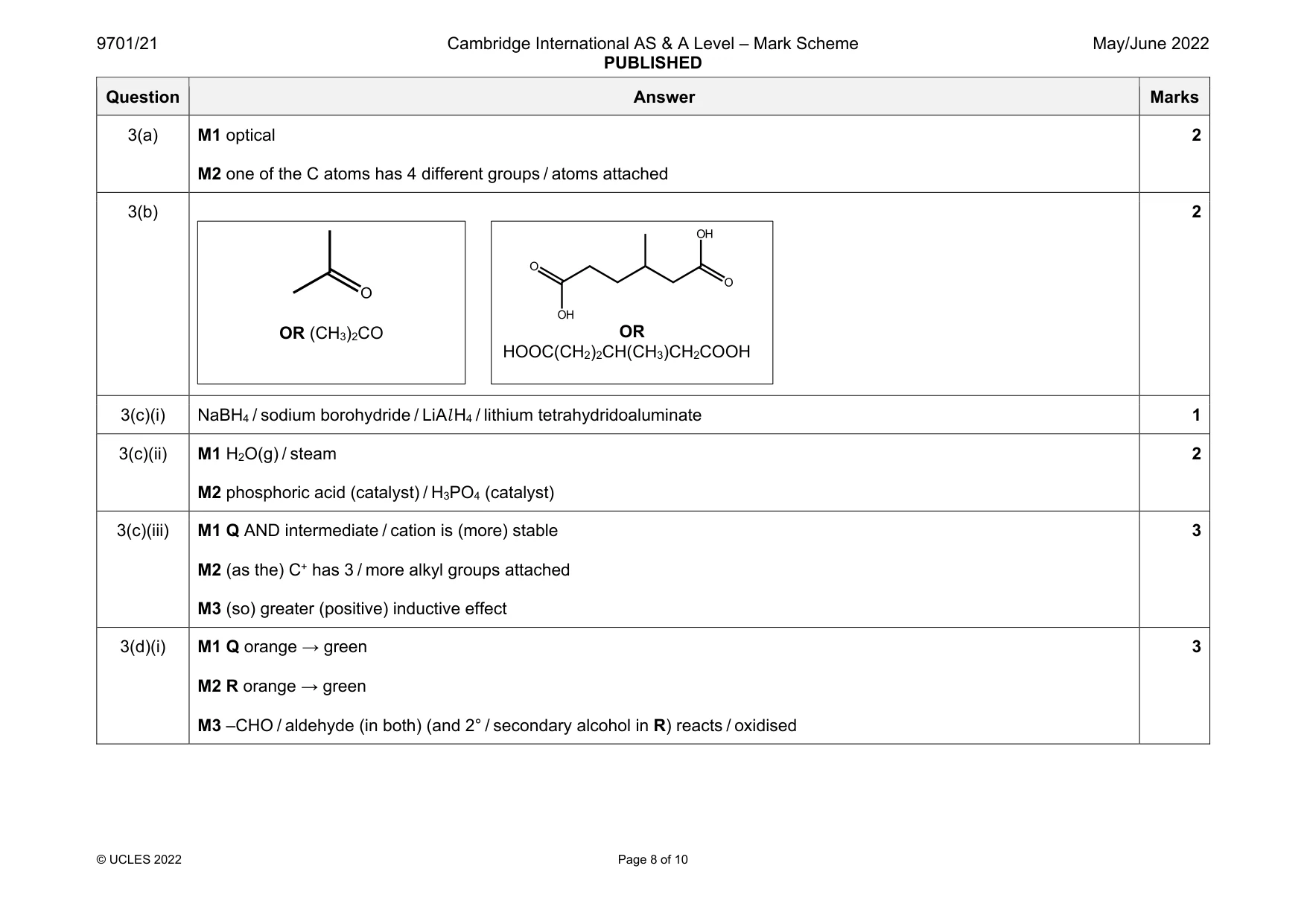
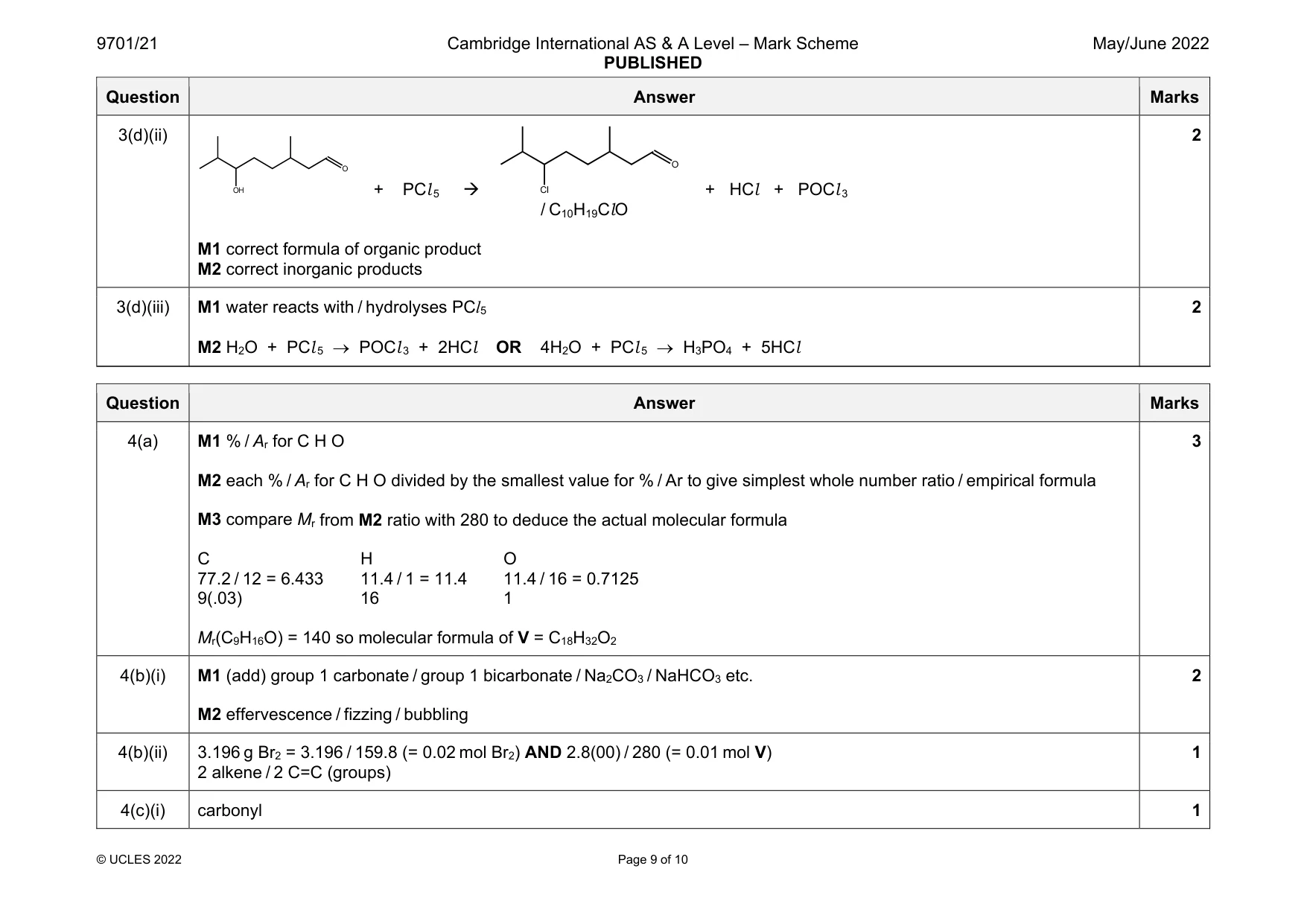
Mark scheme: 3(a) M1 optical M2 one of the C atoms has 4 different groups / atoms attached 2 3(b) 2 3(c)(i) NaBH4 / sodium borohydride / LiAl H4 / lithium tetrahydridoaluminate 1 3(c)(ii) M1 H2O(g) / steam M2 phosphoric acid (catalyst) / H3PO4 (catalyst) 2 3(c)(iii) M1 Q AND intermediate / cation is (more) stable M2 (as the) C+ has 3 / more alkyl groups attached M3 (so) greater (positive) inductive effect 3 3(d)(i) M1 Q orange → green M2 R orange → green M3 –CHO / aldehyde (in both) (and 2° / secondary alcohol in R) reacts / oxidised 3 OR HOOC(CH2)2CH(CH3)CH2COOH OR (CH3)2CO Question Answer Marks 3(d)(ii) + PCl 5 + HCl + POCl 3 / C10H19ClO M1 correct formula of organic product M2 correct inorganic products 2 3(d)(iii) M1 water reacts with / hydrolyses PCl5 M2 H2O + PCl 5 POCl 3 + 2HCl OR 4H2O + PCl 5 H3PO4 + 5HCl 2
Q4 · Compound V is a liquid
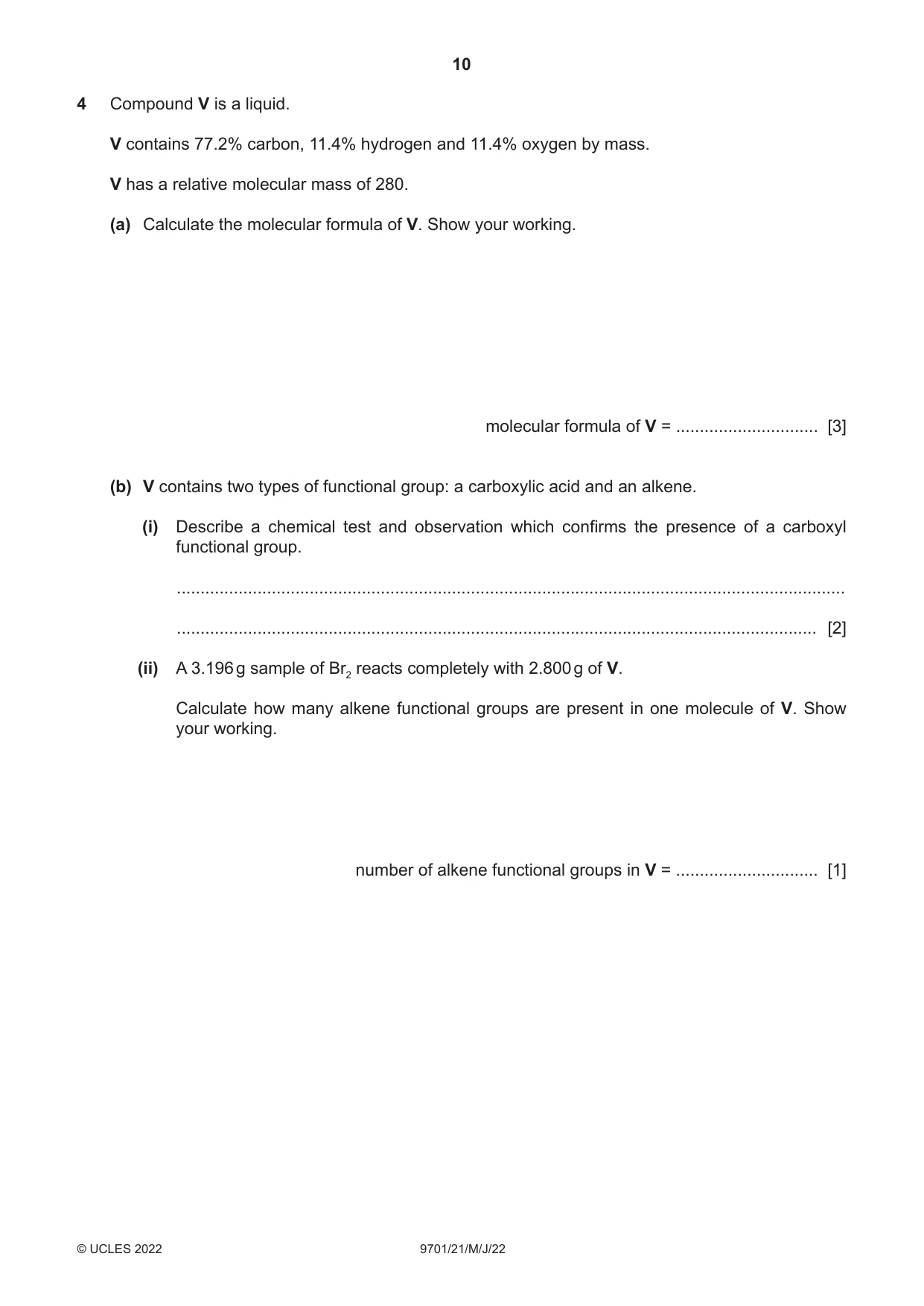
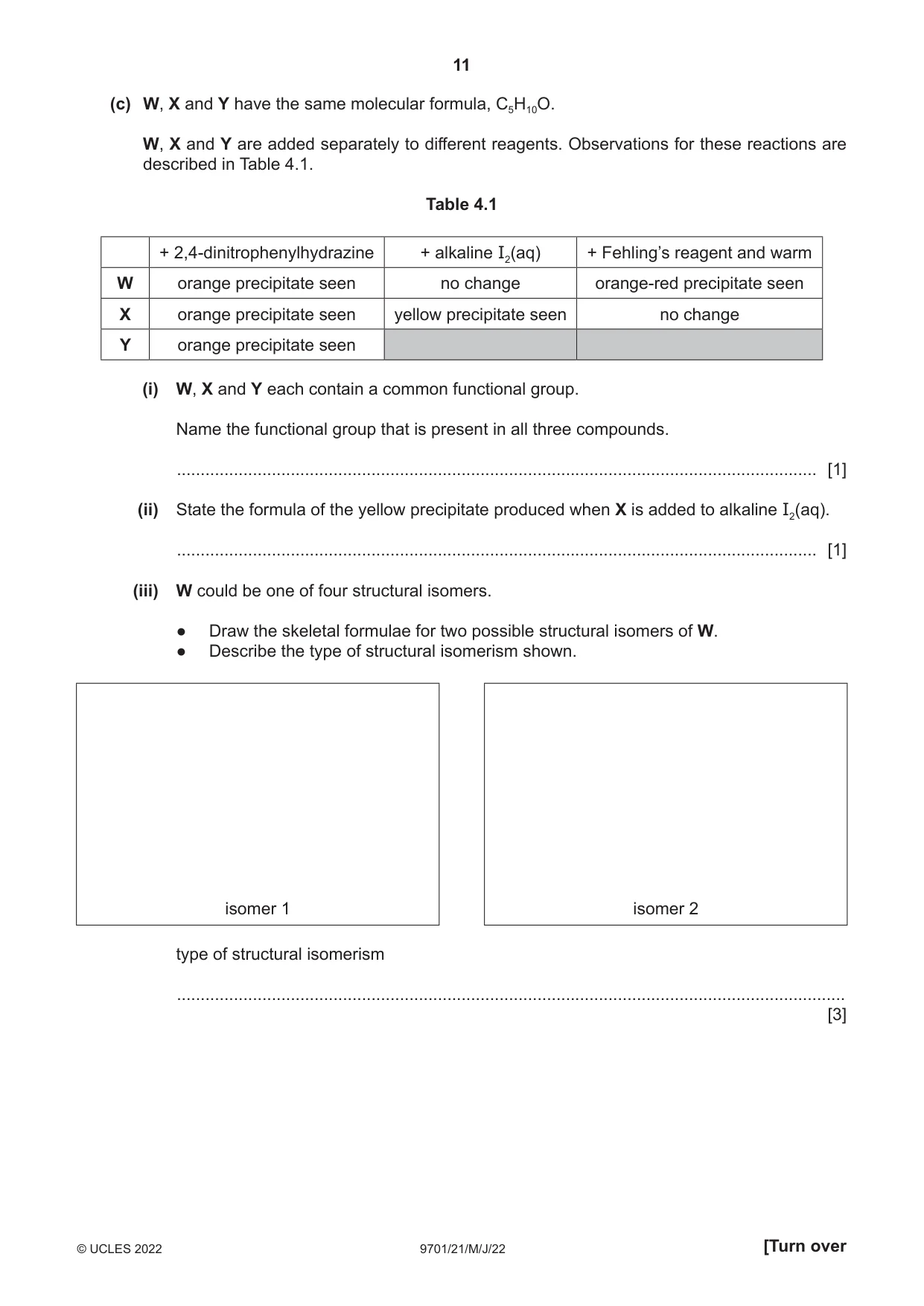
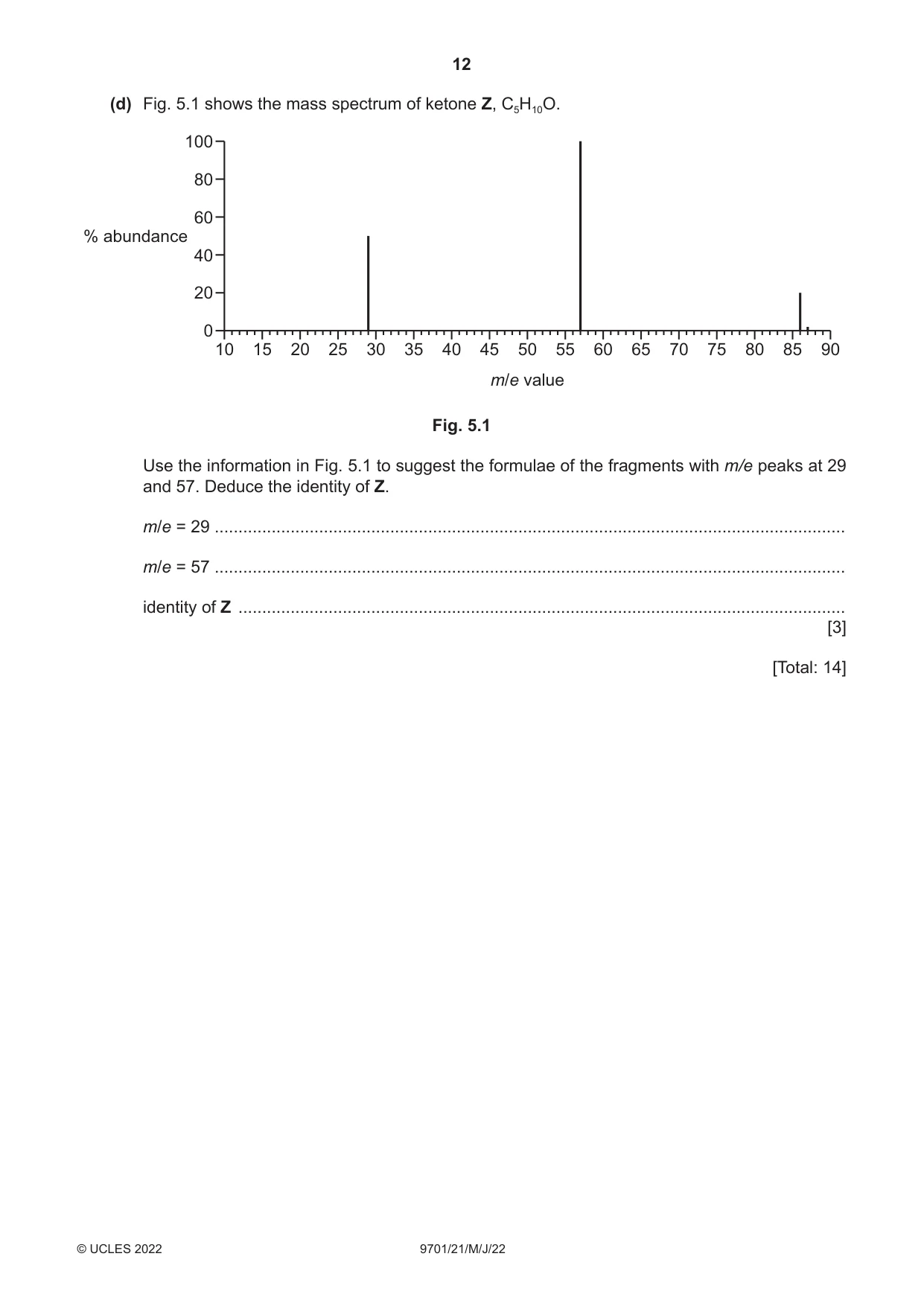
4 Compound V is a liquid. V contains 77.2% carbon, 11.4% hydrogen and 11.4% oxygen by mass. V has a relative molecular mass of 280. (a) Calculate the molecular formula of V. Show your working. molecular formula of V = .............................. [3] (b) V contains two types of functional group: a carboxylic acid and an alkene. (i) Describe a chemical test and observation which confirms the presence of a carboxyl functional group. ............................................................................................................................................. ....................................................................................................................................... [2] (ii) A 3.196 g sample of Br2 reacts completely with 2.800 g of V. Calculate how many alkene functional groups are present in one molecule of V. Show your working. number of alkene functional groups in V = .............................. [1] (c) W, X and Y have the same molecular formula, C5H10O. W, X and Y are added separately to different reagents. Observations for these reactions are described in Table 4.1. Table 4.1 + 2,4-dinitrophenylhydrazine + alkaline I2(aq) + Fehling’s reagent and warm W orange precipitate seen no change orange-red precipitate seen X orange precipitate seen yellow precipitate seen no change Y orange precipitate seen (i) W, X and Y each contain a common functional group. Name the functional group that is present in all three compounds. ....................................................................................................................................... [1] (ii) State the formula of the yellow precipitate produced when X is added to alkaline I2(aq). ....................................................................................................................................... [1] (iii) W could be one of four structural isomers. ● Draw the skeletal formulae for two possible structural isomers of W. ● Describe the type of structural isomerism shown. isomer 1 isomer 2 type of structural isomerism ............................................................................................................................................. [3] (d) Fig. 5.1 shows the mass spectrum of ketone Z, C5H10O. 100 80 60 % abundance 40 20 0 10 15 20 25 30 35 40 45 50 55 60 65 70 75 80 85 90 m/e value Fig. 5.1 Use the information in Fig. 5.1 to suggest the formulae of the fragments with m/e peaks at 29 and 57. Deduce the identity of Z. m/e = 29 ..................................................................................................................................... m/e = 57 ..................................................................................................................................... identity of Z ................................................................................................................................. [3] [Total: 14]
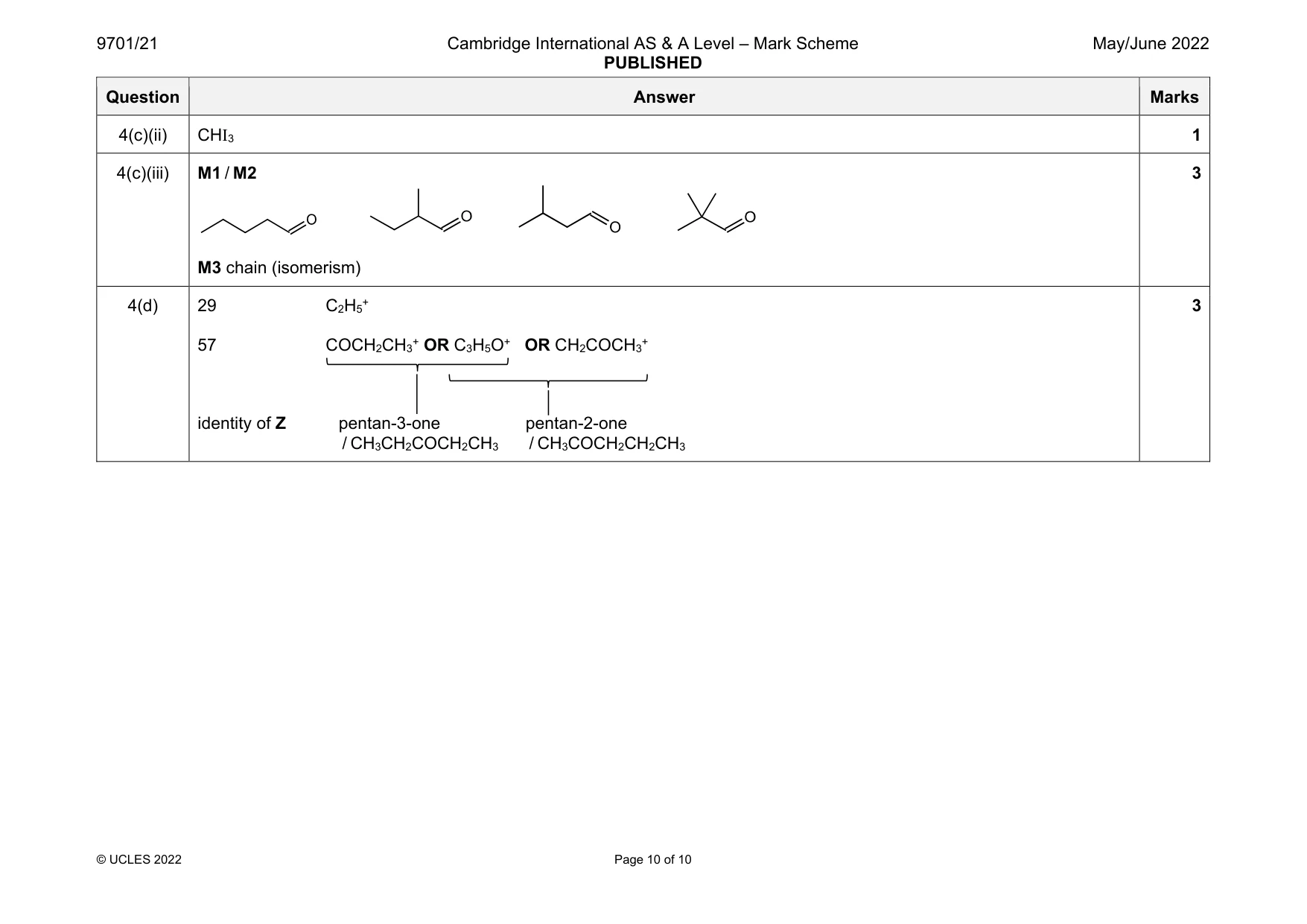
Mark scheme: 4(a) M1 % / Ar for C H O M2 each % / Ar for C H O divided by the smallest value for % / Ar to give simplest whole number ratio / empirical formula M3 compare Mr from M2 ratio with 280 to deduce the actual molecular formula C H O 77.2 / 12 = 6.433 11.4 / 1 = 11.4 11.4 / 16 = 0.7125 9(.03) 16 1 Mr(C9H16O) = 140 so molecular formula of V = C18H32O2 3 4(b)(i) M1 (add) group 1 carbonate / group 1 bicarbonate / Na2CO3 / NaHCO3 etc. M2 effervescence / fizzing / bubbling 2 4(b)(ii) 3.196 g Br2 = 3.196 / 159.8 (= 0.02 mol Br2) AND 2.8(00) / 280 (= 0.01 mol V) 2 alkene / 2 C=C (groups) 1 4(c)(i) carbonyl 1 Question Answer Marks 4(c)(ii) CHI3 1 4(c)(iii) M1 / M2 M3 chain (isomerism) 3 4(d) 29 C2H5+ 57 COCH2CH3+ OR C3H5O+ OR CH2COCH3+ identity of Z pentan-3-one pentan-2-one / CH3CH2COCH2CH3 / CH3COCH2CH2CH3 3
More questions on Reacting masses and volumes (of solutions and gases)
What was in this paper
The subtopics covered by these 4 questions, and how many questions each got. Open one in a new tab to see every Cambridge question on it.
What you needed in this session
Cambridge’s own grade thresholds for 2022 May/June, Paper 2 · Variant 1. A higher threshold means an easier paper — the bar moves with how the cohort did.