Cambridge A Level Chemistry 9701 — 2019 May/June Paper 2 · Variant 2
9701/22/M/J/19 · 5 questions · 60 marks · ≈68 min
The question paper and its mark scheme, free to read here and free to download. This is Cambridge’s own paper, exactly as it was sat.
Question paper12 pages

Mark scheme12 pages
Answers below. Sit the paper first if you are practising.
Questions as text
Q1 · Methylpropane, (CH3)2CHCH3, is an isomer of butane, CH3(CH2)2CH3
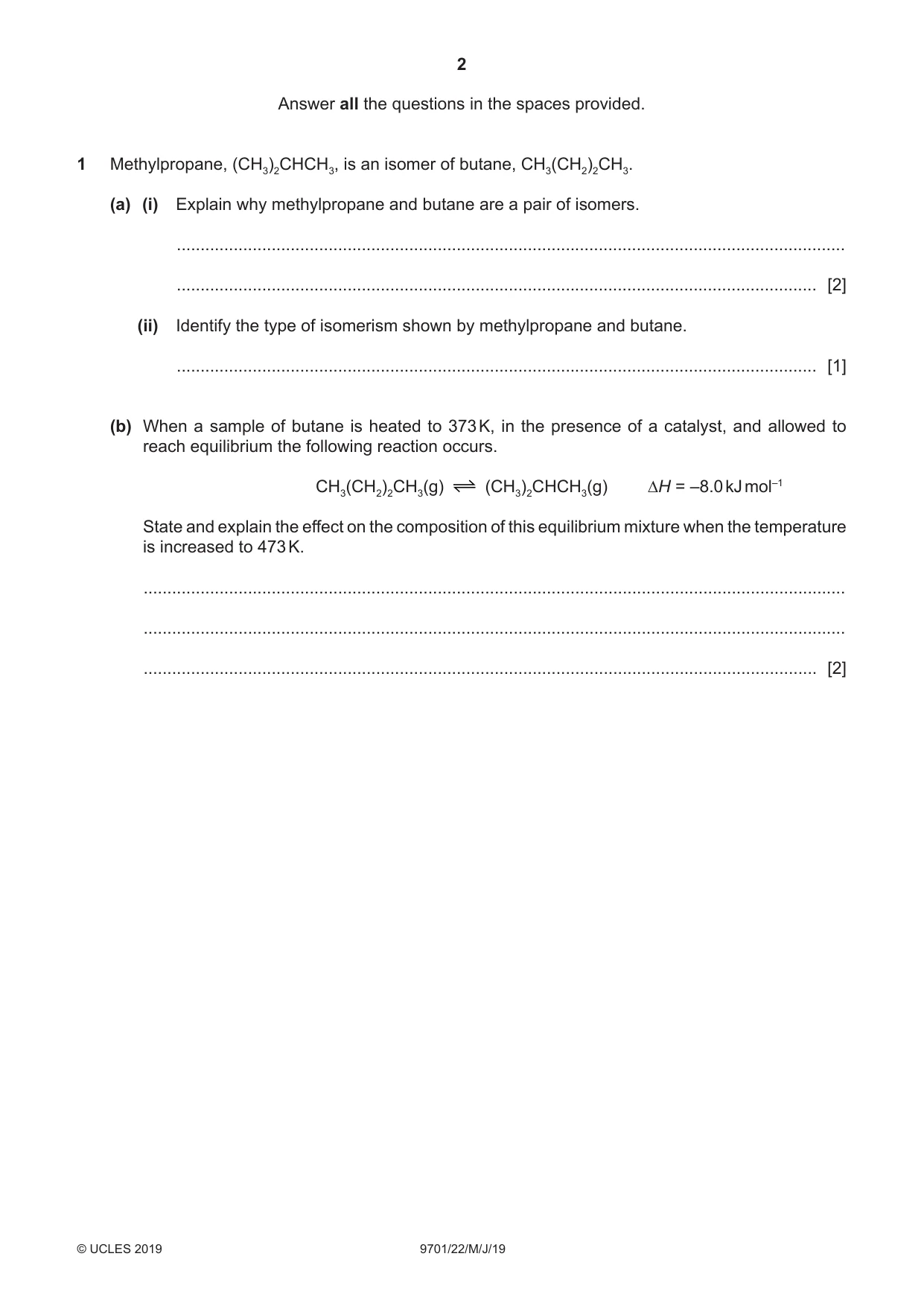
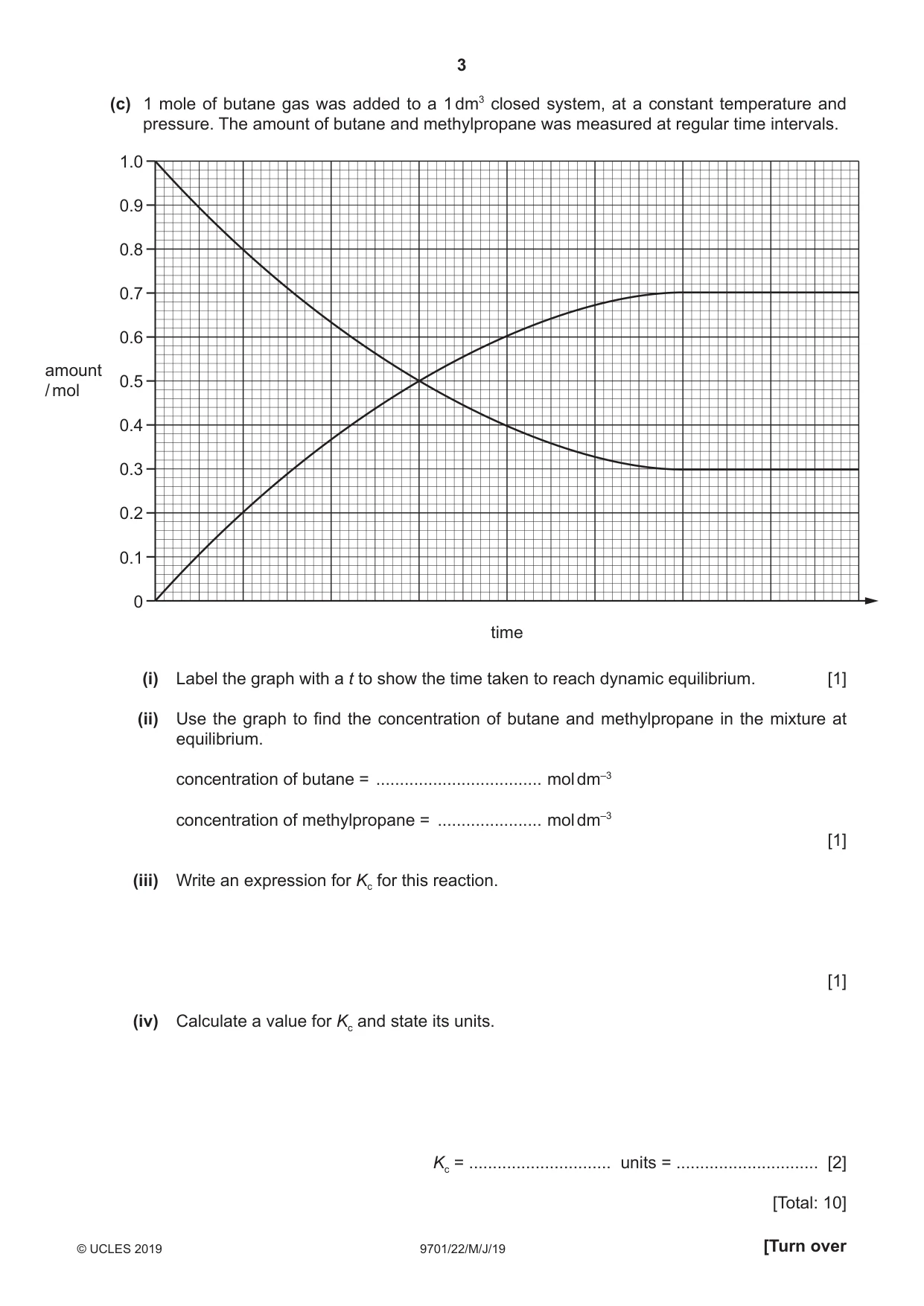
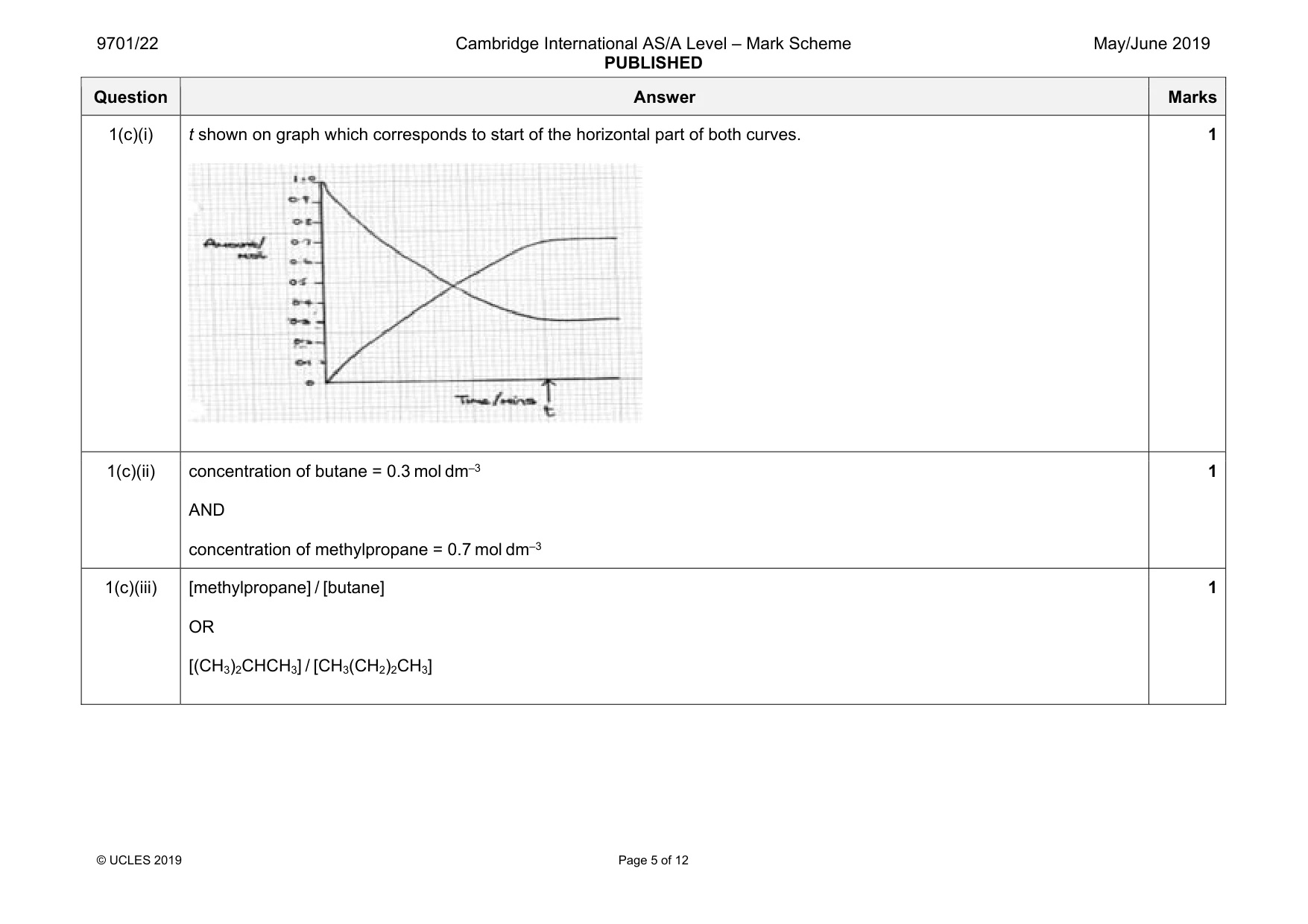
1 Methylpropane, (CH3)2CHCH3, is an isomer of butane, CH3(CH2)2CH3. (a) (i) Explain why methylpropane and butane are a pair of isomers. ............................................................................................................................................. ....................................................................................................................................... [2] (ii) Identify the type of isomerism shown by methylpropane and butane. ....................................................................................................................................... [1] (b) When a sample of butane is heated to 373 K, in the presence of a catalyst, and allowed to reach equilibrium the following reaction occurs. CH3(CH2)2CH3(g) (CH3)2CHCH3(g) ∆H = –8.0 kJ mol–1 State and explain the effect on the composition of this equilibrium mixture when the temperature is increased to 473 K. .................................................................................................................................................... .................................................................................................................................................... .............................................................................................................................................. [2] (c) 1 mole of butane gas was added to a 1 dm3 closed system, at a constant temperature and pressure. The amount of butane and methylpropane was measured at regular time intervals. 1.0 0.9 0.8 0.7 0.6 amount 0.5/ mol 0.4 0.3 0.2 0.1 0 time (i) Label the graph with a t to show the time taken to reach dynamic equilibrium. [1] (ii) Use the graph to find the concentration of butane and methylpropane in the mixture at equilibrium. concentration of butane = .................................... mol dm–3 concentration of methylpropane = ....................... mol dm–3 [1] (iii) Write an expression for Kc for this reaction. [1] (iv) Calculate a value for Kc and state its units. Kc = .............................. units = .............................. [2] [Total: 10]
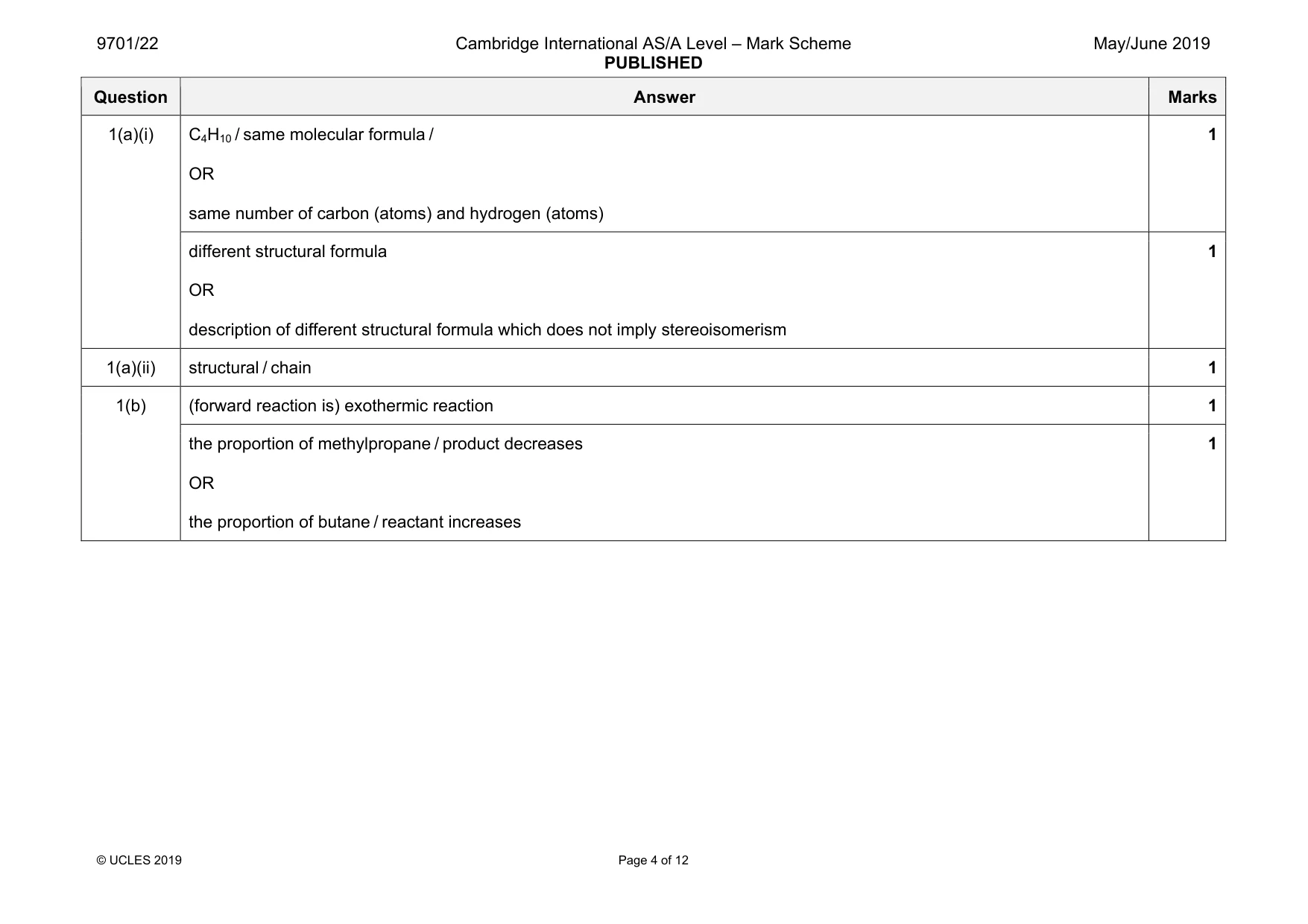
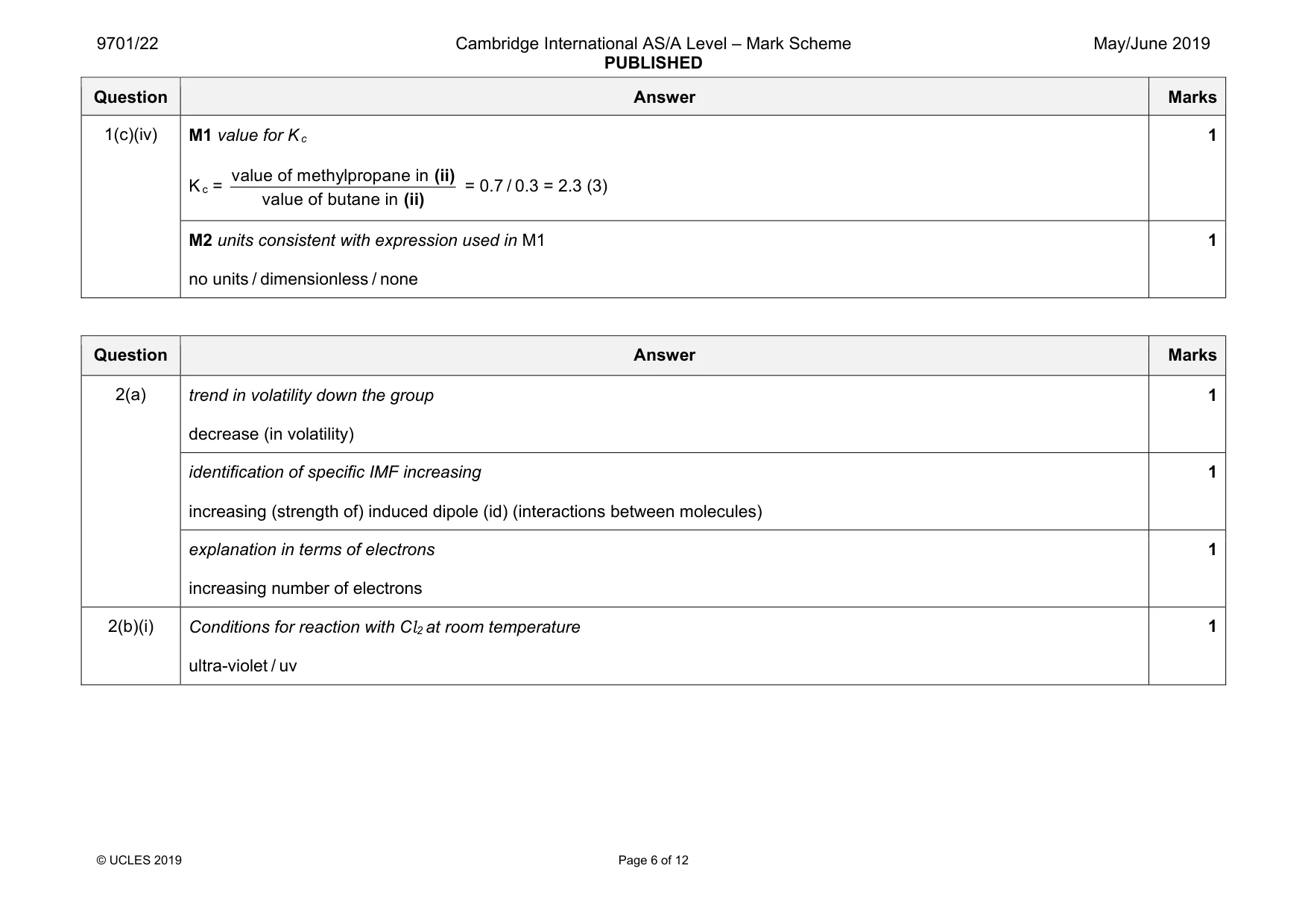
Mark scheme: 1(a)(i) C4H10 / same molecular formula / OR same number of carbon (atoms) and hydrogen (atoms) 1 different structural formula OR description of different structural formula which does not imply stereoisomerism 1 1(a)(ii) structural / chain 1 1(b) (forward reaction is) exothermic reaction 1 the proportion of methylpropane / product decreases OR the proportion of butane / reactant increases 1 Question Answer Marks 1(c)(i) t shown on graph which corresponds to start of the horizontal part of both curves. 1 1(c)(ii) concentration of butane = 0.3 mol dm–3 AND concentration of methylpropane = 0.7 mol dm–3 1 1(c)(iii) [methylpropane] / [butane] OR [(CH3)2CHCH3] / [CH3(CH2)2CH3] 1 Question Answer Marks 1(c)(iv) M1 value for K c K c = value of methylpropane in value of butane in (ii) (ii) = 0.7 / 0.3 = 2.3 (3) 1 M2 units consistent with expression used in M1 no units / dimensionless / none 1
More questions on Chemical equilibria: reversible reactions, dynamic equilibrium
Q2 · Group 17 elements are commonly referred to as the halogens
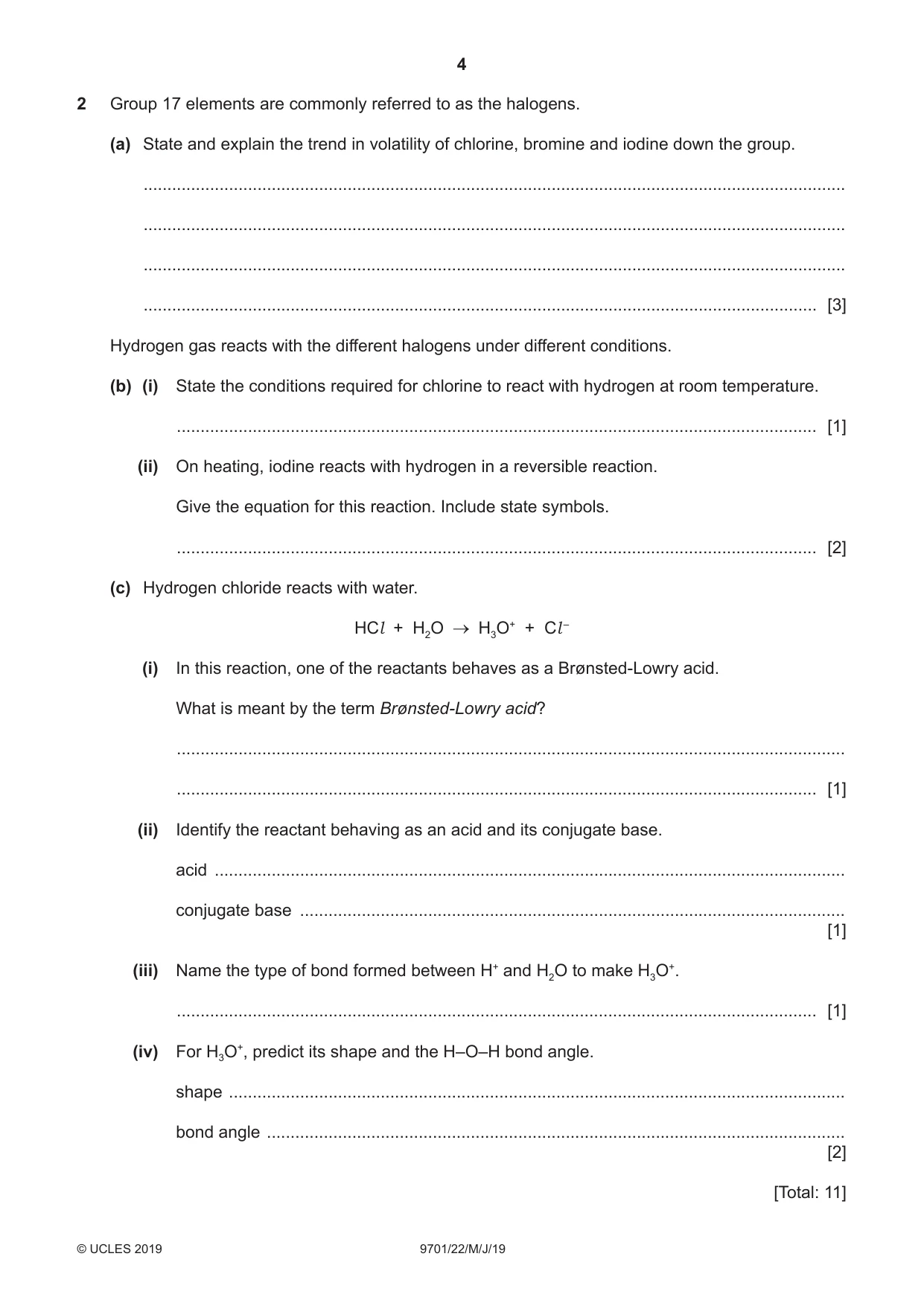
2 Group 17 elements are commonly referred to as the halogens. (a) State and explain the trend in volatility of chlorine, bromine and iodine down the group. .................................................................................................................................................... .................................................................................................................................................... .................................................................................................................................................... .............................................................................................................................................. [3] Hydrogen gas reacts with the different halogens under different conditions. (b) (i) State the conditions required for chlorine to react with hydrogen at room temperature. ....................................................................................................................................... [1] (ii) On heating, iodine reacts with hydrogen in a reversible reaction. Give the equation for this reaction. Include state symbols. ....................................................................................................................................... [2] (c) Hydrogen chloride reacts with water. HCl + H2O H3O+ + Cl – (i) In this reaction, one of the reactants behaves as a Brønsted-Lowry acid. What is meant by the term Brønsted-Lowry acid? ............................................................................................................................................. ....................................................................................................................................... [1] (ii) Identify the reactant behaving as an acid and its conjugate base. acid ...................................................................................................................................... conjugate base .................................................................................................................... [1] (iii) Name the type of bond formed between H+ and H2O to make H3O+. ....................................................................................................................................... [1] (iv) For H3O+, predict its shape and the H–O–H bond angle. shape .................................................................................................................................. bond angle .......................................................................................................................... [2] [Total: 11]
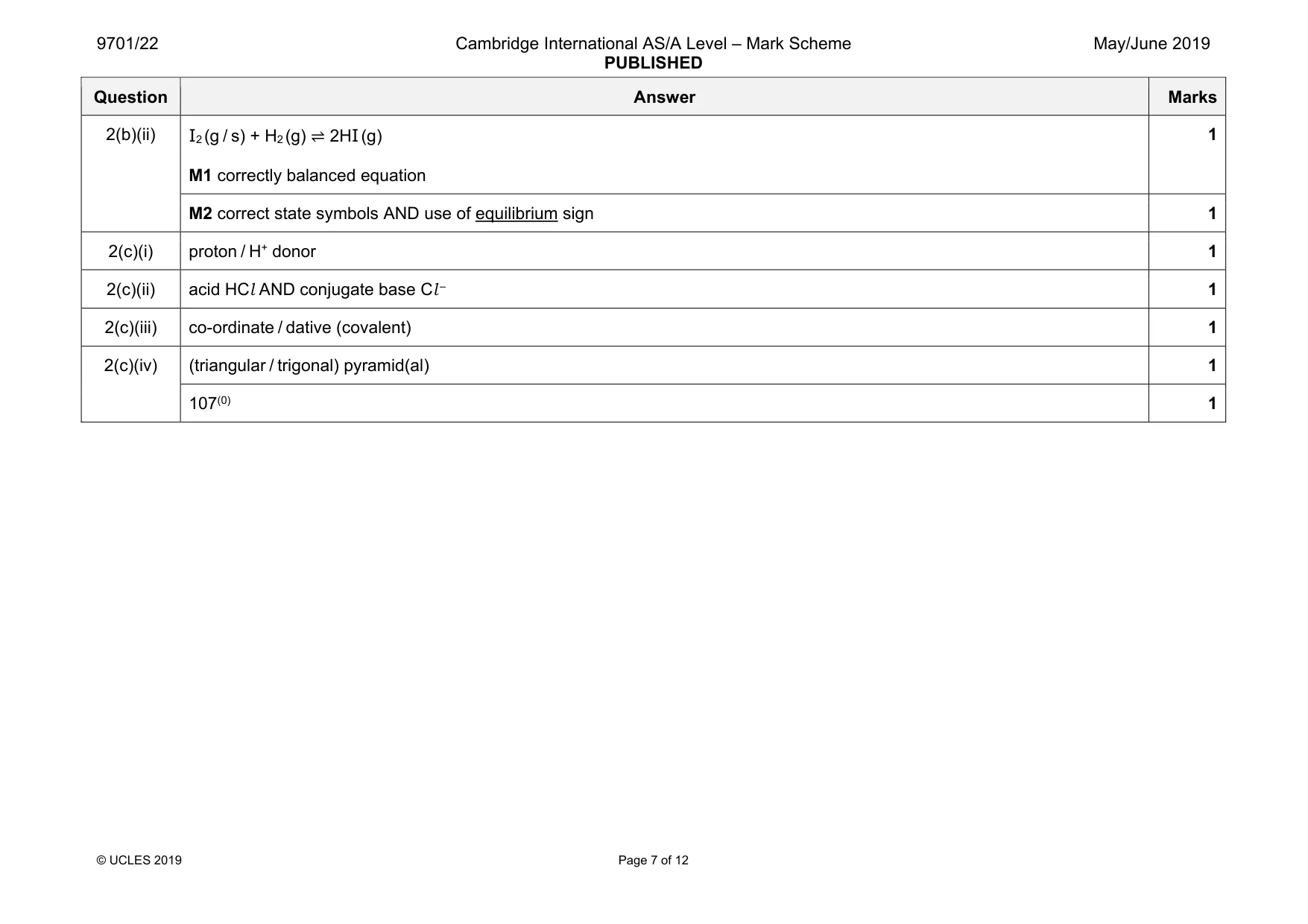
Mark scheme: 2(a) trend in volatility down the group decrease (in volatility) 1 identification of specific IMF increasing increasing (strength of) induced dipole (id) (interactions between molecules) 1 explanation in terms of electrons increasing number of electrons 1 2(b)(i) Conditions for reaction with Cl2 at room temperature ultra-violet / uv 1 Question Answer Marks 2(b)(ii) I2 (g / s) + H2 (g) ⇌ 2HI (g) M1 correctly balanced equation 1 M2 correct state symbols AND use of equilibrium sign 1 2(c)(i) proton / H+ donor 1 2(c)(ii) acid HCl AND conjugate base Cl – 1 2(c)(iii) co-ordinate / dative (covalent) 1 2(c)(iv) (triangular / trigonal) pyramid(al) 1 107(0) 1
Q3 · Period 3 elements react with chlorine gas, Cl 2(g), to form chlorides
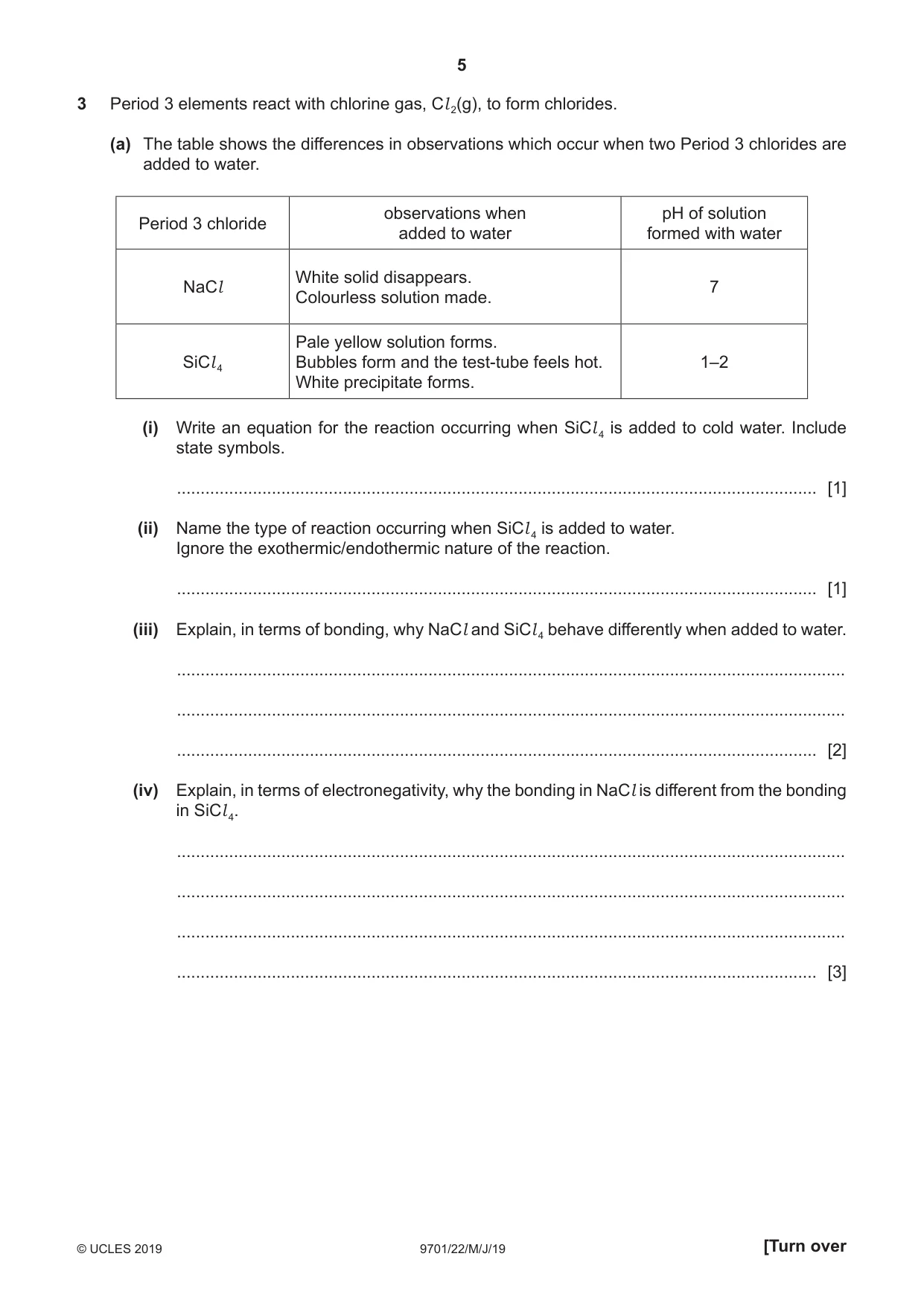
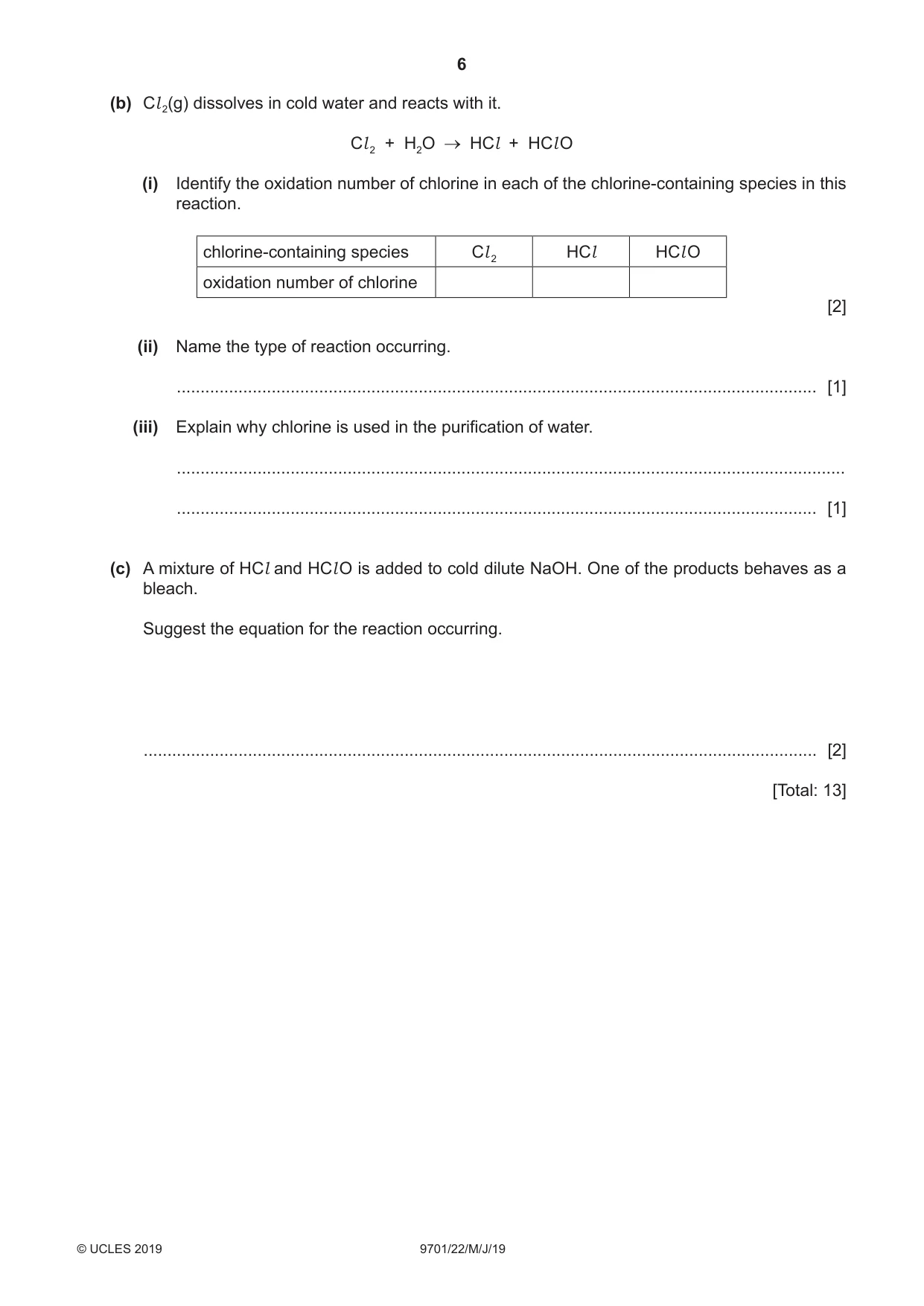
3 Period 3 elements react with chlorine gas, Cl 2(g), to form chlorides. (a) The table shows the differences in observations which occur when two Period 3 chlorides are added to water. observations when pH of solution Period 3 chloride added to water formed with water White solid disappears. NaCl 7 Colourless solution made. Pale yellow solution forms. SiCl 4 Bubbles form and the test-tube feels hot. 1–2 White precipitate forms. (i) Write an equation for the reaction occurring when SiCl 4 is added to cold water. Include state symbols. ....................................................................................................................................... [1] (ii) Name the type of reaction occurring when SiCl 4 is added to water. Ignore the exothermic/endothermic nature of the reaction. ....................................................................................................................................... [1] (iii) Explain, in terms of bonding, why NaCl and SiCl 4 behave differently when added to water. ............................................................................................................................................. ............................................................................................................................................. ....................................................................................................................................... [2] (iv) Explain, in terms of electronegativity, why the bonding in NaCl is different from the bonding in SiCl 4. ............................................................................................................................................. ............................................................................................................................................. ............................................................................................................................................. ....................................................................................................................................... [3] (b) Cl 2(g) dissolves in cold water and reacts with it. Cl 2 + H2O HCl + HCl O (i) Identify the oxidation number of chlorine in each of the chlorine‑containing species in this reaction. chlorine-containing species Cl 2 HCl HCl O oxidation number of chlorine [2] (ii) Name the type of reaction occurring. ....................................................................................................................................... [1] (iii) Explain why chlorine is used in the purification of water. ............................................................................................................................................. ....................................................................................................................................... [1] (c) A mixture of HCl and HCl O is added to cold dilute NaOH. One of the products behaves as a bleach. Suggest the equation for the reaction occurring. .............................................................................................................................................. [2] [Total: 13]
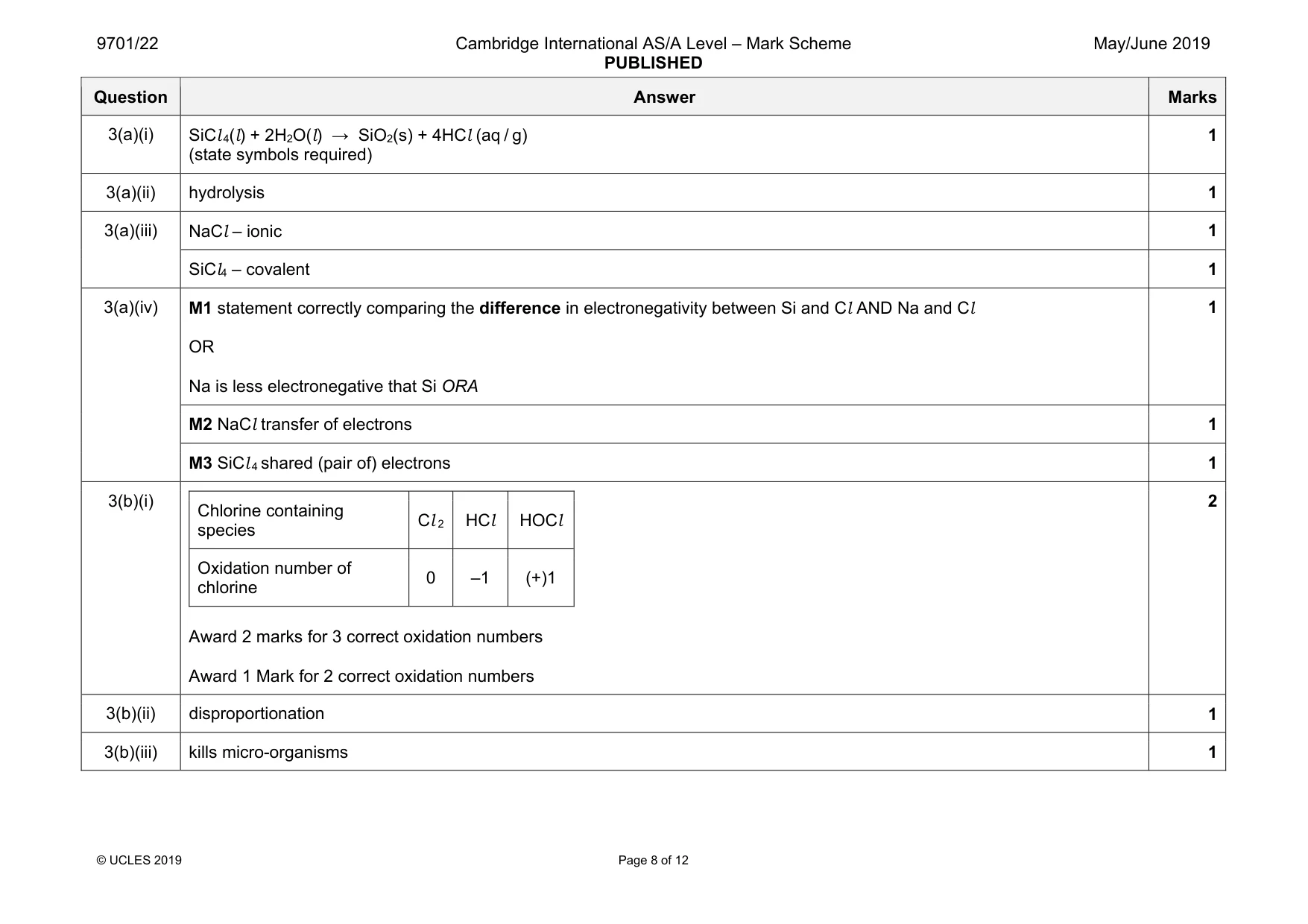
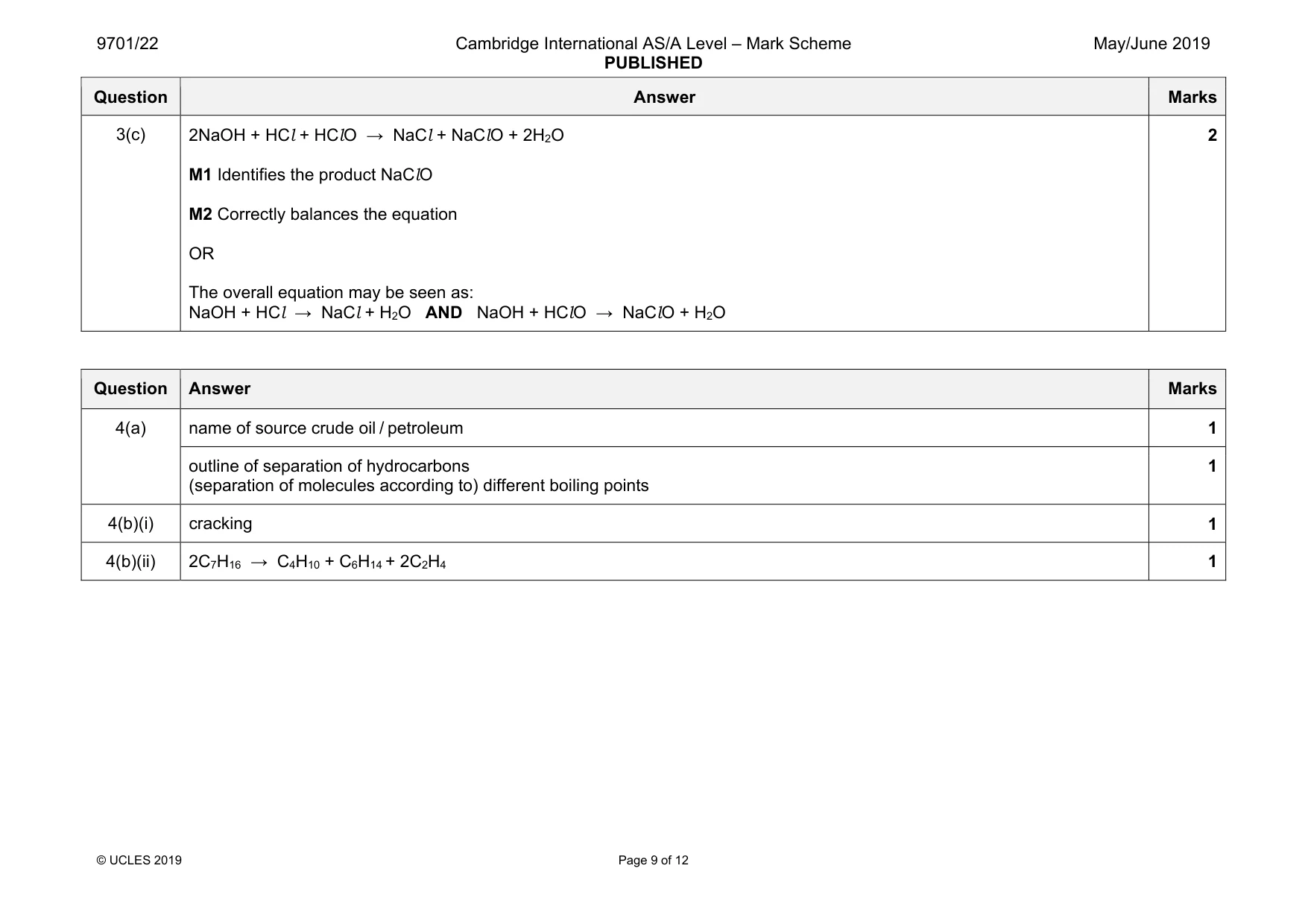
Mark scheme: 3(a)(i) (state symbols required) 1 3(a)(ii) hydrolysis 1 3(a)(iii) NaCl – ionic 1 SiCl4 – covalent 1 3(a)(iv) M1 statement correctly comparing the difference in electronegativity between Si and Cl AND Na and Cl OR Na is less electronegative that Si ORA 1 M2 NaCl transfer of electrons 1 M3 SiCl 4 shared (pair of) electrons 1 3(b)(i) Chlorine containing species Cl 2 HCl HOCl Oxidation number of chlorine 0 –1 (+)1 Award 2 marks for 3 correct oxidation numbers Award 1 Mark for 2 correct oxidation numbers 2 3(b)(ii) disproportionation 1 3(b)(iii) kills micro-organisms 1 Question Answer Marks 3(c) 2NaOH + HCl + HClO → NaCl + NaClO + 2H2O M1 Identifies the product NaClO M2 Correctly balances the equation OR The overall equation may be seen as: NaOH + HCl → NaCl + H2O AND NaOH + HClO → NaClO + H2O 2
More questions on Periodicity of chemical properties of the elements in Period 3
Q4 · There are many different types of aliphatic and aromatic hydrocarbons
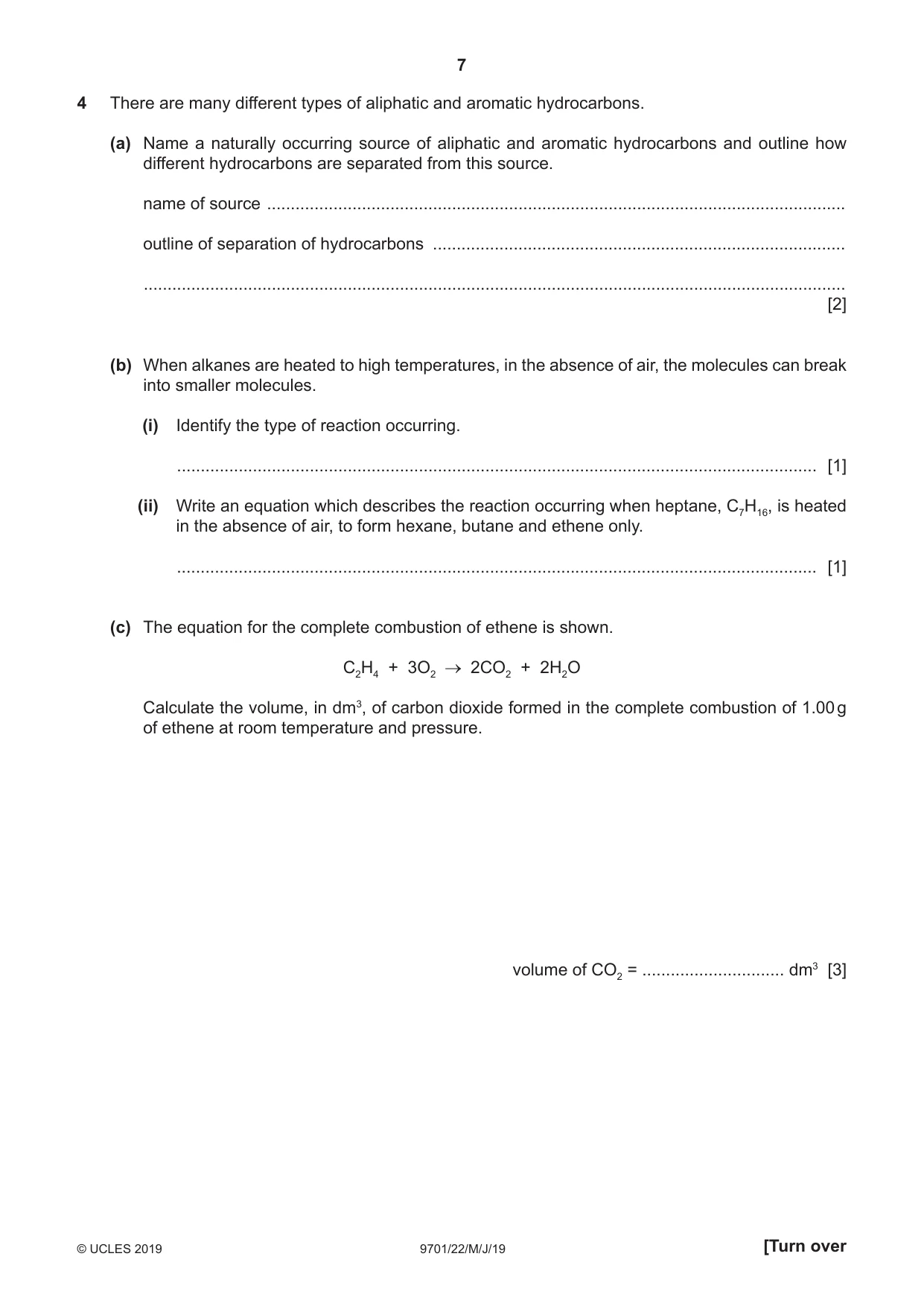
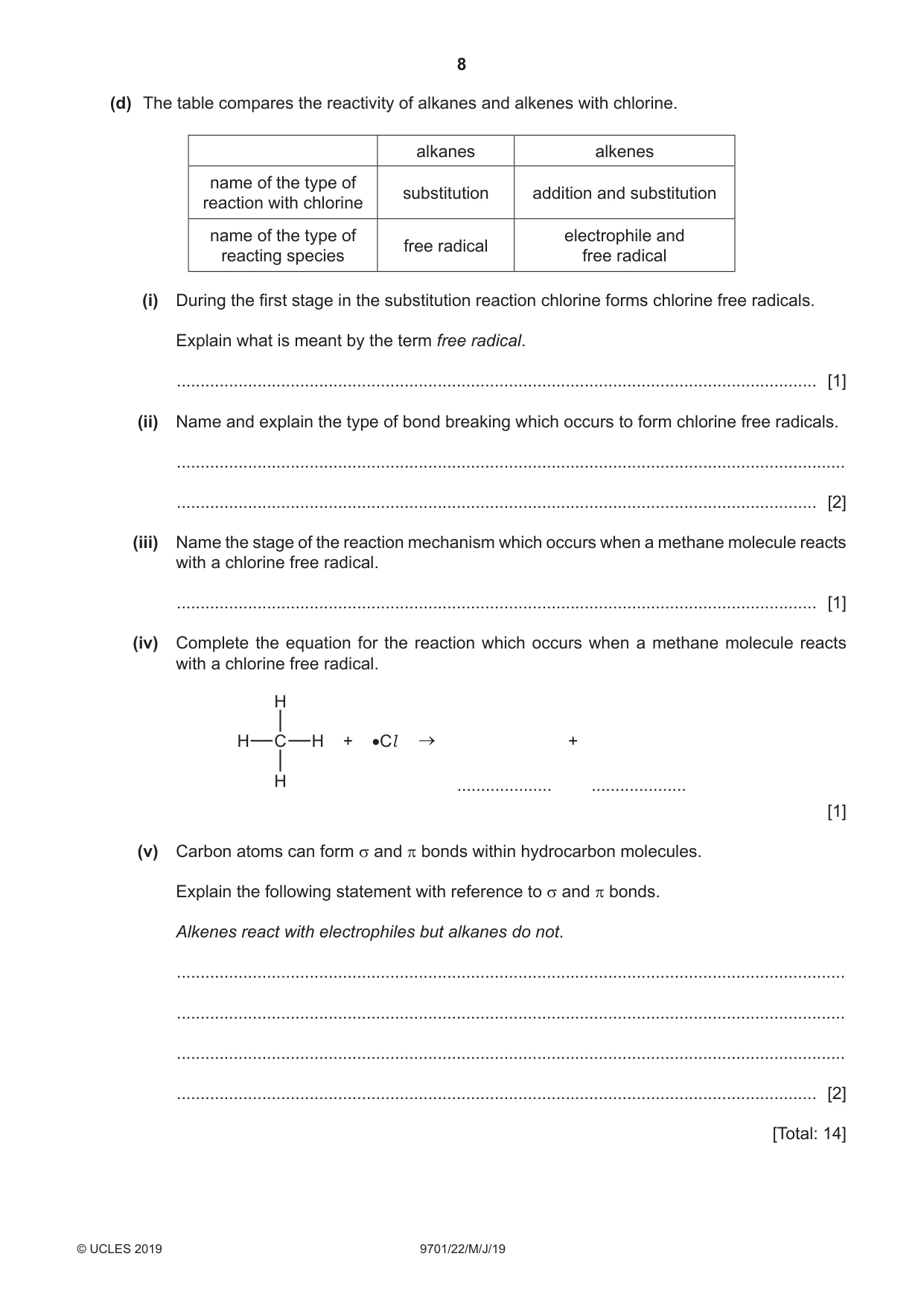
4 There are many different types of aliphatic and aromatic hydrocarbons. (a) Name a naturally occurring source of aliphatic and aromatic hydrocarbons and outline how different hydrocarbons are separated from this source. name of source .......................................................................................................................... outline of separation of hydrocarbons ........................................................................................ .................................................................................................................................................... [2] (b) When alkanes are heated to high temperatures, in the absence of air, the molecules can break into smaller molecules. (i) Identify the type of reaction occurring. ....................................................................................................................................... [1] (ii) Write an equation which describes the reaction occurring when heptane, C7H16, is heated in the absence of air, to form hexane, butane and ethene only. ....................................................................................................................................... [1] (c) The equation for the complete combustion of ethene is shown. C2H4 + 3O2 2CO2 + 2H2O Calculate the volume, in dm3, of carbon dioxide formed in the complete combustion of 1.00 g of ethene at room temperature and pressure. volume of CO2 = .............................. dm3 [3] (d) The table compares the reactivity of alkanes and alkenes with chlorine. alkanes alkenes name of the type of substitution addition and substitution reaction with chlorine name of the type of electrophile and free radical reacting species free radical (i) During the first stage in the substitution reaction chlorine forms chlorine free radicals. Explain what is meant by the term free radical. ....................................................................................................................................... [1] (ii) Name and explain the type of bond breaking which occurs to form chlorine free radicals. ............................................................................................................................................. ....................................................................................................................................... [2] (iii) Name the stage of the reaction mechanism which occurs when a methane molecule reacts with a chlorine free radical. ....................................................................................................................................... [1] (iv) Complete the equation for the reaction which occurs when a methane molecule reacts with a chlorine free radical. H H C H + •Cl + H .................... .................... [1] (v) Carbon atoms can form σ and π bonds within hydrocarbon molecules. Explain the following statement with reference to σ and π bonds. Alkenes react with electrophiles but alkanes do not. ............................................................................................................................................. ............................................................................................................................................. ............................................................................................................................................. ....................................................................................................................................... [2] [Total: 14]
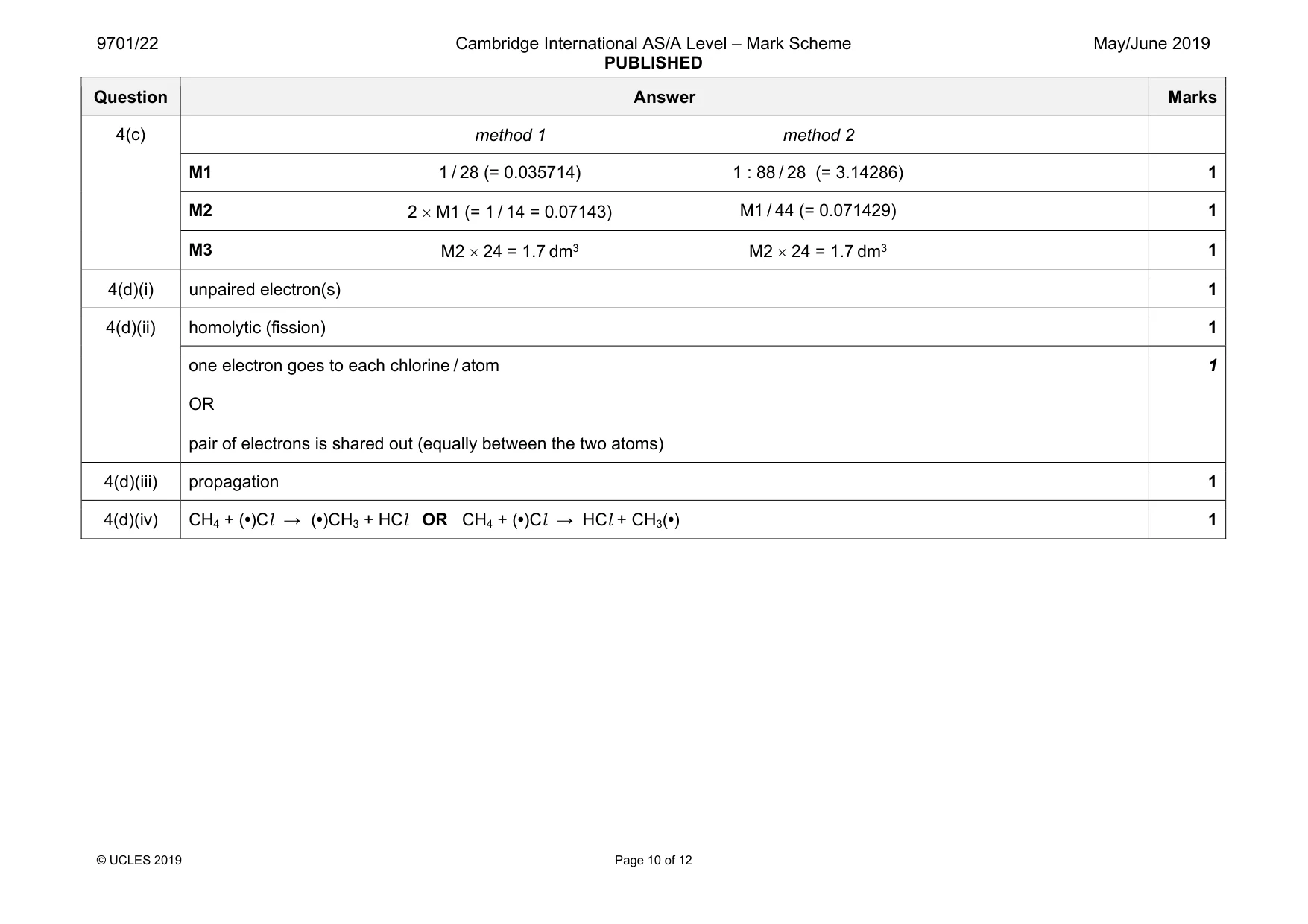
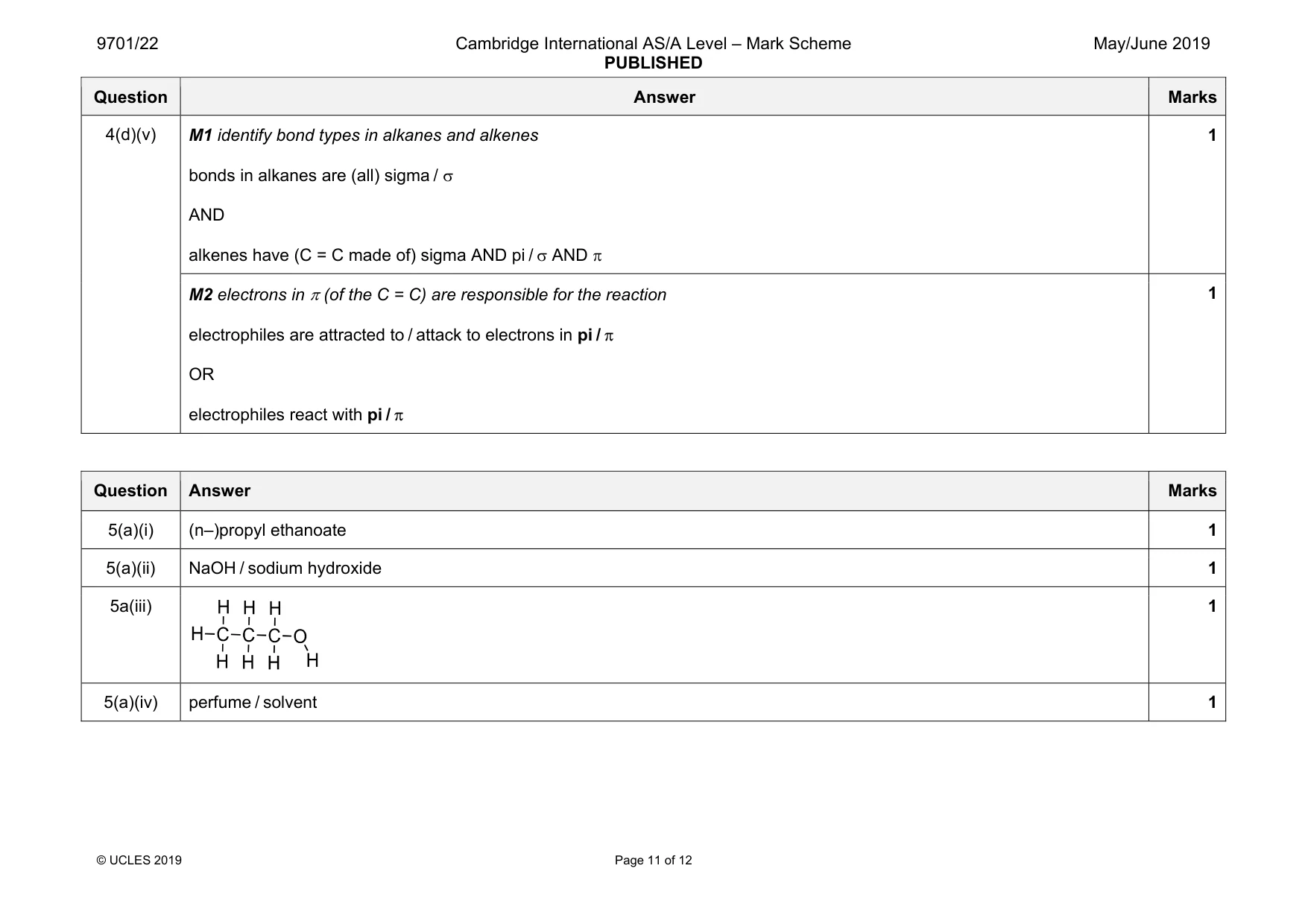
Mark scheme: 4(a) name of source crude oil / petroleum 1 outline of separation of hydrocarbons (separation of molecules according to) different boiling points 1 4(b)(i) cracking 1 4(b)(ii) 2C7H16 → C4H10 + C6H14 + 2C2H4 1 Question Answer Marks 4(c) method 1 method 2 M1 1 / 28 (= 0.035714) 1 : 88 / 28 (= 3.14286) 1 M2 2 × M1 (= 1 / 14 = 0.07143) M1 / 44 (= 0.071429) 1 M3 M2 × 24 = 1.7 dm3 M2 × 24 = 1.7 dm3 1 4(d)(i) unpaired electron(s) 1 4(d)(ii) homolytic (fission) 1 one electron goes to each chlorine / atom OR pair of electrons is shared out (equally between the two atoms) 1 4(d)(iii) propagation 1 4(d)(iv) CH4 + (•)Cl → (•)CH3 + HCl OR CH4 + (•)Cl → HCl + CH3(•) 1 Question Answer Marks 4(d)(v) M1 identify bond types in alkanes and alkenes bonds in alkanes are (all) sigma / σ AND alkenes have (C = C made of) sigma AND pi / σ AND π 1 M2 electrons in π (of the C = C) are responsible for the reaction electrophiles are attracted to / attack to electrons in pi / π OR electrophiles react with pi / π 1
Q5 · Many naturally occurring esters are used as flavourings in food
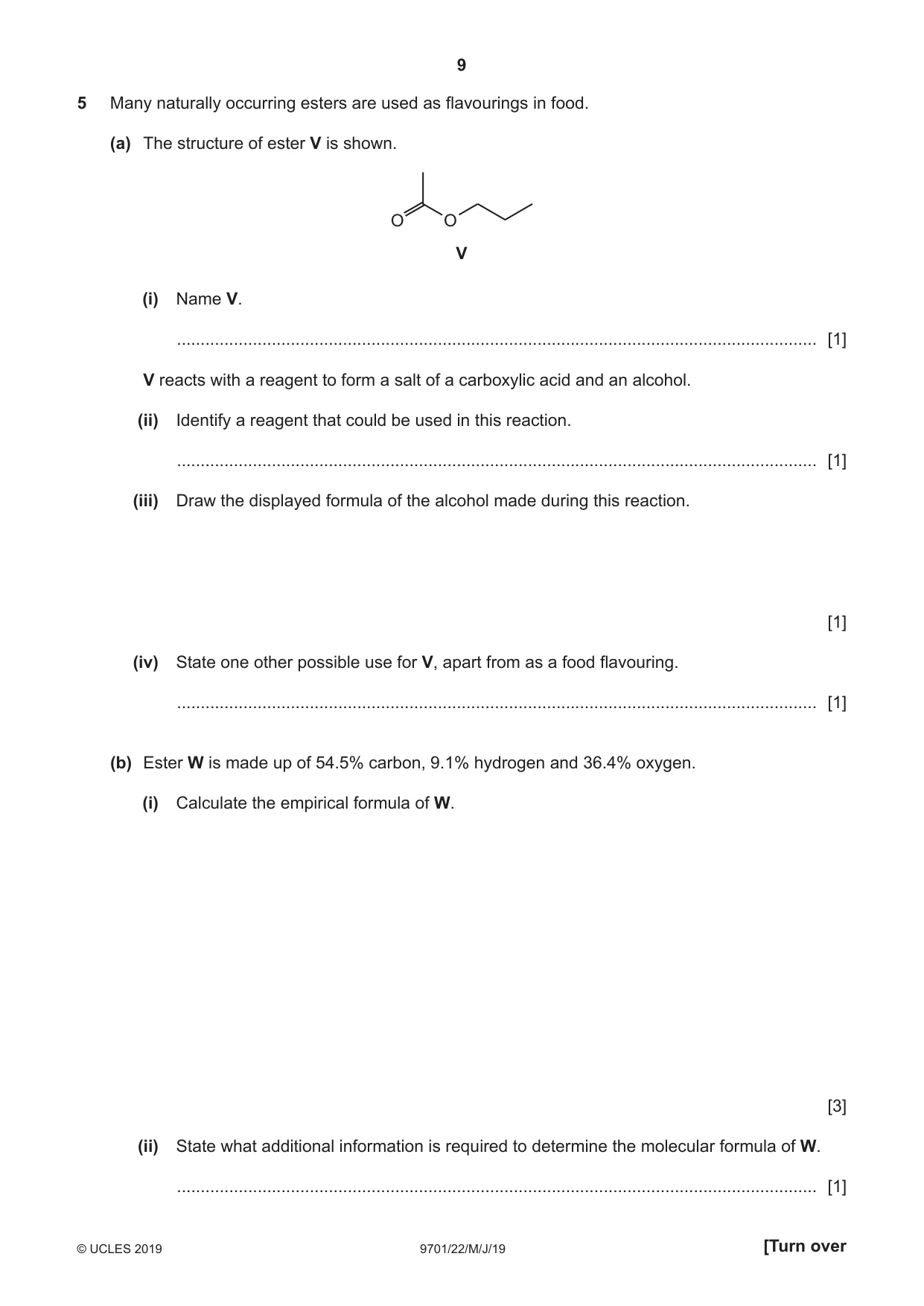
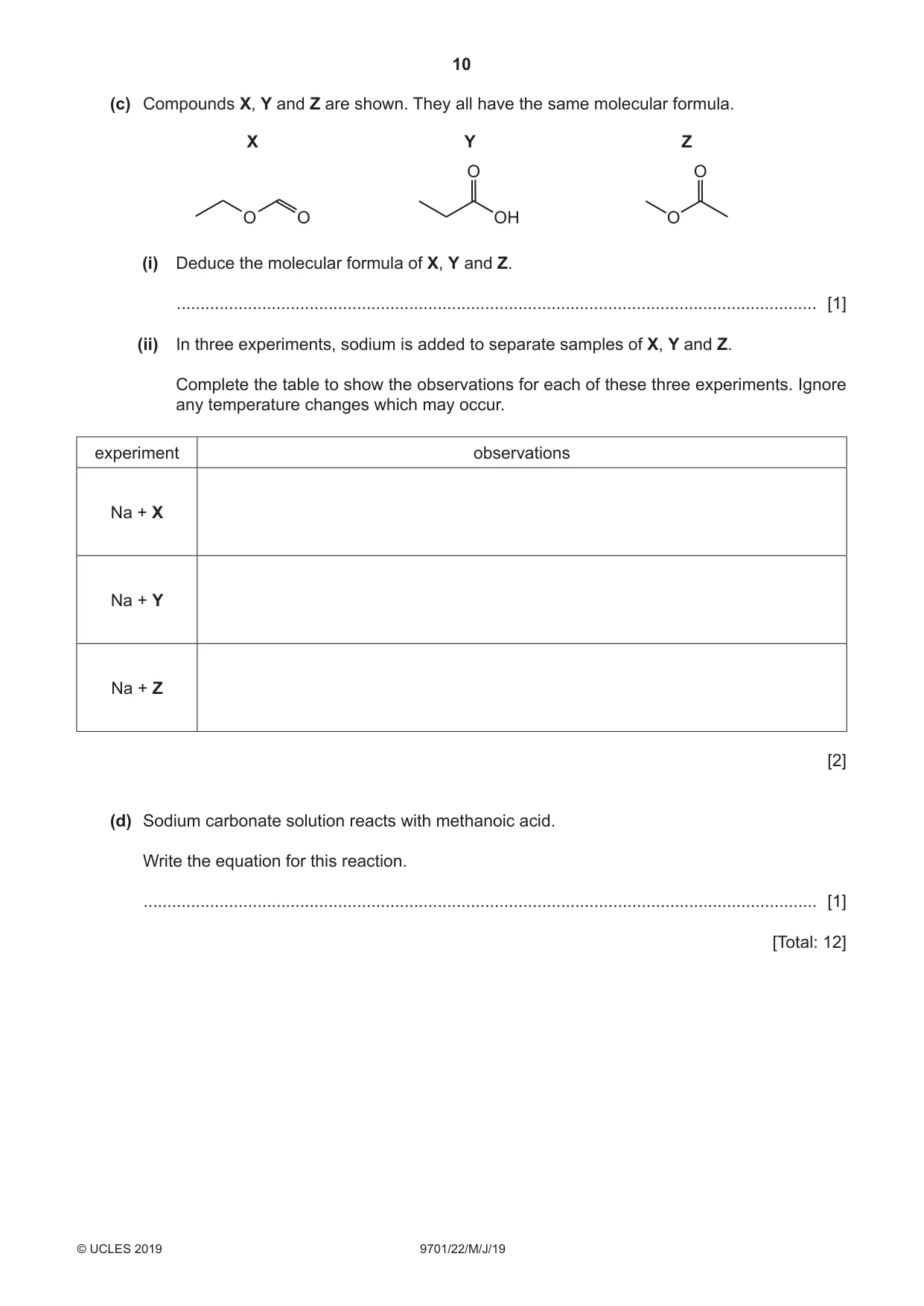
5 Many naturally occurring esters are used as flavourings in food. (a) The structure of ester V is shown. O O V (i) Name V. ....................................................................................................................................... [1] V reacts with a reagent to form a salt of a carboxylic acid and an alcohol. (ii) Identify a reagent that could be used in this reaction. ....................................................................................................................................... [1] (iii) Draw the displayed formula of the alcohol made during this reaction. [1] (iv) State one other possible use for V, apart from as a food flavouring. ....................................................................................................................................... [1] (b) Ester W is made up of 54.5% carbon, 9.1% hydrogen and 36.4% oxygen. (i) Calculate the empirical formula of W. [3] (ii) State what additional information is required to determine the molecular formula of W. ....................................................................................................................................... [1] (c) Compounds X, Y and Z are shown. They all have the same molecular formula. X Y Z O O O O OH O (i) Deduce the molecular formula of X, Y and Z. ....................................................................................................................................... [1] (ii) In three experiments, sodium is added to separate samples of X, Y and Z. Complete the table to show the observations for each of these three experiments. Ignore any temperature changes which may occur. experiment observations Na + X Na + Y Na + Z [2] (d) Sodium carbonate solution reacts with methanoic acid. Write the equation for this reaction. .............................................................................................................................................. [1] [Total: 12]
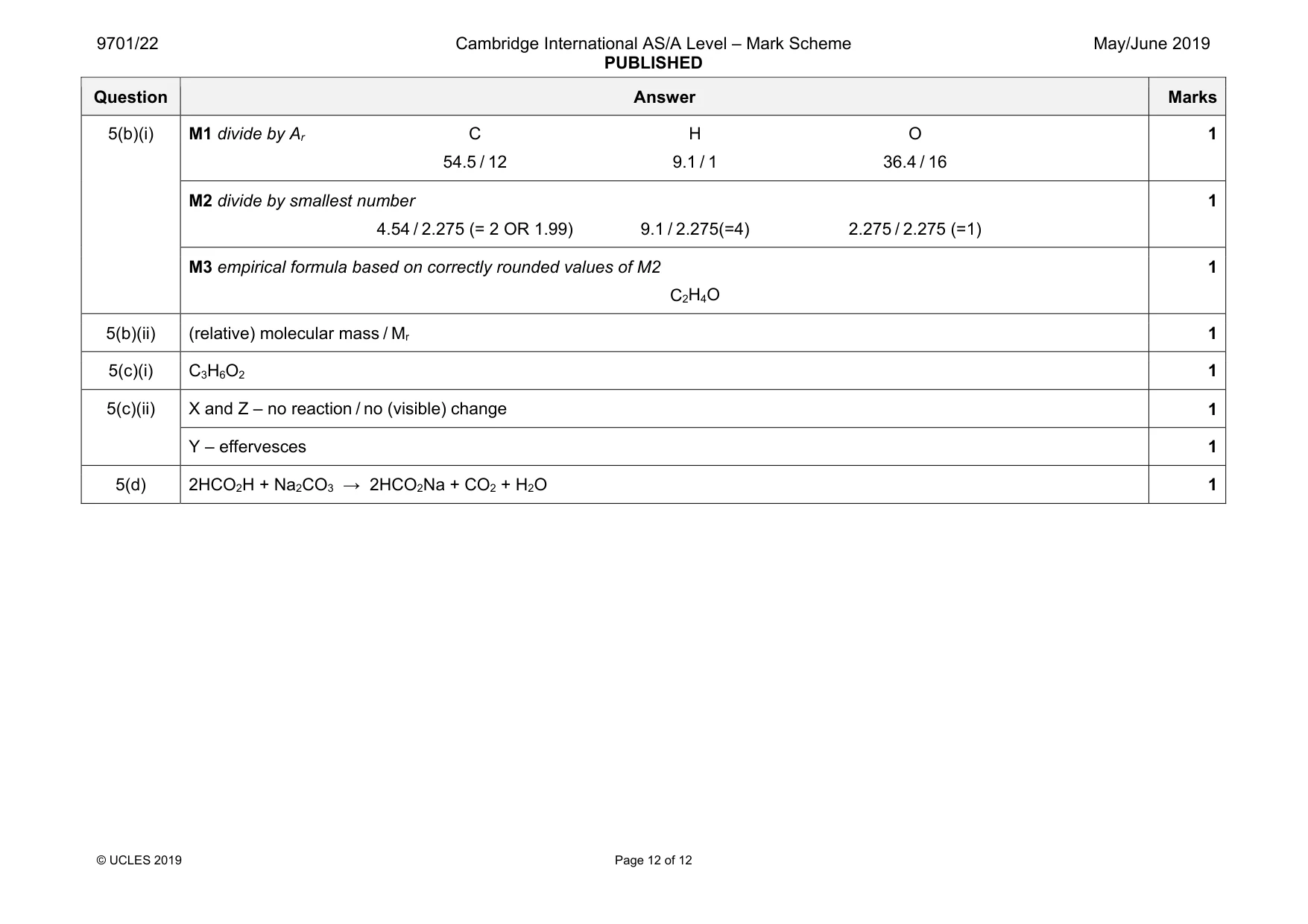
Mark scheme: 5(a)(i) (n–)propyl ethanoate 1 5(a)(ii) NaOH / sodium hydroxide 1 5a(iii) 1 5(a)(iv) perfume / solvent 1 Question Answer Marks 5(b)(i) M1 divide by Ar C H O 54.5 / 12 9.1 / 1 36.4 / 16 1 M2 divide by smallest number 4.54 / 2.275 (= 2 OR 1.99) 9.1 / 2.275(=4) 2.275 / 2.275 (=1) 1 M3 empirical formula based on correctly rounded values of M2 C2H4O 1 5(b)(ii) (relative) molecular mass / Mr 1 5(c)(i) C3H6O2 1 5(c)(ii) X and Z – no reaction / no (visible) change 1 Y – effervesces 1 5(d) 2HCO2H + Na2CO3 → 2HCO2Na + CO2 + H2O 1
What was in this paper
The subtopics covered by these 5 questions, and how many questions each got. Open one in a new tab to see every Cambridge question on it.
What you needed in this session
Cambridge’s own grade thresholds for 2019 May/June, Paper 2 · Variant 2. A higher threshold means an easier paper — the bar moves with how the cohort did.