Cambridge A Level Chemistry 9701 — 2019 May/June Paper 2 · Variant 1
9701/21/M/J/19 · 5 questions · 60 marks · ≈68 min
The question paper and its mark scheme, free to read here and free to download. This is Cambridge’s own paper, exactly as it was sat.
Question paper12 pages

Mark scheme9 pages
Answers below. Sit the paper first if you are practising.
Questions as text
Q1 · Group 2 elements share common chemical properties
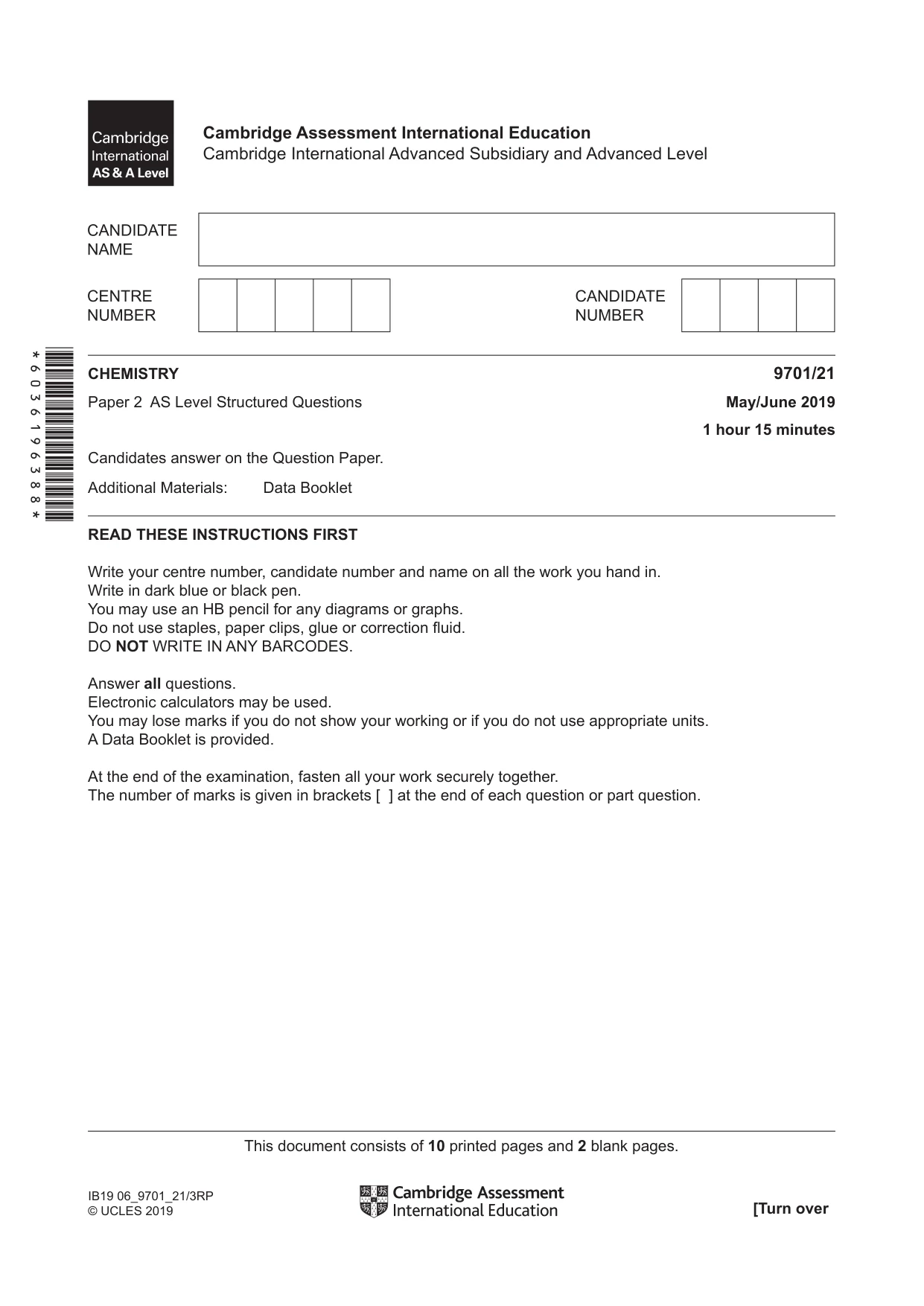
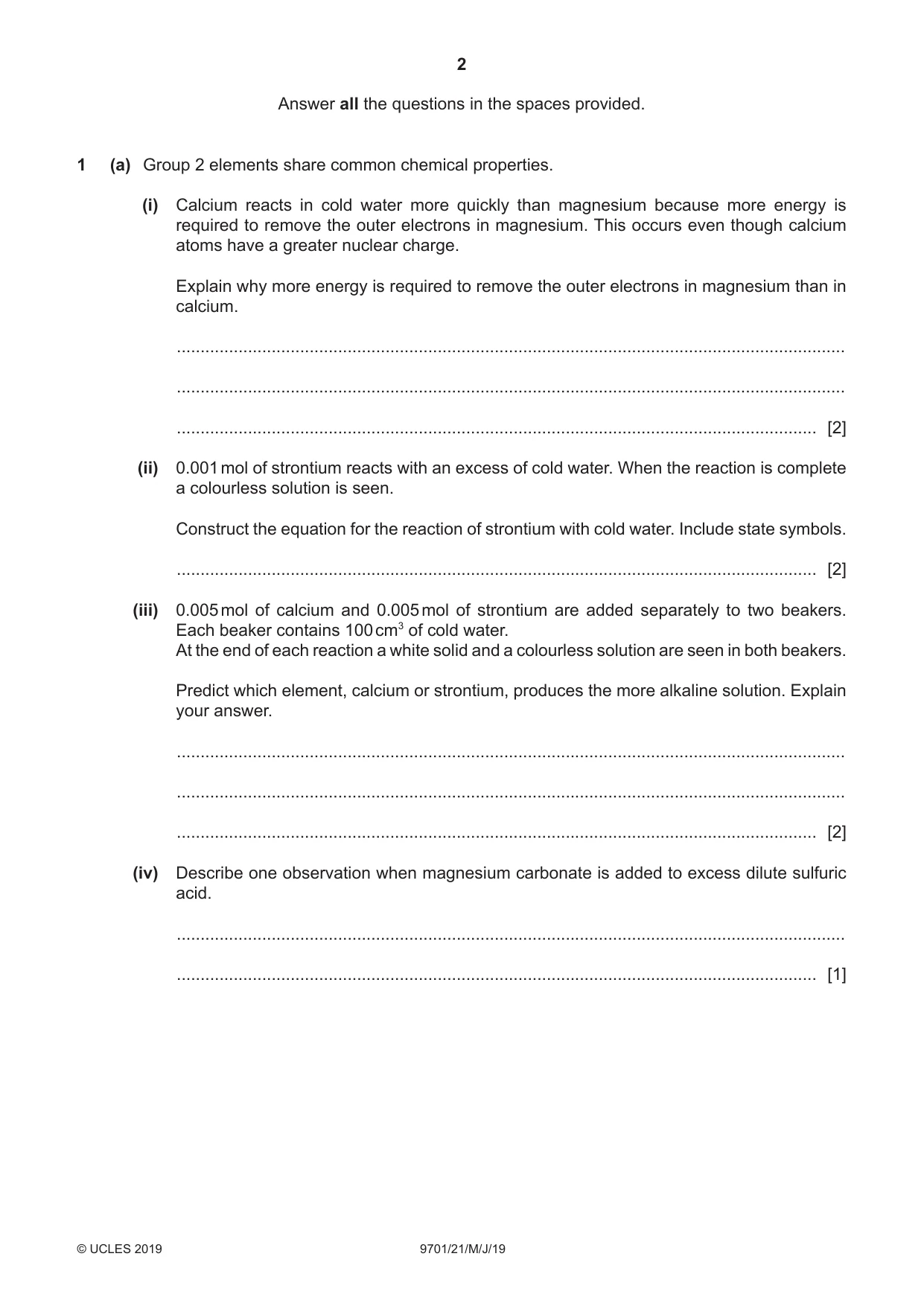
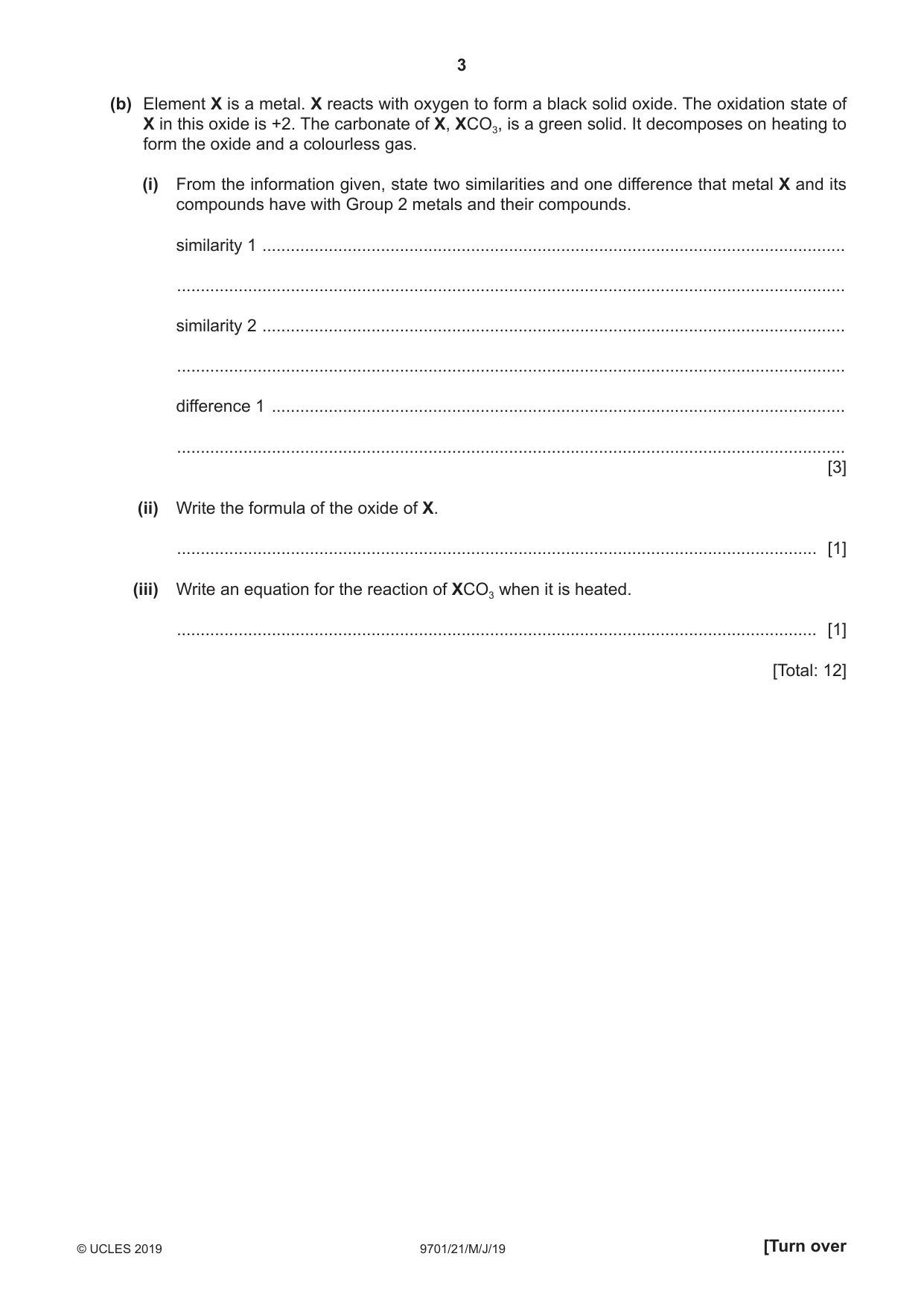
1 (a) Group 2 elements share common chemical properties. (i) Calcium reacts in cold water more quickly than magnesium because more energy is required to remove the outer electrons in magnesium. This occurs even though calcium atoms have a greater nuclear charge. Explain why more energy is required to remove the outer electrons in magnesium than in calcium. ............................................................................................................................................. ............................................................................................................................................. ....................................................................................................................................... [2] (ii) 0.001 mol of strontium reacts with an excess of cold water. When the reaction is complete a colourless solution is seen. Construct the equation for the reaction of strontium with cold water. Include state symbols. ....................................................................................................................................... [2] (iii) 0.005 mol of calcium and 0.005 mol of strontium are added separately to two beakers. Each beaker contains 100 cm3 of cold water. At the end of each reaction a white solid and a colourless solution are seen in both beakers. Predict which element, calcium or strontium, produces the more alkaline solution. Explain your answer. ............................................................................................................................................. ............................................................................................................................................. ....................................................................................................................................... [2] (iv) Describe one observation when magnesium carbonate is added to excess dilute sulfuric acid. ............................................................................................................................................. ....................................................................................................................................... [1] (b) Element X is a metal. X reacts with oxygen to form a black solid oxide. The oxidation state of X in this oxide is +2. The carbonate of X, XCO3, is a green solid. It decomposes on heating to form the oxide and a colourless gas. (i) From the information given, state two similarities and one difference that metal X and its compounds have with Group 2 metals and their compounds. similarity 1 ........................................................................................................................... ............................................................................................................................................. similarity 2 ........................................................................................................................... ............................................................................................................................................. difference 1 .......................................................................................................................... ............................................................................................................................................. [3] (ii) Write the formula of the oxide of X. ....................................................................................................................................... [1] (iii) Write an equation for the reaction of XCO3 when it is heated. ....................................................................................................................................... [1] [Total: 12]
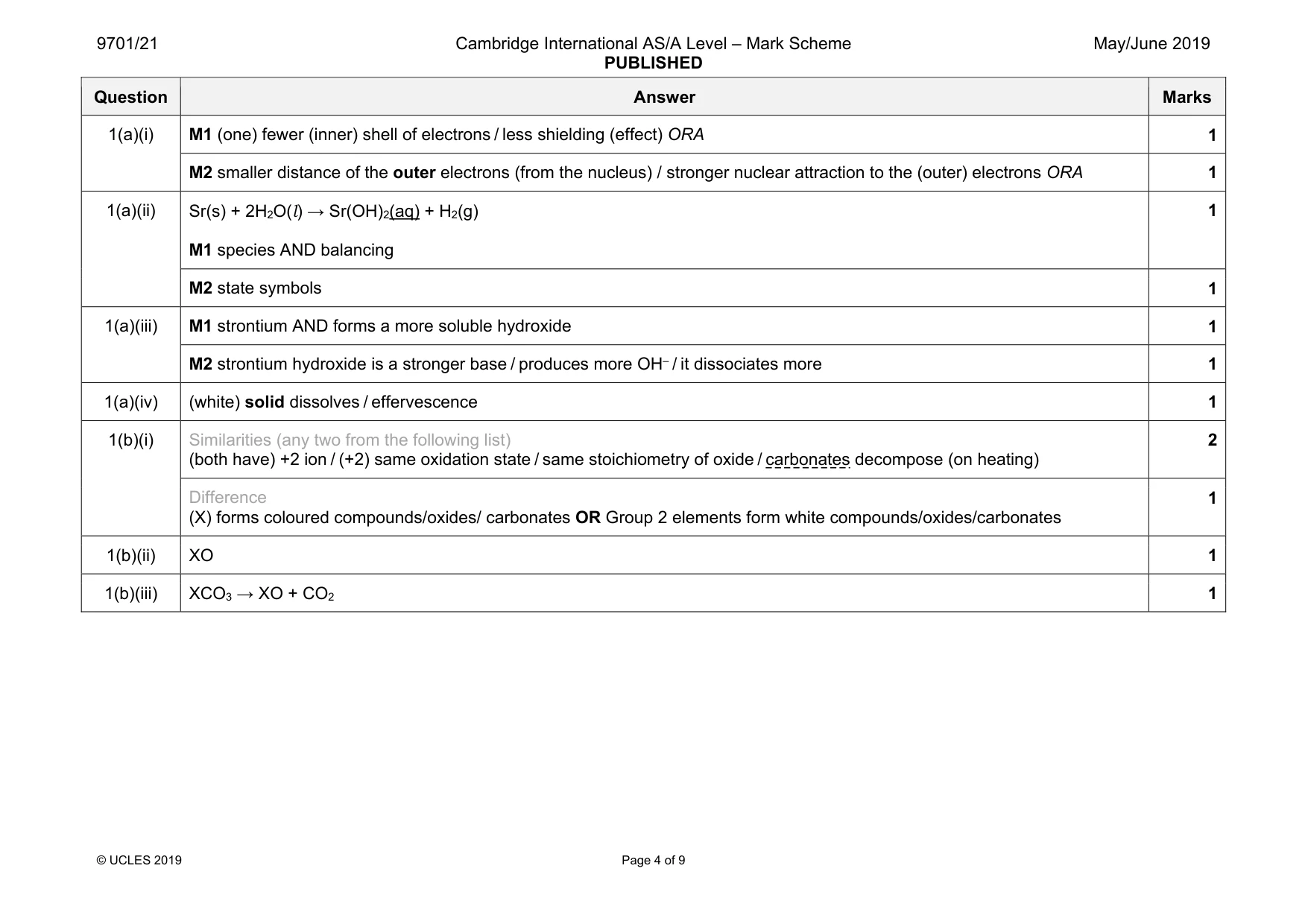
Mark scheme: 1(a)(i) M1 (one) fewer (inner) shell of electrons / less shielding (effect) ORA 1 M2 smaller distance of the outer electrons (from the nucleus) / stronger nuclear attraction to the (outer) electrons ORA 1 1(a)(ii) Sr(s) + 2H2O(l) → Sr(OH)2(aq) + H2(g) M1 species AND balancing 1 M2 state symbols 1 1(a)(iii) M1 strontium AND forms a more soluble hydroxide 1 M2 strontium hydroxide is a stronger base / produces more OH– / it dissociates more 1 1(a)(iv) (white) solid dissolves / effervescence 1 1(b)(i) Similarities (any two from the following list) (both have) +2 ion / (+2) same oxidation state / same stoichiometry of oxide / carbonates decompose (on heating) 2 Difference (X) forms coloured compounds/oxides/ carbonates OR Group 2 elements form white compounds/oxides/carbonates 1 1(b)(ii) XO 1 1(b)(iii) XCO3 → XO + CO2 1
Q2 · Magnesium silicide, Mg2Si, is a compound made by heating magnesium with sand
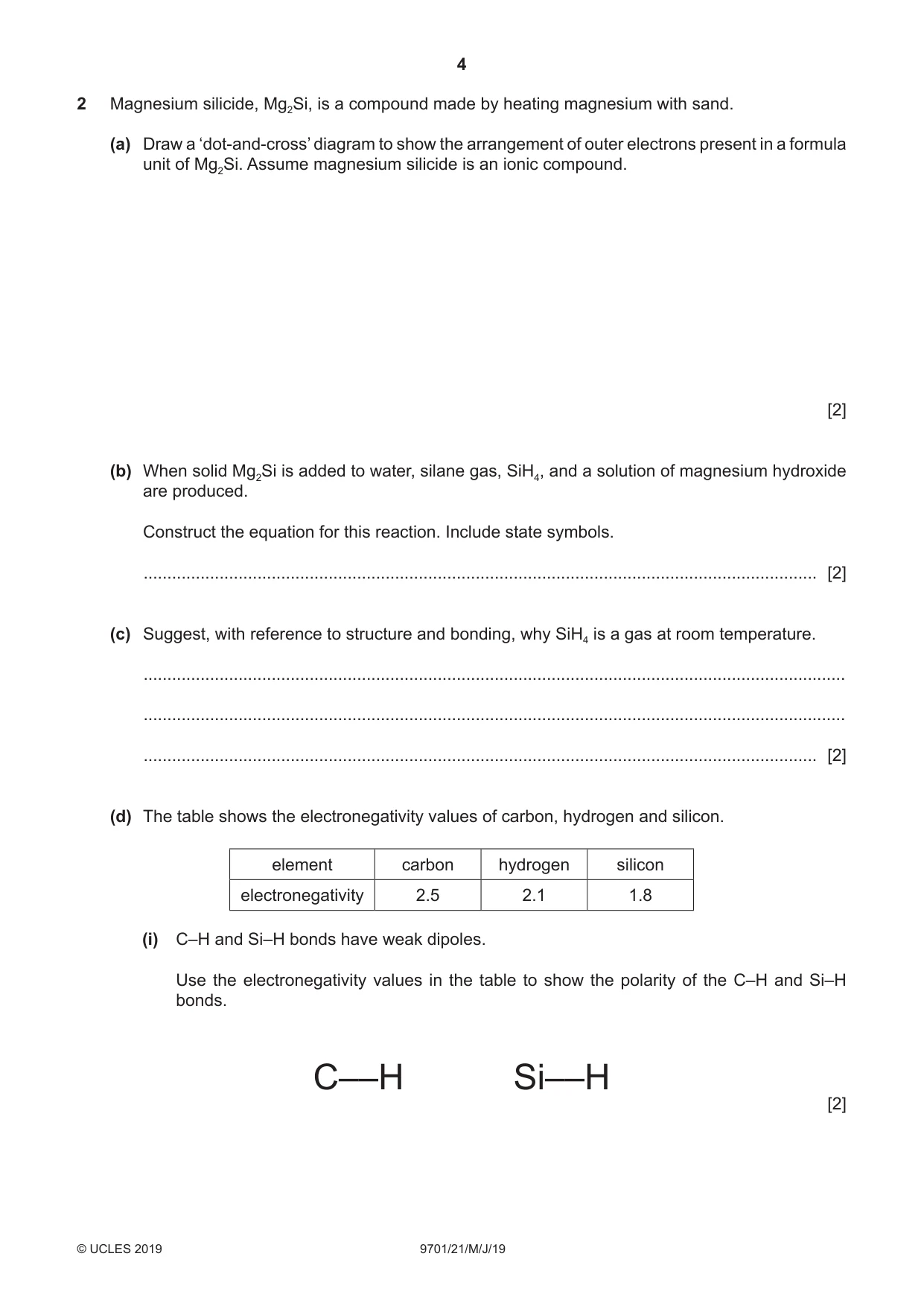
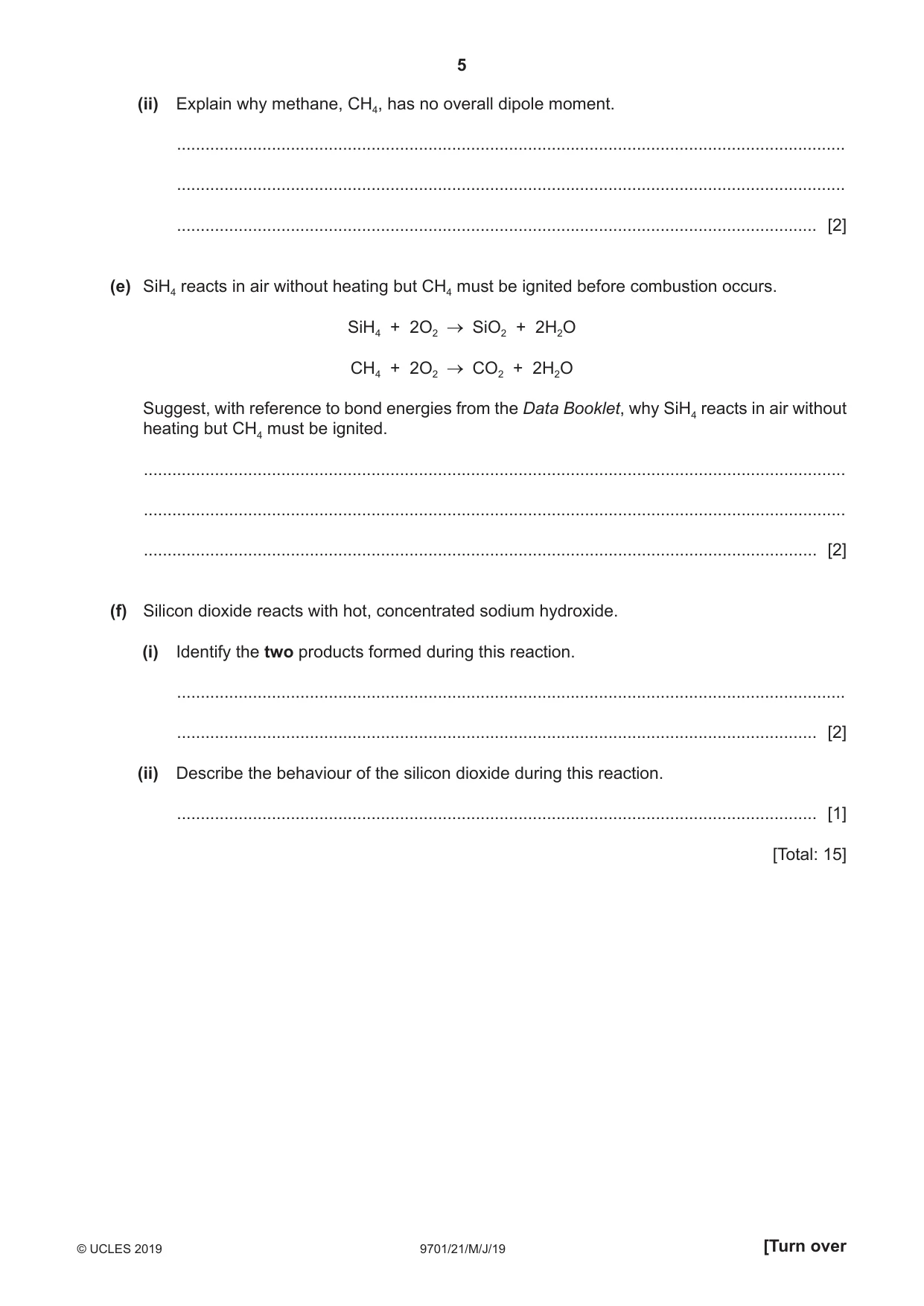
2 Magnesium silicide, Mg2Si, is a compound made by heating magnesium with sand. (a) Draw a ‘dot-and-cross’ diagram to show the arrangement of outer electrons present in a formula unit of Mg2Si. Assume magnesium silicide is an ionic compound. [2] (b) When solid Mg2Si is added to water, silane gas, SiH4, and a solution of magnesium hydroxide are produced. Construct the equation for this reaction. Include state symbols. .............................................................................................................................................. [2] (c) Suggest, with reference to structure and bonding, why SiH4 is a gas at room temperature. .................................................................................................................................................... .................................................................................................................................................... .............................................................................................................................................. [2] (d) The table shows the electronegativity values of carbon, hydrogen and silicon. element carbon hydrogen silicon electronegativity 2.5 2.1 1.8 (i) C–H and Si–H bonds have weak dipoles. Use the electronegativity values in the table to show the polarity of the C–H and Si–H bonds. C––H Si––H [2] (ii) Explain why methane, CH4, has no overall dipole moment. ............................................................................................................................................. ............................................................................................................................................. ....................................................................................................................................... [2] (e) SiH4 reacts in air without heating but CH4 must be ignited before combustion occurs. SiH4 + 2O2 SiO2 + 2H2O CH4 + 2O2 CO2 + 2H2O Suggest, with reference to bond energies from the Data Booklet, why SiH4 reacts in air without heating but CH4 must be ignited. .................................................................................................................................................... .................................................................................................................................................... .............................................................................................................................................. [2] (f) Silicon dioxide reacts with hot, concentrated sodium hydroxide. (i) Identify the two products formed during this reaction. ............................................................................................................................................. ....................................................................................................................................... [2] (ii) Describe the behaviour of the silicon dioxide during this reaction. ....................................................................................................................................... [1] [Total: 15]
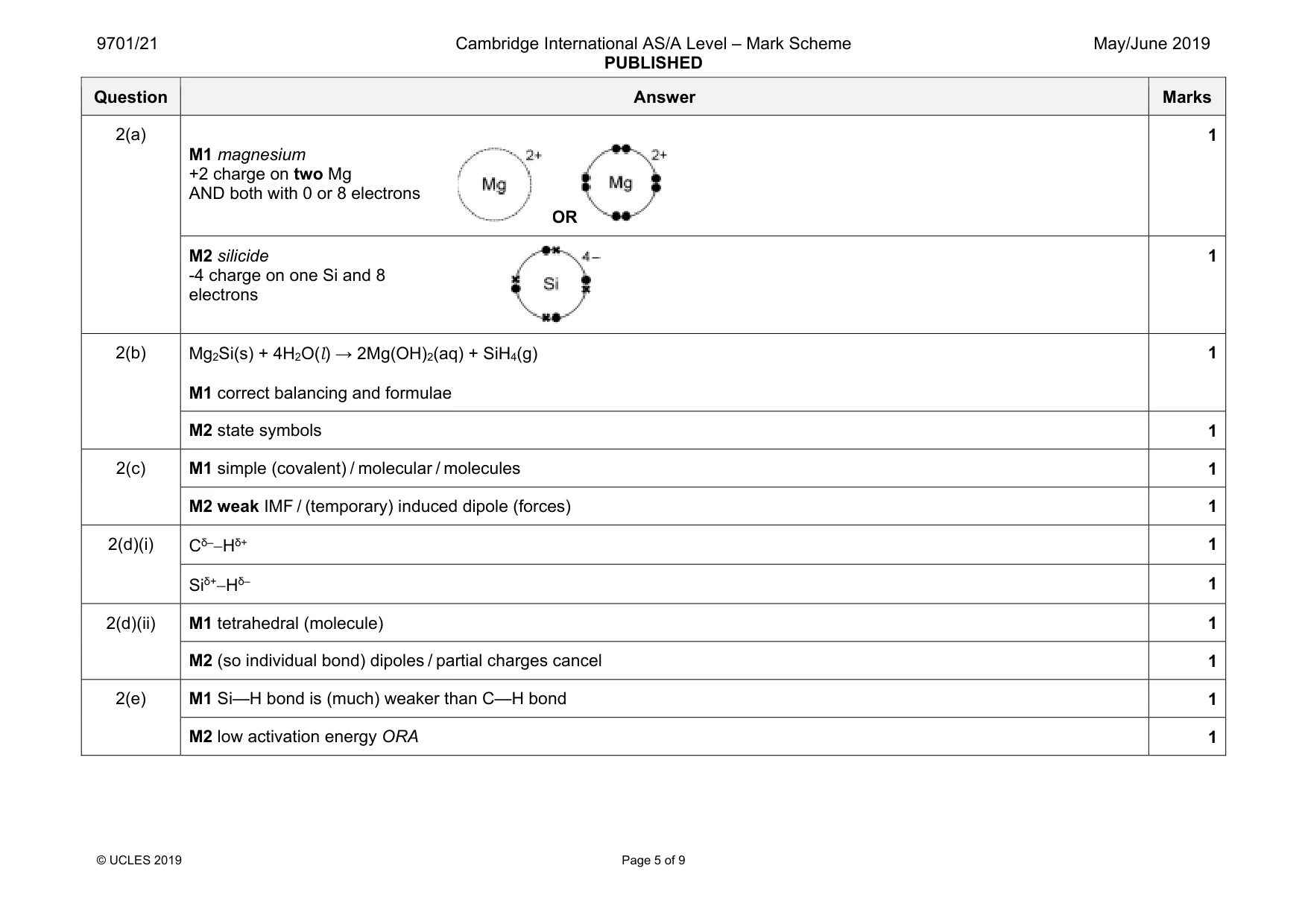
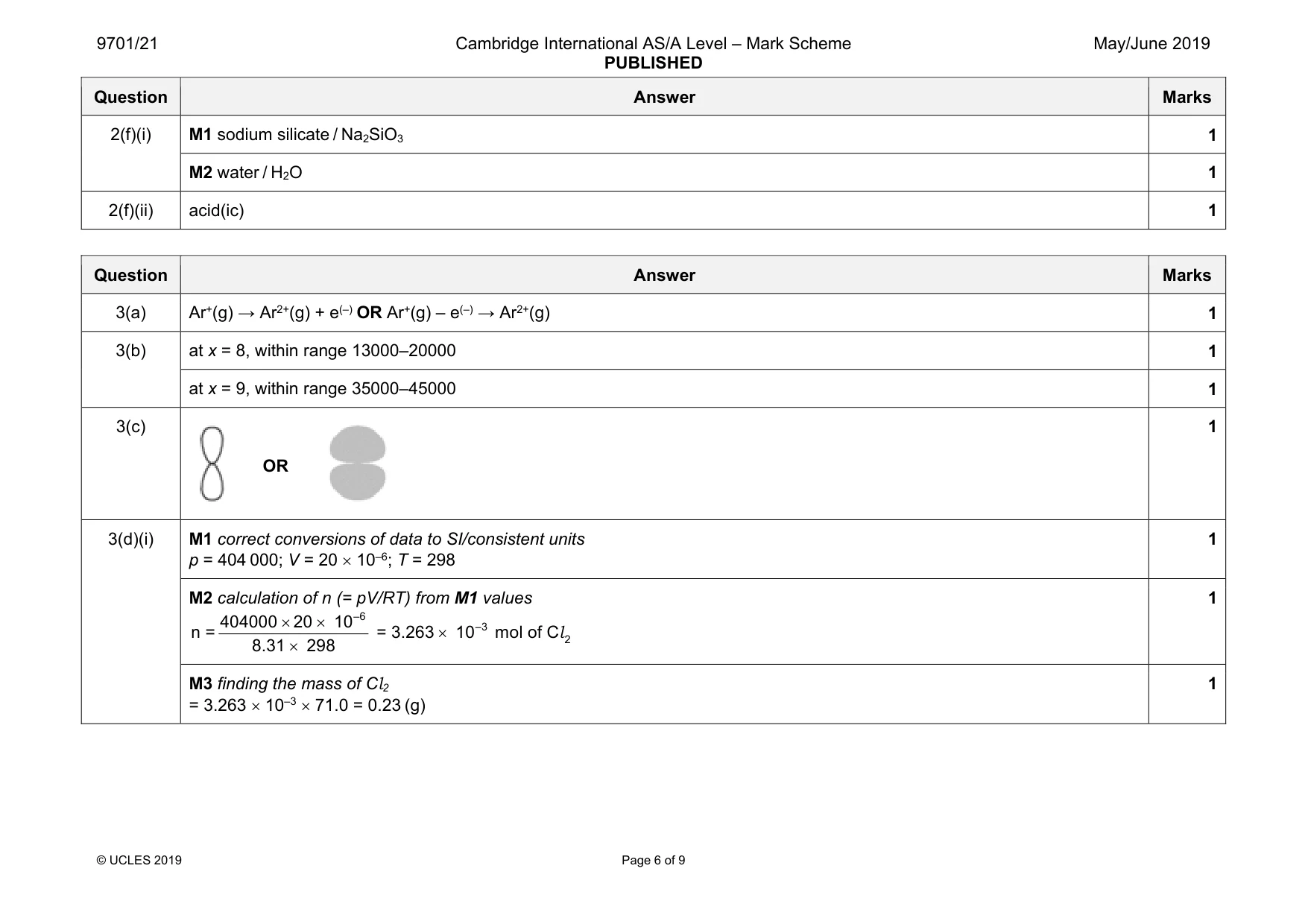
Mark scheme: 2(a) M1 magnesium +2 charge on two Mg AND both with 0 or 8 electrons OR 1 M2 silicide -4 charge on one Si and 8 electrons 1 2(b) Mg2Si(s) + 4H2O(l) → 2Mg(OH)2(aq) + SiH4(g) M1 correct balancing and formulae 1 M2 state symbols 1 2(c) M1 simple (covalent) / molecular / molecules 1 M2 weak IMF / (temporary) induced dipole (forces) 1 2(d)(i) Cδ–−Hδ+ 1 Siδ+−Hδ– 1 2(d)(ii) M1 tetrahedral (molecule) 1 M2 (so individual bond) dipoles / partial charges cancel 1 2(e) M1 Si—H bond is (much) weaker than C—H bond 1 M2 low activation energy ORA 1 Question Answer Marks 2(f)(i) M1 sodium silicate / Na2SiO3 1 M2 water / H2O 1 2(f)(ii) acid(ic) 1
Q3 · Construct an equation for the second ionisation energy of argon
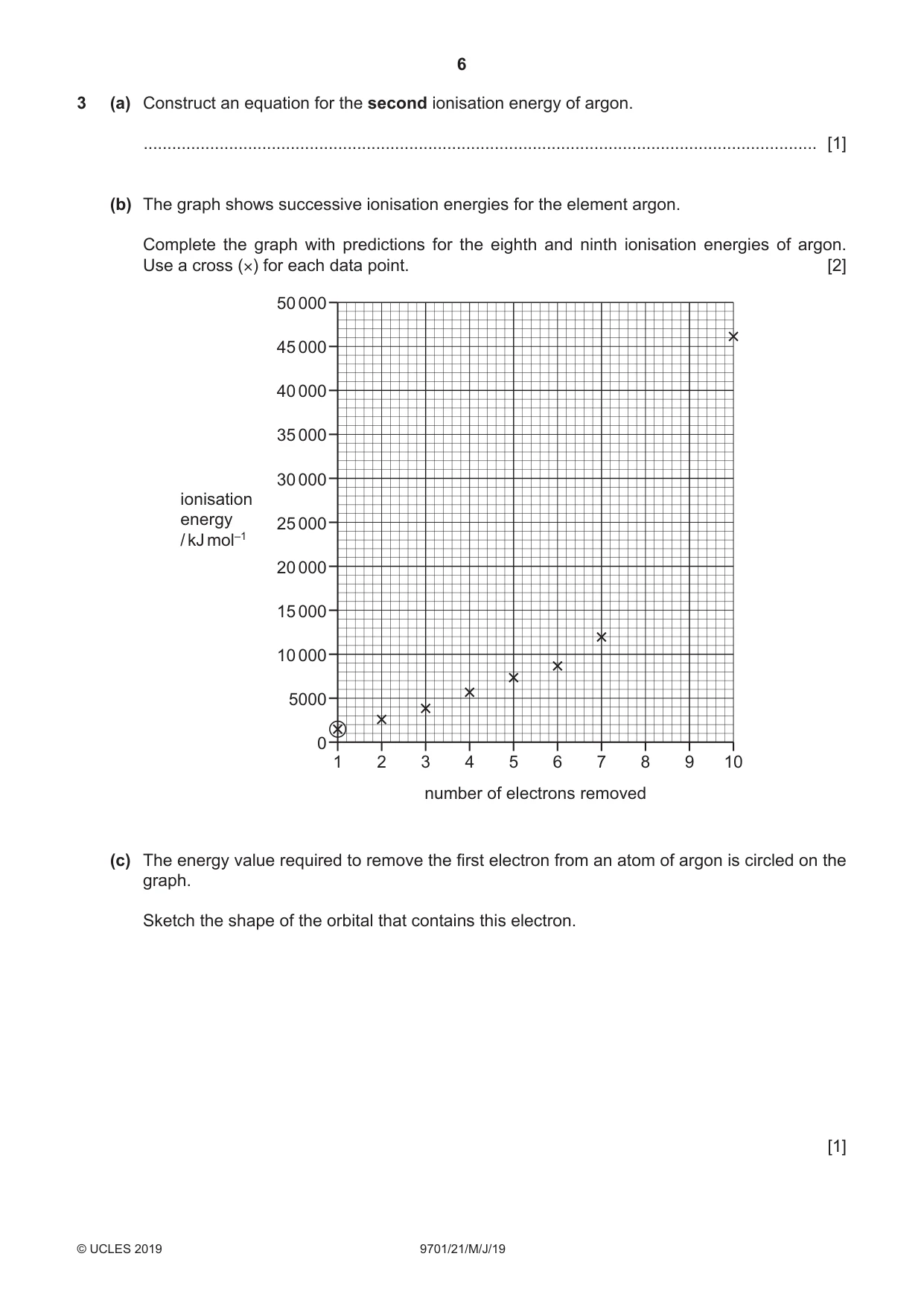
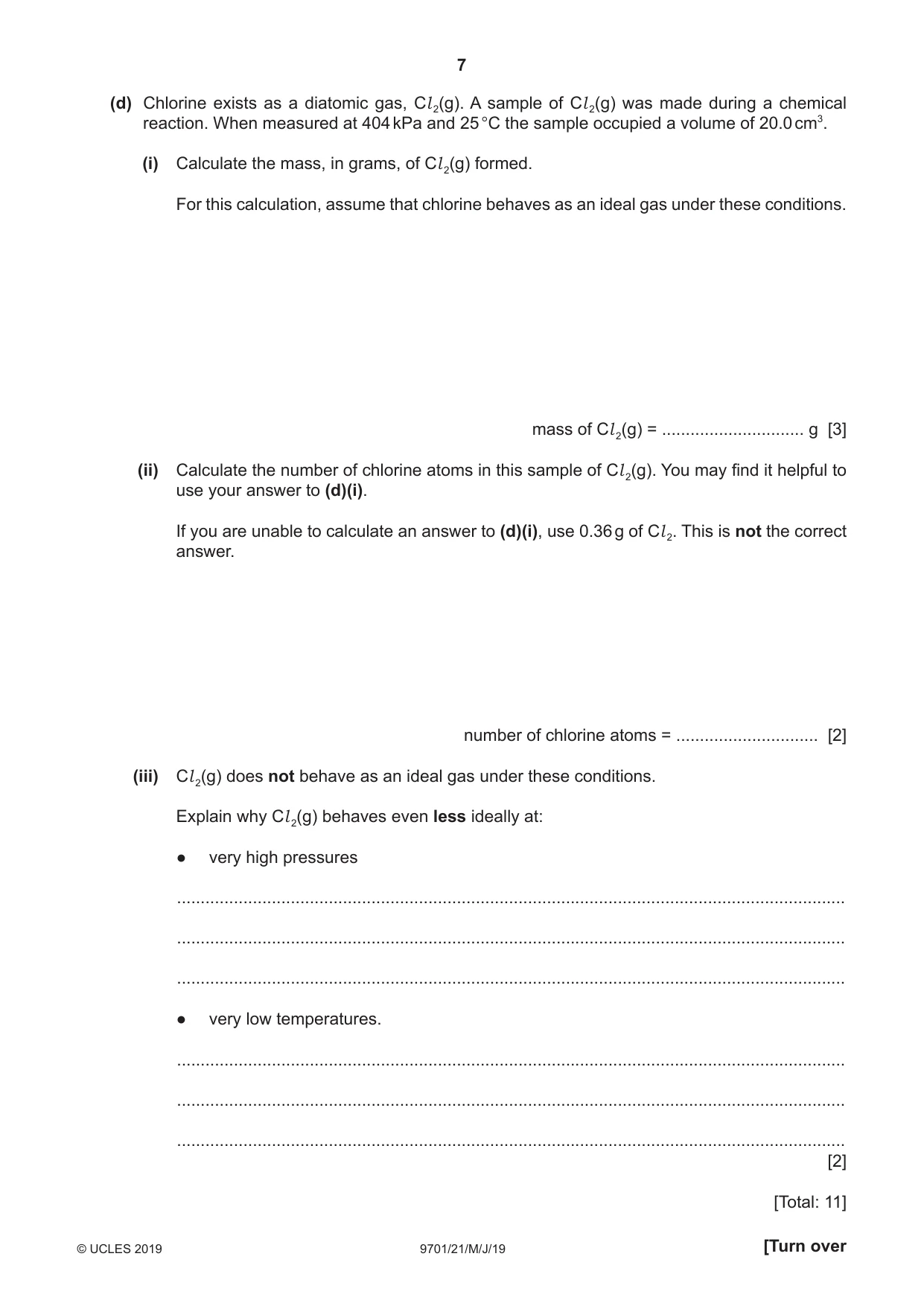
3 (a) Construct an equation for the second ionisation energy of argon. .............................................................................................................................................. [1] (b) The graph shows successive ionisation energies for the element argon. Complete the graph with predictions for the eighth and ninth ionisation energies of argon. Use a cross (×) for each data point. [2] 50 000 45 000 40 000 35 000 30 000 ionisation energy 25 000 / kJ mol–1 20 000 15 000 10 000 5000 0 1 2 3 4 5 6 7 8 9 10 number of electrons removed (c) The energy value required to remove the first electron from an atom of argon is circled on the graph. Sketch the shape of the orbital that contains this electron. [1] (d) Chlorine exists as a diatomic gas, Cl 2(g). A sample of Cl 2(g) was made during a chemical reaction. When measured at 404 kPa and 25 °C the sample occupied a volume of 20.0 cm3. (i) Calculate the mass, in grams, of Cl 2(g) formed. For this calculation, assume that chlorine behaves as an ideal gas under these conditions. mass of Cl 2(g) = .............................. g [3] (ii) Calculate the number of chlorine atoms in this sample of Cl 2(g). You may find it helpful to use your answer to (d)(i). If you are unable to calculate an answer to (d)(i), use 0.36 g of Cl 2. This is not the correct answer. number of chlorine atoms = .............................. [2] (iii) Cl 2(g) does not behave as an ideal gas under these conditions. Explain why Cl 2(g) behaves even less ideally at: ● very high pressures ............................................................................................................................................. ............................................................................................................................................. ............................................................................................................................................. ● very low temperatures. ............................................................................................................................................. ............................................................................................................................................. ............................................................................................................................................. [2] [Total: 11]
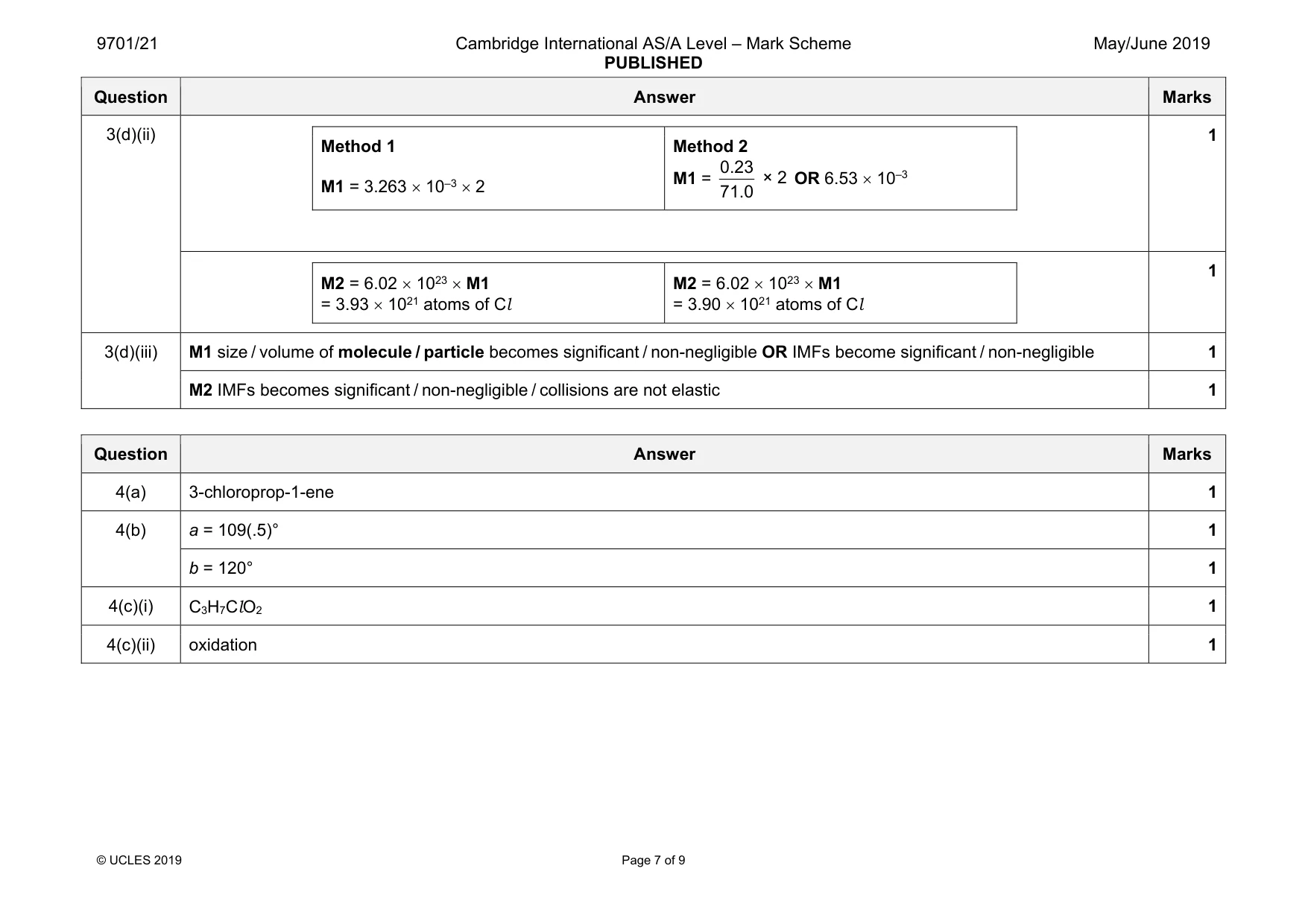
Mark scheme: 3(a) Ar+(g) → Ar2+(g) + e(–) OR Ar+(g) – e(–) → Ar2+(g) 1 3(b) at x = 8, within range 13000–20000 1 at x = 9, within range 35000–45000 1 3(c) OR 1 3(d)(i) M1 correct conversions of data to SI/consistent units p = 404 000; V = 20 × 10–6; T = 298 1 M2 calculation of n (= pV/RT) from M1 values × × × × –6 –3 2 404000 20 10 n = = 3.263 10 mol of C 8.31 298 l 1 M3 finding the mass of Cl2 = 3.263 × 10–3 × 71.0 = 0.23 (g) 1 Question Answer Marks 3(d)(ii) Method 1 M1 = 3.263 × 10–3 × 2 Method 2 M1 = 0.23 × 2 71.0 OR 6.53 × 10⁻³ 1 M2 = 6.02 × 10²³ × M1 = 3.93 × 10²¹ atoms of Cl M2 = 6.02 × 10²³ × M1 = 3.90 × 10²¹ atoms of Cl 1 3(d)(iii) M1 size / volume of molecule / particle becomes significant / non-negligible OR IMFs become significant / non-negligible 1 M2 IMFs becomes significant / non-negligible / collisions are not elastic 1
More questions on The gaseous state: ideal and real gases and pV = nRT
Q4 · The structure of compound Y is shown
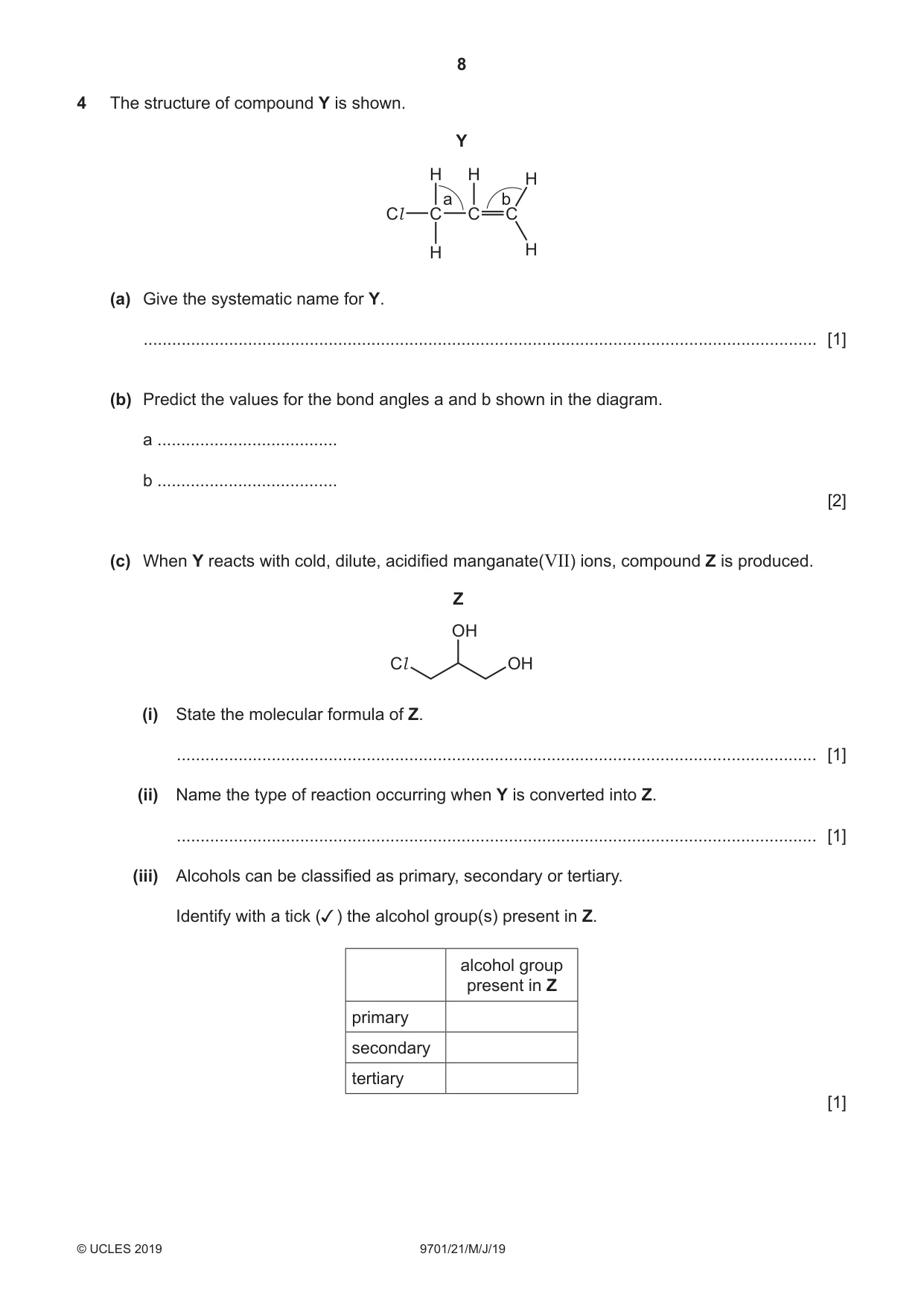
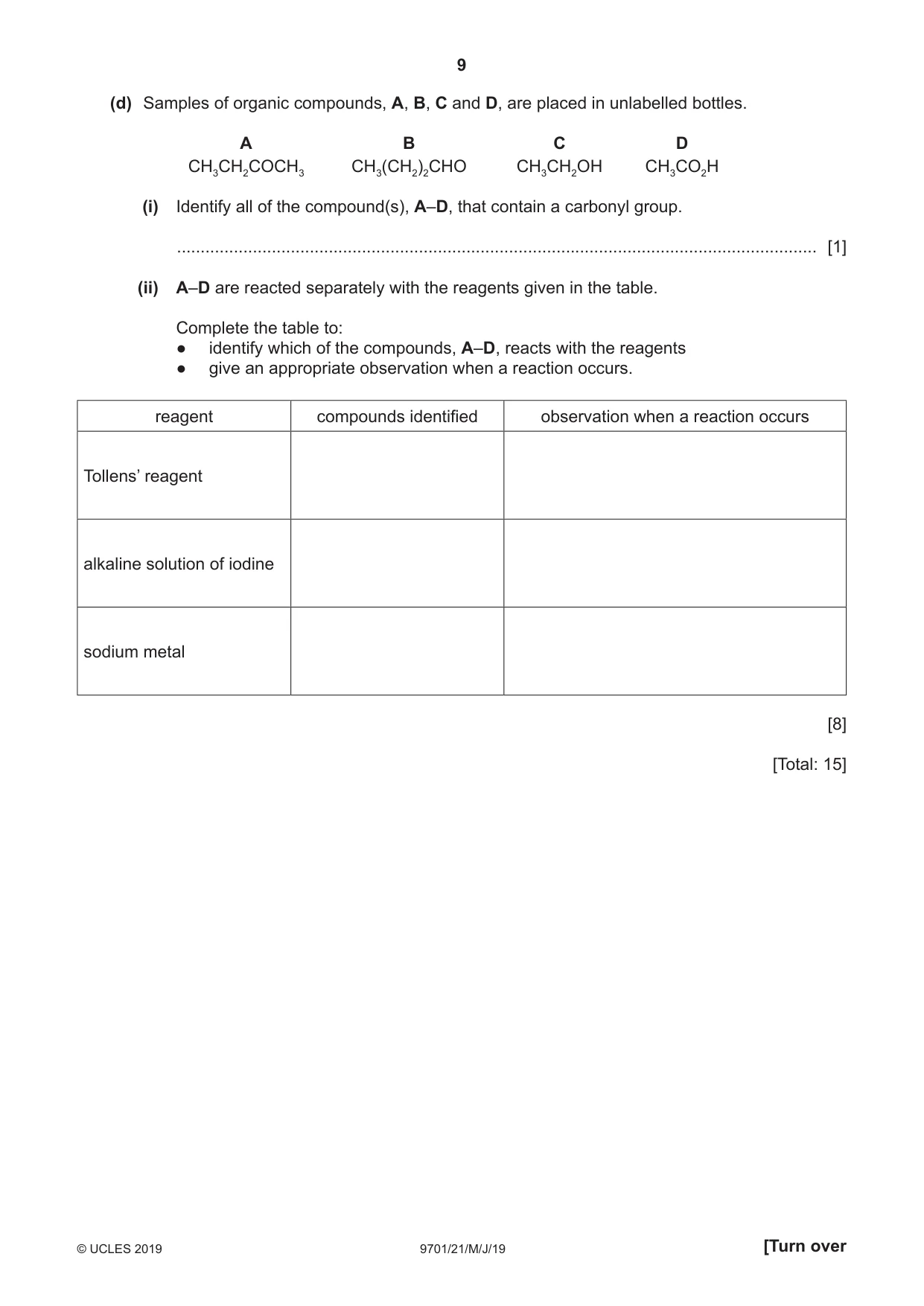
4 The structure of compound Y is shown. Y H H H a b Cl C C C H H (a) Give the systematic name for Y. .............................................................................................................................................. [1] (b) Predict the values for the bond angles a and b shown in the diagram. a ...................................... b ...................................... [2] (c) When Y reacts with cold, dilute, acidified manganate(VII) ions, compound Z is produced. Z OH Cl OH (i) State the molecular formula of Z. ....................................................................................................................................... [1] (ii) Name the type of reaction occurring when Y is converted into Z. ....................................................................................................................................... [1] (iii) Alcohols can be classified as primary, secondary or tertiary. Identify with a tick () the alcohol group(s) present in Z. alcohol group present in Z primary secondary tertiary [1] (d) Samples of organic compounds, A, B, C and D, are placed in unlabelled bottles. A B C D CH3CH2COCH3 CH3(CH2)2CHO CH3CH2OH CH3CO2H (i) Identify all of the compound(s), A–D, that contain a carbonyl group. ....................................................................................................................................... [1] (ii) A–D are reacted separately with the reagents given in the table. Complete the table to: ● identify which of the compounds, A–D, reacts with the reagents ● give an appropriate observation when a reaction occurs. reagent compounds identified observation when a reaction occurs Tollens’ reagent alkaline solution of iodine sodium metal [8] [Total: 15]
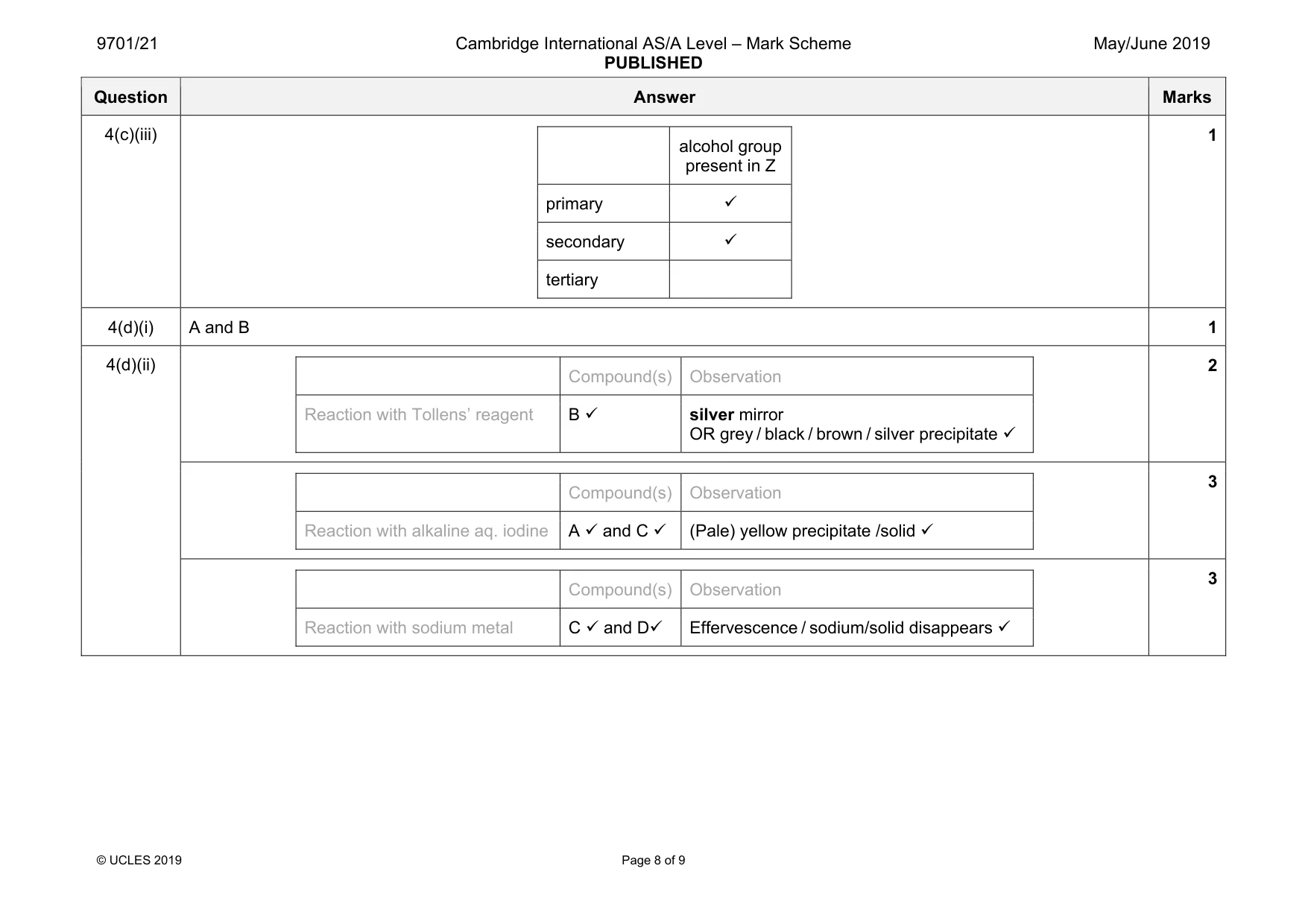
Mark scheme: 4(a) 3-chloroprop-1-ene 1 4(b) a = 109(.5)° 1 b = 120° 1 4(c)(i) C3H7ClO2 1 4(c)(ii) oxidation 1 Question Answer Marks 4(c)(iii) alcohol group present in Z primary 9 secondary 9 tertiary 1 4(d)(i) A and B 1 4(d)(ii) Compound(s) Observation Reaction with Tollens’ reagent B 9 silver mirror OR grey / black / brown / silver precipitate 9 2 Compound(s) Observation Reaction with alkaline aq. iodine A 9 and C 9 (Pale) yellow precipitate /solid 9 3 Compound(s) Observation Reaction with sodium metal C 9 and D9 Effervescence / sodium/solid disappears 9 3
Q5 · Ethanal reacts with a mixture of HCN and NaCN to make 2-hydroxypropanenitrile, CH3CH(OH)CN
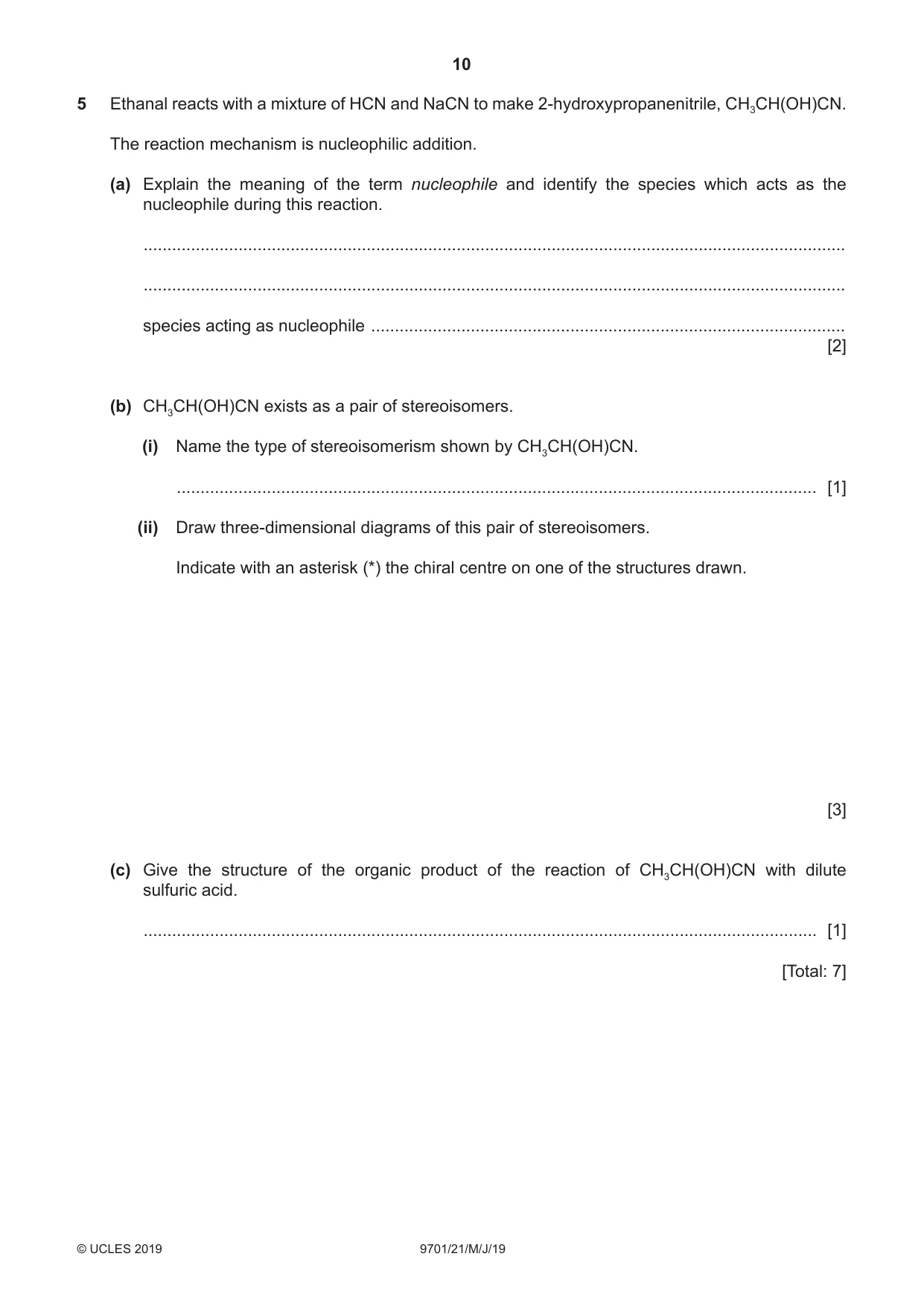
5 Ethanal reacts with a mixture of HCN and NaCN to make 2-hydroxypropanenitrile, CH3CH(OH)CN. The reaction mechanism is nucleophilic addition. (a) Explain the meaning of the term nucleophile and identify the species which acts as the nucleophile during this reaction. .................................................................................................................................................... .................................................................................................................................................... species acting as nucleophile .................................................................................................... [2] (b) CH3CH(OH)CN exists as a pair of stereoisomers. (i) Name the type of stereoisomerism shown by CH3CH(OH)CN. ....................................................................................................................................... [1] (ii) Draw three-dimensional diagrams of this pair of stereoisomers. Indicate with an asterisk (*) the chiral centre on one of the structures drawn. [3] (c) Give the structure of the organic product of the reaction of CH3CH(OH)CN with dilute sulfuric acid. .............................................................................................................................................. [1] [Total: 7]
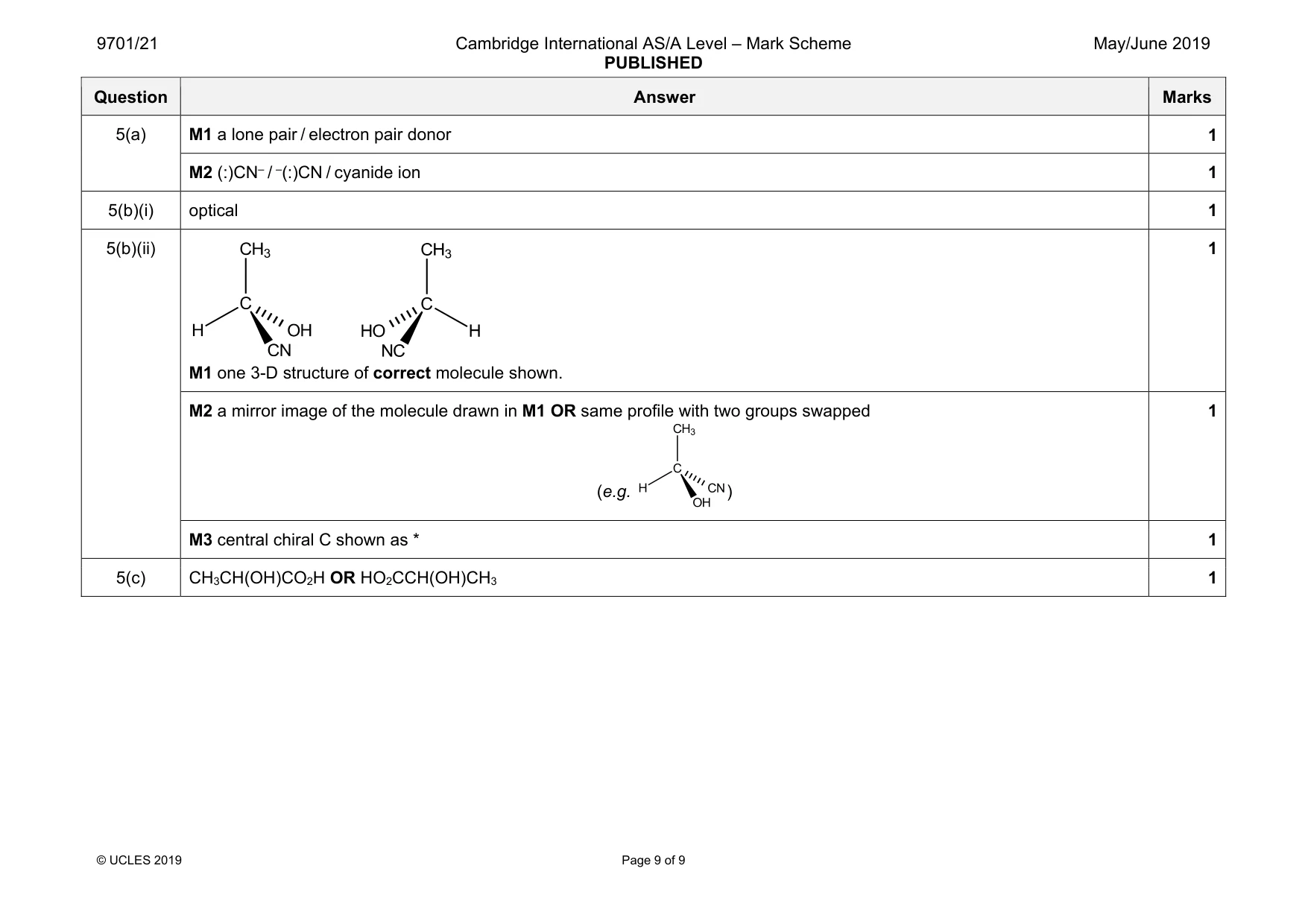
Mark scheme: 5(a) M1 a lone pair / electron pair donor 1 M2 (:)CN– / –(:)CN / cyanide ion 1 5(b)(i) optical 1 5(b)(ii) M1 one 3-D structure of correct molecule shown. 1 M2 a mirror image of the molecule drawn in M1 OR same profile with two groups swapped (e.g. ) 1 M3 central chiral C shown as * 1 5(c) CH3CH(OH)CO2H OR HO2CCH(OH)CH3 1
What was in this paper
The subtopics covered by these 5 questions, and how many questions each got. Open one in a new tab to see every Cambridge question on it.
What you needed in this session
Cambridge’s own grade thresholds for 2019 May/June, Paper 2 · Variant 1. A higher threshold means an easier paper — the bar moves with how the cohort did.