Cambridge A Level Chemistry 9701 — 2019 May/June Paper 2 · Variant 3
9701/23/M/J/19 · 6 questions · 60 marks · ≈68 min
The question paper and its mark scheme, free to read here and free to download. This is Cambridge’s own paper, exactly as it was sat.
Question paper12 pages
Mark scheme9 pages
Answers below. Sit the paper first if you are practising.
Questions as text
Q1 · A sample contains three different types of atom: 1840Ar , 1940K and 2040Ca
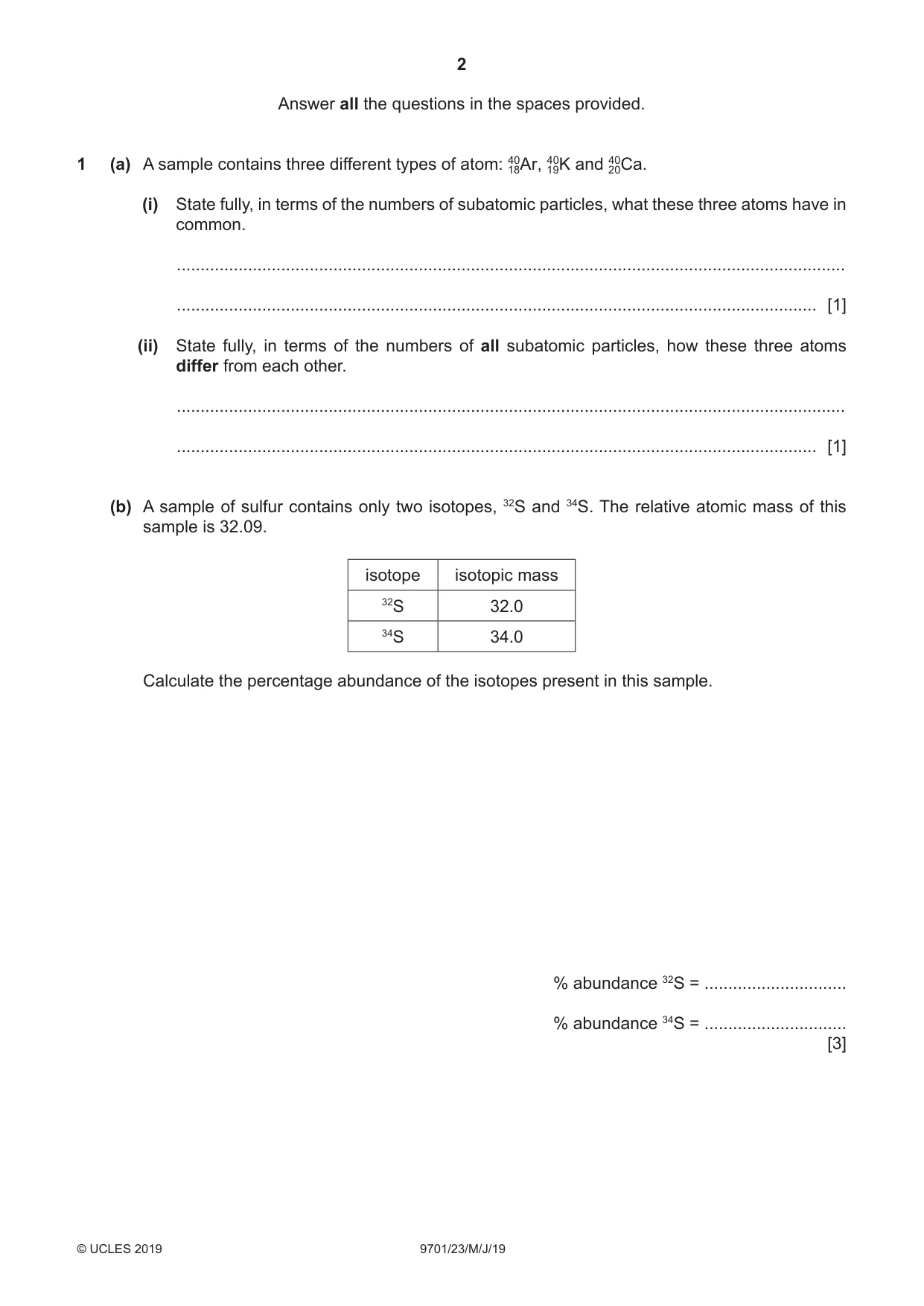
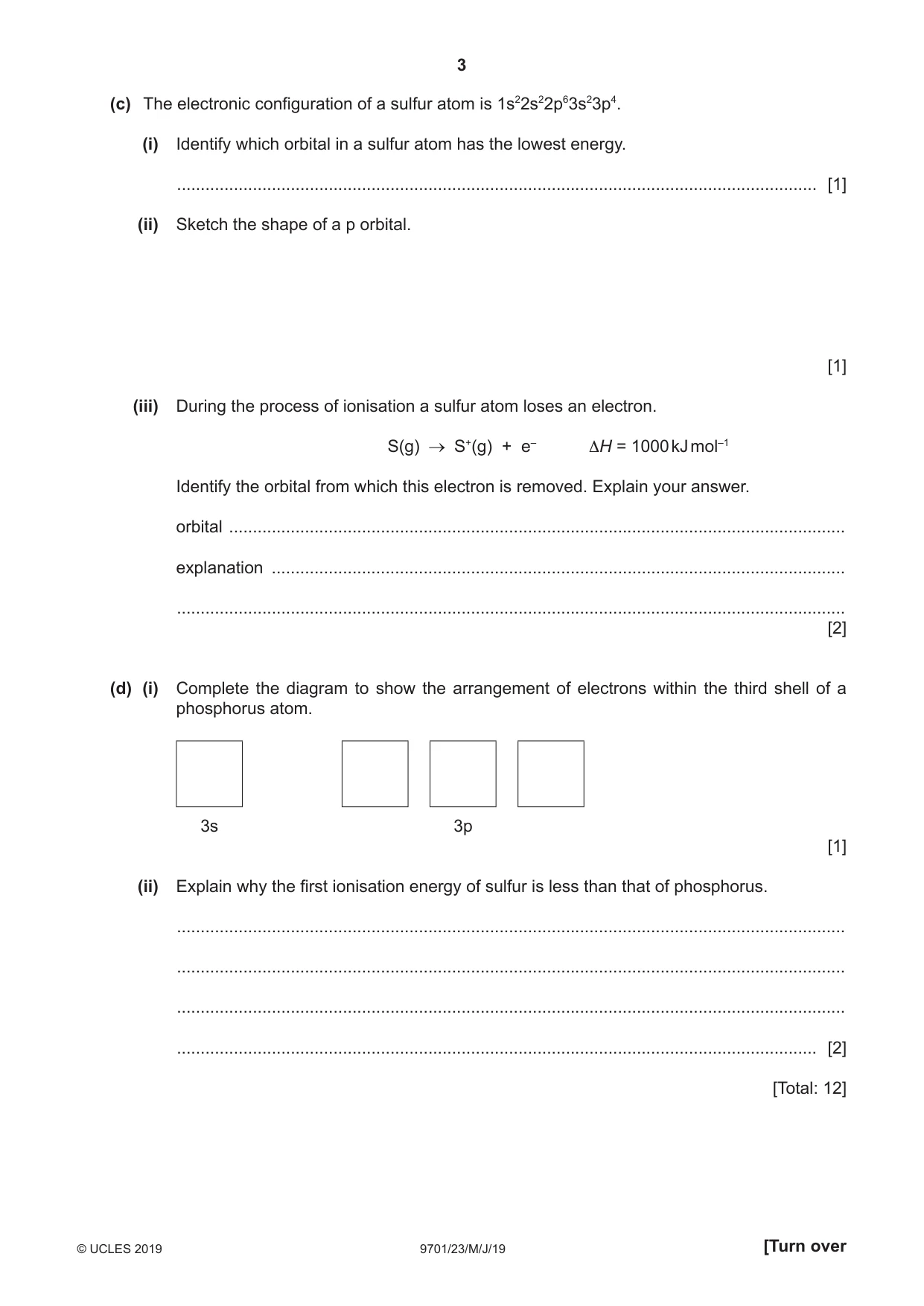
1 (a) A sample contains three different types of atom: 1840Ar , 1940K and 2040Ca . (i) State fully, in terms of the numbers of subatomic particles, what these three atoms have in common. ............................................................................................................................................. ....................................................................................................................................... [1] (ii) State fully, in terms of the numbers of all subatomic particles, how these three atoms differ from each other. ............................................................................................................................................. ....................................................................................................................................... [1] (b) A sample of sulfur contains only two isotopes, 32S and 34S. The relative atomic mass of this sample is 32.09. isotope isotopic mass 32S 32.0 34S 34.0 Calculate the percentage abundance of the isotopes present in this sample. % abundance 32S = .............................. % abundance 34S = .............................. [3] (c) The electronic configuration of a sulfur atom is 1s22s22p63s23p4. (i) Identify which orbital in a sulfur atom has the lowest energy. ....................................................................................................................................... [1] (ii) Sketch the shape of a p orbital. [1] (iii) During the process of ionisation a sulfur atom loses an electron. S(g) S+(g) + e– ΔH = 1000 kJ mol–1 Identify the orbital from which this electron is removed. Explain your answer. orbital .................................................................................................................................. explanation .......................................................................................................................... ............................................................................................................................................. [2] (d) (i) Complete the diagram to show the arrangement of electrons within the third shell of a phosphorus atom. 3s 3p [1] (ii) Explain why the first ionisation energy of sulfur is less than that of phosphorus. ............................................................................................................................................. ............................................................................................................................................. ............................................................................................................................................. ....................................................................................................................................... [2] [Total: 12]
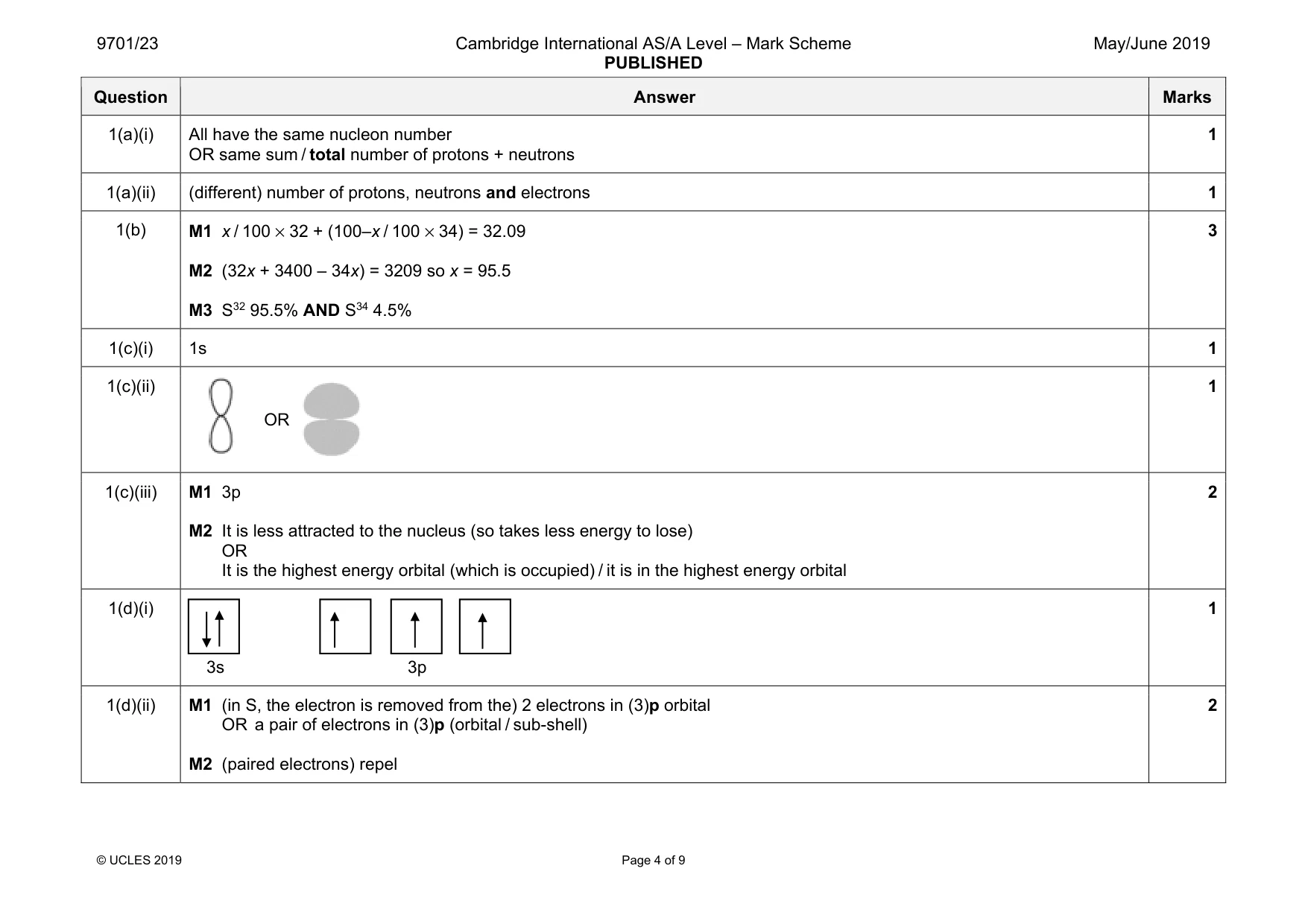
Mark scheme: 1(a)(i) All have the same nucleon number OR same sum / total number of protons + neutrons 1 1(a)(ii) (different) number of protons, neutrons and electrons 1 1(b) M1 x / 100 × 32 + (100–x / 100 × 34) = 32.09 M2 (32x + 3400 – 34x) = 3209 so x = 95.5 M3 S32 95.5% AND S34 4.5% 3 1(c)(i) 1s 1 1(c)(ii) OR 1 1(c)(iii) M1 3p M2 It is less attracted to the nucleus (so takes less energy to lose) OR It is the highest energy orbital (which is occupied) / it is in the highest energy orbital 2 1(d)(i) 3s 3p 1 1(d)(ii) M1 (in S, the electron is removed from the) 2 electrons in (3)p orbital OR a pair of electrons in (3)p (orbital / sub-shell) M2 (paired electrons) repel 2
More questions on Electrons, energy levels and atomic orbitals
Q2 · Iodine is an element in Group 17 of the Periodic Table
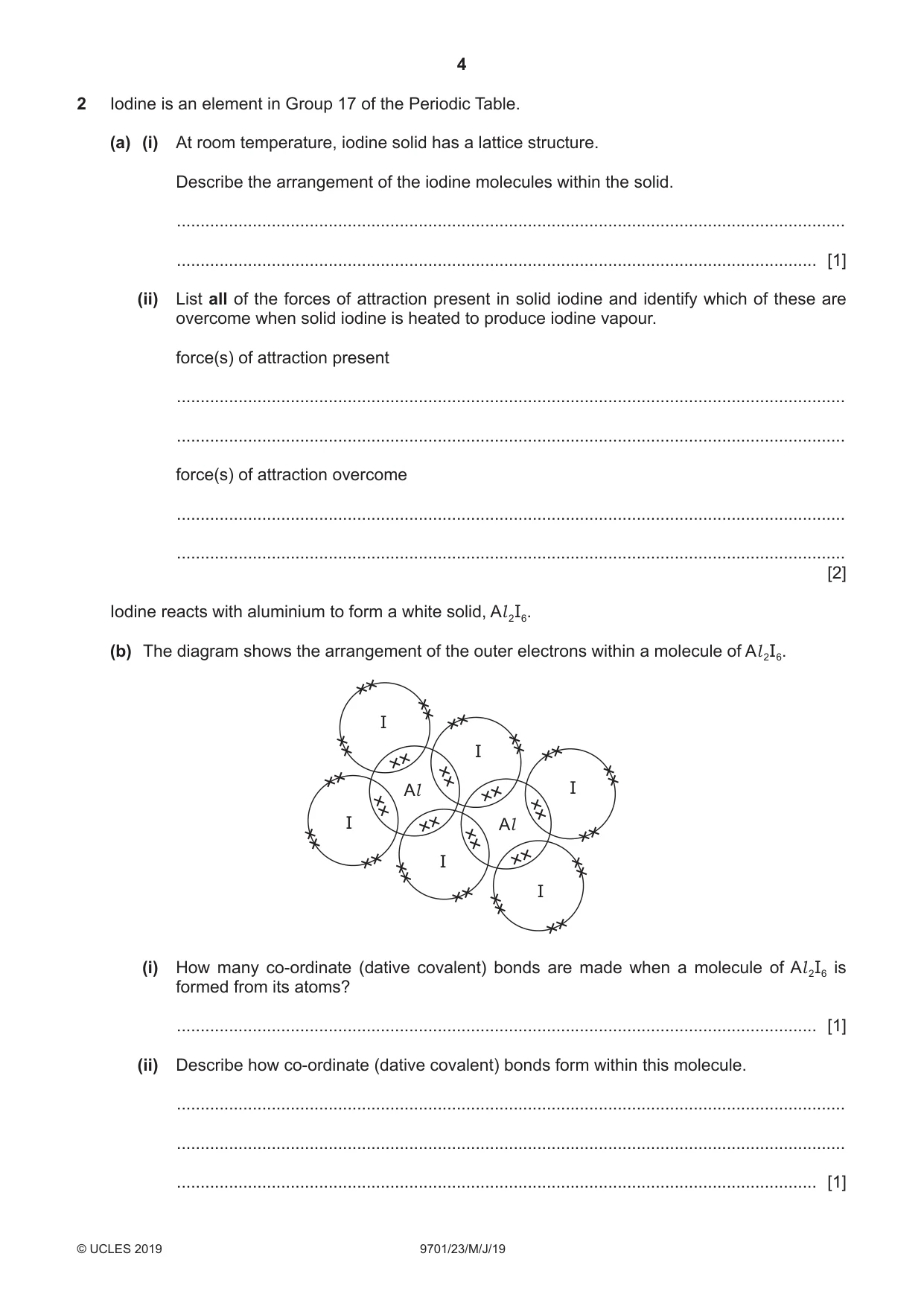
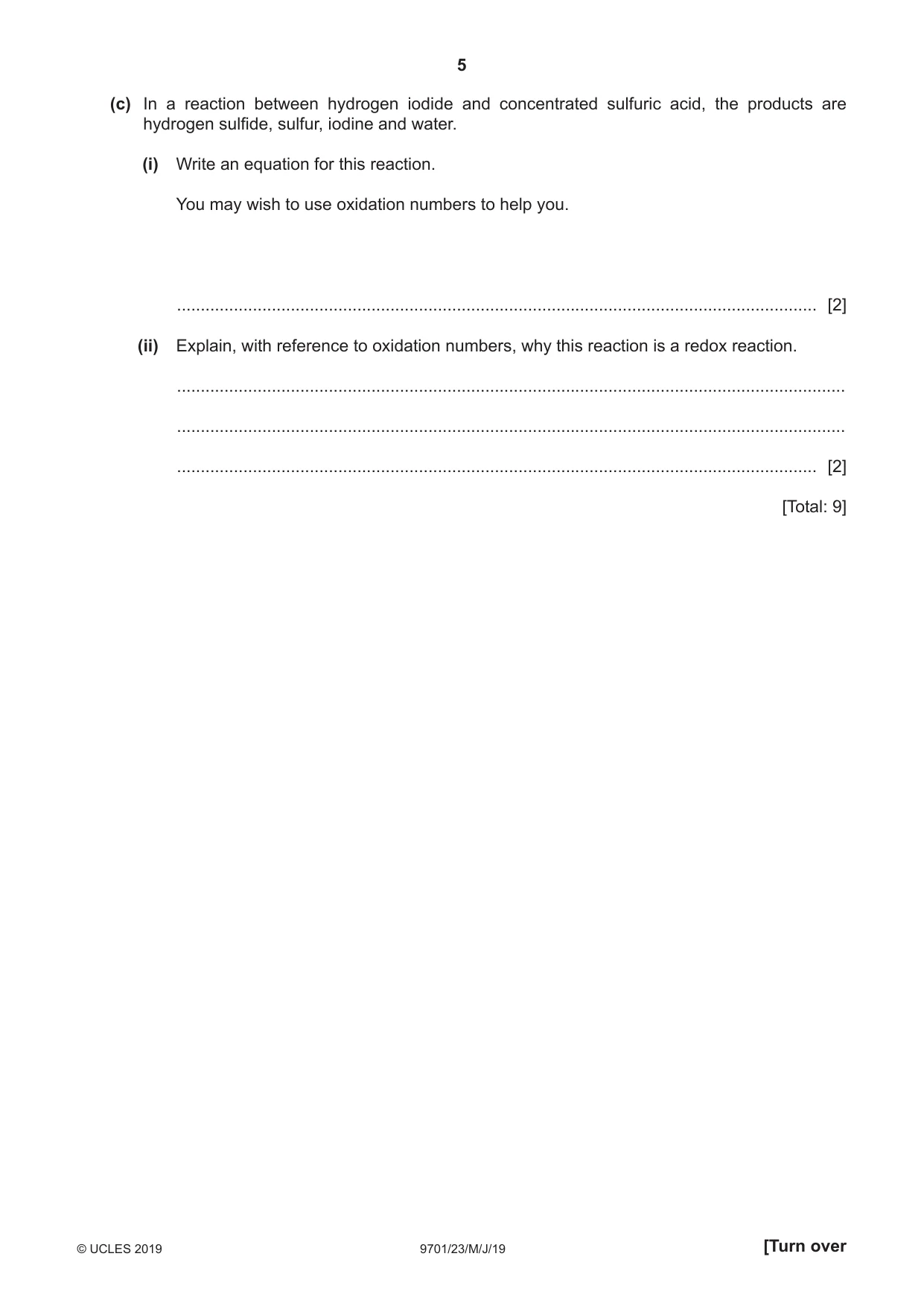
2 Iodine is an element in Group 17 of the Periodic Table. (a) (i) At room temperature, iodine solid has a lattice structure. Describe the arrangement of the iodine molecules within the solid. ............................................................................................................................................. ....................................................................................................................................... [1] (ii) List all of the forces of attraction present in solid iodine and identify which of these are overcome when solid iodine is heated to produce iodine vapour. force(s) of attraction present ............................................................................................................................................. ............................................................................................................................................. force(s) of attraction overcome ............................................................................................................................................. ............................................................................................................................................. [2] Iodine reacts with aluminium to form a white solid, Al 2I6. (b) The diagram shows the arrangement of the outer electrons within a molecule of Al 2I6. I I Al I I Al I I (i) How many co-ordinate (dative covalent) bonds are made when a molecule of Al 2I6 is formed from its atoms? ....................................................................................................................................... [1] (ii) Describe how co-ordinate (dative covalent) bonds form within this molecule. ............................................................................................................................................. ............................................................................................................................................. ....................................................................................................................................... [1] (c) In a reaction between hydrogen iodide and concentrated sulfuric acid, the products are hydrogen sulfide, sulfur, iodine and water. (i) Write an equation for this reaction. You may wish to use oxidation numbers to help you. ....................................................................................................................................... [2] (ii) Explain, with reference to oxidation numbers, why this reaction is a redox reaction. ............................................................................................................................................. ............................................................................................................................................. ....................................................................................................................................... [2] [Total: 9]
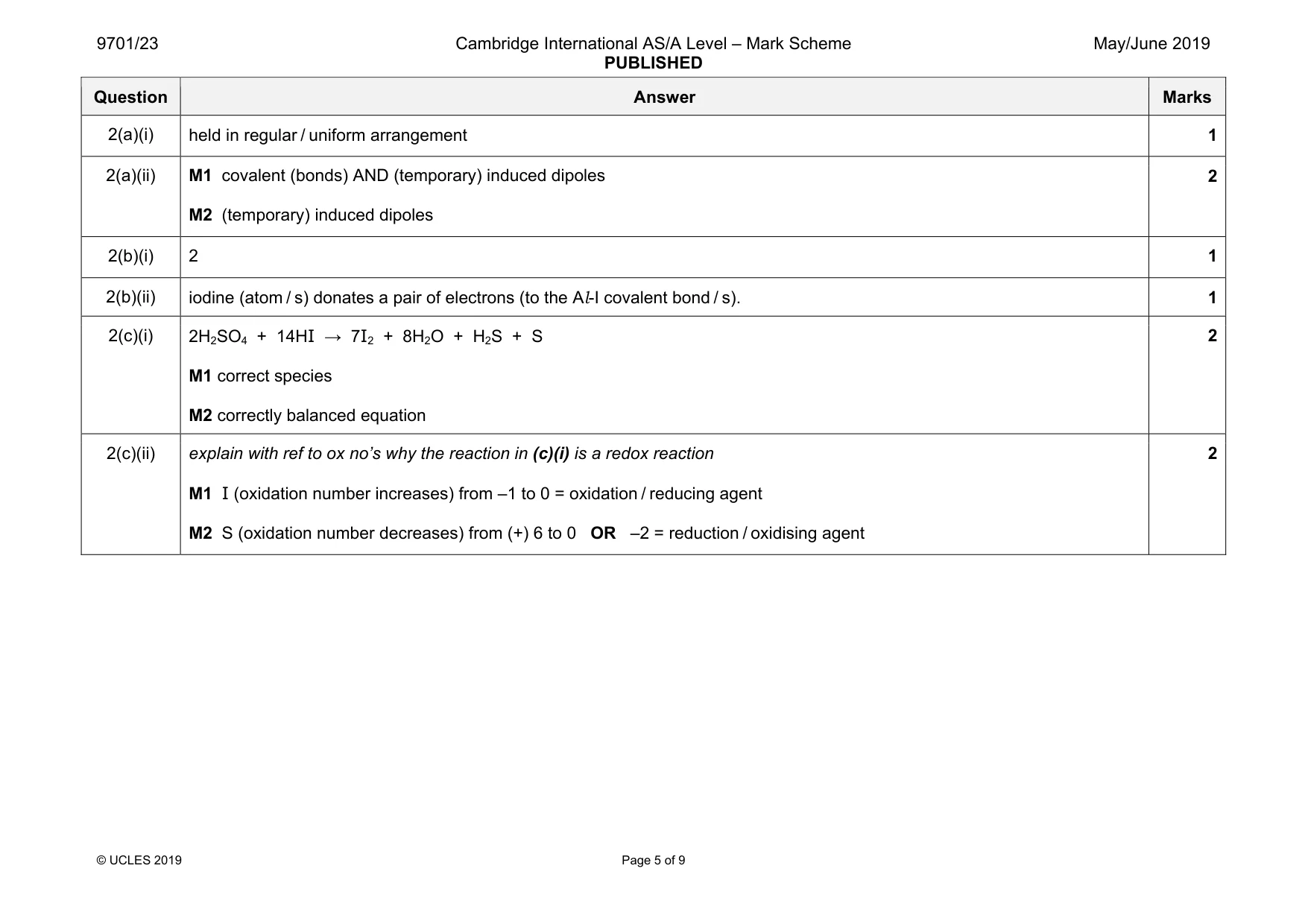
Mark scheme: 2(a)(i) held in regular / uniform arrangement 1 2(a)(ii) M1 covalent (bonds) AND (temporary) induced dipoles M2 (temporary) induced dipoles 2 2(b)(i) 2 1 2(b)(ii) iodine (atom / s) donates a pair of electrons (to the Al-I covalent bond / s). 1 2(c)(i) 2H2SO4 + 14HI → 7I2 + 8H2O + H2S + S M1 correct species M2 correctly balanced equation 2 2(c)(ii) explain with ref to ox no’s why the reaction in (c)(i) is a redox reaction M1 I (oxidation number increases) from –1 to 0 = oxidation / reducing agent M2 S (oxidation number decreases) from (+) 6 to 0 OR –2 = reduction / oxidising agent 2
Q3 · Magnesium reacts with oxygen to form magnesium oxide
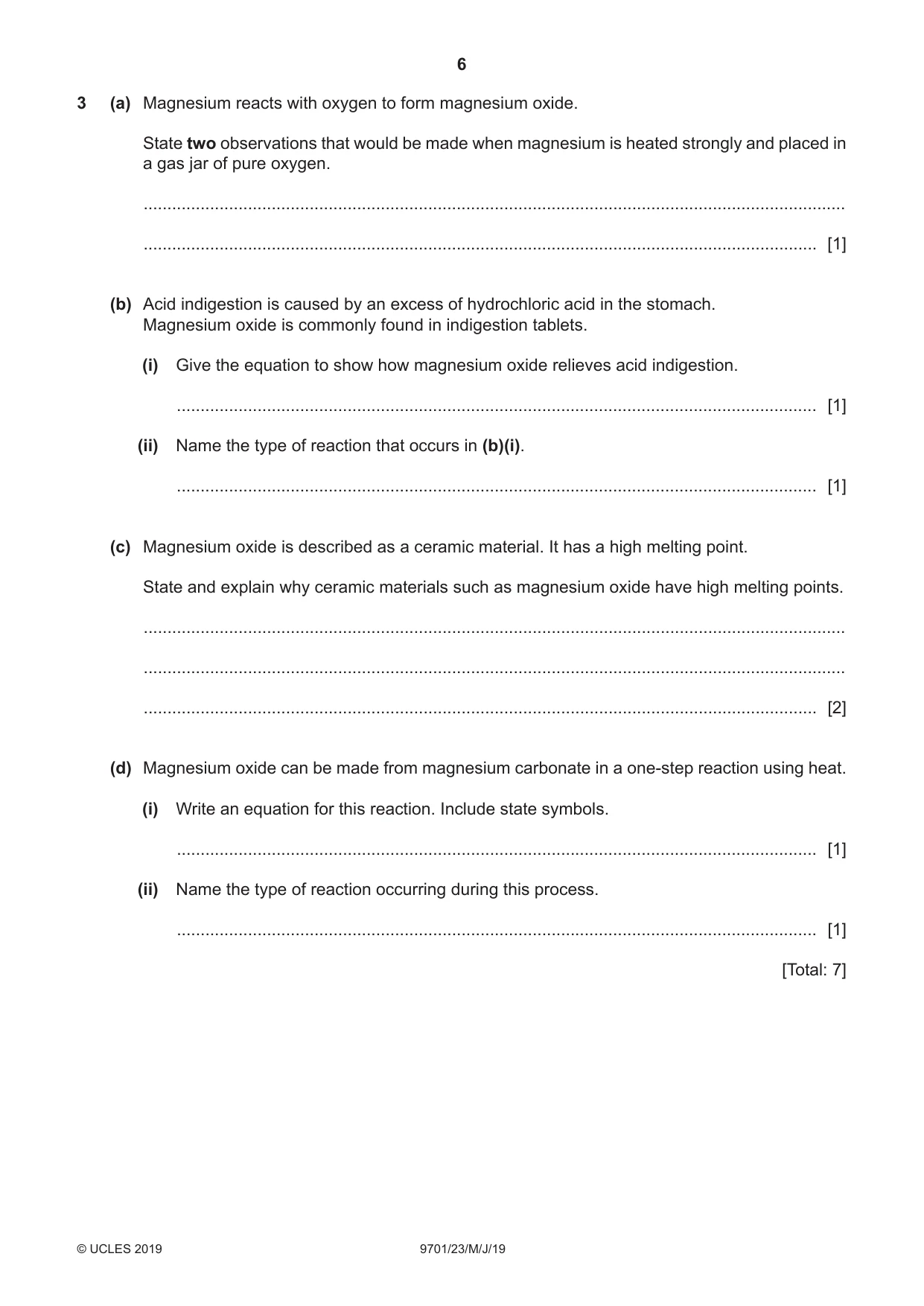
3 (a) Magnesium reacts with oxygen to form magnesium oxide. State two observations that would be made when magnesium is heated strongly and placed in a gas jar of pure oxygen. .................................................................................................................................................... .............................................................................................................................................. [1] (b) Acid indigestion is caused by an excess of hydrochloric acid in the stomach. Magnesium oxide is commonly found in indigestion tablets. (i) Give the equation to show how magnesium oxide relieves acid indigestion. ....................................................................................................................................... [1] (ii) Name the type of reaction that occurs in (b)(i). ....................................................................................................................................... [1] (c) Magnesium oxide is described as a ceramic material. It has a high melting point. State and explain why ceramic materials such as magnesium oxide have high melting points. .................................................................................................................................................... .................................................................................................................................................... .............................................................................................................................................. [2] (d) Magnesium oxide can be made from magnesium carbonate in a one-step reaction using heat. (i) Write an equation for this reaction. Include state symbols. ....................................................................................................................................... [1] (ii) Name the type of reaction occurring during this process. ....................................................................................................................................... [1] [Total: 7]
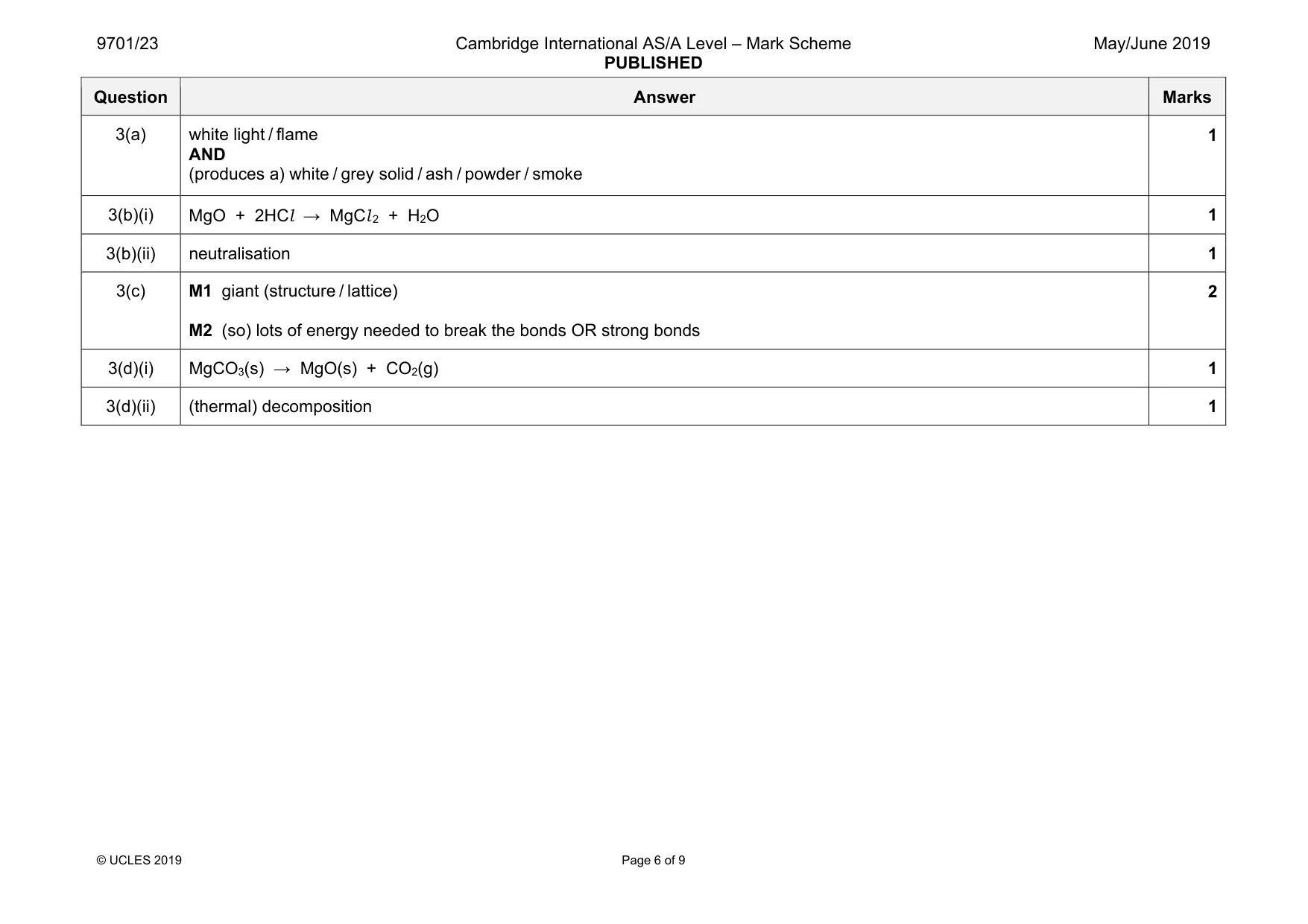
Mark scheme: 3(a) white light / flame AND (produces a) white / grey solid / ash / powder / smoke 1 3(b)(i) MgO + 2HCl → MgCl 2 + H2O 1 3(b)(ii) neutralisation 1 3(c) M1 giant (structure / lattice) M2 (so) lots of energy needed to break the bonds OR strong bonds 2 3(d)(i) MgCO3(s) → MgO(s) + CO2(g) 1 3(d)(ii) (thermal) decomposition 1
Q4 · Release of sulfur dioxide, SO2, into the atmosphere causes acid rain
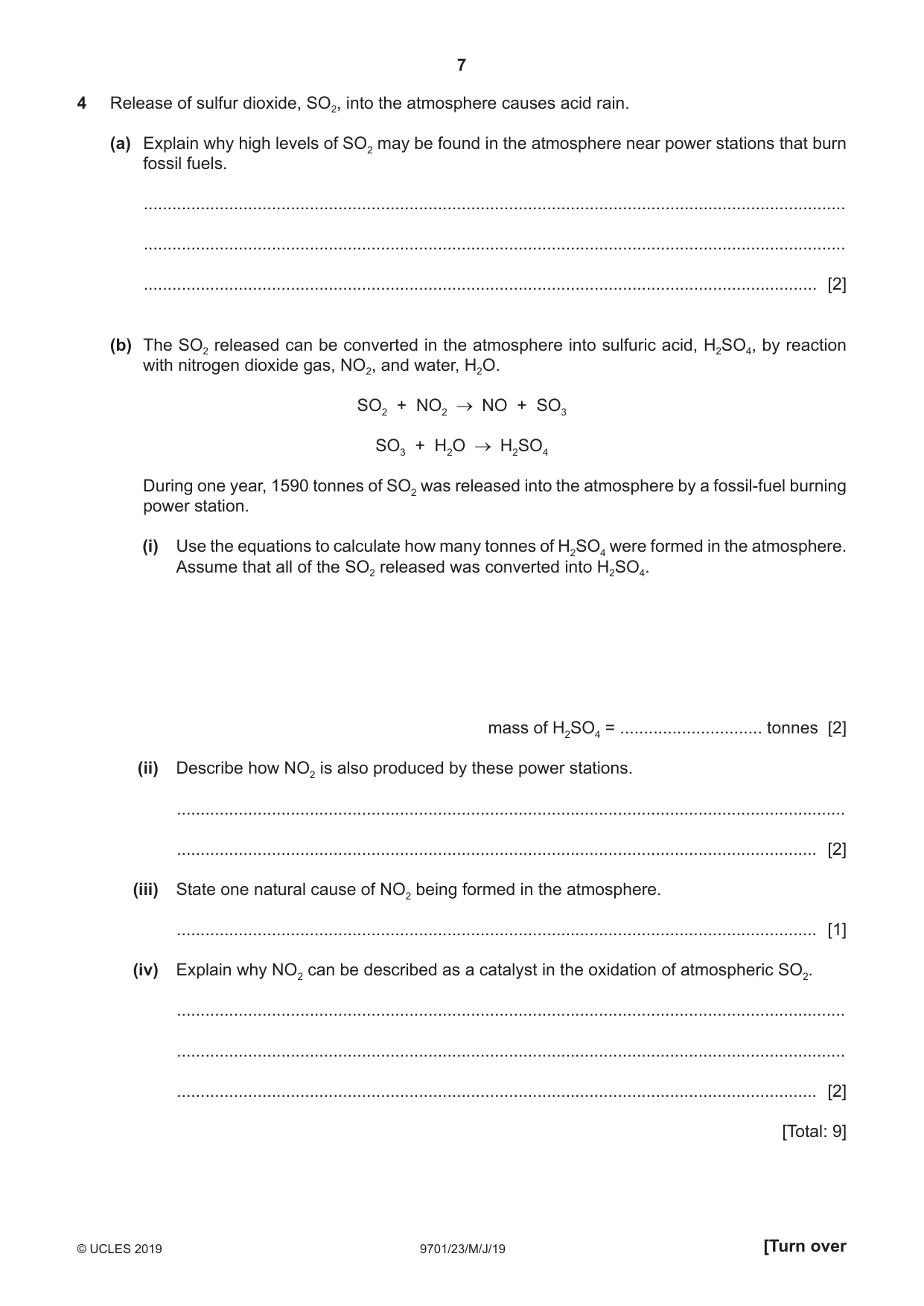
4 Release of sulfur dioxide, SO2, into the atmosphere causes acid rain. (a) Explain why high levels of SO2 may be found in the atmosphere near power stations that burn fossil fuels. .................................................................................................................................................... .................................................................................................................................................... .............................................................................................................................................. [2] (b) The SO2 released can be converted in the atmosphere into sulfuric acid, H2SO4, by reaction with nitrogen dioxide gas, NO2, and water, H2O. SO2 + NO2 NO + SO3 SO3 + H2O H2SO4 During one year, 1590 tonnes of SO2 was released into the atmosphere by a fossil-fuel burning power station. (i) Use the equations to calculate how many tonnes of H2SO4 were formed in the atmosphere. Assume that all of the SO2 released was converted into H2SO4. mass of H2SO4 = .............................. tonnes [2] (ii) Describe how NO2 is also produced by these power stations. ............................................................................................................................................. ....................................................................................................................................... [2] (iii) State one natural cause of NO2 being formed in the atmosphere. ....................................................................................................................................... [1] (iv) Explain why NO2 can be described as a catalyst in the oxidation of atmospheric SO2. ............................................................................................................................................. ............................................................................................................................................. ....................................................................................................................................... [2] [Total: 9]
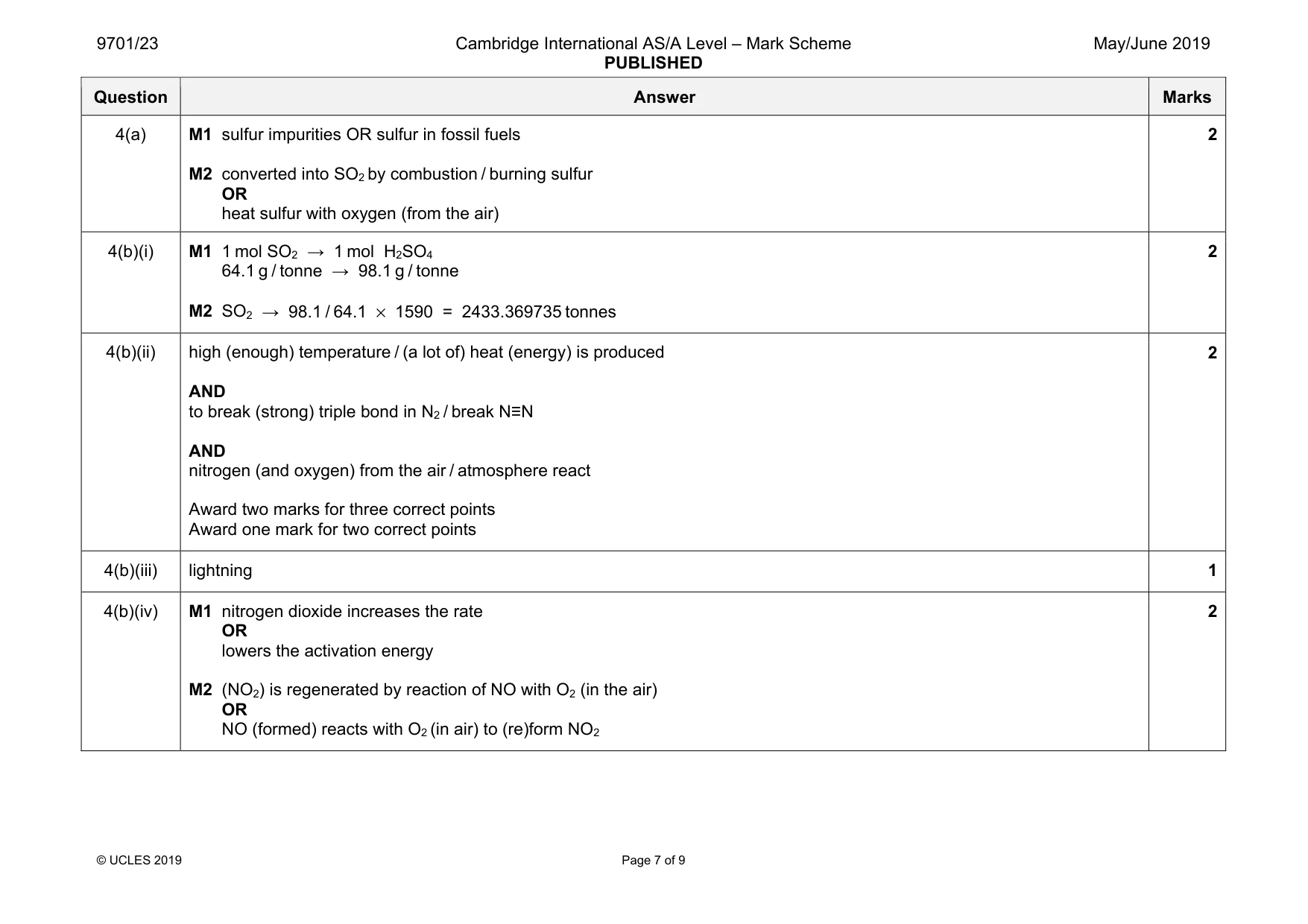
Mark scheme: 4(a) M1 sulfur impurities OR sulfur in fossil fuels M2 converted into SO2 by combustion / burning sulfur OR heat sulfur with oxygen (from the air) 2 4(b)(i) M1 1 mol SO2 → 1 mol H2SO4 64.1 g / tonne → 98.1 g / tonne M2 SO2 → 98.1 / 64.1 × 1590 = 2433.369735 tonnes 2 4(b)(ii) high (enough) temperature / (a lot of) heat (energy) is produced AND to break (strong) triple bond in N2 / break N≡N AND nitrogen (and oxygen) from the air / atmosphere react Award two marks for three correct points Award one mark for two correct points 2 4(b)(iii) lightning 1 4(b)(iv) M1 nitrogen dioxide increases the rate OR lowers the activation energy M2 (NO2) is regenerated by reaction of NO with O2 (in the air) OR NO (formed) reacts with O2 (in air) to (re)form NO2 2
Q5 · Halogenoalkanes react with a number of different reagents in nucleophilic substitution…
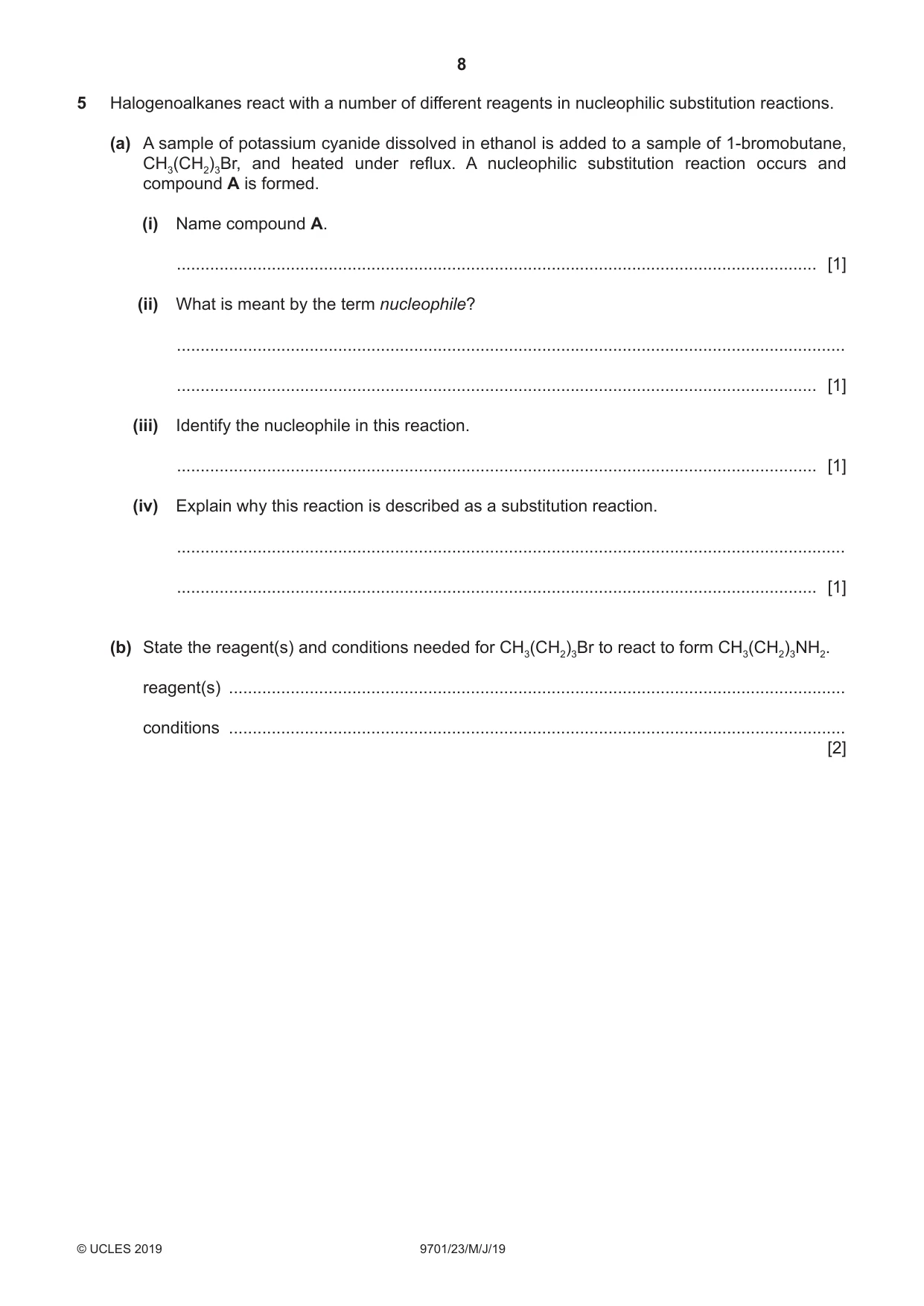
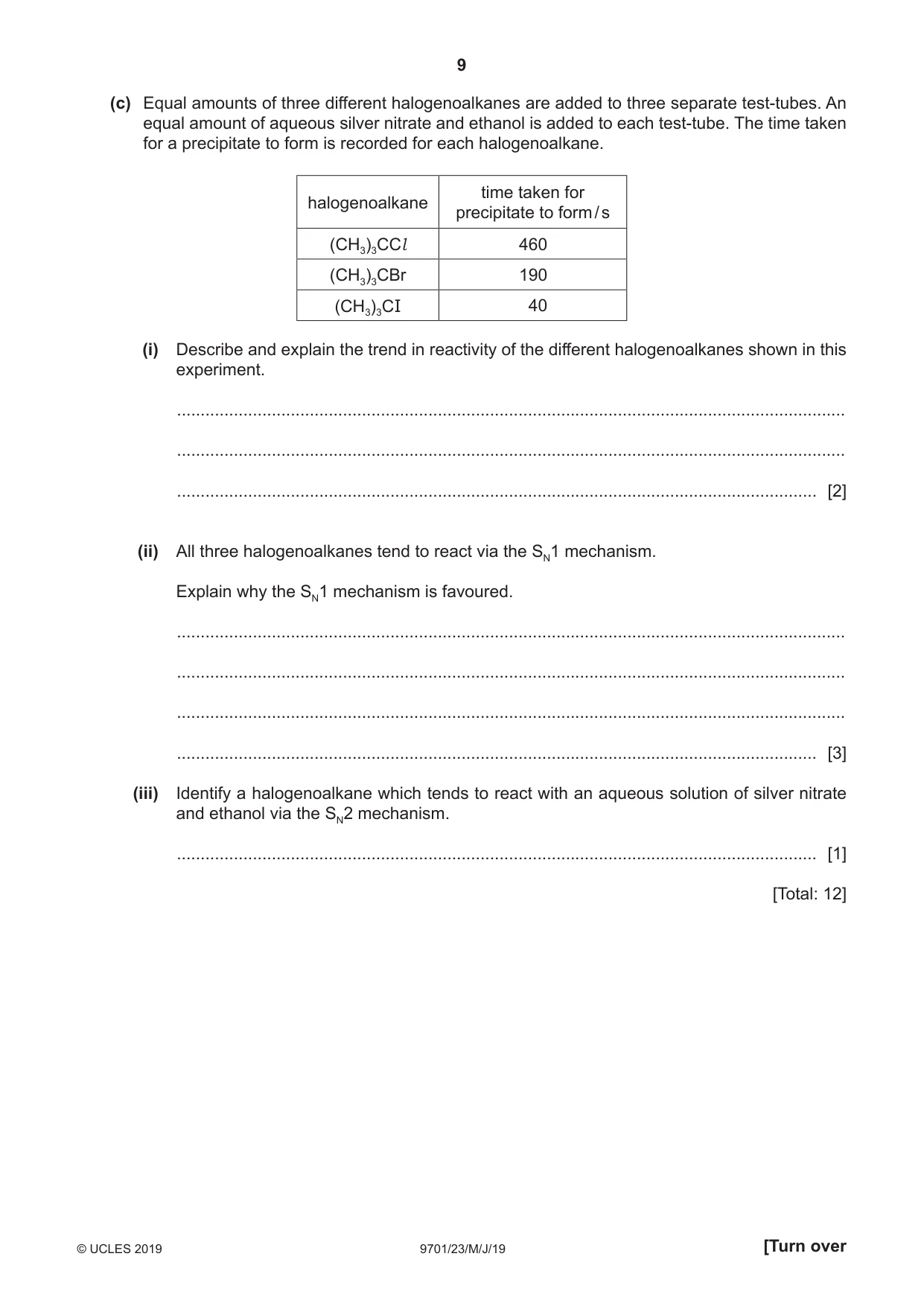
5 Halogenoalkanes react with a number of different reagents in nucleophilic substitution reactions. (a) A sample of potassium cyanide dissolved in ethanol is added to a sample of 1-bromobutane, CH3(CH2)3Br, and heated under reflux. A nucleophilic substitution reaction occurs and compound A is formed. (i) Name compound A. ....................................................................................................................................... [1] (ii) What is meant by the term nucleophile? ............................................................................................................................................. ....................................................................................................................................... [1] (iii) Identify the nucleophile in this reaction. ....................................................................................................................................... [1] (iv) Explain why this reaction is described as a substitution reaction. ............................................................................................................................................. ....................................................................................................................................... [1] (b) State the reagent(s) and conditions needed for CH3(CH2)3Br to react to form CH3(CH2)3NH2. reagent(s) ................................................................................................................................... conditions ................................................................................................................................... [2] (c) Equal amounts of three different halogenoalkanes are added to three separate test‑tubes. An equal amount of aqueous silver nitrate and ethanol is added to each test‑tube. The time taken for a precipitate to form is recorded for each halogenoalkane. time taken for halogenoalkane precipitate to form / s (CH3)3CCl 460 (CH3)3CBr 190 (CH3)3CI 40 (i) Describe and explain the trend in reactivity of the different halogenoalkanes shown in this experiment. ............................................................................................................................................. ............................................................................................................................................. ....................................................................................................................................... [2] (ii) All three halogenoalkanes tend to react via the SN1 mechanism. Explain why the SN1 mechanism is favoured. ............................................................................................................................................. ............................................................................................................................................. ............................................................................................................................................. ....................................................................................................................................... [3] (iii) Identify a halogenoalkane which tends to react with an aqueous solution of silver nitrate and ethanol via the SN2 mechanism. ....................................................................................................................................... [1] [Total: 12]
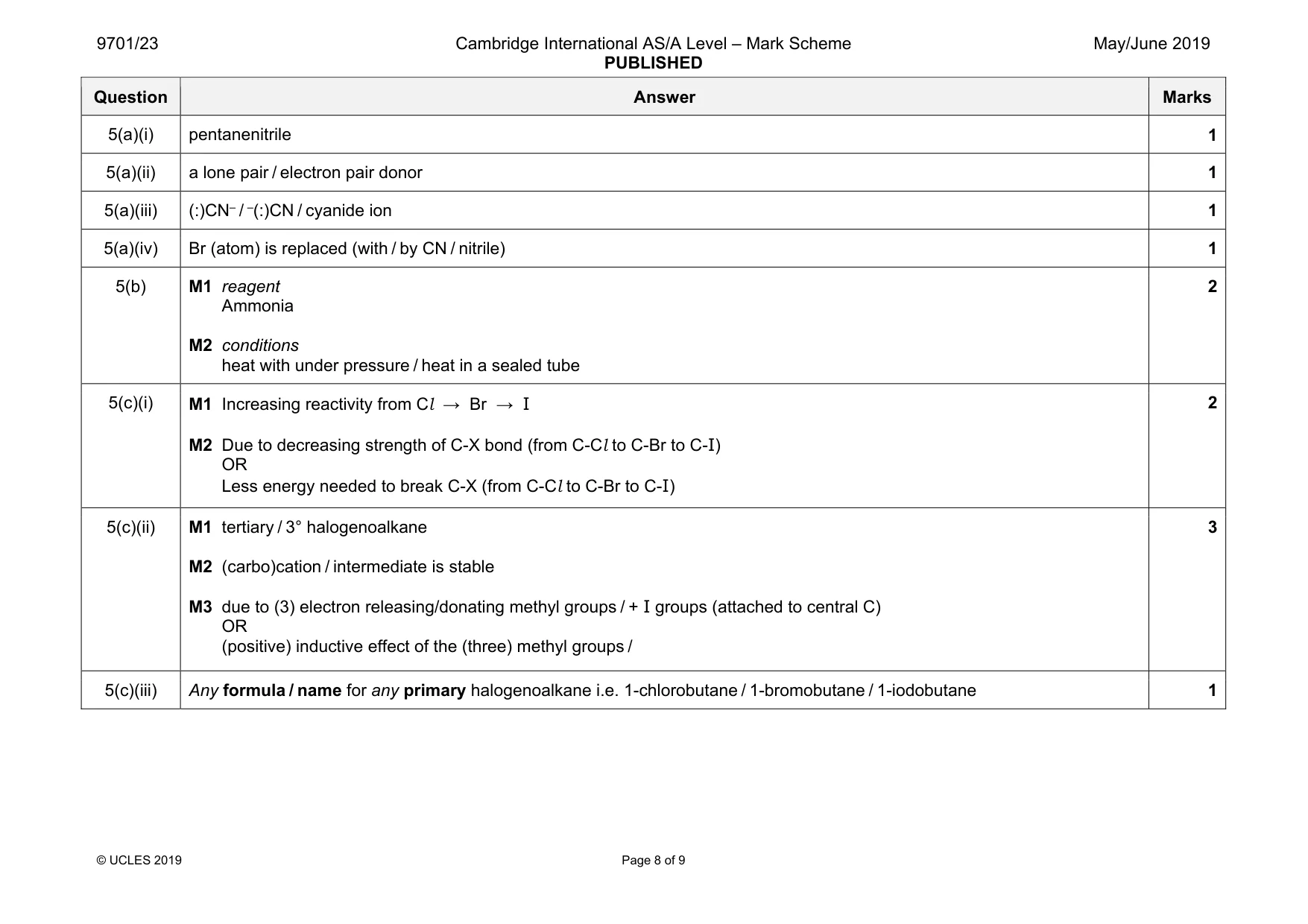
Mark scheme: 5(a)(i) pentanenitrile 1 5(a)(ii) a lone pair / electron pair donor 1 5(a)(iii) (:)CN– / –(:)CN / cyanide ion 1 5(a)(iv) Br (atom) is replaced (with / by CN / nitrile) 1 5(b) M1 reagent Ammonia M2 conditions heat with under pressure / heat in a sealed tube 2 5(c)(i) M1 Increasing reactivity from Cl → Br → I M2 Due to decreasing strength of C-X bond (from C-Cl to C-Br to C-I) OR Less energy needed to break C-X (from C-Cl to C-Br to C-I) 2 5(c)(ii) M1 tertiary / 3° halogenoalkane M2 (carbo)cation / intermediate is stable M3 due to (3) electron releasing/donating methyl groups / + I groups (attached to central C) OR (positive) inductive effect of the (three) methyl groups / 3 5(c)(iii) Any formula / name for any primary halogenoalkane i.e. 1-chlorobutane / 1-bromobutane / 1-iodobutane 1
Q6 · Three alkenes, X, Y and Z, have the same molecular formula
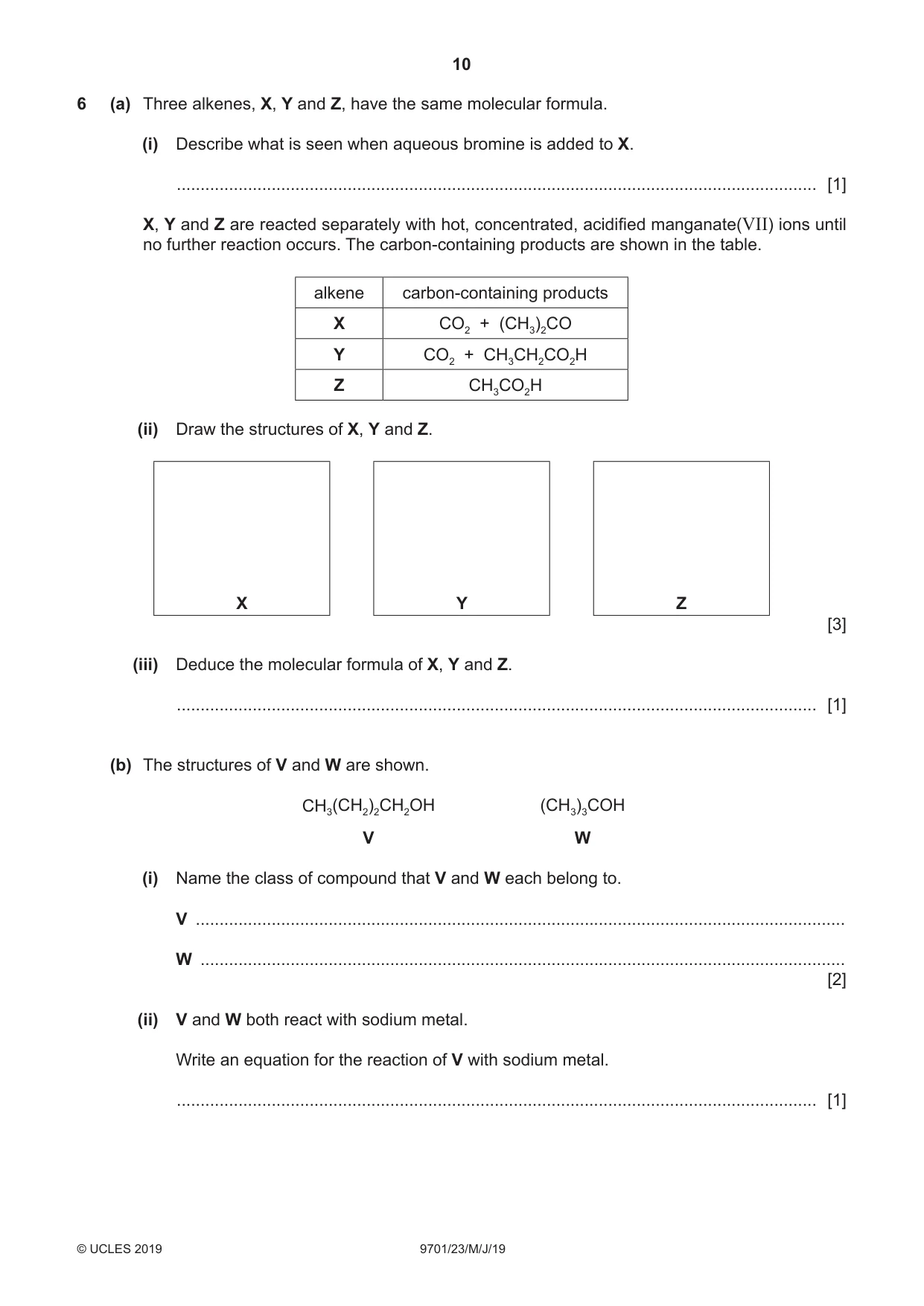
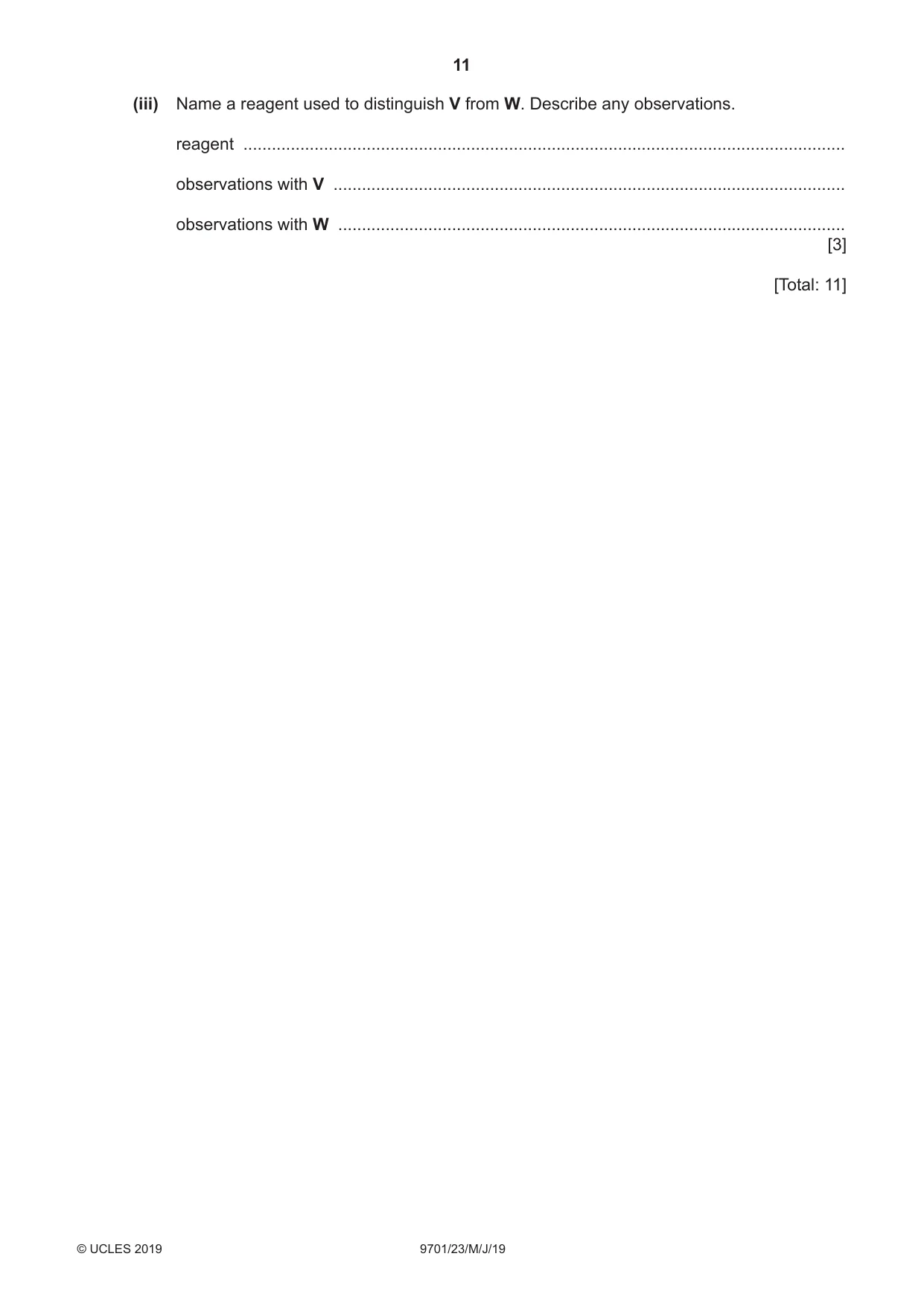
6 (a) Three alkenes, X, Y and Z, have the same molecular formula. (i) Describe what is seen when aqueous bromine is added to X. ....................................................................................................................................... [1] X, Y and Z are reacted separately with hot, concentrated, acidified manganate(VII) ions until no further reaction occurs. The carbon-containing products are shown in the table. alkene carbon-containing products X CO2 + (CH3)2CO Y CO2 + CH3CH2CO2H Z CH3CO2H (ii) Draw the structures of X, Y and Z. X Y Z [3] (iii) Deduce the molecular formula of X, Y and Z. ....................................................................................................................................... [1] (b) The structures of V and W are shown. CH3(CH2)2CH2OH (CH3)3COH V W (i) Name the class of compound that V and W each belong to. V .......................................................................................................................................... W ......................................................................................................................................... [2] (ii) V and W both react with sodium metal. Write an equation for the reaction of V with sodium metal. ....................................................................................................................................... [1] (iii) Name a reagent used to distinguish V from W. Describe any observations. reagent ................................................................................................................................ observations with V ............................................................................................................. observations with W ............................................................................................................ [3] [Total: 11]
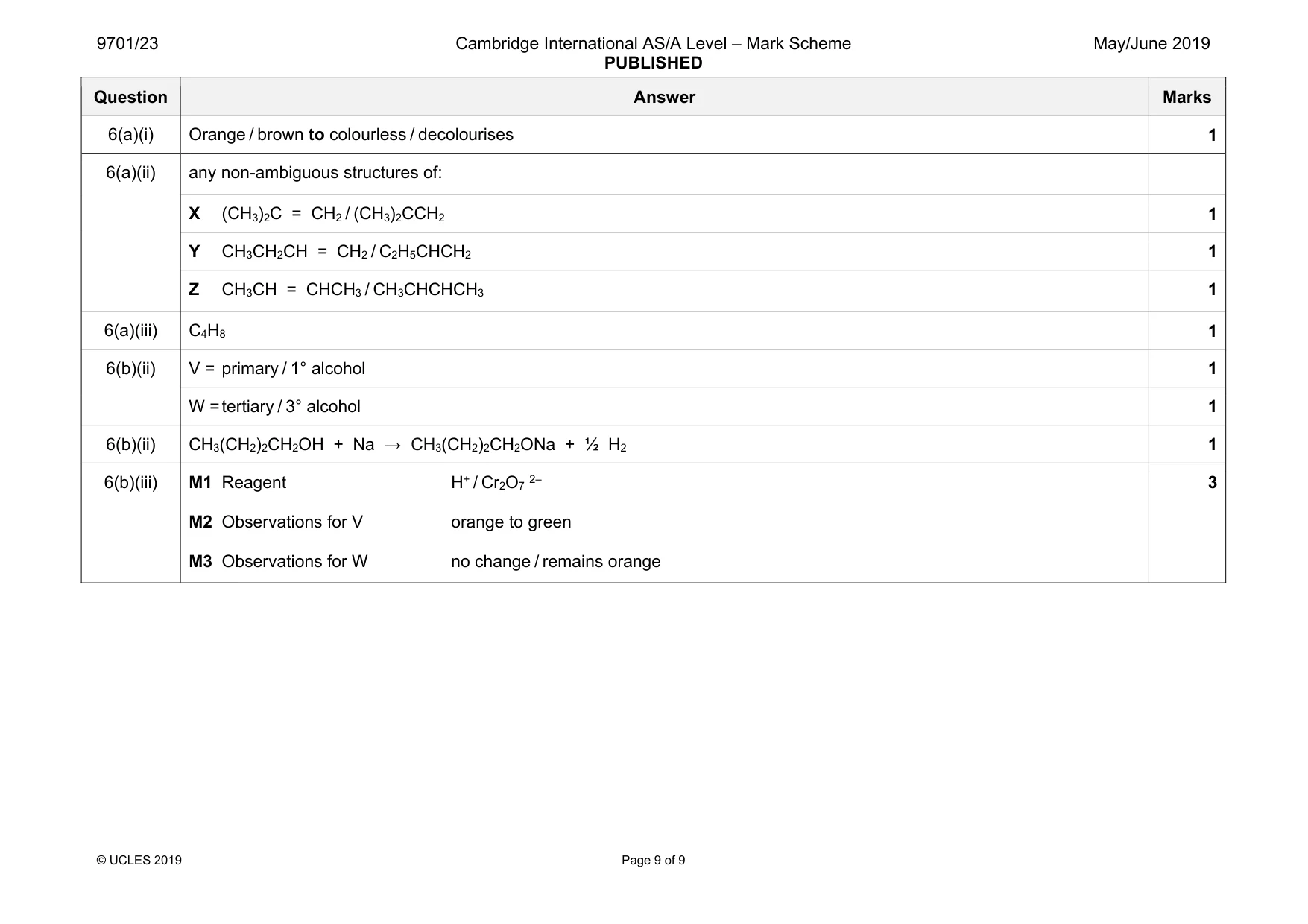
Mark scheme: 6(a)(i) Orange / brown to colourless / decolourises 1 6(a)(ii) any non-ambiguous structures of: X (CH3)2C = CH2 / (CH3)2CCH2 1 Y CH3CH2CH = CH2 / C2H5CHCH2 1 Z CH3CH = CHCH3 / CH3CHCHCH3 1 6(a)(iii) C4H8 1 6(b)(ii) V = primary / 1° alcohol 1 W = tertiary / 3° alcohol 1 6(b)(ii) CH3(CH2)2CH2OH + Na → CH3(CH2)2CH2ONa + ½ H2 1 6(b)(iii) M1 Reagent H+ / Cr2O7 2– M2 Observations for V orange to green M3 Observations for W no change / remains orange 3
What was in this paper
The subtopics covered by these 6 questions, and how many questions each got. Open one in a new tab to see every Cambridge question on it.
What you needed in this session
Cambridge’s own grade thresholds for 2019 May/June, Paper 2 · Variant 3. A higher threshold means an easier paper — the bar moves with how the cohort did.