Cambridge A Level Chemistry 9701 — 2018 May/June Paper 2 · Variant 2
9701/22/M/J/18 · 4 questions · 60 marks · ≈68 min
The question paper and its mark scheme, free to read here and free to download. This is Cambridge’s own paper, exactly as it was sat.
Question paper12 pages

Mark scheme10 pages
Answers below. Sit the paper first if you are practising.
Questions as text
Q1 · Sodium and magnesium are the first two elements in the third period
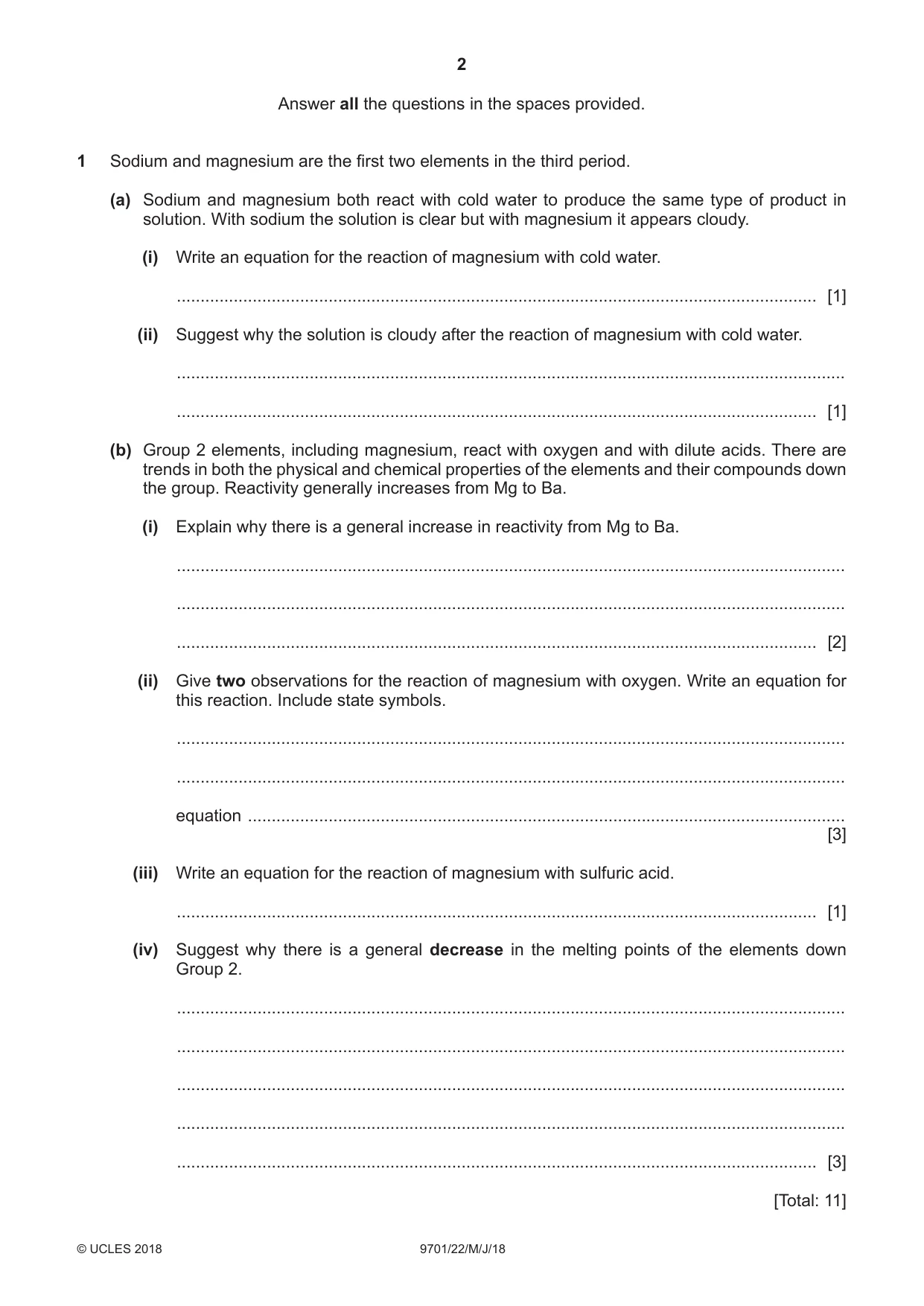
1 Sodium and magnesium are the first two elements in the third period. (a) Sodium and magnesium both react with cold water to produce the same type of product in solution. With sodium the solution is clear but with magnesium it appears cloudy. (i) Write an equation for the reaction of magnesium with cold water. ....................................................................................................................................... [1] (ii) Suggest why the solution is cloudy after the reaction of magnesium with cold water. ............................................................................................................................................. ....................................................................................................................................... [1] (b) Group 2 elements, including magnesium, react with oxygen and with dilute acids. There are trends in both the physical and chemical properties of the elements and their compounds down the group. Reactivity generally increases from Mg to Ba. (i) Explain why there is a general increase in reactivity from Mg to Ba. ............................................................................................................................................. ............................................................................................................................................. ....................................................................................................................................... [2] (ii) Give two observations for the reaction of magnesium with oxygen. Write an equation for this reaction. Include state symbols. ............................................................................................................................................. ............................................................................................................................................. equation .............................................................................................................................. [3] (iii) Write an equation for the reaction of magnesium with sulfuric acid. ....................................................................................................................................... [1] (iv) Suggest why there is a general decrease in the melting points of the elements down Group 2. ............................................................................................................................................. ............................................................................................................................................. ............................................................................................................................................. ............................................................................................................................................. ....................................................................................................................................... [3] [Total: 11]
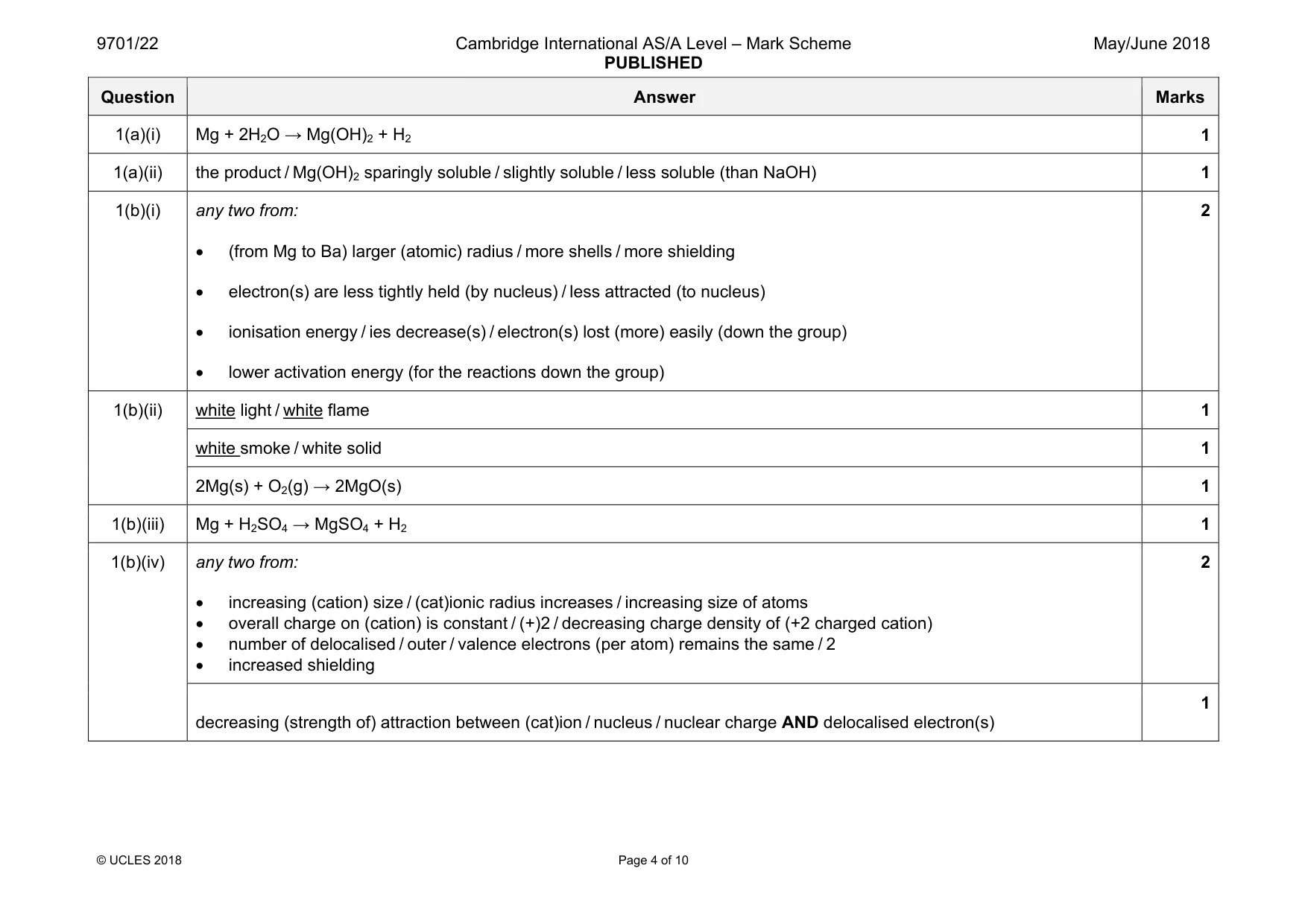
Mark scheme: 1(a)(i) Mg + 2H2O → Mg(OH)2 + H2 1 1(a)(ii) the product / Mg(OH)2 sparingly soluble / slightly soluble / less soluble (than NaOH) 1 1(b)(i) any two from: • (from Mg to Ba) larger (atomic) radius / more shells / more shielding • electron(s) are less tightly held (by nucleus) / less attracted (to nucleus) • ionisation energy / ies decrease(s) / electron(s) lost (more) easily (down the group) • lower activation energy (for the reactions down the group) 2 1(b)(ii) white light / white flame 1 white smoke / white solid 1 2Mg(s) + O2(g) → 2MgO(s) 1 1(b)(iii) Mg + H2SO4 → MgSO4 + H2 1 1(b)(iv) any two from: • increasing (cation) size / (cat)ionic radius increases / increasing size of atoms • overall charge on (cation) is constant / (+)2 / decreasing charge density of (+2 charged cation) • number of delocalised / outer / valence electrons (per atom) remains the same / 2 • increased shielding 2 decreasing (strength of) attraction between (cat)ion / nucleus / nuclear charge AND delocalised electron(s) 1
Q2 · Ammonium iron(II) sulfate, (NH4)2Fe(SO4)2, has a relative formula mass, Mr, of 284
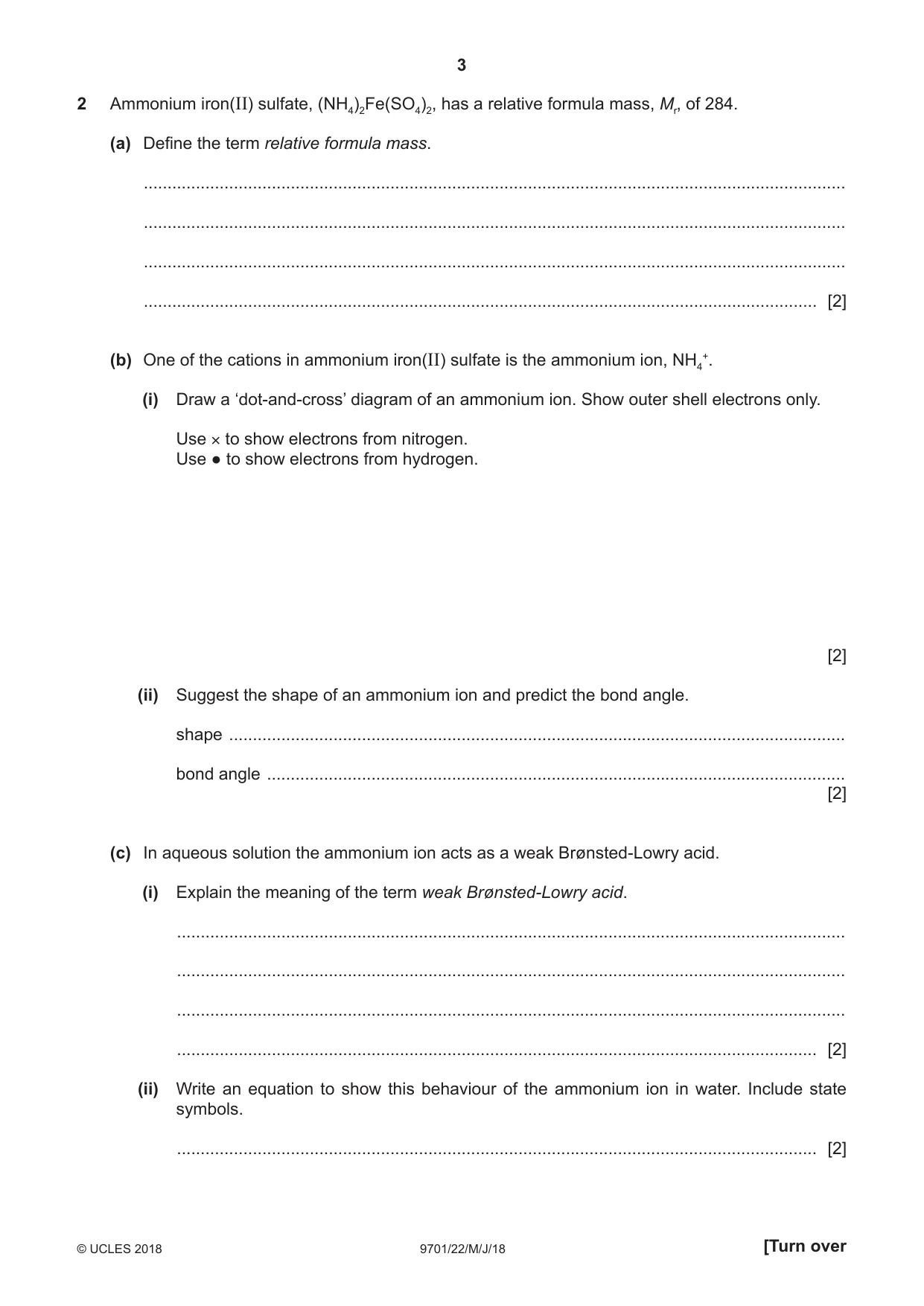
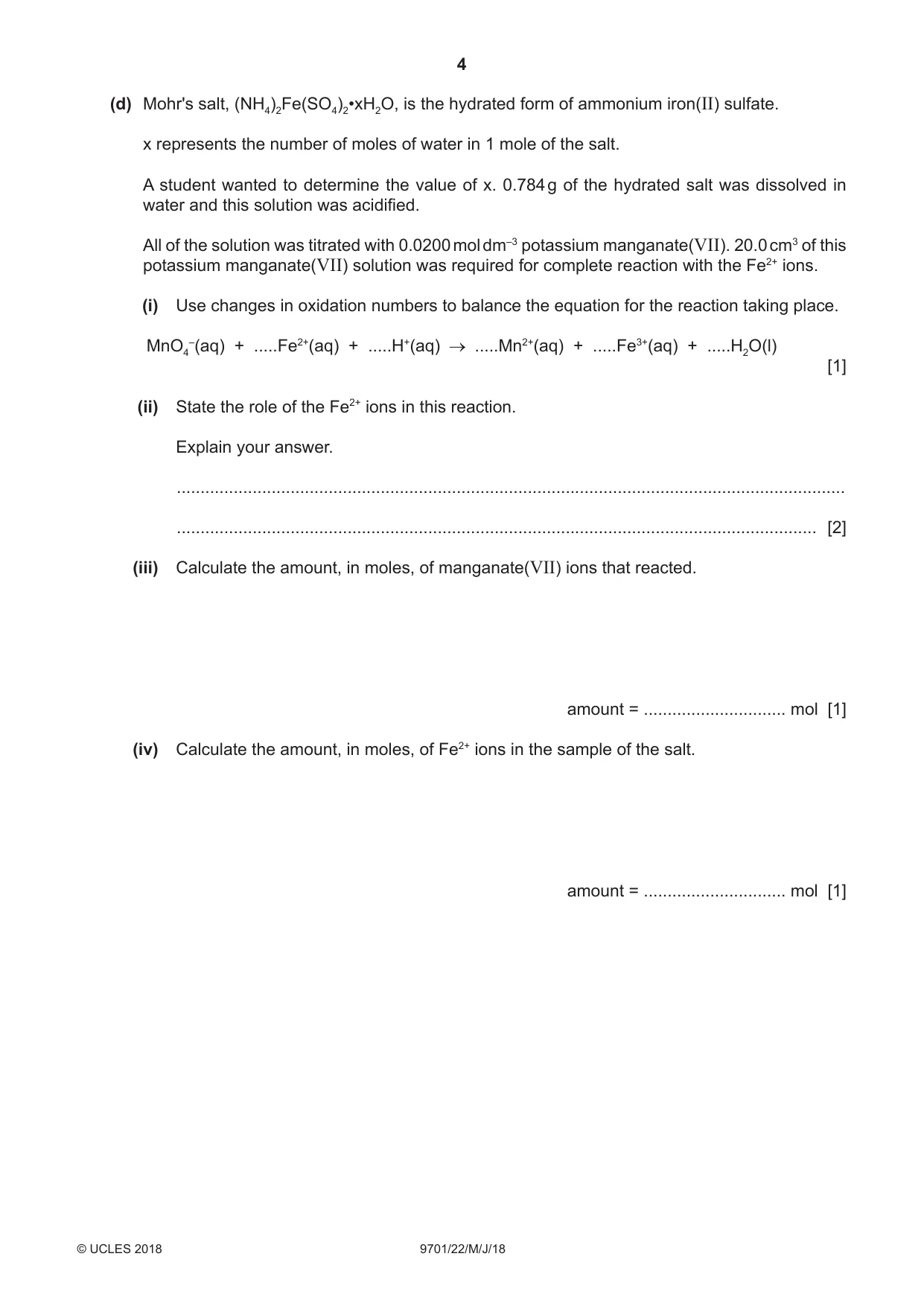
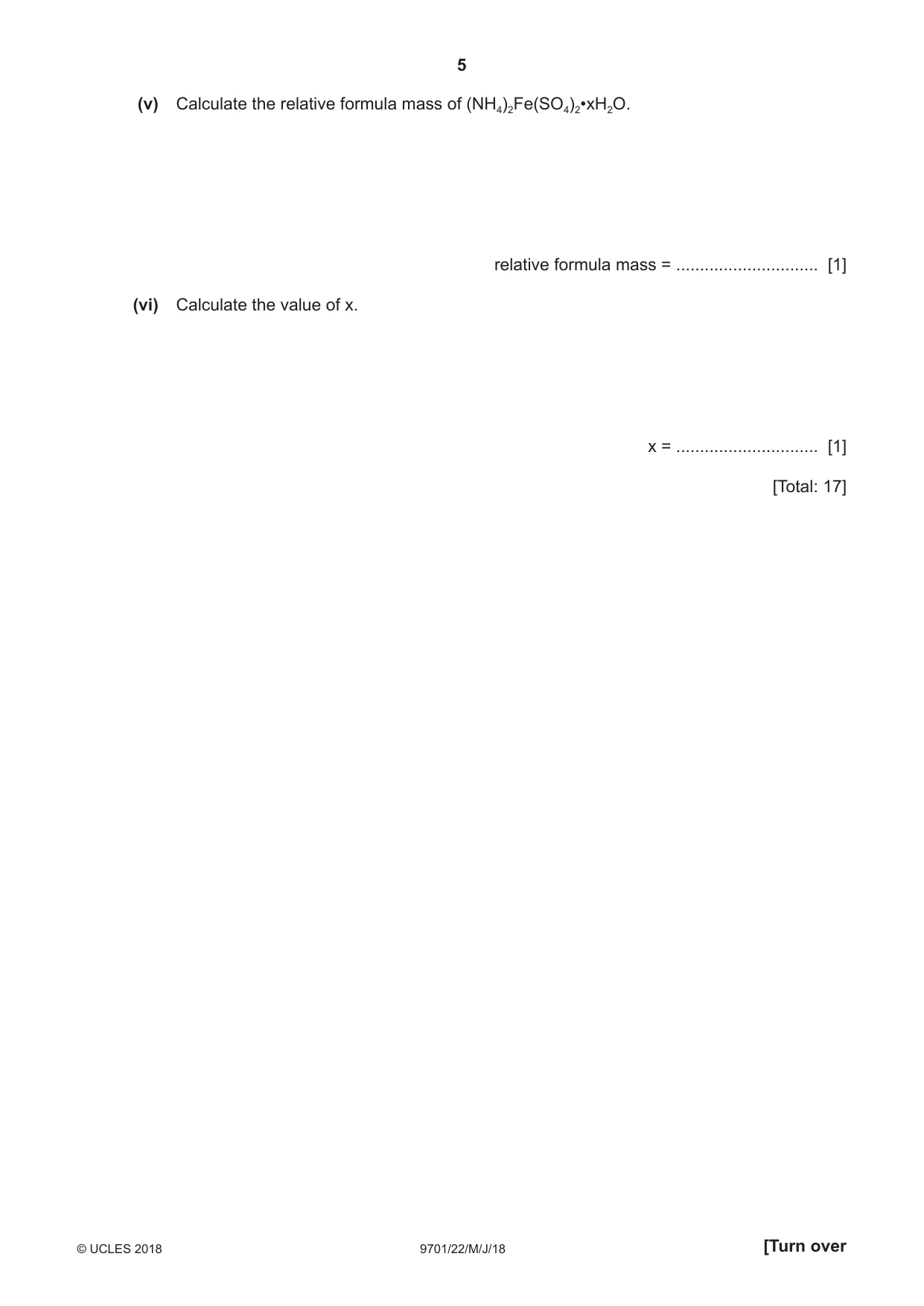
2 Ammonium iron(II) sulfate, (NH4)2Fe(SO4)2, has a relative formula mass, Mr, of 284. (a) Define the term relative formula mass. .................................................................................................................................................... .................................................................................................................................................... .................................................................................................................................................... .............................................................................................................................................. [2] (b) One of the cations in ammonium iron(II) sulfate is the ammonium ion, NH4+. (i) Draw a ‘dot-and-cross’ diagram of an ammonium ion. Show outer shell electrons only. Use × to show electrons from nitrogen. Use ● to show electrons from hydrogen. [2] (ii) Suggest the shape of an ammonium ion and predict the bond angle. shape .................................................................................................................................. bond angle .......................................................................................................................... [2] (c) In aqueous solution the ammonium ion acts as a weak Brønsted-Lowry acid. (i) Explain the meaning of the term weak Brønsted-Lowry acid. ............................................................................................................................................. ............................................................................................................................................. ............................................................................................................................................. ....................................................................................................................................... [2] (ii) Write an equation to show this behaviour of the ammonium ion in water. Include state symbols. ....................................................................................................................................... [2] (d) Mohr's salt, (NH4)2Fe(SO4)2•xH2O, is the hydrated form of ammonium iron(II) sulfate. x represents the number of moles of water in 1 mole of the salt. A student wanted to determine the value of x. 0.784 g of the hydrated salt was dissolved in water and this solution was acidified. All of the solution was titrated with 0.0200 mol dm–3 potassium manganate(VII). 20.0 cm3 of this potassium manganate(VII) solution was required for complete reaction with the Fe2+ ions. (i) Use changes in oxidation numbers to balance the equation for the reaction taking place. MnO4–(aq) + .....Fe2+(aq) + .....H+(aq) .....Mn2+(aq) + .....Fe3+(aq) + .....H2O(l) [1] (ii) State the role of the Fe2+ ions in this reaction. Explain your answer. ............................................................................................................................................. ....................................................................................................................................... [2] (iii) Calculate the amount, in moles, of manganate(VII) ions that reacted. amount = .............................. mol [1] (iv) Calculate the amount, in moles, of Fe2+ ions in the sample of the salt. amount = .............................. mol [1] (v) Calculate the relative formula mass of (NH4)2Fe(SO4)2•xH2O. relative formula mass = .............................. [1] (vi) Calculate the value of x. x = .............................. [1] [Total: 17]
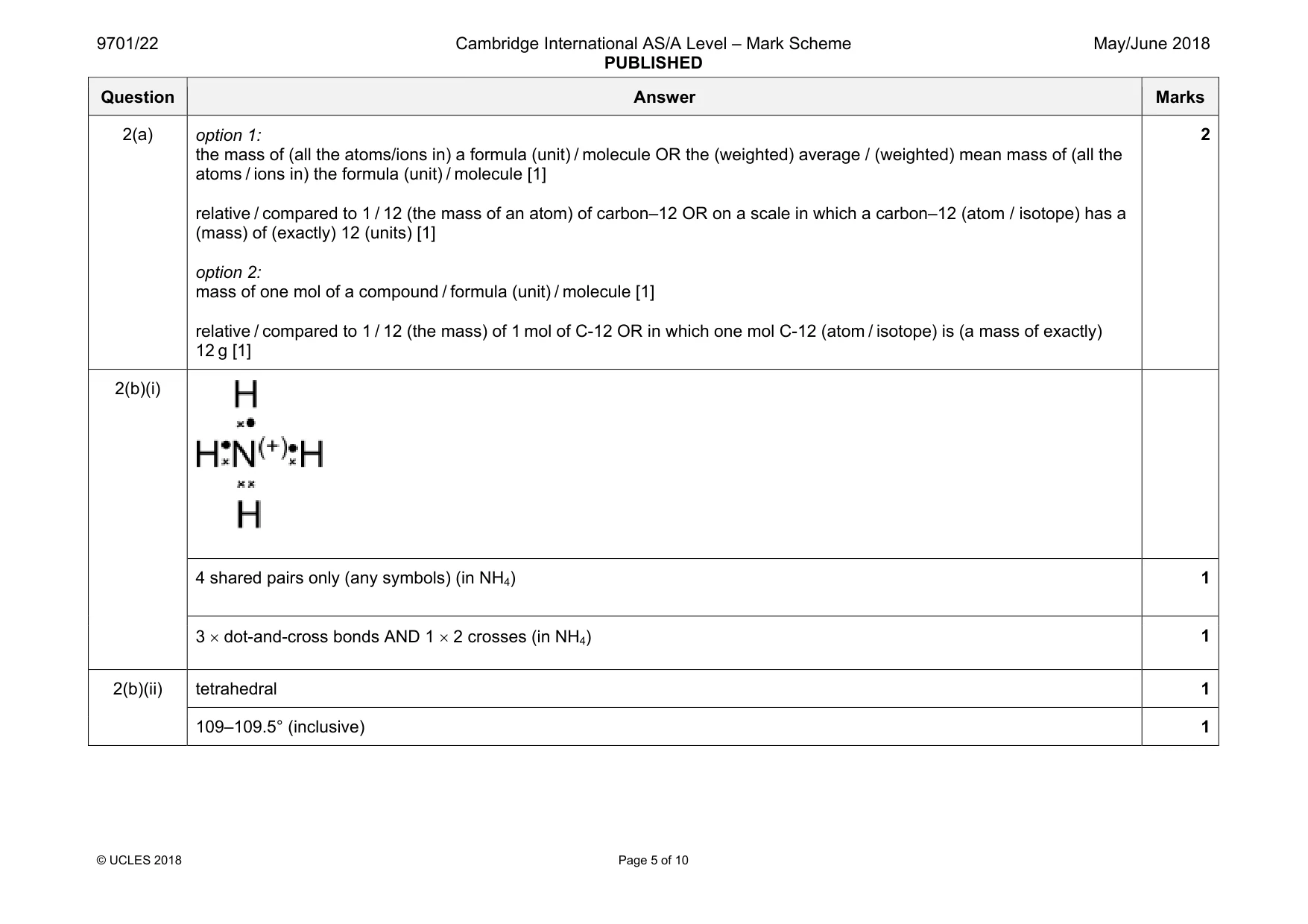
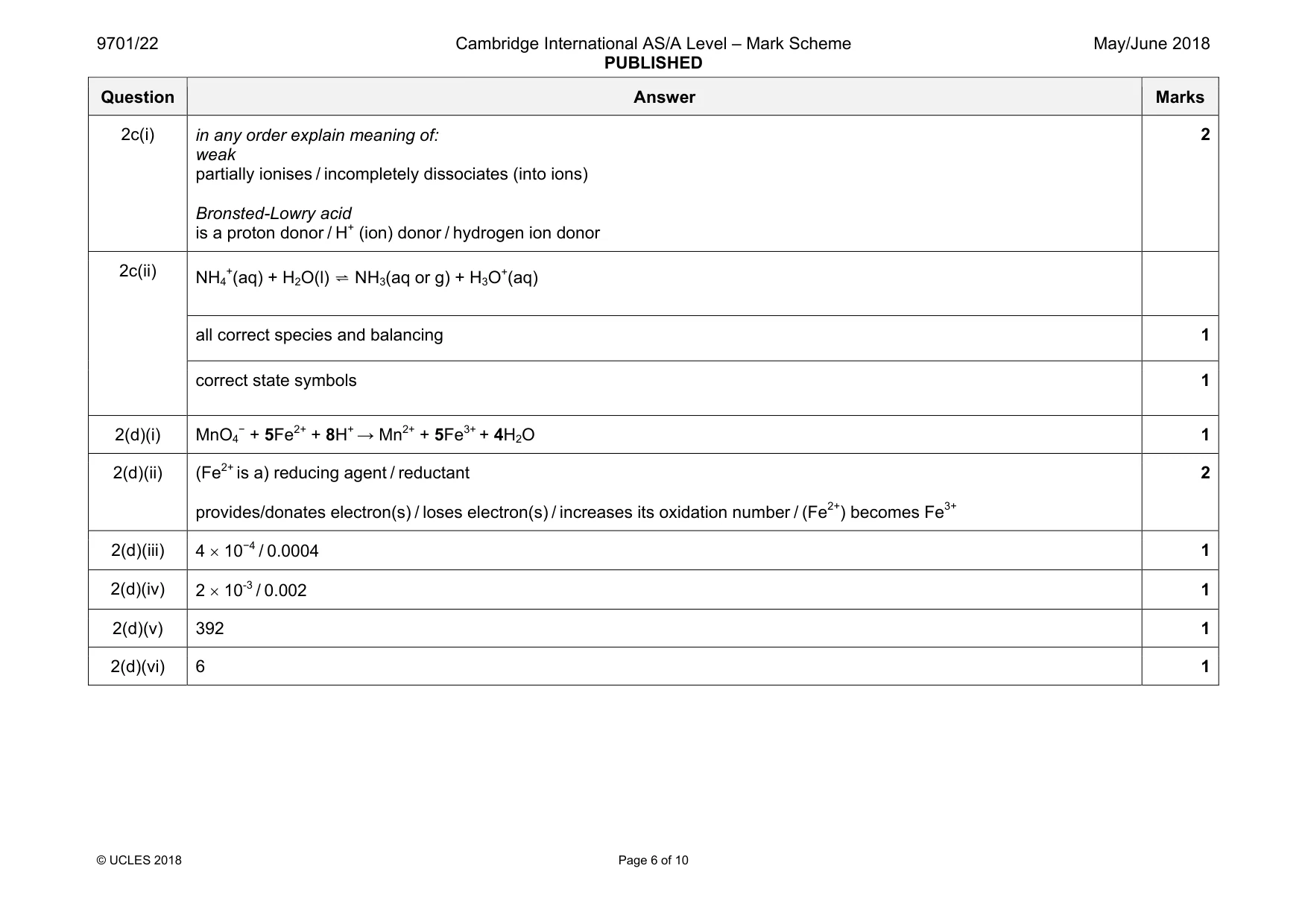
Mark scheme: 2(a) option 1: the mass of (all the atoms/ions in) a formula (unit) / molecule OR the (weighted) average / (weighted) mean mass of (all the atoms / ions in) the formula (unit) / molecule [1] relative / compared to 1 / 12 (the mass of an atom) of carbon–12 OR on a scale in which a carbon–12 (atom / isotope) has a (mass) of (exactly) 12 (units) [1] option 2: mass of one mol of a compound / formula (unit) / molecule [1] relative / compared to 1 / 12 (the mass) of 1 mol of C-12 OR in which one mol C-12 (atom / isotope) is (a mass of exactly) 12 g [1] 2 2(b)(i) 4 shared pairs only (any symbols) (in NH4) 1 3 × dot-and-cross bonds AND 1 × 2 crosses (in NH4) 1 2(b)(ii) tetrahedral 1 109–109.5° (inclusive) 1 Question Answer Marks 2c(i) in any order explain meaning of: weak partially ionises / incompletely dissociates (into ions) Bronsted-Lowry acid is a proton donor / H+ (ion) donor / hydrogen ion donor 2 2c(ii) NH4 +(aq) + H2O(l) ҡ NH3(aq or g) + H3O+(aq) all correct species and balancing 1 correct state symbols 1 2(d)(i) MnO4 − + 5Fe2+ + 8H+ → Mn2+ + 5Fe3+ + 4H2O 1 2(d)(ii) (Fe2+ is a) reducing agent / reductant provides/donates electron(s) / loses electron(s) / increases its oxidation number / (Fe2+) becomes Fe3+ 2 2(d)(iii) 4 × 10⁻⁴ / 0.0004 1 2(d)(iv) 2 × 10⁻³ / 0.002 1 2(d)(v) 392 1 2(d)(vi) 6 1
Q3 · Most vehicle fuels contain hydrocarbons obtained from crude oil
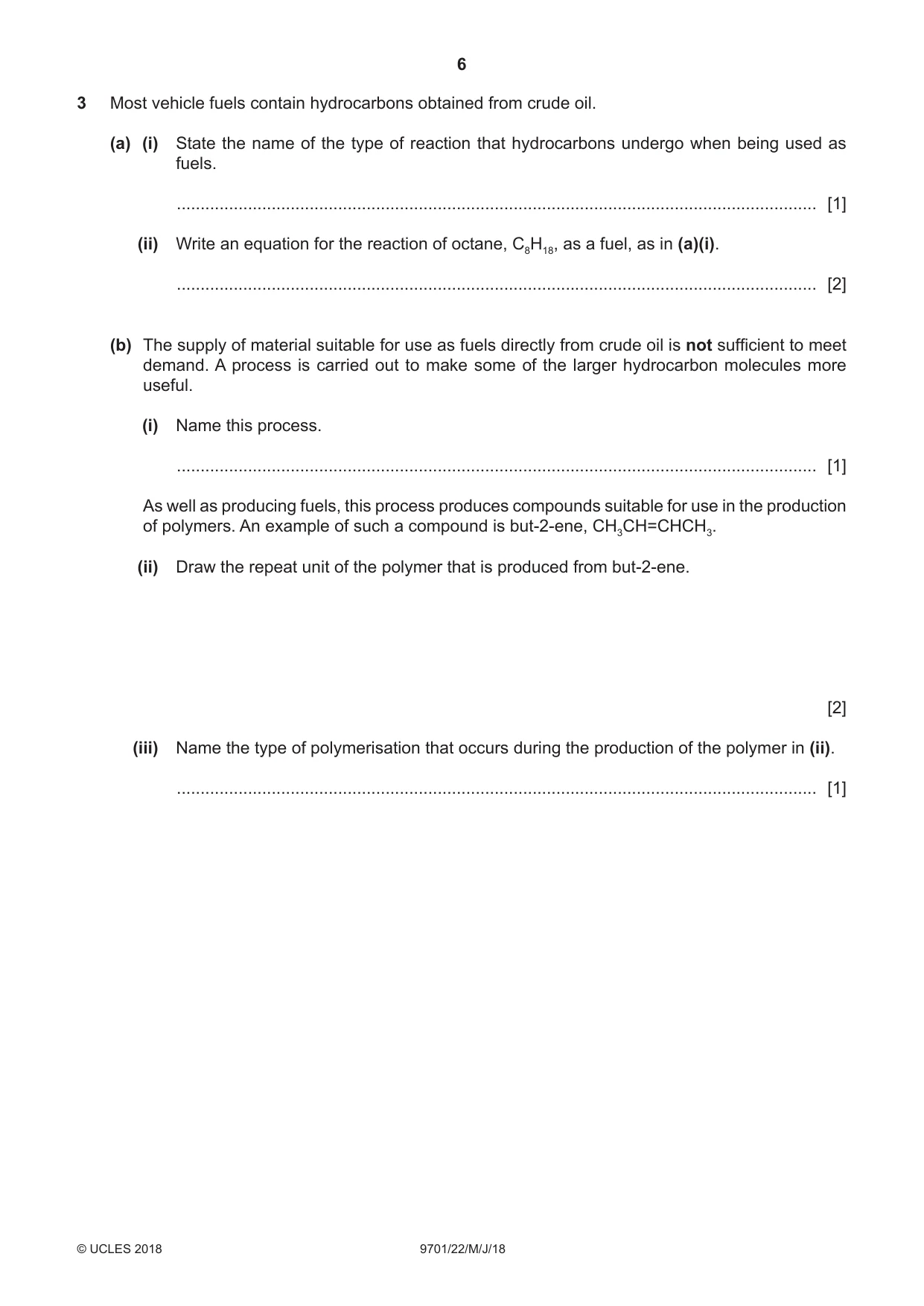
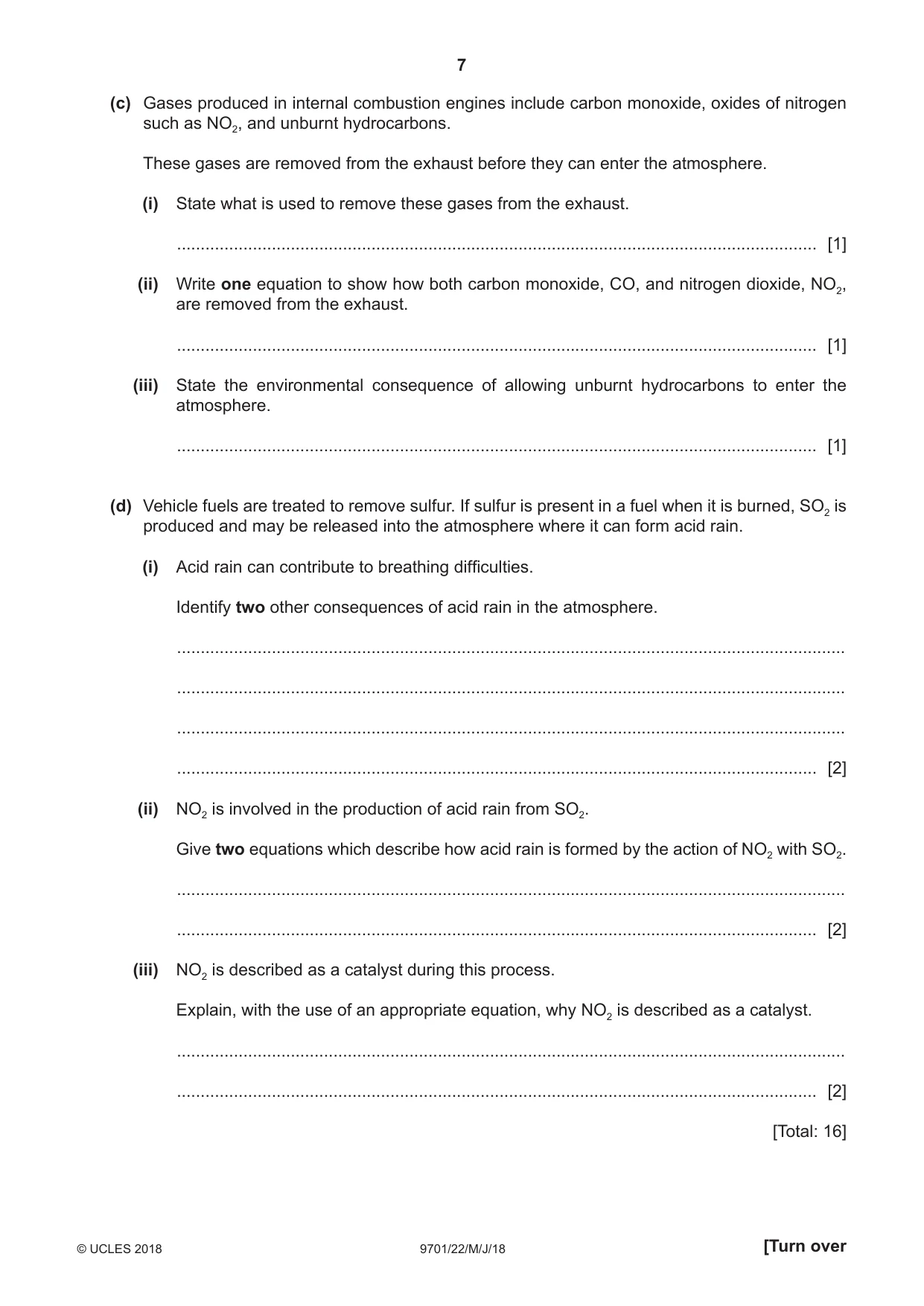
3 Most vehicle fuels contain hydrocarbons obtained from crude oil. (a) (i) State the name of the type of reaction that hydrocarbons undergo when being used as fuels. ....................................................................................................................................... [1] (ii) Write an equation for the reaction of octane, C8H18, as a fuel, as in (a)(i). ....................................................................................................................................... [2] (b) The supply of material suitable for use as fuels directly from crude oil is not sufficient to meet demand. A process is carried out to make some of the larger hydrocarbon molecules more useful. (i) Name this process. ....................................................................................................................................... [1] As well as producing fuels, this process produces compounds suitable for use in the production of polymers. An example of such a compound is but-2-ene, CH3CH=CHCH3. (ii) Draw the repeat unit of the polymer that is produced from but-2-ene. [2] (iii) Name the type of polymerisation that occurs during the production of the polymer in (ii). ....................................................................................................................................... [1] (c) Gases produced in internal combustion engines include carbon monoxide, oxides of nitrogen such as NO2, and unburnt hydrocarbons. These gases are removed from the exhaust before they can enter the atmosphere. (i) State what is used to remove these gases from the exhaust. ....................................................................................................................................... [1] (ii) Write one equation to show how both carbon monoxide, CO, and nitrogen dioxide, NO2, are removed from the exhaust. ....................................................................................................................................... [1] (iii) State the environmental consequence of allowing unburnt hydrocarbons to enter the atmosphere. ....................................................................................................................................... [1] (d) Vehicle fuels are treated to remove sulfur. If sulfur is present in a fuel when it is burned, SO2 is produced and may be released into the atmosphere where it can form acid rain. (i) Acid rain can contribute to breathing difficulties. Identify two other consequences of acid rain in the atmosphere. ............................................................................................................................................. ............................................................................................................................................. ............................................................................................................................................. ....................................................................................................................................... [2] (ii) NO2 is involved in the production of acid rain from SO2. Give two equations which describe how acid rain is formed by the action of NO2 with SO2. ............................................................................................................................................. ....................................................................................................................................... [2] (iii) NO2 is described as a catalyst during this process. Explain, with the use of an appropriate equation, why NO2 is described as a catalyst. ............................................................................................................................................. ....................................................................................................................................... [2] [Total: 16]
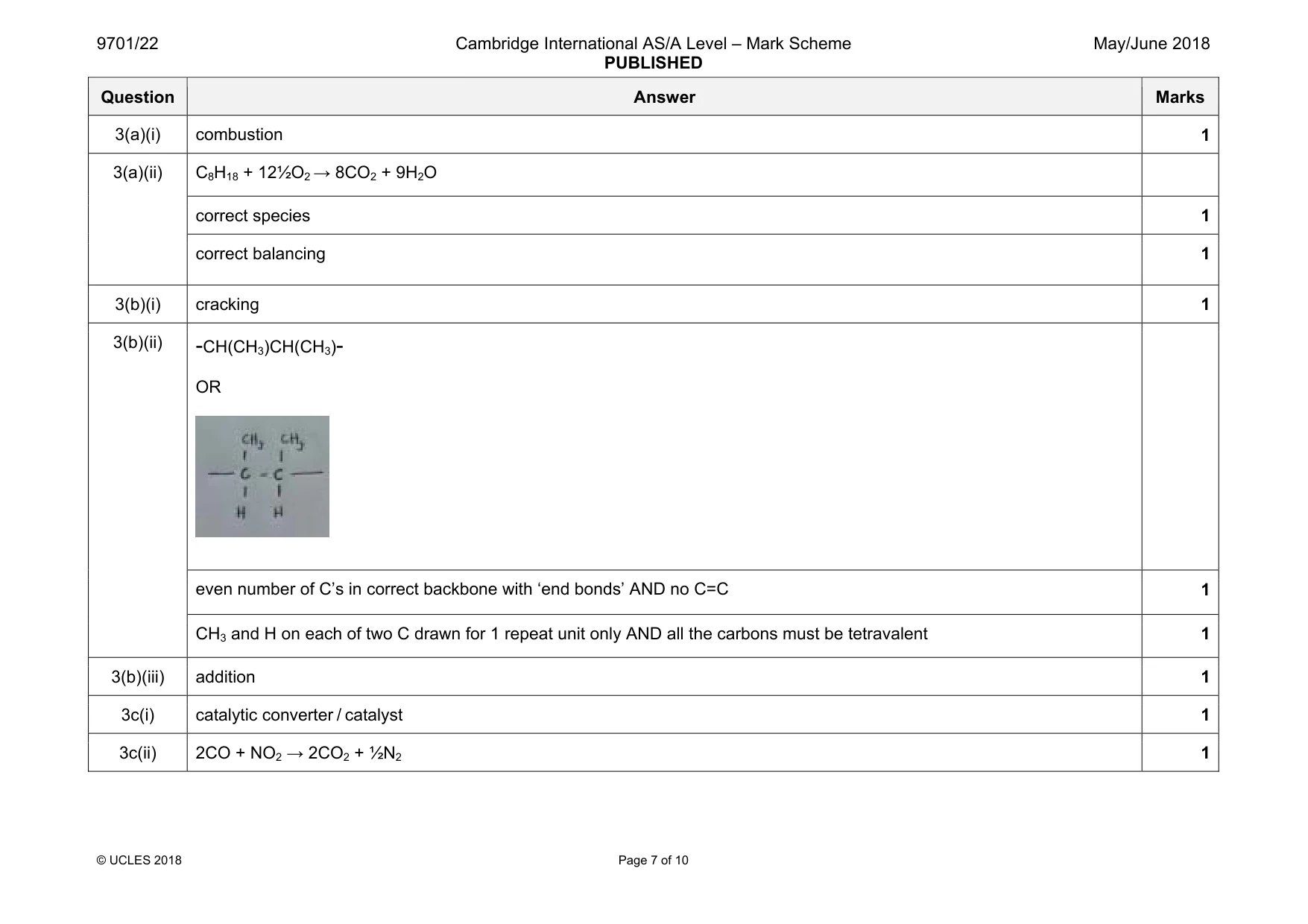
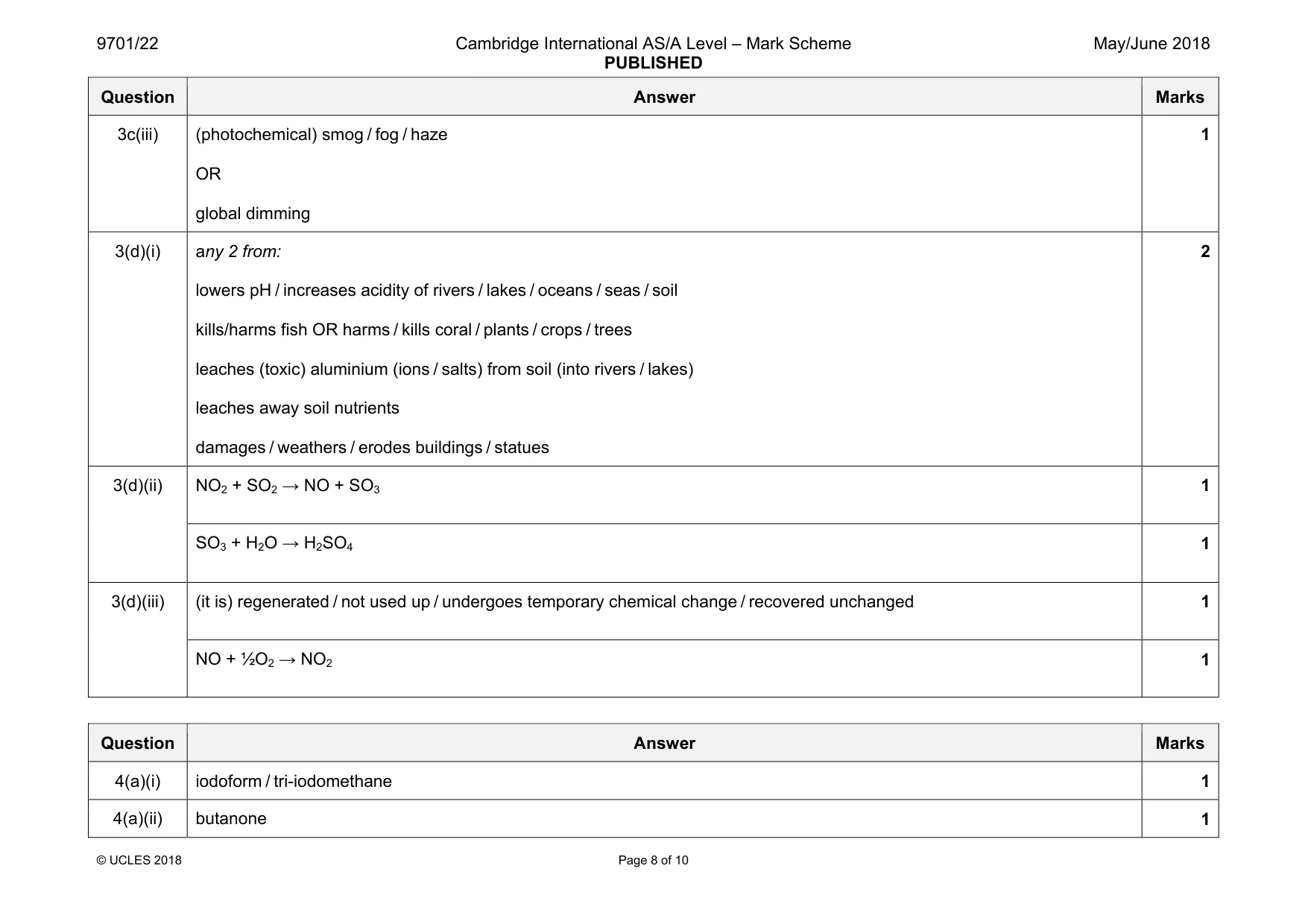
Mark scheme: 3(a)(i) combustion 1 3(a)(ii) C8H18 + 12½O2 → 8CO2 + 9H2O correct species 1 correct balancing 1 3(b)(i) cracking 1 3(b)(ii) -CH(CH3)CH(CH3)- OR even number of C’s in correct backbone with ‘end bonds’ AND no C=C 1 CH3 and H on each of two C drawn for 1 repeat unit only AND all the carbons must be tetravalent 1 3(b)(iii) addition 1 3c(i) catalytic converter / catalyst 1 3c(ii) 2CO + NO2 → 2CO2 + ½N2 1 Question Answer Marks 3c(iii) (photochemical) smog / fog / haze OR global dimming 1 3(d)(i) any 2 from: lowers pH / increases acidity of rivers / lakes / oceans / seas / soil kills/harms fish OR harms / kills coral / plants / crops / trees leaches (toxic) aluminium (ions / salts) from soil (into rivers / lakes) leaches away soil nutrients damages / weathers / erodes buildings / statues 2 3(d)(ii) NO2 + SO2 → NO + SO3 1 SO3 + H2O → H2SO4 1 3(d)(iii) (it is) regenerated / not used up / undergoes temporary chemical change / recovered unchanged 1 NO + ½O2 → NO2 1
Question 4
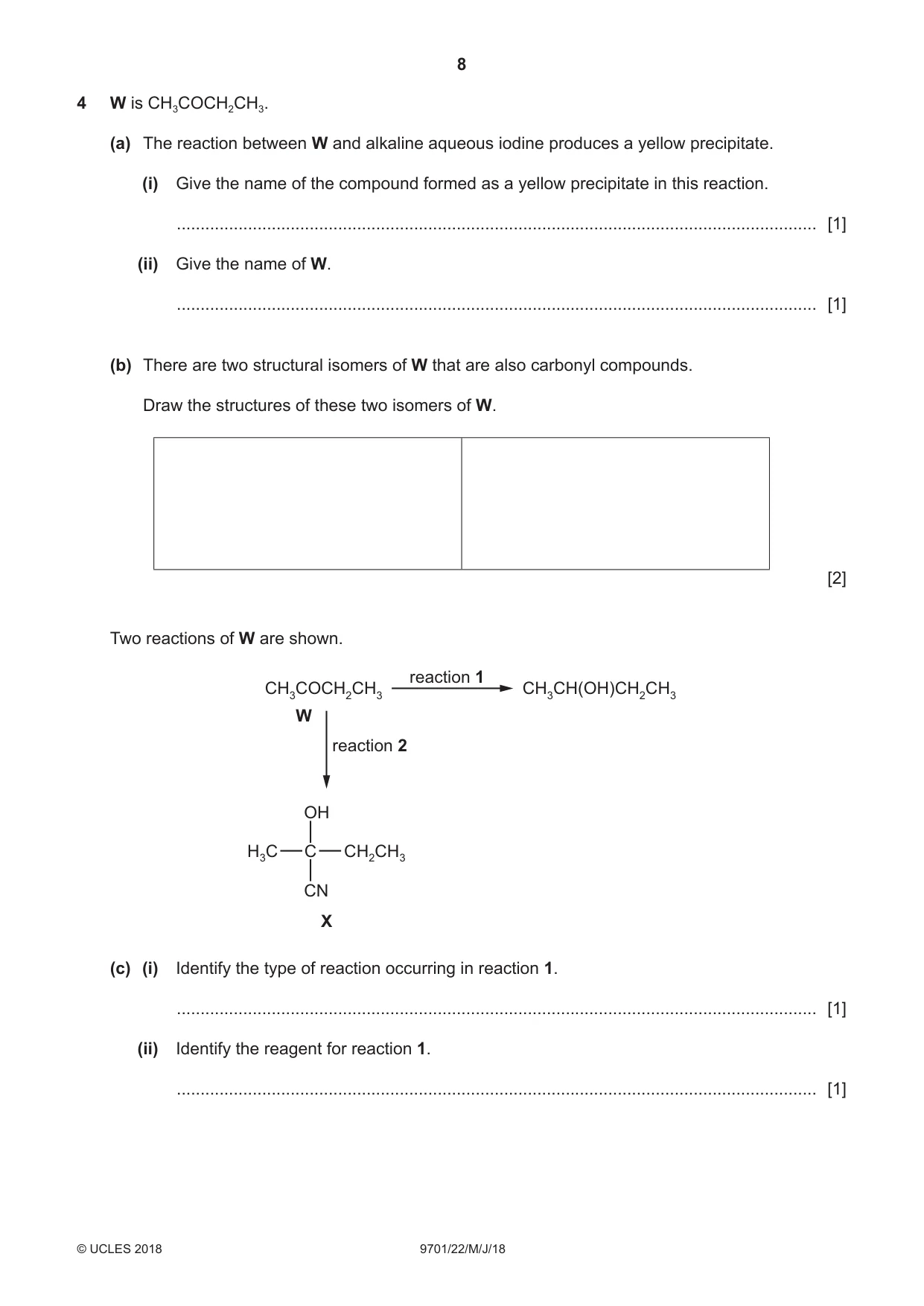
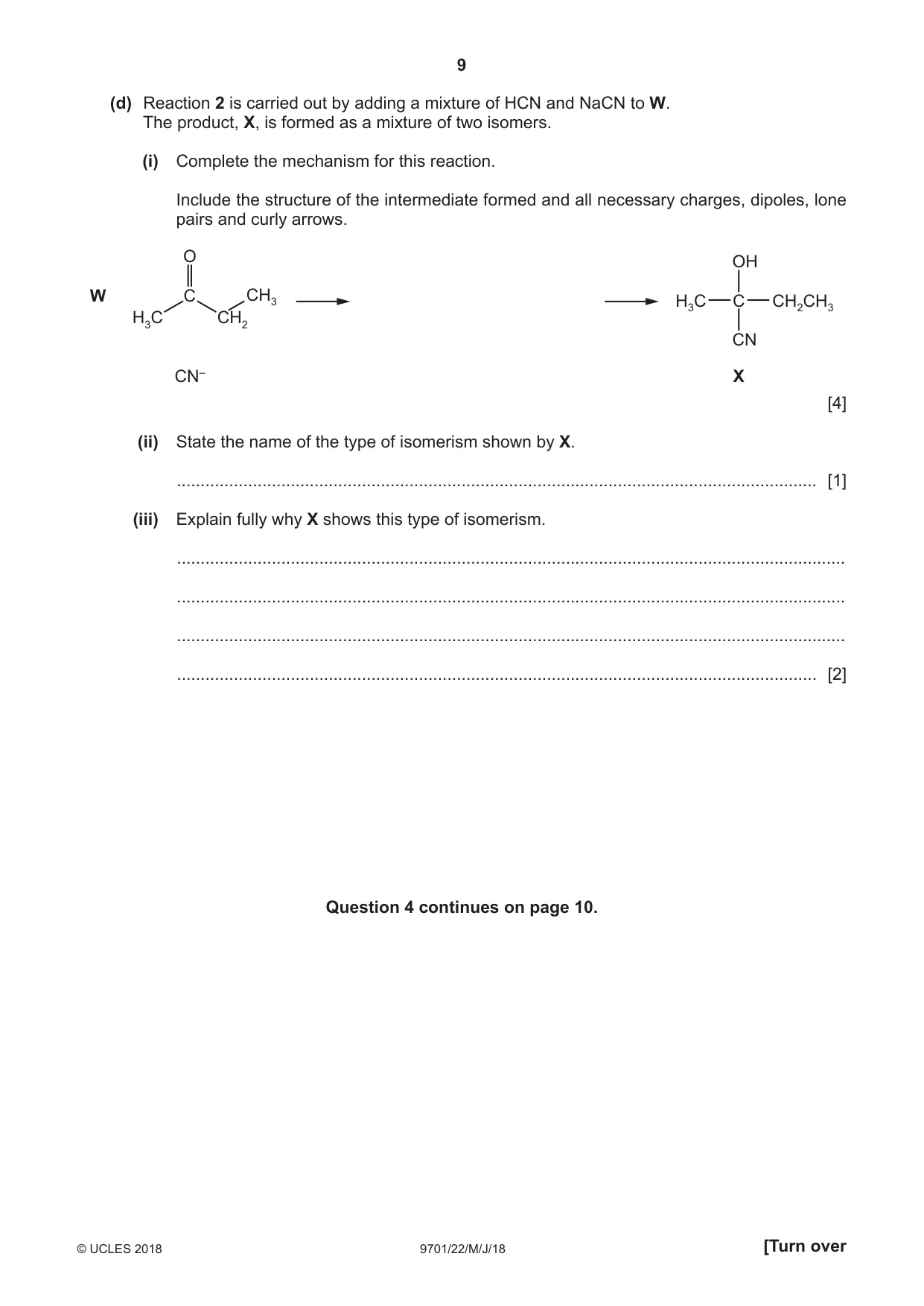
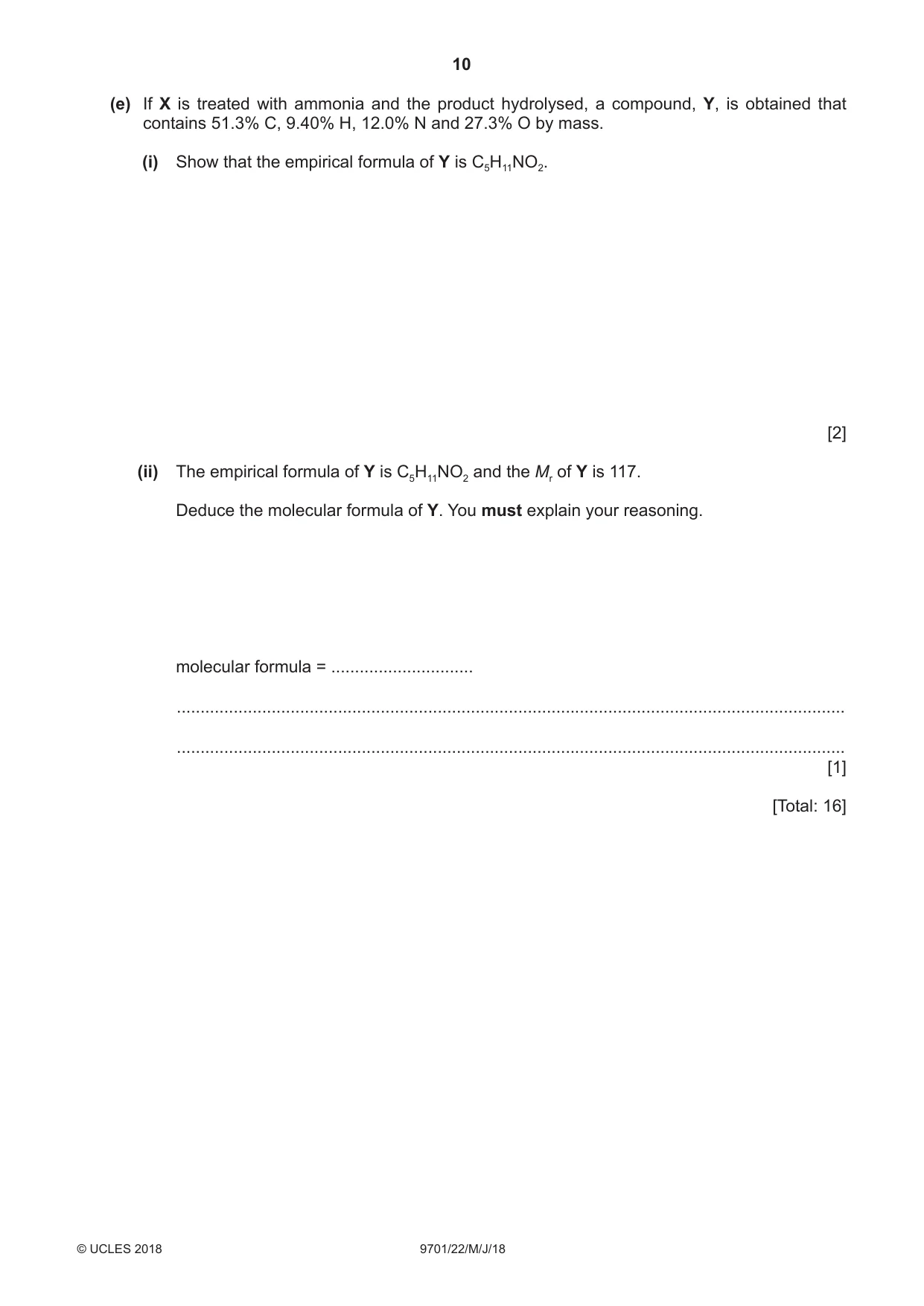
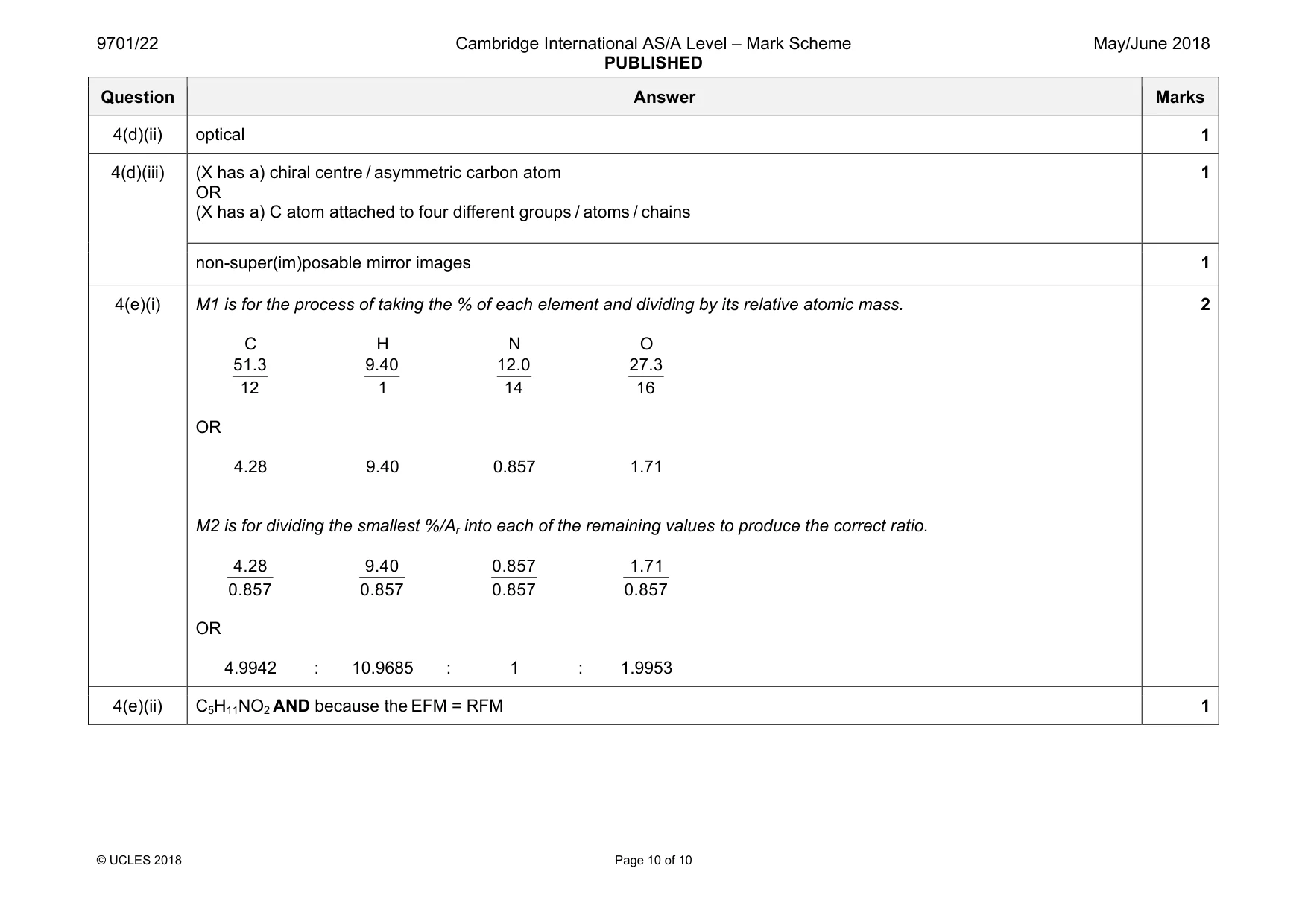
4 W is CH3COCH2CH3. (a) The reaction between W and alkaline aqueous iodine produces a yellow precipitate. (i) Give the name of the compound formed as a yellow precipitate in this reaction. ....................................................................................................................................... [1] (ii) Give the name of W. ....................................................................................................................................... [1] (b) There are two structural isomers of W that are also carbonyl compounds. Draw the structures of these two isomers of W. [2] Two reactions of W are shown. reaction 1 CH3COCH2CH3 CH3CH(OH)CH2CH3 W reaction 2 OH H3C C CH2CH3 CN X (c) (i) Identify the type of reaction occurring in reaction 1. ....................................................................................................................................... [1] (ii) Identify the reagent for reaction 1. ....................................................................................................................................... [1] (d) Reaction 2 is carried out by adding a mixture of HCN and NaCN to W. The product, X, is formed as a mixture of two isomers. (i) Complete the mechanism for this reaction. Include the structure of the intermediate formed and all necessary charges, dipoles, lone pairs and curly arrows. O OH W C CH3 H3C C CH2CH3 H3C CH2 CN CN– X [4] (ii) State the name of the type of isomerism shown by X. ....................................................................................................................................... [1] (iii) Explain fully why X shows this type of isomerism. ............................................................................................................................................. ............................................................................................................................................. ............................................................................................................................................. ....................................................................................................................................... [2] Question 4 continues on page 10. (e) If X is treated with ammonia and the product hydrolysed, a compound, Y, is obtained that contains 51.3% C, 9.40% H, 12.0% N and 27.3% O by mass. (i) Show that the empirical formula of Y is C5H11NO2. [2] (ii) The empirical formula of Y is C5H11NO2 and the Mr of Y is 117. Deduce the molecular formula of Y. You must explain your reasoning. molecular formula = .............................. ............................................................................................................................................. ............................................................................................................................................. [1] [Total: 16]
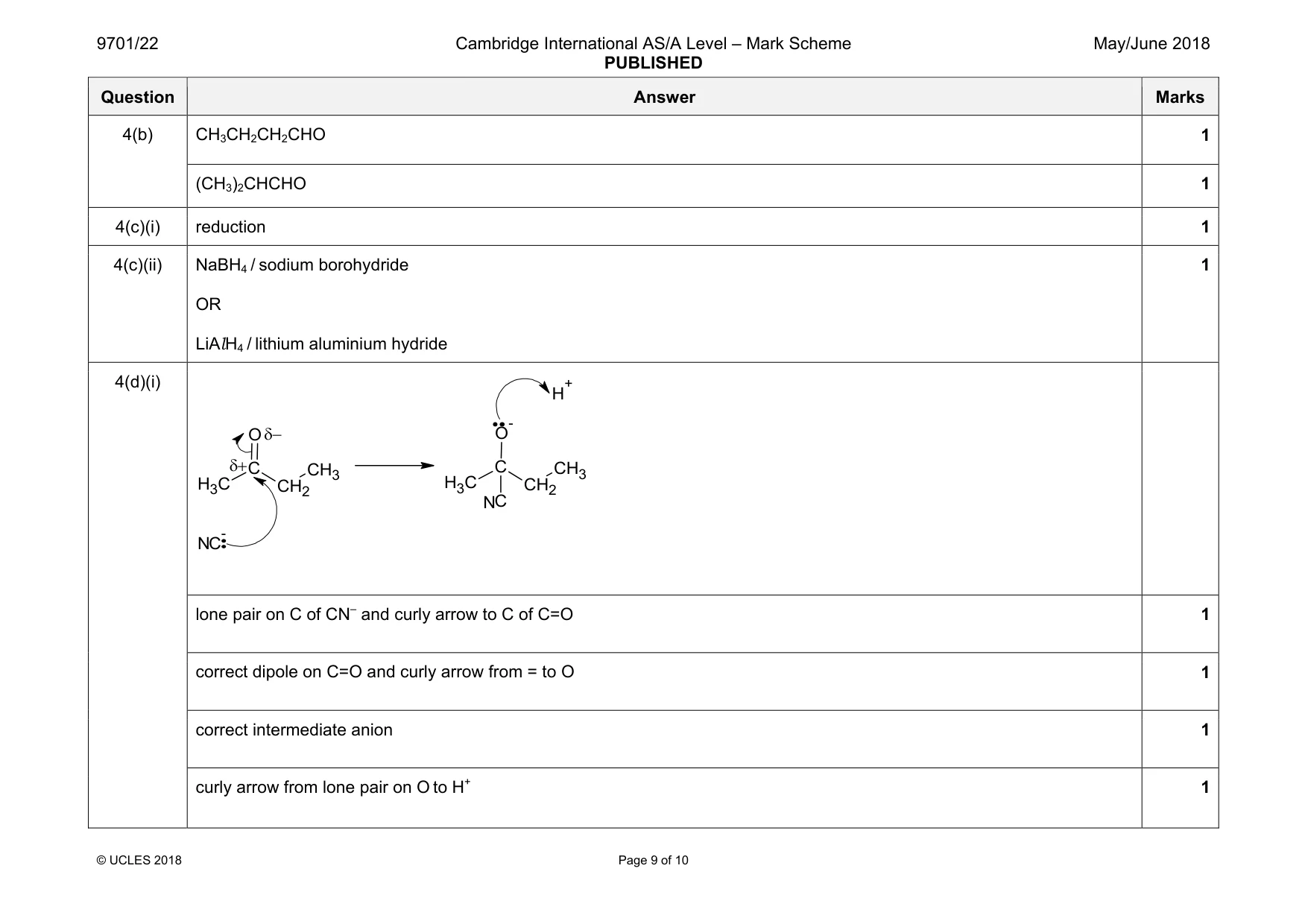
Mark scheme: 4(a)(i) iodoform / tri-iodomethane 1 4(a)(ii) butanone 1 Question Answer Marks 4(b) CH3CH2CH2CHO 1 (CH3)2CHCHO 1 4(c)(i) reduction 1 4(c)(ii) NaBH4 / sodium borohydride OR LiAlH4 / lithium aluminium hydride 1 4(d)(i) CH3 CH2 C C H3 O C - N δ+ δ− CH3 CH2 C C H3 O - C N H + lone pair on C of CN– and curly arrow to C of C=O 1 correct dipole on C=O and curly arrow from = to O 1 correct intermediate anion 1 curly arrow from lone pair on O to H+ 1 Question Answer Marks 4(d)(ii) optical 1 4(d)(iii) (X has a) chiral centre / asymmetric carbon atom OR (X has a) C atom attached to four different groups / atoms / chains 1 non-super(im)posable mirror images 1 4(e)(i) M1 is for the process of taking the % of each element and dividing by its relative atomic mass. C H N O 51.3 12 9.40 1 12.0 14 27.3 16 OR 4.28 9.40 0.857 1.71 M2 is for dividing the smallest %/Ar into each of the remaining values to produce the correct ratio. 4.28 0.857 9.40 0.857 0.857 0.857 1.71 0.857 OR 4.9942 : 10.9685 : 1 : 1.9953 2 4(e)(ii) C5H11NO2 AND because the EFM = RFM 1
What was in this paper
The subtopics covered by these 4 questions, and how many questions each got. Open one in a new tab to see every Cambridge question on it.
What you needed in this session
Cambridge’s own grade thresholds for 2018 May/June, Paper 2 · Variant 2. A higher threshold means an easier paper — the bar moves with how the cohort did.