Cambridge A Level Chemistry 9701 — 2018 May/June Paper 2 · Variant 3
9701/23/M/J/18 · 4 questions · 60 marks · ≈68 min
The question paper and its mark scheme, free to read here and free to download. This is Cambridge’s own paper, exactly as it was sat.
Question paper12 pages


Mark scheme10 pages
Answers below. Sit the paper first if you are practising.
Questions as text
Q1 · The elements sodium to chlorine, in the third period, all form oxides
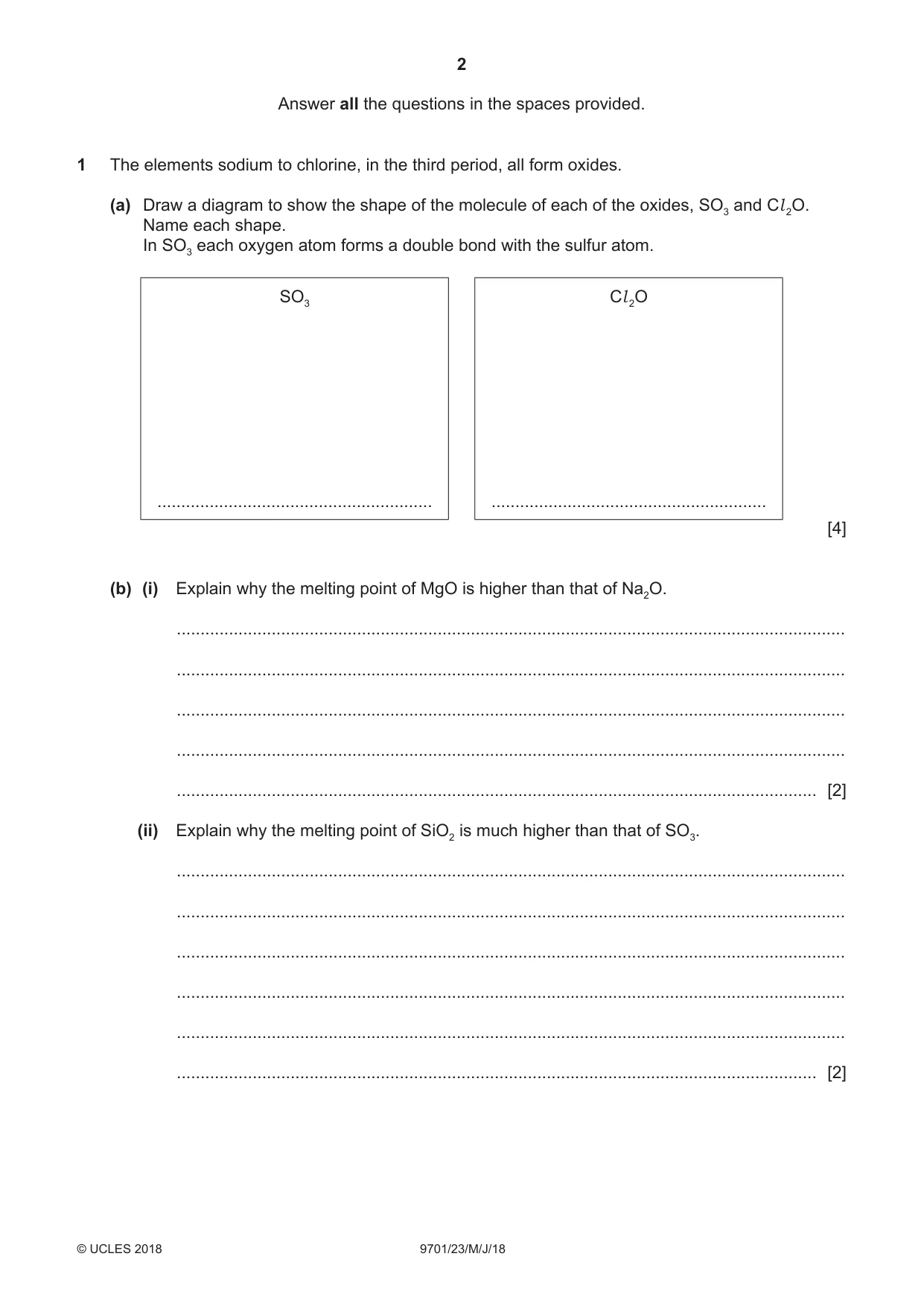
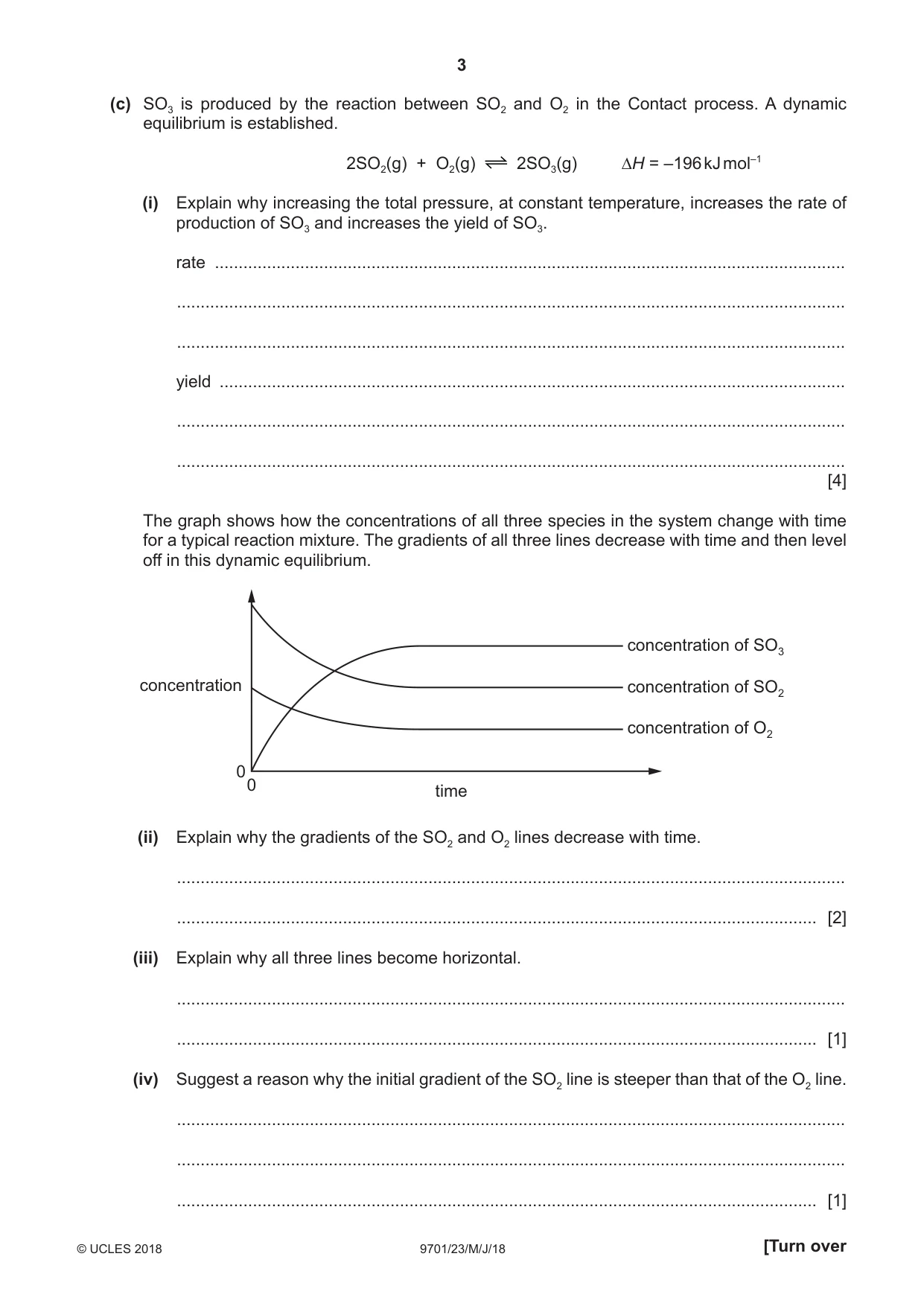
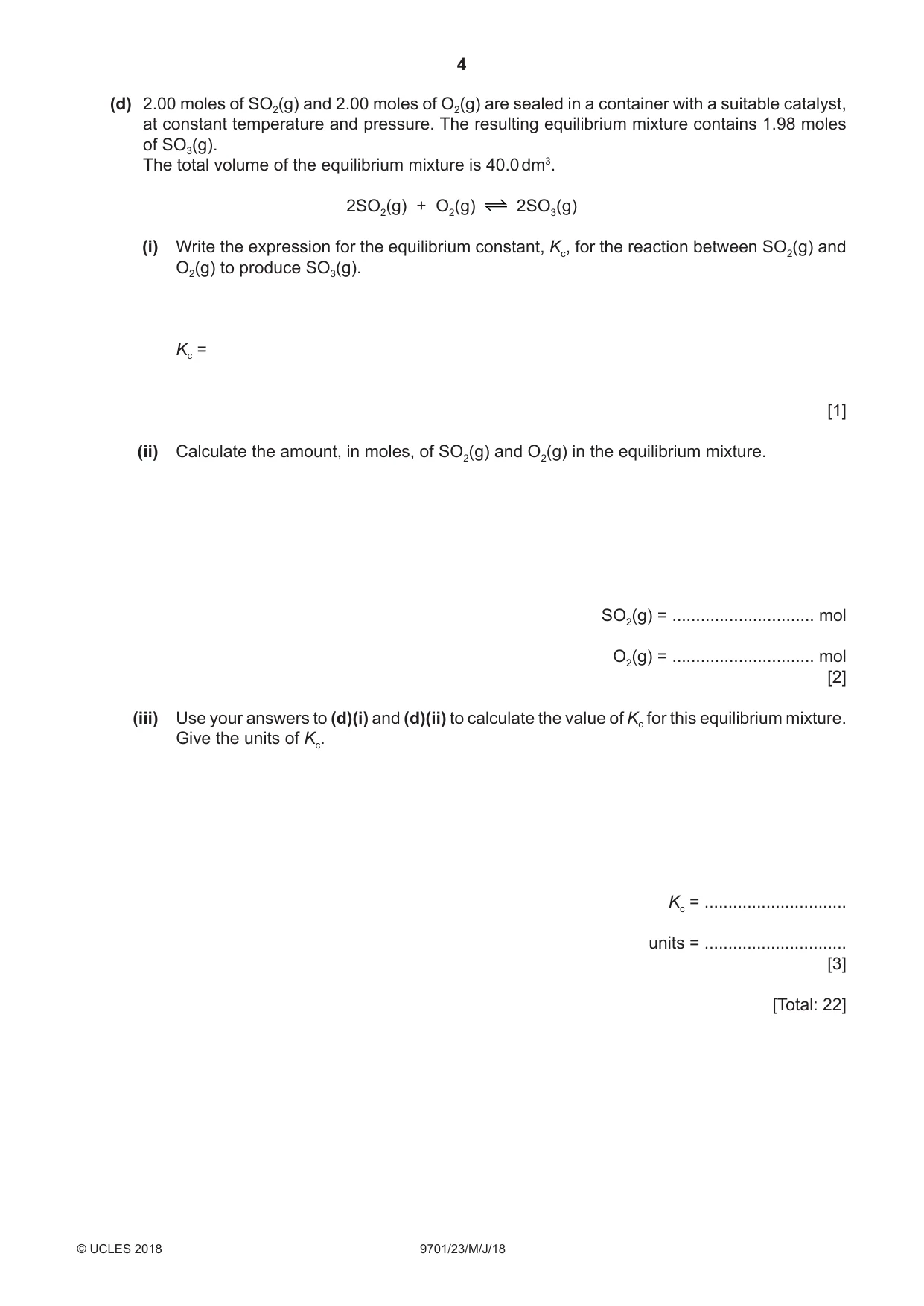
1 The elements sodium to chlorine, in the third period, all form oxides. (a) Draw a diagram to show the shape of the molecule of each of the oxides, SO3 and Cl 2O. Name each shape. In SO3 each oxygen atom forms a double bond with the sulfur atom. SO3 Cl 2O .......................................................... .......................................................... [4] (b) (i) Explain why the melting point of MgO is higher than that of Na2O. ............................................................................................................................................. ............................................................................................................................................. ............................................................................................................................................. ............................................................................................................................................. ....................................................................................................................................... [2] (ii) Explain why the melting point of SiO2 is much higher than that of SO3. ............................................................................................................................................. ............................................................................................................................................. ............................................................................................................................................. ............................................................................................................................................. ............................................................................................................................................. ....................................................................................................................................... [2] (c) SO3 is produced by the reaction between SO2 and O2 in the Contact process. A dynamic equilibrium is established. 2SO2(g) + O2(g) 2SO3(g) ∆H = –196 kJ mol–1 (i) Explain why increasing the total pressure, at constant temperature, increases the rate of production of SO3 and increases the yield of SO3. rate ...................................................................................................................................... ............................................................................................................................................. ............................................................................................................................................. yield ..................................................................................................................................... ............................................................................................................................................. ............................................................................................................................................. [4] The graph shows how the concentrations of all three species in the system change with time for a typical reaction mixture. The gradients of all three lines decrease with time and then level off in this dynamic equilibrium. concentration of SO3 concentration concentration of SO2 concentration of O2 0 0 time (ii) Explain why the gradients of the SO2 and O2 lines decrease with time. ............................................................................................................................................. ....................................................................................................................................... [2] (iii) Explain why all three lines become horizontal. ............................................................................................................................................. ....................................................................................................................................... [1] (iv) Suggest a reason why the initial gradient of the SO2 line is steeper than that of the O2 line. ............................................................................................................................................. ............................................................................................................................................. ....................................................................................................................................... [1] (d) 2.00 moles of SO2(g) and 2.00 moles of O2(g) are sealed in a container with a suitable catalyst, at constant temperature and pressure. The resulting equilibrium mixture contains 1.98 moles of SO3(g). The total volume of the equilibrium mixture is 40.0 dm3. 2SO2(g) + O2(g) 2SO3(g) (i) Write the expression for the equilibrium constant, Kc, for the reaction between SO2(g) and O2(g) to produce SO3(g). Kc = [1] (ii) Calculate the amount, in moles, of SO2(g) and O2(g) in the equilibrium mixture. SO2(g) = .............................. mol O2(g) = .............................. mol [2] (iii) Use your answers to (d)(i) and (d)(ii) to calculate the value of Kc for this equilibrium mixture. Give the units of Kc. Kc = .............................. units = .............................. [3] [Total: 22]
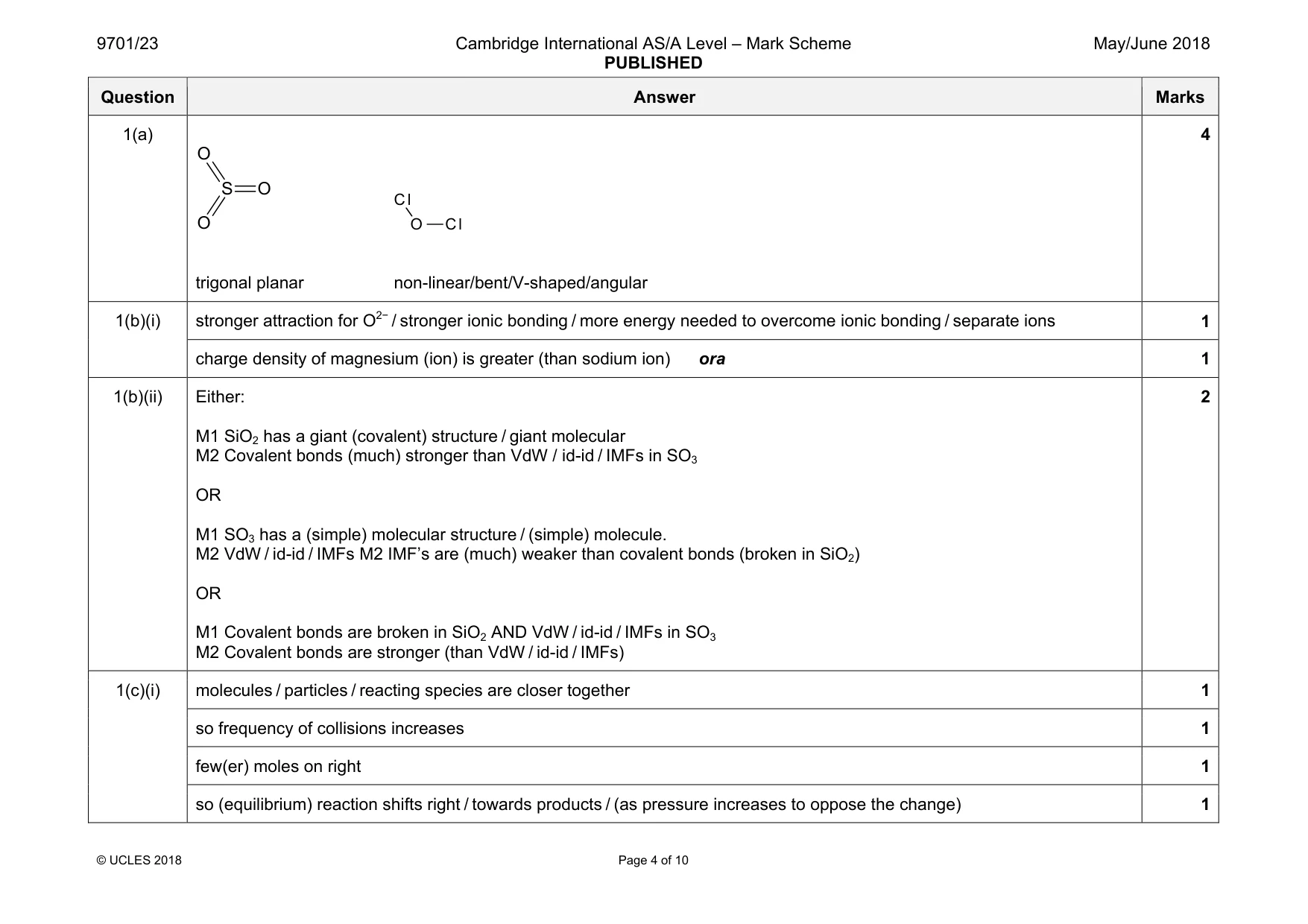
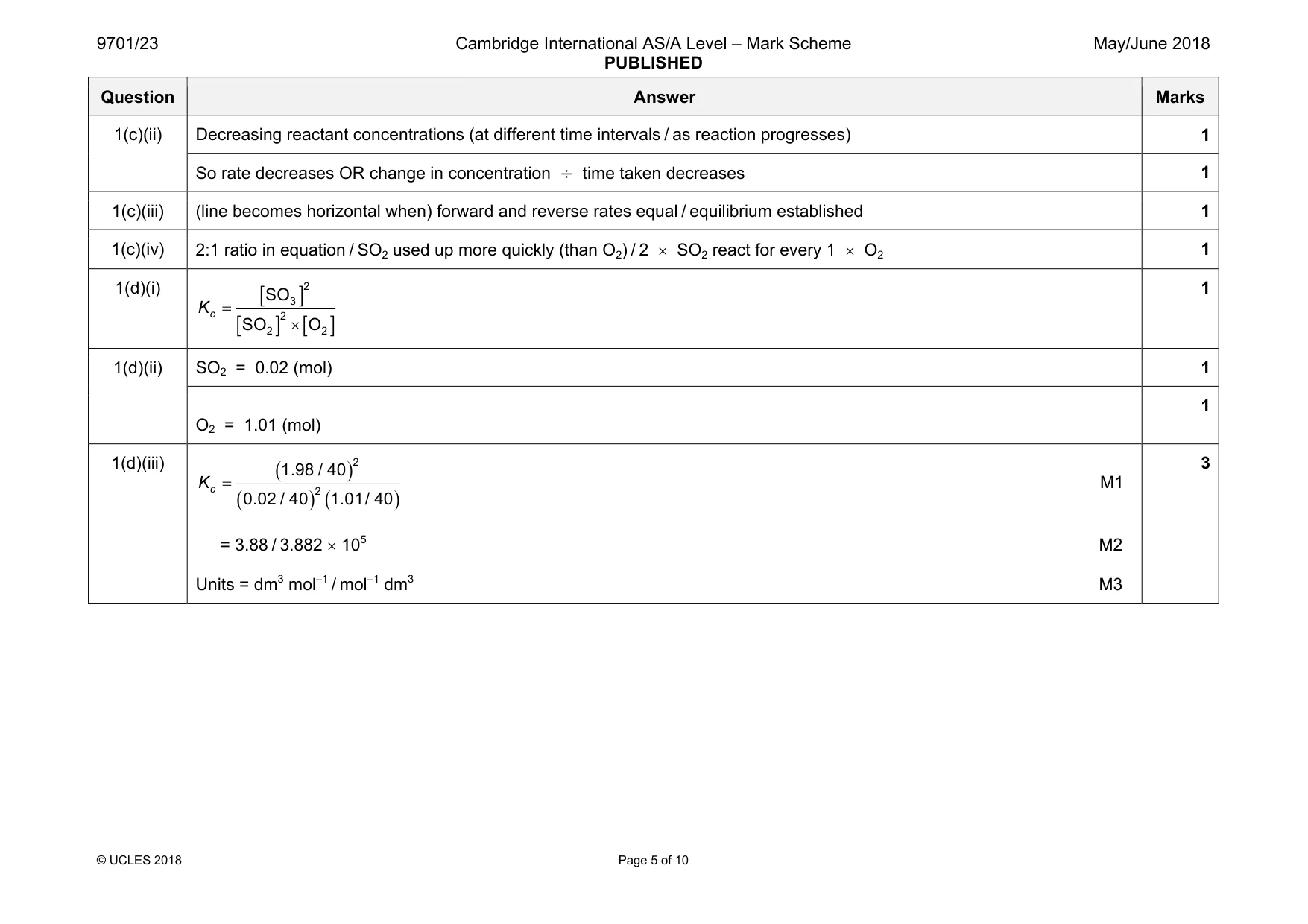
Mark scheme: 1(a) S O O O O Cl Cl trigonal planar non-linear/bent/V-shaped/angular 4 1(b)(i) stronger attraction for O2− / stronger ionic bonding / more energy needed to overcome ionic bonding / separate ions 1 charge density of magnesium (ion) is greater (than sodium ion) ora 1 1(b)(ii) Either: M1 SiO2 has a giant (covalent) structure / giant molecular M2 Covalent bonds (much) stronger than VdW / id-id / IMFs in SO3 OR M1 SO3 has a (simple) molecular structure / (simple) molecule. M2 VdW / id-id / IMFs M2 IMF’s are (much) weaker than covalent bonds (broken in SiO2) OR M1 Covalent bonds are broken in SiO2 AND VdW / id-id / IMFs in SO3 M2 Covalent bonds are stronger (than VdW / id-id / IMFs) 2 1(c)(i) molecules / particles / reacting species are closer together 1 so frequency of collisions increases 1 few(er) moles on right 1 so (equilibrium) reaction shifts right / towards products / (as pressure increases to oppose the change) 1 Question Answer Marks 1(c)(ii) Decreasing reactant concentrations (at different time intervals / as reaction progresses) 1 So rate decreases OR change in concentration ÷ time taken decreases 1 1(c)(iii) (line becomes horizontal when) forward and reverse rates equal / equilibrium established 1 1(c)(iv) 2:1 ratio in equation / SO2 used up more quickly (than O2) / 2 × SO2 react for every 1 × O2 1 1(d)(i) [ ] [ ] [ ] = × 2 3 2 2 2 SO SO O c K 1 1(d)(ii) SO2 = 0.02 (mol) 1 O2 = 1.01 (mol) 1 1(d)(iii) ( ) ( ) ( ) = 2 2 1.98 / 40 0.02 / 40 1.01/ 40 c K M1 = 3.88 / 3.882 × 10⁵ M2 Units = dm3 mol–1 / mol–1 dm3 M3 3
More questions on Chemical equilibria: reversible reactions, dynamic equilibrium
Q2 · One reason for the wide variety of organic compounds is isomerism, either structural…
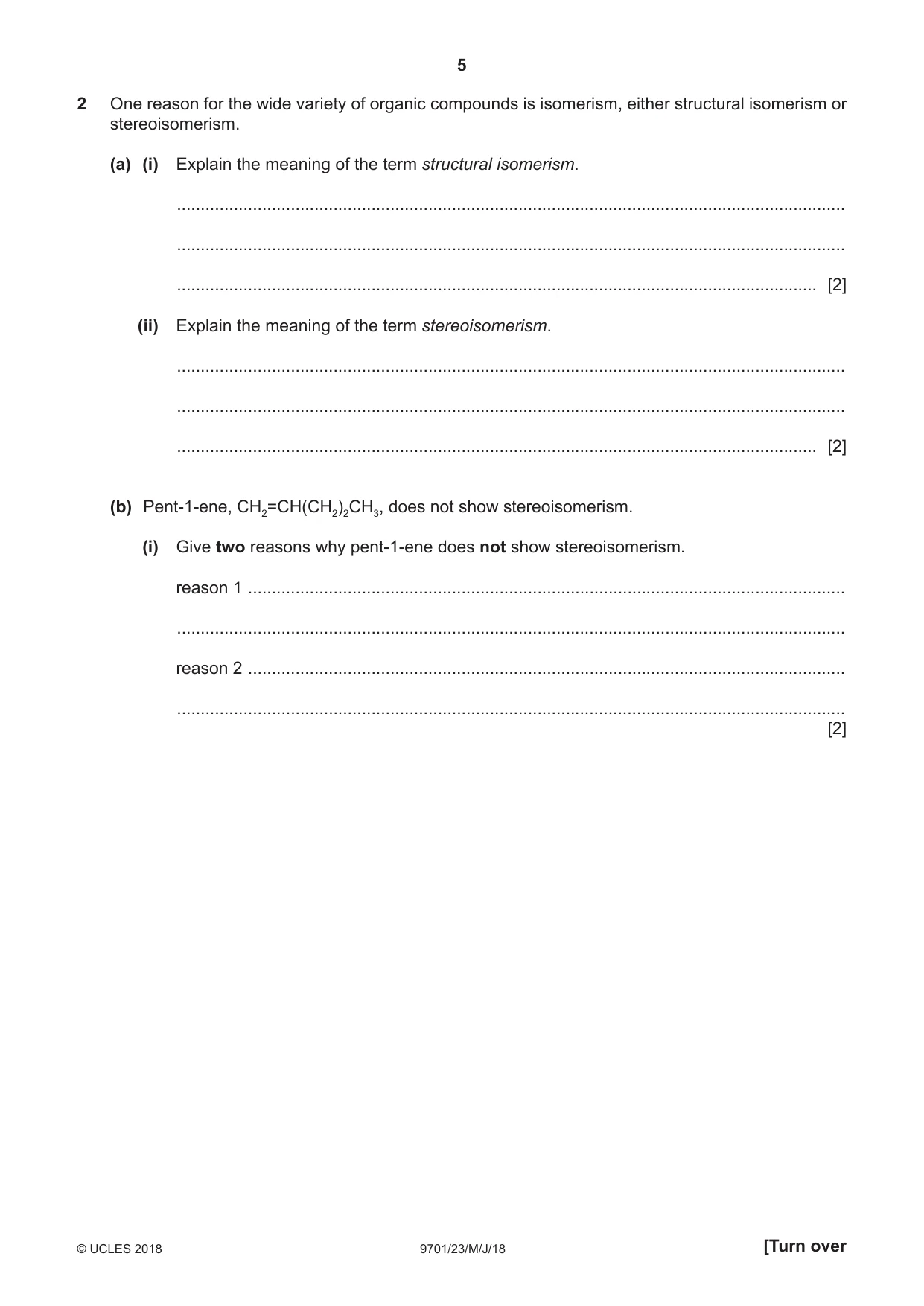
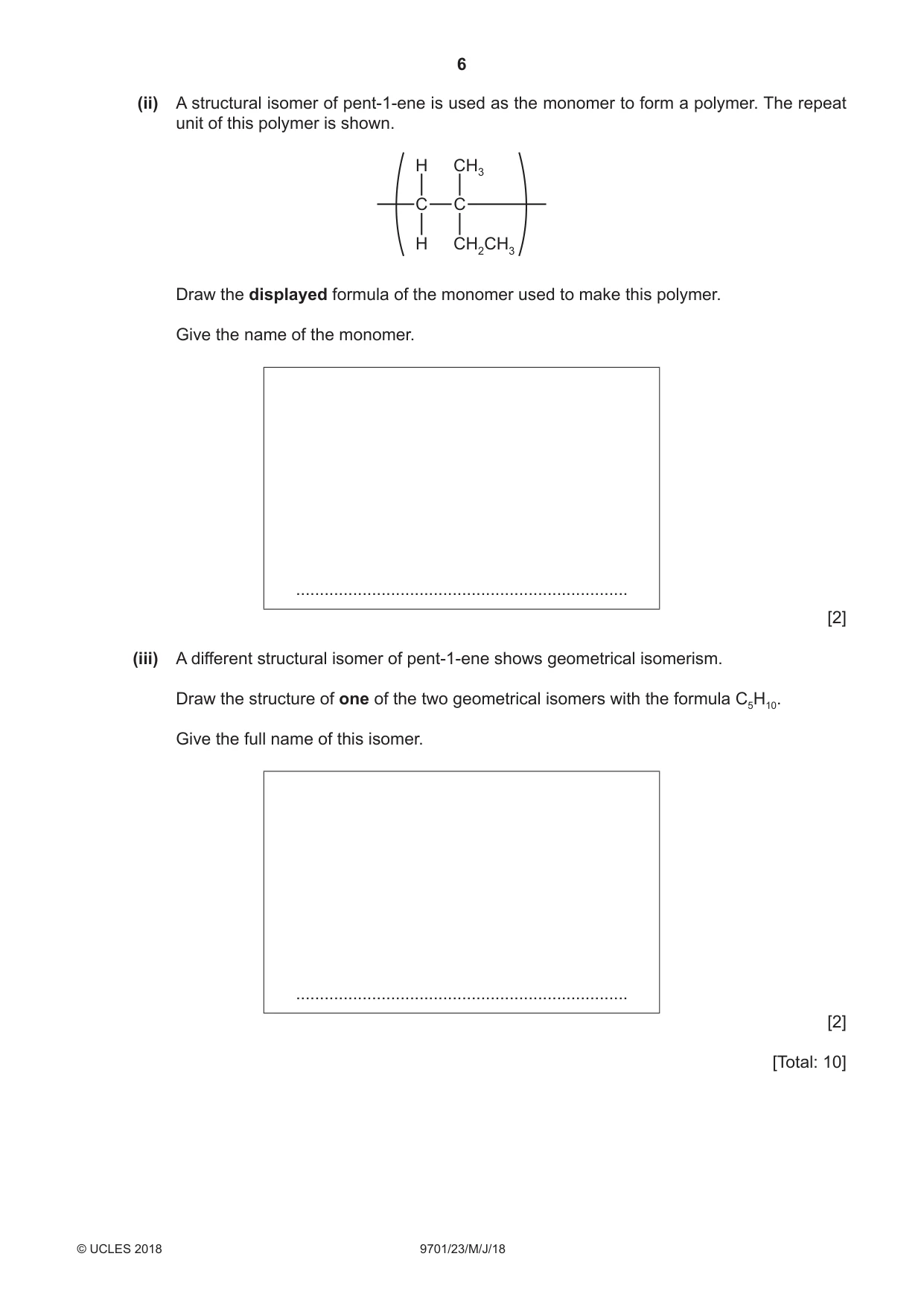
2 One reason for the wide variety of organic compounds is isomerism, either structural isomerism or stereoisomerism. (a) (i) Explain the meaning of the term structural isomerism. ............................................................................................................................................. ............................................................................................................................................. ....................................................................................................................................... [2] (ii) Explain the meaning of the term stereoisomerism. ............................................................................................................................................. ............................................................................................................................................. ....................................................................................................................................... [2] (b) Pent-1-ene, CH2=CH(CH2)2CH3, does not show stereoisomerism. (i) Give two reasons why pent-1-ene does not show stereoisomerism. reason 1 .............................................................................................................................. ............................................................................................................................................. reason 2 .............................................................................................................................. ............................................................................................................................................. [2] (ii) A structural isomer of pent-1-ene is used as the monomer to form a polymer. The repeat unit of this polymer is shown. H CH3 C C H CH2CH3 Draw the displayed formula of the monomer used to make this polymer. Give the name of the monomer. ...................................................................... [2] (iii) A different structural isomer of pent-1-ene shows geometrical isomerism. Draw the structure of one of the two geometrical isomers with the formula C5H10. Give the full name of this isomer. ...................................................................... [2] [Total: 10]
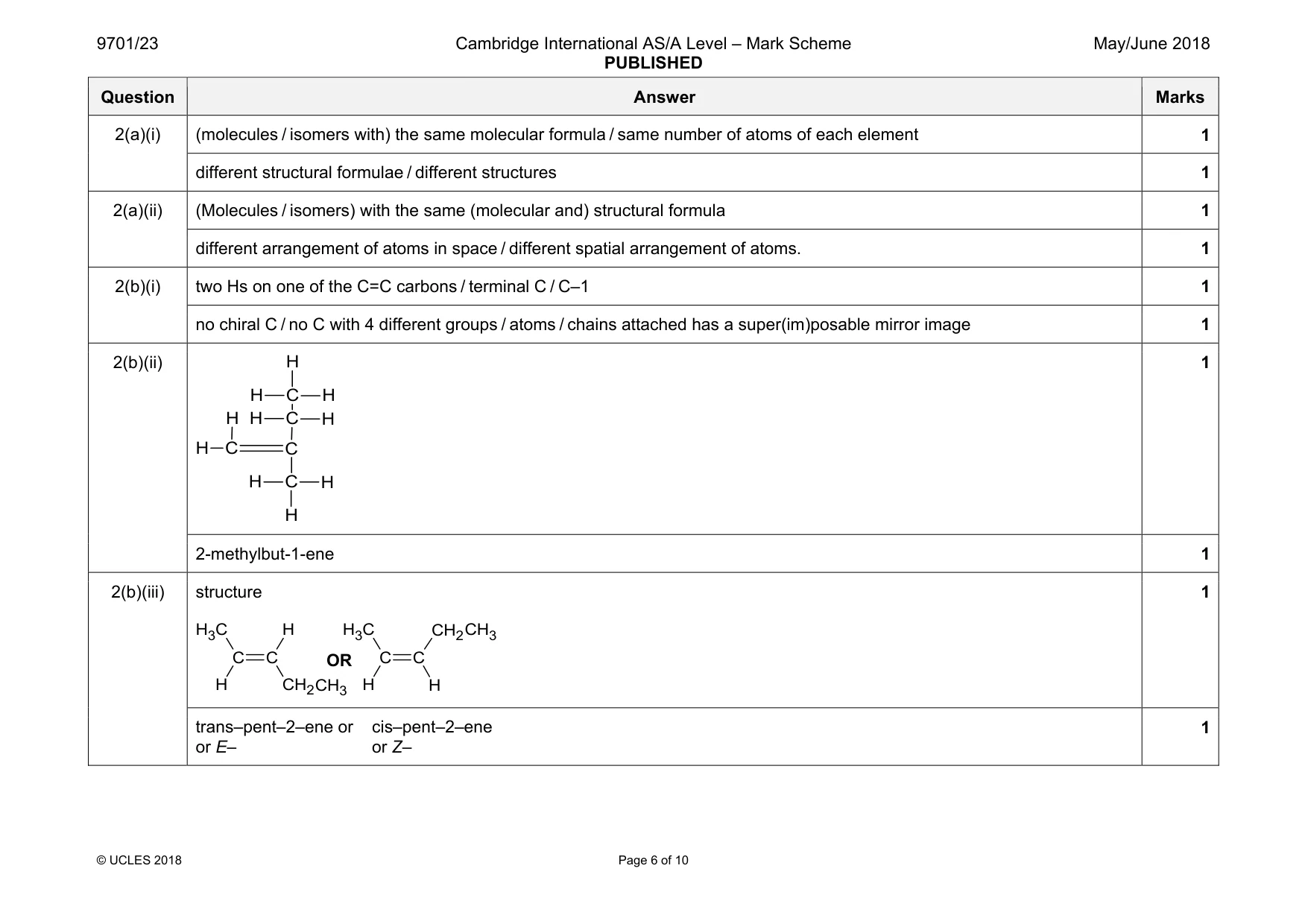
Mark scheme: 2(a)(i) (molecules / isomers with) the same molecular formula / same number of atoms of each element 1 different structural formulae / different structures 1 2(a)(ii) (Molecules / isomers) with the same (molecular and) structural formula 1 different arrangement of atoms in space / different spatial arrangement of atoms. 1 2(b)(i) two Hs on one of the C=C carbons / terminal C / C–1 1 no chiral C / no C with 4 different groups / atoms / chains attached has a super(im)posable mirror image 1 2(b)(ii) C C C H H C C H H H H H H H H 1 2-methylbut-1-ene 1 2(b)(iii) structure C C C H3 CH2 H H CH3 C C C H3 CH2 H H CH3 1 trans–pent–2–ene or cis–pent–2–ene or E– or Z– 1 OR
Q3 · The elements in Group 17, the halogens, show trends in both their chemical and physical…
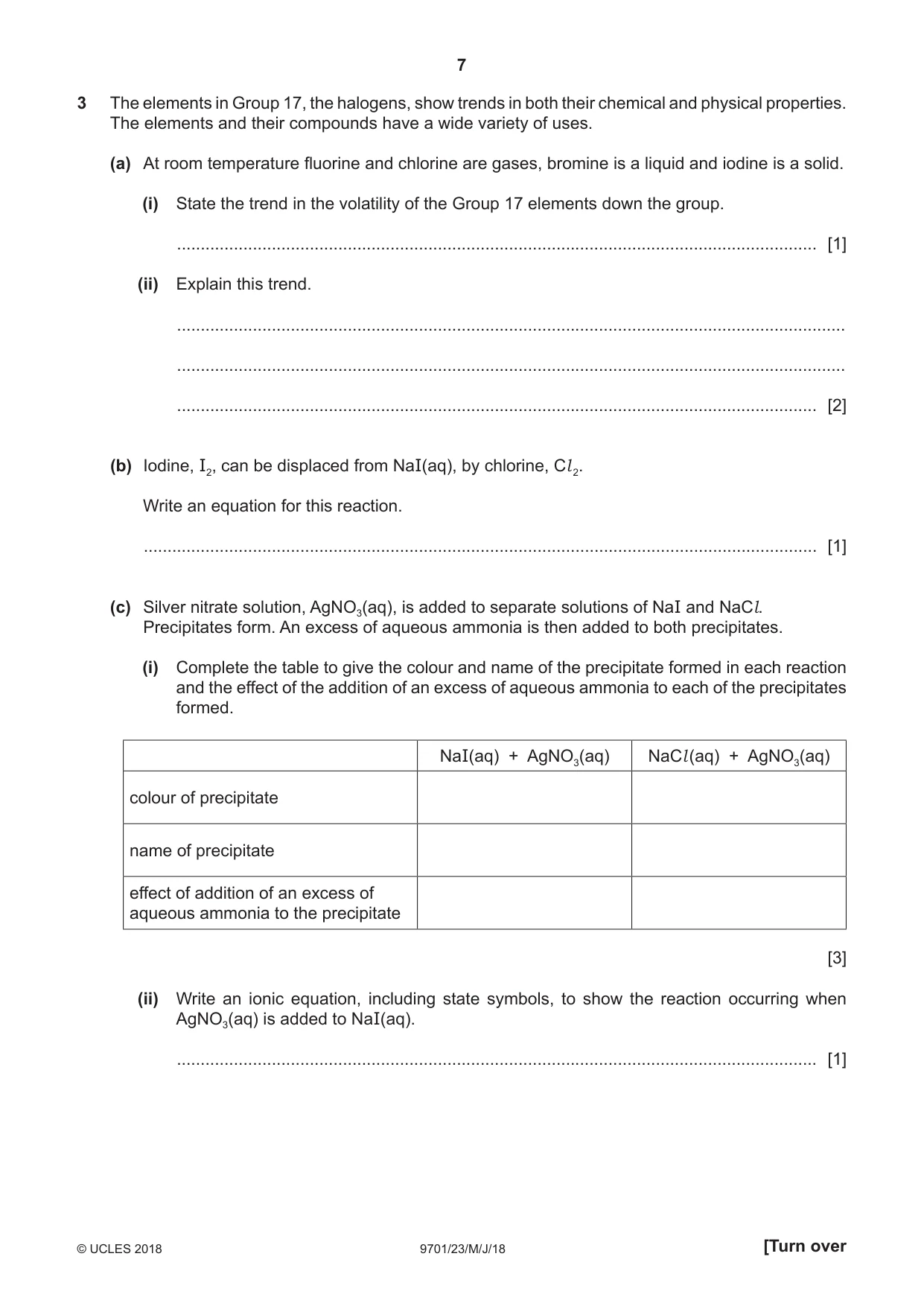
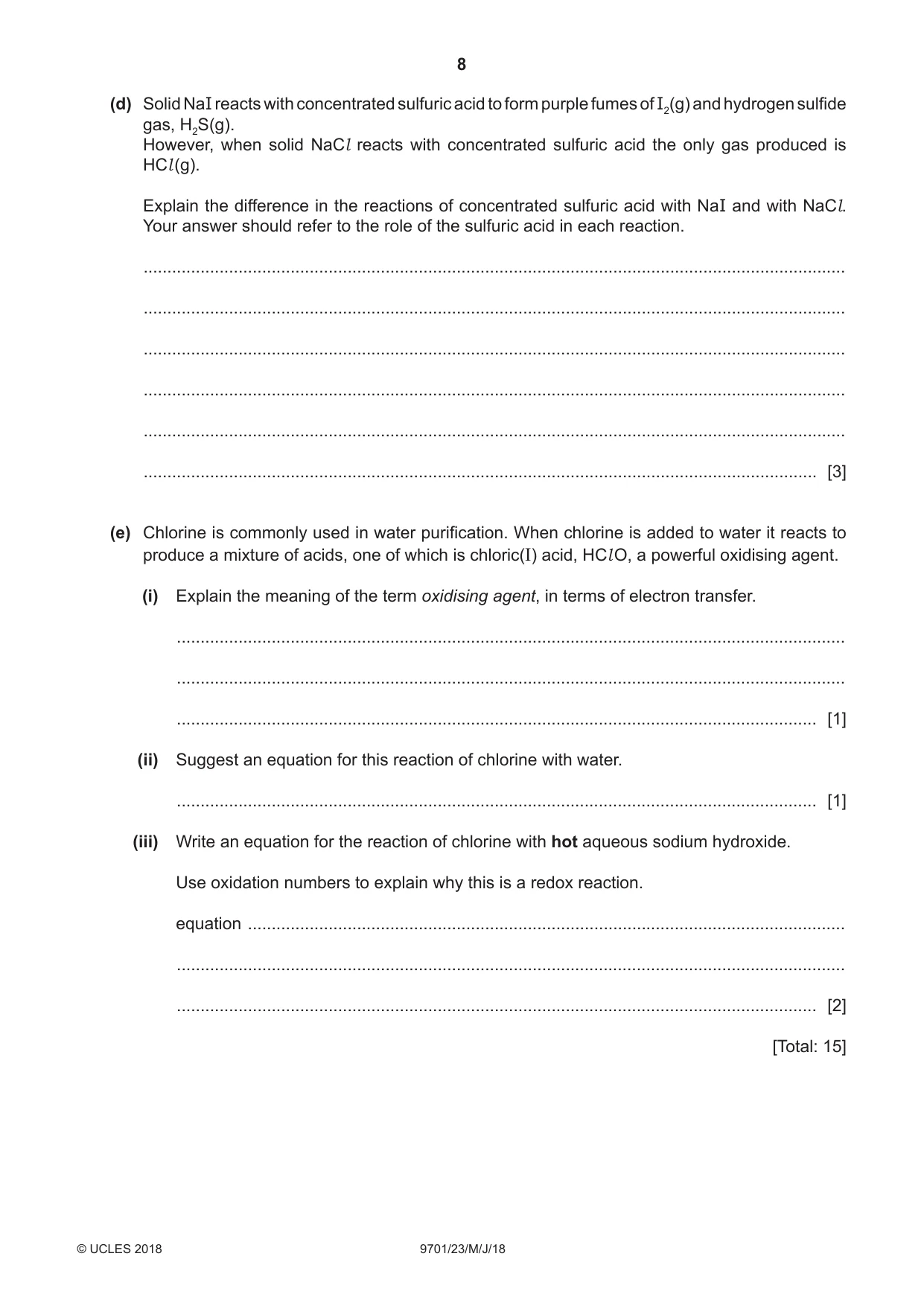
3 The elements in Group 17, the halogens, show trends in both their chemical and physical properties. The elements and their compounds have a wide variety of uses. (a) At room temperature fluorine and chlorine are gases, bromine is a liquid and iodine is a solid. (i) State the trend in the volatility of the Group 17 elements down the group. ....................................................................................................................................... [1] (ii) Explain this trend. ............................................................................................................................................. ............................................................................................................................................. ....................................................................................................................................... [2] (b) Iodine, I2, can be displaced from NaI(aq), by chlorine, Cl 2. Write an equation for this reaction. .............................................................................................................................................. [1] (c) Silver nitrate solution, AgNO3(aq), is added to separate solutions of NaI and NaCl. Precipitates form. An excess of aqueous ammonia is then added to both precipitates. (i) Complete the table to give the colour and name of the precipitate formed in each reaction and the effect of the addition of an excess of aqueous ammonia to each of the precipitates formed. NaI(aq) + AgNO3(aq) NaCl (aq) + AgNO3(aq) colour of precipitate name of precipitate effect of addition of an excess of aqueous ammonia to the precipitate [3] (ii) Write an ionic equation, including state symbols, to show the reaction occurring when AgNO3(aq) is added to NaI(aq). ....................................................................................................................................... [1] (d) Solid NaI reacts with concentrated sulfuric acid to form purple fumes of I2(g) and hydrogen sulfide gas, H2S(g). However, when solid NaCl reacts with concentrated sulfuric acid the only gas produced is HCl (g). Explain the difference in the reactions of concentrated sulfuric acid with NaI and with NaCl. Your answer should refer to the role of the sulfuric acid in each reaction. .................................................................................................................................................... .................................................................................................................................................... .................................................................................................................................................... .................................................................................................................................................... .................................................................................................................................................... .............................................................................................................................................. [3] (e) Chlorine is commonly used in water purification. When chlorine is added to water it reacts to produce a mixture of acids, one of which is chloric(I) acid, HCl O, a powerful oxidising agent. (i) Explain the meaning of the term oxidising agent, in terms of electron transfer. ............................................................................................................................................. ............................................................................................................................................. ....................................................................................................................................... [1] (ii) Suggest an equation for this reaction of chlorine with water. ....................................................................................................................................... [1] (iii) Write an equation for the reaction of chlorine with hot aqueous sodium hydroxide. Use oxidation numbers to explain why this is a redox reaction. equation .............................................................................................................................. ............................................................................................................................................. ....................................................................................................................................... [2] [Total: 15] Question 4 starts on the next page.
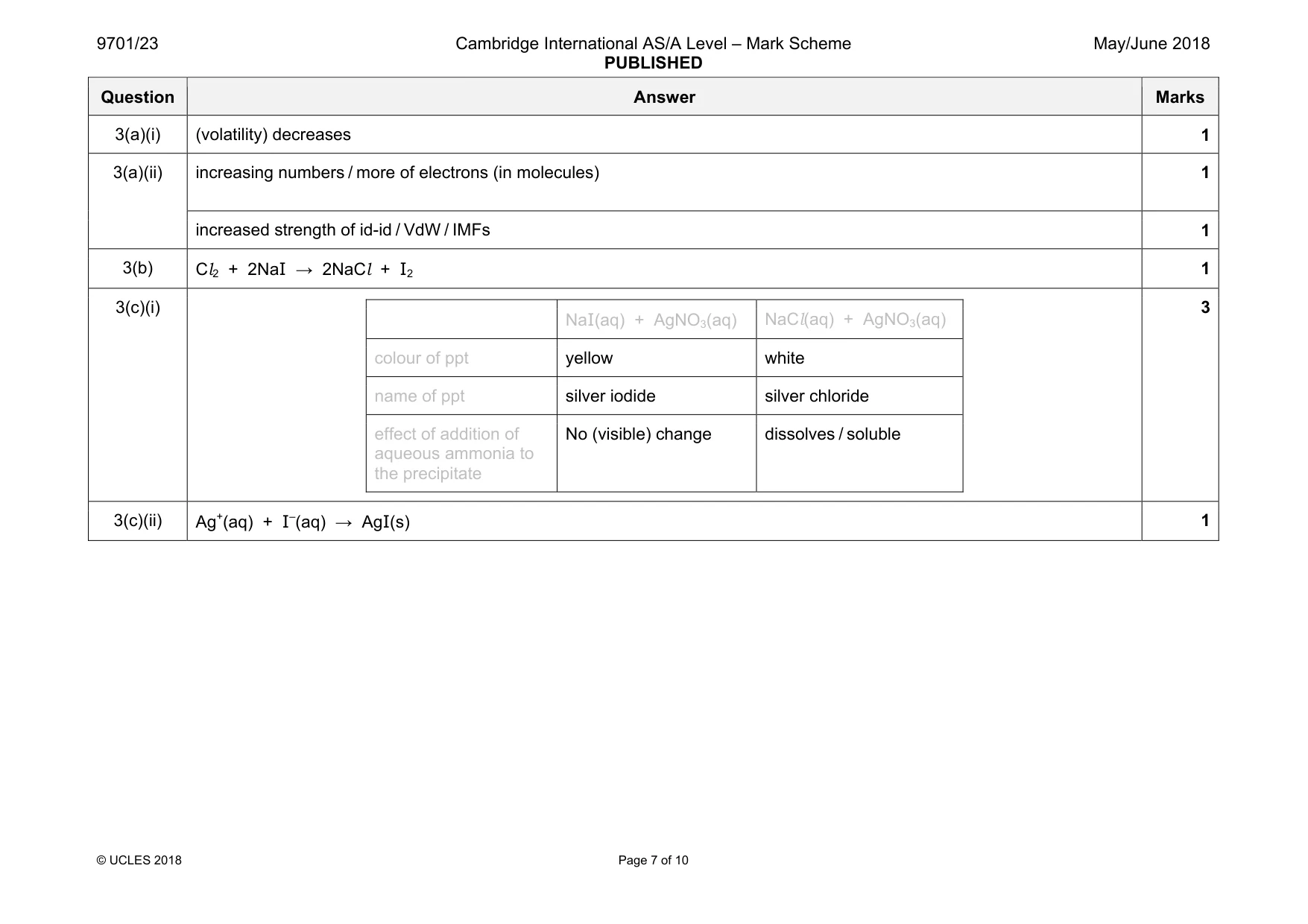
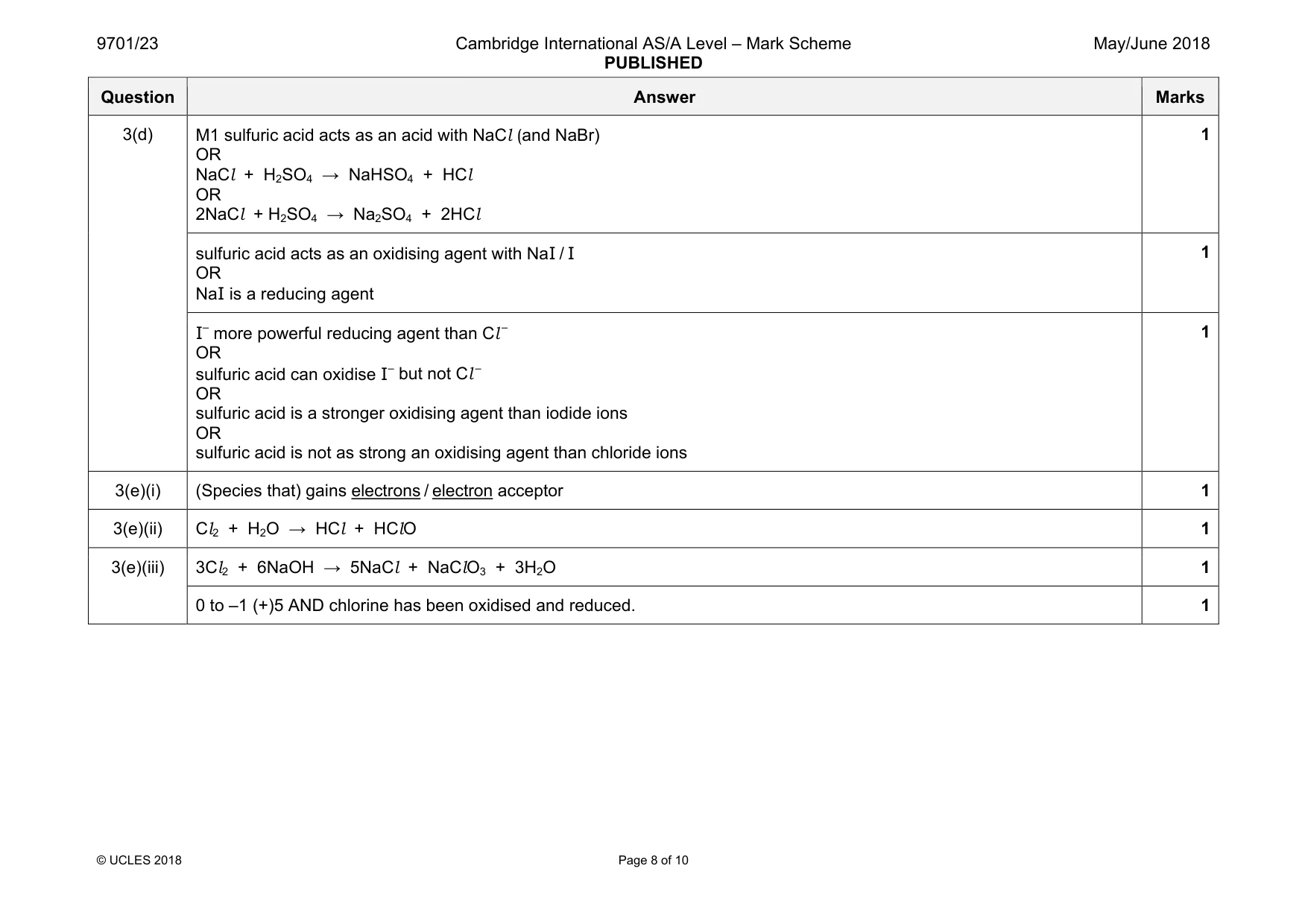
Mark scheme: 3(a)(i) (volatility) decreases 1 3(a)(ii) increasing numbers / more of electrons (in molecules) 1 increased strength of id-id / VdW / IMFs 1 3(b) Cl2 + 2NaI → 2NaCl + I2 1 3(c)(i) NaI(aq) + AgNO3(aq) NaCl(aq) + AgNO3(aq) colour of ppt yellow white name of ppt silver iodide silver chloride effect of addition of aqueous ammonia to the precipitate No (visible) change dissolves / soluble 3 3(c)(ii) Ag+(aq) + I–(aq) → AgI(s) 1 Question Answer Marks 3(d) M1 sulfuric acid acts as an acid with NaCl (and NaBr) OR NaCl + H2SO4 → NaHSO4 + HCl OR 2NaCl + H2SO4 → Na2SO4 + 2HCl 1 sulfuric acid acts as an oxidising agent with NaI / I OR NaI is a reducing agent 1 I– more powerful reducing agent than Cl – OR sulfuric acid can oxidise I– but not Cl – OR sulfuric acid is a stronger oxidising agent than iodide ions OR sulfuric acid is not as strong an oxidising agent than chloride ions 1 3(e)(i) (Species that) gains electrons / electron acceptor 1 3(e)(ii) Cl2 + H2O → HCl + HClO 1 3(e)(iii) 3Cl2 + 6NaOH → 5NaCl + NaClO3 + 3H2O 1 0 to –1 (+)5 AND chlorine has been oxidised and reduced. 1
Question 4
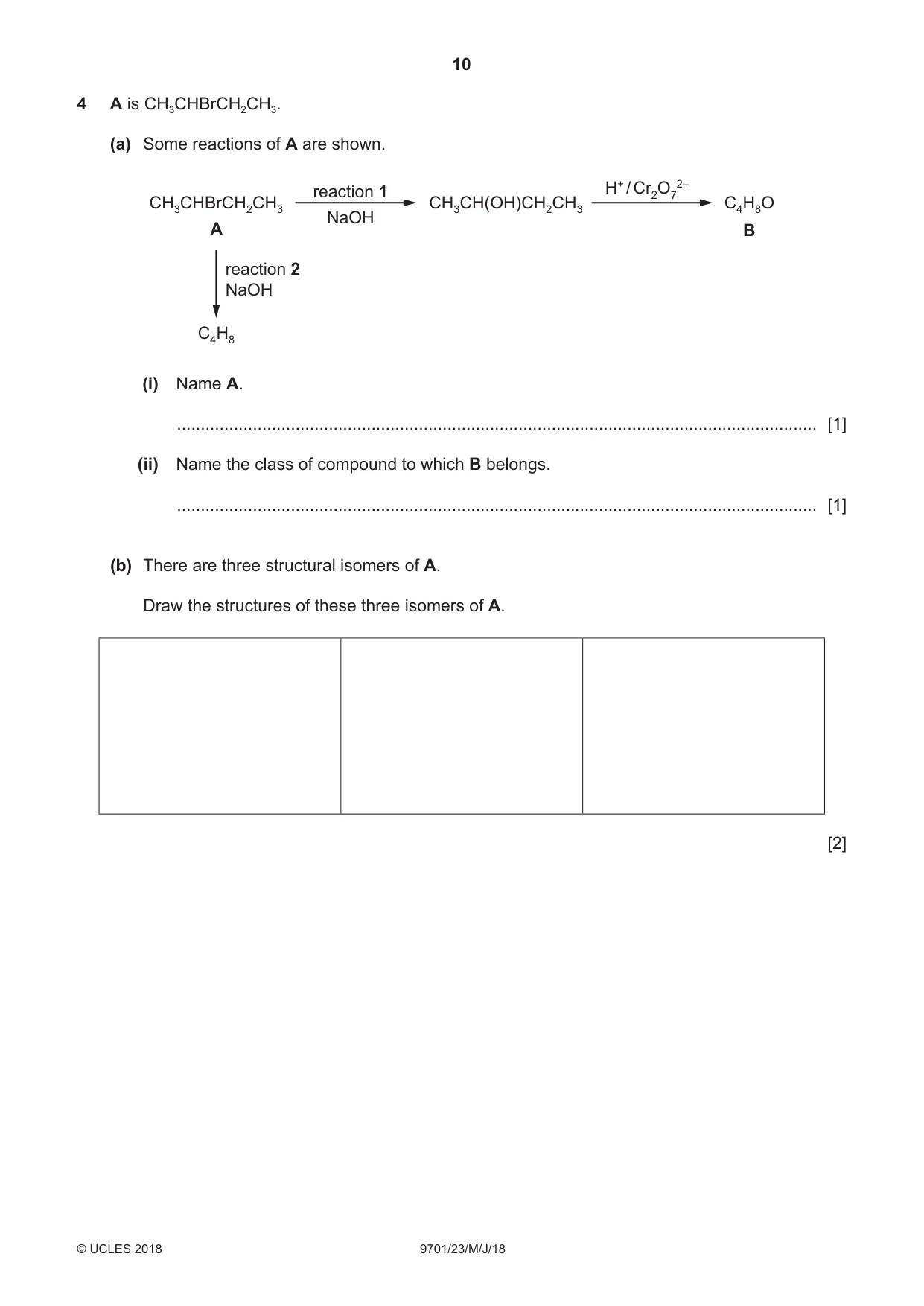
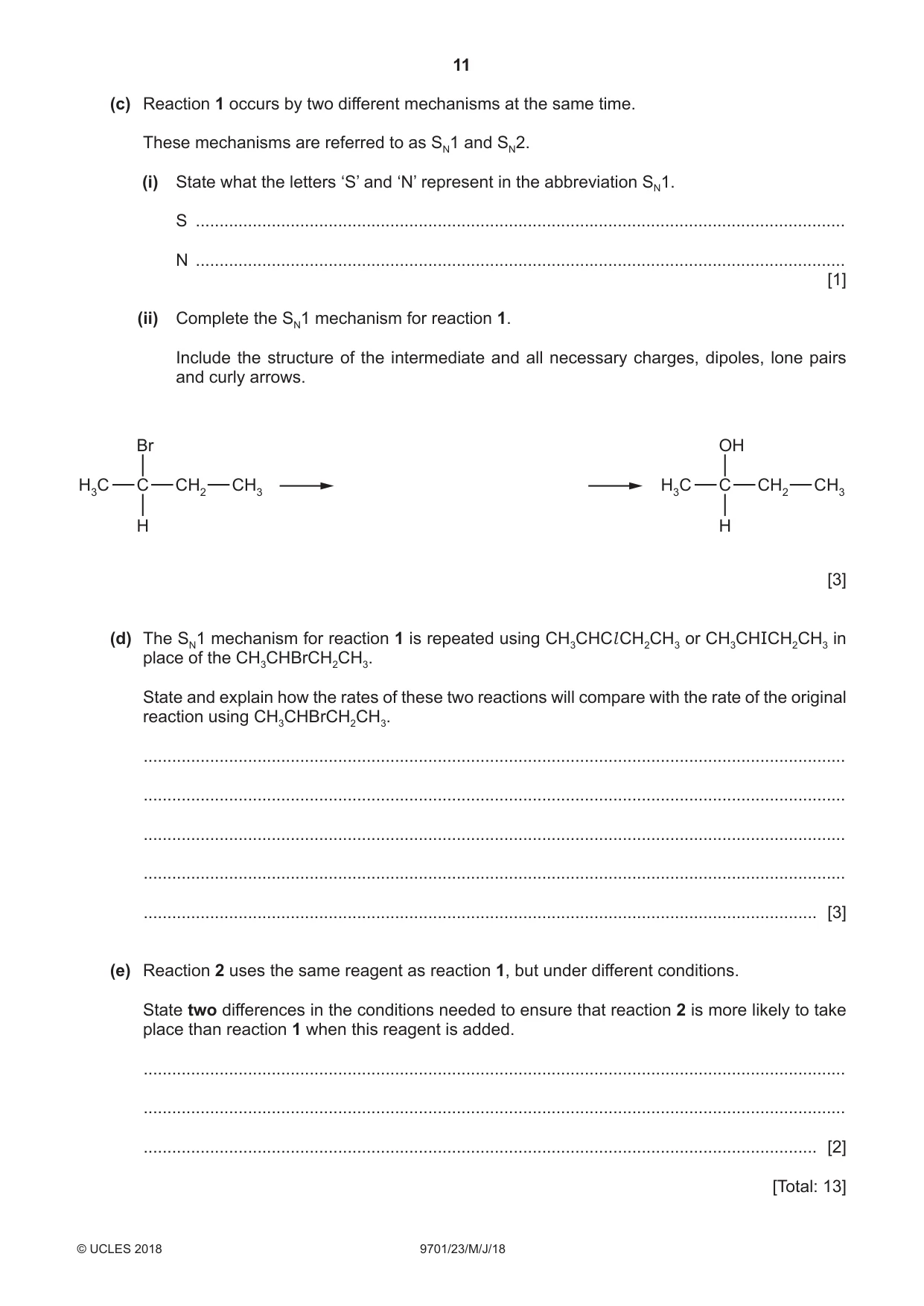
4 A is CH3CHBrCH2CH3. (a) Some reactions of A are shown. reaction 1 H+ / Cr2O72– CH3CHBrCH2CH3 CH3CH(OH)CH2CH3 C4H8O NaOH A B reaction 2 NaOH C4H8 (i) Name A. ....................................................................................................................................... [1] (ii) Name the class of compound to which B belongs. ....................................................................................................................................... [1] (b) There are three structural isomers of A. Draw the structures of these three isomers of A. [2] (c) Reaction 1 occurs by two different mechanisms at the same time. These mechanisms are referred to as SN1 and SN2. (i) State what the letters ‘S’ and ‘N’ represent in the abbreviation SN1. S .......................................................................................................................................... N .......................................................................................................................................... [1] (ii) Complete the SN1 mechanism for reaction 1. Include the structure of the intermediate and all necessary charges, dipoles, lone pairs and curly arrows. Br OH H3C C CH2 CH3 H3C C CH2 CH3 H H [3] (d) The SN1 mechanism for reaction 1 is repeated using CH3CHCl CH2CH3 or CH3CHICH2CH3 in place of the CH3CHBrCH2CH3. State and explain how the rates of these two reactions will compare with the rate of the original reaction using CH3CHBrCH2CH3. .................................................................................................................................................... .................................................................................................................................................... .................................................................................................................................................... .................................................................................................................................................... .............................................................................................................................................. [3] (e) Reaction 2 uses the same reagent as reaction 1, but under different conditions. State two differences in the conditions needed to ensure that reaction 2 is more likely to take place than reaction 1 when this reagent is added. .................................................................................................................................................... .................................................................................................................................................... .............................................................................................................................................. [2] [Total: 13]
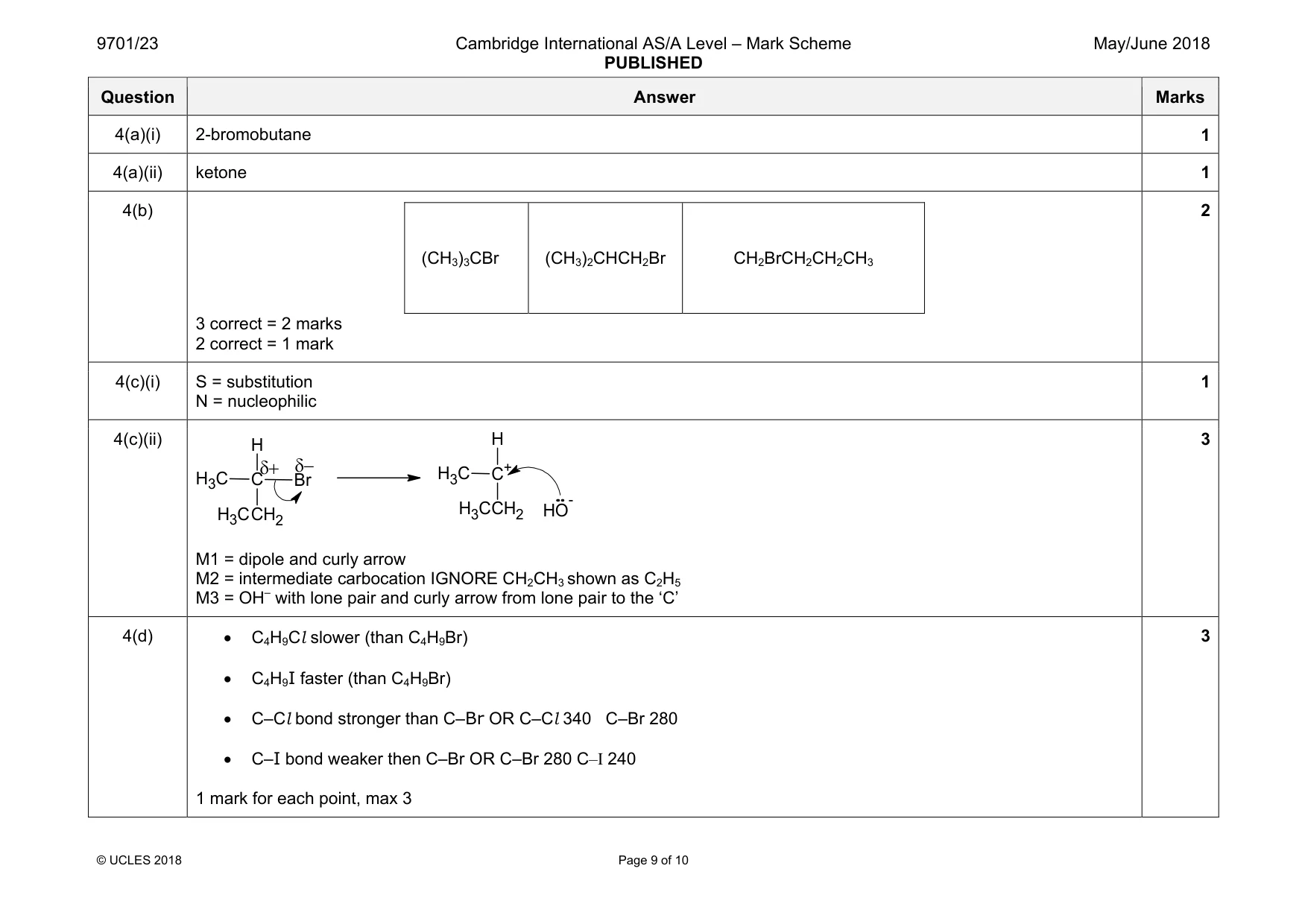
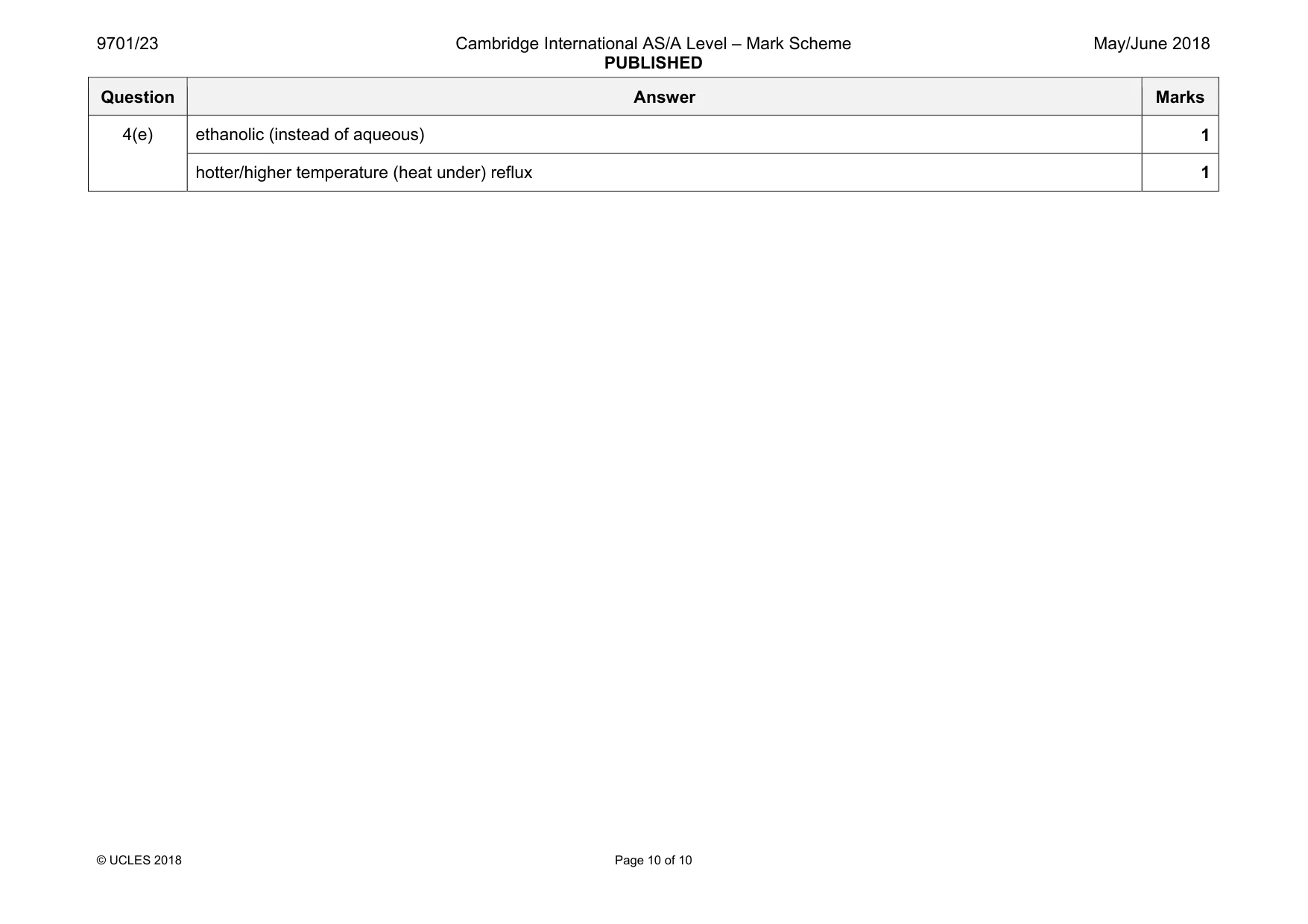
Mark scheme: 4(a)(i) 2-bromobutane 1 4(a)(ii) ketone 1 4(b) (CH3)3CBr (CH3)2CHCH2Br CH2BrCH2CH2CH3 3 correct = 2 marks 2 correct = 1 mark 2 4(c)(i) S = substitution N = nucleophilic 1 4(c)(ii) C C H3 H CH2 Br C H3 C+ C H3 H CH2 C H3 O H - δ+ δ− M1 = dipole and curly arrow M2 = intermediate carbocation IGNORE CH2CH3 shown as C2H5 M3 = OH– with lone pair and curly arrow from lone pair to the ‘C’ 3 4(d) • C4H9Cl slower (than C4H9Br) • C4H9I faster (than C4H9Br) • C–Cl bond stronger than C–Br OR C–Cl 340 C–Br 280 • C–I bond weaker then C–Br OR C–Br 280 C–I 240 1 mark for each point, max 3 3 Question Answer Marks 4(e) ethanolic (instead of aqueous) 1 hotter/higher temperature (heat under) reflux 1
What was in this paper
The subtopics covered by these 4 questions, and how many questions each got. Open one in a new tab to see every Cambridge question on it.
What you needed in this session
Cambridge’s own grade thresholds for 2018 May/June, Paper 2 · Variant 3. A higher threshold means an easier paper — the bar moves with how the cohort did.