Cambridge A Level Chemistry 9701 — 2017 May/June Paper 2 · Variant 2
9701/22/M/J/17 · 4 questions · 60 marks · ≈68 min
The question paper and its mark scheme, free to read here and free to download. This is Cambridge’s own paper, exactly as it was sat.
Question paper12 pages
Mark scheme9 pages
Answers below. Sit the paper first if you are practising.
Questions as text
Q1 · The composition of atoms and ions can be determined from knowledge of atomic number…
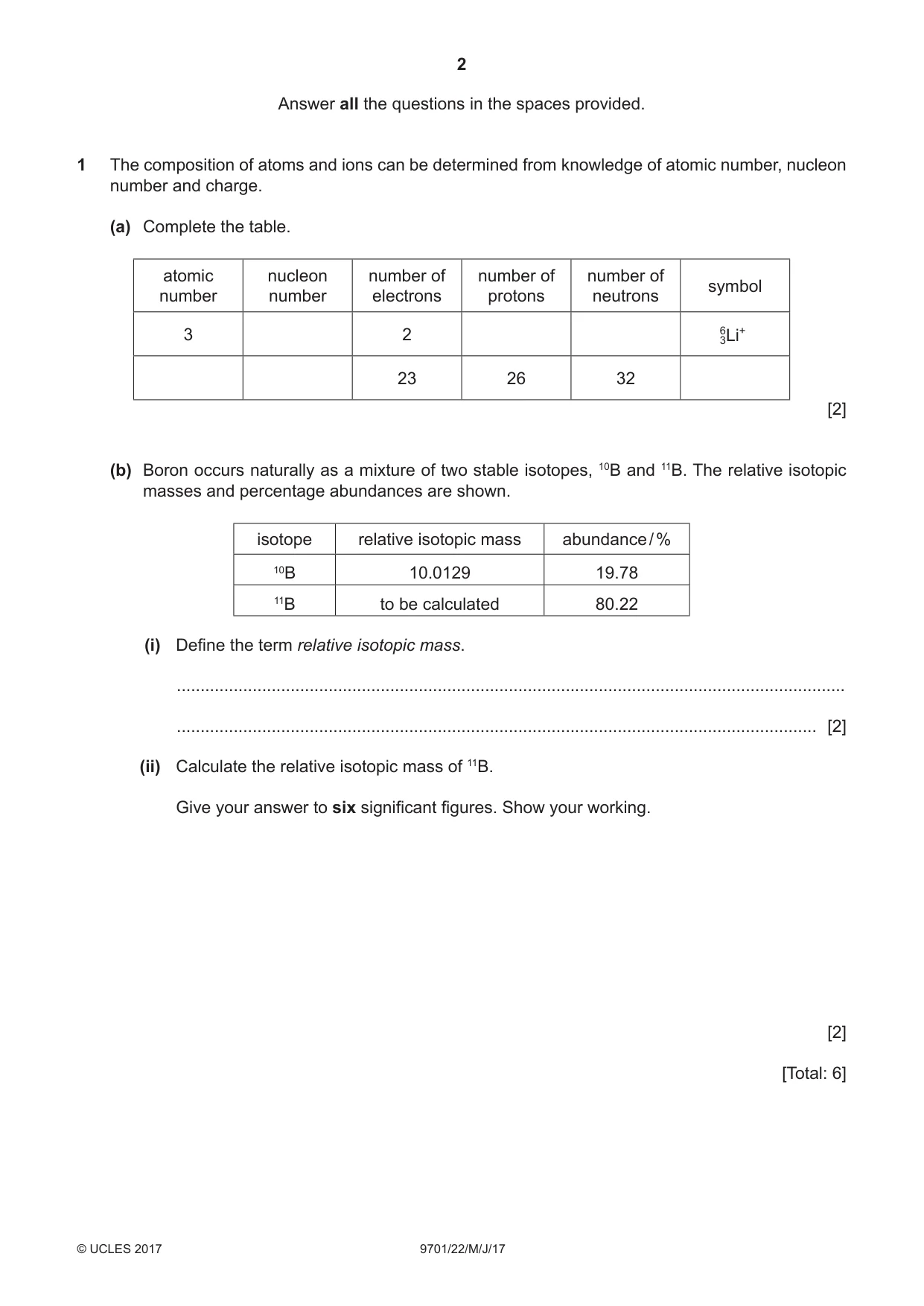
1 The composition of atoms and ions can be determined from knowledge of atomic number, nucleon number and charge. (a) Complete the table. atomic nucleon number of number of number of symbol number number electrons protons neutrons 3 2 6Li+3 23 26 32 [2] (b) Boron occurs naturally as a mixture of two stable isotopes, 10B and 11B. The relative isotopic masses and percentage abundances are shown. isotope relative isotopic mass abundance / % 10B 10.0129 19.78 11B to be calculated 80.22 (i) Define the term relative isotopic mass. ............................................................................................................................................. ....................................................................................................................................... [2] (ii) Calculate the relative isotopic mass of 11B. Give your answer to six significant figures. Show your working. [2] [Total: 6]
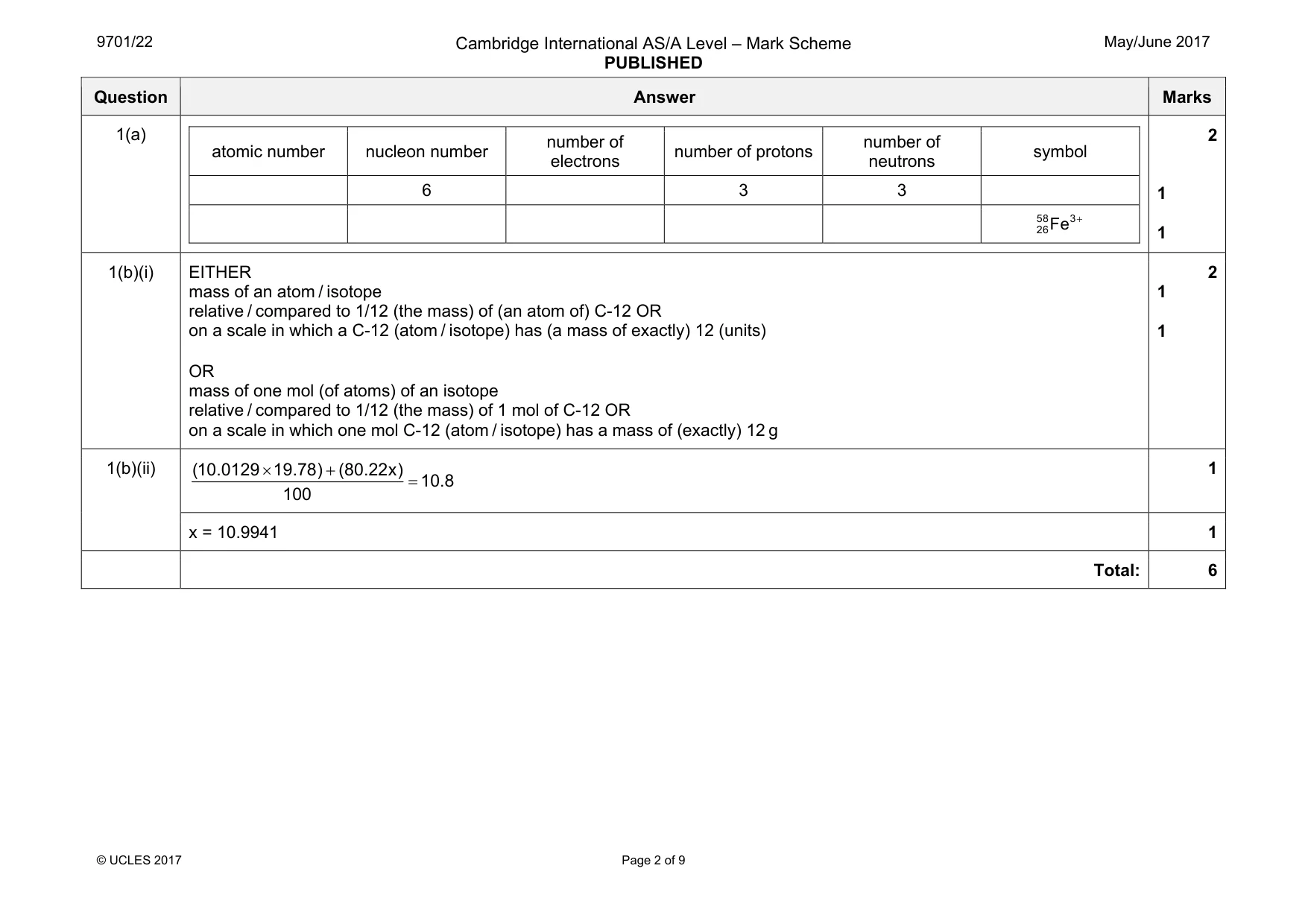
Mark scheme: 1(a) atomic number nucleon number number of electrons number of protons number of neutrons symbol 6 3 3 58 3 26Fe + 2 1 1 1(b)(i) EITHER mass of an atom / isotope relative / compared to 1/12 (the mass) of (an atom of) C-12 OR on a scale in which a C-12 (atom / isotope) has (a mass of exactly) 12 (units) OR mass of one mol (of atoms) of an isotope relative / compared to 1/12 (the mass) of 1 mol of C-12 OR on a scale in which one mol C-12 (atom / isotope) has a mass of (exactly) 12 g 2 1 1 1(b)(ii) (10.0129 19.78) (80.22x) 10.8 100 × + = 1 x = 10.9941 1 Total: 6
Q2 · Nitrogen gas, N2, is very unreactive
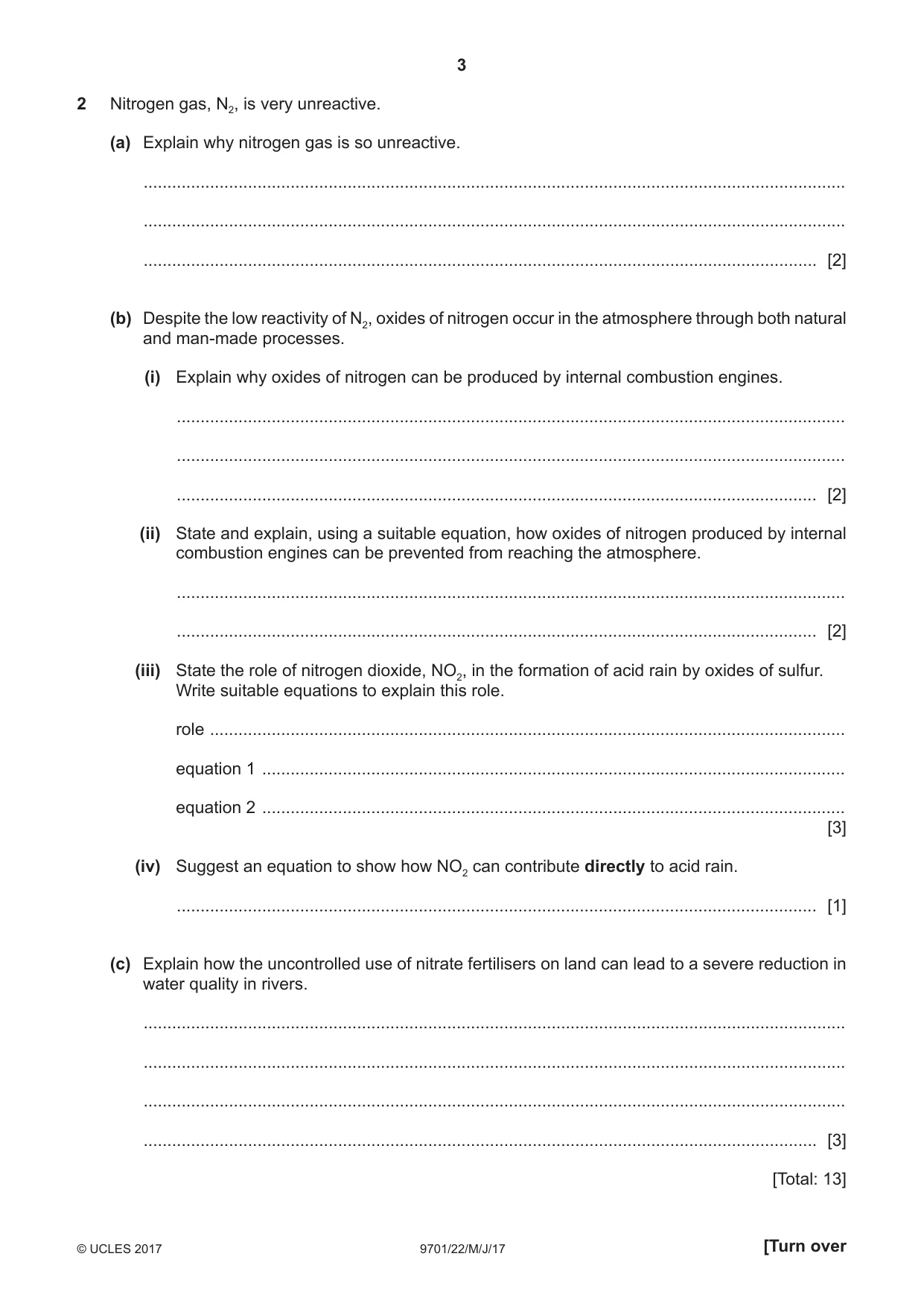
2 Nitrogen gas, N2, is very unreactive. (a) Explain why nitrogen gas is so unreactive. .................................................................................................................................................... .................................................................................................................................................... .............................................................................................................................................. [2] (b) Despite the low reactivity of N2, oxides of nitrogen occur in the atmosphere through both natural and man-made processes. (i) Explain why oxides of nitrogen can be produced by internal combustion engines. ............................................................................................................................................. ............................................................................................................................................. ....................................................................................................................................... [2] (ii) State and explain, using a suitable equation, how oxides of nitrogen produced by internal combustion engines can be prevented from reaching the atmosphere. ............................................................................................................................................. ....................................................................................................................................... [2] (iii) State the role of nitrogen dioxide, NO2, in the formation of acid rain by oxides of sulfur. Write suitable equations to explain this role. role ...................................................................................................................................... equation 1 ........................................................................................................................... equation 2 ........................................................................................................................... [3] (iv) Suggest an equation to show how NO2 can contribute directly to acid rain. ....................................................................................................................................... [1] (c) Explain how the uncontrolled use of nitrate fertilisers on land can lead to a severe reduction in water quality in rivers. .................................................................................................................................................... .................................................................................................................................................... .................................................................................................................................................... .............................................................................................................................................. [3] [Total: 13]
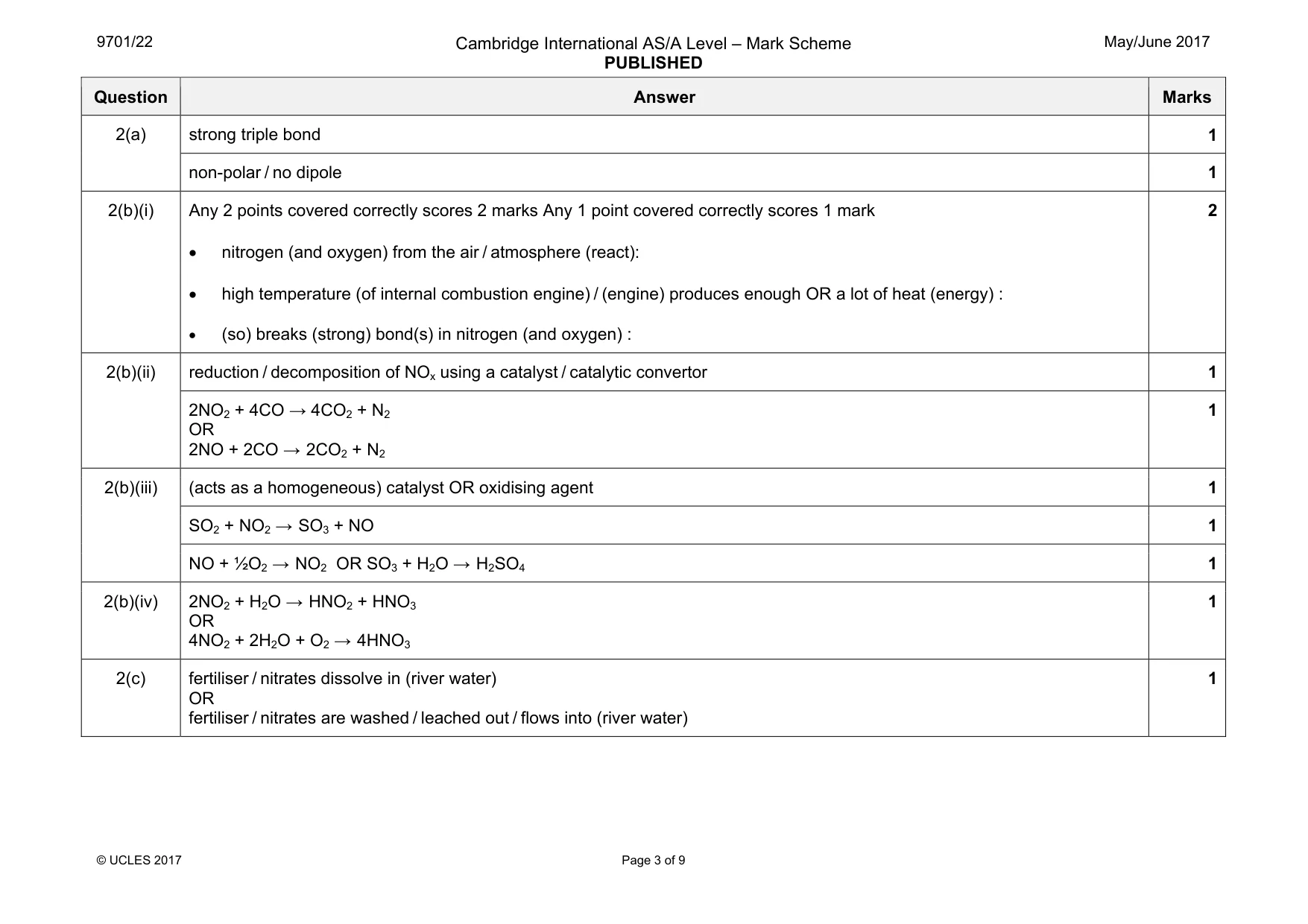
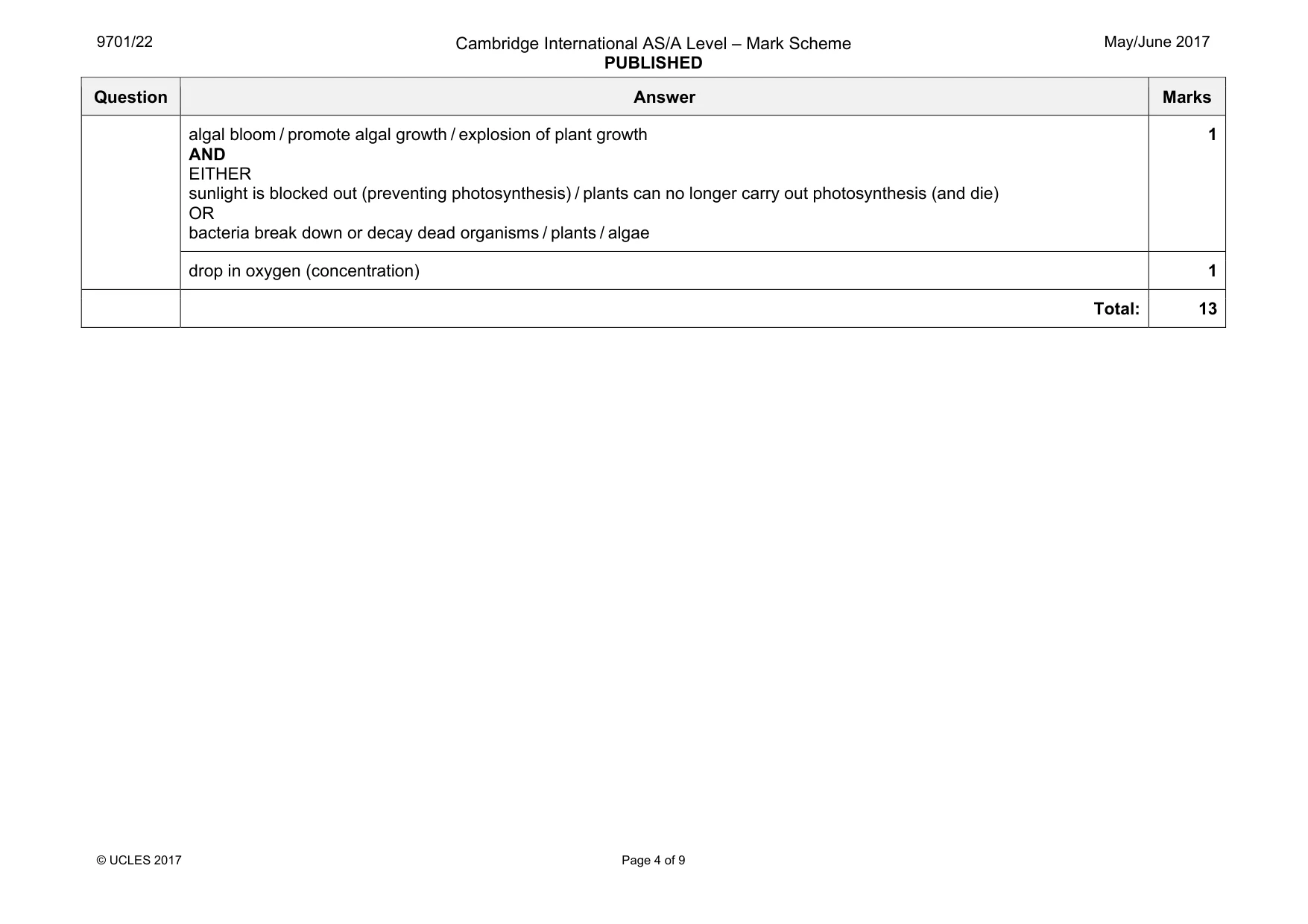
Mark scheme: 2(a) strong triple bond 1 non-polar / no dipole 1 2(b)(i) Any 2 points covered correctly scores 2 marks Any 1 point covered correctly scores 1 mark • nitrogen (and oxygen) from the air / atmosphere (react): • high temperature (of internal combustion engine) / (engine) produces enough OR a lot of heat (energy) : • (so) breaks (strong) bond(s) in nitrogen (and oxygen) : 2 2(b)(ii) reduction / decomposition of NOx using a catalyst / catalytic convertor 1 2NO2 + 4CO → 4CO2 + N2 OR 2NO + 2CO → 2CO2 + N2 1 2(b)(iii) (acts as a homogeneous) catalyst OR oxidising agent 1 SO2 + NO2 → SO3 + NO 1 NO + ½O2 → NO2 OR SO3 + H2O →H2SO4 1 2(b)(iv) 2NO2 + H2O → HNO2 + HNO3 OR 4NO2 + 2H2O + O2 → 4HNO3 1 2(c) fertiliser / nitrates dissolve in (river water) OR fertiliser / nitrates are washed / leached out / flows into (river water) 1 Question Answer Marks algal bloom / promote algal growth / explosion of plant growth AND EITHER sunlight is blocked out (preventing photosynthesis) / plants can no longer carry out photosynthesis (and die) OR bacteria break down or decay dead organisms / plants / algae 1 drop in oxygen (concentration) 1 Total: 13
Q3 · The hydrogen halides, HCl, HBr and HI, can undergo thermal decomposition
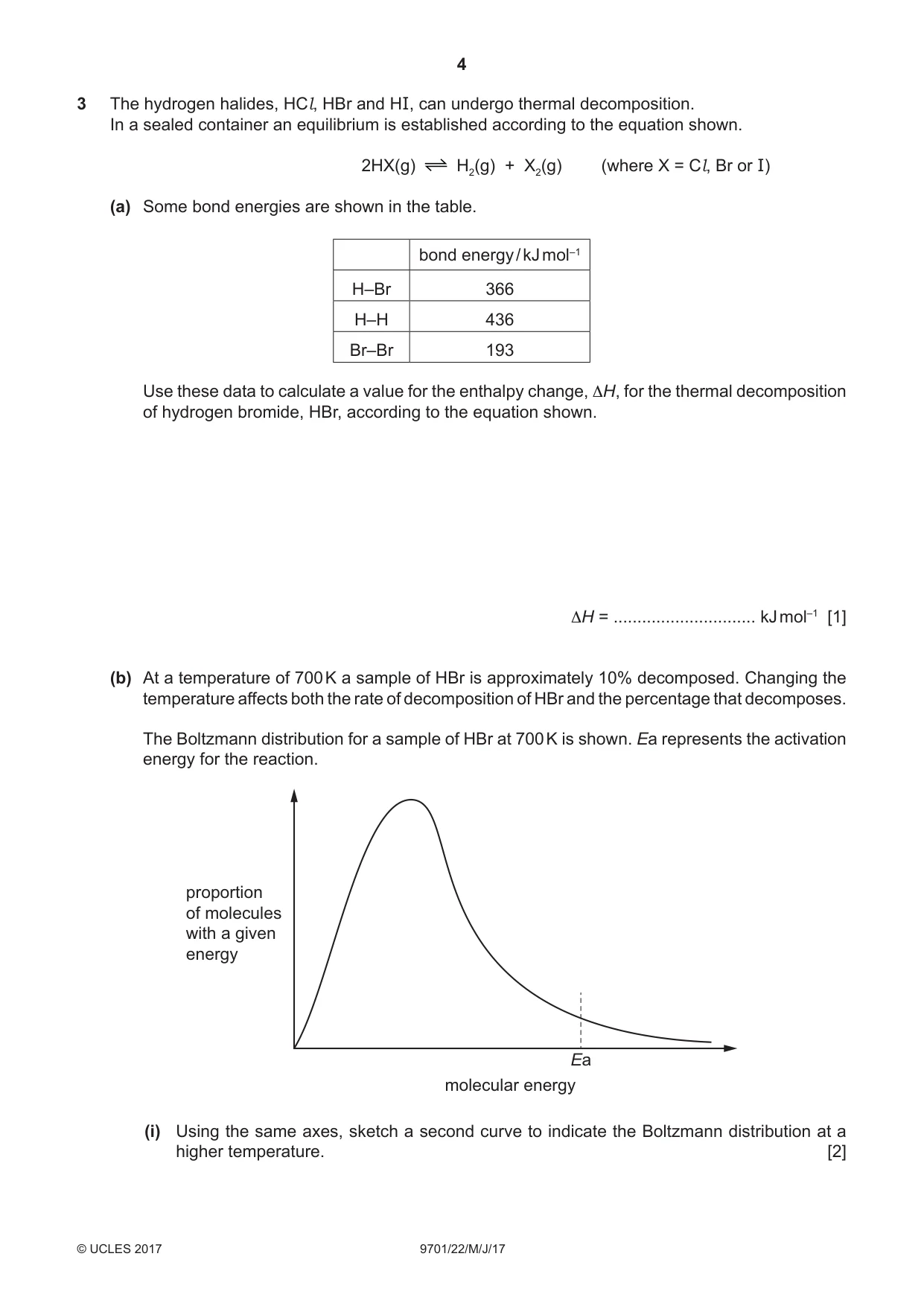
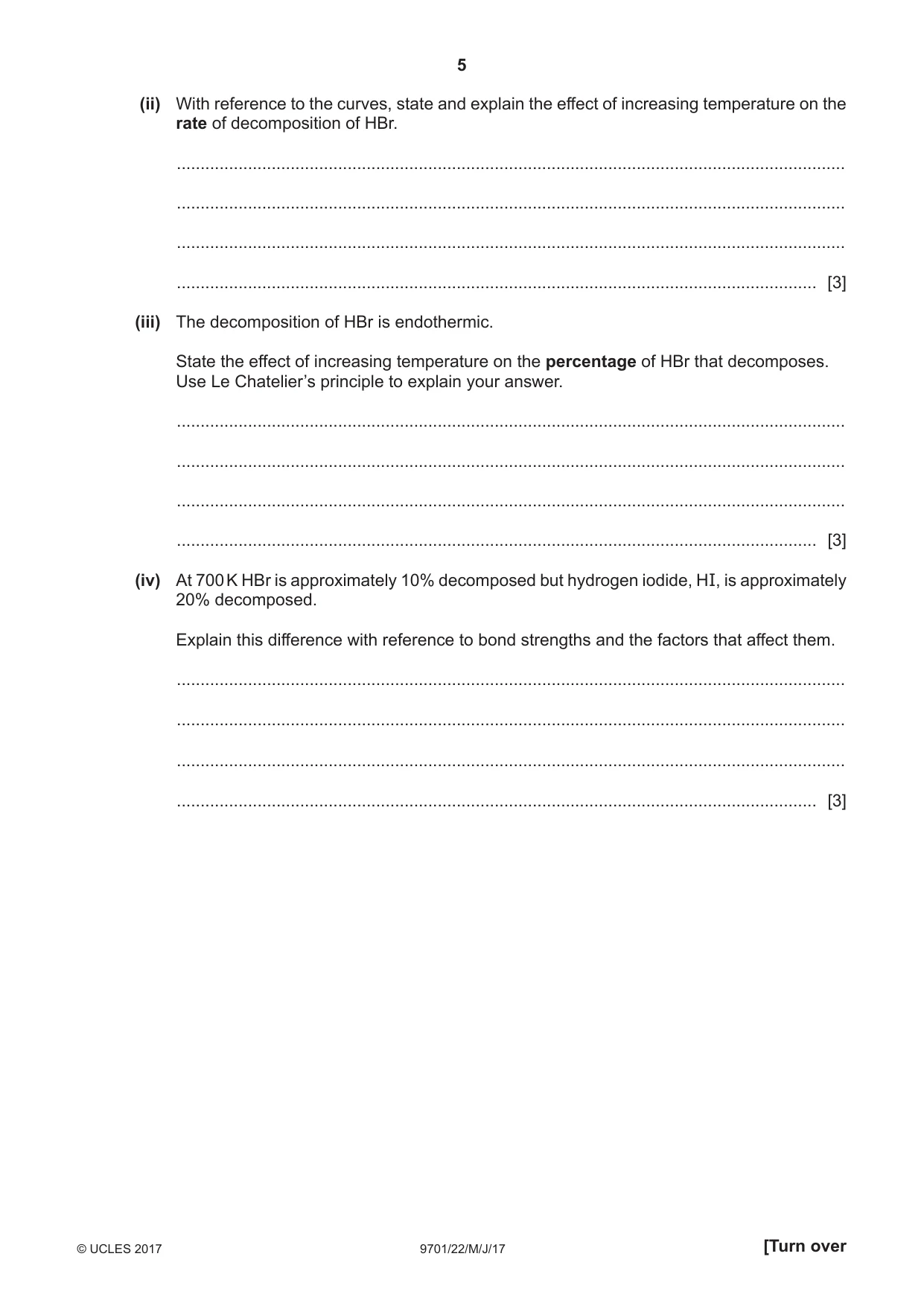
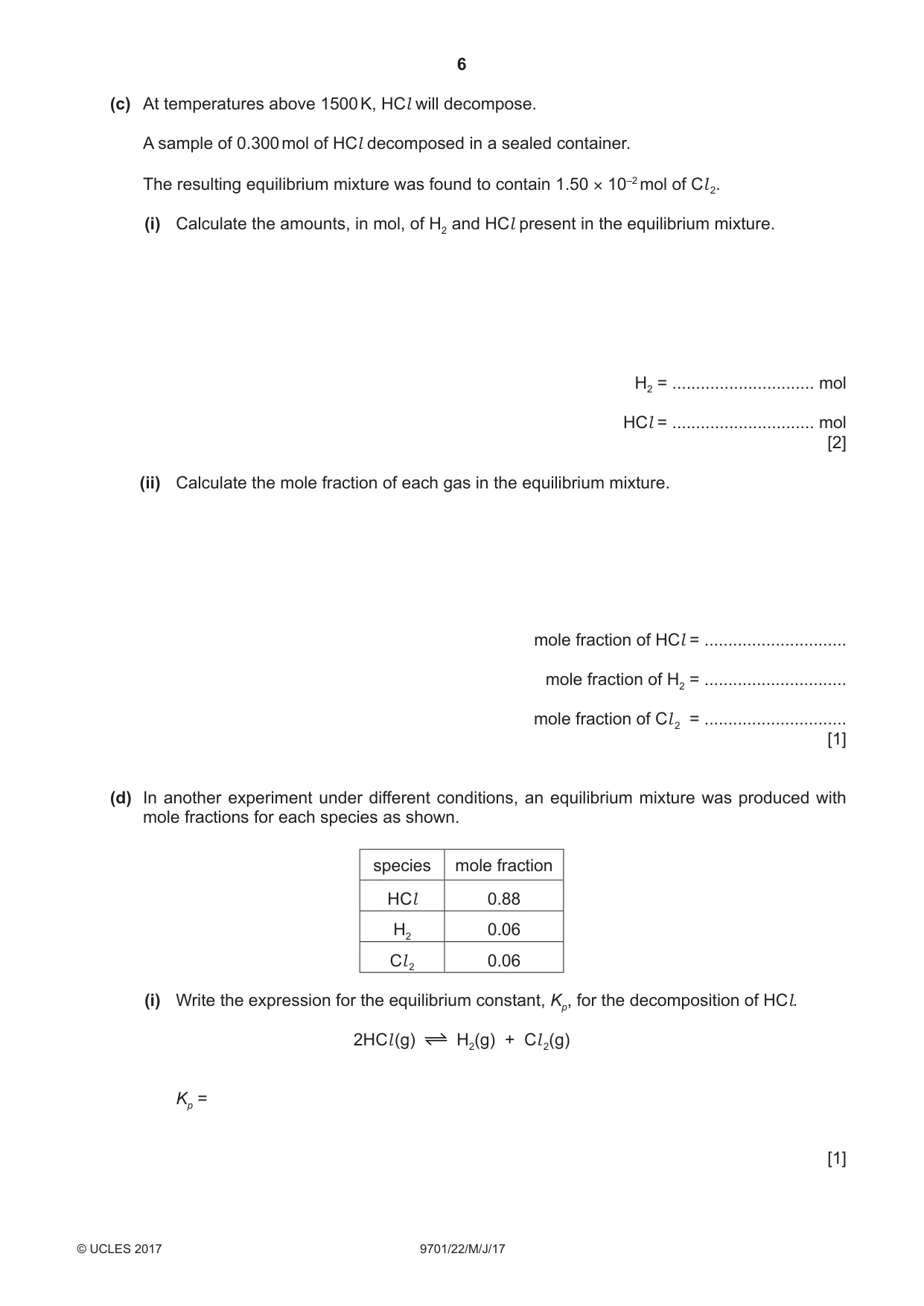
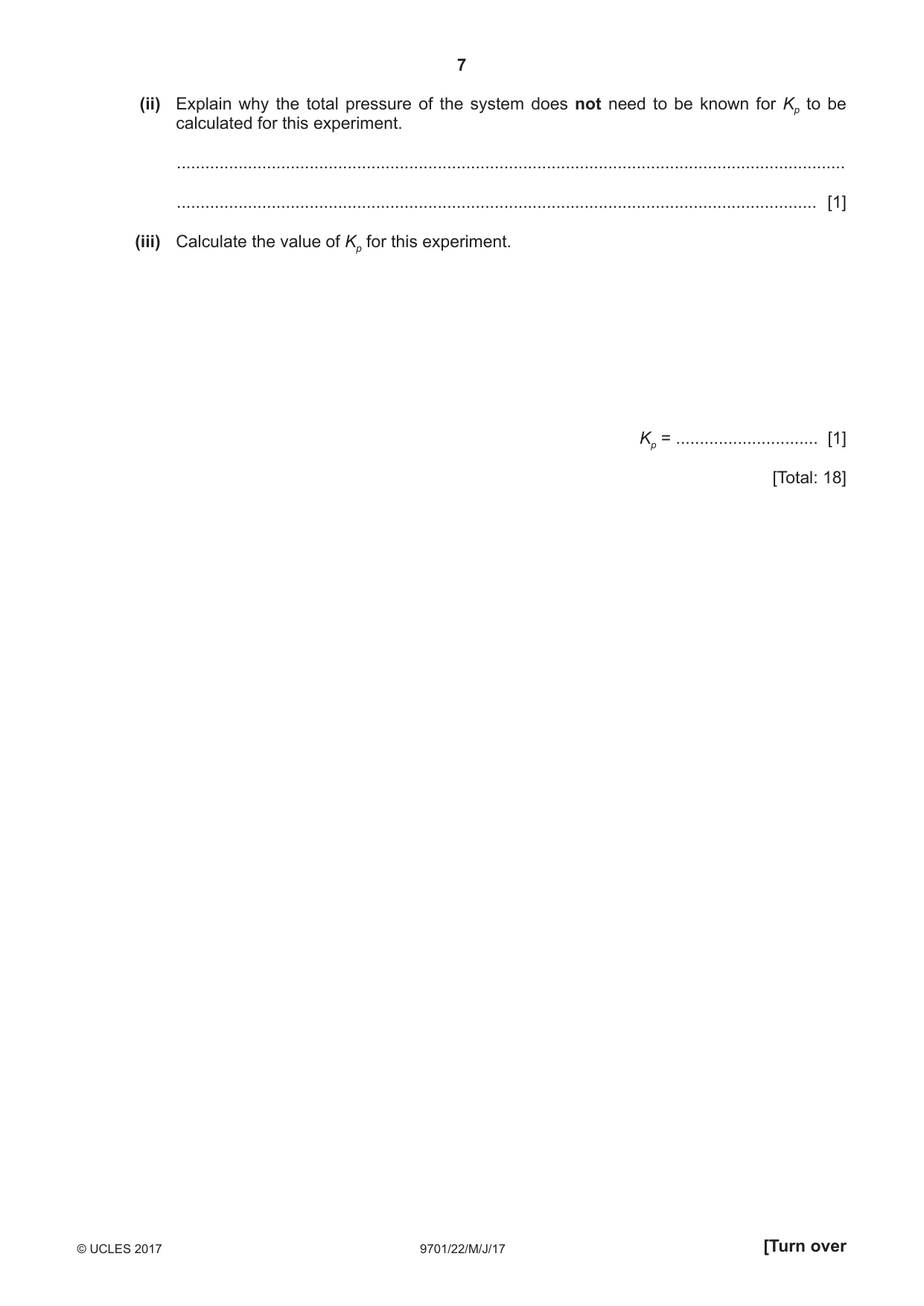
3 The hydrogen halides, HCl, HBr and HI, can undergo thermal decomposition. In a sealed container an equilibrium is established according to the equation shown. 2HX(g) H2(g) + X2(g) (where X = Cl, Br or I) (a) Some bond energies are shown in the table. bond energy / kJ mol–1 H–Br 366 H–H 436 Br–Br 193 Use these data to calculate a value for the enthalpy change, ΔH, for the thermal decomposition of hydrogen bromide, HBr, according to the equation shown. ΔH = .............................. kJ mol–1 [1] (b) At a temperature of 700 K a sample of HBr is approximately 10% decomposed. Changing the temperature affects both the rate of decomposition of HBr and the percentage that decomposes. The Boltzmann distribution for a sample of HBr at 700 K is shown. Ea represents the activation energy for the reaction. proportion of molecules with a given energy Ea molecular energy (i) Using the same axes, sketch a second curve to indicate the Boltzmann distribution at a higher temperature. [2] (ii) With reference to the curves, state and explain the effect of increasing temperature on the rate of decomposition of HBr. ............................................................................................................................................. ............................................................................................................................................. ............................................................................................................................................. ....................................................................................................................................... [3] (iii) The decomposition of HBr is endothermic. State the effect of increasing temperature on the percentage of HBr that decomposes. Use Le Chatelier’s principle to explain your answer. ............................................................................................................................................. ............................................................................................................................................. ............................................................................................................................................. ....................................................................................................................................... [3] (iv) At 700 K HBr is approximately 10% decomposed but hydrogen iodide, HI, is approximately 20% decomposed. Explain this difference with reference to bond strengths and the factors that affect them. ............................................................................................................................................. ............................................................................................................................................. ............................................................................................................................................. ....................................................................................................................................... [3] (c) At temperatures above 1500 K, HCl will decompose. A sample of 0.300 mol of HCl decomposed in a sealed container. The resulting equilibrium mixture was found to contain 1.50 × 10⁻² mol of Cl 2. (i) Calculate the amounts, in mol, of H2 and HCl present in the equilibrium mixture. H2 = .............................. mol HCl = .............................. mol [2] (ii) Calculate the mole fraction of each gas in the equilibrium mixture. mole fraction of HCl = .............................. mole fraction of H2 = .............................. mole fraction of Cl 2 = .............................. [1] (d) In another experiment under different conditions, an equilibrium mixture was produced with mole fractions for each species as shown. species mole fraction HCl 0.88 H2 0.06 Cl 2 0.06 (i) Write the expression for the equilibrium constant, Kp, for the decomposition of HCl. 2HCl (g) H2(g) + Cl 2(g) Kp = [1] (ii) Explain why the total pressure of the system does not need to be known for Kp to be calculated for this experiment. ............................................................................................................................................. ....................................................................................................................................... [1] (iii) Calculate the value of Kp for this experiment. Kp = .............................. [1] [Total: 18]
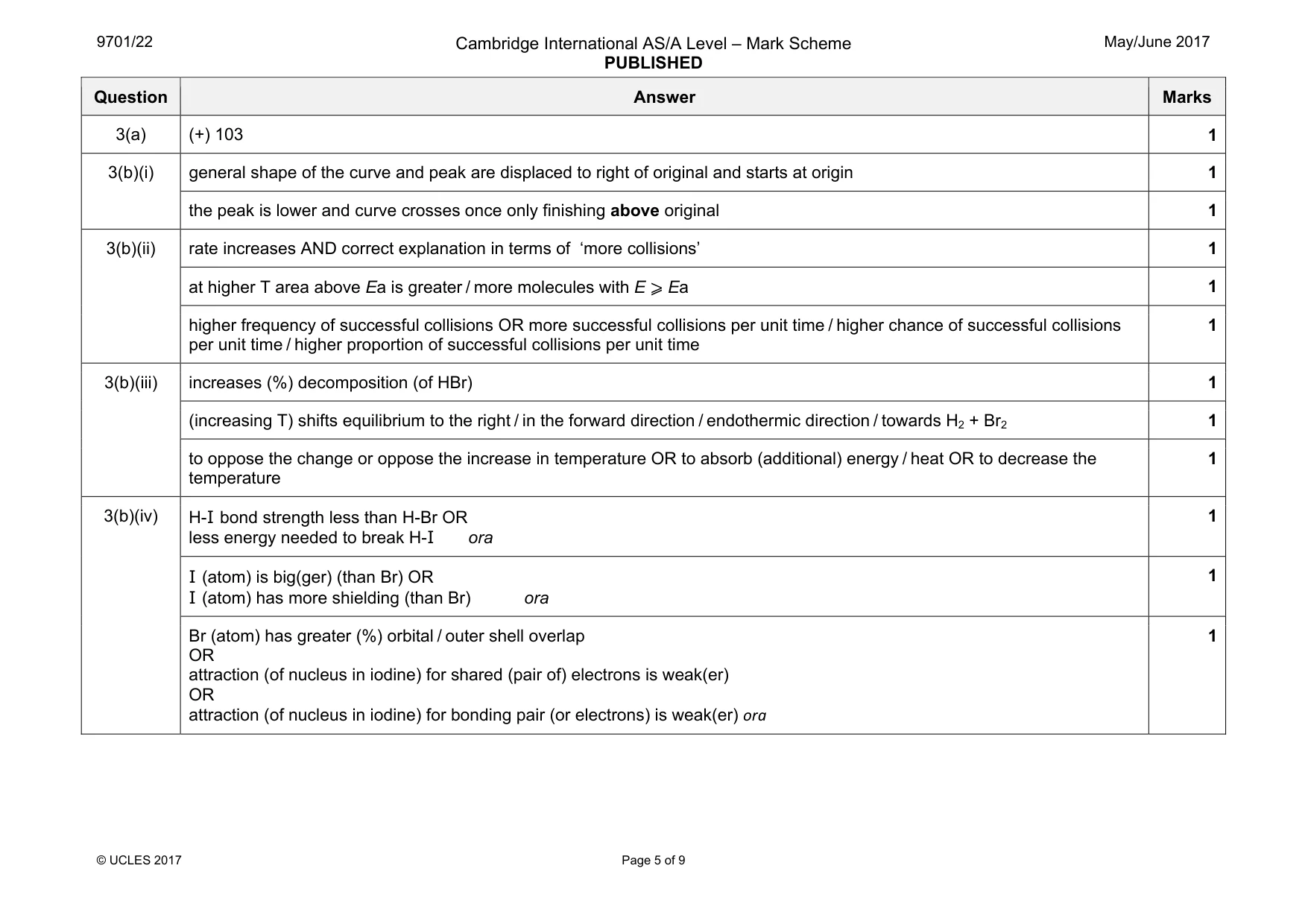
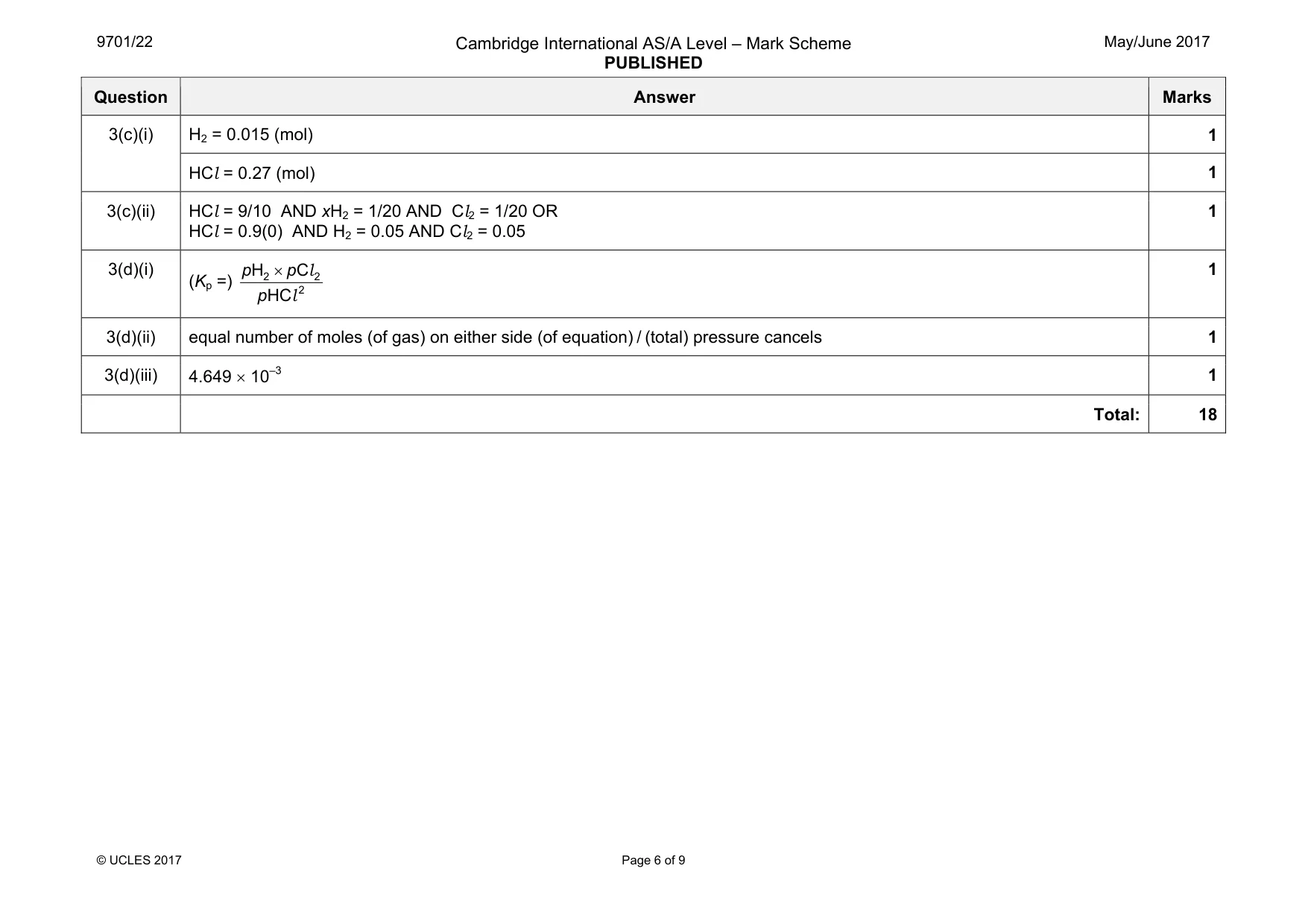
Mark scheme: 3(a) (+) 103 1 3(b)(i) general shape of the curve and peak are displaced to right of original and starts at origin 1 the peak is lower and curve crosses once only finishing above original 1 3(b)(ii) rate increases AND correct explanation in terms of ‘more collisions’ 1 at higher T area above Ea is greater / more molecules with E ⩾ Ea 1 higher frequency of successful collisions OR more successful collisions per unit time / higher chance of successful collisions per unit time / higher proportion of successful collisions per unit time 1 3(b)(iii) increases (%) decomposition (of HBr) 1 (increasing T) shifts equilibrium to the right / in the forward direction / endothermic direction / towards H2 + Br2 1 to oppose the change or oppose the increase in temperature OR to absorb (additional) energy / heat OR to decrease the temperature 1 3(b)(iv) H-I bond strength less than H-Br OR less energy needed to break H-I ora 1 I (atom) is big(ger) (than Br) OR I (atom) has more shielding (than Br) ora 1 Br (atom) has greater (%) orbital / outer shell overlap OR attraction (of nucleus in iodine) for shared (pair of) electrons is weak(er) OR attraction (of nucleus in iodine) for bonding pair (or electrons) is weak(er) ora 1 Question Answer Marks 3(c)(i) H2 = 0.015 (mol) 1 HCl = 0.27 (mol) 1 3(c)(ii) HCl = 9/10 AND xH2 = 1/20 AND Cl2 = 1/20 OR HCl = 0.9(0) AND H2 = 0.05 AND Cl2 = 0.05 1 3(d)(i) (Kp =) 2 2 2 H C HC p p p × l l 1 3(d)(ii) equal number of moles (of gas) on either side (of equation) / (total) pressure cancels 1 3(d)(iii) 4.649 × 10⁻³ 1 Total: 18
More questions on Effect of temperature on reaction rates and the concept of activation energy
Q4 · The hydrocarbons A, C4H10, and B, C4H8, are both unbranched
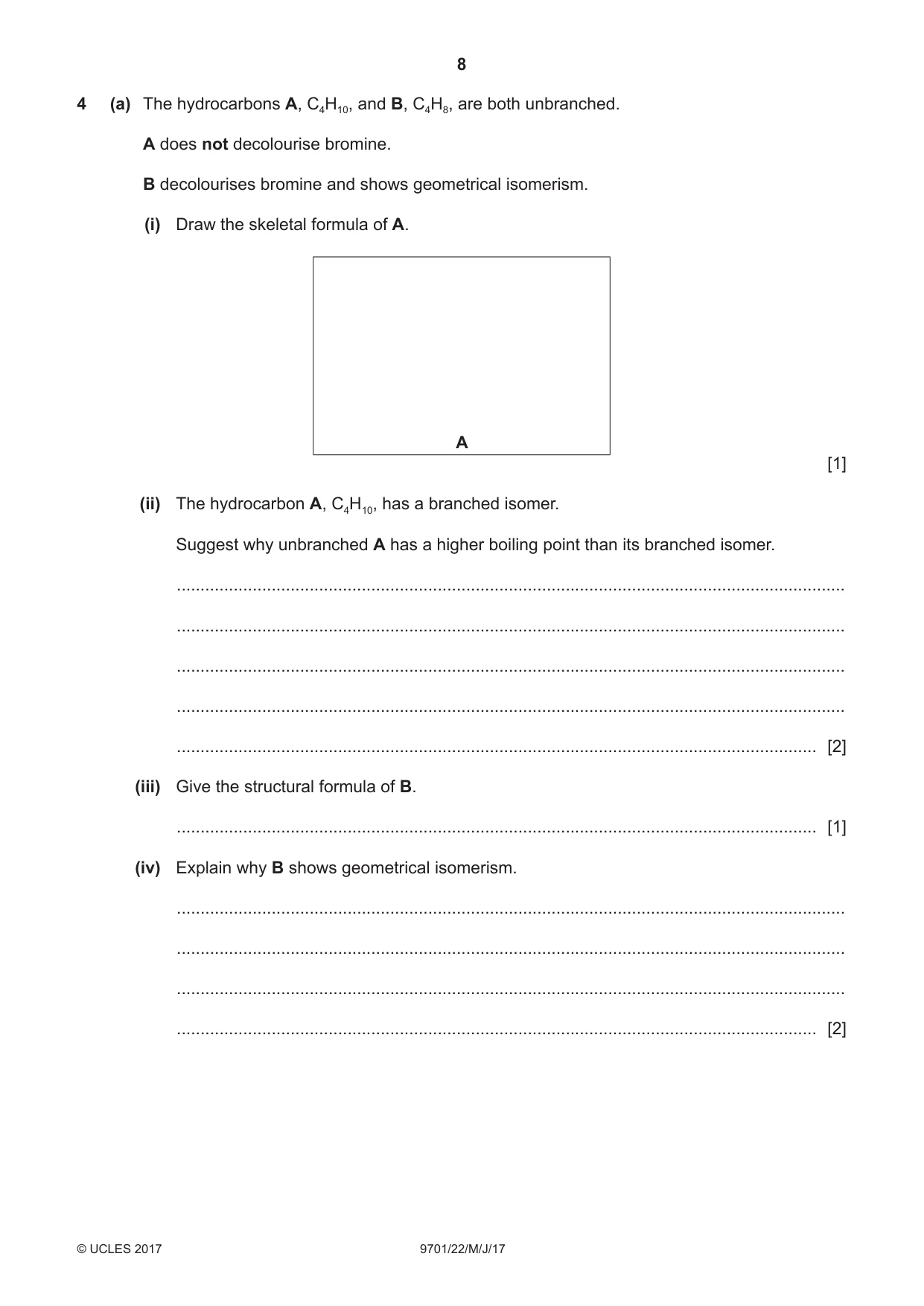
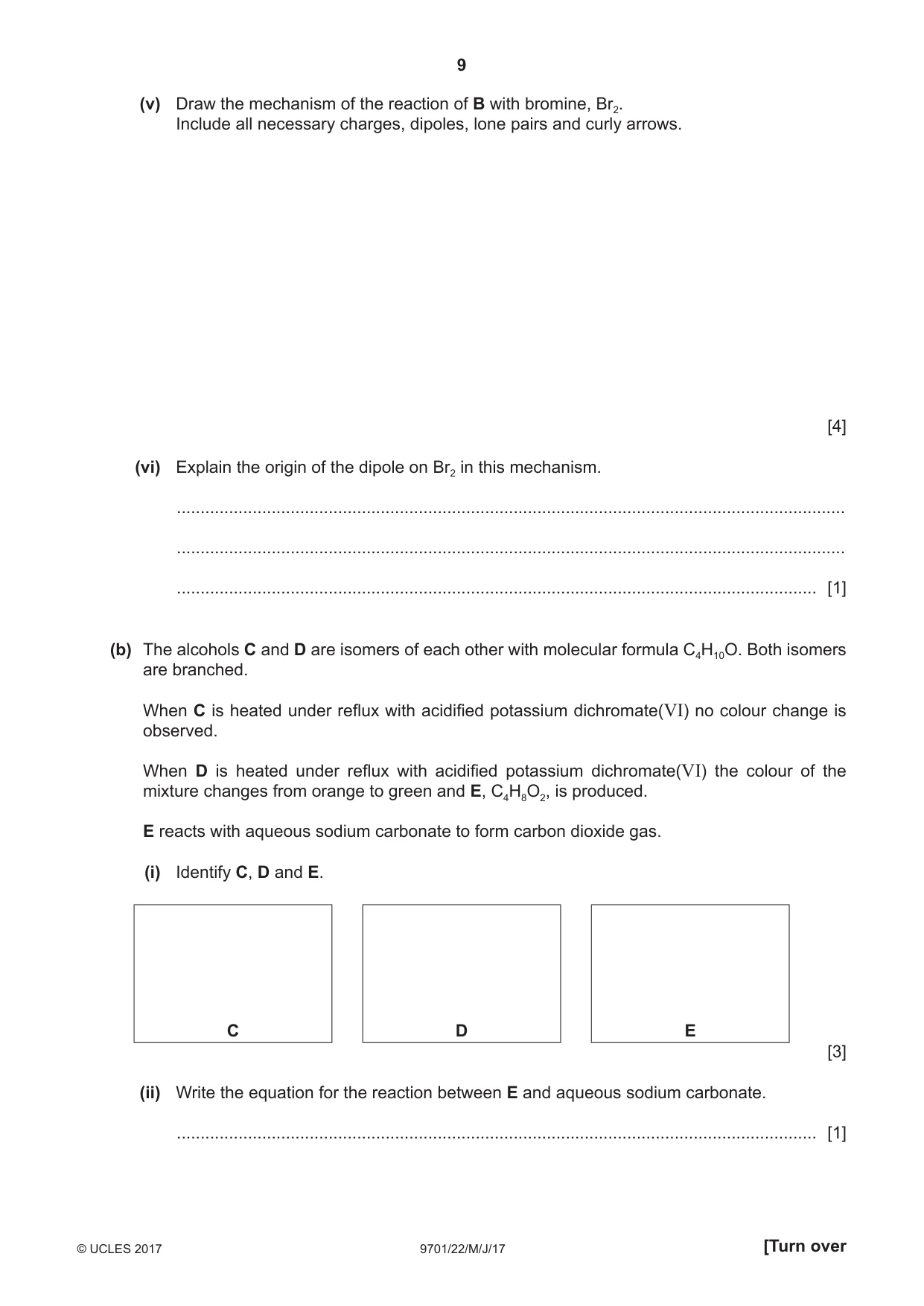
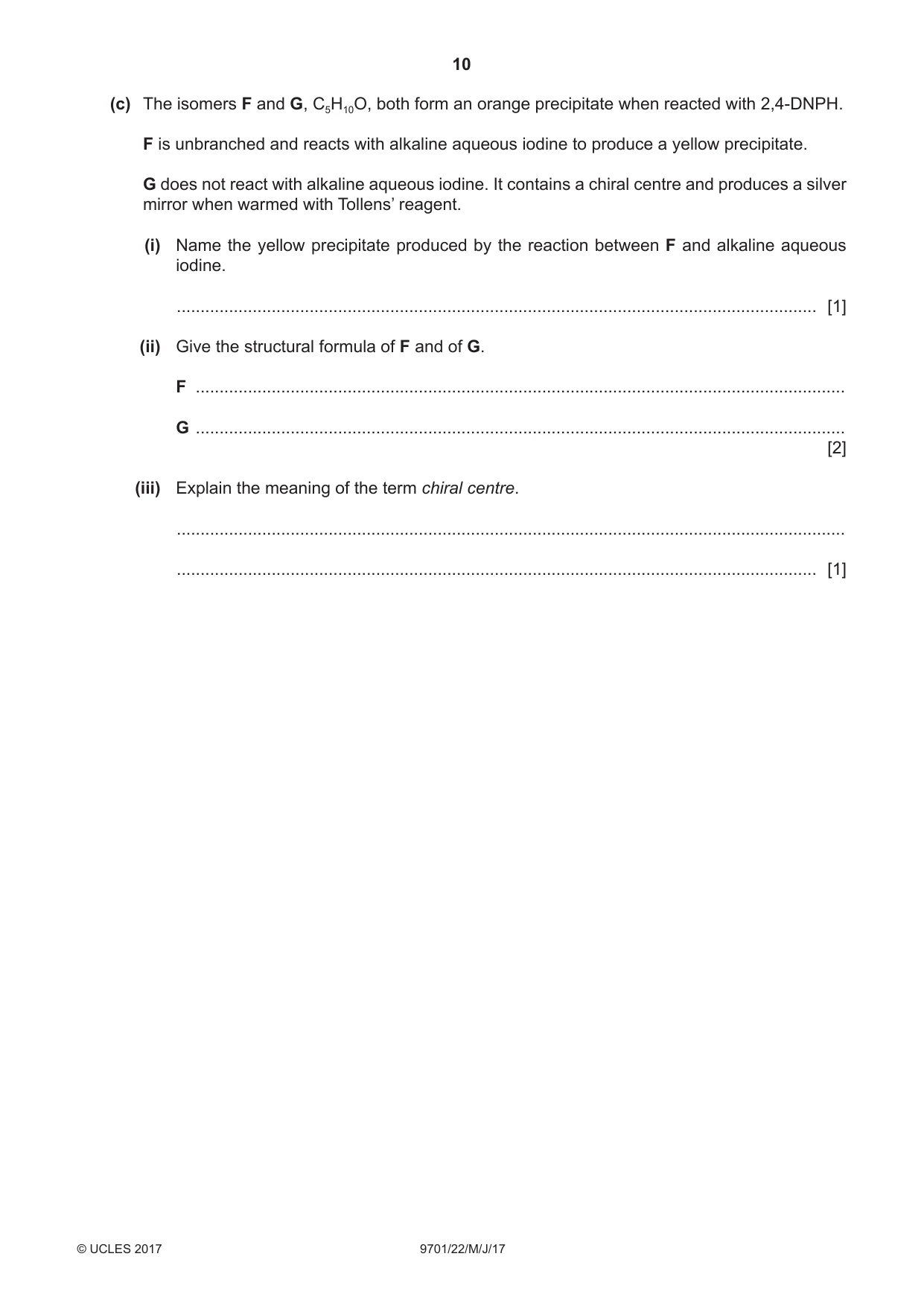
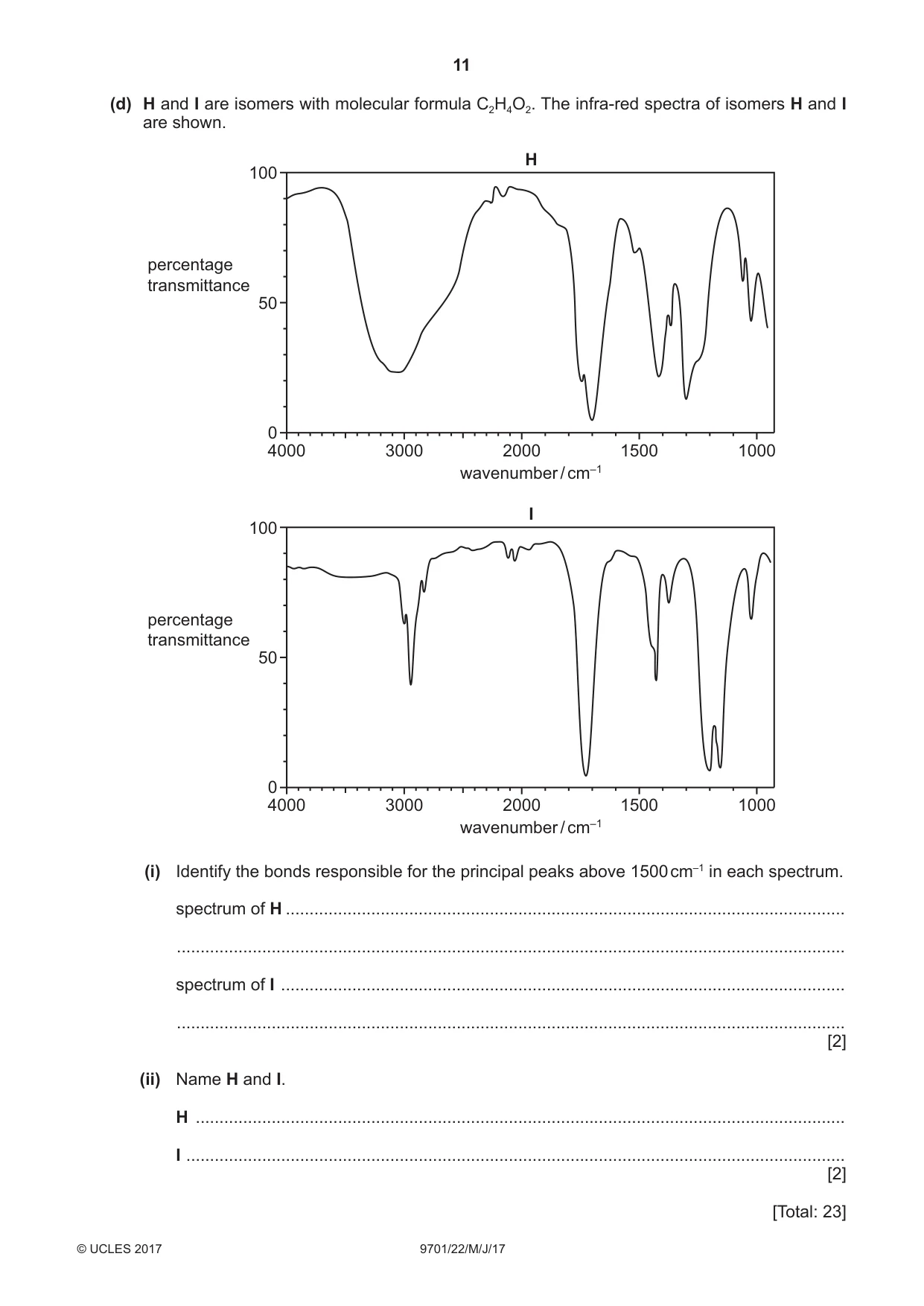
4 (a) The hydrocarbons A, C4H10, and B, C4H8, are both unbranched. A does not decolourise bromine. B decolourises bromine and shows geometrical isomerism. (i) Draw the skeletal formula of A. A [1] (ii) The hydrocarbon A, C4H10, has a branched isomer. Suggest why unbranched A has a higher boiling point than its branched isomer. ............................................................................................................................................. ............................................................................................................................................. ............................................................................................................................................. ............................................................................................................................................. ....................................................................................................................................... [2] (iii) Give the structural formula of B. ....................................................................................................................................... [1] (iv) Explain why B shows geometrical isomerism. ............................................................................................................................................. ............................................................................................................................................. ............................................................................................................................................. ....................................................................................................................................... [2] (v) Draw the mechanism of the reaction of B with bromine, Br2. Include all necessary charges, dipoles, lone pairs and curly arrows. [4] (vi) Explain the origin of the dipole on Br2 in this mechanism. ............................................................................................................................................. ............................................................................................................................................. ....................................................................................................................................... [1] (b) The alcohols C and D are isomers of each other with molecular formula C4H10O. Both isomers are branched. When C is heated under reflux with acidified potassium dichromate(VI) no colour change is observed. When D is heated under reflux with acidified potassium dichromate(VI) the colour of the mixture changes from orange to green and E, C4H8O2, is produced. E reacts with aqueous sodium carbonate to form carbon dioxide gas. (i) Identify C, D and E. C D E [3] (ii) Write the equation for the reaction between E and aqueous sodium carbonate. ....................................................................................................................................... [1] (c) The isomers F and G, C5H10O, both form an orange precipitate when reacted with 2,4-DNPH. F is unbranched and reacts with alkaline aqueous iodine to produce a yellow precipitate. G does not react with alkaline aqueous iodine. It contains a chiral centre and produces a silver mirror when warmed with Tollens’ reagent. (i) Name the yellow precipitate produced by the reaction between F and alkaline aqueous iodine. ....................................................................................................................................... [1] (ii) Give the structural formula of F and of G. F .......................................................................................................................................... G ......................................................................................................................................... [2] (iii) Explain the meaning of the term chiral centre. ............................................................................................................................................. ....................................................................................................................................... [1]
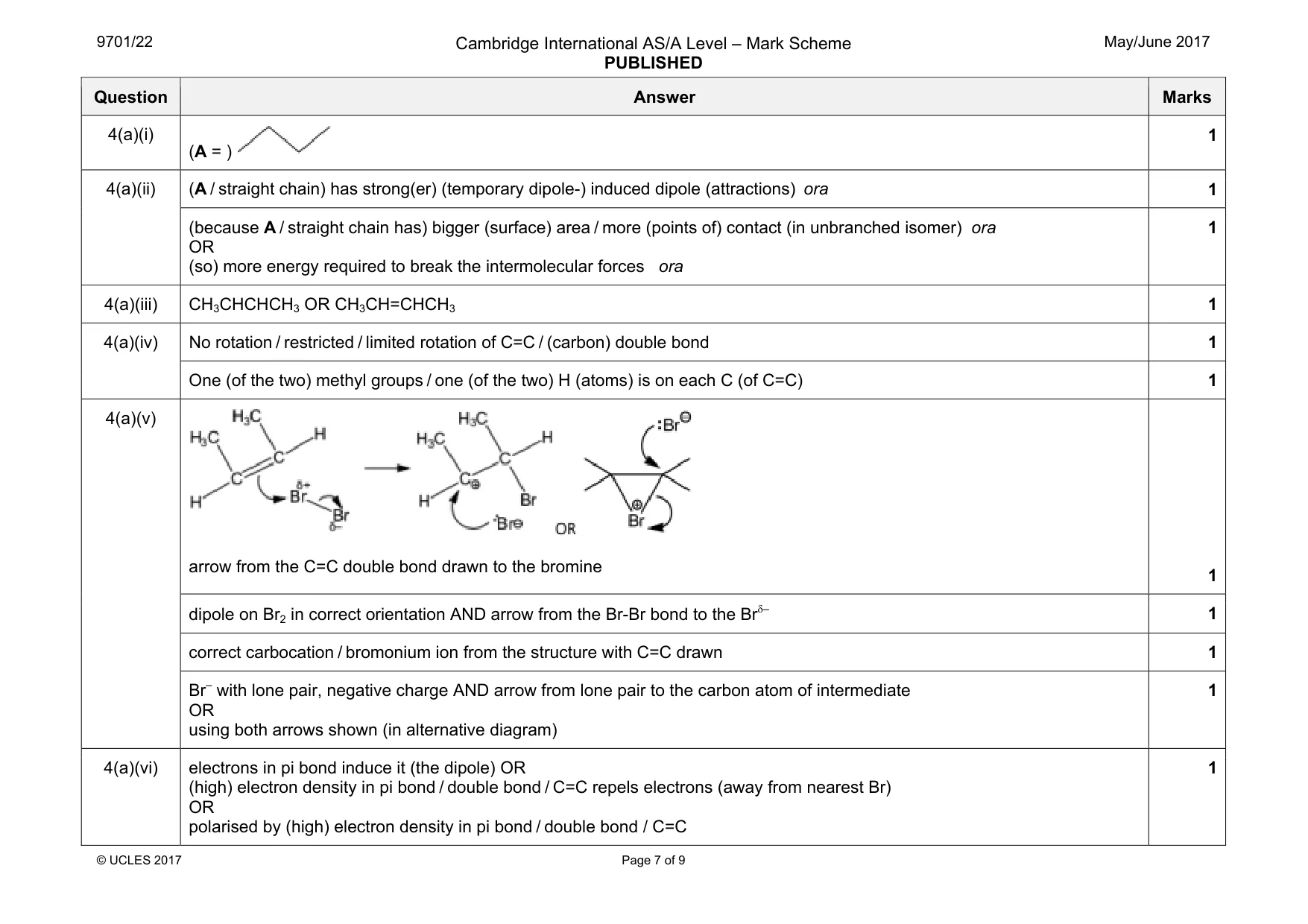
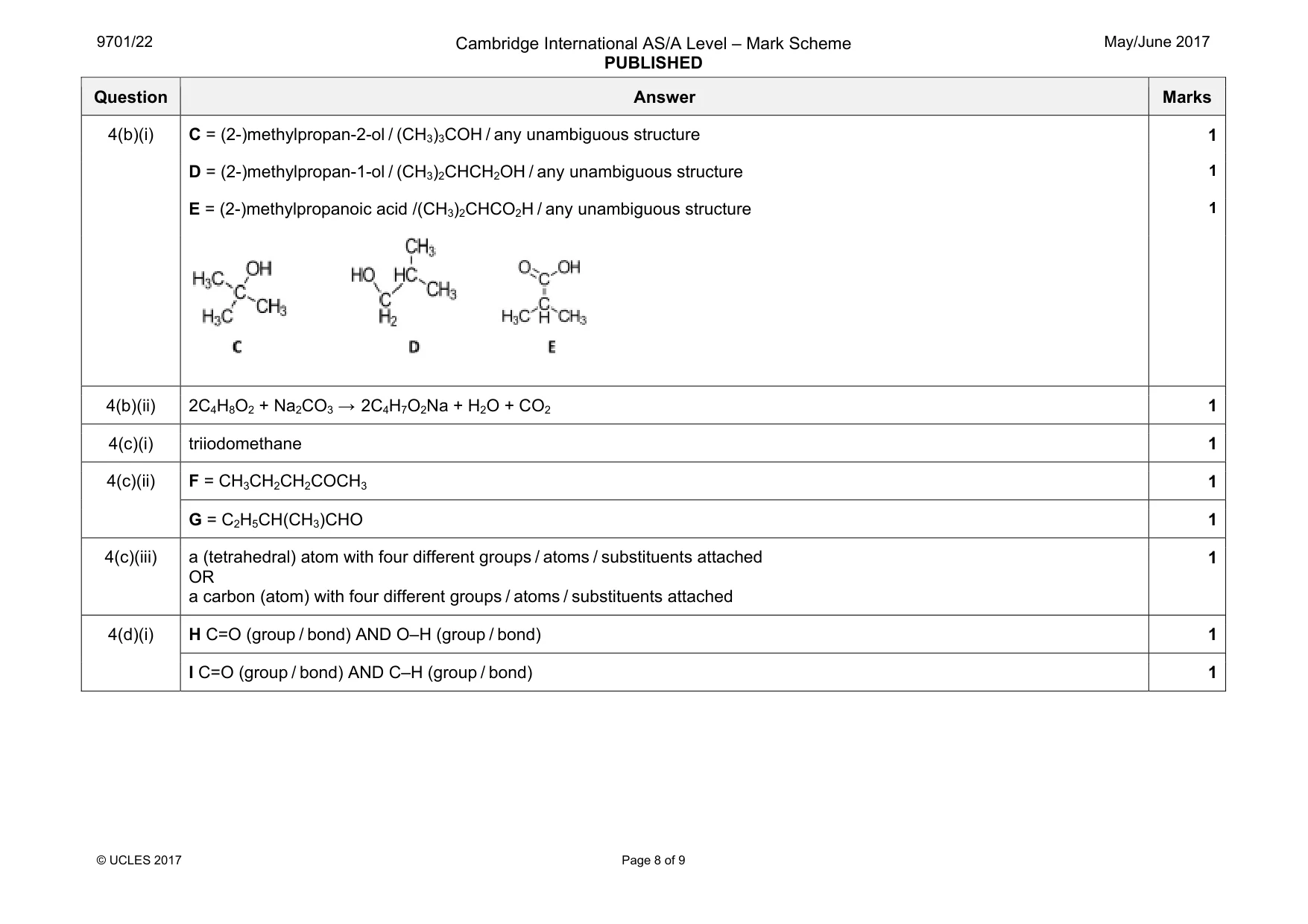
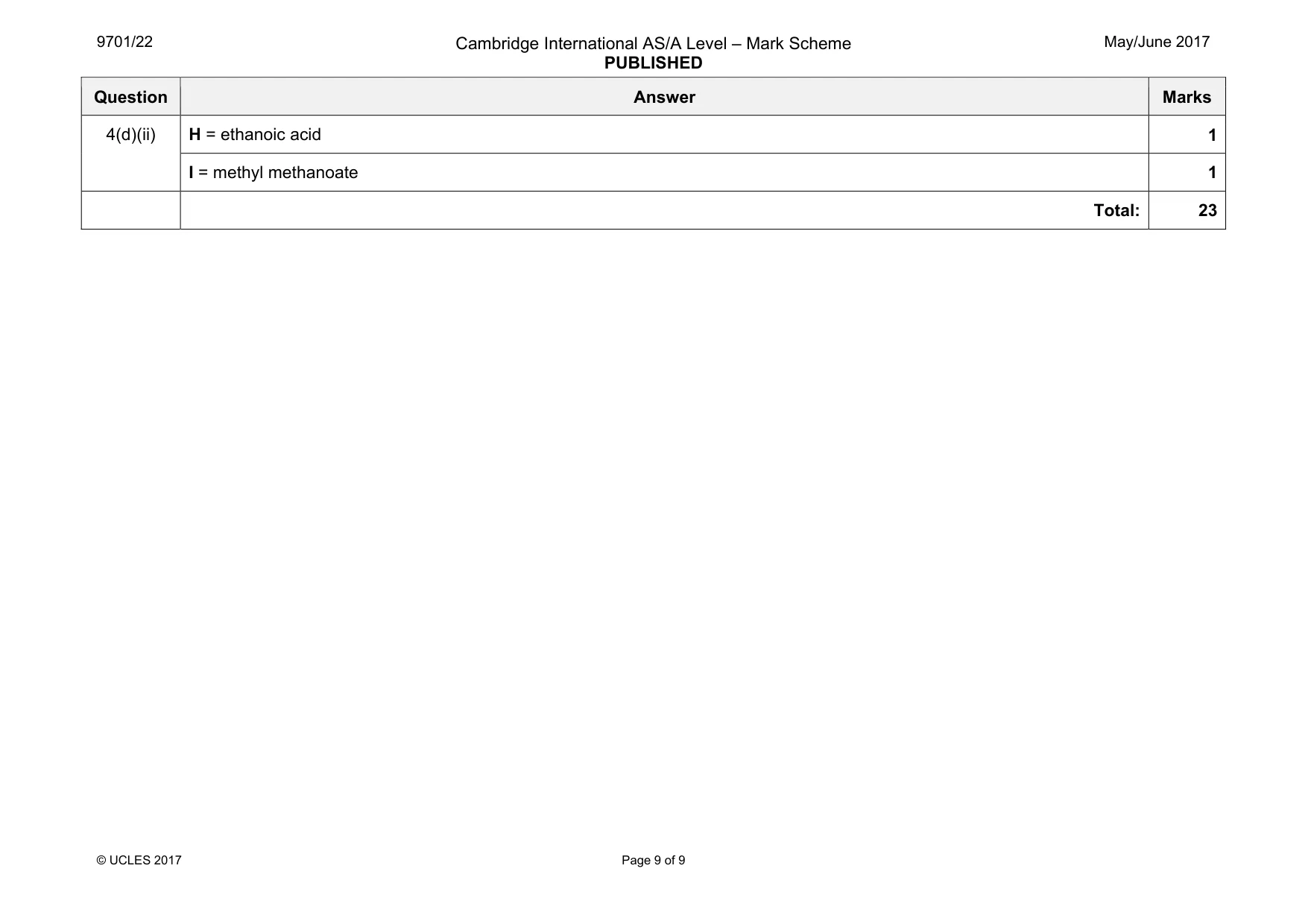
Mark scheme: 4(a)(i) (A = ) 1 4(a)(ii) (A / straight chain) has strong(er) (temporary dipole-) induced dipole (attractions) ora 1 (because A / straight chain has) bigger (surface) area / more (points of) contact (in unbranched isomer) ora OR (so) more energy required to break the intermolecular forces ora 1 4(a)(iii) CH3CHCHCH3 OR CH3CH=CHCH3 1 4(a)(iv) No rotation / restricted / limited rotation of C=C / (carbon) double bond 1 One (of the two) methyl groups / one (of the two) H (atoms) is on each C (of C=C) 1 4(a)(v) arrow from the C=C double bond drawn to the bromine 1 dipole on Br2 in correct orientation AND arrow from the Br-Br bond to the Brδ– 1 correct carbocation / bromonium ion from the structure with C=C drawn 1 Br– with lone pair, negative charge AND arrow from lone pair to the carbon atom of intermediate OR using both arrows shown (in alternative diagram) 1 4(a)(vi) electrons in pi bond induce it (the dipole) OR (high) electron density in pi bond / double bond / C=C repels electrons (away from nearest Br) OR polarised by (high) electron density in pi bond / double bond / C=C 1 Question Answer Marks 4(b)(i) C = (2-)methylpropan-2-ol / (CH3)3COH / any unambiguous structure 1 D = (2-)methylpropan-1-ol / (CH3)2CHCH2OH / any unambiguous structure 1 E = (2-)methylpropanoic acid /(CH3)2CHCO2H / any unambiguous structure 1 4(b)(ii) 2C4H8O2 + Na2CO3 → 2C4H7O2Na + H2O + CO2 1 4(c)(i) triiodomethane 1 4(c)(ii) F = CH3CH2CH2COCH3 1 G = C2H5CH(CH3)CHO 1 4(c)(iii) a (tetrahedral) atom with four different groups / atoms / substituents attached OR a carbon (atom) with four different groups / atoms / substituents attached 1 4(d)(i) H C=O (group / bond) AND O–H (group / bond) 1 I C=O (group / bond) AND C–H (group / bond) 1 Question Answer Marks 4(d)(ii) H = ethanoic acid 1 I = methyl methanoate 1 Total: 23
What was in this paper
The subtopics covered by these 4 questions, and how many questions each got. Open one in a new tab to see every Cambridge question on it.
What you needed in this session
Cambridge’s own grade thresholds for 2017 May/June, Paper 2 · Variant 2. A higher threshold means an easier paper — the bar moves with how the cohort did.