Cambridge A Level Chemistry 9701 — 2017 May/June Paper 2 · Variant 3
9701/23/M/J/17 · 4 questions · 60 marks · ≈68 min
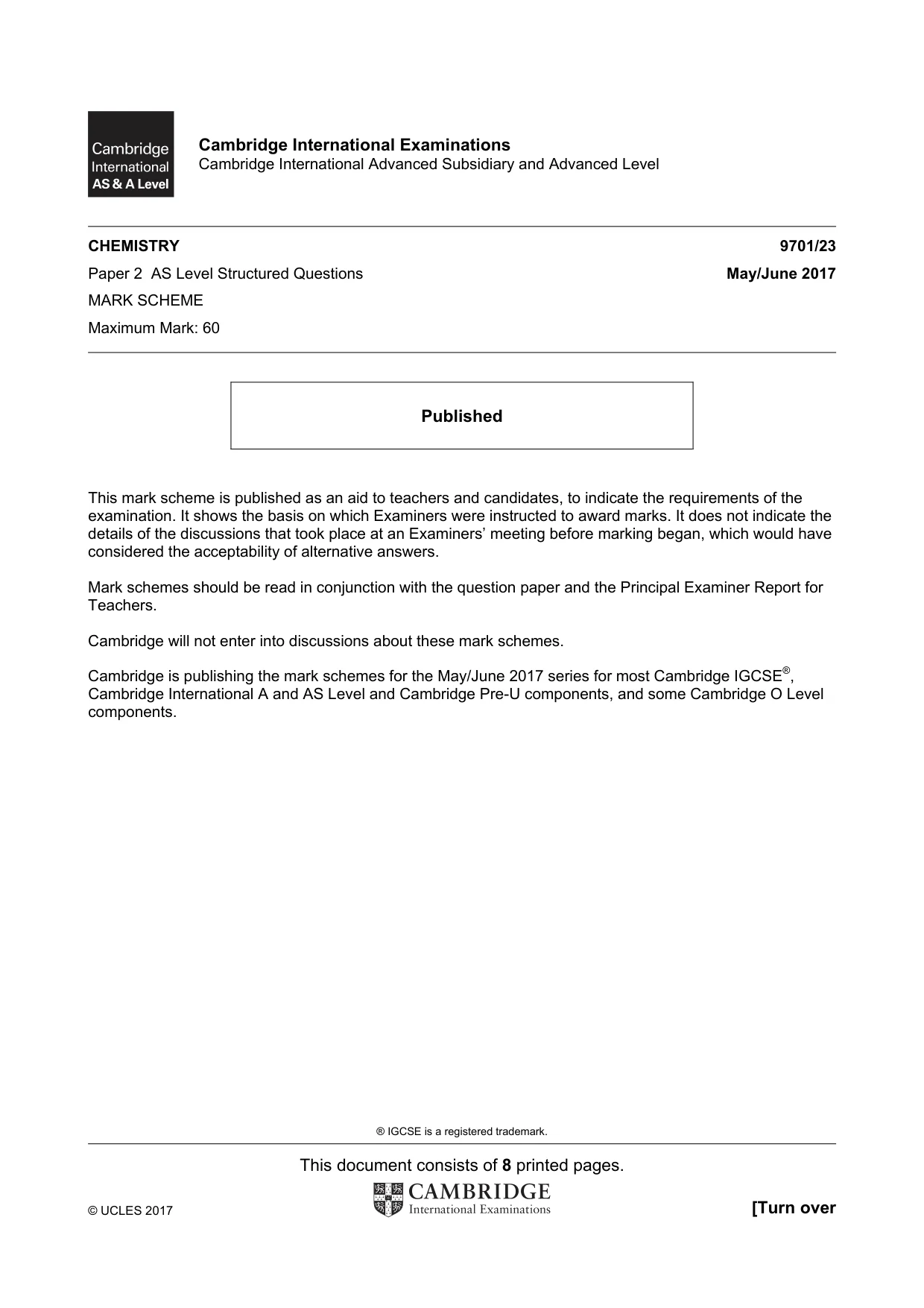
The question paper and its mark scheme, free to read here and free to download. This is Cambridge’s own paper, exactly as it was sat.
Question paper12 pages
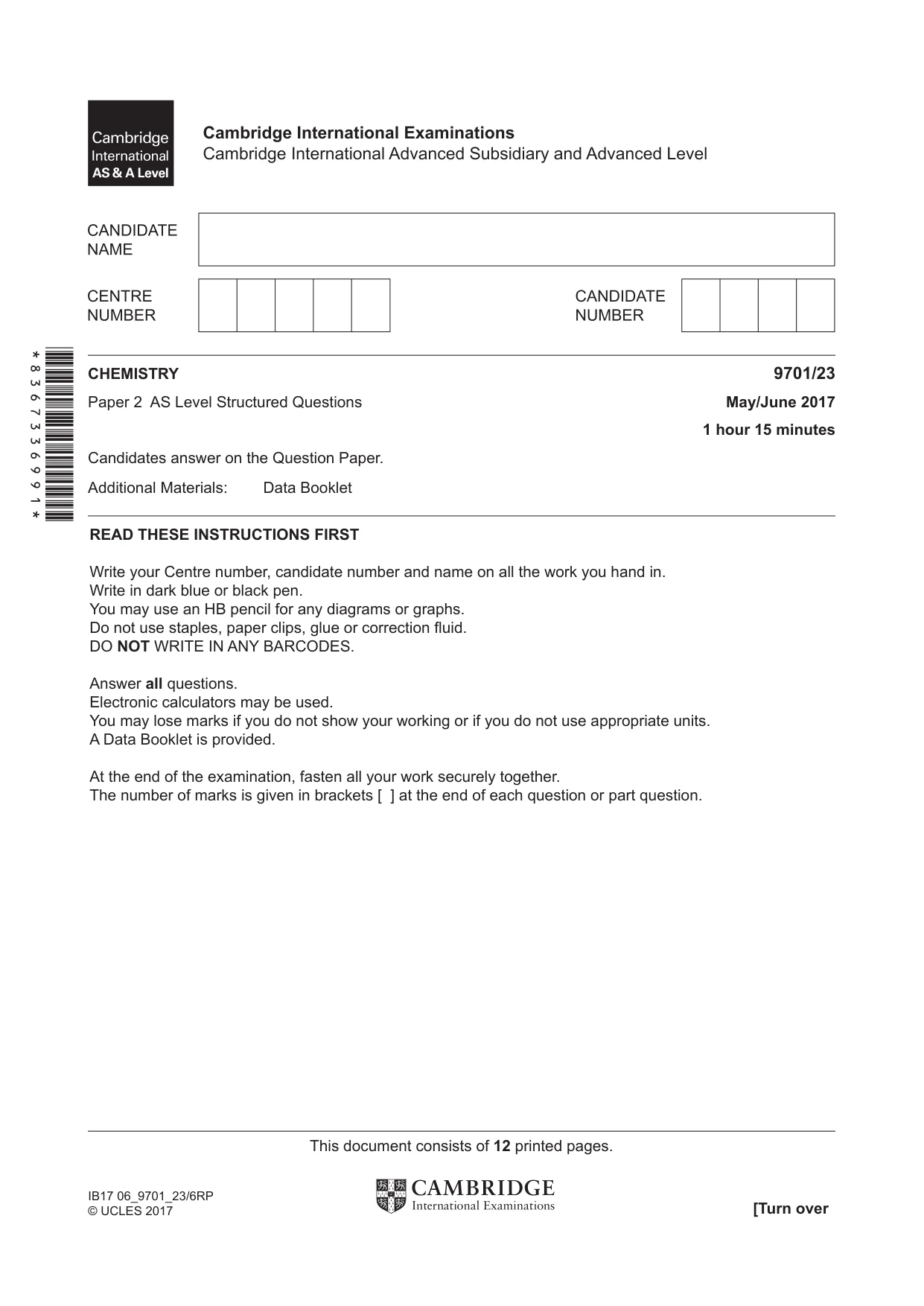
Mark scheme8 pages
Answers below. Sit the paper first if you are practising.
Questions as text
Q1 · Combustion data can be used to calculate the empirical formula, molecular formula and…
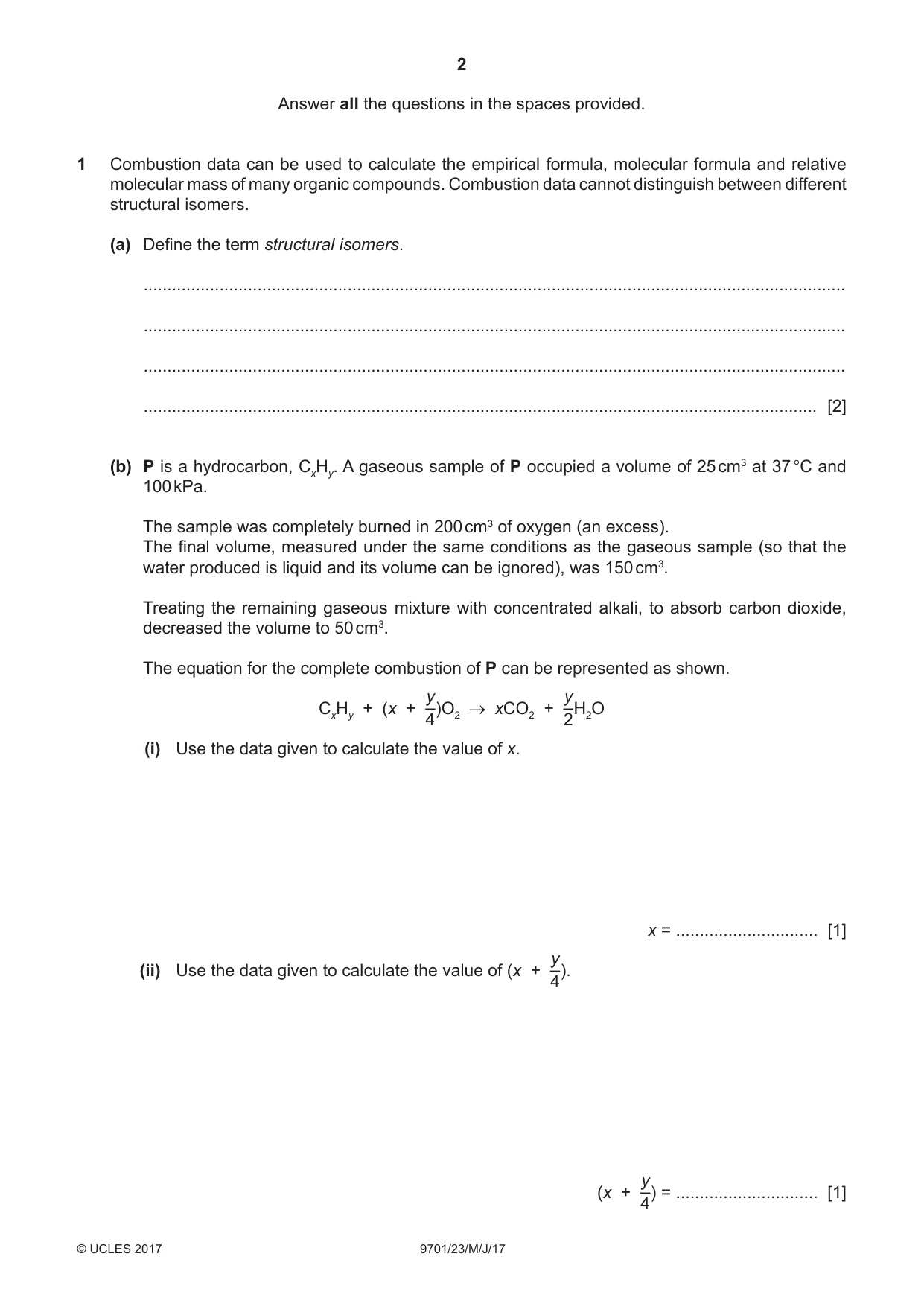
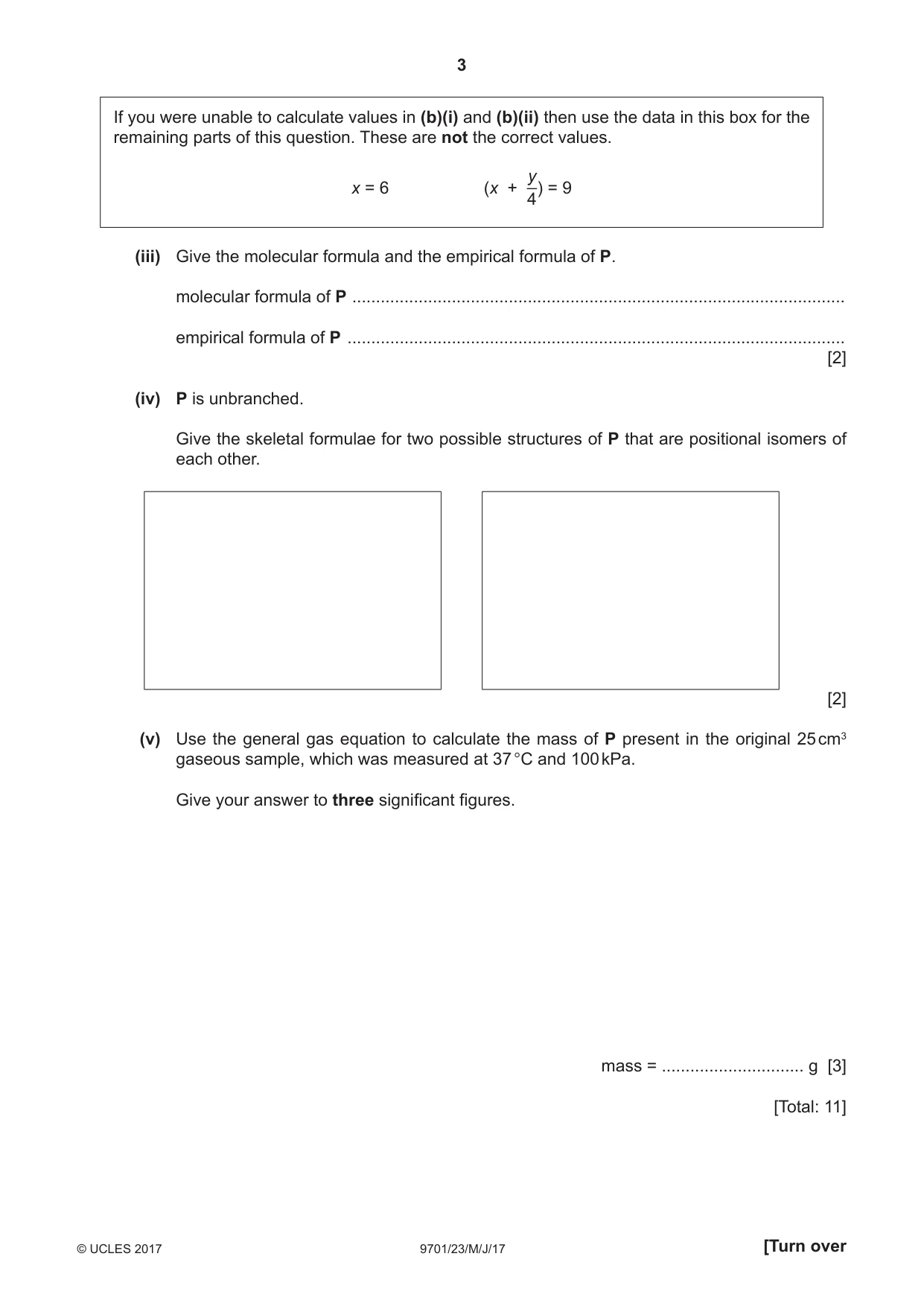
1 Combustion data can be used to calculate the empirical formula, molecular formula and relative molecular mass of many organic compounds. Combustion data cannot distinguish between different structural isomers. (a) Define the term structural isomers. .................................................................................................................................................... .................................................................................................................................................... .................................................................................................................................................... .............................................................................................................................................. [2] (b) P is a hydrocarbon, CxHy. A gaseous sample of P occupied a volume of 25 cm3 at 37 °C and 100 kPa. The sample was completely burned in 200 cm3 of oxygen (an excess). The final volume, measured under the same conditions as the gaseous sample (so that the water produced is liquid and its volume can be ignored), was 150 cm3. Treating the remaining gaseous mixture with concentrated alkali, to absorb carbon dioxide, decreased the volume to 50 cm3. The equation for the complete combustion of P can be represented as shown. y y CxHy + (x + 4)O2 xCO2 + 2H2O (i) Use the data given to calculate the value of x. x = .............................. [1] y (ii) Use the data given to calculate the value of (x + 4). y (x + 4) = .............................. [1] If you were unable to calculate values in (b)(i) and (b)(ii) then use the data in this box for the remaining parts of this question. These are not the correct values. y x = 6 (x + 4) = 9 (iii) Give the molecular formula and the empirical formula of P. molecular formula of P ........................................................................................................ empirical formula of P ......................................................................................................... [2] (iv) P is unbranched. Give the skeletal formulae for two possible structures of P that are positional isomers of each other. [2] (v) Use the general gas equation to calculate the mass of P present in the original 25 cm3 gaseous sample, which was measured at 37 °C and 100 kPa. Give your answer to three significant figures. mass = .............................. g [3] [Total: 11]
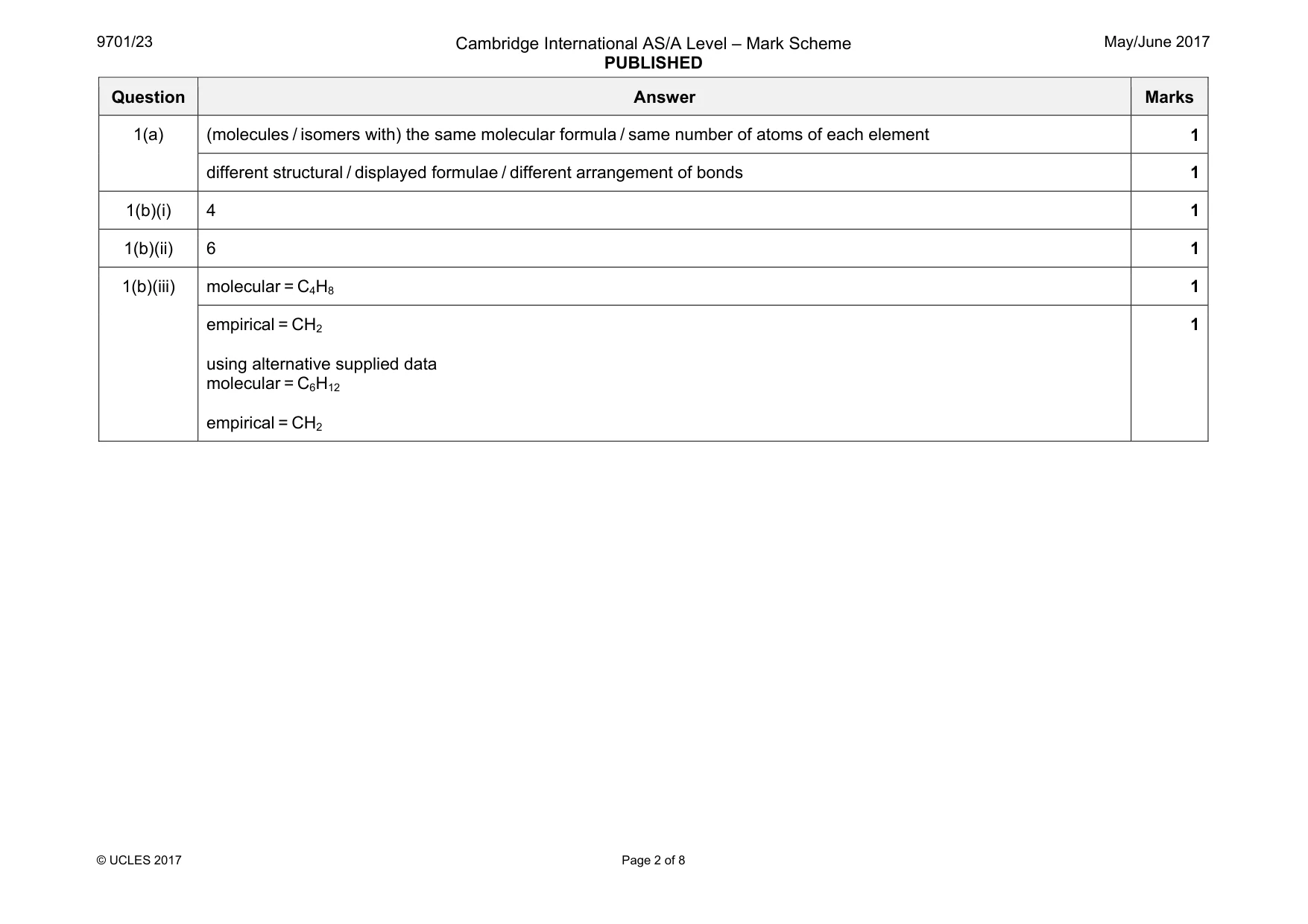
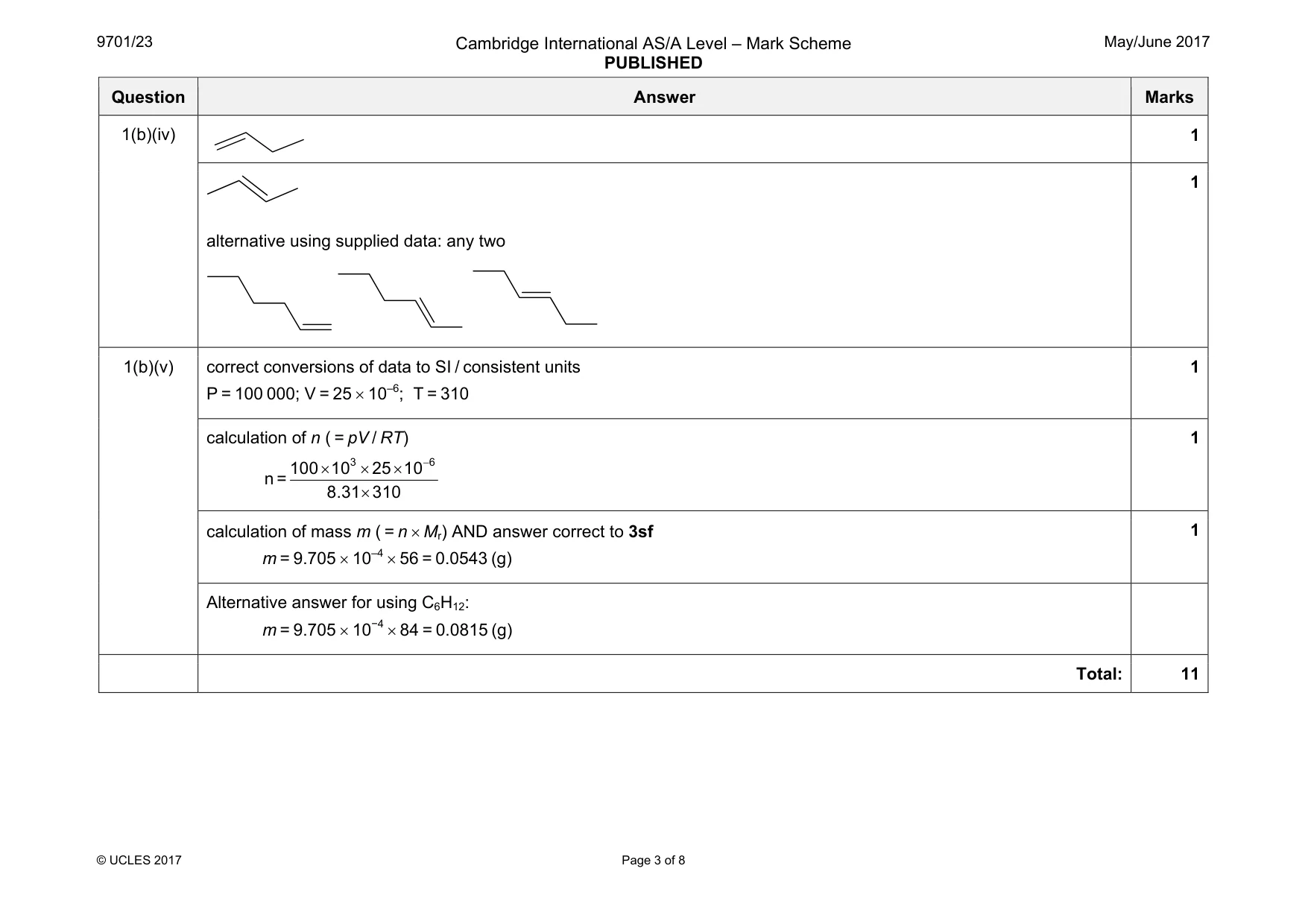
Mark scheme: 1(a) (molecules / isomers with) the same molecular formula / same number of atoms of each element 1 different structural / displayed formulae / different arrangement of bonds 1 1(b)(i) 4 1 1(b)(ii) 6 1 1(b)(iii) molecular = C4H8 1 empirical = CH2 using alternative supplied data molecular = C6H12 empirical = CH2 1 Question Answer Marks 1(b)(iv) 1 alternative using supplied data: any two 1 1(b)(v) correct conversions of data to SI / consistent units P = 100 000; V = 25 × 10–6; T = 310 1 calculation of n ( = pV / RT) − × × × × 3 6 100 10 25 10 n = 8.31 310 1 calculation of mass m ( = n × Mr) AND answer correct to 3sf m = 9.705 × 10–4 × 56 = 0.0543 (g) 1 Alternative answer for using C6H12: m = 9.705 × 10−4 × 84 = 0.0815 (g) Total: 11
More questions on Reacting masses and volumes (of solutions and gases)
Q2 · The halogens, chlorine, bromine and iodine, and their compounds, show a variety of…
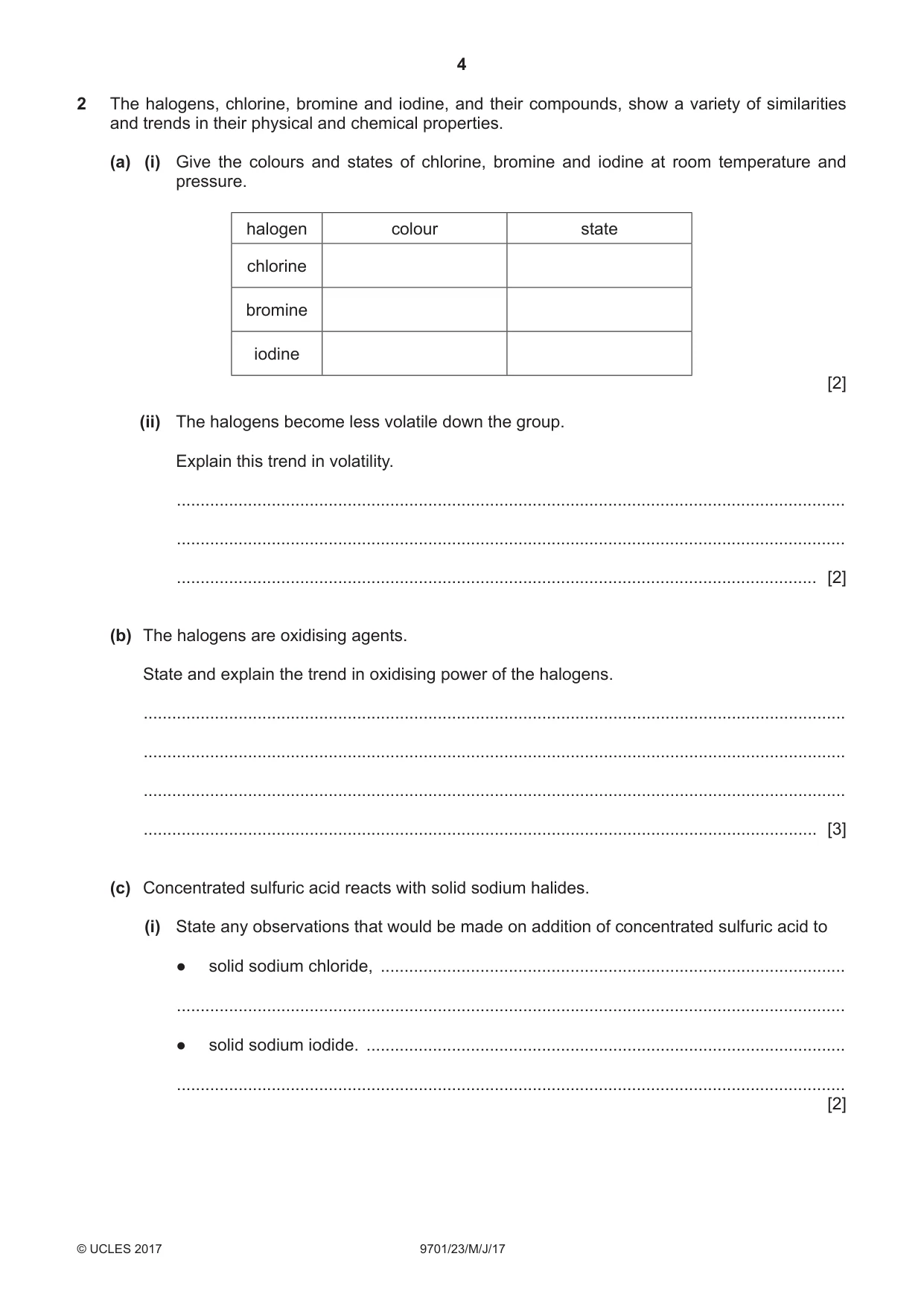
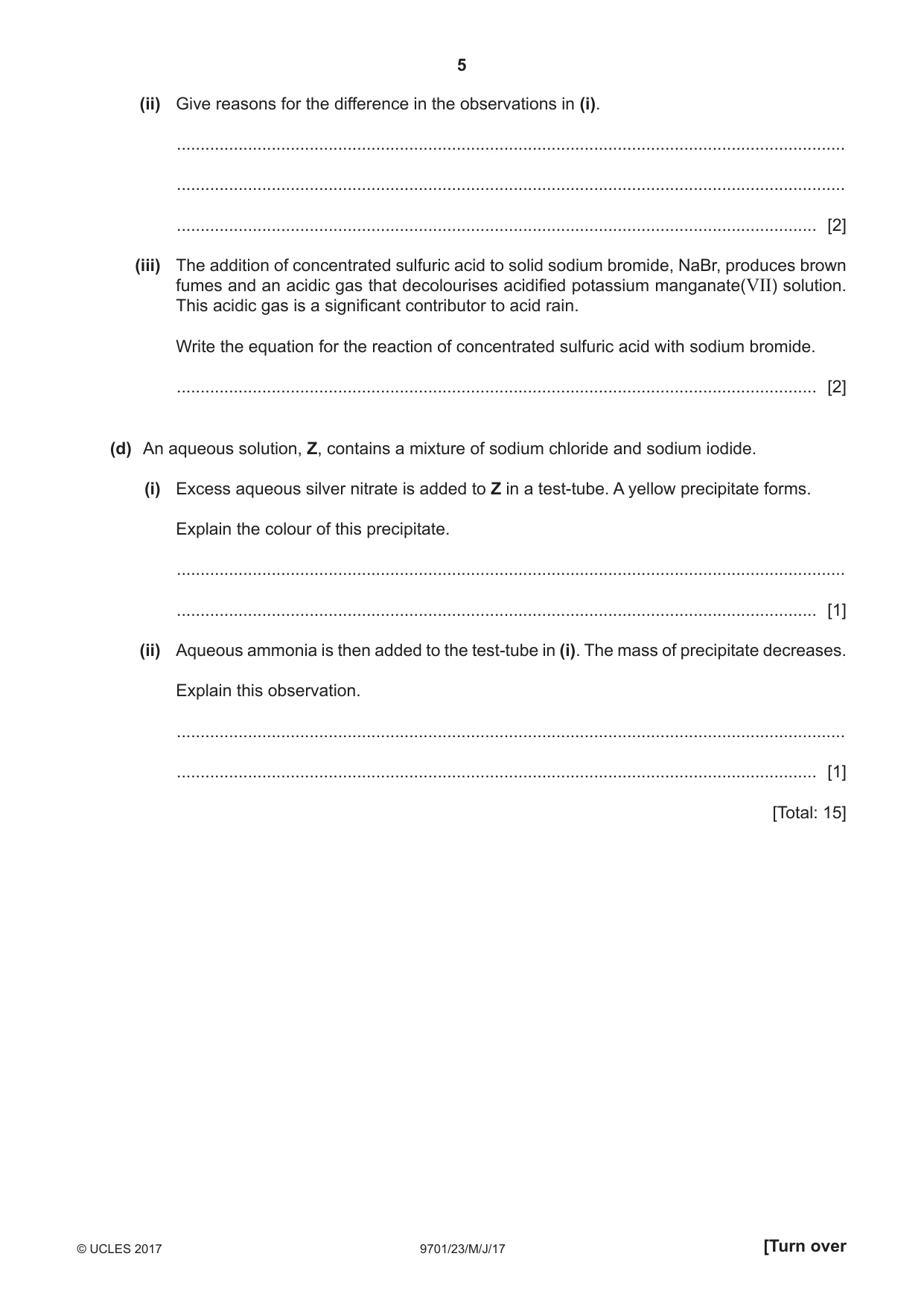
2 The halogens, chlorine, bromine and iodine, and their compounds, show a variety of similarities and trends in their physical and chemical properties. (a) (i) Give the colours and states of chlorine, bromine and iodine at room temperature and pressure. halogen colour state chlorine bromine iodine [2] (ii) The halogens become less volatile down the group. Explain this trend in volatility. ............................................................................................................................................. ............................................................................................................................................. ....................................................................................................................................... [2] (b) The halogens are oxidising agents. State and explain the trend in oxidising power of the halogens. .................................................................................................................................................... .................................................................................................................................................... .................................................................................................................................................... .............................................................................................................................................. [3] (c) Concentrated sulfuric acid reacts with solid sodium halides. (i) State any observations that would be made on addition of concentrated sulfuric acid to ● solid sodium chloride, ................................................................................................... ............................................................................................................................................. ● solid sodium iodide. ...................................................................................................... ............................................................................................................................................. [2] (ii) Give reasons for the difference in the observations in (i). ............................................................................................................................................. ............................................................................................................................................. ....................................................................................................................................... [2] (iii) The addition of concentrated sulfuric acid to solid sodium bromide, NaBr, produces brown fumes and an acidic gas that decolourises acidified potassium manganate(VII) solution. This acidic gas is a significant contributor to acid rain. Write the equation for the reaction of concentrated sulfuric acid with sodium bromide. ....................................................................................................................................... [2] (d) An aqueous solution, Z, contains a mixture of sodium chloride and sodium iodide. (i) Excess aqueous silver nitrate is added to Z in a test-tube. A yellow precipitate forms. Explain the colour of this precipitate. ............................................................................................................................................. ....................................................................................................................................... [1] (ii) Aqueous ammonia is then added to the test-tube in (i). The mass of precipitate decreases. Explain this observation. ............................................................................................................................................. ....................................................................................................................................... [1] [Total: 15]
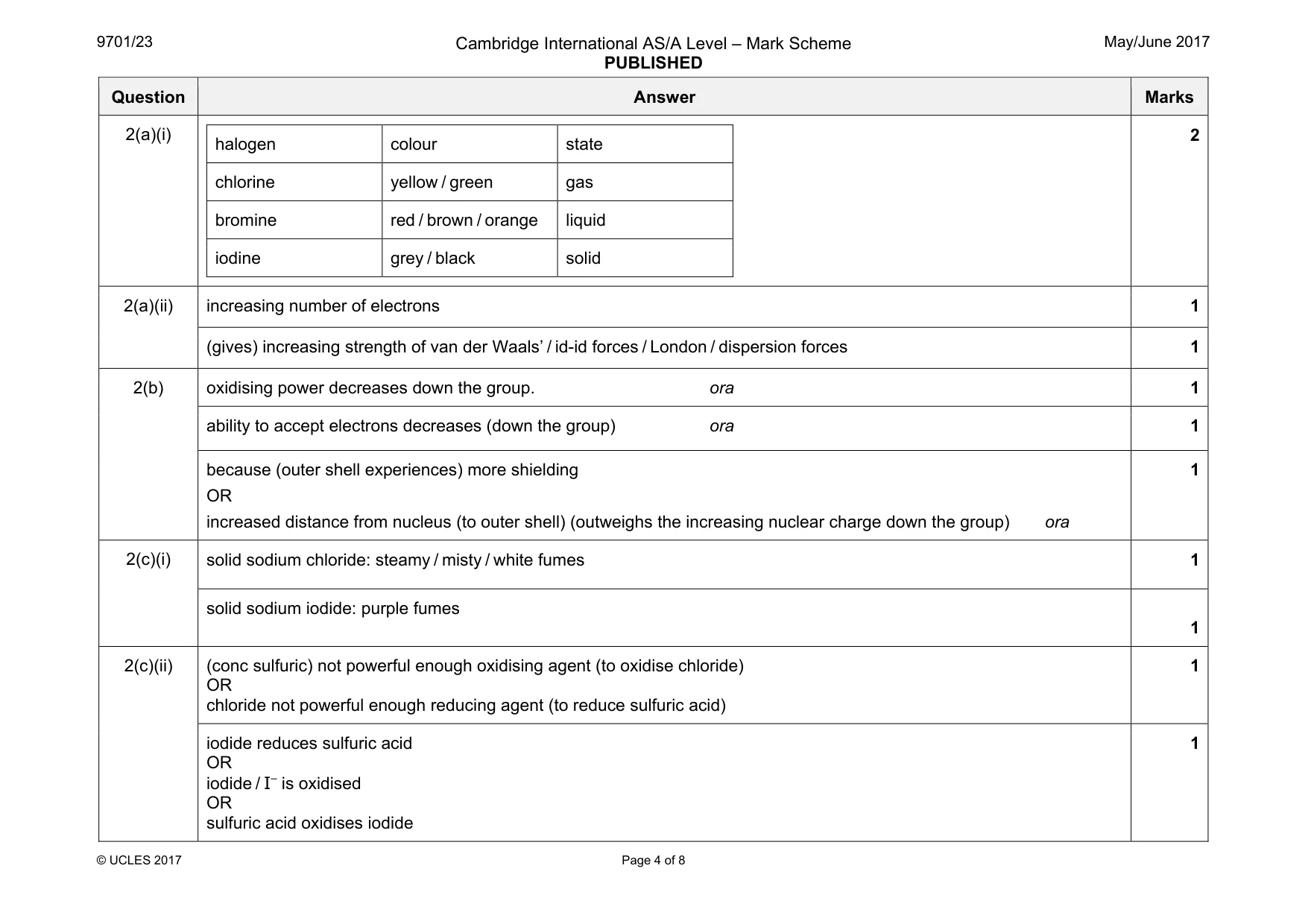
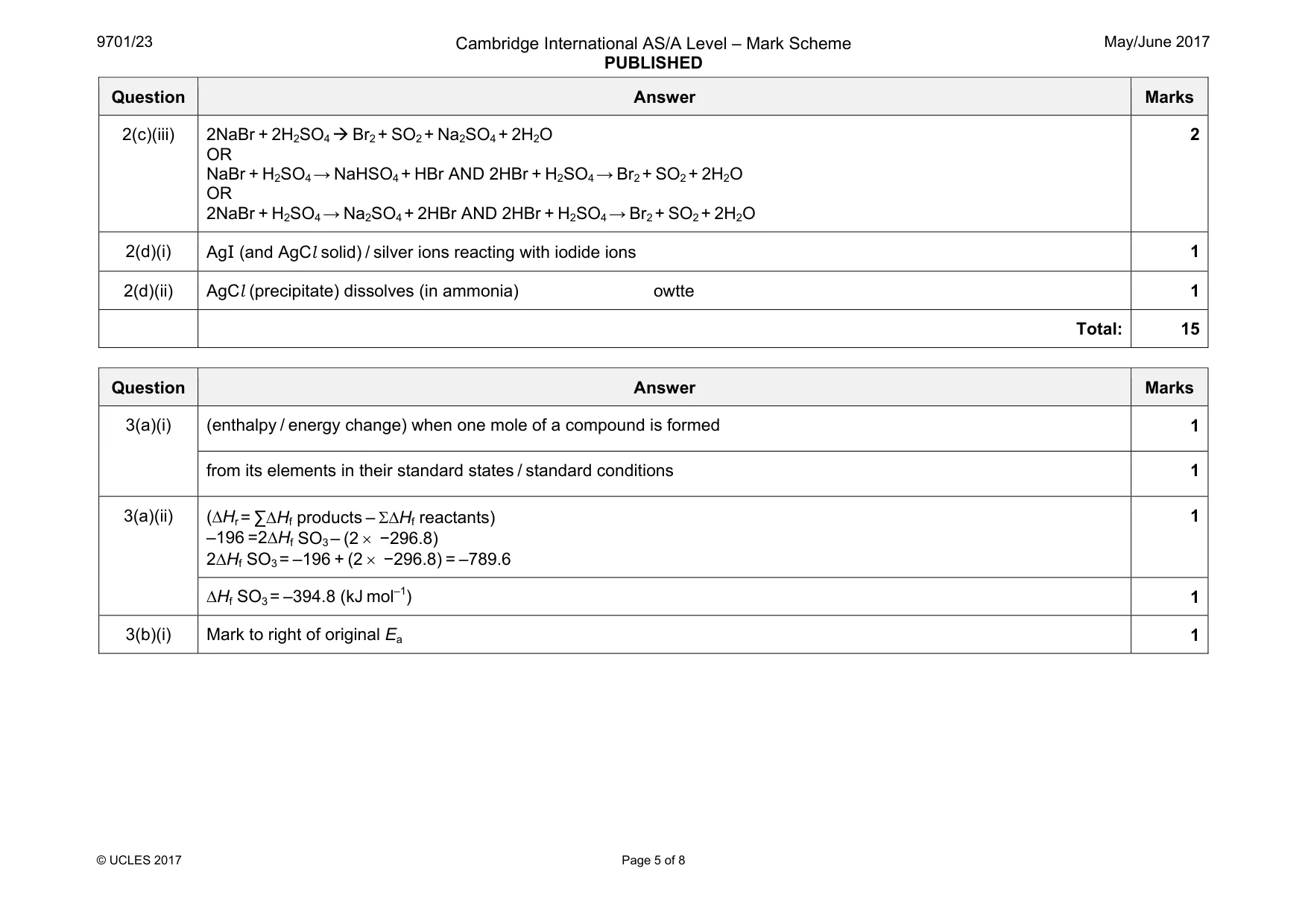
Mark scheme: 2(a)(i) halogen colour state chlorine yellow / green gas bromine red / brown / orange liquid iodine grey / black solid 2 2(a)(ii) increasing number of electrons 1 (gives) increasing strength of van der Waals’ / id-id forces / London / dispersion forces 1 2(b) oxidising power decreases down the group. ora 1 ability to accept electrons decreases (down the group) ora 1 because (outer shell experiences) more shielding OR increased distance from nucleus (to outer shell) (outweighs the increasing nuclear charge down the group) ora 1 2(c)(i) solid sodium chloride: steamy / misty / white fumes 1 solid sodium iodide: purple fumes 1 2(c)(ii) (conc sulfuric) not powerful enough oxidising agent (to oxidise chloride) OR chloride not powerful enough reducing agent (to reduce sulfuric acid) 1 iodide reduces sulfuric acid OR iodide / I– is oxidised OR sulfuric acid oxidises iodide 1 Question Answer Marks 2(c)(iii) 2NaBr + 2H2SO4 Æ Br2 + SO2 + Na2SO4 + 2H2O OR NaBr + H2SO4 → NaHSO4 + HBr AND 2HBr + H2SO4 → Br2 + SO2 + 2H2O OR 2NaBr + H2SO4 → Na2SO4+ 2HBr AND 2HBr + H2SO4→ Br2+ SO2+ 2H2O 2 2(d)(i) AgI (and AgCl solid) / silver ions reacting with iodide ions 1 2(d)(ii) AgCl (precipitate) dissolves (in ammonia) owtte 1 Total: 15
Q3 · Sulfur trioxide, SO3, is manufactured from sulfur dioxide and oxygen by the Contact…
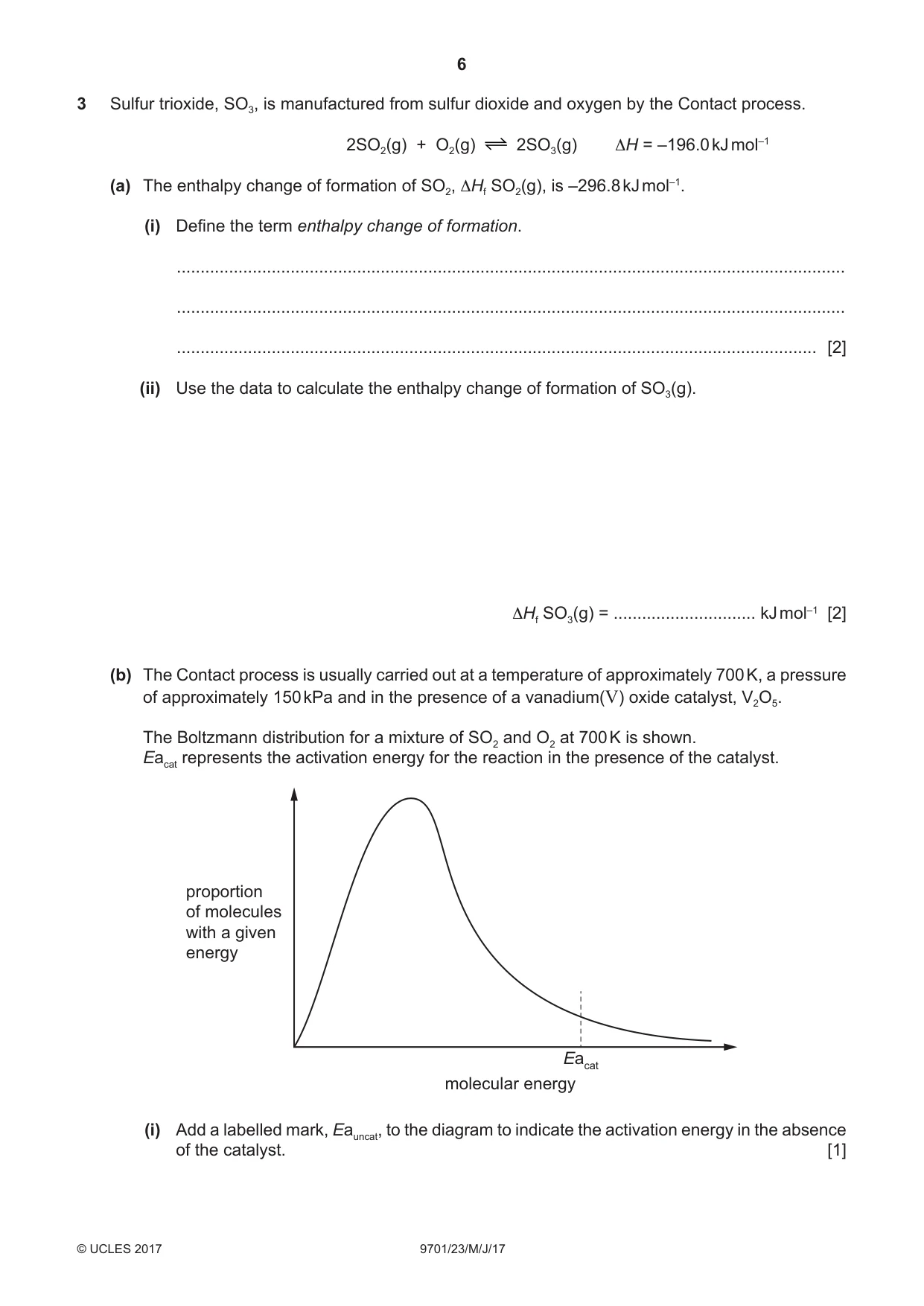
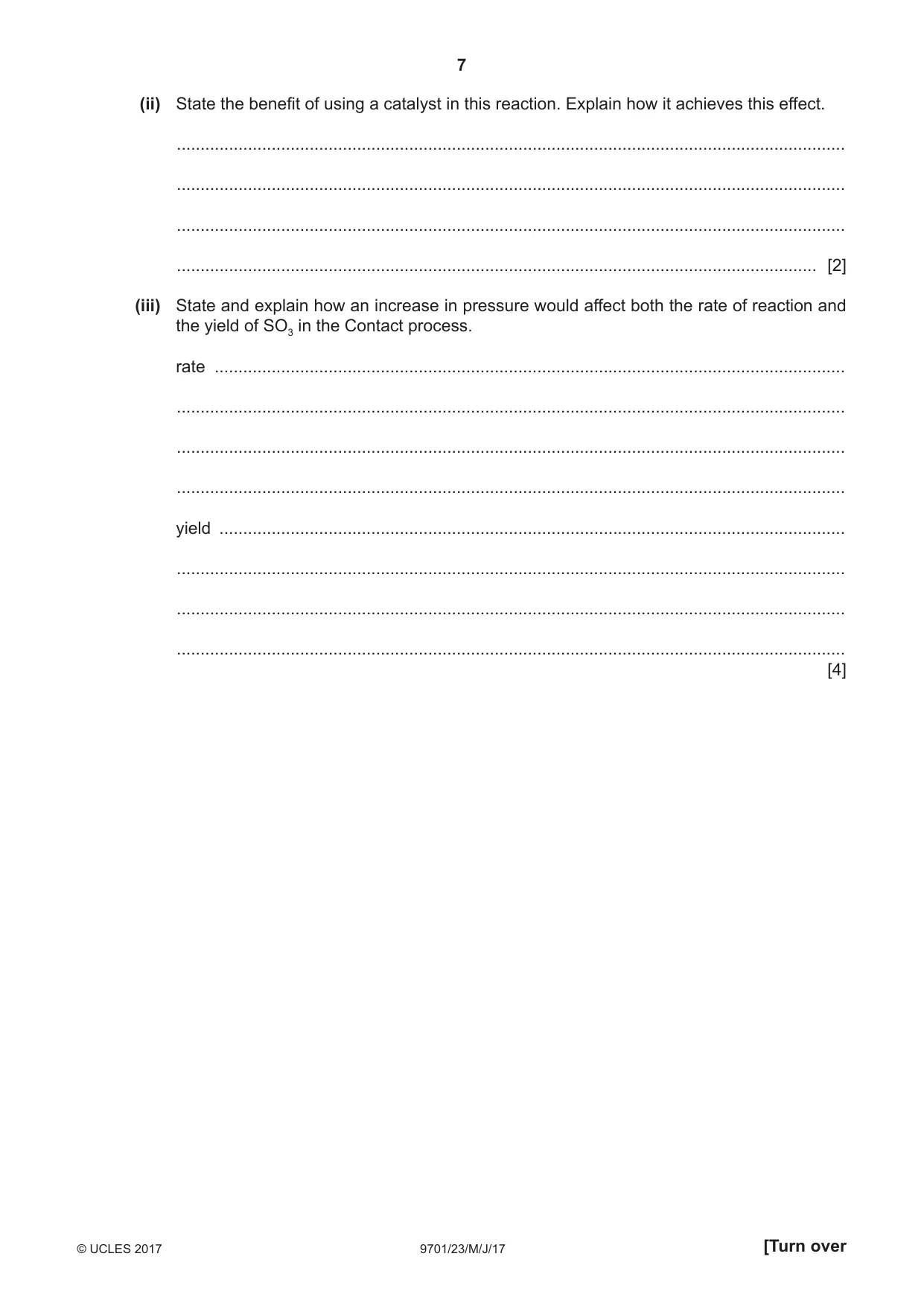
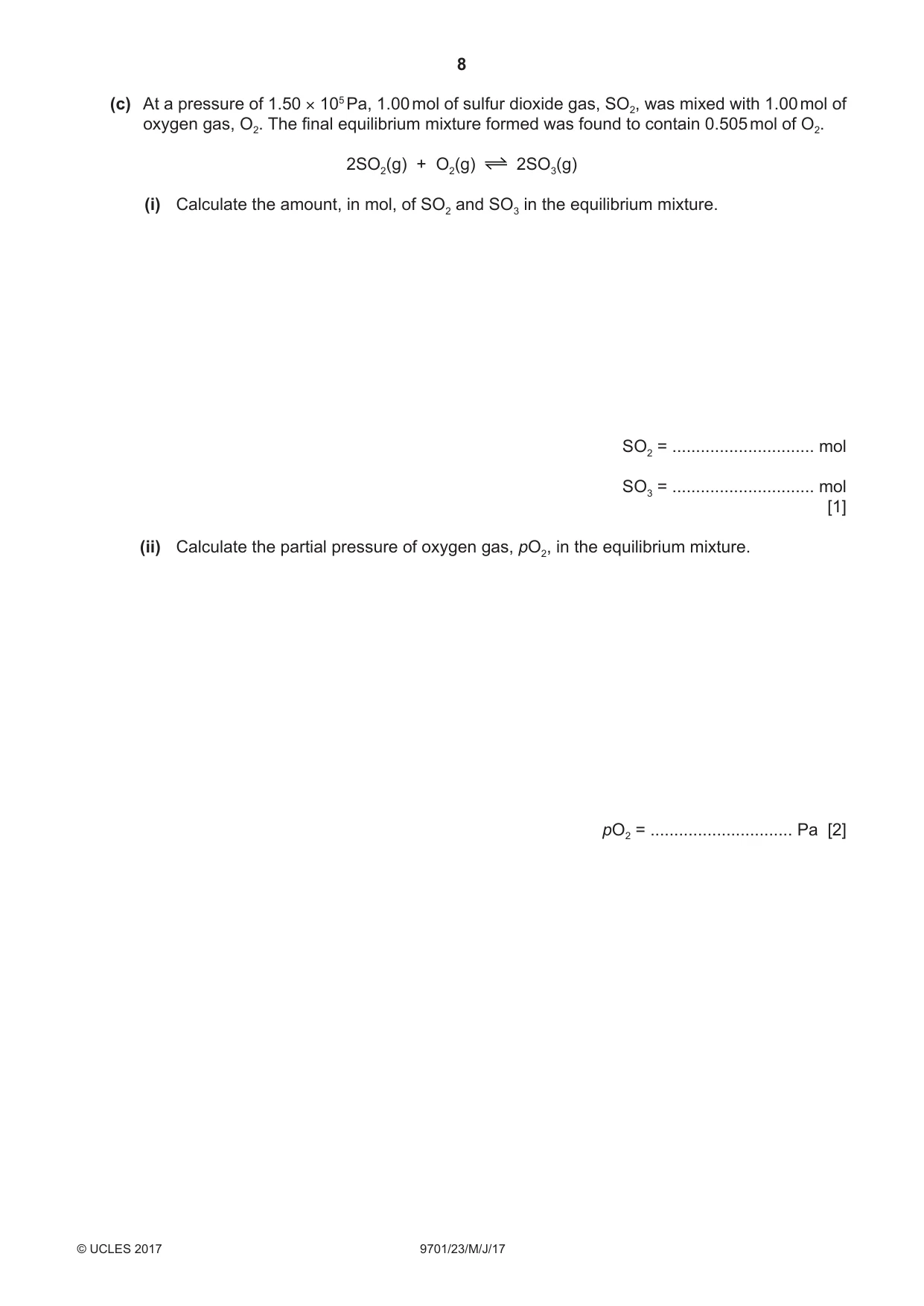
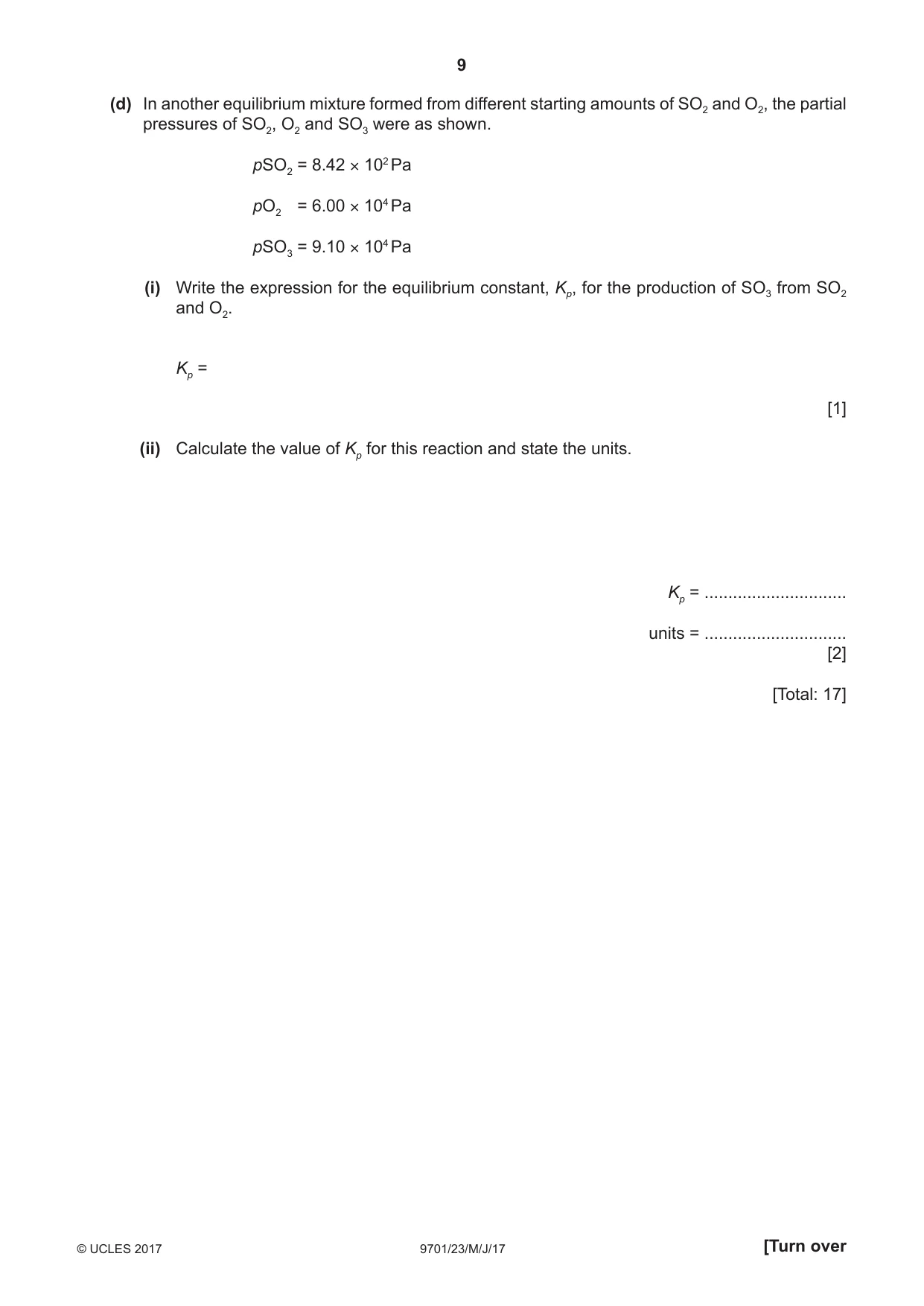
3 Sulfur trioxide, SO3, is manufactured from sulfur dioxide and oxygen by the Contact process. 2SO2(g) + O2(g) 2SO3(g) ΔH = –196.0 kJ mol–1 (a) The enthalpy change of formation of SO2, ΔHf SO2(g), is –296.8 kJ mol–1. (i) Define the term enthalpy change of formation. ............................................................................................................................................. ............................................................................................................................................. ....................................................................................................................................... [2] (ii) Use the data to calculate the enthalpy change of formation of SO3(g). ΔHf SO3(g) = .............................. kJ mol–1 [2] (b) The Contact process is usually carried out at a temperature of approximately 700 K, a pressure of approximately 150 kPa and in the presence of a vanadium(V) oxide catalyst, V2O5. The Boltzmann distribution for a mixture of SO2 and O2 at 700 K is shown. Eacat represents the activation energy for the reaction in the presence of the catalyst. proportion of molecules with a given energy Eacat molecular energy (i) Add a labelled mark, Eauncat, to the diagram to indicate the activation energy in the absence of the catalyst. [1] (ii) State the benefit of using a catalyst in this reaction. Explain how it achieves this effect. ............................................................................................................................................. ............................................................................................................................................. ............................................................................................................................................. ....................................................................................................................................... [2] (iii) State and explain how an increase in pressure would affect both the rate of reaction and the yield of SO3 in the Contact process. rate ...................................................................................................................................... ............................................................................................................................................. ............................................................................................................................................. ............................................................................................................................................. yield ..................................................................................................................................... ............................................................................................................................................. ............................................................................................................................................. ............................................................................................................................................. [4] (c) At a pressure of 1.50 × 10⁵ Pa, 1.00 mol of sulfur dioxide gas, SO2, was mixed with 1.00 mol of oxygen gas, O2. The final equilibrium mixture formed was found to contain 0.505 mol of O2. 2SO2(g) + O2(g) 2SO3(g) (i) Calculate the amount, in mol, of SO2 and SO3 in the equilibrium mixture. SO2 = .............................. mol SO3 = .............................. mol [1] (ii) Calculate the partial pressure of oxygen gas, pO2, in the equilibrium mixture. pO2 = .............................. Pa [2] (d) In another equilibrium mixture formed from different starting amounts of SO2 and O2, the partial pressures of SO2, O2 and SO3 were as shown. pSO2 = 8.42 × 10² Pa pO2 = 6.00 × 10⁴ Pa pSO3 = 9.10 × 10⁴ Pa (i) Write the expression for the equilibrium constant, Kp, for the production of SO3 from SO2 and O2. Kp = [1] (ii) Calculate the value of Kp for this reaction and state the units. Kp = .............................. units = .............................. [2] [Total: 17]
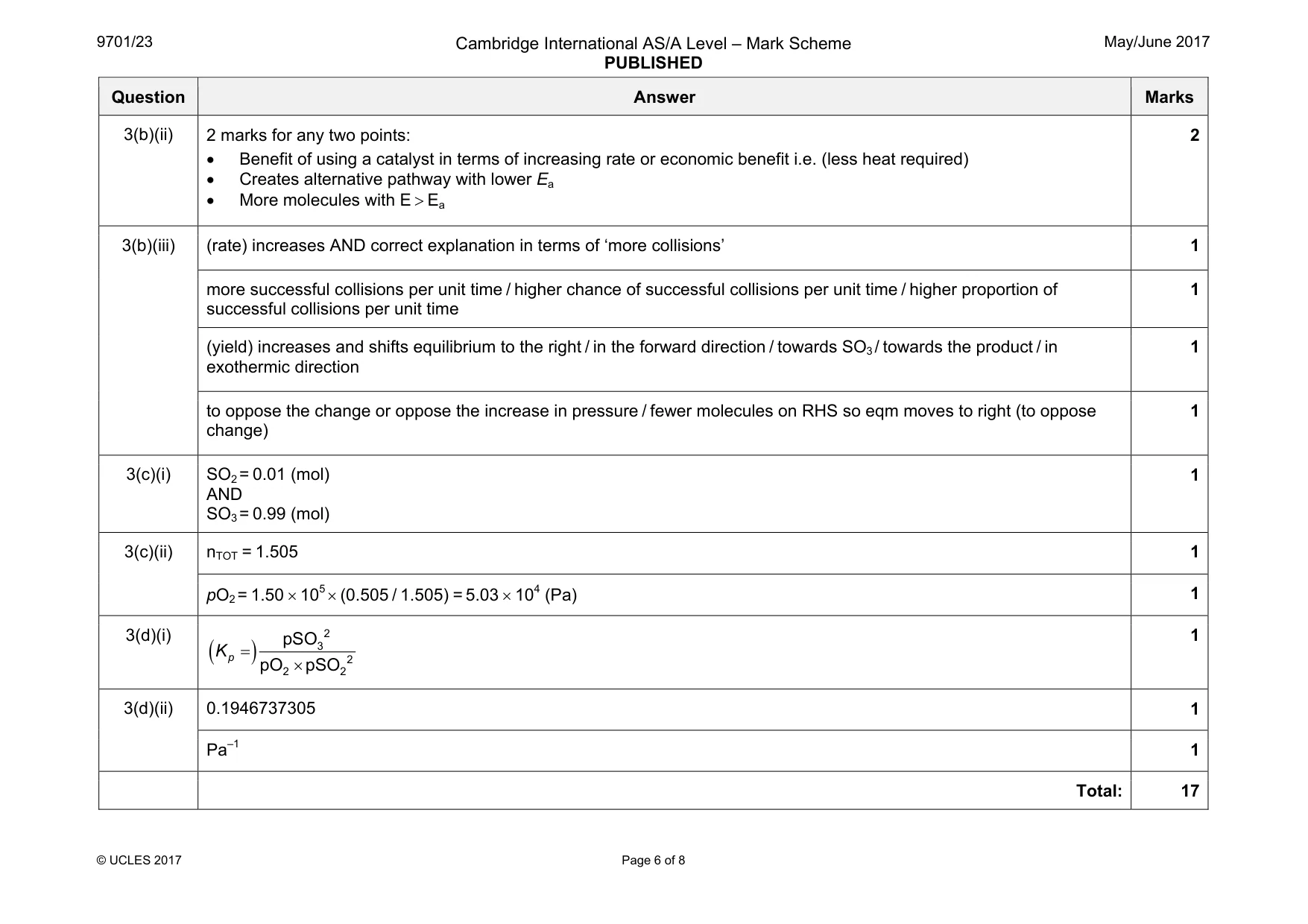
Mark scheme: 3(a)(i) (enthalpy / energy change) when one mole of a compound is formed 1 from its elements in their standard states / standard conditions 1 3(a)(ii) (∆Hr = ∑∆Hf products – Σ∆Hf reactants) –196 =2∆Hf SO3 – (2 × −296.8) 2∆Hf SO3 = –196 + (2 × −296.8) = –789.6 1 ∆Hf SO3= –394.8 (kJ mol–1) 1 3(b)(i) Mark to right of original Ea 1 Question Answer Marks 3(b)(ii) 2 marks for any two points: • Benefit of using a catalyst in terms of increasing rate or economic benefit i.e. (less heat required) • Creates alternative pathway with lower Ea • More molecules with E > Ea 2 3(b)(iii) (rate) increases AND correct explanation in terms of ‘more collisions’ 1 more successful collisions per unit time / higher chance of successful collisions per unit time / higher proportion of successful collisions per unit time 1 (yield) increases and shifts equilibrium to the right / in the forward direction / towards SO3 / towards the product / in exothermic direction 1 to oppose the change or oppose the increase in pressure / fewer molecules on RHS so eqm moves to right (to oppose change) 1 3(c)(i) SO2 = 0.01 (mol) AND SO3= 0.99 (mol) 1 3(c)(ii) nTOT = 1.505 1 pO2 = 1.50 × 105 × (0.505 / 1.505) = 5.03 × 10⁴ (Pa) 1 3(d)(i) ( ) p K = × 2 3 2 2 2 p S O p O p S O 1 3(d)(ii) 0.1946737305 1 Pa–1 1 Total: 17
Q4 · A, B and C all have the formula C4H8
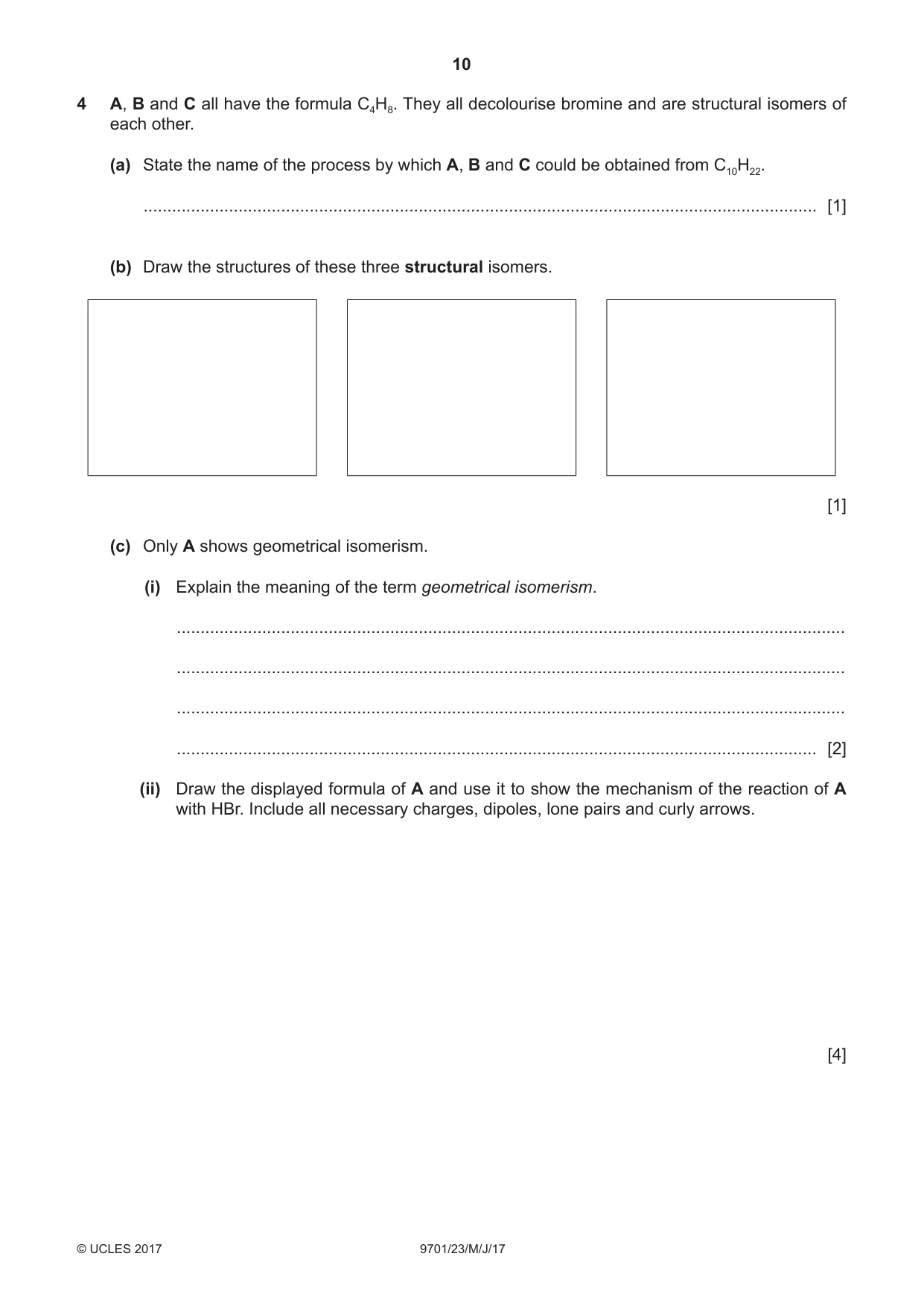
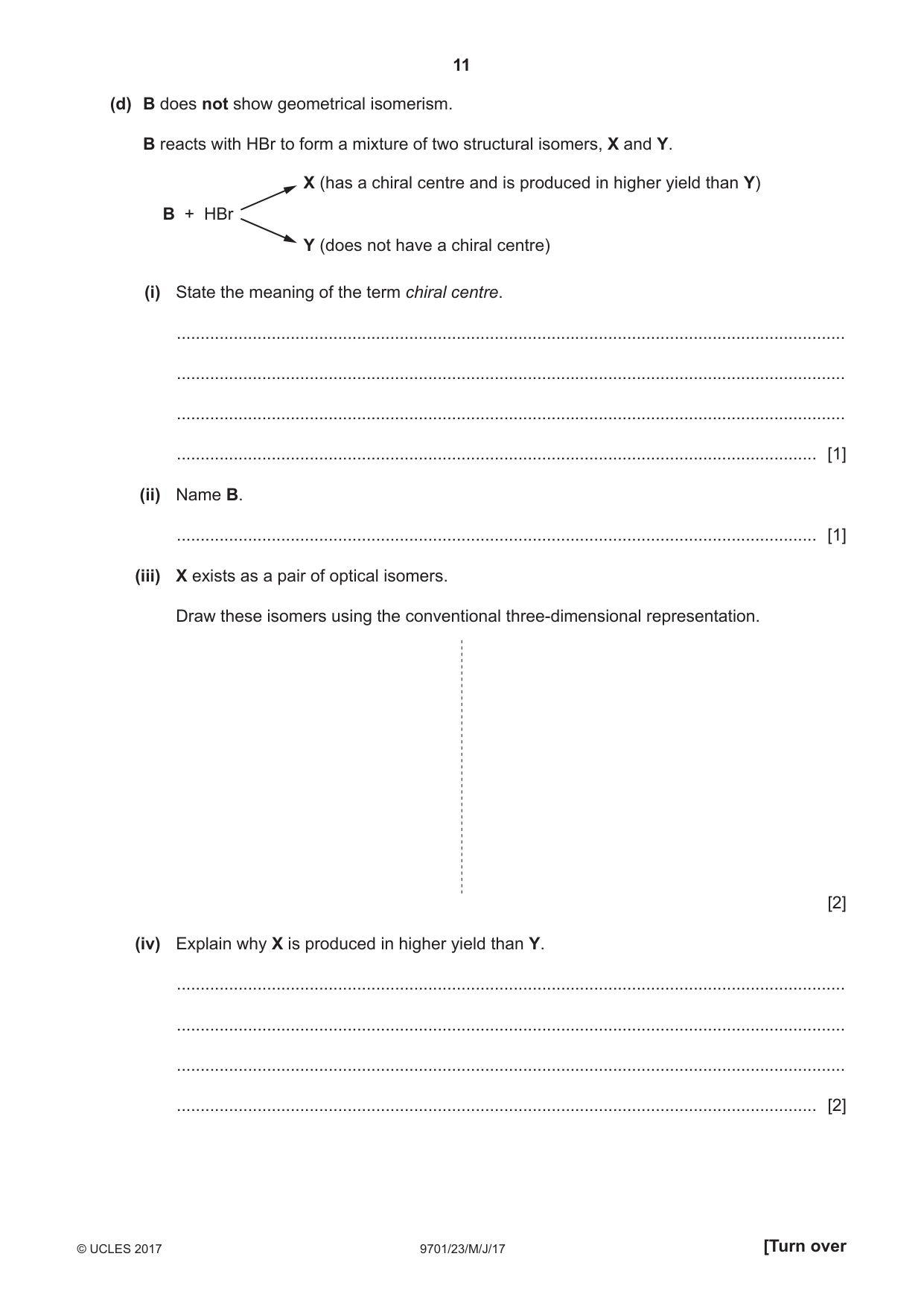
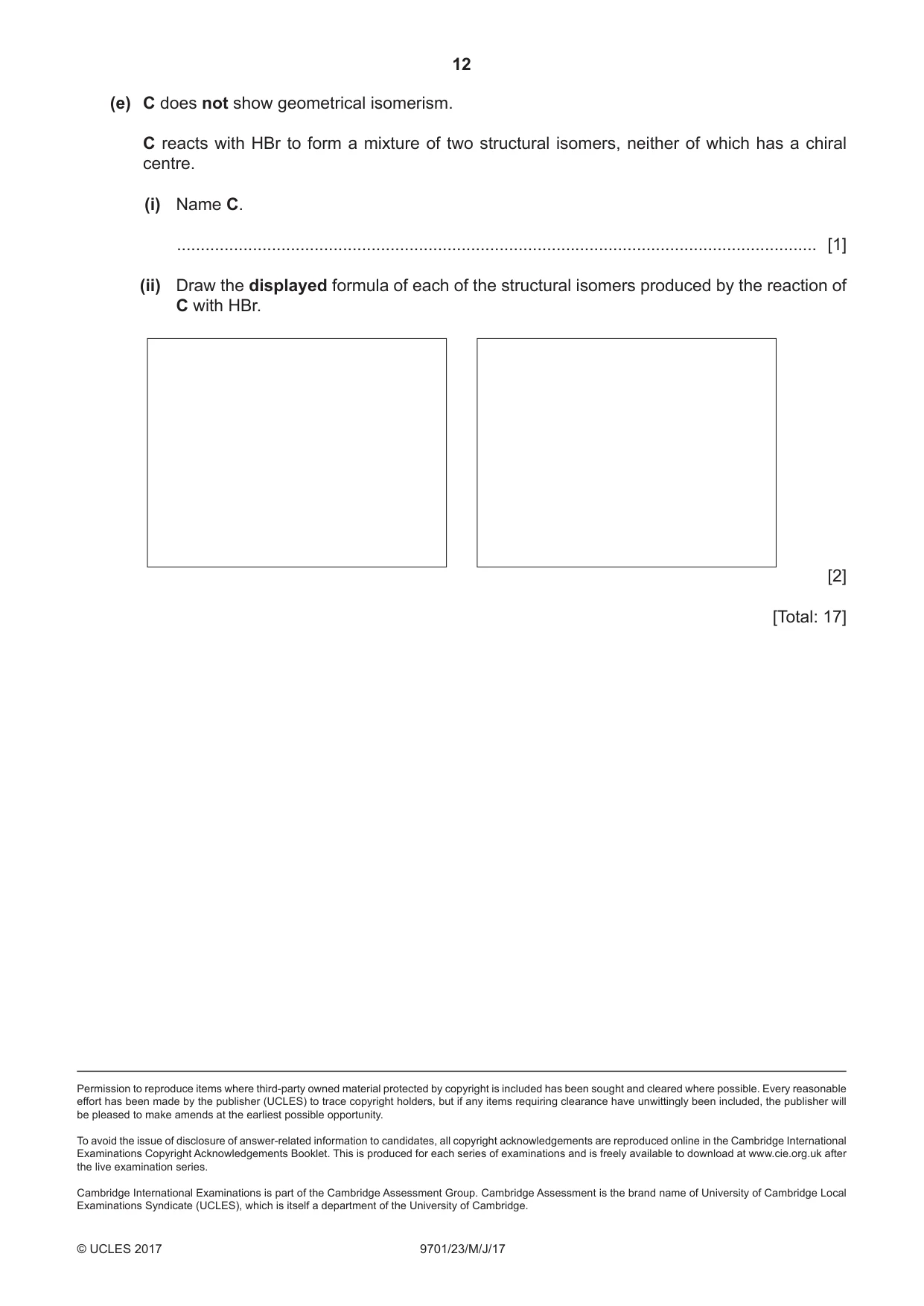
4 A, B and C all have the formula C4H8. They all decolourise bromine and are structural isomers of each other. (a) State the name of the process by which A, B and C could be obtained from C10H22. .............................................................................................................................................. [1] (b) Draw the structures of these three structural isomers. [1] (c) Only A shows geometrical isomerism. (i) Explain the meaning of the term geometrical isomerism. ............................................................................................................................................. ............................................................................................................................................. ............................................................................................................................................. ....................................................................................................................................... [2] (ii) Draw the displayed formula of A and use it to show the mechanism of the reaction of A with HBr. Include all necessary charges, dipoles, lone pairs and curly arrows. [4] (d) B does not show geometrical isomerism. B reacts with HBr to form a mixture of two structural isomers, X and Y. X (has a chiral centre and is produced in higher yield than Y) B + HBr Y (does not have a chiral centre) (i) State the meaning of the term chiral centre. ............................................................................................................................................. ............................................................................................................................................. ............................................................................................................................................. ....................................................................................................................................... [1] (ii) Name B. ....................................................................................................................................... [1] (iii) X exists as a pair of optical isomers. Draw these isomers using the conventional three-dimensional representation. [2] (iv) Explain why X is produced in higher yield than Y. ............................................................................................................................................. ............................................................................................................................................. ............................................................................................................................................. ....................................................................................................................................... [2] (e) C does not show geometrical isomerism. C reacts with HBr to form a mixture of two structural isomers, neither of which has a chiral centre. (i) Name C. ....................................................................................................................................... [1] (ii) Draw the displayed formula of each of the structural isomers produced by the reaction of C with HBr. [2] [Total: 17]
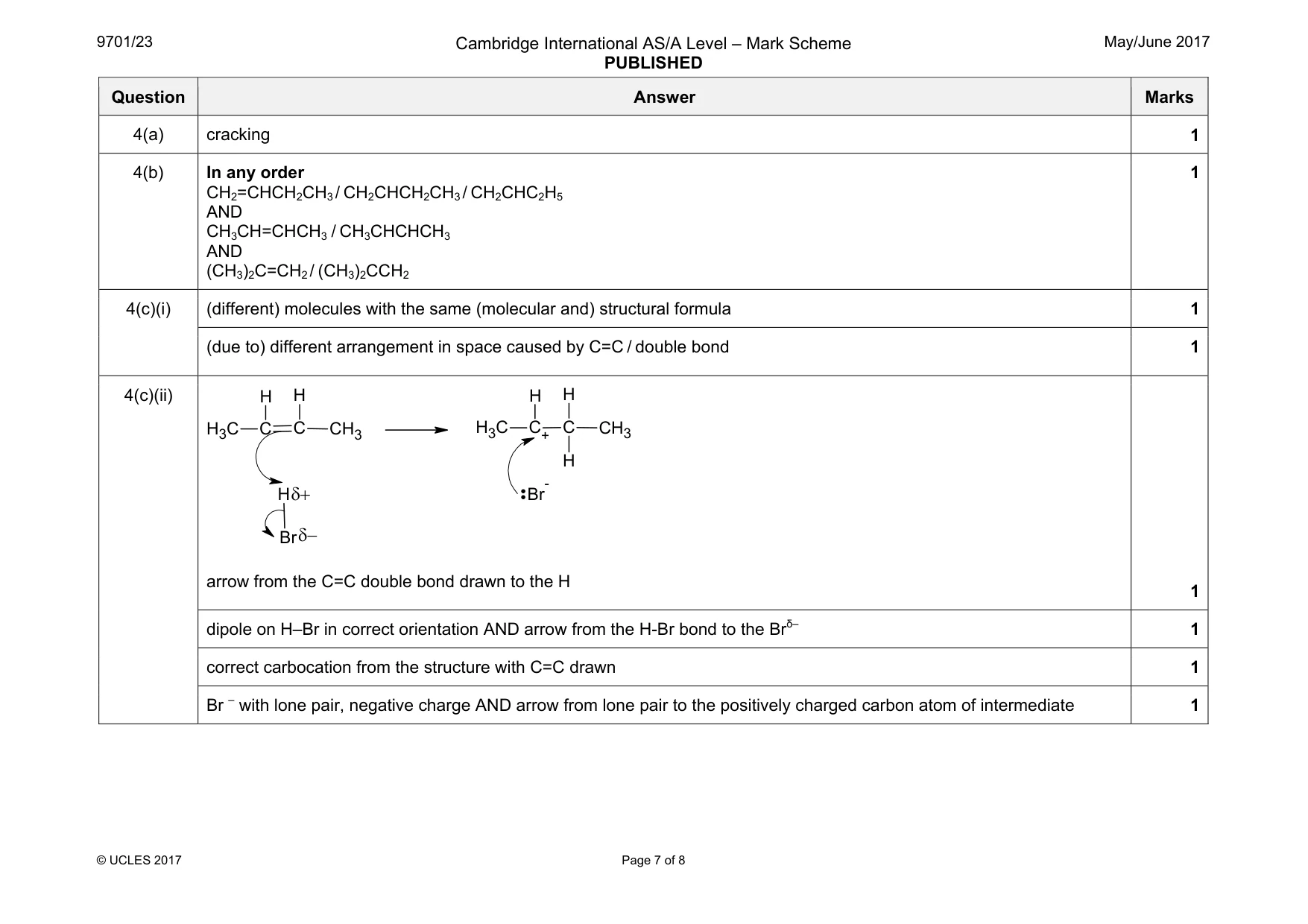
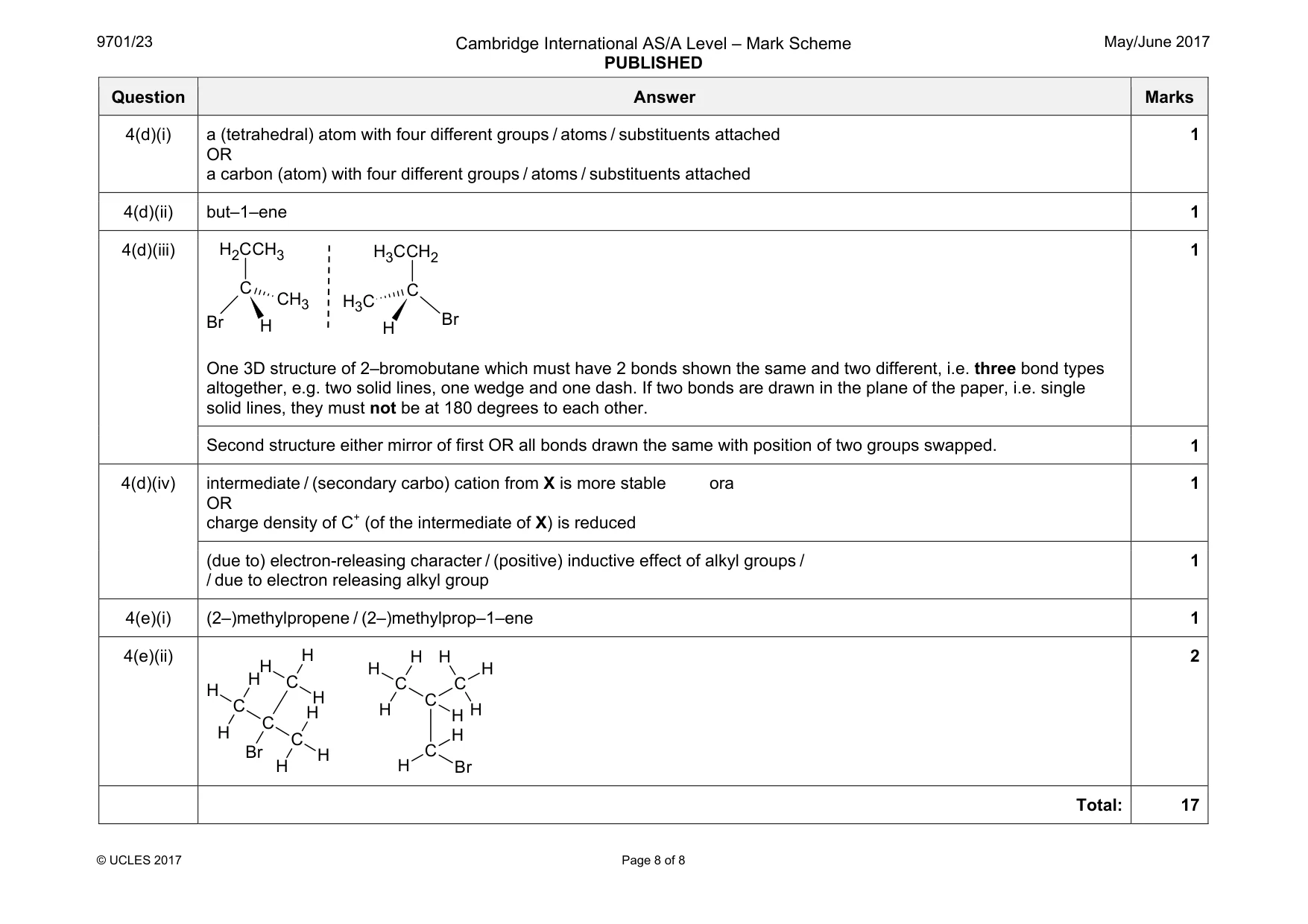
Mark scheme: 4(a) cracking 1 4(b) In any order CH2=CHCH2CH3 / CH2CHCH2CH3 / CH2CHC2H5 AND CH3CH=CHCH3 / CH3CHCHCH3 AND (CH3)2C=CH2 / (CH3)2CCH2 1 4(c)(i) (different) molecules with the same (molecular and) structural formula 1 (due to) different arrangement in space caused by C=C / double bond 1 4(c)(ii) C H3 C C CH3 H H Br Hδ+ δ− C H3 C+ C CH3 H H H Br - arrow from the C=C double bond drawn to the H 1 dipole on H–Br in correct orientation AND arrow from the H-Br bond to the Brδ– 1 correct carbocation from the structure with C=C drawn 1 Br – with lone pair, negative charge AND arrow from lone pair to the positively charged carbon atom of intermediate 1 Question Answer Marks 4(d)(i) a (tetrahedral) atom with four different groups / atoms / substituents attached OR a carbon (atom) with four different groups / atoms / substituents attached 1 4(d)(ii) but–1–ene 1 4(d)(iii) C CH3 C H2 Br CH3 H C C H3 CH2 Br C H3 H One 3D structure of 2–bromobutane which must have 2 bonds shown the same and two different, i.e. three bond types altogether, e.g. two solid lines, one wedge and one dash. If two bonds are drawn in the plane of the paper, i.e. single solid lines, they must not be at 180 degrees to each other. 1 Second structure either mirror of first OR all bonds drawn the same with position of two groups swapped. 1 4(d)(iv) intermediate / (secondary carbo) cation from X is more stable ora OR charge density of C+ (of the intermediate of X) is reduced 1 (due to) electron-releasing character / (positive) inductive effect of alkyl groups / / due to electron releasing alkyl group 1 4(e)(i) (2–)methylpropene / (2–)methylprop–1–ene 1 4(e)(ii) C C C C Br H H H H H H H H H C C C C Br H H H H H H H H H 2 Total: 17
What was in this paper
The subtopics covered by these 4 questions, and how many questions each got. Open one in a new tab to see every Cambridge question on it.
What you needed in this session
Cambridge’s own grade thresholds for 2017 May/June, Paper 2 · Variant 3. A higher threshold means an easier paper — the bar moves with how the cohort did.