Cambridge A Level Chemistry 9701 — 2017 May/June Paper 2 · Variant 1
9701/21/M/J/17 · 4 questions · 60 marks · ≈68 min
The question paper and its mark scheme, free to read here and free to download. This is Cambridge’s own paper, exactly as it was sat.
Question paper12 pages
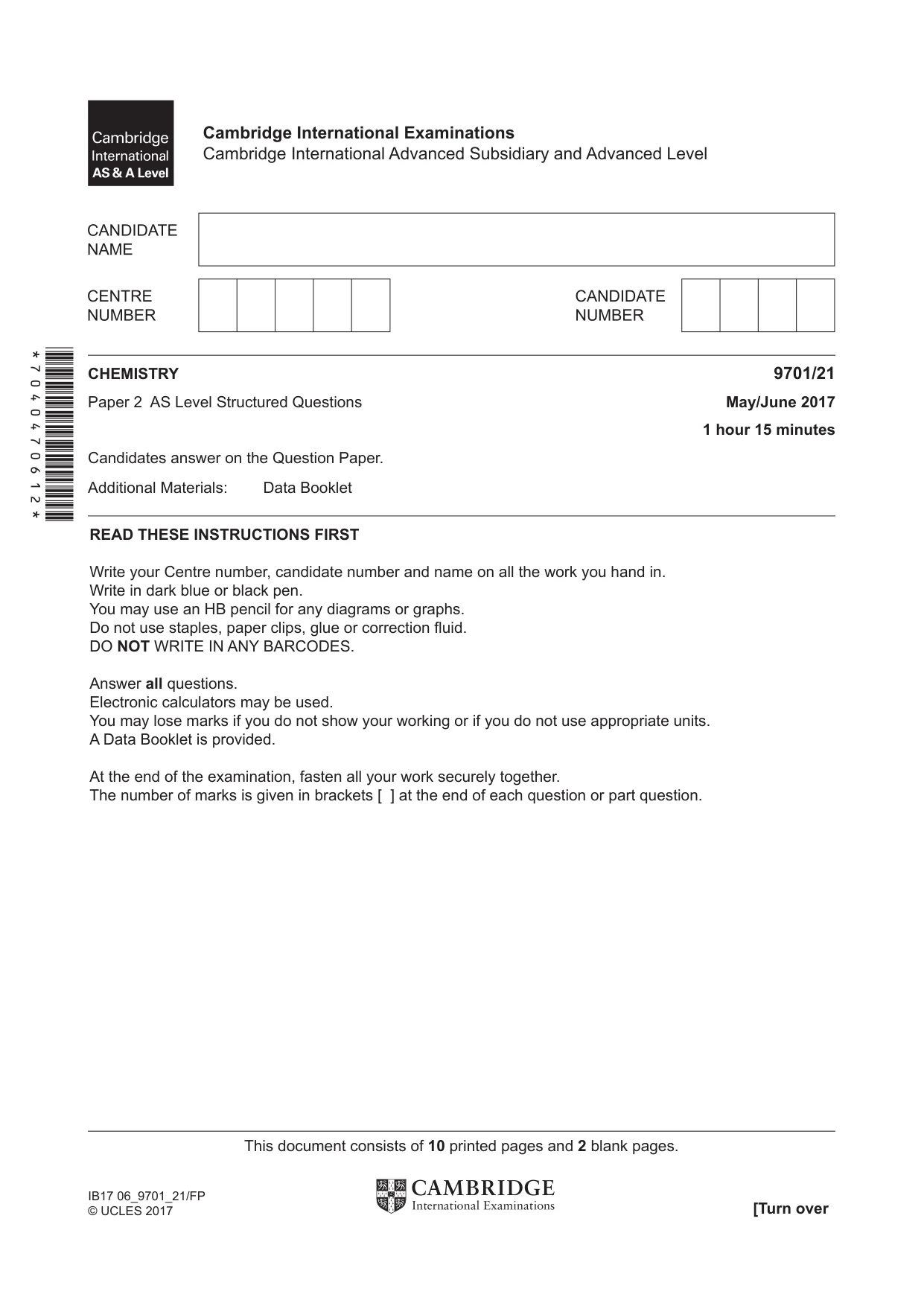

Mark scheme7 pages
Answers below. Sit the paper first if you are practising.
Questions as text
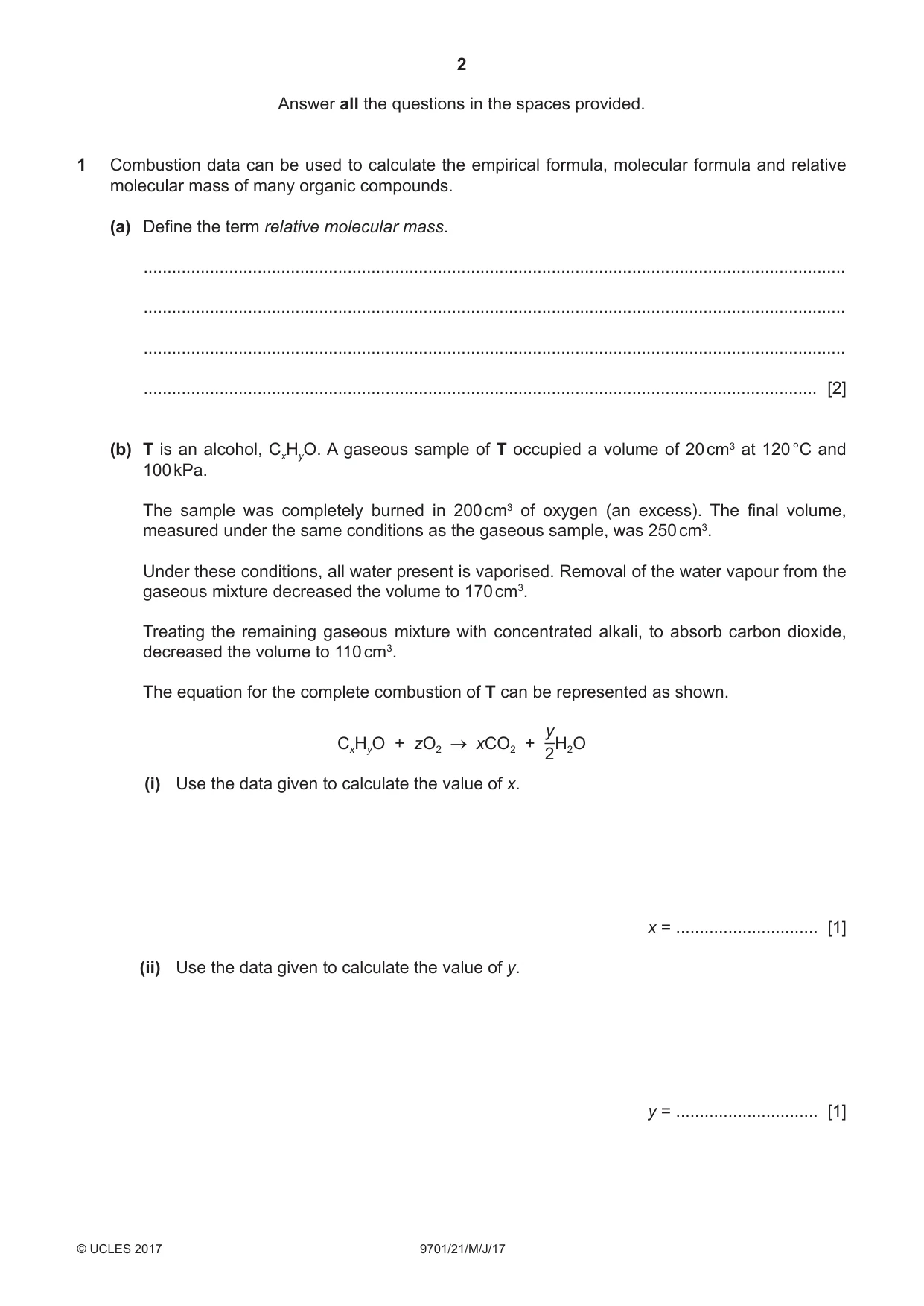
Q1 · Combustion data can be used to calculate the empirical formula, molecular formula and…
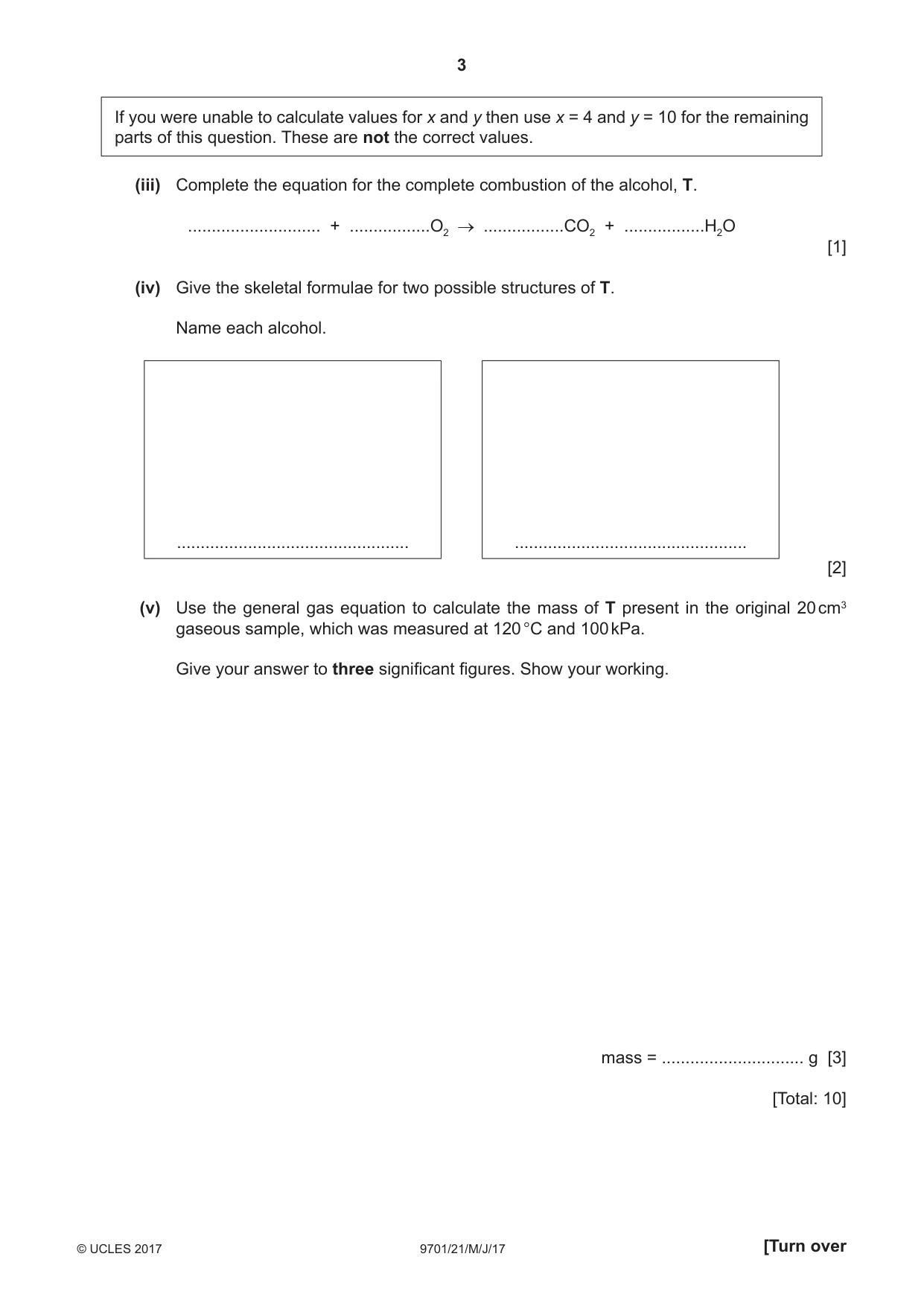
1 Combustion data can be used to calculate the empirical formula, molecular formula and relative molecular mass of many organic compounds. (a) Define the term relative molecular mass. .................................................................................................................................................... .................................................................................................................................................... .................................................................................................................................................... .............................................................................................................................................. [2] (b) T is an alcohol, CxHyO. A gaseous sample of T occupied a volume of 20 cm3 at 120 °C and 100 kPa. The sample was completely burned in 200 cm3 of oxygen (an excess). The final volume, measured under the same conditions as the gaseous sample, was 250 cm3. Under these conditions, all water present is vaporised. Removal of the water vapour from the gaseous mixture decreased the volume to 170 cm3. Treating the remaining gaseous mixture with concentrated alkali, to absorb carbon dioxide, decreased the volume to 110 cm3. The equation for the complete combustion of T can be represented as shown. y CxHyO + zO2 xCO2 + 2H2O (i) Use the data given to calculate the value of x. x = .............................. [1] (ii) Use the data given to calculate the value of y. y = .............................. [1] If you were unable to calculate values for x and y then use x = 4 and y = 10 for the remaining parts of this question. These are not the correct values. (iii) Complete the equation for the complete combustion of the alcohol, T. ............................ + .................O2 .................CO2 + .................H2O [1] (iv) Give the skeletal formulae for two possible structures of T. Name each alcohol. ................................................. ................................................. [2] (v) Use the general gas equation to calculate the mass of T present in the original 20 cm3 gaseous sample, which was measured at 120 °C and 100 kPa. Give your answer to three significant figures. Show your working. mass = .............................. g [3] [Total: 10]
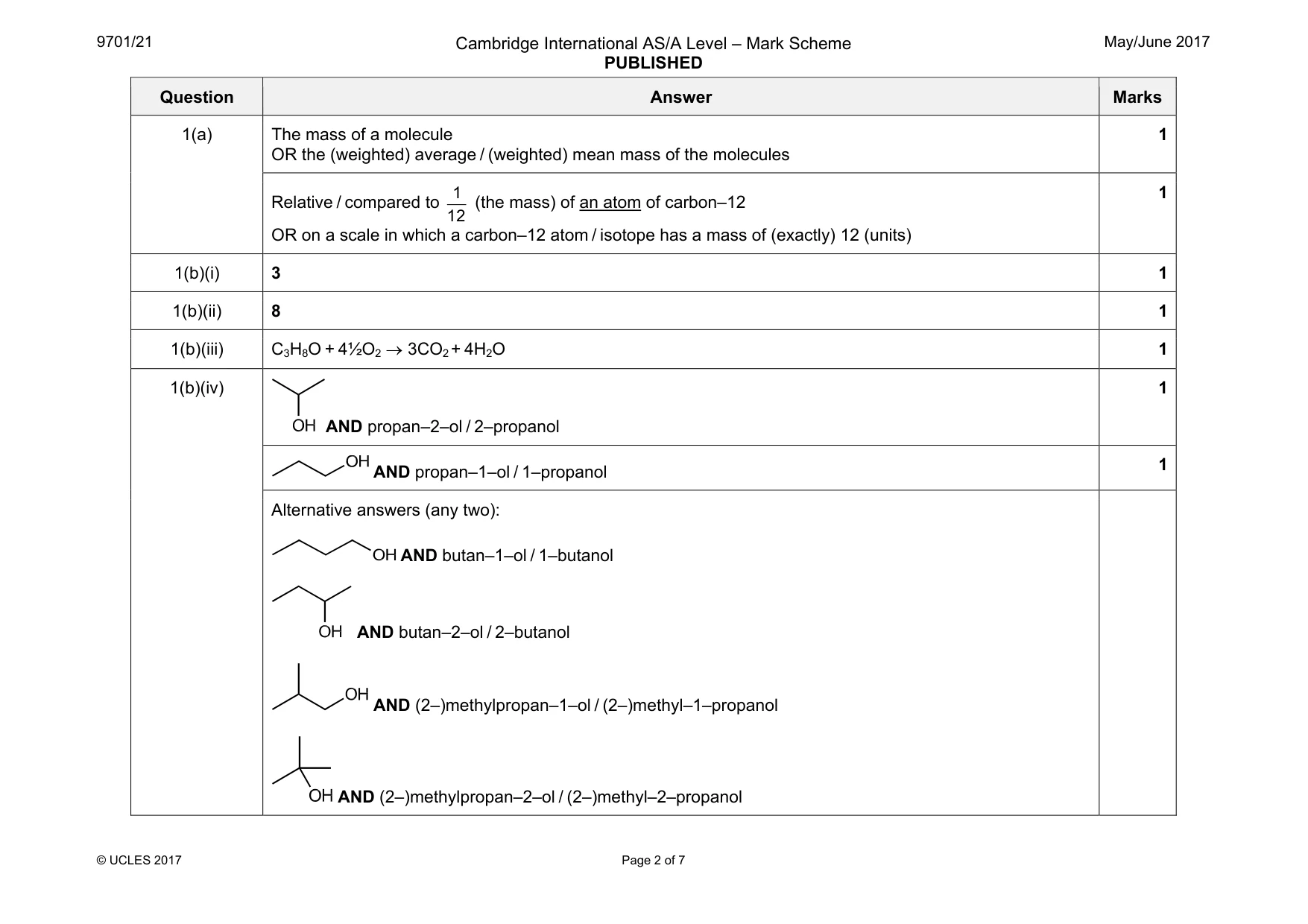
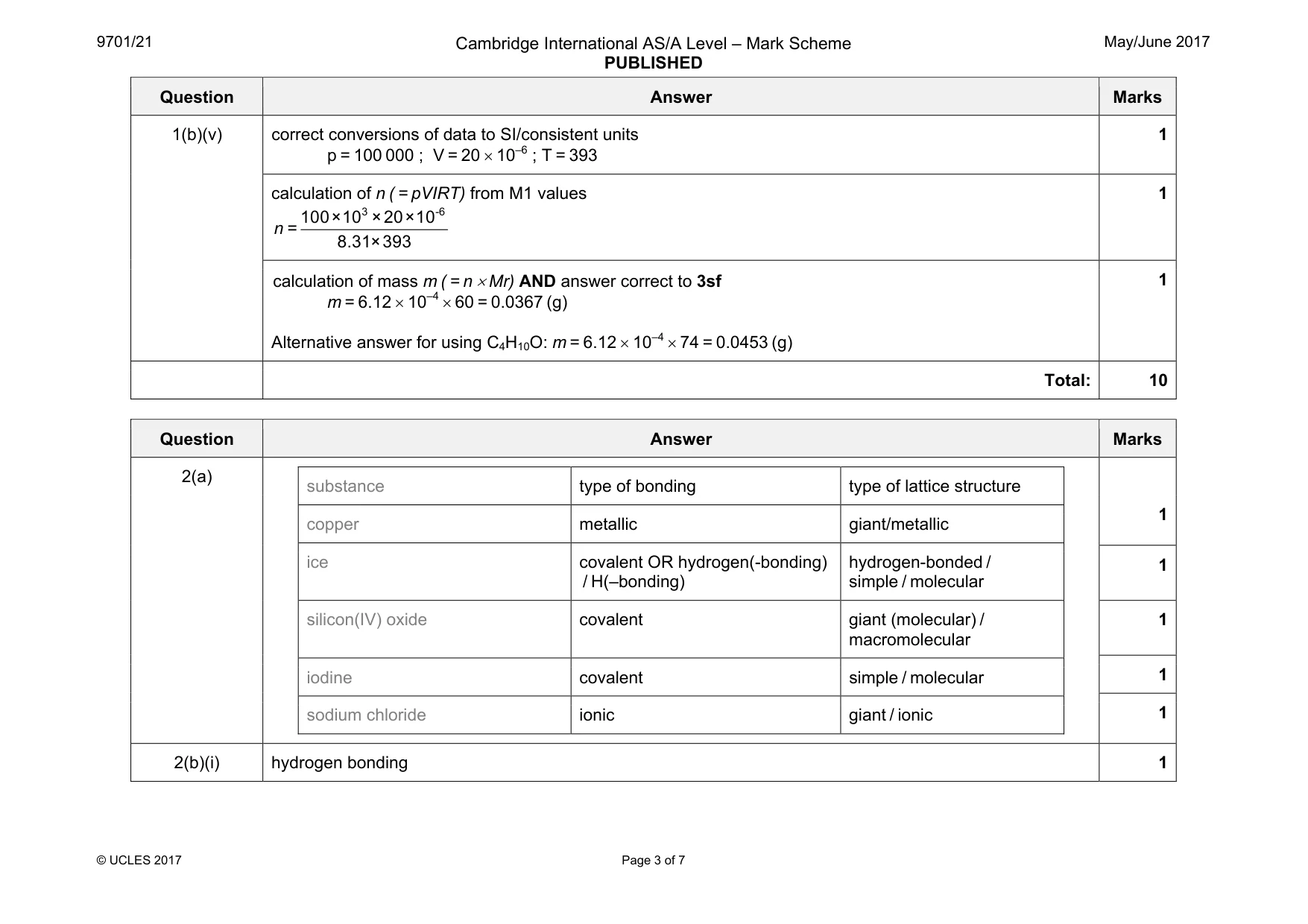
Mark scheme: 1(a) The mass of a molecule OR the (weighted) average / (weighted) mean mass of the molecules 1 Relative / compared to 1 12 (the mass) of an atom of carbon–12 OR on a scale in which a carbon–12 atom / isotope has a mass of (exactly) 12 (units) 1 1(b)(i) 3 1 1(b)(ii) 8 1 1(b)(iii) C3H8O + 4½O2 → 3CO2 + 4H2O 1 1(b)(iv) AND propan–2–ol / 2–propanol 1 AND propan–1–ol / 1–propanol 1 Alternative answers (any two): AND butan–1–ol / 1–butanol AND butan–2–ol / 2–butanol AND (2–)methylpropan–1–ol / (2–)methyl–1–propanol AND (2–)methylpropan–2–ol / (2–)methyl–2–propanol Question Answer Marks 1(b)(v) correct conversions of data to SI/consistent units p = 100 000 ; V = 20 × 10–6 ; T = 393 1 calculation of n ( = pVIRT) from M1 values 3 -6 100×10 ×20×10 = 8.31×393 n 1 calculation of mass m ( = n × Mr) AND answer correct to 3sf m = 6.12 × 10–4 × 60 = 0.0367 (g) Alternative answer for using C4H10O: m = 6.12 × 10–4 × 74 = 0.0453 (g) 1 Total: 10
More questions on Reacting masses and volumes (of solutions and gases)
Q2 · Structure and bonding can be used to explain many of the properties of substances
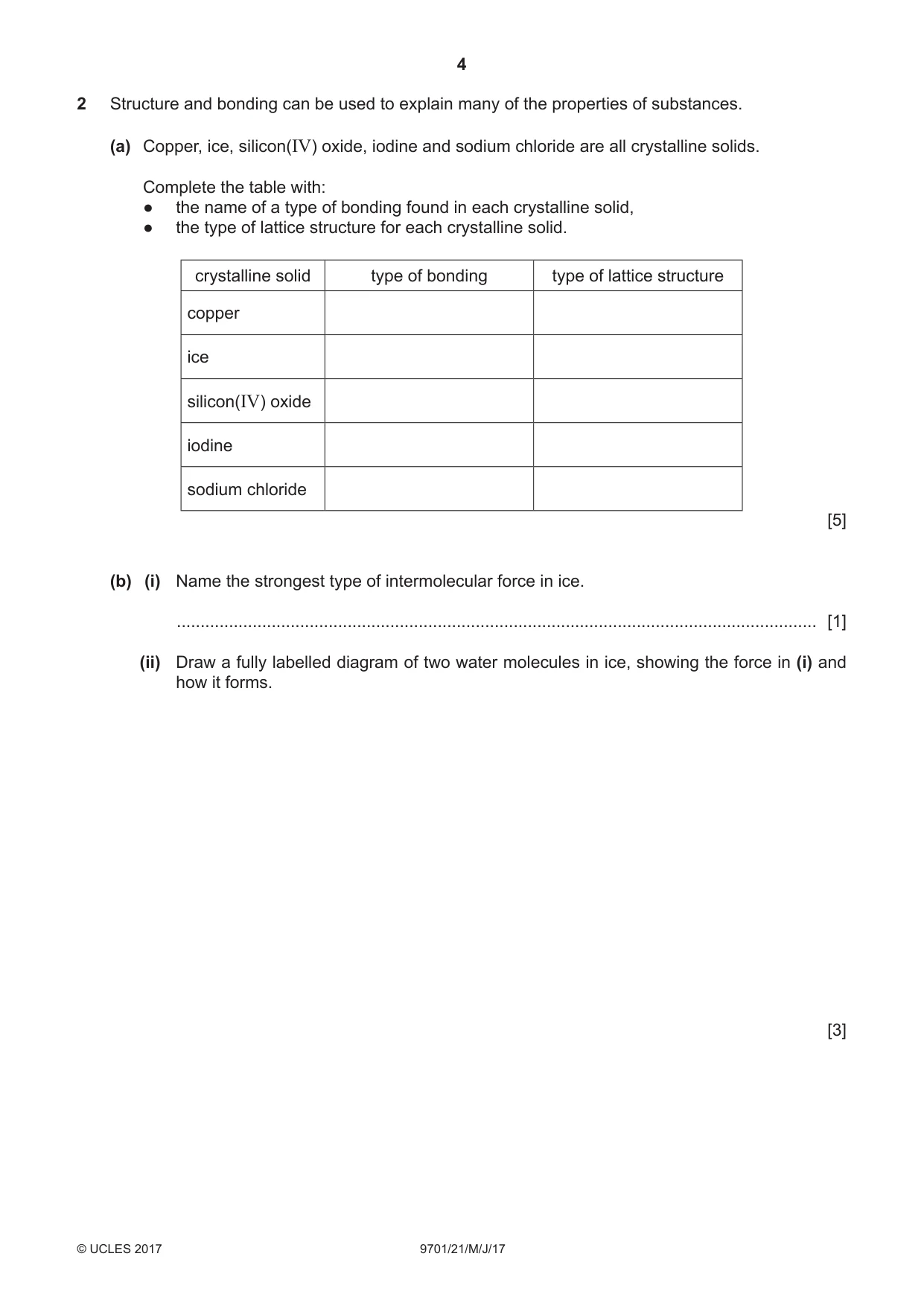
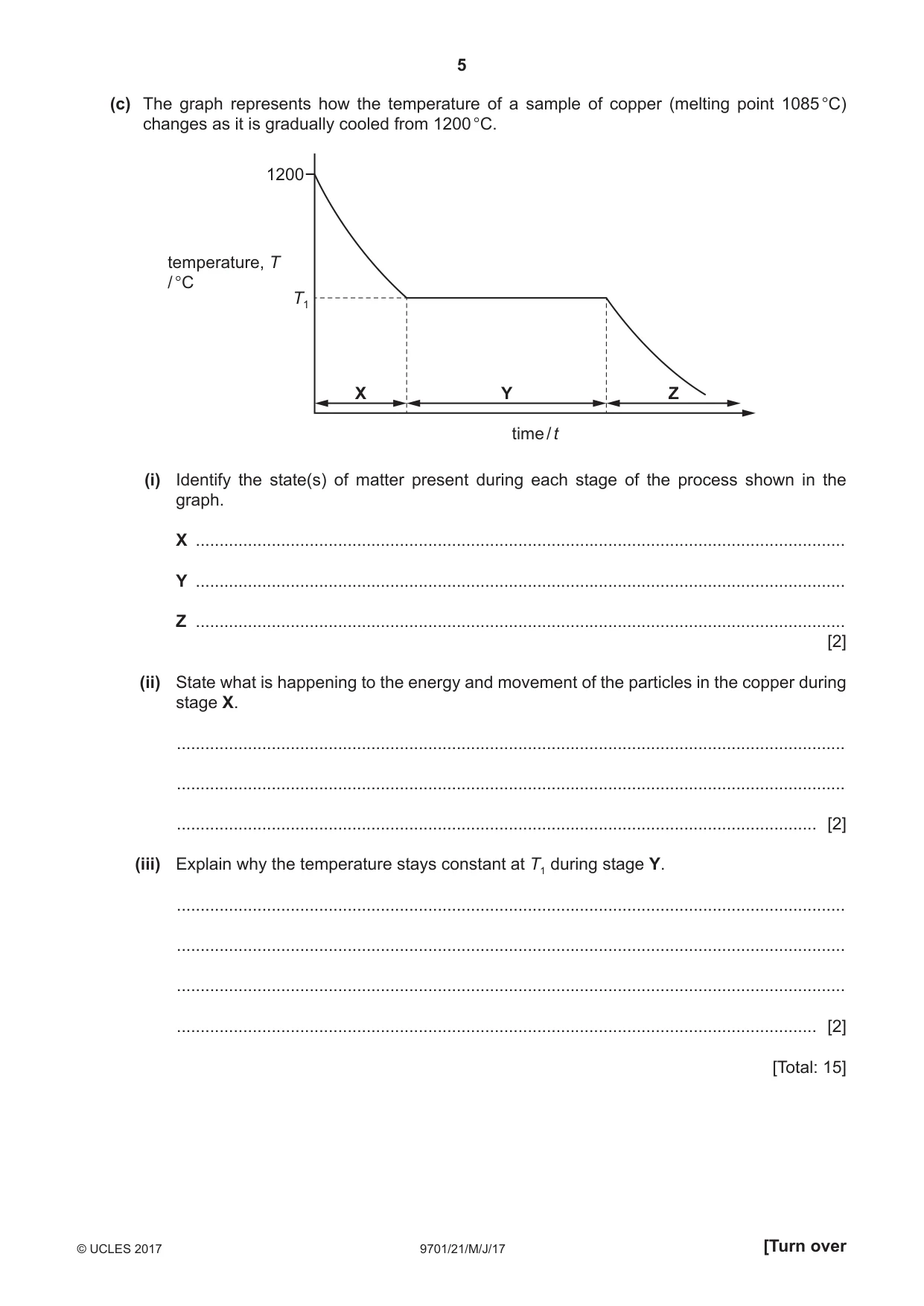
2 Structure and bonding can be used to explain many of the properties of substances. (a) Copper, ice, silicon(IV) oxide, iodine and sodium chloride are all crystalline solids. Complete the table with: ● the name of a type of bonding found in each crystalline solid, ● the type of lattice structure for each crystalline solid. crystalline solid type of bonding type of lattice structure copper ice silicon(IV) oxide iodine sodium chloride [5] (b) (i) Name the strongest type of intermolecular force in ice. ....................................................................................................................................... [1] (ii) Draw a fully labelled diagram of two water molecules in ice, showing the force in (i) and how it forms. [3] (c) The graph represents how the temperature of a sample of copper (melting point 1085 °C) changes as it is gradually cooled from 1200 °C. 1200 temperature, T / °C T1 X Y Z time / t (i) Identify the state(s) of matter present during each stage of the process shown in the graph. X .......................................................................................................................................... Y .......................................................................................................................................... Z .......................................................................................................................................... [2] (ii) State what is happening to the energy and movement of the particles in the copper during stage X. ............................................................................................................................................. ............................................................................................................................................. ....................................................................................................................................... [2] (iii) Explain why the temperature stays constant at T1 during stage Y. ............................................................................................................................................. ............................................................................................................................................. ............................................................................................................................................. ....................................................................................................................................... [2] [Total: 15]
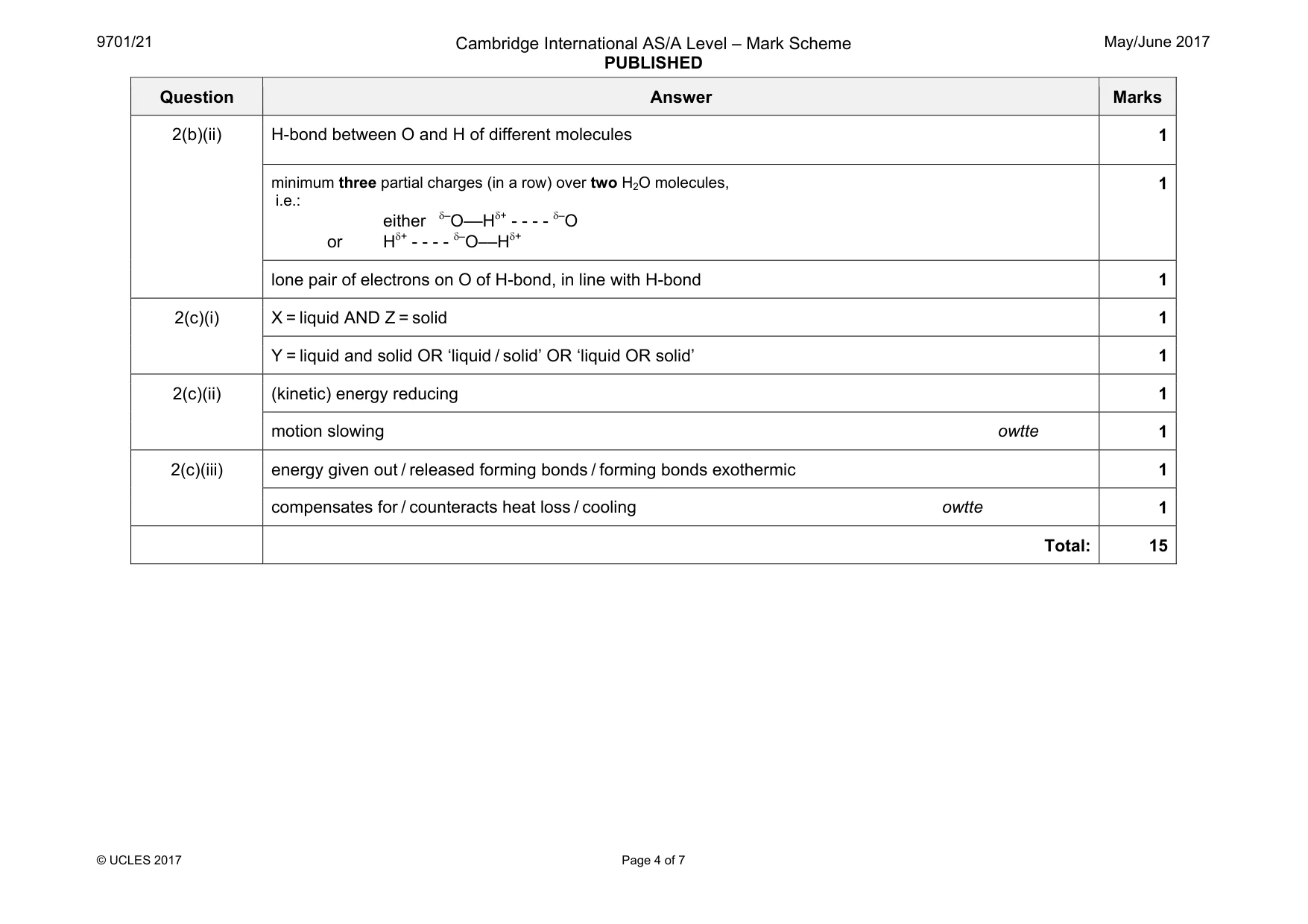
Mark scheme: 2(a) substance type of bonding type of lattice structure copper metallic giant/metallic ice covalent OR hydrogen(-bonding) / H(–bonding) hydrogen-bonded / simple / molecular silicon(IV) oxide covalent giant (molecular) / macromolecular iodine covalent simple / molecular sodium chloride ionic giant / ionic 1 1 1 1 1 2(b)(i) hydrogen bonding 1 Question Answer Marks 2(b)(ii) H-bond between O and H of different molecules 1 minimum three partial charges (in a row) over two H2O molecules, i.e.: either δ–O––Hδ+ - - - - δ–O or Hδ+ - - - - δ–O––Hδ+ 1 lone pair of electrons on O of H-bond, in line with H-bond 1 2(c)(i) X = liquid AND Z = solid 1 Y = liquid and solid OR ‘liquid / solid’ OR ‘liquid OR solid’ 1 2(c)(ii) (kinetic) energy reducing 1 motion slowing owtte 1 2(c)(iii) energy given out / released forming bonds / forming bonds exothermic 1 compensates for / counteracts heat loss / cooling owtte 1 Total: 15
Q3 · The properties of elements and their compounds show similarities, differences and trends…
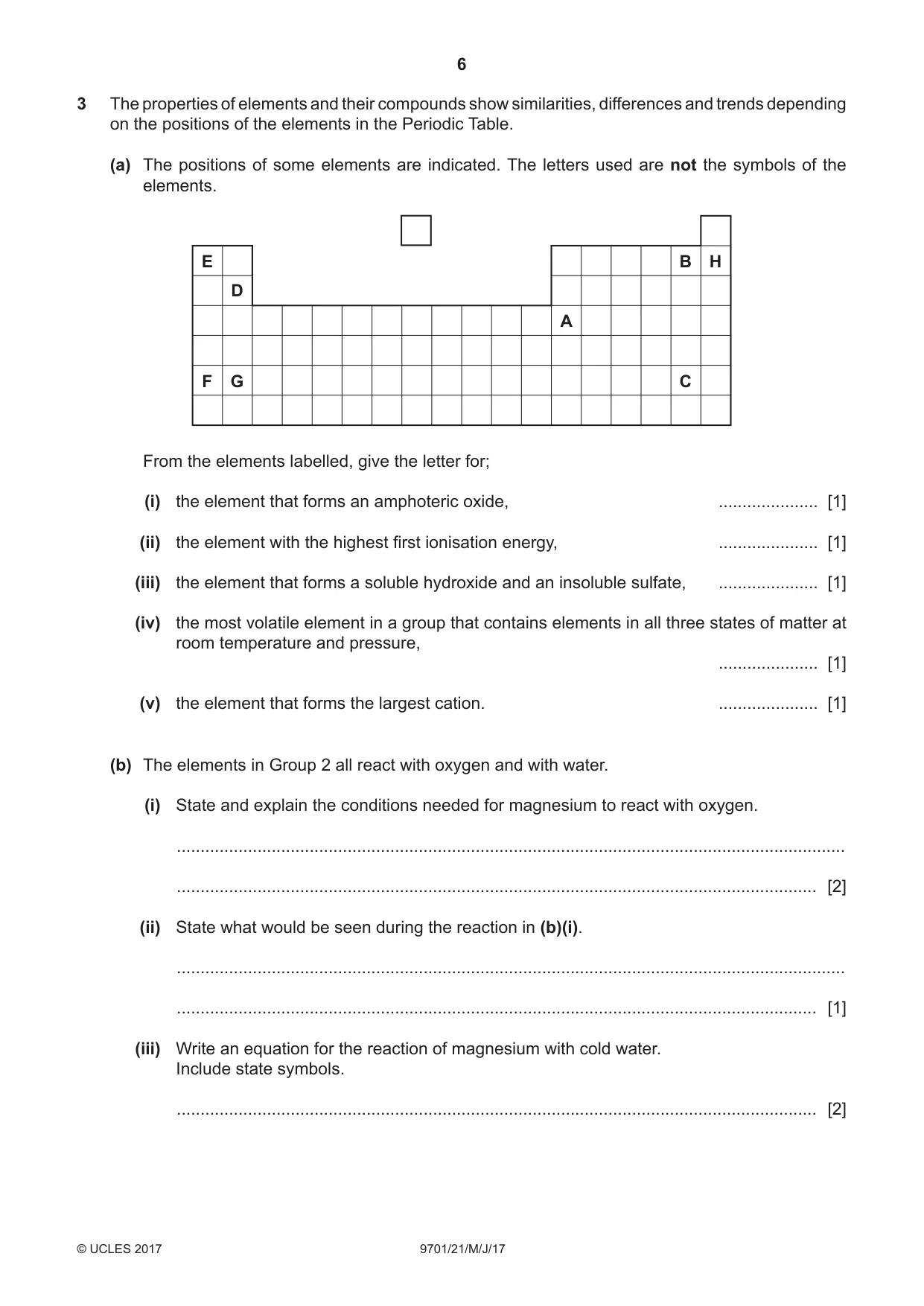
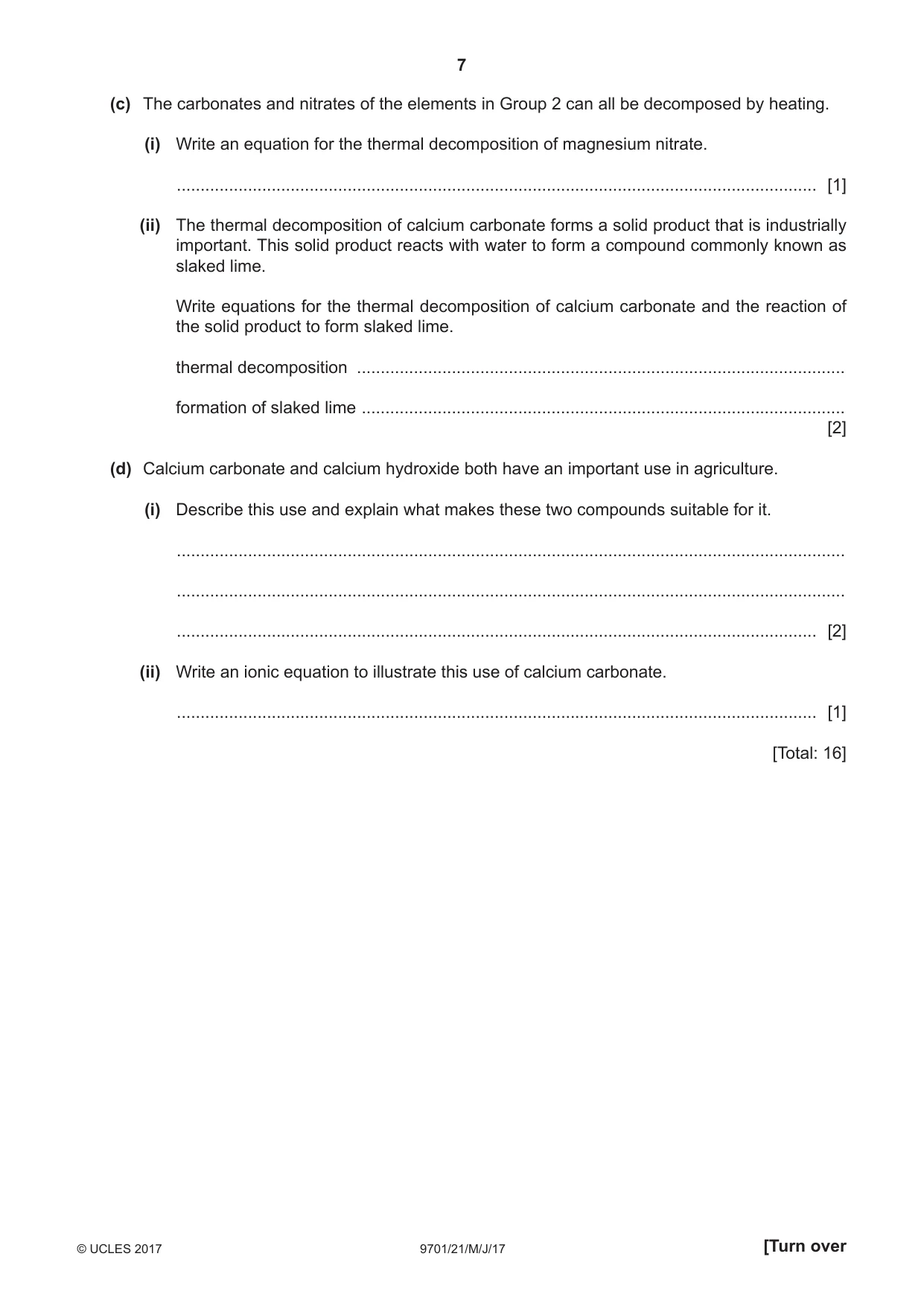
3 The properties of elements and their compounds show similarities, differences and trends depending on the positions of the elements in the Periodic Table. (a) The positions of some elements are indicated. The letters used are not the symbols of the elements. E B H D A F G C From the elements labelled, give the letter for; (i) the element that forms an amphoteric oxide, ..................... [1] (ii) the element with the highest first ionisation energy, ..................... [1] (iii) the element that forms a soluble hydroxide and an insoluble sulfate, ..................... [1] (iv) the most volatile element in a group that contains elements in all three states of matter at room temperature and pressure, ..................... [1] (v) the element that forms the largest cation. ..................... [1] (b) The elements in Group 2 all react with oxygen and with water. (i) State and explain the conditions needed for magnesium to react with oxygen. ............................................................................................................................................. ....................................................................................................................................... [2] (ii) State what would be seen during the reaction in (b)(i). ............................................................................................................................................. ....................................................................................................................................... [1] (iii) Write an equation for the reaction of magnesium with cold water. Include state symbols. ....................................................................................................................................... [2] (c) The carbonates and nitrates of the elements in Group 2 can all be decomposed by heating. (i) Write an equation for the thermal decomposition of magnesium nitrate. ....................................................................................................................................... [1] (ii) The thermal decomposition of calcium carbonate forms a solid product that is industrially important. This solid product reacts with water to form a compound commonly known as slaked lime. Write equations for the thermal decomposition of calcium carbonate and the reaction of the solid product to form slaked lime. thermal decomposition ........................................................................................................ formation of slaked lime ...................................................................................................... [2] (d) Calcium carbonate and calcium hydroxide both have an important use in agriculture. (i) Describe this use and explain what makes these two compounds suitable for it. ............................................................................................................................................. ............................................................................................................................................. ....................................................................................................................................... [2] (ii) Write an ionic equation to illustrate this use of calcium carbonate. ....................................................................................................................................... [1] [Total: 16]
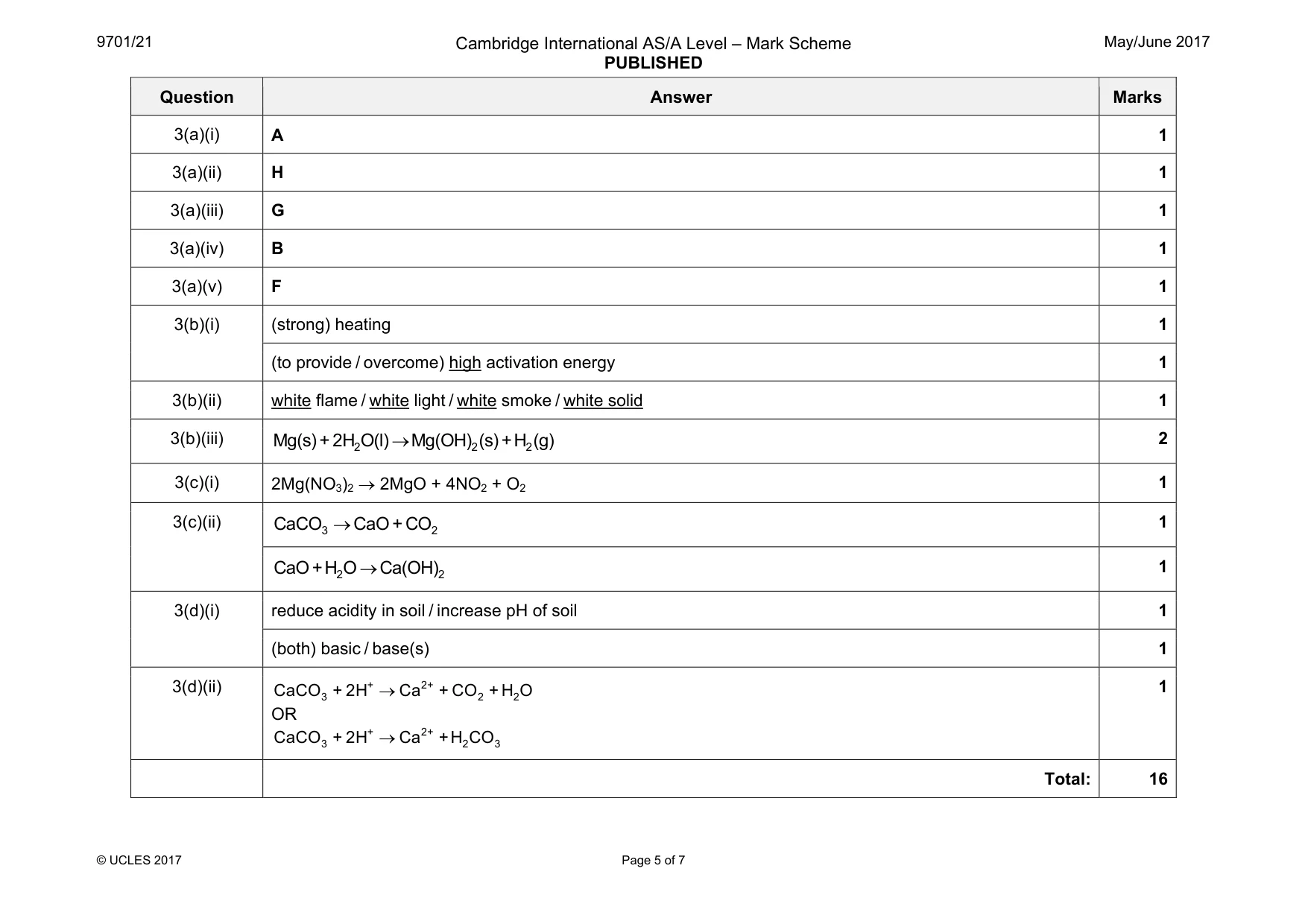
Mark scheme: 3(a)(i) A 1 3(a)(ii) H 1 3(a)(iii) G 1 3(a)(iv) B 1 3(a)(v) F 1 3(b)(i) (strong) heating 1 (to provide / overcome) high activation energy 1 3(b)(ii) white flame / white light / white smoke / white solid 1 3(b)(iii) → 2 2 2 Mg(s) + 2H O(l) Mg(OH) (s) + H (g) 2 3(c)(i) 2Mg(NO3)2 → 2MgO + 4NO2 + O2 1 3(c)(ii) → 3 2 CaCO CaO + CO 1 → 2 2 CaO + H O Ca(OH) 1 3(d)(i) reduce acidity in soil / increase pH of soil 1 (both) basic / base(s) 1 3(d)(ii) → + 2+ 3 2 2 CaCO + 2H Ca + CO + H O OR → + 2+ 3 2 3 CaCO + 2H Ca +H CO 1 Total: 16
Q4 · P, Q and R all have the molecular formula C3H6O
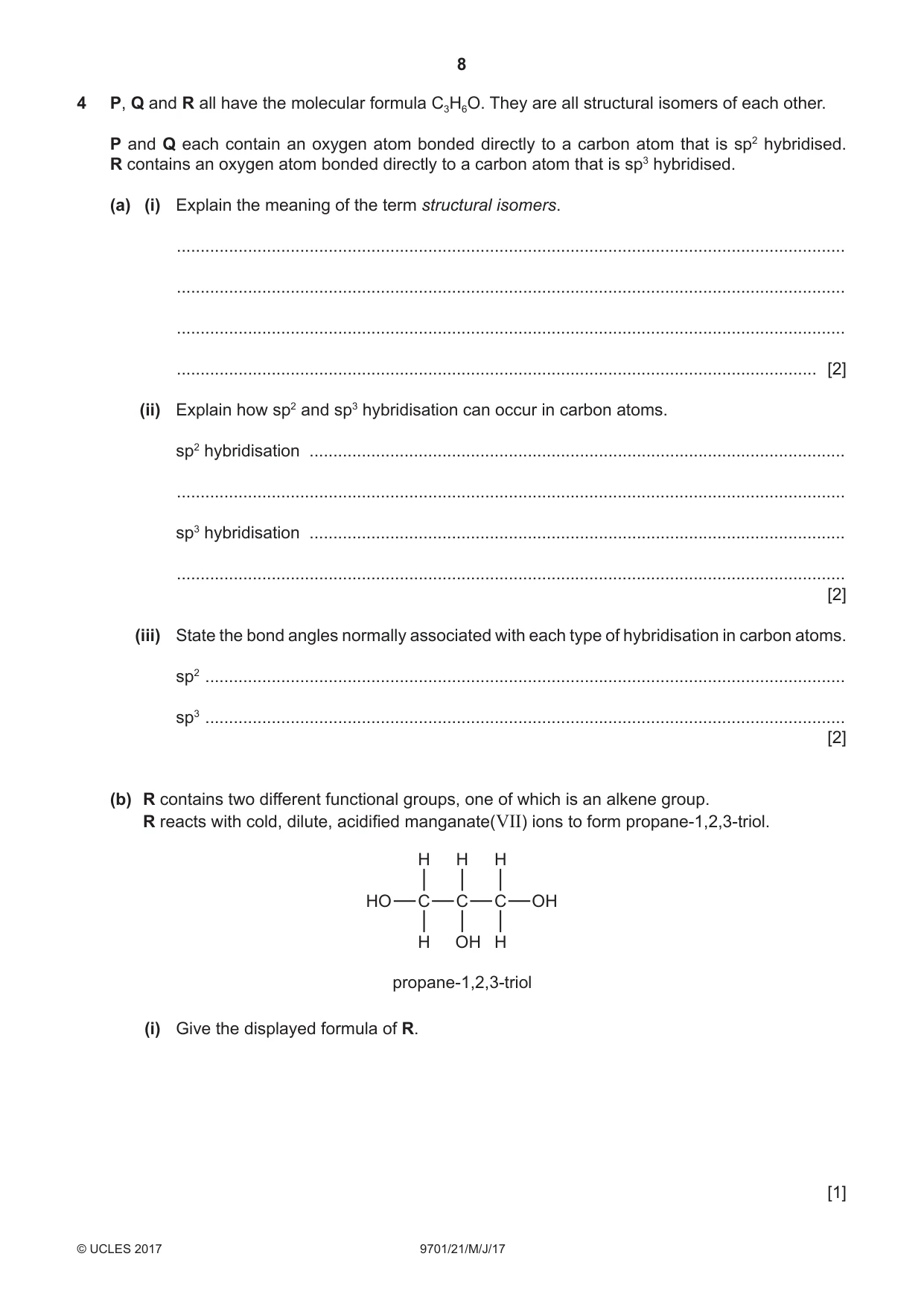
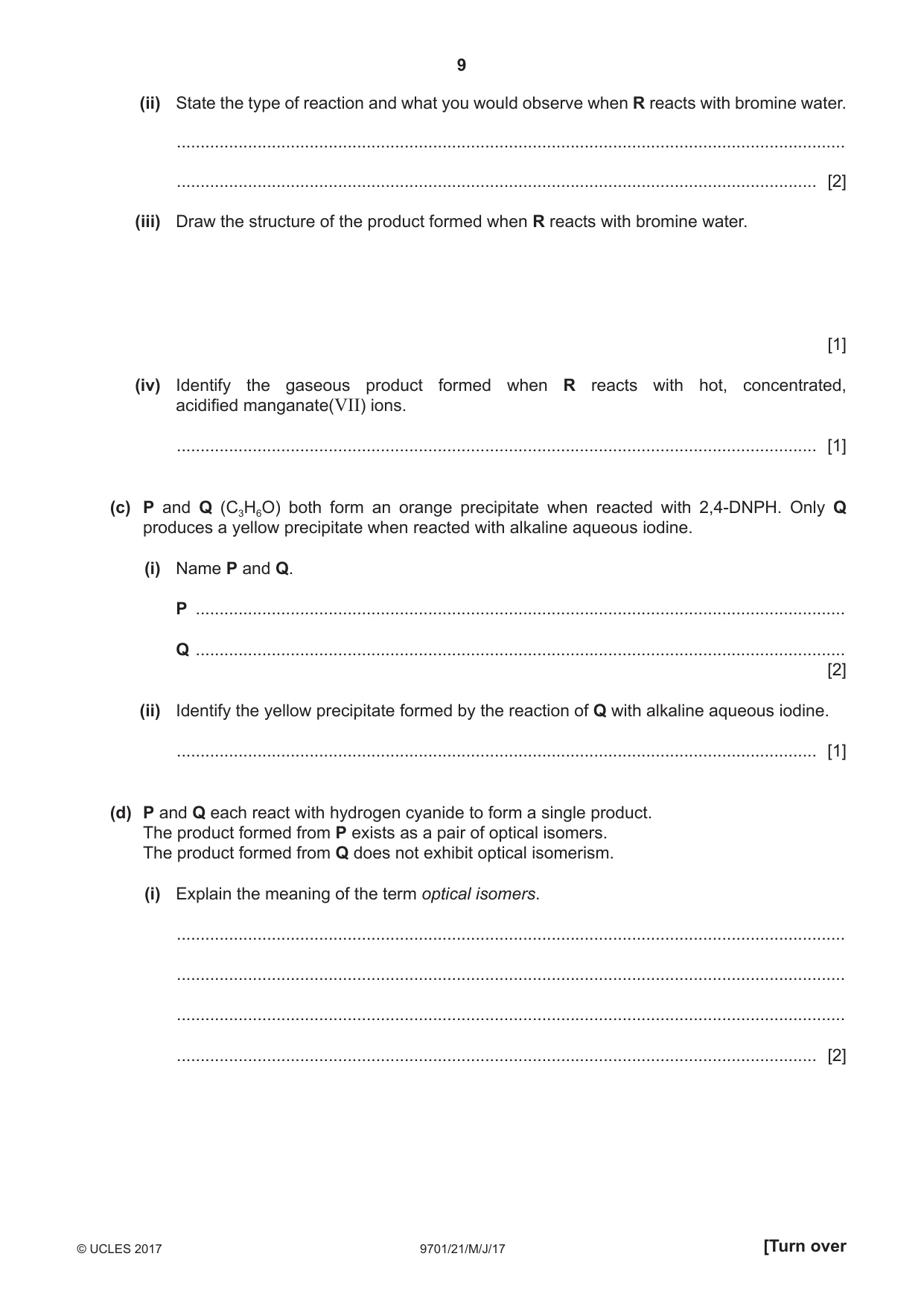
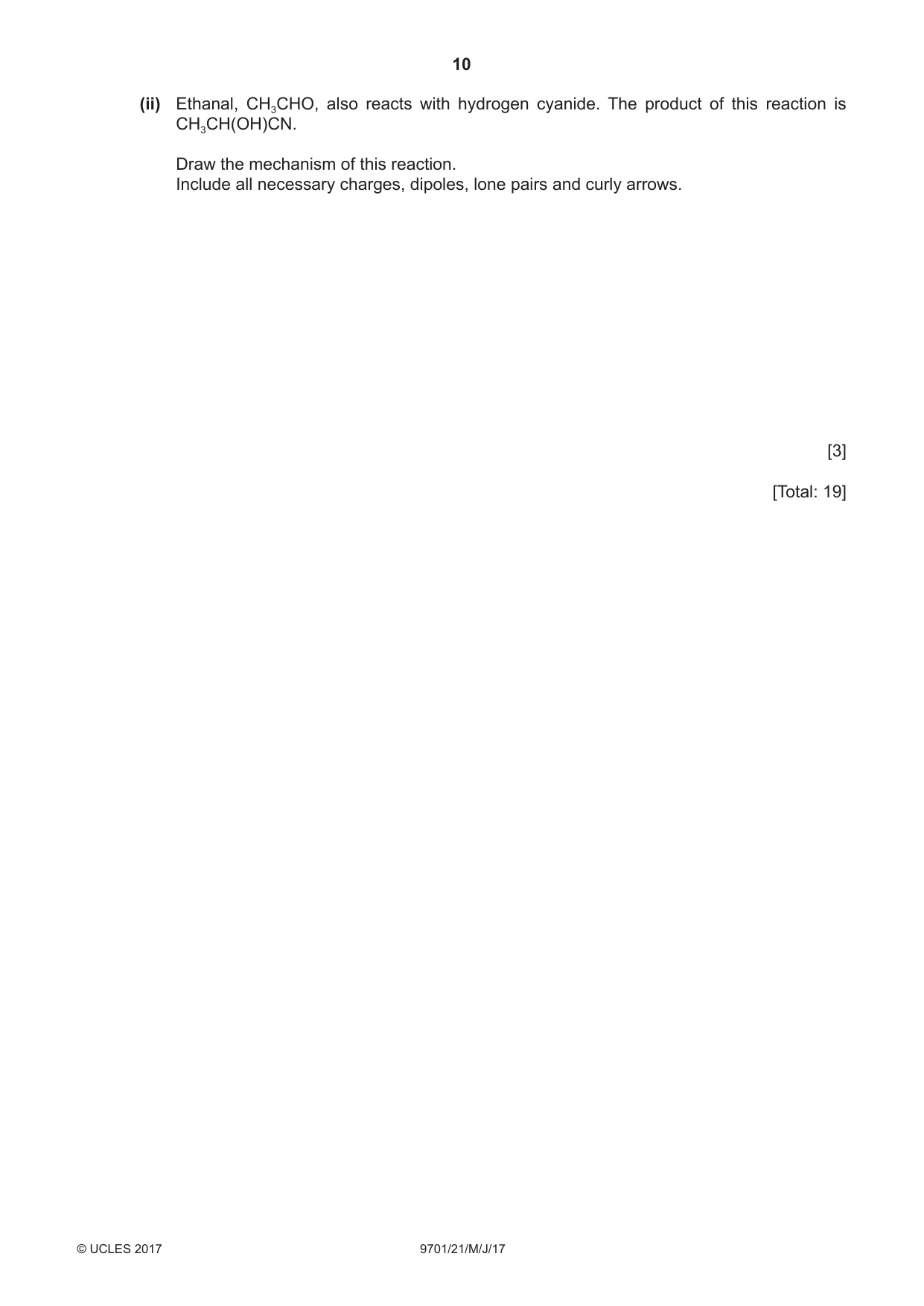
4 P, Q and R all have the molecular formula C3H6O. They are all structural isomers of each other. P and Q each contain an oxygen atom bonded directly to a carbon atom that is sp2 hybridised. R contains an oxygen atom bonded directly to a carbon atom that is sp3 hybridised. (a) (i) Explain the meaning of the term structural isomers. ............................................................................................................................................. ............................................................................................................................................. ............................................................................................................................................. ....................................................................................................................................... [2] (ii) Explain how sp2 and sp3 hybridisation can occur in carbon atoms. sp2 hybridisation .................................................................................................................. ............................................................................................................................................. sp3 hybridisation .................................................................................................................. ............................................................................................................................................. [2] (iii) State the bond angles normally associated with each type of hybridisation in carbon atoms. sp2 ....................................................................................................................................... sp3 ....................................................................................................................................... [2] (b) R contains two different functional groups, one of which is an alkene group. R reacts with cold, dilute, acidified manganate(VII) ions to form propane-1,2,3-triol. H H H HO C C C OH H OH H propane-1,2,3-triol (i) Give the displayed formula of R. [1] (ii) State the type of reaction and what you would observe when R reacts with bromine water. ............................................................................................................................................. ....................................................................................................................................... [2] (iii) Draw the structure of the product formed when R reacts with bromine water. [1] (iv) Identify the gaseous product formed when R reacts with hot, concentrated, acidified manganate(VII) ions. ....................................................................................................................................... [1] (c) P and Q (C3H6O) both form an orange precipitate when reacted with 2,4-DNPH. Only Q produces a yellow precipitate when reacted with alkaline aqueous iodine. (i) Name P and Q. P .......................................................................................................................................... Q ......................................................................................................................................... [2] (ii) Identify the yellow precipitate formed by the reaction of Q with alkaline aqueous iodine. ....................................................................................................................................... [1] (d) P and Q each react with hydrogen cyanide to form a single product. The product formed from P exists as a pair of optical isomers. The product formed from Q does not exhibit optical isomerism. (i) Explain the meaning of the term optical isomers. ............................................................................................................................................. ............................................................................................................................................. ............................................................................................................................................. ....................................................................................................................................... [2] (ii) Ethanal, CH3CHO, also reacts with hydrogen cyanide. The product of this reaction is CH3CH(OH)CN. Draw the mechanism of this reaction. Include all necessary charges, dipoles, lone pairs and curly arrows. [3] [Total: 19]
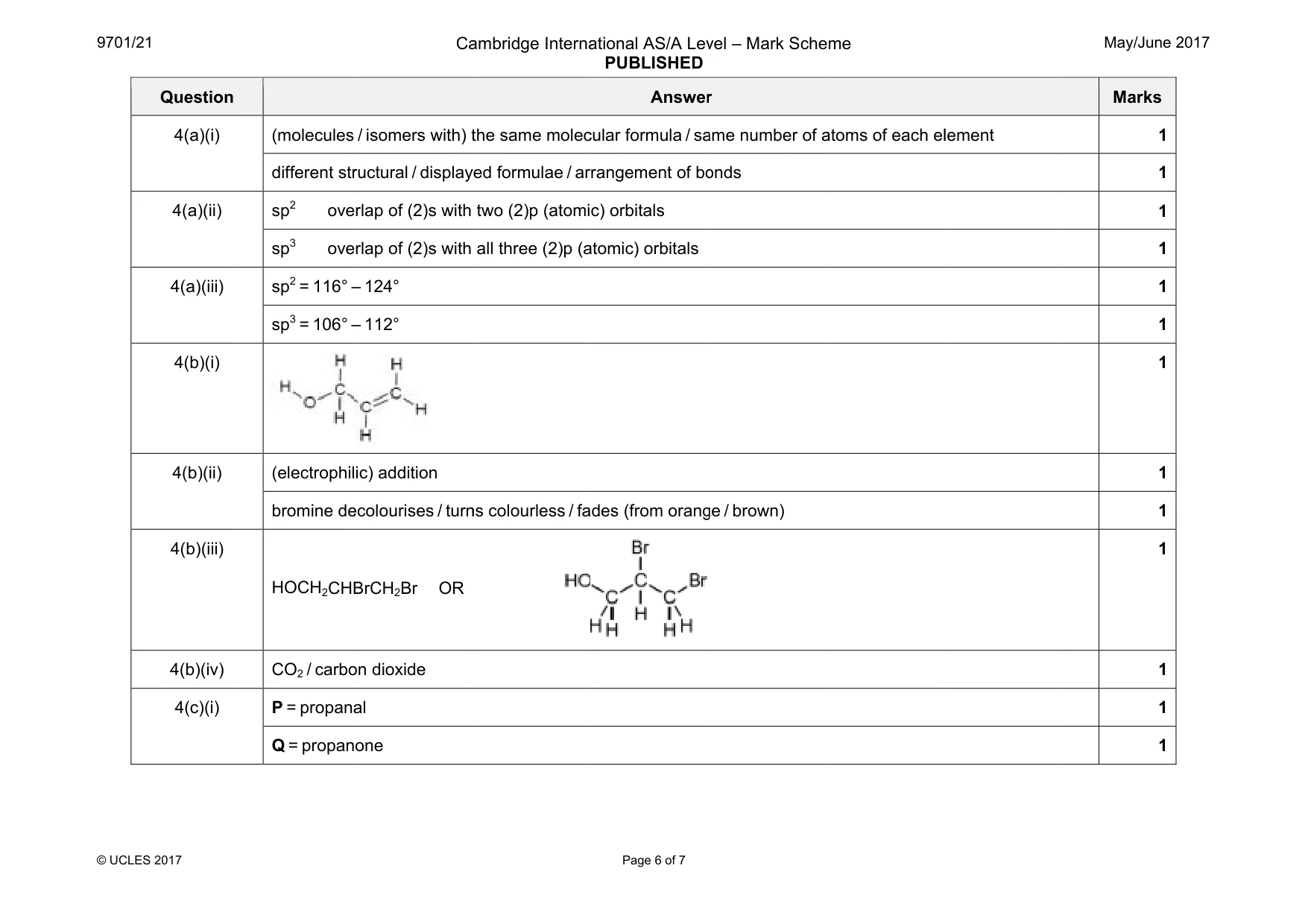
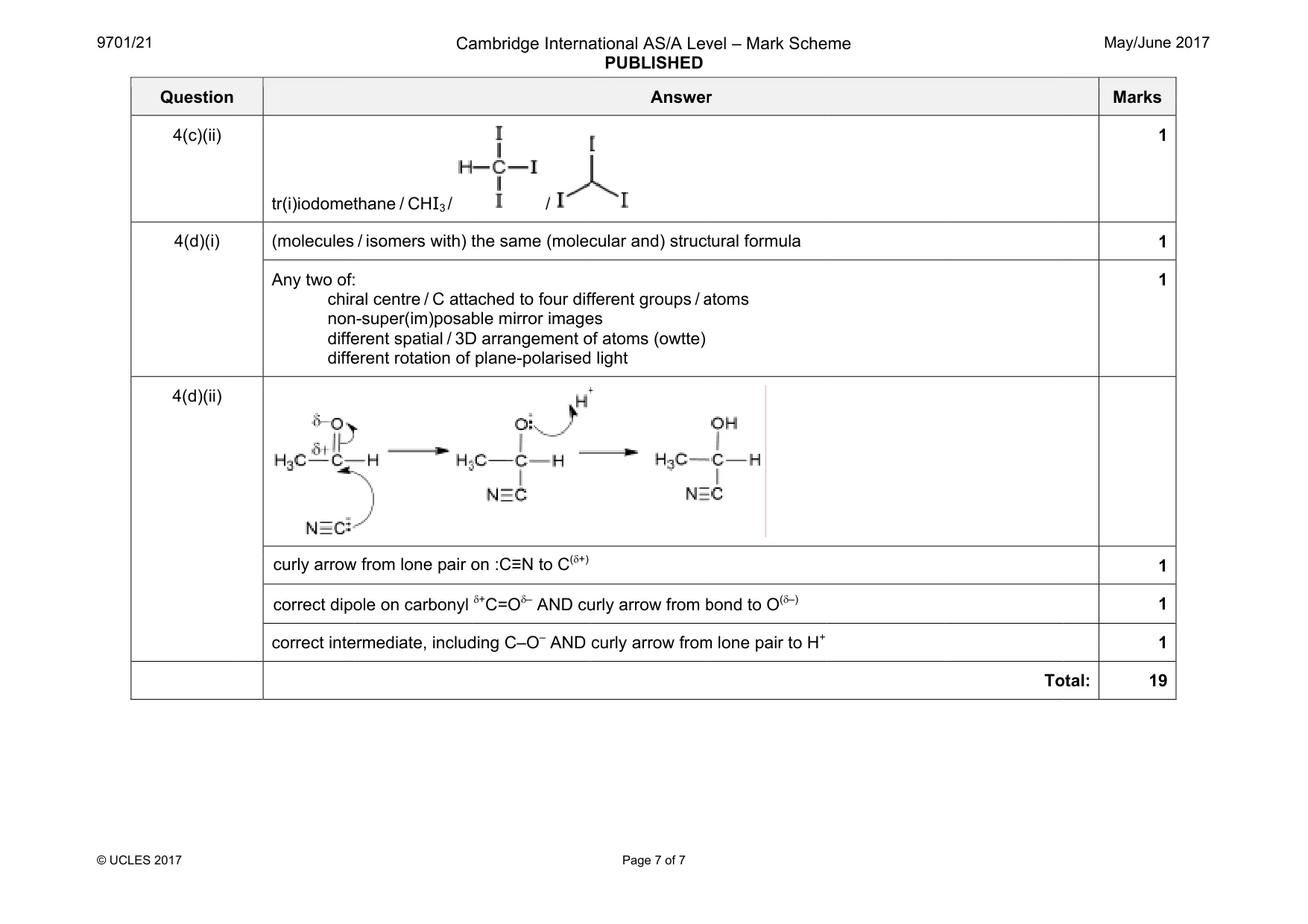
Mark scheme: 4(a)(i) 4(a)(ii) 4(a)(iii) 4(b)(i) 4(b)(ii) 4(b)(iii) 4(b)(iv) 4(c)(i) (molecules different str sp2 ove sp3 ove sp2 = 116° – sp3 = 106° – (electrophil bromine de HOCH2CHB CO2 / carbo P = propana Q = propan / isomers with) t ructural / display rlap of (2)s with rlap of (2)s with – 124° – 112° ic) addition ecolourises / turn BrCH2Br OR on dioxide al one the same molec yed formulae / ar two (2)p (atomi all three (2)p (a ns colourless / fa cular formula / sa rangement of bo c) orbitals atomic) orbitals des (from orang ame number of a onds ge / brown) atoms of each element 1 1 1 1 1 1 1 1 1 1 1 1 1 Question 4(c)(ii) 4(d)(i) 4(d)(ii) tr(i)iodomet (molecules Any two of: chir non diffe diffe curly arrow correct dipo correct inte thane / CHI3/ / isomers with) t ral centre / C atta n-super(im)posab erent spatial / 3D erent rotation of w from lone pair o ole on carbonyl ermediate, includ / the same (molec ached to four dif ble mirror image D arrangement o plane-polarised on :C≡N to C(δ+) δ+C=Oδ– AND cu ding C–O– AND Answer cular and) struct fferent groups / a es of atoms (owtte) light urly arrow from b curly arrow from r tural formula atoms bond to O(δ–) m lone pair to H+ To Marks 1 1 1 1 1 1 otal: 19
More questions on Isomerism: structural isomerism and stereoisomerism
What was in this paper
The subtopics covered by these 4 questions, and how many questions each got. Open one in a new tab to see every Cambridge question on it.
What you needed in this session
Cambridge’s own grade thresholds for 2017 May/June, Paper 2 · Variant 1. A higher threshold means an easier paper — the bar moves with how the cohort did.