Questions as text
Q1 · Magical Mirrors (MM) MM manufactures a range of mirrors using flow production 9609/21 May/June 2017
1 Magical Mirrors (MM) MM manufactures a range of mirrors using flow production. MM benefits from economies of scale. Ben and Mary, the owners of MM, changed the legal structure of the business two years ago from a partnership to a private limited company. They are the only shareholders of MM and have recently increased their investment in the company. 5 There are long lead times from MM’s suppliers so MM maintains a high buffer inventory. This ensures that production can continue if there are any problems with deliveries. However, Ben is worried about the impact of high buffer inventories on MM’s finances (see Table 1). Table 1: Key financial data as at 31 May 2017 ($m) 10 Inventory 10 Trade receivables 5 Trade payables 5 Overdraft 5 MM has two major human resource problems: MM’s labour turnover has been increasing 15 and the number of people applying for jobs at MM is decreasing. MM currently pays high salaries to managers and high hourly rates to other employees. Mary has completed a survey of all MM’s employees. The survey showed the following results. • 45% of all employees stated that they had low motivation. The percentage was higher amongst employees who work in the production process. 20 • 25% of all employees stated that the development of their skills was poor. (a) (i) Define the term ‘economies of scale’ (lines 1–2). [2] (ii) Briefly explain the term ‘buffer inventory’ (line 6). [3] (b) (i) Refer to Table 1. Calculate MM’s acid test ratio. [3] (ii) Explain one way in which MM could improve its liquidity. [3] (c) Analyse one advantage and one disadvantage to Ben and Mary of changing MM from a partnership to a private limited company. [8] (d) Discuss how MM could solve its human resource problems. [11]
30 marks
Mark scheme: Question Answer Marks 1(a)(i) Define the term ‘economies of scale (lines 1–2). 2 Knowledge Marks A correct definition 2 A partial, vague or unfocused definition 1 No creditable content 0 A correct definition will contain: • decreasing unit/average costs • as output rises Exemplar Marks Rationale As a firm produces more the average A correct definition 2 cost falls Unit costs decrease due to an Partial 1 increase in size More output leads to a fall in costs No link to decreasing 1 average/unit costs The savings a firm gets as it grows Partial idea of increase 1 bigger in output Lower costs because the firm is No creditable content 0 established 1(a)(ii) Briefly explain the term ‘buffer inventory’ (line 6). 3 Example or some other way of showing good understanding, i.e. risky to hold too much/too little, C 1 Mark link to liquidity, types of inventory (raw materials, in progress and finished) etc. An explanation of buffer, i.e. surplus, lowest amount B 1 mark etc. An explanation of inventory, i.e. stock, supplies to A 1 mark produce, etc. This is when a business keeps surplus inventory in event of a problem with supply or an increase in demand for its products. This helps prevent the business from running out of supplies which could slow down or prevent production. Ties up working capital. Can be risky if buffer levels too high. No need to link to liquidity or risk of high levels of inventory. Exemplar Marks Rationale Raw materials that are kept in event of Understanding of a problem with supply or an increase buffer and inventory in demand for its products. For and an example. 3 example MM might have a buffer stock of mirrors in case they have an increase in customers. Stock that can be used in case there Understanding of is a sudden increase in customers. buffer and inventory The business will not want too much 3 and good buffer inventory because it ties up understanding shown. money. Surplus stock to make sure the An understanding of business does not run out 2 both inventory and buffer. The inventory a form will keep to make Tautology with sure it does not run out. 1 ‘inventory’ but an idea of buffer. 1(b)(i) Refer to Table 1, Calculate MM’s acid-test ratio. 3 Marks Rationale Correct calculation of MM’s acid-test ratio (with or without 3 working) 2 Correct formula and correct calculation of CL 1 Correct formula or correct calculation of CL 0 No creditable content CA - Inventory CL 15–10 = 5+5 5 = 10 = 0.5:1 (accept 0.5, 50% and any ratio that is equivalent, i.e. 1:2) Common incorrect answers Answer Marks Rationale 15 Correct calculation of ratio based on an =1.5 2 incorrect formula (OFR) – only one 10 mistake 15 Incorrect formula and incorrect calculation = 3 1 of CL, but figures used correctly (OFR) – 5 two mistakes 1.5 0 An incorrect answer with no working 3 0 An incorrect answer with no working 1(b)(ii) Explain one way in which MM could improve its liquidity. 3 Level Knowledge and Application Marks 2b (APP) Explanation of a way to improve liquidity in context 3 1b (KK) Identification of a way to improve liquidity 2 1a (K) Knowledge of liquidity 1 0 No creditable content 0 Correct use of an incorrect answer to 1(b)(i) should be fully rewarded (own figure rule – OFR) No credit for knowledge of acid test or formula – already awarded in previous question Use of acid test ratio (0.5) and/or current ratio (1.5) may provide context if used correctly within a way to improve liquidity. Context and content is likely to come from: Way to improve liquidity (K) Possible context (APP) Increase cash (e.g. by holding MM holds $10 m of inventory – high less inventory, fixed assets buffer inventories etc.) MM is a manufacturer so probably has machines etc. to manufacture mirrors Has an overdraft so will need more than $5 m to have positive cash Increase current assets (e.g. Trade receivables (debtors) is $5 m increase trade MM is a manufacturer (secondary) so receivables/debtors) may gain other benefits from increasing debtor turnover/period Decrease current liabilities Trade payables is $5 m, same as trade (e.g. decrease trade payables, receivables – could be better to have overdraft, short term loans etc.) lower payables than receivables Long lead time may make reducing payables difficult Could reduce overdraft through same ways as increasing cash. Convert $5 m overdraft into longer term debt. 1(c) Analyse one advantage and one disadvantage to Ben and Mary of 8 changing MM from a partnership to a private limited company. Knowledge and Level Marks Analysis (4 marks) Marks Application (4 marks) Shows good Good analysis of one understanding of (or more) advantage(s) moving from a AND one (or more) partnership to a private 4 disadvantage(s) of 4 limited company changing from a partnership to a private limited company 2 Shows isolated Good analysis of one understanding of (or more) advantage(s) moving from a OR one (or more) partnership to a private 3 disadvantage(s) of 3 limited company changing from a partnership to a private limited company Shows knowledge of Limited analysis of one partnerships AND (or more) advantage(s) private limited AND one (or more) 2 2 companies disadvantage(s) of a private limited company 1 Shows knowledge of Limited analysis of one partnerships OR (or more) advantage(s) private limited OR one (or more) 1 1 companies disadvantage(s) of a private limited company Contextual: Possible advantages Possible context Gain limited liability Ben and Mary were in a partnership before and so had higher risk should MM fail that they would lose not only their investment but would be personally liable for the debts of MM Ben and Mary doubled their investment Gain continuity In case Ben or Mary die Gain separate legal identity In case the business gets sued Possible disadvantages Loss of control Ben and Mary have owned and run the business for such a long time (however they are the only shareholders so unlikely to be an issue) Cost of conversion Unlikely to be high but MM has poor liquidity – was this the cause? Preparation and availability Cost – link to liquidity of accounts Competitors will be able to access the accounts 1(d) Discuss how MM could solve its human resource problems. 11 Knowledge and Analysis and Evaluation Marks Marks Application (4 marks) (7 marks) Justified evaluation based 7 on argument(s) in context Developed evaluation based on argument(s) in 6 context An evaluative statement based on arguments in 5 context Argument about one or 3–4 more solutions to human 3–4 resource problems at MM Limited analysis of human 1–2 1–2 resource management No creditable content (0 marks) Context/content: • Training and development, survey shows this was rated poor by 25% of all employees. This is high. Therefore MM should ensure that employees have appropriate training to develop their skills and improve their morale. This may also help with opportunities for promotion. • Team working – morale is lower for employees involved in the production process and this may link to the flow production methods. Therefore team work may improve this as employees can work together and improve their sense of involvement • Fringe benefits and perks – although MM pay well, they could look at their perks and fringe benefits such as holiday periods as this may be a reason • Empowerment and participation – doing some focus groups with employees and/or creating worker representatives may enable MM to better understand the issues and therefore resolve them. Evaluation is likely to come from a candidate: Judging which methods could work best for MM and justifying this in the context for example, training and development given the survey outcomes Weighting their response, for example, why one method would be better than another is likely to lead an evaluative response. Problem Possible solutions Example of analysis Increase wages – link to Already high. Increased costs retention Use non-monetary motivation Could increase costs – may be an Increasing labour (e.g. holidays, perks, fringe alternative to higher wages. turnover benefits etc.) Increase training/skills Increased costs – could be wasted if development staff leave Better/more advertising Increased costs – what is the cause of the fall? Demographics, word of mouth etc. Decreasing Increase wages Already high. Increased costs applications Increase training/skills Could improve word of mouth – may development attract younger applicants, but increased costs Reduce wages Decrease motivation and increase labour turnover further Change payment system (i.e. May not increase costs (could fall) and High management piece rate, retention bonus may increase retention, but may and labour costs etc.) demotivate some workers Increase capital/reduce labour Needs investment - already using flow production – could reduce quality, may further reduce motivation Improve hygiene factors Are conditions poor? If so can it be Low motivation – (poorer in production) improved without increasing costs? lower in production workers Teamwork/cell production May conflict with flow production Increase training/skill Increased costs but could improve development quality and retention Poor skills Increase capital/reduce labour Needs investment – already using flow development production – could reduce quality, may further reduce motivation Increase training/skill Increased costs but could improve development quality and retention Poorly trained/skilled Increase capital/reduce labour Needs investment – already using flow workers production – could reduce quality, may further reduce motivation
This question in 9609/21 May/June 2017
Q2 · Rugged Back Packs (RBP) RBP is a manufacturing business that specialises in producing… 9609/21 Oct/Nov 2017
1 Rugged Back Packs (RBP) RBP is a manufacturing business that specialises in producing travel bags and backpacks. The products are sold by many different retailers. The brand of RBP has become well known for quality and reliability. Each retailer requires a fast response to orders for more inventory from RBP. RBP holds high levels of inventories to enable it to respond to orders from retailers within 48 hours 5 (see Fig. 1). The inventory is kept in a secure warehouse next to the factory. Fig. 1: Inventory control chart 60 50 inventory 40 level 30 (000s) 20 10 0 0 1 2 3 time (weeks) RBP employs around 100 employees in the factory. Most of the employees are skilled operators of the machinery used to make the bags. The factory manager was dismissed last month because productivity levels had fallen and the factory was not achieving RBP’s production targets. This manager had many disagreements with the employees 10 and most of the workforce is demotivated, with high levels of absenteeism and labour turnover. RBP’s factory is now managed by Maya. Maya is a very experienced manager and she was described by her previous employer as having a high level of emotional intelligence. (a) (i) Define the term ‘brand’ (line 2). [2] (ii) Briefly explain the term ‘labour turnover’ (lines 11–12). [3] (b) (i) Refer to Fig. 1. Identify the size of: • maximum inventory level • buffer inventory level • re-order quantity. [3] (ii) Explain one possible use of an inventory control chart to RBP. [3] (c) Analyse two disadvantages to RBP of holding a high level of inventory. [8] (d) Evaluate the importance to RBP of Maya having a high level of emotional intelligence. [11]
30 marks
Mark scheme: Question Answer Marks 1(a)(i) Define the term ‘brand’ (line 2). 2 Knowledge Marks A correct definition 2 A partial, vague or unfocused definition 1 No creditable content 0 A correct definition will contain: • A brand is a name, term, design or symbol • Distinguishes one seller's product from those of others/makes it unique. Exemplar Marks Rationale A brand-name differentiates a product 2 A correct definition from similar products A brand is a name/symbol/design that differentiates a product from similar 2 A correct definition products. Vague as brands could also A brand is a name/image/logo 1 differentiate products with names/images/ logos Distinguishes one product from Other factors could 1 another. also do this 1(a)(ii) Briefly explain the term ‘labour turnover’ (lines 11–12). 3 Award one mark for each point of explanation: C Percentage/proportion or formula 1 mark B per year/time period (this could be in the formula) 1 mark A Employees/workforce that leave 1 mark Content The proportion/percentage/rate of a firm's workforce/employees that leave during a certain time period. Number employees who left in a given time period × 100 Total number of employees Exemplar Marks Rationale The percentage of a firm’s workforce that Points from A, B 3 leave in a year and C Number employees who left in a year Formula covering × 100 3 Total employees all three points Number employees who left Formula missing × 100 2 Total employees the B point Number of employees that leave per year. 2 A and B points Does not refer to workforce/ percentage leaving 1 employees so a C point only Does not explain Numbers of employees that leave 1 ‘turnover’ so point from A only 1(b)(i) Refer to Fig. 1. Identify the size of: 3 • Maximum inventory level • Buffer inventory level • Re-order quantity Marks Rationale 3 Correct calculation of three figures 2 Correct identification of two figures 1 Correct identification of one figure 0 No creditable content No own figure rule applicable Answers: • Maximum inventory level 60 000 (1 mark) • Buffer inventory level 10 000 (1 mark) • Re-order quantity 50 000 (1 mark) Allow 60, 10, 50 Note: Reward if you are confident that they have identified the correct figures 1(b)(ii) Explain one possible use of an inventory control chart to RBP 3 Level Knowledge and Application Marks 2b Shows understanding of a use of an inventory 3 (APP+APP) control chart in context 2a (APP) Identification of a use of an inventory control 2 chart in context 1 (K) Identification of a use of an inventory control 1 chart 0 No creditable content 0 Correct use of an incorrect answer to 1(b)(i) should be fully rewarded (own figure rule –OFR). Note: identification of a figure ONLY would not gain any marks as marks have been awarded in the previous question – the answer must identify a USE Content Answers may include: • Can be used to make sure RBP do not run out of stock – v important as shops require quick response • Can analyse the lead time required for re-orders • Can make sure RBP do not hold too much stock Context may include: • RBP known for reliability • Retailers require a fast response • RPB holds high levels of inventory to ensure a fast response to retail orders • Respond to orders within 48 hours 1(c) Analyse two disadvantages to RBP of holding a high level of inventory Level Knowledge and Marks Analysis Marks Application (4 marks) (4 marks) Good analysis of two (or more) disadvantages of 4 4 holding a high level Shows knowledge of inventory in of holding a high context 2 level of inventory Good analysis of one in context disadvantage of 3 holding a high level 3 of inventory in context Shows knowledge Limited analysis of of inventory and/or two (or more) knowledge of 1–2 disadvantages of 2 holding a high holding a high level level of inventory of inventory 1 Limited analysis of one disadvantage of 1 holding a high level of inventory 0 No creditable content A non-contextual answer can only be awarded a maximum of 2 + 2 = 4 Limited analysis in context: Marks limited to 4 + 2 = 6 Analysis of only one disadvantage in context: Marks limited to 3 + 3 = 6 Content Answers could include: • Cost of storing the stock (i.e. warehousing, insurance etc.) • Possibility of stock becoming obsolete – new designs, materials etc. • Possibility of demand changing – colours, fashions etc. • Cash tied up inventory – opportunity cost Examples of knowledge of Examples of Examples of holding a high level application/context possible analysis of inventory RBP produces large Will increase the cost items (travel bags) High cost of holding of each bag produced and keep them in a stock and decrease the warehouse next to the profit of the business. factory ARA 1(d) Evaluate the importance to RBP of Maya having a high level of 11 emotional intelligence. Analysis and Knowledge and Marks Evaluation Marks Application (4 marks) (7 marks) A justified evaluation based on argument(s) of the importance of 7 emotional intelligence in context Developed evaluation based on argument(s) of the 6 importance of emotional intelligence in context An evaluative statement based on argument(s) of the importance of 5 emotional intelligence in context Argument (two-sided) about the importance of 4 emotional intelligence in Shows understanding of context emotional intelligence in 3–4 Argument (one-sided) context about the 3 importance of emotional intelligence in context Limited analysis of Shows knowledge of 1–2 emotional 1–2 emotional intelligence intelligence Justification can come from looking at the importance and/or importance of other qualities/leadership style required in a leader/manager or importance of training of workers/providing adequate resources 1(d) Answers could include: Emotional intelligence is the ability to recognise your own and other people's emotions, to discriminate between different feelings and identify them appropriately, and to use emotional information to guide thinking and behaviour. Importance in motivating employees, increasing productivity, reducing absenteeism and turnover. • 100 workers who will need to be motivated and led and this may require emotional intelligence, especially since the workers are skilled and therefore not easily replaced. • RBP has high levels of absenteeism and labour turnover – Maya will need to resolve the underlying issues if she is to make the factory more productive • The previous manager was sacked due to lack of productivity. If this is to be solved Maya will need to be able to motivate the workers • However, the productivity issue may not be due to a lack of emotional intelligence from the previous manager, but there may be a more important reasons, such as poor training, equipment etc... • The factory may need a more authoritarian approach to increase productivity An example of how an answer could develop and how it should be annotated. ANAN (one K APP AN EVAL sided) By Overall Maya having high Maya needs to understanding levels of emotional understand their emotions, intelligence is likely to be the emotions This could lead to Maya can make important, as it will help of the 100 better productivity changes to the her understand the issues workers so and hit the factory, which of the workforce that she that she can production may increase manages. (EVAL – tackle the targets. (ANAN) the workers statement) productivity motivation. Emotional issues. (APP) (AN) However, it depends upon intelligence why the productivity levels is ANAN (two- are low. If the main issue recognising sided) was the disagreement The workers your own between the previous may be absent and other Without better manager and the and leaving people’s conditions the workforce then it is likely The factory RBP because of emotions. workers are to be very important. has high poor working (K) unlikely to (EVAL – developed) levels of conditions in the improve their absenteeism factory. This absenteeism and However, this is unlikely to and labour issue requires turnover and be the only issue and turnover. action from therefore RBP will Maya will need more than (APP) Maya not an not have improved just emotional intelligence understanding productivity and to hit the production of their hit the targets. targets for RBP. (EVAL – emotions. (AN) (ANAN) justified)
This question in 9609/21 Oct/Nov 2017
Q3 · Nearly New (NN) NN sells second-hand computers 9609/22 Oct/Nov 2017
2 Nearly New (NN) NN sells second-hand computers. NN is owned by Nathan who is a sole trader. Nathan is a fully trained and qualified computer engineer. Nathan buys broken computers from large electrical retailers and repairs them. The repaired computers are then sold through NN’s website. Nathan uses a cost-based pricing strategy and adds 50% to the cost of the computer and the cost of repairs. Nathan currently works alone and has no employees. 5 Nathan has recently purchased, for $2000, a batch of 20 laptop computers all of which have broken screens. Nathan thinks that each will cost $50 to repair and he hopes to make a profit from selling them. One of Nathan’s biggest problems is cash flow. Nathan pays for all of his inventory in cash and he must spend time repairing the computers before he can sell them. 10 Customers expect a range of computers to choose from and expect next day delivery. This means that most of Nathan’s working capital is tied up in inventory. Sometimes Nathan is offered large batches of computers and he cannot buy them because he does not have the cash available. Nathan wants to recruit an employee to allow him to increase the production at NN. 15 He has interviewed two potential employees and he has made some notes about their suitability (see Table 2). Table 2: Nathan’s notes on the potential employees Name Katy Sahdat Current income per year $20 000 $25 000 20 Two years as a computer Ten years as a sole trader Industry experience repairer for a large electrical repairing computers retailer University degree in No formal qualifications Qualifications computer engineering 25 Age 23 55 Skills • Repairing computers • Repairing computers • Being organised • Managing employees • Communication with customers 30 (a) (i) Define the term ‘inventory’ (line 9). [2] (ii) Briefly explain the term ‘sole trader’ (line 1). [3] (b) (i) Calculate the total profit that Nathan would make if he sold the whole batch of repaired laptop computers (lines 4 to 8). [3] (ii) Explain one advantage to Nathan of using a cost-based pricing strategy. [3] (c) Analyse two methods Nathan could use to improve NN’s cash flow. [8] (d) Recommend which one of the two potential employees Nathan should select. Justify your recommendation. [11]
30 marks
Mark scheme: 2 Nearly New (NN) 2(a)(i) Define the term ‘inventory’. 2 Knowledge and Application Marks A correct definition 2 A partially correct definition 1 No creditable content 0 A correct definition will cover two of the following bullets: • Stock • Raw materials, work in progress, finished products • Used in, or the result of the production process/operations – to fulfil future demand, to sell • Current asset Note: Inventory is a syllabus term to mean the stock of a business – a definition of inventory in terms of all the assets owned by a business (i.e. to take an inventory) is not rewardable. 2(a)(ii) Briefly explain the term ‘sole trader’. 3 C One mark for each of the following (up to a maximum of two 1–2 marks): marks B • Unincorporated • Unlimited liability • No continuity • No separate legal identity • Income tax must be paid (not corporation tax) • Owns all of the profit/responsible for all the losses/takes all the risk • Shares cannot be sold • Accounts do not need to be produced/published/made available A One individual or one person (must be a clear idea of a single 1 mark person) Note: the B and C marks are dependent on gaining the A mark Exemplar Marks Rationale Owned by one person who has 3 A, B and C unlimited liability and takes of the profit for themselves. A single owner with no shareholders 3 A, B and C and accounts do not need to be published. A sole trader has unlimited liability 3 It does not matter if the A and no continuity. It is owned by one mark comes after the B and person. C marks Owned by one person with no 2 A and B shareholders A sole trader does not have any 0 No A mark – this could just shareholders as easily apply to a partnership. A business that has unlimited liability 0 No A mark – this could just with no shareholders and no as easily apply to a continuity. partnership. The person responsible for finance, 0 No understanding of one decision making etc« owner – this could be a manager 2(b)(i) Calculate the total profit that Nathan would make if he sold the whole batch 3 of repaired laptop computers. Mark Rationale 3 marks Correct calculation of the total profit (no $ required) with or without correct working 2 marks Correct calculation of total costs or correct calculation of total revenue (with working) 1 mark Correct formula or correct calculation of total variable costs (with working) 0 marks No creditable content Note: allow an answer of 1500 even if the candidate has identified it as a different figure in the answer (i.e. Total Cost = 1500 = 3 marks) Formula: Total revenue – total costs = profit Calculations: Total variable costs = 20 × £50 repair = $1000 Total costs = Purchase cost = $2000 20 × £50 repair = $1000 $3000 50% mark up = $1500 $4500 Profit = $1500 2(b)(i) Common answers Answer Marks Rationale 1500 (no working) 3 Allow the answer with or without working and $ or incorrect working $2000 + $1000 = $3000 2 Working to support that this is the total cost figure 3000 (no working) 0 A wrong answer with no working to know where the answer has come from 20 × $50 = $1000 1 Working to support the calculation of variable costs $2000 0 A wrong answer with no working to know where the answer has come from 50% of $2000 = $1000 2 One error – mark up was calculated on 20 × $50 = $1000 FC not TC OFR So profit = $0 $2000 2 A route to find total revenue but no 20 = $100 (FC per profit figure – any valid route to find TR computer) correctly without a correct calculation of profit should be awarded 2 marks as $100 + $50 (VC) = $150 long as there is working. (total cost per computer) 50% of $150 = $75 (mark up per computer) $150 + $75 = $225 (price per computer) $225 × 20 = $4500 (total selling revenue) $4500 (no working) 0 A wrong answer with no working to know where the answer has come from 2(b)(ii) Explain one advantage to Nathan of using a cost based pricing strategy. 3 Level Knowledge and Application Marks 2 (APPAPP) Explanation of an advantage of using cost 3 based pricing in context 2 (APP) Identification of an advantage of using cost 2 based pricing in context 1 (K) Identification of an advantage of using cost 1 based pricing 0 No creditable content 0 Answers could include: Examples of Examples of context Possible explanations identifications of an (APP) (APPAPP) advantage (K) Quick and simple Nathan is a computer Therefore this will save engineer and may not Nathan time. be experienced in running a business. Nathan needs to focus So Nathan can focus on on repairing computers gaining sales for the not complicated pricing business. methods. Always leads to a profit Each computer has a So any price higher total cost of $150. than this will result in a Always covers the full profit for Nathan. cost of each computer Predictable profit Nathan chose a 50% So the mark-up should margin mark-up. always equal the profit margin. So Nathan can target a certain margin that he will find acceptable. 2(c) Analyse two methods Nathan could use to improve NN’s cash flow. 8 Level Knowledge and Analysis application 2 Shows 4 Good analysis of TWO 4 understanding of methods of improving cash TWO methods of flow in context improving cash flow in context Shows 3 Good analysis of ONE 3 understanding of method of improving cash ONE method of flow in context improving cash flow in context 1 Shows knowledge of 2 Limited analysis of TWO 2 TWO methods of methods of improving cash improving cash flow flow Shows knowledge of 1 Limited analysis of ONE 1 cash flow or ONE method of improving cash method of improving flow cashflow 0 No creditable content One factor analysed in context, max 3 + 3 Note: the focus of the analysis must be on improving cashflow Answers could include: • Could use a cashflow forecast to identify when Nathan needs extra cash • Nathan could take a partner (this is contextual) • Could arrange credit facilities with suppliers– would the large electrical retailers offer him any credit? • If Nathan currently offers credit (unlikely) he could make sure his customers pay on delivery or in advance. • Nathan could take out a short term source of finance for times when he needs extra cash to purchase inventory – cost of finance, likelihood of getting finance • Take out a long term source of finance to give Nathan access to cash when he needs it – opportunity cost of using finance, cost of finance • Keep a low amount of cash tied up in inventory – unlikely to be popular as customers want next day delivery and a range of computers 2(c) Examples of Examples of application/context Examples of possible methods analysis Arrange Nathan is purchasing from large More time to pay Æ sell credit with electrical retailers who may be computers before paying suppliers likely to give him credit. for the stock Æ revenue before costs need to be Nathan is an established paid Æ less chance of customer of the large electrical negative cashflow businesses and therefore more likely to get credit. Nathan needs the time this credit would give him to repair the computers. Short term Nathan is an established Allow purchase without source of business and may get credit. needing cash Æ Will not finance worsen Nathans Nathan is a sole trader and may cashflow position Æ Less struggle to get a short term chance of negative source of finance cashflow A short term source of finance would allow Nathan to purchase Increase costs of NN Æ the computers without needing a Increase price of a ‘buffer’ of cash available – he can computer Æ May reduce add in the cost of finance to the sales Æ may reduce price of the computers (i.e. costs profits plus). 2(d) Recommend which one of the two potential employees Nathan should select. 11 Justify your recommendation. Knowledge and Marks Analysis and Evaluation Marks Application (4 marks) (7 marks) A justified recommendation for 7 Nathan on which potential employee he should select based on the given arguments for selecting Katy and Sahdat A developed recommendation for 6 Nathan on which potential employee he should select based on the given arguments for selecting Katy and Sahdat An evaluative 5 statement/recommendation based on the given arguments for selecting Katy and Sahdat Shows understanding of 4 Argument(s) based on selecting 4 selection criteria for Katy Katy and Sahdat as potential and Sahdat employees for NN Shows understanding of 3 Argument(s) based on selecting 3 selection criteria for Katy Katy or Sahdat as potential or Sahdat employees for NN Shows knowledge of 1–2 Limited analysis of Katy and 2 selection Sahdat as potential employees Limited analysis of Katy or 1 Sahdat as potential employees Note: APP, AN and ANAN about Katy should be placed in left hand margin and Sahdat in right hand margin Katy • Lower previous salary • Some experience of dealing with electrical retailers (NNs suppliers) • Degree – but is this necessary? • Younger – but is this a benefit and should Nathan make a decision based on age (legal issues?) • Relevant skills and organisation could be useful Sahdat • Higher previous salary – does this mean that he will expect more? • More experience in relevant area • No qualifications, but are they necessary? • Older, but could this be a benefit? • Will his skills of managing employees and communication be any use within NN where he will be the only employee and possibly not customer facing? 2(d) An example of how an answer could develop and how it should be annotated. K APP AN ANAN (one EVAL sided) Selection is Katy has got This may This is likely to I would the ability to some help Nathan reduce the recommend that choose experience to negotiate costs for Nathan chooses between working for a better prices Nathan of doing Sahdat because potential large and credit business, better employees electrical with his improve his productivity will for a retailer. suppliers cashflow and help Nathan to position. (K) (APP) who are the increase his sell computers large chances of quicker and this A business electrical making a profit. may help solve can select retailers. (ANAN – Katy) his major employees (AN) problem of through cashflow. (EVAL interviews, – statement) experience, skills etc. However it However More Quicker repairs (K) depends upon Sahdat has experience could increase whether Nathan more may lead to the productivity feels he can experience quicker of NN and manage Sahdat. than Katy in repairs. (AN) mean that he (EVAL – repairing can sell more developed) computers computers, but he has quicker and If he can’t then been his own gain more this productivity boss for the profit. (ANAN – boost is unlikely last 10 years. However he Sahdat) to happen and (APP) may not be Katy might be willing to the better option take If Sahdat as she may be instructions cannot take easier to from Nathan orders then manage. (EVAL about what Nathan may – justified) to do. (AN) find him difficult to manage and this may lead to conflict and lower productivity for NN. (ANAN – Sahdat) Note: only two ANANs are needed (one for Katy and one for Sahdat) to enable evaluation many candidates will attempt more analysis to give depth to their evaluation. Make sure you are only awarding analysis to the appropriate level – if a candidate has tried to cover lots of different points but only got to limited analysis (AN) each time, then this does not build an argument. Please look out for quality of analysis rather than quantity.
This question in 9609/22 Oct/Nov 2017
Q4 · Wood’s Logs (WL) WL was set up by Robert Wood 50 years ago 9609/21 May/June 2019
1 Wood’s Logs (WL) WL was set up by Robert Wood 50 years ago. It is a private limited company with all of the shares owned by the Wood family. Robert has managed the business since it began and he is well liked as the figurehead of the business. WL cuts down trees and processes them into logs. The logs are loaded onto trucks and trains for delivery to customers. All of WL’s logs are sold in industrial markets. 5 WL is a labour intensive business which has over 100 employees. Demand for logs is seasonal. WL maintains a steady rate of production but the business cannot afford to hold high levels of inventory. Table 1.1 shows a cash flow forecast for the next three months. Table 1.1: Cash flow forecast for WL Month 1 Month 2 Month 3 10 ($000) ($000) ($000) Cash Inflows Revenue 250 300 100 Total cash in 250 300 100 Cash Outflows 15 Labour 150 150 150 Inventory storage 10 5 50 Expenses 5 5 5 Total cash out 165 160 205 Opening balance 20 105 245 20 Closing balance 105 245 140 The workforce is currently demotivated. Employees receive a basic wage and a share of the profits. In the last four years, profits have been falling and the company is struggling to break even. The demand for logs is decreasing, as businesses use more recycled products. WL does not have any environmental targets and this has also reduced demand. 25 Robert is now 70 years old and wants to stop managing WL. His grandson, Brad, is keen to become the new Managing Director. Brad went to university and studied Mintzberg’s management roles. He believes that he has all the skills needed to become the next Managing Director of WL. (a) (i) Define the term ‘break even’ (line 24). [2] (ii) Explain the term ‘industrial markets’ (line 5). [3] (b) (i) Refer to Table 1.1. Calculate the new closing balance for Month 3 if the inventory storage costs for each month increase by 20%. [3] (ii) Explain one benefit for WL of holding inventory. [3] (c) Analyse two factors which may have affected the location of WL. [8] (d) Recommend which of Mintzberg’s management roles is likely to be the most important for the new Managing Director of WL. Justify your recommendation. [11]
30 marks
Mark scheme: Question Answer Marks 1(a)(i) Define the term ‘break even’ (line 24). 2 Knowledge Marks A correct definition 2 A partial, vague or unfocused definition 1 No creditable content 0 Break-even can be defined in a number of ways: • expenditure (costs) and income (revenue) are equal • the level of sales/units where there is no profit or loss • TR = TC Exemplar Marks Rationale When a business makes enough 2 Both elements covered sales/revenue/income to cover all the costs. TC = TR 2 Both elements covered Cost of sales is equal to sales 1 No understanding of total costs revenue. (CoS only covers direct costs) The business makes no profit or loss 1 No understanding of the level of sales/units The point at which a business stops No understanding of the level of making a loss and can start to make a sales/units profit Where the business has made 0 Tautological, no understanding enough sales to have broken even. 1(a)(ii) Explain the term ‘industrial markets’ (line 5). 3 Award one mark for each point of explanation: Rationale Marks C Example or some other way of showing good understanding 1 B Understanding that it is not the end user, i.e. used to produce, not to 1 end user etc. – anything to do with manufacturing and production A Understanding of business to business 1 Content When a business sells to another business, in contrast to selling to the end user. Industrial markets usually supply components for use in the production of products and services. ARA Exemplar Marks Rationale An industrial market is when a 3 A clear understanding of all three business sells components to another elements business who then sells it to another business or the end user When a business sells to another 2 An understanding of B2B and not an business who is not the end user end user but no C mark Selling business to business 1 Point A only When you sell to someone who is not 1 Point B only the end user 1(b)(i) Refer to Table 1. Calculate the new closing balance for Month 3 if the inventory 3 storage costs for each month increase by 20%. Rationale Marks Correct answer with or without correct working or $ or 000s 3 Attempt at calculating Month 3 closing balance using correct figures 2 Formula or correct calculation of Inventory storage for any one month 1 No creditable content 0 Content Month 1 Month 2 Month 3 ($000s) ($000s) ($000s) Cash Inflows Revenue 250 300 100 Total cash in 250 300 100 Cash Outflows Labour 150 150 150 Inventory storage 12 6 60 Expenses 5 5 5 Total cash out 167 161 215 Opening balance 20 103 242 Closing balance 103 242 127 Closing balance = Opening balance + Cash in – Cash out 1(b)(i) Correct answer: $127 000 (accept 127 as the ‘000 is in the column header) Exemplar Mark Rationale 127 (127,000) 3 Does not require the ‘000 of the $ sign 50 × 20% = 60; cash out for mth 2 Calculated one month, closing 3 = 215 closing balance = 124 balance is incorrect as other two months ignored 12 Or 6 OR 60 (with working) 1 Calculated at least one correct new inventory Closing balance = opening 1 Correct formula balance + cash in – cash 1(b)(ii) Explain one benefit for WL of holding inventory 3 Level Knowledge and Application Marks 2b (APP APP) Explanation of a benefit of holding inventory in context 3 2a (APP) Identification of a benefit of holding inventory in context 2 1 (K) Identification of one benefit of holding inventory 1 0 No creditable content 0 Content • To meet changing demand – seasonal demand • To meet unexpected demand – primary business, trees take time to grow – unexpected demand can only be met by holding stock • Respond to customer needs – Industrial market – importance of customer service, repeat customers etc. • To be able to maintain a steady level of production ARA Identification of a benefit Identification of a benefit in Explanation of a benefit (1 mark) context (2 marks) in context (3 marks) To meet changing demand As demand is seasonal So there is always stock ready for sale To meet unexpected As it takes time to cut down So potential sales/revenue demand trees/for them to grow /profit are not lost To have a steady rate of As it is a labour intensive To ensure their 100 production business employees have constant work 1(c) Analyse two factors which may have affected the location of WL. 8 Level Knowledge and Marks Analysis (4 marks) Marks Application (4 marks) 2b Shows understanding of 4 Good analysis of two (or 4 two (or more) factors which more) factors which may may have affected location have affected location of of WL WL 2a Shows understanding of 3 Good analysis of one factor 3 one factor which may have which may have affected affected location of WL location of WL 1b Shows knowledge of two 2 Limited analysis of two (or 2 (or more) factors which may more) location factors affect location 1a Shows knowledge of one 1 Limited analysis of one 1 factor which may affect location factor location No creditable content 0 Content • Geographic – Likely to need a relatively rural area to grow trees and process them. However, cannot be too rural as there is a need for a workforce (labour intensive). • Demographic – WL is a labour intensive business – will need to be close enough to a populated area to provide the workforce. Alternatively, may need to offer accommodation. • Legal – There are likely to be legal restrictions on how many and what type of trees can be felled. May have needed to locate in a country where the laws are more relaxed. • Political – Environmental concerns/leanings of the political party in charge (e.g. Green party) • Resources – Need to be near trees/raw materials for production • Infrastructure – Need to be near a road and rail network for deliveries. • Marketing – there may be types of wood/areas where certain trees grow which have a higher value than others. 1(c) ARA Example of a Examples of Examples of possible analysis factor (K) application/context (APP) (AN + DEV) Location/ As they need to be on/ near So they can have easy access resources woodland (AN) to reduce overheads (DEV) Infrastructure Need t be close to rail/road To ensure easy access for network deliveries (AN) to reduce delivery costs (DEV) Demographic As WL is a labour intensive Need to have a populated area business to provide workforce (AN) to meet staffing levels (DEV) 1(d) Recommend which of Mintzberg’s management roles is likely to be the most 11 important for the new Managing Director of WL. Justify your recommendation. Knowledge and Application Marks Analysis and Evaluation Marks (4 marks) (7 marks) Justified recommendation based 7 on argument in context Developed recommendation 6 based on argument in context An evaluative 5 statement/recommendation based on argument in context Shows understanding of two or 4 Two or more arguments based 4 more uses of Mintzberg’s on the importance of management role(s) in context Mintzsberg’s management role(s) in context Shows understanding of one 3 One argument based on the 3 use of Mintzberg’s management importance of Mintzsberg’s role(s) in context management role(s) in context Shows knowledge of Mintzbergs 2 Limited analysis of two or more 2 management theory AND one of Mintzberg’s management management role OR two role(s) management roles Shows knowledge of Mintzbergs 1 Limited analysis of Mintzberg’s 1 management theory OR one management theory/ one management role management role No creditable content 0 1(d) Content • Interpersonal – is related to anything a manager does which relates to relationships with staff (use examples from below) • Informational – is related to providing information • Decisional – is related to making decisions • Figurehead – Robert has been the MD for 50 years and is well liked as the figurehead. New MD will have to replace him but may be unknown. • Leader/to lead – Over 100 employees – labour intensive – important to lead well to maintain/improve efficiency • Liaison/ to liaise – Workforce is demotivated, new MD will need to liaise with them • Monitor/to monitor/receiver – Demand and profit is falling – therefore the need to monitor this to avoid any more loss is important. • Disseminator/to disseminate – Over 100 workers – need to get information to them quickly and efficiently, especially with poor motivation • Spokesperson – May need to represent the company to governments, environmentalist and the workforce • Entrepreneur – demand/profits have been falling – need to diversify, find an environmental solution. Need to take risks and bring business back into profit. • Disturbance Handler/to handle disturbances – demotivated work force, may start industrial action. Seasonal business – a poor winter may disturb both supply and demand. • Resource Allocator/to allocate resources – Inventory management I important – storage costs – also trees cannot be easily replaced, or replaced I the short term – need to efficiently manage resources. • Negotiator/to negotiate – May need to negotiate with customers (businesses) as well as the demotivated workforce. ARA An example of how an answer could develop and how it should be annotated. K APP AN DEV EVAL The new MD Robert was a A good To improve The entrepreneur role needs to be a good figurehead the morale of is the most important figurehead figurehead will have the the as without new ideas because he trust and demotivated the business will not was well loyalty of the workforce have enough demand liked for over workforce 50 years And this is the most immediate concern for Entrepreneur to diversify Which will To increase WL as demand is find new profits/ falling ways to revenue However this depends boost upon the MD being demand able to have some interpersonal skills
This question in 9609/21 May/June 2019
Q5 · Better Bicycles Ltd (BB) BB is a family-owned small business 9609/23 Oct/Nov 2019
1 Better Bicycles Ltd (BB) BB is a family-owned small business. The firm manufactures bicycles which are supplied to independent retailers. Recently, Lia, the Sales Director, has reported a 20% fall in monthly sales. She has asked the other directors for ideas to increase revenue. The Managing Director, Moneeb, has suggested that BB should open its own retail shop. Moneeb believes that BB has poor inventory management. BB currently uses buffer inventory 5 control methods. There has been a build-up of inventory that is using warehouse space that could be converted to a shop at a cost of $180 000. He estimates additional yearly costs of operating the shop of $40 000. Moneeb has provided the following information in Table 1.1. Table 1.1: Financial data for selling bicycles through BB’s proposed shop 10 Unit price Cost of sales per unit Forecast additional annual sales $300 $120 1250 units John, the Operations Manager, thinks it would be a mistake to open a shop as they have no experience in the retail sector. He thinks that sales could be increased through the 15 existing channel of distribution. John believes that the salaried staff in the sales department are not motivated to find new independent bicycle retailers, as they rely on customers who have bought from BB for many years. Lia thinks that BB should produce a new design of foldable bicycle which would be lightweight and portable. Secondary research shows that this is a growth market with 20 customers prepared to pay a premium price for a well-designed foldable bicycle. Lia estimates that an investment of $225 000 would be required but the gross profit margin is forecast at 50% with additional annual revenue of $500 000. Moneeb and Lia have been asked to present their proposals for increasing BB’s revenue to the other directors, who will then make a decision. 25 (a) (i) Define the term ‘secondary research’ (line 20). [2] (ii) Explain the ‘buffer inventory control method’ of managing inventory (lines 5–6). [3] (b) (i) Refer to Table 1.1. Calculate the forecast gross profit margin on the retail sale of bicycles. [3] (ii) Explain one function of John’s role as an operations manager. [3] (c) Analyse two methods which could be used to improve the motivation of BB’s sales staff. [8] (d) Recommend which proposal for increasing revenue the Directors of BB should choose. Justify your recommendation. [11]
30 marks
Mark scheme: Question Answer Marks 1(a)(i) Define the term ‘secondary research’ (line 20). 2 Knowledge and Application Marks A correct definition 2 A partial, vague or unfocused definition 1 No creditable content 0 Content: Existing data (1) which has already been gathered and organised for another purpose(1) No examples to be credited ARA Exemplar Mark Rationale Using existing data (1) 2 Two separate Collected for another purpose/reason (1) defined points already gathered (1) for another purpose 2 Two separate (1) defined points Gathered by another business 1 One element only Using existing data 1 One element only Second hand research/data 0 Tautological 1(a)(ii) Explain the ‘buffer inventory control method’ of managing inventory 3 (lines 5–6). Knowledge and Application Marks C * E.g. or some other way of showing good 1 understanding; variations in supply, demand and/or production B For unanticipated/unexpected/unplanned situations 1 A Excess stock/safety margin of stock kept 1 No creditable content 0 * use cannot be credited without explanation of the term (A and B) Content: Keeping safety stock, (A) extra stock that is maintained to reduce the risk of a shortfall in components (B) due to uncertainties in supply and demand. (C) Exemplar Mark Rationale a level of excess stock that is 3 A,B and C visible maintained (A) to reduce the risk of a shortfall in components (B) due to uncertainties in supply and demand (C) Safety margin of stock held (A) 3 A,B and C visible when there is uncertainty in demand, supply, or manufacturing output (B) to ensure that the firm can produce enough product for orders (C) Safety margin of stock held (A) 2 A and B only –No when there is uncertainty in demand, example or supply, or manufacturing output (B) understanding a level of extra stock that is maintained 1 A only (A) Stock you don’t need to use 0 Too vague 1(b)(i) Refer to Table 1.1. Calculate the forecast gross profit margin on the 3 retail sale of bicycles. Rationale Marks Correct answer 3 Formula and data used correctly (based on OFR) 2 Attempt (e.g. formula or identifies data) or correctly 1 calculated gross profit ($180) No creditable content 0 e.g. ( Revenue − cost of goods sold ) formula: × 100 (1 mark) Revenue $300 – $120 = $180 $180 (× 100 (2 marks) 300 = 60% (with or without working and % (3 marks) Exemplar answers Answer Mark Rationale 60 (%) 3 Correct answer 0.6 2 1 ,mistake – no × 100 (180/300)*100 2 Correct use of figures (rev-COGS)/rev × 100 1 Formula Gross profit/revenue × 100 1 Correct formula 1(b)(ii) Explain one function of John’s role as an operations manager. 3 Level Knowledge and Application Marks 2 Explanation of an Operations management 3 APP function in context 1b Explanation of a management function 2 K+K 1a Identification of a management function 1 K 0 No creditable content 0 Content • May mention one of Mintzberg’s functions of management (Figurehead, Leader, Liaison Monitor, Disseminator, Spokesperson, Entrepreneur, Disturbance Handler, Resource Allocator, Negotiator) but for context mark must refer to operations. • Operations manager functions such as producing the right amount of a good or service, at the right time, of the right quality and at the right cost to meet customer requirements. ARA Example of how responses should be marked Identification of a Explanation of a Explanation of a function (1 mark) function (+1 mark) function in context (+1 mark) Any one of Mintzbergs motivating the Such as the salaried functions e.g. leader employees sales staff Ensuring stock control To ensure adequate By regulating the / inventory levels levels for production / buffer stock efficiently not too much 1(c) Analyse two methods which could be used to improve the motivation 8 of BB’s sales staff Knowledge and Level Application Marks Analysis (4 marks) Marks (4 marks) Shows understanding Developed analysis of of two motivation two motivational 2b methods could be 4 methods that BB could 4 used for BB’s sales use to motivate its sales staff staff Shows understanding Developed analysis of of one motivation one motivational 2a method could be 3 method that BB could 3 used for BB’s sales use to motivate its sales staff staff Limited analysis of two Shows knowledge of motivational methods 1b two motivation 2 2 that BB could use to methods motivate its sales staff Limited analysis of one Shows knowledge of motivational method 1a one motivation 1 1 that BB could use to method motivate its sales staff 0 No creditable content 0 ARA May mention financial and/non-financial motivators. Content: • Salaried employees so could change to include commission payments • Set sales target with a bonus for meeting target • Offer a profit-sharing scheme • Re-train as sales staff rely on repeat custom so training in attracting new customers • Encourage participation in identifying new outlets especially if go ahead with the new design • Fringe benefits such as a company car to go and meet new customers • Provide more promotion opportunities • May refer to needs such as self-actualisation 1(c) K APP* AN DEV Targets & For the new Which would But may lead to bonus foldable bike/ provide financial mis-selling/ To find new incentives hard sales (ind) bike tactics retailers Commission Based on how Which would And force staff many bikes sold reduce the to look for new safety of a customers salary Retraining To upskill So employees And building a selling skills to would be more wider customer new bike confident base retailers approaching new customers Fringe benefits Provide But may be And reduce company cars expensive 50% gross profit to approach margins new bike retailers *For app, ‘customer’ is too vague, needs reference to ‘bike retailers’ 1(d) Recommend which proposal for increasing revenue the Directors of 11 BB should choose. Justify your recommendation. Knowledge and Analysis and Evaluation Marks Marks Application (4 marks) (7 marks) Justified recommendation 7 based on arguments in context Developed recommendation 6 based on arguments in context An evaluative statement/ recommendation based on 5 arguments in context Understanding of two Argument based on two factors in decision 4 factors of decision making in 4 making in context context Understanding of one Argument based on one factor factor in decision 3 3 of decision making in context making in context Knowledge of two limited analysis of two factors factors of decision 2 2 of decision making by firms making by firms Knowledge of one limited analysis of one factor factor of decision 1 1 of decision making by firms making by firms 1(d) Context must be explicit not just implied based on the 3 proposals – new product/market, stock management and/or motivation of sales employees Context/content: • Moneeb – Change inventory control to JIT, retail sales, improved gross profit margin, utilise spare capacity. Is the location suitable for retail? How easy to re-organise stock system? Implied criticism of stock manager. Requires investment. • Lia – new design of foldable bike/bicycle/cycle, growing niche market, premium prices could lead to higher profit. Risky as not known in that market. Will require marketing campaign – extra costs. Needs more research. Requires investment. • Allow candidates to use Johns contribution as a proposal K APP AN DEV EVAL gross 50% for More Opportunity Should choose profit the folding stock – cost of stock folding bikes margin bike already held (Re- because area of high purpose of expertise and has inventory existing stock) existing sales channels, may not Marketing B2B only – Risky as Have to have enough knowledge no have to complete capital to invest in knowledge start against new shop of from established consumer nothing companies. sales
This question in 9609/23 Oct/Nov 2019
Q6 · Flight Food (FF) FF is a large secondary sector business that supplies airlines with… 9609/23 May/June 2020
2 Flight Food (FF) FF is a large secondary sector business that supplies airlines with in-flight meals. Meals are manufactured using batch production. A different variety of meal is made each hour with a five minute changeover time between batches. FF makes use of Just in Time (JIT) to manage inventory wherever possible. Trucks arrive each hour and deliver the materials needed for production. 5 The market for airline meals is very competitive. FF uses market segmentation when deciding which meals are most likely to appeal to different airlines. FF must adapt to changes in tastes and the demands of each airline. FF is a labour intensive business. The workers are employed with short-term (six month) employment contracts. They are only offered new contracts if they meet their production 10 targets. Table 2.1 shows some production data for FF’s two work teams. Table 2.1: Worker data for FF Team A Team B Number of workers 100 50 Productivity 300 meals 240 meals 15 (per worker per day) The Board of Directors of FF is considering changing the manufacturing process to flow production. This would require purchasing Computer Aided Manufacturing (CAM) equipment and using a capital intensive production process. Production targets would no longer be used for employees because the machinery would be set at a specific production 20 rate. Sabrina, the Operations Director, has put forward the following advantages for moving to flow production: • more products made each hour • lower employment costs 25 • improved quality. Ben, the Human Resource Director, is worried about the change from a labour intensive process to a capital intensive process. (a) (i) Define the term ‘secondary sector’ (line 1). [2] (ii) Explain the term ‘market segmentation’ (line 6). [3] (b) (i) Refer to Table 2.1. Calculate the total number of meals per day produced by both teams. [2] (ii) Explain two ways in which FF may be affected by the lower productivity of employees working in Team B. [4] (c) Analyse two possible disadvantages for FF of using Just in Time (JIT) to manage inventory. [8] (d) Evaluate the possible effects on FF of a change from a labour intensive process to a capital intensive process. [11]
30 marks
Mark scheme: 2(a)(i) Define the term ‘secondary sector’ (line 1). 2 Knowledge Marks A correct definition 2 A partial, vague or unfocused definition 1 No creditable content 0 Content: Businesses that manufacture raw materials (or assemble components) into finished goods 2(a)(ii) Explain the term ‘market segmentation’ (line 6). 3 Award one mark for each point of explanation: Knowledge Marks Example or some other way of showing good 1 understanding Understanding of segmentation 1 Understanding of a market 1 Content Dividing the total population that might demand a product or service into smaller sections where people share certain characteristics. For example, a soft drinks manufacturer might segment their market by age groups. ARA 2(b)(i) Refer to Table 2.1. Calculate the total number of meals per day produced 2 by both teams. Rationale Marks Correct answer with or without correct working 2 Correct calculation of total day shift meals or total night 1 shift meals No creditable content 0 Answer = 42 000 meals 1000 workers X 30 meals = 30 000 meals (day) 500 workers X 24 meals = 12 000 meals (night) OFR 2(b)(ii) Explain two ways in which FF may be affected by the lower productivity 4 of employees working in Team B. Level Knowledge and Application Marks 2b (APP Explanation of two effects of low productivity in 4 +APP) context 2a Explanation of one effect of low productivity in 3 (APP) context 1b (K+K) Identification of two effects of low productivity 2 1a (K) Identification of one effect of low productivity 1 0 No creditable content 0 Content: • FF may have reduced revenue from having less meals to sell to airlines. • FF may have higher costs than the competition – very competitive market. • FF may not be able to afford the capital for mass production. • Low productivity may make the decision to move to mass production more appealing. • May lead to dismissing some of the 500 night-shift workers. • May lead to tougher targets for the workers. ARA 2(c) Analyse two possible disadvantages for FF of using Just in Time (JIT) to 8 manage inventory. Knowledge and Analysis (4 marks) Level Marks Marks Application (4 marks) Shows understanding Good analysis of two of just in time inventory disadvantages of Just in 2b 4 4 control in context Time inventory control in context Shows understanding Good analysis of one of inventory control in disadvantage of Just in 2a 3 3 context Time inventory control in context Shows knowledge of Limited analysis of two 1b Just in Time inventory 2 disadvantages of Just in 2 control Time inventory control Shows knowledge of Limited analysis of one 1a inventory control 1 disadvantage of Just in 1 Time inventory control 0 No creditable content Content: • Risk of running out of stock • More planning needed • Must have good relationship with supplier • No backup inventory in case of a supply chain problem • Poor quality products may lead to major disruption • No spare finished stock just in case ARA 2(d) Evaluate the possible effects on FF of a change from a labour intensive 11 process to a capital intensive process. Knowledge and Analysis and Evaluation Marks Marks Application (4 marks) (7 marks) Justified evaluation based on 7 argument in context Developed evaluation based on 6 argument in context An evaluative statement based on 5 argument in context Shows understanding of Argument based on effects on staff morale and welfare staff morale and welfare of a in context 3–4 move from a labour intensive 3–4 process to a capital intensive process Shows knowledge of Limited analysis of effect(s) on 1–2 1–2 staff morale and welfare staff morale and welfare No creditable content Content: • Staff morale is the job satisfaction, outlook, and feelings of well-being an employee has within a workplace setting. • Staff welfare is about keeping workers healthy and safe. • Some workers may be made redundant – this is likely to affect the morale of the workers still employed by FF. • A move to capital intensive may lead to a less satisfying job for the employees of FF – less variety of meals, etc. • Employees may lose the 5 minute changeover time – may have H&S implications – working longer hours, more intensive etc. • Employees may see that there is even less job security (already low with 6-month contracts). • The loss of production targets may improve staff morale because there is less pressure to produce. • The speed of production will be set by the machinery which may put workers under undue pressure, or to produce at an unrealistic rate. ARA
This question in 9609/23 May/June 2020
Q7 · Quality Furniture (QF) QF is a public limited company in country S 9609/21 Oct/Nov 2021
1 Quality Furniture (QF) QF is a public limited company in country S. It manufactures furniture for cafés. The number of cafés in country S has increased by more than 50% over the last 5 years. This has meant that QF has been able to expand and achieve internal economies of scale. However, the growth of the café market has attracted new firms supplying café furniture and increased competition for QF. 5 An extract from QF’s income statement is shown in Table 1.1. Table 1.1: Extract from QF’s income statement for 2020 $m Revenue 300 Cost of sales 120 10 Gross profit 180 Expenses 150 Although QF has been successful so far, Javid, the Managing Director, has identified two problem areas: inventory and human resources. Inventory 15 QF’s inventory includes raw materials, work in progress and finished tables and chairs. QF buys 80% of its materials from country T and there is a long delivery lead time. This means that QF holds a high level of buffer inventory which has a high value. Human resources QF’s production employees are unhappy that they have not received any benefit from the 20 company’s expansion. Profit has doubled over the past three years but employees have not received any pay increases or bonuses. The employees have all been trained by QF and have specialist skills which had ensured that customer expectations were met. However, customers are starting to complain about a fall in the quality of the furniture, which could be the result of the low morale of the employees. Some highly trained employees have left QF 25 to work for competitor firms. (a) (i) Define the term ‘buffer inventory’ (line 18). [2] (ii) Explain the term ‘internal economies of scale’ (line 3). [3] (b) (i) Calculate QF’s profit margin for 2020. [2] (ii) Explain two ways QF could increase its profit margin. [4] (c) Analyse two disadvantages to QF of holding a high level of inventory. [8] (d) Recommend how QF’s management could improve the morale of its production employees. Justify your recommendation. [11]
30 marks
Mark scheme: Question Answer Marks 1(a)(i) Define the term ‘buffer inventory’ (line 18). 2 Knowledge Marks A correct definition 2 A partial, vague or unfocused definition 1 No creditable content 0 Indicative content AO1 Knowledge and understanding The (minimum) level of stocks/components/supplies – a business aims to hold to ensure orders can be met/point at which business re-orders. A correct definition should include: • an understanding of inventory • an understanding of buffer. Exemplar Marks Rationale Minimum stock level 2 Both buffer and inventory defined Minimum level of inventory 1 Inventory not defined 1(a)(ii) Explain the term ‘internal economies of scale’ (line 3). 3 Award one mark for each point of explanation: C Example or some other way of showing good 1 mark understanding, i.e. can arise from bulk buying, technical/managerial efficiencies, etc. B Understanding of internal economies of scale, 1 mark e.g. Internal economies arise from the growth of the business A Understanding of economies of scale (when 1 mark unit/average costs fall as output rises) Indicative content AO1 Knowledge and understanding • Economies of scale occur when unit/average costs fall as output rises. • Internal economies arise from the growth of the business, e.g. technical economies. AO2 Application Application of an internal economy of scale to a business, such as: • An example of a type of internal economy of scale. • A description of an internal economy of scale that a business might benefit from. Exemplar Marks Rationale Average unit costs decrease (A) as a 3 A + B + C result of the increase in the scale of operations (B), e.g. purchasing economies (C) Reduction in costs per unit (A) as a 2 A + C (growth of result of trading on a large scale, e.g. business not bulk buying (C) mentioned, so no B mark) Fall in costs per unit (A) 1 A only 1(b)(i) Calculate QF’s profit margin for 2020. 2 Rationale Marks Correct answer with or without correct working 2 Formulae/attempt to calculate/calculation of profit 1 No creditable content 0 Content Gross profit – expenses, interest and tax = profit $180m – $150m = $30m (1) OR Profit / Revenue × 100 = profit margin (1) 30 / 300 × 100 Profit margin = 10% Accept 10 (2) Common incorrect answers Exemplar Marks Rationale 10 2 Correct answer – % not needed 60 1 Gross profit (180/300) × 100 = 60% 30 1 Correct profit figure but not profit margin Profit / Revenue × 100 1 Formula 30 / 300 × 100 1 Correct figures but calculation incomplete 1(b)(ii) Explain two ways QF could increase its profit margin. 4 Level Knowledge and Application Marks 2b (APP Explanation of two factors which would increase the 4 +APP) profit margin, in context 2a Explanation of one factor which would increase the 3 (APP) profit margin, in context 1 (K) Identification of two factors affecting the profit margin 2 1 (K) Identification of one factor affecting the profit margin 1 0 No creditable content 0 Content Increase quantity sold without a change in costs / price Increase price whilst maintaining sales Reduce costs without change in quantity sold / price Indicative content AO1 Knowledge and understanding Ways of increasing the profit margin: • to decrease costs • to increase revenue • increase/decrease price AO2 Application Application to QF, including: • QF’s costs – internal economies of scale achieved, so costs will reduce and improve profit margin/buy cheaper wood/decrease inventory holdings as high value, bulky so reduce overhead costs. • QF’s revenue – likely to increase due to 50% growth in cafes over last 5 years/may be difficult due to increased competition/could improve quality to reduce customer complaints and increase sales. • Increased price difficult in competitive market/may be able to decrease price due to lower costs leading to increased revenue. 1(b)(ii) Example of how responses should be marked. Identification of a way Application (K – 2 marks) (APP – 2 marks) Reduce cost of sales by opting for cheaper timber Increase revenue by increasing of its tables and chairs quality Increase revenue from 2020 it earned $300m; they should boost this potentially by increasing the price Decrease cost by buying raw by buying from a supplier in country materials from a cheaper supplier S rather than country T Reduce stock to decrease costs buffer inventory is high value and bulky so can reduce overhead costs ARA 1(c) Analyse two disadvantages to QF of holding a high level of inventory. 8 Level Knowledge and Marks Analysis Marks Application (4 marks) (4 marks) 2b Shows understanding 4 Good analysis of two 4 of two disadvantages of disadvantages of holding a high level of holding a high level of inventory inventory 2a Shows understanding 3 Good analysis of one 3 of one disadvantage of disadvantage of holding a high level of holding a high level of inventory inventory 1b Shows knowledge of 2 Limited analysis of two 2 two disadvantages of disadvantages of holding a high level of holding a high level of inventory inventory 1a Shows knowledge of 1 Limited analysis of one 1 one disadvantage of disadvantage of holding a high level of holding a high level of inventory inventory 0 No creditable content Indicative content Purpose of inventory within a business (raw materials, work in progress, finished products). . AO1 Knowledge and understanding Knowledge of a disadvantage of holding a high level of inventory, including: • cost • security required • waste/damage • storage space could be utilised for other purposes AO2 Application • Number of cafes increased by more than 50% over last five years. • QF has expanded. • Growth of market has attracted new firms. • Cost of sales = $120m (40% of revenue). • 80% of materials from country T, long delivery lead time. • High value, high level of buffer inventory. • QF wants to reduce costs. • Cost of storing may reduce ability to pay higher wages, so trained staff leaving. • PLC – effect on shareholder value. 1(c) AO3 Analysis Disadvantages may include: • costs – high costs of holding stock leading to lower profits affecting shareholders as dividends lower, and may lower share price affecting shareholder value • storage space – could be used elsewhere, e.g. expand manufacturing without needing new premises • security – high value, worth stealing so will require good security measures and expensive insurance • waste/damage – wood furniture, storing for a long period could dry out wood, make it susceptible to damage, e.g. leaks, also could go out of fashion and become obsolete • more management required – ensure stock rotation to avoid any component remaining in store for a long period where it may be damaged/not fit for purpose Examples of how an answer could develop and how it should be annotated. K APP AN DEV High storage opportunity extra outflow of this is a costs cost as money cash to pay for disadvantage as could be used fixed cost employees have for motivating complained employees about low pay, and employee dissatisfaction has reduced quality Capital is tied such as paying reduces working they may face up in stock for the training capital difficulties which would of new recruits paying day-to- have to be sold to replace day expenses those who and short term have left debts 1(d) Recommend how QF’s management could improve the morale of its 11 production employees. Justify your recommendation. Knowledge and Analysis and Application Evaluation Marks Marks (4 marks) (7 marks) Annotation Annotation A justified + + recommendation 7 based on a developed EVAL EVAL EVAL two-sided argument A developed + recommendation 6 based on a developed EVAL EVAL two-sided argument A basic recommendation 5 based on a developed EVAL two-sided argument Shows understanding Developed analysis of + + of more than one more than one 4 method of improving APP method of improving DEV APP DEV morale in context morale in context 3–4 Shows understanding Developed analysis of of one method of one method of 3 improving morale in APP improving morale in DEV context context Limited analysis of Shows knowledge of K + more than one at least two methods + 2 AN K method of improving AN of improving morale 1–2 morale Shows knowledge one Limited analysis of method of improving K one method of 1 AN morale improving morale No creditable content 1(d) Indicative content AO1 Knowledge and understanding Knowledge of methods to improve morale including: • financial – higher payments/bonus/change payment method/award shares in company • non-financial – team working, increase holidays, employee participation encouraged, management style (democratic/laissez-faire as highly skilled), job rotation, promotion opportunities/training AO2 Application Application of morale to QF’s production workers, may include: • low morale of employees leading to a fall in quality and a rise in customer complaints • skilled/highly trained labour leaving leading to high recruitment costs • profits doubled but employees seen no benefit • PLC so employee share ownership could work • highly trained and highly skilled, so more training unlikely to work • increase in competitors willing to attract highly skilled employees from QF AO3 Analysis Analysis of methods may include: • financial morale boosters, e.g. pay increases; employees have not received a pay increase in three years although profits at QF have doubled • non-financial morale boosters, e.g. increase in holidays – employees’ suggestion, promotion opportunities, job redesign, ask employees’ advice on reducing stocks/efficiencies, etc. AO4 Evaluation • A recommendation about how QF’s management could improve the morale of its production employees. • A judgement over the relative suitability of the chosen method(s). • Elements that the recommendation could depend upon, including costs v benefits, employee views, e.g. already highly skilled so more training unlikely to improve morale, competitors’ pay and conditions should be considered. • Weighing up of the impacts on QF/employees – employees complaining about pay and bonuses so increasing these more likely to improve morale. Ownership of shares gives a greater stake in the company, so QF’s objectives (e.g. growth, profits, quality) become the employees’ objectives/employees likely to want to improve quality and reduce customer complaints/increase profits/ensure loyalty so less likely to move to a competitor firm. 1(d) Examples of how an answer could develop and how it should be annotated. K APP AN DEV EVAL Increase can be one increase in productivity increase wages as profits pay will make will increase (wages) is have doubled them work and quality the best way over the last harder may improve to increase 3 years sales morale (eval) as the Introduce suitable for this will lead and lead to employees piece furniture to more units increased do not think rates manufacturin being profits but their pay is g as division produced quality may fair (eval – of labour can go down as justifying be used employees recommenda rush to tion), this has produce a affected the higher quality of the quantity furniture. Increased quality can increase sales and revenue to offset the increase in wages (eval – balancing costs against revenue) ARA
This question in 9609/21 Oct/Nov 2021
Q8 · Cartoon Costumes (CC) Ava is an entrepreneur 9609/22 Oct/Nov 2022
2 Cartoon Costumes (CC) Ava is an entrepreneur. After leaving school she set up CC as a private limited company and she owns 100% of the shares. CC sells ‘dressing up’ costumes (outfits) for children using ecommerce. Each costume is based on popular TV and movie characters that appeal to children. CC owns a large sewing machine which Ava uses to create the costumes. Each costume is made from 5 brightly coloured materials which CC purchases in bulk. Ava has to produce more inventory to grow the business. This can be expensive so Ava is thinking of using crowdfunding to finance this growth. CC has completed its second full year of trading. An extract from the statement of financial position is in Table 2.1. 10 Table 2.1: Extract from CC’s statement of financial position at 31 August 2022 2021 $(000) $(000) Non-current assets 8 8 Current assets 60 50 15 Current liabilities 40 45 Non-current liabilities 18 3 Reserves and equity 10 10 Until recently CC operated from Ava’s house. However, two months ago she rented a shop in a shopping centre. Ava wants to recruit a salesperson for the shop so that she can 20 concentrate on designing and making costumes. Details about the two best applicants are in Table 2.2. Ava must now decide who to employ. Table 2.2: Details about the two best applicants Liu Ahura Date of birth 12 February 2004 19 September 1975 25 Employment • 2 years working part-time in a • 10 years as an actor history small retail food shop • 10 years as manager of a large clothing shop • 5 years unemployed Highest A Levels in Business, Design University degree in Acting 30 qualifications Technology and Mathematics Personal • Good customer service skills • Highly motivated attributes • Likes working with other people • Good administrative skills • Works well on their own Career • Would like to go to university None 35 ambitions • Would like to own a business in the future (a) (i) Define the term ‘inventory’ (line 7). [2] (ii) Explain the term ‘entrepreneur’ (line 1). [3] (b) (i) Refer to Table 2.1. Calculate the change in CC’s working capital between 2021 and 2022. [3] (ii) Explain the distinction between revenue expenditure and capital expenditure for CC. [3] (c) Analyse one possible advantage and one possible disadvantage to CC of using crowdfunding to finance growth. [8] (d) Refer to Table 2.2 and other information. Recommend which person Ava should employ. Justify your recommendation. [11]
30 marks
Mark scheme: 2(a)(i) Define the term ‘inventory’ (line 7). 2 Knowledge Marks A correct definition 2 A partial, vague or unfocused definition 1 No creditable content 0 A correct definition should include the following elements: • Stock/raw materials/work in progress/finished goods/current asset • An idea of the function, e.g. to be able to produce, to be able to meet customer demand etc. Exemplar Rationale Marks The raw materials needed to Both elements 2 produce a product. The store of finished products Both elements 2 used to sell to customers Inventory is another word for One element 1 stock Inventory is stock and can be One element repeated 1 made up of raw materials, work in progress or finished products Inventory is used to grow the No elements and copied from 0 business data 2(a)(ii) Explain the term ‘entrepreneur’ (line 1). 3 Award one mark for each point of explanation: Rationale Marks Three characteristics of an entrepreneur 1 Two characteristics of an entrepreneur 1 One characteristic of an entrepreneur 1 Content Allow any reasonable characteristic of an entrepreneur, for example: • risk taking • innovative • multi-skilled • leader • resilience/able to bounce back • sets up a business • passion • self-confidence • ambition • hardworking • persuasive • aiming for profit (do not allow ‘get rich – too vague) • makes decisions • one of the factors of production (entrepreneurship) • organises the factors of production • organises/raises/provides finance • an example of an entrepreneur (do not allow Ava) Only reward each characteristic once. ARA 2(a)(ii) Answer Rationale Marks An entrepreneur is a risk- Three characteristics 3 taker (1) who tries to make a profit (1) by organising the factors of production (1). Someone who makes Three characteristics 3 decisions (1) about factors of production (1) to make a profit (1). An entrepreneur works hard Two characteristics 2 (1) and has confidence (1). Someone who organises the Only one mark for ‘organising’ 1 land that a business needs the factors of production – do (1). They also organise the not keep rewarding the same number of workers a business characteristics needs and they also organise the capital that a business may need. Entrepreneurship is one of the NAQ 0 factors of production. 2(b)(i) Refer to Table 2.1. Calculate the change in CC’s working capital 3 between 2021 and 2022. Rationale Marks Correct answer with or without correct working or $. 3 Correct calculation of both working capital figures (2021 and 2 2022). Formula or correct calculation of one working capital figure 1 (2021 or 2022). No creditable content. 0 Note: OFR only applies for a mathematical error – candidate must have attempted to calculate working capital to award OFR 2(b)(i) Content Current assets – current liabilities 2021: 50 – 45 = 5 (1) 2022: 60 – 40 = 20 (1) Increase of $15 000 (1) Answer = $15 000 (3) allow 15. Also allow 300% as a correct answer. Common incorrect answers Answer Rationale Marks 300% (no working) Correct answer based on the 3 % 15 (no working) Correct answer 3 20 Do not allow ‘random’ use of 0 5 (no working) these numbers – there must be working to show they were calculated. 2(b)(ii) Explain the distinction between revenue expenditure and capital 3 expenditure for CC. Level Knowledge and Application Marks 2 Explanation of revenue expenditure and capital 3 (APP) expenditure in context 1b Knowledge of capital and revenue expenditure. 2 (K+K) 1a Knowledge of capital or revenue expenditure. 1 (K) 0 No creditable content 0 Note: context is only required once to award APP but must be based on K of both capital and revenue expenditure. Content Capital expenditure is spending on non-current assets like property, plant and equipment. Revenue expenditure is spending on short-term expenses used in the current period or typically within one year. Contextual examples include: Capital expenditure: • Large sewing machine • Non-current assets value of $8000 Revenue expenditure: • Brightly coloured materials • Rent on new shop • Wages for the new employee ARA Example of how a response may develop and should be marked: Identification of a Explanation Possible context distinction (K+K – 2 marks) (APP – 3 marks) (K –1 mark) Revenue Capital expenditure is So, the rent on the expenditure is for for long-term non- shop is revenue short-term current assets. expenditure and the expenses. large sewing machine is capital expenditure. 2(c) Analyse one possible advantage and one possible disadvantage to CC 8 of using crowdfunding to finance growth. Knowledge and Leve Analysis Application Marks Marks l (4 marks) (4 marks) Shows Good analysis of understanding of one advantage one advantage APP and one DEV 2b and one 4 + disadvantage of 4 + disadvantage of funding to APP crowd crowd funding in finance growth in DEV context context Shows Good analysis of understanding of one advantage or one advantage or one disadvantage 2a 3 3 one disadvantage APP of crowd funding DEV of crowd funding to finance growth in context in context Shows Limited analysis knowledge of one of one advantage K AN advantage and and one 1b 2 + 2 + one disadvantage K disadvantage of AN of crowd funding crowd funding to finance growth Shows Limited analysis knowledge of one of one advantage advantage or one or one 1a 1 K 1 AN disadvantage of disadvantage of crowd funding crowd funding to finance growth 0 No creditable content Note: advantage/disadvantage must be for CC, not investors, customers, etc. 2(c) Indicative content AO1 Knowledge and understanding Knowledge of advantage may include: • A speedy/easy way to raise finance. • No upfront fees for the business. • May not need to be repaid. • May be a way of advertising the business. • Feedback from potential customers. • It is a good way to test market the product/business idea. • Ideas that may not appeal to conventional investors can often get financed more easily. Investors often become loyal customers. Knowledge of disadvantages may include: • It can include more complex issues when gaining finance. • Not all crowdfunding projects reach their goal. • Marketing/operational costs of setting up on a crowdfunding platform. • If the funding target is not reached, money is usually returned to investors. • Risk to reputation of a failed project. • The idea may be copied • The cost of giving rewards/discounts may make it unprofitable. • Difficulties of having a large number of potential investors. AO2 Application • Ava owns 100% of the shares of CC. • Ava is planning to use the crowdfunding to purchase inventory to grow. • Sales of children’s costumes (outfits). • Costumes are sold through e-commerce. • Costumes based on popular TV and movie characters (allow relevant examples). • Costumes are made from brightly coloured materials which CC buys in bulk. • CC owns a large sewing machine. • CC has completed two full years of trading (in third year). • Use of Table 2.1. • CC used to be operated from Ava’s house, now in a rented shop in a shopping centre. • CC is recruiting a salesperson. • CC is private limited company (so limited in finance options) 2(c) AO3 Analysis Analysis of the advantages may include: • Marketing benefits – potential customers may see CC’s crowdfunding campaign and choose to purchase her outfits. • A way of gaining finance without interest – lower cost OR a way of reducing the interest payable. • Can be a quick way of gaining finance – the quicker CC opens a shop the more sales. • Crowdfunding can provide CC with feedback on the business and products. • May provide more finance than CC requires now, giving more opportunities for growth in the future. • Investors are likely to become customers (and vice versa), may increase CC’s customer base. Analysis of the disadvantages may include: • Ava may lose equity in CC, may reduce her motivation and she might (eventually) lose control of the business. • Ava may have to give a dividend to the new owners, which may reduce any future profits available for reinvestment and growth in the future. • Ava may have to pay a penalty if the funding is not repaid or lose ownership of an asset (assuming loan crowd funding). • If the target amount is not reached, CC will not gain any money and have wasted time and effort on this. • Risk of competitors seeing what Ava’s plans are for CC. • Time and money required to set up the crowdfunding project – takes Ava away from design and sales. ARA 2(d) Refer to Table 2.2 and other information. Recommend which person 11 Ava should employ. Justify your recommendation. Marks Knowledge and Analysis and Application (4 Marks Evaluation marks) (7 marks) Annotation Annotation Justified evaluation 7 based on EVAL arguments in + EVAL context + EVAL Developed 6 + evaluation based on arguments in EVAL EVAL context An evaluative 5 statement based on arguments in EVAL context Shows 4 Arguments based 4 understanding of APP on two factor DEV two factors + affecting employee + affecting employee APP selection in context DEV selection in context Shows 3 Argument based 3 understanding of on one factor one factor affecting affecting employee APP DEV employee in selection in context context Knowledge of two 2 Limited analysis of 2 K AN factors affecting two factors + + employee K affecting employee AN selection selection Shows knowledge 1 Limited analysis of 1 of one factor one factor affecting K AN affecting employee employee selection selection No creditable content 0 2(d) Knowledge may include: • Selection • Selection criteria Application may include: • Details in Table 2.2 • Sells ‘dress up’ outfits for children • Based on popular TV and film characters • Shop in a shopping centre • Salesperson job. Analysis may include: Liu • Younger (18) – – may be closer to age of consumers (children dress up). • Some experience but less than Ahura – only part time probably while doing A-Levels. Food retail, still retail, but not in this industry. • A-Levels, especially in Business which may be useful. However how useful are academic qualifications to working in a shop. • Good customer service skills – useful for shop work. • Likes working with people but this is a role working on own – may not be suitable. • Likely to be short-term as she wants to go to university and own her own business. May train and then she leaves. Ahura • Older (47) – may be closer to age of customers (parents). • Far more experience and specifically in a clothing shop. Acting experience may also help in ‘dress up’ clothing sales. However, unemployment may have reduced his skills – but also may work for lower wages. • University degree, but likely to be irrelevant. • Highly motivated which is likely to be important when selling in the shop. Only person in shop so likely to need admin skills and works well on his own. All necessary in this position. • Lacks career ambitions but does this suggest no drive. Likely to stay in job, but if it does not work out, might be difficult to get dismiss. Evaluation may include: • A recommendation over which person Ava should employ, Liu or Ahura. • A judgement/evaluation over the suitability of each candidate. • Evaluation of the relative benefits/costs of each. • Elements that the evaluation/judgement might depend upon – length of job, wage of job, Ava’s personal feelings, geographical location, etc. ARA 2(d) Examples of how an answer could develop and how it should be annotated. K APP AN DEV EVAL Based on Liu has less This means which Overall, Liu experience experience that Ahura is means Ava would make than Ahura less likely to can more the better since she need quickly start employee as only worked training in making new she is likely for two how to work costumes. to be more years in a in a clothes/ independent. shop. costume shop Ahura may also struggle However, Liu has a This could Meaning because she based on more mean she Ava can has been their relevant needs less concentrate unemployed qualifications degree in training than on what she for five years Business Ahura, is best at and may and DT. especially in and have the financial increase the forgotten aspects of revenue how a shop the shop. potential of should be the shop. run. However, this depends on when Liu decides to go to university as she may only choose to work for Ava for a very short time.
This question in 9609/22 Oct/Nov 2022
Q9 · Great Desks (GD) GD is a co-operative owned by all of its employees 9609/23 May/June 2023
2 Great Desks (GD) GD is a co-operative owned by all of its employees. It manufactures desks for schools, offices and home use. The products are handmade using job production. GD uses just in time (JIT) inventory control. GD operates in a highly competitive market and uses personal selling to promote its products to wholesale and retail outlets. 5 GD’s employees accept low salaries as most of their income comes from a share of profits at the end of the year. Following five years of rapid growth in sales and profits, GD plans to open its own retail shop. This is because the number of people who work from home is predicted to grow, which will lead to higher demand for desks for home use. GD will need $2m to open the shop. 10 GD’s forecast cash flow from 2023 to 2025 is shown in Table 2.1. Table 2.1 GD’s forecast cash flow 2023 to 2025 ($m) 2023 2024 2025 Cash inflow Revenue 4.0 6.0 9.0 15 Total inflow 4.0 6.0 9.0 Cash outflow Utilities (power, water etc.) 1.5 1.5 2.0 Employee costs 0.5 0.5 0.5 Purchases 2.0 3.5 4.5 20 Marketing 3.0 5.5 5.0 Total outflows 7.0 11.0 12.0 Net cash flow (3.0) (5.0) Opening balance 9.0 6.0 Closing balance 6.0 1.0 25 GD’s employees are concerned about the management style of Steve, the Managing Director, who they say: • spends too much time trying to make people happy rather than solving problems • responds to opinions rather than setting long-term plans • fails to recognise threats to the business and does not see the need for new ideas 30 • takes decisions on the votes of employees rather than the merits of the arguments. (a) (i) Identify one advantage to a business of using job production. [1] (ii) Explain the term just in time (JIT). [3] (b) (i) Refer to Table 2.1. Calculate GD’s forecast closing balance in 2025. [3] (ii) Explain one disadvantage to GD’s employees of it being a co-operative. [3] (c) Analyse two sources of finance GD could use to open its new shop. [8] (d) Evaluate whether Steve’s management style will contribute to GD’s future success. [12]
30 marks
Mark scheme: 2(a)(i) Identify one advantage to a business of using job production. Indicative content Identification of an advantage may include: (High) quality product Can customise orders/wants. Workers involved in the entire process. Accept all valid responses. 1 Question Answer Marks 2(a)(ii) Explain the term just in time (JIT). AO1 Knowledge and understanding 1 mark AO2 Application 2 marks 2 marks Developed application of one relevant point to a business context. 1 mark Knowledge of one relevant point is used to answer the question. 1 mark Limited application of one relevant point to a business context. 0 marks No creditable response. 0 marks No creditable response. Indicative content AO1 Knowledge and understanding. Just-in-time production minimises the time, labour, and materials in a manufacturing process. It does so by only producing goods as they are needed. The desired outcome is a streamlined production system that maintains a minimal amount of on-site raw materials, minimal wait times in the production process and small batch sizes. Knowledge of JIT may include: Inventory control system/production system Buying inventory occurs when needed for production rather than using buffer stock (production). JIT conditions need to be met e.g., reliable suppliers. AO2 Application Limited application applies knowledge of JIT to An example of inventory OR an example of when it is needed. Developed application + applies knowledge of JIT to An example of inventory AND an example of when it is needed. 3 Question Answer Marks 2(a)(ii) Application can be made to GD or any other scenario/context/business. Accept all valid responses. Exemplar and annotations Mark Rationale Order raw materials when needed . For example, a manufacturer requires 1000 pieces of wood to produce a product would order when there is 1000 pieces of wood left .This could reduce waste and employees would know that there is not any spare materials so they can’t make mistakes. 3 An answer which starts with the knowledge and then applies it to a business context. Holding zero buffer inventories . Components for making desks will be ordered when GD needs them . This will reduce storage costs for GD . 3 In the context of the business, GD. Inventory would come just when needed , but the company may need expensive IT systems to manage orders . 2 Clear knowledge. Some application but not developed. Not keeping any inventory, just ordering when needed. . 1 A reasonable definition but no application. Question Answer Marks 2(b)(i) Refer to Table 2.1. Calculate GD’s forecast closing balance in 2025. Indicative content Responses may include: Formula/implied formula: closing balance = net cash flow +opening balance (1) Net cash flow = 9 – 12 (1) = –3 (1) Closing balance 2020 = –3 + 1 = –2 (3) Accept 2 in brackets in place of – sign OFR Marks Answer Rationale 3 marks Correct answer –2 or (2) Working and $ sign do not matter. Must be three to denote the three marks. 2 marks Both of the following: Correct/implied formula (net cash flow +opening balance) Correct calculation of net cash flow (-3) OR An incorrect answer with one mistake allowing OFR for final stage. OR 2 (has not included – sign) To award two marks, there must be: Two and a OR One , one and one 1 mark One of the following: Correct/implied formula (net cash flow + opening balance) Correct calculation of net cash flow (–3) To award one mark, there must be: One and two 0 marks No creditable content. To award zero marks, there must be: One 3 Question Answer Marks 2(b)(ii) Explain one disadvantage to GD’s employees of it being a co-operative. AO1 Knowledge and understanding 1 mark AO2 Application 2 marks 2 marks Developed application of one relevant point to a business context. 1 mark Knowledge of one relevant point is used to answer the question. 1 mark Limited application of one relevant point to a business context. 0 marks No creditable response. 0 marks No creditable response. Indicative content AO1 Knowledge and understanding Knowledge of a disadvantage may include: Complex decisions = uncertainty = poor performance Workers and worker directors might not have skills for decisions Management roles unclear and therefore inefficiencies can occur Unpredictable income for employees Conflict/disagreements between employees AO2 Application Limited application , applies knowledge to GD once. Developed application + applies knowledge to GD twice. Ownership by workers who may be more interested in high profits. Low wages compensated by profit share. Poor decision making by manager. Take decisions on votes not valid arguments. 3 Question Answer Marks 2(b)(ii) Accept all valid responses. Exemplar and annotations Mark Rationale They may have limited capital as need $2m to open their own retail shop , as the members (employees) accept low salaries and the investment may mean a lower share of profits for each of them. 3 A disadvantage using the context of opening a retail shop and that members accept low wages. They may face conflicts among members, as all have a vote, due to differences in opinions , interests or planning, especially regarding the plan to open their own retail shop or the management style of Steve . 3 Conflict is reasonable and two references to the case study for 2 s. Part of the income employees earn comes from profit- share. This may mean that the employees could face lower income if sales fall or costs rise. 2 As there is knowledge of a disadvantage so can go back and award the APP. They may lack secrecy as the affairs of the co- operative are open to all members and sometimes to the public, which may expose them to competition. 1 Lack of secrecy a reasonable disadvantage, but the rest is not specifically related to GD. They may have inefficient management as Steve, the Managing Director, spends too much time trying to make people happy rather than solving problems and responds to opinions rather than setting long-term plans. 0 Although there is some relevant context, there is no knowledge of a disadvantage specific to a co-op (inefficient management could be in any business structure), so no marks can be awarded. Question Answer Marks 2(c) Analyse two sources of finance GD could use to open its new shop. Level AO1 Knowledge and understanding 2 marks AO2 Application 2 marks AO3 Analysis 4 marks 2 3–4 marks Developed analysis Developed analysis that identifies connections between causes, impacts and/or consequences of two points. Developed analysis that identifies connections between causes, impacts and/or consequences of one point. 1 1–2 marks Knowledge of two relevant points is used to answer the question. Knowledge of one relevant point is used to answer the question. 1–2 marks Application of two relevant points to a business context. Application of one relevant point to a business context. 1–2 marks Limited analysis Limited analysis that identifies connections between causes, impacts and/or consequences of two points. Limited analysis that identifies connections between causes, impacts and/or consequences of one point. 0 0 marks No creditable response. 0 marks No creditable response. 0 marks No creditable response. 8 Question Answer Marks 2(c) Indicative content Knowledge of sources of finance (max 2 s), may include: AO1 Knowledge and understanding. Bank loan Open own shop so mortgage Owners’ capital Sale of unused assets Venture capital can be awarded for knowledge of any source of finance. AO2 Application Max one for application for the first source and another for application for the second source Application of knowledge of a source of finance for GD (max 2 s), including: $2m needed Retained profits not known but could make useful contribution if available Few current assets (JIT) so not suitable to convert into cash No loan payments shown so no debts Employees are the owners, low paid Cash balance reducing AO3 Analysis Limited analysis – candidate shows one link in the chain of analysis. Developed analysis candidate shows two or more links in the chain of analysis or a two-sided analysis. Analysis of sources of finance may include: Long term loan may be suitable – but would banks lend to a co-operative? Unlikely to be any unused assets – even if there were it may not be enough for such a large sum. Owners/employees/members may not agree with the plan – so may not be willing to contribute more Effect on liquidity – interest payments will increase cash outflow. and can be awarded for analysis of any source of finance. Accept all valid responses. Question Answer Marks 2(c) Exemplar and annotations AO1 Knowledge AO2 Application AO3 Analysis Exemplar of an advantage Annotations for the first source should be placed in the left-hand margin. Retained profit Employees would receive less through profit-sharing at the end of the year . This option would allow GD to use its own money without increasing its debt or giving up any ownership. However, it would also mean that the employees would receive less profit-sharing at the end of the year, which could affect their motivation and satisfaction. Exemplar of a disadvantage Annotations for the second source should be placed in the right-hand margin. Venture capital Might be attractive to an investor as have 5 years of rapid growth with a forecast of higher demand for desks . This option would not require GD to repay or pay interest on the money received but may come with some conditions or expectations from the investors . This could limit GD’s autonomy or flexibility in running the business or pursuing its social or environmental mission. It could also create a dependency on external funding, which may not be sustainable or reliable in the long term. Question Answer Marks 2(d) Evaluate whether Steve’s management style will contribute to GD’s future success. Level AO1 Knowledge and understanding 2 marks AO2 Application 2 marks AO3 Analysis 2 marks AO4 Evaluation 6 marks 3 5–6 marks Developed evaluation in context A developed judgement/conclusion is made in the business context. Developed evaluative comments which balance some key arguments in the business context. 2 2 marks Developed knowledge of relevant key term(s) and/or factor(s) is used to answer the question. 2 marks Developed application of relevant point(s) to the business context. 2 marks Developed analysis that identifies connections between causes, impacts and/or consequences. 3–4 marks Developed evaluation A developed judgement/conclusion is made. Developed evaluative comments which balance some key arguments. 12 Question Answer Marks 2(d) Level AO1 Knowledge and understanding 2 marks AO2 Application 2 marks AO3 Analysis 2 marks AO4 Evaluation 6 marks 1 1 mark Limited knowledge of relevant key term(s) and/or factor(s) is used to answer the question. 1 mark Limited application of relevant point(s) to the business context. 1 mark Limited analysis that identifies connections between causes, impacts and/or consequences. 1–2 marks Limited evaluation A judgement/ conclusion is made with limited supporting comment/ evidence. An attempt is made to balance the arguments. 0 0 marks No creditable response. 0 marks No creditable response. 0 marks No creditable response. 0 marks No creditable response. Indicative content AO1 Knowledge and understanding Knowledge of management styles (max 2 s), including: Democratic – The manager shares the decision-making power and authority with their employees. The manager encourages and facilitates collaboration and teamwork among the employees and allows them to have a say in how they work. Laissez-faire – The manager gives their employees complete freedom and autonomy to make their own decisions and manage their own work. The manager provides minimal guidance and supervision and trusts the employees to perform well. Autocratic – The manager dictates exactly what they require their subordinates to do and how they should do it. Sets targets. The manager has all the power and authority and does not tolerate any deviation or feedback from the employees. Paternalistic – The manager acts like a parent or a guardian to their employees, providing them with guidance, support, and protection. The manager has all the power and authority, but also cares about the welfare and personal development of the employees. Functions of management – Planning, organising, directing, controlling. Question Answer Marks 2(d) AO2 Application Limited application applies knowledge of management styles to GD once. Developed application + applies knowledge of management styles to GD twice. There are suggestions that Steve is too democratic/laissez faire or may be described as paternalistic as wants people to be happy. Theory Y manager Managers need to make effective decisions and be responsive, but employees don’t think that Steve makes effective decisions. Steve does not see threats to the business. Steve does not make-long term plans. Steve does not consider the merits of an argument but relies on votes of members. Rapid growth in sales and profits over the past 5 years but negative cash flow recently Evidence of planning as aim to open own retail shop. Motivated employees as Steve concerned about their welfare/demotivated as evidenced by concerns about Steve’s style. AO3 Analysis Limited analysis – candidate shows one link in the chain of analysis. Developed analysis – candidate shows two or more links in the chain of analysis. Builds good relationships – particularly as owners are the employees. Some workers may feel that the Steve has the right approach – so feel secure as a result of this; for example, they have a vote and key role in decision making. Suitable for GD’s highly skilled and motivated staff – but could lead to power struggles. There is a lack of strategy for the future of the business – so there is a risk to the security and stability of GD. If threats are not being monitored – then GD is at risk and could fail. Motivated workers – greater productivity Lack of long-term planning – less potential for future growth Plans to open retail shop – evidence of planning. Question Answer Marks 2(d) AO4 Evaluation Limited evaluation – unsupported judgement and/or a weak attempt at evaluative comment Developed evaluation – supported judgement and/or reasonable evaluative comment Developed evaluation in context - supported judgement in context and/or reasonable evaluative comment in context. An evaluation is likely to come from candidates making a judgment and justification on the effectiveness of Steve’s management style e.g. It may be suggested that the Steve need to be more ‘hands on’ and autocratic, due to the change from batch production to mass customisation. Is this suitable for a co-operative? It may result in conflict which reduces productivity, output and sales. Any changes that might need to be made to make it more effective. Suitability of management styles for a co-operative In relation to the change in production process Judgement on most likely effects on success Accept all valid responses. Question Answer Marks 2(d) Exemplar and annotations Steve’s management style seems to be a democratic one , which is a type of participative management style . This means that he values the input and opinions of his employees and tries to involve them in decision-making and problem-solving. He also tends to be flexible, adaptable, and responsive to feedback which might suit a co-operative organisation . Some of the advantages of this management style are that it can increase employee engagement, motivation, creativity, and satisfaction . It can also foster a positive work culture, where employees feel respected and valued . It can also lead to better decisions, as more perspectives and ideas are considered . However, some of the disadvantages of this management style are that it can be time-consuming, inefficient, and confusing . It can also create conflicts among employees, or between employees and managers. It can also make it difficult to implement changes or deal with crises, as there may be too much debate or uncertainty . It can also undermine the authority and credibility of the manager, if they appear indecisive, weak, or dependent on others . Therefore, Steve’s management style may not contribute to GD’s future success, unless he can balance it with other styles when needed. For example, he may need to adopt a more authoritative or persuasive style when he needs to set clear goals, communicate expectations, or motivate employees to achieve results . He may also need to adopt a more transformational or visionary style when he needs to inspire employees with a shared vision, foster innovation, or cope with change. He may also need to adopt a more coaching style when he needs to develop the skills and potential of his employees. In conclusion, Steve’s management style has its strengths and weaknesses, but it may not be enough to ensure GD’s future success. He should be able to adapt his style according to the situation, the goals, and the people involved . AO1 – 2 marks AO2 – 2 marks AO3 – 2 marks AO4 – 6 marks TOTAL – 12 marks
This question in 9609/23 May/June 2023
Q10 · Zoe’s Bags (ZB) Zoe’s Bags (ZB) is an online retailer that makes and sells a range of… 9609/22 Feb/March 2024
1 Zoe’s Bags (ZB) Zoe’s Bags (ZB) is an online retailer that makes and sells a range of luxury hand-made bags. The business was set up three years ago as a partnership by Zoe and her brother Luis and has grown each year. The bags are targeted at a niche market and made to customers’ orders. The business works closely with its main supplier of raw materials. ZB operates a just in time (JIT) inventory 5 management system. All bags have a lead time of five days from when the customer submits the order. Following a magazine advertising promotion in January, orders grew by 50% in February to 1400 bags. Zoe and Luis found it difficult to organise the larger production team. A break-even chart for February is shown in Fig. 1.1. 10 70 000 60 000 50 000 40 000 Costs / Revenue ($) 30 000 20 000 10 000 0 0 100 200 300 400 500 600 700 800 900 1000 1100 1200 1300 1400 1500 Units produced Total costs Fixed costs Sales revenue Fig. 1.1 ZB’s break-even chart for February Due to the increase in orders, Zoe and Luis want to focus on developing the business. They recruited 2 supervisors to manage the 15 production employees. To support the new supervisors, Luis organised some off-the-job training. All production employees are currently paid a salary. However, ZB’s labour turnover has 15 increased recently. One of the new supervisors has recommended that ZB should introduce performance-related pay. Zoe and Luis are currently considering this recommendation. (a) (i) Identify one feature of JIT inventory management. [1] (ii) Explain the term niche market. [3] (b) (i) Refer to Fig. 1.1 and other information. Calculate the margin of safety in February. [3] (ii) Explain one way that Zoe and Luis can use break-even analysis. [3] (c) Analyse two benefits to ZB of providing off-the-job training to the new supervisors. [8] (d) Evaluate whether ZB should introduce performance-related pay. [12]
30 marks
Mark scheme: Question Answer Marks 1(a)(i) Identify one feature of JIT inventory management 1 Indicative content Responses may include: • Low/no inventory levels • Stock ordered according to production/customer demand • Reduced storage costs • Reduced risk of stock being stolen/damaged/becoming obsolete/wastage • Reduced insurance cost / decreased insurance risk • No/smaller warehouse required • Good relationship with suppliers Do not allow better customer relationship Managing inventory is a tautology Accept all valid responses. 1(a)(ii) Explain the term niche market 3 AO1 Knowledge and understanding AO2 Application 1 mark 2 marks 2 marks Developed application of one relevant point to a business context. 1 mark 1 mark Knowledge of one relevant point is used to answer the Limited application of one relevant point to a business question. context. 0 marks 0 marks No creditable response. No creditable response. Responses may include: AO1 Knowledge and understanding A niche market is a (small) section/part/subset of the market. No further marks can be gained without knowledge and understanding AO2 Application A characteristic of a niche market (or niche marketing), such as: • High quality/reputation • USP/clear focus/differentiated • High profit (margin) • Loyal customers • Low economies of scale/high production costs • High risk/often single product/’all eggs in one basket’ • May be more vulnerable to change than a mass market • Easier for small business to enter the market (e.g. lower marketing costs) Example of a niche market (not a business that targets a niche market) Do not allow specialised/customised as APP Accept all valid responses. 1(b)(i) Refer to Fig. 1.1 and other information. Calculate the margin of safety in February. 3 Answer Guidance Formula to find margin of safety = actual output - break- Award 3 marks for correct answer of 400 (with or without even output (1) workings) Read the break-even output correctly from break-even Award 2 marks for correct answer 400 with dollar sign, e.g. chart = 1000 units (1) $400 as the margin of safety is not a financial value OR 1400 – 1000 (2) OFR Answer = 400 (units) or 40% (3) 1(b)(i) Exemplar and annotations Marks 3 marks Correct answer Working does not matter. 400 units or 400 or 40% Must be three to denote the three marks. 2 marks One of the following: To award two marks, there must be • Correct presentation of numbers (1400 – • Two and a 1000), but no correct answer OR • Correct answer with incorrect units (i.e. $400 • One , one and one or 400%) OR An incorrect answer with one mistake allowing OFR for final stage. 1 mark One of the following: To award one mark, there must be: • Correct formula • One and two • Correct identification of the break-even point (1000) 0 marks No creditable content. To award zero marks, there must be • One 1(b)(ii) Explain one way that Zoe and Luis can use break-even analysis. 3 AO1 Knowledge and understanding AO2 Application 1 mark 2 marks 2 marks Developed application of one relevant point to a business context. 1 mark 1 mark Knowledge of one relevant point is used to answer the Limited application of one relevant point to a business question. context. 0 marks 0 marks No creditable response. No creditable response. Knowledge Knowledge of a way to use break-even analysis 1 mark Explanation Explanation of a way Luis could use break-even analysis 1 mark Context Context linked to a way Luis could use break-even analysis 1 mark No marks can be awarded without knowledge. Responses may include: AO1 Knowledge and understanding • To support decision making (i.e. pricing decisions, costing decisions) • To calculate useful data (i.e. break-even level of output, margin of safety, profit/loss levels at levels of output) Do not allow calculations that are needed to produce break even analysis (i.e. VC, FC, TR) • To consider ‘what if’ scenarios, • To forecast costs/pricing No further marks can be gained without knowledge and understanding 1(b)(ii) AO2 Application Explanation may include: • To support decision making; for example Luis could use the break-even data to decide on an appropriate marketing mix • To calculate useful data; such as the level of output at which ZB will stop making a loss. • To consider ‘what if’ scenarios; for example the impact of changing factors of production • To forecast costs/pricing when the level of output changes Context may include: • Margin of safety of 400 (OFR based on answer to Q1(b)(i) • Break-even level of output of 1000 (OFR based on answer to Q1(b)(i) • Allow any correct identifications/calculations of the data in Fig 1.1 (i.e. FC = $25 000, VC per unit = $15, TR/P per unit = $40 – Note: some calculations depend upon the output) • Business set up three years ago / in 2021 • Business has grown each year • Bags are made to order • ZB uses JIT • Lead time is five days • 50% growth in sales in February due to magazine advertising promotion. • Larger production team (due to sales growth) • Two supervisors recruited • 15 production employees • Supervisors given off-the-job training • Production employees paid a salary (fixed, direct cost) • Increased labour turnover recently • Recommendation to introduce performance-related pay • Luxury hand-made bags Accept all valid responses. 1(c) Analyse two benefits to ZB of providing off-the-job training to the new supervisors. 8 Level AO1 Knowledge and AO2 Application AO3 Analysis understanding 2 marks 4 marks 2 marks 2 3–4 marks Developed analysis • Developed analysis that identifies connections between causes, impacts and/or consequences of two points. • Developed analysis that identifies connections between causes, impacts and/or consequences of one point. 1 1–2 marks 1–2 marks 1–2 marks • Knowledge of two • Application of two Limited analysis relevant points is relevant points to a • Limited analysis that identifies connections between used to answer the business context. causes, impacts and/or consequences of two points. question. • Application of one • Limited analysis that identifies connections between • Knowledge of one relevant point to a causes, impacts and/or consequences of one point. relevant point is business context. used to answer the question. 0 0 marks 0 marks 0 marks No creditable response. No creditable response. No creditable response. Off-the-job training is training that takes place away from their place of work. Examples of off-the-job training include a college/university course, distance learning (mark only given if no other marks awarded). 1(c) Responses may include: AO1 Knowledge and understanding Benefits of off-the-job training include: • Specialist/expert training / higher quality • Fewer interruptions / better concentration • Change of environment • Can lead to recognised qualifications • Less production interruptions / does not impact quality / can be done outside work hours • Can be safer / less risk/ allows practice/mistakes Knowledge of a benefit must be specific to off-the-job training AO2 Application • Sells products online / online retailer • Luxury hand-made bags • Made to customer’s order • 15 employees • ZB works closely with its main supplier of raw materials • Operates a JIT inventory management system • ZB set up three years ago • ZB operates as a partnership • Growing demand following magazine advertising promotion in January • Labour turnover increasing AO3 Analysis • Specialist/expert/quality training; less waste in the business – higher profit. • Fewer interruptions / better concentration; supervisors may need less time to be trained, reducing costs – leading to higher profit. • Specialist equipment can be used; which may not be available in the business, so makes supervisors more productive – increased production and revenue. • Change of environment; may motivate workers making them more productive – increased products to sell and revenue. • Valuing employees; makes employees more loyal and less likely to leave the business – reducing recruitment costs. 1(c) • Can lead to recognised qualifications; which may motivate employees to work harder and be more productive – increases revenue. • Fewer production interruptions / does not impact quality; more products produced – decreases average costs. • Can be safer / less risk; less wastage, so lower costs – increased profit. Accept all valid responses. 1(d) Evaluate whether ZB should introduce performance-related pay. 12 Level AO1 Knowledge and AO2 Application AO3 Analysis AO4 Evaluation understanding 2 marks 2 marks 6 marks 2 marks 3 5–6 marks Developed evaluation in context • A developed judgement/conclusion is made in the business context. • Developed evaluative comments which balance some key arguments in the business context. 2 2 marks 2 marks 2 marks 3–4 marks Developed knowledge Developed application Developed analysis Developed evaluation of relevant key term(s) of relevant point(s) to that identifies • A developed and/or factor(s) is used the business context. connections between judgement/conclusion is to answer the question. causes, impacts and/or made. consequences. • Developed evaluative comments which balance some key arguments. 1 1 mark 1 mark 1 mark 1–2 marks Limited knowledge Limited application Limited analysis Limited evaluation of relevant key term(s) of relevant point(s) to that identifies • A judgement/conclusion is and/or factor(s) is used the business context. connections between made with limited to answer the question. causes, impacts and/or supporting consequences. comment/evidence. • An attempt is made to balance the arguments. 0 0 marks 0 marks 0 marks 0 marks No creditable response. No creditable response. No creditable response. No creditable response. 1(d) Responses may include: AO1 Knowledge and understanding Knowledge of performance related pay and/or salary, including; • Performance-related pay; is where the amount of payment is linked – to the employee’s meeting targets/quality/ability • Do not reward ‘performance’ • Salary; a salary is a fixed payment (usually paid monthly) irrespective of number of hours worked and/or productivity One payment system can gain both AO1 marks, if developed knowledge is shown. AO2 Application • Sells products online / online retailer • Luxury hand-made bags • Made to customer’s order • 15 employees • Operates a JIT inventory management system • ZB set up three years ago • ZB operates as a partnership • Growing demand following magazine advertising promotion in January • Orders increased by 50% • Labour turnover increasing • Five-day lead time • Workers currently paid a salary AO3 Analysis Analysis for performance related pay, including; • Performance-related pay offers employees an incentive to work harder – increased productivity . • Performance-related pay offers the employees the opportunity to potentially earn more money than when they were paid a salary. This could reduce labour turnover – decreases costs. • Money as a method of motivation and increased productivity – lower costs. • Challenge of setting fair performance objectives / fair review of performance for all employees, increases productivity – increases sales. • Performance-related pay may encourage some employees to work faster/harder and quicker dispatch of orders may become a source of competitive advantage – increased market share. 1(d) Analysis against performance related pay, including; • Money not motivating all employees so may increases costs – and lead to lower profit • Time/administration involved with managing/operating a performance-related pay system increases costs – reduces profit. • Employees may focus on producing a higher quantity under a performance-related pay system, which could have a negative impact on quality - which could affect future sales/brand image. • The change to performance-related pay may lead to less pay stability for employees and could increase labour turnover further – increasing costs. Allow analysis for and against a maintaining salary, including; • Salary payments offer stability for employees as they know how much they will receive each month which may reduce labour turnover – reducing costs. • Salary payments offer no incentive for employees to increase production – no growth. AO4 Evaluation • A judgement whether ZB should introduce performance related pay, and/or a judgement that ZB should maintain its system of paying a salary. • What the introduction of performance related pay may depend upon, such as; whether employees are motivated by pay, the local labour market and the employee’s reaction to the idea • Whether the benefits of the increased employee effort/motivation outweigh the costs of introducing the system? • What payment systems do other local businesses offer – will ZB continue to lose experienced employees if unhappy about the change? • What impact will the change have on product quality – will this affect future sales/brand image? • Will employees receive a basic payment alongside the performance-related element to provide stability? Accept all valid responses.
This question in 9609/22 Feb/March 2024
Q11 · Samira’s Whiteboards (SW) Samira left school at the age of 18 in country H 9609/21 May/June 2024
1 Samira’s Whiteboards (SW) Samira left school at the age of 18 in country H. She had a small amount of savings and an idea to create a flexible, removable and reusable whiteboard. Samira created a prototype and received small orders from local retailers. A local manufacturer batch produces stock when required. There is a two-week lead time for a minimum order of 500 units. Samira started to sell her whiteboards on her website and 5 at trade shows. She has been trading for seven months. She has good cashflow but little working capital as production costs are high. Samira has heard that OS, a large business that sells office equipment, is planning to sell their own version of Samira’s whiteboard. She is keen to increase production quickly to take advantage of being first to market. However, Samira’s manufacturer cannot supply enough 10 product to meet the growth in potential demand for whiteboards. Fig. 1.1 shows an inventory control chart for the first seven months of trade. 800 700 600 500 400 300 Reorder level 200 100 Minimum stock level 0 Jan Feb Mar Apr May Jun July Fig. 1.1 SW Inventory control chart 2023 Lara, a venture capitalist with experience of manufacturing, has approached Samira about making an investment. She would invest $100 000 to build a local mass production facility 15 for SW. The facility would have a maximum output of 50 000 units per month. Lara wants to own 40% of the business. (a) (i) Identify one traditional function of a manager. [1] (ii) Explain the term working capital. [3] (b) (i) Refer to Fig. 1.1. Calculate the total number of whiteboards sold between January and July. [3] (ii) Explain one cost for SW of holding inventory. [3] (c) Analyse two barriers to entrepreneurship that Samira may have faced when starting up SW. [8] (d) Evaluate whether Samira should accept Lara's offer to invest venture capital. [12]
30 marks
Mark scheme: 1(a)(i) Identify one traditional function of a manager. Indicative content Responses may include: Planning/setting objectives Organising – coordinating activities Directing – supervising and motivating employees, commanding, leading the business/team Controlling – measuring performance against targets Do not reward tautological answers e.g. manage employees/resources Do not reward vague answers, e.g. making decisions Accept all valid responses. 1 Question Answer Marks 1(a)(ii) Explain the term ‘working capital’. AO1 Knowledge and understanding 1 mark AO2 Application 2 marks 2 marks Developed application of one relevant point to a business context. 1 mark Knowledge of one relevant point is used to answer the question. 1 mark Limited application of one relevant point to a business context. 0 marks No creditable response. 0 marks No creditable response. Indicative content Responses may include: AO1 Knowledge and understanding Finance used in day-to-day / trading operations / to enable the business to produce its goods or services / to operate Current assets – current liabilities AO2 Application Explanation of working capital APP can be awarded for a second AO1 point To pay for the running costs – bills/expenses such as staff wages Finance trade credit periods offered to customers Reference to short-term (less than 12 months) Sufficient working capital is needed to ensure that the business has enough liquid assets/avoid liquidity problems Application to a context applied to SW to explain the term working capital Examples of current assets, e.g. stock, inventory, debtors; or examples of current liabilities, e.g. bank overdraft, short- term loans, creditors Examples of expenses/costs, e.g. staff wages 3 Question Answer Marks 1(a)(ii) Application can be made to SW or any other scenario/context/business/person. Allow application to working capital. Accept all valid responses. Guidance in awarding marks Knowledge & understanding Knowledge of working capital 1 mark Explanation Explanation of working capital 1 mark Context Applied to a business context/ business environment 1 mark 1(b)(i) Refer to Fig. 1.1. Calculate the total number of whiteboards sold between January and July. Indicative content 1 mark for the formula for the total number of units sold (words or figures) 1 mark for calculating the maximum stock level and the minimum stock level 1 mark for calculating the total number of whiteboards sold (OFR) Total number sold = maximum stock level – minimum stock level per month Maximum stock level = 800 + 600 + 700 + 500 2600 units Minimum stock level = 100 + 200 + 0 + 400 700 units Answer = 1900 units (3) 3 Question Answer Marks 1(b)(i) Marks 3 marks Correct answer 1900 (units) allow 1900 Working and units do not matter. Must be three to denote the three marks. 2 marks Both of the following: Correct calculation of the maximum stock level AND Correct calculation of the minimum stock level OR Identifying the number of whiteboards sold in each time period OR An incorrect answer with one mistake allowing OFR for final stage. To award two marks, there must be Two and a OR One , one and one 1 mark One of the following: Correct formula for number of units sold (figures or words) OR Correct calculation of the maximum stock level OR Correct calculation of the minimum stock level To award one mark, there must be: One and two 0 marks No creditable content. To award zero marks, there must be One Question Answer Marks 1(b)(ii) Explain one cost for SW of holding inventory. AO1 Knowledge and understanding 1 mark AO2 Application 2 marks 2 marks Developed application of one relevant point to a business context. 1 mark Knowledge of one relevant point is used to answer the question. 1 mark Limited application of one relevant point to a business context. 0 marks No creditable response. 0 marks No creditable response. Indicative content AO1 Knowledge and understanding Knowledge of an appropriate cost of holding a high level of inventory: opportunity cost, storage costs, risk of wastage and obsolescence Costs involved with storing the inventory before it is sold AO2 Application Explanation of a cost of holding inventory A specific cost of holding a high level of inventory, e.g. increased insurance costs to insure the inventory, security, insuring the inventory, rent of warehouse, salaries/wages of warehouse employees Other uses for the space used to store the inventory, e.g. additional production, retail space 3 Question Answer Marks 1(b)(ii) Context applied to SW of a cost of holding inventory Having 500 units in stock means less working capital to spend on marketing at trade shows Potential to have 800 units of stock if sales are poor means potential additional cost of storage space Technology changes so the whiteboards are obsolete before they are sold Quoting data from Fig. 1.1 (SW inventory control chart 2023) Developing mass production facility that will increase output Application must be made to SW and cannot be generic Accept all valid responses. Guidance in awarding marks Knowledge & understanding Knowledge of a cost of holding inventory 1 mark Explanation Explanation of a cost of holding inventory 1 mark Context Applied to a business context/business environment 1 mark Question Answer Marks 1(c) Analyse two barriers to entrepreneurship that Samira may have faced when starting up SW. Level AO1 Knowledge and understanding 2 marks AO2 Application 2 marks AO3 Analysis 4 marks 2 3–4 marks Developed analysis Developed analysis that identifies connections between causes, impacts and/or consequences of two points. Developed analysis that identifies connections between causes, impacts and/or consequences of one point. 1 1–2 marks Knowledge of two relevant points is used to answer the question. Knowledge of one relevant point is used to answer the question. 1–2 marks Application of two relevant points to a business context. Application of one relevant point to a business context. 1–2 marks Limited analysis Limited analysis that identifies connections between causes, impacts and/or consequences of two points. Limited analysis that identifies connections between causes, impacts and/or consequences of one point. 0 0 marks No creditable response. 0 marks No creditable response. 0 marks No creditable response. 8 Question Answer Marks 1(c) Indicative content AO1 Knowledge and understanding Knowledge of barriers to entrepreneurship (max 2 marks – annotate first barrier on left and second barrier on right) including: Lack of business opportunity/lack of differentiation Knowledge of the market Ability to obtain sufficient capital/finance Cost of good locations Lack of connections/network/guidance and advice Competition Lack of a customer base/marketing Entrepreneur’s skills and qualities/inexperience of running a business AO2 Application Context applied to a barrier to entrepreneurship (max 2 marks), including: Samira had a small amount of savings First to market Link to own website, trade shows and small independent retailers Link to specific competition, such as other office stationary suppliers Link to a lack of working capital due to high production costs Lack of a customer base / poor marketing as only 400 sales in May. Question Answer Marks 1(c) AO3 Analysis Limited analysis – candidate shows one link in the chain of analysis. Developed analysis candidate shows two or more links in the chain of analysis or a two-sided analysis. Impacts may include: Poor marketing/knowledge of marketing; low working capital and/or low turnover – may limit the marketing opportunities which in turn may affect the ability to attract new custom and increase purchasing opportunities of scale Lack of technical knowledge in developing the website may make the buying process difficult which may in turn reduce the number of purchasers The cost of premium stands at trade shows may reduce working capital as high initial investment costs may mean she has a poor location which may reduce footfall and sales A small customer base of 400 sales in May could lead to small profits which could in turn mean that banks are reluctant to invest if she asks for a bank loan. A 2-week lead time means SW could run out of inventory, especially if she has many trade shows scheduled which could decrease the amount of sales and therefore profit. Accept all valid responses. Question Answer Marks 1(d) Evaluate whether Samira should accept Lara's offer to invest venture capital. Level AO1 Knowledge and understanding 2 marks AO2 Application 2 marks AO3 Analysis 2 marks AO4 Evaluation 6 marks 3 5–6 marks Developed evaluation in context A developed judgement/conclusion is made in the business context. Developed evaluative comments which balance some key arguments in the business context. 2 2 marks Developed knowledge of relevant key term(s) and/or factor(s) is used to answer the question. 2 marks Developed application of relevant point(s) to the business context. 2 marks Developed analysis that identifies connections between causes, impacts and/or consequences. 3–4 marks Developed evaluation A developed judgement/conclusion is made. Developed evaluative comments which balance some key arguments. 1 1 mark Limited knowledge of relevant key term(s) and/or factor(s) is used to answer the question. 1 mark Limited application of relevant point(s) to the business context. 1 mark Limited analysis that identifies connections between causes, impacts and/or consequences. 1–2 marks Limited evaluation A judgement/conclusion is made with limited supporting comment/evidence. An attempt is made to balance the arguments. 0 0 marks No creditable response. 0 marks No creditable response. 0 marks No creditable response. 0 marks No creditable response. 12 Question Answer Marks 1(d) Indicative content Responses may include: AO1 Knowledge and understanding Knowledge of the features of accepting the venture capital offer (max 2 marks), including: Venture capitalist will invest equity finance in the business/own a share of the business Long-term source of finance Venture capitalist can offer guidance/advice The impact of venture capital on a business ability to grow The relationship between sources of finance and business decisions/growth The need to choose the correct source of finance for the short and long term business aims/growth potential The impact of funding decisions on stakeholders and their reactions AO2 Application Context applied to features of accepting the venture capital offer (max 2 marks), including: Little working capital Two-week lead time for a minimum order of 500 units. Own website, trade shows and independent retailers She has been trading for seven months. She has good cashflow but little working capital as production costs are high. $100 000 VC investment into a mass production facility A 40% share of the business Question Answer Marks 1(d) AO3 Analysis Limited analysis – candidate shows one link in the chain of analysis. Developed analysis – candidate shows two or more links in the chain of analysis. Advantages of venture capital to SW may include: SW will have an experienced partner to find solutions to potential problems which may be cheaper than hiring external business consultants, lowering variable costs and increasing efficiency SW will have a fixed asset that will be able to accommodate the OS order if the product is successful, which may lower the unit cost and increase future profits Disadvantages of venture capital to SW may include: Reduce net profits in the short term and reduces ownership stake, lead to a reduction in dividend/financial returns The mass production facility will need to be built, which will take time; May lose first mover advantage Contribution of the venture capitalists to decision making AO4 Evaluation Limited evaluation – unsupported judgement and/or a weak attempt at evaluative comment Developed evaluation – supported judgement and/or reasonable evaluative comment Developed evaluation in context – supported judgement in context and/or reasonable evaluative comment in context. A judgement about whether Samira should accept Lara’s offer to invest What the judgement might depend upon; the timeframe that SW must satisfy their order, Samira’s appetite for financial risk, the likelihood of the product being successful in the long term, Weighing up the arguments for organic growth vs. investment Accept all valid responses. Question Answer Marks 1(d) Exemplars for awarding evaluation L1 (limited supporting evidence) L2 (developed supporting evidence) L3 (developed supporting evidence with context) Samira should accept Lara’s offer Samira should accept Lara’s offer because it means she will have more capital Samira should accept Lara’s offer because it means she will have more capital to build the local mass production facility No investing venture capital is a bad idea No investing venture capital is a bad idea because Samira will no longer have sole responsibility for decisions No investing venture capital is a bad idea because Samira will no longer have sole responsibility for decisions such as whether to continue to sell the whiteboards on her website In the short-term accepting the venture capital will be unwise. In the short-term accepting the venture capital will be unwise as Samira will give up part of the ownership of the business. In the short-term accepting the venture capital will be unwise as Samira will give up 40% of the ownership of the business.
This question in 9609/21 May/June 2024
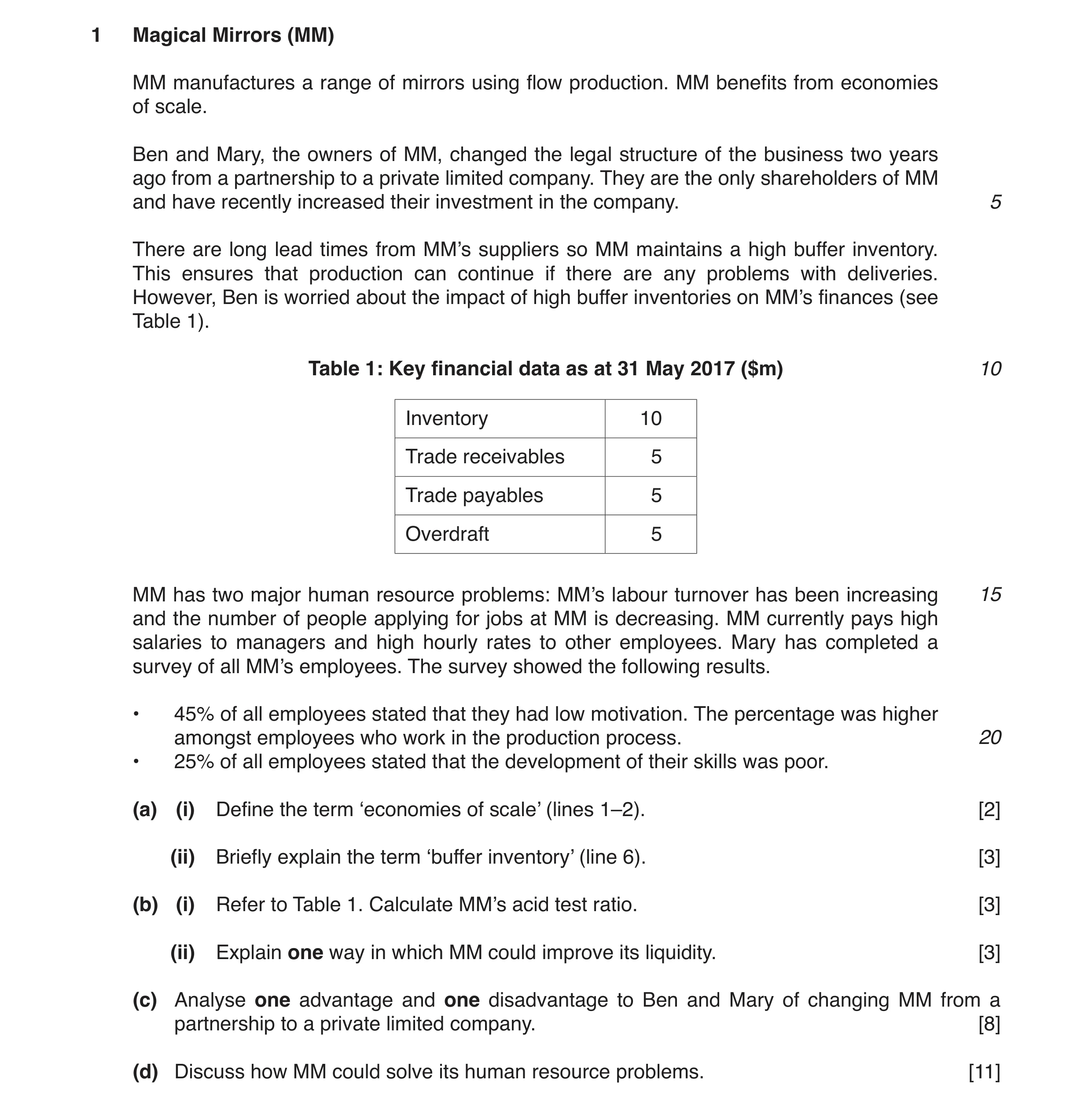 1 / 13
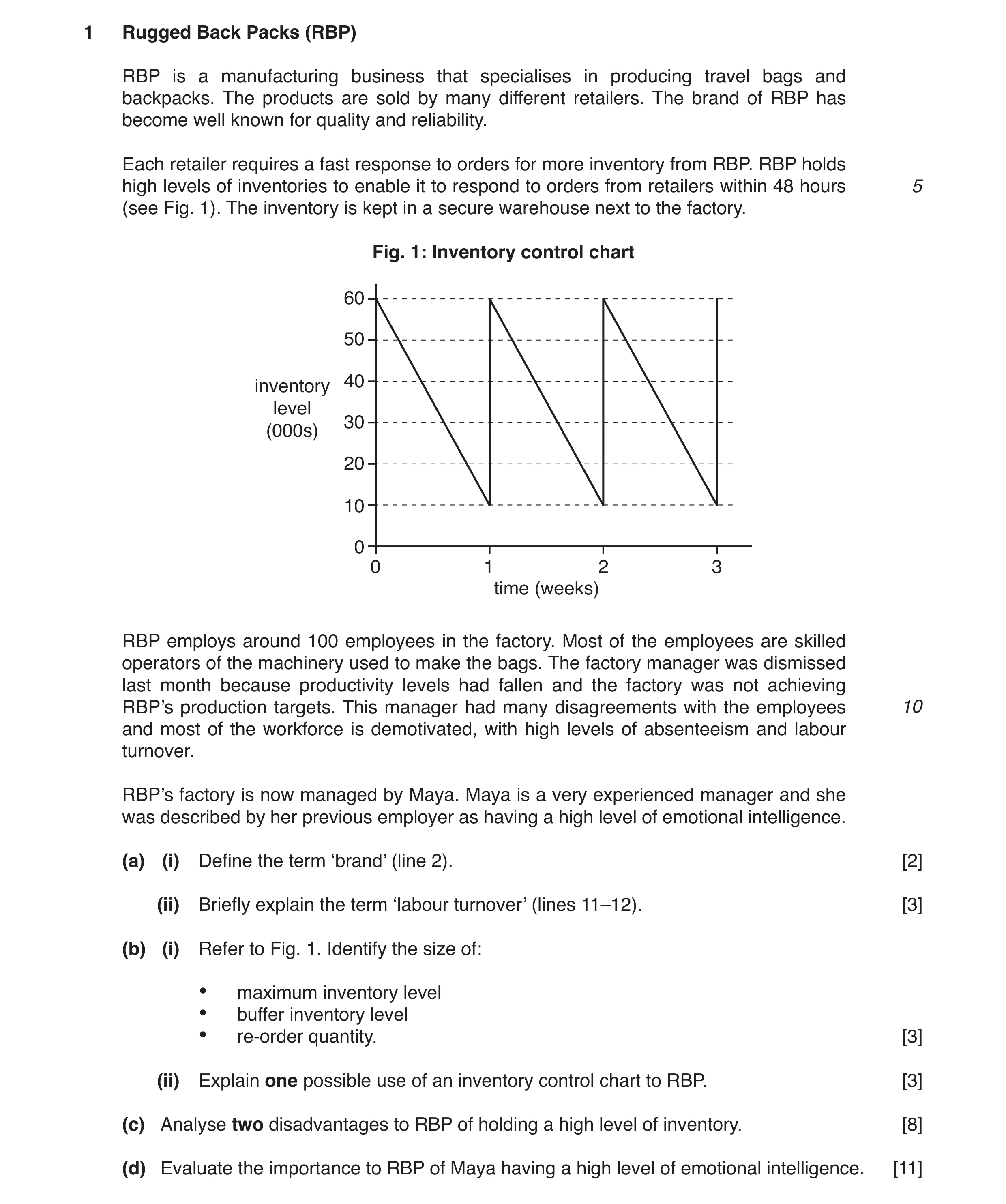 2 / 13
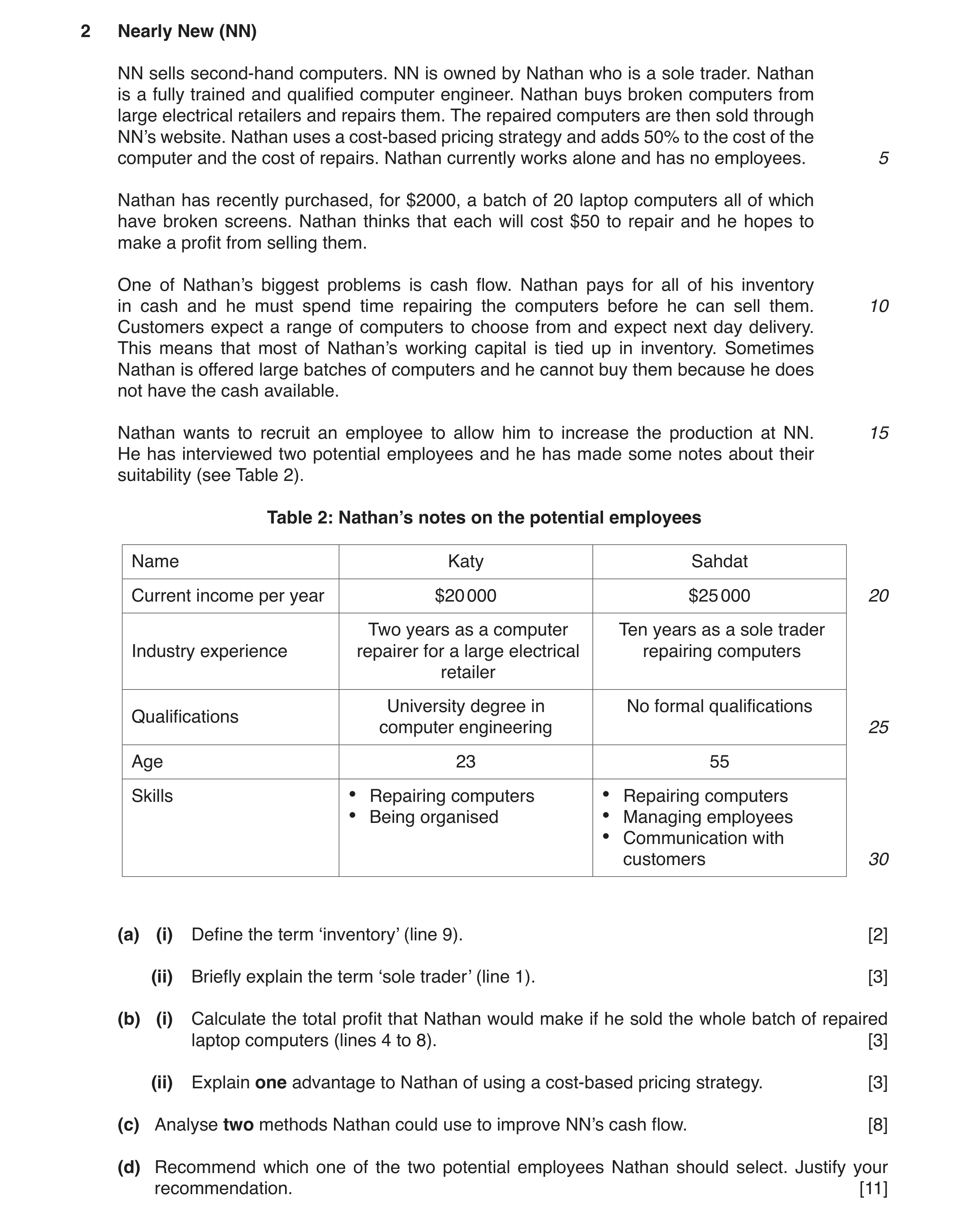 3 / 13
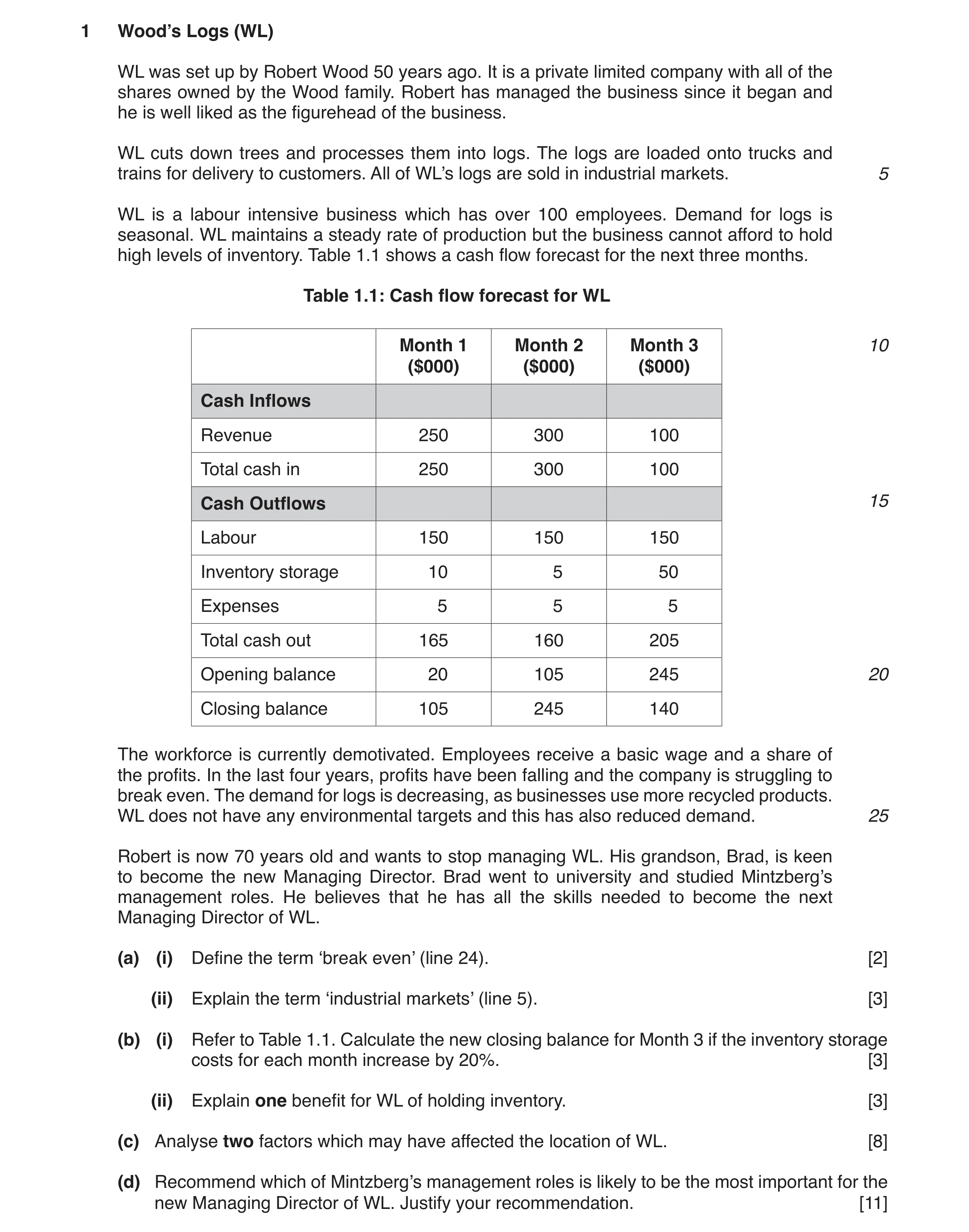 4 / 13
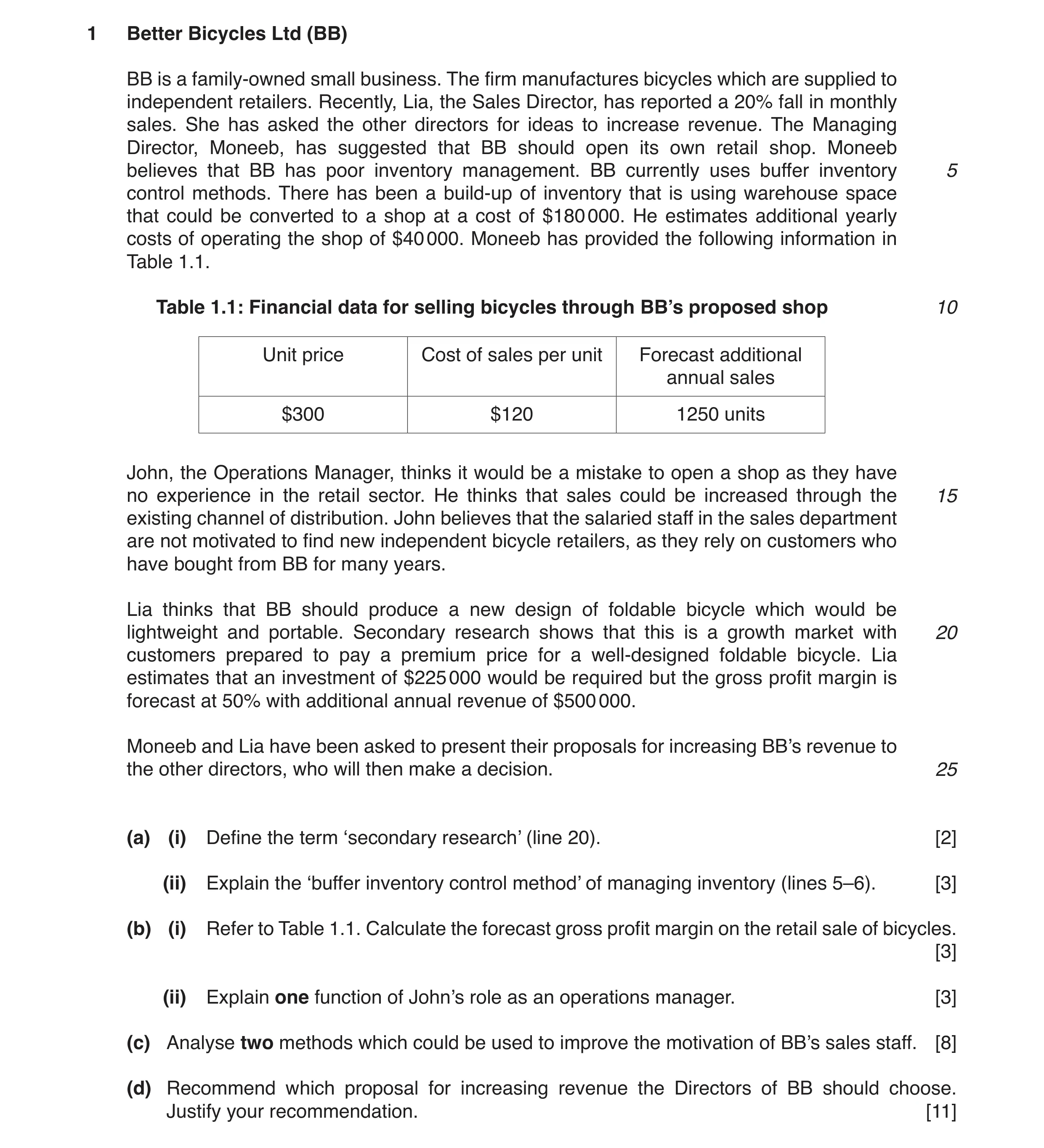 5 / 13
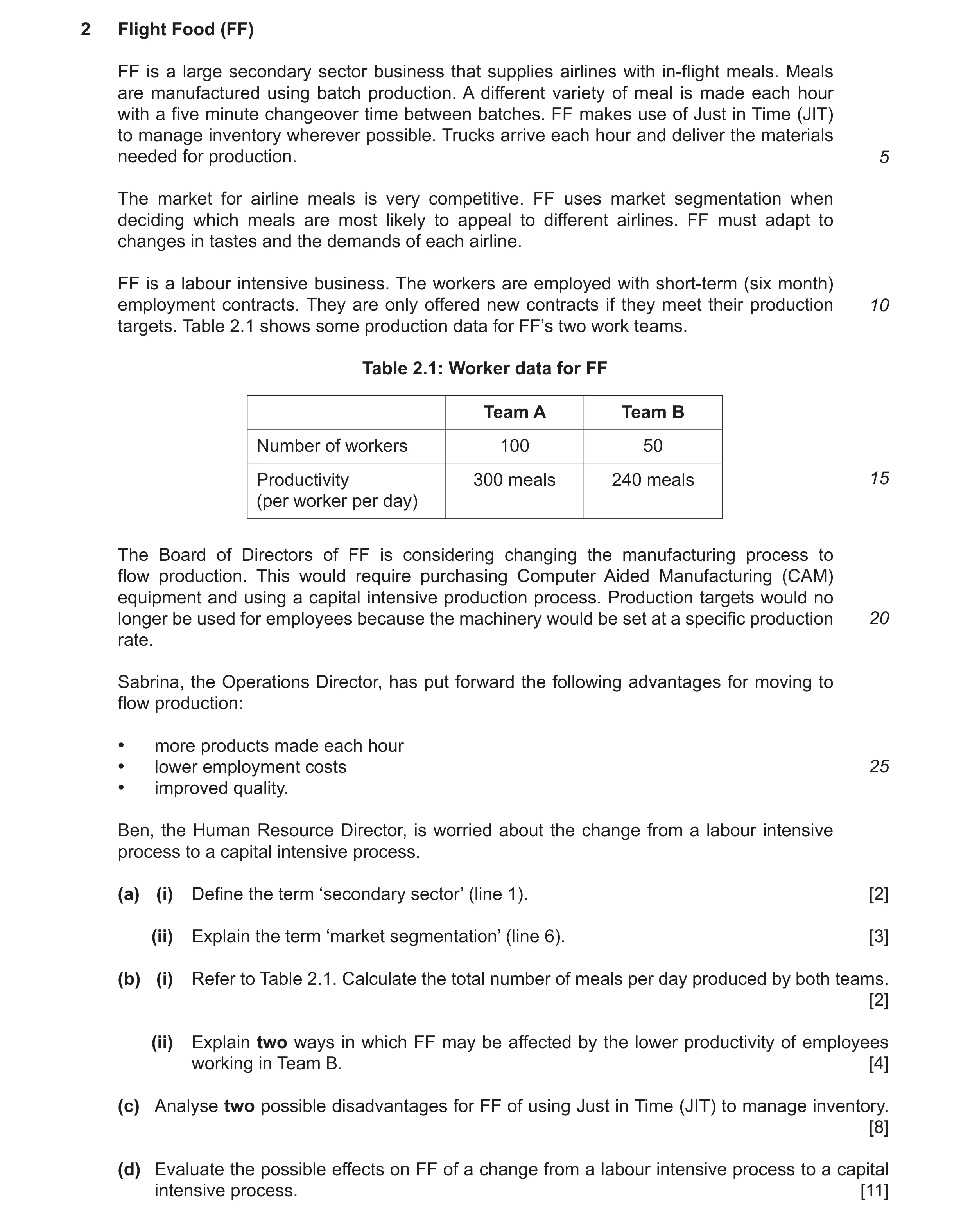 6 / 13
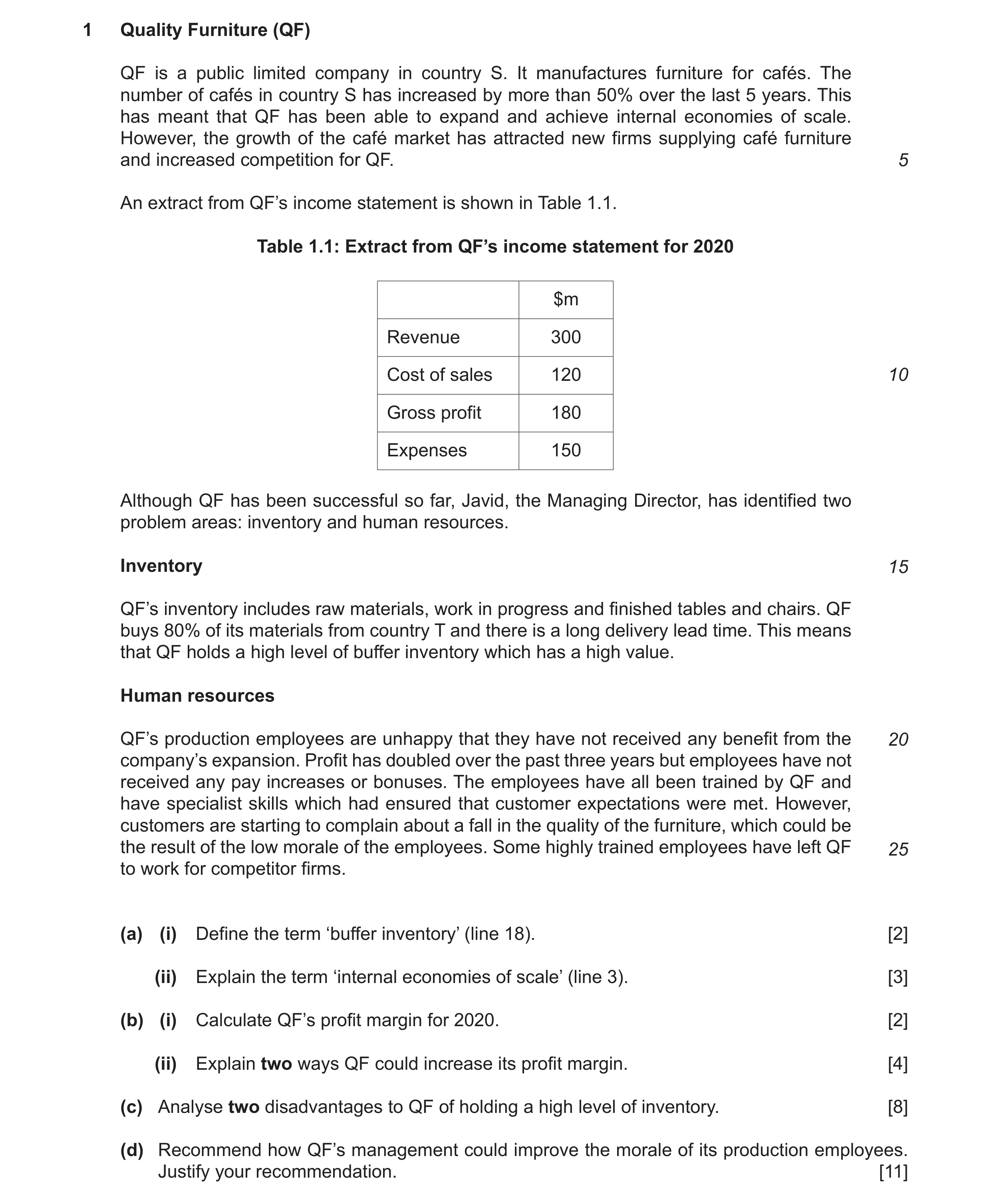 7 / 13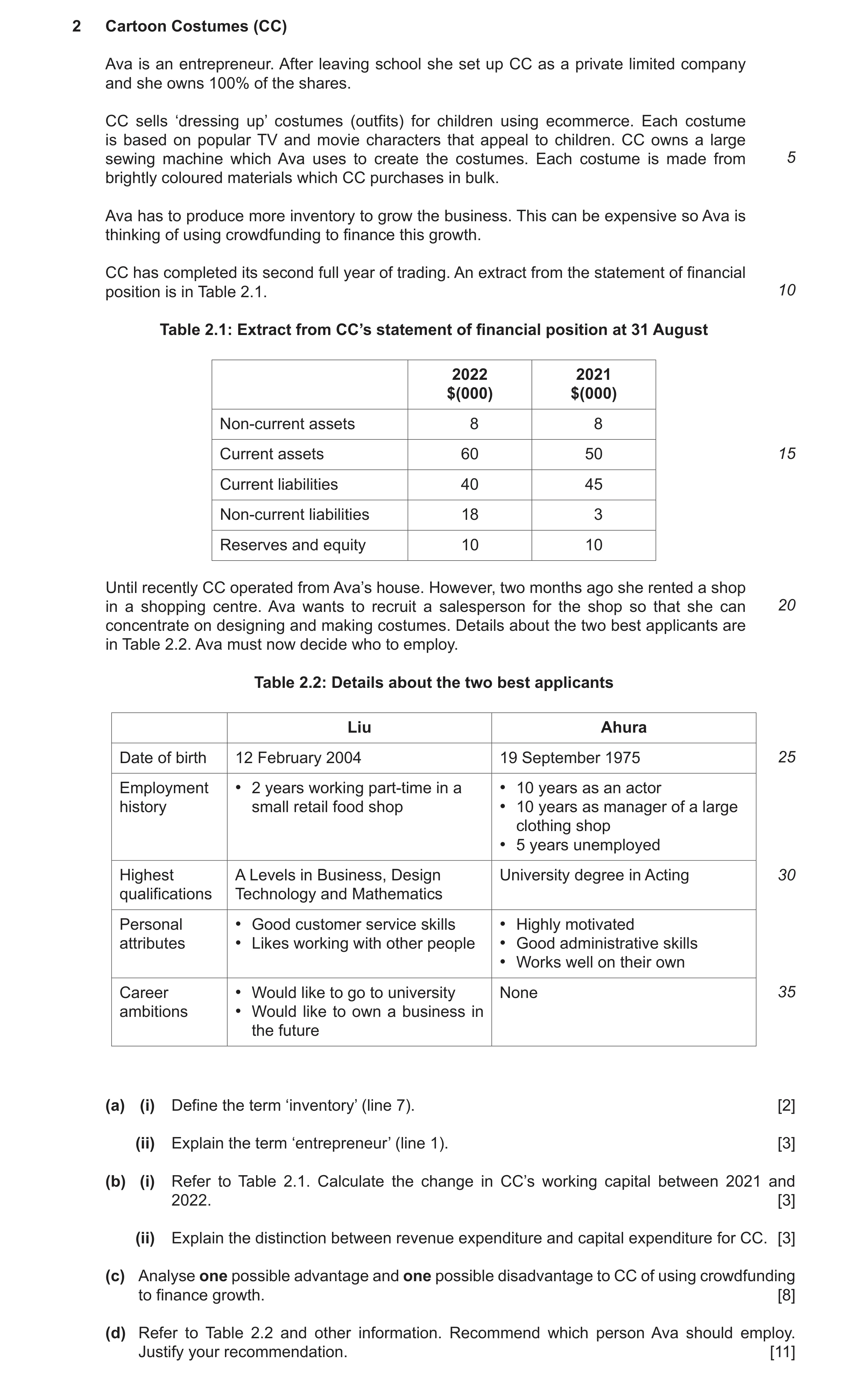
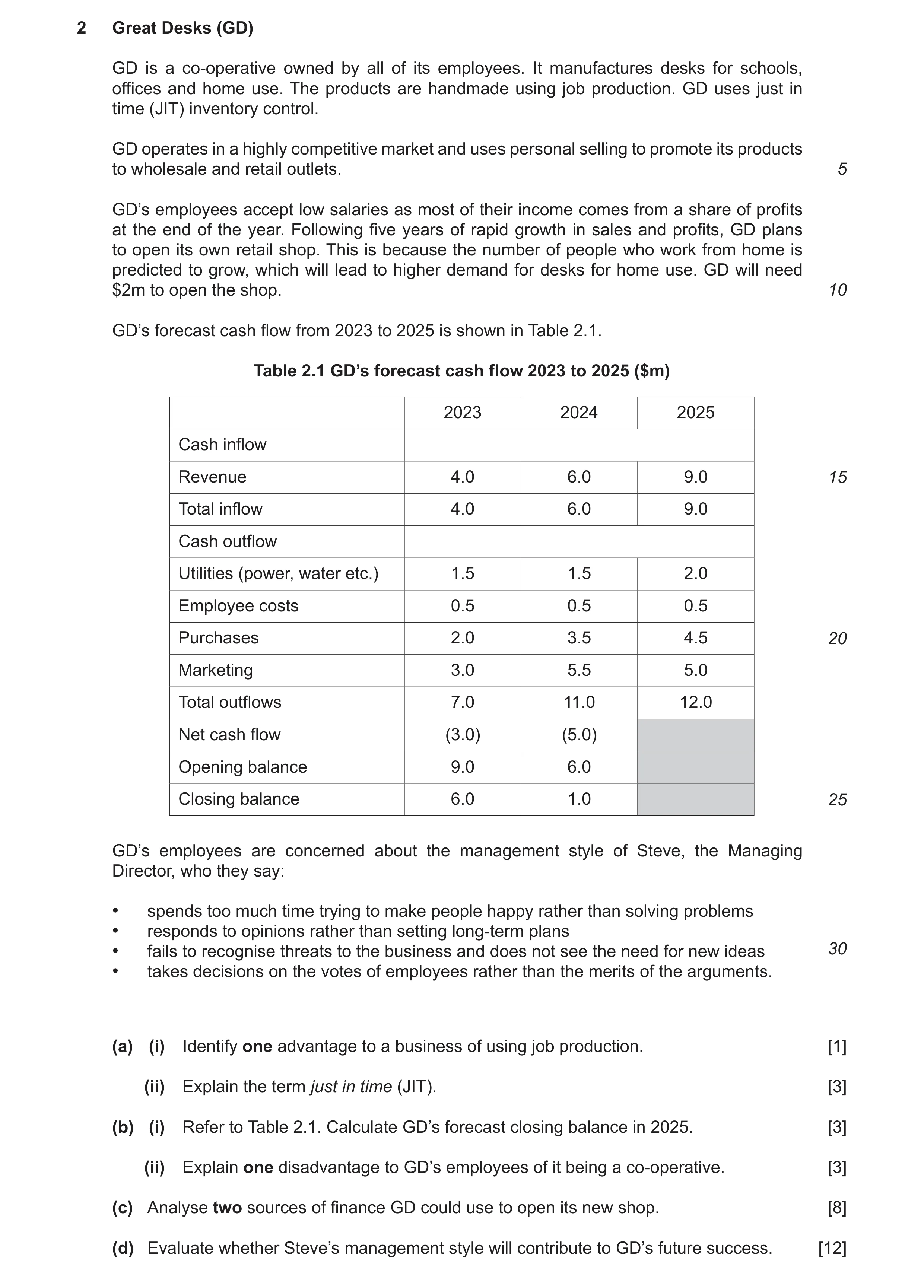 10 / 13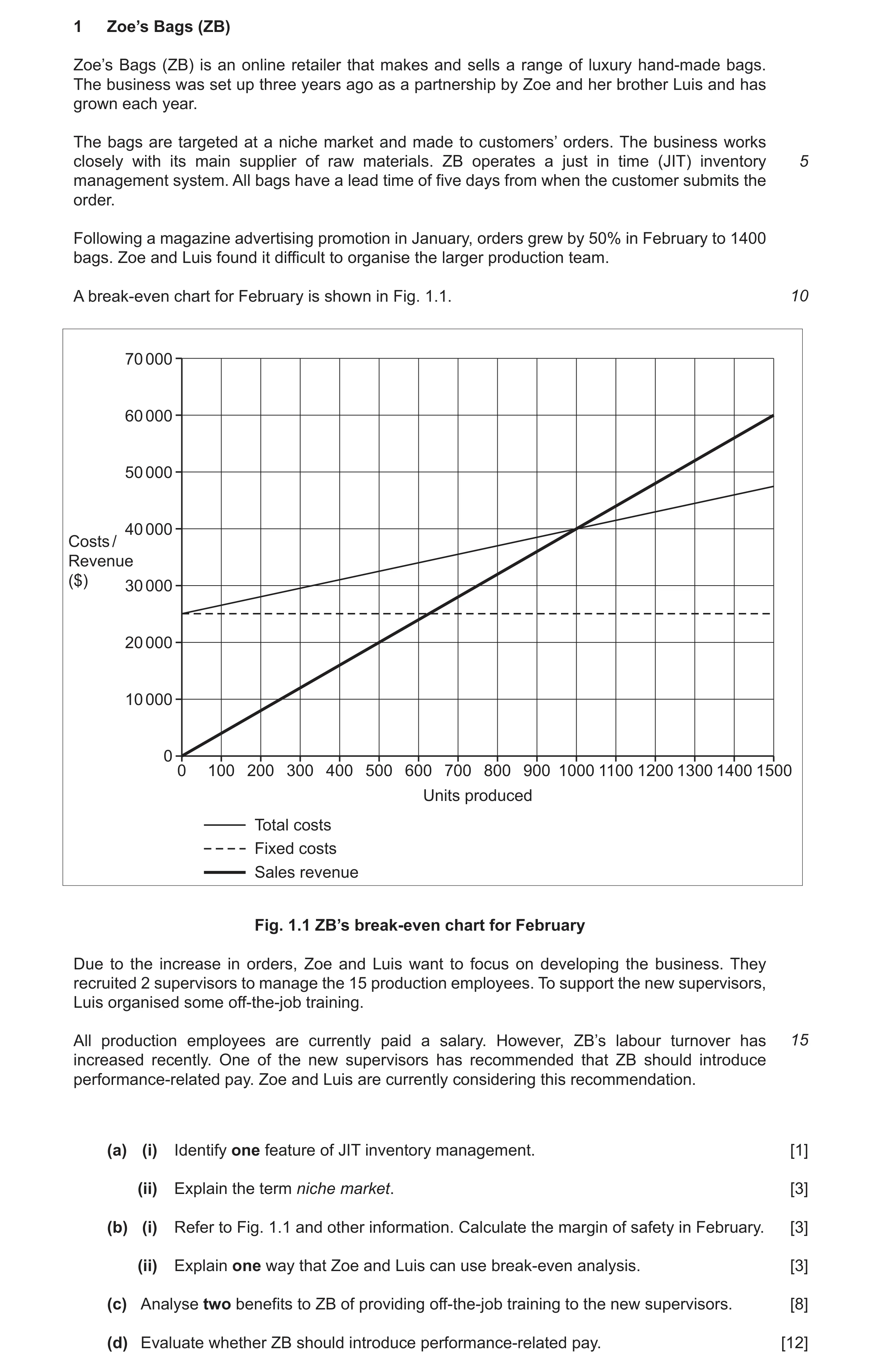
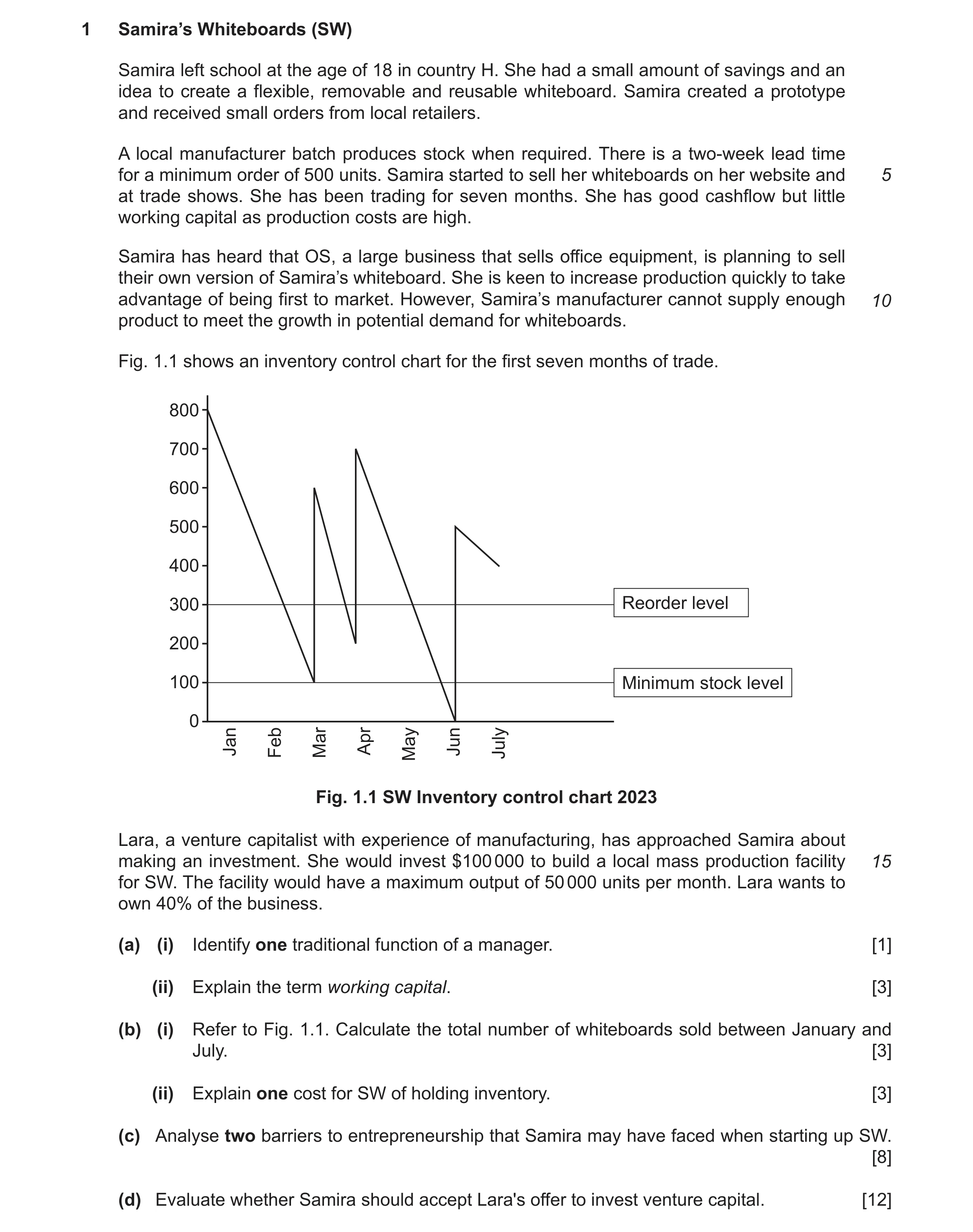 13 / 13
 30
30 30
30 30
30 30
30 30
30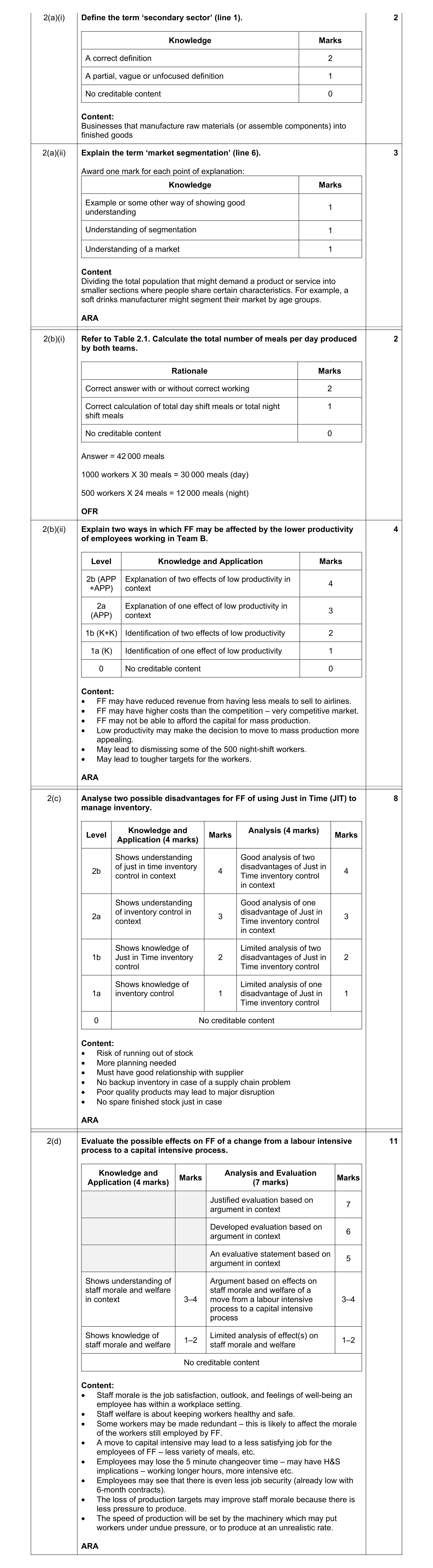 30
30 30
30 30
30 30
30 30
30 30
30