Cambridge A Level Business (for first examination in 2016) 9609 — 2024 May/June Paper 2 · Variant 1
9609/21/M/J/24 · 2 questions · 60 marks · ≈68 min
The question paper and its mark scheme, free to read here and free to download. This is Cambridge’s own paper, exactly as it was sat.
Question paper4 pages

Mark scheme37 pages
Answers below. Sit the paper first if you are practising.
Questions as text
Q1 · Samira’s Whiteboards (SW) Samira left school at the age of 18 in country H
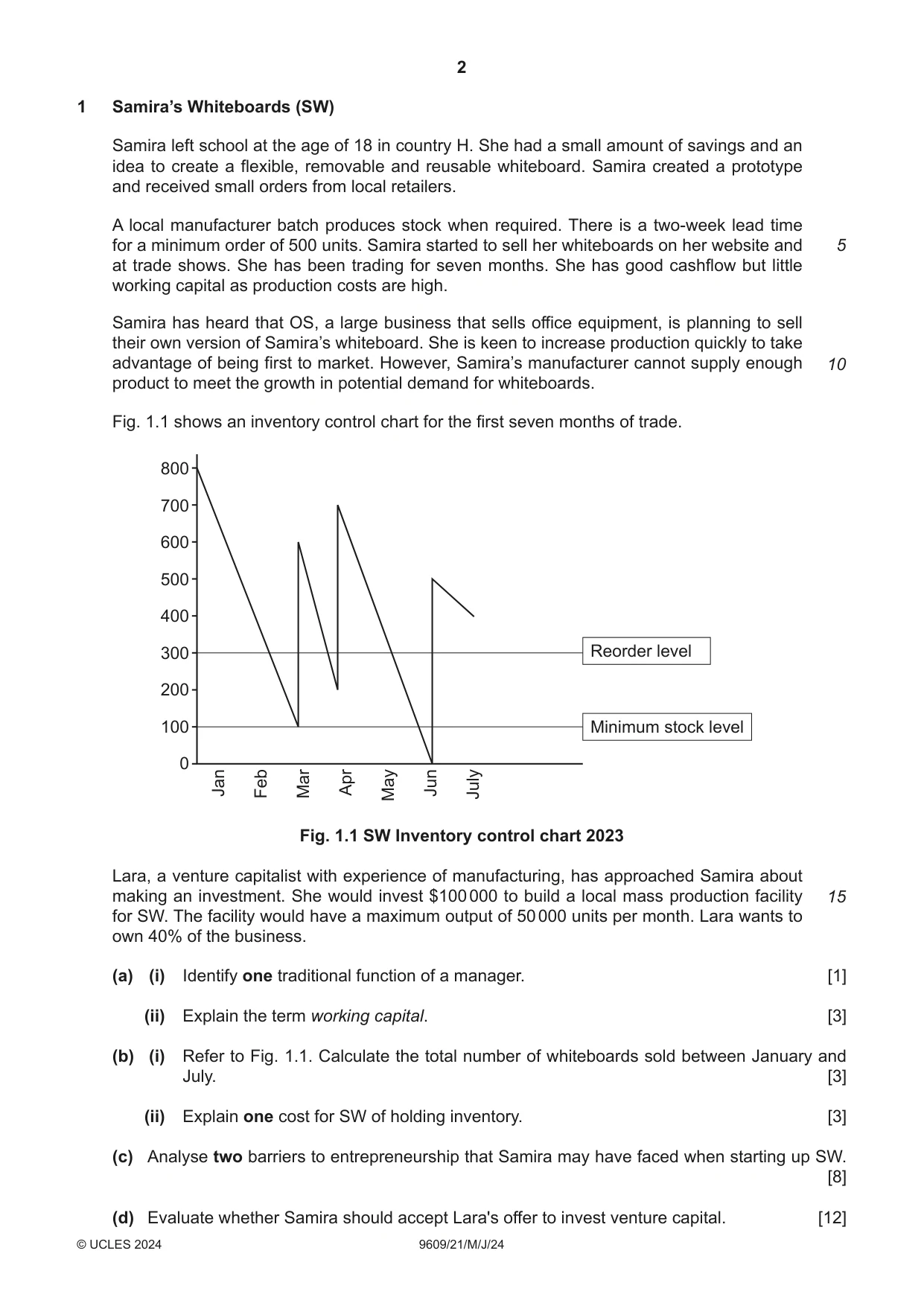
1 Samira’s Whiteboards (SW) Samira left school at the age of 18 in country H. She had a small amount of savings and an idea to create a flexible, removable and reusable whiteboard. Samira created a prototype and received small orders from local retailers. A local manufacturer batch produces stock when required. There is a two-week lead time for a minimum order of 500 units. Samira started to sell her whiteboards on her website and 5 at trade shows. She has been trading for seven months. She has good cashflow but little working capital as production costs are high. Samira has heard that OS, a large business that sells office equipment, is planning to sell their own version of Samira’s whiteboard. She is keen to increase production quickly to take advantage of being first to market. However, Samira’s manufacturer cannot supply enough 10 product to meet the growth in potential demand for whiteboards. Fig. 1.1 shows an inventory control chart for the first seven months of trade. 800 700 600 500 400 300 Reorder level 200 100 Minimum stock level 0 Jan Feb Mar Apr May Jun July Fig. 1.1 SW Inventory control chart 2023 Lara, a venture capitalist with experience of manufacturing, has approached Samira about making an investment. She would invest $100 000 to build a local mass production facility 15 for SW. The facility would have a maximum output of 50 000 units per month. Lara wants to own 40% of the business. (a) (i) Identify one traditional function of a manager. [1] (ii) Explain the term working capital. [3] (b) (i) Refer to Fig. 1.1. Calculate the total number of whiteboards sold between January and July. [3] (ii) Explain one cost for SW of holding inventory. [3] (c) Analyse two barriers to entrepreneurship that Samira may have faced when starting up SW. [8] (d) Evaluate whether Samira should accept Lara's offer to invest venture capital. [12]
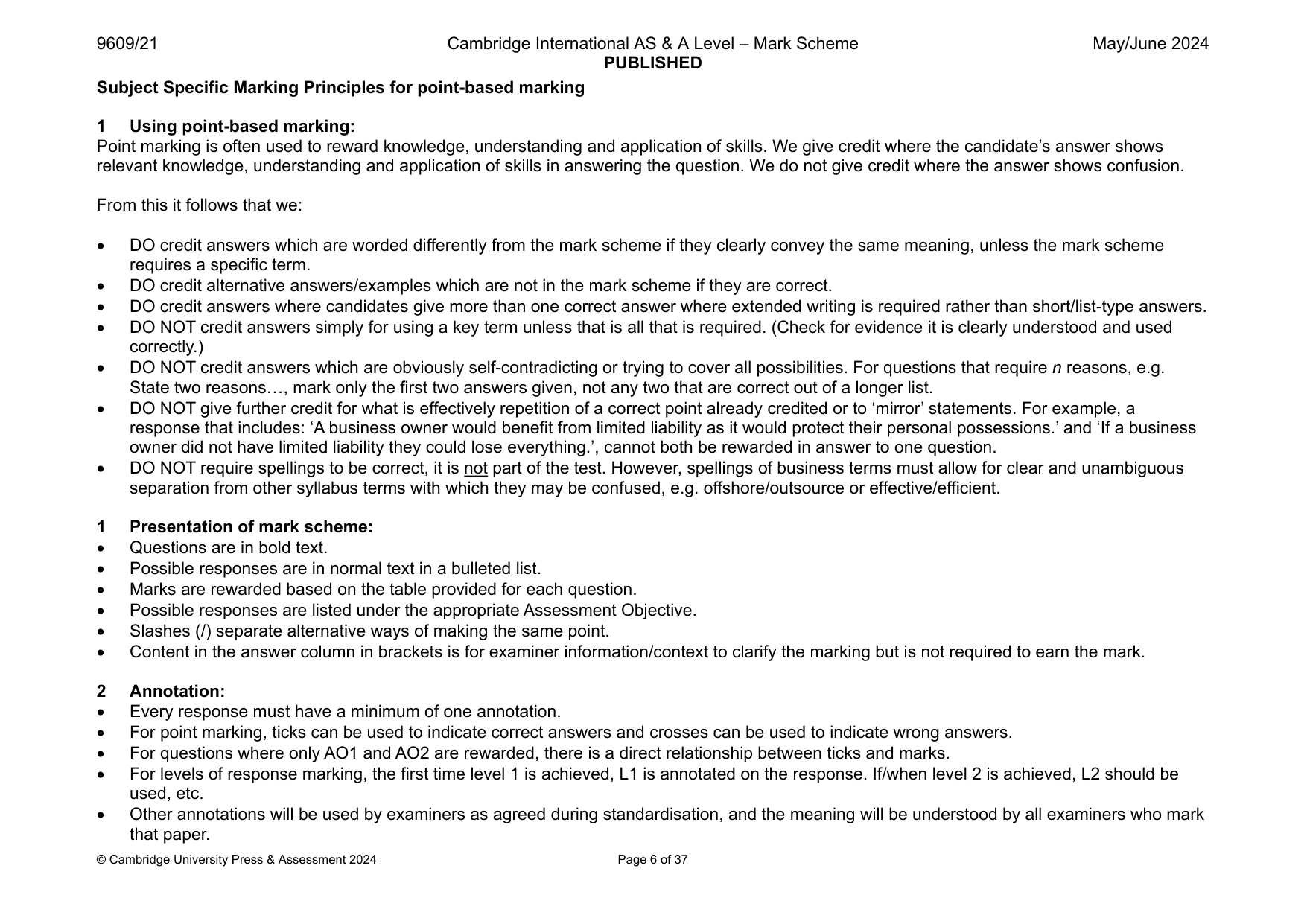
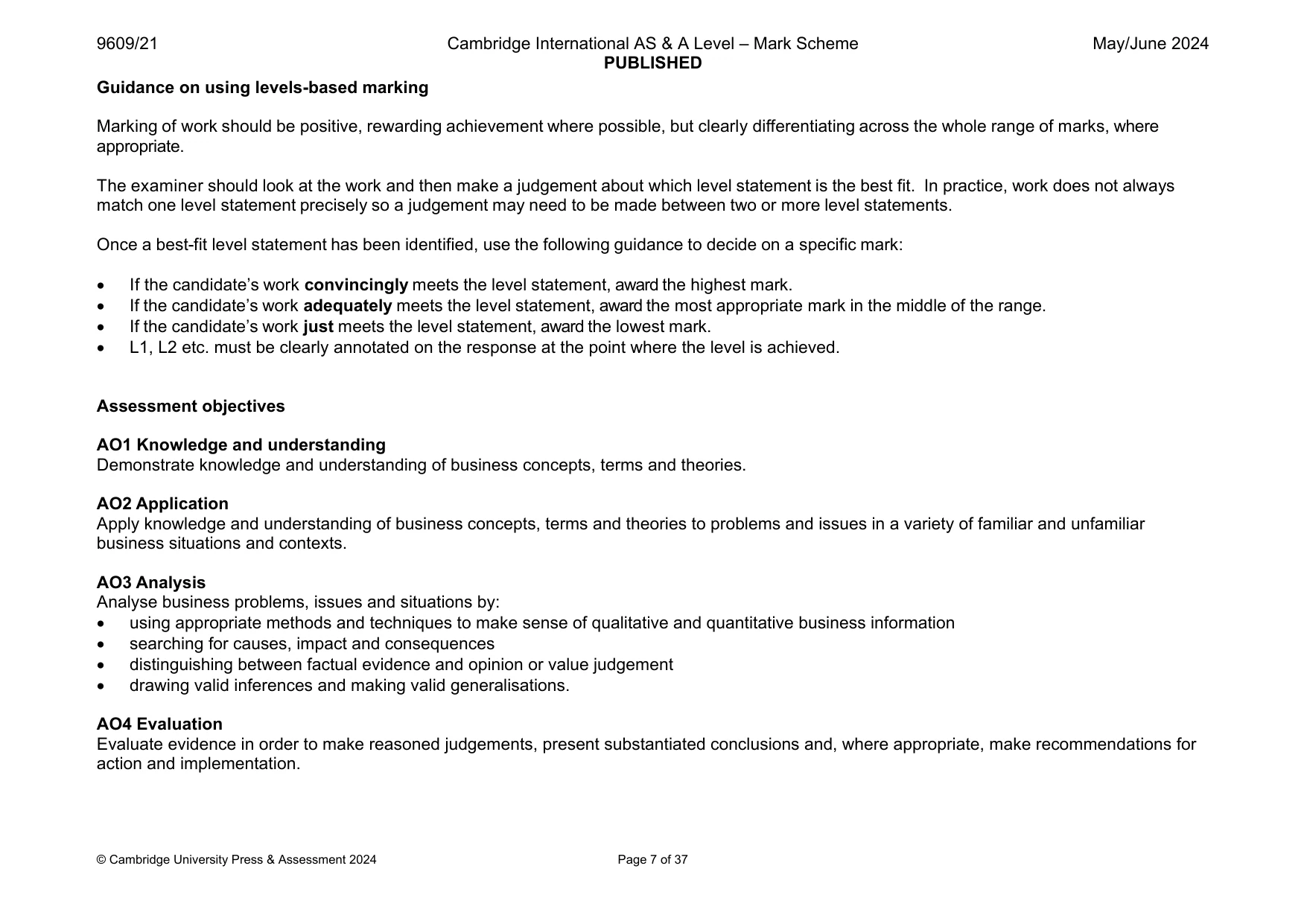
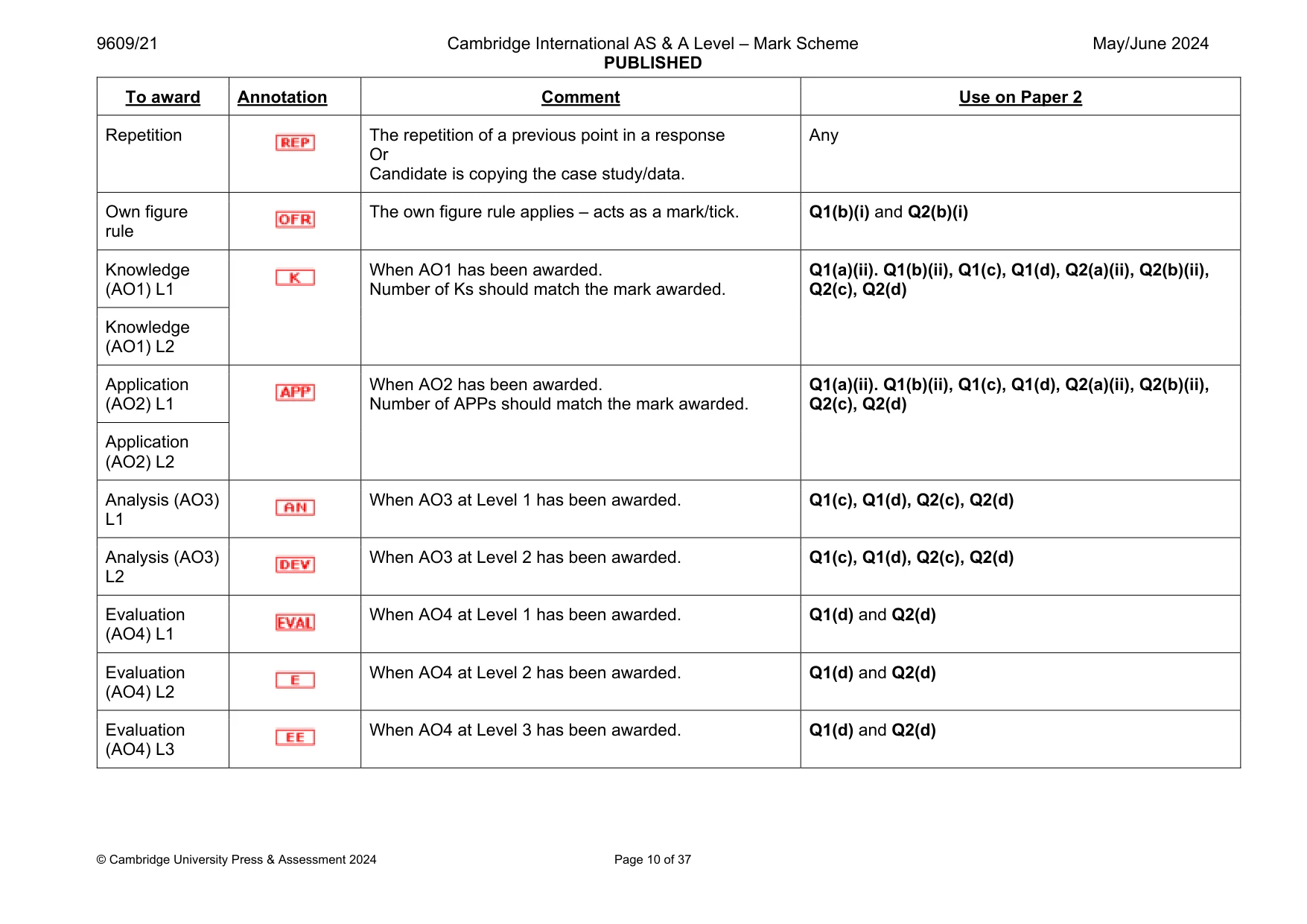
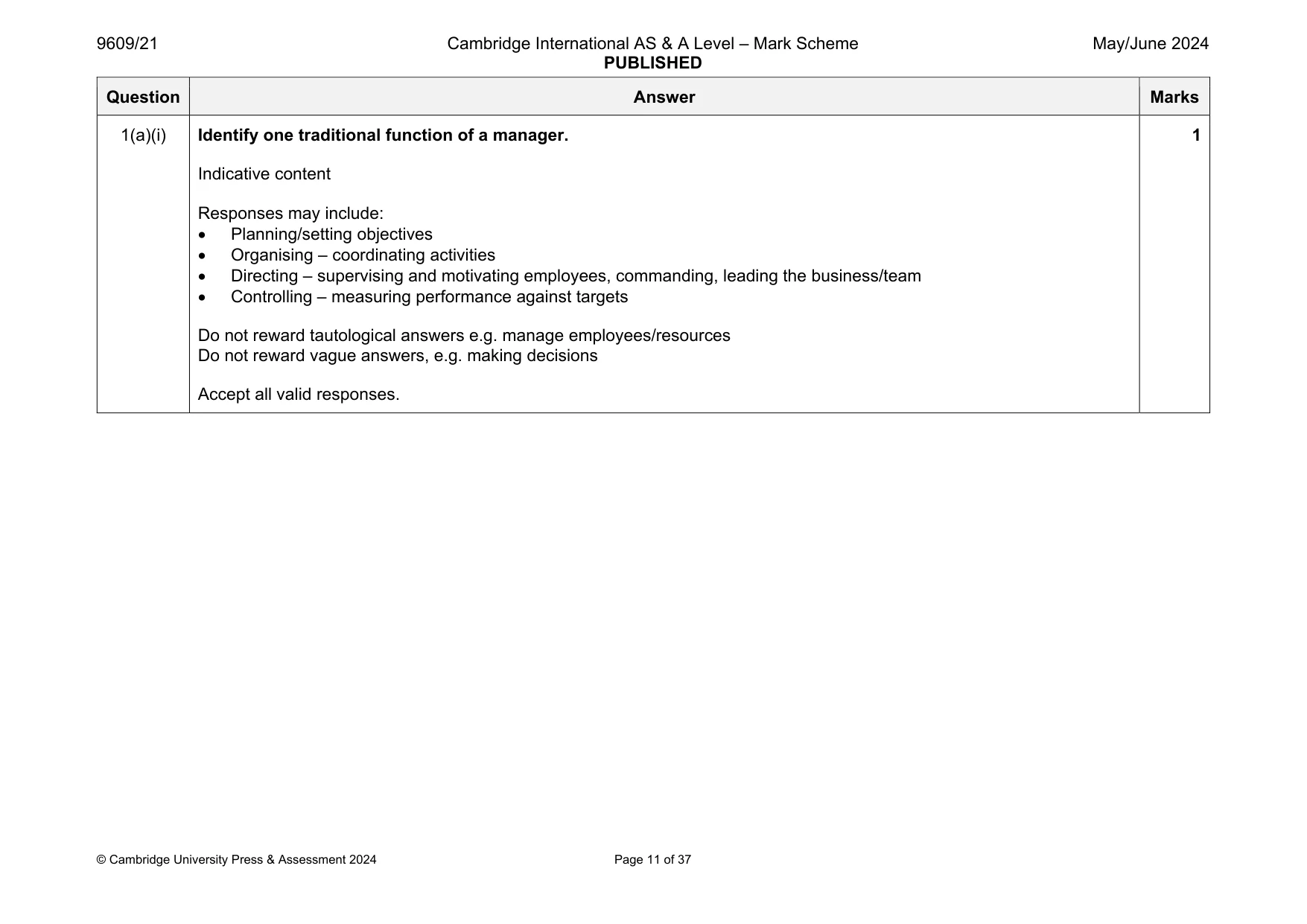
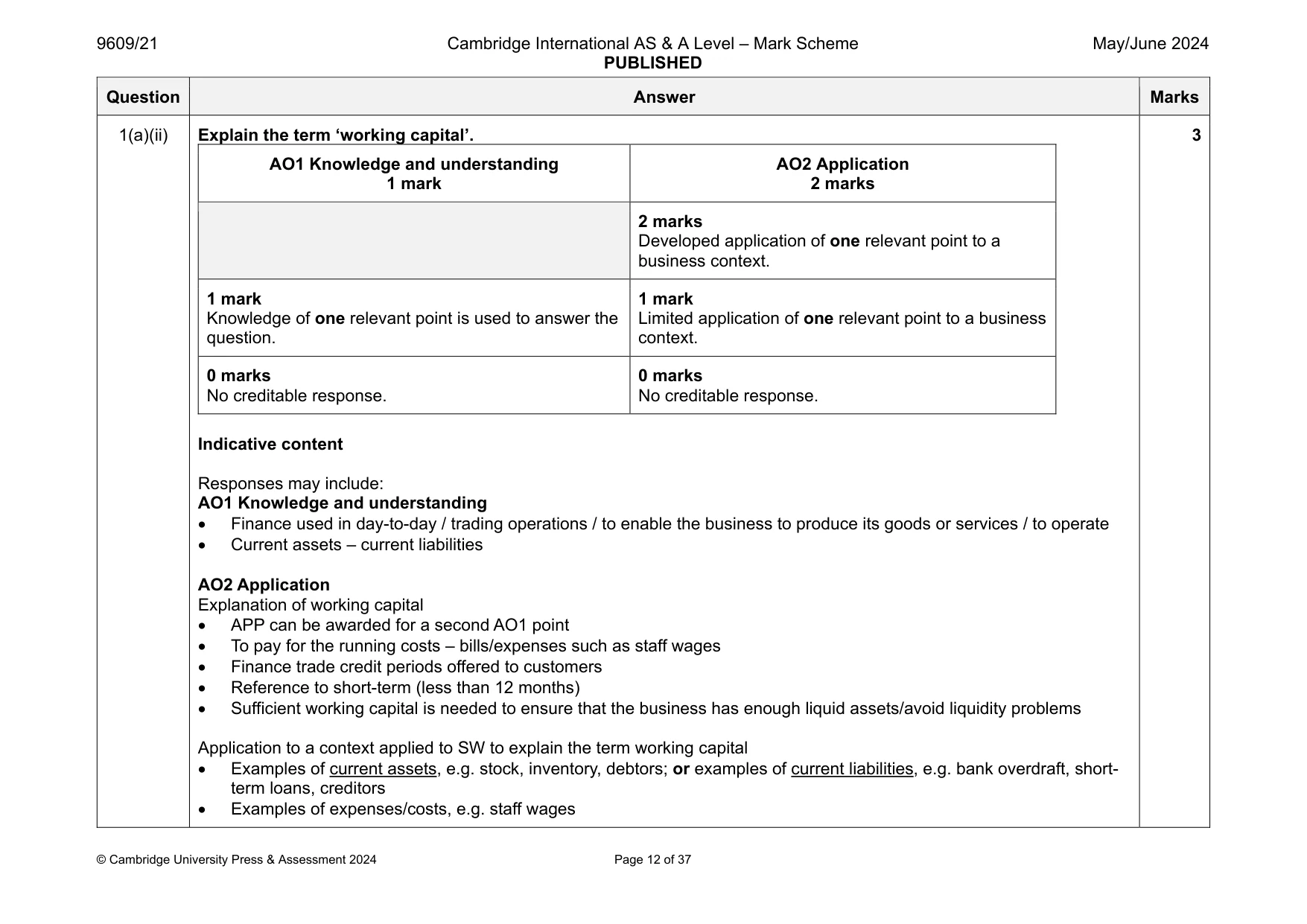
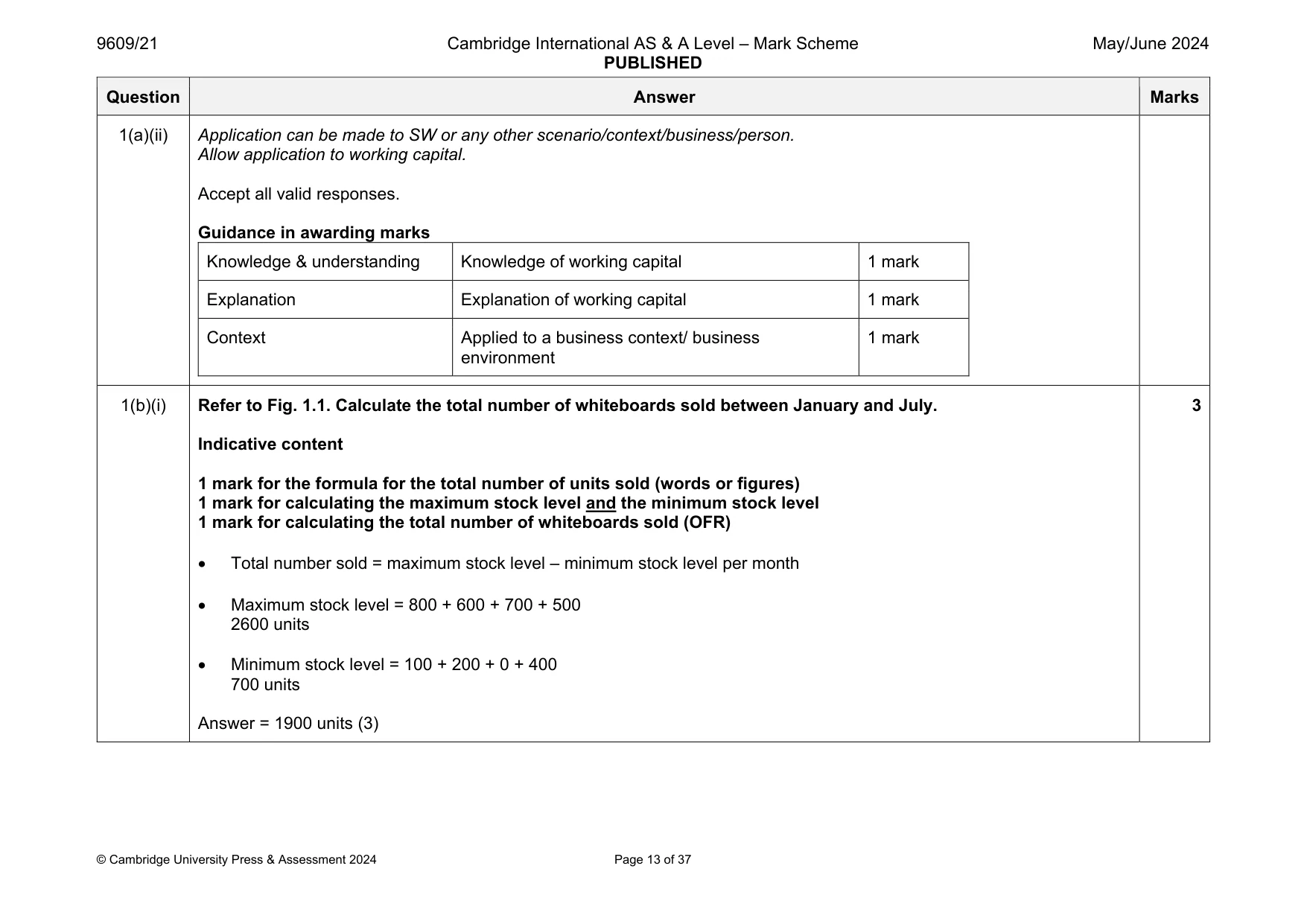
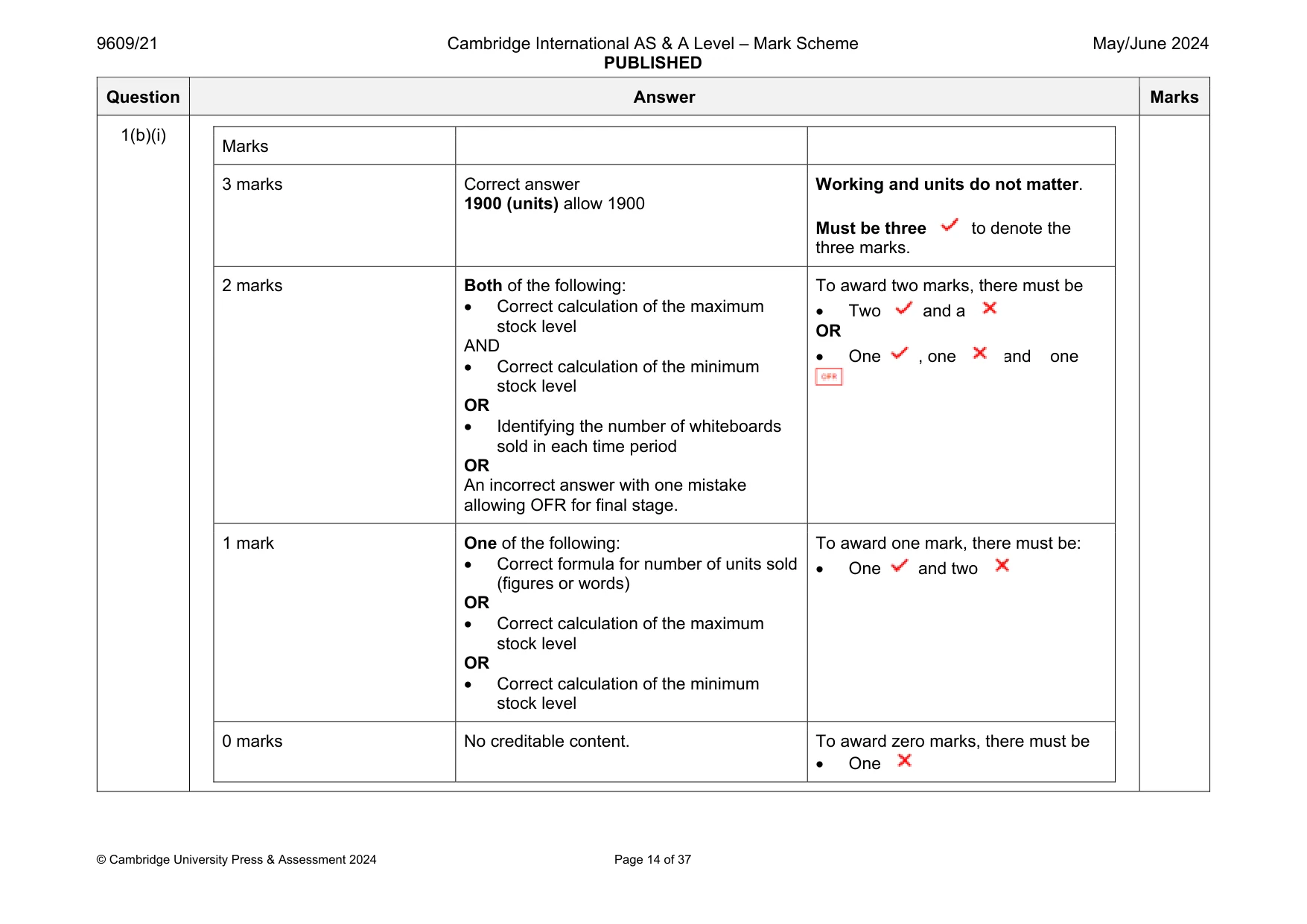
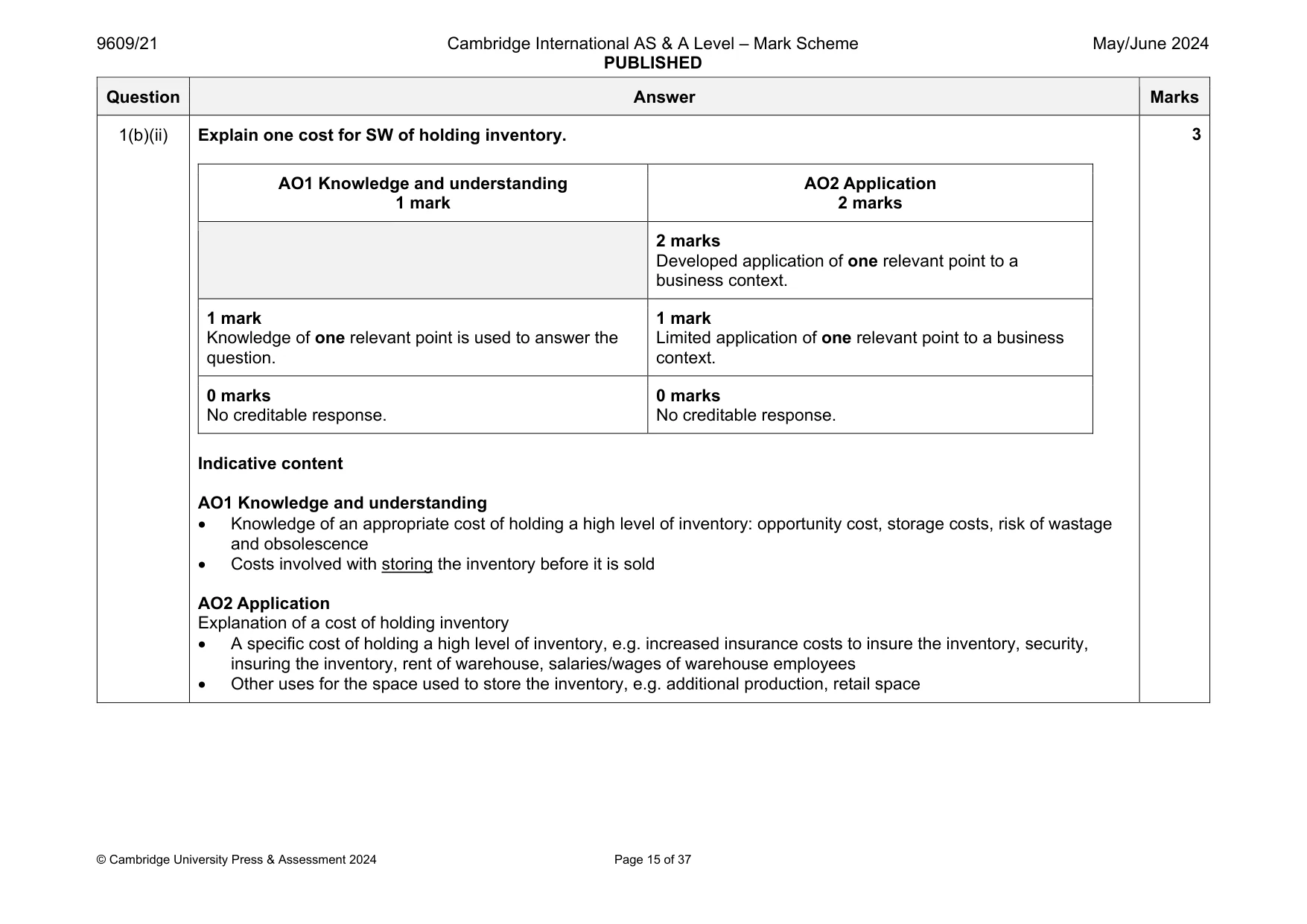
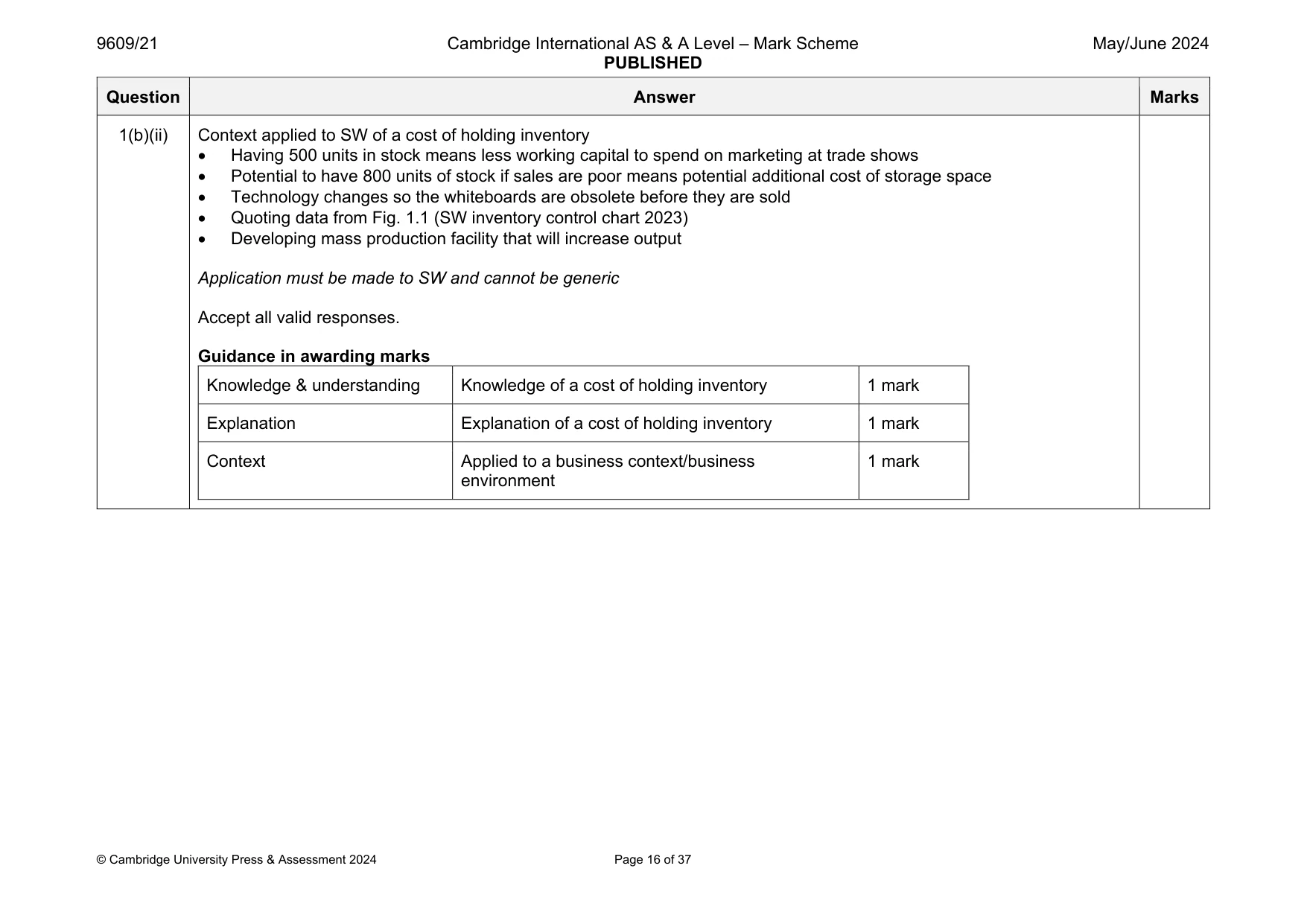
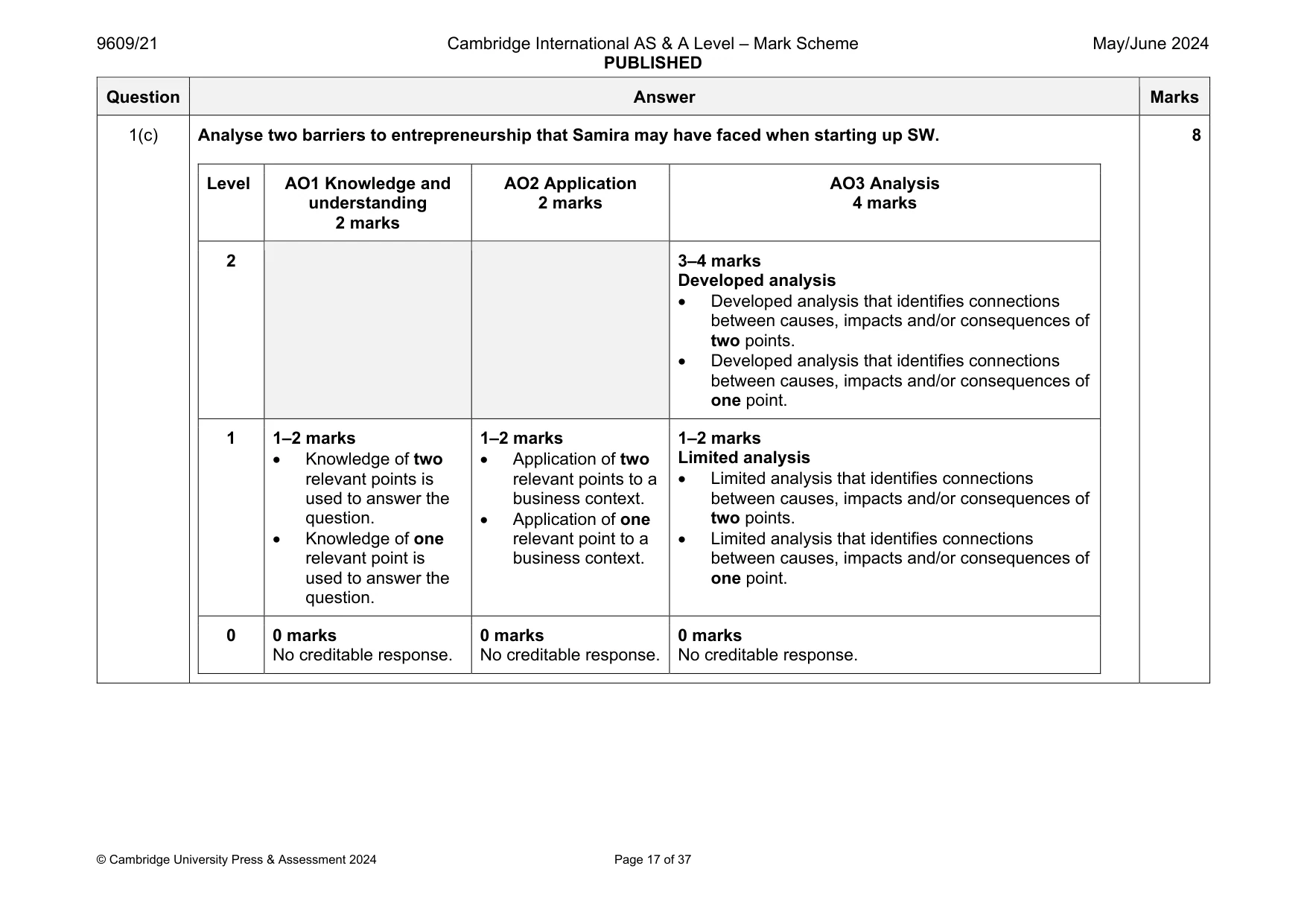
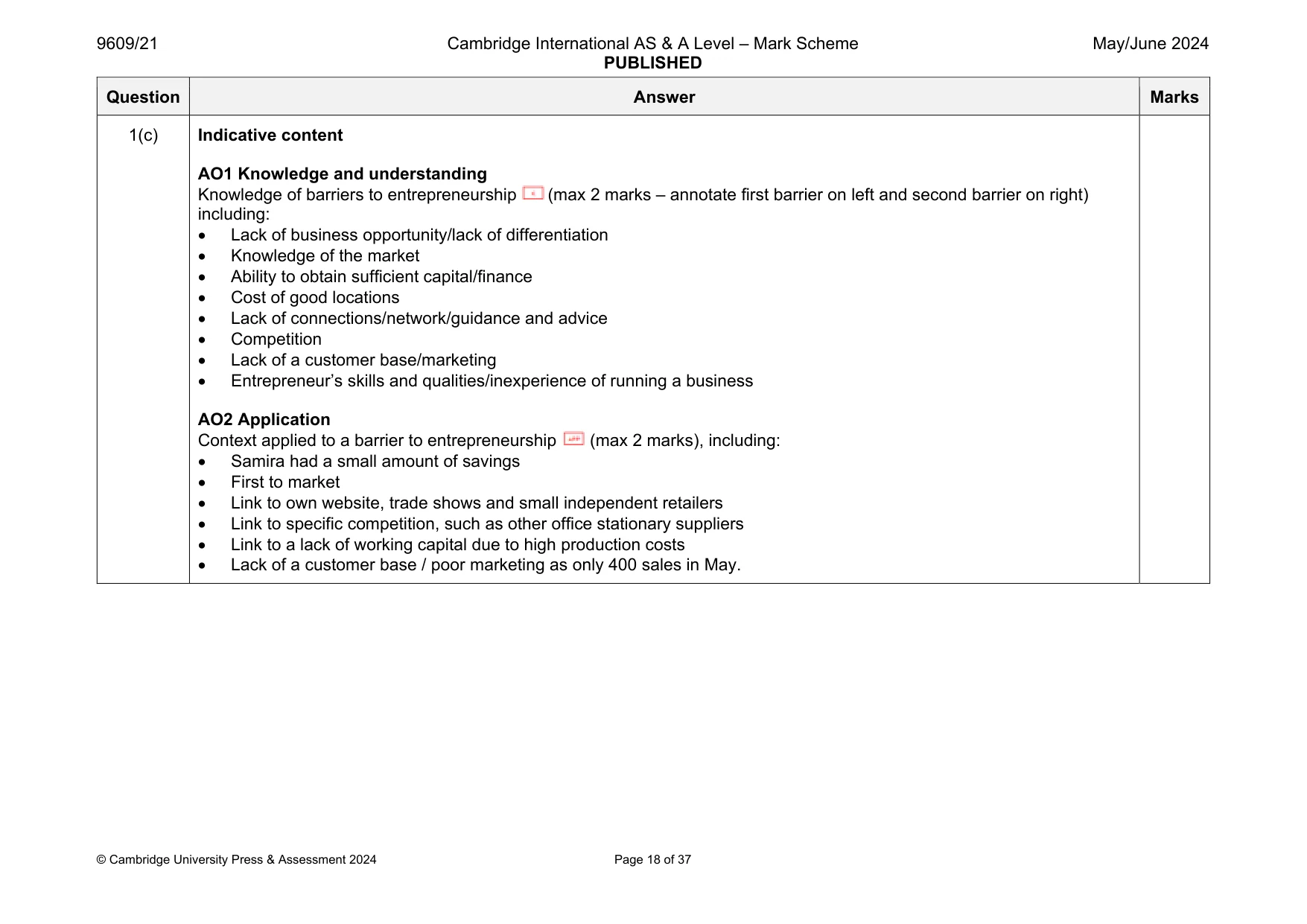
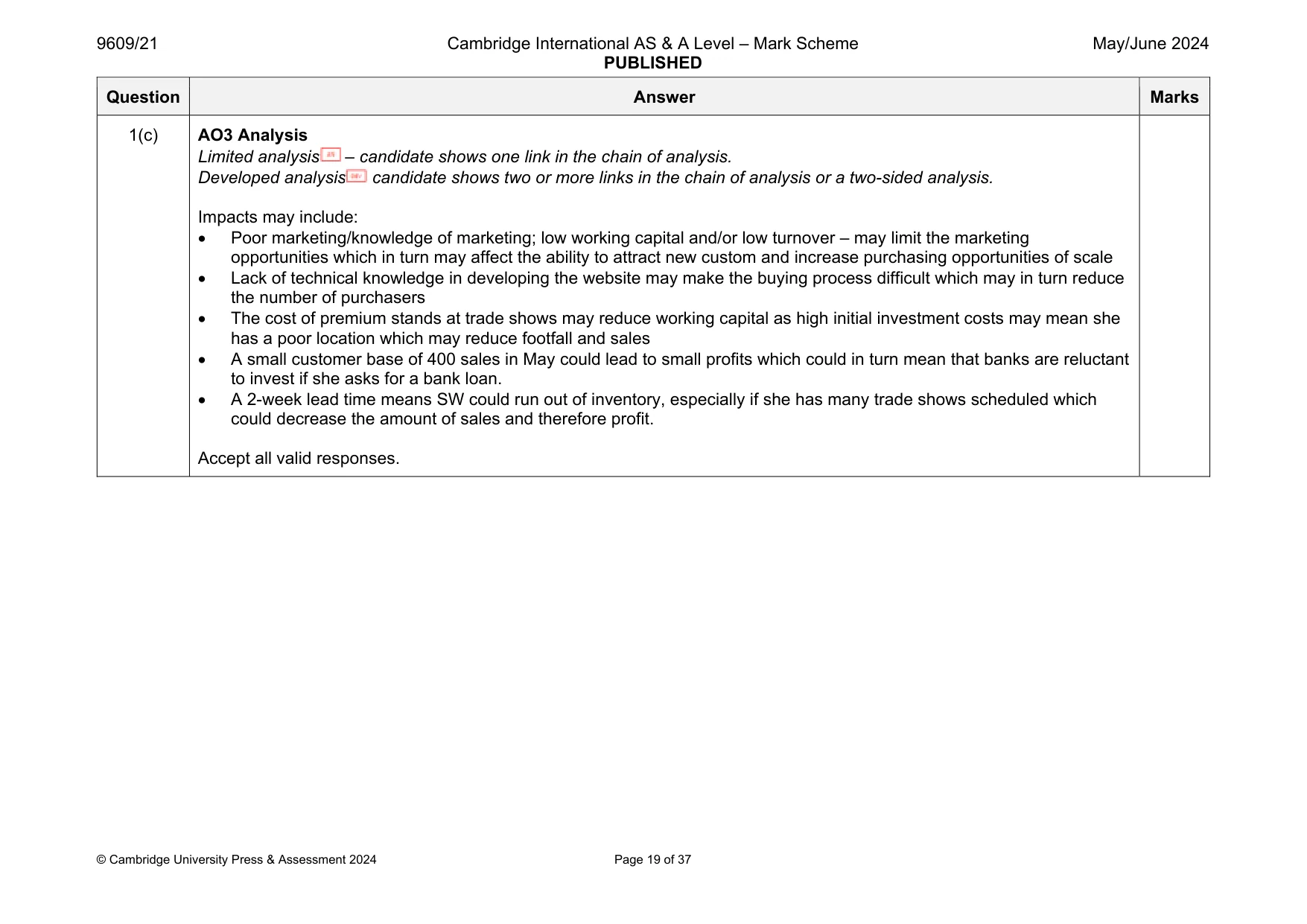
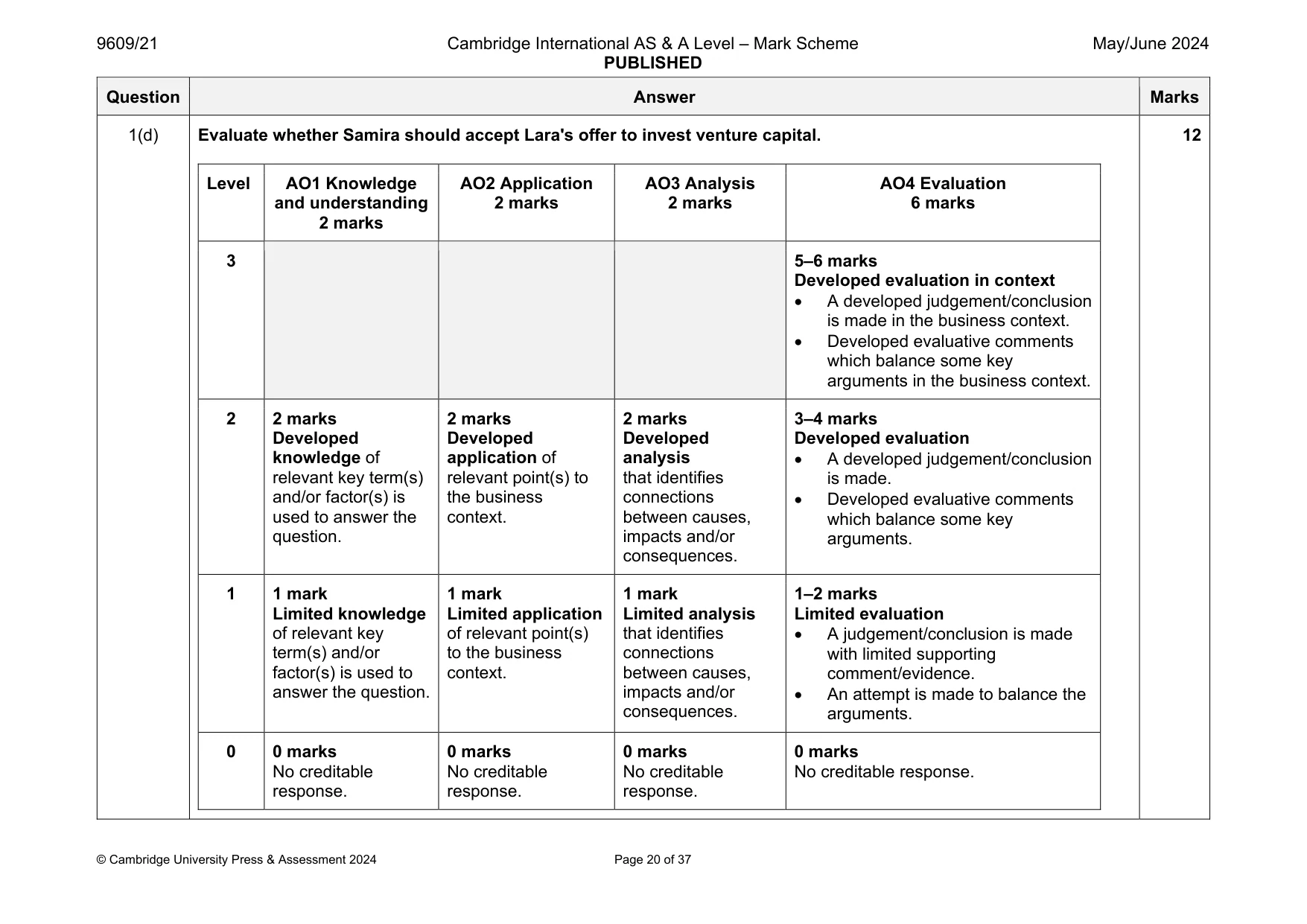
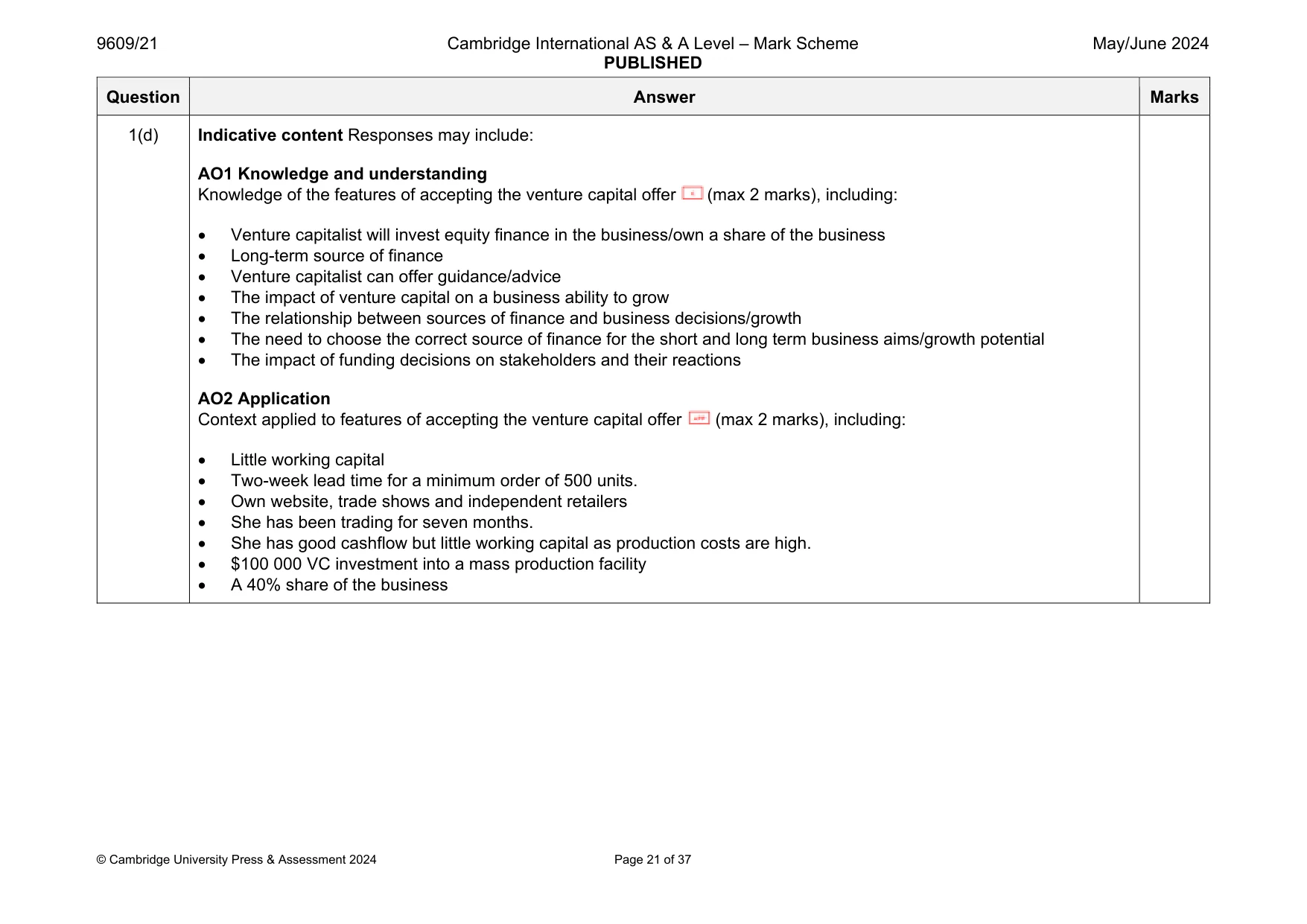
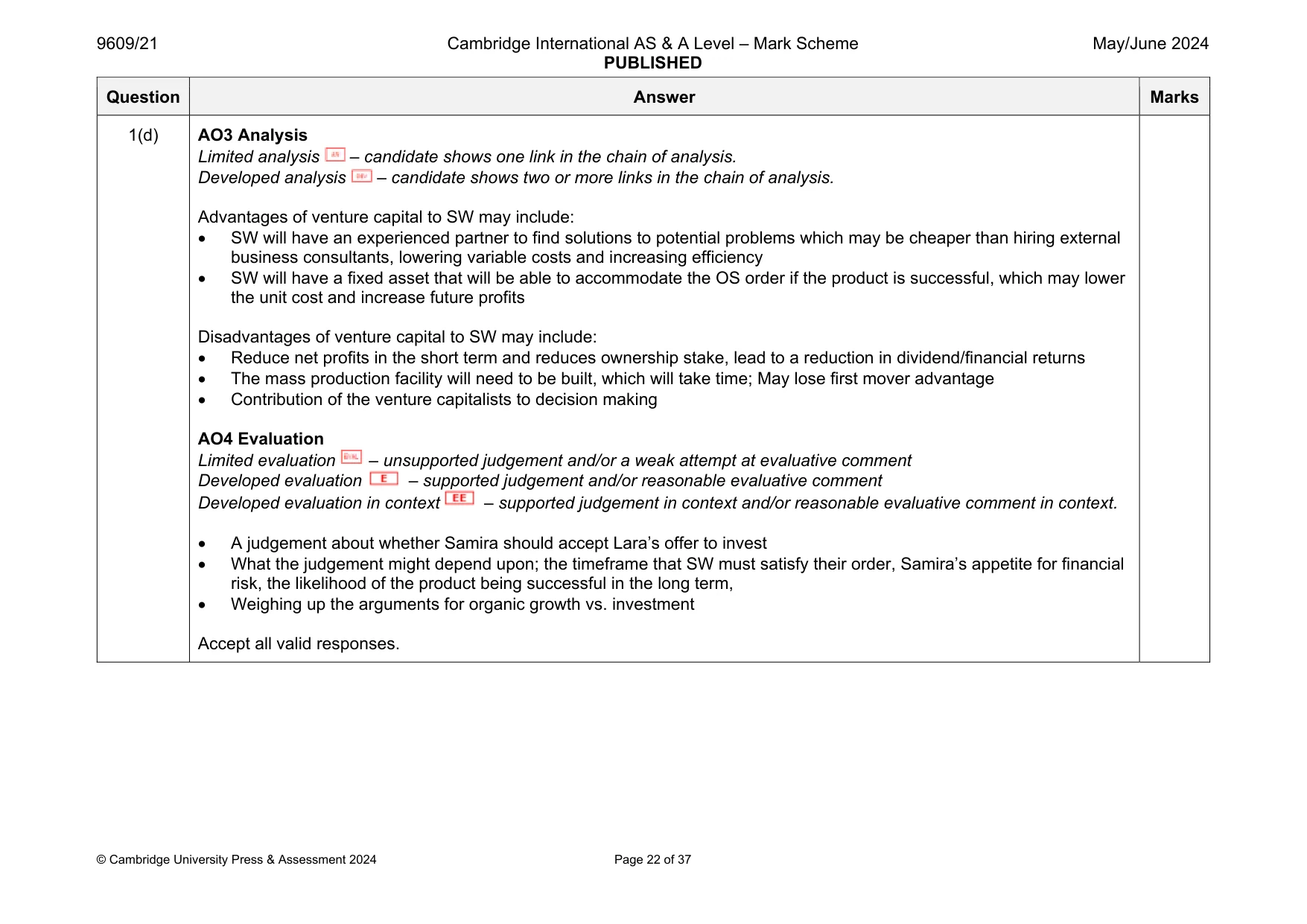
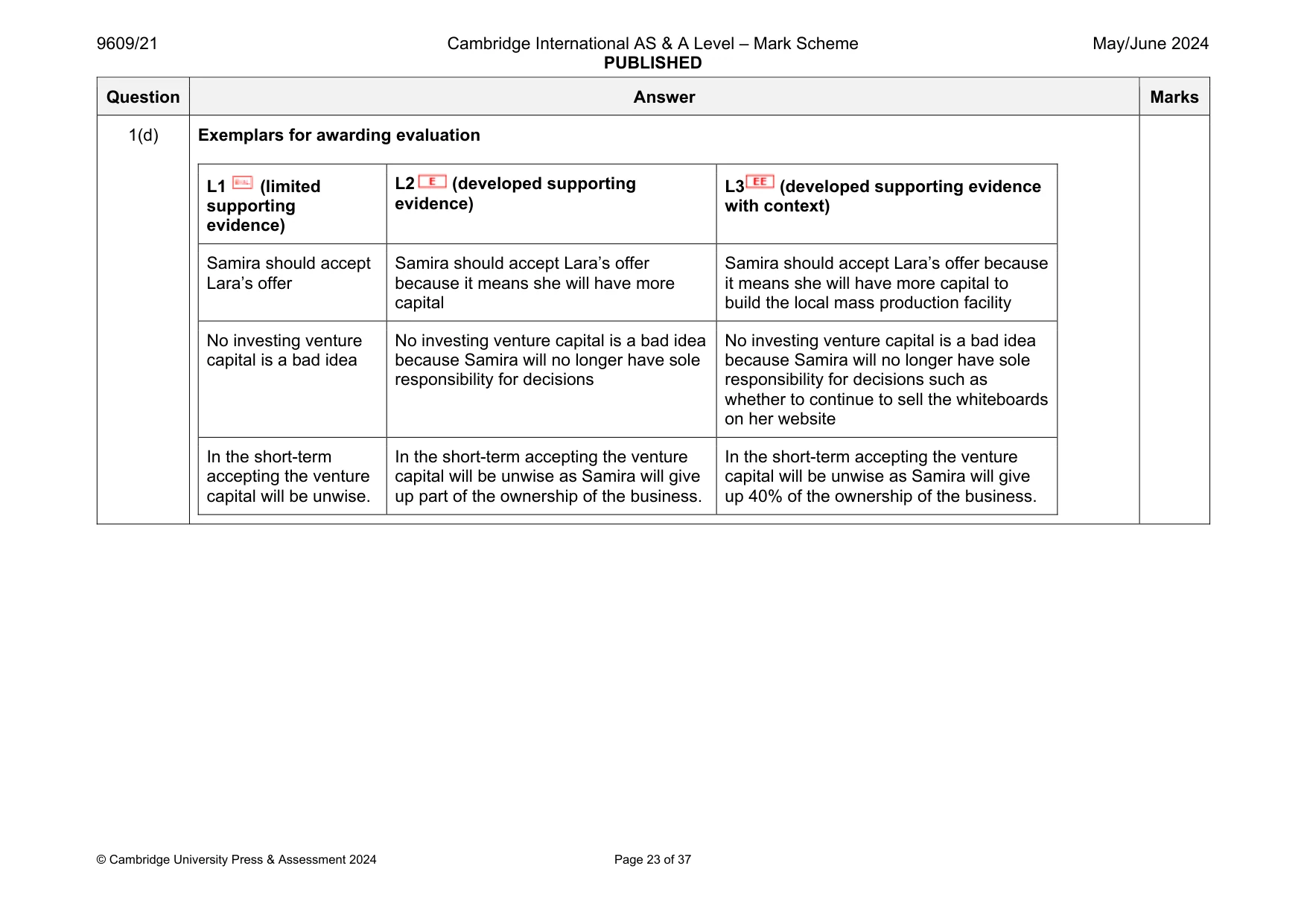
Mark scheme: 1(a)(i) Identify one traditional function of a manager. Indicative content Responses may include: Planning/setting objectives Organising – coordinating activities Directing – supervising and motivating employees, commanding, leading the business/team Controlling – measuring performance against targets Do not reward tautological answers e.g. manage employees/resources Do not reward vague answers, e.g. making decisions Accept all valid responses. 1 Question Answer Marks 1(a)(ii) Explain the term ‘working capital’. AO1 Knowledge and understanding 1 mark AO2 Application 2 marks 2 marks Developed application of one relevant point to a business context. 1 mark Knowledge of one relevant point is used to answer the question. 1 mark Limited application of one relevant point to a business context. 0 marks No creditable response. 0 marks No creditable response. Indicative content Responses may include: AO1 Knowledge and understanding Finance used in day-to-day / trading operations / to enable the business to produce its goods or services / to operate Current assets – current liabilities AO2 Application Explanation of working capital APP can be awarded for a second AO1 point To pay for the running costs – bills/expenses such as staff wages Finance trade credit periods offered to customers Reference to short-term (less than 12 months) Sufficient working capital is needed to ensure that the business has enough liquid assets/avoid liquidity problems Application to a context applied to SW to explain the term working capital Examples of current assets, e.g. stock, inventory, debtors; or examples of current liabilities, e.g. bank overdraft, short- term loans, creditors Examples of expenses/costs, e.g. staff wages 3 Question Answer Marks 1(a)(ii) Application can be made to SW or any other scenario/context/business/person. Allow application to working capital. Accept all valid responses. Guidance in awarding marks Knowledge & understanding Knowledge of working capital 1 mark Explanation Explanation of working capital 1 mark Context Applied to a business context/ business environment 1 mark 1(b)(i) Refer to Fig. 1.1. Calculate the total number of whiteboards sold between January and July. Indicative content 1 mark for the formula for the total number of units sold (words or figures) 1 mark for calculating the maximum stock level and the minimum stock level 1 mark for calculating the total number of whiteboards sold (OFR) Total number sold = maximum stock level – minimum stock level per month Maximum stock level = 800 + 600 + 700 + 500 2600 units Minimum stock level = 100 + 200 + 0 + 400 700 units Answer = 1900 units (3) 3 Question Answer Marks 1(b)(i) Marks 3 marks Correct answer 1900 (units) allow 1900 Working and units do not matter. Must be three to denote the three marks. 2 marks Both of the following: Correct calculation of the maximum stock level AND Correct calculation of the minimum stock level OR Identifying the number of whiteboards sold in each time period OR An incorrect answer with one mistake allowing OFR for final stage. To award two marks, there must be Two and a OR One , one and one 1 mark One of the following: Correct formula for number of units sold (figures or words) OR Correct calculation of the maximum stock level OR Correct calculation of the minimum stock level To award one mark, there must be: One and two 0 marks No creditable content. To award zero marks, there must be One Question Answer Marks 1(b)(ii) Explain one cost for SW of holding inventory. AO1 Knowledge and understanding 1 mark AO2 Application 2 marks 2 marks Developed application of one relevant point to a business context. 1 mark Knowledge of one relevant point is used to answer the question. 1 mark Limited application of one relevant point to a business context. 0 marks No creditable response. 0 marks No creditable response. Indicative content AO1 Knowledge and understanding Knowledge of an appropriate cost of holding a high level of inventory: opportunity cost, storage costs, risk of wastage and obsolescence Costs involved with storing the inventory before it is sold AO2 Application Explanation of a cost of holding inventory A specific cost of holding a high level of inventory, e.g. increased insurance costs to insure the inventory, security, insuring the inventory, rent of warehouse, salaries/wages of warehouse employees Other uses for the space used to store the inventory, e.g. additional production, retail space 3 Question Answer Marks 1(b)(ii) Context applied to SW of a cost of holding inventory Having 500 units in stock means less working capital to spend on marketing at trade shows Potential to have 800 units of stock if sales are poor means potential additional cost of storage space Technology changes so the whiteboards are obsolete before they are sold Quoting data from Fig. 1.1 (SW inventory control chart 2023) Developing mass production facility that will increase output Application must be made to SW and cannot be generic Accept all valid responses. Guidance in awarding marks Knowledge & understanding Knowledge of a cost of holding inventory 1 mark Explanation Explanation of a cost of holding inventory 1 mark Context Applied to a business context/business environment 1 mark Question Answer Marks 1(c) Analyse two barriers to entrepreneurship that Samira may have faced when starting up SW. Level AO1 Knowledge and understanding 2 marks AO2 Application 2 marks AO3 Analysis 4 marks 2 3–4 marks Developed analysis Developed analysis that identifies connections between causes, impacts and/or consequences of two points. Developed analysis that identifies connections between causes, impacts and/or consequences of one point. 1 1–2 marks Knowledge of two relevant points is used to answer the question. Knowledge of one relevant point is used to answer the question. 1–2 marks Application of two relevant points to a business context. Application of one relevant point to a business context. 1–2 marks Limited analysis Limited analysis that identifies connections between causes, impacts and/or consequences of two points. Limited analysis that identifies connections between causes, impacts and/or consequences of one point. 0 0 marks No creditable response. 0 marks No creditable response. 0 marks No creditable response. 8 Question Answer Marks 1(c) Indicative content AO1 Knowledge and understanding Knowledge of barriers to entrepreneurship (max 2 marks – annotate first barrier on left and second barrier on right) including: Lack of business opportunity/lack of differentiation Knowledge of the market Ability to obtain sufficient capital/finance Cost of good locations Lack of connections/network/guidance and advice Competition Lack of a customer base/marketing Entrepreneur’s skills and qualities/inexperience of running a business AO2 Application Context applied to a barrier to entrepreneurship (max 2 marks), including: Samira had a small amount of savings First to market Link to own website, trade shows and small independent retailers Link to specific competition, such as other office stationary suppliers Link to a lack of working capital due to high production costs Lack of a customer base / poor marketing as only 400 sales in May. Question Answer Marks 1(c) AO3 Analysis Limited analysis – candidate shows one link in the chain of analysis. Developed analysis candidate shows two or more links in the chain of analysis or a two-sided analysis. Impacts may include: Poor marketing/knowledge of marketing; low working capital and/or low turnover – may limit the marketing opportunities which in turn may affect the ability to attract new custom and increase purchasing opportunities of scale Lack of technical knowledge in developing the website may make the buying process difficult which may in turn reduce the number of purchasers The cost of premium stands at trade shows may reduce working capital as high initial investment costs may mean she has a poor location which may reduce footfall and sales A small customer base of 400 sales in May could lead to small profits which could in turn mean that banks are reluctant to invest if she asks for a bank loan. A 2-week lead time means SW could run out of inventory, especially if she has many trade shows scheduled which could decrease the amount of sales and therefore profit. Accept all valid responses. Question Answer Marks 1(d) Evaluate whether Samira should accept Lara's offer to invest venture capital. Level AO1 Knowledge and understanding 2 marks AO2 Application 2 marks AO3 Analysis 2 marks AO4 Evaluation 6 marks 3 5–6 marks Developed evaluation in context A developed judgement/conclusion is made in the business context. Developed evaluative comments which balance some key arguments in the business context. 2 2 marks Developed knowledge of relevant key term(s) and/or factor(s) is used to answer the question. 2 marks Developed application of relevant point(s) to the business context. 2 marks Developed analysis that identifies connections between causes, impacts and/or consequences. 3–4 marks Developed evaluation A developed judgement/conclusion is made. Developed evaluative comments which balance some key arguments. 1 1 mark Limited knowledge of relevant key term(s) and/or factor(s) is used to answer the question. 1 mark Limited application of relevant point(s) to the business context. 1 mark Limited analysis that identifies connections between causes, impacts and/or consequences. 1–2 marks Limited evaluation A judgement/conclusion is made with limited supporting comment/evidence. An attempt is made to balance the arguments. 0 0 marks No creditable response. 0 marks No creditable response. 0 marks No creditable response. 0 marks No creditable response. 12 Question Answer Marks 1(d) Indicative content Responses may include: AO1 Knowledge and understanding Knowledge of the features of accepting the venture capital offer (max 2 marks), including: Venture capitalist will invest equity finance in the business/own a share of the business Long-term source of finance Venture capitalist can offer guidance/advice The impact of venture capital on a business ability to grow The relationship between sources of finance and business decisions/growth The need to choose the correct source of finance for the short and long term business aims/growth potential The impact of funding decisions on stakeholders and their reactions AO2 Application Context applied to features of accepting the venture capital offer (max 2 marks), including: Little working capital Two-week lead time for a minimum order of 500 units. Own website, trade shows and independent retailers She has been trading for seven months. She has good cashflow but little working capital as production costs are high. $100 000 VC investment into a mass production facility A 40% share of the business Question Answer Marks 1(d) AO3 Analysis Limited analysis – candidate shows one link in the chain of analysis. Developed analysis – candidate shows two or more links in the chain of analysis. Advantages of venture capital to SW may include: SW will have an experienced partner to find solutions to potential problems which may be cheaper than hiring external business consultants, lowering variable costs and increasing efficiency SW will have a fixed asset that will be able to accommodate the OS order if the product is successful, which may lower the unit cost and increase future profits Disadvantages of venture capital to SW may include: Reduce net profits in the short term and reduces ownership stake, lead to a reduction in dividend/financial returns The mass production facility will need to be built, which will take time; May lose first mover advantage Contribution of the venture capitalists to decision making AO4 Evaluation Limited evaluation – unsupported judgement and/or a weak attempt at evaluative comment Developed evaluation – supported judgement and/or reasonable evaluative comment Developed evaluation in context – supported judgement in context and/or reasonable evaluative comment in context. A judgement about whether Samira should accept Lara’s offer to invest What the judgement might depend upon; the timeframe that SW must satisfy their order, Samira’s appetite for financial risk, the likelihood of the product being successful in the long term, Weighing up the arguments for organic growth vs. investment Accept all valid responses. Question Answer Marks 1(d) Exemplars for awarding evaluation L1 (limited supporting evidence) L2 (developed supporting evidence) L3 (developed supporting evidence with context) Samira should accept Lara’s offer Samira should accept Lara’s offer because it means she will have more capital Samira should accept Lara’s offer because it means she will have more capital to build the local mass production facility No investing venture capital is a bad idea No investing venture capital is a bad idea because Samira will no longer have sole responsibility for decisions No investing venture capital is a bad idea because Samira will no longer have sole responsibility for decisions such as whether to continue to sell the whiteboards on her website In the short-term accepting the venture capital will be unwise. In the short-term accepting the venture capital will be unwise as Samira will give up part of the ownership of the business. In the short-term accepting the venture capital will be unwise as Samira will give up 40% of the ownership of the business.
Q2 · Fizzy Drinks (FD) FD is a private sector business that manufactures an international…
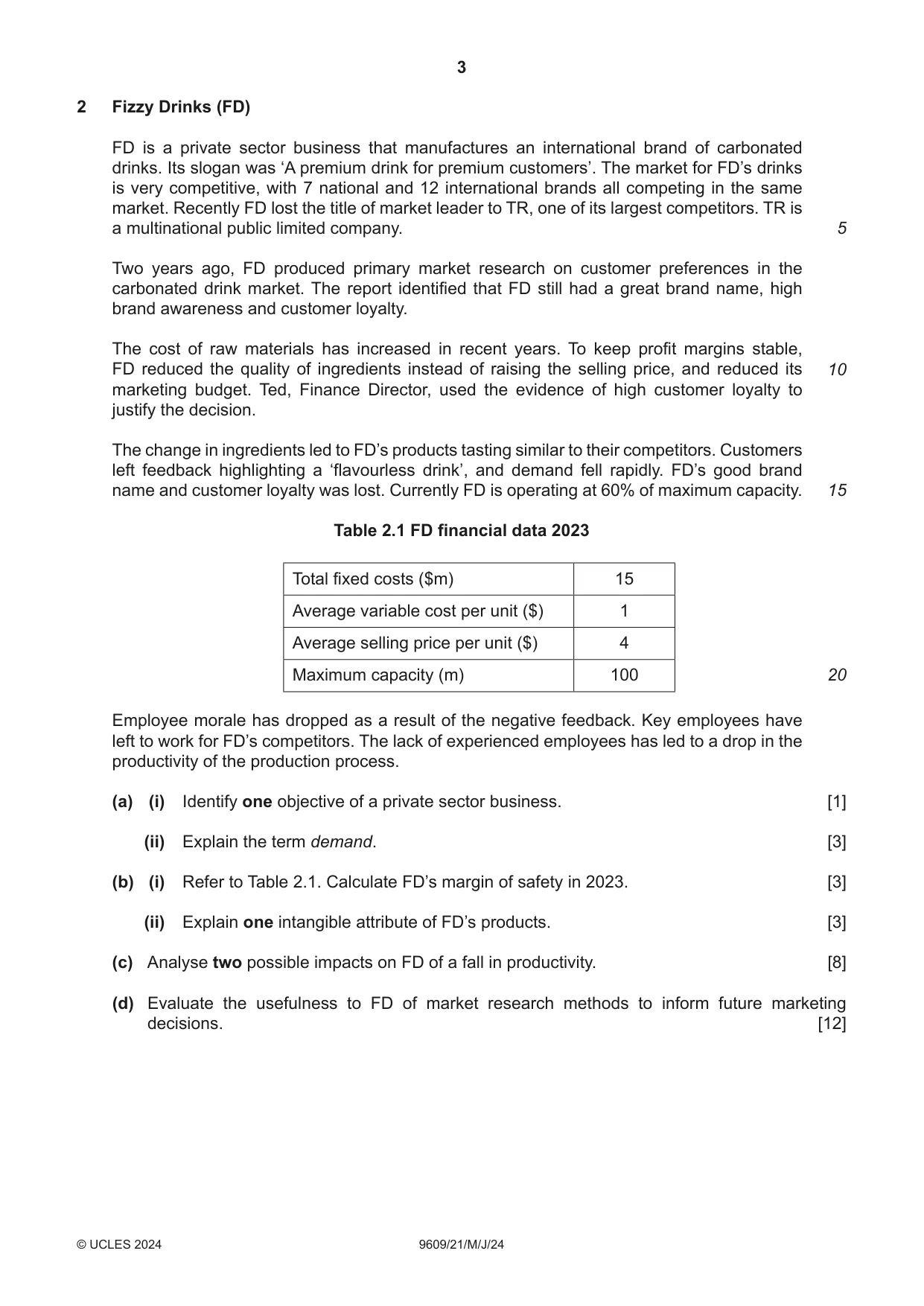
2 Fizzy Drinks (FD) FD is a private sector business that manufactures an international brand of carbonated drinks. Its slogan was ‘A premium drink for premium customers’. The market for FD’s drinks is very competitive, with 7 national and 12 international brands all competing in the same market. Recently FD lost the title of market leader to TR, one of its largest competitors. TR is a multinational public limited company. 5 Two years ago, FD produced primary market research on customer preferences in the carbonated drink market. The report identified that FD still had a great brand name, high brand awareness and customer loyalty. The cost of raw materials has increased in recent years. To keep profit margins stable, FD reduced the quality of ingredients instead of raising the selling price, and reduced its 10 marketing budget. Ted, Finance Director, used the evidence of high customer loyalty to justify the decision. The change in ingredients led to FD’s products tasting similar to their competitors. Customers left feedback highlighting a ‘flavourless drink’, and demand fell rapidly. FD’s good brand name and customer loyalty was lost. Currently FD is operating at 60% of maximum capacity. 15 Table 2.1 FD financial data 2023 Total fixed costs ($m) 15 Average variable cost per unit ($) 1 Average selling price per unit ($) 4 Maximum capacity (m) 100 20 Employee morale has dropped as a result of the negative feedback. Key employees have left to work for FD’s competitors. The lack of experienced employees has led to a drop in the productivity of the production process. (a) (i) Identify one objective of a private sector business. [1] (ii) Explain the term demand. [3] (b) (i) Refer to Table 2.1. Calculate FD’s margin of safety in 2023. [3] (ii) Explain one intangible attribute of FD’s products. [3] (c) Analyse two possible impacts on FD of a fall in productivity. [8] (d) Evaluate the usefulness to FD of market research methods to inform future marketing decisions. [12]
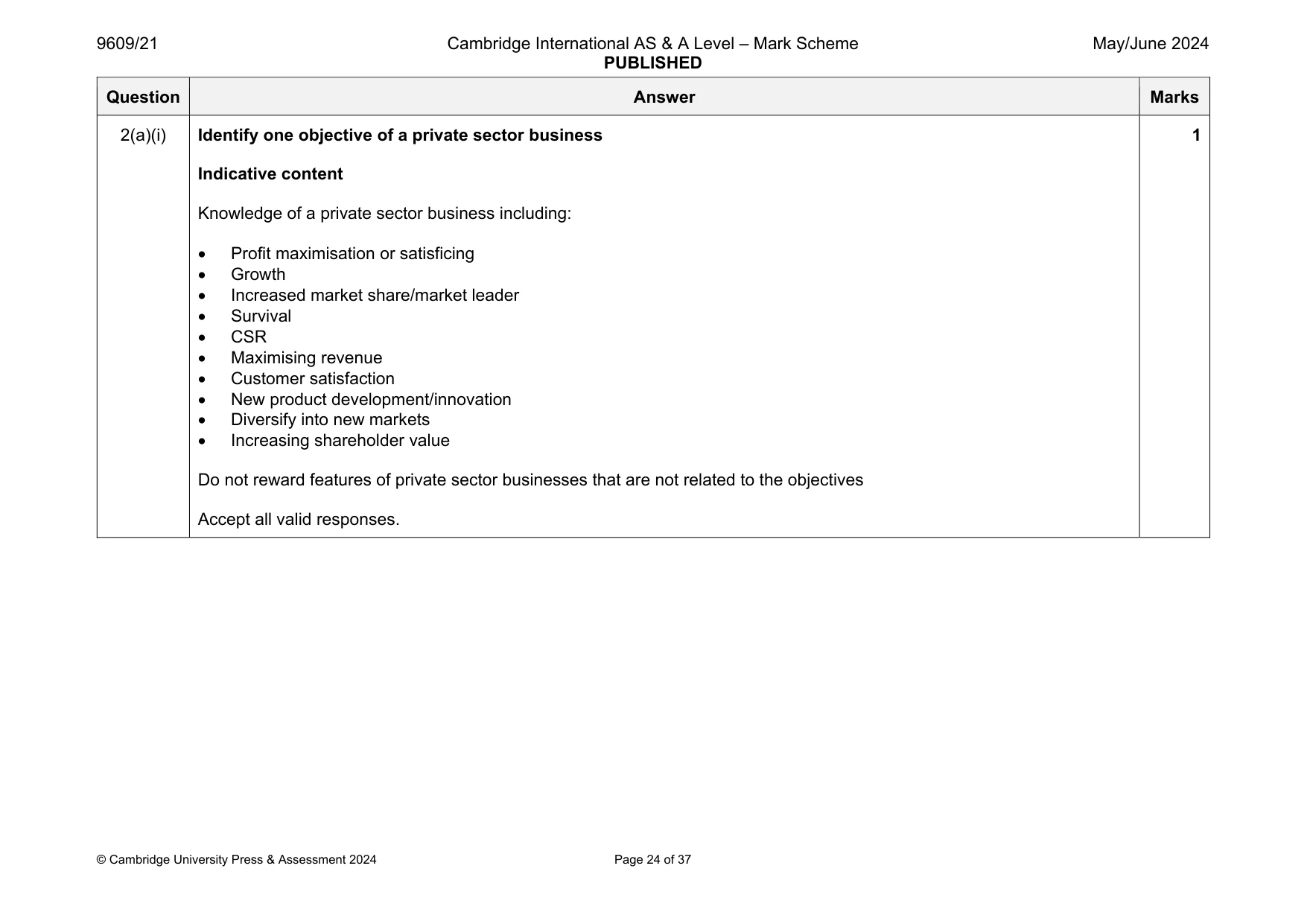
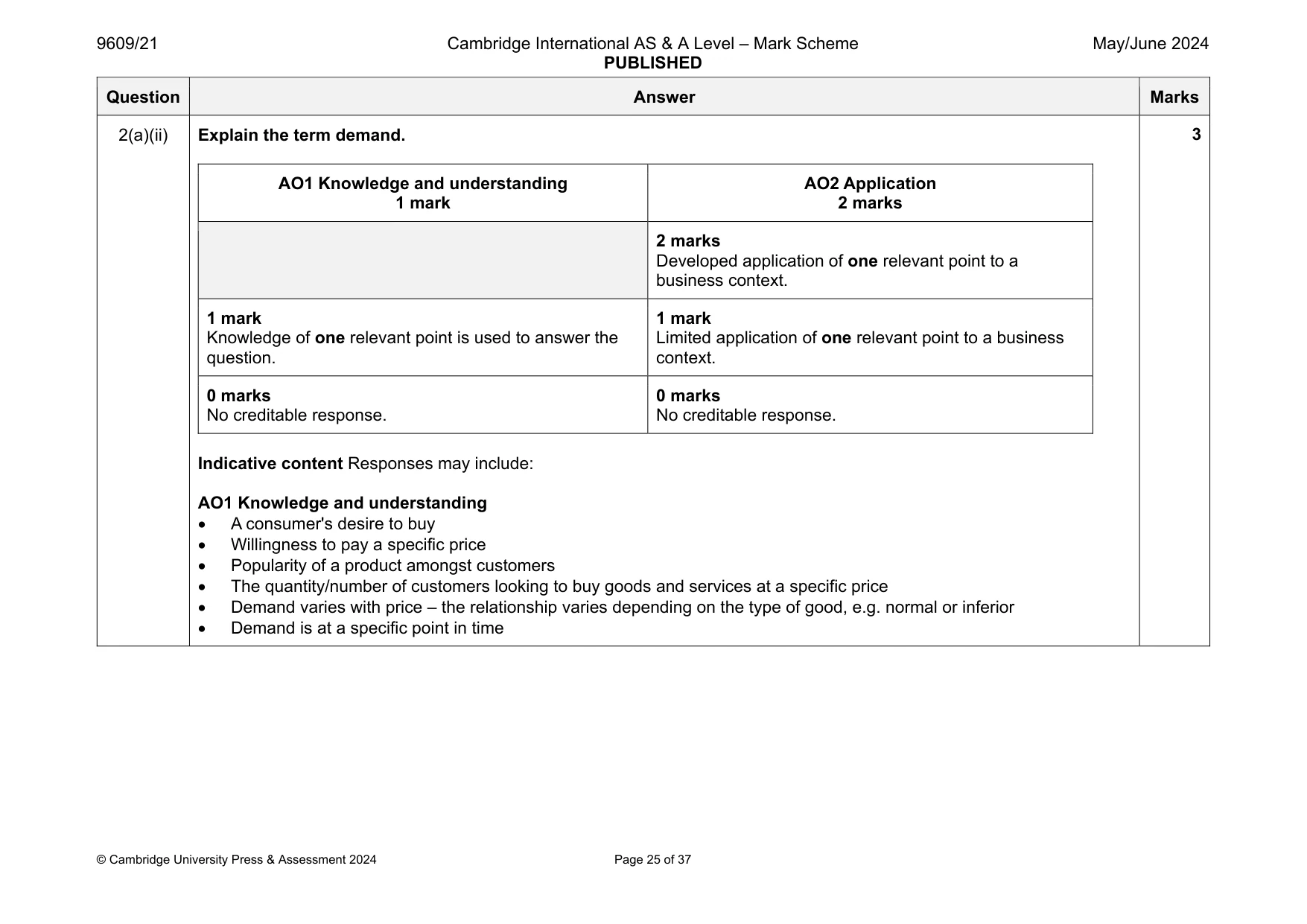
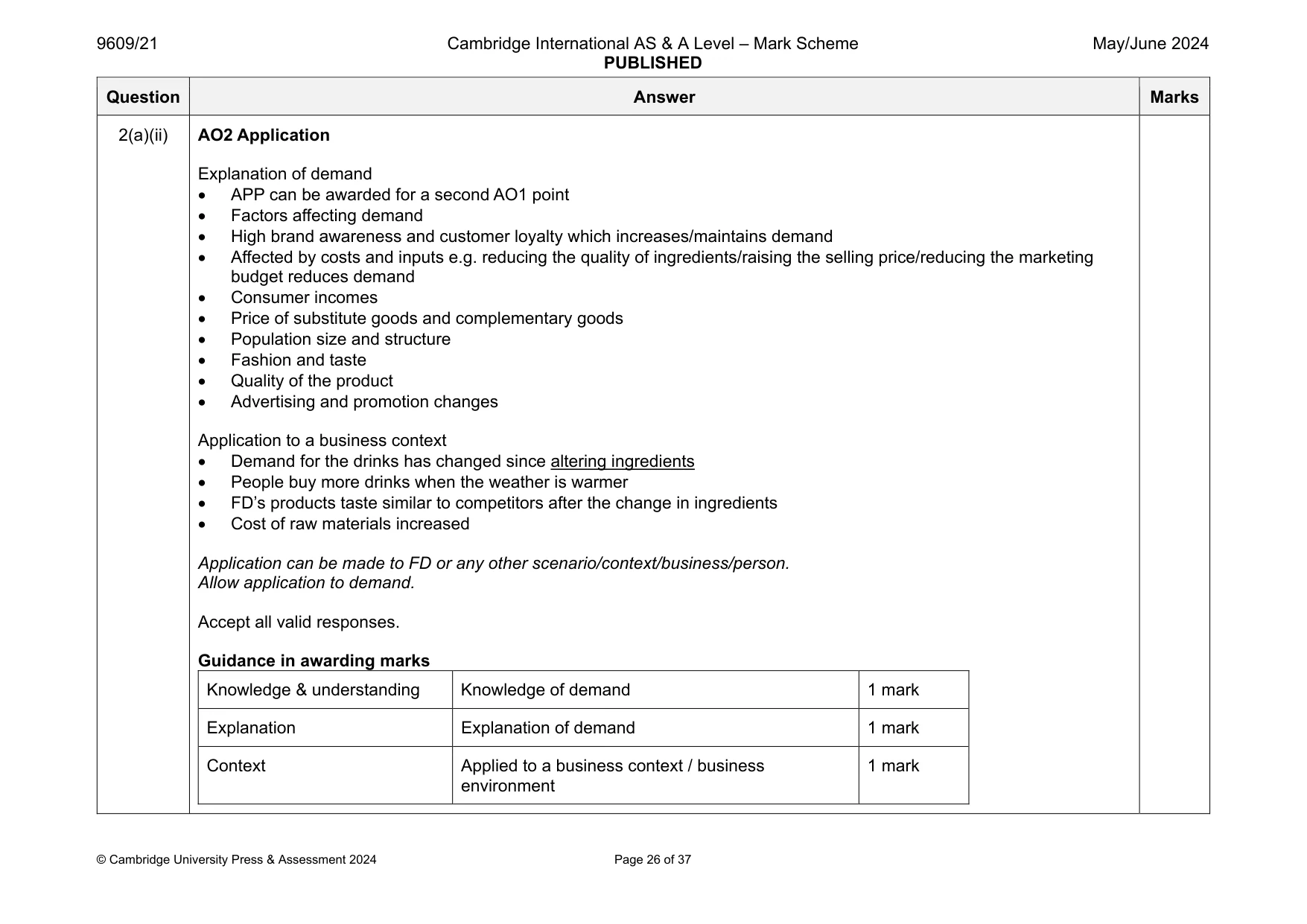
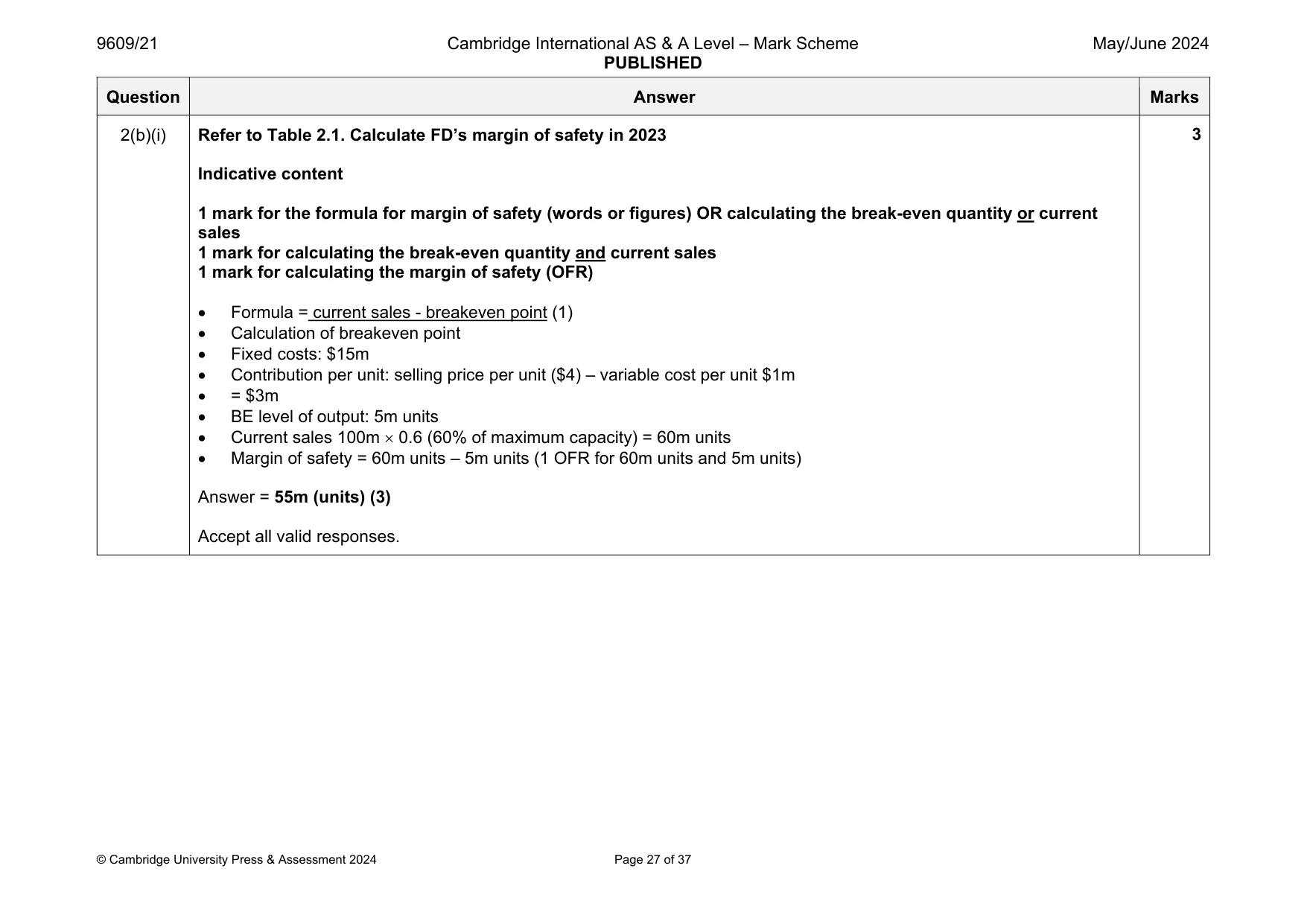
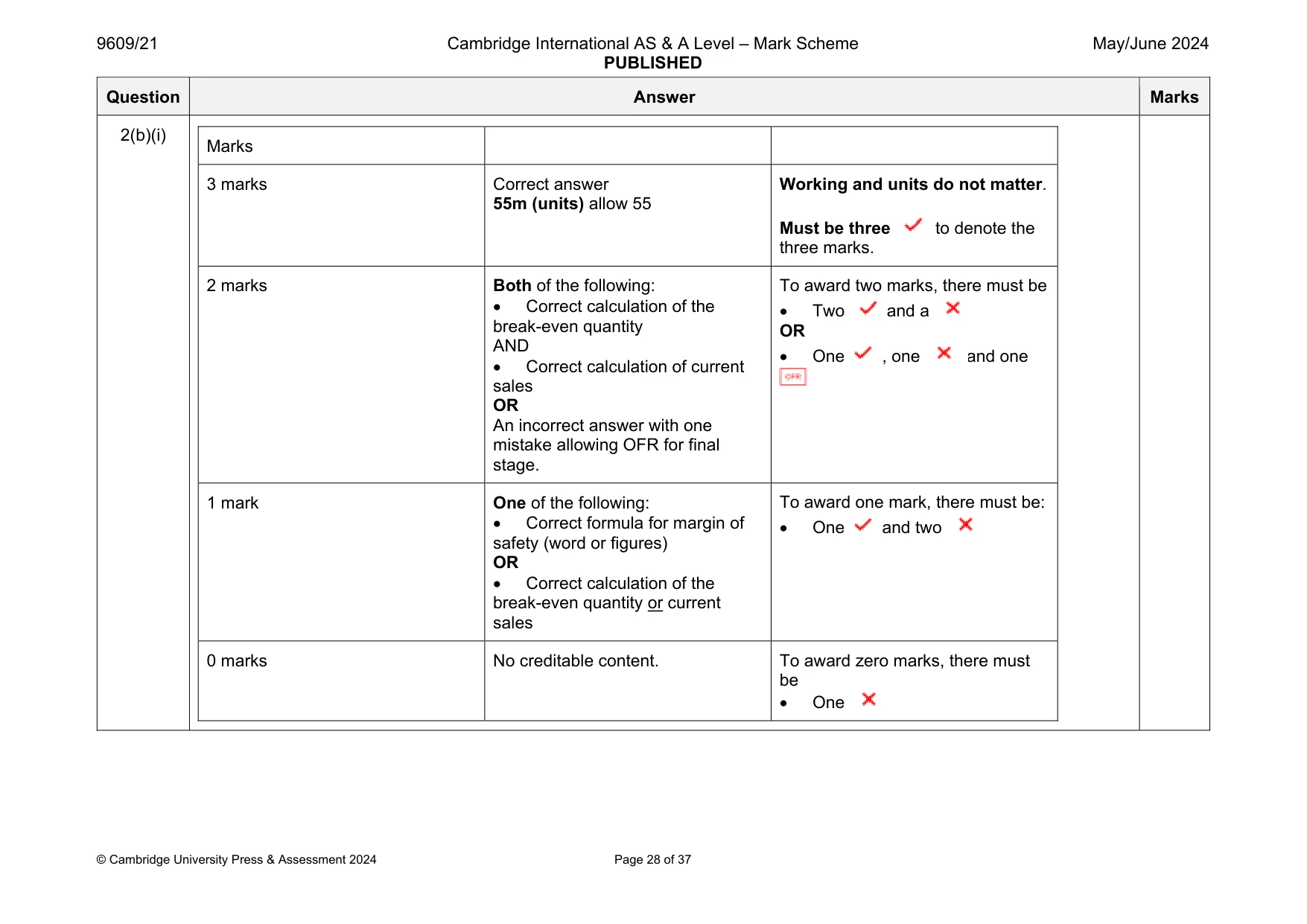
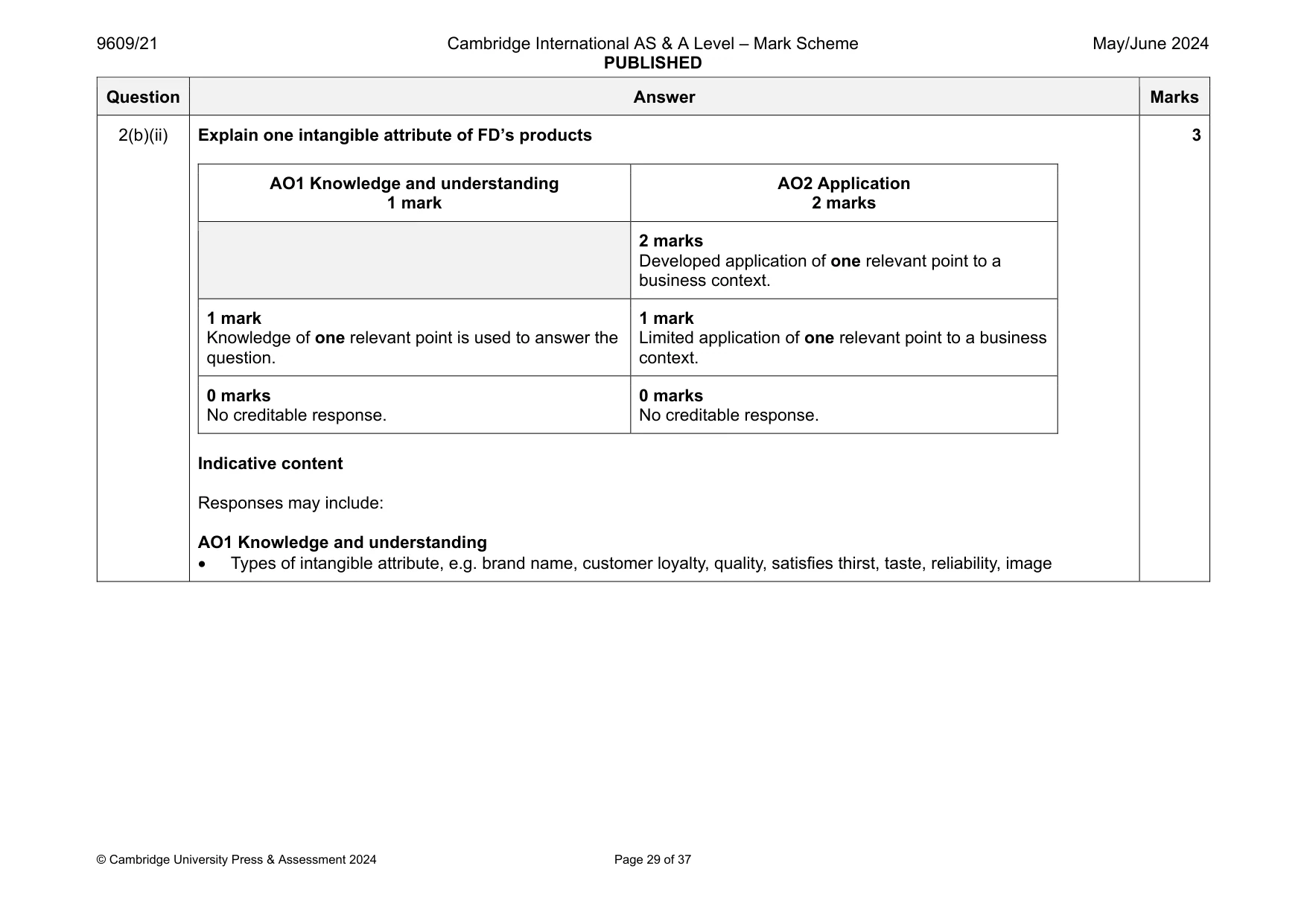
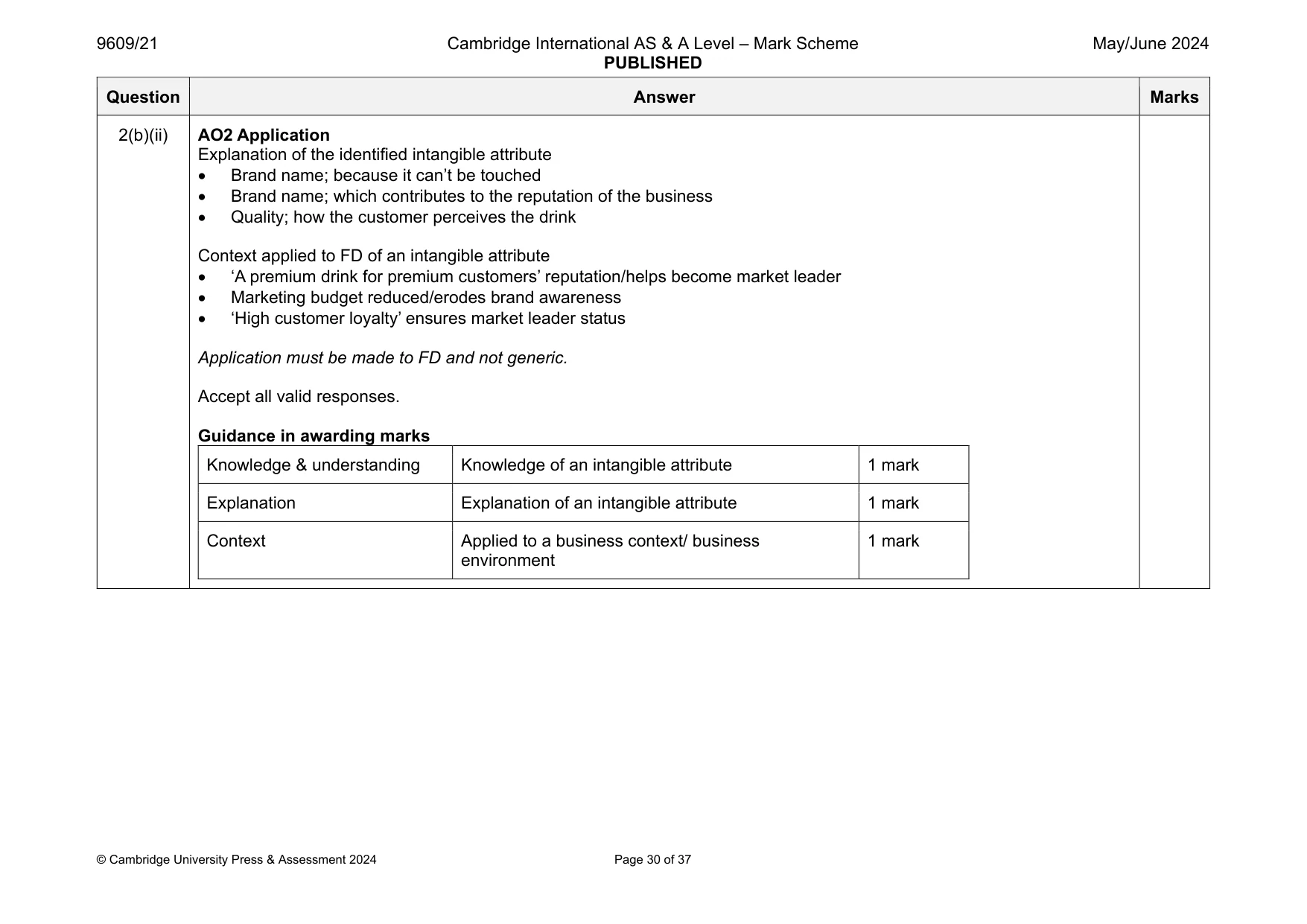
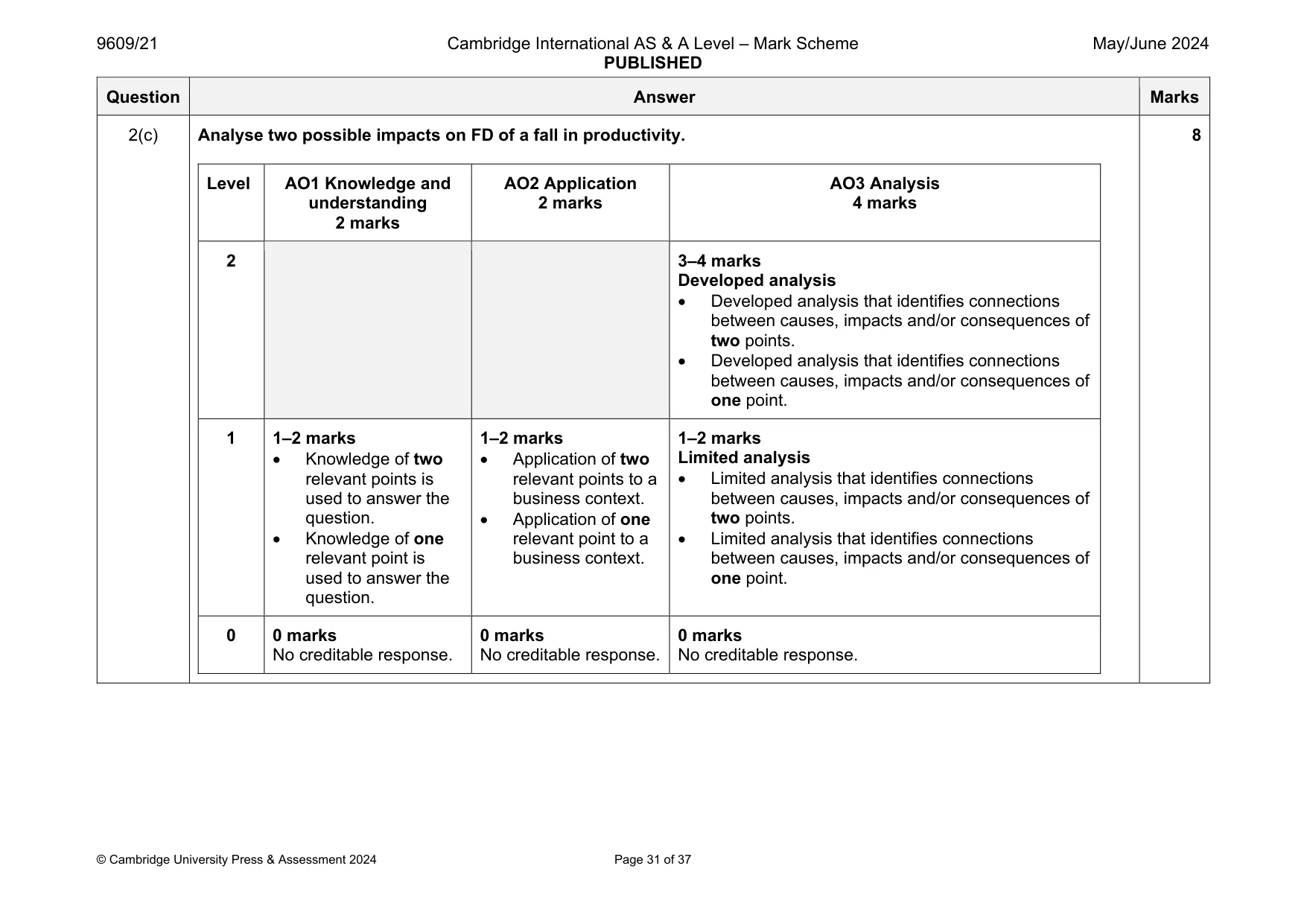
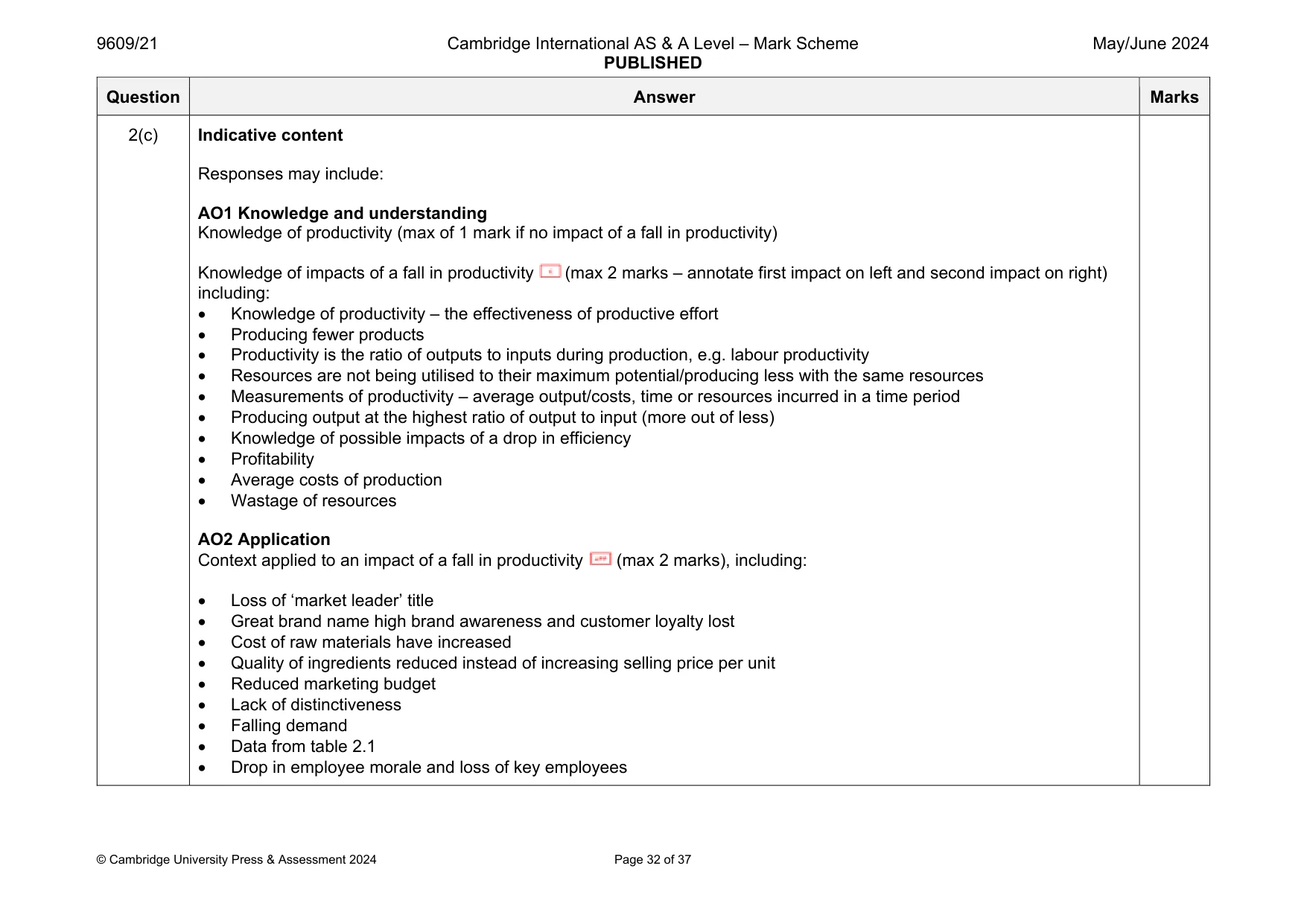
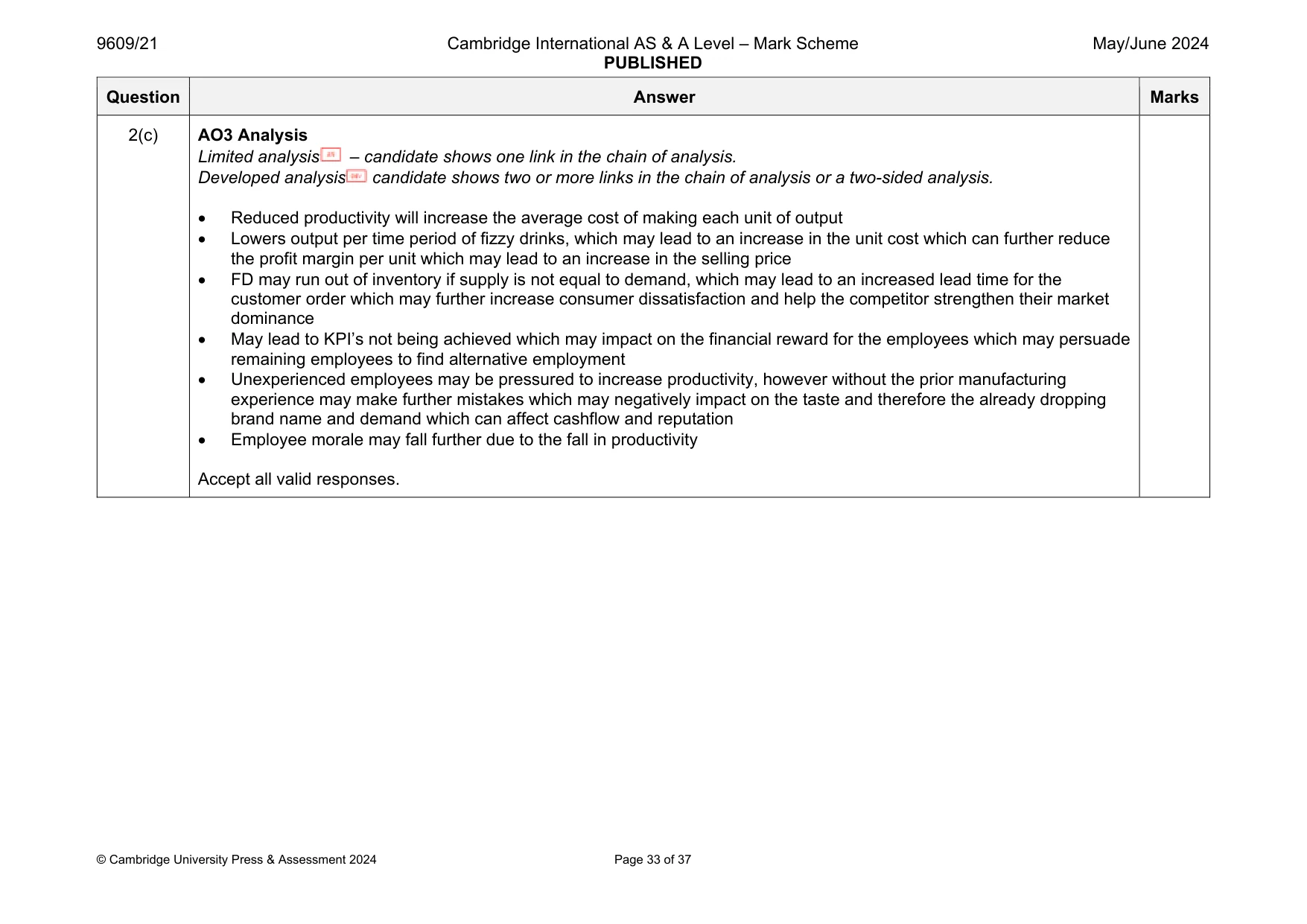
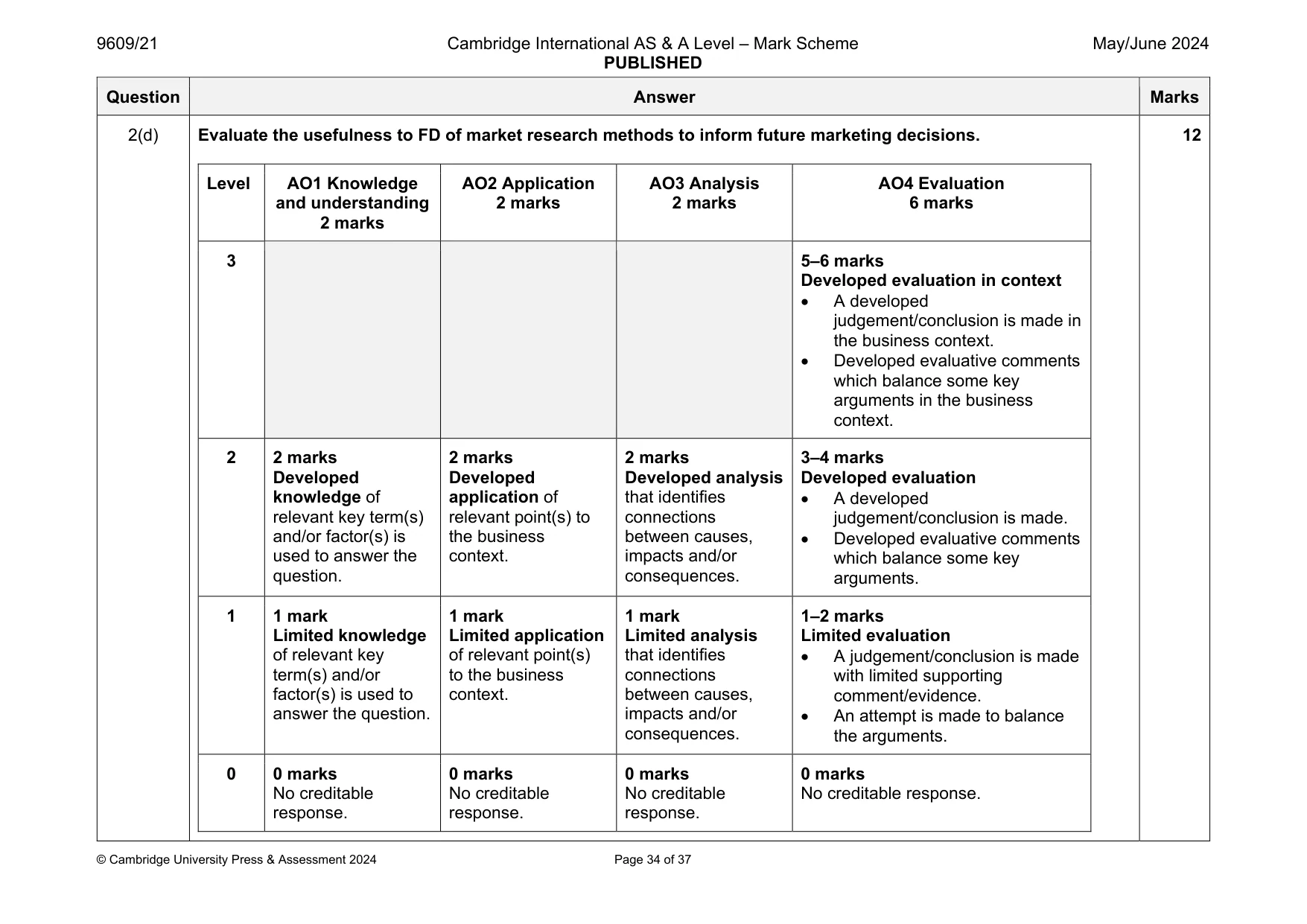
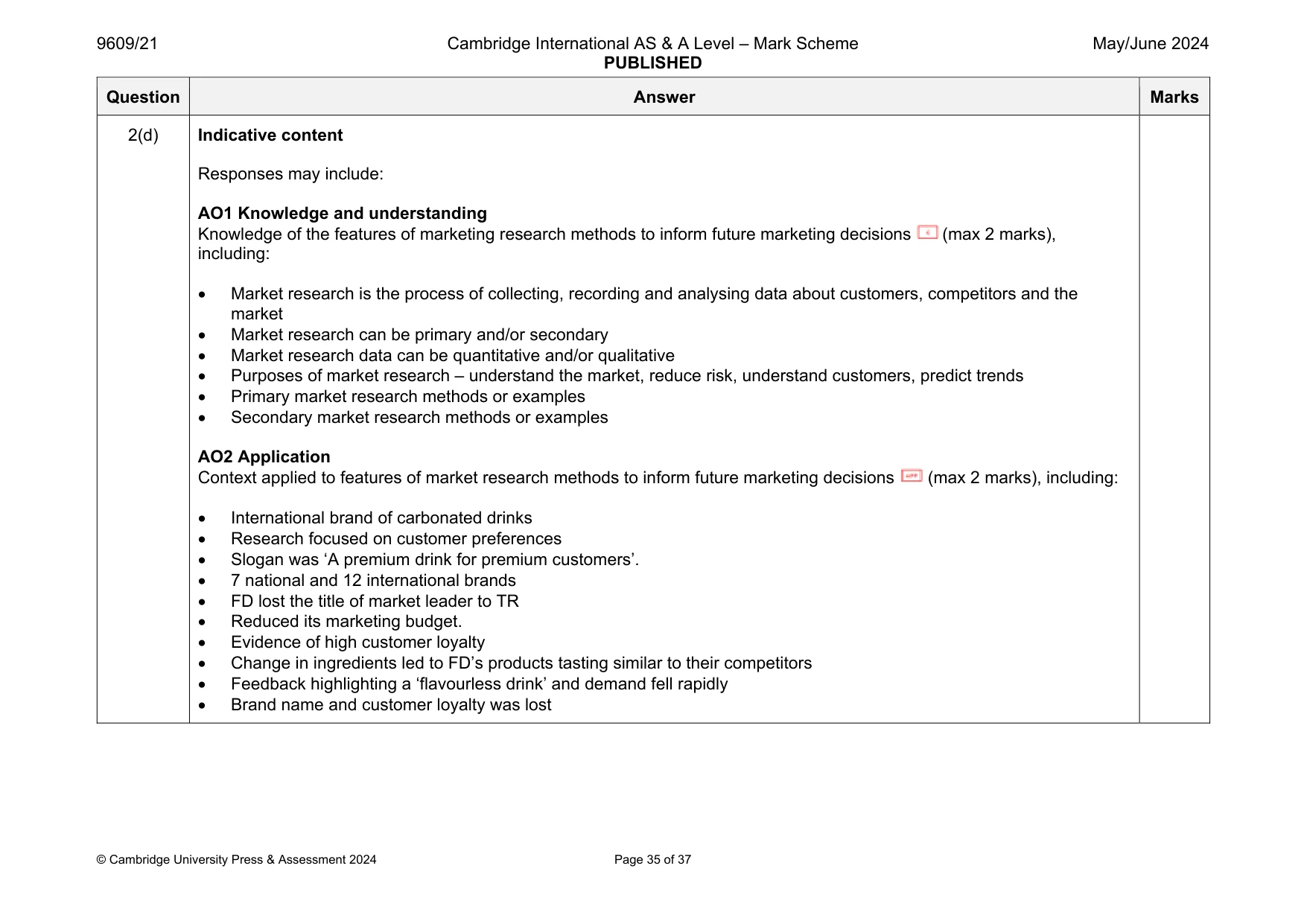
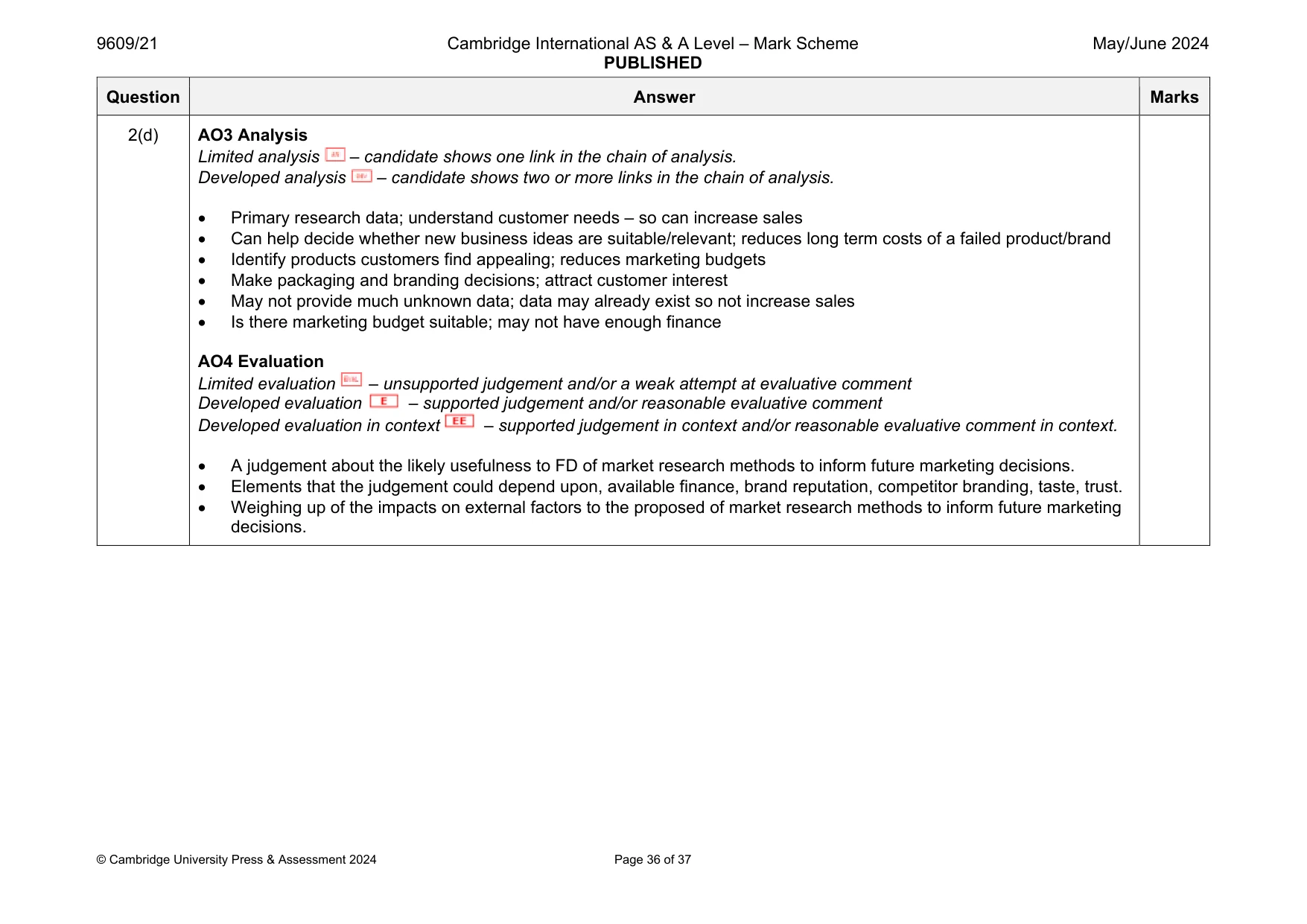
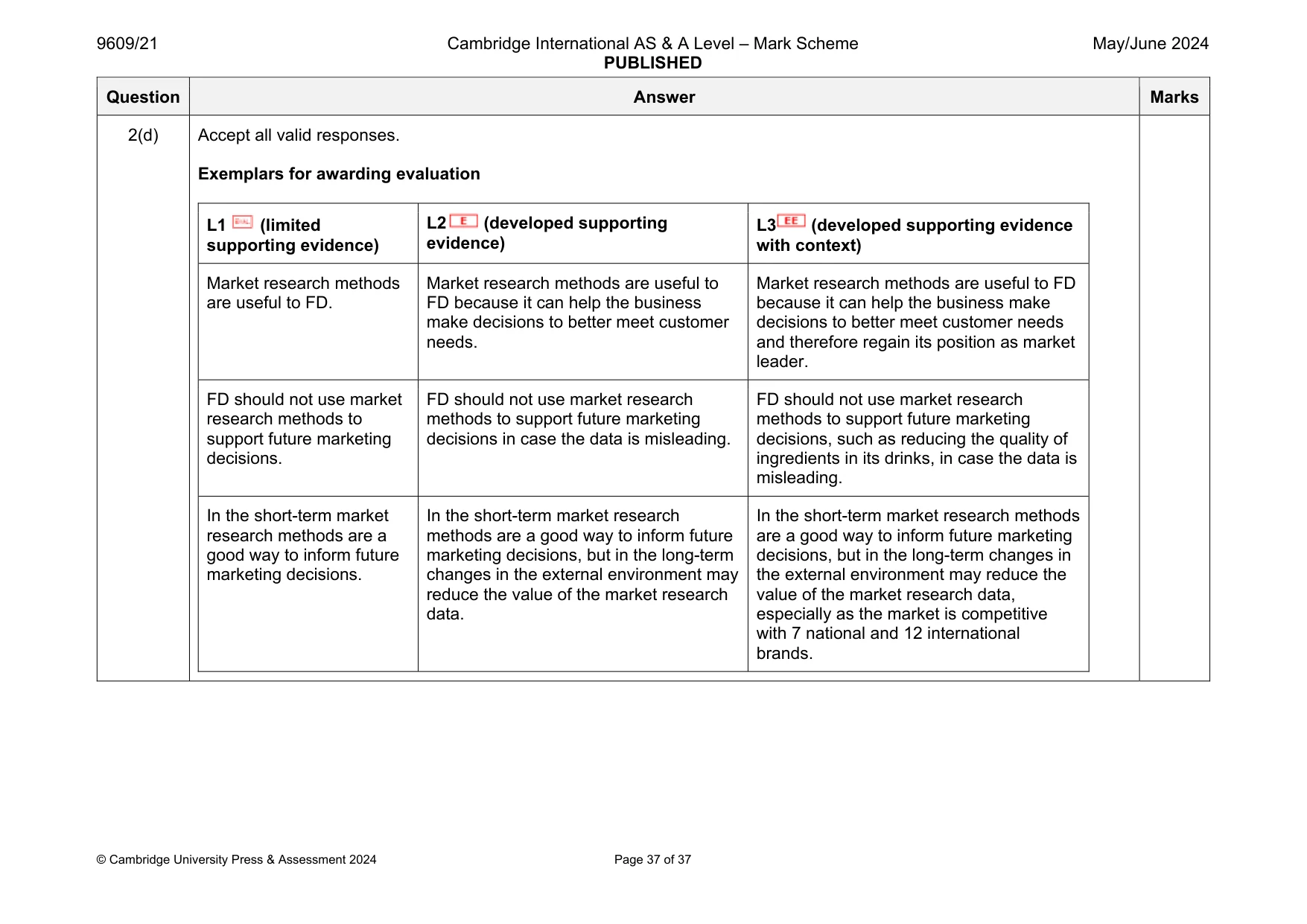
Mark scheme: 2(a)(i) Identify one objective of a private sector business Indicative content Knowledge of a private sector business including: Profit maximisation or satisficing Growth Increased market share/market leader Survival CSR Maximising revenue Customer satisfaction New product development/innovation Diversify into new markets Increasing shareholder value Do not reward features of private sector businesses that are not related to the objectives Accept all valid responses. 1 Question Answer Marks 2(a)(ii) Explain the term demand. AO1 Knowledge and understanding 1 mark AO2 Application 2 marks 2 marks Developed application of one relevant point to a business context. 1 mark Knowledge of one relevant point is used to answer the question. 1 mark Limited application of one relevant point to a business context. 0 marks No creditable response. 0 marks No creditable response. Indicative content Responses may include: AO1 Knowledge and understanding A consumer's desire to buy Willingness to pay a specific price Popularity of a product amongst customers The quantity/number of customers looking to buy goods and services at a specific price Demand varies with price – the relationship varies depending on the type of good, e.g. normal or inferior Demand is at a specific point in time 3 Question Answer Marks 2(a)(ii) AO2 Application Explanation of demand APP can be awarded for a second AO1 point Factors affecting demand High brand awareness and customer loyalty which increases/maintains demand Affected by costs and inputs e.g. reducing the quality of ingredients/raising the selling price/reducing the marketing budget reduces demand Consumer incomes Price of substitute goods and complementary goods Population size and structure Fashion and taste Quality of the product Advertising and promotion changes Application to a business context Demand for the drinks has changed since altering ingredients People buy more drinks when the weather is warmer FD’s products taste similar to competitors after the change in ingredients Cost of raw materials increased Application can be made to FD or any other scenario/context/business/person. Allow application to demand. Accept all valid responses. Guidance in awarding marks Knowledge & understanding Knowledge of demand 1 mark Explanation Explanation of demand 1 mark Context Applied to a business context / business environment 1 mark Question Answer Marks 2(b)(i) Refer to Table 2.1. Calculate FD’s margin of safety in 2023 Indicative content 1 mark for the formula for margin of safety (words or figures) OR calculating the break-even quantity or current sales 1 mark for calculating the break-even quantity and current sales 1 mark for calculating the margin of safety (OFR) Formula = current sales - breakeven point (1) Calculation of breakeven point Fixed costs: $15m Contribution per unit: selling price per unit ($4) – variable cost per unit $1m = $3m BE level of output: 5m units Current sales 100m 0.6 (60% of maximum capacity) = 60m units Margin of safety = 60m units – 5m units (1 OFR for 60m units and 5m units) Answer = 55m (units) (3) Accept all valid responses. 3 Question Answer Marks 2(b)(i) Marks 3 marks Correct answer 55m (units) allow 55 Working and units do not matter. Must be three to denote the three marks. 2 marks Both of the following: Correct calculation of the break-even quantity AND Correct calculation of current sales OR An incorrect answer with one mistake allowing OFR for final stage. To award two marks, there must be Two and a OR One , one and one 1 mark One of the following: Correct formula for margin of safety (word or figures) OR Correct calculation of the break-even quantity or current sales To award one mark, there must be: One and two 0 marks No creditable content. To award zero marks, there must be One Question Answer Marks 2(b)(ii) Explain one intangible attribute of FD’s products AO1 Knowledge and understanding 1 mark AO2 Application 2 marks 2 marks Developed application of one relevant point to a business context. 1 mark Knowledge of one relevant point is used to answer the question. 1 mark Limited application of one relevant point to a business context. 0 marks No creditable response. 0 marks No creditable response. Indicative content Responses may include: AO1 Knowledge and understanding Types of intangible attribute, e.g. brand name, customer loyalty, quality, satisfies thirst, taste, reliability, image 3 Question Answer Marks 2(b)(ii) AO2 Application Explanation of the identified intangible attribute Brand name; because it can’t be touched Brand name; which contributes to the reputation of the business Quality; how the customer perceives the drink Context applied to FD of an intangible attribute ‘A premium drink for premium customers’ reputation/helps become market leader Marketing budget reduced/erodes brand awareness ‘High customer loyalty’ ensures market leader status Application must be made to FD and not generic. Accept all valid responses. Guidance in awarding marks Knowledge & understanding Knowledge of an intangible attribute 1 mark Explanation Explanation of an intangible attribute 1 mark Context Applied to a business context/ business environment 1 mark Question Answer Marks 2(c) Analyse two possible impacts on FD of a fall in productivity. Level AO1 Knowledge and understanding 2 marks AO2 Application 2 marks AO3 Analysis 4 marks 2 3–4 marks Developed analysis Developed analysis that identifies connections between causes, impacts and/or consequences of two points. Developed analysis that identifies connections between causes, impacts and/or consequences of one point. 1 1–2 marks Knowledge of two relevant points is used to answer the question. Knowledge of one relevant point is used to answer the question. 1–2 marks Application of two relevant points to a business context. Application of one relevant point to a business context. 1–2 marks Limited analysis Limited analysis that identifies connections between causes, impacts and/or consequences of two points. Limited analysis that identifies connections between causes, impacts and/or consequences of one point. 0 0 marks No creditable response. 0 marks No creditable response. 0 marks No creditable response. 8 Question Answer Marks 2(c) Indicative content Responses may include: AO1 Knowledge and understanding Knowledge of productivity (max of 1 mark if no impact of a fall in productivity) Knowledge of impacts of a fall in productivity (max 2 marks – annotate first impact on left and second impact on right) including: Knowledge of productivity – the effectiveness of productive effort Producing fewer products Productivity is the ratio of outputs to inputs during production, e.g. labour productivity Resources are not being utilised to their maximum potential/producing less with the same resources Measurements of productivity – average output/costs, time or resources incurred in a time period Producing output at the highest ratio of output to input (more out of less) Knowledge of possible impacts of a drop in efficiency Profitability Average costs of production Wastage of resources AO2 Application Context applied to an impact of a fall in productivity (max 2 marks), including: Loss of ‘market leader’ title Great brand name high brand awareness and customer loyalty lost Cost of raw materials have increased Quality of ingredients reduced instead of increasing selling price per unit Reduced marketing budget Lack of distinctiveness Falling demand Data from table 2.1 Drop in employee morale and loss of key employees Question Answer Marks 2(c) AO3 Analysis Limited analysis – candidate shows one link in the chain of analysis. Developed analysis candidate shows two or more links in the chain of analysis or a two-sided analysis. Reduced productivity will increase the average cost of making each unit of output Lowers output per time period of fizzy drinks, which may lead to an increase in the unit cost which can further reduce the profit margin per unit which may lead to an increase in the selling price FD may run out of inventory if supply is not equal to demand, which may lead to an increased lead time for the customer order which may further increase consumer dissatisfaction and help the competitor strengthen their market dominance May lead to KPI’s not being achieved which may impact on the financial reward for the employees which may persuade remaining employees to find alternative employment Unexperienced employees may be pressured to increase productivity, however without the prior manufacturing experience may make further mistakes which may negatively impact on the taste and therefore the already dropping brand name and demand which can affect cashflow and reputation Employee morale may fall further due to the fall in productivity Accept all valid responses. Question Answer Marks 2(d) Evaluate the usefulness to FD of market research methods to inform future marketing decisions. Level AO1 Knowledge and understanding 2 marks AO2 Application 2 marks AO3 Analysis 2 marks AO4 Evaluation 6 marks 3 5–6 marks Developed evaluation in context A developed judgement/conclusion is made in the business context. Developed evaluative comments which balance some key arguments in the business context. 2 2 marks Developed knowledge of relevant key term(s) and/or factor(s) is used to answer the question. 2 marks Developed application of relevant point(s) to the business context. 2 marks Developed analysis that identifies connections between causes, impacts and/or consequences. 3–4 marks Developed evaluation A developed judgement/conclusion is made. Developed evaluative comments which balance some key arguments. 1 1 mark Limited knowledge of relevant key term(s) and/or factor(s) is used to answer the question. 1 mark Limited application of relevant point(s) to the business context. 1 mark Limited analysis that identifies connections between causes, impacts and/or consequences. 1–2 marks Limited evaluation A judgement/conclusion is made with limited supporting comment/evidence. An attempt is made to balance the arguments. 0 0 marks No creditable response. 0 marks No creditable response. 0 marks No creditable response. 0 marks No creditable response. 12 Question Answer Marks 2(d) Indicative content Responses may include: AO1 Knowledge and understanding Knowledge of the features of marketing research methods to inform future marketing decisions (max 2 marks), including: Market research is the process of collecting, recording and analysing data about customers, competitors and the market Market research can be primary and/or secondary Market research data can be quantitative and/or qualitative Purposes of market research – understand the market, reduce risk, understand customers, predict trends Primary market research methods or examples Secondary market research methods or examples AO2 Application Context applied to features of market research methods to inform future marketing decisions (max 2 marks), including: International brand of carbonated drinks Research focused on customer preferences Slogan was ‘A premium drink for premium customers’. 7 national and 12 international brands FD lost the title of market leader to TR Reduced its marketing budget. Evidence of high customer loyalty Change in ingredients led to FD’s products tasting similar to their competitors Feedback highlighting a ‘flavourless drink’ and demand fell rapidly Brand name and customer loyalty was lost Question Answer Marks 2(d) AO3 Analysis Limited analysis – candidate shows one link in the chain of analysis. Developed analysis – candidate shows two or more links in the chain of analysis. Primary research data; understand customer needs – so can increase sales Can help decide whether new business ideas are suitable/relevant; reduces long term costs of a failed product/brand Identify products customers find appealing; reduces marketing budgets Make packaging and branding decisions; attract customer interest May not provide much unknown data; data may already exist so not increase sales Is there marketing budget suitable; may not have enough finance AO4 Evaluation Limited evaluation – unsupported judgement and/or a weak attempt at evaluative comment Developed evaluation – supported judgement and/or reasonable evaluative comment Developed evaluation in context – supported judgement in context and/or reasonable evaluative comment in context. A judgement about the likely usefulness to FD of market research methods to inform future marketing decisions. Elements that the judgement could depend upon, available finance, brand reputation, competitor branding, taste, trust. Weighing up of the impacts on external factors to the proposed of market research methods to inform future marketing decisions. Question Answer Marks 2(d) Accept all valid responses. Exemplars for awarding evaluation L1 (limited supporting evidence) L2 (developed supporting evidence) L3 (developed supporting evidence with context) Market research methods are useful to FD. Market research methods are useful to FD because it can help the business make decisions to better meet customer needs. Market research methods are useful to FD because it can help the business make decisions to better meet customer needs and therefore regain its position as market leader. FD should not use market research methods to support future marketing decisions. FD should not use market research methods to support future marketing decisions in case the data is misleading. FD should not use market research methods to support future marketing decisions, such as reducing the quality of ingredients in its drinks, in case the data is misleading. In the short-term market research methods are a good way to inform future marketing decisions. In the short-term market research methods are a good way to inform future marketing decisions, but in the long-term changes in the external environment may reduce the value of the market research data. In the short-term market research methods are a good way to inform future marketing decisions, but in the long-term changes in the external environment may reduce the value of the market research data, especially as the market is competitive with 7 national and 12 international brands.
What was in this paper
The subtopics covered by these 2 questions, and how many questions each got. Open one in a new tab to see every Cambridge question on it.
What you needed in this session
Cambridge’s own grade thresholds for 2024 May/June, Paper 2 · Variant 1. A higher threshold means an easier paper — the bar moves with how the cohort did.