Cambridge A Level Business (for first examination in 2016) 9609 — 2021 Oct/Nov Paper 2 · Variant 1
9609/21/O/N/21 · 2 questions · 60 marks · ≈68 min
The question paper and its mark scheme, free to read here and free to download. This is Cambridge’s own paper, exactly as it was sat.
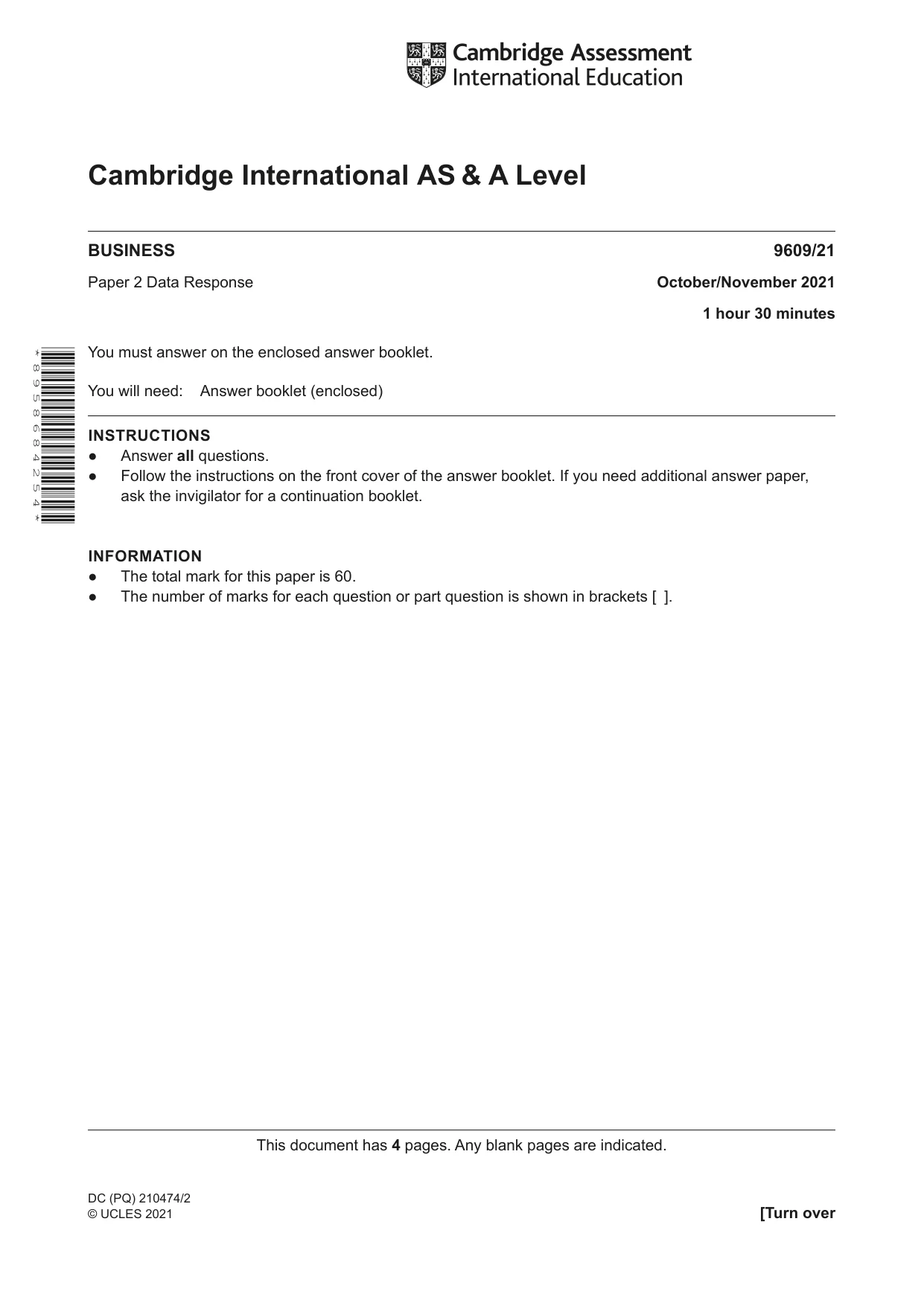
Question paper4 pages

Mark scheme24 pages
Answers below. Sit the paper first if you are practising.

Questions as text
Q1 · Quality Furniture (QF) QF is a public limited company in country S
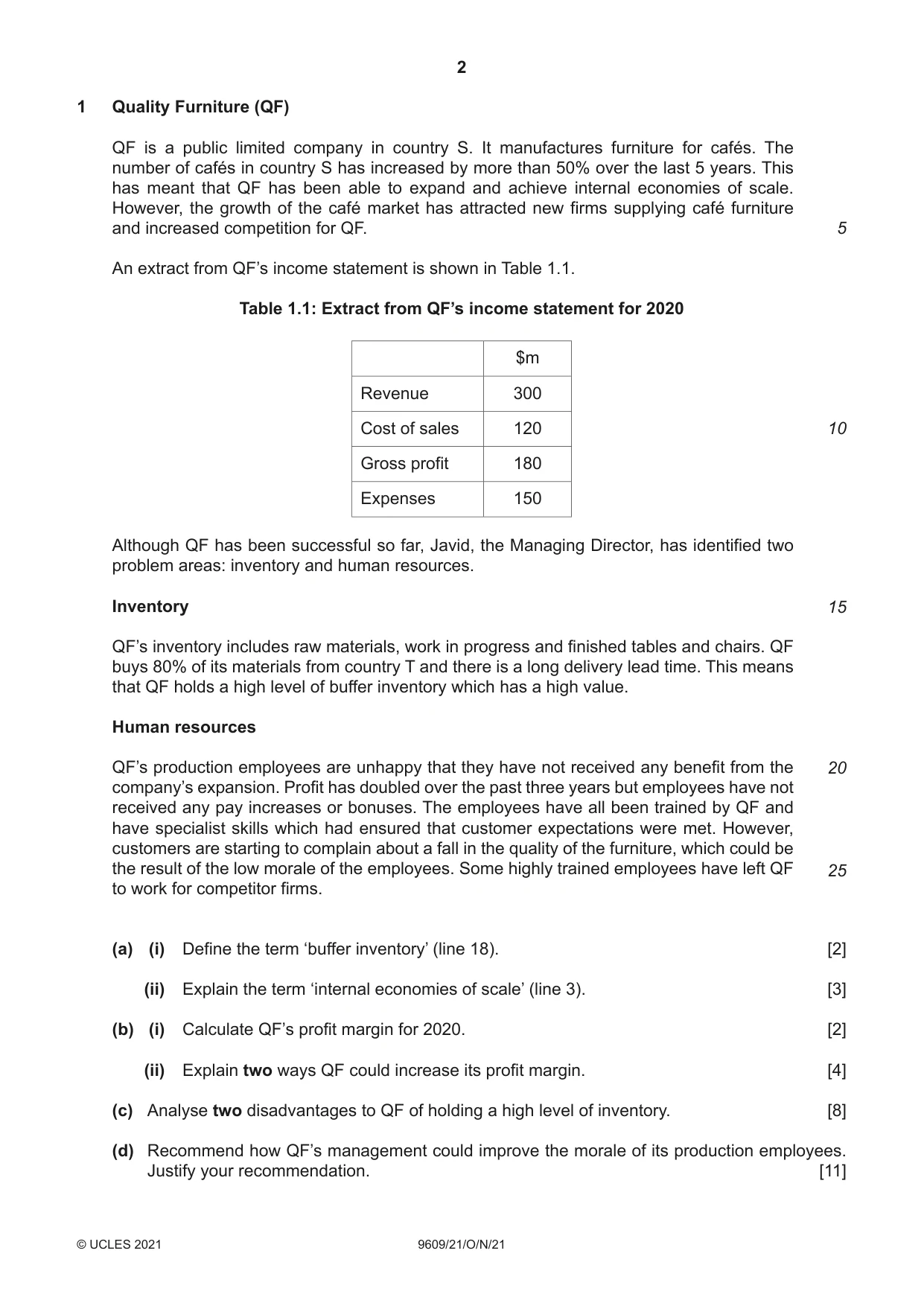
1 Quality Furniture (QF) QF is a public limited company in country S. It manufactures furniture for cafés. The number of cafés in country S has increased by more than 50% over the last 5 years. This has meant that QF has been able to expand and achieve internal economies of scale. However, the growth of the café market has attracted new firms supplying café furniture and increased competition for QF. 5 An extract from QF’s income statement is shown in Table 1.1. Table 1.1: Extract from QF’s income statement for 2020 $m Revenue 300 Cost of sales 120 10 Gross profit 180 Expenses 150 Although QF has been successful so far, Javid, the Managing Director, has identified two problem areas: inventory and human resources. Inventory 15 QF’s inventory includes raw materials, work in progress and finished tables and chairs. QF buys 80% of its materials from country T and there is a long delivery lead time. This means that QF holds a high level of buffer inventory which has a high value. Human resources QF’s production employees are unhappy that they have not received any benefit from the 20 company’s expansion. Profit has doubled over the past three years but employees have not received any pay increases or bonuses. The employees have all been trained by QF and have specialist skills which had ensured that customer expectations were met. However, customers are starting to complain about a fall in the quality of the furniture, which could be the result of the low morale of the employees. Some highly trained employees have left QF 25 to work for competitor firms. (a) (i) Define the term ‘buffer inventory’ (line 18). [2] (ii) Explain the term ‘internal economies of scale’ (line 3). [3] (b) (i) Calculate QF’s profit margin for 2020. [2] (ii) Explain two ways QF could increase its profit margin. [4] (c) Analyse two disadvantages to QF of holding a high level of inventory. [8] (d) Recommend how QF’s management could improve the morale of its production employees. Justify your recommendation. [11]
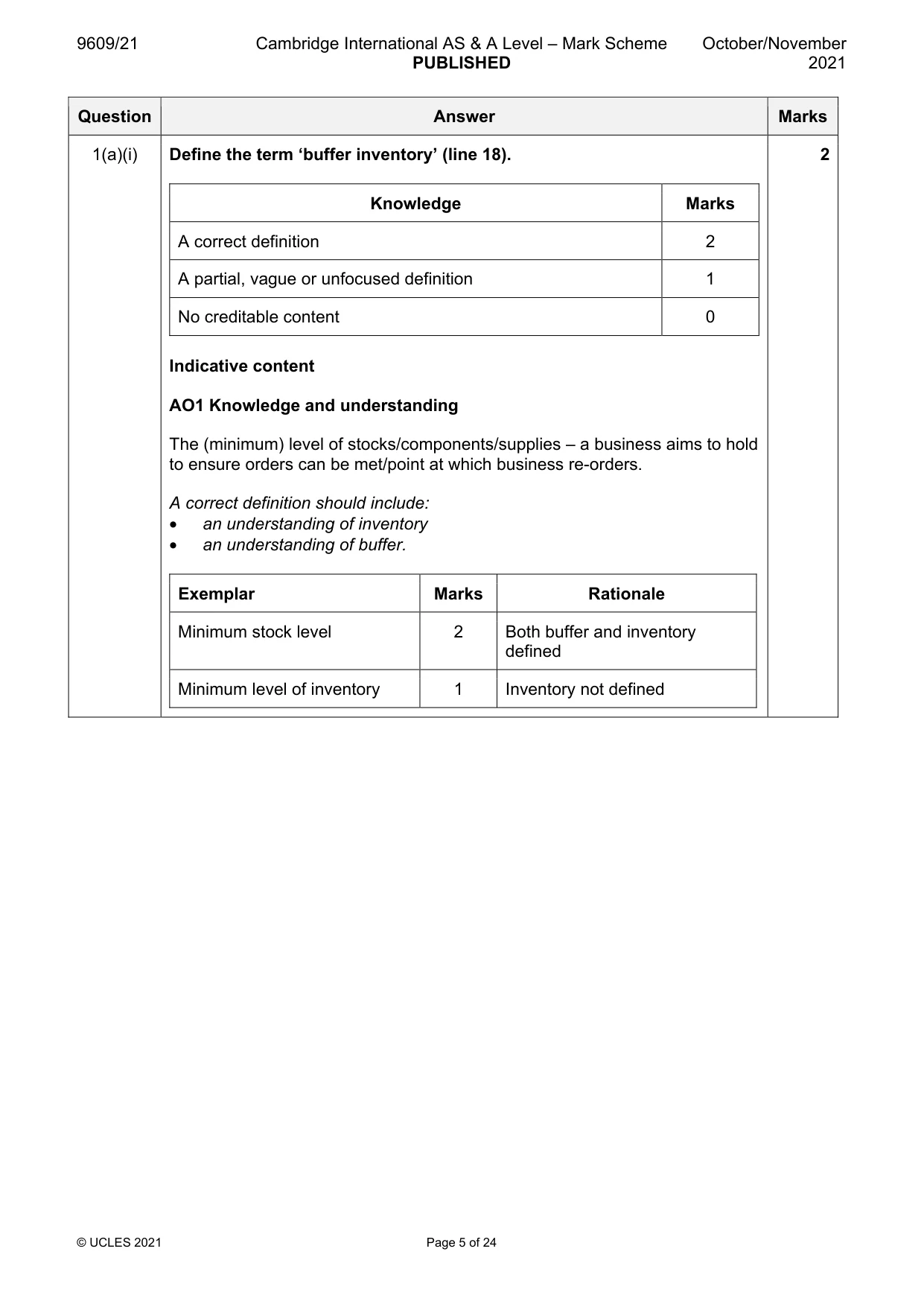
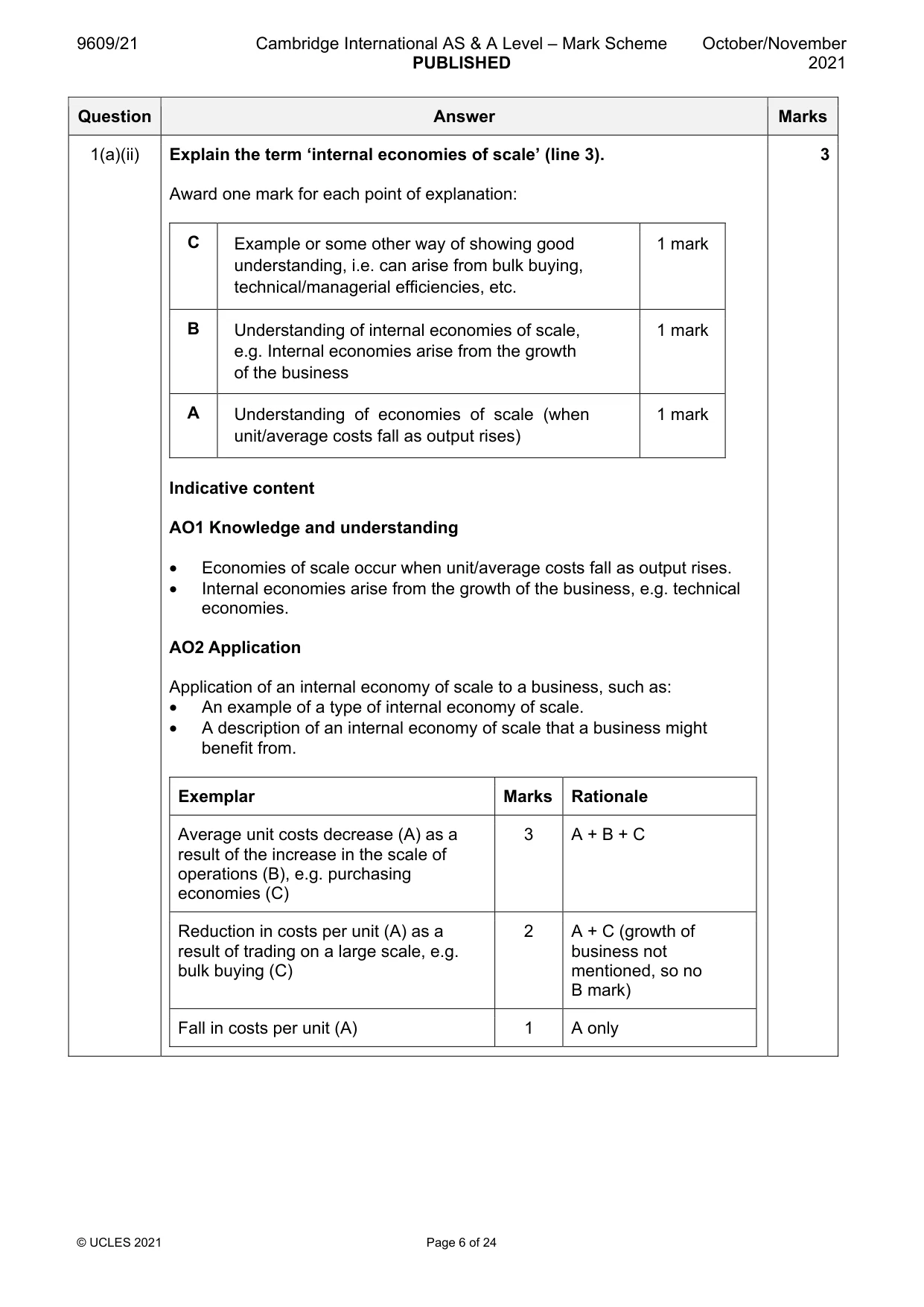
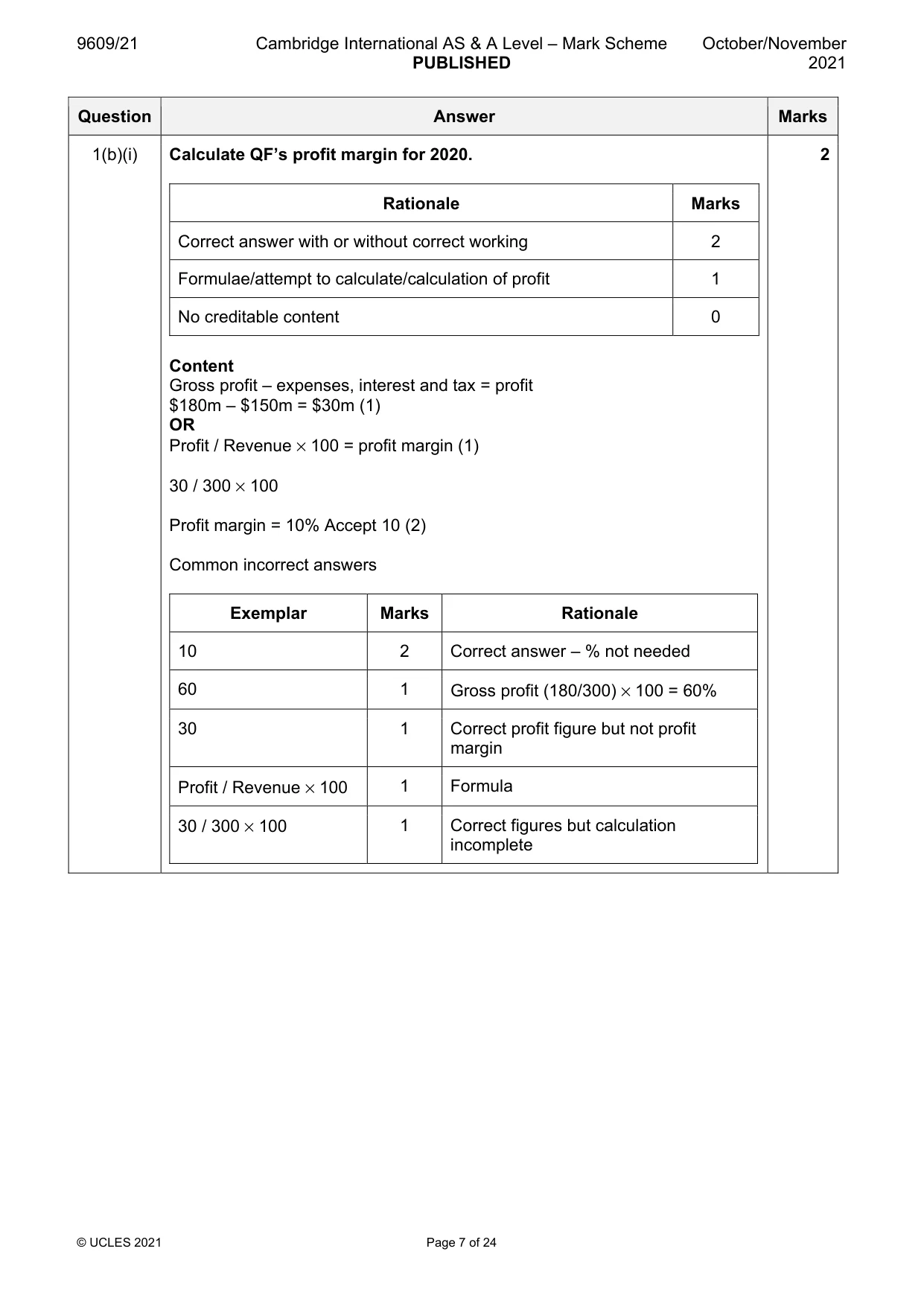
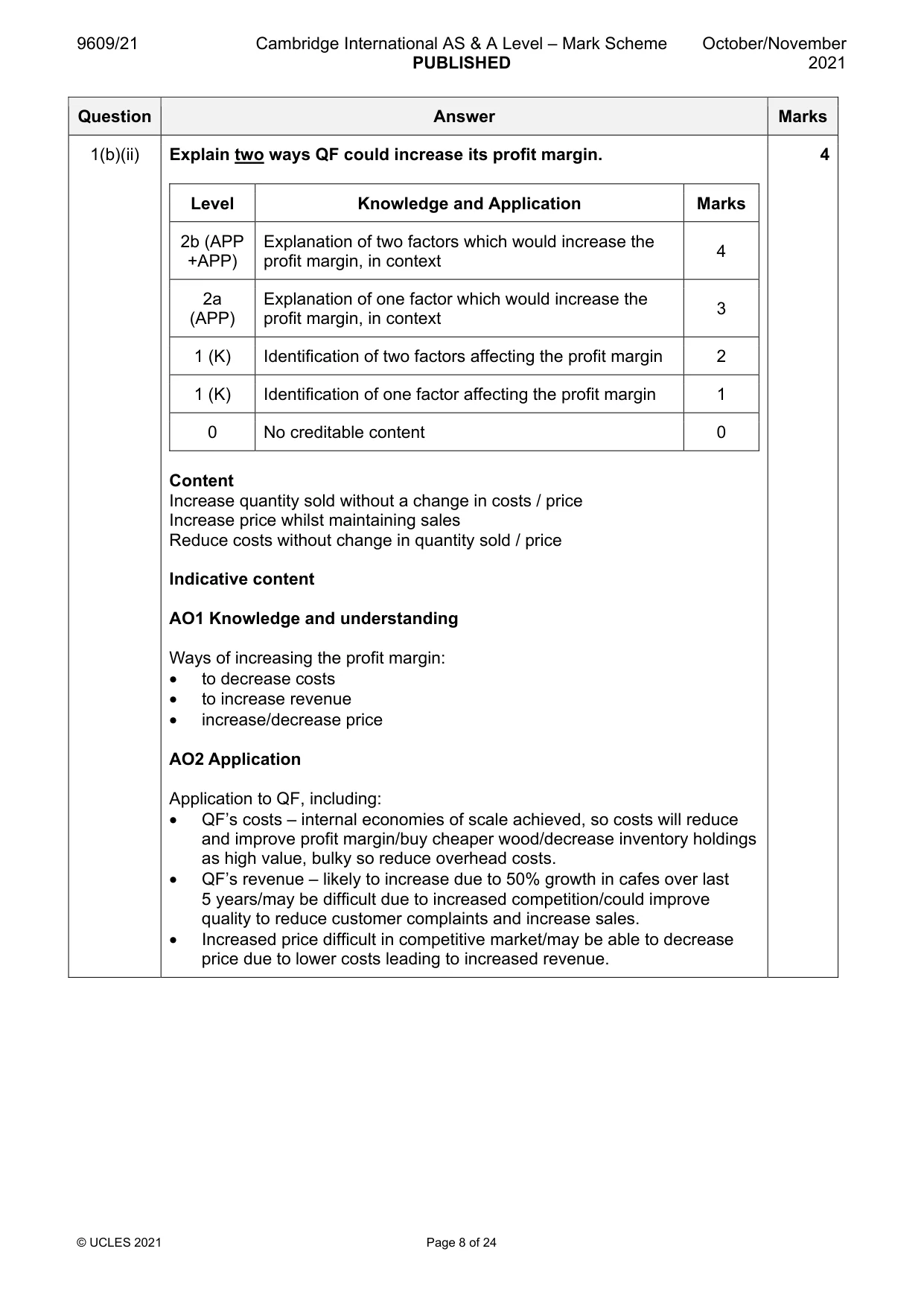
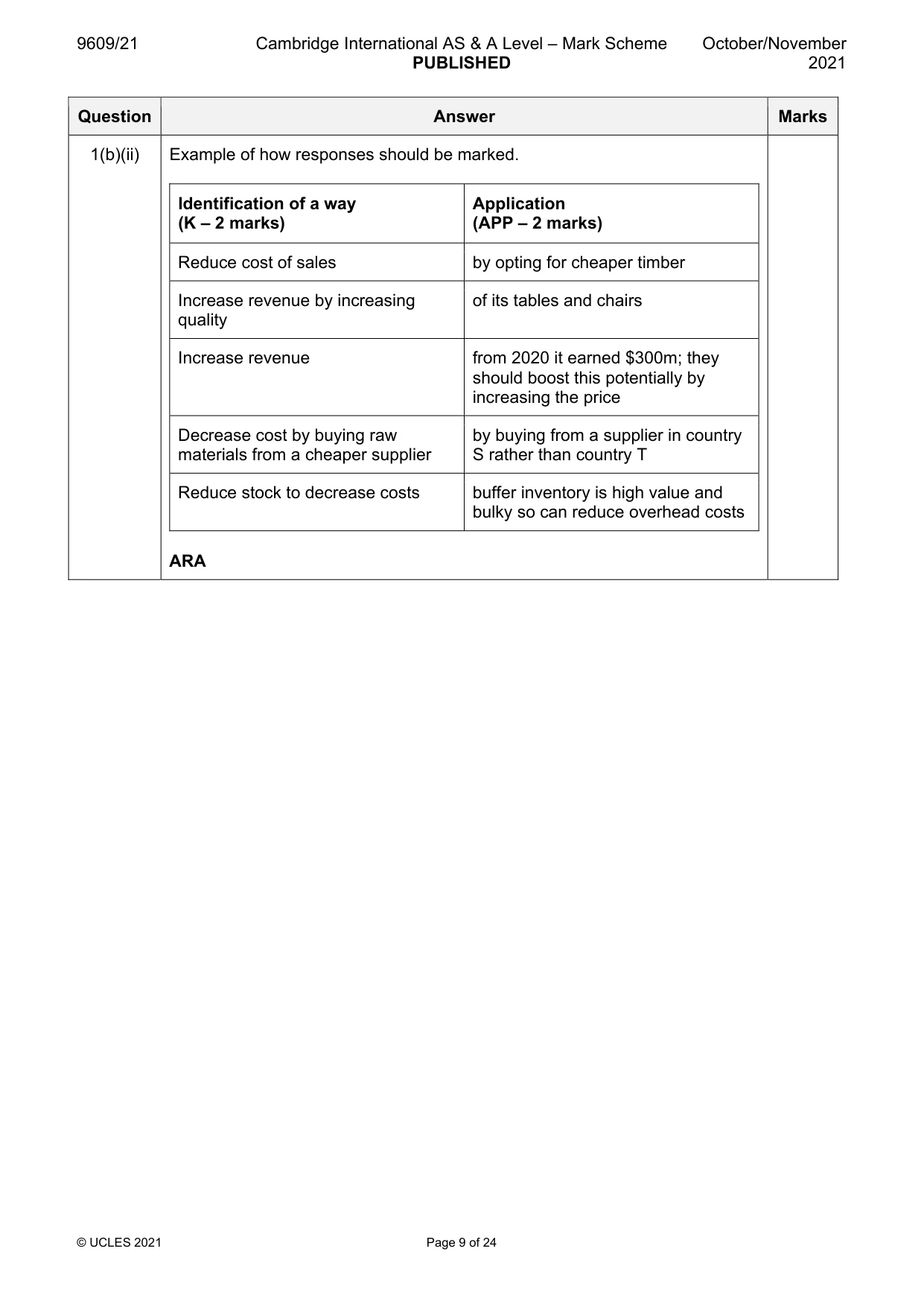
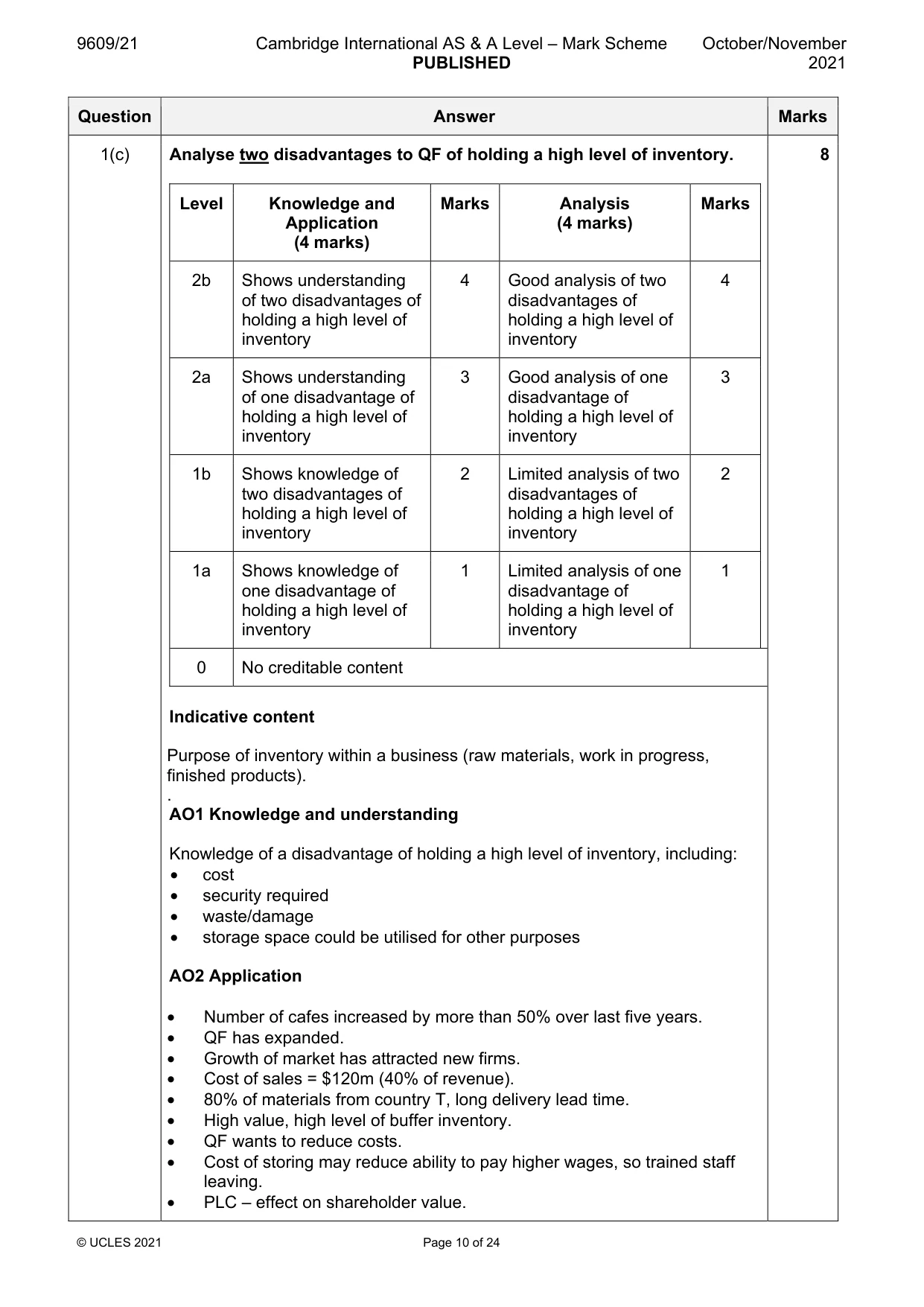
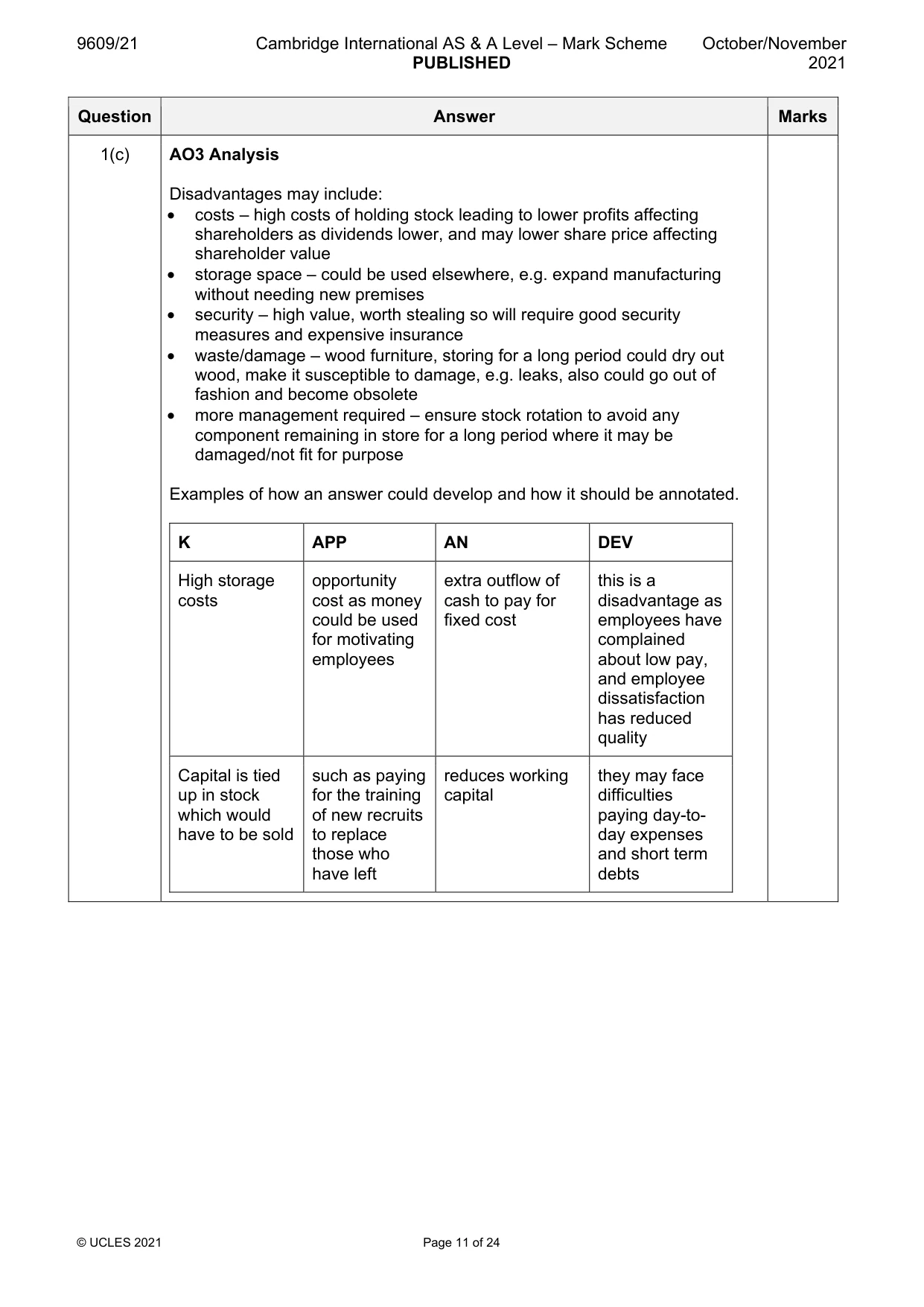
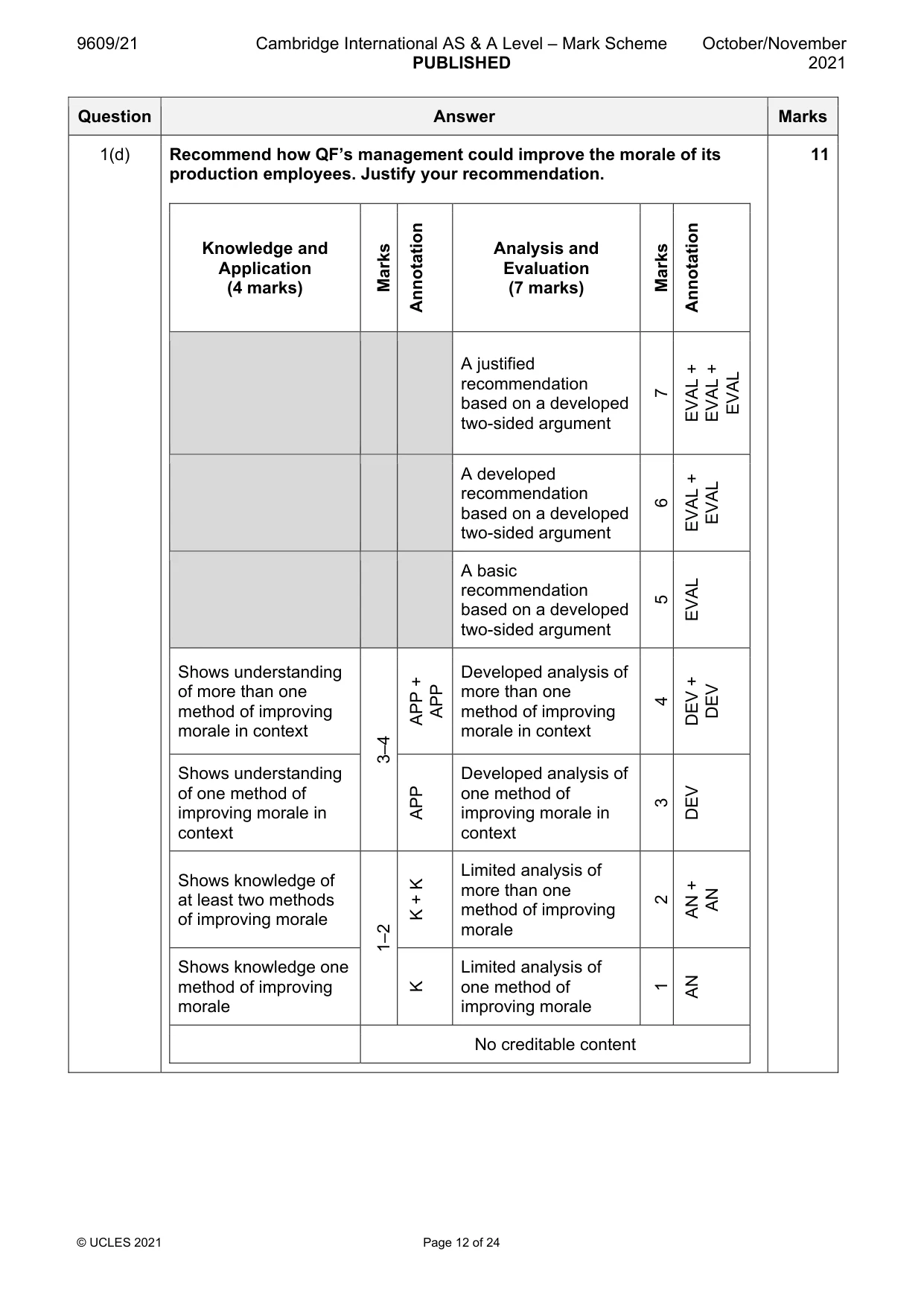
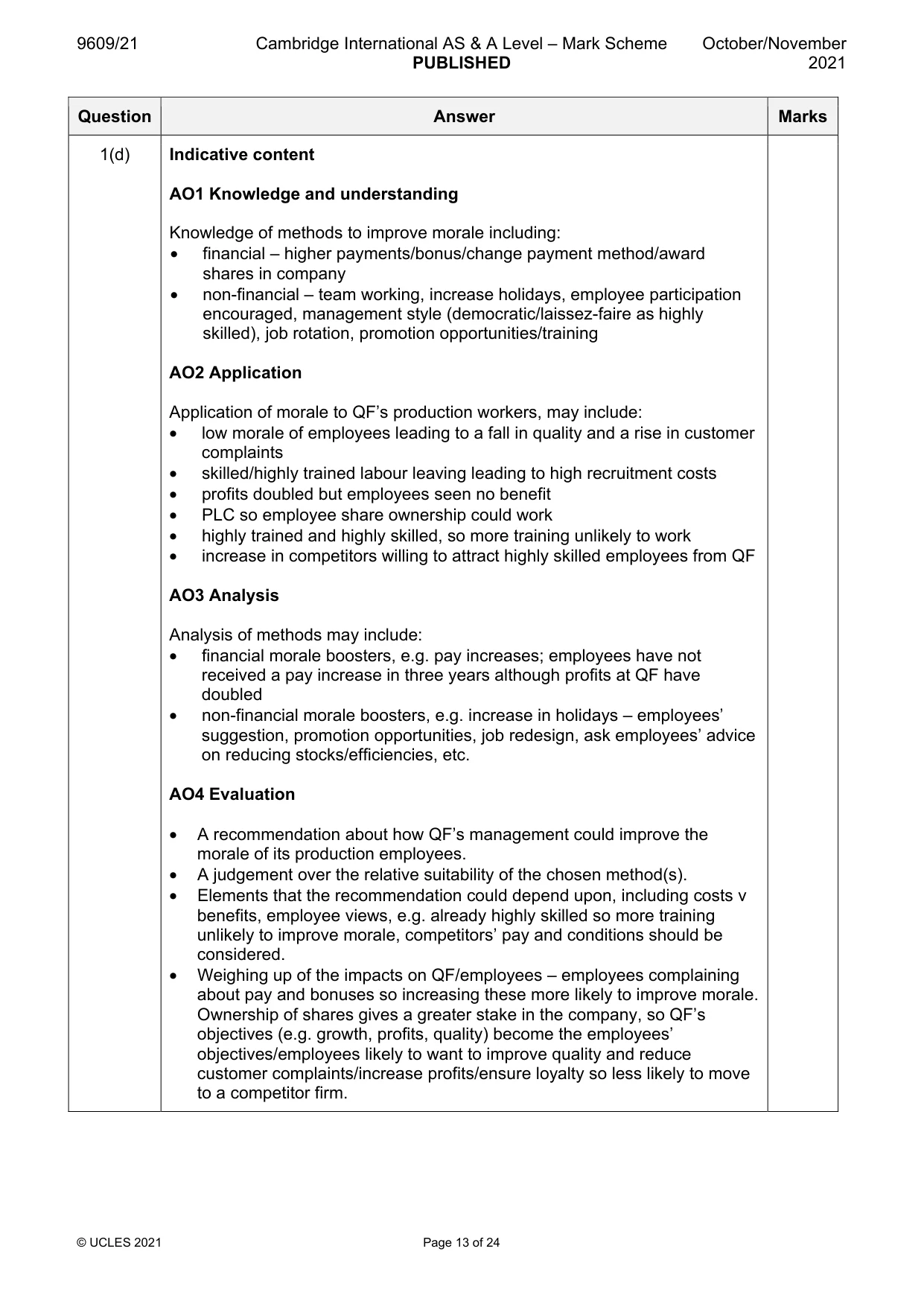
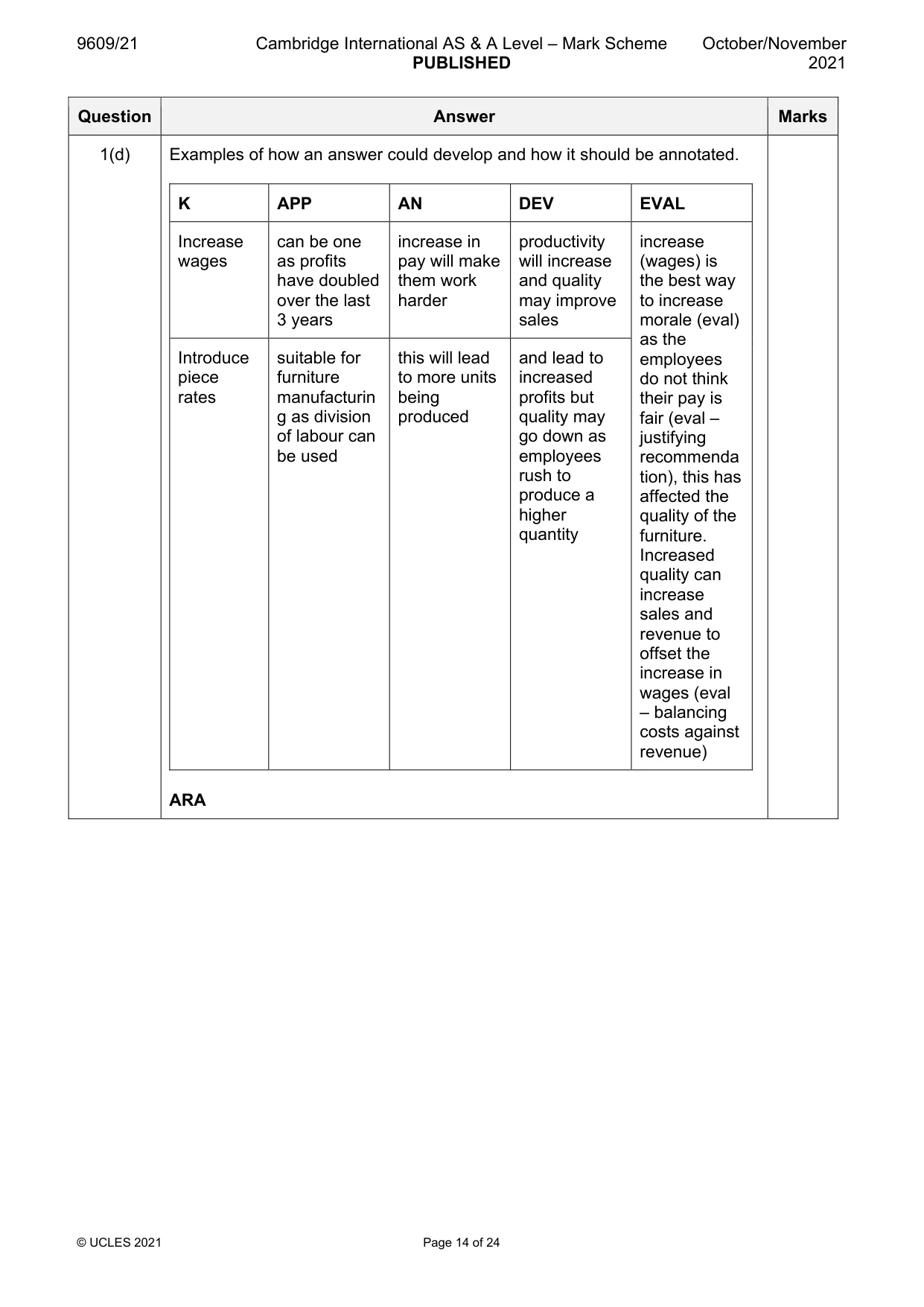
Mark scheme: Question Answer Marks 1(a)(i) Define the term ‘buffer inventory’ (line 18). 2 Knowledge Marks A correct definition 2 A partial, vague or unfocused definition 1 No creditable content 0 Indicative content AO1 Knowledge and understanding The (minimum) level of stocks/components/supplies – a business aims to hold to ensure orders can be met/point at which business re-orders. A correct definition should include: • an understanding of inventory • an understanding of buffer. Exemplar Marks Rationale Minimum stock level 2 Both buffer and inventory defined Minimum level of inventory 1 Inventory not defined 1(a)(ii) Explain the term ‘internal economies of scale’ (line 3). 3 Award one mark for each point of explanation: C Example or some other way of showing good 1 mark understanding, i.e. can arise from bulk buying, technical/managerial efficiencies, etc. B Understanding of internal economies of scale, 1 mark e.g. Internal economies arise from the growth of the business A Understanding of economies of scale (when 1 mark unit/average costs fall as output rises) Indicative content AO1 Knowledge and understanding • Economies of scale occur when unit/average costs fall as output rises. • Internal economies arise from the growth of the business, e.g. technical economies. AO2 Application Application of an internal economy of scale to a business, such as: • An example of a type of internal economy of scale. • A description of an internal economy of scale that a business might benefit from. Exemplar Marks Rationale Average unit costs decrease (A) as a 3 A + B + C result of the increase in the scale of operations (B), e.g. purchasing economies (C) Reduction in costs per unit (A) as a 2 A + C (growth of result of trading on a large scale, e.g. business not bulk buying (C) mentioned, so no B mark) Fall in costs per unit (A) 1 A only 1(b)(i) Calculate QF’s profit margin for 2020. 2 Rationale Marks Correct answer with or without correct working 2 Formulae/attempt to calculate/calculation of profit 1 No creditable content 0 Content Gross profit – expenses, interest and tax = profit $180m – $150m = $30m (1) OR Profit / Revenue × 100 = profit margin (1) 30 / 300 × 100 Profit margin = 10% Accept 10 (2) Common incorrect answers Exemplar Marks Rationale 10 2 Correct answer – % not needed 60 1 Gross profit (180/300) × 100 = 60% 30 1 Correct profit figure but not profit margin Profit / Revenue × 100 1 Formula 30 / 300 × 100 1 Correct figures but calculation incomplete 1(b)(ii) Explain two ways QF could increase its profit margin. 4 Level Knowledge and Application Marks 2b (APP Explanation of two factors which would increase the 4 +APP) profit margin, in context 2a Explanation of one factor which would increase the 3 (APP) profit margin, in context 1 (K) Identification of two factors affecting the profit margin 2 1 (K) Identification of one factor affecting the profit margin 1 0 No creditable content 0 Content Increase quantity sold without a change in costs / price Increase price whilst maintaining sales Reduce costs without change in quantity sold / price Indicative content AO1 Knowledge and understanding Ways of increasing the profit margin: • to decrease costs • to increase revenue • increase/decrease price AO2 Application Application to QF, including: • QF’s costs – internal economies of scale achieved, so costs will reduce and improve profit margin/buy cheaper wood/decrease inventory holdings as high value, bulky so reduce overhead costs. • QF’s revenue – likely to increase due to 50% growth in cafes over last 5 years/may be difficult due to increased competition/could improve quality to reduce customer complaints and increase sales. • Increased price difficult in competitive market/may be able to decrease price due to lower costs leading to increased revenue. 1(b)(ii) Example of how responses should be marked. Identification of a way Application (K – 2 marks) (APP – 2 marks) Reduce cost of sales by opting for cheaper timber Increase revenue by increasing of its tables and chairs quality Increase revenue from 2020 it earned $300m; they should boost this potentially by increasing the price Decrease cost by buying raw by buying from a supplier in country materials from a cheaper supplier S rather than country T Reduce stock to decrease costs buffer inventory is high value and bulky so can reduce overhead costs ARA 1(c) Analyse two disadvantages to QF of holding a high level of inventory. 8 Level Knowledge and Marks Analysis Marks Application (4 marks) (4 marks) 2b Shows understanding 4 Good analysis of two 4 of two disadvantages of disadvantages of holding a high level of holding a high level of inventory inventory 2a Shows understanding 3 Good analysis of one 3 of one disadvantage of disadvantage of holding a high level of holding a high level of inventory inventory 1b Shows knowledge of 2 Limited analysis of two 2 two disadvantages of disadvantages of holding a high level of holding a high level of inventory inventory 1a Shows knowledge of 1 Limited analysis of one 1 one disadvantage of disadvantage of holding a high level of holding a high level of inventory inventory 0 No creditable content Indicative content Purpose of inventory within a business (raw materials, work in progress, finished products). . AO1 Knowledge and understanding Knowledge of a disadvantage of holding a high level of inventory, including: • cost • security required • waste/damage • storage space could be utilised for other purposes AO2 Application • Number of cafes increased by more than 50% over last five years. • QF has expanded. • Growth of market has attracted new firms. • Cost of sales = $120m (40% of revenue). • 80% of materials from country T, long delivery lead time. • High value, high level of buffer inventory. • QF wants to reduce costs. • Cost of storing may reduce ability to pay higher wages, so trained staff leaving. • PLC – effect on shareholder value. 1(c) AO3 Analysis Disadvantages may include: • costs – high costs of holding stock leading to lower profits affecting shareholders as dividends lower, and may lower share price affecting shareholder value • storage space – could be used elsewhere, e.g. expand manufacturing without needing new premises • security – high value, worth stealing so will require good security measures and expensive insurance • waste/damage – wood furniture, storing for a long period could dry out wood, make it susceptible to damage, e.g. leaks, also could go out of fashion and become obsolete • more management required – ensure stock rotation to avoid any component remaining in store for a long period where it may be damaged/not fit for purpose Examples of how an answer could develop and how it should be annotated. K APP AN DEV High storage opportunity extra outflow of this is a costs cost as money cash to pay for disadvantage as could be used fixed cost employees have for motivating complained employees about low pay, and employee dissatisfaction has reduced quality Capital is tied such as paying reduces working they may face up in stock for the training capital difficulties which would of new recruits paying day-to- have to be sold to replace day expenses those who and short term have left debts 1(d) Recommend how QF’s management could improve the morale of its 11 production employees. Justify your recommendation. Knowledge and Analysis and Application Evaluation Marks Marks (4 marks) (7 marks) Annotation Annotation A justified + + recommendation 7 based on a developed EVAL EVAL EVAL two-sided argument A developed + recommendation 6 based on a developed EVAL EVAL two-sided argument A basic recommendation 5 based on a developed EVAL two-sided argument Shows understanding Developed analysis of + + of more than one more than one 4 method of improving APP method of improving DEV APP DEV morale in context morale in context 3–4 Shows understanding Developed analysis of of one method of one method of 3 improving morale in APP improving morale in DEV context context Limited analysis of Shows knowledge of K + more than one at least two methods + 2 AN K method of improving AN of improving morale 1–2 morale Shows knowledge one Limited analysis of method of improving K one method of 1 AN morale improving morale No creditable content 1(d) Indicative content AO1 Knowledge and understanding Knowledge of methods to improve morale including: • financial – higher payments/bonus/change payment method/award shares in company • non-financial – team working, increase holidays, employee participation encouraged, management style (democratic/laissez-faire as highly skilled), job rotation, promotion opportunities/training AO2 Application Application of morale to QF’s production workers, may include: • low morale of employees leading to a fall in quality and a rise in customer complaints • skilled/highly trained labour leaving leading to high recruitment costs • profits doubled but employees seen no benefit • PLC so employee share ownership could work • highly trained and highly skilled, so more training unlikely to work • increase in competitors willing to attract highly skilled employees from QF AO3 Analysis Analysis of methods may include: • financial morale boosters, e.g. pay increases; employees have not received a pay increase in three years although profits at QF have doubled • non-financial morale boosters, e.g. increase in holidays – employees’ suggestion, promotion opportunities, job redesign, ask employees’ advice on reducing stocks/efficiencies, etc. AO4 Evaluation • A recommendation about how QF’s management could improve the morale of its production employees. • A judgement over the relative suitability of the chosen method(s). • Elements that the recommendation could depend upon, including costs v benefits, employee views, e.g. already highly skilled so more training unlikely to improve morale, competitors’ pay and conditions should be considered. • Weighing up of the impacts on QF/employees – employees complaining about pay and bonuses so increasing these more likely to improve morale. Ownership of shares gives a greater stake in the company, so QF’s objectives (e.g. growth, profits, quality) become the employees’ objectives/employees likely to want to improve quality and reduce customer complaints/increase profits/ensure loyalty so less likely to move to a competitor firm. 1(d) Examples of how an answer could develop and how it should be annotated. K APP AN DEV EVAL Increase can be one increase in productivity increase wages as profits pay will make will increase (wages) is have doubled them work and quality the best way over the last harder may improve to increase 3 years sales morale (eval) as the Introduce suitable for this will lead and lead to employees piece furniture to more units increased do not think rates manufacturin being profits but their pay is g as division produced quality may fair (eval – of labour can go down as justifying be used employees recommenda rush to tion), this has produce a affected the higher quality of the quantity furniture. Increased quality can increase sales and revenue to offset the increase in wages (eval – balancing costs against revenue) ARA
Q2 · Tin Mines (TM) TM is a private limited company in the primary sector
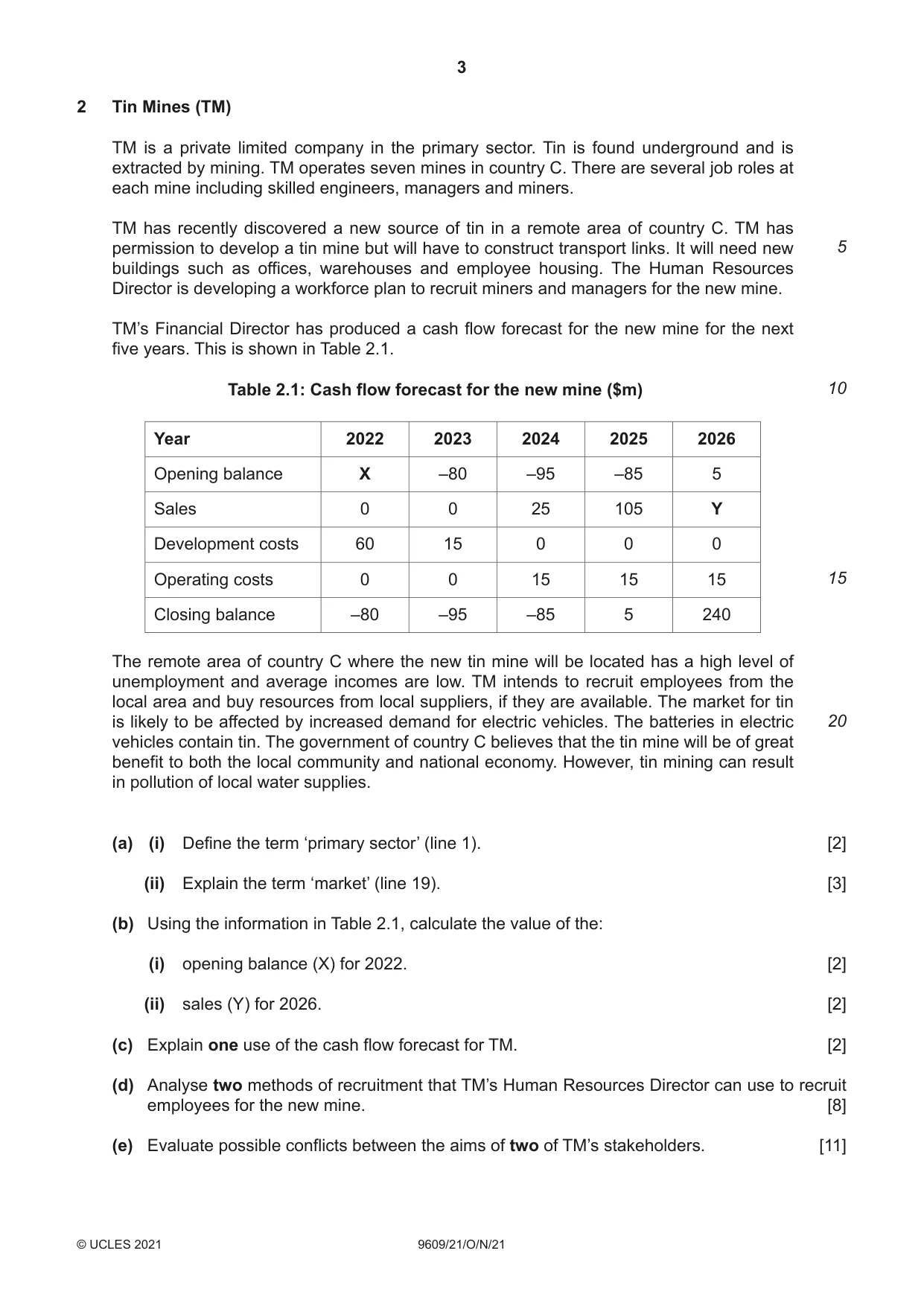
2 Tin Mines (TM) TM is a private limited company in the primary sector. Tin is found underground and is extracted by mining. TM operates seven mines in country C. There are several job roles at each mine including skilled engineers, managers and miners. TM has recently discovered a new source of tin in a remote area of country C. TM has permission to develop a tin mine but will have to construct transport links. It will need new 5 buildings such as offices, warehouses and employee housing. The Human Resources Director is developing a workforce plan to recruit miners and managers for the new mine. TM’s Financial Director has produced a cash flow forecast for the new mine for the next five years. This is shown in Table 2.1. Table 2.1: Cash flow forecast for the new mine ($m) 10 Year 2022 2023 2024 2025 2026 Opening balance X –80 –95 –85 5 Sales 0 0 25 105 Y Development costs 60 15 0 0 0 Operating costs 0 0 15 15 15 15 Closing balance –80 –95 –85 5 240 The remote area of country C where the new tin mine will be located has a high level of unemployment and average incomes are low. TM intends to recruit employees from the local area and buy resources from local suppliers, if they are available. The market for tin is likely to be affected by increased demand for electric vehicles. The batteries in electric 20 vehicles contain tin. The government of country C believes that the tin mine will be of great benefit to both the local community and national economy. However, tin mining can result in pollution of local water supplies. (a) (i) Define the term ‘primary sector’ (line 1). [2] (ii) Explain the term ‘market’ (line 19). [3] (b) Using the information in Table 2.1, calculate the value of the: (i) opening balance (X) for 2022. [2] (ii) sales (Y) for 2026. [2] (c) Explain one use of the cash flow forecast for TM. [2] (d) Analyse two methods of recruitment that TM’s Human Resources Director can use to recruit employees for the new mine. [8] (e) Evaluate possible conflicts between the aims of two of TM’s stakeholders. [11]
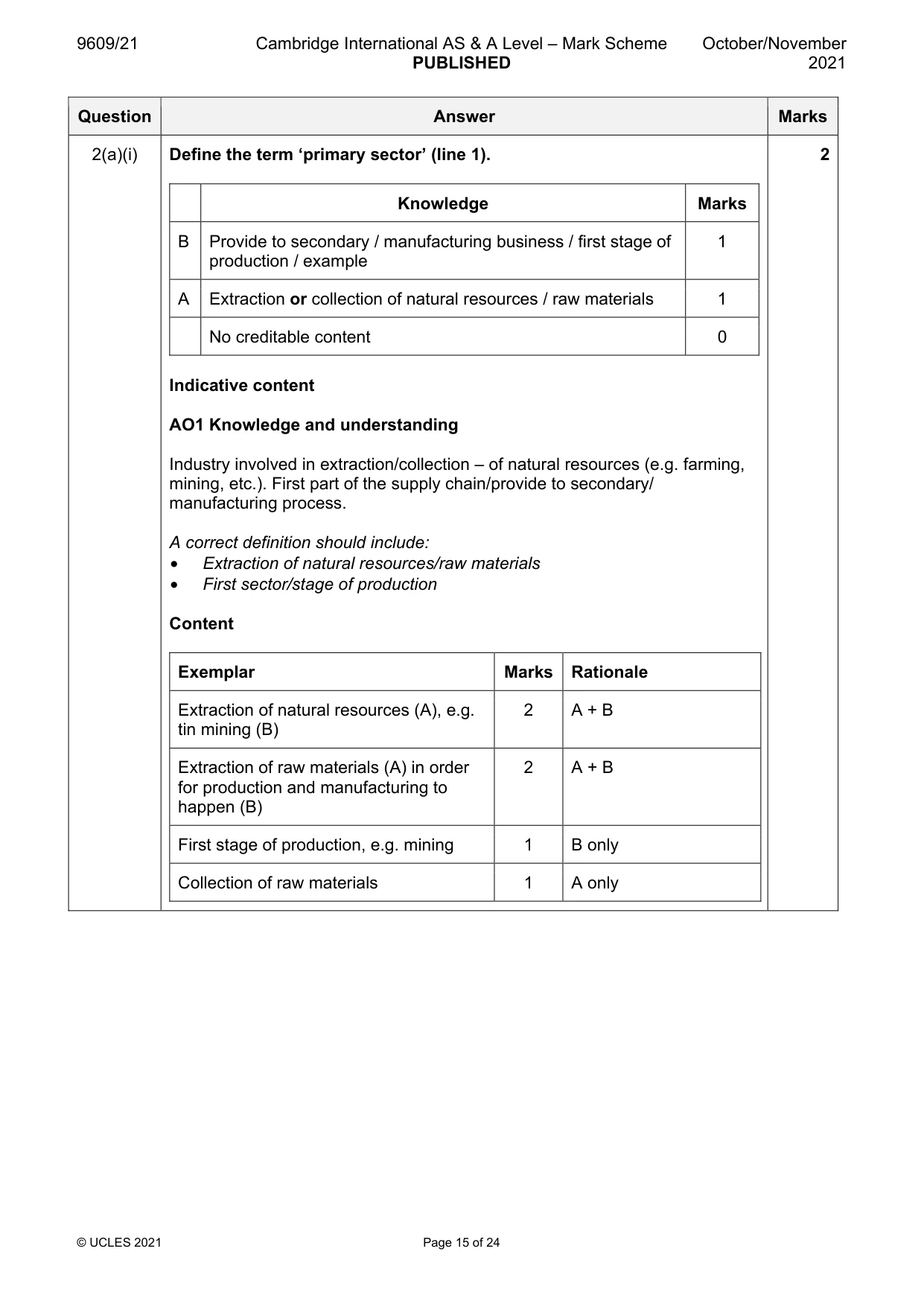
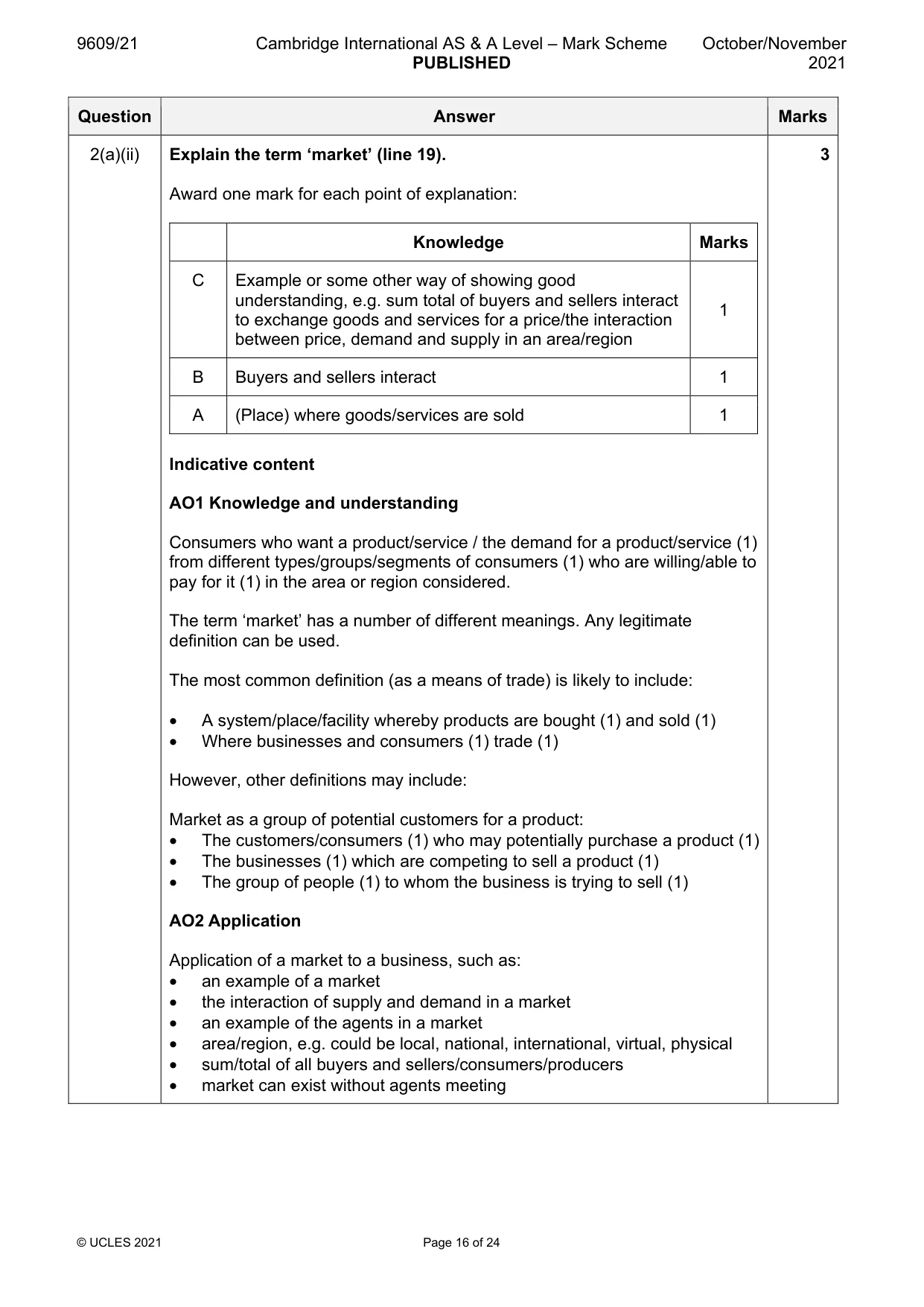
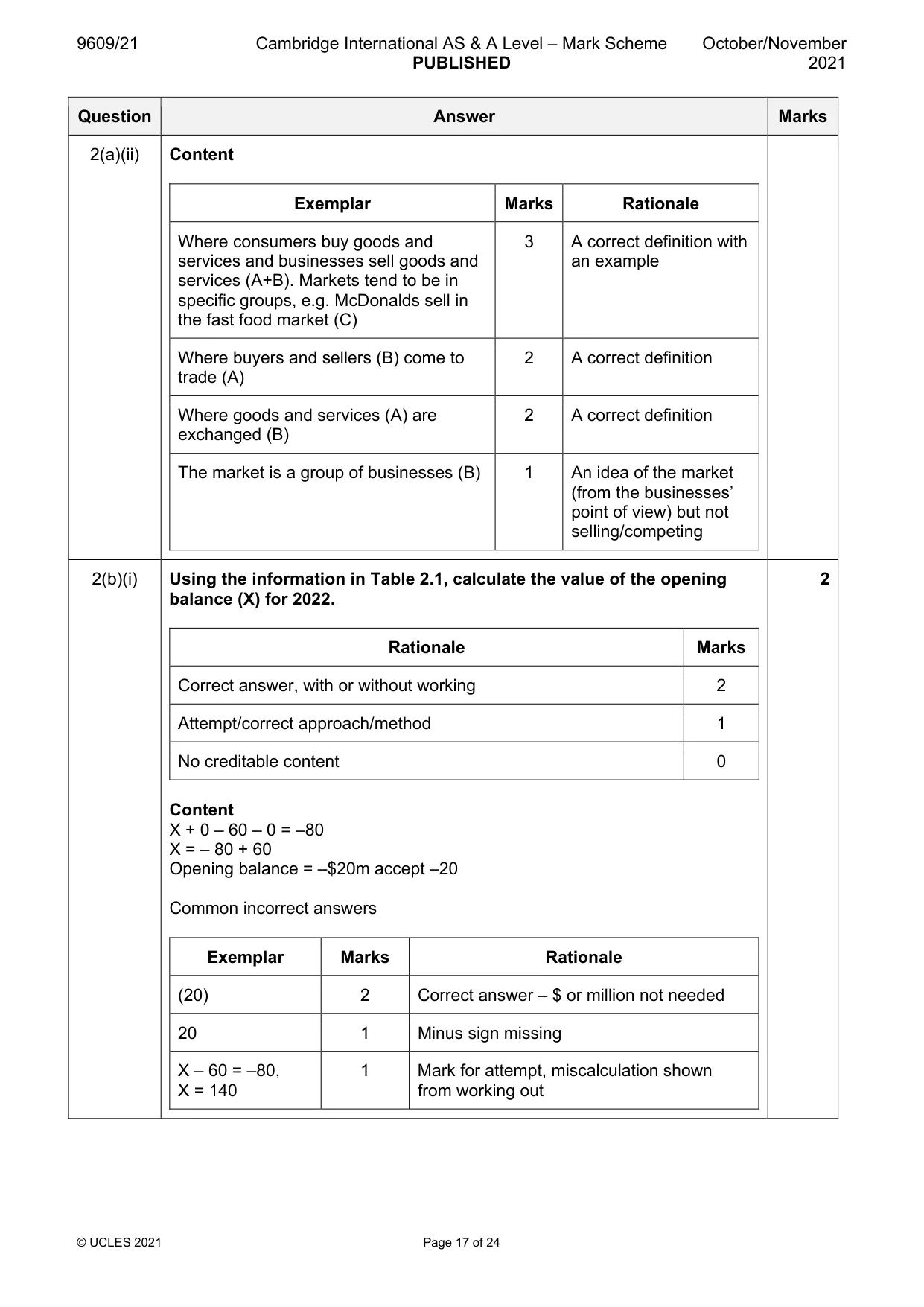
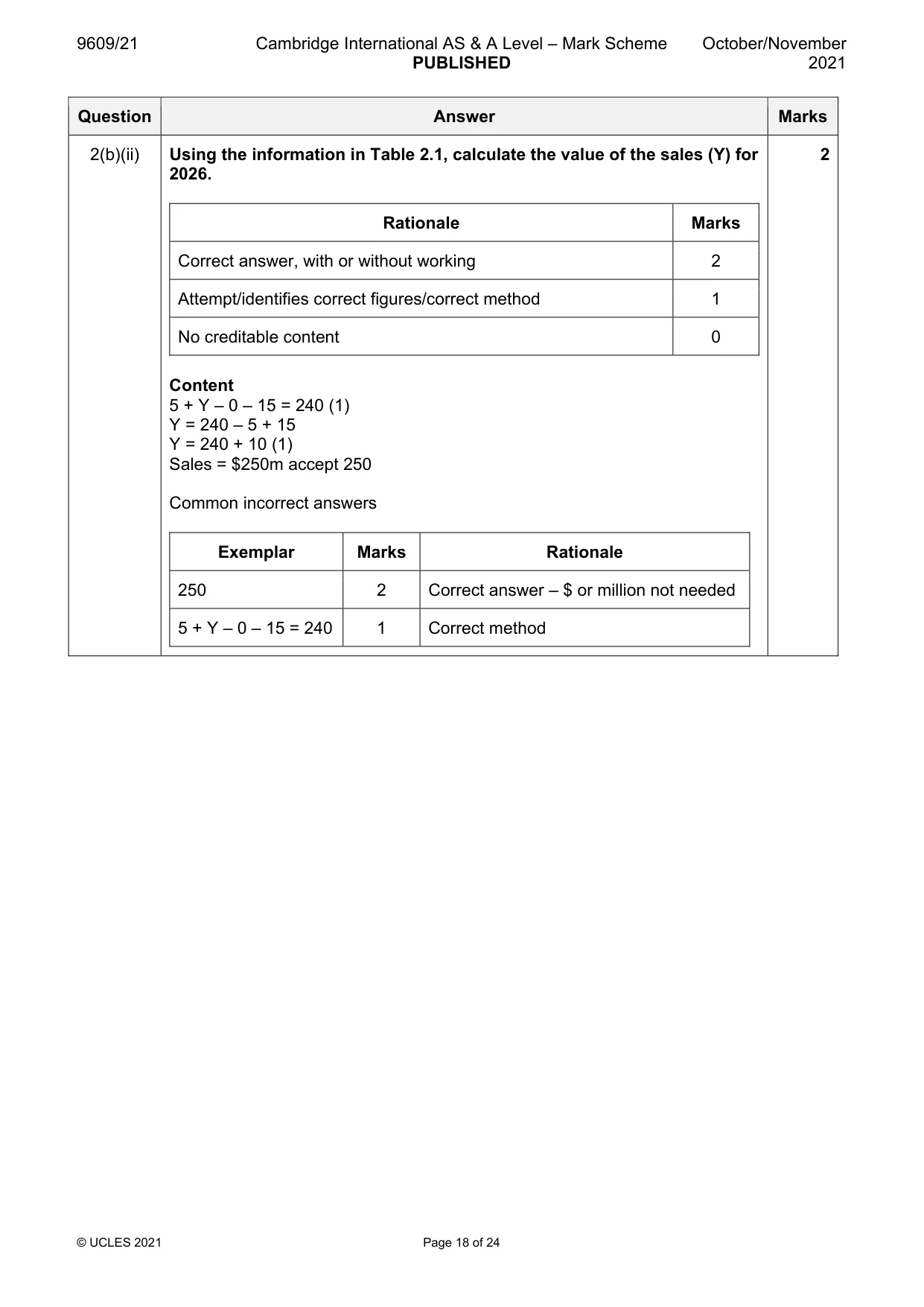
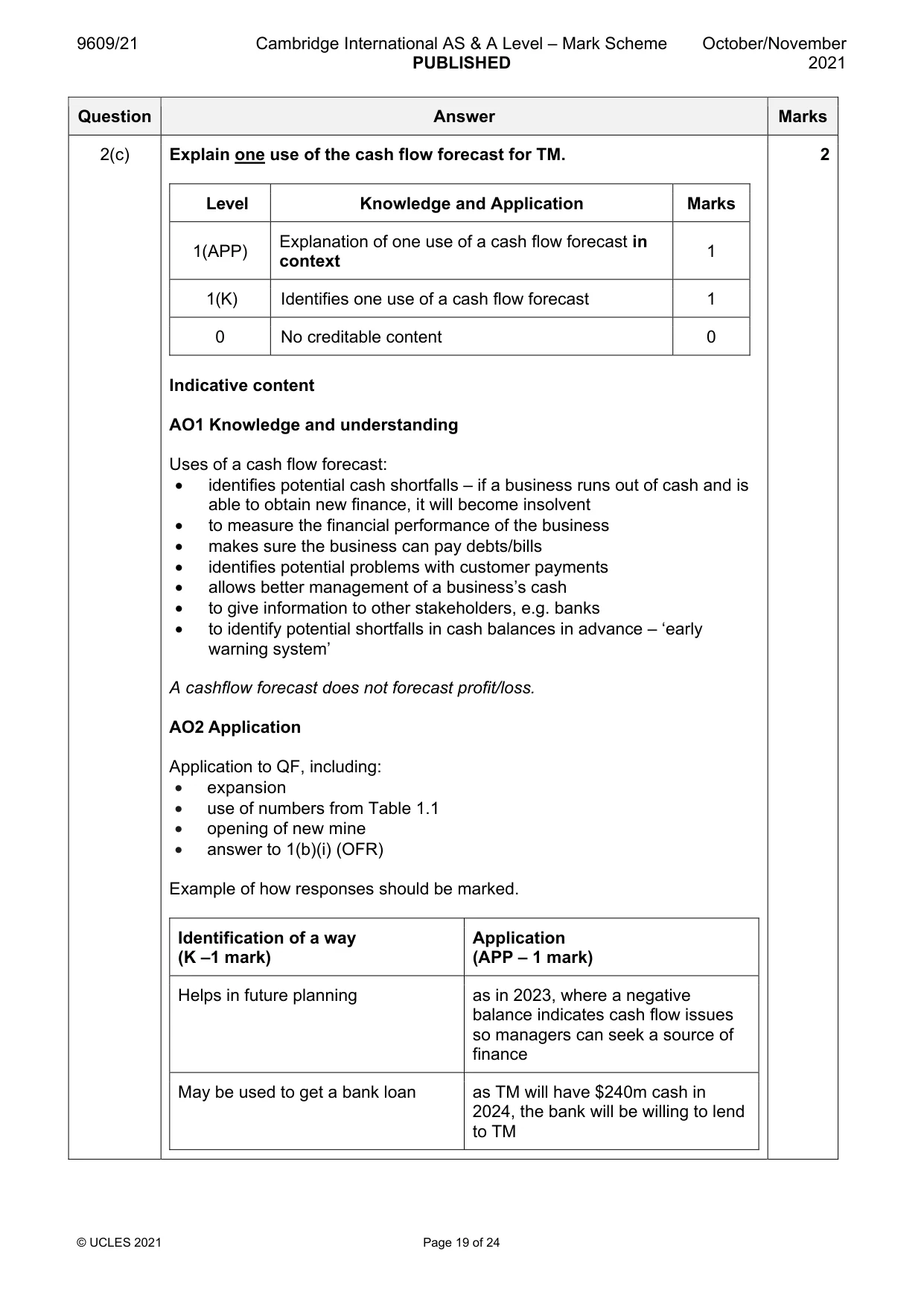
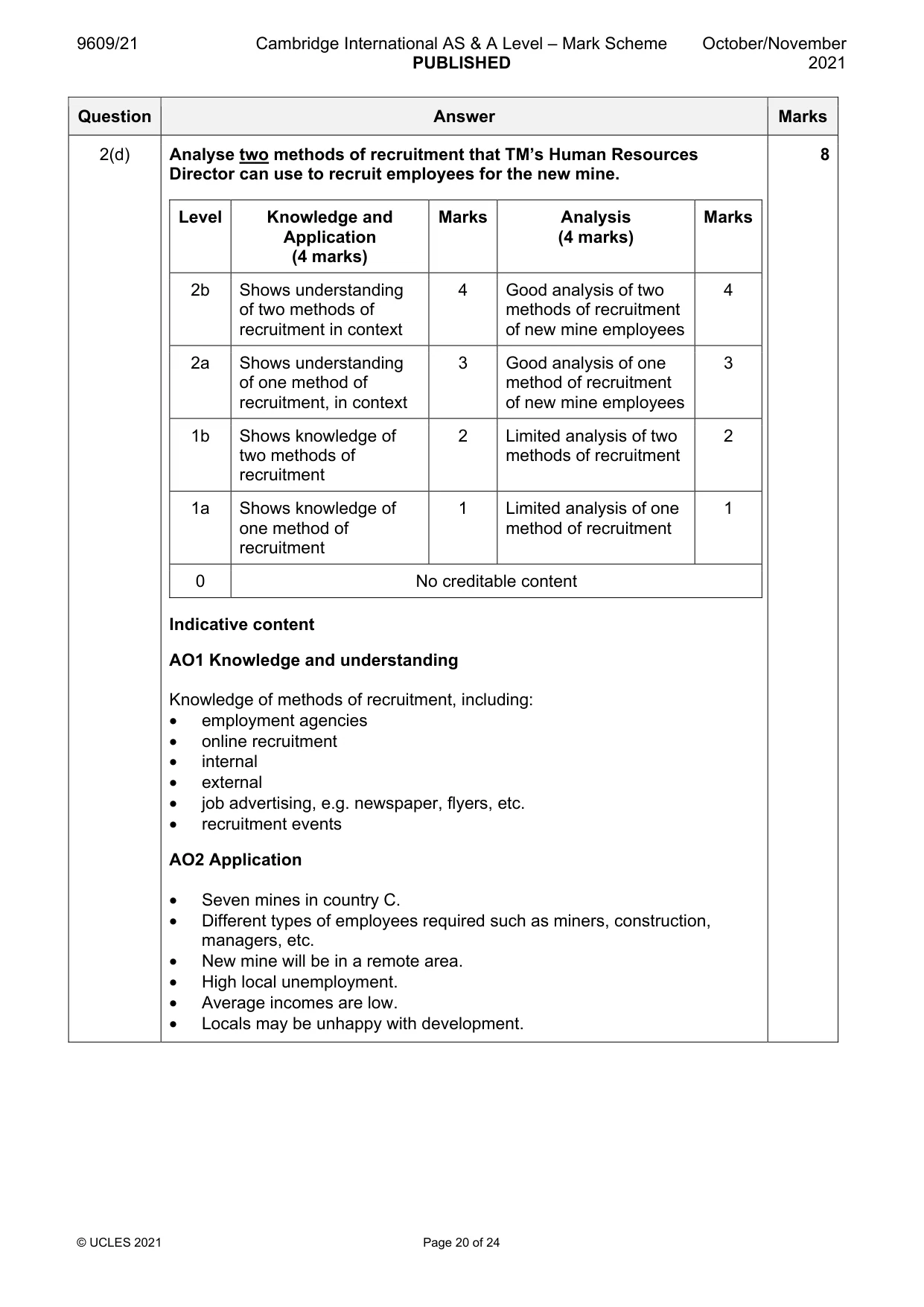
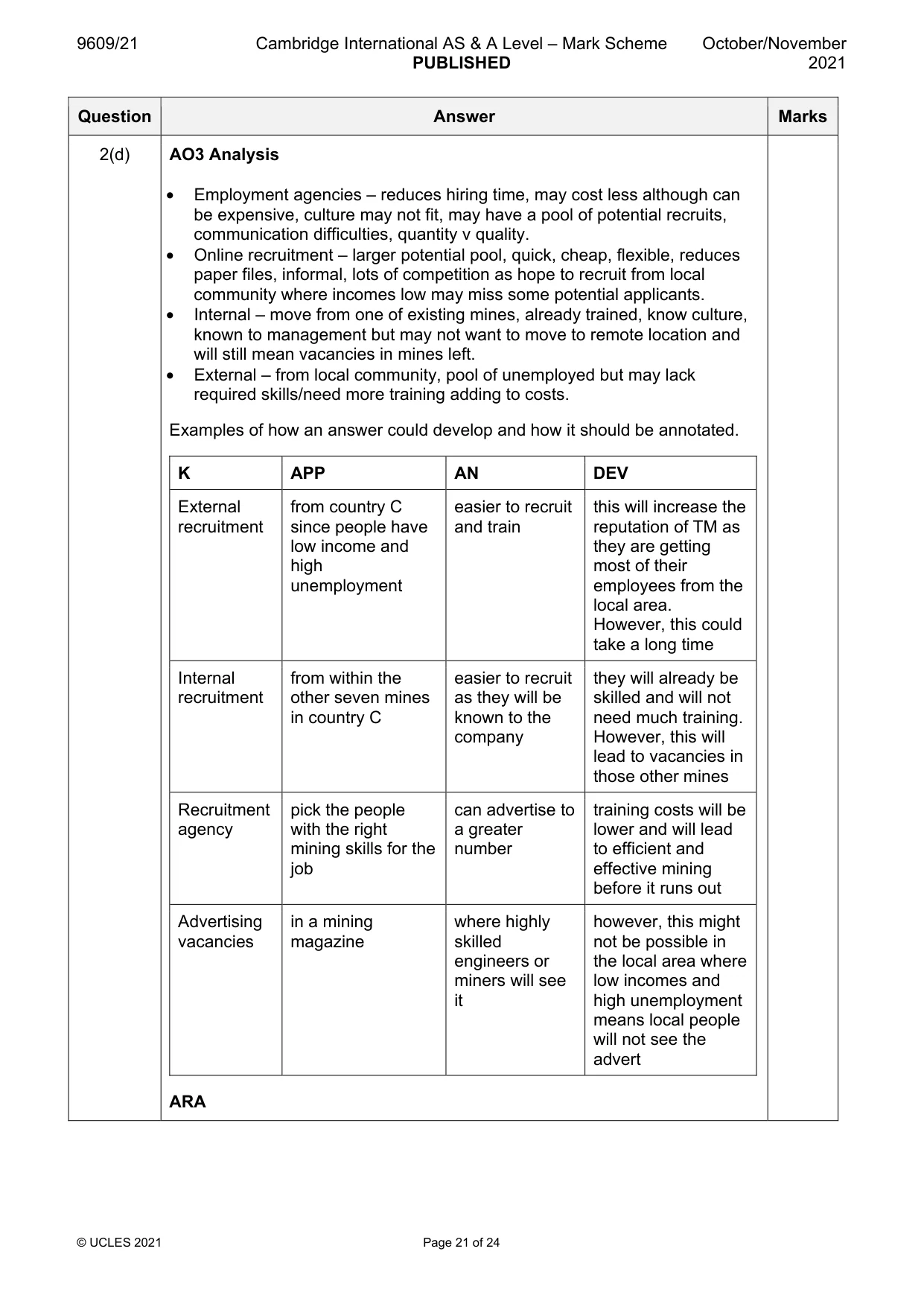
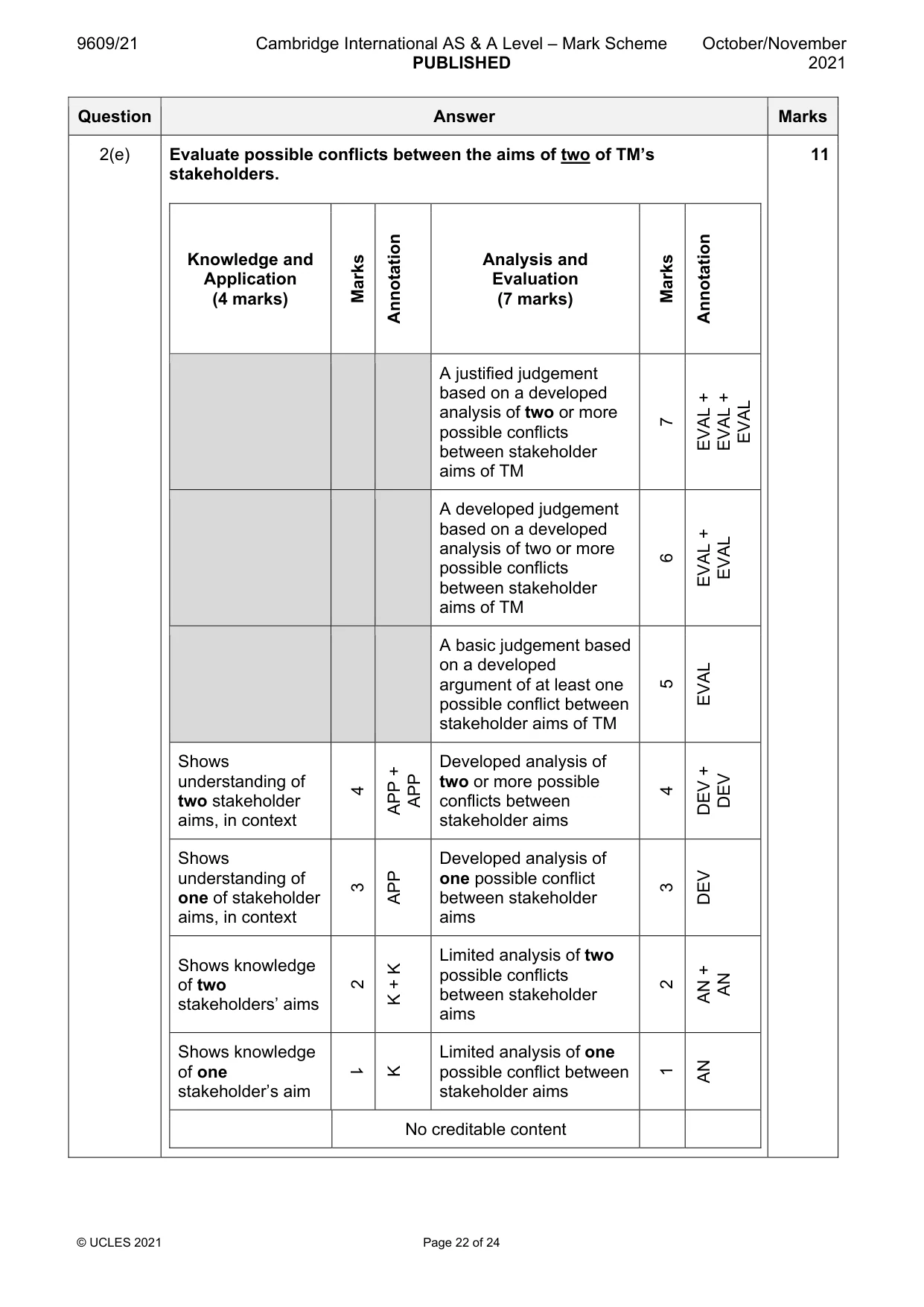
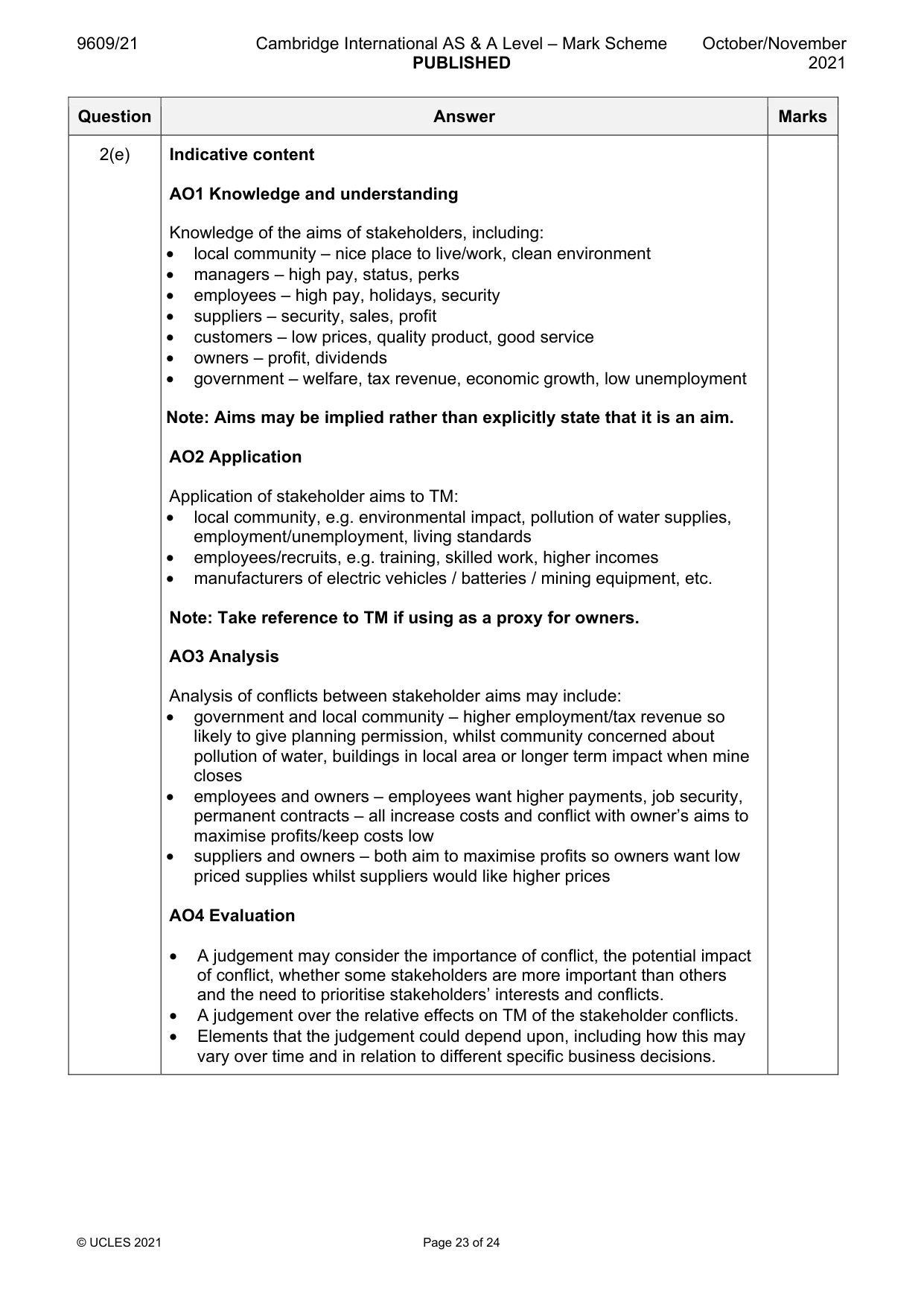
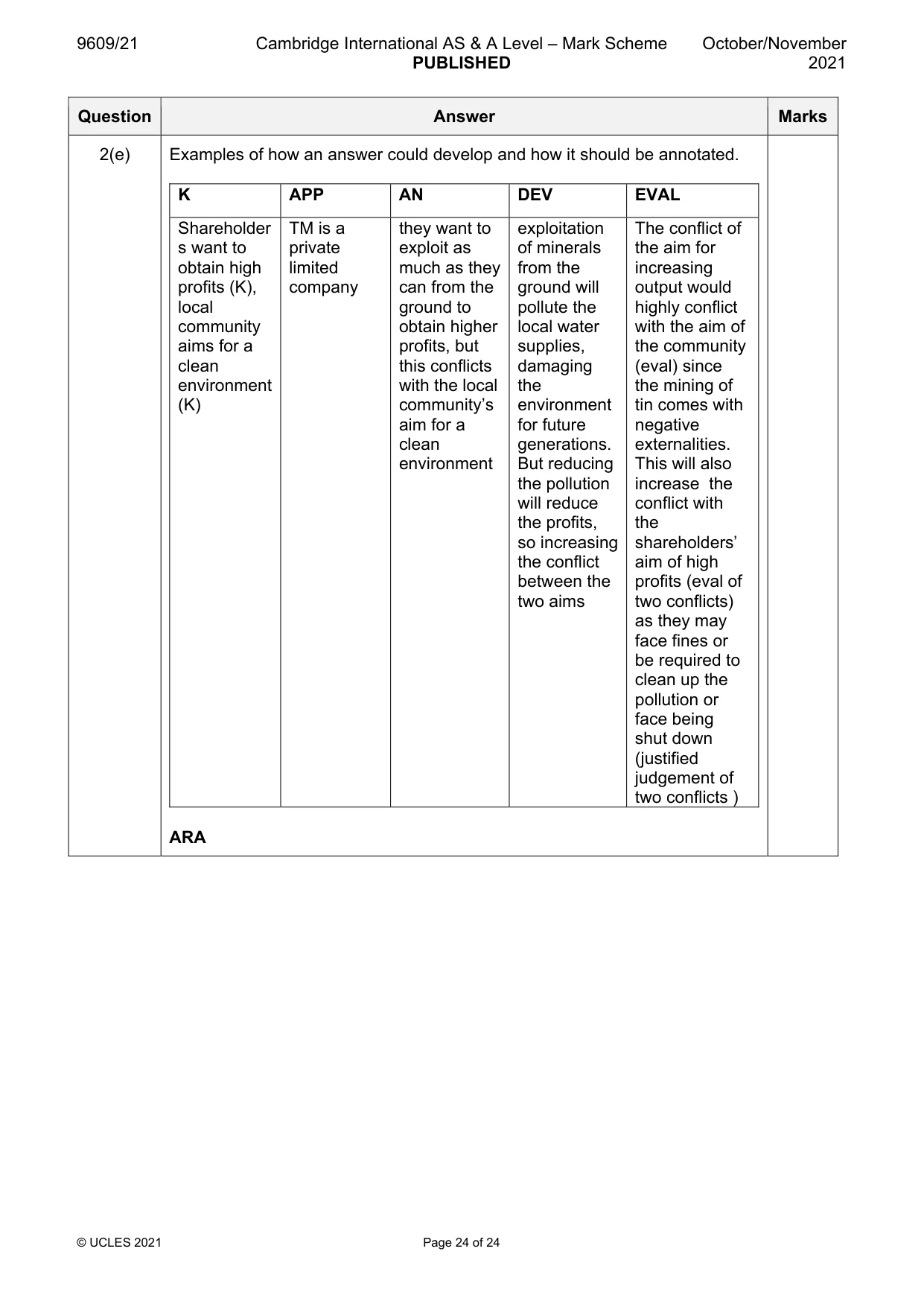
Mark scheme: 2(a)(i) Define the term ‘primary sector’ (line 1). 2 Knowledge Marks B Provide to secondary / manufacturing business / first stage of 1 production / example A Extraction or collection of natural resources / raw materials 1 No creditable content 0 Indicative content AO1 Knowledge and understanding Industry involved in extraction/collection – of natural resources (e.g. farming, mining, etc.). First part of the supply chain/provide to secondary/ manufacturing process. A correct definition should include: • Extraction of natural resources/raw materials • First sector/stage of production Content Exemplar Marks Rationale Extraction of natural resources (A), e.g. 2 A + B tin mining (B) Extraction of raw materials (A) in order 2 A + B for production and manufacturing to happen (B) First stage of production, e.g. mining 1 B only Collection of raw materials 1 A only 2(a)(ii) Explain the term ‘market’ (line 19). 3 Award one mark for each point of explanation: Knowledge Marks C Example or some other way of showing good understanding, e.g. sum total of buyers and sellers interact 1 to exchange goods and services for a price/the interaction between price, demand and supply in an area/region B Buyers and sellers interact 1 A (Place) where goods/services are sold 1 Indicative content AO1 Knowledge and understanding Consumers who want a product/service / the demand for a product/service (1) from different types/groups/segments of consumers (1) who are willing/able to pay for it (1) in the area or region considered. The term ‘market’ has a number of different meanings. Any legitimate definition can be used. The most common definition (as a means of trade) is likely to include: • A system/place/facility whereby products are bought (1) and sold (1) • Where businesses and consumers (1) trade (1) However, other definitions may include: Market as a group of potential customers for a product: • The customers/consumers (1) who may potentially purchase a product (1) • The businesses (1) which are competing to sell a product (1) • The group of people (1) to whom the business is trying to sell (1) AO2 Application Application of a market to a business, such as: • an example of a market • the interaction of supply and demand in a market • an example of the agents in a market • area/region, e.g. could be local, national, international, virtual, physical • sum/total of all buyers and sellers/consumers/producers • market can exist without agents meeting 2(a)(ii) Content Exemplar Marks Rationale Where consumers buy goods and 3 A correct definition with services and businesses sell goods and an example services (A+B). Markets tend to be in specific groups, e.g. McDonalds sell in the fast food market (C) Where buyers and sellers (B) come to 2 A correct definition trade (A) Where goods and services (A) are 2 A correct definition exchanged (B) The market is a group of businesses (B) 1 An idea of the market (from the businesses’ point of view) but not selling/competing 2(b)(i) Using the information in Table 2.1, calculate the value of the opening 2 balance (X) for 2022. Rationale Marks Correct answer, with or without working 2 Attempt/correct approach/method 1 No creditable content 0 Content X + 0 – 60 – 0 = –80 X = – 80 + 60 Opening balance = –$20m accept –20 Common incorrect answers Exemplar Marks Rationale (20) 2 Correct answer – $ or million not needed 20 1 Minus sign missing X – 60 = –80, 1 Mark for attempt, miscalculation shown X = 140 from working out 2(b)(ii) Using the information in Table 2.1, calculate the value of the sales (Y) for 2 2026. Rationale Marks Correct answer, with or without working 2 Attempt/identifies correct figures/correct method 1 No creditable content 0 Content 5 + Y – 0 – 15 = 240 (1) Y = 240 – 5 + 15 Y = 240 + 10 (1) Sales = $250m accept 250 Common incorrect answers Exemplar Marks Rationale 250 2 Correct answer – $ or million not needed 5 + Y – 0 – 15 = 240 1 Correct method 2(c) Explain one use of the cash flow forecast for TM. 2 Level Knowledge and Application Marks Explanation of one use of a cash flow forecast in 1(APP) 1 context 1(K) Identifies one use of a cash flow forecast 1 0 No creditable content 0 Indicative content AO1 Knowledge and understanding Uses of a cash flow forecast: • identifies potential cash shortfalls – if a business runs out of cash and is able to obtain new finance, it will become insolvent • to measure the financial performance of the business • makes sure the business can pay debts/bills • identifies potential problems with customer payments • allows better management of a business’s cash • to give information to other stakeholders, e.g. banks • to identify potential shortfalls in cash balances in advance – ‘early warning system’ A cashflow forecast does not forecast profit/loss. AO2 Application Application to QF, including: • expansion • use of numbers from Table 1.1 • opening of new mine • answer to 1(b)(i) (OFR) Example of how responses should be marked. Identification of a way Application (K –1 mark) (APP – 1 mark) Helps in future planning as in 2023, where a negative balance indicates cash flow issues so managers can seek a source of finance May be used to get a bank loan as TM will have $240m cash in 2024, the bank will be willing to lend to TM 2(d) Analyse two methods of recruitment that TM’s Human Resources 8 Director can use to recruit employees for the new mine. Level Knowledge and Marks Analysis Marks Application (4 marks) (4 marks) 2b Shows understanding 4 Good analysis of two 4 of two methods of methods of recruitment recruitment in context of new mine employees 2a Shows understanding 3 Good analysis of one 3 of one method of method of recruitment recruitment, in context of new mine employees 1b Shows knowledge of 2 Limited analysis of two 2 two methods of methods of recruitment recruitment 1a Shows knowledge of 1 Limited analysis of one 1 one method of method of recruitment recruitment 0 No creditable content Indicative content AO1 Knowledge and understanding Knowledge of methods of recruitment, including: • employment agencies • online recruitment • internal • external • job advertising, e.g. newspaper, flyers, etc. • recruitment events AO2 Application • Seven mines in country C. • Different types of employees required such as miners, construction, managers, etc. • New mine will be in a remote area. • High local unemployment. • Average incomes are low. • Locals may be unhappy with development. 2(d) AO3 Analysis • Employment agencies – reduces hiring time, may cost less although can be expensive, culture may not fit, may have a pool of potential recruits, communication difficulties, quantity v quality. • Online recruitment – larger potential pool, quick, cheap, flexible, reduces paper files, informal, lots of competition as hope to recruit from local community where incomes low may miss some potential applicants. • Internal – move from one of existing mines, already trained, know culture, known to management but may not want to move to remote location and will still mean vacancies in mines left. • External – from local community, pool of unemployed but may lack required skills/need more training adding to costs. Examples of how an answer could develop and how it should be annotated. K APP AN DEV External from country C easier to recruit this will increase the recruitment since people have and train reputation of TM as low income and they are getting high most of their unemployment employees from the local area. However, this could take a long time Internal from within the easier to recruit they will already be recruitment other seven mines as they will be skilled and will not in country C known to the need much training. company However, this will lead to vacancies in those other mines Recruitment pick the people can advertise to training costs will be agency with the right a greater lower and will lead mining skills for the number to efficient and job effective mining before it runs out Advertising in a mining where highly however, this might vacancies magazine skilled not be possible in engineers or the local area where miners will see low incomes and it high unemployment means local people will not see the advert ARA 2(e) Evaluate possible conflicts between the aims of two of TM’s 11 stakeholders. Knowledge and Analysis and Application Evaluation (4 marks) Marks (7 marks) Marks Annotation Annotation A justified judgement based on a developed + + analysis of two or more 7 possible conflicts EVAL EVAL EVAL between stakeholder aims of TM A developed judgement based on a developed + analysis of two or more 6 possible conflicts EVAL EVAL between stakeholder aims of TM A basic judgement based on a developed argument of at least one 5 EVAL possible conflict between stakeholder aims of TM Shows Developed analysis of + + understanding of two or more possible 4 4 two stakeholder APP conflicts between DEV APP DEV aims, in context stakeholder aims Shows Developed analysis of understanding of one possible conflict 3 3 one of stakeholder APP between stakeholder DEV aims, in context aims Limited analysis of two Shows knowledge K + possible conflicts of two 2 + 2 AN K between stakeholder AN stakeholders’ aims aims Shows knowledge Limited analysis of one of one 1 K possible conflict between 1 AN stakeholder’s aim stakeholder aims No creditable content 2(e) Indicative content AO1 Knowledge and understanding Knowledge of the aims of stakeholders, including: • local community – nice place to live/work, clean environment • managers – high pay, status, perks • employees – high pay, holidays, security • suppliers – security, sales, profit • customers – low prices, quality product, good service • owners – profit, dividends • government – welfare, tax revenue, economic growth, low unemployment Note: Aims may be implied rather than explicitly state that it is an aim. AO2 Application Application of stakeholder aims to TM: • local community, e.g. environmental impact, pollution of water supplies, employment/unemployment, living standards • employees/recruits, e.g. training, skilled work, higher incomes • manufacturers of electric vehicles / batteries / mining equipment, etc. Note: Take reference to TM if using as a proxy for owners. AO3 Analysis Analysis of conflicts between stakeholder aims may include: • government and local community – higher employment/tax revenue so likely to give planning permission, whilst community concerned about pollution of water, buildings in local area or longer term impact when mine closes • employees and owners – employees want higher payments, job security, permanent contracts – all increase costs and conflict with owner’s aims to maximise profits/keep costs low • suppliers and owners – both aim to maximise profits so owners want low priced supplies whilst suppliers would like higher prices AO4 Evaluation • A judgement may consider the importance of conflict, the potential impact of conflict, whether some stakeholders are more important than others and the need to prioritise stakeholders’ interests and conflicts. • A judgement over the relative effects on TM of the stakeholder conflicts. • Elements that the judgement could depend upon, including how this may vary over time and in relation to different specific business decisions. 2(e) Examples of how an answer could develop and how it should be annotated. K APP AN DEV EVAL Shareholder TM is a they want to exploitation The conflict of s want to private exploit as of minerals the aim for obtain high limited much as they from the increasing profits (K), company can from the ground will output would local ground to pollute the highly conflict community obtain higher local water with the aim of aims for a profits, but supplies, the community clean this conflicts damaging (eval) since environment with the local the the mining of (K) community’s environment tin comes with aim for a for future negative clean generations. externalities. environment But reducing This will also the pollution increase the will reduce conflict with the profits, the so increasing shareholders’ the conflict aim of high between the profits (eval of two aims two conflicts) as they may face fines or be required to clean up the pollution or face being shut down (justified judgement of two conflicts ) ARA
What was in this paper
The subtopics covered by these 2 questions, and how many questions each got. Open one in a new tab to see every Cambridge question on it.
What you needed in this session
Cambridge’s own grade thresholds for 2021 Oct/Nov, Paper 2 · Variant 1. A higher threshold means an easier paper — the bar moves with how the cohort did.