Cambridge A Level Business (for first examination in 2016) 9609 — 2022 Oct/Nov Paper 2 · Variant 2
9609/22/O/N/22 · 2 questions · 60 marks · ≈68 min
The question paper and its mark scheme, free to read here and free to download. This is Cambridge’s own paper, exactly as it was sat.
Question paper4 pages

Mark scheme24 pages
Answers below. Sit the paper first if you are practising.

Questions as text
Q1 · Friendly Fit (FF) FF is a public limited company that owns a popular social media and…
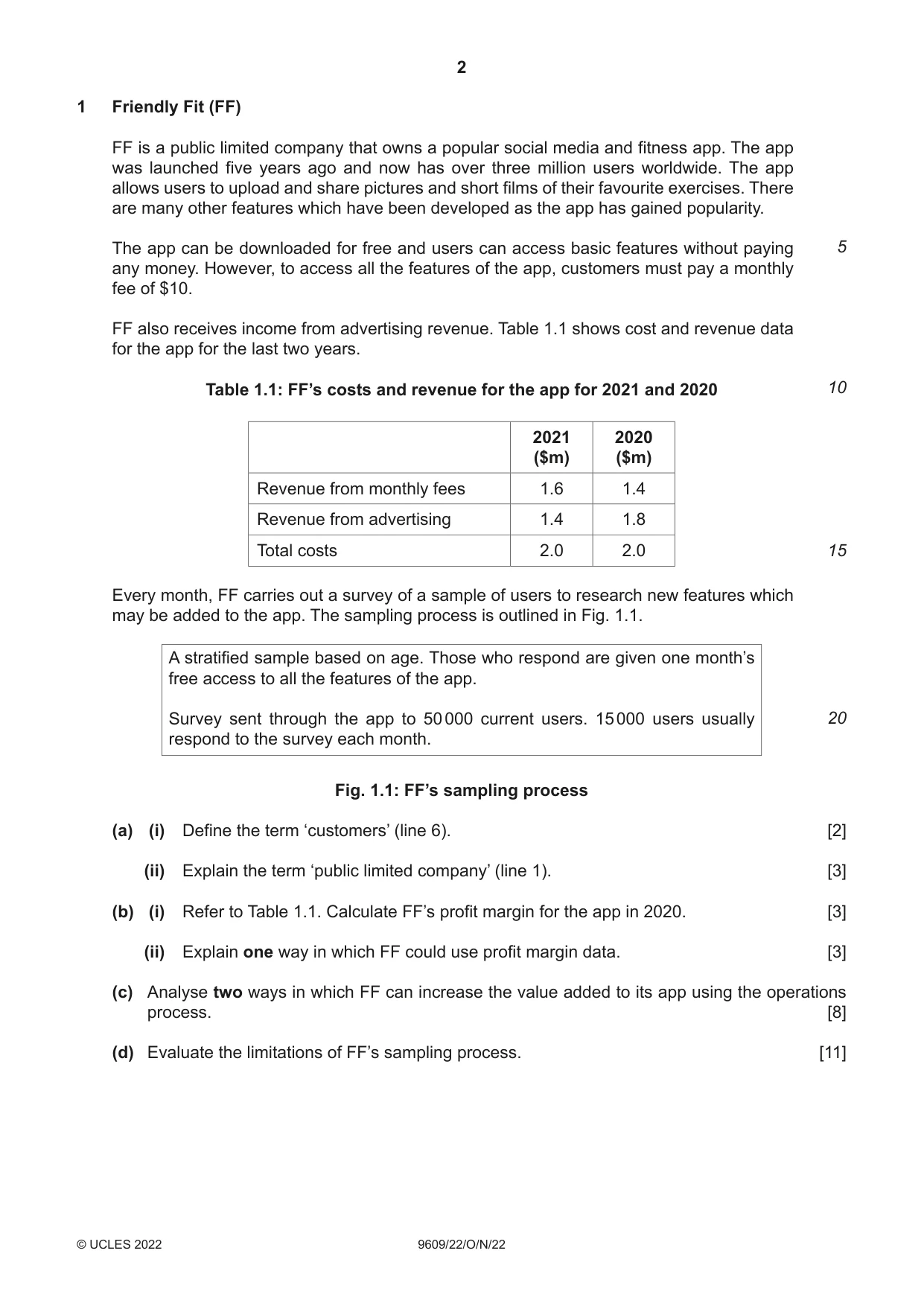
1 Friendly Fit (FF) FF is a public limited company that owns a popular social media and fitness app. The app was launched five years ago and now has over three million users worldwide. The app allows users to upload and share pictures and short films of their favourite exercises. There are many other features which have been developed as the app has gained popularity. The app can be downloaded for free and users can access basic features without paying 5 any money. However, to access all the features of the app, customers must pay a monthly fee of $10. FF also receives income from advertising revenue. Table 1.1 shows cost and revenue data for the app for the last two years. Table 1.1: FF’s costs and revenue for the app for 2021 and 2020 10 2021 2020 ($m) ($m) Revenue from monthly fees 1.6 1.4 Revenue from advertising 1.4 1.8 Total costs 2.0 2.0 15 Every month, FF carries out a survey of a sample of users to research new features which may be added to the app. The sampling process is outlined in Fig. 1.1. A stratified sample based on age. Those who respond are given one month’s free access to all the features of the app. Survey sent through the app to 50 000 current users. 15 000 users usually 20 respond to the survey each month. Fig. 1.1: FF’s sampling process (a) (i) Define the term ‘customers’ (line 6). [2] (ii) Explain the term ‘public limited company’ (line 1). [3] (b) (i) Refer to Table 1.1. Calculate FF’s profit margin for the app in 2020. [3] (ii) Explain one way in which FF could use profit margin data. [3] (c) Analyse two ways in which FF can increase the value added to its app using the operations process. [8] (d) Evaluate the limitations of FF’s sampling process. [11]
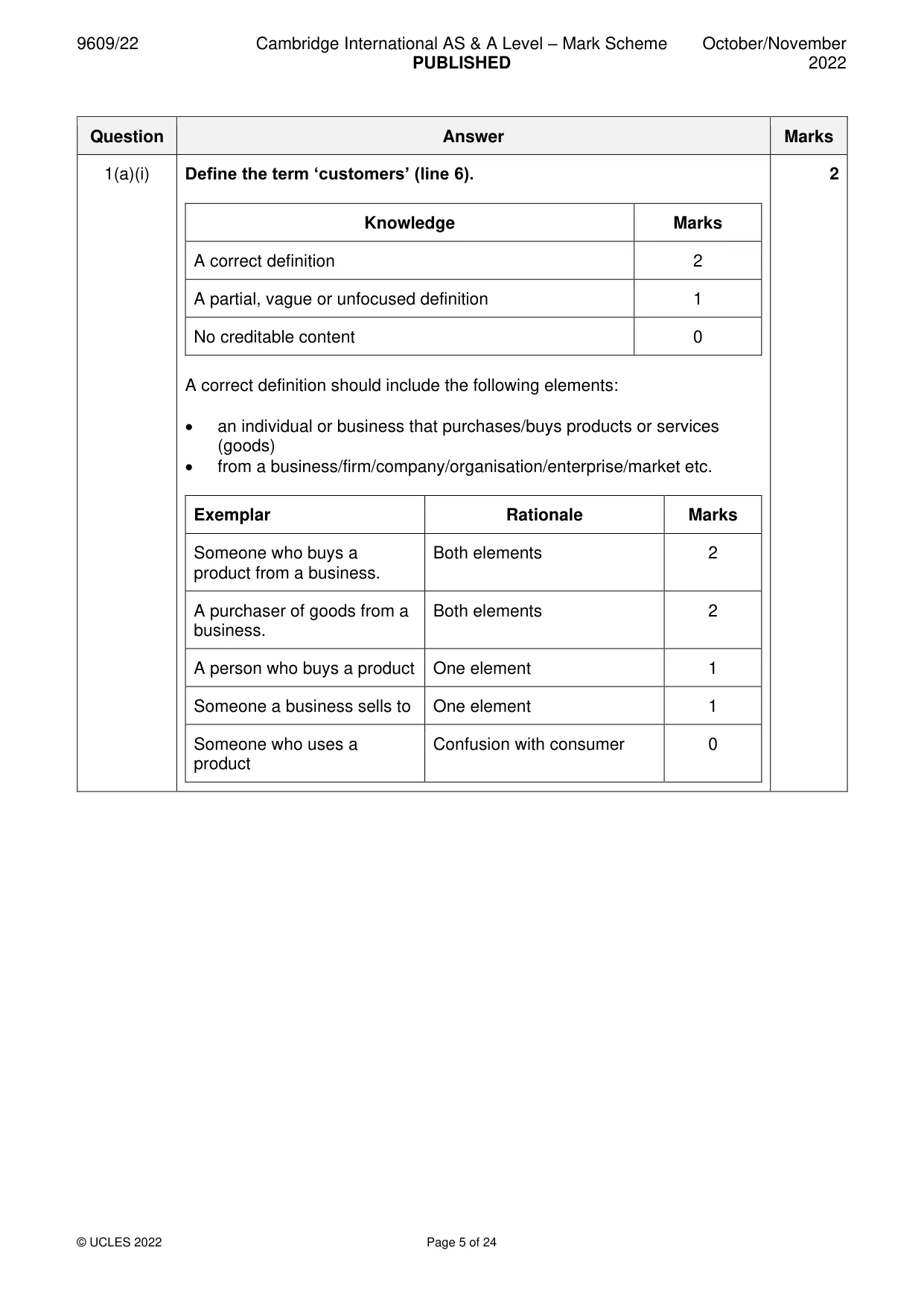
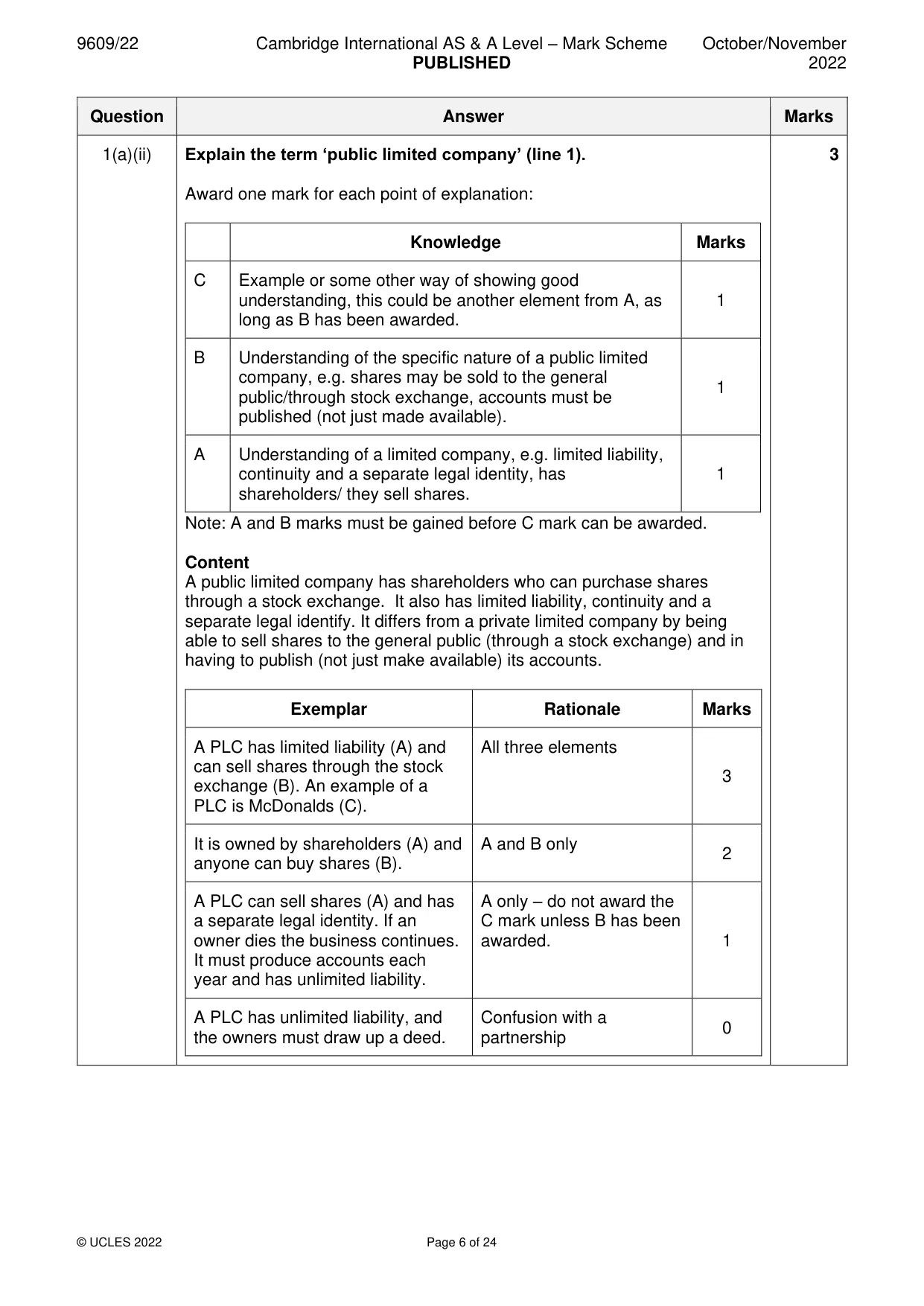
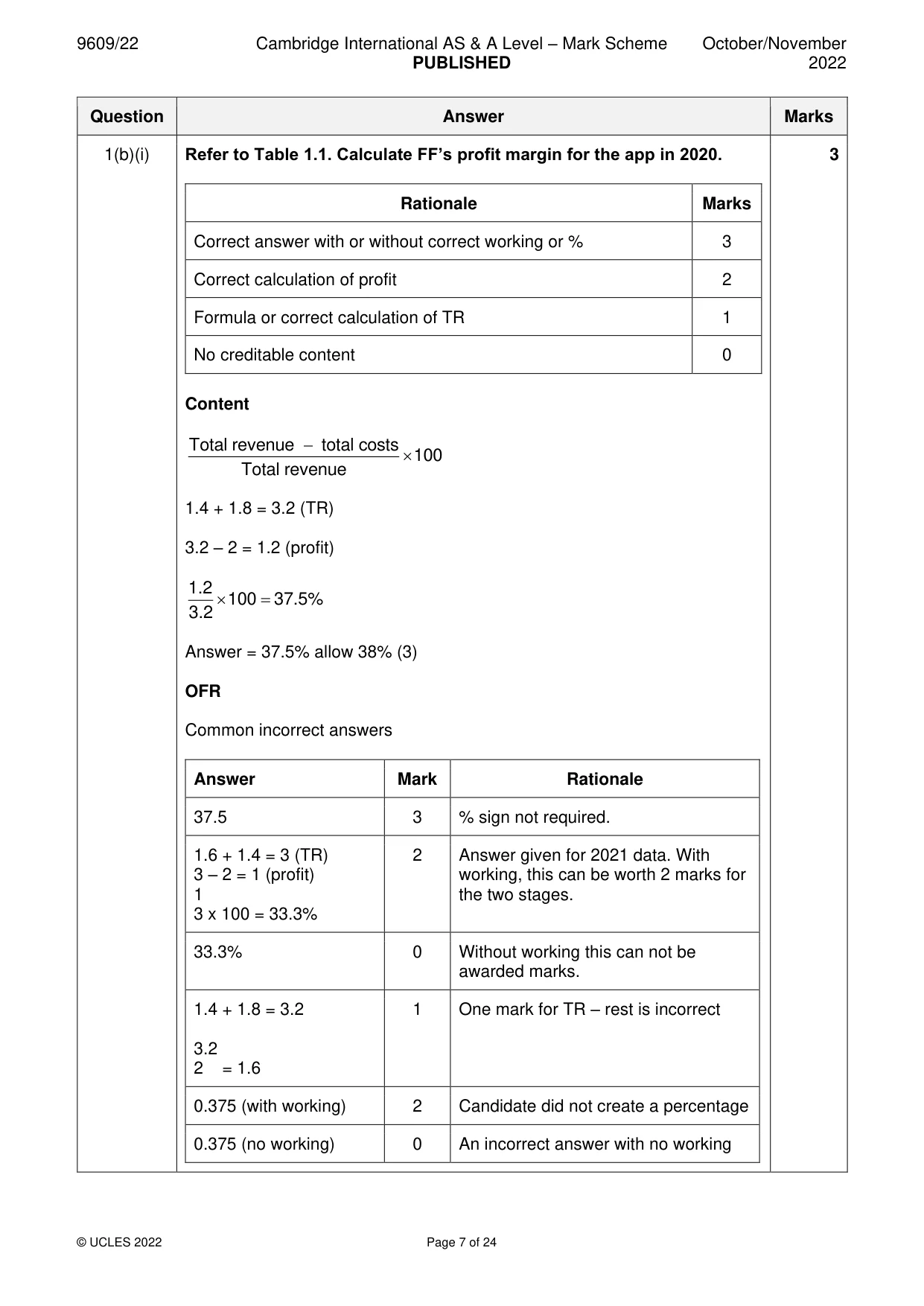
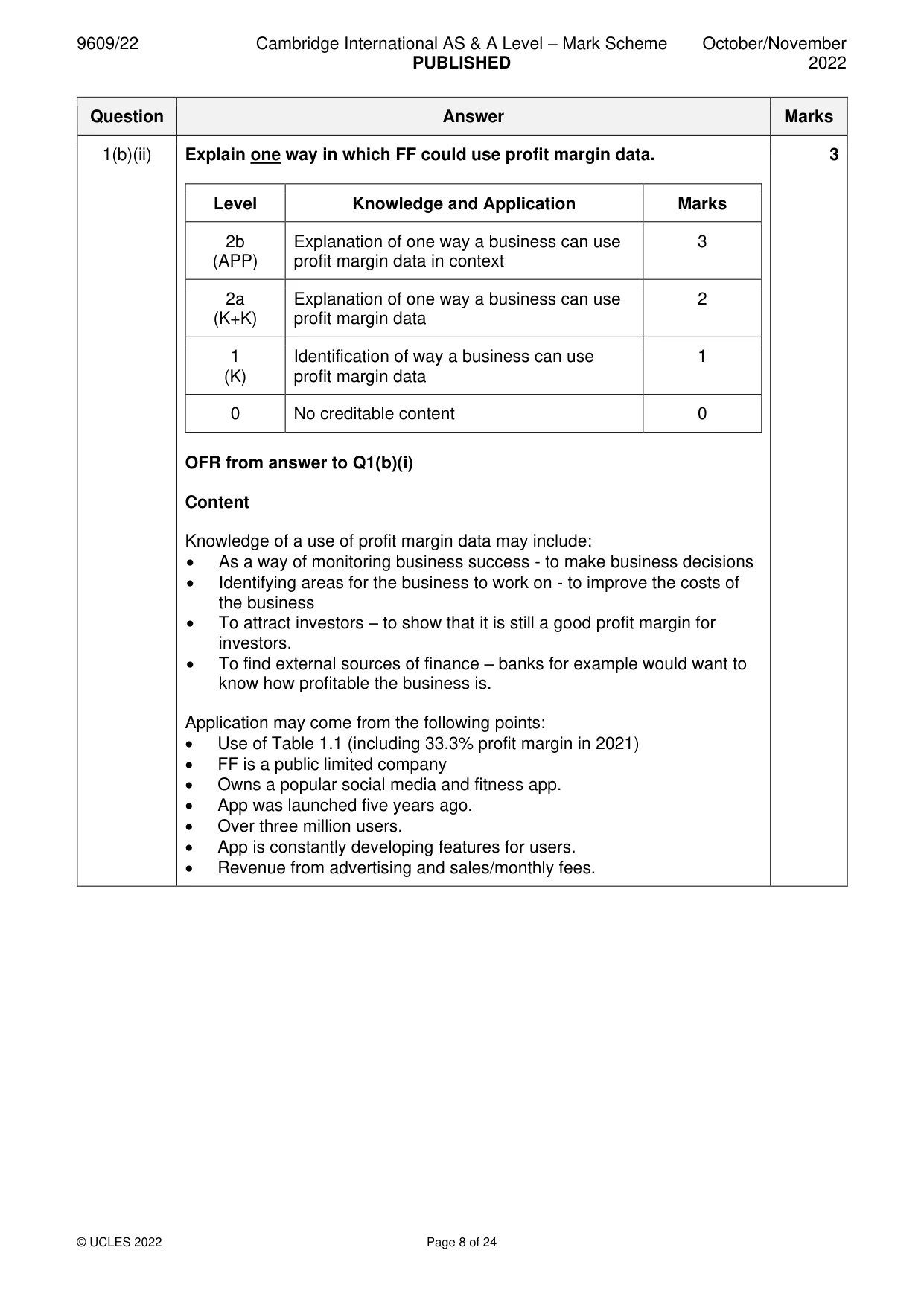
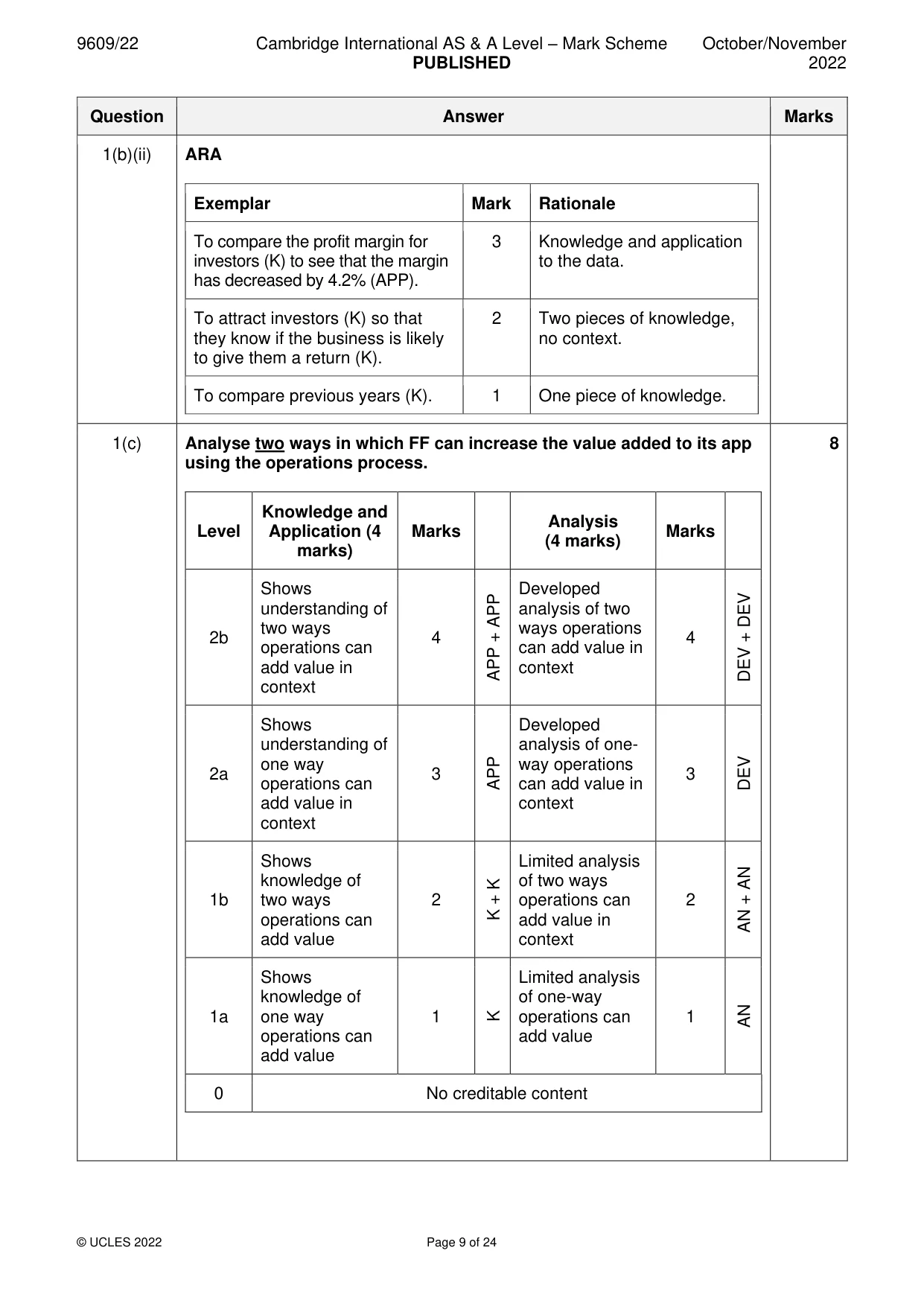
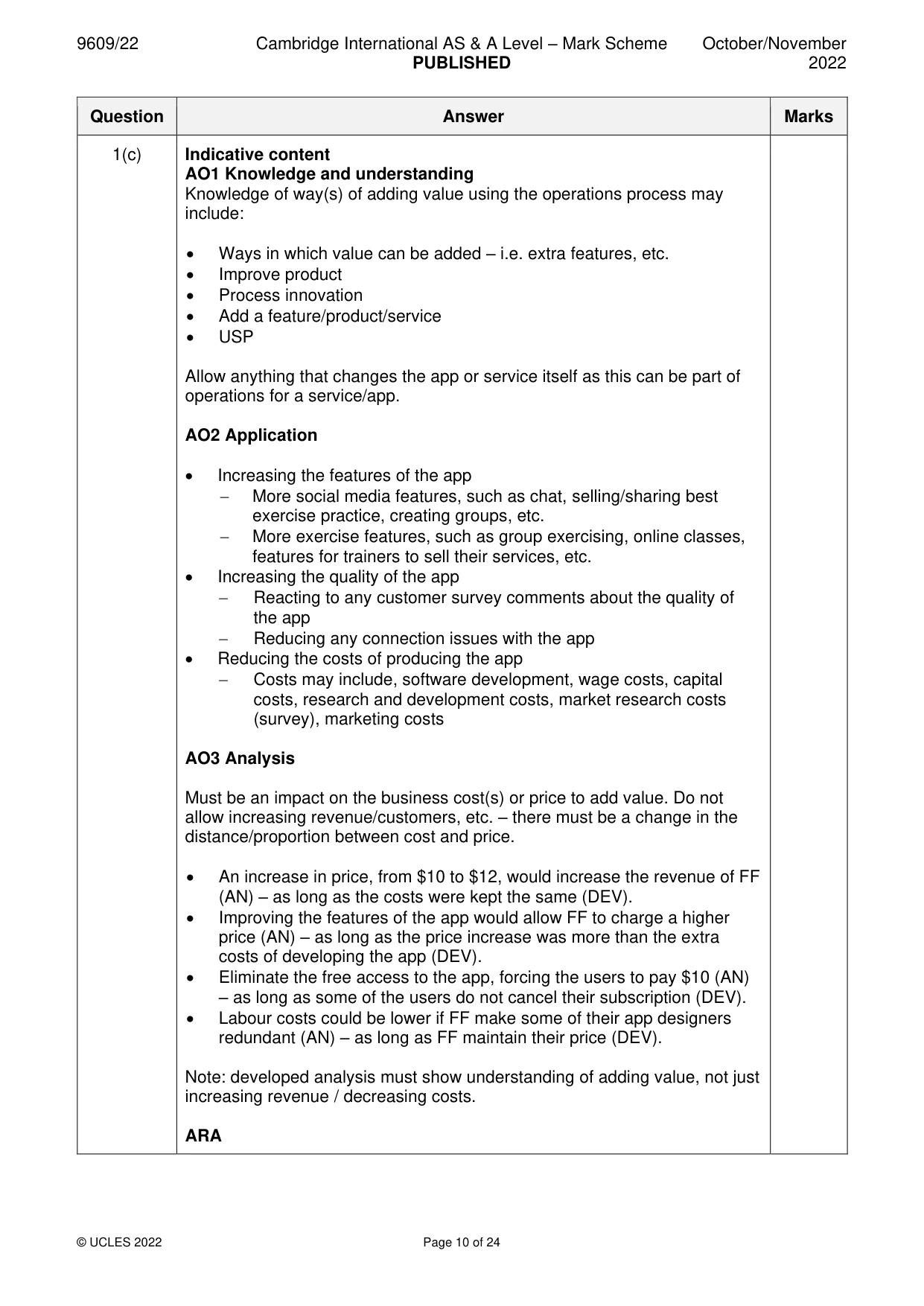
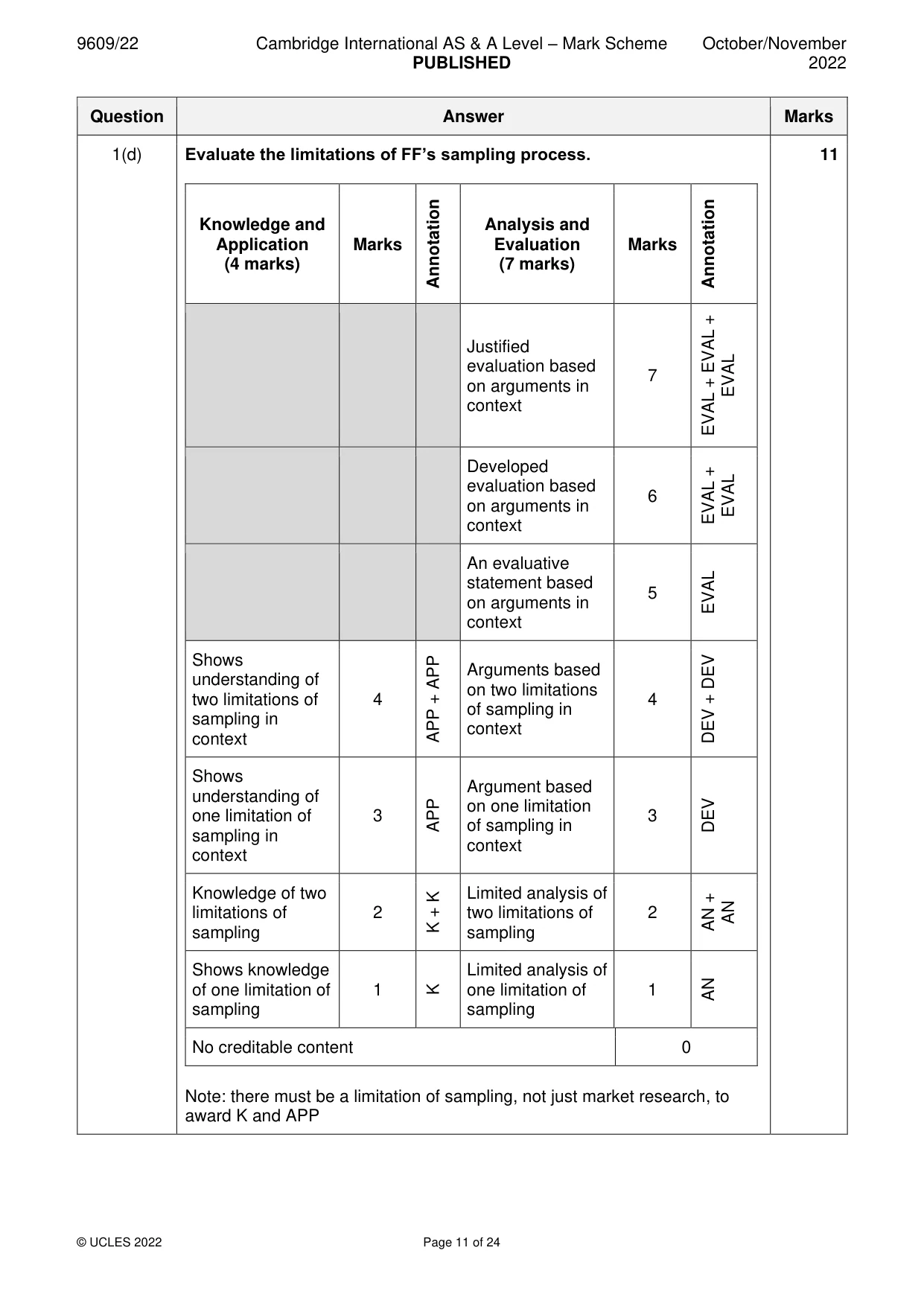
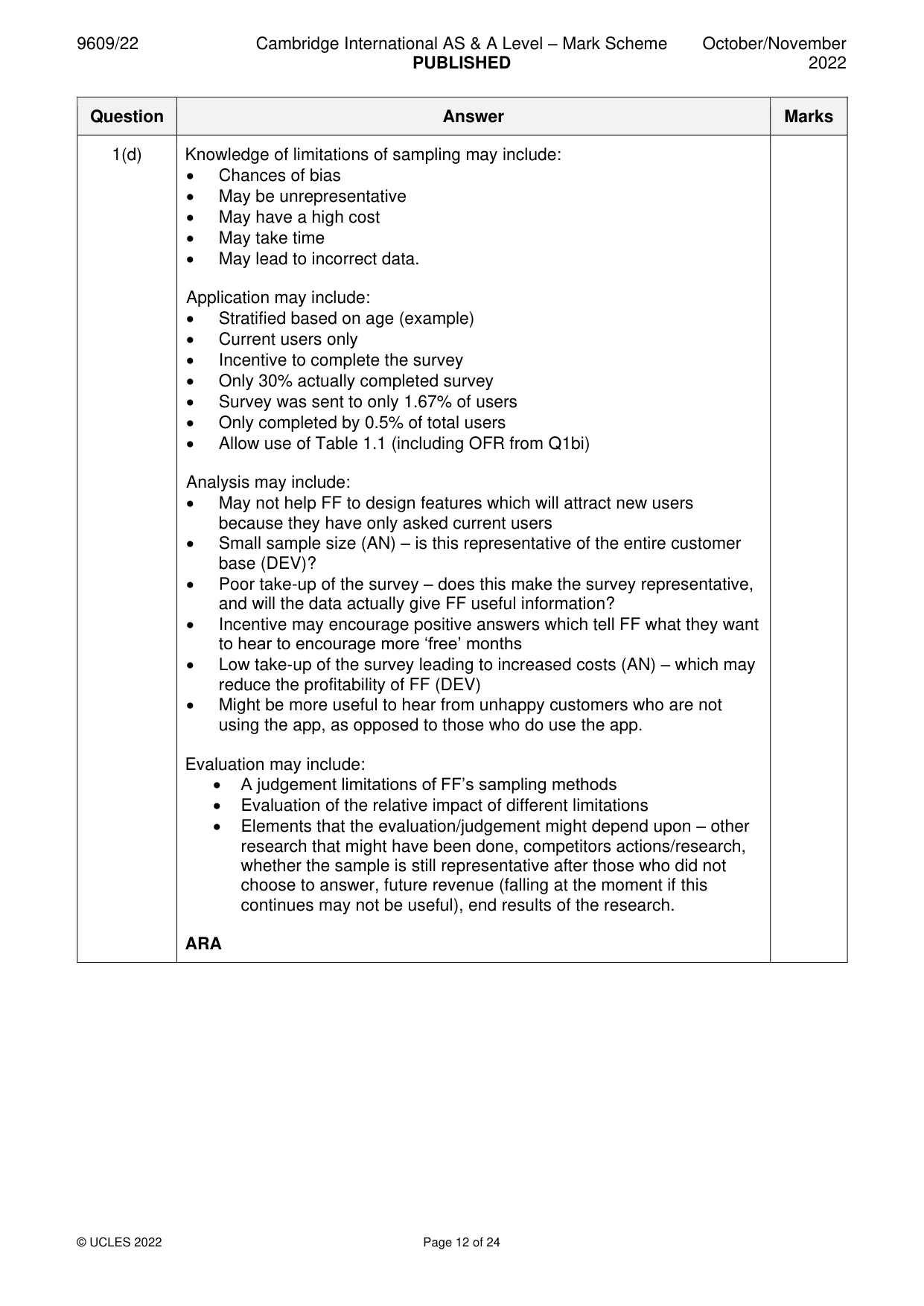
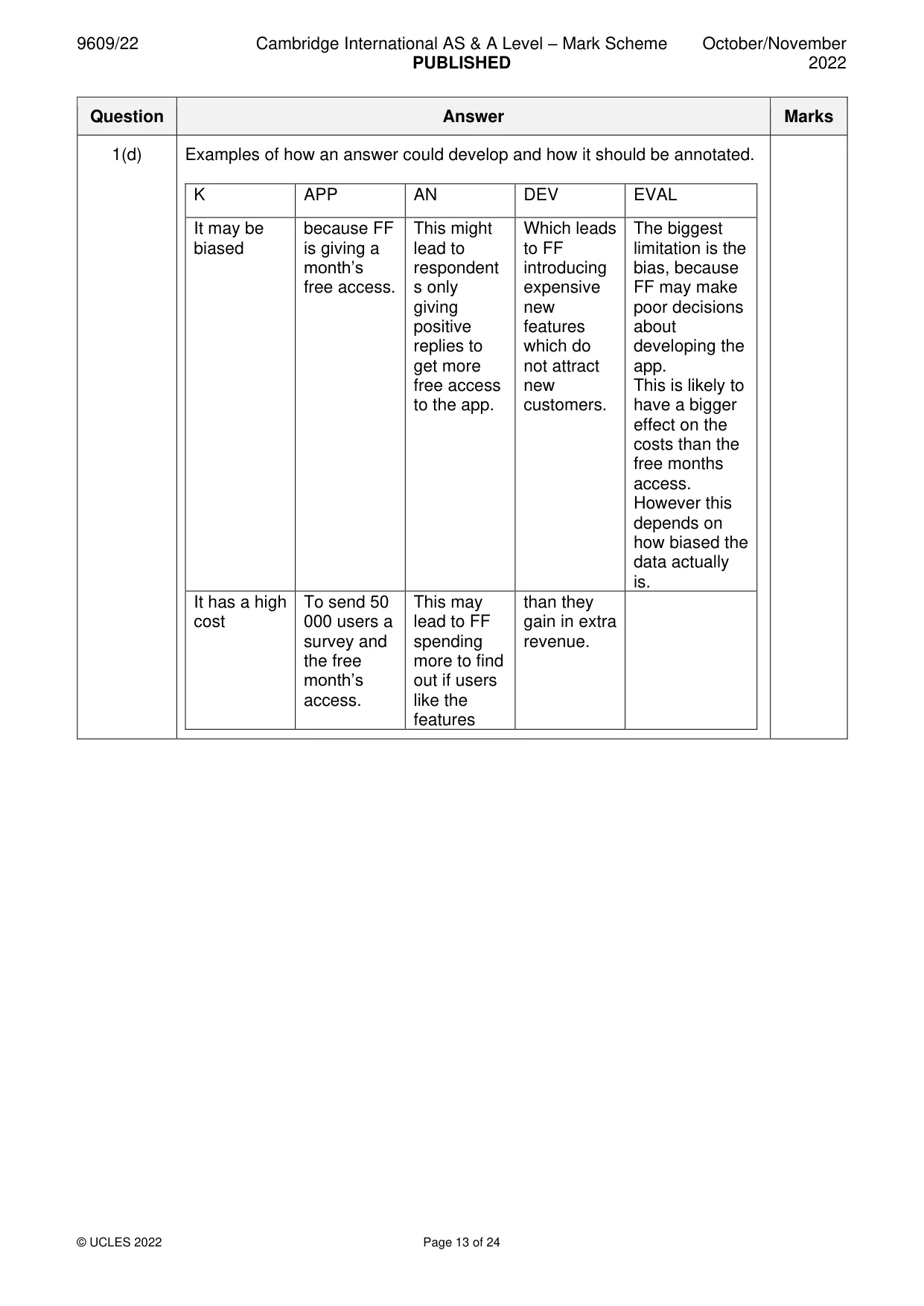
Mark scheme: Question Answer Marks 1(a)(i) Define the term ‘customers’ (line 6). 2 Knowledge Marks A correct definition 2 A partial, vague or unfocused definition 1 No creditable content 0 A correct definition should include the following elements: • an individual or business that purchases/buys products or services (goods) • from a business/firm/company/organisation/enterprise/market etc. Exemplar Rationale Marks Someone who buys a Both elements 2 product from a business. A purchaser of goods from a Both elements 2 business. A person who buys a product One element 1 Someone a business sells to One element 1 Someone who uses a Confusion with consumer 0 product 1(a)(ii) Explain the term ‘public limited company’ (line 1). 3 Award one mark for each point of explanation: Knowledge Marks C Example or some other way of showing good understanding, this could be another element from A, as 1 long as B has been awarded. B Understanding of the specific nature of a public limited company, e.g. shares may be sold to the general 1 public/through stock exchange, accounts must be published (not just made available). A Understanding of a limited company, e.g. limited liability, continuity and a separate legal identity, has 1 shareholders/ they sell shares. Note: A and B marks must be gained before C mark can be awarded. Content A public limited company has shareholders who can purchase shares through a stock exchange. It also has limited liability, continuity and a separate legal identify. It differs from a private limited company by being able to sell shares to the general public (through a stock exchange) and in having to publish (not just make available) its accounts. Exemplar Rationale Marks A PLC has limited liability (A) and All three elements can sell shares through the stock 3 exchange (B). An example of a PLC is McDonalds (C). It is owned by shareholders (A) and A and B only 2 anyone can buy shares (B). A PLC can sell shares (A) and has A only – do not award the a separate legal identity. If an C mark unless B has been owner dies the business continues. awarded. 1 It must produce accounts each year and has unlimited liability. A PLC has unlimited liability, and Confusion with a 0 the owners must draw up a deed. partnership 1(b)(i) Refer to Table 1.1. Calculate FF’s profit margin for the app in 2020. 3 Rationale Marks Correct answer with or without correct working or % 3 Correct calculation of profit 2 Formula or correct calculation of TR 1 No creditable content 0 Content Total revenue − total costs 100 Total revenue 1.4 + 1.8 = 3.2 (TR) 3.2 – 2 = 1.2 (profit) 1.2 100 = 37.5% 3.2 Answer = 37.5% allow 38% (3) OFR Common incorrect answers Answer Mark Rationale 37.5 3 % sign not required. 1.6 + 1.4 = 3 (TR) 2 Answer given for 2021 data. With 3 – 2 = 1 (profit) working, this can be worth 2 marks for 1 the two stages. 3 x 100 = 33.3% 33.3% 0 Without working this can not be awarded marks. 1.4 + 1.8 = 3.2 1 One mark for TR – rest is incorrect 3.2 2.2 = 1.6 0.375 (with working) 2 Candidate did not create a percentage 0.375 (no working) 0 An incorrect answer with no working 1(b)(ii) Explain one way in which FF could use profit margin data. 3 Level Knowledge and Application Marks 2b Explanation of one way a business can use 3 (APP) profit margin data in context 2a Explanation of one way a business can use 2 (K+K) profit margin data 1 Identification of way a business can use 1 (K) profit margin data 0 No creditable content 0 OFR from answer to Q1(b)(i) Content Knowledge of a use of profit margin data may include: • As a way of monitoring business success - to make business decisions • Identifying areas for the business to work on - to improve the costs of the business • To attract investors – to show that it is still a good profit margin for investors. • To find external sources of finance – banks for example would want to know how profitable the business is. Application may come from the following points: • Use of Table 1.1 (including 33.3% profit margin in 2021) • FF is a public limited company • Owns a popular social media and fitness app. • App was launched five years ago. • Over three million users. • App is constantly developing features for users. • Revenue from advertising and sales/monthly fees. 1(b)(ii) ARA Exemplar Mark Rationale To compare the profit margin for 3 Knowledge and application investors (K) to see that the margin to the data. has decreased by 4.2% (APP). To attract investors (K) so that 2 Two pieces of knowledge, they know if the business is likely no context. to give them a return (K). To compare previous years (K). 1 One piece of knowledge. 1(c) Analyse two ways in which FF can increase the value added to its app 8 using the operations process. Knowledge and Analysis Level Application (4 Marks Marks (4 marks) marks) Shows Developed understanding of analysis of two APP DEV two ways ways operations 2b 4 + 4 + operations can can add value in add value in context APP DEV context Shows Developed understanding of analysis of one- one way way operations 2a 3 3 operations can APP can add value in DEV add value in context context Shows Limited analysis knowledge of K of two ways AN 1b two ways 2 + operations can 2 + operations can K add value in AN add value context Shows Limited analysis knowledge of of one-way 1a one way 1 K operations can 1 AN operations can add value add value 0 No creditable content 1(c) Indicative content AO1 Knowledge and understanding Knowledge of way(s) of adding value using the operations process may include: • Ways in which value can be added – i.e. extra features, etc. • Improve product • Process innovation • Add a feature/product/service • USP Allow anything that changes the app or service itself as this can be part of operations for a service/app. AO2 Application • Increasing the features of the app − More social media features, such as chat, selling/sharing best exercise practice, creating groups, etc. − More exercise features, such as group exercising, online classes, features for trainers to sell their services, etc. • Increasing the quality of the app − Reacting to any customer survey comments about the quality of the app − Reducing any connection issues with the app • Reducing the costs of producing the app − Costs may include, software development, wage costs, capital costs, research and development costs, market research costs (survey), marketing costs AO3 Analysis Must be an impact on the business cost(s) or price to add value. Do not allow increasing revenue/customers, etc. – there must be a change in the distance/proportion between cost and price. • An increase in price, from $10 to $12, would increase the revenue of FF (AN) – as long as the costs were kept the same (DEV). • Improving the features of the app would allow FF to charge a higher price (AN) – as long as the price increase was more than the extra costs of developing the app (DEV). • Eliminate the free access to the app, forcing the users to pay $10 (AN) – as long as some of the users do not cancel their subscription (DEV). • Labour costs could be lower if FF make some of their app designers redundant (AN) – as long as FF maintain their price (DEV). Note: developed analysis must show understanding of adding value, not just increasing revenue / decreasing costs. ARA 1(d) Evaluate the limitations of FF’s sampling process. 11 Knowledge and Analysis and Application Marks Evaluation Marks (4 marks) (7 marks) Annotation Annotation + Justified evaluation based EVAL 7 + on arguments in EVAL context EVAL Developed + evaluation based 6 on arguments in EVAL EVAL context An evaluative statement based 5 on arguments in EVAL context Shows Arguments based understanding of APP DEV on two limitations two limitations of 4 + 4 + of sampling in sampling in context APP DEV context Shows Argument based understanding of on one limitation one limitation of 3 3 APP of sampling in DEV sampling in context context Knowledge of two K Limited analysis of + limitations of 2 + two limitations of 2 AN K AN sampling sampling Shows knowledge Limited analysis of of one limitation of 1 K one limitation of 1 AN sampling sampling No creditable content 0 Note: there must be a limitation of sampling, not just market research, to award K and APP 1(d) Knowledge of limitations of sampling may include: • Chances of bias • May be unrepresentative • May have a high cost • May take time • May lead to incorrect data. Application may include: • Stratified based on age (example) • Current users only • Incentive to complete the survey • Only 30% actually completed survey • Survey was sent to only 1.67% of users • Only completed by 0.5% of total users • Allow use of Table 1.1 (including OFR from Q1bi) Analysis may include: • May not help FF to design features which will attract new users because they have only asked current users • Small sample size (AN) – is this representative of the entire customer base (DEV)? • Poor take-up of the survey – does this make the survey representative, and will the data actually give FF useful information? • Incentive may encourage positive answers which tell FF what they want to hear to encourage more ‘free’ months • Low take-up of the survey leading to increased costs (AN) – which may reduce the profitability of FF (DEV) • Might be more useful to hear from unhappy customers who are not using the app, as opposed to those who do use the app. Evaluation may include: • A judgement limitations of FF’s sampling methods • Evaluation of the relative impact of different limitations • Elements that the evaluation/judgement might depend upon – other research that might have been done, competitors actions/research, whether the sample is still representative after those who did not choose to answer, future revenue (falling at the moment if this continues may not be useful), end results of the research. ARA 1(d) Examples of how an answer could develop and how it should be annotated. K APP AN DEV EVAL It may be because FF This might Which leads The biggest biased is giving a lead to to FF limitation is the month’s respondent introducing bias, because free access. s only expensive FF may make giving new poor decisions positive features about replies to which do developing the get more not attract app. free access new This is likely to to the app. customers. have a bigger effect on the costs than the free months access. However this depends on how biased the data actually is. It has a high To send 50 This may than they cost 000 users a lead to FF gain in extra survey and spending revenue. the free more to find month’s out if users access. like the features
Q2 · Cartoon Costumes (CC) Ava is an entrepreneur
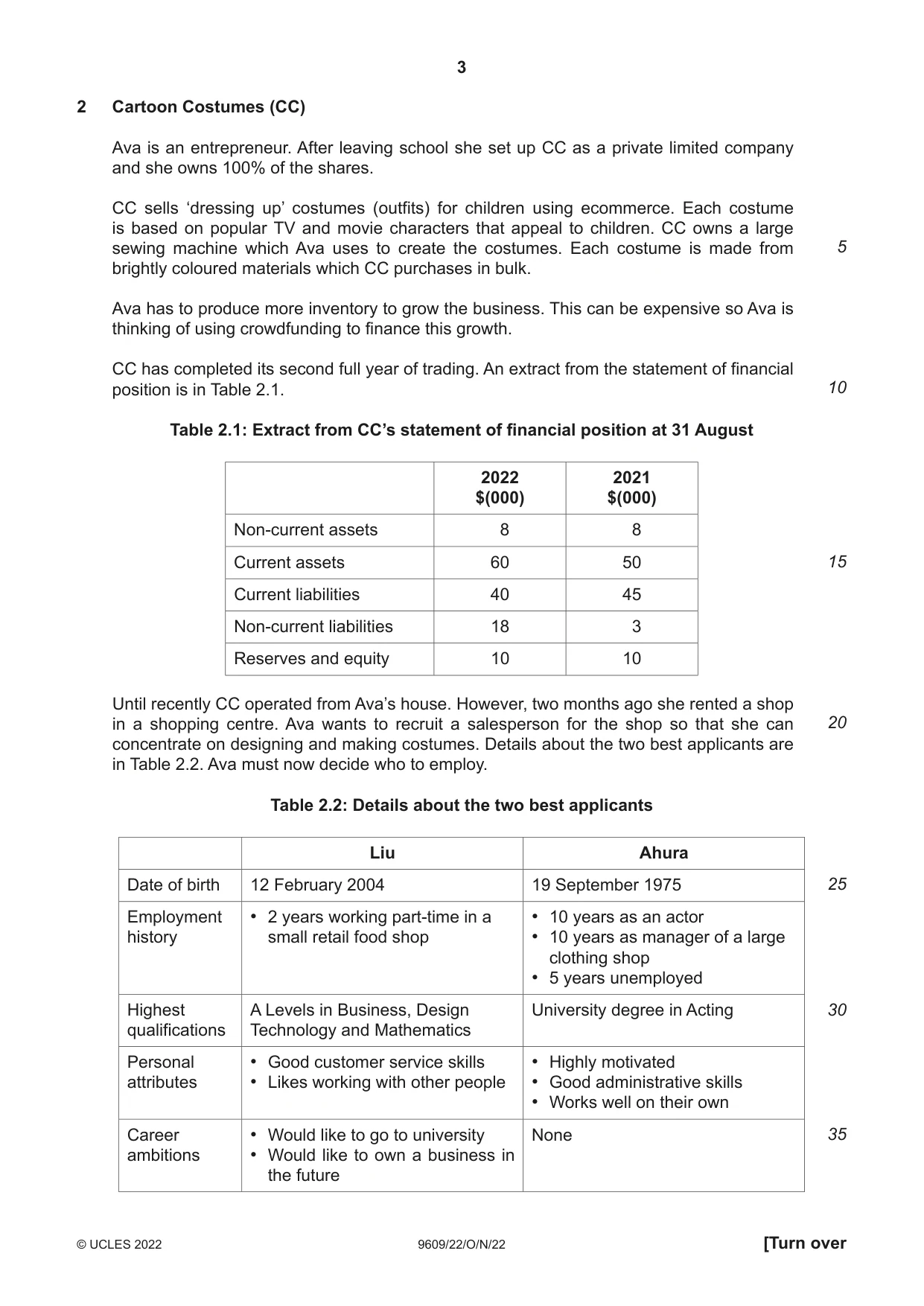
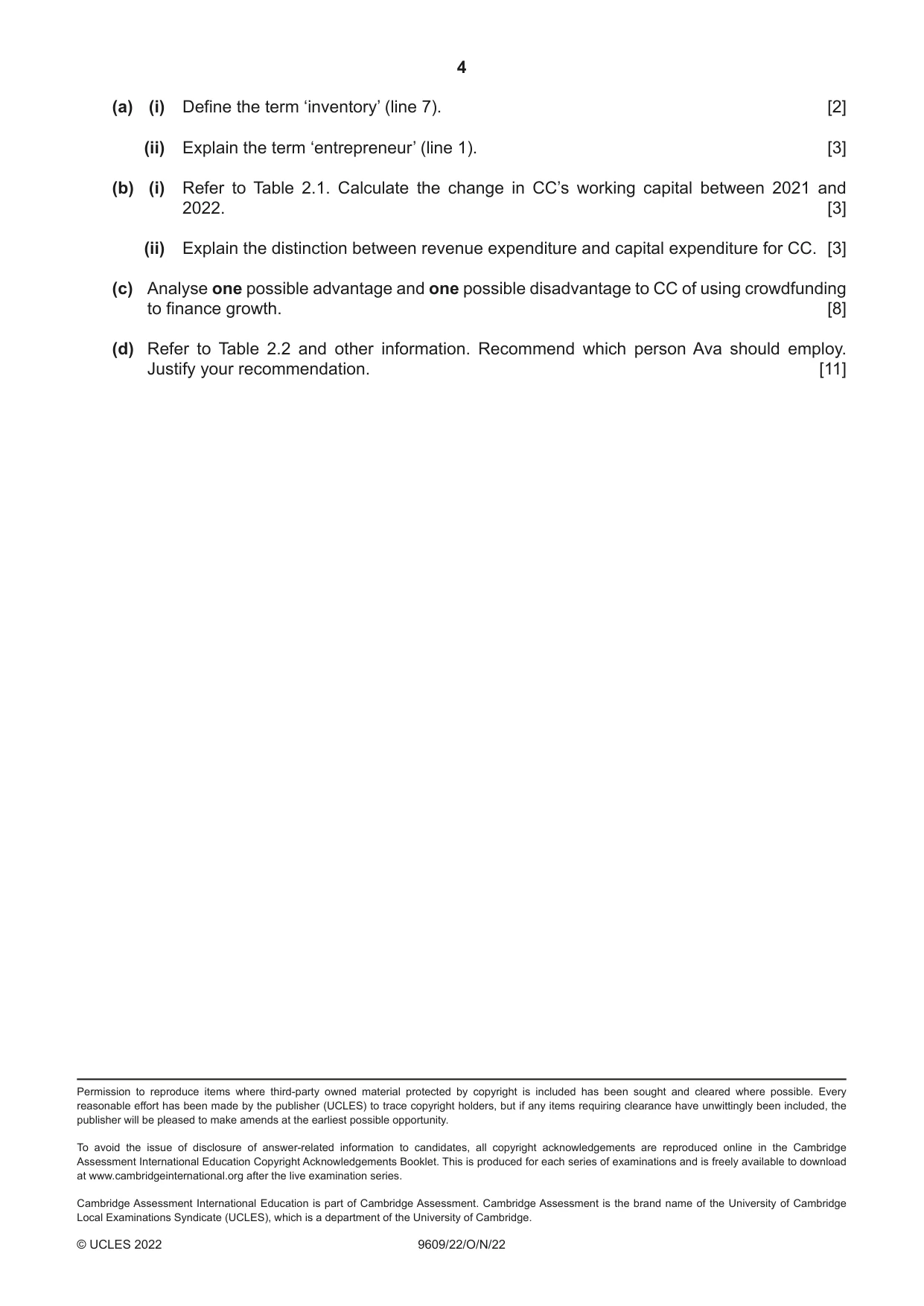
2 Cartoon Costumes (CC) Ava is an entrepreneur. After leaving school she set up CC as a private limited company and she owns 100% of the shares. CC sells ‘dressing up’ costumes (outfits) for children using ecommerce. Each costume is based on popular TV and movie characters that appeal to children. CC owns a large sewing machine which Ava uses to create the costumes. Each costume is made from 5 brightly coloured materials which CC purchases in bulk. Ava has to produce more inventory to grow the business. This can be expensive so Ava is thinking of using crowdfunding to finance this growth. CC has completed its second full year of trading. An extract from the statement of financial position is in Table 2.1. 10 Table 2.1: Extract from CC’s statement of financial position at 31 August 2022 2021 $(000) $(000) Non-current assets 8 8 Current assets 60 50 15 Current liabilities 40 45 Non-current liabilities 18 3 Reserves and equity 10 10 Until recently CC operated from Ava’s house. However, two months ago she rented a shop in a shopping centre. Ava wants to recruit a salesperson for the shop so that she can 20 concentrate on designing and making costumes. Details about the two best applicants are in Table 2.2. Ava must now decide who to employ. Table 2.2: Details about the two best applicants Liu Ahura Date of birth 12 February 2004 19 September 1975 25 Employment • 2 years working part-time in a • 10 years as an actor history small retail food shop • 10 years as manager of a large clothing shop • 5 years unemployed Highest A Levels in Business, Design University degree in Acting 30 qualifications Technology and Mathematics Personal • Good customer service skills • Highly motivated attributes • Likes working with other people • Good administrative skills • Works well on their own Career • Would like to go to university None 35 ambitions • Would like to own a business in the future (a) (i) Define the term ‘inventory’ (line 7). [2] (ii) Explain the term ‘entrepreneur’ (line 1). [3] (b) (i) Refer to Table 2.1. Calculate the change in CC’s working capital between 2021 and 2022. [3] (ii) Explain the distinction between revenue expenditure and capital expenditure for CC. [3] (c) Analyse one possible advantage and one possible disadvantage to CC of using crowdfunding to finance growth. [8] (d) Refer to Table 2.2 and other information. Recommend which person Ava should employ. Justify your recommendation. [11]
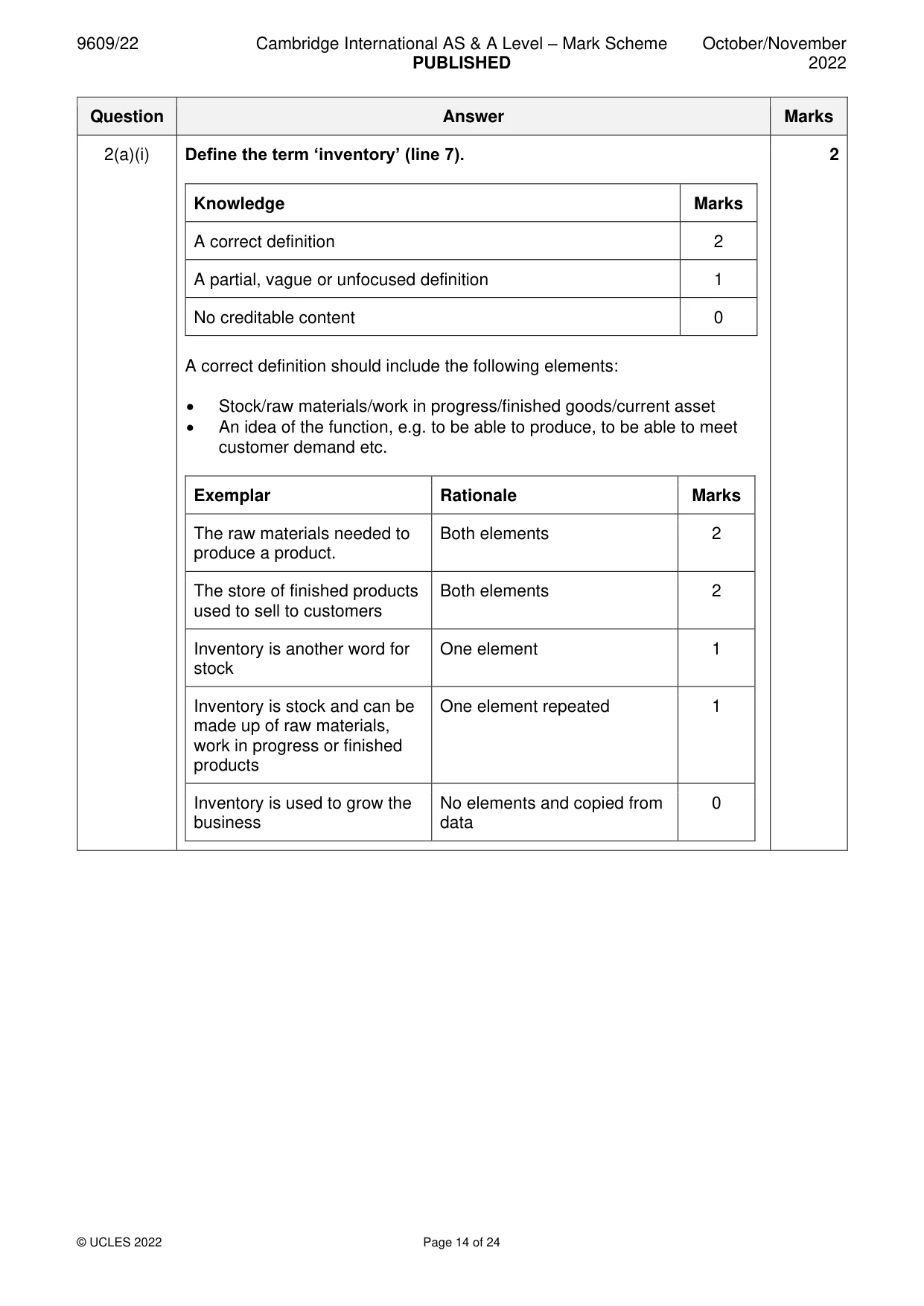
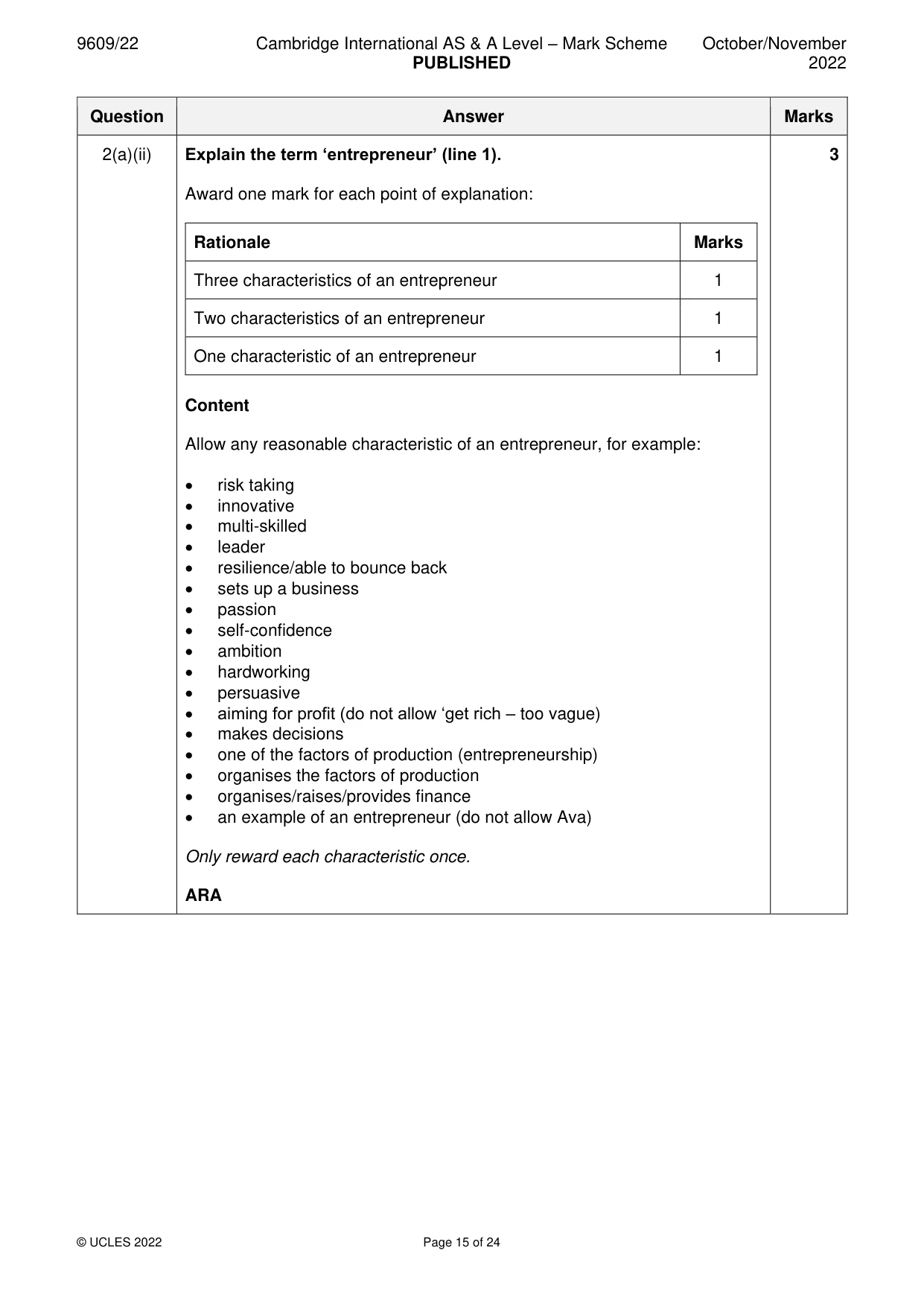
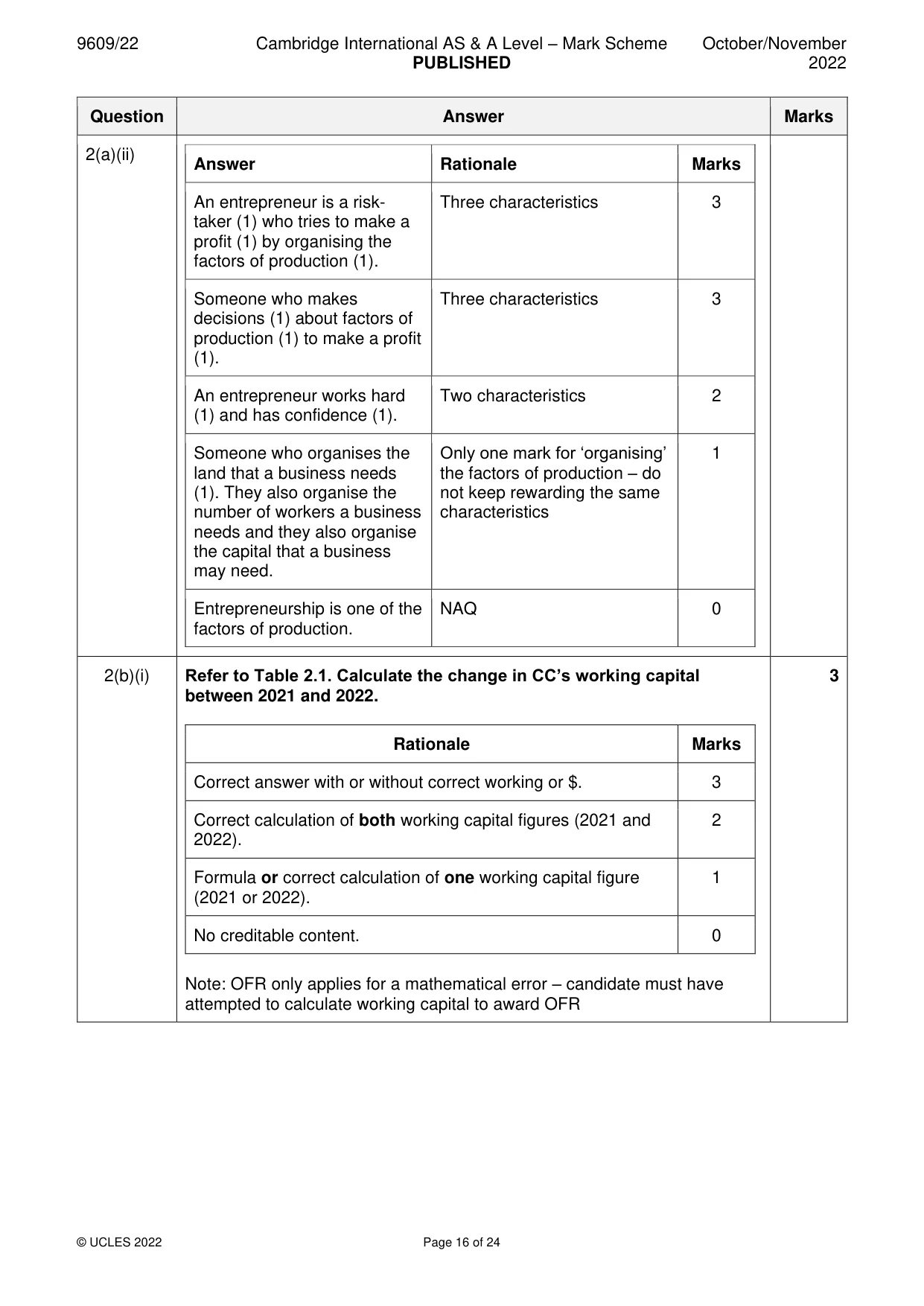
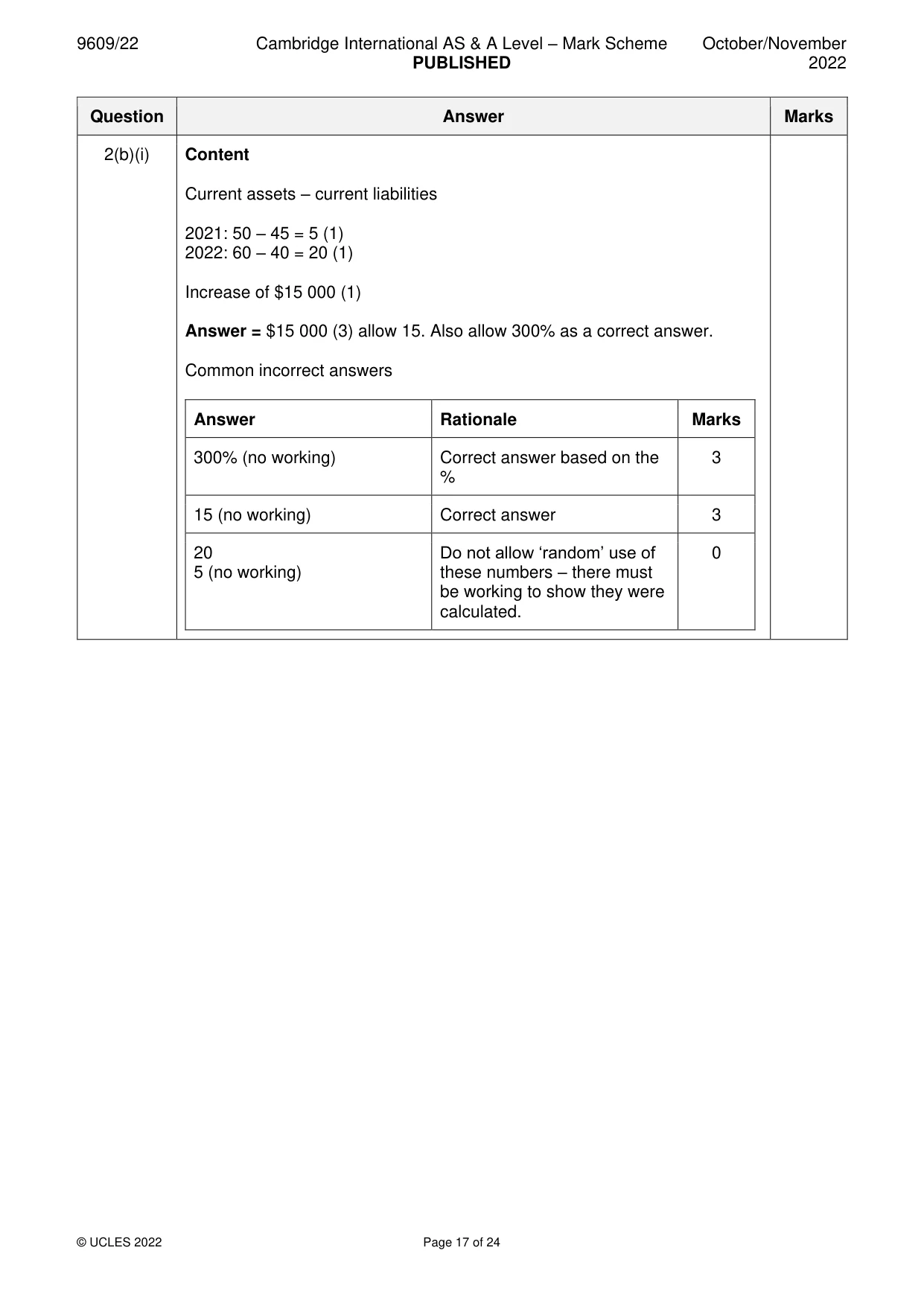
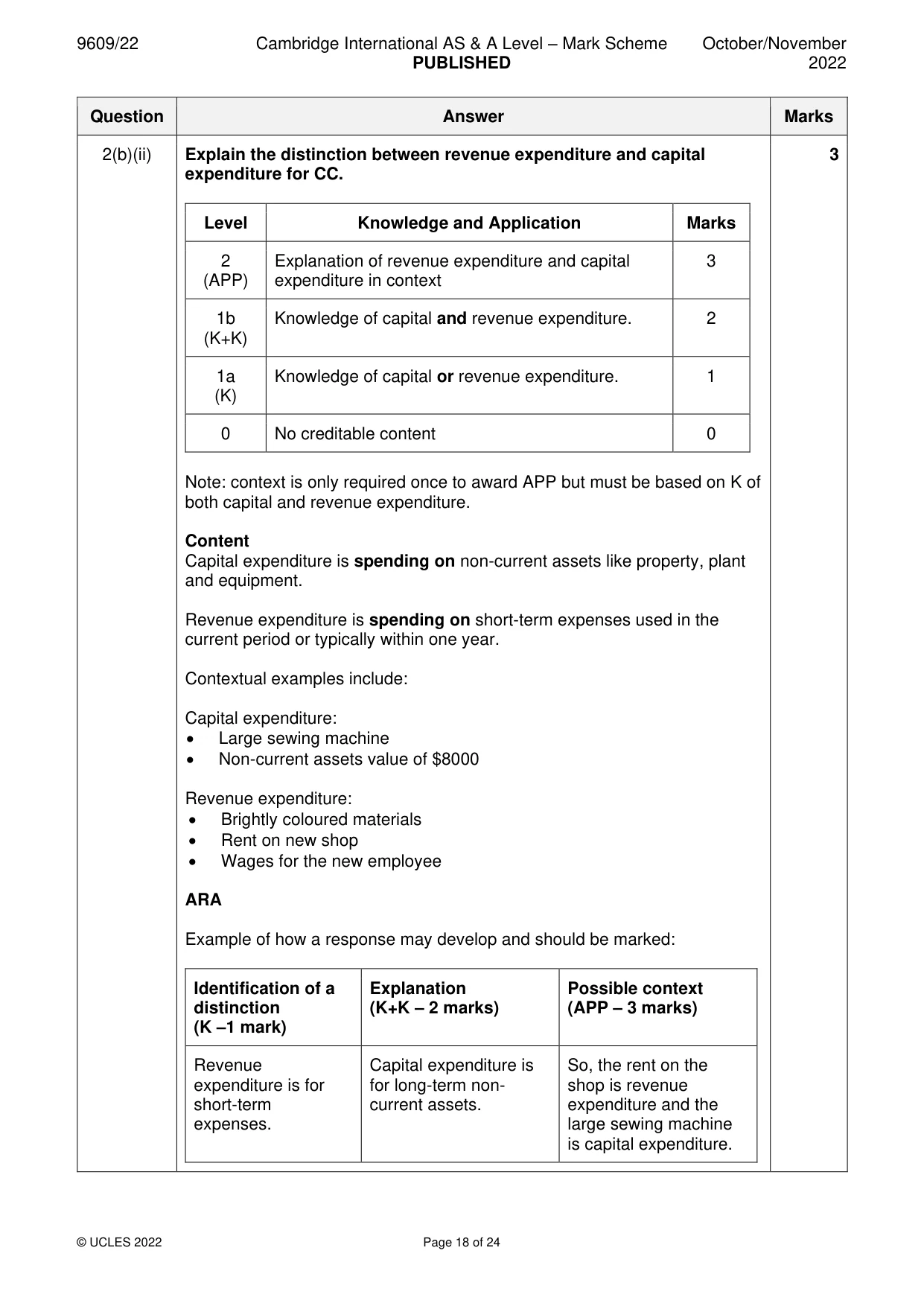
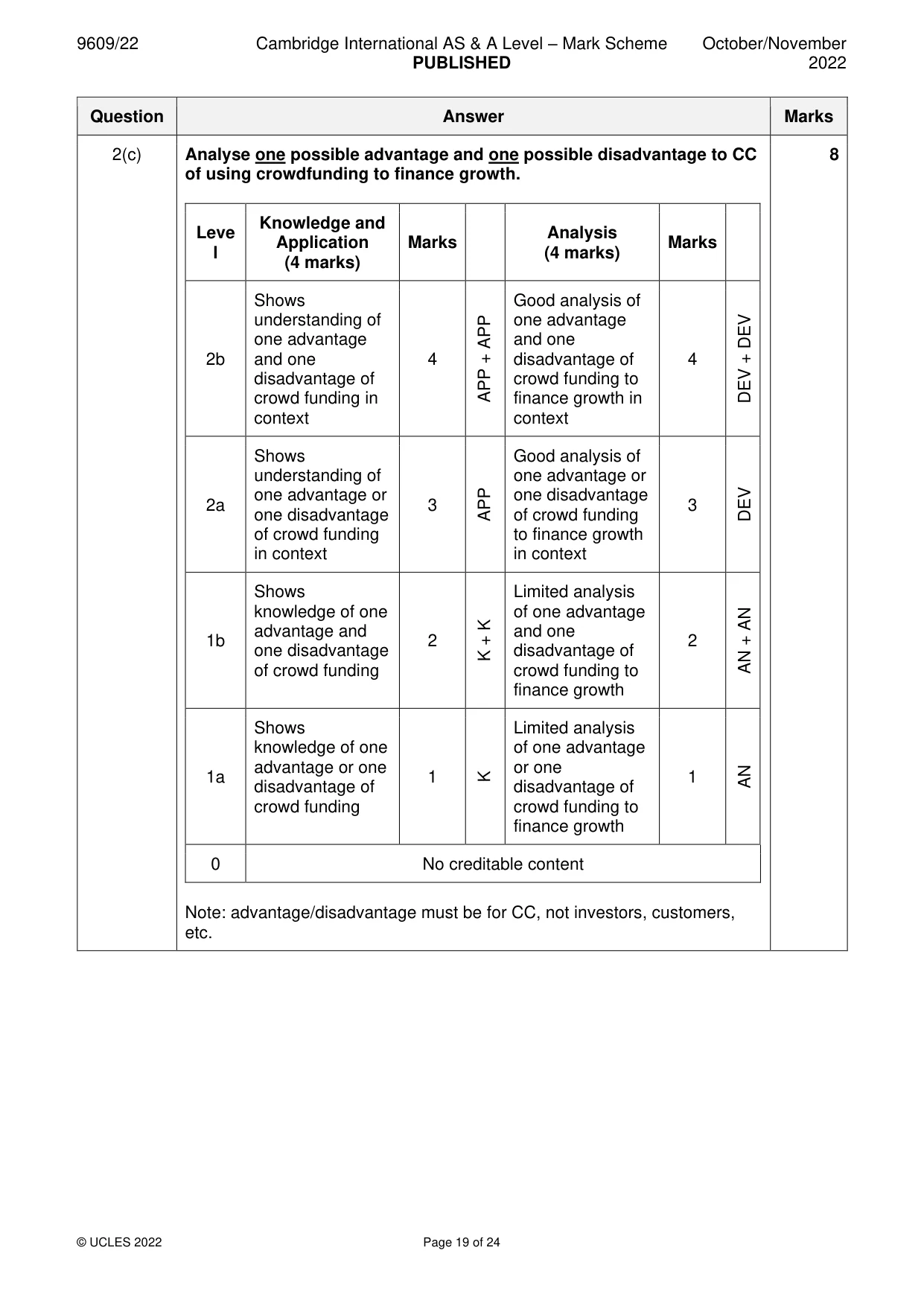
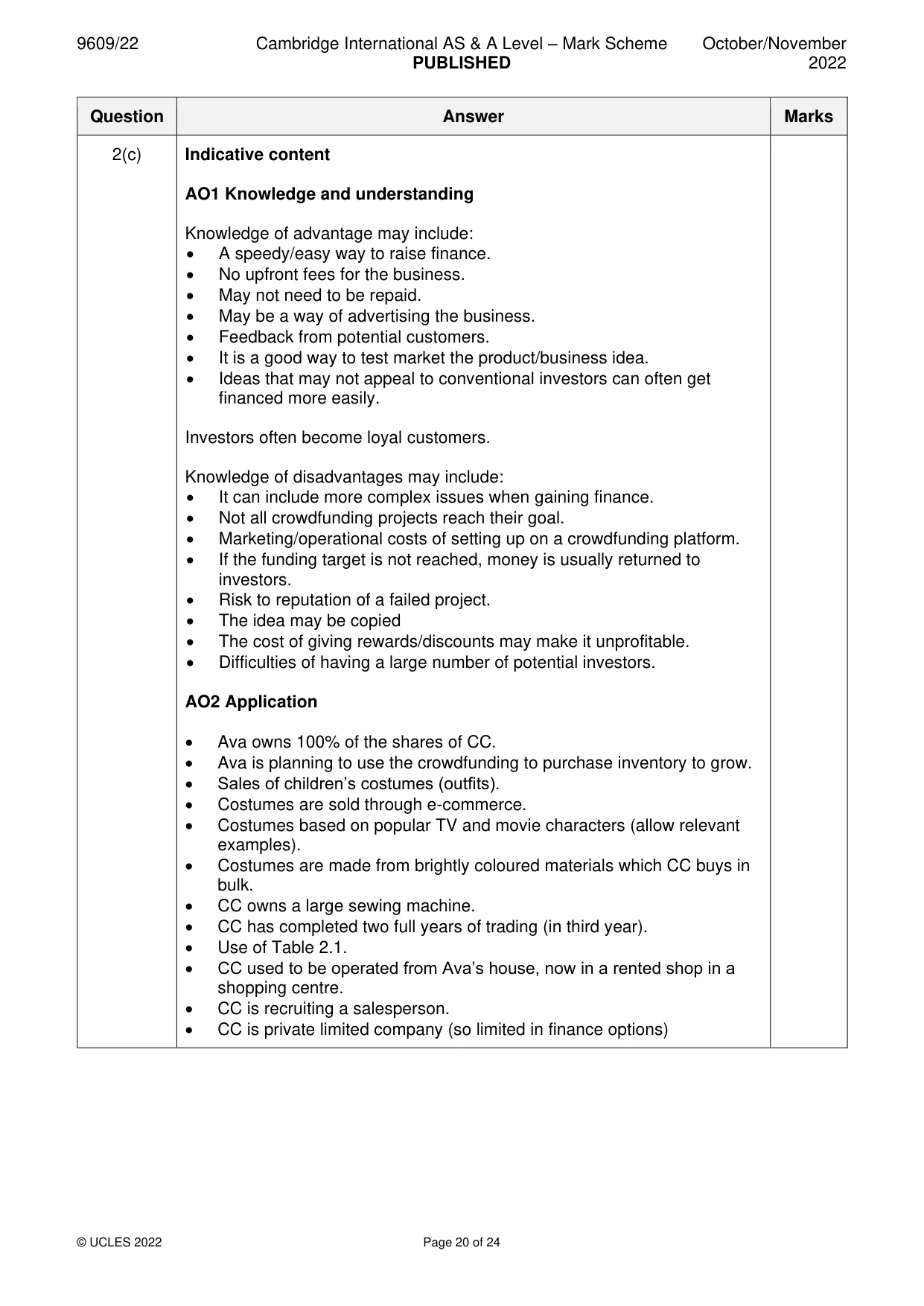
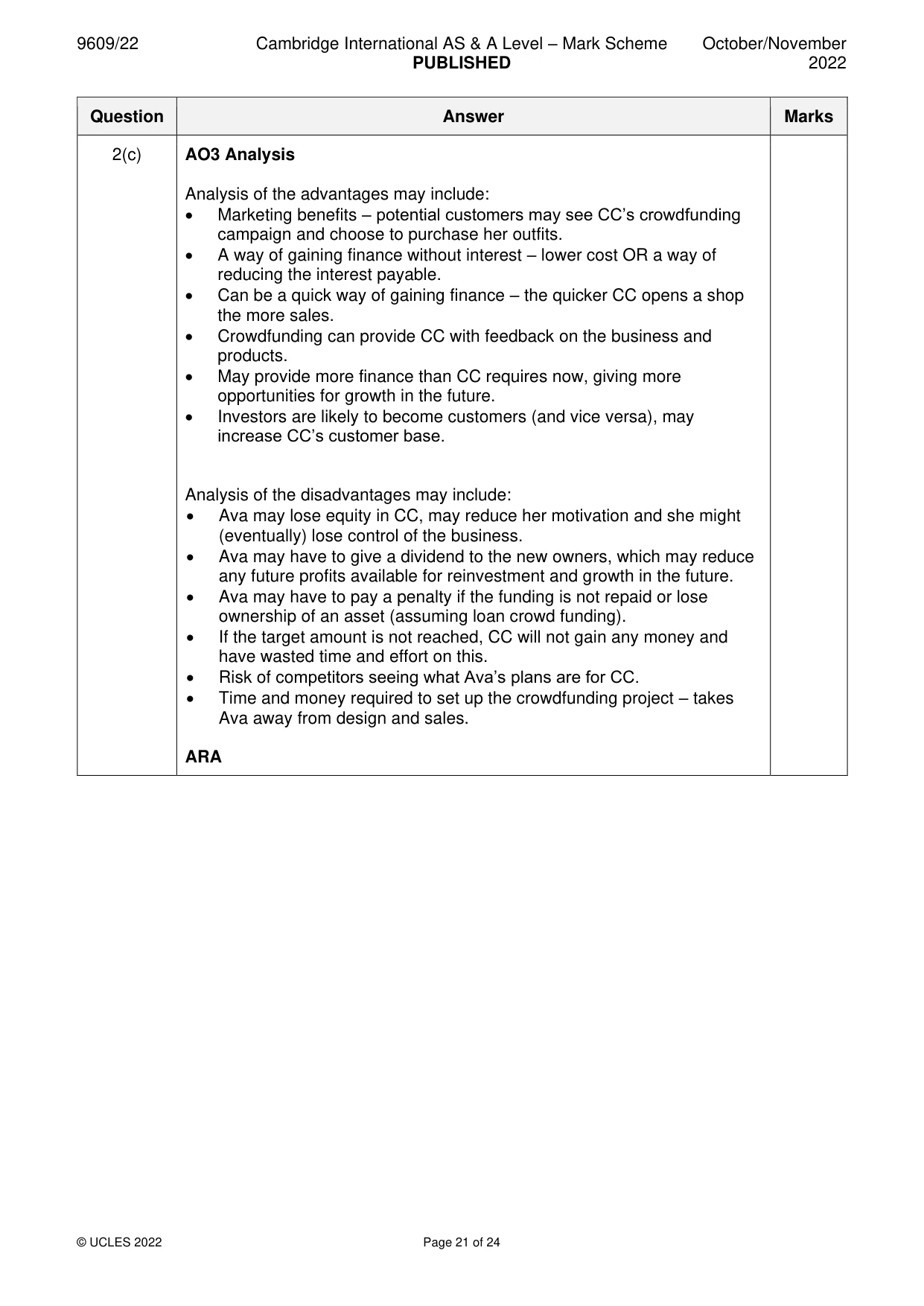
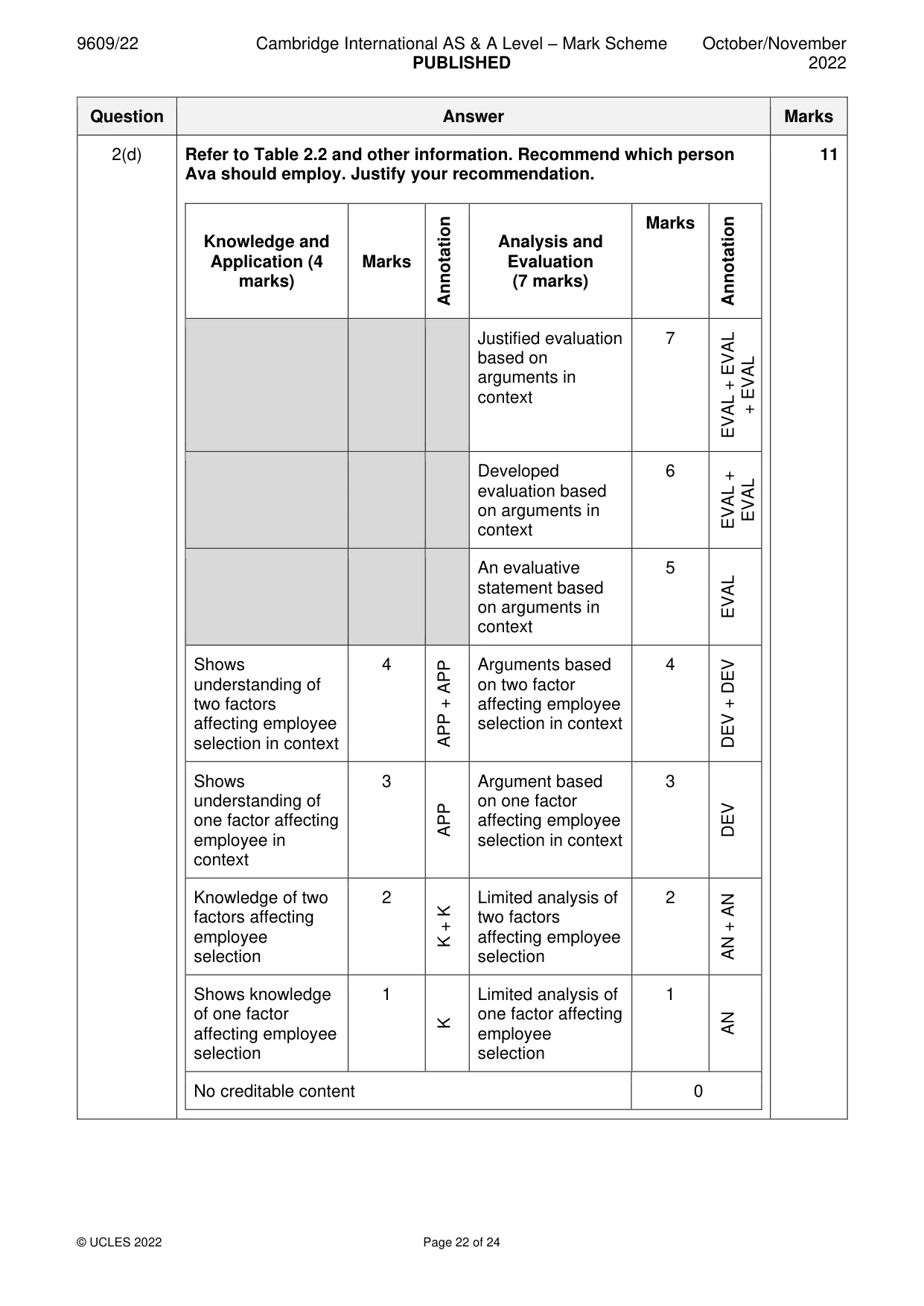
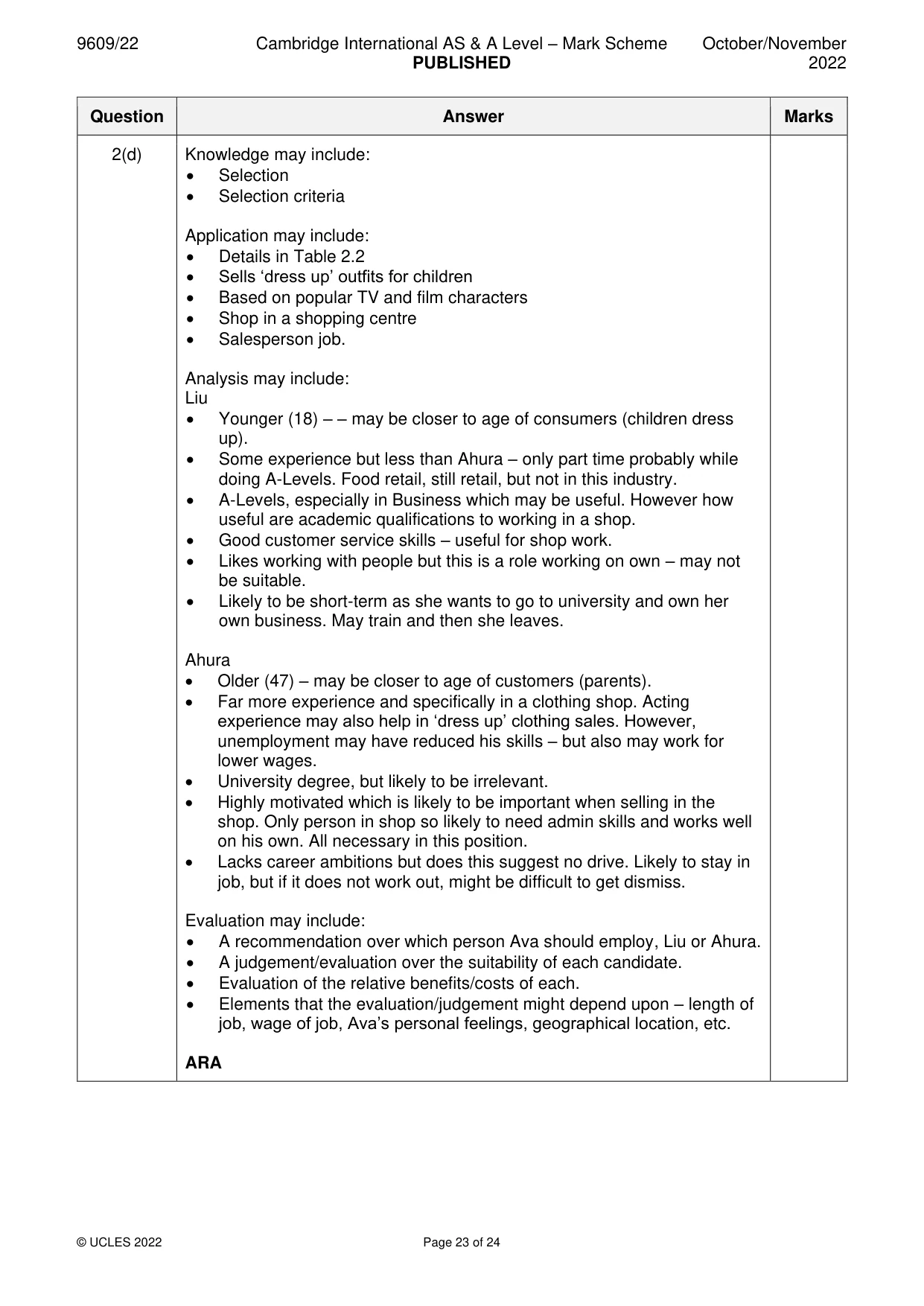
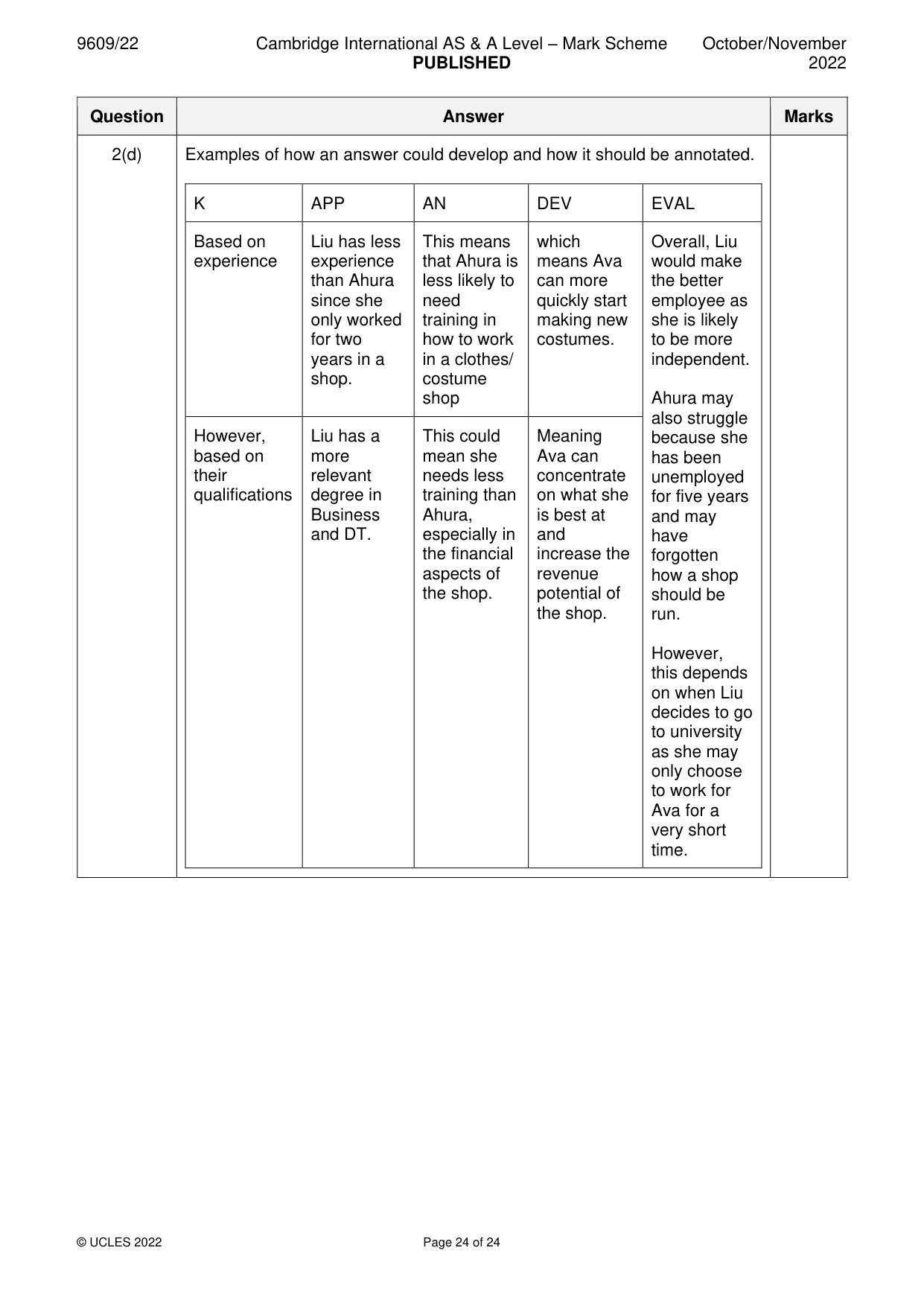
Mark scheme: 2(a)(i) Define the term ‘inventory’ (line 7). 2 Knowledge Marks A correct definition 2 A partial, vague or unfocused definition 1 No creditable content 0 A correct definition should include the following elements: • Stock/raw materials/work in progress/finished goods/current asset • An idea of the function, e.g. to be able to produce, to be able to meet customer demand etc. Exemplar Rationale Marks The raw materials needed to Both elements 2 produce a product. The store of finished products Both elements 2 used to sell to customers Inventory is another word for One element 1 stock Inventory is stock and can be One element repeated 1 made up of raw materials, work in progress or finished products Inventory is used to grow the No elements and copied from 0 business data 2(a)(ii) Explain the term ‘entrepreneur’ (line 1). 3 Award one mark for each point of explanation: Rationale Marks Three characteristics of an entrepreneur 1 Two characteristics of an entrepreneur 1 One characteristic of an entrepreneur 1 Content Allow any reasonable characteristic of an entrepreneur, for example: • risk taking • innovative • multi-skilled • leader • resilience/able to bounce back • sets up a business • passion • self-confidence • ambition • hardworking • persuasive • aiming for profit (do not allow ‘get rich – too vague) • makes decisions • one of the factors of production (entrepreneurship) • organises the factors of production • organises/raises/provides finance • an example of an entrepreneur (do not allow Ava) Only reward each characteristic once. ARA 2(a)(ii) Answer Rationale Marks An entrepreneur is a risk- Three characteristics 3 taker (1) who tries to make a profit (1) by organising the factors of production (1). Someone who makes Three characteristics 3 decisions (1) about factors of production (1) to make a profit (1). An entrepreneur works hard Two characteristics 2 (1) and has confidence (1). Someone who organises the Only one mark for ‘organising’ 1 land that a business needs the factors of production – do (1). They also organise the not keep rewarding the same number of workers a business characteristics needs and they also organise the capital that a business may need. Entrepreneurship is one of the NAQ 0 factors of production. 2(b)(i) Refer to Table 2.1. Calculate the change in CC’s working capital 3 between 2021 and 2022. Rationale Marks Correct answer with or without correct working or $. 3 Correct calculation of both working capital figures (2021 and 2 2022). Formula or correct calculation of one working capital figure 1 (2021 or 2022). No creditable content. 0 Note: OFR only applies for a mathematical error – candidate must have attempted to calculate working capital to award OFR 2(b)(i) Content Current assets – current liabilities 2021: 50 – 45 = 5 (1) 2022: 60 – 40 = 20 (1) Increase of $15 000 (1) Answer = $15 000 (3) allow 15. Also allow 300% as a correct answer. Common incorrect answers Answer Rationale Marks 300% (no working) Correct answer based on the 3 % 15 (no working) Correct answer 3 20 Do not allow ‘random’ use of 0 5 (no working) these numbers – there must be working to show they were calculated. 2(b)(ii) Explain the distinction between revenue expenditure and capital 3 expenditure for CC. Level Knowledge and Application Marks 2 Explanation of revenue expenditure and capital 3 (APP) expenditure in context 1b Knowledge of capital and revenue expenditure. 2 (K+K) 1a Knowledge of capital or revenue expenditure. 1 (K) 0 No creditable content 0 Note: context is only required once to award APP but must be based on K of both capital and revenue expenditure. Content Capital expenditure is spending on non-current assets like property, plant and equipment. Revenue expenditure is spending on short-term expenses used in the current period or typically within one year. Contextual examples include: Capital expenditure: • Large sewing machine • Non-current assets value of $8000 Revenue expenditure: • Brightly coloured materials • Rent on new shop • Wages for the new employee ARA Example of how a response may develop and should be marked: Identification of a Explanation Possible context distinction (K+K – 2 marks) (APP – 3 marks) (K –1 mark) Revenue Capital expenditure is So, the rent on the expenditure is for for long-term non- shop is revenue short-term current assets. expenditure and the expenses. large sewing machine is capital expenditure. 2(c) Analyse one possible advantage and one possible disadvantage to CC 8 of using crowdfunding to finance growth. Knowledge and Leve Analysis Application Marks Marks l (4 marks) (4 marks) Shows Good analysis of understanding of one advantage one advantage APP and one DEV 2b and one 4 + disadvantage of 4 + disadvantage of funding to APP crowd crowd funding in finance growth in DEV context context Shows Good analysis of understanding of one advantage or one advantage or one disadvantage 2a 3 3 one disadvantage APP of crowd funding DEV of crowd funding to finance growth in context in context Shows Limited analysis knowledge of one of one advantage K AN advantage and and one 1b 2 + 2 + one disadvantage K disadvantage of AN of crowd funding crowd funding to finance growth Shows Limited analysis knowledge of one of one advantage advantage or one or one 1a 1 K 1 AN disadvantage of disadvantage of crowd funding crowd funding to finance growth 0 No creditable content Note: advantage/disadvantage must be for CC, not investors, customers, etc. 2(c) Indicative content AO1 Knowledge and understanding Knowledge of advantage may include: • A speedy/easy way to raise finance. • No upfront fees for the business. • May not need to be repaid. • May be a way of advertising the business. • Feedback from potential customers. • It is a good way to test market the product/business idea. • Ideas that may not appeal to conventional investors can often get financed more easily. Investors often become loyal customers. Knowledge of disadvantages may include: • It can include more complex issues when gaining finance. • Not all crowdfunding projects reach their goal. • Marketing/operational costs of setting up on a crowdfunding platform. • If the funding target is not reached, money is usually returned to investors. • Risk to reputation of a failed project. • The idea may be copied • The cost of giving rewards/discounts may make it unprofitable. • Difficulties of having a large number of potential investors. AO2 Application • Ava owns 100% of the shares of CC. • Ava is planning to use the crowdfunding to purchase inventory to grow. • Sales of children’s costumes (outfits). • Costumes are sold through e-commerce. • Costumes based on popular TV and movie characters (allow relevant examples). • Costumes are made from brightly coloured materials which CC buys in bulk. • CC owns a large sewing machine. • CC has completed two full years of trading (in third year). • Use of Table 2.1. • CC used to be operated from Ava’s house, now in a rented shop in a shopping centre. • CC is recruiting a salesperson. • CC is private limited company (so limited in finance options) 2(c) AO3 Analysis Analysis of the advantages may include: • Marketing benefits – potential customers may see CC’s crowdfunding campaign and choose to purchase her outfits. • A way of gaining finance without interest – lower cost OR a way of reducing the interest payable. • Can be a quick way of gaining finance – the quicker CC opens a shop the more sales. • Crowdfunding can provide CC with feedback on the business and products. • May provide more finance than CC requires now, giving more opportunities for growth in the future. • Investors are likely to become customers (and vice versa), may increase CC’s customer base. Analysis of the disadvantages may include: • Ava may lose equity in CC, may reduce her motivation and she might (eventually) lose control of the business. • Ava may have to give a dividend to the new owners, which may reduce any future profits available for reinvestment and growth in the future. • Ava may have to pay a penalty if the funding is not repaid or lose ownership of an asset (assuming loan crowd funding). • If the target amount is not reached, CC will not gain any money and have wasted time and effort on this. • Risk of competitors seeing what Ava’s plans are for CC. • Time and money required to set up the crowdfunding project – takes Ava away from design and sales. ARA 2(d) Refer to Table 2.2 and other information. Recommend which person 11 Ava should employ. Justify your recommendation. Marks Knowledge and Analysis and Application (4 Marks Evaluation marks) (7 marks) Annotation Annotation Justified evaluation 7 based on EVAL arguments in + EVAL context + EVAL Developed 6 + evaluation based on arguments in EVAL EVAL context An evaluative 5 statement based on arguments in EVAL context Shows 4 Arguments based 4 understanding of APP on two factor DEV two factors + affecting employee + affecting employee APP selection in context DEV selection in context Shows 3 Argument based 3 understanding of on one factor one factor affecting affecting employee APP DEV employee in selection in context context Knowledge of two 2 Limited analysis of 2 K AN factors affecting two factors + + employee K affecting employee AN selection selection Shows knowledge 1 Limited analysis of 1 of one factor one factor affecting K AN affecting employee employee selection selection No creditable content 0 2(d) Knowledge may include: • Selection • Selection criteria Application may include: • Details in Table 2.2 • Sells ‘dress up’ outfits for children • Based on popular TV and film characters • Shop in a shopping centre • Salesperson job. Analysis may include: Liu • Younger (18) – – may be closer to age of consumers (children dress up). • Some experience but less than Ahura – only part time probably while doing A-Levels. Food retail, still retail, but not in this industry. • A-Levels, especially in Business which may be useful. However how useful are academic qualifications to working in a shop. • Good customer service skills – useful for shop work. • Likes working with people but this is a role working on own – may not be suitable. • Likely to be short-term as she wants to go to university and own her own business. May train and then she leaves. Ahura • Older (47) – may be closer to age of customers (parents). • Far more experience and specifically in a clothing shop. Acting experience may also help in ‘dress up’ clothing sales. However, unemployment may have reduced his skills – but also may work for lower wages. • University degree, but likely to be irrelevant. • Highly motivated which is likely to be important when selling in the shop. Only person in shop so likely to need admin skills and works well on his own. All necessary in this position. • Lacks career ambitions but does this suggest no drive. Likely to stay in job, but if it does not work out, might be difficult to get dismiss. Evaluation may include: • A recommendation over which person Ava should employ, Liu or Ahura. • A judgement/evaluation over the suitability of each candidate. • Evaluation of the relative benefits/costs of each. • Elements that the evaluation/judgement might depend upon – length of job, wage of job, Ava’s personal feelings, geographical location, etc. ARA 2(d) Examples of how an answer could develop and how it should be annotated. K APP AN DEV EVAL Based on Liu has less This means which Overall, Liu experience experience that Ahura is means Ava would make than Ahura less likely to can more the better since she need quickly start employee as only worked training in making new she is likely for two how to work costumes. to be more years in a in a clothes/ independent. shop. costume shop Ahura may also struggle However, Liu has a This could Meaning because she based on more mean she Ava can has been their relevant needs less concentrate unemployed qualifications degree in training than on what she for five years Business Ahura, is best at and may and DT. especially in and have the financial increase the forgotten aspects of revenue how a shop the shop. potential of should be the shop. run. However, this depends on when Liu decides to go to university as she may only choose to work for Ava for a very short time.
What was in this paper
The subtopics covered by these 2 questions, and how many questions each got. Open one in a new tab to see every Cambridge question on it.
What you needed in this session
Cambridge’s own grade thresholds for 2022 Oct/Nov, Paper 2 · Variant 2. A higher threshold means an easier paper — the bar moves with how the cohort did.