Cambridge A Level Business (for first examination in 2016) 9609 — 2017 Oct/Nov Paper 2 · Variant 2
9609/22/O/N/17 · 2 questions · 60 marks · ≈68 min
The question paper and its mark scheme, free to read here and free to download. This is Cambridge’s own paper, exactly as it was sat.
Question paper4 pages

Mark scheme19 pages
Answers below. Sit the paper first if you are practising.
Questions as text
Q1 · Occasion Cards (OC) OC is a private limited company that sells greeting cards designed…
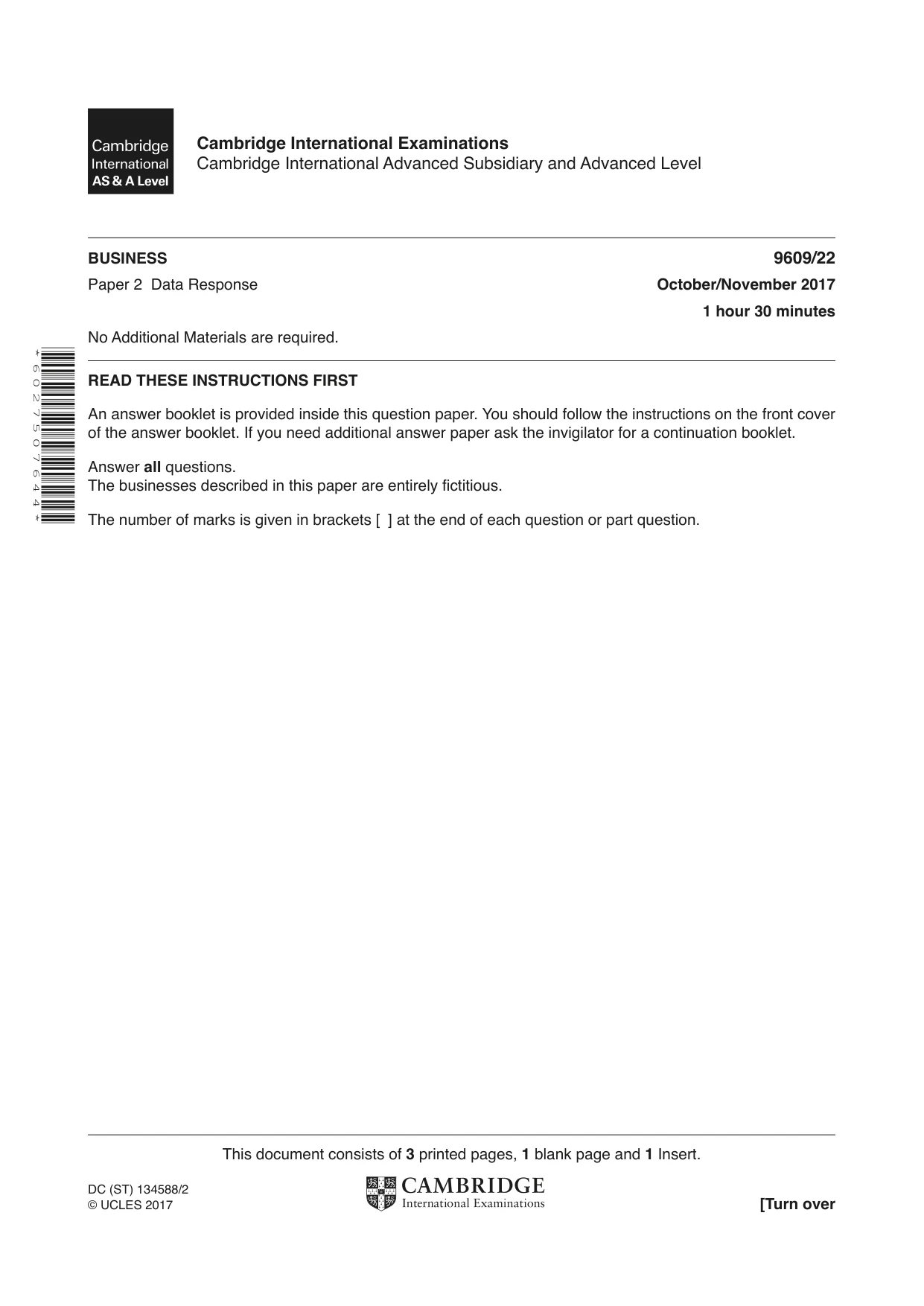
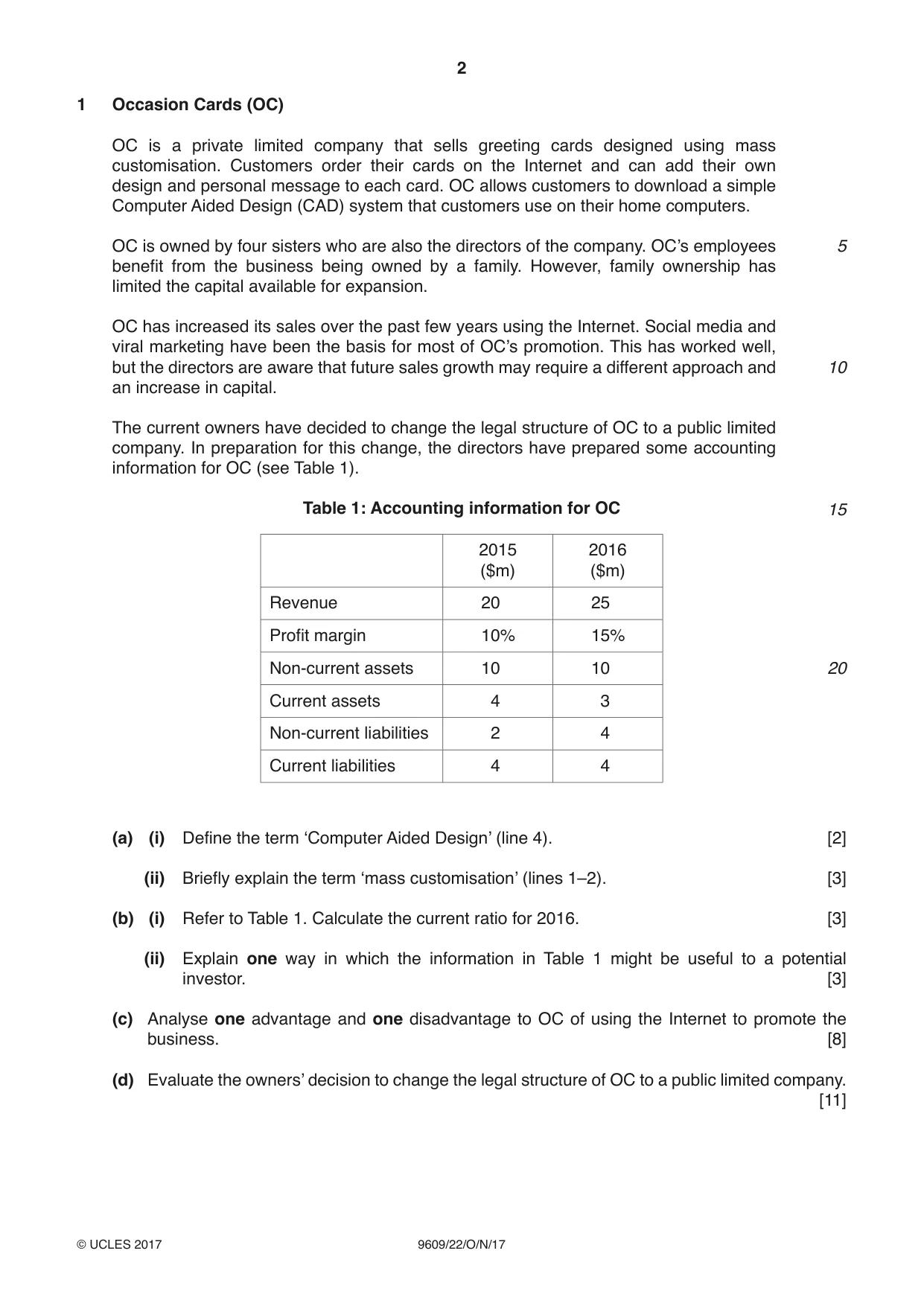
1 Occasion Cards (OC) OC is a private limited company that sells greeting cards designed using mass customisation. Customers order their cards on the Internet and can add their own design and personal message to each card. OC allows customers to download a simple Computer Aided Design (CAD) system that customers use on their home computers. OC is owned by four sisters who are also the directors of the company. OC’s employees 5 benefit from the business being owned by a family. However, family ownership has limited the capital available for expansion. OC has increased its sales over the past few years using the Internet. Social media and viral marketing have been the basis for most of OC’s promotion. This has worked well, but the directors are aware that future sales growth may require a different approach and 10 an increase in capital. The current owners have decided to change the legal structure of OC to a public limited company. In preparation for this change, the directors have prepared some accounting information for OC (see Table 1). Table 1: Accounting information for OC 15 2015 2016 ($m) ($m) Revenue 20 25 Profit margin 10% 15% Non-current assets 10 10 20 Current assets 4 3 Non-current liabilities 2 4 Current liabilities 4 4 (a) (i) Define the term ‘Computer Aided Design’ (line 4). [2] (ii) Briefly explain the term ‘mass customisation’ (lines 1–2). [3] (b) (i) Refer to Table 1. Calculate the current ratio for 2016. [3] (ii) Explain one way in which the information in Table 1 might be useful to a potential investor. [3] (c) Analyse one advantage and one disadvantage to OC of using the Internet to promote the business. [8] (d) Evaluate the owners’ decision to change the legal structure of OC to a public limited company. [11]
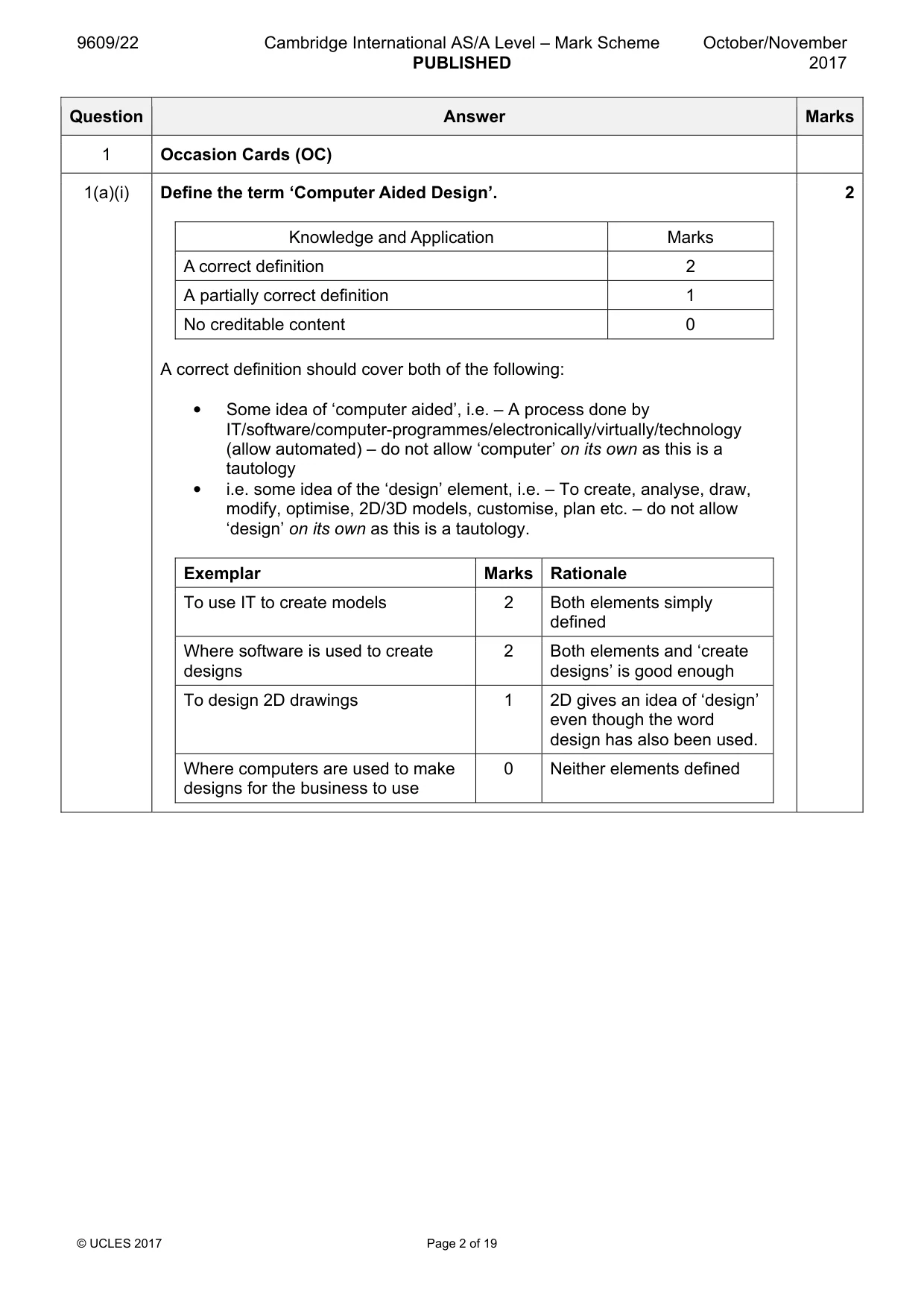
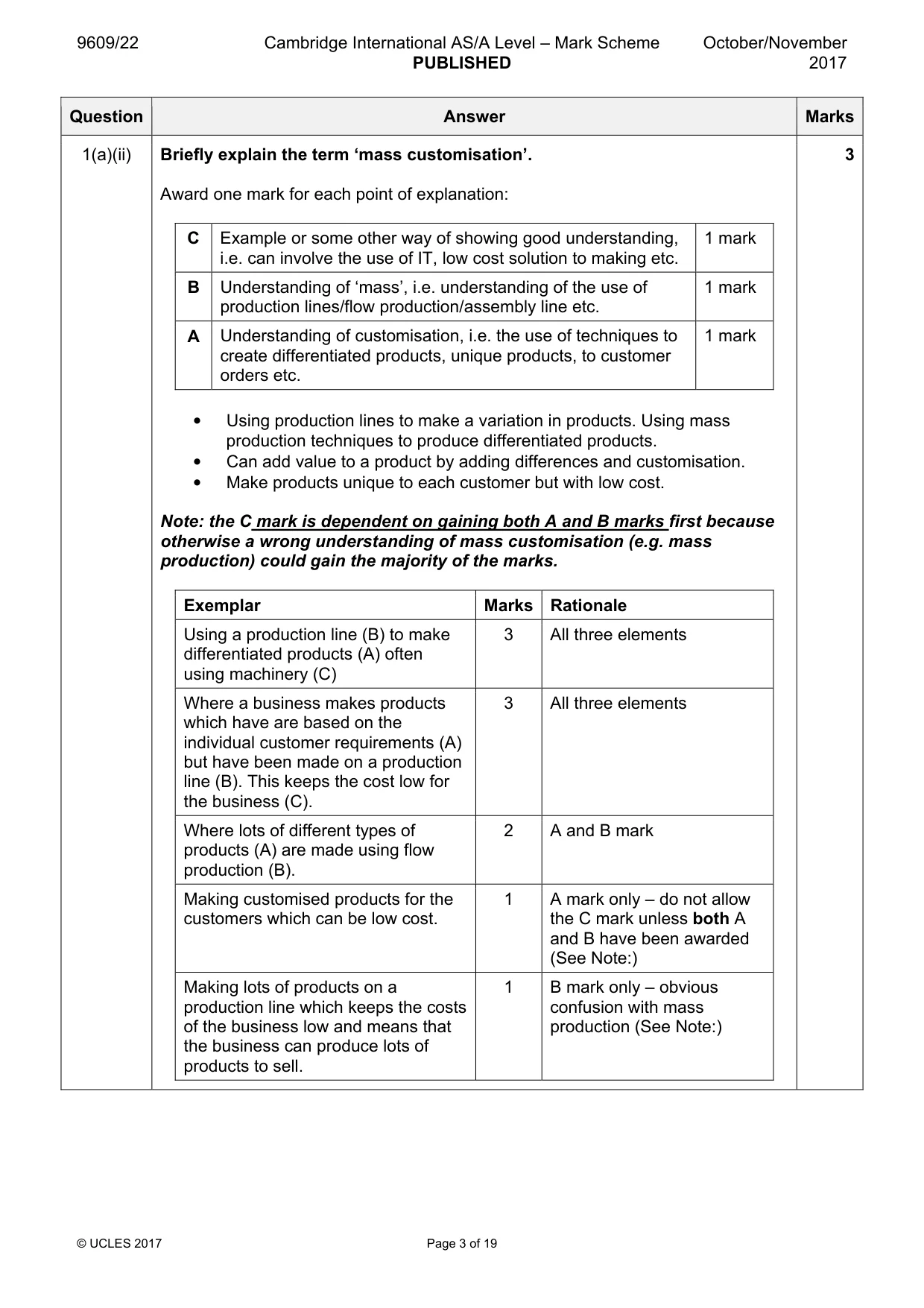
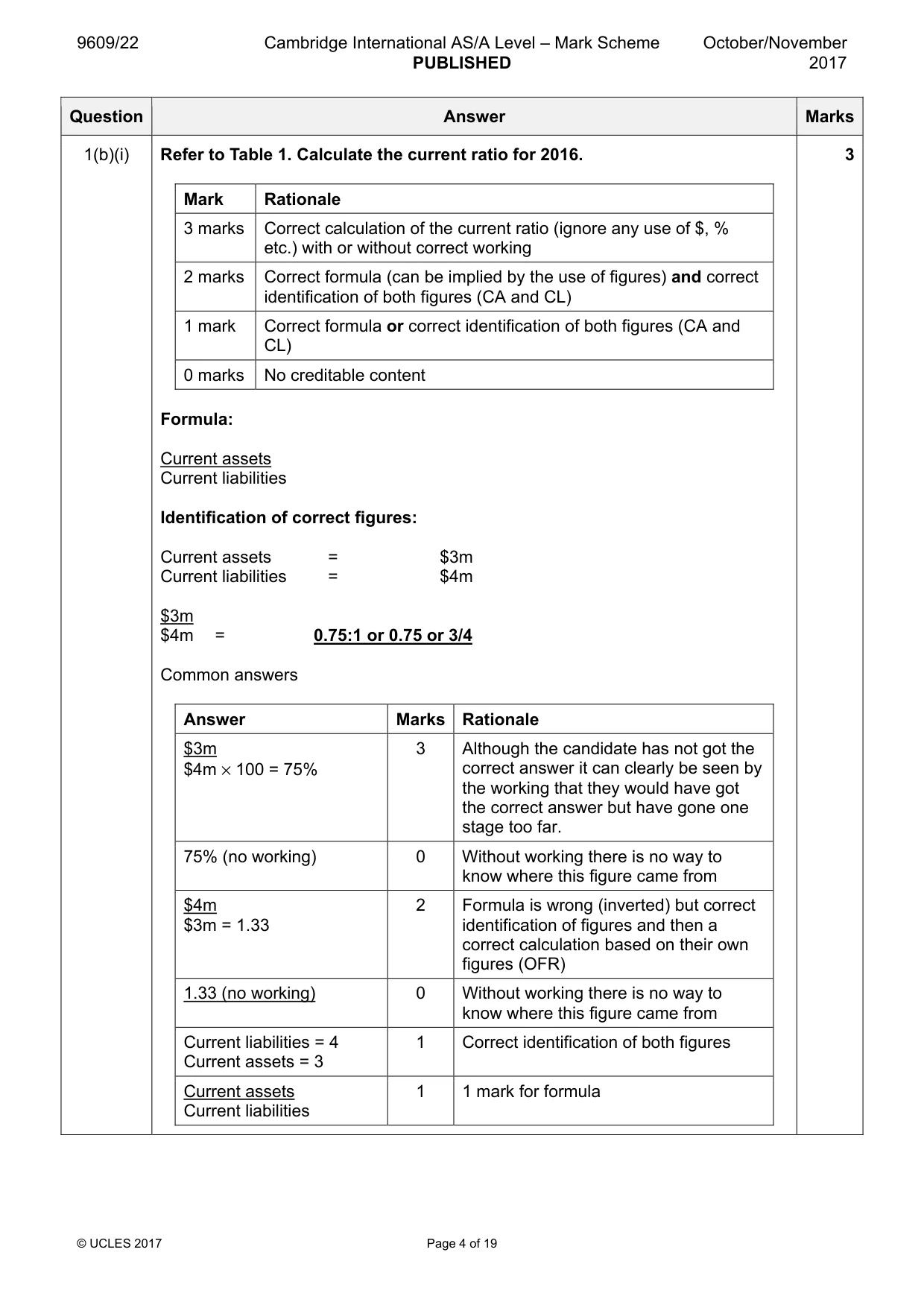
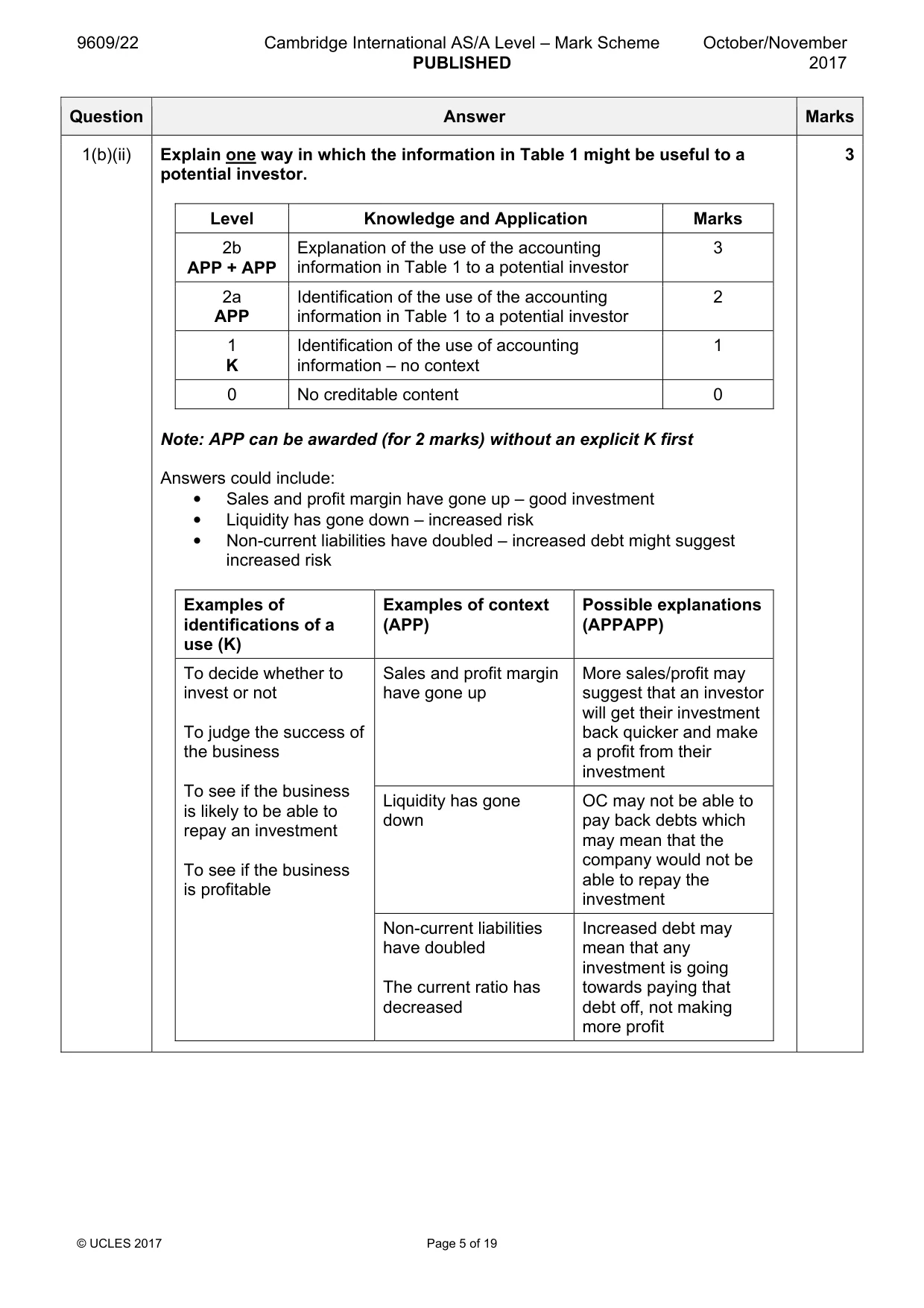
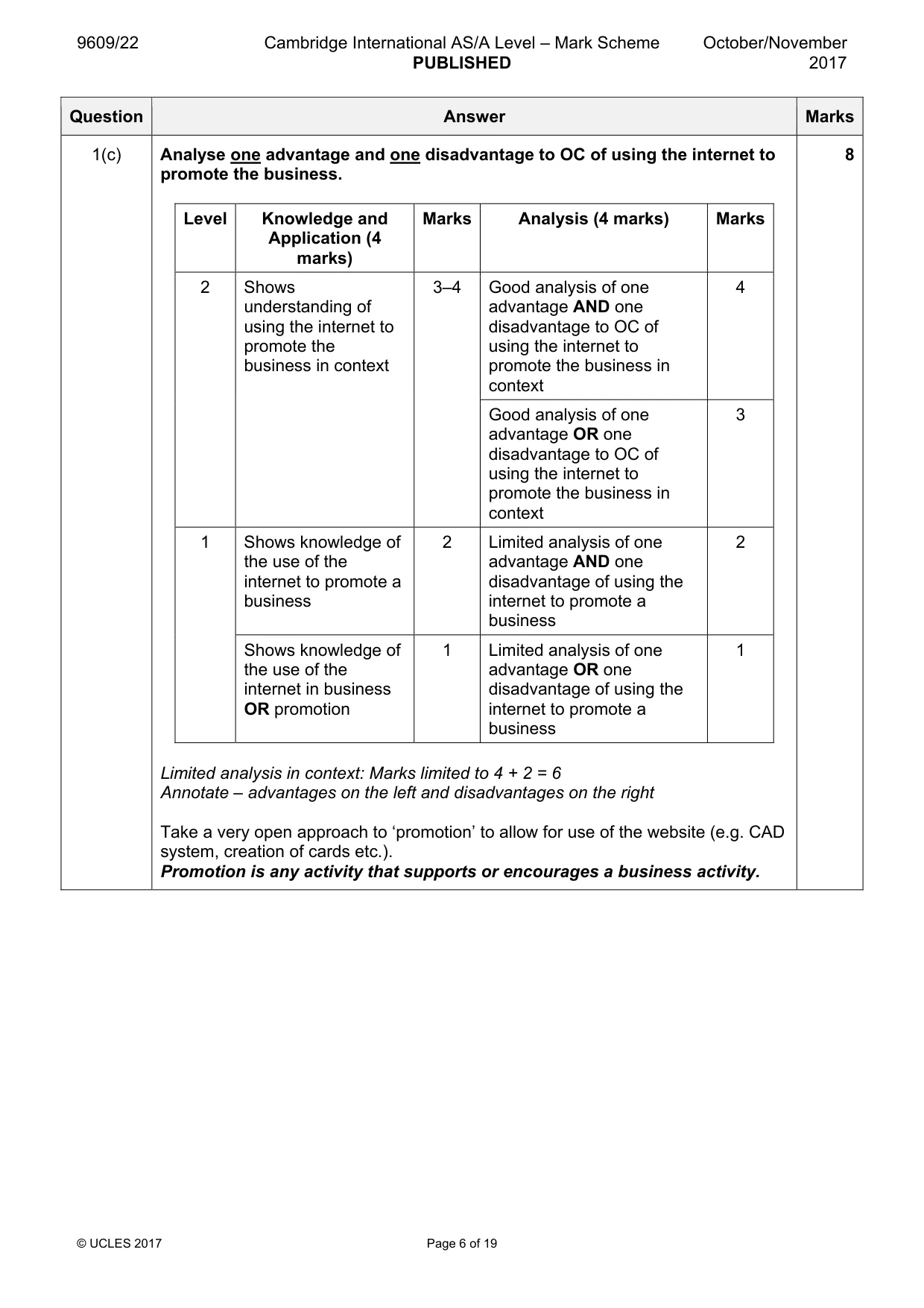
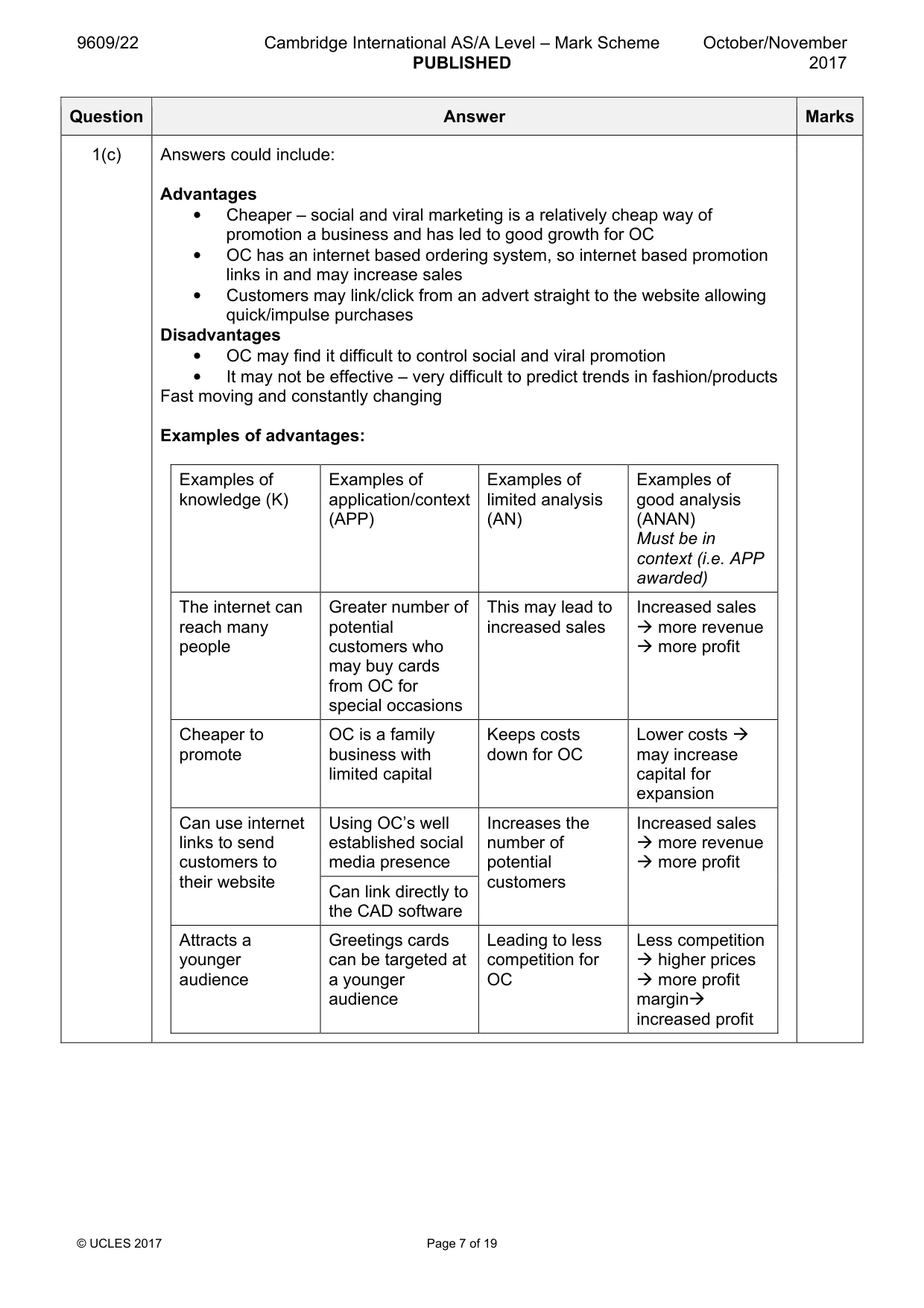
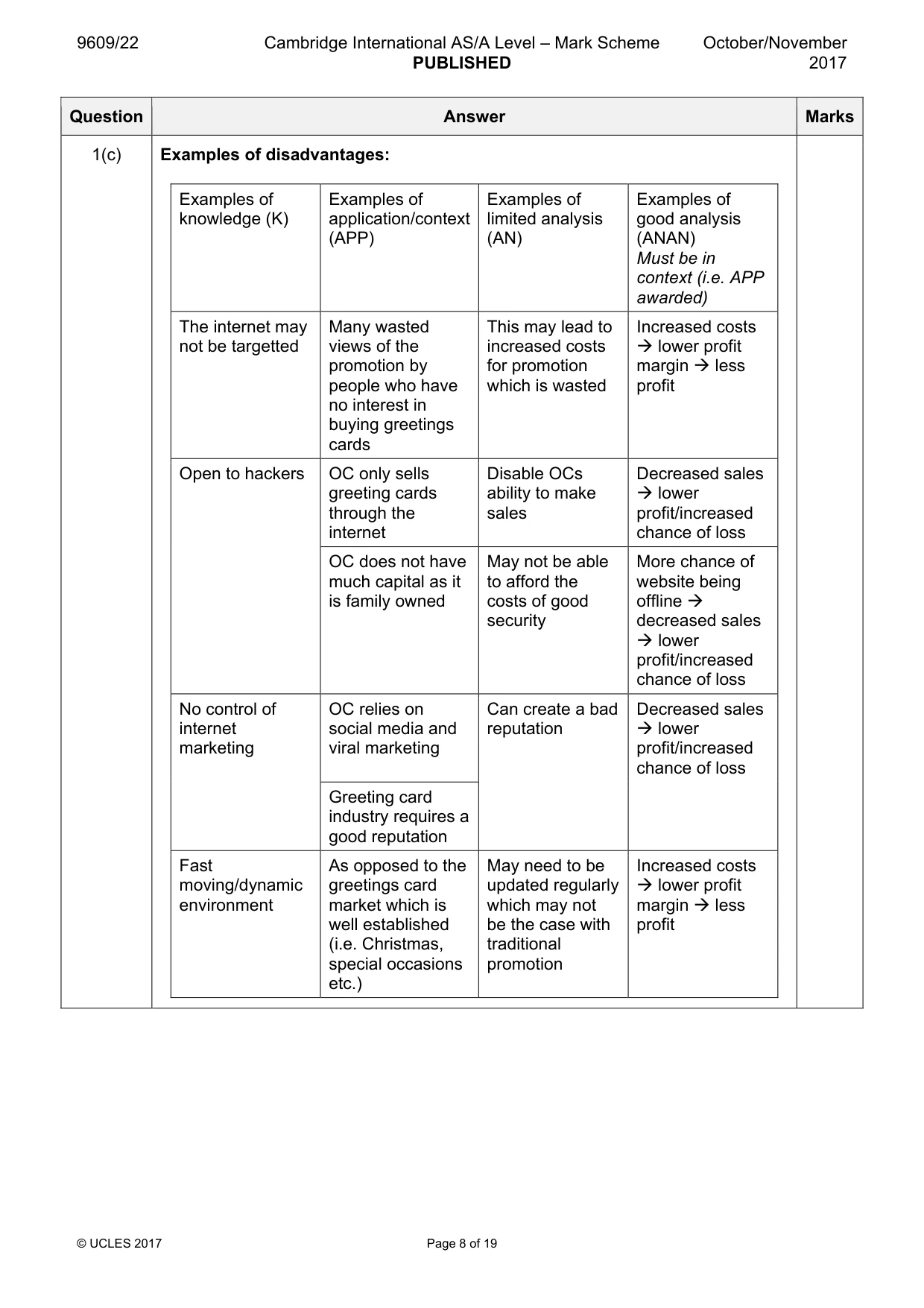
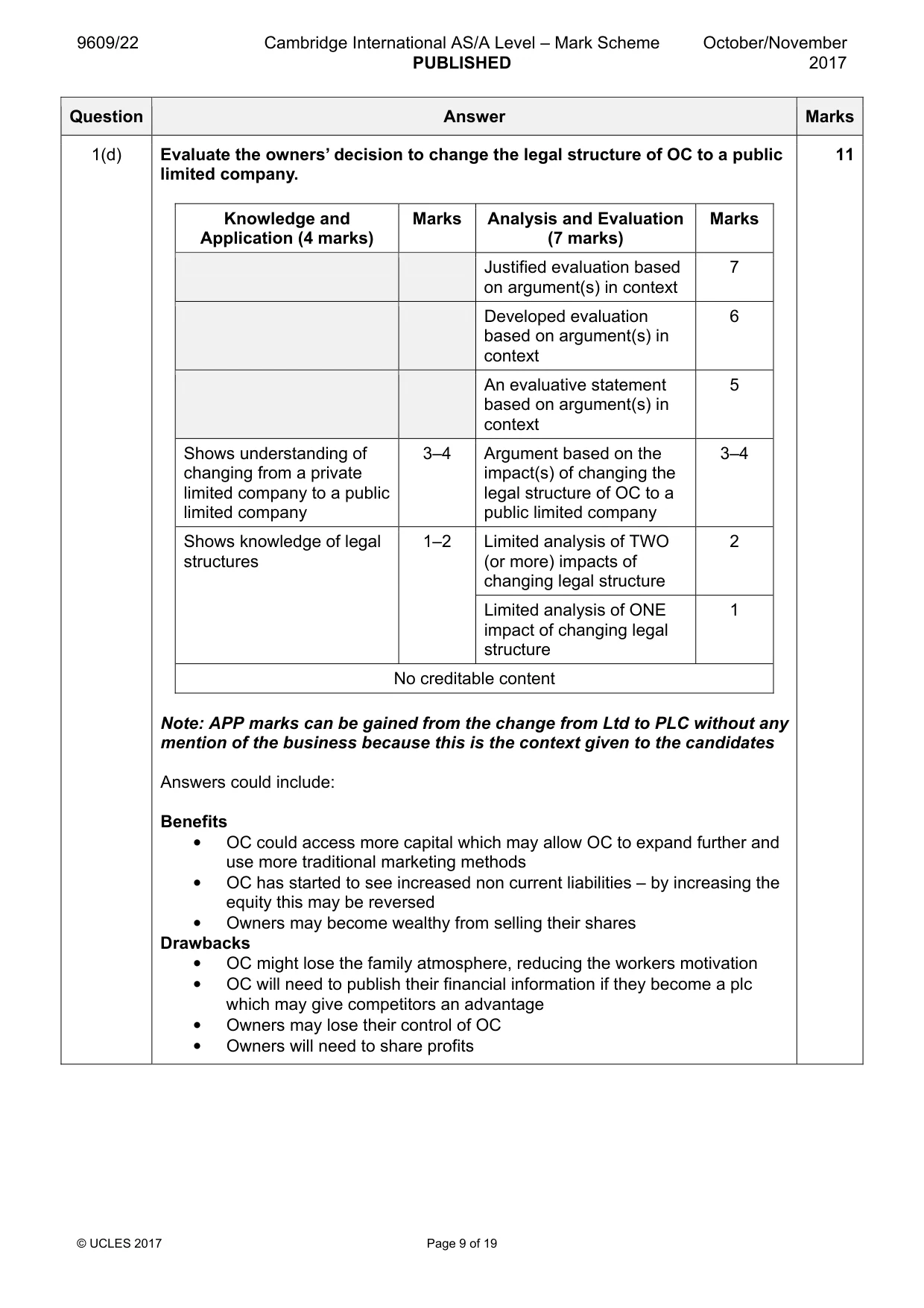
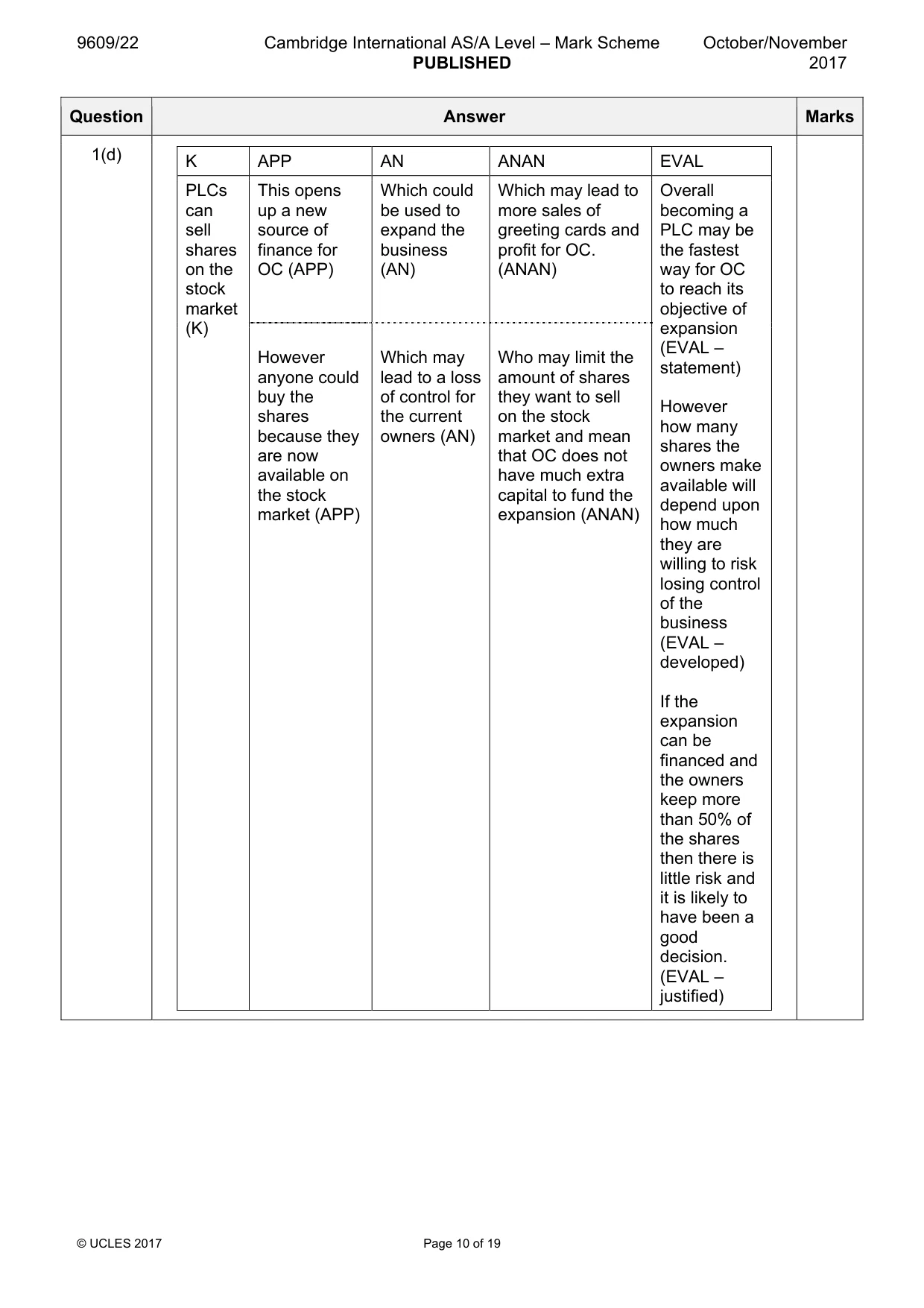
Mark scheme: Question Answer Marks 1 Occasion Cards (OC) 1(a)(i) Define the term ‘Computer Aided Design’. 2 Knowledge and Application Marks A correct definition 2 A partially correct definition 1 No creditable content 0 A correct definition should cover both of the following: • Some idea of ‘computer aided’, i.e. – A process done by IT/software/computer-programmes/electronically/virtually/technology (allow automated) – do not allow ‘computer’ on its own as this is a tautology • i.e. some idea of the ‘design’ element, i.e. – To create, analyse, draw, modify, optimise, 2D/3D models, customise, plan etc. – do not allow ‘design’ on its own as this is a tautology. Exemplar Marks Rationale To use IT to create models 2 Both elements simply defined Where software is used to create 2 Both elements and ‘create designs designs’ is good enough To design 2D drawings 1 2D gives an idea of ‘design’ even though the word design has also been used. Where computers are used to make 0 Neither elements defined designs for the business to use 1(a)(ii) Briefly explain the term ‘mass customisation’. 3 Award one mark for each point of explanation: C Example or some other way of showing good understanding, 1 mark i.e. can involve the use of IT, low cost solution to making etc. B Understanding of ‘mass’, i.e. understanding of the use of 1 mark production lines/flow production/assembly line etc. A Understanding of customisation, i.e. the use of techniques to 1 mark create differentiated products, unique products, to customer orders etc. • Using production lines to make a variation in products. Using mass production techniques to produce differentiated products. • Can add value to a product by adding differences and customisation. • Make products unique to each customer but with low cost. Note: the C mark is dependent on gaining both A and B marks first because otherwise a wrong understanding of mass customisation (e.g. mass production) could gain the majority of the marks. Exemplar Marks Rationale Using a production line (B) to make 3 All three elements differentiated products (A) often using machinery (C) Where a business makes products 3 All three elements which have are based on the individual customer requirements (A) but have been made on a production line (B). This keeps the cost low for the business (C). Where lots of different types of 2 A and B mark products (A) are made using flow production (B). Making customised products for the 1 A mark only – do not allow customers which can be low cost. the C mark unless both A and B have been awarded (See Note:) Making lots of products on a 1 B mark only – obvious production line which keeps the costs confusion with mass of the business low and means that production (See Note:) the business can produce lots of products to sell. 1(b)(i) Refer to Table 1. Calculate the current ratio for 2016. 3 Mark Rationale 3 marks Correct calculation of the current ratio (ignore any use of $, % etc.) with or without correct working 2 marks Correct formula (can be implied by the use of figures) and correct identification of both figures (CA and CL) 1 mark Correct formula or correct identification of both figures (CA and CL) 0 marks No creditable content Formula: Current assets Current liabilities Identification of correct figures: Current assets = $3m Current liabilities = $4m $3m $4m = 0.75:1 or 0.75 or 3/4 Common answers Answer Marks Rationale $3m 3 Although the candidate has not got the $4m × 100 = 75% correct answer it can clearly be seen by the working that they would have got the correct answer but have gone one stage too far. 75% (no working) 0 Without working there is no way to know where this figure came from $4m 2 Formula is wrong (inverted) but correct $3m = 1.33 identification of figures and then a correct calculation based on their own figures (OFR) 1.33 (no working) 0 Without working there is no way to know where this figure came from Current liabilities = 4 1 Correct identification of both figures Current assets = 3 Current assets 1 1 mark for formula Current liabilities 1(b)(ii) Explain one way in which the information in Table 1 might be useful to a 3 potential investor. Level Knowledge and Application Marks 2b Explanation of the use of the accounting 3 APP + APP information in Table 1 to a potential investor 2a Identification of the use of the accounting 2 APP information in Table 1 to a potential investor 1 Identification of the use of accounting 1 K information – no context 0 No creditable content 0 Note: APP can be awarded (for 2 marks) without an explicit K first Answers could include: • Sales and profit margin have gone up – good investment • Liquidity has gone down – increased risk • Non-current liabilities have doubled – increased debt might suggest increased risk Examples of Examples of context Possible explanations identifications of a (APP) (APPAPP) use (K) To decide whether to Sales and profit margin More sales/profit may invest or not have gone up suggest that an investor will get their investment To judge the success of back quicker and make the business a profit from their investment To see if the business Liquidity has gone OC may not be able to is likely to be able to down pay back debts which repay an investment may mean that the company would not be To see if the business able to repay the is profitable investment Non-current liabilities Increased debt may have doubled mean that any investment is going The current ratio has towards paying that decreased debt off, not making more profit 1(c) Analyse one advantage and one disadvantage to OC of using the internet to 8 promote the business. Level Knowledge and Marks Analysis (4 marks) Marks Application (4 marks) 2 Shows 3–4 Good analysis of one 4 understanding of advantage AND one using the internet to disadvantage to OC of promote the using the internet to business in context promote the business in context Good analysis of one 3 advantage OR one disadvantage to OC of using the internet to promote the business in context 1 Shows knowledge of 2 Limited analysis of one 2 the use of the advantage AND one internet to promote a disadvantage of using the business internet to promote a business Shows knowledge of 1 Limited analysis of one 1 the use of the advantage OR one internet in business disadvantage of using the OR promotion internet to promote a business Limited analysis in context: Marks limited to 4 + 2 = 6 Annotate – advantages on the left and disadvantages on the right Take a very open approach to ‘promotion’ to allow for use of the website (e.g. CAD system, creation of cards etc.). Promotion is any activity that supports or encourages a business activity. 1(c) Answers could include: Advantages • Cheaper – social and viral marketing is a relatively cheap way of promotion a business and has led to good growth for OC • OC has an internet based ordering system, so internet based promotion links in and may increase sales • Customers may link/click from an advert straight to the website allowing quick/impulse purchases Disadvantages • OC may find it difficult to control social and viral promotion • It may not be effective – very difficult to predict trends in fashion/products Fast moving and constantly changing Examples of advantages: Examples of Examples of Examples of Examples of knowledge (K) application/context limited analysis good analysis (APP) (AN) (ANAN) Must be in context (i.e. APP awarded) The internet can Greater number of This may lead to Increased sales reach many potential increased sales Æ more revenue people customers who Æ more profit may buy cards from OC for special occasions Cheaper to OC is a family Keeps costs Lower costs Æ promote business with down for OC may increase limited capital capital for expansion Can use internet Using OC’s well Increases the Increased sales links to send established social number of Æ more revenue customers to media presence potential Æ more profit their website customers Can link directly to the CAD software Attracts a Greetings cards Leading to less Less competition younger can be targeted at competition for Æ higher prices audience a younger OC Æ more profit audience marginÆ increased profit 1(c) Examples of disadvantages: Examples of Examples of Examples of Examples of knowledge (K) application/context limited analysis good analysis (APP) (AN) (ANAN) Must be in context (i.e. APP awarded) The internet may Many wasted This may lead to Increased costs not be targetted views of the increased costs Æ lower profit promotion by for promotion margin Æ less people who have which is wasted profit no interest in buying greetings cards Open to hackers OC only sells Disable OCs Decreased sales greeting cards ability to make Æ lower through the sales profit/increased internet chance of loss OC does not have May not be able More chance of much capital as it to afford the website being is family owned costs of good offline Æ security decreased sales Æ lower profit/increased chance of loss No control of OC relies on Can create a bad Decreased sales internet social media and reputation Æ lower marketing viral marketing profit/increased chance of loss Greeting card industry requires a good reputation Fast As opposed to the May need to be Increased costs moving/dynamic greetings card updated regularly Æ lower profit environment market which is which may not margin Æ less well established be the case with profit (i.e. Christmas, traditional special occasions promotion etc.) 1(d) Evaluate the owners’ decision to change the legal structure of OC to a public 11 limited company. Knowledge and Marks Analysis and Evaluation Marks Application (4 marks) (7 marks) Justified evaluation based 7 on argument(s) in context Developed evaluation 6 based on argument(s) in context An evaluative statement 5 based on argument(s) in context Shows understanding of 3–4 Argument based on the 3–4 changing from a private impact(s) of changing the limited company to a public legal structure of OC to a limited company public limited company Shows knowledge of legal 1–2 Limited analysis of TWO 2 structures (or more) impacts of changing legal structure Limited analysis of ONE 1 impact of changing legal structure No creditable content Note: APP marks can be gained from the change from Ltd to PLC without any mention of the business because this is the context given to the candidates Answers could include: Benefits • OC could access more capital which may allow OC to expand further and use more traditional marketing methods • OC has started to see increased non current liabilities – by increasing the equity this may be reversed • Owners may become wealthy from selling their shares Drawbacks • OC might lose the family atmosphere, reducing the workers motivation • OC will need to publish their financial information if they become a plc which may give competitors an advantage • Owners may lose their control of OC • Owners will need to share profits 1(d) K APP AN ANAN EVAL PLCs This opens Which could Which may lead to Overall can up a new be used to more sales of becoming a sell source of expand the greeting cards and PLC may be shares finance for business profit for OC. the fastest on the OC (APP) (AN) (ANAN) way for OC stock to reach its market objective of (K) expansion (EVAL – However Which may Who may limit the statement) anyone could lead to a loss amount of shares buy the of control for they want to sell However shares the current on the stock how many because they owners (AN) market and mean shares the are now that OC does not owners make available on have much extra available will the stock capital to fund the depend upon market (APP) expansion (ANAN) how much they are willing to risk losing control of the business (EVAL – developed) If the expansion can be financed and the owners keep more than 50% of the shares then there is little risk and it is likely to have been a good decision. (EVAL – justified)
Q2 · Nearly New (NN) NN sells second-hand computers
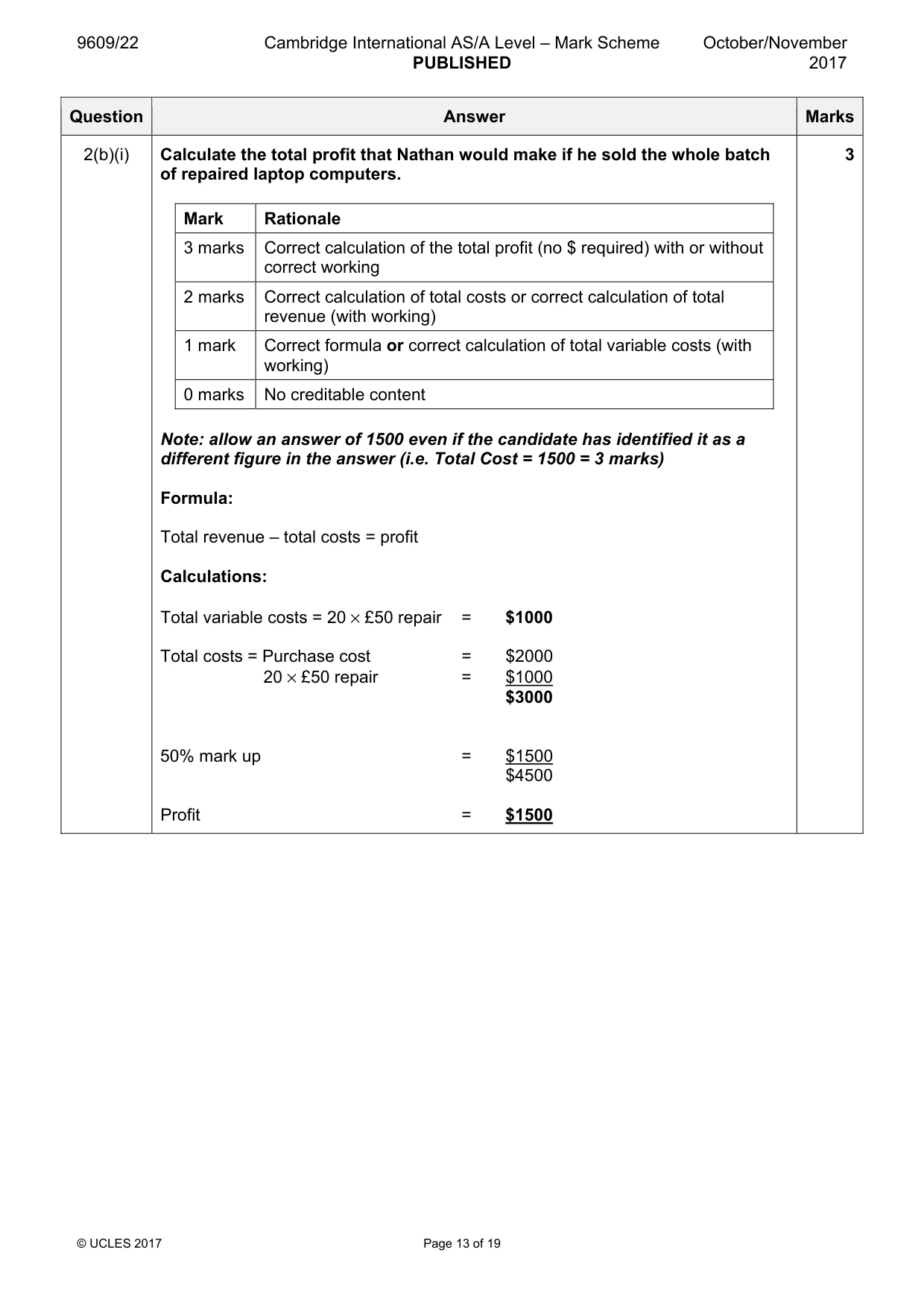
2 Nearly New (NN) NN sells second-hand computers. NN is owned by Nathan who is a sole trader. Nathan is a fully trained and qualified computer engineer. Nathan buys broken computers from large electrical retailers and repairs them. The repaired computers are then sold through NN’s website. Nathan uses a cost-based pricing strategy and adds 50% to the cost of the computer and the cost of repairs. Nathan currently works alone and has no employees. 5 Nathan has recently purchased, for $2000, a batch of 20 laptop computers all of which have broken screens. Nathan thinks that each will cost $50 to repair and he hopes to make a profit from selling them. One of Nathan’s biggest problems is cash flow. Nathan pays for all of his inventory in cash and he must spend time repairing the computers before he can sell them. 10 Customers expect a range of computers to choose from and expect next day delivery. This means that most of Nathan’s working capital is tied up in inventory. Sometimes Nathan is offered large batches of computers and he cannot buy them because he does not have the cash available. Nathan wants to recruit an employee to allow him to increase the production at NN. 15 He has interviewed two potential employees and he has made some notes about their suitability (see Table 2). Table 2: Nathan’s notes on the potential employees Name Katy Sahdat Current income per year $20 000 $25 000 20 Two years as a computer Ten years as a sole trader Industry experience repairer for a large electrical repairing computers retailer University degree in No formal qualifications Qualifications computer engineering 25 Age 23 55 Skills • Repairing computers • Repairing computers • Being organised • Managing employees • Communication with customers 30 (a) (i) Define the term ‘inventory’ (line 9). [2] (ii) Briefly explain the term ‘sole trader’ (line 1). [3] (b) (i) Calculate the total profit that Nathan would make if he sold the whole batch of repaired laptop computers (lines 4 to 8). [3] (ii) Explain one advantage to Nathan of using a cost-based pricing strategy. [3] (c) Analyse two methods Nathan could use to improve NN’s cash flow. [8] (d) Recommend which one of the two potential employees Nathan should select. Justify your recommendation. [11]
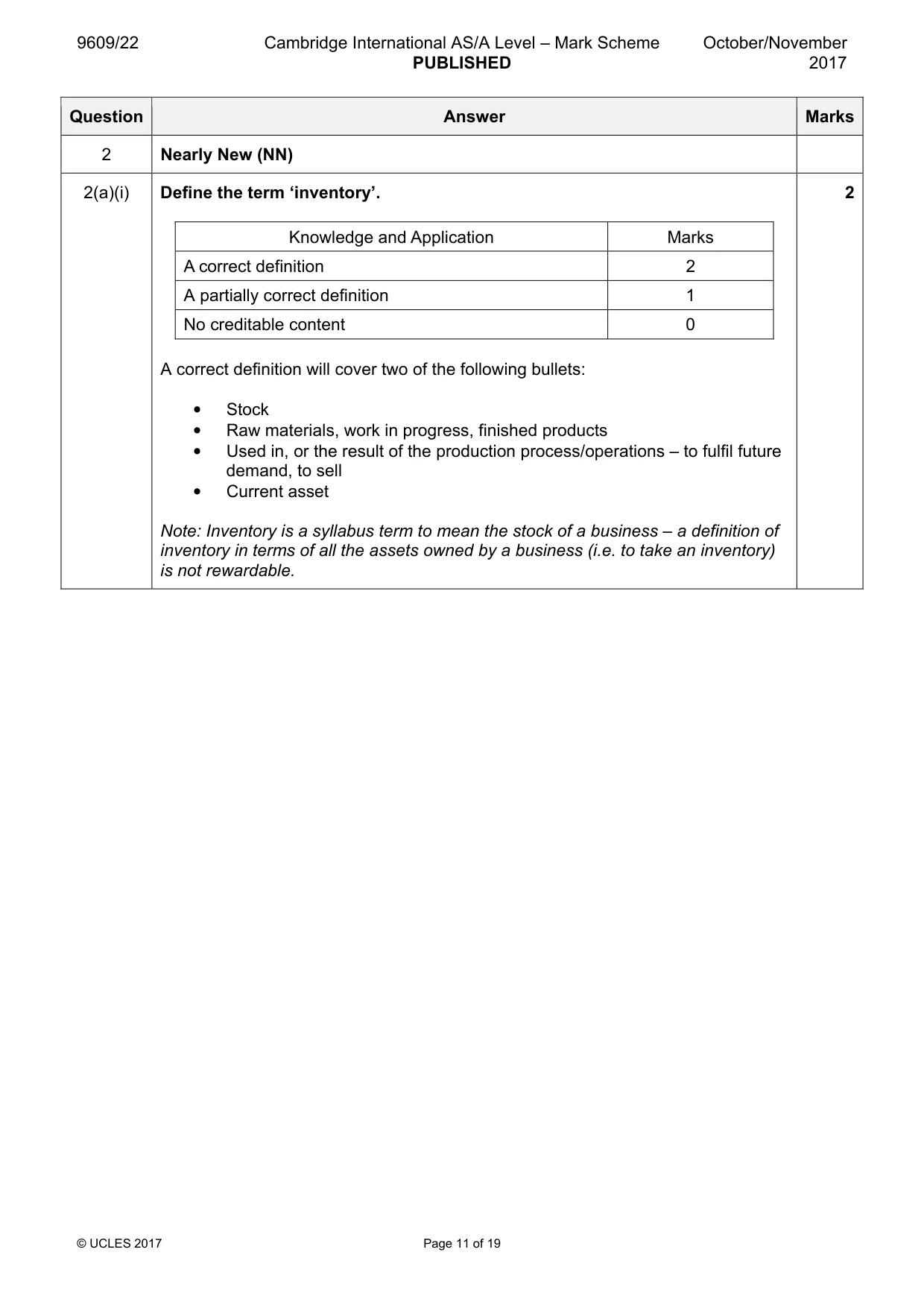
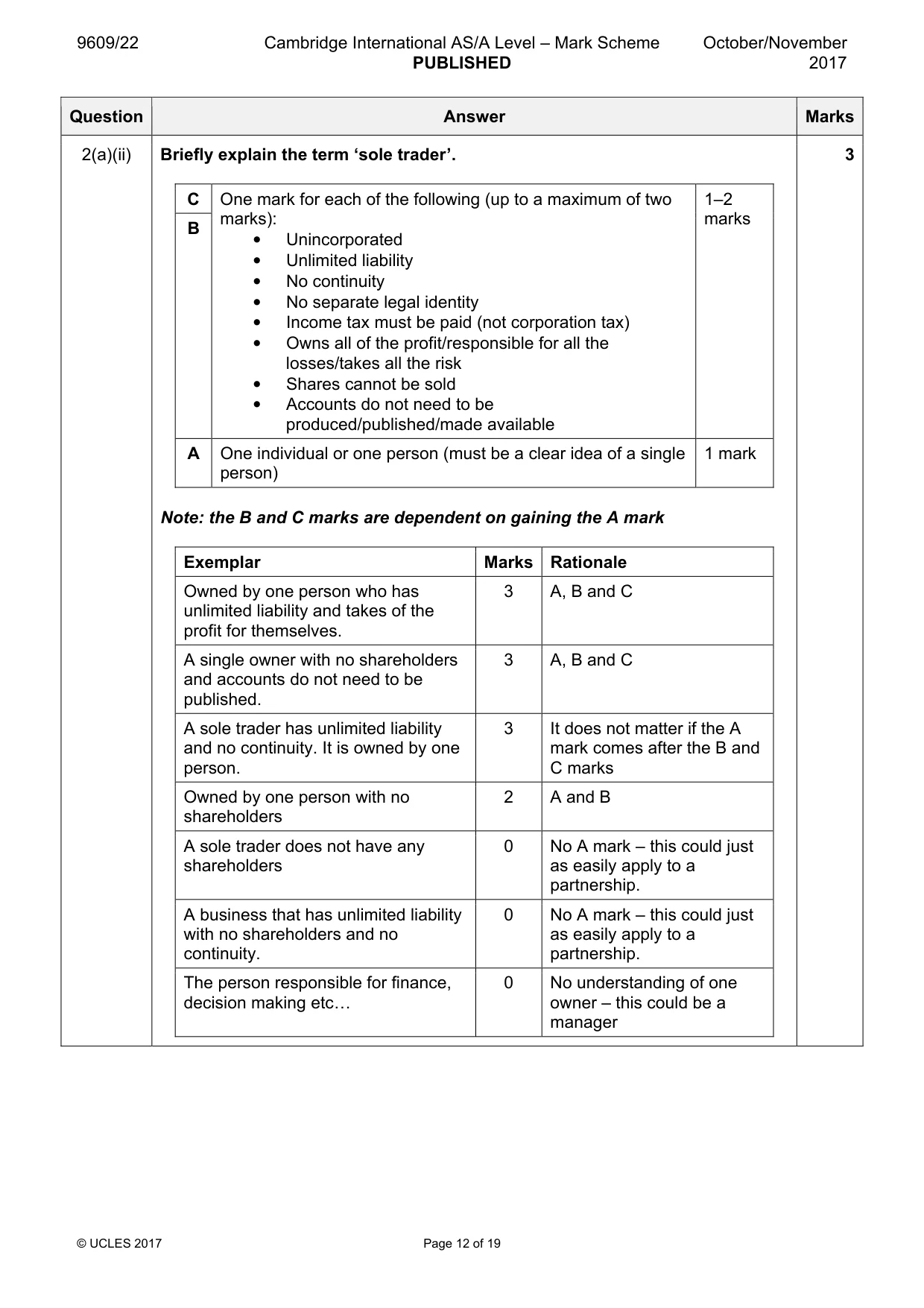
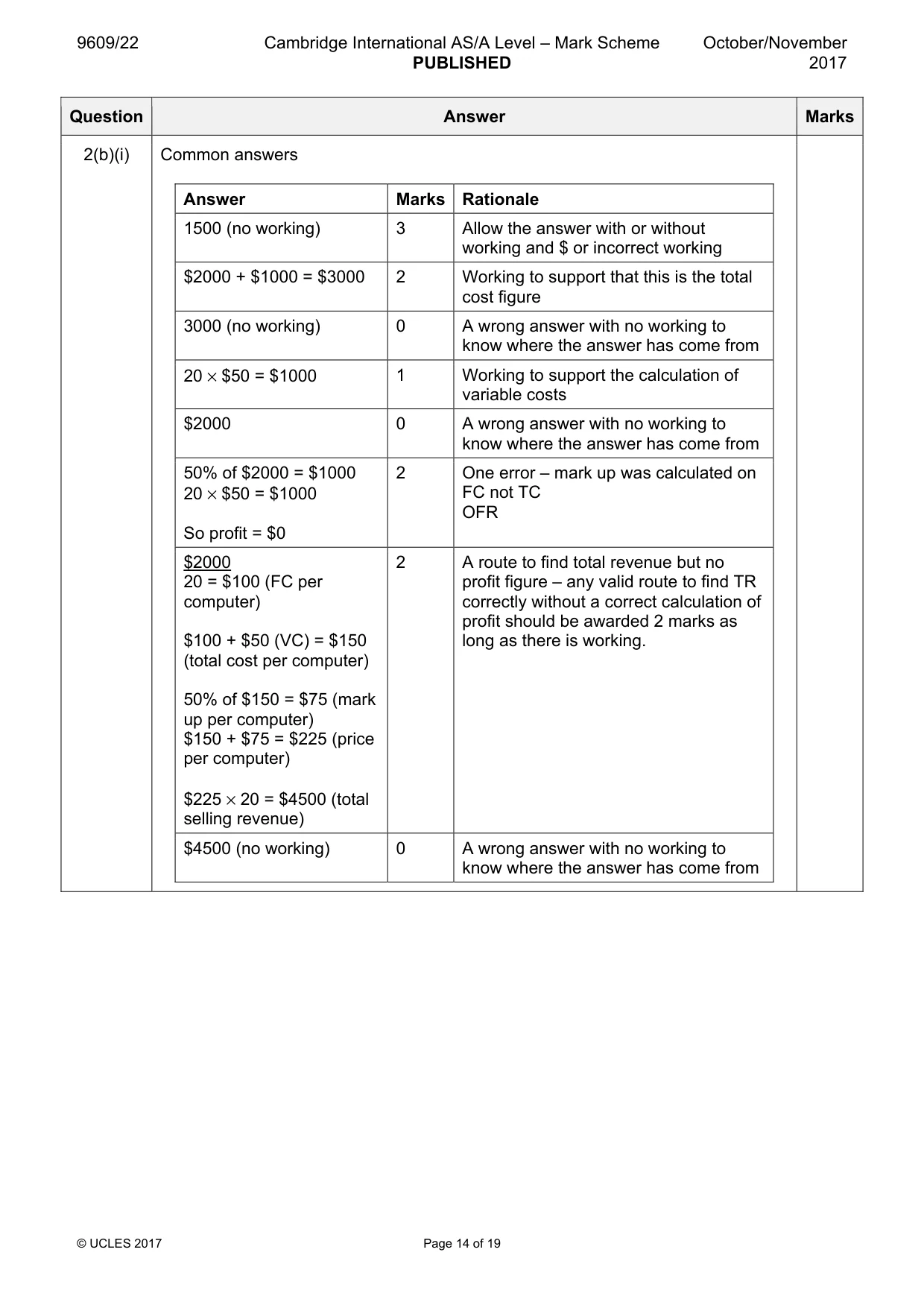
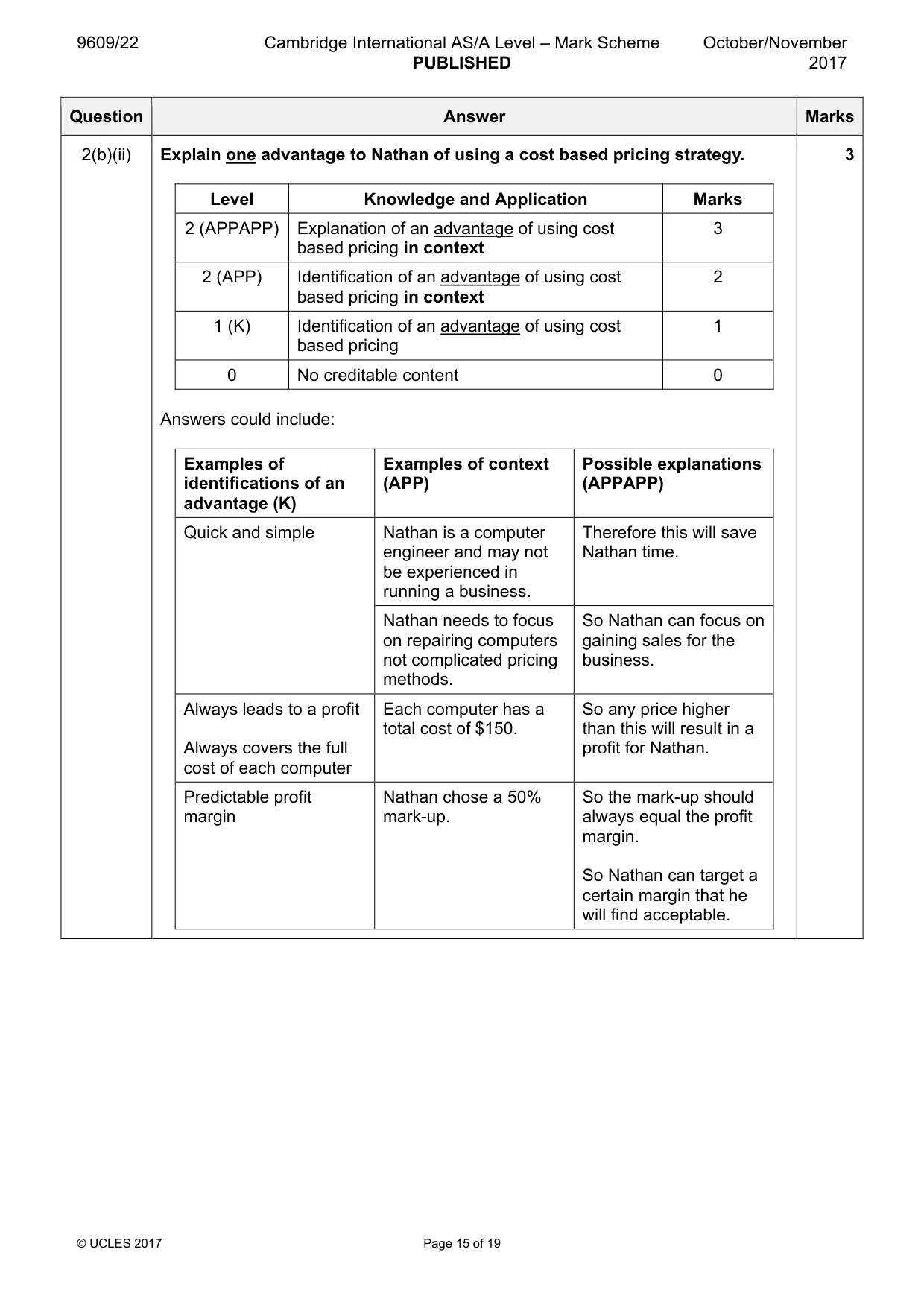
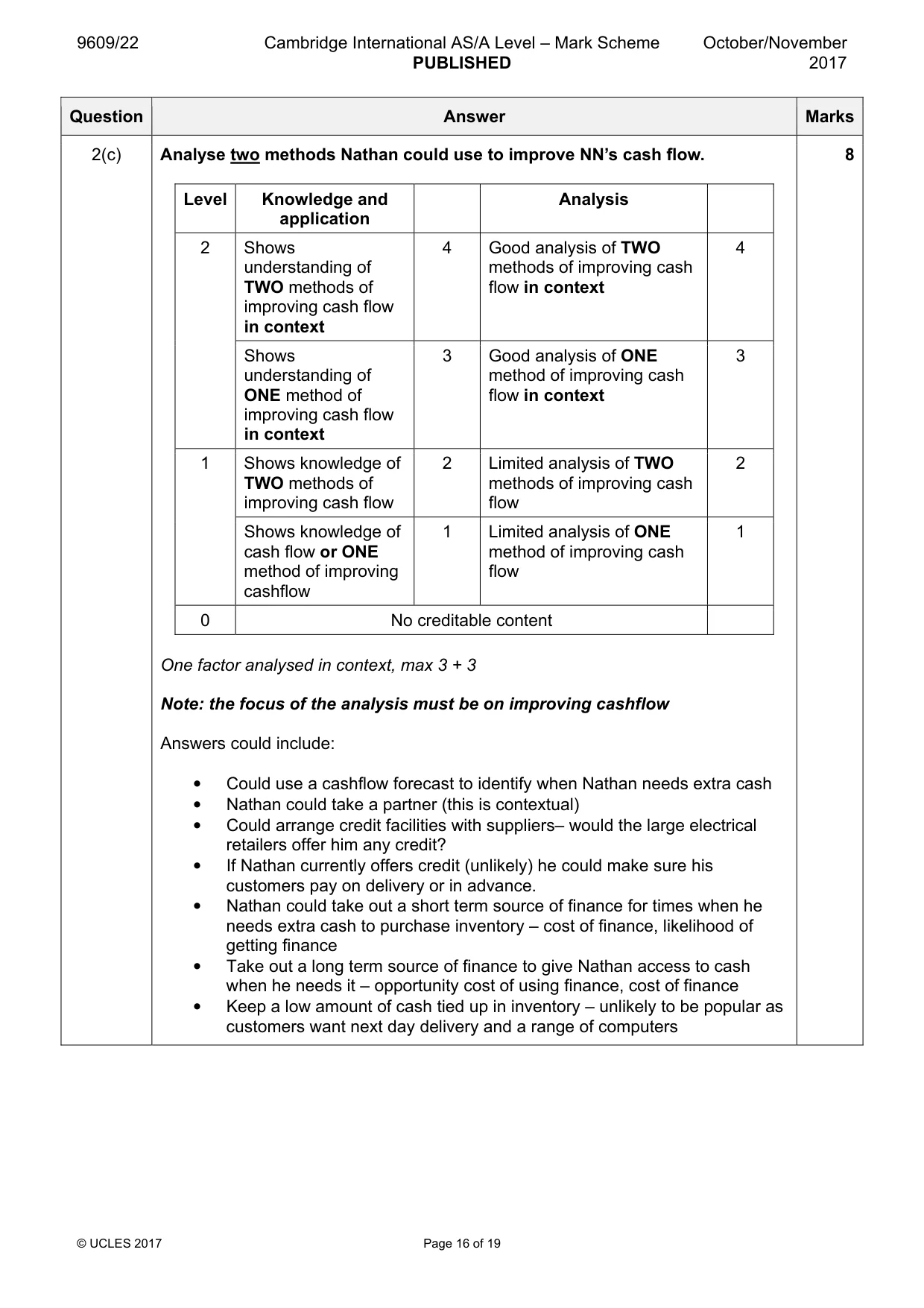
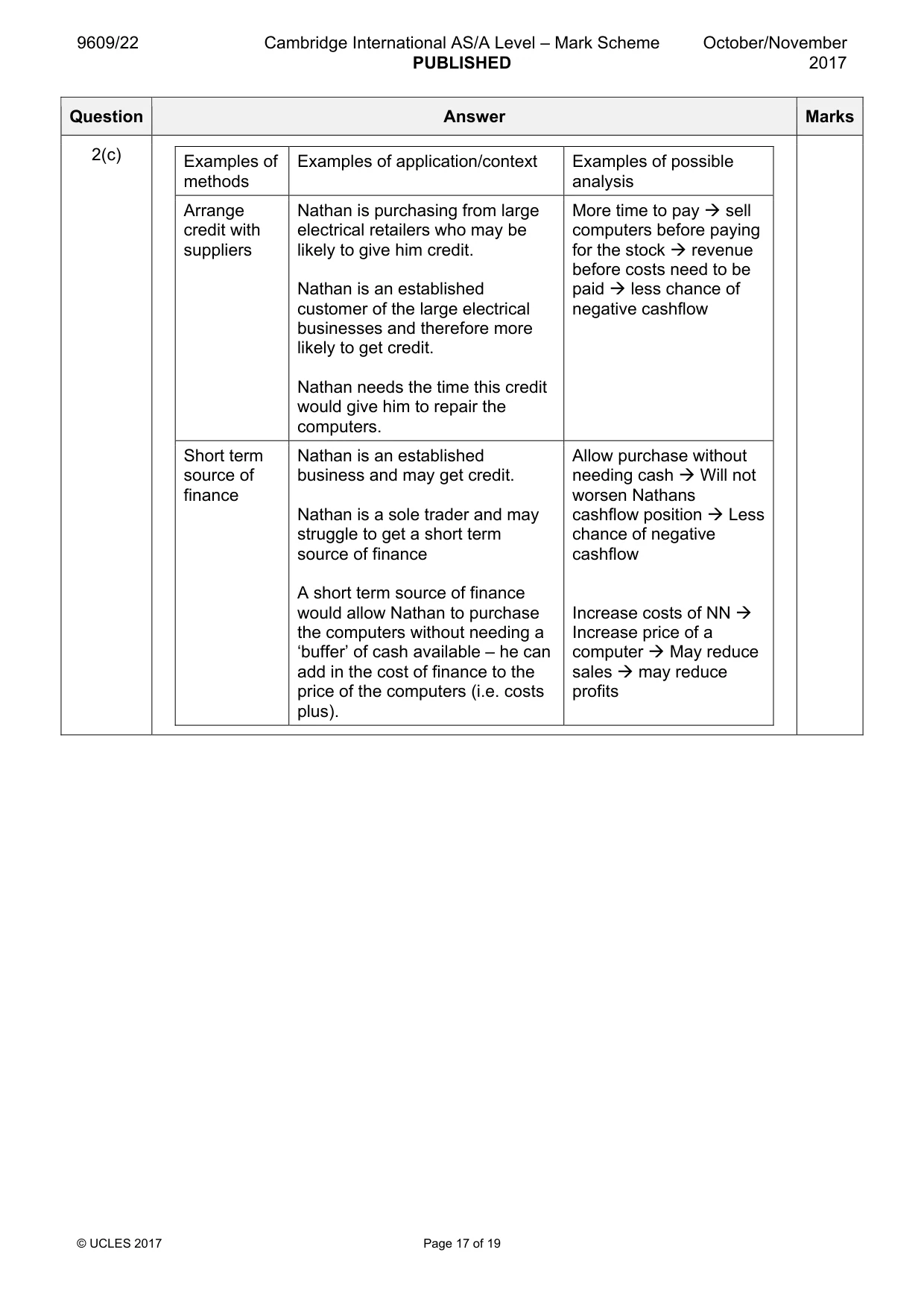
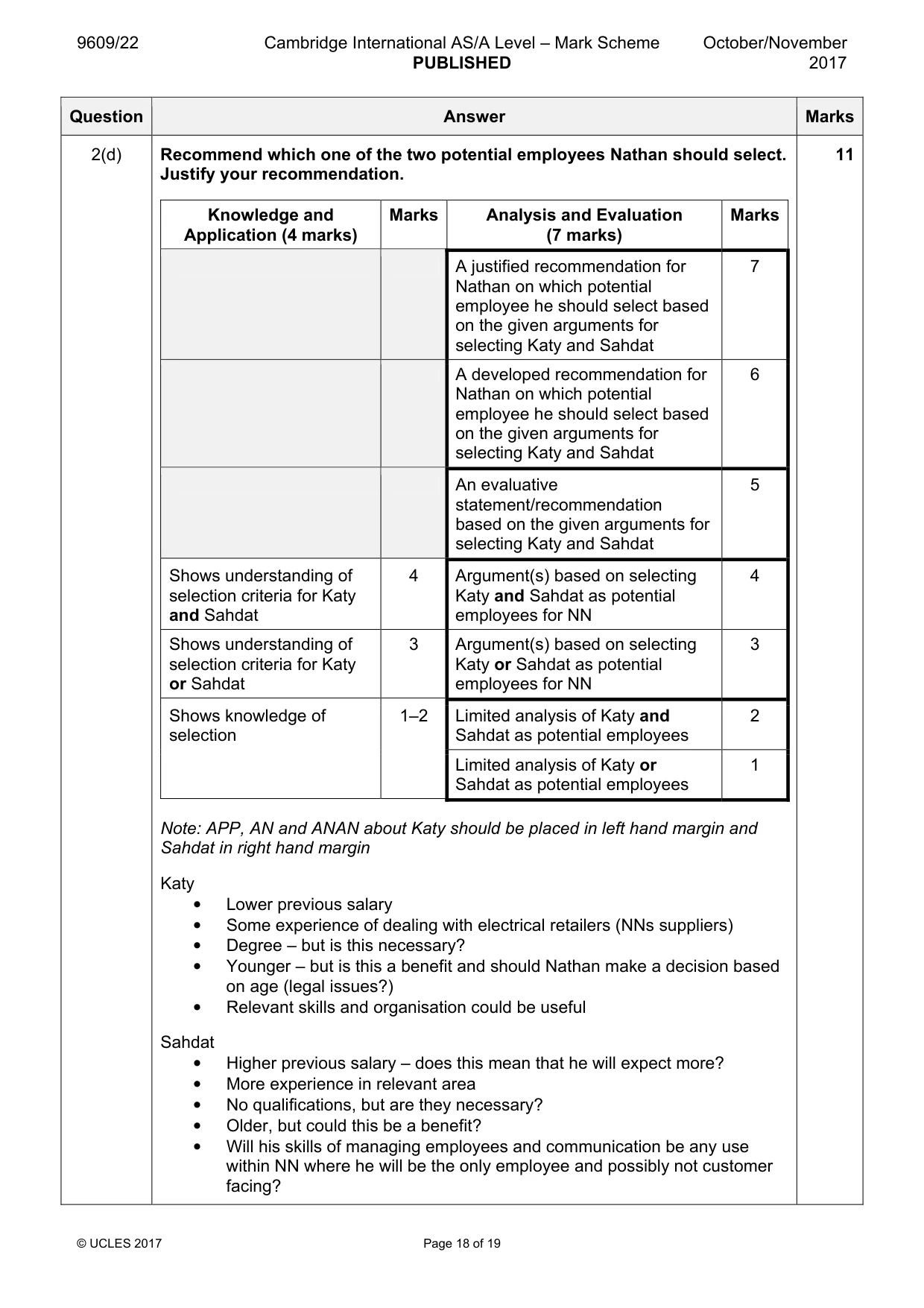
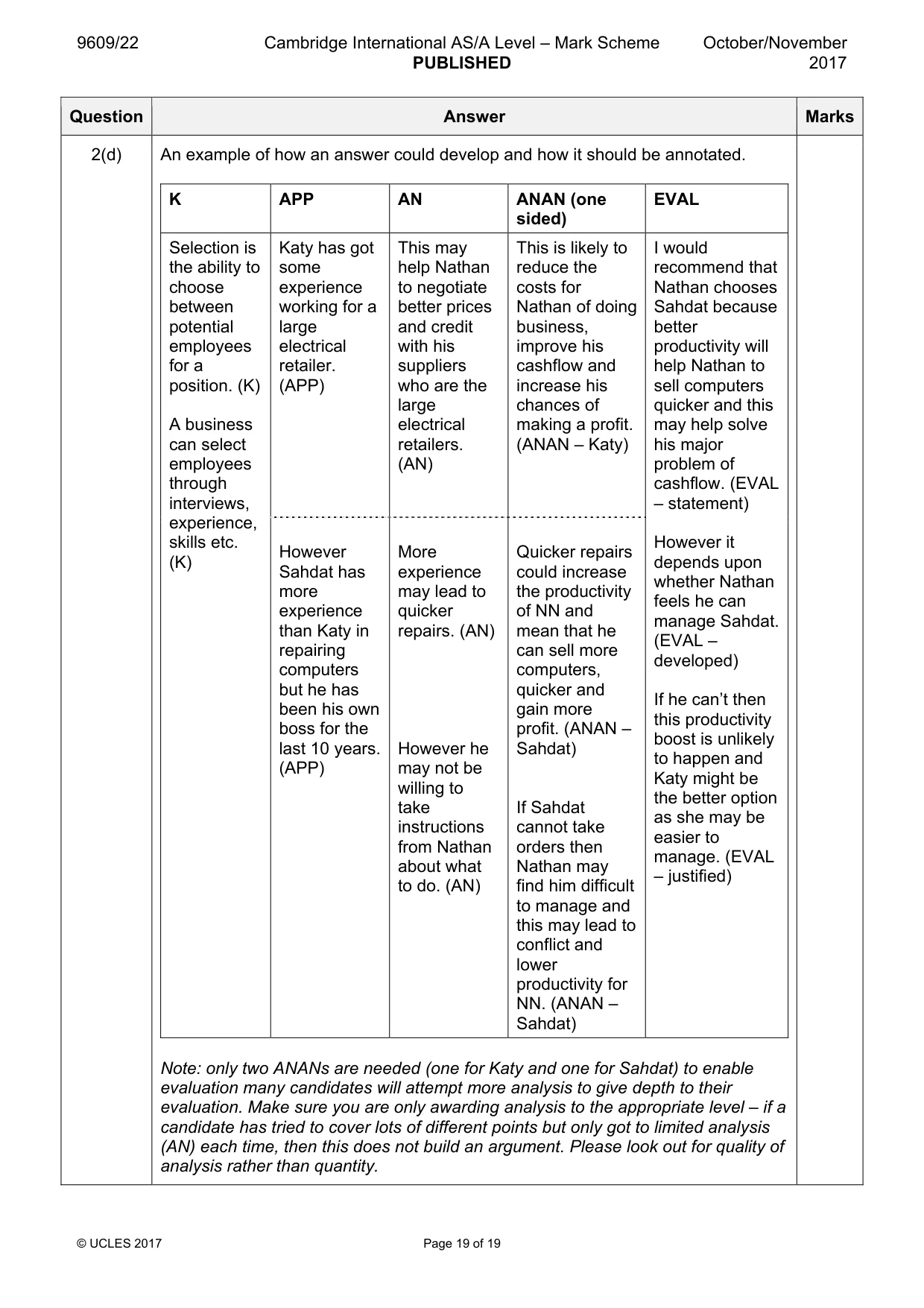
Mark scheme: 2 Nearly New (NN) 2(a)(i) Define the term ‘inventory’. 2 Knowledge and Application Marks A correct definition 2 A partially correct definition 1 No creditable content 0 A correct definition will cover two of the following bullets: • Stock • Raw materials, work in progress, finished products • Used in, or the result of the production process/operations – to fulfil future demand, to sell • Current asset Note: Inventory is a syllabus term to mean the stock of a business – a definition of inventory in terms of all the assets owned by a business (i.e. to take an inventory) is not rewardable. 2(a)(ii) Briefly explain the term ‘sole trader’. 3 C One mark for each of the following (up to a maximum of two 1–2 marks): marks B • Unincorporated • Unlimited liability • No continuity • No separate legal identity • Income tax must be paid (not corporation tax) • Owns all of the profit/responsible for all the losses/takes all the risk • Shares cannot be sold • Accounts do not need to be produced/published/made available A One individual or one person (must be a clear idea of a single 1 mark person) Note: the B and C marks are dependent on gaining the A mark Exemplar Marks Rationale Owned by one person who has 3 A, B and C unlimited liability and takes of the profit for themselves. A single owner with no shareholders 3 A, B and C and accounts do not need to be published. A sole trader has unlimited liability 3 It does not matter if the A and no continuity. It is owned by one mark comes after the B and person. C marks Owned by one person with no 2 A and B shareholders A sole trader does not have any 0 No A mark – this could just shareholders as easily apply to a partnership. A business that has unlimited liability 0 No A mark – this could just with no shareholders and no as easily apply to a continuity. partnership. The person responsible for finance, 0 No understanding of one decision making etc« owner – this could be a manager 2(b)(i) Calculate the total profit that Nathan would make if he sold the whole batch 3 of repaired laptop computers. Mark Rationale 3 marks Correct calculation of the total profit (no $ required) with or without correct working 2 marks Correct calculation of total costs or correct calculation of total revenue (with working) 1 mark Correct formula or correct calculation of total variable costs (with working) 0 marks No creditable content Note: allow an answer of 1500 even if the candidate has identified it as a different figure in the answer (i.e. Total Cost = 1500 = 3 marks) Formula: Total revenue – total costs = profit Calculations: Total variable costs = 20 × £50 repair = $1000 Total costs = Purchase cost = $2000 20 × £50 repair = $1000 $3000 50% mark up = $1500 $4500 Profit = $1500 2(b)(i) Common answers Answer Marks Rationale 1500 (no working) 3 Allow the answer with or without working and $ or incorrect working $2000 + $1000 = $3000 2 Working to support that this is the total cost figure 3000 (no working) 0 A wrong answer with no working to know where the answer has come from 20 × $50 = $1000 1 Working to support the calculation of variable costs $2000 0 A wrong answer with no working to know where the answer has come from 50% of $2000 = $1000 2 One error – mark up was calculated on 20 × $50 = $1000 FC not TC OFR So profit = $0 $2000 2 A route to find total revenue but no 20 = $100 (FC per profit figure – any valid route to find TR computer) correctly without a correct calculation of profit should be awarded 2 marks as $100 + $50 (VC) = $150 long as there is working. (total cost per computer) 50% of $150 = $75 (mark up per computer) $150 + $75 = $225 (price per computer) $225 × 20 = $4500 (total selling revenue) $4500 (no working) 0 A wrong answer with no working to know where the answer has come from 2(b)(ii) Explain one advantage to Nathan of using a cost based pricing strategy. 3 Level Knowledge and Application Marks 2 (APPAPP) Explanation of an advantage of using cost 3 based pricing in context 2 (APP) Identification of an advantage of using cost 2 based pricing in context 1 (K) Identification of an advantage of using cost 1 based pricing 0 No creditable content 0 Answers could include: Examples of Examples of context Possible explanations identifications of an (APP) (APPAPP) advantage (K) Quick and simple Nathan is a computer Therefore this will save engineer and may not Nathan time. be experienced in running a business. Nathan needs to focus So Nathan can focus on on repairing computers gaining sales for the not complicated pricing business. methods. Always leads to a profit Each computer has a So any price higher total cost of $150. than this will result in a Always covers the full profit for Nathan. cost of each computer Predictable profit Nathan chose a 50% So the mark-up should margin mark-up. always equal the profit margin. So Nathan can target a certain margin that he will find acceptable. 2(c) Analyse two methods Nathan could use to improve NN’s cash flow. 8 Level Knowledge and Analysis application 2 Shows 4 Good analysis of TWO 4 understanding of methods of improving cash TWO methods of flow in context improving cash flow in context Shows 3 Good analysis of ONE 3 understanding of method of improving cash ONE method of flow in context improving cash flow in context 1 Shows knowledge of 2 Limited analysis of TWO 2 TWO methods of methods of improving cash improving cash flow flow Shows knowledge of 1 Limited analysis of ONE 1 cash flow or ONE method of improving cash method of improving flow cashflow 0 No creditable content One factor analysed in context, max 3 + 3 Note: the focus of the analysis must be on improving cashflow Answers could include: • Could use a cashflow forecast to identify when Nathan needs extra cash • Nathan could take a partner (this is contextual) • Could arrange credit facilities with suppliers– would the large electrical retailers offer him any credit? • If Nathan currently offers credit (unlikely) he could make sure his customers pay on delivery or in advance. • Nathan could take out a short term source of finance for times when he needs extra cash to purchase inventory – cost of finance, likelihood of getting finance • Take out a long term source of finance to give Nathan access to cash when he needs it – opportunity cost of using finance, cost of finance • Keep a low amount of cash tied up in inventory – unlikely to be popular as customers want next day delivery and a range of computers 2(c) Examples of Examples of application/context Examples of possible methods analysis Arrange Nathan is purchasing from large More time to pay Æ sell credit with electrical retailers who may be computers before paying suppliers likely to give him credit. for the stock Æ revenue before costs need to be Nathan is an established paid Æ less chance of customer of the large electrical negative cashflow businesses and therefore more likely to get credit. Nathan needs the time this credit would give him to repair the computers. Short term Nathan is an established Allow purchase without source of business and may get credit. needing cash Æ Will not finance worsen Nathans Nathan is a sole trader and may cashflow position Æ Less struggle to get a short term chance of negative source of finance cashflow A short term source of finance would allow Nathan to purchase Increase costs of NN Æ the computers without needing a Increase price of a ‘buffer’ of cash available – he can computer Æ May reduce add in the cost of finance to the sales Æ may reduce price of the computers (i.e. costs profits plus). 2(d) Recommend which one of the two potential employees Nathan should select. 11 Justify your recommendation. Knowledge and Marks Analysis and Evaluation Marks Application (4 marks) (7 marks) A justified recommendation for 7 Nathan on which potential employee he should select based on the given arguments for selecting Katy and Sahdat A developed recommendation for 6 Nathan on which potential employee he should select based on the given arguments for selecting Katy and Sahdat An evaluative 5 statement/recommendation based on the given arguments for selecting Katy and Sahdat Shows understanding of 4 Argument(s) based on selecting 4 selection criteria for Katy Katy and Sahdat as potential and Sahdat employees for NN Shows understanding of 3 Argument(s) based on selecting 3 selection criteria for Katy Katy or Sahdat as potential or Sahdat employees for NN Shows knowledge of 1–2 Limited analysis of Katy and 2 selection Sahdat as potential employees Limited analysis of Katy or 1 Sahdat as potential employees Note: APP, AN and ANAN about Katy should be placed in left hand margin and Sahdat in right hand margin Katy • Lower previous salary • Some experience of dealing with electrical retailers (NNs suppliers) • Degree – but is this necessary? • Younger – but is this a benefit and should Nathan make a decision based on age (legal issues?) • Relevant skills and organisation could be useful Sahdat • Higher previous salary – does this mean that he will expect more? • More experience in relevant area • No qualifications, but are they necessary? • Older, but could this be a benefit? • Will his skills of managing employees and communication be any use within NN where he will be the only employee and possibly not customer facing? 2(d) An example of how an answer could develop and how it should be annotated. K APP AN ANAN (one EVAL sided) Selection is Katy has got This may This is likely to I would the ability to some help Nathan reduce the recommend that choose experience to negotiate costs for Nathan chooses between working for a better prices Nathan of doing Sahdat because potential large and credit business, better employees electrical with his improve his productivity will for a retailer. suppliers cashflow and help Nathan to position. (K) (APP) who are the increase his sell computers large chances of quicker and this A business electrical making a profit. may help solve can select retailers. (ANAN – Katy) his major employees (AN) problem of through cashflow. (EVAL interviews, – statement) experience, skills etc. However it However More Quicker repairs (K) depends upon Sahdat has experience could increase whether Nathan more may lead to the productivity feels he can experience quicker of NN and manage Sahdat. than Katy in repairs. (AN) mean that he (EVAL – repairing can sell more developed) computers computers, but he has quicker and If he can’t then been his own gain more this productivity boss for the profit. (ANAN – boost is unlikely last 10 years. However he Sahdat) to happen and (APP) may not be Katy might be willing to the better option take If Sahdat as she may be instructions cannot take easier to from Nathan orders then manage. (EVAL about what Nathan may – justified) to do. (AN) find him difficult to manage and this may lead to conflict and lower productivity for NN. (ANAN – Sahdat) Note: only two ANANs are needed (one for Katy and one for Sahdat) to enable evaluation many candidates will attempt more analysis to give depth to their evaluation. Make sure you are only awarding analysis to the appropriate level – if a candidate has tried to cover lots of different points but only got to limited analysis (AN) each time, then this does not build an argument. Please look out for quality of analysis rather than quantity.
What was in this paper
The subtopics covered by these 2 questions, and how many questions each got. Open one in a new tab to see every Cambridge question on it.
What you needed in this session
Cambridge’s own grade thresholds for 2017 Oct/Nov, Paper 2 · Variant 2. A higher threshold means an easier paper — the bar moves with how the cohort did.