Cambridge A Level Business (for first examination in 2016) 9609 — 2024 Feb/March Paper 2 · Variant 2
9609/22/F/M/24 · 2 questions · 60 marks · ≈68 min
The question paper and its mark scheme, free to read here and free to download. This is Cambridge’s own paper, exactly as it was sat.
Question paper4 pages

Mark scheme30 pages
Answers below. Sit the paper first if you are practising.


Questions as text
Q1 · Zoe’s Bags (ZB) Zoe’s Bags (ZB) is an online retailer that makes and sells a range of…
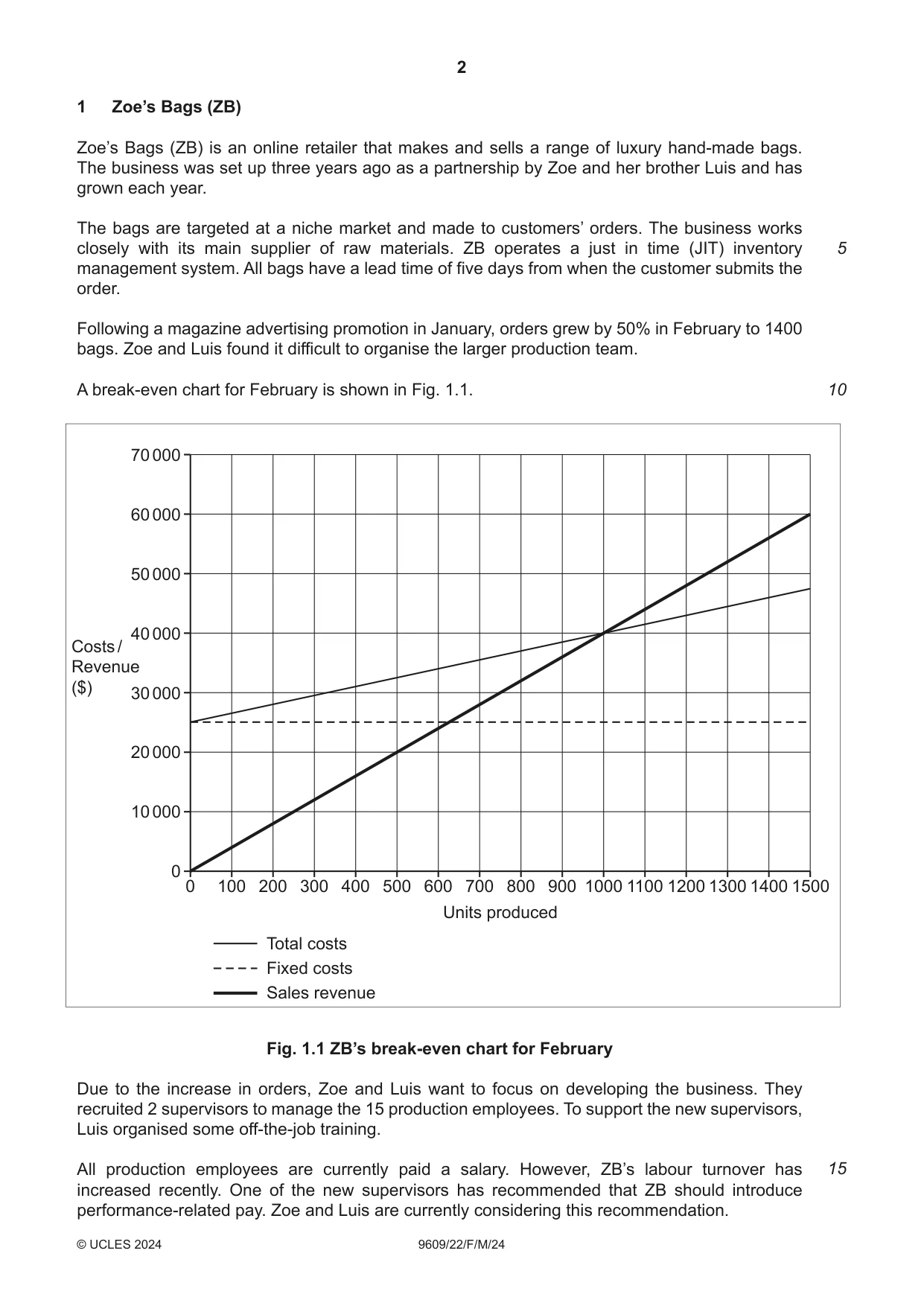
1 Zoe’s Bags (ZB) Zoe’s Bags (ZB) is an online retailer that makes and sells a range of luxury hand-made bags. The business was set up three years ago as a partnership by Zoe and her brother Luis and has grown each year. The bags are targeted at a niche market and made to customers’ orders. The business works closely with its main supplier of raw materials. ZB operates a just in time (JIT) inventory 5 management system. All bags have a lead time of five days from when the customer submits the order. Following a magazine advertising promotion in January, orders grew by 50% in February to 1400 bags. Zoe and Luis found it difficult to organise the larger production team. A break-even chart for February is shown in Fig. 1.1. 10 70 000 60 000 50 000 40 000 Costs / Revenue ($) 30 000 20 000 10 000 0 0 100 200 300 400 500 600 700 800 900 1000 1100 1200 1300 1400 1500 Units produced Total costs Fixed costs Sales revenue Fig. 1.1 ZB’s break-even chart for February Due to the increase in orders, Zoe and Luis want to focus on developing the business. They recruited 2 supervisors to manage the 15 production employees. To support the new supervisors, Luis organised some off-the-job training. All production employees are currently paid a salary. However, ZB’s labour turnover has 15 increased recently. One of the new supervisors has recommended that ZB should introduce performance-related pay. Zoe and Luis are currently considering this recommendation. (a) (i) Identify one feature of JIT inventory management. [1] (ii) Explain the term niche market. [3] (b) (i) Refer to Fig. 1.1 and other information. Calculate the margin of safety in February. [3] (ii) Explain one way that Zoe and Luis can use break-even analysis. [3] (c) Analyse two benefits to ZB of providing off-the-job training to the new supervisors. [8] (d) Evaluate whether ZB should introduce performance-related pay. [12]
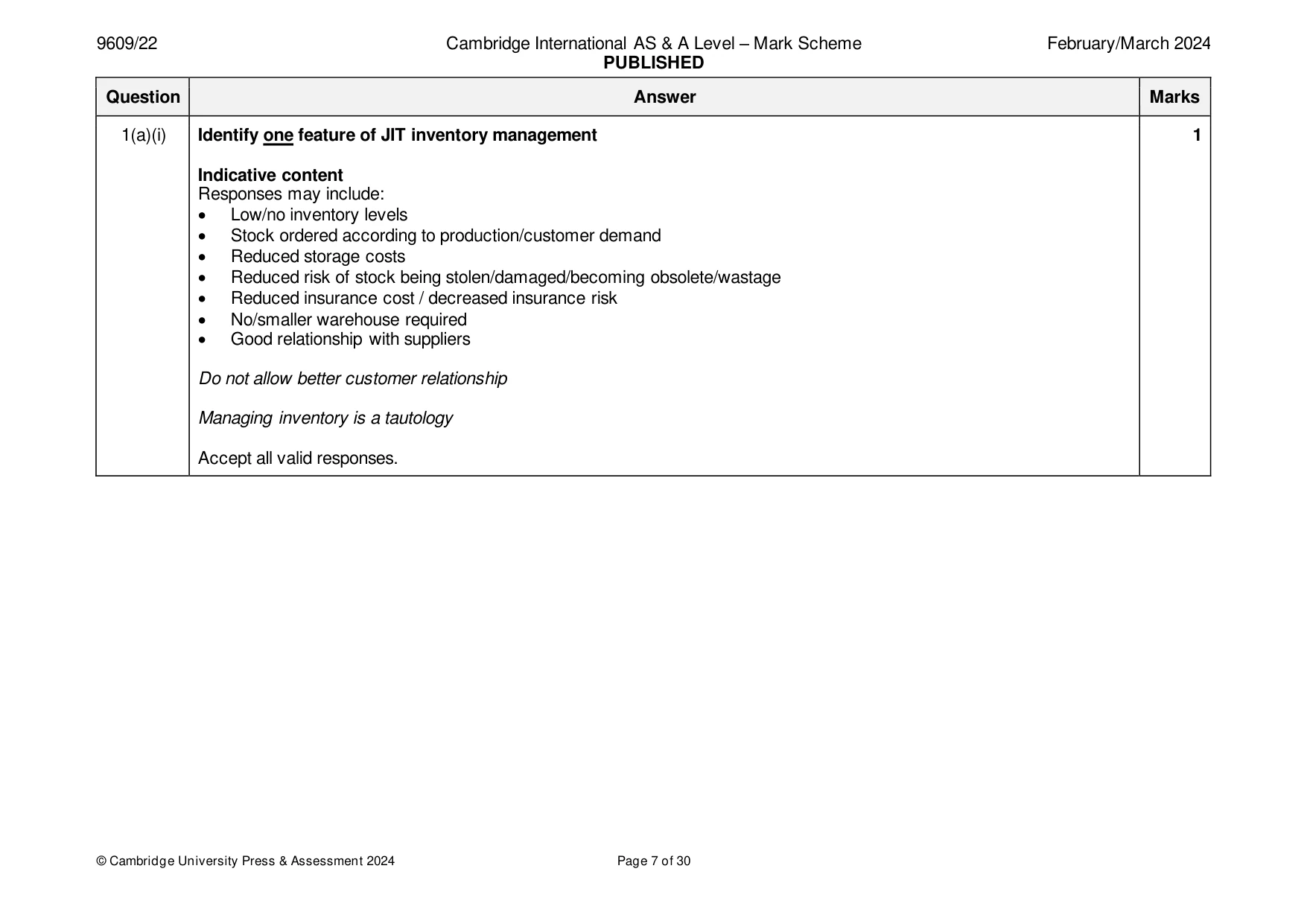
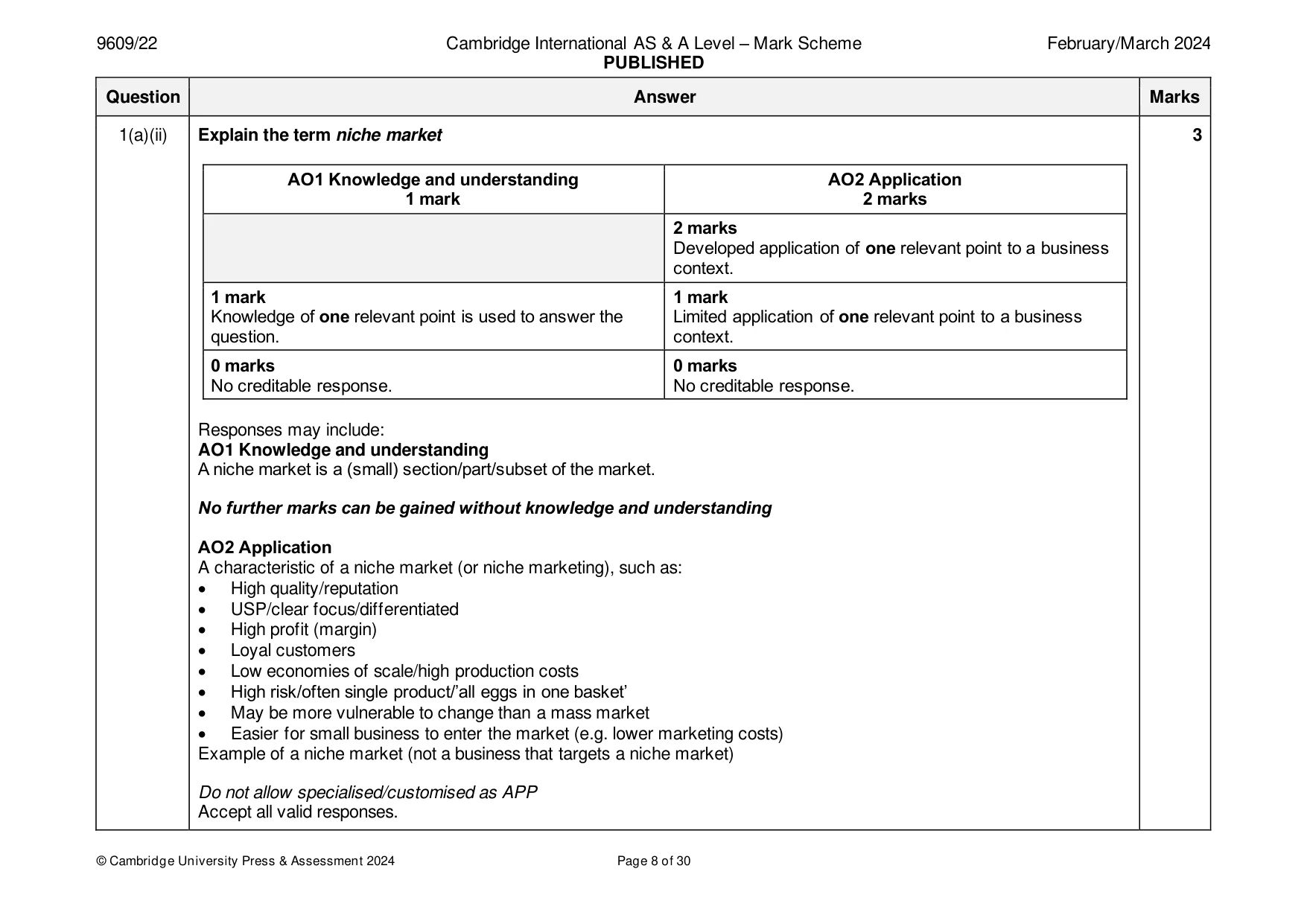
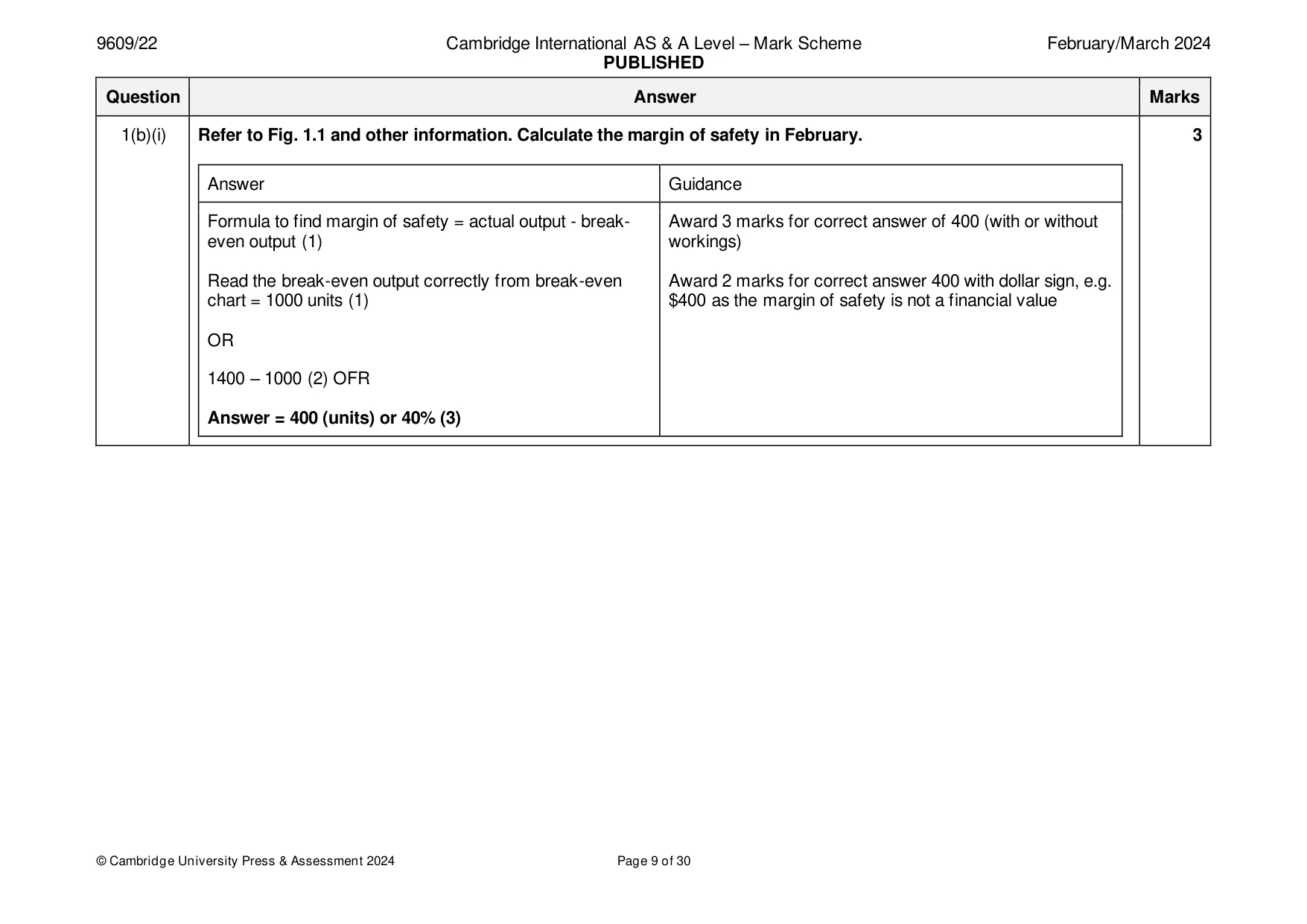
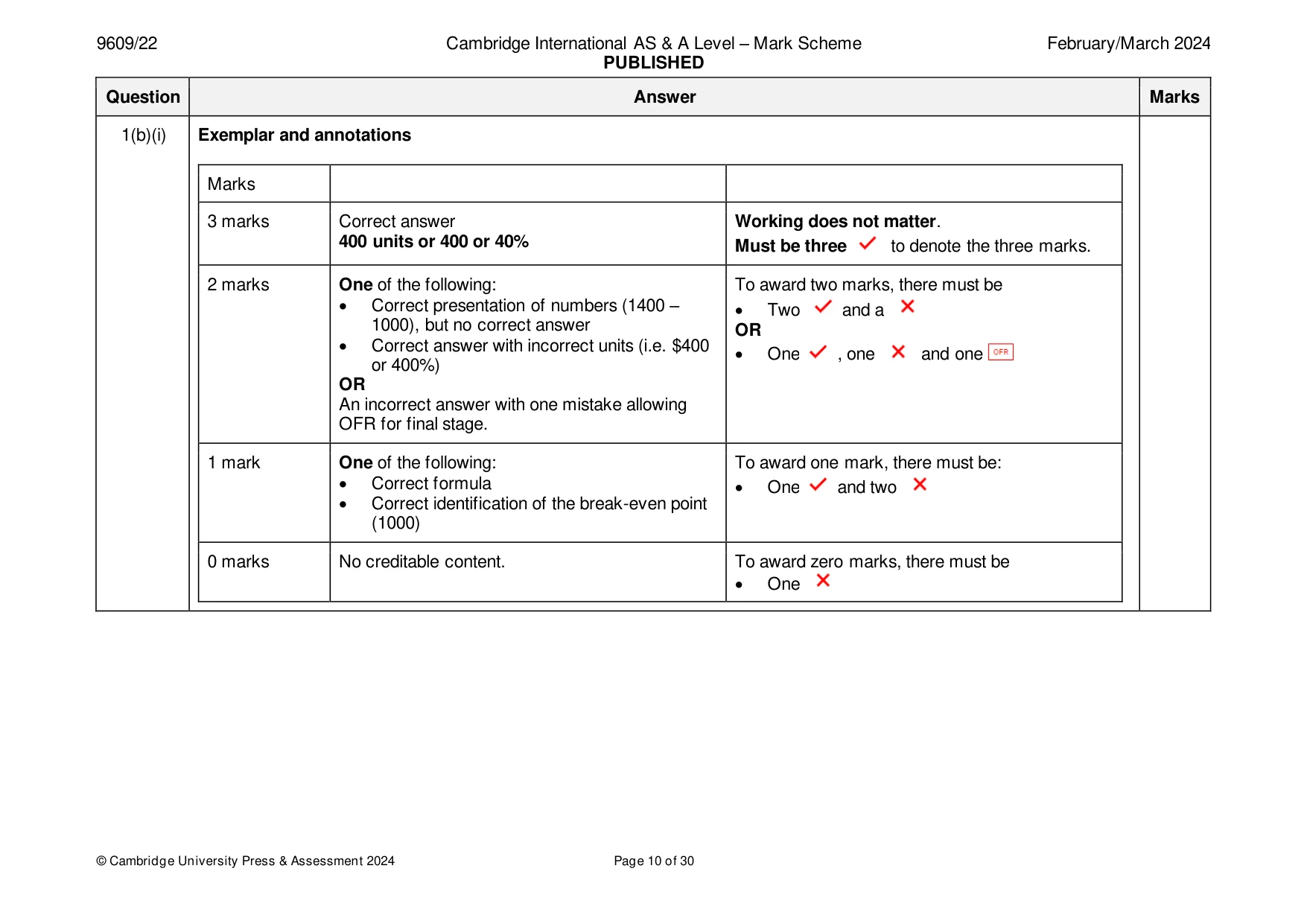
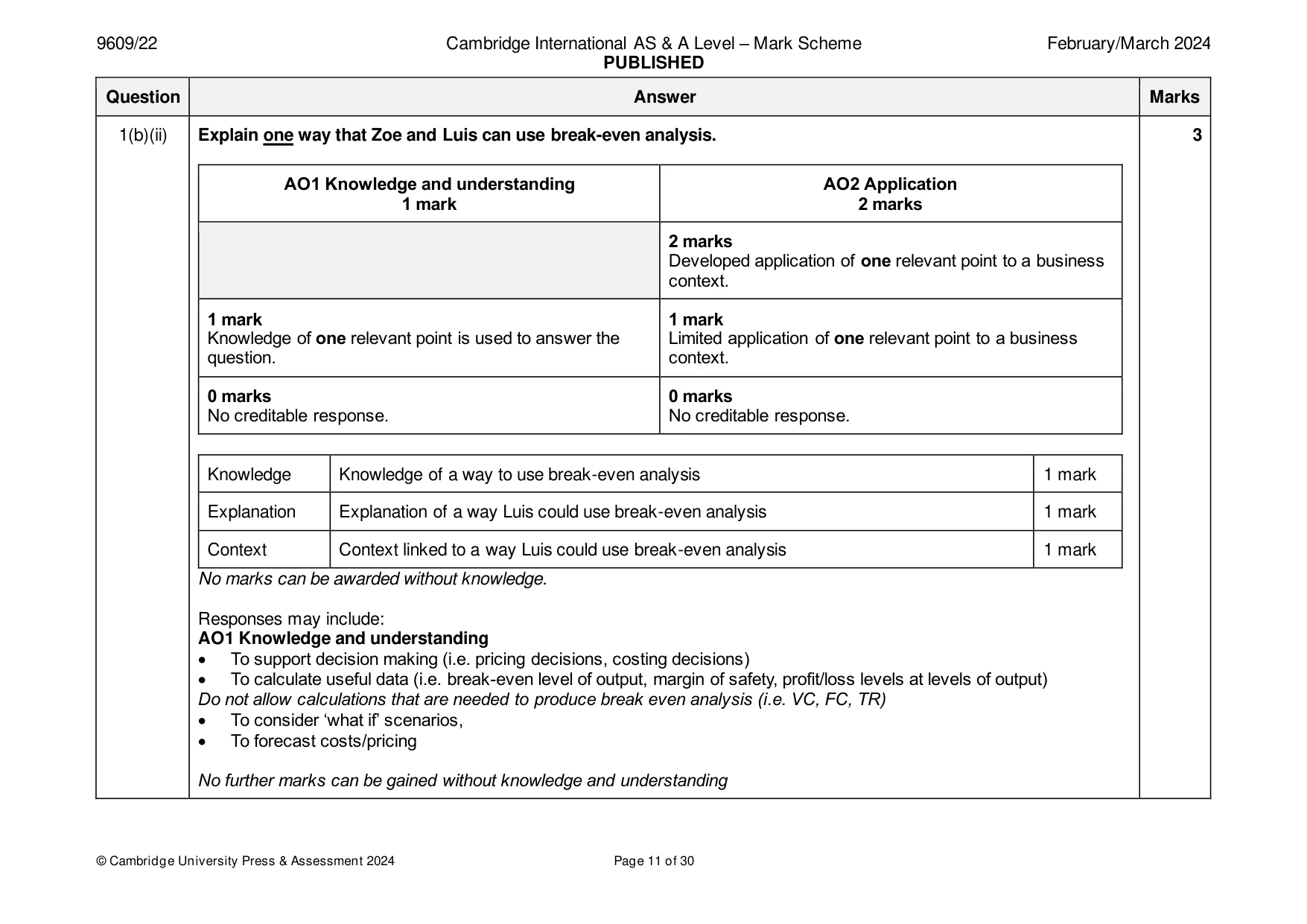
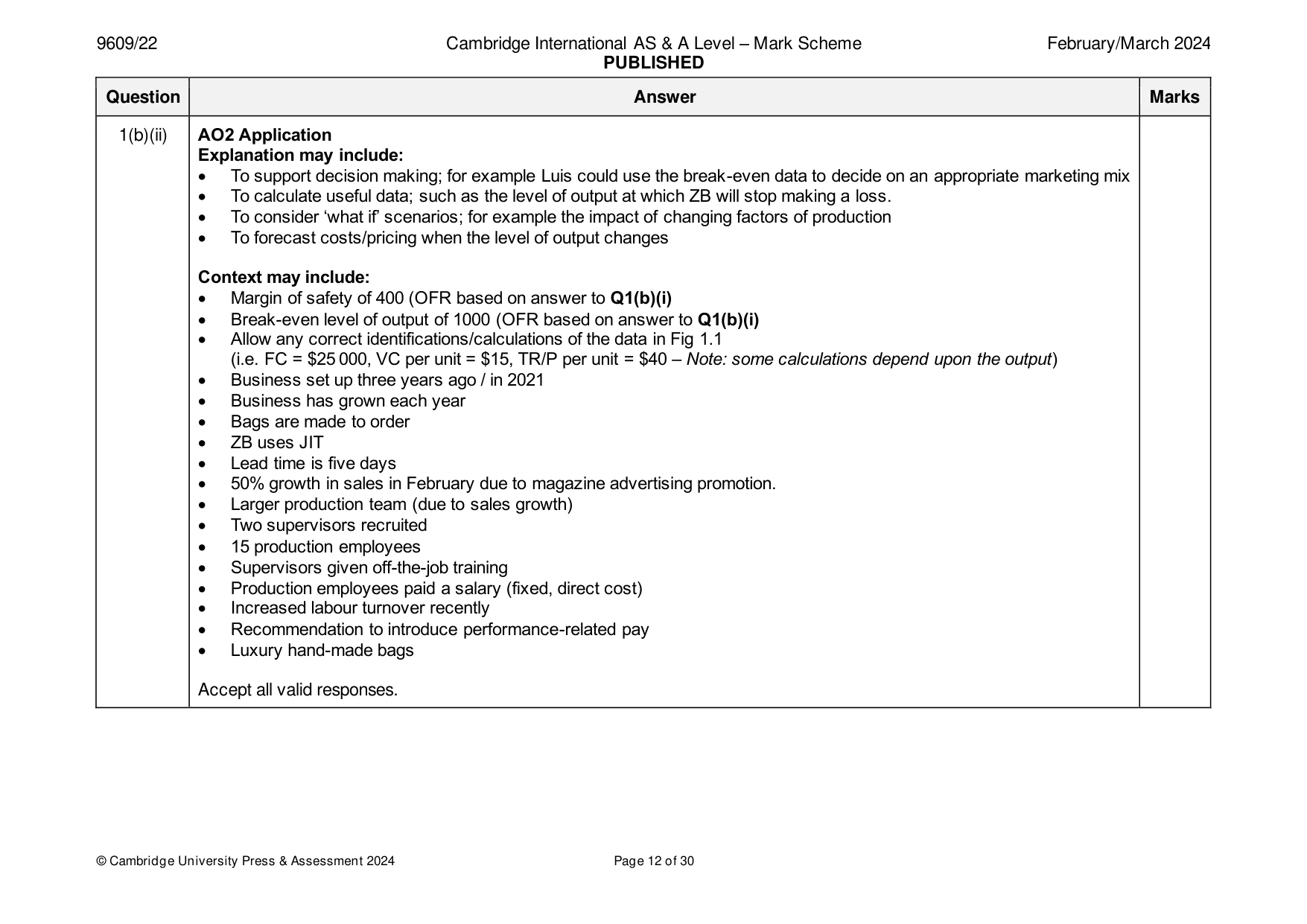
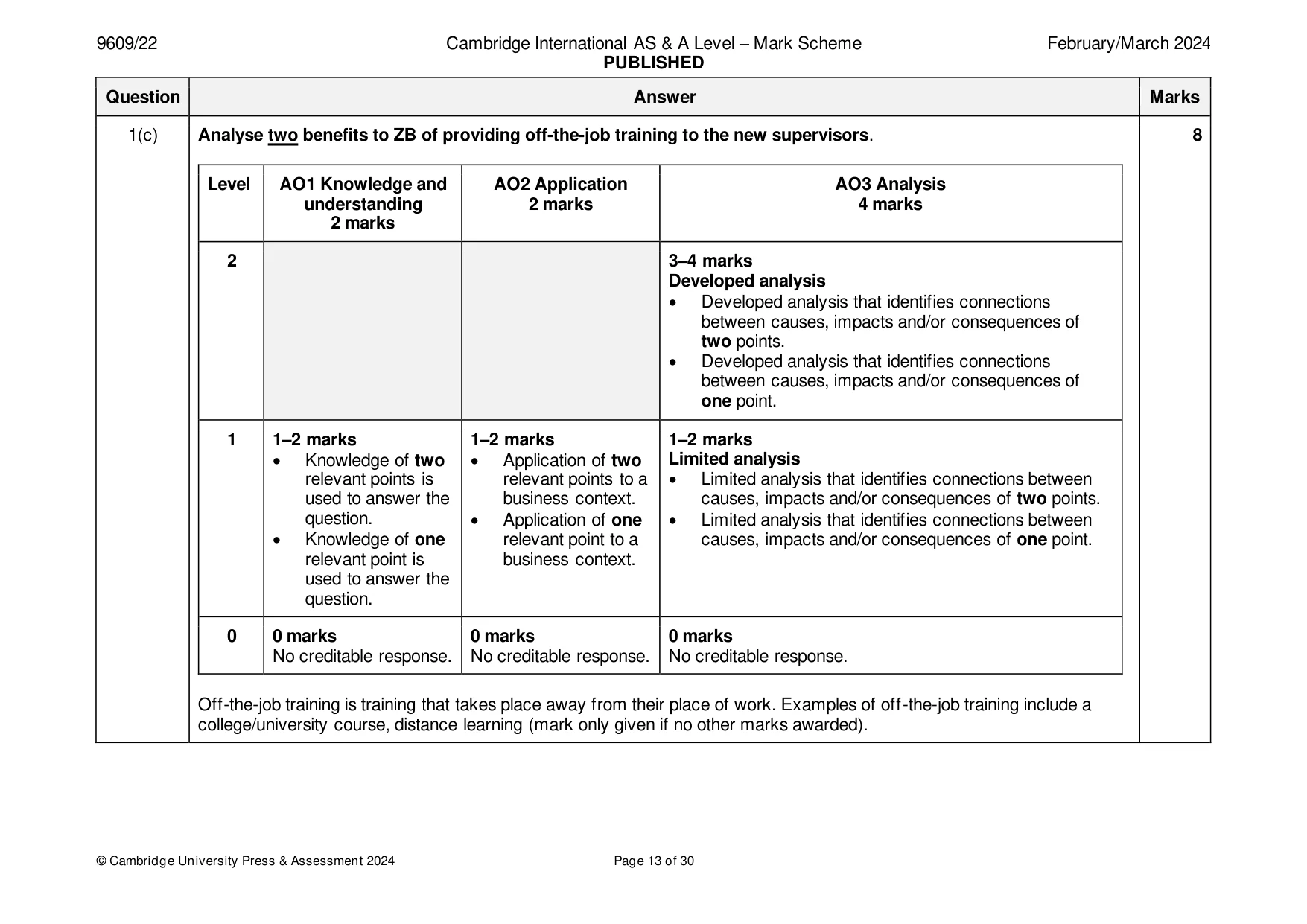
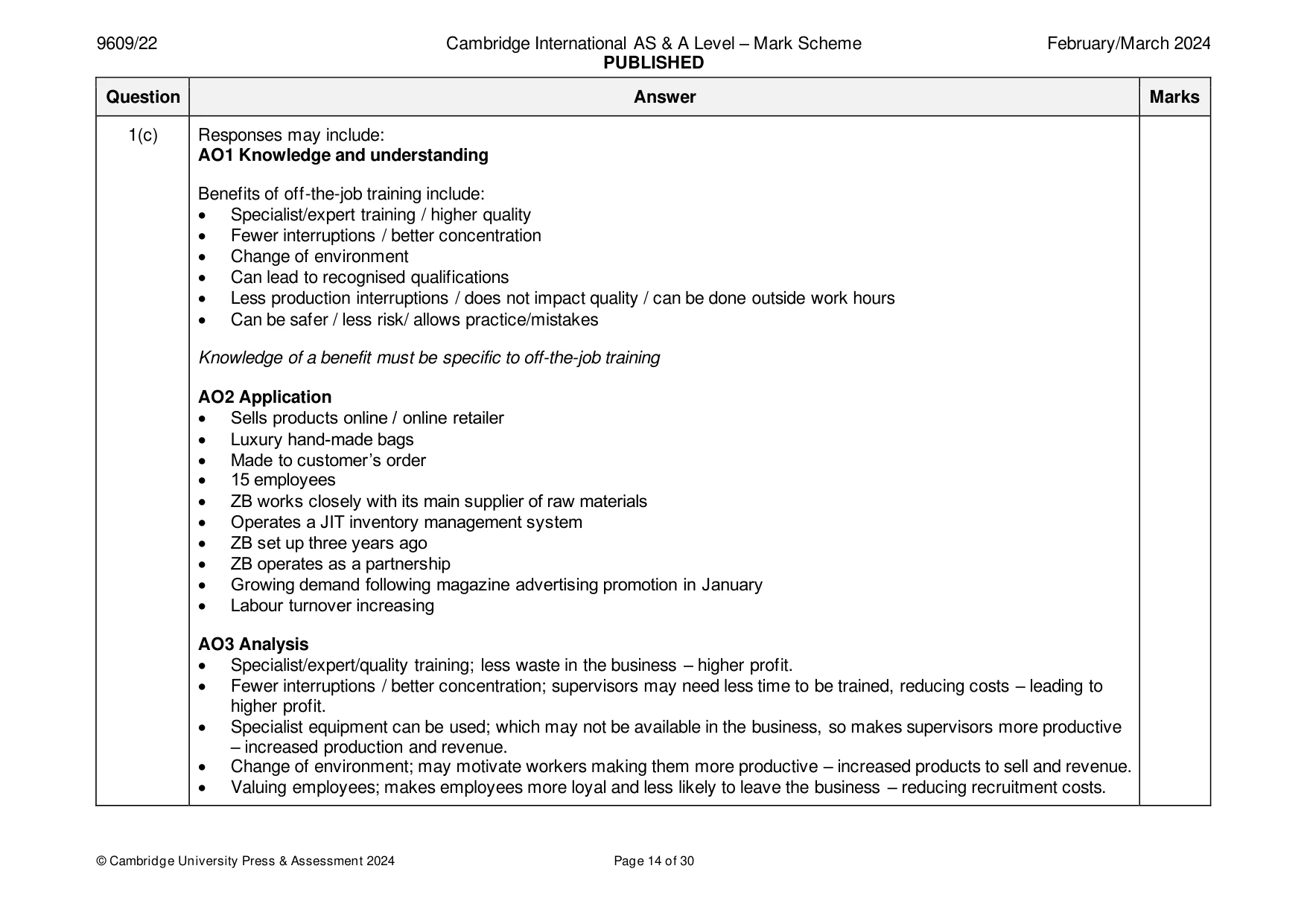
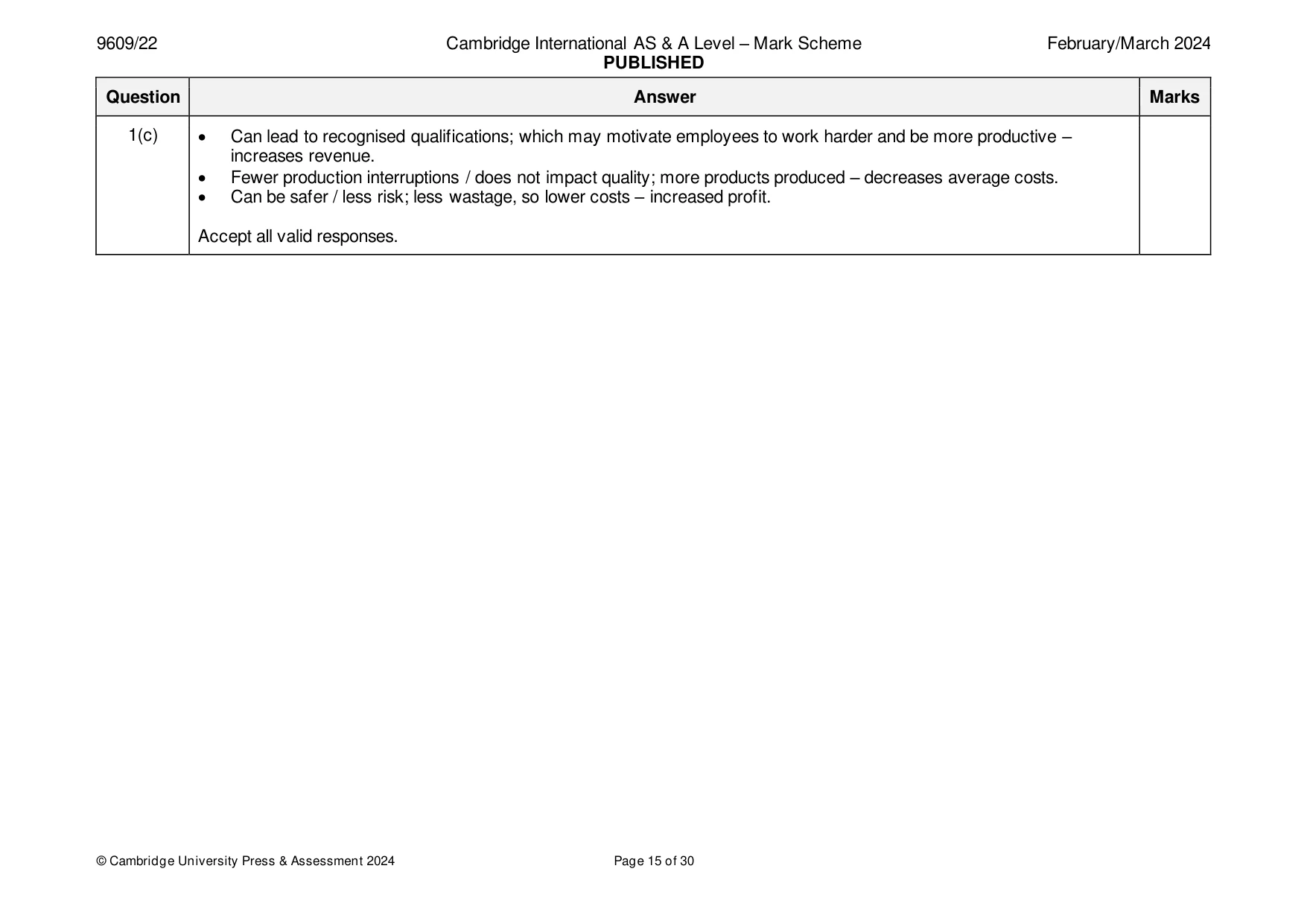
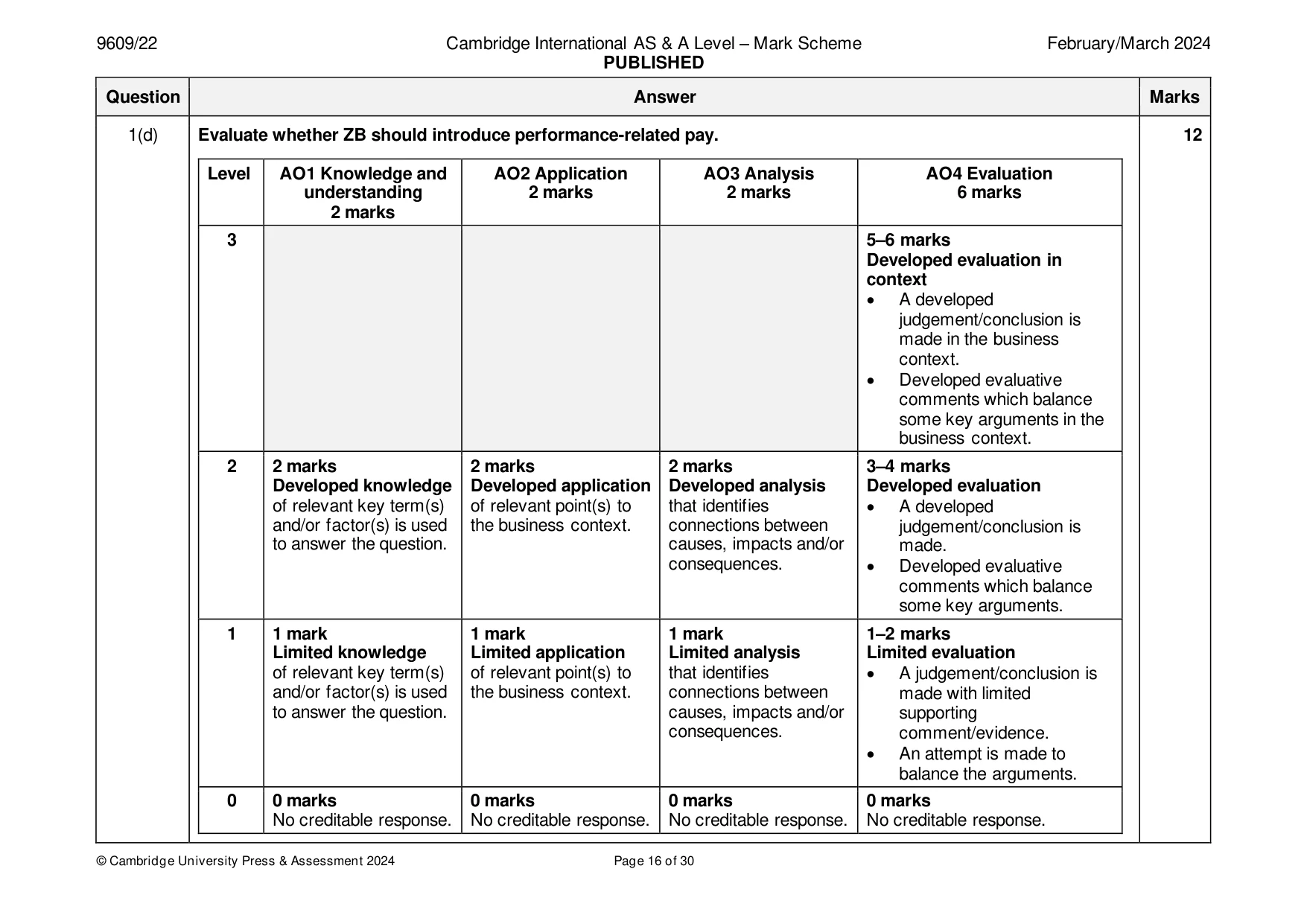
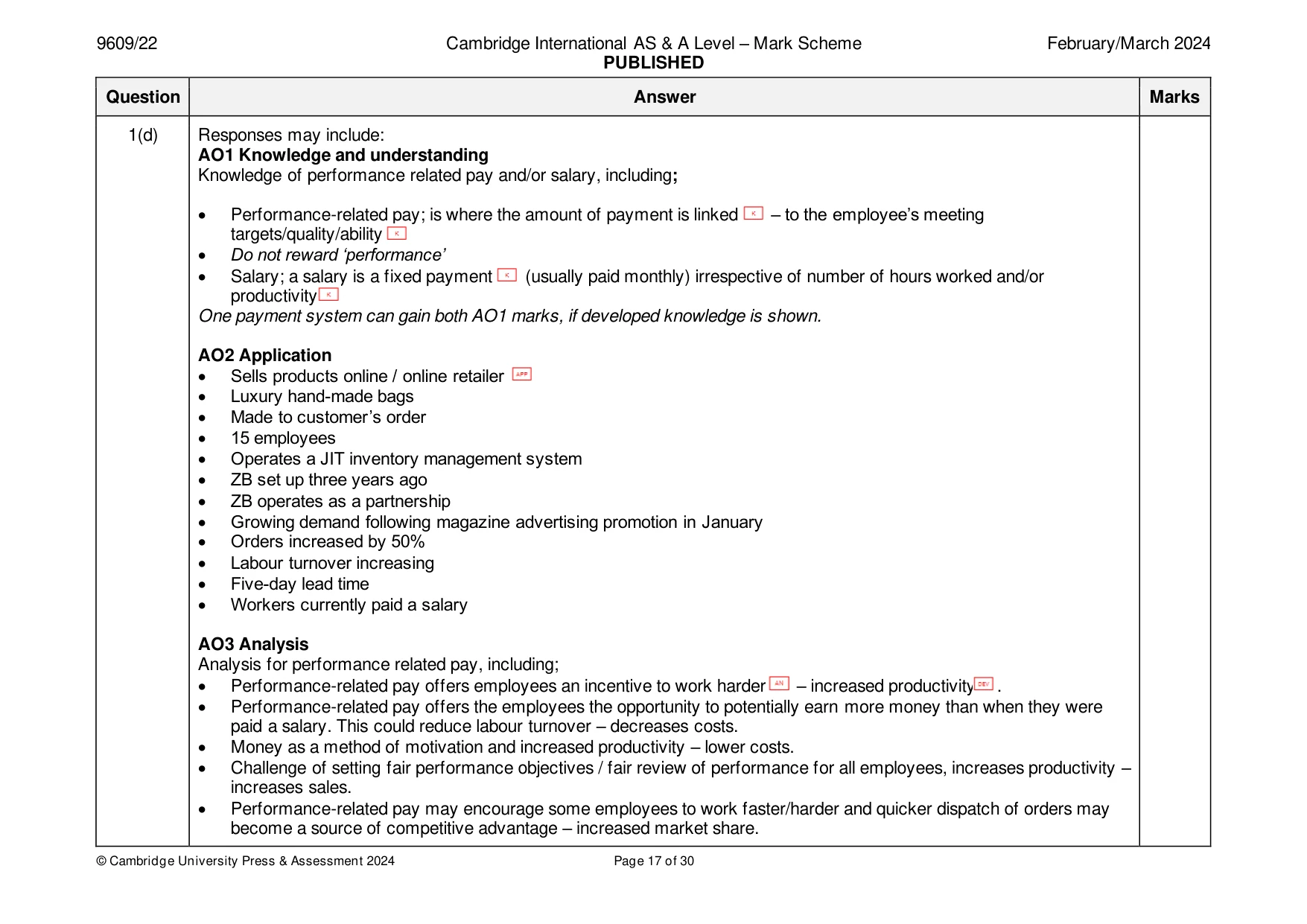
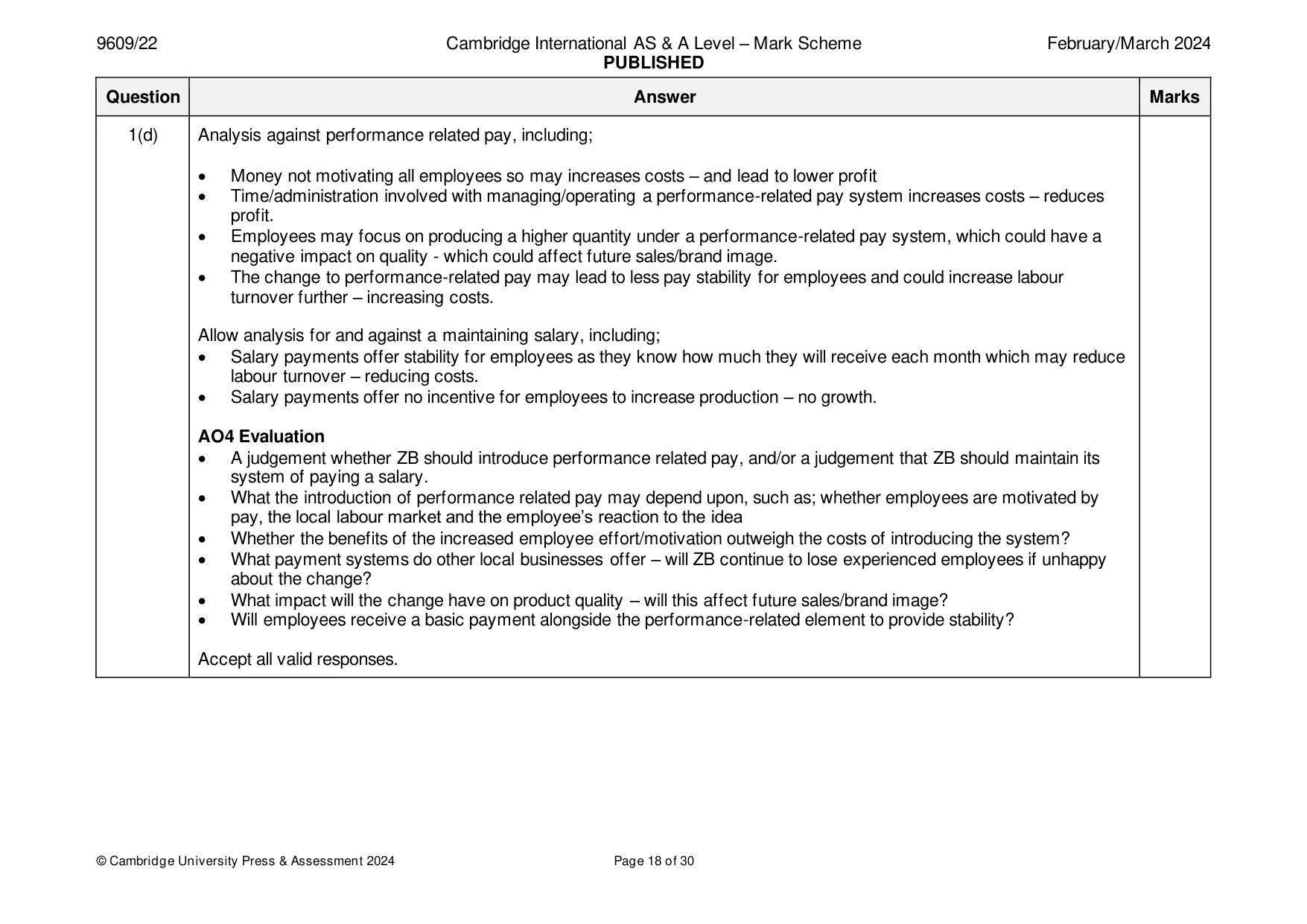
Mark scheme: Question Answer Marks 1(a)(i) Identify one feature of JIT inventory management 1 Indicative content Responses may include: • Low/no inventory levels • Stock ordered according to production/customer demand • Reduced storage costs • Reduced risk of stock being stolen/damaged/becoming obsolete/wastage • Reduced insurance cost / decreased insurance risk • No/smaller warehouse required • Good relationship with suppliers Do not allow better customer relationship Managing inventory is a tautology Accept all valid responses. 1(a)(ii) Explain the term niche market 3 AO1 Knowledge and understanding AO2 Application 1 mark 2 marks 2 marks Developed application of one relevant point to a business context. 1 mark 1 mark Knowledge of one relevant point is used to answer the Limited application of one relevant point to a business question. context. 0 marks 0 marks No creditable response. No creditable response. Responses may include: AO1 Knowledge and understanding A niche market is a (small) section/part/subset of the market. No further marks can be gained without knowledge and understanding AO2 Application A characteristic of a niche market (or niche marketing), such as: • High quality/reputation • USP/clear focus/differentiated • High profit (margin) • Loyal customers • Low economies of scale/high production costs • High risk/often single product/’all eggs in one basket’ • May be more vulnerable to change than a mass market • Easier for small business to enter the market (e.g. lower marketing costs) Example of a niche market (not a business that targets a niche market) Do not allow specialised/customised as APP Accept all valid responses. 1(b)(i) Refer to Fig. 1.1 and other information. Calculate the margin of safety in February. 3 Answer Guidance Formula to find margin of safety = actual output - break- Award 3 marks for correct answer of 400 (with or without even output (1) workings) Read the break-even output correctly from break-even Award 2 marks for correct answer 400 with dollar sign, e.g. chart = 1000 units (1) $400 as the margin of safety is not a financial value OR 1400 – 1000 (2) OFR Answer = 400 (units) or 40% (3) 1(b)(i) Exemplar and annotations Marks 3 marks Correct answer Working does not matter. 400 units or 400 or 40% Must be three to denote the three marks. 2 marks One of the following: To award two marks, there must be • Correct presentation of numbers (1400 – • Two and a 1000), but no correct answer OR • Correct answer with incorrect units (i.e. $400 • One , one and one or 400%) OR An incorrect answer with one mistake allowing OFR for final stage. 1 mark One of the following: To award one mark, there must be: • Correct formula • One and two • Correct identification of the break-even point (1000) 0 marks No creditable content. To award zero marks, there must be • One 1(b)(ii) Explain one way that Zoe and Luis can use break-even analysis. 3 AO1 Knowledge and understanding AO2 Application 1 mark 2 marks 2 marks Developed application of one relevant point to a business context. 1 mark 1 mark Knowledge of one relevant point is used to answer the Limited application of one relevant point to a business question. context. 0 marks 0 marks No creditable response. No creditable response. Knowledge Knowledge of a way to use break-even analysis 1 mark Explanation Explanation of a way Luis could use break-even analysis 1 mark Context Context linked to a way Luis could use break-even analysis 1 mark No marks can be awarded without knowledge. Responses may include: AO1 Knowledge and understanding • To support decision making (i.e. pricing decisions, costing decisions) • To calculate useful data (i.e. break-even level of output, margin of safety, profit/loss levels at levels of output) Do not allow calculations that are needed to produce break even analysis (i.e. VC, FC, TR) • To consider ‘what if’ scenarios, • To forecast costs/pricing No further marks can be gained without knowledge and understanding 1(b)(ii) AO2 Application Explanation may include: • To support decision making; for example Luis could use the break-even data to decide on an appropriate marketing mix • To calculate useful data; such as the level of output at which ZB will stop making a loss. • To consider ‘what if’ scenarios; for example the impact of changing factors of production • To forecast costs/pricing when the level of output changes Context may include: • Margin of safety of 400 (OFR based on answer to Q1(b)(i) • Break-even level of output of 1000 (OFR based on answer to Q1(b)(i) • Allow any correct identifications/calculations of the data in Fig 1.1 (i.e. FC = $25 000, VC per unit = $15, TR/P per unit = $40 – Note: some calculations depend upon the output) • Business set up three years ago / in 2021 • Business has grown each year • Bags are made to order • ZB uses JIT • Lead time is five days • 50% growth in sales in February due to magazine advertising promotion. • Larger production team (due to sales growth) • Two supervisors recruited • 15 production employees • Supervisors given off-the-job training • Production employees paid a salary (fixed, direct cost) • Increased labour turnover recently • Recommendation to introduce performance-related pay • Luxury hand-made bags Accept all valid responses. 1(c) Analyse two benefits to ZB of providing off-the-job training to the new supervisors. 8 Level AO1 Knowledge and AO2 Application AO3 Analysis understanding 2 marks 4 marks 2 marks 2 3–4 marks Developed analysis • Developed analysis that identifies connections between causes, impacts and/or consequences of two points. • Developed analysis that identifies connections between causes, impacts and/or consequences of one point. 1 1–2 marks 1–2 marks 1–2 marks • Knowledge of two • Application of two Limited analysis relevant points is relevant points to a • Limited analysis that identifies connections between used to answer the business context. causes, impacts and/or consequences of two points. question. • Application of one • Limited analysis that identifies connections between • Knowledge of one relevant point to a causes, impacts and/or consequences of one point. relevant point is business context. used to answer the question. 0 0 marks 0 marks 0 marks No creditable response. No creditable response. No creditable response. Off-the-job training is training that takes place away from their place of work. Examples of off-the-job training include a college/university course, distance learning (mark only given if no other marks awarded). 1(c) Responses may include: AO1 Knowledge and understanding Benefits of off-the-job training include: • Specialist/expert training / higher quality • Fewer interruptions / better concentration • Change of environment • Can lead to recognised qualifications • Less production interruptions / does not impact quality / can be done outside work hours • Can be safer / less risk/ allows practice/mistakes Knowledge of a benefit must be specific to off-the-job training AO2 Application • Sells products online / online retailer • Luxury hand-made bags • Made to customer’s order • 15 employees • ZB works closely with its main supplier of raw materials • Operates a JIT inventory management system • ZB set up three years ago • ZB operates as a partnership • Growing demand following magazine advertising promotion in January • Labour turnover increasing AO3 Analysis • Specialist/expert/quality training; less waste in the business – higher profit. • Fewer interruptions / better concentration; supervisors may need less time to be trained, reducing costs – leading to higher profit. • Specialist equipment can be used; which may not be available in the business, so makes supervisors more productive – increased production and revenue. • Change of environment; may motivate workers making them more productive – increased products to sell and revenue. • Valuing employees; makes employees more loyal and less likely to leave the business – reducing recruitment costs. 1(c) • Can lead to recognised qualifications; which may motivate employees to work harder and be more productive – increases revenue. • Fewer production interruptions / does not impact quality; more products produced – decreases average costs. • Can be safer / less risk; less wastage, so lower costs – increased profit. Accept all valid responses. 1(d) Evaluate whether ZB should introduce performance-related pay. 12 Level AO1 Knowledge and AO2 Application AO3 Analysis AO4 Evaluation understanding 2 marks 2 marks 6 marks 2 marks 3 5–6 marks Developed evaluation in context • A developed judgement/conclusion is made in the business context. • Developed evaluative comments which balance some key arguments in the business context. 2 2 marks 2 marks 2 marks 3–4 marks Developed knowledge Developed application Developed analysis Developed evaluation of relevant key term(s) of relevant point(s) to that identifies • A developed and/or factor(s) is used the business context. connections between judgement/conclusion is to answer the question. causes, impacts and/or made. consequences. • Developed evaluative comments which balance some key arguments. 1 1 mark 1 mark 1 mark 1–2 marks Limited knowledge Limited application Limited analysis Limited evaluation of relevant key term(s) of relevant point(s) to that identifies • A judgement/conclusion is and/or factor(s) is used the business context. connections between made with limited to answer the question. causes, impacts and/or supporting consequences. comment/evidence. • An attempt is made to balance the arguments. 0 0 marks 0 marks 0 marks 0 marks No creditable response. No creditable response. No creditable response. No creditable response. 1(d) Responses may include: AO1 Knowledge and understanding Knowledge of performance related pay and/or salary, including; • Performance-related pay; is where the amount of payment is linked – to the employee’s meeting targets/quality/ability • Do not reward ‘performance’ • Salary; a salary is a fixed payment (usually paid monthly) irrespective of number of hours worked and/or productivity One payment system can gain both AO1 marks, if developed knowledge is shown. AO2 Application • Sells products online / online retailer • Luxury hand-made bags • Made to customer’s order • 15 employees • Operates a JIT inventory management system • ZB set up three years ago • ZB operates as a partnership • Growing demand following magazine advertising promotion in January • Orders increased by 50% • Labour turnover increasing • Five-day lead time • Workers currently paid a salary AO3 Analysis Analysis for performance related pay, including; • Performance-related pay offers employees an incentive to work harder – increased productivity . • Performance-related pay offers the employees the opportunity to potentially earn more money than when they were paid a salary. This could reduce labour turnover – decreases costs. • Money as a method of motivation and increased productivity – lower costs. • Challenge of setting fair performance objectives / fair review of performance for all employees, increases productivity – increases sales. • Performance-related pay may encourage some employees to work faster/harder and quicker dispatch of orders may become a source of competitive advantage – increased market share. 1(d) Analysis against performance related pay, including; • Money not motivating all employees so may increases costs – and lead to lower profit • Time/administration involved with managing/operating a performance-related pay system increases costs – reduces profit. • Employees may focus on producing a higher quantity under a performance-related pay system, which could have a negative impact on quality - which could affect future sales/brand image. • The change to performance-related pay may lead to less pay stability for employees and could increase labour turnover further – increasing costs. Allow analysis for and against a maintaining salary, including; • Salary payments offer stability for employees as they know how much they will receive each month which may reduce labour turnover – reducing costs. • Salary payments offer no incentive for employees to increase production – no growth. AO4 Evaluation • A judgement whether ZB should introduce performance related pay, and/or a judgement that ZB should maintain its system of paying a salary. • What the introduction of performance related pay may depend upon, such as; whether employees are motivated by pay, the local labour market and the employee’s reaction to the idea • Whether the benefits of the increased employee effort/motivation outweigh the costs of introducing the system? • What payment systems do other local businesses offer – will ZB continue to lose experienced employees if unhappy about the change? • What impact will the change have on product quality – will this affect future sales/brand image? • Will employees receive a basic payment alongside the performance-related element to provide stability? Accept all valid responses.
Q2 · ML Computers (MLC) MLC is a successful private limited company that has been trading for…
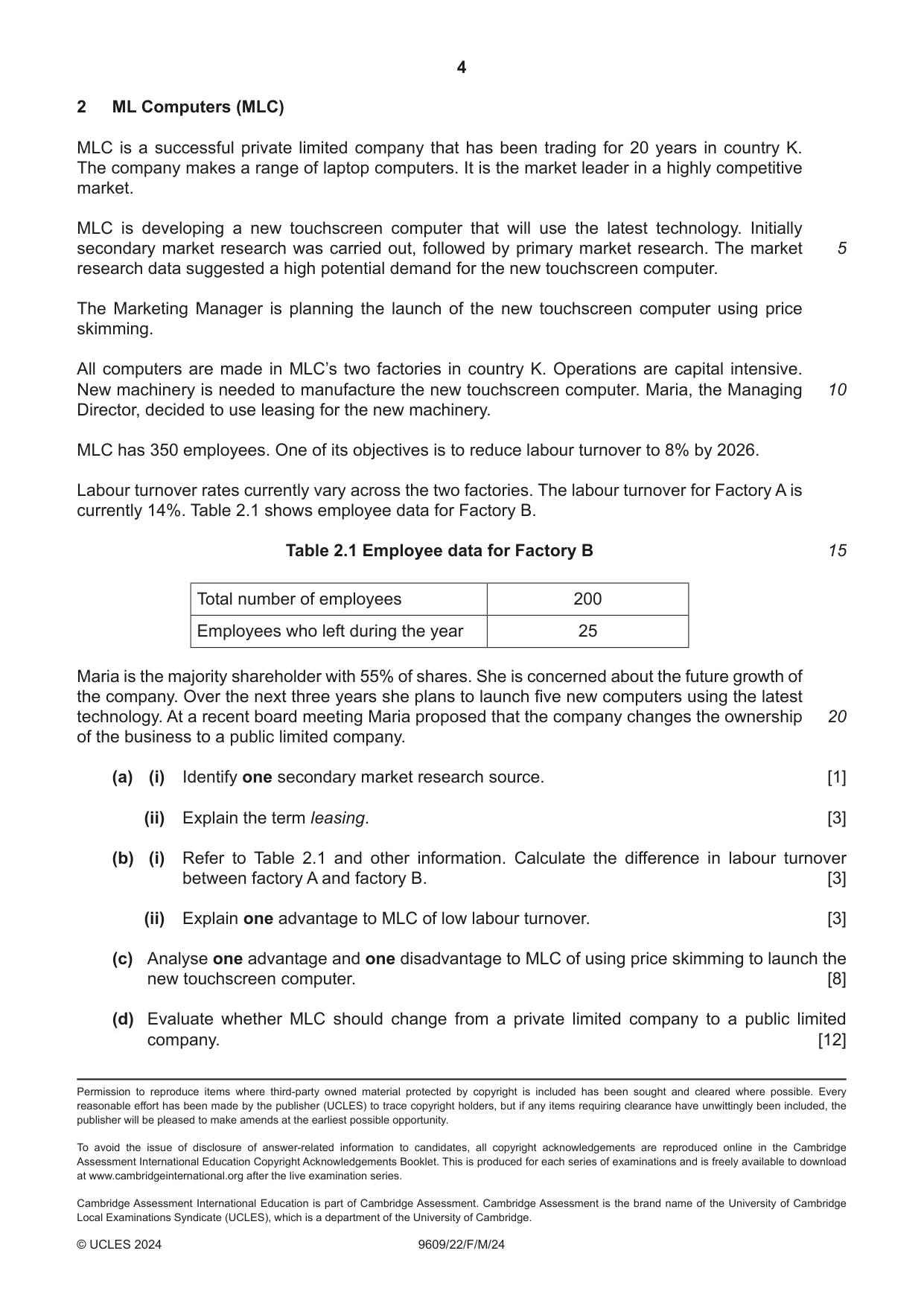
2 ML Computers (MLC) MLC is a successful private limited company that has been trading for 20 years in country K. The company makes a range of laptop computers. It is the market leader in a highly competitive market. MLC is developing a new touchscreen computer that will use the latest technology. Initially secondary market research was carried out, followed by primary market research. The market 5 research data suggested a high potential demand for the new touchscreen computer. The Marketing Manager is planning the launch of the new touchscreen computer using price skimming. All computers are made in MLC’s two factories in country K. Operations are capital intensive. New machinery is needed to manufacture the new touchscreen computer. Maria, the Managing 10 Director, decided to use leasing for the new machinery. MLC has 350 employees. One of its objectives is to reduce labour turnover to 8% by 2026. Labour turnover rates currently vary across the two factories. The labour turnover for Factory A is currently 14%. Table 2.1 shows employee data for Factory B. Table 2.1 Employee data for Factory B 15 Total number of employees 200 Employees who left during the year 25 Maria is the majority shareholder with 55% of shares. She is concerned about the future growth of the company. Over the next three years she plans to launch five new computers using the latest technology. At a recent board meeting Maria proposed that the company changes the ownership 20 of the business to a public limited company. (a) (i) Identify one secondary market research source. [1] (ii) Explain the term leasing. [3] (b) (i) Refer to Table 2.1 and other information. Calculate the difference in labour turnover between factory A and factory B. [3] (ii) Explain one advantage to MLC of low labour turnover. [3] (c) Analyse one advantage and one disadvantage to MLC of using price skimming to launch the new touchscreen computer. [8] (d) Evaluate whether MLC should change from a private limited company to a public limited company. [12]
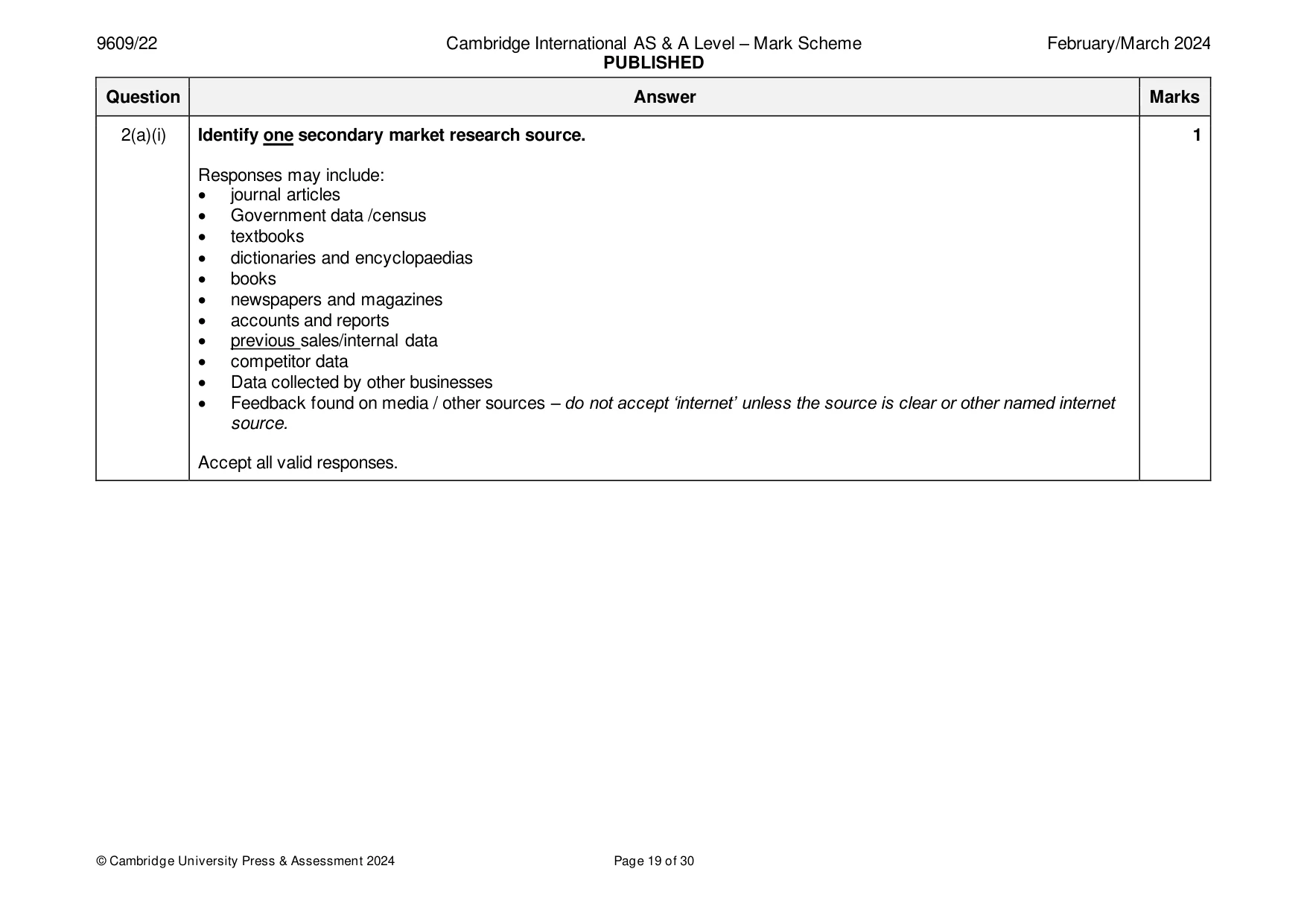
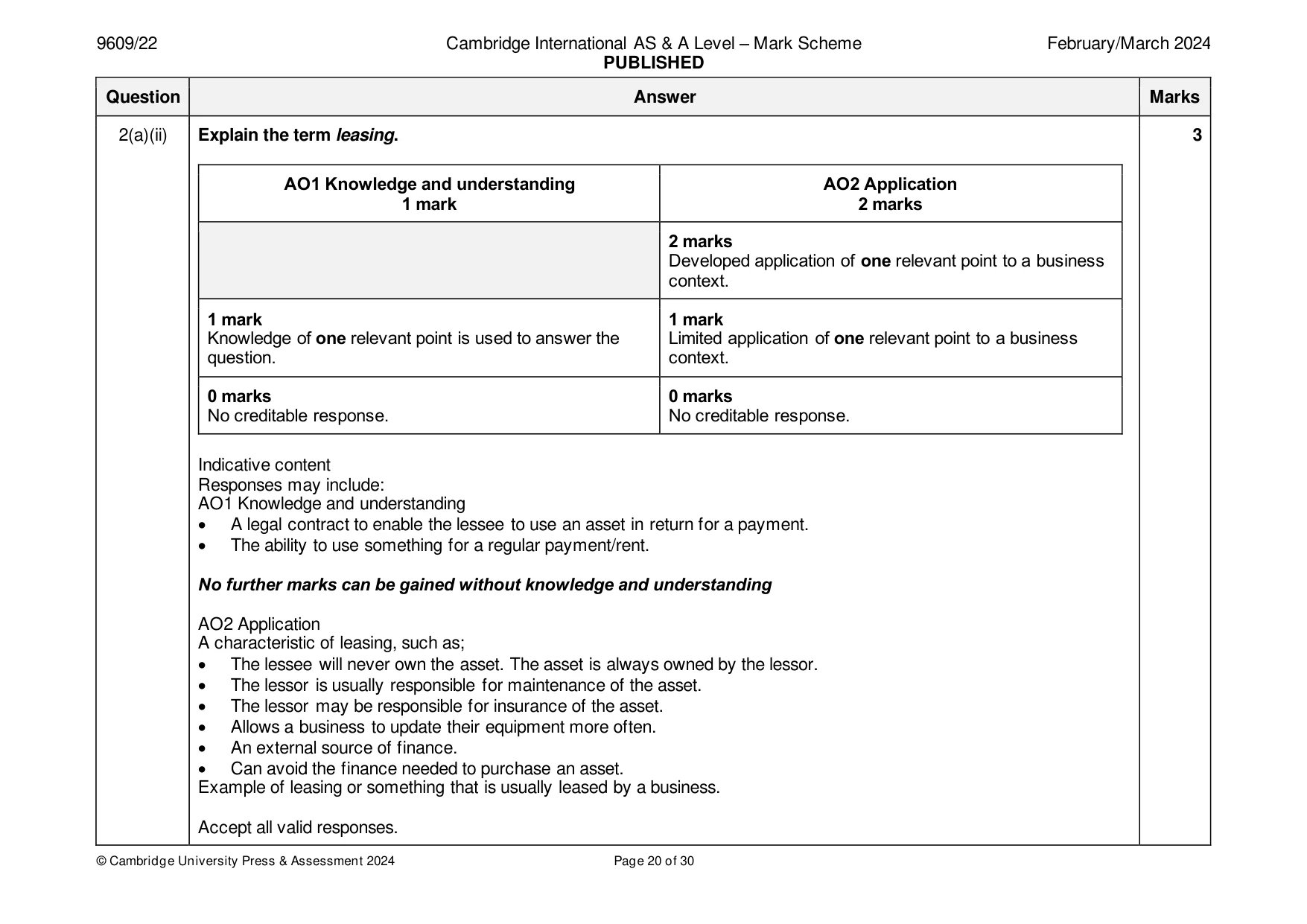
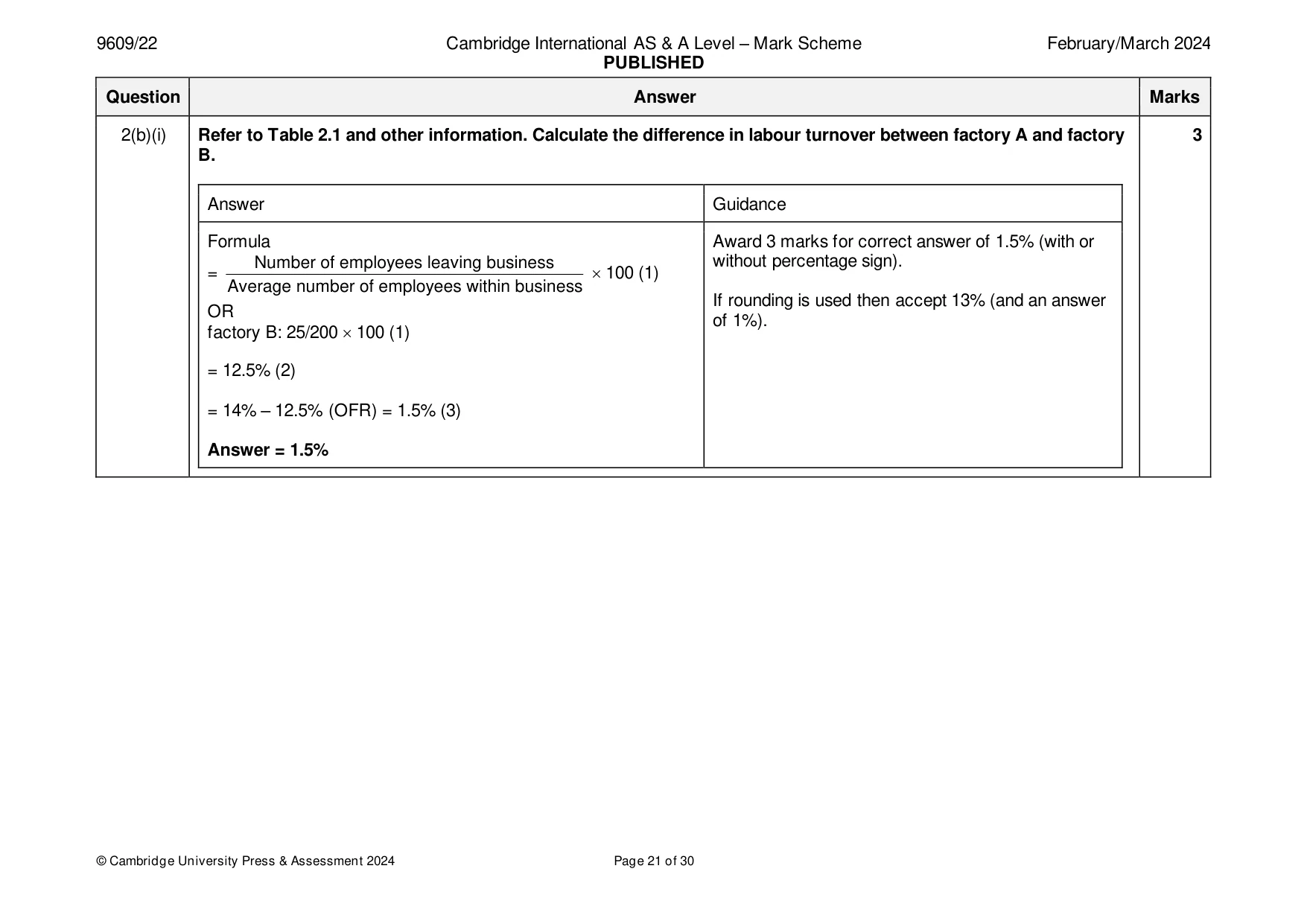
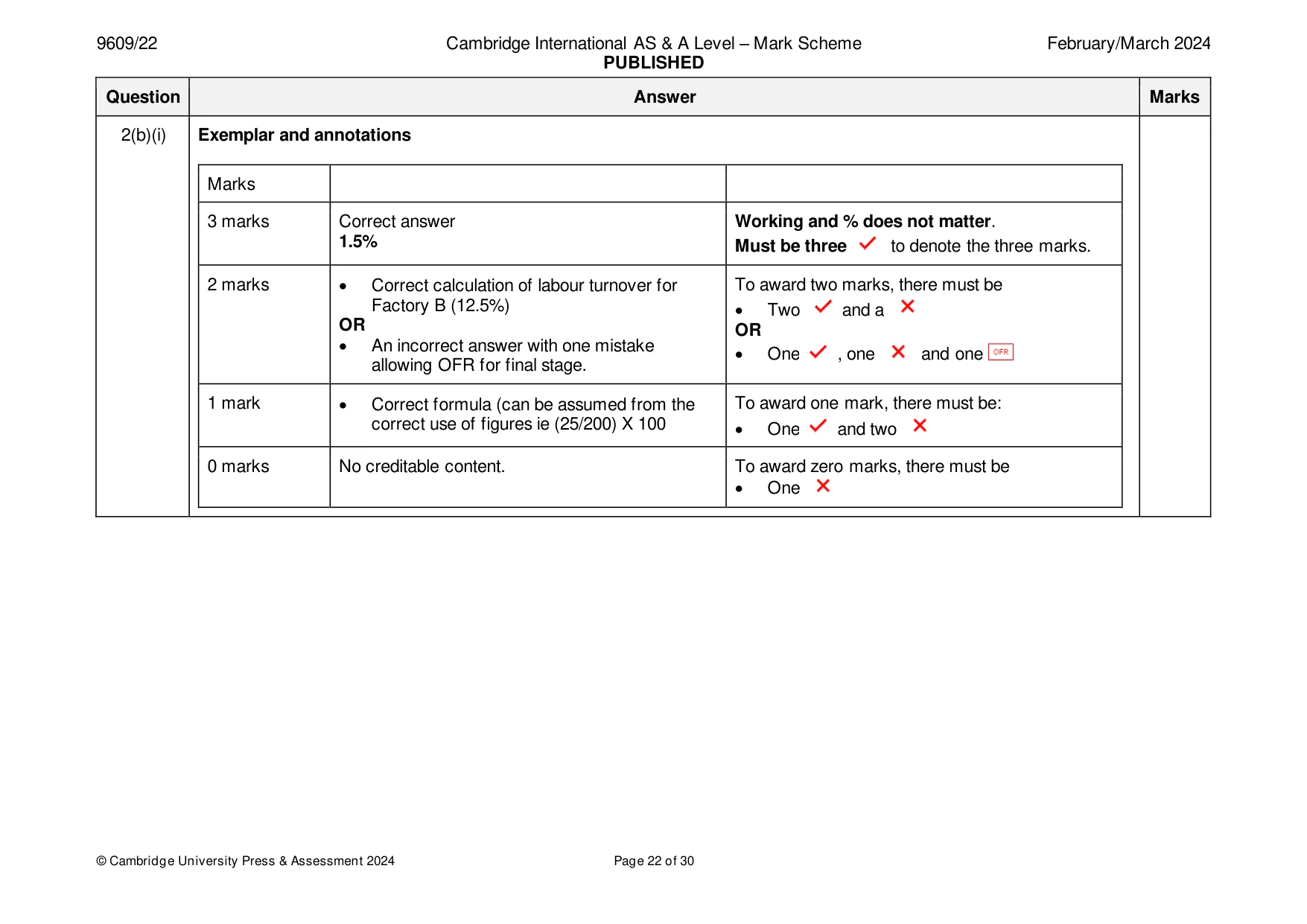
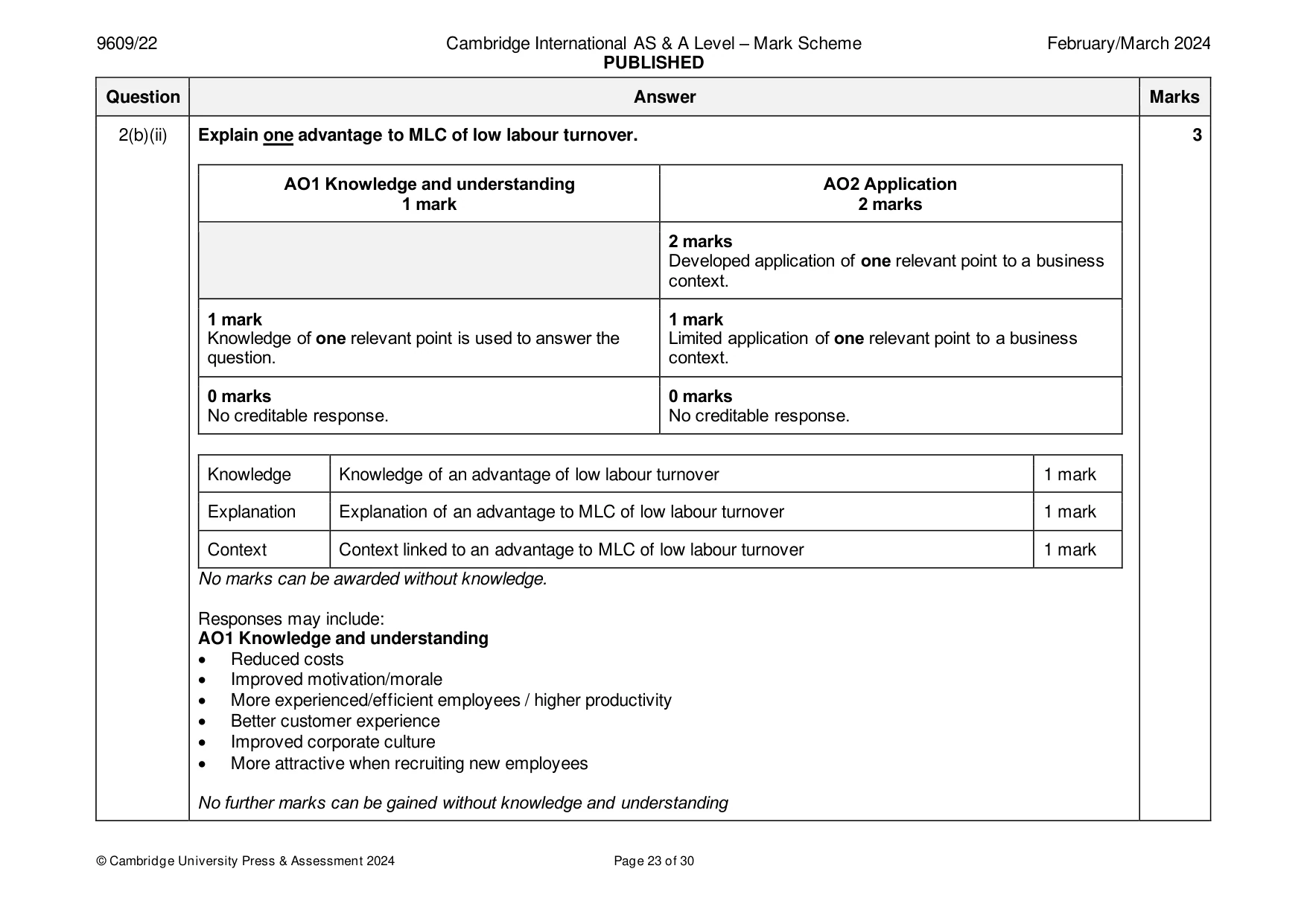
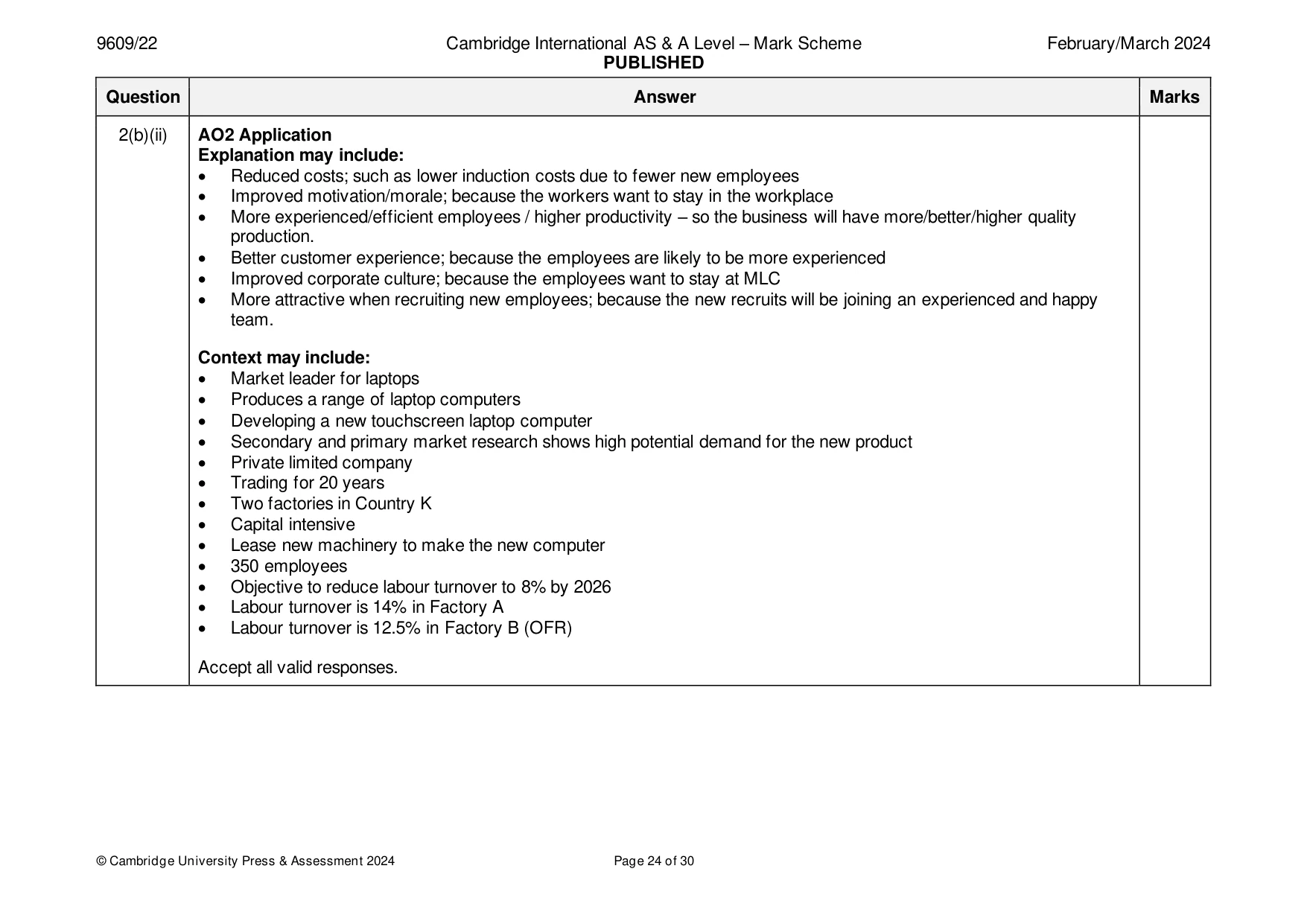
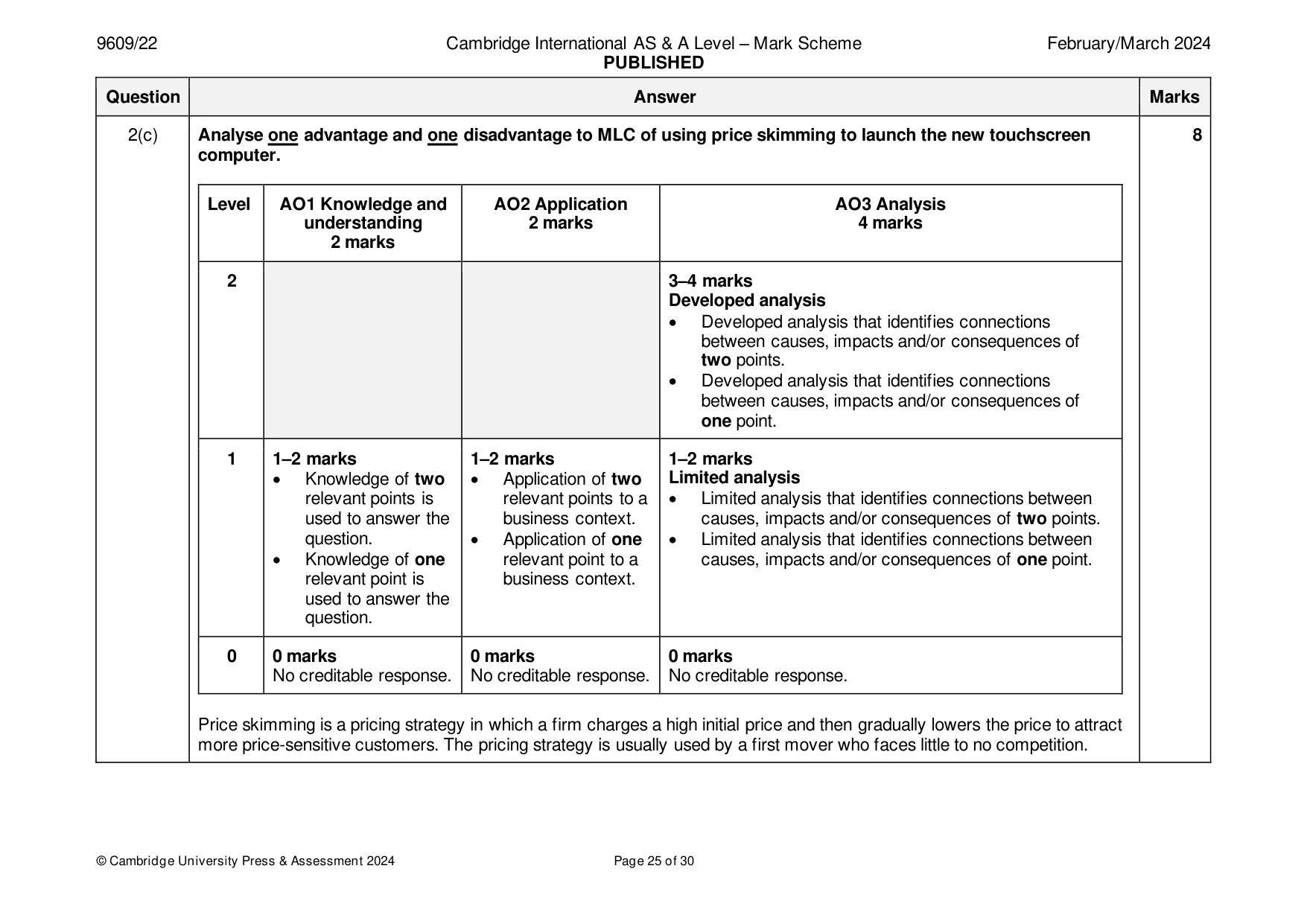
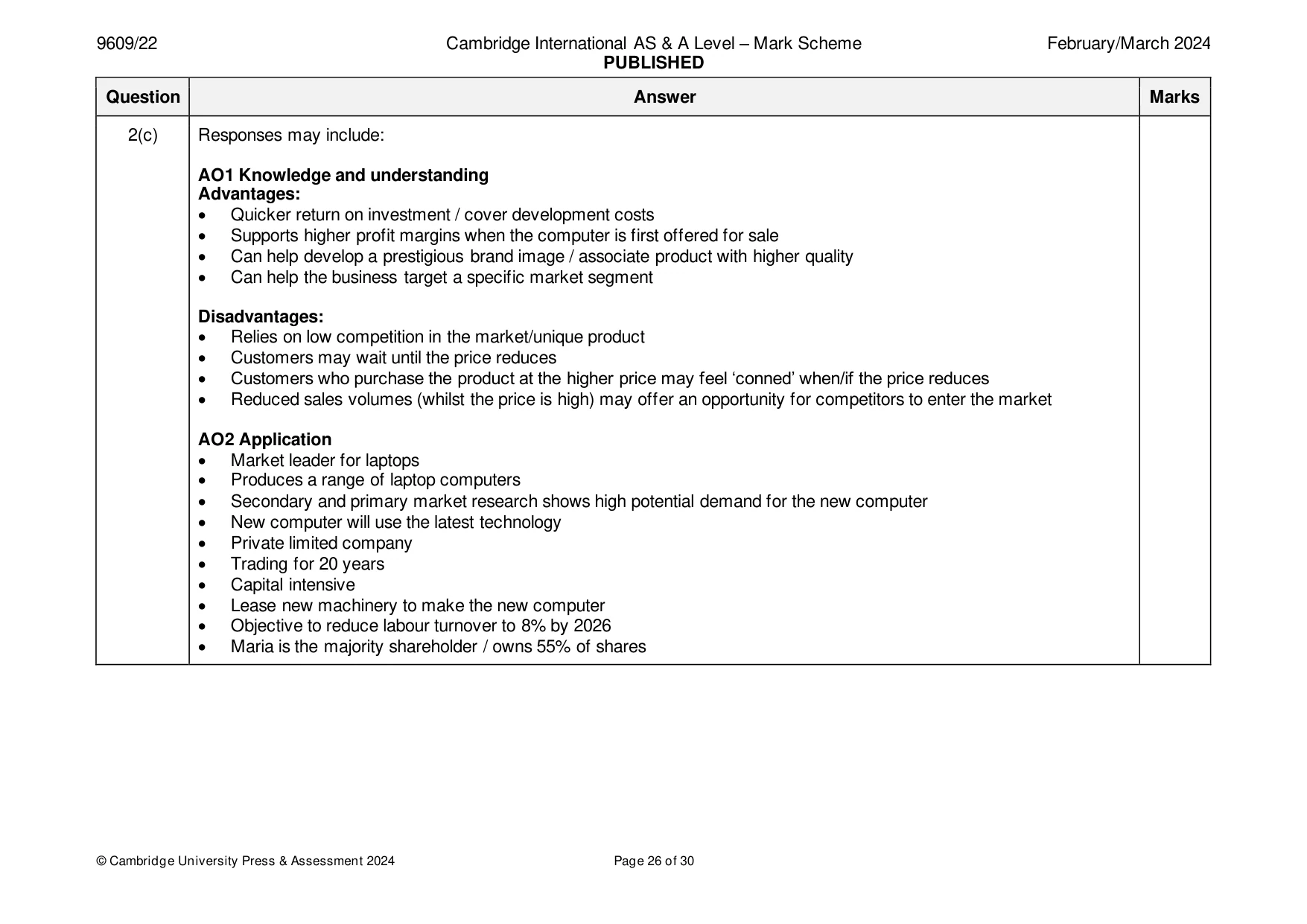
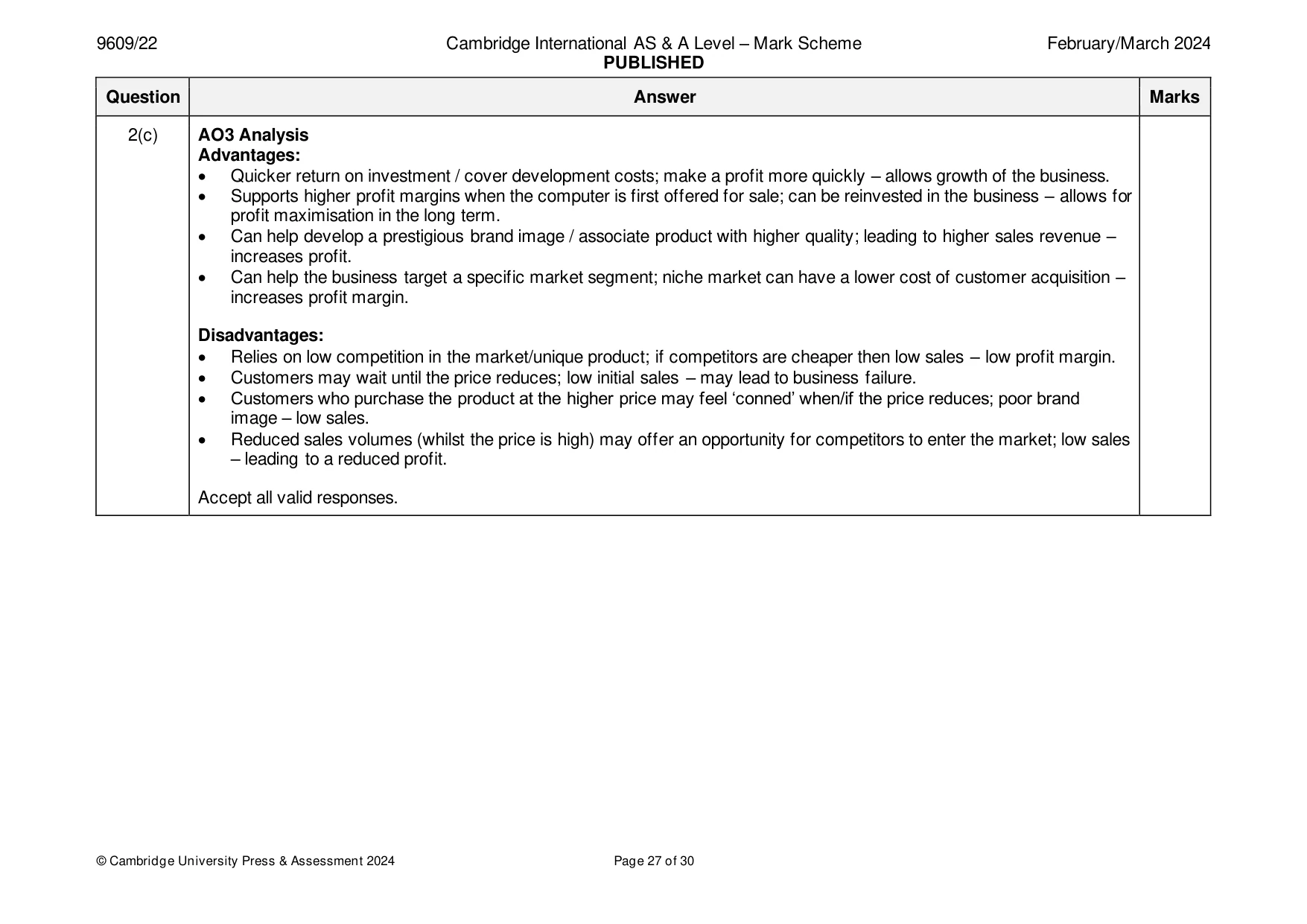
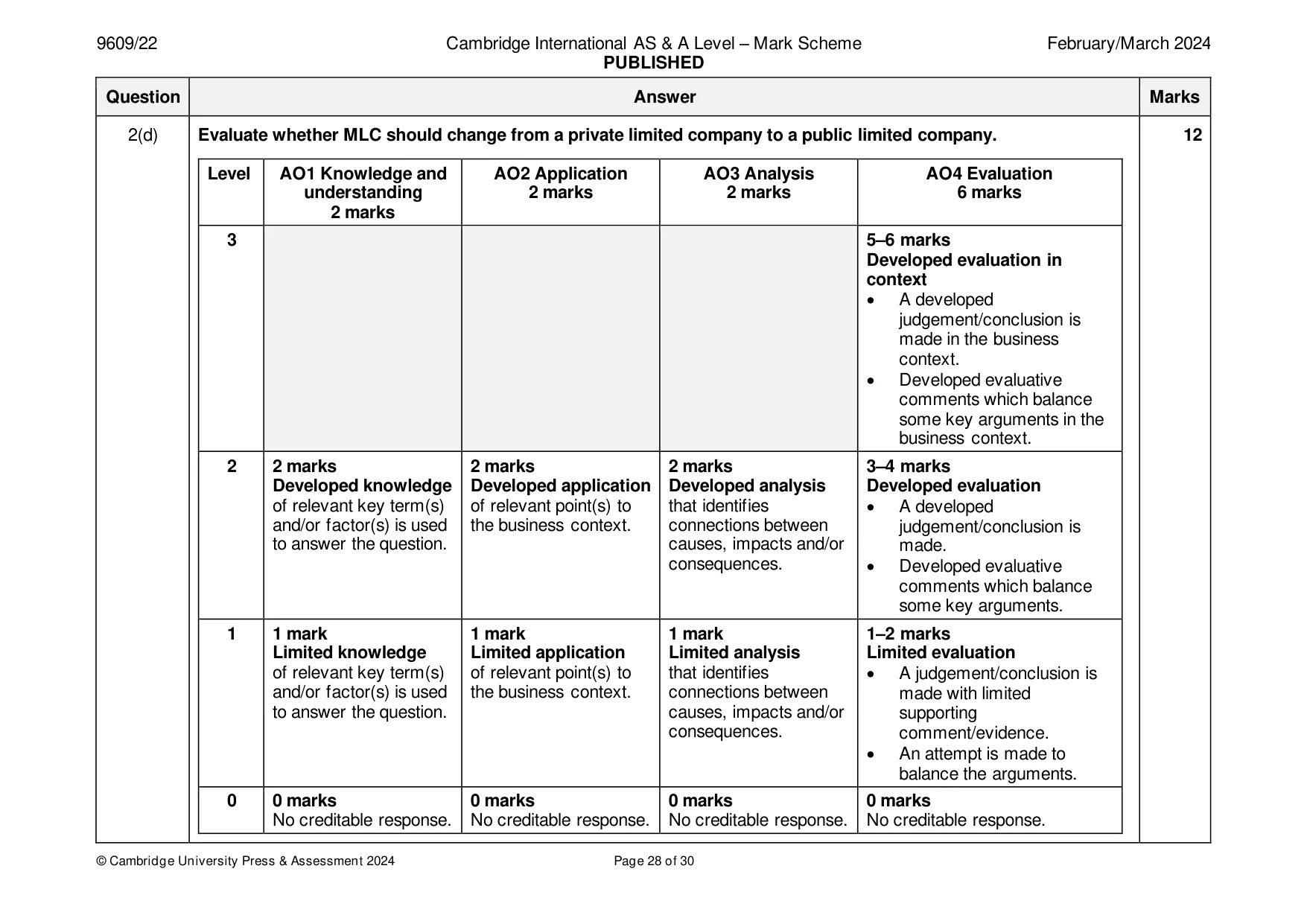
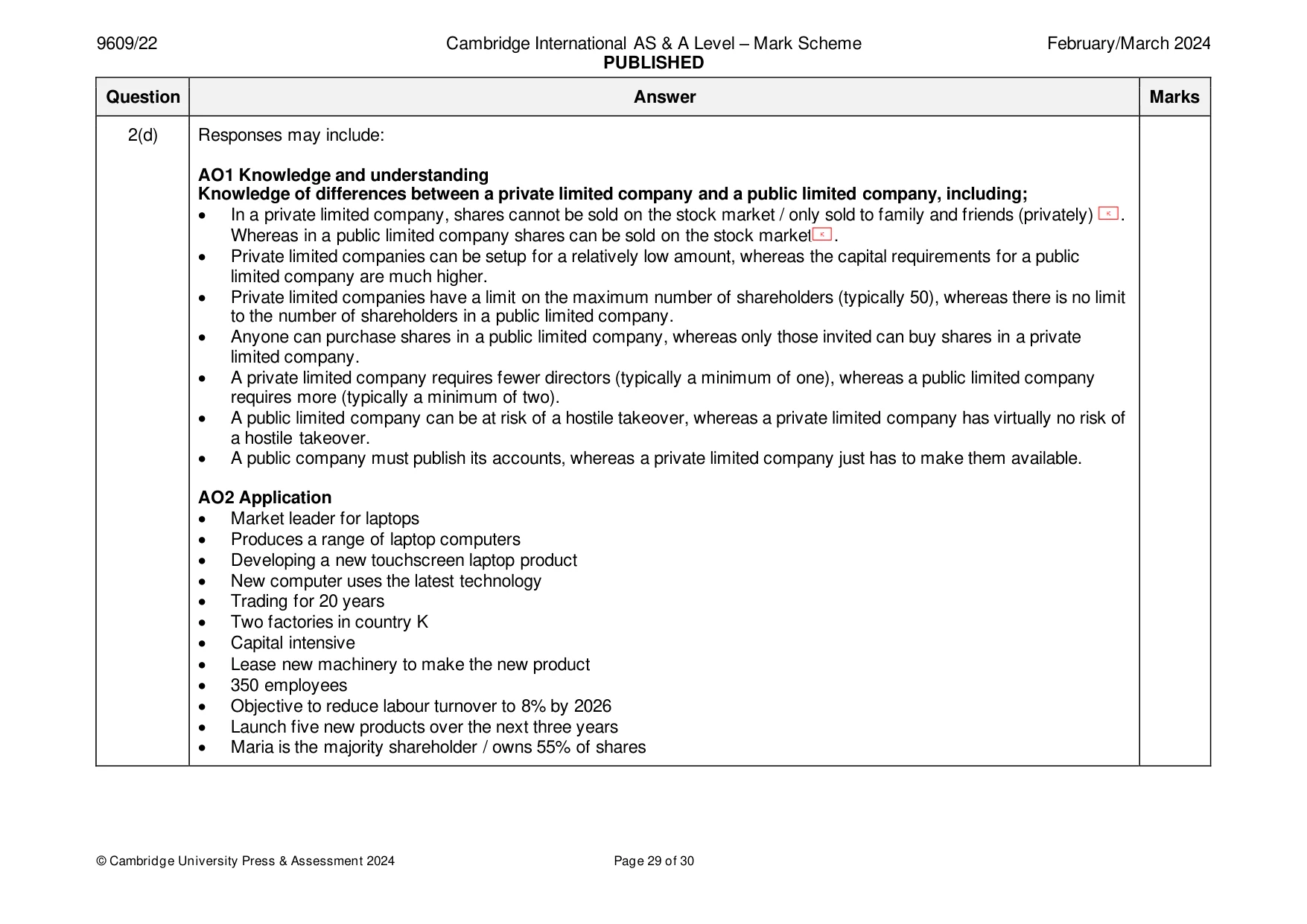
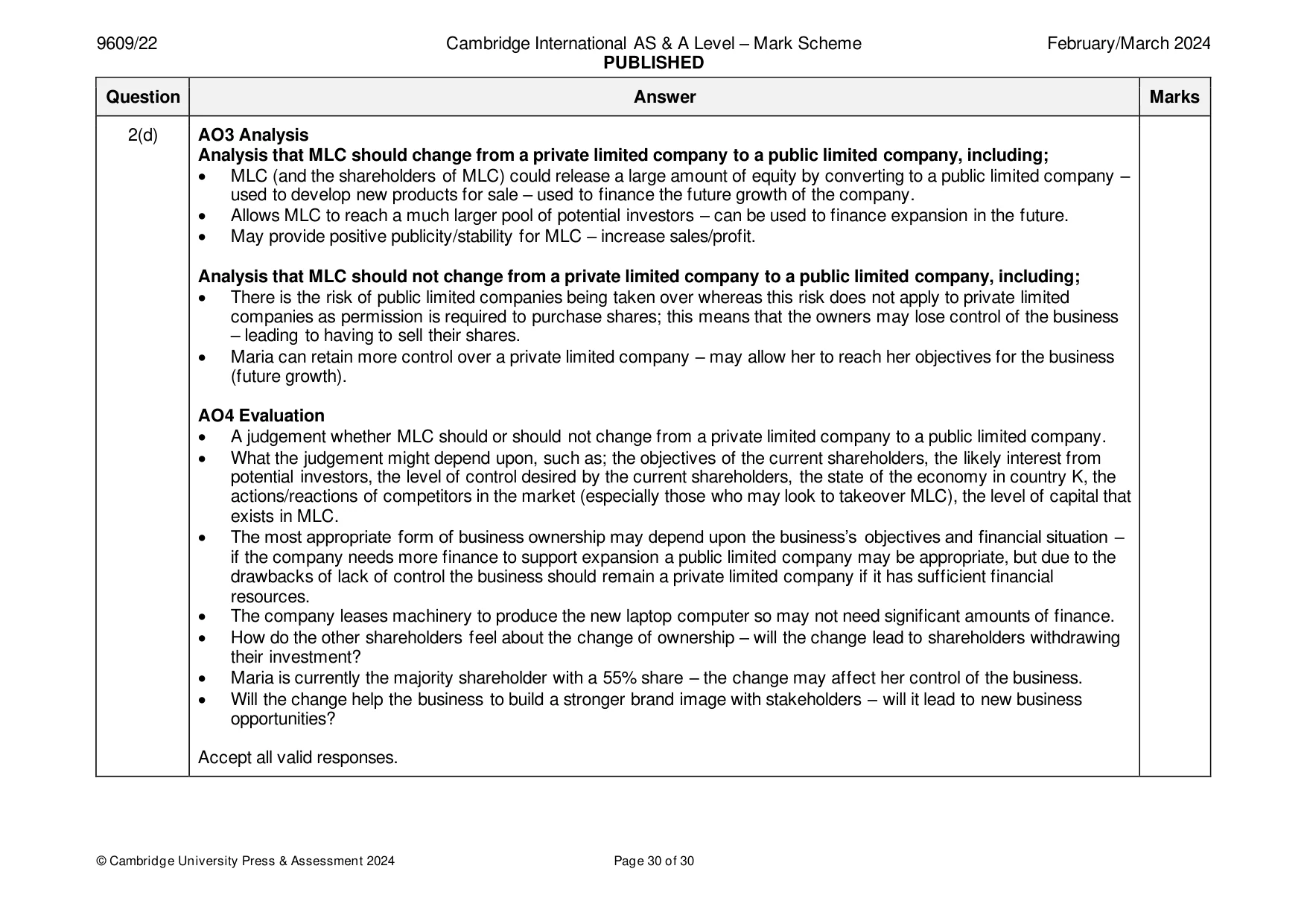
Mark scheme: 2(a)(i) Identify one secondary market research source. 1 Responses may include: • journal articles • Government data /census • textbooks • dictionaries and encyclopaedias • books • newspapers and magazines • accounts and reports • previous sales/internal data • competitor data • Data collected by other businesses • Feedback found on media / other sources – do not accept ‘internet’ unless the source is clear or other named internet source. Accept all valid responses. 2(a)(ii) Explain the term leasing. 3 AO1 Knowledge and understanding AO2 Application 1 mark 2 marks 2 marks Developed application of one relevant point to a business context. 1 mark 1 mark Knowledge of one relevant point is used to answer the Limited application of one relevant point to a business question. context. 0 marks 0 marks No creditable response. No creditable response. Indicative content Responses may include: AO1 Knowledge and understanding • A legal contract to enable the lessee to use an asset in return for a payment. • The ability to use something for a regular payment/rent. No further marks can be gained without knowledge and understanding AO2 Application A characteristic of leasing, such as; • The lessee will never own the asset. The asset is always owned by the lessor. • The lessor is usually responsible for maintenance of the asset. • The lessor may be responsible for insurance of the asset. • Allows a business to update their equipment more often. • An external source of finance. • Can avoid the finance needed to purchase an asset. Example of leasing or something that is usually leased by a business. Accept all valid responses. 2(b)(i) Refer to Table 2.1 and other information. Calculate the difference in labour turnover between factory A and factory 3 B. Answer Guidance Formula Award 3 marks for correct answer of 1.5% (with or Number of employees leaving business without percentage sign). = 100 (1) Average number of employees within business If rounding is used then accept 13% (and an answer OR of 1%). factory B: 25/200 100 (1) = 12.5% (2) = 14% – 12.5% (OFR) = 1.5% (3) Answer = 1.5% 2(b)(i) Exemplar and annotations Marks 3 marks Correct answer Working and % does not matter. 1.5% Must be three to denote the three marks. 2 marks • Correct calculation of labour turnover for To award two marks, there must be Factory B (12.5%) • Two and a OR OR • An incorrect answer with one mistake • One , one and one allowing OFR for final stage. 1 mark • Correct formula (can be assumed from the To award one mark, there must be: correct use of figures ie (25/200) X 100 • One and two 0 marks No creditable content. To award zero marks, there must be • One 2(b)(ii) Explain one advantage to MLC of low labour turnover. 3 AO1 Knowledge and understanding AO2 Application 1 mark 2 marks 2 marks Developed application of one relevant point to a business context. 1 mark 1 mark Knowledge of one relevant point is used to answer the Limited application of one relevant point to a business question. context. 0 marks 0 marks No creditable response. No creditable response. Knowledge Knowledge of an advantage of low labour turnover 1 mark Explanation Explanation of an advantage to MLC of low labour turnover 1 mark Context Context linked to an advantage to MLC of low labour turnover 1 mark No marks can be awarded without knowledge. Responses may include: AO1 Knowledge and understanding • Reduced costs • Improved motivation/morale • More experienced/efficient employees / higher productivity • Better customer experience • Improved corporate culture • More attractive when recruiting new employees No further marks can be gained without knowledge and understanding 2(b)(ii) AO2 Application Explanation may include: • Reduced costs; such as lower induction costs due to fewer new employees • Improved motivation/morale; because the workers want to stay in the workplace • More experienced/efficient employees / higher productivity – so the business will have more/better/higher quality production. • Better customer experience; because the employees are likely to be more experienced • Improved corporate culture; because the employees want to stay at MLC • More attractive when recruiting new employees; because the new recruits will be joining an experienced and happy team. Context may include: • Market leader for laptops • Produces a range of laptop computers • Developing a new touchscreen laptop computer • Secondary and primary market research shows high potential demand for the new product • Private limited company • Trading for 20 years • Two factories in Country K • Capital intensive • Lease new machinery to make the new computer • 350 employees • Objective to reduce labour turnover to 8% by 2026 • Labour turnover is 14% in Factory A • Labour turnover is 12.5% in Factory B (OFR) Accept all valid responses. 2(c) Analyse one advantage and one disadvantage to MLC of using price skimming to launch the new touchscreen 8 computer. Level AO1 Knowledge and AO2 Application AO3 Analysis understanding 2 marks 4 marks 2 marks 2 3–4 marks Developed analysis • Developed analysis that identifies connections between causes, impacts and/or consequences of two points. • Developed analysis that identifies connections between causes, impacts and/or consequences of one point. 1 1–2 marks 1–2 marks 1–2 marks • Knowledge of two • Application of two Limited analysis relevant points is relevant points to a • Limited analysis that identifies connections between used to answer the business context. causes, impacts and/or consequences of two points. question. • Application of one • Limited analysis that identifies connections between • Knowledge of one relevant point to a causes, impacts and/or consequences of one point. relevant point is business context. used to answer the question. 0 0 marks 0 marks 0 marks No creditable response. No creditable response. No creditable response. Price skimming is a pricing strategy in which a firm charges a high initial price and then gradually lowers the price to attract more price-sensitive customers. The pricing strategy is usually used by a first mover who faces little to no competition. 2(c) Responses may include: AO1 Knowledge and understanding Advantages: • Quicker return on investment / cover development costs • Supports higher profit margins when the computer is first offered for sale • Can help develop a prestigious brand image / associate product with higher quality • Can help the business target a specific market segment Disadvantages: • Relies on low competition in the market/unique product • Customers may wait until the price reduces • Customers who purchase the product at the higher price may feel ‘conned’ when/if the price reduces • Reduced sales volumes (whilst the price is high) may offer an opportunity for competitors to enter the market AO2 Application • Market leader for laptops • Produces a range of laptop computers • Secondary and primary market research shows high potential demand for the new computer • New computer will use the latest technology • Private limited company • Trading for 20 years • Capital intensive • Lease new machinery to make the new computer • Objective to reduce labour turnover to 8% by 2026 • Maria is the majority shareholder / owns 55% of shares 2(c) AO3 Analysis Advantages: • Quicker return on investment / cover development costs; make a profit more quickly – allows growth of the business. • Supports higher profit margins when the computer is first offered for sale; can be reinvested in the business – allows for profit maximisation in the long term. • Can help develop a prestigious brand image / associate product with higher quality; leading to higher sales revenue – increases profit. • Can help the business target a specific market segment; niche market can have a lower cost of customer acquisition – increases profit margin. Disadvantages: • Relies on low competition in the market/unique product; if competitors are cheaper then low sales – low profit margin. • Customers may wait until the price reduces; low initial sales – may lead to business failure. • Customers who purchase the product at the higher price may feel ‘conned’ when/if the price reduces; poor brand image – low sales. • Reduced sales volumes (whilst the price is high) may offer an opportunity for competitors to enter the market; low sales – leading to a reduced profit. Accept all valid responses. 2(d) Evaluate whether MLC should change from a private limited company to a public limited company. 12 Level AO1 Knowledge and AO2 Application AO3 Analysis AO4 Evaluation understanding 2 marks 2 marks 6 marks 2 marks 3 5–6 marks Developed evaluation in context • A developed judgement/conclusion is made in the business context. • Developed evaluative comments which balance some key arguments in the business context. 2 2 marks 2 marks 2 marks 3–4 marks Developed knowledge Developed application Developed analysis Developed evaluation of relevant key term(s) of relevant point(s) to that identifies • A developed and/or factor(s) is used the business context. connections between judgement/conclusion is to answer the question. causes, impacts and/or made. consequences. • Developed evaluative comments which balance some key arguments. 1 1 mark 1 mark 1 mark 1–2 marks Limited knowledge Limited application Limited analysis Limited evaluation of relevant key term(s) of relevant point(s) to that identifies • A judgement/conclusion is and/or factor(s) is used the business context. connections between made with limited to answer the question. causes, impacts and/or supporting consequences. comment/evidence. • An attempt is made to balance the arguments. 0 0 marks 0 marks 0 marks 0 marks No creditable response. No creditable response. No creditable response. No creditable response. 2(d) Responses may include: AO1 Knowledge and understanding Knowledge of differences between a private limited company and a public limited company, including; • In a private limited company, shares cannot be sold on the stock market / only sold to family and friends (privately) . Whereas in a public limited company shares can be sold on the stock market . • Private limited companies can be setup for a relatively low amount, whereas the capital requirements for a public limited company are much higher. • Private limited companies have a limit on the maximum number of shareholders (typically 50), whereas there is no limit to the number of shareholders in a public limited company. • Anyone can purchase shares in a public limited company, whereas only those invited can buy shares in a private limited company. • A private limited company requires fewer directors (typically a minimum of one), whereas a public limited company requires more (typically a minimum of two). • A public limited company can be at risk of a hostile takeover, whereas a private limited company has virtually no risk of a hostile takeover. • A public company must publish its accounts, whereas a private limited company just has to make them available. AO2 Application • Market leader for laptops • Produces a range of laptop computers • Developing a new touchscreen laptop product • New computer uses the latest technology • Trading for 20 years • Two factories in country K • Capital intensive • Lease new machinery to make the new product • 350 employees • Objective to reduce labour turnover to 8% by 2026 • Launch five new products over the next three years • Maria is the majority shareholder / owns 55% of shares 2(d) AO3 Analysis Analysis that MLC should change from a private limited company to a public limited company, including; • MLC (and the shareholders of MLC) could release a large amount of equity by converting to a public limited company – used to develop new products for sale – used to finance the future growth of the company. • Allows MLC to reach a much larger pool of potential investors – can be used to finance expansion in the future. • May provide positive publicity/stability for MLC – increase sales/profit. Analysis that MLC should not change from a private limited company to a public limited company, including; • There is the risk of public limited companies being taken over whereas this risk does not apply to private limited companies as permission is required to purchase shares; this means that the owners may lose control of the business – leading to having to sell their shares. • Maria can retain more control over a private limited company – may allow her to reach her objectives for the business (future growth). AO4 Evaluation • A judgement whether MLC should or should not change from a private limited company to a public limited company. • What the judgement might depend upon, such as; the objectives of the current shareholders, the likely interest from potential investors, the level of control desired by the current shareholders, the state of the economy in country K, the actions/reactions of competitors in the market (especially those who may look to takeover MLC), the level of capital that exists in MLC. • The most appropriate form of business ownership may depend upon the business’s objectives and financial situation – if the company needs more finance to support expansion a public limited company may be appropriate, but due to the drawbacks of lack of control the business should remain a private limited company if it has sufficient financial resources. • The company leases machinery to produce the new laptop computer so may not need significant amounts of finance. • How do the other shareholders feel about the change of ownership – will the change lead to shareholders withdrawing their investment? • Maria is currently the majority shareholder with a 55% share – the change may affect her control of the business. • Will the change help the business to build a stronger brand image with stakeholders – will it lead to new business opportunities? Accept all valid responses.
What was in this paper
The subtopics covered by these 2 questions, and how many questions each got. Open one in a new tab to see every Cambridge question on it.
What you needed in this session
Cambridge’s own grade thresholds for 2024 Feb/March, Paper 2 · Variant 2. A higher threshold means an easier paper — the bar moves with how the cohort did.