Cambridge A Level Business (for first examination in 2016) 9609 — 2017 May/June Paper 2 · Variant 1
9609/21/M/J/17 · 2 questions · 60 marks · ≈68 min
The question paper and its mark scheme, free to read here and free to download. This is Cambridge’s own paper, exactly as it was sat.
Question paper4 pages


Mark scheme17 pages
Answers below. Sit the paper first if you are practising.
Questions as text
Q1 · Magical Mirrors (MM) MM manufactures a range of mirrors using flow production
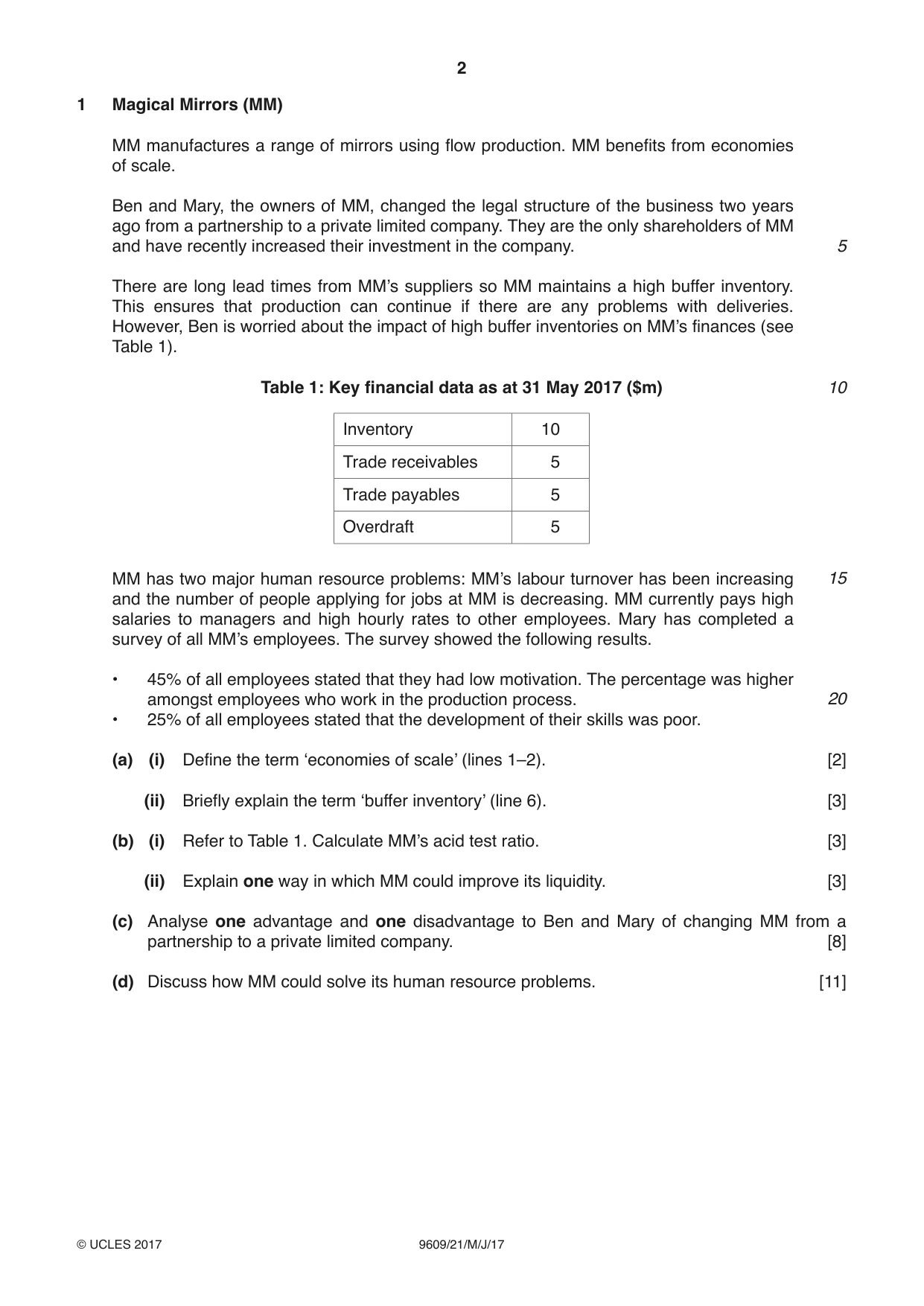
1 Magical Mirrors (MM) MM manufactures a range of mirrors using flow production. MM benefits from economies of scale. Ben and Mary, the owners of MM, changed the legal structure of the business two years ago from a partnership to a private limited company. They are the only shareholders of MM and have recently increased their investment in the company. 5 There are long lead times from MM’s suppliers so MM maintains a high buffer inventory. This ensures that production can continue if there are any problems with deliveries. However, Ben is worried about the impact of high buffer inventories on MM’s finances (see Table 1). Table 1: Key financial data as at 31 May 2017 ($m) 10 Inventory 10 Trade receivables 5 Trade payables 5 Overdraft 5 MM has two major human resource problems: MM’s labour turnover has been increasing 15 and the number of people applying for jobs at MM is decreasing. MM currently pays high salaries to managers and high hourly rates to other employees. Mary has completed a survey of all MM’s employees. The survey showed the following results. • 45% of all employees stated that they had low motivation. The percentage was higher amongst employees who work in the production process. 20 • 25% of all employees stated that the development of their skills was poor. (a) (i) Define the term ‘economies of scale’ (lines 1–2). [2] (ii) Briefly explain the term ‘buffer inventory’ (line 6). [3] (b) (i) Refer to Table 1. Calculate MM’s acid test ratio. [3] (ii) Explain one way in which MM could improve its liquidity. [3] (c) Analyse one advantage and one disadvantage to Ben and Mary of changing MM from a partnership to a private limited company. [8] (d) Discuss how MM could solve its human resource problems. [11]
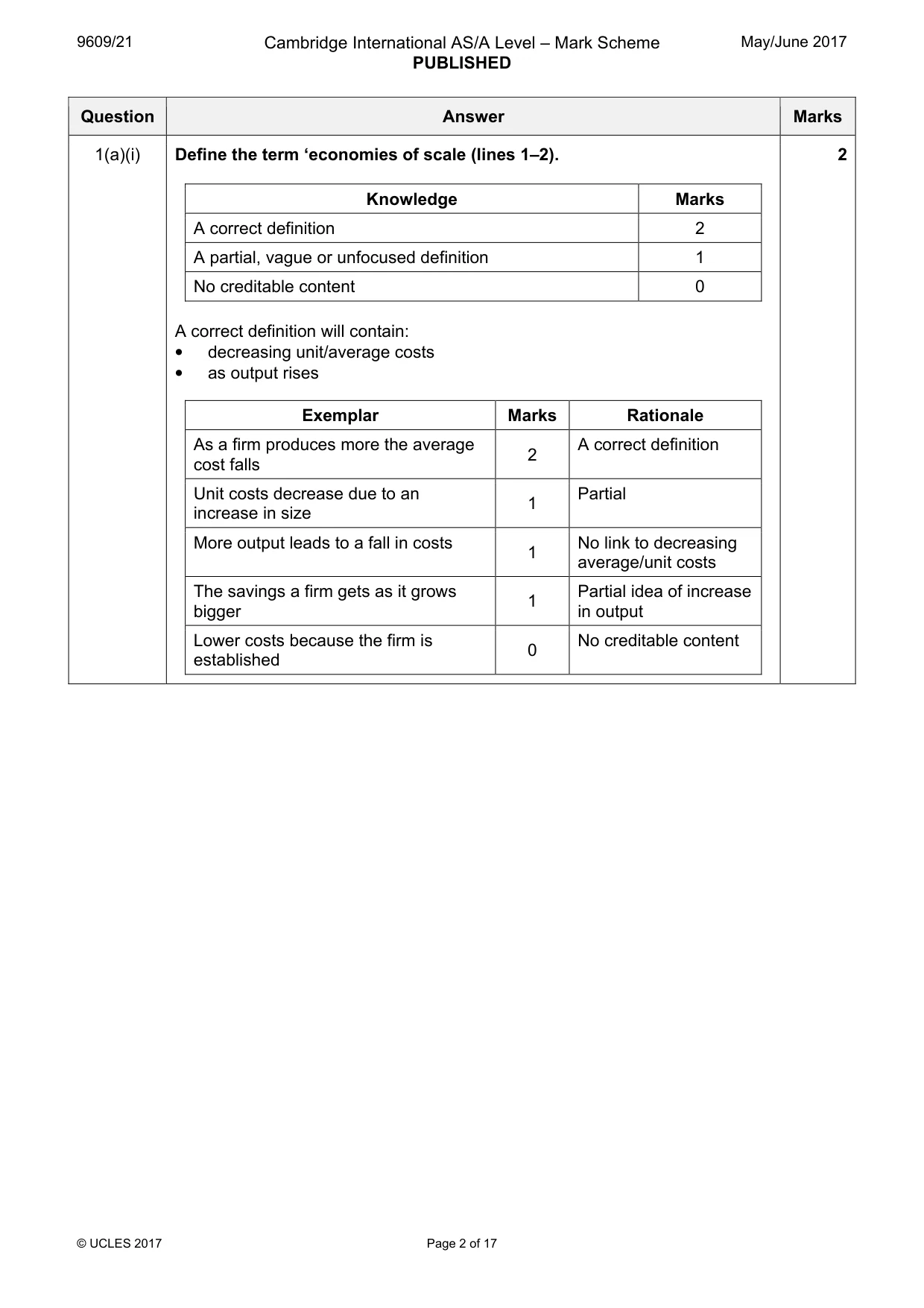
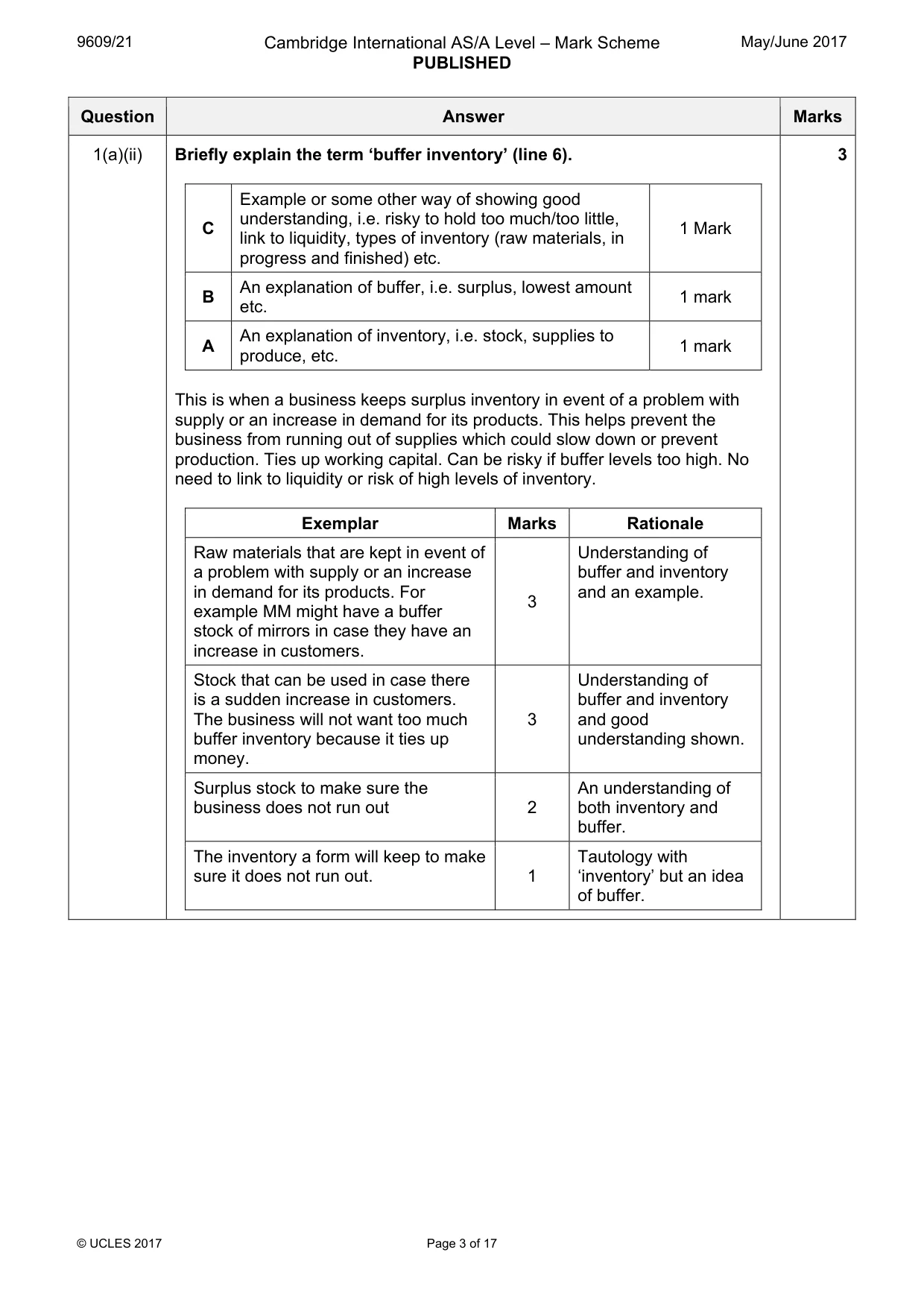
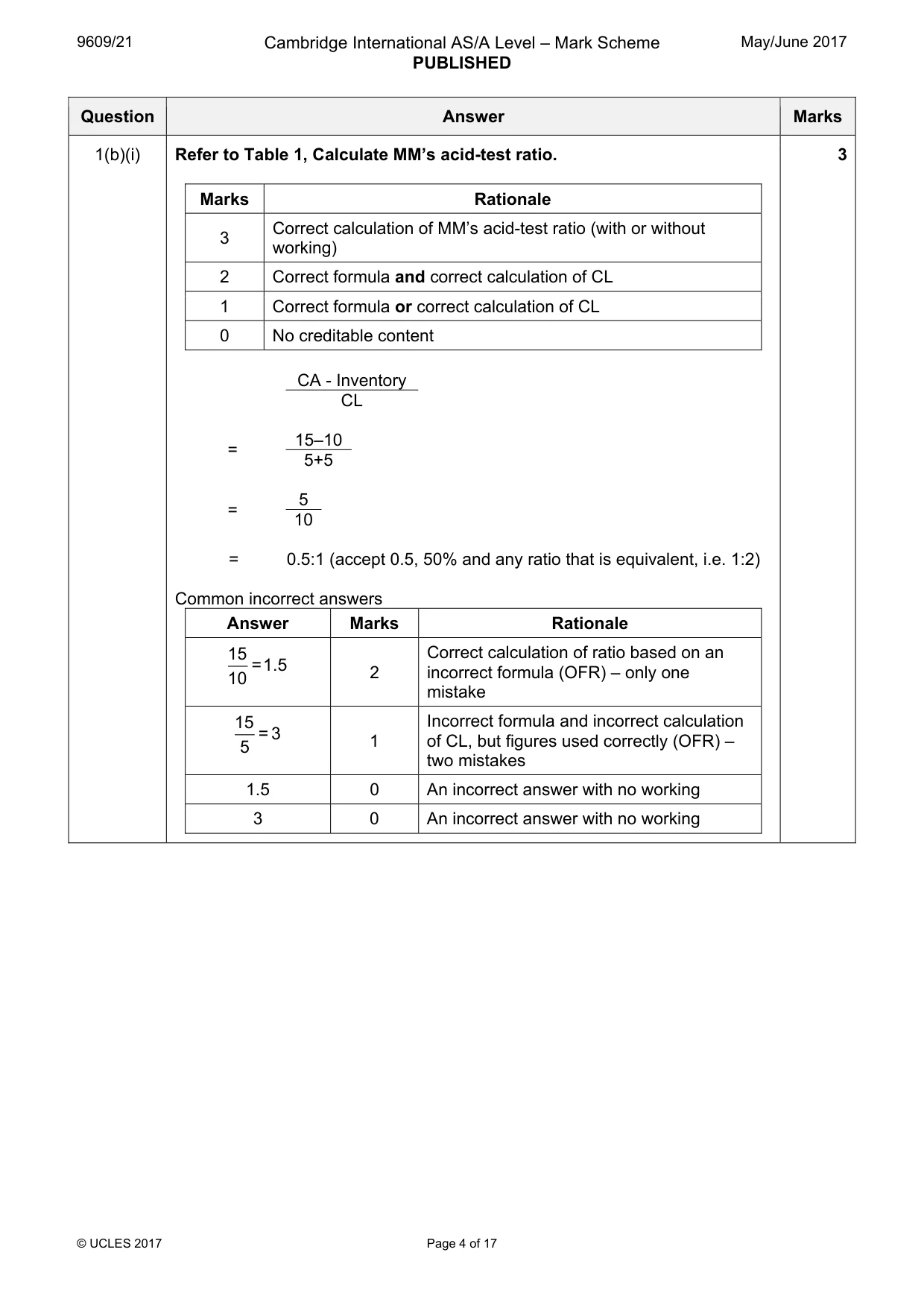
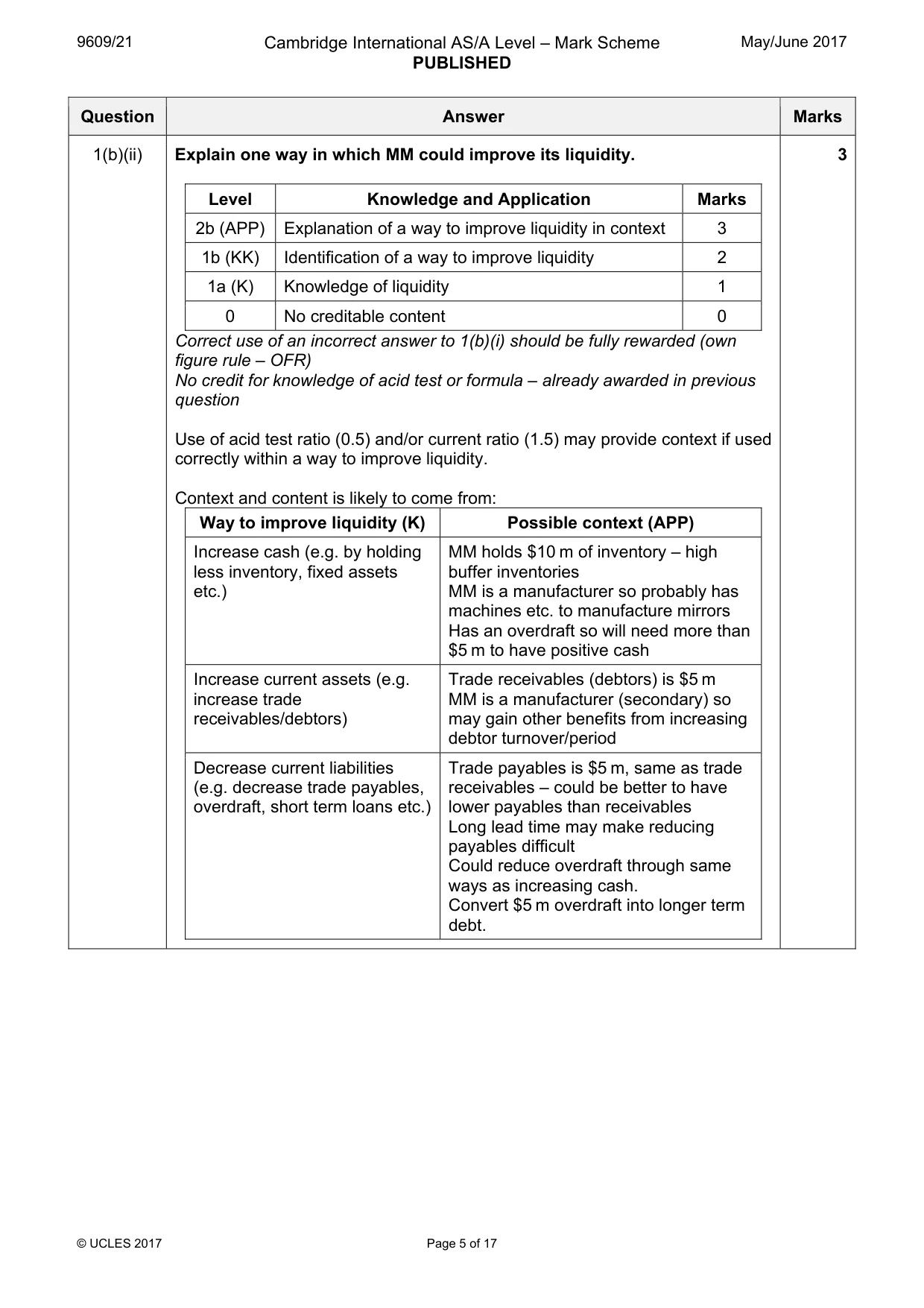
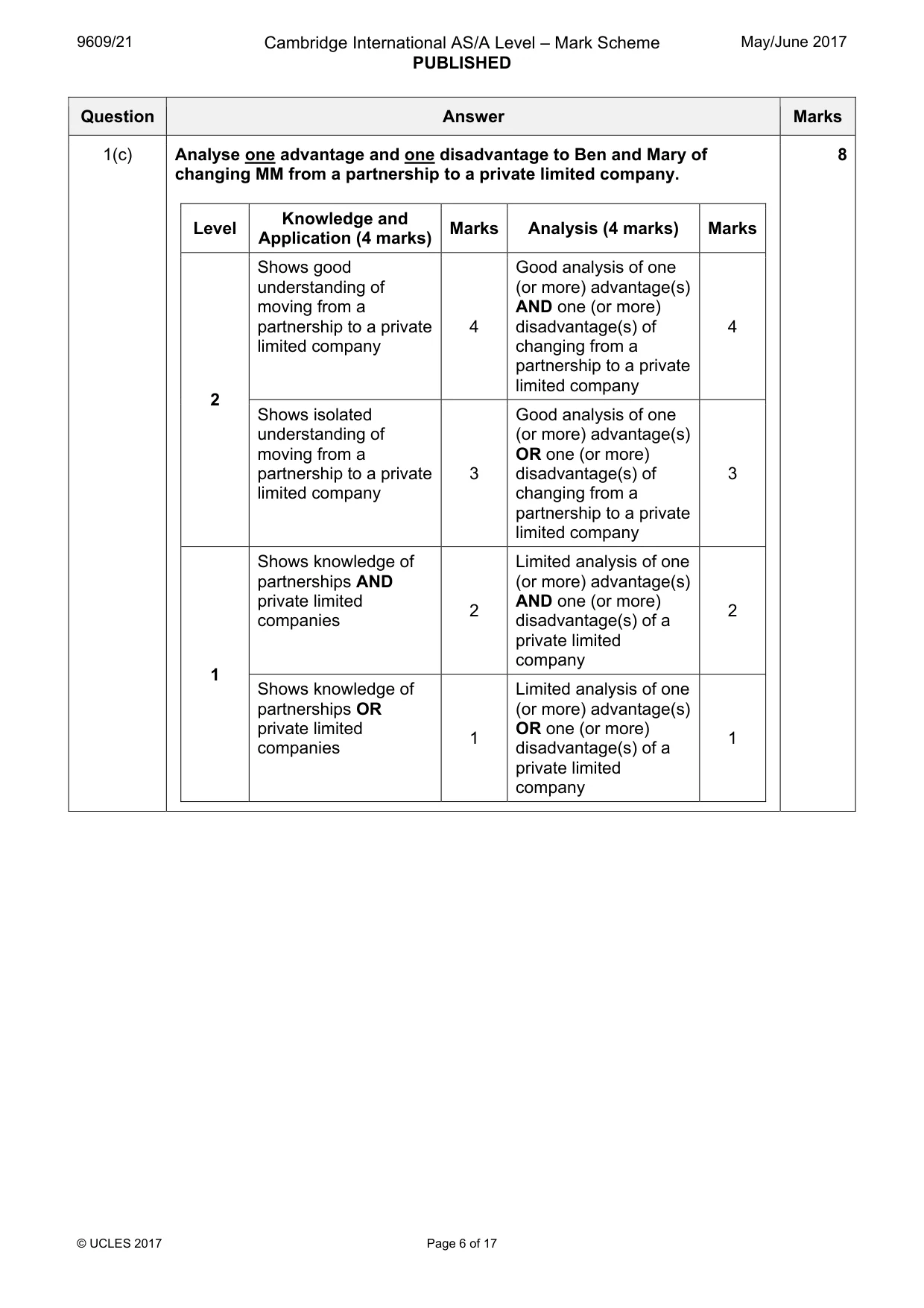
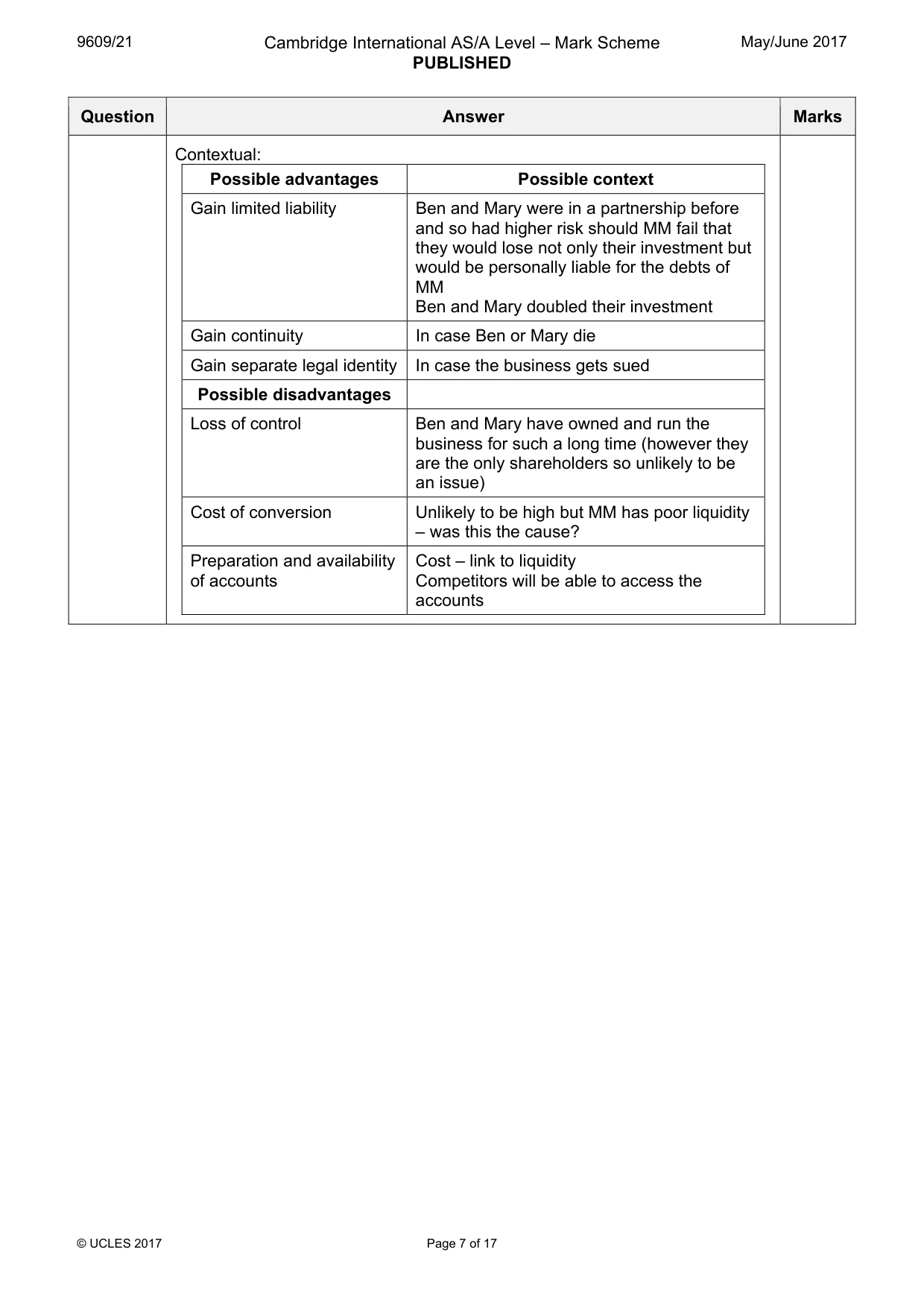
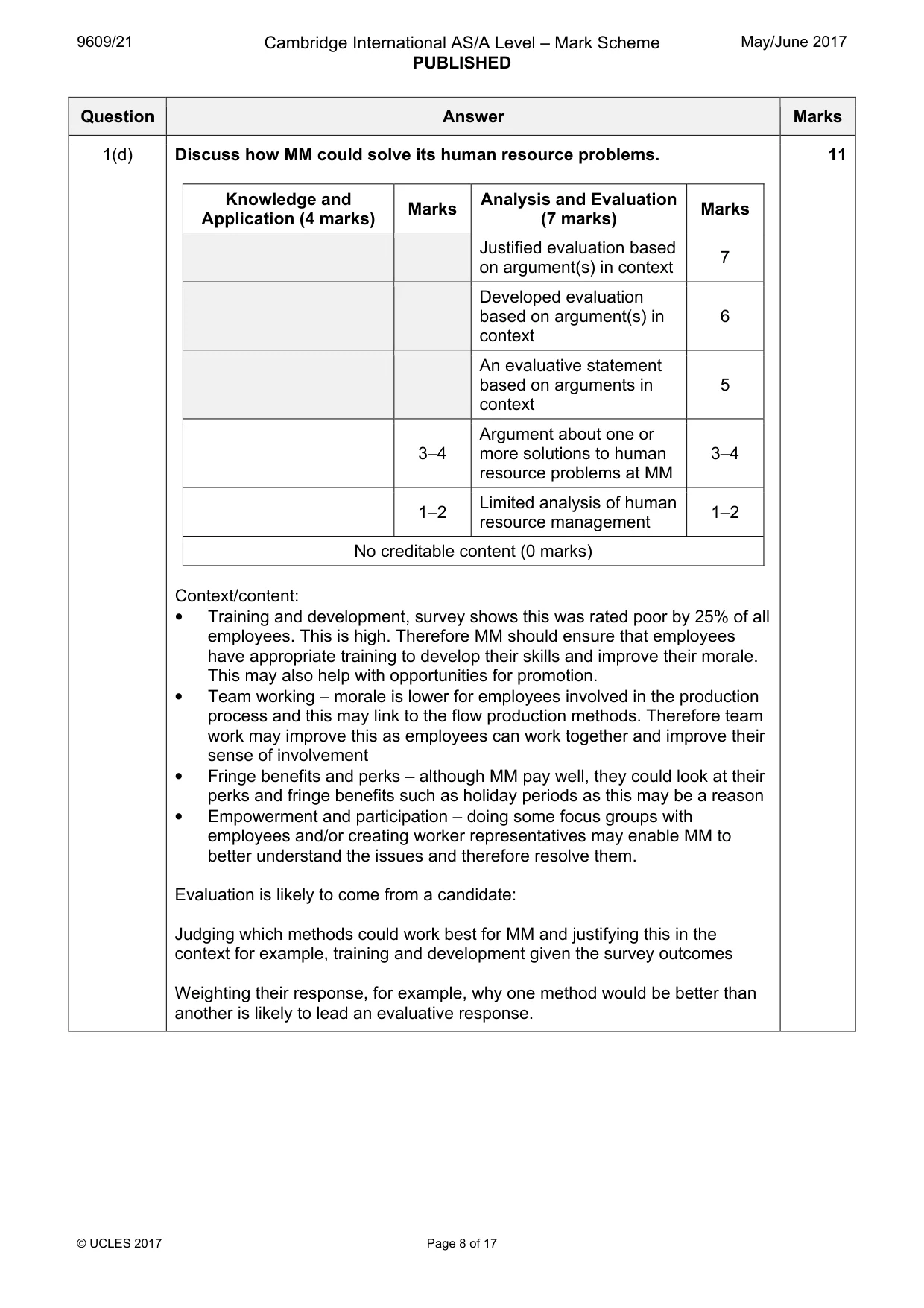
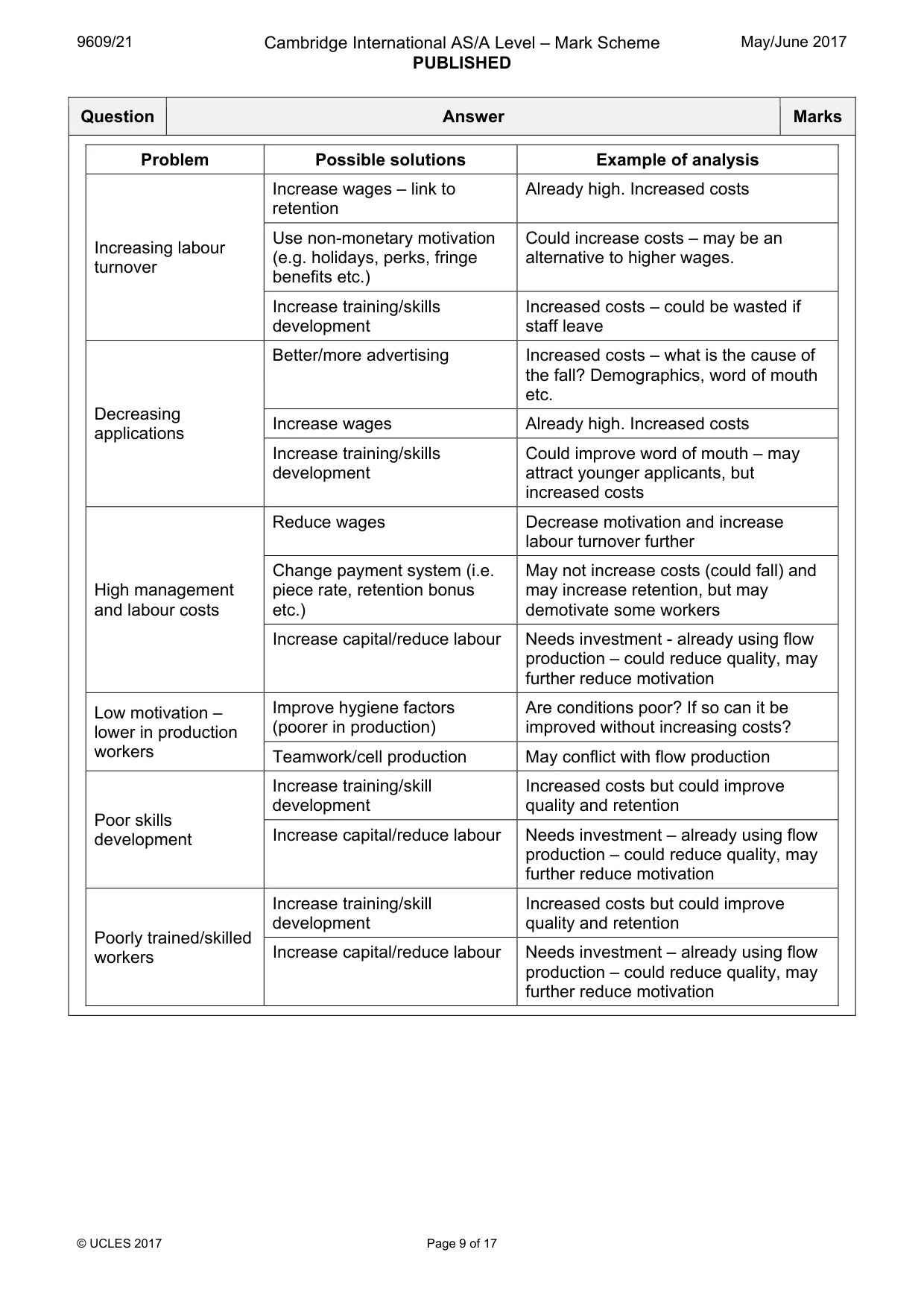
Mark scheme: Question Answer Marks 1(a)(i) Define the term ‘economies of scale (lines 1–2). 2 Knowledge Marks A correct definition 2 A partial, vague or unfocused definition 1 No creditable content 0 A correct definition will contain: • decreasing unit/average costs • as output rises Exemplar Marks Rationale As a firm produces more the average A correct definition 2 cost falls Unit costs decrease due to an Partial 1 increase in size More output leads to a fall in costs No link to decreasing 1 average/unit costs The savings a firm gets as it grows Partial idea of increase 1 bigger in output Lower costs because the firm is No creditable content 0 established 1(a)(ii) Briefly explain the term ‘buffer inventory’ (line 6). 3 Example or some other way of showing good understanding, i.e. risky to hold too much/too little, C 1 Mark link to liquidity, types of inventory (raw materials, in progress and finished) etc. An explanation of buffer, i.e. surplus, lowest amount B 1 mark etc. An explanation of inventory, i.e. stock, supplies to A 1 mark produce, etc. This is when a business keeps surplus inventory in event of a problem with supply or an increase in demand for its products. This helps prevent the business from running out of supplies which could slow down or prevent production. Ties up working capital. Can be risky if buffer levels too high. No need to link to liquidity or risk of high levels of inventory. Exemplar Marks Rationale Raw materials that are kept in event of Understanding of a problem with supply or an increase buffer and inventory in demand for its products. For and an example. 3 example MM might have a buffer stock of mirrors in case they have an increase in customers. Stock that can be used in case there Understanding of is a sudden increase in customers. buffer and inventory The business will not want too much 3 and good buffer inventory because it ties up understanding shown. money. Surplus stock to make sure the An understanding of business does not run out 2 both inventory and buffer. The inventory a form will keep to make Tautology with sure it does not run out. 1 ‘inventory’ but an idea of buffer. 1(b)(i) Refer to Table 1, Calculate MM’s acid-test ratio. 3 Marks Rationale Correct calculation of MM’s acid-test ratio (with or without 3 working) 2 Correct formula and correct calculation of CL 1 Correct formula or correct calculation of CL 0 No creditable content CA - Inventory CL 15–10 = 5+5 5 = 10 = 0.5:1 (accept 0.5, 50% and any ratio that is equivalent, i.e. 1:2) Common incorrect answers Answer Marks Rationale 15 Correct calculation of ratio based on an =1.5 2 incorrect formula (OFR) – only one 10 mistake 15 Incorrect formula and incorrect calculation = 3 1 of CL, but figures used correctly (OFR) – 5 two mistakes 1.5 0 An incorrect answer with no working 3 0 An incorrect answer with no working 1(b)(ii) Explain one way in which MM could improve its liquidity. 3 Level Knowledge and Application Marks 2b (APP) Explanation of a way to improve liquidity in context 3 1b (KK) Identification of a way to improve liquidity 2 1a (K) Knowledge of liquidity 1 0 No creditable content 0 Correct use of an incorrect answer to 1(b)(i) should be fully rewarded (own figure rule – OFR) No credit for knowledge of acid test or formula – already awarded in previous question Use of acid test ratio (0.5) and/or current ratio (1.5) may provide context if used correctly within a way to improve liquidity. Context and content is likely to come from: Way to improve liquidity (K) Possible context (APP) Increase cash (e.g. by holding MM holds $10 m of inventory – high less inventory, fixed assets buffer inventories etc.) MM is a manufacturer so probably has machines etc. to manufacture mirrors Has an overdraft so will need more than $5 m to have positive cash Increase current assets (e.g. Trade receivables (debtors) is $5 m increase trade MM is a manufacturer (secondary) so receivables/debtors) may gain other benefits from increasing debtor turnover/period Decrease current liabilities Trade payables is $5 m, same as trade (e.g. decrease trade payables, receivables – could be better to have overdraft, short term loans etc.) lower payables than receivables Long lead time may make reducing payables difficult Could reduce overdraft through same ways as increasing cash. Convert $5 m overdraft into longer term debt. 1(c) Analyse one advantage and one disadvantage to Ben and Mary of 8 changing MM from a partnership to a private limited company. Knowledge and Level Marks Analysis (4 marks) Marks Application (4 marks) Shows good Good analysis of one understanding of (or more) advantage(s) moving from a AND one (or more) partnership to a private 4 disadvantage(s) of 4 limited company changing from a partnership to a private limited company 2 Shows isolated Good analysis of one understanding of (or more) advantage(s) moving from a OR one (or more) partnership to a private 3 disadvantage(s) of 3 limited company changing from a partnership to a private limited company Shows knowledge of Limited analysis of one partnerships AND (or more) advantage(s) private limited AND one (or more) 2 2 companies disadvantage(s) of a private limited company 1 Shows knowledge of Limited analysis of one partnerships OR (or more) advantage(s) private limited OR one (or more) 1 1 companies disadvantage(s) of a private limited company Contextual: Possible advantages Possible context Gain limited liability Ben and Mary were in a partnership before and so had higher risk should MM fail that they would lose not only their investment but would be personally liable for the debts of MM Ben and Mary doubled their investment Gain continuity In case Ben or Mary die Gain separate legal identity In case the business gets sued Possible disadvantages Loss of control Ben and Mary have owned and run the business for such a long time (however they are the only shareholders so unlikely to be an issue) Cost of conversion Unlikely to be high but MM has poor liquidity – was this the cause? Preparation and availability Cost – link to liquidity of accounts Competitors will be able to access the accounts 1(d) Discuss how MM could solve its human resource problems. 11 Knowledge and Analysis and Evaluation Marks Marks Application (4 marks) (7 marks) Justified evaluation based 7 on argument(s) in context Developed evaluation based on argument(s) in 6 context An evaluative statement based on arguments in 5 context Argument about one or 3–4 more solutions to human 3–4 resource problems at MM Limited analysis of human 1–2 1–2 resource management No creditable content (0 marks) Context/content: • Training and development, survey shows this was rated poor by 25% of all employees. This is high. Therefore MM should ensure that employees have appropriate training to develop their skills and improve their morale. This may also help with opportunities for promotion. • Team working – morale is lower for employees involved in the production process and this may link to the flow production methods. Therefore team work may improve this as employees can work together and improve their sense of involvement • Fringe benefits and perks – although MM pay well, they could look at their perks and fringe benefits such as holiday periods as this may be a reason • Empowerment and participation – doing some focus groups with employees and/or creating worker representatives may enable MM to better understand the issues and therefore resolve them. Evaluation is likely to come from a candidate: Judging which methods could work best for MM and justifying this in the context for example, training and development given the survey outcomes Weighting their response, for example, why one method would be better than another is likely to lead an evaluative response. Problem Possible solutions Example of analysis Increase wages – link to Already high. Increased costs retention Use non-monetary motivation Could increase costs – may be an Increasing labour (e.g. holidays, perks, fringe alternative to higher wages. turnover benefits etc.) Increase training/skills Increased costs – could be wasted if development staff leave Better/more advertising Increased costs – what is the cause of the fall? Demographics, word of mouth etc. Decreasing Increase wages Already high. Increased costs applications Increase training/skills Could improve word of mouth – may development attract younger applicants, but increased costs Reduce wages Decrease motivation and increase labour turnover further Change payment system (i.e. May not increase costs (could fall) and High management piece rate, retention bonus may increase retention, but may and labour costs etc.) demotivate some workers Increase capital/reduce labour Needs investment - already using flow production – could reduce quality, may further reduce motivation Improve hygiene factors Are conditions poor? If so can it be Low motivation – (poorer in production) improved without increasing costs? lower in production workers Teamwork/cell production May conflict with flow production Increase training/skill Increased costs but could improve development quality and retention Poor skills Increase capital/reduce labour Needs investment – already using flow development production – could reduce quality, may further reduce motivation Increase training/skill Increased costs but could improve development quality and retention Poorly trained/skilled Increase capital/reduce labour Needs investment – already using flow workers production – could reduce quality, may further reduce motivation
Q2 · Security Alarms (SA) SA was set up 20 years ago as a partnership
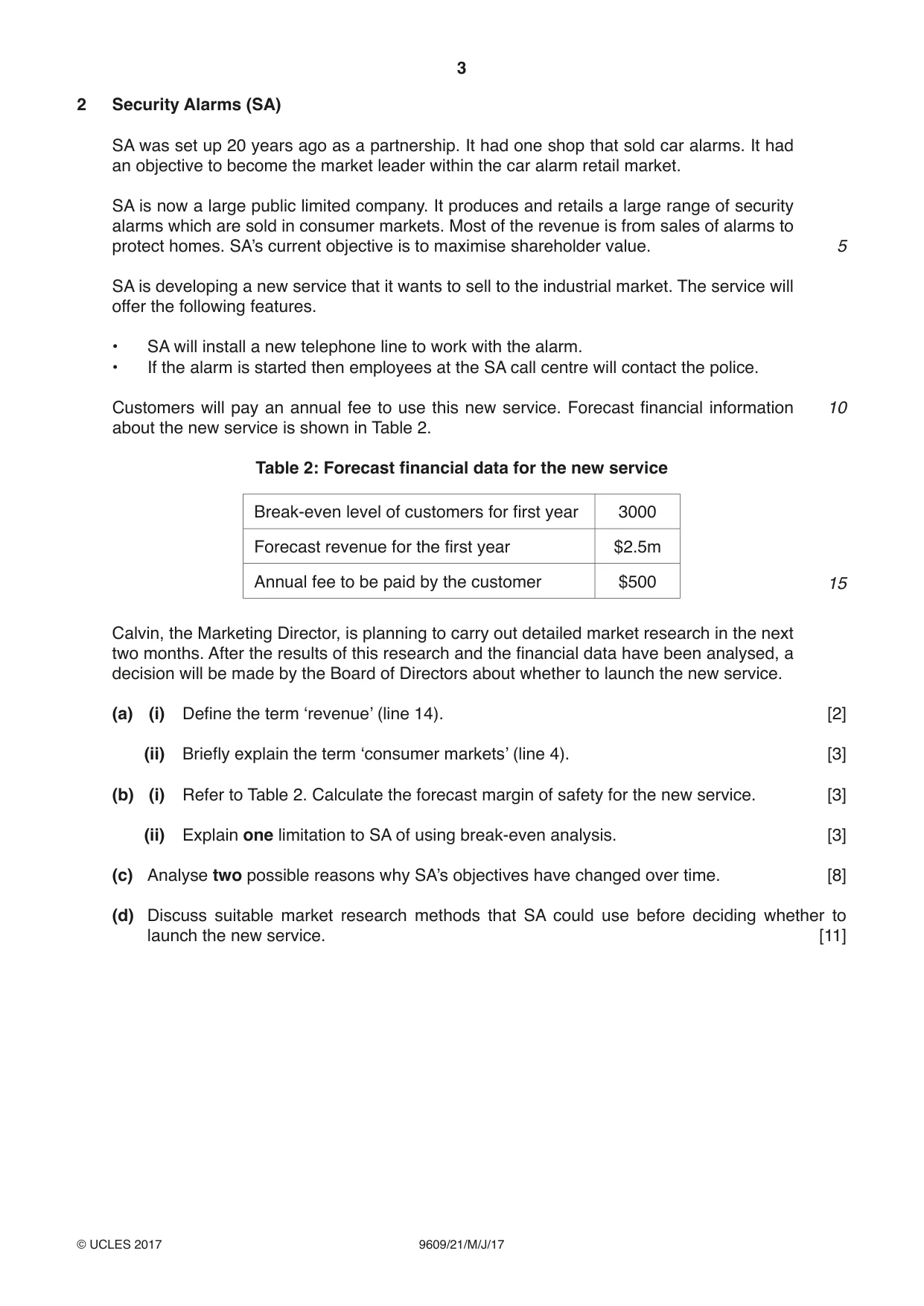
2 Security Alarms (SA) SA was set up 20 years ago as a partnership. It had one shop that sold car alarms. It had an objective to become the market leader within the car alarm retail market. SA is now a large public limited company. It produces and retails a large range of security alarms which are sold in consumer markets. Most of the revenue is from sales of alarms to protect homes. SA’s current objective is to maximise shareholder value. 5 SA is developing a new service that it wants to sell to the industrial market. The service will offer the following features. • SA will install a new telephone line to work with the alarm. • If the alarm is started then employees at the SA call centre will contact the police. Customers will pay an annual fee to use this new service. Forecast financial information 10 about the new service is shown in Table 2. Table 2: Forecast financial data for the new service Break-even level of customers for first year 3000 Forecast revenue for the first year $2.5m Annual fee to be paid by the customer $500 15 Calvin, the Marketing Director, is planning to carry out detailed market research in the next two months. After the results of this research and the financial data have been analysed, a decision will be made by the Board of Directors about whether to launch the new service. (a) (i) Define the term ‘revenue’ (line 14). [2] (ii) Briefly explain the term ‘consumer markets’ (line 4). [3] (b) (i) Refer to Table 2. Calculate the forecast margin of safety for the new service. [3] (ii) Explain one limitation to SA of using break-even analysis. [3] (c) Analyse two possible reasons why SA’s objectives have changed over time. [8] (d) Discuss suitable market research methods that SA could use before deciding whether to launch the new service. [11]
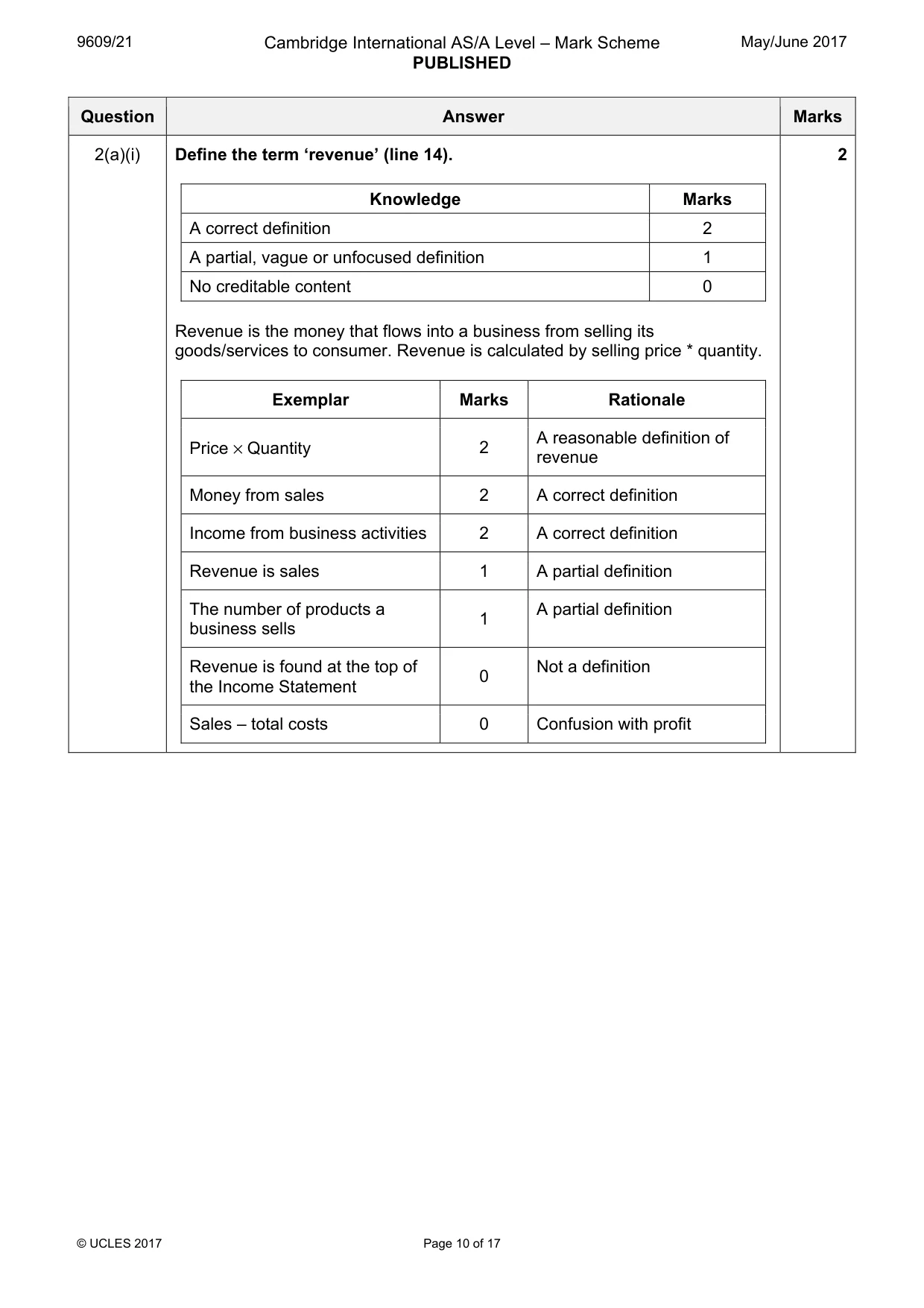
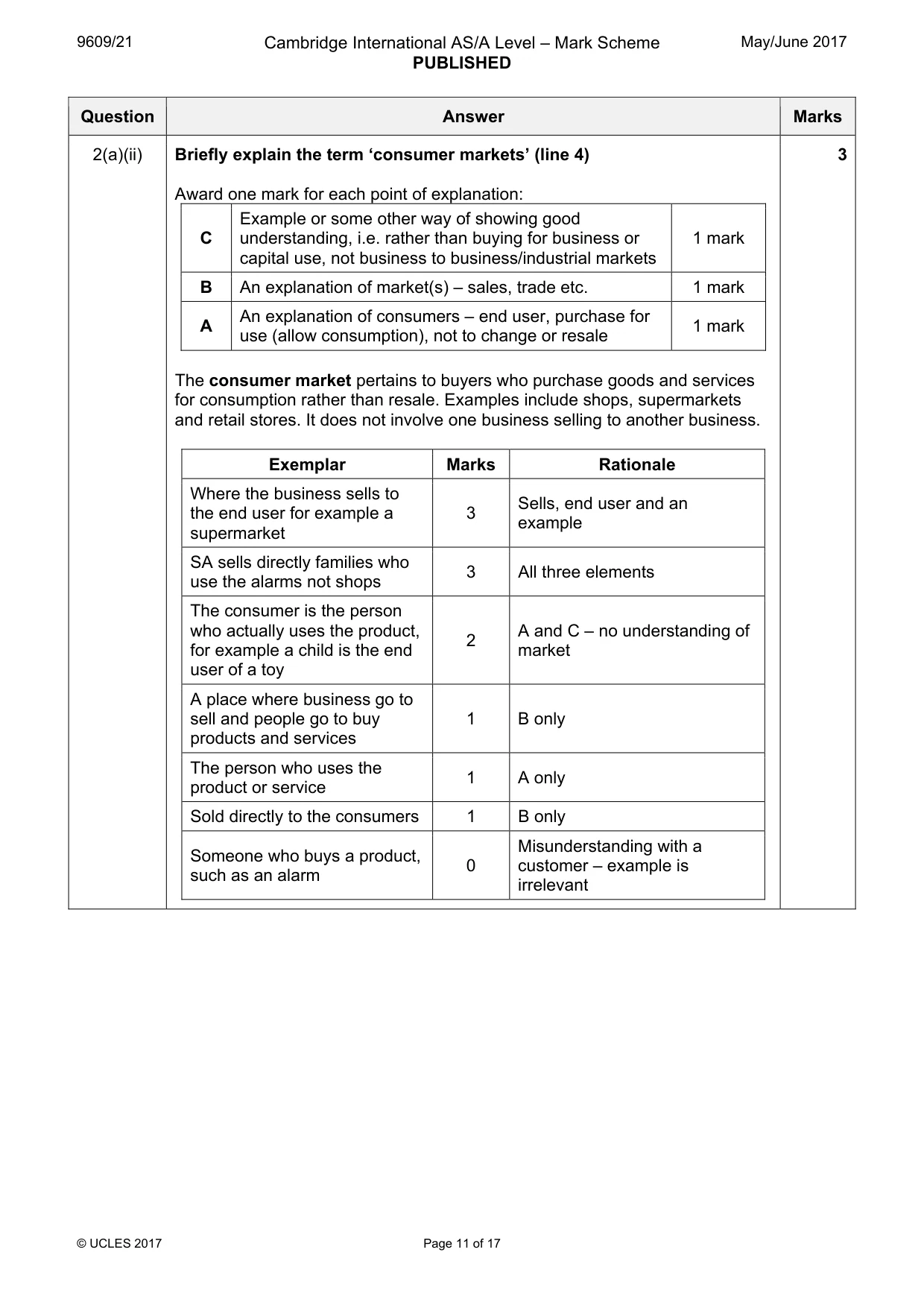
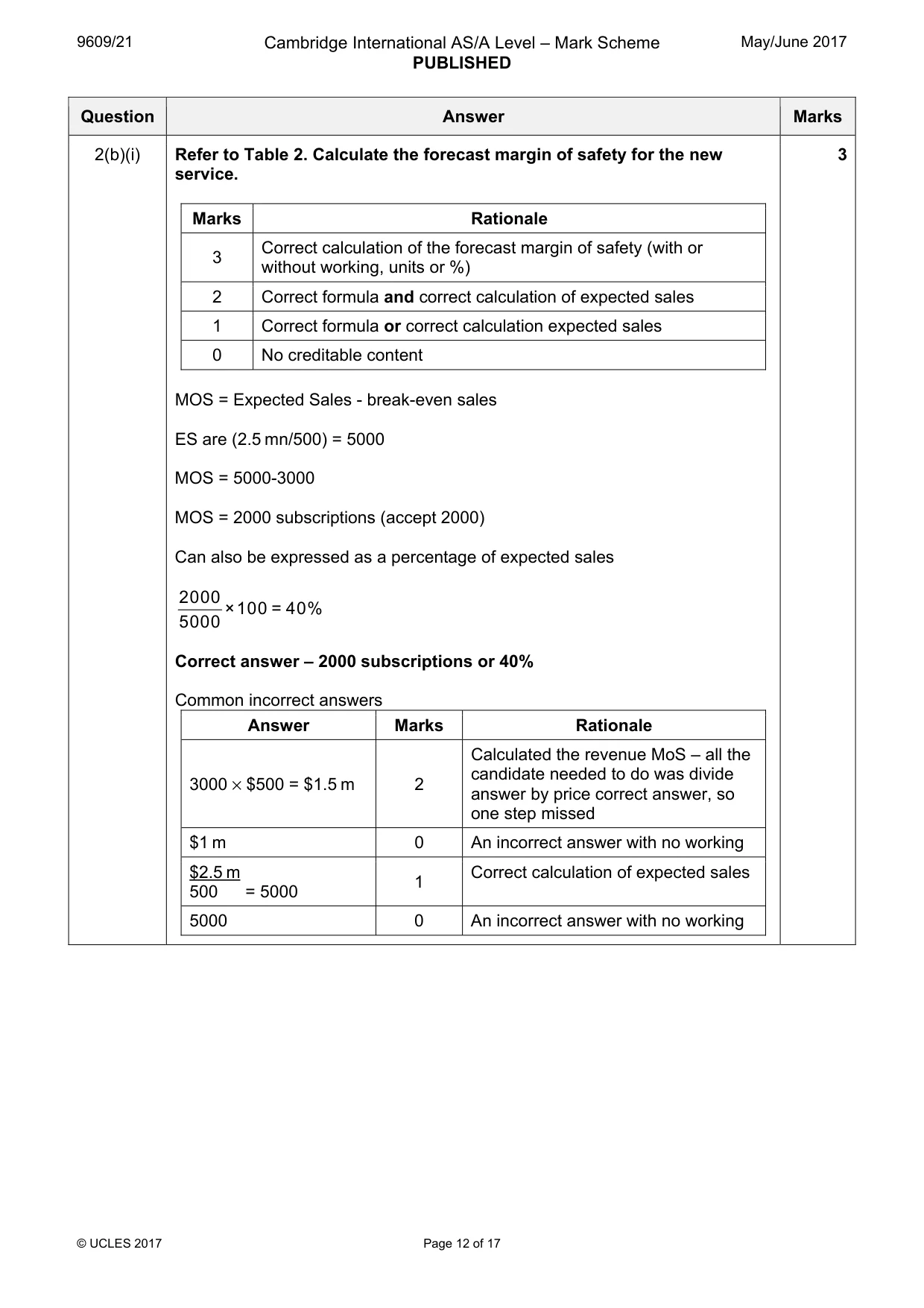
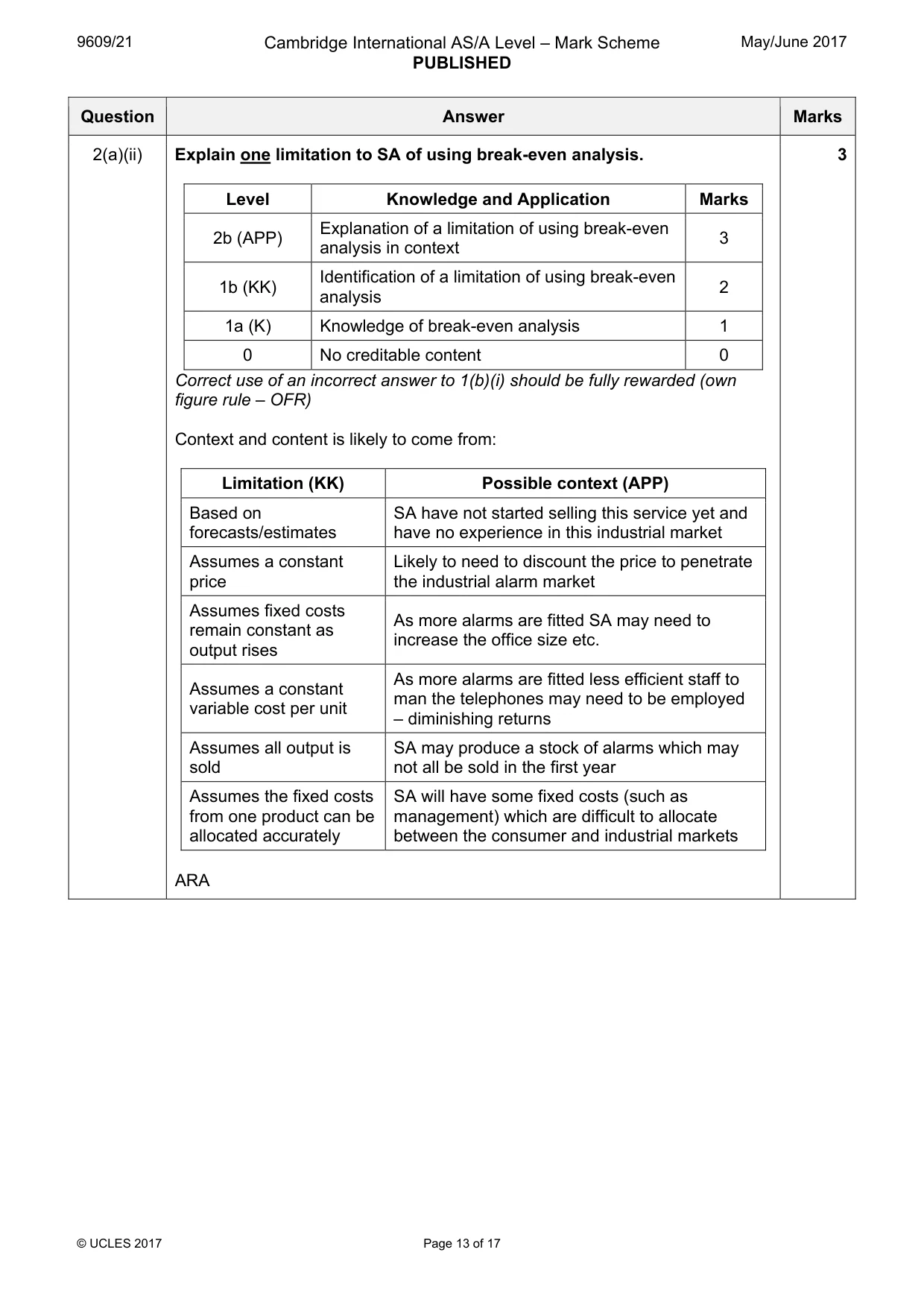
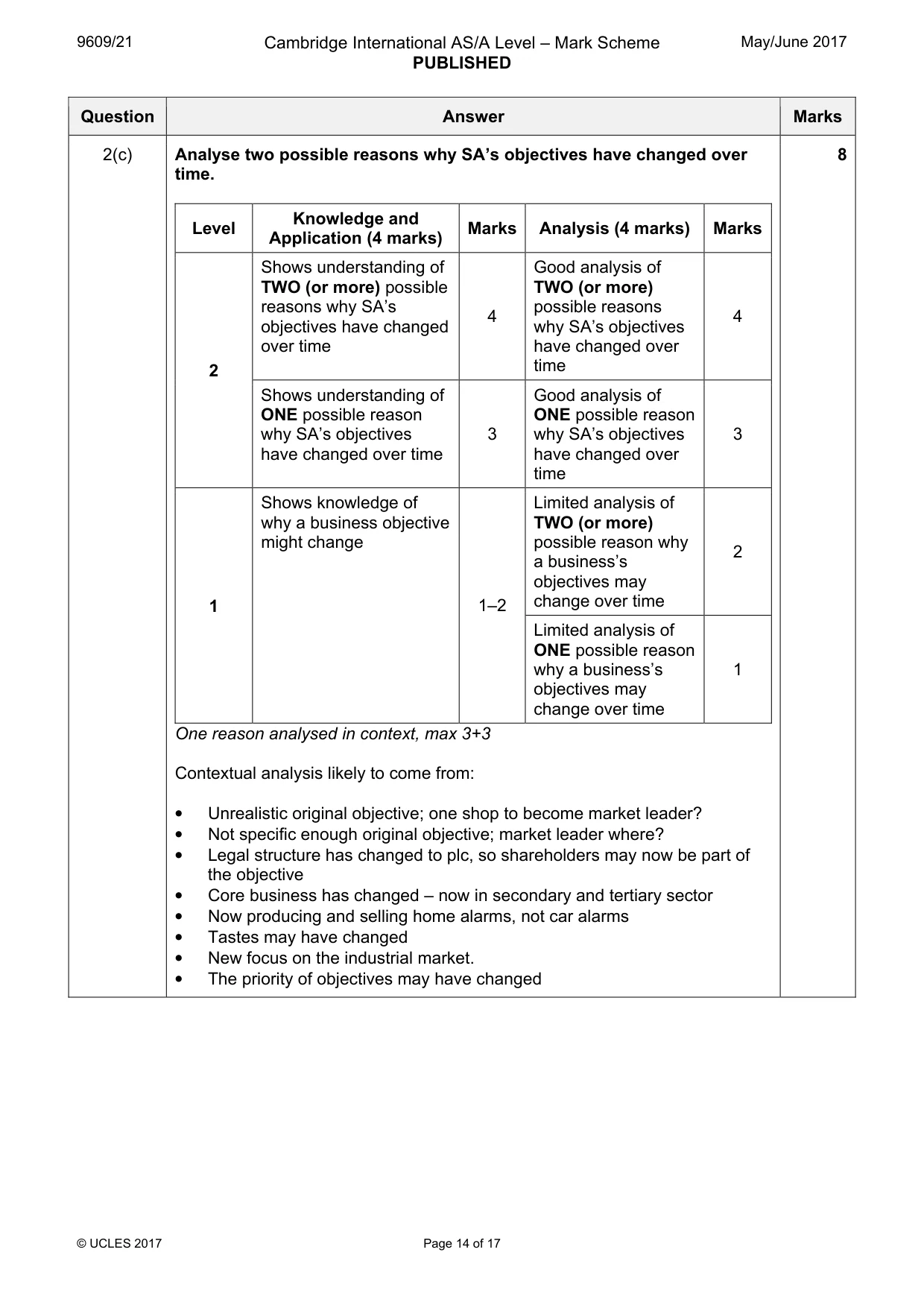
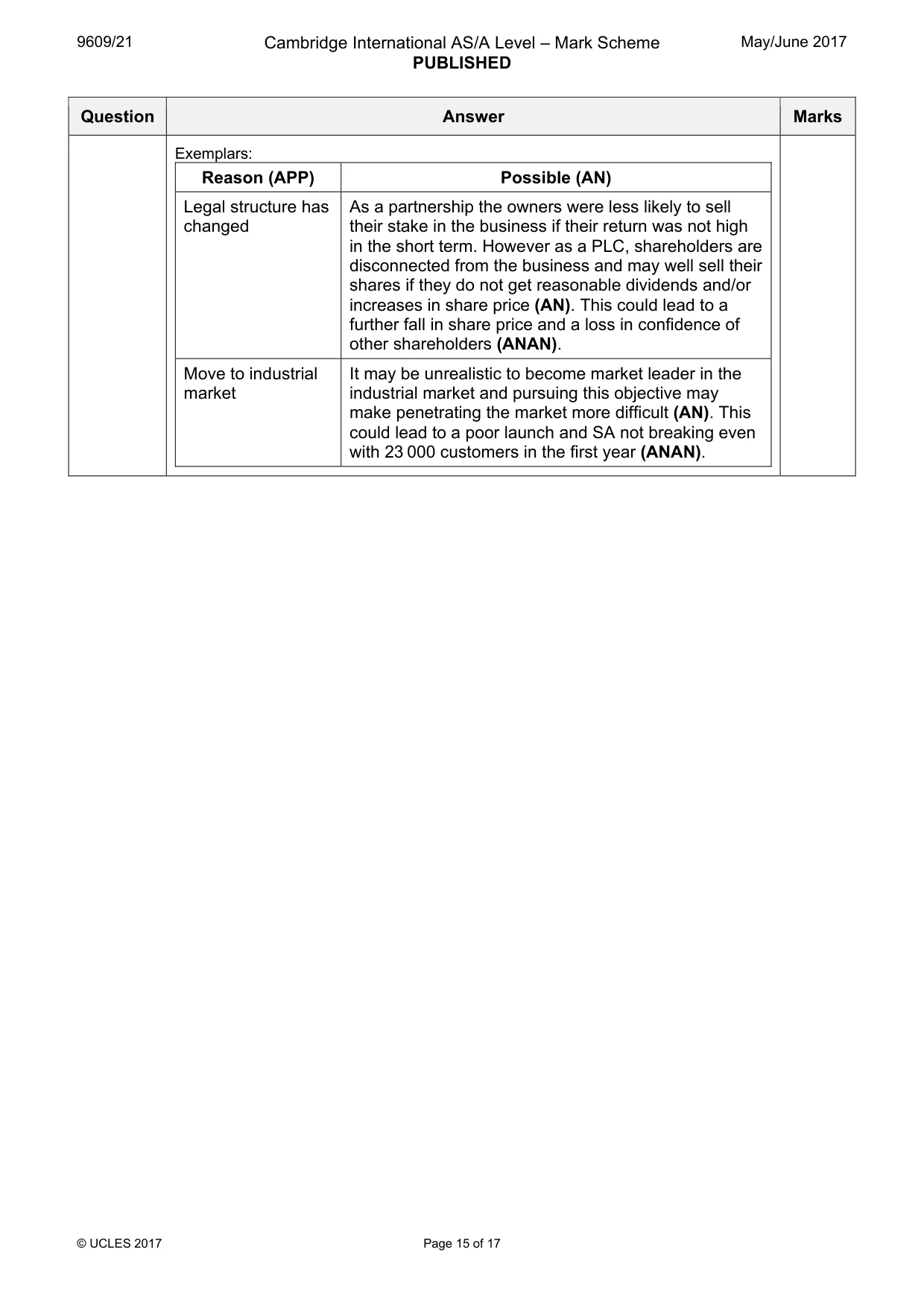
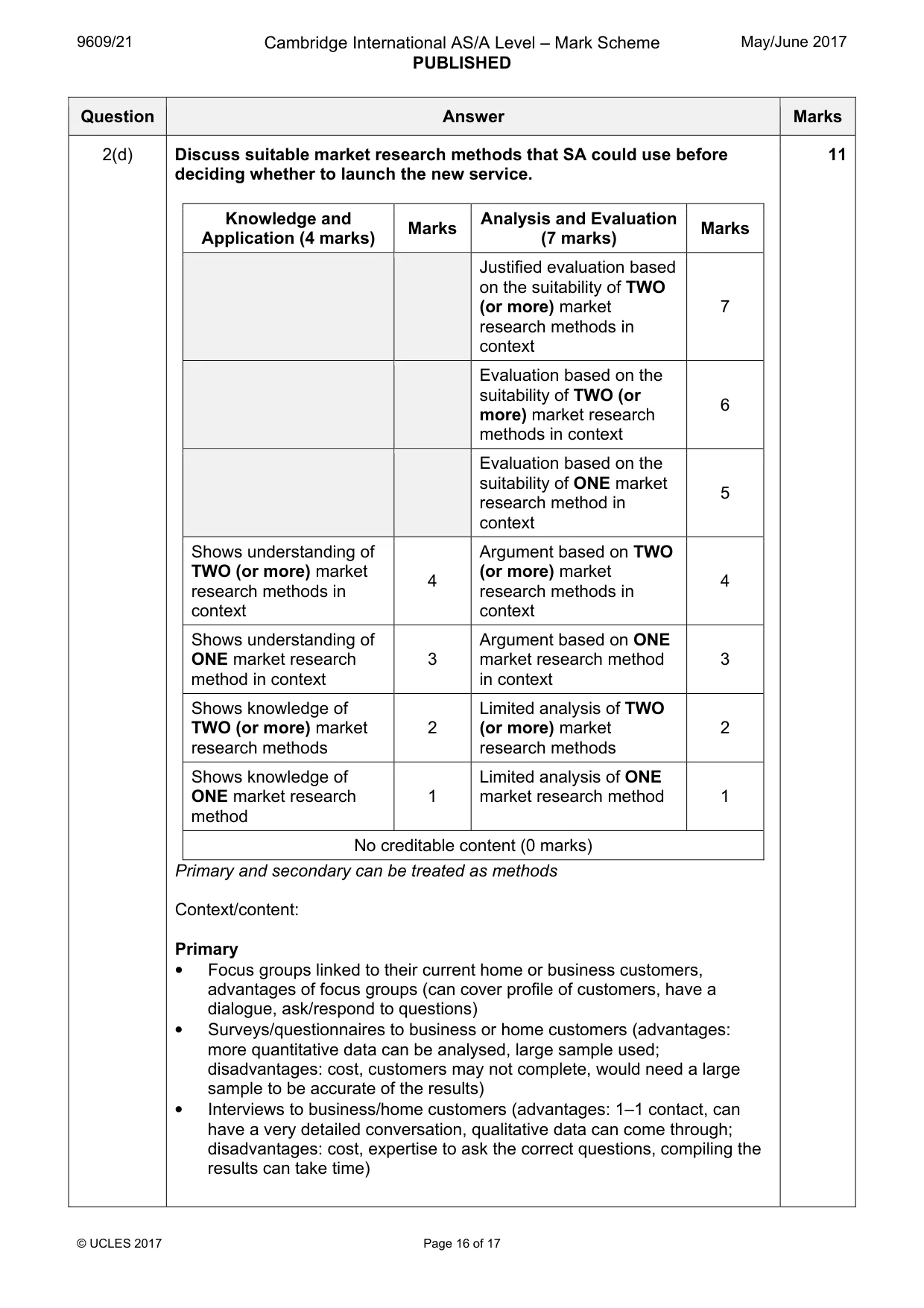
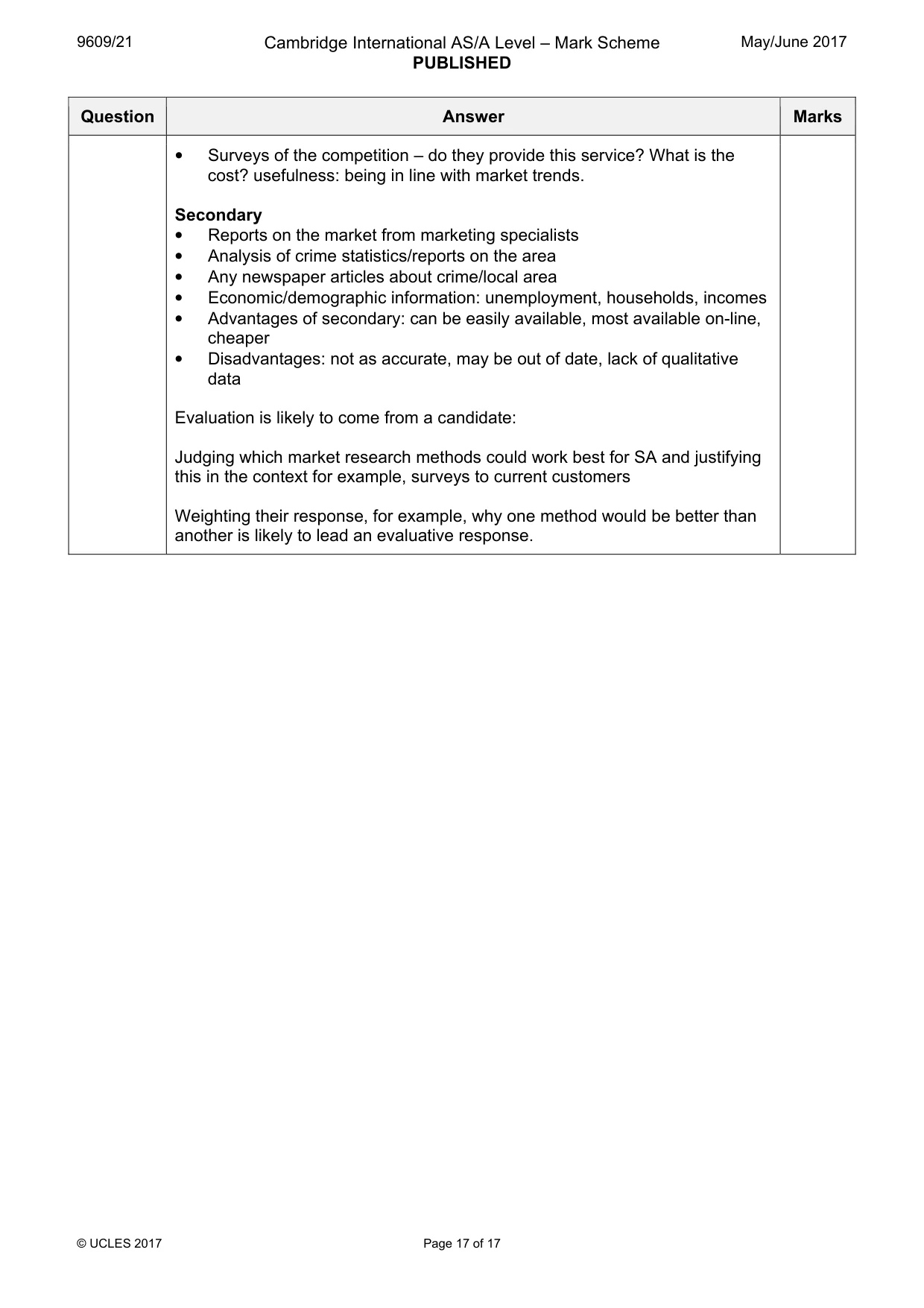
Mark scheme: 2(a)(i) Define the term ‘revenue’ (line 14). 2 Knowledge Marks A correct definition 2 A partial, vague or unfocused definition 1 No creditable content 0 Revenue is the money that flows into a business from selling its goods/services to consumer. Revenue is calculated by selling price * quantity. Exemplar Marks Rationale A reasonable definition of Price × Quantity 2 revenue Money from sales 2 A correct definition Income from business activities 2 A correct definition Revenue is sales 1 A partial definition The number of products a A partial definition 1 business sells Revenue is found at the top of Not a definition 0 the Income Statement Sales – total costs 0 Confusion with profit 2(a)(ii) Briefly explain the term ‘consumer markets’ (line 4) 3 Award one mark for each point of explanation: Example or some other way of showing good C understanding, i.e. rather than buying for business or 1 mark capital use, not business to business/industrial markets B An explanation of market(s) – sales, trade etc. 1 mark An explanation of consumers – end user, purchase for A 1 mark use (allow consumption), not to change or resale The consumer market pertains to buyers who purchase goods and services for consumption rather than resale. Examples include shops, supermarkets and retail stores. It does not involve one business selling to another business. Exemplar Marks Rationale Where the business sells to Sells, end user and an the end user for example a 3 example supermarket SA sells directly families who 3 All three elements use the alarms not shops The consumer is the person who actually uses the product, A and C – no understanding of 2 for example a child is the end market user of a toy A place where business go to sell and people go to buy 1 B only products and services The person who uses the 1 A only product or service Sold directly to the consumers 1 B only Misunderstanding with a Someone who buys a product, 0 customer – example is such as an alarm irrelevant 2(b)(i) Refer to Table 2. Calculate the forecast margin of safety for the new 3 service. Marks Rationale Correct calculation of the forecast margin of safety (with or 3 without working, units or %) 2 Correct formula and correct calculation of expected sales 1 Correct formula or correct calculation expected sales 0 No creditable content MOS = Expected Sales - break-even sales ES are (2.5 mn/500) = 5000 MOS = 5000-3000 MOS = 2000 subscriptions (accept 2000) Can also be expressed as a percentage of expected sales 2000 ×100 = 40% 5000 Correct answer – 2000 subscriptions or 40% Common incorrect answers Answer Marks Rationale Calculated the revenue MoS – all the candidate needed to do was divide 3000 × $500 = $1.5 m 2 answer by price correct answer, so one step missed $1 m 0 An incorrect answer with no working $2.5 m Correct calculation of expected sales 1 500 = 5000 5000 0 An incorrect answer with no working 2(a)(ii) Explain one limitation to SA of using break-even analysis. 3 Level Knowledge and Application Marks Explanation of a limitation of using break-even 2b (APP) 3 analysis in context Identification of a limitation of using break-even 1b (KK) 2 analysis 1a (K) Knowledge of break-even analysis 1 0 No creditable content 0 Correct use of an incorrect answer to 1(b)(i) should be fully rewarded (own figure rule – OFR) Context and content is likely to come from: Limitation (KK) Possible context (APP) Based on SA have not started selling this service yet and forecasts/estimates have no experience in this industrial market Assumes a constant Likely to need to discount the price to penetrate price the industrial alarm market Assumes fixed costs As more alarms are fitted SA may need to remain constant as increase the office size etc. output rises As more alarms are fitted less efficient staff to Assumes a constant man the telephones may need to be employed variable cost per unit – diminishing returns Assumes all output is SA may produce a stock of alarms which may sold not all be sold in the first year Assumes the fixed costs SA will have some fixed costs (such as from one product can be management) which are difficult to allocate allocated accurately between the consumer and industrial markets ARA 2(c) Analyse two possible reasons why SA’s objectives have changed over 8 time. Knowledge and Level Marks Analysis (4 marks) Marks Application (4 marks) Shows understanding of Good analysis of TWO (or more) possible TWO (or more) reasons why SA’s possible reasons 4 4 objectives have changed why SA’s objectives over time have changed over time 2 Shows understanding of Good analysis of ONE possible reason ONE possible reason why SA’s objectives 3 why SA’s objectives 3 have changed over time have changed over time Shows knowledge of Limited analysis of why a business objective TWO (or more) might change possible reason why 2 a business’s objectives may change over time 1 1–2 Limited analysis of ONE possible reason why a business’s 1 objectives may change over time One reason analysed in context, max 3+3 Contextual analysis likely to come from: • Unrealistic original objective; one shop to become market leader? • Not specific enough original objective; market leader where? • Legal structure has changed to plc, so shareholders may now be part of the objective • Core business has changed – now in secondary and tertiary sector • Now producing and selling home alarms, not car alarms • Tastes may have changed • New focus on the industrial market. • The priority of objectives may have changed Exemplars: Reason (APP) Possible (AN) Legal structure has As a partnership the owners were less likely to sell changed their stake in the business if their return was not high in the short term. However as a PLC, shareholders are disconnected from the business and may well sell their shares if they do not get reasonable dividends and/or increases in share price (AN). This could lead to a further fall in share price and a loss in confidence of other shareholders (ANAN). Move to industrial It may be unrealistic to become market leader in the market industrial market and pursuing this objective may make penetrating the market more difficult (AN). This could lead to a poor launch and SA not breaking even with 23 000 customers in the first year (ANAN). 2(d) Discuss suitable market research methods that SA could use before 11 deciding whether to launch the new service. Knowledge and Analysis and Evaluation Marks Marks Application (4 marks) (7 marks) Justified evaluation based on the suitability of TWO (or more) market 7 research methods in context Evaluation based on the suitability of TWO (or 6 more) market research methods in context Evaluation based on the suitability of ONE market 5 research method in context Shows understanding of Argument based on TWO TWO (or more) market (or more) market 4 4 research methods in research methods in context context Shows understanding of Argument based on ONE ONE market research 3 market research method 3 method in context in context Shows knowledge of Limited analysis of TWO TWO (or more) market 2 (or more) market 2 research methods research methods Shows knowledge of Limited analysis of ONE ONE market research 1 market research method 1 method No creditable content (0 marks) Primary and secondary can be treated as methods Context/content: Primary • Focus groups linked to their current home or business customers, advantages of focus groups (can cover profile of customers, have a dialogue, ask/respond to questions) • Surveys/questionnaires to business or home customers (advantages: more quantitative data can be analysed, large sample used; disadvantages: cost, customers may not complete, would need a large sample to be accurate of the results) • Interviews to business/home customers (advantages: 1–1 contact, can have a very detailed conversation, qualitative data can come through; disadvantages: cost, expertise to ask the correct questions, compiling the results can take time) • Surveys of the competition – do they provide this service? What is the cost? usefulness: being in line with market trends. Secondary • Reports on the market from marketing specialists • Analysis of crime statistics/reports on the area • Any newspaper articles about crime/local area • Economic/demographic information: unemployment, households, incomes • Advantages of secondary: can be easily available, most available on-line, cheaper • Disadvantages: not as accurate, may be out of date, lack of qualitative data Evaluation is likely to come from a candidate: Judging which market research methods could work best for SA and justifying this in the context for example, surveys to current customers Weighting their response, for example, why one method would be better than another is likely to lead an evaluative response.
What was in this paper
The subtopics covered by these 2 questions, and how many questions each got. Open one in a new tab to see every Cambridge question on it.