Questions as text
Q1 · A square metre of grassland receives about 1 047 000 kJ of solar light energy each year 9700/11 Oct/Nov 2004
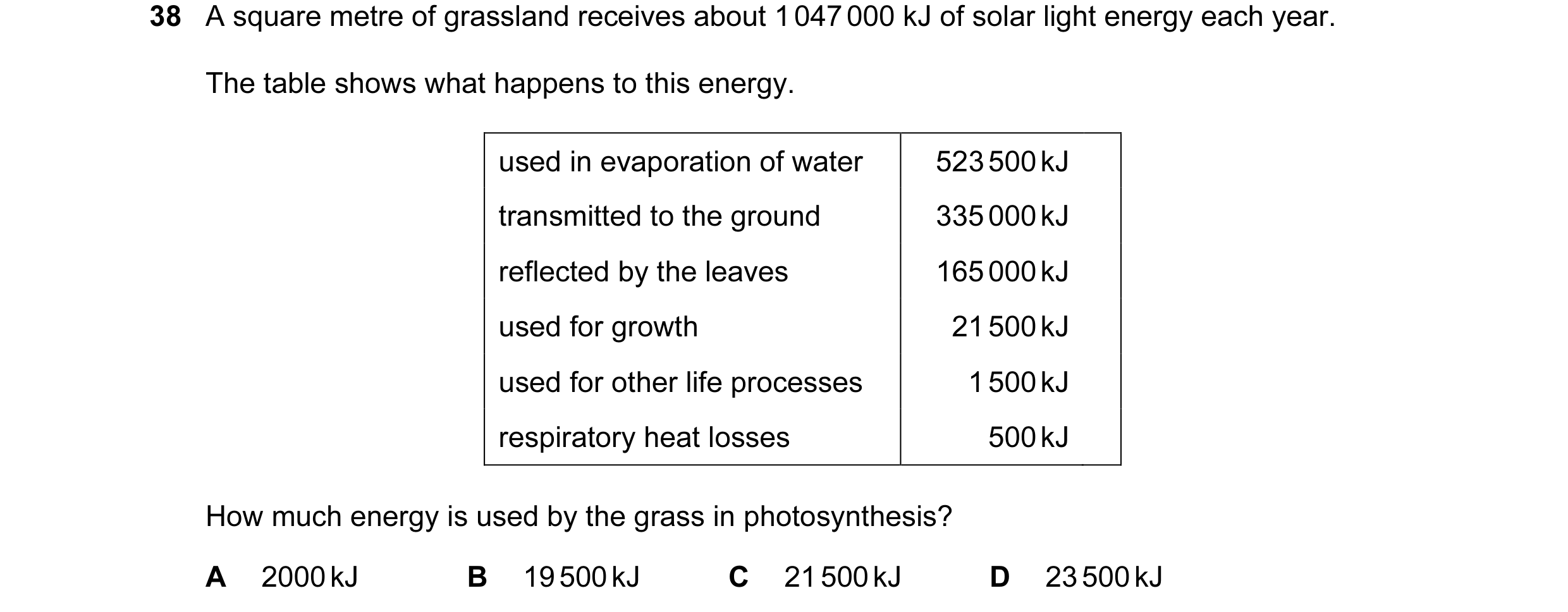
38 A square metre of grassland receives about 1 047 000 kJ of solar light energy each year. The table shows what happens to this energy. used in evaporation of water 523 500 kJ transmitted to the ground 335 000 kJ reflected by the leaves 165 000 kJ used for growth 21 500 kJ used for other life processes 1 500 kJ respiratory heat losses 500 kJ How much energy is used by the grass in photosynthesis? A 2000 kJ B 19 500 kJ C 21 500 kJ D 23 500 kJ
1 marks
Answer: D
This question in 9700/11 Oct/Nov 2004
Q2 · Why does the application of nitrate fertilisers cause an increase in crop production? 9700/11 Oct/Nov 2004
39 Why does the application of nitrate fertilisers cause an increase in crop production? A Green plants manufacture more protein. B More nitrogen is fixed in leguminous plants. C The fertiliser adds energy to the ecosystem. D The number of denitrifying bacteria decreases.
1 marks
Answer: A
This question in 9700/11 Oct/Nov 2004
Q3 · Following an environmental disaster of a major volcanic eruption, the atmosphere contains… 9700/11 Oct/Nov 2007
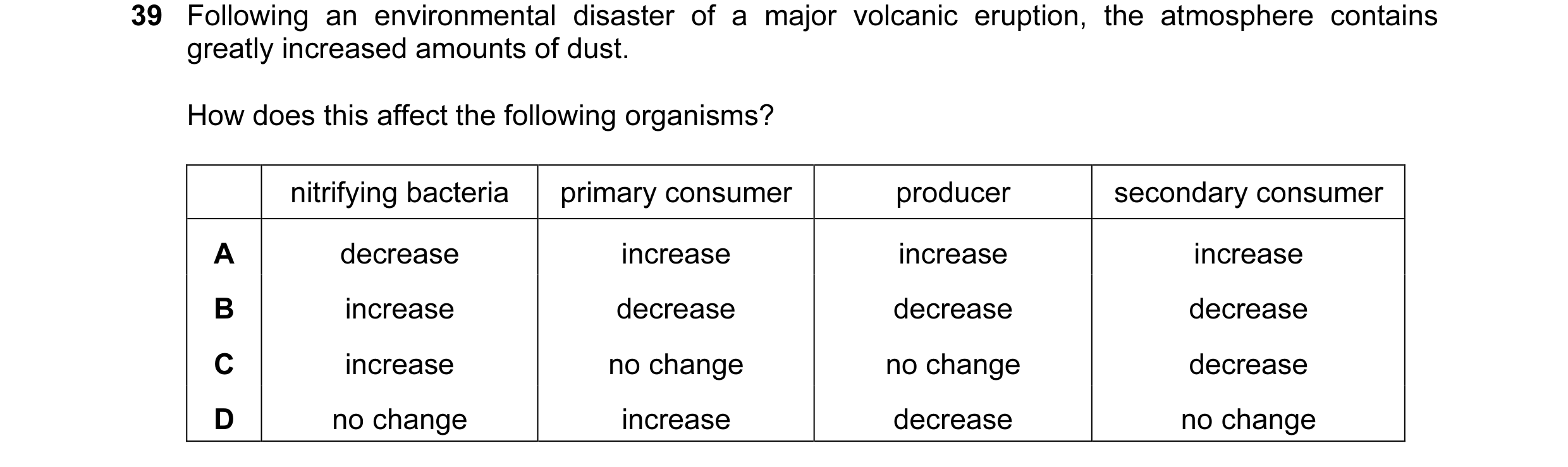
39 Following an environmental disaster of a major volcanic eruption, the atmosphere contains greatly increased amounts of dust. How does this affect the following organisms? nitrifying bacteria primary consumer producer secondary consumer A decrease increase increase increase B increase decrease decrease decrease C increase no change no change decrease D no change increase decrease no change
1 marks
Answer: B
This question in 9700/11 Oct/Nov 2007
Q4 · A square metre of grassland receives about 1 047 000 kJ of solar light energy each year 9700/11 May/June 2011
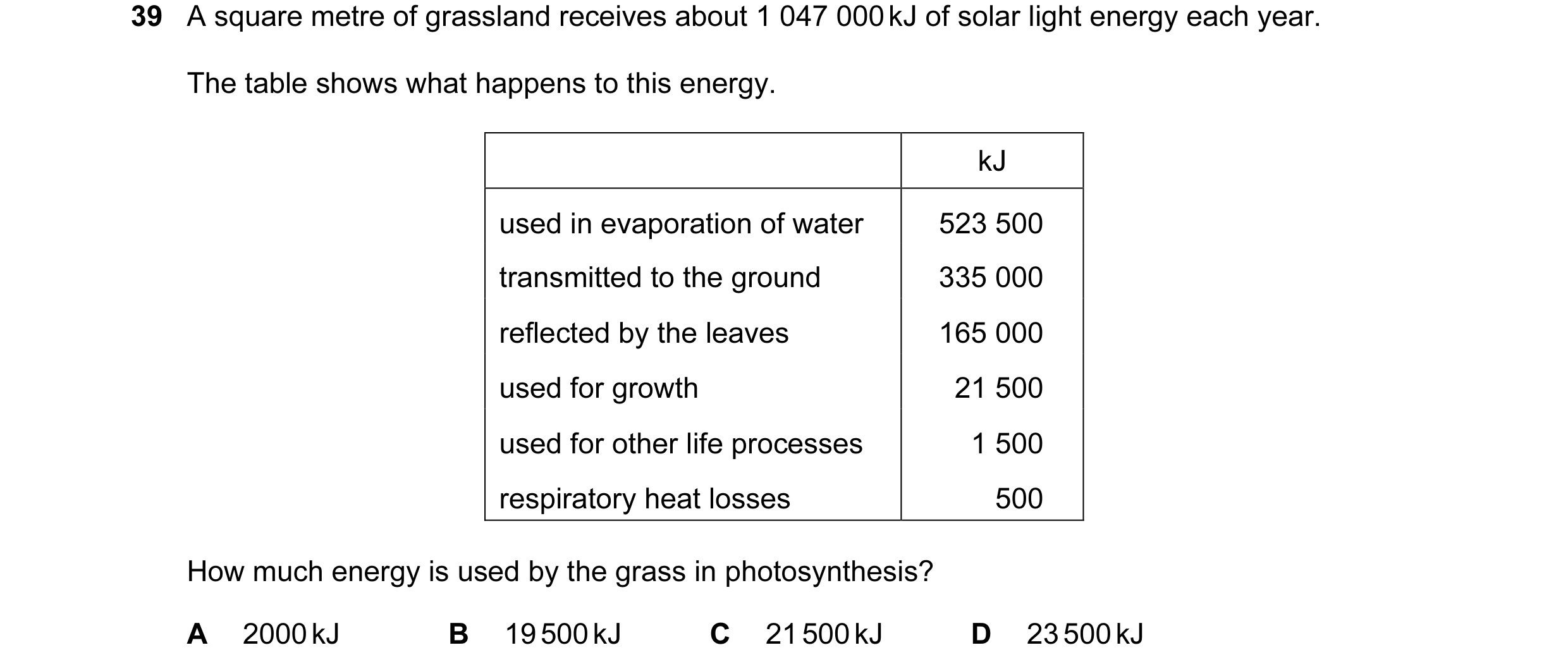
39 A square metre of grassland receives about 1 047 000 kJ of solar light energy each year. The table shows what happens to this energy. kJ used in evaporation of water 523 500 transmitted to the ground 335 000 reflected by the leaves 165 000 used for growth 21 500 used for other life processes 1 500 respiratory heat losses 500 How much energy is used by the grass in photosynthesis? A 2000 kJ B 19 500 kJ C 21 500 kJ D 23 500 kJ
1 marks
Answer: D
This question in 9700/11 May/June 2011
Q5 · A square metre of grassland receives about 1 047 000 kJ of solar light energy each year 9700/13 May/June 2011
20 A square metre of grassland receives about 1 047 000 kJ of solar light energy each year. The table shows what happens to this energy. kJ used in evaporation of water 523 500 transmitted to the ground 335 000 reflected by the leaves 165 000 used for growth 21 500 used for other life processes 1 500 respiratory heat losses 500 How much energy is used by the grass in photosynthesis? A 2000 kJ B 19 500 kJ C 21 500 kJ D 23 500 kJ
1 marks
Answer: D
This question in 9700/13 May/June 2011
Q6 · Why could only 4 % of the energy from sunlight be fixed by producers during… 9700/12 May/June 2012
40 Why could only 4 % of the energy from sunlight be fixed by producers during photosynthesis? A A lot of energy is lost as energy passes from one trophic level to the next in food chains. B A lot of sunlight reflects off clouds, is absorbed by pond water or does not strike chloroplasts. C Some energy passes from dead plants to decomposers such as bacteria and fungi. D Some parts of plants are not eaten or cannot be digested by herbivores.
1 marks
Answer: B
This question in 9700/12 May/June 2012
Q7 · The total rate at which producers synthesise organic material is called gross primary… 9700/12 Oct/Nov 2012
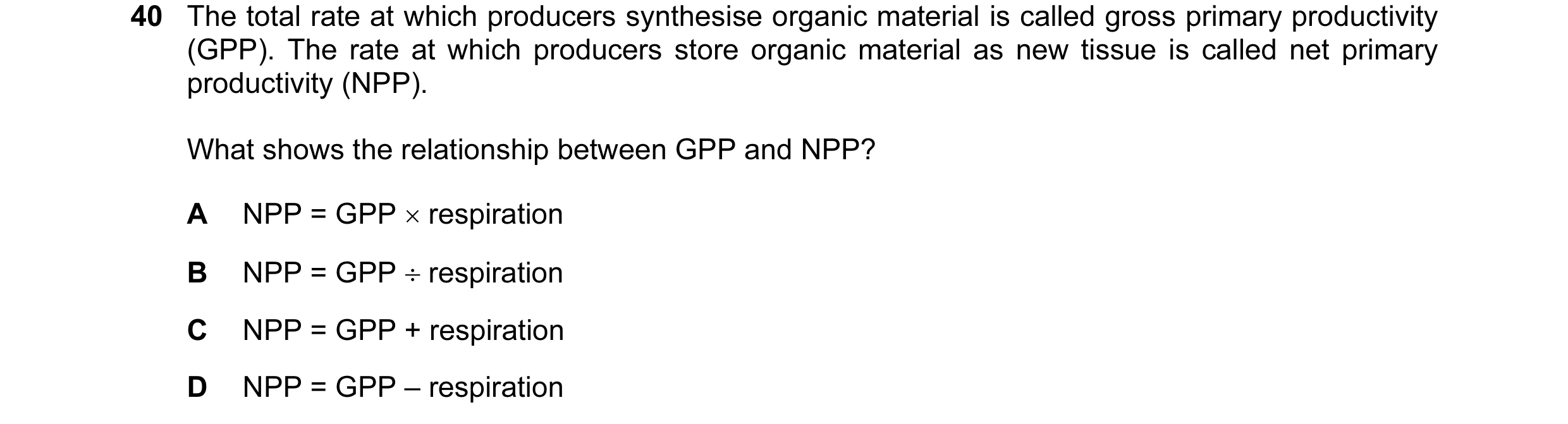
40 The total rate at which producers synthesise organic material is called gross primary productivity (GPP). The rate at which producers store organic material as new tissue is called net primary productivity (NPP). What shows the relationship between GPP and NPP? A NPP = GPP × respiration B NPP = GPP ÷ respiration C NPP = GPP + respiration D NPP = GPP – respiration
1 marks
Answer: D
This question in 9700/12 Oct/Nov 2012
Q8 · The diagram shows the flow of energy through a food chain 9700/13 Oct/Nov 2012
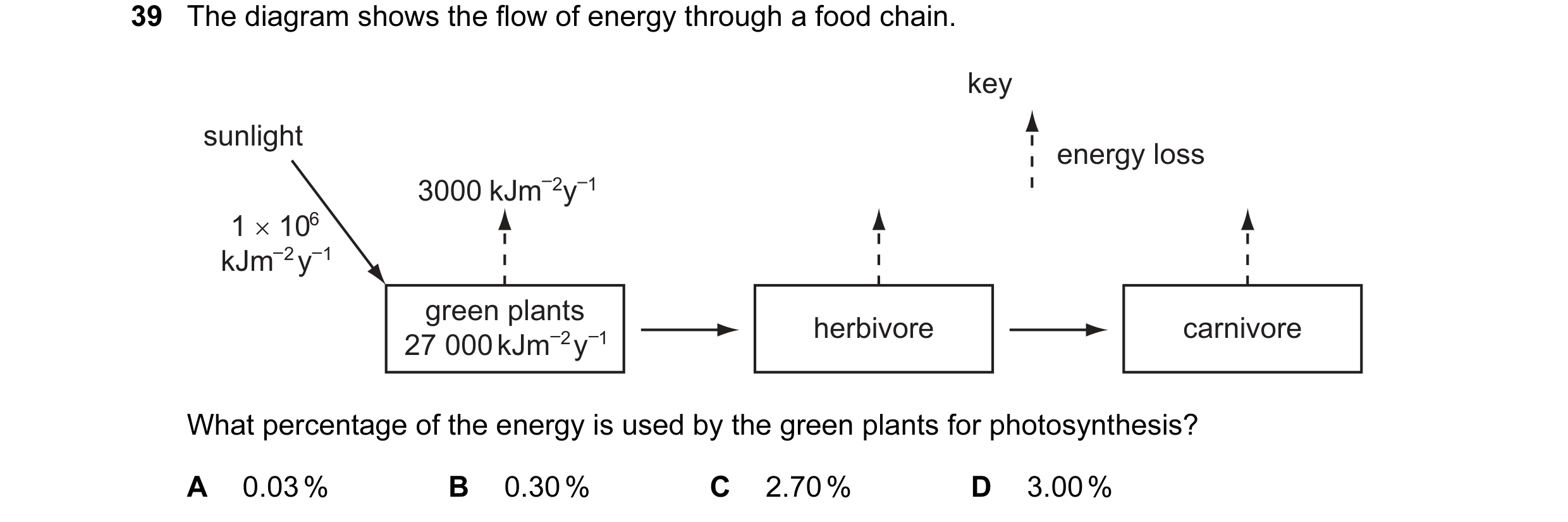
39 The diagram shows the flow of energy through a food chain. key sunlight energy loss 3000 kJm 2y 1 1 × 10⁶ kJm 2y 1 green plants herbivore carnivore 27 000 kJm 2y 1 What percentage of the energy is used by the green plants for photosynthesis? A 0.03 % B 0.30 % C 2.70 % D 3.00 %
1 marks
Answer: D
This question in 9700/13 Oct/Nov 2012
Q9 · The diagram shows the flow of energy through a food chain 9700/12 Oct/Nov 2015
39 The diagram shows the flow of energy through a food chain. key sunlight energy loss 3000 kJ m–2 y–1 1 × 10⁶ kJ m–2 y–1 green plants herbivore carnivore 27 000 kJ m–2 y–1 What percentage of the energy is used by the green plants for photosynthesis? A 0.03% B 0.30% C 2.70% D 3.00%
1 marks
Answer: D
This question in 9700/12 Oct/Nov 2015
Q10 · Which statements are correct for a green plant? 9700/12 Oct/Nov 2018
5 Which statements are correct for a green plant? 1 ATP is produced by mitochondria. 2 ATP is produced by chloroplasts. 3 ATP forms part of the DNA. A 1, 2 and 3 B 1 and 2 only C 1 and 3 only D 2 and 3 only
1 marks
Answer: B
This question in 9700/12 Oct/Nov 2018
Q11 · Plants, such as the tobacco plant, retain very little of the water they take in and the… 9700/13 May/June 2023
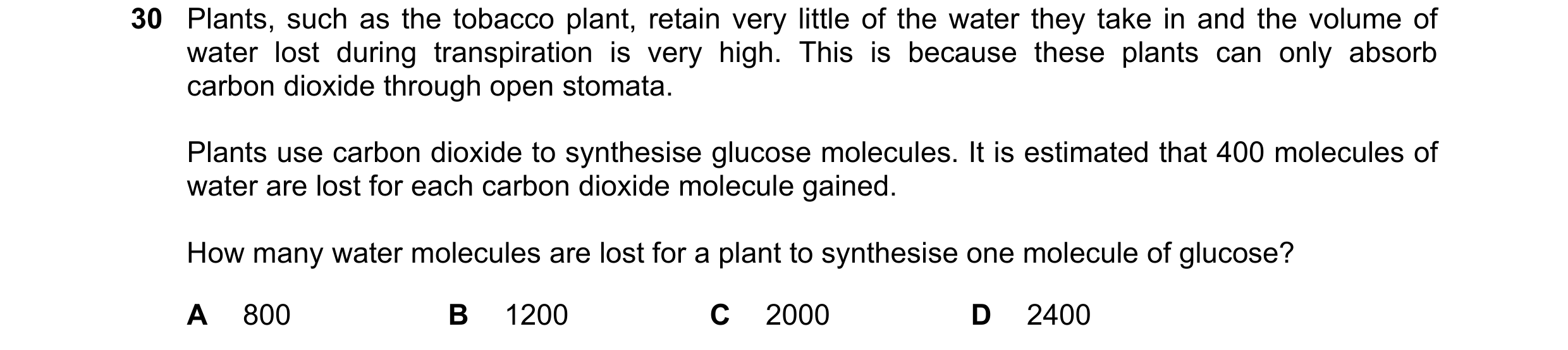
30 Plants, such as the tobacco plant, retain very little of the water they take in and the volume of water lost during transpiration is very high. This is because these plants can only absorb carbon dioxide through open stomata. Plants use carbon dioxide to synthesise glucose molecules. It is estimated that 400 molecules of water are lost for each carbon dioxide molecule gained. How many water molecules are lost for a plant to synthesise one molecule of glucose? A 800 B 1200 C 2000 D 2400
1 marks
Answer: D
This question in 9700/13 May/June 2023

 1 / 3
1 / 3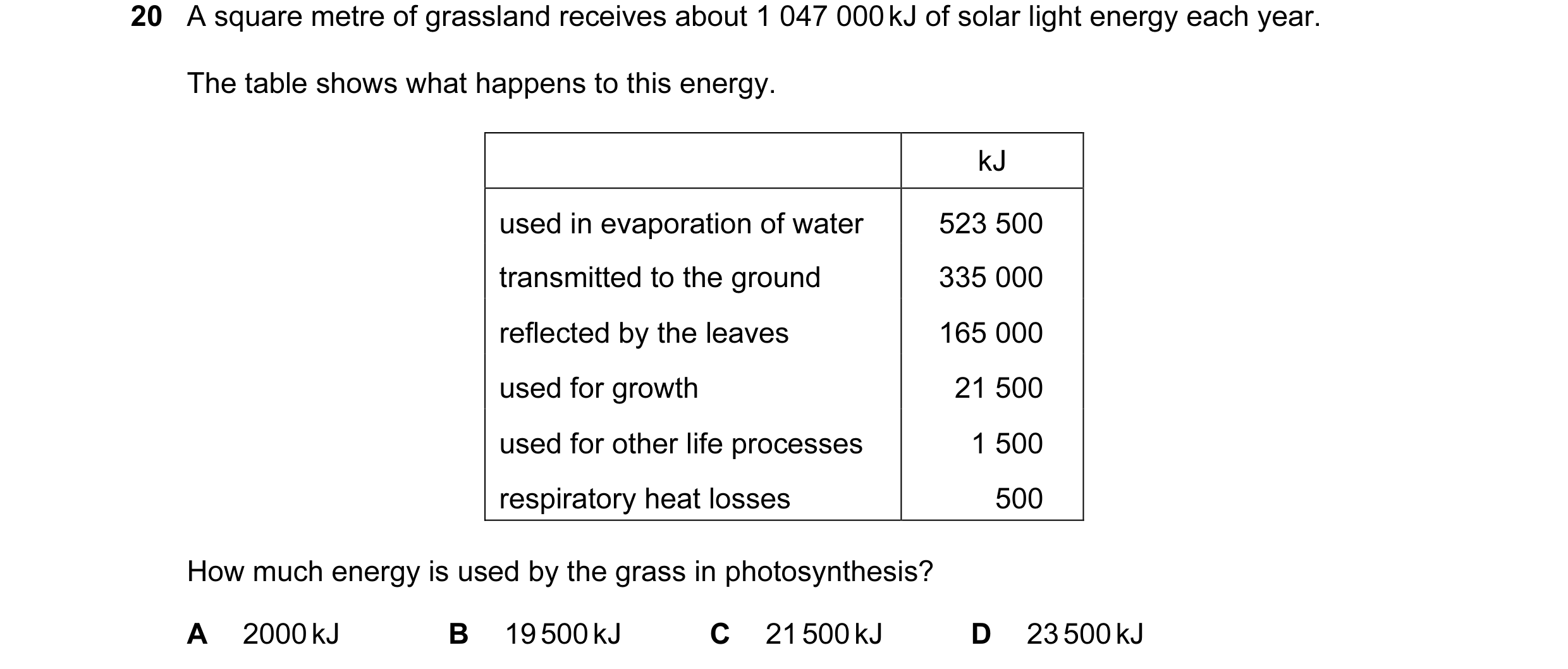

 2 / 3
2 / 3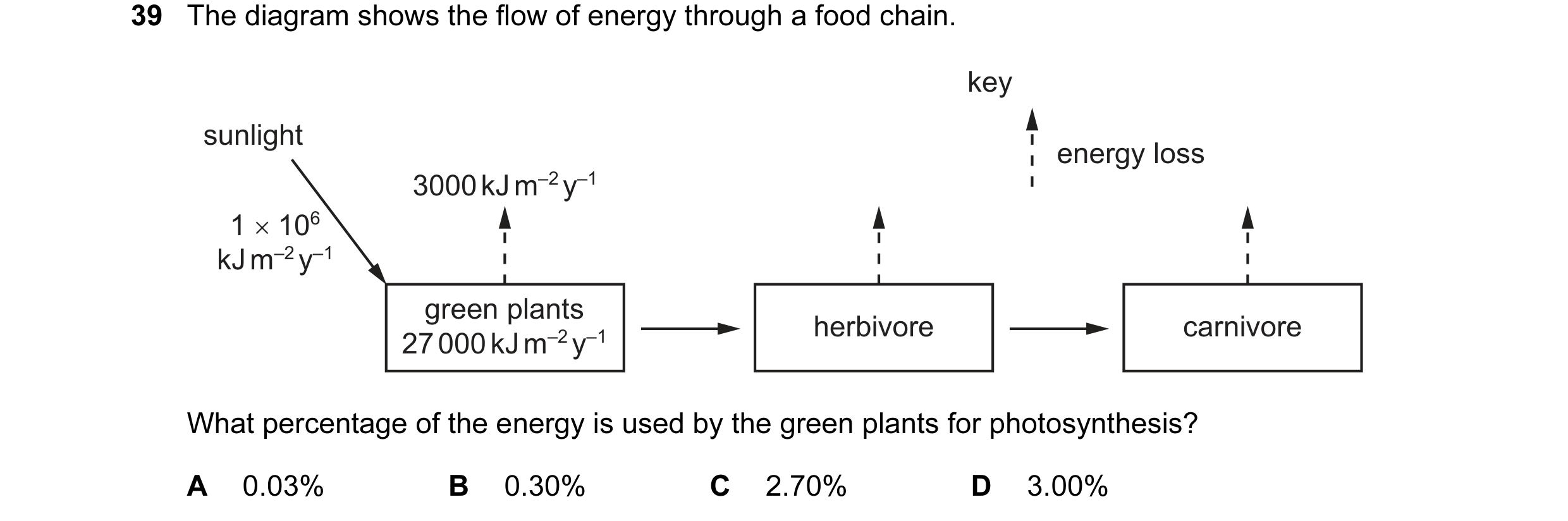

 3 / 3
3 / 3