Cambridge A Level Biology 9700 — 2023 May/June Paper 2 · Variant 3
9700/23/M/J/23 · 6 questions · 60 marks · ≈68 min
The question paper and its mark scheme, free to read here and free to download. This is Cambridge’s own paper, exactly as it was sat.
Question paper16 pages



Mark scheme20 pages
Answers below. Sit the paper first if you are practising.
Questions as text
Q1 · The cells in a tissue are often at different stages of the cell cycle
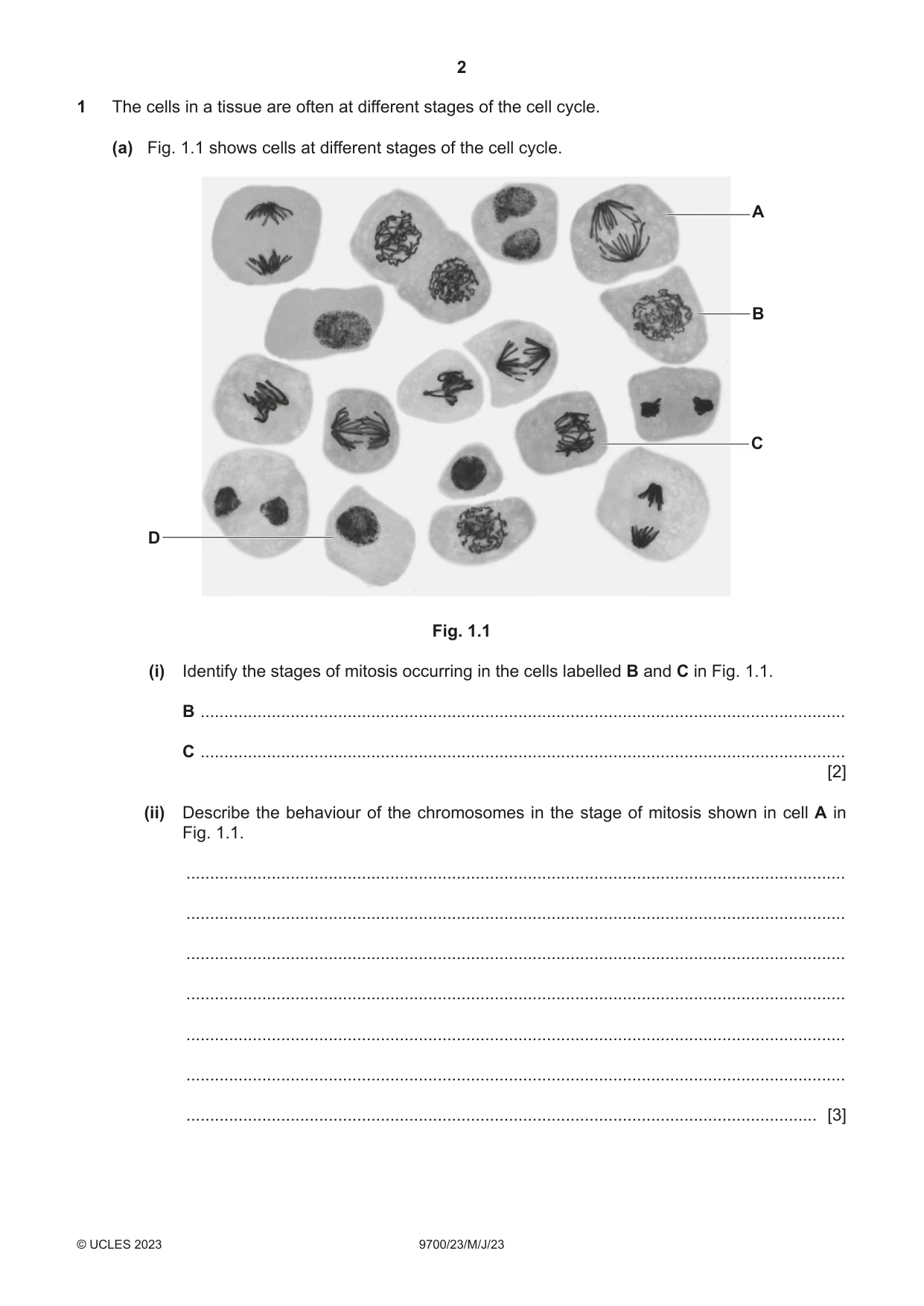
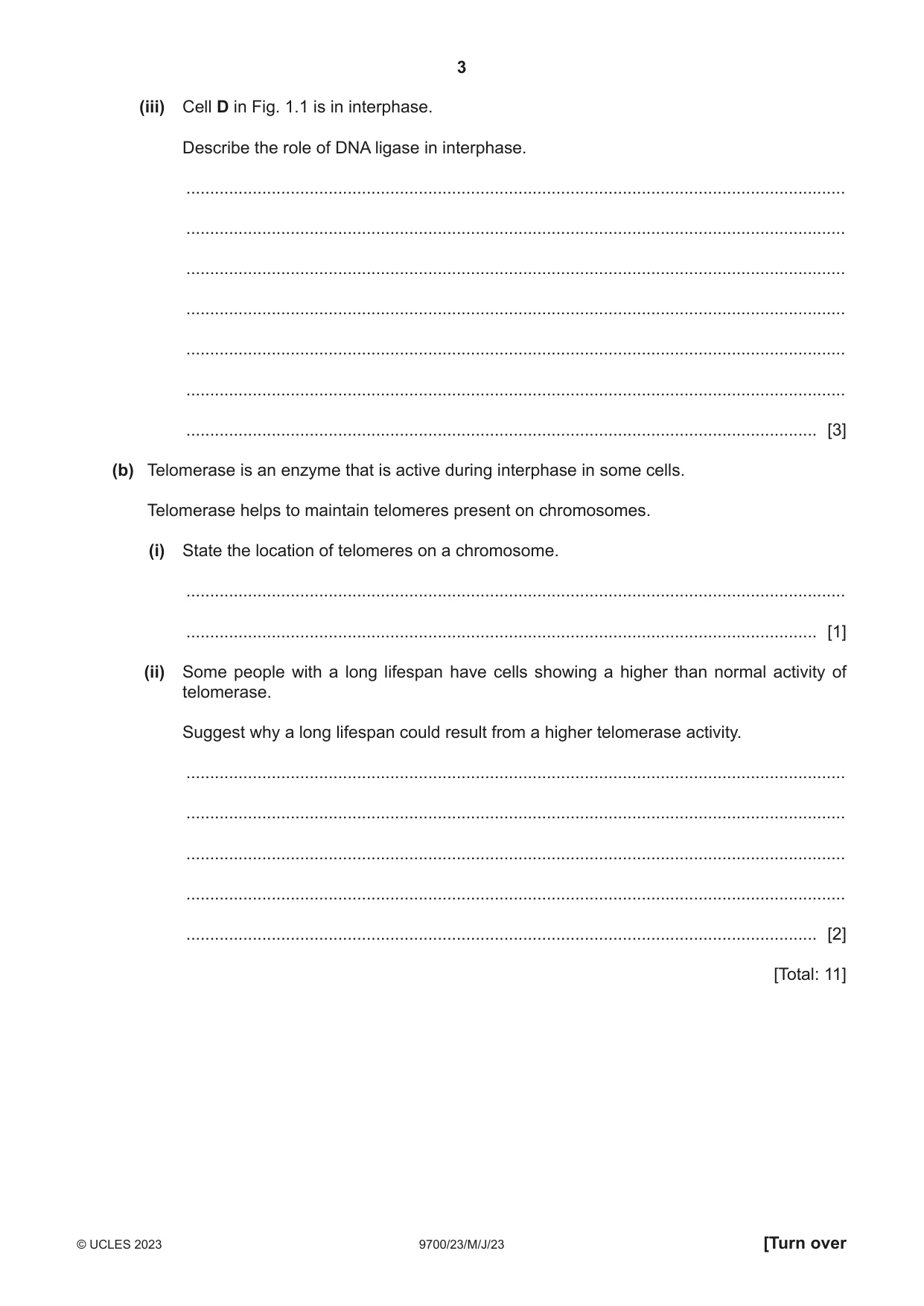
1 The cells in a tissue are often at different stages of the cell cycle. (a) Fig. 1.1 shows cells at different stages of the cell cycle. A B C D Fig. 1.1 (i) Identify the stages of mitosis occurring in the cells labelled B and C in Fig. 1.1. B ........................................................................................................................................ C ........................................................................................................................................ [2] (ii) Describe the behaviour of the chromosomes in the stage of mitosis shown in cell A in Fig. 1.1. ........................................................................................................................................... ........................................................................................................................................... ........................................................................................................................................... ........................................................................................................................................... ........................................................................................................................................... ........................................................................................................................................... ..................................................................................................................................... [3] (iii) Cell D in Fig. 1.1 is in interphase. Describe the role of DNA ligase in interphase. ........................................................................................................................................... ........................................................................................................................................... ........................................................................................................................................... ........................................................................................................................................... ........................................................................................................................................... ........................................................................................................................................... ..................................................................................................................................... [3] (b) Telomerase is an enzyme that is active during interphase in some cells. Telomerase helps to maintain telomeres present on chromosomes. (i) State the location of telomeres on a chromosome. ........................................................................................................................................... ..................................................................................................................................... [1] (ii) Some people with a long lifespan have cells showing a higher than normal activity of telomerase. Suggest why a long lifespan could result from a higher telomerase activity. ........................................................................................................................................... ........................................................................................................................................... ........................................................................................................................................... ........................................................................................................................................... ..................................................................................................................................... [2] [Total: 11]
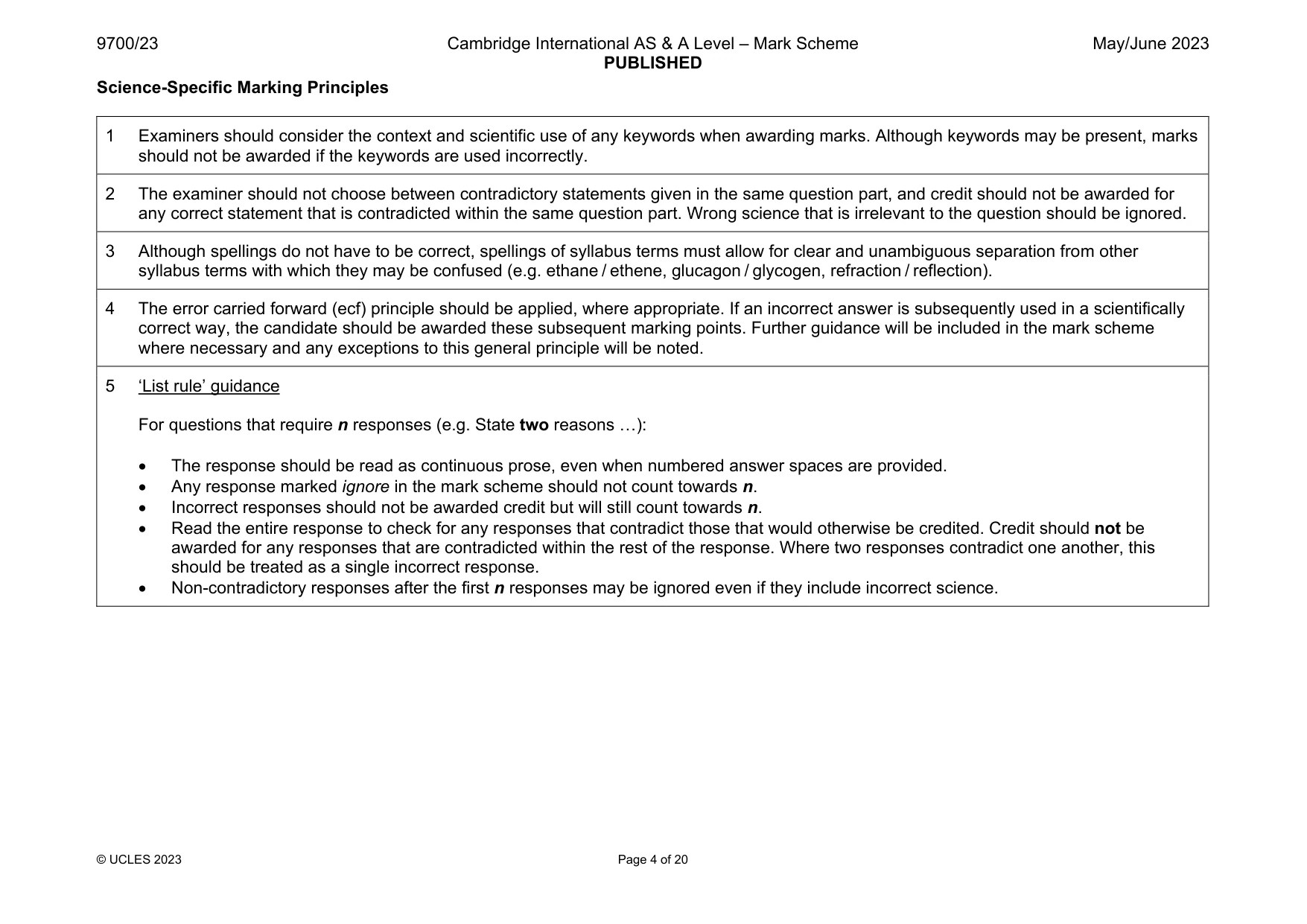
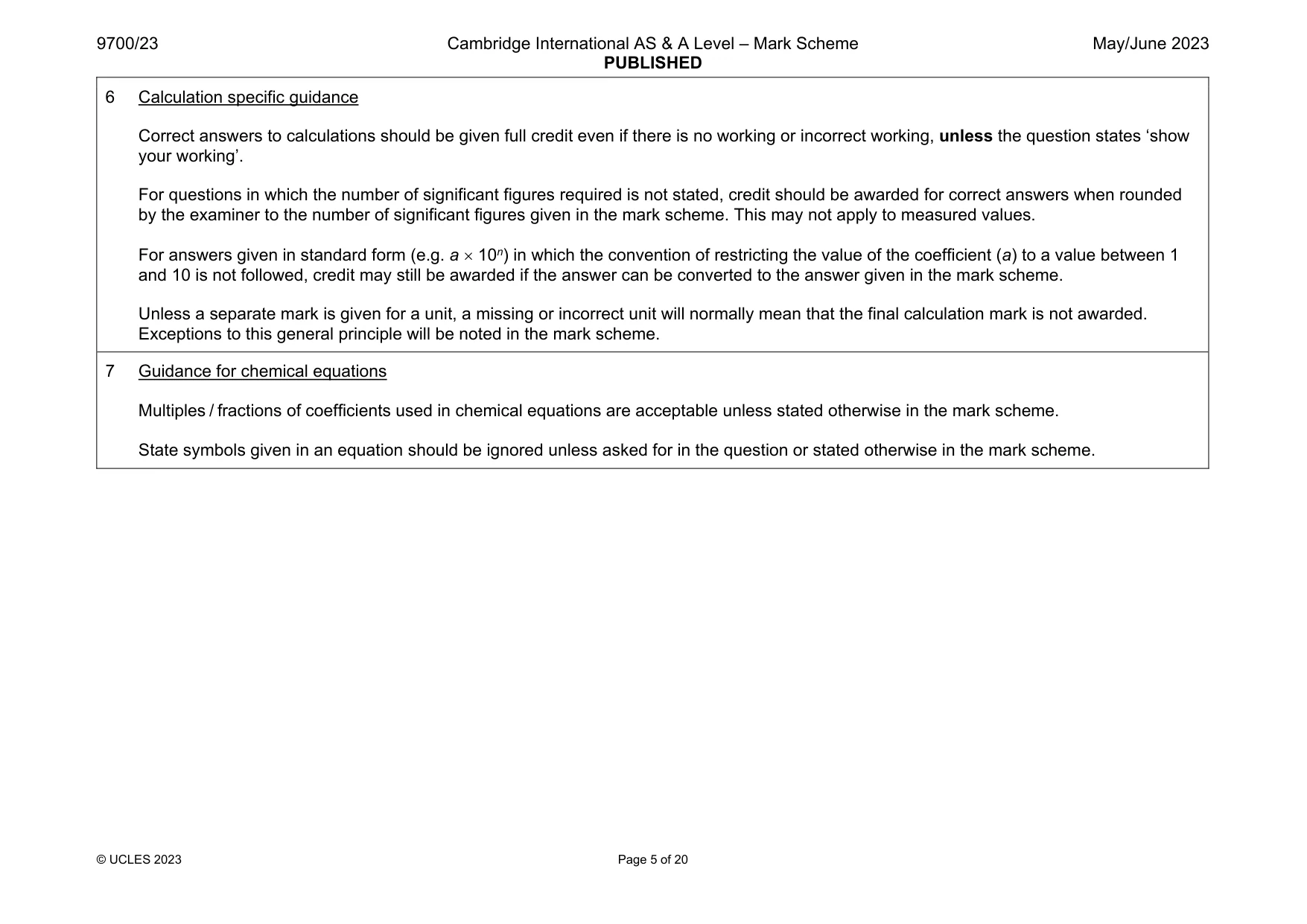
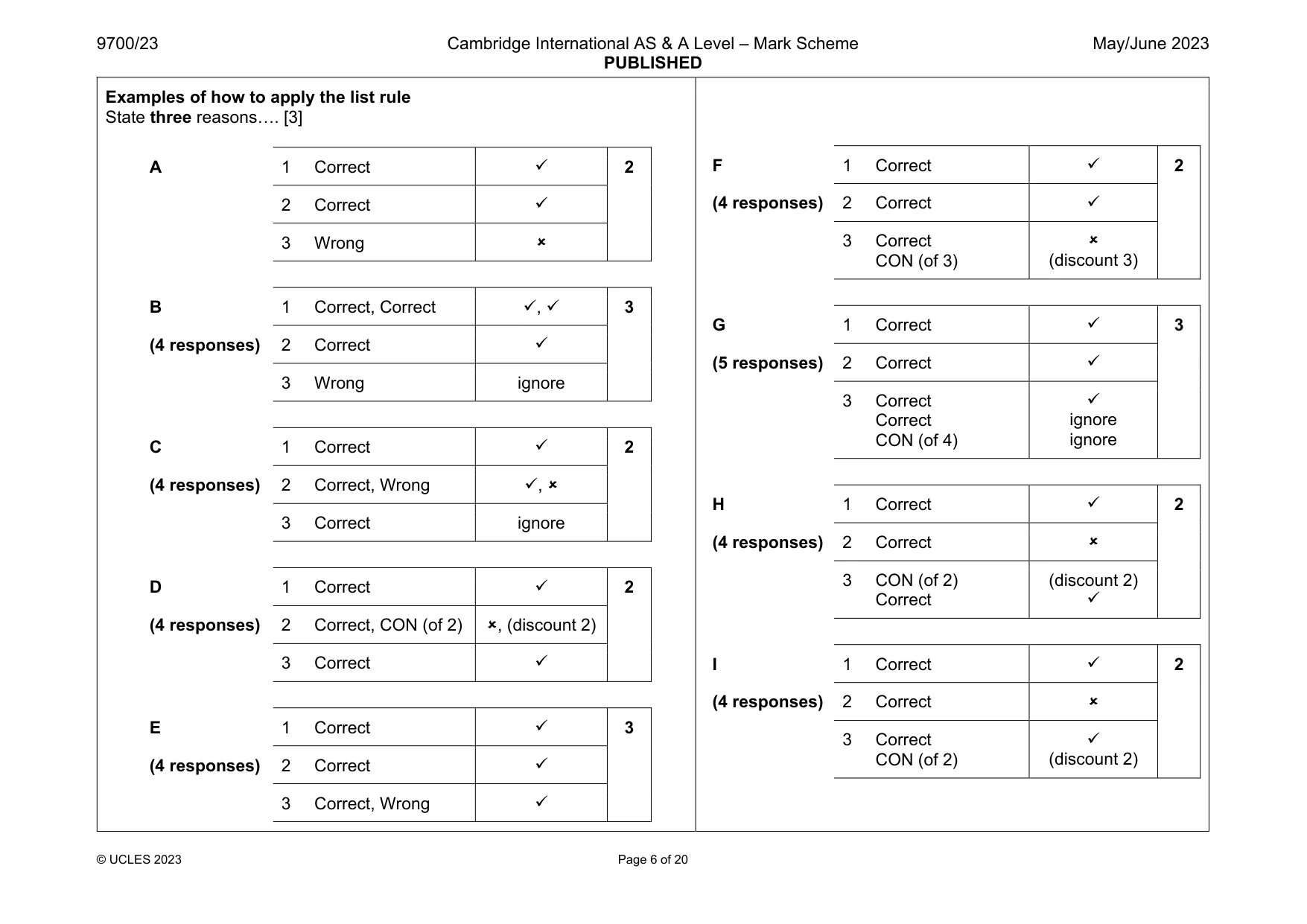
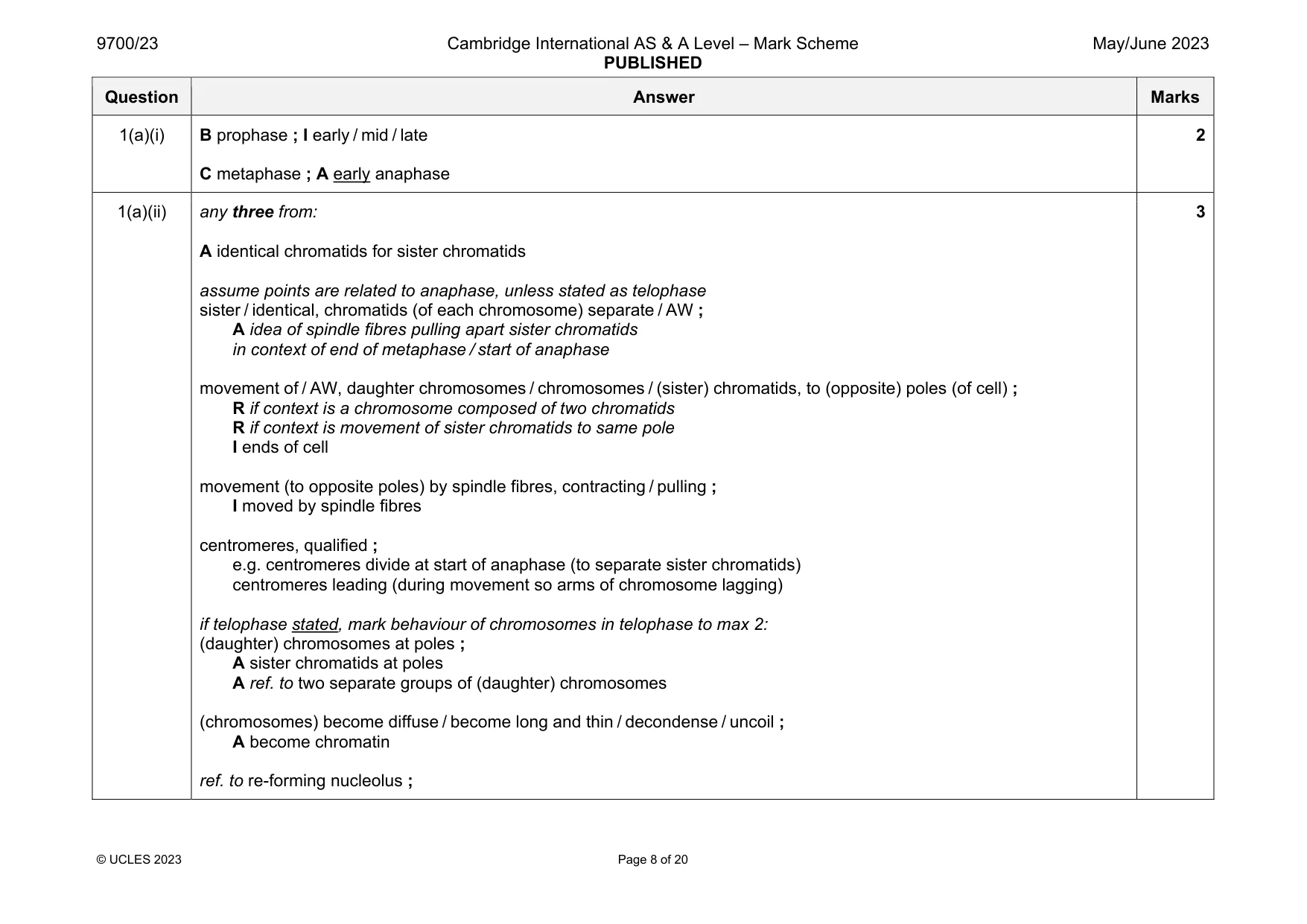
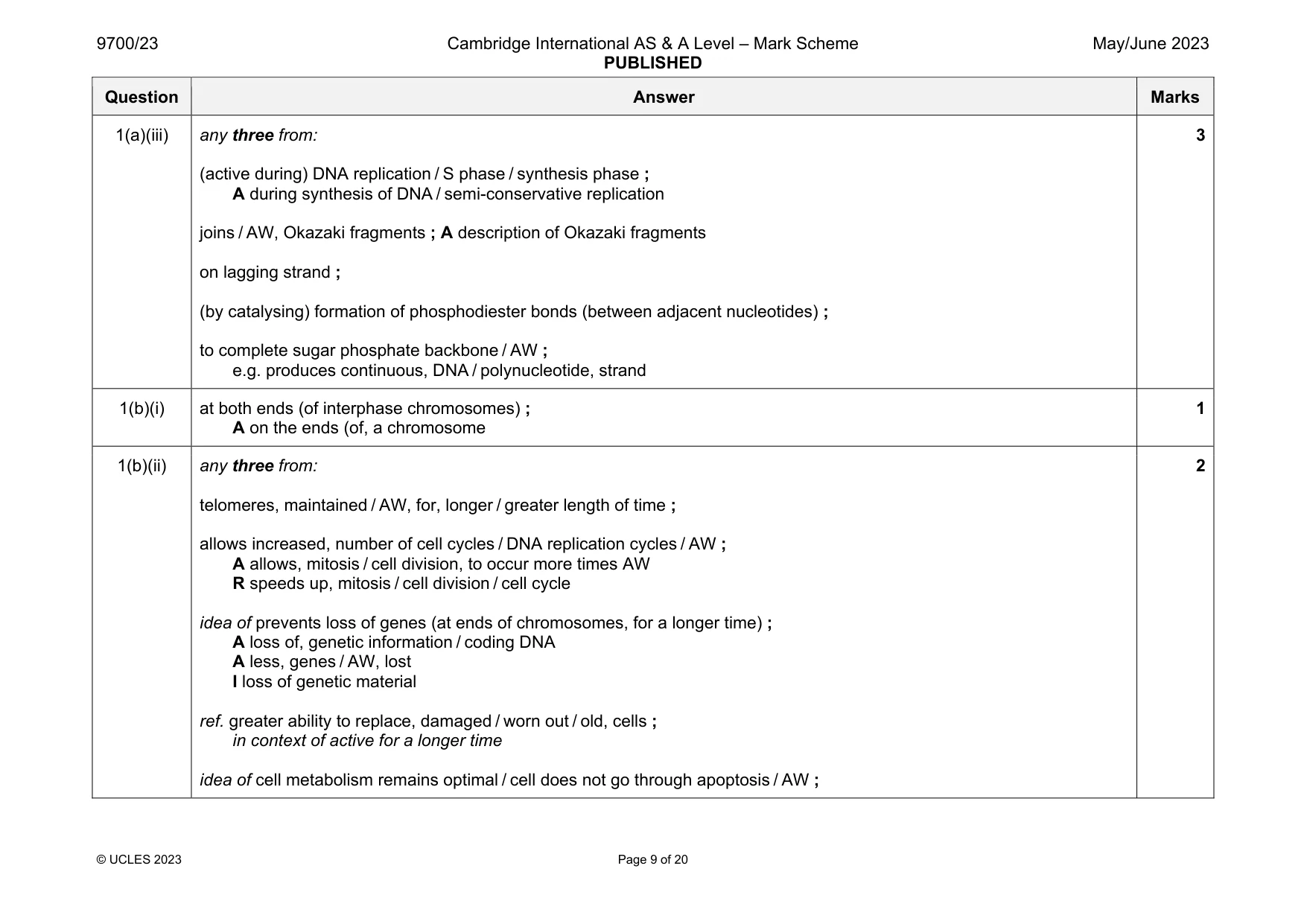
Mark scheme: 1(a)(i) B prophase ; I early / mid / late C metaphase ; A early anaphase 2 1(a)(ii) any three from: A identical chromatids for sister chromatids assume points are related to anaphase, unless stated as telophase sister / identical, chromatids (of each chromosome) separate / AW ; A idea of spindle fibres pulling apart sister chromatids in context of end of metaphase / start of anaphase movement of / AW, daughter chromosomes / chromosomes / (sister) chromatids, to (opposite) poles (of cell) ; R if context is a chromosome composed of two chromatids R if context is movement of sister chromatids to same pole I ends of cell movement (to opposite poles) by spindle fibres, contracting / pulling ; I moved by spindle fibres centromeres, qualified ; e.g. centromeres divide at start of anaphase (to separate sister chromatids) centromeres leading (during movement so arms of chromosome lagging) if telophase stated, mark behaviour of chromosomes in telophase to max 2: (daughter) chromosomes at poles ; A sister chromatids at poles A ref. to two separate groups of (daughter) chromosomes (chromosomes) become diffuse / become long and thin / decondense / uncoil ; A become chromatin ref. to re-forming nucleolus ; 3 Question Answer Marks 1(a)(iii) any three from: (active during) DNA replication / S phase / synthesis phase ; A during synthesis of DNA / semi-conservative replication joins / AW, Okazaki fragments ; A description of Okazaki fragments on lagging strand ; (by catalysing) formation of phosphodiester bonds (between adjacent nucleotides) ; to complete sugar phosphate backbone / AW ; e.g. produces continuous, DNA / polynucleotide, strand 3 1(b)(i) at both ends (of interphase chromosomes) ; A on the ends (of, a chromosome 1 1(b)(ii) any three from: telomeres, maintained / AW, for, longer / greater length of time ; allows increased, number of cell cycles / DNA replication cycles / AW ; A allows, mitosis / cell division, to occur more times AW R speeds up, mitosis / cell division / cell cycle idea of prevents loss of genes (at ends of chromosomes, for a longer time) ; A loss of, genetic information / coding DNA A less, genes / AW, lost I loss of genetic material ref. greater ability to replace, damaged / worn out / old, cells ; in context of active for a longer time idea of cell metabolism remains optimal / cell does not go through apoptosis / AW ; 2
Q2 · The number of cases of tuberculosis (TB) is affected by many biological, social and…
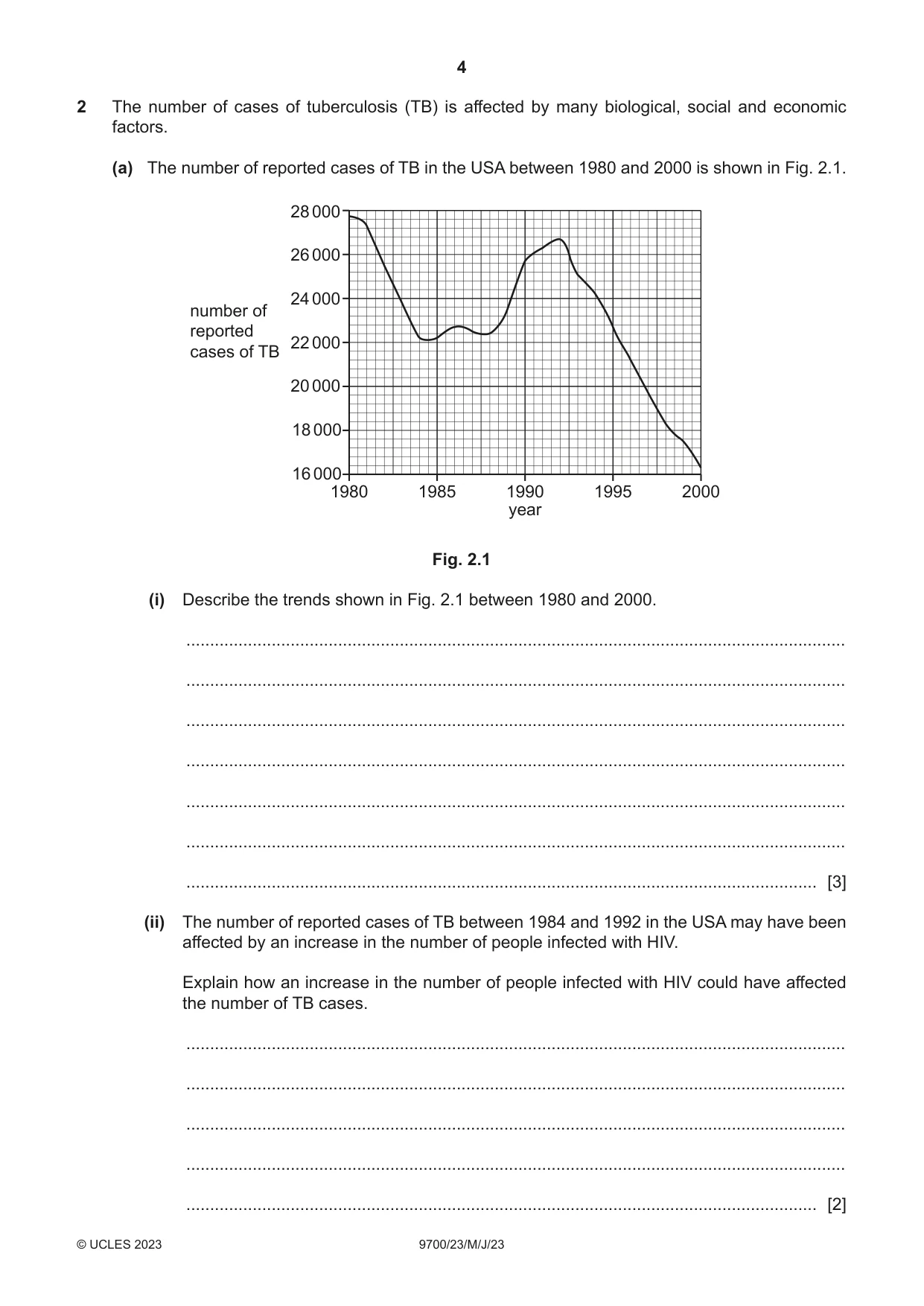
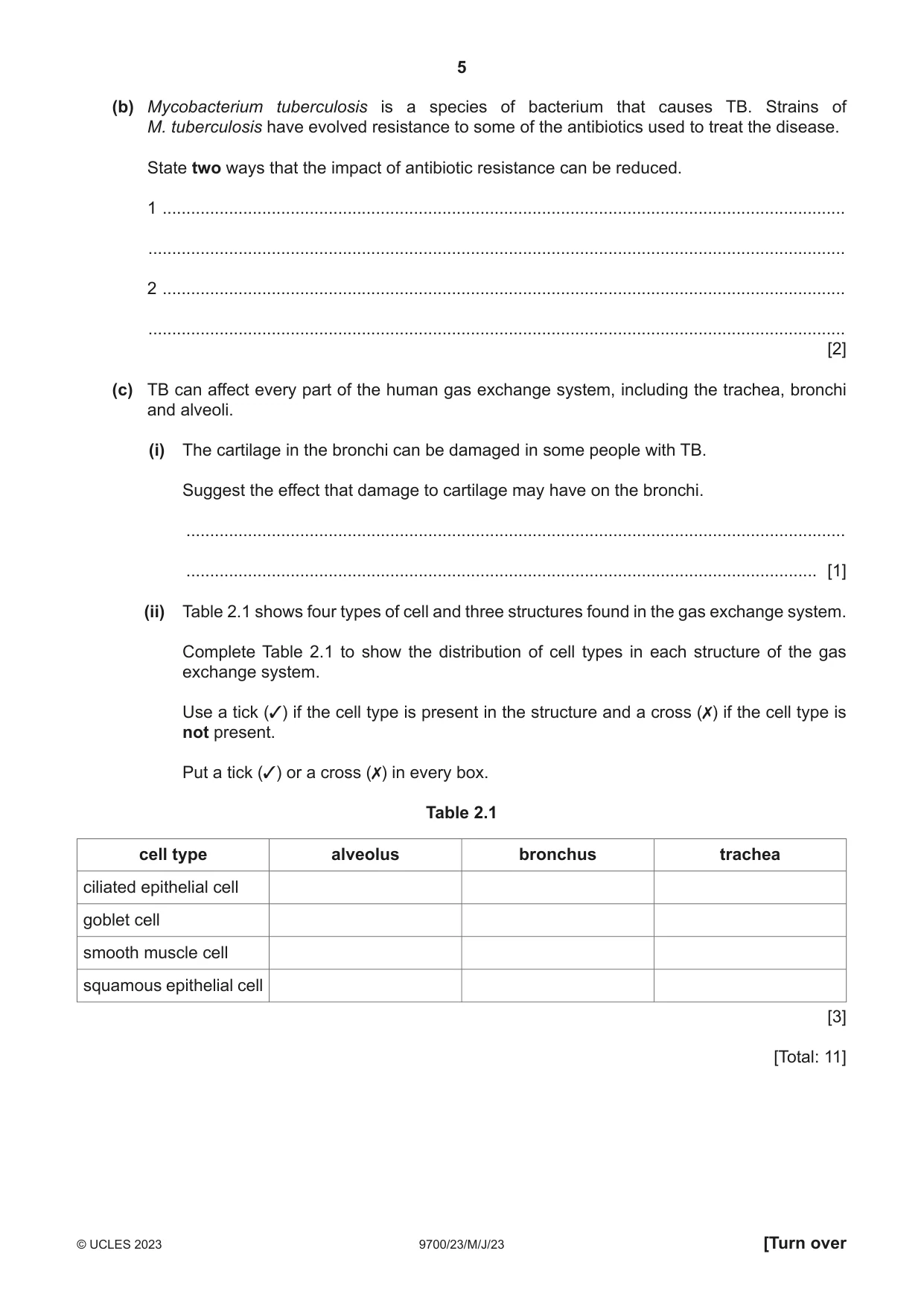
2 The number of cases of tuberculosis (TB) is affected by many biological, social and economic factors. (a) The number of reported cases of TB in the USA between 1980 and 2000 is shown in Fig. 2.1. 28 000 26 000 24 000 number of reported 22 000 cases of TB 20 000 18 000 16 000 1980 1985 1990 1995 2000 year Fig. 2.1 (i) Describe the trends shown in Fig. 2.1 between 1980 and 2000. ........................................................................................................................................... ........................................................................................................................................... ........................................................................................................................................... ........................................................................................................................................... ........................................................................................................................................... ........................................................................................................................................... ..................................................................................................................................... [3] (ii) The number of reported cases of TB between 1984 and 1992 in the USA may have been affected by an increase in the number of people infected with HIV. Explain how an increase in the number of people infected with HIV could have affected the number of TB cases. ........................................................................................................................................... ........................................................................................................................................... ........................................................................................................................................... ........................................................................................................................................... ..................................................................................................................................... [2] (b) Mycobacterium tuberculosis is a species of bacterium that causes TB. Strains of M. tuberculosis have evolved resistance to some of the antibiotics used to treat the disease. State two ways that the impact of antibiotic resistance can be reduced. 1 ................................................................................................................................................ ................................................................................................................................................... 2 ................................................................................................................................................ ................................................................................................................................................... [2] (c) TB can affect every part of the human gas exchange system, including the trachea, bronchi and alveoli. (i) The cartilage in the bronchi can be damaged in some people with TB. Suggest the effect that damage to cartilage may have on the bronchi. ........................................................................................................................................... ..................................................................................................................................... [1] (ii) Table 2.1 shows four types of cell and three structures found in the gas exchange system. Complete Table 2.1 to show the distribution of cell types in each structure of the gas exchange system. Use a tick (3) if the cell type is present in the structure and a cross (✗) if the cell type is not present. Put a tick (3) or a cross (✗) in every box. Table 2.1 cell type alveolus bronchus trachea ciliated epithelial cell goblet cell smooth muscle cell squamous epithelial cell [3] [Total: 11]
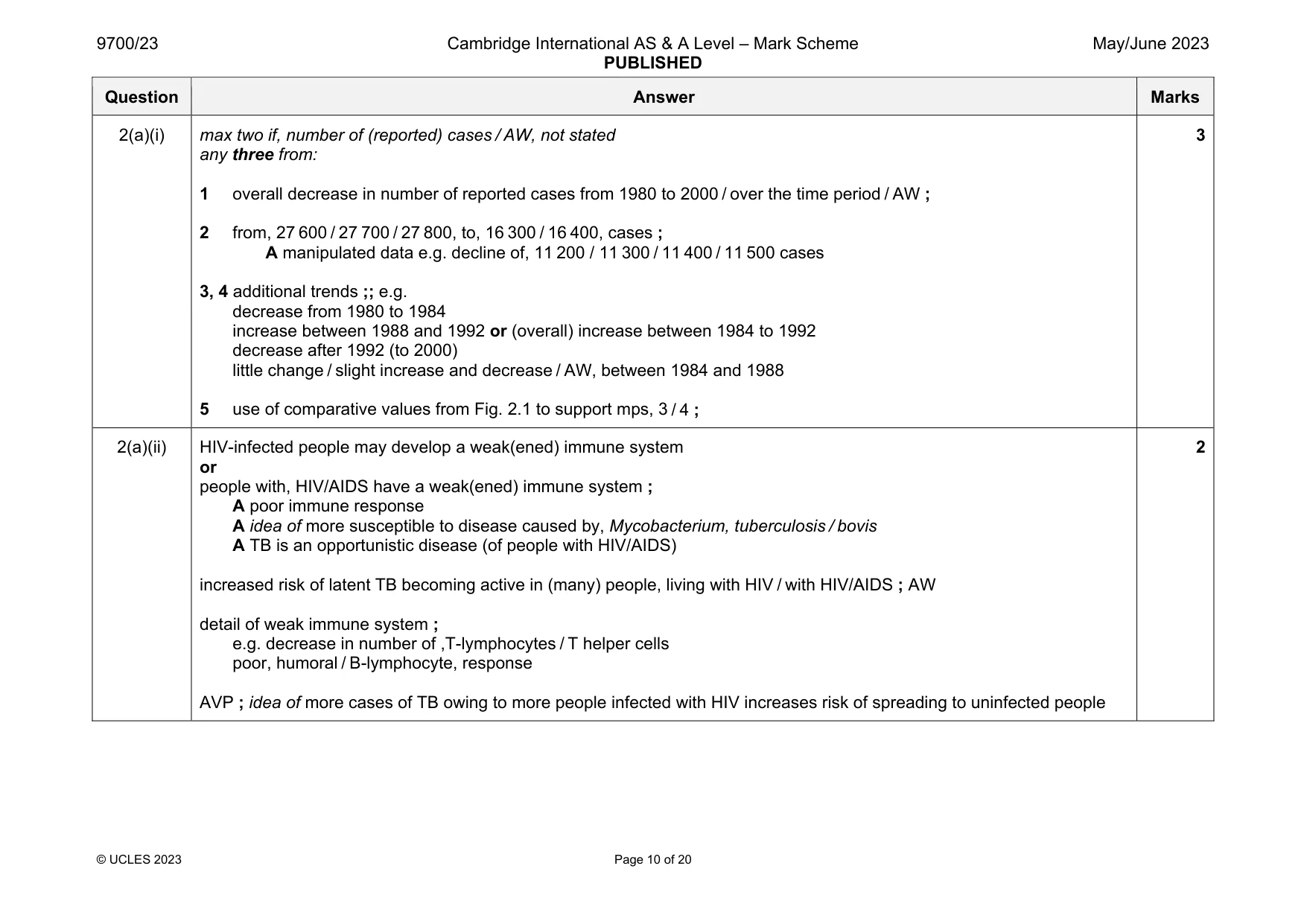
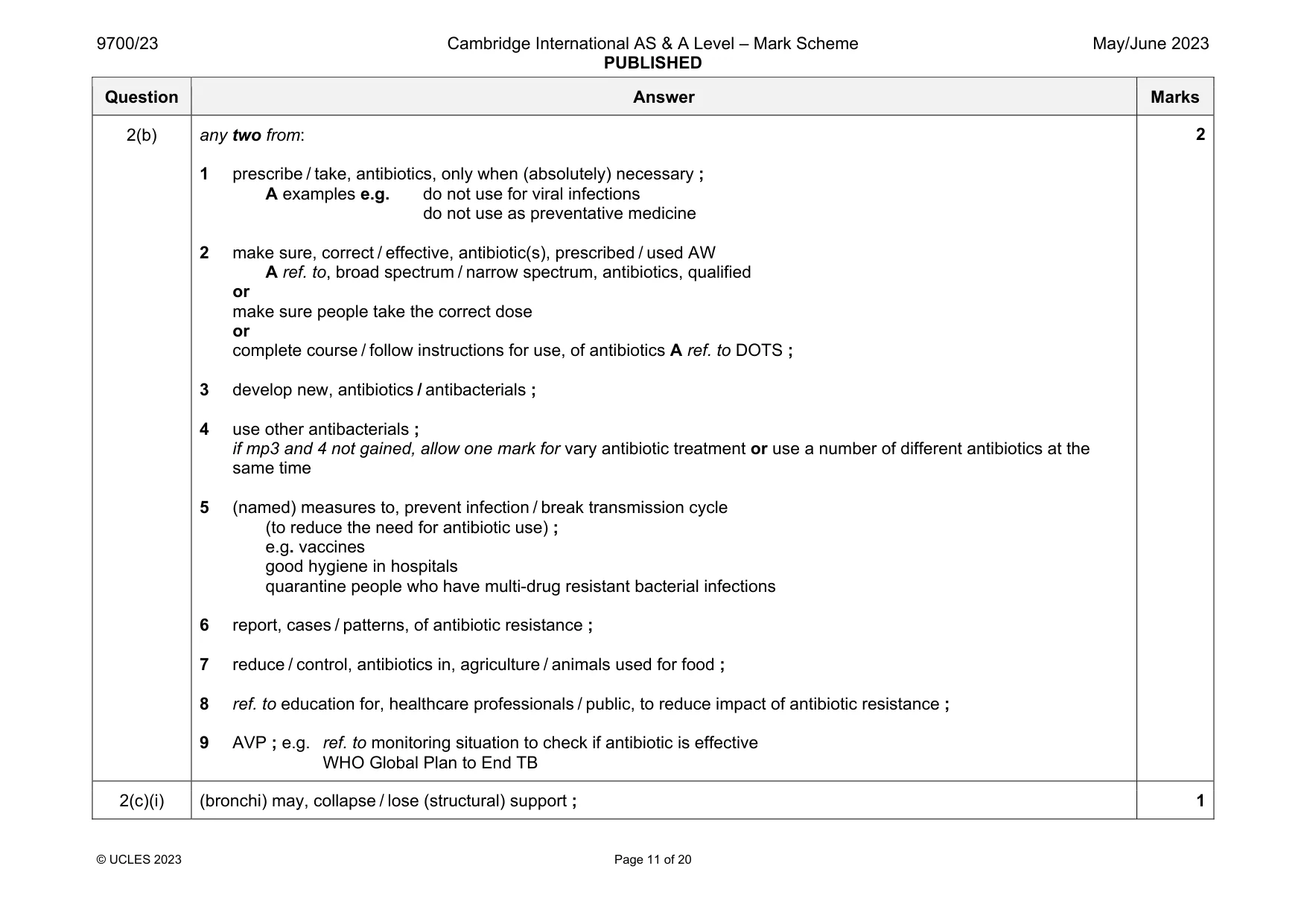
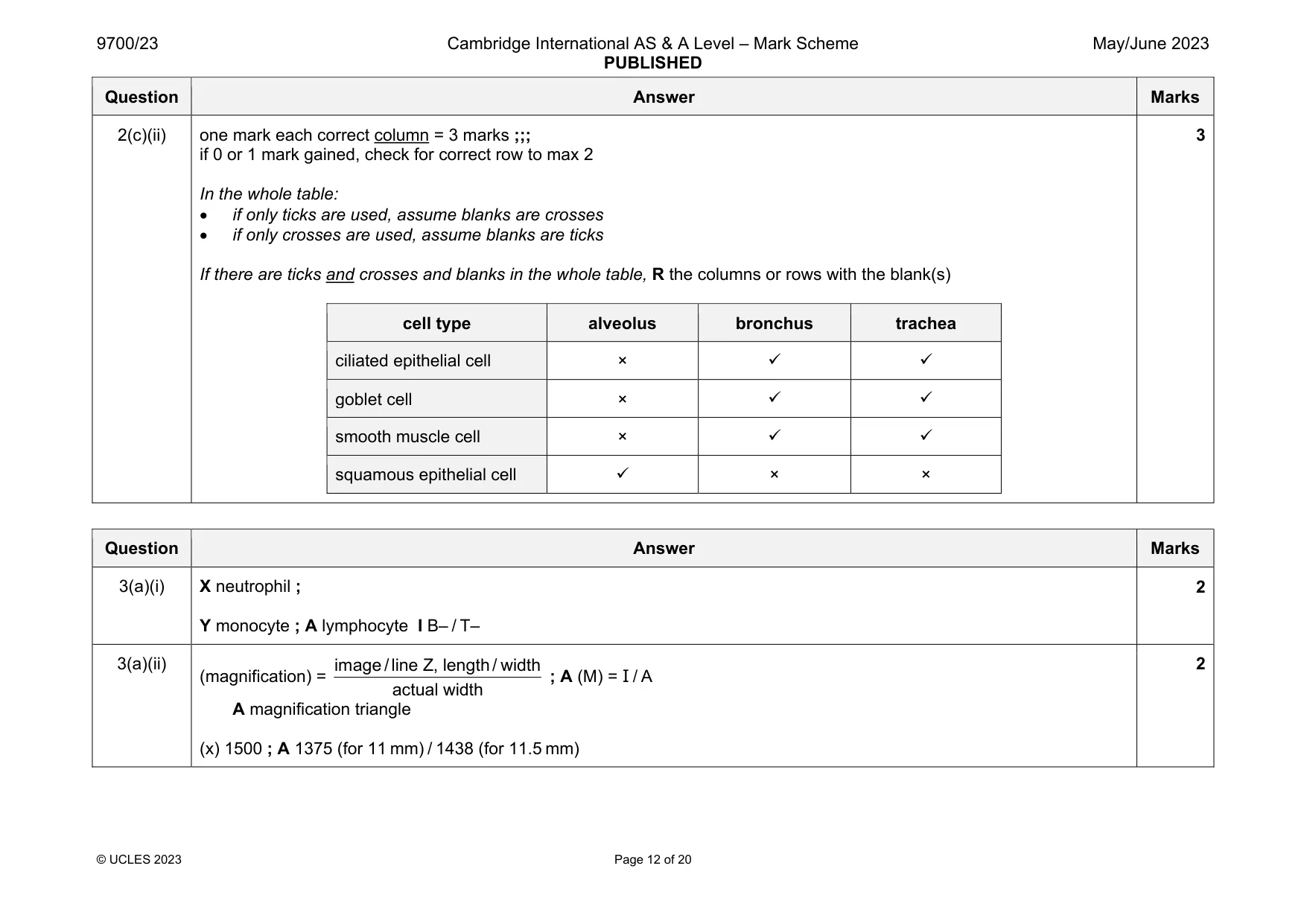
Mark scheme: 2(a)(i) max two if, number of (reported) cases / AW, not stated any three from: 1 overall decrease in number of reported cases from 1980 to 2000 / over the time period / AW ; 2 from, 27 600 / 27 700 / 27 800, to, 16 300 / 16 400, cases ; A manipulated data e.g. decline of, 11 200 / 11 300 / 11 400 / 11 500 cases 3, 4 additional trends ;; e.g. decrease from 1980 to 1984 increase between 1988 and 1992 or (overall) increase between 1984 to 1992 decrease after 1992 (to 2000) little change / slight increase and decrease / AW, between 1984 and 1988 5 use of comparative values from Fig. 2.1 to support mps, 3 / 4 ; 3 2(a)(ii) HIV-infected people may develop a weak(ened) immune system or people with, HIV/AIDS have a weak(ened) immune system ; A poor immune response A idea of more susceptible to disease caused by, Mycobacterium, tuberculosis / bovis A TB is an opportunistic disease (of people with HIV/AIDS) increased risk of latent TB becoming active in (many) people, living with HIV / with HIV/AIDS ; AW detail of weak immune system ; e.g. decrease in number of ,T-lymphocytes / T helper cells poor, humoral / B-lymphocyte, response AVP ; idea of more cases of TB owing to more people infected with HIV increases risk of spreading to uninfected people 2 Question Answer Marks 2(b) any two from: 1 prescribe / take, antibiotics, only when (absolutely) necessary ; A examples e.g. do not use for viral infections do not use as preventative medicine 2 make sure, correct / effective, antibiotic(s), prescribed / used AW A ref. to, broad spectrum / narrow spectrum, antibiotics, qualified or make sure people take the correct dose or complete course / follow instructions for use, of antibiotics A ref. to DOTS ; 3 develop new, antibiotics / antibacterials ; 4 use other antibacterials ; if mp3 and 4 not gained, allow one mark for vary antibiotic treatment or use a number of different antibiotics at the same time 5 (named) measures to, prevent infection / break transmission cycle (to reduce the need for antibiotic use) ; e.g. vaccines good hygiene in hospitals quarantine people who have multi-drug resistant bacterial infections 6 report, cases / patterns, of antibiotic resistance ; 7 reduce / control, antibiotics in, agriculture / animals used for food ; 8 ref. to education for, healthcare professionals / public, to reduce impact of antibiotic resistance ; 9 AVP ; e.g. ref. to monitoring situation to check if antibiotic is effective WHO Global Plan to End TB 2 2(c)(i) (bronchi) may, collapse / lose (structural) support ; 1 Question Answer Marks 2(c)(ii) one mark each correct column = 3 marks ;;; if 0 or 1 mark gained, check for correct row to max 2 In the whole table: if only ticks are used, assume blanks are crosses if only crosses are used, assume blanks are ticks If there are ticks and crosses and blanks in the whole table, R the columns or rows with the blank(s) cell type alveolus bronchus trachea ciliated epithelial cell × goblet cell × smooth muscle cell × squamous epithelial cell × × 3
Q3 · Blood contains white blood cells and red blood cells
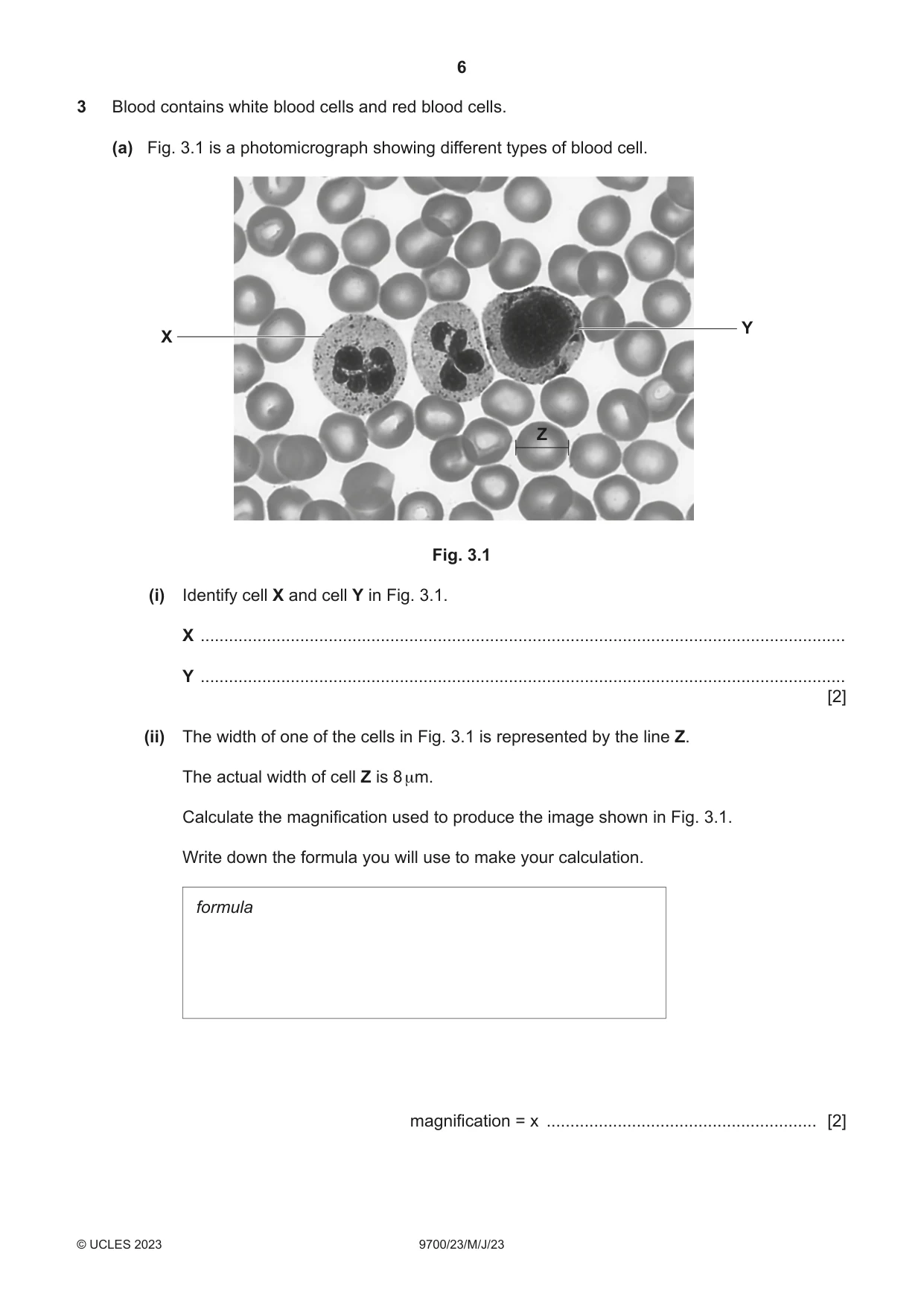
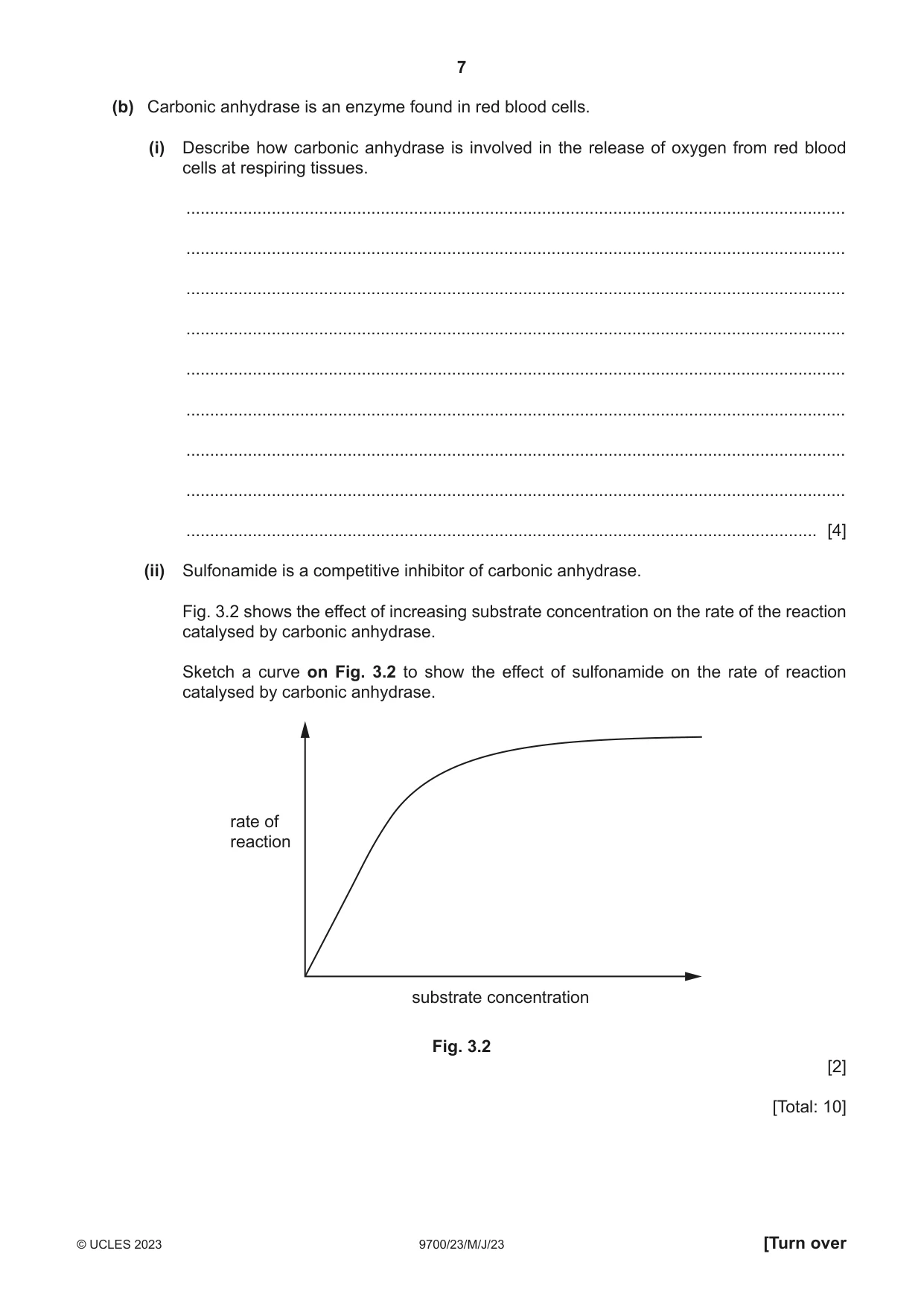
3 Blood contains white blood cells and red blood cells. (a) Fig. 3.1 is a photomicrograph showing different types of blood cell. Y X Z Fig. 3.1 (i) Identify cell X and cell Y in Fig. 3.1. X ........................................................................................................................................ Y ........................................................................................................................................ [2] (ii) The width of one of the cells in Fig. 3.1 is represented by the line Z. The actual width of cell Z is 8 µm. Calculate the magnification used to produce the image shown in Fig. 3.1. Write down the formula you will use to make your calculation. formula magnification = x ......................................................... [2] (b) Carbonic anhydrase is an enzyme found in red blood cells. (i) Describe how carbonic anhydrase is involved in the release of oxygen from red blood cells at respiring tissues. ........................................................................................................................................... ........................................................................................................................................... ........................................................................................................................................... ........................................................................................................................................... ........................................................................................................................................... ........................................................................................................................................... ........................................................................................................................................... ........................................................................................................................................... ..................................................................................................................................... [4] (ii) Sulfonamide is a competitive inhibitor of carbonic anhydrase. Fig. 3.2 shows the effect of increasing substrate concentration on the rate of the reaction catalysed by carbonic anhydrase. Sketch a curve on Fig. 3.2 to show the effect of sulfonamide on the rate of reaction catalysed by carbonic anhydrase. rate of reaction substrate concentration Fig. 3.2 [2] [Total: 10]
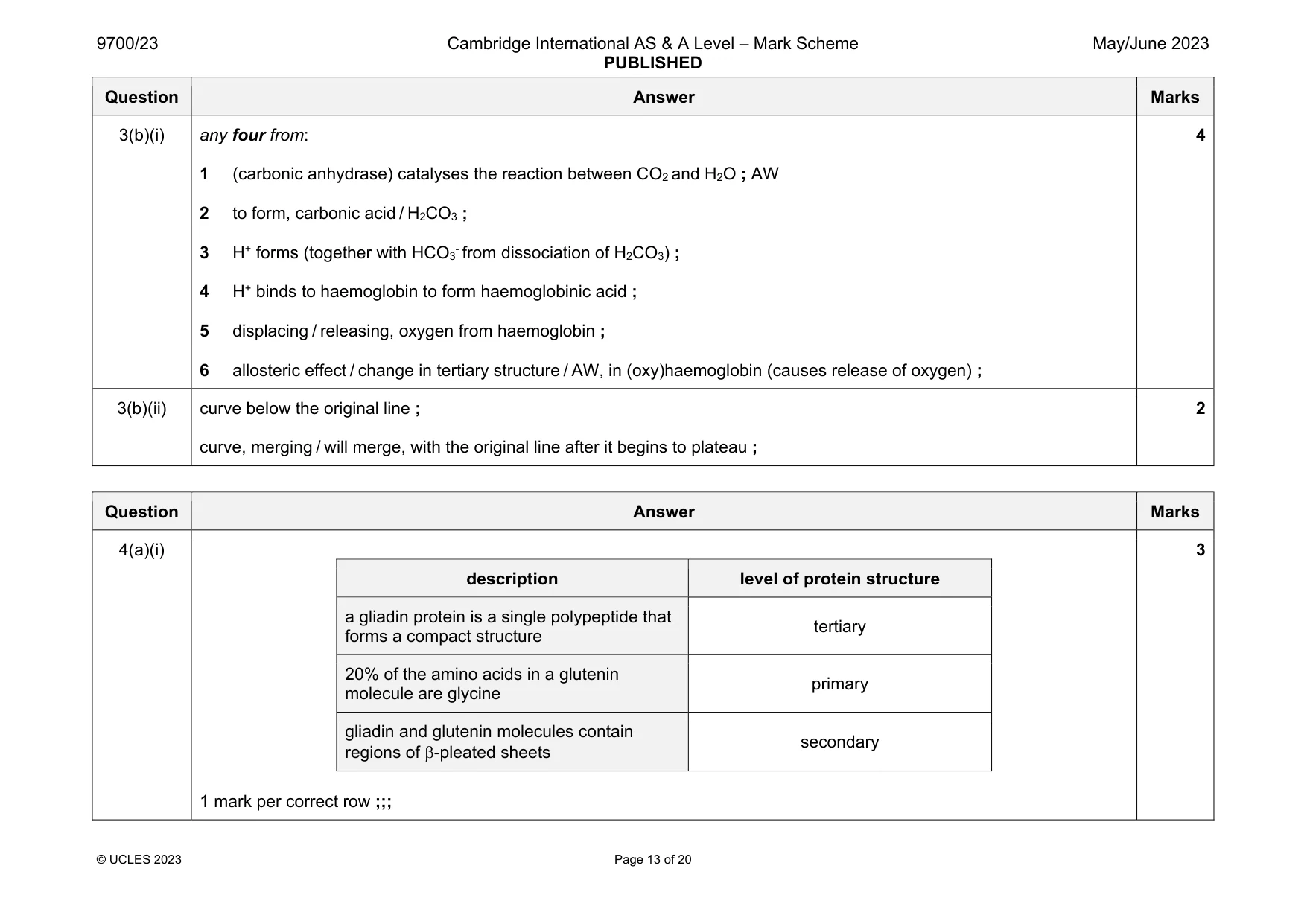
Mark scheme: 3(a)(i) X neutrophil ; Y monocyte ; A lymphocyte I B– / T– 2 3(a)(ii) (magnification) = image /line Z, length/ width actual width ; A (M) = I / A A magnification triangle (x) 1500 ; A 1375 (for 11 mm) / 1438 (for 11.5 mm) 2 Question Answer Marks 3(b)(i) any four from: 1 (carbonic anhydrase) catalyses the reaction between CO2 and H2O ; AW 2 to form, carbonic acid / H2CO3 ; 3 H+ forms (together with HCO3- from dissociation of H2CO3) ; 4 H+ binds to haemoglobin to form haemoglobinic acid ; 5 displacing / releasing, oxygen from haemoglobin ; 6 allosteric effect / change in tertiary structure / AW, in (oxy)haemoglobin (causes release of oxygen) ; 4 3(b)(ii) curve below the original line ; curve, merging / will merge, with the original line after it begins to plateau ; 2
Q4 · Food crops such as barley and wheat contain gluten
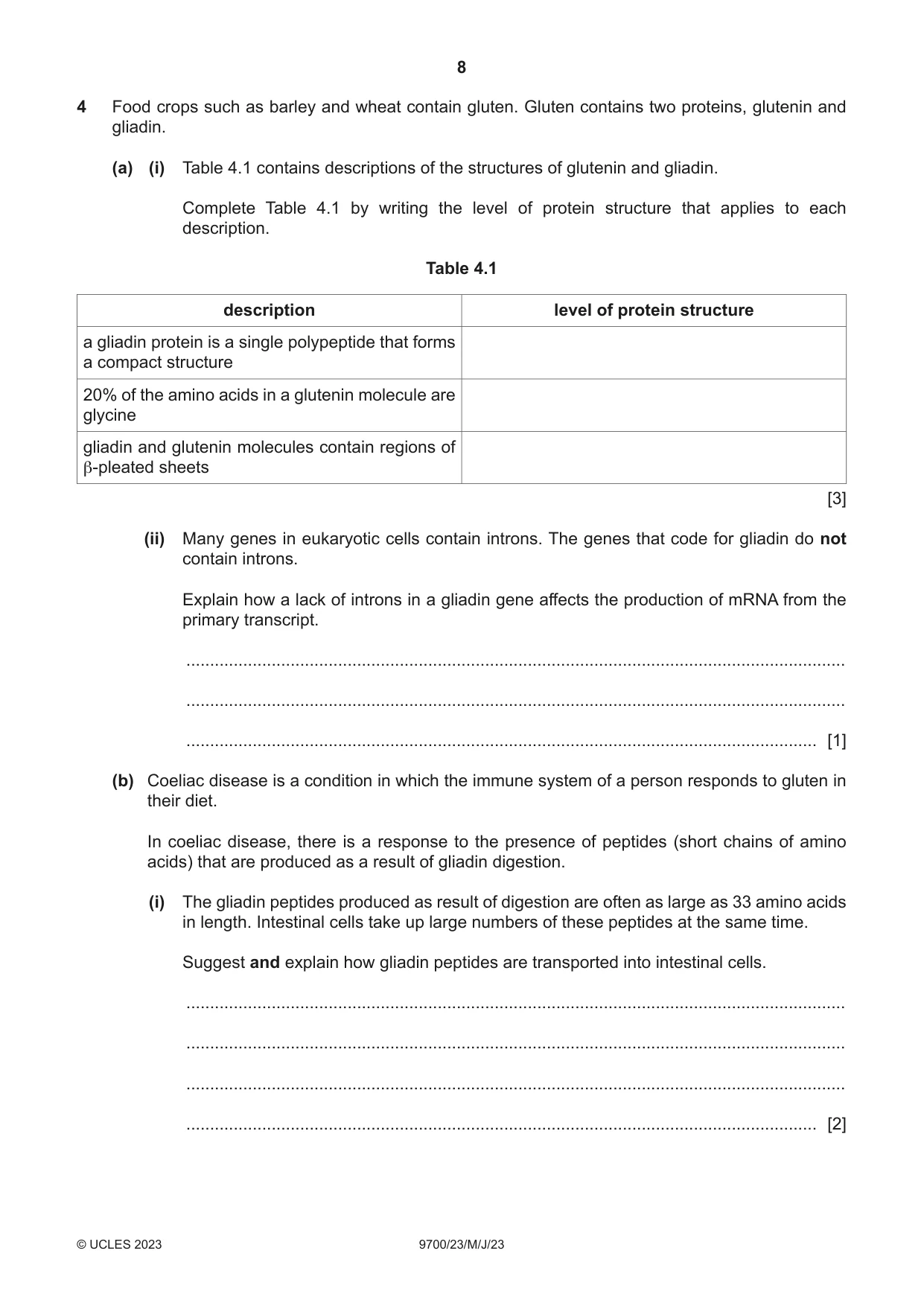
4 Food crops such as barley and wheat contain gluten. Gluten contains two proteins, glutenin and gliadin. (a) (i) Table 4.1 contains descriptions of the structures of glutenin and gliadin. Complete Table 4.1 by writing the level of protein structure that applies to each description. Table 4.1 description level of protein structure a gliadin protein is a single polypeptide that forms a compact structure 20% of the amino acids in a glutenin molecule are glycine gliadin and glutenin molecules contain regions of β-pleated sheets [3] (ii) Many genes in eukaryotic cells contain introns. The genes that code for gliadin do not contain introns. Explain how a lack of introns in a gliadin gene affects the production of mRNA from the primary transcript. ........................................................................................................................................... ........................................................................................................................................... ..................................................................................................................................... [1] (b) Coeliac disease is a condition in which the immune system of a person responds to gluten in their diet. In coeliac disease, there is a response to the presence of peptides (short chains of amino acids) that are produced as a result of gliadin digestion. (i) The gliadin peptides produced as result of digestion are often as large as 33 amino acids in length. Intestinal cells take up large numbers of these peptides at the same time. Suggest and explain how gliadin peptides are transported into intestinal cells. ........................................................................................................................................... ........................................................................................................................................... ........................................................................................................................................... ..................................................................................................................................... [2] (ii) The presence of gliadin causes the immune system of a person with coeliac disease to respond by producing anti-gliadin antibodies. Describe the sequence of events that results in the immune system producing anti- gliadin antibodies. ........................................................................................................................................... ........................................................................................................................................... ........................................................................................................................................... ........................................................................................................................................... ........................................................................................................................................... ........................................................................................................................................... ........................................................................................................................................... ........................................................................................................................................... ..................................................................................................................................... [4] [Total: 10]
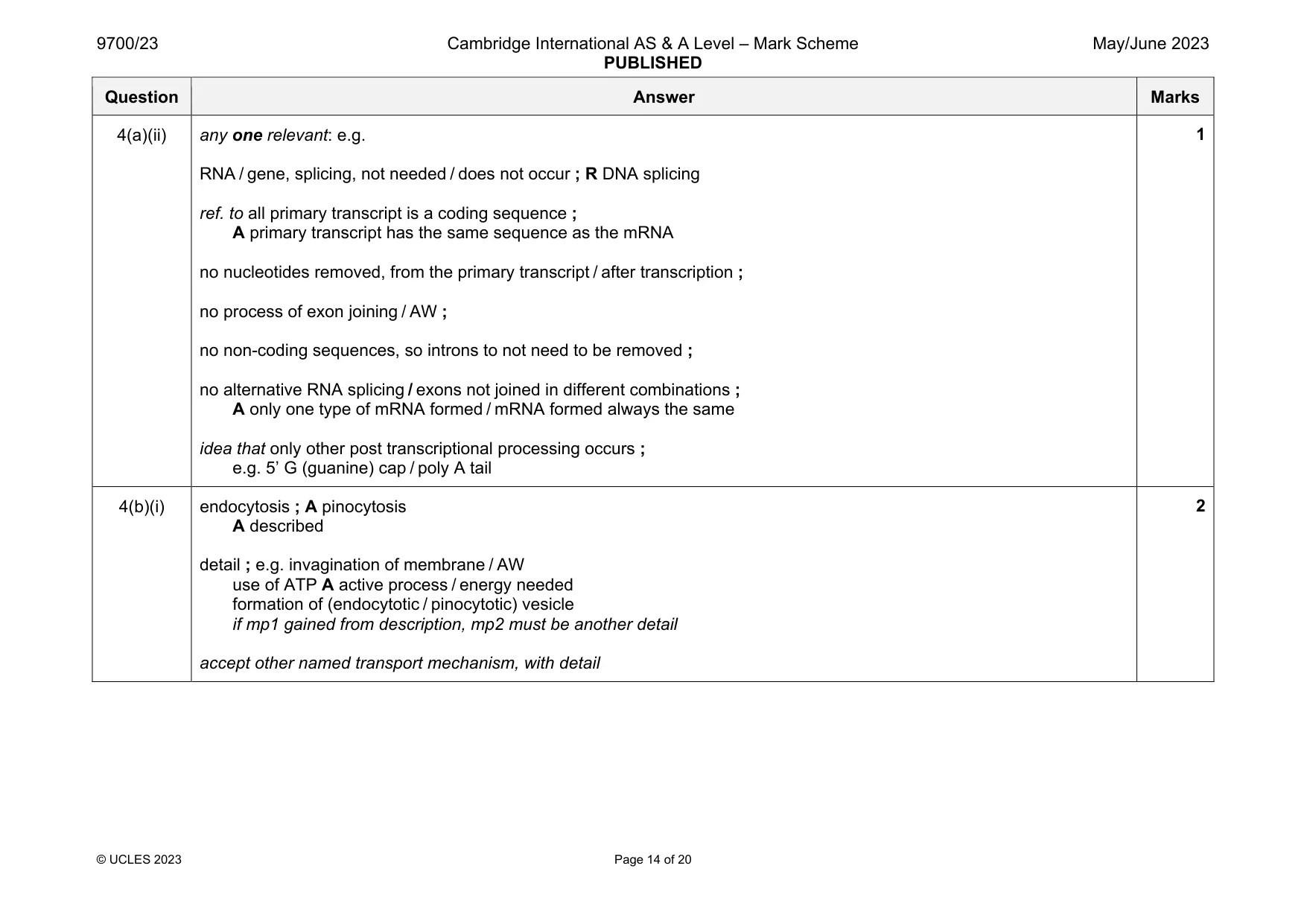
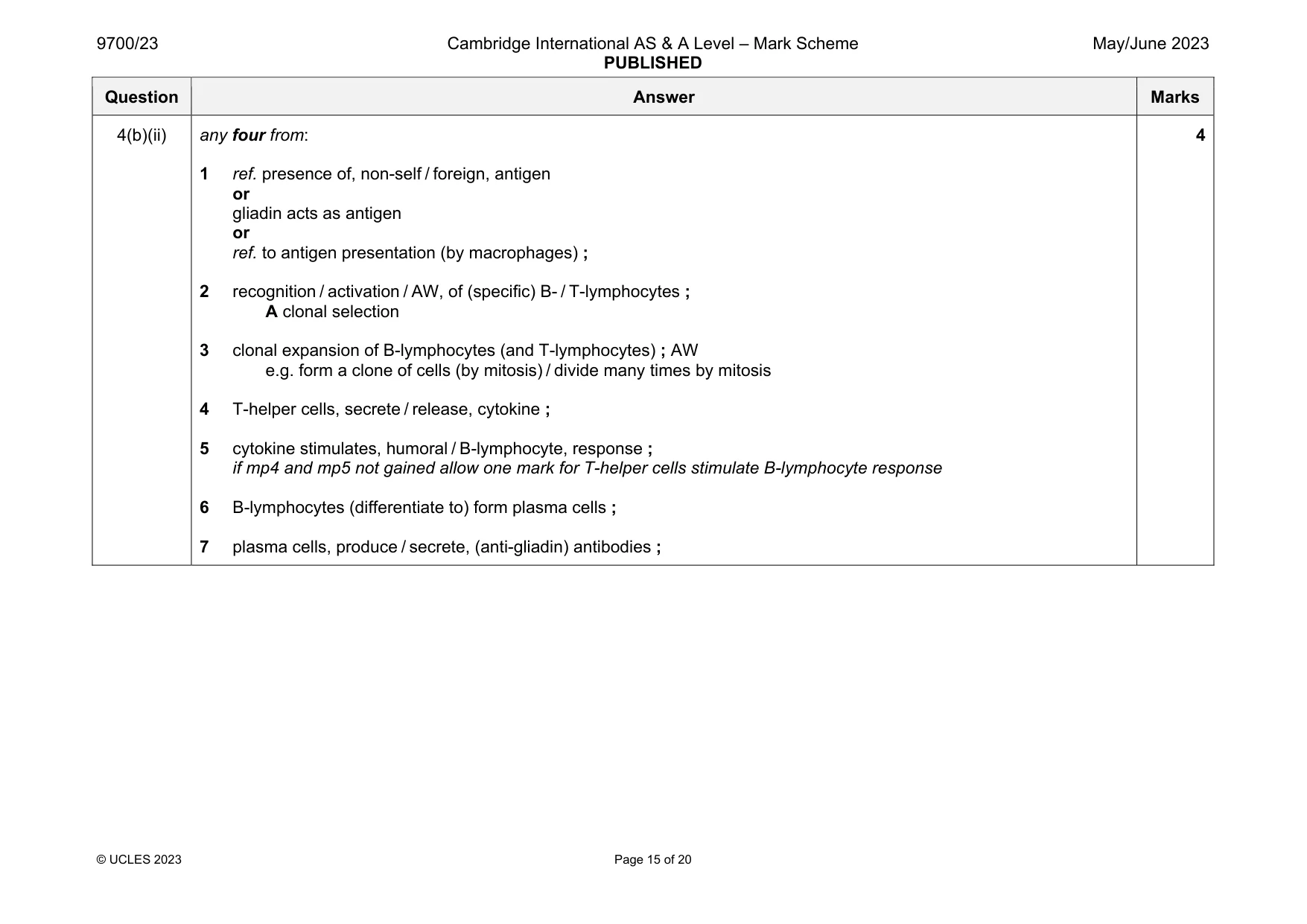
Mark scheme: 4(a)(i) description level of protein structure a gliadin protein is a single polypeptide that forms a compact structure tertiary 20% of the amino acids in a glutenin molecule are glycine primary gliadin and glutenin molecules contain regions of -pleated sheets secondary 1 mark per correct row ;;; Question Answer Marks 4(a)(ii) any one relevant: e.g. RNA / gene, splicing, not needed / does not occur ; R DNA splicing ref. to all primary transcript is a coding sequence ; A primary transcript has the same sequence as the mRNA no nucleotides removed, from the primary transcript / after transcription ; no process of exon joining / AW ; no non-coding sequences, so introns to not need to be removed ; no alternative RNA splicing / exons not joined in different combinations ; A only one type of mRNA formed / mRNA formed always the same idea that only other post transcriptional processing occurs ; e.g. 5’ G (guanine) cap / poly A tail 1 4(b)(i) endocytosis ; A pinocytosis A described detail ; e.g. invagination of membrane / AW use of ATP A active process / energy needed formation of (endocytotic / pinocytotic) vesicle if mp1 gained from description, mp2 must be another detail accept other named transport mechanism, with detail 2 Question Answer Marks 4(b)(ii) any four from: 1 ref. presence of, non-self / foreign, antigen or gliadin acts as antigen or ref. to antigen presentation (by macrophages) ; 2 recognition / activation / AW, of (specific) B- / T-lymphocytes ; A clonal selection 3 clonal expansion of B-lymphocytes (and T-lymphocytes) ; AW e.g. form a clone of cells (by mitosis) / divide many times by mitosis 4 T-helper cells, secrete / release, cytokine ; 5 cytokine stimulates, humoral / B-lymphocyte, response ; if mp4 and mp5 not gained allow one mark for T-helper cells stimulate B-lymphocyte response 6 B-lymphocytes (differentiate to) form plasma cells ; 7 plasma cells, produce / secrete, (anti-gliadin) antibodies ; 4
Q5 · Phloem and xylem are specialised tissues involved in the transport of water, ions and…
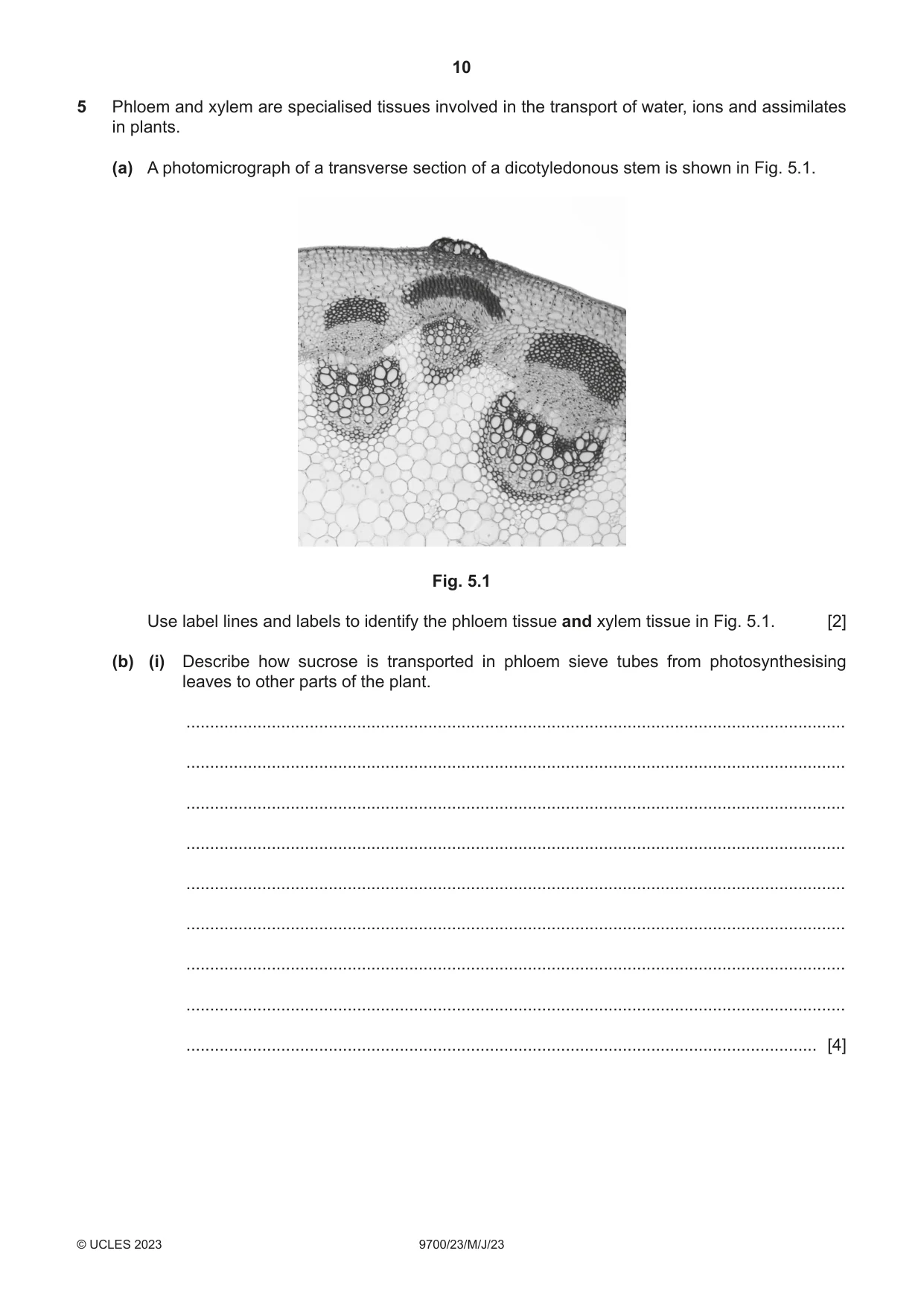
5 Phloem and xylem are specialised tissues involved in the transport of water, ions and assimilates in plants. (a) A photomicrograph of a transverse section of a dicotyledonous stem is shown in Fig. 5.1. Fig. 5.1 Use label lines and labels to identify the phloem tissue and xylem tissue in Fig. 5.1. [2] (b) (i) Describe how sucrose is transported in phloem sieve tubes from photosynthesising leaves to other parts of the plant. ........................................................................................................................................... ........................................................................................................................................... ........................................................................................................................................... ........................................................................................................................................... ........................................................................................................................................... ........................................................................................................................................... ........................................................................................................................................... ........................................................................................................................................... ..................................................................................................................................... [4] (ii) Cyanide ions (CN–) inhibit the activity of an enzyme involved in respiration. Suggest why the treatment of photosynthesising leaves with CN– results in less sucrose being transported into phloem sieve tubes. ........................................................................................................................................... ........................................................................................................................................... ........................................................................................................................................... ........................................................................................................................................... ..................................................................................................................................... [2] (c) A student was asked to carry out semi-quantitative Benedict’s tests on two solutions. • Solution A was extracted from the cytoplasm of cells in the mesophyll tissue of photosynthesising leaves. • Solution B was extracted from the phloem sap in phloem sieve tubes. The solutions were taken from the same plant, and other variables were standardised. For each solution, the student measured the time taken for the first colour change to appear. Suggest which of the two solutions, A or B, would change colour in the shortest time. Explain your answer. ................................................................................................................................................... ................................................................................................................................................... ................................................................................................................................................... ................................................................................................................................................... ............................................................................................................................................. [2] [Total: 10]
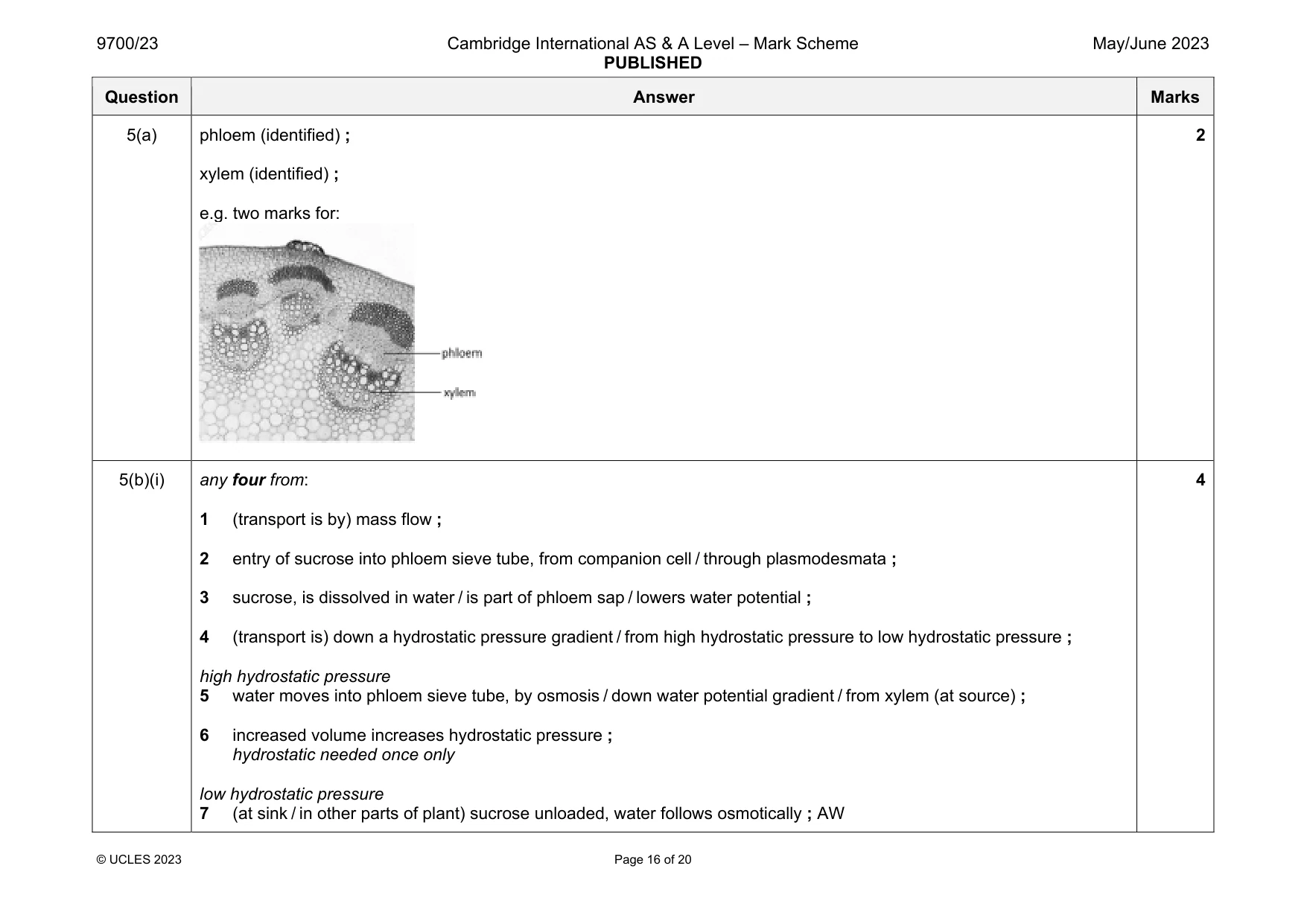
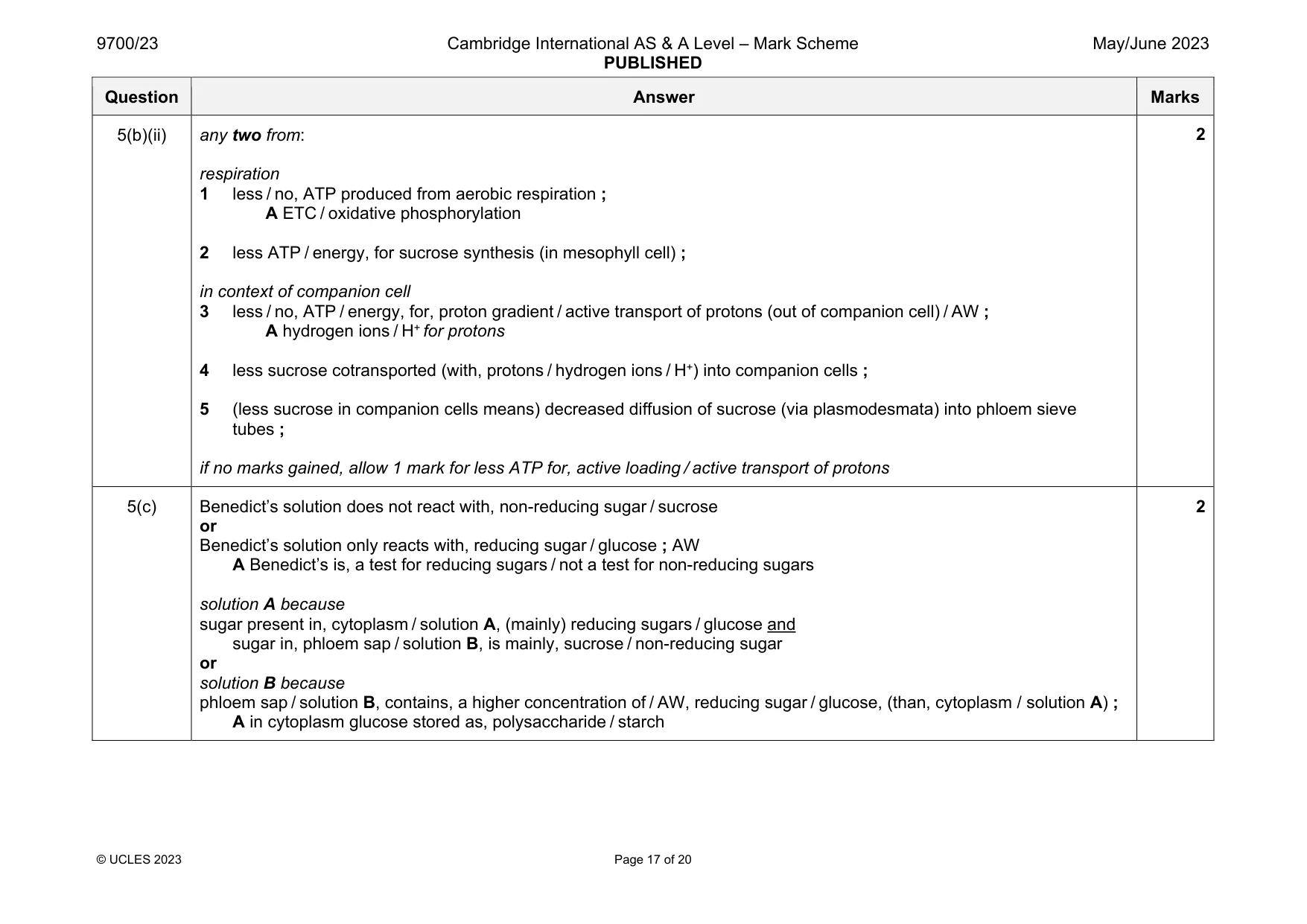
Mark scheme: 5(a) phloem (identified) ; xylem (identified) ; e.g. two marks for: 2 5(b)(i) any four from: 1 (transport is by) mass flow ; 2 entry of sucrose into phloem sieve tube, from companion cell / through plasmodesmata ; 3 sucrose, is dissolved in water / is part of phloem sap / lowers water potential ; 4 (transport is) down a hydrostatic pressure gradient / from high hydrostatic pressure to low hydrostatic pressure ; high hydrostatic pressure 5 water moves into phloem sieve tube, by osmosis / down water potential gradient / from xylem (at source) ; 6 increased volume increases hydrostatic pressure ; hydrostatic needed once only low hydrostatic pressure 7 (at sink / in other parts of plant) sucrose unloaded, water follows osmotically ; AW 4 Question Answer Marks 5(b)(ii) any two from: respiration 1 less / no, ATP produced from aerobic respiration ; A ETC / oxidative phosphorylation 2 less ATP / energy, for sucrose synthesis (in mesophyll cell) ; in context of companion cell 3 less / no, ATP / energy, for, proton gradient / active transport of protons (out of companion cell) / AW ; A hydrogen ions / H+ for protons 4 less sucrose cotransported (with, protons / hydrogen ions / H+) into companion cells ; 5 (less sucrose in companion cells means) decreased diffusion of sucrose (via plasmodesmata) into phloem sieve tubes ; if no marks gained, allow 1 mark for less ATP for, active loading / active transport of protons 2 5(c) Benedict’s solution does not react with, non-reducing sugar / sucrose or Benedict’s solution only reacts with, reducing sugar / glucose ; AW A Benedict’s is, a test for reducing sugars / not a test for non-reducing sugars solution A because sugar present in, cytoplasm / solution A, (mainly) reducing sugars / glucose and sugar in, phloem sap / solution B, is mainly, sucrose / non-reducing sugar or solution B because phloem sap / solution B, contains, a higher concentration of / AW, reducing sugar / glucose, (than, cytoplasm / solution A) ; A in cytoplasm glucose stored as, polysaccharide / starch 2
Q6 · Polysaccharides, such as glycogen, are composed of thousands of monomers
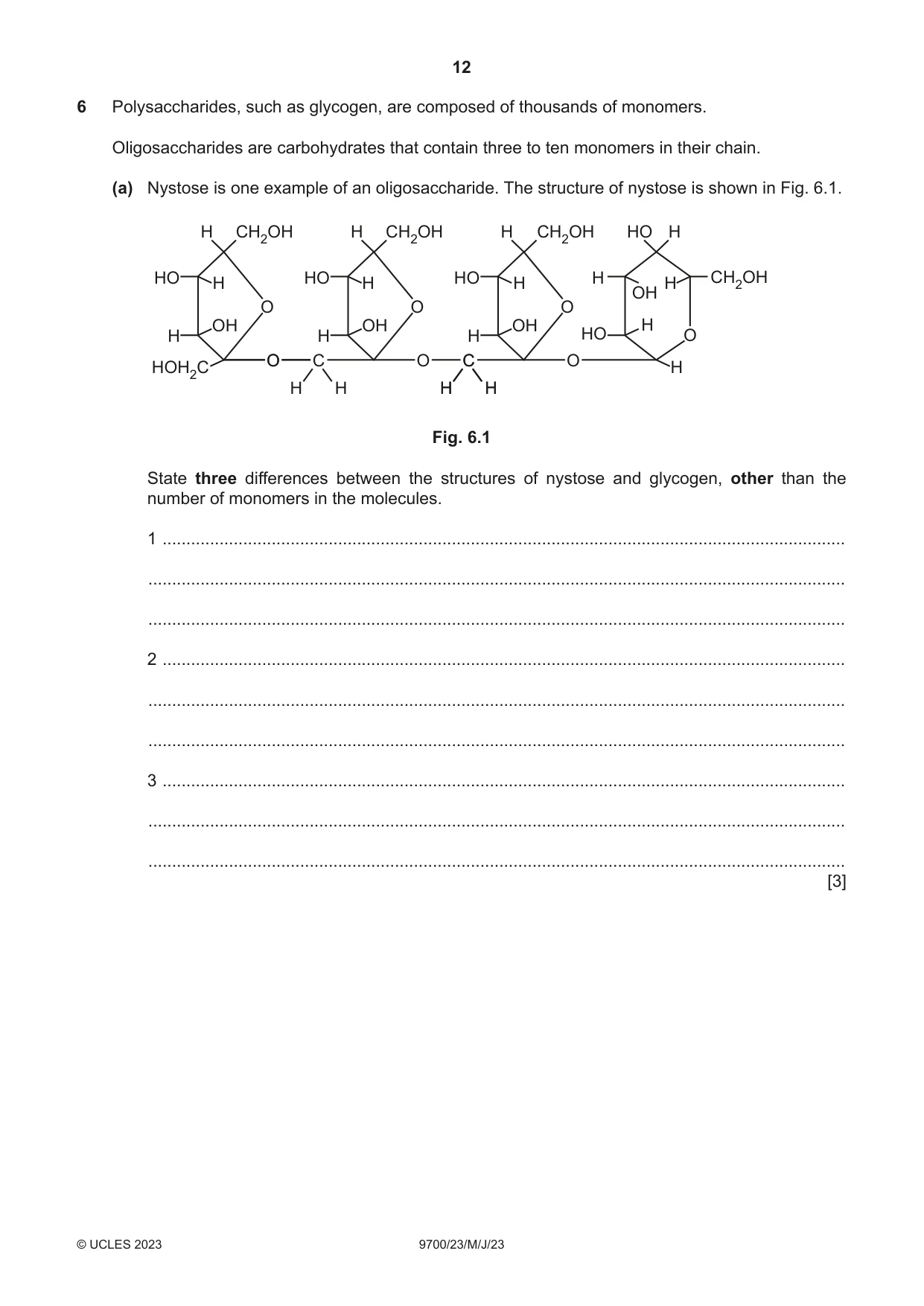
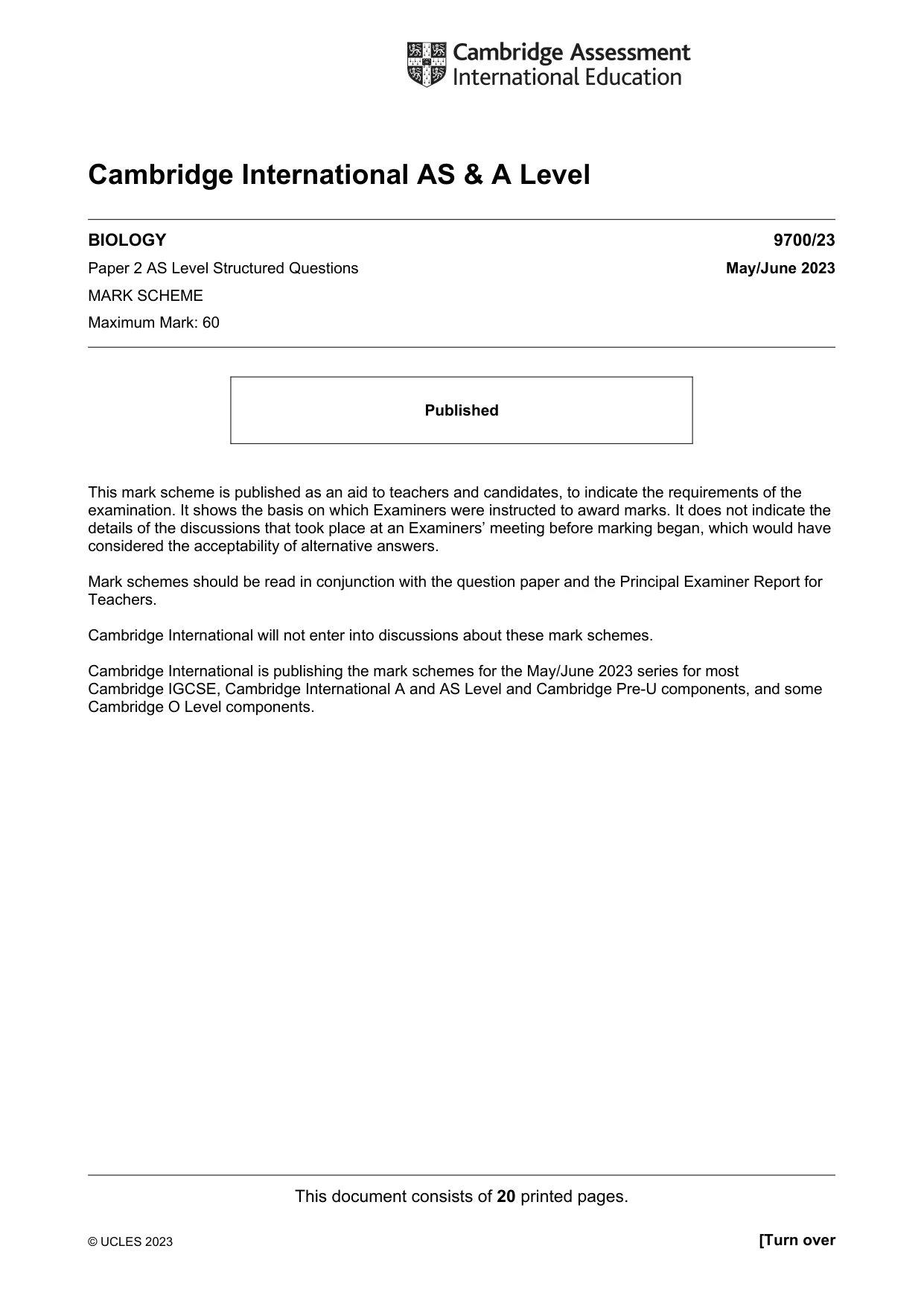
6 Polysaccharides, such as glycogen, are composed of thousands of monomers. Oligosaccharides are carbohydrates that contain three to ten monomers in their chain. (a) Nystose is one example of an oligosaccharide. The structure of nystose is shown in Fig. 6.1. H CH2OH H CH2OH H CH2OH HO H H HO HO HO H H H H CH2OH OH O O O OH OH OH H H H H HO O O C O CC O HOH2C H H H HH HH Fig. 6.1 State three differences between the structures of nystose and glycogen, other than the number of monomers in the molecules. 1 ................................................................................................................................................ ................................................................................................................................................... ................................................................................................................................................... 2 ................................................................................................................................................ ................................................................................................................................................... ................................................................................................................................................... 3 ................................................................................................................................................ ................................................................................................................................................... ................................................................................................................................................... [3] (b) Cells use oligosaccharides to synthesise glycoproteins, which are transported to cell surface membranes. Describe the roles of the rough endoplasmic reticulum and the Golgi body in synthesising glycoproteins. ................................................................................................................................................... ................................................................................................................................................... ................................................................................................................................................... ................................................................................................................................................... ................................................................................................................................................... ................................................................................................................................................... ................................................................................................................................................... ................................................................................................................................................... ............................................................................................................................................. [4] (c) State one role of glycoproteins in the cell surface membrane. ................................................................................................................................................... ............................................................................................................................................. [1] [Total: 8]
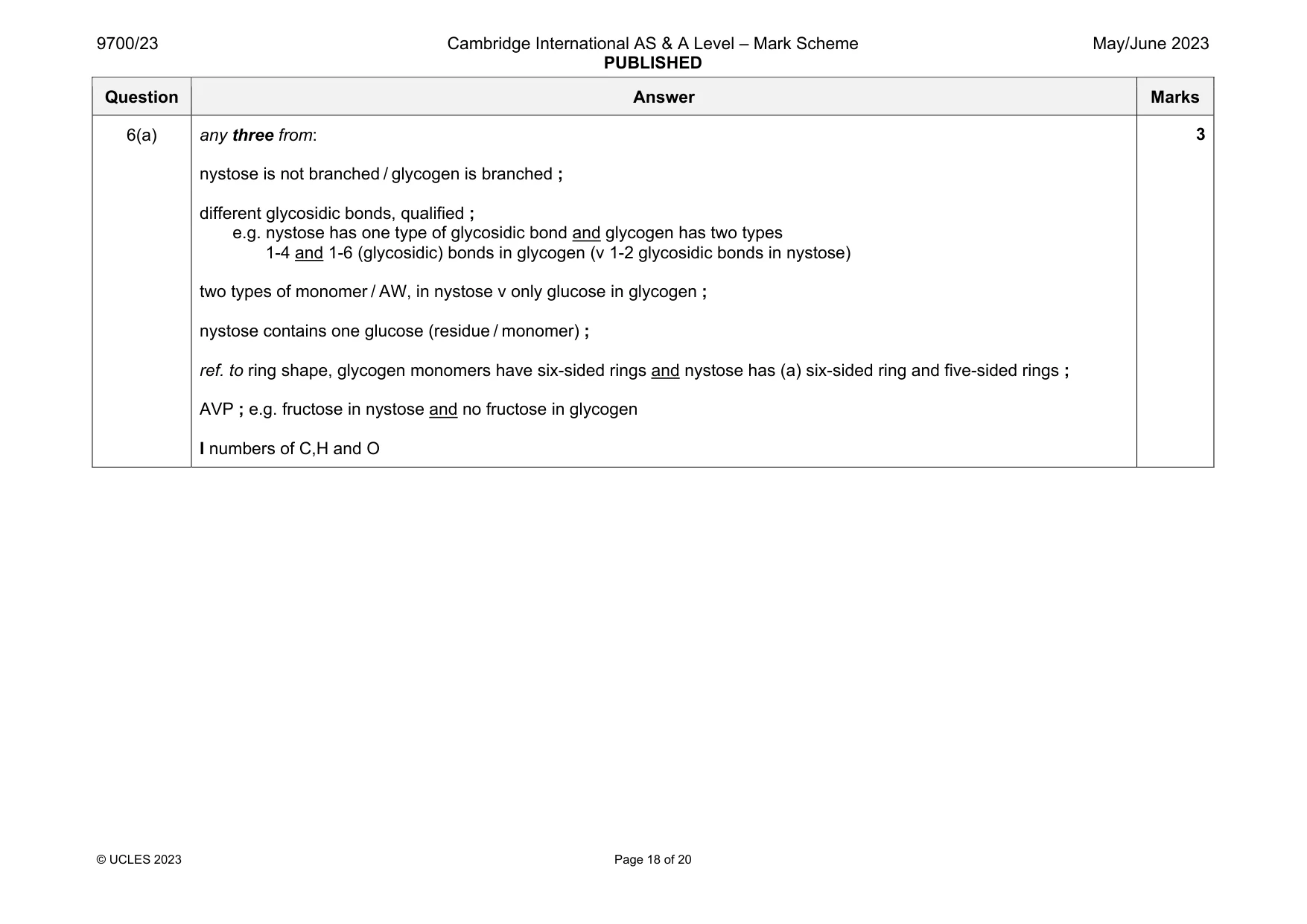
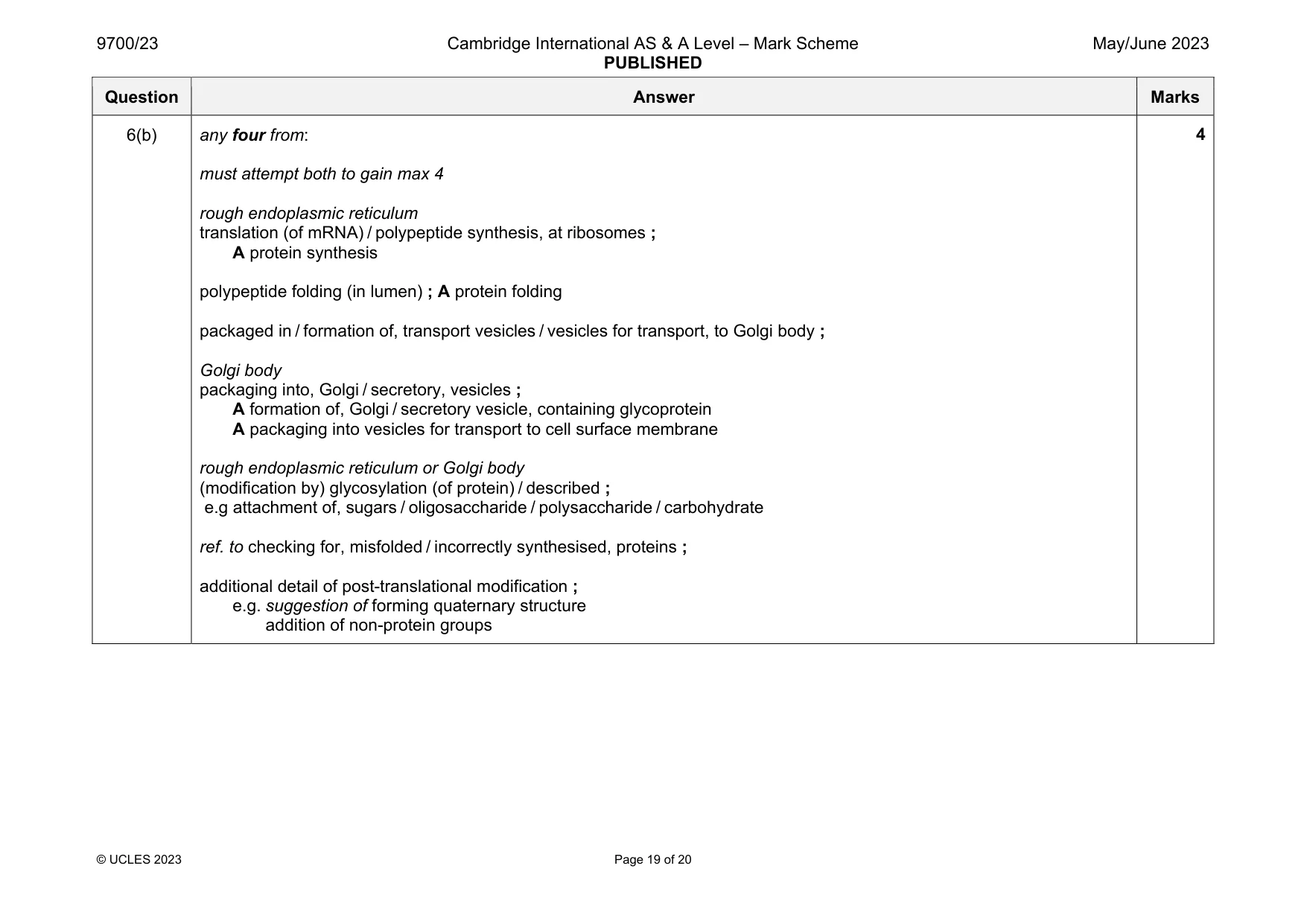
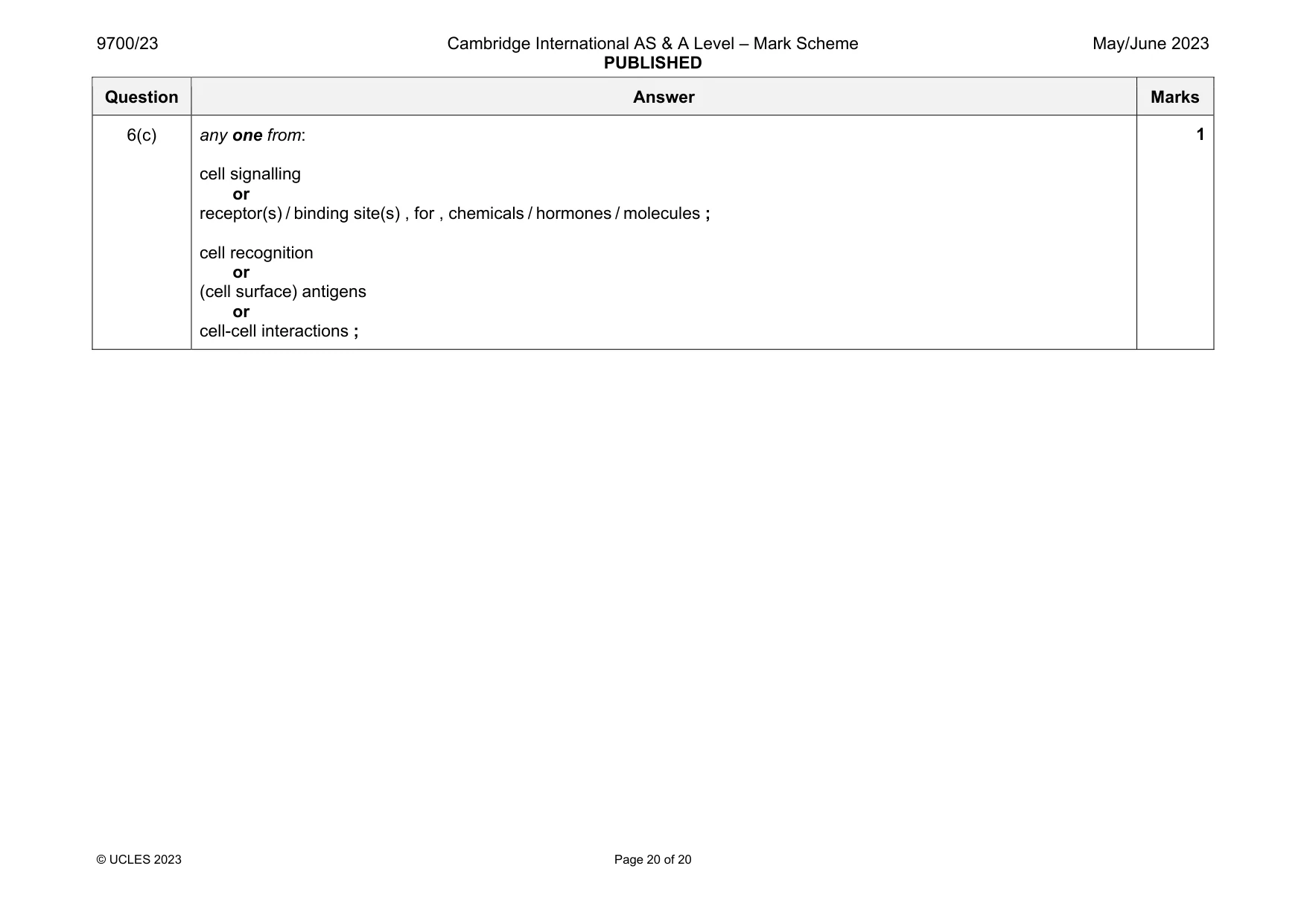
Mark scheme: 6(a) any three from: nystose is not branched / glycogen is branched ; different glycosidic bonds, qualified ; e.g. nystose has one type of glycosidic bond and glycogen has two types 1-4 and 1-6 (glycosidic) bonds in glycogen (v 1-2 glycosidic bonds in nystose) two types of monomer / AW, in nystose v only glucose in glycogen ; nystose contains one glucose (residue / monomer) ; ref. to ring shape, glycogen monomers have six-sided rings and nystose has (a) six-sided ring and five-sided rings ; AVP ; e.g. fructose in nystose and no fructose in glycogen I numbers of C,H and O Question Answer Marks 6(b) any four from: must attempt both to gain max 4 rough endoplasmic reticulum translation (of mRNA) / polypeptide synthesis, at ribosomes ; A protein synthesis polypeptide folding (in lumen) ; A protein folding packaged in / formation of, transport vesicles / vesicles for transport, to Golgi body ; Golgi body packaging into, Golgi / secretory, vesicles ; A formation of, Golgi / secretory vesicle, containing glycoprotein A packaging into vesicles for transport to cell surface membrane rough endoplasmic reticulum or Golgi body (modification by) glycosylation (of protein) / described ; e.g attachment of, sugars / oligosaccharide / polysaccharide / carbohydrate ref. to checking for, misfolded / incorrectly synthesised, proteins ; additional detail of post-translational modification ; e.g. suggestion of forming quaternary structure addition of non-protein groups 4 Question Answer Marks 6(c) any one from: cell signalling or receptor(s) / binding site(s) , for , chemicals / hormones / molecules ; cell recognition or (cell surface) antigens or cell-cell interactions ; 1
What was in this paper
The subtopics covered by these 6 questions, and how many questions each got. Open one in a new tab to see every Cambridge question on it.
What you needed in this session
Cambridge’s own grade thresholds for 2023 May/June, Paper 2 · Variant 3. A higher threshold means an easier paper — the bar moves with how the cohort did.