Cambridge A Level Biology 9700 — 2021 Oct/Nov Paper 2 · Variant 2
9700/22/O/N/21 · 6 questions · 60 marks · ≈68 min
The question paper and its mark scheme, free to read here and free to download. This is Cambridge’s own paper, exactly as it was sat.
Question paper16 pages
Mark scheme21 pages
Answers below. Sit the paper first if you are practising.
Questions as text
Q1 · There are two types of cell, prokaryotic and eukaryotic
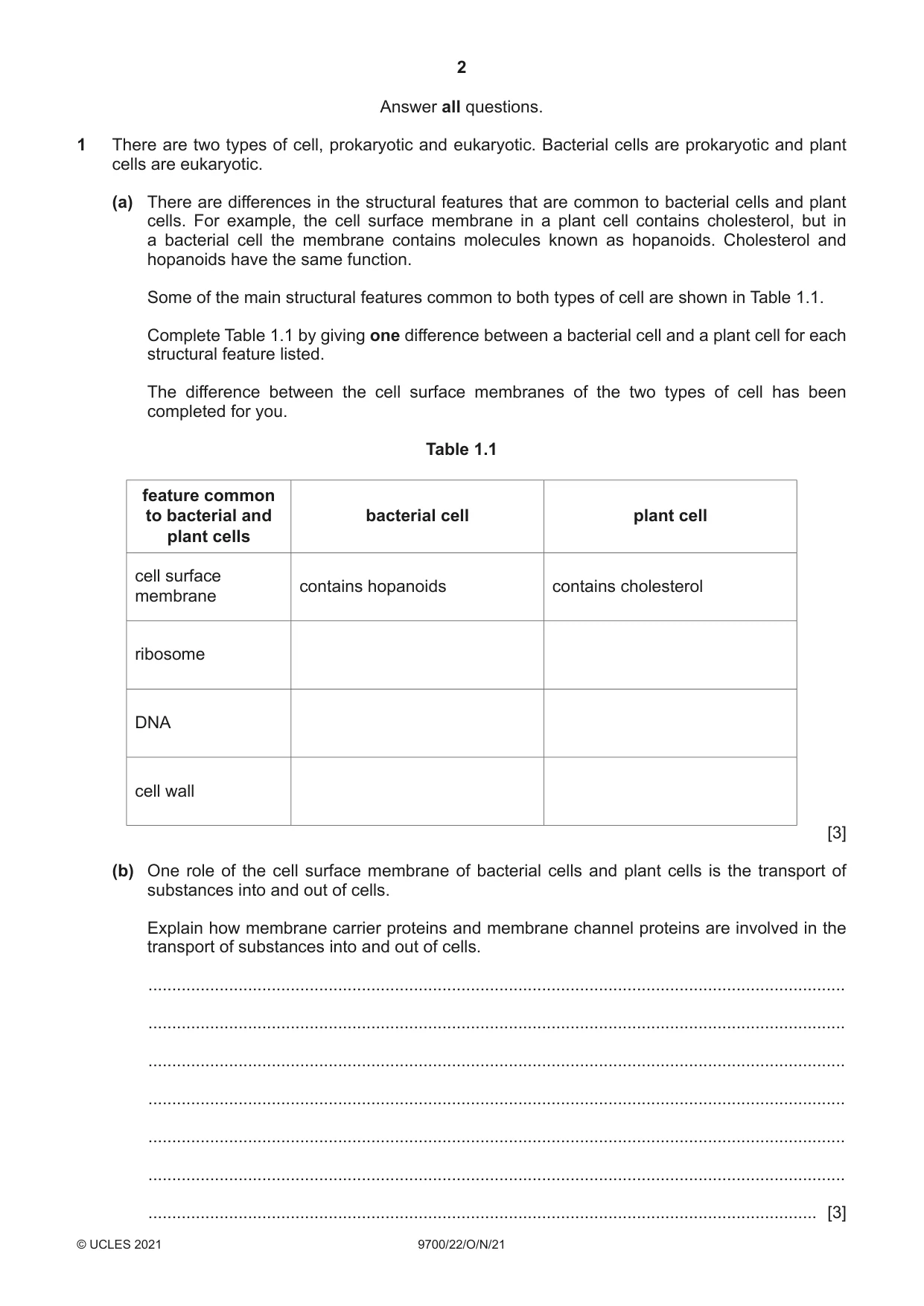
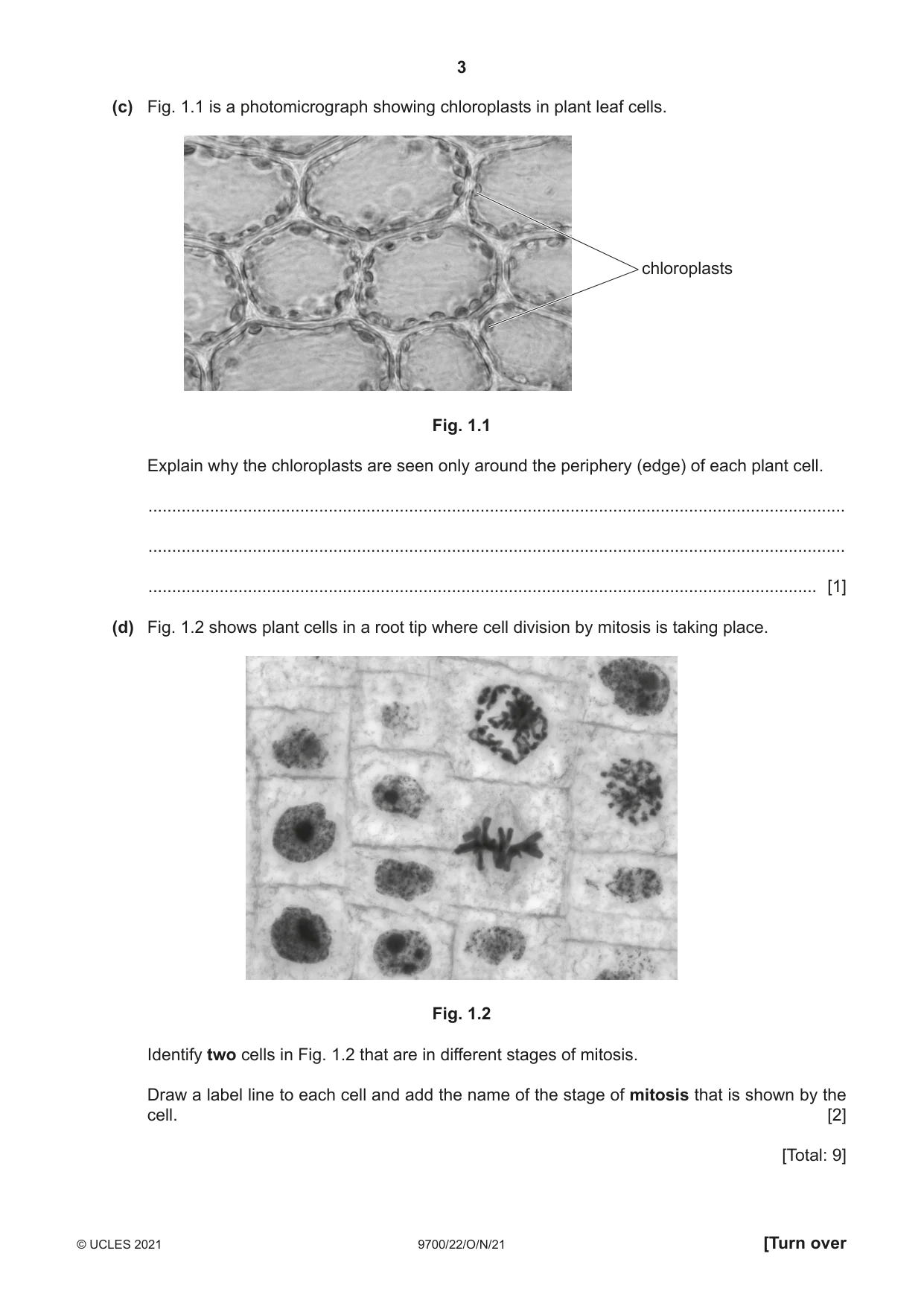
1 There are two types of cell, prokaryotic and eukaryotic. Bacterial cells are prokaryotic and plant cells are eukaryotic. (a) There are differences in the structural features that are common to bacterial cells and plant cells. For example, the cell surface membrane in a plant cell contains cholesterol, but in a bacterial cell the membrane contains molecules known as hopanoids. Cholesterol and hopanoids have the same function. Some of the main structural features common to both types of cell are shown in Table 1.1. Complete Table 1.1 by giving one difference between a bacterial cell and a plant cell for each structural feature listed. The difference between the cell surface membranes of the two types of cell has been completed for you. Table 1.1 feature common to bacterial and bacterial cell plant cell plant cells cell surface contains hopanoids contains cholesterol membrane ribosome DNA cell wall [3] (b) One role of the cell surface membrane of bacterial cells and plant cells is the transport of substances into and out of cells. Explain how membrane carrier proteins and membrane channel proteins are involved in the transport of substances into and out of cells. ................................................................................................................................................... ................................................................................................................................................... ................................................................................................................................................... ................................................................................................................................................... ................................................................................................................................................... ................................................................................................................................................... ............................................................................................................................................. [3] (c) Fig. 1.1 is a photomicrograph showing chloroplasts in plant leaf cells. chloroplasts Fig. 1.1 Explain why the chloroplasts are seen only around the periphery (edge) of each plant cell. ................................................................................................................................................... ................................................................................................................................................... ............................................................................................................................................. [1] (d) Fig. 1.2 shows plant cells in a root tip where cell division by mitosis is taking place. Fig. 1.2 Identify two cells in Fig. 1.2 that are in different stages of mitosis. Draw a label line to each cell and add the name of the stage of mitosis that is shown by the cell. [2] [Total: 9]
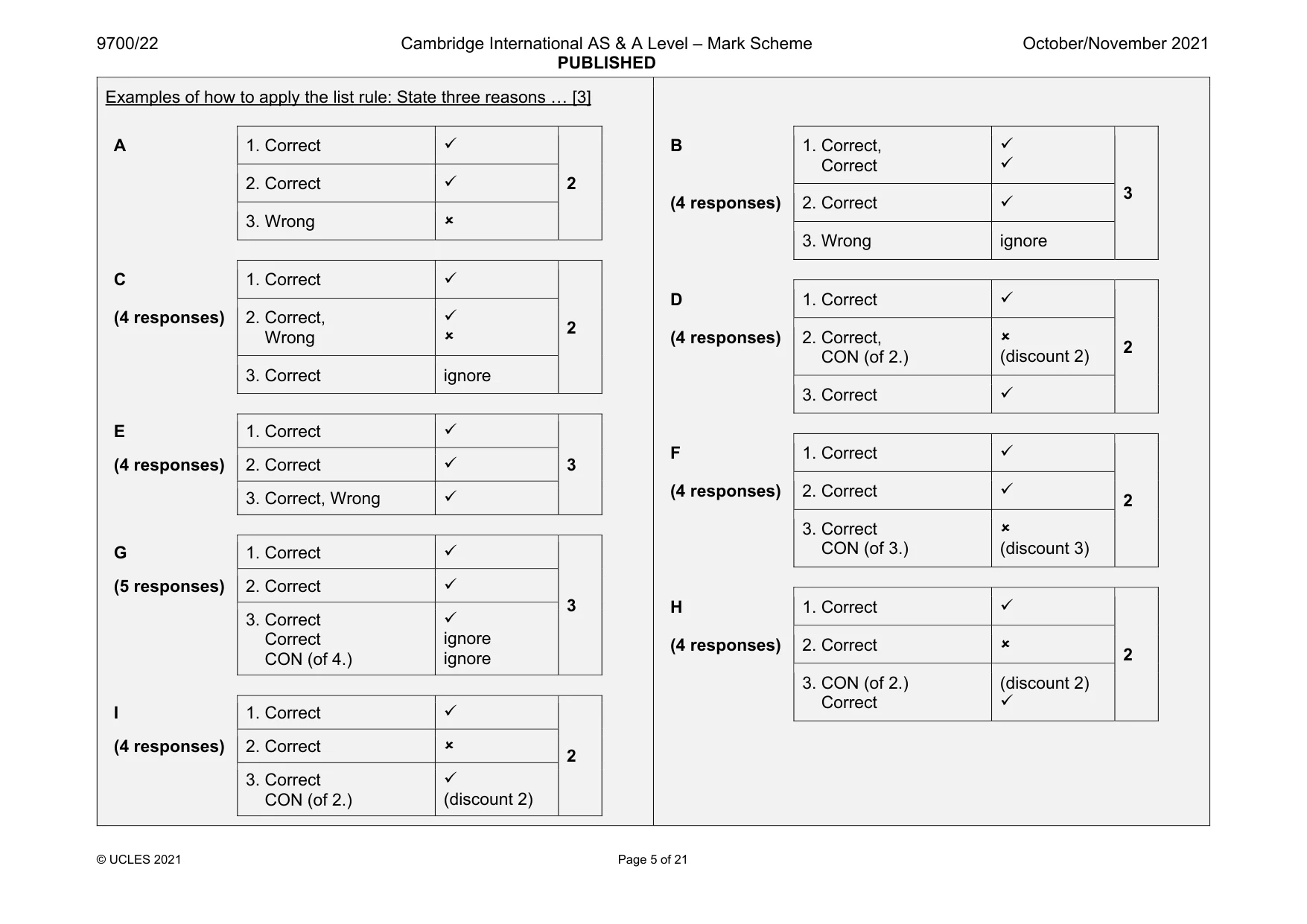
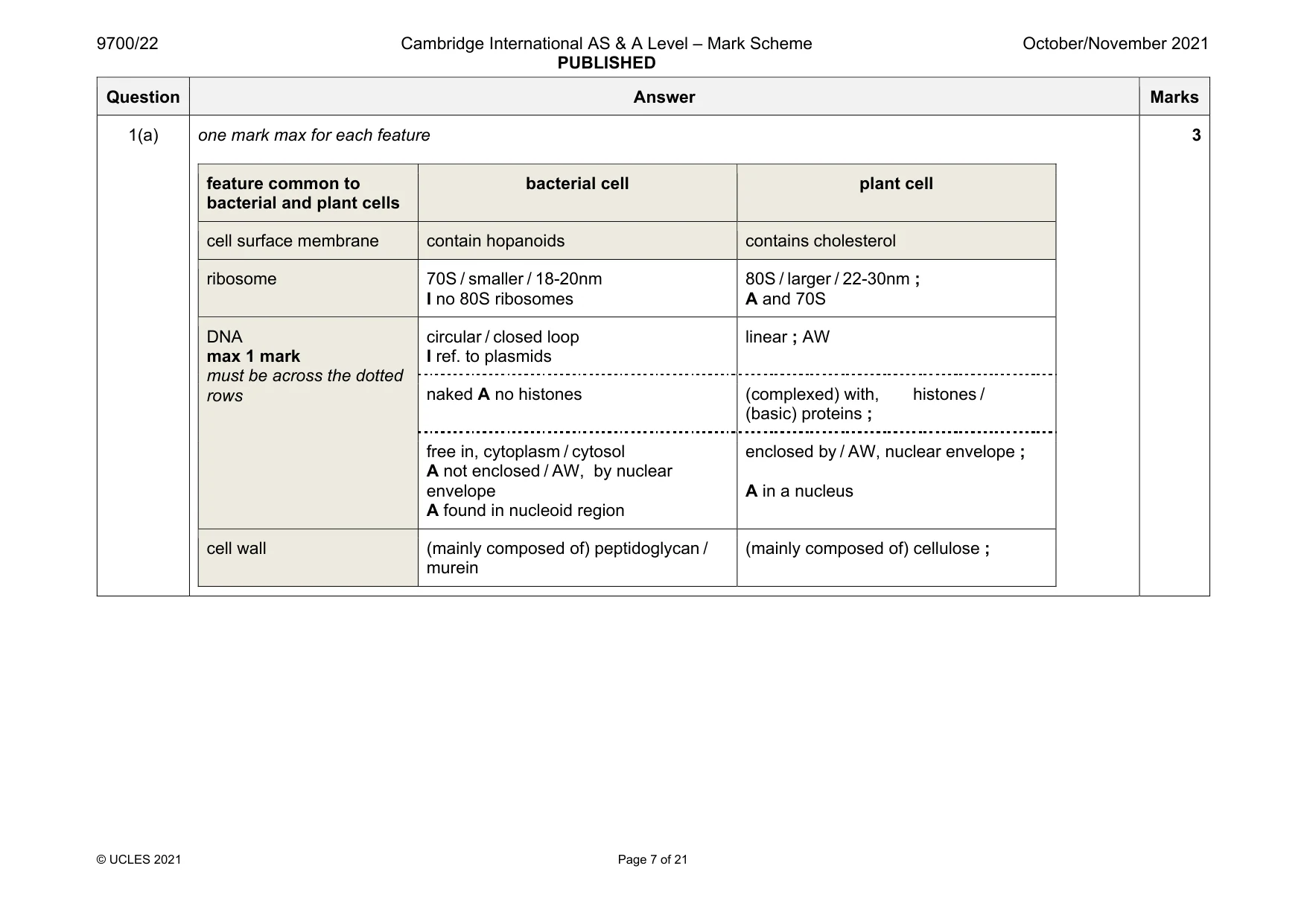
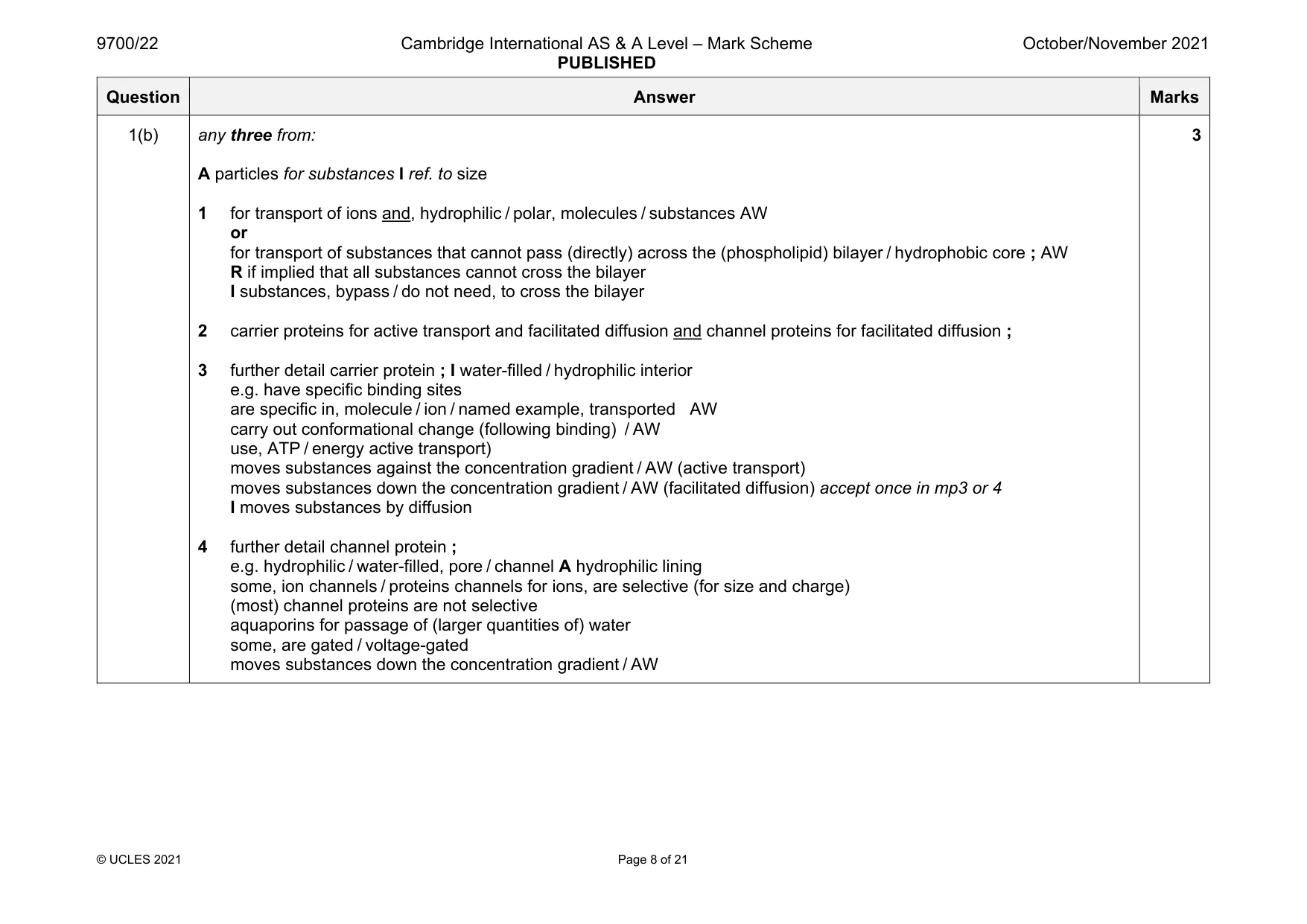
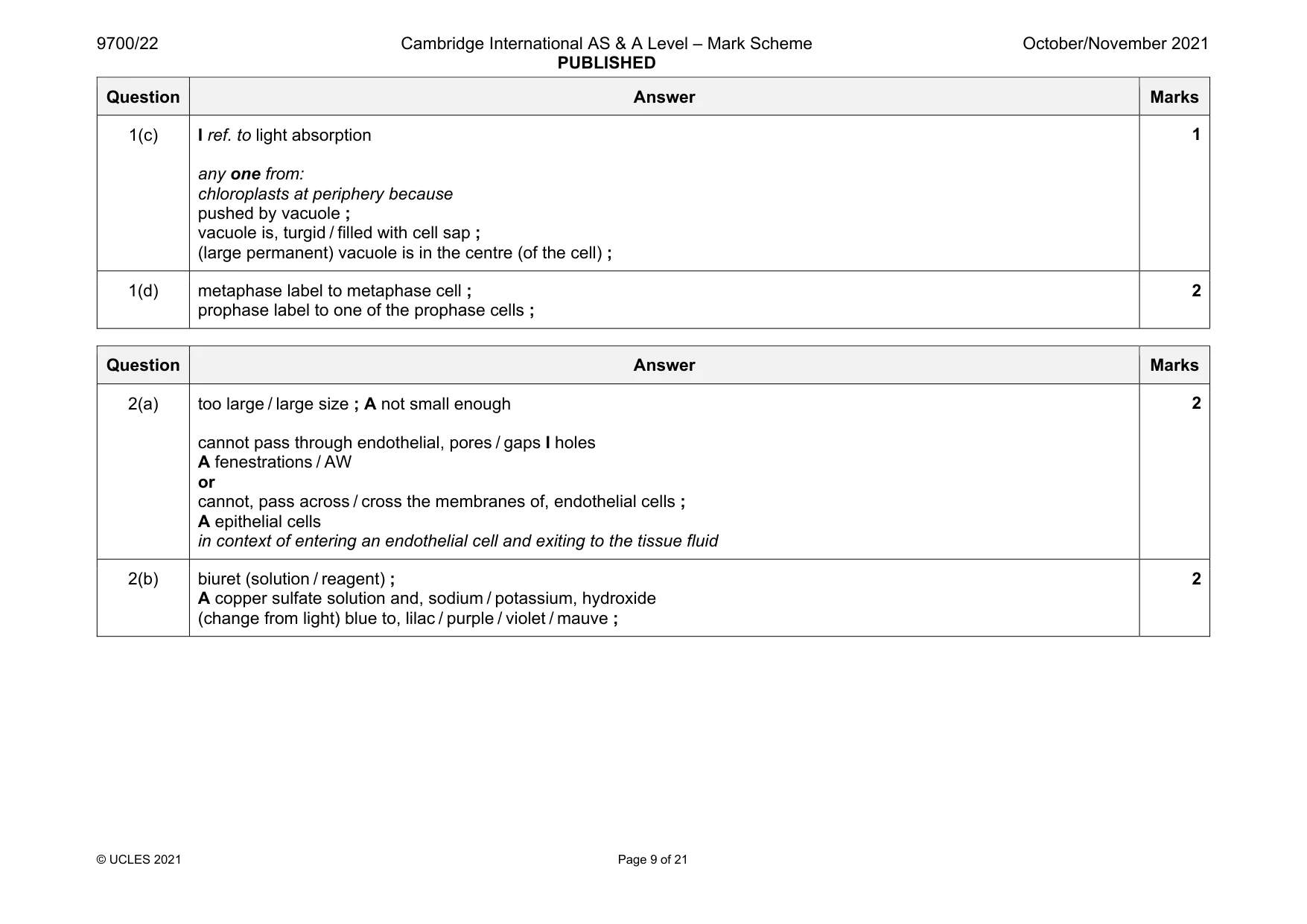
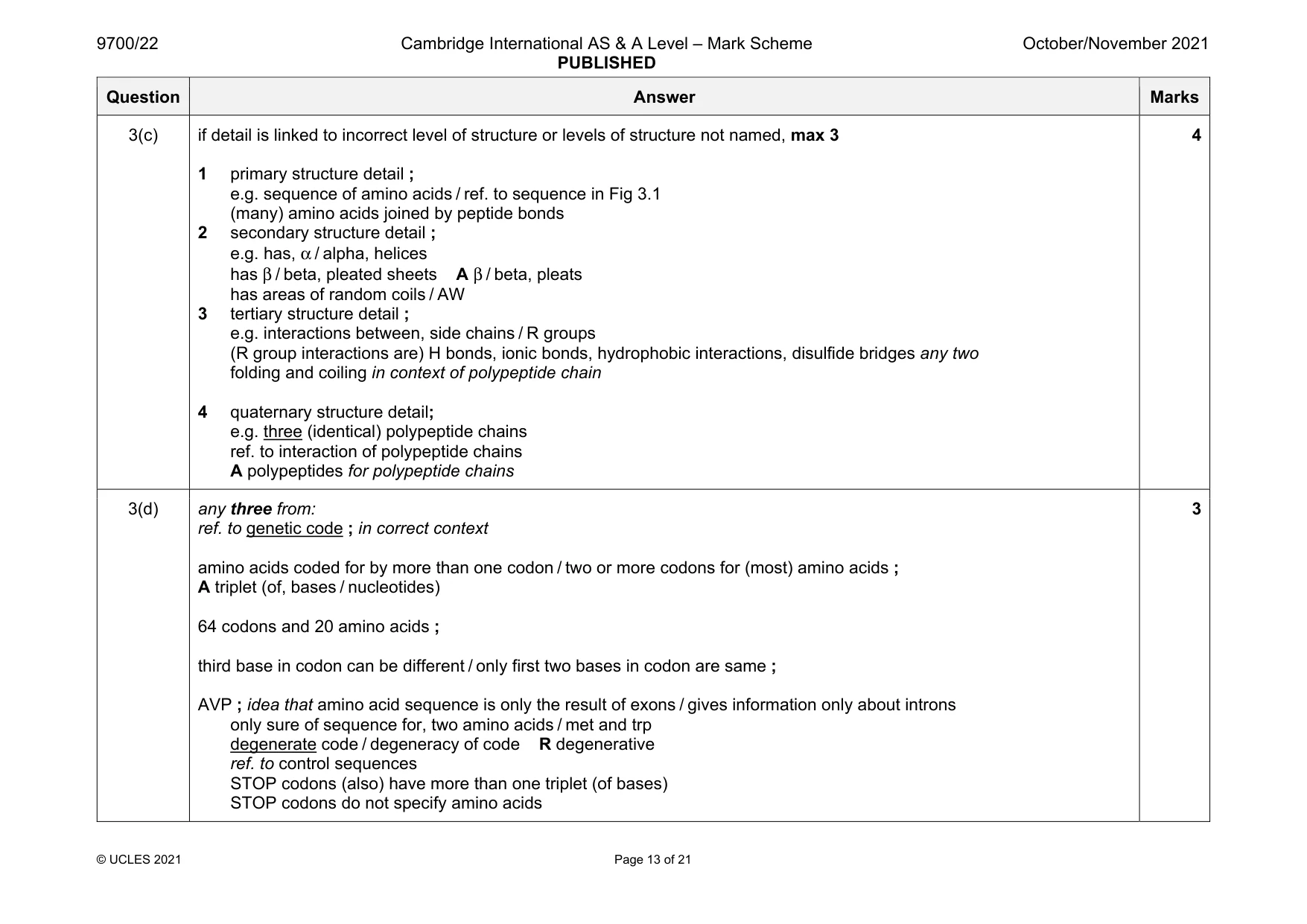
Mark scheme: 1(a) one mark max for each feature feature common to bacterial and plant cells bacterial cell plant cell cell surface membrane contain hopanoids contains cholesterol ribosome 70S / smaller / 18-20nm I no 80S ribosomes 80S / larger / 22-30nm ; A and 70S DNA max 1 mark must be across the dotted rows circular / closed loop I ref. to plasmids linear ; AW naked A no histones (complexed) with, histones / (basic) proteins ; free in, cytoplasm / cytosol A not enclosed / AW, by nuclear envelope A found in nucleoid region enclosed by / AW, nuclear envelope ; A in a nucleus cell wall (mainly composed of) peptidoglycan / murein (mainly composed of) cellulose ; 3 Question Answer Marks 1(b) any three from: A particles for substances I ref. to size 1 for transport of ions and, hydrophilic / polar, molecules / substances AW or for transport of substances that cannot pass (directly) across the (phospholipid) bilayer / hydrophobic core ; AW R if implied that all substances cannot cross the bilayer I substances, bypass / do not need, to cross the bilayer 2 carrier proteins for active transport and facilitated diffusion and channel proteins for facilitated diffusion ; 3 further detail carrier protein ; I water-filled / hydrophilic interior e.g. have specific binding sites are specific in, molecule / ion / named example, transported AW carry out conformational change (following binding) / AW use, ATP / energy active transport) moves substances against the concentration gradient / AW (active transport) moves substances down the concentration gradient / AW (facilitated diffusion) accept once in mp3 or 4 I moves substances by diffusion 4 further detail channel protein ; e.g. hydrophilic / water-filled, pore / channel A hydrophilic lining some, ion channels / proteins channels for ions, are selective (for size and charge) (most) channel proteins are not selective aquaporins for passage of (larger quantities of) water some, are gated / voltage-gated moves substances down the concentration gradient / AW 3 Question Answer Marks 1(c) I ref. to light absorption any one from: chloroplasts at periphery because pushed by vacuole ; vacuole is, turgid / filled with cell sap ; (large permanent) vacuole is in the centre (of the cell) ; 1 1(d) metaphase label to metaphase cell ; prophase label to one of the prophase cells ; 2
More questions on Cells as the basic units of living organisms
Q2 · The high blood pressure at the arterial end of a capillary network results in some…
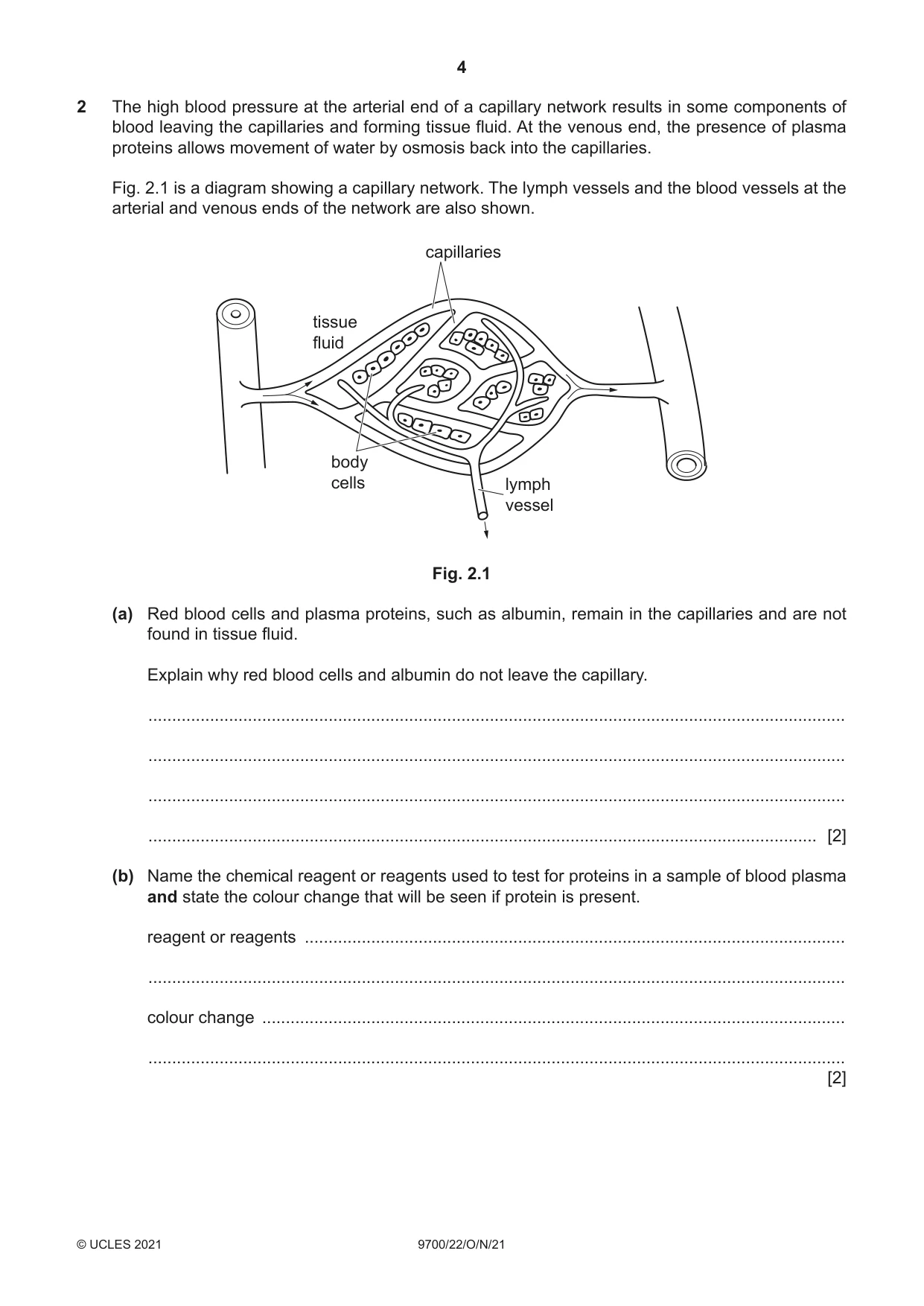
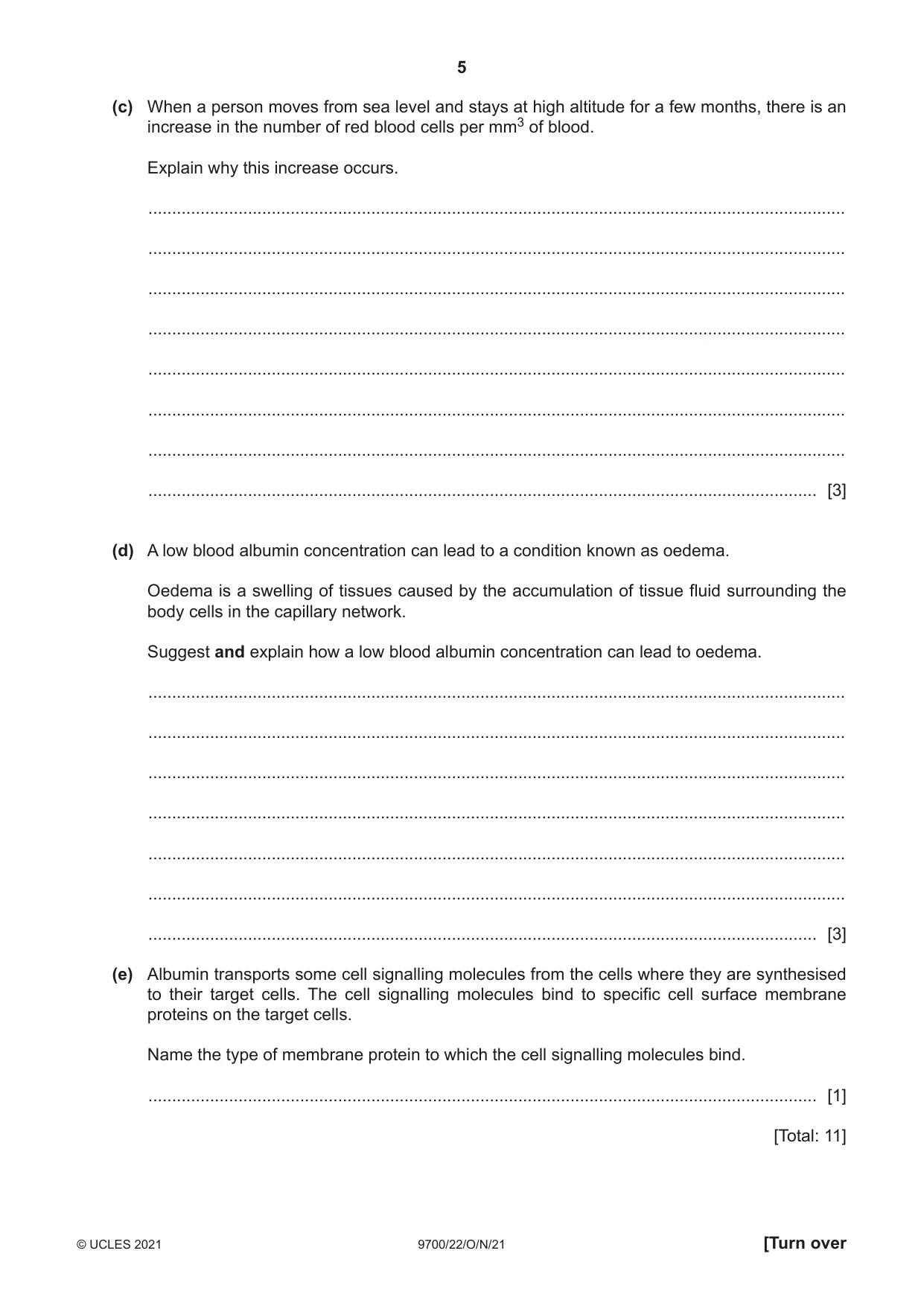
2 The high blood pressure at the arterial end of a capillary network results in some components of blood leaving the capillaries and forming tissue fluid. At the venous end, the presence of plasma proteins allows movement of water by osmosis back into the capillaries. Fig. 2.1 is a diagram showing a capillary network. The lymph vessels and the blood vessels at the arterial and venous ends of the network are also shown. capillaries tissue fluid body cells lymph vessel Fig. 2.1 (a) Red blood cells and plasma proteins, such as albumin, remain in the capillaries and are not found in tissue fluid. Explain why red blood cells and albumin do not leave the capillary. ................................................................................................................................................... ................................................................................................................................................... ................................................................................................................................................... ............................................................................................................................................. [2] (b) Name the chemical reagent or reagents used to test for proteins in a sample of blood plasma and state the colour change that will be seen if protein is present. reagent or reagents .................................................................................................................. ................................................................................................................................................... colour change ........................................................................................................................... ................................................................................................................................................... [2] (c) When a person moves from sea level and stays at high altitude for a few months, there is an increase in the number of red blood cells per mm3 of blood. Explain why this increase occurs. ................................................................................................................................................... ................................................................................................................................................... ................................................................................................................................................... ................................................................................................................................................... ................................................................................................................................................... ................................................................................................................................................... ................................................................................................................................................... ............................................................................................................................................. [3] (d) A low blood albumin concentration can lead to a condition known as oedema. Oedema is a swelling of tissues caused by the accumulation of tissue fluid surrounding the body cells in the capillary network. Suggest and explain how a low blood albumin concentration can lead to oedema. ................................................................................................................................................... ................................................................................................................................................... ................................................................................................................................................... ................................................................................................................................................... ................................................................................................................................................... ................................................................................................................................................... ............................................................................................................................................. [3] (e) Albumin transports some cell signalling molecules from the cells where they are synthesised to their target cells. The cell signalling molecules bind to specific cell surface membrane proteins on the target cells. Name the type of membrane protein to which the cell signalling molecules bind. ............................................................................................................................................. [1] [Total: 11]
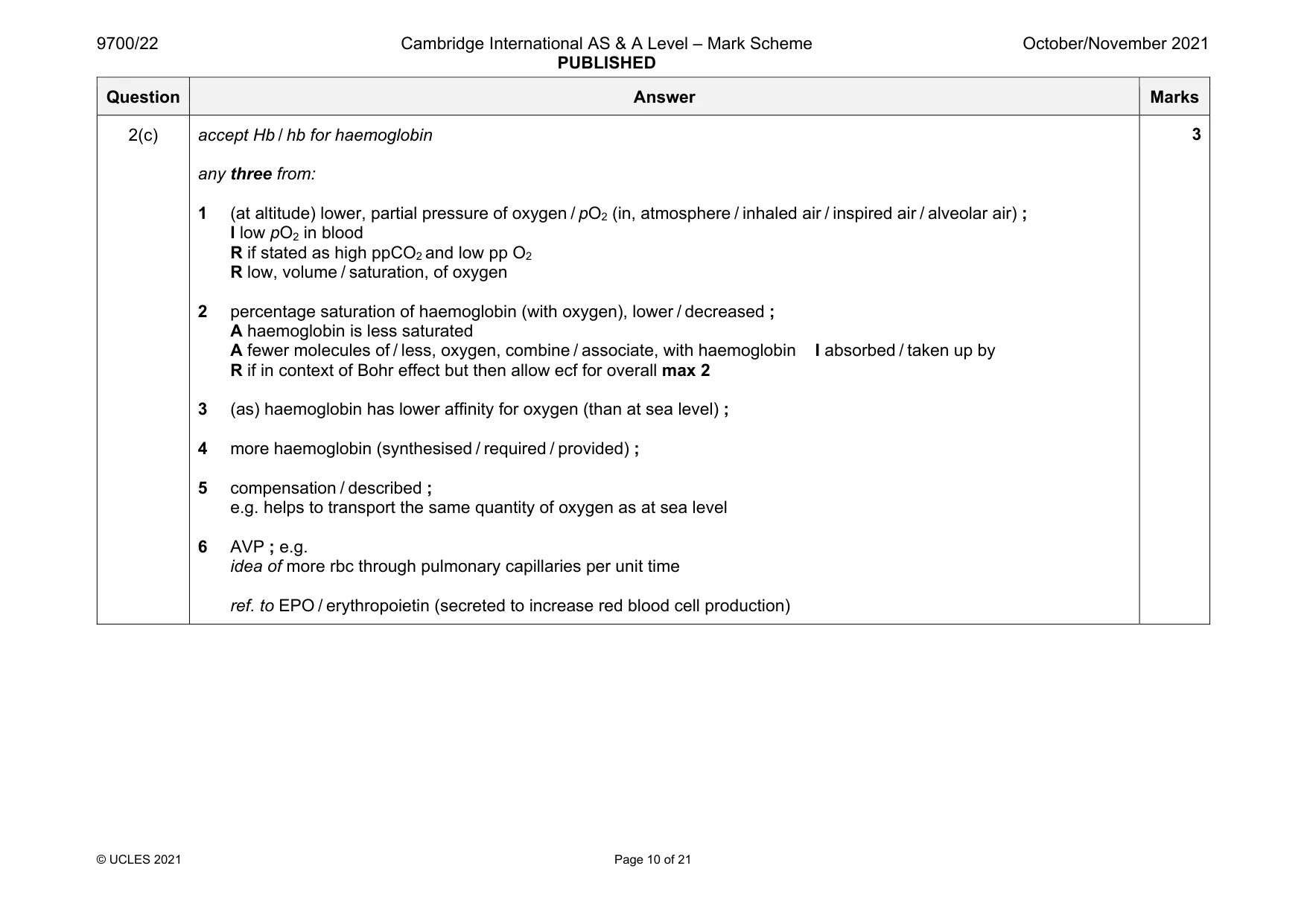
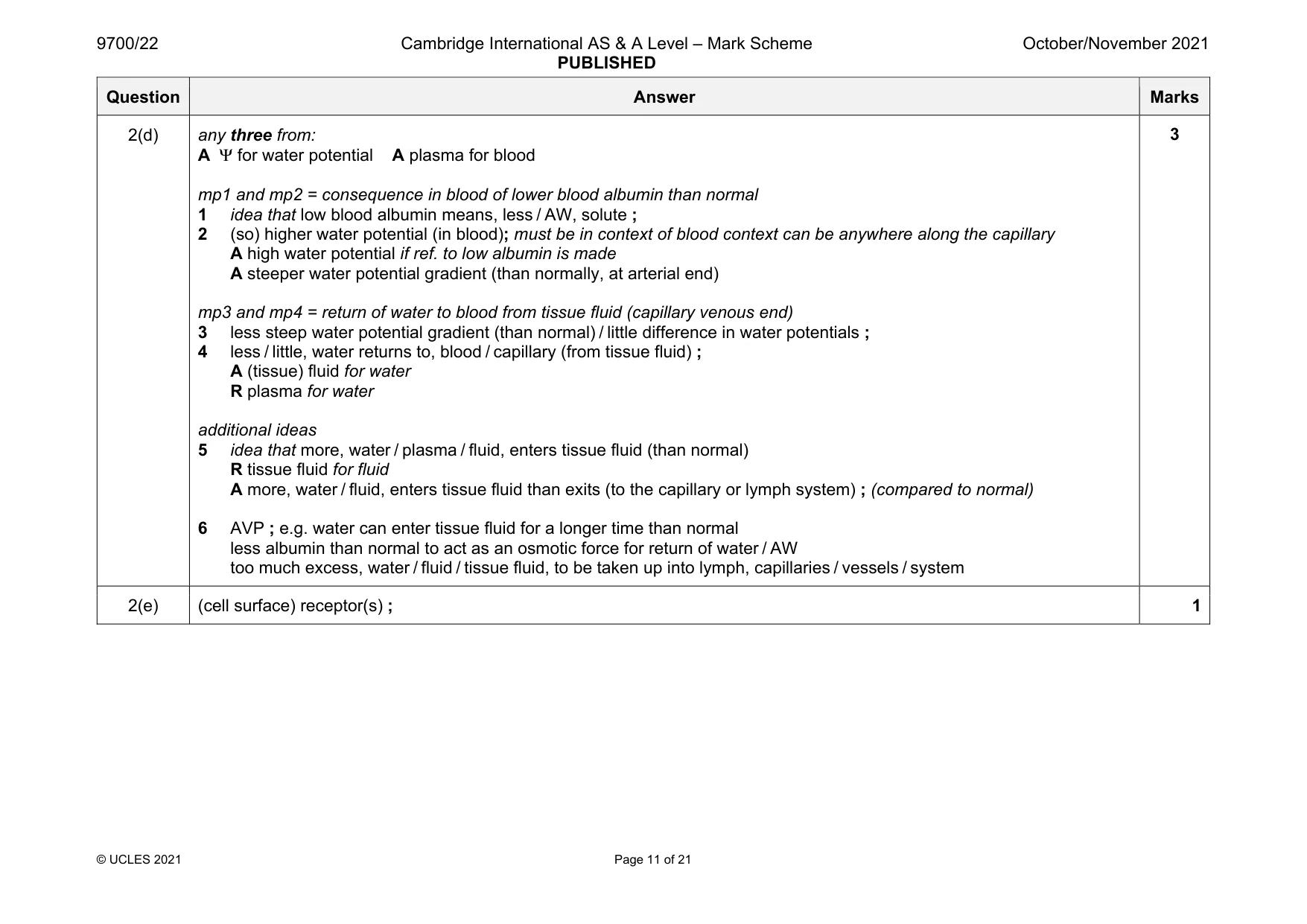
Mark scheme: 2(a) too large / large size ; A not small enough cannot pass through endothelial, pores / gaps I holes A fenestrations / AW or cannot, pass across / cross the membranes of, endothelial cells ; A epithelial cells in context of entering an endothelial cell and exiting to the tissue fluid 2(b) biuret (solution / reagent) ; A copper sulfate solution and, sodium / potassium, hydroxide (change from light) blue to, lilac / purple / violet / mauve ; 2 Question Answer Marks 2(c) accept Hb / hb for haemoglobin any three from: 1 (at altitude) lower, partial pressure of oxygen / pO2 (in, atmosphere / inhaled air / inspired air / alveolar air) ; I low pO2 in blood R if stated as high ppCO2 and low pp O2 R low, volume / saturation, of oxygen 2 percentage saturation of haemoglobin (with oxygen), lower / decreased ; A haemoglobin is less saturated A fewer molecules of / less, oxygen, combine / associate, with haemoglobin I absorbed / taken up by R if in context of Bohr effect but then allow ecf for overall max 2 3 (as) haemoglobin has lower affinity for oxygen (than at sea level) ; 4 more haemoglobin (synthesised / required / provided) ; 5 compensation / described ; e.g. helps to transport the same quantity of oxygen as at sea level 6 AVP ; e.g. idea of more rbc through pulmonary capillaries per unit time ref. to EPO / erythropoietin (secreted to increase red blood cell production) 3 Question Answer Marks 2(d) any three from: A Ψ for water potential A plasma for blood mp1 and mp2 = consequence in blood of lower blood albumin than normal 1 idea that low blood albumin means, less / AW, solute ; 2 (so) higher water potential (in blood); must be in context of blood context can be anywhere along the capillary A high water potential if ref. to low albumin is made A steeper water potential gradient (than normally, at arterial end) mp3 and mp4 = return of water to blood from tissue fluid (capillary venous end) 3 less steep water potential gradient (than normal) / little difference in water potentials ; 4 less / little, water returns to, blood / capillary (from tissue fluid) ; A (tissue) fluid for water R plasma for water additional ideas 5 idea that more, water / plasma / fluid, enters tissue fluid (than normal) R tissue fluid for fluid A more, water / fluid, enters tissue fluid than exits (to the capillary or lymph system) ; (compared to normal) 6 AVP ; e.g. water can enter tissue fluid for a longer time than normal less albumin than normal to act as an osmotic force for return of water / AW too much excess, water / fluid / tissue fluid, to be taken up into lymph, capillaries / vessels / system 3 2(e) (cell surface) receptor(s) ; 1
Q3 · Baculovirus is a virus that kills some of the insect pests of major crops
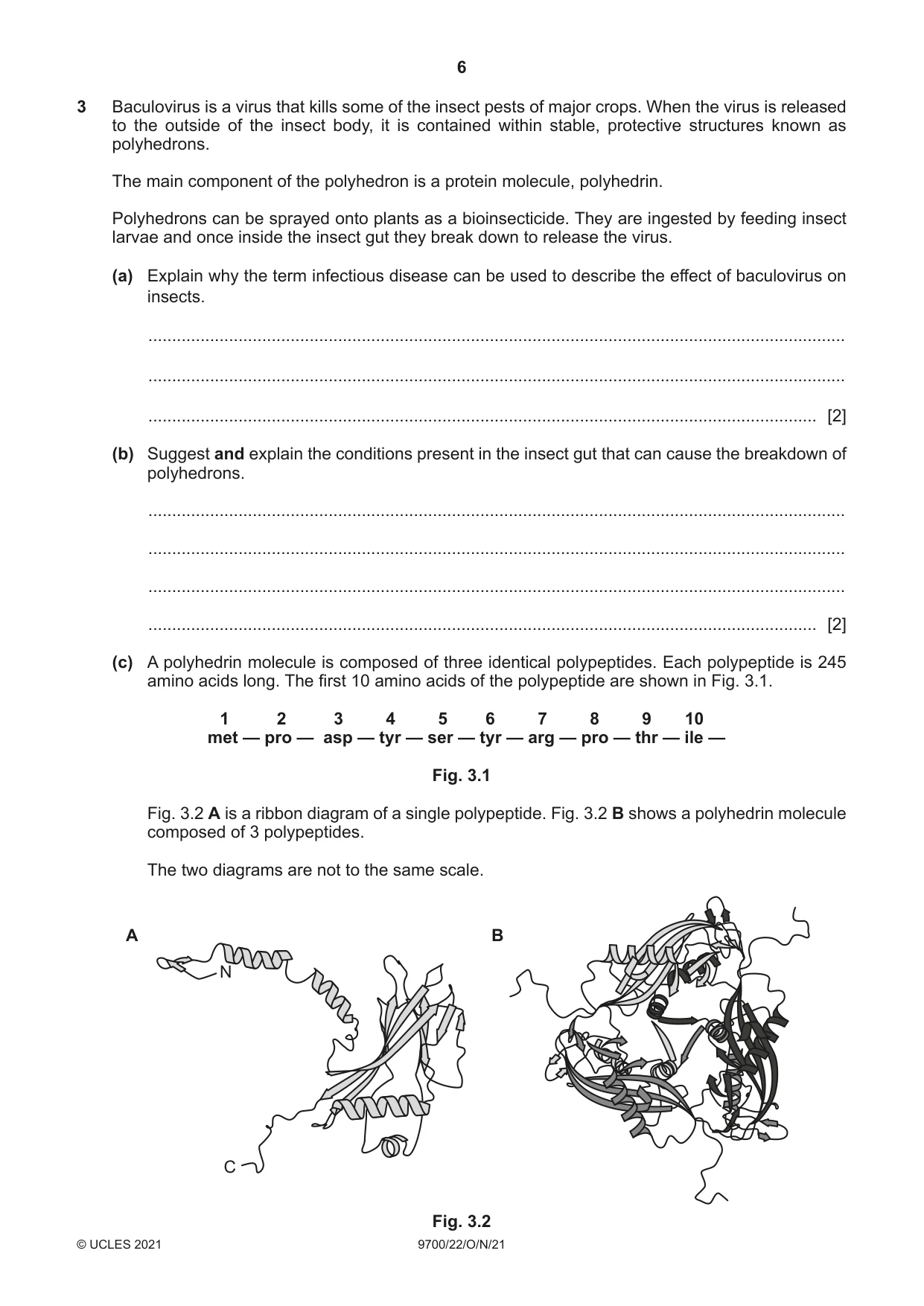
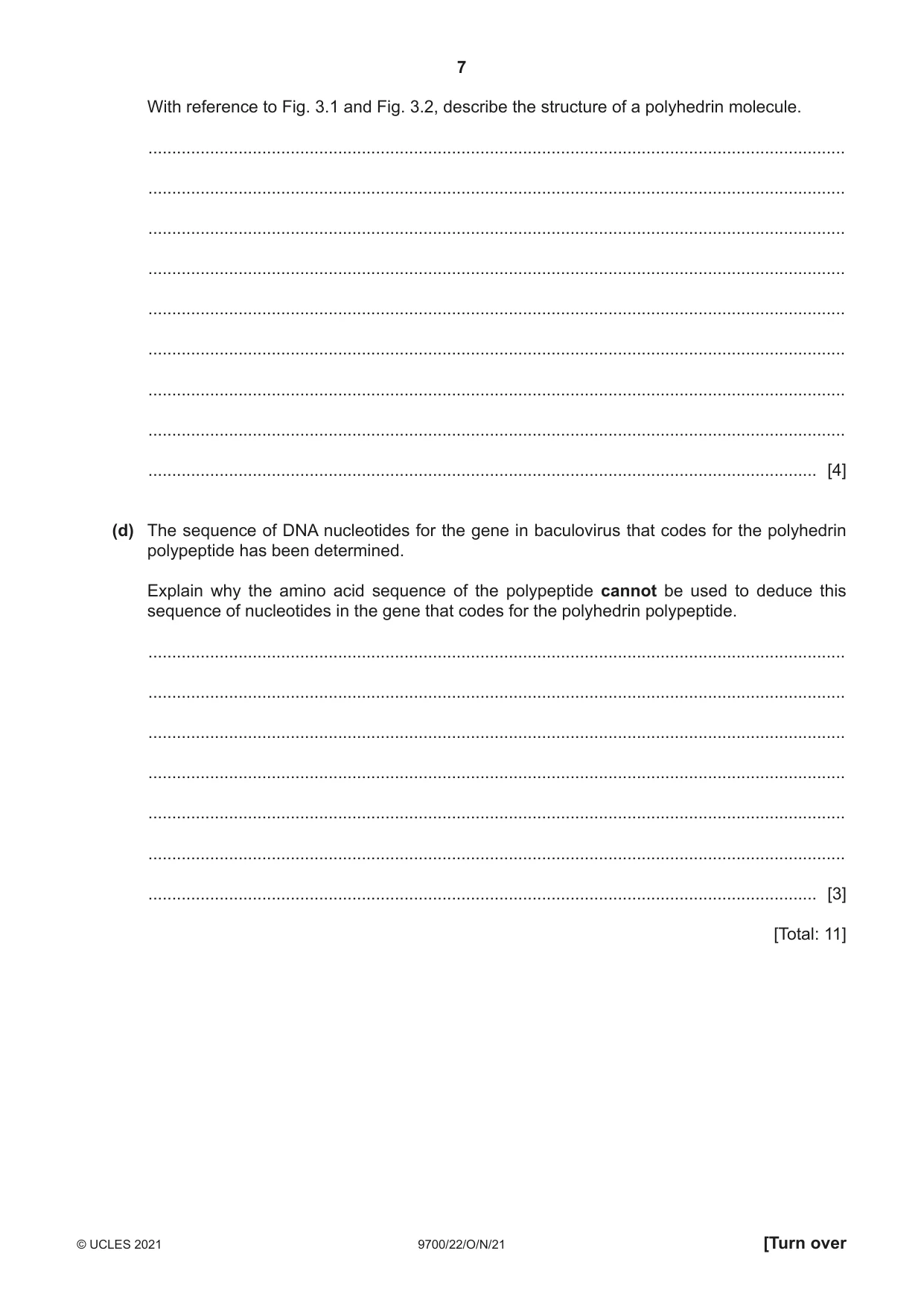
3 Baculovirus is a virus that kills some of the insect pests of major crops. When the virus is released to the outside of the insect body, it is contained within stable, protective structures known as polyhedrons. The main component of the polyhedron is a protein molecule, polyhedrin. Polyhedrons can be sprayed onto plants as a bioinsecticide. They are ingested by feeding insect larvae and once inside the insect gut they break down to release the virus. (a) Explain why the term infectious disease can be used to describe the effect of baculovirus on insects. ................................................................................................................................................... ................................................................................................................................................... ............................................................................................................................................. [2] (b) Suggest and explain the conditions present in the insect gut that can cause the breakdown of polyhedrons. ................................................................................................................................................... ................................................................................................................................................... ................................................................................................................................................... ............................................................................................................................................. [2] (c) A polyhedrin molecule is composed of three identical polypeptides. Each polypeptide is 245 amino acids long. The first 10 amino acids of the polypeptide are shown in Fig. 3.1. 1 2 3 4 5 6 7 8 9 10 met — pro — asp — tyr — ser — tyr — arg — pro — thr — ile — Fig. 3.1 Fig. 3.2 A is a ribbon diagram of a single polypeptide. Fig. 3.2 B shows a polyhedrin molecule composed of 3 polypeptides. The two diagrams are not to the same scale. A B N C Fig. 3.2 With reference to Fig. 3.1 and Fig. 3.2, describe the structure of a polyhedrin molecule. ................................................................................................................................................... ................................................................................................................................................... ................................................................................................................................................... ................................................................................................................................................... ................................................................................................................................................... ................................................................................................................................................... ................................................................................................................................................... ................................................................................................................................................... ............................................................................................................................................. [4] (d) The sequence of DNA nucleotides for the gene in baculovirus that codes for the polyhedrin polypeptide has been determined. Explain why the amino acid sequence of the polypeptide cannot be used to deduce this sequence of nucleotides in the gene that codes for the polyhedrin polypeptide. ................................................................................................................................................... ................................................................................................................................................... ................................................................................................................................................... ................................................................................................................................................... ................................................................................................................................................... ................................................................................................................................................... ............................................................................................................................................. [3] [Total: 11]
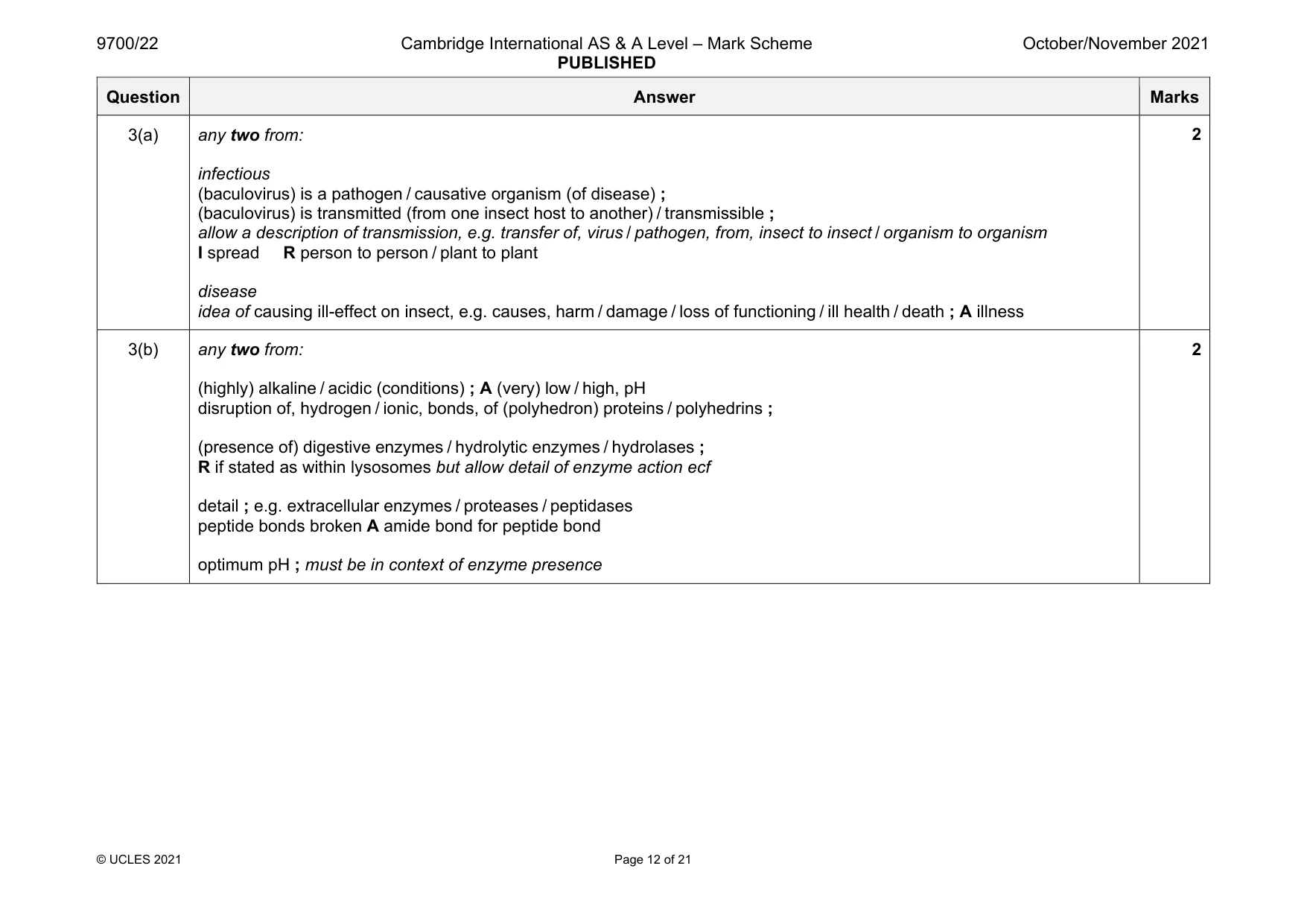
Mark scheme: 3(a) any two from: infectious (baculovirus) is a pathogen / causative organism (of disease) ; (baculovirus) is transmitted (from one insect host to another) / transmissible ; allow a description of transmission, e.g. transfer of, virus / pathogen, from, insect to insect / organism to organism I spread R person to person / plant to plant disease idea of causing ill-effect on insect, e.g. causes, harm / damage / loss of functioning / ill health / death ; A illness 3(b) any two from: (highly) alkaline / acidic (conditions) ; A (very) low / high, pH disruption of, hydrogen / ionic, bonds, of (polyhedron) proteins / polyhedrins ; (presence of) digestive enzymes / hydrolytic enzymes / hydrolases ; R if stated as within lysosomes but allow detail of enzyme action ecf detail ; e.g. extracellular enzymes / proteases / peptidases peptide bonds broken A amide bond for peptide bond optimum pH ; must be in context of enzyme presence 2 Question Answer Marks 3(c) if detail is linked to incorrect level of structure or levels of structure not named, max 3 1 primary structure detail ; e.g. sequence of amino acids / ref. to sequence in Fig 3.1 (many) amino acids joined by peptide bonds 2 secondary structure detail ; e.g. has, α / alpha, helices has β / beta, pleated sheets A β / beta, pleats has areas of random coils / AW 3 tertiary structure detail ; e.g. interactions between, side chains / R groups (R group interactions are) H bonds, ionic bonds, hydrophobic interactions, disulfide bridges any two folding and coiling in context of polypeptide chain 4 quaternary structure detail; e.g. three (identical) polypeptide chains ref. to interaction of polypeptide chains A polypeptides for polypeptide chains 4 3(d) any three from: ref. to genetic code ; in correct context amino acids coded for by more than one codon / two or more codons for (most) amino acids ; A triplet (of, bases / nucleotides) 64 codons and 20 amino acids ; third base in codon can be different / only first two bases in codon are same ; AVP ; idea that amino acid sequence is only the result of exons / gives information only about introns only sure of sequence for, two amino acids / met and trp degenerate code / degeneracy of code R degenerative ref. to control sequences STOP codons (also) have more than one triplet (of bases) STOP codons do not specify amino acids 3
Q4 · Barlinka is a variety of the common grapevine, Vitis vinifera
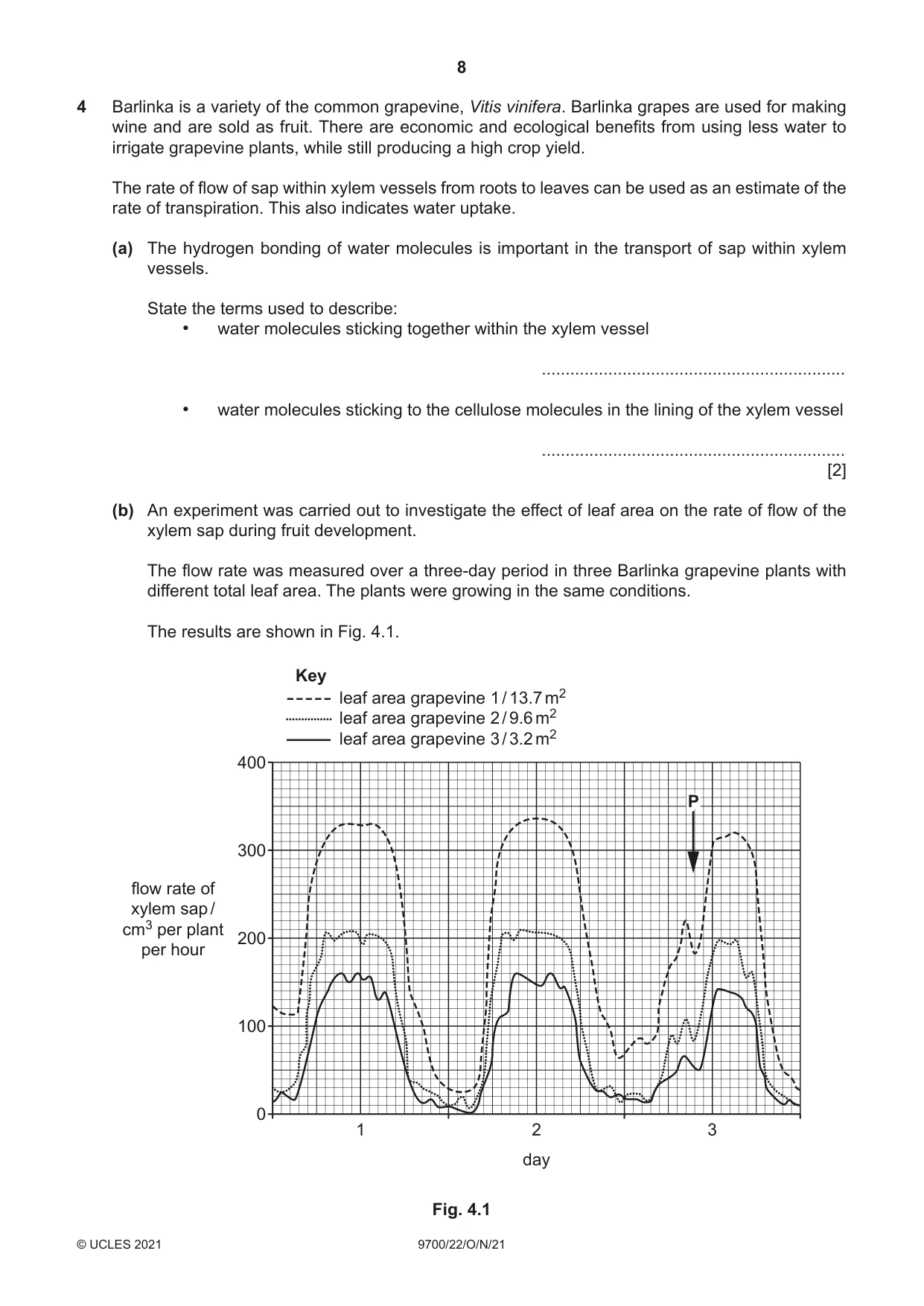
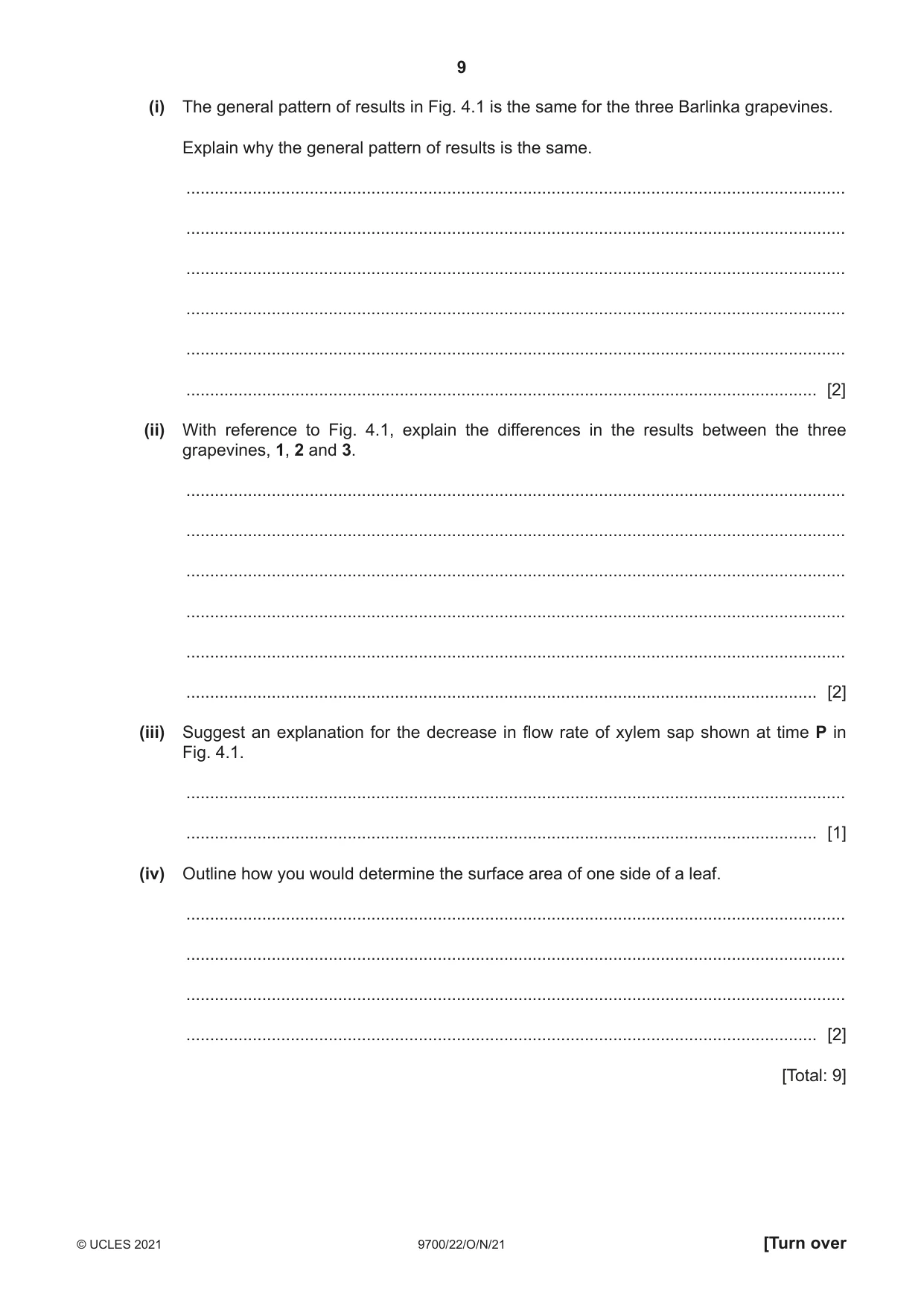
4 Barlinka is a variety of the common grapevine, Vitis vinifera. Barlinka grapes are used for making wine and are sold as fruit. There are economic and ecological benefits from using less water to irrigate grapevine plants, while still producing a high crop yield. The rate of flow of sap within xylem vessels from roots to leaves can be used as an estimate of the rate of transpiration. This also indicates water uptake. (a) The hydrogen bonding of water molecules is important in the transport of sap within xylem vessels. State the terms used to describe: • water molecules sticking together within the xylem vessel ................................................................ • water molecules sticking to the cellulose molecules in the lining of the xylem vessel ................................................................ [2] (b) An experiment was carried out to investigate the effect of leaf area on the rate of flow of the xylem sap during fruit development. The flow rate was measured over a three-day period in three Barlinka grapevine plants with different total leaf area. The plants were growing in the same conditions. The results are shown in Fig. 4.1. Key leaf area grapevine 1 / 13.7 m2 leaf area grapevine 2 / 9.6 m2 leaf area grapevine 3 / 3.2 m2 400 P 300 flow rate of xylem sap / cm3 per plant 200 per hour 100 0 1 2 3 day Fig. 4.1 (i) The general pattern of results in Fig. 4.1 is the same for the three Barlinka grapevines. Explain why the general pattern of results is the same. ........................................................................................................................................... ........................................................................................................................................... ........................................................................................................................................... ........................................................................................................................................... ........................................................................................................................................... ..................................................................................................................................... [2] (ii) With reference to Fig. 4.1, explain the differences in the results between the three grapevines, 1, 2 and 3. ........................................................................................................................................... ........................................................................................................................................... ........................................................................................................................................... ........................................................................................................................................... ........................................................................................................................................... ..................................................................................................................................... [2] (iii) Suggest an explanation for the decrease in flow rate of xylem sap shown at time P in Fig. 4.1. ........................................................................................................................................... ..................................................................................................................................... [1] (iv) Outline how you would determine the surface area of one side of a leaf. ........................................................................................................................................... ........................................................................................................................................... ........................................................................................................................................... ..................................................................................................................................... [2] [Total: 9]
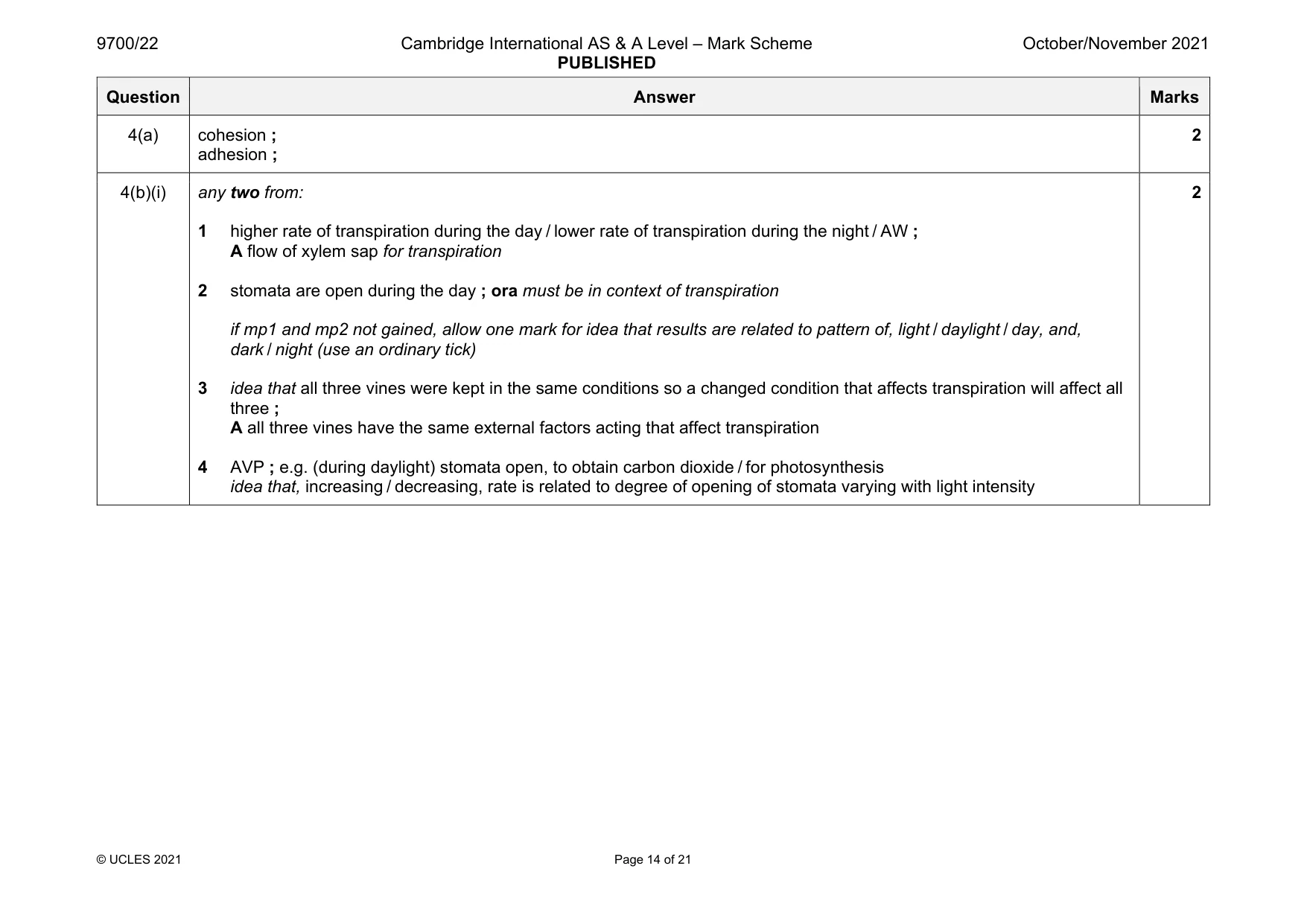
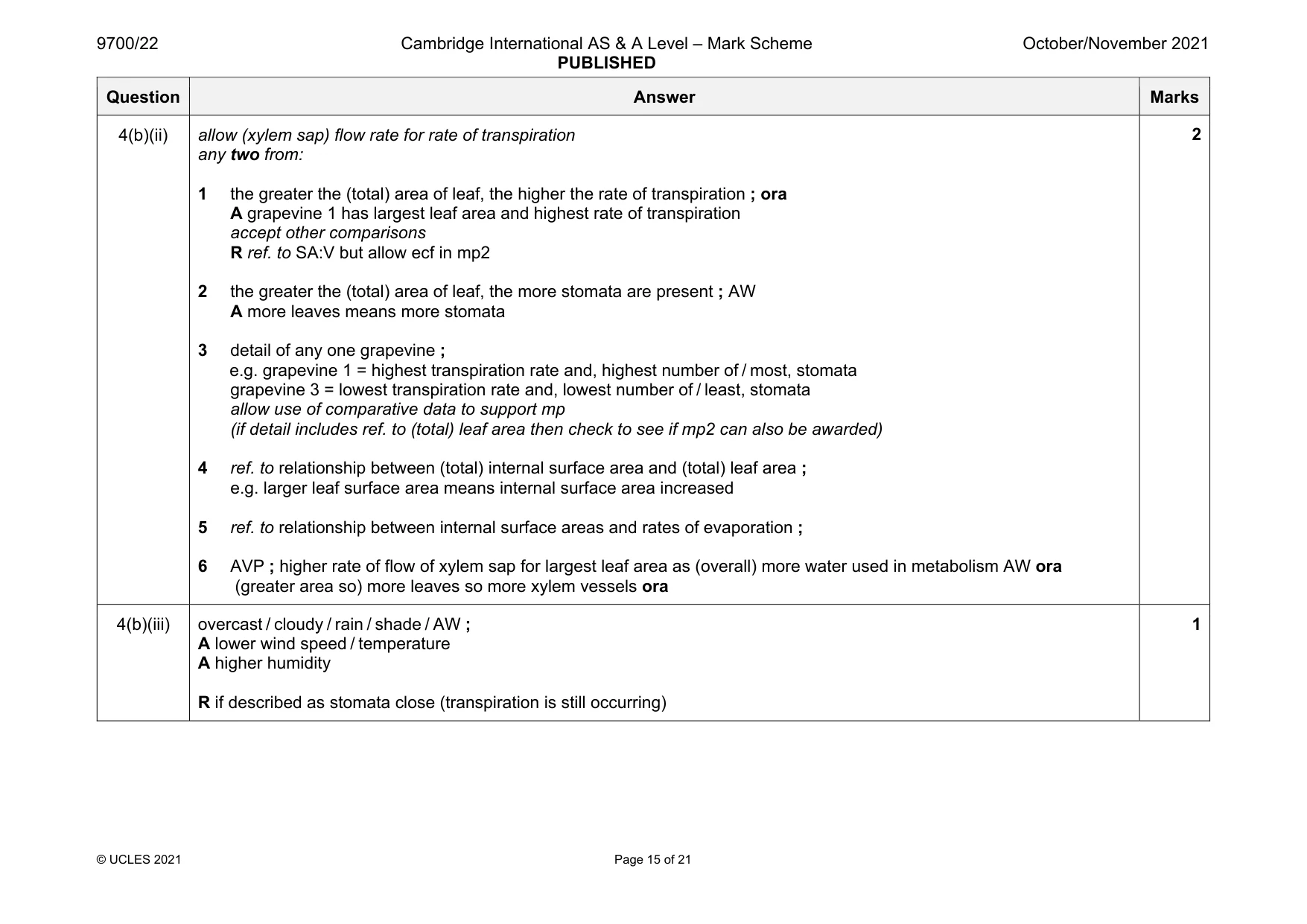
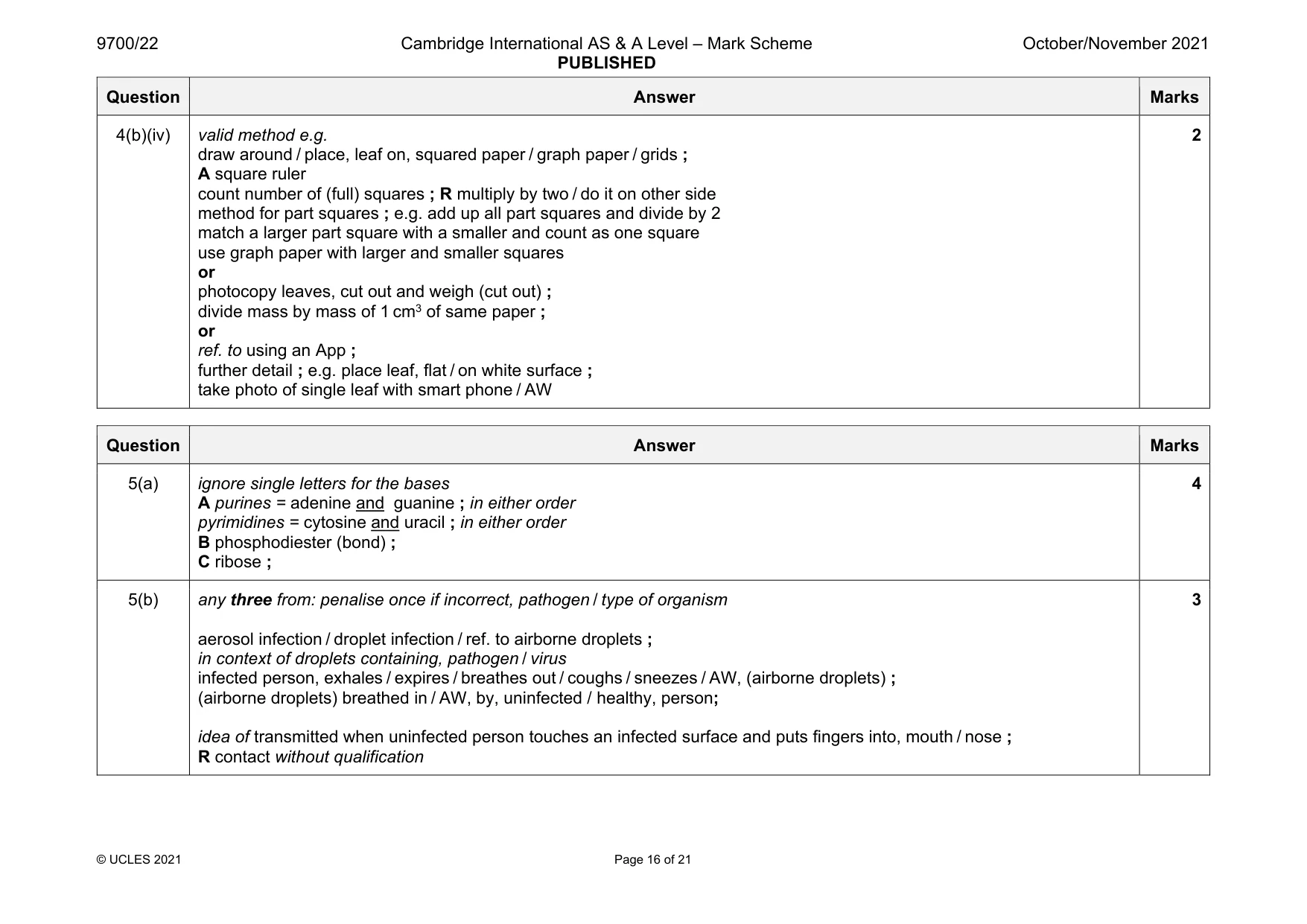
Mark scheme: 4(a) cohesion ; adhesion ; 2 4(b)(i) any two from: 1 higher rate of transpiration during the day / lower rate of transpiration during the night / AW ; A flow of xylem sap for transpiration 2 stomata are open during the day ; ora must be in context of transpiration if mp1 and mp2 not gained, allow one mark for idea that results are related to pattern of, light / daylight / day, and, dark / night (use an ordinary tick) 3 idea that all three vines were kept in the same conditions so a changed condition that affects transpiration will affect all three ; A all three vines have the same external factors acting that affect transpiration 4 AVP ; e.g. (during daylight) stomata open, to obtain carbon dioxide / for photosynthesis idea that, increasing / decreasing, rate is related to degree of opening of stomata varying with light intensity 2 Question Answer Marks 4(b)(ii) allow (xylem sap) flow rate for rate of transpiration any two from: 1 the greater the (total) area of leaf, the higher the rate of transpiration ; ora A grapevine 1 has largest leaf area and highest rate of transpiration accept other comparisons R ref. to SA:V but allow ecf in mp2 2 the greater the (total) area of leaf, the more stomata are present ; AW A more leaves means more stomata 3 detail of any one grapevine ; e.g. grapevine 1 = highest transpiration rate and, highest number of / most, stomata grapevine 3 = lowest transpiration rate and, lowest number of / least, stomata allow use of comparative data to support mp (if detail includes ref. to (total) leaf area then check to see if mp2 can also be awarded) 4 ref. to relationship between (total) internal surface area and (total) leaf area ; e.g. larger leaf surface area means internal surface area increased 5 ref. to relationship between internal surface areas and rates of evaporation ; 6 AVP ; higher rate of flow of xylem sap for largest leaf area as (overall) more water used in metabolism AW ora (greater area so) more leaves so more xylem vessels ora 2 4(b)(iii) overcast / cloudy / rain / shade / AW ; A lower wind speed / temperature A higher humidity R if described as stomata close (transpiration is still occurring) 1 Question Answer Marks 4(b)(iv) valid method e.g. draw around / place, leaf on, squared paper / graph paper / grids ; A square ruler count number of (full) squares ; R multiply by two / do it on other side method for part squares ; e.g. add up all part squares and divide by 2 match a larger part square with a smaller and count as one square use graph paper with larger and smaller squares or photocopy leaves, cut out and weigh (cut out) ; divide mass by mass of 1 cm3 of same paper ; or ref. to using an App ; further detail ; e.g. place leaf, flat / on white surface ; take photo of single leaf with smart phone / AW 2
Q5 · The causative organism of measles is Morbillivirus
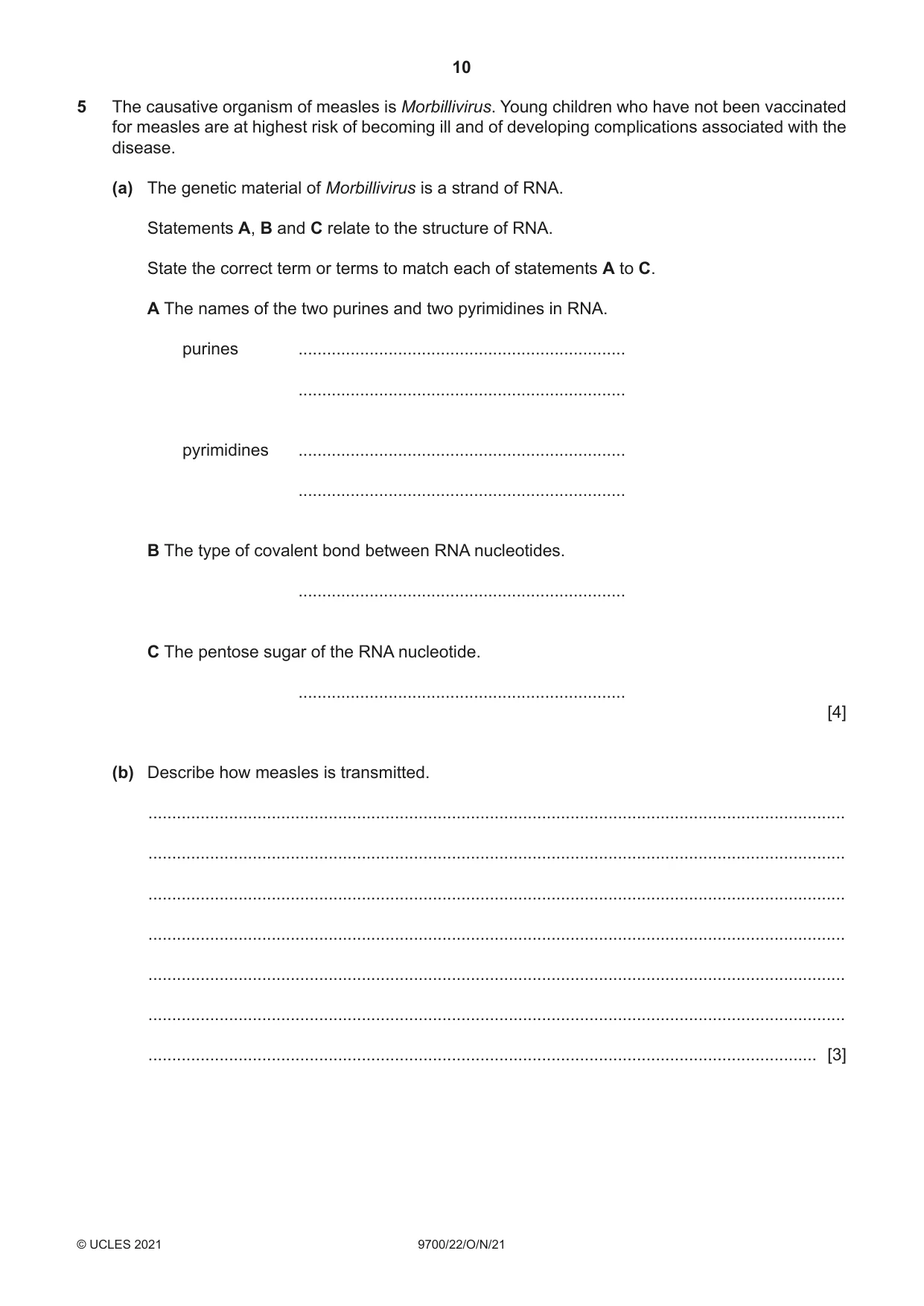
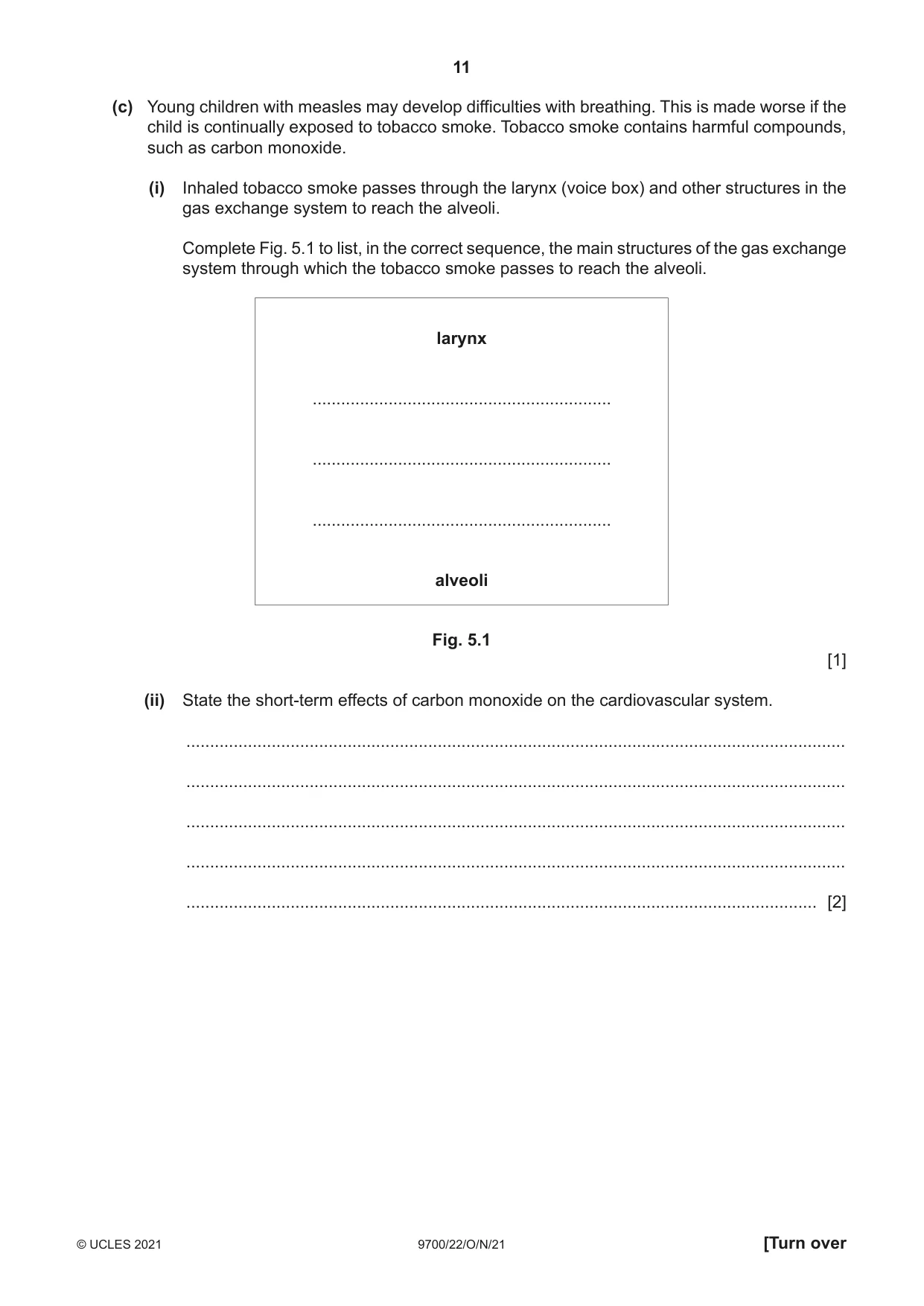
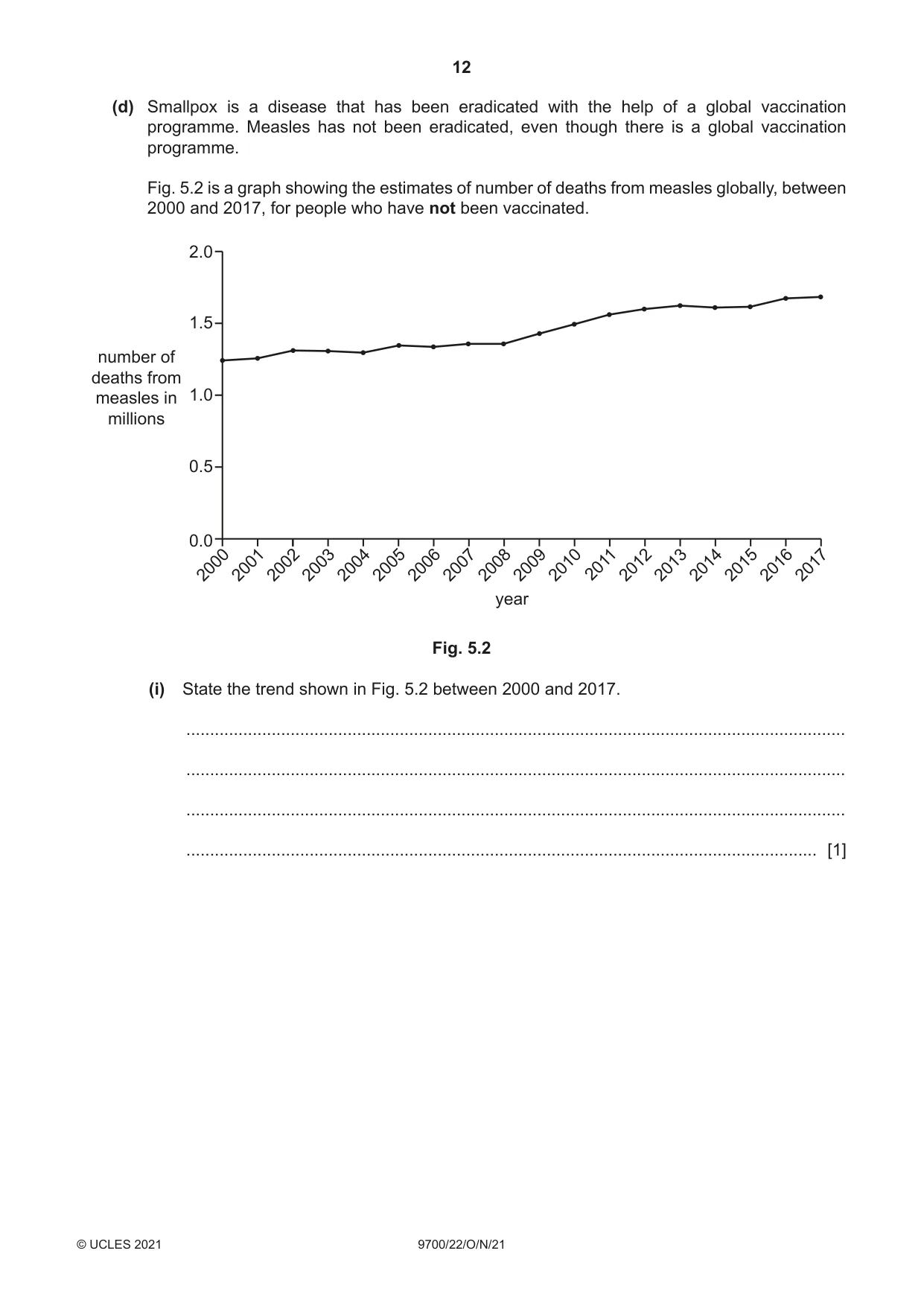
5 The causative organism of measles is Morbillivirus. Young children who have not been vaccinated for measles are at highest risk of becoming ill and of developing complications associated with the disease. (a) The genetic material of Morbillivirus is a strand of RNA. Statements A, B and C relate to the structure of RNA. State the correct term or terms to match each of statements A to C. A The names of the two purines and two pyrimidines in RNA. purines ..................................................................... ..................................................................... pyrimidines ..................................................................... ..................................................................... B The type of covalent bond between RNA nucleotides. ..................................................................... C The pentose sugar of the RNA nucleotide. ..................................................................... [4] (b) Describe how measles is transmitted. ................................................................................................................................................... ................................................................................................................................................... ................................................................................................................................................... ................................................................................................................................................... ................................................................................................................................................... ................................................................................................................................................... ............................................................................................................................................. [3] (c) Young children with measles may develop difficulties with breathing. This is made worse if the child is continually exposed to tobacco smoke. Tobacco smoke contains harmful compounds, such as carbon monoxide. (i) Inhaled tobacco smoke passes through the larynx (voice box) and other structures in the gas exchange system to reach the alveoli. Complete Fig. 5.1 to list, in the correct sequence, the main structures of the gas exchange system through which the tobacco smoke passes to reach the alveoli. larynx ............................................................... ............................................................... ............................................................... alveoli Fig. 5.1 [1] (ii) State the short-term effects of carbon monoxide on the cardiovascular system. ........................................................................................................................................... ........................................................................................................................................... ........................................................................................................................................... ........................................................................................................................................... ..................................................................................................................................... [2] (d) Smallpox is a disease that has been eradicated with the help of a global vaccination programme. Measles has not been eradicated, even though there is a global vaccination programme. Fig. 5.2 is a graph showing the estimates of number of deaths from measles globally, between 2000 and 2017, for people who have not been vaccinated. 2.0 1.5 number of deaths from measles in 1.0 millions 0.5 0.0 200020012002200320042005200620072008200920102011201220132014201520162017 year Fig. 5.2 (i) State the trend shown in Fig. 5.2 between 2000 and 2017. ........................................................................................................................................... ........................................................................................................................................... ........................................................................................................................................... ..................................................................................................................................... [1] (ii) Suggest reasons for the trend shown in Fig. 5.2. ........................................................................................................................................... ........................................................................................................................................... ........................................................................................................................................... ........................................................................................................................................... ........................................................................................................................................... ........................................................................................................................................... ........................................................................................................................................... ..................................................................................................................................... [3] (e) A child with leukaemia is at high risk of developing measles even though the child has a high white blood cell count and has been vaccinated against the disease. Explain why this child is at high risk of developing measles. ................................................................................................................................................... ................................................................................................................................................... ................................................................................................................................................... ................................................................................................................................................... ............................................................................................................................................. [2] [Total: 16]
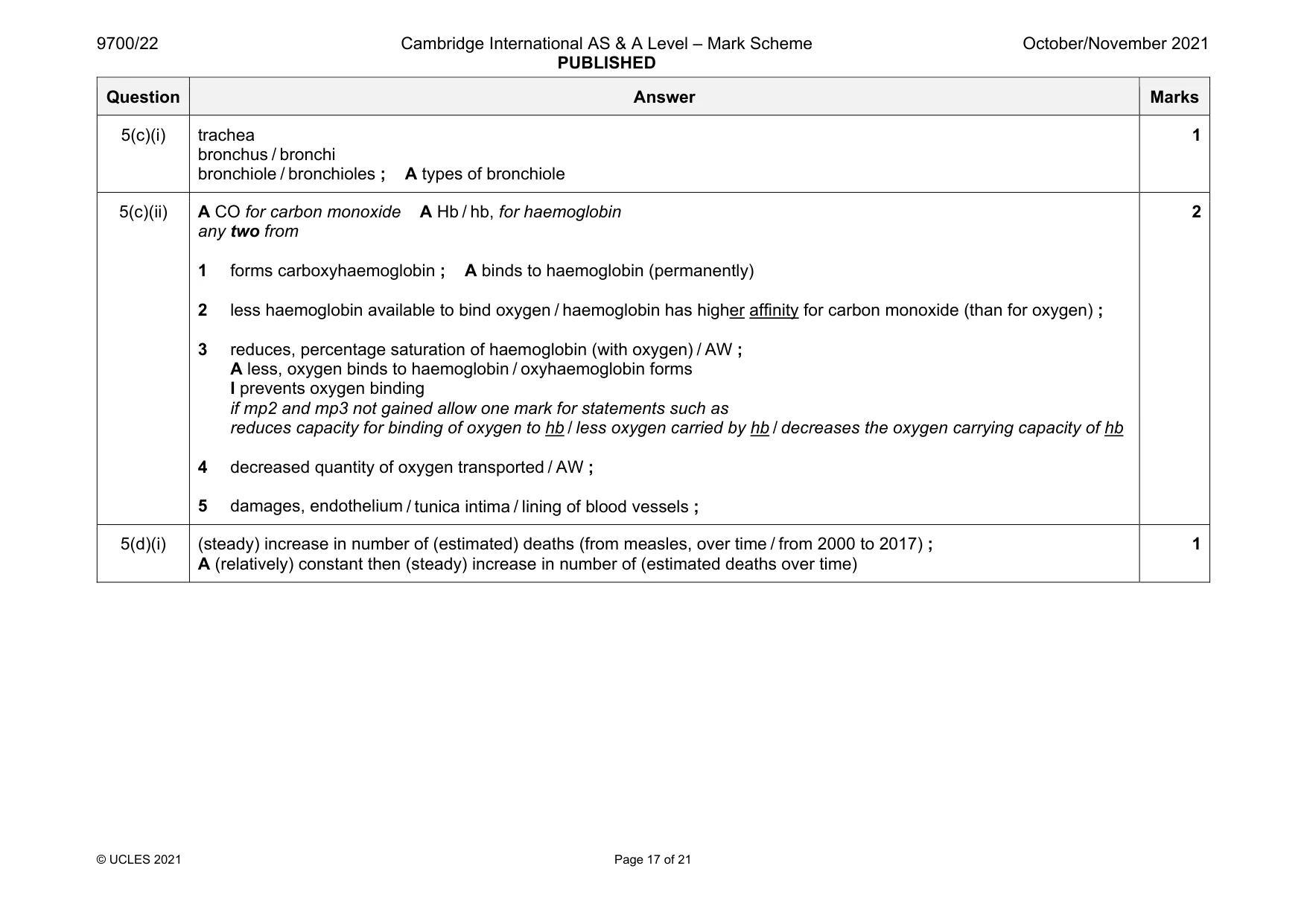
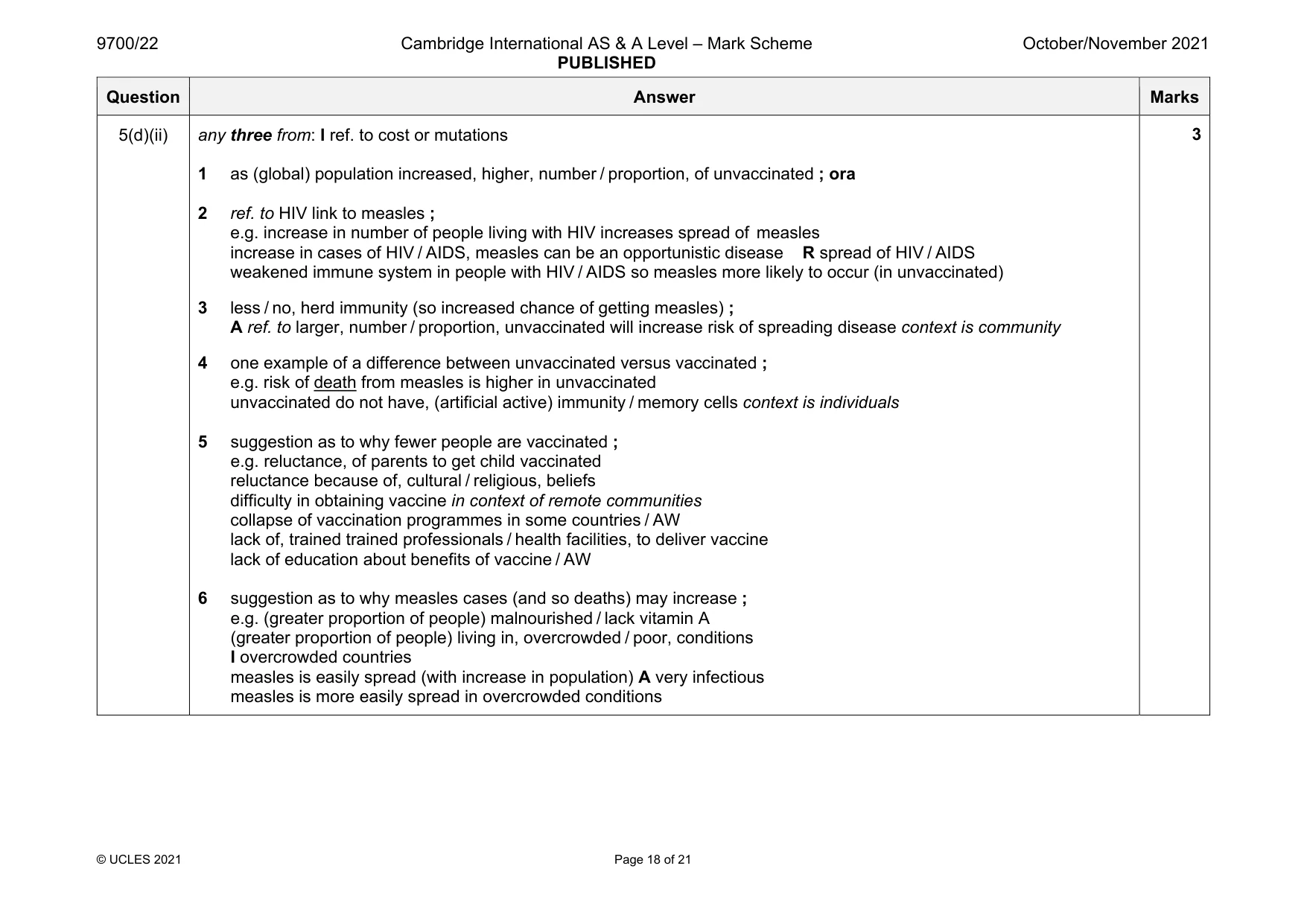
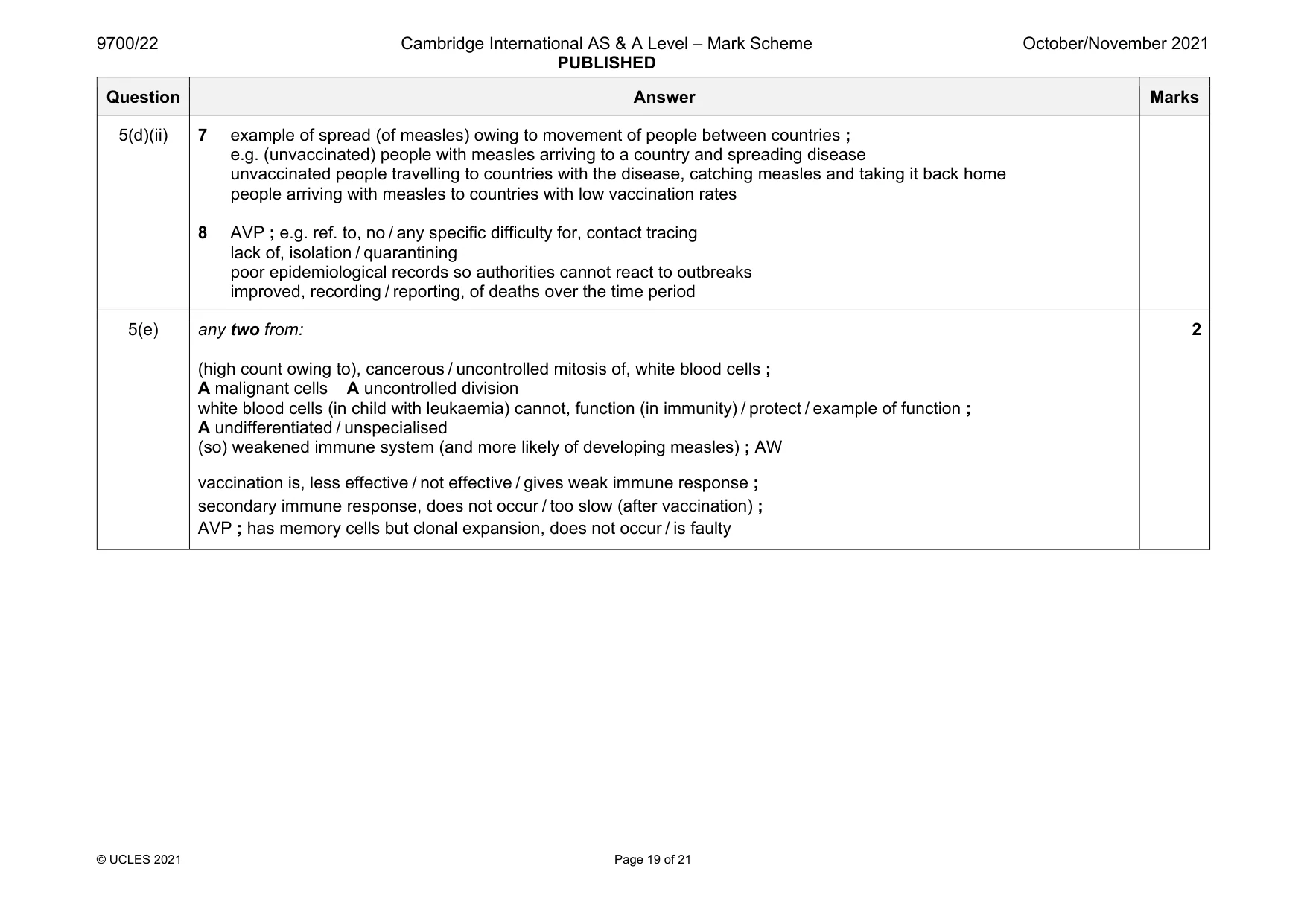
Mark scheme: 5(a) ignore single letters for the bases A purines = adenine and guanine ; in either order pyrimidines = cytosine and uracil ; in either order B phosphodiester (bond) ; C ribose ; 5(b) any three from: penalise once if incorrect, pathogen / type of organism aerosol infection / droplet infection / ref. to airborne droplets ; in context of droplets containing, pathogen / virus infected person, exhales / expires / breathes out / coughs / sneezes / AW, (airborne droplets) ; (airborne droplets) breathed in / AW, by, uninfected / healthy, person; idea of transmitted when uninfected person touches an infected surface and puts fingers into, mouth / nose ; R contact without qualification 3 Question Answer Marks 5(c)(i) trachea bronchus / bronchi bronchiole / bronchioles ; A types of bronchiole 1 5(c)(ii) A CO for carbon monoxide A Hb / hb, for haemoglobin any two from 1 forms carboxyhaemoglobin ; A binds to haemoglobin (permanently) 2 less haemoglobin available to bind oxygen / haemoglobin has higher affinity for carbon monoxide (than for oxygen) ; 3 reduces, percentage saturation of haemoglobin (with oxygen) / AW ; A less, oxygen binds to haemoglobin / oxyhaemoglobin forms I prevents oxygen binding if mp2 and mp3 not gained allow one mark for statements such as reduces capacity for binding of oxygen to hb / less oxygen carried by hb / decreases the oxygen carrying capacity of hb 4 decreased quantity of oxygen transported / AW ; 5 damages, endothelium / tunica intima / lining of blood vessels ; 2 5(d)(i) (steady) increase in number of (estimated) deaths (from measles, over time / from 2000 to 2017) ; A (relatively) constant then (steady) increase in number of (estimated deaths over time) 1 Question Answer Marks 5(d)(ii) any three from: I ref. to cost or mutations 1 as (global) population increased, higher, number / proportion, of unvaccinated ; ora 2 ref. to HIV link to measles ; e.g. increase in number of people living with HIV increases spread of measles increase in cases of HIV / AIDS, measles can be an opportunistic disease R spread of HIV / AIDS weakened immune system in people with HIV / AIDS so measles more likely to occur (in unvaccinated) 3 less / no, herd immunity (so increased chance of getting measles) ; A ref. to larger, number / proportion, unvaccinated will increase risk of spreading disease context is community 4 one example of a difference between unvaccinated versus vaccinated ; e.g. risk of death from measles is higher in unvaccinated unvaccinated do not have, (artificial active) immunity / memory cells context is individuals 5 suggestion as to why fewer people are vaccinated ; e.g. reluctance, of parents to get child vaccinated reluctance because of, cultural / religious, beliefs difficulty in obtaining vaccine in context of remote communities collapse of vaccination programmes in some countries / AW lack of, trained trained professionals / health facilities, to deliver vaccine lack of education about benefits of vaccine / AW 6 suggestion as to why measles cases (and so deaths) may increase ; e.g. (greater proportion of people) malnourished / lack vitamin A (greater proportion of people) living in, overcrowded / poor, conditions I overcrowded countries measles is easily spread (with increase in population) A very infectious measles is more easily spread in overcrowded conditions 3 Question Answer Marks 5(d)(ii) 7 example of spread (of measles) owing to movement of people between countries ; e.g. (unvaccinated) people with measles arriving to a country and spreading disease unvaccinated people travelling to countries with the disease, catching measles and taking it back home people arriving with measles to countries with low vaccination rates 8 AVP ; e.g. ref. to, no / any specific difficulty for, contact tracing lack of, isolation / quarantining poor epidemiological records so authorities cannot react to outbreaks improved, recording / reporting, of deaths over the time period 5(e) any two from: (high count owing to), cancerous / uncontrolled mitosis of, white blood cells ; A malignant cells A uncontrolled division white blood cells (in child with leukaemia) cannot, function (in immunity) / protect / example of function ; A undifferentiated / unspecialised (so) weakened immune system (and more likely of developing measles) ; AW vaccination is, less effective / not effective / gives weak immune response ; secondary immune response, does not occur / too slow (after vaccination) ; AVP ; has memory cells but clonal expansion, does not occur / is faulty 2
Q6 · Amylase is an enzyme that catalyses the hydrolysis of starch into reducing sugars
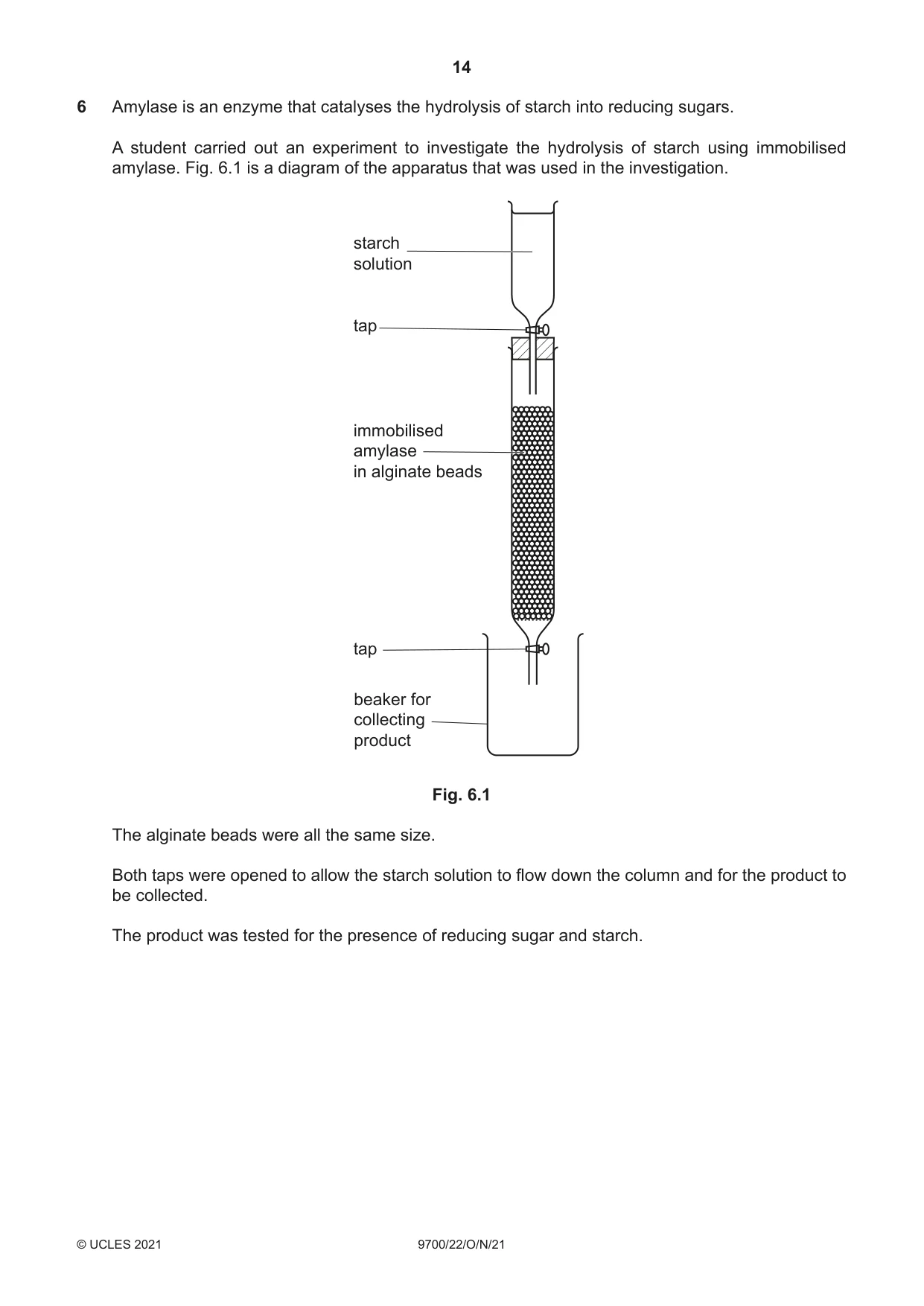
6 Amylase is an enzyme that catalyses the hydrolysis of starch into reducing sugars. A student carried out an experiment to investigate the hydrolysis of starch using immobilised amylase. Fig. 6.1 is a diagram of the apparatus that was used in the investigation. starch solution tap immobilised amylase in alginate beads tap beaker for collecting product Fig. 6.1 The alginate beads were all the same size. Both taps were opened to allow the starch solution to flow down the column and for the product to be collected. The product was tested for the presence of reducing sugar and starch. (a) The results of the investigation showed that the product collected in the beaker contained reducing sugar and starch. With reference to Fig. 6.1, describe a method that would allow the student to use the immobilised amylase to collect a product that contains only reducing sugar. ................................................................................................................................................... ................................................................................................................................................... ................................................................................................................................................... ................................................................................................................................................... ................................................................................................................................................... ................................................................................................................................................... ............................................................................................................................................. [3] (b) One standardised variable in the investigation is the size of the alginate beads. Suggest one reason why using larger or smaller alginate beads in the column would affect the results obtained. ................................................................................................................................................... ................................................................................................................................................... ............................................................................................................................................. [1] [Total: 4]
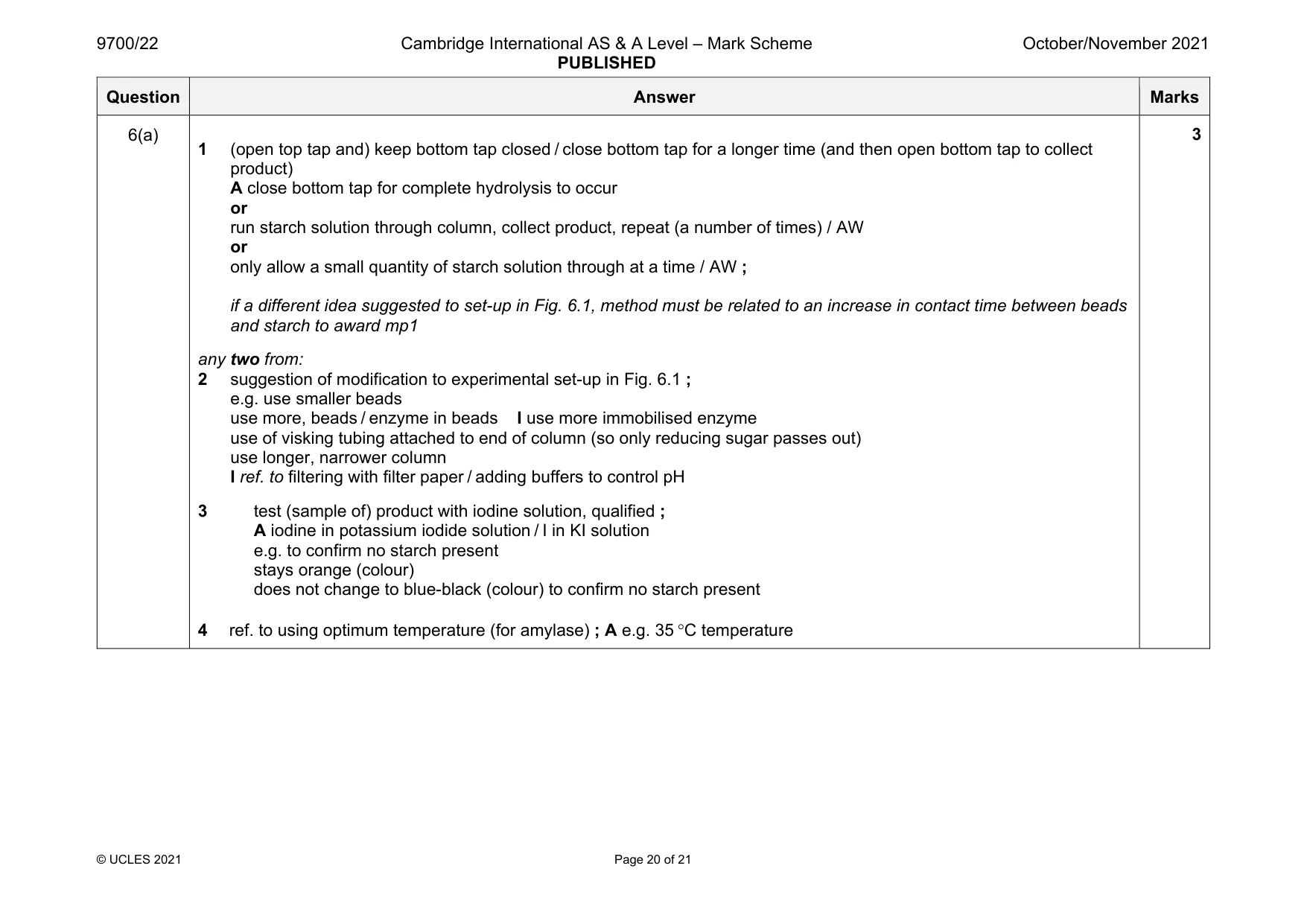
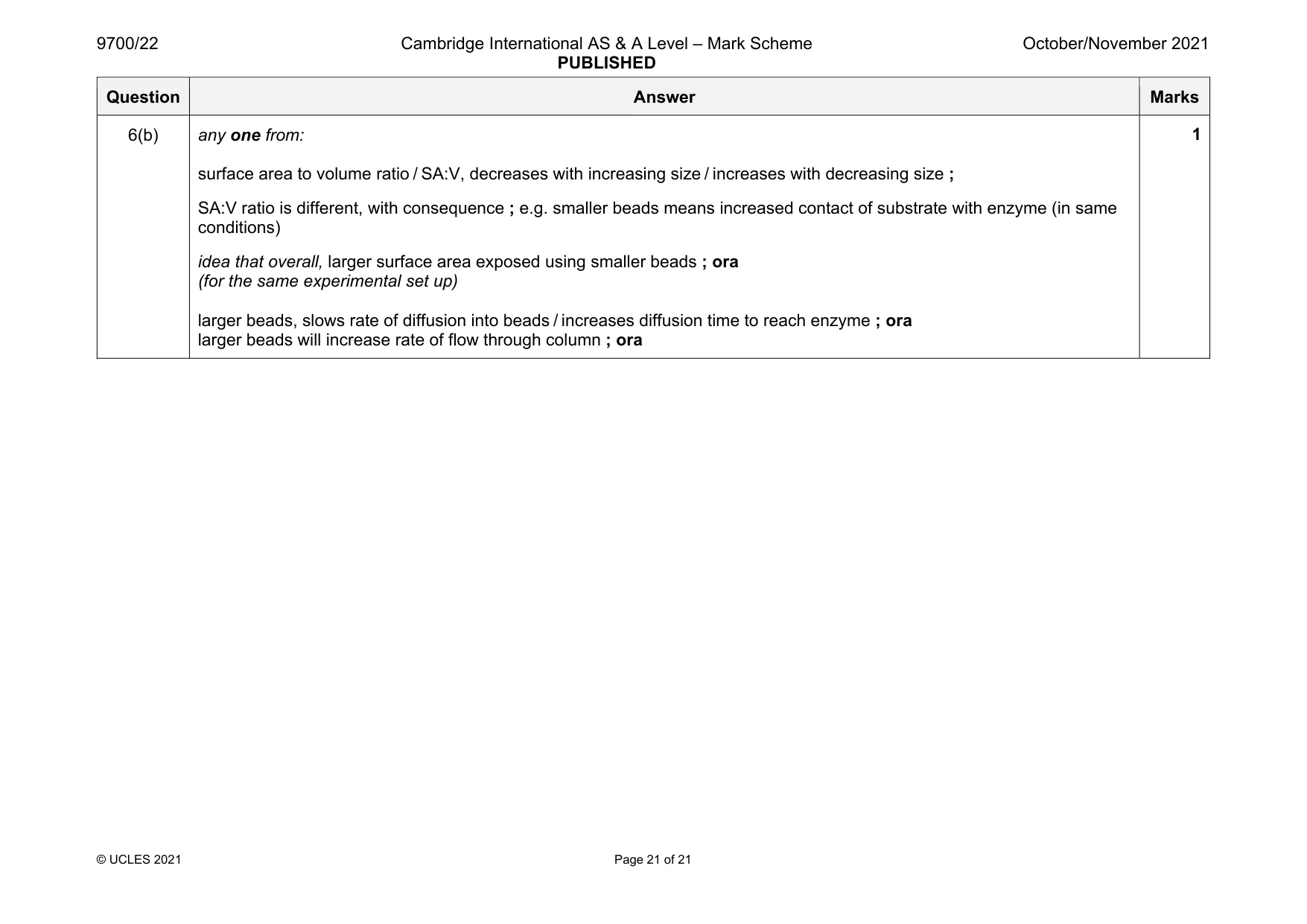
Mark scheme: 6(a) 1 (open top tap and) keep bottom tap closed / close bottom tap for a longer time (and then open bottom tap to collect product) A close bottom tap for complete hydrolysis to occur or run starch solution through column, collect product, repeat (a number of times) / AW or only allow a small quantity of starch solution through at a time / AW ; if a different idea suggested to set-up in Fig. 6.1, method must be related to an increase in contact time between beads and starch to award mp1 any two from: 2 suggestion of modification to experimental set-up in Fig. 6.1 ; e.g. use smaller beads use more, beads / enzyme in beads I use more immobilised enzyme use of visking tubing attached to end of column (so only reducing sugar passes out) use longer, narrower column I ref. to filtering with filter paper / adding buffers to control pH 3 test (sample of) product with iodine solution, qualified ; A iodine in potassium iodide solution / I in KI solution e.g. to confirm no starch present stays orange (colour) does not change to blue-black (colour) to confirm no starch present 4 ref. to using optimum temperature (for amylase) ; A e.g. 35 °C temperature Question Answer Marks 6(b) any one from: surface area to volume ratio / SA:V, decreases with increasing size / increases with decreasing size ; SA:V ratio is different, with consequence ; e.g. smaller beads means increased contact of substrate with enzyme (in same conditions) idea that overall, larger surface area exposed using smaller beads ; ora (for the same experimental set up) larger beads, slows rate of diffusion into beads / increases diffusion time to reach enzyme ; ora larger beads will increase rate of flow through column ; ora 1
What was in this paper
The subtopics covered by these 6 questions, and how many questions each got. Open one in a new tab to see every Cambridge question on it.
What you needed in this session
Cambridge’s own grade thresholds for 2021 Oct/Nov, Paper 2 · Variant 2. A higher threshold means an easier paper — the bar moves with how the cohort did.