Cambridge A Level Biology 9700 — 2019 Oct/Nov Paper 2 · Variant 1
9700/21/O/N/19 · 6 questions · 60 marks · ≈68 min
The question paper and its mark scheme, free to read here and free to download. This is Cambridge’s own paper, exactly as it was sat.
Question paper16 pages
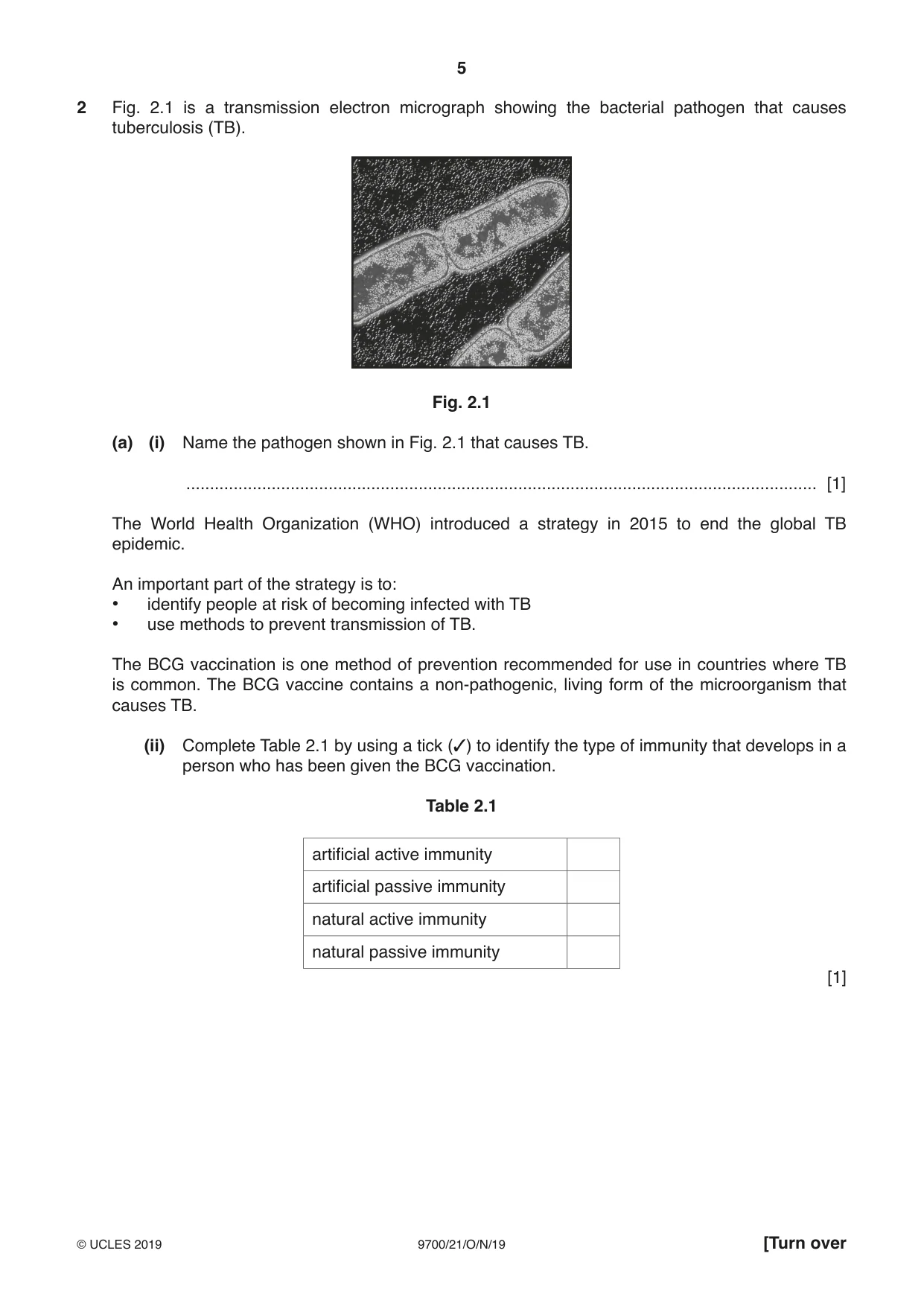
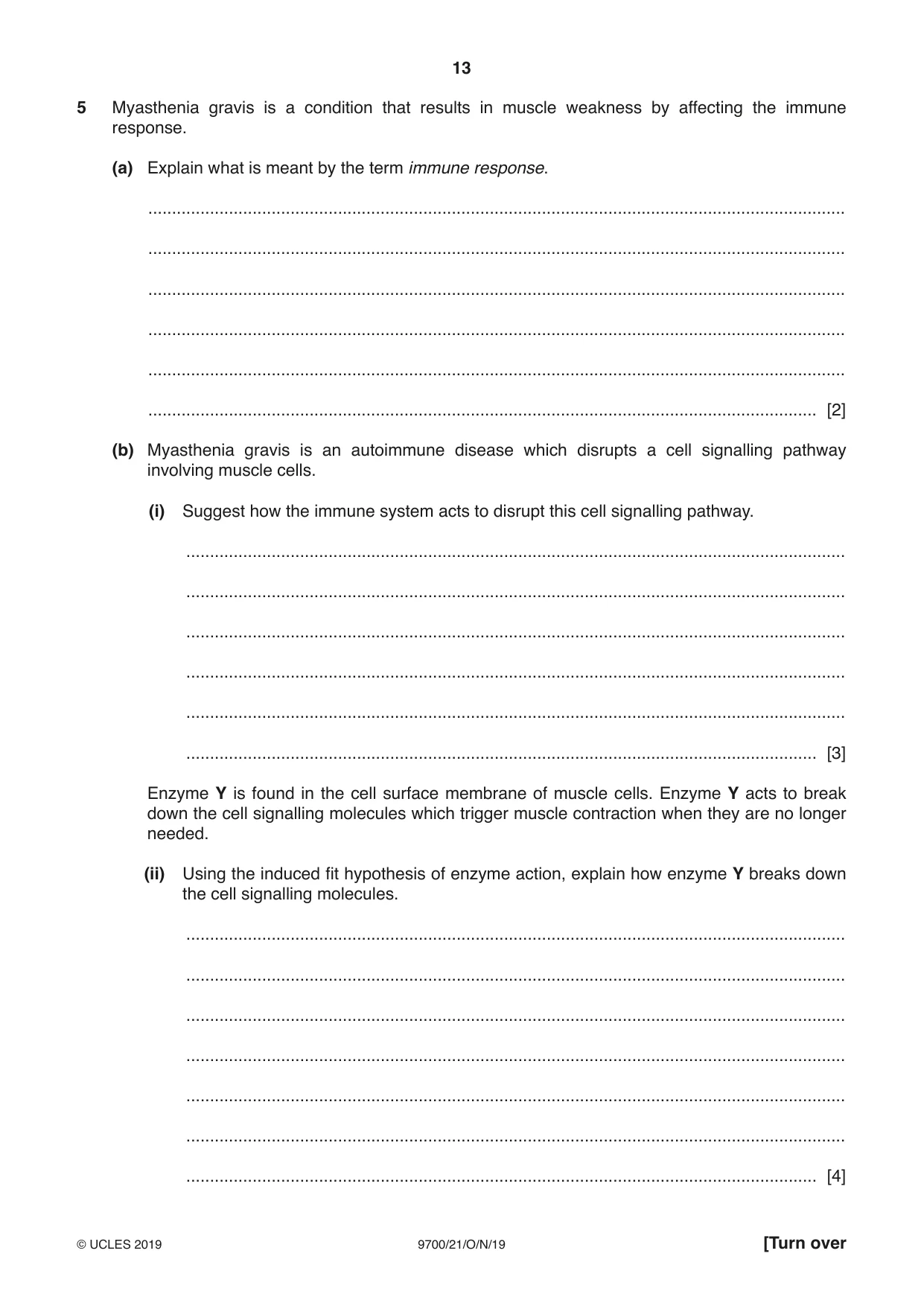
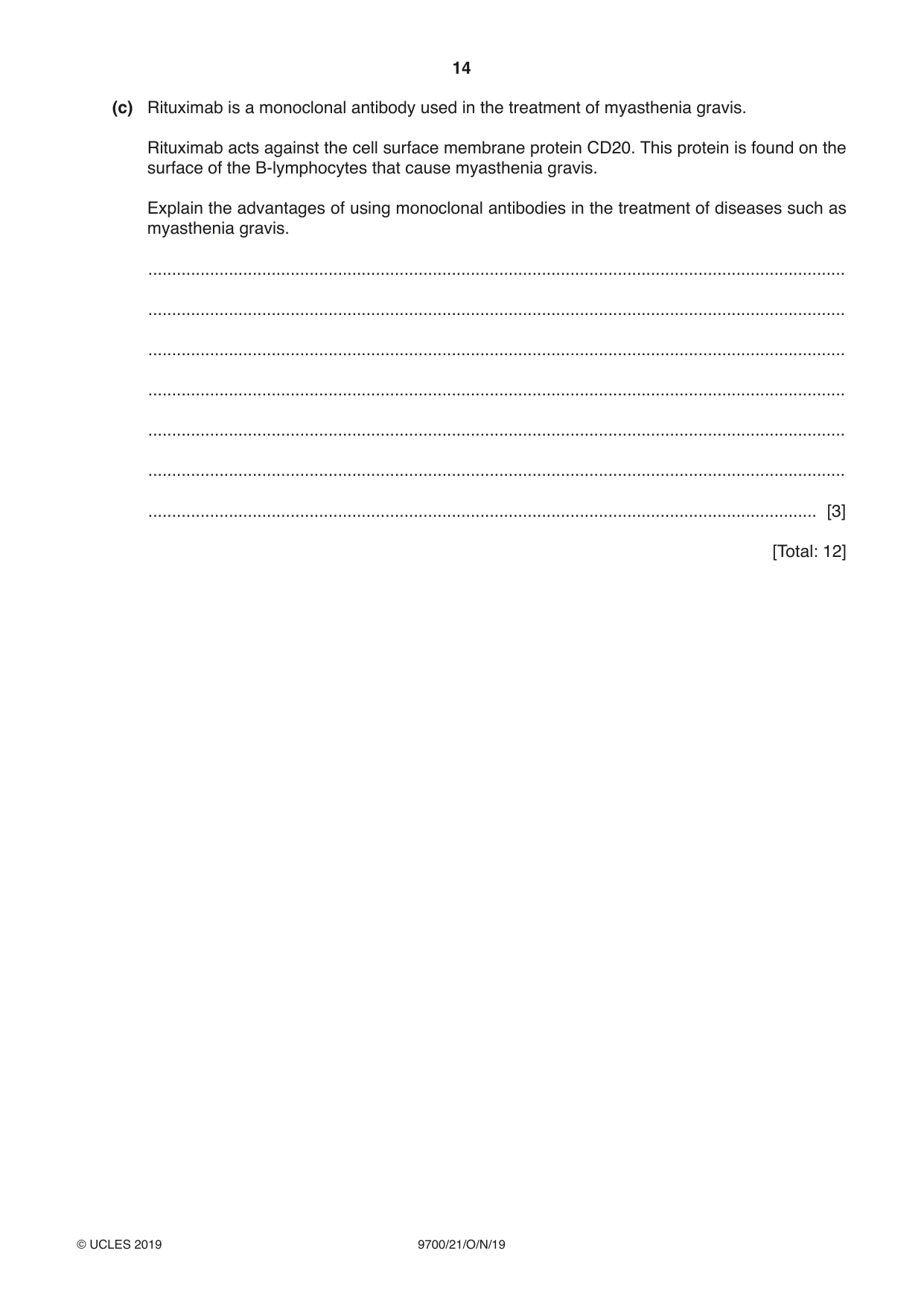
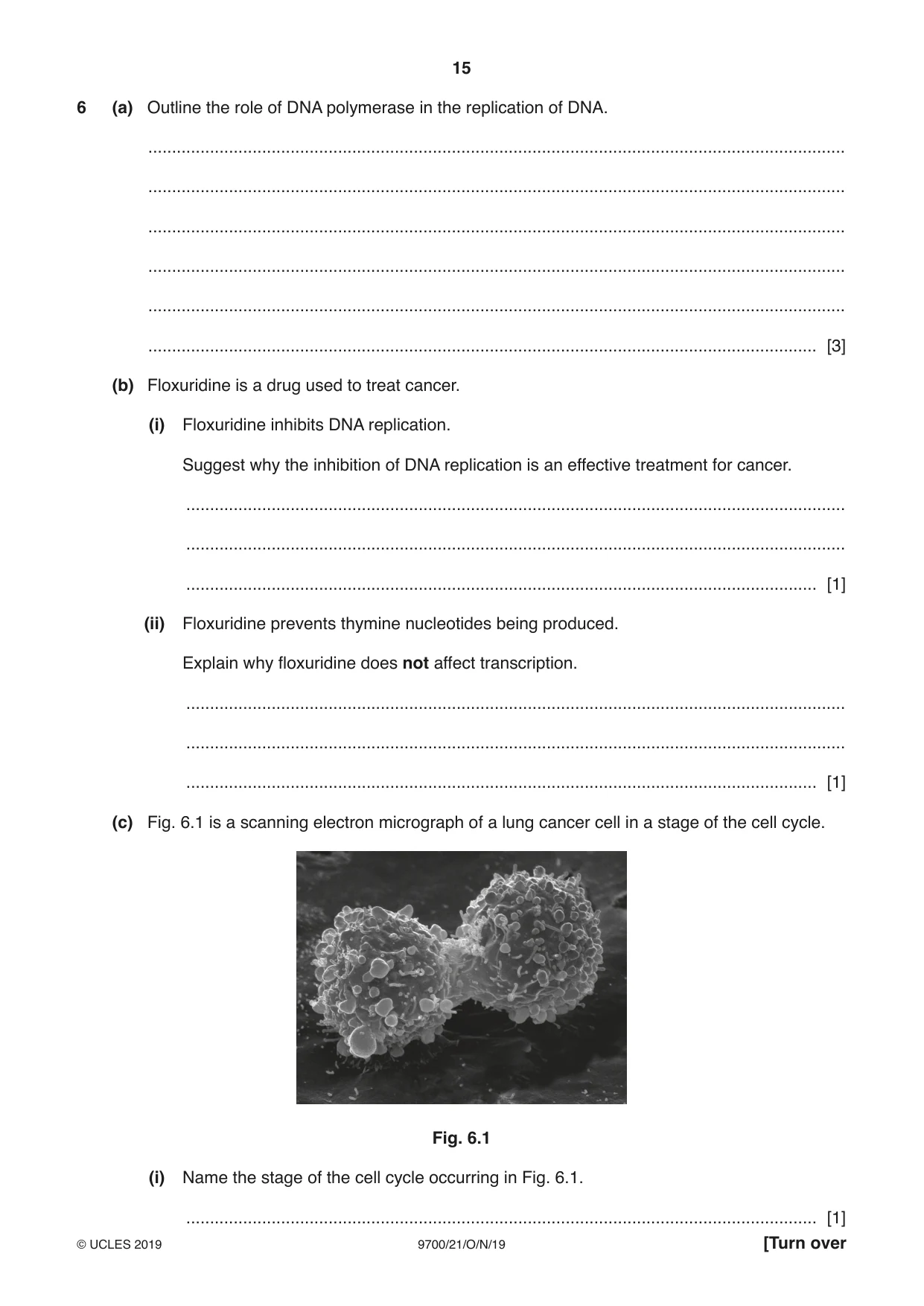
Mark scheme12 pages
Answers below. Sit the paper first if you are practising.
Questions as text
Q1 · The structure of the amino acid glycine
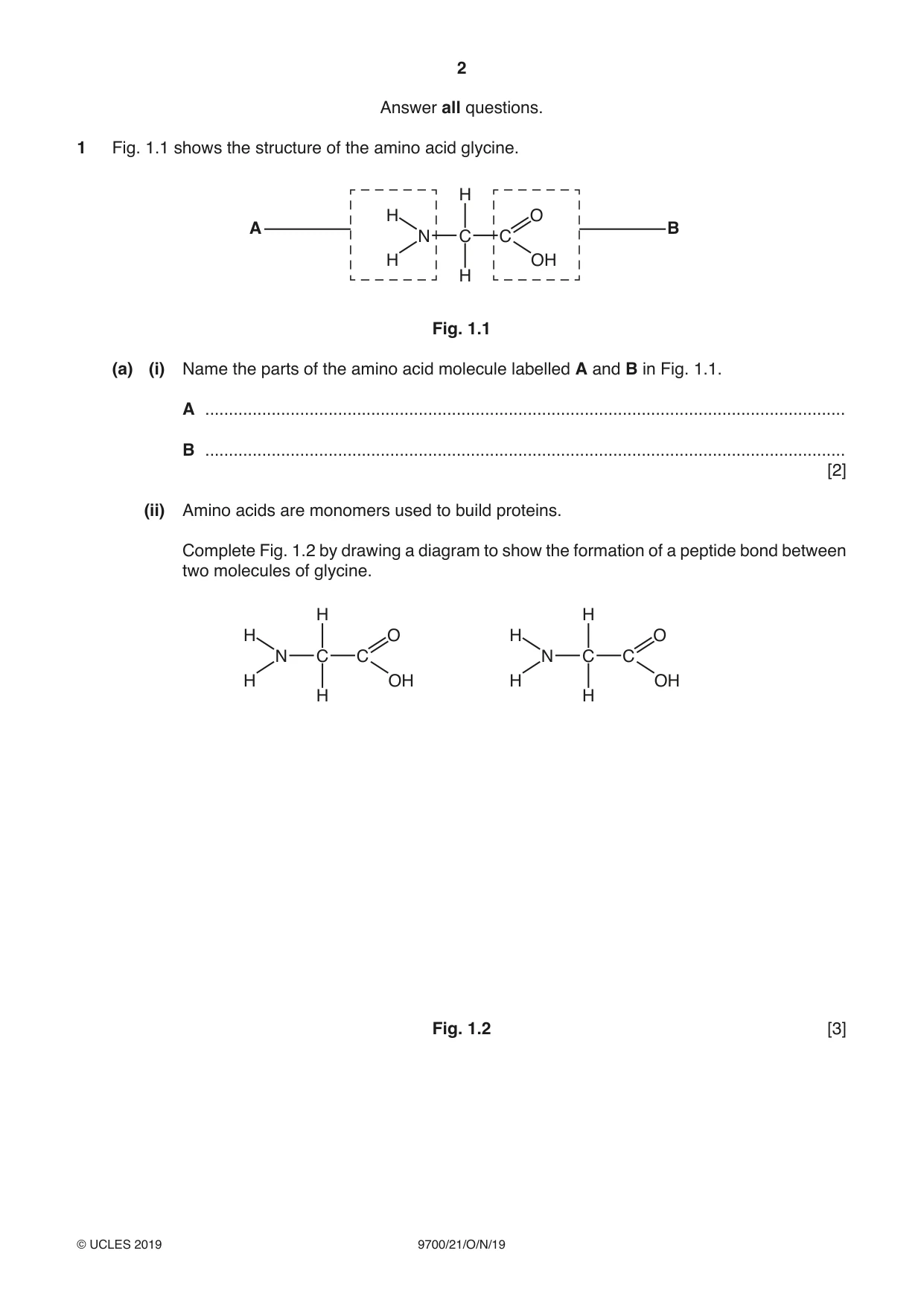
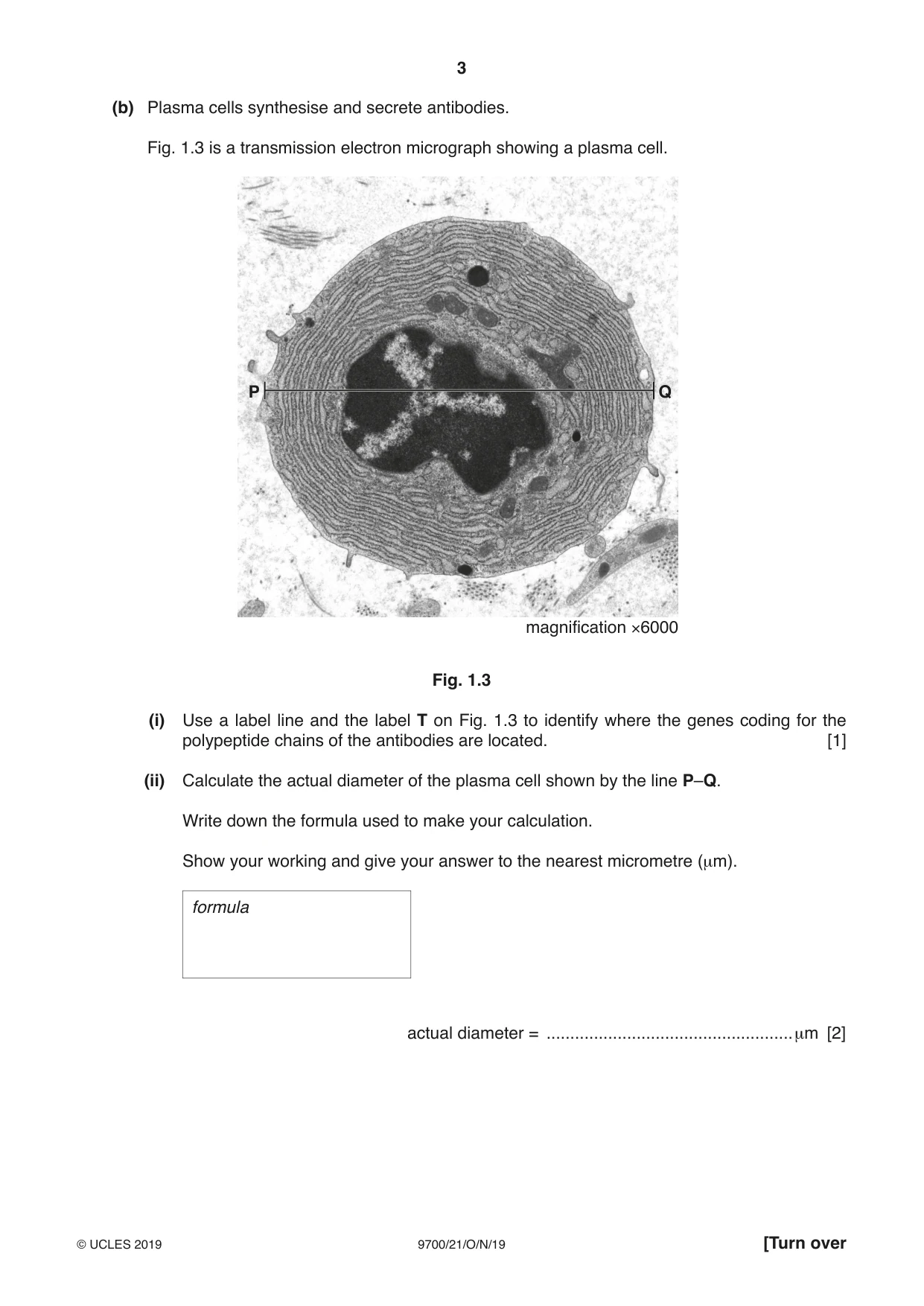
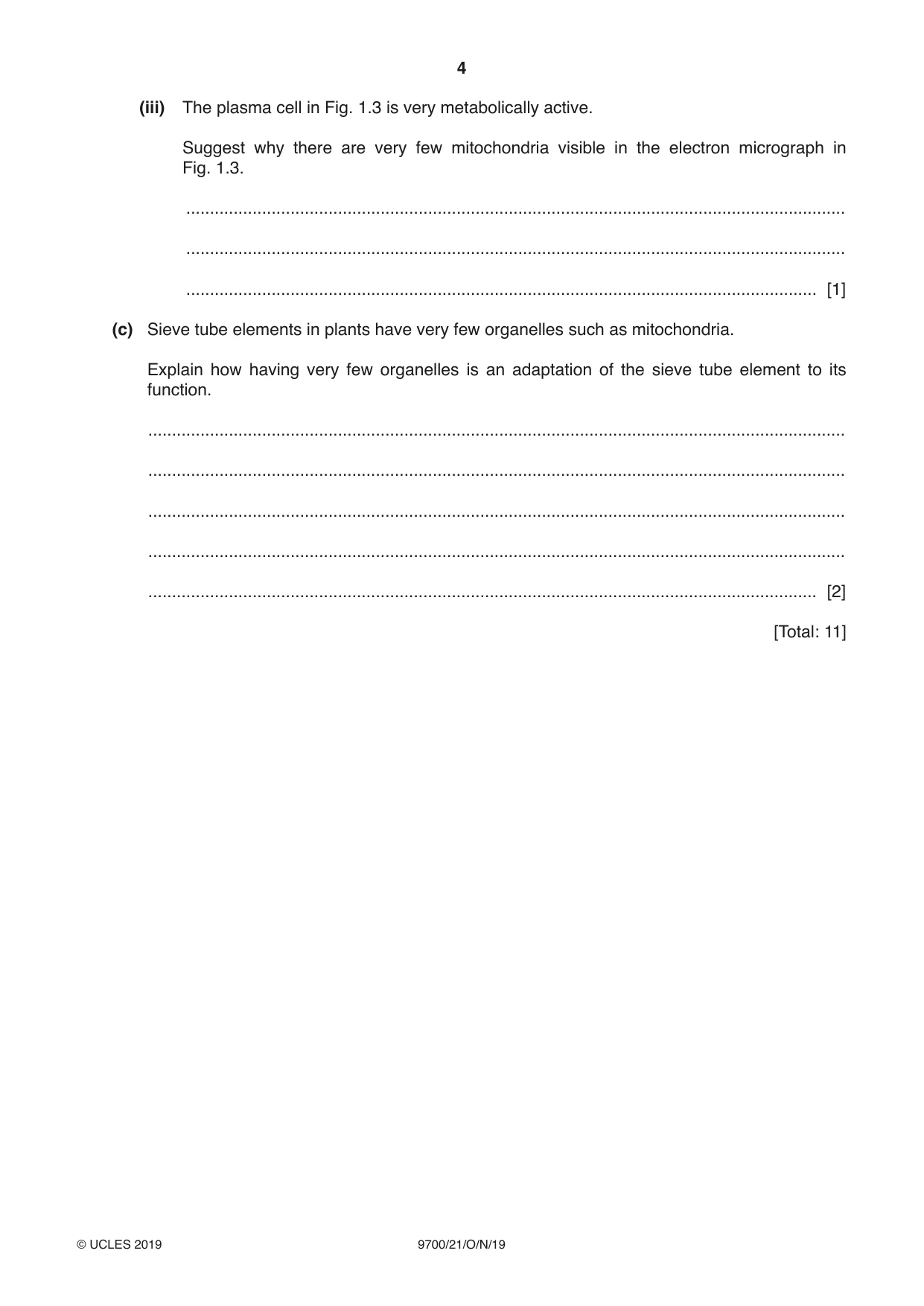
1 Fig. 1.1 shows the structure of the amino acid glycine. H H O A B N C C H OH H Fig. 1.1 (a) (i) Name the parts of the amino acid molecule labelled A and B in Fig. 1.1. A ....................................................................................................................................... B ....................................................................................................................................... [2] (ii) Amino acids are monomers used to build proteins. Complete Fig. 1.2 by drawing a diagram to show the formation of a peptide bond between two molecules of glycine. H H H O H O N C C N C C H OH H OH H H Fig. 1.2 [3] (b) Plasma cells synthesise and secrete antibodies. Fig. 1.3 is a transmission electron micrograph showing a plasma cell. P Q magnification ×6000 Fig. 1.3 (i) Use a label line and the label T on Fig. 1.3 to identify where the genes coding for the polypeptide chains of the antibodies are located. [1] (ii) Calculate the actual diameter of the plasma cell shown by the line P–Q. Write down the formula used to make your calculation. Show your working and give your answer to the nearest micrometre (µm). formula actual diameter = ....................................................µm [2] (iii) The plasma cell in Fig. 1.3 is very metabolically active. Suggest why there are very few mitochondria visible in the electron micrograph in Fig. 1.3. ........................................................................................................................................... ........................................................................................................................................... ..................................................................................................................................... [1] (c) Sieve tube elements in plants have very few organelles such as mitochondria. Explain how having very few organelles is an adaptation of the sieve tube element to its function. ................................................................................................................................................... ................................................................................................................................................... ................................................................................................................................................... ................................................................................................................................................... ............................................................................................................................................. [2] [Total: 11]
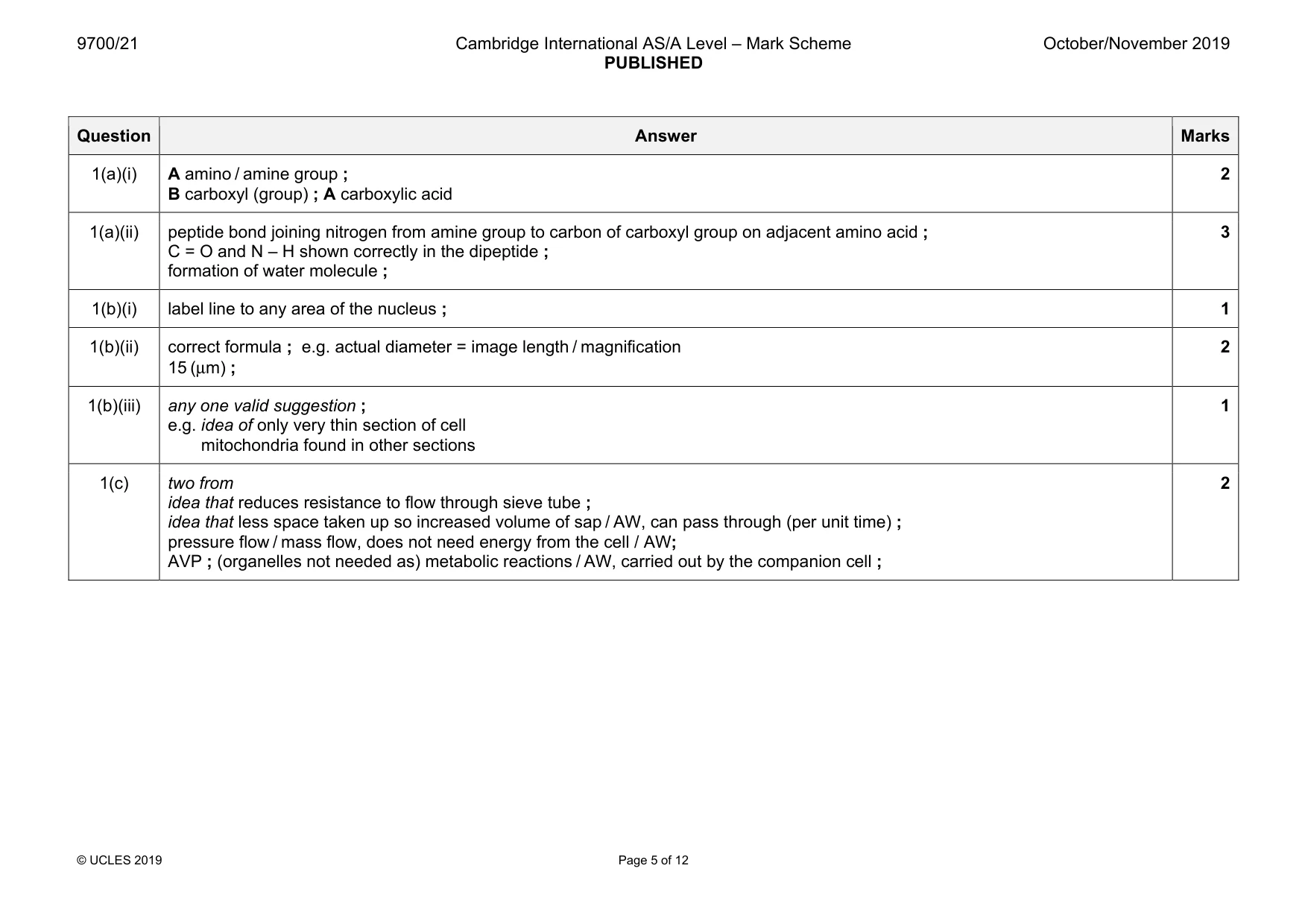
Mark scheme: 1(a)(i) A amino / amine group ; B carboxyl (group) ; A carboxylic acid 2 1(a)(ii) peptide bond joining nitrogen from amine group to carbon of carboxyl group on adjacent amino acid ; C = O and N – H shown correctly in the dipeptide ; formation of water molecule ; 3 1(b)(i) label line to any area of the nucleus ; 1 1(b)(ii) correct formula ; e.g. actual diameter = image length / magnification 15 (µm) ; 2 1(b)(iii) any one valid suggestion ; e.g. idea of only very thin section of cell mitochondria found in other sections 1 1(c) two from idea that reduces resistance to flow through sieve tube ; idea that less space taken up so increased volume of sap / AW, can pass through (per unit time) ; pressure flow / mass flow, does not need energy from the cell / AW; AVP ; (organelles not needed as) metabolic reactions / AW, carried out by the companion cell ; 2
Q2 · A transmission electron micrograph showing the bacterial pathogen that causes…
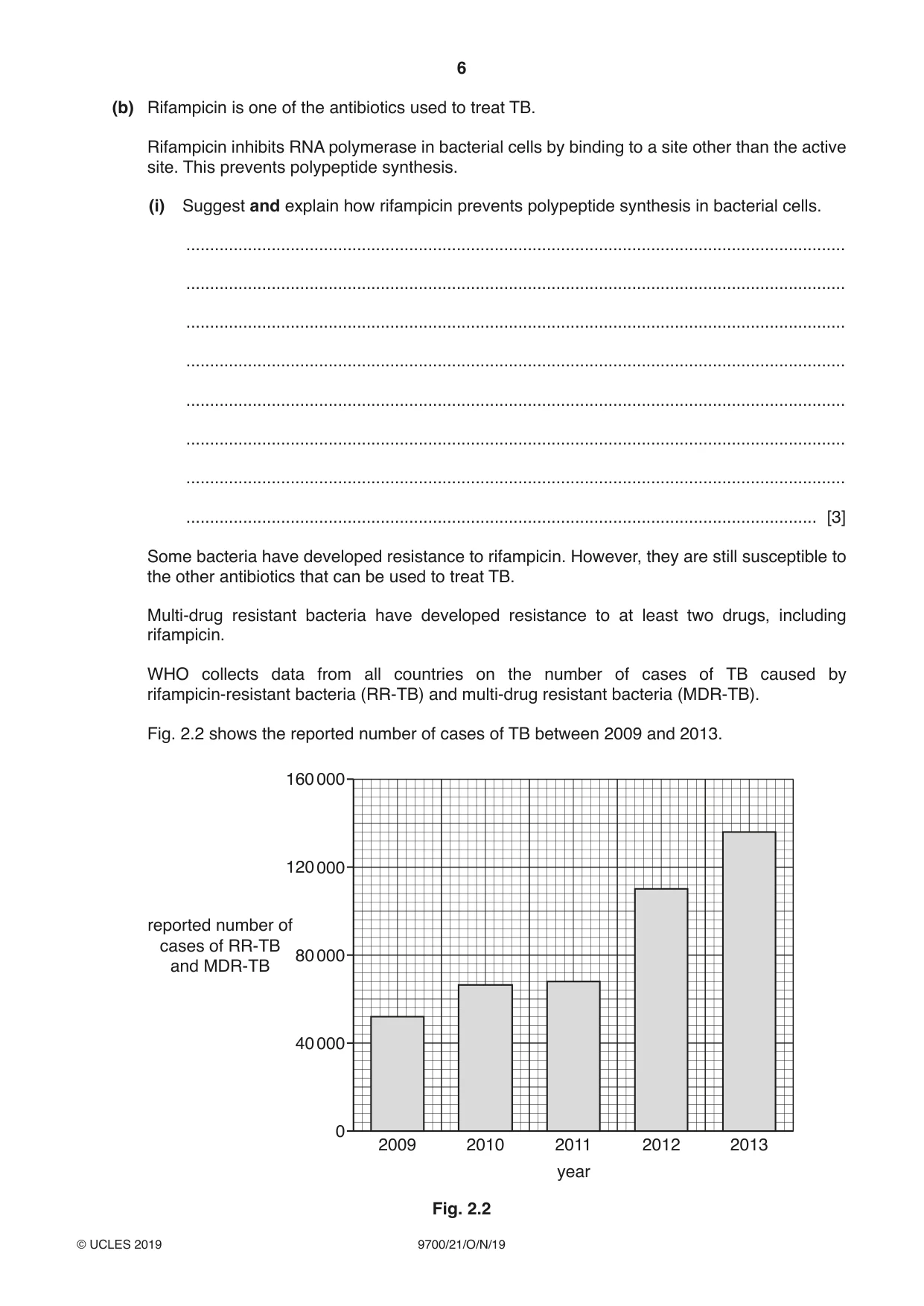
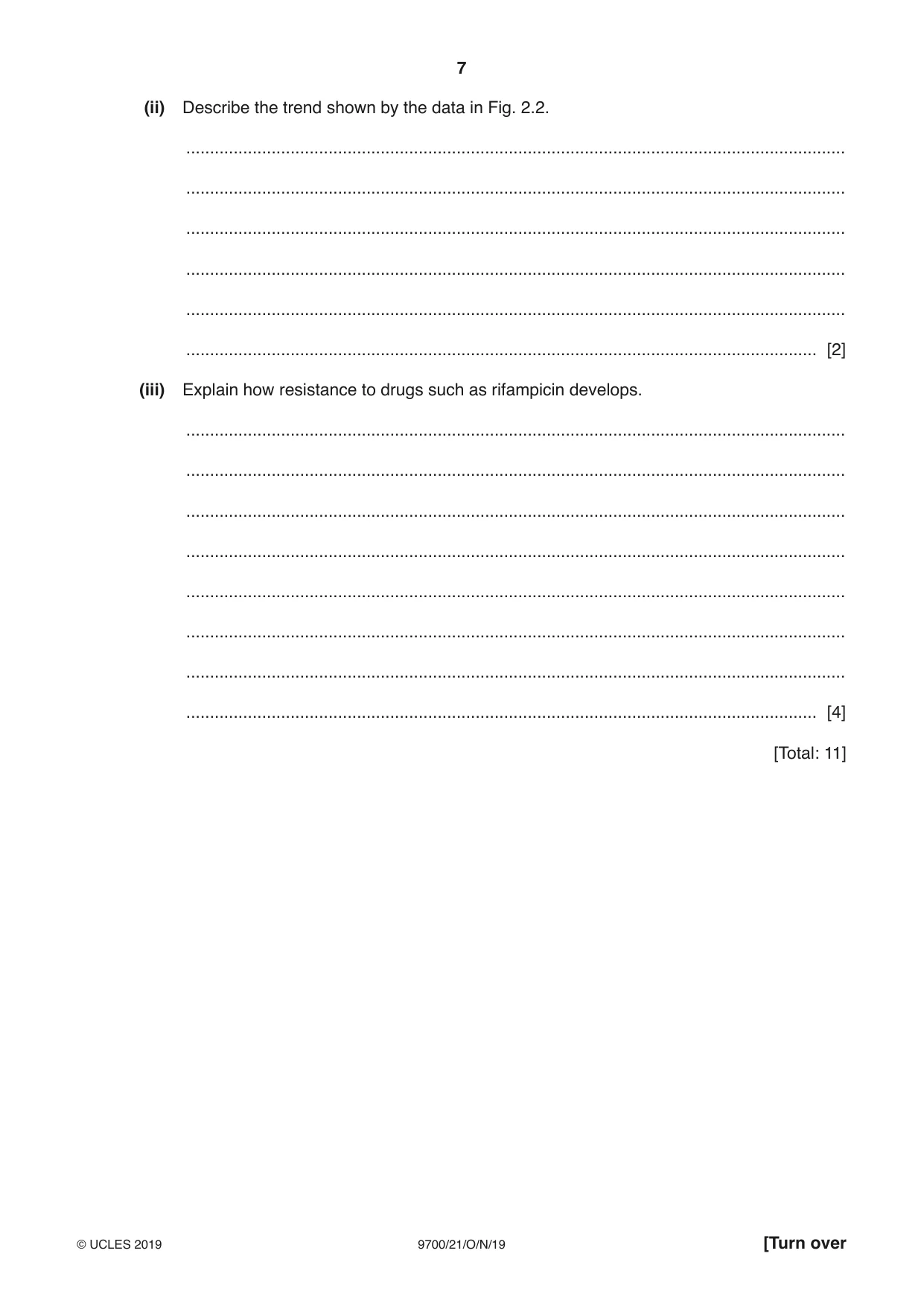
2 Fig. 2.1 is a transmission electron micrograph showing the bacterial pathogen that causes tuberculosis (TB). Fig. 2.1 (a) (i) Name the pathogen shown in Fig. 2.1 that causes TB. ..................................................................................................................................... [1] The World Health Organization (WHO) introduced a strategy in 2015 to end the global TB epidemic. An important part of the strategy is to: • identify people at risk of becoming infected with TB • use methods to prevent transmission of TB. The BCG vaccination is one method of prevention recommended for use in countries where TB is common. The BCG vaccine contains a non-pathogenic, living form of the microorganism that causes TB. (ii) Complete Table 2.1 by using a tick (✓) to identify the type of immunity that develops in a person who has been given the BCG vaccination. Table 2.1 artificial active immunity artificial passive immunity natural active immunity natural passive immunity [1] (b) Rifampicin is one of the antibiotics used to treat TB. Rifampicin inhibits RNA polymerase in bacterial cells by binding to a site other than the active site. This prevents polypeptide synthesis. (i) Suggest and explain how rifampicin prevents polypeptide synthesis in bacterial cells. ........................................................................................................................................... ........................................................................................................................................... ........................................................................................................................................... ........................................................................................................................................... ........................................................................................................................................... ........................................................................................................................................... ........................................................................................................................................... ..................................................................................................................................... [3] Some bacteria have developed resistance to rifampicin. However, they are still susceptible to the other antibiotics that can be used to treat TB. Multi-drug resistant bacteria have developed resistance to at least two drugs, including rifampicin. WHO collects data from all countries on the number of cases of TB caused by rifampicin-resistant bacteria (RR-TB) and multi-drug resistant bacteria (MDR-TB). Fig. 2.2 shows the reported number of cases of TB between 2009 and 2013. 160 000 120 000 reported number of cases of RR-TB 80 000 and MDR-TB 40 000 0 2009 2010 2011 2012 2013 year Fig. 2.2 (ii) Describe the trend shown by the data in Fig. 2.2. ........................................................................................................................................... ........................................................................................................................................... ........................................................................................................................................... ........................................................................................................................................... ........................................................................................................................................... ..................................................................................................................................... [2] (iii) Explain how resistance to drugs such as rifampicin develops. ........................................................................................................................................... ........................................................................................................................................... ........................................................................................................................................... ........................................................................................................................................... ........................................................................................................................................... ........................................................................................................................................... ........................................................................................................................................... ..................................................................................................................................... [4] [Total: 11]
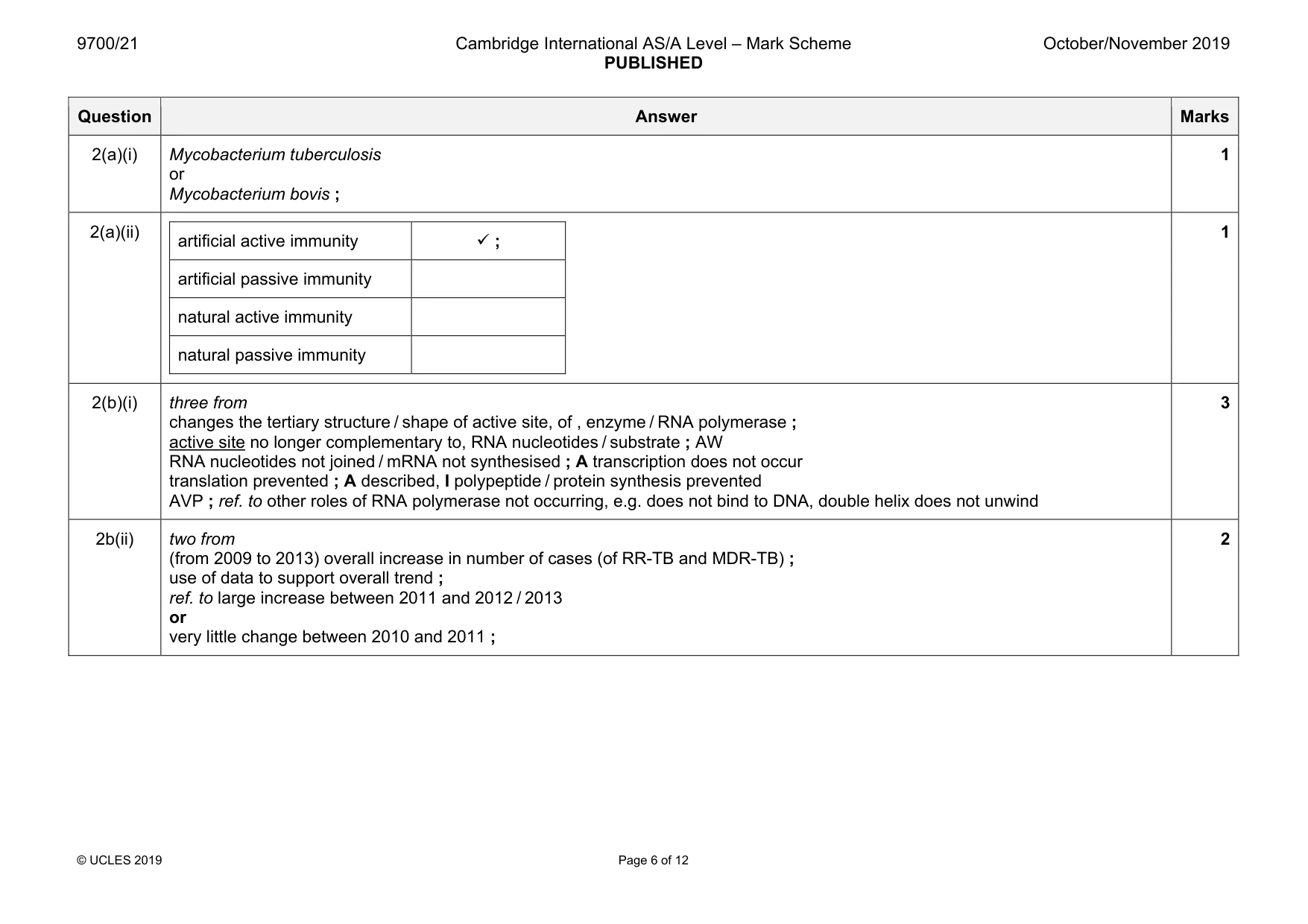
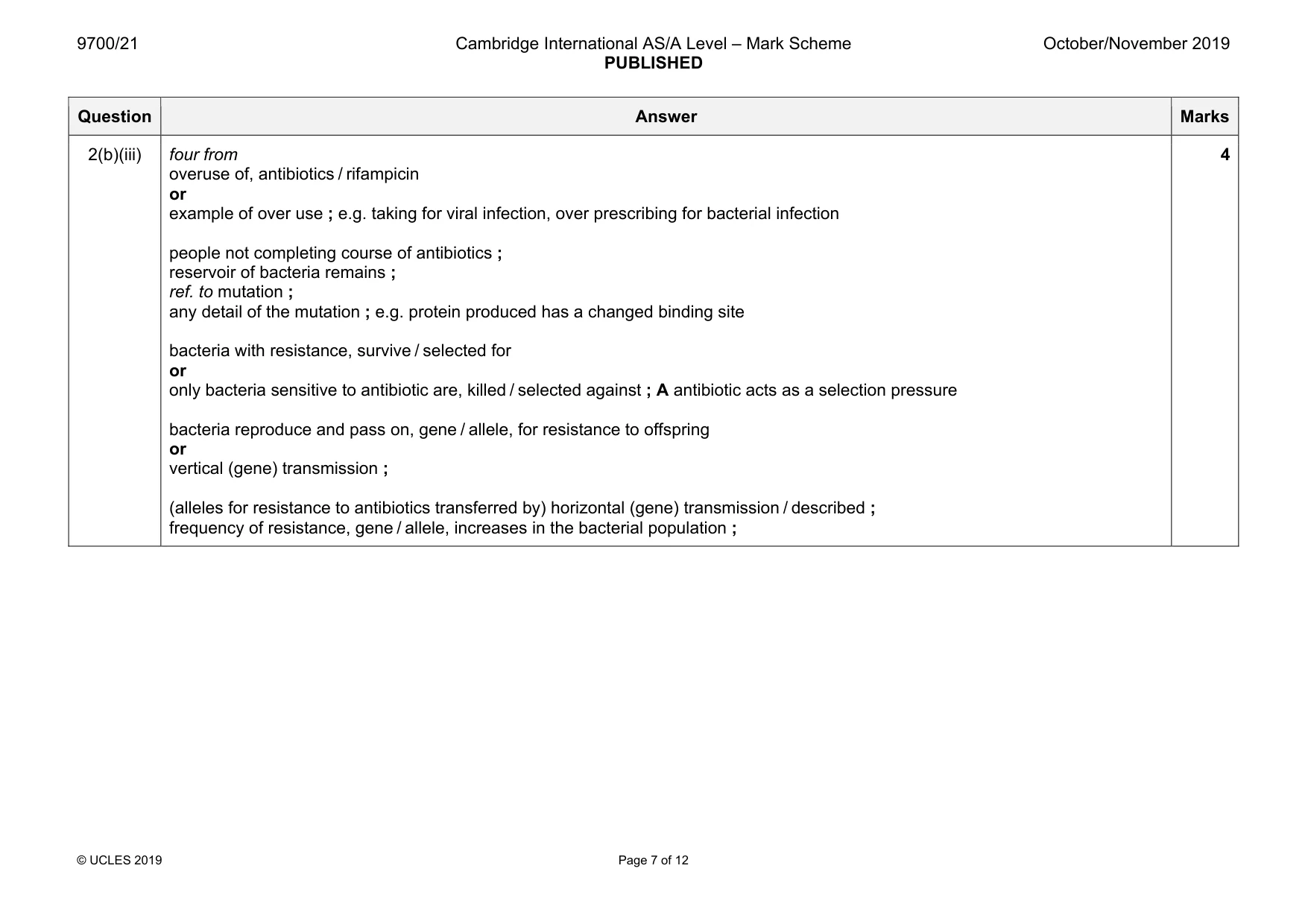
Mark scheme: 2(a)(i) Mycobacterium tuberculosis or Mycobacterium bovis ; 1 2(a)(ii) artificial active immunity 9 ; artificial passive immunity natural active immunity natural passive immunity 1 2(b)(i) three from changes the tertiary structure / shape of active site, of , enzyme / RNA polymerase ; active site no longer complementary to, RNA nucleotides / substrate ; AW RNA nucleotides not joined / mRNA not synthesised ; A transcription does not occur translation prevented ; A described, I polypeptide / protein synthesis prevented AVP ; ref. to other roles of RNA polymerase not occurring, e.g. does not bind to DNA, double helix does not unwind 3 2b(ii) two from (from 2009 to 2013) overall increase in number of cases (of RR-TB and MDR-TB) ; use of data to support overall trend ; ref. to large increase between 2011 and 2012 / 2013 or very little change between 2010 and 2011 ; 2 Question Answer Marks 2(b)(iii) four from overuse of, antibiotics / rifampicin or example of over use ; e.g. taking for viral infection, over prescribing for bacterial infection people not completing course of antibiotics ; reservoir of bacteria remains ; ref. to mutation ; any detail of the mutation ; e.g. protein produced has a changed binding site bacteria with resistance, survive / selected for or only bacteria sensitive to antibiotic are, killed / selected against ; A antibiotic acts as a selection pressure bacteria reproduce and pass on, gene / allele, for resistance to offspring or vertical (gene) transmission ; (alleles for resistance to antibiotics transferred by) horizontal (gene) transmission / described ; frequency of resistance, gene / allele, increases in the bacterial population ; 4
Q3 · A student carried out an experiment to investigate the effect of increasing the…
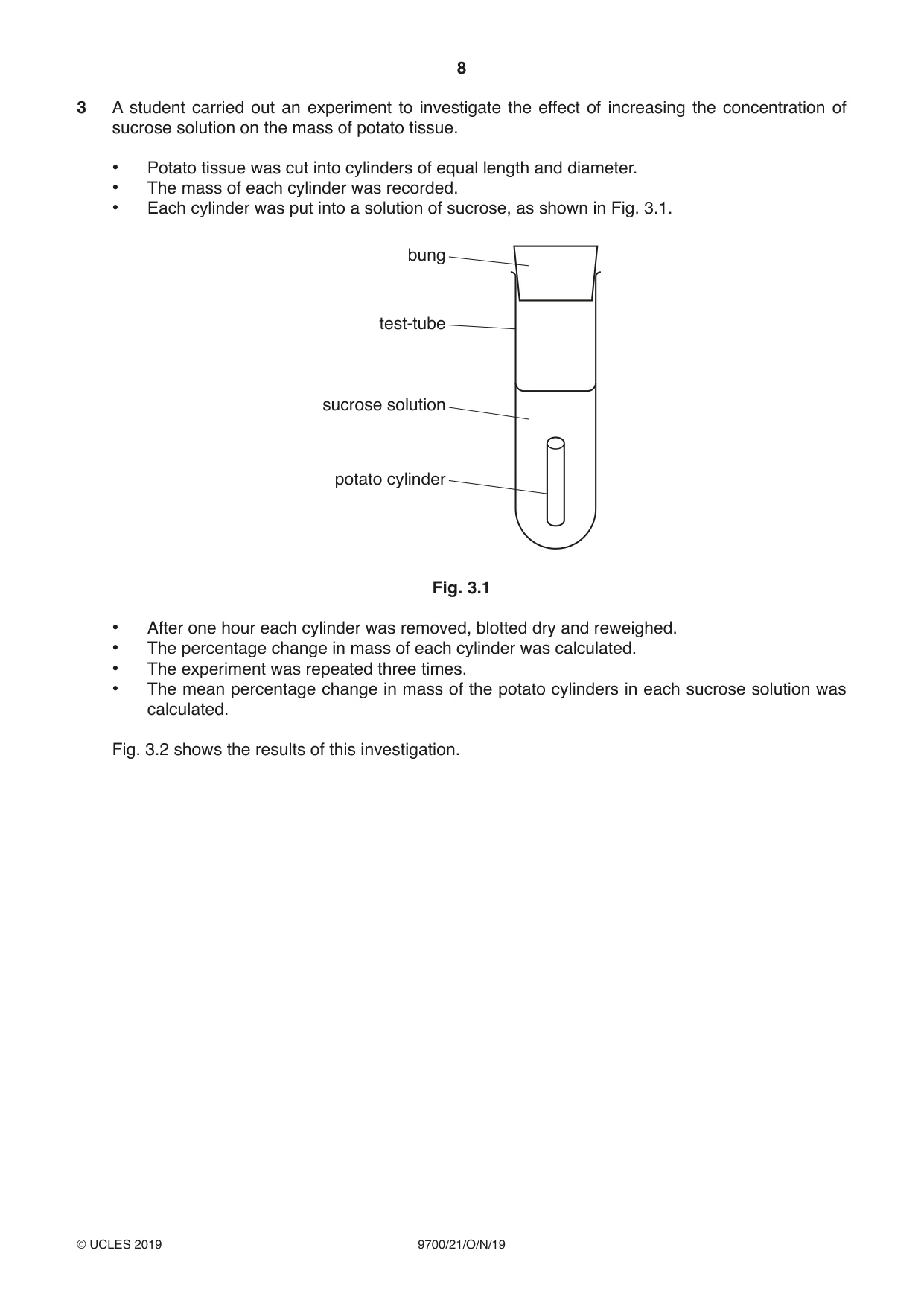
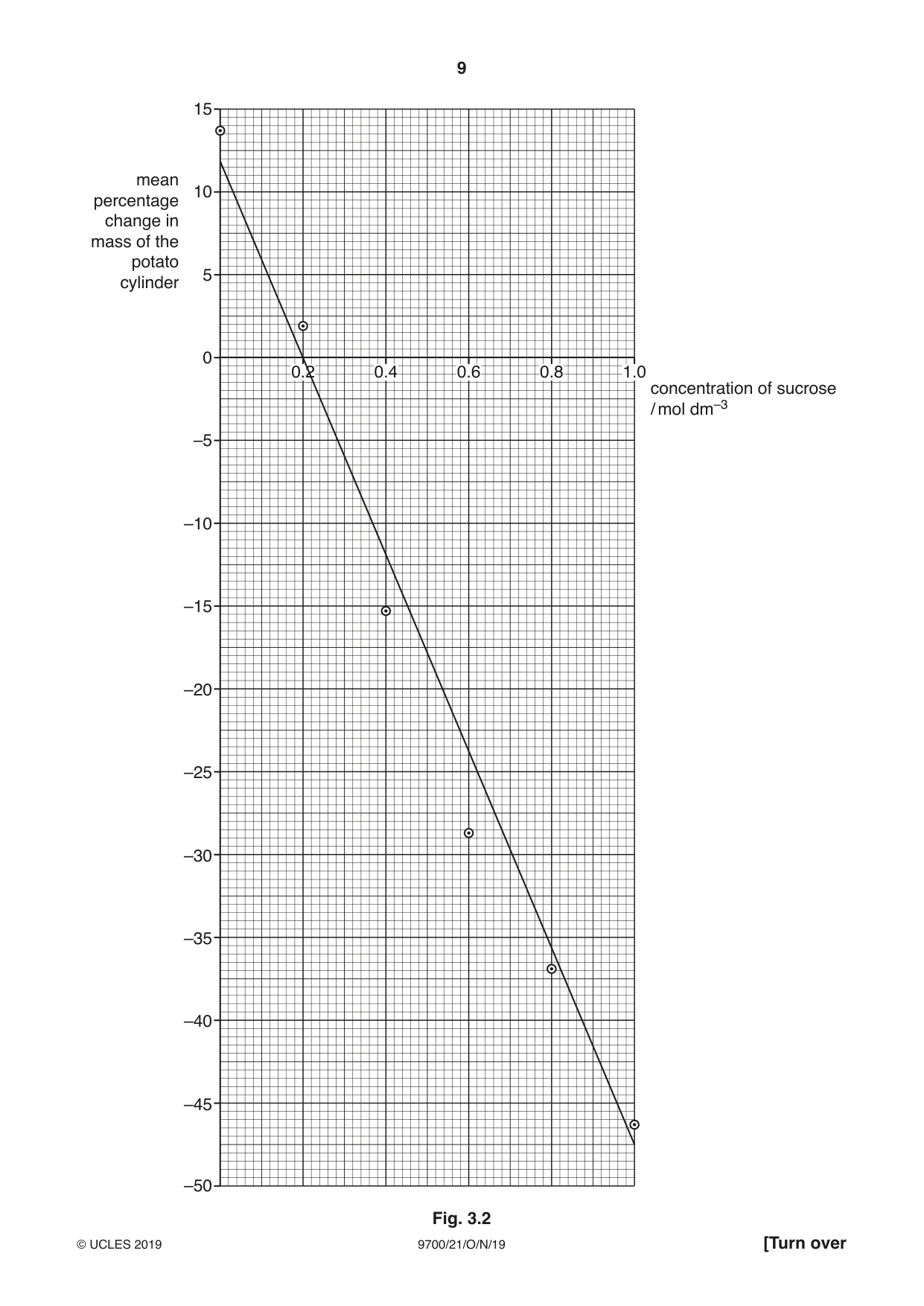
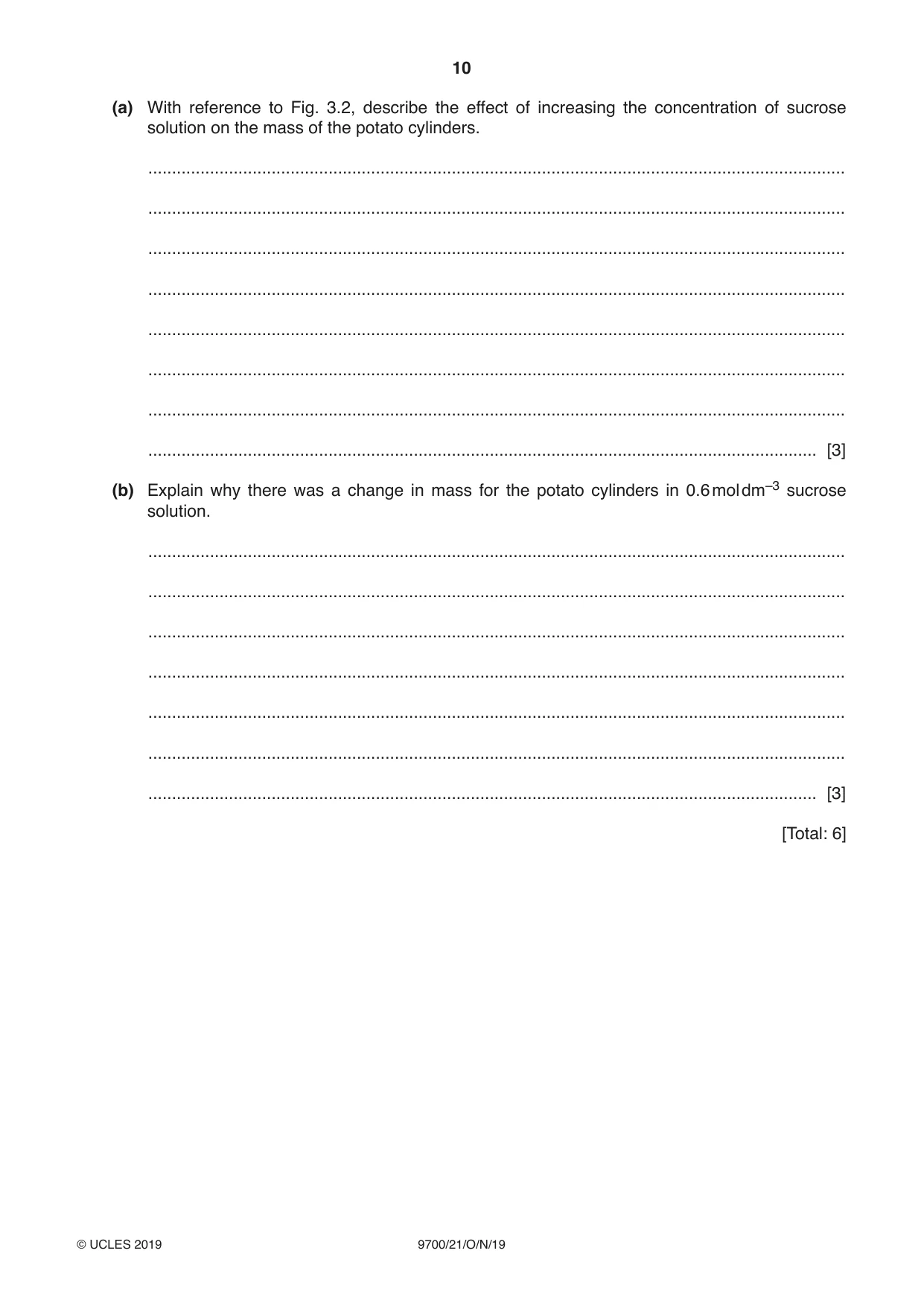
3 A student carried out an experiment to investigate the effect of increasing the concentration of sucrose solution on the mass of potato tissue. • Potato tissue was cut into cylinders of equal length and diameter. • The mass of each cylinder was recorded. • Each cylinder was put into a solution of sucrose, as shown in Fig. 3.1. bung test-tube sucrose solution potato cylinder Fig. 3.1 • After one hour each cylinder was removed, blotted dry and reweighed. • The percentage change in mass of each cylinder was calculated. • The experiment was repeated three times. • The mean percentage change in mass of the potato cylinders in each sucrose solution was calculated. Fig. 3.2 shows the results of this investigation. (a) With reference to Fig. 3.2, describe the effect of increasing the concentration of sucrose solution on the mass of the potato cylinders. ................................................................................................................................................... ................................................................................................................................................... ................................................................................................................................................... ................................................................................................................................................... ................................................................................................................................................... ................................................................................................................................................... ................................................................................................................................................... ............................................................................................................................................. [3] (b) Explain why there was a change in mass for the potato cylinders in 0.6 mol dm–3 sucrose solution. ................................................................................................................................................... ................................................................................................................................................... ................................................................................................................................................... ................................................................................................................................................... ................................................................................................................................................... ................................................................................................................................................... ............................................................................................................................................. [3] [Total: 6]
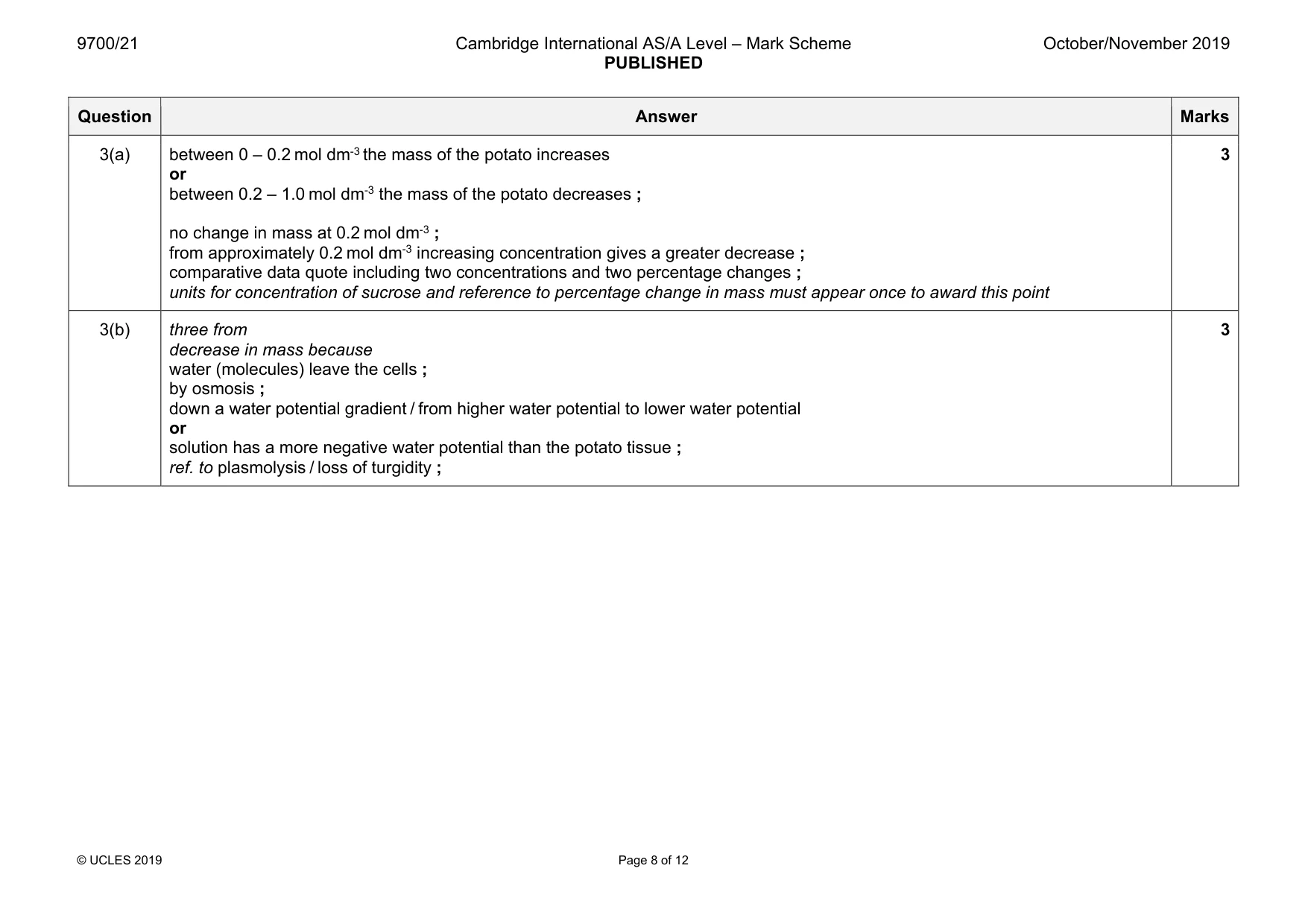
Mark scheme: 3(a) between 0 – 0.2 mol dm-3 the mass of the potato increases or between 0.2 – 1.0 mol dm-3 the mass of the potato decreases ; no change in mass at 0.2 mol dm-3 ; from approximately 0.2 mol dm-3 increasing concentration gives a greater decrease ; comparative data quote including two concentrations and two percentage changes ; units for concentration of sucrose and reference to percentage change in mass must appear once to award this point 3 3(b) three from decrease in mass because water (molecules) leave the cells ; by osmosis ; down a water potential gradient / from higher water potential to lower water potential or solution has a more negative water potential than the potato tissue ; ref. to plasmolysis / loss of turgidity ; 3
Q4 · A photomicrograph of a human blood smear
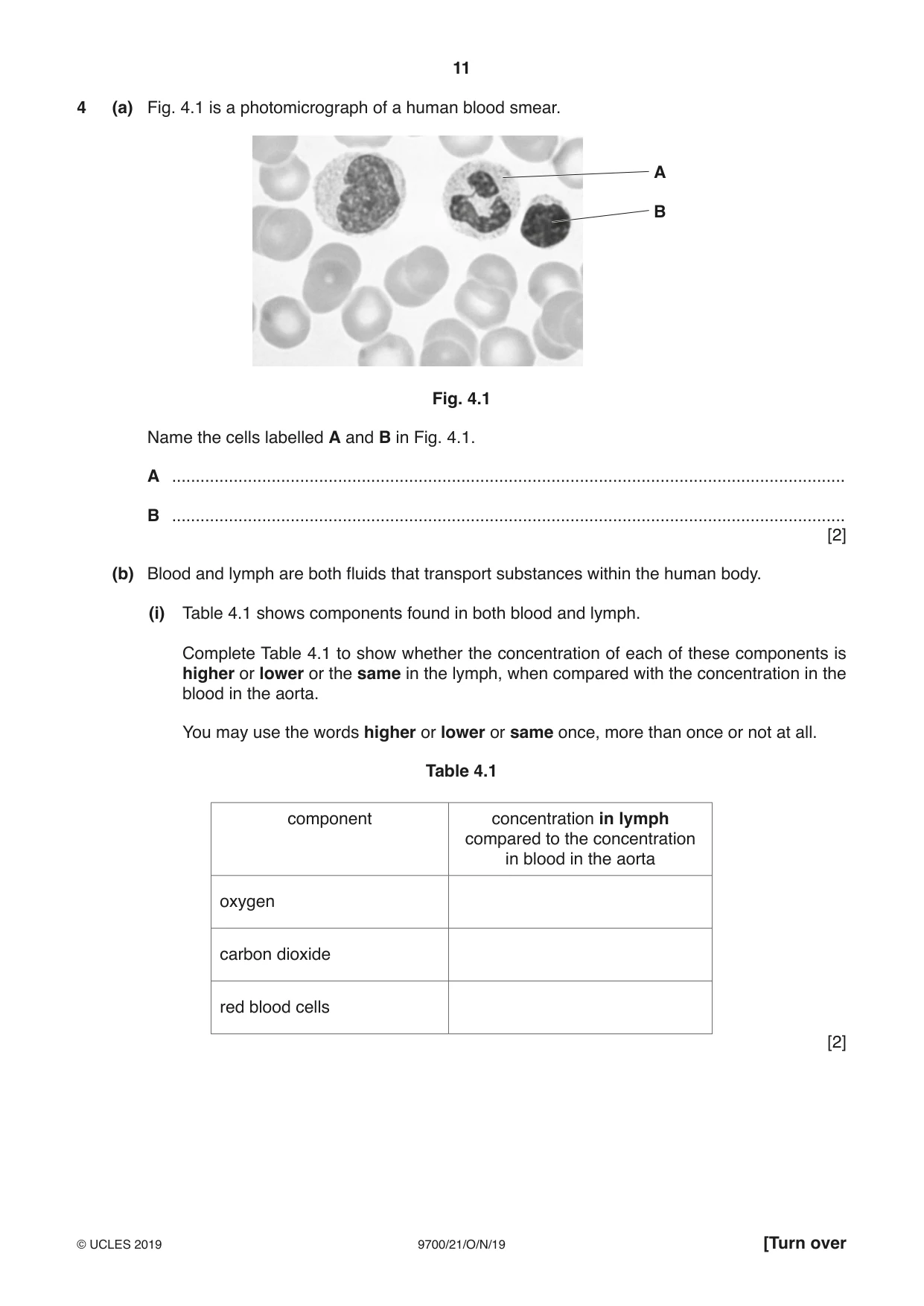
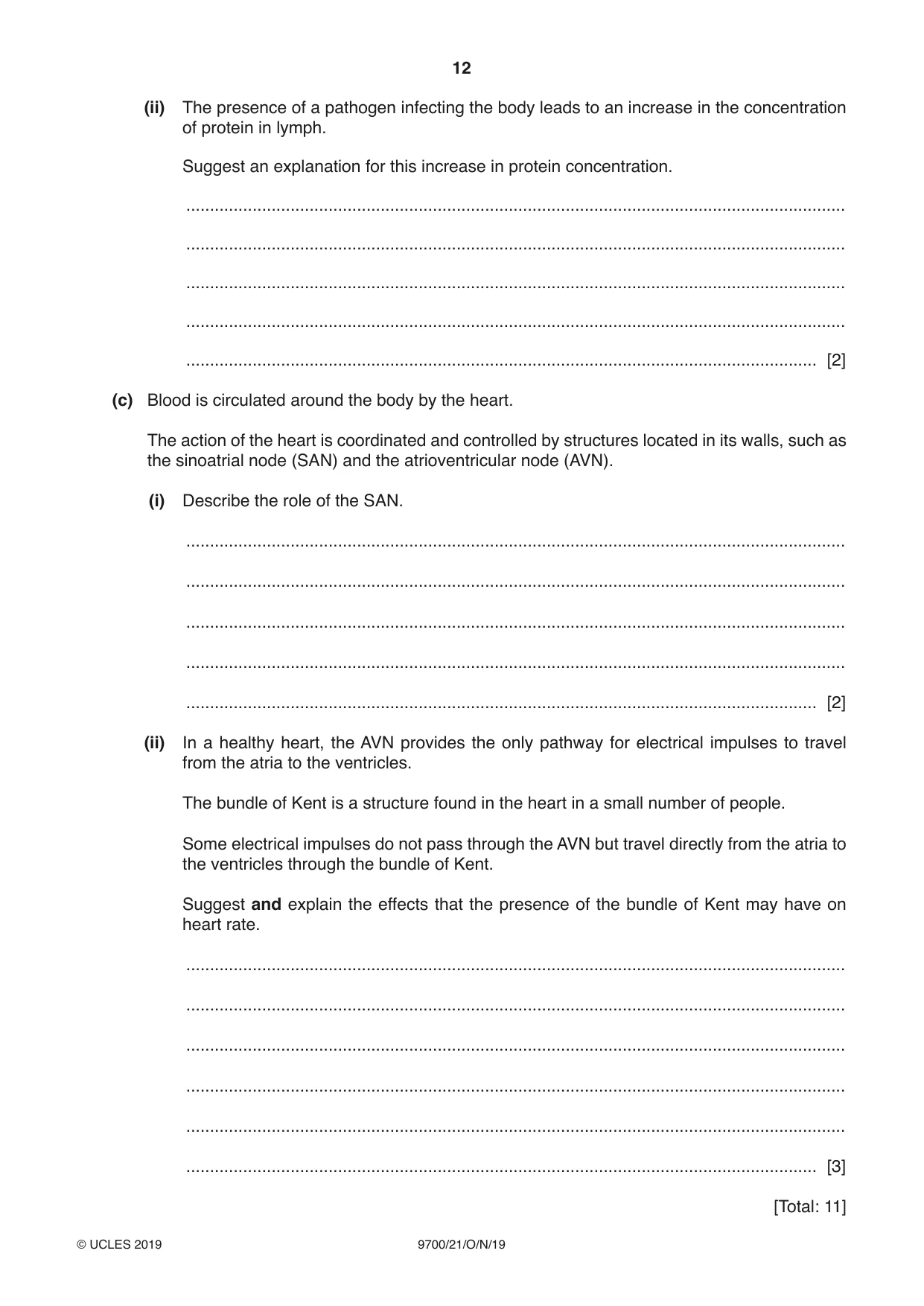
4 (a) Fig. 4.1 is a photomicrograph of a human blood smear. A B Fig. 4.1 Name the cells labelled A and B in Fig. 4.1. A .............................................................................................................................................. B .............................................................................................................................................. [2] (b) Blood and lymph are both fluids that transport substances within the human body. (i) Table 4.1 shows components found in both blood and lymph. Complete Table 4.1 to show whether the concentration of each of these components is higher or lower or the same in the lymph, when compared with the concentration in the blood in the aorta. You may use the words higher or lower or same once, more than once or not at all. Table 4.1 component concentration in lymph compared to the concentration in blood in the aorta oxygen carbon dioxide red blood cells [2] (ii) The presence of a pathogen infecting the body leads to an increase in the concentration of protein in lymph. Suggest an explanation for this increase in protein concentration. ........................................................................................................................................... ........................................................................................................................................... ........................................................................................................................................... ........................................................................................................................................... ..................................................................................................................................... [2] (c) Blood is circulated around the body by the heart. The action of the heart is coordinated and controlled by structures located in its walls, such as the sinoatrial node (SAN) and the atrioventricular node (AVN). (i) Describe the role of the SAN. ........................................................................................................................................... ........................................................................................................................................... ........................................................................................................................................... ........................................................................................................................................... ..................................................................................................................................... [2] (ii) In a healthy heart, the AVN provides the only pathway for electrical impulses to travel from the atria to the ventricles. The bundle of Kent is a structure found in the heart in a small number of people. Some electrical impulses do not pass through the AVN but travel directly from the atria to the ventricles through the bundle of Kent. Suggest and explain the effects that the presence of the bundle of Kent may have on heart rate. ........................................................................................................................................... ........................................................................................................................................... ........................................................................................................................................... ........................................................................................................................................... ........................................................................................................................................... ..................................................................................................................................... [3] [Total: 11]
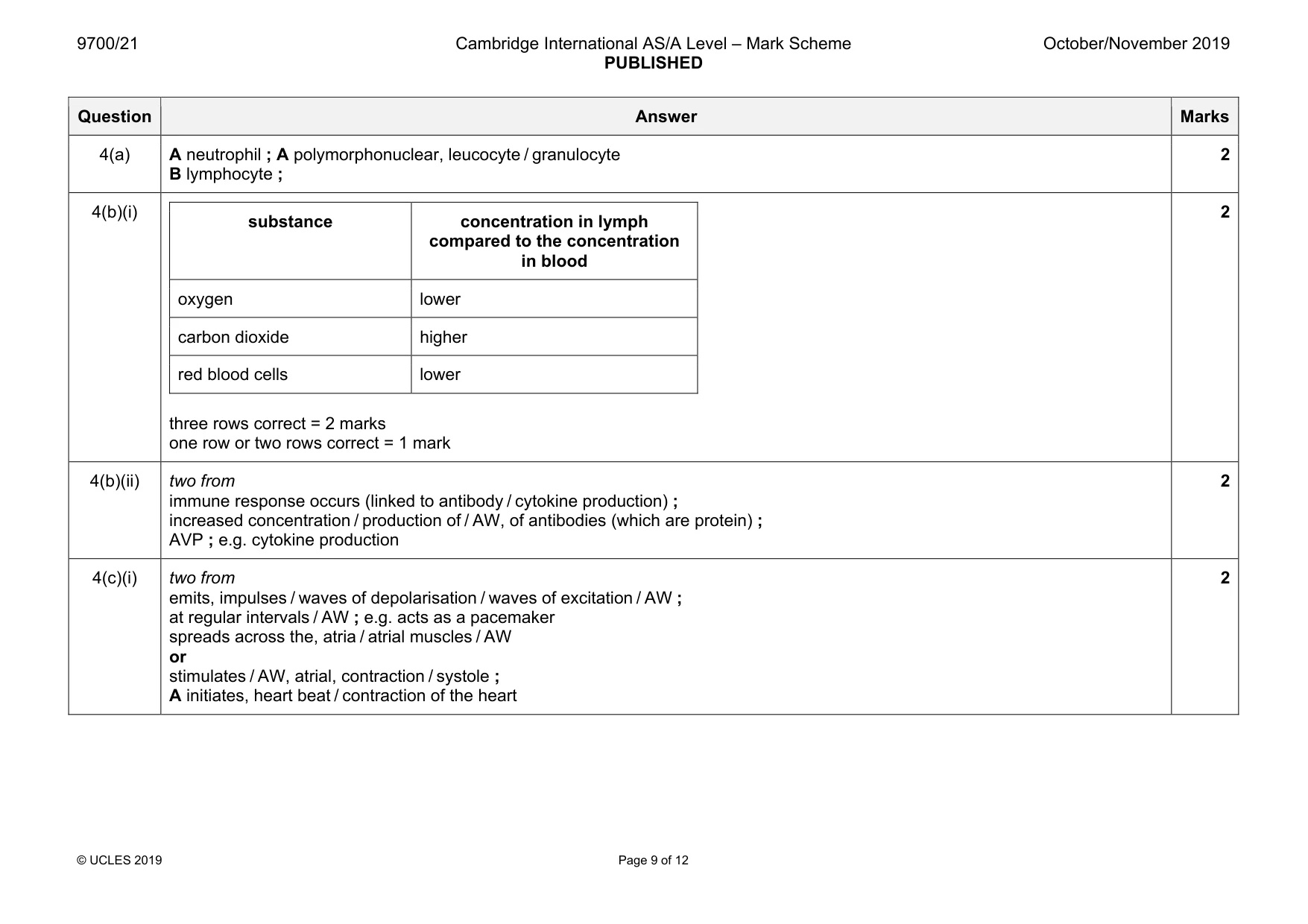
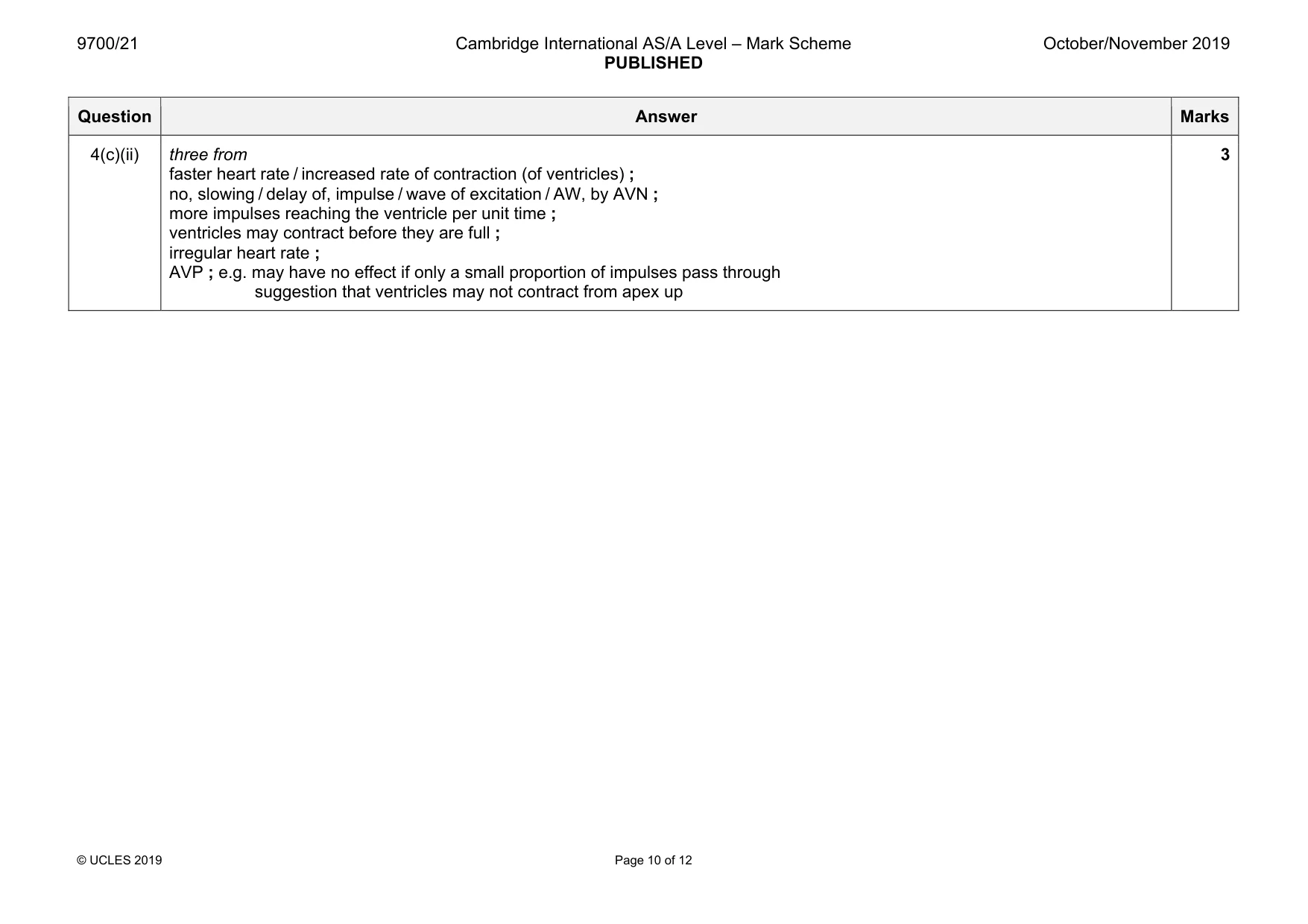
Mark scheme: 4(a) A neutrophil ; A polymorphonuclear, leucocyte / granulocyte B lymphocyte ; 2 4(b)(i) substance concentration in lymph compared to the concentration in blood oxygen lower carbon dioxide higher red blood cells lower three rows correct = 2 marks one row or two rows correct = 1 mark 2 4(b)(ii) two from immune response occurs (linked to antibody / cytokine production) ; increased concentration / production of / AW, of antibodies (which are protein) ; AVP ; e.g. cytokine production 2 4(c)(i) two from emits, impulses / waves of depolarisation / waves of excitation / AW ; at regular intervals / AW ; e.g. acts as a pacemaker spreads across the, atria / atrial muscles / AW or stimulates / AW, atrial, contraction / systole ; A initiates, heart beat / contraction of the heart 2 Question Answer Marks 4(c)(ii) three from faster heart rate / increased rate of contraction (of ventricles) ; no, slowing / delay of, impulse / wave of excitation / AW, by AVN ; more impulses reaching the ventricle per unit time ; ventricles may contract before they are full ; irregular heart rate ; AVP ; e.g. may have no effect if only a small proportion of impulses pass through suggestion that ventricles may not contract from apex up 3
Q5 · Myasthenia gravis is a condition that results in muscle weakness by affecting the immune…
5 Myasthenia gravis is a condition that results in muscle weakness by affecting the immune response. (a) Explain what is meant by the term immune response. ................................................................................................................................................... ................................................................................................................................................... ................................................................................................................................................... ................................................................................................................................................... ................................................................................................................................................... ............................................................................................................................................. [2] (b) Myasthenia gravis is an autoimmune disease which disrupts a cell signalling pathway involving muscle cells. (i) Suggest how the immune system acts to disrupt this cell signalling pathway. ........................................................................................................................................... ........................................................................................................................................... ........................................................................................................................................... ........................................................................................................................................... ........................................................................................................................................... ..................................................................................................................................... [3] Enzyme Y is found in the cell surface membrane of muscle cells. Enzyme Y acts to break down the cell signalling molecules which trigger muscle contraction when they are no longer needed. (ii) Using the induced fit hypothesis of enzyme action, explain how enzyme Y breaks down the cell signalling molecules. ........................................................................................................................................... ........................................................................................................................................... ........................................................................................................................................... ........................................................................................................................................... ........................................................................................................................................... ........................................................................................................................................... ..................................................................................................................................... [4] (c) Rituximab is a monoclonal antibody used in the treatment of myasthenia gravis. Rituximab acts against the cell surface membrane protein CD20. This protein is found on the surface of the B-lymphocytes that cause myasthenia gravis. Explain the advantages of using monoclonal antibodies in the treatment of diseases such as myasthenia gravis. ................................................................................................................................................... ................................................................................................................................................... ................................................................................................................................................... ................................................................................................................................................... ................................................................................................................................................... ................................................................................................................................................... ............................................................................................................................................. [3] [Total: 12]
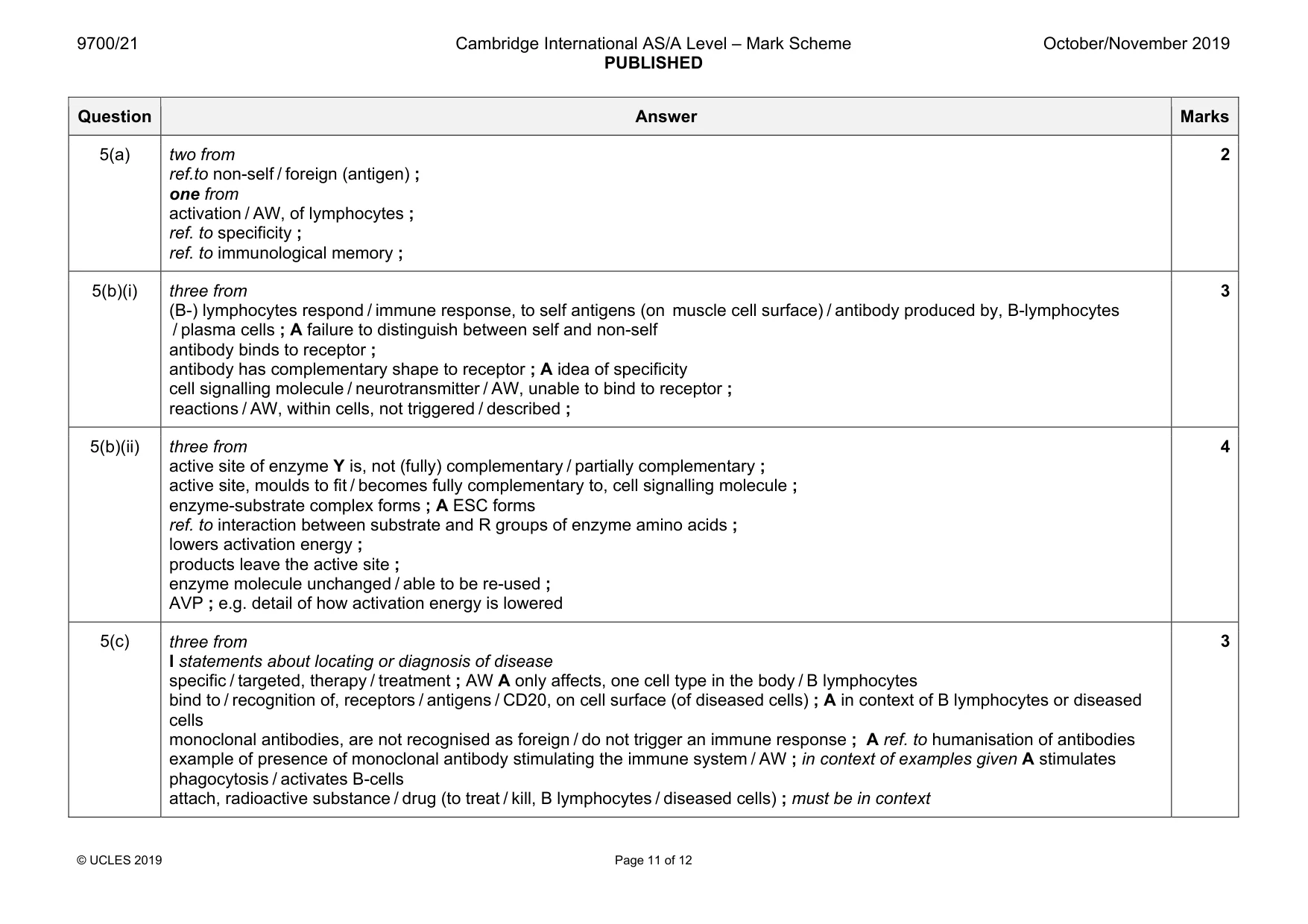
Mark scheme: 5(a) two from ref.to non-self / foreign (antigen) ; one from activation / AW, of lymphocytes ; ref. to specificity ; ref. to immunological memory ; 2 5(b)(i) three from (B-) lymphocytes respond / immune response, to self antigens (on muscle cell surface) / antibody produced by, B-lymphocytes / plasma cells ; A failure to distinguish between self and non-self antibody binds to receptor ; antibody has complementary shape to receptor ; A idea of specificity cell signalling molecule / neurotransmitter / AW, unable to bind to receptor ; reactions / AW, within cells, not triggered / described ; 3 5(b)(ii) three from active site of enzyme Y is, not (fully) complementary / partially complementary ; active site, moulds to fit / becomes fully complementary to, cell signalling molecule ; enzyme-substrate complex forms ; A ESC forms ref. to interaction between substrate and R groups of enzyme amino acids ; lowers activation energy ; products leave the active site ; enzyme molecule unchanged / able to be re-used ; AVP ; e.g. detail of how activation energy is lowered 4 5(c) three from I statements about locating or diagnosis of disease specific / targeted, therapy / treatment ; AW A only affects, one cell type in the body / B lymphocytes bind to / recognition of, receptors / antigens / CD20, on cell surface (of diseased cells) ; A in context of B lymphocytes or diseased cells monoclonal antibodies, are not recognised as foreign / do not trigger an immune response ; A ref. to humanisation of antibodies example of presence of monoclonal antibody stimulating the immune system / AW ; in context of examples given A stimulates phagocytosis / activates B-cells attach, radioactive substance / drug (to treat / kill, B lymphocytes / diseased cells) ; must be in context 3
Q6 · Outline the role of DNA polymerase in the replication of DNA
6 (a) Outline the role of DNA polymerase in the replication of DNA. ................................................................................................................................................... ................................................................................................................................................... ................................................................................................................................................... ................................................................................................................................................... ................................................................................................................................................... ............................................................................................................................................. [3] (b) Floxuridine is a drug used to treat cancer. (i) Floxuridine inhibits DNA replication. Suggest why the inhibition of DNA replication is an effective treatment for cancer. ........................................................................................................................................... ........................................................................................................................................... ..................................................................................................................................... [1] (ii) Floxuridine prevents thymine nucleotides being produced. Explain why floxuridine does not affect transcription. ........................................................................................................................................... ........................................................................................................................................... ..................................................................................................................................... [1] (c) Fig. 6.1 is a scanning electron micrograph of a lung cancer cell in a stage of the cell cycle. Fig. 6.1 (i) Name the stage of the cell cycle occurring in Fig. 6.1. ..................................................................................................................................... [1] (ii) Explain why smoking tobacco increases the risk of developing lung cancer. ........................................................................................................................................... ........................................................................................................................................... ........................................................................................................................................... ........................................................................................................................................... ........................................................................................................................................... ..................................................................................................................................... [3] [Total: 9]
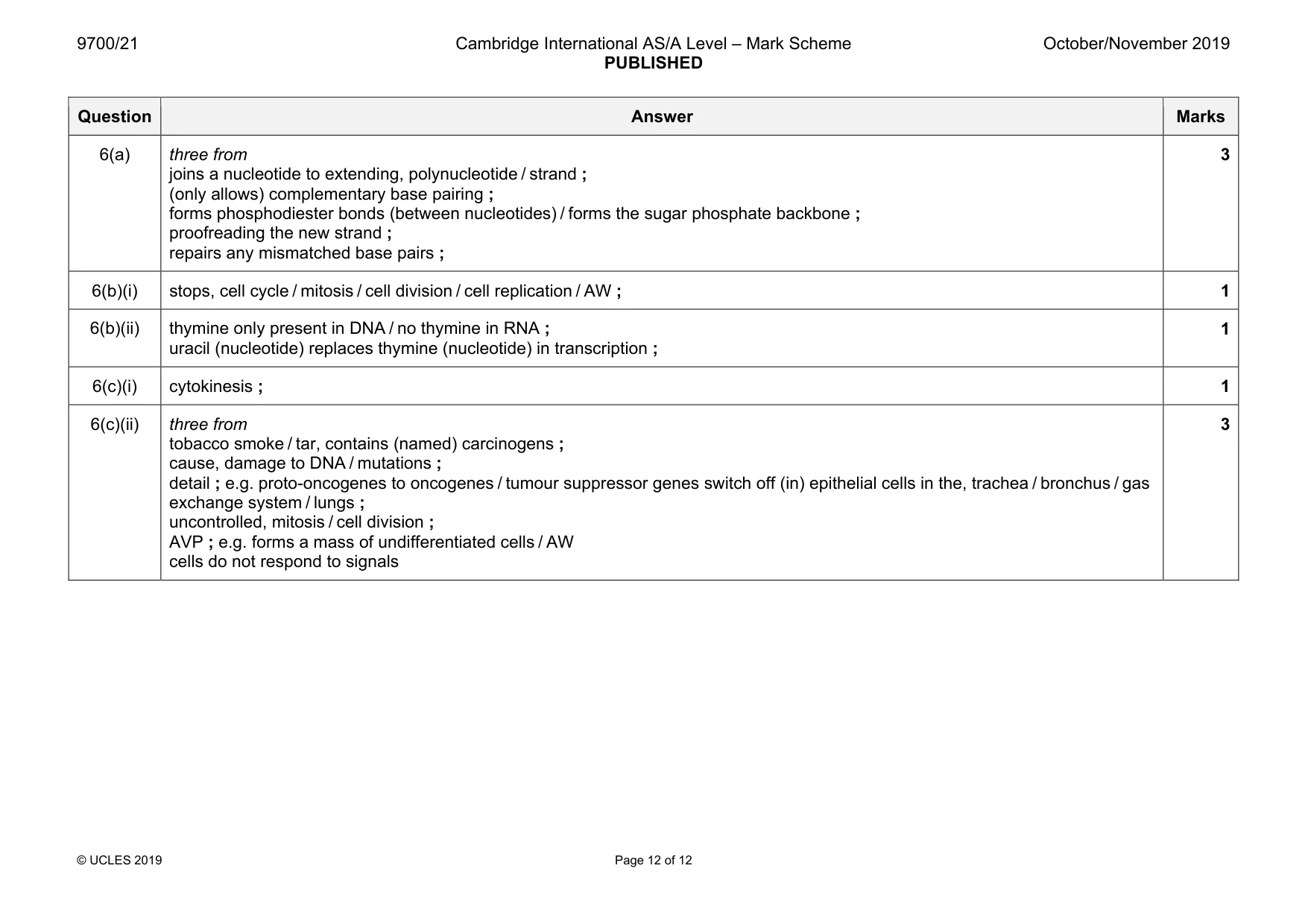
Mark scheme: 6(a) three from joins a nucleotide to extending, polynucleotide / strand ; (only allows) complementary base pairing ; forms phosphodiester bonds (between nucleotides) / forms the sugar phosphate backbone ; proofreading the new strand ; repairs any mismatched base pairs ; 3 6(b)(i) stops, cell cycle / mitosis / cell division / cell replication / AW ; 1 6(b)(ii) thymine only present in DNA / no thymine in RNA ; uracil (nucleotide) replaces thymine (nucleotide) in transcription ; 1 6(c)(i) cytokinesis ; 1 6(c)(ii) three from tobacco smoke / tar, contains (named) carcinogens ; cause, damage to DNA / mutations ; detail ; e.g. proto-oncogenes to oncogenes / tumour suppressor genes switch off (in) epithelial cells in the, trachea / bronchus / gas exchange system / lungs ; uncontrolled, mitosis / cell division ; AVP ; e.g. forms a mass of undifferentiated cells / AW cells do not respond to signals 3
What was in this paper
The subtopics covered by these 6 questions, and how many questions each got. Open one in a new tab to see every Cambridge question on it.
What you needed in this session
Cambridge’s own grade thresholds for 2019 Oct/Nov, Paper 2 · Variant 1. A higher threshold means an easier paper — the bar moves with how the cohort did.