Cambridge A Level Biology 9700 — 2017 May/June Paper 2 · Variant 3
9700/23/M/J/17 · 6 questions · 60 marks · ≈68 min
The question paper and its mark scheme, free to read here and free to download. This is Cambridge’s own paper, exactly as it was sat.
Question paper12 pages
Mark scheme12 pages
Answers below. Sit the paper first if you are practising.
Questions as text
Q1 · Mammals have a closed double circulation system
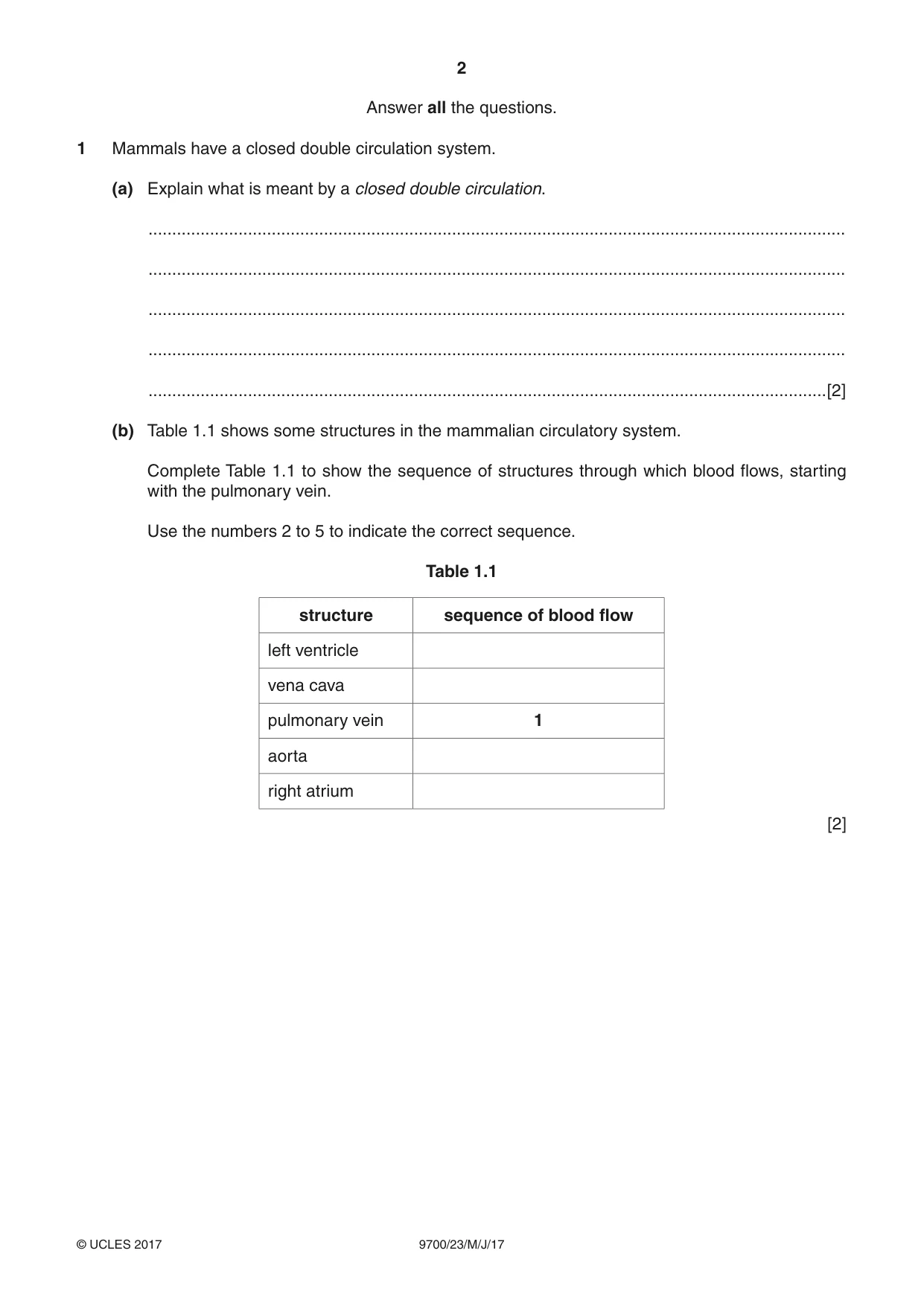
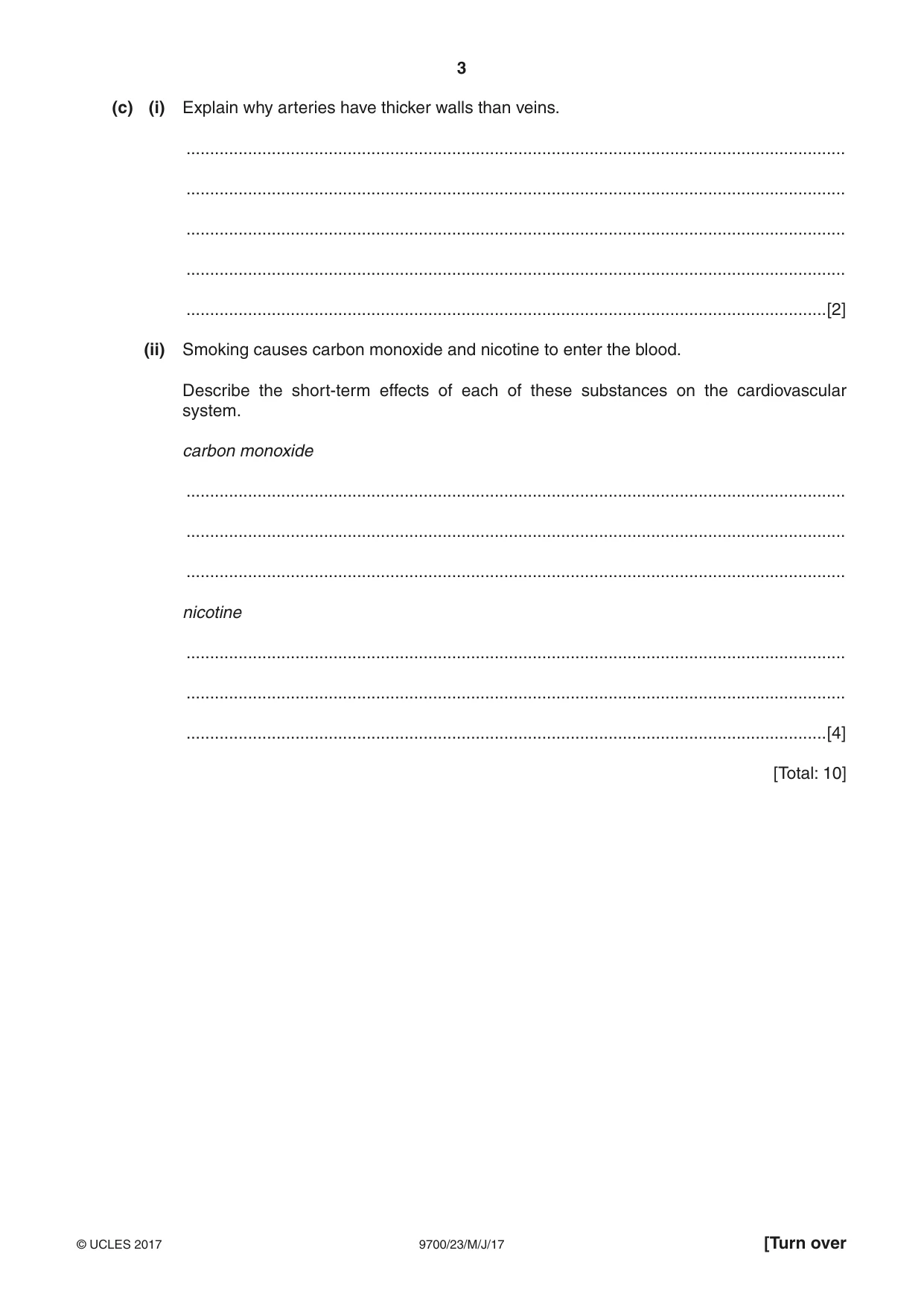
1 Mammals have a closed double circulation system. (a) Explain what is meant by a closed double circulation. ................................................................................................................................................... ................................................................................................................................................... ................................................................................................................................................... ................................................................................................................................................... ...............................................................................................................................................[2] (b) Table 1.1 shows some structures in the mammalian circulatory system. Complete Table 1.1 to show the sequence of structures through which blood flows, starting with the pulmonary vein. Use the numbers 2 to 5 to indicate the correct sequence. Table 1.1 structure sequence of blood flow left ventricle vena cava pulmonary vein 1 aorta right atrium [2] (c) (i) Explain why arteries have thicker walls than veins. ........................................................................................................................................... ........................................................................................................................................... ........................................................................................................................................... ........................................................................................................................................... .......................................................................................................................................[2] (ii) Smoking causes carbon monoxide and nicotine to enter the blood. Describe the short-term effects of each of these substances on the cardiovascular system. carbon monoxide ........................................................................................................................................... ........................................................................................................................................... ........................................................................................................................................... nicotine ........................................................................................................................................... ........................................................................................................................................... .......................................................................................................................................[4] [Total: 10]
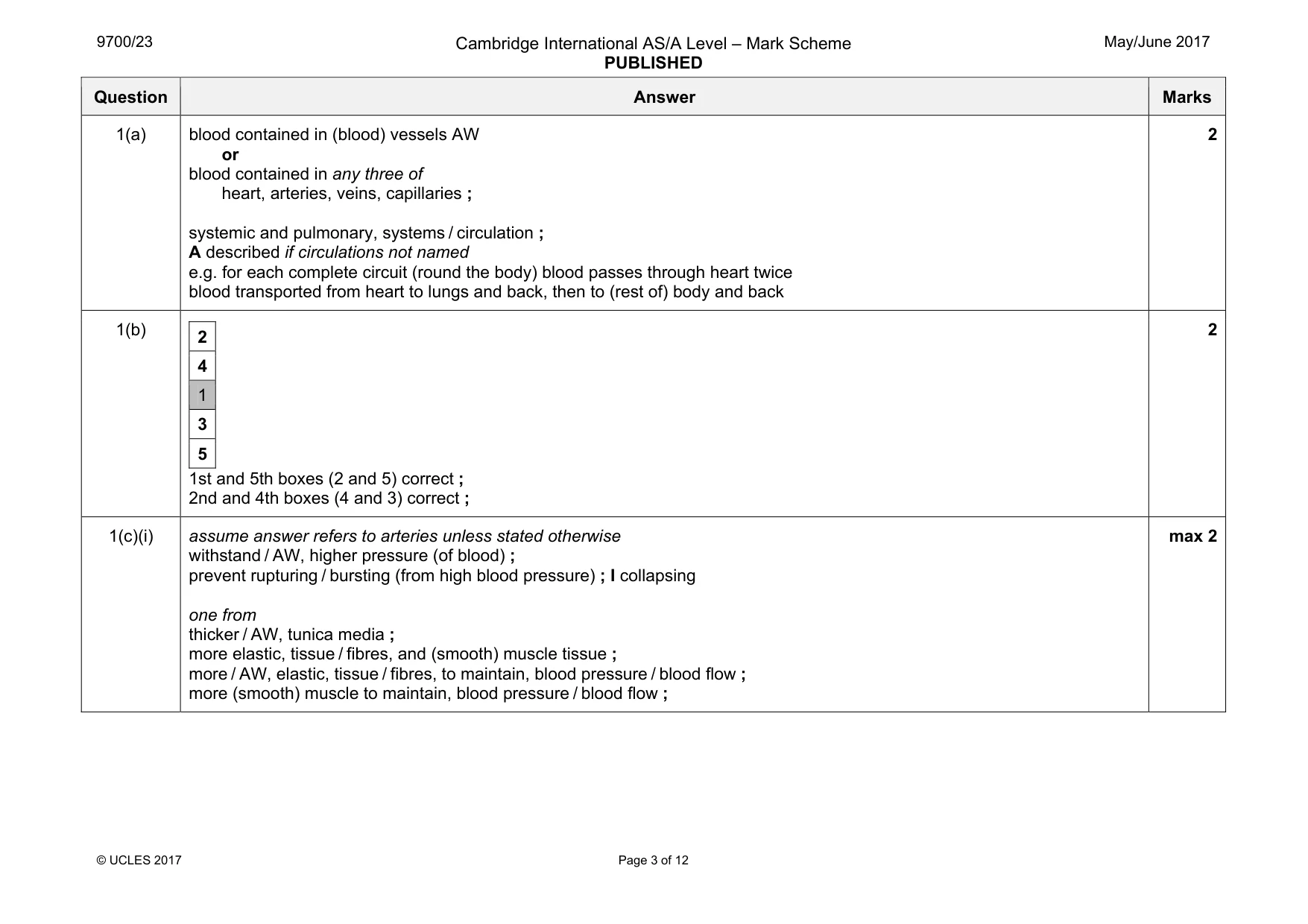
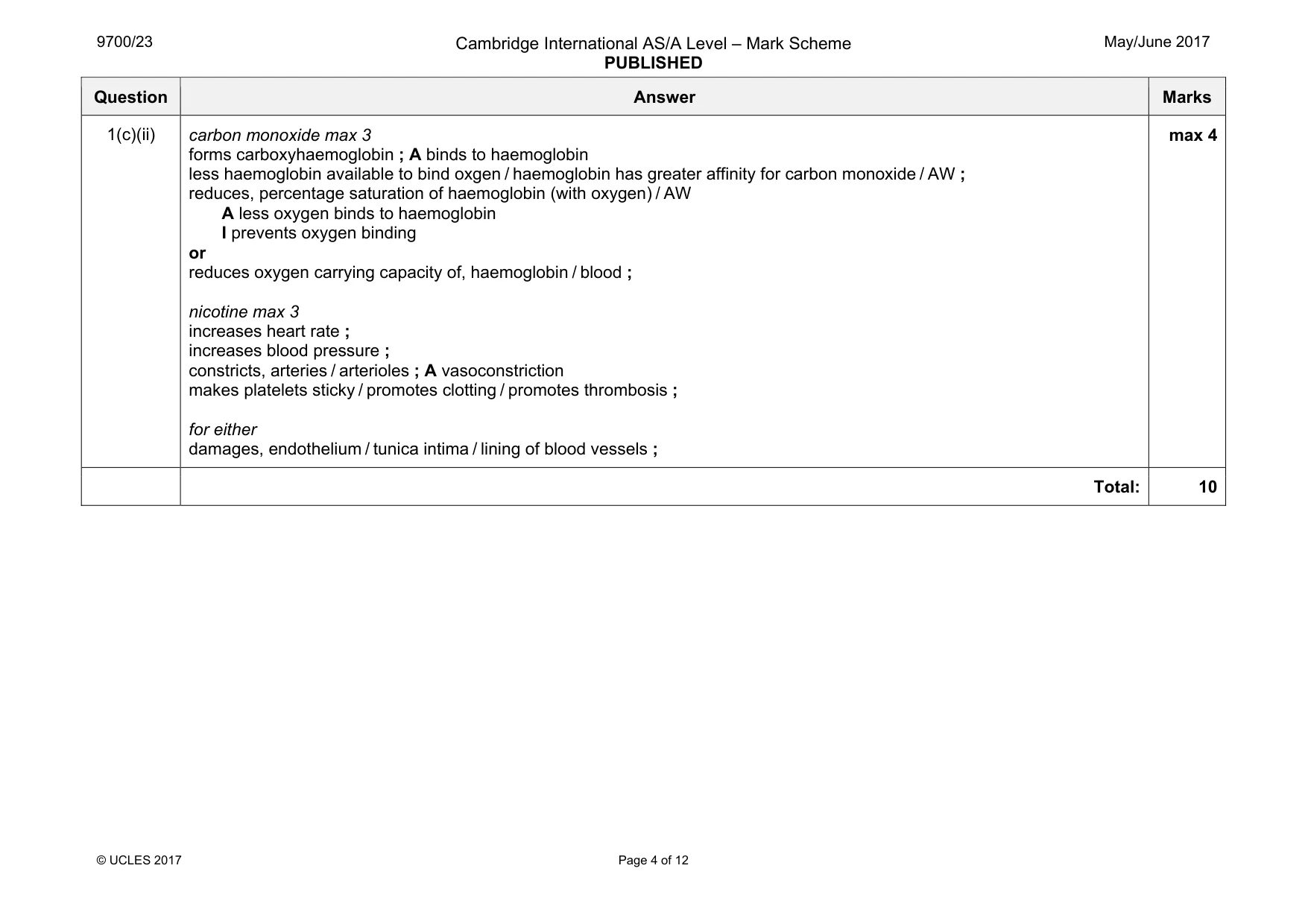
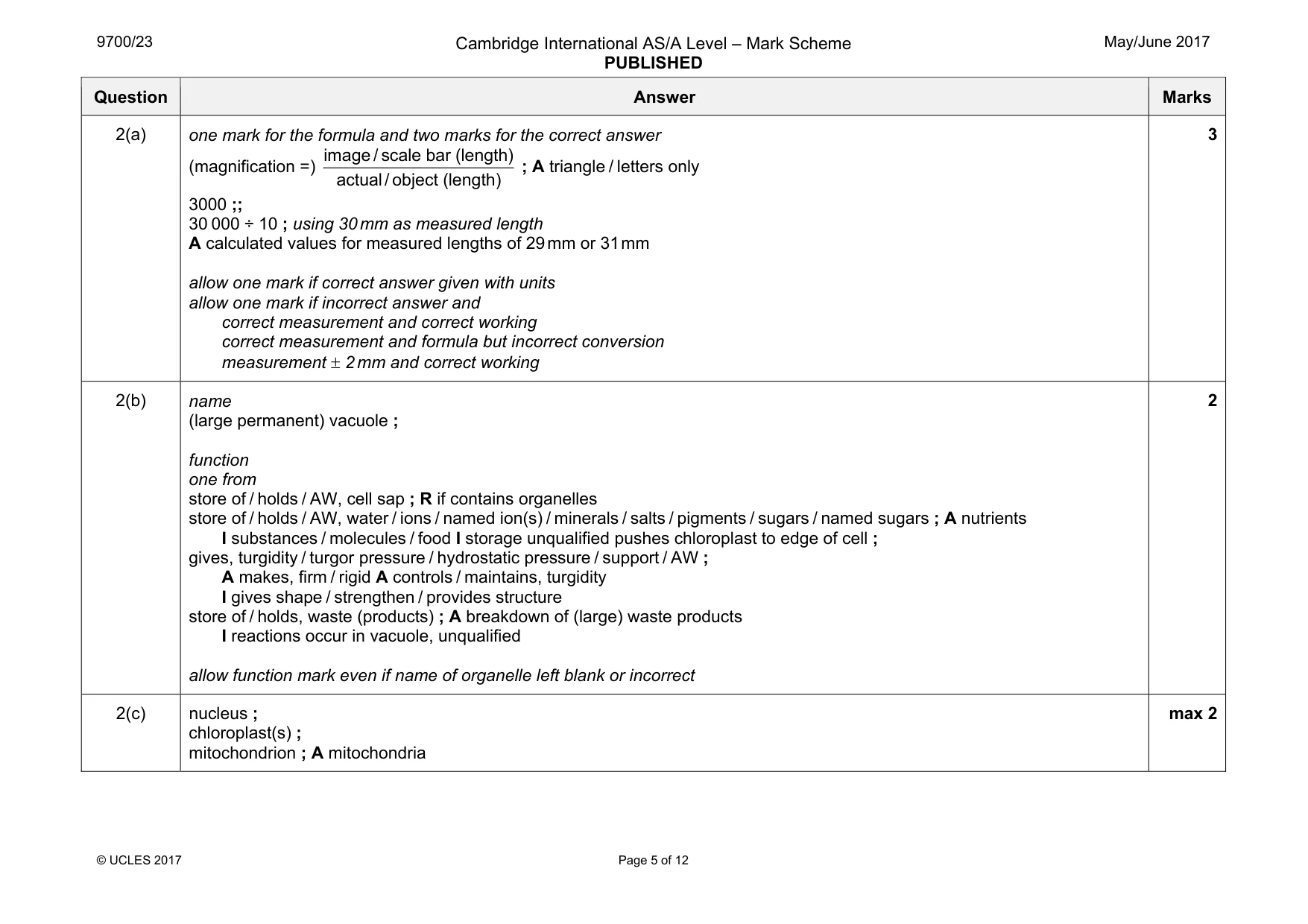
Mark scheme: 1(a) blood contained in (blood) vessels AW or blood contained in any three of heart, arteries, veins, capillaries ; systemic and pulmonary, systems / circulation ; A described if circulations not named e.g. for each complete circuit (round the body) blood passes through heart twice blood transported from heart to lungs and back, then to (rest of) body and back 2 1(b) 2 4 1 3 5 1st and 5th boxes (2 and 5) correct ; 2nd and 4th boxes (4 and 3) correct ; 2 1(c)(i) assume answer refers to arteries unless stated otherwise withstand / AW, higher pressure (of blood) ; prevent rupturing / bursting (from high blood pressure) ; I collapsing one from thicker / AW, tunica media ; more elastic, tissue / fibres, and (smooth) muscle tissue ; more / AW, elastic, tissue / fibres, to maintain, blood pressure / blood flow ; more (smooth) muscle to maintain, blood pressure / blood flow ; max 2 Question Answer Marks 1(c)(ii) carbon monoxide max 3 forms carboxyhaemoglobin ; A binds to haemoglobin less haemoglobin available to bind oxgen / haemoglobin has greater affinity for carbon monoxide / AW ; reduces, percentage saturation of haemoglobin (with oxygen) / AW A less oxygen binds to haemoglobin I prevents oxygen binding or reduces oxygen carrying capacity of, haemoglobin / blood ; nicotine max 3 increases heart rate ; increases blood pressure ; constricts, arteries / arterioles ; A vasoconstriction makes platelets sticky / promotes clotting / promotes thrombosis ; for either damages, endothelium / tunica intima / lining of blood vessels ; max 4 Total: 10
Q2 · A transmission electron micrograph of a cell from a leaf
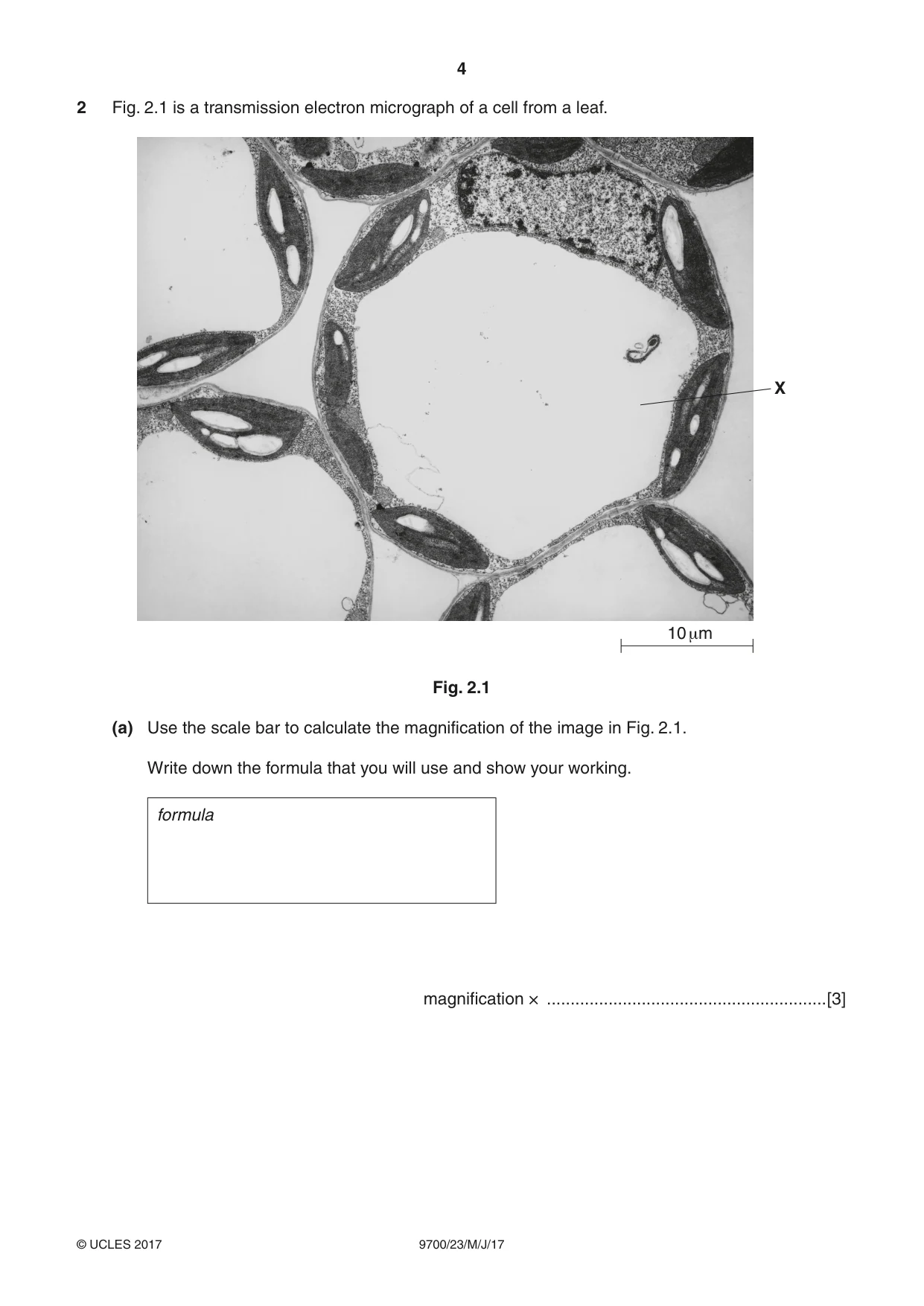
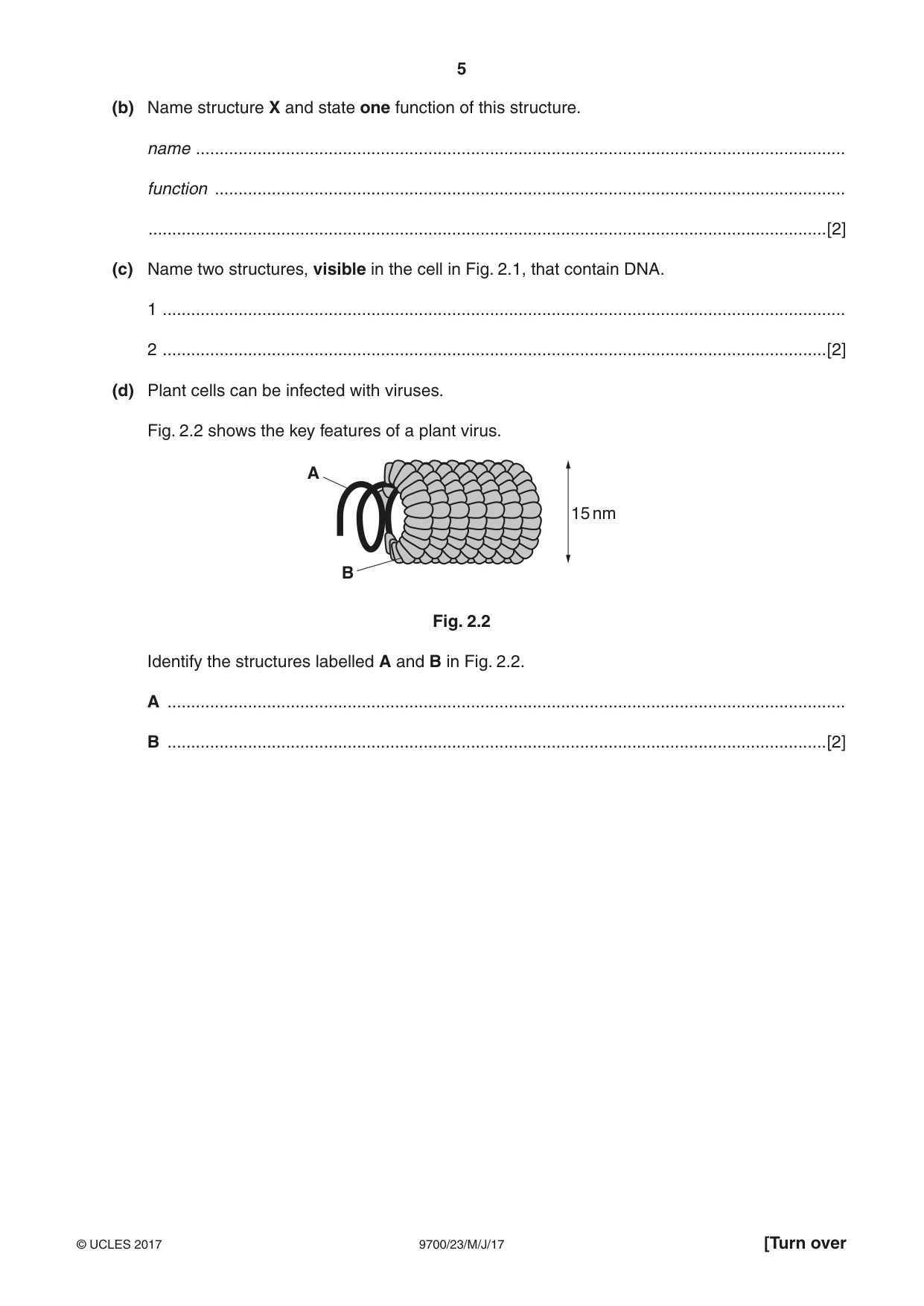
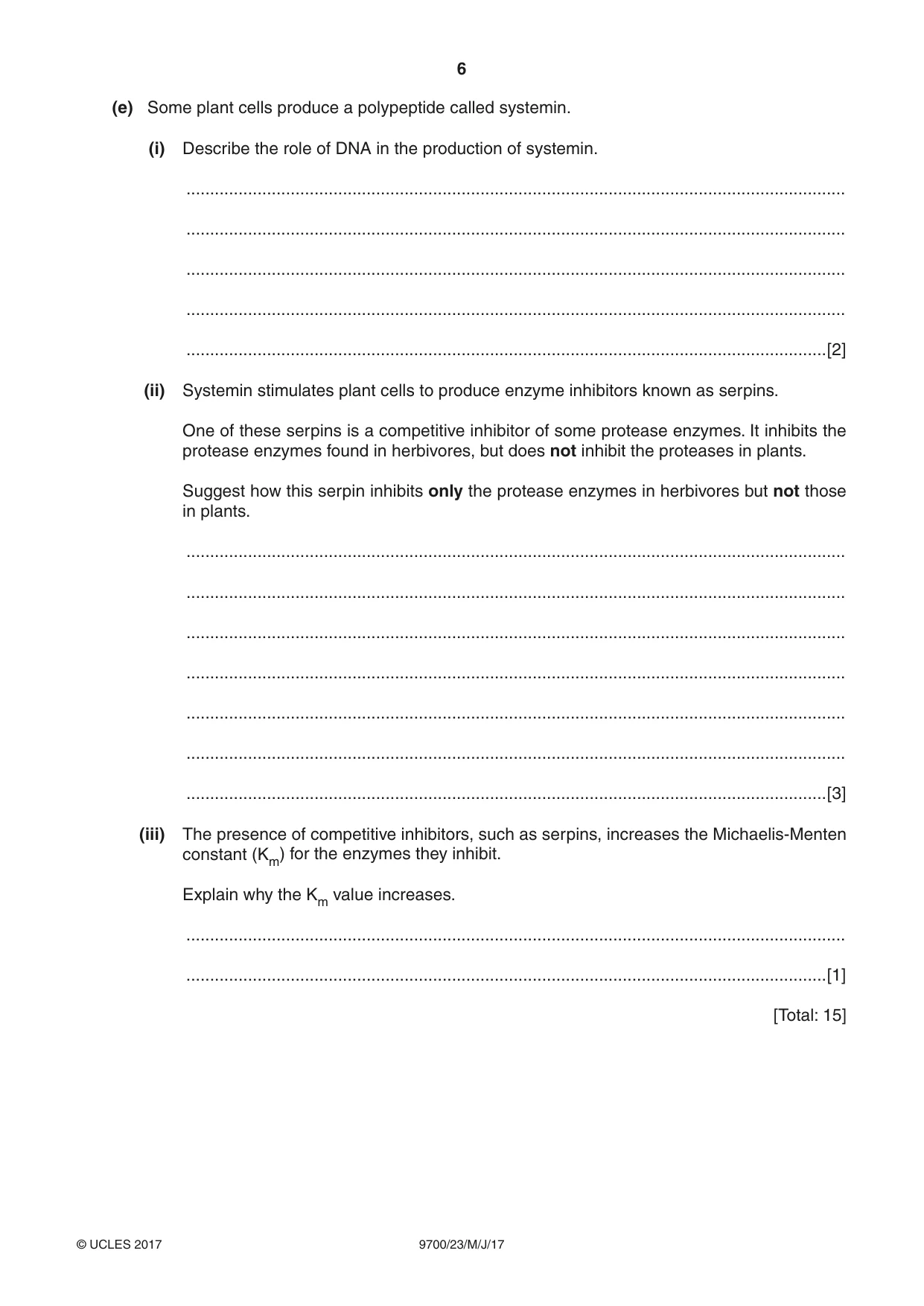
2 Fig. 2.1 is a transmission electron micrograph of a cell from a leaf. X 10 μm Fig. 2.1 (a) Use the scale bar to calculate the magnification of the image in Fig. 2.1. Write down the formula that you will use and show your working. formula magnification × ...........................................................[3] (b) Name structure X and state one function of this structure. name ......................................................................................................................................... function ..................................................................................................................................... ...............................................................................................................................................[2] (c) Name two structures, visible in the cell in Fig. 2.1, that contain DNA. 1 ................................................................................................................................................ 2 ............................................................................................................................................[2] (d) Plant cells can be infected with viruses. Fig. 2.2 shows the key features of a plant virus. A 15 nm B Fig. 2.2 Identify the structures labelled A and B in Fig. 2.2. A ............................................................................................................................................... B ...........................................................................................................................................[2] (e) Some plant cells produce a polypeptide called systemin. (i) Describe the role of DNA in the production of systemin. ........................................................................................................................................... ........................................................................................................................................... ........................................................................................................................................... ........................................................................................................................................... .......................................................................................................................................[2] (ii) Systemin stimulates plant cells to produce enzyme inhibitors known as serpins. One of these serpins is a competitive inhibitor of some protease enzymes. It inhibits the protease enzymes found in herbivores, but does not inhibit the proteases in plants. Suggest how this serpin inhibits only the protease enzymes in herbivores but not those in plants. ........................................................................................................................................... ........................................................................................................................................... ........................................................................................................................................... ........................................................................................................................................... ........................................................................................................................................... ........................................................................................................................................... .......................................................................................................................................[3] (iii) The presence of competitive inhibitors, such as serpins, increases the Michaelis-Menten constant (Km) for the enzymes they inhibit. Explain why the Km value increases. ........................................................................................................................................... .......................................................................................................................................[1] [Total: 15]
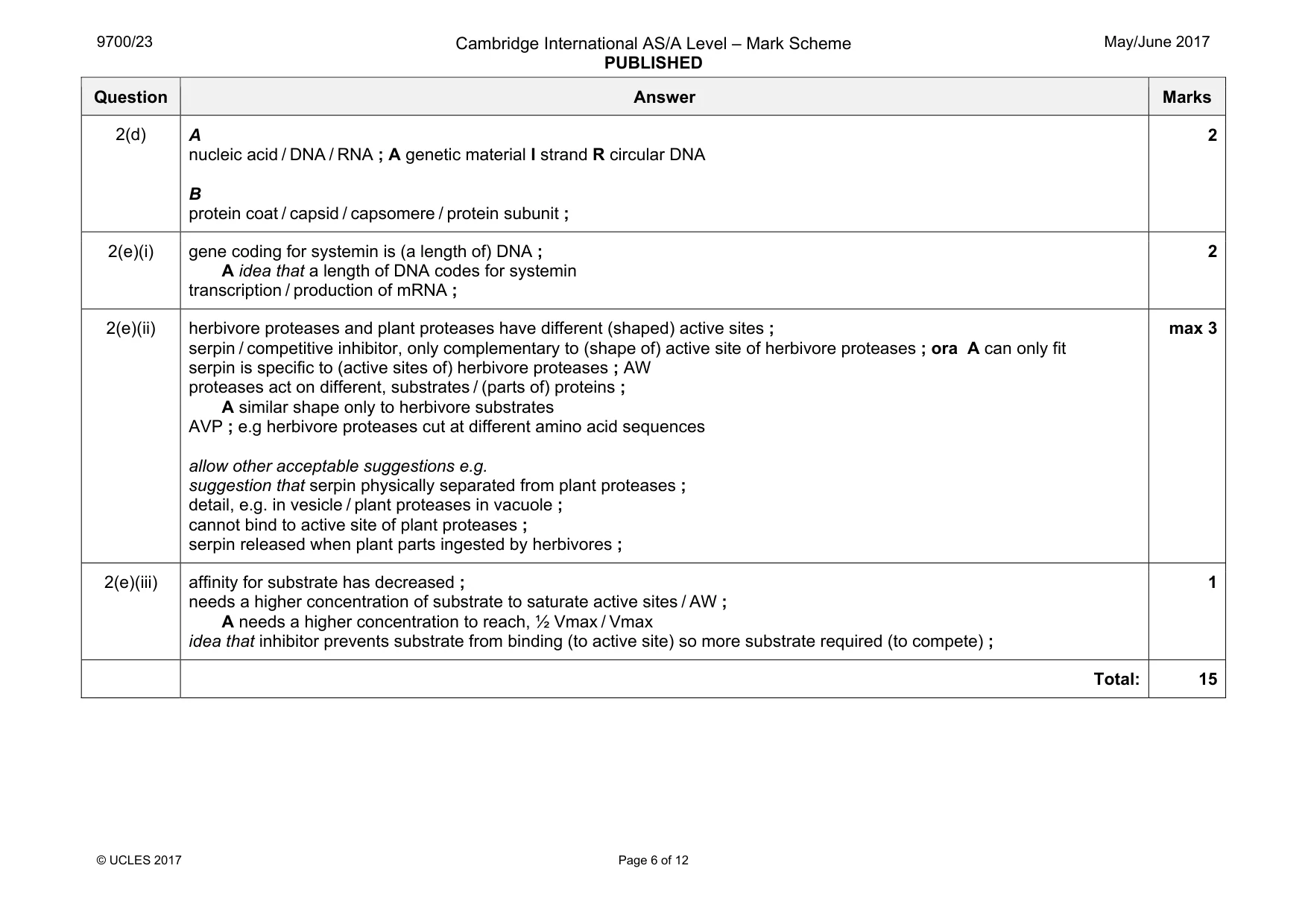
Mark scheme: 2(a) one mark for the formula and two marks for the correct answer (magnification =) image / scale bar (length) actual/ object (length) ; A triangle / letters only 3000 ;; 30 000 ÷ 10 ; using 30 mm as measured length A calculated values for measured lengths of 29 mm or 31 mm allow one mark if correct answer given with units allow one mark if incorrect answer and correct measurement and correct working correct measurement and formula but incorrect conversion measurement ± 2 mm and correct working 3 2(b) name (large permanent) vacuole ; function one from store of / holds / AW, cell sap ; R if contains organelles store of / holds / AW, water / ions / named ion(s) / minerals / salts / pigments / sugars / named sugars ; A nutrients I substances / molecules / food I storage unqualified pushes chloroplast to edge of cell ; gives, turgidity / turgor pressure / hydrostatic pressure / support / AW ; A makes, firm / rigid A controls / maintains, turgidity I gives shape / strengthen / provides structure store of / holds, waste (products) ; A breakdown of (large) waste products I reactions occur in vacuole, unqualified allow function mark even if name of organelle left blank or incorrect 2 2(c) nucleus ; chloroplast(s) ; mitochondrion ; A mitochondria max 2 Question Answer Marks 2(d) A nucleic acid / DNA / RNA ; A genetic material I strand R circular DNA B protein coat / capsid / capsomere / protein subunit ; 2 2(e)(i) gene coding for systemin is (a length of) DNA ; A idea that a length of DNA codes for systemin transcription / production of mRNA ; 2 2(e)(ii) herbivore proteases and plant proteases have different (shaped) active sites ; serpin / competitive inhibitor, only complementary to (shape of) active site of herbivore proteases ; ora A can only fit serpin is specific to (active sites of) herbivore proteases ; AW proteases act on different, substrates / (parts of) proteins ; A similar shape only to herbivore substrates AVP ; e.g herbivore proteases cut at different amino acid sequences allow other acceptable suggestions e.g. suggestion that serpin physically separated from plant proteases ; detail, e.g. in vesicle / plant proteases in vacuole ; cannot bind to active site of plant proteases ; serpin released when plant parts ingested by herbivores ; max 3 2(e)(iii) affinity for substrate has decreased ; needs a higher concentration of substrate to saturate active sites / AW ; A needs a higher concentration to reach, ½ Vmax / Vmax idea that inhibitor prevents substrate from binding (to active site) so more substrate required (to compete) ; 1 Total: 15
Q3 · Name the causative organism of tuberculosis (TB)
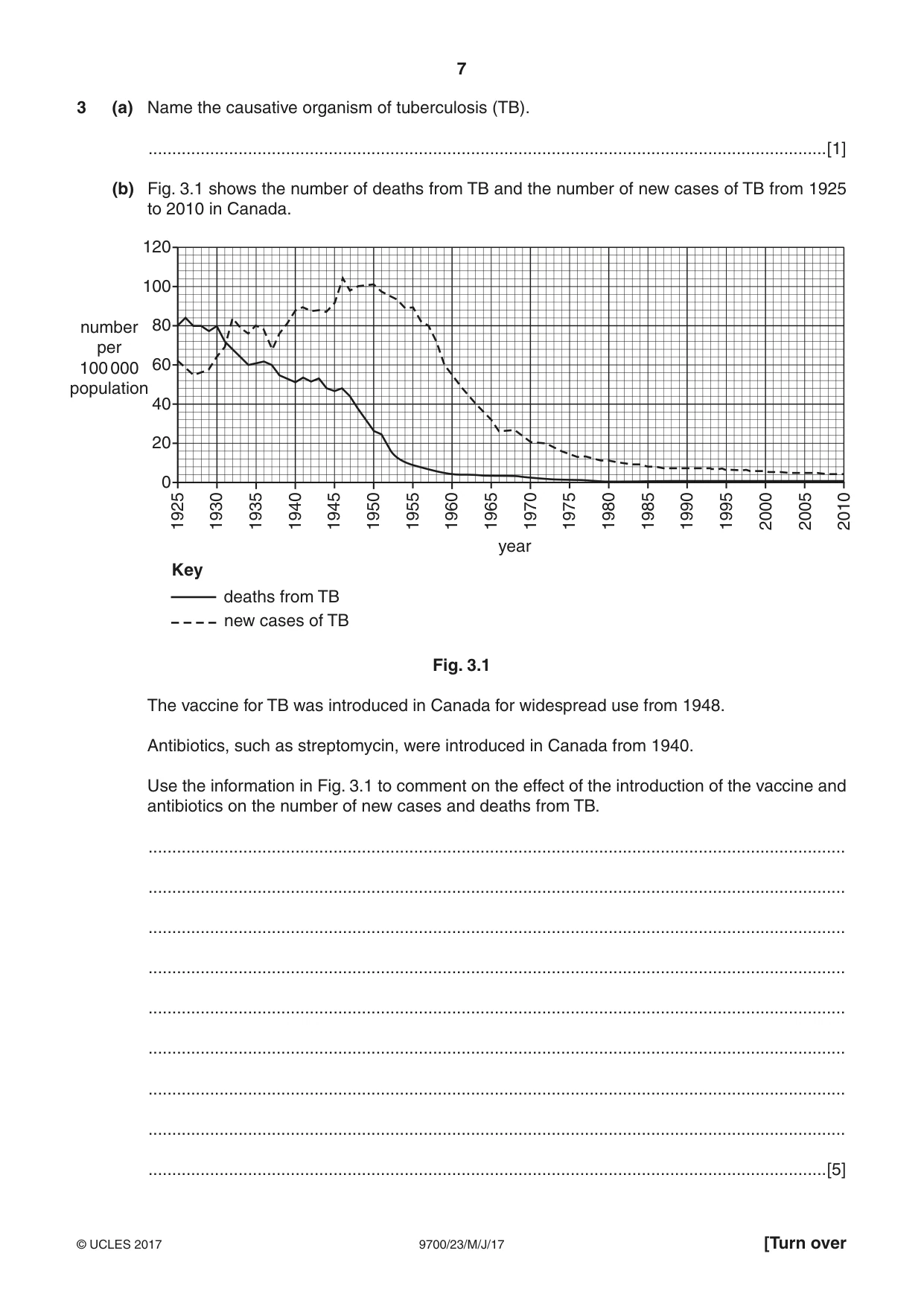
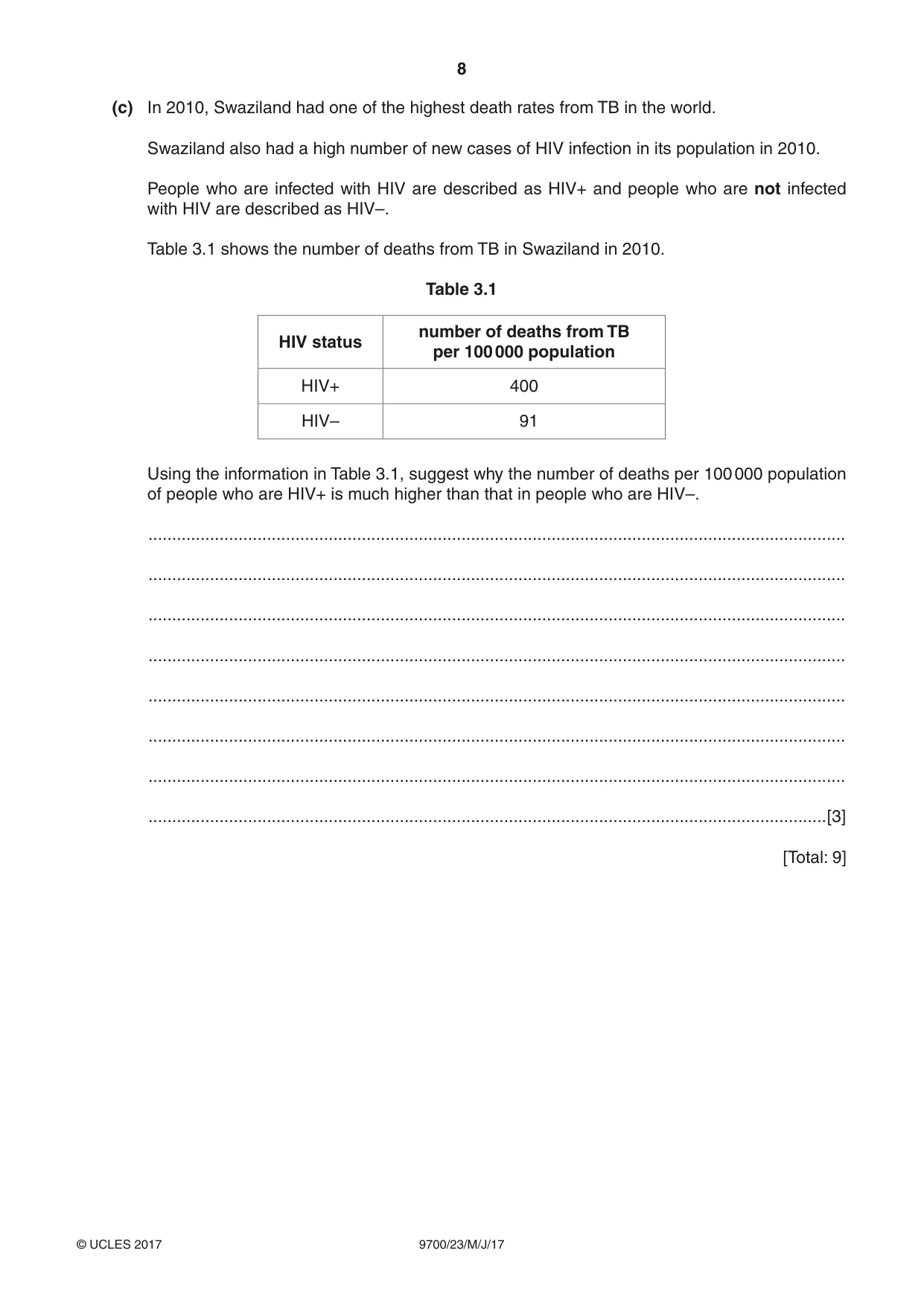
3 (a) Name the causative organism of tuberculosis (TB). ...............................................................................................................................................[1] (b) Fig. 3.1 shows the number of deaths from TB and the number of new cases of TB from 1925 to 2010 in Canada. 120 100 number 80 per 100 000 60 population 40 20 0 1925 1930 1935 1940 1945 1950 1955 1960 1965 1970 1975 1980 1985 1990 1995 2000 2005 2010 year Key deaths from TB new cases of TB Fig. 3.1 The vaccine for TB was introduced in Canada for widespread use from 1948. Antibiotics, such as streptomycin, were introduced in Canada from 1940. Use the information in Fig. 3.1 to comment on the effect of the introduction of the vaccine and antibiotics on the number of new cases and deaths from TB. ................................................................................................................................................... ................................................................................................................................................... ................................................................................................................................................... ................................................................................................................................................... ................................................................................................................................................... ................................................................................................................................................... ................................................................................................................................................... ................................................................................................................................................... ...............................................................................................................................................[5] (c) In 2010, Swaziland had one of the highest death rates from TB in the world. Swaziland also had a high number of new cases of HIV infection in its population in 2010. People who are infected with HIV are described as HIV+ and people who are not infected with HIV are described as HIV–. Table 3.1 shows the number of deaths from TB in Swaziland in 2010. Table 3.1 number of deaths from TB HIV status per 100 000 population HIV+ 400 HIV– 91 Using the information in Table 3.1, suggest why the number of deaths per 100 000 population of people who are HIV+ is much higher than that in people who are HIV–. ................................................................................................................................................... ................................................................................................................................................... ................................................................................................................................................... ................................................................................................................................................... ................................................................................................................................................... ................................................................................................................................................... ................................................................................................................................................... ...............................................................................................................................................[3] [Total: 9]
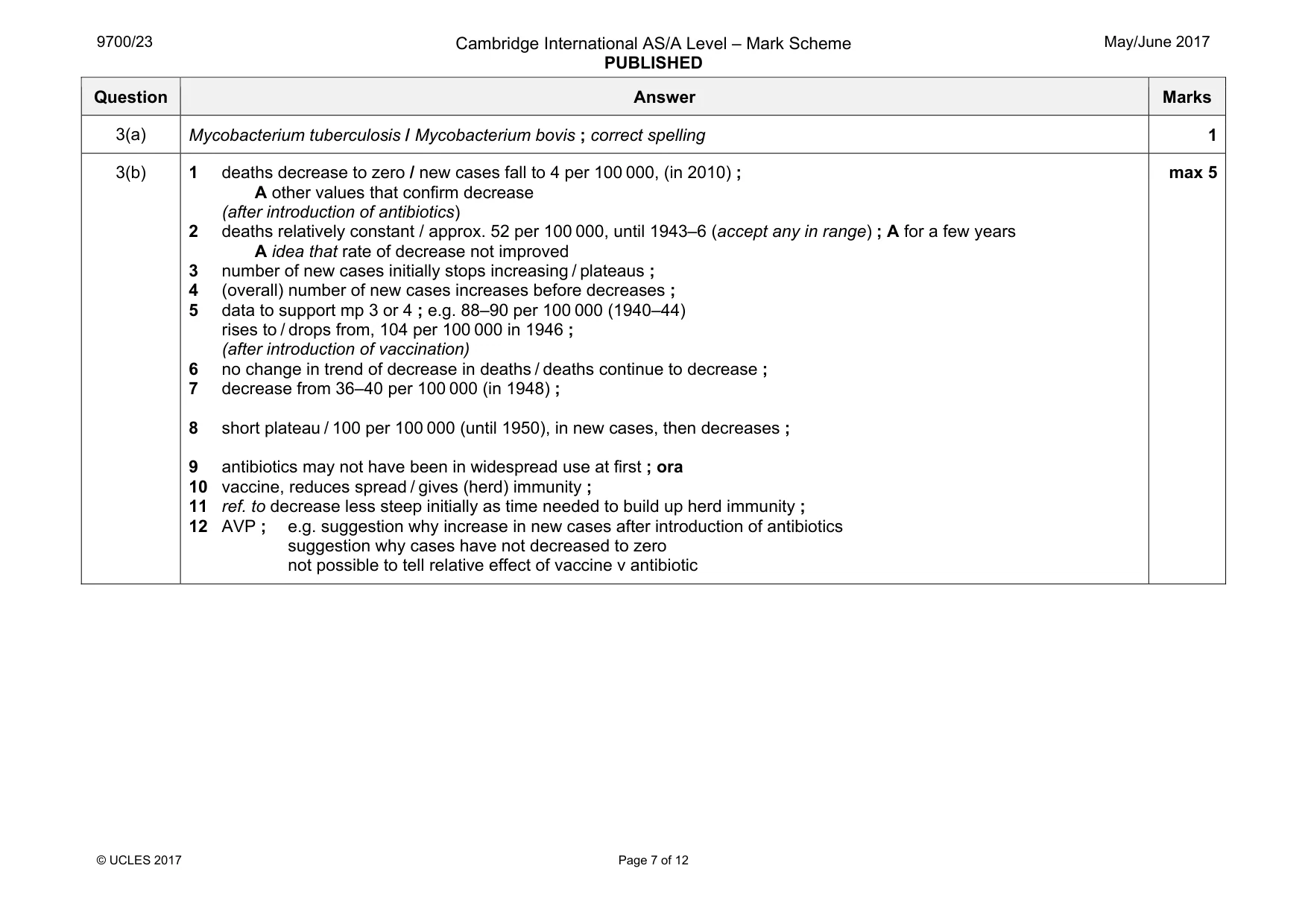
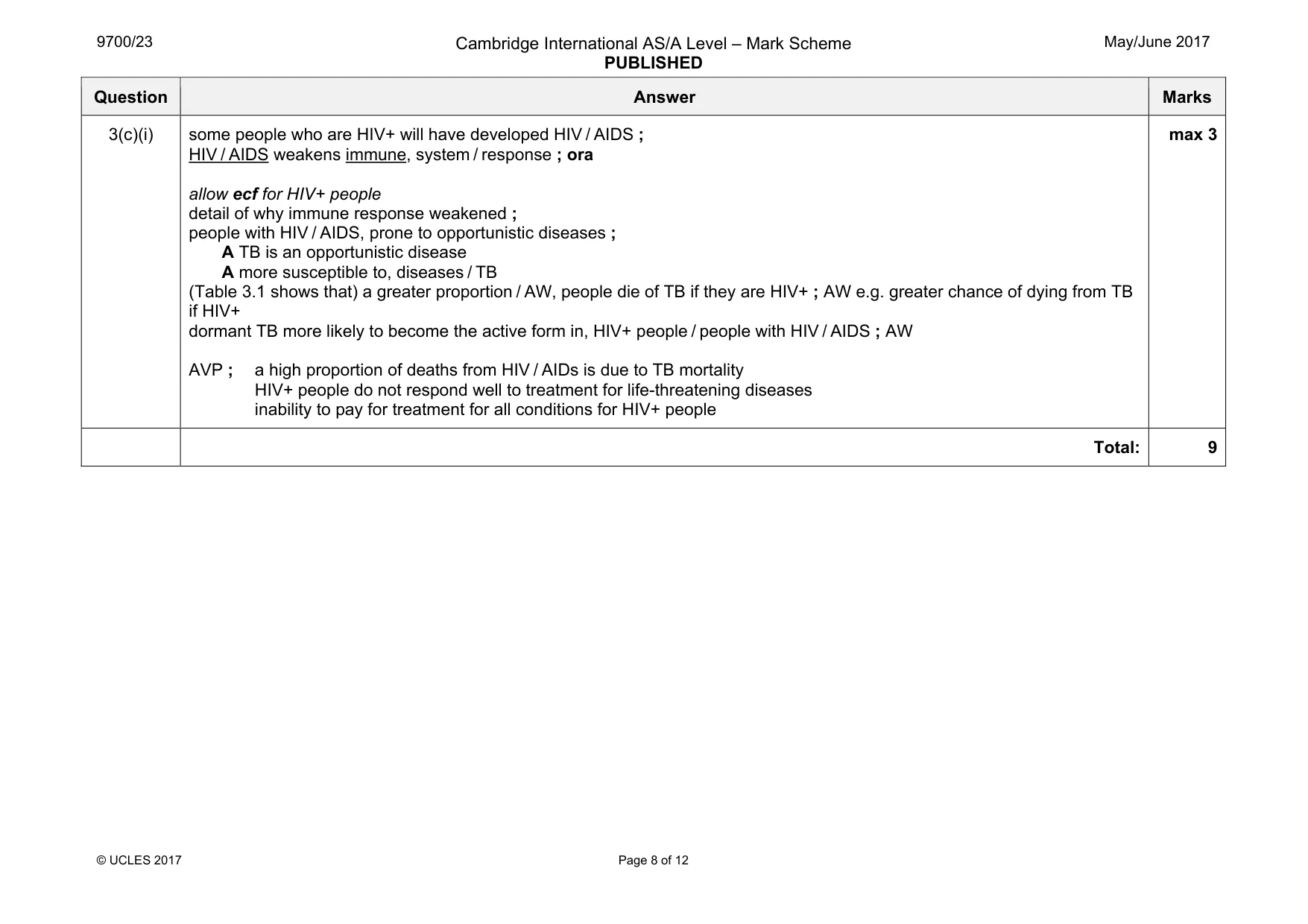
Mark scheme: 3(a) Mycobacterium tuberculosis / Mycobacterium bovis ; correct spelling 1 3(b) 1 deaths decrease to zero / new cases fall to 4 per 100 000, (in 2010) ; A other values that confirm decrease (after introduction of antibiotics) 2 deaths relatively constant / approx. 52 per 100 000, until 1943–6 (accept any in range) ; A for a few years A idea that rate of decrease not improved 3 number of new cases initially stops increasing / plateaus ; 4 (overall) number of new cases increases before decreases ; 5 data to support mp 3 or 4 ; e.g. 88–90 per 100 000 (1940–44) rises to / drops from, 104 per 100 000 in 1946 ; (after introduction of vaccination) 6 no change in trend of decrease in deaths / deaths continue to decrease ; 7 decrease from 36–40 per 100 000 (in 1948) ; 8 short plateau / 100 per 100 000 (until 1950), in new cases, then decreases ; 9 antibiotics may not have been in widespread use at first ; ora 10 vaccine, reduces spread / gives (herd) immunity ; 11 ref. to decrease less steep initially as time needed to build up herd immunity ; 12 AVP ; e.g. suggestion why increase in new cases after introduction of antibiotics suggestion why cases have not decreased to zero not possible to tell relative effect of vaccine v antibiotic max 5 Question Answer Marks 3(c)(i) some people who are HIV+ will have developed HIV / AIDS ; HIV / AIDS weakens immune, system / response ; ora allow ecf for HIV+ people detail of why immune response weakened ; people with HIV / AIDS, prone to opportunistic diseases ; A TB is an opportunistic disease A more susceptible to, diseases / TB (Table 3.1 shows that) a greater proportion / AW, people die of TB if they are HIV+ ; AW e.g. greater chance of dying from TB if HIV+ dormant TB more likely to become the active form in, HIV+ people / people with HIV / AIDS ; AW AVP ; a high proportion of deaths from HIV / AIDs is due to TB mortality HIV+ people do not respond well to treatment for life-threatening diseases inability to pay for treatment for all conditions for HIV+ people max 3 Total: 9 Que estion Answer Ma arks
Q4 · Complete Table 4.1 by using a tick (3) to indicate which statements apply to each of the…
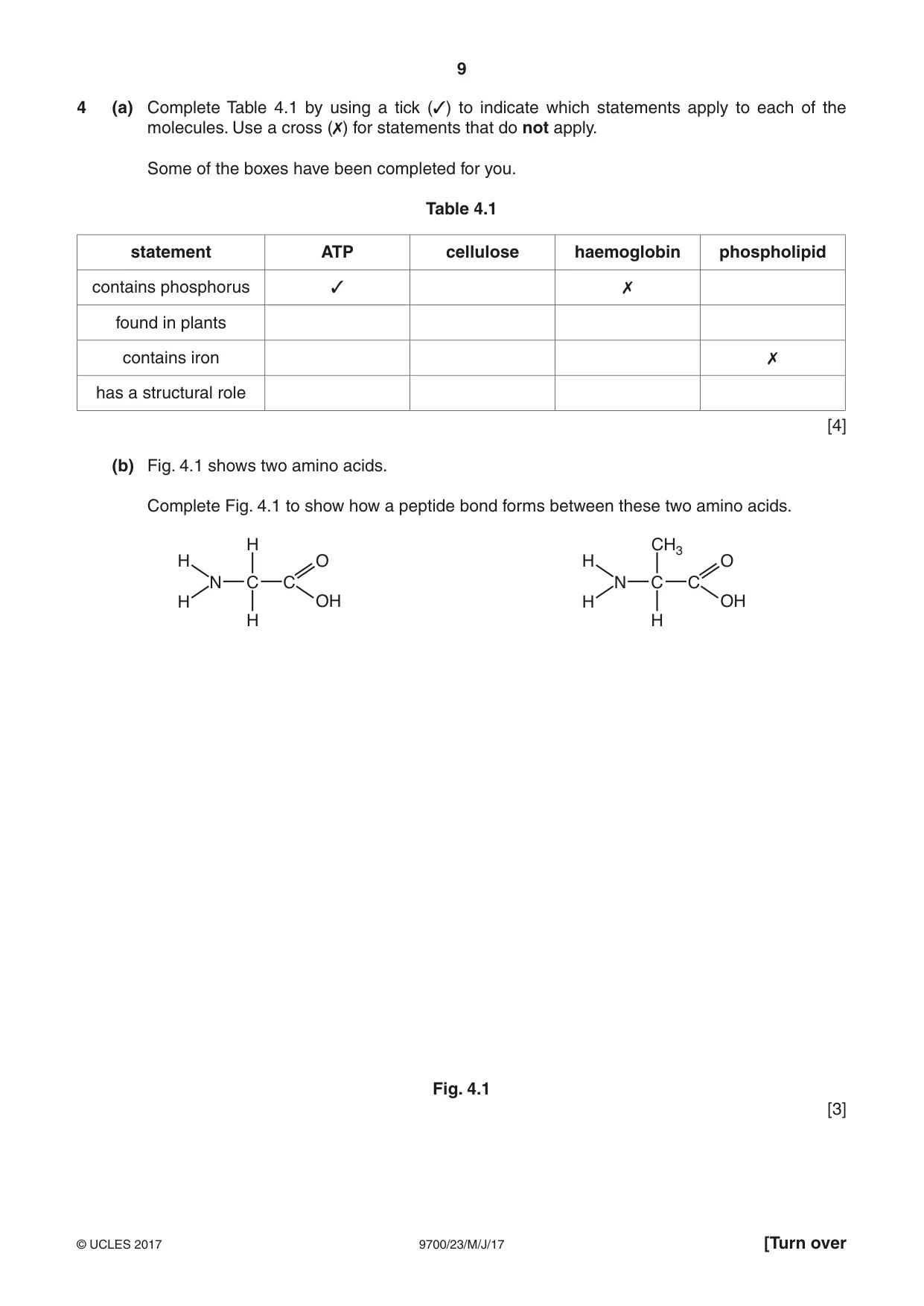
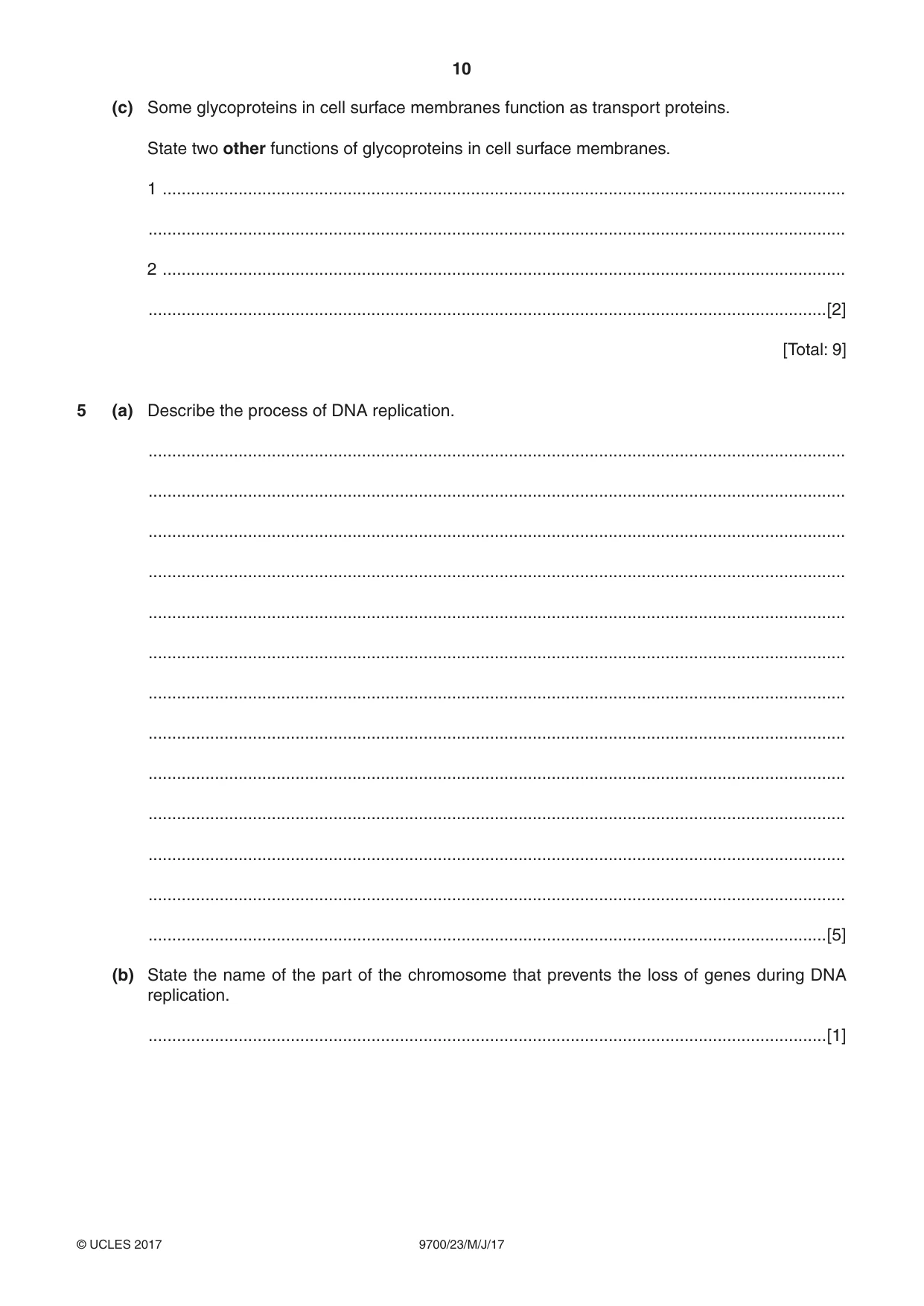
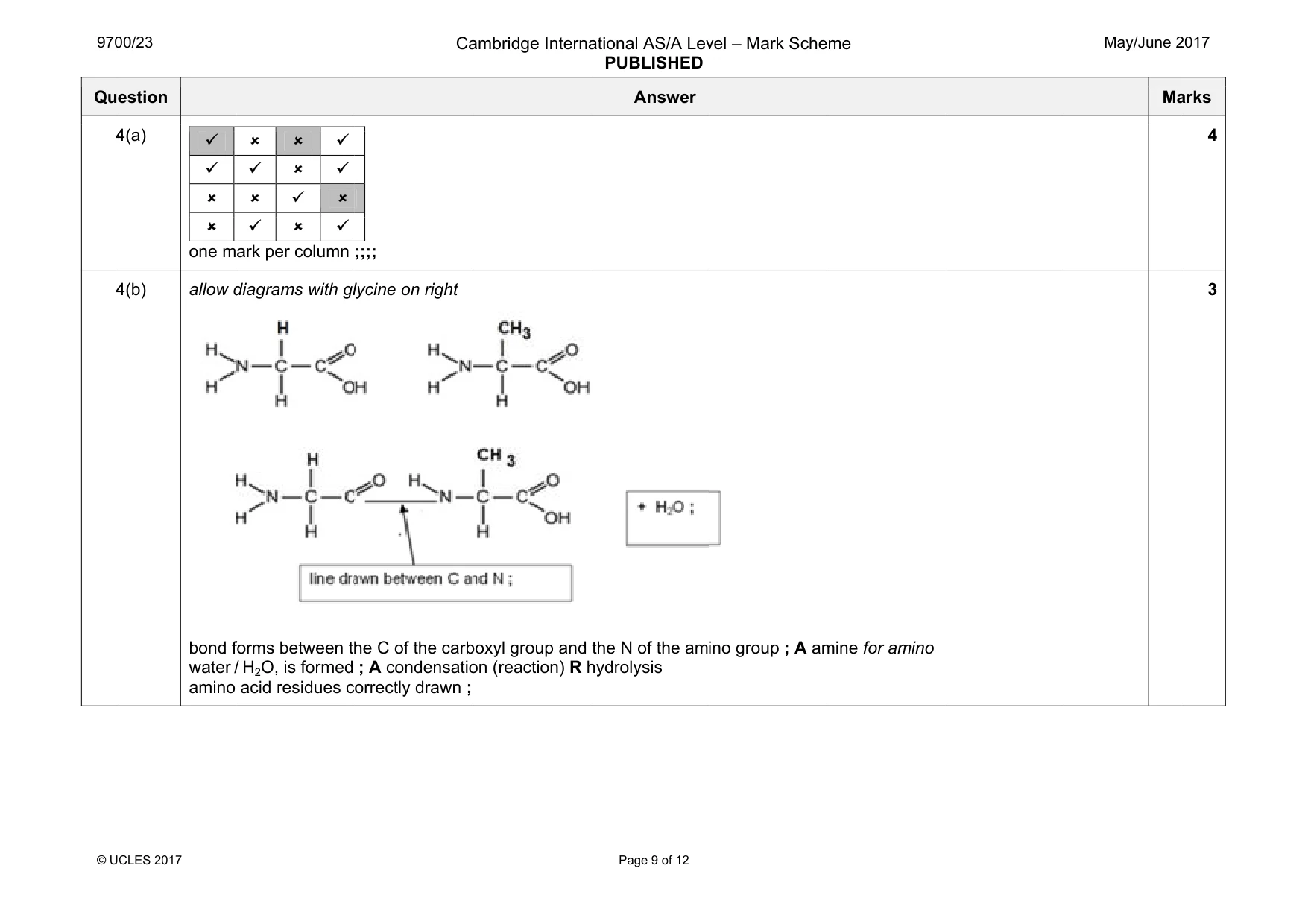
4 (a) Complete Table 4.1 by using a tick (3) to indicate which statements apply to each of the molecules. Use a cross (7) for statements that do not apply. Some of the boxes have been completed for you. Table 4.1 statement ATP cellulose haemoglobin phospholipid contains phosphorus 3 7 found in plants contains iron 7 has a structural role [4] (b) Fig. 4.1 shows two amino acids. Complete Fig. 4.1 to show how a peptide bond forms between these two amino acids. H CH3 H O H O N C C N C C H OH H OH H H Fig. 4.1 [3] (c) Some glycoproteins in cell surface membranes function as transport proteins. State two other functions of glycoproteins in cell surface membranes. 1 ................................................................................................................................................ ................................................................................................................................................... 2 ................................................................................................................................................ ...............................................................................................................................................[2] [Total: 9]
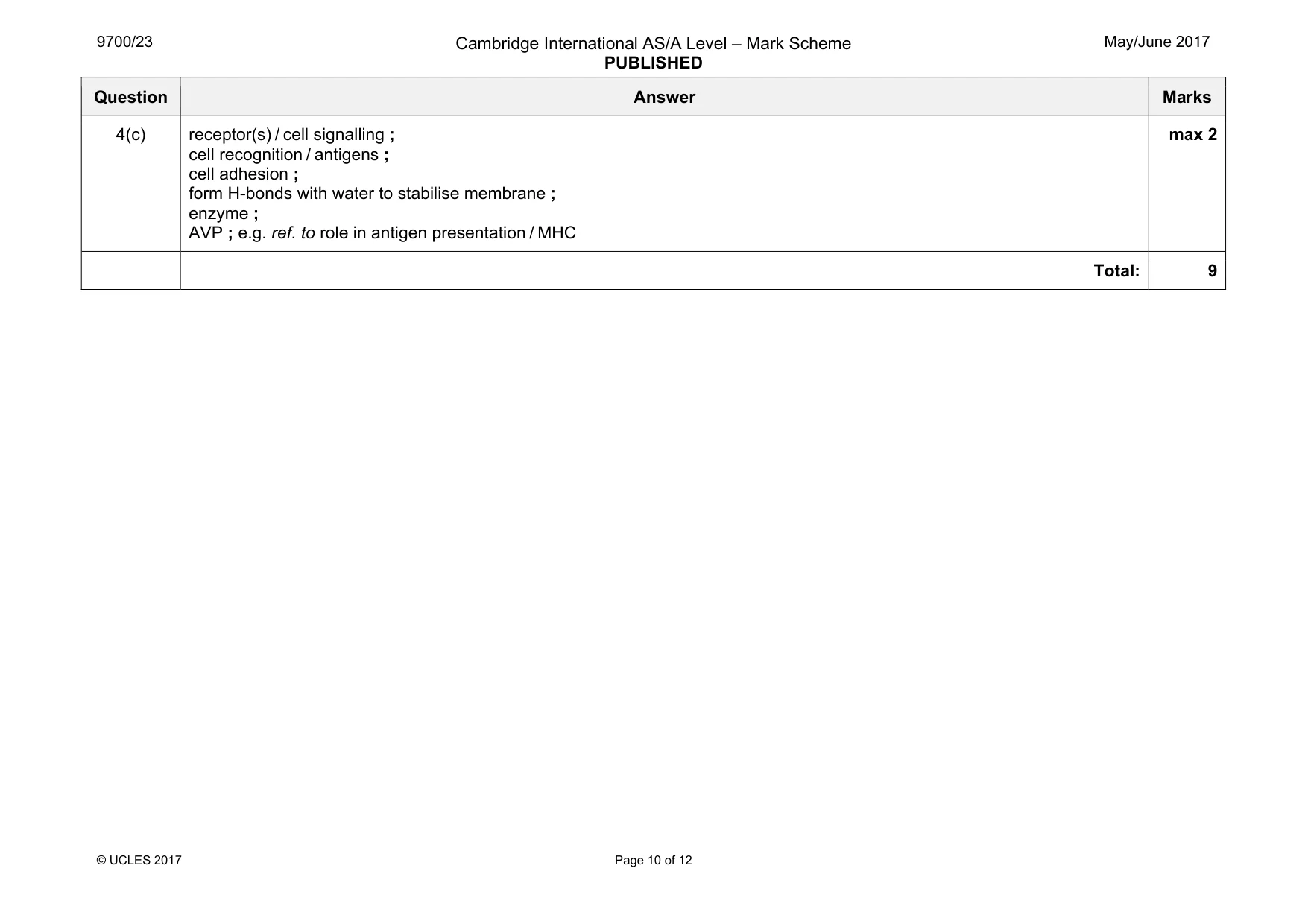
Mark scheme: 4 4 4(a) 9 9 8 8 one m 4(b) allow d bond f water / amino 8 8 9 9 8 9 8 9 8 9 8 9 ark per column diagrams with gl forms between th / H2O, is formed acid residues c ;;;; lycine on right he C of the carb ; A condensatio orrectly drawn ; boxyl group and on (reaction) R h the N of the am hydrolysis ino group ; A am mine for amino 4 3 Question Answer Marks 4(c) receptor(s) / cell signalling ; cell recognition / antigens ; cell adhesion ; form H-bonds with water to stabilise membrane ; enzyme ; AVP ; e.g. ref. to role in antigen presentation / MHC max 2 Total: 9
Q5 · Describe the process of DNA replication
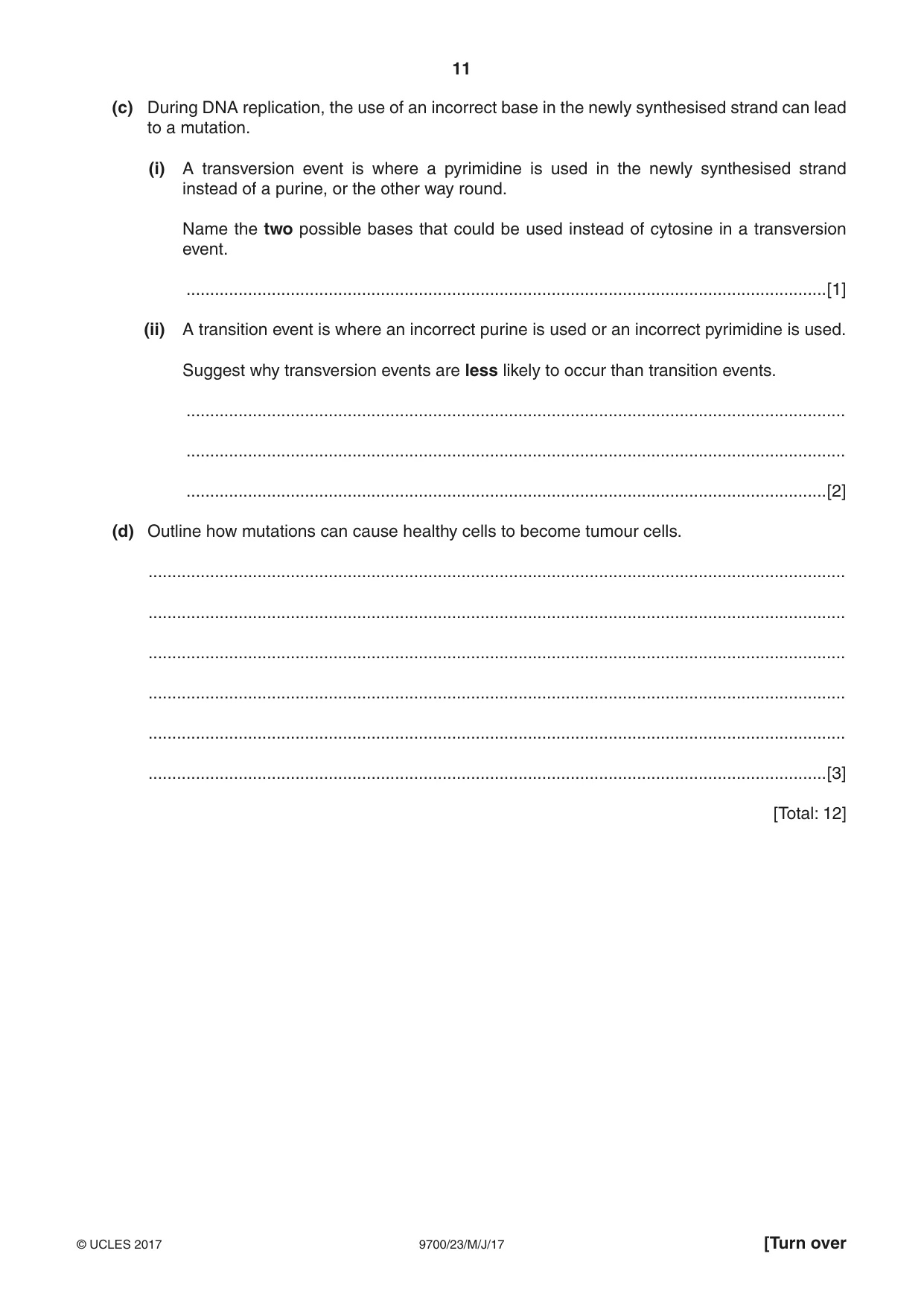
5 (a) Describe the process of DNA replication. ................................................................................................................................................... ................................................................................................................................................... ................................................................................................................................................... ................................................................................................................................................... ................................................................................................................................................... ................................................................................................................................................... ................................................................................................................................................... ................................................................................................................................................... ................................................................................................................................................... ................................................................................................................................................... ................................................................................................................................................... ................................................................................................................................................... ...............................................................................................................................................[5] (b) State the name of the part of the chromosome that prevents the loss of genes during DNA replication. ...............................................................................................................................................[1] (c) During DNA replication, the use of an incorrect base in the newly synthesised strand can lead to a mutation. (i) A transversion event is where a pyrimidine is used in the newly synthesised strand instead of a purine, or the other way round. Name the two possible bases that could be used instead of cytosine in a transversion event. .......................................................................................................................................[1] (ii) A transition event is where an incorrect purine is used or an incorrect pyrimidine is used. Suggest why transversion events are less likely to occur than transition events. ........................................................................................................................................... ........................................................................................................................................... .......................................................................................................................................[2] (d) Outline how mutations can cause healthy cells to become tumour cells. ................................................................................................................................................... ................................................................................................................................................... ................................................................................................................................................... ................................................................................................................................................... ................................................................................................................................................... ...............................................................................................................................................[3] [Total: 12]
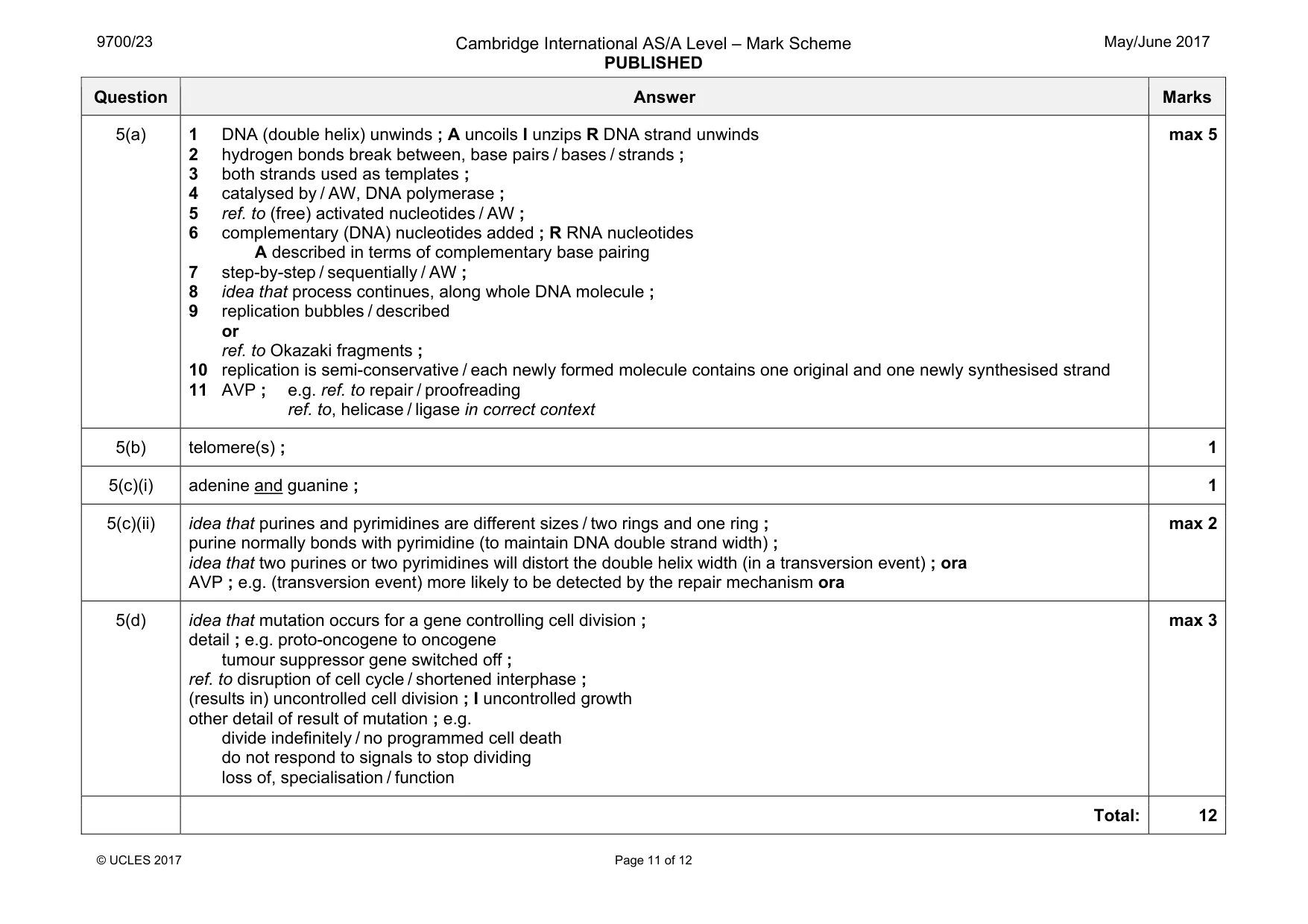
Mark scheme: 5(a) 1 DNA (double helix) unwinds ; A uncoils I unzips R DNA strand unwinds 2 hydrogen bonds break between, base pairs / bases / strands ; 3 both strands used as templates ; 4 catalysed by / AW, DNA polymerase ; 5 ref. to (free) activated nucleotides / AW ; 6 complementary (DNA) nucleotides added ; R RNA nucleotides A described in terms of complementary base pairing 7 step-by-step / sequentially / AW ; 8 idea that process continues, along whole DNA molecule ; 9 replication bubbles / described or ref. to Okazaki fragments ; 10 replication is semi-conservative / each newly formed molecule contains one original and one newly synthesised strand 11 AVP ; e.g. ref. to repair / proofreading ref. to, helicase / ligase in correct context max 5 5(b) telomere(s) ; 1 5(c)(i) adenine and guanine ; 1 5(c)(ii) idea that purines and pyrimidines are different sizes / two rings and one ring ; purine normally bonds with pyrimidine (to maintain DNA double strand width) ; idea that two purines or two pyrimidines will distort the double helix width (in a transversion event) ; ora AVP ; e.g. (transversion event) more likely to be detected by the repair mechanism ora max 2 5(d) idea that mutation occurs for a gene controlling cell division ; detail ; e.g. proto-oncogene to oncogene tumour suppressor gene switched off ; ref. to disruption of cell cycle / shortened interphase ; (results in) uncontrolled cell division ; I uncontrolled growth other detail of result of mutation ; e.g. divide indefinitely / no programmed cell death do not respond to signals to stop dividing loss of, specialisation / function max 3 Total: 12
More questions on Structure of nucleic acids and replication of DNA
Q6 · In the space below, draw a diagram to show a hydrogen bond between two water molecules
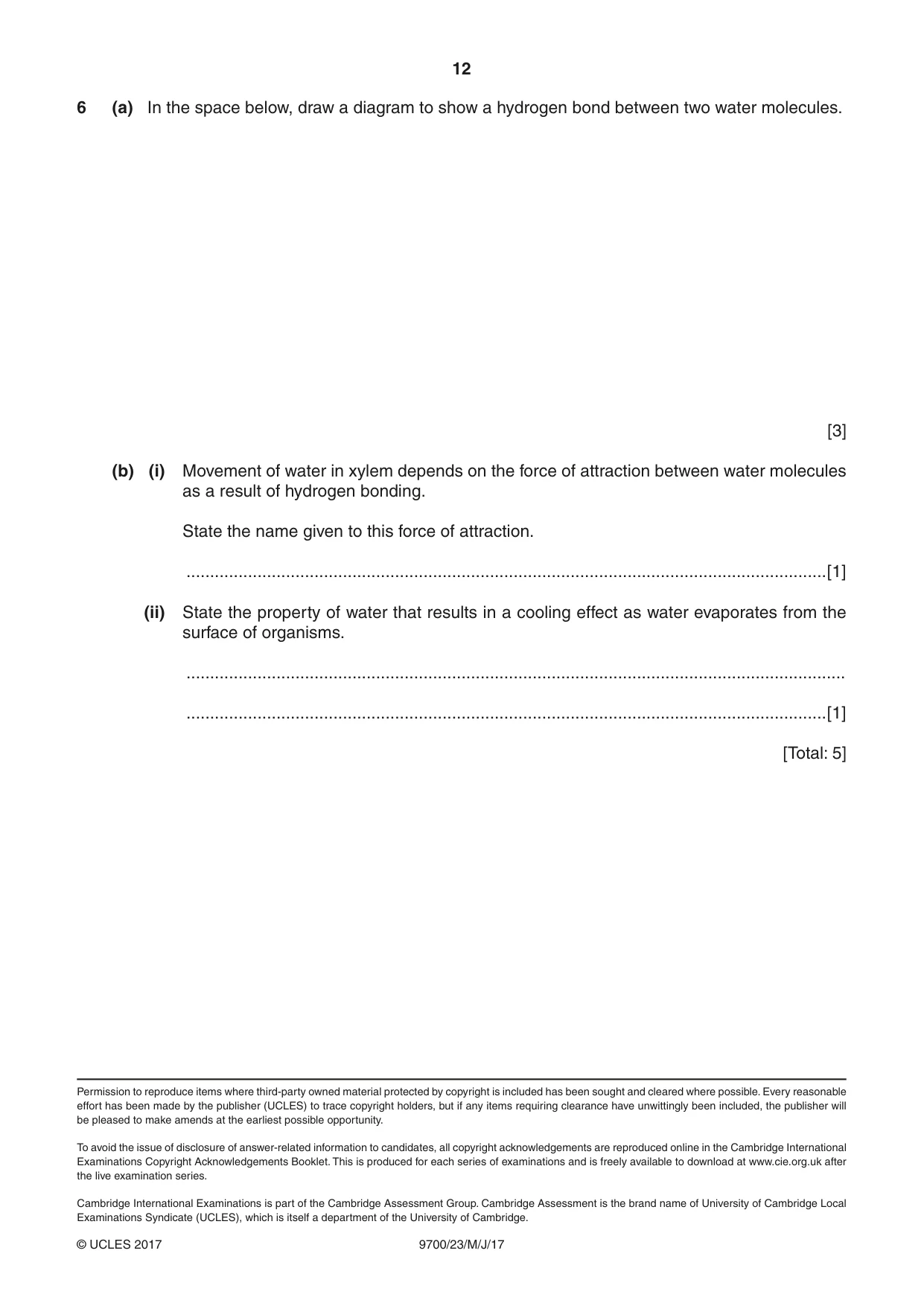
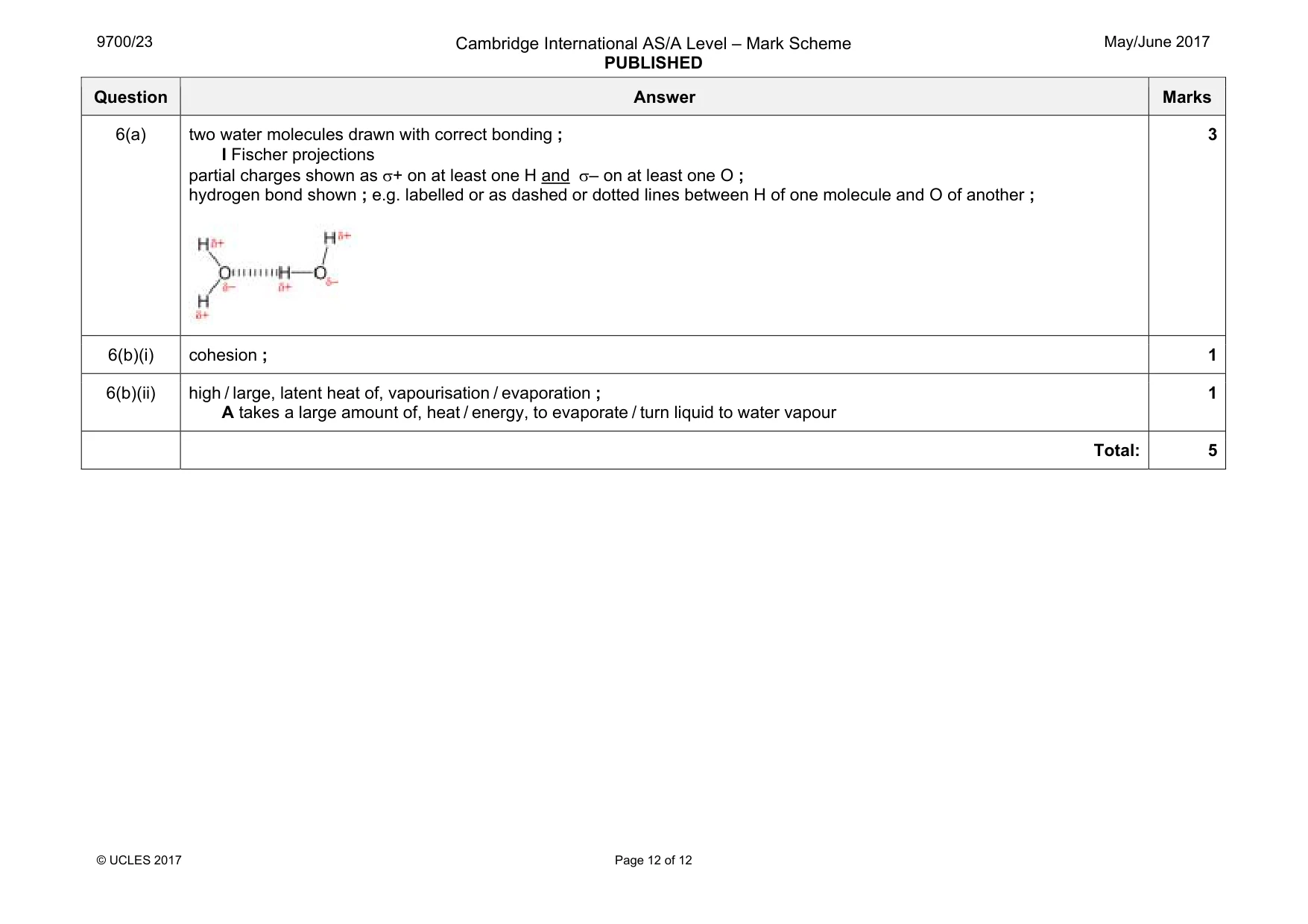
6 (a) In the space below, draw a diagram to show a hydrogen bond between two water molecules. [3] (b) (i) Movement of water in xylem depends on the force of attraction between water molecules as a result of hydrogen bonding. State the name given to this force of attraction. .......................................................................................................................................[1] (ii) State the property of water that results in a cooling effect as water evaporates from the surface of organisms. ........................................................................................................................................... .......................................................................................................................................[1] [Total: 5]
Mark scheme: 6(a) two water molecules drawn with correct bonding ; I Fischer projections partial charges shown as σ+ on at least one H and σ– on at least one O ; hydrogen bond shown ; e.g. labelled or as dashed or dotted lines between H of one molecule and O of another ; 3 6(b)(i) cohesion ; 1 6(b)(ii) high / large, latent heat of, vapourisation / evaporation ; A takes a large amount of, heat / energy, to evaporate / turn liquid to water vapour 1 Total: 5
What was in this paper
The subtopics covered by these 6 questions, and how many questions each got. Open one in a new tab to see every Cambridge question on it.
What you needed in this session
Cambridge’s own grade thresholds for 2017 May/June, Paper 2 · Variant 3. A higher threshold means an easier paper — the bar moves with how the cohort did.