Cambridge A Level Biology 9700 — 2016 Oct/Nov Paper 2 · Variant 2
9700/22/O/N/16 · 60 marks · ≈68 min
The question paper and its mark scheme, free to read here and free to download. This is Cambridge’s own paper, exactly as it was sat.
Question paper20 pages



Mark scheme11 pages
Answers below. Sit the paper first if you are practising.
Paper as text
Question paper, page 1
This document consists of 17 printed pages and 3 blank pages. DC (CW/FD) 109121/4 © UCLES 2016 [Turn over Cambridge International Examinations Cambridge International Advanced Subsidiary and Advanced Level * 8 7 4 4 8 7 5 5 1 6 * BIOLOGY 9700/22 Paper 2 AS Level Structured Questions October/November 2016 1 hour 15 minutes Candidates answer on the Question Paper. No Additional Materials are required. READ THESE INSTRUCTIONS FIRST Write your Centre number, candidate number and name on all the work you hand in. Write in dark blue or black pen. You may use an HB pencil for any diagrams or graphs. Do not use staples, paper clips, glue or correction fluid. DO NOT WRITE IN ANY BARCODES. Answer all questions. Electronic calculators may be used. You may lose marks if you do not show your working or if you do not use appropriate units. At the end of the examination, fasten all your work securely together. The number of marks is given in brackets [ ] at the end of each question or part question.
Question paper, page 2
2 9700/22/O/N/16 © UCLES 2016 BLANK PAGE
Question paper, page 3
3 9700/22/O/N/16 © UCLES 2016 [Turn over Answer all the questions. 1 Match the description for each of statements A to E to a correct cell structure. A Double membrane-bound organelle, absent in animal cells, that produces ATP. … B Partially permeable membrane surrounding the large permanent vacuole of plant cells. … C Formed from microtubules during mitosis. … D Has peptidoglycan as one of its major components. … E Site of assembly of 80S ribosomes. … [5] [Total: 5]
Question paper, page 4
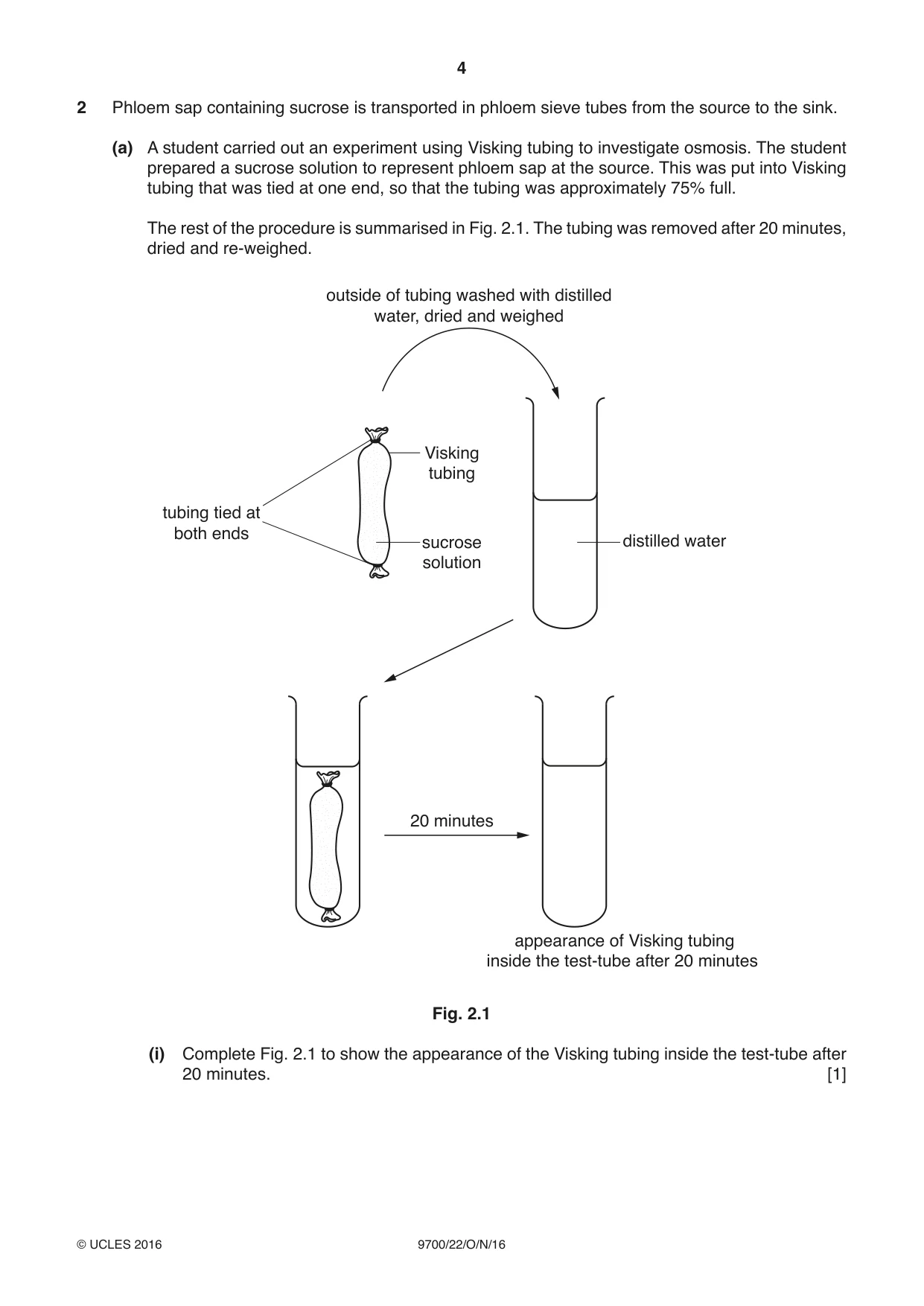
4 9700/22/O/N/16 © UCLES 2016 2 Phloem sap containing sucrose is transported in phloem sieve tubes from the source to the sink. (a) A student carried out an experiment using Visking tubing to investigate osmosis. The student prepared a sucrose solution to represent phloem sap at the source. This was put into Visking tubing that was tied at one end, so that the tubing was approximately 75% full. The rest of the procedure is summarised in Fig. 2.1. The tubing was removed after 20 minutes, dried and re-weighed. tubing tied at both ends Visking tubing outside of tubing washed with distilled water, dried and weighed sucrose solution 20 minutes appearance of Visking tubing inside the test-tube after 20 minutes distilled water Fig. 2.1 (i) Complete Fig. 2.1 to show the appearance of the Visking tubing inside the test-tube after 20 minutes. [1]
Question paper, page 5
5 9700/22/O/N/16 © UCLES 2016 [Turn over (ii) State, with reasons, whether there would be a change in the mass of the Visking tubing containing the sucrose solution after 20 minutes. … … … … … … … … … …[3] (b) Explain how osmosis is involved in the mass flow of phloem sap. … … … … … … … … … …[3]
Question paper, page 6
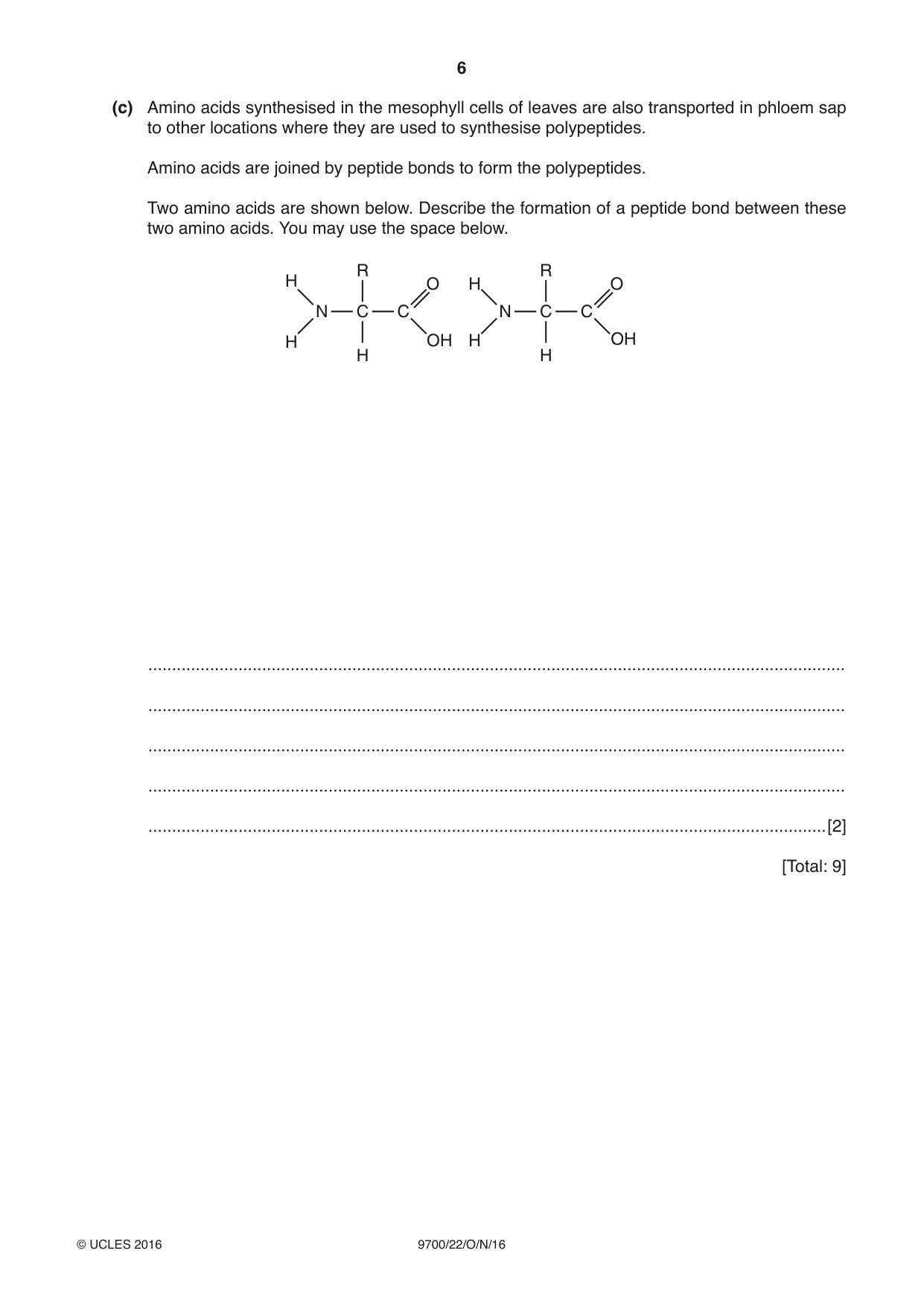
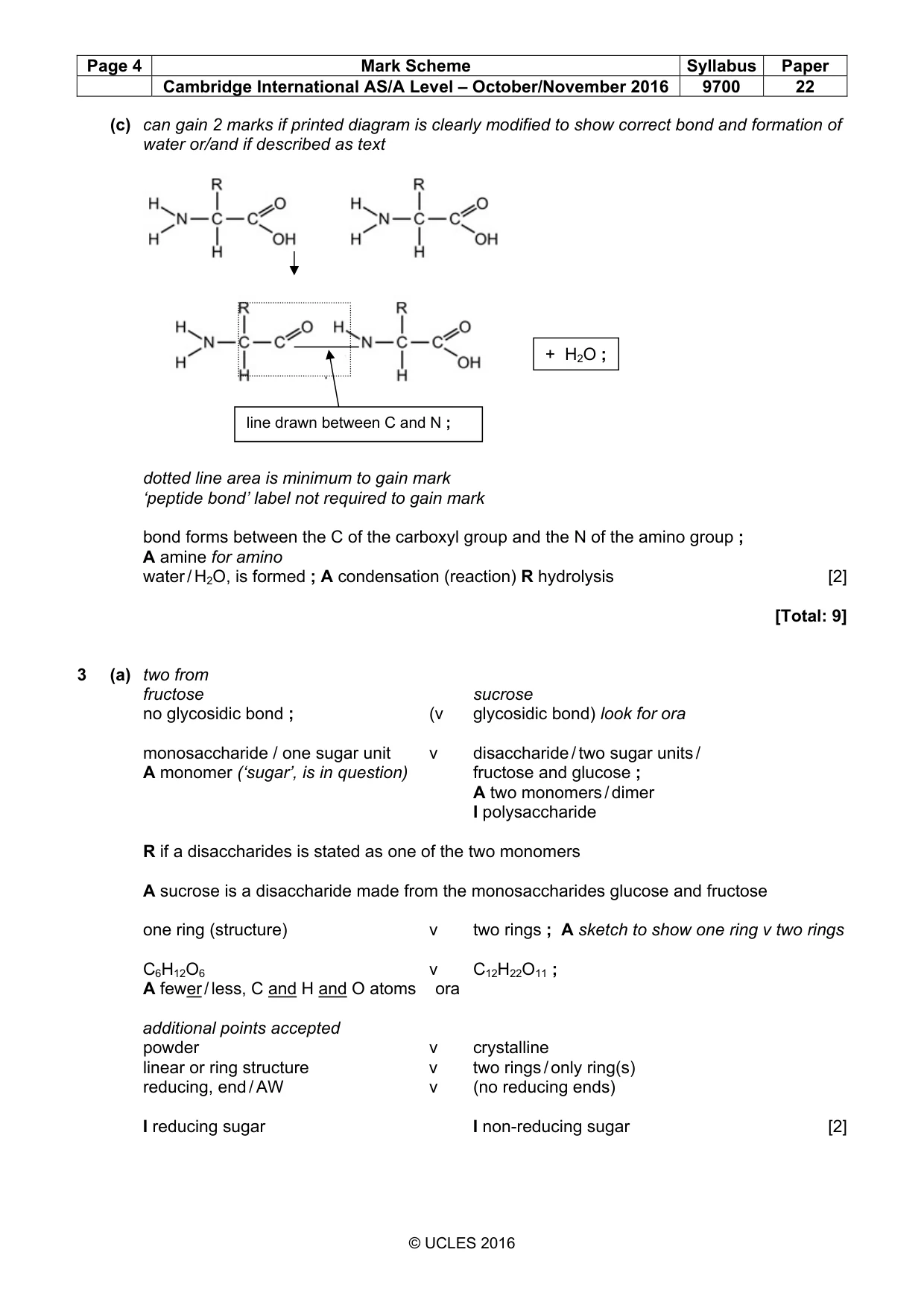
6 9700/22/O/N/16 © UCLES 2016 (c) Amino acids synthesised in the mesophyll cells of leaves are also transported in phloem sap to other locations where they are used to synthesise polypeptides. Amino acids are joined by peptide bonds to form the polypeptides. Two amino acids are shown below. Describe the formation of a peptide bond between these two amino acids. You may use the space below. C C O OH R N H H H C C O OH R N H H H … … … … …[2] [Total: 9]
Question paper, page 7
7 9700/22/O/N/16 © UCLES 2016 [Turn over BLANK PAGE
Question paper, page 8
8 9700/22/O/N/16 © UCLES 2016 3 High fructose corn syrup, made from maize, can be used as a replacement for sucrose to sweeten food and drink products. Commercial production of high fructose corn syrup involves the enzyme glucose isomerase, extracted from bacteria. (a) Fructose and sucrose are both sugars. State two structural differences between fructose and sucrose. 1 … … … 2 … … …[2] (b) The glucose isomerase used in the production of high fructose corn syrup is extracted from a strain of a bacterium, Thermus thermophilus, which is found in hot springs. The enzyme has an optimum temperature of 95 °C. Suggest and explain the advantages of using glucose isomerase from T. thermophilus to produce high fructose corn syrup, rather than using glucose isomerase that has an optimum temperature of 37 °C. … … … … … … …[3]
Question paper, page 9
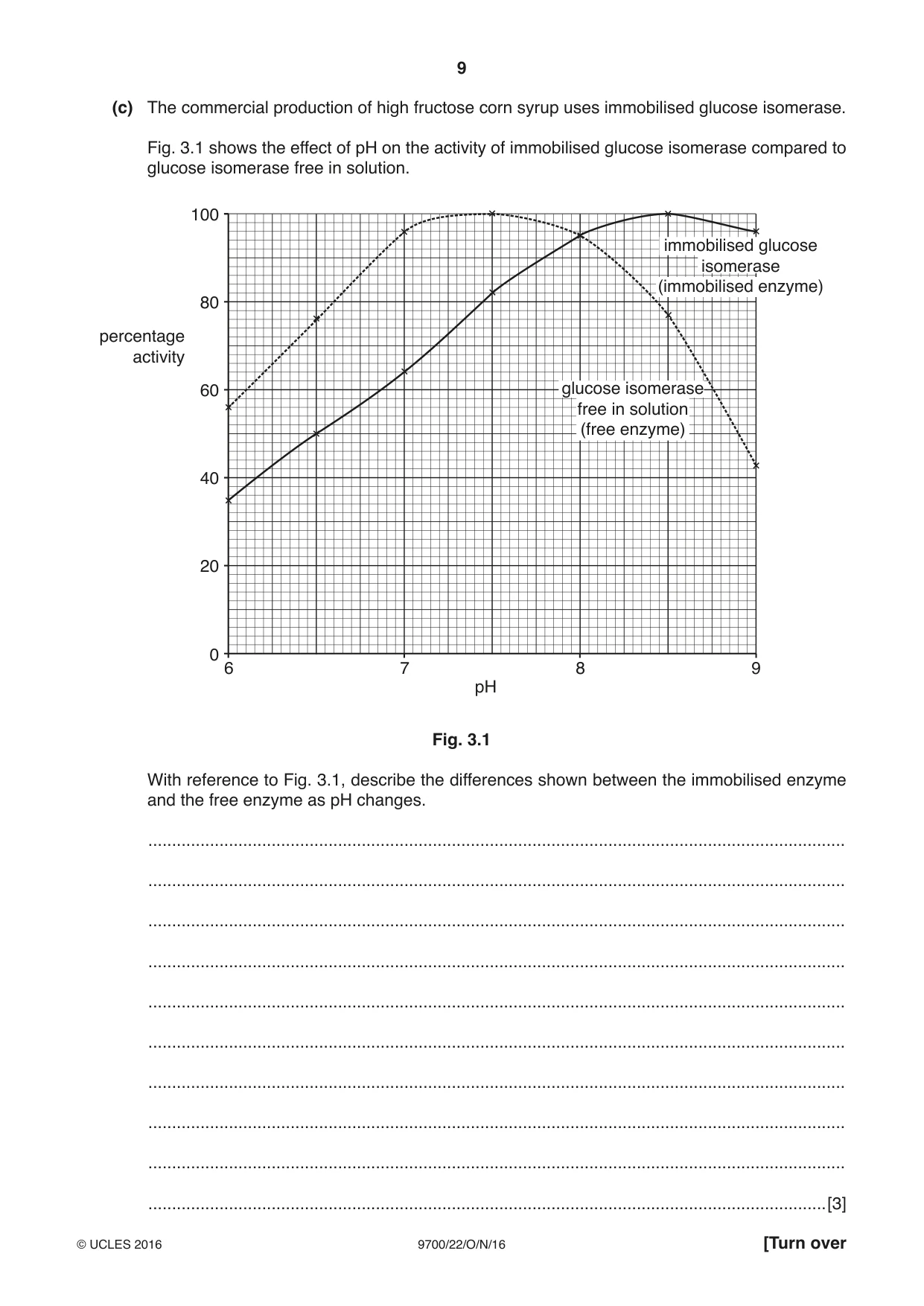
9 9700/22/O/N/16 © UCLES 2016 [Turn over (c) The commercial production of high fructose corn syrup uses immobilised glucose isomerase. Fig. 3.1 shows the effect of pH on the activity of immobilised glucose isomerase compared to glucose isomerase free in solution. 6 0 20 40 60 80 percentage activity 100 7 8 pH 9 glucose isomerase free in solution (free enzyme) immobilised glucose isomerase (immobilised enzyme) Fig. 3.1 With reference to Fig. 3.1, describe the differences shown between the immobilised enzyme and the free enzyme as pH changes. … … … … … … … … … …[3]
Question paper, page 10
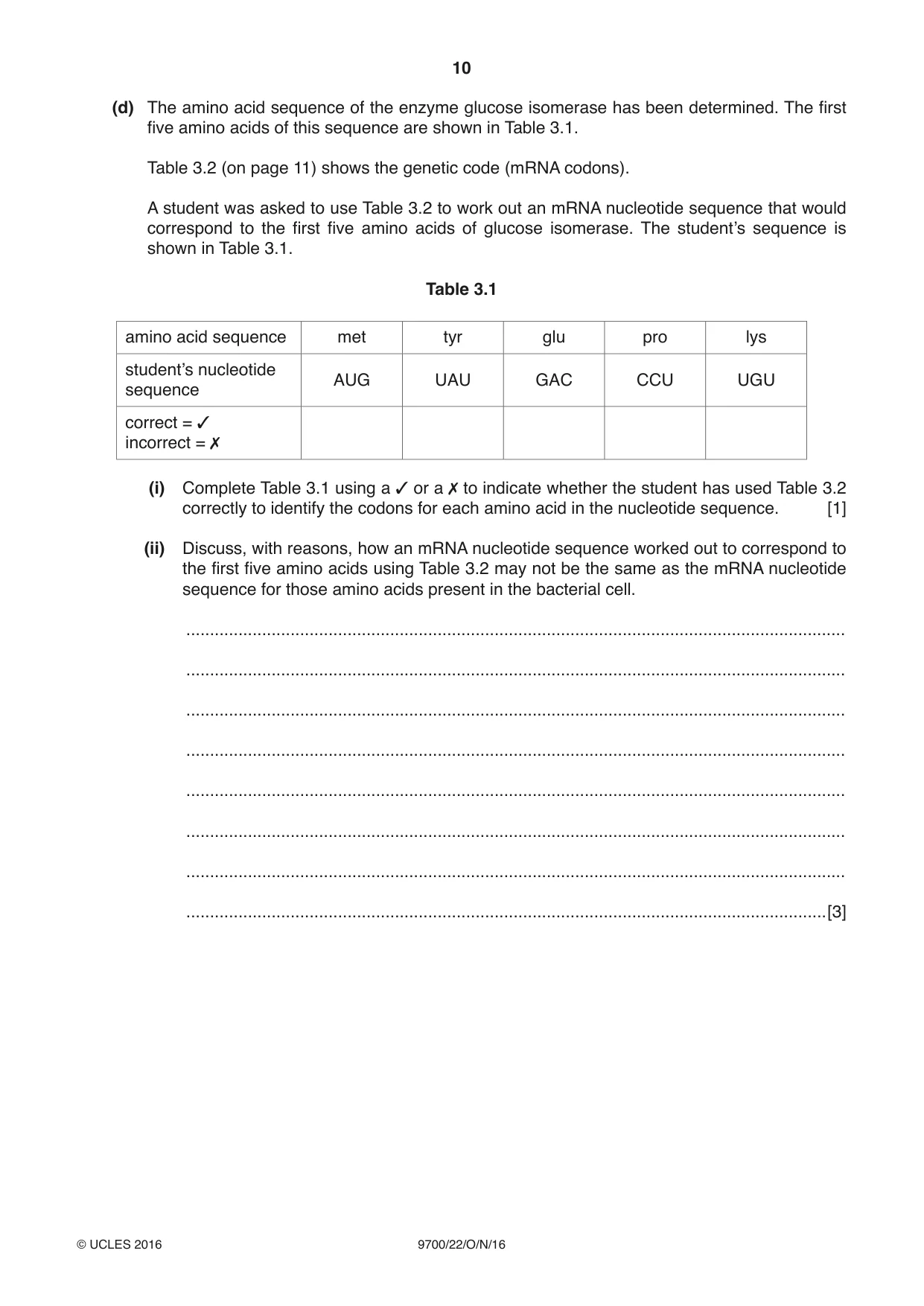
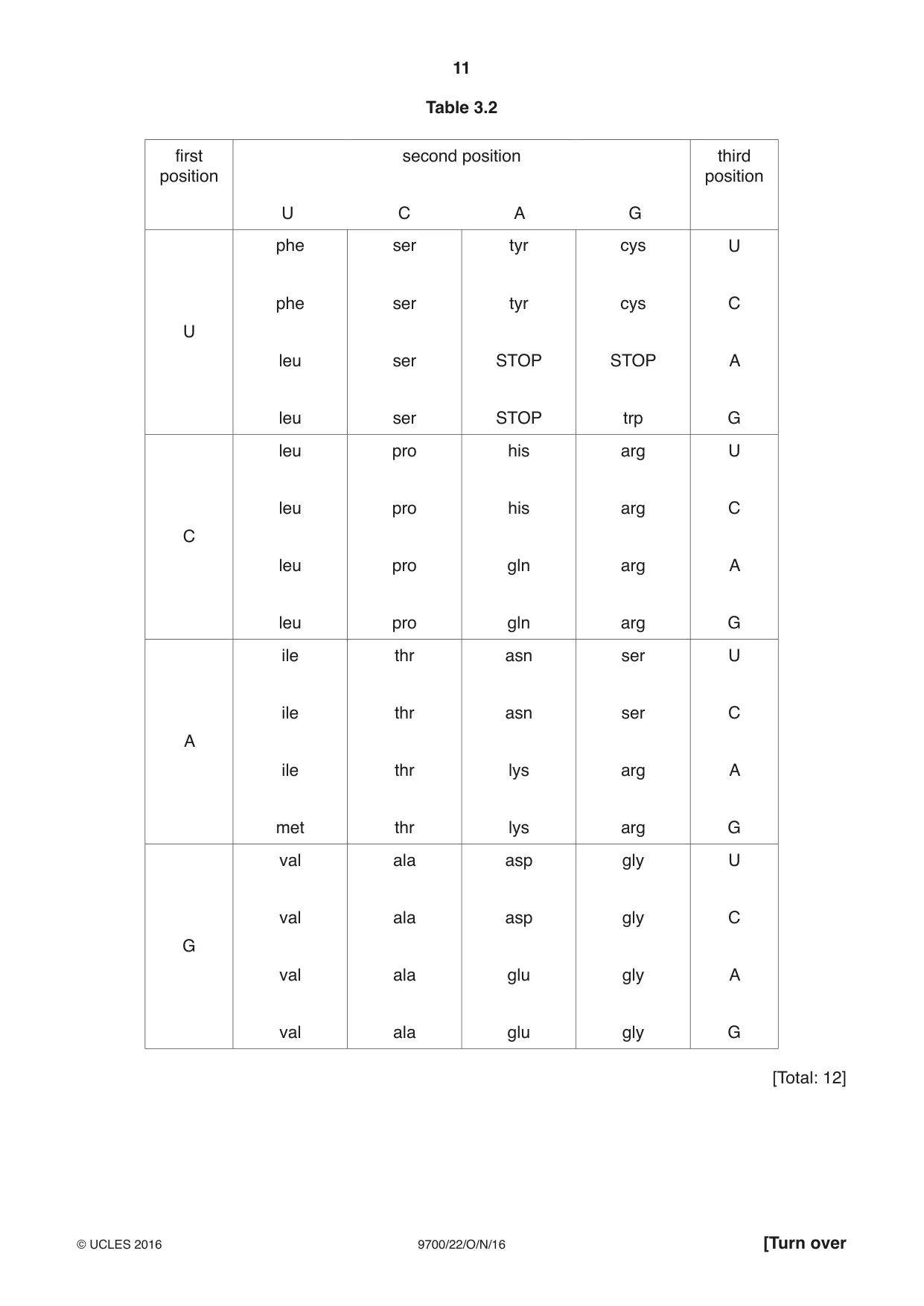
10 9700/22/O/N/16 © UCLES 2016 (d) The amino acid sequence of the enzyme glucose isomerase has been determined. The first five amino acids of this sequence are shown in Table 3.1. Table 3.2 (on page 11) shows the genetic code (mRNA codons). A student was asked to use Table 3.2 to work out an mRNA nucleotide sequence that would correspond to the first five amino acids of glucose isomerase. The student’s sequence is shown in Table 3.1. Table 3.1 amino acid sequence met tyr glu pro lys student’s nucleotide sequence AUG UAU GAC CCU UGU correct = 3 incorrect = 7 (i) Complete Table 3.1 using a 3 or a 7 to indicate whether the student has used Table 3.2 correctly to identify the codons for each amino acid in the nucleotide sequence. [1] (ii) Discuss, with reasons, how an mRNA nucleotide sequence worked out to correspond to the first five amino acids using Table 3.2 may not be the same as the mRNA nucleotide sequence for those amino acids present in the bacterial cell. … … … … … … … …[3]
Question paper, page 11
11 9700/22/O/N/16 © UCLES 2016 [Turn over Table 3.2 first position second position U C A G third position U phe phe leu leu ser ser ser ser tyr tyr STOP STOP cys cys STOP trp U C A G C leu leu leu leu pro pro pro pro his his gln gln arg arg arg arg U C A G A ile ile ile met thr thr thr thr asn asn lys lys ser ser arg arg U C A G G val val val val ala ala ala ala asp asp glu glu gly gly gly gly U C A G [Total: 12]
Question paper, page 12
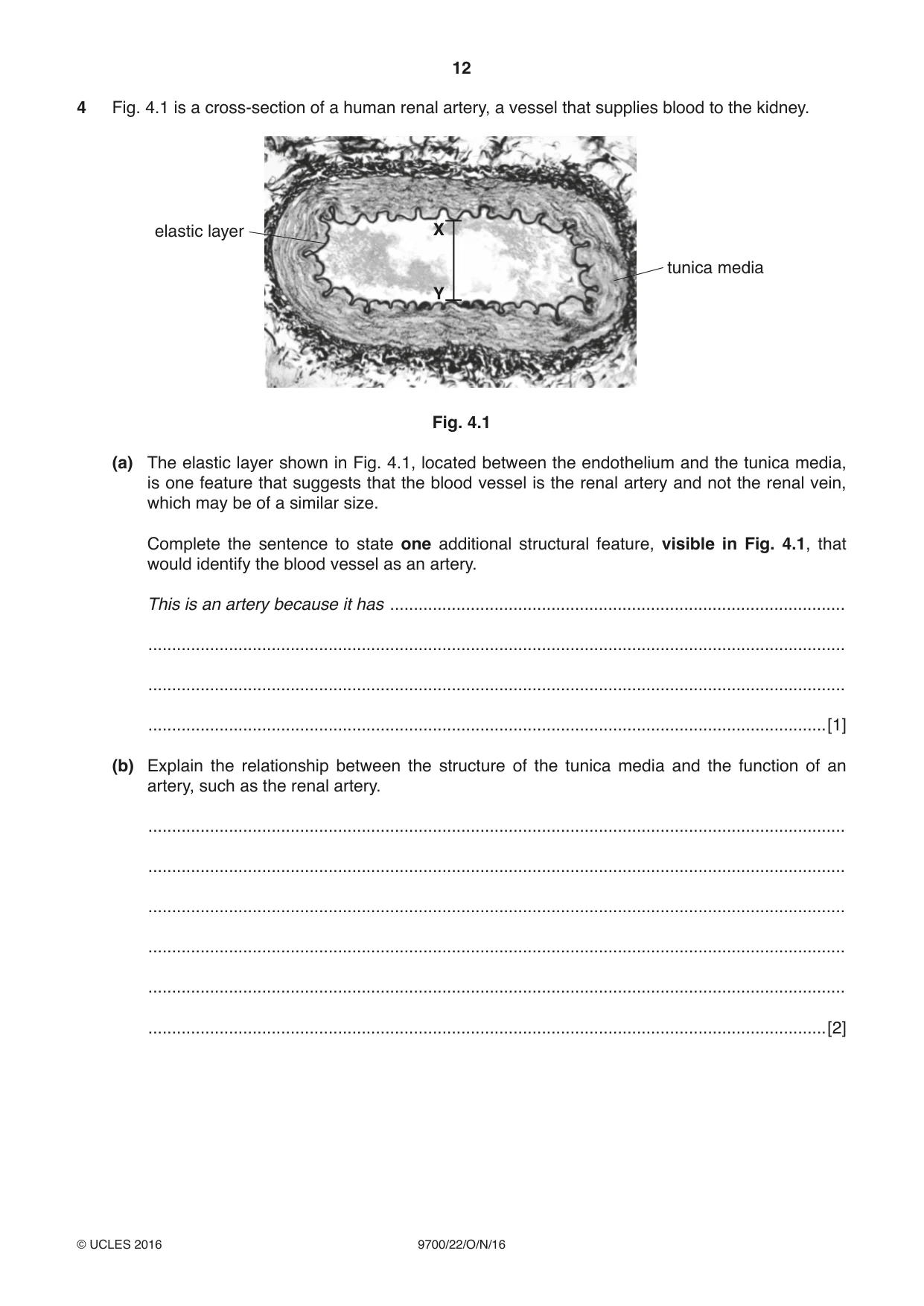
12 9700/22/O/N/16 © UCLES 2016 4 Fig. 4.1 is a cross-section of a human renal artery, a vessel that supplies blood to the kidney. elastic layer X Y tunica media Fig. 4.1 (a) The elastic layer shown in Fig. 4.1, located between the endothelium and the tunica media, is one feature that suggests that the blood vessel is the renal artery and not the renal vein, which may be of a similar size. Complete the sentence to state one additional structural feature, visible in Fig. 4.1, that would identify the blood vessel as an artery. This is an artery because it has … … … …[1] (b) Explain the relationship between the structure of the tunica media and the function of an artery, such as the renal artery. … … … … … …[2]
Question paper, page 13
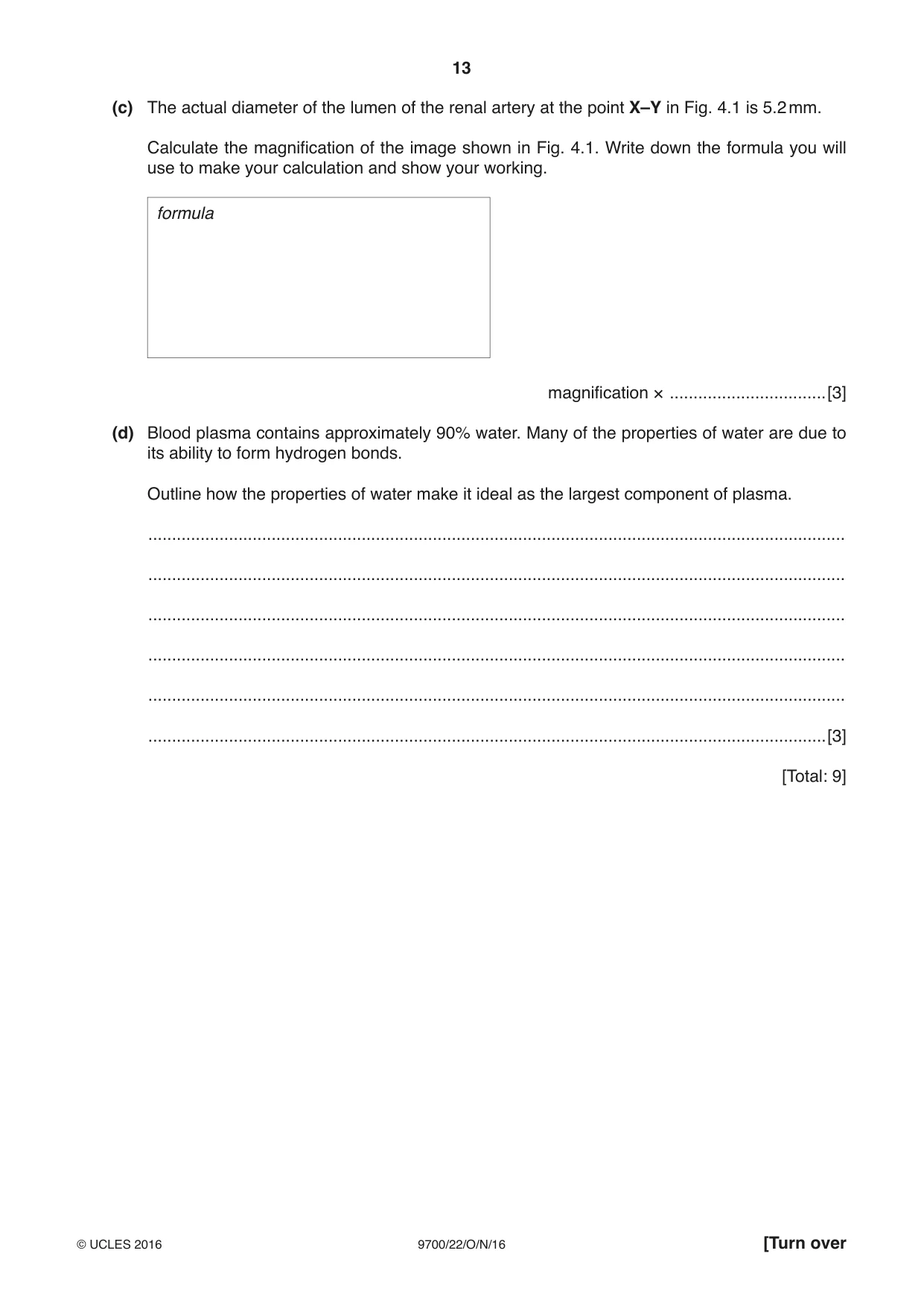
13 9700/22/O/N/16 © UCLES 2016 [Turn over (c) The actual diameter of the lumen of the renal artery at the point X–Y in Fig. 4.1 is 5.2 mm. Calculate the magnification of the image shown in Fig. 4.1. Write down the formula you will use to make your calculation and show your working. formula magnification × …[3] (d) Blood plasma contains approximately 90% water. Many of the properties of water are due to its ability to form hydrogen bonds. Outline how the properties of water make it ideal as the largest component of plasma. … … … … … …[3] [Total: 9]
Question paper, page 14
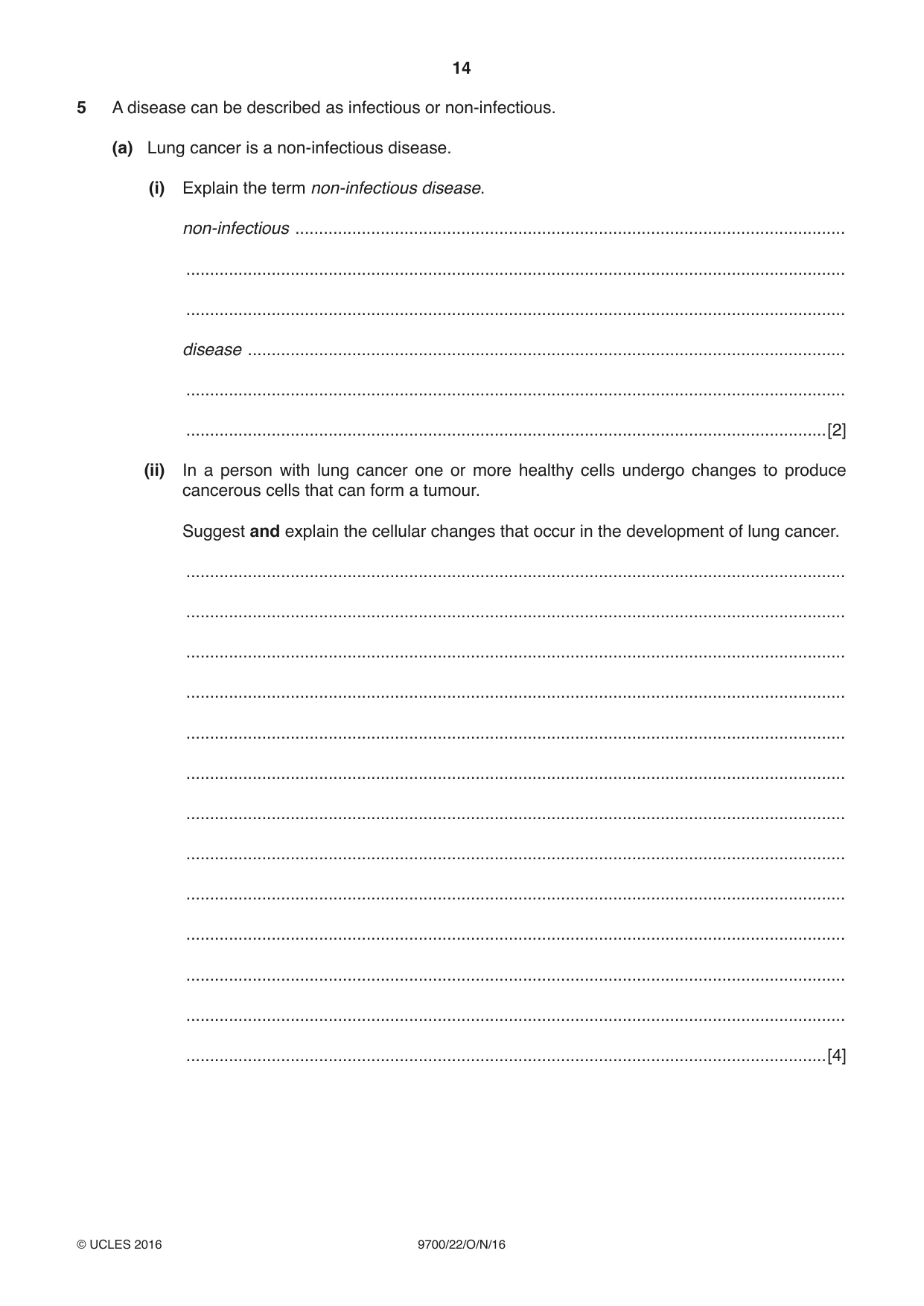
14 9700/22/O/N/16 © UCLES 2016 5 A disease can be described as infectious or non-infectious. (a) Lung cancer is a non-infectious disease. (i) Explain the term non-infectious disease. non-infectious … … … disease … … …[2] (ii) In a person with lung cancer one or more healthy cells undergo changes to produce cancerous cells that can form a tumour. Suggest and explain the cellular changes that occur in the development of lung cancer. … … … … … … … … … … … … …[4]
Question paper, page 15
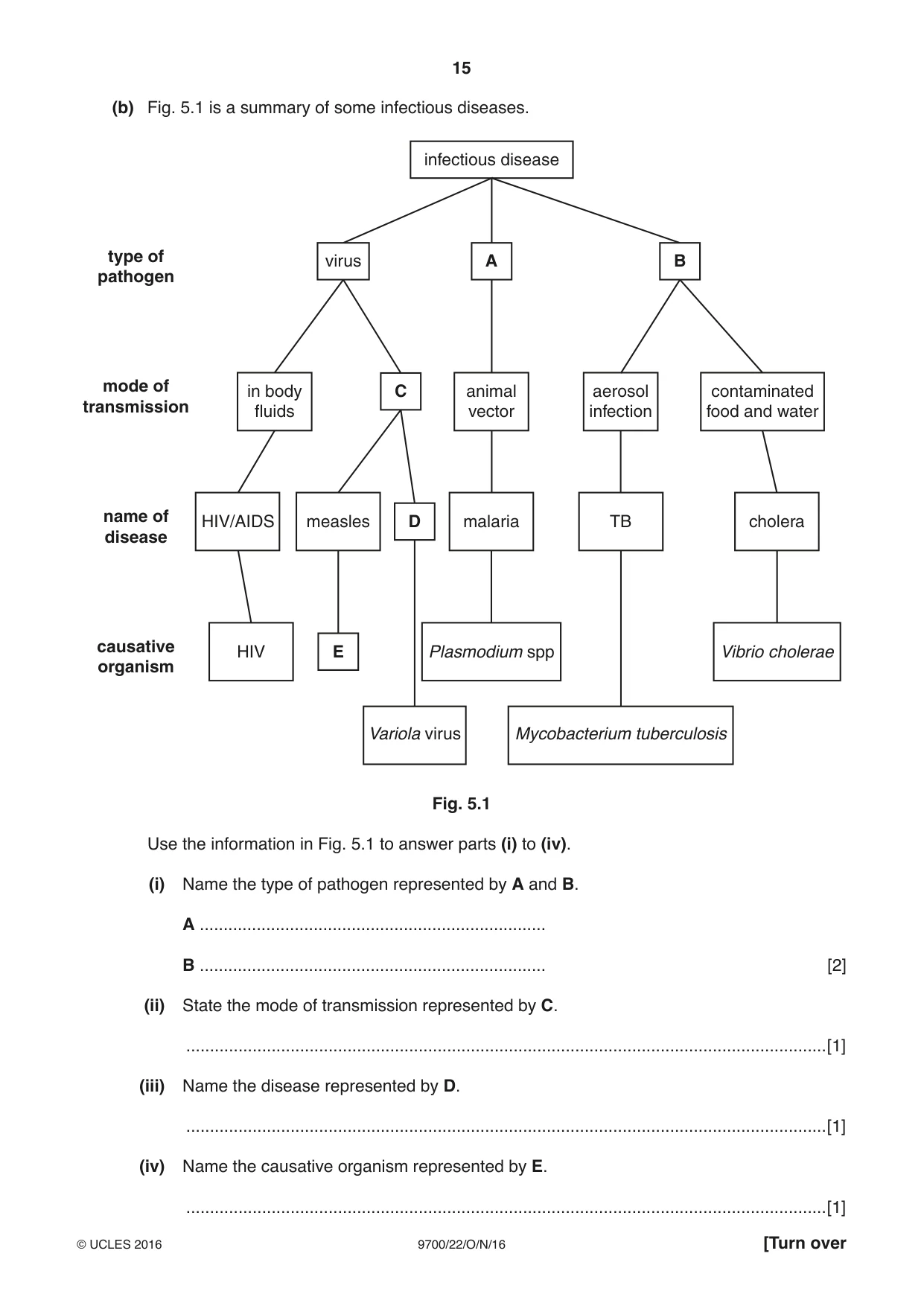
15 9700/22/O/N/16 © UCLES 2016 [Turn over (b) Fig. 5.1 is a summary of some infectious diseases. infectious disease A in body fluids animal vector contaminated food and water aerosol infection HIV/AIDS measles malaria D cholera TB HIV Plasmodium spp Variola virus Mycobacterium tuberculosis E Vibrio cholerae type of pathogen mode of transmission name of disease causative organism C B virus Fig. 5.1 Use the information in Fig. 5.1 to answer parts (i) to (iv). (i) Name the type of pathogen represented by A and B. A … B … [2] (ii) State the mode of transmission represented by C. …[1] (iii) Name the disease represented by D. …[1] (iv) Name the causative organism represented by E. …[1]
Question paper, page 16
16 9700/22/O/N/16 © UCLES 2016 (c) Explain how vaccination can control infectious diseases. … … … … … … …[3] [Total: 14]
Question paper, page 17
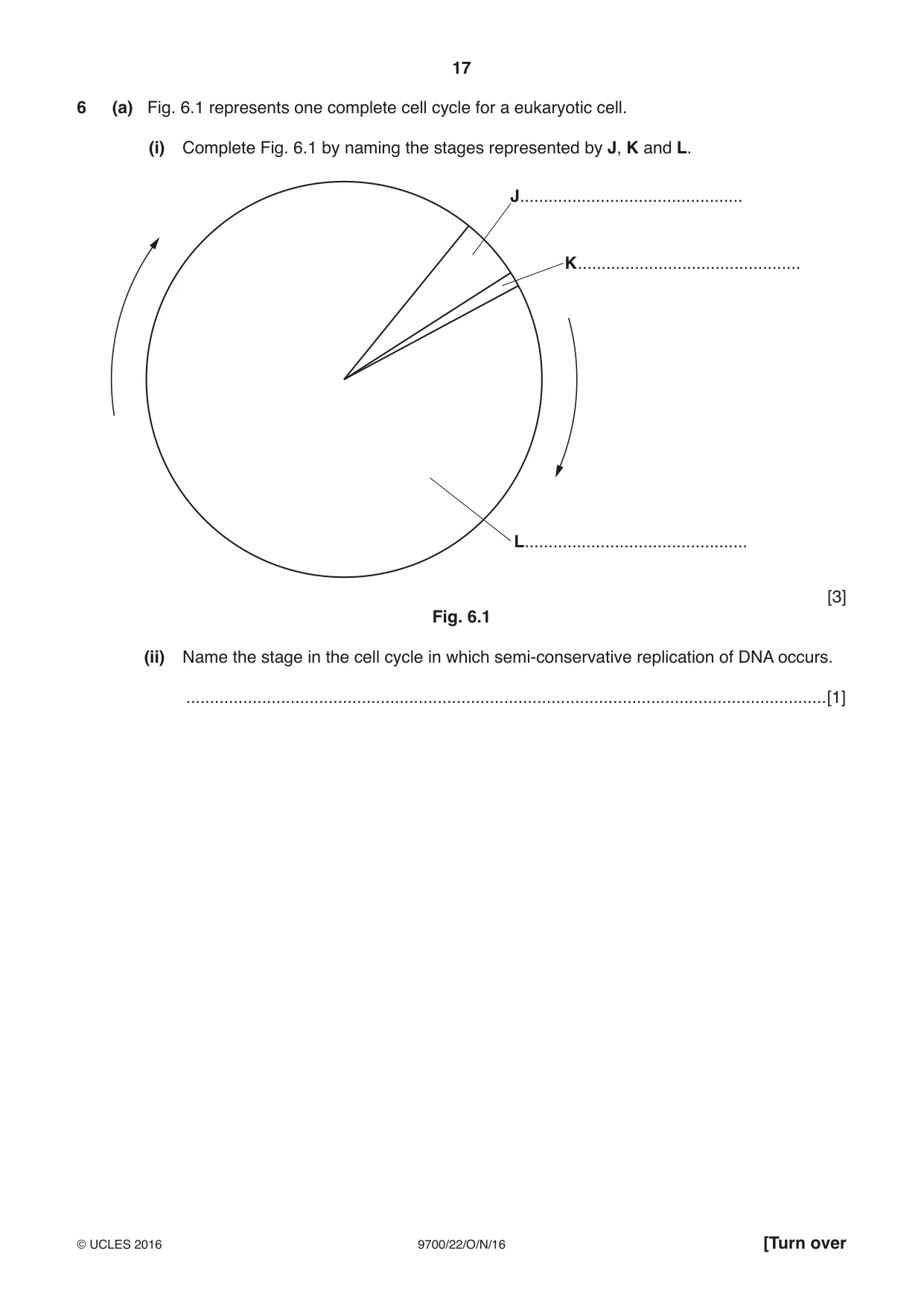
17 9700/22/O/N/16 © UCLES 2016 [Turn over 6 (a) Fig. 6.1 represents one complete cell cycle for a eukaryotic cell. (i) Complete Fig. 6.1 by naming the stages represented by J, K and L. J… K… L… [3] Fig. 6.1 (ii) Name the stage in the cell cycle in which semi-conservative replication of DNA occurs. …[1]
Question paper, page 18
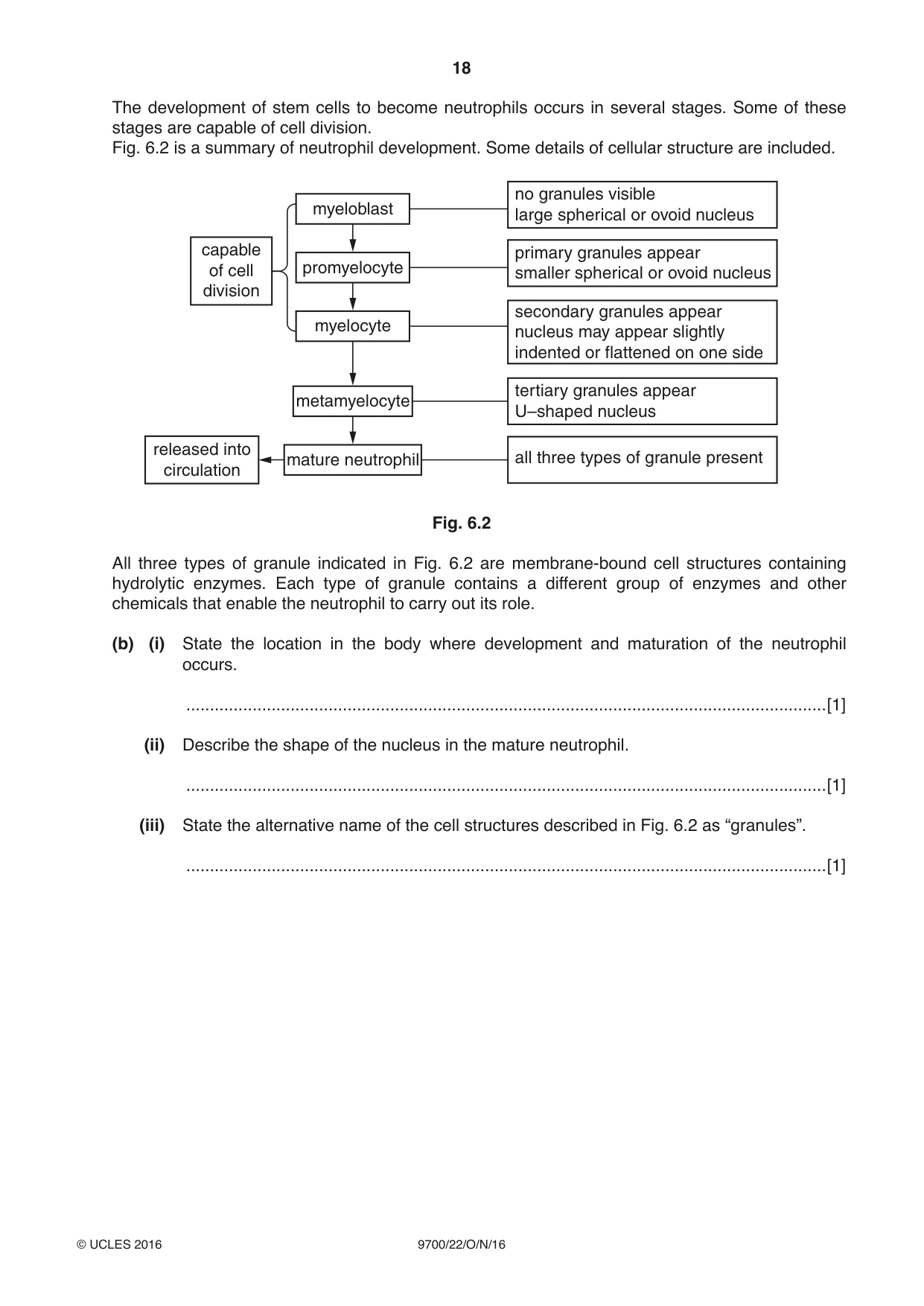
18 9700/22/O/N/16 © UCLES 2016 The development of stem cells to become neutrophils occurs in several stages. Some of these stages are capable of cell division. Fig. 6.2 is a summary of neutrophil development. Some details of cellular structure are included. myeloblast no granules visible large spherical or ovoid nucleus promyelocyte capable of cell division primary granules appear smaller spherical or ovoid nucleus myelocyte secondary granules appear nucleus may appear slightly indented or flattened on one side tertiary granules appear U–shaped nucleus all three types of granule present mature neutrophil released into circulation metamyelocyte Fig. 6.2 All three types of granule indicated in Fig. 6.2 are membrane-bound cell structures containing hydrolytic enzymes. Each type of granule contains a different group of enzymes and other chemicals that enable the neutrophil to carry out its role. (b) (i) State the location in the body where development and maturation of the neutrophil occurs. …[1] (ii) Describe the shape of the nucleus in the mature neutrophil. …[1] (iii) State the alternative name of the cell structures described in Fig. 6.2 as “granules”. …[1]
Question paper, page 19
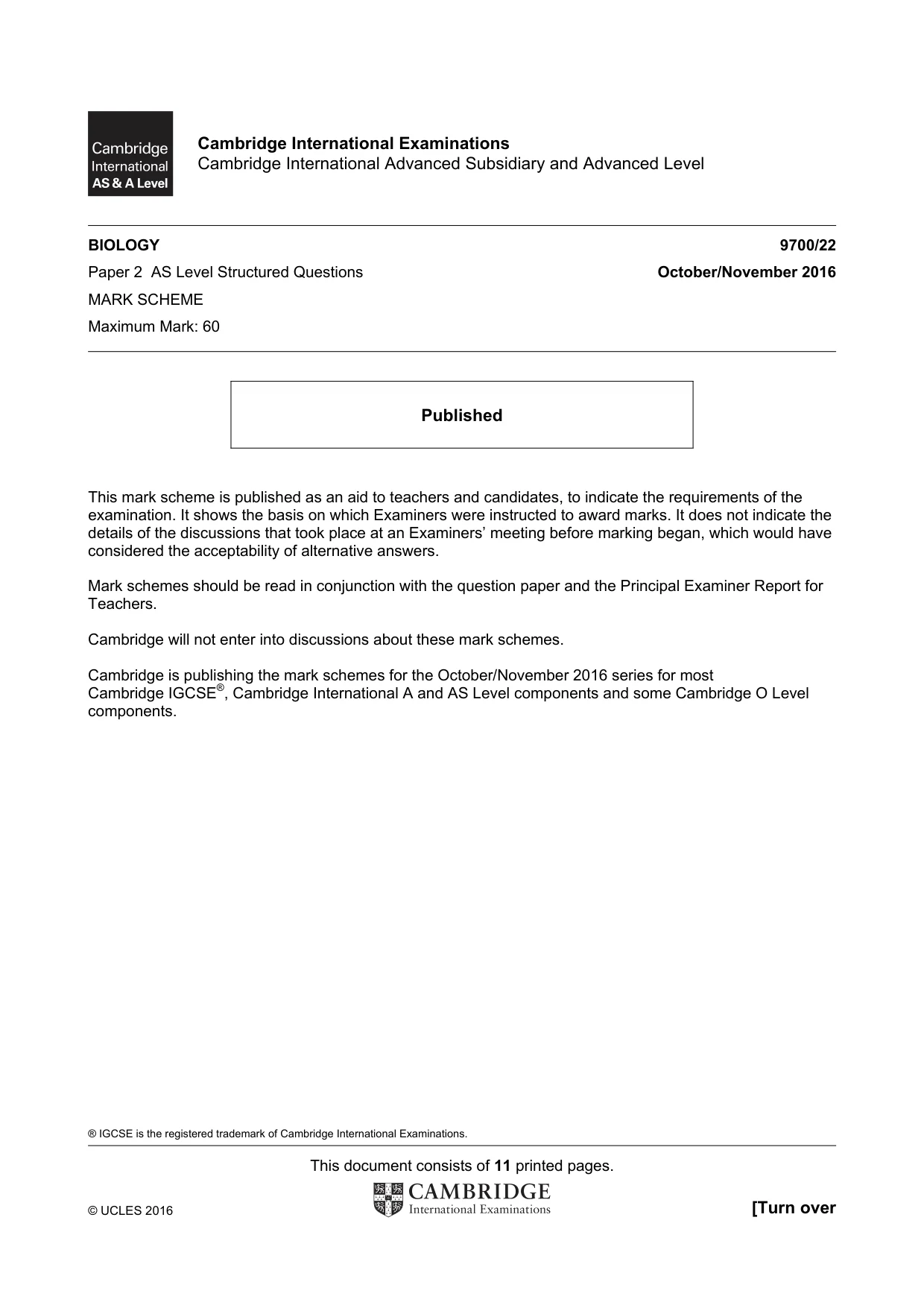
19 9700/22/O/N/16 © UCLES 2016 (c) (i) Primary granules contain proteins known as defensins. These bind to cell surface membranes of bacteria and form very small pores in the membrane. Suggest how defensins contribute to the role of the neutrophil in killing bacteria. … … … … …[2] (ii) Secondary granules contain lysozyme. This is an enzyme that breaks bonds in peptidoglycan molecules. Explain how the action of lysozyme will lead to the destruction of the bacterial cell. … … … … …[2] [Total: 11]
Question paper, page 20
20 9700/22/O/N/16 © UCLES 2016 BLANK PAGE Permission to reproduce items where third-party owned material protected by copyright is included has been sought and cleared where possible. Every reasonable effort has been made by the publisher (UCLES) to trace copyright holders, but if any items requiring clearance have unwittingly been included, the publisher will be pleased to make amends at the earliest possible opportunity. To avoid the issue of disclosure of answer-related information to candidates, all copyright acknowledgements are reproduced online in the Cambridge International Examinations Copyright Acknowledgements Booklet. This is produced for each series of examinations and is freely available to download at www.cie.org.uk after the live examination series. Cambridge International Examinations is part of the Cambridge Assessment Group. Cambridge Assessment is the brand name of University of Cambridge Local Examinations Syndicate (UCLES), which is itself a department of the University of Cambridge.
Mark scheme, page 1
® IGCSE is the registered trademark of Cambridge International Examinations. This document consists of 11 printed pages. © UCLES 2016 [Turn over Cambridge International Examinations Cambridge International Advanced Subsidiary and Advanced Level BIOLOGY 9700/22 Paper 2 AS Level Structured Questions October/November 2016 MARK SCHEME Maximum Mark: 60 Published This mark scheme is published as an aid to teachers and candidates, to indicate the requirements of the examination. It shows the basis on which Examiners were instructed to award marks. It does not indicate the details of the discussions that took place at an Examiners’ meeting before marking began, which would have considered the acceptability of alternative answers. Mark schemes should be read in conjunction with the question paper and the Principal Examiner Report for Teachers. Cambridge will not enter into discussions about these mark schemes. Cambridge is publishing the mark schemes for the October/November 2016 series for most Cambridge IGCSE®, Cambridge International A and AS Level components and some Cambridge O Level components.
Mark scheme, page 2
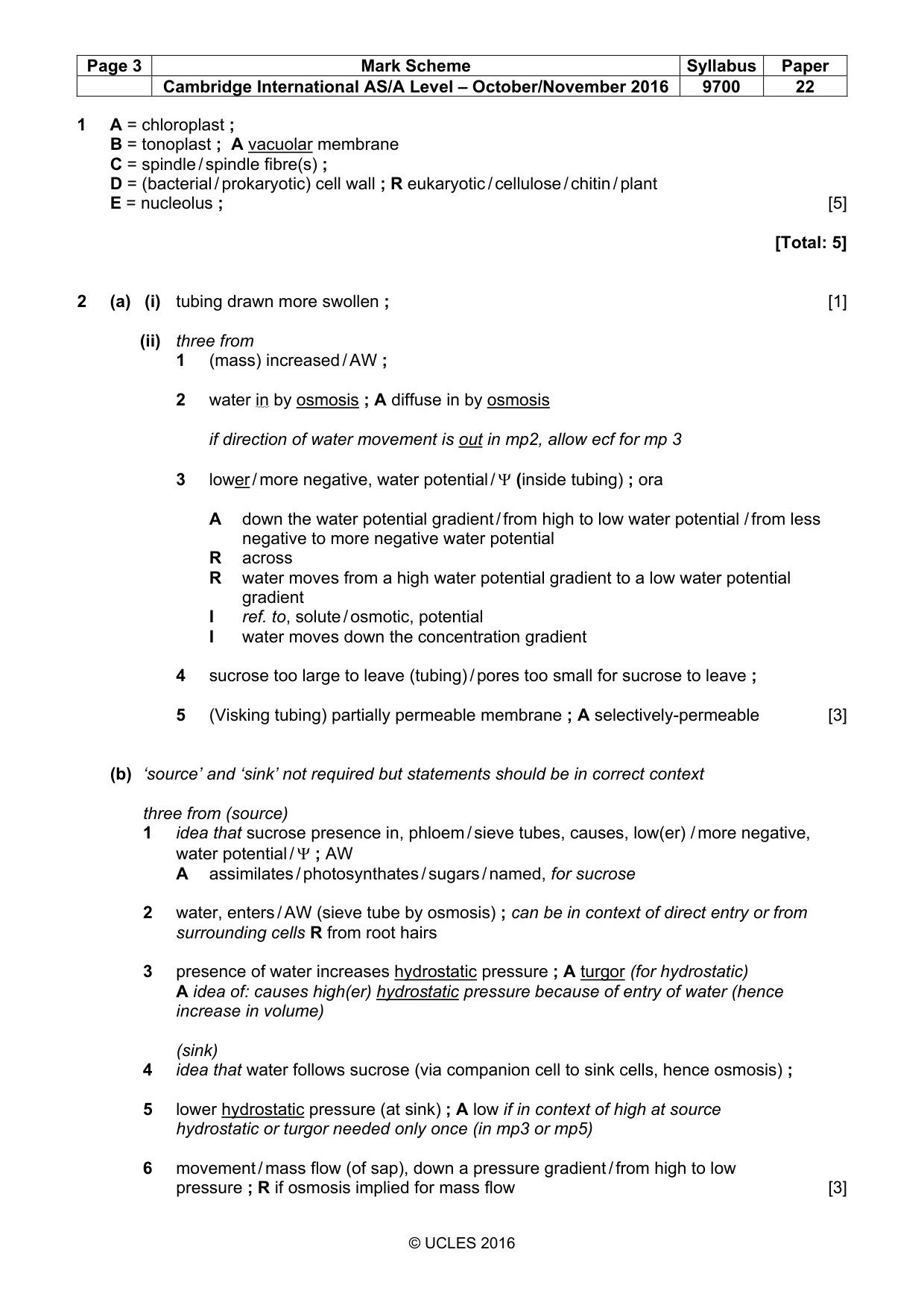
Page 2 Mark Scheme Syllabus Paper Cambridge International AS/A Level – October/November 2016 9700 22 © UCLES 2016 Mark scheme abbreviations: ; separates marking points / alternative answers for the same point R reject A accept (for answers correctly cued by the question or by extra guidance) AW alternative wording (where responses vary more than usual) underline actual word given must be used by candidate (grammatical variants accepted) max indicates the maximum number of marks that can be given ora or reverse argument mp marking point (with relevant number) ecf error carried forward I ignore AVP alternative valid point (examples given as guidance)
Mark scheme, page 3
Page 3 Mark Scheme Syllabus Paper Cambridge International AS/A Level – October/November 2016 9700 22 © UCLES 2016 1 A = chloroplast ; B = tonoplast ; A vacuolar membrane C = spindle / spindle fibre(s) ; D = (bacterial / prokaryotic) cell wall ; R eukaryotic / cellulose / chitin / plant E = nucleolus ; [5] [Total: 5] 2 (a) (i) tubing drawn more swollen ; [1] (ii) three from 1 (mass) increased / AW ; 2 water in by osmosis ; A diffuse in by osmosis if direction of water movement is out in mp2, allow ecf for mp 3 3 lower / more negative, water potential / Ψ (inside tubing) ; ora A down the water potential gradient / from high to low water potential / from less negative to more negative water potential R across R water moves from a high water potential gradient to a low water potential gradient I ref. to, solute / osmotic, potential I water moves down the concentration gradient 4 sucrose too large to leave (tubing) / pores too small for sucrose to leave ; 5 (Visking tubing) partially permeable membrane ; A selectively-permeable [3] (b) ‘source’ and ‘sink’ not required but statements should be in correct context three from (source) 1 idea that sucrose presence in, phloem / sieve tubes, causes, low(er) / more negative, water potential / Ψ ; AW A assimilates / photosynthates / sugars / named, for sucrose 2 water, enters / AW (sieve tube by osmosis) ; can be in context of direct entry or from surrounding cells R from root hairs 3 presence of water increases hydrostatic pressure ; A turgor (for hydrostatic) A idea of: causes high(er) hydrostatic pressure because of entry of water (hence increase in volume) (sink) 4 idea that water follows sucrose (via companion cell to sink cells, hence osmosis) ; 5 lower hydrostatic pressure (at sink) ; A low if in context of high at source hydrostatic or turgor needed only once (in mp3 or mp5) 6 movement / mass flow (of sap), down a pressure gradient / from high to low pressure ; R if osmosis implied for mass flow [3]
Mark scheme, page 4
Page 4 Mark Scheme Syllabus Paper Cambridge International AS/A Level – October/November 2016 9700 22 © UCLES 2016 (c) can gain 2 marks if printed diagram is clearly modified to show correct bond and formation of water or/and if described as text dotted line area is minimum to gain mark ‘peptide bond’ label not required to gain mark bond forms between the C of the carboxyl group and the N of the amino group ; A amine for amino water / H2O, is formed ; A condensation (reaction) R hydrolysis [2] [Total: 9] 3 (a) two from fructose sucrose no glycosidic bond ; (v glycosidic bond) look for ora monosaccharide / one sugar unit v disaccharide / two sugar units / A monomer (‘sugar’, is in question) fructose and glucose ; A two monomers / dimer I polysaccharide R if a disaccharides is stated as one of the two monomers A sucrose is a disaccharide made from the monosaccharides glucose and fructose one ring (structure) v two rings ; A sketch to show one ring v two rings C6H12O6 v C12H22O11 ; A fewer / less, C and H and O atoms ora additional points accepted powder v crystalline linear or ring structure v two rings / only ring(s) reducing, end / AW v (no reducing ends) I reducing sugar I non-reducing sugar [2] line drawn between C and N ; + H2O ;
Mark scheme, page 5
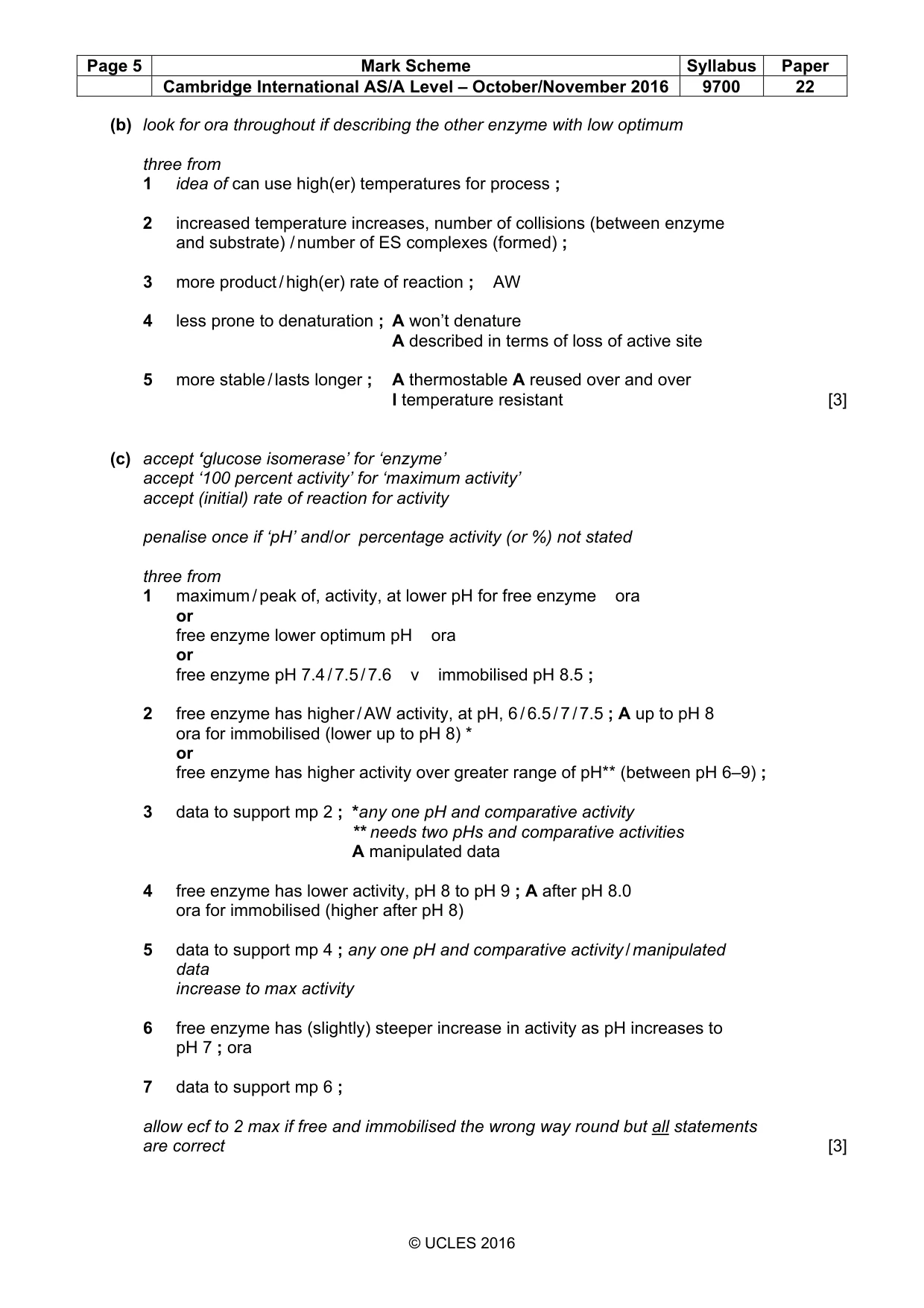
Page 5 Mark Scheme Syllabus Paper Cambridge International AS/A Level – October/November 2016 9700 22 © UCLES 2016 (b) look for ora throughout if describing the other enzyme with low optimum three from 1 idea of can use high(er) temperatures for process ; 2 increased temperature increases, number of collisions (between enzyme and substrate) / number of ES complexes (formed) ; 3 more product / high(er) rate of reaction ; AW 4 less prone to denaturation ; A won’t denature A described in terms of loss of active site 5 more stable / lasts longer ; A thermostable A reused over and over I temperature resistant [3] (c) accept ‘glucose isomerase’ for ‘enzyme’ accept ‘100 percent activity’ for ‘maximum activity’ accept (initial) rate of reaction for activity penalise once if ‘pH’ and/or percentage activity (or %) not stated three from 1 maximum / peak of, activity, at lower pH for free enzyme ora or free enzyme lower optimum pH ora or free enzyme pH 7.4 / 7.5 / 7.6 v immobilised pH 8.5 ; 2 free enzyme has higher / AW activity, at pH, 6 / 6.5 / 7 / 7.5 ; A up to pH 8 ora for immobilised (lower up to pH 8) * or free enzyme has higher activity over greater range of pH** (between pH 6–9) ; 3 data to support mp 2 ; *any one pH and comparative activity ** needs two pHs and comparative activities A manipulated data 4 free enzyme has lower activity, pH 8 to pH 9 ; A after pH 8.0 ora for immobilised (higher after pH 8) 5 data to support mp 4 ; any one pH and comparative activity / manipulated data increase to max activity 6 free enzyme has (slightly) steeper increase in activity as pH increases to pH 7 ; ora 7 data to support mp 6 ; allow ecf to 2 max if free and immobilised the wrong way round but all statements are correct [3]
Mark scheme, page 6
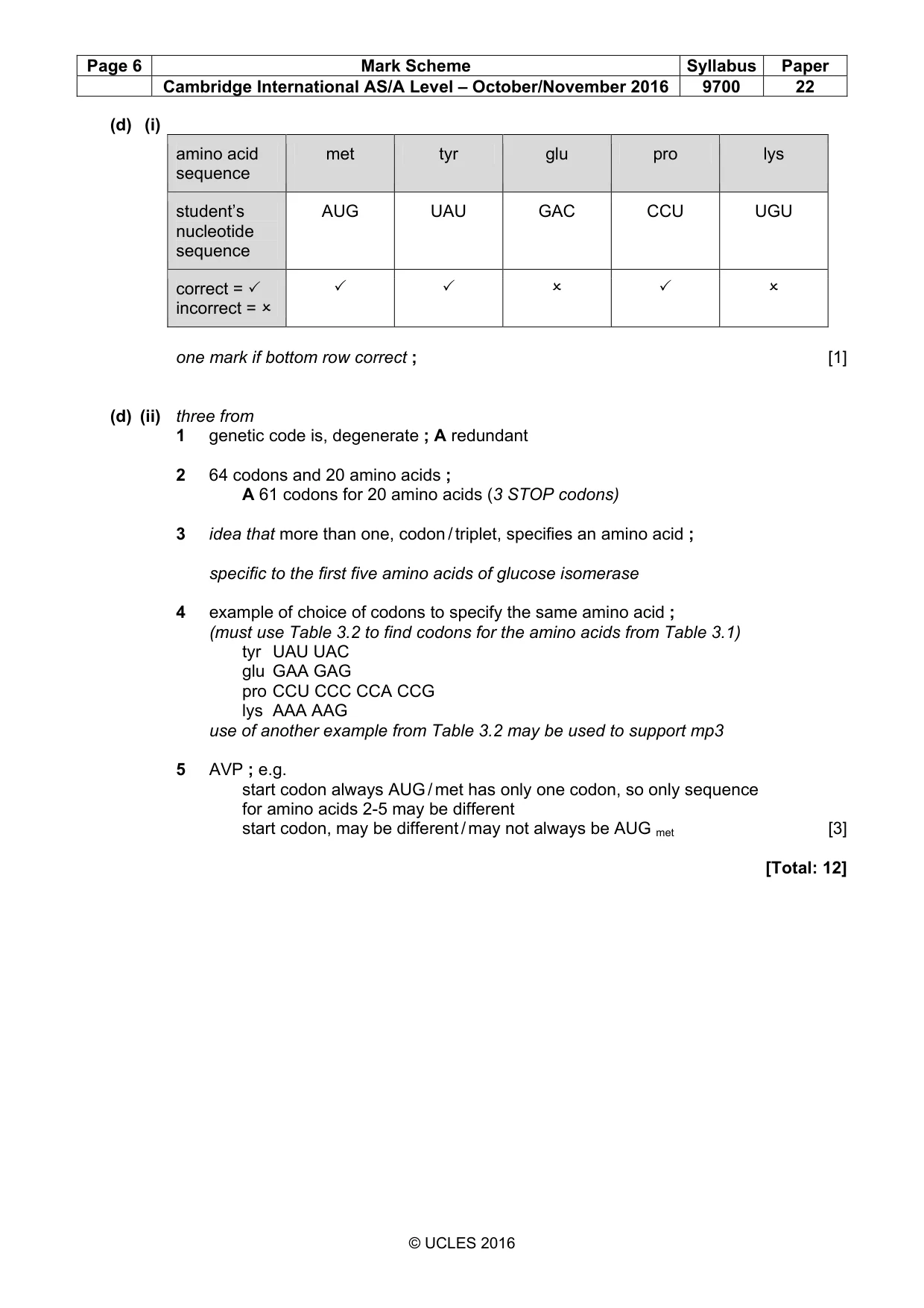
Page 6 Mark Scheme Syllabus Paper Cambridge International AS/A Level – October/November 2016 9700 22 © UCLES 2016 (d) (i) amino acid sequence met tyr glu pro lys student’s nucleotide sequence AUG UAU GAC CCU UGU correct = 3 incorrect = 2 3 3 2 3 2 one mark if bottom row correct ; [1] (d) (ii) three from 1 genetic code is, degenerate ; A redundant 2 64 codons and 20 amino acids ; A 61 codons for 20 amino acids (3 STOP codons) 3 idea that more than one, codon / triplet, specifies an amino acid ; specific to the first five amino acids of glucose isomerase 4 example of choice of codons to specify the same amino acid ; (must use Table 3.2 to find codons for the amino acids from Table 3.1) tyr UAU UAC glu GAA GAG pro CCU CCC CCA CCG lys AAA AAG use of another example from Table 3.2 may be used to support mp3 5 AVP ; e.g. start codon always AUG / met has only one codon, so only sequence for amino acids 2-5 may be different start codon, may be different / may not always be AUG met [3] [Total: 12]
Mark scheme, page 7
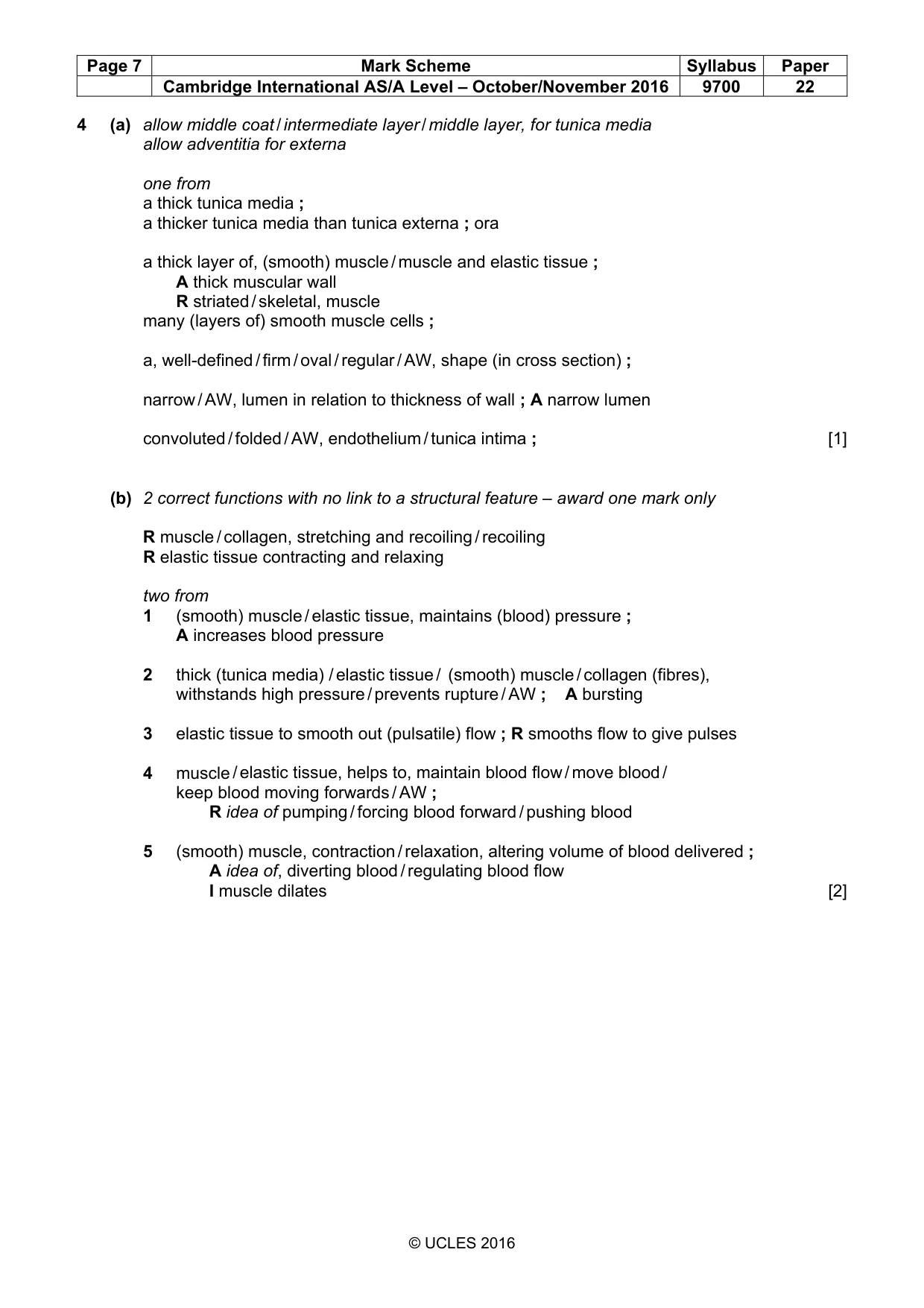
Page 7 Mark Scheme Syllabus Paper Cambridge International AS/A Level – October/November 2016 9700 22 © UCLES 2016 4 (a) allow middle coat / intermediate layer / middle layer, for tunica media allow adventitia for externa one from a thick tunica media ; a thicker tunica media than tunica externa ; ora a thick layer of, (smooth) muscle / muscle and elastic tissue ; A thick muscular wall R striated / skeletal, muscle many (layers of) smooth muscle cells ; a, well-defined / firm / oval / regular / AW, shape (in cross section) ; narrow / AW, lumen in relation to thickness of wall ; A narrow lumen convoluted / folded / AW, endothelium / tunica intima ; [1] (b) 2 correct functions with no link to a structural feature – award one mark only R muscle / collagen, stretching and recoiling / recoiling R elastic tissue contracting and relaxing two from 1 (smooth) muscle / elastic tissue, maintains (blood) pressure ; A increases blood pressure 2 thick (tunica media) / elastic tissue / (smooth) muscle / collagen (fibres), withstands high pressure / prevents rupture / AW ; A bursting 3 elastic tissue to smooth out (pulsatile) flow ; R smooths flow to give pulses 4 muscle / elastic tissue, helps to, maintain blood flow / move blood / keep blood moving forwards / AW ; R idea of pumping / forcing blood forward / pushing blood 5 (smooth) muscle, contraction / relaxation, altering volume of blood delivered ; A idea of, diverting blood / regulating blood flow I muscle dilates [2]
Mark scheme, page 8
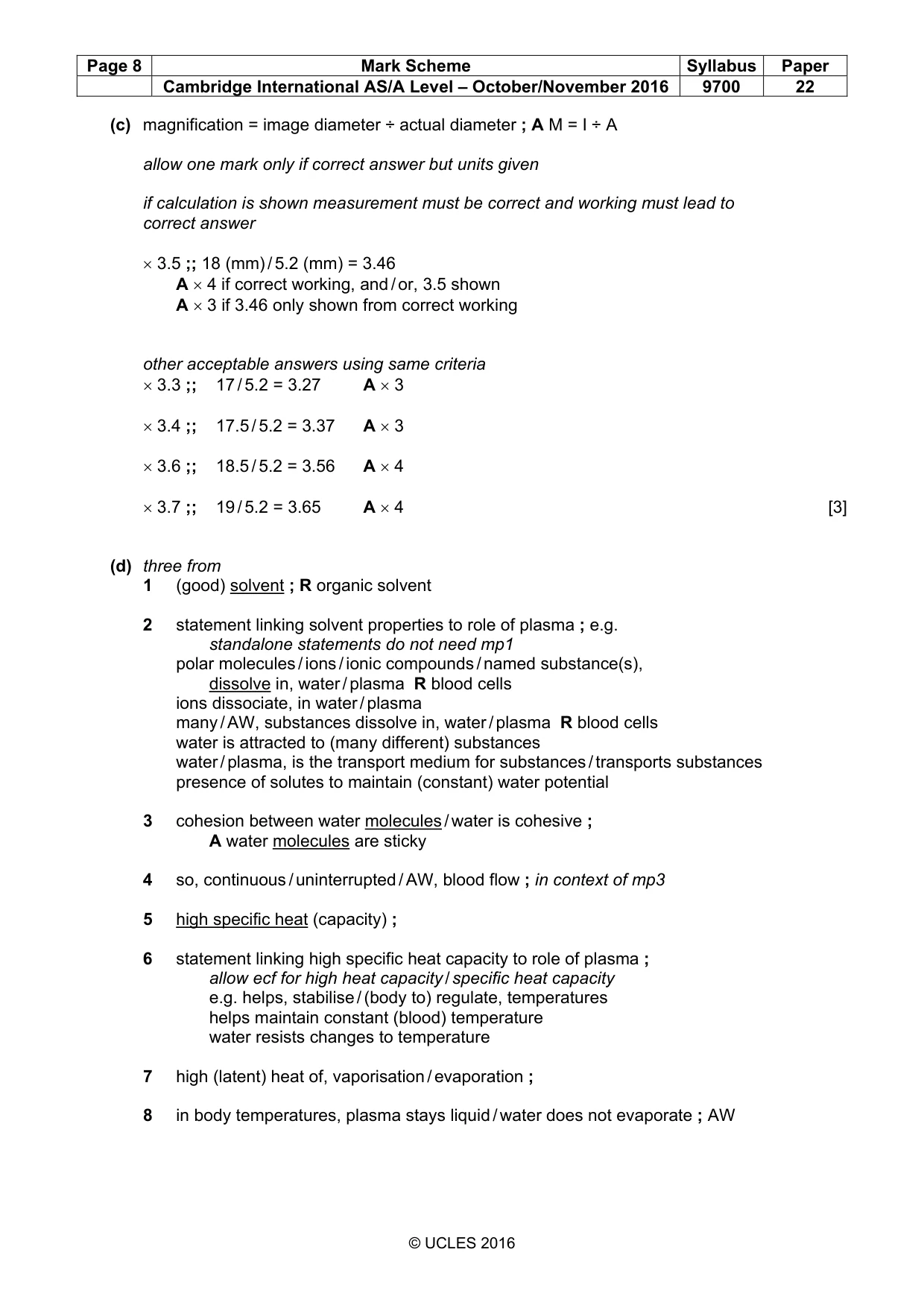
Page 8 Mark Scheme Syllabus Paper Cambridge International AS/A Level – October/November 2016 9700 22 © UCLES 2016 (c) magnification = image diameter ÷ actual diameter ; A M = I ÷ A allow one mark only if correct answer but units given if calculation is shown measurement must be correct and working must lead to correct answer × 3.5 ;; 18 (mm) / 5.2 (mm) = 3.46 A × 4 if correct working, and / or, 3.5 shown A × 3 if 3.46 only shown from correct working other acceptable answers using same criteria × 3.3 ;; 17 / 5.2 = 3.27 A × 3 × 3.4 ;; 17.5 / 5.2 = 3.37 A × 3 × 3.6 ;; 18.5 / 5.2 = 3.56 A × 4 × 3.7 ;; 19 / 5.2 = 3.65 A × 4 [3] (d) three from 1 (good) solvent ; R organic solvent 2 statement linking solvent properties to role of plasma ; e.g. standalone statements do not need mp1 polar molecules / ions / ionic compounds / named substance(s), dissolve in, water / plasma R blood cells ions dissociate, in water / plasma many / AW, substances dissolve in, water / plasma R blood cells water is attracted to (many different) substances water / plasma, is the transport medium for substances / transports substances presence of solutes to maintain (constant) water potential 3 cohesion between water molecules / water is cohesive ; A water molecules are sticky 4 so, continuous / uninterrupted / AW, blood flow ; in context of mp3 5 high specific heat (capacity) ; 6 statement linking high specific heat capacity to role of plasma ; allow ecf for high heat capacity / specific heat capacity e.g. helps, stabilise / (body to) regulate, temperatures helps maintain constant (blood) temperature water resists changes to temperature 7 high (latent) heat of, vaporisation / evaporation ; 8 in body temperatures, plasma stays liquid / water does not evaporate ; AW
Mark scheme, page 9
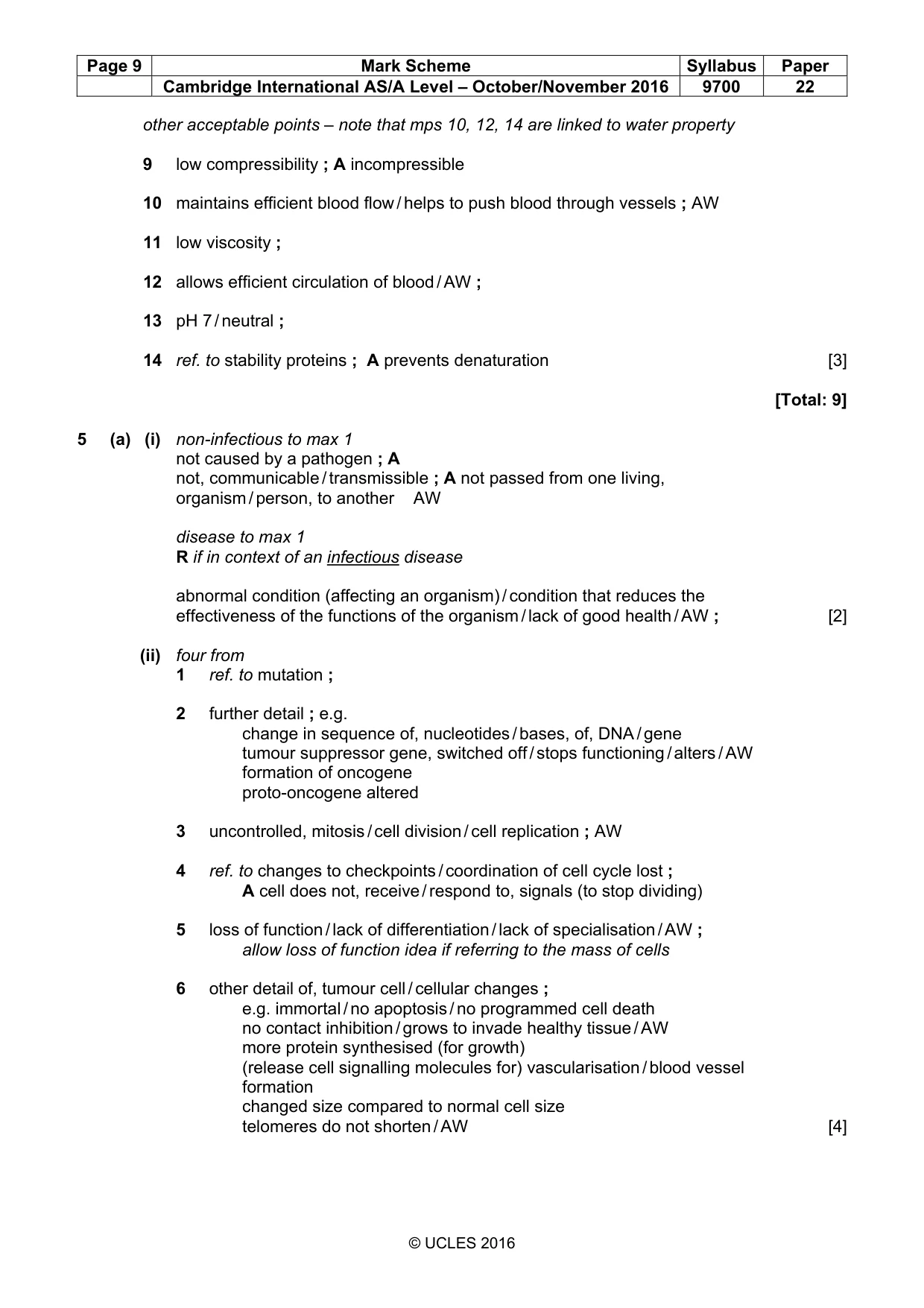
Page 9 Mark Scheme Syllabus Paper Cambridge International AS/A Level – October/November 2016 9700 22 © UCLES 2016 other acceptable points – note that mps 10, 12, 14 are linked to water property 9 low compressibility ; A incompressible 10 maintains efficient blood flow / helps to push blood through vessels ; AW 11 low viscosity ; 12 allows efficient circulation of blood / AW ; 13 pH 7 / neutral ; 14 ref. to stability proteins ; A prevents denaturation [3] [Total: 9] 5 (a) (i) non-infectious to max 1 not caused by a pathogen ; A not, communicable / transmissible ; A not passed from one living, organism / person, to another AW disease to max 1 R if in context of an infectious disease abnormal condition (affecting an organism) / condition that reduces the effectiveness of the functions of the organism / lack of good health / AW ; [2] (ii) four from 1 ref. to mutation ; 2 further detail ; e.g. change in sequence of, nucleotides / bases, of, DNA / gene tumour suppressor gene, switched off / stops functioning / alters / AW formation of oncogene proto-oncogene altered 3 uncontrolled, mitosis / cell division / cell replication ; AW 4 ref. to changes to checkpoints / coordination of cell cycle lost ; A cell does not, receive / respond to, signals (to stop dividing) 5 loss of function / lack of differentiation / lack of specialisation / AW ; allow loss of function idea if referring to the mass of cells 6 other detail of, tumour cell / cellular changes ; e.g. immortal / no apoptosis / no programmed cell death no contact inhibition / grows to invade healthy tissue / AW more protein synthesised (for growth) (release cell signalling molecules for) vascularisation / blood vessel formation changed size compared to normal cell size telomeres do not shorten / AW [4]
Mark scheme, page 10
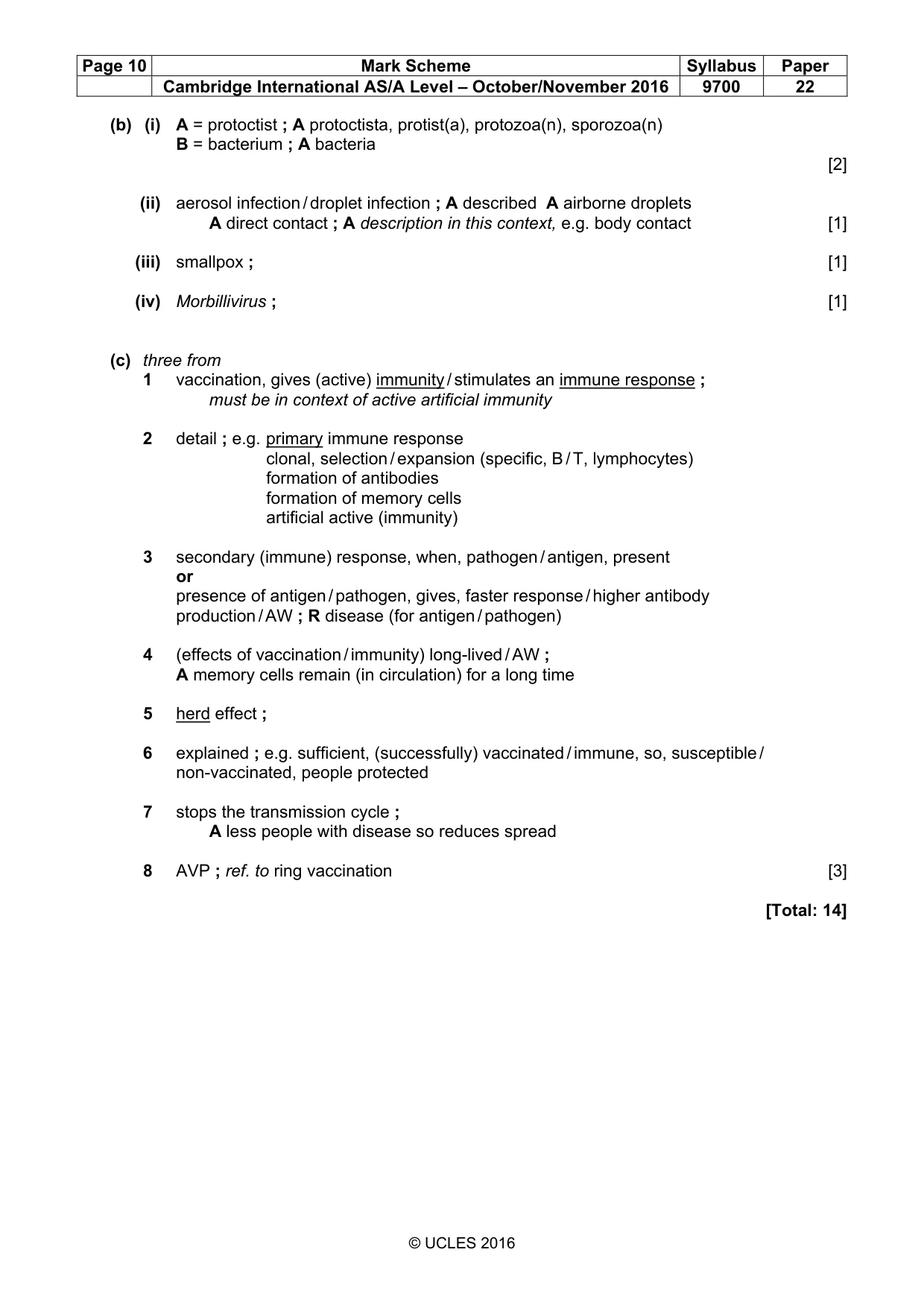
Page 10 Mark Scheme Syllabus Paper Cambridge International AS/A Level – October/November 2016 9700 22 © UCLES 2016 (b) (i) A = protoctist ; A protoctista, protist(a), protozoa(n), sporozoa(n) B = bacterium ; A bacteria [2] (ii) aerosol infection / droplet infection ; A described A airborne droplets A direct contact ; A description in this context, e.g. body contact [1] (iii) smallpox ; [1] (iv) Morbillivirus ; [1] (c) three from 1 vaccination, gives (active) immunity / stimulates an immune response ; must be in context of active artificial immunity 2 detail ; e.g. primary immune response clonal, selection / expansion (specific, B / T, lymphocytes) formation of antibodies formation of memory cells artificial active (immunity) 3 secondary (immune) response, when, pathogen / antigen, present or presence of antigen / pathogen, gives, faster response / higher antibody production / AW ; R disease (for antigen / pathogen) 4 (effects of vaccination / immunity) long-lived / AW ; A memory cells remain (in circulation) for a long time 5 herd effect ; 6 explained ; e.g. sufficient, (successfully) vaccinated / immune, so, susceptible / non-vaccinated, people protected 7 stops the transmission cycle ; A less people with disease so reduces spread 8 AVP ; ref. to ring vaccination [3] [Total: 14]
Mark scheme, page 11
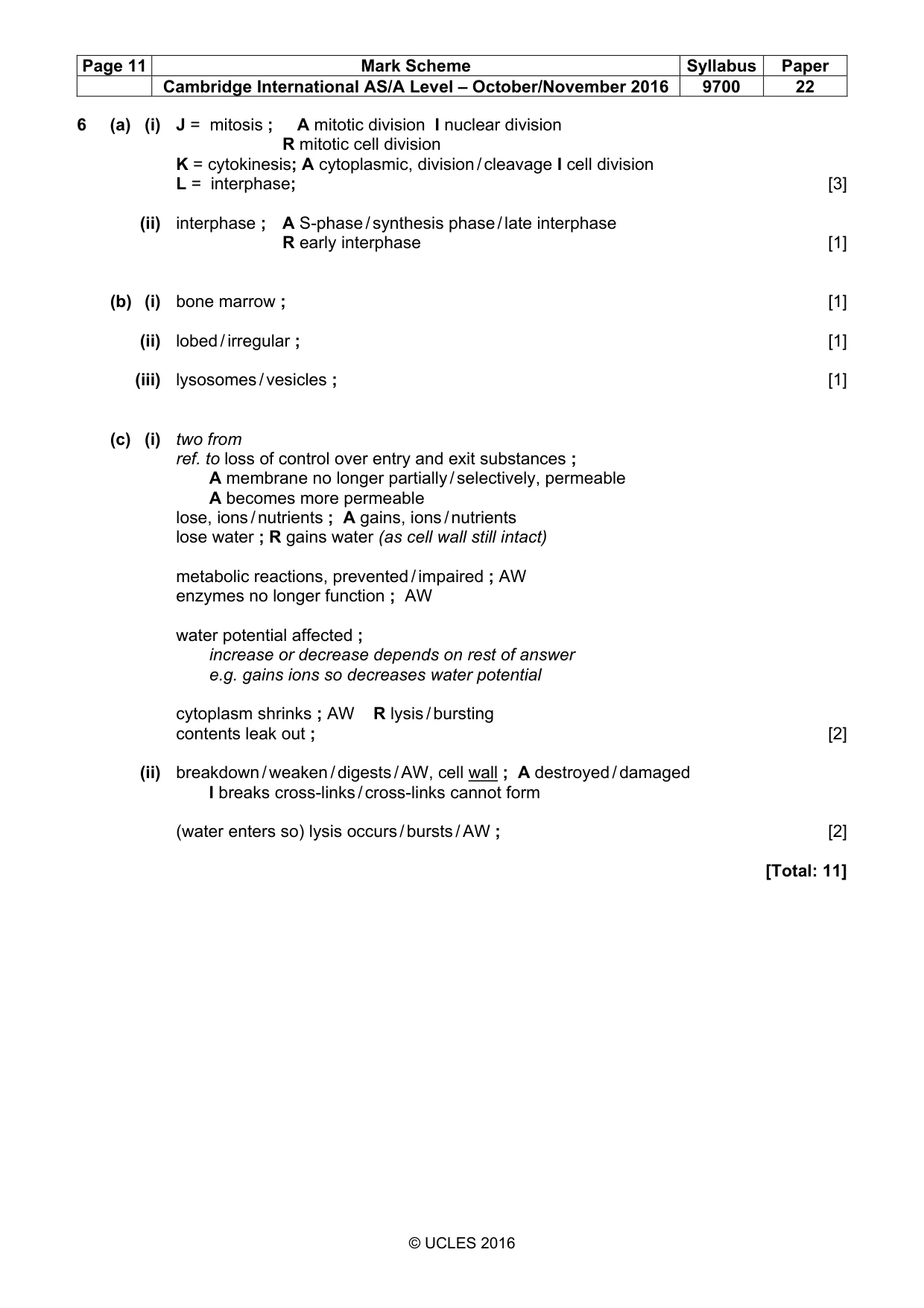
Page 11 Mark Scheme Syllabus Paper Cambridge International AS/A Level – October/November 2016 9700 22 © UCLES 2016 6 (a) (i) J = mitosis ; A mitotic division I nuclear division R mitotic cell division K = cytokinesis; A cytoplasmic, division / cleavage I cell division L = interphase; [3] (ii) interphase ; A S-phase / synthesis phase / late interphase R early interphase [1] (b) (i) bone marrow ; [1] (ii) lobed / irregular ; [1] (iii) lysosomes / vesicles ; [1] (c) (i) two from ref. to loss of control over entry and exit substances ; A membrane no longer partially / selectively, permeable A becomes more permeable lose, ions / nutrients ; A gains, ions / nutrients lose water ; R gains water (as cell wall still intact) metabolic reactions, prevented / impaired ; AW enzymes no longer function ; AW water potential affected ; increase or decrease depends on rest of answer e.g. gains ions so decreases water potential cytoplasm shrinks ; AW R lysis / bursting contents leak out ; [2] (ii) breakdown / weaken / digests / AW, cell wall ; A destroyed / damaged I breaks cross-links / cross-links cannot form (water enters so) lysis occurs / bursts / AW ; [2] [Total: 11]
What you needed in this session
Cambridge’s own grade thresholds for 2016 Oct/Nov, Paper 2 · Variant 2. A higher threshold means an easier paper — the bar moves with how the cohort did.