Cambridge A Level Biology 9700 — 2016 Oct/Nov Paper 2 · Variant 1
9700/21/O/N/16 · 60 marks · ≈68 min
The question paper and its mark scheme, free to read here and free to download. This is Cambridge’s own paper, exactly as it was sat.
Question paper12 pages
Mark scheme8 pages
Answers below. Sit the paper first if you are practising.
Paper as text
Question paper, page 1
This document consists of 12 printed pages. DC (CW/FD) 109119/4 © UCLES 2016 [Turn over Cambridge International Examinations Cambridge International Advanced Subsidiary and Advanced Level * 2 2 4 9 6 5 4 0 8 9 * BIOLOGY 9700/21 Paper 2 AS Level Structured Questions October/November 2016 1 hour 15 minutes Candidates answer on the Question Paper. No Additional Materials are required. READ THESE INSTRUCTIONS FIRST Write your Centre number, candidate number and name on all the work you hand in. Write in dark blue or black pen. You may use an HB pencil for any diagrams or graphs. Do not use staples, paper clips, glue or correction fluid. DO NOT WRITE IN ANY BARCODES. Answer all questions. Electronic calculators may be used. You may lose marks if you do not show your working or if you do not use appropriate units. At the end of the examination, fasten all your work securely together. The number of marks is given in brackets [ ] at the end of each question or part question.
Question paper, page 2
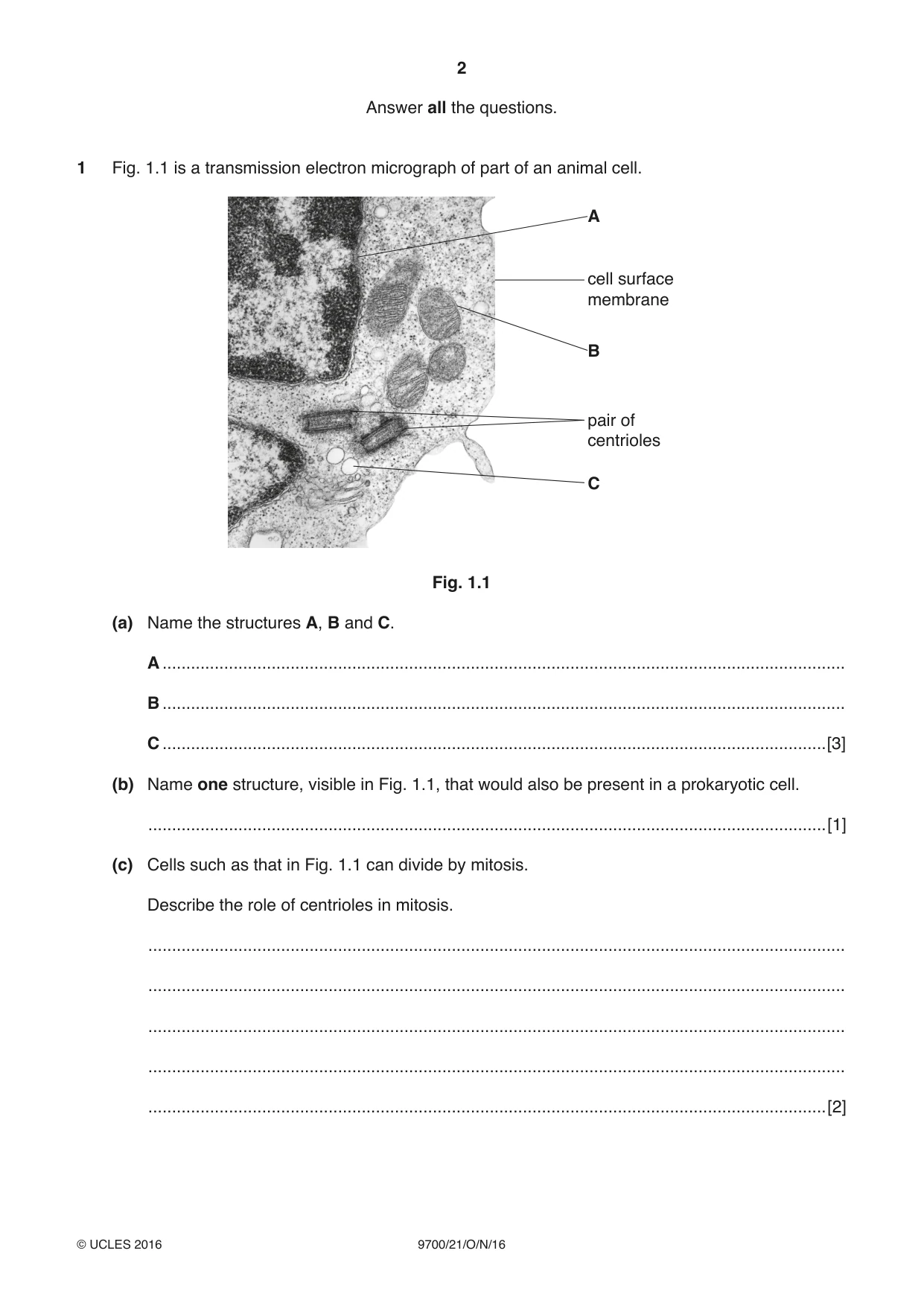
2 9700/21/O/N/16 © UCLES 2016 Answer all the questions. 1 Fig. 1.1 is a transmission electron micrograph of part of an animal cell. A B pair of centrioles C cell surface membrane Fig. 1.1 (a) Name the structures A, B and C. A … B … C …[3] (b) Name one structure, visible in Fig. 1.1, that would also be present in a prokaryotic cell. …[1] (c) Cells such as that in Fig. 1.1 can divide by mitosis. Describe the role of centrioles in mitosis. … … … … …[2]
Question paper, page 3
3 9700/21/O/N/16 © UCLES 2016 [Turn over (d) Sodium ions cross cell surface membranes using facilitated diffusion or active transport. Explain why sodium ions cross cell surface membranes by these mechanisms and not by simple diffusion. … … … … … … … … …[3] [Total: 9]
Question paper, page 4
4 9700/21/O/N/16 © UCLES 2016 2 (a) (i) Define transpiration. … … … …[1] (ii) State two environmental factors that affect the rate of transpiration. Explain how each factor affects the rate of transpiration. factor 1 … explanation … … … factor 2 … explanation … … …[4] (b) Explain how hydrogen bonding is involved in the movement of water through the xylem. … … … … … … … …[3] [Total: 8]
Question paper, page 5
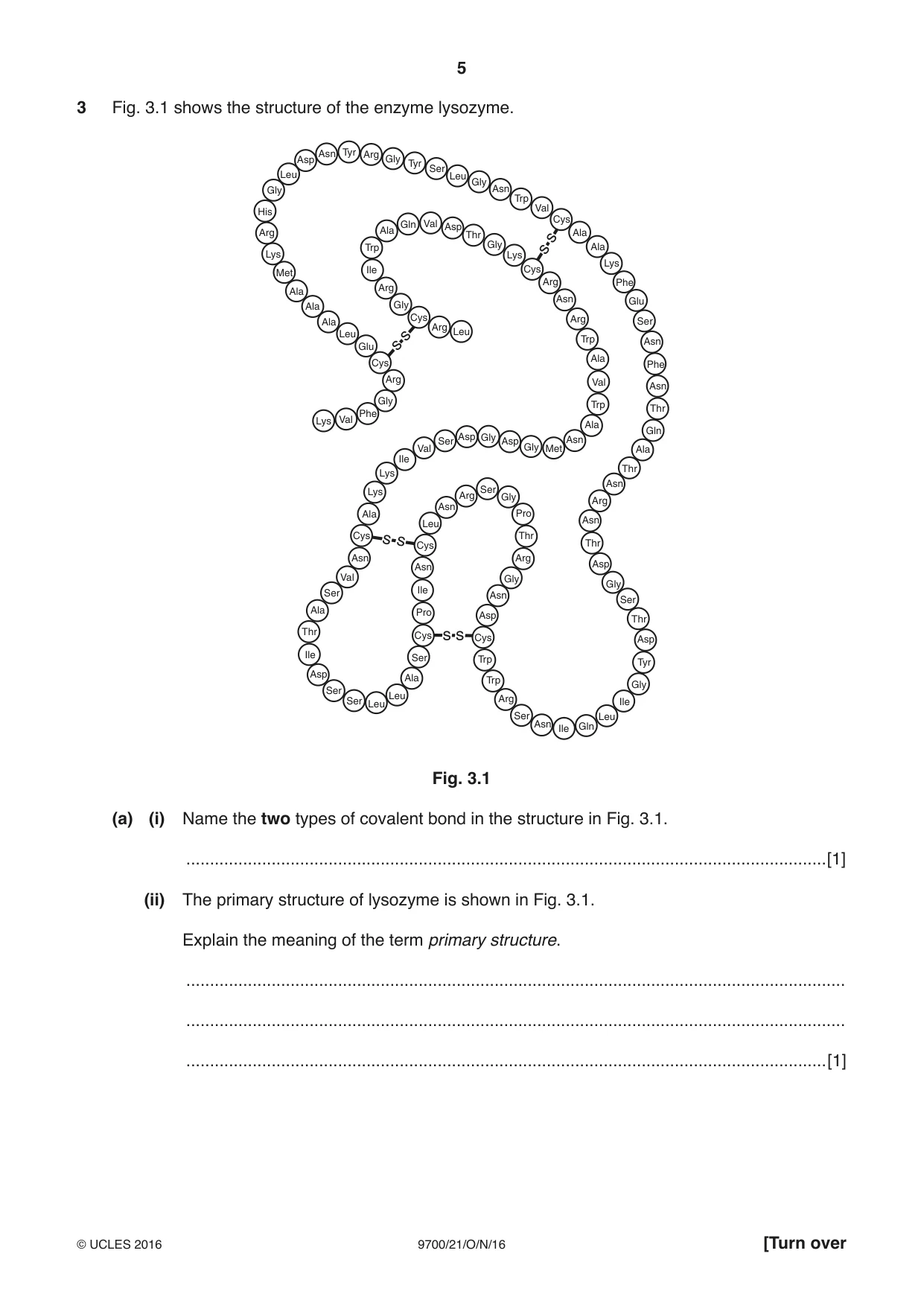
5 9700/21/O/N/16 © UCLES 2016 [Turn over 3 Fig. 3.1 shows the structure of the enzyme lysozyme. s s s s s s s s Lys Trp Trp Trp Val Gly Gly Gly Gly Gly Gly Gly Gly Gly Gly Gly Gly Arg Cys Glu Leu Ala Ala Ala Ala Ala Ala Gln Gln Ile Ile Ile Ile Pro Pro Ile Ile Gln Ala Ala Ala Ala Ala Ala Leu Asp Asn Tyr Tyr Ser Ser Ser Ser Ser Ser Ser Ser Ser Ser Tyr Asn Asn Asn Thr Thr Thr Thr Thr Thr Asn Asn Asn Asn Asn Asn Asn Asn Asn Asp Asp Thr Asp Asp Asp Asp Asp Leu Leu Leu Leu Leu Leu Glu Cys Cys Cys Cys Cys Cys Cys Arg His Arg Arg Arg Trp Trp Trp Arg Arg Arg Arg Arg Arg Phe Phe Phe Val Val Val Val Val Lys Met Met Lys Lys Lys Lys Fig. 3.1 (a) (i) Name the two types of covalent bond in the structure in Fig. 3.1. …[1] (ii) The primary structure of lysozyme is shown in Fig. 3.1. Explain the meaning of the term primary structure. … … …[1]
Question paper, page 6
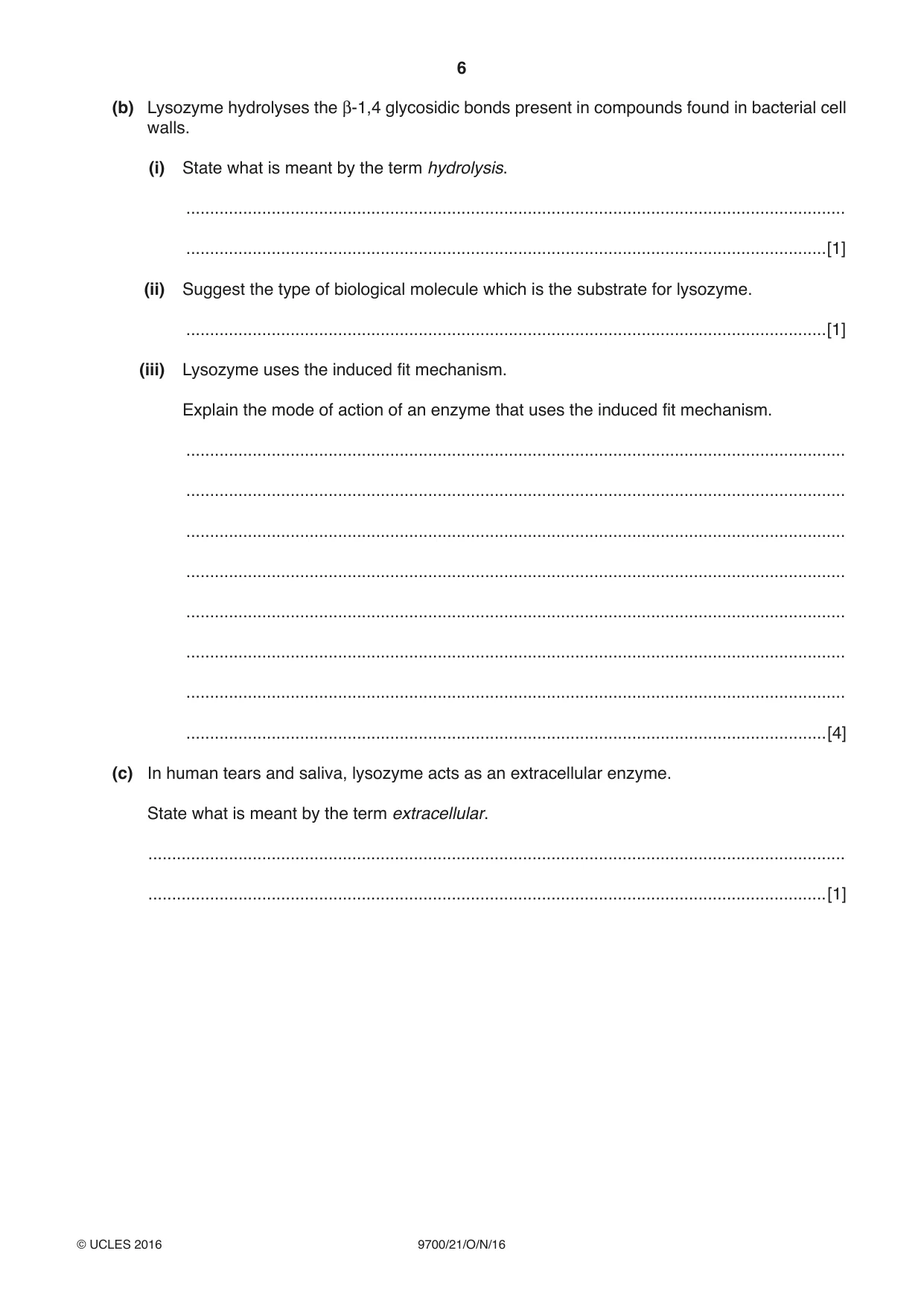
6 9700/21/O/N/16 © UCLES 2016 (b) Lysozyme hydrolyses the β-1,4 glycosidic bonds present in compounds found in bacterial cell walls. (i) State what is meant by the term hydrolysis. … …[1] (ii) Suggest the type of biological molecule which is the substrate for lysozyme. …[1] (iii) Lysozyme uses the induced fit mechanism. Explain the mode of action of an enzyme that uses the induced fit mechanism. … … … … … … … …[4] (c) In human tears and saliva, lysozyme acts as an extracellular enzyme. State what is meant by the term extracellular. … …[1]
Question paper, page 7
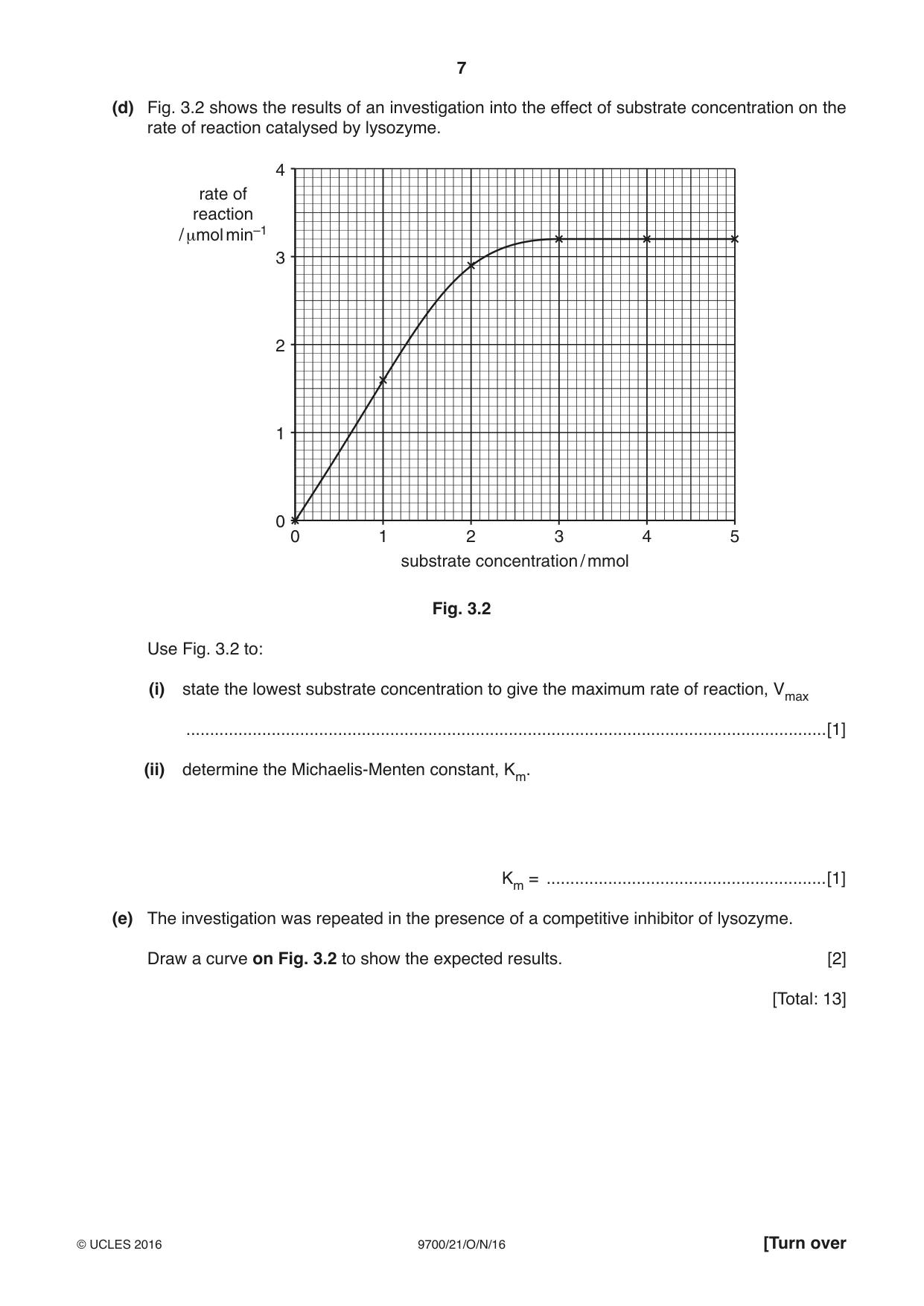
7 9700/21/O/N/16 © UCLES 2016 [Turn over (d) Fig. 3.2 shows the results of an investigation into the effect of substrate concentration on the rate of reaction catalysed by lysozyme. 0 0 1 2 3 4 1 2 substrate concentration / mmol rate of reaction / μmol min–1 3 4 5 Fig. 3.2 Use Fig. 3.2 to: (i) state the lowest substrate concentration to give the maximum rate of reaction, Vmax …[1] (ii) determine the Michaelis-Menten constant, Km. Km = …[1] (e) The investigation was repeated in the presence of a competitive inhibitor of lysozyme. Draw a curve on Fig. 3.2 to show the expected results. [2] [Total: 13]
Question paper, page 8
8 9700/21/O/N/16 © UCLES 2016 4 (a) (i) Name the bacterium that causes cholera. …[1] (ii) Describe how cholera is transmitted from an infected person to an uninfected person. … … … … … …[2] (iii) Suggest and explain why cholera outbreaks are common after natural disasters. … … … … … …[2] (b) The bacteria that cause cholera can become resistant to antibiotics by a substitution mutation. A substitution mutation occurs when one nucleotide in the DNA sequence is replaced by a different nucleotide. (i) Explain how a substitution mutation could result in a change in the amino acid sequence of a polypeptide. … … … … … …[2]
Question paper, page 9
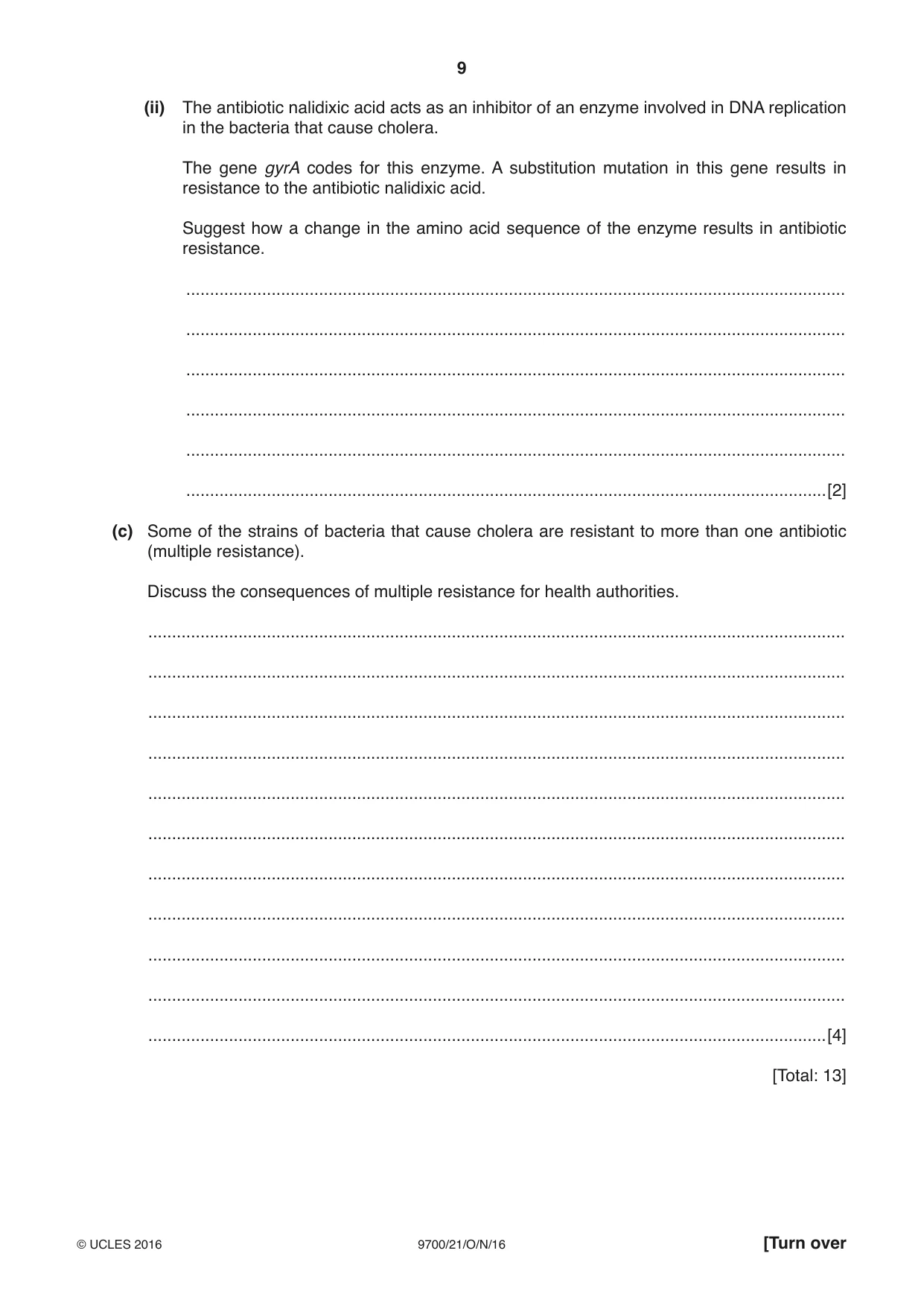
9 9700/21/O/N/16 © UCLES 2016 [Turn over (ii) The antibiotic nalidixic acid acts as an inhibitor of an enzyme involved in DNA replication in the bacteria that cause cholera. The gene gyrA codes for this enzyme. A substitution mutation in this gene results in resistance to the antibiotic nalidixic acid. Suggest how a change in the amino acid sequence of the enzyme results in antibiotic resistance. … … … … … …[2] (c) Some of the strains of bacteria that cause cholera are resistant to more than one antibiotic (multiple resistance). Discuss the consequences of multiple resistance for health authorities. … … … … … … … … … … …[4] [Total: 13]
Question paper, page 10
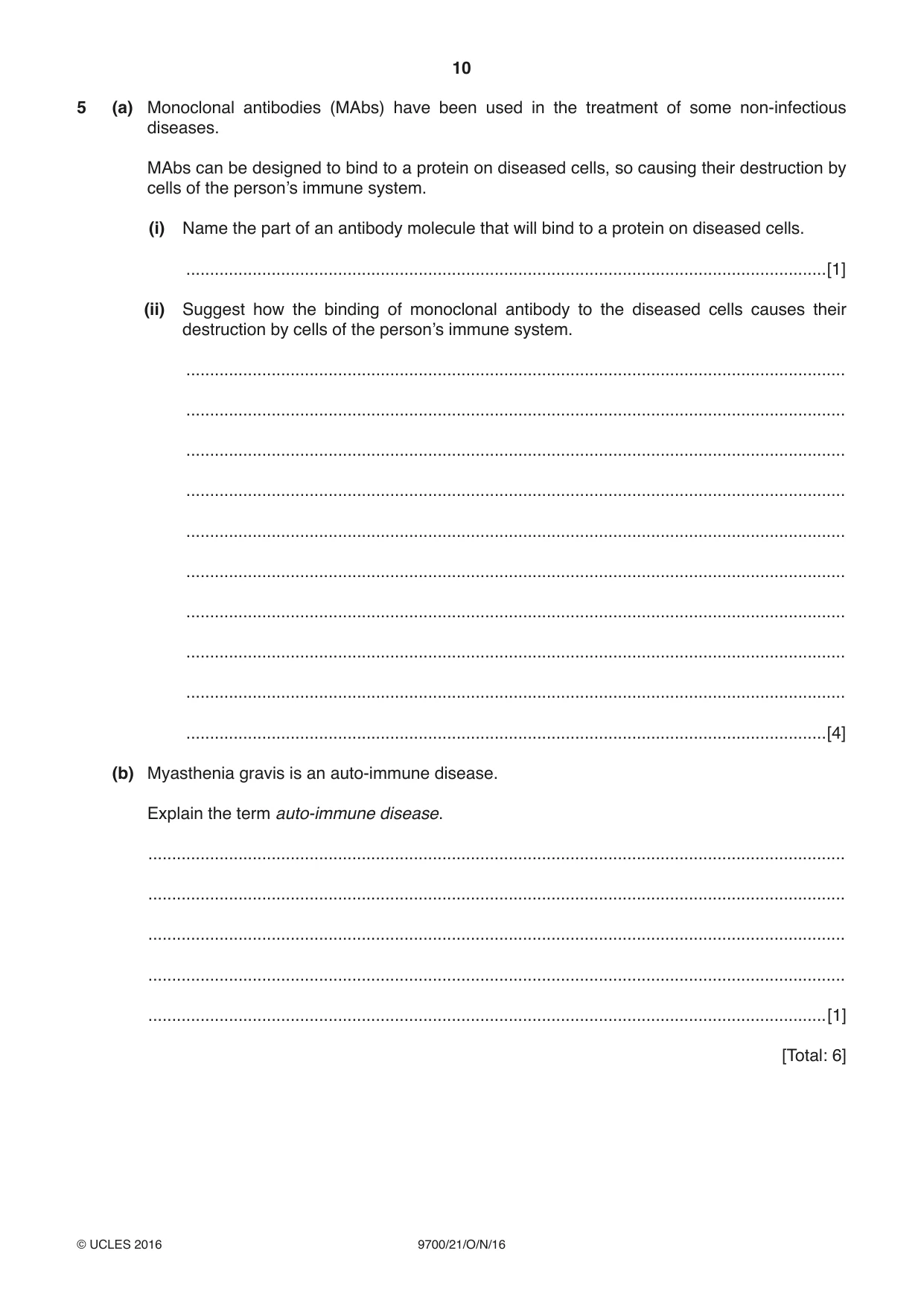
10 9700/21/O/N/16 © UCLES 2016 5 (a) Monoclonal antibodies (MAbs) have been used in the treatment of some non-infectious diseases. MAbs can be designed to bind to a protein on diseased cells, so causing their destruction by cells of the person’s immune system. (i) Name the part of an antibody molecule that will bind to a protein on diseased cells. …[1] (ii) Suggest how the binding of monoclonal antibody to the diseased cells causes their destruction by cells of the person’s immune system. … … … … … … … … … …[4] (b) Myasthenia gravis is an auto-immune disease. Explain the term auto-immune disease. … … … … …[1] [Total: 6]
Question paper, page 11
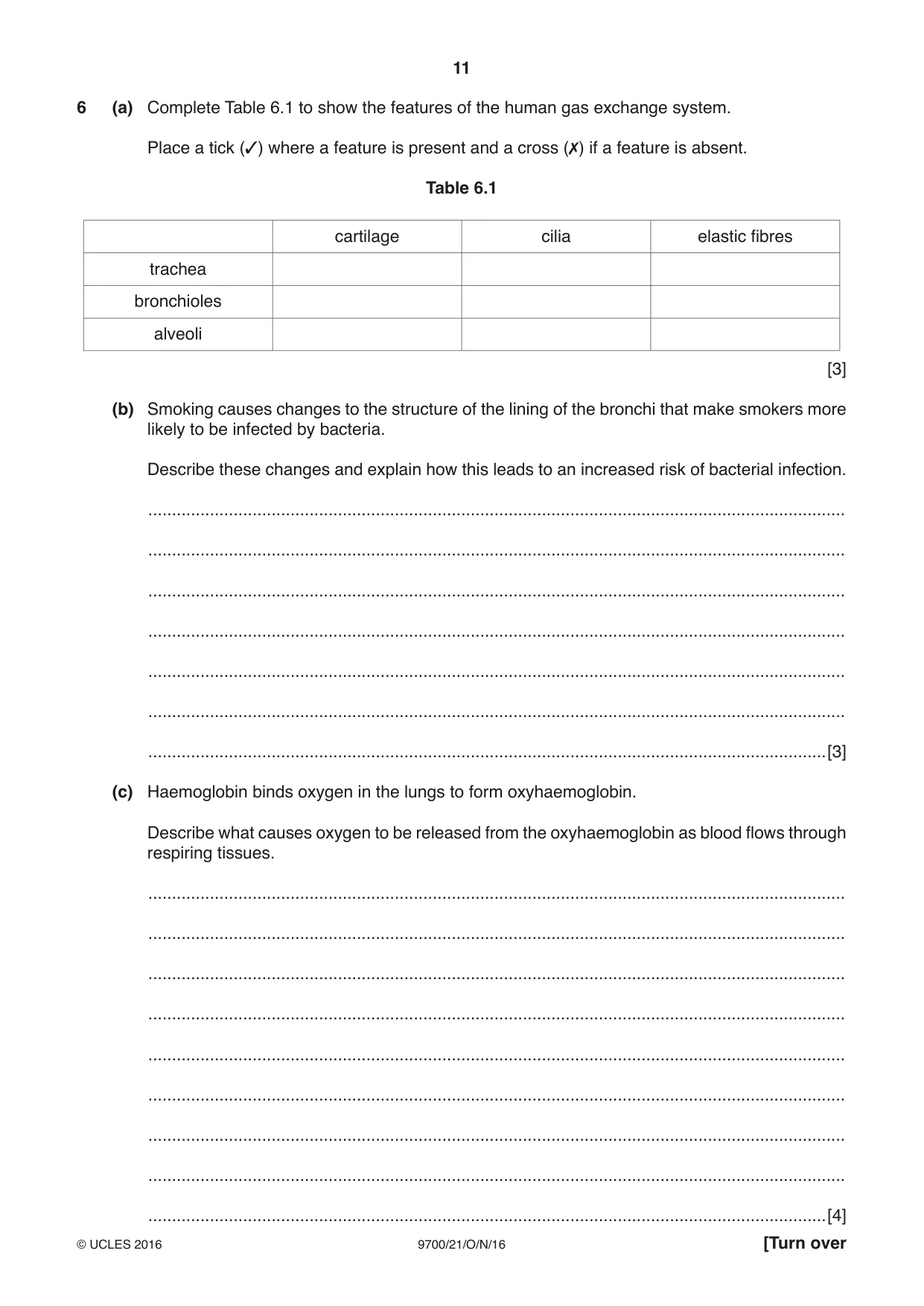
11 9700/21/O/N/16 © UCLES 2016 [Turn over 6 (a) Complete Table 6.1 to show the features of the human gas exchange system. Place a tick (3) where a feature is present and a cross (✗) if a feature is absent. Table 6.1 cartilage cilia elastic fibres trachea bronchioles alveoli [3] (b) Smoking causes changes to the structure of the lining of the bronchi that make smokers more likely to be infected by bacteria. Describe these changes and explain how this leads to an increased risk of bacterial infection. … … … … … … …[3] (c) Haemoglobin binds oxygen in the lungs to form oxyhaemoglobin. Describe what causes oxygen to be released from the oxyhaemoglobin as blood flows through respiring tissues. … … … … … … … … …[4]
Question paper, page 12
12 9700/21/O/N/16 © UCLES 2016 (d) Explain why red blood cells are in blood but not in tissue fluid. … … … …[1] [Total: 11] . Permission to reproduce items where third-party owned material protected by copyright is included has been sought and cleared where possible. Every reasonable effort has been made by the publisher (UCLES) to trace copyright holders, but if any items requiring clearance have unwittingly been included, the publisher will be pleased to make amends at the earliest possible opportunity. To avoid the issue of disclosure of answer-related information to candidates, all copyright acknowledgements are reproduced online in the Cambridge International Examinations Copyright Acknowledgements Booklet. This is produced for each series of examinations and is freely available to download at www.cie.org.uk after the live examination series. Cambridge International Examinations is part of the Cambridge Assessment Group. Cambridge Assessment is the brand name of University of Cambridge Local Examinations Syndicate (UCLES), which is itself a department of the University of Cambridge.
Mark scheme, page 1
® IGCSE is the registered trademark of Cambridge International Examinations. This document consists of 8 printed pages. © UCLES 2016 [Turn over Cambridge International Examinations Cambridge International Advanced Subsidiary and Advanced Level BIOLOGY 9700/21 Paper 2 AS Level Structured Questions October/November 2016 MARK SCHEME Maximum Mark: 60 Published This mark scheme is published as an aid to teachers and candidates, to indicate the requirements of the examination. It shows the basis on which Examiners were instructed to award marks. It does not indicate the details of the discussions that took place at an Examiners’ meeting before marking began, which would have considered the acceptability of alternative answers. Mark schemes should be read in conjunction with the question paper and the Principal Examiner Report for Teachers. Cambridge will not enter into discussions about these mark schemes. Cambridge is publishing the mark schemes for the October/November 2016 series for most Cambridge IGCSE®, Cambridge International A and AS Level components and some Cambridge O Level components.
Mark scheme, page 2
Page 2 Mark Scheme Syllabus Paper Cambridge International AS/A Level – October/November 2016 9700 21 © UCLES 2016 Mark scheme abbreviations ; separates marking points / alternative answers for the same point A accept (for answers correctly cued by the question, or by extra guidance) R reject AW alternative wording (where responses vary more than usual) underline actual word given must be used by candidate (grammatical variants accepted) max indicates the maximum number of marks that can be given ora or reverse argument mp marking point (with relevant number) ecf error carried forward I ignore AVP alternative valid point
Mark scheme, page 3
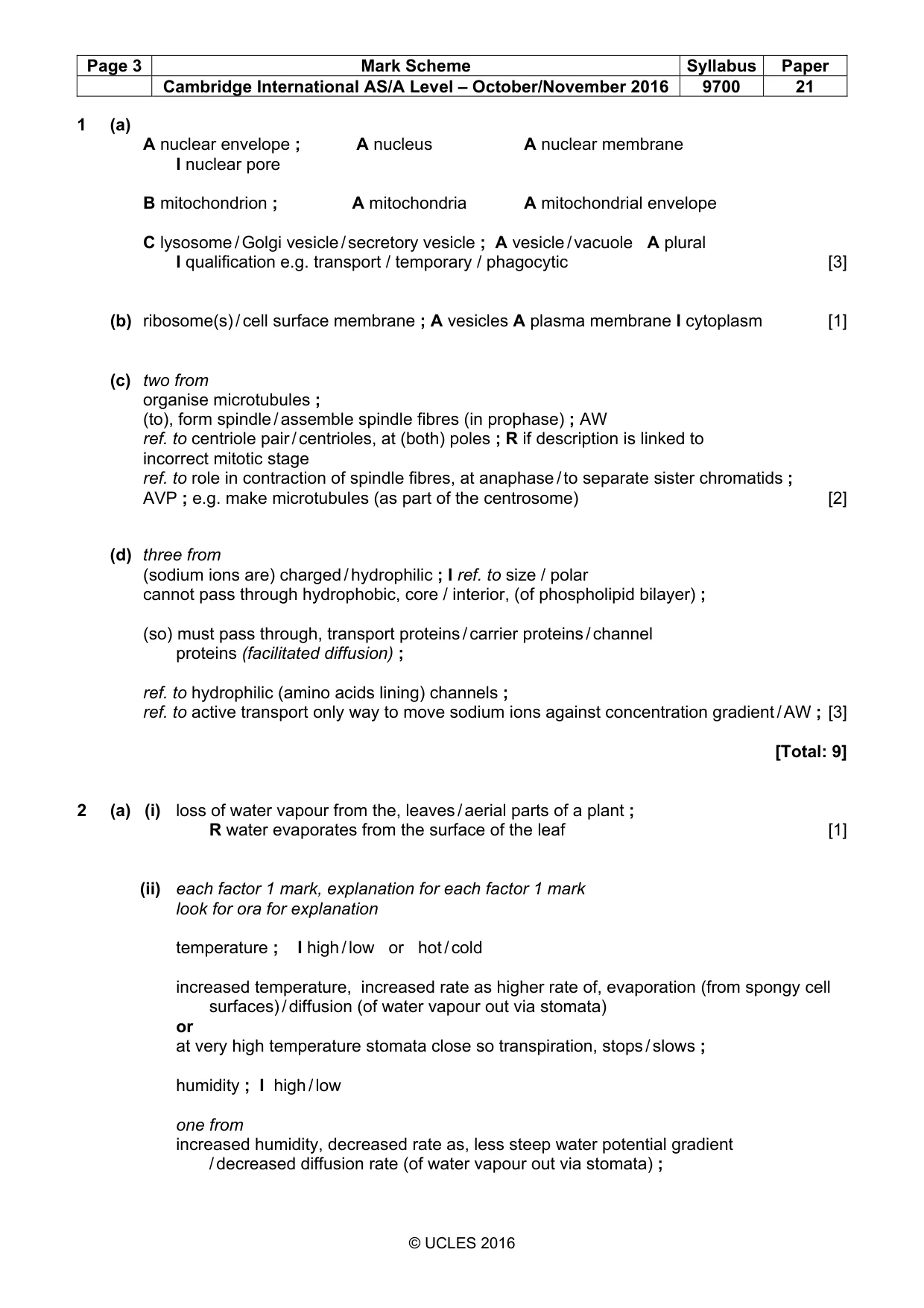
Page 3 Mark Scheme Syllabus Paper Cambridge International AS/A Level – October/November 2016 9700 21 © UCLES 2016 1 (a) A nuclear envelope ; A nucleus A nuclear membrane I nuclear pore B mitochondrion ; A mitochondria A mitochondrial envelope C lysosome / Golgi vesicle / secretory vesicle ; A vesicle / vacuole A plural I qualification e.g. transport / temporary / phagocytic [3] (b) ribosome(s) / cell surface membrane ; A vesicles A plasma membrane I cytoplasm [1] (c) two from organise microtubules ; (to), form spindle / assemble spindle fibres (in prophase) ; AW ref. to centriole pair / centrioles, at (both) poles ; R if description is linked to incorrect mitotic stage ref. to role in contraction of spindle fibres, at anaphase / to separate sister chromatids ; AVP ; e.g. make microtubules (as part of the centrosome) [2] (d) three from (sodium ions are) charged / hydrophilic ; I ref. to size / polar cannot pass through hydrophobic, core / interior, (of phospholipid bilayer) ; (so) must pass through, transport proteins / carrier proteins / channel proteins (facilitated diffusion) ; ref. to hydrophilic (amino acids lining) channels ; ref. to active transport only way to move sodium ions against concentration gradient / AW ; [3] [Total: 9] 2 (a) (i) loss of water vapour from the, leaves / aerial parts of a plant ; R water evaporates from the surface of the leaf [1] (ii) each factor 1 mark, explanation for each factor 1 mark look for ora for explanation temperature ; I high / low or hot / cold increased temperature, increased rate as higher rate of, evaporation (from spongy cell surfaces) / diffusion (of water vapour out via stomata) or at very high temperature stomata close so transpiration, stops / slows ; humidity ; I high / low one from increased humidity, decreased rate as, less steep water potential gradient / decreased diffusion rate (of water vapour out via stomata) ;
Mark scheme, page 4
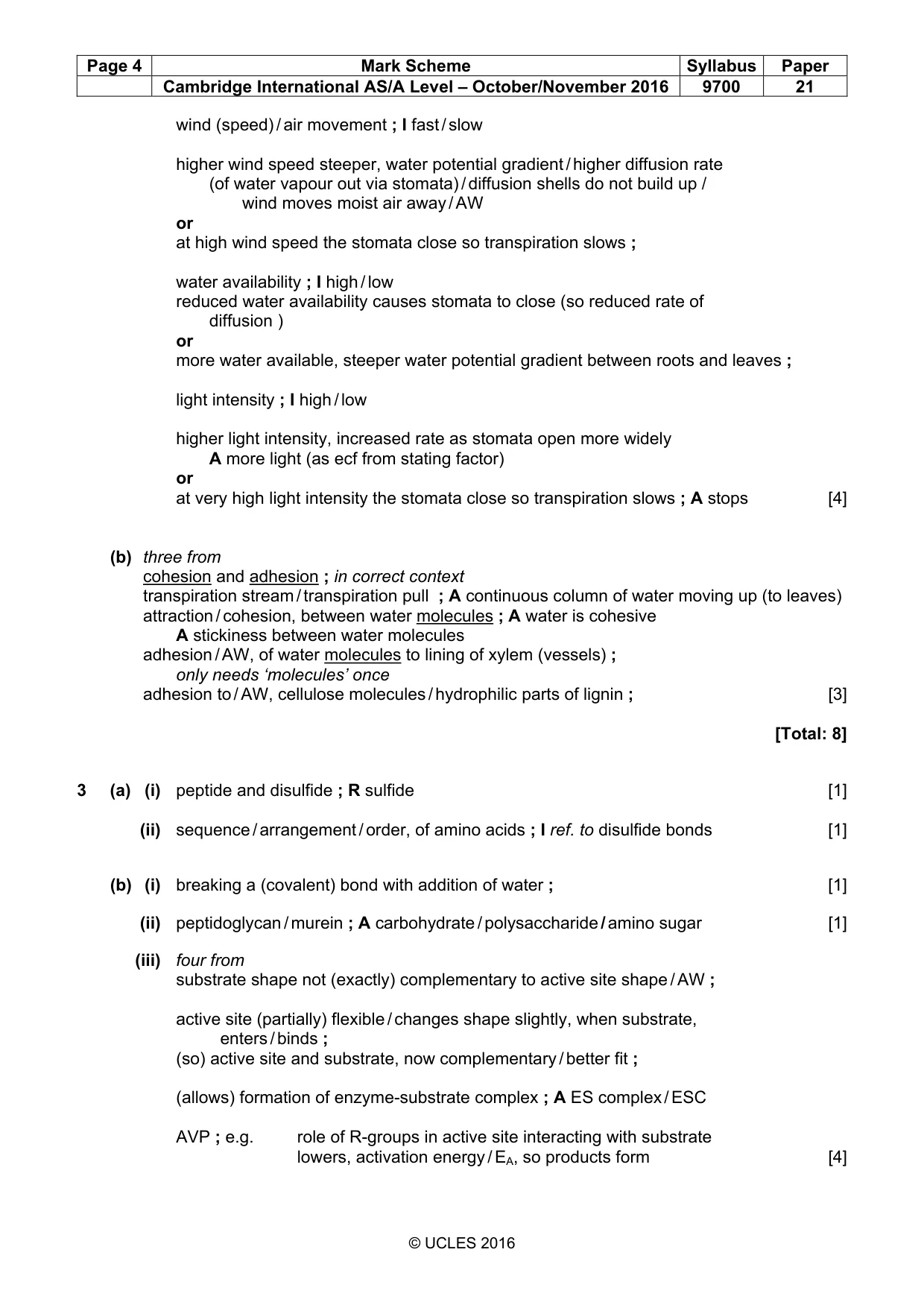
Page 4 Mark Scheme Syllabus Paper Cambridge International AS/A Level – October/November 2016 9700 21 © UCLES 2016 wind (speed) / air movement ; I fast / slow higher wind speed steeper, water potential gradient / higher diffusion rate (of water vapour out via stomata) / diffusion shells do not build up / wind moves moist air away / AW or at high wind speed the stomata close so transpiration slows ; water availability ; I high / low reduced water availability causes stomata to close (so reduced rate of diffusion ) or more water available, steeper water potential gradient between roots and leaves ; light intensity ; I high / low higher light intensity, increased rate as stomata open more widely A more light (as ecf from stating factor) or at very high light intensity the stomata close so transpiration slows ; A stops [4] (b) three from cohesion and adhesion ; in correct context transpiration stream / transpiration pull ; A continuous column of water moving up (to leaves) attraction / cohesion, between water molecules ; A water is cohesive A stickiness between water molecules adhesion / AW, of water molecules to lining of xylem (vessels) ; only needs ‘molecules’ once adhesion to / AW, cellulose molecules / hydrophilic parts of lignin ; [3] [Total: 8] 3 (a) (i) peptide and disulfide ; R sulfide [1] (ii) sequence / arrangement / order, of amino acids ; I ref. to disulfide bonds [1] (b) (i) breaking a (covalent) bond with addition of water ; [1] (ii) peptidoglycan / murein ; A carbohydrate / polysaccharide / amino sugar [1] (iii) four from substrate shape not (exactly) complementary to active site shape / AW ; active site (partially) flexible / changes shape slightly, when substrate, enters / binds ; (so) active site and substrate, now complementary / better fit ; (allows) formation of enzyme-substrate complex ; A ES complex / ESC AVP ; e.g. role of R-groups in active site interacting with substrate lowers, activation energy / EA, so products form [4]
Mark scheme, page 5
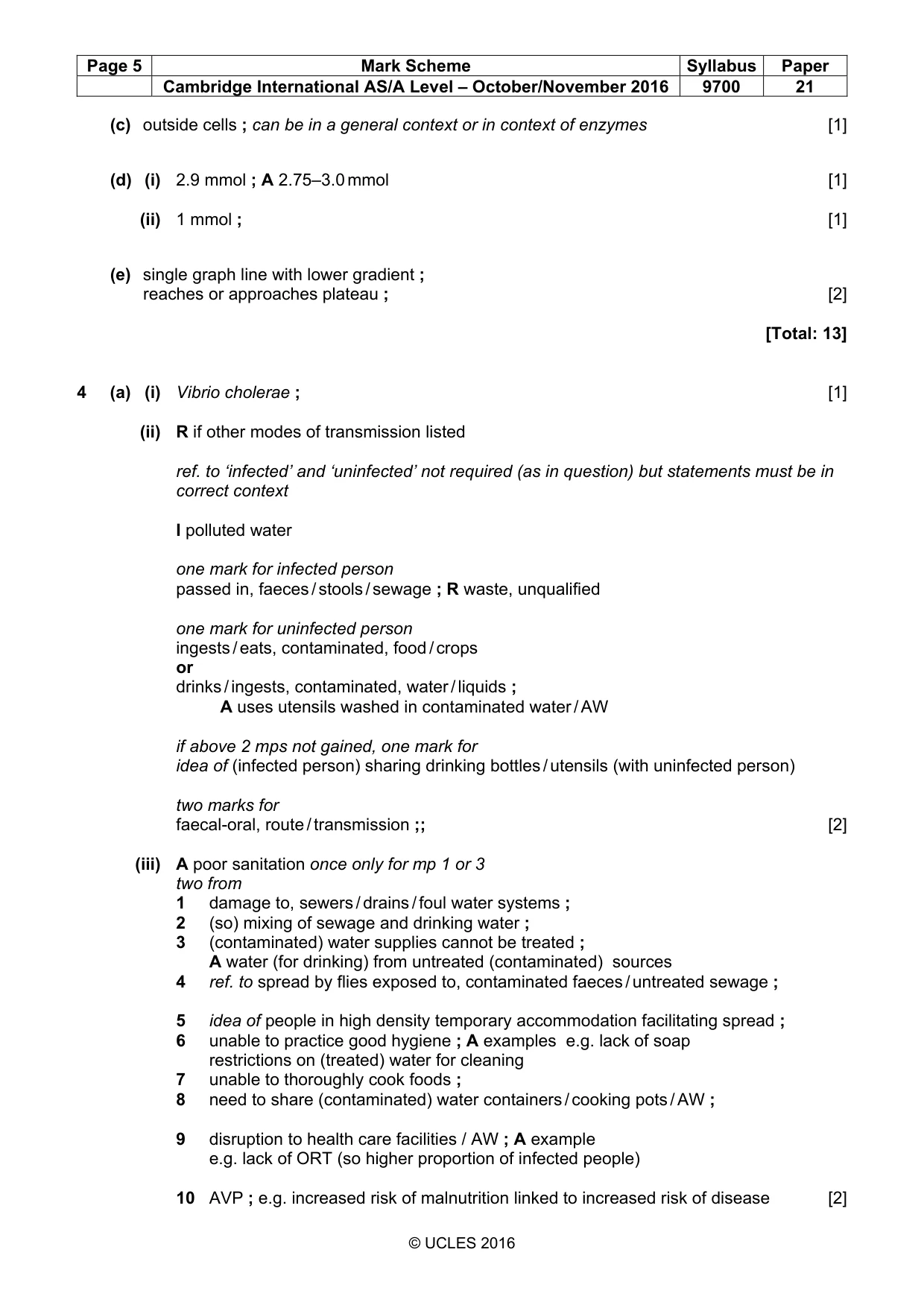
Page 5 Mark Scheme Syllabus Paper Cambridge International AS/A Level – October/November 2016 9700 21 © UCLES 2016 (c) outside cells ; can be in a general context or in context of enzymes [1] (d) (i) 2.9 mmol ; A 2.75–3.0 mmol [1] (ii) 1 mmol ; [1] (e) single graph line with lower gradient ; reaches or approaches plateau ; [2] [Total: 13] 4 (a) (i) Vibrio cholerae ; [1] (ii) R if other modes of transmission listed ref. to ‘infected’ and ‘uninfected’ not required (as in question) but statements must be in correct context I polluted water one mark for infected person passed in, faeces / stools / sewage ; R waste, unqualified one mark for uninfected person ingests / eats, contaminated, food / crops or drinks / ingests, contaminated, water / liquids ; A uses utensils washed in contaminated water / AW if above 2 mps not gained, one mark for idea of (infected person) sharing drinking bottles / utensils (with uninfected person) two marks for faecal-oral, route / transmission ;; [2] (iii) A poor sanitation once only for mp 1 or 3 two from 1 damage to, sewers / drains / foul water systems ; 2 (so) mixing of sewage and drinking water ; 3 (contaminated) water supplies cannot be treated ; A water (for drinking) from untreated (contaminated) sources 4 ref. to spread by flies exposed to, contaminated faeces / untreated sewage ; 5 idea of people in high density temporary accommodation facilitating spread ; 6 unable to practice good hygiene ; A examples e.g. lack of soap restrictions on (treated) water for cleaning 7 unable to thoroughly cook foods ; 8 need to share (contaminated) water containers / cooking pots / AW ; 9 disruption to health care facilities / AW ; A example e.g. lack of ORT (so higher proportion of infected people) 10 AVP ; e.g. increased risk of malnutrition linked to increased risk of disease [2]
Mark scheme, page 6
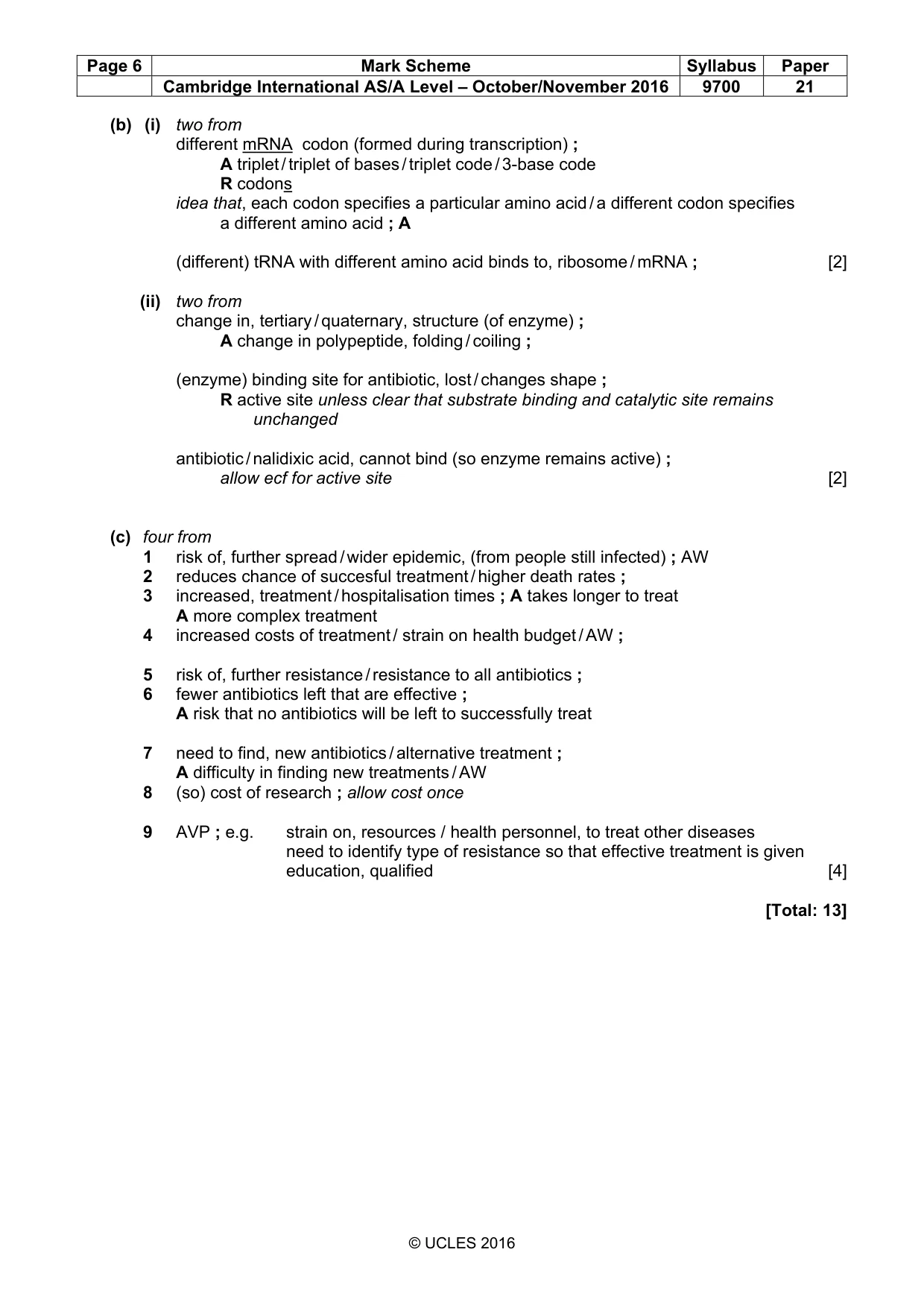
Page 6 Mark Scheme Syllabus Paper Cambridge International AS/A Level – October/November 2016 9700 21 © UCLES 2016 (b) (i) two from different mRNA codon (formed during transcription) ; A triplet / triplet of bases / triplet code / 3-base code R codons idea that, each codon specifies a particular amino acid / a different codon specifies a different amino acid ; A (different) tRNA with different amino acid binds to, ribosome / mRNA ; [2] (ii) two from change in, tertiary / quaternary, structure (of enzyme) ; A change in polypeptide, folding / coiling ; (enzyme) binding site for antibiotic, lost / changes shape ; R active site unless clear that substrate binding and catalytic site remains unchanged antibiotic / nalidixic acid, cannot bind (so enzyme remains active) ; allow ecf for active site [2] (c) four from 1 risk of, further spread / wider epidemic, (from people still infected) ; AW 2 reduces chance of succesful treatment / higher death rates ; 3 increased, treatment / hospitalisation times ; A takes longer to treat A more complex treatment 4 increased costs of treatment / strain on health budget / AW ; 5 risk of, further resistance / resistance to all antibiotics ; 6 fewer antibiotics left that are effective ; A risk that no antibiotics will be left to successfully treat 7 need to find, new antibiotics / alternative treatment ; A difficulty in finding new treatments / AW 8 (so) cost of research ; allow cost once 9 AVP ; e.g. strain on, resources / health personnel, to treat other diseases need to identify type of resistance so that effective treatment is given education, qualified [4] [Total: 13]
Mark scheme, page 7
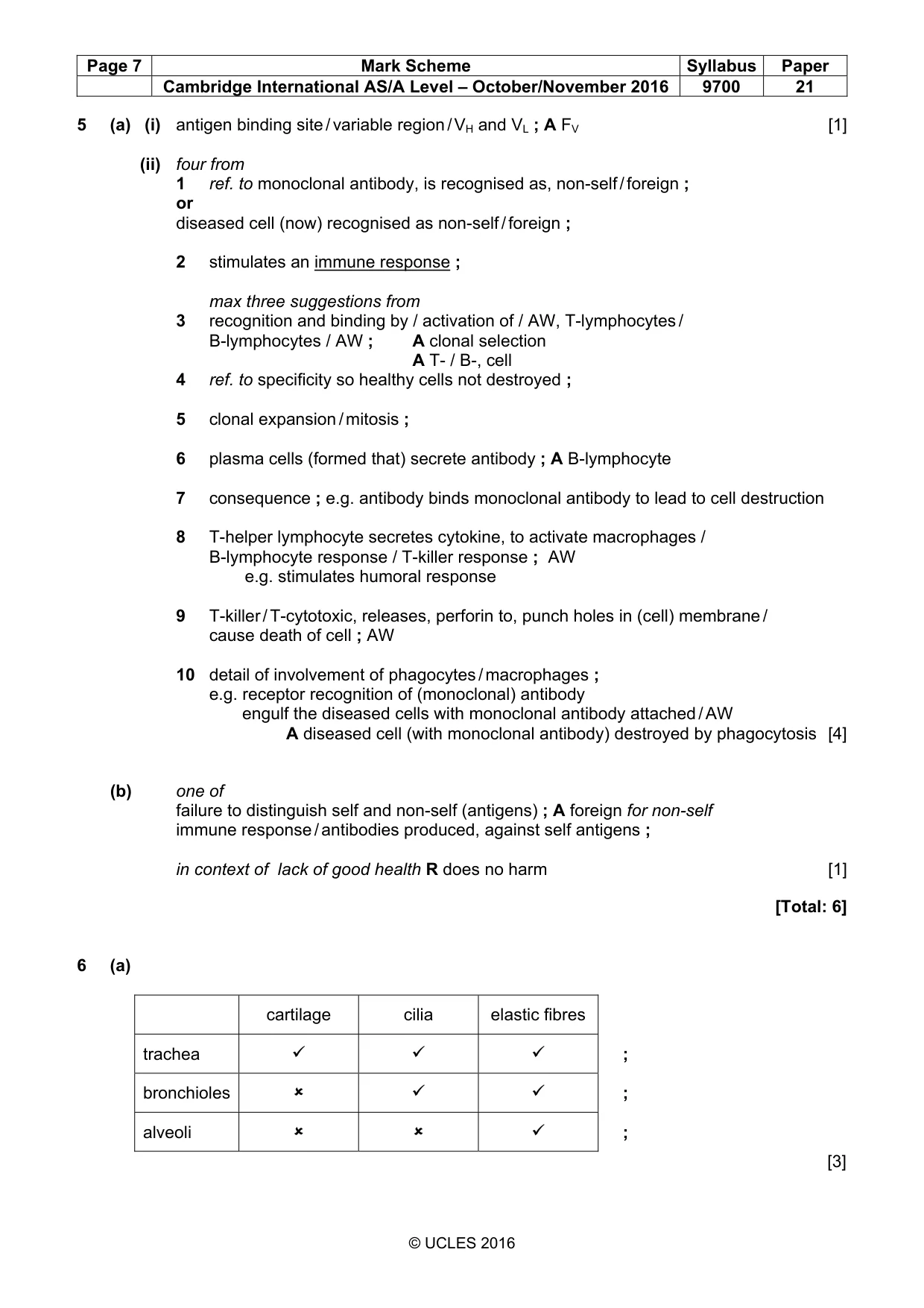
Page 7 Mark Scheme Syllabus Paper Cambridge International AS/A Level – October/November 2016 9700 21 © UCLES 2016 5 (a) (i) antigen binding site / variable region / VH and VL ; A FV [1] (ii) four from 1 ref. to monoclonal antibody, is recognised as, non-self / foreign ; or diseased cell (now) recognised as non-self / foreign ; 2 stimulates an immune response ; max three suggestions from 3 recognition and binding by / activation of / AW, T-lymphocytes / B-lymphocytes / AW ; A clonal selection A T- / B-, cell 4 ref. to specificity so healthy cells not destroyed ; 5 clonal expansion / mitosis ; 6 plasma cells (formed that) secrete antibody ; A B-lymphocyte 7 consequence ; e.g. antibody binds monoclonal antibody to lead to cell destruction 8 T-helper lymphocyte secretes cytokine, to activate macrophages / B-lymphocyte response / T-killer response ; AW e.g. stimulates humoral response 9 T-killer / T-cytotoxic, releases, perforin to, punch holes in (cell) membrane / cause death of cell ; AW 10 detail of involvement of phagocytes / macrophages ; e.g. receptor recognition of (monoclonal) antibody engulf the diseased cells with monoclonal antibody attached / AW A diseased cell (with monoclonal antibody) destroyed by phagocytosis [4] (b) one of failure to distinguish self and non-self (antigens) ; A foreign for non-self immune response / antibodies produced, against self antigens ; in context of lack of good health R does no harm [1] [Total: 6] 6 (a) cartilage cilia elastic fibres trachea 9 9 9 ; bronchioles 8 9 9 ; alveoli 8 8 9 ; [3]
Mark scheme, page 8
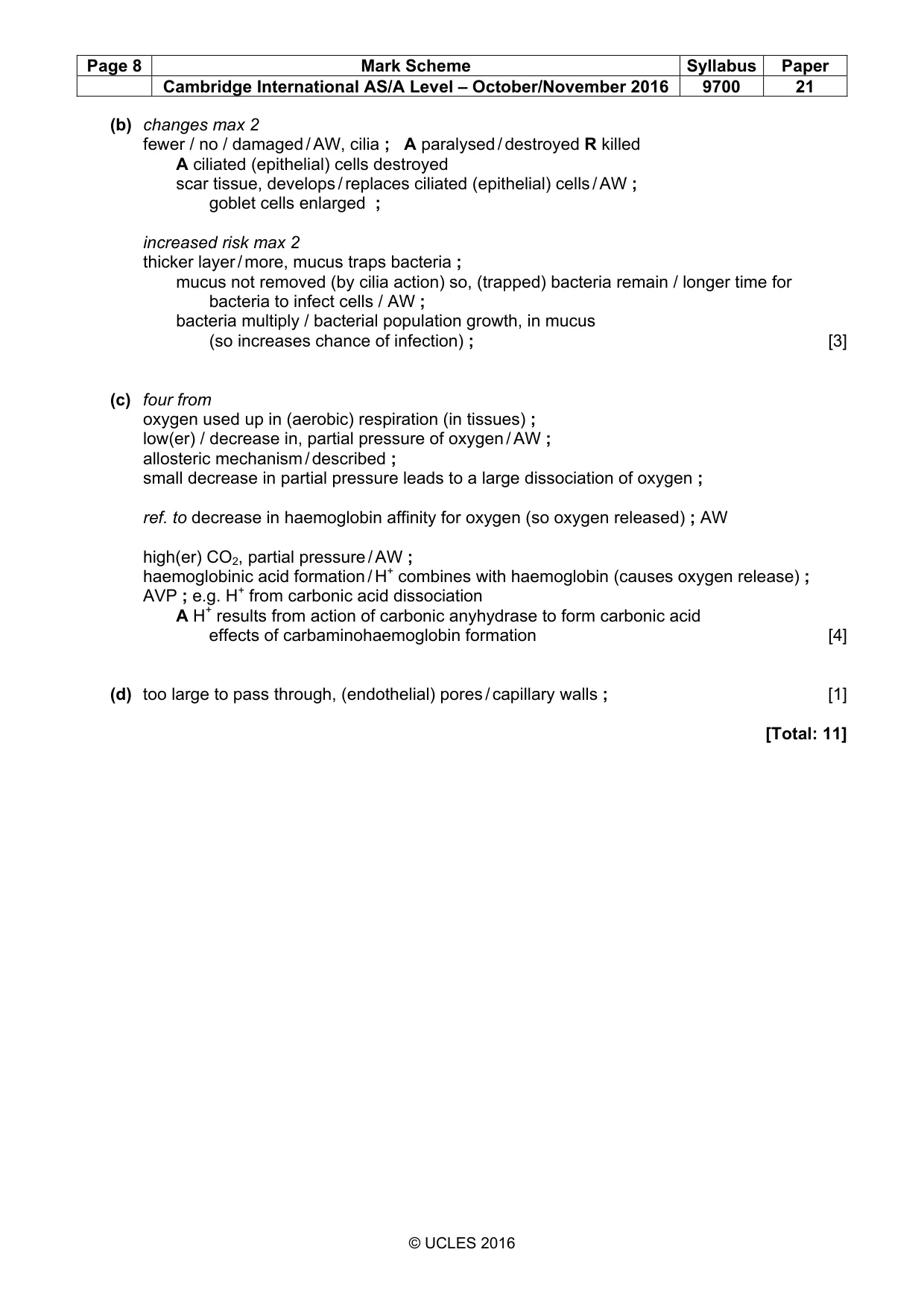
Page 8 Mark Scheme Syllabus Paper Cambridge International AS/A Level – October/November 2016 9700 21 © UCLES 2016 (b) changes max 2 fewer / no / damaged / AW, cilia ; A paralysed / destroyed R killed A ciliated (epithelial) cells destroyed scar tissue, develops / replaces ciliated (epithelial) cells / AW ; goblet cells enlarged ; increased risk max 2 thicker layer / more, mucus traps bacteria ; mucus not removed (by cilia action) so, (trapped) bacteria remain / longer time for bacteria to infect cells / AW ; bacteria multiply / bacterial population growth, in mucus (so increases chance of infection) ; [3] (c) four from oxygen used up in (aerobic) respiration (in tissues) ; low(er) / decrease in, partial pressure of oxygen / AW ; allosteric mechanism / described ; small decrease in partial pressure leads to a large dissociation of oxygen ; ref. to decrease in haemoglobin affinity for oxygen (so oxygen released) ; AW high(er) CO2, partial pressure / AW ; haemoglobinic acid formation / H+ combines with haemoglobin (causes oxygen release) ; AVP ; e.g. H+ from carbonic acid dissociation A H+ results from action of carbonic anyhydrase to form carbonic acid effects of carbaminohaemoglobin formation [4] (d) too large to pass through, (endothelial) pores / capillary walls ; [1] [Total: 11]
What you needed in this session
Cambridge’s own grade thresholds for 2016 Oct/Nov, Paper 2 · Variant 1. A higher threshold means an easier paper — the bar moves with how the cohort did.