Cambridge A Level Biology 9700 — 2014 Oct/Nov Paper 2 · Variant 3
9700/23/O/N/14 · 60 marks · ≈68 min
The question paper and its mark scheme, free to read here and free to download. This is Cambridge’s own paper, exactly as it was sat.
Question paper16 pages

Mark scheme9 pages
Answers below. Sit the paper first if you are practising.
Paper as text
Question paper, page 1
This document consists of 14 printed pages and 2 blank pages. DC (LK/SW) 79831/4 © UCLES 2014 [Turn over Cambridge International Examinations Cambridge International Advanced Subsidiary and Advanced Level * 4 3 2 2 9 3 4 0 0 3 * BIOLOGY 9700/23 Paper 2 Structured Questions AS October/November 2014 1 hour 15 minutes Candidates answer on the Question Paper. No Additional Materials are required. READ THESE INSTRUCTIONS FIRST Write your Centre number, candidate number and name in the spaces provided at the top of this page. Write in dark blue or black pen. You may use an HB pencil for any diagrams, graphs or rough working. Do not use staples, paper clips, glue or correction fluid. DO NOT WRITE IN ANY BARCODES. Answer all questions. Electronic calculators may be used. At the end of the examination, fasten all your work securely together. The number of marks is given in brackets [ ] at the end of each question or part question.
Question paper, page 2
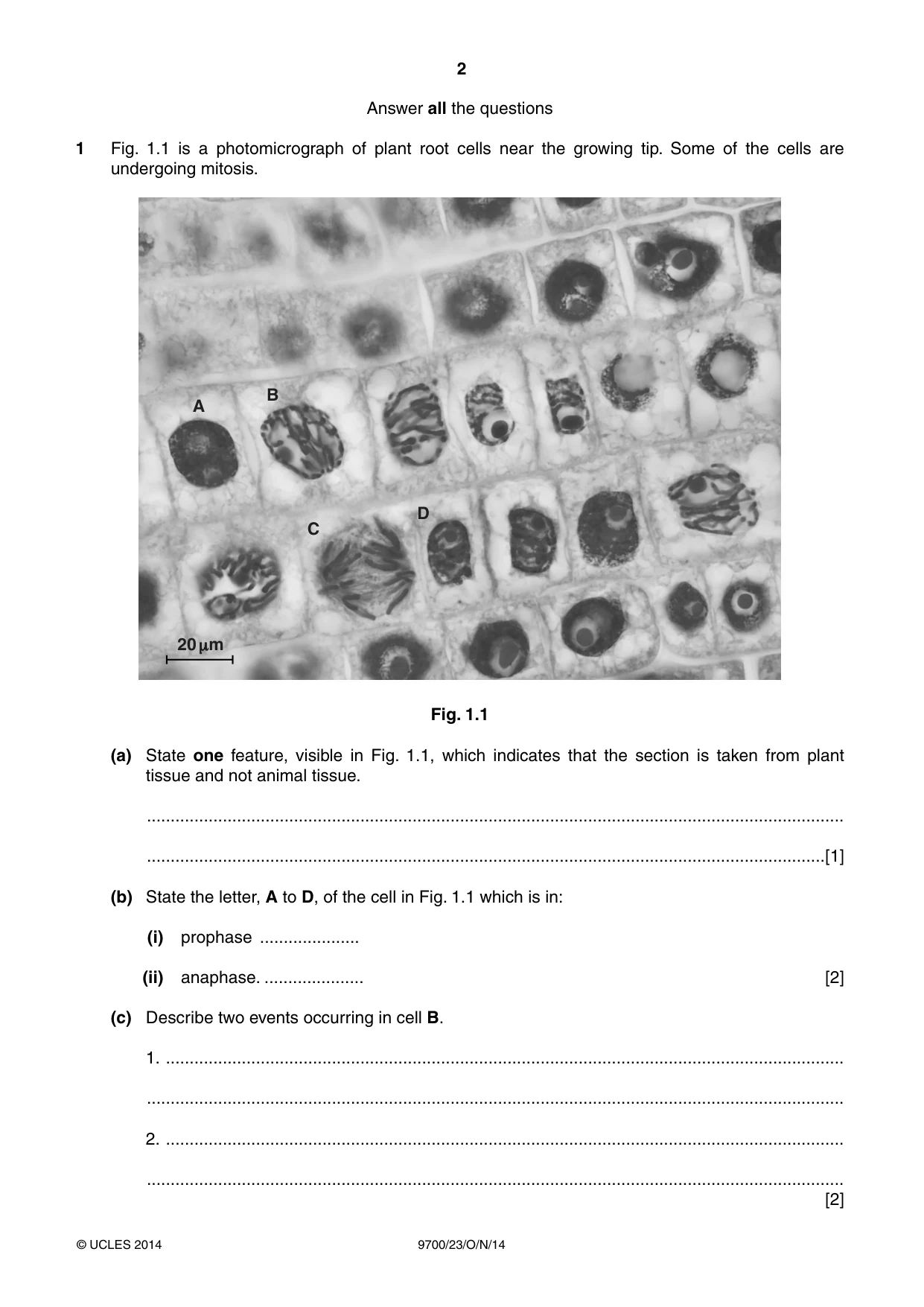
2 9700/23/O/N/14 © UCLES 2014 Answer all the questions 1 Fig. 1.1 is a photomicrograph of plant root cells near the growing tip. Some of the cells are undergoing mitosis. A C 20 +m B D Fig. 1.1 (a) State one feature, visible in Fig. 1.1, which indicates that the section is taken from plant tissue and not animal tissue. … …[1] (b) State the letter, A to D, of the cell in Fig. 1.1 which is in: (i) prophase … (ii) anaphase. … [2] (c) Describe two events occurring in cell B. 1. … … 2. … … [2]
Question paper, page 3
3 9700/23/O/N/14 © UCLES 2014 [Turn over (d) (i) Describe the role of mitosis in a growing plant root tip. … … … … … [2] (ii) Mutations can sometimes occur in cells which are rapidly dividing. Outline how a mutation can cause an altered polypeptide to be produced. … … … … … … … [2] (e) Calculate the magnification of Fig. 1.1. Show your working and give your answer to the nearest whole number. magnification × … [2] [Total: 11]
Question paper, page 4
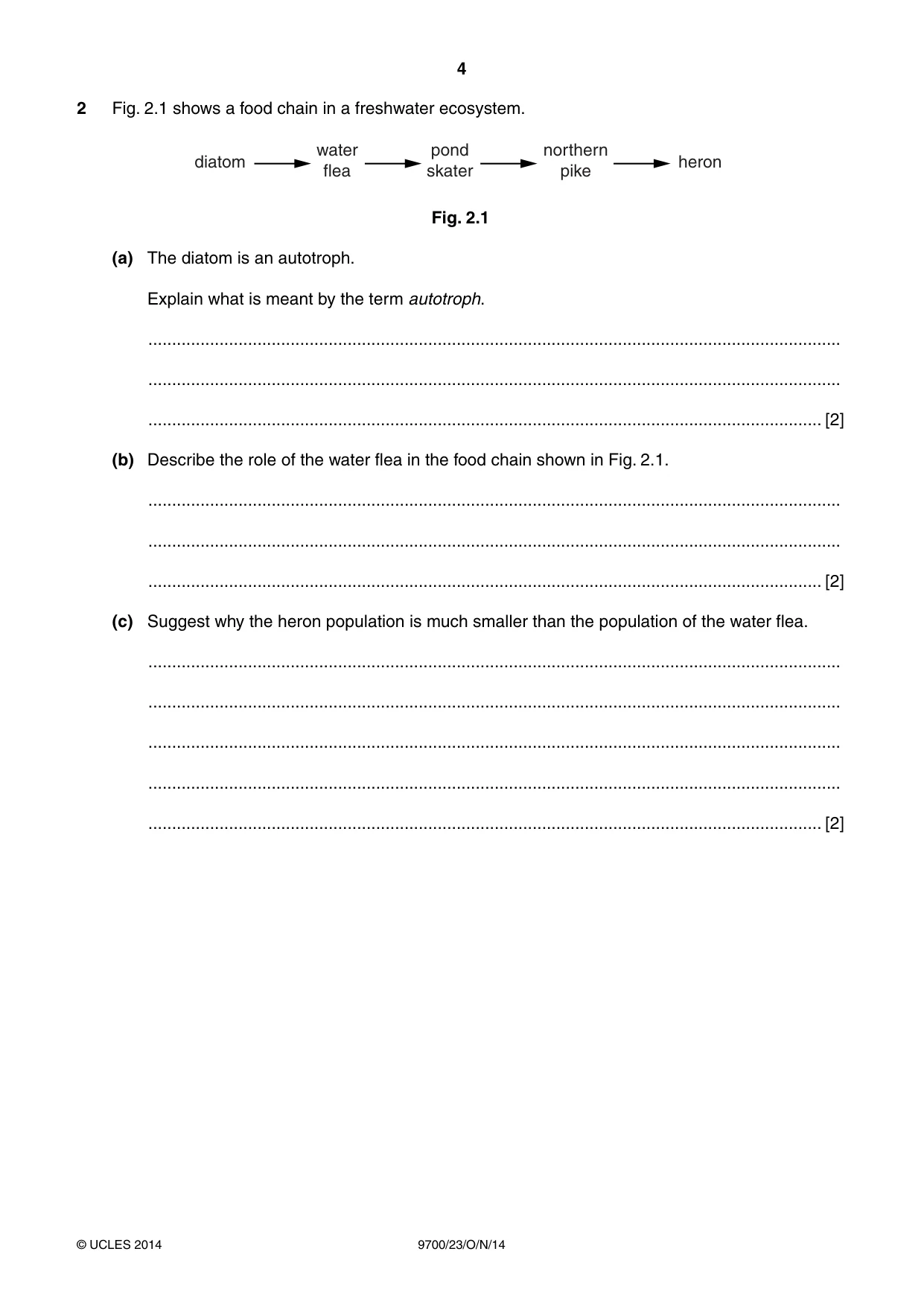
4 9700/23/O/N/14 © UCLES 2014 2 Fig. 2.1 shows a food chain in a freshwater ecosystem. diatom water flea pond skater northern pike heron Fig. 2.1 (a) The diatom is an autotroph. Explain what is meant by the term autotroph. … … … [2] (b) Describe the role of the water flea in the food chain shown in Fig. 2.1. … … … [2] (c) Suggest why the heron population is much smaller than the population of the water flea. … … … … … [2]
Question paper, page 5
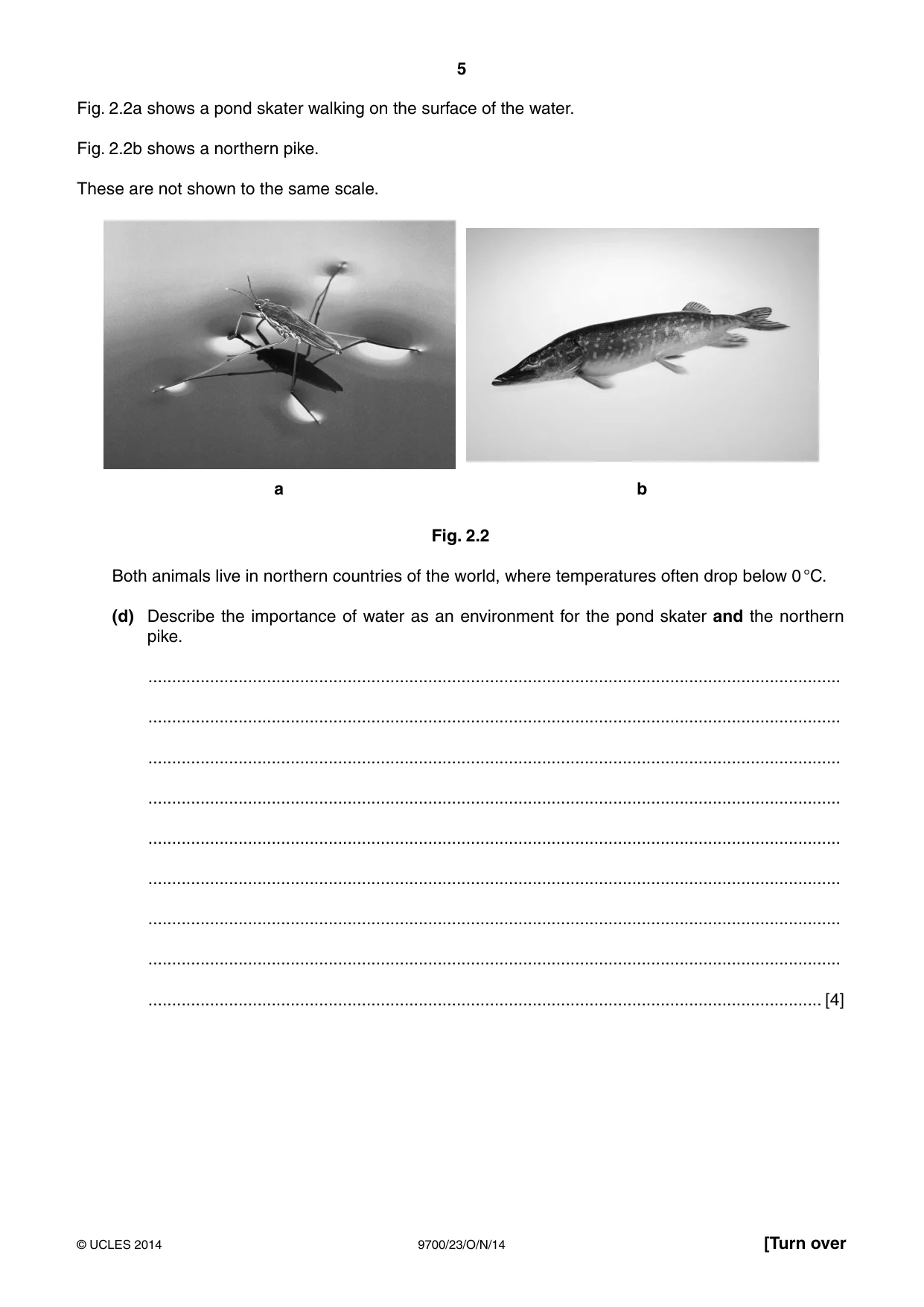
5 9700/23/O/N/14 © UCLES 2014 [Turn over Fig. 2.2a shows a pond skater walking on the surface of the water. Fig. 2.2b shows a northern pike. These are not shown to the same scale. a b Fig. 2.2 Both animals live in northern countries of the world, where temperatures often drop below 0 °C. (d) Describe the importance of water as an environment for the pond skater and the northern pike. … … … … … … … … … [4]
Question paper, page 6
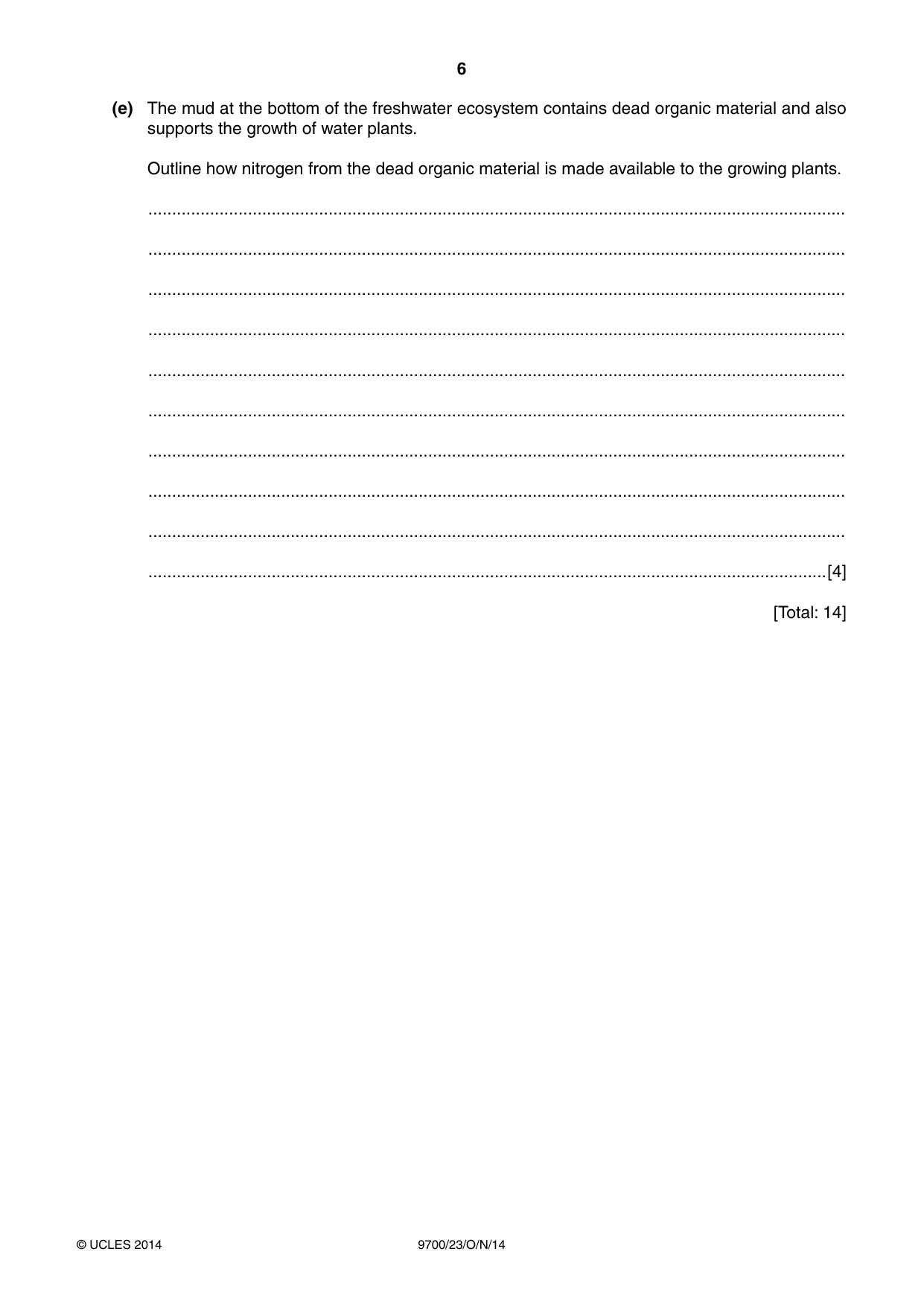
6 9700/23/O/N/14 © UCLES 2014 (e) The mud at the bottom of the freshwater ecosystem contains dead organic material and also supports the growth of water plants. Outline how nitrogen from the dead organic material is made available to the growing plants. … … … … … … … … … …[4] [Total: 14]
Question paper, page 7
7 9700/23/O/N/14 © UCLES 2014 [Turn over 3 Measles is an infectious disease for which vaccines have been developed. The commonly used vaccine consists of an attenuated (weakened) form of the virus. The measles vaccine is normally given to children when they are about one year old, followed by a booster dose when they are about four years old. (a) Explain how this vaccine can provide long-term immunity against measles. … … … … … … … … … … … … … [5]
Question paper, page 8
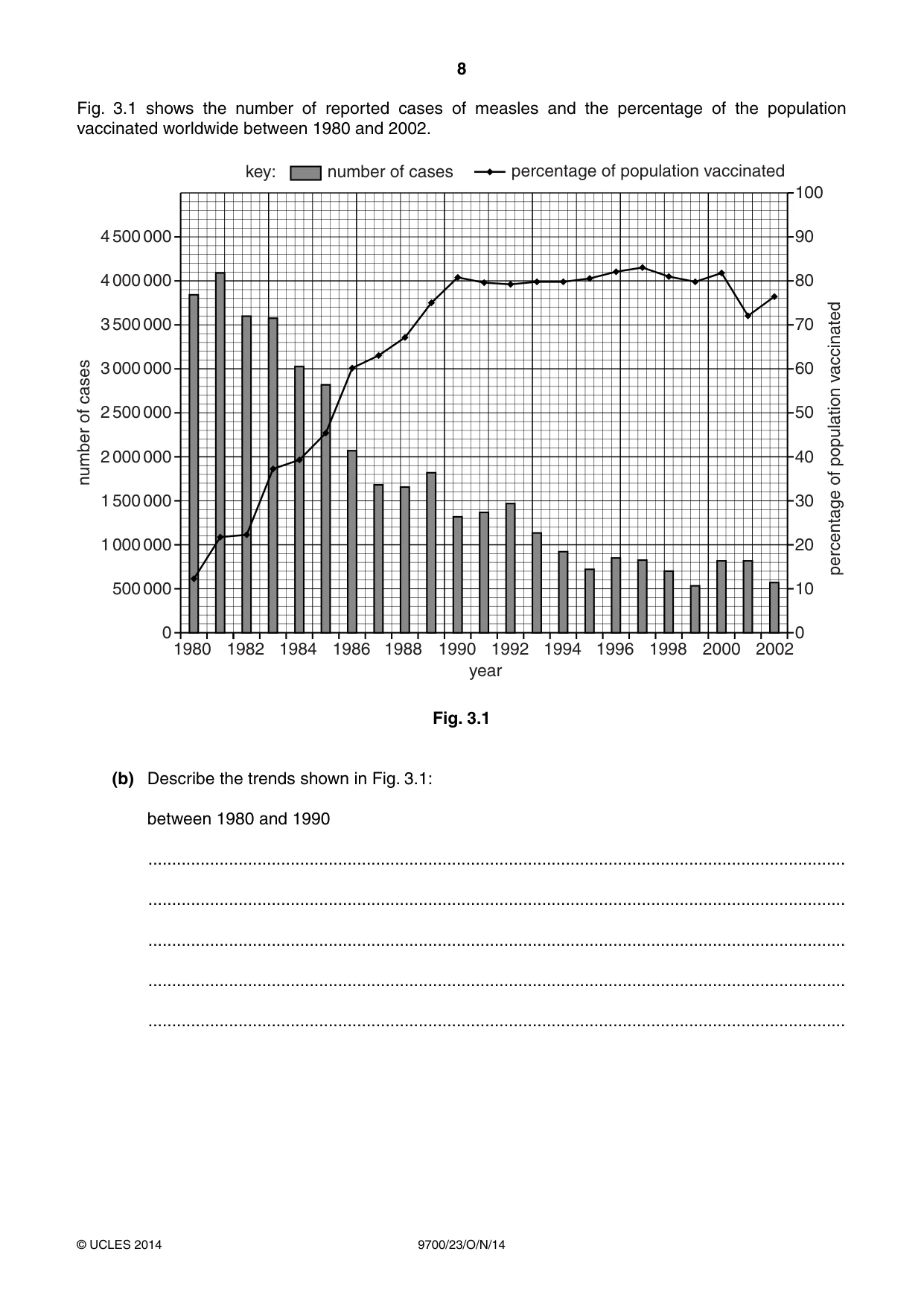
8 9700/23/O/N/14 © UCLES 2014 Fig. 3.1 shows the number of reported cases of measles and the percentage of the population vaccinated worldwide between 1980 and 2002. 1980 number of cases key: percentage of population vaccinated 0 0 10 20 30 40 50 60 70 80 90 100 500 000 1 000 000 1 500 000 number of cases percentage of population vaccinated 2 000 000 2 500 000 3 000 000 3 500 000 4 000 000 4 500 000 1982 1984 1986 1988 1990 1992 year 1994 1996 1998 2000 2002 Fig. 3.1 (b) Describe the trends shown in Fig. 3.1: between 1980 and 1990 … … … … …
Question paper, page 9
9 9700/23/O/N/14 © UCLES 2014 [Turn over between 1990 and 2002. … … … … … … … …[4] (c) The measles virus has a unique protein on its surface called MV-H which can bind to a protein called CD-46 on the surface of human cells. This allows the measles virus to infect these cells. Suggest how the two proteins, MV-H and CD-46, can bind to each other. … … … …[2] [Total: 11]
Question paper, page 10
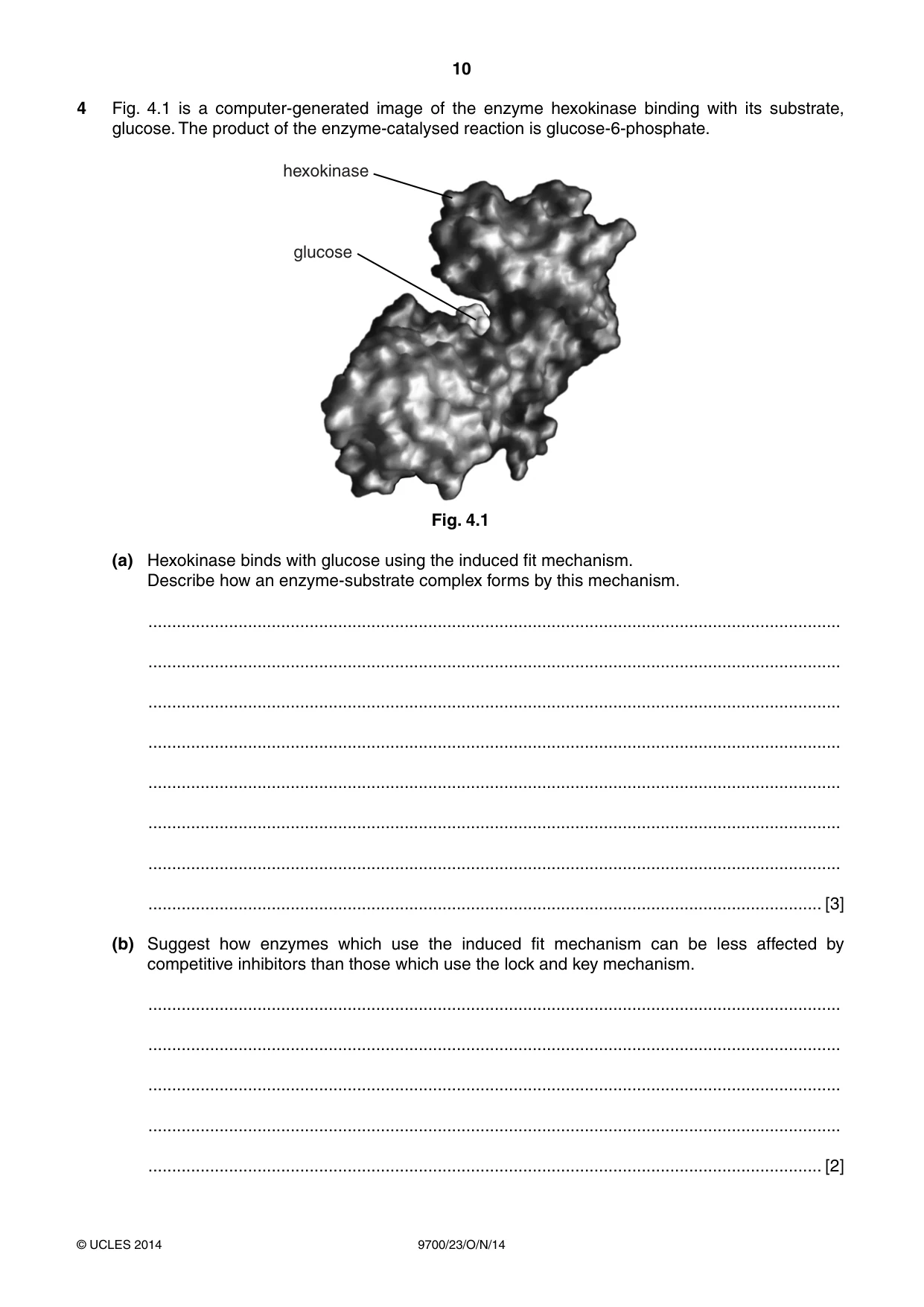
10 9700/23/O/N/14 © UCLES 2014 4 Fig. 4.1 is a computer-generated image of the enzyme hexokinase binding with its substrate, glucose. The product of the enzyme-catalysed reaction is glucose-6-phosphate. glucose hexokinase Fig. 4.1 (a) Hexokinase binds with glucose using the induced fit mechanism. Describe how an enzyme-substrate complex forms by this mechanism. … … … … … … … … [3] (b) Suggest how enzymes which use the induced fit mechanism can be less affected by competitive inhibitors than those which use the lock and key mechanism. … … … … … [2]
Question paper, page 11
11 9700/23/O/N/14 © UCLES 2014 [Turn over (c) When a solution of the enzyme hexokinase is heated to 45 °C for 10 minutes, the quantity of product formed decreases by 50% compared to a sample kept between 30 °C and 40 °C. Explain this result. … … … … … … [3] Glucose can enter cells by active transport or facilitated diffusion. Glucose-6-phosphate is a charged, polar molecule and cannot move out of cells. (d) (i) State two differences between active transport and facilitated diffusion. 1. … … 2. … … [2] (ii) Suggest why glucose-6-phosphate cannot move out of cells. … … … … … … [2] [Total: 12]
Question paper, page 12
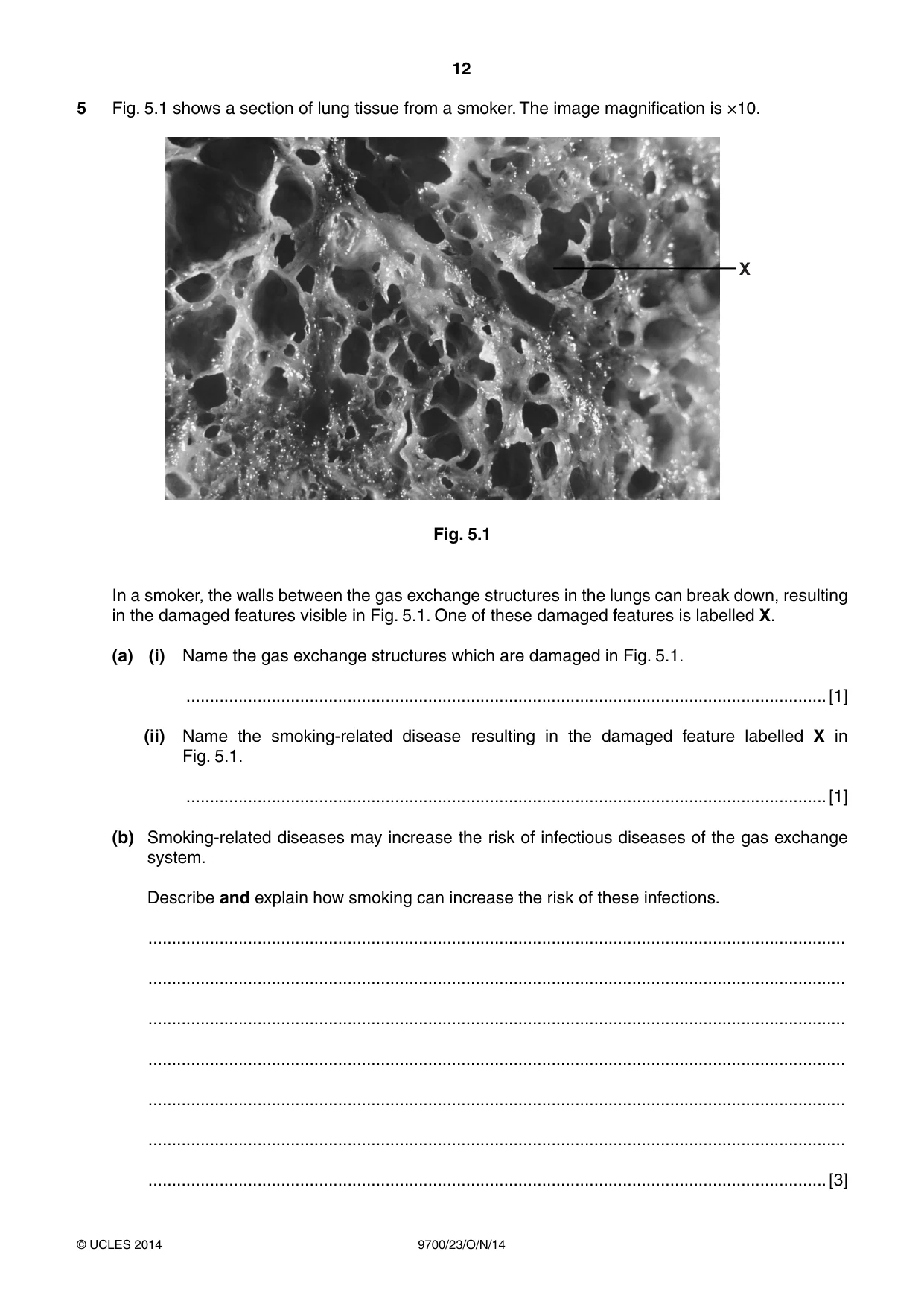
12 9700/23/O/N/14 © UCLES 2014 5 Fig. 5.1 shows a section of lung tissue from a smoker. The image magnification is ×10. X Fig. 5.1 In a smoker, the walls between the gas exchange structures in the lungs can break down, resulting in the damaged features visible in Fig. 5.1. One of these damaged features is labelled X. (a) (i) Name the gas exchange structures which are damaged in Fig. 5.1. …[1] (ii) Name the smoking-related disease resulting in the damaged feature labelled X in Fig. 5.1. …[1] (b) Smoking-related diseases may increase the risk of infectious diseases of the gas exchange system. Describe and explain how smoking can increase the risk of these infections. … … … … … … …[3]
Question paper, page 13
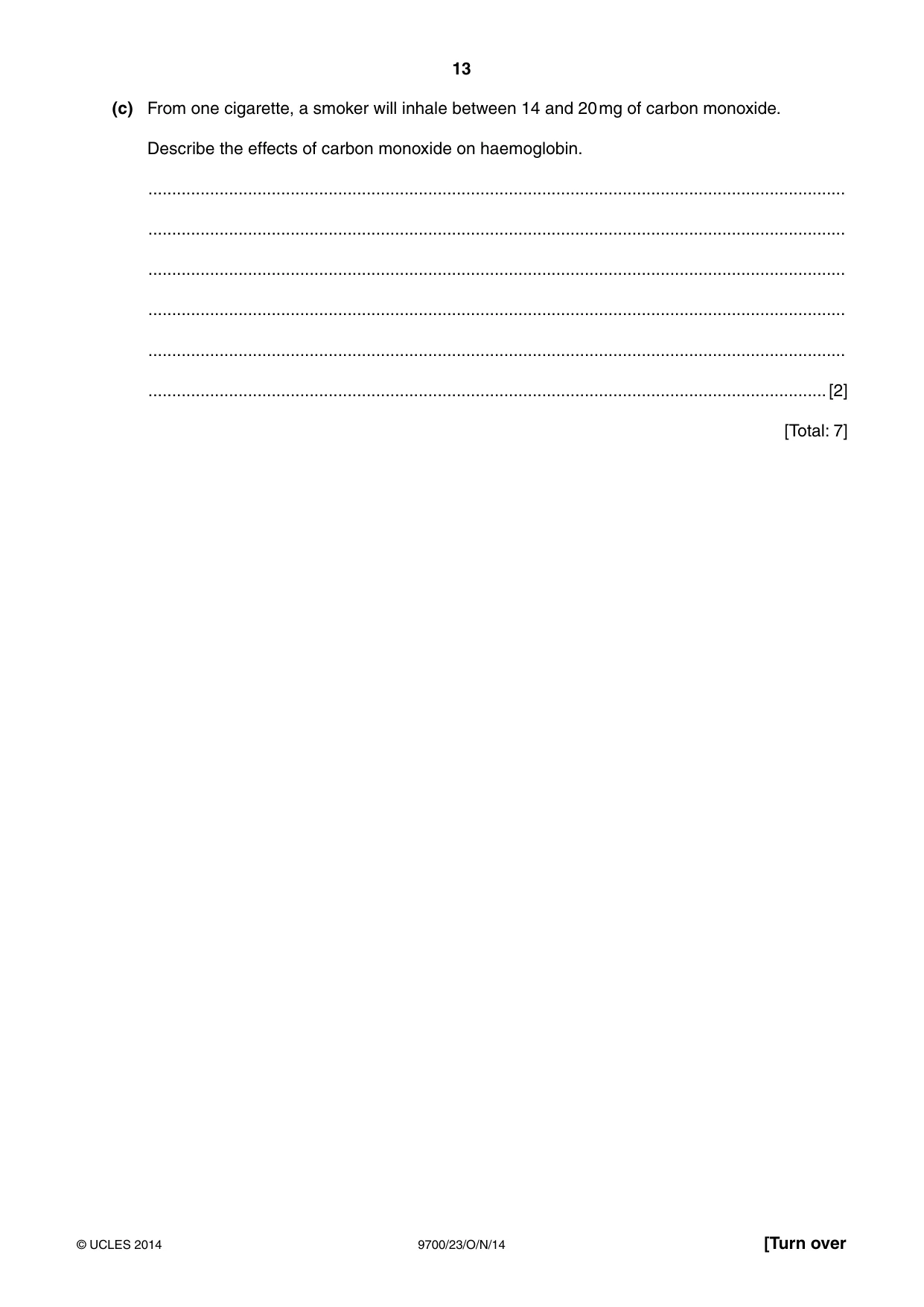
13 9700/23/O/N/14 © UCLES 2014 [Turn over (c) From one cigarette, a smoker will inhale between 14 and 20 mg of carbon monoxide. Describe the effects of carbon monoxide on haemoglobin. … … … … … …[2] [Total: 7]
Question paper, page 14
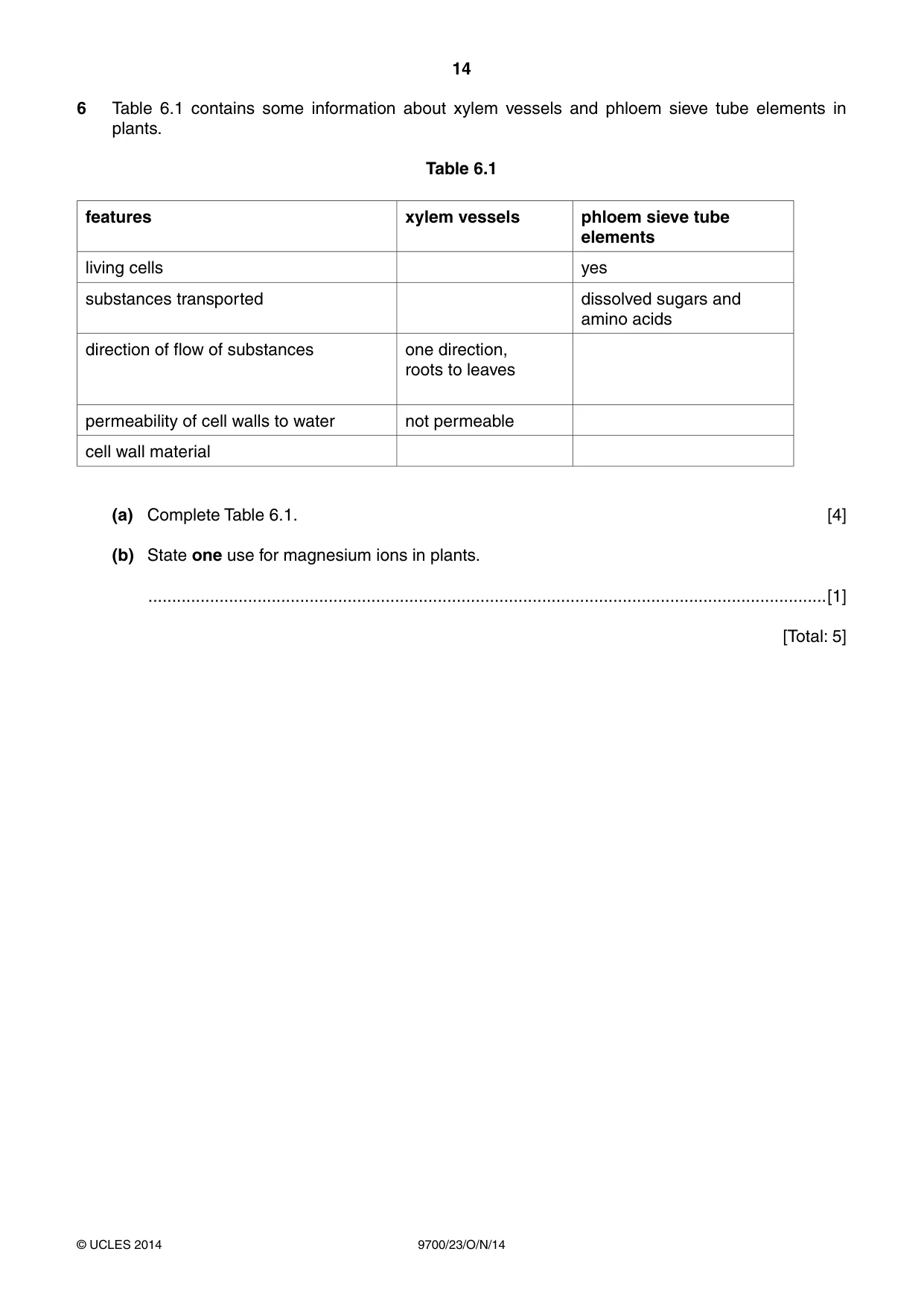
14 9700/23/O/N/14 © UCLES 2014 6 Table 6.1 contains some information about xylem vessels and phloem sieve tube elements in plants. Table 6.1 features xylem vessels phloem sieve tube elements living cells yes substances transported dissolved sugars and amino acids direction of flow of substances one direction, roots to leaves permeability of cell walls to water not permeable cell wall material (a) Complete Table 6.1. [4] (b) State one use for magnesium ions in plants. …[1] [Total: 5]
Question paper, page 15
15 9700/23/O/N/14 © UCLES 2014 BLANK PAGE
Question paper, page 16
16 9700/23/O/N/14 © UCLES 2014 Copyright Acknowledgements: Fig. 1.1 © GERD GUENTHER/SCIENCE PHOTO LIBRARY. Fig. 2.1 a © HERMANN EISENBEISS/SCIENCE PHOTO LIBRARY. Fig. 2.1 b © Francisco Martinez / Alamy. Fig. 4.1 © KENNETH EWARD/BIOGRAFX/SCIENCE PHOTO LIBRARY. Fig. 5.1 © CNRI/SCIENCE PHOTO LIBRARY. Permission to reproduce items where third-party owned material protected by copyright is included has been sought and cleared where possible. Every reasonable effort has been made by the publisher (UCLES) to trace copyright holders, but if any items requiring clearance have unwittingly been included, the publisher will be pleased to make amends at the earliest possible opportunity. Cambridge International Examinations is part of the Cambridge Assessment Group. Cambridge Assessment is the brand name of University of Cambridge Local Examinations Syndicate (UCLES), which is itself a department of the University of Cambridge. BLANK PAGE
Mark scheme, page 1
® IGCSE is the registered trademark of Cambridge International Examinations. CAMBRIDGE INTERNATIONAL EXAMINATIONS Cambridge International Advanced Subsidiary and Advanced Level MARK SCHEME for the October/November 2014 series 9700 BIOLOGY 9700/23 Paper 2 (AS Structured Questions), maximum raw mark 60 This mark scheme is published as an aid to teachers and candidates, to indicate the requirements of the examination. It shows the basis on which Examiners were instructed to award marks. It does not indicate the details of the discussions that took place at an Examiners’ meeting before marking began, which would have considered the acceptability of alternative answers. Mark schemes should be read in conjunction with the question paper and the Principal Examiner Report for Teachers. Cambridge will not enter into discussions about these mark schemes. Cambridge is publishing the mark schemes for the October/November 2014 series for most Cambridge IGCSE®, Cambridge International A and AS Level components and some Cambridge O Level components.
Mark scheme, page 2
Page 2 Mark Scheme Syllabus Paper Cambridge International AS/A Level – October/November 2014 9700 23 © Cambridge International Examinations 2014 Mark scheme abbreviations: ; separates marking points / alternative answers for the same point R reject A accept (for answers correctly cued by the question, or by extra guidance) AW alternative wording (where responses vary more than usual) underline actual word given must be used by candidate (grammatical variants accepted) max indicates the maximum number of marks that can be given ora or reverse argument mp marking point (with relevant number) ecf error carried forward I ignore AVP alternative valid point (examples given)
Mark scheme, page 3
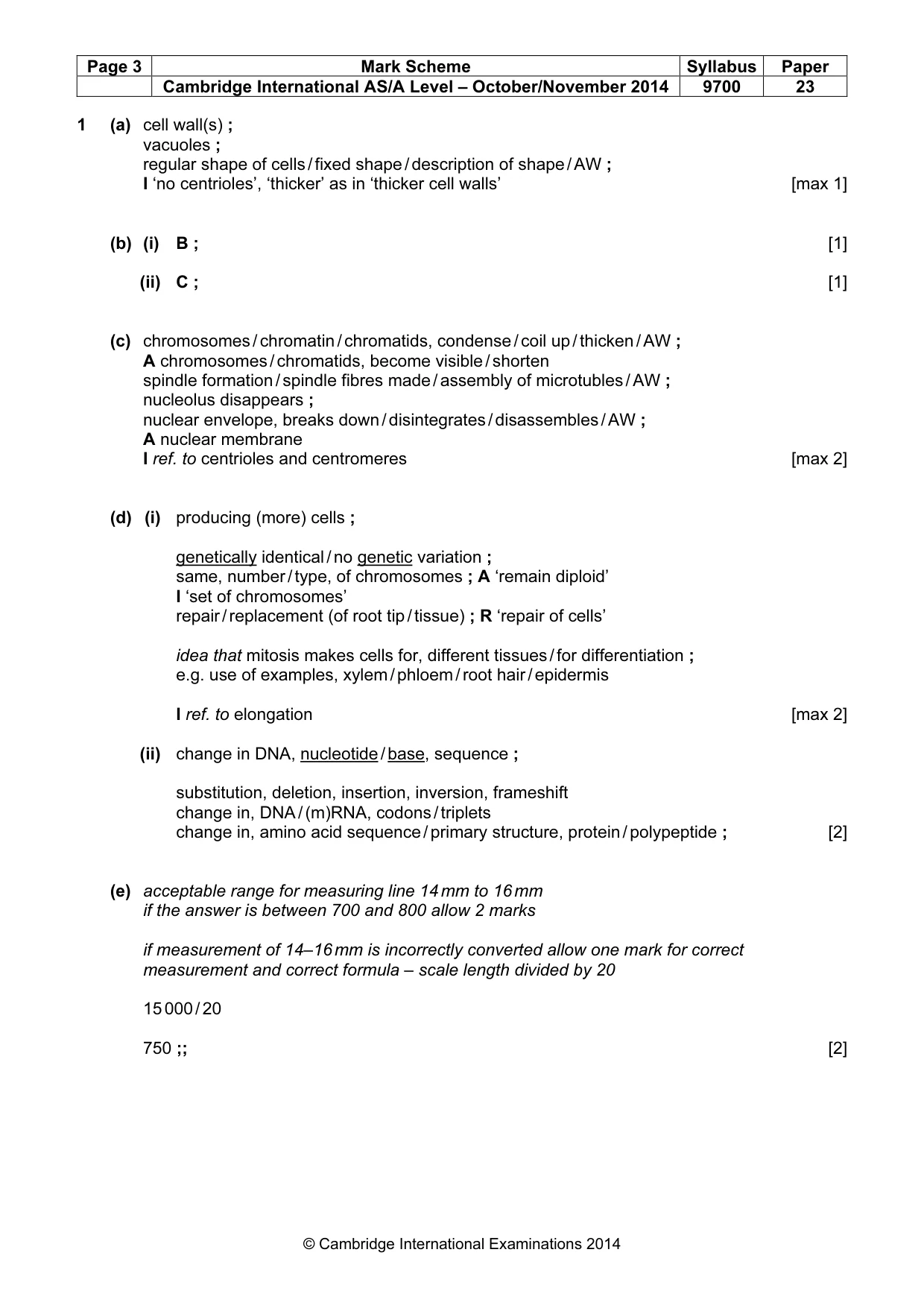
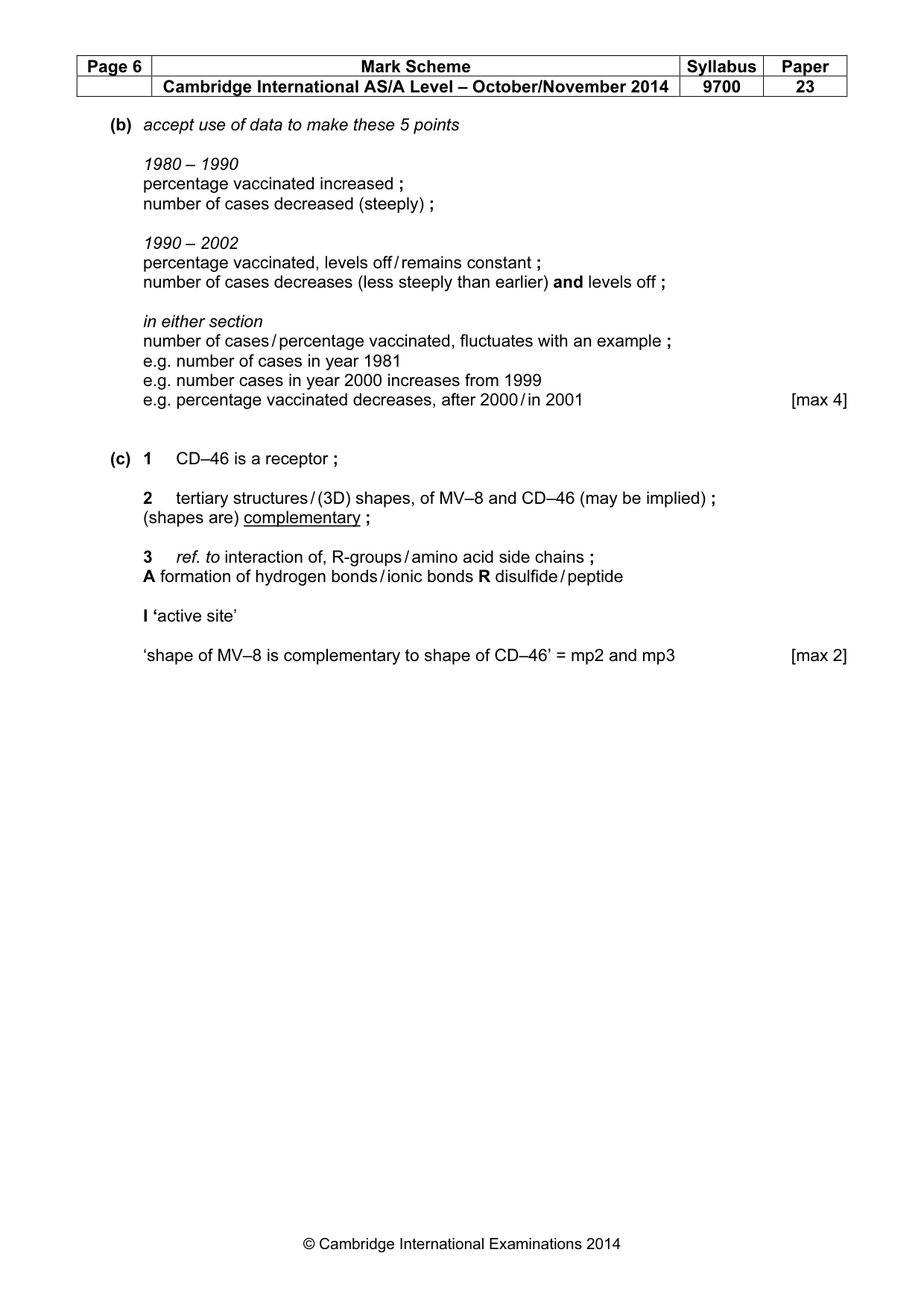
Page 3 Mark Scheme Syllabus Paper Cambridge International AS/A Level – October/November 2014 9700 23 © Cambridge International Examinations 2014 1 (a) cell wall(s) ; vacuoles ; regular shape of cells / fixed shape / description of shape / AW ; I ‘no centrioles’, ‘thicker’ as in ‘thicker cell walls’ [max 1] (b) (i) B ; [1] (ii) C ; [1] (c) chromosomes / chromatin / chromatids, condense / coil up / thicken / AW ; A chromosomes / chromatids, become visible / shorten spindle formation / spindle fibres made / assembly of microtubles / AW ; nucleolus disappears ; nuclear envelope, breaks down / disintegrates / disassembles / AW ; A nuclear membrane I ref. to centrioles and centromeres [max 2] (d) (i) producing (more) cells ; genetically identical / no genetic variation ; same, number / type, of chromosomes ; A ‘remain diploid’ I ‘set of chromosomes’ repair / replacement (of root tip / tissue) ; R ‘repair of cells’ idea that mitosis makes cells for, different tissues / for differentiation ; e.g. use of examples, xylem / phloem / root hair / epidermis I ref. to elongation [max 2] (ii) change in DNA, nucleotide / base, sequence ; substitution, deletion, insertion, inversion, frameshift change in, DNA / (m)RNA, codons / triplets change in, amino acid sequence / primary structure, protein / polypeptide ; [2] (e) acceptable range for measuring line 14 mm to 16 mm if the answer is between 700 and 800 allow 2 marks if measurement of 14–16 mm is incorrectly converted allow one mark for correct measurement and correct formula – scale length divided by 20 15 000 / 20 750 ;; [2]
Mark scheme, page 4
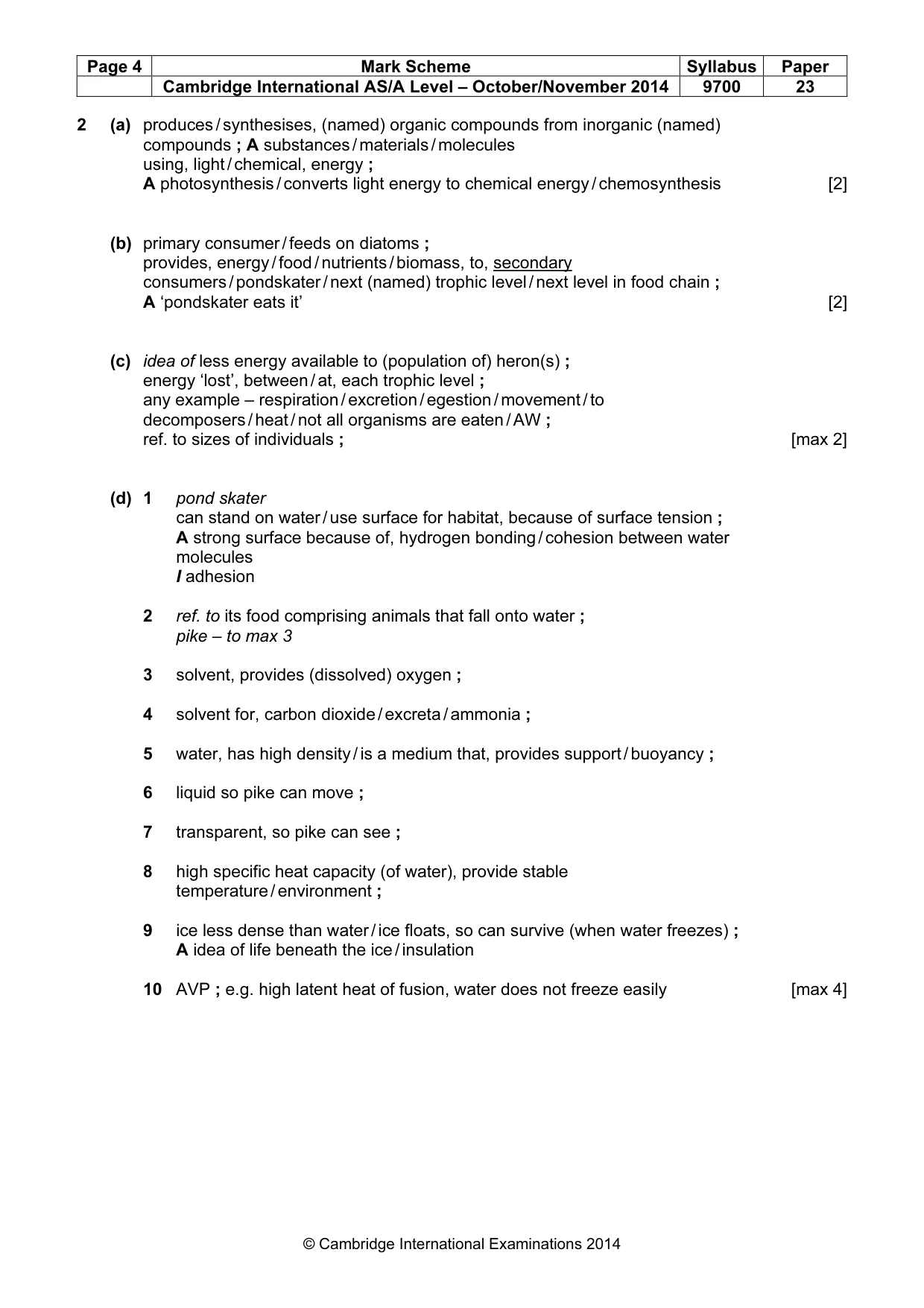
Page 4 Mark Scheme Syllabus Paper Cambridge International AS/A Level – October/November 2014 9700 23 © Cambridge International Examinations 2014 2 (a) produces / synthesises, (named) organic compounds from inorganic (named) compounds ; A substances / materials / molecules using, light / chemical, energy ; A photosynthesis / converts light energy to chemical energy / chemosynthesis [2] (b) primary consumer / feeds on diatoms ; provides, energy / food / nutrients / biomass, to, secondary consumers / pondskater / next (named) trophic level / next level in food chain ; A ‘pondskater eats it’ [2] (c) idea of less energy available to (population of) heron(s) ; energy ‘lost’, between / at, each trophic level ; any example – respiration / excretion / egestion / movement / to decomposers / heat / not all organisms are eaten / AW ; ref. to sizes of individuals ; [max 2] (d) 1 pond skater can stand on water / use surface for habitat, because of surface tension ; A strong surface because of, hydrogen bonding / cohesion between water molecules I adhesion 2 ref. to its food comprising animals that fall onto water ; pike – to max 3 3 solvent, provides (dissolved) oxygen ; 4 solvent for, carbon dioxide / excreta / ammonia ; 5 water, has high density / is a medium that, provides support / buoyancy ; 6 liquid so pike can move ; 7 transparent, so pike can see ; 8 high specific heat capacity (of water), provide stable temperature / environment ; 9 ice less dense than water / ice floats, so can survive (when water freezes) ; A idea of life beneath the ice / insulation 10 AVP ; e.g. high latent heat of fusion, water does not freeze easily [max 4]
Mark scheme, page 5
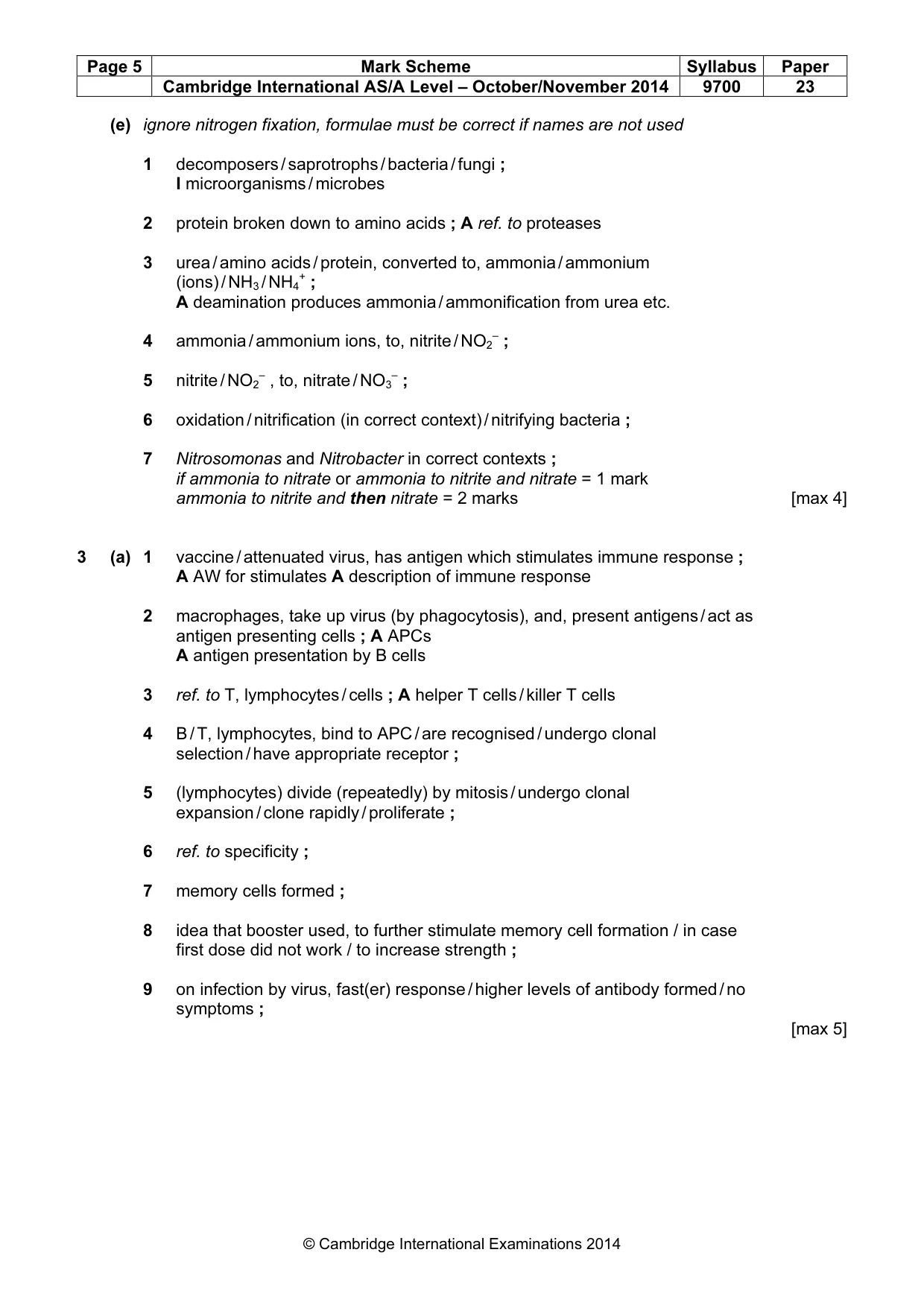
Page 5 Mark Scheme Syllabus Paper Cambridge International AS/A Level – October/November 2014 9700 23 © Cambridge International Examinations 2014 (e) ignore nitrogen fixation, formulae must be correct if names are not used 1 decomposers / saprotrophs / bacteria / fungi ; I microorganisms / microbes 2 protein broken down to amino acids ; A ref. to proteases 3 urea / amino acids / protein, converted to, ammonia / ammonium (ions) / NH3 / NH4 + ; A deamination produces ammonia / ammonification from urea etc. 4 ammonia / ammonium ions, to, nitrite / NO2 – ; 5 nitrite / NO2 – , to, nitrate / NO3 – ; 6 oxidation / nitrification (in correct context) / nitrifying bacteria ; 7 Nitrosomonas and Nitrobacter in correct contexts ; if ammonia to nitrate or ammonia to nitrite and nitrate = 1 mark ammonia to nitrite and then nitrate = 2 marks [max 4] 3 (a) 1 vaccine / attenuated virus, has antigen which stimulates immune response ; A AW for stimulates A description of immune response 2 macrophages, take up virus (by phagocytosis), and, present antigens / act as antigen presenting cells ; A APCs A antigen presentation by B cells 3 ref. to T, lymphocytes / cells ; A helper T cells / killer T cells 4 B / T, lymphocytes, bind to APC / are recognised / undergo clonal selection / have appropriate receptor ; 5 (lymphocytes) divide (repeatedly) by mitosis / undergo clonal expansion / clone rapidly / proliferate ; 6 ref. to specificity ; 7 memory cells formed ; 8 idea that booster used, to further stimulate memory cell formation / in case first dose did not work / to increase strength ; 9 on infection by virus, fast(er) response / higher levels of antibody formed / no symptoms ; [max 5]
Mark scheme, page 6
Page 6 Mark Scheme Syllabus Paper Cambridge International AS/A Level – October/November 2014 9700 23 © Cambridge International Examinations 2014 (b) accept use of data to make these 5 points 1980 – 1990 percentage vaccinated increased ; number of cases decreased (steeply) ; 1990 – 2002 percentage vaccinated, levels off / remains constant ; number of cases decreases (less steeply than earlier) and levels off ; in either section number of cases / percentage vaccinated, fluctuates with an example ; e.g. number of cases in year 1981 e.g. number cases in year 2000 increases from 1999 e.g. percentage vaccinated decreases, after 2000 / in 2001 [max 4] (c) 1 CD–46 is a receptor ; 2 tertiary structures / (3D) shapes, of MV–8 and CD–46 (may be implied) ; (shapes are) complementary ; 3 ref. to interaction of, R-groups / amino acid side chains ; A formation of hydrogen bonds / ionic bonds R disulfide / peptide I ‘active site’ ‘shape of MV–8 is complementary to shape of CD–46’ = mp2 and mp3 [max 2]
Mark scheme, page 7
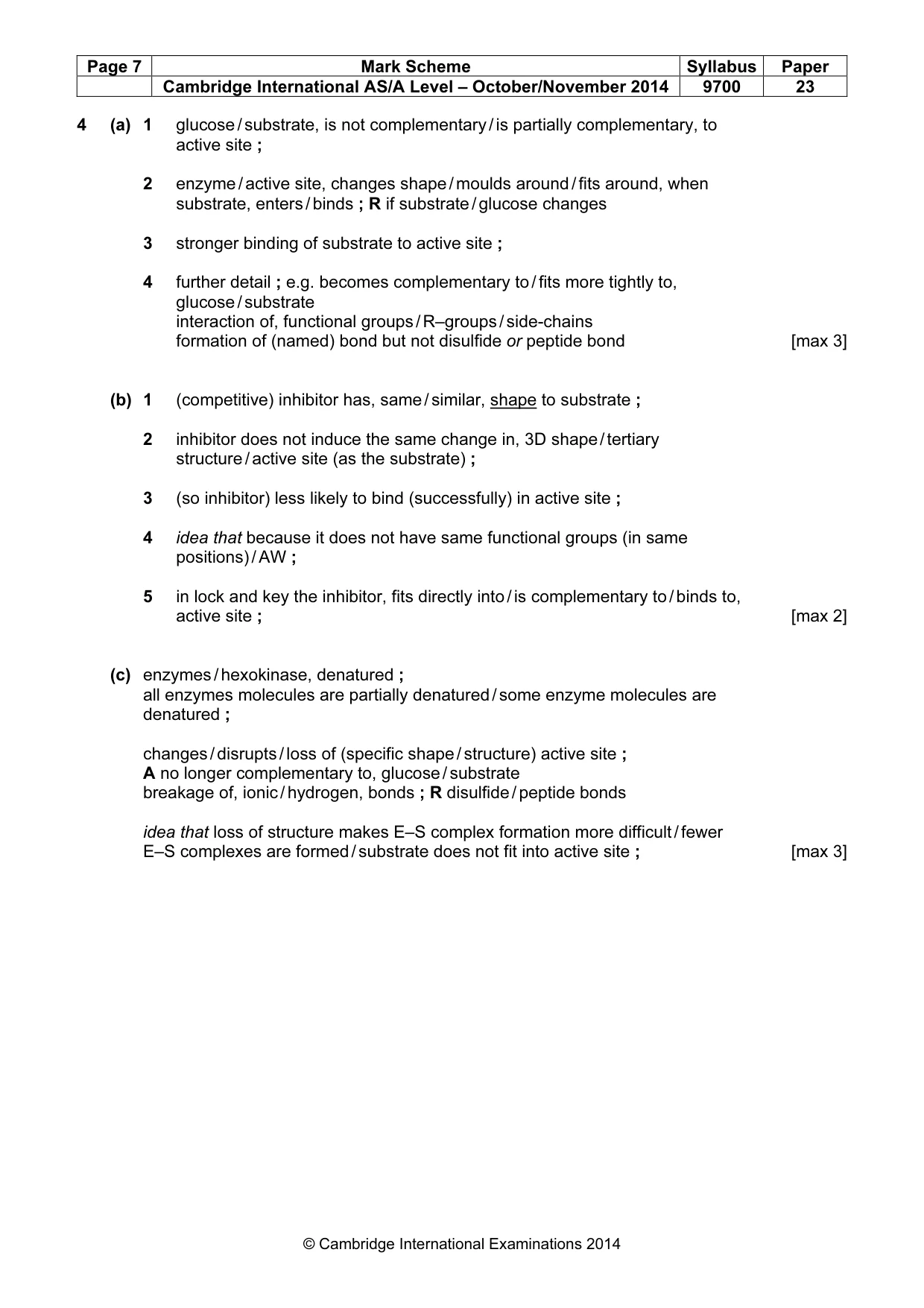
Page 7 Mark Scheme Syllabus Paper Cambridge International AS/A Level – October/November 2014 9700 23 © Cambridge International Examinations 2014 4 (a) 1 glucose / substrate, is not complementary / is partially complementary, to active site ; 2 enzyme / active site, changes shape / moulds around / fits around, when substrate, enters / binds ; R if substrate / glucose changes 3 stronger binding of substrate to active site ; 4 further detail ; e.g. becomes complementary to / fits more tightly to, glucose / substrate interaction of, functional groups / R–groups / side-chains formation of (named) bond but not disulfide or peptide bond [max 3] (b) 1 (competitive) inhibitor has, same / similar, shape to substrate ; 2 inhibitor does not induce the same change in, 3D shape / tertiary structure / active site (as the substrate) ; 3 (so inhibitor) less likely to bind (successfully) in active site ; 4 idea that because it does not have same functional groups (in same positions) / AW ; 5 in lock and key the inhibitor, fits directly into / is complementary to / binds to, active site ; [max 2] (c) enzymes / hexokinase, denatured ; all enzymes molecules are partially denatured / some enzyme molecules are denatured ; changes / disrupts / loss of (specific shape / structure) active site ; A no longer complementary to, glucose / substrate breakage of, ionic / hydrogen, bonds ; R disulfide / peptide bonds idea that loss of structure makes E–S complex formation more difficult / fewer E–S complexes are formed / substrate does not fit into active site ; [max 3]
Mark scheme, page 8
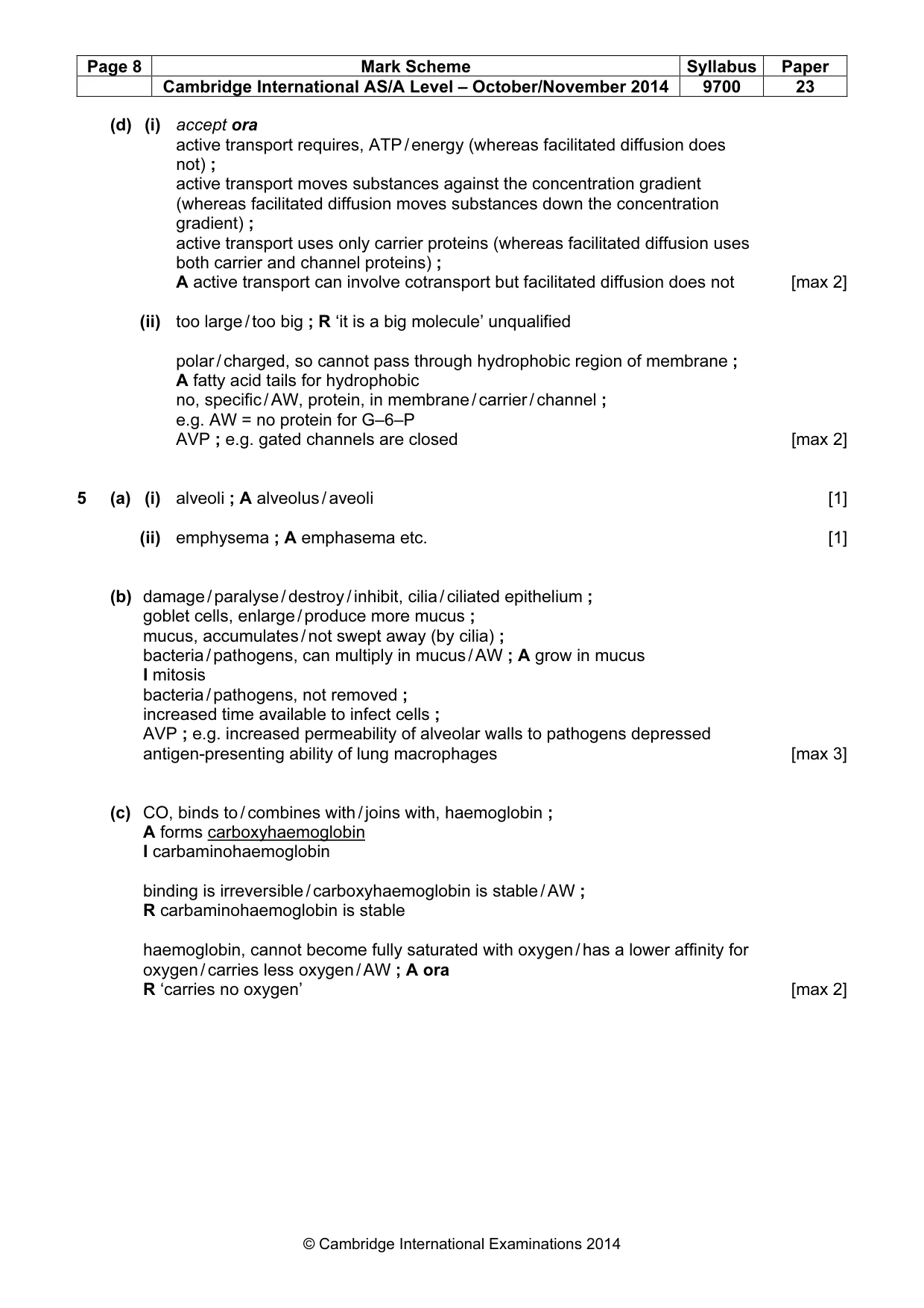
Page 8 Mark Scheme Syllabus Paper Cambridge International AS/A Level – October/November 2014 9700 23 © Cambridge International Examinations 2014 (d) (i) accept ora active transport requires, ATP / energy (whereas facilitated diffusion does not) ; active transport moves substances against the concentration gradient (whereas facilitated diffusion moves substances down the concentration gradient) ; active transport uses only carrier proteins (whereas facilitated diffusion uses both carrier and channel proteins) ; A active transport can involve cotransport but facilitated diffusion does not [max 2] (ii) too large / too big ; R ‘it is a big molecule’ unqualified polar / charged, so cannot pass through hydrophobic region of membrane ; A fatty acid tails for hydrophobic no, specific / AW, protein, in membrane / carrier / channel ; e.g. AW = no protein for G–6–P AVP ; e.g. gated channels are closed [max 2] 5 (a) (i) alveoli ; A alveolus / aveoli [1] (ii) emphysema ; A emphasema etc. [1] (b) damage / paralyse / destroy / inhibit, cilia / ciliated epithelium ; goblet cells, enlarge / produce more mucus ; mucus, accumulates / not swept away (by cilia) ; bacteria / pathogens, can multiply in mucus / AW ; A grow in mucus I mitosis bacteria / pathogens, not removed ; increased time available to infect cells ; AVP ; e.g. increased permeability of alveolar walls to pathogens depressed antigen-presenting ability of lung macrophages [max 3] (c) CO, binds to / combines with / joins with, haemoglobin ; A forms carboxyhaemoglobin I carbaminohaemoglobin binding is irreversible / carboxyhaemoglobin is stable / AW ; R carbaminohaemoglobin is stable haemoglobin, cannot become fully saturated with oxygen / has a lower affinity for oxygen / carries less oxygen / AW ; A ora R ‘carries no oxygen’ [max 2]
Mark scheme, page 9
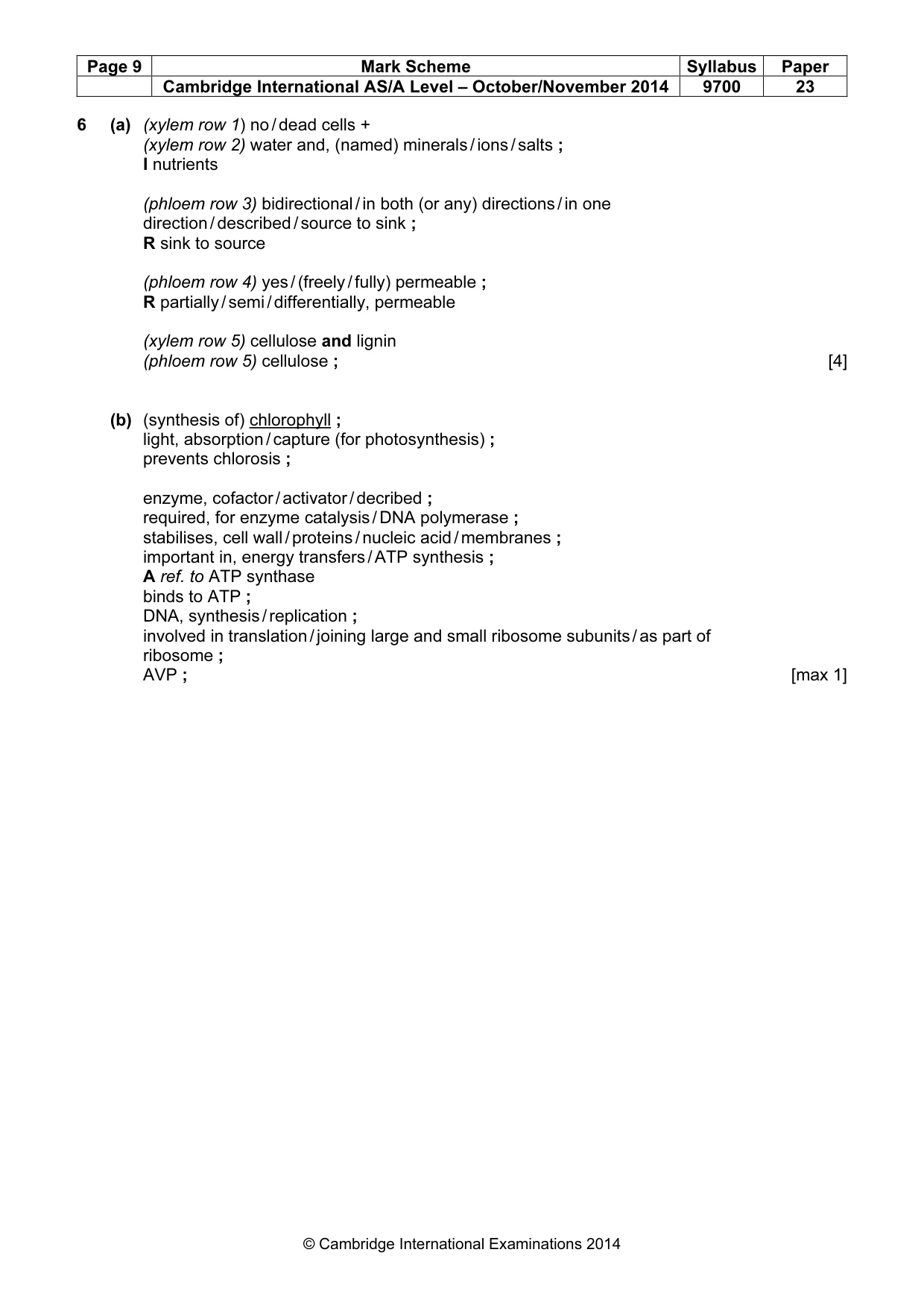
Page 9 Mark Scheme Syllabus Paper Cambridge International AS/A Level – October/November 2014 9700 23 © Cambridge International Examinations 2014 6 (a) (xylem row 1) no / dead cells + (xylem row 2) water and, (named) minerals / ions / salts ; I nutrients (phloem row 3) bidirectional / in both (or any) directions / in one direction / described / source to sink ; R sink to source (phloem row 4) yes / (freely / fully) permeable ; R partially / semi / differentially, permeable (xylem row 5) cellulose and lignin (phloem row 5) cellulose ; [4] (b) (synthesis of) chlorophyll ; light, absorption / capture (for photosynthesis) ; prevents chlorosis ; enzyme, cofactor / activator / decribed ; required, for enzyme catalysis / DNA polymerase ; stabilises, cell wall / proteins / nucleic acid / membranes ; important in, energy transfers / ATP synthesis ; A ref. to ATP synthase binds to ATP ; DNA, synthesis / replication ; involved in translation / joining large and small ribosome subunits / as part of ribosome ; AVP ; [max 1]
What you needed in this session
Cambridge’s own grade thresholds for 2014 Oct/Nov, Paper 2 · Variant 3. A higher threshold means an easier paper — the bar moves with how the cohort did.